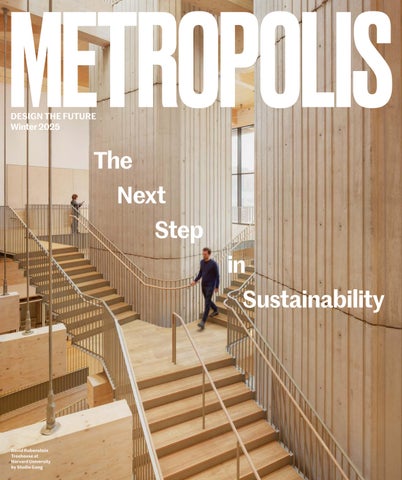
DESIGN THE FUTURE Winter 2025
The Next Step in Sustainability
David Rubenstein Treehouse at Harvard University by Studio Gang
Design Without Boundaries Creativity takes shape in our latest porcelain and ceramic tile collections. Rich in color. Bold in texture. Limitless in application. Designed to transform every surface—inside and out. E X P LO R E O U R L AT E ST P O RC E L A I N + C E R A M I C C O L L ECT I O N S O N S H AWC O N T R ACT.C O M
Contents 14 Contributors 16 In This Issue 20 METROPOLIS Sustainability Lab + Conference 40 Inside Autodesk’s Sustainability Vision—and Actions 44 Is Red Oak Glulam the Next Solution for Greener American Cities? 46 Tracing Mass Timber’s Full Life-Cycle
82 Boss Design’s New Label Changes How Designers Specify 87 What’s Next in Biophilic Design? 100 5 Projects That Let Nature In
104 A New Airport by Foster + Partners Is a Celebration of Culture and Light
104
A modular roof canopy supported by a tree-like structure defines Foster + Partners’ new Techo International Airport in Phnom Penh, Cambodia.
110 Calder Gardens Brings Stillness to Philadelphia’s Parkway 118 At This Portland Hotel, Wellness Is the Ultimate Sustainability
METROPOLIS® (ISSN 0279-4977), WINTER 2025, Vol. 45, No. 5 is published five times a year by SANDOW DESIGN GROUP, LLC, 3651 FAU Blvd., Boca Raton, FL 33431. Periodical postage paid in Boca Raton, FL, and at additional mailing offices. POSTMASTER: Send all UAA to CFS; NON-POSTAL AND MILITARY FACILITIES: send address corrections to METROPOLIS, PO Box 808, Lincolnshire, IL 60069-0808. Subscription department: (800) 344-3046 or email: metropolismag@omeda.com. Subscriptions: 1 year: $32.95 USA, $52.95 Canada, $69.95 in all other countries. Copyright © 2025 by SANDOW DESIGN GROUP, LLC. All rights reserved. Printed in the USA. Material in this publication may not be reproduced in any form without permission from the publisher. METROPOLIS is not responsible for the return of any unsolicited manuscripts or photographs.
6
METROPOLIS
WINTER 2025
COURTESY © NIGEL YOUNG / FOSTER + PARTNERS
Specify Sourcebook: 51 The Best Products and Materials of 2025
Know New Plastic Each Varia Texture panel diverts an equivalent of 3,295 water bottles from the landfill.
3-form.com/knownewplastic
Contents
127 METROPOLIS Planet Positive Awards 2025
136 ekoa by Lingrove, a Planet Positive Awards winner in the Wallcovering category, is made from rapidly-renewable flax.
128 Projects 136 Products
COURTESY LINGROVE
140 People 144 Innovation
8
METROPOLIS
WINTER 2025
Come home to the colors of nature.
Photographed on location at ©2025 KOHLER CO.
Contents 180 Simon Starling’s 2024 solo show Houseboat for Ho (Presented by the Starman) at The Modern Institute in Glasgow featured a cross-cultural installation created with Danish thatchers and Bolivian reed-boat makers.
Now in its second season, the Architizer Vision Awards recognizes excellence in architectural representation shaping how we understand design today.
154 Harvard’s Next Big Urban Experiment
The Enterprise Research Campus draws on the talents of Henning Larsen, Marlon Blackwell Architects, MVRDV, SCAPE, Utile, and Studio Gang.
164 A State-of-the-Art Home for Seafood
3XN’s new Sydney Fish Market, with generous public spaces and a sweeping mass timber roof, is set to be the city’s next big tourist destination.
10
METROPOLIS
172 CannonDesign Remakes California’s First LargeScale Sustainable Building
The renovation of a landmark project by Sim Van der Ryn shows what sustainable strategies have stood the test of time—and what ideas have fallen by the wayside.
180 Thatch—the Past and Future of Green Building?
Architects are rediscovering the potential of reeds and thatch through projects that sequester carbon—and help restore wetlands.
190 Sources 192 Index
ON THE COVERS: Top: Designed by Studio Gang, Harvard University’s David Rubenstein Treehouse anchors the Enterprise Research Campus with its mass-timber structure. Bottom: Inside the Treehouse, exposed beams and glulam columns frame a network of platforms, bridges, and stairs. Photos: © Jason O’Rear courtesy Studio Gang WINTER 2025
COURTESY © SIMON STARLING
151 The 2025 Architizer Vision Awards Winners
Silica Trust the Original. Enjoy the Ease.
MomentumTextilesandWalls.com
SANDOW DESIGN GROUP CHIEF EXECUTIVE OFFICER Erica Holborn
EDITORIAL
PRESIDENT Bobby Bonett CHIEF OPERATING OFFICER Michael Shavalier CHIEF DESIGN OFFICER Cindy Allen
EDITOR IN CHIEF Avinash Rajagopal EXECUTIVE VICE PRESIDENT AND DESIGN FUTURIST AJ Paron DESIGN DIRECTOR Travis M. Ward SENIOR EDITOR AND PROJECT MANAGER Lauren Volker
VICE PRESIDENT, DIGITAL Caroline Davis
SENIOR EDITOR AND ENGAGEMENT MANAGER Francisco Brown
VICE PRESIDENT, BUSINESS DEVELOPMENT Laura Steele
ASSOCIATE EDITOR AND RESEARCHER Jaxson Stone
VICE PRESIDENT, FINANCE Jake Galvin
DESIGNER Robert Pracek PROGRAMS COORDINATOR AND ASSISTANT EDITOR Dinky Asrani COPY EDITOR Don Armstrong FACT-CHECKER Anna Zappia EDITORS AT LARGE Verda Alexander, Sam Lubell
PUBLISHING
SENIOR DIRECTOR, VIDEO Steven Wilsey
SANDOW CHAIRMAN Adam I. Sandow CONTROLLER Emily Kaitz VICE PRESIDENT, HUMAN RESOURCES Lisa Silver Faber DIRECTOR, INFORMATION TECHNOLOGY Joshua Grunstra
ADVERTISING DIRECTOR Tamara Stout tstout@sandowdesign.com 917.449.2845 METROPOLIS is a publication of SANDOW NATIONAL SALES DIRECTOR Rachel Pettit
3651 FAU Blvd. Boca Raton, FL 33431
ACCOUNT MANAGERS Julie Arkin jarkin@sandowdesign.com 917.837.1344 Meredith Barberich meredith.barberich@sandowdesign.com Gregory Kammerer gkammerer@sandowdesign.com 646.824.4609 Laury Kissane lkissane@sandowdesign.com 770.791.1976 Julie McCarthy jmccarthy@sandowdesign.com 847-567-7545 Colin Villone colin.villone@sandowdesign.com 917.216.3690
info@metropolismag.com 917.934.2800 FOR SUBSCRIPTIONS OR SERVICE 800.344.3046 customerservice@metropolismagazine.net
PRINT OPERATIONS MANAGER Olivia Padilla
MARKETING & EVENTS DIRECTOR, PROGRAMS & PARTNERSHIPS Kelly Allen kkriwko@sandowdesign.com DIRECTOR, CLIENT STRATEGY Kasey Campbell SENIOR DIRECTOR, MARKETING OPERATIONS Rachel Senatore DIRECTOR, CREATIVE SERVICES Carly Colonnese GRAPHIC DESIGNER, CREATIVE SERVICES Paige Miller
SANDOW was founded by visionary entrepreneur Adam I. Sandow in 2003, with the goal of reinventing the traditional publishing model. Today, SANDOW powers the design, materials, and luxury industries through innovative content, tools, and integrated solutions. Its diverse portfolio of assets includes LUXE INTERIORS + DESIGN, INTERIOR DESIGN, METROPOLIS, and DESIGNTV by SANDOW; ThinkLab, a research and strategy firm; and content services brands, including The Agency by SANDOW, a full-scale digital marketing agency, The Studio by SANDOW, a video production studio, and SURROUND, a podcast network and production studio. SANDOW is a key supporter and strategic partner to NYCxDESIGN, a not-for-profit organization committed to empowering and promoting the
METROPOLISMAG.COM @metropolismag
city’s diverse creative community. In 2019, Adam Sandow launched Material Bank, the world’s largest marketplace for searching, sampling,
A MORE SUSTAINABLE METROPOLIS
and specifying architecture, design, and construction materials.
As part of the SANDOW carbon impact initiative, all publications, including METROPOLIS, are now printed using soy-based inks, which are biobased and derived from renewable sources. This continues SANDOW’s
THIS MAGAZINE IS RECYCLABLE. Please recycle when you’re done with it. We’re all in this together.
ongoing efforts to address the environmental impact of its operations and media platforms. In addition, through a partnership with Keilhauer, all estimated carbon emissions for the printing and distribution of every print copy of METROPOLIS are offset with verified carbon credits. 12
METROPOLIS
WINTER 2025
Agyl Comfort that’s made to move.
With a soft, inviting shape, casters and an optional tablet, Agyl blends casual comfort with practical mobility. Designed by EOOS. Made by Keilhauer.
Certified Carbon Neutral FSC® Certified Wood BIFMA LEVEL® 3 Indoor Advantage™ Gold Greenhealth Approved™
14
REBECCA GREENWALD
LYDIA W. LEE
BRIAN LIBBY
Rebecca Greenwald is a writer, researcher, and strategist who works with landscape architecture and urban planning studios, artists, nonprofits, and philanthropies. She aims to elevate the work of cities and organizations committed to keeping our urban environments authentic, communal, equitable, and people-oriented amid significant political, economic, and cultural shifts. Greenwald also writes about urban sociology, cultural infrastructure, and public space for outlets including Bloomberg CityLab, METROPOLIS, Fast Company, and Next City. In this issue, Greenwald covers Calder Gardens (p. 110) in Philadelphia, where Piet Oudolf and Herzog & de Meuron’s design brings Alexander Calder’s art into a contemplative, living sanctuary.
Lydia Lee writes about design and sustainability from the San Francisco Bay Area, where she also advocates for more bicycle lanes. She mentors aspiring op-ed writers through the OpEd Project and is the author of The Well-Designed Accessory Dwelling Unit: Fitting Great Architecture Into Small Spaces (Schiffer Publishing). In this issue, Lee revisits California’s first large-scale sustainable building—Sim Van der Ryn’s Gregory Bateson Building (p. 172)—through CannonDesign’s ambitious renovation and its lessons for today’s designers.
Brian Libby has spent the past 25 years as a Portland, Oregon–based architecture and arts journalist. He has contributed to METROPOLIS since 2001 and has also written for nine sections of The New York Times, as well as for The Wall Street Journal, The Atlantic, Dwell, The Architect’s Newspaper, and Oregon ArtsWatch, among others. He has also authored numerous architectural monographs. His forthcoming book, In Search of Portland: Exploring a Transforming City, will be published by Oregon State University Press in 2026. In this issue, Libby explores how LEVER Architecture’s Cascada Hotel and Spa (p. 118) in Portland defines a new era of health-centered, low-carbon hospitality.
COURTESY THE CONTRIBUTORS
CONTRIBUTORS
Average number of copies each issue during preceding 12 months:
Actual number of copies of single issue published nearest to filing date:
35,988
36,000
STATEMENT OF OWNERSHIP, MANAGEMENT AND CIRCULATION
15. The extent and nature of circulation:
(required by Act of August 12, 1970: Section 3685, Title 39, United States Code).
A. Total number of copies printed
1. Metropolis
(Net press run)
2. (ISSN: 6030-9000)
B. Paid circulation.
3. Filing date: 10/1/2025.
1. Mailed outside-county paid subscriptions.
19,495
18,344
4. Issue frequency: 5 times per year.
2. Mailed in-county paid subscriptions.
0
0
5. Number of issues published annually: 5.
3. Sales through dealers and carriers, street vendors and counter sales.
0
0
6. The annual subscription price is $32.95.
4. Paid distribution through other classes mailed through the USPS.
0
0
7. Complete mailing address of known office of publication: 3651 FAU Boulevard Boca Raton, FL 33431.
C. Total paid distribution.
19,495
18,344
8. Complete mailing address of headquarters or general business office of publisher: 3651 FAU Boulevard Boca Raton, FL 33431.
D. Free or nominal rate distribution (by mail and outside mail).
9. Full names and complete mailing addresses of publisher, editor, and managing editor.
1. Free or nominal Outside-County.
11,637
13,861
Publisher, Bobby Bonett, SANDOW, 3651 FAU Boulevard, Boca Raton, FL 33431.
2. Free or nominal rate in-county copies.
0
0
Editor, Avinash Rajagopal, SANDOW, 3651 FAU Boulevard, Boca Raton, FL 33431.
3. Free or nominal rate copies mailed at other Classes through the USPS.
0
0
Managing Editor, Avinash Rajagopal, SANDOW, 3651 FAU Boulevard, Boca Raton, FL 33431.
4. Free or nominal rate distribution outside the mail.
3,189
1,270
10. Owner: SANDOW; 3651 FAU Boulevard, Boca Raton, FL 33431.
E. Total free or nominal rate distribution.
14,826
15,131
11. Known bondholders, mortgages, and other security holders owning or holding 1 percent of more of total amount of bonds,
F. Total free distribution (sum of 15c and 15e).
34,321
33,475
mortgages or other securities: NONE.
G. Copies not Distributed.
1,667
2,525
12. Tax status: Has Not Changed During Preceding 12 Months.
H. Total (sum of 15f and 15g).
35,988
36,000
13. Publisher title: Metropolis.
I. Percent paid.
56.80%
54.80%
14. Issue date for circulation data below: Sep/Oct 2025.
16. Electronic Copy Circulation: A. Paid Electronic Copies.
3,045
1,789
B. Total Paid Print Copies (Line 15c) + Paid Electronic Copies (Line 16a).
22,540
20,133
C. Total Print Distribution (Line 15f) + Paid Electronic Copies (Line 16a).
37,366
35,264
D. Percent Paid (Both Print & Electronic Copies) (16b divided by 16c x 100).
60.32%
57.09%
I certify that 50% of all distributed copies (electronic and print) are paid Iabove nominal price: Yes. Report circulation on PS Form 3526-X worksheet 17. Publication of statement of ownership will be printed in the Nov/Dec 2025 issue of the publication. 18. Signature and title of editor, publisher, business manager, or owner: Bobby Bonett.I certify that all information furnished on this form is true and complete. I understand that anyone who furnishes false or misleading information on this form or who omits material or information requested on the form may be subject to criminal sanction and civil actions.
POSITIVE IMPACT
COLLECTION
PVC-FREE
RESPONSE
Our bio-based resilient flooring is a heterogeneous, commercial-rated polyurethane made from plant-based oils and naturally occurring minerals. Prioritizing our sustainability commitment, this bio-based resilient collection contains no chlorine, plasticizers, solvents, harmful pollutants, or phthalates. JJFLOORING.COM
RESPONSE
REACTION
16
IN THIS ISSUE
Biophilia informed the design of Google’s Gradient Canopy building in Mountain View, California, which achieved Living Building Challenge Petal certification. Read more about the overlap between biophilic and regenerative design on p. 94
“UNFORTUNATELY, MODERN SOCIETY has insufficiently supported the human need to affiliate with nature,” Yale University Professor Stephen Kellert wrote for METROPOLIS in 2015. Distilling decades of research into a succinct article titled “What Is and Is Not Biophilic Design,” this pioneering thinker emphasized the value of biophilia to human well-being. “We are just beginning to find that these environmentally impoverished habitats foster fatigue, symptoms of disease, and impaired performance, and the simple introduction of natural lighting, outside views, and vegetation can result in enhanced health and productivity.” In the decade since he wrote those words, biophilic design has expanded its ambitions. Its promise of reconciling buildings and nature has captured the attention of architects and designers worldwide. And a network of experts in science, sustainability, design, and architecture are urging the adoption of biophilic design not just as a way to make people healthier, but to help other life and planetary systems recuperate and regenerate. “We’re moving beyond buildings that mitigate harm toward architecture that performs like an ecosystem,” writes Erin Rovalo, vice president of community at Living Future and one of the seven leaders who helped us answer the question “What’s Next in Biophilic Design?” (p. 87). As we begin to consider this larger scope for Kellert’s ideas, we’re also rediscovering that early attempts to make buildings more sustainable ended up looking a lot like biophilic design. When CannonDesign took on the task of renovating California’s first large-scale sustainable building (p. 172) it found that the METROPOLIS
innovative architect Sim Van der Ryn had relied heavily on nature-inspired systems and natural materials in 1981 to help the 330,000-square-foot Gregory Bateson Building perform: a night flush system for heat; operable louvers; and a plant-filled, un-air-conditioned atrium. “In short, more than 40 years ago, the Bateson Building was designed to foster biophilia,” our reporter Lydia Lee writes. It’s this kind of thinking about both the experience of natural systems and their tangible interactions with buildings that has been finely engineered in 3XN’s design of the new Sydney Fish Market (“A State-of-the-Art Home for Seafood,” p. 164) or harnessed in the form, materiality, and spirit of the Studio Gang–designed David Rubenstein Treehouse at Harvard University (“Harvard's Next Big Urban Experiment,” p. 154). In fact, just look at the 42 winners and ten honorable mentions in the 2025 METROPOLIS Planet Positive Awards (p. 127) and you will see how biophilia in fact suffuses all the work architects and interior designers are doing today to make a positive impact in the world. Ten years after we first had the privilege of publishing Kellert’s ideas, METROPOLIS is gathering all our best reporting and coverage of the design approach he championed in an updated version of “What Is and Is not Biophilic Design.” You can find his original essay as well as project case studies, reporting, and thought leadership at metropolismag.com/biophilic-design. Inspired by his vision, we can remake the built environment into something more nurturing, sustaining, and organic to this planet’s systems. Happy New Year! —Avinash Rajagopal, editor in chief WINTER 2025
COURTSEY ERIN ROVALO
The Power of Biophilia
The art of connection. Crux combines the natural warmth of wood with the stability of steel, featuring stackable arm and armless café chairs, smooth-rolling casters, bar- and counter-height stools, and matching tables in all three heights.
DIVISION12.COM
SPONSORED CONTENT
Top Left: Designtex Biophilic Collection; Below: Anna Elisabeth Collection
Crypton offers the trifecta of color, pattern, and performance According to a survey by the research experts at Thinklab, designers are asking for more color and more pattern in performance fabrics. Enter the inventor of the category, Crypton, producer of the industry’s most specified fabric in the toughest commercial environments, and the 30-year-strong guiding force behind the largest and most trusted textile brands, such as Burch, Designtex, Kravet Momentum Textiles & Wallcovering, and Stinson. Whether for hospitality, healthcare, education, senior living, or workplace, designers can go to these brands and ask for Crypton by name to receive durable, stain-resistant, and aspirational indoor performance fabrics made with Crypton’s scientific advances. All Crypton offerings are Greenguard Gold–certified and free of harmful chemicals like PFAS, and many of the new partner collections are made at Crypton Mills in North Carolina, supporting American-made production and sustainability. Recent highlights include Montage Weaves, a textural and playful series by Kravet Contract; Designtex’s wellness-oriented Biophilia line; and the hospitality-ready and plentiful (more than 180 SKUs!) Anna Elisabeth Crypton Contract collection.
20
CIRCULARITY IN PRODUCTS
METROPOLIS Sustainability Lab + Conference The inaugural event brought industry leaders together under the theme "SYNERGY" to envision a resilient, regenerative built environment. AT THE NEW SCHOOL IN NEW YORK CITY, the first-ever METROPOLIS Sustainability Lab + Conference brought together more than 200 architects, designers, clients, students, and industry leaders to explore the power of collaboration in shaping a sustainable built environment. This year’s theme, SYNERGY, highlighted how collective innovation drives meaningful change across sectors—from health care and workplace to education METROPOLIS
and development. The program featured dynamic panels, workshops, and keynotes, including Alloy Development CEO Jared Della Valle, alongside the first-ever NYC Sustainability Lab, showcasing 20 partner exhibits (shown on these pages) and an installation by the Healthy Materials Lab at Parsons. Together, the conversations and activations offered a vision for how, through shared purpose and thoughtful design, we can work to create a more resilient and regenerative future. M
|
HEALTHY MATERIALS
ALL IMAGES COURTESY THE MANUFACTURERS
ARPER CATIFA CARTA Catifa Carta is a reinterpretation of Arper’s original iconic design, the Catifa 53. Its seat is crafted from PaperShell’s revolutionary, namesake material, which ingeniously transforms discarded offcuts of deceased trees into durable craft paper, harnessing the carbon dioxide the tree retained throughout its life, contributing to a more environmentally conscious production cycle. arper.com
WINTER 2025
21
CIRCULARITY IN PRODUCTS
|
HEALTHY MATERIALS
ALL IMAGES COURTESY THE MANUFACTURERS
AUTEX ACOUSTICS REPET RePET is Autex Acoustics’ breakthrough pelletizing process, which transforms manufacturing offcuts into homogeneous PET pellets. These pellets then become SpinFix™ mounting clips, Frontier™ End Caps, and Vicinity™ Workstation Clamps. By capturing and reusing in-house waste material, RePET ensures resource recovery, reduces landfill, and minimizes reliance on virgin materials. autexacoustics.com
BORROWED EARTH SPACES Borrowed Earth Spaces is a comprehensive solution and sustainability initiative by Borrowed Earth. By carrying a single material palette across the project, the company reduces waste, maximizes value, and creates a cohesive aesthetic. Architects and designers select one or more stone blocks for a project, and Borrowed Earth takes full responsibility for using each block in its entirety as part of its Zero Waste Initiative. From tiles and panels to tubs, vanities, fireplaces, and lighting, every piece of stone is transformed into a purposeful design element. borrowedearthcollaborative.com
22
METROPOLIS
WINTER 2025
SPONSORED CONTENT
Designing for Zero Waste Ruchika Grover Founder and CEO, Borrowed Earth
Borrowed Earth gives new life to leftover stone with Spaces.
MM: What perspectives or expertise outside your company were critical in shaping the Spaces initiative? RG: The initiative grew through dialogue with architects, designers, and builders who increasingly sought monolithic pieces—tubs, vanities, large-format panels—that typically left large remnants behind. Their input helped us see the necessity of creating a system where every fragment of stone has a purpose. MM: What makes this initiative a sustainability milestone for your company? RG: It transforms what used to be an inevitable waste problem into a closed-loop system. Instead of letting remnants sit indefinitely, Spaces ensures 100 percent utilization of stone blocks—from monumental installations to the smallest functional objects. MM: How does it contribute to healthier, more resilient environments?
Borrowed Earth’s Spaces initiative eliminates excess quarrying and fosters cohesion across architectural elements.
Spaces ensures
100% utilization of stone blocks
METROPOLIS Magazine: Tell us about a new product or product line you’re excited to highlight. What need does it address in the built environment? Ruchika Grover: Borrowed Earth Spaces is an initiative that reimagines how stone is used in projects. Instead of sourcing multiple materials, architects and designers select entire stone blocks, which we then transform holistically into walls, floors, baths, furniture, objects, and even bricks. This ensures zero waste, a unified material palette, and long-term sustainability. It addresses the urgent need for more responsible sourcing in the built environment.
RG: Natural stone, when responsibly sourced and minimally processed, offers non-toxic, durable, and low-VOC surfaces. By committing to full-block utilization, we reduce extraction cycles and environmental strain, allowing stone to be specified more responsibly in sensitive environments. In health care and education, this translates to longlasting, easy-to-maintain surfaces that minimize replacement cycles. In workplaces, the integration of stone elements can foster biophilic connections to nature, enhancing well-being and resilience. MM: Can you share an example of how it has been used successfully in a recent project? RG: In a recent residential project, an entire block of marble was selected under our Spaces program. From this single block, we created a monolithic bath, wall panels, flooring, fireplace surrounds, and a dining table. The approach not only ensured zero waste but also resulted in a space with a remarkable cohesive identity, where every element spoke the same geological language. ■
CIRCULARITY IN PRODUCTS
|
HEALTHY MATERIALS
CARNEGIE BIOBASED XOREL Biobased Xorel is a plant-based, PVC-free textile made from rapidly renewable sugarcane. With up to 91 percent biobased content and a carbon-positive footprint, it delivers durability, cleanability, and aesthetic versatility—without harmful finishes or chemicals. Ideal for wallcoverings, upholstery, and the rPET-based acoustic solution Xorel Artform, Biobased Xorel combines high performance with design flexibility across health care, hospitality, and education environments. carnegiefabrics.com 24
METROPOLIS
CLARUS GLASS WHITEBOARDS & DRY ERASE BOARD PRODUCTS Made in the USA from domestically sourced materials, Clarus products follow responsible manufacturing practices that reduce waste and emissions. Holding more than 43 product certifications, including Indoor Air Advantage Gold and Type III EPDs, Clarus delivers quality, transparency, and flexibility for responsible design. clarus.com WINTER 2025
ALL IMAGES COURTESY THE MANUFACTURERS
WINDFALL + CAMBIO CAMBIO MAGNETIC WALL SYSTEM Windfall + Cambio crafts wall panels, cladding, stair treads, and furniture from reclaimed, salvaged, and responsibly sourced wood. The company’s cladding products offer three installation methods: Sticks, a linear wood profile; Panels, prefinished architectural surfaces in a wide range of colors and textures; and its latest innovation, Cambio® by Windfall, a patented magnetic wall system designed for circularity—reusable, flexible, and waste conscious. windfall.design
SPONSORED CONTENT
Interface is 'all in' on its goal to be carbon negative by 2040, without offsets
Together for Impact Collaboration fuels Interface’s carbon negative innovations.
METROPOLIS Magazine: Tell us about a new product or product line you’re excited to highlight. What need does it address in the built environment? Mikhail Davis: We’re proud to spotlight our carbon negative carpet tile products that store more carbon than they emit. These high-performing products rely on bio-based and recycled content in the supply chain to achieve carbon negativity, and they help us make strides toward our goal of becoming carbon negative by 2040. These innovations address the urgent need for low-impact materials in the built environment and demonstrate how design can actively contribute to climate solutions.
IMAGE: = ©CHRISTOPHER PAYNE/ESTO
Interface's carbon negative carpet tile made with bio-based and recycled material delivers high performance without compromise.
MM: What perspectives or expertise outside your company were critical in shaping these products? MD: Since the early days of our transformation to becoming a purpose-driven company, we have learned to look to nature for inspiration in design—for our products, our material selection, and our partnerships. Biomimicry taught us that if we wanted to achieve our most ambitious targets, we would need to cooperate as much as we compete, so collaboration with suppliers and partners was essential. Their insights helped us reimagine raw material sourcing and manufacturing processes, enabling us to reduce Scope 3 emissions and expand circular solutions across our portfolio.
Mikhail Davis Director, Global Market Sustainability
MM: What makes these products a sustainability milestone for your company?
MD: They prove that carbon negative is possible—without offsets. This milestone redefines our sustainability strategy and sets a new standard for the industry. MM: How do they contribute to healthier, more resilient environments? MD: Experts agree that one of the biggest threats to public health in the 21st century is runaway climate change, so addressing the large-scale ecological challenges we face through our product supply chain benefits not only the building occupant but also the people who interact with our supply chain across the full lifespan of our products. They’re designed for durability, flexibility, and well-being—ideal for high-performance environments like schools, hospitals, and offices. MM: How do these products represent your company’s larger sustainability journey? MD: It’s the embodiment of our “All In” strategy— focused on avoiding, reducing, and storing carbon. Our target is to be carbon negative as a company, with no offsets, by 2040. This means storing more carbon in the products we sell than our business emits, and these products leverage over three decades of innovation to help us pursue our commitment to solving the climate crisis through bold, measurable action. M M : How do you see these innovations contributing to greater collaboration around sustainability in the years ahead? MD: We learned early on that to go as far as we aspired to, we had to get there together with partners in our supply chain and in our customer community. We’re currently measuring how our product could be carbon negative not only in the cradle-to-gate life stages but also throughout its use phase by partnering with customers to help them commit to renewable energy use and lower their operational impacts overall. By sharing our learnings and challenging others to go carbon negative, we aim to accelerate industrywide progress and inspire new partnerships rooted in climate action. ■
CIRCULARITY IN PRODUCTS
|
HEALTHY MATERIALS
FLOKK With Stylex, 9to5 Seating, HÅG, and Via Seating, Flokk brings together four distinct brands united by one vision: to design high-performance seating that’s better for people— and better for the planet. A market leader in Europe and now growing across America, Flokk creates furniture that meets the real needs of modern workspaces while actively reducing environmental impact. flokk.com
COLOMBO DESIGN GREEN MADE Green Made, an initiative by Colombo Design, showcases over 20 years of commitment to conserving nonrenewable resources and advancing eco-compatible production. Through innovations like water recovery systems, solvent-free powder coatings, and a shift from Chromium (VI) to safer Chromium (III), Colombo Design reduces emissions, waste, and environmental impact. colombodesignamerica.com
26
METROPOLIS
ALL IMAGES COURTESY THE MANUFACTURERS
DUVALTEX CLEAN IMPACT TEXTILES Duvaltex’s CLEAN IMPACT TEXTILES® reduce the environmental impact of waste, transforming how products are sourced, manufactured, and disposed of. Gather, made from upcycled ocean waste, is a biodegradable, multiuse style. Its soft-wool-like surface and rich color palette invite tactile exploration, enriching spaces and advancing a more sustainable future. cleanimpacttextiles.com WINTER 2025
SPONSORED CONTENT
Synergy in Hardware Colombo Design’s Kombo Box unites seamless aesthetics and sustainability.
METROPOLIS Magazine: Tell us about a new product or product line you’re excited to highlight. What need does it address in the built environment? Carlo Farina: The new Colombo Design Kombo Box, developed in collaboration with Krona Koblenz, features a magnetic European mortise case and strike available in all Colombo Design finishes, including the Mood RAL finishes. The magnetic mortise and strike faceplates provide a clean, screwfree appearance and allow for interchangeable options. With no lip on the magnetic strike, the frame maintains a sleek, uninterrupted look. As streamlined, seamless aesthetics continue to gain popularity, complete matching hardware with coordinating accessories has become increasingly in demand.
CF: Colombo Design partnered with Krona Koblenz to minimize product packaging, energy consumption, and transportation logistics. The key to success lies in combining smart, forward-thinking business ideas with sustainability. Carlo Farina Sales Manager, Colombo Design America
Colombo Design’s water treatment plant recovers
40% of water annually.
MM: What makes this initiative a sustainability milestone for your company?
CF: The sustainable choices Colombo has adopted under its Green Made initiative reflect our commitment to environmental certifications and values such as UNI ISO 14001 and UNI ISO 9001. These certifications govern our manufacturing processes, including powder coating, trivalent chrome plating, and zero-emission PVD finishes. Additional measures that reduce our environmental impact include the installation of a water treatment plant that recovers 40 percent of water annually, significantly decreasing hazardous waste pollution. MM: Can you share an example of how it has been used successfully in a recent project? CF: Although the Kombo Box is brand new to the market, we anticipate a strong launch. Based on research and variations of this product and finishes already available in our range, the Kombo Box expands the possibilities for hardware coordination. MM: How does it represent your company’s larger sustainability journey? CF: Reducing packaging, minimizing waste, and lowering energy consumption are all part of Colombo Design’s ongoing commitment to environmental sustainability. In 2026, we plan to culminate a green vision that began 25 years ago by achieving EPD (Environmental Product Declaration) certification.
MM: What perspectives or expertise outside your company were critical in shaping this product? CF: Innovation thrives through connection, not isolation. Throughout the years, we have listened to our customers and followed the market demand: the Kombo Box stands as a great example of this. At Colombo Design we aim to have customers, architects, designers, and end-users as our best partners.
MM: How does it contribute to healthier, more resilient environments?
MM: How do you see this innovation contributing to greater collaboration around sustainability in the years ahead? The Colombo Design Kombo Box offers a magnetic mortise case which allows for interchangeability of finishes.
CF: Colombo Design continues to welcome collaborations, ideas, and joint projects from all players in the market chain. ■
CIRCULARITY IN PRODUCTS
|
HEALTHY MATERIALS
INTERFACE “ALL IN” ON CARBON NEGATIVE Interface is going “All In” to solve the climate crisis with the bold ambition of becoming a carbon negative enterprise by 2040—without relying on offsets. Building on decades of progress, Interface is scaling innovations in product design, manufacturing, and supply chain engagement to reduce embodied carbon, store carbon in materials, and inspire others to do the same. interface.com 28
METROPOLIS
IMPACT ACOUSTIC BIOBASED PET Biobased PET plastic relies on crops, fertilizers, and land expansion, increasing biodiversity loss and nutrient pollution. Impact Acoustic’s solution transforms postconsumer PET bottles into high-performance acoustic materials, avoiding farmland use and reducing climate impact. This circular approach keeps resources in use and clearly outperforms biobased PET when assessed against planetary boundaries. Impact Acoustic’s PET solution lowers greenhouse gas emissions up to 60 percent compared with biobased PET. impactacoustic.com WINTER 2025
ALL IMAGES COURTESY THE MANUFACTURERS
FORMICA Formica Corporation is committed to long-term planning and industry-leading environmental stewardship. Formica is committed to becoming carbon neutral by 2030 with a clear road map—including a 25 percent reduction in CO2 emissions and a 10 percent cut in primary energy use by 2026, plus a 5 percent reduction in water footprint. The company also powers its Cincinnati and Saint-Jean-surRichelieu, Quebec, plants with 100 percent renewable electricity. formica.com
SPONSORED CONTENT
Designing with Nature Impact Acoustic's material innovations support ecology and human health.
while producing our product by absorbing excess nitrogen and phosphorus in the soil. MM: How does it contribute to healthier, more resilient environments?
Sven Erni CEO and Cofounder, Impact Acoustic
METROPOLIS Magazine: Tell us about a new product or product line you’re excited to highlight. What need does it address in the built environment?
MM: How does this product represent your company’s larger sustainability journey?
Sven Erni: We are developing environmentally friendly, innovative solutions that support bioremediation and advance ecological health and resource efficiency. Our latest material innovation—a product made from nettle fibers—continues this mission. Free of chlorine, hazardous components, and adhesives, the material supports the natural carbon cycle and can help decarbonize buildings, improve indoor air quality, and enable design that aligns with long-term sustainability goals. MM: What perspectives or expertise outside your company were critical in shaping the final solution? SE: Developing this product required expertise in bioremediation from environmental and biological engineering perspectives, which our interdisciplinary team was able to provide.
SE: The nettle is a natural product that has not been treated with pesticides, fertilizers, or intensive irrigation. This ensures the material is free from harmful chemicals, making it ideal for healthcare and education settings. Additionally, the nettle’s long-lasting properties make it suitable for outdoor environments such as traffic areas.
Impact Acoustic pushes material boundaries, transforming biomass waste into acoustic panels.
SE: This product exemplifies our innovative approach and commitment to leading the development of circular economy solutions in the acoustic industry. It joins other sustainable materials we use, including mycelium, fungi, algae, cork, wood, and cotton. This is a key step in our process, enabling us to incorporate the biological cycle into our products and help restore carbon to the soil. We are focused on providing solutions that are both environmentally friendly and innovative. These solutions support bioremediation and demonstrate our commitment to ecological health and resource efficiency. The material contains no chlorine, hazardous components, or adhesives, and supports the natural carbon cycle. In the built environment, it can be used to decarbonize buildings, improve indoor air quality, and support design that aligns with long-term sustainability goals. ■
MM: What makes this product a sustainability milestone for your company? SE: The nettle is a fast-growing, renewable plant, and using it as a fiber source is a sustainability milestone because it leverages the plant’s unique advantages. Nettles do not require specific growing conditions, do not need to be replanted after harvesting, and generally thrive with minimal intervention. This makes them exceptional compared to conventional crops— they can also contribute to bioremediation
Each day, Impact Acoustic turns
10,000+ plastic bottles into acoustic products.
|
HEALTHY MATERIALS
PALLAS THE REVE™ COLLECTION Bold dreams blossom into breathtaking reality when exquisite craftsmanship and ecological responsibility work in harmony. The Reve™ Collection features Hyphyn™—a revolutionary biodegradable performance vinyl. Engineered with a patented enzyme, Hyphyn™ breaks down by over 90 percent within 24 months in landfill conditions. pallastextiles.com 30
METROPOLIS
WINTER 2025
ALL IMAGES COURTESY THE MANUFACTURERS
CIRCULARITY IN PRODUCTS
SPONSORED CONTENT
Sustainability in Surfacing Formica Corporation delivers durable, long-lasting surfaces with a smaller environmental footprint.
METROPOLIS Magazine: What needs do Formica Corporation products address in the built environment? Christelle Locat-Rainville: Formica Corporation is committed to long-term planning and industry-leading environmental stewardship. We bring our signature products to market with sustainability built into every stage, while being transparent about our environmental footprint and our goals for reducing it. MM: What perspectives or expertise outside your company are critical in shaping Formica® Brand family of products? CL: Our sustainability center of excellence, Nemho, located in Weert, the Netherlands, plays a key role in developing carbon-reduction strategies shared across the Broadview Materials family of companies. Collaboration through Nemho allows us to align sciencebased targets, implement energy-saving projects across plants worldwide, and transparently report progress each year in our sustainability position paper.
reuse hot air from laminate-curing ovens, reducing reliance on natural gas. This project demonstrates how technology and collaboration can meaningfully shrink our carbon footprint while maintaining product quality. M M : How does your product contribute to healthier, more resilient environments? CL: By reducing our carbon emissions, we contribute to a healthier environment. We provide all related certifications for our products, including EPDs, HPDs, Green Guard Gold, USDA BioPreferred, Declare label, FSC, and more. Formica Group North America also participates in the mindful MATERIALS database and supports product transparency documentation.
Christelle Locat-Rainville Marketing Manager, Canada & Commercial Sustainability Leader, Formica Group North America
MM: How will your products contribute to greater collaboration around sustainability in the years ahead? CL: Formica Corporation works to reduce waste during manufacturing wherever possible, including by designing beautiful, long-lasting surfaces, as durability and longevity are key sustainability factors. Our approaches include: manufacturing with renewable energy—our plants in Evendale, Ohio, and St-Jean-sur-Richelieu, Quebec, rely on 100 percent renewable electricity; waste prevention—the extensive Formica® Laminate Collection offers highly durable, timeless patterns that future-proof design; and post-use disposal—our program with TerraCycle enables recycling of sample materials. ■
Formica is working toward a
25% reduction in CO2 emissions by 2026.
MM: What is a recent sustainability milestone for your company? CL: Formica Canada reduced greenhouse gas emissions by 5 percent through an innovative heat-recovery system at our St-Jean-surRichelieu, Quebec, plant. Working with engineering and environmental partners, we installed heat exchangers that capture and
From bold statement pieces to subtle accents, the Formica® Brand family offers versatile surfaces for any space.
CIRCULARITY IN PRODUCTS
|
HEALTHY MATERIALS
STEELCASE CIRCULAR BY STEELCASE Recently, Steelcase doubled the recycled content on average in its top seven task chairs in the Americas and has launched end-of-use services like Circular by Steelcase: Remade to prevent furniture from ending up in landfills. To be remanufactured, or “remade,” a product’s worn elements are disassembled and updated with new parts and finishes, while maintaining the original durability, functionality, and comfort. steelcase.com
ALL IMAGES COURTESY THE MANUFACTURERS
ROCKFON STONE WOOL TILES Rockfon’s Stone Wool Tiles provide a simple solution for the ceiling—with strong performance attributes that prioritize human health, environmental responsibility, and circular design. The company’s four key foundations are the Natural Power of Stone, Protecting the Outdoors, Fostering Health Indoors, and Enduring Circularity. rockfon.com
32
METROPOLIS
WINTER 2025
SPONSORED CONTENT
Designing for Circularity Dr. William Chizhovsky Founder & CEO, The Good Plastic Company
Specifying Growth can save up to
14 lbs of CO2 per square foot compared to the industry average.
The Good Plastic Company makes recycled materials practical and beautiful.
METROPOLIS Magazine: Tell us about a new product or product line you’re excited to highlight. What need does it address in the built environment? Dr. William Chizhovsky: Growth is a collection of eight Polygood® patterns: Cliff, Oyster, Pebble, Midnight, Pumice, Frost, Gossamer, and Haze. Developed with Gensler, the series is inspired by organic textures and natural elements. From the details of bark and leaves to sandy finishes and the luminescence of water, these patterns turn 100 percent recycled plastic into refined surfaces for design-driven projects. Growth answers the demand for circular, specification-grade surfaces in the built environment, providing a sustainable alternative to traditional stone and composite materials. MM: What perspectives or expertise outside your company were critical in shaping this product? WC: Collaboration with Gensler was essential. Their expertise in architecture and design ensured that Growth patterns meet real-world requirements for performance and design flexibility. They guided the balance between visual innovation and application needs, making the collection practical for horizontal uses such as countertops, vanities, and furniture, while maintaining its sustainability focus.
Growth transforms 100 percent recycled plastic into specification-grade surfaces that offer a sustainable alternative to traditional stone and composites.
MM: What makes this product a sustainability milestone for your company? WC: Each Polygood® pattern is made from 100 percent recycled plastic, reducing CO2 footprint and demonstrating true circularity,
yet the collection also proves that sustainable materials can be design-driven, durable, and widely applicable. Specifying Growth can save up to 14 lbs of CO2 per square foot compared to the industry average for surface materials, making Growth not only a design innovation but also a measurable low-carbon solution. MM: How does it contribute to healthier, more resilient environments? WC: Growth’s materials are non-toxic, Red List Free, and certified with an A+ VOC rating, ensuring excellent indoor air quality, while our Cradle to Cradle certification confirms that they meet rigorous environmental standards. This makes the collection suitable even for sensitive settings such as health care and education, while its durability reduces replacement needs in high-traffic workplaces and hospitality venues. MM: Can you share an example of how this product has been used successfully in a recent project? WC: In the retail sector, WeStore has begun implementing the Pebble design across multiple locations, proving the collection’s scalability and consistency on a global level. MM: How does this product represent your company’s larger sustainability journey? WC: With Polygood® and the sophisticated patterns in Growth, we’re showing architects and designers that recycled plastic can go beyond small accents and be used across entire spaces, from walls to furniture to countertops. MM: How do you see this innovation contributing to greater collaboration around sustainability in the years ahead? WC: Growth is an invitation for architects and designers to rethink what’s possible with recycled materials. With Polygood®, our goal isn’t just to inspire architects with beautiful materials—we want them to feel confident and comfortable specifying recycled surfaces, knowing they perform reliably like any traditional material in aesthetics, durability, and scalability. ■
|
HEALTHY MATERIALS
UNIKA VAEV ECOUSTIC BIO Ecoustic Bio is a beautifully crafted acoustic wall tile designed with biophilic principles to connect people to nature for improved well-being. Produced from biobased materials and paired with high-performance acoustic infill, Ecoustic Bio enhances acoustic comfort by reducing sound reverberation, achieving an exceptional NRC rating of 0.85. unikavaev.com 34
METROPOLIS
WINTER 2025
ALL IMAGES COURTESY THE MANUFACTURERS
CIRCULARITY IN PRODUCTS
SPONSORED CONTENT
Collaboration in Materials Eloise Rapp Sustainability Manager, Instyle Interior Finishes
Unika Vaev and its partners transform hemp into low-carbon interior finishes.
METROPOLIS Magazine: Tell us about a new product or product line you’re excited to highlight. What need does it address in the built environment? Eloise Rapp: Bio Tile addresses the urgent need for the built environment to decarbonize and move away from fossil fuel raw materials. With a 100 percent plant-derived, biobased composition, a minimal carbon footprint, and positive indoor health impacts, Bio Tile exemplifies the transition to renewable, regenerative materials for interior finishes. MM: What perspectives or expertise outside your company were critical in shaping Bio Tile? With a biobased composition, a minimal carbon footprint, and positive indoor health impacts, Bio Tile exemplifies the transition to renewable, regenerative materials for interior finishes.
ER: The creative insight and expertise of our design collaborators, VANK, were key to shaping an outcome that was fit for purpose. Consultation with the local architecture and design community revealed that there are limited alternatives to fossil fuel–derived acoustic finishes, so we ensured Bio Tile fulfilled the dual need for specifying natural materials and integrating biophilic design for safe, healthy interiors. MM: What makes this product a sustainability milestone for your company?
Bio Tile is
100% plant-derived.
ER: Bio Tile is one of the world’s first 100 percent plant-derived, hemp-based acoustic finishes. This climate-positive crop rapidly sequesters carbon, grows with minimal inputs, and, when combined with plant-based polymers, can transform into a high-performance acoustic finish. Its manufacturing process utilizes renewable energy and hemp waste from harvesting, further reducing its climate impact.
MM: How does it contribute to healthier, more resilient environments? ER: Bio Tile reshapes how we think about human-nature relationships in interior spaces through thoughtful integration of biophilic design principles. With its natural, earthy coloring and visible hemp and flax fibers, it evokes a sensory and emotional link to the natural world. Its sound absorption of NRC 0.85 with Ecoustic® Infill softens spatial noise for calming, inclusive environments. M M : Can you share an example of how this product has been used successfully in a recent project? ER: Bio Tile was a key finish used in the transformation of Bendigo Bank’s Head Office in Melbourne. Over 400 tiles were installed in multiple meeting rooms across three levels, helping transform a plain, cold office shell into a high-functioning and inviting workspace. The project’s material strategy delivered a 28 percent reduction in embodied carbon compared to a standard fitout. MM: How does this product represent your company’s larger sustainability journey? ER: Instyle/Unika Vaev’s sustainability focus in the coming years is on environmental stewardship, circular innovation, material transparency, and social impact. Bio Tile embodies this framework as it integrates key goals in this journey: reducing the embodied carbon of our products, progressing our biomaterial R&D, and supporting progressive, renewable agriculture and the communities it benefits. MM: How do you see this innovation contributing to greater collaboration around sustainability in the years ahead? ER: Biocomposites such as Bio Tile signal a new era of collaboration around material sustainability, where agriculture, design, engineering, and academia intersect to accelerate innovation. Hemp is one of nature’s most effective carbon sinks, and it can become a powerful climate solution when adopted at scale by the built environment. ■
|
HEALTHY MATERIALS
THE GOOD PLASTIC COMPANY POLYGOOD Polygood® is a high-performance, design-forward surface material made from recycled plastics sourced from discarded refrigerators, washing machines, consumer electronics, and industrial spools. The panels are thermo-formable and water-resistant and can be used structurally without additional substrate support, making them ideal for furniture and interior applications. As a mono-material, it can be fully recycled at the end of its life through our take-back program, supporting a circular, Cradle to Cradle® approach to material design. polygood.com 36
METROPOLIS
TURF WOOD AND STONE TEXTURES Turf’s expanded line of Wood and Stone Textures adds to the company’s offering of finishes, providing visionary collections of nature-inspired, digitally printed patterns. Each collection of textures pairs with the exclusive Hues palette, highlighting Turf’s mastery of its 60 percent preconsumer recycled PET felt material. turf.design WINTER 2025
ALL IMAGES COURTESY THE MANUFACTURERS
CIRCULARITY IN PRODUCTS
SPONSORED CONTENT
Synergy in Sound Turf combines acoustic comfort with natural aesthetics.
METROPOLIS Magazine: Tell us about a new product or product line you’re excited to highlight. What need does it address in the built environment? Robert Krejci: Wood Textures invites architects and designers to introduce naturalfeeling surfaces into their spaces, alongside the advanced acoustic performance of our felt. This new collection continues Turf’s pursuit of nature-inspired, tech-enabled material innovation. By pairing the aesthetics of timber with acoustic utility, Turf offers designers a wide range of options for all their design needs to create welcoming spaces through the harmony of nature and sound.
ARCHITECT: HOK/MULLER2; PHOTO: © FUNGI MEDIA
MM: What perspectives or expertise outside your company were critical in shaping this product? RK: The development process involved extensive research, trend discovery, and a collaborative team effort between Turf’s design team and longtime collaborator Carolyn Ames Noble, to develop a product highlighting both Hues and Textures. As an interior designer and colors, materials, and finishes expert, Noble’s insight on how acoustic solutions function—both visually and aurally—was crucial in ensuring the Wood Textures collection offered designers a tool that is perfect for enhancing the visual appeal of a space while also providing impactful acoustics throughout. MM: What makes this product a sustainability milestone for your company?
RK: Instead of developing a separate line of specific colors and textures, we were able to celebrate our existing Hues color palette. We experimented with ink density, scale, and patterning to create a functional, versatile new collection of nature-inspired finishes using the power of recycled materials to our advantage. Our VOC-free, water-based printing process also allows us to use the minimum amount of ink to maintain the look and feel of our felt.
Robert Krejci Director of Product Development, Turf
MM: Can you share an example of how this product has been used successfully in a recent project? RK: Even though we recently launched Wood Textures, we have used them extensively in the Turf Design Experience Center at the Merchandise Mart. This allows us to showcase how the different textures and colors can be used to define spaces. With Rift, Rotary, and Flat displayed throughout in varying shades and colors—from bold and stimulating to more subdued and natural—our showroom space offers visitors an immersive experience of the collection. MM: How does this product represent your company’s larger sustainability journey? RK: Following the release of our popular Stone Textures, Wood Textures continues Turf’s pursuit of nature-inspired, tech-enabled material innovation. In a natural continuation, we use unique methods to combine procedural textures with parametric products. Wood Textures lean into the material constraints of Turf’s 60 percent pre-consumer recycled PET felt, embracing the heathered look of the recycled product and resulting in a more authentic finish. MM: How do you see this innovation contributing to greater collaboration around sustainability in the years ahead? RK: We design our products with timeless and nuanced aesthetics. Good design is sustainable design—our products live a long life by creating quality acoustic solutions. With installations meant to last, we can work with our clients to rehome lightly used, standard products. This is how we all do more with less. ■
Turf’s Wood Textures collection combines the natural aesthetics of timber with advanced acoustic performance. Photo credit: Kendall McCaugherty
Wood Textures is made of
60% pre-consumer recycled PET felt.
CIRCULARITY IN PRODUCTS
|
HEALTHY MATERIALS
USG ENSEMBLE ACOUSTICAL DRYWALL CEILING Ensemble® Acoustical Drywall Ceiling balances superior acoustics with seamless design—combining core USG product technologies to maximize NRC, CAC, and LR performance. It delivers the sleek, monolithic look of drywall, with NRC up to 0.90 and CAC over 40, while enhancing lighting efficiency. usg.com 38
METROPOLIS
WINTER 2025
IMAGES COURTESY THE MANUFACTURERS
NUCOR FORMAWALL DIMENSION SERIES With Formawall Dimension Series foam, designers don’t have to choose between visionary design and environmental responsibility. Nucor’s Declare Label–certified, halogen-free foam panels deliver high performance, material transparency, and long-term sustainability, empowering designers to create healthier, more sustainable buildings that inspire generations. centria.com
SPONSORED CONTENT
PHOTO 1 - ARCHITECT: TSK, © MICHAEL TESSLER PHOTOGRAPHY PHOTO 2 - ARCHTECT: HOK/MUELLER2, FUNGI MEDIA © USG INTERIORS, LLC
Designing for Comfort USG Ensemble® Acoustical Drywall System blends acoustic performance, wellness, and sustainability.
METROPOLIS Magazine: Tell us about a new product or product line you’re excited to highlight. What need does it address in the built environment? The Ensemble® Acoustical Drywall System delivers superior sound control for quieter, healthier interiors
Stacy Simpson: The Ensemble® Acoustical Drywall System addresses the critical need for enhanced acoustic performance in the built environment. It provides a solution that significantly improves sound control within interior spaces, ensuring a quieter and more comfortable environment. MM: What makes this product a sustainability milestone for your company?
Stacy Simpson Sustainability Manager, USG
USG Ensemble® Acoustical Drywall System delivers up to
0.90 NRC and CAC 40+
SS: The Ensemble® Acoustical Drywall System combines high acoustic performance with complete health and environmental transparency. It was the first USG system solution to have complete product transparency: low VOC emitting, Declare Label, HPD, and product specific EPD. MM: How does it contribute to healthier, more resilient workplaces, health-care, or education environments? SS: Ensemble® Acoustical Drywall System is a low VOC emitting certified product and LBC Red-List free. This is particularly important in health-care and education settings, where vulnerable populations are present. Ensemble® Acoustical Drywall System can contribute toward the building’s occupants' well-being, providing good acoustics and low VOC emissions. Raw materials selected for use in the Ensemble® Acoustical Drywall System go
through a rigorous process that considers the safest choices for our workers, building occupants, and the environment. Additionally, having full health and environmental transparency documentation available gives project teams the opportunity to make the best choices for their owners/clients. MM: Can you share an example of how this product has been used successfully in a recent project? SS: The expansion of Cincinnati Children’s Hospital Medical Center–College Hill was designed to create an environment of comfort, healing, and privacy for its patients. USG collaborated with the project team to help bring the main lobby design from concept to reality, incorporating the Ensemble Acoustical Drywall System as a key feature. MM: How does this product represent your company’s larger sustainability journey? SS: In 2022, USG released our 2030 Sustainability Goals with a focus on enhancing customer well-being. Ensemble® Acoustical Drywall System was formulated to consider the sustainability attributes of the entire system from raw materials to acoustics. Additionally, USG has the goal of providing transparency documents for 100 percent of USG’s products. Ensemble® Acoustical Drywall System was the first USG system solution to have complete product transparency: low VOC emitting certification, Declare Label, HPD, and product specific EPD. MM: How do you see this innovation contributing to greater collaboration around sustainability in the years ahead? SS: By setting a high standard for acoustic performance and environmental responsibility, the Ensemble® Acoustical Drywall System can serve as a catalyst for innovation focused on sustainable building practices. Understanding the challenges of the indoor environment and product sustainability is essential in developing building materials. Collaboration with our customers allows us to work together on their sustainability projects and get a better understanding of their needs. ■
40
ARTIFICIAL INTELLIGENCE
|
SOFTWARE
|
SUSTAINABILITY COMMITMENTS
The Autodesk Gallery, located at the company’s San Francisco headquarters, showcases the wide range of applications made possible by Autodesk’s software—spanning industries from multimedia to architecture.
Inside Autodesk’s Sustainability Vision—and Actions Joe Speicher, Autodesk’s chief sustainability officer, discusses how integrating AI and cloud tools can make sustainable design measurable and achievable across the built environment.
IN 2023, AUTODESK, the giant tech company, launched Forma, an integrated, end-to-end platform that leverages artificial intelligence for predesign and schematic design. The cloud software supports a hypercentralized model for architects, engineers, and construction professionals to ensure buildings perform as planned throughout the project cycle. METROPOLIS sat down with Joe Speicher, Autodesk’s chief sustainability officer, about how the company is aligning these innovations with its sustainability goals—particularly around energy efficiency, workplace design, and corporate commitments. This interview has been edited for length and clarity. METROPOLIS
Francisco Brown: With Autodesk’s rapid growth in cloud computing and AI, how do you reconcile the increased energy demands of data centers that power these technologies with the company’s commitment to environmental impact? Joe Speicher: We’ve been investing in what would now be considered AI capabilities for over a decade, and we feel well prepared to deal with both the opportunities and challenges this presents. We procure cloud service providers and AI capabilities upstream from our vendors. We subsequently provide those same vendors with
Autodesk technology and tools to design, build, and manage their cloud infrastructure. We are aware of the energy and emissions associated with the rise of AI, and we are leveraging all of our capabilities to help reduce that overall, by using some of our tools for energy modeling, materials optimization, and data management in these same servers. FB: You released Autodesk Forma, which features embodied carbon analysis and materials insights. What have you heard from your customers about these new options, and is it changing sustainability practices? WINTER 2025
© FABIANO FEIJO COURTESY AUTODESK, INC.
By Francisco Brown
Crafted with Purpose®
Proxy | (PVC-Free) Non-vinyl Resilient Plank manningtoncommercial.com
|
SOFTWARE
|
SUSTAINABILITY COMMITMENTS
Joe Speicher leads the company’s global initiatives to help clients and partners address global challenges, including climate change and inequality.
JS: It’s a broad spectrum. We have some customers who are incredibly advanced in their thinking about sustainability and others who are beginning to get their heads around these issues and are starting to address them. As you mentioned, we created Forma, a platform that connects all phases of project delivery. At the moment, what is designed is not necessarily what gets built. We know this just from change orders alone, right? Now, with this integrated approach—from the architect’s original model, to construction, to the owner, to the [building] operator—they get a live digital twin of the project model to validate performance against the original design and specifications. As we transition to this datadriven, end-to-end offering, we’re also becoming a platform company, which, by definition, means interoperability of data across the markets we serve, particularly in the built environment, because, for us, sustainability is a data problem. But, yes, we’re getting positive feedback from our customers overall, and interestingly, I will say, over the last few years, our customers are pushing us to do more. FB: What are the biggest challenges that Autodesk faces in meeting its own sustainability targets on time? 42
METROPOLIS
JS: We have three goals that we focus on from a sustainability perspective. The first: Reduce emissions associated with running our own business. We have an SBTi [Science Based Targets initiative]–validated goal across scopes 1, 2, and 3 by this decade. Second: We subsequently commit to powering our business with 100 percent renewable energy. And thirdly, we address the residual emissions associated with our operations. We are a technology company, so we don’t own much of anything, and we essentially ship only code. We have a relatively light footprint. We meet all our commitments with our customers in mind. What are the things that the industry needs that our customers need overall? For instance, thinking about reducing carbon emissions, one of the really challenging things is business travel. Aviation is a hard sector to abate. Therefore, we invest in a couple of sustainable aviation fuel companies and procure sustainable aviation fuel because we think the best thing we can do as a business is to drive the cost curve down so others can participate in this market. Instead of buying a renewable energy credit, we invest in something called virtual power purchase agreements, which enable us to underwrite the development of renewables on the grid. Bringing more renewables onto the grid helps our industry overall by decarbonizing the grid itself and, lastly, by addressing residual carbon emissions. We invest in a rigorous carbon offsetting program because, again, if we can bring down the cost curve, others—including our customers—can participate in this market. FB: What are some internal design and workplace strategies that you have implemented that architects and designers might find inspiring in their own offices? JS: Having an attachment to a workplace and wanting to be in the office are
productivity enhancers for us as a business. One of the best ways we do that is by looking to lease office space that is LEED certified, meets the WELL standard, or meets the BREEAM standard. We know that employees prefer working in office spaces when there’s a sustainability certification. For instance, in our Platinum LEED–certified San Francisco headquarters, we ensured our employees had the best possible experience. For us, it’s all about the opportunity to move toward outcomes-based thinking, or as we call it, outcome-based BIM [building information modeling]. Rather than just square footage, architecture firms can start thinking about [spatial] utilization and the number of folks in the building in order to improve people’s lives in the future. FB: That is a fantastic lead to my last question, which is about the future. When we think about the future of design tools, what excites you most about the role Autodesk plays in making sustainable design easier, faster, and more creative? JS: I’m excited about how AI can let designers focus more on the creative side of their work. We’re using AI to automate repetitive tasks and simplify workflows—the parts no one enjoys doing. Some worry AI might be threatening, but the reality is there’s far more work than there are people or tools to handle it. Technology like ours helps bridge that gap. I often get asked how much carbon Autodesk has offset with our tools. The truth is, the process has traditionally been very siloed—architects design, builders construct, and data gets lost in between. As we connect those stages through platforms like Autodesk Construction Cloud and Forma, we’ll be able to track a building’s lifecycle, validate its performance, and see measurable carbon reductions. That’s what really excites me—proving that sustainable design isn’t just an ideal but a quantifiable outcome. M WINTER 2025
COURTESY AUTODESK, INC.
ARTIFICIAL INTELLIGENCE
teknion blink teknion.com
44
CONSTRUCTION MATERIALS
Is Red Oak Glulam the Next Solution for Greener American Cities?
AT THE INTERSECTION of biophilic design and material innovation stands Vert—a 33-foot-high urban pavilion reimagining an age-old material for sustainable architecture. Conceived by design studio Diez Office and urban greening experts OMC°C, with support from the American Hardwood Export Council (AHEC), Vert integrates living greenery with a renewable structure to show how design can both delight and decarbonize. Built for the London Design Festival, Vert is a quiet yet radical experiment in circular design thinking. Its framework, constructed from glued-laminated red oak, demonstrates that a native, underutilized U.S. species can perform on par with—if METROPOLIS
not better than—its European counterparts. The project, realized in collaboration with timber construction engineers Neue Holzbau, engineering firm Bollinger + Grohmann, and experience designers Forward Studio, is a study in how the built environment can tap local materials to solve global challenges. Red oak, abundant across American forests, has long been overlooked in structural applications. By engineering this hardwood into glulam form, the Vert team unlocked new potential for strength, stability, and aesthetic warmth—qualities that steel and concrete can’t replicate without heavy environmental costs. The result is a space that feels alive: a porous,
SUPPLY CHAINS
Designed by Diez Office, with support from the American Hardwood Export Council, the London Design Festival’s Vert pavilion is constructed from glue-laminated red oak, an abundant but underutilized American species.
light-filled structure where plants and people live in harmony. Vert asks what would happen if cities embraced renewable hardwoods as the backbone of their built environment. In testing red oak’s structural limits and showcasing how beauty and performance can coexist, Vert reveals a way that hardwood can fuel the next generation of mass timber construction, offering a tangible pathway toward greener, more biophilic cities. M
The full story of Vert—and many others like it—appears in the inaugural issue of Hardwood & Design, a new publication celebrating the intersection of architecture, design, and the material intelligence of wood. hardwoodanddesign.com WINTER 2025
© ED REEVE COURTESY LDF
A pavilion at the London Design Festival opens new possibilities for an American hardwood that has long been overlooked.
|
46
EMBODIED CARBON
|
SOFTWARE
Tracing Mass Timber’s Full Life-cycle Corgan introduces its mass timber carbon calculator, which measures the embodied emissions of biogenic carbon. By Justin R. Wolf
METROPOLIS
BARELY A DECADE AGO, mass timber was anointed as the sustainable alternative to building with steel or concrete. Those who initially doubted the engineered material’s tensile strength or fire resistance were assuaged by the International Code Council’s significant gesture of recognizing mass timber in the 2015 International Building Code. What’s more, mass timber’s lightness and flexibility make it ideal for fast and lean construction crews. But when it comes to carbon and its overall emissions impact, mass timber has left a few questions unanswered. As journalist Jim Robbins noted in 2019 for Yale Environment 360: “A lack of understanding of the full CO2 picture has not kept the field from taking off.” Well, now that picture is coming into focus.
Design firm Corgan recently unveiled its Mass Timber Carbon Calculator. This free and open-source tool allows design teams to more accurately quantify the embodied emissions of specific projects. Typically, mass timber’s climate benefits are framed in terms of the wood’s capacity for carbon storage and lower emissions associated with manufacturing. Corgan has effectively repositioned the goalposts, using slashrelated biogenic carbon and transportation emissions as integral metrics in the larger question of mass timber’s carbon impact. “Our industry is ignoring the biogenic carbon that’s associated with the extraction and harvesting of timber from forests,” says Varun Kohli, principal and director of sustainability at Corgan. “So we asked, what happens if we include that? Will that mean WINTER 2025
COURTESY CORGAN — LAKEFLATO
Corgan, in partnership with Lake Flato Architects, is designing the new, 900,000-square-foot terminal at San Antonio International Airport. The 17-gate expansion featuring mass timber, which will unify Terminals A and B, is slated for completion in 2028.
RESIDENTIAL ST YLE . C O M M E R C I A L C A PA B I L I T I E S . roomandboard.com/business 800.952.9155
EMBODIED CARBON
|
SOFTWARE
inappropriately view harvests as carbon neutral so long as forest carbon stocks remain stable on average,” the report reads. In response, Kohli and his colleagues built a tool that traces impact “back to the forest.” “It’s not enough to go back to the fabrication facility,” he says, noting that this is roughly where the proverbial breadcrumbs have been traced to when project teams conduct a life-cycle assessment (LCA) of their building materials. “We also know that EPD [Environmental Product Declaration] data most likely will not count biogenic carbon,” Kohli adds. Like its cousins, the Embodied Carbon in Construction Calculator (EC3) and One Click LCA, Corgan’s Mass Timber Carbon Calculator is designed to paint a more complete picture of practices we know are superior to the status quo but that have been compromised by half-finished datasets. Undoubtedly, when timber projects benefit from sustainably managed forests, regional material sourcing and manufacturing, and faster construction schedules, their carbon footprint is significantly lower compared with conventional builds. "Mass timber is still a good solution for embodied carbon, but we’ve got to pay attention to the nuances,” Kohli says. “You can’t ignore the entire life cycle of mass timber, the piece that existed before fabrication. All told, though, it’s still a better product.” M
COURTESY CORGAN
Varun Kohli, principal and director of sustainability at Corgan, led the integration of years of mass timber research into this new tool. The firm found that only 35 percent of harvested timber reaches construction, while the remaining slash decomposes and releases biogenic carbon, often left out of emission counts.
mass timber is no longer the solution we thought it was?” Biogenic carbon is released through the decomposition or combustion of biomass. When excess tree parts like branches, bark, and stumps (collectively known as slash) are invariably left to rot after a harvest, they gradually emit much of the CO2 that the tree sequestered over its life. Harvests also reduce forests’ capacity to act as carbon sinks, meaning there are fewer trees to absorb what’s being released into the atmosphere and therefore further challenge the notion that producing mass timber is a strictly climate-neutral pursuit. “If you leave [slash] in the forest, off-gassing takes time, but nonetheless you’re not taking the entire tree,” Kohli says. This practice of slash management, or lack thereof, is the crux of Corgan’s exercise. The streamlined tool factors in wood species (e.g., hemlock fir, Southern yellow pine, et al.), harvesting technique, and project location, as well as where regional manufacturing occurs. With these variabilities accounted for, biogenic carbon is the X factor. The motivation for developing the calculator stems from a 2023 report released by the World Resources Institute, The Global Land Squeeze which concludes that previous assessments of mass timber’s carbon impact were incomplete. “Our accounting approach differs from many others that either fail to account for future forest regrowth or
48
METROPOLIS
WINTER 2025
Go Ahead Walk All Over Me
Armstrong Flooring® TimberTones™ LM19W-806W Majestic Natural
Our revolutionary process uses heat and pressure, not acrylic fillers, to create an ultra-dense 100% natural, highly sustainable, hardwood floor that’s ideal for commercial spaces. Armstrong Flooring® TimberTones™ stands up to a range of daily demands and ensures that soft, hardwood species are now viable design options for commercial interiors. So, strut, walk, run or jump - we can take it.
®
©2025 AHF, LLC. All trademarks are owned by AHF, LLC, or its subsidiaries or affiliates.
Scan to visit ArmstrongFlooring.com and learn more about TimberTones
Designed + Made
easy to clean | all season + all weather | awesomely sustainable
in Duluth, Minnesota
lollcontract.com
SOURCEBOOK
COURTESY MYCOWORKS
The Best Products and Materials of 2025
MYCOWORKS Reishi reishi.mycoworks.com
METROPOLIS
WINTER 2025
51
SPECIFY SOURCEBOOK
MYCOWORKS Reishi Developed by MycoWorks, Reishi is a new leather alternative, grown in South Carolina and finished in Spain. With a supple, natural grain and exceptional durability, it has been crafted into handbags, footwear, furniture, and automotive interiors—offering water-resistant, plastic-free luxury for design industries seeking sustainable, high-performance materials. At ICFF 2025, Reishi was featured in furniture upholstery and interior panels, signaling circular design’s shift. reishi.mycoworks.com
KASTHALL Fasad Kasthall’s 2025 Fasad collection, designed with David Chipperfield, reimagines luxury rugs through sustainability. Using 25 percent recycled wool and linen, the woven bouclé designs—Uno and Duo—echo the brick facade of Kasthall’s Swedish mill. The collection blends architectural precision with environmental responsibility, offering tactile pieces crafted for longevity. kasthall.com
CARNEGIE XAF Cumulus 3D Cloud
52
METROPOLIS
ALL IMAGES COURTESY THE MANUFACTURERS
The latest addition to Carnegie’s XAF Clouds collection, the XAF Cumulus 3D Cloud has a sculptural silhouette measuring 55 inches wide, 20 inches high, and 4.75 inches deep. The product is backed with Kirei’s recycled PET and finished in proprietary plant-based Xorel fabric. carnegiefabrics.com WINTER 2025
The Xorel You Love— Reimagined for Upholstery. High-performance indoor-outdoor upholstery textile made from sugarcane
CarnegieFabrics.com/Xorel-Luxe
SPECIFY SOURCEBOOK
ISOMI Knit One The Knit One Chair features a ribbed, dual-tone, 3D-knitted shell that replaces traditional foam, reducing material waste. Its lightweight metal frame enables flat-pack shipping and easy assembly, while optional angled modules, bolt-on wood side tables, and a range of fabric colors allow versatile, customizable configurations. isomi.com
KFI STUDIOS Tumble
ALL IMAGES COURTESY THE MANUFACTURERS
Tumble includes a sculptural side and coffee tables with a round top of shredded, compressed, recycled textiles, giving each piece a unique flecked pattern. Supported by a wood base with a circular cutout, Tumble is offered in two sizes, gray or black tops, and three wood finishes, combining playful geometry with warm, textural contrast. kfistudios.com
54
METROPOLIS
WINTER 2025
FRAMERY ONE LOUNGE Framery One Lounge transforms the bestselling Framery One pod into a serene workspace oasis. Featuring a custom ergonomic sofa and fixed-height table, it blends privacy, comfort, and focus. Designed for both productivity and rejuvenation, this new layout brings the relaxed benefits of working from home directly into the modern office.
SPECIFY SOURCEBOOK
MOMENTUM Muratto Collection
COURTESY MOMENTUM
Momentum and Muratto’s Muratto Collection transforms cork into more than 20 tactile, acoustic formats. Crafted from 100 percent natural, recyclable, and biodegradable cork harvested from the bark of cork oak trees, the collection includes two lines—Organic Blocks and PrimeCork. Panels, strips, blocks, and tiles in varied colors combine durability and sound absorption, adapting to bold or minimalist interiors and highlighting cork’s versatility as a sustainable material. momentumtextilesandwalls.com
56
METROPOLIS
WINTER 2025
SPECIFY SOURCEBOOK
TURF Pantheon Turf’s new ceiling product Pantheon is designed to sculpt the ceiling plane and can be supported using a standard tee grid. It features a coffered form that can be configured with open and closed tiles to create graphic patterns and is available in standard 24-by24-inch tiles finished with nine-millimeter PET felt in a range of colors and textures. turf.design
URBAN EVOLUTIONS Red Oak Veneer Sourced from underutilized wood, this live sawn red oak veneer paneling is an eco-responsible alternative to white oak. Cut from select at-risk, mature, or diseased trees, the veneer is applied to medium-density fiberboard made with up to 80 percent recycled material. Panels measure two or four feet wide, eight feet tall, and three-quarters of an inch thick. urbanevolutions.com 58
METROPOLIS
With the Fern chair as its first product to fully achieve closedloop manufacturing, Haworth is proving that environmental responsibility and ergonomic excellence go hand in hand. The process reuses plastic generated during production stages and from end-of-life chairs to create new Fern models, optimizing existing resources and reducing waste to deliver brand-new products without sacrificing quality or increasing costs. haworth.com
WINTER 2025
ALL IMAGES COURTESY THE MANUFACTURERS
HAWORTH Fern
SOME THINGS NEVER GO OUT OF STYLE.
Alt-Era
ARRIVING EARLY 2026
The Alt-Era collection is a study in textile reinvention, channeling the deep comfort of heirloom textures and the enduring character of classic wear. This seamless transformation is powered by the unparalleled detail of PrintWorks technology, reproducing every gradient with fiber-level precision. A modern aesthetic, built for lasting appeal. Complete creative freedom
POWERED BY PRINTWORKS ™
50+ Years of Proven Precision
Fiber-Level Color Bonding
Broad Color Space
Effortless Customization
SPECIFY SOURCEBOOK
&TRADITION Gio LN14-LN15 Inspired by Gio Ponti’s pareddown yet vibrantly hued Muranoglass chandelier and the glass craftsmanship the Venetian island is renowned for, Luca Nichetto created this modern reinterpretation for &Tradition. Gio takes cues from its namesake by stripping away ornamentation to form a minimal three-tiered luminaire with each component powder-coated a different color. As a subtle nod to Murano glassmaking processes, the conical discs making up the tiers are spun aluminum. The design is offered in two sizes and two color schemes. andtradition.com ANDREU WORLD Valencia Stool
60
METROPOLIS
ALL IMAGES COURTESY THE MANUFACTURERS
Following the DANA storms that ravaged Valencia, Spain, last fall, Spanish designer Patricia Urquiola partnered with Andreu World, one of the region’s leading furniture manufacturers, to launch this hauntingly beautiful piece. The stool, which is 3D printed using a biodegradable and compostable material, has a trunk-like form that appears as though it were hit by a force, evoking resilience and community with its interwoven texture. All proceeds from its sales benefit the affected communities and individuals. andreuworld.com
WINTER 2025
PREMIER COLLECTION Utilizing only high-quality, hand-selected fibers, the Premier Collection merges superior acoustics with an astonishingly smooth surface and depth of color. Acoufelt’s soft architecture ceiling and wall solutions deliver on our trademark commitment to sustainability and wellness. Meticulous sourcing and manufacturing plus an exacting approach to blending fibers of varying color tones and thicknesses allows us to maintain strict control of an exceptional finished product.
Sample today on
SPECIFY SOURCEBOOK
ARKTURA Tapestra Arktura’s Tapestra collection features cable-hung acoustic ceiling modules that merge sound absorption with sculptural form. Consisting of four models—Weave, Spool, Lace, and Pleat—the system uses Soft Sound® material with 12-millimeter frames and 3-millimeter curved ribbons. Modules can form continuous arrays or clustered, cloudlike formations, offering flexible, visually striking acoustic solutions. arktura.com
Merenda Wallpaper’s Formation collection reinterprets traditional motifs through geometric and textile-inspired patterns. Tilt features a bold chevron rhythm with vintage undertones, Cleo reimagines a woven check, and Halo was created from a rubbing done on a vintage glass window in Havana, Cuba. The patterns can be printed on PVC-free substrates in smooth and embossed options and contain no olefins, plasticizers, phthalates, formaldehyde, chlorine, halogen, or heavy metals. The line is digitally printed on FSCcertified papers. merendawallpaper.com
62
METROPOLIS
WINTER 2025
ALL IMAGES COURTESY THE MANUFACTURERS
MERENDA WALLPAPER Formation Collection
Sample today on
THE LANGUAGE OF COLOR Introducing Olive, crafted to balance personal expression with high performance, Olive blends sleek design with practical features. Its soft, natural tones and clean, tailored lines create a workspace that supports focus, calm, and/or relaxation. Olive features an adjustable lumbar pad and optional headrest that delivers comfort and style in every setting.
SPECIFY SOURCEBOOK
RARIFY X GANTRI Cube One
64
METROPOLIS
COURTESY RARIFY X GANTRI
Launched at NYCxDesign 2025, Cube One is the first in-housedesigned product by Rarify—a designer-led ecommerce platform dedicated to vintage and contemporary design—in collaboration with lighting manufacturer Gantri. The modular lamp uses repurposed authentic USM Haller frame elements and a 3D-printed cube lighting unit molded in a sugarcane-derived, biodegradable plant polymer. The modular system supports stacking or clustering multiple cubes to form larger configurations, and the lighting unit is removable at end of life for sustainable disposal. rarify.co
WINTER 2025
MODERN HERITAGE
CH290 Series
Rooted in heritage yet adapting to the present, generous forms and honest materials define the CH290 Series by Hans J. Wegner, embodying meticulous craftsmanship and relaxed elegance. The collection features 2- and 3-seater sofas, low and high-backed lounge chairs, and a footstool — each bringing lasting warmth, quiet sophistication, and a timeless expression to refined interiors.
Find an authorized dealer near you at CARLHANSEN.COM
Flagship Store, Soho 150 Wooster St New York
Flagship Store, Midtown East 145 East 57th Street New York
Flagship Store, San Francisco 111 Rhode Island St #3 San Francisco
Hans J. Wegner
1962
SPECIFY SOURCEBOOK
KEILHAUER Dais Designed to use as few materials as possible, Dais provides a design-forward, sustainable seating solution that is both relaxed and supportive. Constructed with FSC® Certified Wood and biobased foam, it pairs a light, airy frame with a generous, oversized cushion to create a unique visual tension. In 2025, the Dais collection expanded to include a side chair. keilhauer.com
ARMSTRONG WORLD INDUSTRIES Sequels Wood-Look Finish
ALL IMAGES COURTESY THE MANUFACTURERS
For those times when a project calls for warmth as well as durability, Armstrong World Industries has added four new wood-look finishes to its MetalWorks ceiling and wall panels. Available in La Jolla Oak, New Haven Walnut, Cape May Cherry, and Montauk Driftwood, the panels feature FASTPeel protective film that is easy to remove for increased productivity on-site. The collection is available to ship in four weeks or less. armstrongceilings.com
66
METROPOLIS
WINTER 2025
B E N T LE Y M I LLS . C O M
EXPLORE THE LOST LANGUAGE ™ COLLECTION
SPECIFY SOURCEBOOK
STEPHEN BURKS FOR CALICO Particulaire Collection New York–based boutique wallcoverings brand Calico is known for its prolific release of collaboration-driven collections, often imagined with conceptual or expressive frameworks. Stephen Burks’s new Particulaire collection is no different. The offering was conceived based on the idea of keeping souvenirs of one’s travels, in this case, trips to far-flung places like Cambodia. calicowallpaper.com
ABPURE® Infinity is a cradle-togate, carbon-neutral rubber flooring in 20 earth-centric colors. Made with renewable natural gas (RNG) from organic waste, it reduces emissions while offsetting its footprint, as verified by its Type III EPD. By investing in local RNG initiatives, American Biltrite is transforming waste into clean energy, reducing reliance on fossil fuels, and creating a more sustainable future for flooring. american-biltrite.com
68
METROPOLIS
WINTER 2025
ALL IMAGES COURTESY THE MANUFACTURERS
AMERICAN BILTRITE ABPURE® Infinity
Discover the Allsteel D.C. Design Lab
allsteeloffice.com @allsteel
SPECIFY SOURCEBOOK
HBF TEXTILES Creativo
COURTESY PIPPA DRUMMOND
Mark Grattan’s new Layered collection draws inspiration from three aspects of his persona. Creativo, embodying his identity as “the creative,” features a seductive, checkered velvet motif. The textile alternates between cut and uncut surfaces in a rhythm that is both tactile and visually appealing across eight colorways. hbftextiles.com
70
METROPOLIS
WINTER 2025
Beautiful by Nature. Responsible by Design.
Crafted from circular materials and entirely without PVC, the Dimension Collection offers lasting performance, natural beauty, and conscious craftsmanship—setting a new standard for what flooring can achieve.
Avatara Pro Matter Surfaces Mattersurfaces.com
Explore the Dimension Collection
SPECIFY SOURCEBOOK
ARPER Catifa (RE) 46 Designed by Lievore Altherr Molina in 2004, Catifa 46 recently received updates with contemporary materials, resulting in Catifa (RE) 46, which features a distinctive shell made from 100 percent recycled plastic. The shell is available in eight shades and pairs with three base options: four wooden legs, four steel legs, and a sled base. A new seat cushion, also available for outdoor use, is made from Breathair®, an elastomeric polyester. Optional armrests can be added to certain configurations, and Catifa (RE) 46 is also available as a stool in two different heights. arper.com
MOGU Field Panels
ALL IMAGES COURTESY THE MANUFACTURERS
Mogu’s mycelium-based acoustic and flooring solutions showcase the versatility of mycelium in interior design. These sustainable materials offer effective sound absorption, moisture resistance, and fire retardancy—without sacrificing aesthetics. According to Mogu, “Nature is the best architect of all.” mogu.bio
72
METROPOLIS
WINTER 2025
autexacoustics.com 195 Wellington Road, Clayton Grid Ceiling Tiles Frame in Beehive
Above and beyond
We’re changing the nature of commercial ceilings. Introducing Grid Ceiling Tiles, a highly adaptable grid system that showcases color, texture, and geometric elegance.
Explore Grid Ceiling Tiles
SPECIFY SOURCEBOOK
STICKBULB Pillar Known for its linear LED lights made from salvaged wood, Stickbulb explores its softer side with the curving Pillar collection. The modular fixtures feature an illuminated square pocket within a small circular wooden housing. They come in a variety of lengths and can be joined together in standard and customizable configurations, including a sconce, pendant, ceiling mount, and chandelier. Pillar is available in hand-stained natural, white, black, and custom finishes and can be specified with matte white glass LED bulbs for soft, warm lighting or LED MR16 bulbs for spot lighting. stickbulb.com
STYLEX Vina
74
METROPOLIS
ALL IMAGES COURTESY THE MANUFACTURERS
The Vina planter collection by Stylex Studio is an adaptable system that integrates greenery with architecture and furniture, bringing cohesion and elegance to biophilic design. Built on a 10-by-10-inch modular grid, with optional 20-inch planters and heights from 16.5 inches to 35 inches, it has a fluted aluminum exterior that comes in 24 colors and supports flexible layouts, spatial flow, and intentional, visually striking installations for workplaces, lobbies, and hospitality spaces. stylexdesign.com
WINTER 2025
Reducing the world’s carbon footprint is easier
WHEN EVERY SURFACE REFLECTS SUSTAINABLE DESIGN. Crossville® provides creative and sustainable surface solutions—rooted in technical mastery,
designed for long-term function, and finished with style and beauty.
Featured: Portland Cliff™ Porcelain Tile Portland Cliff is carbon neutral and made in the USA.
SPECIFY SOURCEBOOK
3FORM 2025 Color Collection
COURTESY 3FORM
Drawing on color psychology, 3form’s 2025 Color Collection explores the connection between color, texture, and human emotion, offering architects and designers tools to create spaces that resonate on a deeper level. Available in ten colors, the collection is available in 3form’s Varia, Glass, and Chroma materials, as well as its 100 percent Recycled Textures line. Whereas Varia is made with 40 percent recycled materials through mechanical recycling, the Recycled Textures collection utilizes molecular recycling technology to produce a 100 percent recycled material. These innovative manufacturing techniques reduce plastic waste, conserve resources, and support a circular economy. 3-form.com
76
METROPOLIS
WINTER 2025
SPECIFY SOURCEBOOK
AGIO HOSPITALITY Pimlico The Pimlico Collection is built on a Resysta frame, a sustainable, weather-resistant wood alternative made from rice husks, which preserves trees. Its softly curved, circular backrest provides ergonomic support while defining a sculptural, architectural form. A contoured seat upholstered in Sunbrella performance fabric delivers lasting comfort and resilience, combining durability with refined, approachable design. agiohospitality.com
SHAW CONTRACT Art + Science Collection
78
METROPOLIS
ALL IMAGES COURTESY THE MANUFACTURERS
Using the same chemistry as its EcoWorx® carpet tile backing, the Art + Science collection is Shaw Contract’s first PVC-free, fully recyclable EcoWorx™ Resilient option. Pivot, shown here, is part of the collection and comes in 8-by-51-inch planks in a range of wood visuals, making it ideal for moderate to heavy commercial environments. shawcontract.com WINTER 2025
SUPERIOR HEAT RESISTANCE
ZERO SILICA
A RECYCLED CORE
ECLOS is a next-generation mineral surface developed with advanced layered design technology. Find inspiration at cosentino.com | ™ @cosentinousa
INLAYER FULL-BODY DESIGN
SPECIFY SOURCEBOOK
ALPEN Zenith Integrated Window & Door System Alpen introduces an Americanmade fiberglass glazing system designed for commercial and residential applications. With lightweight triple- and quadpane insulated glass and pultruded fiberglass frames with closed-cell foam insulation, the system is as sustainable as it is durable. Spanning a variety of window types—including fixed, casement, awning, double- and single-hung, and horizontal slider—the system meets stringent energy codes and a range of certifications, including ENERGY STAR Most Efficient, Passive House, and Declare Red List–approved. thinkalpen.com
KI Cogni
HempWool by Hempitecture is a sustainable, nontoxic insulation made from 90 percent natural hemp fiber. With an R-value of 3.7 per inch, it offers excellent thermal performance, moisture regulation, and acoustic comfort. USDA BioPreferred certified, HempWool is safe to handle, mold resistant, and carbon negative. hempitecture.com 80
METROPOLIS
ALL IMAGES COURTESY THE MANUFACTURERS
HEMPITECTURE HempWool
Developed by KI based on research into neuroscience and learning, Cogni classroom seating supports brain health and focus through movement, posture flexibility, and sensory engagement. Its cantilever frame encourages micromovements that boost blood flow and attention, while a patentpending surface supports students—especially those with sensory processing needs—who seek tactile input to self-regulate and stay focused. It is ideal for K–12 settings thanks to an antitip design with patent-pending heel-wheel technology and a minimalist shell available in a modern color palette. ki.com
WINTER 2025
Maximize Comfort, Minimize Cost Save up to 50% in tax credits* on Templok® Energy Saving Ceilings
Cut HVAC costs & usage by up to 15%**
Absorb & block sound
Improve thermal comfort
Reduce operational carbon
Start Saving Today! Scan to visit armstrongceilings.com/saveontemplok *Consult your tax attorney or advisor. Eligibility for any tax credits depends on your personal tax situation. **Measured cooling energy savings in lab test. Results may vary. See Templok Technical Guide for details.
82
CIRCULARITY IN PRODUCTS
SPECIFY SOURCEBOOK | EMBODIED CARBON
Boss Design’s New Label Changes How Designers Specify The Carbon Efficiency Label turns complex lifecycle data into a visual tool for informed specification. By Dinky Asrani Boss Design’s Carbon Efficiency Label goes beyond numbers, helping designers make informed decisions.
METROPOLIS
COURTESY BOSS DESIGN
IN AN INDUSTRY filled with acronyms—EPDs, HPDs, LCAs, FSC certifications—Boss Design has introduced something refreshingly direct: a carbon efficiency label that reads less like a compliance document and more like a conversation starter. Modeled after familiar energyefficiency ratings, the label distills complex lifecycle data into visual clarity while acknowledging an often-overlooked truth: not all carbon footprints are created equal. Consider two task chairs with identical carbon footprints—58 kilograms of CO2 equivalent. One lasts five years; the other continues to serve its purpose at 15 years, having been reupholstered once and relocated to a different office. For Boss Design sustainability manager Mark Winsper and creative director Ceri Lovett, this disconnect between theoretical carbon figures and a product’s actual lifespan—and second-life potential—sparked a rethink of WINTER 2025
L i v e Yo u r L i f e I n S t o n e This space was designed by John Beckmann of Axis Mundi, featuring the Cerebral Matter mantle from his Altared States collection exclusively for ABC Stone.
New York 646.707.3065
Brooklyn 718.389.8360
Hicksville 516.997.9412
Ta k e t h e j o u r n e y
|
EMBODIED CARBON
how the industry measures environmental impact. While lifecycle assessments (LCAs) document every emission from raw material extraction to gate, they often treat product lifespan as an afterthought. For Boss Design, longevity isn’t just a footnote—it’s central to carbon measurement. That insight, Lovett says, evolved from Boss Design’s early focus on recycled content and grew into today’s labeling system through one key mechanism: conversation. “The more conversations you have, the more diverse people’s requirements are,” he notes. Designers navigating sustainability mandates kept asking deeper questions: How much material is renewable? Can the product be deconstructed? What happens at the end of life? Each question revealed both knowledge and confusion. “Between CPD, FSC, LCAs— they all mean a lot in their silos, but it becomes confusing when you’re trying to talk to a designer who wants to do the right thing,” Lovett says. Boss Design realized that education couldn’t happen through dense documentation. The carbon efficiency label became a translation tool—visual, digestible, and comparable. Not everyone needs to parse a 20-page LCA, but everyone should be able to see whether a product aligns with their sustainability goals. Boss Design’s label focuses on six circularity metrics: reused, deconstructable, reusable, recycled, recyclable, renewable, 84
METROPOLIS
A complete LCA of a BOSS product, with carbon efficiency ratings and circularity metrics, designed in partnership with and third-party certified by Design Conformity
and second-life potential. These aren’t arbitrary—they reflect where regulation and market expectations are heading. “This is a growing trend we’re seeing,” Winsper says. “As a manufacturer, we have to be ready for it. We have all the facilities to take a piece of furniture, reupholster it, mend it,” Winsper notes. What once might have been seen as repair services now positions Boss Design at the center of an emerging circular economy. In showrooms and specification meetings, the labels, with their simple visual format,
prompt immediate engagement. “At first people don’t recognize it because it’s not something they’ve seen before, but then it just clicks. It’s transparent, it’s obvious,” Winsper explains. Boss Design worked with Design Conformity, an organization backed by university research, to ensure third-party verification. Design Conformity reviews comparable products across the market, contextualizing Boss Design’s ratings within the competitive landscape. Not every designer has the time or expertise to evaluate competing sustainability claims.
By presenting information in an accessible format, Boss Design lowers the barrier to informed specification. “You don’t have to understand all of it,” Lovett says. “You just need to know what’s relevant to you—and that the data is there.” As the market shifts toward built on circularity, companies disposability will need to reinvent themselves. Boss Design’s advantage is that it’s been playing the long game all along. It just needed the right way to tell the story. The carbon efficiency label simply makes that story visible. M WINTER 2025
COURTESY BOSS DESIGN
SPECIFY SOURCEBOOK CIRCULARITY IN PRODUCTS
TERRAZZO: THE ORIGINAL RECYCLED FLOORING What began 500 years ago as a way to recycle marble waste has proven its resilience by withstanding natural disasters. Terrazzo is the ideal building material for sustainable projects. For over a century, the craftsmen of the NTMA have created terrazzo floors that have stood the test of time.
Scan to learn more about The National Terrazzo & Mosaic Association
HARDWOOD & DESIGN WHERE AUTHENTICIT Y, S U STAINABILIT Y, AND ARTISTRY MEET
In an era where authenticity defines excellence, Hardwood & Design explores how real hardwood is shaping modern architecture and interiors — with integrity, artistry, and timeless beauty. Discover the projects, materials, and minds redefining design with purpose. Subscribe now at hardwoodanddesign.com
What’s Next in Biophilic Design? © NOLAN PELLETIER FOR METROPOLIS
What began as a movement to “bring the outdoors in” has evolved into a sophisticated discipline that blends neuroscience, sustainability, and multisensory design. This section explores what’s next for designing with—and like—nature, featuring insights from five leading experts and new projects that put these principles into practice. METROPOLIS
WINTER 2025
87
©B+N Industries, Inc.
Patterns informed by great architecture, and from the original designer herself: Shown here, Tree Rings from the Hypernature Collection in new White Oak. Designed in California. Made in the USA.
Mother Nature. Iconic Panels from B+N.
LIVE, BUILD, WORK, SHOP, STAY, THRIVE, AND BANK WITH US.
www.BNind.com 800.350.4127
|
BIOPHILIA
|
REGENERATIVE DESIGN
Catie Ryan Associate Partner, Terrapin Bright Green
W
e are in the midst of a shift from surface-level to intentional biophilic design. Biophilic design has settled into sustainability parlance, and design firms that adopt biophilic design for one project—espousing the science and impact potential in earnest—are inclined to incorporate biophilic principles and patterns in future projects. Our reports, like The Economics of Biophilia and the 14 Patterns of Biophilic Design have become required reading for new staff
90
METROPOLIS
on-boarding. These firms have been actively internalizing biophilia, training staff to think creatively and multilaterally, and bringing more depth to design solutions and tools like generative AI, giving them a competitive edge. In application, there’s a shift toward design for neurodiversity and systems integration—deeply embedding biophilic design strategies into building systems to yield cobenefits and to protect the biophilic experience from being cost-engineered out of a project. Trauma-informed design and
In Iowa, Marion Fire Station (above) by OPN Architects uses biophilic design to support firefighters’ health and reduce PTSD. AHR Architects’ The Spine (opposite) in Liverpool, U.K., will measure occupant health to create a benchmark for biophilic design across workplaces and other sectors.
design for neurodiversity, particularly for children and senior populations, are embracing biophilia, with attention to how repeated exposure to nature is both the preventative and healing medicine of building design. Such integrative approaches enable a single—albeit often complex and thoughtfully executed—solution to achieve more. Lastly, what’s new is the forthcoming second edition of our Nature Inside, A Biophilic Design Guide, to be released by RIBA Publishing in 2026. M
ILLUSTRATIONS: © NOLAN PELLETIER FOR METROPOLIS; PHOTOS LEFT TO RIGHT: COURTESY CATIE RYAN; © CAMERON CAMPBELL, INTEGRATED STUDIO COURTESY CATIE RYAN
ACADEMIC RESEARCH
WINTER 2025
91
ILLUSTRATIONS: © NOLAN PELLETIER FOR METROPOLIS; PHOTO: © DANIEL HOPKINSON / AHR COURTESY CATIE RYAN
ACADEMIC RESEARCH
|
BIOPHILIA
|
REGENERATIVE DESIGN
Anjan Chatterjee
B
iophilic design promises to restore depleted attention, reduce stress, and improve creativity. Instruction manuals, consultants, and claims abound. The annoying question a scientist like me might ask: Does it work? We compared the impact of natural, biophilic, and a control space on aesthetics, attention, mood, and creativity (Holzman et al.01, 2025). The biophilic room with plants, a moss wall, a fir desk, and a bamboo panel on the ceiling that casts a soft, dappled light, had earth tones and textured walls. The rug was handcrafted with a loose, fractal pattern. The control room identical in size and shape to the biophilic room. What did we find? Aesthetic appreciation using dimensions of coherence, fascination, and hominess (Coburn et al.02, 2020) was greatest for the natural 92
METROPOLIS
environment, followed by the biophilic room, which was more pleasing than the control room. We did not find differences in attention, working memory, or mood across the spaces. People were more creative in nature than in either interior. Rather than decide that biophilic design does not have salutary effects, null experimental results raise further questions. Perhaps we missed a critical biophilic ingredient. Perhaps people need to be in the space for longer durations. Perhaps biophilic design works better for targeted populations, such as attention restoration for people with attention deficit disorder and stress reduction for anxious people. What’s next in biophilic design? We need well-designed empirical studies to show how and why, for whom and under what conditions, biophilic design is helpful. M
SOURCES 01 Holzman, D., Meletaki, V., Bobrow, I., Weinberger, A., Jivraj, R. F., Green, A., & Chatterjee, A. (2025). “Natural beauty and human potential: Examining aesthetic, cognitive, and emotional states in natural, biophilic, and control environments.” Journal of Environmental Psychology, 104, 102591. 02 Coburn, A., Vartanian, O., Kenett, Y. N., Nadal, M., Hartung, F., HaynLeichsenring, G., Navarrete, G., GonzálezMora, J. L., & Chatterjee, A. (2020). “Psychological and neural responses to architectural interiors.” Cortex; a journal devoted to the study of the nervous system and behavior, 126, 217–241. WINTER 2025
ILLUSTRATIONS: © NOLAN PELLETIER FOR METROPOLIS; PHOTO: COURTESY ANJAN CHATTERJEE
Director, Penn Center for Neuroaesthetics, University of Pennsylvania
Your Clients Don’t Need Another Wellness Perk. They Need Their Cortisol Levels to Drop. Biophilic design isn’t decoration. It’s neuroscience. Garden on the Wall® delivers the measurable psychological benefits - stress reduction, cognitive enhancement, emotional restoration - without the maintenance contracts, the irrigation failures, or the dead patches six months later. Our installations - preserved moss walls, wall gardens, and planter inserts use real botanical elements and last 12+ years. Zero water. Zero upkeep. All the neurological impact! We’re neuroaesthetics experts who craft bespoke biophilic environments for projects that win awards, not service calls. Let’s make the world a better place, one Garden on the Wall® at a time! Photography by Tom Harris
Scan to explore how Garden on the Wall® can create something extraordinary for your space.
GARDENONTHEWALL.COM
ACADEMIC RESEARCH
|
BIOPHILIA
|
REGENERATIVE DESIGN
Erin Rovalo Vice President, Community, Living Future Institute
94
METROPOLIS
The Stanley Center for Peace and Security in Muscatine, Iowa, is a fully Living Building Challenge–certified project, generating renewable energy, operating water positive, growing food, and providing daylight and natural materials to support human and planetary health.
SOURCES 01 White, M. P., Alcock, I., et al. (2019). “Spending at least 120 minutes a week in nature is associated with good health and wellbeing.” Scientific Reports, 9(1), 7730. 02 Bratman, G. N., Anderson, C. B., et al. (2019). “Nature and mental health: An ecosystem service perspective.” Science Advances, 5(7).
03 Taylor, R. P., Spehar, B., et al. (2011). “Perceptual and physiological responses to the visual complexity of fractal patterns.” Nonlinear Dynamics, Psychology, and Life Sciences, 15(1), 27–52. 04 Kahn, P. H., Jr. (2011). “Technological nature: Adaptation and the future of human life.” MIT Press.
WINTER 2025
ILLUSTRATIONS: © NOLAN PELLETIER FOR METROPOLIS; PHOTOS: COURTESY ERIN ROVALO
T
he next frontier of biophilic design won’t be satisfied with scattering greenery across sterile surfaces. Research points toward dose and pattern: 120 minutes of nature each week improves mental health (Bratman et al.01, 2019; White et al.02, 2019), while midcomplexity fractals measurably reduce stress (Taylor et al.03, 2011). Tomorrow’s spaces will be calibrated, not decorative—tuned like instruments to deliver evidence-based “doses” of nature across sight lines, sounds, textures, and air. Sustained, multisensory encounters matter more than singular gestures. The bigger leap is regenerative. We’re moving beyond buildings that mitigate harm toward architecture that performs like an ecosystem. The Living Building Challenge provides a framework: projects like the Stanley Center for Peace and Security or Google’s Gradient Canopy don’t just reference nature—they generate clean water, produce energy, grow food, and create habitat. Here, biophilic and climate design converge. A second horizon is the interface of nature and technology. Kahn’s “technological nature”04 research and more recent subsequent studies show digital proxies can soothe but never replace the real. The challenge is weaving sensor-rich, AI-driven systems that amplify natural rhythms, dynamic daylighting, acoustic landscapes, and indoor ecosystems without flattening them into simulation. What’s next? Biophilic design as performance standard: cities and buildings acting as forests, rivers, and reefs, and restoring planetary and human vitality. M
Lasting design for living environments.
Design with JUNE. Access BIM + design files for your next project. vestre.com
|
BIOPHILIA
|
REGENERATIVE DESIGN
ScienceDesignLab Cofounders
The FRACTAL CHAPEL at University Hospital Graz, or “Space of Light,” uses biophilic design and fractal patterns developed with 13&9 Design and Dr. Richard Taylor to allow light to filter into the space and reduce occupant stress.
Dr. Anastasija Lesjak, 13&9Design Dr. Richard Taylor, University of Oregon Martin Lesjak, 13&9 Design and INNOCAD architecture
F
or biophilic designs to be impactful, it is necessary to determine the precise characteristics of nature that promote people’s health and well-being. Our biophilic journey began with psychology experiments funded by NASA. It was concerned about astronauts’ health as they ventured into space and left nature’s scenery behind. By spending 90 percent of their time indoors, people on Earth similarly separate from nature. We found that natural patterns called fractals reduce people’s stress dramatically. 96
METROPOLIS
Eight years ago, we formed the ScienceDesignLab to create fractal patterns for the built environment that combine the science of stress reduction with artistic design. Our fractal designs feature patterns that repeat at different sizes, generating rich visual complexity. Human eyes have evolved to crave this complexity through millions of years of exposure to nature’s fractals. Recognizing that buildings are fundamentally different environments from
nature, our computer programs adapt the complexity of fractals to accommodate the needs of the occupants and their tasks. The Fractal Chapel at the University Hospital in Graz, Austria, is an example of our humanfocused, science-informed designs. In addition to applying our patterns to flooring, walls, ceilings, and lighting, our future designs will include fractal sounds and textures, immersing occupants in a multisense “atmosphere” of fractals analogous to natural experiences. M WINTER 2025
ILLUSTRATIONS: © NOLAN PELLETIER FOR METROPOLIS; PHOTOS LEFT TO RIGHT: ©JAKOB KOTZMUTH COURTESY SCIENCEDESIGNLAB; ©PAUL OTT COURTESY SCIENCEDESIGNLAB
ACADEMIC RESEARCH
Borealis: Well Being for Walls designtex.com
ACADEMIC RESEARCH
|
BIOPHILIA
|
REGENERATIVE DESIGN
Rick Cook
At Google’s New York headquarters in historic St. John’s Terminal, COOKFOX used wooden materials, live plants, water references, and canopy-like ceiling installations to reconnect occupants with nature.
T
he next chapter of biophilic design will see architectural typologies evolving into truly living systems. Where earlier strategies focused on adding plants or maximizing daylight, the next generation must embed nature at every level of design—from dynamic lighting to habitat productivity, even at the scale of the Aero Biome. COOKFOX’s St. John’s Terminal exemplifies this shift: the project fosters 98
METROPOLIS
ecological richness by selecting plantings that sustain biodiversity from the macroto the microscale. As biophilic architecture matures, it must reckon with human diversity. Neurodiverse users and people with different sensory profiles and abilities demand more than biophilic aesthetics— they require environments tuned to variable thresholds of sound, texture, light, and enclosure, emphasizing refuge, natural
rhythms, and material cues as strategies to support different modes of experience. The strongest biophilic work will be deeply human-centric: buildings that heal not just through visible greenery but by reconceiving relationships between built systems and ecosystems. In so doing, architecture becomes a medium for interspecies dialogue—from microbiomes to migratory species—and deepens our understanding of what environments truly support life. M WINTER 2025
ILLUSTRATIONS: © NOLAN PELLETIER FOR METROPOLIS; PHOTOS: © COOKFOX / ALEX FERREC
Founding Partner, COOKFOX Architects
EVOLVE YOUR SHOWER FROM DREAM TO REALITY GROHE THERMOSTATIC SHOWERING Feel the transformative power of water. grohe.us
100
BIOPHILIA
5 Projects That Let Nature In
DESIGN TRENDS
|
INNOVATIVE CONSTRUCTION
DUOLINGO OFFICES New York, NY RAPT STUDIO Duolingo’s New York office, designed by Rapt Studio, incorporates lush greenery as both a design and well-being strategy. Throughout the space, plants replace traditional dividers, introducing texture, warmth, and acoustic softness. The design creates gentle transitions between spaces, fostering calm, focus, and a stronger connection to nature within an active urban workplace.
COURTESY DUOLINGO
From offices to airports, greenery, natural materials, and light foster calm and support well-being—demonstrating how nods to nature can transform everyday spaces.
|
METROPOLIS
PDX AIRPORT TERMINAL Portland, OR ZGF
TOP: © EMA PETER PHOTOGRAPHY COURTESY ZGF; BOTTOM: © CASEY DUNN PHOTOGRAPHY COURTESY CLAYTON KORTE AND EMMER & RYEHOSPITALITY GROUP
Portland International Airport’s new terminal, designed by ZGF with sustainability consulting from Terrapin Bright Green, immerses travelers in Oregon’s natural beauty. A vast mass timber roof features curving, treelike forms, and wood-lattice skylights cast dappled light onto groves of live, deciduous trees. Varied seating arrangements and the terminal’s mezzanine support two aspects of biophilic design: prospect, or an ability to survey your environment, and refuge, a place of protection.
PULLMAN MARKET San Antonio, TX CLAYTON KORTE AND EMMER & RYE HOSPITALITY GROUP Pullman Market in San Antonio’s Pearl District, designed by Clayton Korte and Emmer & Rye Hospitality Group, transforms the restored 1948 Samuels Glass building into a vibrant culinary and grocery destination. Sunlit courtyards, expansive windows, original clay tile, and pockets of greenery—including Audrey ficus, bird of paradise, and gray-toned snake plants—celebrate nature while connecting visitors to Texas’s agricultural and architectural heritage. WINTER 2025
101
BIOPHILIA
|
DESIGN TRENDS
|
INNOVATIVE CONSTRUCTION
ONE RIVER NORTH Denver, CO MAD ARCHITECTS
TOP: © PARRISH RUIZ DE VELASCO COURTESY MAD ARCHITECTS; BOTTOM: © TIM HURSLEY COURTESY MARLON BLACKWELL ARCHITECTS
MAD Architects’ One River North in Denver reimagines a 16-story mixed-use tower with a dramatic four-story canyon of landscaped terraces and water features. The terraces connect amenities like gyms, pools, and clubhouses, while offering residents flowing outdoor experiences inspired by Colorado’s varied landscapes, from foothills to alpine plateaus, and stunning views of the surrounding mountains.
HEARTLAND INSTITUTE Bentonville, AR MARLON BLACKWELL ARCHITECTS Marlon Blackwell Architects’ 85,000-square-foot Heartland Whole Health Institute in Bentonville, Arkansas, draws inspiration from the region’s landscapes. Curving upper floors with brass fins rise above multicolored fieldstone, while interiors feature local pecan wood CNC-milled fins and green felt that evoke a forest-like environment. 102
METROPOLIS
WINTER 2025
Our promise to create beautiful tile responsibly. Overall, we recover and reuse
84% of all process wastewater generated in our manufacturing plants to make tile products.
Our measures have prevented over
125 million gallons of wastewater from entering local municipal water treatment facilities.
Over 99% of our tile collections contain recycled or reclaimed materials.
Our North American facilities recover and reuse over
300 million
O
L
N EAR MOR
We’ve reduced our total energy consumption by
E
A
T
pounds of recycled material per year.
at all sales service centers and distribution facilities since 2018.
S
O
R
US TA IN
MI
OU
SE
UT
SC A
N
BO
11%
ABILI TY
PR
©2025 Daltile
PHOTOGRAPHY: COURTESY © NIGEL YOUNG / FOSTER + PARTNERS; ILLUSTRATIONS: © NOLAN PELLETIER FOR METROPOLIS
BIOPHILIA
104
| INNOVATIVE CONSTRUCTION
METROPOLIS
| PREFABRICATION AND AUTOMATION | RENEWABLE ENERGY
A New Airport by Foster + Partners Is a Celebration of Culture and Light With its innovative modular roof and biophilic interiors, the Techo International Airport is a green gateway to Cambodia. By Jaxson Stone
Foster + Partners’ new Techo International Airport in Phnom Penh, Cambodia, is defined by its modular, undulating roof canopy supported by soaring structural “trees.” Techo International replaces the city’s
previous one-runway airport and is integrated into the firm’s master plan, that includes a park with a boating lake, a transit hub, and a solar farm that is planned to meet a 100 percent of the terminal’s total energy demand. WINTER 2025
105
BIOPHILIA
|
INNOVATIVE CONSTRUCTION
|
PREFABRICATION AND AUTOMATION
|
RENEWABLE ENERGY
B
efore the official opening of Cambodia's Techno International Airport in Phnom Penh on October 20, dozens of travelers were already flooding Instagram with video tour Reels and photos in front of the 30-foot-tall bronze Buddha statue in the center of the light-filled terminal. At that point, the airport had already seen a month’s worth of flights. Designed by Foster + Partners, the airport’s artful blend of natural and artificial light does more than just create the perfect selfie lighting; it contributes to the terminal’s warm, calming atmosphere while significantly reducing the need for energy-intensive artificial illumination throughout the day. “[The airport] is a celebration of Cambodian culture and light— forming a new gateway to the country,” says Stefan Behling, head of studio at Foster + Partners. “It is also one of the most sustainable airports in the region, filled with natural daylight, incredible local greenery, and strong visual connections to the outside.” Comprising a central terminal with two aerofoil-shaped wings, the project features an undulating, modular steel roof canopy—its most striking feature—which stretches across the entire concrete superstructure, from drop-off to air side, and crescendos at the center of the building, echoing the forms of Cambodia’s famous palaces and temples. “The layering of roofs to the center is what you would find in the Angkor Wat’s architecture and in the historic Khmer architecture,” explains senior partner and project lead Nikolai Malsch in an early construction video. The overhanging roof responds to Cambodia’s tropical climate, providing much-needed shading for the exterior and interior spaces and reducing the need for mechanical ventilation. The roof is supported by the treelike structural system, spanning 118 feet. Underneath, a suspended latticed soffit, inspired by traditional Cambodian basket weaving, helps filter daylight. Integrated artificial lighting not only addresses the challenges of evenly illuminating the deep interior spaces of such a large terminal but also helps create an ephemeral atmosphere that both captivates and calms even the most nervous passenger. At night, when the light from the 106
METROPOLIS
In addition to an on-site solar farm, the architects placed emphasis on minimizing embodied carbon, by utilizing a highly efficient structural solution and incorporating local materials. Malsch explains, “Efficient operation is a key consideration to reduce energy consumption. Strategically placed roof lights provide natural daylight throughout the terminal, reducing artificial lighting requirements during the day while generous roof overhangs provide solar control and reduce internal mechanical ventilation requirements.”
WINTER 2025
107
PHOTOGRAPHY: COURTESY © NIGEL YOUNG / FOSTER + PARTNERS; ILLUSTRATIONS: © NOLAN PELLETIER FOR METROPOLIS
BIOPHILIA
|
INNOVATIVE CONSTRUCTION
|
PREFABRICATION AND AUTOMATION
|
RENEWABLE ENERGY
Artificial and natural light is filtered through a woven soffit inspired by traditional Cambodian basketweaving. Inside the expansive arrival and departure hall, warm timber, stone finishes, and native greenery create a serene atmosphere. A massive cast bronze Buddha and other stone sculptures throughout the airport were created by Phnom Penh artist Bu Khan out of local stone.
building’s 180 skylights stops pouring in, this lighting system glows through the screens, transforming the interior into what the firm describes as a “spectacular light sculpture.” Inside the terminal, the designers aimed to highlight the country’s history and evolving identity through the placement of 200 handcrafted sculptures, in addition to the terminal’s massive central Buddha. “The sculptures depict various traditional Khmer forms, including Nagas, a serpent-shaped group of deities,” Malsch notes. Native rumduol trees, alongside local palms and various flowers, fill the central atrium, contributing to a sense of place. With time, one can imagine how these plants will grow to fill the site, both indoors and out. Located 20 kilometers south of Phnom Penh’s center, Foster + Partners’ 2.5 million-square-foot, $2 billion facility is part of a master plan that will include a lake, a high-speed rail link, and a new bus station to encourage public transport, reduce car traffic, and increase connectivity to the city. The facility is set to run almost entirely on energy generated by on-site solar. Partner Matthew Hayhurst adds, “Our holistic vision encompasses the airport’s relationship with its 108
METROPOLIS
immediate surroundings and the city. The terminal building overlooks a new public park, enhancing connections with nature and supporting general well-being for all passengers.” Techo International Airport replaces the nearly 70-year-old Phnom Penh International Airport, which only had one runway, and its arrival is a key component in the nation’s vision for the future. The newly opened first phase of the project will accommodate up to 13 million passengers a year (nearly triple the number the old airport saw in 2024). Due to the innovative modular construction, which helped get the airport built in under five years, the site is also equipped to handle future expansion— an additional southern wing will contribute to the airport being able to accommodate up to 30 million passengers by 2030. Given that Cambodia experienced a 23 percent increase in international tourists from 2023 to 2024, it’s a necessary improvement. “The ambitions for the client were very simple: to put Phnom Penh on the map,” notes Malsch. “What we see already is that everybody we talk to is already very proud of this project. It will be a huge change for the city and the whole nation.” M
WINTER 2025
109
PHOTOGRAPHY: COURTESY © NIGEL YOUNG / FOSTER + PARTNERS; ILLUSTRATIONS: © NOLAN PELLETIER FOR METROPOLIS
CALDER GARDENS, 2025. PHOTOGRAPH BY IWAN BAAN. ARTWORK BY ALEXANDER CALDER © 2025 CALDER FOUNDATION, NEW YORK / ARTISTS RIGHTS SOCIETY (ARS), NEW YORK
110
METROPOLIS
ART AND CRAFT
Calder Gardens Brings Stillness to Philadelphia’s Parkway Piet Oudolf’s new landscape and Herzog & de Meuron’s subterranean museum display Alexander Calder’s work in a cultural sanctuary that redefines the city’s grand boulevard. By Rebecca Greenwald
|
LANDSCAPE
ON WHAT WAS an underutilized site of overgrown weeds, dirt, and portable toilets for special events between Philadelphia’s parkway and interstate 676, the city has gained its most significant new cultural institution in a decade: Calder Gardens. Today, as people pass that same site, they encounter an acre of perennial gardens by the revered landscape designer and horticulturist Piet Oudolf. These gardens lead to a reflective facade that simultaneously abstracts the landscape and conceals a subterranean—yet surprisingly luminous— museum of sculptor Alexander Calder’s works, designed by Herzog & de Meuron. As Oudolf tells METROPOLIS, the design of Calder Gardens extends the more naturalistic approach to urban landscapes that started with his High Line project in New York—going beyond the decorative gardens he became known for across Europe. His
The entrance to Calder Gardens appears to “peel up” from a reflective wall, visually extending the surrounding public gardens and sunken courtyards that frame Calder’s emblematic masterpieces. WINTER 2025
111
|
LANDSCAPE
process involves designing plant communities centered on ideas and narratives, resulting in spaces that feel both natural and wild, yet intentional and organized. At Calder Gardens, these ideas present across seven distinct areas: the west woodland garden, east and west perennial meadows, prairie matrix, robust border, circle entrance garden, and vestige and sunken gardens. More than 37,000 plants across over 250 varietals have been planted 112
METROPOLIS
this year. They are currently finding their footing but are expected to fully mature in the coming years. “This is one of my most complex gardens,” Oudolf says. The space is intended as a respite from the chaos of this time. As Calder Foundation president Sandy Rower puts it, if he had his way, the museum and gardens would be phone-free zones. “This is a place where your nervous system will be able to calm a little bit,” he says. “You can’t understand
The 1,800-square-foot museum sits within a 1.8-acre landscape of open gardens featuring two sunken patios that visually connect the museum’s interior to the park beyond.
WINTER 2025
CALDER GARDENS, 2025. PHOTOGRAPH BY IWAN BAAN. ARTWORK BY ALEXANDER CALDER © 2025 CALDER FOUNDATION, NEW YORK / ARTISTS RIGHTS SOCIETY (ARS), NEW YORK
ART AND CRAFT
Future Forward Sustainability Interiors Start Under Your Feet Mechanical, electrical, and HVAC are tucked under quality engineered access floors and durable finishes. The construction phase accounts for 11% of global carbon emissions, much of it from embodied carbon. Tate Raised Access Flooring with underfloor air distribution reduces waste, improves efficiency, and enhances air quality, helping you build smarter, healthier spaces.
Redmond Library, a branch of Deschutes Public Library REDMOND, OREGON
See our Smart and Efficient Solutions at tateinc.com.
|
LANDSCAPE
The multilevel, partially sunken museum includes a small open auditorium, a gift shop, and flexible exhibition spaces designed to rotate Calder’s works throughout the year. 114
METROPOLIS
Calder’s work from your intellect—you understand it from your body. It’s a very physical thing, and this place being a quiet sanctuary is essential to that.” The gardens themselves act as an offering to the city and are part of the museum’s wider mission to create free cultural spaces that feel accessible, unpretentious, and nonjudgmental. Visitors are now able to meander and sit freely in the gardens during open hours and are encouraged to return to watch the park transform with the seasons and to reconnect with a sense of impermanence and ephemerality. “The project adds a totally different kind of texture and way of using public space along the parkway from the set-back stone facades that are in the area,” says Charlotte Cohen, executive director of the Association WINTER 2025
TOP: CCALDER GARDENS, 2025. PHOTOGRAPH BY IWAN BAAN. ARTWORK BY ALEXANDER CALDER © 2025 CALDER FOUNDATION, NEW YORK / ARTISTS RIGHTS SOCIETY (ARS), NEW YORK; BOTTOM: CALDER GARDENS, 2025. PHOTOGRAPH BY TOM POWEL. ARTWORK BY ALEXANDER CALDER © 2025 CALDER FOUNDATION, NEW YORK / ARTISTS RIGHTS SOCIETY (ARS), NEW YORK
ART AND CRAFT
The Biodegradable Vinyl
Vinyl That Knows When to Say Goodbye. Meet Hyphyn™, the breakthrough in sustainable performance vinyl - engineered to biodegrade over 90% within 24 months in landfill conditions. Because great design shouldn’t last forever. hyphyn.com
|
LANDSCAPE
The museum’s entrance canopy forms a covered vestibule that opens back onto more than 37,000 perennial plants and Calder’s monumental Stabile.
116
METROPOLIS
for Public Art and board member of the Parkway Council. “That the garden comes right out to the sidewalk makes it feel much more approachable and informal.” Calder Gardens is the most exemplary effort to date to advance what the Parkway Council, one of the managing entities, has been advocating for: a reimagining and redesign of the parkway. Despite being home to the city’s most notable cultural institutions—including the Philadelphia Museum of Art, the Barnes Foundation, and Rodin Museum—the area has long felt like a loose assortment of individual destinations on either side of an eight-lane roadway, more highway than boulevard. “Everybody knows what and where it is, and it could be considered a museum district, but there’s really no 'there' there,” says Parkway Council Foundation executive
director Nick Anderson. “There’s no central place that makes you understand that this is a neighborhood where you could spend time. It’s a place you walk through to get to other places rather than a place you enjoy for itself.” This fall, the Parkway Council will release its Parkway to Park plan, outlining a vision meant to improve traffic safety, make the area less intimidating for pedestrians and cyclists, introduce new amenities such as public restrooms and water stations, and unify the parkway’s 52 acres into a large urban park. And along with it comes an opportunity to fulfill an unrealized part of landscape architect Jacques Gréber’s original vision: an embroidery of gardens up and down the parkway. “What we’re hoping is that our garden will inspire more garden activity on the boulevard—all these mowed lawns need to evolve,” says Rower. M
WINTER 2025
CALDER GARDENS, 2025. PHOTOGRAPH BY TOM POWEL. ARTWORK BY ALEXANDER CALDER © 2025 CALDER FOUNDATION, NEW YORK / ARTISTS RIGHTS SOCIETY (ARS), NEW YORK
ART AND CRAFT
DISCOVER RADIUS DOOR, SELF SUSPENDED CABINET, MODULOR WALL PANELLING SYSTEM, SIXTY COFFEE TABLE. DESIGN GIUSEPPE BAVUSO
Rimadesio Showroom New York, Miami, Los Angeles, Chicago info.usa@rimadesio.us
118
BIOPHILIA
|
HEALTHY MATERIALS
|
REAL ESTATE AND INVESTMENT
At This Portland Hotel, Wellness Is the Ultimate Sustainability Designed by LEVER Architecture for developerbuilder Solterra, the Cascada Hotel and Spa embraces low-carbon, health-centric luxury. By Brian Libby
METROPOLIS
PORTLAND, OREGON’S ALBERTA ARTS DISTRICT includes many galleries, restaurants, and shops. Still, until recently, the neighborhood—about four miles northeast of downtown—had no hotels, let alone one like Cascada, with its biophilic-centric interiors and an emphasis on health in seemingly every detail. The lobby’s custom sofas were crafted with Portuguese cork; walls finished with natural limestone plaster; and its front desk faces a two-story living wall. The double-height pool room’s triplepane glass ceiling is embedded with photovoltaic cells. Hundreds of plants—irrigated with rainwater from a 10,000-gallon cistern—were chosen to purify the air. The building’s mass-plywood framing further reduces the project’s carbon footprint. “Every project we’ve done has been built with a LEED Platinum baseline, and this will be LEED Platinum as well, but we’ve also WINTER 2025
©EMA PETER PHOTOGRAPHY COURTESY LEVER ARCHITECTURE
The Cascada Hotel’s facade features a rich interplay of materials and forms, extending the double-height rooms outward onto balconies enclosed by metal mesh, wood, and steel. The design reveals the building’s hybrid mass-timber structure and layered construction language.
A NEW ANGLE ON DESIGN.
3.0 University Place | Philadelphia, PA | Architect: The Sheward Partnership | Product: Linear Open Rulon International | Custom Wood Ceilings and Walls | rulonco.com | Photo: © Matt Wargo
BIOPHILIA
|
HEALTHY MATERIALS
|
REAL ESTATE AND INVESTMENT
done a bunch of other sustainable designations—2030 Challenge, Passive House. Each time we geek out on a different construction methodology, we learn a lot,” says Danya Feltzin, executive vice president of Solterra, the project’s developer and general contractor. “Now the company has evolved from designing sustainable spaces to this project, where the most sustainable aspect is the health-and-wellness focus.” Instead of partnering with a third-party chain, Solterra created the Cascada boutique-hotel brand itself, in keeping with the neighborhood’s local-business vibe. “There’s something like 400 businesses along Alberta Street,” says Solterra’s CEO, Brian Heather, “and not one Starbucks.” Designed by LEVER Architecture, the project began as housing but shifted to a hotel after the pandemic. Many of the residential design features remained, including rooms with double-height, loft-style configurations, as well as washer-dryers and kitchens in every unit. Early on, life-cycle analysis showed a hybrid mass-timber and low-carbon concrete structure would reduce embodied carbon by 35 percent compared with a baseline building designed to code. “It’s a highly customizable modular system that combines the efficiencies of prefabrication with craftsmanship,” says LEVER founder Thomas Robinson. “The floor-and-ceiling panels just stack
©EMA PETER PHOTOGRAPHY COURTESY LEVER ARCHITECTURE
A second-floor bridge spans the double-height lobby area, leading to the spa reception through a living wall. A restrained, neutral palette blurs the boundaries between contemporary hotel lounge and multifunctional coworking space.
120
METROPOLIS
WINTER 2025
NEWTERRA NAVI ELEGANZA SOTTILE
CREATING BEAUTIFUL BATHROOMS MADE IN THE USA CUSTOM PROJECTS WELCOME
concrete sinktop in sand, console in matte black mirror with matte black frame faucet & towel ring in matte black stool in gloss white
LACAVA .com
BIOPHILIA
|
HEALTHY MATERIALS
|
REAL ESTATE AND INVESTMENT
©EMA PETER PHOTOGRAPHY COURTESY LEVER ARCHITECTURE
The hotel’s fully furnished, double-height loft suites—originally conceived as residential units— expand the idea of hospitality for the post-Airbnb era, catering to long-term guests and travelers alike.
122
METROPOLIS
WINTER 2025
LOOKING FOR AN INTERIOR DESIGNER? Hiring the right interior designer and sourcing the best products for your project can be a difficult task. Let Design Finder by ASID simplify your search with listings of: + Interior Designers
+ Manufacturers
+ Design Firms
+ Suppliers
Use this platform to search through project image portfolios, product examples, and resources to make your space come to life! At American Society of Interior Designers, we believe that Design Impacts Lives and finding the right partners is a key piece of the design process. Design Finder by ASID is your go-to resource for connecting with the interior design partners who will help bring your vision to life.
DESIGNERS AND SUPPLIERS, DON’T MISS OUT ON YOUR FREE LISTING!
Find your next partner
designfinder.asid.org IMAGE COURTESY OF 2025 ASID FOCUS AWARD WINNERS
The double-height pool and spa are enclosed by triple-pane glass and solar panels, linked by a network of exposed metal structures and staircases that continue the building’s expressive, material-forward design language. 124
METROPOLIS
BIOPHILIA
HEALTHY MATERIALS
|
REAL ESTATE AND INVESTMENT
typically get with plywood,” the architect adds, “and I think it provides that sense of character they were looking for.” So too does more than 100,000 square feet of limestone plaster, which all but eliminated the need for interior paint. “You don’t smell what you would typically smell in a new building, and it drastically reduces the embodied carbon footprint,” Robinson says. The spa’s high-efficiency water heating and cooling system for its five pools is linked to the HVAC system via water-source heat exchangers, allowing heat recovery between the two systems. The pools are also filtered, without the need for chlorine. “There’s a lot of things that you might not know about unless somebody told you,” Robinson says, “but I think you can sense from the experience of the place.” M
©EMA PETER PHOTOGRAPHY COURTESY LEVER ARCHITECTURE
into place with the metal-stud walls. It’s erected with minimal on-site labor. I think you’re just going to see more of that as a kind of next-generation construction method, because it makes sense.” The mass plywood, manufactured by Freres Engineered Wood, was sourced from nearby Oregon forests, including trees salvaged from the 2020 Santiam fire, southeast of Salem. It also makes use of small-diameter trees, with trunks as little as eight inches “Mass plywood has that ability to utilize fiber that other people don’t know what to do with, and it’s actually one of the biggest issues relative to fire,” Robinson says. As both a structural and a finish material, the mass plywood is visible in the ceilings and throughout the hotel. “It has an elevated quality that you don’t
|
WINTER 2025
125
SPONSORED CONTENT
A Systems Approach to Sustainable Interiors Impact Acoustic and METROPOLIS convened design leaders in two cities to discuss how they integrate sustainability in their practice By METROPOLIS Editors
Andrea Romanó, sustainability manager for Impact Acoustic, speaking at a roundtable in New York City this past July.
“The gas has been pulled back a little bit by our clients,” admitted Brent Capron, associate principal at Corgan, during a roundtable focused on sustainable interiors initiated by the Swiss manufacturer Impact Acoustic and METROPOLIS in New York City this past summer. Capron was speaking about his clients’ willingness to take decisions based on sustainability, noting that there were still many “bright lights out there.” But overall, he said, “they are putting more burden on us to carry that conversation.” The roundtable in New York City, hosted at HDR’s local office, and the one in Los Angeles, hosted by HMC Architects, gathered interior design and sustainability leaders to discuss the progress that interior designers have made in advancing responsible and healthy material use on their projects, and the challenges that still remain. Both events began with remarks by Impact Acoustic—delivered by CEO Sven Erni in L.A. and sustainability manager Andrea Romanó in New York—detailing the company’s dedication to circularity in acoustic materials. Erni and Romanó shared their experience in bringing products made of recycled PET, cotton, and, most recently, mycelium to the market, and the technical challenges that each option brought with it. The company launched a takeback program for its PET products this year, for example, because it was finally able to partner with startups to depolymerize postconsumer PET felt. “You can even make PET sexy again,” Erni joked. Design leaders in both cities echoed this drive towards circularity by sharing their own efforts on interior design projects. “You can actually do quite well even on those little fast turnaround projects, where you don't want to just rip out everything,” said Anne-Rachel Schiffman, discipline director for interior architecture at Snøhetta. “You want to make sure that everything that goes in, hopefully goes out.” Impact Acoustic’s Romanó jumped in to remind design leaders to take every decision thoughtfully, even where seemingly benign materials are concerned: “You can choose, for example, a bioplastic,” he said, “but then it depends on how you treat and install it. Even biobased and
biodegradable plastics need to be captured at the end of life.” It was clear that leaders around the country are pushing their teams to make better decisions around product selection and specification. Christine Vandover, principal and senior project interior designer at HOK, shared how her firm is tracking sustainable materials on all interior design projects as part of a firmwide initiative. Project teams use a simple internal tool to record certifications, material choices, and the use of reclaimed or biobased materials. “We really analyze where scores are low and that's where we're like, okay, we need to do more education or we need to help people look for alternatives,” she said. Time and again, the conversation returned to the topic of helping clients navigate responsible material selections. Alison Fidler, principal and interior designer at ZGF, shared an anecdote of how her team was able to get client buy-in on unconventional but better choices: “They wanted to put vinyl into some of the rooms where pregnant women are going to go and I said, ‘Are we really going to put hormone disrupting material with women who are pregnant?’ You can't say, ‘Do no harm,’ and also do harm in making your building.” The overarching consensus at both roundtables, though, was that selecting healthy and environmentally friendly products is an integral part of interior designers’ responsibility to deliver good spaces for their clients—and should be addressed systemically throughout the design process. “We really need to get away from the idea that the client's not interested in sustainability,” said Jennifer Wehling, director of sustainability at HMC Architects. “Who cares? Stop asking permission. Make good decisions for them that have good impacts.”
The Impact Acoustic Roundtables were facilitated by Avinash Rajagopal, editor in chief, METROPOLIS. Representatives from CannonDesign, DLR Group, HDR, HMC Architects, HOK, JK & Co, Revel, Rios, and Shimoda Design attended in Los Angeles. Representatives from Corgan, Gensler, FXCollaborative, HDR, HLW, HOK, Perkins Eastman, Snøhetta, and ZGF attended in New York City.
Design for a Better Future
© CREDITS GO HERE
2025 METROPOLIS’s Planet Positive Awards winners represent excellence in sustainable, healthy, just design for the built environment.
METROPOLIS
WINTER 2025
127
Projects
CIVIC Orange County Sanitation District Headquarters • HDR • Fountain Valley, California
128
METROPOLIS
material submittals indicates that the project is 90 percent free of Red List materials. With exhibits and public meeting areas, accessible via a pedestrian bridge, the headquarters also serves as a community education hub. Orange County Sanitation District Headquarters is currently completing the reviews for LEED Gold
HONORABLE MENTION The Community Education Center at the 4Roots Regenerative Urban Farm Campus • Little Diversified Architectural Consulting • Orlando, Florida
COURTESY HDR
This 109,000-square-foot facility—the first hybrid mass timber building for a public utility in Southern California—supports wastewater services for 2.6 million people while converting its own processes to reliance on renewable energy. Biogas from sewage treatment fills 60 percent of the building’s energy needs, while photovoltaics produce more energy than the building needs, delivering net-zero operational energy. A high-performance envelope with silicon-glazed curtain wall and terra-cotta rain screen withstands the site’s high-pollution, high-salt conditions, while optimized orientation, shading, and efficient systems reduce solar heat gain loads and enhance comfort. The building promotes occupant well-being with views of nature and daylight reaching 97.5 percent of occupied space. Additionally, current tracking of
Planet Positive Awards CULTURAL Cleveland Museum of Natural History Transformation • DLR Group • Cleveland, Ohio
LEFT TO RIGHT: KEVIN G REEVES; DAN SCHWALM © 2025 HDR
Situated prominently within Cleveland’s cultural district, the Cleveland Museum of Natural History has been a cornerstone of science, education, research, conservation, and community engagement since 1920. Through a multiphase transformation, DLR Group reimagined the museum, creating a sustainable building that immerses visitors in nature while highlighting humanity’s impact on the planet. LEEDv4 BD+C NC Platinum certified in 2025, the museum became the first U.S. institution of its kind to achieve this distinction. Key innovations include a 50,000-square-foot exhibit wing where visitors engage with fossils, interactive displays, and the forces shaping our planet, and the free public Visitor Hall, ensuring inclusive access for all. A glacier-inspired glass-and-GFRC facade reduces embodied carbon while funneling stormwater into a bioswale, integrating performance and environmental stewardship. More than half of the site has been restored with native vegetation, reducing outdoor potable water use by more than 60 percent, mitigating heat island effects, and supporting pollinators, including birds. Together with a biophilic courtyard and bird-safe glass facades, these features create meaningful connections between the building and its natural surroundings.
HONORABLE MENTION Concert Hall Hangzhou • Archi-Tectonics NYC • Hangzhou, China
HEALTH CARE Mayo Clinic Anna-Maria and Stephen Kellen Building • HDR • Rochester, Minnesota Located in Rochester’s Discovery Square, the Anna-Maria and Stephen Kellen Building represents a significant step in Mayo Clinic’s research evolution. Designed as a high-performance, future-ready biomedical facility, it anchors a dynamic ecosystem of life sciences, technology, and entrepreneurship. Integrated at street and subway levels, the building connects seamlessly to adjacent research infrastructure, supporting translational science and community engagement. A risk-zoned floor plate organizes wet, damp, and dry labs for optimized safety and energy efficiency, while a distinctive parametric metal scrim—drawn from Mayo’s three-shield logo—modulates daylight, reduces glare, and enhances performance. Inside, natural materials, unassigned workstations, and integrated technology cultivate a flexible, equitable, and wellnessfocused research environment. All-electric systems, passive cooling, and layered ventilation cut energy use intensity by 40 percent compared with baseline. Through thoughtful design, engineering, and planning, the Anna-Maria and Stephen Kellen Building advances both the practice and culture of research, setting a new benchmark for sustainable, collaborative biomedical facilities. WINTER 2025
129
Projects K–12 EDUCATION Benjamin Banneker Academic High School • Perkins Eastman DC • Washington, D.C.
Trinity University Dicke Hall + Business and Humanities District • L ake Flato Architects • San Antonio Trinity University’s new Business and Humanities District unites 11 academic departments across two renovated midcentury buildings by Texas Modernist O’Neil Ford with Dicke Hall, a 35,000-square-foot mass timber addition. Dicke Hall, San Antonio’s first cross-laminated timber (CLT) structure, celebrates its wood construction with exposed interior panels throughout, reducing the need for additional finishes while creating a warm, contemporary aesthetic. The building cuts embodied carbon by 52 percent and lowers energy use by 90 percent compared with baseline; captures 100 percent of condensate for nonpotable uses; and generates 78 percent of its energy through a rooftop photovoltaic array. Native landscaping, rain gardens, and permeable pavers further reduce water demand. Renovations to the two original historic buildings strengthened their envelopes, integrated high-performance radiant systems, and employed passive design strategies to maximize daylight and minimize heat gain. A circulation spine and social nodes link the old and new buildings, culminating in a live oak–shaded courtyard that encourages collaboration and connection.
HONORABLE MENTION
HONORABLE MENTION
Davis Center, Williams College • L eers Weinzapfel Associates Architects • Williamstown, Massachusetts
The Blake School Early Learning Center • HGA • Hopkins, Minnesota
130
METROPOLIS
LEFT TO RIGHT: ROBERT BENSON; JOSEPH ROMEO / COURTESY PERKINS EASTMAN
HIGHER EDUCATION
For its design of the new building at Benjamin Banneker Academic High School—a public school in the historic center of Washington, D.C.—Perkins Eastman DC employed holistic strategies to deliver social, economic, and environmental value. The heart of the building is the four-story Central Learning Commons, a unifying atrium that connects academic programs and social spaces, culminating in the Skyplace terrace with views of the Washington Monument. LEED v4 BD+C Platinum–certified, the fully electrified building achieves an EUI of 20.2, under the original target, through photovoltaics on the roof, south facade shading devices, and site-mounted panels. Passive strategies and high-performance systems maximize thermal comfort and air quality, while skylights bring natural light deep into the footprint. Stress-reducing features—like warm materials, outdoor classrooms, and accessible green spaces—enhance student and faculty health and engagement. As one of the first two D.C. schools pursuing Net-Zero Energy, the school sets a new standard to be built upon for future modernizations across the district.
Planet Positive Awards INFRASTRUCTURE Portland International Airport, Main Terminal Expansion • ZGF Architects • Portland, Oregon
HOSPITALITY
LEFT TO RIGHT: DOUGLAS FRIEDMAN; ©EMA PETER
Kona Village • Walker Warner • Kona, Hawaii Located on the culturally significant lands of Kaūpūlehu on Hawaii Island, Kona Village has been reimagined after more than a decade of dormancy, balancing cultural preservation with environmental stewardship. The LEED v4 Gold resort honors the legacy of the original property while integrating vernacular architecture, passive design, and modern sustainability strategies. The 81-acre property operates on a microgrid powered by more than 8,000 photovoltaic panels, meeting nearly all of its energy needs. A comprehensive water system captures stormwater, treats wastewater, and reuses well and lagoon sources for irrigation. Structures are oriented for passive cooling, with shaded pathways and
natural ventilation, and are clad in low-emission, durable materials—including recycledplastic thatched roofing. Working with Re-Use Hawaii, the design team also salvaged materials from the original resort, further minimizing environmental impact. In collaboration with cultural advisers, the project preserved over 200 historic sites and engaged local hiring and reuse initiatives, ensuring that the revitalization of Kona Village benefits the community while creating a resilient, net-positive hospitality destination.
Portland International Airport’s new main terminal elevates the passenger experience while setting a benchmark for sustainable aviation infrastructure. Designed to evoke the feeling of a walk in the forest, the ZGF Architects–designed terminal features the first expansive mass timber roof of any major U.S. airport. Over 3.7 million board feet of wood were sourced within 300 miles, with more than one million traceable to their forests of origin—including tribal and community lands—supporting equitable supply chains and sustainable forestry. The project achieved a 66 percent reduction in structural embodied carbon and a 53 percent reduction in operational energy through an efficient enclosure, open-loop ground-source heat pumps, and electrified systems. Water use per passenger is cut in half through low-flow fixtures and nonpotable sources, while daylighting and biophilic design—including more than 50 full-sized trees and 5,000 understory plants— enhance comfort and reduce stress. With its new design doubling processing capacity, PDX demonstrates how large-scale infrastructure can be sustainable, equitable, and distinctly of its place.
HONORABLE MENTION Populus Seattle • Curioso • Seattle WINTER 2025
131
Projects LANDSCAPE Landscape of Landmark Quality, University of Toronto • KPMB • Toronto
132
METROPOLIS
MULTIFAMILY Sendero Verde • Handel Architects • New York Sendero Verde, North America’s largest Passive House residential building, raises the bar for sustainable, affordable housing. Located in East Harlem, it provides homes for over 700 families, including nearly 100 units for formerly homeless residents, and features a Harlem Children’s Zone school, community gardens with rainwater irrigation, and robust social programming. To meet Passive House performance goals on a budget, the design team employed innovative, costeffective strategies, including liquid-applied vapor barriers and PVC-frame triple-glazed windows. The resulting design dramatically lowers long-term operating expenses, using 50 percent less energy than a
comparable New York City high-rise. Residents benefit from reduced utility bills, superior acoustics near Metro-North tracks, and high-quality indoor air delivered via MERV-13 filtered energy recovery ventilators. With its central courtyard and gardens fostering community and connection, Sendero Verde demonstrates that large-scale affordable housing can achieve sustainability, wellness, and high-quality design without prohibitive costs.
HONORABLE MENTION The Kelsey Civic Center • WRNS Studio • San Francisco
LEFT TO RIGHT: SALINA KASSAM; JOSEPH MAZZOLA AND ALBERT VECERKA/ESTO
The Landscape of Landmark Quality project, one of the largest landscape infrastructure initiatives in Canada, is transforming the heart of the University of Toronto’s St. George Campus. Designed by KPMB Architects and Michael Van Valkenburgh Associates, the project removes surface parking, limits vehicle access, and prioritizes pedestrians and cyclists to create a greener, more accessible campus. At King’s College Circle—the centerpiece of four historic campus landmarks—the lawn was regraded and framed with gardens and granite pathways, linking the precinct with a car-free network illuminated by pedestrian lighting. A glass pavilion provides access to a belowground garage, beneath which lies a geothermal field of 368 boreholes reaching 250 meters deep. Acting as a thermal battery, the system will help cut emissions by 46,000 metric tons annually by 2027, as part of project Leap, while serving as a visible teaching tool through subterranean observation windows. With 90 gardens, 55,000 perennials, and hundreds of new trees, the project reclaims 17 acres as a welcoming, sustainable campus core.
Planet Positive Awards RETROFIT OR REPOSITIONING Gregory Bateson Building • CannonDesign • Sacramento, California
PAVILION OR INSTALLATION
LEFT OT RIGHT: IWAN BAAN; LAURA PETERS, CANNONDESIGN
ResilienCity Park Pavilion • nARCHITECTS • Hoboken, New Jersey To strengthen Hoboken, New Jersey’s defenses against coastal flooding, the city invested in comprehensive resiliency infrastructure, including the newly completed ResilienCity Park. Built on a former brownfield in a postindustrial neighborhood, the park features below-grade stormwater detention tanks capable of capturing one million gallons of rainwater, while bioswales and softscape absorb an additional 750,000 gallons aboveground. Anchoring the park—now Hoboken’s largest public outdoor space—is a pavilion designed by nARCHITECTS. Situated at the park’s highest point, it offers panoramic views and fosters an intimate urban dialogue between the park and the public. The oversized canopy shelters two granite-clad volumes below, housing a flexible community room and café and creating a welcoming portal into the park. Pathways connect recreational, cultural, and landscaped areas, extending park life into the pavilion. The galvanized steel and perforated stainless steel canopy provides shade and dappled light, while rainwater collected from the roofs supports irrigation for native plantings. Amenities, including an outdoor movie screen, further activate the space. The pavilion demonstrates how thoughtful design can unite environmental resiliency, community engagement, and public enjoyment.
Originally constructed in 1981 under California state architect Sim Van der Ryn, the Gregory Bateson Building was a pioneering example of sustainable design, featuring passive cooling and low-energy strategies. Over 40 years later, CannonDesign, McCarthy Building Companies, and the California Department of General Services (DGS) completed a transformative renovation via one of DGS’s first progressive design-build projects, modernizing the building’s performance while preserving its historic character. The exterior facade was preserved, with a new rain screen, weather barrier, high-performance insulation, and low-E glazing improving thermal performance. Inside, the entire building’s infrastructure was overhauled, including new HVAC, plumbing, life safety systems, vertical transportation, data, and power. The soaring atrium remains, with its original fabric tubes used for passive airflow joined by a high-volume, low-speed fan to enhance comfort without compromising character. While the building’s historic character was carefully preserved, its workspaces were reimagined to support varied work styles and wellness, featuring collaborative coffee areas, flexible meeting zones, and outdoor respite spaces. On track for LEED Platinum and net-zero energy certifications, the building continues its legacy as the leading edge of sustainable, human-centered design.
WINTER 2025
133
Projects UNBUILT PROJECT Catalunya Media City Three Chimneys / Tres Xemeneies • Marvel and GdSB• Sant Adrià de Besòs, Barcelona
Kupono Hale • Hawaii Off Grid Architecture & Engineering • Makawao, Hawaii Kupono Hale is a fully off-grid tropical residence that exemplifies sustainability, resilience, and site-responsive design. Its signature parabolic roof, crafted from glulam beams and locally sourced Cook Pine, is oriented to optimize solar exposure, enhance airflow, and capture rainwater, while aligning with ocean views and prevailing trade winds. The home’s insulated composite concrete form (ICCF) walls, made from recycled Styrofoam, provide thermal mass and insulation, reducing energy demand and reliance on virgin materials. Beneath, a polished concrete slab stores and regulates heat, reinforcing the home’s passive temperature control strategy. Kupono Hale operates independently of municipal utilities, instead relying on a 10,000-watt photovoltaic system, solar hot water, and a 15,000-gallon rainwater catchment tank. Cross ventilation, clerestory windows, and deep overhangs help cut active cooling needs by over 80 percent and reduce artificial lighting needs by 60 percent. By integrating efficient systems, recycled materials, and climate-responsive strategies, Kupono Hale minimized environmental impact and provided a blueprint for resilient, regenerative tropical housing. 134
METROPOLIS
LEFT TO RIGHT: TRAVIS ROWAN PHOTOGRAPHY; FILIPPO BOLOGNESE, STUDIOKMH / STEFAN KASMANHUBER
SINGLE FAMILY
Located between Barcelona and Badalona in Sant Adrià de Besòs, the Tres Xemeneies project transforms a decommissioned 1970s power plant into the new heart of Catalunya Media City. The winning proposal by Marvel and Garcés de Seta Bonet Arquitecte (GdSB) preserves the site’s iconic chimneys while reactivating the adjacent turbine hall with digital and creative programs. The intervention targets an A energy rating and BREEAM certification, envisioning a nearly Zero Energy Building powered by 4,500 square meters of photovoltaic panels integrated into an extensive green roof system. Sustainability strategies are embedded throughout. The turbine hall operates as a bioclimatic space, capturing solar heat in winter and cooling naturally through cross ventilation and louvers in summer. A “box in a box” approach conditions only essential volumes, reducing energy demand. Vegetated courtyards and green roofs regulate temperature, enhance biodiversity, and mitigate the urban heat island effect. Material choices emphasize preservation, while new timber structures extend the building’s lifecycle. Water efficiency measures—efficient fixtures, rainwater harvesting, and groundwater use—further minimize impact, creating a resilient, regenerative model for adaptive reuse.
Planet Positive Awards
WORKPLACE NBCUniversal Campus Project • LEVER Architecture • Universal City, California At NBCUniversal’s historic studio lot, LEVER and Field Operations transformed the broadcaster’s campus with new amenities and revitalized landscapes, drawing inspiration from Southern California’s natural beauty to foster creativity, connection, and a renewed sense of culture and place. Anchoring the revitalized studio lot, The Commons and One Universal are among the highest-scoring LEED v4 mixeduse office projects in the U.S., making Universal Studios the first Hollywood lot with LEED Platinum buildings. Energy efficiency drives the design, with daylight harvesting, demand response strategies, and high-performance facades reducing energy use by 25 percent. A central chiller plant employs ultralow GWP refrigerants, cutting climate impacts. And during the design phase, lighter building materials such as unitized glass and an aluminum curtain wall were selected in
lieu of concrete to reduce the embodied carbon of the project. The project successfully diverted 92 percent of waste from landfills during construction, saving over 9,100 tons of waste, while landscape and water systems integrate drought-tolerant planting and 100 percent recycled irrigation water from the Universal Studios theme park. Together, these measures advance NBCUniversal’s goal of carbon neutrality by 2035.
HONORABLE MENTION Ontario Secondary School Teachers’ Federation (OSSTF/ FEESO) Headquarters and Multi-Tenant Complex • Moriyama Teshima Architects • Toronto
JUDGES
EMA PETER
Carson Chan MoMA / Former Director, the Emilio Ambasz Institute for the Joint Study of the Built and the Natural Environment Tanya Eagle JLL / Director, Sustainable Buildings Team Lead
Vivian Loftness Carnegie Mellon University / University Professor, Paul Mellon Chair
Avinash Rajagopal Editor in Chief, METROPOLIS
Vicki Worden President & CEO, Green Building Initiative, Inc.
WINTER 2025
135
ACOUSTICS
ARCHITECTURAL LIGHTING
ARCHITECTURAL SYSTEMS
Ecoustic Bio Tile, Unika Vaev
RENEW, Pinnacle Architectural Lighting
SunStyle, CertainTeed
Ecoustic Bio Tiles are made from 100 percent biobased materials derived from plants and agricultural by-products, reducing environmental impact. Available in Flat and Ellipse designs, they deliver acoustic comfort with an NRC rating of 0.85—bridging sustainability and performance while supporting biophilic design, enhancing well-being, and connecting people to nature. unikavaev.com
RENEW reimagines linear lighting by blending material expression, technical precision, and environmental responsibility. Crafted from FSC-certified wood with a slim aluminum core, its field-removable panels enable future adaptability, while tongue-and-groove joinery ensures seamless, glare-free illumination. Available in five finishes and custom options, RENEW can be fully disassembled at end of life. pinnacle-ltg.com
SunStyle combines structural roofing materials with solar modules to create a high-performance, sleek roofing system. Its edge-to-edge, patented diamond-patterned modules are engineered for weatherproofing and durability, while high-quality PERC monocrystalline cells maximize efficiency. SunStyle integrates seamlessly into any building, including those with complex roof layouts or atypical roof shapes. certainteed.com
136
METROPOLIS
COURTESY LEFT TO RIGHT: INSTYLE AU; TRAVERSE IMAGE; CERTAINTEED
Products
COURTESY LEFT TO RIGHT: KAWNEER; COVERINGSETC; HUMANSCALE
Planet Positive Awards
FACADE SYSTEMS
HARD FLOORING
OFFICE FURNITURE
1600UT SS Curtain Wall System, Kawneer
Eco-Terr Tiles Urban Fossil Ash Grey, COVERINGS ETC
Freedom Chair, Humanscale
Kawneer’s 1600UT SS Curtain Wall System is designed to reduce buildings’ carbon emissions, both embodied and operational, throughout its entire lifespan. It combines superior thermal performance with efficient screw-spline construction for faster installation. Crafted from ultralow-carbon aluminum and fully recyclable, it meets the latest seismic standards and is designed for versatility with a sleek 2½-inch sight line. kawneer.us
Eco-Terr Urban Fossil Ash Grey transforms recycled demolition debris into elegant, durable terrazzo tiles, reducing landfill waste and the need for new materials. Free of resins, epoxies, and VOCs, the tiles resist stains, frost, chemicals, and fire. Ideal for floors, terraces, pool pavers, counters, walls, facades, and furniture, they are available in Honed, Riverwash, and Microlinen finishes and in standard sizes: 16 by 16 by ⅝ inches and 24 by 24 by ¾ inches. coveringsetc.com
Since 1999, the Freedom Chair has set the bar for ergonomic design while driving sustainability forward. Now made with recycled content, including reclaimed fishing nets, it’s produced in TRUE Zero Waste facilities and verified Red List Free. Freedom is Declare, GREENGUARD, GREENGUARD Gold, and LEVEL® 3 certified—safe for people and planet. humanscale.com
WINTER 2025
137
OUTDOOR FURNITURE
SOFT FLOORING
SURFACES, TILES, MATERIALS
Tall Lollygagger Chaise, Loll Designs
MultiSensory Collection, Mohawk Group
Ignea, Neolith
The new Tall Lollygagger Chaise from Loll Designs offers a higher seat while retaining the collection’s signature recline and casual aesthetic. It also adds wheels for easy movement and a rear hook to hold a beach tote, purse, or backpack. Crafted in the USA from partially recycled high-density polyethylene—derived from milk jugs—it’s ultradurable, recyclable, and Cradle to Cradle Certified Bronze. lolldesigns.com
The MultiSensory collection celebrates the power of texture to reconnect us with our tactile senses and evoke the calming presence of nature. Made with MohawkGroup’s Heathered Hues solution-dyed Duracolor Tricor fiber, the collection includes modular and broadloom options in 14 colorways. Certified Beyond Carbon Neutral and Red List Free, MultiSensory delivers earthy, textural flooring that prioritizes environmental responsibility and circularity. mohawkgroup.com
Neolith Ignea is a high-performance sintered stone surface inspired by volcanic rock, with tactile Riverwashed textures and rich, earthy tones. Made with up to 98 percent recycled content in a zero-waste, renewable-energy–powered facility, it’s scratch-, stain-, UV-, and water-resistant with near-zero porosity. It is available in large-format slabs and multiple thicknesses for versatile, sustainable design. neolith.com
138
METROPOLIS
COURTESY LEFT TO RIGHT: LOLL DESIGNS; MOHAWK GROUP; NEOLITH
Products
Planet Positive Awards HONORABLE MENTIONS
SOFT FLOORING Lost Language Bentley Mills
TEXTILES Technicolour Kvadrat
JUDGES
WALLCOVERINGS
Xorel Luxe, Carnegie Fabrics
ekoa, Lingrove
Carnegie Xorel Luxe delivers indoor/ outdoor versatility, bleach cleanability, and 160,000 double rubs with biobased performance. Engineered from a proprietary blend of Biobased Xorel yarn and richly textured bouclé, it’s made from rapidly renewable sugarcane. Xorel Luxe is 100 percent PVC- and PFAS-free, inherently antimicrobial, and Cradle to Cradle Certified Gold. Ideal for upholstery, wrapped panels, and headboards, it is available in five patterns: Corsica, Crete, Milos, Mykonos, and Paros. carnegiefabrics.com
ekoa is a natural, durable wallcovering made from rapidly renewable flax, ideal for hospitality, health-care, workplace, and residential interiors. Free of Red List chemicals and petroleum-based ingredients, it’s low-VOC and supports healthy indoor air. Ekoa is impact resistant, and its 14 rich, nonrepeating tones add depth and texture to walls, ceilings, and furniture. ekoa.design
Simona Fischer MSR Design / Director of Sustainable Practice Jonsara Ruth Healthy Materials Lab / Cofounder and Design Director Mallory Taub Gensler / Sustainability Director and Climate Action & Sustainability Leader Avinash Rajagopal Editor in Chief, METROPOLIS
COURTESY LEFT TO RIGHT: JAMES RANSOM; EKOA
TEXTILES
WINTER 2025
139
People FIRM OF THE YEAR HOK
COURTESY HOK
HOK has had a landmark year at the cutting edge of sustainable design, with 20 of its projects achieving LEED Gold, LEED Platinum, or BREEAM Excellent certification in 2024–25. This push for excellence is accompanied by progress across its portfolio, as the firm exceeds energy reduction targets set by the American Institute of Architects (AIA) well ahead of the 2030 deadline. In 2024, HOK designs achieved a 68 percent reduction in energy use intensity (EUI) compared with baseline levels—surpassing both the firm’s 2023 results (65.5 percent) and the AIA’s 50 percent average. That same year, HOK also leveraged Life Cycle Analysis assessments to optimize embodied carbon in structural systems for all new buildings over 5,000 square feet. Interiors have been a special focus at the firm, with director of interiors Tom Polucci and director of thought leadership, interiors, Kay Sargent issuing a call to action in the firm’s HOK Forward publication. “Our approach to interior design prioritizes human health, environmental sustainability and social equity,” the pair write. “These are big issues that require more than just HOK’s commitment. We are calling on our clients, vendors, construction partners and industry peers to do the same.” At the heart of this effort is a proprietary materials tracking tool. Over the past four years, the tool has enabled designers to collect and analyze data on key sustainability metrics for every project. The firm has set specific goals around embodied carbon, green chemistry, and sustainable sourcing for its 27 global offices. Last year alone, it tracked 139 projects—a 300 percent increase since 2021.
140
METROPOLIS
Planet Positive Awards SUSTAINABILITY LEADER David Briefel • Climate Action Studio Director, Principal • G ensler
LEFT TO RIGHT: ROBERT DIETCHLER; ANNE HAMERSKY
David Briefel is sustainability director and climate action practice leader at Gensler, driving industry transformation through both built work and systems change. His portfolio includes the Etsy Headquarters— New York City’s first and largest Living Building Challenge (LBC) Materials Petal project—and the LEED Platinum Ford Foundation Center for Social Justice, both of which were honored with AIA COTE Top Ten Awards. His work on Google’s NYC headquarters at St. John’s Terminal earned ILFI Zero Carbon Ready and LEED Platinum status. Beyond individual projects, Briefel helped develop Gensler’s Product Sustainability (GPS) standards, which define environmental criteria for materials across hundreds of projects globally, moving the market toward more regenerative choices. His research on embodied carbon and data-driven design has informed policy, practice, and education across the field. Briefel also mentors the next generation of climate-minded designers through Gensler’s training programs and as a guest lecturer at FIT and Pratt Institute.
SUSTAINABILITY LEADER Katie Ackerly • Principal and Sustainable Design Director • David Baker Architects As principal and sustainable design director at David Baker Architects (DBA)—a collaborative architecture and urban design firm based in San Francisco and Birmingham, Alabama— Ackerly has deepened the firm’s integration of sustainability into its practice. By rooting goals in community insight and aligning with client values, she unites social impact with environmental performance. Ackerly launched DBA’s participation in the AIA 2030 Commitment, overseeing reporting and action planning with a focus on transparency and accountability. She also established an internal sustainability cohort of subject-matter leaders who track firm-wide progress in areas such as healthy materials, equipment selection, ecological health, resilience, building reuse, and meaningful community engagement. Under her leadership, DBA has participated in the Living Future Affordable Housing Pilot, the California Energy Commission–funded Zero Energy Housing Pilot and EPIC Challenge, and the REALIZE-CA retrofit initiative. Outside DBA, she contributes technical insight and advocacy to industry networks, including the AIA, Living Future, PHIUS, Build It Green, and Green Commons. WINTER 2025
141
People SUSTAINABILITY EDUCATOR Robin Z. Puttock • Assistant Professor • Kennesaw State University
142
METROPOLIS
SUSTAINABILITY CONSULTANT Kristen DiStefano • Director • Atelier Ten As Atelier Ten’s West Coast regional director, DiStefano leads a multidisciplinary team of environmental designers, analysts, and strategists who guide project teams from early visioning through implementation, integrating science-based strategies that address climate, carbon, equity, and resilience. She has served as a sustainability consultant on 200 projects, and her recent project work includes the biophilic NVIDIA campus in Santa Clara, California, the hybrid mass timber California College of Arts Unified Campus in San Francisco, and the LEED Platinum UC Merced 2020 Project. By informing and driving low-carbon decisions, DiStefano’s team has saved 503,714,763 kgCO2e over all the projects. She has also been influential in Atelier Ten’s Masterplanning practice, contributing to 45 master plan projects over the years. She has advanced the transformation of district energy and water systems, shaping, for example, the sustainability strategy for San Francisco’s rapidly developing waterfront—including Mission Rock, India Basin and Potrero Power Station. DiStefano has led the way in developing sustainability frameworks and performance targets that align with local context, community needs, and climate realities.
LEFT OT RIGHT: ROBIN Z. PUTTOCK; ATELIER TEN
An assistant professor at Kennesaw State University, Puttock was recognized this year with the AIA Georgia Educator of the Year Award. She was formerly a senior lecturer at the University of Maryland and associate dean of undergraduate studies and assistant professor of practice at The Catholic University of America. She is the editor of Teaching Carbon-Neutral Design in North America: 20 Award-Winning Architectural Design Studio Methodologies (Routledge, 2025). Last year, Puttock led Macon-Bibb Refresh and Recovery: A Service-Learning Mixed-Use Net-Zero Focus Studio, a partnership between fifth-year architecture students and civic leaders and residents of the historic Black Greenwood Bottom neighborhood in Macon-Bibb County, Georgia. She also taught Biophilic Design in Practice: A Serenbe Multi-Scale Engagement Studio in collaboration with Serenbe, an award-winning 1,000-acre biophilic community in Chattahoochee Hills, Georgia. Puttock is also a practicing architect with more than 20 years of national, award-winning sustainable design experience at firms including Gensler and The Lukmire Partnership, serving as the project architect for 11 LEED-certified buildings. She is currently serving as the 2025 chair of the National AIA Committee on the Environment (COTE) Leadership Group.
Planet Positive Awards RISING STAR Natalie Pullen • Senior Interior Designer • HGA
LEFT OT RIGHT: ADRIENNE FOX; RIC BERRYMAN / PRACTICE
Pullen is a member of HGA’s National Sustainability Council, acting as a sustainability liaison for the Interior Design department in the firm’s Minneapolis office and as a resource across its 12 offices for material health and embodied carbon. Her role has enabled her to work on projects that have utilized renewable energy systems, achieved Net Zero status, earned LEED and Living Building Challenge certifications, complied with Minnesota B3 requirements, received COTE Awards, and reported on AIA 2030/AIA Materials Pledge Commitments. She completed the documentation for Minnesota’s first Living Building Challenge project, the Wolf Ridge Environmental Learning Center, and provided project documentation for HGA’s first submission to the AIA Materials Pledge. “She’s developed countless resources and educational opportunities for those around her to become more climate literate—including an Embodied Carbon Resource Guide, EPD basics, and tutorials on using the EC3 tool and reducing embodied carbon on projects—as well as led strategy sessions for training principals and project managers for how to bring sustainability to the forefront for our clients,” says HGA senior interior designer Sophie Kjeldgaard. “She is the definition of leading by example, showing true care and empathy for all living things on this earth.”
RISING STAR Casey Castor • Director of Sustainability • Practice Castor is director of Sustainability at Practice, a midsized firm located in Pasadena, California, working on education, housing, and civic projects. From iterative energy modeling and embodied carbon analysis to equitable funding strategies for affordable housing, he leads the effort to ensure that high-performance design is accessible and impactful, especially for underserved communities across Southern California. Over the last 18 months, he has worked with the firm’s leadership team to expand its baseline services and formats into a potential new business unit that would allow clients the flexibility to explore more rigorous options and analyses beyond their original scope.
Beyond the office, he serves as vice-chair of the AIA Los Angeles Committee on the Environment. He also cofounded Mack Research, a clean-tech research company that explores decentralized wind energy solutions for urban architecture, such as a modular wind energy facade system designed for retrofit and new build applications on midrise buildings. “What distinguishes Casey is his collaborative approach and belief that climate action must be shared,” says Ali Barar, managing principal at Practice. “He brings people into the solution: Staff, consultants, community stakeholders, and policy leaders are engaged to create momentum through optimism, clarity, and strategic alignment.” WINTER 2025
143
Innovation CORPORATE SUSTAINABILITY INITIATIVE “All In” Strategy & Commitment • Interface
The Metropole Building Project • Seattle • BuildingWork The long-vacant Metropole building in Seattle’s Pioneer Square National Historic District has been transformed into a 34,000-square-foot, LEED Platinum–certified hub for community organizations advancing racial equity. BuildingWork led an intensive three-year design and permitting process, commissioned by the Satterberg Foundation, followed by a three-year construction effort. Using 3D scanning and BIM, the team documented existing conditions and coordinated a hybrid seismic retrofit combining new steel moment frames with concrete shear wall structural systems. Exterior work included a full restoration of the original Tenino sandstone and brick masonry facades, repair of earthquake-damaged walls, and the reconstruction of two collapsed upper floors. Interior work celebrated the building’s material legacy by leaving original brick, timber, and steel exposed, minimizing finish materials and embodied carbon. Designed to achieve an Energy Use Intensity of just 18, the Metropole is among Seattle’s most energyefficient buildings. Sustainable features include an innovative HVAC system that uses air-sourced radiant heating and passive chilled beam cooling; tripleglazed windows; and natural ventilation supported by operable windows. The project achieved a 46 percent reduction in annual energy costs and a 40 percent reduction in potable water use. 144
METROPOLIS
COURTESY FROM TOP: DOUG WALKER; INTERFACE, INC.
ADAPTIVE REUSE
Carpet has the highest carbon footprint per unit of any interior design material, according to a study by the Carbon Leadership Forum. Interface has been on a 30-year journey to lower its carbon footprint and become carbon negative by 2040, which it aims to do through carbon reduction and storage. The company is redirecting former offset investments toward projects that drive direct carbon reduction and carbon storage. These efforts include reimagining product development and manufacturing, increasing recycled content, increasing the use of biobased materials, exploring opportunities and partnerships in its supply chain, and driving commercial adoption of circular models across all product categories. Interface reaffirmed its commitment in 2025 with two major announcements: the introduction of the first-ever carbon negative rubber prototype and the integration of captured carbon into its carpet tile manufacturing processes. These updates align with Interface’s 2030 science-based targets, validated by the Science Based Targets initiative and aligned with a 1.5ºC pathway. After just five years, Interface has already passed the halfway point in achieving each target.
Planet Positive Awards CIRCULARITY INITIATIVE IN PRODUCTS Cambio • Windfall Architectural Products
CIRCULARITY INITIATIVE IN PRODUCTS
COURTESY FROM TOP: KRISTEN FAYE ; WINDFALL ARCHITECTURAL PRODUCTS
EcoWorx M™ • Shaw Commercial
Cambio is an original magnetic wall and ceiling panel system that enables reconfiguration and helps eliminate the waste traditionally generated during renovations and installations. The flexible, magnetic panels can be easily repositioned and reused, creating a truly sustainable supply chain that extends material life cycles indefinitely. Thanks to industrial-strength magnets, the panels stay securely in place while remaining movable. Cambio can easily be changed for functionality, quick repair, maintenance, or even aesthetics—there are more than 500 design variations of the panels now available. The metal rails that support the panels can also be easily removed and installed in other spaces or rotated among multiple rooms for a quick refresh. Through its Re-Cambrio program, Windfall takes back any panels no longer being used. Users can change layouts, rotate panels, or replace individual components as needed, extending product lifespan, reducing both material consumption and waste—proving that sustainable design and aesthetic excellence can work hand in hand.
EcoWorx M™ is a carpet tile backing designed to aid in moisture mitigation and ease of installation, while enhancing both in-room and floor-to-floor acoustics. Carbon neutral and PVC free, EcoWorx M carpet tiles are also fully recyclable and can be reclaimed at the end of useful life through the re[TURN]® reclamation program, which then turns them into the material ingredients for new EcoWorx flooring. Specifically designed for use in areas where moisture is a concern, EcoWorx features a breathable PET layer that alleviates slab-based moisture by allowing evaporation. It also eliminates the need to remove existing adhesives or perform moisture testing prior to installation. The carpet tiles utilize EcoSolution Q100 yarn, which contains 100 percent postindustrial recycled content. The PET layer in the backing contains 90 percent preconsumer/postindustrial recycled content, and overall, EcoWorx products contain up to 68 percent recycled content per square yard. EcoWorx M is expected to be certified Cradle to Cradle Bronze by the end of 2025, with NSF 140 Gold certification, Declare Label, HPD, and EPD all available this year. WINTER 2025
145
Innovation EMBODIED CARBON REDUCTION Grant Thornton UK • L ondon • HLW
Mount Vernon Library Commons • Mount Vernon, Washington • HKP Architects Resilience at the Mount Vernon Library Commons (MVLC) is embedded not just in the building’s performance but also in the community’s determination to respond to a changing climate, economic inequity, and social need. Located in a Justice40-designated rural city in Washington State and pursuing Passive House certification, the all-electric MVLC merges a library, a community center, and the nation’s largest public EV charging garage. Mount Vernon’s historic downtown is flood prone and has weak seismic soils. More than 1,000 stone columns were installed under the site to stabilize the soils, and the city increased the seismic design to Risk Category 3 so the facility could serve the public during emergencies. The building is noncombustible and includes rooftop 146
METROPOLIS
space for a generator that can power emergency systems and the community kitchen. Passive House standards create a tight envelope that ensures occupant comfort and protection from wildfire smoke, heatwaves, or power outages. With an estimated EUI of 12, MVLC will have significantly low utility costs. Stormwater strategies, involving biocells and modular wetlands, for instance, bolster its environmental performance and climate adaptation. MVLC is also socially and economically resilient: Built with no increase to local property taxes and funded by more than 20 grants, it is a model for equitable public investment.
HONORABLE MENTION Sarasota County Fire Station #13 • Sarasota, Florida • Sweet Sparkman
COURTESY FROM TOP: DPDRONES; HUFTON & CROW
DESIGN FOR RESILIENCE
For its new London hub, Grant Thornton opted to take a 99,350-square-foot space being partly vacated by another organization. Recognizing the amount of useful life left in the existing space, Grant Thornton UK partnered with HLW and its in-house sustainability consultancy, BEYOND, to repurpose as much of the existing materials, furniture, and architectural elements as possible. The efforts achieved a 79 percent total reduction in embodied carbon, with 38 percent from repurposed flooring alone. The team reused 64 percent of finishes and over 1,700 pieces of existing furniture. During the renovation, all the construction and demolition waste was diverted from landfill and incineration. Items that could not be reused or repurposed were donated to a local charity, Waste to Wonder, which redistributes redundant office furniture to community organizations. All new materials brought into the project were vetted for a low Global Warming Potential. This included renewable cork, reclaimed wood, and coffee-ground–based furniture from Mater. The team developed a flexible “kit-of-parts” approach for ensuring cohesion between new and reused materials, enabling the office and its program to adapt to evolving ways of working in the future.
Planet Positive Awards
IMPACT ON HEALTH AND WELLNESS
COURTESY: PATRICK MARTINEZ
Matt’s Place 2.0 • Spokane, Washington • The Miller Hull Partnership, LLP Matt’s Place 2.0 (MP 2.0) is a prefabricated, modular, mass timber, single-family-home prototype designed to meet the needs of patients and families navigating the challenges of an amyotrophic lateral sclerosis (ALS) diagnosis. Individuals with ALS experience difficulty with mobility, communication, and performing daily tasks. Miller Hull donated its services to design and deliver MP 2.0 to further the Matt’s Place Foundation’s mission of maintaining dignity for ALS sufferers through technology and housing. MP 2.0 features a main-floor suite for patients and two upstairs bedrooms and a bathroom for family members and
caretakers. This separation of zones allows patients to be with their family while ensuring their own dignity. All lower-level areas can comfortably fit the wheelchairs patients use as the disease progresses. The house is configured in an L shape, creating a weatherprotected carport and entry for patients to transition from vehicle to wheelchair comfortably. An outdoor deck runs adjacent to the main living level, and there is a garden where residents can spend time outside. The property is also equipped with smart technology tailored for those living with ALS, including systems that can be operated solely by the occupant’s eye movements. WINTER 2025
147
Innovation INNOVATION IN MATERIAL USE IN PRODUCTS ekoa • Lingrove
148
METROPOLIS
OVERALL DECARBONIZATION Rubin Hall at New York University • New York City • WSP USA In 2024, New York University completed a large-scale retrofit of what is now Rubin Hall, a first-year students’ residence. The adaptive reuse of the 100-yearold Grosvenor Hotel represents a meaningful approach to addressing embodied carbon, but the effort didn’t stop there. Rubin Hall is currently the world’s largest Passive House residential retrofit, following the EnerPHit standard. It was transformed from an uninsulated red brick and terra-cotta building—with single-pane windows and a fossil gas boiler with steam radiators—into an energy-efficient facility designed to enhance occupant well-being. The most crucial element was the transition from gas heating for the building’s space and water to an efficient all-electric heat pump system, which replaced fossil fuel–based radiators and boilers, effectively eliminating Scope 1 greenhouse gas emissions. Insulated interior walls achieve high levels of heat and energy retention, while occupancy sensors limit heating and cooling when rooms are empty. The building is projected to have a 56 percent reduction in energy use compared with a typical renovation and a 54 percent reduction in projected water use while eventually eliminating on-site fossil fuel use entirely.
COURTESY FROM LEFT: EKOA; CHRIS COOPER
ekoa is a natural and durable wallcovering made from rapidly renewable flax, ideal for hospitality, health-care, workplace, and residential interiors. Free from Red List chemicals and petroleum-based ingredients, it helps create healthy indoor air and is naturally low in VOCs. Flax, ekoa’s main ingredient, matures in just 90 days and is carbon negative, capturing more CO2 than it emits. The only other material used in its manufacturing is a plant-based bioresin, a proprietary composite technology that gives ekoa the strength and impact resistance needed for hospitality settings, health-care facilities, and workplaces. Because the finish is built into the material itself, no additional coatings or treatments are required. ekoa is also curve ready, down to a three-inch radius, allowing it to be applied to a wide range of surfaces—from flat walls to architectural features and furniture. With 14 rich tones ranging from warm beige to deep charcoal, all with nonrepeating fiber patterns, ekoa brings depth and texture to walls, ceilings, and even furniture.
Planet Positive Awards RESEARCH AND DEVELOPMENT Regenerative Futures • HOK Through partnerships with Biomimicry 3.8 and EcoMetrix Solutions Group, HOK teams conduct ecosystem service modeling of specific ecological sites and derive lessons from biological intelligence. They then benchmark and forecast the environmental, economic, and social impacts of projects to compare them with those ecosystem service models and ensure a positive impact. HOK has implemented this methodology across multiple projects, including the modeling of built projects and/or those still growing for up to ten years. Stanford’s Center for Academic Medicine was the first pilot project for this methodology, while the team has studied the progress of ecosystem services at the U.S. Coast Guard headquarters in Washington, D.C., and LG North American Headquarters in Englewood Cliffs, New Jersey. Ultimately, Regenerative Futures aims to shift the development paradigm from “Do less harm” to “Create abundance.”
COURTESY: JAMES STEINKAMP
HOK’s Regenerative Futures research represents an effort to redefine the architecture, engineering, and construction industry’s approach to ecosystem services, biodiversity, and community connections to nature in the built environment through: a clear definition of regenerative development, new methodology for design and bioinspired innovation, and modeling methodology that quantifies ecosystem performance A regenerative development is one that provides more ecosystem services than its adjacent habitat. It creates an ecosystem that is healthier because of human intervention and enables conditions for the built environment and nature to evolve as one. HOK’s design approach is inspired by nature’s wisdom and driven by data. The methodology begins with benchmarking ecosystem services the site provides—soil, water, air, biodiversity, health and well-being, carbon sequestration, and climate balancing.
WINTER 2025
149
CONTINUOUS AUTHENTICATION
MOBILE SURVEILLANCE
BEHAVIORAL ANALYTICS
Invisible Security Security Design is currently based on restricting access and protecting perimeters. Invisible security in contrast foresees free access.
VIRTUAL PERIMETER
Invisible security uses data, technology and design to secure places. Everywhere and at any point in time. While putting security at its core, it respects public acceptance, privacy and convenience, in order to make physical spaces not only safe, but also frictionless, trustworthy, and liveable. CONSENT-BASED IDENTITY MANAGEMENT
Learn Learn More More
The 2025 Architizer Vision Awards Winners Now in its second season, the Architizer Vision Awards recognizes excellence in architectural representation—from the concepts, drawings, and models to the renderings, photographs, and videos shaping how we understand design today. Selected across more than 50 categories by an international jury that included Daniel Libeskind, Steven Holl, Lyndon Neri, and Sanjay Puri, these six Best of the Year winners exemplify the power of imagery to influence how architecture is conceived, understood, and ultimately realized.
151 ARCHITECTURAL CONCEPT OF THE YEAR LAND-CR.AF.T.ED (Community Reinvent Affordable Food Through Ecologic Design) C+S Architects, Maria Alessandra Segantini
© C+S ARCHITECTS COURTESY ARCHITIZER
Land-CR.AF.T.ED envisions a new rural paradigm at the intersection of regenerative agriculture and social housing, organizing raw-earth homes, pixel-farms, irrigation basins, and rewilded forests into a circular master plan.
METROPOLIS
WINTER 2025
Eagle + West Jason O’Rear Photography Taken from a helicopter high above Brooklyn, this cinematic image is a masterclass in visual storytelling: crystalline reflections in the East River, crisp contrasts between glass and concrete, and a vertiginous scale that asserts architecture’s ability to shape the skyline. 152
METROPOLIS
© JASON O’REAR PHOTOGRAPHY COURTESY ARCHITIZER
ARCHITECTURAL PHOTOGRAPH OF THE YEAR
ARCHITECTURAL MODEL OF THE YEAR
CLOCKWISE FROM TOP LEFT: © JOE RUSSELL & EMMA; © EUGENE TAM; COURTESY OLSON KUNDIG; © HOROMA LTD; ALL COURTESY ARCHITIZER
Theseus Joe Russell & Emma Sheffer Designed for the Port of Chelsea, MA, Theseus reimagines maritime infrastructure as a bold new model for resilient urban housing, repurposing decommissioned bulk carrier ship hulls into adaptable, suspended living blocks.
ARCHITECTURAL DRAWING OF THE YEAR The Archatographic Map of the Incomplete Landscapes on Pedra Branca Eugene Tan Inspired by medieval mappamundi, Eugene Tan’s richly layered drawing collapses time, perspective, and terrain into a speculative cartography of Pedra Branca—a once-inaccessible island long defined by political dispute.
ARCHITECTURAL VIDEO OF THE YEAR Counterweight Olson Kundig ARCHITECTURAL RENDERING OF THE YEAR The New Neighbor Horoma Ltd Using photorealism not to sell fantasy but to critique it, this rendering revisits the NIMBY debate with fresh urgency, placing a gleaming tower within the quiet fabric of a suburban backyard—a confrontation between lived domesticity and unchecked urban ambition.
Austin Wilson and Christian Sorensen Hansen, with creative direction by Alan Maskin and Ciara Cronin, and featuring Olson Kundig architect Tom Kundig and resident “gizmologist” Phil Turner, collaborate on Counterweight, a cinematic meditation on movement that captures the spirit of Olson Kundig’s kinetic architecture.
Scan to watch video
WINTER 2025
153
CONSTRUCTION MATERIALS
|
HEALTHY MATERIALS
|
REAL ESTATE AND INVESTMENT
By
s w ra sd V, pu , m en RD Ca ars V ch L , M . ar ng c ts ng s e n i i te G a Re Hen ch io r d se r i of l A tu rp ts el S te e n w n d k l c ,a En a e e t Bla ile Th th n Ut o st on arl E, Ju M AP a SC nd
Ha Ne rv Ur xt ard Ex ba Bi ’s pe n g rim en t
Designed by Studio Gang, The David Rubenstein Treehouse at Harvard University—the first mass-timber building on campus—anchors the new Enterprise Research Campus (ERC) in Allston, developed in partnership with Tishman Speyer.
Li
154
METROPOLIS
WINTER 2025
155
© JASON-O'REAR COURTESY STUDIO GANG
CONSTRUCTION MATERIALS
|
HEALTHY MATERIALS
|
REAL ESTATE AND INVESTMENT
One Milestone East and West, a pair of office and laboratory buildings designed by Studio Gang and Henning Larsen, with new residential towers by MVRDV visible to the right
nstitutions, regardless of their scale or import, tend to cast long shadows of impact and influence that parallel the civic histories of the places they occupy. But they are anything but predictable chronometers. Their abstract processes and mechanisms of change can rightly prompt excitement and further impetus for the institution’s pursuit of academic excellence. Still, the antipode can be trepidation: What will be transformed and to what end? The Enterprise Research Campus (ERC) will fully open next spring to senses of both excitement and trepidation. As Harvard University’s first venture into commercial development and real estate, in partnership with Tishman Speyer, ERC sets a high bar amid a broader ten-year master plan for the community of 156
METROPOLIS
Allston—across the river from Cambridge, Massachusetts, where Harvard was founded in 1636. These two powerhouses, Harvard and Tishman Speyer, have substantial field experience in the realm of urban development, albeit from opposite missions, which raises a question about their outcomes. What does a nearly 400-yearold institution overwhelmingly associated with its role as a foundry for knowledge have in common with a commercial titan attuned to social and financial patterns? Both are in the business of shaping environments and gathering people. Tishman Speyer assembled a team of designers who could establish their shared terms of engagement and aesthetics from day one—Boston-based Utile was selected to support all planning endeavors; New York’s SCAPE is at the helm of site infrastructure and landscape design; New York and Copenhagen’s Henning Larsen is developing one of two lab buildings; the Dutch collaborative MVRDV is designing the 343-unit residential complex; Fayetteville-based Marlon Blackwell Architects the hotel; and Chicago’s Studio Gang for both a conference center, the Treehouse, and the remaining lab. Studio Gang and Henning Larsen led the master plan and overall coordination of the project. If the ERC seems like a peculiar assemblage for a university’s campus planning arm to undertake, it is, by design. In part, because it’s intended to be something of an experiment in social and spatial inclusion, breaking with traditionally tense models of “town and gown” frameworks. With proximity to Harvard’s business school and the engineering and incubator facilities, the area’s demographics will be academically varied, but with the addition of a hotel, residences, and businesses, not only does the user base broaden, but so does the schedule and nature of activity in a dense footprint. The plan will also deliberately embed resources for the Allston neighborhood, with 25 percent of the residential units allocated as affordable housing. Local minority stakeholders have contributed a portion of the investment financing, and the ground floors of all buildings will be occupied by local women- and minorityowned businesses. All elements of the campus embody Harvard’s latest Sustainable Building
Standards and support the university’s environmental commitment to be fossil fuel neutral by 2026. Other details are tailored and specific to the buildings’ functions, such as all-electric commercial kitchens, healthy material selections, or structural system specifications. When I walked to the site on a late September afternoon, I was specifically there to visit the David Rubenstein Treehouse, which has now been substantially completed. “The David Rubenstein Treehouse demonstrates Harvard’s commitment to advance holistic, sustainable development,” says Heather Henriksen, Harvard’s chief sustainability officer. “By leveraging multidisciplinary research to pilot leading sustainable design practices, the university
COURTESY © TISHMANSPEYER
The Enterprise Research Campus was envisioned to connect with the existing neighborhood fabric in Allston—which is in the midst of executing a ten-year master plan—and extend a new promenade toward the Charles River.
WINTER 2025
157
CONSTRUCTION MATERIALS
|
HEALTHY MATERIALS
|
REAL ESTATE AND INVESTMENT
© JASON-O’REAR COURTESY STUDIO GANG
Each facade of the Treehouse is subtly inflected to engage its surroundings and outdoor spaces. The resulting form—paired with its pinkish wood cladding— produces a layered, clunky expression that reveals the building’s mass-timber structure.
158
METROPOLIS
WINTER 2025
159
CONSTRUCTION MATERIALS
|
HEALTHY MATERIALS
|
REAL ESTATE AND INVESTMENT
The interior's exposed mass-timber structure establishes a distinctive architectural identity. Harvard's own research into healthy buildings informed the choices for materials and systems.
is providing scalable building solutions that address climate, health, and well-being.” The outer shell of the building is wood-clad—a fine pseudo-herringbone of Alaskan yellow cedar and a spruce-fir mix forms the rain screen and the composite thermal jacket, which expresses the structure beyond, much like veining in variegated leaves. The effect is such that your eyes can follow the stand of primary columns that are mostly visible through its sheath of curtain wall, to a coppice point of flared inflections, up to the final terminal shoots of the crown. That structural hierarchy of its mass-timber skeleton is gifted to the viewer as a visual cipher to the building’s predominant architectural language, even if the true breadth of nuance is not yet fully evident. The pentagonal plan, combined with its short stature and northwestern positioning, simultaneously maximizes solar exposure while aiming to buffer wind and traffic noise for the plaza 160
METROPOLIS
beyond. It also maintains a long view corridor to the Charles River beyond for occupants in the neighboring buildings. Any preliminary sense of grasping the building’s nature from its crisply folded exterior massing almost instantly dissolves when you enter it. At the head of the Treehouse is a single atrium, orbiting twinned concrete shafts—the grain and module of their wooden formwork is not only on display but appears to be buffed into high relief. These contain two elevator hoist ways and are neatly pocketed to anchor the network of heavy timber beams and CLT, which either span to rest on the surrounding grid of glulam columns or suspend from hanger rods attached to levels above. The building as a whole is astonishingly quiet—attributable to the isolative properties of heavy timber; the thick, multilayered glazing, pleasingly speckled with a faint fritted diagrid pattern to uphold Studio Gang’s trademark commitment
to bird safety in the built environment, but also to something I almost didn’t notice: its enhanced MEP systems, which meet Harvard Healthier Building Academy requirements, and provide about 75 percent more outside air than required with an energy-efficient displacement ventilation system. Each floor above is organized with a balance of flexible common areas and breakout rooms of varying sizes. All materials have been vetted as free of chemical classes of concern, in support of a campus-wide effort to transition to healthier finish products. Ceilings are either fully exposed or outfitted with a microperforated wood veneer panel with acoustic absorption above. The quiet visual simplicity of this palette allows the small but tricky details and tectonic expressions to shine. While it is often difficult to accurately predict exactly how new multifunctional spaces will be activated and occupied after they are opened to the public, it is not difficult to imagine that the new Treehouse and the ERC as a whole will be an energetic and highly sought location. “It is the institution’s hope that the Enterprise Research Campus will be a space for innovation to grow and expand through connection,” says Amy Kamosa, Harvard’s associate director of communications and outreach. “The ERC will be a place where ideas and people come together and where cutting-edge research meets real-world solutions. We are thrilled to see this vision become a reality and look forward to opening its doors to the community and visitors alike.” M
WINTER 2025
161
© JASON-O'REAR COURTESY STUDIO GANG
The Treehouse incorporates healthier interior materials, furniture, and finishes free of harmful chemicals such as PFAS, enhancing indoor air quality.
TOP: © JASON-O'REAR COURTESY STUDIO GANG; BOTTOM: COURTESY STUDIO GANG
A cross-section of the project reveals a series of platforms and bridges that extend the outdoor public realm into the building’s interior. A biodiverse landscape supports local wildlife, while bioswales and a rooftop collection system capture and reuse rainwater.
162
METROPOLIS
|
HEALTHY MATERIALS
|
REAL ESTATE AND INVESTMENT
Je N an ew n e Ru Ga be ng ns o te n H in a Tr rva ee rd ho ’s us e
CONSTRUCTION MATERIALS
LJ: Were you actively collaborating with the landscape team at SCAPE to achieve such a highly integrated design? There’s an impression of seamless interweaving in the relationship of paving textures.
e th r . fo ing gn d si uil de b e er th b s im ck s t pa as un m c t rst ite s fi ch y ’ ar it e ers T h n iv u © JOHN DAVID PITTMAN COURTESY STUDIO GANG
Linda Just: How did you generate the form of the building in response to its site conditions? Jeanne Gang: When we were in the early design phase during the COVID-19 era, we envisioned spaces where people could gather. We placed the core in the center and arranged casual spaces around it to encourage people to gather and circulate. At the top level, there are expansive views of the campus and city, framed by the building’s timber columns. On the north side is the Canopy Hall, the main gathering space, and then a terrace along the south facade. There’s also a pre-function area with other breakout spaces surrounding it. We carefully thought about where to put that main space, and we landed at the top so that visitors could have the feeling of being “up in the canopy.”
JG: We were really thinking about the ground floor as an extension of the urban space around it. The lobby is designed as a space that people can easily move through and reach other parts of the neighborhood, like the Greenway. If you look at the building in the site view, it’s a lot smaller than the other buildings. That helps people enter at multiple points, drawing them into the park at the site’s center. The resulting little bow-tie shape at the ground plane connects and activates the ground floors by allowing you to see in.
LJ: I think you have long been a champion working with wood as a material, are there areas you have experimented with it in this project as one of Studio Gang’s newest forays in mass timber? JG: From a sustainability standpoint, the building is designed to perform very well, especially when compared to similar buildings using traditional materials. Our use of mass timber is a significant part of this, along with the use of low-carbon concrete below grade and for the elevator cores. The concrete mix uses ground glass pozzolan, a low-carbon cement replacement made from post-consumer glass containers. We were able to use mass timber throughout, but we also thought about how to innovate with it. A lot of people believe that mass timber only lends itself to boxier forms, but we wanted to create a new shape that could expand beyond those.
We also had to produce a highperformance envelope. We needed cladding to waterproof this wood structure to comply with thermal design requirements, and that’s where these interesting diagonal panels on the facade came into the design. We also had to clad the structure, as it cannot be exposed, with a few exposed timber columns, so we allowed it to express itself through its branched form. LJ: The Rubenstein Treehouse effectively serves as a gathering space. Did you have any particularly defined parameters for what was meant to go inside, or was it more open to interpretation? JG: This was a fun and exciting program because Harvard has so many different types of gatherings, from academic lectures and conferences to social events for celebrating or fundraising. It was important to think about how to help people connect in a space like this. One way we did that was by creating visual connections across levels. The ground level is open to the public, so you can study there, grab a coffee from the café, or simply cut through the building to get to the Greenway. Designing a building with flexibility requires integrating a lot of different elements that make this possible. For example, we had to ensure there was sufficient storage space for various equipment and movable walls to adjust the size of the gathering spaces. M WINTER 2025
163
A State-of-the-Art Home for Seafood
164
METROPOLIS
ENERGY EFFICIENCY
|
INNOVATIVE CONSTRUCTION
|
WATER
3XN’s new Sydney Fish Market, with generous public spaces and a sweeping mass timber roof, is set to be the city’s next big tourist destination.
FROM LEFT TO RIGHT: © SARA VITA COURTESY 3XN; COURTESY 3XN; © CONNOR O'SHEA COURTESY 3XN
By Avinash Rajagopal
After seven years in construction, the Sydney Fish Market opens in January 2026. Designed by 3XN with BVN serving as executive architect, the 136,000-square-foot market with the largest mass timber roof in the Southern Hemisphere sits on a nearly 13-acre site on Sydney’s Blackwattle Bay. WINTER 2025
165
from the Central Business District—where the iconic Sydney Opera House, designed by Danish architect Jørn Utzon, reigns as antipodean tourist attraction number one—I had to take a bus that dropped me off several blocks away. I arrived at the site as indicated on Google Maps but then did a double take in disbelief. A forlorn wayfinding sign suggested I weave my way through rusting, moldy shipping containers to find the entrance to the third largest 166
METROPOLIS
fish market in the world. Already, I began to see why the New South Wales (NSW) government had ponied up 750 million Australian dollars for a new fish market designed by 3XN and BVN on an adjacent pier in Sydney’s Blackwattle Bay. Make no mistake, the existing Fish Market—erected in the 1980s with no aspirations to architectural significance— is very important to Sydney, generating an annual A$303 million in economic and
social impact, according to a study by Deloitte Access Economics. “One in five international tourists to Sydney visit the existing fish market, and it’s the secondmost visited attraction in Sydney behind the Opera House,” the NSW premier at the time, Gladys Berejiklian, declared while unveiling the plans for its replacement in 2016. She might be right, but it appears many of those visitors felt the same way about the Fish Market as I did:
© CONNOR O’SHEA COURTESY 3XN
To get to Sydney’s Fish Market
COURTESY 3XN
ENERGY EFFICIENCY
|
INNOVATIVE CONSTRUCTION
|
WATER
The low-carbon concrete and timber used to build the Fish Market were brought to the site on barges from a staging area on Glebe Island (facing page), allowing the team to keep construction emissions as low as possible. This, alongside a host of other sustainability measures (this page), earned the project a 5 Star Green Star from the Green Building Council of Australia. WINTER 2025
167
|
INNOVATIVE CONSTRUCTION
The roof of the Fish Market (opposite, top) serves six functions: it has lower embodied carbon compared to a conventional roof, shades the building to regulate the temperature inside, brings natural light in through the openings in each module (above), allows hot air out of the building, generates energy for the building through PV panels, and gathers rain water to meet nearly half the market’s water needs. The building itself is the stage for a complex choreography of operations, including seafood auctions, wholesale commerce, and public education. The Market hopes that these attractions, with general public areas and ferry access will double visitors over the next ten years.
168
METROPOLIS
|
WATER
in a 2018 survey, 65 percent of frequent visitors felt “the current Fish Market is tired and needs an upgrade.” Enter the architects at the Danish firm 3XN, who are very conscious of the coincidence of being the second European team tasked with creating a waterfront icon for Sydney. But, speaking over the din of an already swelling tourist crowd at the market on a Friday morning this past summer, 3XN Sydney partner Fred Holt was clear about why the firm beat out the competition to receive the commission: “There’s a theatricality to an authentic, operating fish market. We won because we kept that front and center.” 3XN’s new building, a gleaming glass box under a dramatically undulating timber roof, sitting out on the water of the bay, has some conceptual echoes of the Sydney Opera House. It too features a public terrace running around the building that is lifted off the pier, oriented toward the water and accessed by stairs that sweep up from landscaped plazas at sea level. And then there’s that canopy—not quite the iconic sails of the music venue, but remarkable in its own right as the largest mass timber roof in the Southern Hemisphere.
Inside, the building has a four-tiered scheme. The ground level is where the fish and crustaceans arrive, by boat or truck, feeding into the glass-walled auction space and operating floor of the Fish Market. “It’s essentially a big, glass refrigerator, and it’s visible to all passersby. You can see products coming in; you can see everything being handled,” Holt says. Above this level are the retail spaces— a simple grid of shops and eateries where the existing tenants of the Fish Market will move in ahead of the opening in January 2026, alongside some locally popular food vendors. This tier opens out onto the outdoor space that lines three sides of the building, where vendors and tenants spill out with al fresco dining experiences that are almost certain to become some of the city’s most coveted. These outdoor areas connect to the more than 6,400 square feet of new public space on the pier via sculptural stairs on three sides of the building, providing great places to perch with a seafood meal and take in the views. The next tier, a mezzanine level, houses the Fish Market’s offices and the classrooms of a cooking school. And then, lifted several feet above that level on slender columns, is the roof. Constructed of 594 timber beams and 400 aluminum cassettes with integrated photovoltaic panels, this mass timber stratum functions more like an enormous canopy over the entire market. This means that cool, shaded breezes can circulate naturally through most of the building (except for the coldest, temperature-controlled areas on the bottommost tier, where fish are stored and handled). “It actually reduces energy loads by 35 percent from a building as usual,” Holt explains. “It allows indirect daylight in through the south-facing skylights and cooling through natural ventilation.” An in-depth study by GXN, the independent research studio that grew out of 3XN in 2007, modeled and calibrated this passive climate control system so that both humans and fish can be at their best—in the temperature-controlled parts and in the open-air areas, in the peak of summer and the cooler months of the year.
© CONNOR O'SHEA COURTESY 3XN
ENERGY EFFICIENCY
COURTESY 3XN
WINTER 2025
169
ENERGY EFFICIENCY
|
INNOVATIVE CONSTRUCTION
The waves in the roof are a nice nod to the building’s aquatic character, of course, but they serve another purpose as well. “At the mezzanine level, we needed to fit an additional retailer and office space as well as the cooking school. That created two high points and then, therefore, two low points,” generating the curved form, explains John Sham, senior associate at 3XN/GXN. “Those two low points collect every drop of water that hits the Fish Market roof.” Half of that water is filtered, stored, and then used to wash down the Fish Market, cutting the building’s overall water consumption by half. The water used for the wash down is then also collected and filtered to be reused. “We’ve created a closed loop system,” Sham says with pride. Details and systems like this 170
METROPOLIS
|
WATER
abound at the new market, earning it a 5 Star Green Star rating from the Green Building Council of Australia. Nearly a decade in the making, the new Fish Market heralds the next chapter in Sydney’s waterfront development. The move from its old location to its new one at the head of Blackwattle Bay opens up approximately 25 acres of harborside land, where the city hopes to spur a mixed-use development that includes 1,500 new homes. Over time, Sydney wants to give more of its citizens access to its most precious asset—a waterfront lifestyle made possible by its temperate climate, and this first new building in Blackwattle Bay sets the tone. As Holt says, “The Sydney Fish Market can only be designed the way it is because it’s in Sydney, on this location.” M
Landscape architects Aspect Studio have designed a network of public promenade areas, seating, and parks (above). Vendor and tenant fit-outs were underway at the market at the time of publishing. When they are completed, visitors will experience a full cross section of everything seafood that Sydney has to offer—they will see it handled and sold in the lower levels, be able to eat some of the best from the market’s vendors, and even participate in cooking lessons in the school on the mezzanine level.
COURTESY 3XN
WINTER 2025
171
AIR QUALITY
|
ENERGY EFFICIENCY
|
RESPONSIBLE RENOVATION
CannonDesign Remakes California’s First Large-Scale Sustainable Building The renovation of a landmark project by Sim Van der Ryn shows what sustainable strategies have stood the test of time—and what ideas have fallen by the wayside.
© LAURA PETERS COURTESY CANNONDESIGN
By Lydia Lee
172
METROPOLIS
Designed by architect Sim Van der Ryn and completed in 1981, the Gregory Bateson Building in Sacramento was a pioneering model of passive cooling and sustainable design. More than four decades later, CannonDesign, McCarthy Building Companies, and California’s Department of General Services have reimagined it as a modern LEED Platinum workplace while preserving its architectural legacy.
WINTER 2025
173
174
METROPOLIS
© LAURA PETERS COURTESY CANNONDESIGN
AIR QUALITY
The building’s atrium is crowned by north- and south-facing sawtooth skylights and expansive clerestories. The original skylights were outfitted with operable louvers, a motorized system that was designed to automatically block direct sun and optimize natural light, a cutting-edge system at the time. The louvers are now fixed in place. The team preserved the original fabric tubes, which were designed as circulation fans. A large high-volume, low-speed fan in the center of the atrium ceiling now serves as the atrium’s primary air circulation system.
|
T ENERGY EFFICIENCY
|
RESPONSIBLE RENOVATION
he sustainable design movement owes much to the late architect Sim Van der Ryn, often referred to as the father of green architecture. While other architects of his time were preoccupied with the stylish rigors of modernism, he focused on reducing the environmental impact of the built environment. His design for the 330,000-square-foot Gregory Bateson Building in Sacramento, California, is credited as the first large-scale example of sustainable architecture. CannonDesign recently completed a $169 million renovation of the 1981 flagship office building, a prescient glimpse of how we want our buildings to be designed today. “Our assignment was to upgrade the building to desired energy standards but not to disturb the past,” says Praful Kulkarni, principal at CannonDesign. In 1975, Van der Ryn, a professor at UC Berkeley known for experimental off-the-grid buildings, was appointed state architect to advance a new administration’s environmental agenda. In a 2006 interview, he described how he brought people on board: “I had a gallon gas can and a little Japanese teacup, and I said to the committee, ‘See this gallon of gas? This represents how much [energy] it takes to heat, light, and cool a square-foot of state office space today. My goal is to reduce that amount by 90 percent.’” To minimize the energy use in Sacramento’s extremely hot weather, Van der Ryn relied on passive solar prinWINTER 2025
175
COURTESY CANNONDESIGN
Because computer modeling tools of the time were primitive, mockups were built on site to measure light penetration on the facades. Each facade is responsive to the solar orientation of the building.
176
METROPOLIS
© LAURA PETERS COURTESY CANNONDESIGN
AIR QUALITY
ciples. The four-story building has an exposed post-and-beam concrete structure, which provides significant thermal mass, absorbing heat during the day and releasing it at night. In addition, it was designed with a night flush system that pumped out hot air through vents and fans. Natural light came in through the perimeter glazing, outfitted with exterior fabric shades, and a sawtooth roof, plus a wide band of north- and south-facing skylights with operable louvers. The building was—and remains—unusual for its enormous atrium, a soaring, 23,000-square-foot
unconditioned, plant-filled space at the heart of the building. Van der Ryn, who passed away in 2024, was also deeply interested in what he called “social ecology,” bringing people in tune with nature. On both the interior and exterior, the concrete was paired with warmly hued Douglas fir paneling, as if a Brutalist building had been outfitted with brown corduroy dungarees. Walking through the plant-filled atrium and up and down two grand stairs, the 1,000 staff members would be aware of the changing light and temperature during the year. They would see each other through
|
ENERGY EFFICIENCY
|
RESPONSIBLE RENOVATION
cutouts in the walkways and on one of the building’s 23 exterior decks. In short, more than 40 years ago, the Bateson building was intent on fostering biophilia, as well as a culture of collaboration where “accidental collisions” occur. To augment the building’s ability to heat and cool itself, below the atrium was a 600-ton bed of river rocks. A sound idea in principle, the rocks would store extra cooling energy from the night flush. This cool air would not only keep the atrium comfortable, it would be used as the air supply for the offices’ forced-air system, reducing the load on the air-conditioning WINTER 2025
177
AIR QUALITY
|
ENERGY EFFICIENCY
|
RESPONSIBLE RENOVATION
units. (And the office heating system could heat the rocks to warm up the atrium.) The visible parts of this experimental heating and cooling system were proudly called out in bright colors, akin to the Centre Pompidou in Paris, completed a few years before. The two vertical air shafts are painted blue with a big red dot, and suspended from the soaring ceiling are four giant orange tubes with fans, each more than 40 feet long. Alas, the rock HVAC was soon decommissioned because of airborne contamination concerns, but the rocks and colorful infrastructure remain in place. Over time, the building developed the typical problems of an aging structure and needed a building envelope upgrade, an all-electric HVAC system, and accessibility and fire safety enhancements. In addition, because the building is a California historical resource, the CannonDesign team had to figure out how to restore the exterior and key interior elements in the process. Notably, it replaced all the rotting Doug fir glulam panels on the exterior, which had been bolted directly to the exterior metal framing, with custom milled glulam panels on the face of the rainscreen system. With contemporary open office spaces, a modern reception area, and a bike storage room, the renovation helps to replenish the optimistic spirit of the past—while exceeding energy-efficiency targets. The CannonDesign team was keenly aware of the building’s communal spirit. On all the drawings, in the “designed by” box, someone had written, “All of us.” “That always touched me when I opened up those as-built documents to check things,” says CannonDesign’s Ian Merker, the project architect. “It was a team effort. And that’s exactly what we’re doing today with these collaborative design-build projects.” When Van der Ryn dedicated the building before he passed away in 2024, he said: “We're most alive when we experience subtle cycles of difference in our surroundings. The building itself…constantly tunes our awareness of the natural cycles which support all life. Maybe this is what aesthetics and beauty are all about.” M 178
METROPOLIS
Inside, the Gregory Bateson Building’s reimagined workspaces blend history with high performance. CannonDesign introduced flexible layouts, shared collaboration zones, and daylightfilled offices that support hybrid work. Natural materials and warm tones connect to California’s landscape, creating a healthy, energy-efficient environment that honors the building’s sustainable legacy while meeting contemporary workplace needs.
WINTER 2025
179
© LAURA PETERS COURTESY CANNONDESIGN
BIOBASED MATERIALS
|
CONSTRUCTION MATERIALS
|
REGENERATIVE DESIGN
Thatch— the Past and Future of Green Building? Architects are rediscovering the potential of reeds and thatch through projects that sequester carbon—and help restore wetlands. By Malaika Byng 180
METROPOLIS
In its ongoing project Growing Place, Londonbased design and research nonprofit Material Cultures collaborated with Pasteur Gardens’ site caretakers to install food-growing infrastructure at the North London site. In his 2024 solo show at the Modern Institute in Glasgow, Simon Starling presents Houseboat for Ho (Presented by The Strawman), a cross-cultural installation realized in collaboration with Danish thatchers and Bolivian reed-boat makers. Located on the shore of Lake Balaton in Hungary, RAPA’s Tihany House is a three-story structure with a bold, cantilevered upper volume clad entirely in natural thatch.
WINTER 2025
181
FROM TOP TO BOTTOM, LEFT TO RIGHT: © HENRY WOIDE COURTESY GROWING PLACE (2); © NOEMI REIJNEN COURTESY GROWING PLACE; COURTESY © SIMON STARLING (3); © TAMAS BUJNOVSZKY COURTESY RAPA (3)
|
CONSTRUCTION MATERIALS
hen the British artist Simon Starling marooned a houseboat made from reeds on Denmark’s Jutland Peninsula in 2023, he was highlighting two parallel ecological crises: rising sea levels and the destruction of biodiverse wetlands around the world. Houseboat for Ho— which still rests on stilts in the Wadden Sea National Park—was made by thatchers in the flooding-beset coastal region, in collaboration with reed-boat builders from South America’s Lake Titicaca, where soaring temperatures have caused water levels to plummet. But Starling was also showing the design potential of this wetland-grown, carbon-sequestering, and insulating material, which is finding fresh popularity among European architects. In Houseboat for Ho—shaped like a giant smile—bundles of reeds form the houseboat’s curved, 36-foot-long base, providing buoyancy, while the vertical reeds of the thatched roof repel rainwater away from the structure. Thatched reeds have been part of building vernaculars around the world for millennia. The Aymara and Uru communities in Bolivia and Peru still craft boats and floating villages from the material, which has a high silica content, making it naturally water and fire resistant. But the Industrial Revolution saw reed and straw—a less durable but once-prevalent thatching material—replaced by slate and cheap manufactured alternatives in many parts of the world, putting thatchers out of business. Meanwhile, the drainage of wetlands for agriculture has decimated the rich ecosystems where reeds grow, forcing many of the remaining thatchers in Europe, for example, to import reeds from China. 182
METROPOLIS
|
REGENERATIVE DESIGN
Simon Starling’s Houseboat for Ho, crafted in miscanthus and water reed, uses material traditions to confront rising sea levels. Rooted in craft, climate, and connection, the exhibition invites a slow reflection on landscape, labor, and change.
© SIMON STARLING
W BIOBASED MATERIALS
WINTER 2025
183
RAPA’s design for a Hungarian summer home (this page) reinterprets local building styles, including thatched-roofed rural longhouses. The ground level is wrapped in textured local stone, anchoring the home to its site while contrasting with the lightness of the woven roof. Since 2010, Dutch architect Arjen Reas has extended the use of thatch beyond the roof to cover homes almost entirely in a coat of reeds. Pictured, opposite: Villa Benthuizen, The Netherlands.
184
METROPOLIS
BIOBASED MATERIALS
|
CONSTRUCTION MATERIALS
REGENERATIVE DESIGN
window, you can see the material, which connects you to the environment,” says founder Arjen Reas. Thatching typically costs more than conventional roofing materials, he adds, but it saves money on energy bills by keeping a house at a consistent temperature. Over on the shores of Hungary’s Lake Balaton, where reeds grow in abundance, Reisz and Partners Architects (RAPA) has enveloped a house’s roof, walls, and the underside of cantilevered living spaces in reeds—harvested by the thatcher himself— which soften the acoustics on the terrace beneath. The home has since become Instagram famous, helping to boost the material’s appeal, but RAPA cofounder Ádám Reisz says that he still battles with people’s preconceptions. “They don’t see it as reliable,” he says. But a thatched roof
LEFT: © BALINT JAKSA COURTESY RAPA; RIGHT: © LUC BUTHKER COURTESY AR JEN RAES
Half of the wetlands in Europe and the continental United States have been destroyed in the last 300 years, according to a scientific paper published on Nature. com in 2023, and 75 percent in the U.K.—a place where the chocolate-box thatched cottage is part of cultural identity. But their preservation is crucial: Globally, peatlands store twice as much carbon as forests. Architects are reawakening to the merits of renewable reeds and finding new ways to express them, suggesting that wetland restoration and responsible farming for construction could go hand in hand. Rotterdam, Netherlands-based Arjen Reas Architects has wrapped the roofs and walls of several homes in the material, describing it as a “warm coat” that links rural buildings to their surroundings. “When you lie in bed and gaze out of the
|
WINTER 2025
185
CLOCKWISE FROM LOWER LEFT: © LOES VAN DUIJVENDIJK COURTESY LMNL (3); COURTESY LMNL
The Veldhuis House by LMNL office (completed 2022) reinterprets the traditional Dutch barn typology with a brick base and a thatched roof. The three-story front volume houses bedrooms and an attic, while the rear volume steps down to a single level and holds the living and dining spaces. Cross-laminated timber, wood-fiber insulation, and local clay bricks form a vapor-permeable, low-tech envelope.
186
METROPOLIS
BIOBASED MATERIALS
|
CONSTRUCTION MATERIALS
|
REGENERATIVE DESIGN
can last up to 40 years if properly maintained. Reisz advises a “quick preen” every couple of years to maximize longevity, involving removing moss, pushing back errant reeds, and replacing bits where density has been lost. Reas, meanwhile, sees beauty in the material’s patina. “It reacts with time and weather conditions, but I see this as something positive,” he says. Despite reeds’ silica content, thatching is often deemed a fire risk by insurers since it’s more combustible than slate, for example. Reas mitigates this by fixing the thatching to a multiplex board directly atop a layer of insulation, eliminating any air pocket—and keeping premiums down. In Denmark, the Royal Danish Academy’s CINARK, Center for Industrialized Architecture is currently experimenting with spraying straw thatch with fire-retardant clay. Although thatching repels water, architects often add impermeable layers of petrochemical-based materials to prevent ingress. But when Dutch studio LMNL Office for Architecture and Landscape built Veldhuis amid the farmlands of North Brabant, it was adamant that the house be able to “breathe”—like those in past centuries. “Why would anyone live in a hermetically sealed plastic bag?” asks the studio’s cofounder Robert van der Pol, noting that typical roofing products are high in embodied carbon and unhealthy for those who build a house and live in it. “The idea that materials can be grown, used, and then composted and returned to nature is, in our opinion, common sense.” Veldhuis has a cross-laminated timber frame and a biobased, vapor-permeable buildup of a Solitex Adhero membrane, wood fiber insulation, Elka ESB board, and local thatch. Reeds cover the roof and some of the walls, helping the home meld with the landscape. Such houses rely on the knowledge of master thatchers, passed down through generations. But in areas where that knowledge has faded—or never existed— could there be simpler ways to use reeds and straw? That was the thinking behind the prototype building that U.K.-based design and research organization Material WINTER 2025
187
BIOBASED MATERIALS
|
CONSTRUCTION MATERIALS
REGENERATIVE DESIGN
the German state of Brandenburg to explore how responsible wetland farming can provide renewable construction materials while rehabilitating the peatlands. Its wetland explorations have inspired its exhibition design for Thirst: In Search of Fresh Water, which opened at London’s Wellcome Collection on June 26 (on view until February 1, 2026). Visitors pass through a door in a thatched wall to enter, and display boards are made from pulped and heat-pressed wetland materials such as reed and sedge from the Norfolk Broads— Britain’s largest protected wetland—to explore the importance of fresh water for both living beings and landmasses. It feels pertinent in a country with a dire history of failing to nurture its marshes. Could we help rebuild the world’s carbon sinks as we construct our homes? It’s an idea worth floating. M
Over the summer of 2024, the first phase of Material Cultures' Growing Place project involved a series of participatory workshops that explored the use of experimental materials made from agricultural by-products such as timber, clay, wheat, and reed. The second phase brought together gardeners, builders, and architects to design and build a structure that could be replicated across similar sites.
© HENRY WOIDE COURTESY GROWING PLACE
Cultures conceived for a food-growing site in London, made in collaboration with growers and builders during workshops. The straw and clay walls of the Pasteur Gardens building are clad in small, vertical bundles of reed, which can be made quickly and are protected by a corrugated metal roof with large eaves. “The idea was about knowledge transfer,” says codirector George Massoud. A thatcher and a straw specialist helped shape the construction system and passed on their know-how, but the prototype can be replicated by less-skilled hands elsewhere. “The process of design and making became a tool for reimagining a reparative relationship with the land,” Massoud adds. Material Cultures is leading the charge toward bioregional construction that aligns with regenerative agriculture. In 2023, the team spent weeks wading through bogs in
|
188
METROPOLIS
Harunt et ipienim ilicto cone illore erchicias dolupta que pa cusa de re ped experunte et idenes restrum verionsequi doluptas enis aut imilige niasit occum conseribus, aut et volorep eriaeperro occaborrore destios parchiciis dem qui tetur, ommolen daesti abo. Icitat vellesequia il mos si
COURTESY ARKIN TILT ARCHITECTS
The Return of Straw Bale Straw-bale homes once proliferated across the plains of Nebraska, when the rise of the straw baler in the late 19th century saw farmers use the bales as bricks for buildings. What the plains lacked in stone and timber, they made up for in an abundance of grain crops— and their by-product. Now international designers are returning to straw to reduce carbon emissions in the built environment. In Ashland, Oregon, a group of architects, engineers, and natural building specialists recently teamed up to build Oceanspray Townhomes, which they say is the first multistory, multifamily straw-bale building in the United States. “We have been working with straw-bale construction for over 30 years, and while it isn’t the only ‘tool in the toolbox,’ it may be our favorite,” says David Arkin of Arkin Tilt Architects, which collaborated with Verdant Structural Engineers to
design the four two-bedroom dwellings to provide healthy, climate-resilient rental units. “Our clients came to us already sold on the benefits of this rapidly renewable, carbon-storing resource, including its thermal performance and the beautiful thick walls it creates.” The traditional Nebraska approach involved compressing straw bales into load-bearing bricks coated in plaster—a method still used for small dwellings today. At Oceanspray Townhomes, however, the straw bales are stacked vertically between wood framing for well-insulated walls finished with clay plaster internally and lime plaster on the exterior. Most of the bales were installed during a work party organized by the California Straw Building Association (CASBA), which saw 40 volunteers roll up their sleeves, including Luke Lombardi, a senior engineer at
Located in Ashland, Oregon, the Oceanspray Townhomes by Arkin Tilt Architects is a six-unit rental development built to LEED for Homes standards with a straw-bale envelope and low-carbon structure. Straw bales are stacked within traditional wood framing and finished with clay plaster for highly insulated, breathable walls. Structural timber, reclaimed materials, and a rooftop photovoltaic system reinforce durability and climate-responsible design.
international design consultancy Buro Happold. “This project embodies the hope for a working case study of how to build in the future,” says Lombardi. “Instead of merely reducing the harm caused by building materials, it seeks to make them part of a holistic solution that balances with nature.” Lombardi estimates that Oceanspray Townhomes (built to meet LEED for Homes
certification standards) achieves an 85 percent reduction in emissions compared to typical homes, largely a result of using straw bales, including for internal party walls. Massey Burke, director of CASBA, says the United States generates 22 million tons of straw each year. Building with this abundant waste product could lock up large amounts of carbon for years to come. M WINTER 2025
189
Sources
Discover the people, manufacturers, and suppliers behind the projects featured in the Winter 2025 issue of METROPOLIS.
CALDER GARDENS (“Calder Gardens Brings Stillness to Philadelphia,” p. 110)
CASCADA (“At This Portland Hotel, Wellness Is the Ultimate Sustainability,” p. 118)
• Client: CP 2023, c/o Neubauer Family Foundation • Client representative: Aegis Property Group • Design architect: Herzog & de Meuron Basel Ltd. • Executive Architect: Ballinger • Interiors: Herzog & de Meuron • AVI consultant: Altieri, LLC • Engineering: Ballinger (structural) • Graphics: Karlssonwilker Inc. (signage) • Landscaping: Piet Oudolf, Mayfield Gardens Inc., Richard Herbert • Lighting: Flux Studio Ltd • Sustainability consultant: Re:Vision Architecture • Other: Guy Nordenson and Associates (structure consultant); Huber Straub AG (concrete consultant); Strotmann und Partner (concrete restoration); Pennoni (civil/geotechnical); Metropolitan Acoustics (acoustics); Cerami Associates (security); VDA (vertical transportation); Jensen Hughes (code); Conspectus (specifications); Corsi Associates (food service)
• Design architect: LEVER Architecture • Architect of record: LEVER Architecture • Interiors: LEVER Architecture and SolTerra Capital, Inc • Engineering: Holmes (structural); Glumac (MEP) • Landscaping: Shapiro Didway • Lighting: Glumac • Sustainability consultant: Glumac • Other: RWDI (envelope commissioning); Humber Design Group (civil)
INTERIORS • Acoustics: Metropolitan Acoustics • Woodwork: Hagen Construction Inc. • Specialty furniture/custom millwork: Herzog & de Meuron (design); Mack Custom Woodworking LLC (manufacturing); Hagen Construction Inc. (manufacturing); Von Rickenbach Swiss AG (manufacturing) EXTERIORS • Cladding/facade systems: Bamco Inc., Architectural Wall Systems • Concrete: Madison Concrete Construction; Reg Hough Associates (RHa) (consultant) • Glazing: National Glass & Metal Co. • Metal wall systems: Bamco Inc. • Roofing: Simpson Gumpertz & Heger OUTDOORS • Security: Cerami Associates BUILDING SYSTEMS • AVI/IT/Data: Altieri, LLC • Vertical Transportation: VDA • Mechanical: Wm. J. Donovan Co. • Electrical: Armour & Sons Electric • Security: Cerami Associates 190
METROPOLIS
INTERIORS • Ceilings: Freres Lumber, Mass Plywood Paneling (MPP) • Flooring: Concrete Collaborative terrazzo tile; Le Ceramiche • Kitchen surfaces: Dekton • Lighting: Graypants Lighting • Skylights: Custom Designed Skylights, Inc. • Specialty furniture: Stair treads: Richlite • Upholsteries: Custom Portuguese cork upholstery • Wall finishes: Limestone Plaster EXTERIORS • Cladding/facade systems: Ventilated rain-screen stucco system, ACM panels • Doors: APA Facade Systems • Glazing: Triple pane IGUs, Glassbel • Solar/solar protection: Onyx Solar, Mono-Crystalline Photovoltaic panels • Windows: APA Facade Systems BUILDING SYSTEMS • Structural (steel/mass timber/concrete/ etc.): Freres Mass Plywood Panels DAVID RUBENSTEIN TREEHOUSE AT HARVARD UNIVERSITY (“Harvard’s Next Big Urban Experiment,” p. 154) • Client: Harvard University, Tishman Speyer • Design Architect: Studio Gang INTERIORS • Bath fittings: TOTO, Kohler, Dyson, Elkay, Sloan, Bobrick Washroom Equipment • Cabinetwork and Custom Woodwork: Mark Richey Woodworking • Ceilings: HASSLACHER NORICA TIMBER (columns and beams), MCM Acoustical, Armstrong World Industries • Flooring: Nordic Structures, Mark Richey
Woodworking, G&S Acoustics, Armstrong World Industries, Daltile, Limelight Tiles & Ceramics, Crossville Tile, Forbo Flooring Systems, Dur-A-Flex • Furniture: Mark Richey Woodworking, Andreu World, Hightower, Pedrali, Bernhardt Furniture, Haworth, Keilhauer, Leland Furniture, STYLEX, Haworth • Lighting: Lumenwerx, BASO, USAI Lighting, , ALW, B-K Lighting, WE-EF, Acuity • Upholsteries: Kvadrat, Maharam, Luum Textiles, Luna Textiles, HBF Textiles • Specialty Furniture: Ghent, Nucraft Furniture, Hushoffice, Custom Office Furniture • Paint: Benjamin Moore, Carboline • Solid Surfacing: Corian Design, Caesarstone US, Shaw Contract, Tate, Attiro • Stairs: Linder Enterprises • Wall finishes: Construction Specialties, Capri Collections, Forbo • Window shades: Contexture Inc., Mermet USA EXTERIORS • Cladding/facade systems: Cherry Hill Glass Co. Inc., Morin by Kingspa, CENTRIA, South County Post & Beam Inc., Western Forest Products, Schüco International KG (curtain wall systems) • Doors: DAWSON Balanced Doors, Kawneer, Cap8 Doors & Hardware, Oregon Door, Mark Richey, LaCantina Doors, McKEON, Rytec, Skyfold Inc. • Glazing: Guardian Glass • Hardware: Allegion, Von Duprin, Burns Manufacturing Inc. • Roofing: GAF EverGuard® • Skylights: E-Skylight • Windows: Schüco International KG (metal frames) • Other: Western Forest Products (exterior columns and beams); Boston Sand and Gravel Company (concrete mix with ground glass pozzolan); GLASSBEL Group (insulated glass units) BUILDING SYSTEMS • Building Management System: ENE Systems • Elevators: Mitsubishi Electric • Security: HID GREGORY BATESON BUILDING RENOVATION (“CannonDesign Remakes California’s First Large-Scale Sustainable Building,” p. 172) • Client: State of California Department of General Services • Architect of Record: CannonDesign • Engineering: Glumac (MEP); Forell | Elsesser Engineers Inc. (structural); Siegfried (civil) • Fire Protection: Coffman Engineers • Landscape Architect: RHAA Landscape Architects • Preservation: Architectural Resources Group • Consultants: Ninyo & Moore (industrial hygienist/hazardous materials); RDH Building Science (building enclosure); Lerch Bates (elevator); Lawson Mechanical (MP trade partner); Schetter Electric (electrical trade partner)
INTERIORS • Bath Surfaces: Hadrian • Ceilings: Armstrong (tile) • Flooring: Shaw Contract • Furniture: Steelcase, Coalesse, ERG, Buzzispace, Andreu World, Allsteel, Systems and Space, Watson, Landscape Forms, Extremis, Manos Made • Kitchen Products: Krion (countertops), Durasein, Duracon • Lighting: iGuzzini, Litecontrol, Lithonia, Prulite, Mark Lighting, Edge Lighting, Spectrum, Muuto, GUBI, Andlight, Ecosense, Juno, Kelvix • Paint: Sherwin-Williams • Partitions: Draper, MechoShade • Textiles: Shaw Contract, Maharam • Wall Finishes: Quiet Technologies, Armstrong, Tarkett, Walltalkers, Koroseal, Surfacing Solution, AVI ArchVeneers, Pioneer Millworks • Other: Allegion (hardware); Nevell Group (wall systems); Cambria (quartz surfaces); Claridge (writable wall panels), EXTERIORS • Cladding/facade systems: Dryvit, Metal Sales • Doors: Curries, Marshfield, Algoma, Door Systems Inc. • Glazing: Oldcastle, Vitro • Windows: Kawneer • Other: Georgia Pacific, Owens Corning, ThermaFiber, Rockwool, Thermazee, GE, Balco, Dow, Sansin, Siplast, Isolatek, Hilti, USG OUTDOORS • Furniture: Landscape Forms, Extremis • Pavers: H.C. Muddox, Interstate Brick • Other: Ground Control BUILDING SYSTEMS • AVI/IT/Data (audiovisuals): Samsung, Crestron • Structural (steel/mass timber/concrete/ etc.): Forell Elsesser Engineers, RDH Building Science • Other: Kewaunee, Labconco, Whirlpool, KitchenAid, Summit, Ninyo & Moore, Lawson Mechanical, Schetter Electric SYDNEY FISH MARKET (“A State-of-the-Art Home for Seafood,” p. 164) • Client: Urban Growth New South Wales • Design Architect: 3XN • Executive Architect: BVN • Landscape Architect: AAPECT Studios • Urban Masterplanners: FJMT • Engineering: Mott MacDonald (civil, structural, and transportation); Aecom (mechanical and vertical transportation); Arup (transportation) • Consultants: Wallner Weiss (public art); BBC (planning), Group DLA (BCA) • Other: EcoLogical (biodiversity); UGDC / Clouston (visual impacts); Windtech (wind); SLR (acoustics); Stantec (ESD); Apex (facade); Cardno (flooding); CityPlan/Comber (heritage & archaeology); Royal Hasokoning DHV (maritime navigation); Mir, Doug and Wolf, Aesthetica Studio, 3XN (visualizations) WINTER 2025
Product Showcase
New releases that respond to the needs of projects today
SPONSORED CONTENT
NATIONAL TERRAZZO AND MOSAIC ASSOCIATION Versatile, elegant, and timeless, today’s terrazzo is an environmentally friendly material that combines extraordinary design potential, optimal durability, and low maintenance. The National Terrazzo & Mosaic Association is the authority for terrazzo and has been offering support and technical advice to the design community since 1923. ntma.com
AUTEX ACOUSTICS® Mirage™ Textured Tiles merge acoustic performance with architectural expression. With six modular patterns that respond to light and movement, the collection introduces depth, texture, and balance—transforming interiors into tactile, sensory landscapes. autexacoustics.com
DIVISION TWELVE Classic yet fresh, Goldi strikes the perfect balance between form and function. Whether you go thin, classic, or chunky with the base, every version keeps the timeless schoolhouse charm intact. A newly widened seat brings the comfort while its stackable, indoor/outdoor design makes it as easygoing as it looks. division12.com
INFINITY DRAIN Designed in collaboration with Gensler and inspired by the science of adhesion, Infinity Drain’s Adhesion Linear Drain features a unique grate pattern that mimics the natural movement of water droplets. The result is a modern, rhythmic design with no visible repeat or tiling. Available in multiple installation series, including Site Sizable®, Adhesion combines bold surface design with precision-engineered performance. infinitydrain.com
Index
Learn more about the topics you’re interested in as you explore the Winter 2025 issue of METROPOLIS.
SUSTAINABILITY, WELLNESS, EQUITY
p. 154
p. 104
AIR QUALITY 172 CannonDesign Remakes California’s First Large-Scale Sustainable Building BIOPHILIA 87 What’s Next in Biophilic Design? 100 5 Projects That Let Nature In 104 A New Airport by Foster + Partners Is a Celebration of Culture and Light 118 At This Portland Hotel, Wellness Is the Ultimate Sustainability
ACADEMIC RESEARCH 87 What’s Next in Biophilic Design? ART AND CRAFT 110 Calder Gardens Brings Stillness to Philadelphia’s Parkway DESIGN TRENDS 100 5 Projects That Let Nature In LANDSCAPE 110 Calder Gardens Brings Stillness to Philadelphia’s Parkway REAL ESTATE AND INVESTMENT 118 At This Portland Hotel, Wellness Is the Ultimate Sustainability 154 Harvard’s Next Big Urban Experiment
CIRCULARITY IN PRODUCTS 20 METROPOLIS Sustainability Lab + Conference 82 Boss Design’s New Label Changes How Designers Specify EMBODIED CARBON 46 Tracing Mass Timber’s Full Lifecycle 82 Boss Design’s New Label Changes How Designers Specify ENERGY EFFICIENCY 164 A State-of-the-Art Home for Seafood 172 CannonDesign Remakes California’s First Large-Scale Sustainable Building HEALTHY MATERIALS 20 METROPOLIS Sustainability Lab + Conference 118 At This Portland Hotel, Wellness Is the Ultimate Sustainability 154 Harvard’s Next Big Urban Experiment
TECHNOLOGY & RESEARCH ARTIFICIAL INTELLIGENCE 40 Inside Autodesk’s Sustainability Vision—and Actions BIOBASED MATERIALS 87 What’s Next in Biophilic Design? 180 Thatch—the Past and Future of Green Building? CONSTRUCTION MATERIALS 44 Is Red Oak Glulam the Next Solution for Greener American Cities? 154 Harvard’s Next Big Urban Experiment 180 Thatch—the Past and Future of Green Building? INNOVATIVE CONSTRUCTION 104 A New Airport by Foster + Partners Is a Celebration of Culture and Light A State-of-the-Art Home for Seafood 164
REGENERATIVE DESIGN 87 What’s Next in Biophilic Design? 180 Thatch—the Past and Future of Green Building?
PREFABRICATION AND AUTOMATION 104 A New Airport by Foster + Partners Is a Celebration of Culture and Light
RENEWABLE ENERGY 104 A New Airport by Foster + Partners Is a Celebration of Culture and Light
SOFTWARE Inside Autodesk’s Sustainability Vision—and 40 Actions 46 Tracing Mass Timber’s Full Lifecycle
RESPONSIBLE RENOVATION 172 CannonDesign Remakes California’s First Large-Scale Sustainable Building SUPPLY CHAINS 44 Is Red Oak Glulam the Next Solution for Greener American Cities? SUSTAINABILITY COMMITMENTS 40 Inside Autodesk’s Sustainability Vision—and Actions WATER 164 A State-of-the-Art Home for Seafood 192
METROPOLIS
WINTER 2025
LEFT: © JOHN DAVID PITTMAN COURTESY STUDIO GANG; RIGHT: COURTESY © NIGEL YOUNG / FOSTER + PARTNERS
PEOPLE & PRACTICE
Runs in the family.
A chip off the old block – the JUMPER® Stool. Now adding even more flex to the fam. The JUMPER Stool. Designed by Jean Nouvel with all kinds of features. Multiple heights. Casters. Stacks to ten high. And air cushion, ply, or upholstered shells for 360 comfort. Engage the core and the cerebellum. Brilliant!
VSAMERICA.COM 704.378.6500 INFO@VSAMERICA.COM
Photograph by Kendall McCaugherty
Monolith Wall Scape
Designed for those who go against the grain If creativity is in your nature, our new family of Wood Textures is your acoustic solution. Maximize style and minimize echo with an exquisite suite of colors and textures.
turf.design