The Top A&D Students of 2023

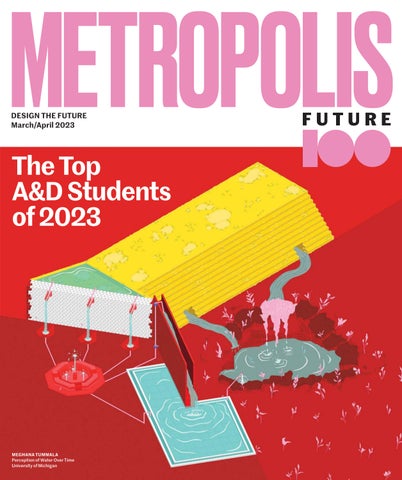
FUTURE100 March/April 2023 DESIGN THE FUTURE MEGHANA TUMMALA Perception of Water Over Time University of Michigan
Woven with energy. Love for color and design. Commitment to innovation. To us, it’s not just material. It’s passion, pride, performance, and beauty. A legacy built over 50 years. Together with you, we will continue to create— Today, tomorrow and for decades to come.
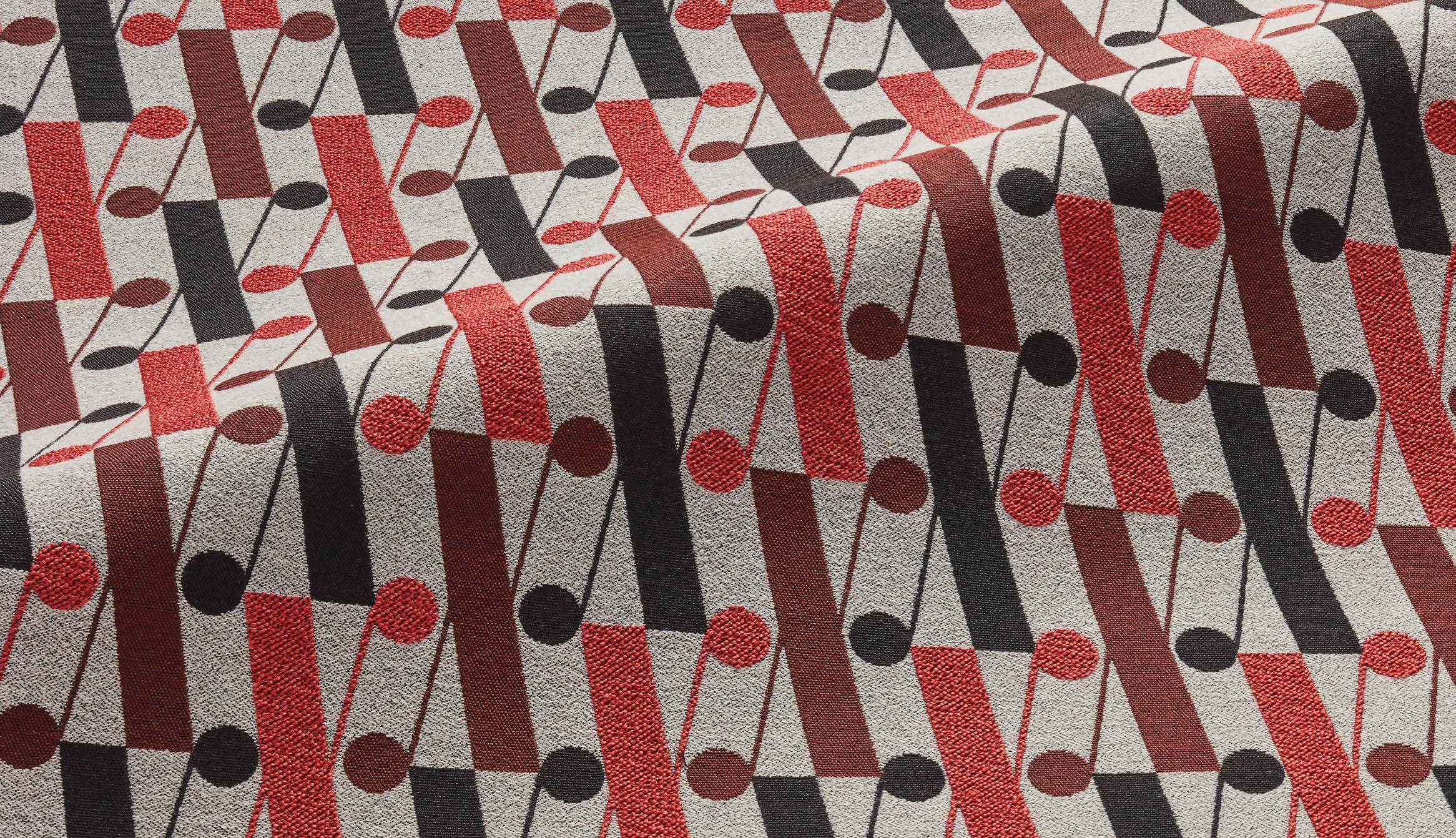

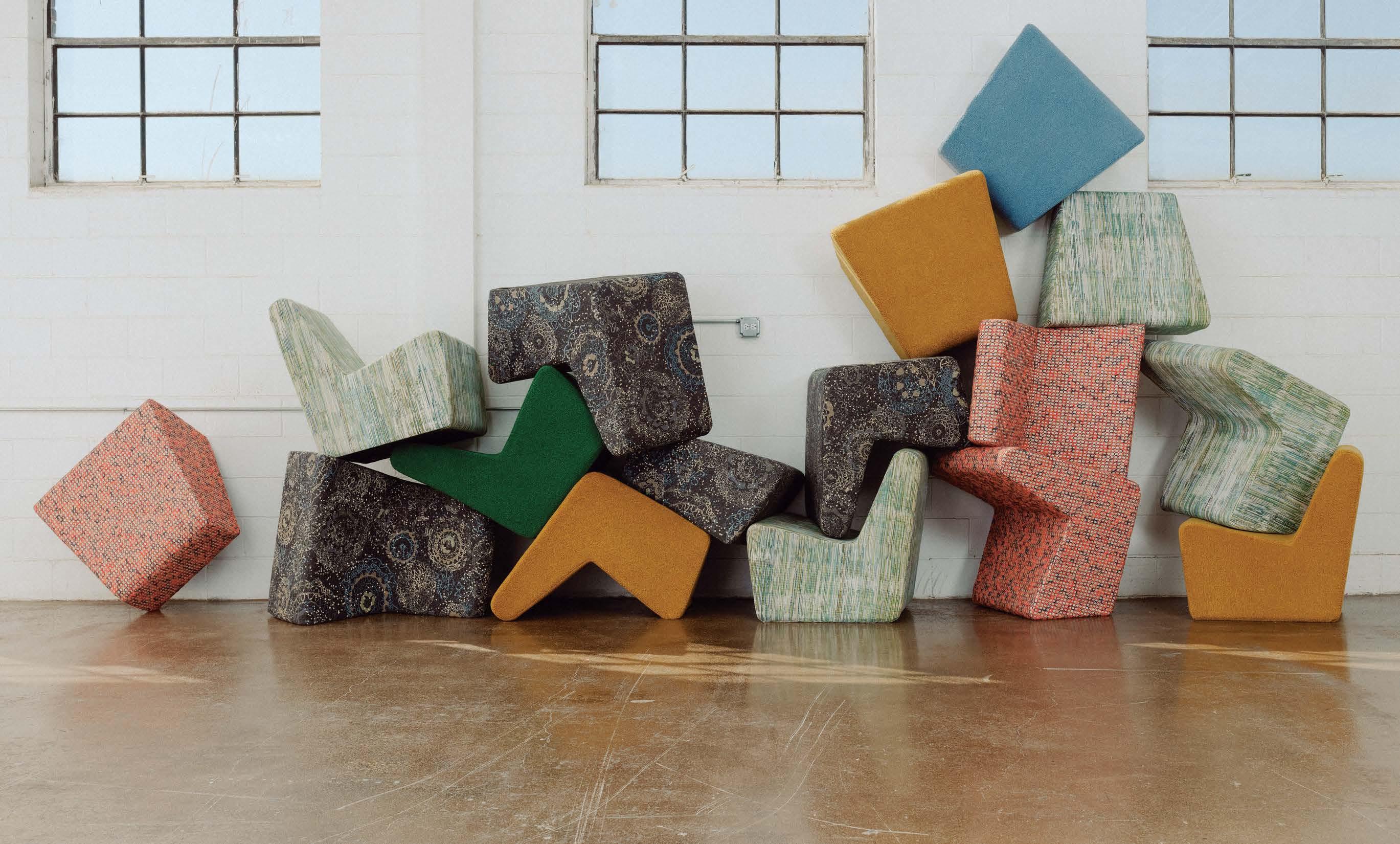
Arc-Com.com GLYPH COLLECTION ~ In collaboration with House Industries
Upholstery | Wall Surfaces | Privacy Curtains | Drapery | Panel | Digital | Custom












teknion.com
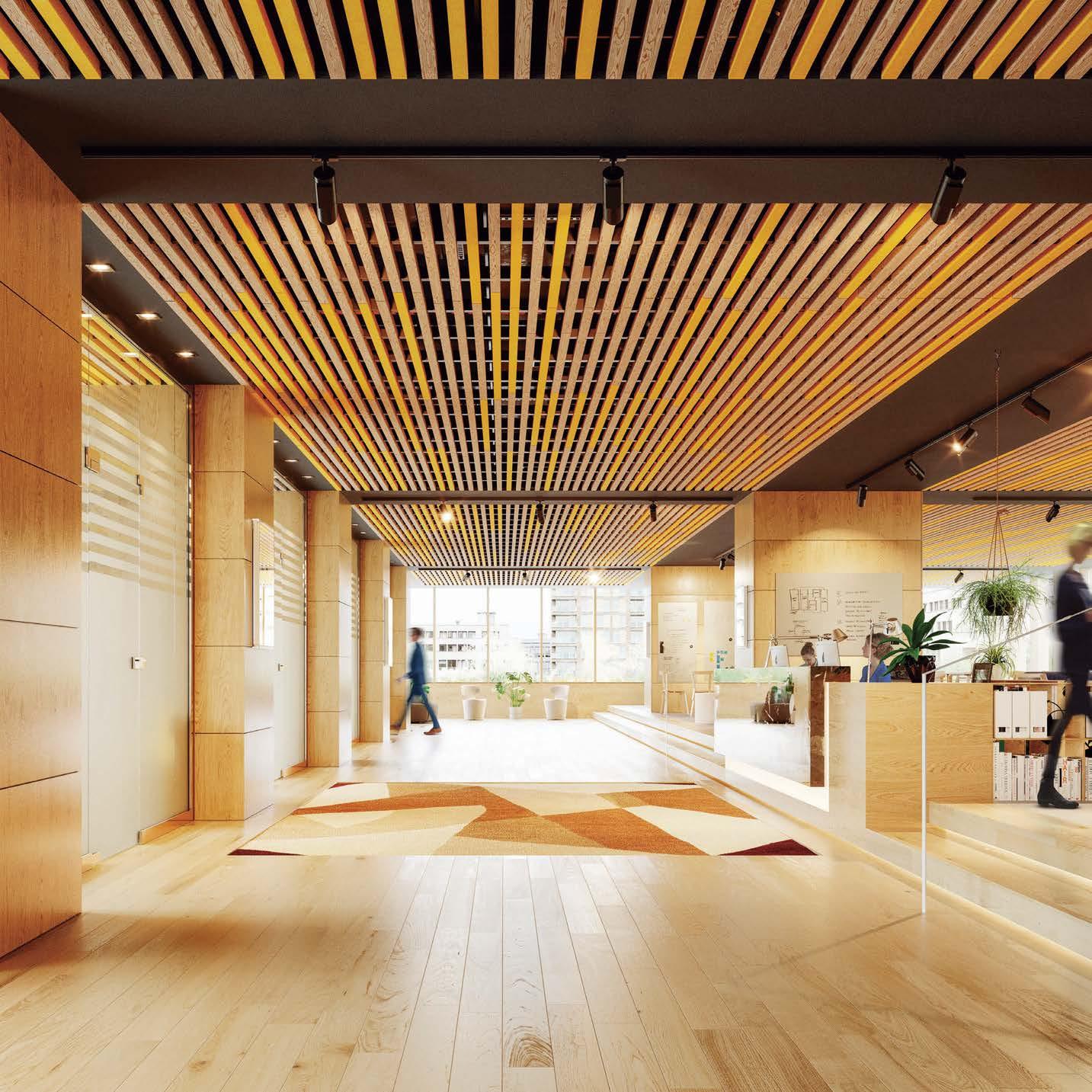 Image by Imperfct*
Artful acoustics for welcoming spaces
turf.design
Arbor Ceiling Baffles
Together

















































We Design June 12–14, 2023 The world’s leading platform for commercial design THE MART, Chicago neocon.com NeoCon® is a registered trademark of Merchandise Mart Properties, Inc. Produced by:
The students featured in this issue represent the cream of the crop graduating this year from North America’s architecture and design schools. Meet the Metropolis Future100.







The Top A&D Students of 2023











FROM LEFT TO RIGHT: COURTESY BRETT WOOD; COURTESY HBA; COURTESY HIGHGATE
Making a Scene 142 A new wave of hotels and lounges use maximalist sensibilities and cinematic dimensions
place guests
stage. What’s Next in Hospitality 154 A couple of change agents tell us how they’re reshaping spaces built for leisure.
FEATURES
to
center
THE FUTURE100 106 RADICAL REGENERATION 114 NAMITA CHANDRASHEKAR 118 SOLUTIONS FOR SWAMPS 120 AT HOME IN THE WORLD 122 CLYTIE HOI TING MAK 124 IN REAL LIFE 126 YUNIN JEUNG 130 FOOD FOR THOUGHT 132 EMMA WEAVER 134 BUILDING BACK BRAVELY 136 NICOLAS BURBANO DIAZ 138 METROPOLIS 8 MARCH/APRIL 2023
ELEVATE THE OUTDOORS
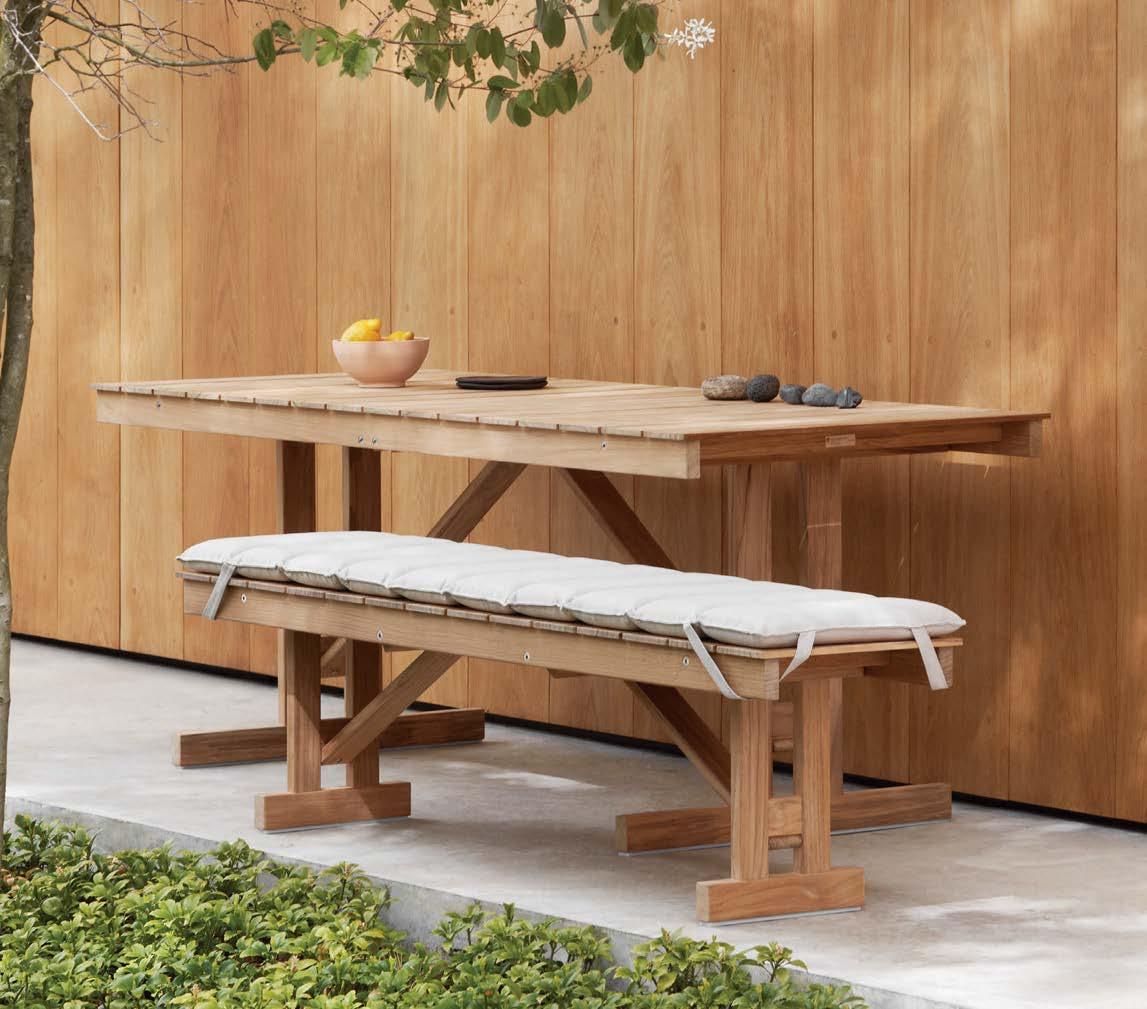
Functional strength and timeless silhouettes distinguish Børge Mogensen’s Outdoor Series. First developed in the 1970s, the space-saving outdoor collection can easily be folded up when not in use. Each utilitarian piece is crafted from durable, FSCtm-certified teak to complement its classic, Shaker-inspired style.
FSC TM C135991 CARLHANSEN.COM
Børge Morgensen Outdoor Series 1971
Flagship Store, New York 152 Wooster St, New York Flagship Store, San Francisco 111 Rhode Island St #3, San Francisco Showroom, New York 251 Park Avenue South, 13th Floor, New York
 The Nick Cave Collection
What makes an architecture and design practice unique? How do firms and offices develop areas of expertise, deep insights, and passion projects? Metropolis editor in chief Avinash Rajagopal sat down with 20 firms in 2022, speaking to practitioners about what distinguishes their work. Here are architecture and design leaders from 11 firms on what gives them their edge.

TOP: COURTESY JOSÉ HEVIA; BOTTOM: COURTESY MOMA DESIGN STORE CONTRIBUTORS 20 IN THIS ISSUE 22 RESOURCE Reintroducing the Climate Toolkit for Interior Design 24 The Design for Equity Primer 26 SPECTRUM 44 TRANSPARENCY Warm Reception 56 DEPARTMENTS METROPOLIS® (ISSN 0279-4977), March/April 2023, Vol. 43, No. 1 is published six times a year, bimonthly by SANDOW DESIGN GROUP, LLC, 3651 FAU Blvd., Boca Raton, FL 33431. Periodical postage paid in Boca Raton, FL, and at additional mailing offices. POSTMASTER: Send all UAA to CFS; NON-POSTAL AND MILITARY FACILITIES: send address corrections to Metropolis, PO Box 808, Lincolnshire, IL 60069-0808. Subscription department: (800) 344-3046 or email: metropolismag@omeda. com. Subscriptions: 1 year: $32.95 USA, $52.95 Canada, $69.95 in all other countries. Copyright © 2023 by SANDOW DESIGN GROUP, LLC. All rights reserved. Printed in the USA. Material in this publication may not be reproduced in any form without permission from the publisher. Metropolis is not responsible for the return of any unsolicited manuscripts or photographs. FOCUS Lighten Up 58 PRODUCTS Luminary Delights 60 SUSTAINABLE Something Old, Something New
p.88 p. 58 30
64
LANDSCAPE Riparian Recreation 70 LIVING Second Draft 76 NEW TALENT Atelier L’Abri 82 EDUCATION Design for Discovery 88 INSIGHT Sources of Inspiration 94 FUTURE100 REPORT 96 NOTEWORTHY Morris Adjmi 160 METROPOLIS 12 MARCH/APRIL 2023
SoftSpan®








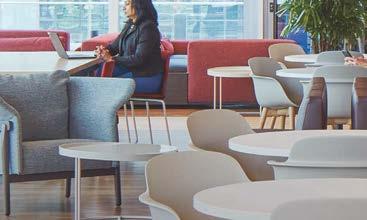

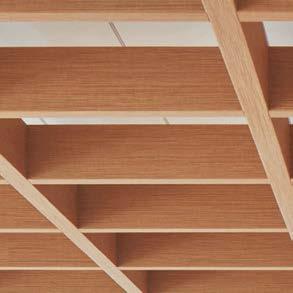
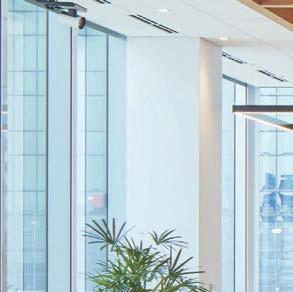
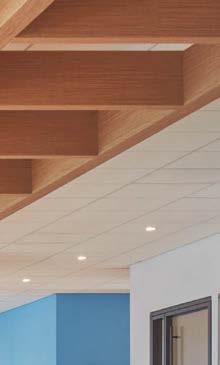
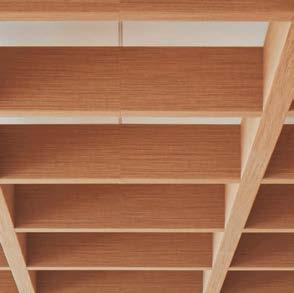
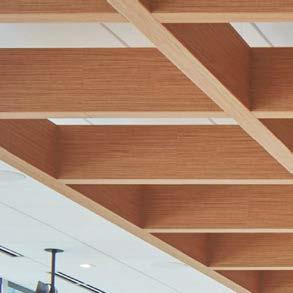
Acoustic Trellis & Coffer System
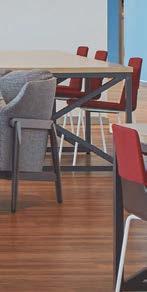
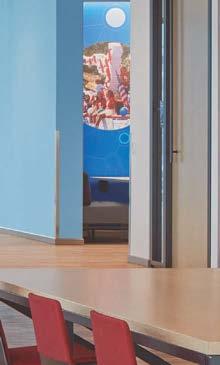
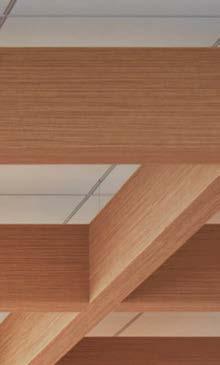
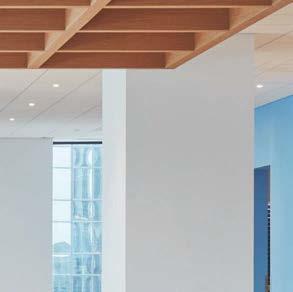
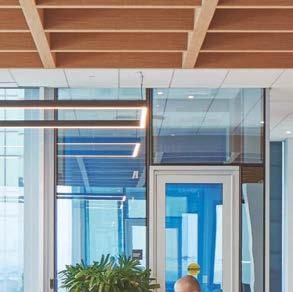
Create the experience of large timber trellises without the weight, all while reducing the impact of noise with our award-winning SoftSpan®. Choose from a variety of form factors, finishes, and accessories, including lighting, and expand capabilities through connectivity with SoundBar®. The possibilities are truly endless.


Fueling Possibilities® Scan learn more about the line now!
arktura.com/softspan | info@arktura.com
Pictured: SoftSpan® 48 in Soft Sound® Wood Texture at BMO Tower, Chicago, Illinois, a collaboration with Interior Architects.
Photo by Tom Harris.

The small city has a wealth of Modernist architecture, but preserving it isn’t always straightforward. The contrasting fates of two churches by Eero and Eliel Saarinen show why.
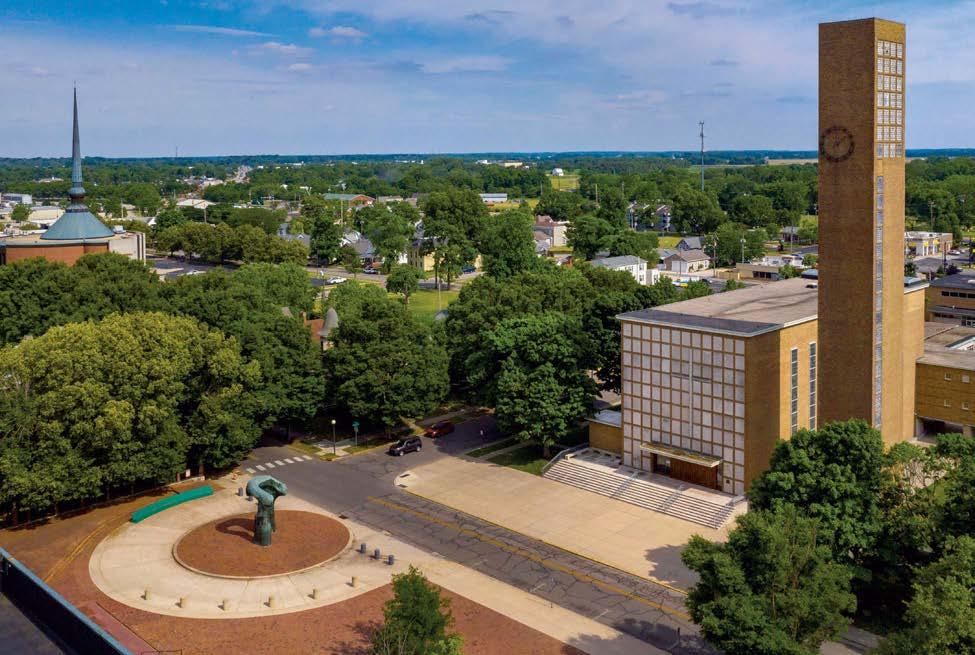
CLOCKWISE FROM TOP: COURTESY HADLEY FRUITS; COURTESY EMA PETER; COURTESY GAFFER PHOTOGRAPHY Inside
the Fight to Save Two Saarinen Churches in Columbus, Indiana
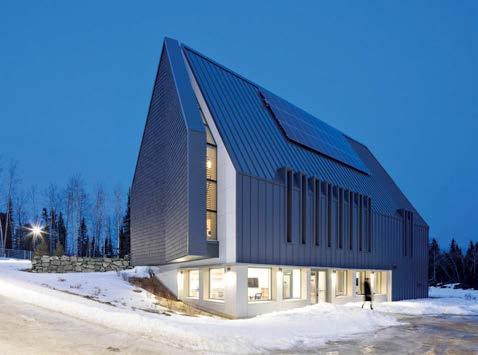
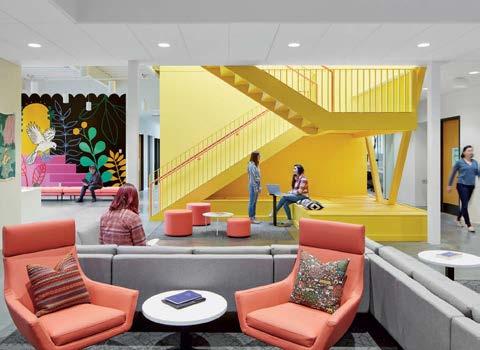
METROPOLISMAG.COM More of your favorite Metropolis stories, online daily Join discussions with industry leaders and experts on the most important topics of the day. Register for free at metropolismag.com/ think-tank How a Health-Care Clinic Applied Trauma-Informed Design to Serve the LGBTQIA+ Community Perkins&Will’s Family Tree Clinic answers the question “What does healing look like to you?” This First Nations Cultural Center Is a Symbol of Community and Sustainability
of
House–certified
in
METROPOLIS 16 MARCH/APRIL 2023
A multifunctional building for the Doig River people is one
the northernmost Passive
buildings
Canada.
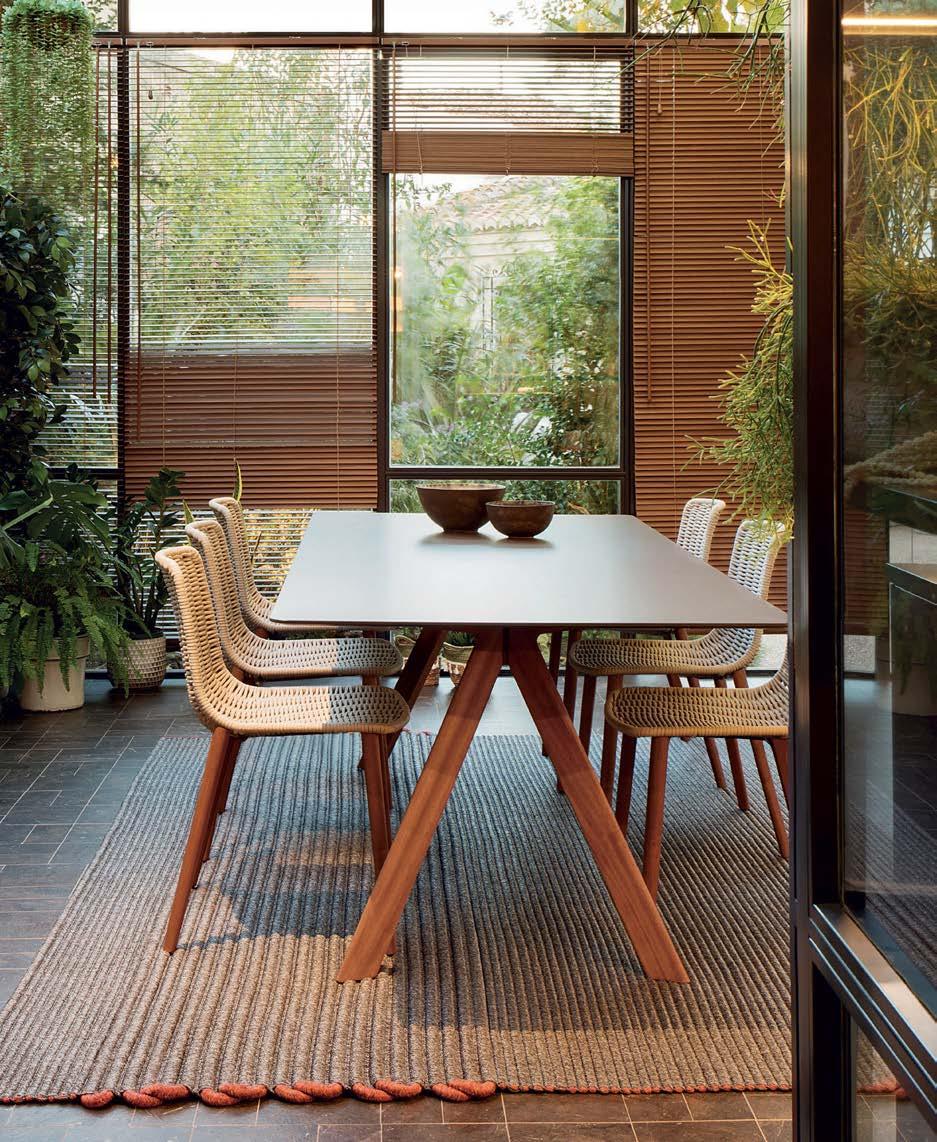
Lapala hand-woven
Lievore Altherr Molina & Atrivm dining table . Manel Molina —— Photographer: Meritxell Arjalaguer © Expormim —— (212) 204-8572 usa@expormim.com www.expormim.com
chair.
EDITORIAL
EDITOR IN CHIEF Avinash Rajagopal
DESIGN DIRECTOR Tr avis M. Ward
DEPUTY EDITOR Kelly Beamon
EDITORIAL PROJECT MANAGER Laur en Volker
DIGITAL EDITOR Ethan Tucker
ASSOCIATE EDITOR J axson Leilah Stone
DESIGNER Rober t Pracek
COPY EDITOR Benjamin Spier
FACT CHECKER Anna Zappia
EDITORS AT LARGE Ver da Alexander, Sam Lubell
PUBLISHING
VICE PRESIDENT, PUBLISHER Carol Cisco
VICE PRESIDENT, MARKETING & EVENTS Tina Brennan
ADVERTISING DIRECTOR
Tamara Stout tstout@sando wdesign.com 917.449 .2845
ACCOUNT MANAGERS
Ellen Cook ecook@sando wdesign.com 423.580.8827
Gr egory Kammerer gkammer er@sandowdesign.com 646.824.4609
Colin Villone colin.villone@sando wdesign.com 917.216 .3690
Michael Croft 224.931.8710
L aury Kissane 770.791.1976
MARKETING & EVENTS MANAGER Kelly Kriwko kkriwko@sandowdesign.com
EVENTS MANAGER Lorraine Brabant lbrabant@sandowdesign.com
SENIOR DIRECTOR, CONTENT DISTRIBUTION Amanda Kahan
SENIOR MANAGER, DIGITAL CONTENT Ile ana Llorens
SOCIAL MEDIA COORDINATOR Zoya Naqvi
METROPOLISMAG.COM
@metropolismag
SANDOW DESIGN GROUP
CHAIRMAN Adam I. Sandow
CHIEF EXECUTIVE OFFICER Erica Holborn
CHIEF OPERATING OFFICER Michael Shavalier
CHIEF DESIGN OFFICER Cindy Allen
CHIEF SALES OFFICER Kate Kelly Smith
EXECUTIVE VICE PRESIDENT + DESIGN FUTURIST AJ Paron
EXECUTIVE VICE PRESIDENT, DIGITAL + STRATEGIC GROWTH Bobby Bonett
SENIOR VICE PRESIDENT, PARTNER + PROGRAM SUCCESS Tanya Suber
VICE PRESIDENT, HUMAN RESOURCES Lisa Silver Faber
VICE PRESIDENT, BUSINESS DEVELOPMENT Laura Steele
VICE PRESIDENT, STRATEGIC PARTNERSHIPS Katie Brockman
SENIOR DIRECTOR, PODCASTS Sam Sager
DIRECTOR, VIDEO Steven Wilsey
SANDOW DESIGN GROUP OPERATIONS
SENIOR DIRECTOR, STRATEGIC OPERATIONS Keith Clements
CONTROLLER Emily Kaitz
DIRECTOR, INFORMATION TECHNOLOGY Joshua Grunstra
METROPOLIS is a publication of SANDOW 3651 FAU Blvd. Boca Raton, FL 33431
info@metropolismag.com
917.934.2800
FOR SUBSCRIPTIONS OR SERVICE
800.344.3046
customerservice@metropolismagazine.net
EXECUTIVE DIRECTOR, FINANCE & OPERATIONS Lorri D’Amico
DIRECTOR, SPECIAL PROJECTS Jennifer Kimmerling
PARTNER SUCCESS MANAGER Olivia Couture
SANDOW was founded by visionary entrepreneur Adam I. Sandow in 2003, with the goal of reinventing the traditional publishing model. Today, SANDOW powers the design, materials, and luxury industries through innovative content, tools, and integrated solutions. Its diverse portfolio of assets includes SANDOW DESIGN GROUP, a unique ecosystem of design media and services brands, including Luxe Interiors + Design, Interior Design, Metropolis, DesignTV by SANDOW; ThinkLab, a research and strategy firm; and content services brands, including The Agency by SANDOW, a full-scale digital marketing agency, The Studio by SANDOW, a video production studio, and SURROUND, a podcast network and production studio. SANDOW DESIGN GROUP is a key supporter and strategic partner to NYCxDESIGN, a not-for-profit organization committed to empowering and promoting the city’s diverse creative community. In 2019, Adam Sandow launched Material Bank, the world’s largest marketplace for searching, sampling, and specifying architecture, design, and construction materials.
THIS MAGAZINE IS RECYCLABLE. Please recycle when you’re done with it. We’re all in this together.
METROPOLIS 18 MARCH/APRIL 2023
355 Alhambra Cir Suite 1000, Coral Gables, FL 33134 / 786.686.5060









Find inspiration at cosentino.com
™ @cosentinousa
TK05 TK06 GK07
A CARBON NEUTRAL PRODUCT BY COSENTINO NEBBIA AVORIO GRIGIO VK03 VK04 VK02 VK01 GRAFITE
SABBIA VICENZA
MARMORIO CEPPO
TRAVERTINO KODE CEPPO KODE
KODE
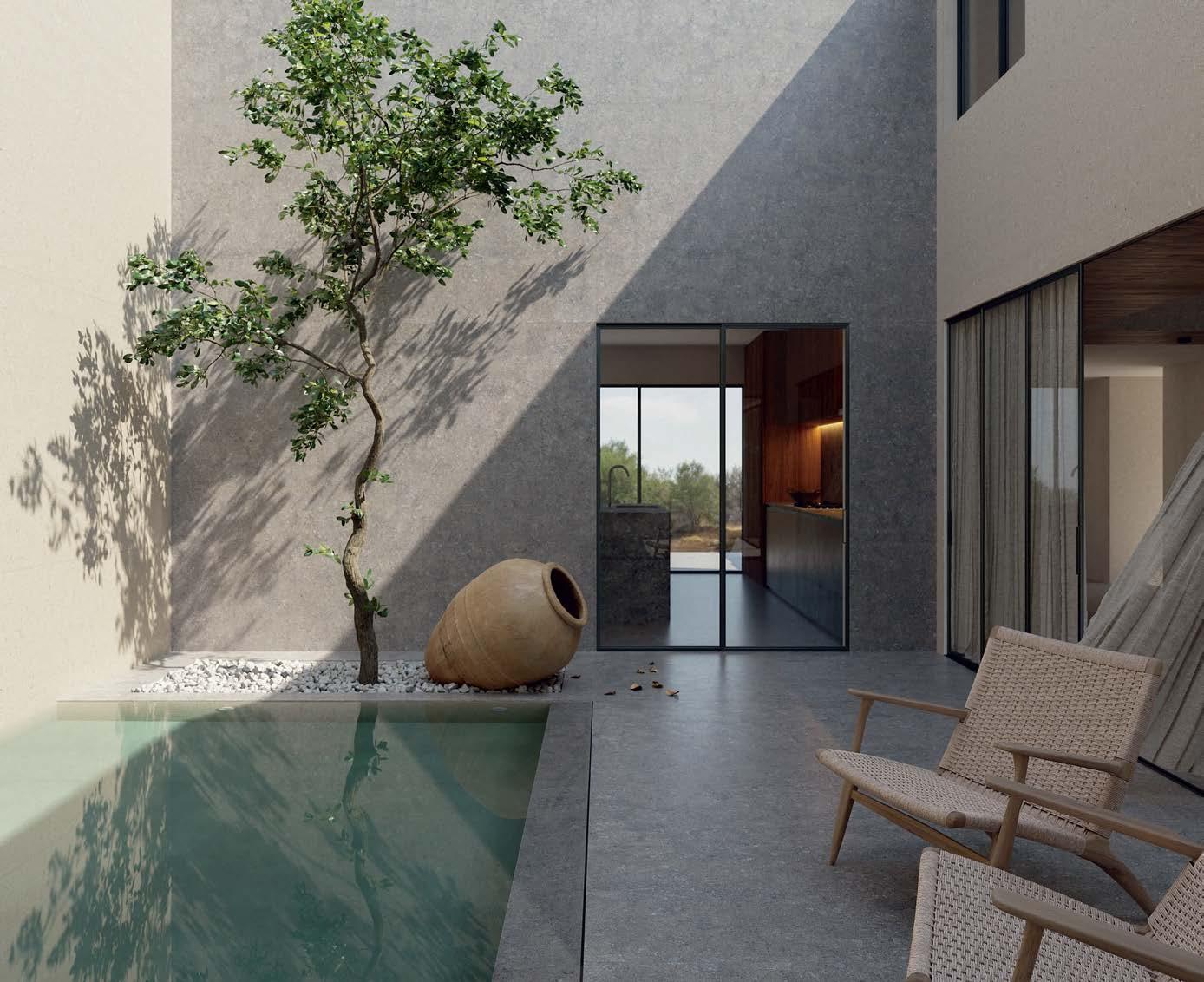
Introducing Pietra Kode: the Italian stones of yesteryear recoded by DEKTON for contemporary architecture and design.
Cosentino North America
CONTRIBUTORS
AUSTIN MACDONALD

Austin Macdonald is a Montreal-based journalist who has covered Quebec’s design scene for over two decades. He has interviewed local talents such as Zébulon Perron, Samuel Lambert, and Claude Cormier. His broader professional interests include food, travel, and sustainability. He is also the author of Montreal and Quebec City for Dummies Macdonald’s New Talent column (p. 82) spotlights Montreal-based design studio Atelier L’Abri.

JAMES MCCOWN
James McCown is a Boston-based architectural journalist and author. He has written several books, most recently Strata: A Desert Dwelling (Oscar Riera Ojeda Publishers, May 2023) and The Home Office Space: Pavilions, Shacks and Extensions for Optimum Inspiration and Productivity (Rizzoli New York, fall 2023). He holds a master’s degree in the history of art and architecture from Harvard University. McCown wrote this issue’s Multifamily column (p. 76) on the transformation of Chicago’s famed Tribune Tower into luxury housing.
GREGORY SCRUGGS
Gregory Scruggs is an award-winning journalist based in Seattle. In addition to Metropolis, he writes about architecture, design, and urbanism for ARCADE, Bloomberg CityLab, Monocle, and Next City He covers these issues from the global scale at United Nations debates to the hyperlocal scale of individual city blocks. Scruggs penned this issue’s Sustainable column (p. 64) on the LMN-designed Hines Seattle headquarters.
ON THE COVER
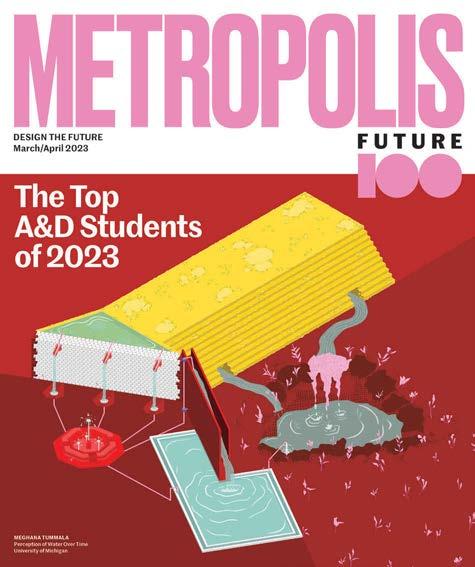
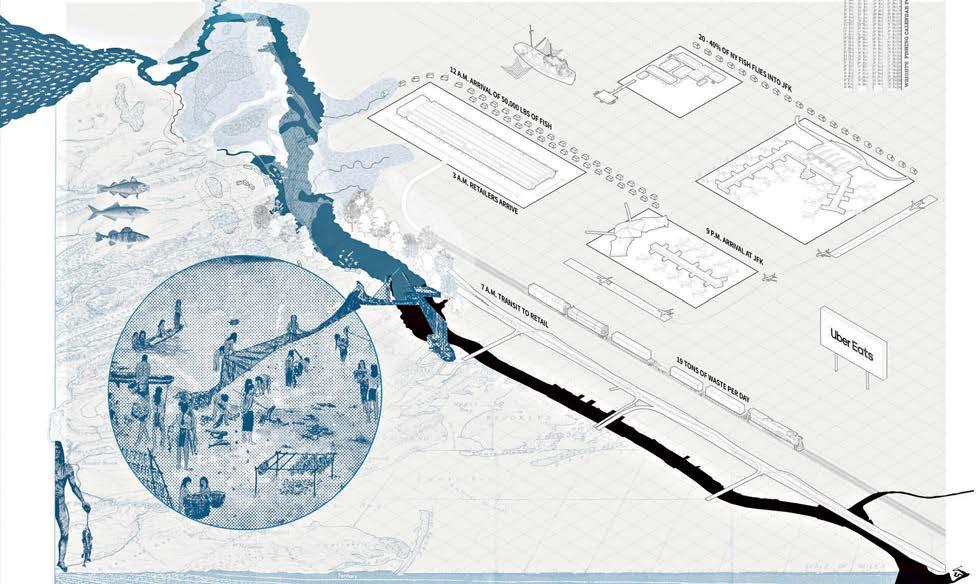
PERCEPTION OF WATER OVER TIME
Meghana Tummala
University of Michigan architecture and urban planning undergraduate Meghana Tummala tells stories through drawing. In her project, Perception of Water over Time, she tells the story of Mexico City’s relationship with water. After returning from a study abroad trip to the city in May 2022, the young designer grew interested in the effects of climate change and lack of access to clean water, she tells the University of Michigan’s The University Record. “Although
these effects impact many Latin American countries, Mexico City is unique in that it’s also sinking due to the draining of the aquifer underground.” This month’s cover drawing shows how water in the city is drained or used through ornate spouts, fountains, and piping, illustrating how it is “both feared and valued.”

COURTESY THE CONTRIBUTORS
METROPOLIS 20 MARCH/APRIL 2023
dezeenwinnerawards





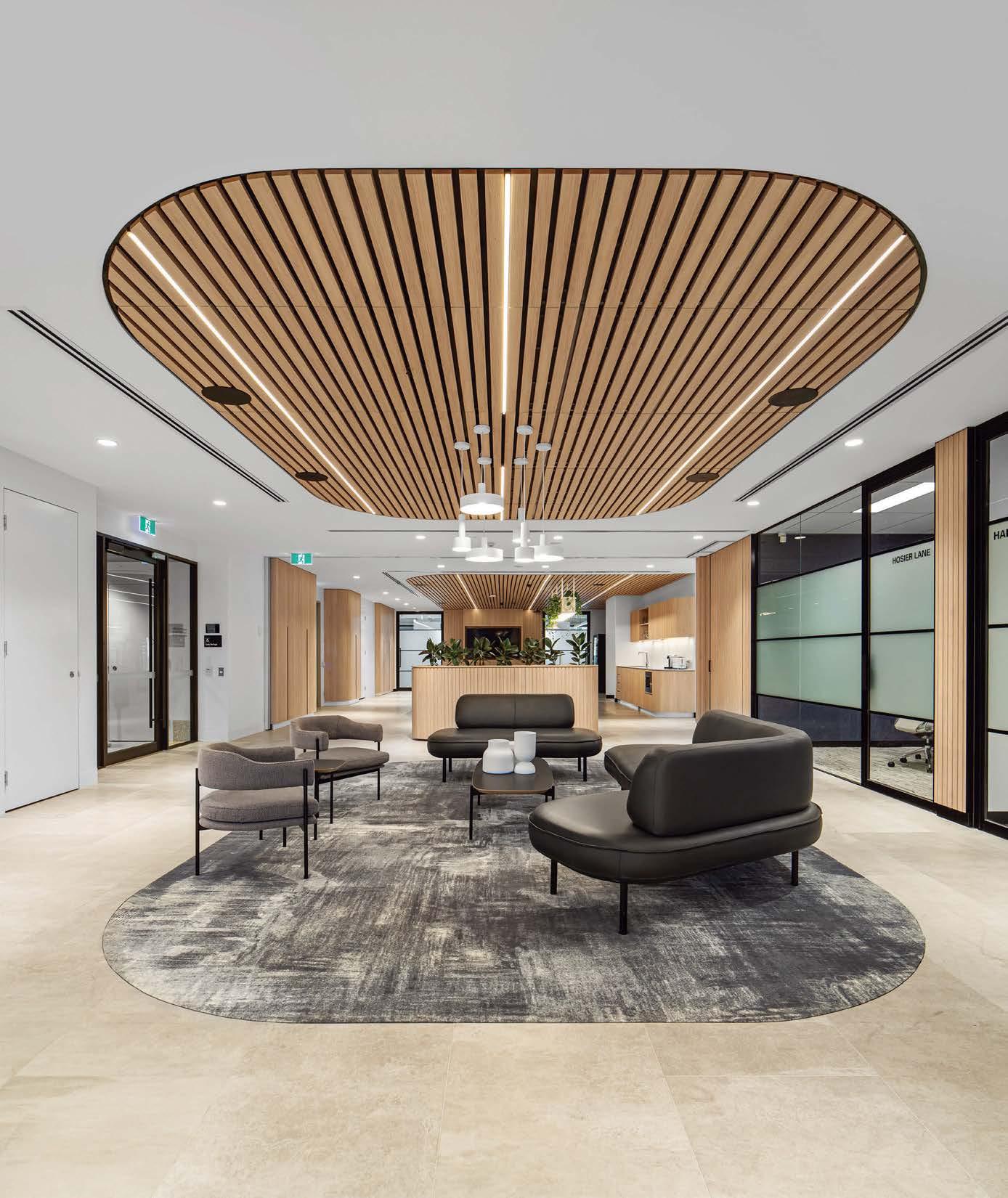
Pico is Woven Image’s latest design-led embossed acoustic wall panel that reduces reverberated noise in shared spaces. It’s beautiful design, tactile surface, acoustic properties and sustainability credentials, make it an ideal surface finish for commercial interior spaces. Embossed panels are made using PET from recycled plastic bottles and solar energy, alongside carbon offset schemes, offering ingredient transparency through Declare, whilst being Red List Free, with low VOC emissions.
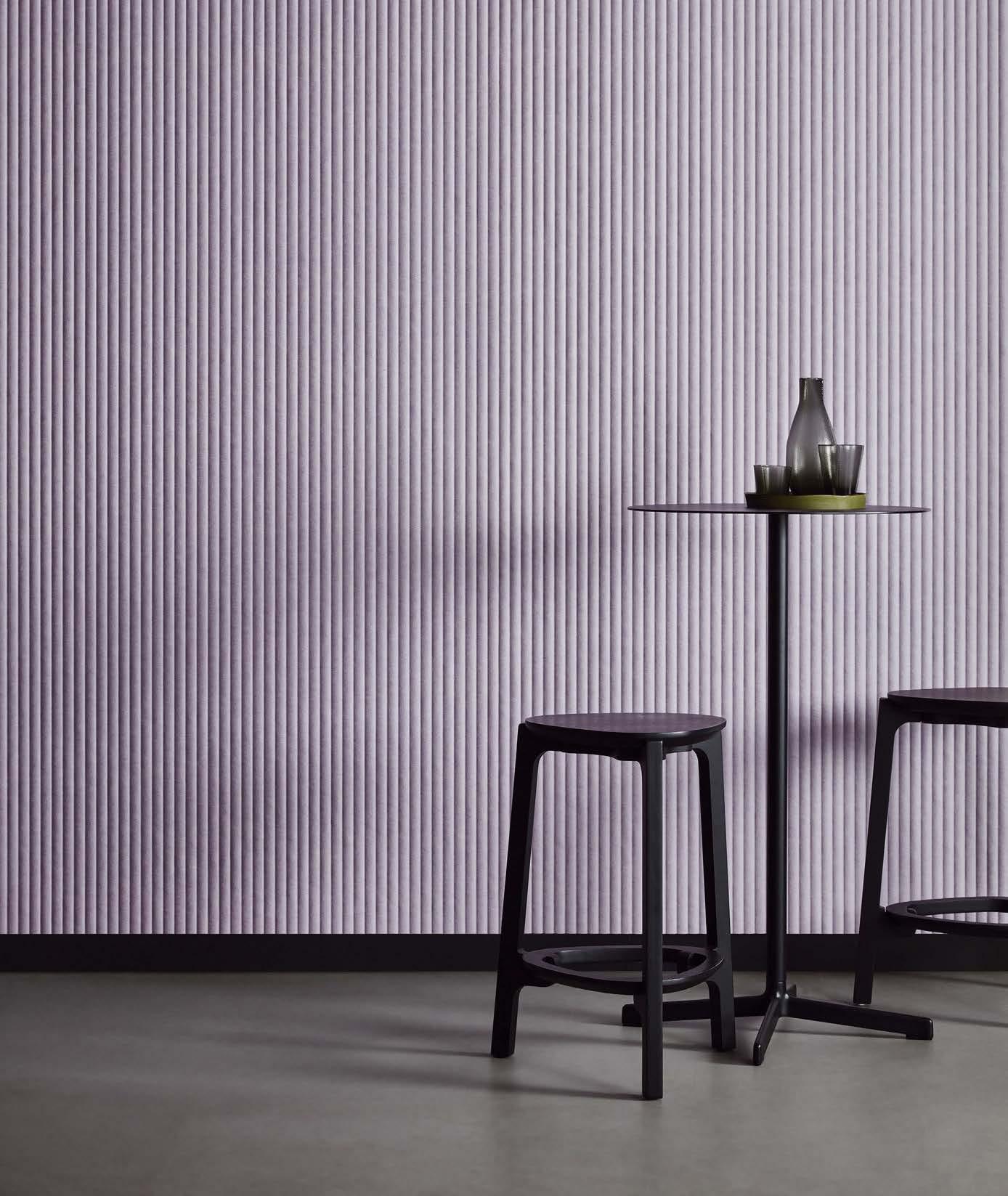 PICO, available in 20 colors, featured here in orchid.
2020 wovenimage.com enquiries@wo v enimage.com +1 949 220 3727
Long-term Thinking
Student work is often like a crystal ball for any profession. The portfolios of graduating young architects and interior designers not only reflect the debates taking place in the profession at large (no doubt filtered into the classroom by instructors) but also give us an inkling of future frontiers where experienced professionals today have barely set foot.
More than 400 students from across the United States and Canada applied to Metropolis’s 2023 Future100 program, hoping to be selected as the best talents graduating in North America this year.
SANDOW Design Group EVP and Design Futurist AJ Paron and I had our work cut out for us in determining the final list, and then the Metropolis editorial team had an equally big challenge parsing the portfolios for trends and patterns that might tell us something about the mindset that this generation is bringing to the A&D professions.
The message in the crystal ball is clear—the Future100 are eager to renegotiate the relationship between humans and the earth’s ecosystems. Students like Alyssa Halloran (SCAD), Minghao William Du (The Cooper Union), and Lamia Albunni (University of Cincinnati) see design and construction as regenerative processes, capable of reversing the damage we’ve caused to the natural environment. This perspective is most keenly applied in projects located on waterfronts and in wetlands: Louisiana State University graduate student Courtney Klee’s Grand Isle Restoration project, for example, seeks to rebuild an eroded barrier island through landscaping measures and a breakwater installation (“Solutions for Swamps,” p. 120).
In their broad concern with regenerating ecosystems, two interesting areas of focus appear. The first is a deep respect for Indigenous communities and their knowledge—see Halloran’s Timber in the City project (p. 114), California College of the Arts
student Rizwana Lubis’s multifamily housing proposal Rescape (p. 136) , and University of Michigan student Meghana Tummala’s Repair, Reclaim, & Reparations project (p. 120).
The second is a focus on biodiversity loss. With more than a million species in danger of extinction, scientists around the world are sounding the alarm about a crisis second only to climate change in the apocalyptic consequences it can have for human life on earth. Professional architects and designers have yet to mainstream this concern within their projects, but as you will read in “Building Back Bravely” (p. 136), it’s clear that the 2023 Future100 cohort understands the urgency.
Metropolis will be celebrating this wonderful group of young architects and interior designers throughout April 2023. You can read more about them in this issue, watch them explain their projects on designtvbysandow.com, and get to know them better on metropolismag.com/future100.
This month, we also have a dedicated section on the future of hospitality design (p. 141). In “Making a Scene” (p. 142), associate editor Jaxson Stone tracks the emergence of over-the-top properties where history and showmanship combine to put guests in the spotlight like never before. Additionally, two leaders in the industry— Kathleen Dauber, a partner at Hirsch Bedner Associates, and Paul McElroy, executive vice president of design and construction for Highgate—weigh in on how hospitality might respond to the short-term disruption of the pandemic and the long-term challenges that will result from a changing climate (“What’s Next in Hospitality?” p. 154).
Their sentiments echo the spirit we see in the Future100 student portfolios: During this time of change, we must act with courage and ambition.—Avinash Rajagopal, editor in chief
COURTESY JOSH GREENE
THIS ISSUE
IN
METROPOLIS 22 MARCH/APRIL 2023
Josh Greene’s Current, a project in collaboration with Zach Felder and Huy Truong
RESOURCE
Reintroducing the Climate Toolkit for Interior Design
The toolkit now contains expanded guidance on carbon hot spots and circular design strategies.
By Ethan Tucker
You can access the toolkit at metropolismag.com/climatetoolkit
The Metropolis Climate Toolkit for Interior Design, a first-of-its-kind resource for designing low-carbon spaces, has been updated with new tools, resources, and insights for 2023. The refreshed toolkit’s 20-plus strategies come courtesy of interior design and climate experts from across the United States who joined Metropolis for three in-depth workshops in Washington, D.C., San Francisco, and Austin.
We first launched the toolkit in 2021 to help interior designers navigate their role in the climate fight. Interiors are a major source of embodied carbon in the building industry, much bigger than many previously assumed. In fact, it’s estimated that by 2050 the interior design industry will have influence over almost a tenth of global carbon emissions.
Now, on the heels of one of the warmest winters on record and with COVID-19 still swirling about, there’s more urgency than ever
to designing greener. That’s why we updated the toolkit with findings and feedback gathered from workshops held across the country. Each workshop was composed of 20 to 30 design and sustainability leaders and tackled a specific part of the toolkit in detail. Participants shared information, strategies, and resources, while also offering insights from their own on-the-ground experiences.
Based on input from industry leaders, the toolkit now offers extended advice on how interior designers can focus on the product categories with the greatest potential impact on carbon emissions, or “hot spots.” Since Environmental Product Declarations and emissions data may not be available for certain products, the toolkit also provides guidance on how to build expertise in those categories.
When it comes to designing for circularity, the toolkit now provides clear

guidance in four sections: Prioritize Reuse and Recycling, Embed Reuse in Your Practice, Design for the Next Life, and Close Out Responsibly. New information includes suggestions on types of documentation that can prepare interior designers, clients, and facility managers for a circular future.
Because the world of low-carbon interiors is constantly evolving, the Climate Toolkit for Interior Design is a living document. The process of keeping it up to date continues this year with workshops planned for New York City, Chicago, and Seattle. As you explore the toolkit and implement its suggestions in your work, we welcome your comments and input to keep it as relevant as possible for the industry. Send your feedback to climatetoolkit@metropolismag.com.
Together, we can make a global impact and contribute to the safety and well-being of generations to come! M
THOMAS HEINZ
The 2022 Climate Toolkit Workshops were conducted in partnership with Interface, Material Bank, Cosentino, Lutron, Mecho, Momentum, One Workplace, Steelcase, and Teknion.
METROPOLIS 24 MARCH/APRIL 2023
























RESOURCE
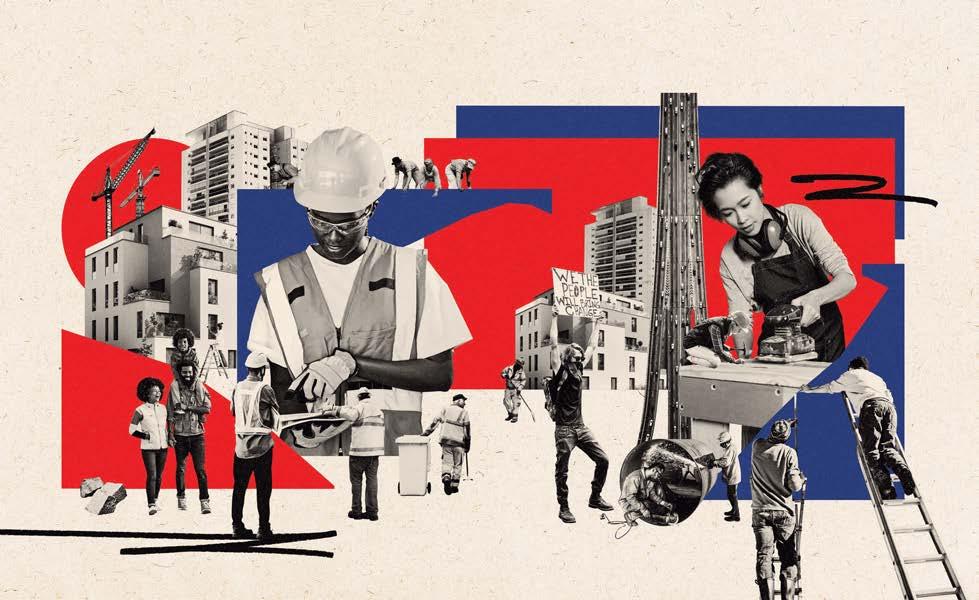
The Design for Equity Primer
Metropolis has compiled tool kits, manuals, certifications, and indexes that can help you design with justice, equity, diversity, and inclusion in mind.
By Avinash Rajagopal
A fundamental purpose of architecture and design practice is to shape spaces where people can live, work, play, heal, socialize, and carry out all the activities necessary for us to survive and thrive. However, th ese provisions have not been distributed equally or fairly: Those able to pay for design services shape the built environment to their purposes, sometimes at the expense of other, more vulnerable groups.
This includes many who are not represented in firms’ offices or their typical client base, as well as people who are involved in projects’ supply chains and in the afterlife of buildings and interiors.
There has been growing recognition that this situation needs to change. Various organizations—both within the architecture and interior design industry and outside it—are defining frameworks, providing guidance, and developing tools so that the built environment can undo the harm and injustice it causes, and start to make a positive impact in everyone’s lives.
This Design for Equity Primer gathers as many of those existing resources as possible, under six sections:
- Equity in Design Firms
- Equity in Architecture and Design Supply Chains
- Meaningful Community Engagement
- Linking Sustainability and Equity
- Connecting Health and Equity
- Equity in Project Outcomes
Each section contains a brief introduction, links to resources relevant to that section, suggested reading from Metropolis’s reporting, and additional reading from various sources.
The Design for Equity Primer was created through a three-week hackathon, with the input of architecture, design, real estate, hospitality, and manufacturing professionals who are engaged in the work of making the built environment more equitable and just.
This is a living resource and will be updated with additional tools, manuals, and certifications as they become available. We hope you will find it useful as you work toward creating positive experiences for all. M
The Design for Equity Hackathon was organized in partnership with Humanscale, Mohawk Group, and Wolf-Gordon.
Representatives from CannonDesign, Gensler, Highgate, HKS, HOK, JLL, Perkins&Will, Salesforce, SmithGroup, and ZGF contributed their research and insights.
The hackathon sessions were organized by Metropolis VP of marketing and events Tina Brennan and events manager Kelly Kriwko. The texts in the Primer were written by Metropolis deputy editor Kelly Beamon and digital editor Ethan Tucker. It was designed by design director Travis Ward and designer Robert Pracek. Illustrations are by Klawe Rzeczy.
KLAWE RZECZY
METROPOLIS 26 MARCH/APRIL 2023
Scan to explore the Design for Equity Primer
DISCOVER TERRA: THE SHERWIN-WILLIAMS® COLORMIX® FORECAST 2023
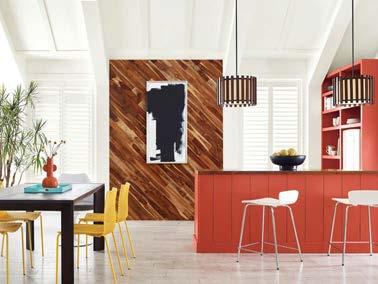
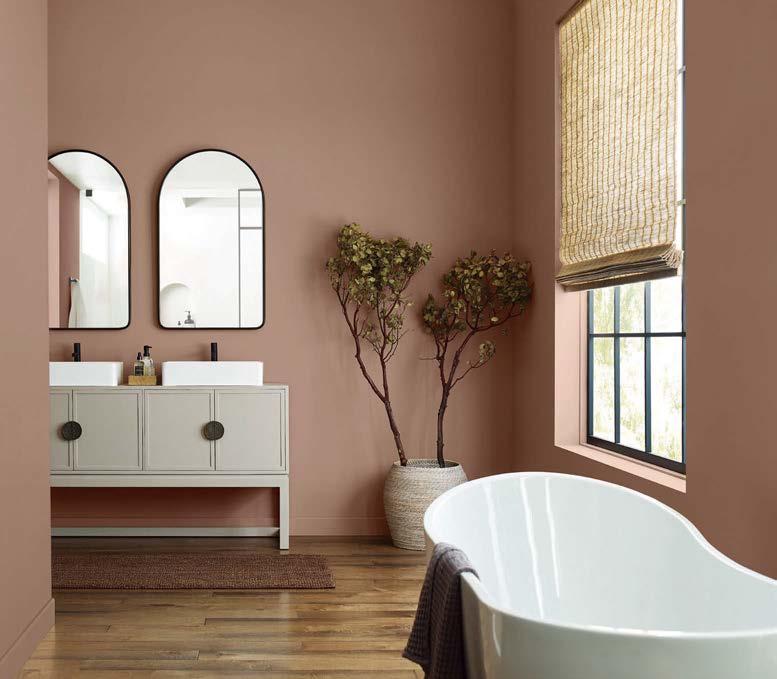
Let’s explore the moods, moments, and movements that helped the Sherwin-Williams color forecast team tell the tale of the Colormix® Forecast 2023 in the four palettes and 40 colors of Terra.
THE BIOME PALETTE
We’re seeing biophilic influences in design and architecture through an increasing preference for sustainable systems and products—things created using earth-friendly processes and designed to last a lifetime and diminish waste.
The Biome palette takes inspiration from nature—with beautiful earth tones and a blend of subdued greens and blues—and embodies the concept of a world in which plants and people exist together in perfect harmony.
THE LORE PALETTE
The Lore palette tells the story of the maker sensibility inherent in human nature. We are all called to create, and across the world and throughout history that call has been answered in countless ways.
Lore celebrates creativity in all forms, and the lessons we learn from each other when we adopt and adapt ancient artforms. This palette’s rich color choices recall the vibrant fibers of intricate weavings, the paints of beautifully frescoed walls, hand-dyed yarns, and ornate pottery pieces.
THE NEXUS PALETTE
Whether through self-care rituals, healthcare improvements, or a deeper consciousness of our environmental impact—there’s an everpresent need for attention and mindfulness in the treatment of ourselves and our spaces.
This “care economy” gave rise to our third trend palette in the 2023 Colormix® Forecast. The tinted neutrals and sunbaked tones of the Nexus palette exude an enveloping warmth, reminiscent of the compassion that’s driving so many of our shared experiences today.
THE ORIGIN PALETTE
These are the colors of pure, personal joy. Residential and commercial spaces are experiencing an exuberant revival of tried-and-true classics and updated takes on time-honored
aesthetics. Vividly colored minerals and geodes also inspired this palette: our planet’s special way of showing how something can grow more beautiful over time.
The Origin palette is inspired by the hybrid existence of our newly phygital world. This vibrant mix is a spin on retro favorites, a perfect balance of looking back and forging ahead—a collection of colors that seeks the middle ground between activity and rest, venturing out and staying in, then and now.
Each palette of Terra allows us to paint a picture of a future where people are the key point of change, in a time when shared experience unites us all. To see the complete forecast, visit swcolorforecast.com
SPONSORED CONTENT
(Above) Redend Point SW 9081 (195-C4) is an essential new neutral, a sunbaked terracotta color that’s easy to love and easy to use anywhere. (Below) The retro red of Peppery SW 6615 (117-C6) pops against Pure White 7005 (255-C1).
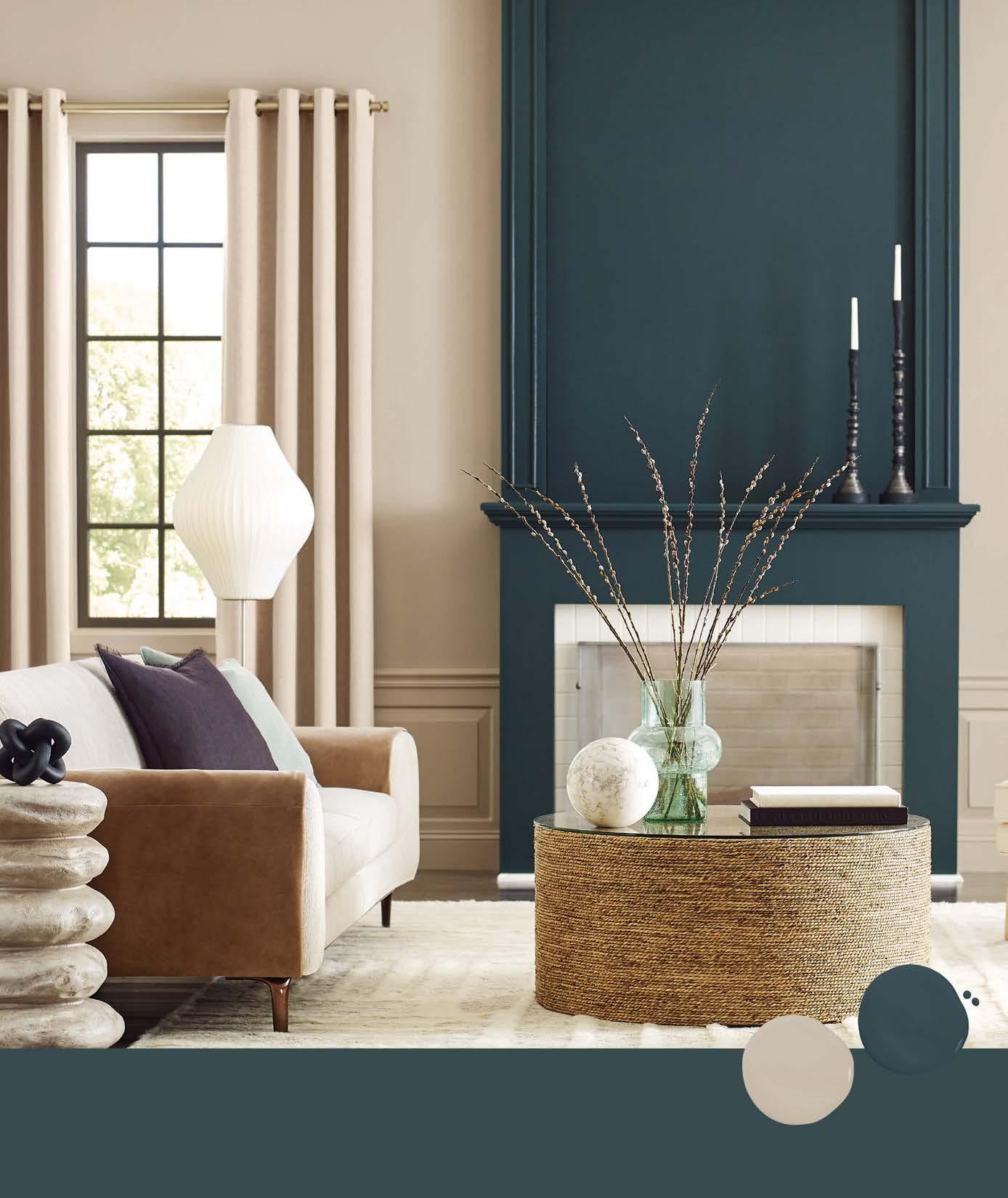
Mount Etna SW 7625 Semi-Gloss Shiitake SW 9173 Flat Experience the beauty of home, heritage, and all that makes us human. Explore the 2023 Colormix® Forecast at swcolorforecast.com © 2023 The Sherwin-Williams Company
© CREDITS GO HERE
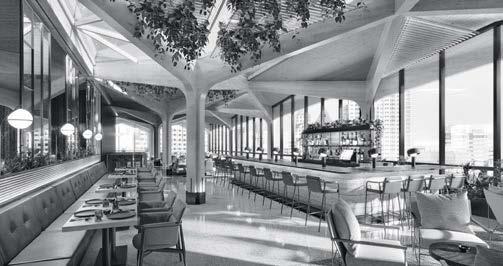
Mass Timber Innovation: The Hospitality Prototype, DLR Group
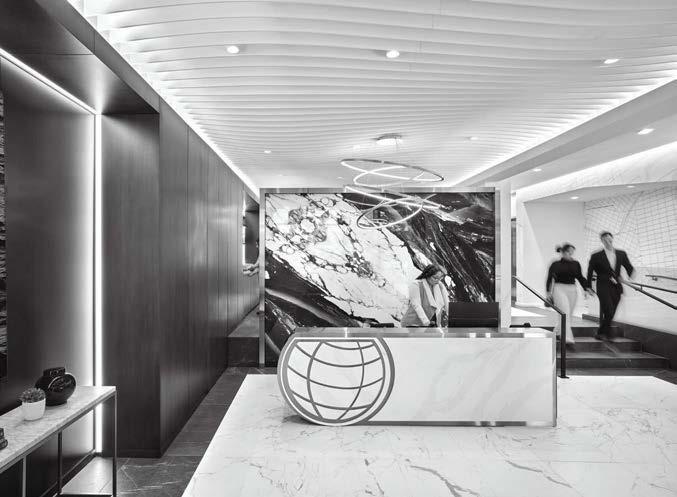
Frosch International Travel Headquarters, HKS
METROPOLIS 30
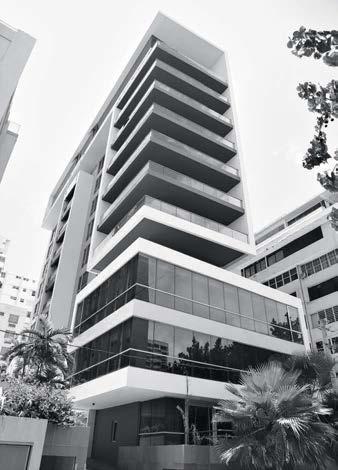
Venetian Tower, Álvarez-Díaz & Villalón
Joining Forces for Better Design
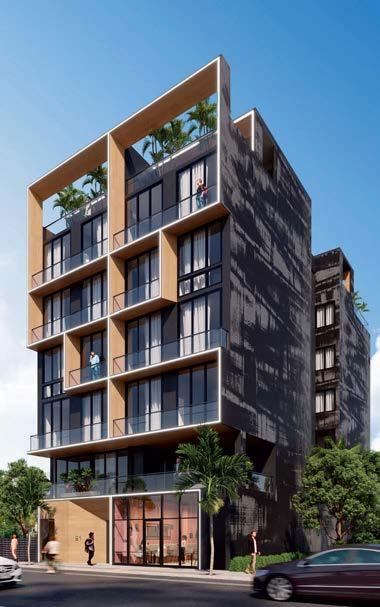
By collaborating across its four offices—New York, Stamford, Miami, and Washington, D.C.—MKDA creates spaces that work best for its clients.
“Each of MKDA’s offices was started by people from the surrounding market and each studio hires locally. We dig deep to understand each of those specific regions and guide our clients. Each office has its expertise, and we share lots of information and ideas across the firm.
This is especially important right now, as it is an exciting time in all sectors of architecture and design. The experiences that we’ve all gone through over the last few years really magnified the importance of space and our environment, and how we interact with our surroundings. Everyone is looking for a dynamic workplace. They’re looking for flexibility. They’re looking for areas for people to collaborate and socialize. They’re thinking about how to attract and retain talent.
Everything is much more human-centric. We’re thinking about how people come together as a community and how they interact with each other. And that goes for any sector—workplace, but also hotel and multifamily. The future for us is continuing to look at those different sectors and how they blend. The beauty of that is that we have experts within MKDA that focus on each one of those different sectors. The way that we approach work, play, live is all intertwined at this point. To have all our experts at the table looking at each project through a different lens creates spaces that are dynamic.” –Amanda
Hertzler, regional managing principal, and Michael Kleinberg, CEO, MKDA
What makes an architecture and design practice unique? How do firms and offices develop areas of expertise, deep insights, and passion projects? Metropolis editor in chief Avinash Rajagopal sat down with 20 firms in 2023, speaking to practitioners about what distinguishes their work. Here are 11 architecture and design leaders on what gives them their edge.
Scan to watch the Leading Edge videos on DESIGNTV by SANDOW
IN PARTNERSHIP WITH MKDA MKDA.COM
MARCH/APRIL 2023 31
Block City; Miami, FL
Creating Meaningful Environments
Through thoughtful connections—whether between a building and the surrounding city, an interior and exterior, or art and architecture— multidisciplinary firm MA | Morris Adjmi Architects delivers designs that are simultaneously iconic, contextual, and community-oriented.
“Growing up in New Orleans, I always noticed how the buildings were similar but different. I felt that was something that made them special: they were part of a bigger story, but they had their own identity as well. We try to do that in our work—bridging history, context, art, and experiences to create compelling buildings and environments.
A project we just finished that exemplifies this is The Grand Mulberry in New York City’s Little Italy district. It was the former site of the Italian-American Museum, which is returning within the multifamily building’s storefront. Having it fit in with fabric of the city was important to me, but I also wanted to bring the neighborhood’s past and future together. We designed a special brick that
has a series of domes to create a façade that is reminiscent of historic tenement buildings, then overlayed a more contemporary window grid on top of that. It creates this play between the sculptural qualities of the brick and the precision of the new windows. It recalls the neighborhood’s history in a way that celebrates it—but it’s also for our time and beyond.
To create something that’s meaningful is very difficult. Every project site is different and unique, so if we bring the site into the design, then we can do something special. But it’s not enough to just say, ‘This reflects the neighborhood, or this reflects the context.’ We strive to bring something more and take the design narrative beyond
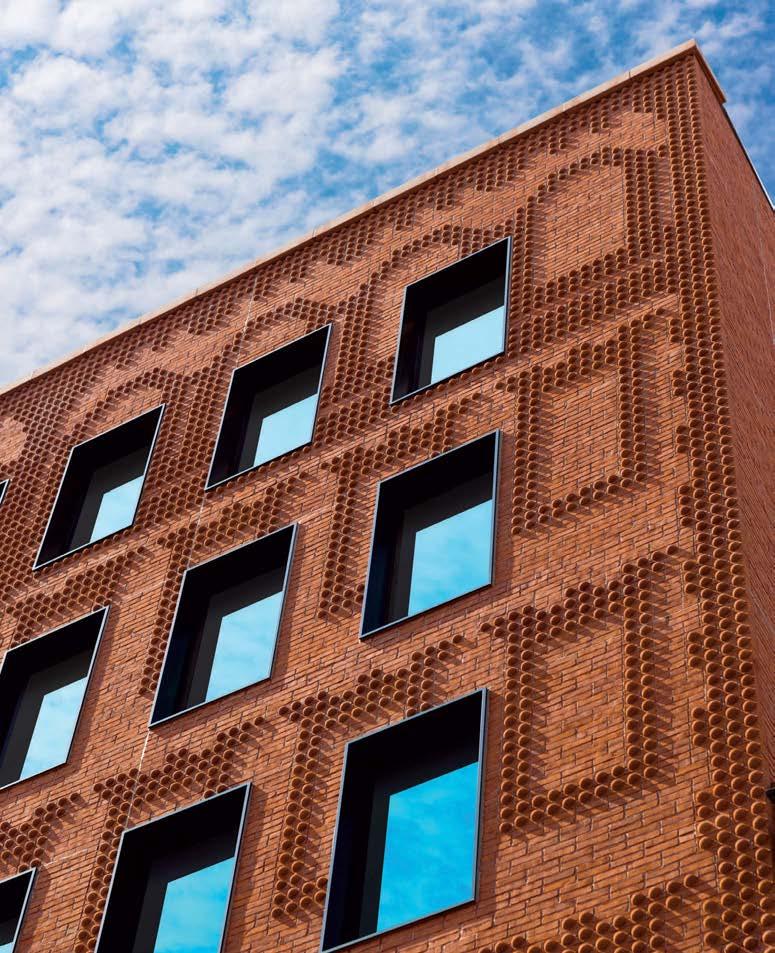
IN PARTNERSHIP WITH MA MA.COM The Grand Mulberry; New York, NY
METROPOLIS 32
just a referential quotation of history or the building next door.
Art can really imbue the project with that special character. I am fascinated by the process that artists go through to bring personal experiences to their work. There’s always stimulation in art, and I like to draw on that as well. Many of MA’s projects have been inspired by artists, whether it’s Rachel Whiteread, who makes positives of negative space, or Donald Judd and his sort of tight precision minimalism. Art and architecture can work together, they can feed each other.
When we were moving to our new office about eight years ago, I said: ‘Why don’t we start by creating an art program?’
I had worked with Aldo Rossi for many years and had a collection of his drawings. We did an exhibition of those drawings, and that was the foundation of the practice and our appreciation for art.
From there, we launched a whole program of exhibitions, both with artists we
knew, and those we were interested in collaborating with. The program enables us to do a few things that I think are unique, one being that we can continually change our environment. It’s always fresh, and that stimulates different thinking. It also developed into another core service that we provide, which is art consulting.
Our projects start from the wider picture of the city to the site, to our building and the interiors, to the furniture, and then the actual art in the building. Our interior materials may be inspired by the exterior or the story of the exterior. Sometimes the interior starts to impact the way the architecture is organized or where the building entrance is. It really is a dialog between the two disciplines. We design in a way that doesn’t divide the responsibilities. We unify our architecture and interior design teams in a way that they can work together to create a vision that’s all-encompassing.”
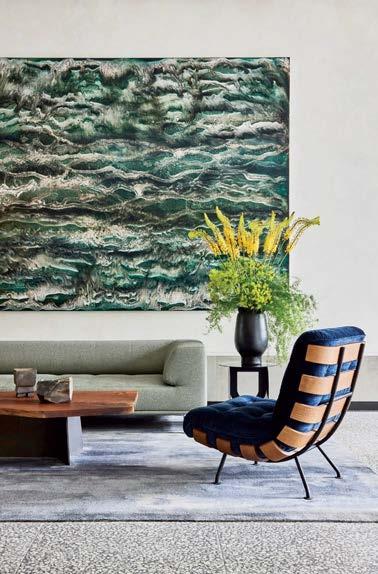
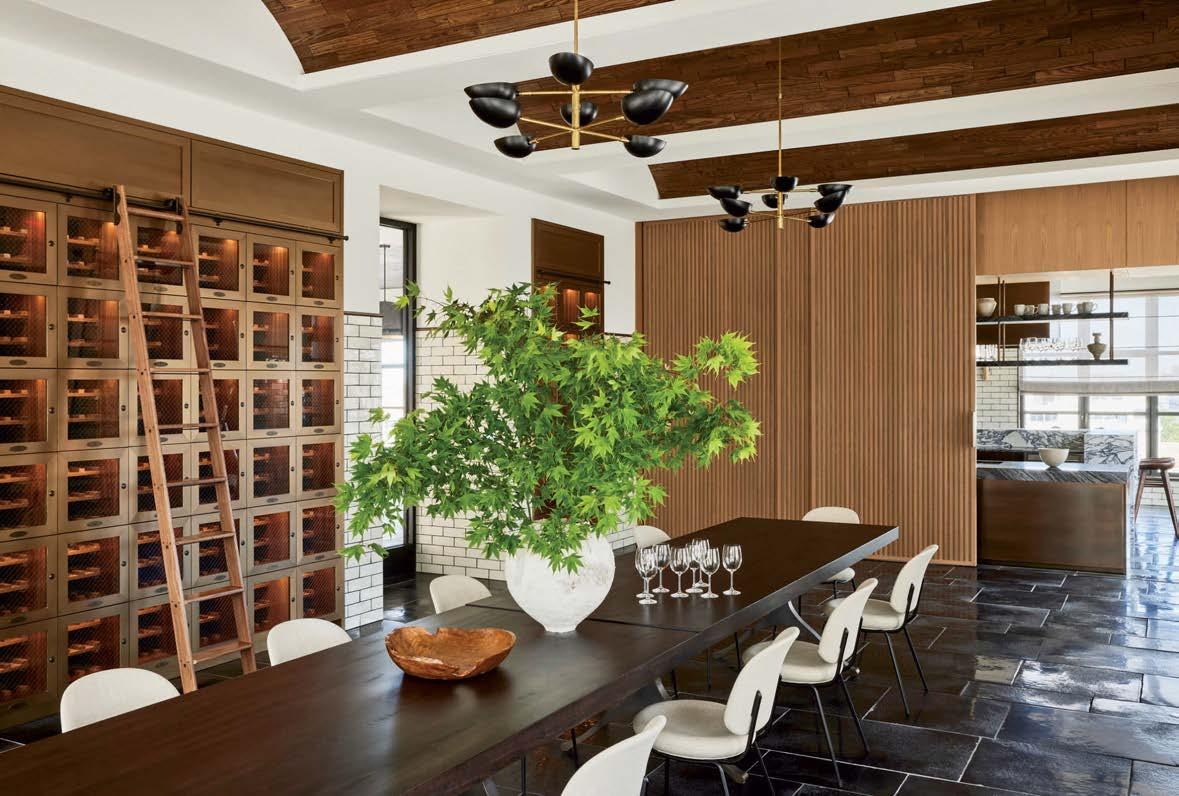 –Morris Adjmi, founder and principal, MA
Front & York; Brooklyn, NY
–Morris Adjmi, founder and principal, MA
Front & York; Brooklyn, NY
MARCH/APRIL 2023 33
Drawing People Together Through Design
How do you create spaces that amplify emotional connection and belonging? Putting human interaction at the heart of their practice, global firm Populous designs futureconscious entertainment venues where memories are made.
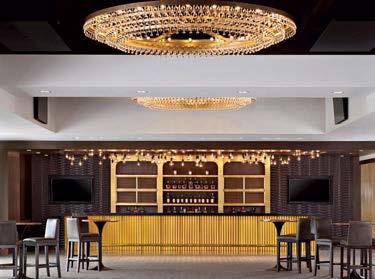
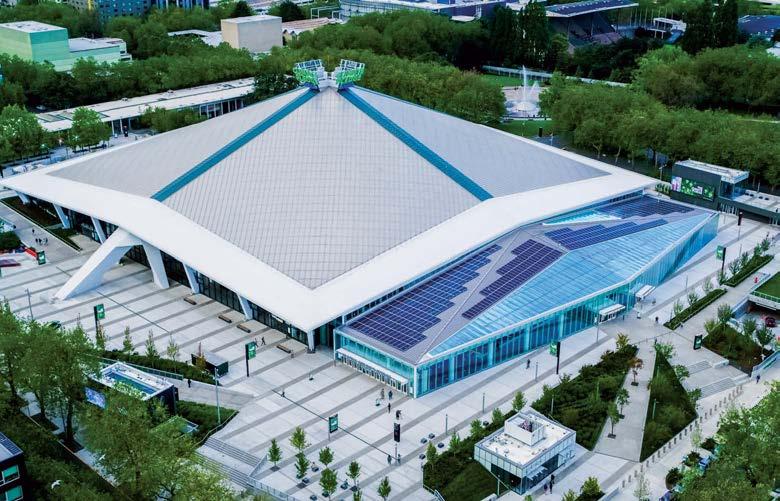
“The fun in our design process is creating something that’s truly unique—whether it’s the exterior architecture of a venue or the interior design of a hospitality space. We want to create something that speaks to the team, the client, and the community. It’s easy to create beautiful, staggering images but, for us, it starts with the story. We’re focused on every visitor who enters our facilities. We want to know what’s going to excite them. Our task is to create an experience that will have them wanting to come back over and over again.
People crave an intimate connection, whether their feet are on the court or they’re sitting in the upper deck. We dedicate a lot of time and research to understanding the demographics of people who visit our venues to determine what a premium experience looks like for
everyone. We do this through a technique called journey mapping, where we imagine different types of guests and map out their imaginary routes from the moment they step out of their car or the subway to when they leave the venue, and then we try to engage them along that path. By looking at these diverse viewpoints, we can ensure every individual’s experience is unique and memorable.
The venues we design are 365-days-ayear, 24/7 experiences. They are a critical part of their city and the urban core. Whether we are working with iconic brands on updates to historic venues like Churchill Downs Racetrack or Wrigley Field, or new entertainment facilities, our goal is to design spaces and experiences that are reflective of the communities we’re creating them for.
Also, because the buildings and events we create are often vast and the centerpiece of wider community districts, our role in climate action is unique. We’re thinking about that every day, from the site selection of the venue to the materials we choose for the interior spaces. We focus on research and development so we can make the best long-term decisions and solve for these challenges as an industry. We have to future-proof. We have to create a better-built tomorrow.
As we think about the future, people are our priority—whether it’s the fan, the artist, the staff or the athlete. We create connection at every scale and down to every last detail. And at the root of it all, we’re designing places for human connection.” —Mason Paoli, principal, and Adam Stover, senior principal, Populous
IN PARTNERSHIP WITH POPULOUS POPULOUS.COM
Churchill Downs; Louisville, KY
FROM LEFT: COURTESY MATT KOCOUREK; COURTESY EMA PETER METROPOLIS 34
Climate Pledge Arena; Seattle, WA
Designing Beyond Aesthetics
Thoughtful of people and place, brand and community, physical and digital, DLR Group creates layered hospitality experiences that keep guests coming back.
“We combine qualitative and quantitative research systems. If we’re designing somewhere, we also want to see it; we want to feel it. We talk to people who live there and become part of the neighborhood’s texture, so we’re not just inserting a hotel but creating something that belongs to the community as well.
We’ve found great success in taking our concepts to the next level, with the backing of science. Our in-office research team is led by people in cultural anthr opology who are diving into human nature. There’s a neuroscience approach to it: We’re trying to engage guests’ senses, because with the right sensory surroundings, you create more meaningful, lasting memories.
IN PARTNERSHIP WITH DLR GROUP DLRGROUP.COM
Technology can also enhance a built environment make it that much more memorable and beautiful. It really allows people to think outside the box. It doesn’t have to be something that’s permanently built. It could be something that evolves so that every time your guest comes, they can experience something different.
Hospitality is our passion because we get to reinvent it every single time. We don’t ever want someone to go to a hotel that we’ve worked on and think, ‘Oh, this looks like the last one they did.’ We want to be the people at the forefront of bringing new technology and experiences to hotels.” –Ed Wilms, principal and global hospitality leader, and Valentina Castellon, principal and national hospitality leader, DLR Group
Designing with Intention
Architecture, interior design, and consulting firm Álvarez-Díaz & Villalón’s work is impactful both in scale and purpose. With an emphasis on sense of place and culture, they deliver socially conscious projects designed to create opportunity and empower communities.
“Our passion is to design places that positively impact people’s lives. While we love conceptual architecture because it allows us to run wild with our creativity, what we really want is the project to get built, and to be economically viable and sustainable long-term. This is why we focus on a few core typologies, among them multifamily housing, hospitality, and institutional.
We’re contextual designers. We always try to understand the sense of place for a
project. On our commercial projects, we focus on creating opportunity and livelihood. We believe that if you’re able to enhance the experience of the end user, you can elevate and empower them. Even when it comes to hospitality, understanding of the location of the project and the culture is key to creating an authentic experience. Another one of the key elements in design is making sure that when you work within a community, you never turn your back on them.
We’re connectors, but we are also facilitators and translators. We focus our efforts on designing a positive experience for the end user while at the same time making sure that the project is economical and sustainable. This is attractive to both the developer and the clients. When the projects materialize, they strengthen the community. And this is a win-win for everyone involved.”
–Ricardo Álvarez-Díaz, FAIA, cofounder and CEO, and Cristina Villalón, cofounder and managing principal, Álvarez-Díaz & Villalón®
IN PARTNERSHIP WITH ÁLVAREZ-DÍAZ & VILLALÓN ALVAREZDIAZVILLALON.COM
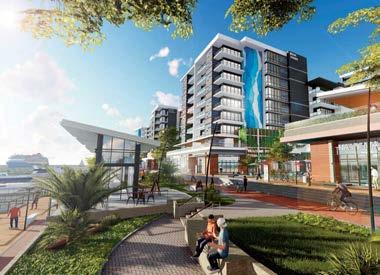
Waterfront Project; San Juan, Puerto Rico
MARCH/APRIL 2023 35
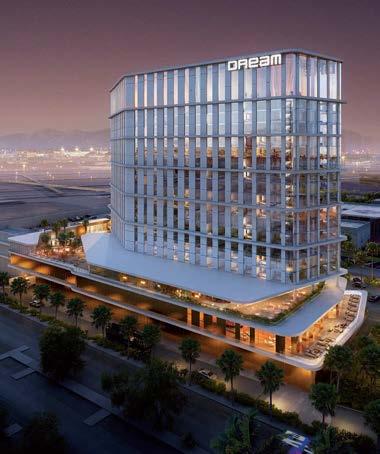
Dream; Las Vegas, NV
Optimizing Spaces with Observation-Informed Design
Architecture and interiors firm Eastlake Studio combines with next-generation experience consulting company geniant, merging research expertise with forward-thinking design to support the evolution of the modern workplace.
“Back in the day, the tech industry realized that for their apps or software to be valuable, they had to understand people, so they would bring in behavioral researchers to study their customers. And when a company is creating a new piece of technology, it’s no surprise to anyone involved if it costs tens of millions of dollars to develop.
Yet for a physical space, it seems like an outrageous luxury to invest in deeply understanding how people are going to use that space. That’s why it's enormously
helpful that we have our roots in technology. Two thirds of our company is a technology company and one third is physical space and, with that experience and awareness, we’re taking an evolutionary step as a discipline. We're getting behavioral researchers to come in and do the hard work of understanding the people that use our spaces.
This kind of collaboration is the future of the industry. Armed with behavioral information, our architects can design more productive environments. Architects and
designers need to have knowledge of all these other disciplines and aspects that really make spaces great experiences.
In the earlier phase of a project, we engage in a deep level of analysis, looking at what is really going on with a client or group of people, employees, or customers—whomever will end up using the space. Architects typically engage in stakeholder interviews or surveys, but the true magic comes when you push beyond that, using context observation to validate what you learn from interviews.
IN PARTNERSHIP WITH EASTLAKE STUDIO EASTLAKESTUDIO.COM STEVE HALL © HALL+MERRICK PHOTOGRAPHERS METROPOLIS 36
Twelve01 West Lake; Chicago, IL
We're going through this process for ourselves right now. In our stakeholder workshop, we worked on a variety of different questions and activities. Instead of starting with what we think the solution is and trying to validate that, we're trying to gather everyone's information and poke holes until we determine what the real problems are. Historically as designers and architects, we were always trying to drive the process to a solution with our questions, which becomes very leading. The process should instead be focused on getting to the root of the problem, even if it's not the answer that you want.
We're discovering different things in our research that we believe are going to help us be a bett er business, and it’s not only about the space investment. The research is telling us about all the experiences that can be better. When you pull these data points together and analyze them, and then overlay the design process, you don't end up with just one project but many small projects that affect the employee experience. From there, you can prioritize, build a road map, and feel empowered to initiate those smaller projects over time.
Right now, real estate is still driving a lot of decisions. The thinking is, ‘Oh, our lease is terminating in a year so we should start now.’ That’s why this upfront research gets cut out. Companies think they already know the problem but are just moving people from here to there. They have to give themselves time and runway to get started earlier so that when they begin the real estate process, they’ve already gathered and validated all the information, and they know for sure that that footprint is what's right for them.
You must think about commercial real estate like a company. If I introduce a piece of software, it should make you a better company. Real estate, too, should be a service. If you're a lawyer, your office should make you a better lawyer. People shouldn’t succeed at their jobs despite their office, but because of it.” –Christina Brown, principal, Eastlake Studio, and David Dewane, chief experience officer, phy sical space, geniant
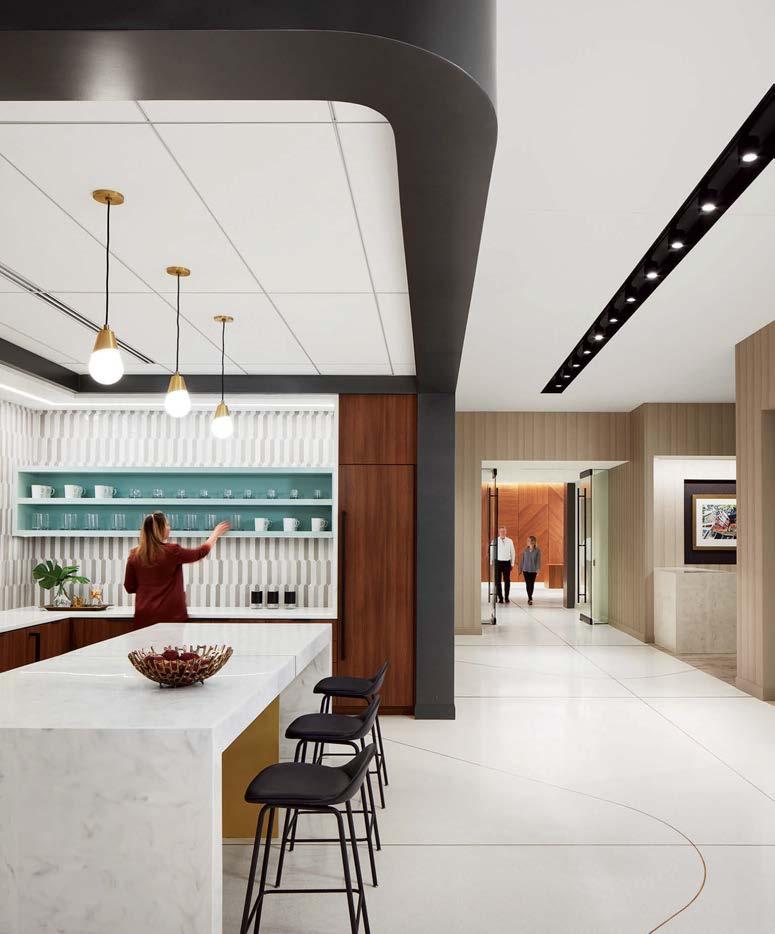
1 S Wacker, 12th Floor; Chicago, IL
KENDALL
©
MARCH/APRIL 2023 37
Downtown Grand Rapids Office; Grand Rapids, MI
MCCAUGHERTY
HALL+MERRICK PHOTOGRAPHERS
Elevating Design Through Bespoke Research
Information and insight drive design at HKS. Through a collaborative, investigative approach, the firm supports its clients in looking beyond benchmarks to create breakthrough solutions.
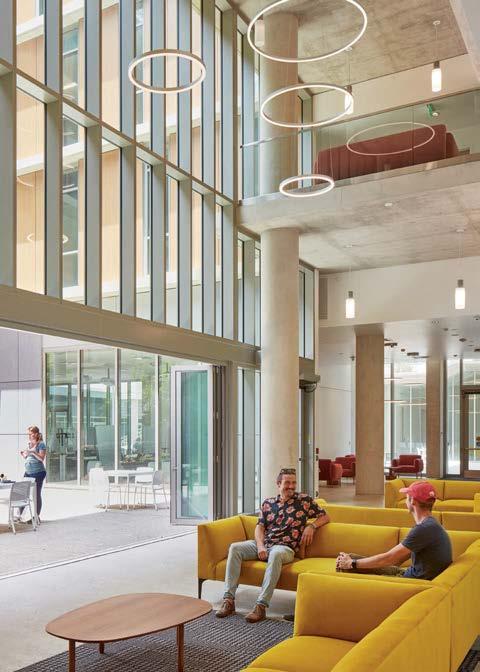
“Our clients look at us as true partners and consultants. We’ve spent a great deal of time workshopping with our clients, really diving deep and thinking about space quite differently than we've ever done before. The work is not as specific as we've seen in the past. It's not always a workplace project or a health care project. There’s this incredible blurriness. We've really leaned into that as a consortium of practitioners: How can we come together and invest internally in our relationships to trust each other and really to build?
We are big believers of art and science coming together. One thing we keep hearing from our clients, is that nobody knows what they're doing. Our director of research is fond of saying we're living in an experiment. Pre-pandemic, we and our clients relied a lot on benchmarks, which never really told the whole story, but it was a way of managing risk. Now, we’re working with clients around
the future, and it's incredibly personal and bespoke to individual organizations.
One thing that makes our research different is the people on our team. They are true academic researchers, not just architects and designers who like to use Google. There's an ego looseness that exists within us to be able to take this research point of view, and to be able to partner with a client and say: ‘Nobody has the answers right now, but let's roll up our sleeves and figure them out.’ Research is also incredibly accessible within our firm. Our research incubator program is open to everyone; anyone who has a good idea can pitch it. So the ideas are coming from the people doing the work for our clients, not from someone incredibly disconnected.
We are so fortunate to have clients that truly trust us. We become their partner in the process. They feel our passion. We're keen listeners. Our clients are eager to test forward-thinking ideas because they believe
in our design firm. That says a lot about our power of influence; and we want to be able to use design as a tool to elevate their business, to take a consumer to a new place. Every place has a story, and as we design, we help tell it. Our work enlivens communities, energizes the users and consumers, and respects and protects our planet.
Our interiors practice in health, education, corporate, venues, and hospitality continues to redefine type, thoughtfully apply science, influence market, inspire awe, and collaborate to positively transforming our clients’ organizations through the built environment. Our strategic thinking and bespoke mindset builds on behavior-focus systems, and values the embrace of the whole-person.” —Meena Krenek, principal, global practice director of venues interiors, and Kate Davis, partner, global practice director of commercial interiors, HKS
UC San Diego; La Jolla, CA IN PARTNERSHIP WITH HKS HKSINC.COM FROM LEFT: COURTESY
COURTESY
HARRIS METROPOLIS 38
SoFi Stadium; Inglewood, CA
BRUCE DAMONTE;
TOM
Breaking Away from Convention
Whether through provocative building strategies or innovative material use, Kyle May’s desire to rethink norms drives his practice.
“We enjoy experimenting. When you learn how things are typically built, then you start to think of how things could be built, and it allows you to imagine something different. We just moved into a new 4,000-squarefoot shop where we’re able to expand our capacity for testing ideas and producing even more, and more types of, components and elements for each of our projects. This intrinsic control gives us a lot of freedom because we can fully conceptualize and produce the design intent, with the ability to improve things in real time. We can go out to the shop and say, ‘Hey, we could do this
detail that wouldn’t add too much effort or time but would really elevate the project.’
Materials are the heart of our practice in a lot of ways. Whether we’re experimenting with manual 3D printing, building a stool entirely out of tack welds, or using gypsum board to create a door that looks like it was carved out of stone, we use material innovations to create details and environments that our clients and the occupants of our buildings love.
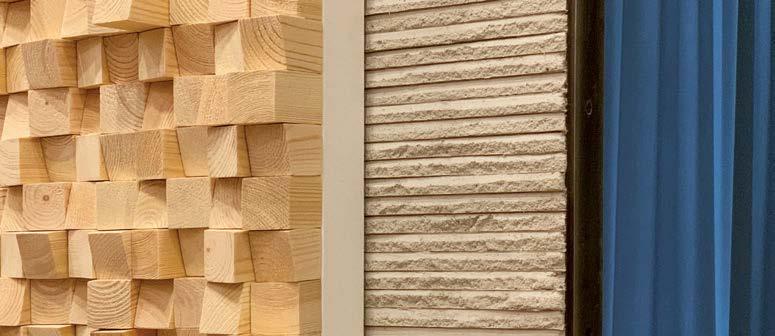
PARTNERSHIP WITH KYLE MAY, ARCHITECT KYLEMAYARCHITECT.
We strive to create spaces that are so beautiful that they become sustainable in the way that they’re cared for and appreciated. It is critical to think about the lifespan of a building in this way. A building that’s not necessarily energy efficient, and yet is loved and used well, can be a better building than a building that’s energy efficient but only lasts for ten years. That’s really where we need to focus as architects.” –Kyle May, Principal, Kyle May, Architect
Engaging Communities Through Design
Seeking to create beauty that makes a difference in people’s lives, Louise Braverman’s work strikes the perfect balance of visionary and pragmatic.
Centro de Artes Nadir Afonso; Boticas, Portugal
“I entered the field of architecture with a healthy dose of skepticism. Originally, I started in the art field. I was very interested in art that was situated in the land and a part of the land. But then over time, I was looking for a way that my art could be more involved in the lives of everyday people. I decided I’d be an architect, and
that was about all I knew about architecture. And it turned out to be a really good choice because I go to my office every day with a passion to create.
I believe that compelling architecture is a natural reflection of our human instinct to provide both beauty and community. Making a tangible difference
to the people who encounter our architecture is important to me, whether in cultural projects, residential projects, or in more unusual projects, like the dormitory we created for health-care workers in East Africa that was 100 percent off the grid. My interest in the relationship between art and architecture continues to inspire our work. Art very basically is about ideas. It’s about ideas that are prevailing in our culture today, and ideas that have prevailed previously in our culture. You can learn from the art world about what’s important to people. I truly believe that these same ideas must be embedded in architecture to make it compelling. And that’s what we go in to work every day to do.” –Louise Braverman, principal, Louise Braverman Architect
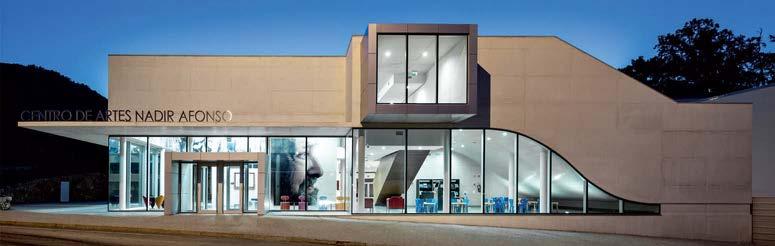
IN
Gotham Wellness SoHo; New York, NY
IN PARTNERSHIP WITH LOUISE BRAVERMAN LOUISEBRAVERMANARCH.COM
TOP: COURTESY KYLE MAY MARCH/APRIL 2023 39
Growing Thriving Communities
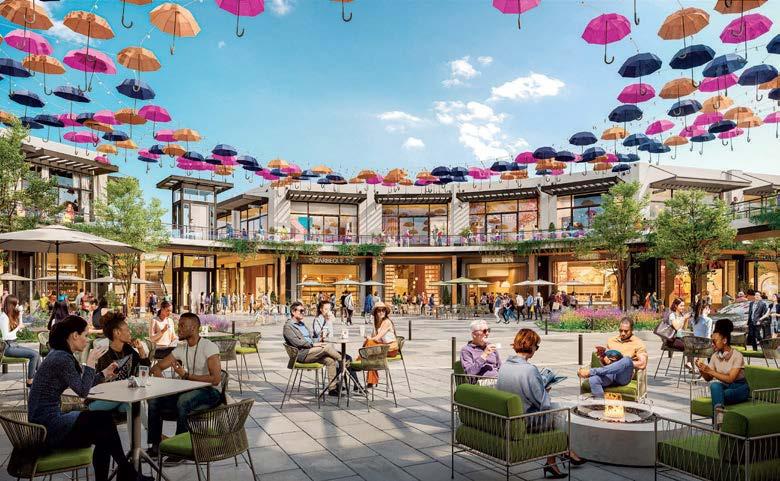
Drawing on its expertise across architecture, urban design, landscape architecture, and interiors, GGLO develops mixeduse projects that are making a positive impact in cities.
“There are tremendous opportunities in mixed-use projects. They often involve properties that are underutilized or have been lying fallow for a long period of time. They can transform a suburban town into a walkable urban environment. People are often drawn to the pretty picture, a ‘happy neighborhood’ site plan. These might look great on paper, but do they really work?
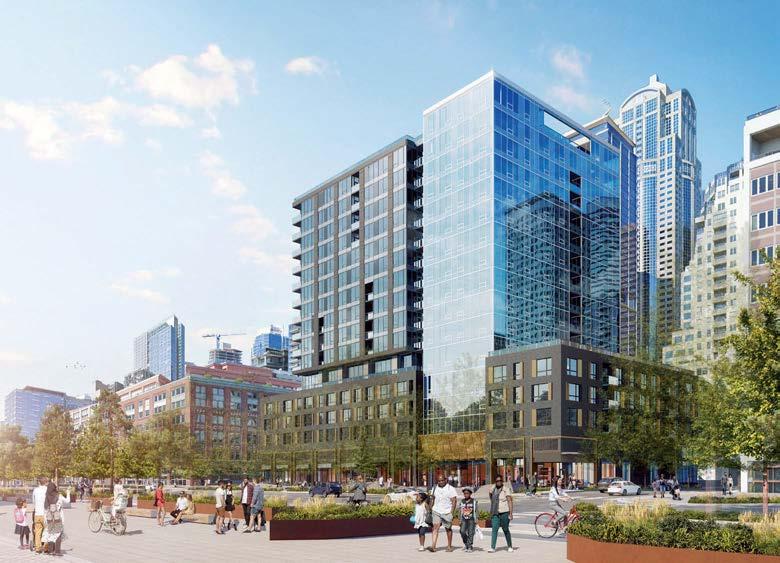
First, when we’re designing mixed-use projects, we look at the different layers of impact. There are more mundane but very important aspects to look at like covenants and lease restrictions, parking, and accessibility to transit. For a project to be successful, this spiderweb network of utilities and infrastructure must be considered before more aspirational ideas.
Once we peel back those layers, we continue with geographical research. Mixed-use projects usually have some standard foundational programmatic elements but going deep and understanding the subcultures within a neighborhood and community—that’s the place for innovation. We work to uncover what is unique about each location, listening to people and observing how they interact.
We think about programing as a curated mix of uses, considering a ‘day in the life’ of a person who lives or works in the building, or someone who is visiting in a restaurant or a retail setting. Exploring these experiences allows us to understand
overlapping values among different people. We also like think about programing in the context of day-to-night activation, and how spaces can flex over time.
Building in flexibility and adaptability is inherent to the work that we do. We’ll often design multi-phase, multi-building projects. This kind of work can take a decade or more to complete, and something that was going to be built in a certain area this year might not be viable starting five years later. We must be able to roll with that. The programing must
change and evolve to service the diversity of people who will engage with these projects over time.
We see a responsibility to bring the best to the communities that that we work in. We want to bring liveliness, vibrancy, and innovation that enhances buildings and spaces we’re working on and the community at large. We believe every building should be a good citizen, if you will, in the community that it’s built in.” –Jeff
 Foster & Kimberly Frank, Principals, GGLO
IN PARTNERSHIP WITH GGLO GGLO.COM AMLI Pierside; Seattle, WA
METROPOLIS 40
Redmond Town Center; Redmond, WA
Letting Passion Lead
Alison Antrobus started her namesake design studio in 2002 with a focus on luxury residential projects. To create a work culture that nurtures beautiful design, she encourages her Miami-based team to explore creatively, constantly learn from each other, and evolve with every project.
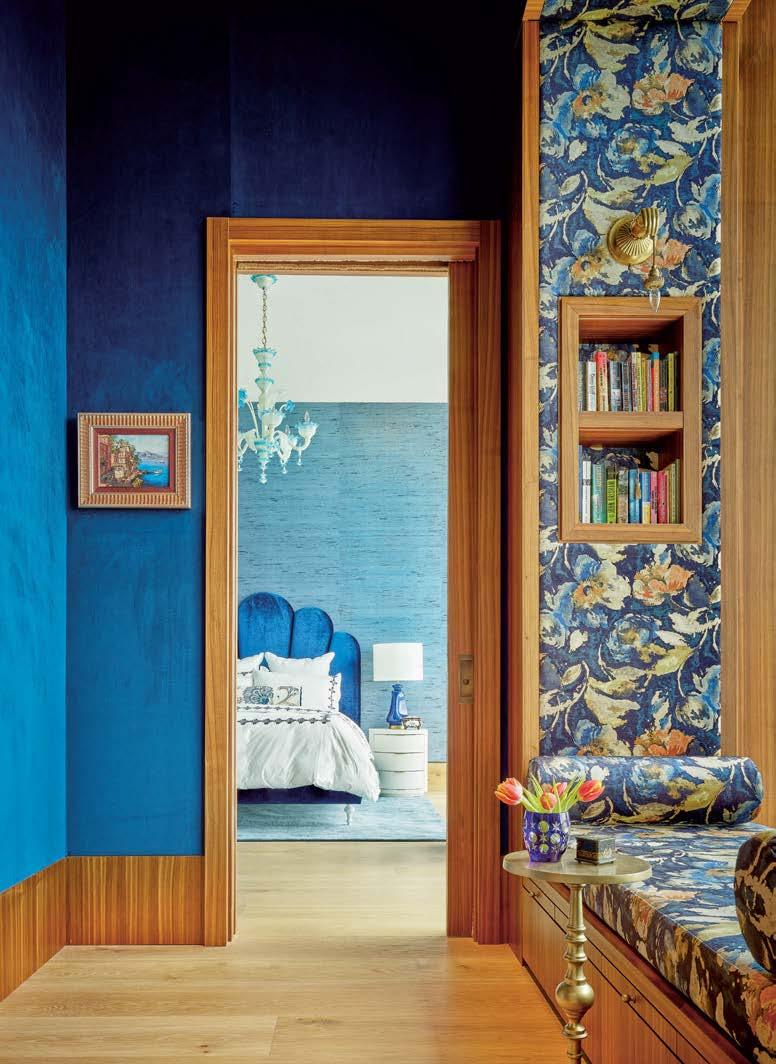
“The team at Antrobus Design Collective is so special and unique in so many ways. As a designer who is also a mother, I had to create that type of team. We lead with a lot of vulnerability and freedom of expression— and that’s how we evolve creatively, manage to do what we do, and enjoy doing it.
I don’t want to isolate designers that are not parents, as everybody brings their own strengths to the table. I am speaking purely about what I know being a parent in the world of interior design. From my perspective, because of all the complexities and challenges of raising little humans and bringing them into this world, being a parent absolutely makes me a better design leader.
As a parent, you must always think multidimensionally—not just about what’s in front of you, but what’s ahead of and beside you. You must think through scenarios that are very layered and complicated. When I’m working on a layout, or even an object or a piece of fabric, my experience as a parent enhances my ability to think on multiple levels simultaneously. I also feel very adept at managing a multitude of vendors, challenges, and personalities all at the same time given my training at home in navigating the complexities of being a parent.
Society has become much more accepting of professionals who are also parenting. I really believe that the pandemic had a lot to do with that. Everybody from newscasters to high-profile attorneys were Zooming from their homes with the possibility of a child interrupting the call. Suddenly, people in the public eye were seen as human,
not just as these public figures. Parenting became more accepted in the workplace because Covid stripped away the veneer of perfection and exposed the organic and often “beautifully messy” reality of parenting. Another parenting perspective I bring to running my company is the importance of encouraging personal growth as a means for professional growth. It’s important to give people the space to be their authentic selves—whether that’s in their family life or in their creative endeavors. This keeps you alive creatively! I also understand that it starts at the top. If I’m able to evolve, then
my team can grow and evolve. We recently went on a retreat, and I asked the team, ‘What are your passions aside from interior design? How can I assist you in developing these creative projects?’ I think it’s important that people keep their umbrella very wide. The broader your creative outlets, the better designer you are.
The sky’s the limit if you invest in your team. I really want to stress that the more freedom you want to have as a designer, the more you must nurture the culture of your team.” –Alison
Antrobus, founder, Antrobus Design Collective
IN PARTNERSHIP WITH ANTROBUS DESIGN COLLECTIVE ANTROBUS-COLLECTIVE.DESIGN
MARCH/APRIL 2023 41
Private Residence; Miami, FL COURTESY BARRY GROSSMAN
by Sina Pearson

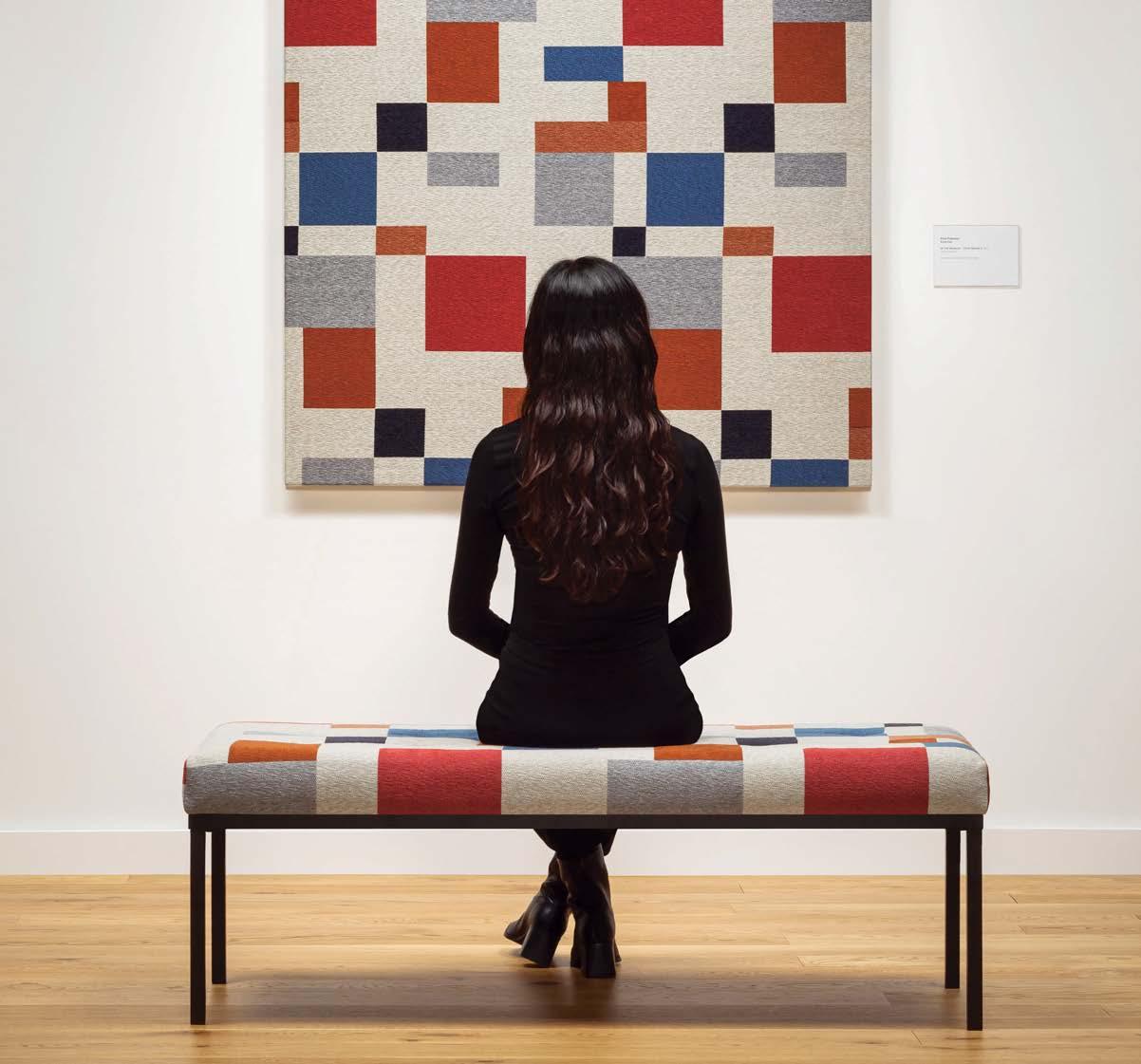
A T T H E M USEU M CO L L EC T I O N
Textile: Color Works Red Gray
MomentumTextilesAndWalls.com
At All Scales
A work in progress since 1999, Eric Owen Moss Architects’ (W)rapper tower is finally complete, making an otherworldly addition to the West Los Angeles skyline. Its strange form is the result of a design that replaces orthogonal columns and beams with curvilinear structural elements.
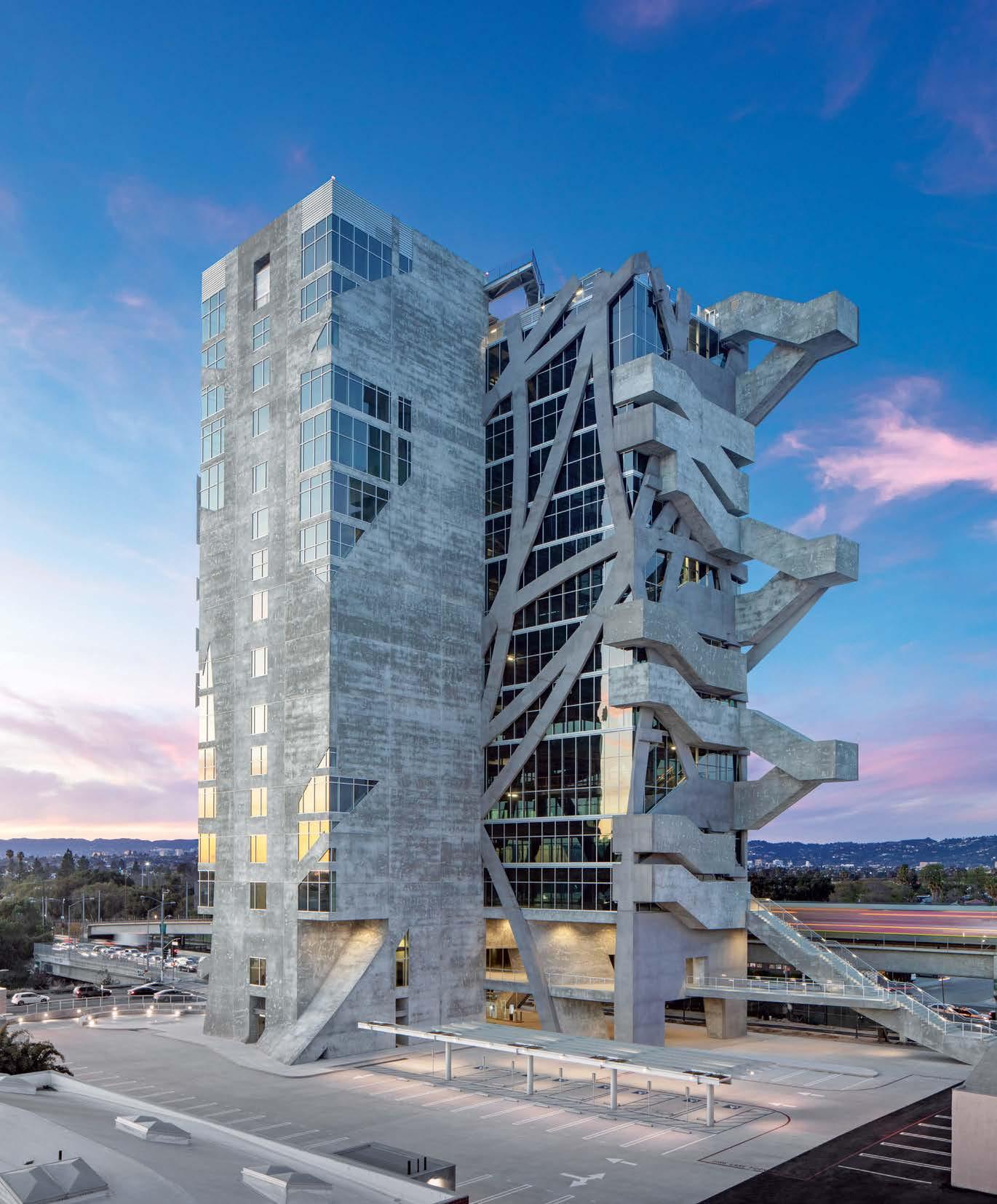
COURTESY © TOM BONNER 2023
METROPOLIS 43 MARCH/APRIL 2023
SPECTRUM
An essential survey of architecture and design today
ARCHITECTURE Wraparound Structure
For more than 40 years, Eric Owen Moss Architects and developer Samitaur Constructs have been building a collection of more than 30 rugged, deconstructed structures at Hayden Tract, a former heavy manufacturing hub in Culver City, California. The stream of experimental edifices—many filled by creative and tech firms— have short, catchy names like Pterodactyl, Beehive, Dune, Stealth, Waffle, and Umbrella.
By far the biggest of the bunch is the recently completed (W)rapper, a 17-story, 235-foot-tall tower that lies just across the boundary in Los Angeles. Its unusual form was achieved by shifting the typical structural grid of columns and beams into one based on curving external bands.
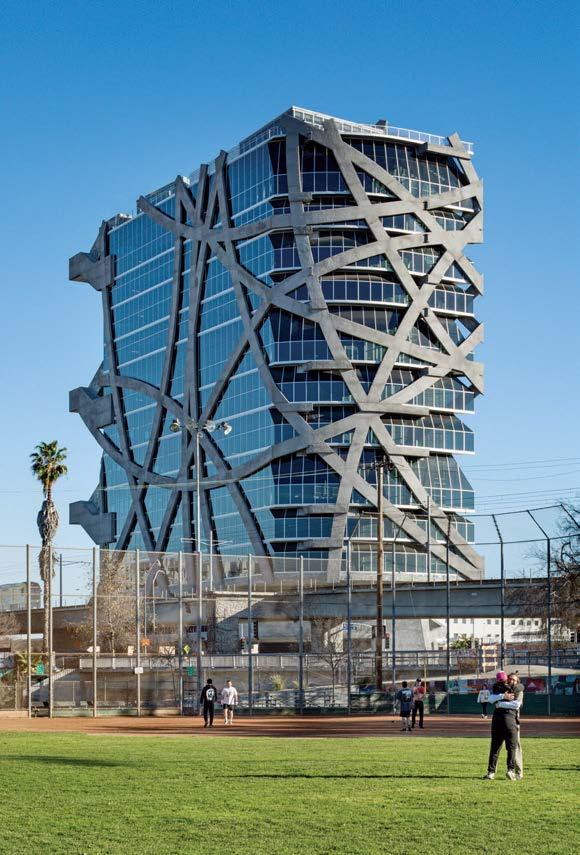
“As soon as you bend that column line, the framing becomes substantially different,” explains Eric Owen Moss. “It’s a conceptual tension between the possibilities of disorder and the promise of order.” Moss sees the building—like most of his work here—as a resounding counterpoint to the glassy, orderly blocks that most offices inhabit.
“We tried to take the logic of the building and express it,” notes Eric Owen Moss Architects project director Dolan Daggett. “Once you combine architecture and structure, it changes everything.”
Viewed looking up from the corner of Jefferson and National Boulevards, the gray tower’s mélange of rough, two-coat plaster facade, tinted and gridded high-performance window wall system, and arching structural steel bands (each is a foot thick and five feet tall and coated with spray-on cementitious fireproofing) appears somewhat arbitrary. But despite its unusual appearance, the building’s form is actually quite rigorous, growing out of the evershifting, arched bands—the loads transfer from band to column to girder and create increasingly complex geometries.
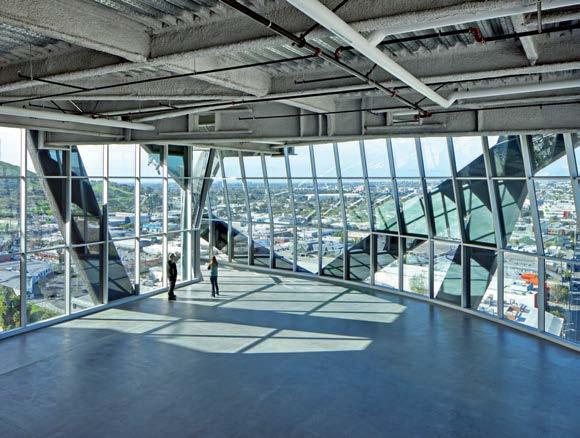
Because the building’s structure is shifted to the exterior, massive interior spaces on each floor are almost completely open and column-free. The combination of slightly warped walls and wraparound views leaves the impression of floating in a nest. You can feel the structure around you. The arcing bands frame unexpected views, and on lower levels the passage of Expo Line trains lends a dynamic urban feel that becomes surreal when you watch the trains curving around the bend, seemingly swallowed by the expanse of the Los Angeles Basin. —Sam
Lubell
COURTESY © TOM BONNER 2023
METROPOLIS 44 MARCH/APRIL 2023
Ceiling installation meets art installation




Some ceiling designs are so visually striking they feel more like art installations. WoodWorks® Custom Grille Ceiling Systems give you the freedom to express yourself with 3-dimensional shapes, linear patterns, and biophilic materials. Frame it all in the proper light with integrated fixtures from certified lighting partners. Our complimentary ProjectWorks® design service can even help develop your design intent into safe and manufacturable solutions and provide mock-ups, budgets, and detail drawings that bring your ideas to life. Get started on your masterpiece today at armstrongceilings.com/woodworksgrille



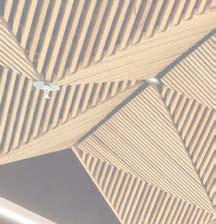
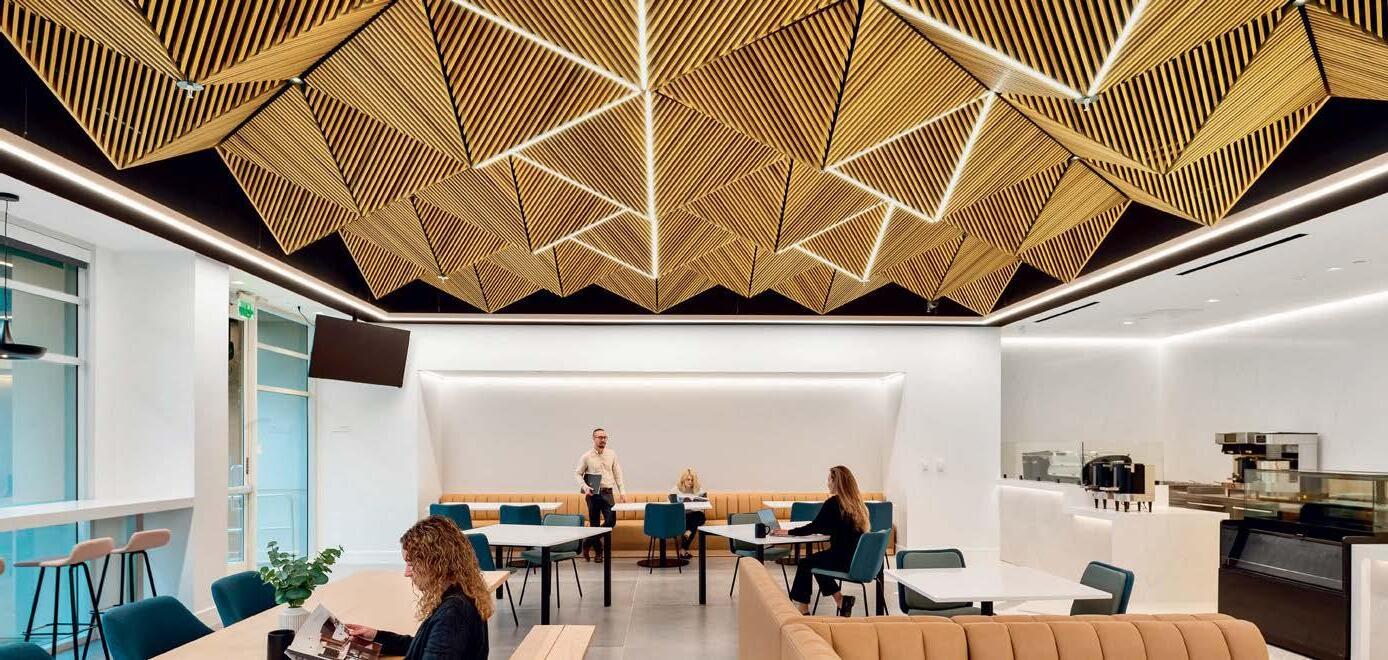 WoodWorks® Custom Grille Ceiling System > Redwood LIFE Café - Redwood City, CA > Habitec Architecture & Interior Design - San Jose, CA
Design & Pre-Construction Service
WoodWorks® Custom Grille Ceiling System > Redwood LIFE Café - Redwood City, CA > Habitec Architecture & Interior Design - San Jose, CA
Design & Pre-Construction Service
EXHIBITION Ahead of the Curve
For Hector Guimard (1867–1942), the goal was always to “put the beautiful within reach of everyone.” From Paris’s sinuous Metro station entrances to the intricate design of his wife’s wedding dress, Guimard dedicated every aspect of his life to creating unity between the architectural, decorative, and fine arts. Yet while Guimard quickly became France’s most famous Art Nouveau architect, breaking from the classical and revivalist styles of the 19th century, he died in relative obscurity in the United States, leaving much of his extensive oeuvre overlooked in the canon of architecture and design history.
A new exhibition sets out to change that. By considering Guimard’s processes and marketing strategies, Hector Guimard: How Paris Got Its Curves provides a fascinating look at the life and work of this influential designer. It showcases nearly 100 objects including furniture and cast-iron architectural elements alongside jewelry, textiles, wallpaper, typography, drawings, and photographs, as well as other products, plans, and marketing materials. Co-organized by the Cooper Hewitt, Smithsonian Design Museum and Chicago’s Richard H. Driehaus Museum and on view through May 2023, the ornate naturalistic designs tell the story of Guimard’s eponymous “brand,” Le Style Guimard, and its radical vision for industrial design.

While visitors will be entranced by the Gesamtkunstwerk of Guimard’s life, including his designs for his personal residence and studio, Hotel Guimard, the highlight of the exhibition is the architect’s lesser-known collection of concepts for several housing projects from the 1920s. In the context of the post–World War I housing shortage, Guimard’s foray into housing reflected his socialist leanings and advocacy of human rights. Works on view such as drawings for a Design for a Mass-operational House (1920) and Standardized Rural House (1920) display an early recognition of modular building systems including roofing tiles and interlocking concrete blocks.
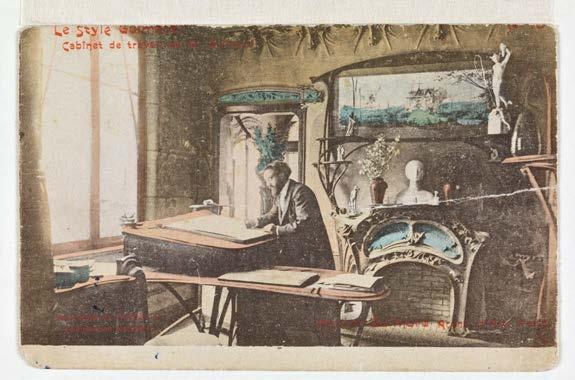
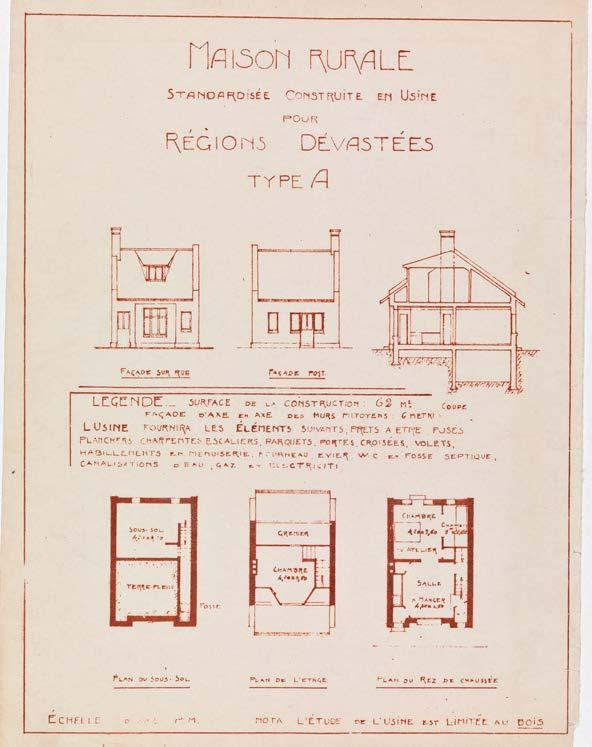
Guimard wasn’t developing prefab methods only to radically rethink the construction process. Art historian Barry Bergdoll writes in the accompanying catalog that he “was thinking through the implications of … sequencing to the nature of labor on the building site.” By embracing new building materials such as masonry, glass, cast iron, and concrete, Guimard’s work not only signaled a transformation of the city, but also displayed a sustained effort to make the Art Nouveau style accessible and affordable to the masses. –Jaxson
Leilah Stone
COURTESY MATT FLYNN SPECTRUM
METROPOLIS 46 MARCH/APRIL 2023
On view at the Cooper Hewitt, Hector Guimard: How Paris Got Its Curves showcases over 100 objects designed by the French architect including marketing postcards (above), textile designs and fragments of garments (left), and plans for standardized housing projects (below).
TILE THAT MAKES A STATEMENT.

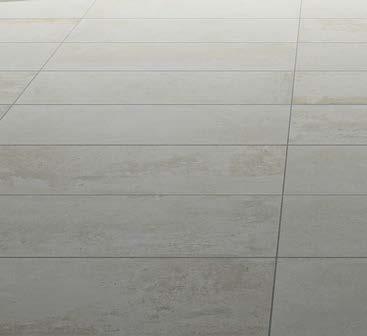
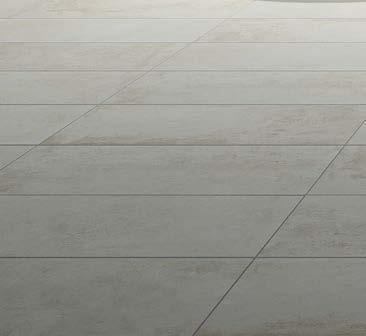
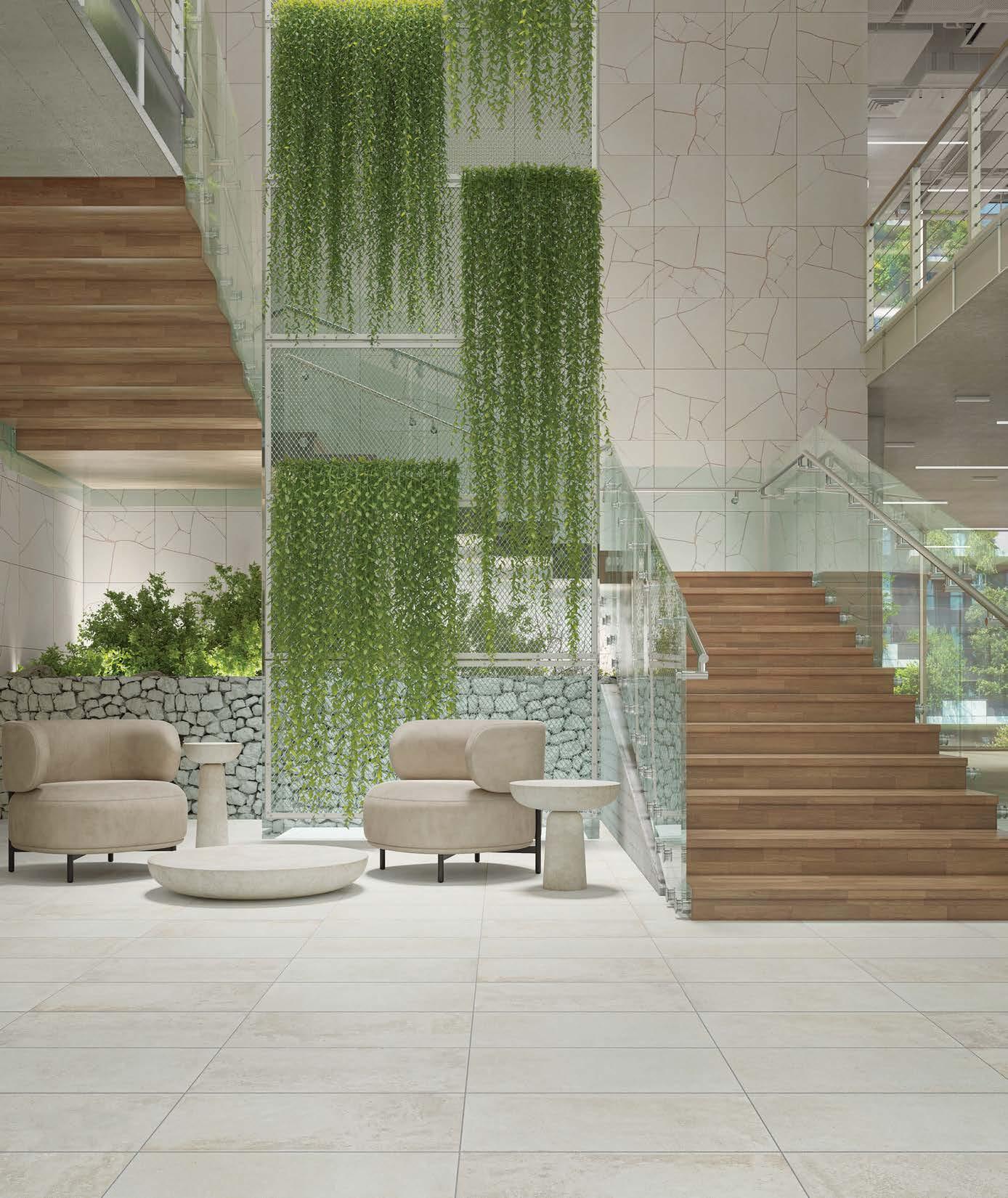
As the world-class leader in Tile, Natural Stone & Countertops, Daltile offers the largest assortment of high-style solutions to elevate any space or design.


©2023 Daltile IMAGINEWHAT'SPOSSIBLE™ WITHDALTILEDESIGNS FREE DESIGN SERVICES AVAILABLE!
Photo features Stare™ Kintsugi HIBI Moonlight 601R on the wall and Rekindle™ White RK10 on the floor.
HISTORY
Archival Treasures
As an art student from California studying at László Moholy-Nagy’s Institute of Design in Chicago during the mid-1940s, Mary Dill Henry wrote in her MFA thesis: “The world we live in is a vast and beautiful place, full of vital forces that work upon us and within us. Nothing is static or stationary, everything is in constant motion.”
Until her death in 2009, Henry surfed the various waves of 20th-century artistic expression: New Deal realism, Constructivism, Modernism, Minimalism, and mild strains of psychedelia. Among her most memorable works are the murals and mosaics she produced for the Hewlett-Packard headquarters in Palo Alto, California, and Op Art paintings that pulsate with depth and color. One work from 1985, Passiflora Red, coaxes volume and dimensionality from a
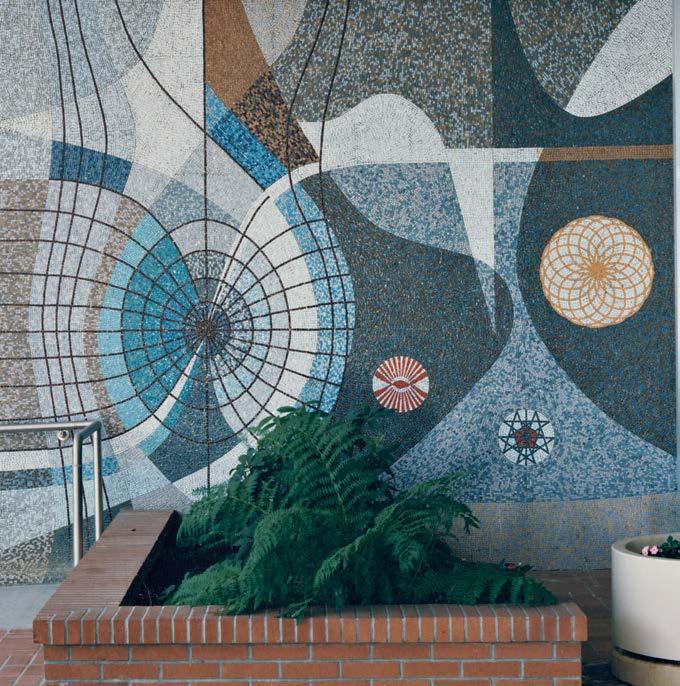
series of nested red triangles lustily tipped up on edge. In another piece from 1985 called Chateau de Courances , outlines of a fractal web pattern squirm and creep next to the orthogonal lines that are their animating counterpoint.
Despite her proximity to pivotal figures like Moholy-Nagy and her freewheeling embrace of the Institute of Design’s influential pedagogy, Henry hasn’t always been given her due. That’s about to change, as the Hauser & Wirth Institute (HWI) has cataloged and digitized her archive (sketchbooks, photos, letters, artist statements, press clippings, and drawings) and donated it to the Paul V. Galvin Library University Archives at the Illinois Institute of Technology, which absorbed the Institute of Design in 1949. HWI (a nonprofit private foundation)

emphasizes diversity and equity in archival research, aiming to raise the profile of unheralded voices and helping to surface “archives that maybe wouldn’t come to the attention of a research institution,” says Lisa Darms, its executive director.
Darms was attracted to Henry’s oeuvre in part because she was an artist who “comes to devoting herself fully to her practice later in life.” Henry’s wide eclecticism was at least in part driven by the fact that her most productive years were spent hewing to the whims of the commercial art world and hemmed in by domestic responsibility. It’s a testament to her Institute of Design training and its mediumagnostic approach that she generated works dynamic and vigorous enough to make commercial utility and free-form creative pursuit shine equally brightly. —Zach Mortice
COURTESY HAUSER & WIRTH INSTITUTE
SPECTRUM
METROPOLIS 48 MARCH/APRIL 2023
Left: Mary Dill Henry painting a mural at Hewlett-Packard headquarters in Palo Alto, California, in 1958. Right: the exterior wall mosaic Henry designed for HP two years later.



Introducing the 5 most requested specialty finishes. For those less concerned with staying in the lines. Indoor, outdoor, and custom options for residential and commercial applications. ¨ www.infinitydrain.com Made in the USA Color Theory
Satin Champagne
Polished Gold
Polished Brass
Matte White
Gunmetal
HOUSE Bird Watch
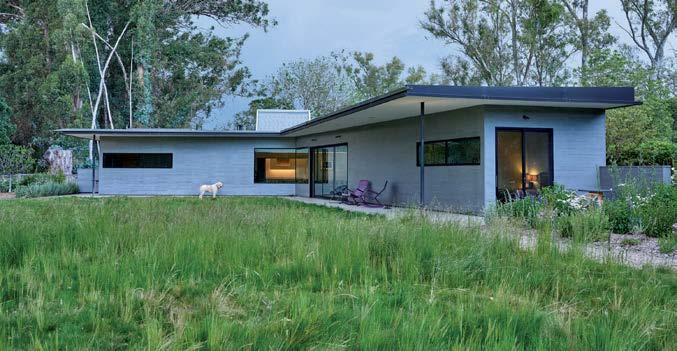
Inspired by the murmuration of mourning doves that share his wooded property in Sonoma, California, Neal J.Z. Schwartz, founder and principal of San Francisco–based Schwartz and Architecture, built his feathered neighbors a new home. The contemporary riff on the traditional dovecote is built into the roof of a 390-squarefoot studio addition to Schwartz’s house. Dovecotes, once built as adjuncts to country kitchens and barns, historically held agricultural functions as well as decorative ones.
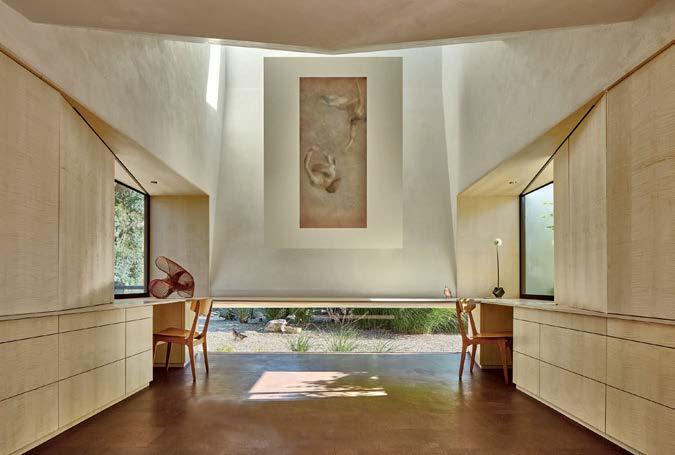
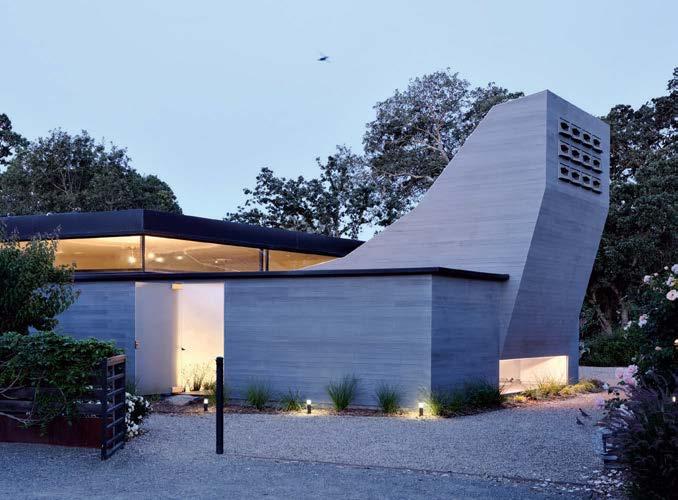
The monolithic tower is plugged into one side of an existing 2,000-square-foot L-shaped home that embraces the adjacent vineyard views and was designed with passive cooling and heating in mind. Its unique vaulting makes manifest the height, orientation, proportion, and ventilation requirements most advantageous to the doves’ nesting with 12 boxes carved into the angular, cedar-clad facade. The custom roof is shingled with laser-cut metal tiles that nest together, minimizing construction waste while enhancing aesthetics. “In terms of technical details, I am proud of the feather roof because it was a true creative collaboration with the contractor and is significantly less expensive than a traditional standing seam metal roof,” explains Schwartz.
While the dovecote allows brooding birds to remain undisturbed by interior goings-on, the lower window permits inhabitants to view the doves’ ground-feeding rituals. Inside the chapel-like volume hangs a custom sheer silk curtain, printed with an image of flocking birds, divides the studio from the home, while adding to its venerability. “I am most proud of the space’s quality and how it is tailored to my sense of calm and contemplation,” says Schwartz. Soft coos resound like a hymn.
—Joseph P. Sgambati III
COURTESY DOUGLAS STERLING SPECTRUM
San Francisco–based Schwartz and Architecture’s Neal J.Z. Schwartz has designed a 390-square-foot studio addition to his Sonoma, California home. Inspired by the mourning doves that share his property, Schwartz also incorporated a contemporary nesting area into the the addition’s roof.
METROPOLIS 50 MARCH/APRIL 2023
CREATING PLACES TO BELONG
Creating a place where employees feel like they belong is more than providing a workspace. It’s about connecting to a greater purpose and supporting individual needs.
Scan the QR code to learn how Kimball International created their path forward through personal stories, insights, conversations, and inspiration.

kimballinternational.com
BOOKS
Lifelong Learning
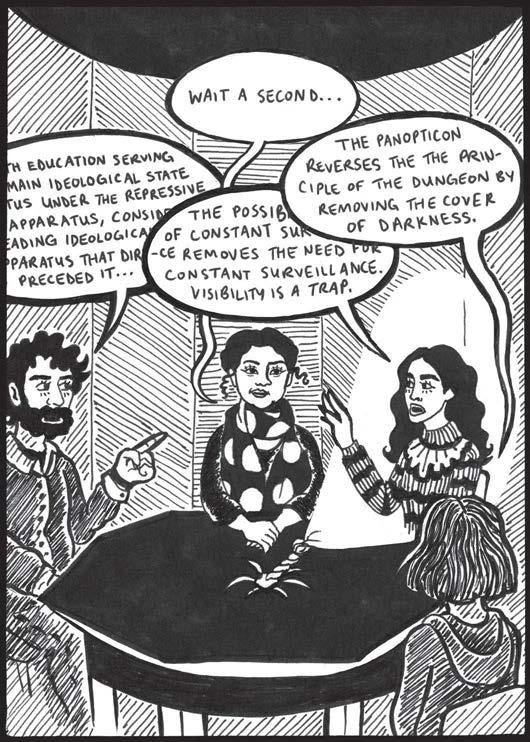
How to Be a Design Student (And How to Teach Them) By Mitch Goldstein; Princeton Architectural Press, 176 pp., $25.95
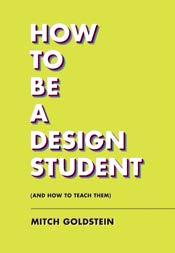
With 18 years of experience teaching and a lifetime of learning and creating, Mitch Goldstein has a lot of advice for design students. In his new book, How to Be a Design Student (And How to Teach Them), the designer and educator has compiled many of these lessons into an accessible volume that will be helpful for designers no matter where they are in their schooling.
The book is filled with nuggets of wisdom that address questions such as “Why go to design school?”, “How do you learn how to design?”, “What’s the difference between art and design?” (Hint: It doesn’t matter!), “Should you pursue an MFA?”, and “What does a professional designer do anyway?”
While the book was primarily written for current and future students, there are parts specifically directed at instructors. “Teachers and students are deeply intertwined—they are not on two opposing sides,” Goldstein writes in the introduction. “We are all in it together, working collaboratively to learn how to make and think as creative practitioners.” Most of all, the book is an important reminder that we are all students of life. “It’s called ‘creative practice’ because you never stop learning how to do it.”
—Jaxson Leilah Stone
The Messenger Matters
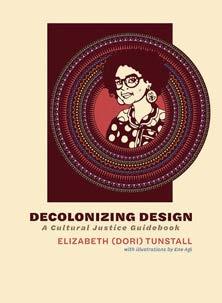
Decolonizing Design: A Cultural Justice Guidebook
By Elizabeth (Dori) Tunstall
136 pp., $22.95
with illustrations by Ene
Agi MIT Press,
Writing a book about decolonizing design is no easy feat. Writing one that is scholarly, accessible, and deeply personal is even tougher. But Elizabeth (Dori) Tunstall is no stranger to firsts. She currently serves as the dean of Ontario College of Art and Design University in Toronto, making her the first Black person to hold such a position at a design school anywhere in the world. And her lived experience in the world of design pedagogy is largely what makes her an expert guide to these troubled waters.
In the introduction to her new book, Decolonizing Design: A Cultural Justice Guidebook, Tunstall begins in the first person, tracing her ancestry and cultural heritage for the reader, and listing her identities (African American, cisgender,
Christian, scholar, creative…), before outlining her objectives for decolonizing design. It’s a small but powerful move, showing that the decolonial work starts from listening to the lived experiences of others. She writes: “The book is deeply interwoven with my lived experiences of interacting with cities, people, ideas, and projects to bring you inside of a person doing this work. I will tell you where the blows were, how hard they hit, and what I did to heal myself, the communities, and institution in which I was working.”
Organized into five chapters, the book blends memoir, guidebook, and manifesto, but for Tunstall, the biggest takeaway is that decolonizing design means “putting indigenous first,” followed by “dismantling the tech and racist bias” in European Modernism, making amends to diverse communities, and reprioritizing resources. —J.L.S.
COURTESY PUBLISHERS SPECTRUM
METROPOLIS 52 MARCH/APRIL 2023
At Mannington Commercial, our heart lies in our craft. We make exceptional flooring products with thoughtful design and uncompromising performance. With a commitment to providing more sustainable products our Legato Liquid Linoleum flooring has attained USDA BioPreferred® certification. For more information, visit us online at manningtoncommercial.com.


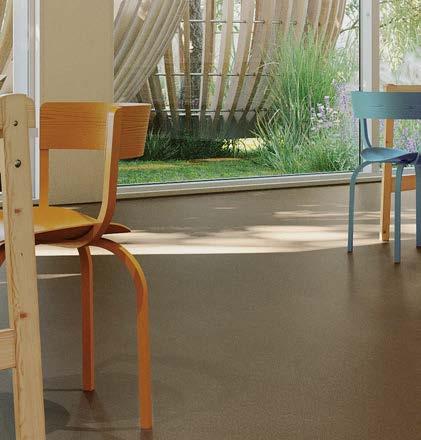
Legato N339
Rietveld Relaunched
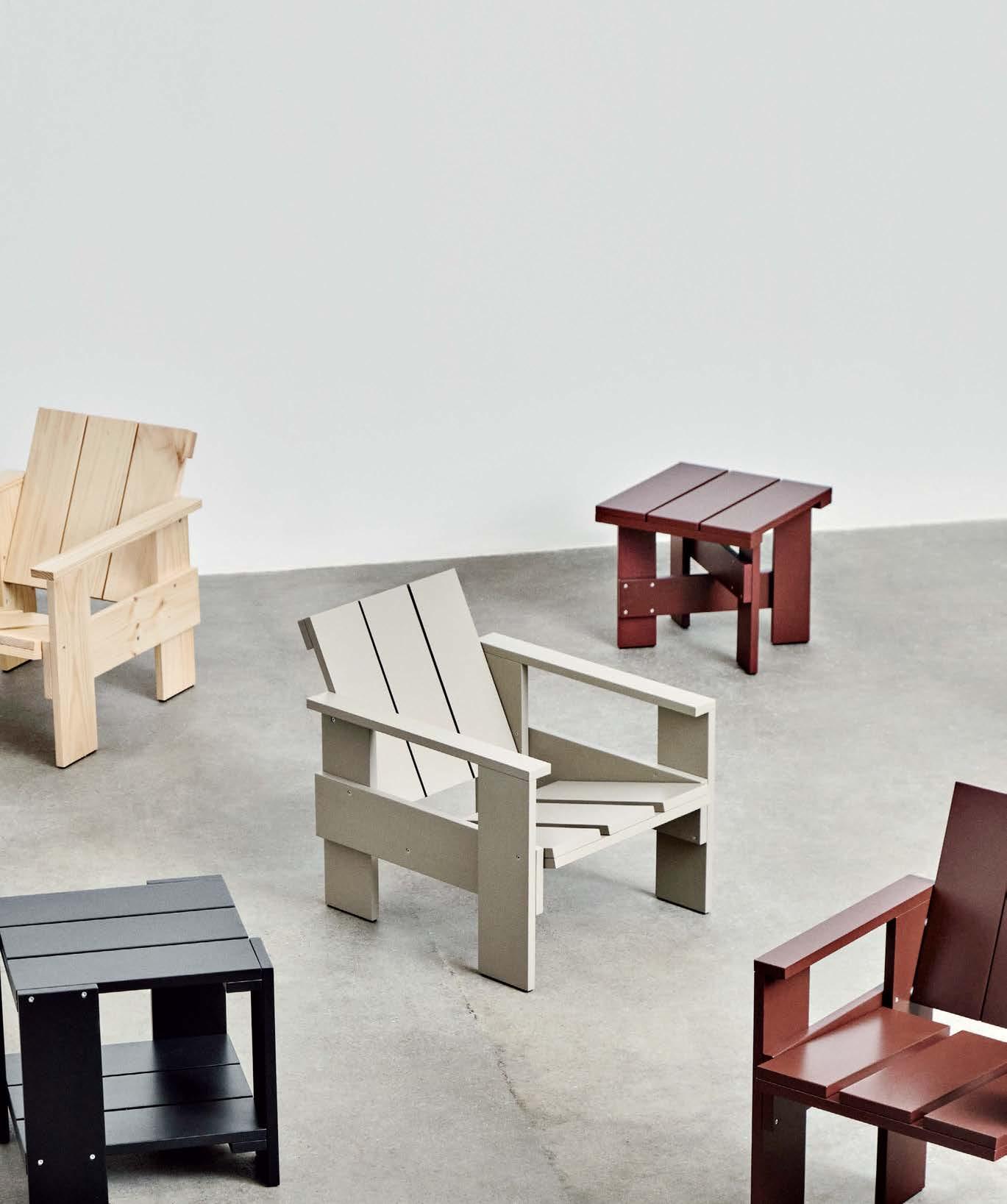
In collaboration with Rietveld Originals, HAY has resurrected Dutch designer Gerrit Rietveld’s 1934 Crate Collection. The Copenhagen-based furniture and lighting manufacturer says the project underscores design sensibilities it shares with the famously progressive architect and designer. “The connection we now have with Gerrit’s very own grandchildren, hearing their stories, is an experience I wouldn’t dream of being without,” says cofounder Rolf Hay, reflecting on the collection’s development process.
The Dutch De Stijl movement of the early 1900s, with which Rietveld’s work is associated, espoused a visual language that was utilitarian in expression, using geometric forms and primary colors to articulate design and, in some cases, function. Rietveld’s original Crate chair was built using surplus wood from shipping crates, with the specific purpose of making sensible furniture affordable.
Consisting of a lounge and dining chair, low table, and side table, the new indoor/outdoor collection is made of solid pine finished with a water-based lacquer available in five colors: natural, black, white, Iron Red, and London Fog. The pieces are manufactured with respect to the originals, echoing Rietveld’s transparent construction and balanced proportions. Assembly requires only screws. Seating can be supplemented with optional cushions in selected textiles for added comfort.
Because both HAY and Rietveld Originals are purveyors of modern design, the collaboration is a testament to the relationship between architecture and object to achieve a fitness of purpose. Akin to fashion, furniture is a thing of utility adapted and adjusted to the user’s lifestyle needs. But culturally significant pieces like those immortalized in this collaboration are talismans of their time—De Stijl artifacts that declare themselves part of the zeitgeist almost 90 years later. —Joseph
P.
Sgambati III
Copenhagen-based furniture and lighting manufacturer HAY has recently relaunched Dutch designer Gerrit Rietveld’s 1934 Crate Collection. The dining chair, low table, and side tables are all made out of surplus wood from shipping crates, just like the originals.
COURTESY RIETVELD ORIGINALS X HAY SPECTRUM PRODUCT
METROPOLIS MARCH/APRIL 2023 54
The New Era of Lighting



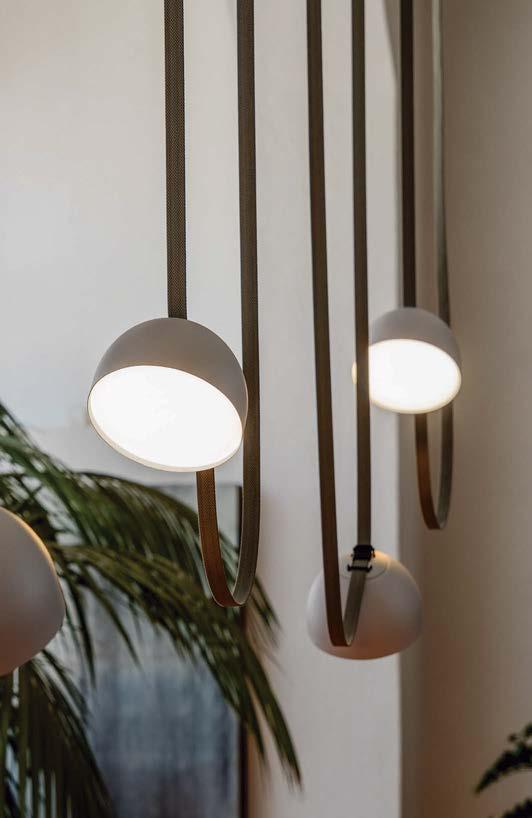
Essential and avant-garde; Plusminus is a versatile lighting system with a conductive textile belt that allows for the free positioning of multiple luminaires and the intuitive creation of customized lighting solutions.





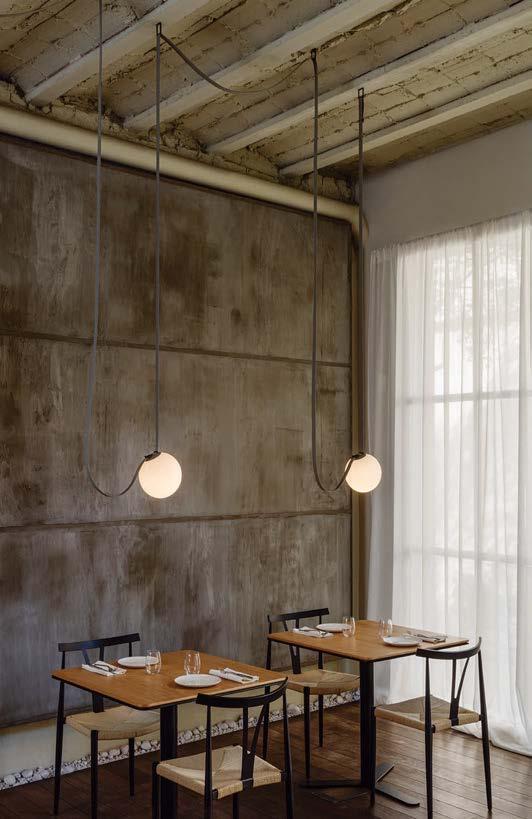 Design by Diez Office Diez Office
Discover
TRANSPARENCY Warm Reception
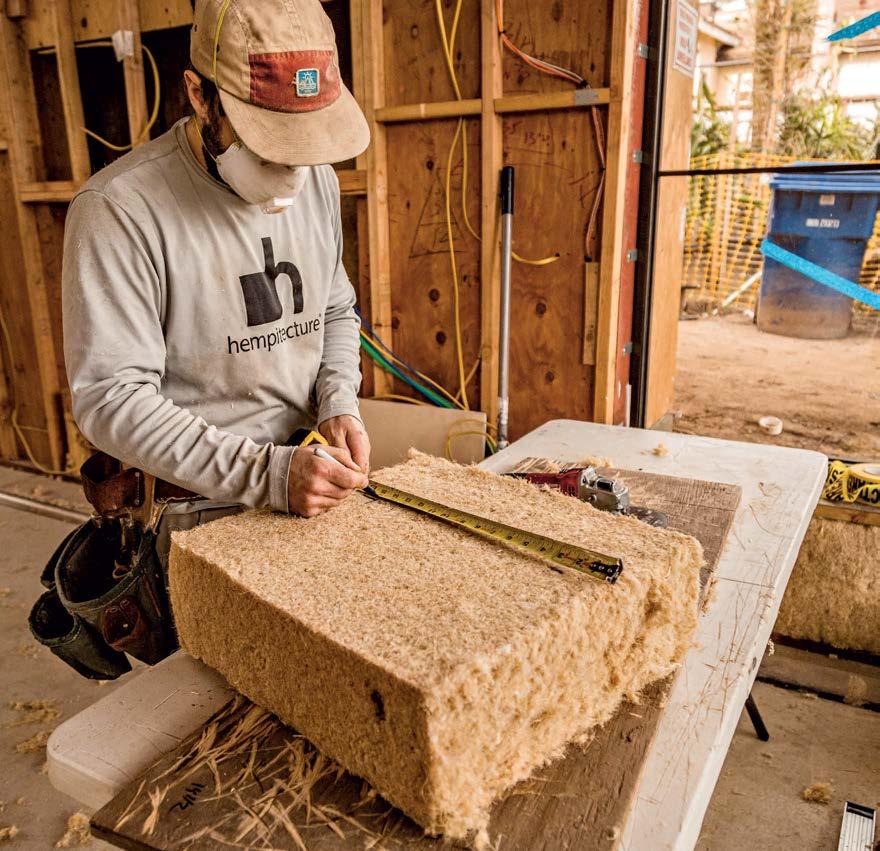
Hempitecture raises the bar in building insulation with an option that stores carbon as well as heat.
By Kelly Beamon
HEMPWOOL
Improving on other sustainable options, this hemp-based thermal batt insulation adds carbon absorption to its list of attributes, including being biobased and safe for workers to touch. Here’s how it’s weeding out the competition.
01
RENEWABLY SOURCED
Industrial hemp plants, the insulation’s chief raw component, have a rapid growing cycle that also helps with soil regeneration, requires no fertilizer or pesticides, and needs 50 percent less water than cotton per season.
02
CARBON NEGATIVE
One acre of industrial hemp absorbs roughly 9.8 tons of atmospheric carbon as it grows.
03
LABOR-FRIENDLY
There are no irritating allergens or VOCs in the final product, which means installers can safely handle HempWool without gloves. Basic protective gear, such as eye protection and a dust mask typical of work sites, are all that’s recommended.
04
BIOBASED-CERTIFIED
Administered under the USDA’s BioPreferred Program, the label means the product’s biodegradable ingredients are verified, including the amounts—in this case 90 percent hemp, 10 percent polymer binder. It’s even compostable.
05
THERMAL EFFICIENCY
Because HempWool is a dense material, it has an R-value comparable to both mineral wool and fiberglass.
06
PEST-RESISTANT
The high concentration of silica within the panels makes them less likely than wool to attract moths, termites, and rodents.
07
MOISTURE CONTROL
Unlike traditional fiberglass options, which are made less effective by exposure to moisture, HempWool can absorb up to 20 percent of its weight in water before losing its insulating value. That helps reduce the risk of mold.
COURTESY STEVEN BUSBY
METROPOLIS 56 MARCH/APRIL 2023
RESIDENTIAL STYLE. COMMERCIAL CAPABILITIES. roomandboard.com/bicontract 800.952.9155
FOCUS Lighten Up
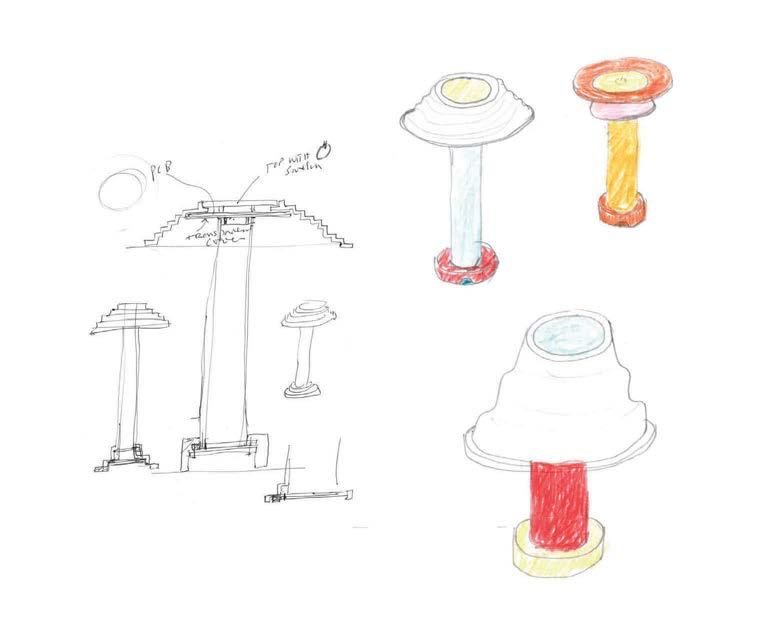
A founding member of Italy’s Memphis Group is debuting lighting that captures the collective’s wild style for a new generation to enjoy.
By Kelly Beamon
Shocking. Playful. Approachable. The new Sowden Light Collection by its namesake George J. Sowden communicates everything the Ettore Sottsass–led Memphis Milano collective, to which Sowden belonged, intended with its inaugural products in 1981. A protégé of Sottsass, Sowden went on to churn out items for such manufacturers as Alessi and Olivetti, but also colorful home accessories such as electric kettles, juicers, and carafes under his own brand.

More than his other post-Memphis objects, the new lighting (a line extension of a single portable lamp brought to market last year) best captures the bold detailing, wacky proportions, and cheeky spirit of exploration that make his original Memphis furniture prized on the secondary market today (Google his 1982 Metropole clock and 1981 D’Antibes cabinet to see auction results).
“I was working on another lighting project and needed to make a prototype,” Sowden says. “To make the model of the shade, I decided to use silicone because it was a quick, precise, and relatively inexpensive way to do it. By doing this I discovered the silicone had an extraordinary quality of light diffusion; it was this unexpected surprise which was the beginning of the Sowden lighting collection,” he adds. The full line is available now exclusively through MoMA Design Store. M
COURTESY MOMA DESIGN STORE
Born in Leeds, U.K., designer George Sowden studied architecture at the Gloucestershire College of Arts. He moved to Milan in the 1970s and joined Memphis in 1980. Sowden Light (left) includes two styles of table lamps, five pendants, a floor lamp, and an update of his 2021 portable table lamp.
METROPOLIS 58 MARCH/APRIL 2023
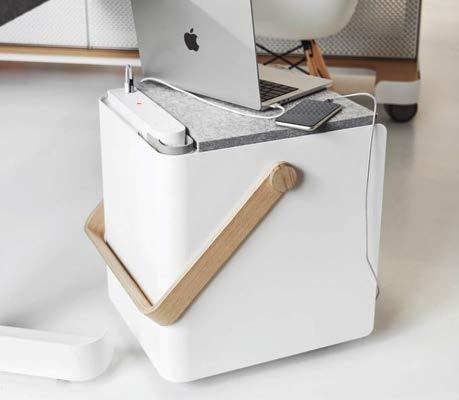
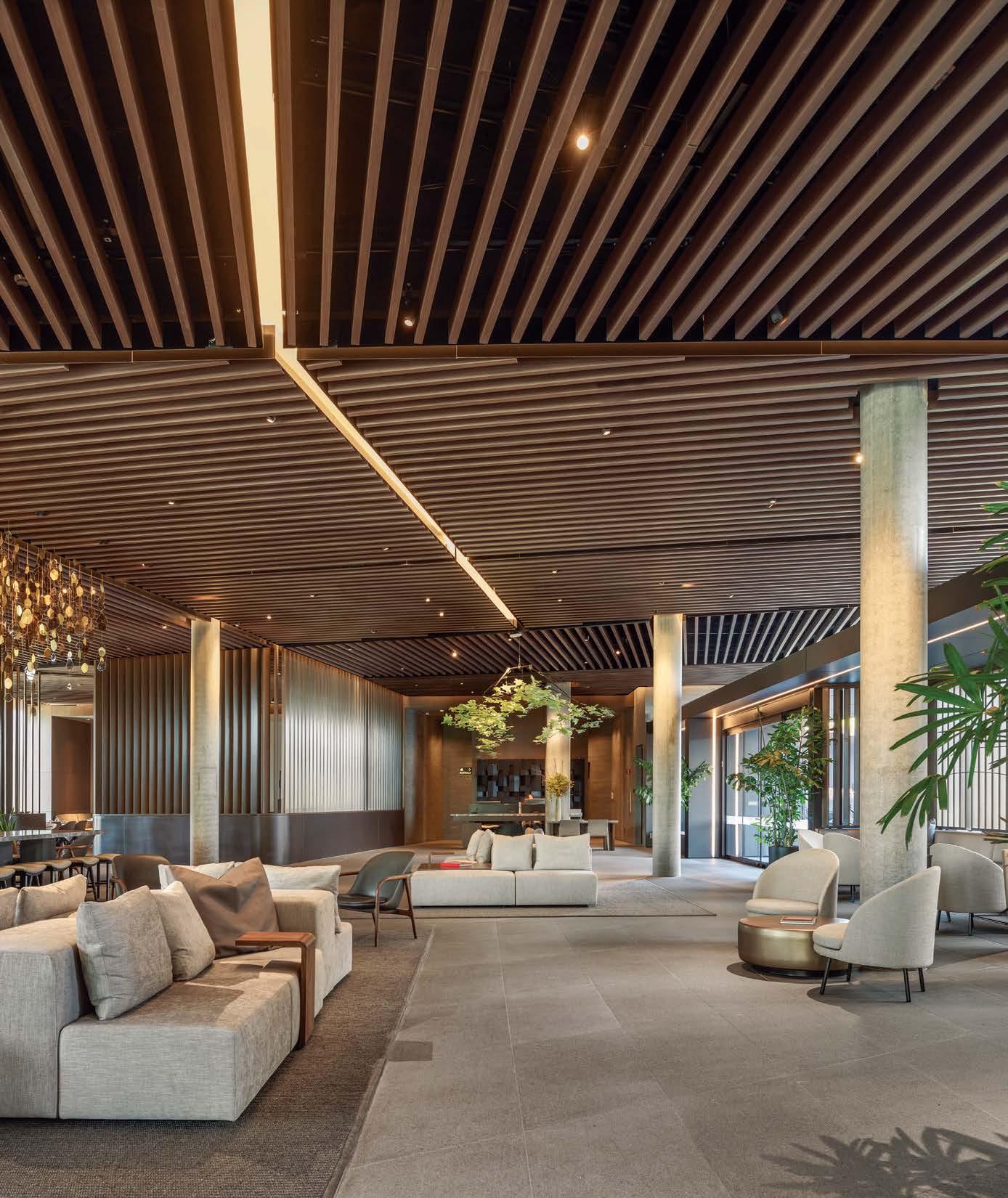


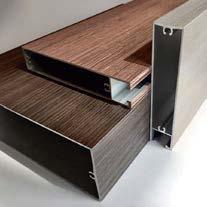
This Isn’t Wood. Fortina is a remarkable architectural system that looks and feels like real wood, but made with aluminum and a hyperrealistic surface. Available in a multitude of wood species and metal finishes. For interior and exterior applications. Fortina. Fool Your Senses. Featured: the Tetra Hotel, Sunnyvale with louvers in Linda Acacia LB finish. Inset: a few of the profiles in Vent Walnut, Earl Walnut and Rokko Cedar fnishes. © B+N Industries Inc. www.BNind.com 800.350.4127
PRODUCTS Luminary Delights
The latest lighting references forest landscapes, fantasy, mobility, and minimalism.
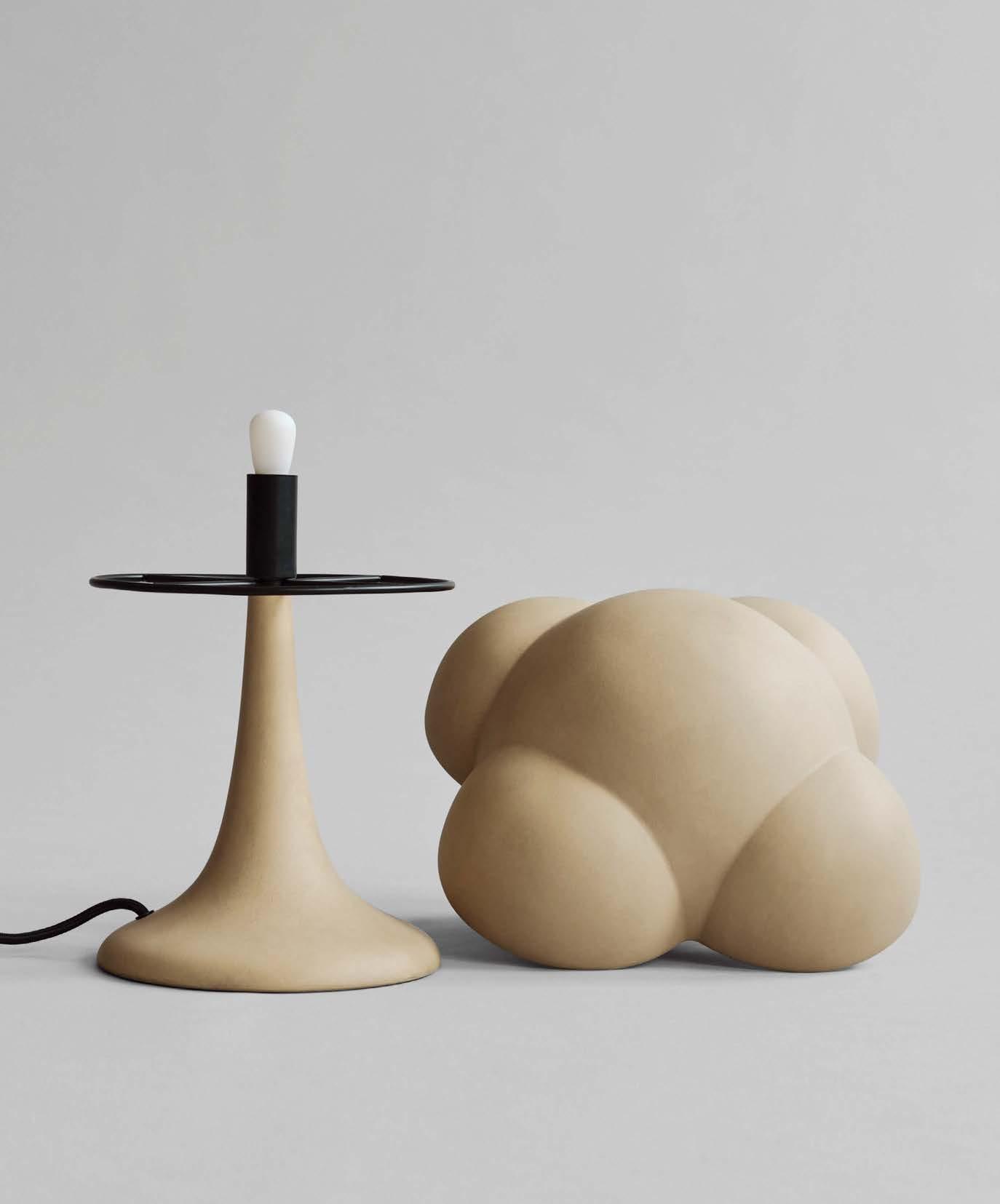 By Kelly Beamon
Lighting designs still echo escapist fantasies sparked by the pandemic shutdown: Mushroomstrewn woodlands and gleaming virtual worlds continue to inform shapes and finishes. The 101 Copenhagen Fungus table lamp on this page features a shroom shape; Rosie Li x MONDAYS’ Pilar collection (opposite, top left) has a softer reference in its lichen patterns. Other luminaires seem forged in the metaverse because of their dreamy gold finishes from shade to base. There’s also a steady stream of the pared-down and the portable, trends that are direct by-products of a newly flexible and even nomadic office. Review our sampling on the following pages.
01 METROPOLIS 60
This handcrafted lighting collection sprouted from a collaboration between designer Rosie Li and ceramics studio
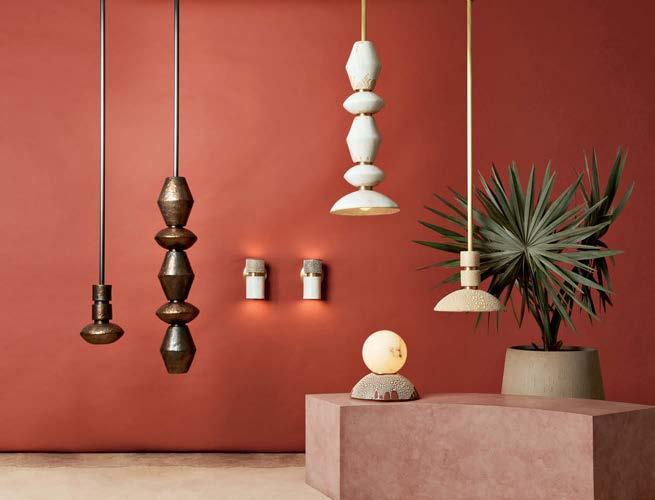
MONDAYS. The forms mimic Constantin Brancusi’s famous sculpture Endless Column; the crackle glazing resembles a lichen’s crusty texture.
ROSIE LI x MONDAYS rosieli.com
Though it looks shroom inspired, this combination sconce and shelf is actually based on architectural domes. Made of aluminum and acrylic, the LED is also available as a suspension, floor, and table lamp.
ESTILUZ estiluz.com
Compact and mighty, this seven-by-five-inch indoor/ outdoor LED swivels to cast a multidirectional beam, so it can be used as a downlight, accent, wall washer, or sloped ceiling fixture.

PROGRESS
progresslighting.com
Part of a collection engineered to maximize illumination and shrink housing size, Micro Doubles features two 1.25-inch LEDs in a single discreetly recessed fixture. Declare label and Living Building Challenge–and Red List–approved.
USAI LIGHTING
usailighting.com
COURTESY THE MANUFACTURERS
02 PILAR
03 CUPOLINA
04 SURFACE MOUNT CYLINDER
LIGHTING
05 LITTLEONES MICRO DOUBLES
02 03 04 05
01 FUNGUS
MARCH/APRIL 2023 61
Designed by Kristian Sofus Hansen and Tommy Hyldahl, the materiality and shape of this porcelain table lamp channel a mushroom’s biophilic charm. 101 COPENHAGEN 101cph.com
06 ONTOLOGIA Minneapolis design studio Prospect Refuge created a reality-bending handblown lighting collection, which includes this sconce as well as chandeliers, floor lamps, and pendants.

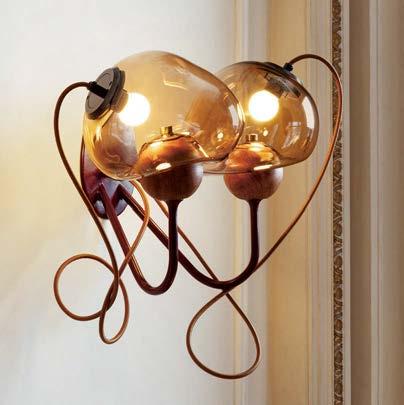

HENNEPIN MADE hennepinmade.com
07
Besides
ROCKY MOUNTAIN HARDWARE rockymountainhardware.com
08 Y AND RETRO
These lamps are bronze sculptures from a collection designed by Noé DuchaufourLawrance, and made of cast-off screws, bolts, and faucets melted and then cast using traditional African techniques by bronzesmiths in Burkina Faso.
MAISON INTÈGRE maisonintegre.com
09 PORTABLES
At this year’s Euroluce during Salone del Mobile, Tom Dixon is debuting rechargeable versions of his lamps Melt (pictured), Stone, and Bell to work anywhere you do.
TOM DIXON tomdixon.net
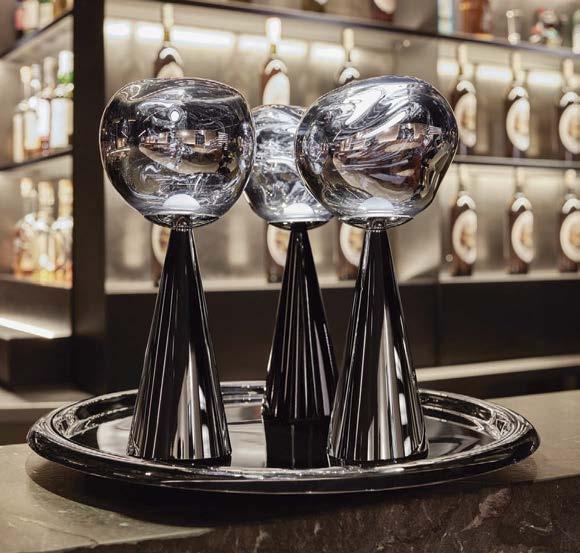
COURTESY THE MANUFACTURERS PRODUCTS Luminary Delights
LINEAR CHANDELIER
silicon bronze that looks like molten gold, this LED suspension comes in 11 other hardware-like finishes.
07 08 06 09 METROPOLIS 62


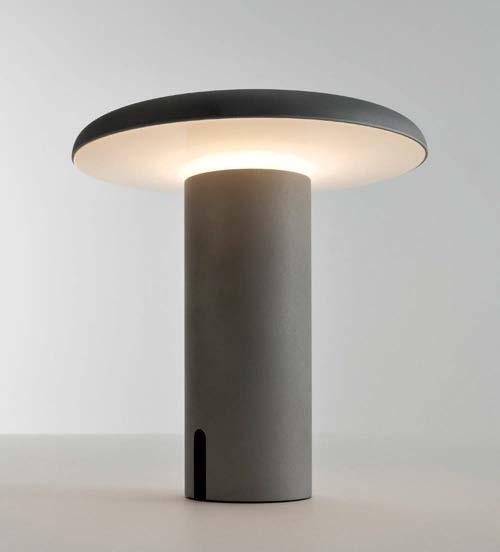
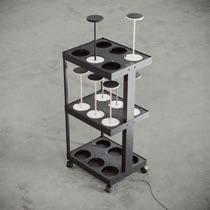
ARTEMIDE
11 TAKKU Foster + Partners designed this workplace-friendly portable for Artemide, which features a 32-hour run time.
artemide.com
12 SILVER DOLLAR
10 12
A new finish helps distinguish Refractory’s 68-inch-tall, cast-bronze Promontory Standing Lamp. Silver Dollar is a dramatic hand-applied silver treatment evocative of heirloom silverware. REFRACTORY refractory.studio
10 ROD
Extending the Diesel Living with Lodes collection, this portable LED table lamp (named for the construction rod that its steel stem resembles) has eight hours of battery life and an optional cart for recharging 18 at once.
11 MARCH/APRIL 2023 63
DIESEL LIVING WITH LODES uk.diesel.com/en/living/
SUSTAINABLE Something Old, Something New
LMN Architects achieves a carbon-friendly office renovation for a real estate client by striking a careful balance of reused and responsibly sourced materials.
By Gregory Scruggs
Global commercial real estate giant Hines bought Seattle’s handsome Norton Building in 2021 with designs to plant its Pacific Northwest headquarters on a floor formerly occupied by a coworking space. While the existing layout of 7,120 square feet arranged with a ring of partitioned offices worked for Hines’s plans, the aesthetics were lackluster by the standards of a property firm known for its design acumen.
When Hines began working with its longtime partner LMN Architects—conveniently located three floors down—it expected that basics such as the carpet and door s would be replaced with brandnew materials. But LMN has been on the forefront of addressing the embodied carbon of interior design decisions. They studied the impact of their own offices after a 2013–2015 remodel and determined that over 60 years, interior renovations can generate as much embodied carbon as the construction of framing and building envelopes—even though the latter receive far more attention from industry groups, standard setters, and regulators.
LMN suggested that Hines’s redesign process could center the impact of embodied carbon in a first-of-its-kind implementation of the firm’s research. Given Hines’s pledge to achieve net zero operational carbon by 2040 without buying offsets, and its admiration of LMN’s own office, which leans into the timeless aesthetic of Seattle’s finest International Style building, the new landlord gave the architects the design reins.
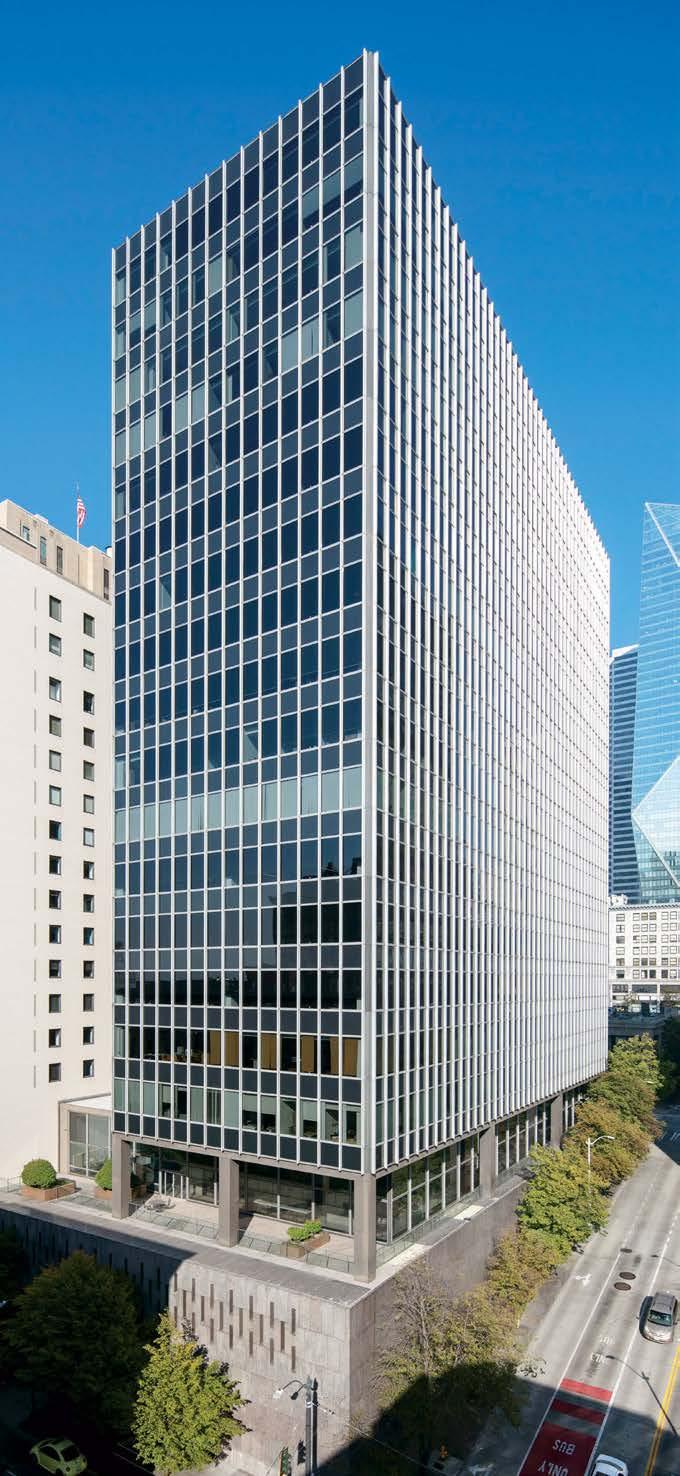
COURTESY ADAM HUNTER/LMN ARCHITECTS
METROPOLIS 64 MARCH/APRIL 2023
LMN Architects prioritized recycled materials and meticulous carbon analysis to transform a former coworking space into Hines’s new eighth-floor headquarters in Seattle. That reduced the redesign’s embodied carbon by roughly 65 percent.








Powerbond® RS The first soft-surface flooring CERTIFIED asthma & allergy friendly¨ Learn more about Powerbond RS hybrid resilient sheet at contract.tarkett.com/Powerbond allergy standards.com Powerbond RS Maelstrom 04849 | Electricity 33203
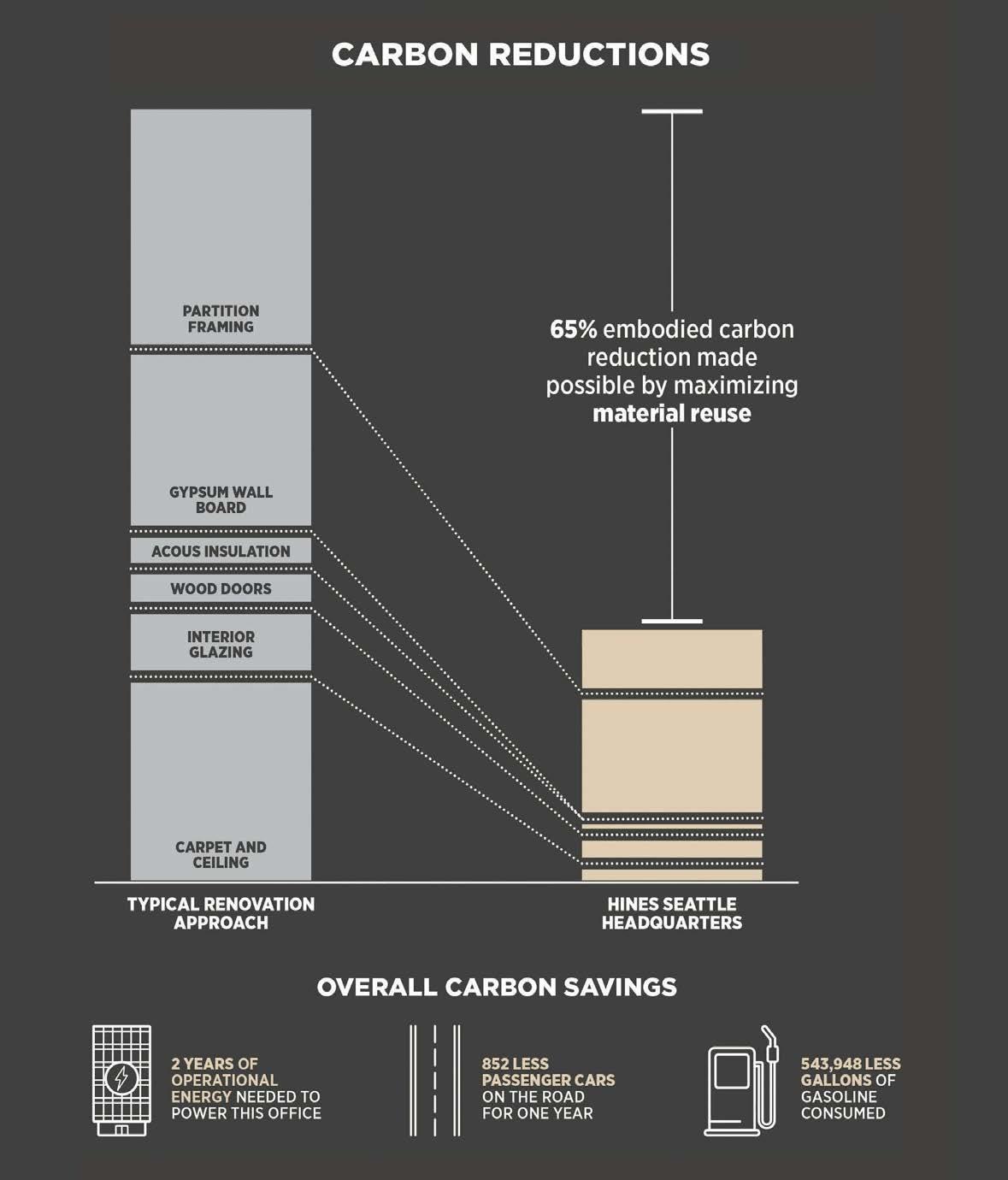
COURTESY LMN ARCHITECTS SUSTAINABLE Something Old, Something New METROPOLIS 66
The first step: The LMN team quickly got to work resolving the biggest in a number of usually carbon-heavy decisions— how to treat the unloved carpet that had been installed just a year or two prior. When presenting a new palette to the client, they kept the original gray carpet. Set against other colors, like blue walls and red chairs in Hines’s signature hue, the client didn’t recognize the carpet and signed off.
“Finding a way to reuse the carpet is a big, easy win,” says Justin Schwartzhoff, LMN’s embodied carbon research lead. Together with Kjell Anderson, director of sustainable design, the team tracked the impact of every existing or potentially new material down to the square foot in a spreadsheet. While less sexy than renderings, the spreadsheet was a powerful tool in client meetings to inform the team’s decision tree. Suddenly, each new material chosen incurred an additional embodied carbon penalty, as the spreadsheet noted the cost of sending existing material to the landfill.
That approach led the LMN team in several unexpected directions. Discarded wood became a barn door. Conference room demolition yielded 100 square feet of glazing that was repurposed for the entry. For a feature wall framing the reception that abstracts the topography of Seattle, fabricators relied on 1,100 square feet of discarded offcuts from wood manufacturers. The resulting design reduced embodied carbon by an
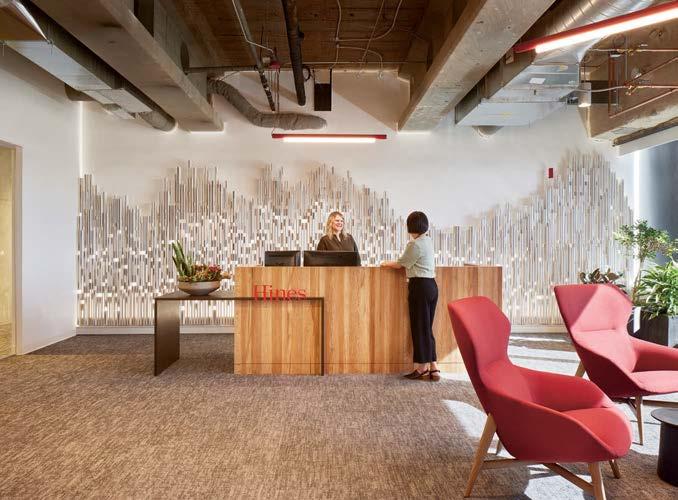
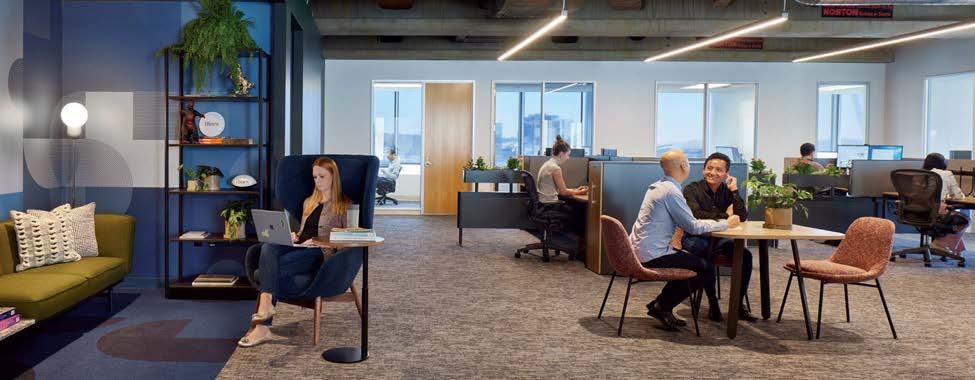
A spreadsheet used to track the impact of each design decision was a tool that informed such choices as making a feature wall in reception from discarded wood offcuts (top), retaining the existing gray carpeting (center), and sourcing overstock from a flooring distributor to help delineate zones.
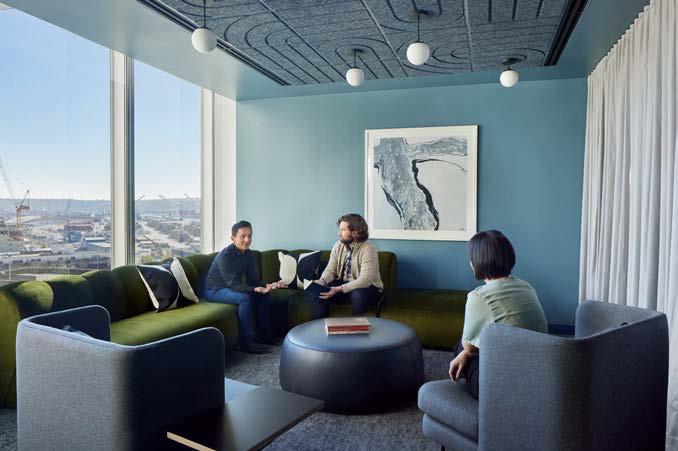
COURTESY BENJAMIN BENSCHNEIDER
MARCH/APRIL 2023 67
estimated 65 percent versus a standard remodel of an empty shell. Adding a kitchen, for example, would have been carbon-intensive given the need for new plumbing, appliances, and finishes.
As for that carpet? Reusing it left the team with an area of 485 square feet that needed new flooring. They lucked out with overstock from a flooring distributor and found a similar color scheme with a different pattern that now demarcates the elevator entranceway from the office zone.
The end result was both cheaper— thanks to fewer new materials purchased— and quicker, as sourcing locally avoided the supply chain bottlenecks facing designers who rely heavily on catalogs. Most importantly, the renovation lived up to the client’s high standards, including meeting nooks and a community table that make the intimate office welcoming to its occupants.
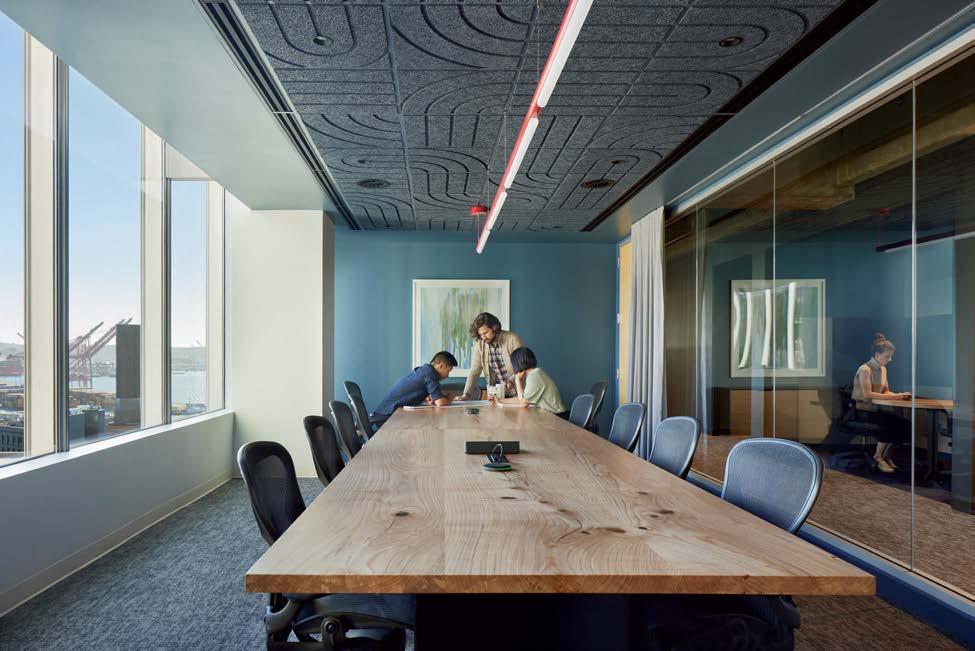
LMN had the benefit of working in the environmentally conscious Pacific
Northwest, with access to suppliers like Seattle salvaged wood specialists Urban Hardwoods and Portland recycled wood engineers Formology Architectural Products. But the trend toward a circular economy for construction material is growing nationally, as local and state governments adopt increasingly aggressive deconstruction ordinances and industry groups like All For Reuse create maps to guide architects and designers toward recycled materials.
LMN hopes to inspire imitators. It recently published 11 articles in its Path to Zero Carbon Series through its research arm. LMN principal Jenn Chen, project lead for the Hines Seattle Headquarters, has advice for those seeking to follow this successful proof of concept.
“It takes a little bit of muscle to think differently during the design process,” she says. “Get out of your comfort zone. You can make old things feel new and shiny.” M
Selected Sources
• Design Architects: LMN Architects (Kjell Anderson, Hank Butitta, Jenn Chen, Erik Larson, Curtis Ma, Chris Martin, Justin Schwartzhoff, Pamela Trevithick)
• Client: Hines Interests Limited Partnership
INTERIORS
• Lighting Design: Titan Electric with LMN Architects
• MEP Engineer: Hermanson Company LLP
• General Contractor: Sellen Construction
• Furniture Selection: Porter
• Material Vendor: Formology
Architectural Products
• Ceilings: Armstrong, Tectum
• Carpeting: salvaged (Legacy Group), new (Flor, Interface)
• Workstations: Watson
• Seating: Keilhauer, Bernhardt, Steelcase, Blu Dot, Aeron Chairs (reuse)
• Adjustable Height Table: Coriander Designs
• Lighting: Resolute Lighting (custom elevator lobby and kitchenette fixtures); ANDlight (red accent lighting)
• Paint: Sherwin-Williams
• Drapery: Carnegie, Alphacoustic
• Feature Wall: Formology, Custom Interiors
• Interior Glazing: EastSide Glass
• HVAC: Hermanson Company LLP
COURTESY BENJAMIN BENSCHNEIDER
The conference room’s custom tabletop is made of salvaged wood from a fallen tree in the Madrona neighborhood of Seattle.
SUSTAINABLE Something Old, Something New
METROPOLIS 68 MARCH/APRIL 2023
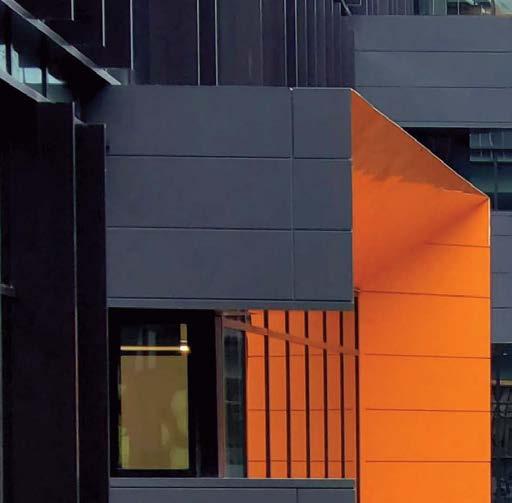
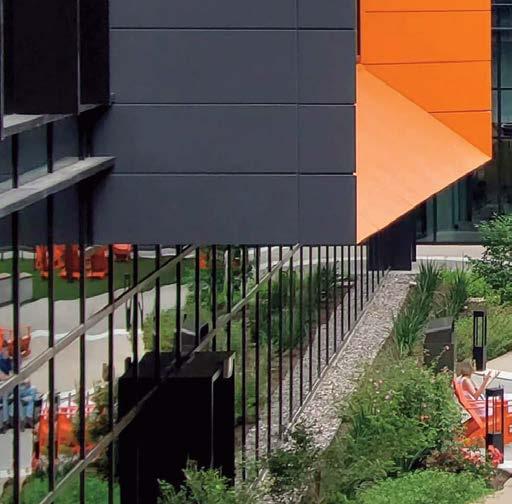
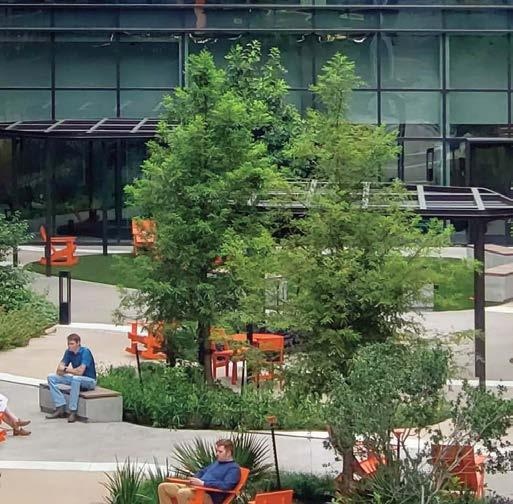
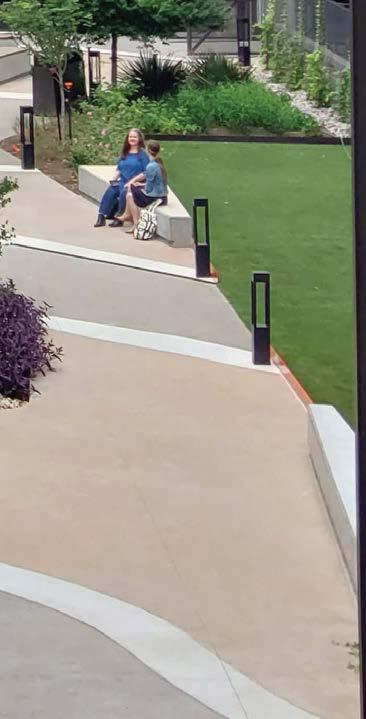
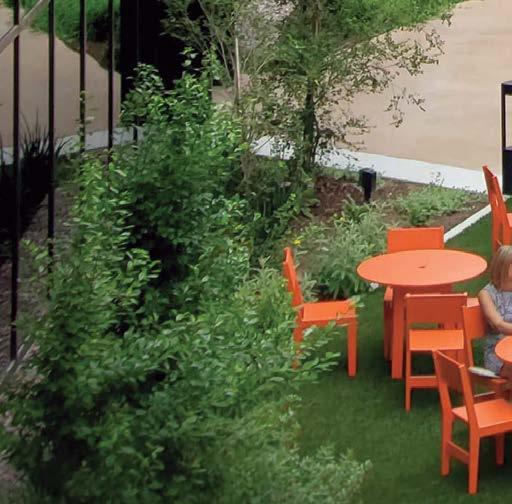
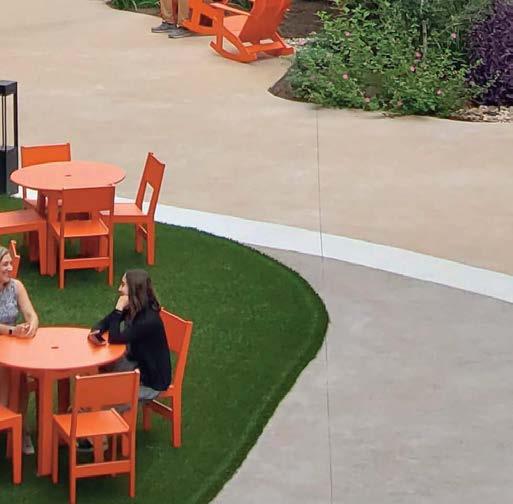


easy to clean | all season + all weather | awesomely sustainable Are you an industry professional? Join our contract program. lolldesigns.com/contract
Scroggs | Coleman &
for the modern lollygagger Designed + Made in Duluth, Minnesota
Photo:
Ashely
Assoc
LANDSCAPE Riparian Recreation
Grand Junction in Westfield, Indiana, is the Rust Belt’s first climate-resilient park.
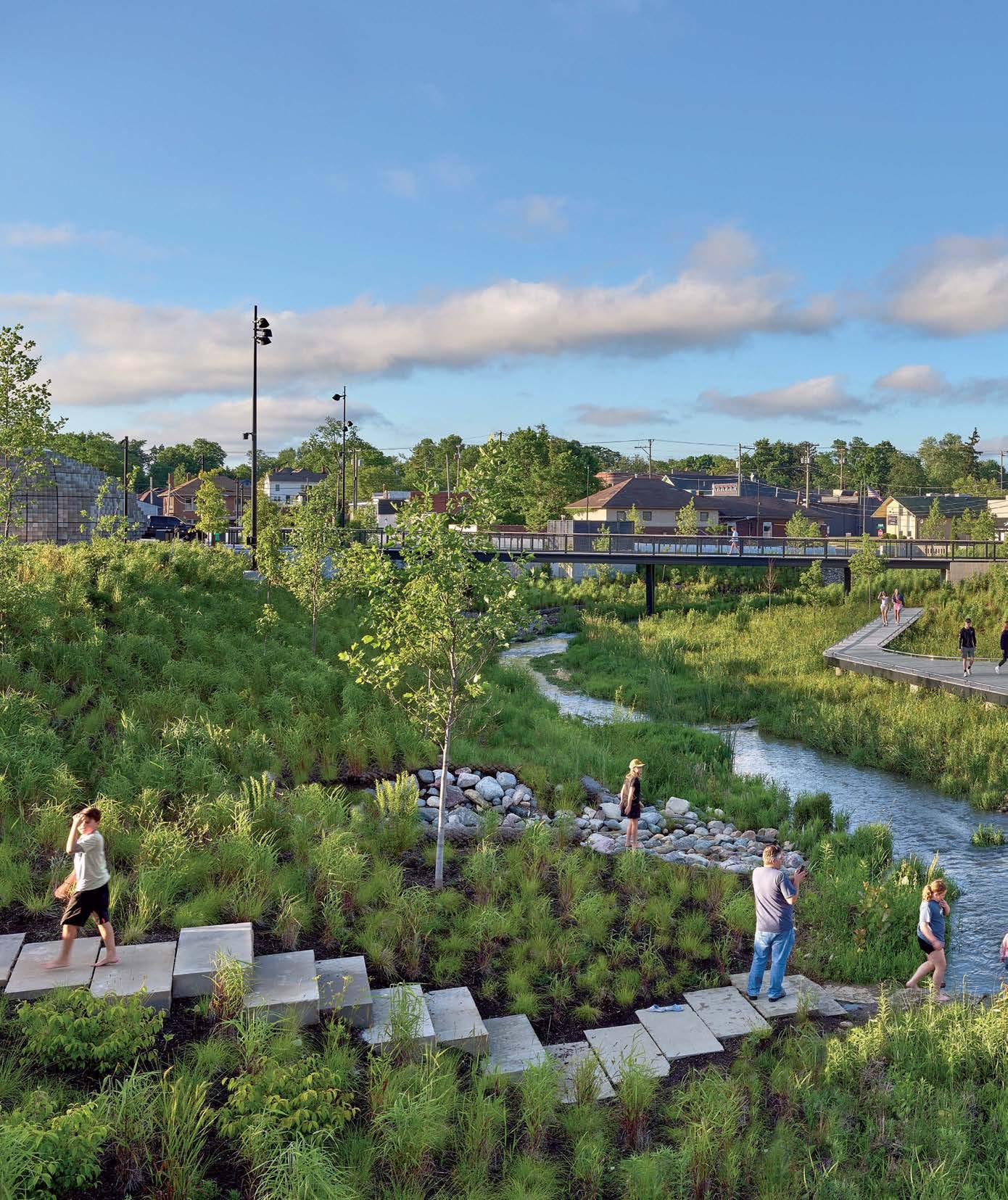 By Adrian Madlener
When you think of areas most likely to be affected by climate change–induced sea level rise, you probably imagine scenes of flooding in Bangladesh, images of storm-ravaged coastal Florida, or perhaps Lower Manhattan succumbing to the Hudson River. The American Midwest might not be the first place that comes to mind, but the reality is that almost any water-adjacent area is prone to increased inundation. In recent years, major rivers like the Mississippi, the Rhine, and their many tributaries have overflowed, wreaking havoc on regions that might be described as landlocked.
One such river is Westfield, Indiana’s seemingly docile Cool Creek, which spilled over its channelized banks in 2013 during a 500-year storm and caused significant damage to hundreds of properties and much of the Indianapolis suburb’s downtown.
Not long after the floodwaters receded, local officials began plans for Grand Junction Park and Plaza, a new green-blue infrastructure project that provides a suite of amenities to local residents while mitigating extreme weather patterns and reviving neglected ecosystems. Spearheaded by DAVID RUBIN Land Collective, the new multimodal green lung works to contain the volatile brook within 7.8 acres of graded landscaping.
COURTESY ALAN KARCHMER
METROPOLIS 70
Grand Junction Park in Westfield, Indiana, overlays a new public green space with stormwater infrastructure to prevent flooding on Cool Creek. The project was a collaboration between DAVID RUBIN Land Collective, HWKN Architecture, Toronto-based strategic design studio BMD (Bruce Mau Design), RATIO Architects, FlatLand Resources, and VS Engineering.
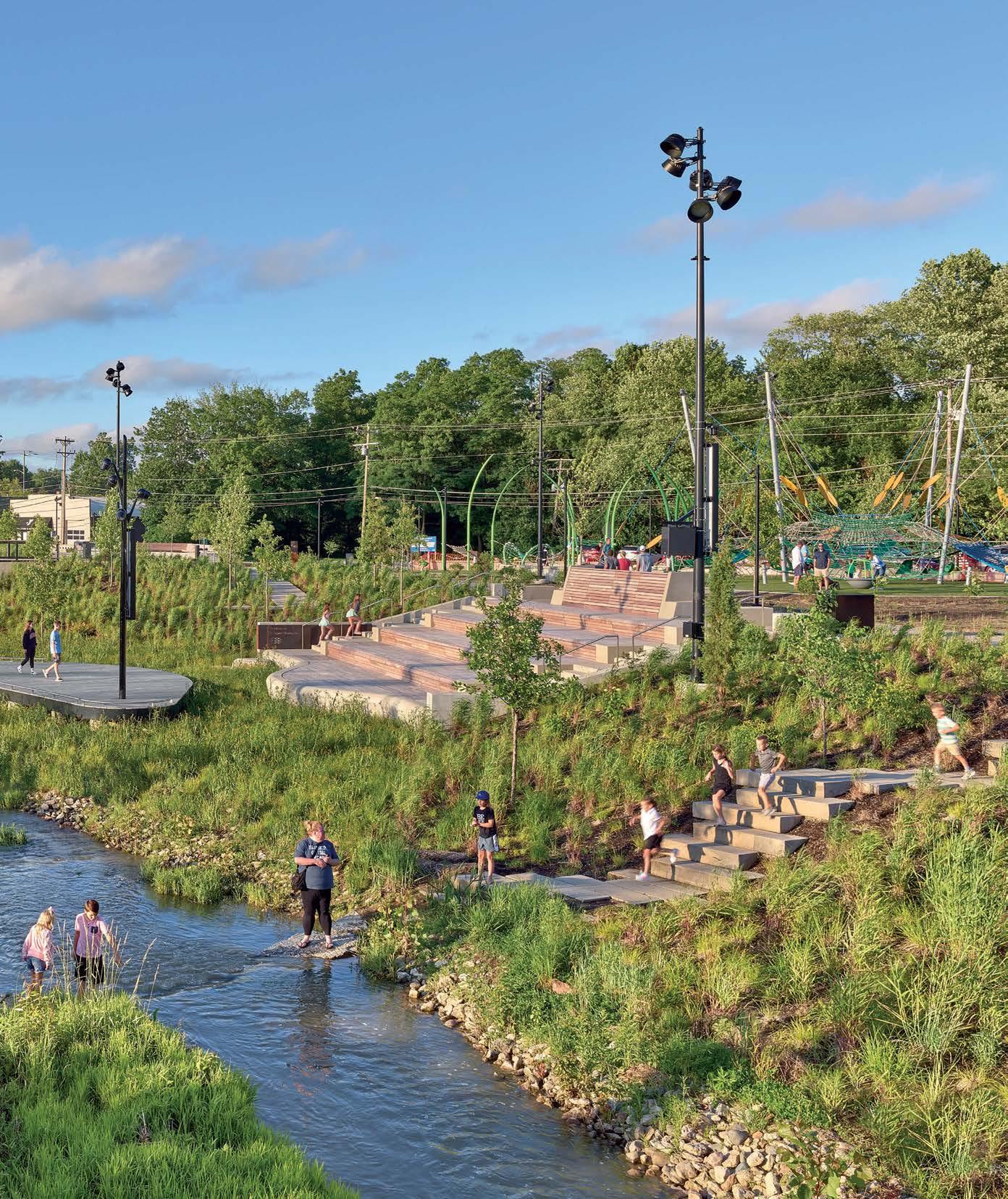
MARCH/APRIL 2023 71
Developed in partnership with New York’s HWKN Architecture, Toronto-based Bruce Mau Design, and local firm RATIO Architects, the holistic intervention has revitalized the long-neglected riparian corridor as a recreational asset for the town and as flood protection for the surrounding community. Like wetlands throughout the country, the landscape surrounding Cool Creek was drained for farmland because of the Swamp Act of 1850, which had the ultimate effect of hemming in the waterway, destabilizing the wetland ecosystems, and making the creek more prone to damaging floods.
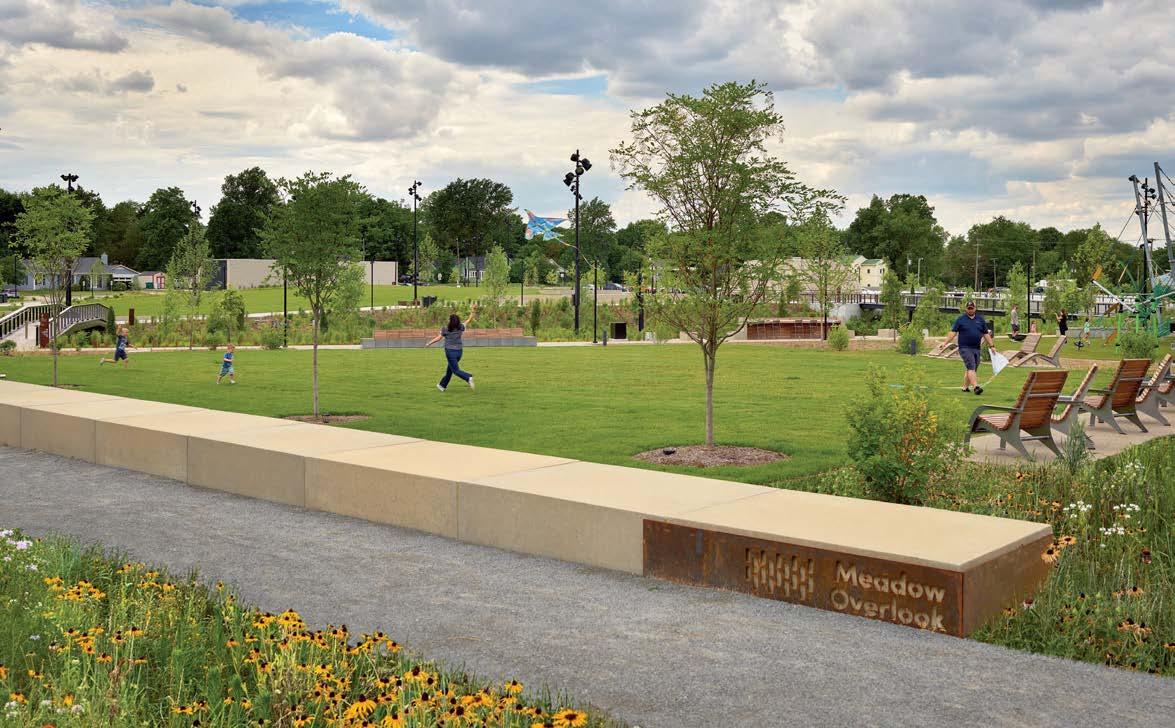
The consortium of architects sought not only to make the river and its surrounding parkland a focal point for the town but to counteract more than a century of disastrous land use decisions. They stabilized and redirected vulnerable areas of the tributary in a fashion that mimics natural patterns, allowing the river to flow evenly and without intrusion. Cool Creek’s channelized, V-shaped profile was redefined as a bankfull waterway with space to safely overflow its bounds during flood events. Native
plants line a series of stepped terraces, helping to keep these slopes in place and buffer the water when it reaches critical levels. A riprap—rocks installed in a ribbon pattern— operates as an additional line of defense.
A 48-inch storm pipe that often clogged during heavy rain, causing walls of water to reach Westfield’s downtown, was removed and an overflow dam put in its place. The slanted wall that captures rainwater doubles as an interactive climbing structure, while J-hook vanes were installed throughout to disperse potential inundations.
“The frequency and intensity of severe weather is a clear and present danger that is not subsiding, and no area is immune,” says David A. Rubin, founder of the eponymous firm. “Cities and states should be seeking opportunities to ameliorate potential threats within the fabric of our connective tissue. Infrastructure cannot be ‘out of sight,’ but ought to be integrated in a manner that supports safety and social engagement.”
The new public venue is crisscrossed by nine intersecting trails that wind through its undulating
Located where five multipurpose trails intersect along Cool Creek, Grand Junction is a place for residents to meet, eat, relax, work, bike, skate, and explore. Its nearly eight acres feature a program of plantings that ranges from rugged and resilient vegetation along the creek to more refined lawns on higher ground.
COURTESY ALAN KARCHMER
LANDSCAPE Riparian Recreation
METROPOLIS 72 MARCH/APRIL 2023
Upfit
Bring It Out
We believe that for design to be truly great, it must stand the test of time, be sustainably crafted, and proudly American made.
Upfit : Making the most of every outdoor space
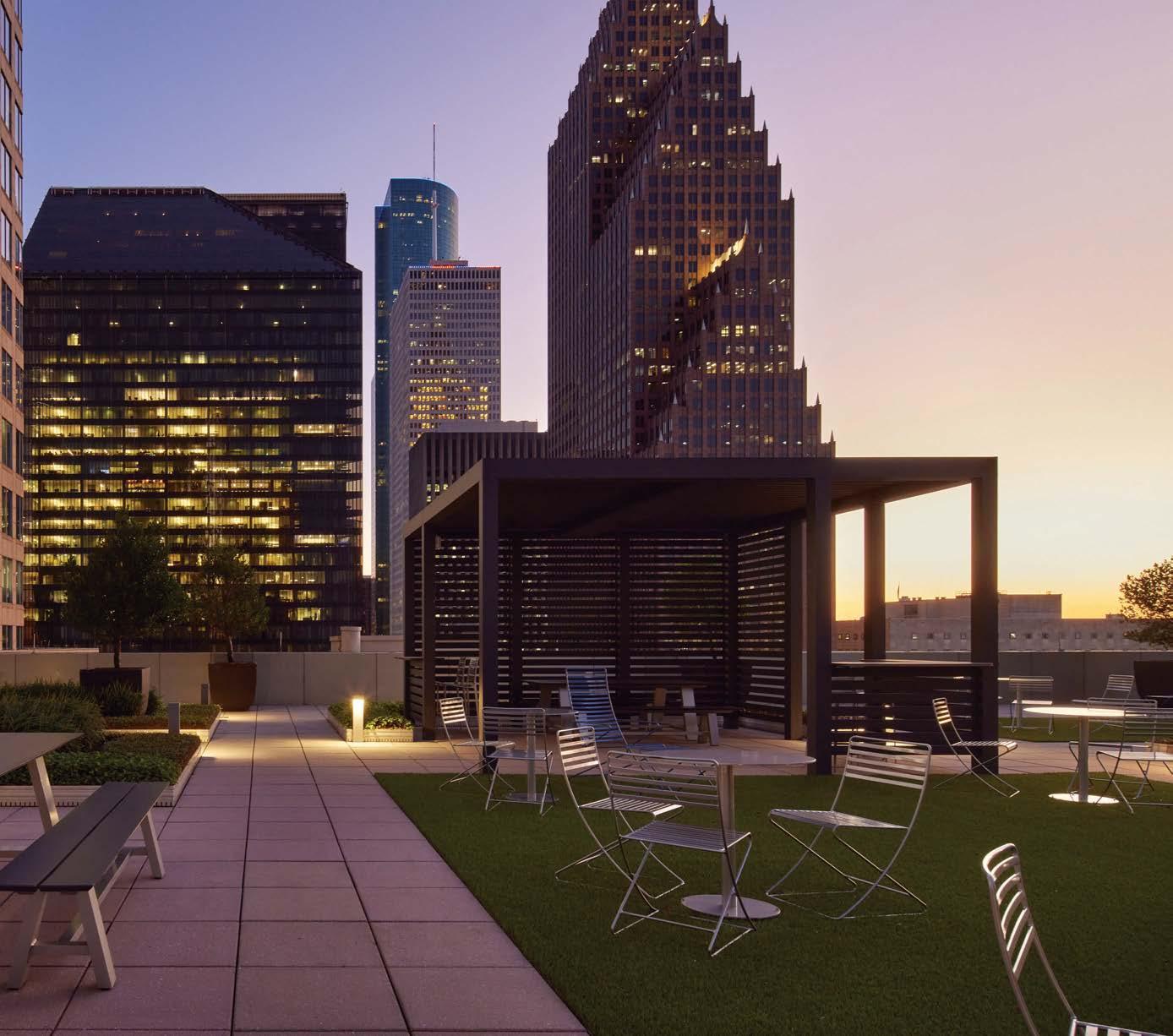
Designed by KEM STUDIO and StruXure Outdoor
Landscape Forms | A Modern Craft Manufacturer
landscape, making it a popular place for joggers and cyclists. The park also includes several HWKN-designed pavilions clad in a topographical layering of limestone block—sourced locally—as well as a café, an ice rink, a winter skate rental facility, a children’s playground, and a soon-to-be-realized outdoor stage.
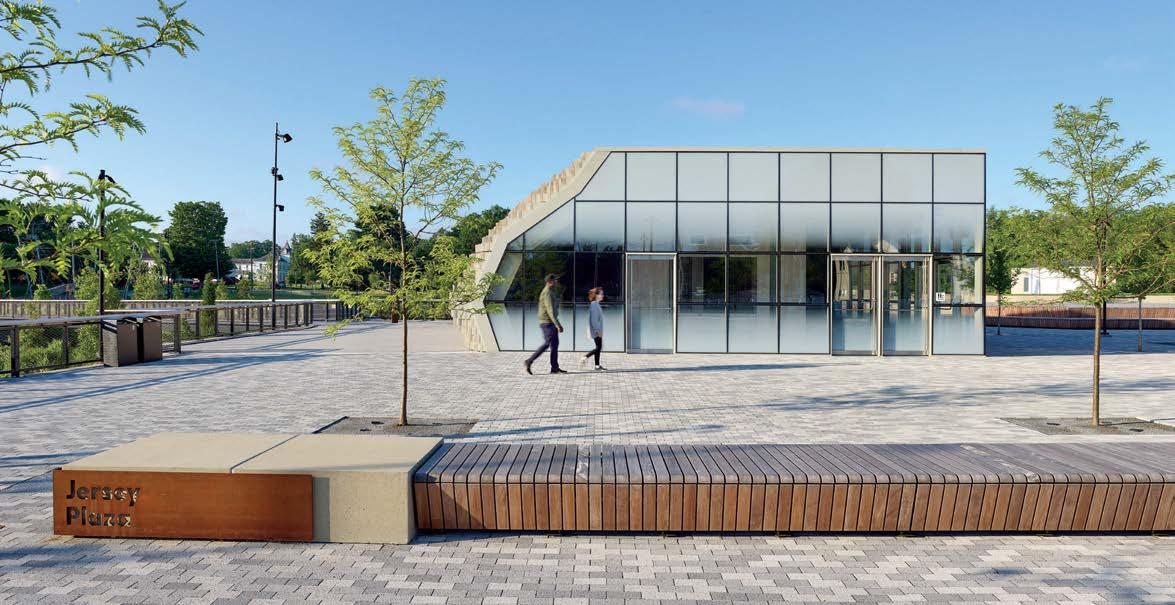
The overall concept was as much about ensuring longevity as it was site-specific integration, taking into account the different facets of the site’s history while facilitating its auspicious destiny as a beloved public space. “With this project being the first of its kind, a lot of details are novel but, at the same time, have already informed work we’ve done in other projects,” says Matthias Hollwich, HWKN founding principal.
Hollwich believes that the team’s approach to finding climate resilience in preexisting natural systems can be a model for urban placemaking and revitalization in other cities as well. “It’s about creative programming that enables people to do things they want to do, and identity-generating architecture that makes a place recognizable—and filled with future memories,” he concludes. Today residents can engage in the park’s layered infrastructure that programs around, across, and above Cool Creek, making the waterway a source of joy rather than destruction. M
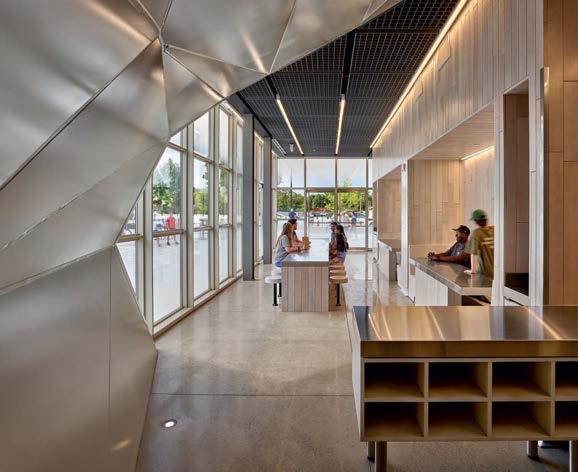
COURTESY ALAN KARCHMER LANDSCAPE Riparian Recreation
The new park seamlessly combines outdoor and indoor amenities. Visitors can grab a cup of coffee or lace up a pair of skates at the HWKN-designed café and skate pavilion, boosting the site’s year-round appeal. Clad in local limestone block, the pavilion’s exterior blends into the landscape.
METROPOLIS 74 MARCH/APRIL 2023
AMPLIFIED NATURE
Natural connection. Designed for communal spaces, Amplified Nature is a biophilic boost of texture and color. Available in five styles in both carpet tile and broadloom, the collection is designed to offer a range of flooring solutions – simplifying the product specification process with coordinating options that meet the needs of varying spaces.
PATCRAFT.COM | @PATCRAFTFLOORS | 800.241.4014 © 2023 Shaw, a Berkshire Hathaway Company
LIVING Second Draft
Chicago’s Tribune Tower recently underwent a conversion from offices to high-end apartments, opening another chapter in the landmark’s history.
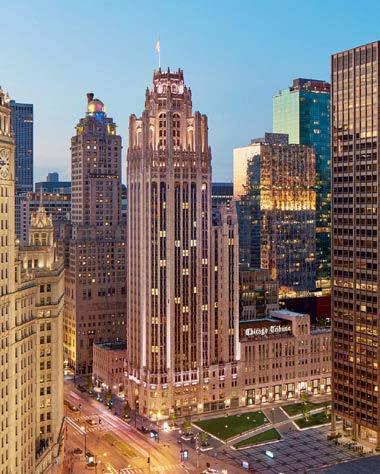
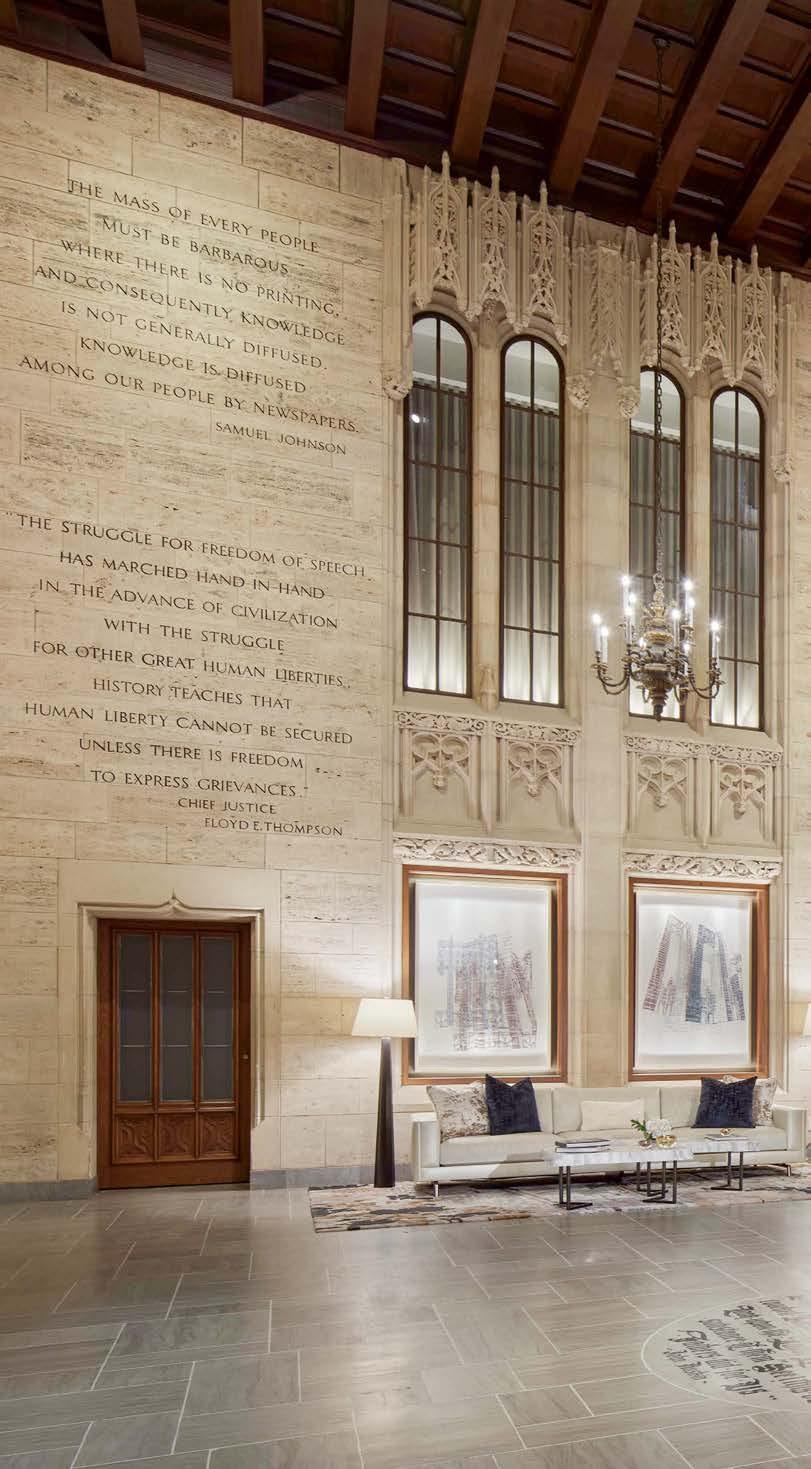 By James McCown
The Chicago Tribune Tower is the fruit of an epic international architecture competition held in 1922 that attracted design luminaries such as Walter Gropius, Eliel Saarinen, and Adolf Loos. But Raymond Hood and John Mead Howells’s neo-Gothic skyscraper scheme, with its iconic flying buttress crown, won the day. It was completed in 1925 and has been a proud addition to the Chicago skyline ever since.
COURTESY DAVE BURK
The Tribune Tower, one of the most famous buildings on the Chicago skyline, was recently converted from offices to high-end residences. Many original features, such as an imposing main lobby, have been left in place.
METROPOLIS 76
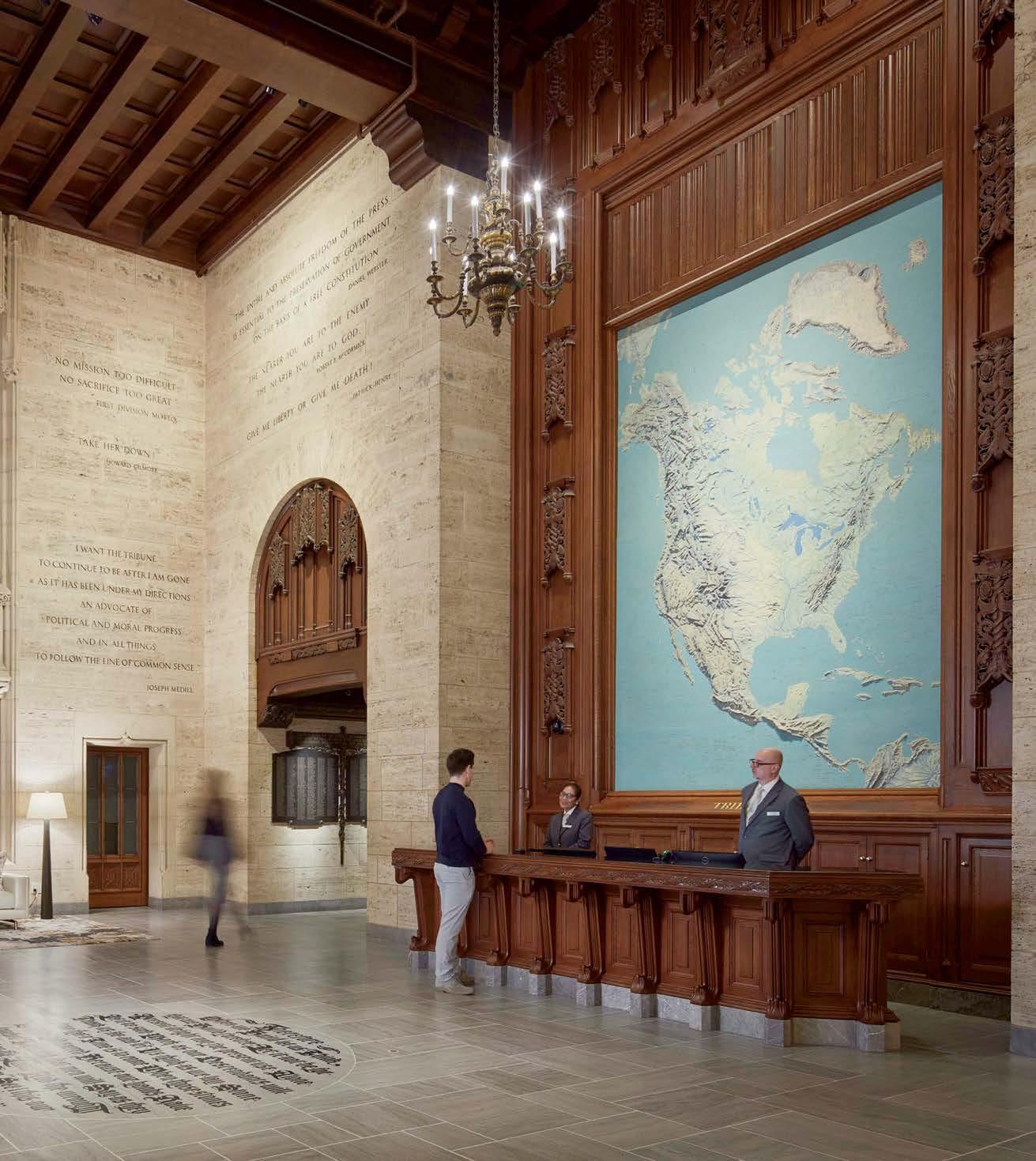
MARCH/APRIL 2023 77
Today the Chicago Tribune newspaper is but a ghost of its former self, relegated to nondescript space elsewhere in the Windy City. But its namesake tower is as beautiful and prominent as ever—now fully converted to 162 residences ranging in size from 1,100 to 4,400 square feet and priced from $900,000 to $7 million.
The Tribune Tower is a designated Chicago Landmark, meaning all alterations had to be approved by the Chicago
Department of Planning and Development. To attract affluent residents, developers added approximately 55,000 square feet of amenity space, according to Steve Hubbard, associate principal in the Chicago office of Solomon Cordwell Buenz (SCB), the architecture firm that handled the conversion.
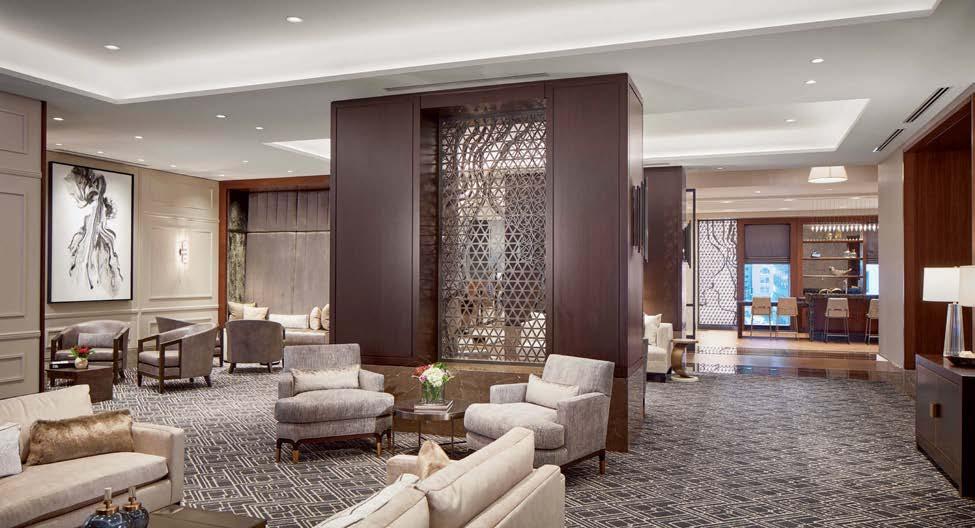
“Floors 2, 3, 7, and 25 were substantially altered into a series of practical and social spaces,” Hubbard says. Level 2 is a fitness center; level 3 is a series of social spaces
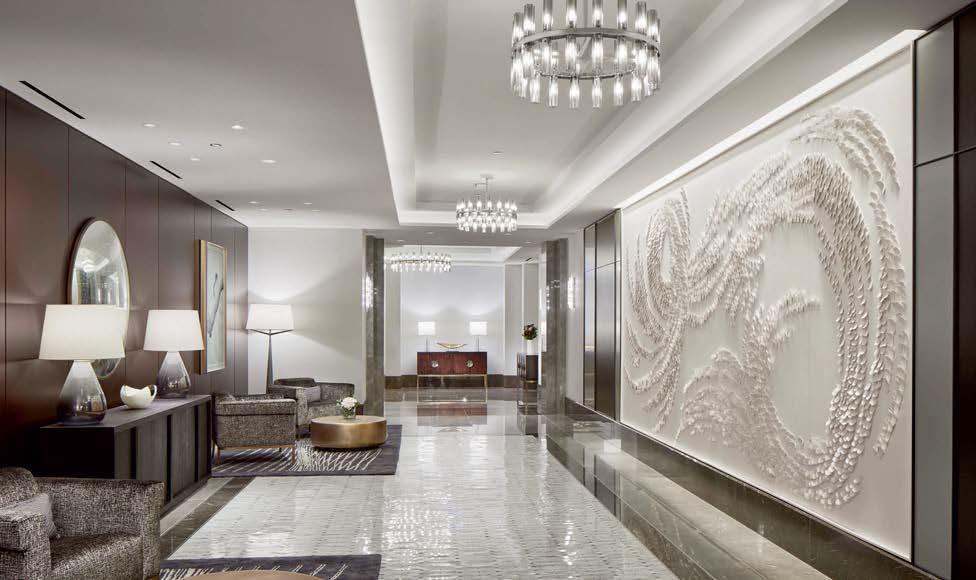
COURTESY DAVE BURK
Interior designers Gettys Interiors brought a background in hospitality to bear on the building’s private lobby and communal spaces. Though the interior retains some of the building’s formal elegance, residential furniture, textiles, and wallcoverings have a softening effect.
LIVING Second Draft METROPOLIS 78 MARCH/APRIL 2023
Handmade in England
Introducing Forme brassware, the conscious collection made with uncompromising attention to detail. samuel-heath.com
including a bar and a link to an outdoor garden; level 7 has an indoor pool; and finally, level 25 is a spectacular “porch in the sky” on which occupants can socialize under the building’s signature flying buttresses.
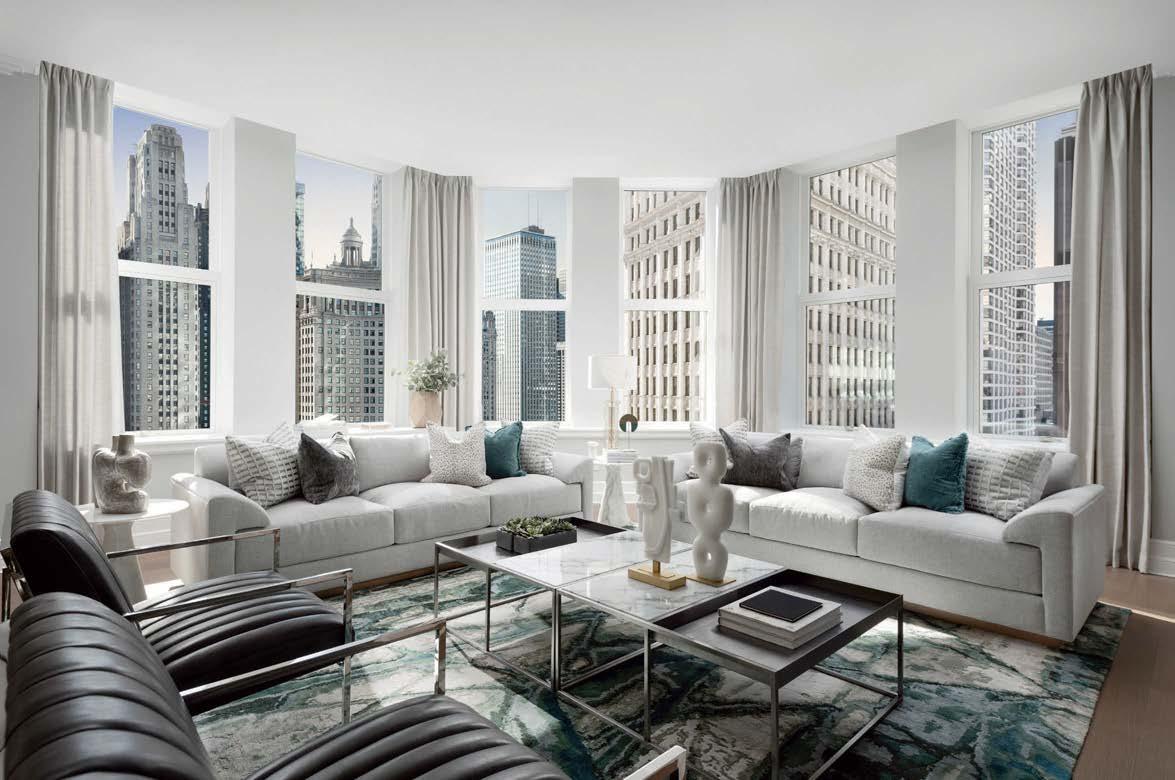
Hubbard points out that only the main tower of the Tribune complex was landmarked—in theory the 1920s printing plant, 1930s radio building, and 1950s television complex, all parts of the Tribune media empire, could have been razed. “But the decision was made to keep the entire character of the building,” he says. Even the original Chicago Tribune logo has been renovated and preserved on the building’s facade.
Similar care was brought to interior spaces: “The interior design honors the
history of the building,” says Ryan Schommer, director of Gettys Interiors, a Chicago design firm. Nowhere is this clearer than in the two lobbies. The original off North Michigan Avenue remains largely as it was during the building’s Tribune years, while another, more private entrance is located to the north along Illinois Street.
“The historic and private lobbies are connected,” he explains. “Gettys Group is known for hospitality design, so we took a luxury approach akin to a great hotel.” The private lobby features, for example, a Holly Hunt leather sofa and Christopher Guy chairs, alongside a working fireplace.
Upstairs, 55 different layouts were conceived for the tower’s 162 units. Details
like crown moldings and baseboards were custom designs, while bathrooms feature specially ordered fixtures from Waterworks and kitchens were designed in collaboration with The Galley. “We spent a lot of time studying neo-Gothic architecture. Everything is custom and curvilinear, right down to the ornaments on the door handles,” says Schommer.
The conversion was a joint venture between two real estate development companies: CIM Group and Golub & Company. Planning started in 2016 and the conversion/renovation was completed in mid-2022. Hubbard feels fortunate to have been involved with such a historic property: “This was a once-in-a-lifetime opportunity for an architect,” he says. M
COURTESY DAVE BURK LIVING Second Draft
Solomon Cordwell Buenz’s associate principal Steve Hubbard states that replicating the tower’s landmarked windows was a challenge. “We had to make them look double hung, when in fact they are awning windows,” he says.
METROPOLIS 80
A spectacular “porch in the sky” where residents can socialize under the building’s signature neo-Gothic stonework while enjoying views of the Chicago skyline is accessible from the 25th floor. An elevated green space, meanwhile, serves as a private park.
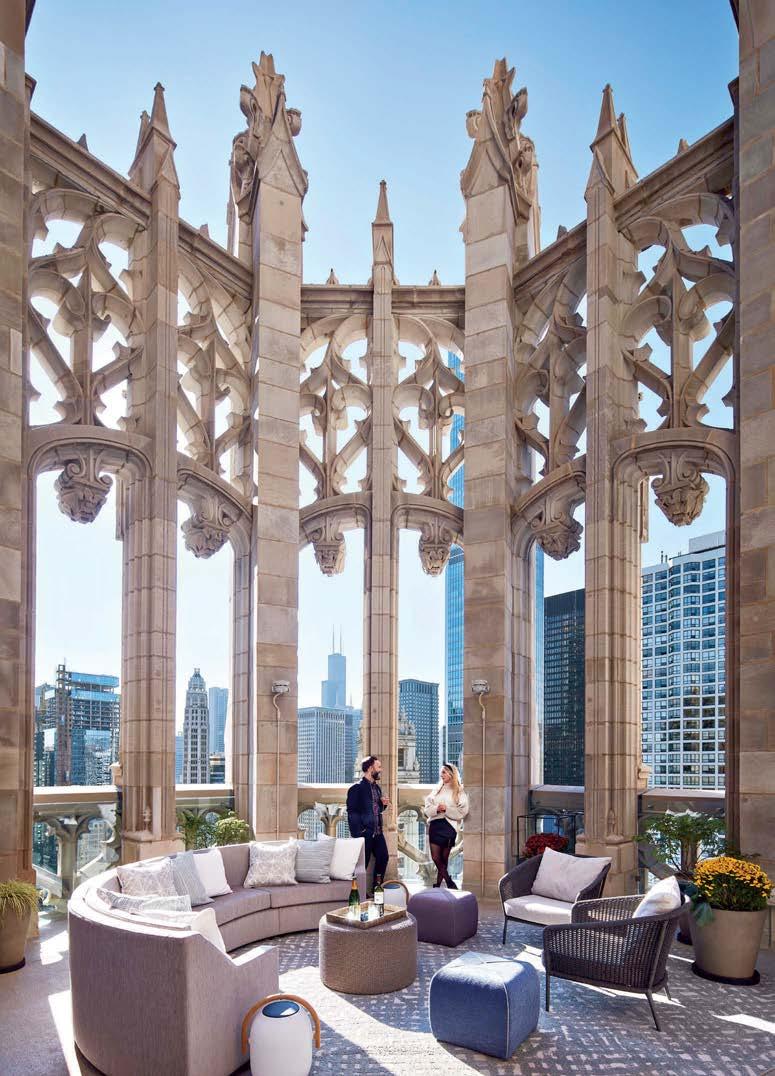
Selected Sources
• Design Architect: Solomon Cordwell Buenz (SCB)
• Interiors: The Gettys Group Companies
• Developer: CIM Group/Golub & Company
• Historic Preservation Consultant: VHA
• General Contractor: Walsh Group
• Structural Engineer: TGRWA
• Additional Engineering: Klein & Hoffman, Elara, WJE
• Landscaping: Site Design Group, Olin
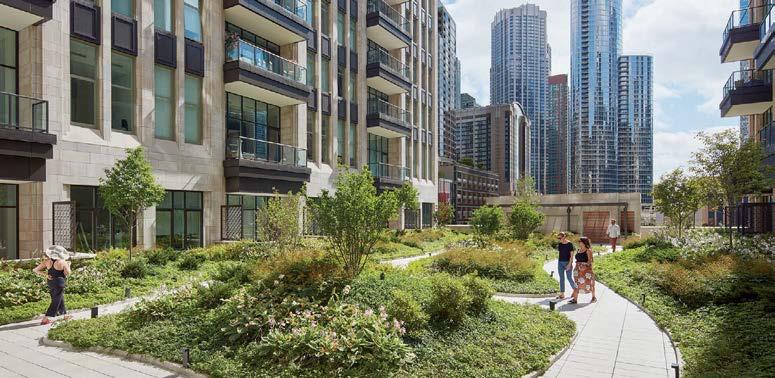
• Lighting: Schuler Shook (Exterior), KNL (Interior)
• Vertical Transportation: Jenkins & Huntington Inc.
INTERIORS
• Public Art Consultant: Soho Myriad
• Bath Fittings: Waterworks, Kohler, Lacava
• Bath Surfaces: GI Stone, International Stone
• Flooring: Encore Hospitality, Jamie Stern
Hospitality
• Furniture: Baker, Bright Chair, HBF, HF Collection, Holly Hunt, Haworth, Usona, Corporate Concepts, Charter Furniture, CB2, Century Furniture
• Kitchen Products: Wolf, Sub-Zero, Galley Workstation, Boveli Custom Cabinets
• Lighting: Alger Triton, Terzani, Visual Comfort, Charles Loomis Lighting, Yellow Goat Design, Usona, Holly Hunt
• Paint: Sherwin-Williams, Benjamin Moore
• Textiles: Townsend Leather, Texstyle Leather, Edelman Leather LLC, Luna Textiles, Fil Doux Textiles, Garrett Leather, Larsen Fabrics, Tiger Leather, Fabricut, JF Fabrics, Optima Leather, Architex International Fabric
• Wall Finishes: Phillip Jeffries, Stone Source, Daltile, Virgina Tile, Ceramic Technics, Stone Peak, Mirage, Kaleen, Spinneybeck, Garrett, Parenti
EXTERIORS
• Doors: Architectural Glass Works
• Glazing: Cardinal Glass Industries, Reflection
Window + Wall
• Windows: Graham, Jensen Windows, Reflection
Window + Wall
• Other: Bader Art & Metal, Nic Solutions LLC, Chicago Ornamental Iron
MARCH/APRIL 2023 81
NEW TALENT Atelier
L’Abri
Montreal’s Atelier L’Abri aims to bring the lessons of Passive House to the masses.
By Austin Macdonald
The photogenic Nordic-influenced aesthetic of architects Francis Labrecque and Nicolas Lapierre has taken over Instagram feeds and Pinterest boards since they founded their firm, Atelier L’Abri, less than a decade ago, but the Montreal studio’s work is more than mood-board minimalism. Projects like Quebec’s third Passive House and a complex of A-frame micro-cabins demonstrate that style can be a powerful tool for ecological change. By making sustainable design look beautiful and effortless, the designers

From left to right: Nicolas Lapierre, Francis Pelletier, and Francis M. Labrecque met and formed Atelier L’Abri while they were students at the Université de Montréal. Pelletier now leads a spin-off construction company.

believe they can persuade homeowners and developers to pursue greener projects. Labrecque and Lapierre completed their master’s degrees in architecture at the Université de Montréal in 2013. During their studies, they founded Atelier L’Abri with a fellow student, Francis Pelletier, who now leads a spin-off construction company. Along the way, Labrecque interned with Berlin’s Ester Bruzkus Architekten, and Lapierre worked in Bjarke Ingels Group’s New York office.
Saltbox Passive House was L’Abri’s breakout sustainable design project. Only the third home in Quebec to achieve the Phius Passive House standard, its triple-glazed windows and thick layer of cellulose thermal insulation mean the building requires very little energy to heat, even in the Canadian winter.
PORTRAIT COURTESY RONNY PHOTOGRAPHY; COURTESY RAPHAËL THIBODEAU
(2)
METROPOLIS 82
The natural wood and white surfaces of the Saltbox Passive House’s interior speak to L’Abri’s Nordic design sensibility and demonstrate that highly energy-efficient buildings can feel as airy and comfortable as conventional ones.
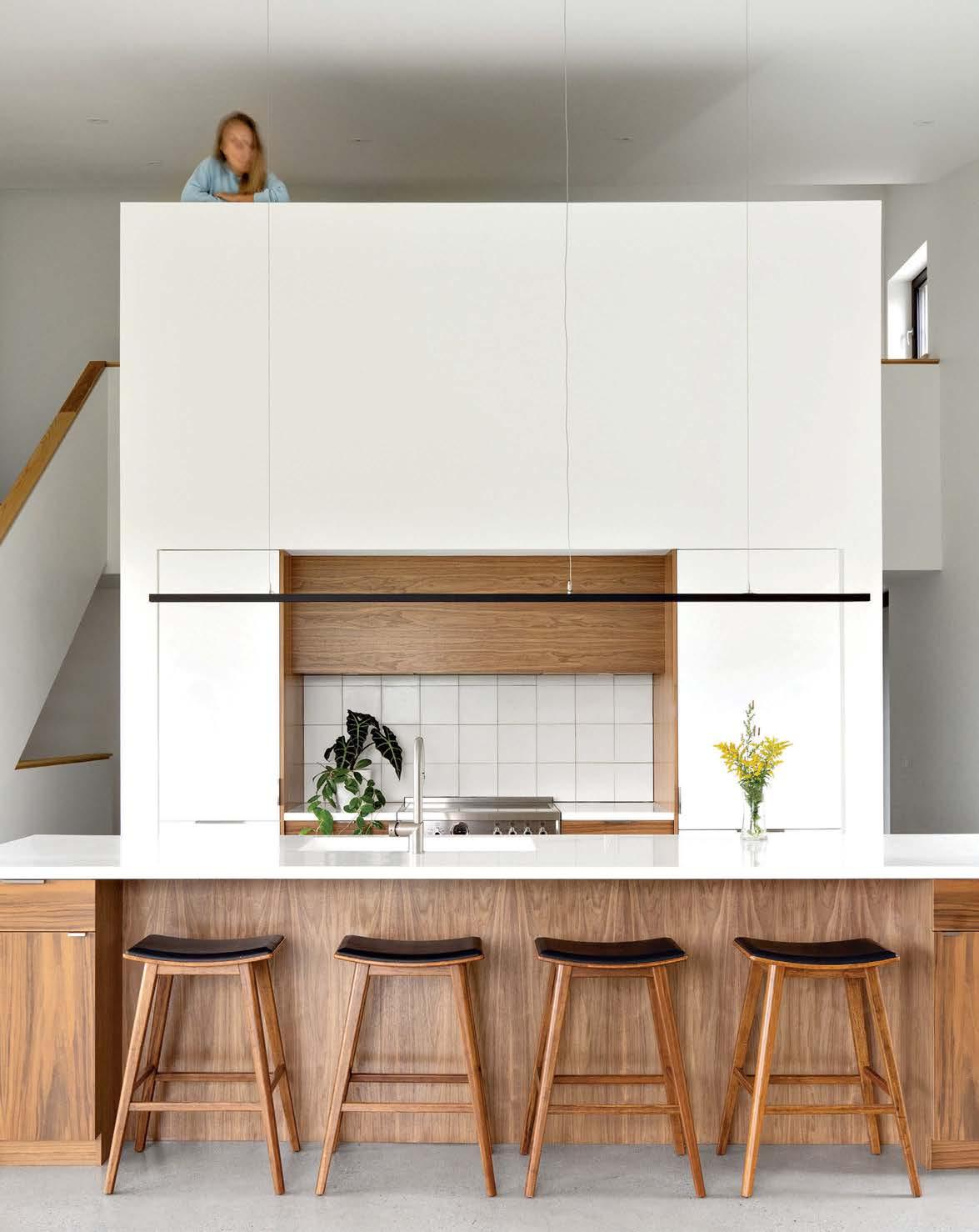
MARCH/APRIL 2023 83
L’Abri’s work resists grand gestures, opting instead for performance over the long haul. “Simplicity to start off with and then quality at the end, rather than over-the-top complexity and then cheap results,” says Lapierre, explaining the practice’s mantra.
Looking at a project’s carbon footprint as a whole means not only specifying high-performance mechanical systems but assessing the embodied carbon footprint of materials. For L’Abri, that means avoiding concrete and plastics where possible and favoring regional materials like local timber and granite from quarries in Quebec and Vermont.
“It’s not easy,” Labrecque adds. “You have to ask, ‘Where are the materials from? What are they made of? What’s the life cycle?’ But if you do that analysis well, then you can be confident that your house is a good answer to current problems.”
Completed in June 2020, L’Abri’s Saltbox Passive House in Bromont, Quebec, was the studio’s breakout sustainable construction project. Named after a colonial building style popularized in New England, the 3,100-square-foot, singlefamily principal residence for four outside Montreal earned a Phius certification,
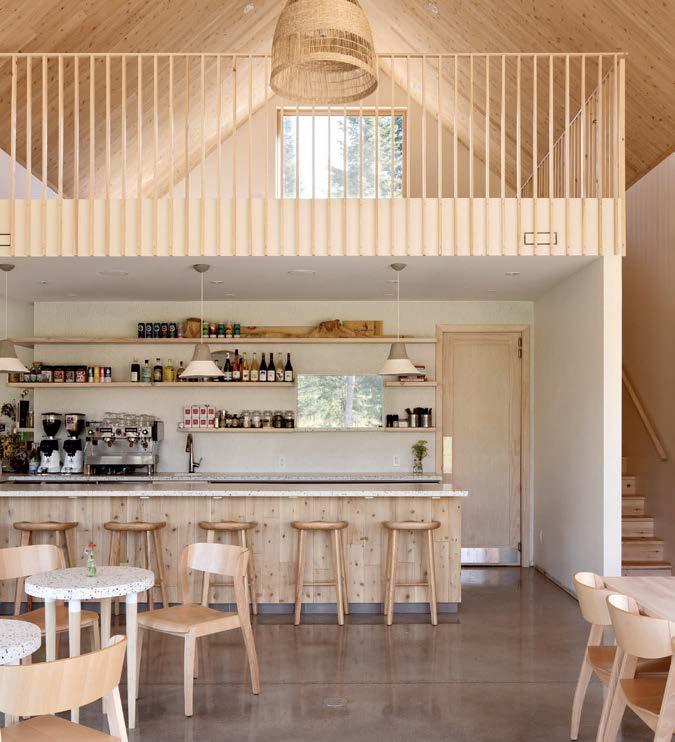
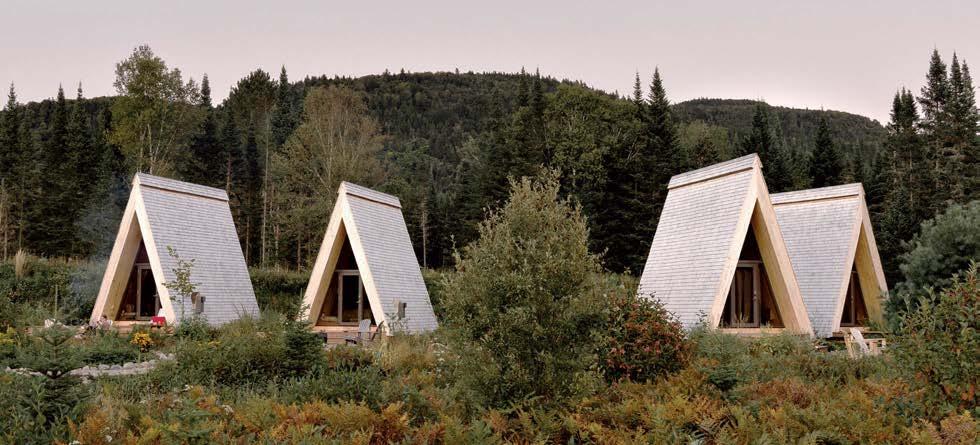
COURTESY RAPHAËL THIBODEAU NEW TALENT Atelier L’Abri
The A-frame cabins of Farouche Tremblant, an organic farm and eco-resort nestled in the Quebec wilderness, were a hit on social media and set the stage for L’Abri to begin taking larger commissions.
METROPOLIS 84 MARCH/APRIL 2023


CREATING BEAUTIFUL BATHROOMS MADE IN THE USA CUSTOM PROJECTS WELCOME LACAVA .com
ZOOM shown in brushed gold
making it only the third passive building ever completed in the province.
Sustainability hawks prize passive buildings for their super-insulated envelopes, airtight construction, high-performance glazing, elimination of thermal bridges, and ventilation with heat recovery—all of which dramatically reduce buildings’ energy costs and operational carbon footprints.
“Saltbox was definitely a turning point for the office. It’s very hard to achieve the Passive House standard in Quebec because we’re so far north,” Lapierre explains. “But the certification got people talking about high-performance buildings. Also, it demonstrated that sustainability and good looks can coexist.”
In July last year, the duo completed a cluster of dreamy A-frame glamping structures at Farouche Tremblant, a 100-acre organic farm in the Laurentians. This commission helped Labrecque and Lapierre pivot toward larger, multi-unit residential projects.
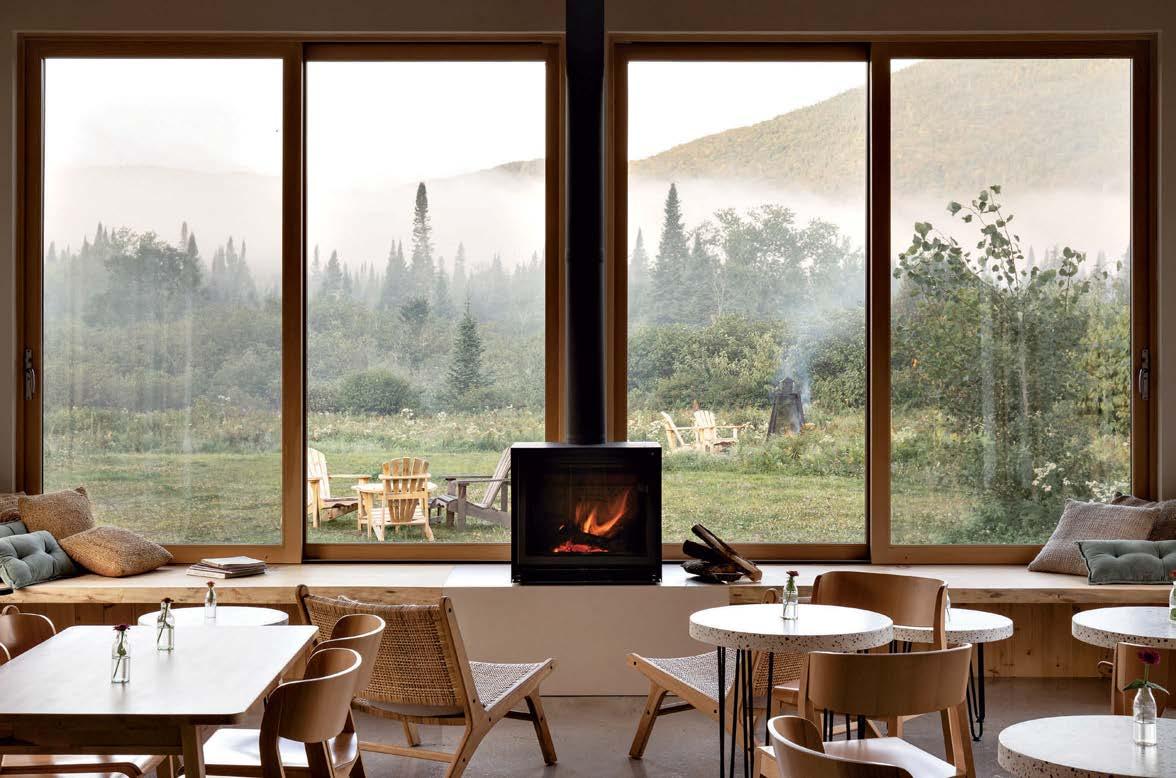
Carving out a niche for holistic mixeduse development, they’re currently working on master plans for three small neighborhood-scale projects in towns and villages across Quebec. One, Cohabitat Nidazo in Frelighsburg, is a residential development that may feature as many as 45 homes clustered around a communal garden. Instead of a traditional developer, L’Abri is working for a nonprofit formed by the town’s residents to purchase the land and build an ecologically minded community.
They’ll take the lessons learned from Saltbox and apply them to their new projects. “If we can get to 60 percent of the way towards a Passive House and repeat that 30 times, maybe that’s the best way to have the biggest impact,” says Labrecque.
Even as their ambitions grow, the pair’s designs are likely to stay rooted in the local vernacular, says Lapierre. “More often than not, when we look at what’s the most sustainable solution, we come back to the tried-and-true details that were already there. As it turns out, there are very good reasons why these things were built a certain way in the first place.”
Lapierre pauses and shrugs: “You know, maybe pitched roofs just make sense in our climate.” M
NEW TALENT Atelier L’Abri COURTESY RAPHAËL THIBODEAU
METROPOLIS 86 MARCH/APRIL 2023
The common areas at Farouche Tremblant are designed with the firm’s signature restrained hand, letting local materials—and scenic views—speak for themselves.
Create unique architectural elements with aluminum chain links

kriskadecor.com
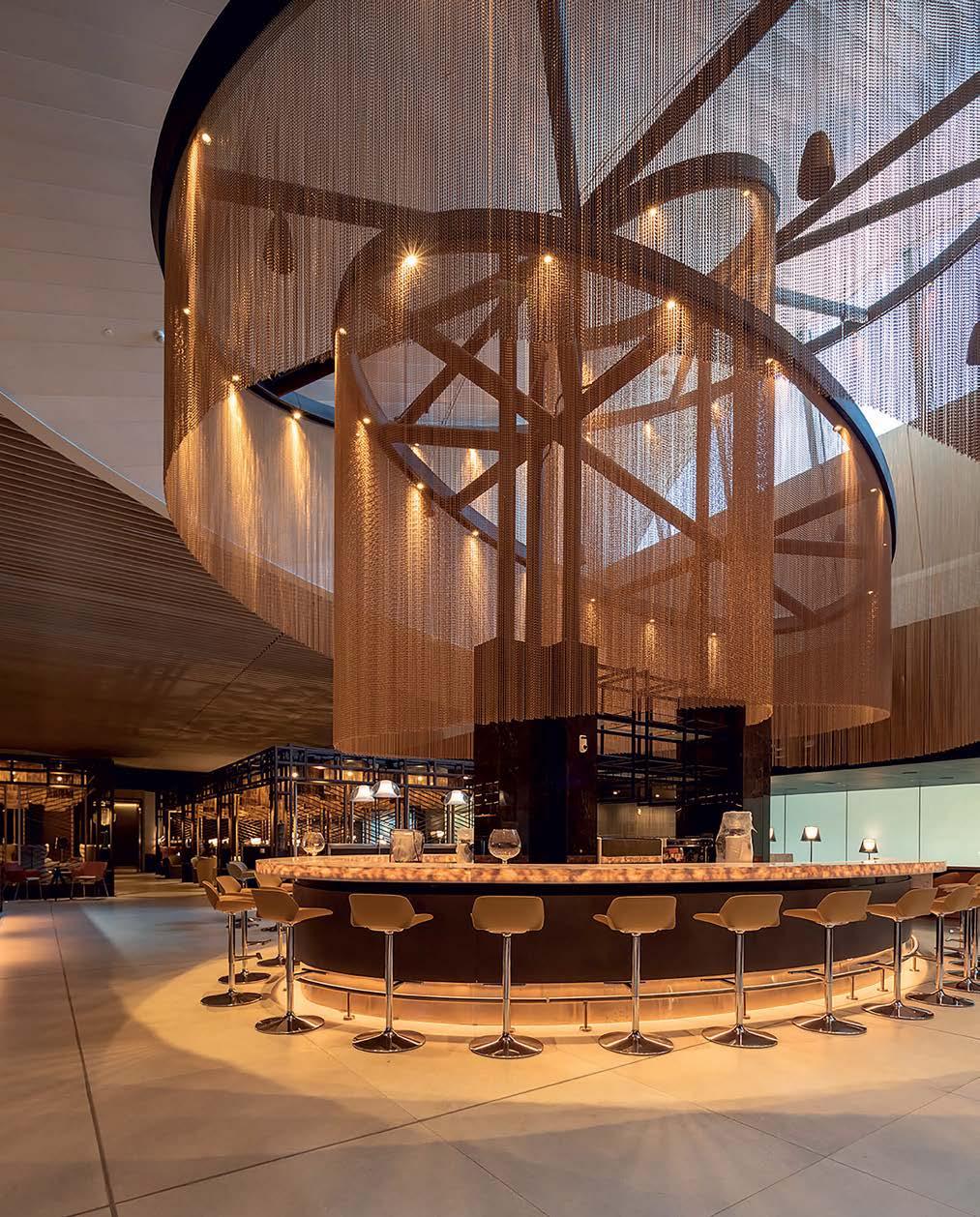 LATAM Airlines
Vip Lounge by Grupo Arquitectos, Santiago de Chile Airport.
Photo: Aryeh Kornfeld.
LATAM Airlines
Vip Lounge by Grupo Arquitectos, Santiago de Chile Airport.
Photo: Aryeh Kornfeld.
EDUCATION Design for Discovery
Office for Political Innovation’s Reggio School blends sustainable design with the principles of the Reggio Emilia approach.
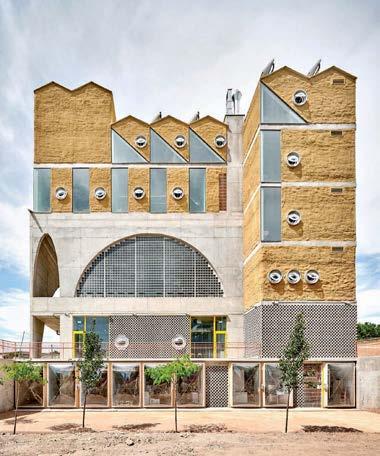
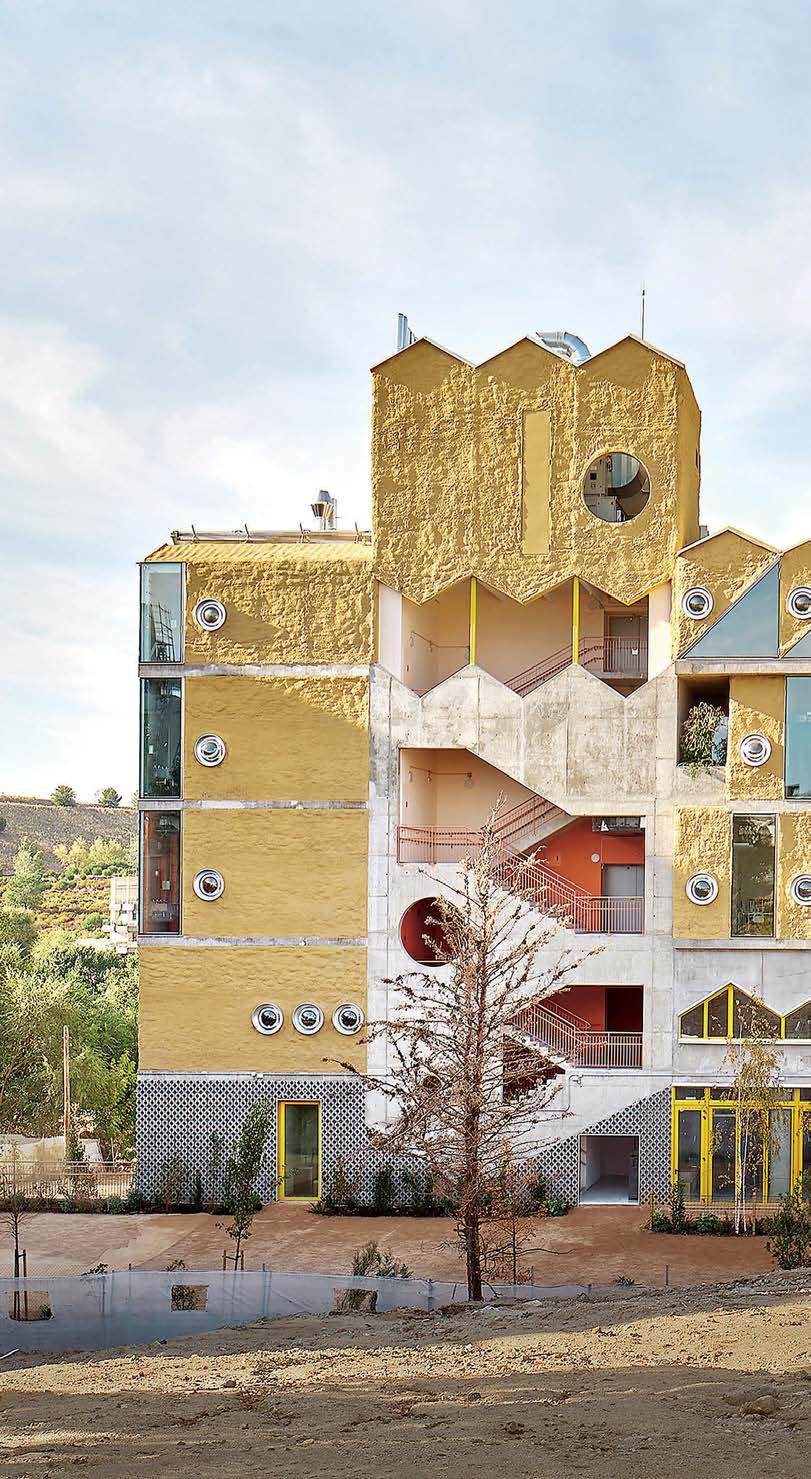 By Matthew Marani
Madrid’s Office for Political Innovation (OPI), a studio led by architect Andrés Jaque, who is dean of Columbia University’s Graduate School of Architecture, Planning and Preservation, is known for its playfully irreverent design approach. That preference for the idiosyncratic over the mundane, as displayed at the House in Never Never Land in Ibiza and the Rambla Climate House in Murcia, has come to further fruition with the recently completed Reggio School, a six-story pilot project for the Reggio Center for Pedagogical Research and Innovation on the outskirts of Madrid. The project broke ground in March 2020 and opened its doors in September 2022.
COURTESY JOSÉ HEVIA
METROPOLIS 88
Designed by Madrid’s Office for Political Innovation, the Reggio Center for Pedagogical Research and Innovation was designed according to the Reggio Emilia approach, an experiential learning philosophy and pedagogy focused on preschool and primary education. The unique six-story school on the outskirts of Madrid uses cork as the primary exterior element and form of insulation.
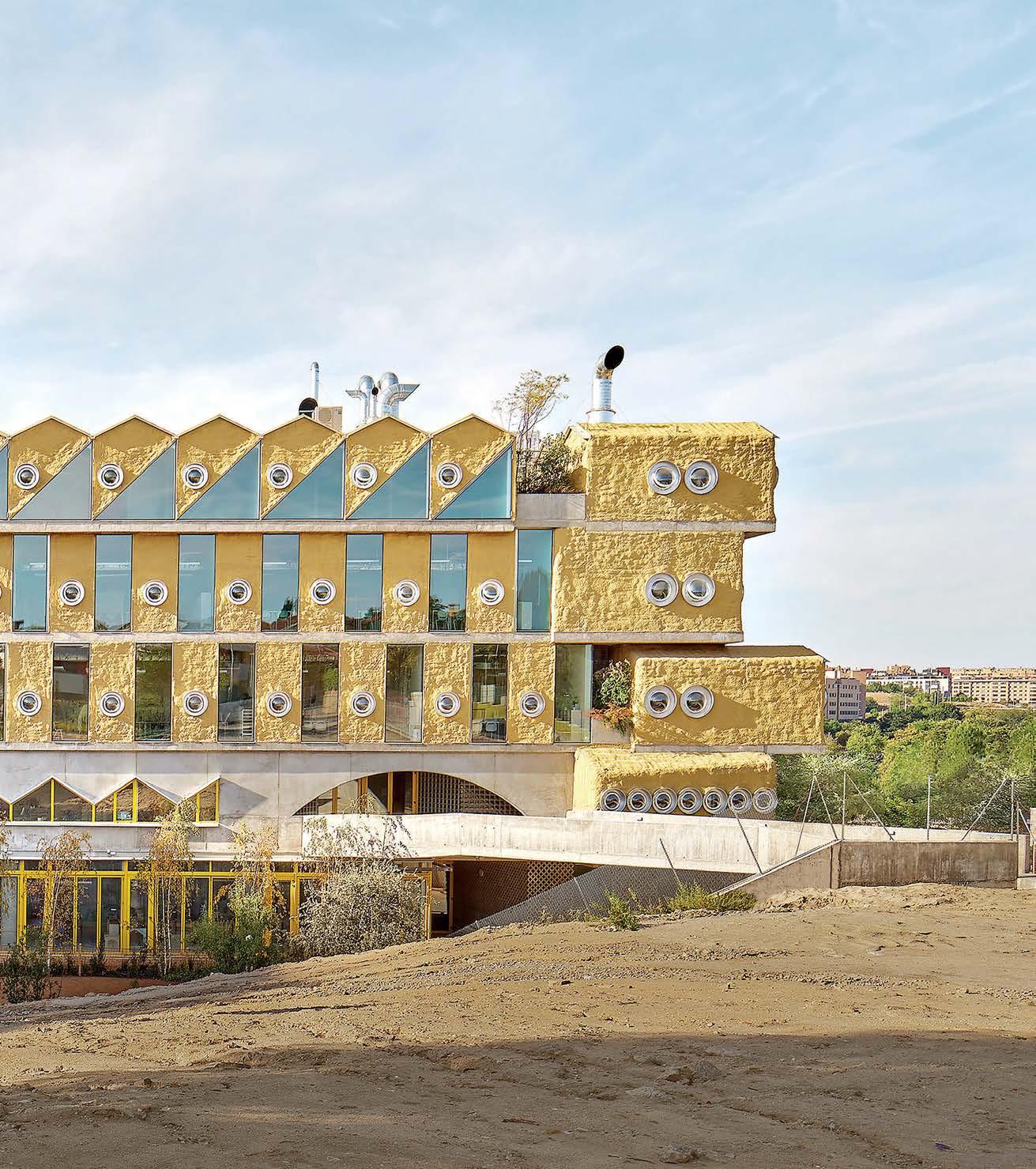
MARCH/APRIL 2023 89
The school is designed according to the principles of the Reggio Emilia approach, an educational model developed by Italian educator Loris Malaguzzi that seeks to empower children as the primary agents of their education. “The role of the architecture is to become an opportunity for collective self-experimentation as a source of learning and teaching by experience,” explains Jaque. “The design of the school accumulates many different architectural traditions to allow for kids growing to acknowledge experience and feel how they are part of larger ecosystems and societies.”
The result is not so much an individual building but an accretion of towns and villages—replete with a skyline of gable roofs and sun-drenched loggias—centered on a vegetated public square, or agora. Classrooms are assembled according to ascending age groups: The youngest students are located on the first two floors, with a greater rootedness in the surrounding terrain, while the oldest students are placed at canopy level of the vegetated courtyard. Cork is the primary exterior element of the project and, with its yellowish-brown complexion and uneven surfacing, resembles a wattle-and-daub
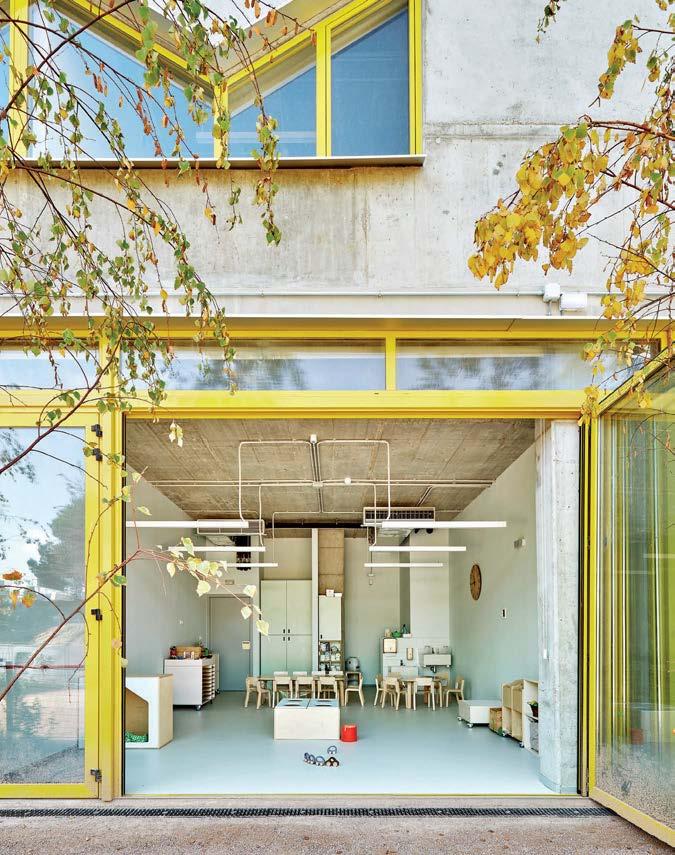
For architect Andrés Jaque, the building itself combines various architectural traditions, ecosystems, and climates serving as an opportunity for learning about larger ecosystems and societies. The youngest students are located on the first two floors with classrooms that open to the surrounding landscape, representing a rootedness in the terrain.
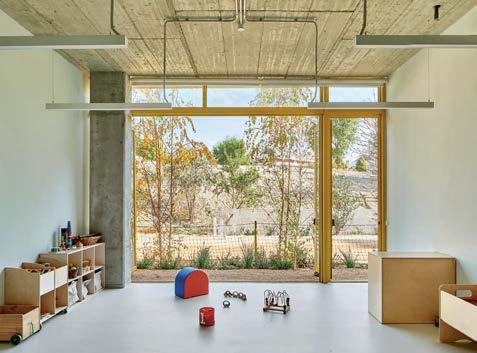
COURTESY JOSÉ HEVIA EDUCATION Design for Discovery
METROPOLIS 90
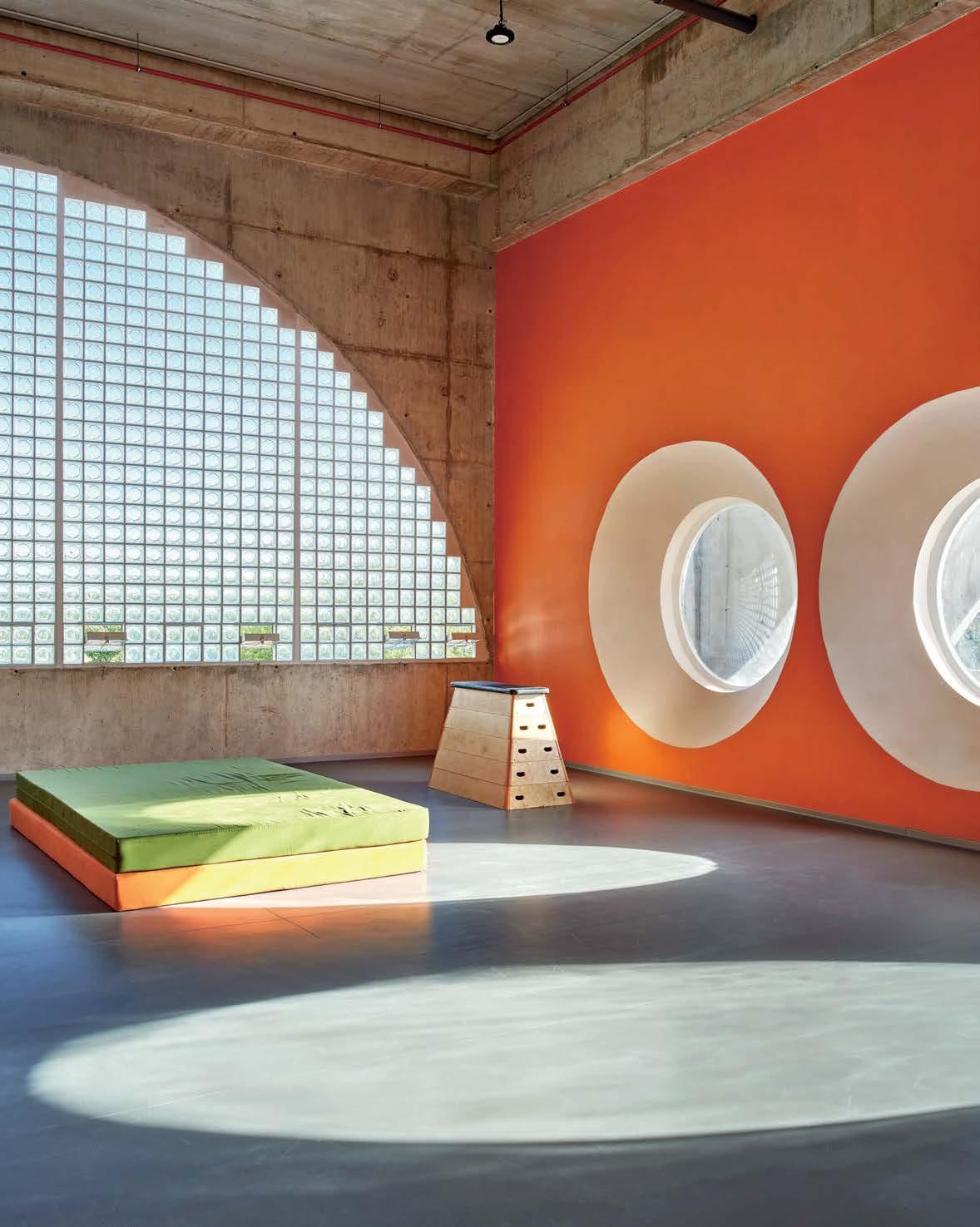
MARCH/APRIL 2023 91
half-timber structure, save for significant moments of bare concrete, porthole-like windows, and triangular panes of glass that blend into the window wall facade system. Cork for the project was sourced from Extremadura in Spain and Alentejo in Portugal, and it doubly serves as exterior cladding and the primary form of thermal insulation. The material also happens to be exceptionally sustainable; the bark of the cork oak tree is harvested every nine to twelve years, leaving the tree intact for future cultivation.
That same emphasis on sustainability is evident in the relatively austere interior of the school—concrete is not hidden behind
wall paneling, and the mechanical systems are laid bare for building occupants to observe. For the latter, approximately 70 percent of the energy consumed for heating and water is sourced from a rooftop solar array. An approximately 120-foot-long window operates automatically to control the internal climate. All such features, and their visibility, are key components of the school’s mission. “I would read it as a naked building to a large extent, because the mechanical systems and the structures are basically part of the pedagogy,” says Jaque. “The performance and daily life of the building becomes a big source of the learning opportunities that kids are exposed to.” M
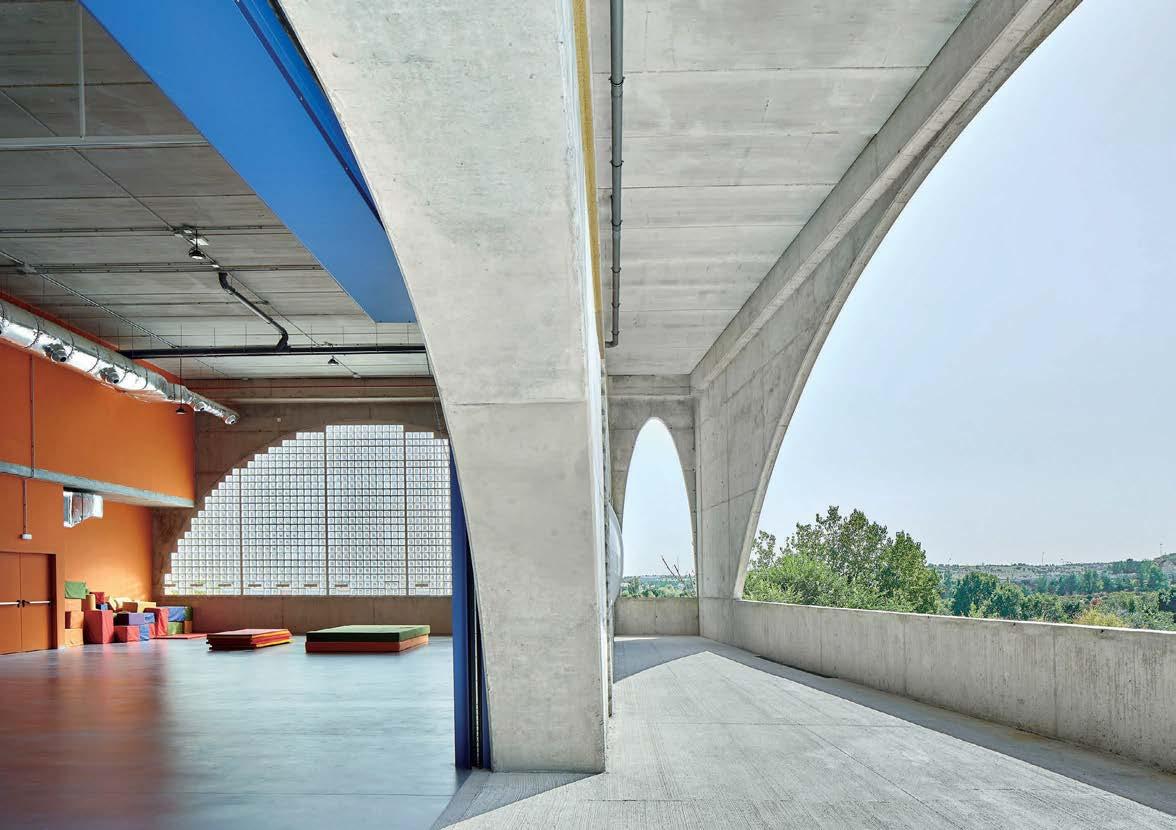
COURTESY JOSÉ HEVIA EDUCATION Design for Discovery
The second floor features large arched loggias that showcase views of the surrounding landscape. The interiors are marked by a contrasting use of concrete and bold colors. Mechanical systems serve as a pedagogical opportunity.
METROPOLIS 92
The upper levels of the school feature reclaimed water and soil tanks that nourish an indoor garden under a greenhouse structure. Classrooms for the other students surround the garden.
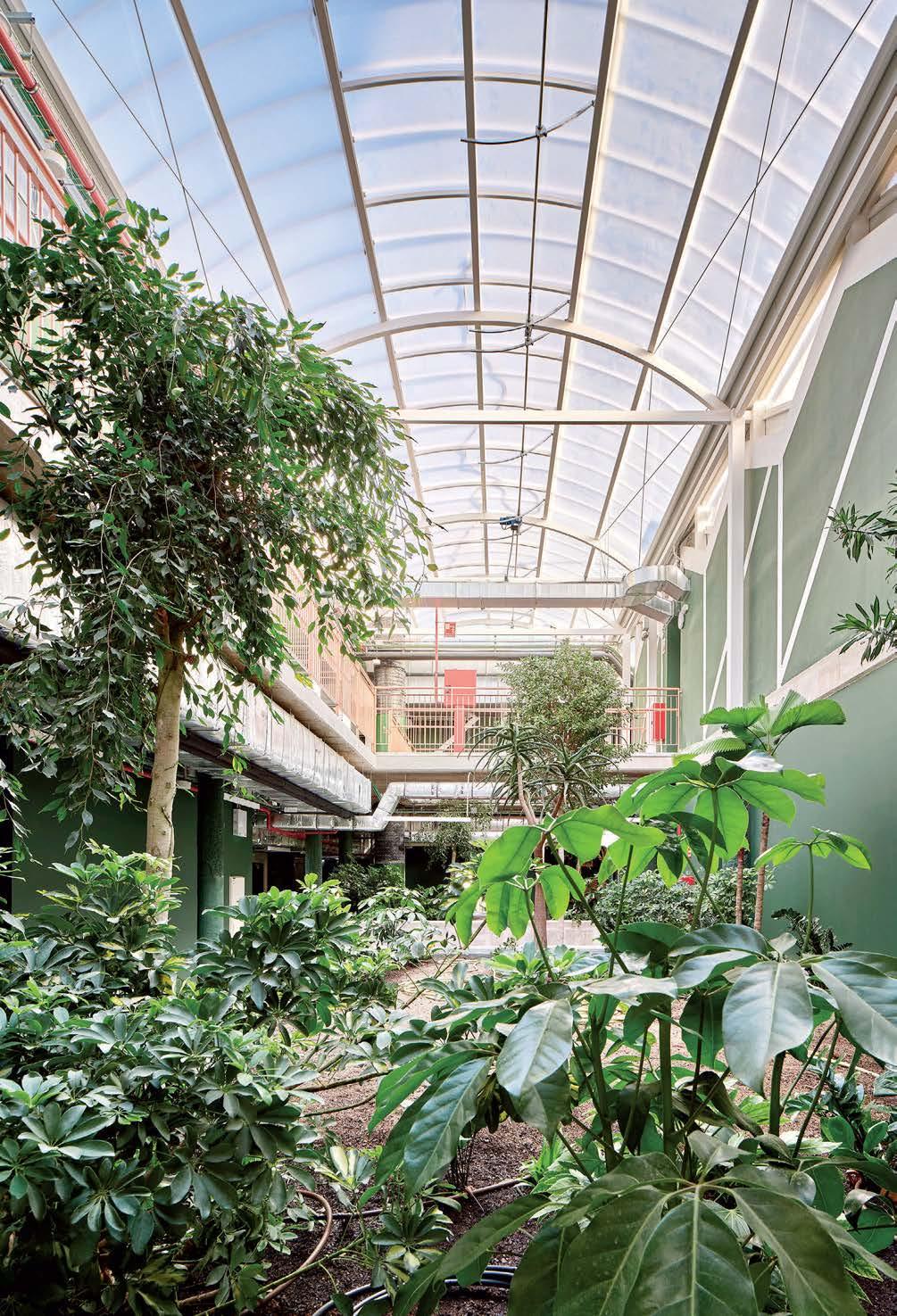
MARCH/APRIL 2023 93
INSIGHT Sources of Inspiration
ThinkLab’s U.S. Design Industry Benchmark Report for 2023 reveals the top 7 places architects and designers look to kindle creativity.
By Erica Waayenberg
Passionate architects and designers strive to create environments that support and delight their occupants. But where do they get their inspiration? ThinkLab’s annual survey of over 1,100 U.S.-based practitioners highlights where this audience looks for fresh ideas. Here are the top seven sources of inspiration for A&D professionals, according to our U.S. Design Industry Benchmark Report for 2023.
01 Trade publications and magazines
Trade publications and magazines are seen as go-to sources for cutting-edge design philosophy, allowing readers to stay abreast of the latest innovations and discover products from reputable brands. What kind of content will make an architect or a designer pause? Beautiful, full-bleed imagery and candid commentary from the creators.
02 Brand websites
For the first time, ThinkLab survey results show a brand’s website as architects’ and designers’ number one source for information, surpassing brand reps. Our research also shows that two-thirds of professionals feel loyalty to brands they know and trust. Once they’ve found companies they know will deliver on their product promise, they are looking for them to showcase their latest product launches with the support of lifestyle images, white sweep images, and robust product information all in the same place. They desire a self-serve experience at multiple points throughout the design process.
03 Social media
Architects and designers are routinely turning to Instagram and Pinterest in their professional life as well as for leisure. These platforms allow them to “online date” a

METROPOLIS
94
brand to get a sense of whether the portfolio is the right fit for their client. Companies with robust social platforms provide an unpressured opportunity for designers to get to know products.
04 Internet searches
Architects and designers may turn to the internet in hopes of finding something new and inspiring or to solve a one-of-a-kind constraint. When it comes to an organic internet search, websites that are crystal clear about what a company does and provides help designers and architects in their work.
05 Showrooms/Design Centers
While the digital world can bring a plethora of product options and inspirational images to our fingertips in seconds, it can also make it hard to differentiate quality as well as hand, finish, and other tactile qualities of
products. Showrooms and design centers are still beloved when paired with concierge-like staff who are knowledgeable about the latest products and ready to pull options that complement a designer’s creative vision. A great showroom doesn’t remain static; rather, it invites interactivity and provides space for design ideation either while browsing alone or nailing down selections with clients in tow.
06 Trade shows
Trade shows provide full immersion in the industry’s design, new product launches, thought leadership, awards, and networking. In a sea of sensory and information overload, sometimes it is simplicity that stands out. A focused and immersive experience and crystal-clear messaging about a product or service help grab attention and create a lasting impression.
07 Material Bank
Material Bank, an aggregate material sampling source that offers overnight sample delivery for design professionals, was a critical player in keeping projects moving forward during the early days of the pandemic. But it has since established itself as a useful tool earlier in the design process. Architects and designers now cite Material Bank as a go-to source for inspiration, where they are exposed to products and brands that they might never have encountered on their own or in their firms’ libraries.
To stay top of mind, it’s critical to understand these key platforms in order to connect with specifiers. Want to learn more about this audience and what is important to them? View the full U.S. Design Industry Benchmark Report from ThinkLab below.
Erica Waayenberg is the head of research and content development for ThinkLab, the research division of SANDOW Design Group. Join in to explore what’s next at thinklab. design/join-in.
 Scan to view the full U.S. Design Industry Benchmark Report from ThinkLab
MARCH/APRIL 2023 95
REPORT
Each year, Metropolis sets out to designate the top graduating architecture and interior design students in the United States and Canada. The program, sponsored by Armstrong, Daltile, Formica, Interface, Kawneer, Keilhauer, Sherwin-Williams, and Yabu Pushelberg, invited the most talented students from the class of 2023 to apply. “Supporting the next generation of designers not only affirms our values but is necessary for the success of the industry as a whole,” says Rowan Thompson, brand strategy manager at Yabu Pushelberg.
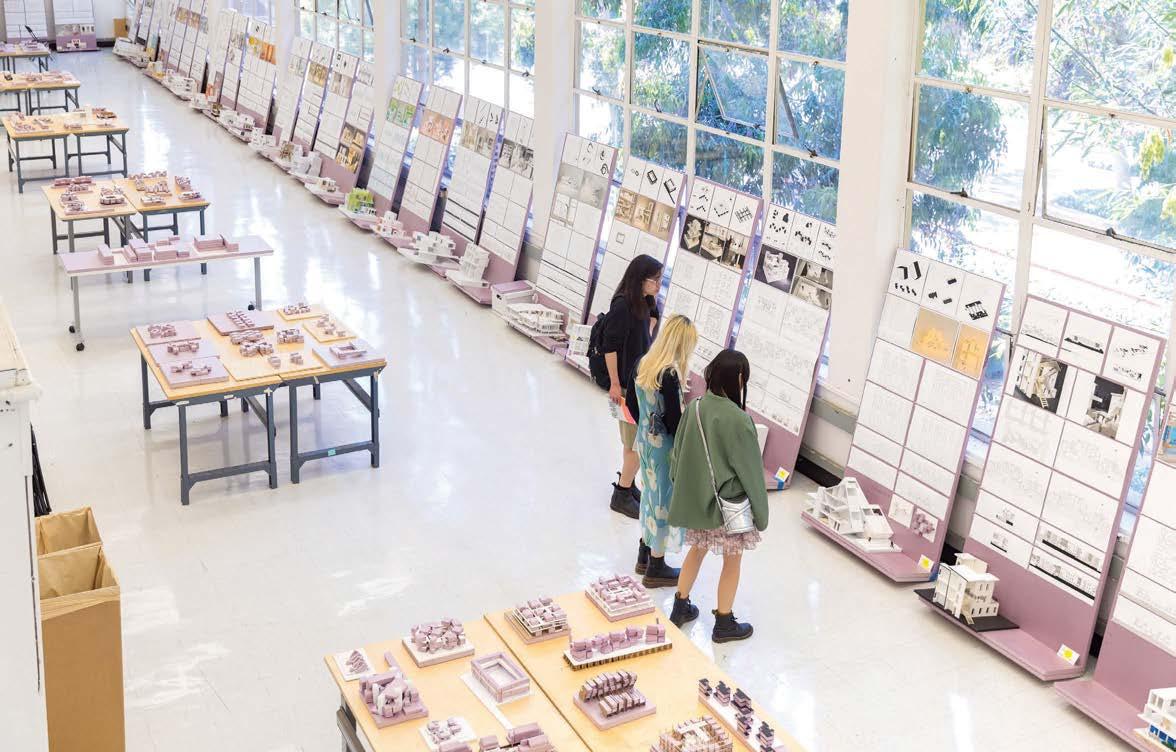
Nominated by their instructors and mentors, these 50 interior design and 50 architecture students were chosen by the Metropolis team. They hail from some of the best schools in North America, from Yale University to the University of California, Los Angeles, and call anywhere from Miramar, Florida, to Bellevue, Washington, home. A diverse group—with many women, as well as those who identify as BIPOC, LGBTQIA+, or neurodivergent—they are leaders on their campuses, advocating for equity and inclusion through their work and extracurriculars.
On the following pages, we give you a broad look at this group of talented young designers: who they are, where they come from, and what and where they study. Then see the full list of winners (p. 106) and dive deeper into their impressive work (p. 114) to get a glimpse of what the future of the A&D industry could be.
COURTESY © 2022 SARAH M. GOLONKA
METROPOLIS 96 MARCH/APRIL 2023
Three of this year’s Future100 students study at the University of California, Los Angeles. Shown here, a studio in Perloff Hall, which is home to UCLA’s Architecture and Urban Design program.
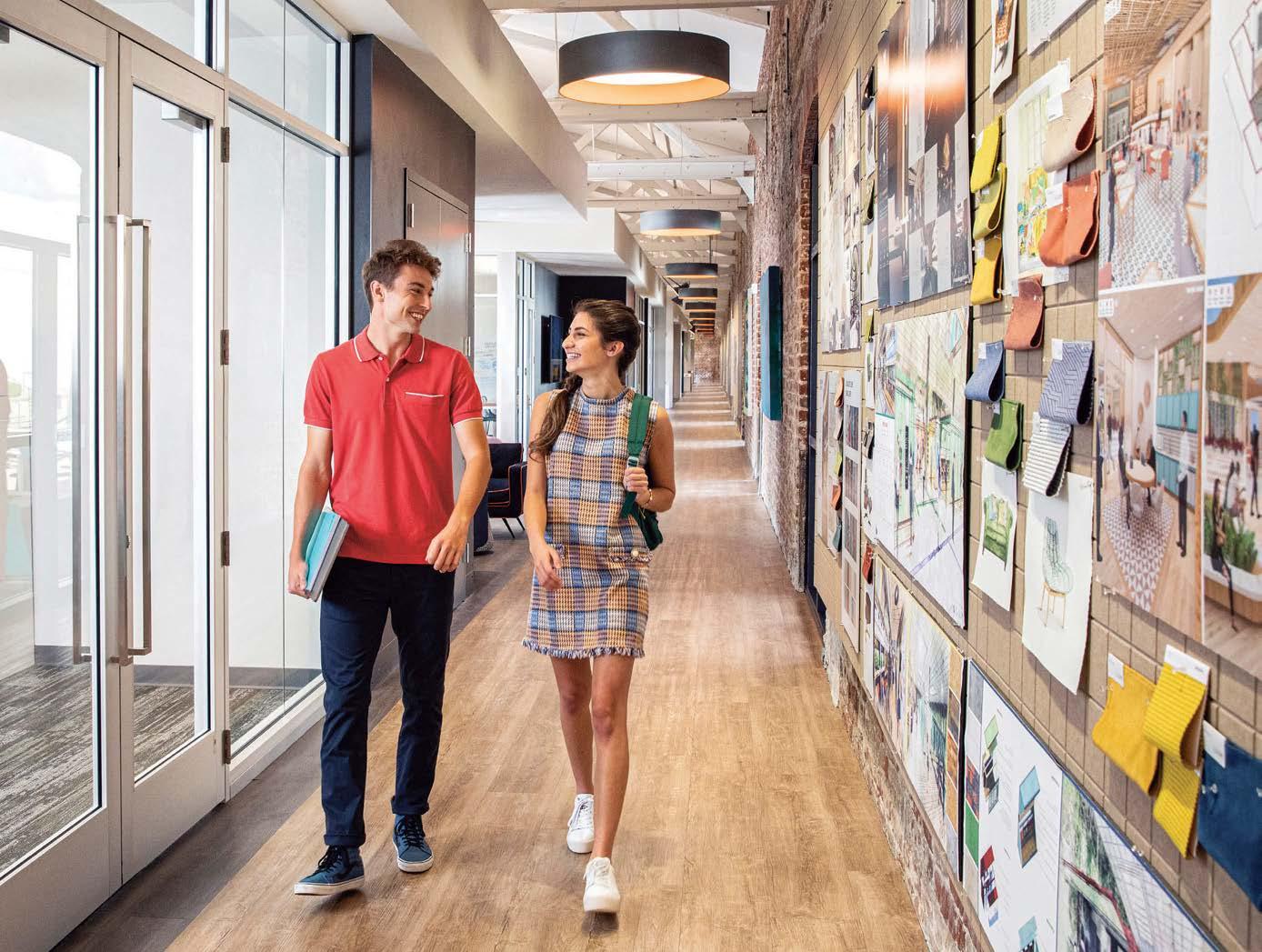
ARCHITECTURE STUDENTS
SCHOOLS
Where Do They Study?
Launching a search across the United States and Canada, we reached out to deans, professors, and advisers at architecture and interior design programs, looking to find the top students from the class of 2023. Enthusiastic nominations came flooding in from leading schools throughout North America.
ArtCenter College of Design
Baylor University
Belmont University
Boston Architectural College
British Columbia Institute of Technology
California College of the Arts
California Polytechnic State University, San Luis Obispo
California State Polytechnic University, Pomona
Clemson University
Colorado State University
Columbia University
Drexel University
Fashion Institute of Technology
Florida International University
Florida State University
George Washington University
Iowa State University
Kansas State University
Kent State University
Louisiana State University
Louisiana Tech University
Marymount University
Mississippi State University
New Jersey Institute of Technology
New York Institute of Technology
New York School of Interior Design Pratt Institute
Rensselaer Polytechnic Institute
Rhode Island School of Design
Savannah College of Art and Design
State University of New York at Buffalo
Syracuse University
Texas A&M University
The Boston Architectural College
The Cooper Union
The New School, Parsons School of Design
Toronto Metropolitan University
Tulane University
University of Arkansas
University of California, Los Angeles
University of Cincinnati
University of Florida
University of Illinois Urbana-Champaign
University of Kentucky
University of Michigan
University of North Texas
University of Oklahoma
University of Oregon
University of Pennsylvania
University of Texas at Austin
University of Utah
Virginia Tech
Woodbury University
Yale University
METROPOLIS FUTURE100 REPORT
INTERIOR DESIGN STUDENTS 1 STUDENT 2 STUDENTS 3 STUDENTS 4 STUDENTS 5 STUDENTS METROPOLIS 98 MARCH/APRIL 2023
(The)


Air. An original design from VS.
A happy answer to the varied needs of students, teachers and space planners. Elegantly ergonomic, thanks to the design sensibilities of architect Jean Nouvel.
We believe when you take care of students the rest follows. See the new JUMPER Air in motion at vsamerica.com/jumper
VSAMERICA.COM 704.378.6500 INFO@VSAMERICA.COM
Jumper®
ACADEMICS What Do They Study?
Pursuing undergrad or graduate degrees in architecture and interior design, the Future100 students also demonstrate passions for other creative outlets—from painting and photography to lighting and furniture design—as well as interests in areas of study such as urban planning, accessible design, and sustainability.
ARCHITECTURE STUDENTS INTERIOR DESIGN STUDENTS
DIVERSITY What Do They Say About the Future?
These top students advocate for equity and inclusion through their work and extracurriculars, and many identify with groups that are underrepresented in the A&D professions.
7%
of students held leadership positions within their AIAS, ASID, IIDA, or NOMAS campus chapters, or within another architecture or interior design organization.
Judging Criteria
The most talented students from the class of 2023 submitted their academic accomplishments, a portfolio, and testimonials from an instructor or a professional mentor. Applicants were required to be enrolled in an accredited architecture or interior design program at a public or private college in the United States or Canada, be working on studio-based or research-based projects, and be in good academic standing. Student submissions were reviewed by the Metropolis team and judged on their creativity, rigor, and professionalism.
“The profession needs more people like Benjamin Janes in it—people who are not just intelligent, talented designers but who also have a strong and unwavering commitment to sustainability and equity.”
NICO LARCO, Professor, Director of Urbanism Next Center, and Co-Director of Sustainable Cities Initiative, University of Oregon
“Katherine Olson is a champion for people with di erent abilities and designs culturally sensitive solutions where everyone feels par t of her designed environment.”
VIBHAVARI JANI, Professor, Interior Architecture and Industrial Design, Kansas State University
“Michael Urueta is passionate about architecture serving as a vehicle for promoting and supporting human well-being for populations that are rarely touched or served in a meaningful way by our profession.”
DAVID ALLISON, Alumni Distinguished Professor and Director, Graduate Studies in Architecture and Health, Clemson University
METROPOLIS FUTURE100 REPORT
ARCHITECTURE STUDENT INTERIOR DESIGN STUDENT LGBTQIA+ 3 6 BIPOC 10 16 44 24% Graduate 26% Undergraduate 25% Undergraduate 25% Graduate 27 FEMALE NEURODIVERSE 2 2 METROPOLIS 100 MARCH/APRIL 2023
Explore Metropolis's Design for Equity Primer, a guide to all existing resources to improve equity in the process and outcomes of architecture and interior design.

presented by









GEOGRAPHY Where Are Their Schools?
Where Are They From?
METROPOLIS FUTURE100 REPORT ARCHITECTURE STUDENT INTERIOR DESIGN STUDENT
ARCHITECTURE STUDENT INTERIOR DESIGN STUDENT Arizona Arkansas British Columbia California Colorado Connecticut Florida Georgia Illinois Iowa Kansas Kentucky Louisiana Maine Massachusetts Michigan Missouri Nevada New Jersey New Mexico New York Ohio Oklahoma Ontario Oregon Pennsylvania Rhode Island South Carolina Tennessee Texas Utah Virginia Washington Vietnam Ames, Iowa 01 Ann Arbor, Michigan 02 Arlington, Virginia 03 Austin, Texas 04 Baton Rouge, Louisiana 05 Blacksburg, Virginia 06 Boston, Massachusetts 07 Brooklyn, New York 08 Buffalo, New York 09 Burbank, California 10 Burnaby, British Columbia 11 Champaign, Illinois 12 Cincinnati, Ohio 13 Clemson, South Carolina 14 College Station, Texas 15 Denton, Texas 16 Eugene, Oregon 17 Fayetteville, Arkansas 18 Fort Collins, Colorado 19 Gainesville, Florida 20 Kent, Ohio 21 Lexington, Kentucky 22 Los Angeles, California 23 Manhattan, Kansas 24 Miami, Florida 25 Mississippi State, Mississippi 26 Nashville, Tennessee 27 New Haven, Connecticut 28 New Orleans, Louisiana 29 New York, New York 30 Newark, New Jersey 31 Norman, Oklahoma 32 Old Westbury, New York 33 Pasadena, California 34 Philadelphia, Pennsylvania 35 Pomona, California 36 Portland, Oregon 37 Providence, Rhode Island 38 Ruston, Louisiana 39 Salt Lake City, Utah 40 San Francisco, California 41 San Luis Obispo, California 42 Savannah, Georgia 43 Syracuse, New York 44 Tallahassee, Florida 45 Toronto, Ontario 46 Troy, New York 47 Waco, Texas 48 Washington, D.C. 49
With wide-ranging geographic and cultural backgrounds, the Future100 study anywhere from New York to San Francisco. 11 01 03 04 02 05 06 07 08 09 34 23 10 36 41 46 20 45 24 12 13 14 15 16 17 18 19 21 22 25 26 27 28 29 30 31 32 35 38 39 40 42 43 44 47 48 49 33 37 METROPOLIS 102 MARCH/APRIL 2023


NYC’S OFFICIAL CELEBRATION OF DESIGN May 18-25, 2023 Visit festival.nycxdesign.org to plan your journey. Thank you to our 2023 Festival Sponsors
North America’s singular platform for international design. Co-located with WantedDesign Manhattan. Register now at icff.com ICFF 2023 MAY 21-23 | JAVITS CENTER, NYC Metropolis readers: Your pass is complimentary with promo code METROPOLIS23
The projects on the following pages represent the best thinking being nurtured in architecture and interior design classrooms across the United States and Canada today. Pragmatic, ambitious, and even visionary, these 100 undergraduate and graduate portfolios are by students who don’t shy away from challenges at any scale— from intimate pavilions to regenerative planning for coastal ecosystems. The class of 2023 seems primed to reinvigorate the building professions for the demanding decades ahead.
© CREDITS GO HERE
METROPOLIS MARCH/APRIL 2023 105
THE FUTURE100
The 100 students listed here represent some of the most impressive young designers graduating from North America’s architecture and design schools this year. The pages of their portfolios showcase thorough research, fresh methodologies, innovative materiality, and beautiful, well-designed spaces and buildings of all types. But beyond that, their work considers the industry’s role and responsibility to make an impact, thoughtfully weighing context, culture, community, inclusivity, and sustainability, proving this cohort is primed to make their mark on the industry.
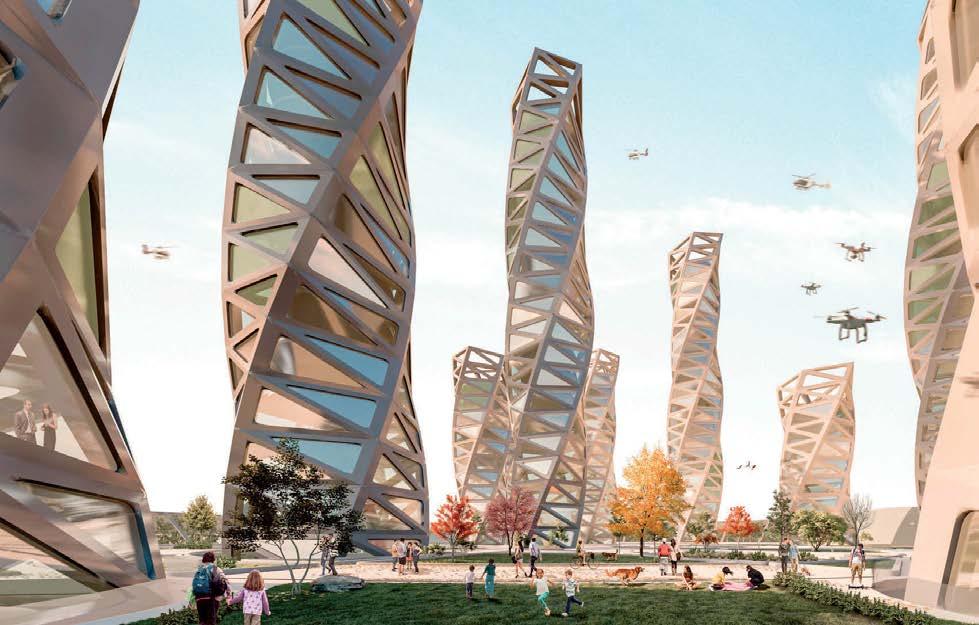
COURTESY SHRAVAN ARUN METROPOLIS 106
HORIZON Shravan Arun, University of Illinois Urbana-Champaign
ASHAYKEEN ABEDIN
Drexel University
Undergraduate Architecture
NOMINATORS: Jacklynn Niemiec, Assistant Professor, and Dr. Mark L. Brack, Professor Emeritus
Abedin is an architectural designer and avid photographer whose designs propose inventive solutions to pressing global problems like dental care in the developing world, and food production in dense cities.
ABRAR ALAHMADI
Drexel University
Graduate Interior Architecture & Design
NOMINATOR: William Mangold, Assistant Professor, Department of Architecture, Design & Urbanism, Antoinette Westphal College of Media Arts & Design
In the design of the Arise Community Center, Alahmadi illustrates her ability to design creative community spaces that “improve the quality of human life.”
LAMIA ALBUNNI (P. 114)
University of Cincinnati
Graduate Architecture
NOMINATOR: Edward Mitchell, Director, School of Architecture and Interior Design
Albunni’s REthink, REuse, and REhab Akron, Ohio, productive settlement proposal demonstrates a high level of research, deep commitment to material innovation, and a poetic sense of form.
STEVEN ALMOND (P. 132)
University of Cincinnati
Graduate Architecture
NOMINATOR: Ed Mitchell, Director, School of Architecture and Interior Design
With designs that include an aquaponic urban farming campus, a master plan for a city in Kentucky, and the rehabilitation of a historic canal lock building, Almond’s portfolio shows a designer interested in confronting the legacy of deindustrialization with community-oriented design.
SHRAVAN ARUN
University of Illinois at Urbana-Champaign
Undergraduate Architecture
NOMINATOR: Francisco Javier RodríguezSuárez, Director of the School of Architecture and Clayton T. Miers
Professor in Architecture
From work on competition designs as an intern with Perkins&Will to editing the Ricker Report, a student-run design publication, Arun’s work explores a range of scales and multitude of forms.
SAMUEL BAGER (P. 122)
Columbia University
Graduate Architecture
NOMINATOR: Michael Caton, Adjunct Assistant Professor, Graduate School of Architecture, Planning and Preservation
Bager’s ingenuity is evident in his ambitious design ideas that address issues ranging from housing to education, community, play, consumption, the environment, and time.
BRIANNA BALDWIN
Tulane University
Graduate Architecture
NOMINATOR: Ruben Garcia-Rubio, Assistant Professor of Architecture & Urbanism, School of Architecture
Baldwin’s Poydras Office Proposal demonstrates her extraordinary attention to detail, thorough material investigation, and thoughtful comprehension of construction details, resulting in a compelling design.
AFNAN BASHAIKH
Drexel University
Graduate Interior Architecture & Design
NOMINATOR: William Mangold, Assistant Professor, Department of Architecture, Design & Urbanism, Antoinette Westphal College of Media Arts & Design
From residential to commercial projects, Bashaikh demonstrates an ability to create atmospheric interiors with a strong focus on light and material.
LAFAYETTE BONNER
University of Florida
Graduate Interior Design
NOMINATOR: Roberto Rengel, Professor and Department Chair
With a focus on health-care design, Bonner’s design philosophy prioritizes “universality, texture, biophilia, and color to create comforting, healing spaces.”
NICOLAS BURBANO DIAZ (P. 138)
Toronto Metropolitan University
Undergraduate Interior Design
NOMINATOR: Jonathon Anderson, Associate Professor + Director
For Burbano Diaz, “questioning the status quo is part of my design process and philosophy.” Believing that interiors can affect the communities we live in, the undergraduate has developed the design of a Resilient Service Model for art galleries that considers the needs of both workers and guests.
LISA BURNETT
Belmont University
Undergraduate Interior Design
NOMINATOR: Finis Eliot, Assistant Professor of Interior Design
Through installation artworks, interior design projects, and product design, this student explores how human beings interact with their spatial environments.
CHELSEA CAMERON (P. 120)
Florida International University
Graduate Architecture
NOMINATOR: Henry Rueda Coronel, Chair of the Department of Architecture
Cameron’s passion for community and sensitivity to society’s inequalities are evident in her work, including her 3D Printed Housing project, which applied digital fabrication to address affordable housing.
NAMITA CHANDRASHEKAR (P. 118)
The New School, Parsons School of Design
Graduate Interior Design
NOMINATOR: Gökhan Kodalak, Part-time Lecturer
Chandrashekar brings a spirit of deep inquiry into all her projects—whether they are a built installation, furniture design, material studies, or the design for an urban interior within New York’s Central Park.
EUNJUNG CHOI
Iowa State University
Graduate Interior Design
NOMINATOR: Jae-Hwa Lee, Assistant Professor
Choi’s portfolio exhibits a strong focus on hospitality, whether for a luxury residential community, a nursing home, or a branded retail environment.
SARAH CHOUDHARY
New York School of Interior Design
Graduate Interior Design
NOMINATOR: Joseph Goldstein, Adjunct Professor, Principal of JGArchitects
In Choudhary’s design for The Walt Disney Museum of Animation, the interior design student creates an immersive, cinematic experience that explores the history of animation and the legacy of Walt Disney.
CONSTANCE CHU
New Jersey Institute of Technology
Undergraduate Interior Design
NOMINATOR: David Brothers, Senior University Lecturer, Interior Design Program Coordinator
Chu’s portfolio is replete with spaces that take a joyful approach to design, and experiment with light, color, texture, and materiality.
SOORIN CHUNG
George Washington University
Graduate Interior Architecture
NOMINATOR: Catherine Anderson, Assistant Professor, Director of Graduate Studies
Chung’s portfolio provides thought-provoking insight into the future of work, whether through a live/work space for artists, the design for a therapeutic privacy pod, or a modular furniture system for hybrid work.
CAIUS COWGILL
California Polytechnic State University, San Luis Obispo
Undergraduate Architecture
NOMINATORS: Stephen Phillips, Professor, and Doug Jackson, Professor
Cowgill’s designs for a multifunctional rail system that incorporates green space along with a proposed residential tower pockmarked by voids show a designer taking inventive approaches to familiar typologies.
EMILY CREEK (P. 126)
University of Arkansas
Undergraduate Interior Design
NOMINATOR: Jinoh Park, Assistant Professor
This student’s evidence-based approach to design focuses on creating user experiences that support wellness and a sense of community connection.
HANNAH CRUTCHFIELD
University of Texas at Austin
Graduate Interior Design
NOMINATOR: Lysa Janssen, Adjunct Assistant Professor
Crutchfield’s thoughtful designs for cohousing, hospitality spaces, and public pavilions offer cohesive, humanistic solutions to a range of project briefs.
MARCH/APRIL 2023 107
ANDREEA DAN
Tulane University
Undergraduate Architecture
NOMINATORS: Iñaki Alday, Dean, School of Architecture, and Ruben Garcia, Assistant Professor of Architecture and Urbanism
Designs for libraries and resilient community centers, and research into the role of public monuments in America’s history of racial injustice, show Dan’s keen interest in how architecture and community intersect.
RYAN DEL POSO
Woodbury University
Undergraduate Architecture
NOMINATOR: Matthew Gillis, Professor
Colorful renderings bring imaginative, community-oriented designs to life in Del Poso’s portfolio. Highlights include two proposals for Los Angeles’s Ballona Creek Wetland: a high-tech wildlife viewing platform and an immersive ecological research station.
ELIZABETH DOEPKER
University of Cincinnati
Undergraduate Interior Design
NOMINATORS: Edward Mitchell, Director, School of Architecture and Interior Design, and Aubrie Welsh, Internship Adviser, Owner of Aubrie Welsh Interiors
Projects including the cafeteria of a children’s hospital, residences, and research into the needs of displaced persons demonstrate a genuine curiosity about how people interact with designed space.
MINGHAO (WILLIAM) DU (P. 114)
The Cooper Union
Undergraduate Architecture
NOMINATOR: Hayley Eber, Acting Dean at the Irwin S. Chanin School of Architecture of the Cooper Union
An adaptive reuse scheme for Empire State Plaza in Albany, New York, alongside construction details for an affordable housing unit shows a designer thinking both big and seriously.
CORA EMBREE
Virginia Tech
Undergraduate Interior Design
NOMINATOR: Alp Tural, Assistant Professor of Interior Design
From an art gallery made of shipping containers to a hybrid meeting pod, a keen interest in designing multifunctional, adaptable spaces is evident in Embree’s portfolio.
KATIE GAGLE
Kent State University
Undergraduate Interior Design
NOMINATOR: Ronn M. Daniel, Associate Professor
Gagle’s projects, such as a Center for Applied Drama and Autism, aim to translate narrative into physical space through user research.
ALDEN GENDREAU
California College of the Arts
Undergraduate Architecture
NOMINATOR: Antje Steinmuller, Associate Professor and Chair
Between an interlocking wooden structure designed to be used as a wildlife refuge and a board game developed as an engaging community planning tool, Gendreau’s work challenges the traditional boundaries of architecture.
JOSH GREENE
Yale University
Graduate Architecture
NOMINATOR: Eeva-Liisa Pelkonen, Assistant Dean and Professor, School of Architecture
Exploring environmental and social justice in the built environment, Greene’s portfolio demonstrates his passion for human-centered, place-based, and mission-driven design.
EVA GROOS
Syracuse University
Undergraduate Interior Design
NOMINATOR: Zoriana Dunham, Program Coordinator
This student’s community-oriented designs benefit from rigorous site analysis and demonstrate an interest in changing urban landscapes for the better.
ALYSSA HALLORAN
Savannah College of Art and Design
Graduate Architecture
NOMINATOR: Mike Hill, Professor
From her material research with rattan and cobb to her pavilion design for the 2025 World Expo, Halloran’s work explores new ideas and theories, resulting in evocative pieces of design.
RIHAM HAMED
University of Oklahoma
Graduate Interior Design
NOMINATOR: Mia Kile, Associate Professor
After receiving a degree in architecture in Egypt, she moved to the U.S. to pursue her passion in interior design. A nuanced attention to the relationship between interior and exterior is present in all her designs.
ALISON HICKS
University of Oregon
Undergraduate Interior Design
NOMINATOR: Kyuho Ahn, Interior Architecture Head and Associate Professor
Designs for office interiors, a café, a library branch, and even a chair she fabricated herself speak to Hicks’s well-rounded capabilities.
MARTIN HITCH (P. 126)
California College of the Arts
Graduate Architecture
NOMINATOR: Brian Price, Chair of Graduate Architecture
Projects like Ebb (& Flow) and Ghost House are a testament to Hitch’s imagination, critical sensibilities, and entrepreneurial spirit.
LAURA HUANG
The Boston Architectural College
Graduate Interior Design
NOMINATOR: Sarah Redmore, Director of Undergraduate Interior Architecture
Thinking through ideas such as accessibility, universal design, and wellness, Huang has developed a concept for a family lounge that can be implemented in commercial spaces.
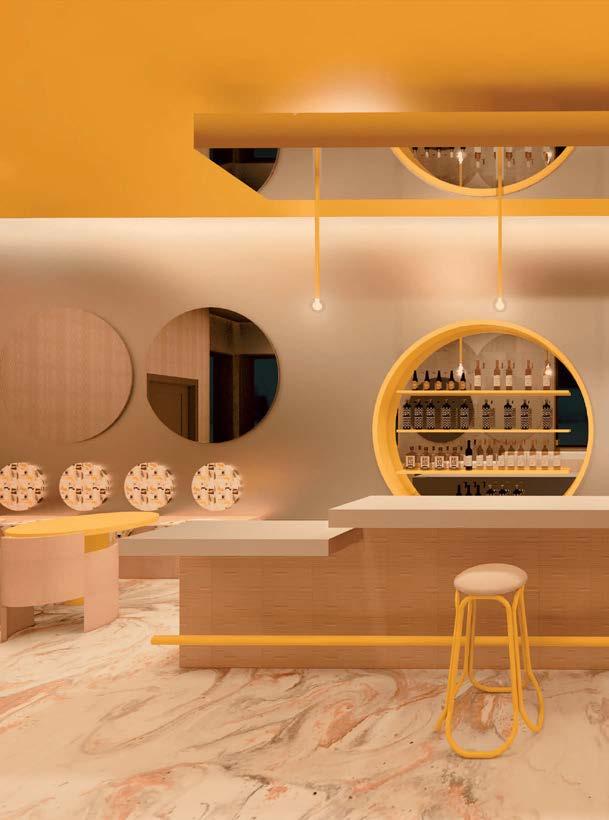
COURTESY MARIJA IVIC
METROPOLIS 108
VIVIAN HUYNH
Savannah College of Art and Design
Undergraduate Interior Design
NOMINATOR: Chi-Thien Nguyen, Chair of Interior Design and Preservation Design
Inspired by an internship in Singapore, her upbringing in Vietnam, and an American education, Huynh fuses Eastern and Western influences in her rich, tactile designs.
MARIJA IVIC
University of Texas at Austin
Graduate Interior Design
NOMINATOR: Igor Siddiqui, Program Director for Interior Design
From a nightclub in a historic building to a public house in Boston’s oldest neighborhood, when it comes to hospitality, Ivic demonstrates a skill in bridging old and new.
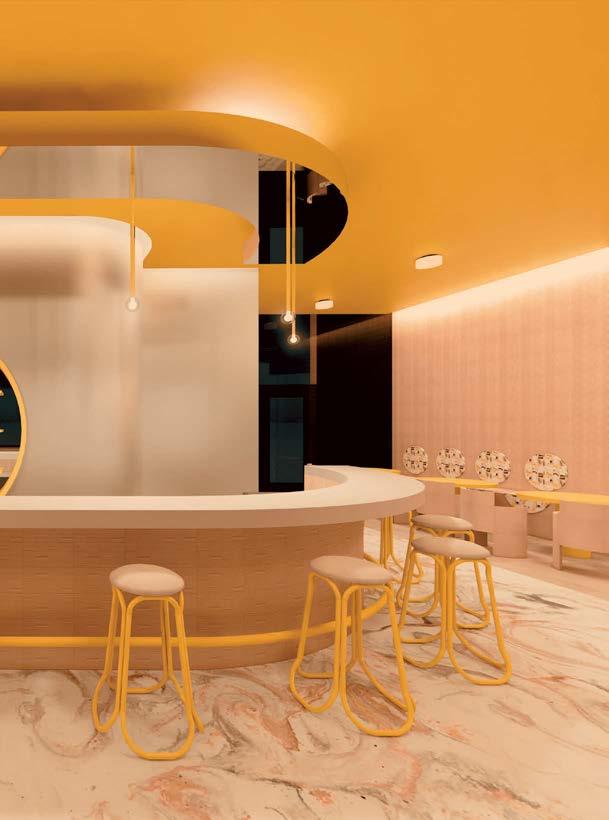
SHREYA JAISWAL
State University of New York at Buffalo Graduate Architecture
NOMINATOR: Gregory K. Serweta, Visiting Adjunct Instructor
Jaiswal’s imaginative design proposal for an art museum in downtown Buffalo, New York, demonstrates her ability to achieve site-specific, design-driven results.
BENJAMIN JANES
University of Oregon
Graduate Architecture
NOMINATOR: Nico Larco, Professor, Director of Urbanism Next Center, and Co-Director of Sustainable Cities Initiative
Janes’s Lloyd Creative District project exhibits his concern for equity and ability to incorporate various viewpoints and translate them into an innovative design solution.
YUNIN JEUNG (P. 130)
Louisiana Tech University
Undergraduate Architecture
NOMINATOR: Will Doss, Assistant Professor, School of Design
From a psychedelic spaceship inspired by the Mad Hatter of Alice in Wonderland to a writing museum, Jeung’s designs are as beautifully rendered as they are inventive.
SIJIE JI
University of California, Los Angeles Graduate Architecture
NOMINATOR: Mohamed Sharif, Assistant Adjunct Professor and Partner, Sharif, Lynch: Architecture
From her Floating House proposal that addresses rising sea levels in Kiribati to her dodecahedron spatial research, Ji’s designs are skillfully executed syntheses of technological and structural innovation.
SARAH JOHNSON
University of Pennsylvania Graduate Architecture
NOMINATOR: Andrew Saunders, Associate Professor and Director of the Master of Architecture Program, Weitzman School of Design Architecture Department
Johnson’s striking proposals include The Hydrosphere Garden, a residential building where people and coral cohabitate, and Technobabble, a community hub that combines Afrofuturist ideals, futuristic technology, and neighborhood needs.
TASMIA KAMAL
University of Illinois, Urbana-Champaign
Graduate Architecture
NOMINATORS: Francisco Javier Rodríguez-Suárez, FAIA, Director, Clayton T. Miers Professor, ACSA Distinguished Professor; and Sara Bartumeus Ferré, Associate Professor, Chair, Urbanism Program Area
Kamal’s innovative and thoughtful approach is exemplified in A Pantone Pixelscape: Negotiating Thresholds Through Gradients, which restores the relationship between park and river by creating thresholds through gradients in the form of pixels.
MATTHEW KELLER
British Columbia Institute of Technology
Undergraduate Architecture
NOMINATORS: Jody Patterson, Program Head, Bachelor of Architectural Science, and Fernanda Hannah Suarez, full-time faculty, Bachelor of Architectural Science
Sensitive designs for a nursery school and a multipurpose timber structure reveal a designer intent on making a positive impact on user communities.
DAVID KIM
British Columbia Institute of Technology
Undergraduate Interior Design
NOMINATOR: Tiia Manson, Program Head, Bachelor of Interior Design
Across designs for cultural spaces, residences, retail, and hospitality environments, this student strives for design that “everyone can experience and enjoy without discrimination or difficulty.”
YOUNG KIM
The New School, Parsons School of Design
Undergraduate Interior Design
NOMINATOR: Carly Cannell, Interim Director of BFA Interior Design Program and Assistant Professor
Designs for a fashion archive and a clothing manufacturing facility display this student’s well-developed sense of how differing design disciplines complement one another.
COURTNEY KLEE
Louisiana State University
Graduate Architecture
NOMINATOR: Fabio Capra-Ribeiro, Assistant Professor, School of Architecture
From her Grand Isle Barrier Island Restoration project to her proposal for affordable housing for Hispanic farmworkers, Klee demonstrates particular and sophisticated awareness of community and regional issues.
KASEY KRUSE
Colorado State University
Undergraduate Interior Design
NOMINATOR: Jain Kwon, Assistant Professor of Interior Architecture & Design
Kruse’s projects represent her creativity as well as an understanding of the greater context of interior environments, considering community, inclusivity, and environmental impact.
MARCH/APRIL 2023 109
THE AGATE PEARL, PUBLIC HOUSE Marija Ivic, University of Texas at Austin
NATALIA LAYKOV
Marymount University
Undergraduate Interior Design
NOMINATOR: Dr. Robert Paul Meden, Professor
Laykov’s background in medicine and hospitality is apparent in her designs that thoughtfully consider well-being and the relationships between people and their environments.
RYAN LEW (P. 126)
California Polytechnic State University, San Luis Obispo
Undergraduate Architecture
NOMINATORS: Nathaniel Hudson, AXP Supervisor, and Angela Bracco, Professor
Lew’s portfolio stands apart for its intricate 3D architectural models and inventive built furniture and product design prototypes.
ETHAN LEWIS (P. 126)
Tulane School of Architecture
Undergraduate Architecture
NOMINATOR: Juan Medina Revilla, Adjunct Lecturer
Lewis put his design talents to real-world use participating in Tulane’s annual Sukkah-building project and URBANBuild, a yearlong project to design and construct an affordable home.
CHANGXIN LI
Pratt Institute
Undergraduate Architecture
NOMINATOR: Keena Suh, Associate Professor, Interior Design Department
Through designs for modular housing units, a multigenerational apartment project, and a community center designed to withstand flood inundation, Li seeks sustainable solutions to community problems.
WANYING LI
University of California, Los Angeles
Graduate Architecture
NOMINATOR: Neil Denari, Professor, Principal of NMDA, Neil M. Denari
Architects Inc., and Professor of Architecture and Urban Design
Li’s propensity for taking risks is evident in her portfolio showcasing unique forms of expression in both concept and image.
RIZWANA LUBIS (P. 136)
California College of the Arts
Undergraduate Architecture
NOMINATORS: Janette Kim, Assistant Professor, and Antje Steinmuller, Associate Professor and Chair
Lubis’s designs for urban homesteading schemes as well as houses in the desert and on the beach reveal a designer sensitive to questions of how form should respond to the context of the site.
MACKENZIE LUKE (P. 122)
Rhode Island School of Design
Undergraduate Architecture
NOMINATOR: Nancy Nichols, Critic at the Department of Architecture
Luke’s eye-catching hand-drawn illustrations and 3D models bring to life projects that range from relief housing to neighborhood rezoning.
CHENHAO LUO (P. 132)
Syracuse University
Undergraduate Architecture
NOMINATOR: Daekwon Park, Undergraduate Chair
An urban high-rise inspired by a vending machine and an impressionistic map of Beijing are just a few of this student’s inventive designs.

CLYTIE HOI TING MAK (P. 124)
UCLA Architecture and Urban Design Graduate Architecture
NOMINATOR: Mohamed Sharif, Assistant Adjunct Professor and Director, Undergraduate Program, Architecture and Urban Design
Mak’s designs—from her Sunset Pixel arts-based community building to her Drive-In Drive Thru cinema and food distribution center—demonstrate meticulous attention to detail.
EMMA MANGELS (P. 114)
New York Institute of Technology
Undergraduate Architecture
NOMINATORS: Dongsei Kim, Assistant Professor of Architecture and Thesis Coordinator, and Evan Shieh, Adjunct Professor
A proposal for a redesign of Rikers Island to address its environmental and justice issues demonstrates Mangels’s belief that design should provide communities with equitable and resilient built environments.
DISORIENTATION FROM WAR TRAUMAS
Jonathan Marcos, Rensselaer Polytechnic Institute
JONATHAN MARCOS
Rensselaer Polytechnic Institute
Undergraduate Architecture
NOMINATOR: Adam Dayem, Assistant Professor
Marcos’s futuristic projects, such as a cantilevered observation platform intended to reconnect city dwellers to the natural world, offer radical responses to the changing urban environment.
ZEPHYR MARTIN (P. 132)
Drexel University
Undergraduate Architecture
NOMINATORS: Jacklynn Niemiec, Assistant Professor, and Rachel Schade, Associate Teaching Professor
From an art gallery nestled in a park to an academic building loaded with sustainable systems and biophilic elements, Martin’s designs aim for a positive impact on the environment.
REYHA METE
Fashion Institute of Technology
Undergraduate Interior Design
NOMINATOR: Joseph Goldstein, Professor
Mete brings a unique elegance to her work, including her design for the headquarters of a nonprofit organization for young women of color that features structures inspired by the Turkish art technique Ebru.
ALLIE MILLER
University of Oregon
Graduate Interior Design
NOMINATOR: Kyuho Ahn, Interior Architecture Head and Associate Professor
For Miller, “good design is aesthetically beautiful while maintaining social equity and sustainability.” This is particularly apparent in her design for SOULcial, a clubhouse for folks with intellectual and emotional disabilities.
COURTESY JONATHAN MARCOS
METROPOLIS 110
YASMIN MOHAMED
University of Kentucky
Graduate Interior Design
NOMINATOR: Hannah R. Dewhirst, Assistant Professor
Mohamed is interested in the ways in which interior design affects community and economy. With multiple café designs, her portfolio highlights how these ideas are key to a new wave of hospitality.
AMALIA MOREJON
Florida International University
Graduate Interior Design
NOMINATOR: Newton D’Souza, Professor and Chair of the Interior Architecture
Department
Morejon blends her interests in photography, horticulture, and travel with her desire to create welcoming luxury in hospitality. This is most apparent in her cruise-ship and yacht designs.
ALANA MORRIS
Boston Architectural College
Graduate Architecture
NOMINATOR: Karen Nelson, Dean, School of Architecture
Morris’s thesis project, an education center for the visually impaired, shows a dedication to using design as a force for driving positive outcomes.
KATHERINE OLSON
Kansas State University
Graduate Interior Architecture & Industrial Design
NOMINATOR: Vibhavari Jani, Professor
“I always try my best to develop inclusive and equitable design solutions where everyone feels respected,” writes Olson. From winning the International Interior Design Association’s Mid-America Student of the Year Award for adaptable workplace, she’s certainly on the right track.
AUDREY PACE
University of Arkansas
Graduate Interior Design
NOMINATOR: Jinoh Park, Assistant Professor
Whether it’s a design for a wellness clinic or for senior housing, Pace incorporates nature and evidence-based design strategies that help users feel at peace in their environments.
LINDSAY PETERSON
University of Oregon
Graduate Interior Design
NOMINATOR: Linda Zimmer, Associate Professor, Interior Architecture
Peterson’s portfolio includes a diverse range of projects, including but not limited to furniture prototypes, a design for an artist’s retreat, and residential renovations—all with the technical skill to back it up.
PEIWEN QIN
University of Kentucky
Graduate Interior Design
NOMINATOR: Hannah Dewhirst, Assistant Professor
Various methods of representation abound in Qin’s portfolio, from detailed hand renderings of residential spaces, to detailed laser-cut models, to thoughtprovoking collages.

JAMAICA REESE-JULIEN
University of Pennsylvania
Graduate Architecture
NOMINATOR: Andrew Saunders, Associate Professor and Director of the Master of Architecture Program, Weitzman School of Design Architecture Department
Reese-Julien believes in architecture that is deeply rooted in its site, culture, politics, and context. Her work questions how design can be more useful to the communities and environments it affects.
KAIT REYNOLDS
University of Texas at Austin
Graduate Interior Design
NOMINATOR: Clay Odom, Graduate Adviser for Interior Design
For Reynolds, collage is often used as a “tool to collect thoughts, imagery, and spatial layouts.” This mode of representation fills the portfolio with bold perspective and section drawings.
YULETA ROEUN
University of North Texas
Undergraduate Interior Design
NOMINATOR: Johnnie Stark, Associate Professor of Interior Design, College of Visual Arts and Design
Roeun’s work reflects consistent attention to the human relationship with the built environment, employing detailed processes supported by research-based behavioral theories and material analysis.
CARLOS ROMO
Texas A&M University
Graduate Architecture
NOMINATOR: Ahmed Ali, Associate Professor of Architecture, Harold L. Adams Endowed Professor of Architecture, Associate Department Head for Professional Programs, Director of Resource-Based Design Research Lab (RBDR/Lab)
Romo communicates his passion for making buildings and integrating theories into practice through articulate illustrations and the written word.
MOTOMU (LUCIA) SAKAKIBARA
New York School of Interior Design
Undergraduate Interior Design
NOMINATORS: Ellen S. Fisher, PhD, Vice President for Academic Affairs and Dean; and Antonio Rodríguez-Argüelles, Associate and Senior Interior Designer, Ewing Cole Sakakibara exhibits a sense of adventure in her design explorations, from her research that includes theory, precedent, environmental psychology, and case studies to her sophisticated sketches and diagrams.
GILLIAN SCHEER
Baylor University
Undergraduate Interior Design
NOMINATOR: Elise King, Associate Professor
Scheer’s designs are creative and thoughtful, providing memorable experiences for users in all types of interior environments from workplaces to play spaces.
ANNABELLE SCHNEIDER
The New School, Parsons School of Design
Graduate Interior Design
NOMINATOR: Michele Gorman, Director of the MFA Interior Design Program & Assistant Professor of Interiors, Objects, and Technologies
Schneider’s designs are “driven by contrasts, disruptions, and stories of the in-betweens,” she writes. Her bold, experiential approach is apparent in an illustrated exploration of Alexander Girard’s work.
MARCH/APRIL 2023 111
JULIANA SCHWARTZ
Kansas State University
Graduate Interior Architecture & Industrial Design
NOMINATOR: Michelle Wempe, Professor of Practice
“To me, design is language,” Schwartz writes. “It’s a tool to meet needs and building blocks to arrange into works of art.” Her curiosity is a driving force of her design practice: “Seeking to understand and meet unfulfilled needs encapsulates the way I approach each project.
HALI SHERIFF (P. 136)
State University of New York at Buffalo
Graduate Architecture
NOMINATOR: Annette LeCuyer, Professor of Architecture
Sheriff’s design for an urban art museum exemplifies her ability to apply conceptual strategy at multiple scales ranging from city to building to detail.
DANA SHORES
University of Florida
Graduate Architecture
NOMINATORS: David Rifkind, Director of School of Architecture, and Nancy Clark, Interim Associate Dean, College of Design
Construction and Planning
Shores’s talent as a visual artist is evident in work that includes sculptural installations and infrastructural projects that act as public art.
AASTHA SHRESTHA
University of Utah
Graduate Architecture
NOMINATOR: Timothy O. Adekunle, Associate Professor and Director of Graduate Studies, School of Architecture, College of Architecture + Planning
Proposals like the Panorama Hub visitors center in Croatia and her analysis for a row-house development in Salt Lake City exemplify Shrestha’s passion for using architecture to celebrate and build community.
MAYKWAN SPECTOR
Savannah College of Art and Design
Undergraduate Interior Design
NOMINATOR: Chi-Thien (CT) Nguyen, Chair of Interior Design
Whether for a Gucci hotel or a sensory pod in the South of France, Spector’s designs embrace artistry, exploring where beauty meets function to positively affect people.
CAROLINE ST. CLERGY
University of Texas at Austin
Undergraduate Interior Design
NOMINATOR: Nerea Feliz, Associate Professor
St. Clergy uses a broad material palette and formal experimentation to respond to design challenges, producing rich, stimulating, and responsible environments.
EMILY TA (P. 132)
California State Polytechnic University, Pomona
Undergraduate Architecture
NOMINATOR: Alexander Pang, Adjunct Faculty
From a master planning proposal for the Los Angeles River to a mixed-use housing design, Ta’s portfolio wrestles with the implications a changing climate and changing industrial use patterns have for the built environment.
MEGHANA TUMMALA (P. 120)
University of Michigan
Undergraduate Architecture
NOMINATOR: Stratton Coffman, Studio Instructor
Tummala’s models, architectural designs, and photographs of disassembled objects demonstrate her adeptness at thinking in three dimensions.
MICHAEL URUETA (P. 122)
Clemson University
Graduate Architecture
NOMINATOR: David Allison, Alumni Distinguished Professor and Director, Graduate Studies in Architecture + Health
Urueta’s interest in the responsibility of architecture to address the needs of underrepresented populations is evident in his collaborative Arcos Por La Dignidad project for asylum seekers along the U.S.–Mexico border.
CHRISTINA VAN METER
Virginia Tech
Undergraduate Interior Design
NOMINATOR: Alp Tural, Assistant Professor
Van Meter’s design solutions, evidenced by empathetically selected materials and immersive 3D visuals, reflect her strong sensitivity to users’ spatial experiences.
MOISES VILLANUEVA
University of Florida
Graduate Architecture
NOMINATOR: David Rifkind, Director, School of Architecture
From his Winter Park Library proposal to his design for an Aquatic Spatial Machine, Villanueva’s innovative work considers history, equity, and environment.
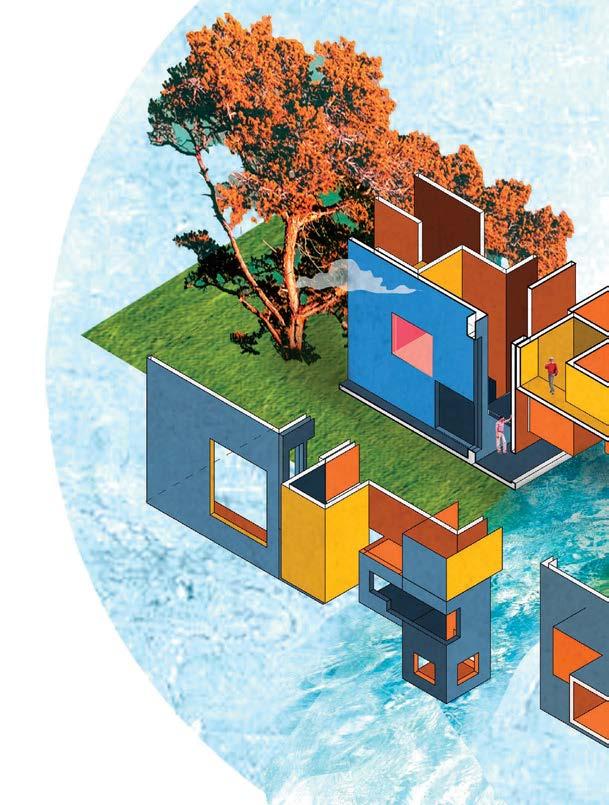
OLIA VORONEZHSKAIA
Drexel University
Graduate Interior Architecture and Design
NOMINATOR: William Mangold, Assistant Professor, Department of Architecture, Design & Urbanism, Antoinette Westphal College of Media Arts & Design
From a design of homes for an astronomer and the visually impaired to an immersive gallery and park shelter, Voronezhskaia’s portfolio expertly balances conceptual thinking with technical skill.
HSIN (AUDREY) WANG
Pratt Institute
Undergraduate Architecture
NOMINATOR: Keena Suh, Associate Professor, Interior Design Department
Wang’s thoughtful, climate-conscious designs include a flood-resilient community center and shelter in Rockaway Beach, New York, as well as a research center for a wetland ecosystem in central Italy.
YULI WANG
Columbia University
Graduate Architecture
NOMINATOR: Ziad Jamaleddine, Assistant Professor
From her multigenerational housing complex Plug-In House to a trailscape in upstate New York designed to foster relationships between users and the natural environment, Wang’s work thoughtfully considers context and community.
COURTESY ASIYE YUKSELEN
METROPOLIS 112
EMMA WEAVER (P. 134)
Kent State University
Undergraduate Interior Design
NOMINATOR: Tina Patel, Assistant Professor, Interior Design, College of Architecture and Environmental Design; and Julia Gilstrap, Associate Interior Designer, CID Design Group
Weaver’s designs are rooted in an understanding of users and context, leading to purposeful solutions like her A Prison Becomes an Art Complex, which addresses community needs while representing the rich history of Florentine architecture.
MADARA WICKREMASINGHE
Iowa State University
Graduate Interior Design
NOMINATOR: Yongyeon Cho, Assistant Professor, Fitwel Ambassador
For Wickremasinghe, interior design is about blending a variety of interests and skills into a cohesive whole. “I understand how important it is to connect with the natural and man-made worlds, oftentimes putting on the shoes of a scientist, storyteller, or investigator, to conduct thorough research in forming a well-analyzed design solution.”
ALYSIA WILLIAMS
Mississippi State University
Undergraduate Architecture
NOMINATOR: Karen Cordes Spence, Director and Professor
From a mass-timber public library to an urban high-rise, Williams’s projects are embedded within their community context.
MAGGIE WILLIAMS
George Washington University
Graduate Interior Design
NOMINATOR: Catherine Anderson, Assistant Professor of Interior Architecture, Director of Graduate Studies
Williams’s portfolio is filled with projects that incorporate soft curves, atmospheric lighting, and a keen attention to color, light, and detail. In the design for Hotel Thalia, she uses all these elements to evoke a sense of curiosity and discovery.
ELIZABETH (LIZZY) WILSON (P. 114)
California College of the Arts
Graduate Architecture
NOMINATOR: Brian Price, Chair of Graduate Architecture + Associate Professor
In Wilson’s work—like her Wild West proposal, which considers the contradictory pride, anxiety, and risk bundled in the Western landscape—she is critical yet optimistic in proposing ways that we can live with unresolved situations.
YILIN XU
Pratt Institute
Undergraduate Interior Design
NOMINATOR: Keena Suh, Associate Professor, Interior Design Department
Xu’s expressive and inventive designs include her Memoir of Black Ballet Performance Art Center, for which she transformed an existing library into a community space celebrating the history of Blacks in ballet and the visual arts.
SOOJUNG YOO (P. 126)
ArtCenter College of Design
Undergraduate Interior Design
NOMINATOR: David Mocarski, Department Chairman, Graduate and Undergraduate Environmental Design
Whether a product, graphic, or spatial project, Yoo’s work pushes the boundaries with a strong personal voice and awareness of current trends and materials.
ANGELINA YIHAN ZHANG (P. 122)
Syracuse University
Undergraduate Architecture
NOMINATOR: Daekwon Park, Undergraduate Chair
Between compact microhomes, modular housing for a lagoon environment, and analysis of foodscapes, Zhang’s designs are attuned to the challenges of urban density and precarity around the globe.
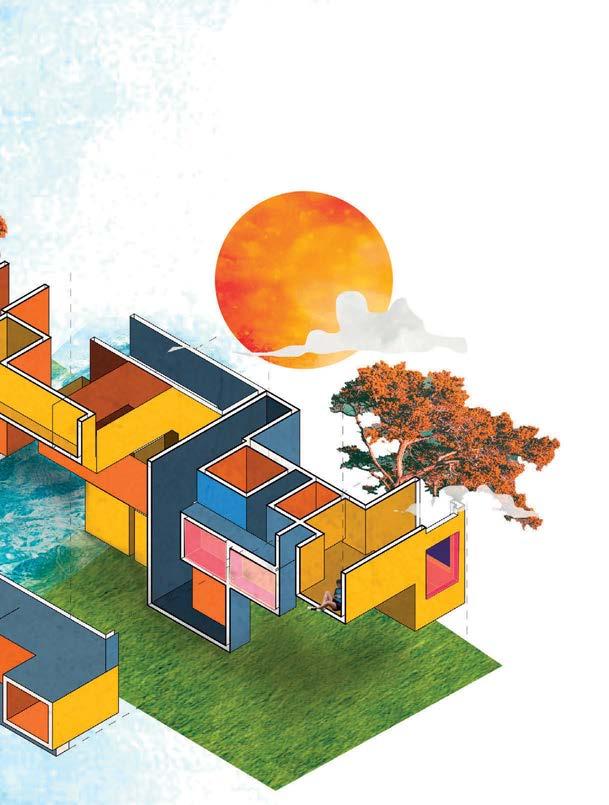
CHI ZHANG
Yale University
Graduate Architecture
NOMINATOR: Eeva-Liisa Pelkonen, Assistant Dean and Professor
Zhang’s work, like her To Be Seen, To Be Heard residential building that devotes its body to protests, is focused on serving vulnerable populations and underprivileged people.
LAN (JUDY) ZHOU
Toronto Metropolitan University
Undergraduate Interior Design
NOMINATOR: Jonathon Anderson, Associate Professor and Director
Zhou’s design work is thoughtfully grounded in research, often incorporating speculative and imaginative proposals that reframe a project’s bounds in surprising ways.
OLIVIA ZOLLO
Florida State University
Graduate Interior Design
NOMINATOR: Marlo Ransdell, Associate Professor in Interior Design
While Zollo’s portfolio spans commercial, residential, and health-care projects, each individual space utilizes furnishings and materials that recall a sense of comfort and home.
MARCH/APRIL 2023 113
EXQUISITE CORPSE Yilin Xu, Pratt Institute
RADICAL REGENERATION
By Audrey Gray
Ask any seasoned doctor how the human body repairs itself and they’ll admit that it is still largely a mystery. We only know how to encourage that process.
Regenerative design works in much the same way. We have developed standards, carbon calculators, and an activist movement to try to reverse the damage of global warming, but these actions only nudge nature’s healing power, which often takes time and needs more support. A group of Metropolis ’s Future100 designers stand out because their portfolios show they’re wise enough to kn ow this, and brave enough to devote themselves to creating careful, slow interventions anyway. “We’re running out of room to start fresh,” says 22-year-old Long Island, New York, native Emma Mangels. “We have to learn how to fix the problems that we’ve created ourselves.”
Mangels took on one of the most continually tragic sites in North Ameri-
ca: New York City’s Rikers Island, the site of the deadly prison built on acres of methane-belching landfill. Accepting the complicated political reality of the location, Mangels proposed a five-year phaseout of the prison’s operations, followed by a just transition of land around it to include a memorial to those who died there, affordable housing, job-training centers, and gradu al land restoration engineered to suit the saltwater tidal estuary known as the East River.
Equally willing to attempt careful, slow change in the face of an uncertain future, Lamia Albunni considered Akron, Ohio’s historic coal mines and saw potential for literal rehabilitation in a proposed research laboratory and hospital that would embrace coal as a generative material instead of fuel. Small amounts of coal can be safely converted in-lab to graphene, a strengthening agent used in prosthetics.
RIKERS REDESIGN
Among the heinous secrets of Rikers Island is the fact that much of the prison complex rests on a gaseous landfill of New York City garbage. Emma Mangels did a deep dive on the history of the site and the prison and imagined regeneration as well as reparations. She created a plan to phase out penal operations over six years, memorials to the people who suffered on the island, and a new community of affordable housing, training centers, and community gardens—new life after decades of decay.
These design students take on the earth’s most broken places and dare to heal and fortify them in the face of uncertainty.
METROPOLIS 114
RETHINK, RESEARCH, REHAB
Akron, Ohio, was once called the Rubber Capital of the World, a tire mecca. But it also has a long history of coal production and a slew of abandoned mines. Lamia Albunni’s project investigated a new low-carbon process to convert a small amount of coal into graphene, a strong material used in the production of prosthetics. Extrapolating, she envisioned a research and rehab hospital in Akron, launching a regenerative next chapter for the city’s identity.
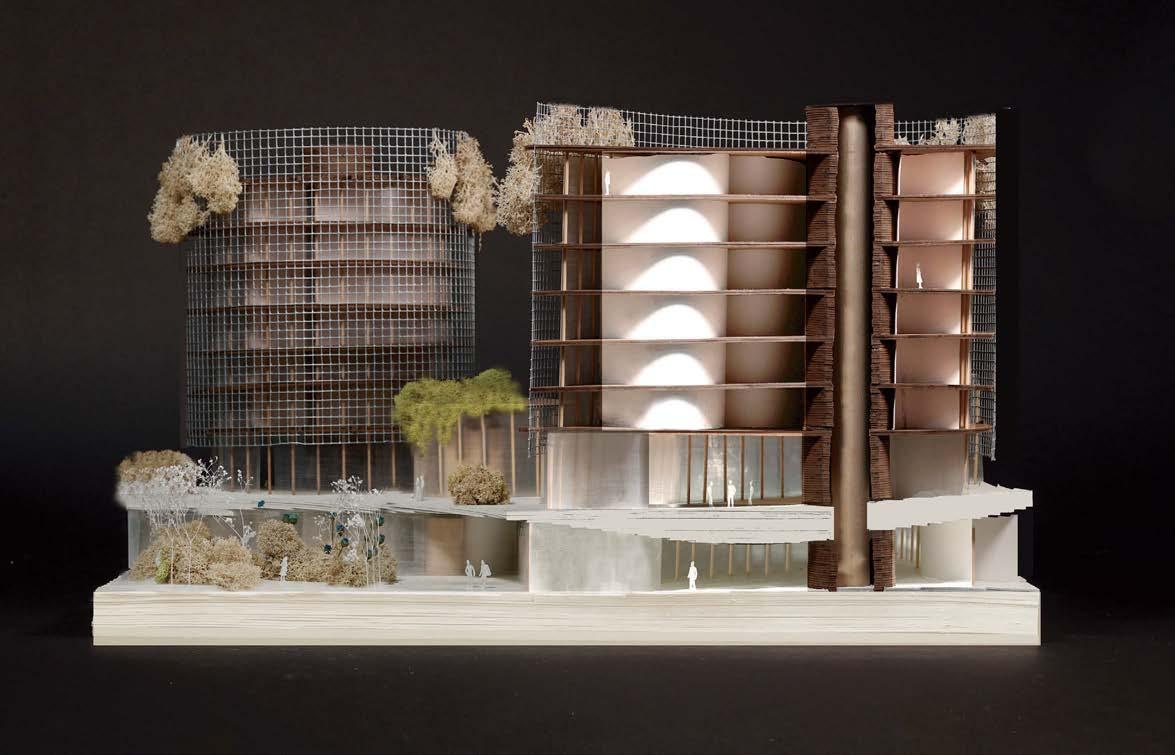
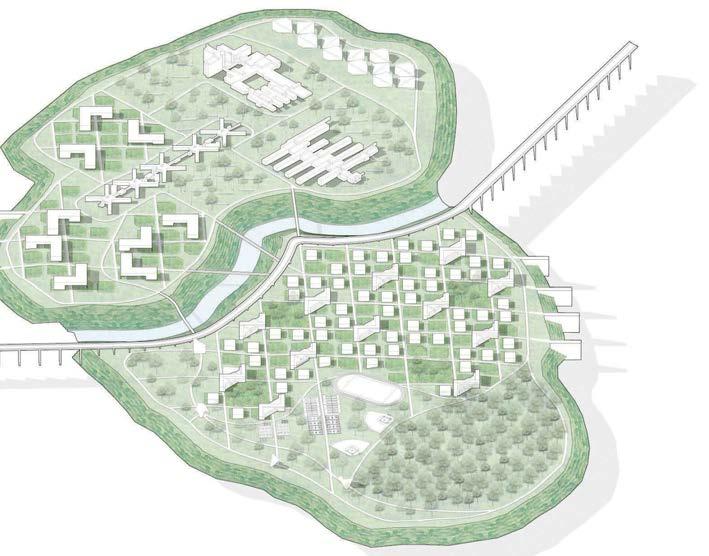
MARCH/APRIL 2023 115
TOP: COURTESY LAMIA ALBUNNI; BOTTOM: COURTESY EMMA MANGELS

COURTESY MINGHAO (WILLIAM) DU METROPOLIS 116
SOFTENING MODERNISM
It takes a visionary to compare Albany, New York’s Empire State Plaza to the sweeping majesty of Oscar Niemeyer’s Brasília, yet Minghao Du saw not only the spare beauty but the potential to re-skin cold monuments with organic materials and publicfriendly atria. His proposal (opposite page) is a bid to transform dated and barren civic plazas across the country into vibrant community meeting grounds.
RESILIENT AIRPORT
The year? 2075. The place? Hong Kong, where sea levels have risen, neighborhoods have become unfathomably dense, and food has gotten scarcer. Lizzy Wilson’s concept (shown right) claims sprawling airport hangars as foundations for vertical gardens and imagines human-made wetlands in Victoria Bay with “oystertecture” water filtration systems and floating parks.
With that plan in place to repurpose local resources, Albunni designed an undulating hospital with winter gardens and greenhouses for patients and staff. “I’ve always thought about how architecture tends toward generic, economic, fast structures. I’m trying to slowly understand how architecture can become more responsible for experience,” she says.
Alyssa Halloran and Minghao (William) Du each surveyed long-developed American cities caked in concrete and wondered if it was time to see soil again, to encourage a natural takeover. Halloran envisioned an Atlanta where original Native American trails would be re-instituted as walking paths bordered by native plants. She saw opportunities to infuse the sleek development of the past few decades with more organic building materials, from mass timber to rattan and cob, an ancient building material made of clay, sand, and straw. Du brought a fresh eye to the 20th century’s spare civic
monuments such as Empire State Plaza in Albany, New York, and developed his own “softening Modernism” method of green conversion, emphasizing atria alive with public life instead of windwhipped barrenness.
Mindful of unsustainable agricultural practices and potential food shortages in coming years, other student concepts fully embraced alternative farming in places long wrecked by industry. Lizzy Wilson imagined sprawling hangars at a Hong Kong airport serving as the future foundation of elaborate vertical gardening operations. Brianna Baldwin viewed the petrochemical-soaked Gulf Coast of Louisiana as something that could be restored with aquaculture. She envisioned an outdoor classroom to train young people in the potential of swampland farming, which carries an added bene t of stormwater management. Ashaykeen Abedin designed individual hydroponic gardening pods and proposed stacking them in elegant con gurations throughout
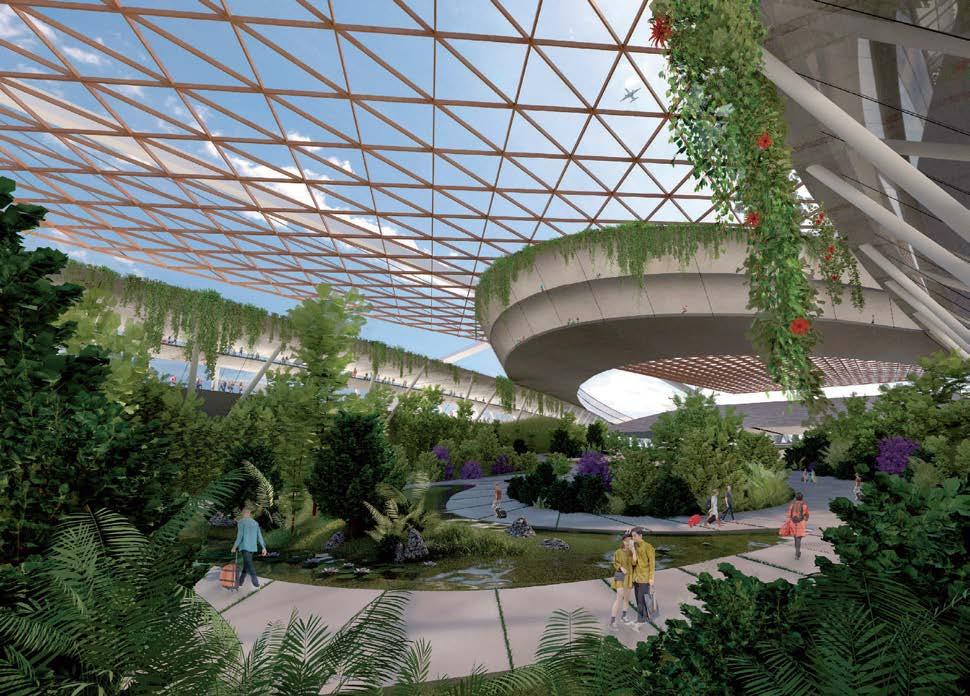
Japan’s densest cities, a new vertical take on community gardening and family food security.
More than one of these designers expressed nervousness at bringing their rewilding ideas to critique. They worried that the pros would see them as naive or too idealistic. But their ideas represent an unstoppable force in this cohort, a reminder that humans are made of the same genius self-healing elements as the rest of nature. M
COURTESY LIZZY WILSON
MARCH/APRIL 2023 117
NAMITA CHANDRASHEKAR
This student uses an undergraduate degree in architecture and cross-continental urban experiences to design for harmony with the natural world.
By Laura Feinstein
WEAVE
Inspired by the idea of letting nature be a co-creator in the process of design, Chandrashekar composed this lamp out of banana leaves. She used traditional weaving practices along with cornstarch as a natural glue to hold the free ends of the weave in place.

Good public design rarely relies on angles or color schemes—it’s the cultivation of community that defines success. This concept is inherent to the practice of Namita Chandrashekar, who trained as an architect in bustling Mumbai before moving to New York City to complete her master’s of fine arts in interior design at The New School’s Parsons School of Design. With her project Incandescent Immersion, the young designer reimagines an urban interior within Central Park as a refuge for “the human and the nonhuman life forces that interact with the built environment,” she e xplains, creating an immersive structure that blends with
nature rather than fighting it. “This urban pavilion tends to different definitions of interiority, allowing the scale of the grid to respond to the agents’ needs, be it a bird, human, tree, or light.”
The rich textures of nature are abundant in Chandrashekar’s work. In Thrissur, a material exploration in birch plywood and banana leaves, the flat, hearty fronds are woven into a series of traditional floor tables, crafting an homage to the ubiquitous banana leaves used in family celebrations and holiday festivities in South India. In Weave, the same leaves are transformed into a biodegradable lamp prototype. “When
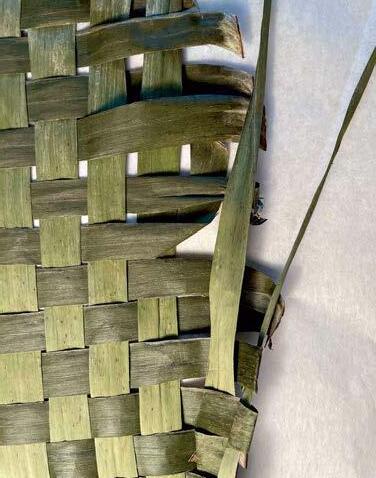
you let nature be a co-creator in the process of design, the outcomes are far more beautiful,” she says of working with sustainable materials like peace lilies and fallen ginkgo leaves. “I have seen projects bloom to life by incorporating a natural element,” she says, explaining that “you learn to be more delicate and nurturing when you are using living materials, as there is so much you cannot control.” In addition, Chandrashekar notes that when you listen and respond to the needs of your material, the process is elevated to one of partnership. “You are no longer driving the project but collaborating with the materials.” M
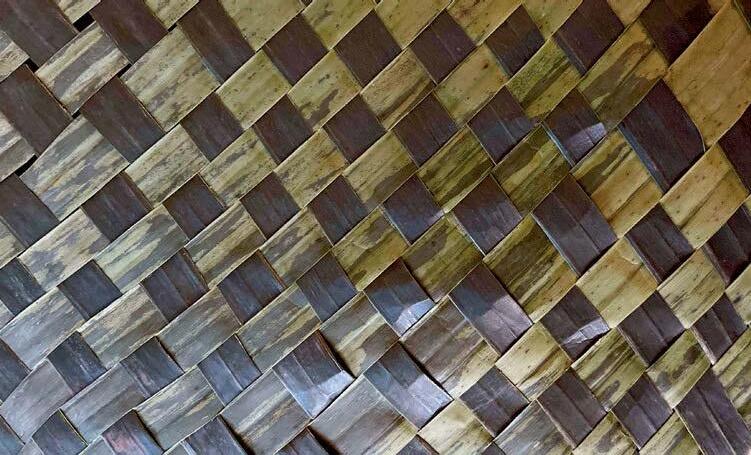
COURTESY NAMITA CHANDRASHEKAR
METROPOLIS 118
INCANDESCENT IMMERSION

This urban pavilion in Central Park is designed as a refuge for human and nonhuman life forces. The project aims to create an interior space that coexists with the natural world.
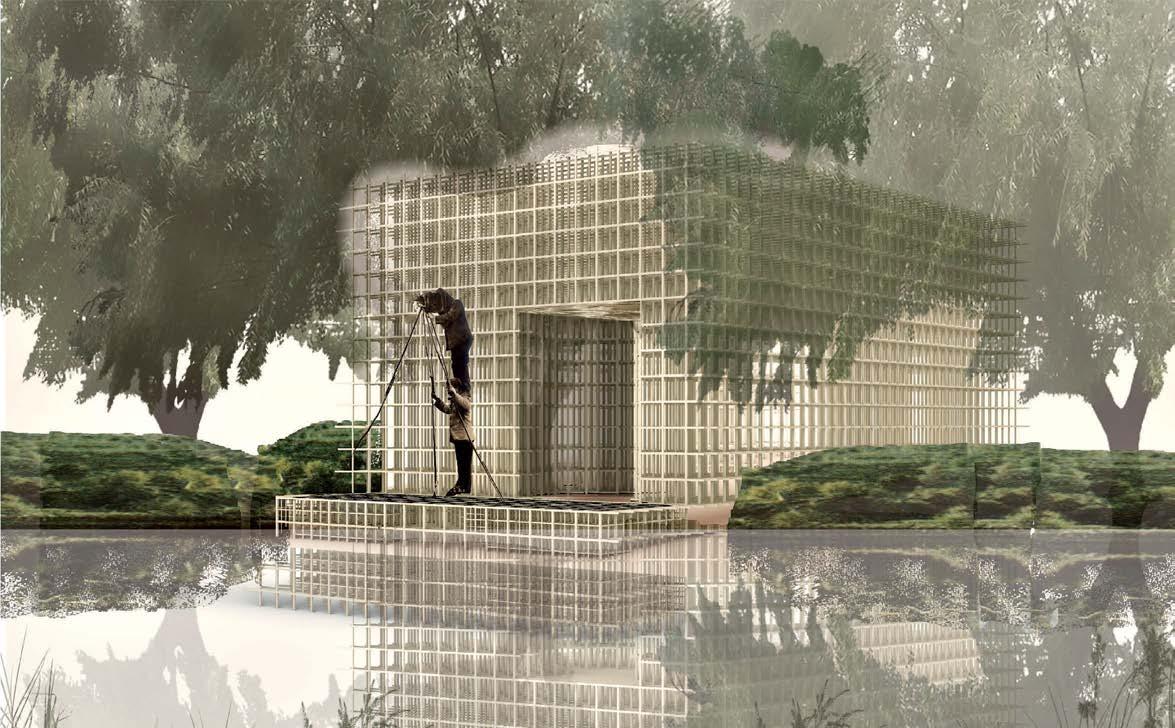
MARCH/APRIL 2023 119
SOLUTIONS FOR SWAMPS
Four scholars probe the resilience of future wetland developments.
By Matthew Marani
Given that climate change and its extreme weather patterns are upending existing modes of planning, it’s important that today’s architecture students explore ways to mitigate its impact on wetlands, which are key components of resilience plans. Several Future100 students are breaking new ground in that area.
With hurricanes and rising sea levels threatening to erode vast stretches of Louisiana’s coastline, the state is the perfect training ground for resilient design strategies. Against this backdrop, Courtney Klee, a graduate student at Louisiana State University, has conceived a set of natural and nature-based solutions. Klee’s Grand Isle Restoration concept seeks to rebuild th e eroded Gulf Coast barrier island with landscaping measures such as mangrove and
dune-grass plantings as well as a dune and breakwater installation.
That same emphasis on shoring up natural defenses is evident in Nest & Cave, a project led by Florida International University graduate Chelsea Cameron. As the title suggests, the project is to create an ecosystem, or home, for the mangrove tree crab within Miami’s Greynolds Park. The crabs are an essential part of that ecosystem because their burrowing activities and leaf eating help to balance it. Cameron’s proposed human-made bamboo structure could provide habitat and serve as a research and learning hub.
In some cases, improving an area’s resilience is also tied to the larger issue of reparations for its residents. Meghana Tummala, of the University of Michigan, uses her project Repair, Reclaim &
Reparations to address both. It proposes relocating parts of an existing golf course to improve the conditions of Fleming Creek, a tributary of the Huron River, while also creating space for a new ecological justice center informed by the stories of the indigenous Ojibwa, Odawa, and Potawatomi tribes.
The United States is not the only country grappling with the issue of wetland restoration: Hsin Audrey Wang’s Rosario-Victoria Science and Service Center, a science center proposed for a preserved wetland in Argentina near the Paraná River, would be achieved through a modular construction s ystem engineered to rest lightly on the ground.
Student projects such as these stand out because they provide a glimmer of hope for one of our most precious resources. M
METROPOLIS 120
REPAIR, RECLAIM, & REPARATIONS
Meghana Tummala uses her project to propose the partial relocation of a golf course to both improve conditions of Michigan’s Fleming Creek and clear the way for a new ecological justice center informed by the stories of the area’s Indigenous people.
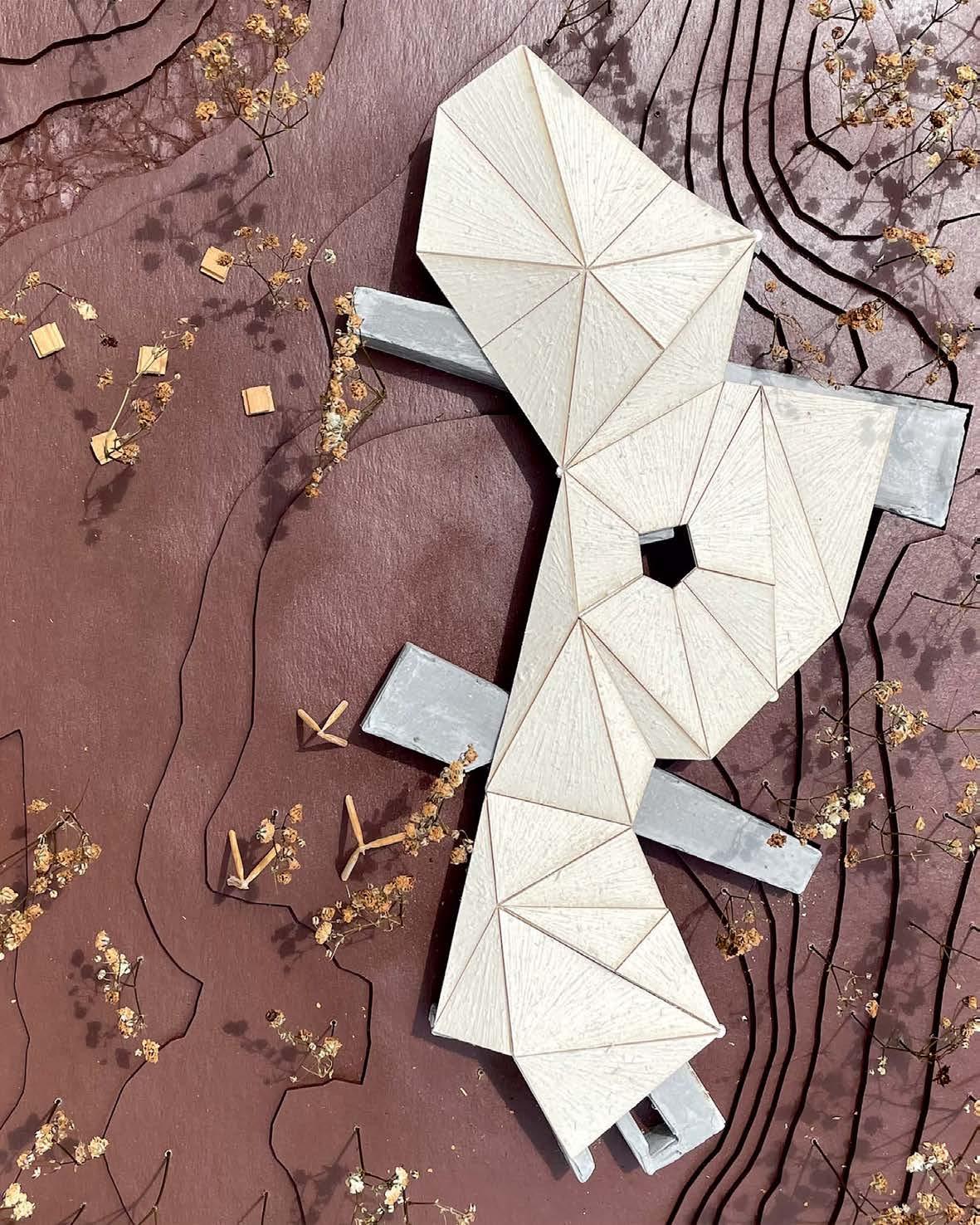
COURTESY MEGHANA TUMMALA
MARCH/APRIL 2023 121
AT HOME IN THE WORLD
Architecture students dream up empathetic responses to a global crisis.
By Sam Lubell
Housing is arguably the most pressing crisis facing architecture today, and many of this year’s Future100 winners have addressed it with depth and sensitivity. The best entries proved that advanced methodologies and a generous spirit of humanity need not be mutually exclusive. Such approaches can inform each other while enhancing practicality, flexibility, affordability, community, and sustainability.
Many students devised a ordable, practical, and easy-to-build housing solutions. Michael Urueta, a graduate architecture student at Clemson University, proposed Arcos Por La Dignidad, merging new construction with rem-
nants of industrial structures to provide living units, services, and so cial spaces for asylum seekers in the border town of Nuevo Laredo, Mexico. Arched brick and concrete structures contain classes, clinics, and other resources, while recycled steel platforms (scavenged locally) serve as foundations for houses built using straw bale construction, a local technique.
For a site on the other side of the country, in New York City’s South Bronx, Samuel Bager, a graduate architecture student at Columbia GSAPP, created Mod:Live. It’s a system of prefabricated modular units designed to “undercut the traditional
costs of housing and reduce the rate of vacancy.” Each unit is a kit-of-parts, from its facade to interior details.
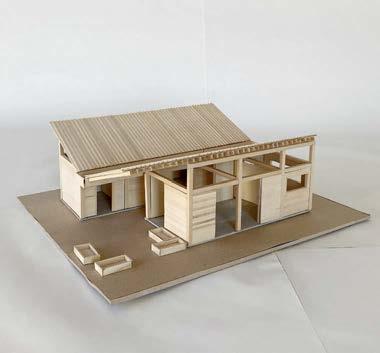
Bager’s project zeroes in on another main theme among students: exibility. Each living unit’s interior walls can be folded and pivoted to accommodate diverse living situations, while the exterior’s mechanical louver system can be compressed, expanded, or rotated to suit various preferences for sunlight and privacy.
Angelina Yihan Zhang, an undergraduate at Syracuse University, proposed Reimagine Makoko, in which modular pods for housing and services such as education and health care in the floating settlement of Makoko, Lagos, can be customized through temporary panels and varying surfaces. The buoyant pods can also be easily connected or broken down. And
Mackenzie Luke, an undergraduate at Rhode Island School of Design, proposed The Butterfly House, another housing system concept for the global poor whose sliding walls can connect two butter yroofed building halves, while a secondary system of movable partitions can break space into individual rooms. M
BUTTERFLY HOUSE
COURTESY MACKENZIE LUKE METROPOLIS 122
Mackenzie Luke’s Butterfly House is a modular design intended to provide inexpensive and dignified housing to the global poor.
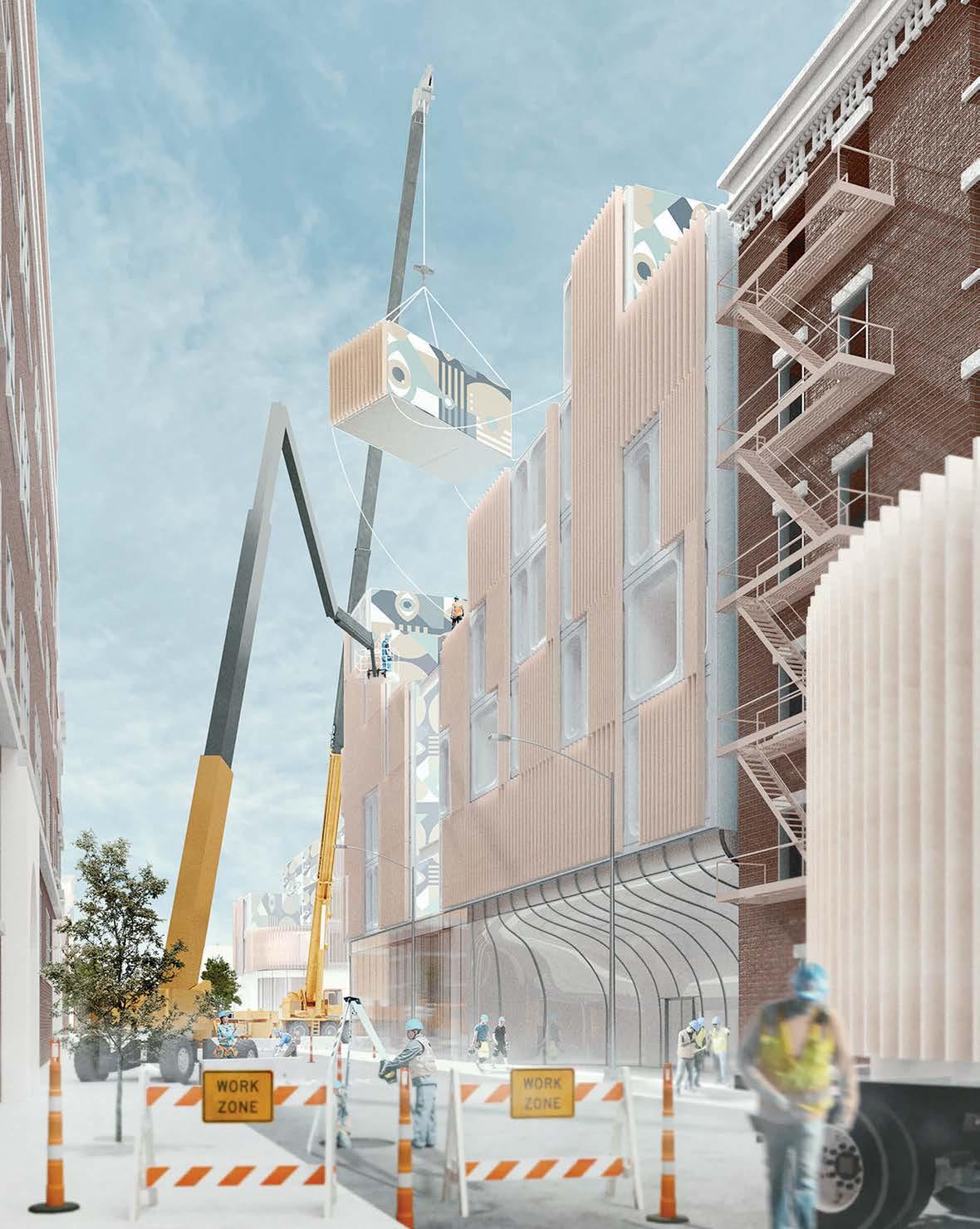
COURTESY SAMUEL BAGER
MARCH/APRIL 2023 123
MOD:LIVE Samuel Bager’s prefabricated kit-of-parts can accommodate diverse living situations via features like foldable walls and a movable exterior louver system.
CLYTIE HOI TING MAK
Mak brings together multiple design disciplines to explore the relationships between the forms of the built environment and the human psyche.
By Sam Lubell
Clytie Hoi Ting Mak, an MArch student at UCLA, charts an ambitious course for her work, skillfully interweaving elds like architecture, art, graphic design, and urban planning.
Growing up in Hong Kong, Mak was surrounded by breathtaking variety: old and new, Chinese and English. She learned how to “read” di erent types of buildings and what they mean in terms of culture, history, values, and perspective. Over time she expanded her “reading” into visual signs, nature, and more, all informing her work. By breaking down typical boundaries, Mak creates a new vision for architecture, not to mention sophisticated, overlapping collisions of form, program, and concept.
“It turns the seemingly static structure into a more changeable and dynamic form,” says Mak of her multipronged approach. Minoring in psychology during her undergraduate studies, she adds, allowed her to also explore the complex interrelationships between the human psyche and physical environments, hoping to enhance mood, behavior, and more.
At Sunset Pixel, a proposed arts collective for L.A.’s Sunset Strip, Mak channeled the area’s shifting topography and cultural exuberance into a building filled with layering, shuffling, pixelated, and stepping forms. Aided by a keen
interest in construction technology, the project incorporates offsetting prefabricated perf orated metal panels, an exposed steel frame structure, and a standing seam metal roof.
A drive-in movie theater and food distribution center in Los Angeles grows out of a “reading” of architecture, planning, and infrastructure: Cars roll into a series of partially enclosed theaters, while freeway underpasses and overpasses thread in between. “It transforms the architecture into the constant processes of ows of the city,” she says.
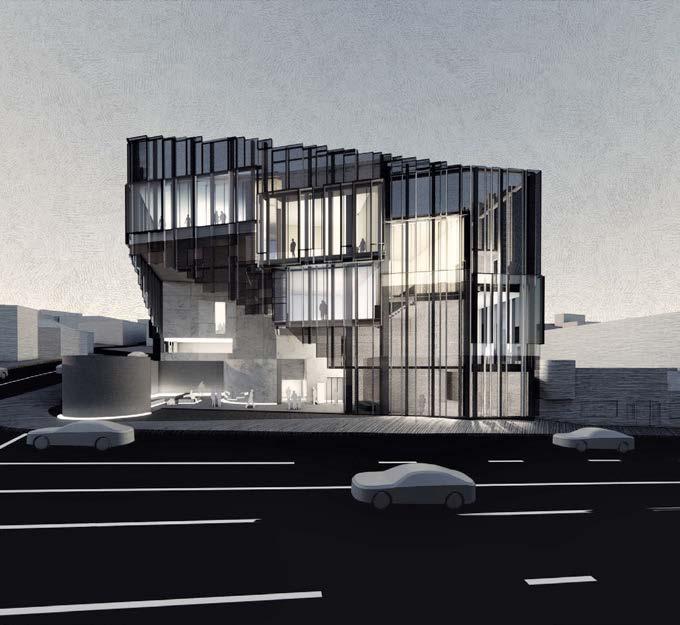
Each project has a social mission, adds Mak. Urban Threshold, a social
housing project in her native Hong Kong, aims to become a “condenser of community,” combining a multitude of housing units with shared balconies and kitchens, sky gardens, temporary living, coworking spaces, a nursery, park, footpa th, and more. Sky Streets Village, on the other hand, tackles sprawl and environmental degradation by incorporating single-family housing into a multistory village containing courtyards, bioswales, and advanced rainwater collection techniques. “My interest in architecture stems from the positive impacts a built environment brings to society,” she notes. M
COURTESY CLYTIE HOI TING MAK
METROPOLIS 124
SUNSET PIXEL ARTS COLLECTIVE
Mak’s design (opposite) transforms an existing building on a corner lot into a welcoming space to make art.
URBAN THRESHOLD
Mak’s design for a social housing scheme in Hong Kong arranges a variety of uses vertically by their need for privacy. Family units occupy top floors; below them are single units, temporary units, coworking space, and, at ground level, public areas.
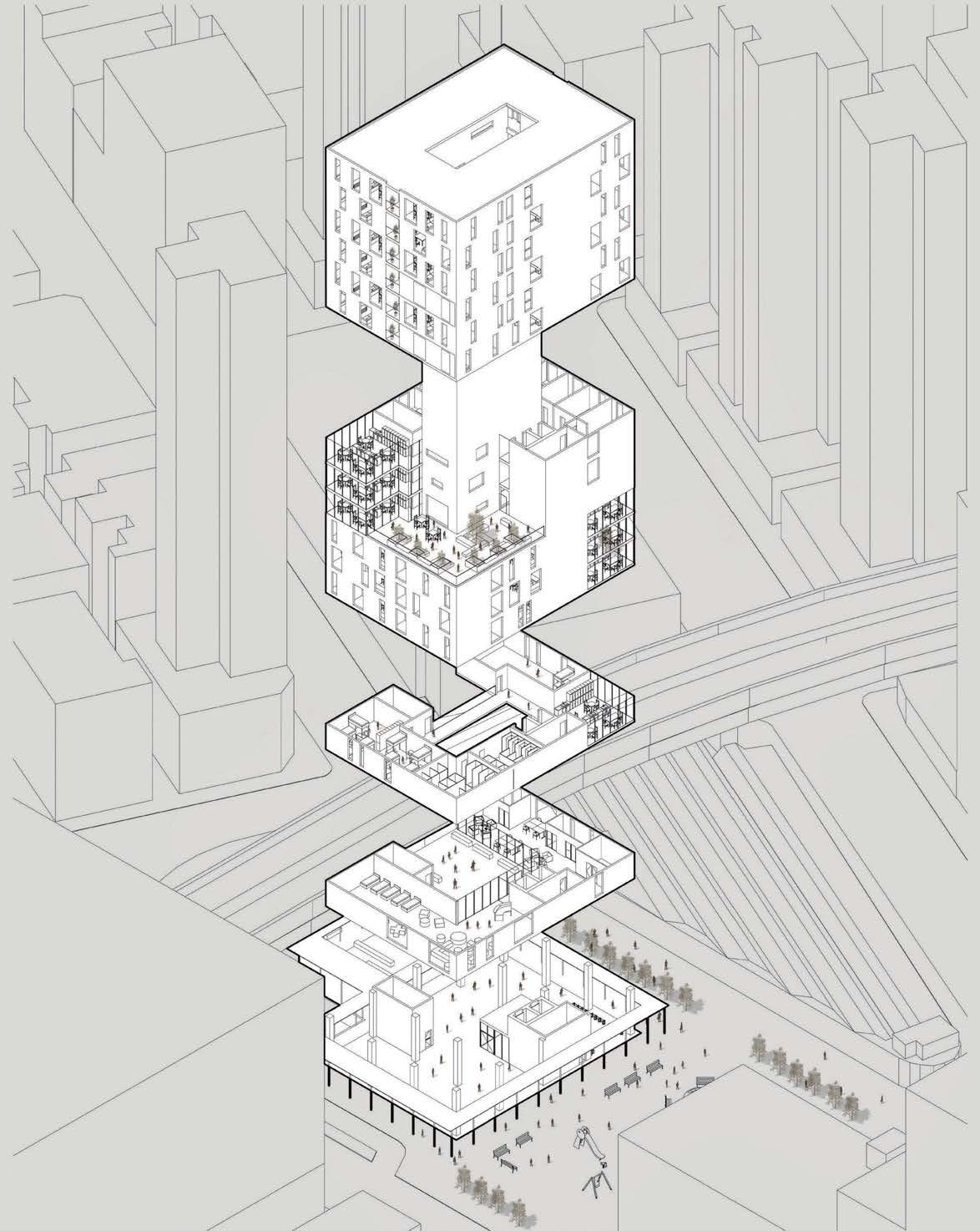
MARCH/APRIL 2023 125
IN REAL LIFE
Student designers test their ideas in three dimensions.
Student design portfolios contain, unsurprisingly, mostly speculative work. This year’s Future100 winners are no exception, but a few students had the opportunity to actually build things, using CNC-milled lumber, recycled felt, 3D-printed plastic, and other materials to bring their ideas to life. Their creations, from outdoor structures to small products, demonstrate not only a fluency in transcribing designs into physical reality but a willingness to learn from their materials and take inspiration from the act of building. They are a reminder that even in an age of sumptuous digital renderings and virtual reality metaverses, you don’t know quite how something will work until you build it. —Ethan
Tucker
Ethan Lewis, an undergraduate architecture student at Tulane University, has worked with a group of student volunteers each year over his five-year college career to design and build a sukkah on the Tulane campus. These temporary shelters are constructed in celebration of the Jewish harvest festival Sukkoth. His most recent uses CNC-milled plywood panels to integrate seating and shelter into the structural form.
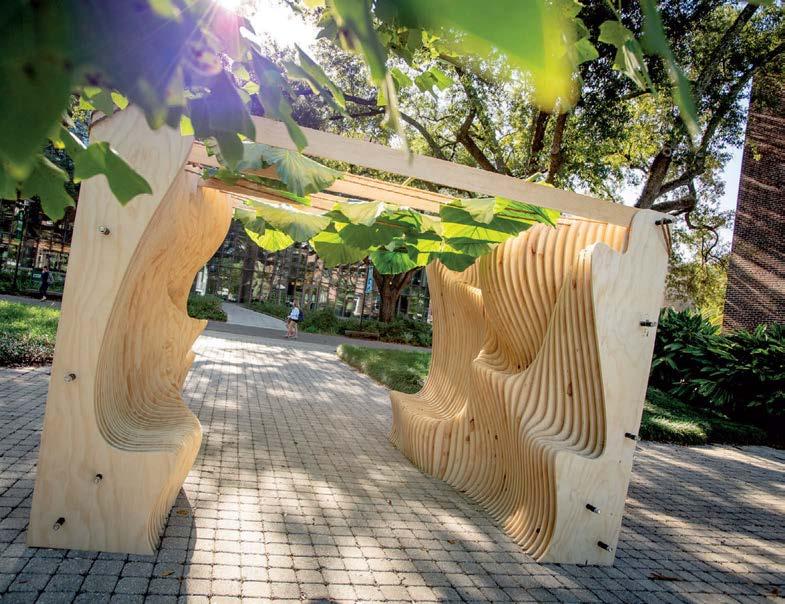 TULANE SUKKAH
COURTESY ETHAN LEWIS METROPOLIS 126
This outdoor lounge structure built by Martin Hitch, a graduate architecture student at California College of the Arts, began without drawings, renderings, or plans of any kind. Rather, Hitch and his teammates sketched forms inspired by the site’s desert landscape directly onto sheets of plywood and cut them by hand, resulting in a playful, expressive form.
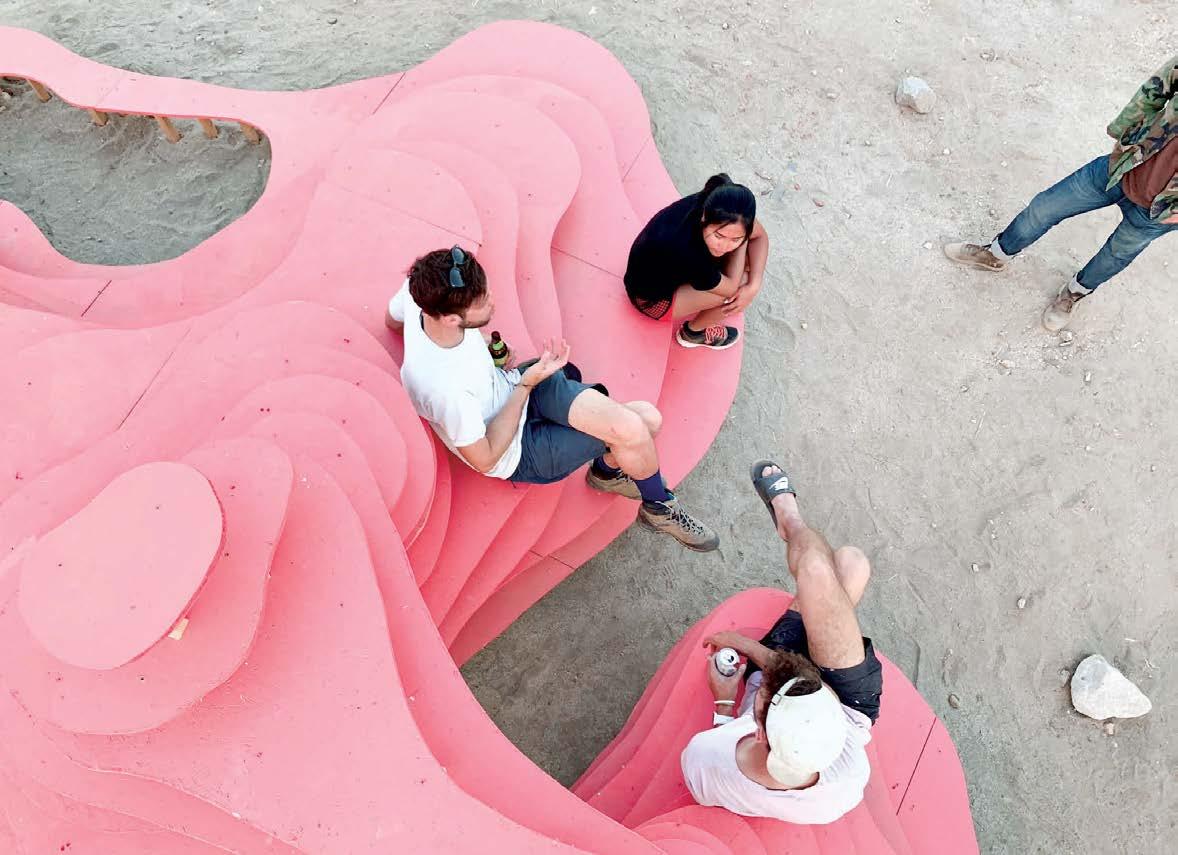
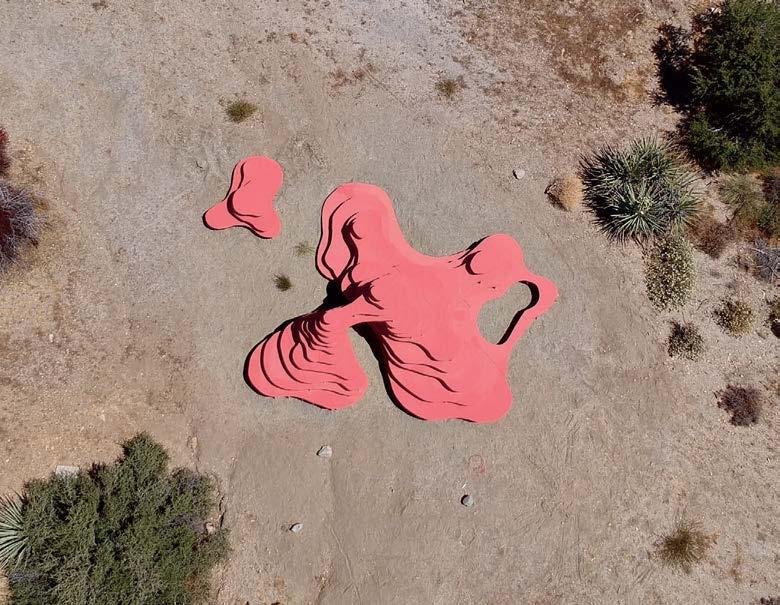
COURTESY MARTIN HITCH
EBB (& FLOW)
MARCH/APRIL 2023 127
ZONE
Zone, a space divider designed by Soojung Yoo, a recent graduate of ArtCenter College of Design, is made of dimpled discs of recycled PET felt. The screen, which snaps together with leather straps and rivets, creates a sense of privacy and acoustic comfort.
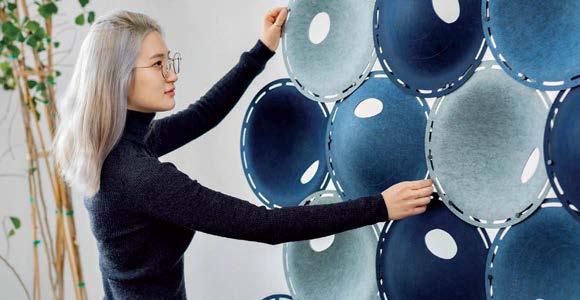
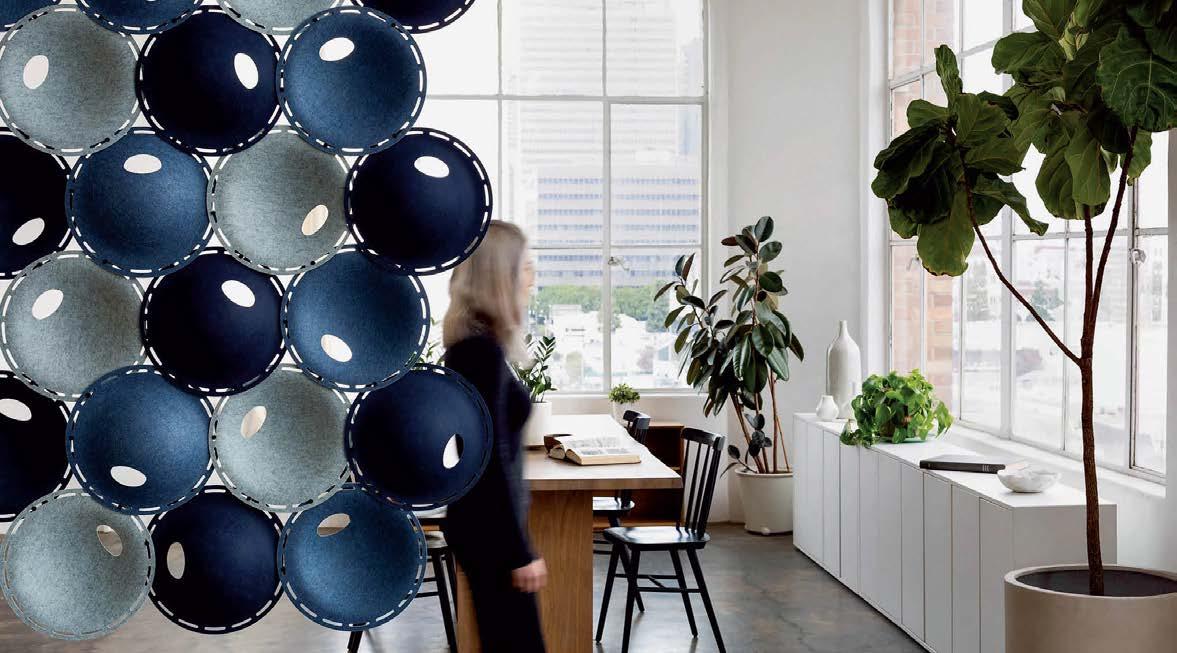
FIREFLY PENDANT
To produce Firefly, Emily Creek, an undergraduate interior design student at the University of Arkansas, combined old-school woodworking techniques (turning walnut on a lathe) and high-tech manufacturing (3D-printing the lamp’s plastic shade).
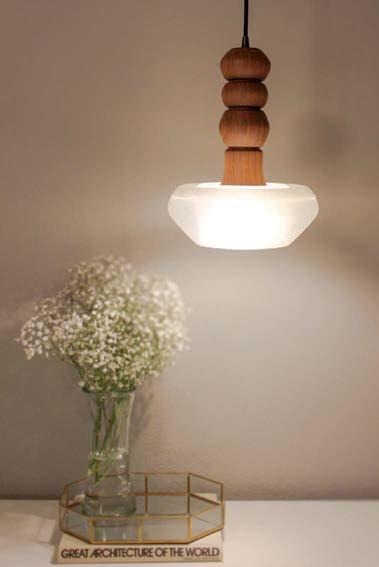
COUNTERCLOCKWISE FROM TOP: COURTESY EMILY CREEK; COURTESY SOOJUNG YOO (2)
METROPOLIS 128
CONSUMED
Consumed is a wooden table with integrated seating and planters for growing produce from seed to consumption. Ryan Lew, an undergraduate architecture student at California Polytechnic State University, San Luis Obispo, devised the project to consider how the dining table can encourage a sustainable lifestyle.
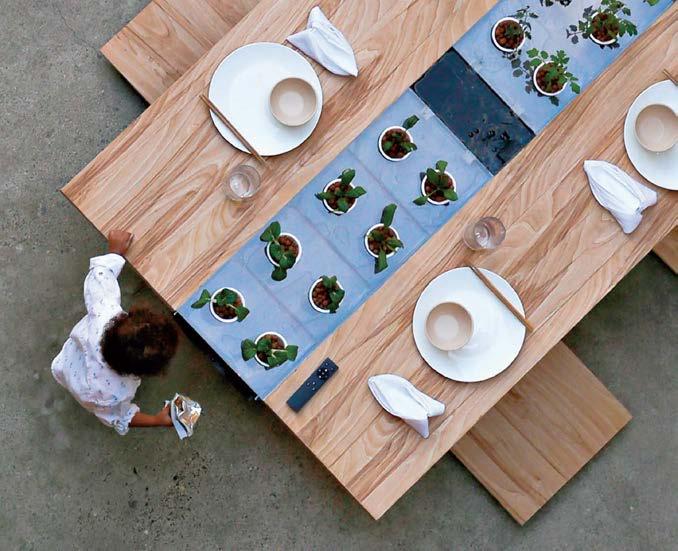
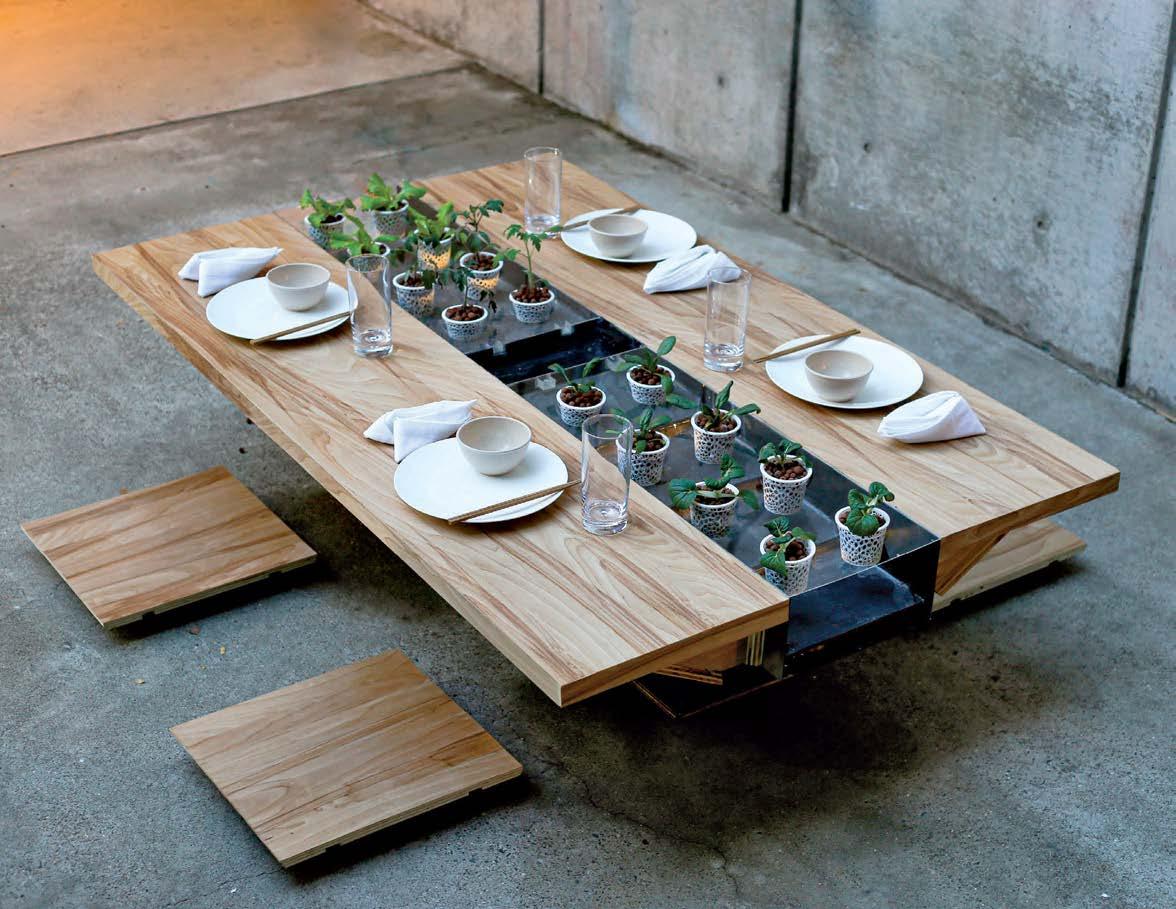
COURTESY RYAN LEW MARCH/APRIL 2023 129
YUNIN JEUNG
Jeung’s architectural designs fuse formal expressiveness with a social purpose.
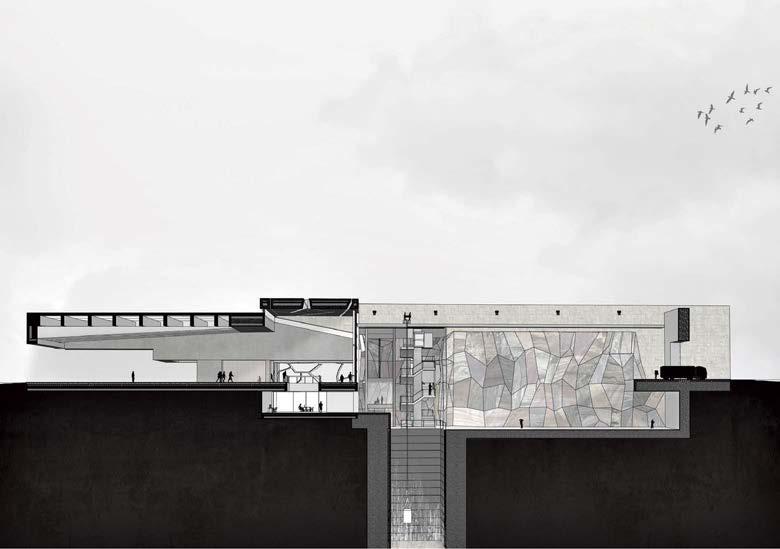 By Sam Lubell
The work of Louisiana Tech University undergraduate YunIn Jeung showcases a rare combination of unrestrained creative exploration and disciplined technical skill, stemming from his equal passions for scientific and imaginative thinking. Jeung first started studying to be a doctor, like his father, but he found the medical world creatively stifling. Architecture has nurtured both sides of his personality.
Armed with his systematic but innovative approach, Jeung pursues outside-the-box projects that also happen to make good sense. Another gift is an ability to open his mind to new creative opportunities and points of view, which
comes largely from a youth growing up all over the world, starting outside Busan, South Korea, and continuing to Australia, the U.K., Ghana, and Niger.
“I feel like living in di erent cultures and meeting di erent people allowed me to be a more exible thinker and respond to a new environment more quickly,” he notes.
Jeung’s design for the New Mexico Strata Research Center on top of an abandoned mine unlocks the potential of the museum not just to tell the story of the site’s geological formations but to introduce views into those formations themselves. For the Songdo National Writing Museum, exhibiting the development of
Korean writing from ancient forms to the present day, jagged forms are inspired by the shared aspects of various types of letters, while the circulation expresses stylistic changes as you move horizontally through the building and changes over time as you move up through a dramatic central atrium.
Such projects also help tell a story and teach lessons through architecture, ful lling another personal goal: to have social impact. It’s an ambition he developed early, appreciating his father’s e orts to heal patients in need around the world. “Buildings are for people. They must impact people in very profound ways,” says Jeung. M
COURTESY YUNIN JEUNG
METROPOLIS 130
NEW MEXICO STRATA RESEARCH CENTER
Jeung’s design for a geological museum (opposite) built into an abandoned mine allows visitors to explore the earth’s layers firsthand.
SONGDO NATIONAL WRITING MUSEUM
To build a 3D-printed scale model of the museum (this page), Jeung divided the building’s galleries and functional spaces into seven volumes that interlock with one another, fitting together like a puzzle.
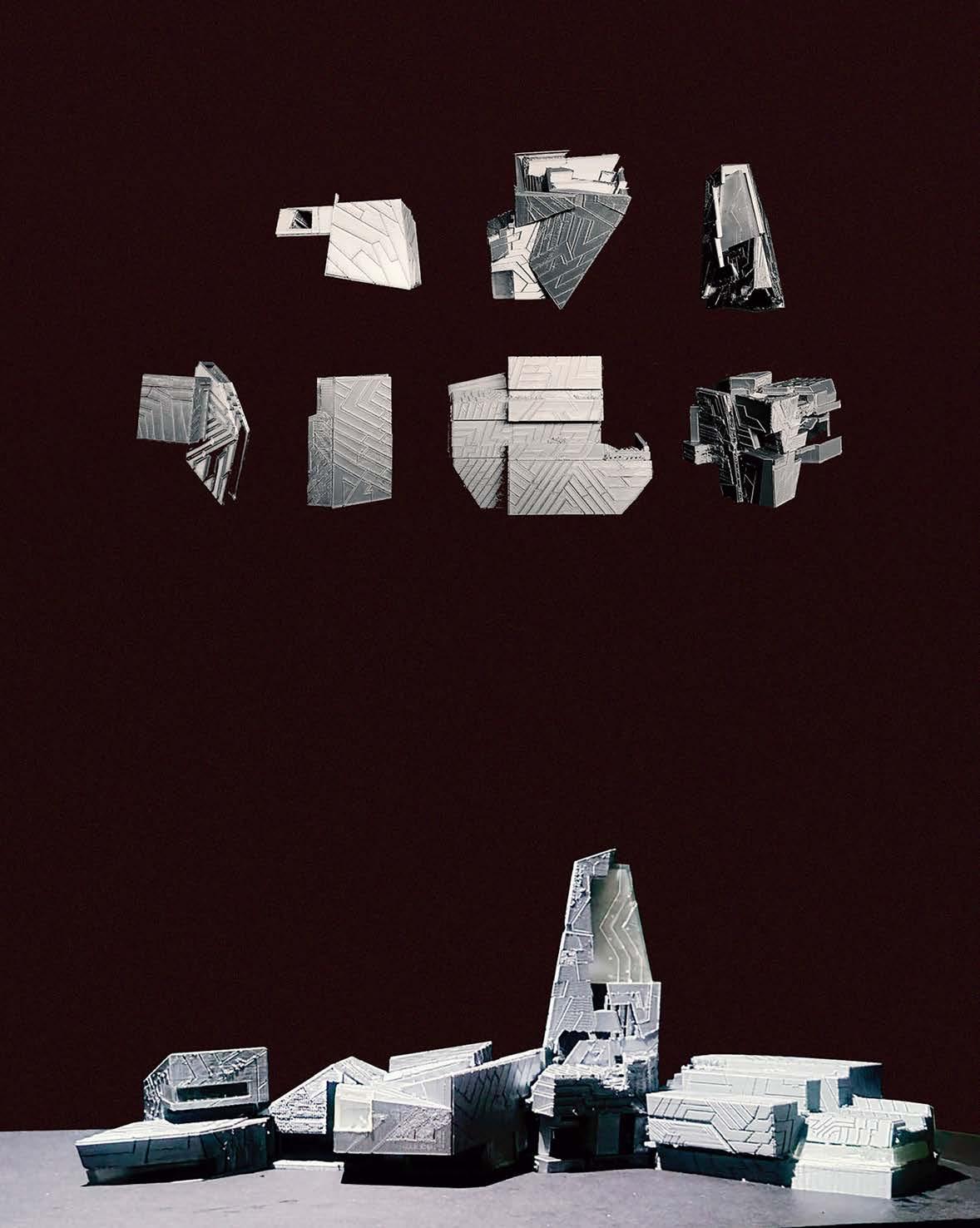
MARCH/APRIL 2023 131
FOOD FOR THOUGHT
Young designers address food insecurity through schemes that bring agricultural producers and consumers together.
By Sam Lubell
As the demand for access to healthy food intensifies and supply chains are stretched to their limits, innovation in agriculture is more than an interesting experiment—it’s essential. Future100 students approached the issue in a multitude of ways, from urban farming and aquaponics to brownfield remediation.
Among the most unusual proposals was Syracuse University undergraduate Chenhao Luo’s Tetravoltaics, which he completed in collaboration with fellow students Nicholas Chung and Angelina Zhang. Envisioned for the outskirts of the German industrial city of Mannheim, the project comprises a lattice of tetrahedral modules for the production of green energy, food, and recreational space. Consisting of an “Energy Park,” a “Garden Park,” and a “Community Park,” the project aims to make the locus of production not only legible but fun.
Another hybrid of sorts comes from Drexel University undergraduate Zephyr Martin, whose West Sprout unites an academic tower with a series of raised greenhouses containing hydroponic gardens, serving as teaching spaces while also providing fresh produce for an area of Philadelphia that is currently a food desert. The facility additionally serves as a center for community life, offering outdoor dining, a farmers market, a green roof, and outdoor classrooms. Also linking food production and education, University of Cincinnati architecture graduate student Steve Almond proposed the Rubber Bowl Aquaponic Campus, co-locating traditional farmers with students and aquaponics researchers on a site that merges timber-framed campus buildings with varied growing facilities. “By granting access to both types of groups, stu-
dents who become future researchers and agriculturalists will have a greater understanding of a wider range of complementary practices rather than simply becoming specialists within one field,” writes Almond.
Emily Ta, an undergraduate at California Polytechnic State University, Pomona, proposed Not a Sunflower Farm, which would transform a utility right-of-way corridor adjacent to the Los Angeles River into a cultural and recreational complex. On the underutilized site of ubiquitous transmission lines, the project situates itself along a “Utility Park Promenade,” connecting diverse communities like Bell Gardens, Downey, Lynwood, and South Gate through an ambitious program that includes remediation agriculture, education spaces, composting workshops, hydroponic greenhouses, an edible garden, and even a vegetarian restaurant. M
METROPOLIS 132
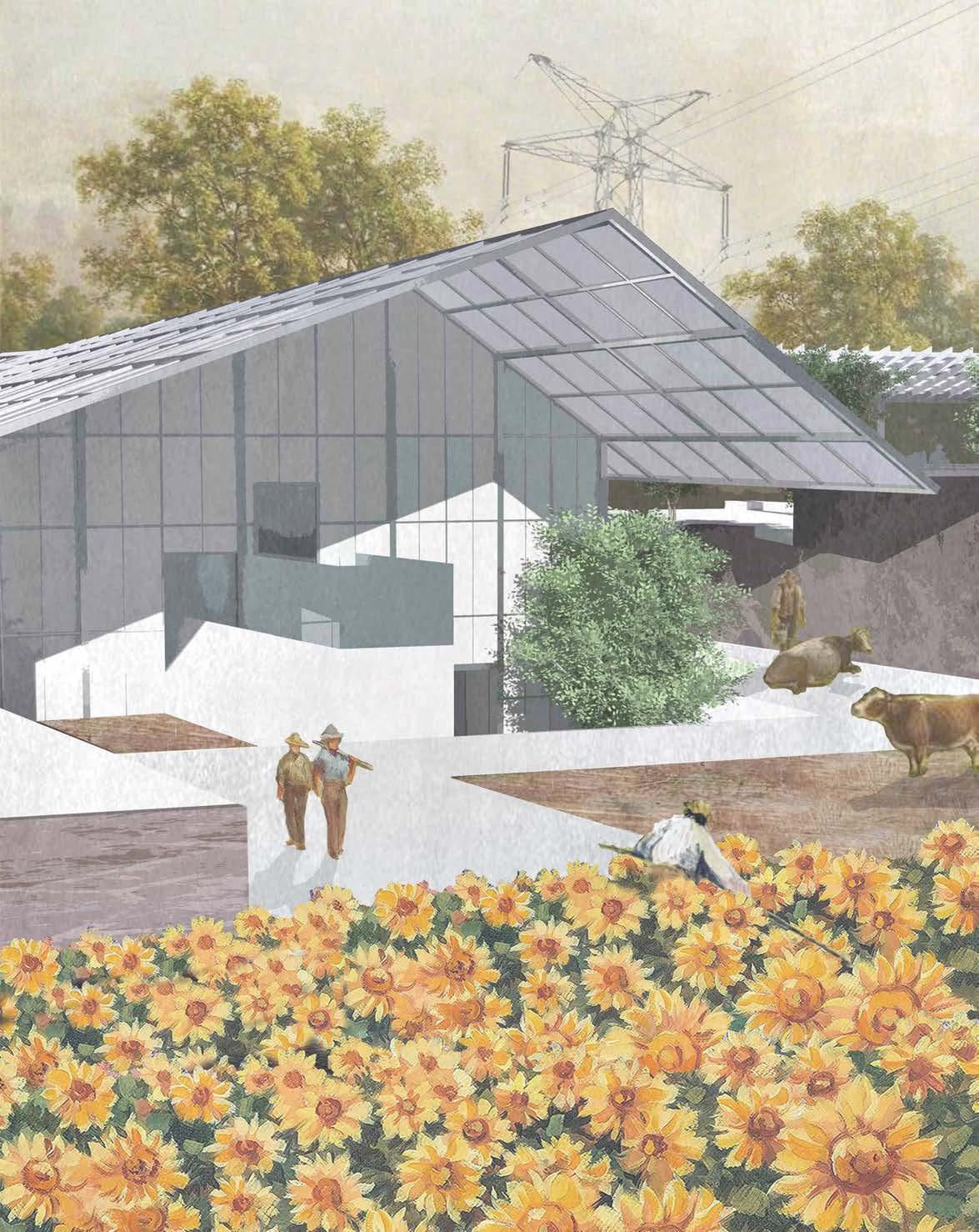
COURTESY EMILY TA
MARCH/APRIL 2023 133
NOT A SUNFLOWER FARM Emily Ta proposes linking several Los Angeles neighborhoods by transforming a utility right-ofway into a linear farm.
EMMA WEAVER
This interior design graduate designs for (and with) empathy.
By Laura Feinstein
Kent State University undergraduate
Emma Weaver once envisioned a future in architecture rather than interior design. “I loved math and art, and I wanted a career where I could creatively use both,” she says. What inspired Weaver to switch majors was the appeal of a more immediate connection. “I liked how interior design is human-centered and how many opportunities there are to better people’s lives by making interiors more intentional and purposeful.” This drive has since become a passion: “Now my main purpose is to tell people’s stories through the interiors they inhabit.”
That concept is apparent in her proposal for the Center for Applied Drama and Autism, created with fellow student
Kara Mayor last fall. At this after-school program in Akron, Ohio, autistic students learn coping skills through theater techniques and applied drama in surroundings designed with sensory sensitivities in mind. Considering the students’ sensory needs, Weaver and Mayor began the project with extensive research into design for neurodivergence. Inspired by a quote from Naoki Higashida’s 2007 book The Reason I Jump: The Inner Voice of a 13-Year-Old Boy with Autism (“In nature, we receive a sort of permission to be alive in this world…”), the pair decided to “unstructure” the space and mimic the ow of nature—“although we discovered that ‘unstructured’ is really just a highly organized structure,” jokes Weaver. The pair focused on crafting the space to
CENTER FOR APPLIED
In this proposal (designed in collaboration with Kara Mayor), Weaver paid special attention to how acoustics, soothing color palettes, and furniture affect people with sensory sensitivities. empower students and meet their social and sensory needs. This paradoxical approach to designing for neurodiversity was a unique opportunity to show ways that good design can neutralize the negative effects of societal pressures on neurodiverse students.
Designing for neurodiversity changed Weaver’s mindset. “During space planning and programming, it was important to consider the different wayfinding techniques, sensory spatial sequencing, and smooth thresholds between spaces,” she says. Weaver elaborates that although individuals will ultimately have different design preferences, mindfulness will help folks on the spectrum thrive and “feel more comfortable and included.” M
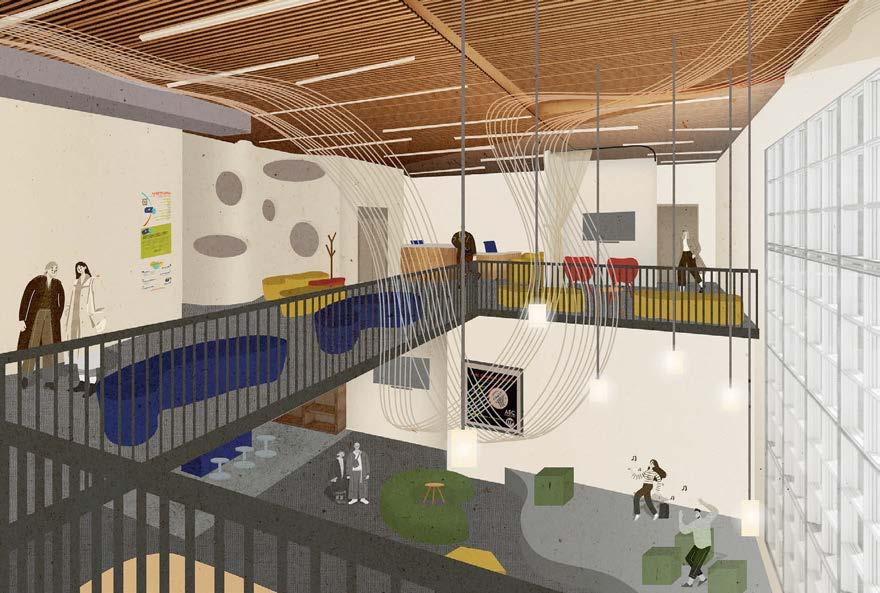
COURTESY EMMA WEAVER
DRAMA AND AUTISM
METROPOLIS 134
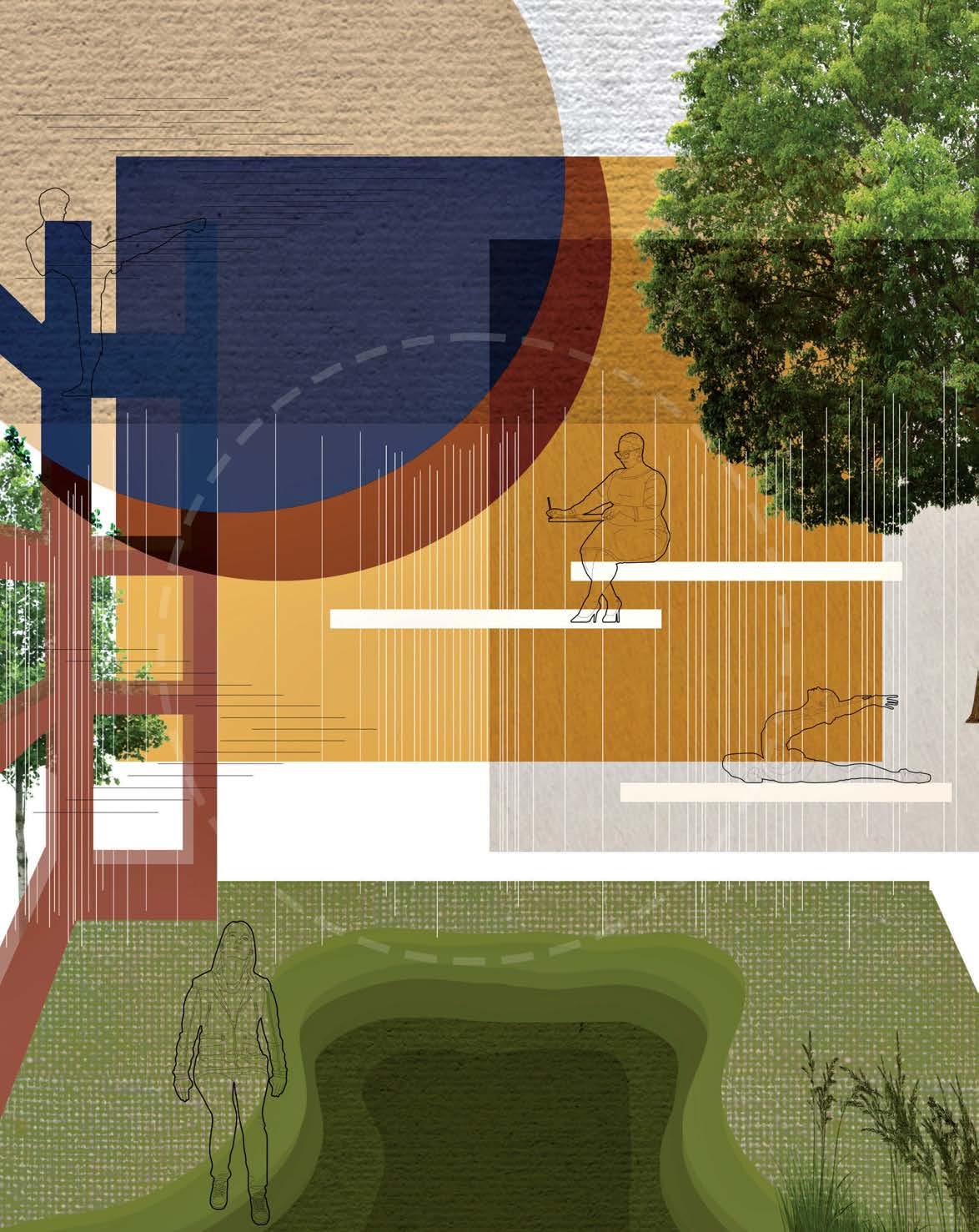
MARCH/APRIL 2023 135
BUILDING BACK BRAVELY
Four portfolios posit a spiritual link between architecture and habitat restoration.
By Rebecca Greenwald
In the spring of 2021, University of Florida architecture student Moises Villanueva set out every day in a kayak on Lake Wauburg to learn experientially about changing site conditions and the relationship between humans and surrounding wetlands: “It has opened my view on how designers view nature, and how we can better understand qualities that come from the environment and begin to apply and transform them into actual spatial conditions.”
Villanueva’s approach to architecture that integrates engagement with nature exemplifies a group of Future100 students who are laser-focused on biodiversity. Their concepts range widely from a new migratory bird sanctuary in Lima, Peru, to a trail designed to restore an ecologically depleted landscape in New York, to reintroducing local ecology in multifamily housing in California.
All assume a spiritual connection between architecture and habitat restoration. For Rizwana Lubis’s Rescape multifamily housing proposal in Piedmont, the landscape between dwellings is designed according to Indigenous beliefs and practices through a central bioretention courtyard, flowing water features, and native plantings woven throughout to remediate contaminated soil on-site.
Yuli Wang’s Unfolding Trailscape is designed as a green pilgrimage that directly involves hikers in restoring the landscape using natural and reclaimed materials to build a series of ephemeral structures along the route including a nursery of plants grown from seed, a bathhouse, shrines, and a mosque: “By building these structures, people gradually recover the damage they have brought to nature and leave some space for nature to be not interrupted by human activity. Unfolding Trailscape
attempts to build a place in which people and nature rely on each other; as one develops, the other benefits.”
The Future100 also employ architectural design strategies that minimize impact on animals and ora. Hali Sheri ’s Research and Observation Center for Migratory Birds, for example, aims to restore an industrially degraded urbanadjacent landscape in Peru into a thriving ecological habitat. An architectural, cultural, and visitors center and its surrounding pathways are designed to support migratory birds; a “staggered volumetry with greater height towards the urban area and lower height towards the wetlands” would also have circulation that prioritizes natural lighting and minimizes noise. For Espinoza, designing for biodiversity means putting nature rst: “The project and the natural area are in constant dialogue, where the protagonist is the natural environment.” M
METROPOLIS 136
RESEARCH AND OBSERVATION CENTER FOR MIGRATORY BIRDS
Hali Sheriff’s vision for a new visitor attraction on the formerly industrial outskirts of Lima, Peru, aims to connect students, scientists, and tourists with their local ecology. The project centers engagement and education on regional flora and endangered species, and knits together wetland restoration across the site through landscape interventions and a structure featuring low-impact design strategies.
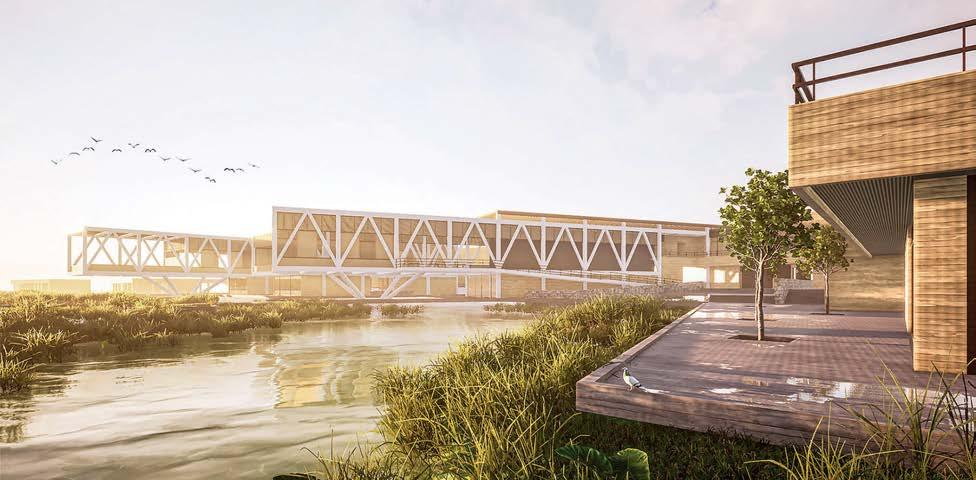
RESCAPE
Rizwana Lubis’s concept for Rescape aims to address both gentrification in Piedmont and surrounding Oakland and restoration of local biodiversity: The proposal includes a new mixed-income multifamily housing development and shared outdoor spaces that use Indigenous land practices to improve soil conditions, while supporting animals and native plants.
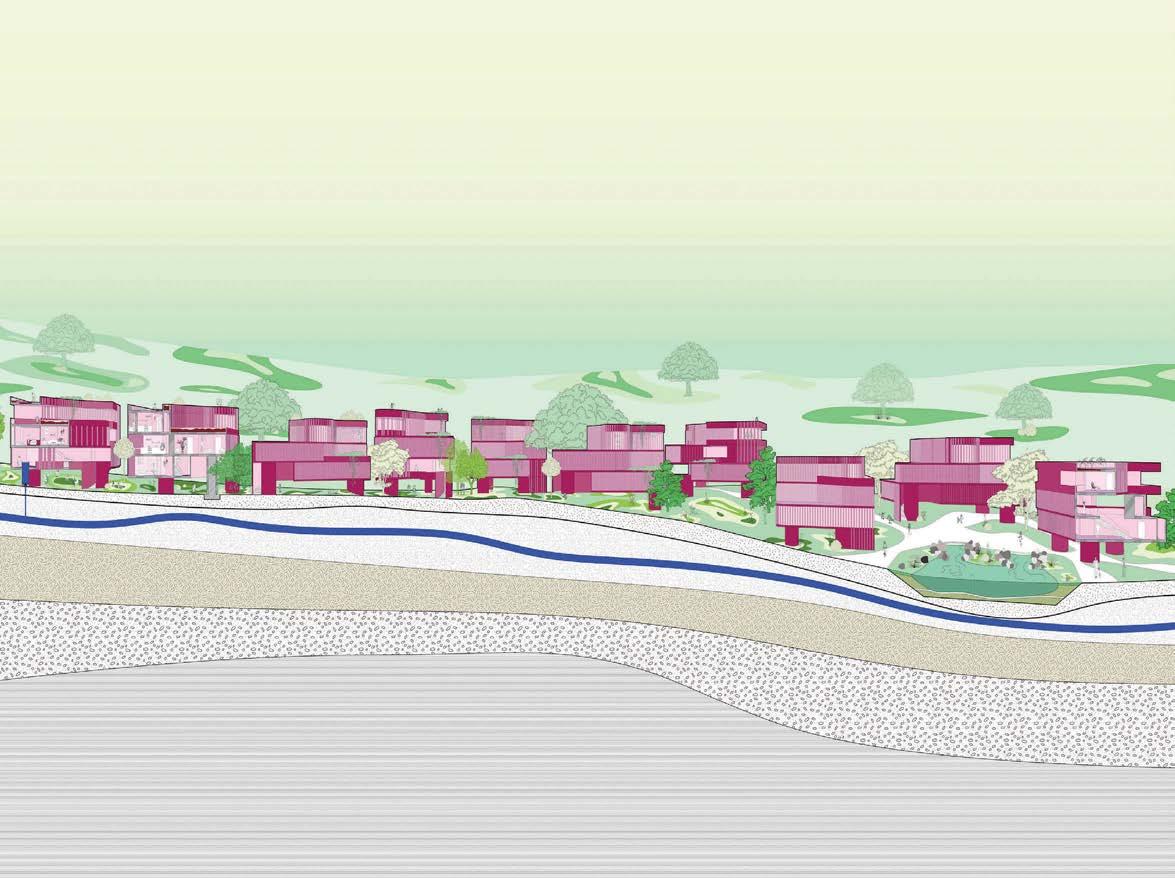
TOP: COURTESY RIZWANA
LUBIS; BOTTOM: COURTESY HALI SHERIFF
MARCH/APRIL 2023 137
NICOLAS BURBANO DIAZ
With a focus on hospitality and housing, this student aims to use design to build community.
By Ethan Tucker
Nicolas Burbano Diaz didn’t begin his education with the goal of becoming a designer. Instead, he had his sights set on a career path some consider more lucrative, earning an undergraduate degree in business and landing a job at a Toronto bank. The realization that he needed a more creative métier came three years into his nance career while he was sprucing up his apartment with furniture he had designed and built on weekends. “Those pieces, even though they were minor, had such a huge impact on how my partner and I felt in the space,” he says. Opening that door to curiosity led Diaz back to school for a bachelor’s degree
in interior design at Toronto Metropolitan University, where many of his projects have explored how design can bene t communities struggling with gentri cation and displacement in his adoptive city (Diaz was born and raised in Colombia). One such project, Move Laneway House, was conceived in response to a citywide initiative proposing accessory dwelling units for Toronto homes that open onto back lanes. Thanks to movable walls, the unit can expand and contract depending on an occupant’s needs. It has no dedicated bedrooms, which the designer points out are empty most of the day. Instead, it features multifunctional spaces
with stow-away Murphy beds.
A similar approach to problemsolv ing is on display in the Annex CoLiving House. “The original assignment was to design a hotel, but Toronto has enough hotels,” says Diaz, pointing out that hotels and co-living have roughly equivalent spatial requirements: small private rooms and common spaces such as lobbies, restaurants, and terraces. “Questioning the status quo is part of my process and philosophy,” the designer writes in his portfolio, along with the statement “I believe design can help improve people’s lives.” It has certainly transformed his own. M
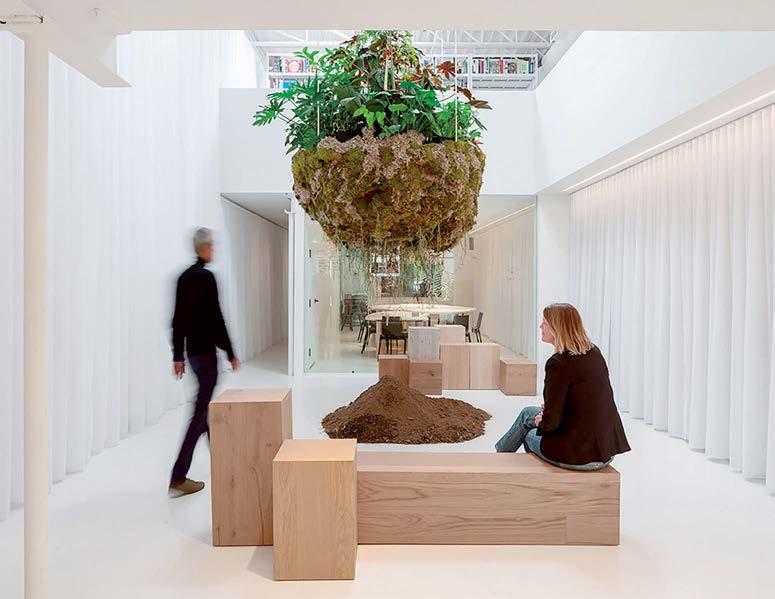
COURTESY NICOLAS BURBANO DIAZ
METROPOLIS 138
REFUGE IN THE SKY
In addition to his undergraduate studies, Diaz is working part-time as a designer with local design firm Mason Studio, where he worked with colleagues to fabricate a six-foot floating island of living greenery (opposite) in the firm’s gallery space in Toronto’s Junction Triangle neighborhood.
MOVE LANEWAY HOUSE
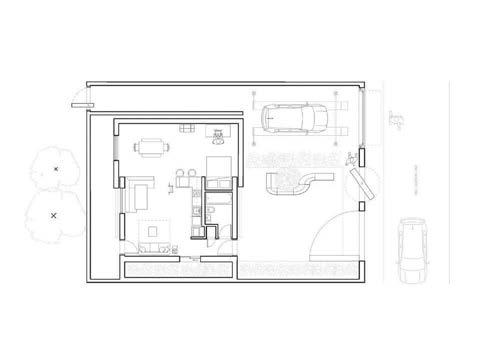
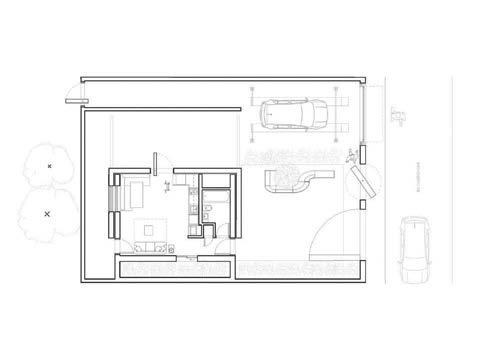
This prototype for adaptable microliving allows residents to expand or contract their living space over time.
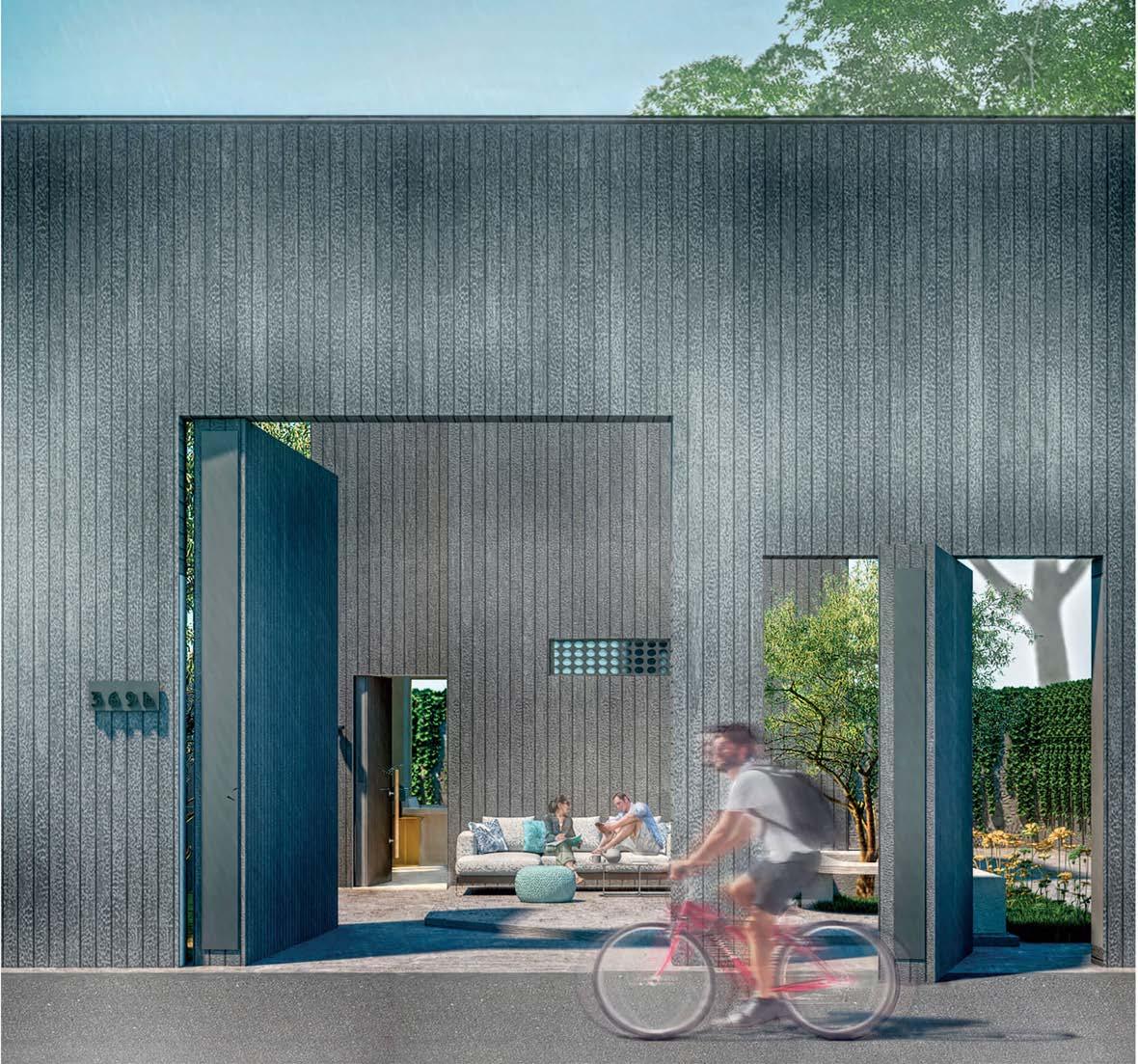
MARCH/APRIL 2023 139
Congratulations to the top architecture and interior design students recognized by the Metropolis Future100! We look forward to your influence on the purpose-driven design of tomorrow.
KEITH AUDIT | DIRECTOR, MARKETING | ARMSTRONG WORLD INDUSTRIES
Congratulations, what a huge accomplishment! As you enter the workforce, remember to be flexible & pivot when opportunities arise to maximize your future success.
Formica Corporation congratulates the Metropolis Future100! We celebrate your accomplishments and look forward to your continued impact on the design community.
On behalf of Interface, congratulations to the Future100! With your innovative ideas and passion for design, the outlook for our industry is bright. We wish you the best and encourage you to design in a way that creates a climate fit for life.
LISA
| VICE PRESIDENT OF SUSTAINABILITY - AMERICAS | INTERFACE
Kawneer is proud to support the Metropolis Future100. We are excited to see fresh innovative ideas that will move the industry forward and work in partnership to create positive environments to shape a better world.
Keilhauer is proud to support the Metropolis Future100 class of 2023. We look forward to seeing what this year’s group of innovative interior designers and architects accomplish within their fields. Congratulations!
MEGHAN SHERWIN | CHIEF MARKETING OFFICER | KEILHAUER
Sherwin-Williams is proud to support future interior designers as they continue to showcase the power of design through their work.
SUE WADDEN | DIRECTOR OF COLOR MARKETING | SHERWIN-WILLIAMS
We can’t wait to see what the future holds for the Future100 Class of 2023!
In partnership with
AMY GATH | VICE PRESIDENT, MARKETING & STRATEGY | FORMICA CORPORATION
CHRIS GIOVANNIELLI | DIRECTOR OF GLOBAL PRODUCT MANAGEMENT| KAWNEER COMPANY, INC.
WHITNEY WELCH | VICE PRESIDENT COMMERCIAL SALES | DALTILE CORPORATION
CONWAY
Colors from Sherwin-Williams Mode: Colormix� Forecast swcolorforecast.com
In Depth
Maximalism is back, and with good reason. Responding to pent-up demand after these years of restricted travel, some hoteliers and restaurateurs are creating theatrical experiences in unique properties so that every guest feels like a star. Meanwhile, other leaders in the industry are focused on deep challenges in sustainability, equity, and an ever-shifting tourism industry. Read on to discover the new frontiers of hospitality design.
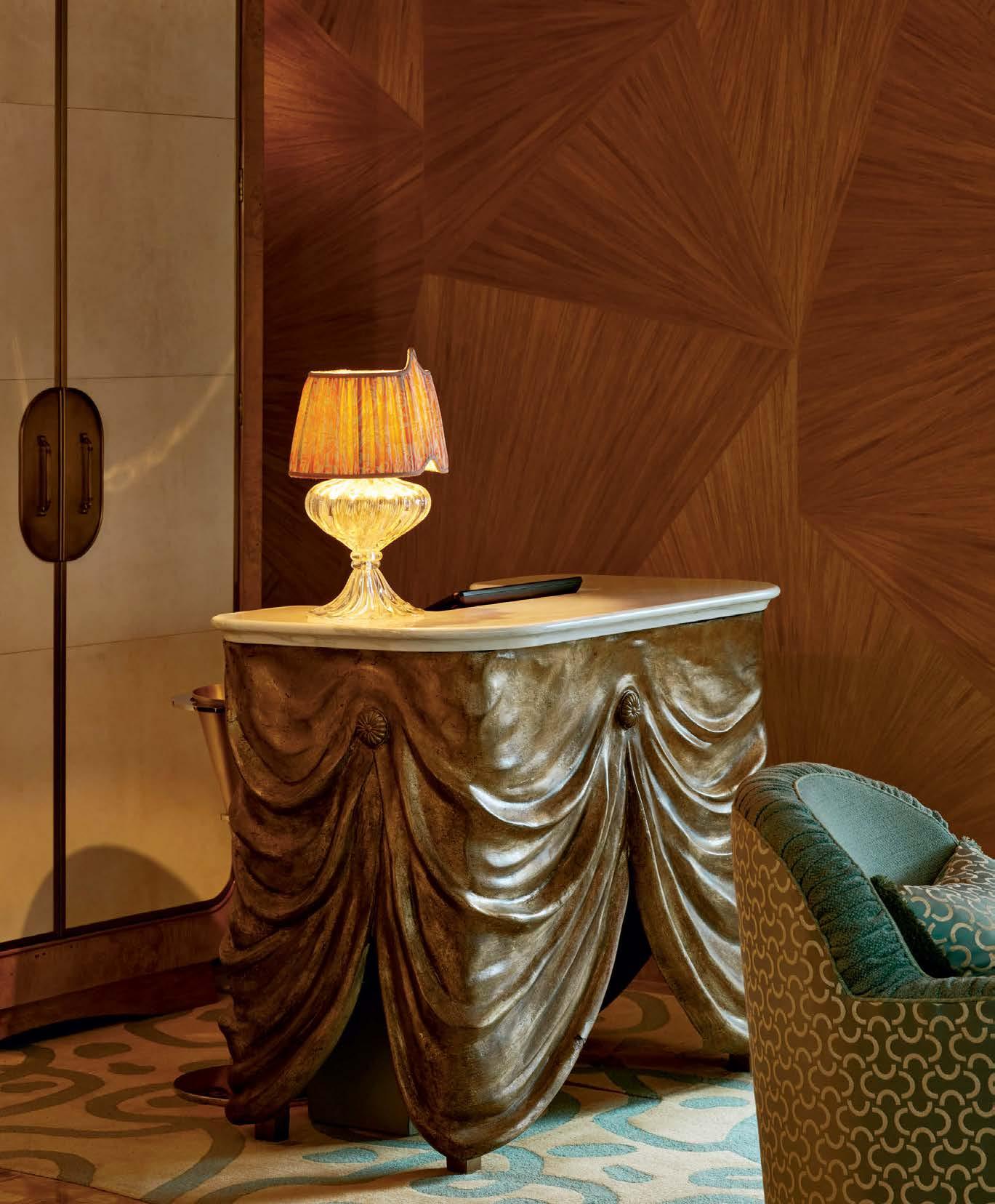 London- and New York–based Martin Brudnizki Studio recently renovated London’s famed Dorchester hotel, including interiors of the Vesper Bar, a James Bond–inspired lounge.
COURTESY
METROPOLIS MARCH/APRIL 2023 141
MARTIN BRUDNIZKI STUDIO
Making
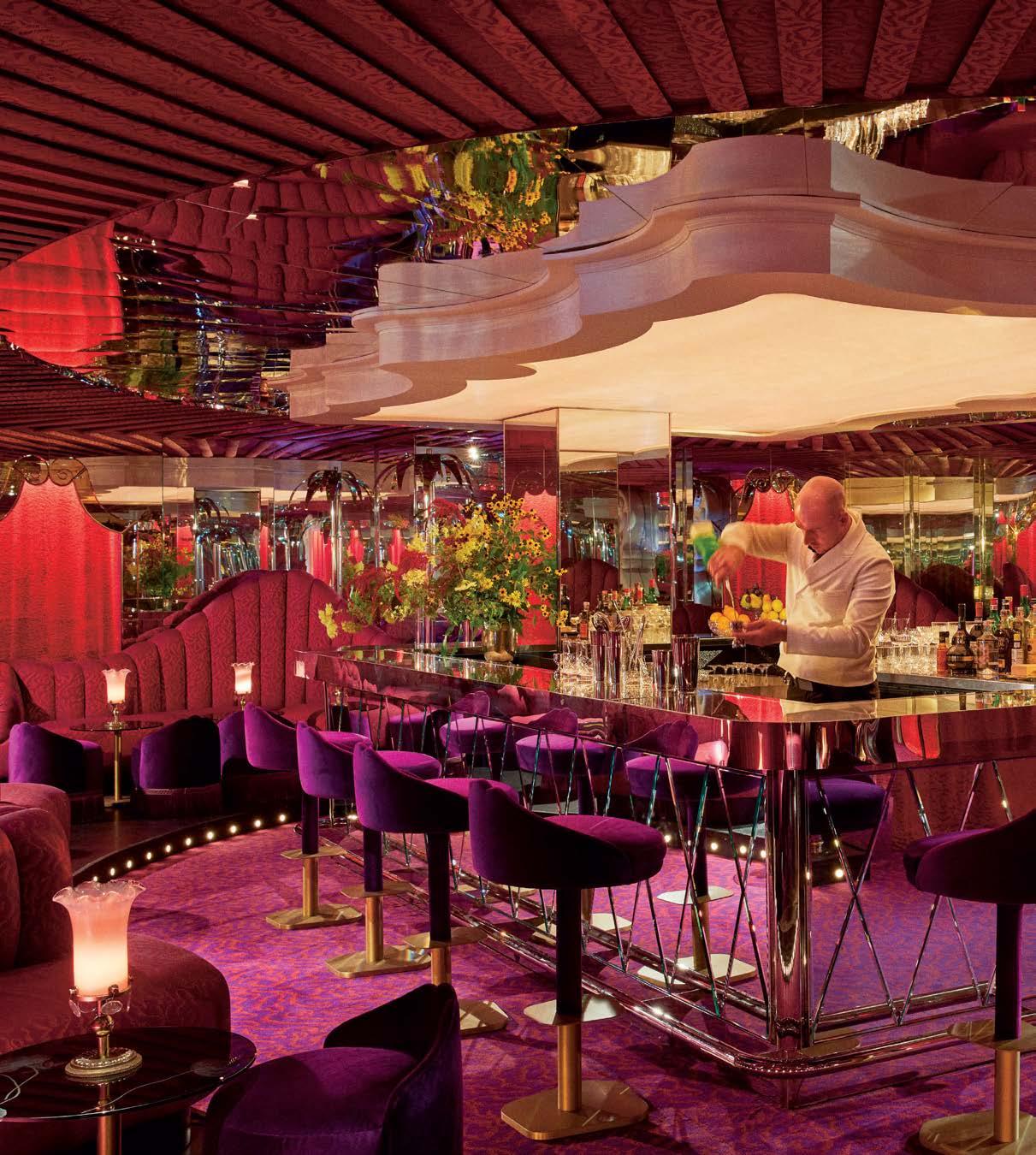
142
METROPOLIS
ULYSSES HOTEL ASH NYC Baltimore
Across the globe, designers and hoteliers are leaning into maximalism. With Baltimore’s Ulysses Hotel, this is less about aesthetics and more about providing a unique perspective for the guest.
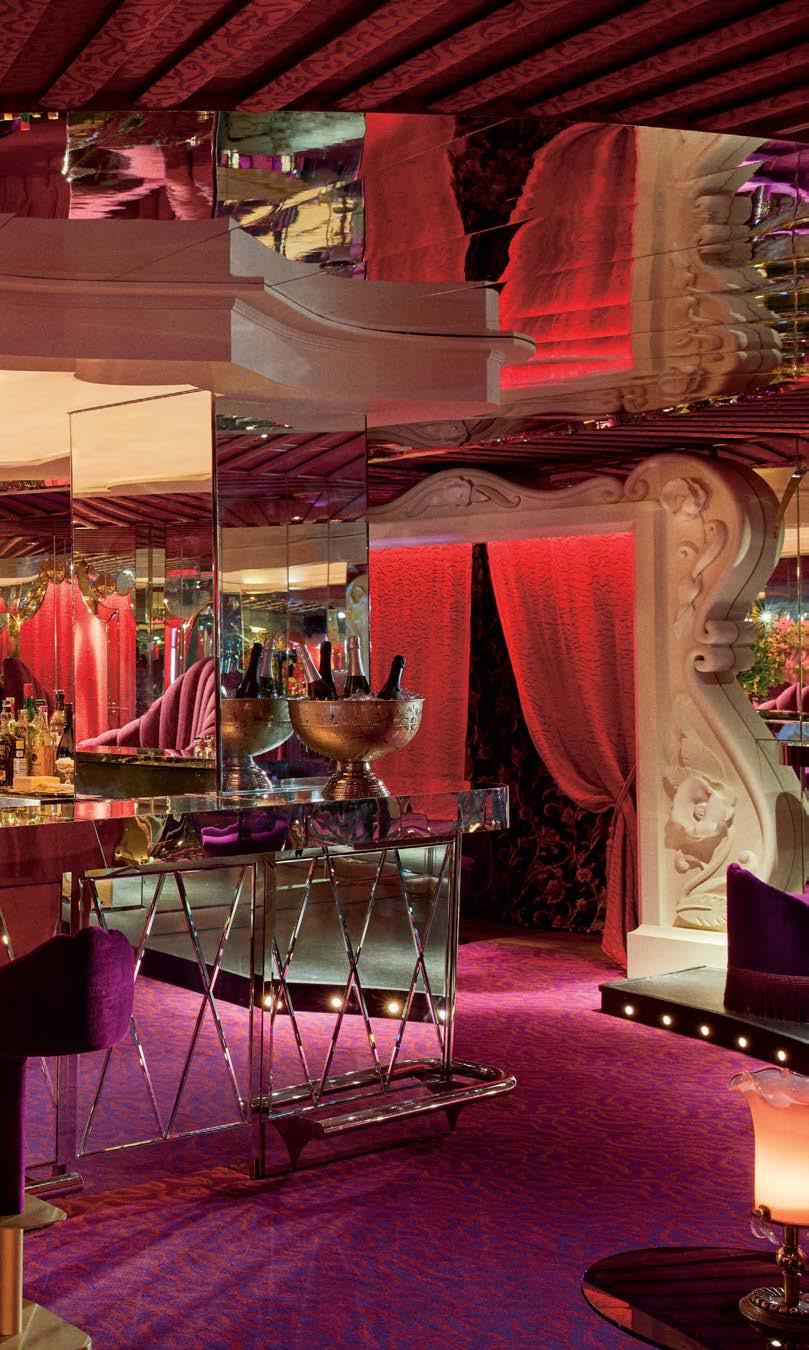
ASH CEO Ari S. Heckman explains, “I think most hospitality today is birthed by [designers] who are trying very hard to please the vast majority of people, which means not taking a firm stance or putting forth a point of view.” By incorporating elements of storytelling, the New York–based design firm is changing that.
By Jaxson Leilah Stone
aScene
A new wave of hotels and lounges use maximalist sensibilities and cinematic dimensions to place guests center stage.
COURTESY BRETT WOOD MARCH/APRIL 2023 143
ULYSSES HOTEL ASH NYC BALTIMORE
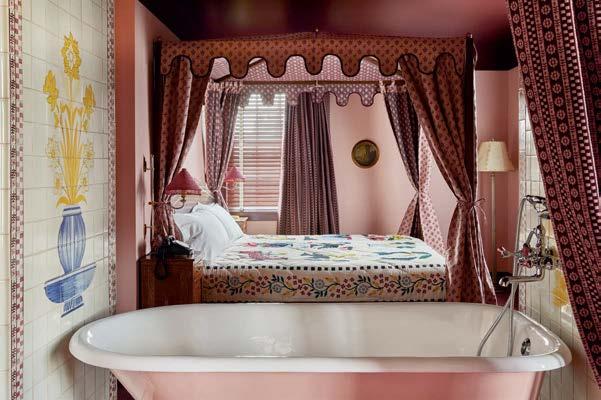
A screenwriter or novelist constructs a believable universe through a collection of scenes and images; ASH has created Ulysses in much the same way. For example, within the guest rooms, handmade quilts inspired by Baltimore album quilts cover the canopied beds and the various symbols that decorate each quilt are explained in a daily newsletter placed by the bed. Stories are implied in every detail.
here are works of fiction that offer a brief respite from the mundanity of everyday life, and then there are novels and films that transport you to completely new worlds, leaving a permanent impression on the audience’s sense of what’s possible. A skillfully designed hotel does the same thing, centering each guest as the protagonist of a meticulously crafted universe in which the designer’s palette of objects and materials, just like a writer’s words and sentences, lends meaning to the narrative. A slew of new hospitality projects lean into this idea, crafting romantic interiors that blend fact and fiction, taking on novelistic and cinematic dimensions while paying close attention to local context and history.
It’s hard not to feel a type of magnetic #MainCharacterEnergy once inside the maximalist interiors of Baltimore’s new Ulysses Hotel. Designed by ASH NYC and located in a 1911 building within the city’s historic Mount Vernon neighborhood, Ulysses, like ASH’s other three properties, functions as what the firm calls a “cin-
ematic monument.” Serving as “both the stage and the performance,” the hotel’s design doesn’t allow for passive participation. Rather, the interior serves as a set for guests to act out their own fantasies, each space drawing awareness of guests’ every move. Indeed, Ulysses’s over-thetop spaces feel as though they were designed with the elements and techniques of cinematography in mind: Attention to angle and movement, continuity, composition, and dramatic lighting all contribute to dynamic, image-driven interiors that walk the tightrope between glamour and kitsch. There is a level of self-awareness here that many hospitality experiences get wrong or ignore. One of the most striking spaces in the hotel is Bloom’s, an exuberant cocktail lounge opulently outfitted in velvet upholstery, mirrored surfaces, and Hans Hollein-esque chrome-sheathed palm trees. A round ceiling mirror is layered atop a red tented ceiling treatment and reflects the lounge’s central bar and serpentine booths that are raised on a stagelike platform. All these details recall the elements of entertainment architecture across time, from 19th-century circus designs to Las Vegas casinos and the mirror-clad guest rooms of the 1950s honeymoon resorts that once dotted the nearby Poconos. This PoMo collage of material-driven allusions is key to the hotel’s aesthetic. ASH’s Will Cooper tells Sight Unseen that Ulysses’s interiors can be summed up as “Paris, Texas, Disney’s Epcot Center, the purple and red robes of the papacy, and the limpid insides of a ripe plum.”
T COURTESY BRETT WOOD
METROPOLIS 144
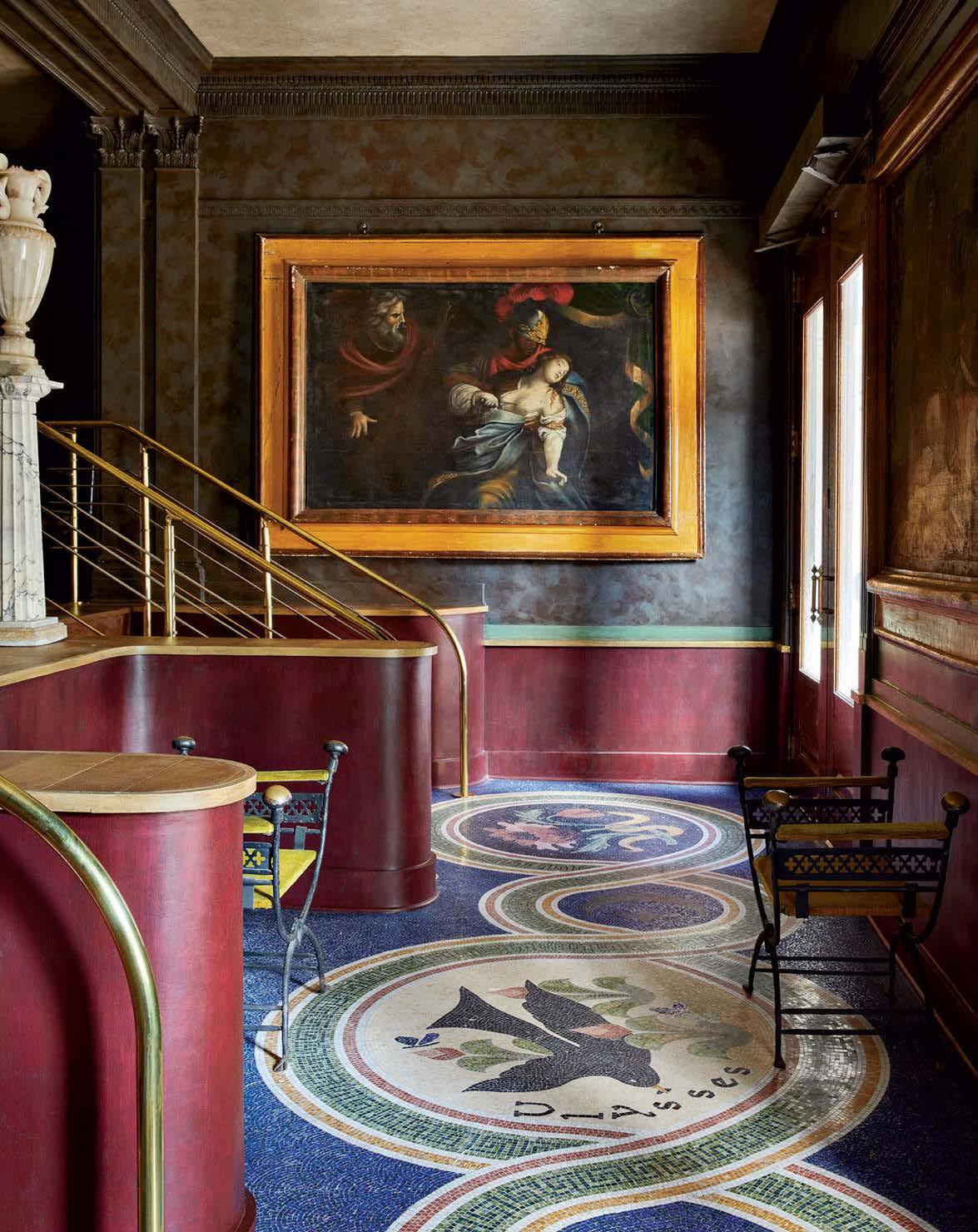
© CREDITS GO HERE MARCH/APRIL 2023 145
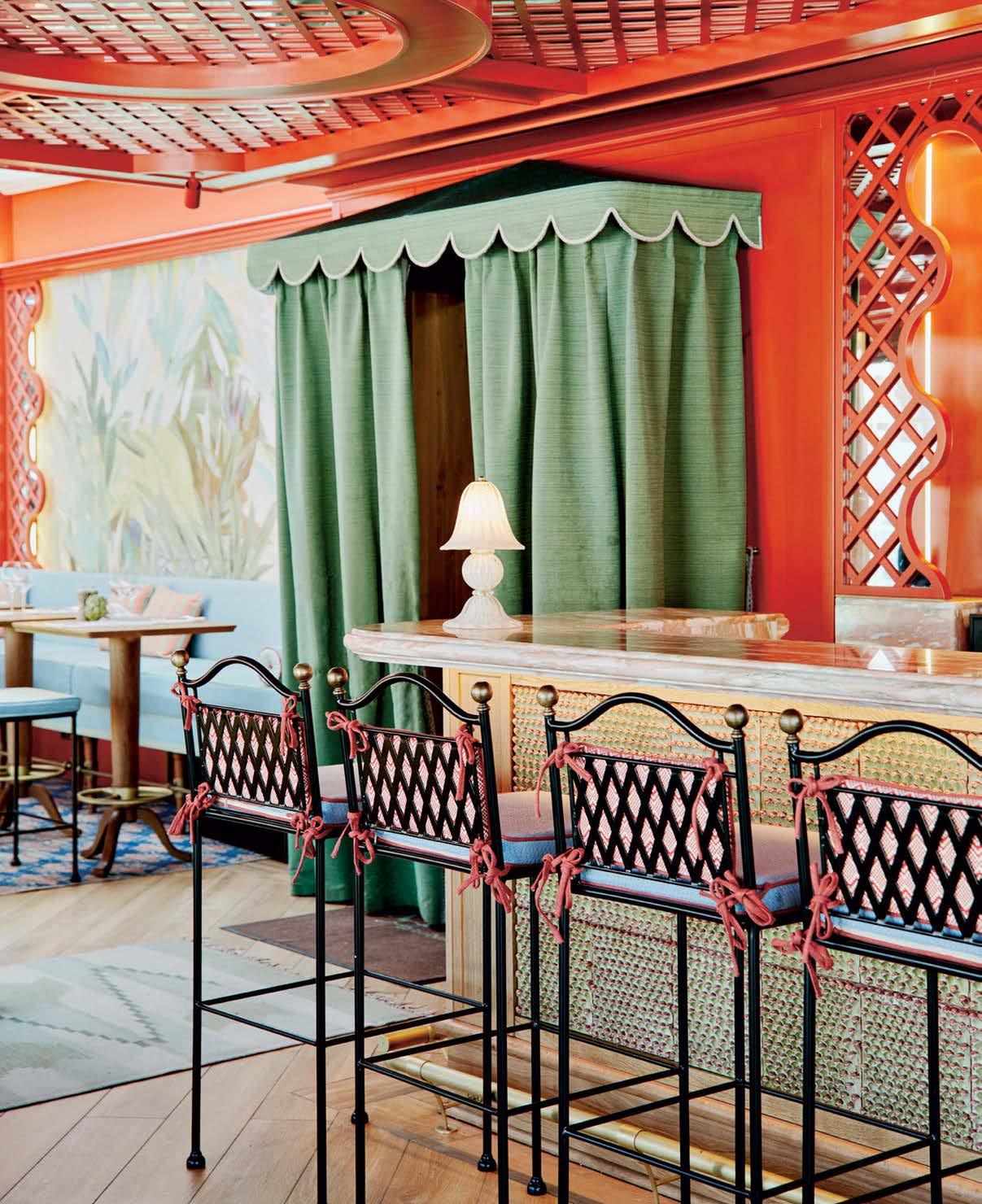
© CREDITS GO HERE CREDITS METROPOLIS 146
But context is not lost in the fantasy. The references aren’t random, but a carefully constructed balance of high and low that is emblematic of Charm City, creating an unexpected dialogue between local immigration history (Ulysses was the name of a ship that brought Bavarian immigrants to Baltimore), the emergence of the Streamline Moderne style, and filmmaker John Waters’s legacy of celebrating camp and the aesthetics of trash.
“To me, a good hotel experience should be transportive. It should make you feel like a character in a play,” notes Ari S. Heckman, partner and CEO of ASH. “One of the amazing attributes of hotels is that you are only there for a limited period. You can literally try on a new persona if you want to.” Heckman continues, “Our job is to create a really good set and some really good supporting characters to transport guests.”
If there is one interior designer who harnesses the transportive capabilities of interior design, it’s London- and New York–based Martin Brudnizki. The designer balances the theatrical and experiential through a combination of objects and materials that wrap around the guest like a costume. Known for creating atmospheric interiors for luxury hospitality projects such as New York City’s Beekman Hotel, Brudnizki has most recently brought his romantic sensibilities to London’s famed Dorchester Hotel.
Says Brudnizki: “Memory and the feeling of escape are big par ts of design.” The design and history of the Dorchester specifically point to larger cultural shifts in pleasure, leisure, and escapism among
Martin Brudnizki Studio Beaumarly Group
Paris
Martin Brudnizki’s design for La Plage Parisienne, located on the banks of the Seine River in Paris, creates a whimsical atmosphere informed by the history of Paris’s outdoor cabarets.
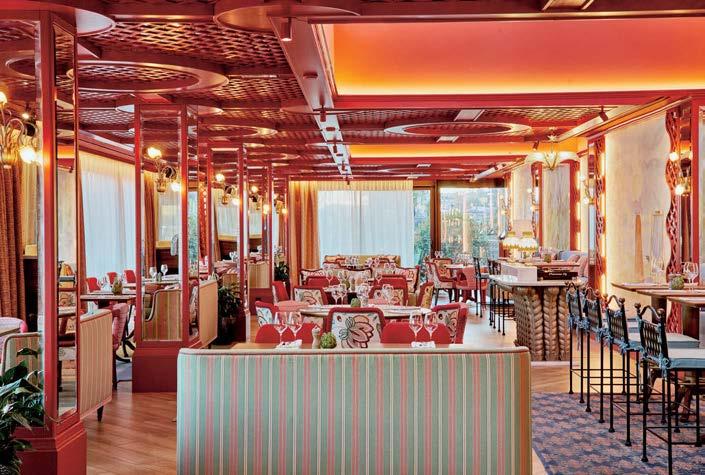
Brudnizki’s design is also inspired by Renoir’s painting Luncheon of the Boating Party

COURTESY MARTIN BRUDNIZKI STUDIO
LA PLAGE PARISIENNE
MARCH/APRIL 2023 147
the city’s young bohemian aristocrats. Opening in 1931, the Dorchester quickly became a destination known for hosting Hollywood’s elite and London’s literati, drawing crowds into its Art Deco interiors for nightly jazz and cabaret performances as well as prestigious literary luncheons that still occur to this day. In fact, the intimate relationship between literature and interior design has been present at the Dorchester since its opening. When the hotel opened, the Dorchester privately published A Young Man Comes to London , a 49-page satirical romance by Michael Arlen that tells the story of two “Bright Young Things” experiencing the new Dorchester Hotel. Following the story were color plates showcasing illustrations of the interiors as well as other architectural explanations and insights. The Dorchester gave the publication to guests, and Brudnizki drew on its pages for inspiration.
But Brudnizki tapped into the hotel’s rich literary history in more ways than one. On the ground level, his design for the Vesper Bar is inspired by Ian Fleming’s 1953 novel Casino Royale , in which James Bond awakens in a suite at the Dorchester. The 007-inspired cocktail lounge with dramatic palladium-leaf ceilings provides yet another layer of escapism to the hotel’s interiors. But Brudnizki notes that when designing an element of escape, it also needs to be tied to the site. “The aim is to transport people but also ensure it feels contextual. Yo u are essentially transporting people to another world outside of the streetscape
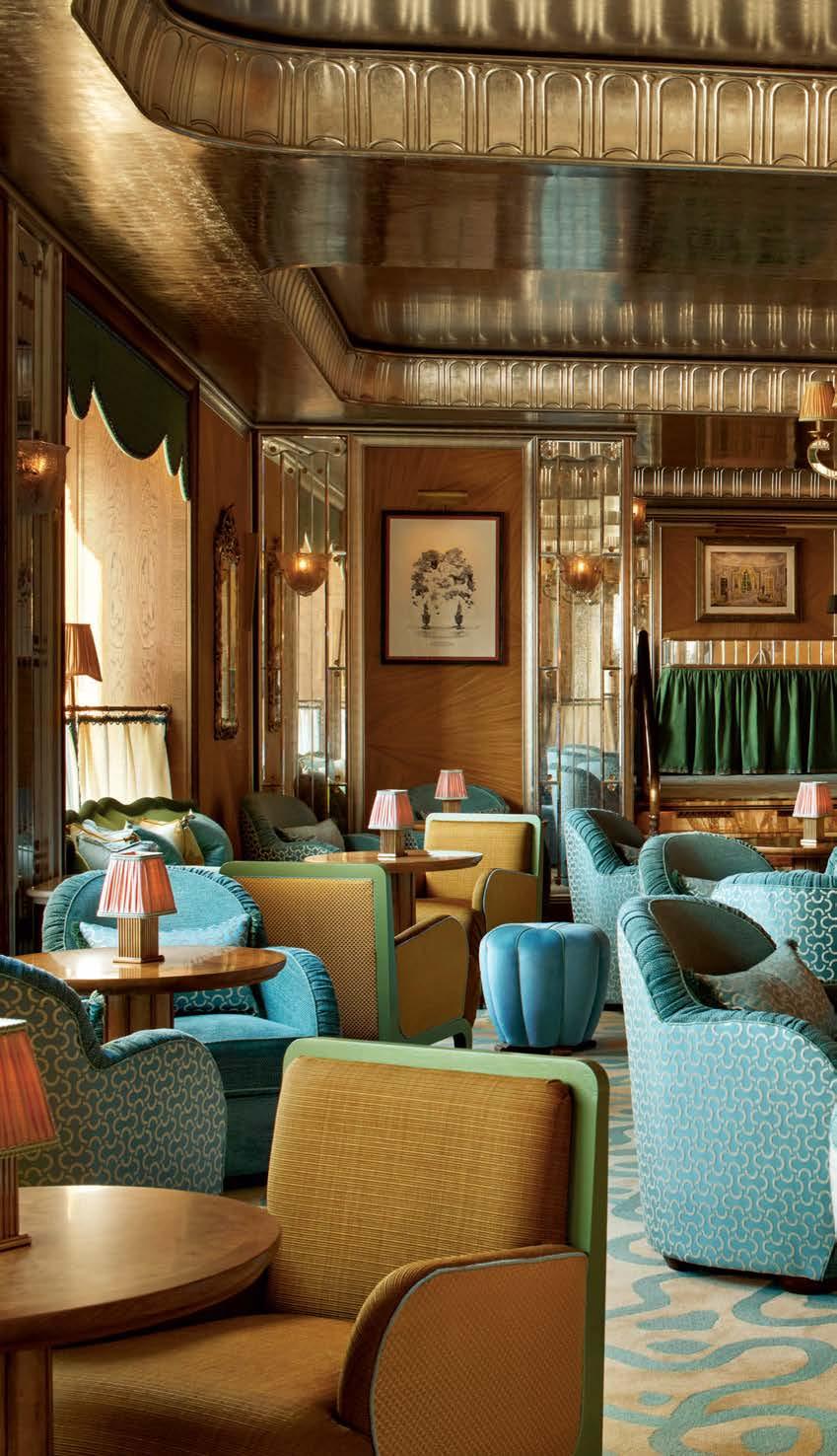
VESPER BAR AT THE DORCHESTER HOTEL
Martin Brudnizki Studio Dorchester Collection London
“I often think of Édouard Vuillard paintings [which capture a] sense of merging with your interior, almost wearing it like you wear your clothes,” says Brudnizki, explaining the link between fashion, fiction, and design.
“I believe our interiors are as much a part of our identities as fashion, friends, and books—interiors encapsulate all these things.”
METROPOLIS 148
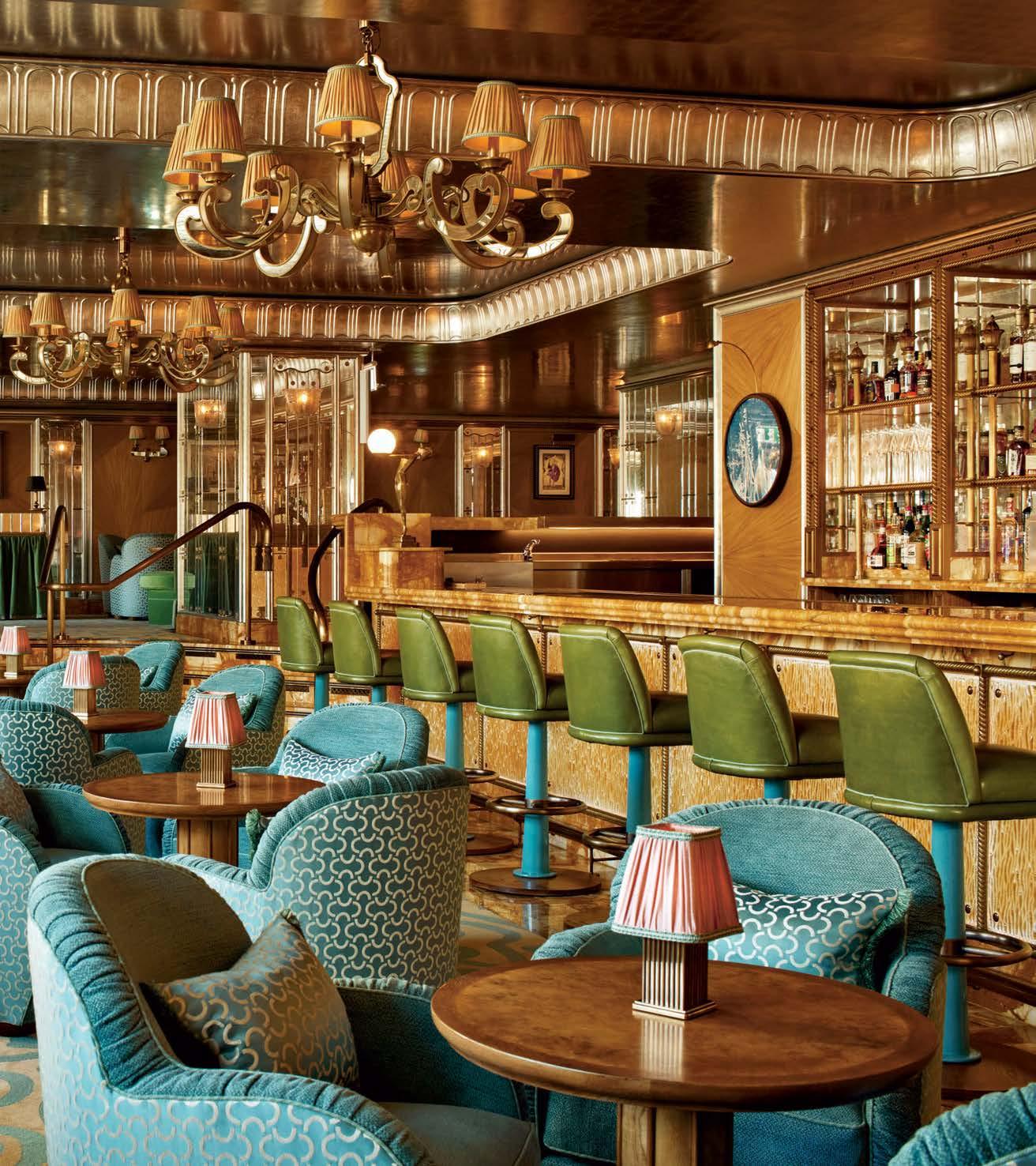
COURTESY MARTIN BRUDNIZKI STUDIO MARCH/APRIL 2023 149
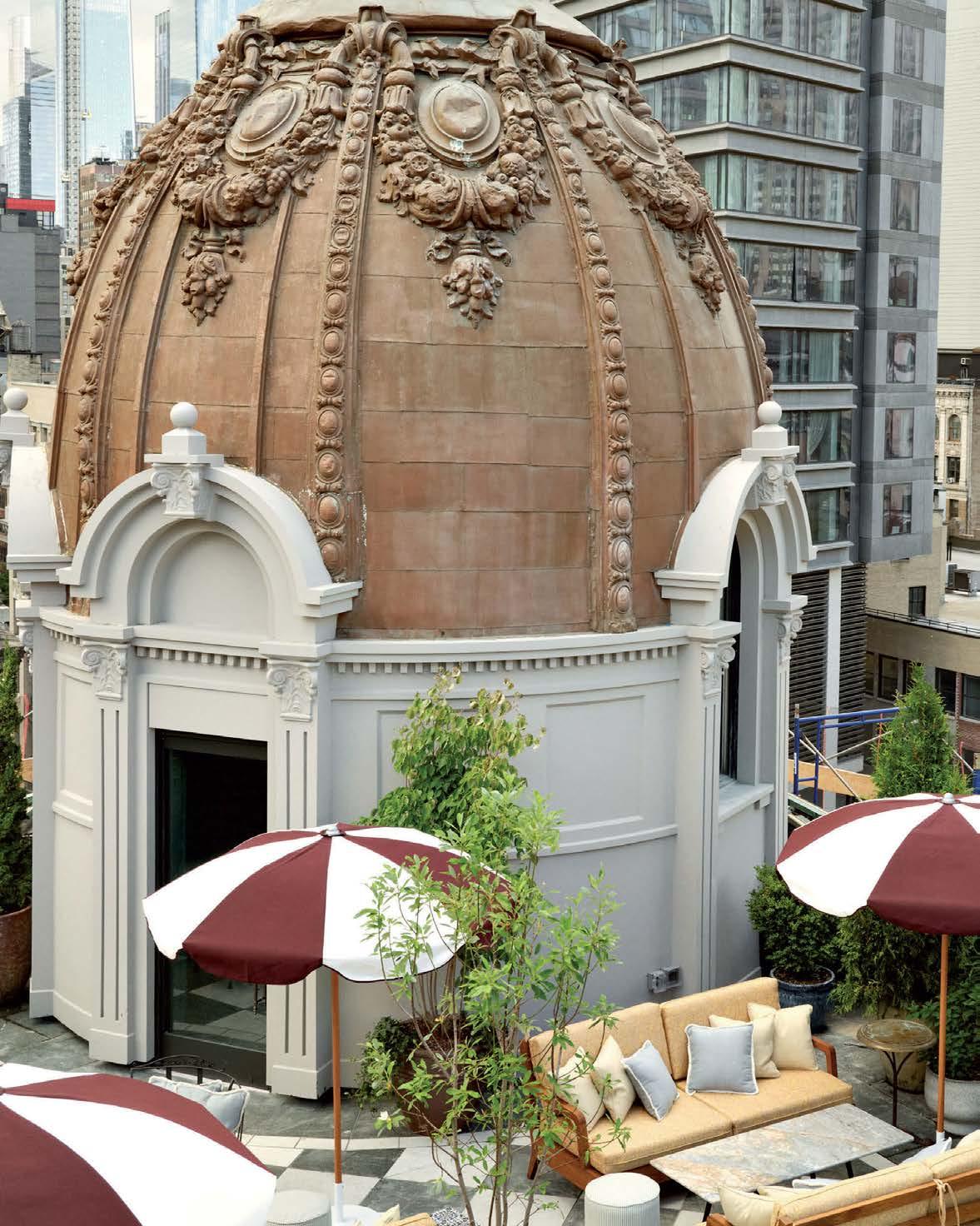
© CREDITS GO HERE CREDITS METROPOLIS 150
but one that feels entirely natural and suited to the history and future history of that streetscape,” he explains.
This thought process is particularly apparent in Manhattan’s NoMad neighborhood, where Stonehill Taylor and Soho House Design Group have teamed up to transform the former NoMad Hotel into a private members’ club and hotel called The Ned NoMad. The design of The Ned, located in the 1903 Beaux Arts Johnston Building around the corner from Tin Pan Alley, was inspired by the neighborhood’s relationship to the golden age of music. Nowhere is this more apparent than in its Magic Room, a striking red lounge that places guests center stage in a contemporary reinter-
pretation of an Art Deco cabaret club. “The location of it almost makes it feel secretive—like a hole-in-the-wall club— and you immediately feel like it’s a special, exclusive room and you were brought to an ‘in the know’ space,” explains Marinda Thomas, interiors associate at Stonehill Taylor. “The stage and windows look out to 28th Street on Tin Pan Alley and bring music back to this street during the shows.”
Sometimes you don’t need the historical context of a decades-old, landmarked building to craft a rich design narrative that immerses you in its world. Sometimes scenes must be built from scratch. This is what GRT Architects has done with Bad Roman, a modern “Italian”
Located in New York City’s historic Johnston Building (opposite), a new hotel and members’ club designed by Stonehill Taylor is setting the stage of the former NoMad Hotel. Blending
“Beaux Arts style with Manhattan allure,” The Ned features an Art Deco–inspired lounge called the Magic Room (above), a members-only dining room called The Ned’s Club, a 167-room hotel, and various eateries that are open to the public.
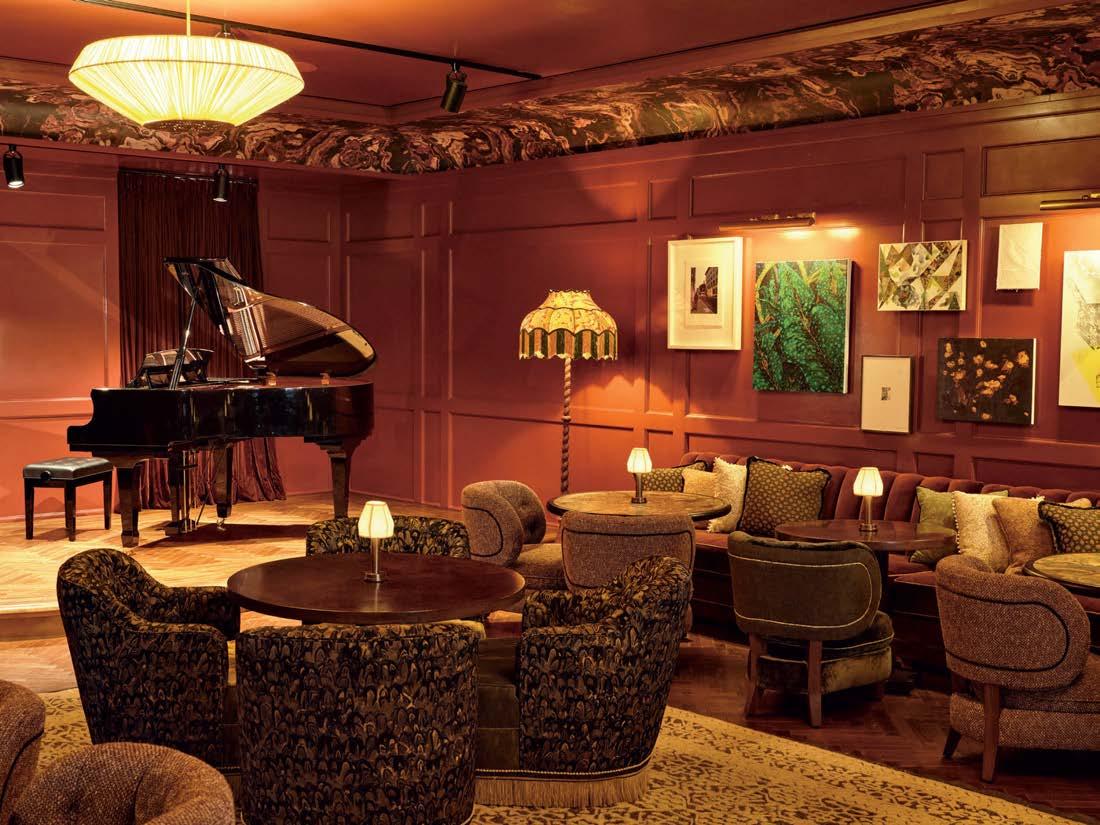
COURTESY THE NED NOMAD
THE NED NOMAD Stonehill Taylor Soho House Design Group New York City
MARCH/APRIL 2023 151
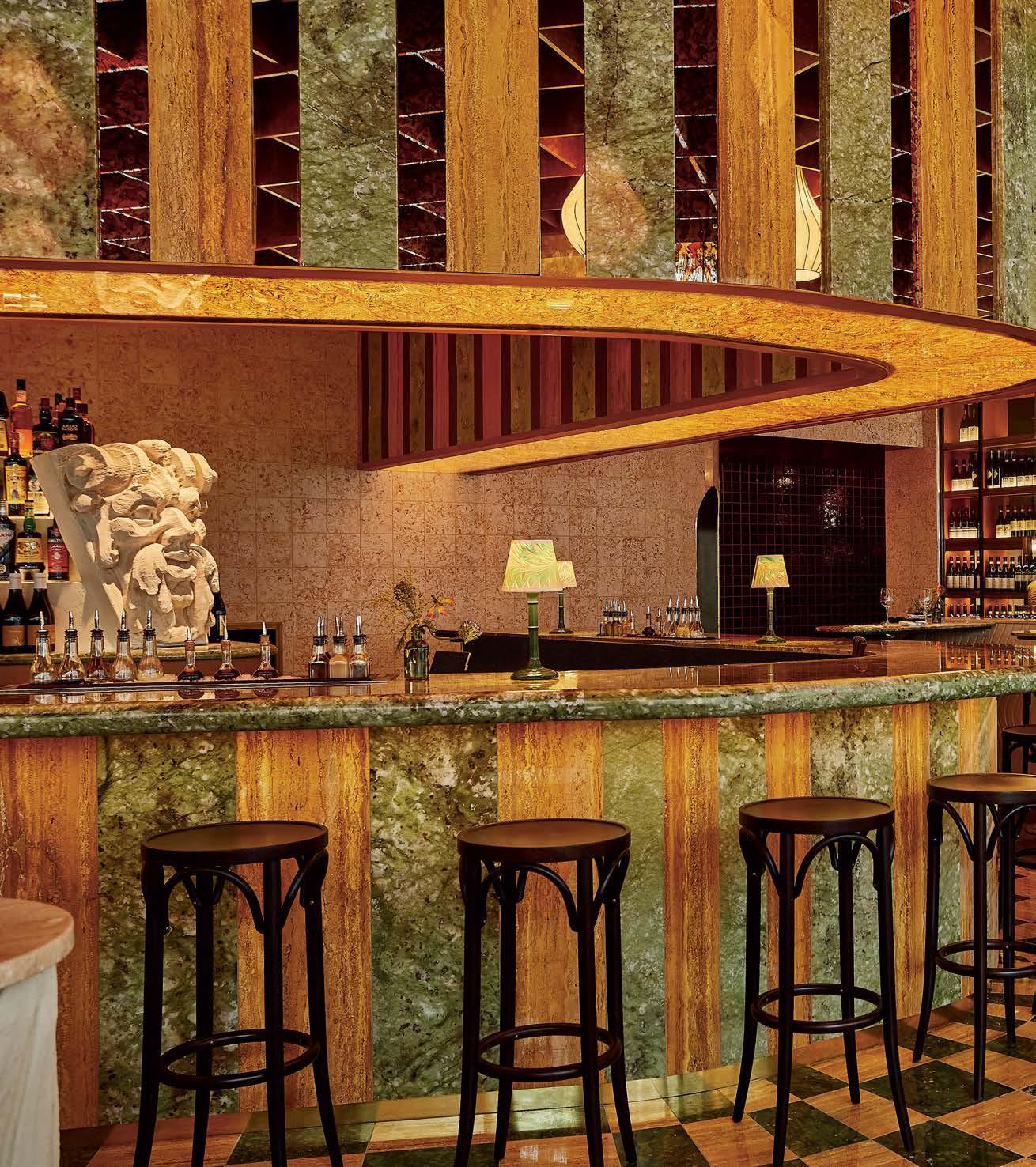
METROPOLIS 152
restaurant in Manhattan’s Shops at Columbus Circle. Just as the menu turns tradition on its head, the GRT-designed space temporarily takes guests out of the generic SOM-designed shopping mall and into the enchanting red glow of what Eater called New York’s most “unhinged Italian restaurant” of the year.
Like Ulysses, Bad Roman blends classicism and camp, where the firm’s deep knowledge of contextually appropriate materials and ambient lighting becomes saturated with whimsical decor choices such as bright orange booths separated by statues of Italian greyhounds, a host stand guarded by a wild boar wearing a neon necklace, serpentshaped doorknobs, fragments of 19thcentury tilework, majolica bowls of fruit, and a women’s room marked by a majestic mosaic fountain. GRT writes in a recent press release: “Minimal it is not, but the design of Bad Roman is unified by a high level of handcraft, and a say-yes-toall-beautiful-materials attitude.” M
BAD ROMAN GRT Architects Quality
Branded New York City
Located in Manhattan’s Shops at Columbus Circle, Bad Roman is a layered Italian restaurant that turns both food and design on their heads. Created by New York–based GRT Architects, the interior design playfully combines Italian-American aesthetics, snakelike motifs, cheeky statues, artwork, and even a mosaic fountain in the space. The firm writes on its website, “Where The Shops at Columbus Circle are politely elegant, Bad Roman is a riot of rich and varied materials, textures, found objects, shapes and color.” Who said good design needed to be polite?
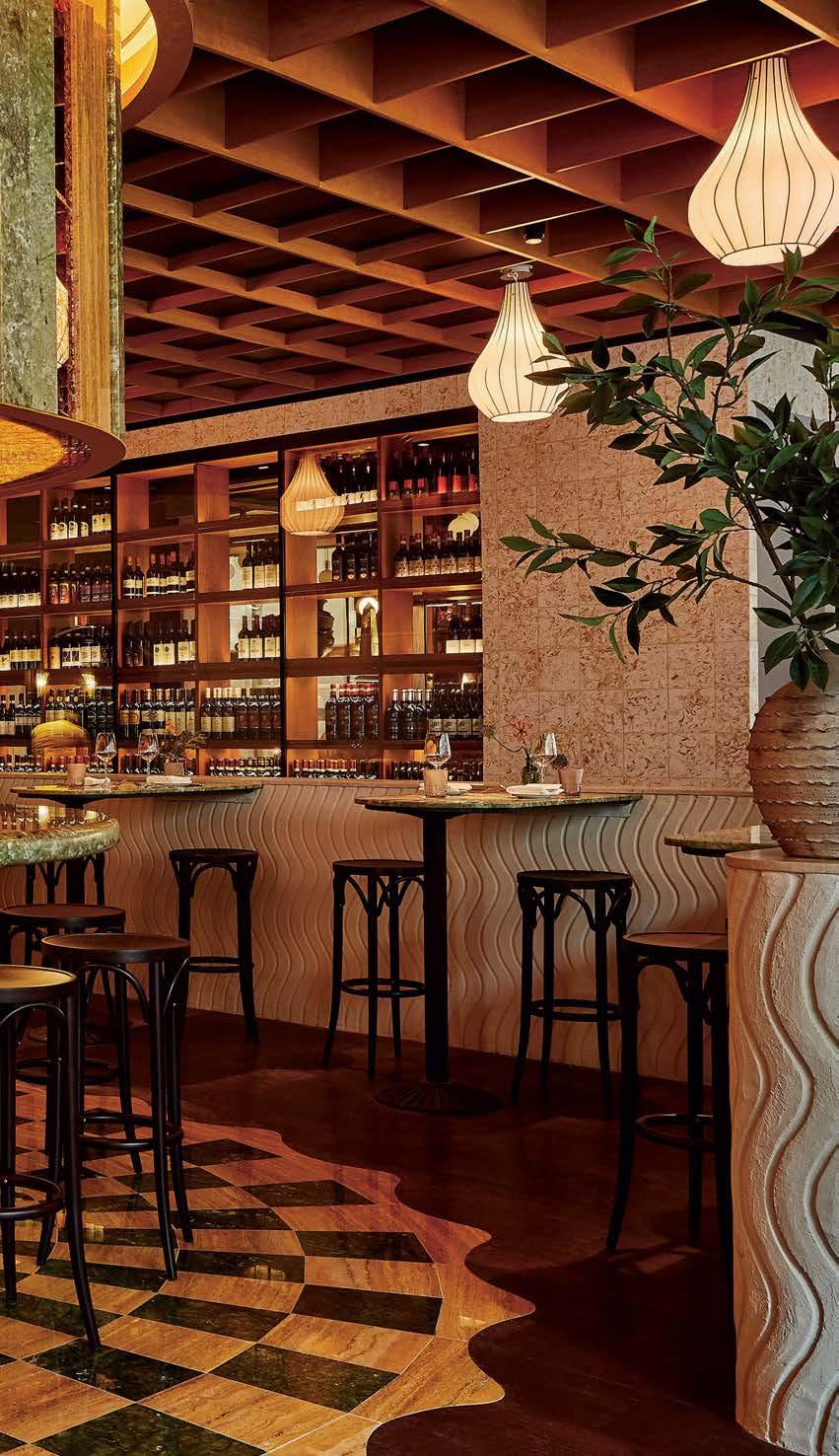
MARCH/APRIL 2023 153
COURTESY BAD ROMAN
A couple of change agents tell us how they’re reshaping spaces
What’s Next in Hospitality?
As in the case of residences and workspaces, making and marketing hospitality projects relies heavily on creatives who, in turn, rely on building materials, the quality of which relies on manufacturers—manufacturers that rely on workers across a complex web of supply chains. And now that this network of people and processes is more visible, hospitality projects contend with the same issues that dog, say, corporate offices or healthcare: the climate emergency around reducing carbon, post-pandemic apprehension among guests, and the new nomadic nature of work. It’s a critical time to hear how some of the world’s biggest hotel architects and developers are responding. Can new projects reduce their c arbon footprint enough? Which zones in a hotel or resort can best support a remote and increasingly mobile workforce? Paul McElroy, executive vice president of design and construction for the global hospitality investment and management company Highgate, and Kathleen Dauber, a partner at Hirsch Bedner Associates in Los Angeles, shared their insights with Metropolis ’s deputy editor Kelly Beamon.
METROPOLIS 154
PAUL MCELROY, EXECUTIVE VICE PRESIDENT OF DESIGN AND CONSTRUCTION FOR HIGHGATE











A critical focus for LUCID, Highgate’s design and construction division, is pushing the envelope on what it means to act sustainably. As a result, we’re actively seeking the right partnerships that will not only help us hold ourselves accountable to minimize our carbon footprint but also inspire a more conscious ripple effect across the larger hospitality community.
Over two years ago we partnered with a company called MindClick to help audit our furniture, fittings, and equipment (FF&E) vendor partners on their sustainability practices and give them an independent rating. Now we are focused on wor king with vendors that meet these validated sustainability cr iteria and objectives, which are managed through the MindClick platform.





Some examples of where we are making changes include Boston Park Plaza, a property that has made a bold commitment to eliminate all single-use plastics throughout the entire property, including all guest rooms, meeting spaces, and dining options. The hotel installed water refill stations on every guest floor and sourced reusable water bottles to distribute to guests. It also provides compostable coffee pods and condiment kits in every guest room and uses compostable to-go containers and silverware for takeout, events, and in-room dining deliveries.
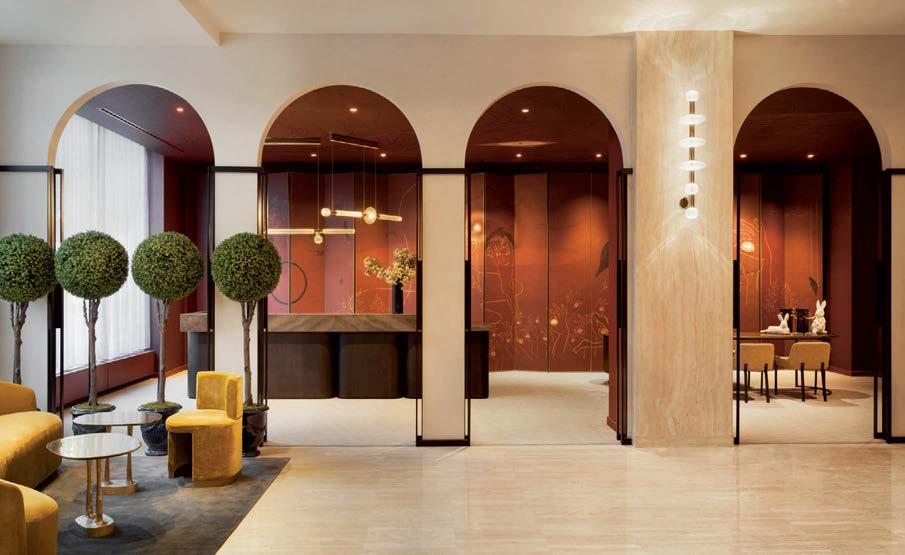
Additionally, Alohilani Resort’s commitment to sustainability is rooted in a legacy to preserving Hawaii’s forests. In 2021 the hotel continued to build upon its existing sustainability initiatives and set an ambitious goal to achieve PAS 2060 carbon-neut ral certification. This project was recognized as the only Gold Standard–certified carbon project in the state of Hawaii and has already contributed to the reforestation of more than 1,200 acres.
These are just a few examples. Sustainability is non-negotiable for us. We are making efforts now that will pay it forward to the industry as a whole.
COURTESY HIGHGATE
The recently renovated Park Lane New York, managed by Highgate
MARCH/APRIL 2023 155
KATHLEEN DAUBER, PARTNER AT HIRSCH BEDNER ASSOCIATES IN LOS ANGELES






While the pandemic has changed how hospitality can be delivered, it hasn’t taken the “hospitality” out of the hospitality sector. In many ways, hospitality in the “new normal” looks a lot like it did before the pandemic. Quick-think design solutions like Plexiglas shields have gone by the wayside. High-touch items such as decorative pillows, blankets, and minibars have found their way back into the hotel room.
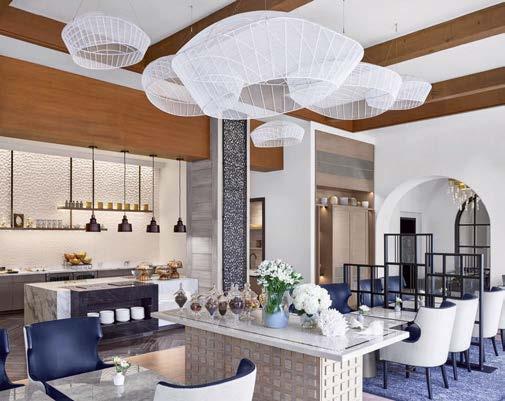
Long periods of confinement have taught people the importance of relationships and social interaction, and fueled their appetites for travel. People regained confidence in getting out to experience the world and safely gathering in person again as restrictions were lifted.
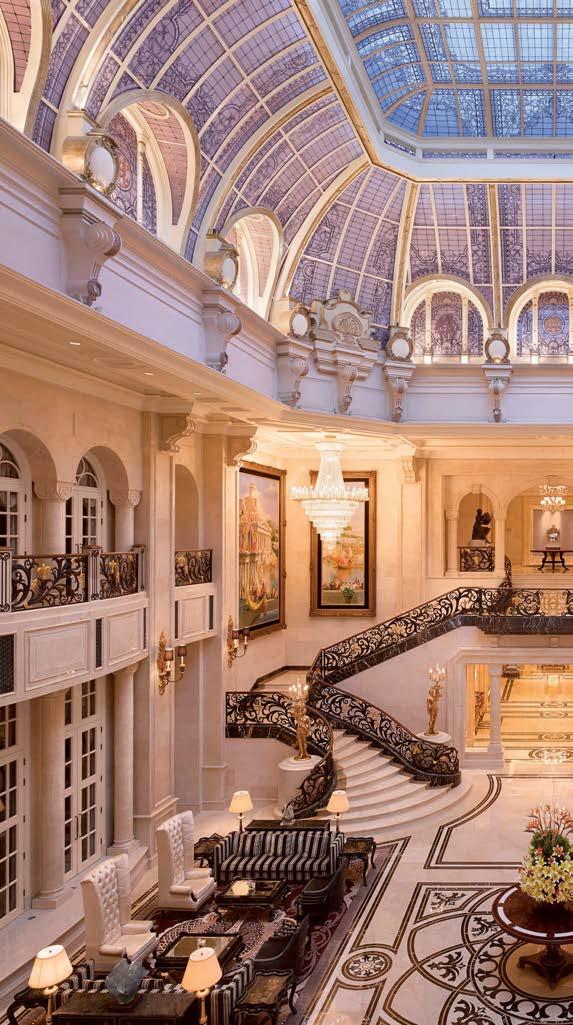
TOP LEFT: COURTESY HBA
METROPOLIS 156
Left: the Ritz-Carlton Bacara Club Lounge. Above: the lobby of the Castle Hotel in Dalian, China. Opposite: the lobby of the Hotel Villagio in Yountville, California.
On the industry side, this has forced accelerated change. While some changes were temporary, others have made a lasting impact on how our global industry moves forward. Innovations in technology have brought in new possibilities from contactless check-in and QR code menus to AI assistants and touchless faucets.
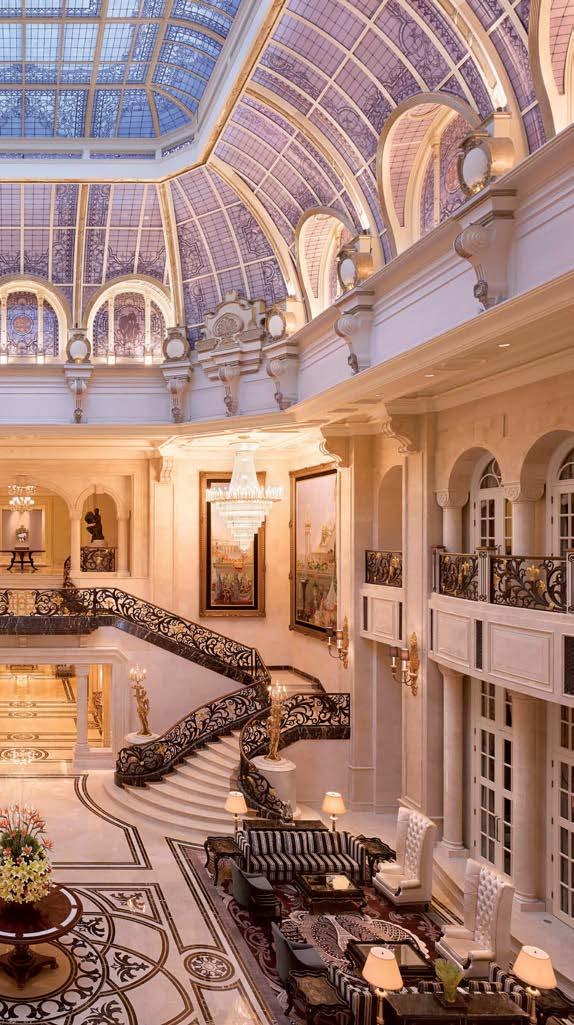
Sustainability, which was already making strides pre-pandemic, will undoubtedly play a role in shaping our industry’s future. Hospitality’s efforts to go plastic-free were briefly diverted during the pandemic but not undone. We’re seeing sustainability at the forefront again, particularly with hotels in the United States and other climate-aware countries. The rollout of large-format, refillable bath amenities is regaining momentum. California has taken major steps in eliminating personal care products packaged in single-use plastic from all hotels.
The hybrid work environment is here to stay. Millennials and Gen Z have spoken, and the hospitality industry is answering their call for a better work-life blend. Across the resort sector worldwide, workspaces are making a comeback in guest room design as a lifestyle amenity, especially in countries where the line between business and resort hotels is more distinct. One might discover the cocktail table doubles as a work surface, or that the side table is ergonomically designed, high and large enough for working on a laptop. Furniture may have more leisurely characteristics but with dual functionality to accommodate a guest’s needs.
Hotels and resorts with campus-style layouts, open-air corridors, and guest rooms accessible from the outdoors were the first to see leisure guests return in significant numbers when it was safe to travel again. Motels gained renewed respect, too, and benefited from the surge in travel. Having demonstrated success in a worst-case scenario, I think we’ll see more of these concepts, or at least elements of them, in future hotel and resort developments. M
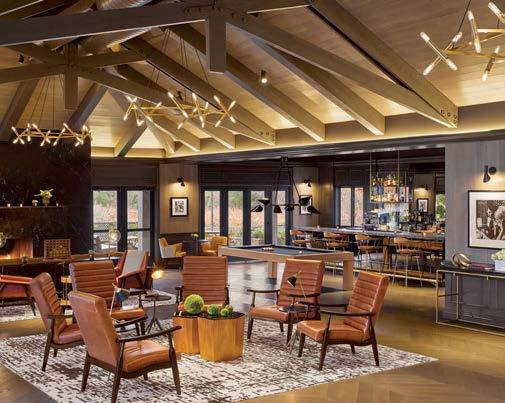
COURTESY WILL PRYCE (3)
MARCH/APRIL 2023 157
SPONSORED CONTENT Product
Showcase
Metropolis partners offer creative solutions for architecture and interior design projects. These new releases are tailored to your specification needs, designed to help you create beautiful, healthy spaces.
For a digital version, go to metropolismag.com
Mayer Fabrics
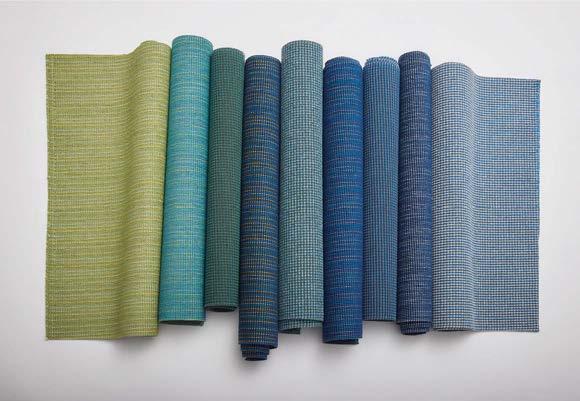
SEAQUAL INITIATIVE is a unique collaborative community that works with ocean clean-up programs around the world to transform the marine litter recovered into Upcycled Marine Plastic; a new, fully traceable raw material. Mayer’s upholstery patterns Caspian and Mira contain SEAQUAL® YARN. Caspian gets its beautiful allover plush texture from its alternating subtle shades of chenille, while Mira, is a simple texture with a dimensional woven structure.
@mayerfabrics | mayerfabrics.com
Interested in being a guest or sponsoring? Reach out to Kelly Kriwko, kkriwko@sandowdesign.com
LISTEN HERE
In weekly episodes, Metropolis will explore sustainability in the broadest sense of the word— encompassing inclusive, healthy, and resilient design alongside reductions in carbon emissions and toxic waste.
The Boston Architectural College
The Boston Architectural College (BAC) is an internationally recognized institution with a diverse student and alumni population representing 54 countries. Providing excellence in design education, the BAC offers bachelor and graduate degrees in architecture, interior architecture, landscape architecture, and design studies as well as offering continuing education certificates and courses. The BAC upholds the importance of inclusive admissions, diversity, equity, innovation, and the intrinsic value of academic and experiential education.
@thebacboston | the-bac.edu
Kent State University College of Architecture and Environmental Design
Congratulations to Katie Gagle and Emma Weaver for joining a distinguished cohort of seven Kent State Interior Design students selected to the Metropolis Future 100 in the past three years! Kent State University’s CIDA accredited Interior Design program prepares future leaders in a rapidly changing and world through the development of foundational skillsets, critical mindsets, and exposure to advanced technologies that enhance the human experience in the built environment.
@kentcaed | kent.edu
Kansas State University College of Architecture, Planning & Design
APDesign is a comprehensive and interdisciplinary school with professional graduate programs in architecture, interior architecture, industrial design, landscape architecture, and regional & community planning. APDesign students design, plan, build, and fabricate at one of the most affordable and highly ranked programs in the nation. Students are exposed to many opportunities preparing them to lead the design and planning professions.
@APDesignKState | apdesign.k-state.edu/
University of Oregon
The University of Oregon’s School of Architecture & Environment is nationally recognized for its innovation and sustainability research including the design of buildings, interiors, landscapes, and communities. We are committed to civic responsibility, environmental sustainability, and interdisciplinary education. We offer accredited, professional programs in Architecture, Interior Architecture, and Landscape Architecture at the undergraduate and graduate levels as well as research-based degrees and two doctoral degrees.
@uoarchenv | archenvironment.uoregon.edu
Schools Showcase The Metropolis Future100
MARCH/APRIL 2023 159
ON DISCREET MUSIC
Brian Eno’s Discreet Music is an album that I have continued to listen to since its release in 1975. It crystallized the way I think about art and architecture.
The album includes deconstructed and reinterpreted excerpts from Pachelbel’s Canon in D Major. It is a familiar piece of 17th-century chamber music that was altered, adapted, and repurposed through a series of Eno’s tape loops and searing guitar work by Robert Fripp. Eno’s ability to create something enduring through its connection to history while still modern and relevant changed my thinking about architecture.

Eno used the term “ambient music” to describe his atmospheric abstract soundscapes—music that accommodates many levels of listening without enforcing one in particular. He wrote, “It must be as
ignorable as it is interesting.” Like Eno’s music, ambient architecture rewards our attention but does not demand it—buildings that are shaped by context, history, and our milieu. I’m proud to lead an office dedicated to designing buildings that resonate with an ambient hum. We strive to create iconic architecture and environments that stand out by fitting in.
Morris Adjmi, FAIA, is the founder and principal of MA | Morris Adjmi Architects—a multidisciplinary design practice that provides a comprehensive approach to architecture, interior design, placemaking, and art services. Adjmi’s passion for contextual architecture began with the cast-iron French Quarter balconies and crumbling Creole cottages in his hometown of New Orleans and was refined in New York and Milan during a 13-year collaboration with Pritzker Prize–winning architect Aldo Rossi.
PORTRAIT COURTESY MORRIS ADJMI NOTEWORTHY Morris Adjmi
METROPOLIS 160 MARCH/APRIL 2023





Catwalk Visit Catwalk Made in America