Forward Osmosis
Membracon UK

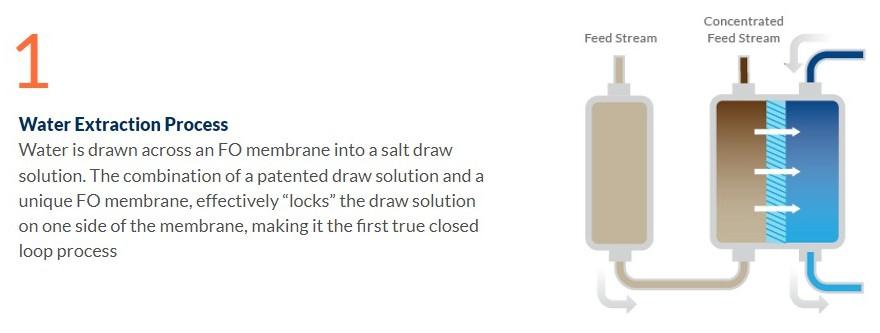
Forward Osmosis (FO) is a natural membrane process found in nature capable of extracting pure water from impure sources. Unlike Reverse Osmosis (RO), which uses hydraulic pressure to drive water across a semipermeable membrane, FO uses a “draw” solution to draw water across it. FO spontaneously draws water across a membrane whenever one solution is higher in salt concentration or solute (draw solution) than another (feed solution). The difference in salt concentration between solutions is known as the osmotic gradient (Δπ) and is the free and natural energy responsible in powering the water extraction process.
Forward osmosis (FO) is an osmotic membrane process that uses the natural driving force of osmotic pressure to separate water from a solution. FO uses a semipermeable membrane to separate two solutions with different concentrations: a feed solution and a draw solution. The draw solution has a higher concentration of solutes than the feed solution, which creates an osmotic pressure gradient. The water in the feed solution moves across the membrane to the draw solution, driven by the osmotic pressure difference.
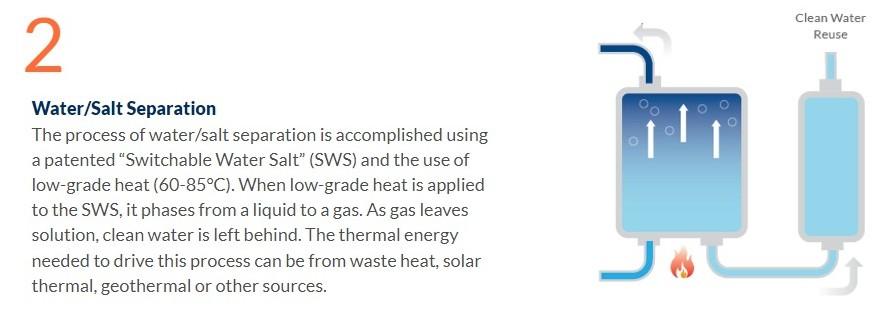
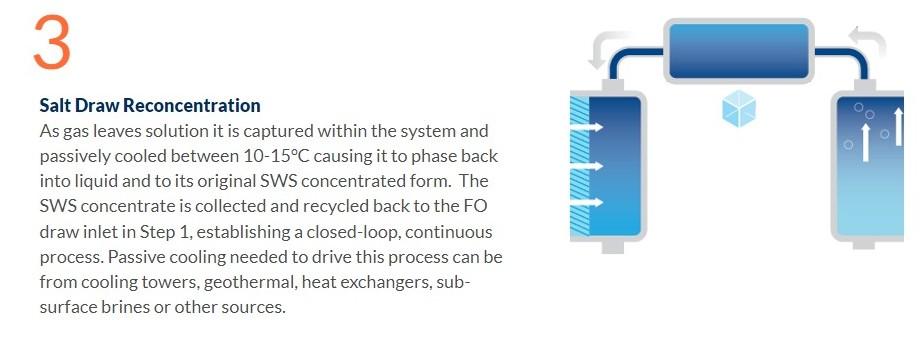
As water is drawn from the feed solution into the draw solution across the semi-permeable membrane, two things occur; the feed becomes concentrated, and the draw solution becomes diluted. The result of this is a reduction in the osmotic gradient between solutions and in turn a reduction in the flow rate across the semi-permeable membrane known as flux rate. For forward osmosis to operate continuously, water drawn across the membrane into the draw solution must be removed continuously so that a maximum draw concentration can be maintained and a maximum concentration gradient achieved.
Forward Osmosis has a number of advantages over other desalination technologies, such as reverse osmosis (RO):
● FO does not require high pressure to operate, which can reduce energy costs. ● FO can be used to treat a wider range of water sources, including high-salinity wastewater.
● FO is less susceptible to fouling than RO.
Forward Osmosis is still a relatively new technology, but it is rapidly gaining traction in a variety of applications, including:
● Desalination of seawater and brackish water
● Wastewater treatment
Food and beverage processing
Pharmaceutical manufacturing
Here are some examples of how Forward Osmosis is being used in the real world:
● A company in California is using FO to desalinate seawater and provide drinking water for a coastal community.
● A company in China is using FO to treat wastewater from a chemical plant.
● A company in Europe is using FO to concentrate fruit juice for a food and beverage company.
● A company in the United States is using FO to produce purified water for a pharmaceutical manufacturing plant.