In Security December 2025

Page 1


IN SECURITY

Paxton10 provides a single solution combining access control and video management. Easy to quote, install and use.

futureproof security for your buildings. The latest release of Paxton10 includes Lockdown and email notifications. Instantly secure the premises in the event of an emergency and recieve real-time notifications of alarms, access attempts, lockdown and more.

Editor Chris Hewett editorial@mebmedia.co.uk

Accounts Jay Kempisty accounts@mebmedia.co.uk

Publisher Wayne Banks +44 (0)1622 201207 wayne.banks@mebmedia.co.uk

Website and Circulation Manager Kevin Villa website@mebmedia.co.uk

Design and Production Charles David production@mebmedia.co.uk

In Security Magazine is published 6 times a year by

MEB Media Publishing Ltd 13 Princes Street Maidstone Kent ME14 1UR United Kingdom Tel: +44 (0)1622 201207, info@mebmedia.co.uk www.mebmedia.co.uk

Articles and art may not be reproduced or reprinted without the express written permission of the publisher.

Exclusion of Liability

Although every effort will be made to ensure the accuracy of all materials published, the publisher takes no responsibility for errors or omissions.

Copyright © MEB Media Publishing Ltd 2010 - 2025, all rights reserved.

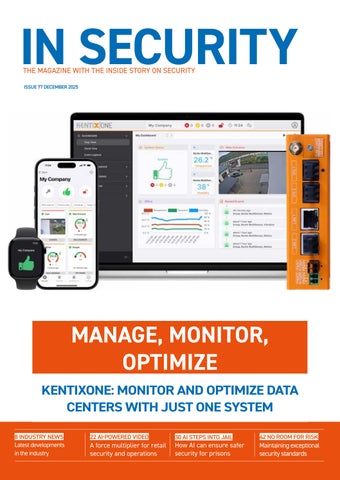
4 Cover story - Manage, monitor, optimize KentixONE: Monitor and optimize data centers

8 Product & Industry News

Latest developments from the security industry

22 AI-powered analytics A force multiplier for retail security and operations

26 Elegant atmosphere, intelligent security Dallmeier at Casino Ambassadori

30 AI steps into Jail How AI can ensure safer security for prisons

34 Sustainability in alarm response

Sustainability initiatives and carbon-reduction requirements on keyholding

38 From watchdog to acting The future of AI-driven surveillance

42 No room for risk

Maintaining exceptional security standards

Manage, monitor, optimize

KentixONE: Monitor and optimize data centers with just one system

Physical security is fundamental to every design, build, or refit of a data center. This applies whether the site will offer co-location services or is to be operated as a secure in-house facility. As guidance from the UK’s NPSA notes: “Security must be considered at all stages of the project and must not be thought of as a separate entity that can be addressed later.”1

Both practically and strategically, data is now among the most critical resources for commercial and non-commercial organizations. As a result, demand for new data premises is growing fast. With almost 3,500 data centers in operation, Europe is already the second-largest regional market after

the Americas. The UK, Germany, France and Italy each have more than 200 data centers in operation as of late 20252. At the same time, the growing scope of national and regional regulation places ever more pressure on operators to make sure they take an appropriate approach to data management and protection.

The highly sensitive nature of data storage brings sites within the scope of strict new requirements such as the EU’s NIS2 and Cyber Resilience Act3. In fact, regulations like the EU’s GDPR have further fuelled a European data-center building boom. According to European Data Centre Association (EUDCA) forecasts, by 2030 more than 100bn EUR will be invested in the sector and co-location will contribute 84bn EUR to Europe’s

GDP, almost triple its contribution in 20234.

Stakes can be high and penalties may be severe for organizations who get data security wrong. The cost of an average data breach is 3.8m EUR, according to IBM’s 2025 annual report5. The penalty in terms of reputation and/or regulator fines could be much more. Clearly, compliance within a complex regulatory landscape and the implementation of joined-up security and access management are growing challenges.

The physical security challenges of data centers

Because staff, contractors and visitors all require varying levels of access at different times, data center

security depends on flexible, scalable access management. Systems must enforce strict, least-privilege access policies and prevent the misuse of credentials. Multiple layers must work together seamlessly, with every event logged and traceable. Integration between security, HR, and visitor management systems helps ensure permissions stay current as people join or leave projects. Remote and real-time oversight are essential.

The goal is not just to prevent unauthorized access, but to maintain a clear audit trail which satisfies requirements under ISO 27001, NIS2 and more. When properly designed and implemented, intelligent security management underpins the data center’s physical resilience and operational efficiency – deterring hybrid physical–cyber attacks in the process, for example.

“The specification and deployment of the right security and access technologies in data centers requires both project and geographical expertise,” says Jochaim Mahlstedt, Managing Director at Kentix GmbH, part of ASSA ABLOY. “At ASSA ABLOY, we have broad experience in implementing access and security solutions for this sector. For example, Kentix solution’s versatility is demonstrated at co-located data centers by Heidelberg iT

Management GmbH & Co. KG and onpremise server security for a major utility, among many other successful implementations.”

“As a powerful new addition to our stable of digital solutions, the KentixONE platform was designed specifically from the ground up for deployment in the white space of data centers. It performs eight critical security tasks within its one intuitive, integrated platform without unnecessary complexity. With KentixONE, we can equip data center whitespace with the security it needs—now and well into the future. The platform supports seamless integration with data center infrastructure management (DCIM), ticketing systems, and EAC solutions.”

“Data centers deserve a digital security management solution built entirely with their needs in mind,” he adds. “Now they can have it.”

A security platform designed specifically for white space in data centers

A recent addition to ASSA ABLOY’s portfolio of digital solutions, KentixONE is an integrated platform for physical security and monitoring in data centers. This unique solution combines 8 different security-related functions within one system:

• access control

• intrusion detection

• video surveillance

• external fault report

• early fire detection

• environment monitoring

• power monitoring

• network monitoring

Instead of relying on separate security solutions, KentixONE brings a holistic approach which was tailormade for the white space in data centers: all relevant information is gathered in a single interface, where it is evaluated and can be processed automatically. This comprehensive approach ensures data storage buildings and the IT infrastructures they house receive wide-ranging protection from the latest physical threats to their data, protecting business reputation and ensuring stringent compliance demands are met.

To maximize convenience for data center operators, the KentixONE platform has a modular design and can be integrated into different environments – from small businesses to large, distributed locations. It can be used locally, via a web browser, or via cloud-based access. Because it is IoT based, the system is fast and responsive.

“The KentixONE visual interface

makes operation intuitive,” explains Joachim Mahlstedt. “Kentix hardware, including wall readers, handles with integrated reader, and a range of rack-level digital devices, enables data centers to scale their physical security protections painfree.”

KentixONE: control and convenience from a unified interface KentixONE strengthens data center security not by adding standalone tools – and increasing management complexity – but by forging a direct link between physical infrastructure and IT operations. The platform keeps sensitive operational data under local control while enabling granular access management, full audit trails, and real-time alerts. At rack level, integrated cabinet access control, intelligent PDUs, and environment sensors allow operators to set temporary permissions, track interventions, and monitor energy usage by rack, turning static physical assets into intelligent nodes in the center’s overall security architecture.

KentixONE brings convenience as well as control and security. Instead of fragmented, siloed systems with diverse interfaces and data sources, security teams operate a unified platform which combines access control, intrusion detection, multi-modal monitoring, early fire detection, video surveillance,

and rack-level intelligence in one environment. KentixONE offers real-time overview for more than 40 potential physical risk factors, from unauthorized entry and perimeter breaches to overheating, humidity changes, water leaks, and power anomalies. Everything the security manager needs is accessible on dashboards or via the convenient mobile app.

Data-center disciplines are combined rather than reinvented, saving management time and reducing the risk of human error. Early fire detection —before a fire breaks out— goes beyond conventional smoke-based systems by correlating thermal imaging, gas detection, temperature trends, and air-quality data to identify fire risks much earlier. This is especially important in high-density computer environments and battery-powered infrastructure where traditional alarms often activate too late to be effective.

An equally innovative approach underpins the broader model of unifying up to 8 formerly separate security and monitoring domains into a single IoT-based framework, reducing system complexity while increasing depth of insight. The platform is designed to scale from small technical rooms to multi-site data-center estates, helping an organization’s infrastructure to

grow, evolve, or become more geographically spread without creating hassle.

“KentixONE can even help improve the energy-efficiency performance of your data center,” says Joachim Mahlstedt. “Granular power monitoring from Kentix rack PDUs gives operators insights into power consumption and load behaviour, supporting more efficient capacity planning and improved PUE management.”

“In fact, according to many of our customers, KentixONE can save up to 50% in operational costs compared with traditional siloed solutions. Its open platform design simplifies integration with a vast range of compatible systems to help data center managers get their security ready for what’s ahead.”

To learn more about implementing innovative physical security in your data center, visit kentix.com.

• 1: www.npsa.gov.uk/security-bestpractices/build-it-secure

• 2: www.visualcapitalist.com/visualizing-allof-the-worlds-data-centers-in-2025/ 3: www.assaabloy.com/group/emeia/ stories/news/staying-secure-in-todaysdigital-landscape

• 4: datacentremagazine.com/data-centres/ eudca-report-reveals-100bn-investmentpipeline-to-2030

• 5: www.ibm.com/reports/data-breach

Organizations will focus on flexibility, responsible AI, and unified connected systems to strengthen security and operational performance

Genetec Inc. (“Genetec”), the global leader in enterprise physical security software, today shared its top predictions for the physical security industry in 2026.

Choice and flexibility will define the next phase of cloud adoption

In 2026, the conversation around cloud adoption will continue to mature. Organizations will prioritize solutions that offer deployment flexibility and scalability. Rather than committing to a single deployment model, enterprises will evaluate each workload based on performance, cost, and data residency requirements. They will then choose the environment that best supports their operational needs, whether it’s on-premises, in the cloud, or a hybrid approach.

Access control modernization will accelerate

Open architecture solutions will give end users the freedom to choose the devices and applications that best support their operations. This approach will extend the life of existing infrastructure while allowing teams to adopt cloud services where they add the most value. Vendors that offer full-range deployment options and strong interoperability across environments will be best positioned to meet these expectations. In contrast to proprietary systems that limit choice and create lock-in, open solutions provide a more adaptable path that supports long-term flexibility and control.

Access control will remain a top priority as organizations modernize legacy systems and focus on maximizing ROI. The value of access control is expanding well beyond locking and unlocking doors to deliver measurable business outcomes, such as energy efficiency, occupancy management, and operational insights.

Genetec predicts top physical security trends for 2026

AI moves from hype to intelligent automation In 2026, the conversation will shift from AI and LLM hype to practical, outcome-driven Intelligent Automation (IA) solutions that streamline workflows, improve accuracy, and enable faster, smarter decisions. IA will increasingly automate repetitive tasks, enhance monitoring precision, support predictive maintenance, and extract meaningful insights from growing data volumes.

Rather than adopting technology for its own sake, users will focus on features that genuinely improve daily operations, such as intelligent search to accelerate investigations, reduce false alarms, and strengthen situational awareness. By optimizing response and reducing manual overhead, IA allows operators to focus their time and energy on important work and decisionmaking that requires human judgment.

As the market matures, expectations around transparency and responsible implementation will rise. Users will demand clarity on how AI is used, how systems are built, and how data is collected, processed, and protected. They will also expect vendors to prioritize cybersecurity and ensure that IA features are deployed in a safe, controlled, and accountable way. Organizations will move away from innovation for its own sake to delivering measurable, trustworthy, and meaningful outcomes powered by intelligent automation.

Access Control as a Service (ACaaS) adoption will accelerate as organizations prioritize easier maintenance, greater scalability, and predictable operating costs. Enterprises will favor hybrid deployments that combine on-premises and cloud capabilities. Unifying ACaaS and Video Surveillance as a Service (VSaaS) will further enhance visibility and streamline management across sites.

Mobile credentials and biometrics will continue to transform identity management, offering greater convenience and security while decentralizing ownership of identity data. As mobile wallets and ultrawideband technologies become mainstream, users will gain more ease and flexibility in how they authenticate and interact with secured environments and facilities.

Connected systems will bring intelligence and efficiency to security operations

Over the next year, the number of connected devices will continue to surge as organizations integrate IoT sensors, building systems, and smart devices into unified security and operations platforms. Bringing this information together in one place will give teams a clearer view of what is happening across their facilities and help them respond faster and with greater confidence.

The convergence of IT, operational technology, and physical security will accelerate, enabling real-time data sharing and smarter decision-making across facilities. End users will expect open, scalable platforms that connect diverse devices securely and deliver both operational and security value.

As the landscape grows more complex, organizations will seek guidance on how to deploy the right technologies and manage them effectively. The leaders in this space will be those who unify diverse devices securely, offer cloud-native and hybrid options, and embed cybersecurity into their design.

IDIS ptz cameras with AI-Powered autotracking FOR enhanced surveillance in multiple settings

PTZ line-up with advanced AI features, exceptional image capture, and low light performance to boost control room efficiency

IDIS has launched two new advanced PTZ cameras, providing powerful AI and NIR performance. The extended range offers a broader choice of PTZ cameras to more efficiently cover open areas, in applications including public and communal spaces, commercial offices, schools, logistics centers and warehouses, retail settings, and perimeters.

The new NDAA-compliant cameras from South Korea’s largest in-country surveillance manufacturer now include the 4MP AI PTZ (LightMaster) DCS6481HRA and the Mini 5MP AI PTZ (DC-S4561WRA), which sit alongside the company’s recently launched Edge AI Plus 8MP and 6MP cameras.

Each PTZ model features IDIS Deep Learning Analytics (IDLA), powered by IDIS’s in-house-developed IDIS Deep Learning Engine. Designed to support busy operators and control rooms with more accurate monitoring of activity and events, these functions include AI auto-tracking, which automatically detects and classifies objects in real time, distinguishing between humans, vehicles, and irrelevant background such as shadows, animals, or moving foliage. When a target is detected, the PTZ locks onto it and follows it across its field of view, dynamically adjusting the zoom and angle. Targets can be selected automatically by event triggers or chosen manually using client software. Auto-tracking can be coordinated across multiple cameras, allowing targets to be followed from scene to scene without a break in visibility.

IDLA further enhances efficiency with automated surveillance functions, including object detection, intruder detection, and loitering detection. In addition,

distinguishing between humans, vehicles, and other objects with a high degree of accuracy, the IDIS AI PTZs come with two-way audio and leverage metadata to reduce false alarms, improving the speed and efficiency of investigations and searches, and the export of forensic evidence, while supporting faster incident response and a more proactive approach to threat detection and deterrence.

Both PTZ cameras feature IDIS’s Electronic Image Stabilization (EIS), reducing blur and maintaining exceptional image quality, even during pan-and-tilt movements and zoom transitions. At the same time, IDIS Smart Failover ensures recording continuity during network interruptions.

The outdoor-ready 4MP AI PTZ (LightMaster) DC-S6481HRA has an NIR night vision range up to 400m and features IK10 vandal-proof construction and IP66 environmental ratings against water, corrosion, dust, and ice, making it an ideal choice for challenging environments across size commercial and industrial settings, perimeters, parking lots, and smaller public surveillance applications.

The Mini 5MP AI PTZ (DC-S4561WRA) has an NIR range of up to 100 meters, and its compact, sleek design makes it easy to install in limited-space locations, making it ideal for high-end environments with challenging lighting conditions, enabling discreet yet high-performance AI-powered pan, tilt, and zoom functionality.

“Our expanded AI PTZ line-up makes it easier than ever to design video surveillance solutions that provide outstanding performance in the widest range of settings,” said Jun-Kyung Sung, Head of the Product Planning Team at IDIS. “And with advanced analytics including auto-tracking, targets can be kept under surveillance, and their movements automatically followed, even at the busiest moments.”

The cameras come with all the benefits of IDIS DirectIP® technology, including automatic device configuration enabling hassle-free plug-and-play setup and one-click connection, simplifying cybersecurity during installation and maintenance.

For more information, please visit www.idisglobal.com

HKC accelerates connected security with SecureHub launch at Mercedes-Benz World

HKC Security recently brought together professional security installers from across the UK for a day of innovation and adrenaline at Mercedes-Benz World, where the company officially unveiled its latest development in alarm technology, the SecureHub alarm panel.

Under the theme ‘power plus speed equals performance’, the event reflected the reliability and performance that have become synonymous with the HKC brand. Installers were given the first opportunity to experience SecureHub in action, through live demonstrations and technical presentations led by HKC’s product experts.

The system’s speed of installation, enhanced connectivity options and integration with HKC’s expanding ecosystem were key talking points throughout the day, positioning SecureHub as the next evolution in professional-grade intruder alarm technology.

The event also provided valuable networking

opportunities, with HKC’s senior team on hand to discuss product updates, business support and upcoming developments. Attendees were treated to a high-performance driving experience on the Mercedes-Benz World track, symbolising the energy and innovation that drives HKC forward.

Damian Lloyd, Head of Marketing at HKC, said: “SecureHub is designed to give professional installers everything they need to deliver faster, smarter and more secure installations.

“We’ve engineered it with the installer experience in mind, from streamlined setup to flexible system configuration and seamless connectivity. Launching it at Mercedes-Benz World felt like the perfect way to capture the spirit of performance that underpins both the product and our approach as a business.”

HKC SecureHub is available now via HKC’s approved distribution partners, for more information and to register your interest, visit: https://bit.ly/3WMYAfe

HIGH-END CAMERA

THE NEW FUJINON SX800. THE BEST OF BOTH. With the new SX800, Fujinon combines both in one for the first time: camera and lens. For long range surveillance at the highest level with 40x optical magnification and constantly sharp images. www.fujifilm.eu/fujinon. Fujinon. To see more is to know more.

Genetec brings audio communications to Security Center SaaS

New feature integrates intercom support and SIP-based audio into unified platform to accelerate incident response and enhance situational awareness.

Genetec Inc. (“Genetec”), the global leader in enterprise physical security software, today announced the addition of cloud-native audio communications capabilities to Security Center SaaS. Building on more than a decade of experience in delivering intercom and SIP-based audio solutions in its on-premises platform, Genetec is now bringing real-time voice capabilities to the same intuitive cloud-based interface that already unifies video, access control, and intrusion monitoring.

Whether handling day-to-day operations or coordinating an emergency response, security teams in sectors such as education, retail, and healthcare, can now use real-time audio, access control, and video to make faster, more informed decisions. With communications built directly into Security Center SaaS, operators interact with individuals at entry points, verify identities with live video, and take immediate action without having to switch tools or interfaces.

“Our goal is to give customers the same freedom with audio that they already expect from video and access control,” said Christian Morin, Vice President of Product Engineering at Genetec Inc. “Organisations can choose the intercom devices that best fit their needs, and manage them through a single cloud-native platform without being tied into a vendor’s proprietary ecosystem.”

Communications for Security Center SaaS can support anything from a few intercoms to thousands across large enterprises. Because it is cloud-native and

built on an open architecture, organisations can start small, test deployments with minimal investment, and expand quickly using the intercom devices that best suit their needs. At launch, the feature will support intercom devices from Axis, with plans to add more vendors in future releases.

“The native integration of Axis intercoms into Security Center SaaS built with Axis Cloud Connect means customers get enterprise-grade communications without the complexity of standalone systems. Security teams can manage Axis intercoms directly in the same platform they use for video surveillance, access control, event-to-action automation, forensic search, data analysis, and more. This improves situational awareness and helps operators respond to incidents more effectively,” said Fredrik Nilsson, VP Americas, Axis Communications.

Strong cybersecurity and privacy features are built into the design of Security Center SaaS. Like video and access control, audio data is handled as confidential information and secured with encrypted communications to safeguard data in transit. Audit trails provide accountability during investigations, and automated software updates with regular security patches keep the system current against emerging threats.

Communications for Security Center SaaS will be available globally in September 2025 through the Genetec network of accredited channel partners.

For more information, visit: https://www.genetec.com/product-releases/ communications-for-security-center-saas.

ASSA ABLOY digital access solution wins another innovation award

Aperio® wireless locks, part of a suite of Digital Access Solutions from ASSA ABLOY, have transformed facilities management. They make secure entry more flexible, scalable, and convenient. Over a decade of Aperio innovations in wireless access have once again been recognized by an international awards jury: Aperio was recently named Most Innovative Security Product of the Year at the 2025 Business World Excellence Awards.

“This award is a testament to Aperio’s intelligent technology, innovative design and real-world impact raising the bar in wireless access,” says Vishal Maheshwari, Director and Head of Digital and Access Solutions MEIIA Region at ASSA ABLOY Opening Solutions. “A heartfelt thank-you to our partners, customers and teams whose dedication continues to fuel our journey of innovation. We remain focused on pushing boundaries, maintaining the highest standards and shaping the future of secure access.”

The prize was judged by an international panel of 14 business leaders and security experts. The award was presented at an event in New Delhi in October*.

Wireless digital access from a global leader Aperio technology was designed for native integration with almost any access management or security system. Its open technology platform makes integration – online and/or offline – fast and intuitive. Connected control of Aperio devices is seamless within the existing system without any need for database set-up. All Aperio devices are controlled and operated entirely within this “master” system, simplifying operation and saving

training costs. Extending an existing access solution to almost any opening by adding Aperio wireless devices is quick and easy.

As a result, Aperio has earned wide-ranging adoption and industry recognition for its smart functionality, including real-time management; rapid scalability, even in retrofit environments; contemporary aesthetics; and energy-efficiency performance. Compact and powered by standard batteries, Aperio devices are straightforward to install and require minimal maintenance. They are available for almost any application, including cylinders, handles, escutcheons, server rack locks, cabinet locks, padlocks, wall readers and more. All Aperio devices are compatible with a comprehensive range of RFID and mobile access credentials, including mobile wallets.

Both the technology and individual Aperio devices have won a string of awards in recent years, including India’s 2025 King’s Excellence Award. The Aperio H100, a door device with digital access technology inside a battery-powered handle, was winner at EUIPO’s DesignEuropa Awards and the German Design Council’s Iconic Award: Innovative Interior. Aperio devices have also been named Intersec Access Control Product of the Year, among many other prestigious international recognitions.

To learn more about ASSA ABLOY Aperio® wireless locks, visit www.assaabloy.com/group/emeia/ solutions/topics/access-control/aperio.

HID unveils next-generation FIDO hardware and centralized management at scale

The Next Generation of HID’s FIDO Portfolio Features Hardware Authenticators and a Centralized Management Experience that Simplifies Passkey Deployment

HID, a worldwide leader in trusted identity and access management solutions, has announced a new line of FIDO-certified credentials—now powered by the new Enterprise Passkey Management (EPM) solution— designed to help organizations deploy and manage passkeys at the enterprise scale.

New research from FIDO Alliance shows that while 87% of enterprises are adopting passkeys, nearly half of those that are yet to deploy cite complexity and cost concerns as primary barriers. HID’s solution streamlines the shift to passwordless authentication.

This next phase of HID’s passwordless authentication roadmap gives enterprises choice, flexibility, and speed to deploy FIDO without compromising user experience or security posture. The expanded portfolio delivers phishing-resistant authentication with enterprise-grade lifecycle management, making scalable passwordless security accessible to organizations of all sizes. The solution works seamlessly across diverse work environments while reducing IT support requirements through centralized visibility and control.

“Phishing-resistant authentication isn’t one-size-fitsall. It’s a journey, and we’re here to help enterprises along the way,” said Sean Dyon, Vice President & Head of the Authentication Business Unit at HID. “Rolling out

passkeys isn’t just about issuing devices, it is about giving security teams the tools to manage them at the enterprise scale, with the same precision as the rest of the identity stack. Our next-generation portfolio delivers both the hardware diversity and FIDO management capabilities organizations need to deploy and manage passkeys at scale.”

Unlock Enterprise-Grade Passkey Management – at scale

Rolling out FIDO across the enterprise isn’t just about secure hardware—it’s about control, continuity and compliance. HID’s new subscription-based solution empowers IT and IAM leaders to drive passwordless adoption at scale—securely, efficiently, and with full administrative oversight.

With HID’s Enterprise Passkey Management, you can:

• Remotely initiate and manage provisioning — Issue FIDO credentials on behalf of users to reduce manual effort, end user training requirements and accelerate deployment.

• Gain full lifecycle visibility — Manage issuance, revocation and audit trails at scale to support compliance and operational efficiency.

For more information on how to successfully embrace the passwordless journey, visit the website

Squire introduce toughest padlock yet with SS100CS LEV5

Squire Locks has launched its strongest padlock yet –an enhanced version of the SS100CS, which is widely regarded as the world’s strongest padlock.

The SS100CS LEV5 receives a rating of SR5 from the LPCB (Loss Prevention Certification Board), making it the first and only padlock to have ever achieved this grade.

The level 5 rating demonstrates the padlock’s extreme resistance against attacks from powerful battery-operated tools. By achieving LPCB SR5, SS100CS LEV5 effectively stands up against a range of tools, including angle grinders, circular saws and drills to a level unachieved by any previous padlock.

The ultimate security solution

Alongside LPCB SR5 certification, SS100CS LEV5 is also CEN grade 6 accredited, the highest accreditation available, further demonstrating the padlock’s strength.

The padlock is also accredited by Secured by Design, the official police security initiative, and is supplied with four keys plus a security key card to prevent unauthorised key duplication – new keys can only be cut by Squire, ensuring they never fall into the wrong hands.

Ideal for high security applications, such as critical national infrastructure, the Squire SS100CS LEV5 boasts a 100mm wide hardened steel body, and a 20mm

diameter boron hardened steel shackle, both reinforced with tungsten carbide for even further resistance against attack. Anti-drill protection offers enhanced defence against tampering.

Commitment to building the best

The SS100CS LEV5 builds upon Squire’s 245-year commitment to manufacturing high-quality, highperformance security solutions.

John Squire, CEO, said: “The introduction of the SS100CS LEV5 shows exactly what we’re capable of at Squire and how we’re constantly innovating to produce highly accredited padlocks for our commercial customers.

Our newly achieved SR5 accreditation sets a benchmark in the industry, reaffirming our position as leaders in high-security solutions. We’re not just making the strongest padlock, we’re giving our customers total confidence that their most critical assets are protected against even the most determined attacks. We’re proud of our SR5 certification and will continue to strive to produce the most effective security solutions on the market.”

For more information on Squire and the SS100CS LEV5, please visit: https://squirelocks.co.uk/ collections/stronghold-padlocks/products/ss100-lev5.

HID Appoints Jos Beernink to Lead its Physical Access Control Business in Europe

The New Vice President for Europe to Drive Regional Growth Across Strategic Channel Partners and Verticals

HID, a worldwide leader in trusted identity solutions, today announced the appointment of Jos Beernink as Vice President Europe for its Physical Access Control (PACS) business.

In this role, Beernink will lead HID’s strategy, sales and operations across the whole European region, helping organisations leverage trusted identity and access control technologies to create a secure, smarter and more efficient workplace and physical spaces.

Beernink brings more than 25 years of international leadership experience in the technology and security industries to HID. His career spans sales, go-to-market and general management roles at companies including Atari, Tech Data, Samsung Electronics, Honeywell Security & Fire, Genetec and Milestone Systems (part of Canon Group).

“HID is the global leader in secure identity and access solutions, with products and technologies that touch almost every part of modern life,” said Beernink. “It’s inspiring to join a company that combines such strong innovation with a clear, forward-looking vision. HID’s scale, expertise and technology make it uniquely positioned to help customers navigate the digital transformation of access control - from mobile and cloud-connected systems to the next generation biometric authentication methods.”

Since joining HID, Beernink has been focused on strengthening HID’s European presence through closer alignment with channel partners, increased support for enterprise end-users, expansion of HID’s sales and engineering teams and continued investment in strategic growth verticals including data centres, critical infrastructure, healthcare, government and smart buildings.

Beernink holds a business degree in Commercial Economics, studied Business Administration in the Netherlands, and has completed executive programs at Harvard Business School, INSEAD, and Nyenrode University, where he published a paper on strengthening boardroom preparedness for cyber risks.

Outside of work, Beernink is a licensed private pilot, dedicated runner and an active board member of his local Lions International chapter, combining his enthusiasm for technology, travel and community service.

“Jos brings a wealth of experience and a truly international perspective to our European leadership team,” said Gerald Grattoni, HID’s Vice President & Head of Mature Markets. “His deep understanding of the security landscape, coupled with a strong customer-first mindset, will be instrumental in driving our continued growth and innovation across the region.”

For more information, visit www.hidglobal.com

Why door closers matter in smart buildings

Smart buildings take a connected approach to managing and monitoring who is coming into and going through them. For almost every user, whether visitor, staff or contractor, the building journey begins with a door.

A 2025 report by analysts Memoori suggests that the global IoT market in commercial buildings will grow to $101 billion (€87.5 billion) by 2030, at a baseline predicted CAGR of 7.9%1. Memoori identify offices, retail premises, datacenters, and hospitality businesses as probably early adopters of smart building technology.

The smart building will streamline the experience for both users and managers. When fully implemented, it promises buildings which are more secure; that make better use of energy; and which will make data-driven decisions in real time. On the basis of these concrete benefits, analysts forecast rapid growth.

It starts at the door

In a world of smart sensors, building management dashboards and real-time analytics, the door closer is easy to overlook. Yet in creating tomorrow’s generation of intelligent buildings, this device will play a critical role. Modern high-spec door closers do far more than simply shut a door. They help preserve climate zones, reduce noise, support fire safety and accessibility, enhance security and convenience, throughout the wider building.

For security, the door closer is essential. A door left ajar – whether by wind, human error or wear and tear – undermines access protocols and protections. Intelligent closers work alongside digital locking and access systems to ensure doors shut reliably behind every authorized user, reducing the risk of tailgating. A certified door closer is also a key component in fire safety strategy. When integrated with fire alarm systems, closers allow fire doors to remain open during normal use, but close automatically in an emergency. This supports safer evacuations and regulatory compliance without compromising day-to-day convenience.

From a sustainability standpoint, the contribution is

also tangible. A closed interior door helps to maintain temperature differentials, between an office and the corridor, for example, or a server room and an atrium exposed to climate variations. Fully closed interior doors help reduce stack pressure – the unwanted inflow of air at lower levels, caused by rising warm air within the building – which can otherwise disrupt HVAC performance.

Even a single poorly closed door can force HVAC systems to work harder, leading to unnecessary energy waste. A door closer ensures these doors shut gently but securely every time, supporting improved energy efficiency metrics

Smart door, smarter building

In a connected building, integration is everything. ASSA ABLOY intelligent door closers are designed to work as part of a broader Building Management System (BMS). They integrate seamlessly with access control, fire alarm and HVAC platforms, helping the building to become more responsive, more secure, and more efficient.

“Every model in our range of award-winning door closers is engineered for performance, durability and aesthetics. As you would expect, they meet or exceed critical EN 1154 compliance requirements and in most cases, are certified for use on fire doors” says Andreas Gmelin, Product Management and Business Development Director from ASSA ABLOY Opening Solutions EMEIA. “Increasingly, they are also designed, from the ground up, by paying attention to their growing role within an intelligent building environment. They can be responsive and be used together with other components in a smart building, focusing upon access, energy and life safety.”

To explore the intelligence inside every ASSA ABLOY Door Closer, and how it benefits your building, visit: https://www.assaabloy.com/group/emeia/solutions/ topics/door-closers.

Paxton’s Net2 Access Control strengthens safeguarding and simplifies access for Birmingham charity

Bringing Hope is a Birmingham-based charity dedicated to supporting vulnerable communities and individuals across the city. Their work spans a range of services including family support, offender rehabilitation, community integration programmes, and education initiatives. The organisation was featured on the BBC, highlighting its impactful role within the local community. Operating from a busy multi-use facility, Bringing Hope shares its premises with a nursery and other partner organisations.

To enhance building security and streamline access for staff, volunteers, and visitors, Bringing Hope partnered with ID Security Systems, a Birmingham-based specialist in integrated electronic security solutions. With over 30 years of experience in the industry, they recommended Paxton’s Net2 access control system as a reliable, future-proof solution tailored to the charity’s safeguarding and operational needs.

Requirements

service users on-site, the functionality with Net2 proved to be an ideal fit.

Net2’s intuitive software interface was especially valuable to the security systems manager. “I’m not very tech-savvy,” said Bishop Robin Thompson, Executive Director of Bringing Hope, said: “I’m not very techsavvy, but Net2 is so easy to use. It didn’t take long to learn at all, and I now have a clear overview of who is where and when in the building.”

Bringing Hope needed an access control system that could improve security, support their safeguarding responsibilities, and adapt to their evolving needs. Following a network upgrade, the team sought a modern solution that was easy to use and provided better visibility of movement throughout their premises. Key requirements included:

• Managing different user access levelsfor staff, volunteers, clients, professionals, and tradespeople, including weekend-specific access

• Protect service userswith lockdown functionality and controlled building flow.

• Ensure secure, zoned accessacross multiple doors and floors, with future plans to extend control to the lift

• Automate out-of-hours restrictionsusing timezones to reduce manual intervention.

• Enable quick and simple deactivationof lost or unreturned fobs to maintain system integrity

• Provide an intuitive, user-friendly interfacethat works for non-technical staff while offering full oversight of building occupancy

The Solution

After carefully assessing the needs of the site, ID Security Systems recommended and installed Paxton’s Net2 access control across six key doors within the Bringing Hope facility. With multiple users, varied access requirements, and a mix of staff, volunteers, and

The system allows administrators to define access levels based on roles—granting staff, professionals, and weekend volunteers access to only the areas they need. Timezones are used to automatically lock areas after hours and assign limited-time access to tradespeople, reducing administrative effort and improving security.

Lockdown capability provides peace of mind, particularly in an environment supporting vulnerable individuals. Bishop Robin Thompson explained, “The lockdown feature is particularly useful in our environment due to the vulnerable people we work with and some of the horrible things we know happen in the world.”

Results

Since installing Paxton’s Net2 system, Bringing Hope has enhanced security across six doors, managing over 35 users with ease and confidence.

The charity benefits from streamlined user management—including swift cancellation of lost or unreturned fobs—and automated control of access through timezones, which reduces administrative overhead and increases site safety.

The lockdown feature offers critical protection tailored to an environment supporting vulnerable people, while real-time monitoring gives staff clear visibility of occupancy and movement within the building.

Supercharge Your Cameras with Industry-Beating

IDIS is transforming video surveillance with an advanced choice of edge cameras, AI box devices, servers, and software ― innovations that make it easy to supercharge your operations without the burden of ongoing maintenance agreements or device connection costs.

Regardless of the size or type of your business, regardless of your operational priorities, IDIS makes it affordable to harness the power of AI video with solutions that give you optimized security and safety plus actionable business intelligence ― all with industry-beating accuracy.

And our expanding AI video range upholds the IDIS promise of plug-and-play installation, robust performance, and a low total cost of ownership.

AI-powered video analytics

A force multiplier for retail security and operations by Karl Pardoe, Account Executive at Genetec

Shoplifting has hit an all-time high, with over 530,000 offences reported in the year to March 2025, highlighting a growing need for security solutions that can proactively identify suspicious behavior, such as someone standing near a clothing rack for too long. Whether it’s spotting a potential shoplifter before they leave the store, identifying hazards like spills in an aisle, or tracking patterns in

customer flow to adjust staffing, AI-powered video analytics can help retailers respond to incidents faster, reduce false alarms, and gain insights that improve security, operations, and customer experience.

AI vs. IA: Clarifying the terminology While they may seem similar, AI and Intelligent Automation (IA) play different interconnected roles in providing benefits to the retail industry. AI involves teaching

technology to spot patterns, make decisions, and carry out tasks by feeding it information. For example, an AI-powered video security system can identify and flag suspicious activity to a security team, freeing up time they would have otherwise spent watching multiple hours of video.

IA, on the other hand, uses AI and takes it a step further by including human decision-making, so the security team can choose the best

Empowering loss prevention teams with AI-enabled technology

Retail loss prevention teams face mounting challenges, from ORC to internal theft. Strengthening processes and deploying advanced monitoring systems can help retailers become more resilient against threats.

Key benefits of AI-powered video analytics include:

Reducing friction for loss prevention teams

Retailers accumulate vast amounts of video footage every day, but manually sifting through it is timeconsuming and inefficient. By using AI-enabled features of their video management or physical security system to analyse video streams, loss prevention teams can identify potential issues faster and focus on actual risks instead of monitoring multiple cameras at once.

For example, automated alerts can notify operators of potential threats, such as individuals lingering in high-value areas. Once flagged, management can review the incidents and decide if further

monitoring or intervention is needed. This proactive approach reduces false alarms and allows teams to respond swiftly to credible threats.

Accelerating investigations

Manual video reviews after an incident can stretch for hours or even days. AI-powered video analytics can help streamline this process with forensic search functions. Investigators can use natural language prompts such as “woman in a red jacket” or “white truck near entrance” to easily locate relevant footage within a specific time frame. This rapid access to evidence not only aids internal investigations but also streamlines collaboration with law enforcement. Once the footage is located, loss prevention teams can securely share evidence with law enforcement using a digital evidence management system (DEMS).

Detecting vehicle license plates

ORC often involves repeat offenders operating across multiple stores in a region. In this case, an automatic license plate recognition (ALPR) solution enables retailers to track vehicle plates linked to previous incidents. For example, when a flagged vehicle enters a

property, staff receive immediate alerts, and the information can be shared with law enforcement and nearby participating retailers. This collaboration strengthens defenses against ORC and helps retailers build stronger cases against offenders.

Enhancing the customer experience

Many people enjoy going into a store, whether it’s to see and touch a product before buying it (46%) or to take it home right away (40%), according to a PwC Survey. By showing when stores are busiest, how shoppers move through the aisles, and where staff are most needed, AI-powered video analytics can give retailers the information they need to create experiences that match what customers want.

Here are four ways retailers can improve customer experience by deploying AI-powered video analytics:

Understanding traffic patterns

By using AI to analyse data from in-store cameras, retailers can get a clearer picture of how customers move through the space. This helps identify high-traffic areas, optimise store layouts, and ensure essential items are within easy reach. For

instance, a retailer can use these insights to determine the best placement for seasonal or clearance items, ultimately creating a smoother and more enjoyable customer experience.

Improving

marketing and promotions

Video data can be used to monitor customer movement and help evaluate the effectiveness of product displays and promotional campaigns. By correlating customer behavior with sales data, retailers can determine which displays convert browsers into buyers. Additionally, comparing traffic patterns before, during, and after a promotion can provide valuable insights into what strategies work best for attracting and retaining customers.

Keeping shelves stocked and stores clean

Video analytics can help detect when stock is low or displays are disorganised. In this case, automated alerts can notify staff when restocking is needed or when a display has been disrupted, ensuring products are always available and the store stays presentable.

Managing checkout lines and customer service

Video analytics can detect long lines at registers and alert staff, prompting the opening of additional registers to ensure the customer experience is not negatively impacted. Similarly, by monitoring store zones, staff can be notified when a customer appears to need assistance, helping to close more sales and provide a personalised experience.

Building a responsible approach to AI

Retailers are increasingly using AI for large-scale data analysis and automation, aiming to maximise security investments and support loss prevention teams. However, AI is not a one-size-fits-all solution, and its success depends on thoughtful planning and human oversight. Some key considerations include:

Data privacy: Retailers must prioritise the protection of customer data by following strict data protection regulations and implementing strong security measures. Access to sensitive information should be carefully controlled to prevent misuse. Transparency and fairness: AI

models should be rigorously tested to ensure fair, unbiased outcomes. Retailers should choose vendors that rigorously test AI models to minimise bias and ensure accurate, explainable results.

Human decision-making: While AI can process information faster than any human, final decisions –especially those involving security – should involve human judgment. AI serves as a tool to inform and support decision-making, not replace it.

Preparing

for tomorrow’s retail landscape

To fully benefit from AI advancements, retailers should consider physical security platforms with built-in AI capabilities. In these modern systems, AI isn’t a separate add-on, it’s embedded into the software, quietly powering key functions like video analytics.

Ultimately, the key to success lies in blending innovative technology with a thoughtful, human-centered approach. By doing so, retailers can protect their assets and create a shopping environment that’s both safe and enjoyable for customers.

Elegant atmosphere, intelligent security

Modern video technology meets stylish atmosphere – Dallmeier at Casino Ambassadori

In the heart of Georgia’s capital, Tbilisi, right on the banks of the Kura River, lies the renowned Casino Ambassadori – a venue that has trusted in Dallmeier video technology for almost ten years to ensure the highest security standards. Guests from all over the world appreciate the stylish ambience and the wide range of gaming options, from classic table games to modern slot machines. With a comprehensive modernization based on professional video technol-

ogy from Dallmeier, the security concept has now been consistently enhanced.

Rising demands for technology and security

Casino Ambassadori has been working with Dallmeier security solutions for almost ten years. Over time, requirements in terms of image quality, cybersecurity and workflow efficiency have increased. The unobtrusive integration of technology into the ambience, as well as the

challenging lighting conditions, have also presented the casino operators with new challenges. The subdued lighting, which is integral to the exclusive atmosphere, often poses a challenge for conventional cameras. It was therefore even more crucial to install the Dallmeier cameras very discreetly throughout the facility, without detracting from the guests’ experience.

Security without interruptions

The aim of the modernisation was to

establish a reliable, comprehensive solution that would enable the seamless documentation of all relevant areas and provide efficient support for employees. As well as securing the gaming tables and cashier areas, it was also necessary to secure the underground car park, workplaces and paths to prevent conflicts and provide guests and employees with a general sense of security.

It was also essential that ongoing casino operations were not affected during the entire changeover phase. Therefore, the new products had to be implemented in such a way that they could be seamlessly integrated into existing processes without causing any interruptions or downtime. “Thanks to the close cooperation and good dialogue with Dallmeier and the integrator Safe-X, we were able to complete a transition phase between the old and new system while everything continued to run smoothly,” emphasizes David

Kvavadze, IT Manager at Casino Ambassadori.

Thoughtful video technology for clear insights

Following a thorough evaluation process, the casino once again opted for a comprehensive security solution

from Dallmeier. The technology comprises over 100 Domera® cameras, including PTZ and Fisheye models, which provide a 360° panoramic view of indoor areas. The system is complemented by highperformance recorders, servers and workstations, as well as the modular

Hemisphere® video management software. The interaction of all these components “from a single source” allows the casino’s security staff to provide efficient protection.

The IT Services and Consulting company Safe-X was responsible for the on-site implementation, overseeing the installation and operational realisation of the project. Close and coordinated cooperation between Casino Ambassadori, Dallmeier and Safe-X ensured smooth dialogue between all parties involved.

Mate Gvinjilia, CCTV Manager at Casino Ambassadori, emphasises: “We shared our several years of experience, and improvement requests with Dallmeier. During our

visit to the HQs in Regensburg, we tested the Hemisphere® system. Afterwards, we realised that this was exactly what we needed.”

Conclusion: detailed images, streamlined processes

With the modernization of its security system, Casino Ambassadori has taken a decisive step towards the future. The high user-friendliness of the modular VMS Hemisphere® and the central system control noticeably improve work processes and operational procedures. Above all, the high image quality ensures that potential incidents can be quickly identified and efficiently processed – a key factor for smooth day-to-day operations in the casino.

The collaboration between Casino Ambassadori and Dallmeier was goal-oriented and very positive throughout the entire project. New perspectives are also emerging for the future development of security infrastructure within the corporate group.

“Dallmeier has proven to be a reliable partner, which enables future cooperation for other properties for the Ambassadori Group,” says Konstantin Charbadze, Technical Director / Co-Founder, Safe-X.

For further information please visit www.dallmeier.com.

AI steps into prison security

How AI can ensure safer security for prisons

AI has many potential roles in law enforcement that can improve security and safety for all. One example can be seen with securityscanning systems currently being installed in some prisons to prevent the smuggling of contraband and other prohibited and potentially

dangerous items. They combine safe millimetre-wave scanners, which are already widely used for passenger security checks at airports, with new AI models that are specially trained to detect threats that are relevant to the prison environment.

A proven technology with more to offer

Advanced millimetre-wave scanners have quickly become a familiar sight for air travellers and have changed the security check-in experience, reducing false alarms as well as improving detection of suspicious

items. The technology inside is harmless to the human body, as well as preserving privacy, and scanning is fast and informal.

The team behind the Rohde & Schwarz QPS (Quick Personnel Security) scanners has discovered the potential of millimeter wave scanning – vigilance, speed, privacy and safety – for use in prisons. To help tailor the solution to meet the specific needs of this environment, they reached out to a prison operator willing to help with development and testing.

Safe, smart, private Scanning with millimetre waves can detect hidden objects concealed under and within clothing. While able to penetrate clothing, the waves are reflected by the skin and are harmless to body tissue. They can detect many different types of

materials including metals and nonmetals such as liquids and powders, so they can help detect forbidden items. In the past, prison staff would need to carry out a full body pat down which are invasive and pose a security risk to staff that may be more vulnerable whilst they carry out the search. By using a scanner, there is no contact required and the natural arms down pose required for scanning that makes airport checks so natural and easy, can work well in prisons too as it is unchallenging and can help to keep the mood calm.

R&S QPS scanners contain an array of millimetre-wave transmitters and receivers that are activated in a sequence. This enables the system to be quiet, fast, and ultra-reliable.

The reflected waves, picked up by the receivers, are handled with powerful digital signal processing

to produce a coherent dataset. Within this data lies the evidence of any unusual items. These could be inoffensive objects such as credit cards, memory cards, or papers, or they may be threats such as firearms and knives.

Objects that are not contraband, such as buttons or zippers, will not confuse the R&S QPS scanner. While the millimetre wave scanner detects everything, the algorithm takes care of distinguishing, understanding, and assessing that these are not threats. Here’s where the specially trained AI makes the difference, spotting the digital footprints among the mass of “normal” background data.

If anything is discovered, the system pinpoints its location on the body using a generic avatar image displayed on-screen. Security staff can then carry out a targeted search. This all happens without creating any

facial or body images of the person being scanned, ensuring privacy at all times.

Training for new threats

As the threats encountered in prisons are different to those expected at an airport, the AI algorithms developed to safeguard air travel needed retraining to meet the specific needs of prison operators. Security staff are always on the lookout for weapons like improvised plastic stabbing implements, as well as items that ordinary members of the public can carry quite legitimately. Drugs are another obvious target and, in prison, are often transported in small syringes or vials that can be difficult to find or dissolved in liquids to avoid detection. Others include specialized gadgets, like ultraminiature Bluetooth cell-phones that are the size of a fingertip yet provide full communication functionality, and would also avoid detection with traditional methods. Security checks are also needed at multiple locations to prevent visitors from smuggling prohibited items and substances from outside, as well as preventing the distribution or movement of items between different areas within

the prison.

Training the AI involves conducting large numbers of scans of people without contraband and then doing the same recordings of people with contraband, to drive the machine-learning process. Items are hidden in locations across the entire body. When testing confirms the required accuracy has been achieved, with extremely high detection rates and minimal false alerts, the training is complete and the model can be duplicated and deployed to as many systems as are needed.

As part of this process, teaming up with the prison network operator provided invaluable expertise for testing the newly retrained models. The algorithms, test criteria, and methodology used are, of course, closely guarded secrets. It’s enough to say that the algorithms were designed and tested with every possible threat and every conceivable smuggling technique in mind.

R&S QPS201 scanners are being installed throughout the prison, at visitor entrances and at sensitive or strategic locations such as restricted areas, to prevent illegal activities: from drug dealing and prohibited

communications to intimidation and violence. In addition, the scanners of several prisons can be networked using an R&S QPS server to combine and compare their statistics and use the results to identify possible outliers.

Keeping the pace of progress

As security threats are always evolving, it’s important to keep improving and expanding the detection capabilities. Rohde & Schwarz is therefore committed to regularly providing comprehensive software updates. As the algorithms run on powerful processors at the heart of R&S QPS systems, continuous improvement unleashes more of the potential from these resources. By providing this assurance, Rohde & Schwarz has been awarded the DrugDetect Program for Prisons in Europe.

The R&S QPS201, enhanced with AI specially optimized for prison authorities, is now in action and helping maintain a safe environment for staff and prisoners. It is considered proportionate and understood as respecting privacy. It provides both protection and enforcement.

Increase safety on the factory floor?

Visit the Azena Application Store: the largest open platform for IP cameras. Offering groundbreaking software that runs on different models and integrates seamlessly with third party systems. Letting you benefit from AI video analytics – whether optimizing new cameras or retrofitting existing ones.

The range of ready-to-install apps extends beyond security and safety; adding value to operational intelligence, automation, or process control in such industries as healthcare, manufacturing, retail, transportation and tra ic.

Release the power of AI video solutions. www.azena.com

Start with a free trial Our free trial program is an easy way to test our solution with our support – no strings attached.

Sustainability in alarm response

Exploring the impact of sustainability initiatives and carbon-reduction requirements on keyholding and alarm response operations

Balancing operational efficiencies and customer satisfaction with costs, resources, and legislative obligations is a challenge faced by every security services provider offering keyholding and alarm response.

While mobile security operations must adhere to strict compliance, with BS 7984 standard and SIA licensing for guards at the very core of the operations, security providers

are increasingly contending with a wider range of regulations. Among the most pressing are sustainability requirements that are prompting a re-evaluation of long-established operational models.

From the increased sustainability emphasis within the Procurement Act 2023, which may influence major contract allocations, to incoming frameworks such as the UK Sustainability Reporting Standards (UK SRS) or the Corporate

Sustainability Reporting Directive (CSRD) for the EU operations, sustainable practices have shifted decisively from optional to essential. Yet change is rarely quick or easy, and mobile security operations are no exception.

Operational challenges and compliance: a system under pressure In-house mobile patrol operations follow strict protocols: keys are numbered, sealed, and stored in

designated, secure facilities, with quarterly audits in place. For patrols, substantial quantities of keys are transported in reinforced vehicles, significantly heavier than a standard transit van.

For many established security providers, these processes have been refined over years of practice. But increasing pressure to reduce carbon emissions is pushing companies to reassess their approach.

At first glance, the answer may seem simple: transition to electric fleet. In reality, the challenge is far more nuanced. Specialised patrol vans require higher load-bearing capacity to accommodate reinforced structures and heavy key lockers, capabilities not yet widely matched by available electric models. And where suitable options do exist, cost may become a limiting factor. The upfront capital cost of electric vans (even before specialist fit-out) remains significantly higher than for diesel equivalents. Although lower running costs over time can help balance the investment, the initial outlay can still place substantial

financial pressure on organisations managing large mobile fleets.

An alternative approach is to use lighter vehicles and remove key storage from vans. But this introduces new complexities. Patrol guards may need to collect keys from a central point for every callout, slowing response times, or providers may need to adopt a dual-response model in which a keyless patrol attends first and waits for keys to arrive.

Offsetting emissions: a short-term fix, not a long-term strategy

A seemingly simple option is to offset emissions and pursue Net Zero compliance. Although better than taking no action, offsetting schemes remain controversial and are often criticised as “greenwashing.”

The core issue is that offsetting does not reduce emissions generated by day-to-day operations. Instead, it can function as a temporary workaround, supporting programmes with uncertain long-term outcomes. While offsetting may still play a useful role, it is rarely sufficient on its own.

Is outsourcing the answer? The high cost of letting go

Given these challenges and operational complexities, it is unsurprising that some large security and facilities management organisations turn to outsourcing. On paper, outsourcing keyholding and alarm response can eliminate the need to transport and safeguard keys internally. No keys, no problems!

Yet, this keyholding passthe-parcel comes with its own risks, particularly the loss of operational control. Providers become dependent on contractors’ processes and performance while remaining accountable to their clients. With limited oversight, they cannot directly influence response times, procedural compliance, or key-management integrity. Although contractors can face penalties for breaches, strained client relationships and jeopardised renewals pose significant commercial risks.

Technology to the rescue

There is, however, room for optimism. Security technology

is advancing rapidly, enabling sophisticated remote site monitoring and intrusion detection through AI-driven systems and IoT devices. Modern SOCs are increasingly data-led, with enhanced capability to identify false alarms and reduce unnecessary site visits.

As these technologies evolve, companies must adapt, though transformation inevitably comes with costs. In the longer term, keyless access may become the norm, reducing reliance on physical keyholding. But that future is not yet fully realised, and the operational challenges, along with associated emissions, remain very much in place.

Alternative methods gain momentum

It’s no surprise that security providers are increasingly exploring alternative keyholding approaches that maintain strong physical security while improving efficiency and reducing emissions.

As an example, one of the largest global security companies is adopting SentriGuard, a smart key management solution across its European mobile operations. SentriGuard stores keys at the point of entry in a certified key vault (LPS 1175, SR2 – C1 & C3) and is managed remotely via a cloud-based platform

that also offers full access audit.

By shifting to this model, the organisation is streamlining keyholding processes, reducing audit complexity, and maintaining robust protection for commercial customers. Crucially, it also supports more sustainable fleet management by allowing lighter electric vehicles to be used, as keys no longer need to be transported during patrols.

Compliance considerations: scrutiny remains essential

Any new solution must be accompanied by rigorous due diligence. Both the physical and digital security of systems like SentriGuard and their alternatives require thorough evaluation before deployment.

The scope of assessment will depend on risk and minimum security requirements. This may include reviewing loss prevention or security certifications, performance ratings, ISO compliance, hardware origin, and digital security auditing.

Usability also plays a key role, particularly the ability to revoke access for individuals or groups remotely and run audit reports on the visits that have already taken place. SentriGuard, for example, is managed via a dedicated platform that enables these controls and

provides additional operational alerts, including key detection in the vaults and device battery-status monitoring.

The future is bright. But only for those ready to adapt Keyholding and mobile operations are undergoing a period of significant change, driven by environmental pressures, rising in-house operational costs, and rapid technological development. In an era where fleet emissions can represent a substantial share of a mobile security provider’s carbon footprint, adapting is no longer optional.

Success will depend on embracing new technologies, rethinking long-standing processes, and investing in models that deliver both sustainability benefits and reliable service. Those who move early will set the pace for the industry, reduce long-term costs, and strengthen client confidence in a sector undergoing faster-than-expected transformation. And, perhaps, innovative systems like SentriGuard will help the sector move closer to that balance.

Learn more about SentriGuard on www.keyneticsltd.co.uk

Ulisse

Thermal

ULISSE EVO THERMAL is the new high-performance PTZ thermal camera with radiometry functions, designed to provide a preventative 24/7 video surveillance system in critical infrastructures, transport, traffic, railways and fire detection applications.

From watchdog to acting

The future of AI-driven surveillance by Andrew Robbins, Director of Security, Risk and Resilience, OCS UK & Ireland

AI-powered CCTV is having a significant impact on the way organisations approach physical security. Intelligent video analytics, behavioural detection, and real-time alerts are redefining what surveillance can achieve. However, the most effective strategy is humanled, with technology serving as an enabler, not a replacement.

At OCS, where our security teams operate across diverse environments, it’s not about replacing people with machines. It’s about giving our frontline colleagues to tools to act faster, smarter, and with greater

confidence.

From passive monitoring to proactive intervention

Traditional CCTV systems were largely reactive, recording incidents to be reviewed later. Today, AI-driven surveillance changes that. Advanced algorithms can detect anomalies, recognise patterns, and flag unusual behaviour in real-time. However, the real value lies in how this intelligence is applied.

For example, behavioural analytics in high-footfall areas, such as a stadium’s concourse, can identify early indicators of risk

such as loitering, pacing, or erratic movements. These alerts prompt a live review by a trained officer, enabling early intervention before a situation escalates. In a retail setting, this might mean spotting potential theft before it happens whereas in healthcare, it might mean identifying a patient in distress and dispatching help immediately.

This shift from passive monitoring to proactive intervention is a gamechanger. It turns surveillance into a tool for prevention rather than documentation, sharpening human vigilance and reducing response

times dramatically.

Reducing noise, improving focus

One of the biggest challenges in CCTV monitoring is information overload. In large, complex environments – such as transport hubs or critical national infrastructure – operators face thousands of camera feeds and alerts.

AI-powered technology can help filter out false positives while prioritising genuine threats. Consider the difference between an individual adjusting a backpack and another concealing a prohibited item. AI can make that distinction, reducing alert fatigue and allowing security teams to focus on what matters most.

For organisations managing

multiple sites, AI-enabled CCTV provides a unified security picture. It connects data points across locations, enabling faster escalation, better co-ordination with law enforcement, and more strategic resource allocation. This approach is critical for mitigating risks like co-ordinated theft or repeated trespassing incidents.

The ability to consolidate data across sites also supports predictive modelling, helping organisations anticipate patterns of behaviour. This is particularly valuable for sectors such as retail and transport, where incidents often occur in clusters or follow seasonal trends. By recognising these clusters and trends, security teams can allocate resources more effectively, such as

deploying additional staff during peak risk periods.

Building trust through transparency With smarter surveillance comes a greater demand for responsibility. Public confidence and trust are dependent on transparency. Clear signage, ethical deployment, and robust data protection measures. People need to understand that AI in CCTV is not about constant monitoring or invasive scrutiny; it’s about safety, efficiency, and prevention.

Communicating this distinction is key. When individuals know why surveillance measures exist and how they protect them, trust grows. And so does compliance. Organisations should also consider publishing

privacy impact assessments, sharing summaries of data protection audits, and providing clear signage about AI usage. These measures not only demonstrate accountability, but they can reassure the public that AI-driven CCTV is deployed ethically and for safety purposes.

Augmented security, not automated security

The future of CCTV isn’t machinerun, it’s human-led, technologyenabled. Emotional AI, multimodal analytics, and integrated platforms will all play a role, but only if they are deployed thoughtfully, with people at the centre.

At OCS, we focus on implementation, training, and culture. Our security colleagues remain the frontline, and AI’s role is to give them the best possible tools to act decisively and safely. That means evolving training programmes to include digital literacy and AI awareness, ensuring teams can interpret and act on AI-generated insights.

This human-centric approach also mitigates the risk of over-reliance on technology. By ensuring that AI complements rather than replaces human judgment, organisations can avoid blind spots and maintain flexibility in dynamic environments. Ultimately, the future of

surveillance lies in balance. Technology will continue to advance, but its value will always depend on the people who use it. By keeping human judgement at the heart of security strategy, organisations can build CCTV systems that are not only smarter, but fairer, safer, and more resilient.

The road ahead: opportunities and challenges

Looking ahead, AI-driven CCTV will become even more sophisticated. Predictive analytics could anticipate incidents before they occur, while integration with access control and emergency systems will create a seamless security ecosystem. However, these opportunities come with challenges.

Cybersecurity is a major concern. As CCTV systems become more connected, they also become more vulnerable to hacking. Organisations must invest in robust cybersecurity measures to protect sensitive data and maintain system integrity such as implementing end-to-end encryption for video streams or deploying multi-factor authentication for system access.

Another challenge is bias in AI algorithms. If not properly managed, AI systems can misinterpret behaviours or disproportionately flag

certain demographics. Continuous auditing and ethical oversight are essential to prevent discrimination and maintain fairness. Finally, cost remains a barrier for some organisations. While AI-enabled CCTV offers long-term savings through risk reduction and operational efficiency, the initial investment can be significant. Clear ROI models and phased implementation strategies can help overcome this hurdle by spreading investment over time while building confidence among stakeholders, ensuring long-term adoption.

A human-centric future AI-driven CCTV represents a powerful evolution in security technology, but its success depends on human leadership. By combining the speed and precision of AI with the judgement and empathy of trained professionals, organisations can create security systems that are proactive, transparent, and resilient.

At OCS, we believe the future of surveillance is not about replacing people, it’s about empowering them. With the right balance of technology and human insight, CCTV can move from being a passive watchdog to an active partner in safety and risk management.

No room for risk

Maintaining exceptional security standards through the BT Redcare migration by Nicholas Whiting, VP Alarm Signalling, AddSecure UK, and Roger Kay, Associate Director, Banham Security

Maintaining highsecurity standards is non-negotiable in the alarm and monitoring sector, particularly for organisations protecting high-value assets and high-net-worth clients. When BT Redcare announced its withdrawal from the market and that IoT communications company, AddSecure, would be offering updated services to affected

customers, security providers across the UK were forced to act quickly to secure continuity, compliance and trust. One such provider was Banham Security, a trusted British brand established almost 100 years ago, known for its bespoke property security services for both homeowners and trade.

Protecting high-net-worth properties With its strong reputation and

history as a reliable physical and monitored security brand, Banham Security’s core market consists of high-net-worth individuals, including businesses such as art galleries and jewellery manufacturers, who rely on the firm to keep their properties safe. Like many security companies in the UK, Banham Security had opted for BT Redcare as its signalling solution of choice.

With the Redcare closure

confirmed, Banham Security faced a fast-approaching deadline to replace monitored alarms and prevent the risk of customers being left noncompliant or uninsured. The closure also posed potentially significant operational and cost pressures for engineers tasked with transitioning devices within the required timeframe.

Navigating a successful migration

The industry-wide shift created by BT Redcare’s withdrawal meant Banham Security needed to act fast to keep their customers protected. Any replacement had to maintain the same high-security standards their clients expected, whilst ensuring minimal disruption across active installations. Added to this were considerations around the ongoing PSTN shutdown, fast approaching and ending January 2027, meaning any new solution had to be futureproof rather than a short-term fix.

To support the migration, the security company appointed AddSecure. Although relatively new to the UK market, AddSecure has extensive experience in European legacy alarm solution upgrades and signalling transitions, placing the company in a strong position to assist providers undertaking large-scale system change. Their involvement helped ensure Banham Security could evaluate and deploy

a solution that met existing security requirements while supporting long-term continuity.

When exploring options to replace BT Redcare, Banham Security’s priority was not to onboard an unfamiliar or untested signalling solution. The scale of the change ahead meant the business needed confidence not only in the technology, but in the expertise behind it. AddSecure was already known to Banham Security through its work in seamlessly taking over the Next Generation platform from BT Redcare, giving Banham Security direct exposure to how the system performed and who was responsible for developing it. With AddSecure’s team bringing many years of experience in large-scale legacy upgrades across Europe, the transition felt less like adopting a new product and more like continuing a trusted technological lineage.

This familiarity, coupled with confidence in AddSecure’s technical knowledge, meant Banham Security could rely on the guidance and support offered throughout the transition. In high-security environments, where system reliability directly affects insurance compliance and customer safety, having a signalling partner that could be trusted to get it right was vital. Knowing the platform and the people behind it enabled Banham Security to move quickly, reduce the need

for intensive retraining, and make decisions at pace during a period of industry-wide change.

A trusted alternative

To replace legacy alarm signalling solutions that would be made redundant following the BT Redcare closure, Banham Security implemented the AddSecure Essential IP SP4 and the Advanced range (DP2 and DP3) signalling solutions as the primary replacements for legacy alarm equipment across its monitored estate. Essential IP SP4 offered a close technical match to the previous single path signalling setup, with the Advanced range providing dual-path capability for Grade 2 and higher-risk environments where insurance requirements are more strict. This made the products suitable not only for direct swap-outs, but also for maintaining the exceptional security grading standards that Banham Security’s customers expect.

Another advantage was Essential IP SP4’s wi-fi compatibility, which allowed for a smoother migration from legacy systems without the need for extensive re-cabling or panel replacement. The device also works across multiple alarm panel types, including older installations, allowing Banham Security engineers to retain existing hardware wherever appropriate. This helped reduce time on site and avoided unnecessary

Roger Kay
Nicholas Whiting

disruption, particularly within residential properties and buildings with challenging layouts.

Banham Security also made use of the AddSecure Connect Hub for multi-storey or larger installations, where alarm panels may be located in basements with the customers router on upper floors or a significant distance away Using the hub, with its secure and private IoT connectivity, allowed communication without relying on customer wi-fi, supporting stable signalling while limiting cable runs and installation time. Practical engineering features, such as the OLED display on the signalling unit, also provided quick visual diagnostics for installers, enabling both fast and easy installation.

The transition to AddSecure allowed Banham Security to manage the BT Redcare withdrawal with only having to swap out legacy signalling systems and not IP ready signalling devices already deployed without deep modifications to existing alarm systems. This significantly reduced operational pressure on engineers during a period where time and resources were under strain. As

the Next Generation range works with legacy panel types and offers dual-path support, the business was able to maintain security grading while moving monitored customers across with minimal disruption.

Engineers found the hardware familiar to install, and unique features such as the OLED display providing easy to read status indicators were particularly valuable when dealing with large volumes of upgrades. For Banham Security’s end customers, many of which rely on continuous alarm monitoring for insurance compliance, the migration was handled behind the scenes, preserving continuity and trust.

Having a signalling partner with a reliable, proven platform was equally important. With the AddSecure system already established and operating successfully in the UK for several years, Banham Security had confidence in its long-term stability. By moving to a modern, network-ready alarm solution, Banham Security removed the need for repeated system changes as the PSTN switch-off and future network upgrades roll out. Customers

could be migrated in one upgrade instead of multiple engineer visits, minimising disruption and giving them confidence that its estate is ready for what comes next.

Looking ahead

With the migration successfully complete, Banham Security is now looking at how the wider AddSecure product portfolio could support future alarm strategies as products are introduced in the UK in the coming years. But what can other security providers learn from this?

The BT Redcare shutdown has acted as a wake-up call for the alarm industry highlighting the importance of futureproof signalling, scalable infrastructure, and solutions that work across legacy estates. Banham Security’s experience shows that with careful planning and the right support, the transition can strengthen long-term resilience rather than disrupt it. In doing so, the company has maintained highsecurity performance through the migration and positioned itself, like many UK providers must now do, for a more robust digital future.

P R E P A R E D

F O R I P V O I C E ?

Mitigating risk, protecting your customers A call to installers

DIRECTORY

The ASSA ABLOY Group is the global leader in access solutions. Our offering covers products and services related to openings, such as locks, doors, gates and entrance automation solutions. This also includes expertise in controlling identities with keys, cards, tags, mobile and biometric identity verification systems.

www.assaabloy.com

azena accelerates the next generation of smart security and safety solutions through joint innovation with customers and partners. Our goal is to be the leading open platform and marketplace for smart security and safety solutions. The platform we offer is based on a camera operating system that powers cameras from various manufacturers on the market.

www.azena.com

Club Car boasts nearly 60 years of industry-leading innovation and design, initially focused on golf cars and then expanding to commercial utility vehicles and personal-use transportation.

www.clubcar.com

Innovating for a smarter, safer world by combining intelligent technology and human imagination, at Axis Communications we offer solutions based on sight, sound and analytics to improve security and optimize business performance.

www.axis.com

Buildings today don’t only provide a safe, functional place for people to live and work. They can also cater for – and even respond to – their needs, while helping them work more efficiently and sustainably. At Bosch Building Technologies, we are at the forefront of these new developments.

www.boschbuildingtechnologies.com

With a full HD camera and an optically stabilized, 40x zoom lens from FUJINON, two high-performance components are integrated into one system. This innovation is the result of years of experience in digital cameras and a dedication to the highest optical quality.

www.fujifilm.eu/fujinon

Hanwha Techwin Europe, formerly Samsung Techwin Europe, offers robust and reliable video surveillance products designed to meet the current and future needs of security professionals. Our cameras, video recorders and other devices are built to exacting standards which reflect the heritage of precision engineering associated with the Samsung brand.

www.hanwha-security.eu

HID powers the trusted identities of the world’s people, places and things. We make it possible for people to transact safely, work productively, and travel freely. We are passionate about helping people use a verified, trusted identity to make it more convenient and safer for them to get to where they need to go and achieve what they want to do in everyday life.

www.hidglobal.com

Maxxess Systems delivers innovative SaaS and security management software solutions that combine otherwise disparate physical security, communications, business intelligence and data integration capabilities onto one unified management platform.

https://maxxess-systems.com

Panasonic i-PRO Sensing Solutions

Corporation of America a global leader in professional security solutions for surveillance and public safety, is launching their new name, i-PRO Americas Inc., and taking a unique approach to best navigate the evolving business environment and technology demands of the professional security industry.

https://i-pro.com/eu/en

As a trusted advisor and reliable partner, as a system integrator, service provider and a product vendor, Siemens offers energy-efficient, safe and secure buildings and infrastructure. With our people, our global footprint and our technical expertise, it's our passion helping you to create the perfect place – your perfect place.

www.siemens.com

Transforming teaching and learning with creative solutions to engage and inspire every student. Learning’s becoming more interactive. More immersive. More collaborative. At Sony we’re working with universities, colleges and schools to create richer, more rewarding educational experiences for today’s students and teaching staff.

https://pro.sony.com

At Mayflex we lead the way in the distribution of Converged IP Solutions. Bringing together ‘best-in-class’ Infrastructure, Networking and Electronic solutions. We’re a growing international force, enriched by the skills, expertise and unique personalities of our people. Globally owned but with a family and local feel.

www.mayflex.com

With over 30 years of experience, we design and manufacture marketleading security solutions for a range of buildings. Around 25,000 buildings each year are secured globally with Paxton products. Our global Head Office is based in Brighton, we have colleagues in 12 countries and we export to over 60 countries worldwide.

www.paxton-access.com

From its inception in 2001, SALTO was created with one objective: to devise a world-class access control system that was simple to use and extremely efficient, giving users the ability to control all their access needs and secure all their doors without complex and expensive wiring.

www.saltosystems.com

Videx Security is a leading manufacturer and supplier of access control systems across the UK. We are experts in the door entry market. Videx and our team of estimators, technical support and designers are focused on making and providing high quality products and support to customers.

www.videxuk.com

Turn static files into dynamic content formats.

Create a flipbook
Issuu converts static files into: digital portfolios, online yearbooks, online catalogs, digital photo albums and more. Sign up and create your flipbook.