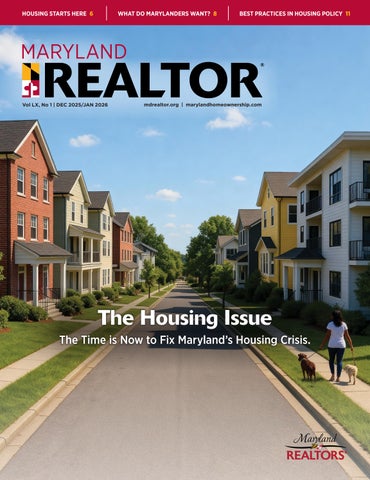
The opinions expressed by nonstaff contributors may not reflect the official opinion of Maryland REALTORS® and/or policies derived from leadership and staff.
Mission Statement
Maryland REALTORS® exists to support all segments of its membership and their specialties. Maryland REALTORS®, through collective efforts with local boards/associations and the National Association of REALTORS®:
■ Develops and delivers programs, services and related products that maintain and elevate the high standards of the real estate business and the professional conduct of its practitioners;
■ Assists members in ethically and professionally serving the public;
■ Promotes and preserves the right to own, transfer and use real property; and
■ Protects the right of members to conduct business within a framework of fair and reasonable laws and government regulations.
In principle and in practice, Maryland REALTORS® values and seeks diversity and inclusive participation within the field of real estate and recognizes each member as a unique individual.
Moving Forward with Purpose on Housing
The start of a new year is more than a moment of reflection; it’s an invitation to step forward with purpose. As we take stock of the progress we’ve made, we also gain clarity about what comes next and how we can shape a stronger future for Maryland’s housing landscape.
This issue of Maryland REALTOR® magazine embraces that spirit. It looks squarely at the challenges Marylanders face when it comes to housing, and it provides solutions rooted in what voters themselves have told us they want. These pages highlight the opportunities our elected leaders have to ease the housing crisis and help communities thrive.
We know what happens when the housing crisis goes unaddressed. Fewer available homes. Higher prices. More Marylanders feeling pushed to leave the state. And local governments hesitating to update land-use and zoning policies that could expand housing options for middle- and lowerincome families.
You’ve heard me say, “Be one. Do one. Bring one.” As the legislative session and the 2026 elections approach, “Bring one” becomes especially powerful.
Attend local government meetings and bring a colleague along. Get to know your association’s government affairs director. Speak up when public policy decisions are being shaped. When the NIMBY voices show up, be the YIMBY who says yes to smart, inclusive growth. Even if a meeting’s agenda seems minor, being present builds familiarity, confidence, and connection. In candidate forums, press for real and specific solutions to the housing crisis.
And here’s the part people forget: advocacy isn’t just civic engagement—it’s networking. Every meeting is a chance to build relationships with the people who live, work, and invest in your community.
When it comes to “Do one,” start by sharing what you’ve learned. Talk about the ideas and data you’ll find on the following pages. Check out our “Advocacy Wins-days” videos. Follow our social media channels, share posts that speak to you, and tag us using #marylandsfuturebeginsathome. Want to go deeper? Team up with your local association and send a letter to the editor of your local community news organization. Use your voice to champion practical, commonsense housing solutions.
When
the NIMBY voices show up, be the YIMBY who says yes to smart, inclusive growth. ”
Here’s the best part: once you’re doing one and bringing one, you’ll quickly realize that you’re already being one —a REALTOR who leads by example and stands up for housing opportunity for every Marylander.
Complaints alone don’t change anything. Action does. Step into the conversation. Become a trusted voice in your community. Encourage solutions that make Maryland stronger.
Maryland REALTORS® and your local association are ready with the tools, information, and support to help you succeed.
All we need now is your voice. ■
Denise Lewis Is Maryland REALTORS®’ 2026 President.
Maryland’s Future Begins at HomeBY
Maryland’s economic and budgetary woes have been well documented in the years since the pandemic. Our anemic economic growth has led policymakers to search for answers to unlock Maryland’s potential and set us back on the path to financial prosperity. Increasingly, the solution comes back to housing.
This Fall, Maryland REALTORS® launched the “Maryland’s Future Begins at Home” campaign, to highlight the critical link that housing supply and attainability plays in our state’s economic success.
This idea wasn’t developed in a vacuum. An October report from the Comptroller of Maryland
clearly shows that our severe housing shortage and excessive costs are creating a downward drag on the labor market, economic output, and state revenues.
Namely, Maryland is losing around 40,000 residents annually to states with lower housing costs, like Florida, Pennsylvania, and Texas resulting in a net loss of $2.7 billion in Adjusted Gross Income (AGI). Housing affordability and
Want to do your part?
overall cost of living are now a driving force of migration decisions.
The “Maryland’s Future Begins at Home” campaign urges policymakers to move beyond piecemeal changes toward a sustained, collaborative effort to address Maryland’s housing crisis. By doing so, Maryland can retain its tax base and workforce, both now and into the future. ■
REALTORS® and their clients are encouraged to visit OpenDoorsMaryland.org to learn about the “Maryland’s Future Begins at Home” campaign and to share your housing stories with Maryland decision makers. Follow the QR code!
Housing Starts Here in Maryland
BY WES MOORE, GOVERNOR OF MARYLAND
Every Marylander should have a pathway to work, wages, and wealth, and we must ensure that opportunity is accessible for more families in our state. One of the best wealth creation tools is owning a home. But now, as prices surge and supply dwindles, the dream of homeownership seems unattainable for far too many.
The housing shortage is a complex problem, but the solution is relatively straightforward: We need to build more housing. And as we build more, we will bring costs down, drive economic growth, and help more Marylanders claim their piece of the American Dream.
To understand the depth of the ongoing housing crisis and the need for swift action, you simply need to look at the numbers. From 2000 to 2022, the share of households in Maryland earning enough to afford a median-priced home fell from 75% to less than 50%. Housing affordability is the number one concern for voters, with nearly a quarter citing it as the biggest problem facing the state. Even renting has become prohibitively expensive, with average monthly rents for a two-bedroom apartment in Maryland rising well above the national average.
The result of this price surge, detailed in Comptroller Brooke Lierman’s recent report on Housing and the Economy (follow the QR code), is that young people and middle-income families are fleeing the State of Maryland. We rank in the top 10 of all states in the nation for population loss. Notably, many Marylanders are relocating to neighboring states, signaling a willingness to endure a longer commute to their job in Maryland because there are more plentiful and affordable housing opportunities just across the border.
The crux of the problem is low supply. Conservative estimates suggest that to provide enough homes at an affordable price for current Maryland residents, we need to build another 100,000 units. This projection doesn’t account for the nearly 600,000 additional units we would need to accommodate population growth in the coming years.
Getting back on track would mean building 30,000 homes each year. But since 2014, Maryland has only permitted an average of 18,000 units per year, far fewer than our neighboring states.
It’s time to turn the tide on Maryland’s housing shortage. And our administration is fighting to do exactly that. Secretary Jake Day and his team at the Maryland Department of Housing and Community Development have focused on adopting new policies and reforming outdated processes to accelerate housing production statewide.
In the 2024 General Assembly session, we partnered with legislators, local governments, industry experts, and community advocates to secure passage of the most significant housing legislation Maryland had seen in decades, including the Housing Expansion and Affordability Act. Our agenda helped improve regulations and streamlined processes related to housing production. It also incentivized development and guided investment to build on state-owned land, on properties owned by willing nonprofit, religious, and civic partners, and near rail stations.
Our Housing Starts Here Executive Order can be summed up in a single word: speed. We need to move faster to build new homes, make housing more affordable, and create a more competitive market.”
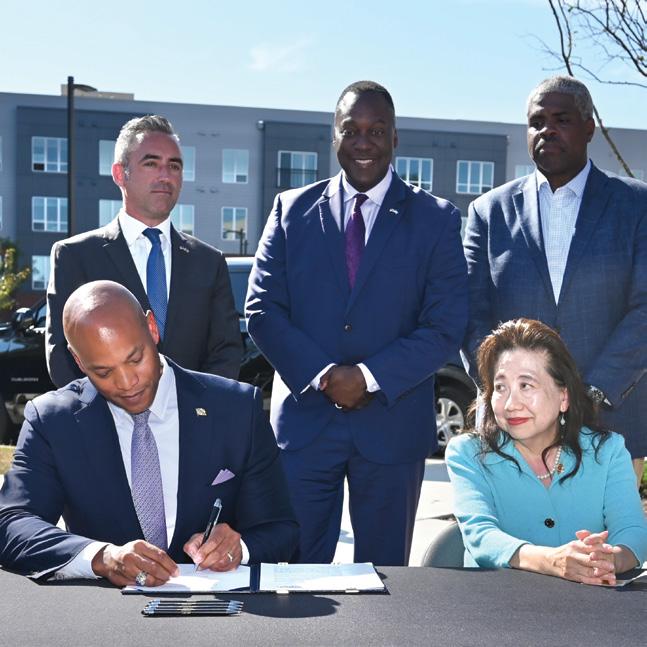
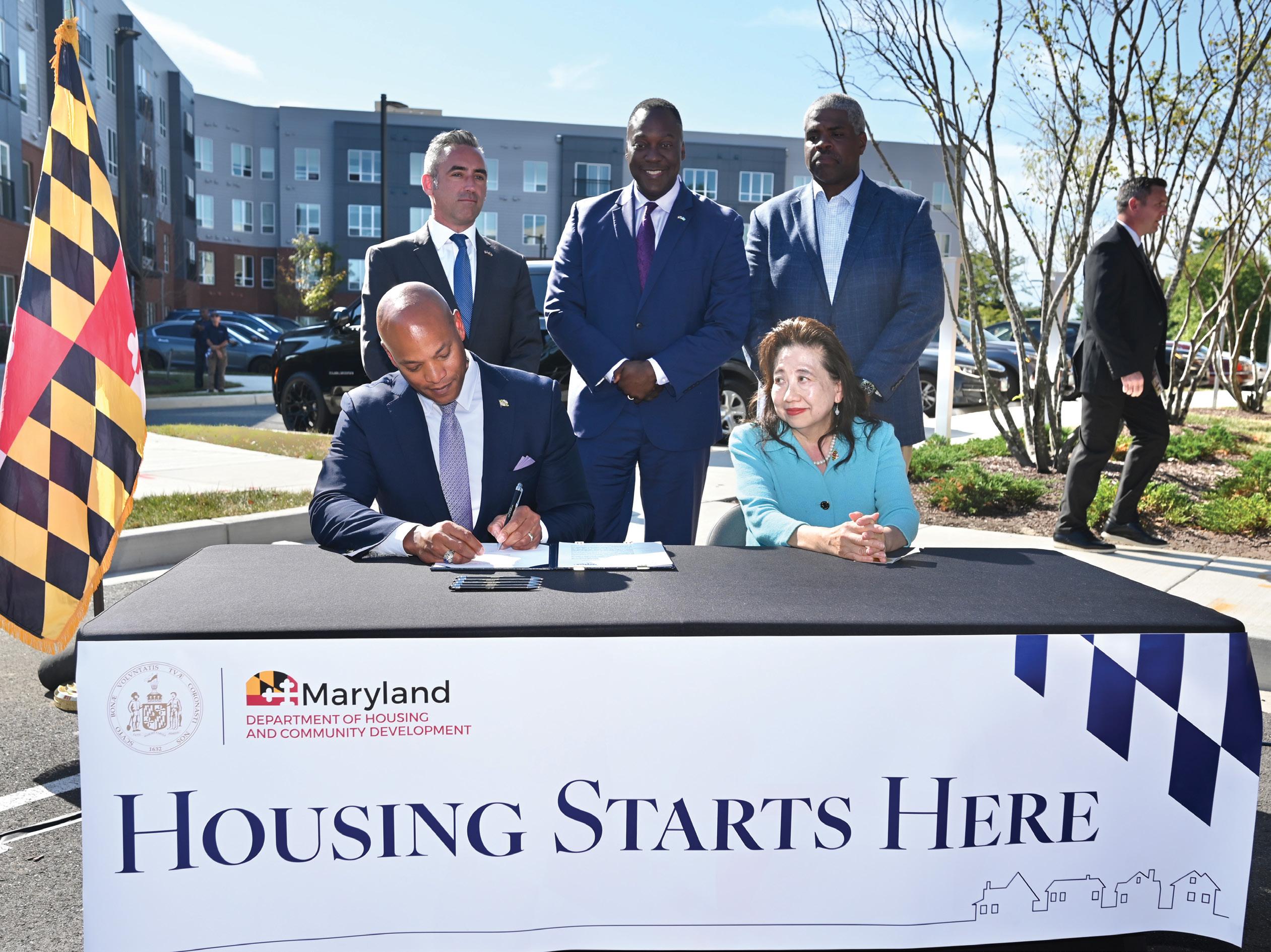
While I’m proud of that victory, there’s still more to do. That’s why, in September, I signed the “Housing Starts Here” Executive Order, which builds upon our 2024 legislation to supercharge the creation of new, affordable housing in Maryland. Our Housing Starts Here Executive Order can be summed up in a single word: speed. We need to move faster to build new homes, make housing more affordable, and create a more competitive market.
Four primary components anchor this push. First, we will accelerate development on state-owned land, selecting prime locations that can be used for transit-oriented development and new housing. Second, we will streamline state permitting to improve speed, transparency, and predictability. Third, we will establish housing production targets that set clear goals for local jurisdictions. Fourth, we will create the Housing Leadership Award to recognize local jurisdictions that meet or exceed production targets or enact policies to advance housing development.
Gone are the days of “no” and “slow” when it comes to housing development. Maryland will be the state of “yes” and “now.” And even though we’ve already delivered major progress, we will continue to be aggressive in our push to build more, quickly and responsibly. For this administration, housing isn’t a phase or a fad. It’s an ongoing mission.
Our work has just begun, and I hope you will lend your support and advocacy to help make Maryland a state that is pro-housing–fully and unapologetically. ■
Wes Moore is the 63rd Governor of the State of Maryland.
What Do Marylanders Want? Housing. NOW.
Maryland’s Unmistakable Mandate for Housing Legislation BY
BY LISA MAY
The conversation about Maryland’s housing needs and affordability is over. It is no longer a niche policy debate—it is a full-blown economic crisis that Maryland voters are demanding the General Assembly solve with decisive state action.
Two comprehensive polls conducted in early 2025 deliver an overwhelming, non-negotiable mandate: The state must prioritize our state’s economic growth by dismantling the local barriers stifling new construction and delivering housing that Marylanders can actually afford. The data is clear, the political opportunity is massive, and inaction is politically and economically unsustainable.
Housing Pain is Widespread
Maryland families are feeling intense financial pressure, and they are pointing directly at the cost of housing. According to a Greater Greater Washington poll fielded in February 2025, 74% of Marylanders report that rising housing costs are causing a financial burden for themselves or someone in their immediate family
This is not a marginal issue; it is a fundamental threat to household stability.
Findings in Maryland REALTORS®’ annual State of Housing poll from January 2025 reinforce this urgency. Housing affordability was the top volunteered issue voters want the legislature to address, and they were nearly unanimous—84%—in their belief that the cost to buy a house in Maryland is “too high.”
The consequence of this affordability crisis is a profound threat to Maryland’s workforce retention: nearly onethird of voters overall, and 42% of young renters have considered leaving the state because of high housing costs. If we cannot house our younger workforce, our economy faces a catastrophic brain drain.
Voters Speak. Are Elected Officials Listening?
Historically, housing production was the purview of local governments, with state officials taking a mostly hands-off approach. However, that framework has brought us a housing crisis that has gotten worse, not better, with each passing year. The status quo is no longer working—or acceptable—to Maryland voters.
State officials are earning dismal grades for their handling of this crisis, with 73% of voters giving them a “poor” or “just fair” rating on housing affordability and availability. Local governments fare even worse, receiving “poor” or “just fair” grades from 77% of voters.
Voters recognize the problem, and they hold their elected leaders accountable for failing to deliver solutions. The message here cannot be ignored.
The Need is Real and Growing
The polling confirms that voters understand the core issue: we simply haven’t built enough homes across the entire economic spectrum. Large majorities consistently identify a shortage across every major housing segment, including those with lower incomes, older Marylanders and those living with disabilities.
What has been most eye-opening is the dramatic change in views on housing for middle-income Marylanders. When Maryland REALTORS® began the State of Housing poll in 2020, only 46% said that there was too little housing that was affordable for those with middle incomes. By January 2025, that had increased to 66%. In a separate Maryland REALTORS® poll conducted in September, that number had jumped even higher. Now, 74% - nearly three in four – Maryland voters believe there is too little housing that is affordable for the middle class.
74
Maryland voters say that RISING HOUSING COSTS ARE CAUSING A FINANCIAL BURDEN for themselves or someone in their immediate family.
Source: Greater Greater Washington survey of Maryland voters, February 2025
84
believe the cost of housing in Maryland is TOO HIGH in 2025.
42
of YOUNGER RENTERS are considering LEAVING MARYLAND due to the high cost of housing.
Nearly
7 in 10
voters (69%) agree with REDUCING THE AMOUNT OF TIME it takes for housing project to go through PERMITTING PROCESSES.
7 in 10
76
of Maryland voters support reforms that prioritize putting MORE HOMES in areas where JOB OPPORTUNITIES HAVE OUTPACED available housing supply.
Maryland voters want to see a MIX OF HOMES AND BUSINESSES NEAR TRANSIT AREAS, and allowing for smaller housing options (duplexes, townhomes, etc.) on most residential lots in existing neighborhoods.
7 in 10
Maryland voters (71%) believe the GOVERNMENT SHOULD REDUCE BARRIERS to building new housing, the help bring down prices.
73 believe that STATE GOVENMENT is only doing a FAIR OR POOR job on housing issues.
77 believe that LOCAL GOVENMENT is only doing a fair or poor job on housing issues.
79 demand governments “STICK TO CLEAR AND OBJECTIVE CRITERIA” when evaluating housing projects.
NOT ENOUGH housing for those with moderate incomes
74 66 46 September 2025
January 2025
January 2020
And let’s remember, when it comes to polling, most respondents view themselves as middle class. What those numbers are saying, loud and clear, is that Maryland does not have enough housing that is affordable for people like them
The Mandate for Action
The polling provides a clear blueprint for legislative success, offering specific, high-support policies that mirror key components of legislation that has been proposed in the General Assembly.
Voters overwhelmingly support state intervention focused on efficiency and production:
Reduce Regulatory Barriers: Seven in ten Maryland voters (71%) believe the government should reduce barriers to building new housing to help bring down prices..
Ensure Objective Criteria: An overwhelming 79% of respondents demand that governments “stick to clear and objective criteria” when evaluating housing projects. This policy directly addresses the arbitrary nature of the local permitting process, which frequently stalls development.
Speed Up Permits: Nearly seven in ten voters (69%) agree with reducing the amount of time it takes for housing projects to go through permitting processes. Time is money in development, and voters want the state to facilitate speed and certainty.
Build Where the Jobs Are: 76% support reforms that prioritize producing more homes in areas where job opportunities have outpaced the available housing supply. This is a clear economic strategy that connects housing policy directly to workforce needs.
Add Density to Existing Infrastructure: Seven in ten voters favor allowing a mix of homes and businesses in areas near rail transit stations, and allowing smaller housing options, like duplexes and townhomes, on most residential lots in existing neighborhoods.
State officials are earning dismal grades for their handling of this crisis, with 73% of voters giving them a “poor” or “just fair” rating on housing affordability and availability. Local governments fare even worse, receiving “poor” or “just fair” grades from 77% of voters.”
The Path to Economic Recovery is Paved with Housing
For state officials grappling with Maryland’s budget deficits and economic stagnation, housing production is the mechanism for economic stability. Voters understand that building is beneficial to creating jobs, increasing the customers for local businesses, and making housing more affordable.
The window of opportunity to fundamentally address Maryland’s housing crisis is open: the state must use its legislative power to boost supply, reduce regulatory friction, and prioritize housing development near jobs and transit.
Supporting aggressive pro-housing legislation is not just sound economic policy; it is a clear response to the overwhelming demands of the electorate, who have grown weary of soaring costs and regulatory paralysis.
By passing legislation that institutionalizes clear, objective building rules and encourages the production of diverse housing types, Maryland can stabilize its workforce, attract investment, and ensure that the next generation of residents can afford to stay and thrive here.
The time for action is now. ■
Lisa May is the Director of Advocacy and Public Policy for Maryland REALTORS®.
Options for Maryland: Implementing Best Practices in Housing Policy
BY
BY SALIM FURTH MERCATUS CENTER AT GEORGE MASON UNIVERSITY
Maryland has a long history as an innovative leader in housing policy. But in the last few decades the state has fallen behind, enabling less housing production and suffering higher prices than many peer states.
Maryland has long been a housing innovator. The Baltimore Plan of the 1940s offered rehabilitation as an alternative to destructive urban renewal. Suburban idealism was put into practice in Greenbelt and Columbia. Maryland builders showed that townhomes could work in suburban contexts—a trend that is now being imitated from New Hampshire to Nevada.
The early suburban developers set aside stream valleys in northern Prince George’s County, creating an enviable network of streams, woods, and trails along the tributaries of the Anacostia River. One county over, Bethesda’s high-rise, transit-oriented development is a style and degree of urbanization that would be hard to imagine in a comparably affluent suburb of Boston or San Francisco.
Some innovations were too clever by half. Montgomery County balanced an agricultural reserve conservation program with a market for transferable development rights, so that developers in places like Bethesda could buy and use the development rights lost by farmers. And Maryland courts were the first to validate inclusionary zoning ordinances. Inclusionary zoning— requiring a developer to subsidize some homes in each development—has more often been used as a mask for exclusion than a remedy.
Even today, one of the hottest new housing trends is to copy Montgomery County’s Housing Production Fund, which allows a county commission to be a public developer, rolling over its funding and plowing what would otherwise be profits into setting aside a percentage of units as affordable housing. Five states have set up similar funds in the past year and a half.
Now a Leader Lags
But these recent innovations have not been enough to counterbalance rising opposition to homebuilding. Maryland, like any state, has a vigorous and vocal minority of residents who choose to show up at public hearings and oppose change in their neighborhoods, even if it costs others a place to live. And the unique environmental challenges of the Chesapeake Bay watershed have led to stricter environmental regulations. In the 1980s and 1990s, Maryland’s housing growth was on par with peers such as Delaware, Oregon, and Virginia, averaging 6 or 7 building permits per year for every 1,000 residents. Since 2005, however, the state has produced at less than half the old rate, matching California’s dismal growth record.
Partly, this decline is a result of slowing demand. Maryland’s home prices are among the slowest growing in the nation since 2005. And yet, those prices remain higher than in any bordering state.
Without overstating the affordability and growth challenges facing Maryland, there is clearly room to make it easier, cheaper, and less uncertain to build homes in the Old Line State.
Legislative Options
In Maryland, as in other states, legislators can reach into a well-stocked toolbox for policies to rebuild the state’s capacity to welcome new homes. In a recent policy brief (follow the QR code), my colleagues Emily Hamilton and Charles Gardner and I profiled four sections of that toolbox: reversing regulatory overreach, streamlining procedures, improving legal frameworks, and updating construction standards.
Although our brief was written mainly with state legislation in mind, the majority of these approaches can be taken at the county level. In addition, counties and cities are best positioned to preemptively upzone in order to increase competition between builders and lower housing costs.
Reverse Regulatory Overreach
The state legislature devolves land use powers to the counties and some cities—but not without guardrails. Maryland’s worsening growth and rising prices suggest that these guardrails need to be repaired.
Finish legalizing accessory dwelling units. Effective October 1, 2025, a new Maryland law allows basement apartments and backyard cottages statewide. But Hamilton and Kol Petersonrated the law as “weak” relative to those in peer states, since it only closes one of four major loopholes that hostile local governments exploit. Maryland can really unlock these small homes by closing the last three loopholes:
a. Outlaw discrimination against renters
b. Cap local parking minimums
c. Require by-right permitting processes
Models: Washington and Arizona.
Allow residential uses in commercial zones. The 2024 Moore Housing plan (formally, the Housing Expansion and Affordability Act) took a decisive step toward opening up the largest untapped pool of land where housing can be built without adding utilities: commercial zones. But that legislation was limited in geography (it only applies near transit stops), and it only applied to mixed-income housing. The legislature could go much further, allowing townhomes and apartment buildings anywhere that offices and retail are allowed.
Models: Texas, Florida, and Montana allow multifamily development in commercial zones, at least in larger jurisdictions.
Cap minimum lot sizes.
How many homes can fit into a new subdivision? That’s limited by minimum lot sizes, which increase sprawl and hurt affordability.
Models: Maine capped minimum lot sizes at 5,000 square feet in any location served by sewers. The reform passed unanimously.
Allow transit-oriented development.
WMATA serves the nation’s best examples of transitoriented development—mostly on the Virginia side. State law should allow tall buildings and walkable neighborhoods near WMATA and MARC stations with minimal barriers.
Models: Colorado requires jurisdictions served by transit to upzone sharply, although the localities can decide how to map the new zoning.
Limit parking mandates.
Most zoning codes in Maryland require an arbitrary amount of land to be paved over for parking, leading to a large number of unused parking spaces. In cities like Cambridge, Maryland, that don’t require parking, developers provide what is necessary and avoid waste
Models: Washington, Montana, and New Hampshire have all capped parking requirements at zero to one space per home, depending on the situation.
Streamline Procedures
Every builder knows that approval delays can add costs and kill projects. Discretionary review procedures also introduce bias into the approval process and invite corruption.
Allow third-party review of building plans. Several Maryland counties already encourage reviews of development plans by outside professionals, at the builder’s expense. Others should imitate this practice, and the state can require that they allow qualified thirdparty reviews to replace in-house review.
Model: Prince George’s County builders and regulators use third-party review extensively.
Include conserved land in density calculations.
When Tom Coale and I interviewed Maryland land use lawyers and building professionals agreed that environmental approval processes were broken. One helpful change would be to give developers credit in density calculations for land they agree to conserve. This would boost the number of homes in each development and reduce the developer’s incentive to fight against conservation requests.
Model: Montgomery County calculates density based on the developer’s entire project area, including land that remains natural.
Create a unified standard for environmental waivers.
Because most projects cannot meet unrealistic environmental standards, they instead proceed via state and local “alternative compliance.” Lawmakers should codify a uniform standard or automatically waive state compliance when equal-or-more stringent local compliance is achieved.
Model: Massachusetts has some unreasonable local environmental standards, but at least projects don’t need double approval to proceed.
Require “specific and objective” approval criteria.
Zoning, historic, and other codes sometimes include vague rules that invite biased, unpredictable review. The state can require that codes be specific and objective so that everyone can understand and follow the rules.
Model: Rhode Island and Washington have reined in unpredictable discretionary review by local staff and design review boards.
Fix zoning that makes existing conditions
illegal.
In many historic areas of the state, existing zoning would not allow the existing development patterns. Zoning that doesn’t reflect reality can make it infeasible to redevelop vacant sites and replace decayed buildings. To address this problem, the legislature should invalidate restrictions on siting, use, parking, or bulk on blocks where at least one-quarter of the buildings don’t comply.
Many states have this problem - none has decisively addressed it.
Improve Legal Frameworks
State law creates a background of rights and procedures that quietly influence every land use decision.
Adopt protections against downzoning. Maryland property owners have virtually no protection against new regulations that reduce their opportunities and property values. The state can adopt Arizona’s approach and require the county to compensate a property owner for a proven reduction in property value.
Models: Arizona is the gold standard. Wisconsin requires a supermajority council vote to approve a downzoning, which is simpler but weaker.
Limit who can appeal
administrative approvals.
Maryland’s standard for those who can sue to block a local approval has eroded. Maryland lawmakers should revise the administrative appeals statute to discourage such bad-faith appeals. They should narrow the definition of special aggrievement to include an objective injury not otherwise addressed by permits, such as damage to property. Appellants should substantiate such an injury by an affidavit or third-party expert report, similar to what is required of medical malpractice plaintiffs alleging professional negligence by a healthcare provider.
Make Maryland an early-vesting state.
Governor Moore’s 2025 Housing for Jobs Act included this small, common-sense reform, which would ensure that builders can complete their projects without the rules changing midway. The bill stalled, but this provision should go forward.
Model: In Virginia, building rights vest when a developer has made significant expenditures reliant on a governmental approval.
Update Construction Standards
Maryland has taken important steps toward ensuring that innovative and cost-effective construction methods are allowed. Officials can follow through and ensure that those steps result in real change and more diverse options for residents.
Create safe standards for single-stair buildings.
This building type is praised for allowing family-size apartments on smaller, urban lots where a larger apartment building would be infeasible. HB 489 (2025) kicked off the legalization process by asking the Department of Labor for a report by the end of 2026. The administration should communicate as research is completed and be ready to move toward complete legalization.
Model: Baltimore City signed into law a detailed single-stair building code amendment, adopted November 3, 2025.
Remove additional barriers to manufactured and modular homes.
The Housing Expansion and Affordability Act requires that manufactured and modular homes be allowed wherever stick-built houses are allowed. The administration should track this question and ask for legislation addressing any remaining barriers, such as local design requirements that conflict with the HUD code for manufactured homes.
Allow lower-cost elevators.
New research has identified a key reason elevators are so scarce in the U.S.: they cost three times as much as in peer countries. Lawmakers can address these high costs by allowing smaller elevators in mid-size buildings and allowing elevators that comply with international standards.
Model: The Center for Building in North America has published detailed policy suggestions.
Conclusion
Maryland’s history of housing innovation shows what the state can achieve when policy aligns with practicality and ambition. Yet its current housing shortage and high costs suggest a system constrained by outdated rules, excessive discretion, and insufficient flexibility. Reclaiming Maryland’s leadership means making it easier to build homes that meet the diverse needs of its residents. Reforms should focus on reversing overregulation, streamlining reviews, modernizing codes, and trusting markets to adapt. Thoughtful reform, rooted in both Maryland’s legacy and today’s best practices, can restore balance between environmental stewardship and housing opportunity. ■
Salim Furth is a Senior Research Fellow and Director of the Urbanity project at the Mercatus Center at George Mason University. His research focuses on housing production and land use regulations. He frequently advises local governments and testifies before state and federal legislatures. He earned his Ph.D. in economics from the University of Rochester.
Maryland’s Housing
MENU
Maryland’s future is built upon having the housing we need to serve our residents and our workforce. Fortunately, many of the solutions outlined in this article and which have been proven to work will be before the General Assembly in 2026. They includ e:
Zoning Reforms That Promote Housing
Local zoning laws dictate what can be built and where. Too often, these regulations only allow large single-family homes on large lots, and prohibit smaller, denser, and more attainable housing types. State officials should enact legislation that expands both middle housing options (like townhomes, duplexes, and cottage homes) and where those homes can be located, so that more Marylanders can find housing that meets their needs.
Housing Production Incentives
Quantifying Maryland’s housing shortfall is a necessary step toward closing the gap between the housing we have and the housing we need. Our elected officials must be held accountable for producing housing within their jurisdictions until those shortages are eliminated, and those that do should be rewarded for their efforts.
Reducing Barriers to Housing Construction
Even where housing is allowed to be built, there can be obstacles that prevent new developments from moving forward. These include convoluted permitting processes and unpredictable project approval timelines. It can also include the misuse of regulations intended to match growth with infrastructure improvements, which are made so onerous they stop housing altogether. The General Assembly should pass legislation to provide an orderly, predictable, and affordable development approval process to speed up housing production.
Addressing Housing Affordability
Increasing Maryland’s housing supply will reduce the costs of rentals and ownership units. However, low- and extremely low-income residents will still require additional assistance to afford housing within their budgets. Maryland officials should consider measures targeted to this population, including expanding the Renters’ and Homeowners’ tax credit programs, and addressing the steep rise in property tax assessments for rental properties not covered by the state’s homestead exemption.
Accelerated Incrementalism in Housing Policy: A Pragmatic Path to Reform
BY CHUCK KASKY
In the realm of housing policy, sweeping reforms often face political gridlock, budgetary constraints, and public resistance. Yet the urgency of our housing crisis, from affordability to homelessness, demands action. Enter the concept of accelerated incrementalism, a strategic approach that blends the realism of gradual change with the urgency of rapid implementation. It’s not a contradiction in terms, but a nuanced framework for achieving meaningful housing reform without waiting for perfect conditions or consensus.
Accelerated incrementalism refers to a policy strategy that implements small, manageable changes at a faster pace than traditional incrementalism. Rather than overhauling housing systems in one fell swoop, policymakers introduce a series of targeted reforms like zoning tweaks, funding shifts, pilot programs, and regulatory adjustments on a compressed timeline. The goal is to build momentum, test ideas in real time, and scale successful interventions quickly.
This approach recognizes that housing systems are complex and deeply embedded in local politics, market dynamics, and community identities. Trying to impose radical change overnight often leads to backlash or unintended consequences. Accelerated incrementalism offers a middle path: bold in ambition, modest in execution, and nimble in adaptation.
Housing policy is notoriously resistant to change. Local zoning laws, entrenched homeowner interests, and bureaucratic inertia can stall even the most wellintentioned reforms. Meanwhile, housing shortages, rising rents, and growing homelessness continue to escalate. Accelerated incrementalism offers a way to break the stalemate.
■ Political Feasibility. Small changes are easier to pass through city councils or state legislatures. They attract less opposition and can be framed as pragmatic rather than ideological.
■ Public Buy-In . Communities are more likely to accept gradual shifts, like allowing duplexes in single-family zones than sweeping transformations.
■ Policy Learning. Incremental steps allow governments to evaluate outcomes, adjust strategies, and avoid costly missteps.
■ Speed. By stacking reforms and shortening implementation cycles, accelerated incrementalism achieves cumulative impact faster than traditional methods.
Several cities and states, including Maryland, have embraced elements of accelerated incrementalism, often without naming it as such.
■ Minneapolis 2040 Plan: The city eliminated singlefamily zoning in favor of triplexes citywide. While this was a bold move, it was preceded by years of smaller zoning reforms and public engagement, making the transition smoother.
■ Maryland’s ADU Legislation. After a multi-year study, the state passed statewide ADU legislation. This is a bold move in making ADU opportunities statewide, while also allowing local governments time to implement the new law for their communities. Each jurisdiction with zoning authority must adopt by October 1, 2026, an ordinance allowing ADUs.
■ Portland’s Residential Infill Project. Portland, Oregon, incrementally expanded housing options in low-density neighborhoods, allowing duplexes, triplexes, and fourplexes. The policy was phased in with design standards and affordability incentives to ease community concerns.
These examples show how accelerated incrementalism can reshape housing landscapes without triggering political upheaval.
To accelerate incrementalism effectively, policymakers must rethink how reforms are designed and deployed. Key strategies include:
■ Bundling Reforms. Instead of passing one change per year, bundle several complementary reforms into a single legislative package. For example, zoning reform paired with permitting streamlining and affordability incentives.
■ Short Feedback Loops. Use pilot programs and data dashboards to monitor outcomes quickly. Adjust policies based on real-time feedback rather than waiting for multi-year evaluations.
■ Administrative Agility. Empower local agencies to implement changes without lengthy approval processes. This may require revising procurement rules, staffing models, or interdepartmental coordination.
■ Narrative Framing. Communicate the vision behind incremental changes. Frame them as steps toward a more inclusive, resilient housing system rather than isolated tweaks.
Accelerated incrementalism is not without risk. Moving too fast can overwhelm administrative capacity or
provoke community resistance. Poorly designed reforms may have unintended consequences, such as displacement or speculative investment. That’s why the “incremental” part of the strategy is crucial. It allows for course correction and stakeholder engagement.
Moreover, acceleration must be grounded in equity. Rapid reforms that benefit developers but ignore tenants or low-income residents can exacerbate inequality. Policymakers must ensure that incremental steps are aligned with broader goals of affordability, accessibility, and racial justice.
While most examples come from U.S. cities, accelerated incrementalism has global relevance. In rapidly urbanizing countries, where housing demand outpaces supply, this approach can help governments test and scale solutions without waiting for perfect infrastructure or political consensus. In post-industrial cities facing population decline, it can support adaptive reuse and neighborhood revitalization.
The key is to tailor the pace and scope of reforms to local conditions, while maintaining a clear vision of longterm transformation.
Your Car has Gone the Distance for You
it can go the distance for someone else
When it’s time for a new car, let the one you’ve relied on help another family move forward.
Donate your car to Vehicles for Change and give local families access to reliable transportation.
Client moving and no longer need their car? We can help.
Running or not, we’ll tow it for free.
The Housing Market in 2026
BY ANIRBAN BASU
The coming of the New Year represents a critical point for Maryland’s economic and housing market future. Forces shaping housing markets, including monetary policy, federal government cutbacks, demographic shifts, mortgage rate declines, and decades of restrictive local land use decisions are converging to create both unprecedented challenges and strategic opportunities for Free State real estate professionals.
As indicated by the Maryland Department of Housing and Community Development, Maryland confronts a 96,000-unit housing shortage that fundamentally constrains the state’s economic competitiveness. Homes have simply become too expensive for many younger families and solo professionals, leading many to abandon the state for communities that offer more opportunities to live affordability, including in the American south.
This deficit represents the accumulated consequences of local zoning restrictions and NIMBY opposition that have systematically suppressed housing production, elevated costs, and created barriers to workforce mobility and business expansion. Housing scarcity now directly threatens Maryland’s ability to attract talent, retain businesses, and maintain fiscal stability. Community opposition often targets proposed
apartment developments, but even proposed singlefamily developments often face organized opposition, because of concerns regarding school overcrowding and traffic. But data indicate that Maryland’s population has barely expanded in recent years. Since 2020, the state’s population has expanded at a 0.43% annual rate, ranking it behind states like Rhode Island and Minnesota at number 33 according to Census Bureau data.
For Maryland REALTORS® preparing for 2026, understanding the relationship between housing supply, demand, mortgage rates, family income dynamics, buyer and seller psychology, remote work, and downsizing of the federal government will be pivotal. In a housing-constrained environment, the fact that many federal workers, including those in Montgomery and Prince George’s counties, are losing jobs is both a source of economic weakness and opportunity. Many federal households have enjoyed elevated incomes for years, have owned their homes for decades, and have disproportionately helped to drive their local economies. Their loss of jobs, either through voluntary actions such as accepting buyouts or because of layoffs, will negatively impact the local economy, but may also free up housing inventory for many, including younger families.
One might think that Maryland’s policymakers would respond to this state of affairs by bulking up Maryland’s economic development competitiveness. With the federal government no longer poised to be the economic driver of the past, the state will need to attract more private investment to support shared prosperity and tax bases. Instead, policymakers in Annapolis doubled down on its anti-growth policies during the 2025 legislative session by raising a host of taxes and fees, including a 3 percent information technology tax that has enraged many local entrepreneurs.
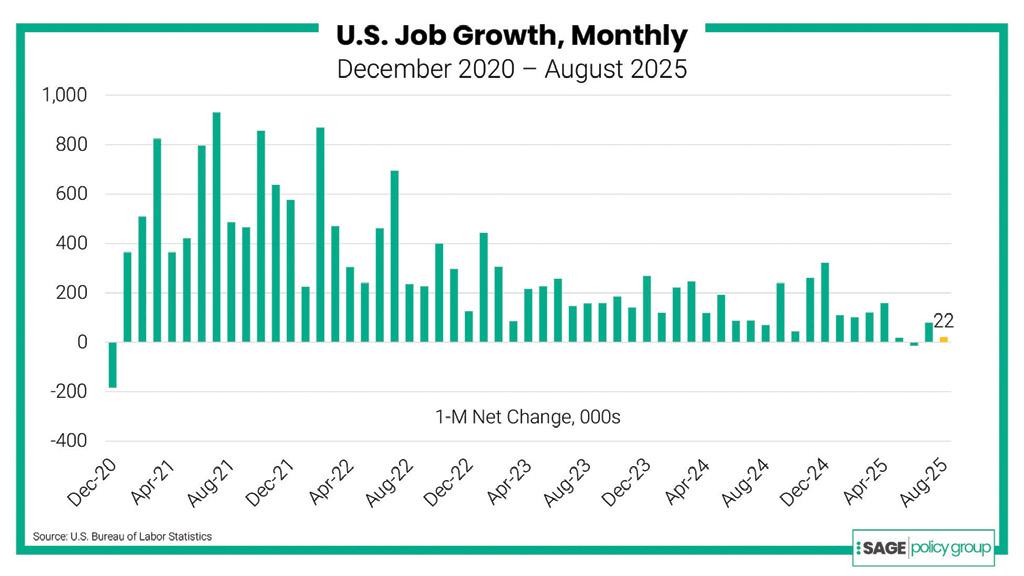
Maryland lost 15,000 federal jobs between January and August of 2025. Overall statewide job growth has slowed to a crawl, with unemployment continuing to edge higher in many communities. While that economic weakness may translate into additional fiscal weakness at the state level during the years ahead, it also suggests a repricing of local housing stock and greater affordability. For those who want Maryland’s economy to be strong, the next few years may prove disappointing. One suspects that many current Marylanders will leave the state once mortgage rates fall, allowing them to sell their home locally in pursuit of more affordable lifestyles (including for purposes of retirement) elsewhere.
National Economic Overview
No one could have predicted 2025. Much of the unexpected has been introduced by a president inaugurated on January 20th. Few were prepared for what has occurred. After all, this is President Trump’s second term in office, and many may have expected the economic conditions that characterized Trump 1.0. Those were generally good years with the economy, associated with flourishing financial markets and falling unemployment.
True, the pandemic undid that progress and then some. It has taken years for the U.S. economy to normalize. In many ways, the economy has yet to fully normalize, with stimulus spending still racing through the economy’s veins, inflation remaining above the Federal Reserve’s two percent target, and office vacancy rates still elevated in many of the nation’s largest cities.
Nonetheless, the U.S. macroeconomy entered 2025 with momentum. After expanding 2.9 percent in 2023, the economy grew another 2.8 percent in 2024. The notion among many had been if the U.S. economy could perform well under President Joe Biden, imagine what it could accomplish under the stewardship of businessman Donald Trump, who among other things enjoys
This (housing) deficit represents the accumulated consequences of local zoning restrictions and NIMBY opposition that have systematically suppressed housing production, elevated costs, and created barriers to workforce mobility and business expansion.”
Republican majorities in both the House and Senate and inherited an artificial intelligence infrastructure spending boom.
Alas, the year has not worked out as anticipated. Policymaking emanating from Washington, D.C. has aggressively sought to reshape global trade, American demographics, and taxation. The list of policies emerging from the nation’s capital is lengthy, including sizeable tariffs on leading trading partners like Mexico and Canada, Liberation Day tariffs on a variety of nations, 50 percent tariffs on steel, aluminum, copper, and India, and more recently announced tariffs on pharmaceuticals, kitchen cabinets, and upholstered furniture, passage of the One Big Beautiful Bill, and mass deportations.
One can debate the merit of such policies. Many cheer efforts to reindustrialize America, secure the southern border, and offer greater tax benefits for entrepreneurs, corporations, and wealthier households. Others bemoan rising costs associated with tariffs and fewer available workers, adjustments to social programs like food stamps and Medicaid, and prospective increases in the national debt.
Whatever one’s stance on such things, for now the impact has been to soften economic growth and reinvigorate inflation. At 2024’s onset, the nation’s unemployment rate stood at 4 percent. By August, it was 4.3 percent. Meanwhile, inflation by certain measures has risen above 3 percent once again, as tariffs paid by U.S. importers begin to be passed along to final consumers. The effective U.S. tariff rate has climbed to approximately 19.5 percent as of late-August, the highest level since 1933. Higher tariffs have already fundamentally altered trade dynamics and cost structures across industries. Construction has been hit particularly hard with rising prices for wiring, steel, and lumber, but the
impacts extend to automobiles, appliances, electronics, and consumer goods of all kinds. Whenever production costs increase, those costs ultimately find their way to end consumers.
Meanwhile, job growth has screeched to a halt, putting further pressure on households challenged by massive price increases transpiring over the past 4+ years. In certain larger communities including New York and Los Angeles, the regional unemployment rate is now above five percent.
To reinvigorate the economy and prevent unemployment from edging higher, the Federal Reserve cut interest rates in September and is poised to cut further during the months ahead. At this point, there is no optimal path for the Federal Reserve. With the economy both slowing and inflation reaccelerating, monetary policymakers are forced to choose between fighting inflation by remaining restrictive or easing policy to engender more growth. Recent actions and pronouncements by Federal Reserve officials indicate that the greater priority is preventing further economic softening.
Implications for the Housing Market
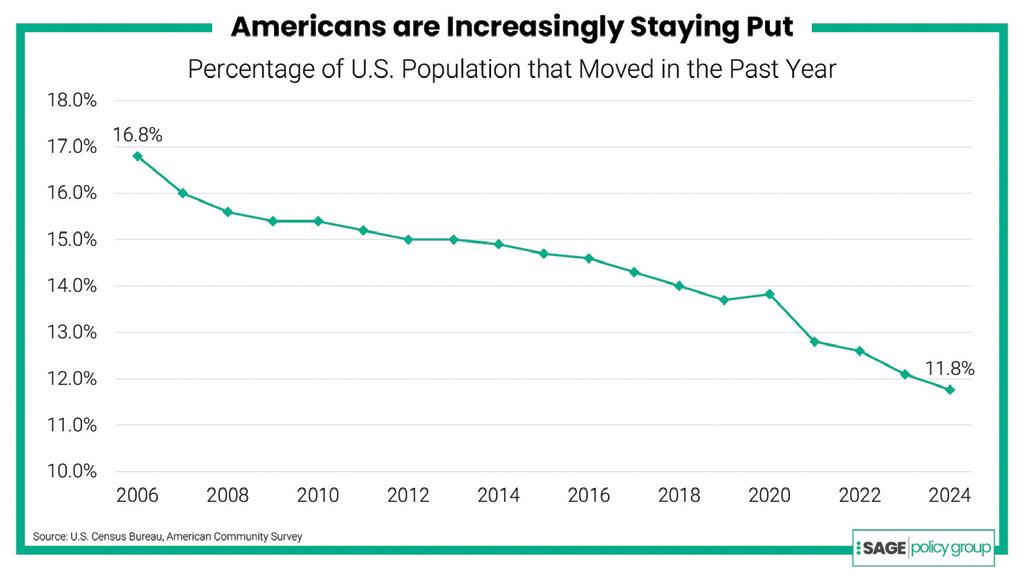
With mortgage rates still elevated and many having refinanced their mortgages during the pandemic or initial stages of recovery therefrom, America has simply not been on the move. Rather, many homeowners have delayed selling, producing limited inventories and upward pressure on sales prices.
It is the young who have been most negatively impacted by housing market dynamics. While a fortunate few of those in Gen Y (the Millennials) or Gen Z have attained homeownership status, many others have not, frustrated by low inventory, high prices, and by their standards, extremely elevated borrowing costs. Accordingly, it has often been older sellers and buyers who have been driving deal flow. In 2024, the median age of a homebuyer rose to 56 years, up from 49 the year prior. Moreover, the share of multigenerational households who purchase homes recently rose to 17 percent, a reflection of the imbalances that have emerged between household income and the cost of purchasing and maintaining a home.
True, the inventory of homes for sale has been rising recently, up 17 percent in June 2025 from a year earlier. Nonetheless, inventory remains approximately 20 percent below pre-pandemic levels. New construction is unlikely to come to the rescue in the near-term. Homebuilder sentiment remains constrained, with the National Association of Home Builder (NAHB) index at 37 in October 2025. This was below the breakeven sentiment reading of 50 for an 18th consecutive month.
One thing has changed recently. Home sales prices have begun to decline in a growing fraction of communities. As of July 2025, the S&P Case Shiller Index had registered declines for five consecutive months. In Tampa, prices are down 2.8 percent on a year-ago basis while Phoenix has registered a nearly 1 percent decline. It is not surprising that the markets that had been the strongest in terms of price gains are now the weakest; these are the markets that have seen the largest increase in supply over the past several years.
Maryland: No Longer America in Miniature
There was a time when Maryland’s economy looked much more like the nation. The state was a powerhouse in manufacturing, distribution by sea, air, rail, and road, financial services, and medical research. While the state remains a center of research, much of its growth in recent decades has been in federal government employment and contracting, thereby differentiating it from the balance of the nation. Despite having one of the nation’s most hostile business climates, the Free State continued to flourish as the federal government expanded ceaselessly. Alas, such things are no more. As a reflection of Maryland’s economic malaise, the State’s debt-rating was recently downgraded by Moody’s from AAA to AA1. This represents the first time in 52 years that Maryland has lacked a universal triple A bond rating.
There has been some good news locally. The Baltimore metropolitan area recorded 2,597 total sales in September, a 6.5 percent year-over-year increase that indicates resilience. Matters have been more volatile, however, in Maryland’s D.C. suburbs, which is shaped by federal workforce uncertainty, return-to-office mandates, and a lengthy government shutdown. These factors contributed to growing buyer hesitancy and flat price growth, with the median price up just 0.3 percent year-over-year. Still, the median sales price edged above $600,000.
On the Eastern Shore, market momentum softened, with 324 closed sales in July, a 5.8 percent decline annually. Meanwhile, inventory expanded 24.4 percent, hinting perhaps at future home sales price declines. The Eastern Shore is not alone. Inventory has been climbing rapidly recently in much of the state, including in both the Baltimore and Washington metropolitan areas.
Those rising inventory levels are in part a reflection of weaker purchasing interest. Homes are remaining on the market longer, with listings averaging 31 days in Baltimore, up 19 percent from a year-ago and 21 days in Maryland’s D.C. suburbs, 10 days longer than during the prior year.
Just as inventory begins to rise, Maryland state government has determined that this is now the time to aggressively intervene in the marketplace to
expand housing supply. The Housing Expansion and Affordability Act (HB538) represents a fundamental change of the relationship between state mandates and local zoning authority, attempting to directly address the state’s 96,000-unit housing shortage. Local jurisdictions historically maintained codes favoring singlefamily detached housing, constraining middle-density housing supply and contributing to price escalation.
Under HB538, projects within 0.75 miles of rail stations, on former government campuses, or controlled by nonprofits receive density bonuses and limitations on local requirements. In single-family zones, qualified projects may include duplexes, triplexes, and quadplexes. In multifamily zones, projects achieve 30 percent density increases, fundamentally reshaping infill development economics. Undoubtedly, many local government officials will challenge the State’s attempted intervention, zealously guarding their preeminence in rendering local zoning decisions and issuing permits.
Looking Ahead
Through all the uncertain characterizing 2025, the stock market has boomed, unemployment has remained reasonably stable, and inflation has failed to surge. With interest rates set to decline further in 2026 and with inventory of unsold homes rising, there is a likelihood that transactional volume will expand in America next year. That may also be true in Maryland. However, price dynamics are likely to be less favorable to homeowners and sellers in Maryland relative to the balance of the nation as many households seek to move as their federal careers wind to a close, as they seek less expensive environments and/or communities offering stronger job markets. ■
Anirban Basu is the Chair and CEO of Sage Policy Group.
Advancing the Agenda: Maryland REALTORS® 2026 Legislative Priorities
BY LISA MAY
Every year, the Maryland REALTORS® Public Policy Committee develops a focused slate of policy initiatives for the General Assembly. These efforts aim to achieve legislative changes that benefit the industry, its members, and critically, the home buying and selling public.
Aside from housing supply legislation, our 2026 priorities focus on modernization, consumer protection, and transaction processes.
Streamlining Contracts and Disclosures
One major point of frustration is the continual changes and lengthening of the contract of sale due to new real estate notices and disclosures introduced annually. This complexity makes the purchasing process more confusing for buyers.
To address this, Maryland REALTORS® will pursue legislation to establish an Online Real Estate Disclosure Portal. The objective is to create one state website where purchasers can enter a property address and instantly find specific information, such as easements, floodplains, and critical areas. If successful, this initiative would also set a precedent that future disclosures and notices should be handled through the portal, rather than further expanding the contract.
Another priority involves refining the process for handling earnest money deposits. In 2023, REALTOR® legislation (SB 651/HB 1235) was enacted to reform the return of deposit process, requiring the escrow holder to return a buyer’s deposit if the contract is properly terminated (unless the seller objects). However, this law applied only to a specific list of contingencies, notably excluding financing contingencies. Since this leaves open the question of why the process does not apply to every contingency, REALTORS® will seek legislation in 2026 to expand the deposit return provisions to all contract contingencies.
Addressing Fees and Transaction Processes
Maryland REALTORS®, working alongside a broad coalition of stakeholders, successfully defeated a proposal to implement a new $0.20/ page user fee for accessing the Land Records system (MDLandRec. net). This proposed fee was slated to coincide with the launch of a new records database. The focus for the next General Assembly session is finding a more permanent solution for this access fee issue.
Furthermore, Maryland REALTORS® will continue to engage on the issue of Condo/HOA resale fees and process reform. For several
sessions, legislation has been introduced to address excessive fees charged by Condominium Associations and Homeowners’ Associations for the resale disclosure packet. These efforts also seek to shorten expedited delivery timeframes and resolve the inconsistencies existing between the two governing acts.
Modernizing Brokerage and Agreements
Following the NAR Settlement, states are revisiting their real estate brokerage laws and determining whether to allow additional forms of representation. Many states currently allow licensees to act as transactional brokers, where the agent facilitates the sale without exclusively representing either party. Maryland may explore allowing this option, which would provide consumers with an alternative outside of the traditional buyer and seller agency agreements currently outlined in state law.
Finally, the 2026 agenda includes addressing existing 40-Year Homeowner Benefit Agreements (HBAs). Although legislation passed in 2024 to prohibit the future use of these agreements—where homeowners receive an upfront stipend in exchange for agreeing to use a specific brokerage later— approximately 1,000 HBAs remain recorded in Maryland land records.
continued on page 26
Empowering Agents Through Fair Housing Education: Maryland REALTORS® Leading the Way
BY SUSAN YASHINSKIE
In Maryland’s dynamic real estate landscape, ensuring equal access to housing is not just a legal requirement—it’s a moral imperative. The Maryland REALTORS® Education Department plays a pivotal role in equipping real estate professionals with the knowledge and tools they need to uphold fair housing principles and serve all clients with integrity.
At the heart of this mission is a robust educational framework that integrates fair housing training into both pre-licensing and continuing education (CE) programs. Every licensed agent in Maryland is required to complete two hours of fair housing education as part of their CE for license renewal. This requirement ensures that agents remain current with evolving federal, state, and local fair housing laws, including protections under the Fair Housing Act, the Americans with Disabilities Act (ADA), and Maryland-specific regulations.
The Education Department offers a variety of courses that go beyond the basics. These include interactive sessions, case studies, and video scenarios that help agents recognize and prevent discriminatory practices such as steering, blockbusting, redlining, and linguistic profiling. Courses also address newer areas of concern,
such as criminal record screening and sexual orientation protections, ensuring agents are prepared to navigate complex transactions with sensitivity and legal compliance.
One standout initiative is the Housing Opportunity Certification (HOC), which enhances REALTORS®’ understanding of affordable housing finance programs. Through four specialized classes, agents learn about federal, state, and local programs that support homeownership for underserved communities. This certification not only boosts agents’ expertise but also places them on a referral list on the Maryland Homeownership website, connecting them with clients seeking knowledgeable professionals. Look for dates in 2026 for our next set of HOC classes.
Maryland REALTORS® also publishes an annual Fair Housing Guide, a comprehensive resource detailing current regulations and best practices. This guide is designed to help agents educate their clients and promote fair housing in every transaction. It includes definitions of protected classes, examples of prohibited conduct, and instructions for filing complaints with the Maryland Commission on Civil Rights.
By integrating fair housing education into its core programming, the Maryland REALTORS® Education Department ensures that agents are not only compliant but also advocates for equity in housing. These efforts help prevent costly lawsuits, protect professional reputations, and most importantly, foster inclusive communities across the state.
In a profession where trust and ethics are paramount, Maryland REALTORS® continues to lead by example—empowering agents to uphold the values of fairness, respect, and opportunity for all. ■
Susan Yashinskie is the Director of Professional Development and Member Engagement for Maryland REALTORS®.
Scan to learn more about the HOC Certification
Scan to view our latest Fair Housing Guide.
Scan to view our latest Fair Housing Guide in Spanish.
Meet the Maryland Real Estate Commission
BY SCOTT LEDERER
As executive director of the Maryland Real Estate Commission, I believe it’s important and valuable for Maryland REALTORS® to know who serves on the commission. Behind every license issued, every policy reviewed, and every regulation enforced is a team of dedicated professionals and volunteer commissioners who work tirelessly to ensure the integrity of Maryland’s real estate industry.
In this issue, I’m pleased to introduce you to the people who make that work possible: our commissioners and our staff.
Our Commissioners
The Maryland Real Estate Commission is guided by a group of deeply committed individuals who bring a wealth of experience, insight, and public service to their roles. Our commissioners represent both industry and consumer interests, ensuring that every decision we make reflects fairness, professionalism, and a shared commitment to protecting the public.
We currently have one consumer member vacancy on the Commission. If you know of someone interested in this role, please have them reach out to me at scott. lederer@maryland.gov.
Our commissioners are invaluable to our mission. Their diverse
professional backgrounds and regional perspectives help us serve Maryland’s real estate community with balance and fairness. Even more impressive, they serve entirely as volunteers, dedicating their time, knowledge, and energy to strengthening our regulatory framework and upholding public confidence in the profession.
We are extremely fortunate to have such an experienced and capable board. The insight of each commissioner helps shape policies that are practical, equitable, and responsive to the evolving needs of both licensees and consumers. Their guidance ensures that the commission’s decisions reflect not only the letter of the law but also the realities of the industry they help oversee.
Our Staff
While the commissioners provide leadership and oversight, the dayto-day operations of the Maryland Real Estate Commission are managed by a group of exceptional staff members who demonstrate the highest standards of dedication and professionalism. This team handles thousands of interactions each year, from processing new license applications and renewals to responding to inquiries, investigating complaints, and ensuring compliance with Maryland’s real estate laws.
Their work requires accuracy, efficiency, and an unwavering commitment to public service. More than that, it requires empathy and patience. Our staff understands that behind every email, phone call, or application is a person — a licensee working to build their career or a consumer seeking help with a real estate concern. The respect and care they bring to every interaction truly embody what it means to serve. ■
Scott Lederer is the Executive Director of the Maryland Real Estate Commission.
Commissioners & Staff
MREC Commissioners
Demetria C. Scott, Chair Industry Member, Baltimore City
Joseph Wilson Industry Member, Eastern Shore
Sandy Olson Industry Member, Frederick County
MREC Staff
Executive Director: Scott Lederer
Hope Mims Industry Member, Baltimore County
Jackie Alexander Industry Member, Southern Maryland
Kambon R. Williams Consumer Member
Administrative Assistant: Tenensia Stanley
Roxanne Alston Consumer Member
Nea Maloo Consumer Member
Licensing Supervisor: Amore Umayahta
Licensing: Tia Wright
Stay Warm and Sell MORE with Maryland!
BY GREGORY HARE
In the cold winter months, there is nothing like the warmth of home. The Maryland Mortgage Program (MMP) partners with real estate professionals to help more Marylanders bundle up and begin a new chapter in a home of their own. MMP offers a variety of flexible financing options for realtors to guide buyers through the challenges of home purchase.
Check Out Some of Our Available Products:
■ Flex 3% Loan - Comes with a down payment assistance loan equal to 3% of the first mortgage in a 0% deferred second lien. Can be used for repeat buyers.
■ FHA 203K Limited Loan - Allows for additional financing for repair/modernization as part of the home purchase.
■ 1st Time Advantage Direct - No DPA but offers the lowest interest rate available with a MMP loan. ■
Gregory Hare is the Assistant Secretary, Maryland Department of Housing and Community Development. mmp.maryland.gov, singlefamilyhousing.dhcd@maryland.gov, 1-800-756-0119
CEO CORNER continued from page 17
Accelerated incrementalism is more than a policy tactic; it’s a mindset. It challenges the false binary choice between radical overhaul and cautious tinkering. By embracing small changes with big purpose, housing policymakers can navigate complexity, build trust, and deliver results.
In an era of housing precarity and political polarization, this approach offers a pragmatic compass for change. It doesn’t promise instant solutions, but it does promise movement, and in housing policy, movement is often the hardest part. ■
HOUSING ADVOCATE continued from page 22
REALTORS® will explore requirements, similar to those recently passed in Arizona, to address existing HBAs when no real estate brokerage services have been performed under the agreement.
2026 will be a busy one for real estate. Let’s get to work! ■
Lisa May is the Director of Advocacy and Public Policy for Maryland REALTORS®.
Chuck Kasky is CEO of Maryland REALTORS®.
Pitch59: Let Your Story Help Sell Homes
Every realtor has a story: the reason you got into this business, the values that guide you, the moments that remind you why it matters. Maybe it’s helping a first-time buyer find the perfect starter home or seeing a family’s excitement as they get the keys to their dream house. Those moments are what set you apart. But in a world of endless listings, digital ads, and online noise, your story can easily get lost.
With Pitch59, you can:
■ Create a short, personal video that brings your brand to life. Our AI script creator and on-screen prompter make it easy, even from your phone.
■ Share it instantly with clients, partners, or prospects via text, email, QR code, or social. No app required on their end.
■ Turn introductions into genuine relationships that build trust and drive referrals, because people do business with people they know, like, and trust.
■ Let others share your story, too. Anyone can forward your PitchCard to friends or family looking for an agent, multiplying your reach effortlessly.
■ Keep your network active and growing. With our analytics, see when your PitchCard is viewed or shared so you know who’s engaging and where new opportunities might come from.
Pitch59 helps you show up as your most authentic self, wherever business happens. Because homes aren’t just sold through transactions. They’re built on connections. Pitch59 helps you show up as your most authentic self, wherever business happens. Because homes aren’t just sold through transactions. They’re built on connections.
The Fine Print
That’s why Maryland REALTORS® has partnered with Pitch59, because we believe real connections drive real results. Together, we’re helping members make lasting impressions through authentic, 59-second video introductions called PitchCards.
Your PitchCard helps people see who you are, hear your passion, and feel your difference before they even meet you.
Maryland REALTORS® members: Tell your story. Grow your business.
Create your PitchCard today: Follow the QR code!
Maryland REALTORS® members receive exclusive pricing; this is a member benefit. Maryland REALTORS® does not endorse specific products but offers this partnership for your convenience. Terms and pricing available at pitch59.com . ■
Disputing an Earnest Money Deposit
Q: If the Buyer terminates the contract pursuant to a contingency (not related to financing), what is the procedure for the Seller if they want to dispute the distribution of the earnest money deposit?
BY KIM LINK, ESQ
A: If the Buyer terminates the contract pursuant to any contingency (set forth in Md. Code Ann., Real Property Art. §10-80)3 such as:
■ Appraisals
■ Back-up contracts
■ Condominium notices
■ Conservation easements
■ Deeds and titles
■ Home or environmental inspections
■ Homeowners’ association notices
■ On-site sewage disposal system inspections
■ Property condition disclosures and disclaimer act notices
■ Termite inspections
■ Third-party approval not related to financing; or
■ Water and sewer assessments notices, and the Seller does not want the earnest money deposit (EMD) to be returned to the Buyer, the Seller should do the following:
Within 10 days of receiving the Buyer’s request for release of the EMD, the Seller must provide the Escrow Holder with a copy of a notarized, written request for mediation relating to the distribution of the trust money.
The Seller may request mediation through Maryland REALTORS® Mediation Service Provider, O.M. Services, Inc. Follow the QR Code to learn more.
Once mediation services have been requested, the Seller must provide a copy of the notarized, written request for mediation to the Escrow Holder within 10 days of receiving the Buyer’s request for release of the EMD.
If the Escrow Holder receives a copy of the notarized, written request for mediation, they must hold the EMD until: (1) A court order or mediation agreement authorizes the distribution of the trust money, or (2) The Escrow Holder files an interpleader action in district court.
If a buyer or seller fails to meet a contract contingency, does the contract automatically “expire?”
Unless the contract specifically states otherwise, the contract does not automatically expire if a party fails to meet a contingency. The contract may be terminated under the terms of the contingency clause, but this usually requires affirmative action by the party exercising the contingency. Be sure to adhere to the terms and timelines provided in the contingency clause to protect your client’s interests.
Note: Maryland REALTORS is seeking expansion and clarification of EMD release provisions in 2026. See the Housing Advocate column on page 22 for more details. ■
Maryland REALTORS®.
Kim Link is the Director of Legal Affairs for
1ST
Sell More With Maryland.
LOCAL ZONING IS BROKEN
If local zoning worked, Maryland wouldn’t be short 590,000 homes needed both today and tomorrow.
The problem? Restrictive land-use policies and outdated zoning rules that favor big, expensive houses — homes out of reach for most Marylanders.
It’s no surprise that 70% of Marylanders believe their elected officials aren’t doing enough to fix the housing crisis.
But together, we can change that.
Visit OpenDoorsMaryland.org. Share your story. Demand action from state leaders.