Demanding, fickle and often fleeting, nothing offers challenge like the winter season. Our range is designed to let you thrive in this hostility. Hewn from ice, granite, and grit, this gear is strong, protective, and refined. Built to help you meet the challenges of winter head on.
WWW.RAB.EQUIPMENT
MAZAMA BULLETIN
IN THIS ISSUE CONTENTS
FEATURES
Weighed Down by the Past, p. 9
Mazama Lodge, p. 13
Mazama Mountaineering Center Update, p. 14 Alano Club & the Mazamas Team Up for Peak Recovery, p. 16
First Aid as Second Nature to the Mazamas, Part II, p. 19
The Thrill of the Mountains, p. 22 Climbing Committee Awards, p. 24
A Cold Night at Mazama Lodge, p. 26 Tomyhoi Peak, p. 30
National Forest Permits Part II, p. 34 Doing the Privilege Walk in the Outdoor Adventure Community, p. 36
COLUMNS
Correction, p. 4
Mazama Membership, p. 5
President’s Message, p. 6
Interim Executive Director’s Message, p. 7 Saying Goodbye, p. 18 Mazama Classics, p. 18
Successful Climbers, p. 24
Upcoming Courses, Activities, & Events, p. 25 What’s Happening Around The Mazamas? p. 29 Executive Board Minutes, p. 38 Mazama Used Equipment Sale, p. 39 Colophon, p. 39
We are at a crossroads which will determine whether we see that future come true. We could lose a lot more than our identity if we do nothing. ” p. 6
Not all the weight that I carried, mind you, was due to outdated equipment. It also had to do with some poor choices I made with new gear because my considerations were likewise based on the past: the memory that heavier pack-weight was simply part of the deal." p. 9
The privilege walk is typically an eye opening experience for those from privileged backgrounds, as individuals come face to face with other people in their community who have had vastly different experiences based on parts of their personal identities." p. 36
JANUARY/FEBRUARY 2023 3
Cover: Climbing Committee Chair Trey Schutrumpf teaching an ICS class on evaluating the snowpack and avalanche safety. Photo by Brendan Scanlan.
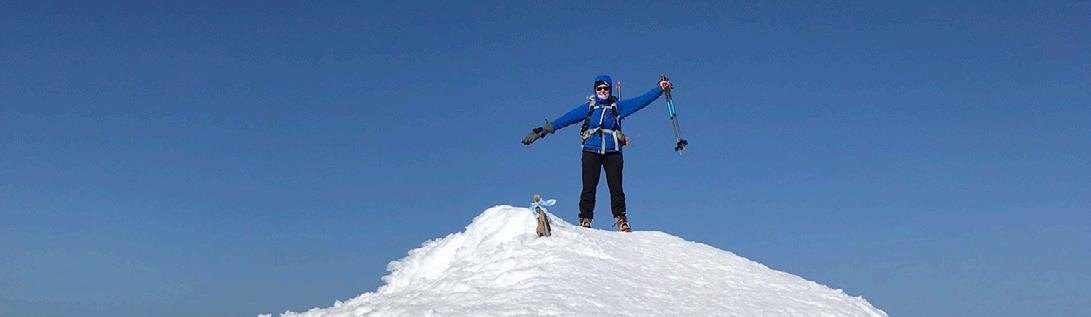
Above: New member Susan Bailey on the summit of Mt. Adams, July 14, 2019.
Volume 105 Number 1 January/February 2023
CORRECTION
The amended and restated Mazama Bylaws published in the November/December Mazama Bulletin (see pages 26–31 of that issue) contained a typo. Section 4.10 includes a reference to 4.12. The reference should be to 4.11. It should read as follows:
4.10 Executive Committee.
The board shall have an executive committee, which shall be a board committee that may exercise the authority of the board as described in Section 4.11. The executive committee shall be composed of the president, vice president, immediate past president, secretary, and treasurer; the board or the president may also appoint at-large directors to serve on the executive committee. Only directors shall be voting members of the executive committee. The president shall preside at the executive committee meetings. Between meetings of the board, the executive committee shall have and exercise all the authority of the board in the management of affairs of the Mazamas, except as limited by Section 4.11. At least 24 hours’ notice shall be required to convene a meeting of the executive committee.
4
YOUR AD HERE! Contact the us to learn more about advertising in the Mazama Bulletin!
mazama.bulletin@mazamas.org
MAZAMA MEMBERSHIP
OCTOBER Membership Report
NEW MEMBERS: 30
Courtney Adams, South Sister
Michele Barnett, Mount St. Helens
Eleanor Bold, South Sister
Ralph Cope, Mt. Adams
Katie Crafts, Mt. Hood
Tim Doerr, Mt. Hood
Matthew Donahue, Mount St. Helens
Traci Donahue, Mount St. Helens
Scott Dudley, Mount St. Helens
Jessie Fan, Mount St. Helens
Mark Federman, Mount St. Helens
Martin Fisher, Mt. Hood
Regan Fisher, Mt. Hood
Linda George, Mt. Hood
Kimberly Glock, Mt. Rainier
REINSTATEMENTS: 32
DECEASED: 0
MEMBERSHIP ON OCTOBER 31:
2,039 (2022); 2,251 (2021)
Amanda Gonser, Mount St. Helens
Katie Grinnell, South Sister
Jane Hammaker, Mount St. Helens
Whitney Harvey, South Sister
Peter Laciano, Cotopaxi (Ecuador)
Nellie Long, South Sister
Michael McAlpine, Mount St. Helens
Travis Meyer, Mount St. Helens
Brandon Miller, Mount St. Helens
Brian Miller, South Sister
Becca Mischel, Mount St. Helens
Heather Nesheim, South Sister
Taylor Smiley Wolfe, Mt. Adams
Andrew Stewart, Mt. Hood
Nathan Taylor, Mt. Adams
NOVEMBER Membership Report
NEW MEMBERS: 33
Shavali Alisher, Mt. Adams
Matt Brown, Middle Sister
Brett Close, Mount St. Helens
Claudia Doerr Riley, South Sister
Christopher Donato, Mount St. Helens
Tom Durkin, South Sister
Gerald Egan, Mt. Baker
Benton Fong, Mount St. Helens
Andrew Ganim, Mount St. Helens
Sophia Gregory, Mount St. Helens
Amy Hamala, Mount St. Helens
Dave Hugill, Mt. Athabasca (Canada)
Bill Hulley, South Sister
Mary Landwer, Mount St. Helens
Nicole Machen, South Sister
Brian McCully, Mt. Whitney
REINSTATEMENTS: 21
DECEASED: 6
Andy Mocny, Mount St. Helens
Sangram More, Mount St. Helens
Lucy Newman, Mt. Hood
Jim Orsi, Mt. Rainier
Gabrielle Orsi, Sahale Mountain
Josh Pertile, Mont Blanc (FranceItaly)
Olivia Linda Reed, Mount St. Helens
Ariel Rigney, Cotopaxi (Ecuador)
Nikolay Roshet, Mt. Adams
Saraja Samant, Mount St. Helens
Josh Sisco, Mt. Adams
Kathryn Villarreal, South Sister
Andrew Voss, Mt. Rainier
Kelsey Williams, Mt. Rainier
Tressie Word, Mt. Shasta
Clarke Young, South Sister
MEMBERSHIP ON NOVEMBER 30:
2,049 (2022); 2,251 (2021)
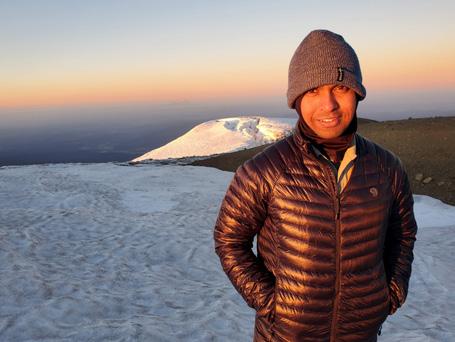
Top: New member Benton Fong on the summit of Mount St. Helens, May 22, 2020.
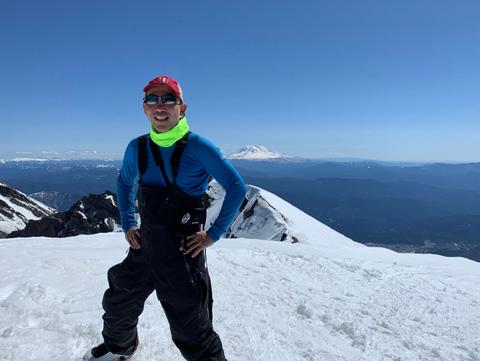
Middle top: New member Mary Landwer on the summit of Mount St. Helens, August 17, 2018.
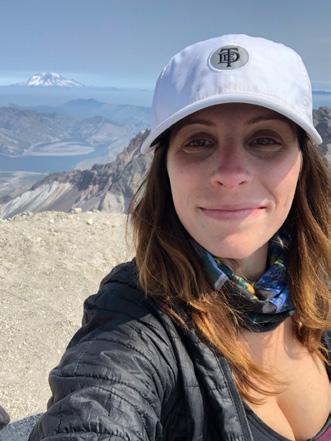
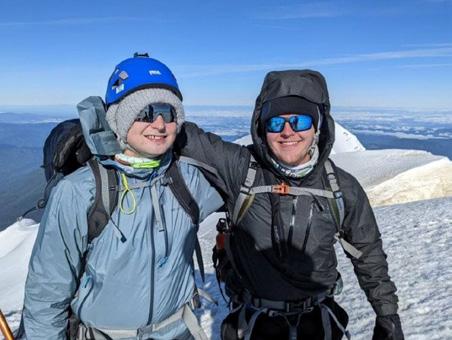
Middle bottom: New member Shavali Alisher on the summit of Mt. Adams, July 24, 2021.
Bottom: New member Tim Doerr and friend on the summit of Mt. Hood, June 23, 2022.
JANUARY/FEBRUARY 2023 5
PRESIDENT’S MESSAGE
Vote for Goat.
by Greg Scott, Mazama President
Icould spend this space telling you about all the reasons I want you to vote for the amended and restated bylaws change, but you already know where the board and I stand on this. Instead, I want to use this space to encourage every Mazama to simply vote. Because the Mazamas is counting on it.
If you’re reading this you renewed your membership, recommitting your interest in the Mazamas. We might all have different reasons for being a member, but we are unified in the notion that the Mazamas has value and is worth continuing. The evidence of this is in the conversations I had with members this year. Whether it’s the longtime rambler who uses rambles not to discover the Mazamas, but to stay connected even when they can no longer climb. Or the member who left the Mazamas because they didn’t like the direction the organization was going a decade ago, but after reading about the proposed bylaws changes, renewed their membership so they could vote to ensure the Mazamas continues to exist. Or the new member who is enthusiastic to share their unique talents with the First Aid and Publications Committees and specifically moved from the east coast to Portland (over Seattle) because Portland was home to the Mazamas. The common thread is, we all love this organization and do not want to see it disappear. We have 30 committees and hundreds of volunteers devoted to all aspects of mountain recreation, continuing the mission of the Mazamas on an almost daily basis. I reached out to former Mazama presidents to get their impressions of the proposal. Not surprisingly, after thoughtful dialogue through emails and phone calls, the vast majority of them affirmed they support the proposal, including:
■ Christine Mackert (1981, 1990, 1999, 2000, 2001)
■ Keith Mischke (1983) [also former executive director]
■ Larry Stadler (1985)
■ Ray Sheldon (1992)
■ Dennis Olmstead (1993)
■ Dave Sauerbrey (2003)
■ Wendy Carlton (2005)
■ Keith Dubanevich (2007)
■ Gerald Itkin (2008)
■ Pam Gilmer (2010)
■ George Cummings (2011)
■ Doug Couch (2012–2013)
■ Bronson Potter (2014)
■ Sojo Hendrix (2015)
■ Steve Hooker (2016–2017)
■ Chris Kruell (2018)
■ Laura Pigion (2019)
■ Joe Eberhardt (2021)
■ Jesse Applegate (2022)
Mazama members need to unite to ensure the decision to amend and restate the bylaws is a mandate, and we have a clear direction going forward.
Some have framed this proposal as change, but I prefer to call it innovation. The Mazamas know about innovation. Whether it's canyoneering in the Pacific Northwest, a sport for which longtime Mazama member Kevin Clark wrote the book, or UIAA training certification through the Mountain Education Alliance, an innovation that will impact the entire United States, the Mazamas is still at the forefront of our craft. I recently read Let My People Go Surfing by Yvon Chouinard (an honorary Mazama). I learned Chouinard originally found commercial success making pitons for his climbing friends. When he realized that the pitons were leaving permanent scars on the rock, he gave up that business, which at the time accounted for 80 percent of his revenue. Some of his friends thought he was crazy, but he recognized his work was becoming irrelevant to the environmental ethos of climbing. Instead, he introduced the chock, and co-wrote the first essays on clean climbing, forever changing climbing protection in North America. His success led him to found Patagonia. The bylaws proposal demands similar adaptation. We are positioned to realize this vision and see it through, but it’s up to you, a member, to make it happen. Last year’s Mazama President, Jesse Applegate, provided the vision for the alternative when he said in
March 2022, “What if the Mazamas will cease to exist in the not-so-distant future?” While there is no guarantee our plan will work, that is not a reality I want to explore. This idea drove the board of directors over the last several months to make the bylaws proposal with advice from skilled non-profit consultants, outside counsel, and buy-in from membership. We are at a crossroads which will determine whether we see that future come true. We could lose a lot more than our identity if we do nothing.
Which direction will I be writing about in my next president’s message? That is up to you.
BYLAWS VOTE TIMELINE:
» Special election opens January 3, 2023
» Electronic ballots arrive via email on January 2, 2023
» Paper ballots arrive on or around January 3, 2023
» Special election closes January 31, 2023 at 3 p.m.
» Results annouinced online and via email January 31, 2023
BOARD OF DIRECTORS AREAS OF FOCUS 2023
1. Complete Executive Director hire by May 15, 2023
2. Re-evaluate budget and accounting systems
3. Assess lodge and create sustainable operations plan
4. Develop revenue
5. Improve communication
6. Assess board needs and restructure nominations process
7. Ensure access for climbs and hikes
6 MAZAMAS
INTERIM EXECUTIVE DIRECTOR’S MESSAGE
by Kaleen Deatherage, Interim Mazama Executive Director
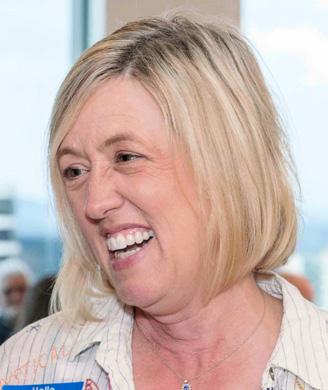
As I write today, the snow is falling on the mountain, the skiing is great, and the winter conditions we all love are present, suggesting that this is going to be a great winter sports season in the Pacific Northwest.
At the end of December, I celebrated one year of service as your Interim Executive Director. What a privilege it has been to meet and work alongside the board of directors, staff, and membership of this organization. Your passion for hiking, climbing, skiing, mountaineering, canyoneering, and much more is inspiring! I’ve learned so much about the tremendous service the Mazamas has given to the alpine sports community in the Northwest, and to the stewardship and protection of mountain environments in Oregon, Washington, and around the country. Thank you for bringing me into the Mazama family—I hope to stay involved even once my service as your transitional leader is complete.
Speaking of the Mazama family, 2023 will bring us an exciting opportunity for membership growth. With the vote on our bylaws occurring at the end of January, the passage of a revised governance structure will open the doors to attracting and engaging people like me as new members. I fall into that category of someone who spends much of my free time outdoors enjoying our forest and alpine environments in Oregon and Washington. But while I am an experienced backpacker, currently I don’t meet your eligibility requirements. Come February, if I become eligible, you can count on me to become a member, and I am confident that once we share with the broader community that the Mazamas has opened the doors to bring more people into our family, you’ll see a significant increase in memberships. It excites me to think of all the talented and passionate people who will learn more about the Mazamas by joining your ranks, and how that will amplify your ability to promote alpine sports and the conservation of our mountains in this time of rapid climate change.
If you still have questions about our revised bylaws proposal, I encourage you to attend our January town hall, one of our board member-hosted happy hours or coffees, or to simply pick up the phone and give me a call. The board of directors and I are excited about the steps we have outlined to make the Mazamas, once again, a vibrant and healthy organization prepared to succeed for decades to come, and our hope is that each of you is excited about that future as well.
To continue bringing clarity to the full membership, I want to use the space I have remaining in this edition to talk about how our financial situation and our bylaws proposal are connected. As it has become more apparent to our membership this year—the Mazamas no longer enjoys a strong financial position with ample funds in reserve, but rather has depleted its reserves and is now operating in a deficit—the question I’ve fielded repeatedly is, “Why are we here, and what happened?”
As it has become more apparent to our membership this year—that the Mazamas no longer enjoys a strong financial position with ample funds in reserve, but rather has depleted its reserves and is now operating in a deficit—the question I’ve fielded repeatedly is, “Why are we here, and what happened?"
The simplest answers often reflect the truth, and I believe our present reality comes down to two things: inertia and the current bylaws. Inertia is typical in any organization or company with over 100 years of vibrant history. Change is hard to manage, and it is human nature to wait, hope things will improve, and sometimes unfortunately miss the moment to make easy corrections that will avoid larger problems in the future. When you add that to our current bylaws structure, which severely curtails the board of directors' ability to make course corrections swiftly in response to changing conditions, such as recouping the loss of membership by
adjusting fees or seeking new sources of revenue by pursuing foundation grants for which we are not presently eligible, the result is the weakened financial position we find ourselves in today. Throughout this year, we’ve talked to many former Mazama board members and past presidents. Nearly all have expressed their support for the changes we have proposed and lamented with us how constrained they felt while they were leading our organization to make the necessary decisions to help the Mazamas remain financially stable with ample reserves to protect ourselves.
The good news is that the Mazama financial position can recover. With the passage of the revised bylaws, we will add more options and more tools that your board of directors and Executive Director can use to help the Mazamas recover and remain fiscally sound. And we’re not waiting until the bylaws pass to get started.
JANUARY/FEBRUARY 2023 7
continued on next page
Interim Executive Director's Message,
continued from previous page
Along with the work we’ve done this year on bylaws revisions, we’ve also been focused on reworking our accounting and budgeting system to manage our finances more accurately. We have completely remodeled our budgeting process and the template that we use to project and track our fiscal performance. Our new structure is tremendously simplified, making it easier to understand and easier to use to make real-time decisions to curtail spending or seek additional revenue if circumstances warrant it. We have implemented a full costing approach so that the overhead expenses of our organization are allocated across all of our programs. This will allow us to understand the true cost of operating all of the activities and classes that we offer. The board of directors will have new and improved monthly financial reports to monitor the overall financial position of the Mazamas, and our committees will now receive timely and useful monthly reports so that the organization can review
how its activities and classes are impacting overall budget performance. These new tools will set the Mazamas on the path to stabilizing and then growing its revenue base, so that in the future you can have exciting conversations about how to grow your program offerings as you respond to the requests and desires of hundreds of new members actively utilizing their new membership.
It’s a new year, and we are on the cusp of a new and improved Mazamas. Not different in fundamentals or the values that express who you are and why your organization is so important, but rather a revitalized Mazamas, confident in who you are, and ready to meet 2023 with the tools and people to thrive for another 129 years.
8 MAZAMAS
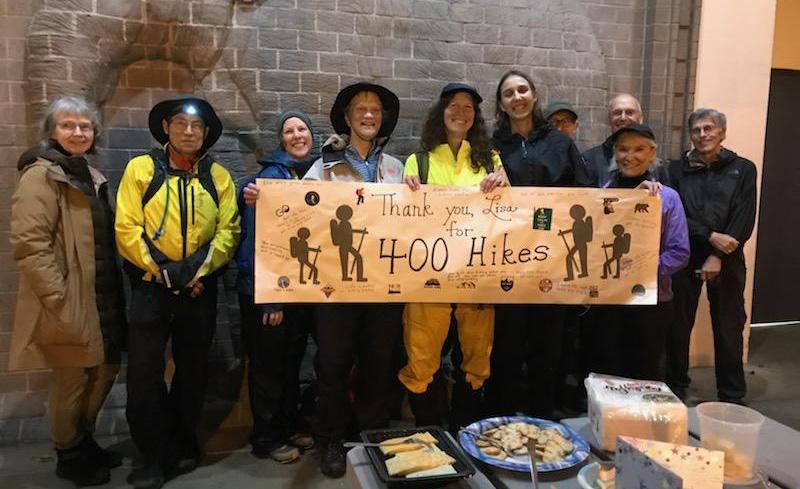
Above: Lisa Ripps, center of sign, celebrated her 400th Ramble lead on Tuesday, October 25, 2022. That is approximately 2,600 miles, just shy of the distance between Portland and New York City!
Photo by Mazama Rambles.
WEIGHED DOWN BY THE PAST
Nostalgia vs. Common Sense in Packing for a Climb
by Peter Boag
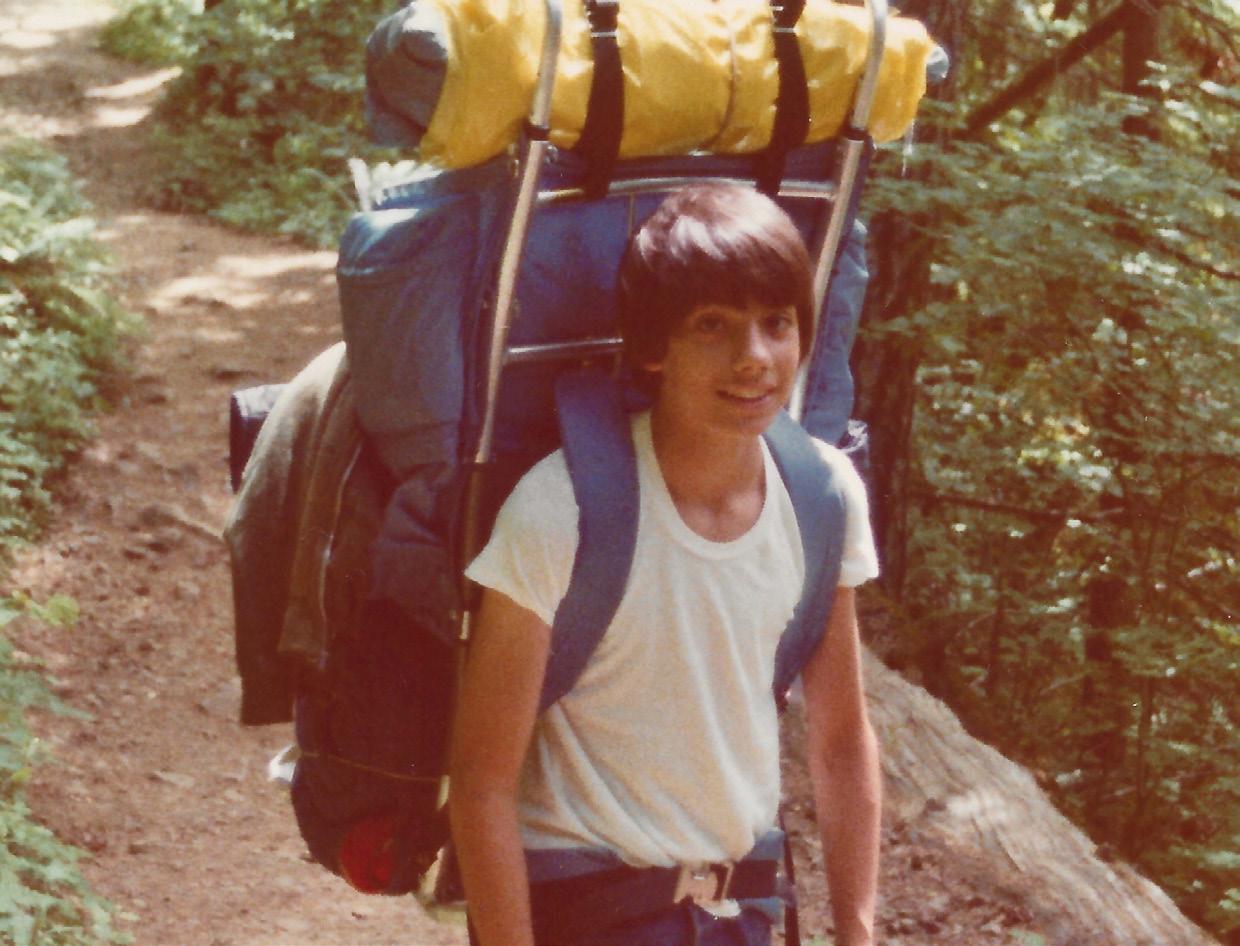
I’ve only climbed for a few years, but I started backpacking in the 1970s and I continued doing so, along with occasional snow camping while cross-country skiing, well into the next decade. After that, life and career got in the way while my gear languished for lack of use. The 1970s were yet early days in the evolution of modern, lighter outdoor gear. We still used packs with external frames, though composed of aluminum, and wore clothing largely made from cotton—denim jeans, t-shirts, and sweatshirts were common on the trail. Even cooking with Sterno fuel was not a distant memory. Because I was a poor college and graduate student in the 1980s, my gear did not evolve much with the times.
Note to readers: This commentary is intended for less-experienced climbers and those who might have more know-how but are still looking to trim weight from their packs. For ultralight backpackers and climbers who know what they are doing, the only value here is possibly a laugh at my expense.
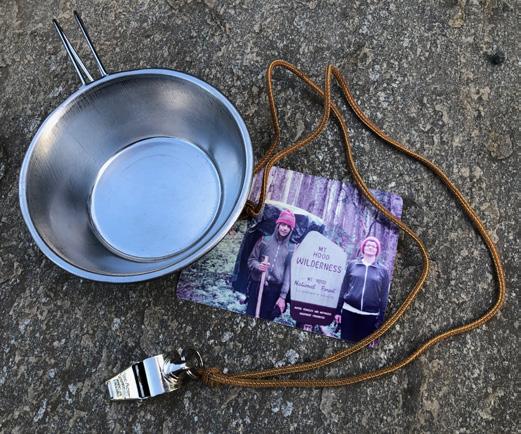
When I started climbing seriously in 2018, I dug through my old equipment. It was something of a trip down memory lane. Most of what I still held onto were trifling things whose mass and vintage seemed inconsequential when compared to the weight of the sentiment and nostalgia attached to them. For example, my steel Sierra Cup, which my parents (who had since passed away) gave me when I started
backpacking as a 13-year-old was what I used on my first major trip—Mt. Hood’s Timberline Trail in 1975. It weighs 3.8 ounces. Those today made of titanium tip the scales at almost one-third that. But what is a couple ounces compared to the memories?
JANUARY/FEBRUARY 2023 9
Above: The author as a lad carrying an enormous pack while on a trip up Eagle Creek in the Columbia River Gorge in 1975. Photo by Guy Boag.
continued on next page
Weighed down, continued from previous page
As it turned out, a couple ounces are a good deal of annoyance, though it took me some time to acknowledge that sentiment and nostalgia are best carried in the head and heart and not on the back. On my first overnight climbs with the Mazamas, my pack typically weighed a lot. To rub salt into my back’s aching wounds were those teammates who boasted of packs of less than 30 pounds and that appeared more like knapsacks in comparison to my 75-liter Gregory! Especially objectionable was when, through the course of the adventure, those same climbers pulled from their packs all sorts of luxuries— insulated wrappers around scrumptiouslooking burritos, full-body mosquito nets, hammocks, and even pillows! But little did they know that I carried my steel whistle that my parents had lovingly gifted to me long ago. Never mind that I had never actually needed that whistle for its intended purpose and that built into my Gregory’s shoulder strap is a plastic whistle that works perfectly fine.
Not all the weight that I carried, mind you, was due to outdated equipment. It also had to do with some poor choices
I made with new gear because my considerations were likewise based on the past: the memory that heavier packweight was simply part of the deal. Over the course of my first climbs with the Mazamas, however, I did start making adjustments. For example, I bought a lighter and more compact quilt to replace my bulkier sleeping bag for summer outings. I also soon replaced my brand new, nine-pound all-season tent, which I lugged up to the Lunch Counter on a June climb of Mt. Adams—the weather was perfectly lovely—with a two-and-one-half pound, one-person Big Agnes. That the latter is the size of a coffin and has convinced me that I will not be buried in one is another matter.
I also have bought a couple smaller packs. I have learned that Gregorys, which I love for their comfort, are a bit heavier than other brands, but the comfort is something
I refuse to part with ... yet.
Issues with my pack and my back (and my feet) came to a head this past summer on the death march, which some of you might know as a climb of Glacier Peak. Gary Bishop led us. Lauren Saxton, with whom I took ICS this past
year, assisted. Other team members were Margaret McCarthy, Nimesh Patel, and Ryan Reed. The Glacier Peak climb is in fact a long one from the North Fork Sauk Trailhead—perhaps 35 miles roundtrip. We did carry gear that is not needed on every summer alpine climb, namely ice axes and crampons. Since my feet cannot tolerate crampon-compatible boots forever, I carried those on my pack while wearing my considerably more comfortable hiking boots for much of the route. Before group gear, my pack weighed some 48 pounds. I barely crammed it all into my 75-liter pack. Mine was likely the heaviest; some others weighed a scant 35 pounds.
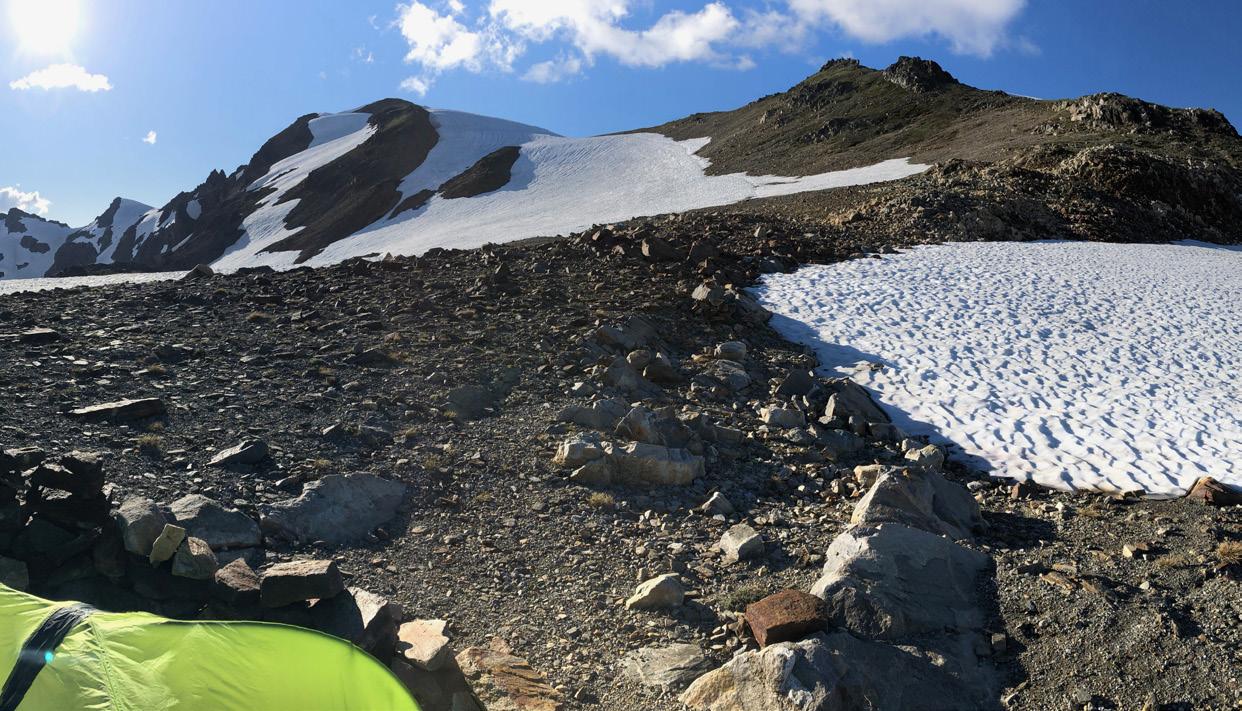
I about died. I also (quietly) complained. The second afternoon we camped at Glacier Gap. We had delightful weather and a good amount of time to laze about before the planned summit the next day. I will be forever thankful to Lauren and Ryan, who paid my tent site a visit that afternoon and insisted that I produce all my gear so that they might examine it and provide tips for cutting down on weight and bulk. They did not find much that was unnecessary, but they had many ideas for
10 MAZAMAS
what I could do to lessen the load. Did I genuinely need that Swiss Army knife with multiple blades, bottle openers, nail files, and even a lanyard? Was my childhood whistle truly necessary when my pack’s strap had one built in? When Margaret joined us—her curiosity piqued by all the stuff strewn across the mountainside—she kindly reminded me of something I knew: a first-aid kit’s sling might be replaced in the field with someone’s shirt or jacket. She also explained at one of the trip’s mealtimes that sometime back she had learned that using a Mountain House dinner the first night provided a reusable and durable aluminum pouch in which lightweight instant mashed potatoes could be reconstituted on a subsequent evening. This obviates the need for more such meals in pouches, potentially some dinnerware, and bulk. It also saves money on food.
When we got back to the trailhead, I was exhausted and my feet were turning numb. In my nightmares that evening, as I lay in bed back home, my heavy gear lumbered in my head. Clearly, I needed to do something. The next day, I carefully removed items from my pack and weighed
each on my kitchen scale. While doing so, I searched for lighterweight alternatives online, ordered some, and also headed out to local equipment dealers. The catch here is that I did shell out money. One well-intentioned customer service worker at a gear shop feigned commiseration, while joyously ringing up the cash register, when she voiced what I was coming to know: there are at least two phases in outfitting as a climber. The first is when you initially buy the necessities. The second is when you become yet more serious about the sport and more thoughtfully realize that you can find much lighter-weight (and more expensive) replacement equipment. But the results for me were impressive. I was able to cut down the poundage of my Glacier Peak pack from 48 to 39 with my new gear. I also saved by economizing on other items. I let go of my steel whistle, though certainly not the memories attached to it. Those 39 pounds, I might add, still included carrying my climbing boots.
Above: The author’s Sierra Cup and steel whistle that date to the early 1970s and which his parents gave him when he started backpacking. The photograph within, which the author’s father, Guy took, is of the author and his mother when the three backpacked the Timberline Trail in 1975. Photo by the author.
with shorter summer gaiters, which work perfectly fine in the season’s snow conditions. I replaced my Sea-to-Summit with a Neoprene mattress. I exchanged my large Swiss Army knife with one that has exactly what I use: a blade and scissors. Saving both weight and space, I let go of one of my two Nalgene bottles and replaced it with a one-liter, collapsible Platypus water bladder. I committed myself to a two-liter bladder in my pack, rather than the three. Should I need more water, I’ll take some in the Nalgene I carry anyway. I even went so far as to take the winter snow baskets off my trekking poles and replace them with the smaller ones, which work perfectly fine in summer conditions. In doing so, their weight dropped from 1.4 to one-half ounce. I also looked carefully at my first-aid kit, set aside the sling and a few extra bandages, and replaced the tube of antibiotic ointment with a few small packets of the same, the weight of each of
Here are a few big and small changes I made. I replaced my winter gaiters
JANUARY/FEBRUARY 2023 11
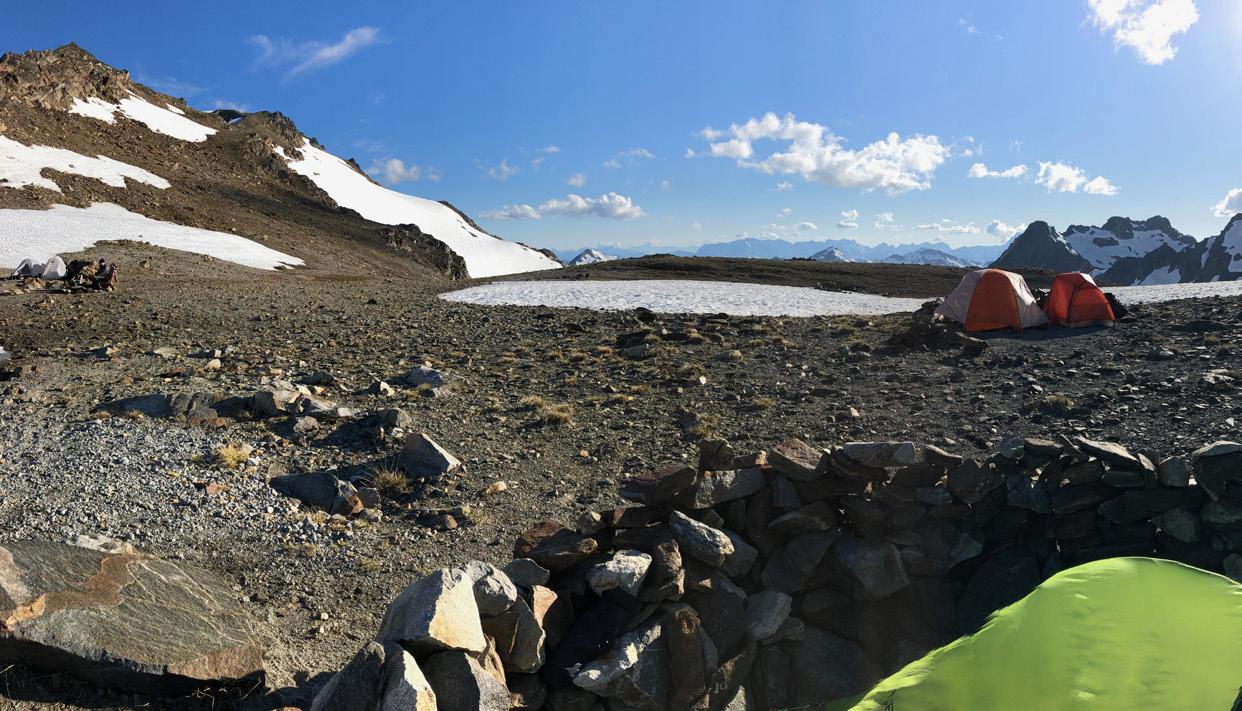
Above: The author’s tent site in the foreground at Glacier Gap on the Glacier Peak climb. Here is where, with the help of teammates, the author began seriously thinking about how to save weight and space on alpine climbs. Photo by the author.
continued on next page
Weighed down, continued from previous page
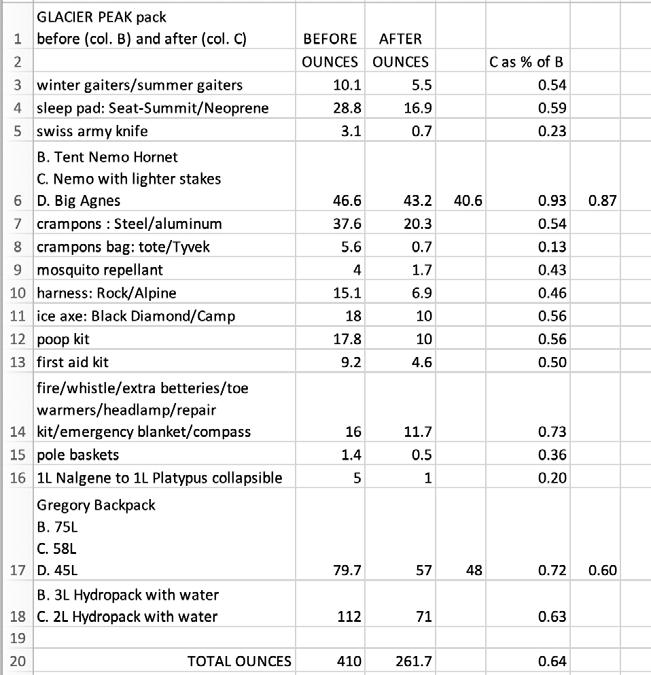
the latter my kitchen scale did not even detect.
Some of my equipment changes were of course more consequential ... and expensive. Several people had used aluminum crampons on Glacier Peak while I toted around my steel ones. Mind you, aluminum crampons cannot always substitute for steel, but they can in some cases and would have saved me an entire pound on Glacier Peak. A no-expense change was replacing my crampons’ tote with a Tyvek envelope that I picked up at the post office for free. That spared almost 5 ounces. Much more expensive was a new Camp nanotech ice axe, but it eliminated half a pound. Another outlay was for an alpine harness to replace my rock climbing harness. That saved yet another half a pound.
You might imagine my thrill when, a couple weeks later, I packed for my next climb—this one of Mt. Jefferson’s south ridge. The leader was Joe Eberhardt, I assisted, and the other team members were Gary Riggs, Verna Burden, and Sergey Kiselev (the latter two were ICS friends). That adventure is not nearly as many miles as Glacier, but there are similarities between the two. Namely, in both cases you start at low elevations and gain more than 7,000 feet. Mt. Jefferson is only two nights, so I did save weight and space by carrying less food. Nevertheless, for Mt. Jefferson I did need an ice tool in addition to my axe, and my steel crampons were a must for the “terrible traverse.” Still, I was initially able to get everything into my 58-liter Gregory, which saved another 22 ounces. In all, my pack came in at not quite 39 pounds! And that included my climbing boots, which even fit inside!
Sadly, I let myself get swept up in the moment. When I noticed that there was still room left over in my pack, I imagined that if I strapped the tent onto the outside, I might get everything into my 45-liter Gregory, thus saving yet more weight! So that is what I did. The sad part is that while removing items from the one pack, I set a few on a shelf that I typically do not use and failed to notice that they had not made the transfer. When my Mt. Jefferson team reached our camp at Shale Lake, I discovered my oversight: three things were missing. One was my sleeping pad.
Luckily, I found a good layer of relatively soft duff on which to pitch my tent and I spread clothing out under my quilt. Also embarrassing was my missing stove (I had the fuel, though). Because we were a team of only five and two others had brought stoves, this was not a serious issue.
Most annoying was having left behind one of the few luxuries that I allow myself— my collapsible pee bottle. One of the keys to a successful climb in my estimation is excellent hydration. I try to drink a good amount throughout the day and during the night prior to summit day. Thus, having a pee bottle close at hand (when I am tenting alone, mind you) is a real blessing. So, at Shale Lake on Mt. Jefferson’s south side, and amid swarms of mosquitos, I had to get out of my tent multiple times during the night—and all due to my momentary loss of attentiveness amidst the excitement of dropping to yet a smaller pack and saving another nine ounces! (I’ll add here that I also cut down on the amount of mosquito repellant I carry and the bottle I transport it in—a 2.3-ounce savings.)
My recommendation to the less experienced is to think carefully about
weight as you make your gear purchases. Get an inexpensive kitchen scale. It will help you think through every item that you carry—an ounce here and an ounce there really add up. Are there items that you can easily do without, especially considering the route you intend to climb? One of my major hang-ups while climbing is pooping, and thus for the multi-day trip to Glacier Peak, I took along too many wag bags. I did not know beforehand that there were lowsilhouette toilets available for two nights of our outing when we camped at White Pass. Also, think about space so as to cut down on pack size. Can you make do with collapsible water bottles, a smaller tent, and repackaging meals?
For me specifically, I am a historian by vocation. The past and its meanings and connections and even currency weigh on me in whatever I do. It seems to have met its match, however, in my avocations of climbing and backpacking. These pursuits have led me to so many different insights about being a human, not the least of which is the necessity to sometimes shed the weight of the past in order to better enjoy the present.
12 MAZAMAS
Above: Screen shot of the author’s spreadsheet created while weighing items from his Glacier Peak pack and comparing those to the weight of replacement gear. Photo by the author.
MAZAMA LODGE
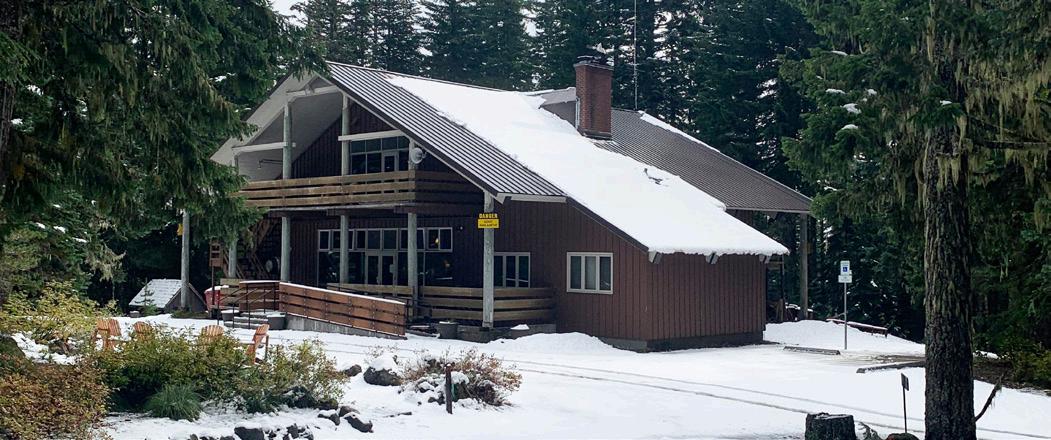 by Gina Binole, Mazama Office and Communications Coordinator
Big plans are afoot for the Mazama Lodge next year. And with those plans will come big asks. Our first aim is to put in the effort to address deferred maintenance and get our cherished lodge back into good working order. Then, once the snow thaws and mountain access is easy, we want to host a couple of great events for members in 2023. We haven’t decided on the details of these events yet, except that we know, with next year being the 100th anniversary of the Mazamas operating a lodge on Mt. Hood, that we want one event to kick off a capital campaign for the lodge.
“It’s clear the lodge is a beloved asset to the organization, one that dates back 100 years in 2023,” says Interim Executive Director Kaleen Deatherage. “It’s also become very clear during my tenure here that the lodge needs a lot of work to bring it up to code and to create a more inviting and safe space for people to gather.”
On the to-do list for the lodge is:
■ A new roof
■ Repair damage in the walls/restroom due to roof leaks
■ Kitchen remodel
■ Floor repairs
■ Improved heating throughout the lodge
■ Electrical work
■ Plumbing work
Our classes, the Basic Climbing Education Program (BCEP), Intermediate Climbing School (ICS), Family Mountaineering (FM101), and First Aid will continue to utilize the lodge as they always have for their activities. But the lodge will remain closed for the foreseeable future to the general public and for special events like weddings.
Access to the lodge is an important benefit to our members. While our upgrade efforts will be underway next year, we also want to launch a new system that encourages our members to take a training to become a lodge host, which will in turn allow us to open the lodge up to members at least one weekend a month for those who wish to spend the night at the lodge, or pop in on a weekend. Again, please be patient as we establish a system. But we do know that the very first part of this process will require enough interested members to take part in our Mazama Lodge Host Boot Camp.
Becoming a lodge host will take about a half-day of training (including travel to and from the lodge). This instruction includes everything from working our coffee pot, to how to turn everything on and off to guest clean up. Look for signups on the Mazama calendar soon.
Once we’ve had at least 20 people take the training, they will be able to sign up in pairs to host on a Friday, Saturday, or Sunday. Hosts are expected to be present
at the lodge for a 24-hour shift, but they also will be able to stay in one of the private rooms, FREE of charge, for the entire weekend of their shift.
Sounds amazing, right? And an awesome perk of membership. But only if people within our ranks step up and take the time to become lodge hosts. We will of course need to work around the full schedule of Mazama classes using the lodge from January through May.
We hope many of you had the chance to stop by the lodge between Christmas and New Years for some hot chocolate and a little holiday cheer. We’ll keep everyone posted on the next opportunity for YOU, our members, and your families to enjoy your home on the mountain. In the meantime, thank you for your patience and understanding as we invest the volunteer and staff time, as well as the financial resources to maintain our lodge and ensure it can continue to be a much-loved benefit to members for decades to come.
JANUARY/FEBRUARY 2023 13
The Mazama home on the mountain to host some fun—and require some fundraising—in 2023
MAZAMA MOUNTAINEERING CENTER UPDATE
by Rick Craycraft, Building Manager Emeritus
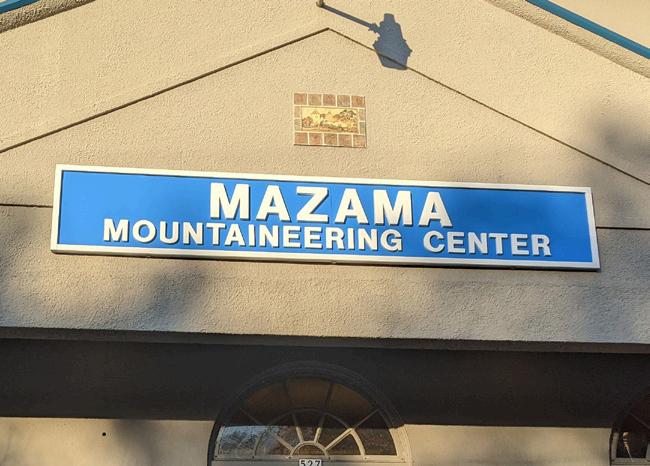
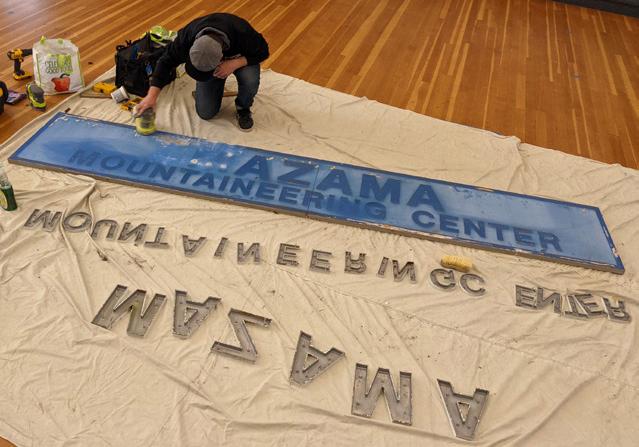
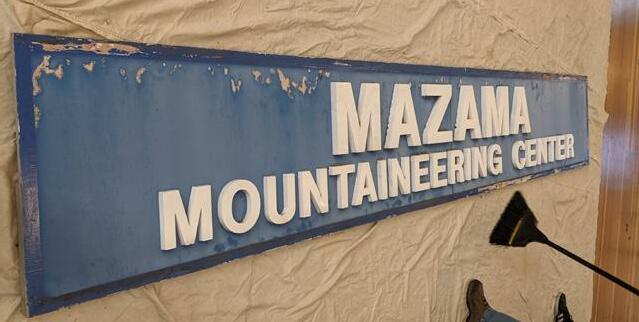
As with prior years during the pandemic, the lack of traditional activity around the MMC left us time to address deferred maintenance and also provided us with record numbers of volunteers looking to contribute. No project symbolized this development to me as much as the complete facelift of the sign on the front of the building. On a dry weekend in early October 2021, Michael Moy and Collin Edwards-Hill showed up with their own tools and a professional attitude for this task. The sign got taken down, disassembled, repainted, the letters meticulously cleaned (did you know that those letters are metal and not wood, as I had thought?), and remounted, all in the space of a weekend.
In the weeks before that, Collin had also built platforms protecting the wires and hoses of our new HVAC units in the south yard that now heat and cool the two top floors of the building separately, unlike the prior units. Dave Nelson created a hatch in the ceiling of the copy and office supply room (where the interior units are) to allow access to the ducting above, in case there are ever problems. The HVAC project itself was supervised by Jeff Hawkins, who contributes greatly around the building and grounds, all motivated by his (and our) commitment to address climate change. Along those lines, whenever he is not out adventuring, Richard Sandefur shows up at the MMC and says, “I’m here to save the world” and proceeds with the project of swapping out all lights in the building to LED. The last time I
talked with him, he assured me that we are about 60 percent of the way there.
A new volunteer, Abraham Cissna, responded to a call for help in the online weekly eNews and brought an impressive array of skills to various long-neglected projects. And an old volunteer, Cody Evans, who has since moved to South Carolina, always makes sure there is a task waiting for him when he returns from time to time to see his family in Portland. Both of these guys had a hand in taping off the fire lanes in the “chair room” in the auditorium and around the main electrical boxes in the boiler room.
And, finally, on a recycling note, for the first time in 10 years a Mazama member initiated a recycling practice. Christine Troy, of the First Aid Committee, found a place to recycle the substantial numbers of plastic gloves we generate in those classes.

14 MAZAMAS
The State of the Mazama Mountaineering Center, Inside and Out
As we entered a new fiscal year in October 2021, the grounds crew, under the leadership of Kyla Ogle for two years now, jumped into action. Kyla had determined that most of the shrubs and trees in the south yard were not native, contrary to our overall landscaping plan. Hence, we took out everything but a sole vine maple and replanted with various native species. Just be patient for now. Someday they will really look like something.
On the other side of the building we decided it was time to eliminate a few problem trees. The line of maples along the north wall of the building were also not native and were planted prohibitively close to our 95-year-old foundation. In the parking lot swale, there was an alder that the late Dick Pugh, the original designer of the landscaping plan, had wanted to see gone. Instead of blooming where it was planted, this alder had taken a weird turn and ended up partially under the parking lot curb. After the tree was felled, Cody Evans took a shot at the remaining stump, but Trey Schutrumpf later got it out of there.
The week-to-week work—a nearly year-round task—on our landscape maintenance is tended by a core team of Kyla, Tom Wrona, and Maggie Woodward. Other periodic and valuable
Opposite
This
This article was intended to be my presentation at the Annual Meeting on October 1. However, with full disclosure, I was unable to attend that meeting because I was so wiped out from the previous weekend’s climbing adventures.
contributions this year came from Kayla Miller, Geramy Ogle (Kyla's brother), Bill Bluestar, and Bob Breivogel also picked up a pair of clippers out there one day. We are striving, successfully, for an aesthetically pleasing, respectfully native, and healthy environment around our building.
Another aspect of managing the building and the grounds is the current phenomenon of homelessness. The MMC is not untouched by this part of our society. We’re right down the street from Laurelhurst Park and its well-documented difficulties, and around the corner from the Friends Meeting Hall, which in the past has had a free meal program. And we have a landscape with cozy nooks and a building with covered places to sleep out of the rain. The Mazama staff is in touch with the surrounding neighbors and City of Portland services. This can be a tricky and difficult situation. As you know, it is part of modern life. We’re doing the best we can.
JANUARY/FEBRUARY 2023 15
page: Tom Wrona, Kyla Ogle, and Rick Craycraft raking fall leaves in the MMC parking lot. Photo by Brendan Scanlan.
page: Refurbishing the MMC sign. Photos by Collin Ewdards-Hill.
ALANO CLUB & THE MAZAMAS TEAM UP FOR PEAK RECOVERY
by Gina Binole
In her 20s, Ali Marie Koch struggled with anxiety, an eating disorder, depression, and panic attacks. “I tried a lot of different things to make myself feel better,” Koch recalls. But nothing helped. She even succumbed to her suicidal thoughts with a failed attempt. “When I found myself in a place of hopelessness, I knew I had to create a path back to wellness.”
That path led her to the Mazamas. Well, actually her mother, Susan Koch, a 2008 Basic Climbing Education Program (BCEP) graduate, hike leader, and Guardian Peaks Award recipient, shepherded her to the organization.
“I didn’t think there were other people like me who were happy on a hiking trail and not walking at the mall,” Susan says. “But I just fell in love with climbing and hiking, and the Mazamas were so kind and made me feel so welcome.”
Susan, a physician with Kaiser, wanted to at least try and expose Ali to the outdoor experiences that positively transformed her life decades before. They began

hiking together. Susan waited until Ali’s strength and endurance increased and the wildflowers were peaking. Then she brought Ali up Old Snowy.
“When I stood on top of that mountain, I felt a sense of strength and inner peace I’ve never felt before,” Ali says. “I was connected to something bigger than myself … I thought there was a secret sauce here, which can lead to mental and physical wellness.”
Now 11 years into her recovery, Ali is an active Mazama who enjoys snowboarding, climbing, and split-boarding. She also aims to offer up some of that “secret sauce” to next year’s BCEP students via the Alano
Above: Susan and Ali Marie Koch on Dog Mountain, Washington.
Opposite page (clockwise from the left): Mt. Whitney, California; Mt. Kilimanjaro, Tanzania, Africa (two photos). Photos supplied by Ali Koch.
Club of Portland, the largest and oldest recovery center in the United States. Peak Recovery, a project of Alano, supports people in mental health and substance use recovery with free outdoor movementbased programming rooted in a true love of nature.
With Ali as program manager, Peak Recovery is excited to partner with the Mazamas and fund nine BCEP students in 2023 who identify as being in mental health and/or substance use recovery. Peak Recovery will cover the cost of the class and provide transportation in a ninepassenger Sprinter van. After the class, participants in the Peak Recovery cohort
16 MAZAMAS
will be gifted a Mazama membership to continue on their mountaineering journey.
“The ethos of Alano and Peak Recovery is in line with the Mazamas,” says Joe Preston, BCEP Committee chair. “It’s the kind of partnership that will help us be more inclusive and welcoming, and we all want to see efforts like this expand every year.”

In 2022, BCEP put together several affinity teams, including an all-Latino team, an LGBTQ team, and a sober team. The Peak Recovery partnership is an 18-month pilot program that Ali and Brent Canode, co-founder and Alano’s executive director, hope will become an ongoing partnership with the Mazamas.

“There’s a popular saying, and one of my favorite truisms in the behavioral health field, which goes like this: ‘The opposite of addiction is connection.’ At Alano Club of Portland we’ve taken that idea a bit further, recognizing that the point of connection must be meaningful and authentic for true community to grow and flourish,” Canode
says. “Like most things in life, recovery is not a one-size fits all journey, and those points of connection must speak in a way that compels a person to reach out and then remain on that path. That’s why we are thrilled to bring Peak Recovery to our community in partnership with the Mazamas, another legacy non-profit with a deep history of service and impact in Oregon."
Susan and Ali credit the Mazamas in part for the happy, healthy lives they lead today, exposing them to a community of people passionate about movement and time in nature, tightening their family bond with trips that included the summit of Mt. Kilimanjaro and highlighting how resilient they are as women in the health care field.

“It’s been such a privilege to spend time in nature with other Mazamas, some of whom we now feel are like family,” Ali says. “It’s now a privilege to light this fire, to share the transformative, healing powers of mountains with others.”
GET INVOLVED!
■ Learn more and register for the course at PeakRecoveryPNW.org under the mountaineering section for the “Mazama + Peak Recovery” BCEP team.
■ Learn more about BCEP and join the BCEP Info Night webinar at 6:30 p.m. on January 11. mazamas.org/ event/2969/.
■ Applications will go live January 18, and applications close February 9.
■ Anyone applying for these nine spots on the "Mazama + Peak Recovery" BCEP team will all be in the same cohort (which will be led by James Jula from the Mazama BCEP leader team)
JANUARY/FEBRUARY 2023 17
SAYING GOODBYE
DOROTHY W. DAVIDSON
OCTOBER 9, 1923–AUGUST 25, 2022
Dorothy joined the Mazamas in 1970 and enjoyed hiking, climbing, trekking, and cross-country skiing. She earned her Guardian Peaks Award in 1972 and her Seven Oregon Cascade Peaks Award in 1977.
GARY A. NEGELSPACH
JANUARY 6, 1935–OCTOBER 7, 2022
Gary joined the Mazamas in 1960. He earned his Guardian Peaks Award in 1960, his Seven Oregon Cascade Peaks Award in 1964, and his Sixteen Northwest Peaks Award in 1969.
KENNETH W.
GUENTHER
OCTOBER 14, 1927–JULY 8, 2022
ARNOLD D. PICKAR
JUNE 24, 1927–NOVEMBER 29, 2023
MAZAMA CLASSICS
We lead a wide variety of year-round activities including hikes, picnics, and cultural excursions. Share years of happy Mazama memories with our group. All ages are welcome to join the fun.
The Classics Committee needs an infusion of new members. We are down to five people. Members are in short supply to offer Classics events. Please email Flora at flobell17@comcast. net to apply. We meet via Zoom on odd-numbered months.
CONTACTING THE CLASSICS
Contact the Classics Chair, Flora Huber, at 503658-5710, flobell17@comcast.net, or classics@mazamas.org.
SUPPORT THE CLASSICS
The Classics Committee needs a volunteer to put more content in our column on a quarterly basis. We want to document past Classics events and make sure that our postings to the web are current and complete. More generally, there is always work to be done on the committee. Our meetings are the fourth Monday of every other month at 11 a.m. on Zoom. Email classics@mazamas.org and tell us how you can help.
CLASSICS COMMITTEE MEETING
Keep an eye on the Mazama calendar for our next meeting.
18 MAZAMAS
For members with 25 years of membership, or for those who prefer to travel at a more leisurely pace.
PDXWalk.com Hiking app with maps for offline use, including: Mt. Hood Forest Park Paths: Coast to Coast Oregon LowerWashington 48 states Pacific Crest Trail Appalachian Trail
Android devices only More info at PDXWalk.com
For
FIRST AID AS SECOND NATURE TO THE MAZAMAS, PART II
by the Mazama First Aid Committee, Peter
In the November/December 2022 issue of the bulletin, we provided a brief history of the origins of the Mazama First Aid Committee and the role that disasters in the mountains had in shaping the first aid curriculum that we offer to our climb leaders, to the students in the Intermediate Climbing School, and to others interested in safety in the outdoors (or elsewhere). We also shared two stories about how the first aid skills that Mazamas learned in our Wilderness First Aid and Mountaineering First Aid courses came in useful when they helped their own family members while camping and also helped themselves by directing others less knowledgeable to assist with their own injuries sustained while climbing. We continue our series with a few more such tales that our membership has since shared with us. These range from the minor, to the observational, to the near catastrophic. With these, we continue to stress the importance of our courses, the value of first aid preparedness to the Mazamas wherever they might roam, and the vast variety of situations where medical assistance and knowledge might make the difference between life and death.
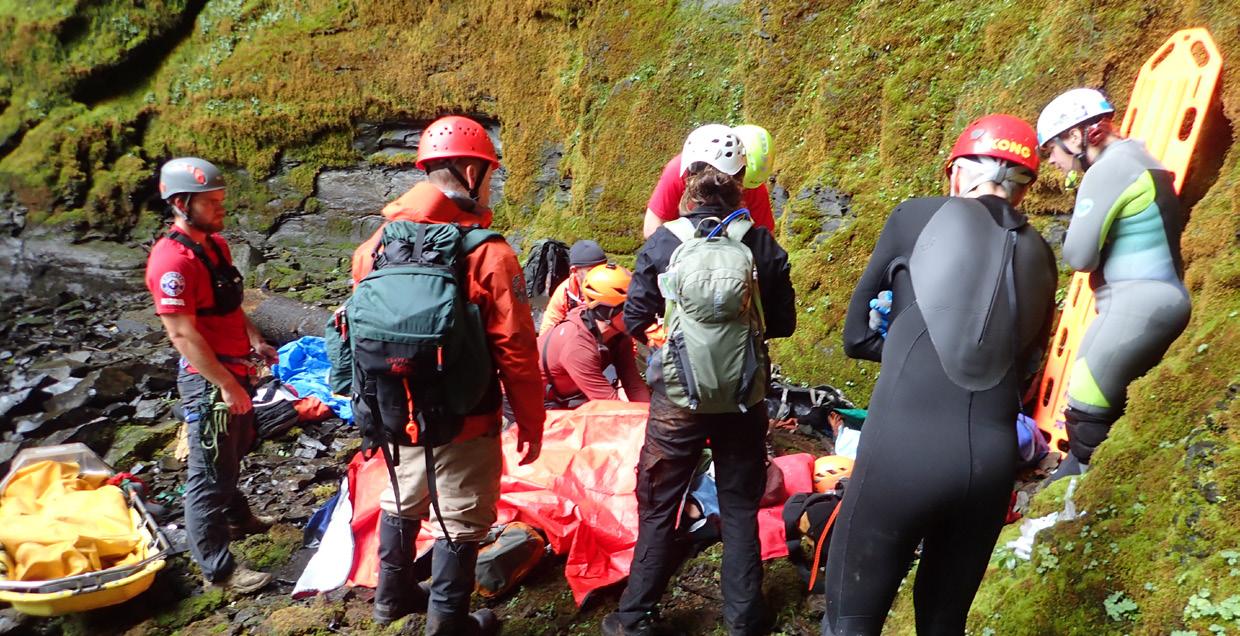
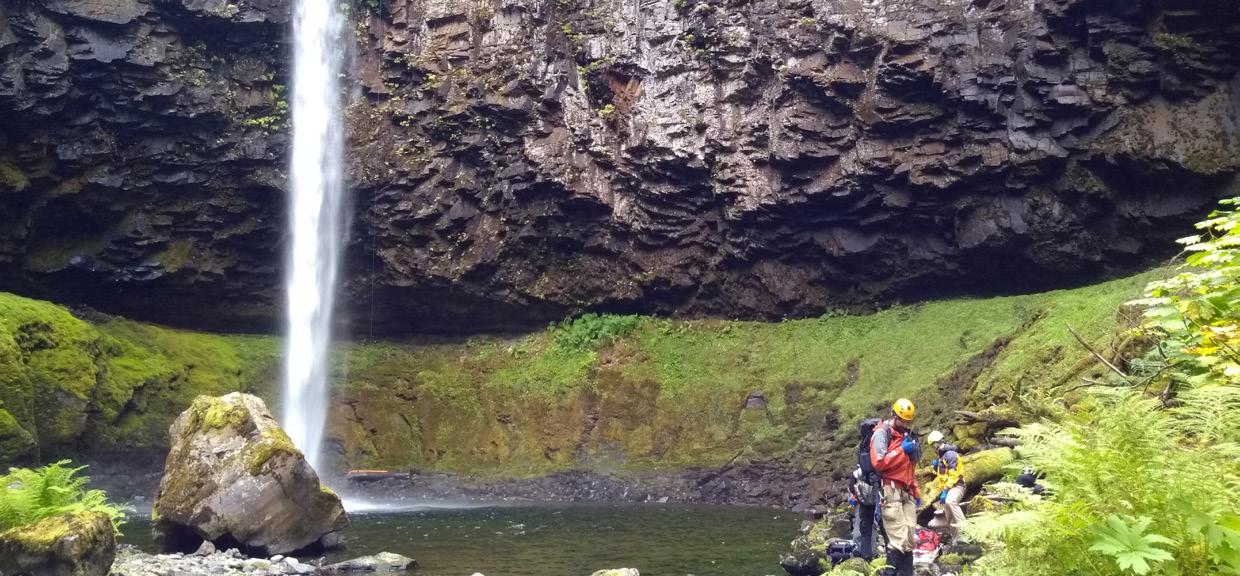
Wim Aarts, for example, wrote in about a rappelling accident while canyoneering at Big Creek Falls in the Gifford Pinchot National Forest in September 2018.
After two people checked the rope setting, the first person rappelled down Big Creek Falls. At 130 feet, this canyoneering trip starts with a bang. When we heard continuing whistling, the signal for trouble, we immediately sent a second climber down.
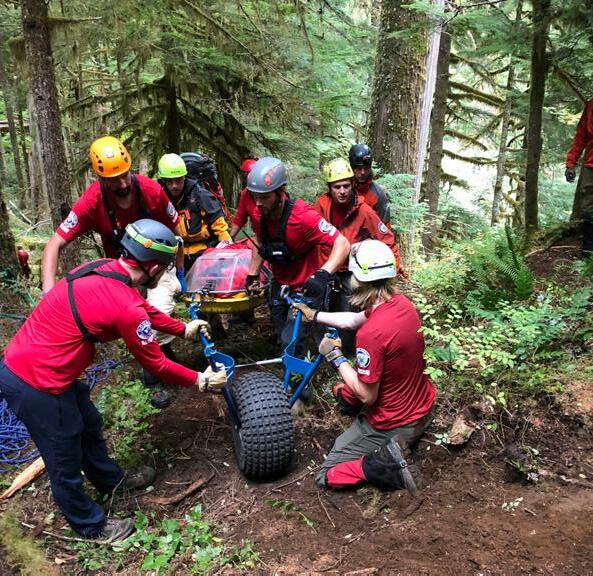
The second person noticed the rope was too short and, with the aid of the team, came back up. I rappelled down to the fallen canyoneer and began coordinating to get more help down and to send one person to set off an emergency call.
We moved the injured person out of the water and the waterfall spray, put him in a bivy bag, and got him as warm as we could. This had to be done despite back and hip pain that pointed to possible back injury. Not moving the fallen canyoneer would have certainly resulted in severe hypothermia.
When the EMT showed up he commended our actions ... in moving the person and keeping him as warm as possible in that situation. Those assisting the injured canyoneer were leaders of the Canyoneering Committee, one climb leader, and two ICS grads. The experience, training, and exposure to Mountaineering First Aid was
JANUARY/FEBRUARY 2023 19
Boag, and You
continued on next page
Above: EMTs arrive on the scene at Big Creek Falls. Photo by Wim Aarts.
First Aid, continued from previous page
a greatly added benefit in knowing what to do in a difficult situation and deciding between moving an injured person with a major method of injury.
Also in the Gifford Pinchot, but within the Mount St. Helens National Volcanic Monument, member Britt Hoover was just reaching the summit with her husband, Jeff, on a sunny weekday in April of 2019 when they noticed, alone on the summit ... another climber, sitting on the snow and looking quite fatigued. I noticed her pant leg was torn and there was blood on the snow beside her. I introduced myself as a first aider and asked if she would like assistance. She told us she separated from her group before the weather station and fell down a slope when climbing up a ridge. In a state of shock or confusion, she continued up the mountain alone to the summit.
We could see the rest of her group climbing up from the false summit. While we waited for them to arrive, I gave her my foam pad to sit on and a warm layer, as she was wearing a cotton sweatshirt and she was shivering. I assessed her for other injuries and dressed and bandaged the cut on her leg. We gave her water and food, as she had none with her.
When her group of four friends arrived at the summit, we shared information about her state and injuries. They told us they had first aid experience and they felt comfortable escorting her down the mountain. We descended, keeping them in sight in case assistance was needed.
In another incident just this past March, Britt was visiting Joshua Tree National Park in southern California when her first aid preparedness came in handy again. She and her family had made their way to Keys View to watch the sunset over the Coachella Valley.
While we were setting up our spot, I saw a man walk underneath a metal placard with sharp corners and sustain a deep 5-inch long cut to his head.
I approached the injured man and the large crowd that started gathering around him. I asked if anyone was a medical professional or first aid certified; no one was. Because we were more than an hour
from medical care, I offered to help as a mountaineer first aider and the patient accepted.
I asked a bystander to call 911 and I asked the other bystanders to gather first aid supplies from their vehicles. Using gloves, I dressed and bandaged his head wound and instructed the patient to apply pressure to his head. While we waited over an hour for the park rangers and EMTs to arrive, I regularly checked his vitals and assessed his level of responsiveness. I kept him distracted and warm after the sun set and the temperatures in the desert dropped. When the rangers and EMTs arrived, I gave them my SOAP [Subjective, Objective, Assessment, and Plan] notes. The patient was transported by ambulance to a local hospital.
Member and climb leader James Jula also related to us an incident in California, though at the opposite end of the state from Britt’s experience. He was on a private climb of Cosmic Wall at Mt. Hubris (also known as the Ogre) when, during the scrambly descent ... my climbing partner, also a Mazama, had a sharp rock slip and fall onto the inside of her calf just above the ankle, slicing about a 3–to–4-inch wound that clearly would need stitches later. I cleaned the wound and butterflied it together, then wrapped it to keep any other dirt out on the remaining part of our descent and subsequent drive to an urgent care. I believe she ended up with 11 stitches.
On another private climb, this one at Mt. Adams, again in the Gifford Pinchot National Forest, James helped yet another climbing partner. It was a “very hot weekend,” James recalled, and on, day two, my climbing partner started getting a severe headache and a noticeable change in mood. After observing his behavior for a bit on the way down, I noticed lots of liquid intake with a comment of feeling really thirsty, lots of stopping to urinate, but little to no food replenishment, especially with anything high in electrolytes. Most likely he had gotten hyponatremic (having a lower than normal level of sodium in the bloodstream), and about 20 minutes after having him eat some foods with plenty of electrolytes, he could feel a bounce back. He didn't plan his food intake in such a way as to be sure he had enough electrolytes for the sweat expenditure that weekend.
20 MAZAMAS
Above: At the base of Big Creek Falls. Right: Taking the victim out in a wheelbarrow. Photos by Wim Aarts.
One final story that James sent in took place on South Sister, which forms part of the geographic divide between the Willamette and Deschutes National Forests. This climb was Mazamasponsored.
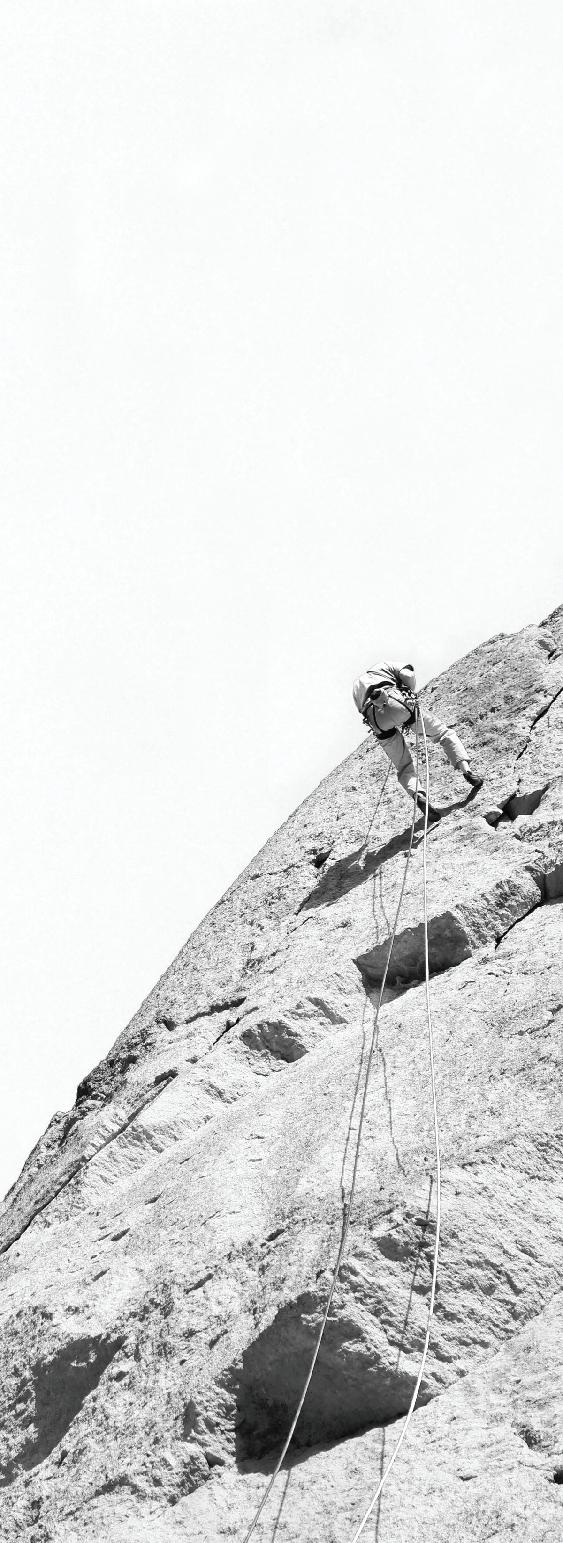
Near the summit on our way up, we ran into a couple obviously in need of some help. One of them popped her knee out of joint on the descent during a slip and was struggling to make it back down the mountain. It was a good weather day, but still cold with 15–20 mph winds on top. She was in shorts and a t-shirt with no other clothing, and was starting to get quite cold given she could no longer move fast enough to stay warm. Between the two of them they had one backpack, but only with some food and water, no first aid kit or any of the other ten essentials. Asking for consent to help resulted in her starting to cry with an emphatic “yes, please!” We quickly got her a jacket, a sitting pad, and some hand warmers to help keep her warm while we assessed and subsequently wrapped her knee. She had already taken ibuprofen from some other climbers ... and with the loaning of a jacket and a set of hiking poles from one of the members of our group, the couple started heading back down the mountain. We continued on to finish our summit, letting them know we would help more on the way down if needed. They made it to the bottom just before we did, leaving behind a stash of the stuff we let her borrow and a thank you note.
Do you have an interesting story of how your first aid training helped yourself, a friend, a team participant, a family member, or someone you came across in the field or around work and town? Or did someone else’s outdoor first aid training help you in a difficult moment? The First Aid Committee would like to hear your stories from blisters to bee stings to breakages. We are especially interested in events that happened in the Three Sisters, Mt. Jefferson, and Mt. Hood Wilderness Areas, or in the Gifford Pinchot and Mount Baker-Snoqualmie National Forests. Please email firstaid@mazamas.org with your name and brief details of your story.
JANUARY/FEBRUARY 2023 21
THE THRILL OF THE MOUNTAINS
by Nachiket Rajderkar
Igrew up in Nagpur, India. It is a city of some 2.5 million inhabitants and is in the state of Maharashtra. Located in the center of India, roughly 1,000 miles from the closest snowcapped mountain, Nagpur has no mountain climbing tradition to speak of, though it has one guiding company. I was fortunate enough that my family loves travelling, and we visited the mountains when we could. This is how I developed my love for the outdoors. I arrived in the United States in 2008 and settled in Portland in 2011. After moving to Portland, I started hiking again and used that as a way to meet and connect with new people. After climbing my first peak (Mount St. Helens) I was hooked on summiting mountains. After climbing some other “easy” peaks, I realized that if I want to continue doing this, I needed the appropriate skills and a community that enjoys doing this.
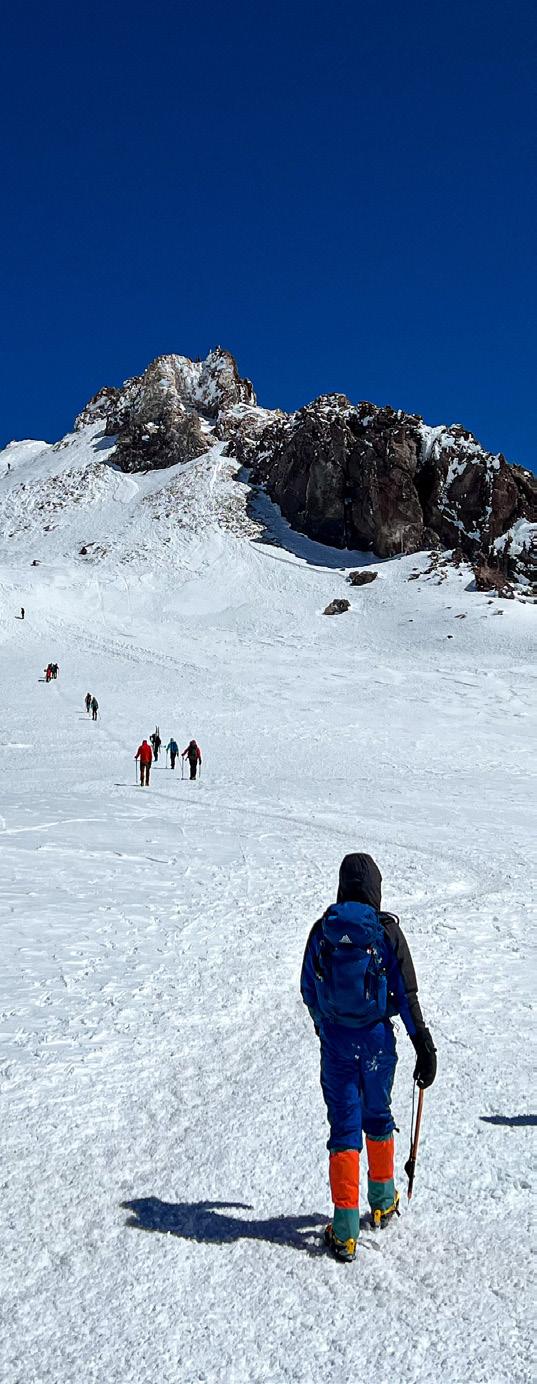
That’s when I decided to join the Mazamas on a friend’s recommendation. I took BCEP in 2018 and have climbed a few peaks in the Cascades since, including Mt. Hood and Mt. Adams. I was fortunate to be able to climb Mt. Shasta this past May. Pushkar Dixit led the climb and Sohaib Haider was the assistant. There were nine other climbers besides myself. The expedition had been rescheduled several times over the course of the spring due to the changing weather, but luckily, we had the perfect window open for us for May 20–21.
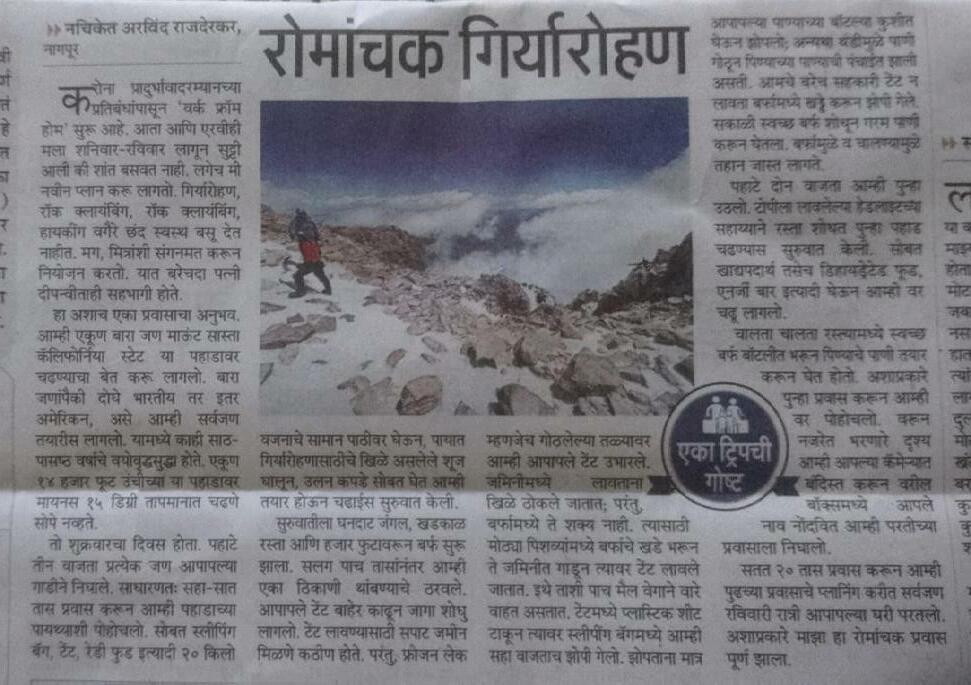
A few days after the successful summit, I shared the experience with my mother, Urmila Rajderkar, back home in India. She does local charity work as part of a women’s organization and occasionally writes for the local newspaper, Maharashtra Times, regarding these activities. Mom was excited to hear about Mt. Shasta, took copious notes, and wrote a story in my voice that she sent off to the newspaper. On July 6, Maharashtra Times printed it in the local language of Marathi, albeit omitting some paragraphs on “packing in and packing out” due to space limitations. My wife and I have translated the story and have left in place some of the language, since some of the English words have no equivalents in Marathi. For example, Mom interpreted my description of crampons as “boots with nails.”
As expatriates, we often share descriptions of our lives here with folks back home. While our loved ones can easily relate to most of our day-to-day nitty-gritties, they do not always so easily relate or have the opportunity to experience mountaineering adventures. Mom’s “The thrill of the mountain” helped to facilitate, in a small way, the transmission of Mazama culture and our love of the Pacific Northwest’s outdoors to the 2.5 million people of Nagpur.
continued on next page
22 MAZAMAS
Above: Ascending Mt. Shasta. Photo by the author.
by Urmila Rajderkar translated by Nachiket Rajderkar & Deepanwita Pal
Due to Covid restrictions, we are still working from home and relatively a lot more time has been spent indoors than outdoors in the last couple of years. However, even before the pandemic, I couldn’t just relax at home once the weekend arrived, I would be itching to make plans, to explore new places. The love of mountaineering, rock climbing, and hiking doesn't let me sit still at home and I try to make plans with my wife and friends every chance I get.
This is an account of one such adventure. We were a group of 12, with two Indians and ten Americans, with a mix of both younger and older people in the group. All of us shared the common goal of summitting Mt. Shasta but climbing a 14,000 foot mountain in 15 degrees F is not an easy task.
The plan was to climb Mt. Shasta over the weekend. We started from Portland at 3 a.m. in the wee hours
of Friday morning [May 20] and drove about seven hours to get to the base of the mountain. Our packs weighed around 20 kg loaded with a tent, sleeping bag, mattress pads, and dehydrated food. We went equipped with our woolen clothing and mountaineering shoes with nails in them.1
The climb began in a dense forest with rocky terrain. We encountered snow after gaining 1,000 feet. After five hours of hiking, we decided to stop and camp. Our hope of finding a snow-free flat land to camp for the night came to naught and we opted to camp on a frozen lake. You can stake a tent on dry land, but it is harder to do in snow. I filled a few bags with snow, tied them to the tent, and buried them to secure my tent. There was a constant wind gust of about 5 mph. I put a plastic sheet in the tent and went to bed in my sleeping bag at 6 p.m. I put my water bottles in the sleeping bag during the night to stop them from freezing. Some of the other
1 Lost in translation.
climbers slept in a trench in the snow without any tent.
We woke up at 2 a.m. to continue our ascent. In the morning, we melted some clean snow to make more water since cold weather and a lot of trekking makes one thirstier. By using a headlamp attached to the helmet, we started finding our way up the mountain. The weather was so frigid that soon our water bottles froze! Thankfully, we had energy bars and some dehydrated food with us as we trudged up the mountain. After hiking up for a few hours, we finally made it to the summit. We captured the beautiful views with our phone cameras and wrote our names in the notebook in a box at the summit. With the joy of the summit behind us, we started our journey back to the car, all the while planning our next adventure. We returned home in the wee hours of Sunday morning [May 22].
JANUARY/FEBRUARY 2023 23
“The thrill of the mountain,” Maharashtra Times, July 6, 2022
SUCCESSFUL CLIMBERS
Due to ongoing negotiations with the United States Forest Service, we've recently been unable to publish the lists of successful climbers. For more on that issue see the ""National Forest Permits Part II" on page 34. The list below details only successful climbs in the areas where the Mazamas is currently allowed to operate.
October 1, 2022–Broken Top, Green Lakes. Pushkar Dixit, Leader; Jack Amoss, Assistant Leader. Matthew Egeler, Massimiliano Gallo, Alex Kunsevich, Nimesh Patel, Elizabeth Reed, Midori Watanabe.
October 1, 2022–Goat Island Mountain, Frying Pan Creek. Bob Breivogel, Leader; Andrew Behr, Assistant Leader. Mark Bauer, Christabel Behr, truth Johnston, Whitney Lindahl, Greg Long, Sharon Selvaggio, Adriana Vintila.
October 1, 2022–Mt. McLoughlin, East Ridge. Scott Auble, Leader; Guy Wettstein, Assistant Leader. Stephen Kingsbury, Erik Scott, Lynsey Tyler.
October 1, 2022–North Sister, South Ridge. Darren Ferris, Leader; Ryan Reed, Assistant Leader. Marsha Fick, Sohaib Haider, Brian Hodakievic, Andy Nyce, Laetitia Pascal.
October 2, 2022–Naches, Chinook Pass. Bob Breivogel, Leader; Steven Wagoner, Assistant Leader. Aaron Leingang.
October 2, 2022–Yakima Peak, East Ridge. Bob Breivogel, Leader; Andrew Behr, Assistant Leader. Christabel Behr, Rick Busing, truth Johnston, Aaron Leingang, Jesse Wagoner, Steven Wagoner.
October 9, 2022–Mt. Washington, North Ridge. Pushkar Dixit, Leader; Joe Preston, Assistant Leader. Judith Baker, Jonny Cushing, Avery Hashbarger, Thomas Owens, Stephanie Podasca, Ben Rothfuss.
October 15, 2022–South Sister, Devil’s Lake. Pushkar Dixit, Leader; Joe Preston, Assistant Leader. Michele Barnett, Eleanor Bold, Michael French, Heather Nesheim, Joshua Raglione, Nathan Taylor, Geronimo Thomas.
October 16, 2022–Three Fingered Jack, South Ridge. Pushkar Dixit, Leader; Jack Amoss, Assistant Leader. John Facendola, Massimiliano Gallo, Becca Hawkins, Alex Kunsevich, Sergei Kunsevich, Kyle Mangione, Devyn Powell, Sarah Richin, Jenna Shockley, Sam Wanzenried.
CLIMBING COMMITTEE AWARDS
When we published the list of awardees in the November/ December 2022 Mazama Bulletin (see page 16 of that issue), we inadvertently omitted the awardees for the Terry Becker Award and the recipient of several other awards. We apologize for the oversight.
Terry Becker Award
2019
■ Matthew Sundling 2021 ■ Gary Bishop ■ Yun Long Ong
Awarded by the Climbing Committee for successfully leading climbs of the Sixteen Major Northwest Peaks.

Guardian Peaks Awardee
■ Matthew Sundling
Oregon Cascade Peaks Awardee ■ Matthew Sundling
5-, 10-, and 15-Point Leadership Awards
■ Matthew Sundling (earned all three)
24 MAZAMAS
UPCOMING COURSES, ACTIVITIES, & EVENTS
FIRST AID STOP THE BLEED COURSE BASIC CLIMBING EDUCATION PROGRAM
Registration opens: January 2, 2023
Date: February 9, 2023
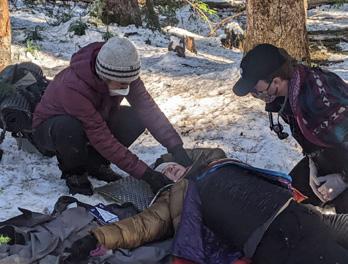
Why learn? A bleeding injury can happen anywhere. We've all seen it happen too often—on the news or in everyday life. Lifethreatening bleeding can happen in people injured in serious accidents or disasters. Instead of being a witness, you can become an immediate responder because you know how to STOP THE BLEED®.
In this course, there will be a formal presentation at the MMC Holman Auditorium followed by hands-on practice of applying direct pressure, packing a wound, and using a tourniquet to stop bleeding. With three quick actions, you can be trained to save a life. The #1 cause of preventable death after injury is bleeding. The course fee includes a personal tourniquet.
Register at tinyurl.com/MazFASTB.
SPECIAL BYLAWS VOTE
» Special election opens January 3, 2023
» Electronic ballots arrive via email on January 2, 2023
» Paper ballots arrive on or around January 3, 2023
» Special election closes January 31, 2023 at 3 p.m.
» Results annouinced online and via email January 31, 2023
SSI OPEN ICE NIGHTS AT THE MMC
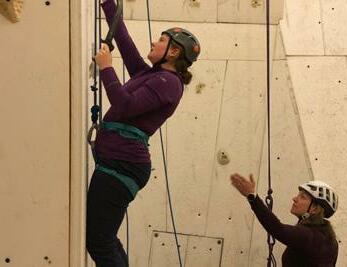
The Mazama Steep Snow & Ice subcommittee is once again hosting open climb nights in Holman Auditorium on the artificial foam ice wall. You do need to sign up for this activity as we have limited space each night. However, you don't need any ice climbing experience, and you don't even need ice tools! But you must be able to belay independently.
Watch for dates in the weekly eNews each week as we determine our next climbing nights in January and February. Join us to learn some ice climbing and drytooling/mixed climbing techniques!
USED EQUIPMENT SAL
Date: March 3, 5–8 p.m.
Location: Mazama Mountaineering Center
Time to pull that old ice axe and those unused crampons off the shelf. The Mazamas will be holding its famous Used Equipment Sale (UES) again this year on March 3, 2023.
The Used Equipment Sale is an annual event. Sellers can clear out their unused gear and make some cash, and buyers can snap up field-tested equipment at great prices! You can get rid of unused gear and help the Mazamas at the same time.
Get full details on page 39 of this issue.
Info Night: Jan. 11, 2023
Classes start: March 2023
TRANSFORM YOUR OUTDOOR GAME!
Are you looking to learn climbing and mountaineering skills? In our 8-week BCEP course, experienced Mazama leaders will teach small teams the basic rock and snow skills needed to climb snow-covered peaks, rock climb, and be a member of an alpine climbing team.
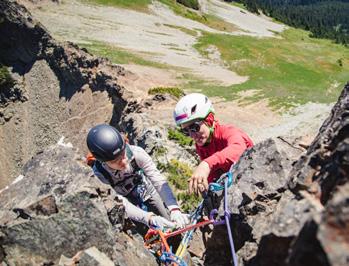
More info at www.mazamas.org/bcep.
STREET RAMBLES
Going on a Street Ramble is one of the best ways to get an introduction to the Mazama hiking program. Meet other hikers and plan a weekend trip, maintain your fitness after work, and see some hidden parts of Portland you might never see otherwise. Interested in joining us? All you need to do is show up, check in, pay, and be ready to go at 6 p.m. We'll see you there!
We operate Tuesday and Thursday night Street Rambles year-round from REI in the Pearl District (NW Portland).
More info at mazamas.org/rambles
JANUARY/FEBRUARY 2023 25
A COLD NIGHT AT MAZAMA LODGE
by Paul Bascom
As every Mazama member knows, there are last-minute decisions made at the start of an adventure that seem completely reasonable at the time. As the adventure unfolds, such decisions may begin to appear suspect, even foolhardy. However, by that time there is too much momentum accumulated and too much invested in achieving the goal that changing the objective occurs only with great reluctance. Typically, we push onward towards our summit, usually culminating in success, despite some selfimposed obstacles. In the end, in addition to the satisfaction of accomplishment, there is a good story to tell.
Which may capture the spirit of the memorable, but very cold, night my 13-year-old daughter Rose spent with her dad at the Mazama Lodge.
We had planned on returning to Portland after an evening of skiing at Skibowl, but it was snowing heavily as we arrived. The blizzard was forecast to continue through the night. We could ski
fresh powder snow all morning and still get back to Portland in time for Christmas Eve meal preparation. I decided we should spend the night up on the mountain.
I had a sudden inspiration. We could stay at the Mazama Lodge! I checked the website. The private rooms were occupied, but there was still space available in the bunk room. Excellent! Ah, a rustic
mountain lodge. How nice! I imagined a crackling fire, convivial atmosphere, laughter and conversation. I quickly made an online reservation, and paid with my credit card. Bunk room for two. Perfect.
Except for the simple fact that I had never spent the night at the Lodge, nor even stepped foot in the Lodge. Nor had I read the fine print on the website. Any
26 MAZAMAS
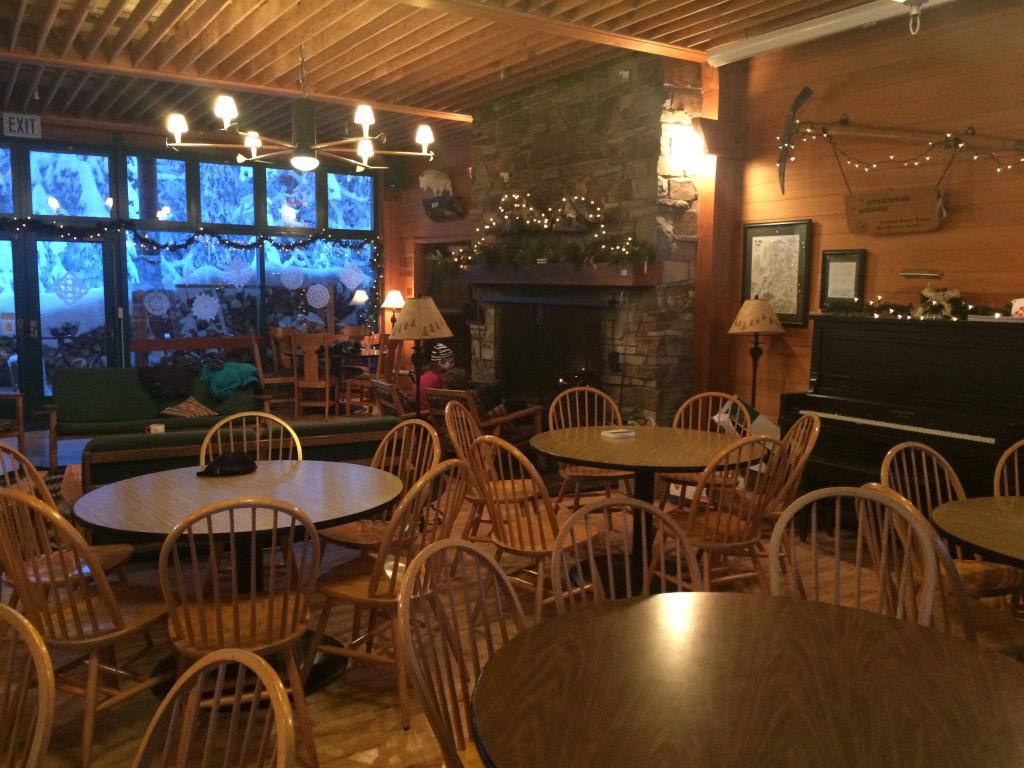
Above: Great room at the Mazama Lodge, a welcome sight on a cold winter night. Photo by the author.
of which, in retrospect, would have led to different decisions being made, but less of a story to tell.
We caught the last chairlift after an evening of epic powder skiing, and stopped for huckleberry pie and cocoa at the Huckleberry Inn. It was nearing midnight before we made our way toward the Lodge. The website instructed me to park at the Sno-Park just east of Government Camp. However, the Sno-Park was filled with fresh snow. Cars left overnight were imprisoned by a berm of plowed snow from the road. There was no chance that I could park there.
I was undeterred. I parked on the shoulder, flashers on. Late-night traffic was sparse. I planned to leave Rose in the welcoming confines of the Lodge, return to move the car to the plowed streets of Government Camp, and then retrace my steps. I showed Rose the unmarked, unlit, unplowed snowy road across from the Sno-Park and assured her, “This is the way to the Lodge.” She was unconvinced. “Dad, this is crazy.”
To her credit, Rose uttered this only a few times as we walked up the snowy road into the dark, deep woods. I pretended that I was certain that I knew the way, though doubt began to creep in. Eventually, I found a small snow-covered sign with the Mazama logo barely perceptible in the gloom. We turned onto what to Rose must have seemed a completely imperceptible trail, untrodden by any person since the afternoon blizzard. “Are you sure this is the way?” Rose asked skeptically. “Absolutely,” I replied, as if to convince myself as much as her.
Into the darkness we pressed onward and upward. Soon a few twinkling lights reassured me that I had not led her astray. After cresting a small rise, there it was, the Mazama Lodge, the porch light aglow. Ah, someone had stayed up to welcome us. Or so I thought.
Inside, the basement was empty, save for a few scattered backpacks. Upstairs, the great room was dark, and similarly empty. No crackling fire, no amiable chatter. A scribbled note on the reception desk indicated that the caretakers had been asleep for several hours, and were not to be awakened, except for emergencies. No worries, we would move quietly and find our own way to the bunk room.
Upstairs we crept, only to find that the bunk rooms were empty, not a soul
present. As I surveyed the situation more closely, a sudden realization crept over me: the Mazama Lodge is a rustic lodge, not a hotel. The room was cold, frigid even. “Bunk room” means unheated room. More importantly, “bunk room” means “bring your own sleeping bag and pillow.” We had only the clothes on our backs.
Some fathers might have retreated then and there, but I remained undeterred. Morning powder snow beckoned. How bad could it be, sleeping without sleeping bags or pillows? I found the stack of sheets used to cover the plastic pads on the bunks. Still bundled up in her ski clothes, I tucked a couple of sheets around Rose and left her alone there in the dark. I promised I would hurry back.
As I descended the empty hallways, I was grateful she had never watched the movie The Shining. The occasional intrusive image of Jack Nicholson’s maniacal grin disturbed my otherwise idyllic walk down to move my car to Government Camp, and then back, snow falling gently through the trees.
Rose was awake when I returned. “Dad, I’m cold,” she grumbled. Two thin sheets had not been enough to ward off the chill of the room, despite her down coat and insulated ski pants. “Don’t worry. I’ll snuggle you,” I assured her. I lay down on the narrow bunk beside her, wrapping her up against me. As I drifted off to sleep, I remembered the sweet pleasure of new
My reverie was interrupted by a jab in the ribs. “Dad! You’re snoring! You can’t go to sleep until I fall asleep.” I struggled vainly to stay awake, trying to remain immobile as my muscles began to ache. Another jab in the ribs: “DAD! Wake up!” We decided that she should wrap her arms around me, keeping her ears against my back, a maximum distance from my noisy breathing. “That’s perfect. I feel so warm,” she reported reassuringly. “Don’t move!” she commanded, before a change in her
JANUARY/FEBRUARY 2023 27
fatherhood, infant Rose sleeping on my chest.
continued on next page
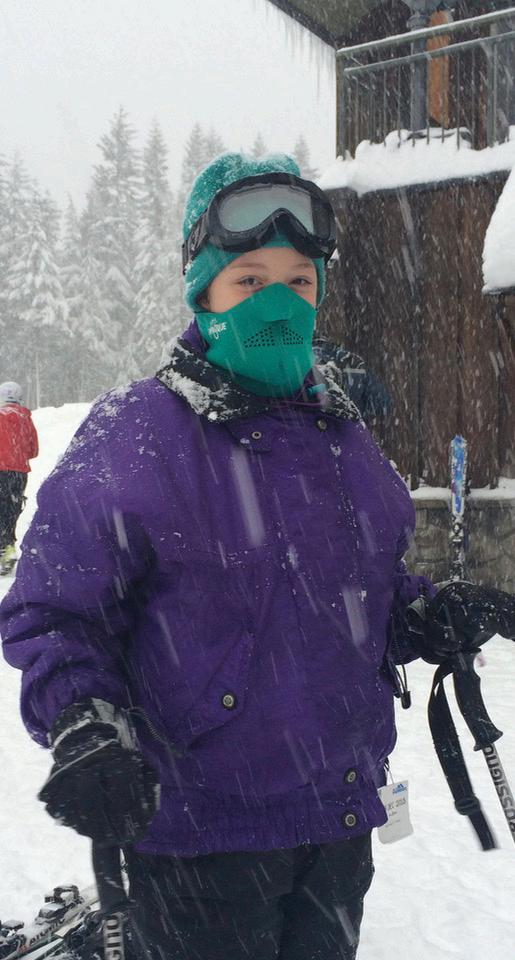
Above: Rose Bascom, skiing at Timberline. Photo by the author.
breathing signaled the onset of sleep. Sleep soon overtook me, too.
Sometime later I awoke with a start, with the sudden recognition that I was not warm. I was cold, very cold. I had only a thin base layer on, no fleece or down. Since I generate so much heat when I ski, that’s all I wear under my shell. I had not packed any extra clothes, this being an impromptu trip. I remembered some uncomfortable nights at the base of the East Face of Mt. Whitney. “Travel light, cold at night” had been the motto of that adventure.
I wanted to check my watch, stretch my legs, move about to warm up, but I had this precious child snuggled against my back. I felt like the male Emperor Penguin, incubating his egg against the Antarctic cold, while his mate fishes in the teeming seas nearby. The only option was to remain immobile, obeying the imperative of fatherhood.
Finally, a faint glow could be seen out the window, and we roused, my muscles stiff and sore. Downstairs, there was a crackling fire. The caretakers
had prepared a hearty breakfast for the handful of guests from the private rooms, who had chosen to spend Christmas Eve at the Lodge. We sat by the fire to warm up.
“How did you sleep?” I asked Rose. “Warmly,” she replied, adding, “That was a good adventure,” which warmed my heart. I remembered my own father’s motto after similar adventures/misadventures: “Makes for a good story.”
The father of three beautiful daughters, Paul Bascom has called Portland home for 40 years. He was the first palliative medicine physician in Oregon. As such, he is well aware that people, and institutions, can die. Previously an intermittent member, he is now a consistent Mazama member. He fervently supports current efforts to set the Mazamas on a sustainable path toward a long life.
MAZAMA VALUES
SAFETY
We believe safety is our primary responsibility in all education and outdoor activities. Training, risk management, and incident reporting are critical supporting elements.
EDUCATION
We believe training, experience, and skills development are fundamental to preparedness, enjoyment, and safety in the mountains. Studying, seeking, and sharing knowledge leads to an increased understanding of mountain environments.
VOLUNTEERISM
We believe volunteers are the driving force in everything we do. Teamwork, collaboration, and generosity of spirit are the essence of who we are.
COMMUNITY
We believe camaraderie, friendship, and fun are integral to everything we do. We welcome the participation of all people and collaborate with those who share our goals.
COMPETENCE
We believe all leaders, committee members, staff, volunteers, and participants should possess the knowledge, skills, abilities, and judgment required of their roles.
CREDIBILITY
We believe we are trusted by the community in mountaineering matters. We are relied upon for information based on best practices and experience.
STEWARDSHIP
We believe in conserving the mountain environment. We protect our history and archives, and sustain a healthy organization.
RESPECT
We believe in the inherent value of our fellow Mazamas, of our volunteers, and of members of the community. An open, trusting, and inclusive environment is essential to promoting our mission and values.
28 MAZAMAS
Lodge,
continued from previous page
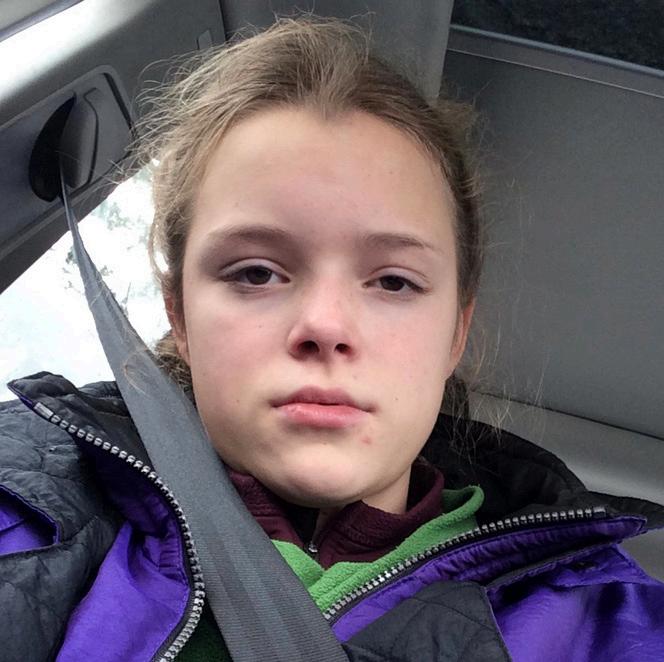
Above: Rose after a cold night at the lodge. Photo by the author.
WHAT’S HAPPENING AROUND THE MAZAMAS?
NOMINATING:
■ We prepared for and pulled off the successful October election.
■ Vlad Lo and Lacey Breton have joined the committee as new members.
BCEP:
The committee is working with multiple organizations that use Horsethief Butte to avoid scheduling conflicts, is streamlining the scheduling tool for leaders, and is drafting curriculum changes and a more transparent application and acceptance policy.
STEEP SNOW AND ICE:
■ The committee reviewed feedback from its 2022 skill-builder and has developed recommendations for changes for 2023, it continued developing its open ice climbing nights and held two sessions at the MMC on Nov. 9 and 16, and is discussing rejuvenating the Portland Ice Climbing competition. Three new members joined: Theresa Silveyra, Amy Krull, and Wojciech Pagacz.
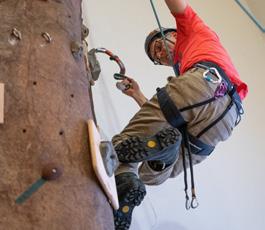
NORDIC:
■ The committee held a Zoom information night for the upcoming season on November 16, and has recruited instructors and assistants and assigned them to teams for Beginner, Novice, and Intermediate, teams.
■ With the help of staff, Nordic has updated its webpage.
■ Registration for the upcoming Backcountry course ended on December 5.
OUTINGS:
■ The committee has discussed the “Special Use Permits” issue as related to access to federal lands.
■ It approved a proposed Outing to Big Bend and Guadalupe National Parks in Texas.
■ It also notes that its work is slowed due to office concerns about generating sufficient income and needing assistance with the Mazama computer system.
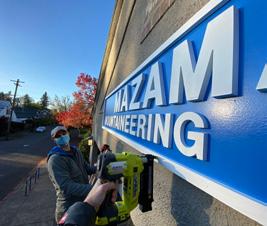
RESEARCH:
CLASSICS:
Marty Hanson is leaving due to his election to the Executive Council. Classics seeks to replace him and desires more members generally.
FIRST AID:
■ The committee held a WFA course on Oct. 14, Nov. 12, and Nov. 19; MFA on Nov. 20; and, at press time, planned an Epi-Pen Training on Dec. 6. The committee is in discussions with Base Medical about fee rebates for Mazamas taking its courses. It also notes slowed response time to requests for assistance with First Aid courses due to staff limitations and is seeking solutions.
■ New member Sergey Kiselev has become the MFA Skill-builder program manager.
■ Lisa Ripps and Sandra Volk are volunteering with varied CPR training duties.
■ Base Medical recognized Christine Troy for her role as an instructor.
RISK MANAGEMENT:
We completed the Risk Management Brochure and were busily reviewing it as fall began.
PUBLICATIONS:
As you can see, we continue to produce the bulletin. We added a new member, Elise Engler, continue to work toward taking over duties from staff, and, as always, we encourage members and committees to submit stories about their activities, goals, members, and issues of relevance.
■ The committee discussed the launch of the 2023 Request for Proposals and is considering a spring seminar featuring grant recipients.
■ Ralph Shuping will step down as chair in the spring of 2023 and Erin Jauarigue, current co-chair, will replace him.
■ Candace Fallon, Steve Hinkle, and Trey Schutrumpf have resigned, bringing the current committee to eight members.
JANUARY/FEBRUARY 2023 29
TOMYHOI PEAK
by Anibal Rocheta
Tomyhoi Peak is a 7,434-foot Skagit Range mountain located one mile south of the Canada-US border in the Northern Cascades of Washington State. It is located west of Mt. Larrabee and within the Mt. Baker Wilderness, which is part of Mount Baker-Snoqualmie National Forest.
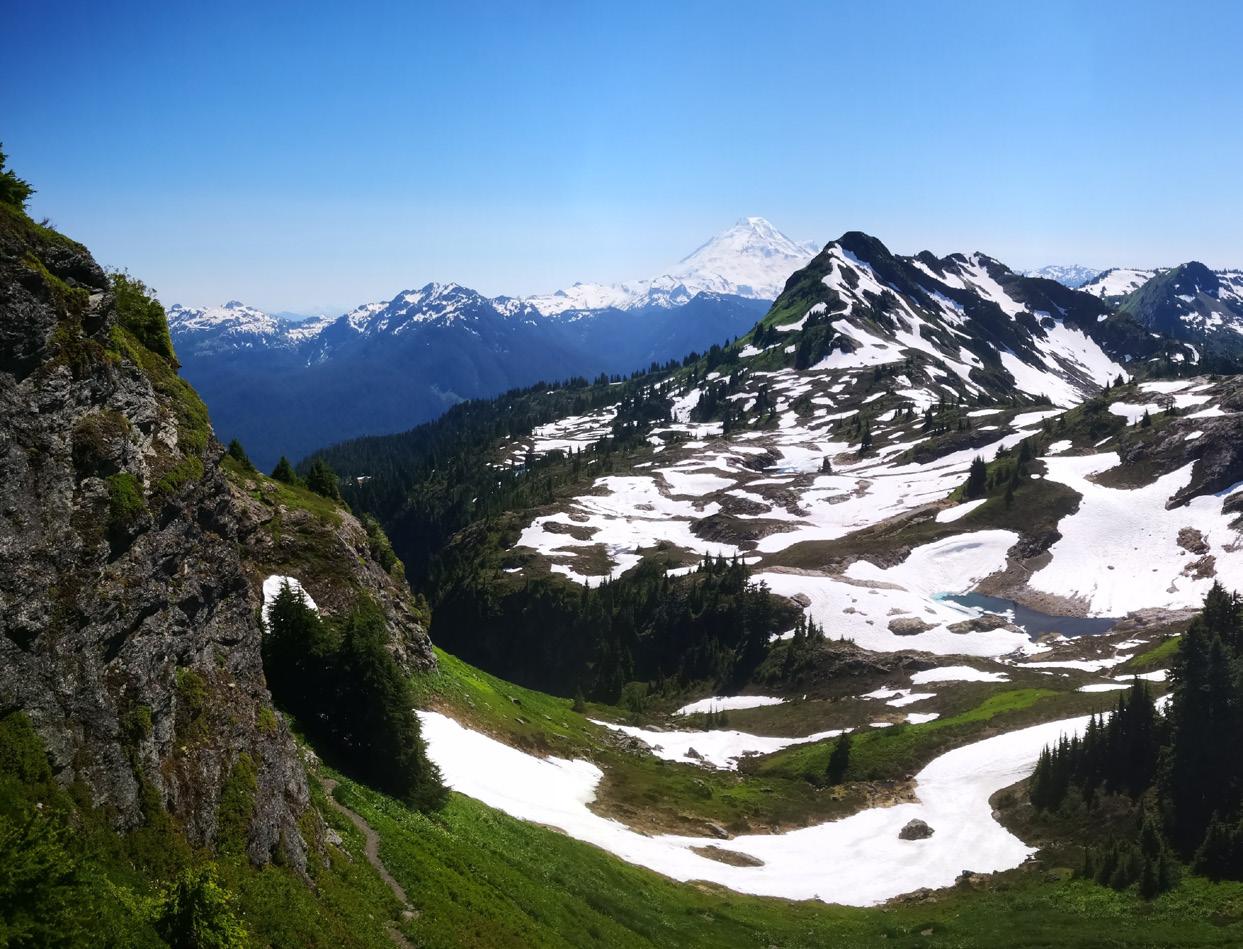
THE GOOD
■ The view from Tomyhoi Peak is the best mountain panorama I’ve ever seen.
■ You can bring your dog, but I recommend only going to Yellow Aster Meadows.
■ The climb helps you increase your self-confidence.
THE BAD
■ The drive is many hours from Portland.
■ The maximum group size is 12 climbers.
■ It’s helpful to have backpacking experience since you must carry all your equipment for several days.
Above: View of the area where we camped at Yellow Aster Meadows.
Although Tomyhoi Peak barely exceeds 7,000 feet, compared to the notable Mt. Baker, Mt. Shuksan, and Mt. Larrabee nearby, I consider it to have one of the best mountain views I have seen thus far and will surely be hard to beat.
THE ROUTE
We took the Southeast route, a trail recommended for experienced adventurers. You can take your dog on this trail but you must keep it on a leash—I would only take them to the camping valley area since later it could be a bit strenuous and even risky for them.
30 MAZAMAS
continued on next page
TOMYHOI PEAK
by Anibal Rocheta
Tomyhoi Peak es una montaña de Skagit Range de 7.434 pies, situada a una milla al sur de la frontera entre Canadá y los Estados Unidos, en las Cascadas del Norte del Estado de Washington. Se encuentra al oeste de Mt. Larrabee y dentro del desierto Mt. Baker, que forma parte del Bosque Nacional Mount Baker-Snoqualmie.
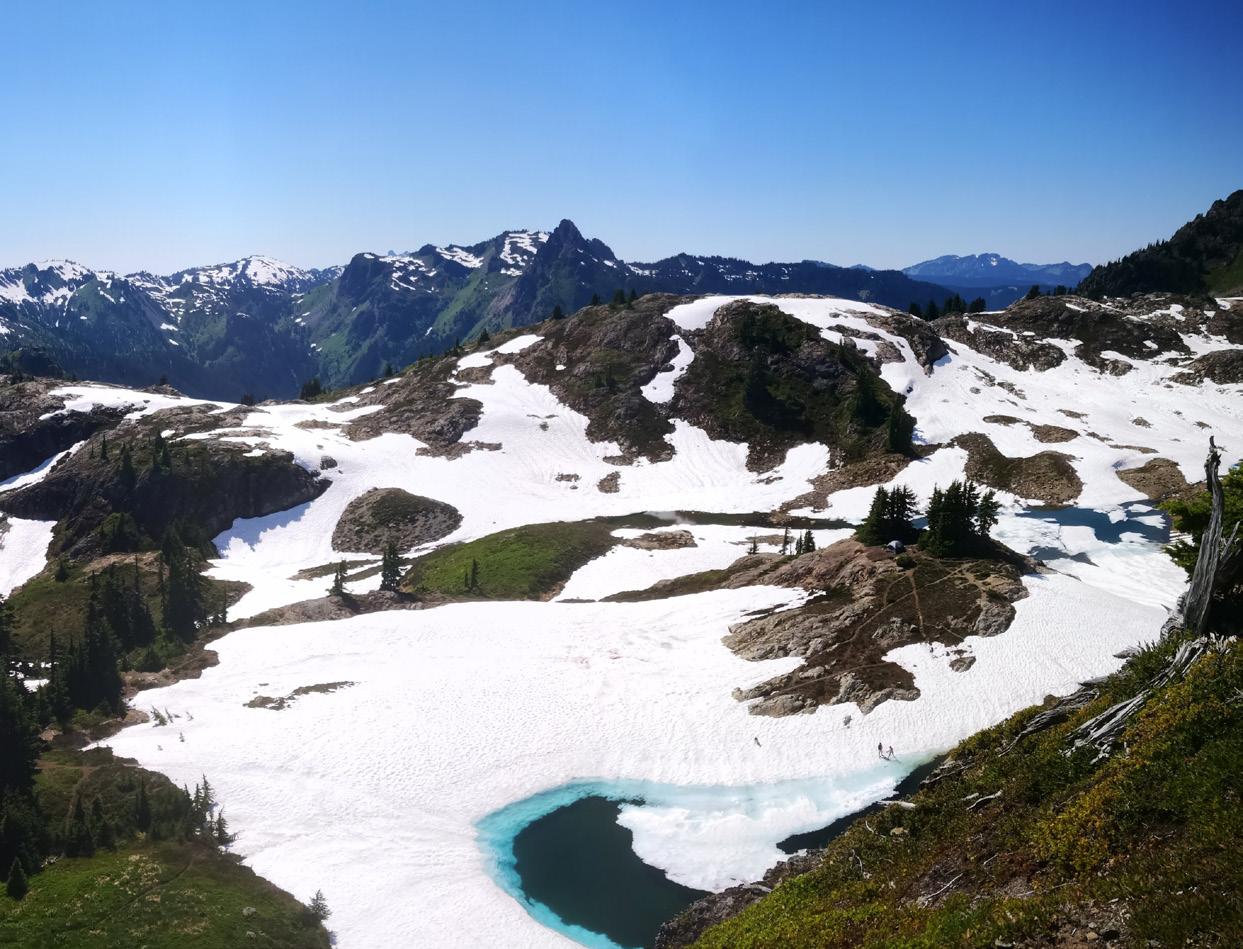
LO BUENO
■ La vista desde de Tomyhoi Peak es el mejor panorámica de montaña que he visto.
■ Puedes traer tu perro, pero yo aconsejo que sea hasta Yellow Aster Meadows solamente.
■ Escalar te ayuda a aumentar la confianza en ti mismo.
LO MALO
■ Es necesario manejar muchas horas desde Portland.
■ El tamaño máximo del grupo es de 12 escaladores.
■ Es útil tener experiencia de excursiones con mochila, ya que debes cargar todos tus equipos por varios días.
A pesar de que Tomyhoi Peak apenas supera los 7.000 pies, comparado con los notables Mt. Baker, Mt. Shuksan, y Mt. Larrabee en las cercanías, considero que es una de las mejores vistas en montaña que he visto hasta el momento y seguramente será difícil de superar.
LA RUTA
Tomamos la ruta Sureste, un sendero recomendado para aventureros con experiencia. En este camino puedes llevar a tu perro, pero debes mantenerlo con correa; yo los llevaría hasta la zona del valle de acampada, ya que luego podría ser un poco extenuante e inclusive riesgoso para ellos.
continúa en la siquiente página
JANUARY/FEBRUARY 2023 31
Encima de: Vista del area donde acampamos en Yellow Aster Meadows.
Tomyhoi,
We started the hike on the Yellow Aster Butte Trail, then continued to a valley with several small lakes at 5,580 feet. We camped near a small mountain lake (tarn). The round trip was about 12 miles.
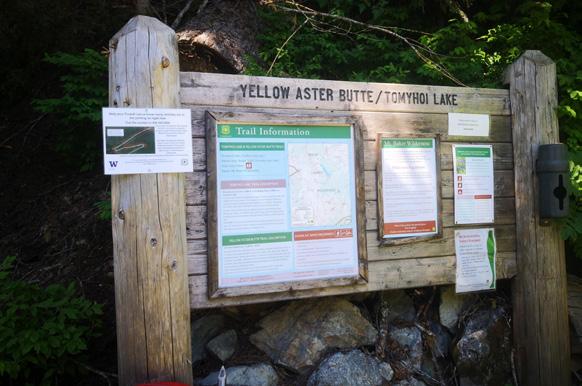
To do this activity, an average fitness level is required, at least jogging or cycling three times a week. As I always say, know your limitations and do not go beyond your capabilities. The walk through the forest is intermediate, but the final part of the mountain is quite challenging, especially on the incline.
In addition, some technical equipment is needed, including climbing and mountaineering equipment. The trail to Tomyhoi Peak is at the back of the lake where we had camped, and climbs steeply up the side towards the top. We followed the cairns until we saw the well-defined path.
Halfway up the ascent you will come across a false summit, but don't give up!
Continue climbing through beautiful valleys with spectacular views of Mt. Baker and Mt. Shuksan to reach the summit. The last 160 feet is difficult and exposed, but very satisfying.
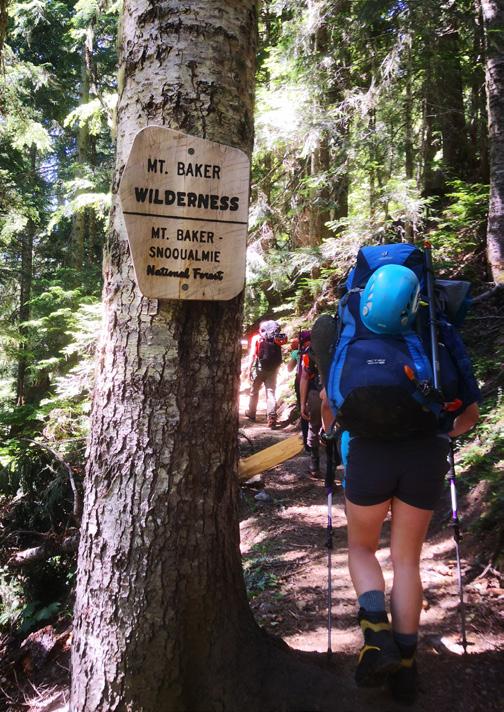
Upon reaching the summit you will appreciate a unique 360-degree panoramic view—everything seems unreal, just one mile from the border between the United States and Canada. I dare to say that it is one of the most impressive views I have ever enjoyed in a mountain setting.
MY RECOMMENDATIONS
■ You will be required to have the Northwest Forest Pass in order to park, so come prepared with the pass.
■ For camping I used the Mountain Hardwear Direkt 2 four-season tent and it worked very well.
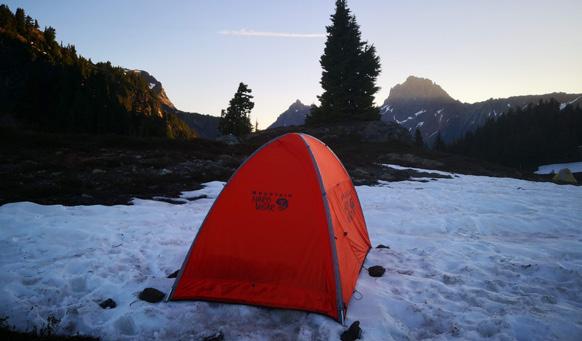
■ It is important to wear a good intermediate layer optimal for winter and alpine climbing. In my case, I used
a Mountain Equipment Eclipse Hooded Zip T.
■ With freedom of movement and just the right weight, the Mammut Eigerjoch Pro IN Hooded Jacket is a must-have piece that you can wear on many of your mountain adventures.
■ I recommend using the AllTrails app for digital maps (you can even use them without a signal on your phone).
■ Take your sunglasses and sunscreen, and anything else you will need throughout the expedition. I like the Julbo EXPLORER 2.0 expedition sunglasses.
If you want more details of recommendations, contact me.
I hope this brief information will help you plan your expedition to Tomyhoi Peak.
To learn more about our adventures, you can follow us on Instagram @ locoporlaaventura.
32 MAZAMAS
continued from previous page
Above, clockwise from the top: Start of the hike; taking the Yellow Aster Butte Trail; camp near a small mountain lake (tarn). Opposite page: Ascending the last feet with fixed rope and prusik knot; Tomyhoi Peak summit at 7,451 feet (2266 meters), July 16, 2018., Photos by Anibal Rocheta.
Anibal is a professional adventure guide, videographer, and photographer from Venezuela.
He has been a Mazama since 2014 (joining as soon as he moved to Oregon). He has been leading mountain expeditions in Venezuela, Peru, and the USA for many years, and has lead tourism initiatives in Venezuela through TV programs, training, and advising companies in ecotourism and adventure.
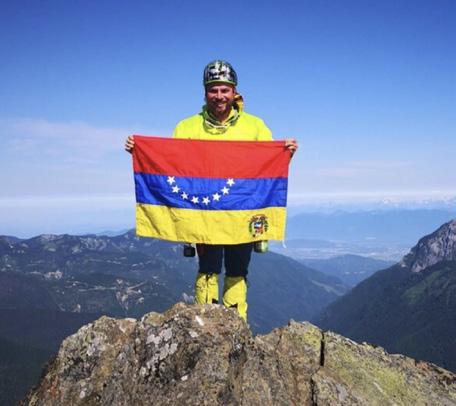
Anibal is an assistant in the first Mazama Latino BCEP group, and is producing the first adventure TV show for the Latino community in Oregon called “Loco por la Aventura.” Learn more about his adventures and recommendations at www.locoporlaaventura.com.
Pagina opuesta: Inicio de la caminata; tomando el sendero Yellow Aster Butte Trail; acampamos cerca de un pequeño lago de montaña (tarn). Encima de: Ascendiendo los últimos pies con cuerda fija y nudo prusik; cumbre de Tomyhoi Peak a 7,451 pies (2,266 metros),16 de julio de 2018. Fotos de Anibal Rocheta.
Iniciamos la caminata por el sendero Yellow Aster Butte. Luego continuamos hasta un valle con varios lagos pequeños a 5.580 pies. Acampamos cerca de un pequeño lago de montaña (tarn). El viaje de ida y vuelta duró aproximadamente 12 millas.
Se requiere un nivel de condición física promedio, es decir al menos trotar o hacer bicicleta tres veces por semana. Como siempre digo, conoce tus limitaciones y no vayas más allá de tus capacidades. La caminata por el bosque es intermedia, pero la parte final de la montaña es bastante desafiante, sobre todo en la inclinación.
Requiere algo de equipo técnico, incluyendo equipo de escalada y alpinismo. El camino hasta Tomyhoi Peak se encuentra en la parte trasera del lago donde habíamos acampado, subiendo abruptamente por el costado hacia la cima. Seguimos los mojones hasta que ver el camino bien definido.
Hay una cumbre falsa a la mitad del ascenso, ¡pero no te rindas! Sigue escalando entre hermosos valles con vistas espectaculares de Mt. Baker y Mt. Shuksan para alcanzar la cumbre. Los últimos 160 pies son difíciles y expuestos, pero muy satisfactorios.
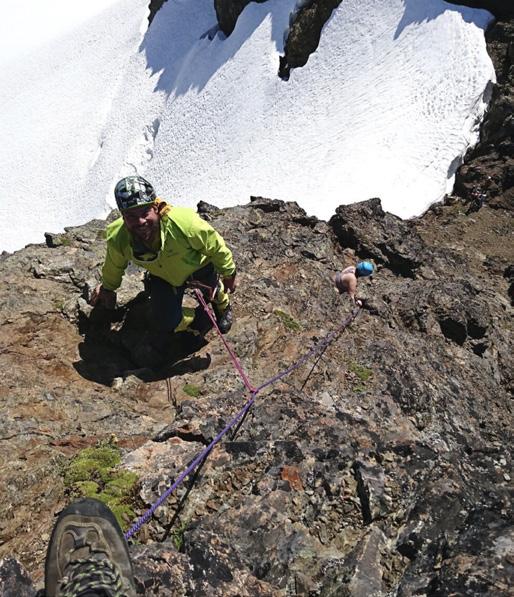
Al llegar a la cumbre apreciarás una vista panorámica única de 360 grados, todo parece irreal, a solo una milla de la frontera entre los Estados Unidos y Canadá. Me atrevo a decir que es una de las vistas más impresionantes que he disfrutado en un entorno de montaña.
MIS RECOMENDACIONES
■ Es necesario tener el Northwest Forest Pass para poder estacionar, así que venga preparado con el pase.
■ Para acampar usé la carpa de cuatro estaciones Mountain Hardwear Direkt 2 y funcionó muy bien.
■ Es importante llevar una buena capa intermedia óptima para el invierno y la
escalada alpina. En mi caso, utilicé una Mountain Equipment Eclipse Hooded Zip T.
■ Con la libertad de movimiento y el peso justo, la Mammut Eigerjoch Pro IN Hooded Jacket es una pieza necesaria, la cual podrás usar en muchas de tus aventuras en montaña.
■ Recomiendo usar la aplicación AllTrails para los mapas digitales (incluso los puedes usar sin señal en el teléfono).
■ Llévate tus lentes de sol y bloqueador solar, y cualquier otra cosa que necesites durante la expedición. Me gustan los lentes de expedición Julbo EXPLORER 2.0.
■ Si deseas más detalles de recomendaciones contáctame.
Espero que esta breve información te ayude a planificar tu expedición a Tomyhoi Peak.
Para conocer más sobre nuestras aventuras, puedes seguirnos en Instagram @locoporlaaventura.
JANUARY/FEBRUARY 2023 33
Tomyhoi, continúa desde de la página anterior
NATIONAL FOREST PERMITS PART II
Above: Washington State's National Forests. Image courtesy of the United States Forest Service.
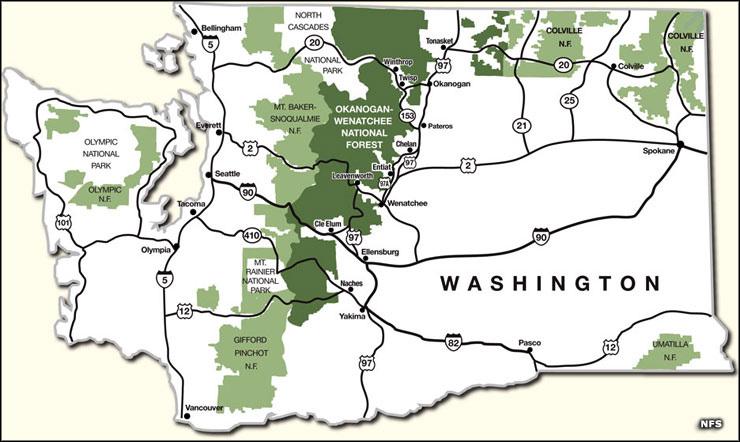 by Matt Blecharz, Mazama Access Committee
If you’ve been following the discussion over the past several months about how the Mazamas is permitted to access national forests in the region, you know we have made the difficult decision to stop operating in Gifford Pinchot National Forest, Mt. Baker-Snoqualmie National Forest, and in areas as far-reaching as Inyo National Forest, where the John Muir Trail resides. These limits impact both climbing and hiking alike, prevent individuals from completing their 16 Northwest Peaks journeys, and have wider ramifications across our organization than can be listed here. The Mazamas is deeply committed to charting a path through this challenge, and, where possible, to explain this issue more broadly.
We are well-positioned to navigate this challenge by cultivating and strengthening our relationship with national forest managers while continuing to provide our services for members and nonmembers alike. We must foster new relationships and develop sustainable processes which ensure transparency to our U.S. Forest Service partners. We must also bring awareness of our activities to the Mazama community and the public. These efforts are estimated to take around 2–3 years,
assuming the dedicated support of at least two individuals within our organization. This is a relationship that the Access Committee believes should be maintained by Mazama staff members to bring stability to this process and consistency when our partners in national forests change. This work includes cultivating relationships, forecasting, and reporting upon our activities within each national forest, and where needed, managing permitting processes on an ongoing basis.
Due to the recent permitting impacts, the Access Committee, made up of members across the Climbing, Trail Trips, and Outings Committees, is recommending the Mazama Board of Directors take two actions:
Cease hiking and climbing fees (with an exception for Mt. Hood) and introduce a limited approach to publicly free and accessible hikes; and,
Remove the glaciated peak requirement from the Mazama bylaws.
34 MAZAMAS continued
page
on the top of the next
In Mt. Hood National Forest, our current ten-year permit allows Mazama education programs, hiking, and climbing to continue sustaining the organization through reasonable pricing. The Access Committee is researching how the Mt. Hood permitting process may impact climbs. Outside the Mt. Hood National Forest and the Oregon Columbia River Gorge National Scenic Area, we are collectively restricted from offering hiking, climbing, outings, and any activity which exchanges money for that activity. This regulation impacts the Mazamas—and all organizations exchanging funds for services—across all national forest land, which currently spans 17 different areas. It may eventually include Mr. Rainier National Park and affect the Tatoosh area, where we currently explore and enjoy the outdoors.
The Mazamas holds true to its core that we are not a guiding organization (individuals supported by an outfitter) or an outfitter organization (a licensed business that employs guides). Yet contrary to this belief is our approach to charging activity fees. Pecuniary remuneration—in our case providing outdoor opportunities and experiences for members and the broader public in exchange for money—is central to how the Mazamas operates today. Through this exchange of money, and under Federal Regulation 36 CFR 251, each climb or hike we operate aligns with the commercial outfitting/guiding services definition. This presents a significant
barrier to the Mazamas and has the potential to alter where we operate—and more importantly, how we are allowed to operate—in each region.
With more than a century of enabling accessibility and responsible hiking and climbing practices, the Mazamas was surprised to learn this regulation is being applied to our organization. Non-profit organizations are not exempt and must begin to operate accordingly. Successfully navigating this challenge requires the Mazamas to stop charging a fee for activities in areas where we do not have a permit to operate as an outfitter. Making this change will require the Mazamas to identify and cultivate new income streams or further increase our commitment to broadening our membership.
Charging for a service (climb or hike) is not the only barrier to entry that our public community experiences to engage with the Mazamas at large. The Mazamas charges a membership fee which comes with a condition—the glaciated peak requirement. While charging a membership fee is not in question, what is in question is how the glaciated peak requirement presents an accessibility barrier to the services our organization offers. For a climb or hike to not be considered a guided service, there must also be opportunities for the public to sign up and successfully hike or climb without a fee being charged. Climbs can continue to have skill requirements and numbers can be limited to a maximum per individual on an annual basis.
To compound our challenges, the glaciated peak requirement adds additional complexity to our operational success—this barrier limits our ability to grow membership by limiting access, which ultimately limits our opportunity to expand our community. Reinforcing the glaciated peak requirement is a direct risk to enabling the public’s accessibility to the Mazamas. To enable the organization’s continued access to all the region’s national forest lands and enhance the sustainability of our organization and its commitment to bringing more public access to public lands, your help is required! We will not get to a resolution without you and all our members—we will not be successful without passing the proposed changes to the Mazama bylaws in January.
Voting for the proposed bylaws change on January 31, 2023, is critical to the Mazamas and its access concerns. To continue exploring all the region’s beautiful areas, your board and Executive Director, working in conjunction with the Mazama committees, must modernize our fee and membership structure to remain relevant, which today requires a time-intensive two-thirds vote. Additional information is available in the November/December 2022 Mazama Bulletin starting on page 32.
WHAT THE ACCESS COMMITTEE IS RECOMENDING:
» No fee for climbs.
» You must be a member to apply for climbs.
» We will continue to charge a fee for Mt. Hood climbs.
» Individual climbers will be responsible for any individual permit or camping fees.
» Hikes will be free to members and nonmembers.
» Recommendation assumes the bylaws pass and anyone can become a Mazama member.
ACCESS COMMITTEE MEMBERS:
Jesse Applegate, climb leader
Matt Blecharz, climb leader
Bob Brievogel, board member and climb leader
Amy Brose, climb leader
Tom Davidson, Trail Trips Committee
Leigh Schwarz, Outings Committee
Trey Schutrumpf, Climbing Committee
Greg Scott, climb leader, Mazama President
Glen Widener, climb leader
Daniel Zawistowski, DEI Committee
JANUARY/FEBRUARY 2023 35
»
»
»
»
»
»
»
»
»
»
DOING THE PRIVILEGE WALK IN THE OUTDOOR ADVENTURE COMMUNITY
By Aimee Frazier and Thomas Doherty
As a Mazama member, I have followed the dialog on our organization’s Route Ahead from a unique perspective. My work as a psychologist has focused on studying people’s relationship with nature and the outdoors; this interest has led me to train counselors in taking therapy out of doors, which has in turn brought up questions about obstacles to access. Aimee Frazier, in training to become a licensed counselor, brought my attention to a thought-provoking training she recently conducted for the Association for Experiential Education. I believe her account below canhelp guide discussions about our sense of identity and purpose.
I hope you give this exercise a try, and find it enlightening. Personally, while I did not grow up with access to mountains, I was lucky enough to know people who could take me up peaks like Mt. Rainier, despite my limited experience, and keep me safe – and I always felt fully accepted in the outdoors. My privilege walk into the outdoors, in other words, was more like a run. What has yours been like? --Thomas Doherty
The outdoor adventure community has historically lacked inclusivity, catering access to outdoor adventurebased experiences to white, middle- and upper-class men who are able-bodied. This exclusivity has left out people from a variety of diverse backgrounds, body types, and identities, making the outdoors feel unapproachable or unsafe for many.
Privilege is defined as “Unearned access or advantages granted to specific groups of people because of their membership in a social group.". One tangible way of recognizing privilege is an experiential exercise called a Privilege Walk. The purpose of this activity is to expand awareness of one’s own privileges or lack thereof, and gain insight into the different experiences between individuals.
This idea originated from the work of Peggy McIntosh, who wrote White Privilege: Unpacking the Invisible Knapsack. In her work, McIntosh describes privilege and defines many of the unearned benefits that white individuals typically take for granted, that people from other racial backgrounds do not have.
The Privilege Walk is typically an eye-opening experience for those from privileged backgrounds, as individuals come face to face with other people in their community who have had vastly different experiences based on parts of their personal identities.
I most recently led this experience with outdoor-based experiential educators and therapists. Thirty-four participants from a variety of backgrounds signed up for an experiential workshop on the topic of inclusion and social justice in the outdoors. The group lined up, standing side by side, in a large field, all facing forward, where I stood in front of the group. I described the purpose of the exercise: to better understand our levels of privilege in the context of the outdoor adventure field. I let participants know that they had a choice to participate or observe and that they were never obligated to answer any questions. With that, we began.
I read the first statement. “Take a step forward if you grew up in a home where your parents or guardians took you outdoors during your childhood.” Most participants stepped forward. Some did not.
The statements continued from a more generalized perspective and progressed toward more personal experiences. “Take a step forward if you had access to safe parks, trails, or outdoor recreation areas during your childhood.” “Take a step forward if you have always felt welcome by other people and organizations in the outdoor setting.” Many stood still. Participants looked to
their left and right, toward the individuals they knew and cared for. Having learned of their experiences of exclusion, their faces revealed a variety of emotions.
“Take a step forward if you have felt fully comfortable and widely accepted by others in the outdoor adventure field based on your racial background, cultural identity, socioeconomic status, ability level, sexual orientation, gender identity, or sex.” Many did not step forward.
Their stillness represented the lack of safety, acceptance, and inclusion they had experienced. I watched individuals silently wipe tears away as they acknowledged and witnessed the representation of deeply personal wounds within their community of peers and colleagues. Following the last statement, the participants paused to take inventory of their place in the now-dispersed line of participants. Some individuals stood near the starting line, indicating a lack of privilege, while others were much further ahead—indicating a wide gap of privilege within the outdoor adventure community.
In the debrief, we talked about what it was like to see privilege dispersed unequally through the community. Those who had more privilege shared their mixed emotions. Those who had less privilege shared what it was like to have their reality witnessed by peers. Some chose to share their personal stories of not having access to the outdoors during childhood or finding the outdoor adventure field to not be inclusive of “people like me.” It was a moving experience that
36 MAZAMAS
allowed participants to see a tangible representation of privilege and systemic issues that are often ignored.
Marinel M. de Jesus, the founder of Brown Gal Trekker, encourages those leading and participating in outdoor adventures to acknowledge the reality of inequality in our communities. She encourages adventurers to educate themselves on issues of inequality and privilege, and to be an advocate by calling out “isms” when we see them—racism, sexism, ableism, etc. She states that it is crucial for each individual to know their personal biases and work to continually let them go. When others from backgrounds different than our own share deeply personal experiences of encountering inequality, it’s important to validate their pain.
I encourage those leading within the outdoor adventure field to take time to reflect on issues of privilege and engage with their own experiential Privilege Walk within their communities.
“So what does privilege have to do with the outdoors? A lot actually. Nature is inhabited by people who reflect the same biases you see everywhere else in society. Although it’s tempting to view the outdoors as a transcendent experience that will smooth over unpleasant topics like … racism … that’s more wishful thinking than reality. Forest bathing doesn’t wash away bigotry … Privilege is hard to see. In fact, the more you have it, the less likely you are to be aware that it exists.”—Danielle Williams, Melanin Base Camp
OUTDOOR EXPERIENTIAL PRIVILEGE WALK:
TAKE A STEP FORWARD IF …
» You grew up in a home where parents took you outdoors
» An adult in your life took you on outdoor adventures on a regular basis
» You have ever engaged in a sport or a community program that allowed you to spend time in the outdoors as an athlete or recreationally
» You lived within walking distance of a safe trail, park, or outdoor recreation area
» People in your life encouraged you to spend time outdoors
» You always feel safe when outdoors with friends
» You always feel safe when outdoors alone
» As a child you learned the skills necessary for safe practices when participating in recreational activities outdoors
» As a child you had financial access to organizations that facilitated outdoor activities
» You feel comfortable sleeping outdoors
» You have never been harassed by strangers outdoors in a wilderness setting
» You have always felt welcome in the outdoor setting
» You had access to outdoor-based organizations where leaders had similar identities (gender, race, socioeconomic status, etc.) to that of your own
» You’ve spent more than a week at a time living outside (camping, backpacking, etc.)
» You’ve had the financial means as a young adult to enjoy one or more outdoor recreation activities
» You have always felt comfortable in all areas of your personal identity being widely accepted by others in the outdoor adventure or recreation setting (gender identity, sexual orientation, race, class, cultural identity, socioeconomic status, etc.)
» You have at least one place in nature where you feel connected to something larger than yourself
References:
■ files.eric.ed.gov/fulltext/EJ1277027. pdf
■ psychology.umbc.edu/wp-content/ uploads/sites/57/2016/10/WhitePrivilege_McIntosh-1989.pdf
■ unitedwaysem.org/equity_challenge/ day-3-what-is-privilege/
■ www.melaninbasecamp.com/
■ www.browngaltrekker.com
Resources:
■ americanhiking.org/hikingresources/racism-in-the-outdoors/
■ www.browngaltrekker.com
■ www.melaninbasecamp.com/
JANUARY/FEBRUARY 2023 37
EXECUTIVE BOARD MINUTES
by Greg Scott, Secretary
SEPTEMBER 28, 2022
Attending: Jesse Applegate (in-person), President; Aimee Filimoehala (remote), Vice President; David Urbaniak, (remote), Treasurer; Greg Scott (in-person), Secretary; Bob Breivogel (remote), Amanda Ryan-Fear (remote), Charles Barker (remote); Staff: Kaleen Deatherage, Interim Executive Director (in-person). Guests: Liz Crowe.
WELCOME & CALL TO ORDER
■ The meeting was called to order at 4:03 p.m. by President Jesse Applegate.
■ Jesse noted a quorum was present. Jesse began by noting that the focus of the meeting would be on the bylaws proposal.
BUSINESS AGENDA
■ Treasurer’s Report. In lieu of a treasurer’s report, Kaleen and David introduced Liz Crowe who has helped revise the budget process. Liz provided the Executive Council with an overview of the Mazamas accounting structure, comparing the old process to the new process.
■ The new template consolidates the departments into department groups and functions making the financials much easier to analyze.
AMENDED AND RESTATED BYLAWS PROPOSAL
■ The majority of the meeting was spent going section by section through the draft Amended and Restated Bylaws proposal.
■ At the conclusion of this review Greg made a motion to approve the Amended and Restated bylaws proposal pending confirmation with counsel, clarification, and proposed edits. Aimee seconded.
□ Motion passed unanimously.
■ The final draft of the proposed Amended and Restated Bylaws will be published to the membership in the next bulletin.
ANNUAL MEETING
■ The Executive Council and Kaleen discussed the agenda for the annual meeting. The Executive Council will share the December 2021 P2P focused assessment with the membership at the annual meeting. There will be a
president’s report, treasurer’s report, and secretary's report.
■ EC will plan to talk about where we are in the bylaws process in the secretary's report.
■ There will be committee reports followed by announcement of election results. The Executive Council will convene following the annual meeting to elect officers.
MT. HOOD PERMIT PROPOSAL
■ Jesse is working on proposed language for the Mazama position on the Mt. Hood Permit Proposal. Generally the position will state that the Mazamas is in favor of improving safety, stewardship, and education on Mt. Hood, however it is against implementing fees. Rather we would be interested in supporting the Forest Service in restoring federal funding through other means.
□ The board is in favor of this concept.
■ A question came up about what was happening with the USFS special use permit issue. Greg reported that the first Access Committee meeting will take place October 12.
■ The committee will be tasked with answering the following questions:
□ Where does this regulation impact us?
□ What Mazama programs are impacted?
□ What should the Mazamas do to minimize the impact?
□ Who should own the relationship with the USFS going forward?
□ How can the Mazamas influence the legislature to change this process?
■ Bob asked to join the Access Committee.
■ Jesse adjourned the meeting at 6:35 p.m.
by Walter Keutel, Recording Secretary
OCTOBER 3, 2022
MINUTES OF THE MAZAMA EXECUTIVE COUNCIL—ELECTION OF OFFICERS
Attending: Greg Scott, Bob Breivogel, Marty Hanson, David Urbaniak; absent: Charles Barker, Terry Donahe; Staff: Kaleen Deatherage, Interim Executive Director; Mathew Brock, Library and Historical Collections Manager; Nomination Committee members: Ardel Frick, John
WELCOME & CALL TO ORDER
■ The meeting was called to order at 7:59 p.m. by chair pro tem Ardel Frick from the Nominating Committee. She appointed Walter Keutel, also from the Nominating Committee, to be the recorder.
■ It had previously been noted by the recorder that two directors were present in the room and three directors were present in the teleconference. Two were absent and two positions are currently vacant.
■ Ardel Frick announced the business at hand, which was to elect all four Mazama officers.
■ Ardel Frick called for nominations for the election of president.
□ Marty Hanson nominated Greg Scott for the office. No other nominations were received, and Greg Scott was elected president by unanimous show of hands vote.
■ Ardel Frick called for nominations for the election of vice president.
□ Greg Scott nominated David Urbaniak for the office. No other nominations were received, and David Urbaniak was elected vice president by unanimous show of hands vote.
■ Ardel Frick called for nominations for the election of secretary.
□ Greg Scott nominated Claire Tenscher for the office. No other nominations were received, and Claire Tenscher was elected secretary by unanimous show of hands vote.
■ Ardel Frick called for nominations for the election of treasurer.
□ Greg Scott nominated Terry Donahe for the office. No other nominations were received, and Terry Donahe was elected treasurer by unanimous show of hands vote.
■ Ardel Frick announced the completion of business to elect officers and congratulated the new officers.
■ The meeting adjourned at 8:09 p.m.
38 MAZAMAS
Rettig, Walter Keutel, Barbara Weiss.
MAZAMA USED EQUIPMENT SALE
■ Date: Thursday, March 3, 5–6 p.m. for Mazama members and students in climb classes; 6–8 p.m. for the general public.
■ Gear Drop-off for Sale: March 2, 4–8 p.m.
■ Location: Mazama Mountaineering Center, 527 SE 43rd Ave., Portland, Ore.
Clear out your gear room! Make way for more! The Used Equipment Sale (UES) is an annual event. Sellers can make some money by letting go of unused gear and buyers can get great deals on field-tested equipment. Nordic and telemark ski gear (no downhill skis, please), snowshoes, all kinds of outdoor clothing, assorted (and we do mean assorted!) camping and backpacking gear, shoes and boots, books, and technical climbing gear will all be available. This is a great chance to clean out your gear room of unneeded stuff, make a buck, help out the Mazamas, and find some great deals yourself. Cash, checks, or Visa and Mastercard are accepted.
WHAT SHOULD YOU DO IF YOU’D LIKE TO SELL SOMETHING?
■ Look in your gear closet for sale able equipment or clothing you aren’t using or have upgraded. See what items we will accept at mazamas.org/UES.
■ Price it reasonably and it will sell; you’ll keep 70 percent of all proceeds.
■ Pick up price tags and tally sheets at the MMC starting January 31, between 10 a.m. and 4 p.m.
■ Mark your calendars for March 2 from 4–8 p.m. to drop off items for the sale.
■ Pickup of leftover items is Saturday, March 4.
Once again, we’ll be collecting warm clothing for Mainspring ( formerly FISH Emergency Services) or a similar organization to distribute to those in need.
For questions, email ues@mazamas.org or visit the website at mazamas.org/UES.
COLOPHON
CONTACT US
Mazama Mountaineering Center
527 SE 43rd Ave., Portland, Oregon, 97215 Phone: 503-227-2345 | help@mazamas.org Hours: Tuesday–Thursday, 10:30 a.m.–5 p.m. Mazama Lodge 30500 West Leg Rd., Government Camp, OR, 97028 Phone: 503-272-9214 mazamalodge@mazamas.org Hours: Closed until 2023 Editor: Mathew Brock, Bulletin Editor (mazama. bulletin@mazamas.org)
PUBLICATIONS TEAM
Members: Peter Boag, Elise Englert, Darrin Gunkel, Ali Gray, Ryan Reed, and Claire Tenscher (publications@mazamas.org)
MAZAMA STAFF
GINA BINOLE Office & Communications Coordinator ginabinole@mazamas.org
MATHEW BROCK Library & Historical Collections Manager mathew@mazamas.org
RICK CRAYCRAFT Facilities Manager facilities@mazamas.org
KALEEN DEATHERAGE Interim Executive Director kaleendeatherage@mazamas.org
BRENDAN SCANLAN Operations & IT Manager brendanscanlan@mazamas.org
For additional contact information, including committees and board email addresses, go to mazamas.org/ contactinformation.
MAZAMA (USPS 334-780):
Advertising: mazama.ads@mazamas.org. Subscription: $15 per year. Bulletin material must be emailed to mazama.bulletin@mazamas.org. The Mazama Bulletin is currently published bi-monthly by the Mazamas—527 SE 43rd Ave., Portland, OR 97215. Periodicals postage paid at Portland, OR. POSTMASTER: Send address changes to MAZAMAS, 527 SE 43rd Ave., Portland, OR 97215. The Executive Council meets at 4 p.m. on the third Tuesday of each month. Meetings are open to members. The Mazamas is a 501(c)(3) Oregon nonprofit corporation organized on the summit of Mt. Hood in 1894. The Mazamas is an equal opportunity provider.
JANUARY/FEBRUARY 2023 39
40 MAZAMAS
DONATE NOW TO OUR ANNUAL CAMPAIGN! Donations this year will go to support education scholarships, youth programming, grants, and Mazama Lodge maintenance.
Mazama Periodical Postage Paid in Portland, Oregon Mazamas® 527 SE 43rd Ave. Portland OR 97215 www.mazamas.org
ICS students relax after a day at Horsethief Butte, September 2022. Photo by Teresa Dalsager.
