The official publication of the Massachusetts State Automobile Dealers Association, Inc
Uncertainty Abounds –Focus on What We Can Control
By Jeb Balise, MSADA President
Soon, we will be closing the books on 2025. As we approach the end of the year, we can look back on matters that were resolved hopefully to the benefit of our dealerships – delays of EV mandates here and the ultimate repeal of the CARB mandates in Congress; passage of electronic titles for our RMV to implement; revised federal tax policies; new junk fee regulations with a dealership carve-out, just to name a few.
Moving forward, however, there are matters which are presently out of our hands – what will CARB come up with in response to the EV repeals; the ever-changing landscape of the Trump tariffs currently in the hands of the U.S. Supreme Court; will this year’s tax law changes have the intended effects in 2026; federal efforts to address consumer affordability issues and what that might mean for businesses; efforts here to alter tax policy, both in favor and against taxpayers.
As we approach the end of the year, we can look back on matters that were resolved, hopefully to the benefit of our dealerships.
Looking to Capitol Hill, as the U.S. House and Senate operate on a sliver of a Republican margin, we can expect Congress to play catch up after having sat out almost two months during a Democrat-induced shutdown. There are serious matters requiring legislative attention, and a Congress idle for such a long period of time means their work will be squeezed into a compressed period of time heading into next Fall’s midterm elections. The next 300-plus days will fly by.
In the present, the daily drive for success demands our constant attention. There are those matters we know we need to get right all the time – wage compliance, HR training, IT compliance and security, workplace safety rules, and tax planning are some of the vital ones. While these are all the things we can control in our businesses, it keeps getting more complicated. It is essential we focus more time and effort on them. Your Association is here to help.
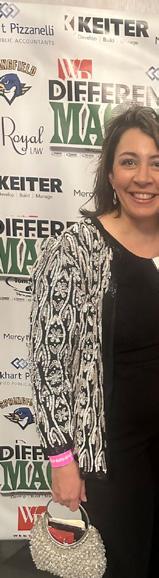
Finally, among us are shining examples of the best we offer. Each year we have the opportunity to send one of our dealers to the NADA convention to be honored for the good they accomplish in their communities. It is a special moment we all can take pride in. I look forward to seeing Carla Cosenzi Zayac carry the Massachusetts banner as our Dealer of the Year candidate at the NADA Show in Las Vegas in February. I have known Carla her whole life. Her dedication to her employees, customers, and the Hampshire County community is an inspiration we all can follow. We offer Carla our sincerest congratulations as she prepares for her recognition in Vegas.
Msada BOaRd
Barnstable County
Brad tracy, tracy Volkswagen
Berkshire County
Brian Bedard, Bedard Brothers Auto Sales
Bristol County
richard Mastria, Mastria Auto group
Essex County
William Deluca iii, Bill Deluca family of Dealerships
Paul Bertoli, Priority chryslerJeep Dodge ram
Franklin County [open]
Hampden County
Jeb Balise, Balise Auto group
Hampshire County
Bryan Burke, Burke chevrolet
Middlesex County frank Hanenberger, MetroWest Subaru
Norfolk County
Jack Madden, Jr., Jack Madden ford charles tufankjian, toyota Scion of Braintree
Plymouth County
christine Alicandro, Marty’s Buick gMc isuzu
Suffolk County [open]
Worcester County
Steven Sewell, Westboro chrysler Dodge ram Jeep
Steve Salvadore, Salvadore Auto
Medium/Heavy-Duty Truck Dealer
Director-at-Large [open]
Immediate Past President
chris connolly, Jr., Herb connolly chevrolet NADA Director
Scott Dube, Mcgovern Hyundai rt.93
OFFICERs
President, Jeb Balise
Vice President, Steve Sewell
Treasurer, Jack Madden, Jr. Clerk, c harles tufankjian
MSADA A SS oci Ate M e M ber S D irectory
ACV Auctions
Steve Sirko (856) 381-3914
ADESA
Elizabeth Morich (508) 270-5400
Albin, Randall & Bennett
Barton D. Haag (207) 772-1981
Allied Recycling Center
Joseph Castaneda (781) 316-7180
Ally
Maryanne Recupero (617) 997-9574
American Fidelity Assurance Co.
Kathleen Weisenbach (402) 523-5945
America’s Auto Auction Boston
Chris Colocousis (774) 218-8930
ArentFox LLP
Paul Marshall Harris (617) 973-6179
Sarah Decatur Judge (617) 973-6184
Armatus Dealer Uplift
Joe Jankowski (410) 391-5701
Auto Auction of New England
Steven DeLuca (603) 437-5700
Bank of America Merrill Lynch
Stephen Delaney (781) 981-9370
Nancy Price (781) 534-8543
BCI Financial Corp.
Timothy Rourke (860) 302-7127
Bellavia Blatt
Leonard Bellavia (516) 873-3000
Bernstein Shur
Nicholas Higgins (207) 228-7191
Broadway Equipment Company
Fred Bauer (860) 798-5869
Cambridge Trust
David Sawyer (617) 620-3484
CBIZ
Nichole Rene (203) 781-9690
CDK Global
Rob Steele (508) 564-1346
Citrin Cooperman
Ron Masiello (508) 757-3311
Clifton Larson Allen
Nick Chappell (508) 930-2199
Cooperative Systems
Scott Spatz (860) 250-4965
Cox Automotive
Polly Penna (303) 981-1298
CVR
John Alviggi (267) 419-3261
Dave Cantin Group
Woody Woodward (401) 465-7000
Dealer Pay
Shannon Wischmeyer (636) 293-8038
Downey & Company
Paul McGovern (781) 849-3100
DP Sales Distributors
Andrew Prussack {631) 842-7549
Driving Dealer Performance
Kimberly Guerin (978) 760-0322
EasyCare New England
Greg Gomer (617) 967-0303
eDealer Services, LLC
Tom McKinnon (617) 631-3293
Ethos Group, Inc.
Drew Spring (617) 694-9761
EVready Energy
Chris Nihan (978) 406-1578
Federated Insurance
Kevin Sundberg (559) 547-9694
Fisher Phillips LLP
Jeff Fritz (617) 532-9325
Josh Nadreau (617) 532-9323
Freedom Solar Power
Ryan Ferrero (970) 214-4433
GW Marketing Services
Gordon Wisbach (857) 404-0226
Harris Beach Murtha Cullina
Thomas Vangel (617) 457-4072
Hilb Group
James Pietro (508) 791-5566
Huntington National Bank
Mark Flibotte (781) 724-3749
JM&A Group
Chris “KC” Hwang (954) 415-6961
Key Bank
Tom Flynn (716) 998-6247
M & T Bank
John Federici (401) 642-5622
Maverick Document Signings
Lisa Spring (310) 739-6967
McWalter Volunteer Benefits Group
Shawn Allen (617) 483-0359
Merchant Advocate, LLC
Dan Giordano (973) 897-2778
Mintz Levin
Kurt Steinkrauss (617) 542-6000
Nancy Phillips Associates, Inc.
Nancy Phillips (603) 658-0004
National Business Brokers
Peter DiPersia (603) 881-3895
National Grid
Nicole Caruso-Carlin (347) 426-6331
NEAD Insurance Trust
Charles Muise (781) 706-6944
Northeast Dealer Services
Johna Cutlip (401) 243-7331
OCD Tech
Michael Hammond (844) 623-8324
Performance Brokerage Services
Jacob Stoehr (847) 323-0014
Performance Management Group, Inc.
Dale Ducasse (508) 393-1400
Piper Consulting
Jim Piper (207) 754-0789
Plug In America
Joel Levin (237) 925-1364
Pozerski Hatch & Company
Chris Ernst (781) 953-3627
Pullman & Comley LLC
James F. Martin, Esq. (413) 314-6160
Reynolds & Reynolds
Austin Ziske (802) 505-0016
Rockland Trust Co.
Joseph Herzog (508)-830-3241
Santander Bank
Richard Anderson (401) 432-0749
Chris Peck (508) 314-1283
Schlossberg, LLC
Michael O’Neil, Esq. (781) 848-5028
Southern Auto Auction
Joe Derohanian (860) 292-7500
Sprague Energy
Steve Borelli (508) 768-5252
The Towne Law Firm P.C.
James T. Towne, Jr. (518) 452-1800
TrueCar
Lauren Bailey (703) 909-1625
Truist
Andrew Carmer (401) 409-9467
Twelve Points Wealth Management
Taylor Duffy (978) 318-9500
Wells Fargo Dealer Services
Rich DeFreitas (857) 205-2780
Withum
Kevin Carnes (617) 471-1120
Zurich American Insurance Company
Steven Megee (774) 210-0092
A Dose of Reality, Maybe
By Robert O’Koniewski, Esq.
MSADA
Executive Vice President
rokoniewski@msada.org
Follow us on X (formerly Twitter) • @MassAutoDealers
On November 19, the Legislature commenced its six-week holiday season break from its formal sessions leaving many issues to be resolved in 2026.
Prior to the rules-mandated break, however, legislators began to throw enhanced scrutiny on two key aspects of the Commonwealth’s operations that may be showing signs of strain – the ability to meet Clean Energy initiatives and mandates in light of the growing costs of heating and lighting homes and businesses, and the roller coaster upand-down flow of state revenues to meet current state budget obligations while federal spending commitments shrink under the Trump administration and the GOP-controlled Congress.
While November 19 was the last day the House and Senate could hold formal sessions to take up controversial matters, the Legislature does operate under a carryover rule that allows for action on bills moving through the process to be taken up in the second year of the two-year session. Nevertheless, the Legislature will hold twice-a-week informal sessions through to the end of 2025 to move non-controversial bills with unanimous consent.
One bill that could see action in 2026 that impacts auto dealerships and other small businesses – consumer data privacy legislation – has been moving in both chambers. The Senate passed a bill a couple of months back, and the House Ways and Means Committee presently is reviewing a bill that the House members of the Joint Committee
on Advanced Information Technology, the Internet and Cybersecurity recently reported favorably out of committee.
“Affordability” seems to be the buzzword dominating politics over the last several months. In Massachusetts, growing utility expenses have been plaguing residents and businesses for years. However, with a surge in utility costs earlier this year, Governor Maura Healey filed a bill in May to address the issue. The Legislature has yet to take up her bill. However, the House members of the Joint Committee on Telecommunications, Utilities, and Energy this month did move its own bill out of committee to address affordability and economic competitiveness issues.
The bill would establish an “affordability and competitiveness standard” to guide state energy decisions, scale back planned spending in the next Mass Save efficiency plan, and relax restrictions on gas and nuclear energy. The bill would shift oversight of clean energy procurements to a newly created Division of Clean Energy Procurement within the Department of Energy Resources, and reduce the size of the 2025–2027 Mass Save plan from $4.5 billion to $4 billion.
The measure would also remove the prohibition on Mass Save incentives for efficient gas heating systems and decouple the program from greenhouse gas reduction goals, returning it to a cost-effectiveness focus. Other provisions extend state offshore wind deadlines from 2027 to 2029,
repeal restrictions on new nuclear power plant construction, and use clean peak energy credits to enhance hydropower’s market position.
A key aspect of the committee’s bill addresses the 2021 climate law’s requirement that Massachusetts reduce greenhouse gas emissions by at least 50% below 1990 levels by 2030. The bill would make the 2030 target non-binding under certain conditions and grant the state legal immunity if the goal is missed.
Environmental advocates and climate groups immediately blasted the legislation. More than 100 climate and environmental groups called on the Legislature to reject any effort to weaken the 2030 mandate or reduce Mass Save funding. For example, the Conservation Law Foundation warned the bill would “gut the state’s climate law,” while the Green Energy Consumers Alliance urged lawmakers to oppose any reduction in emissions targets or energy efficiency funding.
Nevertheless, as the Legislature begins to address utility affordability issues through the Winter, the House has begun to stake out a position that places existing green energy mandates on the table, much to the consternation of the Senate.
On the state’s money-side, overseers of the Commonwealth’s fisc are beginning to sound alarms of the potential impact federal budget cuts may have on the state’s spending for health care, transportation, and other social safety net programs. Officials also are closely watching the flow of revenues in the treasury and if they are going to keep up with expectations –one month they do; the next month they do not, and so it goes. According to the governor’s budget chief, soaring health care costs and spending that far exceeded original estimates have combined to push fiscal year 2025 state spending up to or perhaps beyond the starting point of fiscal 2026 spending.
Moreover, an advisory committee overseeing the state’s rainy day fund – now sitting at a balance of slightly over $8 billion
– must make some decisions regarding its potential usage.
While the state budget picture rolls along, tax cutting advocates may have a chance to place two initiative petitions on the November 2026 ballot: one to cut the state’s personal income tax from 5% to 4% over three years (4.67% for tax year 2027, 4.33% for 2028, and 4% for 2029), and one to change the current limit on how much revenue the state can collect in a given year, with the intent to make it easier to send more money back to taxpayers under the revised formula.
Moving into 2026, the Commonwealth’s spending will face challenges as COVID-enhanced monies have run out, the provisions of the D.C. Republicans’ One Big Beautiful Bill Act begin to alter programs the state relies on heavily, and tax policy gets debated in the run up to a potential ballot question – or two – next November.
New IRS Guidance on 2026 Retirement Contribution Limits
In 2022, Congress enacted the SECURE 2.0 Act (the “Act”) with the intent to expand coverage and increase retirement savings. Several provisions of the Act related to catch-up contributions became effective following the Internal Revenue Service’s (“IRS”) release of final regulations.
Sections 109, 117, and 603 of the Act increase the catch-up contribution limits for participants that attain ages 60 to 63 in retirement plans, excluding SIMPLE plans; increase the catch-up contribution limits for SIMPLE IRA and SIMPLE 401(k) plans; and require catch-up contributions to qualified retirement plans to be subject to Roth tax treatment.
The final regulations are effective November 17, but plan sponsors must comply with the final regulations for plan years beginning after December 31, 2026, with certain exceptions. In addition, plan sponsors must generally amend plan doc-
uments by December 31, 2026, pursuant to IRS Notice 2024-2.
Check out MSADA Bulletin #156 (11/28/25) for more detailed information provided by our associate member, Harris Beach Murtha Cullina PLLC.
ComplyAuto Webinar on Dec. 4 “Automate Your F&I Compliance and Back-Office Compliance
Reviews”
ComplyAuto, MSADA’s endorsed compliance expert, will conduct a complimentary webinar next week to show dealers and their key managers how to leverage ComplyAuto’s compliance expertise and the power of AI to drive massive efficiencies into dealers’ F&I deal processes. Manual checklists, missing documents, and delayed funding are all symptoms of outdated systems, and they are costing you time and money.
As we approach 2026, there is no better time to modernize your dealership’s F&I process by adopting the most powerful AI tool in auto retail – DealerCheck Ai, powered by ComplyAuto.
On Thursday, December 4, at 1pm ET, join ComplyAuto’s CEO, Chris Cleveland, and COO, Andy Graff, for a free webinar focused on efficiency, accuracy, and automation in your F&I department. DealCheck Ai is the premiere AI-powered tool in F&I, completing hours of work in just seconds. Chris and Andy will share practical strategies that dealers are using to streamline deal flow, improve compliance, and automate deal checks across the entire dealership.
Key Takeaways for Dealers:
• How simple it is to streamline your F&I process in 2026;
• An exclusive sneak peak of DealCheck Ai’s enhancements before you attend the 2026 NADA Show next year; and
• How you can reduce paperwork with digital document management.
Refer to MSADA Bulletin #155 (11/26/25) to register for this complimentary webinar.
the roundu P
Fed Court Stops Cal’s Enforcement of Clean Truck Partnership
On Halloween, a federal district court took the scare out of California’s efforts to enforce the Clean Truck Partnership and hold heavy-duty truck manufacturers to two CARB rules, which have been struck down by the Congressional Review Act, while ongoing litigation regarding the rules proceeds through the court system.
On October 31, the United States District Court for the Eastern District of California enjoined California’s attempt to enforce the Clean Truck Partnership (CTP). As a result of the court’s order, California cannot hold the heavy-duty truck industry to California Air Resources Board (CARB) regulations (Advanced Clean Trucks and Omnibus Low NOx) that were struck down by the Congressional Review Act (CRA) during the pendency of the litigation. As a result of the ruling, it is unambiguous that heavy-duty manufacturers will not have to certify their vehicles and engines to California standards.
Although Congress passed, and the President signed, CRA resolutions disapproving of waivers the EPA granted to CARB to regulate the heavy-duty industry, California has maintained that heavy-duty manufacturers continue to be subject to Advanced Clean Trucks (ACT) and Omnibus Low NOx (HDO) rules because they signed on to an agreement between manufacturers and CARB: the Clean Truck Partnership. This ruling means that the CARB cannot rely on the CTP to enforce those regulations during the pendency of the lawsuit where four heavy-duty vehicle manufacturers challenged the CTP and California’s ability to regulate after the passage of the CRAs.
On August 11, four major truck manufacturers brought suit against CARB seeking to stop CARB from enforcing California’s ACT and HDO regulations that are preempted by the federal Clean Air Act after adoption of the CRA disapprovals and seeking to enjoin CARB from enforcing those regulations through the CTP. CARB has attempted to enforce its regulations
most recently through an October 27 lawsuit in state court suing the manufacturers for breach of the CTP contract.
The Federal court, in enjoining CARB’s enforcement of the CTP, cited the state breach-of-contract lawsuit as evidence that California was continuing to attempt to enforce the Clean Truck Partnership and that, without an injunction, the manufacturers would suffer immediate harm.
The manufacturers’ lawsuit against CARB arguing that California’s heavy-duty regulations are preempted by federal law will continue to be litigated, and ATD will continue to evaluate its potential role in this litigation. Litigation is also occurring in a different Federal Court in California, where California has sued the EPA arguing the CRA disapprovals are illegal and CARB regulations are not preempted. ATD/NADA has moved to intervene in that lawsuit on behalf of the EPA and those motions are pending, though the litigation is stalled during the federal government shutdown.
EEOC Issues New Materials on National Origin Discrimination
On November 19, the U.S. Equal Employment Opportunity Commission (EEOC) issued new educational materials to raise awareness of national origin discrimination in the workplace.
The guidance explains that Title VII of the Civil Rights Act of 1964 (Title VII) prohibits discrimination against employees and job applicants based on the individual’s national origin. National origin discrimination involves treating workers unfavorably or favorably because they are from a particular country or part of the world. The EEOC emphasizes that this discrimination can include preferring foreign workers, including workers with a particular visa status, over American workers.
The EEOC also highlights that the following considerations do not justify national origin discrimination:
• Customer or client preference;
• Lower cost of labor (whether due to “under the table” payment, or abuse of
certain visa-holder wage requirement rules);
• Beliefs that workers from one or more national origin groups are “more productive” or possess a better work ethic than another national origin group.
The new guidance demonstrates the EEOC’s increased focus on “rigorously enforcing existing – but sometimes under-enforced – labor and employment law.” According to the EEOC, “Unlawful bias against American workers, in violation of Title VII, is a large-scale problem in multiple industries nationwide.” The automotive industry in recent months has received increasing attention because of lawsuits and federal enforcement of employment and immigration law. The US Department of Justice Civil Rights Division has also demonstrated increased enforcement in this area.
In announcing the guidance’s issuance, EEOC Acting Chair Andrea Lucas stated, “The EEOC is putting employers and other covered entities on notice: if you are part of the pipeline contributing to our immigration crisis or abusing our legal immigration system via illegal preferences against American workers, you must stop. The law applies to you, and you are not above the law. The EEOC is here to protect all workers from unlawful national origin discrimination, including American workers.”
Next Coffee with Coopsys –Dec. 9, 10am
Join us on Tuesday, December 9, at 10:00 a.m. ET, as we put on our next instalment of our 2025 “Coffee with Coopsys” webinar series from our associate member, Cooperative Systems.
Coopsys works with businesses to increase their IT knowledge and understanding. The “Coffee with Coopsys” program is a series of brief webinars (no longer than 15 minutes for your morning break) we provide to our members to expand upon and improve their experiences regarding IT issues and dealership best practices.
2025 Cybersecurity Roundup – Key Takeaways and Best Practices for Your Dealership: Join us as we recap this year’s
most important cyber trends, threats, and what auto dealers need to do to stay protected in 2026.
You can register at www.coopsys.com/ msada to secure your spot!
Our PACs - NADAPAC & NCDPAC
We appreciate the contributions we receive from our member dealers who answer our calls for donations to our PACs.
Each year MSADA expresses itself politically through NADA’s federal PAC, NADAPAC, and through our state PAC, the New Car Dealers Political Action Committee (NCDPAC). We depend on contributions from our dealers to keep these PACs strong, as we need to have an active voice in Washington and on Beacon Hill. Contributions to our PACs are an inexpensive insurance policy. Since by law we cannot use our membership dues or other association revenues for political contributions, the PACs help us to remain strong politically as we advocate for our dealers’ interests in the political process.
If you have not yet given to the PACs this year, please contact me at rokoniewski@msada.org and we can make sure your contributions happen. Thank you.
MSADA Endorsed Vendor Services
Your Association has engaged several vendors this year for newly agreed upon endorsed services:
• Merchant Advocate works with retailers to analyze the credit card fees those businesses are charged and assessed in processing transactions. The savings can be considerable, as Merchant Advocate uncovers duplicate or unsubstantiated fees from the credit card companies. Over the last several years, they have saved retailers across the country over $400 million.
• Plug In America, through its PlugStar program, works with dealerships to train personnel, including salespersons, to be able to best address your customers’ needs and questions regarding electric vehicles. They presently work with dealerships in over 30 states to assist dealerships in the
transition to EV sales and servicing.
• ComplyAuto works with dealers’ compliance efforts on privacy and cybersecurity platforms, FTC Safeguards Rule, advertising, AI-powered sales, workplace safety and OSHA-related rules, and HR policies and employee training.
• Sprague Energy works with businesses to analyze their electric and gas charges in an attempt to provide them with reduced charges for such services. Sprague works with a number of Massachusetts dealerships currently in those efforts.
In addition, we want to remind you of several vendors who have been long-time partners of your Association:
• Ethos Group, who can improve your F&I products, services, and compliance.
• Reynolds & Reynolds, who, through its LAW Library program, is our partner for forms sales and compliance.
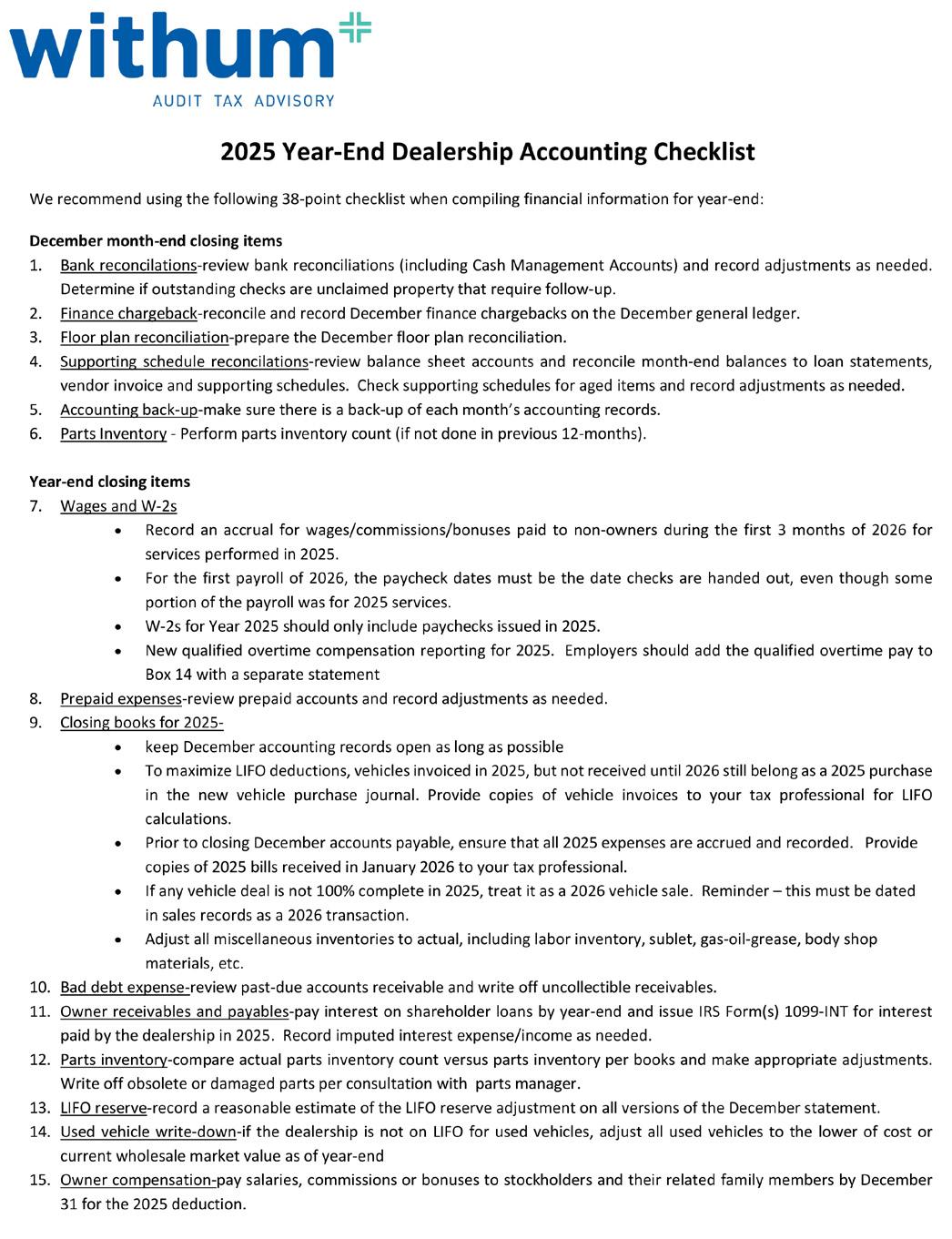
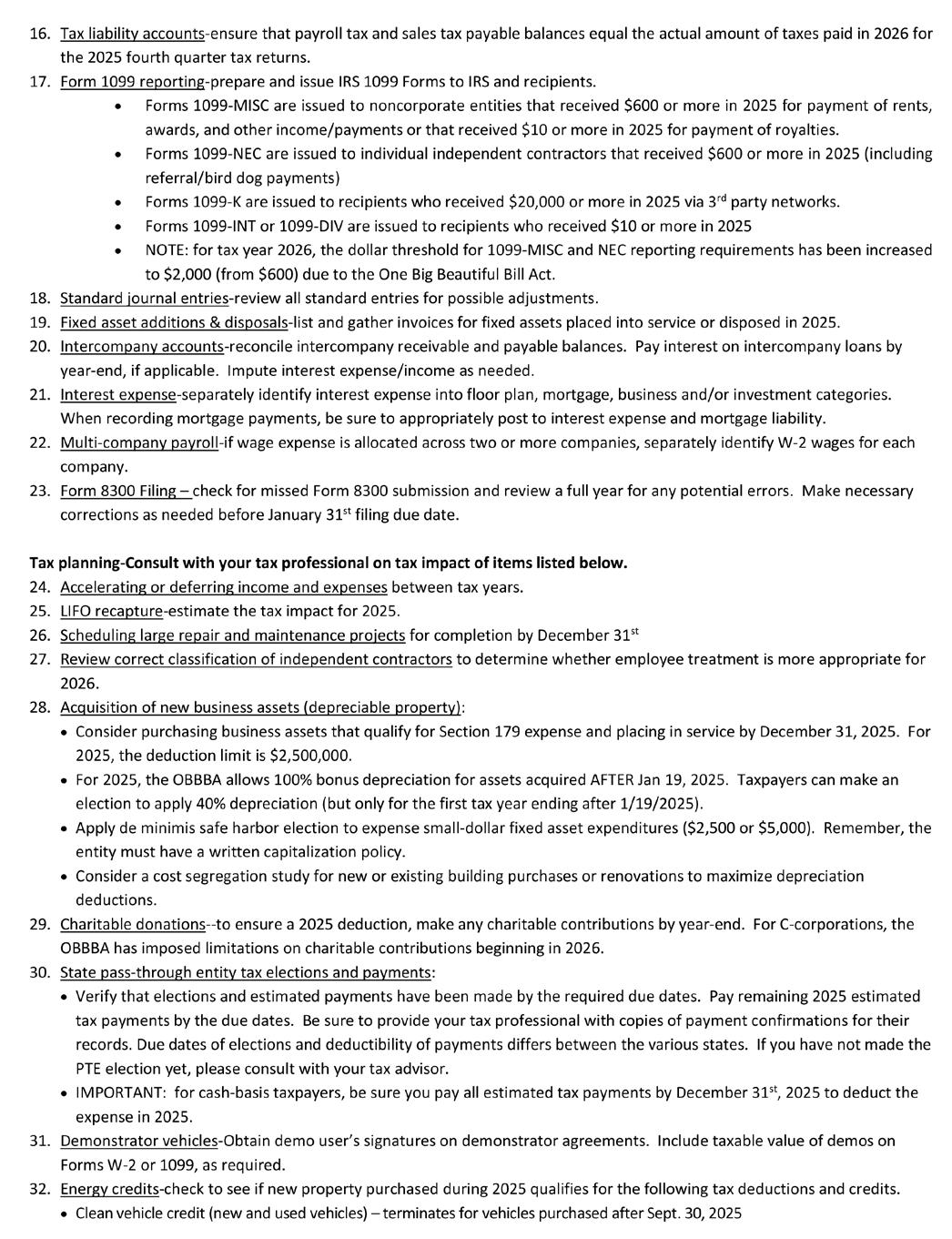
• Withum (formerly O’Connor & Drew), who is our accounting partner.
• American Fidelity, who can assist you with health and other insurance-based benefit products for your employees. Check out the ads for most of these companies in this month’s Auto Dealer magazine. For more information, feel free to contact me at rokoniewski@msada.org
2026 TIME Dealer of the Year Carla
Cosenzi Zayac, TommyCar Auto Group
Your MSADA Executive Committee has named Carla Cosenzi Zayac of the TommyCar Auto Group in Hadley as our 2026 TIME Dealer of the Year.
As a result of our selection, Carla will stand in nomination as the Massachusetts representative for the TIME and Ally dealer of the year award which will be announced at the National Automobile Dealers Association Show on February 5, in Las Vegas. Carla is one of a select group of 47 dealer nominees from across the country who will be honored at the 109th annual NADA Show. This will be TIME’s 57th annual award.
Congratulations to Carla, and best of luck in the national competition in Vegas next year.
Check out our cover story on Carla in this month’s Auto Dealer.
Be On the Lookout for Scam Invoices
[Bart Haag, CPA at Albin Randall & Bennett, an MSADA associate member, provided the following information in MSADA Bulletin #146 (11/3/25).]
“We were notified by a client in New Hampshire that they have received several scam invoices. As examples, one was sent by Cronos Consulting Group in the amount of $49,975. Another was sent by Meijoi Vales for $9,975, marked down from an original $19,850.
“Both invoices included email conversations with a GM no longer employed by the dealer, and the Cronos Consulting Group invoice even included a W-9. They looked legitimate.
“We recommend putting your accounts payable departments on alert. Ask them to be certain that whomever they pay is a legitimate vendor. Dealers may also want to review each check, wire transfer, or credit card charge to ensure you agree with vendors being paid.
“Please let us know if you have any additional questions.”
Bart Haag can be reached at bhaag@ arbcpa.com.
Form 8300 Transaction Letters Due January 31, 2026
The IRS requires any person who receives more than $10,000 in cash in a single transaction or a series of related transactions in 2025 while conducting his or her trade to file a Form 8300 with the agency. Most businesses must file the Form 8300 electronically (e-file) with the IRS.
Further, for every 2025 deal in which you file a Form 8300, you must notify the customer by January 31, 2026, that you filed that form. The IRS Form 8300 reference guide is available at www.irs.gov/ businesses/ small-businesses-self-employed/irs-form8300-reference-guide. The applicable form is available at www. irs.gov/pub/irs-pdf/ f8300.pdf. t
EGISLATIVE S CORECARD
NOVEMBER 2025
BILL# SPONSOR SUBJECT
S201
H406
H398
S271
H342
H365
S202 H424
Amendments to Ch. 93B, the auto dealer franchise law.
Rep Chan
Rep Finn Rep Howitt
S291 H474
Sen O’Connor
RTR Law amendment to fix consumer notice requirement.
Creates process to appeal improperly issued Class 1 license.
Sen Crighton Rep Lewis
Modernize on-line vehicle purchase process.
S266 Sen Moore Amends definition of heavy-duty trucks in RTR law.
Sen Velis
Rep Walsh Open safety recalls notifications.
S228 Sen Feeney Protects consumer choice in vehicle service contracts.
S797 H1260
H1285
H1293
H1139
S812
H3406
S2185
H2386
H3535
S2360
Sen Moore Rep McMurtry Rep Philips
Sen Crighton Rep Hunt Rep Puppolo
Rep Donahue
Sen Oliviera
Rep Puppolo
Sen Moore
Rep Muradian
Rep Muradian
Creates process to increase the insurance reimbursed labor rate paid to auto body repairers.
Protects consumer choice in vehicle service contracts.
Regulates motor vehicle servive contracts
Creates process to delay ACT.
H3572 Creates process to delay ACC II and ACT.
Rep Soter
Sen Cronin
H3603 Eliminates initial state inspection for new vehicle.
Rep Arciero
Joint Committee on Consumer Protection held public hearing on 10/14/25.
Joint Committee on Consumer Protection held public hearing on 10/14/25.
Joint Committee on Consumer Protection held public hearing on 10/14/25.
Joint Committee on Consumer Protection held public hearing on 10/14/25.
SUPPORT Joint Committee on Consumer Protection held public hearing on 10/14/25.
SUPPORT Joint Committee on Consumer Protection held public hearing on 4/14/25. H4284, redraft of H474, reported favorably and referred to House Ways and Means.
SUPPORT Joint Committee on Consumer Protection held public hearing on 10/14/25.
Joint Committee on Financial Services held public hearing on 10/22/25.
Joint Committee on Financial Services held public hearing on 5/13/25.
SUPPORT Joint Committee on Financial Services held public hearing on 5/13/25.
SUPPORT Joint Committee on State Administration held public hearing on 7/22/25.
SUPPORT Joint Committee on Telecommunications, Utilities and Energy held public hearing on 5/14/25.
SUPPORT Joint Committee on Transportation held public hearing on 5/13/25. H3603 reported favorably and referred to House Ways and Means.
H3690 Rep Howitt Limit doc prep fee to $400. OPPOSE Joint Committee on Transportation held public hearing on 5/13/25. Reported favorably and referred to House Ways and Means.
H3676
H3677
S2371
S2374
H78
H80
H104
S29
S33
S45
Rep Gregoire
Rep Gregoire
Sen DiDomenico
Sen DiDomenico Establishes requirements for e-titles and e-signatures on RMV and sales docs.
Rep Farley-Bouvier
Rep Hogan
Rep Vargas
Sen Creem
Sen Driscoll
Sen Moore
SUPPORT Joint Committee on Transportation held public hearing on 5/13/25.
Mass. Consumer Data Privacy Act OPPOSE Joint Committee on Advanced Information Technology, the Internet and Cybersecurity held public hearing on 4/9/25. Redraft S2516 reported favorably on 5/12/25, referred to Senate Ways and Means. On 9/25/25, Senate passed S2619. which was referred to House Ways and Means.
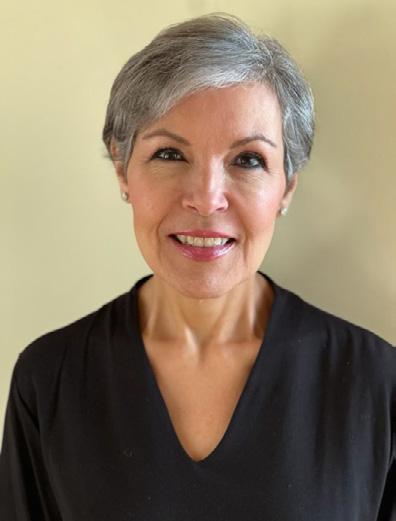
Carla Cosenzi Zayac
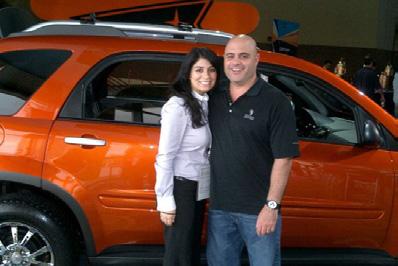
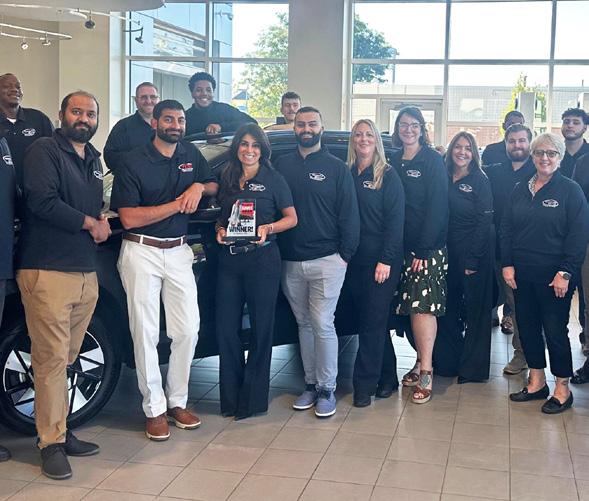
HAMPSHIRE COUNTY may be home to what are known as the Five Colleges, which include UMass’s flagship campus in Amherst and four well-established private colleges. But in another notable “first” for the Massachusetts State Automobile Dealers Association, Hadley’s Carla Cosenzi Zayac of the TommyCar Auto Group will be the association’s first TIME Dealer of the Year honoree hailing from Hampshire County as well as its youngest dealer to be so recognized during the award’s existence.
2026 Massachusetts TIME Dealer of the Year
She completed the NADA Dealer Academy, worked through every department, and earned a GM role just before her father’s glioblastoma diagnosis altered the course of the company and her life. When her father passed away after a courageous battle with glioblastoma, Cosenzi was faced with the unexpected responsibility of leading the family business.
When franchised auto dealers from around the country convene in Las Vegas next February 5 for the 2026 NADA Show, which will be the 109th edition of the national convention, Cosenzi will be one of only 47 auto dealers nominated for the 57th annual award from more than 20,000 nationwide.
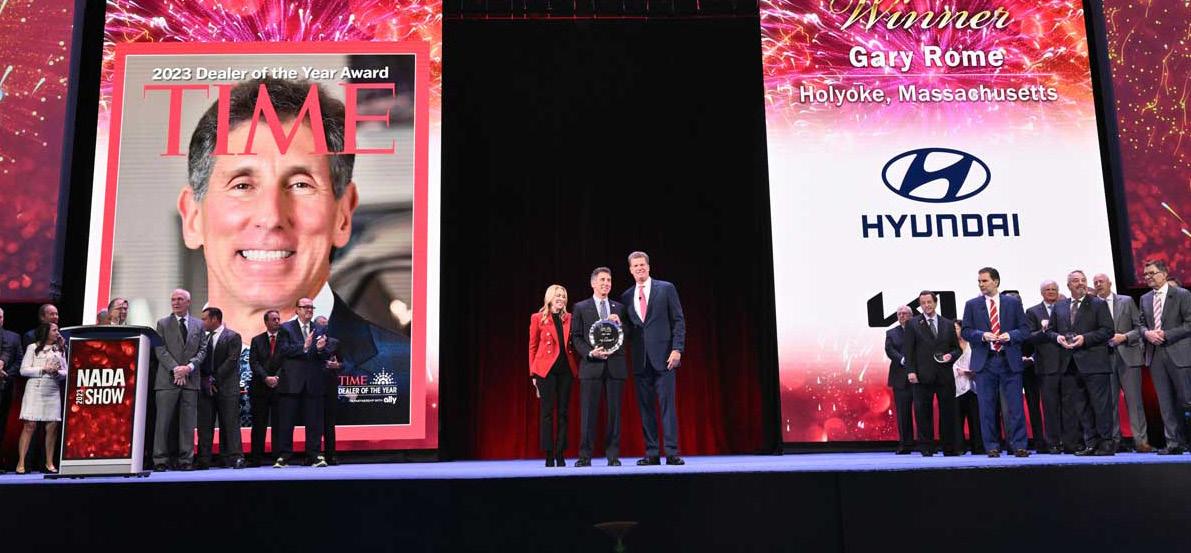
Massachusetts has had recent success over the last five years for the national award, with Gary Rome of Gary Rome Hyundai in Holyoke receiving the national title in Dallas in 2023, while three other dealers have been named finalists – George Haddad earlier this year in New Orleans, Tom Murphy in 2024, and Christine Alicandro, virtually, during the 2021 Covid shutdown.
The TIME Dealer of the Year award is one of the automobile industry’s most prestigious and highly coveted honors. The award recognizes the nation’s most successful auto dealers who also demonstrate a long-standing commitment to community service.
A second-generation dealer and president of Country Nissan within the family-owned TommyCar Auto Group, Cosenzi did not initially plan a career in retail automotive. After earning a master’s degree in clinical psychology from Columbia University, she agreed, at her father Tom Cosenzi’s urging, to try the family business.
“From my first sale, I realized I could change how people experienced the car-buying process,” she said. “Trust, transparency, and relationships became the foundation, and many of those early customers still come back today.”
“At 29, I was suddenly responsible for more than 200 employees,” she said. “There were moments the weight felt unbearable, but our team’s loyalty and my father’s values of integrity, hard work, and putting people first guided every decision.”
In the years since, she has stabilized and grown the business while honoring her father’s legacy. Cosenzi grew the family busi-
ness through strategic expansion – adding new franchises, launching TommyCar Collision and TommyCar Towing, and making significant investments in modern, customer-centric facilities. Under her direction, she led the construction of stateof-the-art Volkswagen and Hyundai dealerships, setting a new benchmark for customer experience, employee satisfaction, and operational excellence.
2026 MASSACHUSETTS TIME DEALER OF THE
Building on that success, she is now leading a renovation of the Country Nissan facility, incorporating the latest Nissan retail design and innovative, customer-first features. The modernization reflects the company’s continued evolution while staying true to its core promise — “You’re Gonna Love It Here.”
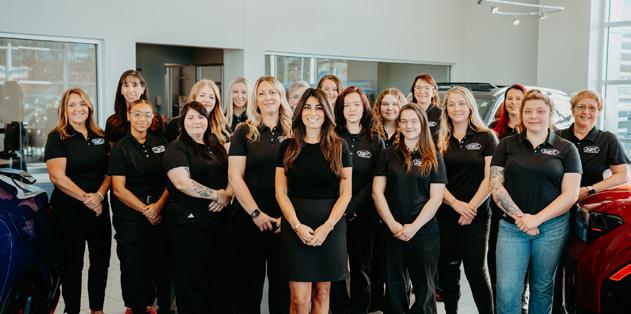
Just as she invests in the spaces that welcome customers, Cosenzi places equal emphasis on creating an environment where employees can thrive. Employee satisfaction and wellness are core to the TommyCar culture. From creating positive, supportive workplaces to offering programs that promote balance and personal growth, Cosenzi believes that a thriving team is the foundation of exceptional customer experiences.
“When you take care of your people first, they take care of your customers,” she said.
That philosophy extends beyond the showroom through the employee-led Carla Cares program, which empowers team members to support the causes and communities they care about most – strengthening both company culture and local impact.
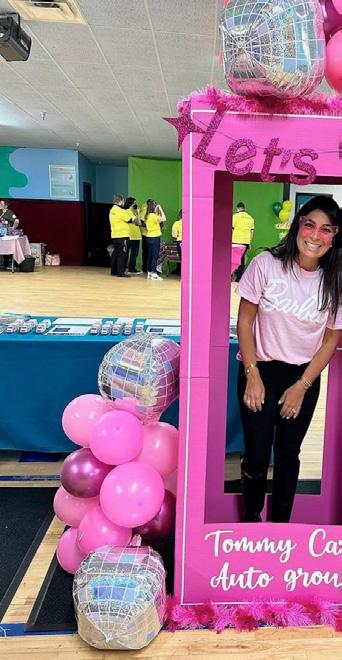
The Carla Cares program reviews thousands of local requests annually and mobilizes volunteers and funding across youth programs, women’s shelters, food banks, and more, giving team members ownership of the causes they champion.
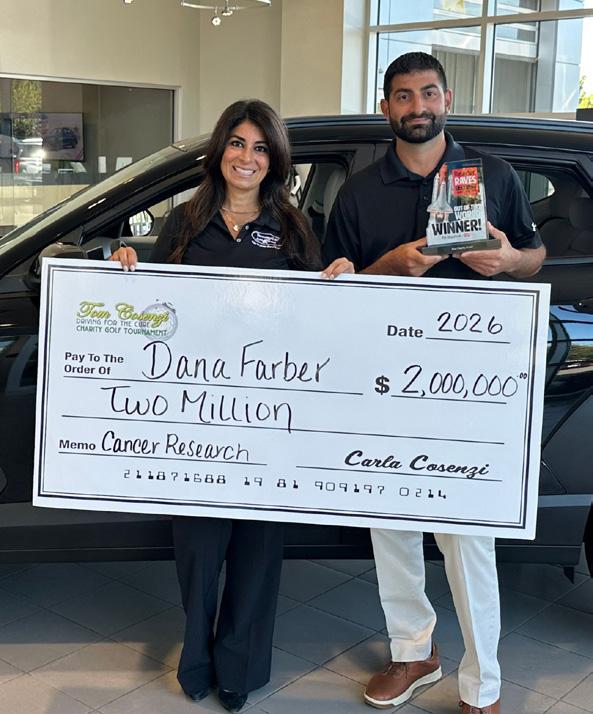
The group’s signature event, the Tom Cosenzi Driving for the Cure Charity Golf Tournament, held in memory of her father, is one of the largest charity golf tournaments in western Massachusetts and consistently ranks among the top 10 events supporting the Jimmy Fund and Dana-Farber Cancer
Institute. Since its founding in 2009, it has raised more than $2 million for glioblastoma cancer research, with over 90% employee participation each year.
In addition, the Tom Cosenzi Scholarship, also created in her father’s memory, awards $5,000 annually to local graduating seniors, selected by an employee committee, continuing the family’s deep commitment to education and community advancement.
Together, these initiatives ensure that Tom Cosenzi’s legacy of leadership, generosity, and perseverance continues to inspire others within the TommyCar Auto Group and throughout the community.
That same commitment to strengthening local connections is reflected in the company’s approach to customer loyalty and engagement. Over the past 18 months, Country Nissan enhanced its TommyCard Rewards Program to deepen loyalty and community ties. Guests earn points on service and parts redeemable toward future vehicle purchases, receive referral rewards, and can track benefits through a new mobile app. The program also partners with more than 30 local merchants to provide exclusive savings, driving business to neighborhood retailers while adding tangible, everyday value for customers.
“Customers save money, local businesses grow, and the community gets stronger,” she said. That same philosophy extends to every interaction within the dealership. At TommyCar, loyalty is not just earned through programs. It is built through people. For Cosenzi, customer satisfaction is built in the everyday.
“It’s the technician staying late so a nurse can make her shift, the advisor arranging a loaner so a family doesn’t miss a trip, the salesperson moving a mom’s belongings into her new SUV,” she noted.
Those daily moments – reflected in repeat business and community “favorites” awards across dealership, repair, collision, and charity event categories – define the brand’s reputation.
Each year dealers are nominated for the dealer of the year honor by the executives of state and metro dealer associations around the country. A panel of faculty members from the Tauber Institute for Global Operations at the University of Michigan will select one finalist from each of the four NADA regions and one national Dealer of the Year. Three finalists will receive $5,000 for their favorite charities, and the winner will receive $10,000 to give to charity, donated by Ally.
In its 15th year as exclusive sponsor, Ally also will recognize dealer nominees and their community efforts by contributing $1,000 to each nominee’s 501(c)3 charity of choice. Nominees will be recognized on AllyDealerHeroes.com, which highlights the philanthropic contributions and achievements of TIME Dealer of the Year nominees.
TIME is the 102-year-old global media brand that reaches a combined audience of over 120 million around the world through its iconic magazine and digital platforms. Ally Financial Inc. is a financial services company with the nation’s largest all-digital bank and an industry-leading auto financing business, driven by a mission to “Do It Right” and be a relentless ally for customers and communities.
“The TIME Dealer of the Year award honors automotive dealers who set the standard for excellence and community impact,” said Jessica Sibley, CEO of TIME. “Each year, we spotlight those whose dedication uplifts and inspires their communities. At TIME, we are proud to continue celebrating these extraordinary contributions in partnership with Ally.”
Doug Timmerman, President of Dealer Financial Services, Ally, said, “The TIME Dealer of the Year award honors those exceptional dealers who not only excel in their business endeavors but also demonstrate a profound commitment to uplifting their communities. These nominees embody the spirit of leadership and service, making a lasting impact both in their dealerships and beyond.”
MSADA dealer President Jeb Balise of the Balise Auto Group is excited to see a fellow western Massachusetts native honored on the national stage in Las Vegas.
2026 MASSACHUSETTS TIME DEALER OF THE
“We are proud to have Carla stand for us at the upcoming NADA Show in Las Vegas as our Dealer of the Year,” said Jeb Balise of the Balise Auto Group who serves as MSADA’s current dealer president. “She not only is a successful dealer in our area of the state but also stands out as an exemplar of one of our best for her commitment to her community through her charitable efforts and her employees as she successfully grows and operates her businesses.”
“I have known Carla her whole life. To see her take over her father’s business at a very young age, watch it grow and flourish over the years, all while enhancing various charitable efforts in her community, we could not ask for a better Dealer of the Year nominee to carry the Massachusetts banner into Las Vegas next year,” Balise stated.
Carla was nominated for the TIME Dealer of the Year award by Robert O’Koniewski, executive vice president and general counsel of the Massachusetts State Automobile Dealers Association. Carla and her husband, Nicholas Zayac, have two children, Talia and Nico.
“Thrust into a difficult situation with her dad’s passing, Carla met the immediate challenges head on and then some,” said O’Koniewski. “Through her leadership and vision, she has grown her businesses as well as her commitment to the community, expanding her charitable activities and enhancing her support for cancer research and various educational programs. Her efforts have left an indelible mark while creating positive opportunities for her employees and for residents in Hadley and elsewhere. We are honored to have her represent all Massachusetts dealers at the TIME-Ally ceremony in Vegas.”
Previous Massachusetts TIME Dealers of the Year
1970 Fred Cain, Finalist
1971 John Dugan
1972 Robert Brest
1973 Peter Fuller
1977 Herb Anderson
1978 Julian Lucini, Finalist
1979 Joseph Gill
1980 Nathan Shulman
1981 George Rowe
1982 Donald Lorenz
1983 Richard Bournival
1984 Argeo Cellucci
1985 Charles Long
1986 John Mirak
1987 Daniel Harrington
1988 Edward Amabile
1989 William Cammarano
1990 John “Jack” Swanson
1991 Jerry Couture
1992 George Luddy
1993 Ed Ciampa
1994 George Albrecht
1995 John Walsh
1996 Jay Tracy
1997 Thomas Barenboim
1998 John Santilli
1999 Daniel Quirk
2000 Walter Earl
2001 Jeb Balise
2002 George Luddy
2003 Thomas Keery II
2004 Donald Rodman, Finalist
2005 Jack Sarat
2006 Marshall Jespersen
2007 Ernest Boch, Jr.
2008 Herbert Chambers
2009 Beth Lorenz
2010 Richard Mastria, Jr.
2011 William DeLuca III
2012 Ann Regan
2013 Raymond J. Ciccolo
2014 Brian Kelly
2015 Scott Shulman
2016 Adam Connolly
2017 Gary Johnson
2018 Frank Hanenberger
2019 Don Sudbay, Jr.
2020 Raymond J. Ciccolo
2021 Christine Alicandro, Finalist
2022 Joseph Shaker
2023 Gary Rome, National Winner
2024 Thomas Murphy, Jr., Finalist
2025 George Haddad, Finalist
NEWS from Around the h orn MSADA
IN MEMORIAM
Denise Bruno
Denise M. Bruno, a pioneering businesswoman, beloved wife, devoted mother, and adoring grandmother, passed away on November 12, 2025, at the age of 65 after battling an aggressive form of cancer. The disease took her life in just six short weeks. She died peacefully, surrounded by her family, after returning home to Assonet, Massachusetts.
A trailblazer in the car business, Denise made history as the first female Toyota dealer in New England, the seventh female Toyota dealer in the nation, and the first female Hyundai dealer on the East Coast— remarkable achievements in what remains a male-dominated industry.
Denise proudly followed in the footsteps of her father, the legendary Jack Barboza, a local titan of the automotive industry. When he retired, he chose Denise—his eldest and only daughter—to lead Route 44 Toyota and Route 44 Hyundai (formerly Fall River Hyundai). He recognized her brilliance, strength, and charisma, and knew she possessed the rare ability to inspire and motivate others. Under her leadership, the dealerships flourished, but it was her warmth, care, and generosity that left the deepest impression. Denise often said that her greatest accomplishment in business was helping her employees achieve their dreams for themselves and their families.
ished grandchildren, Jack and James Finley. Denise was devoted to her daughters, helping them pursue their greatest goals. Her two young grandchildren were her ultimate joy and the reason she fought so fiercely in her final weeks. From the time they were babies, she lovingly told them, “I love you more than life”—and she truly meant it.
Additionally, she is survived by her brother, Robert Barboza, and his wife, Lisa, and their son, her beloved nephew, Austin. She is also survived by her youngest brother, Michael Barboza, and his husband, Carlos Presiga. She was predeceased by her parents, Jack and Pat Barboza. While in the hospital, she buried her mother, Pat, just two months prior. Her family is comforted knowing they will be reunited again.
Denise’s lifelong beauty was far more than skin deep. She touched countless lives with her generosity, compassion, and magnetic spirit. Always the first to give back to those in need, she embodied strength and selflessness in all aspects of her life.
A public celebration of Denise’s extraordinary life was held on November 17, at St. Bernard’s Church in Assonet, with a Mass of Christian Burial followed by burial at Assonet Burial Grounds. A wake was held the evening prior, on November 16, at the O’Keefe-Wade Funeral Home in Taunton, Massachusetts.
She worked alongside her two brothers and her beloved husband, Timothy Bruno. They were married for 42 years and together raised four beautiful daughters. Tim’s devotion to Denise was evident to all who knew them. In her final weeks, he never left her side—sleeping just a few feet away from her in her hospital room at Brigham and Women’s Hospital. Even while gravely ill, Denise befriended every nurse, leaving a lasting impression on each of them.
Denise is survived by her loving husband, Timothy; her daughters, Jackie Bruno, Erica Martin, Nicole Bruno, and Alexandra Bruno; her son-in-law, Ben Martin; and her cher-
In lieu of flowers, the family requests donations be made to The Burt Wood School of Performing Arts in memory of Denise Bruno. Over the course of her life, Denise sponsored hundreds of students so they could take part in the school’s plays and classes. A lifelong believer in the arts, she saw firsthand how much the school enriched the lives of her own children and grandchildren, and she made it her mission to ensure others had that same opportunity. Checks can be made out in memory of Denise Bruno “The Burt Wood School” and mailed to 133 Center St., Middleborough, MA 02346. Donors can also Venmo @TheAlleyTheatre.
BEVERLY
Kelly auto Holds Pinewood derby
On November 12, the Kelly Auto Group conducted its first Pinewood Derby Classic to support Scouting in Massachusetts.
“We understand that few things are more thrilling than seeing our cars make someone happy and perform at their best. This year, we’re channeling that same passion for creativity, craftsmanship, and friendly competition into something a little smaller—but just as meaningful,” Kelly Auto commented in a released statement. “It is more than just a race. For decades, this Scouting tradition has inspired creativity, skill-building, and community. This year, Cub Scouts is celebrating its 110th anniversary, and millions of kids nationwide continue to benefit from Scouting programs that help them grow into confident, capable leaders.”
The event, at Brian Kelly’s Classic Car Museum, raised more than $14,000 for local Scouting programs. The event was put on through Scouting America Greater Boston and was the first of its kind on the North Shore.
SACRAMENTO
California Enacts the “CaRs act,” Overhauling Vehicle sales and Leasing Rules
By Mark Sanborn, Senior Product and Regulatory Counsel, ComplyAuto
On October 6, 2025, Governor Gavin Newsom signed into law Senate Bill 766 — the California Combating Auto Retail Scams (CARS) Act. Taking effect on October 1, 2026, this legislation represents one of the most comprehensive reshapings of California’s retail automotive sales and leasing practices in decades.
A State-Level Successor to the FTC’s “CARS Rule”
The CARS Act is California’s response to the Federal Trade Commission’s now-invalidated Vehicle Shopping Rule (CARS Rule), which the Fifth Circuit Court of Appeals struck down in February 2025. The federal rule never took effect, but California went ahead and created its own version that captures many of the goals the FTC had with the Vehicle Shopping Rule. However, the final text of the CARS Act includes several positive clarifications and revisions secured through the efforts of the California New Car Dealers Association.
The new law brings far-reaching changes for retail automotive transactions, focusing on transparency, disclosure, and consumer choice. For dealerships, the compliance lift will be significant, but early preparation will go a long way toward ensuring smooth implementation.
This article is a high-level overview of some of the most impactful elements of the CARS Act. Stay tuned for more updates and compliance guidance from ComplyAuto in the coming weeks and months as dealers start to prepare for the changes that this new law will require.
Major Provisions and Dealer Obligations
1. Required “Total Price” Disclosure & First Communication Rule
When selling or financing a vehicle, dealers must clearly and conspicuously disclose the vehicle’s “total price” in any advertisement that mentions a specific vehicle for sale, or that includes a monetary amount or financing term for a specific vehicle. They must also make this disclosure in the first written communication that refers to a specific vehicle for sale, or that includes a monetary amount or financing term for any vehicle.
This requirement will likely be the most difficult to implement for dealers, as it can be challenging to verify whether a salesperson actually provided the disclosure before sharing any other written communications. Dealers will therefore need a strong internal process to ensure that, before any email, text, document, credit application, or written communication is given to a customer, the total price disclosure has been clearly provided first or alongside it.
This “total price” includes all items installed on the vehicle and price adjustments but excludes taxes and certain fees permitted by law, including the dealer document processing charge (which a separate pending bill would raise from the current $85 cap). Dealers may therefore continue excluding the document processing charge from the advertised total price, which is an important distinction from the proposed FTC CARS Rule.
However, the Act no longer permits a distinction for optional addons that are pre-installed, such as theft deterrent devices. And advertising based solely on MSRP (with a disclaimer that it does not constitute the advertised price) will no longer be allowed unless the MSRP is the dealer’s actual total advertised price and stated as such.
2. Add-On and Payment Disclosure Requirements
Additionally, if a dealer discusses monthly payments or compares payment options in connection with a sale or lease (such as in a worksheet or payment options overview document), the total amount that the consumer will pay to purchase or lease the vehicle at that payment amount must be disclosed along with a disclosure that lower payments often increase the total amount that a consumer will pay.
Finally, any written representation about add-on products or services must include a disclosure that the consumer can purchase or lease the vehicle without the add-on. Fortunately, the law explicitly states that each of these disclosures may be satisfied by adding them to the existing California Pre-Contract Disclosure form that is used by most California dealers today.
Dealers must also retain copies of these written communications and disclosures for at least two years.
3. Add-On Product Limitations
The Act directly targets “junk fees” by prohibiting dealers from charging for add-on products or services that provide no benefit to the buyer or lessee. Examples include nitrogen tire packages with less than 95% purity, GAP agreements that fail to comply with California’s financing laws, service contracts voided by preexisting vehicle conditions, or oil changes for electric vehicles.
If a dealer sells an add-on, it must provide a real, measurable benefit to the consumer. Dealers are also required to keep records demonstrating that the add-ons they sell in fact benefit consumers.
NEWS from Around the h orn
4. The Three-Day Right to Cancel for Used Vehicles & New “No Cooling Off” Signs
Perhaps the most critical change is the creation of a no-charge three-day right to cancel for most retail sales and leases of used vehicles priced at $50,000 or less. Buyers may return the vehicle within three days for any reason, subject to certain conditions, including mileage limits (no more than 400 miles driven, and charges allowed after 250 miles) and payment of a restocking fee between $200 and $600 (but not to exceed 1.5% of the sale price).
The law specifies strict timelines for refunding down payments, returning trade-in vehicles, and processing cancellations. Failure to adhere to these timelines or overcharging a restocking fee constitutes a violation of the Act. If a dealer sells a customer’s trade-in vehicle during the customer’s three-day cancellation period and the customer later decides to cancel the transaction, the dealer must return the greater of the vehicle’s fair market value, the actual cash value (ACV) listed on the contract, or the amount the dealer received for selling the trade-in. Because of this, dealers should carefully evaluate the risk of reselling trade-in vehicles before the cancellation period expires. They may wish to hold (“bullpen”) trade-in vehicles for the full three days or reconsider over-allowing and listing inflated ACVs that could result in financial losses if the customer exercises their right to cancel.
This right does not apply to new vehicles, lease buy-outs, auctions, fleet sales, or used vehicles priced above $50,000. This will also require updated signage for the “No Cooling Off” signs that dealers are required to post.
5. Recordkeeping and Retention Duties
Dealers must keep all records showing compliance with the Act for at least two years from when they are created. These records include evidence demonstrating that advertisements and online listings accurately show a vehicle’s total price, copies of all signed purchase, financing, and lease documents and related written communications (even if the deal wasn’t finalized), and documentation supporting that any add-on products—like service contracts or GAP coverage—comply with legal requirements.
Dealers must also retain records of cancellation requests, refunds, and trade-in returns, as well as any written buyer or lessee complaints, and inquiries about add-ons and vehicles, and the dealer’s responses. Implementation and Compliance Outlook
Although the CARS Act does not take effect until October 2026, its impact will reach many facets of a dealership’s operations— from advertising, negotiation, and F&I presentations to disclosure forms and record retention. Dealers should begin reviewing their systems and workflows now to ensure readiness.
Form providers, finance companies, add-on providers, and dealer management software vendors will play an important role in updating standardized sales and lease forms and ancillary transaction documents to meet the new disclosure and cancellation requirements. However, forms alone will not ensure compliance. The CARS Act demands a coordinated approach that combines accurate documentation with consistent staff practices, reliable systems, and ongoing training.
“Merchant Advocate found a costly error—our software was not passing along all the necessary information—and worked directly with our provider to resolve the issue. We’ve already saved more than $70,000 as a result. I recommend having Merchant Advocate look at your account.”
–Denise Devoe, Corporate Controller
“Not only did Merchant Advocate uncover a significant optimization opportunity, but they also helped us replace 100 out-of-date terminals—for free! We are looking forward to more than $60,000 in savings in our first year. Merchant Advocate took care of everything—the process couldn’t have been any easier for us.”
–Jeb Balise, President
“Within the first two months of working with Merchant Advocate, we’ve saved over $4K in credit card fees across our 9 Merchant IDs! I wholeheartedly endorse Merchant Advocate for any business seeking to optimize their payment processing costs and enhance their financial health. Their vigilant monthly oversight of our statements ensures that we are not subjected to the pitfalls of an unregulated industry.”
–Joe Bonofiglio,
C o r p o r a te C o nt r o l l e r
How a Strong Month-End Close Drives Dealership Financial Success
By Erika Gagne
CPA, Albin Randall & Bennett
Running an auto dealership means coordinating several interconnected departments – sales, parts, service, and financing – all moving at high speed. Without a solid month-end close, it is easy for financial accuracy to skid off course. A disciplined close process keeps your numbers reliable, your team accountable, and your dealership positioned for year-end success.
The Importance of a Disciplined Month-End Close
A clean and timely month-end close is the foundation of dealership financial management. Management decisions, factory reporting, and lender relationships all rely
on accurate numbers. When accounts are reconciled and each department’s performance is captured correctly, leadership can act confidently.
Regular reconciliations also prevent costly surprises. Small discrepancies that go unchecked can snowball into major accounting issues, or worse, missed opportunities. Just as importantly, strong monthend habits reduce the chaos of year-end audits and tax preparation. A dealership that closes well every month closes the year with less stress, fewer adjustments, and better results.
Core Month-End Close Procedures
• Reconciling the Balance Sheet: Start by confirming that all cash accounts, including F&I reserves and manufacturer incentive accounts, are reconciled. Review receivable schedules against the general ledger and evaluate aged customer and warranty receivables for collectability. Match vehicle inventory subledgers to physical counts in your DMS and ensure
used vehicle valuations make sense. Payables require equal attention: confirm invoices, floorplan payoffs, and trades are fully recorded. Do not forget payroll and accruals by verifying that commissions and bonuses are complete and properly timed.
• Reviewing the Income Statement: Each department’s gross profit should be compared to prior months and budget expectations. If something looks off in new, used, parts, or service, investigate early. Align factory incentives with the period when revenue was earned and double-check that prepaid expenses or allocations have not been spread incorrectly across months.
• Schedule Review and Clean-Up: Identify stale or unexplained balances and use exception reports to flag issues requiring attention. Intercompany and dealer group balances should be reviewed regularly to ensure they are cleared and properly recorded.
• Documentation and Sign-Off: Every dealership accounting team should maintain a month-end checklist with preparer and reviewer signoffs to ensure accountability and maintain audit readiness. Storing supporting documents electronically is a simple way to keep records organized and accessible when questions arise.
Leveraging Tools and Technology
A structured checklist remains one of the most effective tools for month-end accuracy. Assign tasks to multiple roles to create built-in review points. Most Dealer Management Systems, such as CDK, Reynolds, or Dealertrack, offer automated reports that simplify reconciliations and reduce manual errors.
Consider integrating accounting automation tools or AI-based reconciliation software to handle recurring entries and
By reconciling consistently, reviewing thoroughly, and leveraging technology wisely, you can turn a tedious process into a competitive advantage.
flag anomalies. Dashboards can also help track close status across departments, ensuring visibility and accountability throughout the process.
Preparing for Year-End
• Conduct a “Pre-Year-End” Close: Treat November as a trial run for year-end. Address any lingering issues, clean up suspense and clearing accounts, and confirm balances with manufacturers, especially floorplan, warranty, and rebate accounts.
• Align with External Parties: Coordinate early with your CPA or auditor to clarify expectations and deadlines. Review fixed asset additions and disposals, confirm depreciation schedules, and verify inventory valuations, including LIFO if applicable.
• Analyze Year-End Adjustments: Check that all prepaid expenses, accruals, and bonuses are captured. Review warranty liability estimates and deferred income accounts to ensure accurate reporting.
Understanding and Managing “13th Month” Entries
Many dealerships post final year-end adjustments after December close, often referred to as “13th month” entries. These adjustments are not for factory reporting but help finalize financial statements for audit and tax purposes. Handled properly, these entries fine-tune financial accuracy without disrupting factory or internal reporting. Best practices include:
• Clearly labeling and dating all “13th month” entries in the accounting system.
• Maintaining a separate journal or accounting period for these adjustments.
• Restricting access to authorized accounting or controller staff.
• Documenting all support and communicating with your CPA before posting.
Common Pitfalls
Some of the most frequent dealership accounting issues stem from overreliance
on DMS balances without reconciling to the general ledger. Others include failing to record F&I chargebacks, overlooking small balances that carry forward month after month, or leaving accounting periods open for late changes. Locking each period immediately after close, once reviewed, prevents unapproved adjustments and strengthens internal control.
The Road Ahead
A well-executed month-end close is more than a back-office task; it is a strategic discipline that keeps your dealership financially healthy and audit-ready. By reconciling consistently, reviewing thoroughly, and leveraging technology wisely, you can turn a tedious process into a competitive advantage. To start audit-proofing your dealership, treat every month-end close like a mini year-end.
Trust LAW ®
There are over 1,500 attorneys in the United State who focus on legal actions against car dealers.
Who reviews your F&I documents for legal or regulatory changes?
What if your dealership had access to a complete suite of documents needed in F&I?
Only the LAW F&I Library™ provides:
A complete set of state-specific F&I documents in both pre-printed and electronic formats.
An industry leading team of in-house and outside legal resources reviewing forms for legally required and best practice updates.
A trained team of compliance consultants who can work with you to manage your compliance risks.
The One Big Beautiful Bill – Is it Big and Beautiful for Auto Dealerships?
By William Morgan, Esq., Thomas S. Vangel, Esq., and Jamie Radke, Esq., Harris Beach Murtha
As the end of 2025 approaches, the following summary of the One Big Beautiful Bill (the “OBBB”), signed into law July 4, 2025, addresses whether the Bill helps auto dealerships and how dealerships can benefit from it going forward.
EV Credits and Charging Station Incentive Changes
OBBB makes several changes to clean vehicle credits. The credits for purchases of new and used EVs expired September 30, 2025, and the EV charging station credit ends June 30, 2026. Dealers planning to install chargers should act quickly. As EV adoption continues to grow (albeit more slowly than many expected), Dealers who wish to invest in EV infrastructure still have time to take advantage of charging station credits.
Business Tax Relief - Section 168(k) Bonus Depreciation and Section 179 Expense
OBBB permanently extends 100% bonus depreciation for qualified property acquired after January 19, 2025. This will allow dealerships to immediately expense equipment, furniture, and fixtures. Bear in mind that Massachusetts does not conform to federal bonus depreciation. Massachusetts requires the federal bonus depreciation deduction be added back to arrive at Massachusetts taxable income, and that the Massachusetts depreciation deduction be separately calculated, usually using MACRS (Modified Accelerated Cost Recovery System).
The OBBBA also increases the maximum allowable Section 179 deduction to $2.5 million in the 2025 taxable year. The deduction phases out dollar-for-dollar when qualifying property exceeds $4 million, fully phasing out at $6.5 million. The increased Section 179 deduction will enable dealers to immediately expense
100% of the cost of the asset placed in service. Most states, including Massachusetts, generally allow Section 179 deductions, contrasted with bonus depreciation above, therefore the use of Section 179 may allow for a reduction in state income taxes.
Consumer Incentives - Car Loan
Interest Deduction, SALT Cap Raised
OBBB introduces a new deduction allowing consumers to deduct up to $10,000 of interest paid on a qualifying vehicle loan, available for personal vehicles purchased between 2025 and 2028. Capped at $10,000 per year, consumers may claim it even if they do not itemize deductions on their tax returns. It is subject to an income-based phase-out beginning at $100,000 of modified adjusted gross income (“MAGI”) ($200,000 for joint filers) and is fully unavailable for those with MAGI of $150,000 ($250,000 for joint filers).
To qualify, the vehicle must be a new personal vehicle (including cars, minivans, vans, SUVs, pickup trucks, or motorcycles) for which final assembly occurred in the United States.
This is an opportunity for sales teams to use the tax break as a tool to address customer concerns about high pricing for new vehicles. The tax savings may incentivize customers to buy now as opposed to waiting on a new car purchase.
The OBBB raised the state and local tax (“SALT”) cap on deductions from $10,000 to $40,000 for people earning under $500,000 annually. This allows a larger portion of state and local taxes to be deducted, resulting in an increase in after-tax disposable income for a larger portion of the population.
The car loan interest deduction and increase in the SALT limit should enhance consumer buying power, reducing hurdles to vehicle ownership.
Improved Cash Flow to Dealership Owners
The Section 199A 20% qualified business income deduction was made permanent. This helps ‘S’ Corporations and LLCs taxed as partnerships to stay competitive with ‘C’ Corporations for income tax purposes. Making this deduction permanent continues a tax benefit for many family-owned and privately held dealerships.
Also, OBBB restores EBITDA (Earnings Before Interest, Taxes, Depreciation and Amortization) as the basis for calculating interest deductibility under Section 163(j). By adding depreciation and amortization back to adjusted taxable income, some dealers will be able to take advantage of the bonus depreciation noted above, where the floor plan financing will no longer exceed the limitation. It will also provide a larger deduction ceiling for leveraged buyers considering using debt in acquisitions.
Estate and Gift Tax Provisions
OBBB permanently increased the estate tax exemption to $15 million per person, or $30 million per married couple, indexed for inflation starting in 2026. Dealership owners considering a succession plan or ownership transfer can utilize this increase to implement their plans in a tax-efficient manner. Though the OBBB refers to this change as ‘permanent,’ this estate tax benefit could be replaced by something less favorable following a change in political administrations and/or tax policies, making early planning essential.
Key Takeaways
OBBB provides a series of investment incentives, consumer stimulus, and tax relief that can reward the proactive dealership for growth in the coming years.
Four Key Considerations When Handling Consumer Disputes
By Greg Paonessa, Sara Judge, Paul Harris, and Devon Bodey of ArentFox Schiff LLP
Customer service is a top priority for all car dealerships. Many shoppers make their decision about where to purchase a vehicle based on prior experience or word of mouth experiences from other customers. For this reason, many dealers go above and beyond to rectify issues customers raise before they rise to a legal dispute. A dealership may want to refund a small amount of money or offer free services as a gesture of goodwill to the customer to address their concerns. In some instances, the dealership may allow the customer to return a vehicle when the dealership is not legally obligated to do so.
These are common practices which build goodwill with your customers. There are times, however, when no matter how reasonable a dealer is in offering to resolve an issue with a customer, a demand letter follows.
Here are four key considerations to look out for when making courtesy “goodwill” offers to customers or when responding to consumer demand letters.
If you resolve an issue with a customer, how should you memorialize that resolution?
Most customer complaints are resolved at the dealership level without involving legal counsel. Often, a customer makes a demand so small that the dispute can be resolved quickly and for a relatively low expense. Many dealers are eager to make a nominal payment to put the matter behind them rather than allow the matter to ripen into litigation.
While that is reasonable, and in many situations likely the most cost-effective way to resolve the matter, it is crucial to memorialize that agreement and have the customer sign a release so that they cannot come back later and raise the same issue again. The last thing you want is to make a pay-
ment, assuming it is resolving the matter, only to have it rear its ugly head again because the resolution was not documented.
You also want to avoid having the “goodwill” payment or free service to be later construed as some sort of admission of wrongdoing by your dealership. Using a short, clear and concise release that the customer signs can avoid future problems.
In our practice, we find that most customers do not refuse to sign a basic release in exchange for refunds or free services if the release language is short, fair, and easily understandable. The purpose of the release is to have the customer acknowledge that the issue is resolved.
If your dealership is making a significant concession to a customer, having proper documentation helps clearly define what the dealership’s obligations are going forward, which can prevent customer confusion in the future should problems again arise with the vehicle. We recommend speaking to your trusted legal counsel to see if they can prepare a short release document which can be implemented on a quick and cost-efficient basis for these types of disputes.
Ideally, your service manager should be encouraged to reach out to your dealership’s trusted legal counsel to properly document these types of customer concessions. This should not be an expensive or “big lift” for your dealership’s legal counsel to implement on an as needed basis.
Does the demand refer to MGL Chapter 93A?
Sometimes, customers do not wish to resolve a dispute without first escalating it into a legal dispute. It should come as no surprise that the plaintiff’s bar is fixated on MGL Chapter 93A, which is the consumer protection statute designed to prevent unfair or deceptive acts or practices in trade
or commerce. And why not? It provides for multiple damages and attorneys’ fees if a knowing and willful violation is proven.
Pursuant to Chapter 93, Section 9(3), a consumer-plaintiff, at least thirty days before commencing a lawsuit under the statute, must make “a written demand for relief, identifying the claimant and reasonably describing the unfair or deceptive act or practice relied upon and the injury suffered . . . .” You, the recipient, have 30 days to make a written tender of settlement. If that offer is rejected and the Court later determines the offer was reasonable, the plaintiff’s recovery can be limited to that amount.
The recent trend, however, is for the plaintiff’s bar to make general, sweeping allegations of unfair or deceptive conduct and then to demand compensation in some unquantified amount. The question this raises is whether making a demand for an unspecified amount truly identifies the injury suffered. Massachusetts case law says that a demand is sufficient where it concretely describes the injury and the amount of damages is reasonably ascertainable. That is a case-by-case assessment that must be performed, but these are issues that you should be discussing with your legal counsel when preparing a response.
The most important thing to remember though is that a response is due in 30 days if you wish to make a case later on that the plaintiff’s damages should be capped. In our practice, we find that demand letters sometimes do not get tendered to us for response until close (or after) the 30-day deadline. Training your staff to promptly forward demand letters to management is important, as you may be missing the opportunity to “cap damages” by making a reasonable settlement offer.
In a situation where the demand letter is vague and fails to articulate an actual mon-
etary demand, there is no reason that the dealership’s response cannot also include a counter-demand for more specific damages to enable you to assess whether tendering a settlement makes sense.
In short, you may be tempted to respond to legal demand letters without the assistance of counsel. However, once you see reference to “Chapter 93A” in a demand letter, the dealership should be consulting with legal counsel to leverage an optimal response. This is especially true with buyback demands under the Lemon Law, which frequently cite Chapter 93A. A prompt analysis of Lemon Law liability by counsel can save a dealership protracted legal fees in the future should the matter turn into litigation.
Does the consumer demand letter refer to or make a demand for revocation of acceptance?
Another buzz word to look for in consumer demand letters is “revocation of acceptance” or demands made under the Massachusetts Uniform Commercial Code, commonly referred to as the “UCC”.
The regulations governing the sale of motor vehicles in Massachusetts require a dealer to “acknowledge in writing, within three business days of being so notified, a purchaser’s revocation of acceptance of a motor vehicle” made under the UCC. Failure to do so could be deemed a violation of Chapter 93A.
“Acknowledging” the revocation does not mean you need to agree to take the vehicle back. It simply means that your dealership needs to promptly and thoroughly investigate and respond to such demands within this tight three-day period. Management at all stores should be trained to promptly review and respond to any demand letter which is purporting to “revoke acceptance” of a vehicle.
Finally, do not be a target for Lemon Law counsel.
We understand the desire to quickly resolve disputes involving a single sales transaction. However, in our practice we have seen that dealerships that quickly settle frivolous or baseless demands can potentially become viewed as a “soft target”
for consumer protection law firms.
To avoid this, we recommend a prompt and thorough investigation be made upon receipt of any consumer demand to determine any potential violations of law. Pushing back and refusing to offer settlement when there is no evidence of wrongdoing is not only within your rights, it may also prevent your dealership from being seen as an “easy target” going forward. The decision to make an offer of settlement versus fighting a demand should be made with these considerations in mind.
Each of the situations presented above, while common, should always set off alarm bells for you. Always memorialize the payment of money or provision of free services to resolve a customer dispute; do not let a Chapter 93A or UCC demand letter linger; make sure it satisfies the requirements under the statute before making a settlement offer; and pay particular attention when you see the words “revocation of acceptance”. Otherwise, small issues can grow into larger, more costly disputes.
Multi-State Privacy Sweep Sends Clear Warning to Dealerships
By Mark Sanborn, Senior Product and Regulatory Counsel, ComplyAuto
Regulators in California, Colorado, and Connecticut have stepped up enforcement in a very visible way. On September 9, 2025, regulators in these three states announced a coordinated sweep of businesses that appear to be ignoring opt out preference signals, including Global Privacy Control (GPC) signals, the browser-based tool that automatically communicates a consumer’s choice to opt out of targeted advertising and the sale of their personal information.
This sweep follows an April 2025 announcement by state regulators from Colorado, Connecticut, California, New Jersey, Delaware, Oregon, and Indiana, who agreed to collaborate on privacy enforcement and share expertise. Since that announcement, Minnesota and New Hampshire joined the multistate consortium.
For dealerships, this development is a signal that regulators are looking closely at the way businesses’ websites, including dealer websites, collect and use consumer data, and whether those practices line up with state privacy laws.
Opt-out preference signals, often referred to as Global Privacy Control (GPC) signals, are browser- or device-based mechanisms that automatically communicate a consumer’s choice to opt out of the sale or sharing of their personal information. These signals allow users to express privacy preferences universally, rather than having to make individual requests on every website they visit. Under many state privacy laws, businesses must recognize and honor valid opt-out preference signals as a legally binding consumer request.
Why This Sweep Matters for Dealers
Dealership websites are among the most data-intensive in retail. Lead forms,
trade-in calculators, service schedulers, chat tools, cookies, and digital advertising pixels all capture and transmit customer information around the clock. Regulators know this, which is why honoring GPC signals has become a top priority. What makes this especially urgent is how easy it is to check. Regulators and consumers can test in minutes whether a website respects GPC signals. There is no gray area: either it works or it does not. Many states, such as California, Colorado, Connecticut, Texas, Maryland, and Minnesota, already require GPC recognition.
What Dealerships Should Do Now
The lesson from this sweep is clear: do not wait for a regulator’s letter to check your compliance. Dealers can take practical steps today to reduce risk and strengthen their compliance:
• Check Your Website Functionality. Ensure your website recognizes and processes GPC signals. Many consent management tools support this already, but don’t assume yours does.
• Audit Your Tracking Technologies. Dealers often run multiple layers of tracking scripts from OEMs, third-party vendors, and advertising partners. Verify that your website is configured to respect opt-out signals for all technologies on your website. This requires accurately classifying all tracking tools on your site so your consent manager can handle each one correctly.
• Test Independently. Run your own tests across different browsers. Do not rely solely on the vendor that built or manages your site to test itself. Regulators can run the same tests you can.
• Update Your Privacy Policy. Make sure your privacy disclosures explain how
you handle opt-out preference signals. Align what you say publicly with what your website actually does. If your disclosures say one thing but your site operates differently, regulators and consumers can hold you independently liable for misleading statements, even apart from the underlying privacy violation.
• Train Your Teams. Ensure that compliance, marketing, and sales staff understand the dealership’s obligations, and that business practices track what your policy promises.
Looking Ahead
This multi-state sweep is part of a broader enforcement shift. State regulators are increasingly pooling resources and focusing on simple, technology-driven requirements that are easy to verify. For dealerships, this means the compliance spotlight will increasingly fall on the website and the public-facing tools like GPC compliance.
The takeaway is straightforward: treat GPC compliance as a must-have, not a nice-to-have. Dealers that act now to test and update their systems will not only reduce enforcement risk but also position themselves to meet the next wave of privacy obligations already on the horizon.
How ComplyAuto is Helping
ComplyAuto is MSADA’s endorsed compliance partner. ComplyAuto Privacy customers can access ComplyAuto’s consent management tool to recognize and honor opt-out preference signals, including Global Privacy Control signals, ensuring your dealership meets this key requirement automatically. t
Should you have questions, contact Lauren Bailey at lauren.bailey@complyauto.com.
Dealership Cybersecurity – Dealers Are Locking Their Doors But Vendors Are Leaving the Windows Open
By David Cantor Adams IT Security Analyst, OCD Tech
In June 2024, CDK Global, a provider of dealer management systems serving over 15,000 automotive dealerships, was on the receiving end of a ransomware attack that crippled operations for three weeks. The attack cost the industry an estimated $1 billion in lost sales and productivity.
What made the breach worse? CDK’s inadequate response allowed attackers to strike a second time while the company was still recovering from the first breach. Dealerships dependent on CDK for critical functions such as vehicle sales, financing data, inventory management, and customer tracking, were forced to return to manual processes with some locations unable to fully operate for nearly a month.
The CDK breach was both disruptive and costly, but it was not an isolated incident. The companies that provide dealerships with products and services have become a prime target for cyberattacks. There is clearly a pattern of attackers exploiting similar vulnerabilities across the industry.
For example, in August 2025, Motility Software, a Reynolds and Reynolds company and DMS provider serving 7,000+ recreational and motorsports dealerships, was hit with a ransomware attack that exposed sensitive data such as telephone, social security, and driver license data. The breach impacted over 766,000 customers.
Automaker Stellantis, experienced a 2025 breach when attackers compromised a third-party customer service center supporting their North American operations, exposing contact information for over 18 million customers.
In March 2025, LES Automotive, a vehicle video marketing company, saw their video platform compromised via a sophisticated “ClickFix” social engineering campaign that ultimately impacted 100+ dealership websites. Users were tricked into executing commands that gave attackers access to their systems.
So, what do all these events have in common? All four happened outside the
While the FTC Safeguards require dealerships to ensure their service providers implement equivalent security protections, vendors have been slow to comply.
dealership’s four walls. CDK, Stellantis, Motility Software, and LES Automotive are supply chain attacks. While dealerships have been investing in cybersecurity by following Safeguard requirements to train employees, deploy encryption, and roll out multi-factor authentication, ven-
dors outside their direct control remain the weak link.
While the FTC Safeguards require dealerships to ensure their service providers implement equivalent security protections, vendors have been slow to comply. Some DMS providers, for instance, missed the FTC’s June 2023 deadline for implementing multi-factor authentication entirely. The shift to attacking dealerships through downstream vendors is not a coincidence. It reflects an attitude or misunderstanding that vendors who serve dealerships are not subject to the same regulatory scrutiny and enforcement pressure that dealers face.
Recognizing this, dealerships should reach out to their vendors, advise them of the FTC Safeguards requirement, and require contractual adherence. Dealerships should be prepared to take their business elsewhere, even with high impact systems like the management system. While a dealership cannot force compliance, they can make compliance part of the quality effort and recognize that companies that do not take data privacy seriously are delivering an inferior product.
Supply chain vulnerabilities are not the only problem exposed by these breaches. Incident response failures compounded the damage across multiple attacks. CDK’s inability to detect, contain, and properly recover from the initial breach left them wide open for a second attack while they were still recovering from the first attack.
Asbury Automotive Group, operating more than 200 dealerships nationwide, experienced a December 2023 breach that exposed social security numbers, driver’s licenses, and state IDs. Again, similar detection failures are apparent, with the intrusion going unnoticed until significant damage was done. Asbury took four
dealerships should reach out to their vendors, advise them of the FTC Safeguards requirement, and require contractual adherence.
months to notify affected individuals. This exceptionally long period violated state breach notification laws, opening the group up to multiple class action lawsuits. These failed responses show the value in maintaining written incident response plans that are regularly reviewed and tested, ensuring your team knows exactly what to do when an incident occurs, which reduces such response times.
The LES Automotive attack succeeded because of training gaps. Social engineering attacks work. The best defense is security awareness and phishing training that trains employees to recognize attacks and gives guidance on reporting them. For dealerships, these failures highlight why the FTC Safeguards exist and what could happen when dealerships ignore or only partially implement them.
Other ways dealerships can safeguard their systems include scheduling an internal vulnerability scan for your network or a penetration test which simulates an attack from the outside. Vulnerability scanning is required under the FTC Safeguards and for good reasons.
For example, in February 2025, Hertz Rent A Car IT security was compromised by the Clop ransomware gang. Attackers were able to exploit unpatched vulnerabilities in the Cleo file transfer software product. Those vulnerabilities, once identified through industry reporting methods such as the Common Vulnerabilities and Exposures (CVE) system, are the kinds of hidden vulnerabilities that scanning and penetration testing are designed to look for. The FTC Safeguards require security testing at least every six months, or
continuous monitoring through managed security services.
The FTC Safeguards deadline passed in June 2023. Now, two years later, dealerships and vendors supporting those dealerships can clearly see the cost of non- or partial adherence to the rules, beyond the mere threat of fines and penalties. While FTC Penalties start at $46,000 per violation, the cost of the hackers catching you without safeguard protections in place is much higher, both monetarily and in reputational damage to the dealership brand.
Take the time now to assess where you stand. Talk to your IT team, engage a managed service provider, or bring in a third-party auditor to identify gaps. The cost of compliance is significantly lower than the cost of a breach.
The Power of Empathy, Obligation, and Emotion in Selling Automobiles
By Tim Marbut Ethos Group
In the competitive world of automobile sales, success rarely comes down to product alone. Customers can find detailed specifications, safety ratings, and financing options online before they ever step foot in a showroom.
What separates the truly great sales professional from the rest is not just knowledge of vehicles but the ability to connect
with customers on a deeper human level. At the heart of this connection are three essential pillars: empathy, obligation, and emotion.
When combined, these elements transform the sales process from a transaction into a trusted relationship, ultimately driving both customer satisfaction and longterm loyalty.
Empathy: Stepping Into the Customer’s Shoes
Empathy is the foundation of effective selling. It means more than listening; it means truly understanding the customer’s perspective, desires, and concerns. A customer may walk into a dealership looking at a mid-size SUV, but behind that choice could be a father worried about his fam-
ily’s safety, a mother wanting space for kids and groceries, or an adventurer picturing weekends exploring trails. By practicing empathy, the salesperson moves beyond features and functions to uncover underlying needs. This requires active listening, asking thoughtful questions, and paying attention not just to words but also to tone, hesitation, and body language. For example, when a customer says, “I want something reliable,” an empathetic salesperson digs deeper: “Tell me what reliability means to you. Are you thinking about long trips, maintenance costs, or peace of mind on daily commutes?”
Empathy builds trust because customers feel seen and understood. In an industry where many buyers enter with skepticism, this trust becomes a decisive factor. People
do not just want to buy a car; they want to buy from someone who cares about their journey.
Obligation: Serving with Responsibility
While empathy helps identify customer needs, obligation fuels the salesperson’s sense of responsibility to meet them. Obligation in automobile sales is not about pressure; it is about duty. When a customer walks through the door, they are entrusting one of the largest purchases of their life to the salesperson. With that trust comes an obligation to act with integrity, honesty, and professionalism.
referrals—the lifeblood of a sustainable automotive career. Obligation transforms sales into stewardship, where the goal is not a quick close but a long-term relationship built on trust and respect.
Emotion: The Driving Force Behind Decisions
Automobile purchases are never purely logical. While customers often justify decisions with numbers—fuel efficiency, monthly payment, resale value—emotion drives the final choice. Cars are not just modes of transportation; they are extensions of identity, reflections of lifestyle, and symbols of achievement.
might say, “Imagine loading the kids up on a snowy morning and knowing you will get them safely to school.” Emotion turns features into experiences, and experiences into buying decisions.
Integrating the Three
Empathy, obligation, and emotion are not separate skills; they work together in harmony. Empathy allows the salesperson to uncover the customer’s true needs. Obligation ensures those needs are met with honesty and responsibility. Emotion connects the product to the customer’s deeper desires and values. By weaving these three together, the salesperson transforms the buying experience from transactional to transformational.
This obligation means presenting options transparently, even when those options may not maximize short-term profit. If a customer is better served by a certified pre-owned vehicle rather than a brandnew one, the salesperson has a duty to guide them there. If a certain model does not suit their needs, obligation requires steering them toward a better fit.
When obligation is prioritized, customers sense that the salesperson is not just chasing a commission but is genuinely committed to their well-being. This sense of service creates repeat business and
A young professional choosing a sporty coupe may be motivated by pride and individuality. A growing family selecting a minivan may be motivated by love, safety, and responsibility. An outdoor enthusiast choosing a rugged SUV may be motivated by freedom and adventure. Each decision is emotional at its core.
Salespeople who tap into these emotions create powerful connections. They do this not through manipulation but through storytelling and visualization. Instead of simply saying, “This SUV has advanced all-wheel drive,” a salesperson
The Lasting Impact
When empathy, obligation, and emotion guide the sales process, the results extend beyond the showroom floor. Customers leave not only with a vehicle but also with confidence in their decision and trust in the dealership. They become advocates, telling friends and family about the experience. They return when it is time for another purchase. In an industry where online research and digital tools have reduced the salesperson’s role in providing information, the human elements of empathy, obligation, and emotion have become more important than ever. These qualities cannot be replaced by a website or an algorithm. They make the difference between selling a car and creating a customer for life.
Ultimately, the automobile business is not about metal, engines, or financing. It is about people. And people want to be understood, served, and inspired. Sales professionals who embrace empathy, obligation, and emotion will not only succeed in sales but also leave a legacy of trust, service, and human connection.
When the Threat Comes from Within –What Auto Dealerships Need to Know About Insider Risks
By Scott Spatz CEO, Cooperative Systems
When we talk about cybersecurity, it is easy to picture a hoodie-wearing hacker in a dark basement trying to break into your dealership’s network from across the globe. And while external threats are very real, many of the most damaging cyber incidents do not come from the outside at all. They come from the people already inside your building.
Whether it is an accidental click, a disgruntled employee, or a contractor with more access than they should have, insider threats are one of the most overlooked risks in the auto industry today. And with the growing amount of digital tools, cloud systems, and sensitive data flowing through your dealership every day, the risk is only increasing.
We will break down what insider threats look like, why they happen, and, most importantly, what you can do to protect your dealership.
What Exactly Is an Insider Threat?
At its core, an insider threat is any risk that comes from someone within your organization. That could be a current or former employee, a contractor or temporary worker, or a third-party vendor with access to your systems.
These threats can be intentional (like stealing customer data or sabotaging systems) or unintentional (like accidentally
downloading malware or forwarding sensitive information to the wrong person).
In dealerships, where different departments often share access to the same systems – from service techs logging into repair databases to sales teams managing finance contracts – the potential for insider threats is everywhere.
Why Dealerships Are Especially at Risk
Unlike more centralized businesses, dealerships often operate with a mix of siloed departments, legacy systems, and vendors all connecting to the same net-
Insider threats can be tricky because they often look like business as usual.
work. That makes it hard to monitor who is accessing what and why. Here is why the auto retail space is especially vulnerable:
• Shared logins and poor access control: Multiple employees may use the same credentials for key platforms.
• High turnover rates: Staff may leave, but their access might not be revoked right away.
• Lack of formal cybersecurity policies: Smaller dealerships often have not implemented training or procedures for internal risk management.
And let us be honest; dealerships are busy. The focus is on moving forward, hitting monthly goals, and keeping customers happy. Cybersecurity often takes a backseat until something goes wrong.
The Real-World Impact of Insider Threats
Insider threats can have wide-ranging consequences. A few examples:
• Data breaches: A careless employee downloads a phishing email and exposes thousands of customer records.
• Operational downtime: An upset technician deletes critical files or tampers with internal systems.
• Compliance violations: Sensitive customer or finance data is mishandled, leading to regulatory fines or lawsuits.
• Reputation damage: If word gets out that your dealership mishandled data, customers lose trust.
What is frustrating is that many of these incidents could have been prevented with better access control, employee training, and monitoring tools.
How to Spot the Signs
Early Insider threats can be tricky because they often look like business as usual. Having visibility into who is accessing what and when is key to spotting these issues early. Here are a few red flags to watch for:
• Employees accessing systems they do not need for their role;
• Downloading or copying large amounts of data to personal drives;
• Logging in at strange hours or from un-
Whether it is an accidental click, a disgruntled employee, or a contractor with more access than they should have, insider threats are one of the most overlooked risks in the auto industry today.
familiar locations;
• Sudden changes in behavior, attitude, or job satisfaction; and
• Former employees still possessing active credentials.
Steps You Can Take to Protect Your Dealership
Here is the good news – there is much you can do right now to reduce your risk, even without a big IT department.
• Implement Role-Based Access Controls: Only give employees access to the systems and data they actually need. Remove shared logins and deactivate credentials immediately when someone leaves.
• Use Multi-Factor Authentication (MFA): MFA adds a second layer of protection, so even if credentials are stolen, your systems stay secure.
• Educate Your Team: Ongoing cybersecurity training should be part of your
dealership’s culture. Teach employees how to spot phishing, handle sensitive info, and report suspicious behavior.
• Monitor Activity: Implement tools that log and monitor system access. This helps you spot unusual patterns early before they turn into a full-blown incident.
• Review Vendor Access Regularly: Do a regular audit of which third parties have access to your systems and what data they can reach. Limit access to the bare minimum.
• Have an Incident Response Plan: Know what you will do if something does go wrong. Have a playbook for shutting down access, investigating the incident, and notifying the right parties.
Trust, But Verify
Your people are your dealership’s greatest asset, but, in the wrong circumstances, they can also become a risk. That does not mean you stop trusting your team. It
means you put the right processes in place to protect them and your business.
Cybersecurity is not just an IT issue anymore. It is a business issue, a reputation issue, and a customer trust issue. The dealerships that recognize this and act accordingly will be the ones that stay protected, resilient, and trusted by their customers.
Want Help Getting Started?
If you are not sure how to begin evaluating or improving your dealership’s insider threat protections, Coopsys is here to help. We work with dealerships across New England to implement practical, right-sized cybersecurity programs, including user access audits, training programs, and ongoing system monitoring. Reach out to our team at www.coopsys.com to start a conversation and protect your dealership from the inside out.
Do Not Let Your Estate Plan Stall Out –Why Dealers Need a Tune-Up Before 2026
By Chris Cahill Partner, Twelve Points
Auto retail is fast-moving, capital-intensive, and unlike any other privately held business. Franchise rules, OEM approvals, lending covenants, and family dynamics make estate planning for dealer principals far more complex than a “standard” business owner’s plan. Yet many dealer families’ estate documents, buysells, and trusts were drafted years ago— often before major regulations and market changes.
A thoughtful review and refresh of your estate plan is essential. It is not only about reducing taxes; it is about ensuring continuity for your stores, your people, and your family legacy.
Three Near-Term Tax Realities You Cannot Ignore
1. Elevated Federal Exemption Now Permanent. Under the new One Big Beautiful Bill Act, effective January 1, 2026, the federal lifetime exemption for estate, gift and generation-skipping transfer (GST) tax rises to $15 million per individual (or $30 million per married couple) and is indexed for inflation. For high-networth dealers, this shift means that, while federal estate tax risk is reduced, the need for strategic planning remains critical, especially given business valuations, liquidity demands, and state tax exposures.
2. Retirement-Asset Acceleration Under the 10-Year Rule. Most non-spouse beneficiaries of IRAs and qualified plans now must withdraw inherited balances within ten years, a significant acceleration compared with prior “stretch” strategies.
That may push heirs into higher tax brackets and force liquidity events. Planning for beneficiary designations, trust language, and payout timing is essential.
3. State-Level Estate & Inheritance Tax Risks Persist. While the federal landscape has shifted, many states maintain independent estate or inheritance taxes with much lower exemptions. For example, Massachusetts currently has a $2 million exclusion threshold for its estate tax. Dealer families with multiple locations or residences across states must coordinate domicile, entity status, and trust planning to avoid unexpected state tax burdens.
Dealer-Specific Succession
Pressures That Standard Plans Miss
• OEM Approval and Rights of First Refusal (ROFR). Every effective estate plan must embed the governance and approval structures demanded by your franchise agreements, state statutes, and OEM guidelines. For a dealership, transition is not just a matter of family governance; it is a factory, franchise, and regulatory matter. The OEM must often approve ownership and management changes; many franchise agreements include ROFR provisions that allow a manufacturer to insert an alternative buyer on your chosen terms. If your estate plan or buy-sell agreement fails to align with franchise obligations, you risk delays, lost value, and disruption.
• Valuation and Blue-Sky Volatility. Dealer blue-sky multiples shift constantly with margin pressure, brand desirability, and interest-rate environments. Industry reports (e.g., Kerrigan Advisors’ Blue Sky Report) show a still active but selective market. Using outdated valuation clauses in your buy-sell or estate plan can lead to estate-tax disputes, heir disagreements, or underfunded transitions. Plans should reference current market multiples, credible benchmarks,
and qualified appraisers.
• Banking Covenants and “Key-Person” Risk. Dealership financing often contains change-in-control clauses or due-on-death triggers. If the principal becomes incapacitated or dies, lenders may demand immediate recourse, additional guarantees, or repayment. Proper planning aligns disability buy-out mechanics, life-insurance proceeds, corporate liquidity reserves, and operation-continuity funding so that the business remains operational during transition.
What a Proper “Review and Refresh” Should Cover
• Governance and Successor Authority. Confirm your successor (owner, manager) is named consistently in OEM filings, entity documents, trusts, powers-of-attorney, and insurance policies. Seek OEM pre-approval of successor candidates where possible.
• Buy-Sell Modernization. Update transfer triggers (death, disability, divorce, disagreement, dissolution) and ensure valuation and funding mechanisms align with current business realities. Confirm alignment with ROFR and franchise-agreement timing.
• Entity and Equity Recapitalization. Revisit capital structure; use of non-voting equity for next generation, grantor trusts, family operating companies, and mechanics that allow value-growth transfer while maintaining operational control and satisfying OEM “active-management” criteria.
• Liquidity Engineering. Coordinate life-insurance design, credit-facility options, captive or reinsurance distributions, and redemption protocols. Ensure your estate plan accommodates the business’s capital-intensive nature without forcing fire-sales of dealerships.
A thoughtful review and refresh of your estate plan is essential. It is not only about reducing taxes; it is about ensuring continuity for your stores, your people, and your family legacy.
sions or staggered distributions, and coordinate with estate trust funding to minimize tax erosion for heirs.
• Multi-State Coordination. If you own stores or real property in multiple states or reside elsewhere, review domicile, ancillary probate avoidance, and entity situs. A state-tax audit or exposure can unravel estate plans built solely on federal assumptions.
• Family Governance. Formalize roles for active versus passive heirs: consider family councils, voting trusts, advisory boards, management training, and communication plans. The business is not merely an asset but also a multigenerational institution.
• Full Service Every 2–3 Years (or Sooner with Major Events): Revisit valuation, entity structure, trust design, state-tax posture, and buy-sell triggers, especially when you acquire/dispose dealerships, bring in new partners, or face family succession.
Despite the higher federal exemption, the complexity of dealership succession—approval risk, valuations, liquidity demands, state tax exposure—makes this a high-stakes exercise. Acting proactively now prevents stress, lost value, and compromised family legacies.
Driving Your Legacy Forward
As a firm focused on family-owned automotive retail businesses, we coordinate estate, corporate, and franchise-counsel workstreams so that every element—from OEM requirements to tax efficiency—is synchronized. Our objective is straightforward: preserve enterprise value, minimize tax drag, align the next generation for success, and secure the legacy you have built.
A strong estate plan is not just a legal document; it is a business-continuity tool. Do not wait for an unexpected life event, market shift, or OEM challenge to discover your plan is mis-misaligned. Schedule your “estate-planning tune-up” now and keep your dealership—and your legacy— running smoothly.
Patrick Manzi NADA Chief Economist
BEV Sales Fall in First Month Without EV Tax Credit
New light-vehicle sales in October 2025 recorded the lowest SAAR in 15 months. The October 2025 SAAR of 15.3 million units represents a decline of 4.8% year over year and 5.9% compared to September 2025. The SAAR decrease was primarily driven by the decline in battery electric vehicle (BEV) sales, which fell significantly in October 2025 following the end of the EV tax credits on September 30.
BEV sales represented just 5.9% of new-vehicle sales in October 2025, down from the all-time high of 11.3% in September 2025. BEV sales in October 2025 totaled just under 75,000 units, a decline of 46.7% compared to September 2025 and down 23.8% year over year. The expiration of the EV tax credits in September pulled ahead many EV sales that likely would have occurred later.
The decline in BEV sales could have been more severe without
several OEMs increasing their own incentives in October to help make up for the loss of the federal credit. According to J.D. Power, average incentive spending per unit on BEVs totaled $13,161, up $2,047 compared to September 2025.
It remains to be seen what the natural demand for BEVs will be in the absence of the credit, but we do expect it will take quite some time for BEV sales to reach the rate they were in the final months of the EV tax credits.
Our outlook for the rest of the year is for a slower sales pace relative to Q3 2025. Given the pull-ahead sales that occurred earlier this year, a slower Q4 will not necessarily impact full-year sales totals too much. We expect sales will be flat or up slightly compared to full-year 2024.
The Federal Government is Open for Business (for Now)
By Cody Lusk
President
& CEO, American
International Auto Dealers Association
On November 12, President Trump signed into law a bill ending the longest government shutdown in American history. After a 43-day pause, your federal government was once again fully funded and officially back open for business. But, because the current deal only covers most federal spending until January 30, the stage has been set for another potential shutdown in the new year. Until then, lawmakers and federal regulators will have their hands full with a variety of issues, many of which substantially impact the auto industry and auto retailers.
Immediately post-shutdown, while most Americans were no doubt looking forward to the restoration of regular flight patterns, the opening of national parks, and getting the government working again, AIADA’s engaged membership body continued keeping a close eye on America’s trade policy. It seems certain that for the remainder of 2025 trade will be one of the most pressing issues facing both policymakers and American consumers.
In an effort to ensure dealers’ voices are being heard on this issue, AIADA submitted comments to the U.S. Trade Representative on the joint review of the US-Canada-Mexico trade agreement (USMCA). Our comments detailed the impact tariffs are having on the already strained ability of Americans to afford new cars, the positive effect USMCA has had on North American auto production, and the significant contributions international nameplate dealers make to the health of the American
economy. AIADA’s comments concluded with this:
“Overall, USMCA offers a structure that strengthens the North American auto industry, promotes regional production and trade, and provides mechanisms such as tariff relief, and regional sourcing that support consumer affordability by reducing cost pressures. The agreement creates the opportunity for affordability gains, and helps stabilize the supply-chain landscape, it positions the industry better for stable, reasonably priced vehicles.
“At AIADA, we recognize that trade agreements are living, breathing docu-
Trade relationships must evolve over time to reflect changing industries, national security concerns, and shifting global alliances.
ments. Trade relationships must evolve over time to reflect changing industries, national security concerns, and shifting global alliances. Reviews and assessments are good and necessary.
“President Trump has shown how highly he values a healthy and globally competitive auto industry. He has committed to supporting American-based manufacturers and workers. AIADA’s members are similarly committed to working with the president and his administration to find trade solutions that work for all Americans invested in this economy.
“America’s car buyers deserve policies that promote choice, competition, and affordability. We strongly believe that the USMCA has done just that.”
The joint review of USMCA will be conducted by all signatory countries be-
Patrick Manzi NADA Chief Economist
ginning July 1, 2026, and the next step in the review process will be a public hearing on USMCA scheduled for early December. Until then, AIADA is committed to keeping up the drumbeat in support of USMCA and reminding policy makers of the potentially devastating impact additional trade barriers could have on America’s small businesses and consumers.
While USMCA waits for its official review, the U.S. Supreme Court recently held its own assessment of the Trump administration’s use of tariffs to re-shape US trade policy. On November 5, justices heard oral arguments in the case on the president’s authority to unilaterally impose tariffs under the International Emergency Economic Powers Act (IEEPA). IEEPA was used by the president to impose the “reciprocal” country-specific tariffs that went into effect on August 7 on nearly 70 countries, as well as fentanyl emergency tariffs.
Administration officials have indicated they will pursue different legal means to continue the tariffs if the Court does not rule in their favor. Importantly, the 25 percent auto tariff was imposed under a separate law, Section 232, which applies to products deemed a threat to U.S. national security and will be unaffected by the Court’s ruling, which could come before the end of the year.
At AIADA, we expect that the evolution of American trade policy will remain a priority for both Congress and the White House, regardless of the government’s funding status. It is, therefore, vital that our organization and the dealers it represents remain engaged and vigilant as the trade laws our industry built itself around are re-shaped.
I urge all dealers to stay informed via AIADA’s publications and engaged through our grassroots program. More than ever, your voice needs to be heard on Capitol Hill.
The Federal Government is Open for Business (for Now)
By Cody Lusk President & CEO, American International Auto Dealers Association
A preferred broker in New England for 45 years
WE HAVE A SUCCESSFUL PROCESS THAT GETS THE DEAL DONE!
Choosing a local dealership broker with a lifetime of experience in the Northeast is your best bet. We will sell your dealership(s) for maximum value. We will sell you a store hassle-free with honesty and integrity. We have the BEST reputation in the Northeast, bar none! We have sold more stores here in the past 45 years than any other broker. National brokers cannot offer you that hands on experience here! To us, you aren’t just another number. Our focus is on your needs. Our mission is to provide the highest level of service to our clients by achieving results in a timely, professional, confident manner.
➥ We have a long term, very close, productive working relationship with VADA dealer members.
➥ Highest level of integrity and Buyer and Seller loyalty
➥ Our clients now include the FOURTH Generation of our original clients
➥ Highest volume of brokered dealership transactions in New England bar none
➥ We are the most experienced brokers
➥ Deals get done using brokers not lawyers or accountants to negotiate the best deals for clients
➥ We are local
➥ No alien broker can compete
➥ No one knows this market better than Gordon Wisbach over 4 decades
Contact Gordon Wisbach for your FREE consultation gordon@gwmarketingservices.com 508-395-2500
By Scott Pearson Chairman, American Truck Dealers
Planning for 2026 ATD Show Continues
As we dealers strive to achieve a strong finish to 2025 at our truck dealerships, our ATD staff continues to labor on making sure our 2026 Show in Las Vegas is the best ever.
Registration and housing are still open for ATD Show 2026. Register today to connect with fellow truck dealers and managers, OEM representatives, and industry leaders for three dynamic days of education, networking, and business solutions designed to move your dealership forward. And do not forget to bring your crew!
Together, we are driving success. With a high-octane NADA welcome reception at F1 Grand Prix Plaza, one of Las Vegas’ hottest new venues, you will want to race to register!
Visit www.atdshow.org to secure your spot and book your hotel. See you at the Wynn Las Vegas in February!
ATD Emerging Leaders
Last month, ATD unveiled the rebranding of the NextGen program as “ATD Emerging Leaders”. The initiative will be led by ATD Emerging Leaders Chair, Chris O’Donnell of Valley Truck Centers, in Parma, Ohio. If you know of an eligible dealer or key manager, please forward this information to them. Dealers and others can join at www.nada.org/atd. Here are the key details of the program:
What Is ATD Emerging Leaders? ATD Emerging Leaders is a membership group and professional development network within ATD dedicated to developing and advancing the next generation of truck dealership leaders.
Who Is Eligible? ATD Emerging Leaders is open to any member truck dealership employee, regardless of age or position, who aspires to be a leader in their truck dealership.
Vision Statement: Provide professional development and opportunities for truck dealership leaders of the future by fostering peer relationships, education, social networking and advocacy, thus building a stronger industry.
Benefits of Becoming a Member:
• Peer relationships and sharing with dealers in and out of your brand both medium and heavy-duty.
• Engaging in advocacy efforts to advance truck dealer legislative and regulatory priorities.
• Access to industry news and updates.
• ATD Emerging Leaders networking events.
• Educational events and seminars.
• Free Webinars.
Questions? Contact Chris O’Donnell at codonnell@valley1.com or Kim Carey, ATD Manager, at kcarey@nada.org.
Fed Court Stops Cal’s Enforcement of Clean Truck Partnership
OEMs’ Litigation Against CARB and CARB Lawsuit Against EPA Continue
On Halloween, a federal district court took the scare out of California’s efforts to enforce the Clean Truck Partnership and hold heavy-duty truck manufacturers to two CARB rules, which have been struck down by the Congressional Review Act, while ongoing litigation regarding the rules proceeds through the court system.
On October 31, the United States District Court for the Eastern District of California enjoined California’s attempt to enforce the Clean Truck Partnership (CTP). As a result of the court’s order, California cannot hold the heavy-duty truck industry to California Air Resources Board (CARB) regulations (Advanced Clean Trucks and Omnibus Low NOx) that were struck down by the Congressional Review Act (CRA) during the pendency of the litigation. As a result of the ruling, it is unambiguous that heavy-duty manufacturers will not have to certify their vehicles and engines to California standards.
Why it Matters: Although Congress passed, and the President signed, CRA resolutions disapproving of waivers the EPA granted to CARB to regulate the heavy-duty industry, California has maintained that heavy-duty manufacturers continue to be subject to Advanced Clean Trucks (ACT) and Omnibus Low NOx (HDO) rules because they signed on to an agreement between manufacturers and CARB: the Clean Truck Partnership. This ruling means that the CARB cannot rely on the CTP to enforce those regulations during the pendency of the lawsuit where four
heavy-duty vehicle manufacturers challenged the CTP and California’s ability to regulate after the passage of the CRAs.
On August 11, four major truck manufacturers brought suit against CARB seeking to stop CARB from enforcing California’s ACT and HDO regulations that are preempted by the federal Clean Air Act after adoption of the CRA disapprovals and seeking to enjoin CARB from enforcing those regulations through the CTP. CARB has attempted to enforce its regulations most recently through an October 27 lawsuit in state court suing the manufacturers for breach of the CTP contract.
The Federal court, in enjoining CARB’s enforcement of the CTP, cited the state breach-of-contract lawsuit as evidence that California was continuing to attempt to enforce the Clean Truck Partnership and that, without an injunction, the manufacturers would suffer immediate harm.
What ATD Is Doing: The manufacturers’ lawsuit against CARB arguing that California’s heavy-duty regulations are preempted by federal law will continue to be litigated, and ATD will continue to evaluate its potential role in this litigation. Litigation is also occurring in a different Federal Court in California, where California has sued the EPA arguing the CRA disapprovals are illegal and CARB regulations are not preempted. ATD/NADA has moved to intervene in that lawsuit on behalf of the EPA and those motions are pending, though the litigation is stalled during the federal government shutdown.
Check out the following news report covering the court’s actions.
OEMs Win First Round of CARB’s Clean Truck Lawsuit
By Jason Cannon, Commercial Carrier Journal
On October 31, U.S. District Judge Dena Coggins issued a preliminary injunction barring California from enforcing the terms of its Clean Truck Partnership.
Daimler Truck North America (DTNA), PACCAR, International Motors, and Volvo Group North America (VGNA) sought an injunction in a lawsuit filed in August, arguing that when President Donald Trump in June walked back Biden-era Environmental Protection Agency waivers relating to California’s Advanced Clean Trucks (ACT) regulations and its Omnibus Low NOx (Omnibus) rule, it also voided the CTP.
The court ordered that while the litigation is pending, CARB is “enjoined from implementing, enforcing, attempting to enforce, or threatening to enforce the Clean Truck Partnership.”
In a statement provided to CCJ, DTNA noted the plaintiffs filed this lawsuit to get clarity on their legal obligations under federal law regarding the Clean Truck Partnership. While California directed industry to comply with the agreement, the United States instructed manufacturers to disregard it. “DTNA appreciates the Court’s prompt decision and is especially grateful for the Court’s attention to this matter during a time of limited judicial resources,” the company added.
CARB in the previous week filed a lawsuit of its own against
DTNA, PACCAR, International, and Volvo Group alleging breach of contract over their agreement with the state on the CTP. The order explicitly clarifies that this injunction bars CARB from pursuing its state court breach-of-contract lawsuit seeking specific performance of the agreement.
The OEMs were seeking preliminary injunctive relief based on three preemption claims: preemption of the Clean Truck Partnership; preemption of six CARB regulations—ACT, Omnibus, Advanced Clean Cars II, ACF, Phase 2 Greenhouse Gas, and Heavy-Duty On-Board Diagnostic; and preemption of the May MAC and Executive Order N-27-25) as well as a First Amendment free speech claim. Judge Coggins denied the latter claims.
CARB says it will seek to have portions of the manufacturers’ original lawsuit dismissed on November 21.
Other signatories of CTP but not included directly in the lawsuits are Cummins, Ford Motor Company, General Motors Company, Hino Motors Limited, Isuzu Technical Center of America, PACCAR, Stellantis N.V., and the Truck and Engine Manufacturers Association (EMA).
Federal emissions standards currently scheduled to apply for model year 2027 are expected to drive up truck costs anywhere from $10,000 to $20,000, and CARB’s state-specific regulations that exceed those enacted by the Environmental Protection Agency, the OEMs warned, were especially onerous.
Attorneys representing DTNA noted that the company spends “well over 10,000 manhours planning, preparing, and submitting the required certification paperwork to CARB,” adding, “CARB’s annual certification requirements will conservatively cost [Daimler] at least $3.6 million for model year 2026 in internal expenses.”
Attorneys for International noted that CARB’s annual certification process requires the company to invest “a significant amount of time and money to design, develop and test its vehicles and engines,” work that costs “tens of millions of dollars and thousands of hours.”
They further explained that if CARB were enjoined from enforcing its standards, “International could immediately seek to modify its current California certification applications to align with federal-based requirements. This would, for instance, allow International to suspend ongoing costly testing, including the aging of engines, that California requires above and beyond federal testing requirements.”
Volvo Group called it “very burdensome” to comply with CARB’s emissions certification processes, adding that to receive a certification from CARB, “Volvo must conduct significant testing of Volvo’s [Medium- and Heavy-Duty Vehicles] and engines”—a process that “takes months of preparation, testing, and analysis.”
CARB Delays Omnibus Public Hearing
Trucks, Parts, and Service
California’s Air Resources Board (CARB) has delayed its upcoming public hearing regarding the proposed amendments to its On-Road Heavy-Duty Engine and Vehicle Omnibus Regulation
“Heavy-duty truck emissions have been reduced by 99% since 1970, and further reducing NOx by over 80% requires costly new emissions control equipment that remains untested in the marketplace.”
–Patrick Kelly ATA Vice President of Energy and Environmental Affairs
and its Low Carbon Fuel Standard Regulations.
The hearing was announced in September and was scheduled to be held on November 20, after CARB announced its intent to amend its Low NOx Omnibus regulation amid its battle with the Federal government and truck manufacturers regarding the validity of regulations in the state.
CARB reported that the hearing on these items has been postponed to a future date and time. A subsequent notice will follow in the future with more information, including the date, time, and location of the rescheduled hearing, CARB states. The public comment period for the regulatory action, which began on September 26, 2025, and which closed on November 10, 2025, has not been extended, CARB adds.
This announcement comes just a week after U.S. District Judge Dena Coggins issued a preliminary injunction barring California from enforcing the terms of its Clean Truck Partnership.
EPA Will Not Delay 2027 NOx Rule, But Plans ‘Major Changes’
By Jason Cannon, Commercial Carrier Journal
The U.S. Environmental Protection Agency is moving forward with the 2027 timeline for its heavy-duty NOx rule—currently set to take effect with the 2027 model year—but says changes are in store.
The American Trucking Associations (ATA), National Tank Truck Carriers, Truckload Carriers Association, and 49 state trucking associations in August penned a letter to EPA, asking the regulator to push implementation to 2031, citing “substantial compliance costs and operational burdens at a time when the trucking industry is already contending with historically difficult market conditions.”
Administrator Lee Zeldin in March announced EPA was reevaluating the Biden-era 2022 Heavy-Duty Engine and Vehicle rule that regulates oxides of nitrogen (NOx) and other emissions beginning with Model Year 2027.
EPA told CCJ on Monday the agency continues to reevaluate the rule and plans to propose a rule in the spring of 2026 that will take effect the following model year.
“If finalized,” EPA said, “the action will make major changes to the program requirements while maintaining the Model Year 2027 start of the standards, which can significantly reduce the cost of new heavy-duty vehicles, while still protecting human health and the environment, and avoiding regulatory distortions of the heavy-duty vehicle market.”
A spokesperson for Daimler Truck North America told CCJ that the company appreciates EPA’s efforts to reduce costs while maintaining a focus on air quality and legislative consistency, adding
“[This] announcement provides the regulatory certainty needed for effective production planning and customer support.”
The new limits currently tighten tailpipe NOx emissions to a level 80%-plus below the current standard and reduce the particulate matter limit by 50%. The agency also will require that OEMs extend warranties to 450,000 miles from 100,000 and useful life limits to 650,000 miles from 435,000 miles.
EPA did not disclose plans for its 2026 revised proposal, but the extended warranty has been cited by OEMs as a major driver of increased costs for MY2027 trucks. Given that EPA expects its changes to the current NOx regulations to drive down costs, warranty provisions are likely to be affected.
The standards require heavy-duty commercial vehicles to limit nitrogen oxide (NOx) emissions to 0.035 grams per horsepower-hour during normal operation, 0.050 grams at low load, and 10.0 grams at idle, and will also increase the useful life of governed vehicles by 1.5 to 2.5 times and yield emissions warranties that are 2.8 to 4.5 times longer — provisions that guarantee that as vehicles age, they will continue to meet EPA’s more stringent emissions standards for a longer period of time.
The 1,153-page rule also requires manufacturers to better ensure that vehicle engines and emission control systems work properly on the road, including demonstrating that engines are designed to prevent drivers and fleets from tampering with emission controls by limiting tamper-prone access to electronic pollution controls.
The decision to remain on course is somewhat of a reversal in recent emissions policy that has seen EPA dismantle California’s vehicle emissions standards, target for repeal the Endangerment Finding — which would roll back the Greenhouse Gas Phase 3 rule — and help unravel the Clean Truck Partnership between California and truck and engine manufacturers.
ATA Vice President of Energy and Environmental Affairs Patrick Kelly noted that while the ATA appreciates the EPA’s efforts to reevaluate heavy-duty engine and vehicle standards to reduce costs for new trucks—”action [that] will help preserve trucking jobs and keep freight moving safely and efficiently,” he said—he also encouraged the EPA to implement flexibilities to reduce the cost and complexity of the Biden-era rule.
“Heavy-duty truck emissions have been reduced by 99% since 1970, and further reducing NOx by over 80% requires costly new emissions control equipment that remains untested in the marketplace,” he added. “The underlying 2027 implementation timeline raises serious concerns for America’s truckers, as the rule is likely to drive up equipment prices at a time when the nation’s motor carriers are already bracing for steep increases.”
Dealers Muddle Through Ugly Q3 as Possible Recovery Finds Aftermarket First
By Lucas Deal, Chief Editor, Trucks, Parts, and Service
A bad year got worse for commercial truck and trailer dealers in the third quarter, according to responders of our most recent Trucks, Parts, Service MarketPulse quarterly survey.
Business in the aftermarket was better — with responders rating Q3 as their best since 2023 — but both channels remain tepid about the months ahead. The economic and freight uncertainty leading to the contraction of North American trucking capacity is putting dealer and aftermarket business leaders in a bearish place when business planning for 2026 and beyond.
No responders to the TPS quarterly survey think their business has hit an all-time low, but confidence for a quick market turnaround has been extinguished.
As one dealer responder puts it, “This is a very uncertain time for our industry. Truck demand is the softest it has been since the Great Recession of 2008. Recently announced tariffs have the potential to make a very slow market even slower.”
Aftermarket sentiment is similar, as one responder states, “Tariffs are making our industry unstable, and the competition is dropping prices to single-digit margins due to truck sales/production being down.”
Third quarter assessments varied across channels
Last quarter marked the largest discrepancy in business conditions among dealer and aftermarket responders in the history of our survey. Dealers evaluated the period as a 5.00 on average on our 1-10 scale (where one is the best quarter ever and 10 is the best), slightly below the 5.05 rating in Q2 and the lowest dealer evaluation in survey history.
In the aftermarket, however, the assessment of Q3 was much stronger. After giving Q2 a 5.86 rating on our 1-10 scale, aftermarket responders rated Q3 as a 6.14. That is the first time quarterly market assessment by the two segments has been separated by more than 1.00 on our scale. It’s also the strongest quarterly assessment among aftermarket responders since the third quarter of 2023 (6.70).
The inconsistency between the channels in Q3 also was found in other areas of the survey. When rating Q3 to the same period in 2024, 39% of dealers said their profits were down at least 5% (the same number that reported new equipment sales as their weakest business unit), with another 11% down by a smaller percentage. Conversely, only 5% of aftermarket responders were down at least 5% year over year, with an impressive 24% stating their profitability was actually up at least 5%.
Outside influences much more burdensome for dealers
Though tariffs and the price fluctuations they cause have impacted both segments, on the whole, global economic volatility and domestic policy actions are overwhelmingly hitting dealers harder than the aftermarket.
Two thirds of dealers in our Q3 survey rated “political influence on trucking” as a top five concern, and 61% also stated “regulatory influence on trucking” as a major concern. Aftermarket responders were under 40% for both categories.
Additionally, while both sides have similar expectations for Q4, dealers appear more likely to right-size their operations due to business conditions. No aftermarket responders are intending to reduce their workforce in the next six months, but 17% of dealers are considering it.
Yet dealers also are more open to expansion — 56% of responders are considering adding a new location, compared to 38% for aftermarket responders — so it is possible dealer investment potential varies substantially company to company.
Expectations in sync for Q4 before diverging
With dealers expecting the fourth quarter to be a little better and the aftermarket a touch worse than Q3, both segments seem to view the rest of the year on a similar plane. Dealers responders predict a 5.17 on our 1-10 scale; aftermarket responders a 5.61. Within the channels, all October survey responders expect the fourth quarter to be a 3-7 on our 1-10 scale — meaning no one expects a market collapse or explosion. Aftermarket predictions are mostly in the 5-7 range, dealers in the 4-6 range.
It is looking into 2026 and comparing quarters to past performance where expectations change. Two thirds of aftermarket responders expect the next six months to be 1 to 5% better than the same period a year ago, with another 5% expecting to be up more than 5% year over year.
In the dealer channel, that positivity does not exist. More than half of dealers expect the next six months to be down year over year (33% down 1-5%, 22% down at least 5%) with another 39% expecting a flat market. Only 6% of dealers see positive quarters ahead, and at a mild 1-5% growth trajectory.
Freight Forecast Unable to See Quick Turn Around Trucks, Parts, and Service
With freight volumes possibly collapsing and fleets continuing to struggle financially, new equipment investment plans are being sharply curtailed as 2025 closes, ACT Research addresses in its most recent Freight Forecast outlook report.
“Truckload fleet margins are at historic lows and unable to find traction, so the dollars aren’t there for equipment investment, particularly as tariffs push costs up,” says Tim Denoyer, ACT Research vice president and senior analyst.
Denoyer adds ACT’s outlook foresees “considerable declines in equipment demand in 2026,” with rates insufficient to offset cost inflation.
“Demand remains choppy, but highway tractor capacity is contracting at a quickening pace, with ongoing closures in the for-hire market, the reversal of private fleet expansion and elevated driver enforcement,” he says. “The issue for the freight cycle is now the affordability reductions tariffs are imposing on U.S. businesses and consumers.
“Many of these taxes could be reversed if the Supreme Court upholds rulings that the IEEPA tariffs are unconstitutional, which seems more likely after oral arguments.”
That Giving Time of Year Is Upon Us
Scott Dube, Partner at McGovern
HyunDai rt. 93, rePreSentS
naDa’S MaSSacHuSettS MeMberS on tHe naDa boarD of DirectorS
He can be reacHeD at SDube@ McGovernauto coM
‘Tis the season of giving. In communities all over the country, local businesses and charities are working to provide toys, gifts, and even basic necessities like food, clothing, and medicine to families in need. Leading the charge are local auto dealerships, who have long partnered with established charity groups like Toys for Tots or organize events of their own to make sure no family misses out on holiday cheer.
Dealers step up time and time again to help. They are always the first to answer the call. Through good times and bad, dealers are there to fill that need. We owe our dealers applause for meeting the needs of our communities during the year.
If you have an event or cause to which you provide assistance, shoot me an email with the details and photos so we can feature it on the charitable giving section of the NADA website.
Further, we are counting down until the auto industry converges in Las Vegas, February 3-6, for the highly anticipated NADA Show 2026. This is not just an event; it is an extravaganza that promises something for everyone. While there, we will install our new chairman – Rob Cochran from Pennsylvania. There is still time to register at nada.org. Don’t delay – register today!
Finally, a big part of the events on the Main Stage each year is the TIME-Ally Dealer of the Year ceremony. I offer our congratulations to Carla Cosenzi Zayac, who will be our Massachusetts Dealer of the Year selection. Good luck to Carla in Vegas, and we thank her for all she does back home.
NADA Expo: Two Halls, One Great Experience
By Maryann Malesardi NADA Senior Manager, Event Marketing
The countdown is officially on. With NADA Show 2026 a little more than two months away, we are shifting into high gear!
Get ready for the auto industry’s most powerful marketplace of products, partnerships, ideas, and innovation. NADA Expo is set to deliver an experience you cannot afford to miss.
One Expo. Two Halls. Unlimited Opportunity. NADA Show 2026 Expo is officially sold out! With 600+ exhibitors across two dynamic halls, whether you are tackling today’s challenges, exploring new vendors, seeking proven solutions, or looking for your next competitive edge, you will find it on the Expo floor.
We are turning up the energy — and the opportunity — with a fresh experience that spotlights innovation, growth, and real-world solutions for every department of the dealership.
For 2026, the newly renovated North Hall has been reworked to feature an expanded layout and a focus on innovation and 145 first-time exhibitors. Expect real applications of AI, as well as the ever-popular Dealer Learning Lab.
North is also your direct gateway to and from the Show’s Main Stage — where dynamic speakers offer energy, insight, and inspiration.
North Hall is about innovation, West Hall is about solutions. Together, the two deliver the full picture: North Hall drives what’s next. West Hall keeps business moving.
As NADA’s Director of Expositions Connie Mikels said:
“North Hall is the launchpad of innovation, networking, and fresh opportunity that powers every corner of the Show. North is not just where you see what is next — it is where you start making it happen. That is where the doors open, the buzz starts, and the business of the future takes shape.”
From there, the momentum continues in West Hall, the heartbeat of trusted providers, proven systems, and operational strength. Plus, a brand-new Product Discovery Stage bringing you the latest and greatest tech, tools, and tactics in the industry.
Expo+ Education
Take advantage of the dynamic duo: education on the Expo floor.
• The Dealer Learning Lab (in North Hall) offers fast, focused, 20-minute sessions packed with practical strategies from dealers and industry experts. Pop in for real-world insights on digital marketing, service operations, leadership, profitability, and more. Each session delivers key dealership takeaways.
• It is counter-balanced by the Product Discovery Stage, in West Hall. Brand-new for 2026, this is your chance to see live demos, deep dives, and hands-on product insights to help you compare solutions quickly and confidently.
And So Much More
Step into the newly designed NADA Pavilion — learn how to maximize your NADA membership benefits, and explore programs designed to help dealerships thrive.
Then, plug into the future of auto retail, in the EV Power Pit. Whether you are just getting started or already leading the charge, here, you will find the tools, insights, and confidence to accelerate your EV strategy.
Expo Hours
Wednesday, February 4: 10 am–5 pm
Thursday, February 5: 8:30 am–5 pm
Friday, February 6: 8:30 am–12:30 pm
Fuel Your Business. Find Your Next Big Idea. Only at NADA Expo.
Join us in Las Vegas, February 3-6 (Tuesday-Friday)!
NADA Issues Update
On November 12, President Donald Trump signed legislation ending the longest government shutdown in U.S. history, hours after the House of Representatives voted to restart disrupted food assistance, pay hundreds of thousands of federal workers, and revive a hobbled air-traffic control system.
The Republican-controlled chamber passed the package by a vote of 222-209, with Trump’s support largely keeping his party together in the face of vehement opposition from House Democrats, who are angry that a long standoff launched by their Senate colleagues failed to secure a deal to extend federal health insurance subsidies.
Trump’s signature on the bill, which cleared the Senate earlier in the week, ended the 43-day shutdown.
The deal extends funding through January 30, leaving the federal government on a path to keep adding about $1.8 trillion a year to its $38 trillion in debt.
With the shutdown over, Congress can get back to the job of legislating and oversight. NADA continues to confront various matters:
Tariffs
On October 17, President Trump announced a 25% tariff on imports of Class 3–8 medium- and heavy-duty trucks and key truck parts (including engines, transmissions, tires, and chassis) under Section 232 of the Trade Expansion Act of 1962. The Commerce Department’s Section 232 investigation, launched in April 2025, concluded that imports of medium- and heavy-duty trucks, parts, and buses pose a national security risk, leading to the new tariffs. The tariff took effect November 1, 2025.
• Trucks not qualifying under USMCA will pay the tariff on the full vehicle value.
• Trucks qualifying under USMCA will pay the tariff only on non-U.S. content.
• USMCA-compliant truck parts are exempt until a process is established to determine non-U.S. content.
Manufacturers can offset Section 232 tariffs on imported parts with a 3.75% credit (based on the total value of U.S.built trucks from 2025–2030). To align with the auto industry, the existing rebate credit for non-USMCA imported automobile parts that are installed on U.S.-assembled vehicles—also worth 3.75% of MSRP for U.S.-assembled vehicles—has been extended through 2030. A similar rebate program will be created for truck engine manufacturers.
Products subject to these new tariffs will be exempt from
tariffs on steel, aluminum, copper, autos, auto parts, and lumber, as well as “reciprocal” tariffs on imports from Canada, Mexico, Brazil, or India.
NADA and ATD have expressed opposition to these tariffs, cautioning that they will escalate truck costs, diminish sales, reduce manufacturing jobs, and adversely affect the outlook for the industry.
This month, the U.S. Supreme Court will hear oral arguments in Trump v. V.O.S. Selections, Inc., which addresses the legality of President Trump’s tariffs under the International Emergency Economic Powers Act (IEEPA). While the case could generate significant headlines about tariffs, it is important for dealers to know the case does not directly affect the tariffs on autos and auto parts.
NADA and ATD will keep members informed of new guidance and continue to advocate against tariffs that increase truck costs and hurt dealership viability.
Catalytic Converter Anti-Theft Bill
The NADA-supported PART Act continues to gain steam in the House. Since the House version of the PART Act (H.R. 5221/S. 2238) was introduced right before Washington Conference, it has 47 House cosponsors (30 Democrats and 17 Republicans), including Massachusetts Reps. Lori Trahan, D-Westford, and Jake Auchincloss, D-Newton. The Senate bill is sponsored by Sens. Amy Klobucher (D-Minnesota) and Bernie Moreno (R-Ohio).
Catalytic converters are being stolen at high rates because they contain valuable metals, such as rhodium, platinum and palladium. Thieves can easily steal catalytic converters from vehicles, and since they are not readily traceable, there is a lucrative market for these stolen parts. These thefts are costing millions of dollars to businesses and vehicle owners alike. In addition, for consumers, replacing a catalytic converter is costly and often difficult due to the part’s high demand and supply chain shortages.
The bipartisan legislation would require new vehicles to have traceable numbers on catalytic converters and assist law enforcement in fighting catalytic converter theft and would establish a federal criminal penalty for the theft, sale, trafficking or known purchase of stolen catalytic converters.
Despite the widespread support for the PART Act, the Alliance for Automotive Innovation is the only organization that is publicly opposing the legislation.
NADA encourages its members to thank those who have cosponsored H.R.5221 and S.2238 and follow up with those who have not yet done so to request they cosponsor this important legislation.
So-Called “Right to Repair”
NADA opposes so-called “right to repair” legislation H.R.1566/S.1379, the “REPAIR Act,” which is unnecessary and has little to do with vehicle repair.
In September, NADA/ATD sent letters to the House of Representatives and the Senate strongly opposing
H.R.1566/S.1379 as unnecessary and overbroad. The bills would create an entirely new regulatory framework — with a mandated rulemaking, new advisory panel, and reports to Congress every two years — all for a nonexistent problem. This new regulatory paperwork burden could cost dealers and consumers over $100 million annually, affecting 28 million transactions, and expose dealers to significant fines by the Federal Trade Commission.
NADA continues to advocate to members of Congress on why the REPAIR Act is unnecessary. New and important voices are opposing so-called “right-to-repair” legislation. The International Association of Machinists and Aerospace Workers
New and important voices are opposing so-called “rightto-repair” legislation. The International Association of Machinists and Aerospace Workers (IAM) and the Illinois AFL-CIO both recently sent letters to Congress opposing the legislation, as well as the New Jersey chapter of the IAM.
(IAM) and the Illinois AFL-CIO both recently sent letters to Congress opposing the legislation, as well as the New Jersey chapter of the IAM. The opposition to this legislation by the New Jersey IAM is notable as Rep. Frank Pallone (D-New Jersey) serves as the ranking member of the House Energy and Commerce Committee, which has jurisdiction over this legislation.
Supporters are working to attach the bills to next year’s Surface Transportation Reauthorization bill. NADA appreciates your efforts in urging your Members of Congress to oppose these bills.
CARB ZEV Mandates
In September, NADA, ATD, and the Alliance for Automotive Innovation filed a motion to intervene in California’s lawsuit against the Environmental Protection Agency (EPA). California filed this suit against the EPA hours after President Trump signed three Congressional Review Act resolutions that eliminated CARB’s ability to ban gas and hybrid cars and diesel trucks and further regulate NOx truck emissions. The lawsuit seeks to reinstate these regulations, known as Advanced Clean Cars II, Advanced Clean Trucks, and Omnibus Low Nox, respectively. In seeking to join this suit, NADA and ATD protect dealers’ interests by opposing California’s
efforts to revive its unobtainable standards that Congress properly recognized hurt vehicle affordability and are out of sync with customer demand. In the coming weeks, the court will rule on whether NADA and the Alliance can intervene in the suit in support of the EPA.
EPA’s EV Mandate
In September, NADA and ATD submitted comments to the EPA supporting its plan to eliminate the Biden administration’s unreasonable emissions standards. The Biden administration’s greenhouse gas (GHG) rules were premised on overly aggressive assumptions regarding future electric vehicle market penetration without proper consideration of lagging charging infrastructure and consumer behavior. NADA and ATD support replacing those rules with technology‐neutral national emissions standards that consider market realities. The rule the Trump administration’s EPA proposed in July would create a seismic change in the regulatory environment regarding tailpipe emissions and could have significant impacts on the auto industry from changing the types of cars automakers manufacture to vehicle supply and consumer preferences. The EPA could issue a final rule repealing the GHG standards by the end of the calendar year. Opponents are almost certain to challenge it in court. In the meantime, NHTSA is expected to issue a rulemaking proposal to make major changes to CAFE standards.
Sony Honda Mobility
On August 19, the California New Car Dealers Association (CNCDA) filed a lawsuit against the American Honda Motor Co., Sony Honda Mobility Inc. (SMH), and Sony Honda Mobility of America Inc. for violating California state franchise laws. California’s state franchise law is explicit: automakers are prohibited from creating or affiliating with separate brands that compete with their franchised dealers. CNCDA legally asserts that SMH’s so-called joint venture is effectively an extension of Honda rather than a truly independent entity, which is harming and competing against the state’s Honda and Acura dealers. From the outset, NADA has made it clear to Honda that any misguided attempt to bypass or undercut its U.S. dealers will be challenged in statehouses and courthouses across the country – with NADA’s full support. NADA will continue to support CNCDA’s legal actions and keep our members updated on the progress of this lawsuit.
Volkswagen/Scout
The California New Car Dealers Association (CNCDA) filed a lawsuit with the Superior Court of California against Volkswagen Group and Scout Motors Inc., seeking to block the company’s plans to sell vehicles directly to consumers in the state. The lawsuit asserts that Volkswagen is illegally competing with its dealer partners through its affiliate, Scout Motors. CNCDA’s lawsuit follows the same legal action taken by Florida VW and Audi dealers in Miami-Dade County Circuit Court earlier this year to block Scout’s direct-sales attempt in the state. Since VW AG signaled the reemergence of
Academy Students Donate 13,000+ Pairs of Socks
By Camron Wilson NADA Vice President, Education and Training
Socks are the most requested and least donated item at shelters. This October, NADA Academy students changed that story in a big way, rallying classmates to collect more than 13,000 pairs of new socks for neighbors in need across Virginia and Washington, DC. This act of generosity was a testament to their commitment to service and a reminder of the simple ways we can make a big difference in the lives of those less fortunate. Why socks? When temperatures drop, clean, dry socks help prevent blisters, infections, and cold-related health issues for people experiencing homelessness. They are small, affordable, and immediately useful, precisely the kind of item that turns generosity into comfort fast.
To every student, instructor, and staff member who pitched in: thank you! Your generosity warmed hearts and feet, right when it mattered most.
the Scout brand in the U.S., NADA has directly and publicly communicated to VW and Scout leadership that the franchise system is the best and most-efficient way to deliver the customer experience that today’s marketplace demands. NADA will continue to work with state and metro dealer associations to protect the franchise system and stand behind our Volkswagen and Audi dealers across the country.
Used-Vehicle Recall Legislation
Sen. Richard Blumenthal (D-Connecticut) reintroduced legislation that would cripple the used-vehicle market by halting a dealer’s sale of used vehicles under any open recall (S.2956). Most recalls do not require the drastic step of grounding. This bill would devalue many trade-ins, making it more expensive for buyers to purchase a newer, safer vehicle. NADA is strongly opposed to this legislation. NADA expects that Sen. Blumenthal will attempt to add S.2956 to next year’s highway bill reauthorization as he has unsuccessfully tried in 2021 and 2015.
Why the “Voice of Technician” Survey Matters
Larry Hourclé, NADA Academy Instructor
As a former technician and now an Academy instructor, I know firsthand how important it is for techs to have a real
Winning Classes:
Class N483 – 6,750 socks
Class N482 – 2,286 socks
Class N466 – 275 socks
voice in shaping our industry. That is why I am excited about the launch of the third annual Voice of Technician Survey from ASE and WrenchWay.
This anonymous survey is designed to capture what life is really like in the automotive, diesel, and collision fields. What is working, what is not, and what needs to change. Last year, nearly 5,000 techs, instructors, service professionals, and students took part. Their feedback helped highlight the biggest challenges in retention, training, career growth, and workplace culture.
If you are a technician, instructor, manager, or student, I encourage you to take the 6-10 minutes to complete the survey. Your insights help us build more relevant training, support stronger career pathways, and ensure technicians are heard at every level of the industry.
I spent years in the bay before stepping into the classroom, and I can tell you, real progress happens when real techs speak up. This survey is one of the best ways to make that happen. Take the survey, share your experience, and help shape the future of our profession.
If you are in dealership management, please share the link with your technicians.
Survey Link: https://www.surveymonkey.com/r/XZJSLRJ t