Zora J Murff makes works with images and texts that he finds in his physical surroundings and on the internet. Murff’s photographs and collages challenge the meanings of widely recognizable symbols by playing with chronology and crafting ambiguous or fantastic stories out of those we thought we knew. Bits of text on his collages, some with his own highlighting visible, invite viewers to imagine and research narratives about the role that capitalism and culture play in shaping people — and to do something about what they find. Murff hopes to move viewers to examine the roots of the freedoms promised by official narratives in the United States. The works in RACE/HUSTLE reveal the ways our definitions of freedom can shape or hurt us. How do we liberate ourselves?
Printed on six shopping bags, framed and displayed in two rows, in red, white, and blue and red, black, and green: THE GREATEST NIGGA IN THE UNIVERSE is not a statement of confidence but a brand. There is no subject claiming to be the greatest; that status would belong to anyone caught holding the bag. Zora J Murff’s and WORK/PLAY’s Feelin’ Myself (Black Excellence/Complex) (2024) puts the phrase at the center of a symbol of commerce and displays that symbol in a frame, emphasizing its “art” status. Feelin’ Myself describes the
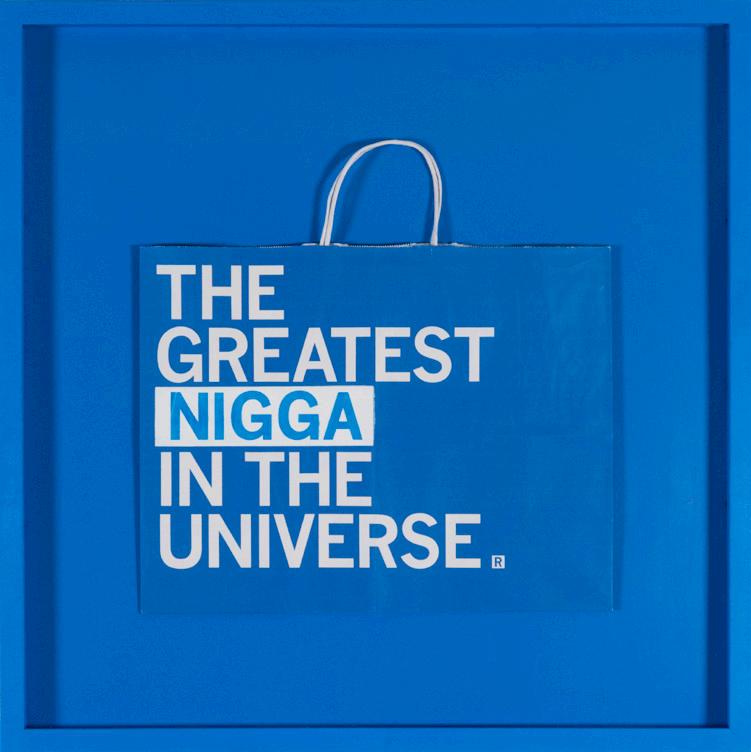
“Black excellence complex” as a way of navigating blackness, capitalism, and spectacle that perpetuates all three while supposedly doing the opposite. As the poet, scholar, organizer, and filmmaker Too Black has written, “What first appears to be inspired by Black Rage is reduced to simulacra: the self-determination of Black power is pigeonholed to front Black capitalism, the anger and suffering of the Black poor is liquidated to front rich Black entertainers' ambitions, the courage of Black militancy is strangulated to front State repression.”1 Too Black’s message rings throughout Murff’s practice. While he knows that art-making can contribute to the false images of freedom, he points out the class politics in Black struggle at every turn.
Murff reveals the irony and duplicity of Black excellence by signifying, a Black folk practice of critique through misdirection that depends here on textual and visual readings, knowledge of widespread symbols, and associative logic.2 Murff’s collages also signify. Pure air, pure food, and pure drink are essential to healthy growth (Affirmation #3) (2020) is one such collage with several layers of depth pictorially and interpretively. Murff first made a photograph by “collaging within the frame,” referring to his intentional layering of objects before taking the photo. In the original photograph, the black cover of the March 26, 1981 issue of Jet magazine is affixed to a white wall with a piece of red tape. Two majesty palm fronds cross in front of the magazine cover, as if to cancel out its title and imagery referring to the 1979–81 serial murders of twenty-eight Black children and adults in Atlanta. A few of the children’s eyes peer out around stripes of green. On top of this small drama, Murff has created a labyrinth of history and ideas, made of pictures and bits of text that combine for a frenetic energy like a Public Enemy song.
Looking at Pure air, the eyes continually glide, snag on a bit of text, and linger, sometimes on a face, a glint of photographed light, or a corner caught in a trick of ambiguous layering. The pictures are representations and will be recognized that way; at the same time, arms,
torsos, and gazes also draw lines and create the appearance of movement toward other items and around the collage as a whole. Single words and shorter statements break through the composition, changing the speed of Murff’s upload to the viewer. Murff marks his favorite figures with stars, or places them in the sky as stars. Someone else is in the sky: President Barack Obama, who cannot, in these collages at least, escape the drones he ordered during his administration. Gestures like this combine with Murff’s choices of material to generate new stories that the original sources, much less the subjects of these images, could not have imagined.
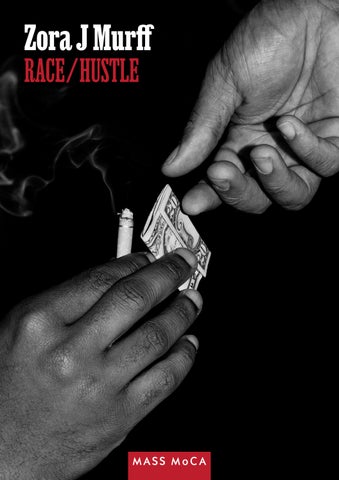
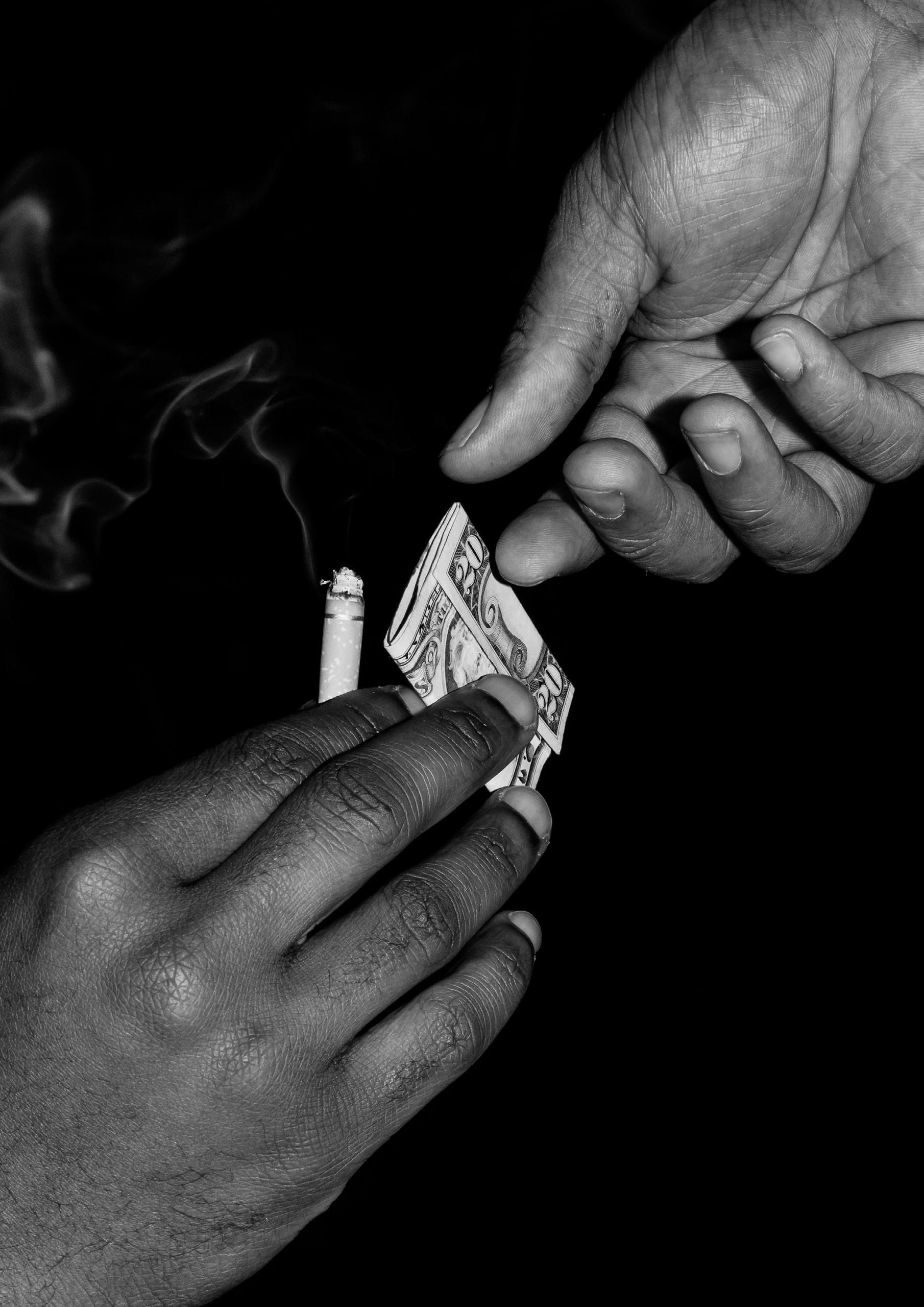
Gas Money (Affirmation #1), a photograph from 2019, frames two hands that point toward the photograph’s center from opposite ends. They hover over a black void, passing a folded $20 bill between them, separated by Andrew Jackson’s face and charged space. Does “gas money” mean we are looking at a gesture of payment after someone got a ride home or a weed deal? The smoke that breaks the void might hint at an answer, but does not rule the other out. It remains ambiguous which direction the bill is traveling. This pictures a relationship; an off-the-books economic transaction. Either way, someone gets what they need to keep them going.
The red, black, and green set in Feelin’ Myself, as well as the color scheme in Pure air, gestures at Pan-Africanism. 3 First Shots (2024), which features images of Murff at a gun range, speaks to armed resistance to oppression, not that he suggests vigilantism; Black residents of Lincoln Heights, Ohio, who armed themselves against neo-Nazis appear in Pure air and as the subjects of Murff’s first painting, The Necessary Machinery of Survival (Lincoln Heights, OH) (2025). A new installation, Bully Pulpit (Consciousness Raising) (2025) is a platform from which Murff will read the entirety of Blood in My Eye, a book published posthumously by the Black radical activist and political prisoner George Jackson, who was killed by guards in 1971. Installed around a column outside the gallery, Bully Pulpit places
Jackson’s advocacy for armed resistance against American fascism in a setting typically reserved for worship — and also, crucially, for gathering and community organizing.
With Bully Pulpit and other works, Murff wants to tell people what they may not want to hear. Imperialism and white supremacy have wreaked havoc both outside and inside the U.S., on bodies as well as minds. Resistance through a plurality of methods is necessary, but some methods, like anti-capitalist organizing and armed resistance, are punished by the state, and others whose ideas about appropriate behavior dominate the public sphere. RACE/ HUSTLE means to nudge, surprise, or entice people toward mental transformation through education and exposure to ideas and images, we can expand our imaginations of what liberation looks like and how to get there. While more is needed to move people from the symbolic register to real, tangible organization, RACE/ HUSTLE is a call looking for an answer. In the words of Pure air: ACTION…UNITE…Commit class suicide! Against a pervasive and decades-old pessimism, Murff proposes a revolutionary optimism articulated well by the late Assata Shakur, a U.S.-born revolutionary who defied imprisonment and found refuge in Cuba:
“Through the lies and the sell-outs. The mistakes and the madness. Through pain and hunger and frustration, We carried it on.
Carried on the tradition… Carry it on now. Carry it on TO FREEDOM!”4
1 “Laundering Black Rage | Black Agenda Report.” September 7, 2022. https://www.blackagendareport.com/launderingblack-rage.
2 Abrahams, Roger D. Talking Black. Newbury House Publishers, 1976, 19.
3 Pan-Africanism is the idea that members of the African diaspora have a shared destiny with Africans living on the continent. It has been a basis for political organization since the late eighteenth century. The red, black, and green striped Pan-African flag was adopted in 1920 by the massively popular activist Marcus Garvey and the Universal Negro Improvement Association.
4 Shakur, Assata, Angela Y. Davis, and Lennox S. Hinds. Assata: An Autobiography. Lawrence Hill Books, 2001, 264–65.
Zora J Murff (b. 1987) is an Oregon-based artist and educator interested in liberation from anti-Blackness. He uses his creative practice to explore the politics of racialization using provocative imagery and practices photography expansively, stretching it across disciplines to create associative or implied images. He strives to speak plainly about visual culture and its entanglement with race, capitalism, and other forms of hierarchical oppression.
Zora J Murff: RACE/HUSTLE
December 6, 2025 – November 2026
Curated by Terence Washington, Curatorial Exchange Initiative Fellow, MASS MoCA
Zora J Murff is part of MASS MoCA’s Curatorial Exchange Initiative (CEI). The CEI is an exploratory pilot for how contemporary museums work collaboratively with curators and artists, whose diverse practices and knowledge can be exchanged, supported, and deepened. The three-year program invites six curators to realize curatorial projects at MASS MoCA and in the North Adams community. CEI is generously supported through a leadership gift from Sarah Arison and the Arison Arts Foundation, Michi Jigarjian, Denise Sobel, the Teiger Foundation, and Yukiko and Anders Schroeder. Additional support is provided by the Director’s Catalyst Fund, with generous contributions from Greg and Anne Avis, Kelly and Bill Kaiser, Steve and Lisa Jenks, Bob Gold, and an anonymous donor.
Programming at MASS MoCA is made possible in part by Mass Cultural Council.
Front cover: Zora J Murff, Gas Money (Affirmation #1), 2019. Archival pigment print. 60 × 75 inches. 3 + 1 AP. Courtesy of the artist
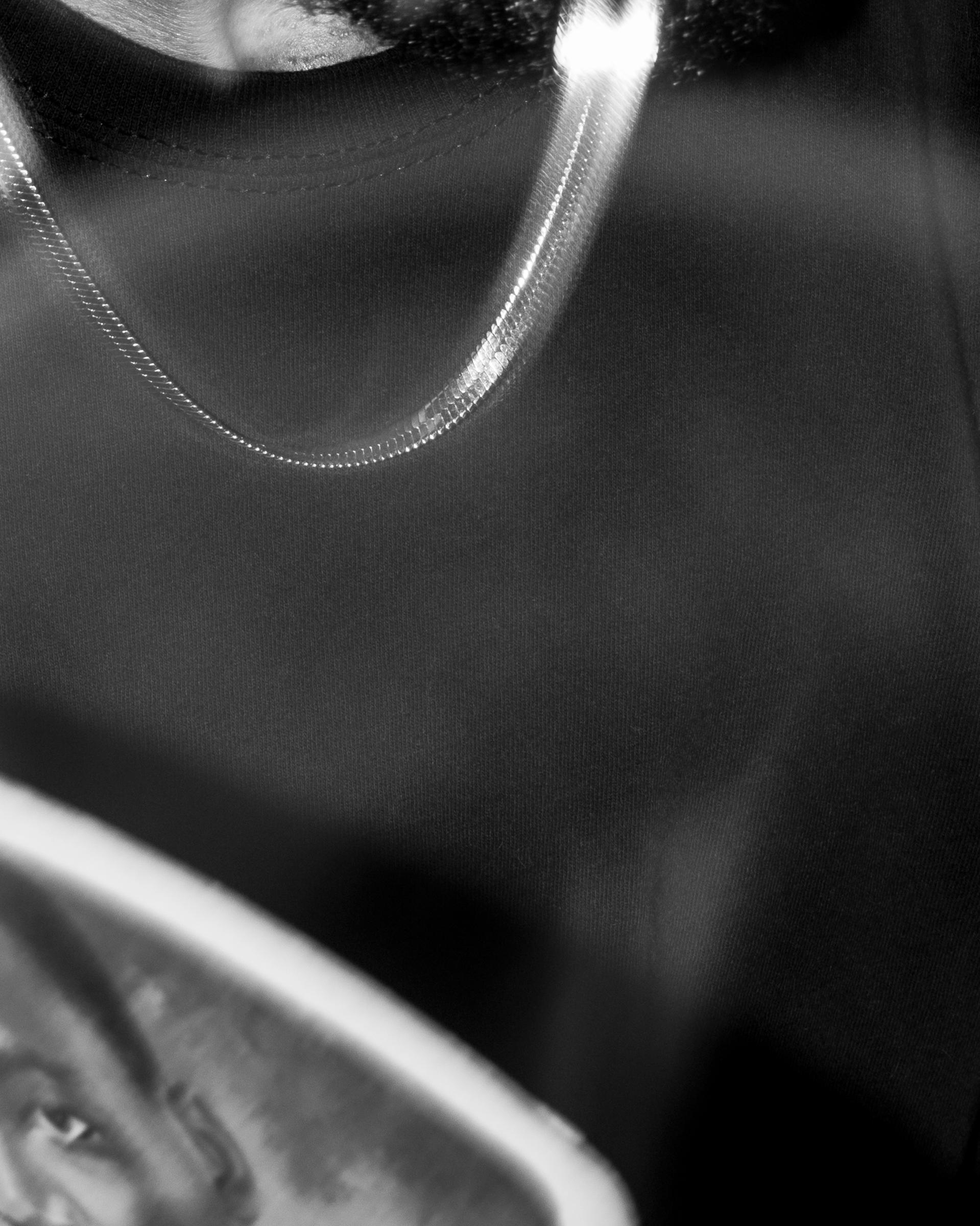
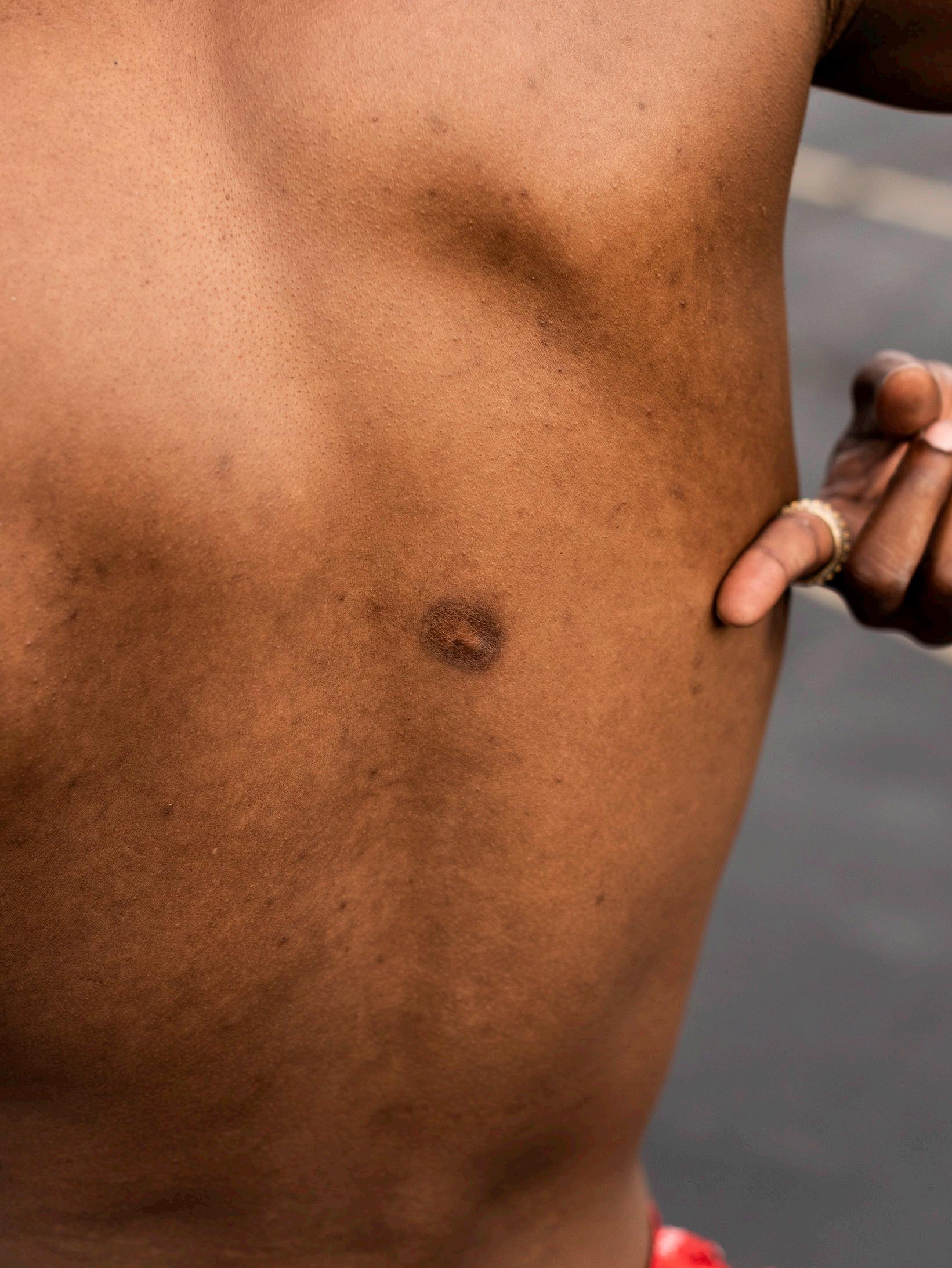
Back cover: Zora J Murff, Hit-a-lick (Race Traitor), 2019. Archival pigment print. 24 x 30 inches. 3 + 1 AP. Courtesy of the artist
For further reading:
Zora J Murff: True Colors (or, Affirmations in a Crisis)
Published by Aperture
Available in MASS MoCA’s R&D Store and online