Slouching towards Parihaka
Dawn, 5 November 1881, and the Armed Constabulary, its hour come round at last, is about to fall upon Parihaka. In the belly of the beast stands an Irishman, the consequences of whose small part in what is about to happen will stretch far into the future. At its head a second man sits astride a white horse. He is an important politician from Wellington, and fears what has been taking place at Parihaka. He would see the pā razed and its people scattered to the winds.
Leviathan arrives at the gates of the pā and is met by lines of young boys performing haka, lines of young girls skipping, lines of women offering loaves of bread to those about to rain destruction down upon them.1 The welcome is spurned, the hospitality refused.
The Riot Act is read. Tense men stand and wait. They have been ordered to shoot any Māori who so much as ‘flashe[s] a tomahawk’.2 None does so. A horse steps on a young boy’s foot. He will still be limping many years later and a man fully grown as he walks the halls of the nation’s Parliament.3
An hour passes. Nothing is going on but something is happening. Power is being resisted in ways it does not understand. Subtlety is being exercised in the face of blunt force. Honour and infamy are on display; both will endure. A future
is being told, although no words are spoken. Something is being born. Then two men step forward to arrest three others, and the violence and violation begin.4
One day, years earlier, on the other side of the world, the Irishman had followed his father and older brother out of Limerick gaol and into the light. A month before, on 4 July 1873, the three had travelled in the opposite direction, convicted of assault and sentenced to a short spell inside with hard labour. He was from a farming family that eked out a living on a small scrap of land in the east of County Limerick, and well used to hard labour. All the same, it had been a difficult month, strapped to a penal treadwheel — a never-ending staircase of pain crammed with gravel — and breaking stones to repair famine roads that went nowhere and were built by starving people. Following the eight hours of industrial exertion he endured each day, he had to suffer a further two of spiritual labour. He had washed just once.
The day he was sent down, another man had been fined £1 for stealing a penknife, someone else was sentenced to three months for accepting tuppence under false pretences, and a 15-year-old boy who had run away from his apprenticeship received 14 days’ hard labour. They joined the man in the gaol, which was shunted up against the banks of the River Shannon and designed by the English architect who sketched the plans for Buckingham Palace. The gaol had a stage for public executions, which the Irishman suspected was not a feature of the palace. Much later, long after he had left Ireland, the scaffold would be pulled down and the prison would become Geary’s biscuit and sweet factory.
The young man made his way back to the 29-acre farm on which he had lived each of his 17 years. The land was in the township of Ballynagreanagh, part of the parish of Kilteely, a Fenian stronghold close to the border with Tipperary. His parents did not own the farm they worked. It belonged to an Englishman who lived in Devon, the latest in a long line of British gentry who, for over two hundred years, had held title to land confiscated from the Irish. The family had moved onto the farm a decade before the Irishman had arrived in the world, during the worst of the years of starvation, following the eviction of the previous tenant for failure to keep up with the rent. Each year his parents paid £21 4s an acre to till the land and graze a few head of stock, their tenure at the will and whim of the absentee landlord.
Not long after he left prison, the Irishman boarded a ship and sailed to the other side of the world. He ‘took the boat’, as his people said, because he did not much fancy his chances in a family struggling to make a go of things on a small piece of land to which they had no claim, in a country desperately slow to recover from the ravages of Phytophthora infestans. 5 His older brother, the one who had been tied to the treadwheel beside him, also left Ireland, although the boat he took was bound for Boston. The father remained in Ballynagreanagh, where he would die, alone, 20 long years after the last of his children had sailed way.
The Irishman took passage on the New Zealand Shipping Company’s Wennington, pulling away from Gravesend docks on 21 January 1874 to begin an exodus from which he would not return. As was the case for millions of other Irish, his
would be an Iliad without an Odyssey. The clipper carried 291 passengers (equivalent ‘to 234½ statute adults’, the Wellington Independent would later note)6 and 13,000 pieces of railway iron. The live cargo included tinsmiths, bricklayers, ropemakers, butchers, farriers, hammermen, bootmakers, general servants, housemaids and housekeepers.7 He was one of 10 farm labour-ers aboard. It was said of the ship’s human consignment that it was ‘just the class of immigrants the colony is in want of’.8
Strong headwinds and thumping gales meant the journey took 124 days, much longer than was usual for the run down the coast of Africa, around the Cape and across the Indian Ocean. Three children died and ten were born during those terrible months at sea. After two days battling to get past the Heads, the ship docked in Wellington on 25 May 1874, to the great relief of the fledgling town’s inhabitants: some had publicly feared that ‘serious misfortune had misfallen her’ and given up all hope for the vessel’s safety.9
Health inspectors declared the passengers ‘to be a healthy lot of people, free from organic disease of any kind’, while the local newspaper enthused that they were ‘decidedly of a superior nature to that of some landed lately’.10 Within a day or two they were all employed, including the nine who travelled to Marton by special coach to help assuage ‘the great demand for labour still existing in [that] district’.11
The Irishman spent his first night in New Zealand in ‘rude but comfortable quarters’ at the Mount Cook Barracks.12 Seventeen years later he would return to that building, no longer an Irish farm labourer but a bombardier in the colony’s Permanent Militia. In the years between, the building would host other men from parts and places of the new land he had
not yet heard of but would find himself entangled in soon enough. These others, having defied the authority of the colonial government with ploughs and fences, were on their way to their own gaols and hard labour. All of this, though, lay in the future.
After that first night, the Irishman was lost to history for three years. Much later, it would be thought by some among his descendants that he had been in Westport, or perhaps Kumara. He might have been a policeman or possibly a miner. But no one could be sure, because his sort leave little impression on history. Until they find themselves caught up in it.
In late August 1877 the Irishman joined the New Zealand Armed Constabulary. Had he hoped for fame, fortune or glory, he would have been disappointed. He would, in time, find infamy, and may have been disappointed by that too. Much of the work was tedious, and involved constructing roads, bridges and, in a town called Taupō, a public swimming pool which the town’s dignitaries named after the men who built it.
It was hard labour, which he knew well and was not much bothered by. He was also required to keep the peace among the rowdier elements of the settler community who were prone to maiming cattle, offending against the Diseased Sheep Act and keeping bawdy-houses.13 The job also called for pacifying Māori.14
By 1880 the Irishman was working on a road around the Taranaki coast. Unlike the famine roads in the west of the country he had left behind, this route did not lead nowhere. This one led directly to Parihaka pā, the seat of the great Māori rangatira Te Whiti O Rongomai and Tohu Kākahi.15
All the talk in the man’s new land was that Parihaka had become a gathering place of disaffected and dangerous natives, an obstacle preventing the opening up of land to settlement. It was generally agreed that if progress was to be made, this threat had to be nullified. It was also generally agreed that while it would be best if local Māori came to their senses and saw the benefits of embracing British civilisation, military force should be used against them if they did not. After all, such was the natural order of things when the British settled the savage places of the world.
The Irishman worked on the invasion road for more than a year. It was an arduous business, felling the bush, removing the stumps and clearing the flax and toetoe. That year the weather was unusually wet and the work especially miserable. Sometimes he and those he worked alongside were asked to help erect telegraph lines; occasionally they were called upon to deliver the mail between Ōpunake and Ōkato.
At first he was based at the Armed Constabulary’s formidable redoubt at Ōpunake, whose great earthen parapets overlooked the bay and had been adjudged ‘a most creditable defensive work’.16 As the road was pushed further north, however, he no longer made his way back to Ōpunake at the end of each day, but slept instead in camps at places with names like Ngā Kumikumi, Opua, Kaikahu and Pukehinau.
His fellows formed armed covering parties ‘of not less than a sergeant and twenty constables’ to protect him and the others while they worked on the road.17 Digging, levelling and laying gravel dominated the days, but the man and his colleagues were also ‘thoroughly exercised in squad, company, skirmishing, and rifle drill’.18 Each day brought him closer to the one on which he would meet the group working its way south from Ōkato. There
were those who hoped that on the day the two roading gangs came together a ‘very great political effect would be produced upon the Natives throughout the coast [when] they saw the three things for which the government [had] so long contended being done together: the road, the telegraphy line, and the lighthouse’.19 Surely then, they said to each other, the natives would see sense.
There was little sign of any such effect. Instead, the Irishman’s work was disrupted by hordes of small Māori children, who would approach the road, chanting in their unintelligible language. Sometimes, too, he and the other constables would have to tear down fences erected by the locals and in the way of the road. Often, and he found this tiresome, the fences would be put back up during the night and would have to be pulled down all over again the next morning. His political betters saw to it that the people responsible for holding back progress were arrested and imprisoned far away, allowing work on the road to continue.
Progress prevailed, as it tends to when backed by force, and by May 1881 the Irishman was garrisoned in the small stone redoubt that served as the Armed Constabulary’s Cape Egmont camp, and where he and 41 other constables diligently protected the Cape Egmont lighthouse against incursions from the natives.20 There he repeated the oath of allegiance to Her Majesty Queen Victoria, signing up for a further three years of service.
There were moments of levity. Many years later, a photo would emerge showing him standing alongside other members of an Armed Constabulary rugby team out at the Rāhotu Domain. The men’s jerseys lace up to the neck and they are wearing tight white trousers and heavy boots. Only two of the
16 do not sport moustaches. One has his head bandaged. They look severe, these men. As well they might, for around them a tempest is gathering.
The storm breaks at dawn. Women (and perhaps young girls) are raped, whare torn down, cultivations ripped up, treasures stolen, people deported and imprisoned. Up and down the Taranaki coast other villages are pillaged in the Constabulary’s fevered search for weapons. The men who commit these acts, amongst whom the Irishman is numbered, will subsequently be absolved of responsibility for their actions under legislation which ‘freed, acquitted, released, indemnified, and discharged [them] of, from, and against all actions, suits, complaints, information, indictments, prosecutions, liabilities, and proceedings whatsoever’.21
None of what they do is reported in the papers at the time, for the important man from Wellington — the one who insisted on riding his fine white charger into the pā — has seen to it that the press are kept far from proceedings, the better that he get to tell the future what happened at Parihaka.22 And so, as can be the way with great catastrophes, what occurred ‘produced more forgetting than history’.23 Among Pākehā, at least.
Neither do these things end quickly. The days of darkness grind on, and the Irishman remains at Parihaka as part of an occupying force garrisoned on top of a hill overlooking the pā which the invading force has named Fort Rolleston. He sees the survivors scrabbling for what little has not been destroyed or stolen or ruined. He sees the return of Te Whiti O Rongomai and Tohu Kākahi from imprisonment in Te Wai Pounamu the South Island. He sees the breaking up of an attempt by Māori
from beyond the pā to bring two drayloads of salted pork in to feed the people — and he sees, perhaps from up close, the Armed Constabulary retaliate, on the express orders of the man from Wellington, by demolishing newly rebuilt whare.24
He sees food being offered to men and women suffering great privation, but only in return for undertaking road work. (And perhaps, in that moment, he remembered the treatment of his own people in Ireland.) It is probable that he saw many other things which were and are not spoken of. When finally he leaves Parihaka, at the end of November 1884, the pass laws restricting Māori movement into and out of the pā are still in place.
For a time the Irishman continued building roads on the East Coast, and then in Taupō and Tokaanu. But the Armed Constabulary’s days were coming to an end, and when it was disbanded in 1886 he headed south to Port Chalmers to join No. 4 Artillery Battery of the Permanent Forces. On 8 December 1886 he ceased to be Constable 796 and became Bombardier 67.
He was at Port Chalmers, not far from where the ploughmen exiled from Parihaka had been imprisoned, for just over four years. Most of the ploughmen were back in Taranaki on the day the man marched into the pā behind the fine white horse, but some never returned home.
It was not a happy time for him. Out on the Otago Heads he damaged his spine badly while discharging a heavy gun and was hospitalised for two months. His eyesight deteriorated, something a medical specialist attributed to ‘the heavy lifting of artillery pieces’.25 By early 1891 he was no longer able to carry out his duties as a gunner, and was reassigned to the artillery’s Wellington Depot — housed in the very premises in which he
had spent his first night ashore following the docking of the Wennington all those years earlier. When his time in the military ended in September 1891, the Irishman headed back to Taranaki.
By 1893 he was on his first farm, Section 44 Block 12 of the Cape Survey District, initially as a tenant but from 1895 as the owner. It was right on the South Road, barely a mile from Pungarehu. He would have seen this land when he was toiling on the invasion road; may even have rested on it while he boiled a billy or broke his fast. Perhaps that was when the idea of returning here took hold: the moment he looked up from raking the loose metal and saw right through the Māori whare which, at that time, were still standing, and into a future that would, as it happened, come to pass.
In 1898 he married. She, too, was Irish, and 17 years his junior. Her village, Galbally, was just 12 miles from his, but they met on the other side of the world. She was one of seven children from her father’s second marriage, four of whom left Ireland with the old man in 1895. The wedding took place at the Catholic church in Ōkato, and the reception was held in the schoolhouse in Pungarehu. In 1881 that classroom had been the blockhouse in which Te Whiti O Rongomai and Tohu Kākahi had been held for a month following the invasion of their pā.
The Irishman was not new to farming. All the same, 14 years in military service had taken a toll and it took him some time to find his way. At his first clearing sale the stock agent complained about the state of his animals; ‘several of the cows were backwards’, it was reported in the local paper, and ‘nearly all were in low condition’.26
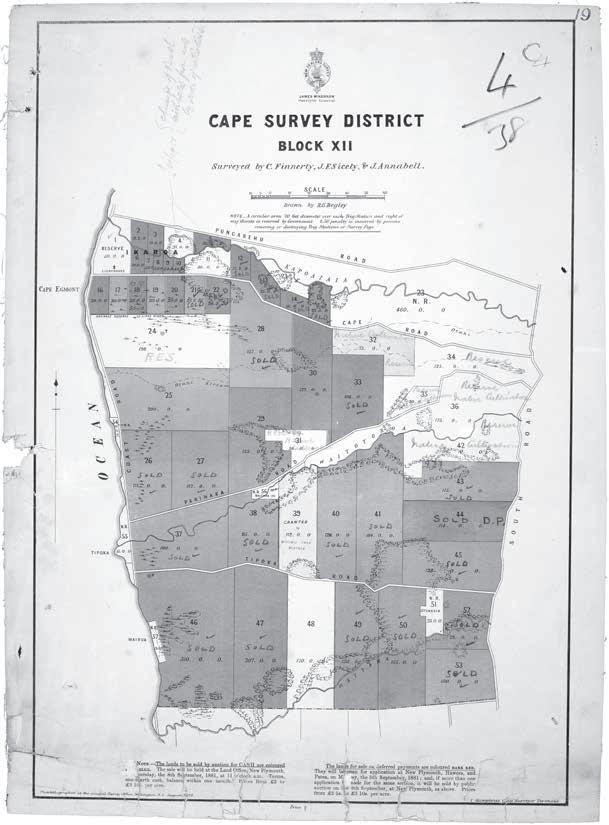
This is the map of the survey that divided up the confiscated Taranaki land on which whare once stood and crops grew, and which brought the Irishman into his new good fortune. Te Rua Mahara o te Kāwanatanga Archives New Zealand
Later that year he considered quitting dairying altogether and advertised the sale by auction of ‘the whole of his quiet Dairy Cows’.27
But the Irishman persevered, seeking some years later ‘[a] milker, Man preferred’.28 In 1902 he signed a lease on a second farm, Section 2 Block 13 of the Cape Survey District, which was on the Opourapa Road, not far from the first. A third — Section 102 Block 12 of the Cape Survey District — followed in 1922, although this farm belonged to his wife, who paid Hori Teira £2947 for a property which, in the archives that tell the story of the alienation of land from Taranaki Māori, is called Parihaka A.
The Irishman and his wife set about leaving Ireland behind on these three pieces of land. And they did well, reinventing themselves as New Zealanders across the course of their life together. In doing so they were accompanied by a good many other people determined to call new lives, new stories, new futures into existence. He fulfilled his civic responsibilities, serving on the Pungarehu Country School District Board and the committee of the Rahotu Athletics Club — which held a ‘Maori v Pakeha Tug-O-War, ten men aside’ on 31 March 1902.29
He regularly petitioned the Parihaka Road Board on behalf of his neighbours for improvements to the Opourapa Road. His cows improved in quality as the years passed, ‘a very prime Shorthorn cow’ going for £13 10s in 1915.30 There was time, too, to play the violin at dances in the local halls. In 1901 he took first place in the Rhubarb section of the Farm and Garden Produce division of the Cape Egmont Horticultural Society’s Third Annual Show; the following year he won both the Ham and the Bacon sections. Of what his wife did there is little or no record.
There are things that must be said about the soil on which all of this took place. Each farm was on land the Crown had confiscated from Taranaki Māori in 1865. The first was part of a long strip that ran the length of the western side of the South Road and which, had the survey plans been accurate, would not have been available for the Irishman to buy. Initially, at least, the men in Wellington undertook to return land on the mountain side of the road to Māori as native reserves, and to sell only that on the seaward side — the most fertile, and which had included the greater part of Parihaka’s extensive cultivations — to settler-farmers.
But once the dust had settled, the road was found to run much closer to the mountain than had been planned. It is not clear why this happened. In this way, an additional 5000 acres were released for sale — including the Irishman’s first farm, which he purchased on tick for £350 and which, not very long before he signed on the dotted line, had been producing wheat, oats, maize and potatoes for the people of Parihaka.
The second, the Opourapa Road farm, was part of a 1895acre parcel called the Waiotama Block which the Crown had granted to Māori in 1882 through a deed that came gift-wrapped in an assurance that the land was ‘absolutely inalienable’. But the Crown was wont to say such things in those times and equally wont to change its mind, and Waiotama was quickly carved up and leased out to Pākehā farmers as West Coast leasehold land.
There is nothing quite like a West Coast lease. The one the Irishman signed was to a farm that was owned by Māori but administered by a government official, the Public Trustee. The £35 he paid each year for his lease went first to the Trustee, who deducted survey fees, Crown and native land rates, a 7.5 per cent
commission, land taxes, interest on overdrafts, and the costs associated with bush-felling, fencing, draining and maintaining roads, before handing what was left to the land’s owners. More often than not, that was very little.
The civil servant, not the owners, set the rent, which was reviewed every 21 years. There was only one rent increase in the 40 years the Irishman’s signature was on the lease. Had he wanted to (he didn’t), he could have mortgaged, sub-let or transferred his lease to others without the owners’ permission or knowledge. If he had stumbled across mines, metals, minerals, coal, lignite, slate or freestone while on his way to the milking shed (he didn’t), he would have had to hand it all over to the Crown, not the owners.
He could (and may well) have used the Government Advances to Settlers Act 1894 to borrow money to improve the land. That option was not available to Māori landowners — who were not, after all, settlers. And, subject to the discretion of the Trustee, he held a perpetual right of renewal to his lease.
The third farm was not, in fact, his, but was purchased by his wife. It was available only because it was part of 5000 acres the men in Wellington decided to keep — rather than return to Māori, as they had initially promised — as ‘indemnity for the loss sustained by the government in suppressing the Parihaka sedition’.31
In due course that land was sold, its purchase price added to the vast wealth fund raised by the state from the sale of Māori land that fuelled the construction of a new colony. There was an urupā on this farm. There was also an earlier title to the block: it had been granted in 1883 to a group of Māori, the names Te Whiti O Rongomai and Tohu Kākahi the first two etched on the title.
Of these things the Irishman may or may not have been aware.
He died on 6 February 1923 of what was in those times known as senile decay, and was buried at the Ōkato cemetery, where his pallbearers were all former comrades from the Armed Constabulary. The notes of the Last Post accompanied him down into the dark.
Everything he had been part of and party to — the monstrous, the monumental, the mundane — would soon fade from the world. The years of Irish poverty; the dawn on which he had stood at the gates of Parihaka; the taking of the land that became three family farms: in time, all of it would be forgotten by those who came after him. Silence would settle over those things. They would cease to be spoken of and would tumble out of memory, lost to his descendants who were busy getting on with the business of becoming New Zealanders.
For a while, their stories carried the whispers of all that had been necessary so that they might stand on the edge of the world and call this place home. Eventually, even those murmurs fell quiet. But the Irishman had set matters in motion. Taken decisions and made choices he could not have guessed at on the day he left Limerick gaol, the repercussions of which would rumble down the long years that followed his death.
The Irishman’s name was Andrew Gilhooly, and he was my great-grandfather.