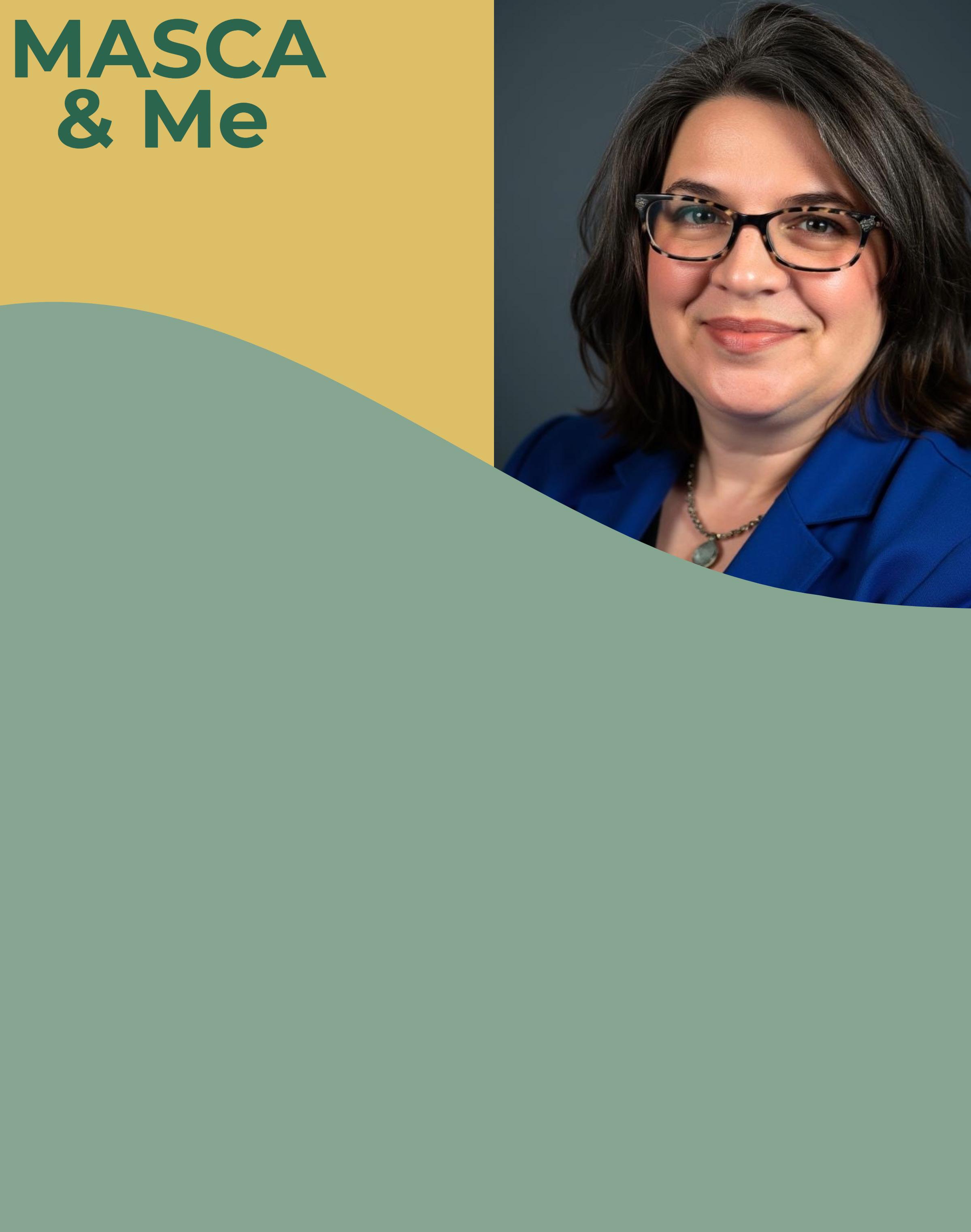
I want to do something FUN this December as a MASCA Community!
Let’s share the Life of a School Counselor!
December is a uniquely challenging and rewarding month for school counselors. It’s mixed with academic deadlines, seasonal social-emotional needs, as well as schoolwide fun!
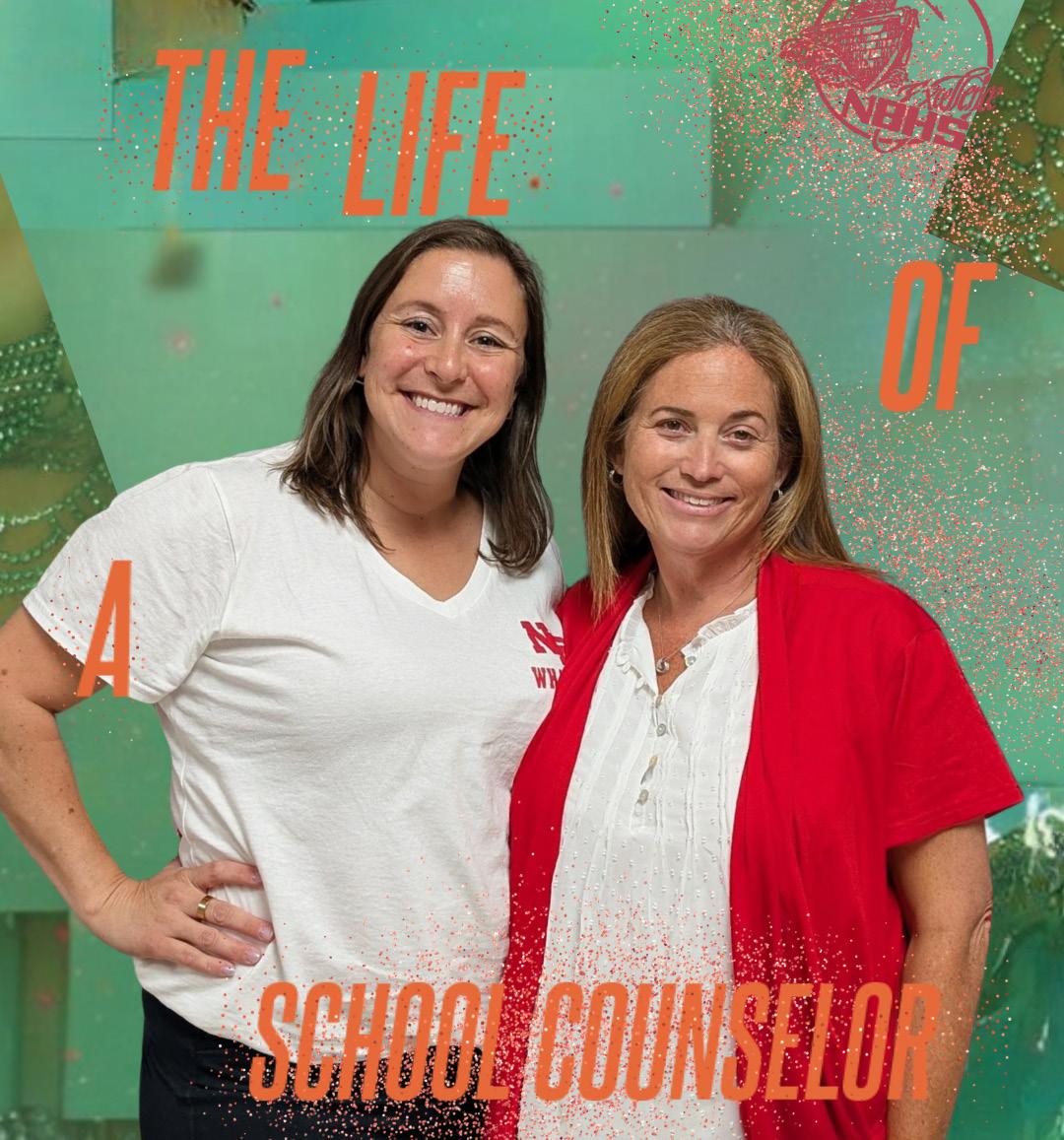
I invite you to participate in our exclusive photo series: “The Life of a Massachusetts School Counselor.”
The Goal: To capture and celebrate the diverse, complex, and vital work you do every day.
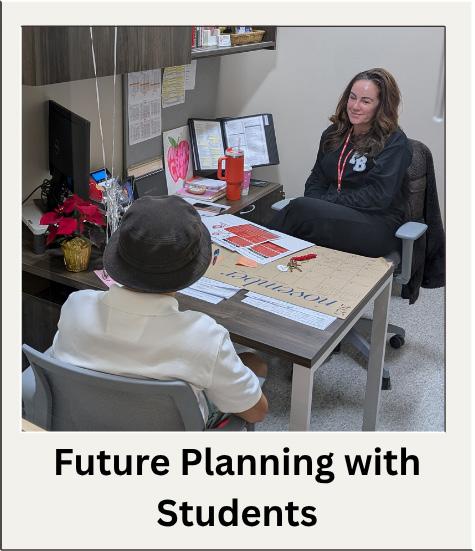
I want to see it all: from future planning small groups, to the contributions you make to school culture.
● Classroom Presentations or schoolwide presentation
● Participating in Spirit Days (individually or as a department)
● Door Decorating activities
● Collaborating with teachers and staff
By sharing snapshots of your December counselor life, we can collectively build a powerful visual narrative for our profession.
Upload 3-5 photos that illustrate the range of your daily duties along with your name, school, and a brief caption for each. See
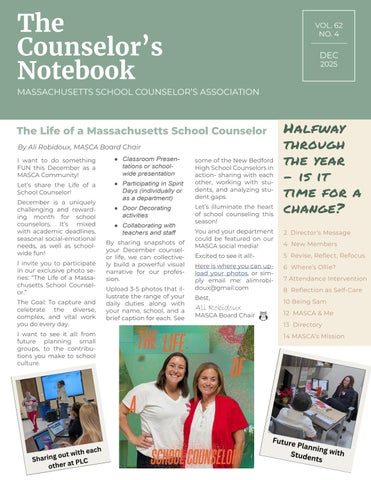
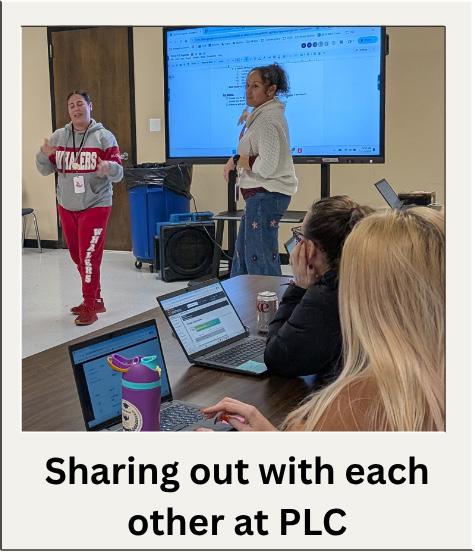
some of the New Bedford High School Counselors in action- sharing with each other, working with students, and analyzing student gaps.
Let’s illuminate the heart of school counseling this season!
You and your department could be featured on our MASCA social media! Excited to see it all!Here is where you can upload your photos, or simply email me: alimrobidoux@gmail.com
Best,
Ali Robidoux MASCA Board Chair
Director’s Message
New Graduation Requirement
By Bob Bardwell, MASCA Executive Director
December 1 is an important date for the students of the Commonwealth. That is the date when the preliminary report of the Statewide Graduation Council (SGC) will be released at a public announcement at Dedham High school at 9:45 AM. Typically these events bring out the Governor, Lt. Governor, Secretary, Commissioner and other high level education officials. After all, this is a big deal.
I’ve written about the work of the SGC before. On November 5, 2024 2,004,216 million (or 59.07%) of the Massachusetts voters voted to approve ballot question 2 which would eliminate the requirement that students would have to pass the high school ELA, math and science MCAS tests in order to graduate (The ballot question did not seek to change local course and credit requirements). Students in grades 3-8 and again in high school will still need to take the tests per federal law, but like the 3-8 tests, the high school tests are no longer high-stakes.
On January 17, 2025, Governor Healey issued Executive Order No. 639: Establishing a K-12 Statewide Graduation Council. The Council had to produce a report with preliminary findings and recommendations by December 1, 2025 with a final report by July 1, 2026.
As one of the 34 members of the Council, I have been an active participant in the monthly, and sometimes two meetings per month since March 2025. Most were in person in Worcester while others were virtual. Time was spent reviewing what options, such as end of course assessments, capstones or a required program of study could be used to replace the MCAS. The Council, with the help of consultants, also surveyed what other states are doing and had Council members provide feedback about some of the initial proposals. In addition, the consultants and staff from the Executive Office of Education (EOE) held numerous in person and virtual focus group meetings across the state to hear from residents (students, staff, families, community members, employers) about what they would want all Massachusetts students to be able to demonstrate competency in before earning their high school diploma.
I cannot get into the specifics of the initial recommendations as they are embargoed until December 1. What I can tell you is that many of the ideas and suggestions will absolutely impact school counselors, especially those in our secondary schools who work with graduating seniors. Those who are currently responsible for checking graduation credits would very likely have to be involved in tracking new requirements, whatever they may be. It may also be that if things like MyCAP or participating in early college or innovation pathways become required, school counselors would absolutely need to be involved with educating students and families, perhaps implementing and most likely monitoring these new requirements.
I have stated to the Council from the very beginning that school counselors currently are absolutely necessary to ensure graduates meet local graduation requirements and any additional requirements mean that additional counselors would be needed to assist in implementing new requirements. To expect students, families and staff to navigate this new landscape alone would lead to confusion, chaos and frustration.
I have also shared with the Council that the timing of these possible new requirements come at a very challenging time, especially considering it is expected that the 2026-27 school budgets will be facing some of the biggest challenges school districts have faced in many years. Even though any new requirements would be phased in over several years, people now will ask “How
(continued next page)
Bob Bardwell
New Graduation Requirement
(continued from previous page)
can schools be expected to support increased graduation requirements when some of our colleagues may no longer have jobs?” For example, it has been reported that as part of the current $1.4 million budget deficit in Whitman-Hanson, that two of the 25 staff laid off effective November 21 were high school counselors (1 school and 1 school adjustment).
I want to be clear that this initial report contains several proposed recommendations and that they may not all make it to phase two, those that will become required. There are still so many questions that need to be answered, not only which recommendations will actually be implemented, but also what supports, if any, will districts receive to implement them. The Council has been told many times that “The cake is still being baked.”
While I fully support the goal to improve our already high standards and create more opportunities to ensure our students have all of the tools, skills and experiences to successfully navigate their world post high school graduation, it cannot be done by simply by adding this new work to the already overwhelmed counselors, some with caseloads well above the recommended ratio of 250:1. Either additional counselors will
need to be hired or something will need to be taken off the counselors’ plate. However, this typically is not the case when new initiatives are launched.
I highly suggest that when you read the proposed recommendations (they will be posted here) you do not immediately go to “How is this going to work?” Give the Council, consultants and DESE/ EOE staff time to further refine and explain how the recommendations will be implemented. I am hopeful that all our questions/concerns will be answered in the coming months, certainly by July 1. There will also be time for public comment on the proposed requirements so take the opportunity to submit your thoughts through that process when the time comes.
MASCA will certainly keep you informed about the work of the Council over the next few months. We will share updates and decisions as they are made. Rest assured that MASCA will continue to work closely with our DESE/EOE colleagues to ensure that the counselor voice is heard and considered as districts move this work forward in whatever format the policy makers and legislators establish to replace MCAS.
As always, if you have any questions or concerns, please do not hesitate to reach out to me. This is a critical time in the Commonwealth and we need to get this right. Our students deserve no less.
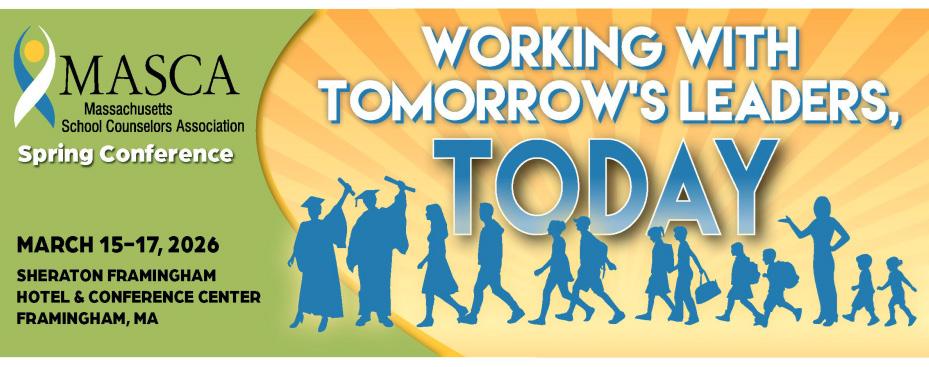
Don’t Miss MASCA’s Spring Conference! For more information or to register, go to https://ncyionline.org/conferences/mascac/.
New MASCA Members:
Megan Beck
Samantha Boyle
Brie Bulley
Rory Cartland
Sydney Colon
Elisabeth Compton
Patricia Cutler
Erin DiPalma
Maxx Domingos
Christine Evans
Heidi Greenlaw
Shannon Grote
Cameron Hewitt
Lee Hoegler
Emily Johnston
Sarah Johnston
Katie Killion
Brenna Lawlor
Ahhabya Leconte
Julia Marshall
Kacie Martel
Kristin Martell
Molly McGee
Carmen Melendez
Alicia Musso
Brielle Palin
Alicia Paull
Madison Previte
Nicole Pucillo
Catherine Puskas
Casey Santoriello
Lisa Savastano-Brady
Ireland Stevenson
Christine Tessier
Aleah Vasselin
Lucy Walsh
Kristina Wright
If you know or happen to meet any of our new members, please extend a very warm welcome!
Reflect, Reset, Refocus!
By Jennifer Just McGuire, College & Career Information Coordinator, New Bedford Public Schools; MASCA Chair, Technology Committee and Co-Chair, School Counselor Pipeline Committee
As we approach the end of the calendar year, many of us naturally start thinking about resolutions—those personal and professional goals that help us begin the next calendar year with intention and hope. For school counselors, the New Year brings a unique opportunity: it’s not only a fresh start, but also the midpoint of our school year. That makes this the perfect moment to reflect, reset, and refocus.
By this point in the year, we’ve likely been running full speed since September. The fall was a blur of schedules, deadlines, and a slew of student needs pulling us in many directions. But before we cruise into the spring semester, it’s worth hitting “pause” and asking ourselves how things are really going. Remember those goals you set at the start of the year—building stronger student connections, engaging families, improving programs, or maybe just finding a better work-life balance? Now’s the perfect time to check in on that progress.
Reflection helps us slow down and take time to evaluate where we are and where we’re headed. We can look back at the goals we set at the start of the year and consider which ones are on track and which might need a bit more attention. It also encourages us to acknowledge what we’re proud of, because recognizing growth—both our own and our students’—keeps us motivated. At the same time, reflection helps us identify any challenges that have emerged along the way, opening the door to new ideas, collaborations, or creative solutions. And finally, it prompts us to think about the small adjustments that could help us finish the year strong, reminding us that sometimes the slightest changes make the biggest difference in how we feel and function.
As counselors, we always encourage students to do this kind of thinking—to celebrate wins, learn from mistakes, and reset goals. This season, let’s take our own advice. (This may be tough for some
of us to do!) Reflection isn’t about judgment or being disappointed if something isn’t going according to plan; it’s about awareness. It reminds us why we do what we do, and it helps us stay aligned with our “why.”
“Reflection
helps us slow down and take time to evaluate where we are and where we’re headed.”
In addition to assessing our progress, this moment is also a chance to consider how we’re caring for ourselves as professionals who consistently show up for others. The mental load of school counseling is real, and as you likely have discovered, we cannot be there for others if we are not taking care of our own needs. Think about what routines or habits have helped you stay anchored so far—perhaps a supportive colleague, a regular check-in with your school counseling team, or a small ritual that brings calm to a busy day. It may also be worth identifying what boundaries could help you protect your time and energy in the months ahead. Whether it’s blocking off time for planning, stepping away from email after work, or simply allowing space to breathe during the day, these small acts do make a difference. (This is definitely something I have struggled with throughout my career.) Bottom line, when we take care of ourselves, we show up more fully for our students. Honoring your own well-being is not a luxury—it’s part of the work, and an essential piece of getting through the school year with strength and purpose.
Sometimes, the toughest part of reflection is making time for it. But even a few minutes during your commute or while walking the halls of your building can spark valuable insights. Reflection might identify what is working beautifully and deserves to be cultivated, or what is draining us and needs an adjustment. It can also reignite our sense of purpose, reminding us that the work we do matters deeply, even when the days feel long or exhausting.
So as the calendar year winds down, give yourself permission to pause for a moment. Look back, look forward, and give yourself credit for how far you’ve come. The second half of the school year is full of opportunity—new chances to connect, grow, and make a difference, one student and one day at a time.
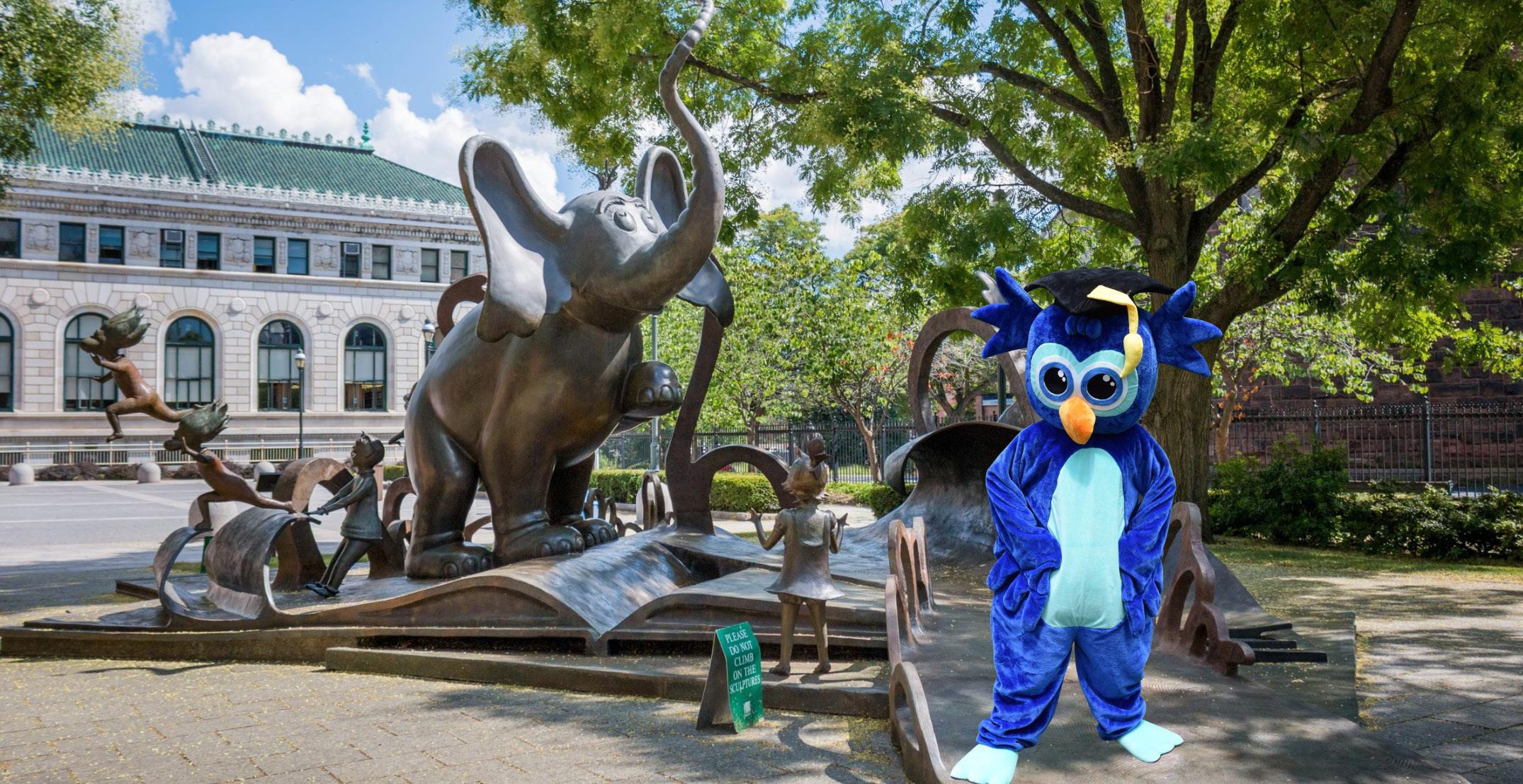
Where’s Ollie?
The correct answer to last month’s Where’s Ollie? challenge is: Boston Public Library. The Boston Public Library, founded in 1848, was the first large free municipal library in the United States! Its main branch in Copley Square is often called a “palace for the people,” featuring grand marble staircases, murals by John Singer Sargent, and a stunning reading room with soaring arches. The library’s collection includes over 23 million items—everything from rare manuscripts to vintage maps. Plus, it’s a great spot to relax in the peaceful courtyard or grab a coffee while surrounded by history. Visit the Courtyard Tea Room for a high tea experience!
Congratulations to Cara Zwicker (Groton-Dunstable Regional Middle School),
winner of the November Where’s Ollie? contest. Cara won a $10 Amazon gift card! Acknowledgement for Christine Fearey (Carroll School), Christopher Shen (Oxford Public Schools), Juliette Coatsworth (Foxborough Regional Charter School), Julie Cahill-O’Shea (Hamilton-Wenham Regional HS), Lauren Gee (Newburyport High school), Kerri Ciulla (Melrose), Sara Phelps (Newburyport), and Dawn Ruell (Agawam Public Schools) for getting the correct answer. Fantastic job!
Where is Ollie this month? Submit your guess and win a $10 Amazon gift card. Submissions are due 12/15/25. One entry per person. Send us your guess using this form or scanning the QR code above right.
Interventions for Supporting Attendance: Counselor-Led Solutions
By Allison Brann, MASCA Emerging Leader and School Counselor at Royalston Community School
As school counselors, we juggle numerous tasks and initiatives each day. Developing and implementing a comprehensive school counseling program requires working with students at various levels and intensities to meet their needs. Part of this work must include a direct focus on ensuring students are attending school. Identifying why a student is missing school requires compassionate communication and collaboration with a variety of stakeholders. Whether students are missing school due to anxiety, bullying, academic struggles, or a lack of belonging or connection, school counselors must actively incorporate attendance support into our daily work.
Why Does Attendance Matter?
As school counselors and educators, we understand the importance of consistent attendance. Being in school each day, on time, sets students of all ages up for success. As an elementary school counselor, I know how important it is to establish early beliefs and routines around attendance, though this is often challenging because we must also support the entire family in understanding why attendance matters. Of course, absences happen. However, missing too much school, especially in the elementary years, is strongly connected to both immediate and future school success.
The
Counselor’s
Role in Supporting Attendance
We know attendance is important, and we know it is an increasing challenge. So, what is our role in improving it? During the 2023–2024 school year, I was part of a team recognized by DESE as one of ten Attendance All-Star Schools for greatly reducing chronic student absenteeism. As we enter a new calendar year, I hope some of these ideas inspire your own programs and attendance initiatives!
I use Minute Meetings as a way to connect with every student, understand how they feel about school, and identify those who may need additional intervention. These meetings—quick, though often longer than a minute!—provide a snapshot of students’ sense of belonging, peer relationships, and connections with trusted adults at school.
Each month, I incorporate SEL themes such as respect, cooperation, and responsibility. I connect each theme with a school-wide challenge to build excitement and create opportunities for fun. For example, during our month focused on respect, each grade competed to earn “respect tags” for moments when students were caught being respectful. The class with the most tags chose a reward, such as extra recess. Students delivered their tags to the office, creating positive touchpoints with many children multiple times a day.
For themes like responsibility, we tie the concept directly to attendance. Throughout that month, we randomly selected one student who was present each day to come to the office and choose a small prize. This initiative not only reinforced the theme but also created positive office visits and interactions with staff.
I also offer lunch bunch groups to all students, with specific days reserved for students needing attendance support. For those requiring more intensive intervention, I incorporate Check-In/Check-Out (CICO) systems and small groups. Using data from Minute Meetings and attendance reports, I identify approximately five students per month to target with these supports.
Collaboration
and Community Partnerships
The importance of collaboration when ad-
(continued on page 9)
End-of-Year Reflection as Self-Care: Recognizing What You’ve Accomplished
By Brynn Cooper, MASCA Counseling Director SIG Co-Leader, Weymouth Public Schools
It’s December, and while the rest of the world posts “year in review” highlights on social media in preparation for launching into the new calendar year, school counselors are managing midyear transitions, finalizing applications, fielding referrals for students who “are just starting to pop up”, and running on autopilot. Ask anyone what they accomplished this year, and they will likely provide a detailed inventory of unfinished tasks. As humans, we are primed for ruminating on the things we didn’t do as opposed to the things we did. Ask us to name three professional wins? Three things we’re immensely proud of? I can hear the crickets now…
As helping professionals we’ve been conditioned to focus on gaps and needs and to celebrate the strengths of our students/clients. But this December, as we finish the year 2025 and join the masses in thinking about the past 12 months, I’m inviting you to engage in something that is an essential professional practice: intentional reflection that recognizes your true impact and value.
But why is this so hard?
Our work is never considered “complete”. There’s no day when we can say we have met all student needs, addressed every crisis, or cleared every item from our task list. This non-stop feeling of being in constant motion and demand makes it difficult to pause and assess progress.
Additionally, much of our most impactful work is invisible. We’re considered most effective when our interventions prevent problems that never materialize, which makes our impact hard to measure. When we cannot identify our impact, we question our effectiveness. Once we start questioning our work and the impact it has, we are in prime position for burn out– we feel exhausted, have low self-esteem and consider our contributions to our school and position minimal and ineffectual.
Have you ever driven home at the end of the day wondering “What did I actually accomplish today?” It isn’t because we accomplished nothing—it’s because we didn’t pause to notice what we did accomplish. We didn’t consider all the
boxes we didn’t add to our checklist that contribute to a successful day. Without this awareness, we deepen self-doubt and give power to the voice in our head that says “but am I doing enough?”
Perhaps most importantly, by allowing self-critique to take over we fail to model what we so adeptly teach. We encourage students to celebrate growth and track progress, set goals and celebrate when they are accomplished, yet we don’t engage in these practices ourselves.
Reflection as Professional Practice
Research on self-compassion in helping professions demonstrates that acknowledging our efforts and impact builds resilience and effectiveness. Self-compassion predicts professional sustainability more reliably than self-criticism. Taking time to recognize what you’ve accomplished is a professional practice that sustains your capacity to serve students and combats the negativity that can easily creep in.
Suggestions for Year-End Reflection
1. Block 60-90 minutes on your calendar before winter break. Treat it as non-negotiable professional development or prep time. Choose a location where you won’t be interrupted—not your office. Consider including a colleague who you can share successes with– sometimes it is helpful to have someone else get us started.
2. Use a fun template you find on Canva or a notebook that brings you joy. The (continued next page)
End-of-Year Reflection
(continued from previous page)
format matters less than the content. Don’t worry about grammar, spelling, or handwriting.
3. Search your email for keywords like “thank you,” “appreciate,” “grateful,” or “help” to find messages from students, parents, and colleagues. These small notes of appreciation may have been discarded at the time but show the impact you have had throughout the year
4. Consider also what you stopped doing–Reflect on what you intentionally discontinued, delegated, or declined this year. These decisions often represent growth in boundary-setting and prioritization—worthy accomplishments that we rarely celebrate.
5. No task, project, etc. is too small to include!
Capturing the Quiet Victories
Before finishing your reflection, consider the victories less celebrated: the student who came to you about their self-injurious behavior, the hostile parent who became collaborative (think about those keyboard warriors– has their tone changed?), the administrator who finally understood your role, the teacher who learned strategies from you and was finally able to connect with a student. These are usually left off of “to do” lists and won’t appear in data reports, evaluations, or even your own notes but they represent the profound, often invisible impact of your work.
Onward
Don’t let this reflection slow down in 2026. Update your resume or LinkedIn profile—even if you’re not seeking new positions, capture these accomplishments while they’re accessible and you have the motivation to celebrate them. Create a “wins folder” for positive feedback (doubles as evidence for your evaluation!). Screenshot thank-you notes from students, parents, staff and colleagues. Next December, you’ll appreciate having this documentation when you sit down in your quiet space to do your yearly reflection. Congratulations on all you’ve accomplished this year!
Interventions for Attendance
(continued from page 7)
dressing attendance cannot be overstated. Improving attendance is a team effort involving administration, teachers, community partners, and families. I am fortunate to work with a principal and dean of students who understand the role of the school counselor and how our school community benefits when we partner on initiatives—attendance included. I am able to provide leadership and advocate for clear, compassionate attendance policies aligned with SEL and trauma-informed practices.
Each month, our administrative team and I identify students who have accrued a concerning number of absences. We then open communication with families so we can work together to remove barriers impacting attendance. As an elementary counselor, family involvement is essential. In our conversations, we aim to uncover barriers such as illness, transportation challenges, family responsibilities, or unstable housing. Our district’s Family & Community Center is a valuable resource where we can refer families for added support.
Teachers are also key partners. We ask: Can they offer additional support to help students recover missed instructional time? Are there after-school opportunities, such as homework or reading clubs? When a student misses school, we want to find ways to help them make up for lost learning.
Self-Reflection & Advocacy
As we approach a new year, it’s the perfect time for self-reflection about our school counseling programs. Where can we make changes, try new strategies, advocate for students, and collaborate more effectively with our teams? Chronic absenteeism is not just a student issue—it is a complex challenge requiring counselor leadership. I hope this article offers inspiration for strengthening your own attendance initiatives, because when students show up, they do more than attend school—they connect, grow, and belong.
Being Sam - a Story of Hope
by Sam Bruetsch (he/him), Outreach Specialist, BAGLY
“I truly believe I only survived by luck. One bad day could literally have killed me.”
I graduated in 2022 from a public high school in a middle class, majority white town about 45 minutes north of Boston. Growing up, like so many others, I had no representation of life outside a cisgender heterosexual marriage. For me, that created a lot of confusing feelings that I had no reference for.
As a young child in elementary school, I remember telling a friend how I wanted to grow up and get houses next to each other so we could spend all our time together. I don’t remember having aspirations for anything else. Looking back, I can recognize that the obsession I had over a girl in 4th grade was actually a crush. I can still picture the yellow makeup bag she brought to recess. Also, I wished to have been named Samantha so I could be called Sam. Since I never saw other possibilities, I had no idea what was within reach.
Without trusted adults I could talk to, around 7th grade I began to struggle with severe depression. At my middle school, the only out LGBTQ+ students were bullied. There was little visible support from teachers. I believe we had one guidance counselor, but I have no actual memory of it. We had mental health conversations in health class, but I never felt close enough to tell someone how I really felt, especially not a mandated reporter.
Beginning in high school, many of my friends spent time in inpatient programs. Some I knew about; others I discovered later, when I learned they hadn’t had actually had mono after all. My high school had about twelve hundred students divided into three houses. Each house had two guidance counselors and one clinical psychologist. This, I realize now, was an incredible privilege. Freshman year, we had another mental health unit where my guidance counselor passed out little cards to students so they could privately request to speak with her. Although I had struggled with believing my problems were worth talking about, a friend of mine shared how she filled out the card to talk to the counselor about boys. This knowledge helped me dismantle the idea that my problems weren’t worth her time.
I met with my guidance counselor shortly after filling out the card, and, still fearing mandated reporters, I instead talked about my medical issues. She immediately referred me to the clinical psychologist, whom I saw at least once a week for around a year. Then came COVID. My school shut down during my sophomore year. I never told anyone how truly badly I was doing until I was entering my Junior year at the age of 16.
BAGLY (The Boston Alliance of LGBTQ+ Youth) is a youth-led, adult-supported social support organization, committed to social justice and creating, sustaining, and advocating for programs, policies, and services for the LGBTQ+ youth community in Massachusetts.
As I was about to enter high school I realized I wasn’t straight. The idea of being straight felt like a tight, itchy sweater. I came out as pansexual when I began dating my first girlfriend in the winter of my freshman year. For me, it took a while to open up to the idea of being queer before I was able to access those feelings. Before high school, my friends were mainly straight and cisgender. I remember feeling broken when they talked about crushes on boys at sleepovers.. Before then, the only gay people on TV were Mitch and Cam on Modern Family and Ellen, which didn’t feel representative of my 14 year old self. The first gay person I learned about in high school was Mathew Shepard. My chorus did a beautiful tribute to him, and his story remains close to my heart; however, it was overwhelming to discuss his murder while I was figuring out my own queerness.
Everything changed when I finally got the representation I had been longing for and entered the magical world of queer YouTubers. Being able to
(continued next page)
(continued from previous page)
access so many stories online helped me break through the walls I built around my identities and gave me the confidence to be openly queer. At the end of my senior year, I told a few friends I was using she/they pronouns. It took me a while to realize that me feeling happy in my clothes and body was not the same as other people enjoying my appearance.
I finally felt free to explore my gender at college, and with the incredible support from my friends and family, I was able to socially and medically transition on my own timeline. My pronouns changed a few times, landing with he/they by the end of my first year at college. I switched to Fenway Health and got a PCP who specialized in trans healthcare. I started testosterone that spring and got top surgery in August. Gender affirming care can be life-saving, and I have the firsthand experience to prove it. I’m now a senior in college, and I’ve never felt happier or more comfortable in my body.
Reflecting on the support I received in high school, I now understand what a privilege it was to be born in a town that could afford six counselors and three psychologists in a public high
school. And while it wasn’t perfect, I recognize that the care I had was far more comprehensive than most American students have access to. Students were learning about their identities and staff were also learning how to appropriately engage with – and respect – LGBTQ+ students.
My school was generally accepting of queer and trans students. And while there weren’t violent hate crimes, there was a lot of subtle hate that teachers didn’t seem to know how to handle. I do wish my high school had shown positive queer and trans representation as well as unequivocal acceptance and support. Queer and Trans students should know they will be protected, and those words should be followed with actions. I also wish my school had made more of an effort to evaluate my safety risk. I was just too afraid of what would happen if I spoke up. I truly believe I only survived by luck. One bad day could literally have killed me.
By the time I graduated high school, there was a Queer Space club and classrooms with pride flags. I hope the students who came after me felt supported, and I hope this support only grows. Now more than ever is the time to be loudly supporting Queer and Trans youth.
Sara Runkle
School Counselor
Kiley Prep. Springfield, MA
What makes you unique as a school counselor?
I approach counseling as a mix of social justice, strategic planning, and comedy: I’m here to disrupt inequity, teach real coping and communication skills, and keep it real with middle schoolers. I show up as my full, genuine self—and I’m honest about what I’m still learning, because modeling growth is part of the work.”
What inspires you about being a school counselor?
I became a school counselor because of my high school counselor, Mr. Blomquist, who showed up for me during a time when I didn’t even know how to ask for help. He was nothing like me on the surface, different background, different personality, different world, but he believed in me and advocated for me anyway, and that changed everything. That’s what inspires me, the reminder that students don’t need a perfect match, just a consistent person who sees them, teaches them skills for life, and stays on their team even when things get messy.
What career would you be doing if you were not a school counselor?
Something where I still get to help humans and spend more time outside. I would either be leading nature-based youth program or be the friendly woman at a national park who hands out trail maps and life advice at the same time.
What is your favorite tool to use in your work as a school counselor?
Humility, humor and Microsoft/ Google forms
What words do you live by?
From the Talmud
“Do not be daunted by the enormity of the world’s grief. Do justly now, love mercy now, walk humbly now. You are not obligated to complete the work, but neither are you free to abandon it.” Or in short, Progress not Perfection
Why is it important to you to be part of a community of school counselors?
I genuinely love learning. Being involved in MASCA ensures that I am always learning and growing as a counselor and as a person. Last year was one of the most challenging of my career, not because I stopped loving the work, but because the conditions made me question whether I could keep doing it in a healthy and sustainable way. Staying involved in MASCA (and actually getting more involved) grounded me. It reminded me of my skills, and my purpose. MASCA didn’t just help me grow, it helped me stay and move forward in the profession I care deeply about.
How would you describe your job to a 5 year old?
My job is to help students grow their brain, their mind, and their people skills. I help with stuff that isn’t in the books like how to learn and how to handle big emotions and sticking with things even when they are hard.
How do you decompress/eliminate stress or refuel for the next day?
I decompress by reading, family time, going for a walk or other activity, snuggling my very anxious but very sweet dog Millie, calling/texting the friends who make me laugh, and the radical act of going to bed early.
What brings you joy?
For me, joy means being in nature (camping, campfires, fall leaves, the quiet of a snowfall) and getting to share those moments with my family and the friends who feel like home. Bonus if I can add in a good book too!
Share an example of something that you learned from one of your students.
During the pandemic, when adults were stressing about toilet paper shortages, a student casually shared that she’d lived through far harder things in a refugee camp, and it instantly put everything in perspective. It was a sharp reminder that our students carry stories and experiences we may never see on the surface. I work to assume less, listen more and lead with grace.
What is your favorite dessert?
I can’t choose just one! Apple crisp, ice cream, and almost anything with chocolate and peanut butter.
MASCA Governing Board and Staff Directory
GOVERNING BOARD
Chair: Ali Robidoux
School Adjustment Counselor
New Bedford Public Schools
Assistant Chair: Cory McGann
School Counseling Department
Head
Ashland High School
Board Members
Mindy Cripps
Director of School Counseling
Billerica High School
John Crocker
Director of School Mental Health & Behavioral Services
Methuen Public Schools
Jessica Descartes
School Counselor
Tech Boston Academy
Andrea Encarnacao
School Counselor
Boston Latin School
Cynthia Esielionis
School Counselor
Ayer Shirley Regional Middle School
Lori Ford
School Counselor
Edgartown School, Martha’s Vineyard
Amanda Ugrinow
School Counselor
Westborough High School COMMITTEES
Conference
Ali Robidoux
School Adjustment Counselor
New Bedford Public Schools
Ethics
Mindy Cripps
Guidance Director
Billerican High School
Fiscal Oversight
John Crocker
Director of School Mental Health & Behavioral Services
Methuen Public Schools
Government Relations & Advocacy
Juliette Coatsworth
School Counselor
Foxborough Regional Charter School
Fran Frederick
School Adjustment Counselor
Belchertown High School
Inclusion, Diversity, Equity & Access
Vacant
MA Model
Jodi Then
School Counselor
Snowden International School, Boston
Cynthia Esielionis
School Counselor
Ayer Shirley Regional Middle School
Member Services
Tama Lang
School Counselor
Litwin Elementary School, Chicopee
Nomination and Bylaws
Jessica Descartes
School Counselor
Tech Boston Academy
Professional Recognition
Dina Sibilia
School Counselor
West Springfield High School
Tama Lang
School Counselor
Litwin Elementary School, Chicopee
Publicity
Luz Mederos Dorleans
School Counselor
Boston Latin Academy
Chris Soverow
Retired School Counselor
Research and Evaluation
Tim Poynton
Professor
UMASS Boston
School Counselor Pipeline
Jessica Almeida
School Counselor
Quinn Middle School, Hudson
Jennifer McGuire
College & Career Information
Coordinator
New Bedford Public Schools
Strategic Planning
Kerry Bartlett
School Counselor
Hudson High School
Technology
Jennifer McGuire
College & Career Information Coordinator
New Bedford Public Schools
APPOINTED POSITIONS
Executive Director & Member-
ship Coordinator
Bob Bardwell
Secretary
Julia Cahill-O’Shea
Counselors Notebook & Tech Coordinator
Jean Atwater-Williams
Mentoring Coordinator
Maryanne Margiotta
Program Review Coordinator
Kari Denitzio
Diversity Fellows
Amanda Berg
ESP, Granby Elementary School
Roz Riggins-DesRuisseux
School Counselor
Snowden International School, Boston
Denise Evans
School Counselor
The Carroll School
JC Topete Martinez
School Counselor
Boston Latin School
PDP Coordinator
Ali Robidoux
School Adjustment Counselor
New Bedford Public Schools
LIAISONS
Affiliate Liaison
Christine Weissman
Family & Community Engagement Counselor
Ware Jr.-Sr. High School
Counselor Educator Liaison
Megan Krell
Associate Professor Fitchburg State University
DESE Liaison
Lisa Harney
MA Dept of Elementary & Secondary Education
Emerging Leader Liaisons
Cory McGann
School Counseling Department
Head
Ashland High School
Courtney Royal
School Counselor
Gloucester High School
Graduate Student Liaisons
Ryan Beck
Gradudate Student
UMASS Amherst
Rachel Flagg
Gradudate Student
Assumption University
Nicole Ward
Gradudate Student
Boston University
EMERGING LEADERS
Allison Brann
School Counselor
Athol-Royalston Community School
Charlsey Penney
School Counselor
Challenge & Reach Academy, Worcester
Jen Pinhal
Early College School Counselor
New Bedford High School
Sara Runkle
School Counselor
Kiley Prep Middle School,
Springfield
Emerging Leader
Anthony Simmons
School Counselor
Atlantis Charter School
SPECIAL INTEREST GROUP (SIG) LEADERS
Career/Technical
Annie McCarthy
School Counselor
Franklin County Technical School
Maryrose O’Neil
School Counselor
Tantasqua Regional High School
Kaitlin Monahan
School Counselor
Greater Lowell Technical High School
Counseling Directors
Meg Clougherty
School Counseling Program
Director
Boston Latin School
Brynn Cooper
Director of Counseling
Weymouth High School
Elementary
Lori Ford
School Counselor
Martha’s Vineyard
Megan McShane
School Counselor
St Columbkille Partnership School
Maura Ricardi
School Adjustment Counselor
East Street School, Ludlow
Multilingual Learners
Priscila Anderson
School Counselor
Woburn Memorial High School
Matt Baione
School Counselor
Revere High School
Olivia Hull
School Adjustment Counselor
Brookline High School
Middle Level
Dawn Martin
School Counselor
Qualters Middle School, Mansfield
Jackie Saunders
School Counselor
Gibbs School, Arlington Retirees
Helen O’Donnell
Retired School Counselor
Anne Thidemann French
Retired School Adjustment
Counselor
School Adjustment Counselors/
School Social Worker
Nychele Clark
School Adjustment Counselor
Gardner High School
Kate Niedel
Retired School Adjustment Counselor
Anne Thidemann French
Retired School Adjustment Counselor
Secondary
Karen McCrillis
School Counselor
Gardner High School
Anthony Simmons
School Counselor
Atlantis Charter School, Fall River
Rachael Weinhold
School Counselor
Winchendon High School
Urban
Rani Gould
School Counselor
The Academy at Kiley Middle School
Chase Grogan
Student Development Counselor
Community Academy of Science and Health
Sara Runkle
School Counselor
Kiley Prep Middle School, Springfield
AFFINITY GROUP LEADERS Counselors of Color
Jessica Descartes
School Counselor
Tech Boston Academy
Andrea Encarnacao
School Counselor
Boston Latin School
Aaron Spencer
School Counselor
Nashoba Valley Technical High School
LGBTQ+
Jessica Almeida
School Counselor
Quinn Middle School, Hudson
Mindy Cripps
Director of School Counseling
Billerica High School
Denise Evans
School Counselor
The Carroll School
Mission Statement:
The mission of MASCA is to elevate and advance the school counseling profession in Massachusetts through leadership, collaboration, visibility, and professional development to optimize student success.
Vision Statement:
The vision of MASCA is to equip school counseling professionals with the knowledge and skills needed to implement a comprehensive school counseling program in their school community. Through an equitable lens, we advocate that all K-12 Massachusetts students have access to a school counselor and the opportunity to become their best selves in school, their personal lives, and their communities.
Core values:
Advocacy - Committing to center the school counseling profession by highlighting and advancing the core values of school counselors, both individually and as a profession.
Equity - Requiring inclusivity, diversity, and accessibility for all school counselors and the students and families they serve
Collaboration – Working together with all stakeholders allows school counselors to deliver the highest quality school counseling program for all students.
Excellence - Maintaining the highest level of professional standards and advancing the delivery of comprehensive school counseling programs (i.e.: MA Model) for all students.
Strategic Objectives:
Objective #1 - Advocacy - Position MASCA as a recognized, valuable, and respected voice at local, state, and regional levels by building the awareness of the importance and impact of the work and role of school counseling professionals.
Objective #2 - Equity - Position MASCA as a leading organization in dismantling racist, sexist, homophobic, gendered, ableist, ageist, religious intolerance and other oppressive policies and practices while emphasizing the need for diversity and inclusion in school counseling personnel and programming.
Objective #3 - Membership - Grow MASCA membership by retaining and engaging current members, and recruiting new members, with an on-going commitment to cultivate a more diverse membership.
Objective #4 – Professional Development - Create, provide and/or promote relevant, high-quality, accessible, and timely professional development to meet the needs of our members and support the implementation of comprehensive school counseling programs.
Objective #5 – School Counselor Pipeline - MASCA must address the increasing number of unfilled school counselor vacancies and reduction of candidates entering school counseling preparation programs.