UViclaunchesAIpilotinthree coursesthisfall PG. 4
Strugglingtofndaco-op? Considerworkstudyinstead PG. 6

VikesWomen'sSoccercollideagainst Cascadesinano-scoretie PG. 10

With no more pool and no more free gym, many students are left wondering why athletic fees continue to climb
EDEN CONTI SENIOR STAFF WRITER
With tuition — and student fees — being due at the end of this month, many students are curious to know: what is their athletics and recreation fee actually funding?
In fall 2024, UVic made the decision to drain the McKinnon Pool, to the dismay of students and community members alike, with the fnal closure being announced July 2024. That same year, UVic quietly closed the McKinnon gym, the only gym on campus that ofered weight room facilities to students without an additional membership fee.
Despite the closure of both of these facilities, all undergrad students, whether part-time or full-time, and whether or not they use any athletics facilities, are required to pay the full Athletics and Recreation (ATRS) fee.
The Vikes Recreation website claims that, “on average,” part-time students use the facilities more than their fulltime counterparts.
This year, the fee sits at $100, a nearly $4 increase from last year’s ATRS fee.
In a statement to the Martlet, a UVic
spokesperson said that “the ATRS fee goes up every year in accordance with the Tuition Limit Policy,” which limits the increase to two per cent per year.
The spokesperson continued that this increase “does not keep pace with inflationary costs associated with delivering our programs. As such, each year this fee becomes a smaller percentage of the department’s annual operating budget.”
According to the Vikes Recreation website, the ATRS fee does provide students with some resources without any extra cost. The fee allows students to access drop-in recreation (basketball, volleyball, badminton, etc.), the Centre for Athletics and Recreation and Special Abilities (CARSA) squash courts, the CARSA stretch zone, and covers tickets to some Vikes games.
These drop-in fitness options, however, don’t appeal to all students.
“I’m a little bit upset that I pay a hundred dollars and don’t get to use the weight room,” said Anya, a first year undergraduate student. “So, what are those fees then? Is that just so I can use the squash courts? Because I don’t play squash. Can I opt out of it? No I can’t.”
Despite these being advertised as the
“free ftness options” on campus, some of them still come with a cost. For example, students are welcome to go to the drop-in pickleball courts so long as they have their own equipment. If they don’t, equipment can be rented from the equipment desk. Booking the court may be free, but regular rental costs over the course of a semester will add up.
"If it went to facilities operations, I could go for a swim on campus right now"
CARSA is now the only gym on campus following the closure of McKinnon. Students are only able to use the weight room if they purchase an additional membership, which now costs $103 per term. Should students want to access multiple of CARSA’s resources, such as group ftness or yoga classes, they must pay an additional $80 on top of the
regular membership fees.
In total, this allots to over $200 in fees, or close to $300 for the particularly eager students, when both the ATRS fee and membership fees are considered.
The ATRS fee is meant to supply students with subsidized student rate memberships at CARSA, however, compared to other gyms in the area, the ATRS fee plus membership fees only adds up to around a $50 discount within a 4 month timespan.
For many students, this begs the question, where is the money going?
“Some universities bundle gym and ftness centre access directly into their student fee at a higher cost. At UVic, the athletics and recreation fee supports core operations and services,” said Michelle Peterson, Director of Operations in the Department of Wellness, Recreation & Athletics, in an emailed statement.
“This approach gives students the choice to opt in to additional recreation options,” the statement continues, “while keeping the base fee lower for everyone.”
Vikes Recreation says the ATRS fee “accounts for less than a third of the department’s overall $14-million
operating budget.” According to the Vikes Recreation website, the ATRS “is not a service fee; it provides essential support for ATRS facilities and operations,” and that it also “supports hundreds of students participating in Vikes sports clubs and annual events” such as Thunderfest, Holi Colour Run, and Dodge in the Dark, which students may attend free of charge.
The remainder of the funding is allocated towards “maintaining facilities and renewing equipment.”
However, many students remain frustrated by the way funding is allocated. “If it went to facilities operations, I could go for a swim on campus right now,” said Thomas Jensen, a second year Bachelor of Commerce (BCom) student. Much of this frustration comes from the continually increasing fee on top of a decreasing number of resources. Vikes Recreation notes that the ATRS fee will not “increase when programs, services or facilities are added, nor does it decrease when changes are made to existing programs, services or facilities.”
Placemaking Network celebrates 1 000th little free library
From books and board games to pet accessories and plants, Victoria's Little Free Libraries bring neighbours together
he describes as, “the idea of people coming together to shape the public spaces they live in."
Teale Phelps Bondaroff, Saanich city counsellor and marine conservationist, has spent the last eight years running the Little Free Library (LFL) project across Greater Victoria. On Sept. 20, 2025, the community came together to celebrate the installation of the 1 000th LFL.
Phelps Bondaroff first became involved in this project in 2015, after noticing more and more LFLs during his commute, cycling to work in Oak Bay every day. He reached out to The Greater Victoria Placemaking Network and soon after, he and his partner launched a campaign to update the LFL map. They added 86 previously unmapped libraries, bringing the number on the map from 25 to 111. From there, the goal became to reach 150 LFLs for the 150th anniversary of Canada in 2017. This meant building new ones, but they reached their target. Reaching this goal didn’t mark the end of the LFL project, but the beginning, and the project took off from here. This project goes beyond the mere sharing of books, and into a deeper sense of creating community. Phelps Bondaroff believes that LFLs are an entry into “place-making” — which
LFLs are often managed by one or two people, but sustained by the community. They also often go far beyond books. Today, there are boxes for plants, seeds, puzzles and board games, art supplies, food, household items, children’s toys, and pet-related items. Some neighborhoods even have LFLs that specialize within the book category, such as libraries solely for kids’ books or poetry.
“I always describe them as coral reefs for the community,” Phelps Bondaroff said. They introduce people to the idea that they can actively shape their neighborhoods.
LFLs become small hubs of interaction, creativity, and sharing, connecting people in ways that go far beyond lending a book.
Local businesses and organizations also support the initiative. Some local pizza shops have LFLs outside their storefronts, local nurseries donate plants and seeds, bookstores provide surplus or discarded titles, and some organizations use the LFLs to distribute information.
Over the years, challenges such as wear-and-tear have arisen, but Phelps Bondaroff emphasizes the resilience of the project. Broken doors or cracked plexiglass are quickly repaired or replaced, and instances of intentional damage are rare. The whimsical nature of the libraries, he says, encourages respect from those who may be inclined to commit an act of vandalism.





zone for kids, placemaking information booths, live music, and food trucks.
The 1 000th LFL milestone was celebrated on Sept. 20 at the Oaklands Community Association, with an event titled “Books, Bites, and Beats.” The celebration included an LFL petting zoo, and LFL auction (with proceeds going to the Victoria Literary Society), a DIY
Phelps Bondaroff said the event also included a functioning lighthouse LFL built by a local craftsman, which was included in an auction, cosplay superheroes to entertain kids, and the launch of the Greater Victoria Little Free Library Awards.
The awards allow community members to nominate libraries in their neighborhoods across numerous categories such as “cutest library” to “best library for puzzles.” Voting
will close in October, and winners will be announced in November. Looking forward, Phelps Bondaroff hopes the project continues to inspire placemaking and community-building. While the LFLs may have reached a high number, he emphasizes the importance of quality and diversity, encouraging libraries to focus on different items or themes, and fostering opportunities for others to actively shape their urban space.

Ring Road lane closure set to lift soon, other continues into next year
The Fraser Building expansion nears completion while the Engineering Building project is predicted to run until 2026
ABIGAIL FISHMAN
SENIOR STAFF WRITER
Construction on two major building projects has reduced trafc on parts of Ring Road to a single lane since construction began in 2022, with one closure expected to lift soon while the other will remain in place for at least another year.
At the Fraser Building, the university has added a new wing to house the National Centre for Indigenous Laws (NCIL), a facility that has been in the works since 2019. The vision for the centre is to create a physical space that both celebrates Indigenous legal traditions and provides a culturally appropriate setting for teaching, research, and knowledge sharing. The project’s design was guided by four purposes: conveying, sharing, stimulating, and researching Indigenous laws.
Design work for the NCIL took place between 2020 and 2022, followed by the start of construction in November 2022. The foundation was completed in 2023 and, by late 2023, the steel and mass timber structure began to rise.
Through the spring and summer of 2024, crews completed the majority of the building and the roof. The building was completed in the fall of 2024 followed by interior framing.
The NCIL opened this September, however, some fnishing work is still underway on the site.
As the fnal work on the project nears completion, its impact on Ring Road trafc will be lessened. In a statement to the Martlet a university representative

said that site fencing is expected to come down in early October, at which point the lane closure outside the Fraser Building will end. Alongside the reopening of the road, the pedestrian and bike crossing, as well as the sidewalk, will be reinstated, and improvements will also be introduced, including new bike racks and a landscaped plaza with seating.
The closure at the Engineering and Computer Science (ECS) project, however, will last much longer. Planning for this expansion also began in 2019, with design work continuing through 2023. Construction began in 2024 and is scheduled to continue into
late 2026. The project includes both a new academic space and the High Bay Research and Structures Lab (HBRSL), which the university said is part of an efort to meet the growing demand for post-secondary engineering graduates.
The ECS expansion is envisioned as “a beacon of innovation, collaboration, and learning for an adaptive and sustainable future,” according to the project’s webpage.
When it is complete, a UVic representative said, it will not only provide modern research and teaching facilities, but will also reshape the surrounding area with bike lanes, accessible parking stalls, bike parking,
and — similarly to the NCIL — a landscaped plaza. The university predicts that one lane of Ring Road at the site will remain closed until late 2026.
UVic acknowledges that construction has changed trafc fow, but said that the impacts have been limited. Trafc control and signage are in place to guide drivers, and the occasional full closures are scheduled during of-peak times to reduce disruption. The university has not reported signifcant congestion at either site.
A university spokesperson noted that the start of the academic year often brings an increase in trafc regardless
of construction, and that congestion is expected to ease as people settle into routines.
The university has also received feedback from the community about the disruptions. Most comments, UVic told the Martlet have been requests for clear signage and slower vehicle speeds near construction zones. In response, the university installed additional signs and speed humps.
The university also said notices about closures have been sent by email, posted on the UVic website and social media, and reinforced by signage and trafc fagger personnel at the sites. For those looking to avoid traffic altogether, the university representative pointed out that the campus is wellserved by walking, cycling, and transit. These modes are being further integrated into the ongoing projects, which emphasize improved safety and accessibility for people who travel to campus without a vehicle, the representative said. Looking ahead, UVic anticipates that Ring Road will continue to be afected by maintenance and projects in the coming years. The university said that they work to minimize disruptions through coordinated scheduling, clear communication, and traffic management.
In the longer term, both the NCIL and ECS expansion promise to add more to campus than just new buildings. UVic said the associated upgrades to landscaping, bike lanes, sidewalks and pedestrian crossings will make the campus safer, more accessible, and more welcoming for years to come.
guide to Victoria's community and recreation centres
Learn a new hobby or pursue your interests while connecting with your local community
KIERA
While UVic offers a wide array of activities for students, getting off campus and exploring the wider community can be just as enriching.
One way to get engaged beyond UVic is by checking out the region’s plethora of community and recreation centres, which have a lot more to ofer beyond the standard gym or ftness centre. There are 11 community and recreation centres around Victoria and Saanich, and the District of Saanich and City of Victoria websites provide lists of each of their facilities, to make it easy to fnd activities near you. These community centres are valuable aspects of student life that create opportunities to interact with other local community-members, and pursue new hobbies and interests for free or at a low-cost.
There are also a number of programs and events that foster connection and engagement in the broader Victoria community, whether you are looking for some good food or to develop a new skill. On the second Saturday of every month, Oaklands Community Centre has a Queer Community Dinner, which they describe as “by queer community for queer community.”
Or, join Quadra Village Community Centre for their Dungeons and Dragons night every Monday from 6:00 p.m. to 10:00 p.m., which welcomes players of any skill level. If you are looking for
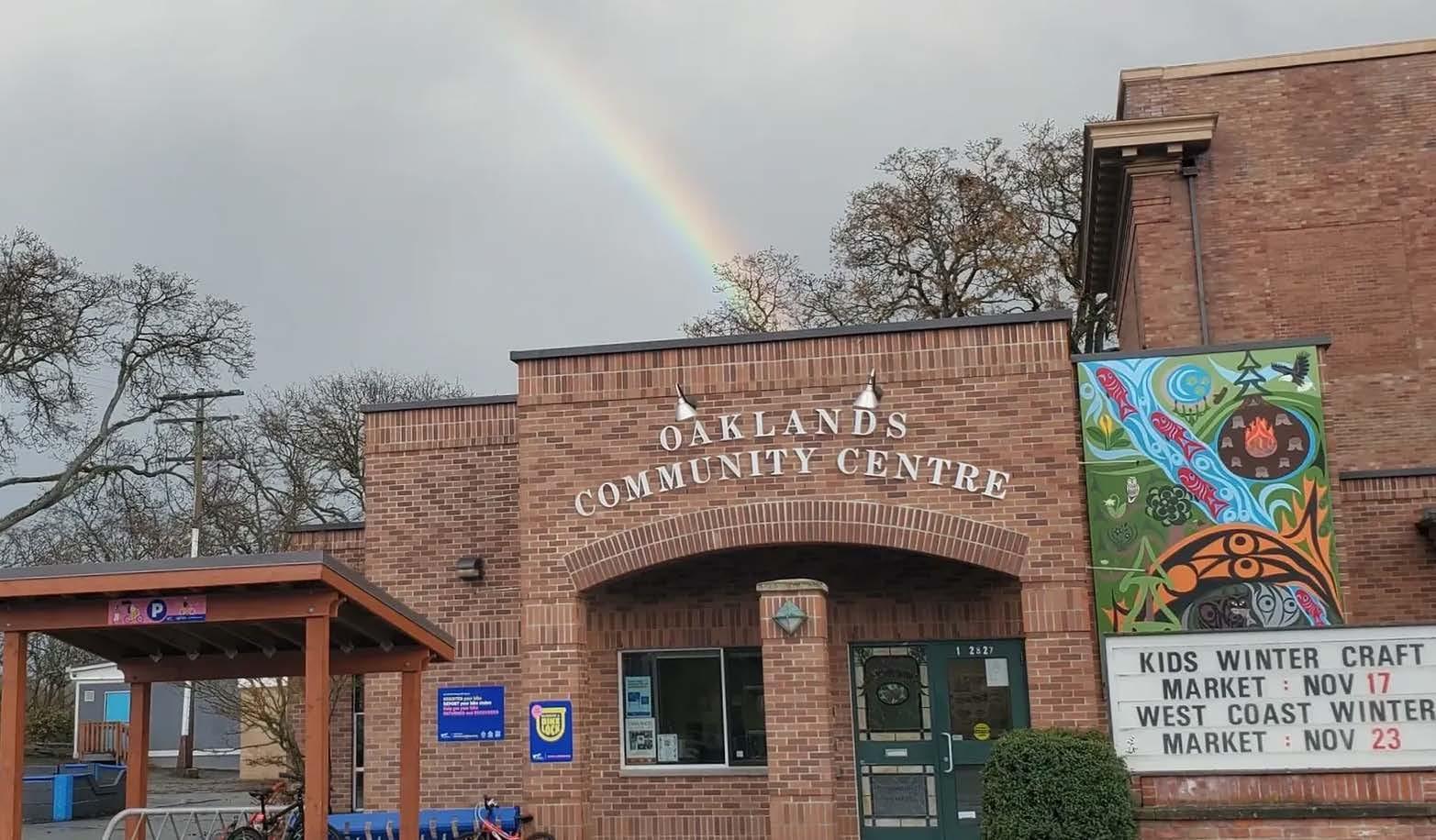
something more low-key, visit Fairfeld Community Centre for their Unwind Victoria Knitting Club, a group open to everyone, no experience necessary; just bring your own yarn and tools! Interested in learning a new language?
Try one of the courses ofered through a community centre. The Victoria West Community Centre, for instance, ofers French and Spanish classes for beginner and intermediate adults.
If you are looking for some afordable ftness options, local rec centres have
special student rates for many of their facilities and classes. Saanich offers students a discounted rate of $7 for single admissions, and their unlimited access passes are
The program, Studiosity, was previously piloted at UBC, who opted not to implement it
EDEN CONTI
SENIOR STAFF WRITER
Studiosity, an AI writing assistance tool, is being launched in three UVic courses this fall as part of an experiment with AI in the classroom.
The classes involved in the pilot include COM 220, HINF 230, and ED-D101.
Notably, none of these courses are primarily writing focused. COM 220 and HINF 230 are cross-listed under Organizational Behaviour and Change Management, and are offered by the Gustavson School of Business. ED-D101 is open to all undergraduate UVic students and is a "crash course" of sorts on how to “become a better university student.”
“Studiosity is an AI-supported academic-feedback tool specifically designed to complement student learning in post-secondary settings,” said a UVic representative in an emailed statement to the Martlet “It focuses on formative, real-time feedback rather than generating or correcting work,” the statement continues.
In this way, Studiosity differs from other AI platforms like ChatGPT or Copilot, which are generative rather than analytical. Studiosity ofers suggestions for improvement in areas such as grammar, spelling, or structure, but will not edit students’ work directly.
In their statement, UVic explained that Studiosity and other such software are not meant to replace the role of faculty or teaching assistants in the classroom, but are intended to serve as an additional tool.

Dr. Dillon Chrimes, an Assistant Teaching Professor in the School of Health Information Sciences, is enthusiastic about the pilot in his Organizational Behaviour and Change Management course (HINF 230).
“Students are going to use [AI] no matter what,” Chrimes said. “And, why not?”
Studiosity is being used in his classes to aid students who are new to writing literature reviews — an essential element to any research paper. Along with Studiosity, Chrimes also uses an AI site called “Packback” to help students with writing exercises. While Packback costs $49 for students to use, Studiosity is being ofered free of charge for students enrolled in the pilot courses.
Chrimes said that his use of AI tools has helped students improve their writing, primarily in the structure of academic and scientifc papers, but notes there is still the potential for negative outcomes, stating that there is “nothing blocking
weird prompts and scenarios, and fake information” when used in the classroom.
Other professors involved in the pilot, such as Dr. Mariel Miller, an Assistant Professor in Educational Psychology & Leadership Studies, are not as enthusiastic about AI tools as Chrimes.
Miller’s course, Learning Strategies for University Success (ED-D101), is largely focused on “learning to learn” and is open to all students, regardless of discipline. She says, “AI is already integrated into a number of sectors, so developing AI literacy is becoming an important part of university.”
Studiosity is being offered as an optional tool in Miller’s course, but no students are required to use it if they are uncomfortable doing so, nor is it being recommended.
“Critical pause is what you want,” Miller
says. “Not just using it because it’s available, but thinking ‘is this helpful?’ or ‘is this needed?’ or ‘what other resources are available?’”
In their statement, the university acknowledged that “human feedback is necessary,” however, they continue to explore AI tools in some classrooms. UVic also continues to highlight the resources that professors and the Academic Skills Centre (ASC) can ofer.
The ASC offers guidance on study strategies, citation methods in academic papers and presentations, and even help with revision and editing for class assignments. They also now offer assistance in navigating academic integrity and the use of AI in coursework.
The Martlet reached out to the ASC for comment about the role of AI and programs such as Studiosity in the
classroom, but the ASC declined to comment themselves, instead providing the same statement from UVic on generative AI. “We are actively supporting our academic community to ethically and appropriately use these tools in learning and teaching,” the statement reads. Concerns over AI and its efects on students' writing and critical thinking skills are widespread, as well as irrefutable concerns about the environmental impacts of generative AI. From increased carbon emissions because of electrical power to strains on local water supplies for cooling, training and operating AI models is not without consequence. While this is something Miller considers when explaining AI to students, she said not all professors acknowledge the “other side of the coin.”
“I don’t want to talk about the bad things,” said Chrimes, who says he operates on an “honour system” and hopes his students put in their own critical thinking and fact-checking.
UBC launched their own Studiosity pilot in the 2024–2025 academic year, but no longer uses the tool. Instead, they opted to explore alternative writing assistants. Their announcement about the pilot’s conclusion states that “Studiosity is no longer available to use at UBC.”
In an emailed statement to the Martlet about the pilot, UBC said that it is still “too soon to comment” and the outcomes of their pilot will be posted “in due course.”
With UVic’s own Studiosity pilot having just launched, any results are a ways of, but human interaction and feedback remains a core part of classes. Chrimes, an AI enthusiast himself, nonetheless admits that he’d “rather talk to someone than ChatGPT.”
The petition follows a letter submitted to university leaders in April, outlining similar concerns
ETHAN BARKLEY
On Sept. 8, 2025, a coalition of student and employee organizations launched a petition requesting that university leaders address “serious problems” with UVic’s student accommodation systems.
The petition is undersigned by the University of Victoria Faculty Association, the Professional Employees Association (PEA), Canadian Union of Public Employees (CUPE) 951, CUPE 917, CUPE 4163, UVic Students Society (UVSS), UVic Graduate Student Society (GSS), Society for Students with a Disability (SSD), UVic Pride Collective, Native Students Union (NSU), UVic Campus Community Garden (CCG), and Gender Empowerment Centre (GEM).
The petition follows a letter signed by these organisations to UVic administration in April 2025, which raised concerns about a number of issues relating to the way student accommodations are handled at UVic.
According to a press release, the coalition says they have seen “no positive action” from the university since.
The April letter mentioned specifc concerns — such as a 2023 decision to divide students requiring accommodations into two groups — among other concerns relating to funding, increased responsibilities for instructors who lack the necessary training to provide accommodations,
personnel shortages, and exam environments that were not sufciently “distraction-reduced.”
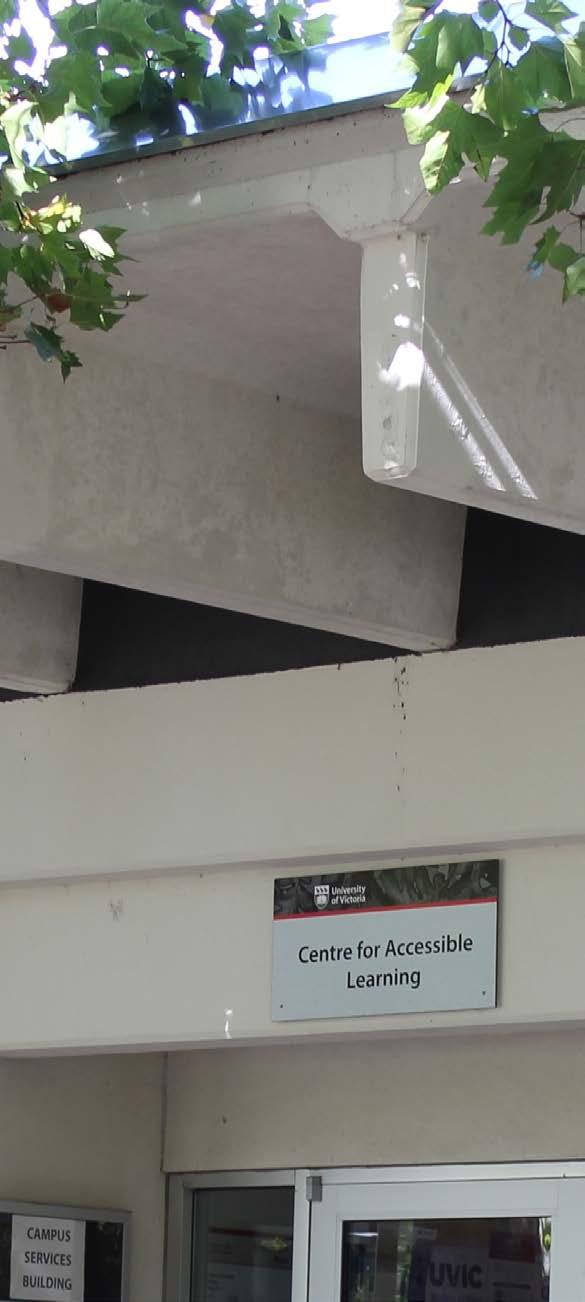
Following this decision, one group would have exam accommodations handled by the Ofce of the Registrar and Enrolment Management (OREM) while the other would continue to have exam accommodations provided through the Centre for Accessible Learning (CAL).
In a statement to the Martlet, a UVic spokesperson said that around 3 800 students — roughly 20 per cent of the student population at UVic — have an accommodation plan with CAL.
“This refects a signifcant increase over time and is expected to grow as more students with disabilities transition successfully from the K-12 system to post-secondary education,” the spokesperson said.
In a statement to the Martlet in April, Dr. Elizabeth Adjin-Tettey, UVic’s Associate Vice-President Academic Programs, said that “CAL has experienced an exponential growth in the number of accommodation requests in recent years,” stating that prior to the COVID-19 pandemic, only about 10 per cent of the student body registered with CAL each year.
“To help support this growth,” Adjin-Tettey stated, “funding for CAL increased by 28 per cent in 2024–2025, and has increased by 150 per cent over the past 10 years.” However, according to the April letter, this statement doesn’t mention the 200
per cent increase to students registering with CAL during the same period.
The original letter submitted by the coalition ended with six calls to action related to student accommodations, including a review of testing environments and increased availability of training and support for teaching staff. In an emailed statement, Hannah Brown, co-chairperson of the SSD, said the coalition “have not seen any [concrete] actions” regarding these six requests.
Brown told the Martlet that the coalition received a response to their letter on May 12, 2025, which they said, “did not adequately deal with the concerns of the group.”
The letter, signed by UVic’s VicePresident Academic and Provost, Dr. Elizabeth Croft, said that UVic and other institutions have historically “relied on support models that focused on accommodation over accessibility.”
“While these approaches provided essential support in the past,” the letter continues, “they are no longer sufficient to meet the diverse and growing needs of our student population.”
The university’s letter goes on to mention a number of planned and already under-way initiatives, including the convening of a working group on reviewing and implementing central supports, guidelines for instructors regarding distractionreduced environments, and enhancements to supports for
The university celebrated the launch with a two day symposium, featuring renowned librarians, journalists, and authors
EDEN CONTI SENIOR STAFF WRITER
UVic libraries launched a new initiative, the “Kula: Library Futures Academy,” with a symposium on Sept. 15 and 16. Subtitled “truth, knowledge and society,” the event featured authors, storytellers, writers, and librarians who spoke on the role and importance of libraries and archives in today’s society.
The grey walls and grey carpets of the Sngequ House conference centre lit up on Monday morning, as the room welcomed over 300 eager librarians, professors, archivists, and scholars of all kinds. Old computers from the Historic Computing Lab were set up on display, not far from an old printing press, where laser-cut and hand-pressed Kula Academy cards were passed out to attendees.
“What a library is, is changing,” said UVic University Librarian Jonathan Bengtson during the launch. “The digital shift of the past few decades decries the need for radical collaboration with libraries, across institutions and across geopolitical boundaries.”
The academy is headed largely by UVic’s librarians Jonathan Bengtson and Dr. Matt Huculak, and is generously funded by donors Dr. Brian R. Gaines and Dr. Mildred L. G. Shaw.
The aim of the Kula Academy is to stimulate collaboration between librarians, library users, students, and community members while acknowledging both the difculty and the potential that comes with digitizing

resources and navigating an increasingly digital world.
Some initiatives that the academy is taking on include the Kula Dialogue Series, Confict Aftermath Digital Archive Project (CADAP), Liberating Knowledge Partnerships (LKP), the Farallon Book Arts Lab, and more. Nearly all of these endeavours highlight archival ethics and the role of modern technology in the process of documentation and preservation.
The symposium featured a variety of guest speaker panels, ranging from authors, storytellers, journalists and flmmakers to librarians and archivists.
The moderated discussions were all centered around the themes of truth, knowledge, and society, and invited open discussion with audience members.
Michael Witmore, Director Emeritus
of the Folger Shakespeare Library in Washington, D.C., highlighted the importance of fostering a community that cares about holding onto history.
“We need to continue to build a community of writers, artists, community members,” Witmore said, “who are creating memory and who are, essentially, living in service to making those memories come alive.”
One of the key features of the academy is the hope that it will inspire greater transdisciplinary conversation and research, as well as serve as a place for gathering.
Reflecting on his time in graduate school, Huculak said that “magic happened when the medical student and the musician got together and created a new piece of art.” He hopes that ofering this physical hub to students and scholars
will make way for more sharing of both ideas and experiences.
In the afternoon, the ofcial launch took place with a speech by Jonathon Bengtson, who said, “Our impact, if we are to thrive and be successful and serve our role, lies only in our collective power.”
“The mission of the Kula: Library Futures Academy,” he continued, “is to build such [a] community.”
Distinguished guests such as Dr. Elizabeth Croft, UVic’s Vice President Academic and Provost, and Guy Berthiaume, Librarian and Archivist of Canada Emeritus, were invited to sign a document to formalize the launch. The 18th century paper was then left out during the evening reception for all guests to sign.
The name, Kula, was chosen in 2017 when the UVic libraries created their
open-access academic journal. Translated from Sanskrit, kula means “community,” but if translated from ‘ōlelo Hawai'i, it can mean “school” or “academy” — a translation unknown to the founders until recently.
The Kula Academy will not interfere with the regular operations of UVic libraries, but it will ofer opportunities for student involvement through workshops and fellowships, as well as ofering spaces for students to gather and work together in a transdisciplinary fashion.
Shortly, they will ofer a paper-making class in collaboration with UVic’s Campus Community Gardens (CCG) and the English department. Flax that was grown in the gardens will soon be harvested and made into paper by students. Experiential projects like this are important to Huculak, because it’s “not just knowing things that’s important … it’s the how that matters.”
“When students have the opportunity to see the how,” Huculak continued, “it gives [them] a deeper connection and understanding of where knowledge comes from, and the fragility of it as well.” The creators of the Kula Academy have high hopes for what they might accomplish and aspire to leave a legacy for current and future UVic students. “My dream, when it’s time for me to leave this place," Huculak said, "is that there’s a vibrant community-making space that people know is there for them, and [is] a place of people feeling welcome and [of] idea sharing.”
graduate students.
The letter concludes with UVic stating that the “accommodated exam supports ofered by OREM will remain in place” for 2025–2026 academic year, and the university will “continue to monitor how supports are used.”
A UVic spokesperson explained in an emailed statement that “many Canadian universities are moving away from traditional accommodation models” and that “the focus is shifting towardsaccess-centred teaching and assessment practices, which adopt proactive strategies to reduce reliance on individual accommodations.”
However, critics of the university’s approach, like Brown, say that this leads to a decentralized and unpredictable system for students, with increased responsibility put on the shoulders of professors and teaching assistants. “There is no guarantee that professors will treat accommodations in the same way,” Brown told Saanich News. Brown said that the coalition has received “no further dialogue” from the university since receiving the letter.
The petition, which at the time of publication has reached 413 signatures, similarly ends with four calls to action for the university, including prioritizing more resources and support to meet students’ accessibility needs, making a “binding commitment” to a long-term system of centralized coordination for accommodated exams, as well as
convening an “accessibility and accommodations working group” no later than Jan. 1, 2026, to run a survey and report its results by March 1, 2026.

RAE DAWSON OPERATIONS MANAGER
As students, if there’s one thing that truly unites us all, it’s the struggle to make a paycheque while still in school. Thankfully, UVic ofers several opportunities for students to fnd work that not only pays the bills, but ofers valuable experience to build your resume, can be balanced with a student schedule, and creates connections with academic and business professionals to guide your career forward. However, not all of these opportunities are created equal.
The UVic Co-op program, or Co-operative Education, has been around since 1976. Co-op “lets you try out career options and gain valuable paid work experience” during your degree. While mandatory for some undergraduate programs, like the Bachelor of Commerce (BCom) and Bachelor of Engineering (BEng), it is open optionally to all second-year students onwards.
According to UVic’s website, 56 per cent of UVic students participate in the Co-op program. Ideally, co-op allows you to test the waters of working in your field during your undergrad, make some money, and gain career experience. There is no doubt that the co-op program does provide excellent opportunities for students — but not without cost.

Students who enter into the Co-op program are required to take a class — in addition to their regular course load — called “Introduction to Professional Practice” (IPP). This course requires students to complete a resume, cover letter, and conduct a mock interview to prepare them for the workplace. After completing the IPP course, students gain access to the Co-op and Career portal, where they can find job postings that employers have indicated are relevant to their field of study.
According to UVic, the average student wages from a single co-op placement are $3 636 per month, meaning co-op fees will cost each student approximately 22 per cent of their earnings at each placement.
On their website, the UVic Co-op program breaks down this fee and states that the co-op fee “is not a job placement fee — it goes towards the cost of running the program.” It claims that 50 per cent is put towards
‘’student support,’’ 15 per cent to ‘’job development,’’ 15 per cent to ‘’employer support,’’ 10 per cent to ‘’faculty relationships,’’ and 10 per cent to "administration."
the co-op fees, additional course load, and longer wait time until graduation all have the potential to seriously set some students back financially.
during their degree. However, co-op is not the only option for UVic students seeking field-relevant work during their degree. UVic’s “Work Study” program is free, and is offered to students who demonstrate financial need (which, let's be real, is most of us). Work Study positions are parttime jobs on campus that have been funded by the university specifically for students, are designed to work around a student schedule, and provide excellent opportunities to make academic and professional connections.
to positions on campus and begin work — at no cost to your earnings or the length of your degree.
Work Study is not without its flaws, as you are only approved for a certain amount of hours, and it only runs September to April. However, the lack of prerequisites required, academic and professional connections students have the potential to make, being able to keep 100 per cent of their earnings, flexibility to a student schedule, and having a job located on campus, means that it may be a more feasible option for many students to earn both money and experience during
In my personal experience, I enrolled in both the humanities co-op and work study programs during my undergraduate degree.
My co-op experience was competing for a small pool of jobs designated to all humanities students, never hearing back from employers, and taking an additional course — on top of my regular full-time course load — that did not guarantee me a job placement. I decided to drop out of the co-op program after two years of frustration, having never once landed a position through the co-op board, and found my own employment, where I could keep all my earnings.
One factor remains key to student success when designing and grading assignments in subjective felds: clear expectations
RUBY HARRIS SENIOR STAFF EDITOR
In academic disciplines where questions often have no single “right” answer, like the fne arts and humanities, assessing students’ learning and assigning a grade can be a challenge. To do so, professors are required to design assignments and guidelines in a way that makes it possible to evaluate a painting, or give a letter grade to the strength of an argument.
In “subjective” disciplines like this, one factor remains key to student success — clear expectations.
In the humanities and social sciences, the research essay continues to dominate. Still, some professors — recognizing that students are completing the same kinds of assignments across their courses — are experimenting with new ways to assess learning.
— the Company Report Card. In this assignment, students investigate a garment company or manufacturer and give it grade-like ratings, examining its history, environmental impact, labour standards, and more.
One of the key benefits of the assignment, Clarke explained, is that it builds relevant skills that the traditional essay format might not. By answering particular kinds of questions and examining specifc policy areas, students develop evaluative and auditing skills — similar to what they might use in their professional lives. What makes this assignment especially effective is the level of support provided along with it. Clarke supplies six pages of instructions, a detailed example, and specifc research questions that she wants students to address. She also adapts the assignment each year based on student feedback, and ofers solo options for those who fnd group work difcult.
of guidance left me confused. Ultimately, the task felt more subjective than a traditional open-ended paper. Clear guidelines are also essential for neurodivergent students, for whom vague expectations pose a unique challenge. Bella Jacobs, Office Coordinator of the Society for Students with a Disability (SSD), explained in an emailed statement that, while many neurodivergent students enjoy flexibility and creativity, clear boundaries provide a necessary starting point and structure for approaching the task.
“That said, even assignments with very specifc outcomes can come with their own challenges,” Jacobs stated. Rigid formats may not align with how some students learn or express ideas, making it harder to engage meaningfully without additional support.
To receive the “Co-op” designation on their transcript, students are required to complete three to four semesters of co-op, which will extend a typical four-year undergraduate degree by another year. Additionally, for each semester students spend in a co-op placement, they are required to pay the university “co-op fees,” which amount to $807.56 for domestic students, and $1 696.75 for international students.
However, even if students find a co-op position outside of the co-op and career portal, they are still required to pay a co-op fee for each work term.
Earlier this year, CBC reported that, according to a survey, 46 per cent of B.C. residents are $200 away from being unable to pay their bills. The same survey reported that 49 per cent of the same group didn’t believe they would be able to cover their expenses without going into more debt over the next year. With such a small margin for many between being able to pay their bills or not, co-op fees could be the nail in the coffin for some students, who already face significant financial hardship.
Of the 2.2 million people in college or university across Canada, according to Statistics Canada, 1.7 million of them are reported to be acquiring debt via student loans.
If you are a student looking to earn both money and professional experience during your undergraduate degree, be sure that you are aware of all your options. While co-op is a great opportunity for those that can afford it, the financial and time constraints associated could be a significant setback for others. Struggling to fnd a co-op? Consider work study instead
For those with few financial barriers, this may not serve as a deterrent to the co-op program. However, those who rely on work placements to pay their bills during their undergrad may be in for a rude awakening after securing a work placement. In a cost of living crisis,
Extending a degree by a year, in addition to paying co-op fees, may not be a feasible option for some without going further into debt and limiting their ability to pay bills
Before you even apply, you can access the Work Study job board to see what positions are available, rates of pay, hours available, and the various programs, departments, and faculty/staff members you would be working under. Full-time students apply through Student Awards and Financial Aid (SAFA) by detailing their budget to determine financial need, and if approved, you are designated a certain amount of hours the university will fund you for. Afterwards, you can start applying
My work study experience was significantly more lucrative. I got approved within a week, and was immediately able to secure a position on campus working with a professor in my field. I was free to work other jobs due to the flexible nature of the position, could work around my class schedule with ease, and was able to do work that significantly bolstered my resume. The professional connections I made and experience from my work study is the reason I have a full-time job today — and it didn’t cost me a thing.
At UVic, a few courses encourage students to connect research with creative expression. The university even celebrates this shift with its annual Unessay Competition, which invites students to showcase their research presented in creative formats other than the traditional essay. When it comes to alternative assignments, you might expect them to be less concrete or “objective” than traditional assignments. But some, actually, are less open-ended, and are designed with more structured expectations which can make grading easier and, in a sense, more objective.
Dr. Marlea Clarke, an associate professor in the Department of Political Science at UVic, designed a unique group assignment for one of her classes
This specificity “guides students [through] an assignment which is quite different,” Clarke said, while still providing opportunities for creativity and innovation. The level of detail in the Company Report Card also makes it easier for her to grade objectively.
Not all professors, however, bring the same clarity to expectations for unique assignments. In one class, for instance, I was tasked with an “argument reconstruction” — something I had never encountered before. The instructions were vague, and were one page long to Clarke’s six. Unsurprisingly, perhaps, I earned the lowest grade of my degree on it.
Like Clarke’s assignment, it required specifc research outcomes, but the lack
Neurodivergent people are often stereotyped as being better suited to fields like math and science, where there is often a “right answer.” But, Jacobs emphasized, “this is not a refection of ability or interest, but often a response to how subjects are taught and how accessible their expectations are.”
In reality, neurodivergent students bring profound insight to the arts and humanities, with many individuals having strong abilities to recognize “patterns, nuances, and inconsistencies” and to “hyperfocus” on topics that interest them.
These fields shouldn’t just accommodate neurodivergent students — they should actively uplift them through accessibility and support. That begins with clear assignment guidelines.
Clarke notes that while some

departments may have internal norms, UVic has no university-wide standards for assignment design. Lee Henderson, chair of the writing department, echoes this.
He told the Martlet in an emailed statement that professors have “academic freedom” in course design and expectations, and in subjective felds like creative writing, grading is “always a challenge,” but is still valuable for a student’s growth as an artist.
With limited institutional guidance at UVic, professors set expectations as they see ft, resulting in wide variation in the level of assignment guidance across campus. For students, especially autistic students, who often thrive in
structured and consistent environments, this is frustrating terrain to navigate. At the end of the day, whether it's a research paper or an alternative research assignment, a poem or a lab, clear expectations beneft everyone. Students already have enough to juggle, without secondguessing what their professors want. No assignment in subjective fields can ever be truly objective. Clear expectations may not erase the challenges of grading, but they make the learning process both fairer and more meaningful for students and professors alike.
A student refects on a professor's strict no-device policy, and argues that higher education should empower young adults to choose their own learning paths
uses a device, it distracts others and attention drifts across the room.
protecting us from bad decisions.
On the first day of my creative non-fiction workshop, my professor announced a strict no-device policy. Laptops away, notebooks out. Though the rule works in this particular course — small, conversational, and collaborative — I still hesitated. I couldn’t shake the thought: if I’m paying thousands of dollars to be here, shouldn’t I get to decide how I learn best?
Feeling frustrated and curious, I decided to interview her to learn more. She explained her policy, which has been in place for a decade, is about protecting the focus of her workshop, not about control. She said that devices have a "secondhand smoke” effect; when one student
I don’t dismiss this reasoning. The research supports it. Countless studies show that students retain more when they handwrite notes, and that off-task device use in class tanks performance. These facts matter.
But here’s where I diverge: universities are not high schools. Yes, some, if not most, students will use their laptops during class to shop online, scroll through social media, or play games. That’s not ideal, but managing one’s reaction to distractions outside of their control is still the responsibility of the student. We are, after all, adults who have paid thousands of dollars to study here. If some students choose to waste their time and money, that’s on them. University isn’t about
It’s about giving us the freedom to learn how to make good ones.
Another key argument in favour of device usage is that students don’t all learn the same. I type notes in class because I can’t keep up with the pace of the lecture otherwise.
Later, I rewrite them by hand — that’s when the material sticks. Take away my laptop and I lose half of my system.
Further, the research shows that it’s not laptops themselves that harm learning outcomes, but how they’re used. On-task use — note-taking, following slides, looking at relevant material — correlates with positive outcomes. Off-task use correlates with negative outcomes. The difference isn’t the device, it’s selfregulation.
Furthermore, for some students
with mobility or learning impairments, using a device in class might not be just convenient, but necessary. While professors are required to make accommodations for these students, banning devices in classrooms can end up ostracizing those students, or bringing their disability to others’ attention.
Technology isn’t going anywhere. The workforce runs on it, and so does the world. Banning it in university classrooms doesn’t prepare us for that reality, while learning how to use it responsibly does. Handwriting is a valuable skill, but students can practice it without banning devices.
Device bans may protect some, but they also penalize students who are disciplined and whose learning style depends on technology. UVic doesn’t have a policy around personal
devices in the classroom; ultimately, classroom policies are up to each instructor. While most professors design their courses with students’ best interests and learning outcomes in mind, that shouldn’t mean imposing one-size-fits-all learning methods.
As adults paying for our education, we have the right, and the responsibility, to decide how we learn best. Professors can guide us, but ultimately the choice should belong to the student. For me, and for many others, that includes my laptop.



Theatre explores power in a timely production of '1979'
Director Glynis Leyshon says the production, originally slated for before COVID-19, may be more relevant than ever

The day is Dec. 13, 1979. Progressive Conservative Party of Canada leader Joe Clark has been the prime minister for just six months. Tonight, parliament will vote on Clark’s budget for the country, focusing on austerity measures and cuts to government spending. It’s obvious to everyone that the budget will not pass, and its likely failure will bring a premature end to Clark’s term in ofce.
Such is the moment of the Belfry Theatre’s production of 1979
Originally planned to release when COVID-19 hit, 1979 was postponed, but director Glynis Leyshon said the play may be more relevant to audiences now than its original planned run, given today’s volatile politics, mirroring the dramatic and high-stakes setting of 1979.
The play takes place entirely in the Prime Minister’s office, with a revolving door of historic Canadian politicians to share their advice to Clark, whether he wants it or not.
Three actors play a cast of seven — the only unchanging role is Nathan Howe as Clark, channeling the long-suffering straight man archetype in a cast of big personalities, while chaos ensues in parliament.
Of course, those big personalities

wHIMSY by Destin Conrad
An artistic leap from one of RnB's most beloved
RAVESSA FEJZULLAI CONTRIBUTING WRITER
wHIMSY the latest release from Tampa-raised R&B artist Destin Conrad, marks an artistically bold turn in his career, moving away from more polished R&B stylings toward a looser, more organic sound rooted in jazz infuences.
The album was recorded in two weeks in Los Angeles, according to Conrad, contributing to its energy and spontaneous feeling. Conrad brings in jazz and R&B legends on vocals and production, who help expand the project sonically. These risks show Conrad’s willingness to stretch and let the music breathe.
The production creates a smoky, after-hours mood, one that many (myself included) associate with jazz. It feels immersive. It feels sophisticated. Tracks like “wHIP” and “wASH U AWAY” capture this mood well. The jazz instrumentation does not feel inauthentic, as it sometimes can from non-jazz artists, but naturally part of the album. Because wHIMSY was made quickly, there are some moments on the album that feel raw or less polished, but it adds to the charm; the lack of gloss gives it character.
Musically, Conrad strikes a fine balance between vocals and instrumentation — neither side feels overdone. He often restrains his own vocals to let the instruments take the spotlight, resulting in a satisfying balance.
The album’s themes are familiar to fans of Conrad. Love, desire, longing, frustration, and intimacy.
Conrad frames these in a cinematic, sometimes humorous way throughout the project. Some tracks feature scenes and characters (“A Lonely Detective”) and provide an inner monologue (“drifting”).
Harrold, Terrace Martin, Vanisha Gould, and James Fauntleroy are just a few names attached to the project, but they are not just featured names: their contributions feel woven in. They add to the cinematic aspects of the album, too — whether it’s Martin’s legendary saxophone performances setting the mood, or Gould’s soulful and charismatic vocal performances fully embodying the emotions of her character on “A Lonely Detective” and “BOREDOM.”
Even though Conrad is exploring new territory, wHIMSY does not feel disjointed. The interludes, spoken word sections, and pacing of the record feel intentional, with a pleasant fow.
hosts second
'Indigenous Theatre Festival: Staging our Voices' focused on language revitalization
BRIANNA BOCK SENIOR STAFF WRITER
On Sept. 12 and 13, UVic’s Phoenix Theatre hosted the second Indigenous Theatre Festival: Staging Our Voices — a free festival for all attendees that honours Indigenous languages through the power of performance and workshops.
The frst Indigenous Theatre Festival took place in 2022, at the Phoenix Theatre and First Peoples House. Dr. Kirsten Sadeghi-Yekta, an associate professor in UVic’s theatre department — who is also the festival producer — said the idea came after she was invited to work with the Hul’q’umi’num’ community in 2015 to experiment with theatre for language reactivation.
are dramatized for the sake of the stage. “[The play is] not trying to pretend it’s naturalism,” said Leyshon. While the play is based on true events, these events have been heightened to draw out dramatic attention.
“It’s not a hatchet job on anyone, [rather, the playwright is] interested in finding the truth,” said Leyshon. The characters are heightened for comedic purposes, but they don’t represent an attack on specific political figures.
All three actors do a fantastic job in heightening the tension of the last few minutes before the climactic budget vote. Actors Jay Hindle and Luisa Jojic electrify the stage, jumping seamlessly from character to character as they charge through the office doors. Their larger-than-life performances grow even sharper in contrast to the understated “Joe Who” (a pejorative nickname given to Clark, regarding his lack of presence).
During these tense last scenes, the play’s comedy hits hardest; each moment becomes a battle as Clark fights to hold his ground. Throughout the play, political context is projected onto the wall of the Prime Minister’s office, featuring details like Clark’s gas tax, the 1979 approval rating of Clark’s successor, Pierre Trudeau, and the number of projected votes
for and against the budget. The projector serves as a way to keep the audience up to speed. It becomes a character in its own right, and the actors break the fourth wall at times to react to its updates.
At the heart of the play is a debate about power and leadership, asking what it means to possess and exercise power. Each scene feeds into this discussion without offering a definitive answer. 1979 culminates in a long (fictionalized) exchange about power, which bluntly hammers this point home. Here, in the second act, the comedy recedes to let these contemplations about power resonate.
1979 is a witty political satire of a quietly seminal moment in Canadian politics. It is, at once, a historical look at Clark’s brief tenure as prime minister, the moment where the Progressive Conservative Party evolved into the Conservative Party, and a timely reflection on what citizens expect their politicians to do with the power they have given them.
1979 runs at the Belfry Theatre until October 5th. Tickets can be purchased on the Belfry Theatre website.
Lyrically, he is not afraid to showcase the less glamorous parts of relationships, such as boredom, distance, and infdelity. In addition to award-winning jazz and R&B legends, the album also features a number of artists and vocalists. Keyon
There are moments when Conrad’s vocal delivery remains smooth and controlled, which is often a strength, but here, it feels like a missed opportunity, especially compared to the riskier instrumentals featured on the album. There are places I wish he would go further vocally, with more rawness and contrast. He has the talent and ability, so I can only hope he will continue to take more risks with his artistry on future projects. Some of the stronger tracks on wHIMSY are “wHIP,” which sets the tone beautifully with moody trumpet and longing lyricism; “wASH U AWAY,” featuring a stellar fusion of intimate lyrics and captivating saxophone from Martin; “A Lonely Detective” due to it’s strong narrative storytelling, the wonderful Vanisha Gould’s feature, and the moral complexities raised by its lyrics; and “The W” with its smooth harmonies, immersive atmosphere. wHIMSY largely succeeds in what it sets out to do. It is a genre-blending, atmospheric, emotionally honest album that showcases another side of Destin Conrad’s artistry. It might not be perfect, but its strengths lie in mood, sincerity, and musical exploration. It is strong, memorable, and brave — if occasionally uneven — but very much worth diving into, especially for listeners who appreciate jazz-painted R&B and cinematic storytelling.
“We realized that a lot of Indigenous Artists feel isolated, specifcally artists that are working with the language and they would love to fnd ways to gather, to share food, to share stories, and be in one space together,” said SadeghiYekta. “That was the reason we initiated the frst Indigenous Theatre Festival in 2022, and that urge is still there, so we wanted to do it again to have more people involved.”
The shows featured at the festival ranged from dances, drumming, an in-progress stage play and a completed one, a clown show, and an opera. All touched on language revitalization and brought something new to the stage.
Some drew from personal experiences with language, while others were partlanguage lessons, part-performance,

and some were traditional performances, untranslated into English. There were nine shows in total.
“Language is culture,” said Tara Morris, Suwsiw, of the Cowichan Tribes, who is on the organization committee for the festival. Morris also ran the From Page to Stage workshop at the festival, which explored the adaptation of an Indigenous oral story into a staged production.
“Along with language is culture, and the beauty of being able to express in theatre is embedding the culture. Exploring yourself, exploring identity and doing that without judgement I think — a lot of the people in these language programs aren’t fuent — it’s just a playful, fun way to explore, to build identity, and build that confdence and pride in who we are,” Morris said. That pride was evident in every single performance on Saturday. A palpable feeling of excitement flled the Phoenix in between shows and workshops, and as attendees gathered together, a real sense of community encompassed the entire festival.
Using theatre for language revitalization was the overarching focus of the festival. “The positive thing for me is seeing that actually happen,” said Morris. “It's just very, very, empowering to witness people who have the dedication,the passion and the drive, and know the importance of it. The reason why theatre is such an amazing tool is [it shows] the possibility of language learning for youth.” For Morris, revitalization is a way “to celebrate what our world views are, and what our knowledge systems are, and what our truths are, and who we are and what’s important to us and looking at how they’re expressed in our songs, our dances, our legends, our stories, and all our histories and our longhouses. I think that’s the ultimate key — is to fnd ways to carry on the teaching of passing down those to the next generation,” Morris said. Regarding what she hoped attendees would take away, Sadeghi-Yekta said that she not only hoped it would be a safe and healing space for attendees, but that it would be “a playful space” too.
The workshops focused on how to apply the mission of the festival to the participants' future work. Morris’ workshop, for example, focused on adapting a story into a stage production. Participants were given the freedom to try anything with the script, such as a silent, choreographed dance.
Lawrence Thomas, the ceremonial speaker on Friday night, said walking away at the end of the festival felt like “walking on air.”
'Bad Luck Pearl' is a massive multi-instrumentalist foray UVic student Maxwell Sorenson's production features 19 musicians, many of them students
GABRIEL LUNN SENIOR STAFF WRITER
Bad Luck Pearl is the project of Maxwell Sorenson, a fourth year student at UVic. This debut album, also titled Bad Luck Pearl dropped in July under Funny Orange Label, a Victoria-based CD and cassette label. Written largely in his hometown of Calgary, Sorenson composed many of the album’s tracks in his home basement, and produced demos which would eventually be recorded in Victoria.
Sorenson connected with over a dozen Victoria-based musicians for the project, as well as several from Calgary, Edmonton, and Whitehorse, through UVic’s Computer Music Course Union (CMCU) — of which he is currently president — and the Music and Computer Science combined program.
Bad Luck Pearl totals at no less than 19 accredited musicians and vocalists contributing to its formidable instrumentation.
Sorenson cited contemporary musicians in Victoria as a driving inspiration for the record, as well as influences of chamber rock and baroque pop groups such as Black Country, New Road and Vampire Weekend.
“It was largely inspired by other [student’s] work, and also a lot of it was done in the [UVic CREATE Lab] recording studio on campus,” said Sorenson in an interview.
“[The album] was written in Calgary but most of it is about things that happened in Victoria. There’s a lot of [material] about religion, specifically about Christianity. It's something that I have been thinking about and struggling with a lot,
specifically about the nature of truth.”
The opening track, “Blurs to Red,” wrestles with the nature of truth in the context of religious struggles, and the outlandish notion that any single person could accurately distill its essence. Sorenson sings listfully over a dizzying accompaniment of instruments that seem to fill the mix to every possible corner.
Other tracks, like “The Weight of My Head” showcase the reflection of genres like chamber rock and baroque pop in clear form, contrasting the driving drums and lyric-centric verses between the alto saxophone, violin, oboe, and clarinet, which elevate the songs. “Uriah” shows a direct line of influence to projects like Radiohead's In Rainbows featuring tireless acoustic guitar against spiraling horn arrangements, culminating in an anxious storm of sound.
Although Sorenson composed all the music together in advance of recording, he does not describe himself directly as a multiinstrumentalist. Instead, he says, he took on the role of producer and creative director, working one-onone with musicians.
“I started [when] we ran CMCU events and started doing jams. I am not super profcient in any instrument, so I didn't feel super comfortable playing…. But I started directing people,” Sorenson said. “I found I really enjoyed doing that … and that people really appreciate it when you’re good at it. They want direction.”
He states that a large part of the project revolved around building confidence and asking for feedback from fellow collaborators.
“[The process] was a lot of learning

about myself and about leadership with directing all these people … what I have to stick with and not budge on.”
Despite being an album that was mostly written in advance, there are a few exceptions, those being the improvisational, collaborative tracks.
Sorenson notes the contribution of Anthony Ryan, former CMCU president, who coordinated a feedback system using multiple speakers and microphones, providing a background of heavy reverberation for instrumentalists to improvise against. Segments of this recording were then worked into the album. Transitioning from more traditional songwriting, “Naomi’s Interlude” is a deft and poignant addition of
ambient music, utilizing dense layers of reverberated percussion, piano, and accordion — played by Naomi Harris — that shivers in its timbre.
Harris also provides the song’s backing vocals.
“Having all these recorded pieces that I can't change and fit together in such a structured way, it was a challenge to me. Letting go of that need to have meticulous control over everything was really helpful and I think it led to some really cool stuff.”
Sorenson noted working with soprano vocalist Sadie Karlsson as a highlight of the recording process, who’s most prominently featured on “Light Pollution, Pt. 1.”
“She understood what the songs were supposed to be,” said Sorenson.
“She instantly was able to improvise over them very fluidly."
Karlsson’s performance is a thread that brings together the track’s piano performance, turning it from lilting and daze-like to then frenetic, accompanied by a pulsating string performance. Karlsson’s vocals hang high among the entire track and are impossible to ignore. If anything, the track seems to want to rest firmly in space before abruptly changing into a frantic drum beat and bass guitar jam supported by oboe and horn. “Pt. 2,” the sequel track to “Light Pollution, Pt. 1,” feels like the most energetic track on the album, and its drum performance by Ezekiel Dukart holds a vice-like grip on the track’s energy. Sorenson also commented on how the album has been received since its release, and the number of inquiries he’s fielded regarding Karlsson’s vocals, as well as several of the instrumental performances by others.
“Going a step further, finding the names of the performers, especially because a lot of them are UVic students — and you may very well know some of them. I would implore people to do that if they hear something that catches their ear.”
Sorenson states he’s deeply missed performing live, and has hopes to collect instrumentalists for a performance of the album tracks within this semester.
The album is available on streaming platforms such as Spotify, Apple Music, and Bandcamp. A run of cassettes are available for order via Back Luck Pearl ’s Bandcamp page, as well as Funny Orange Label.
After weeks of endless chatter and persuasion, I sat down to watch the recent hit Netfix flm, KPop Demon Hunters ( KPDH ). I had no prior knowledge of K-Pop, but the movie's 12-song soundtrack had been on repeat at my work, and the songs that once annoyed me became so catchy that I added a few to my playlist.
I was hesitant at frst, but once I sat down, I couldn’t look away for the entire hour and a half runtime.
This summer, KPDH directed by Maggie Kang and Chris Appelhans, became Netfix’s most-watched movie, reaching more than 33 million views in two weeks. It follows the (fctional), world-renowned K-Pop trio HUNTR/X, whose secret side hustle is demon hunting.
The all-female trio, Rumi, Zoey, and Mira, split their time between performing for fans and protecting their souls from the persistent threat of the supernatural. When the trio encounters their biggest nemesis, the Saja Boys — a charming boy band of undercover demons — they must work together to protect their fanbase from their irresistible grasp and re-establish the Honmoon (the world’s protective barrier that ensures demons stay in the demon realm).
The overall message of the flm is to accept oneself by confronting the shameful parts of one’s identity, rather than hiding them. The main protagonist, Rumi, embodies this message in her struggle to accept her

identity as a half-demon. In the flm, demons are symbols of shame and internal human struggle, which are exploited by the demon king Gwi-Ma to gain power over souls.
Exploitation and control are recurring themes in KPDH and directly reflect the overproduced world of K-Pop and pop culture in the real world through a satirical lens. This cultural commentary is displayed through the intense pressure placed on HUNTR/X throughout the film. These themes parallel the exploitation of K-Pop
fgures in the real world, and serve as an allegory for the consumerism and idolatry that powerful fandoms foster. Through the candid portrayal of the main characters, viewers can see how taxing these roles can be. The juxtaposition of perfectly choreographed routines and chaotic demon fighting reflects both the struggle fans do not see, and their inability to humanize their idols. In 2024, K-Pop star Karina from Aespa posted a handwritten apology on Instagram. Why? She was
addressing her relationship with actor Lee Jae-Wook. After her announcement, fans went as far as driving a truck into her management agency. This incident is just a taste of the “false intimacy," or parasocial relationships, that pervades much of K-Pop fandom. Parasocial relationships like this are explored in KPDH where HUNTR/X superfans “ship” Rumi with Jinu, one of the Saja Boys. This abnormal behaviour perpetuates the idols' orchestrated identities and their fear of backlash from their fans.
These incidents, in both real life and KPDH, expose the industry behind K-Pop groups. When it comes down to it, these idols are a product to consume, and are marketed relentlessly. Popular K-Pop groups like BLACKPINK and BTS are met with a constant demand for more content. Similarly, with KPDH, the marketing for the flm breeds obsessive fans who crave more content. Social media trends have spread like wildfre, with people flming makeup transformations, dance videos, and lip-syncing challenges inspired by the flm. One of the most notable is the dance trend to the song “Soda Pop,” written by Kevin Woo, which is sung by the Saja Boys in the flm. On TikTok, there are 1.2 million videos using the song “Soda Pop,” most of which feature users dancing to Lee Jung’s choreography, as seen in the flm. When it comes to the marketing of the flm, KPDH is infuenced by the “Hallyu wave” or Korean wave — the diffusion of Korean culture in the 1990s, when South Korea emerged as a global leader. This includes the increase in popularity of Korean cuisine, culture, makeup, music, cinema, and their impact on Western audiences.
KPDH is an important piece of cultural commentary, shedding light on how demanding the life of a K-Pop star can be. Through exaggerated displays of fan behaviour and internal confict, viewers are invited to question whether or not their idolization is healthy or toxic.
Vikes Women's Soccer collide against Cascades in a no-score tie
Vikes dominated in scoring attempts, while both goalkeepers made critical saves



Vikes goalie McKenna Jaine made one crucial save, leaping to catch an overhead penalty kick during the second half that saved the Vikes in a critical moment. Jaine was the only goalkeeper during the match, playing the full 90 minutes.
“Defense wasn’t what cost us the game,” said David. “Defensively, there wasn't a lot to do. But when we had to we did it.” Both teams displayed cohesive defense that thwarted the other’s opposition.

David states that the Vikes’ primary task going forward is to complete precise scoring attempts.
“We created enough chances [but] we didn’t score … we just have to keep working hard. It will come.” Ruby Nicholas, fourth year Vikes forward, took the most shots of the game with four attempts, two of which were on target. Nicholas was named Canada West Player of the Year for women’s soccer in 2024. David also highlighted the eforts of fourth year midfelder Taiya Scorey, who demonstrated two shooting attempts during the match, including a header.
“[Scorey] played very well. She hit a header going under the crossbar, and the [UFV] goalkeeper made a great save.”
The Vikes displayed a dominant efort in the frst half of the match, outshooting the Cascades 8-1 and eventually closing out with 12-2 in score attempts. Cascades goalie Alana Madec held a formidable
presence defending the net, collecting six saves across the match's full duration. The game marked the second match against UFV this season. In their frst match, the Vikes out-scored the Cascades 5-0 on Aug. 23. This time, however, while making signifcantly more score attempts, both teams were unable to score.
The Vikes played a second game that weekend, on Sept. 12, which David said was a “fantastic game” against the Trinity Western University Spartans.
“We didn’t come out with a win either there, which is too bad,” David said. “But we’re [staying] positive and will keep working and things will come.”
This season follows one of the Vikes’ strongest campaigns in recent years. During the 2024–2025 season, the team fnished 9-5-5, earning the Canada West silver medal. The accolade was the team’s frst conference medal since 2017, and placed them in national title competition at the 2024 U Sports Women’s Soccer Championship. The Vikes move to 2-2-2 for the season, and will be on an extended break before their match against the University of Northern BC Timberwolves on Sept. 26 at Centennial Stadium.
David said the Vikes women’s team will continue to work on completing scoring attempts as they look to the season ahead. “We’re going to keep working hard. We know where we want to go.”











Visithttps://pondscumgames.blogspot.comformorepuzzleslikethisone!

Across 1. Luxury brand created by Mario in Italy
6. Part of a fower
10. How a love note might end 14. Totally surround 15. Old version of 52-down
16. Terrible prince of Moscow
17. Walk stealthily and unseen
18. Some pub oferings
19. Campbell in the Scream franchise
20. Method of teaching reading using sounds
22. Camera technician on a flmset
23. "The end is ____!"
26. Pseudonym, in short
27. Baseball player Puig
29. Fawcett of Charlie's Angels
31. Scam
32. Attempt
33. Expedition for Indiana Jones or Lara Croft
37. Purposely misspelled word used on social media to avoid content flters
38. Hereditary director Aster
39. Praises
43. What the circled letters in this puzzle do on a map
46. How a drill sergeant might be addressed
49. "___-Haw!"
50. Out of fashion
51. Incite, like suspicion
53. Sufx for many belief systems
55. User on Reddit who doesn't want to be known
56. Do terribly, as a comic
57 Defensive fortress
60. Girl from Green Gables
61. City where the Nobel Peace Prize is awarded
62. Gave the job to
66. Opposite of a slacker
67. Eager
68. Culture that performs haka
69. Black and white agate
70. Appease, as hunger
71. Make nighttime noise
Down
1. Arthur's channel
2. Burgundy or Swanson
3. Wood chopping tool
4. Muscle used for respiration
5. Egyptian cross
6. Smelled nasty
7. Shire from Rocky and The Godfather
8. High-up at a company, say
9. How a love note might end
10. Places to cross, as you would see on a road sign
11. "That old drama? I'm so ____ __"
12. Professor of superpowered mutants
13. Like cheap toilet paper
21. Third largest Hawaiian island
23. Bygone crypto art fad
24. "The way _ ___" by Timbaland
25. Wimpy kid who keeps a diary
28. Religious leader who founded the American Shakers
30. Tests metal or ore
31. Drink ticket, for example
34. Clean up, as leaves
35. A part of hospitals that don't need an appointment: abbr.
36. Someone from Hobart or Launceston
40. Second word in many stories
41. Extinct, fightless bird
42. British submachine gun used in WWII
44. Shoes that had a "pump" model that you could infate with air
45. TV cable
46. Saturday, in Valencia
47. Like some patches for jackets
48. Mitt, who lost in 2012
52. Basic option when ordering a ride somewhere
53. Small island
54. Word with stepping or Rosetta
58. On a boat poetically
59. Ω Ω Ω Ω
63. Winnie's marsupial friend
64. Make a mistake
65. Six-sided game piece