Jan 29

Page 1


MARTLET THE

NEWS

UVicestimates1200volumes damagedbyheavyrainfalllastmonth PG. 4

NEWS

B.C.SupremeCourthearschallenge tofaith-basedhospitaldenyingMAID PG. 5

ARTS

'Hamnet'isapoignantexplorationof howtheartscantransformus PG. 11

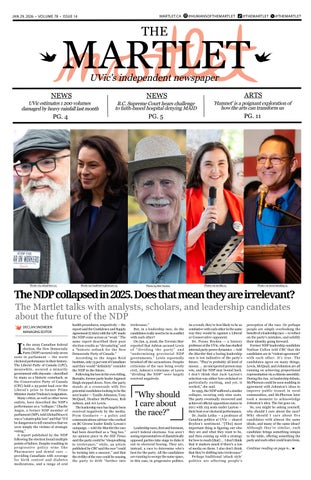
The Martlet talks with analysts, scholars, and leadership candidates about the future of the NDP

In the 2025 Canadian federal election, the New Democratic Party (NDP) secured only seven seats in parliament — the worst electoral performance in their history.

The Liberal Party of Canada (LPC), meanwhile, secured a minority government with 169 seats —described by many as a historic comeback, as the Conservative Party of Canada (CPC) held a 25-point lead over the Liberal’s prior to former Prime Minister Justin Trudeau's resignation.

Many critics, as well as other news outlets, have described the NDP’s performance as a “collapse.” Charlie Angus, a former NDP member of parliament (MP), told GlobalNews it was a “catastrophic loss” and that “it’d be dangerous to tell ourselves that we were simply the victims of strategic voting.”

A report published by the NDP following the election found multiple points of failure. Despite resulting in progressive policy wins like Pharmacare and dental care — providing Canadians with coverage for birth control and diabetes medications, and a range of oral

health procedures, respectively — the report said the Confidence and Supply Agreement (CASA) with the LPC made the NDP come across as “weak.” The same report described their poor election results as “devastating” and a “historic setback for the New Democratic Party of Canada.”

According to the Angus Reid Institute, only 13 per cent of Canadians said they would “definitely” consider the NDP in the future.

Following his loss in his own riding, Burnaby, former party leader Jagmeet Singh stepped down. Now, the party stands at a crossroads with five potential candidates looking to be the next leader — Tanille Johnston, Tony McQuail, Heather McPherson, Rob Ashton, and Avi Lewis.

The leadership race has largely been received negatively by the media.

Prym Goodacre — a policy and communications advisor who worked on BC Greens leader Emily Lowan’s campaign — told the Martlet the race had been described as a “hug box.”

An opinion piece in the Hill Times said the party could be “sleepwalking to irrelevance,” while, an article published by CBC said the race “could be turning into a snoozer,” and that the civility of the race could be causing the party to drift “further into irrelevance.”

But, in a leadership race, do the candidates really need to be in conflict with each other?

On Jan. 5, 2026, the Toronto Star reported that Ashton accused Lewis of “dividing the party” and “undermining provincial NDP governments.” Lewis reportedly brushed off the accusations. Despite criticisms of the race being overly civil, Ashton’s criticisms of Lewis “dividing the NDP” were largely received negatively.

"Why should I care about the race?"

Leadership races, first and foremost, aren’t federal elections. You aren’t seeing representatives of diametrically opposed parties take stage to duke it out in electoral boxing. They are, instead, a race to determine who's best for the party. All the candidates are running to occupy the same space, in this case, in progressive politics.

As a result, they’re less likely to be as combative with each other in the same way they would be against a Liberal or Conservative opponent.

Dr. Penny Bryden — a history professor at the UVic, who has studied internal party power dynamics — told the Martlet that a boring leadership race is not indicative of the party’s future. “They're probably all kind of snoozy … an unexpected person may win, and the NDP may bound back. I don't think that Jack Layton's selection was either fore-ordained or particularly exciting, and yet, it worked,” she said.

In 1993, the NDP suffered a similar collapse, securing only nine seats. The party eventually recovered and achieved official opposition status in 2011 with 103 seats under Layton — their best ever electoral performance.

Dr. Justin Leifso — a professor of Canadian politics at UVic — shared Bryden's sentiment. “[The] most important thing is figuring out who they are and what they want to be, and then coming up with a strategy for how to reach [that] … I don't think that it matters much if there's a ton of media on them. I also don't think that they're drifting into irrelevance” Perhaps traditional ‘attack style’ politics are affecting people's

perception of the race. Or perhaps people are simply overlooking the benefit of a leadership race — to reflect on the party’s mistakes, and solidify their identity going forward.

Former NDP leadership candidate Nathan Cullen told CBC that the candidates are in “violent agreement” with each other. It’s true. The candidates agree on many things. Lewis, McQuail, and Johnston are all running on achieving proportional representation via a citizens assembly.

During the Jan. 10 leadership debate, McPherson could be seen nodding in agreement with Johnston’s ideas to improve public transit in rural communities, and McPherson later took a moment to acknowledge Johnston’s idea. The list goes on. So, you might be asking yourself, why should I care about the race? Why should I care about five candidates with almost the same ideals, and many of the same ideas? Although they’re similar, each candidate brings something unique to the table, offering something the party and each other could learn from.

Continue reading on page 6...

Photo by Ben Hustas.
Photo via heathermcpherson.ca.
Photo via tanille.ca.
Photo via robashton.ca.
Photo via torontotoday.ca.

UVIC MASTER IN MANAGEMENT

BUILD TECHNICAL SKILLS. LEAD HUMAN SOLUTIONS

Fast track your career with a degree that builds technical, business and leadership skills. Complete your degree in 12-16 months, with optional work term. Choose your concentration:

UVic looking to develop properties on the edges of campus

Properties include the Ian Stewart Complet and adjacent lands, Queenswood Campus, and Cedar Hill Corners

development within a short walk of the university campus.”

The strategy says the University District is the first property the university plans to develop, and describes it as “ideal for new housing” given proximity to campus, transit, amenities, and that the buildings presently on the site are “nearing the end of their lifecycle.”UVic has stated that they are committed to working with the District of Saanich during the

In an emailed statement, a spokesperson from the Saanich Council

said that, at this time, the District has not received an application for development, but UVic has continued to be involved in potential policy changes for the area that could inform a future application.

According to the spokesperson, UVic has also been keeping the District staff aware of when they are doing engagement work on the proposals, are meeting with staff to check on policy directions, and seeking feedback on topics such as land use issues, servicing, and transportation options. UVic has also been involved in the

Quadra McKenzie plan process, which aims to develop housing options, transportation corridors, and more walkable access to community amenities and services in the area.

CEDAR HILL CORNERS

In an emailed statement to the Martlet Kevin Murdoch, Mayor of Oak Bay, said that the next step is UVic developing the vision for the Cedar Hill Corner property, which will likely include public input, and then bringing that information to Oak Bay for consideration. Oak Bay said the conversations about the land’s development with the District began in 2020, when UVic closed the land off from public access during the pandemic. The District said UVic has recently added the property as a priority

Students of Colour Collective to host their second Global Village event next month

Global Village will take place in the first week of February, showcasing food,

and discourse from many of the campus' vibrant cultures

The five-day cultural exhibition runs from Feb. 2 to Feb. 6, and invites students to engage with themes of identity, home, and belonging through various events.

SOCC Coordinator Aafiya Bhayani said Global Village emerged from a recognition that, while UVic is home to students from diverse backgrounds, there are not many opportunities to acknowledge and celebrate the array of vibrant cultures on campus. Global Village is meant to rectify that.

“There’s people from all around the world,” Bhayani said, “[but] there’s no space for them to be loud.”

She explained that, when our campus ignores cultural differences, or treats students’ experiences as interchangeable, the vibrancy of cultures on campus go unnoticed.

Global Village aims to challenge that injustice, and create space for students to share their cultures — including their struggles, creative expressions, and understandings of home. The goal of the event is to give people a platform to express “what’s home, what’s belonging, [and] what their culture is,” Bhayani said.

The event is modelled on Global

Village Dubai, a large multicultural festival park established in 1997, that brings together dozens of cultures through food, entertainment, and exhibitions. UVic’s Global Village adapts that concept to a campus scale, centring student voices and local community.

This year’s events kick off on Feb. 2 with Bollywood Karaoke Night at Felicita’s Campus Pub from 7:30 to 11 p.m. Bhayani said that the collective wanted to start the week with a cultural karaoke night at Felicita’s to extend

the pub into a place where people could enjoy a variety of cultural music. On Feb. 3, the SUB will host two daytime events. “Pavilions: Around the World” is a tabling fair held in the Michèle Pujol Room from 10 a.m. to 3:00 p.m. and will feature cultural ambassadors, community organizations, local vendors, and BIPOC-owned businesses. Overlapping will be the “Global Kitchen,” a free food fair in the SUB Upper Lounge from 12 to 3 p.m., where student chefs will prepare dishes

their cultures and speak about the history and personal connection behind each meal.

“The idea is people have food, and then they walk around, and they experience the different cultures at UVic,” Bhayani said.

Educational programming has also expanded this year. On Feb. 4, “Between Places, Between Belonging” will bring together panellists from 2 to 4 p.m. to discuss topics of immigration, displacement, and the emotional complexities of calling

Photo by Sabina Mendoza-Brown.
'It was set up to fail' B.C.'s drug decriminalization pilot program will not be renewed, health minister says

Experts and advocates say the province's decriminalization pilot lacked the social supports needed to succeed

B.C. Minister of Health, Josie Osborne, released a statement on Jan. 14 confirming that the Ministry of Health will not be asking the federal government to renew the drug decriminalization pilot program, which will come to an end on Jan. 31, 2026.

The program, put into effect on Jan. 31, 2023, was a three-year long exemption to the Controlled Drugs and Substances Act (CDSA) granted to the province by Health Canada, which allowed adults in B.C. to legally possess up to 2.5 grams cumulative of certain controlled substances for personal use in private residences, places unhoused individuals legally seek shelter, and various other locations. It was launched with the intention of making it easier for people struggling with substance use to reach out for help without fear of being criminalized or stigmatized, but Osborne said “it has not delivered the results [they] hoped for.” Jessi Hamilton and Hannah Thiessen, two members of HARD law — a student club based out of UVic’s law school that advocates for harm reduction and decriminalization — told the Martlet that the pilot fell short in many ways, with Hamilton describing it as “set up to fail.” They said that 2.5 grams is well below what someone entrenched in substance use would realistically possess. Additionally, they said there were no public education efforts, nor any expansion of social services such

as housing and mental health care, accompanying the pilot.

Dr. Jaime Arredondo, the Canada Research Chair in Substance Use and Health Policy Research, said that for decriminalization to be successful, more social support needs to accompany it. Among other things, he said that the lack of housing and affordability crisis both need to be addressed, as well as hiring more social workers, providing safe supply, and an immediate process for those seeking help.

While Arredondo recognizes that the goal of the decriminalization pilot was to view substance use as a health issue, rather than a criminal one, he said “we didn’t have enough time to see the full effects of [it] being implemented.”

He said that evidence-based policy

should be isolated from political agendas, and localized solutions should be explored in more depth, because certain policy solutions might work better than others in a particular location.

While public safety concerns are completely valid, Hamilton and Thiessen said, they pointed to a lack of safe supply as the main root of these issues, explaining that the unregulated, toxic drug supply is the only supply of these drugs available to most people.

In May 2024, Health Canada announced an amendment to the exemption that had been requested by the province, prohibiting possession of illicit drugs in public spaces.

Exemptions remained for private residences, designated healthcare clinics, overdose prevention and drug

checking sites, and locations where individuals were lawfully sheltering.

On Jan. 15, 2026, Chief Constable of the Vancouver Police Department, Steve Rai, released a statement saying that decriminalization, being unsupported by sufficient investments in prevention, drug education, access to treatment, or support for appropriate enforcement, created unintended harm for the Vancouver community.

Thiessen also shared her concern with a possible increase in drug overdoses following the end of the pilot. She explained that increased arrests for low-level drug possession will result in many substance users being released back into the community with lower drug tolerances, which they may not account for when dosing.

Though the pilot is not being renewed, it will not affect the Good Samaritan Drug Overdose Act, a piece of federal legislation which provides certain legal protections to individuals seeking emergency help during an overdose.

Drug decriminalization has been implemented in many countries, with the effectiveness varying greatly depending on the approach. Advocates point to Portugal as an example of successful decriminalization.

In 2001, Portugal decriminalized the low-level possession and consumption of all illicit drugs.

Alongside this, they significantly expanded treatment and harm reduction services.

After over a decade, according to a report from the Drug Policy Alliance, there was no major increase in substance use. The report also states that Portugal has seen lower rates of problematic and adolescent substance use, reduced drug-induced deaths, and a marked increase in the number of people receiving treatment.

The Portuguese model can be taken as evidence to many that decriminalization can be successful, but shows that it must not come alone.

With no single drug policy solution available to address the toxic drug overdose crisis, experts say many factors are needed together to bring success.

Arredondo said that “drug decriminalization is a necessary, but not sufficient condition to improve the lives of people who use drugs.”

UVic estimates 1 200 library volumes damaged by last month's heavy rainfall

Areas of the second and third floors remain closed due to water damage, are expected to reopen in the coming weeks

of the third floor was necessary to allow the space to dry properly, and to address minor damage to the ceiling and flooring.

They also said that the university was taking the temporary closure as an opportunity to perform “broader proactive maintenance” on the thirdfloor mezzanine, such as removing some materials containing asbestos, which they said is often present in older buildings in B.C., as well as replacing some pipes and fittings that showed signs of age as a “preventative measure.”

“The university proactively removes materials that could contain asbestos as part of renovations and upgrades,” the spokesperson said.

B.C. Supreme Court hears challenge to faith-based hospital denying MAID and other essential care

A B.C. Supreme Court case challenges whether publicly funded, faith-based hospitals can deny services such as medical assitance in dying on religious ground

A four-week case began on Monday, Jan. 19 in the B.C. Supreme Court, challenging the right of publicly-funded hospitals to practice faith-based care.

The case began in April 2023, when 34-year-old Sam O’Neill was diagnosed at St. Paul’s Hospital in Vancouver with Stage 4 cervical cancer that had reached her bones and lungs.

O’Neill was approved for medical assistance in dying (MAID), but the procedure could not be carried out at St. Paul’s, because it is run by Providence Health Care — a Catholic organization that runs 18 health care facilities across Vancouver.

To receive MAID, O’Neill had to be transferred to another facility, but to move her, they had to fully sedate her, and she did not regain consciousness before the procedure. Her loved ones say that the transfer caused unnecessary and unbearable agony in the last hours of her life.

The plaintiffs include Gaye and Jim O’Neill — the parents of Sam O’Neill; Dying With Dignity Canada — a national human-rights charity committed to improving the quality of dying and protecting end-of-life rights; and Dr. Jyothi Jayaraman — a MAID provider

and palliative care physician, who worked for Providence until 2023.

Currently in B.C., hospitals are allowed to refuse legal services including MAID, abortion, and contraceptives, based on the religious beliefs of the hospital’s management.

The BC Humanist Association — a non-profit organization that advocates for secularism and human rights — is one of the intervenors in this case, meaning they will be bringing both legal and philosophical arguments at the end of the case.

Ian Bushfield, BC Humanist’s Executive Director, said in an interview that their argument will center around the province’s duty of religious neutrality, and that the province is violating the Charter of Rights and Freedoms by giving religious exemptions for essential services.

A major component of this case is the public funding that St. Paul’s Hospital receives. In 2019, the provincial government announced that it would allocate $1 billion in funding for the new St. Paul's hospital — a facility that cost $2.18 billion overall — which is set to open this year.

Bushfield said that, besides the funding for the new facility, the majority of St. Paul’s funding also comes from the government.

“I do think that the funding should come with an obligation to uphold

people’s Charter rights and provide the full suite of care that is available everywhere,” he said.

He told the Martlet he believes that the public “should be able to expect that public funds don’t go to promote any one religion over others.”

The province has addressed similar issues in other cases, such as in the Comox Valley in 2017, when four hospice beds, and two new ones, were moved from St. Joseph’s General Hospital, a Catholic-run facility, to a different location, after more than 80 doctors signed a letter requesting that the new hospice beds be kept away from St. Joseph's. They said that MAID should be available to hospice patients in the valley without having to be transferred.

In this case, Bushfield said, “It’s just a refusal to touch Providence and St Paul’s.”

In an interview with the Martlet Dr. Kathryn Chan — a UVic professor in the Faculty of Law who specializes in law and religion — highlighted section 2(a) of the Charter, that asserts “freedom of conscience and religion,” but also section 1, which asserts that rights and freedoms guaranteed by the Charter are “subject only to such reasonable limits prescribed by law as can be demonstrably justified in a free and democratic society.”

She explained that “there are different parties with religious freedom at stake,” in this case, and that the plaintiffs will

likely be arguing that this practice of faith-based care violated the religious or conscientious freedom of doctors who would otherwise provide MAID, but are not allowed to do so at these facilities.

Providence took over the operation of two hospices where Dr. Jayaraman worked in 2023, and as an attending physician, she would have to sign off on transfers and attest that a patient was in proper condition to be moved.

She resigned in February 2023, and in an affidavit, she wrote that “authorizing the move was something I could not be involved with as a matter of principle.”

Jayaraman has provided MAID to 44 people who had to be moved from faithbased facilities since 2016, and described some of these incidents in court documents as “very distressing,” as patients were in pain or heavily sedated. The trial is expected to continue in the coming weeks, with arguments from the plaintiffs, the province, and intervenors to be heard. A decision from the B.C. Supreme Court will have broader implications for how publicly funded, faith-based health care institutions continue to operate in the province.

to library book collections was restricted to a small area on the third-floor mezzanine and did not impact our Special Collections or Archives,” the spokesperson told the Martlet

The spokesperson said the clog was caused by vegetation, and described it as “common” for roof drains to become obstructed by moss or leaves during heavy rainfall.

“When significant rainfall is forecasted, the university takes proactive steps to prepare infrastructure for higher-than-normal water volumes. Despite these precautions, isolated issues can still occur during extreme weather events.”

“Following this incident, the drain in question was assessed and no deficiencies were identified that would require renovation or redesign.” They added that the university’s roofing contractor will do additional moss removal in the short term, as

well as minor repairs to roof flashing in the coming weeks, while long-term work is planned for the spring, when roof conditions are dry.

They also revealed that a “small amount” of water damage was sustained in the basement as a result of an overwhelmed drain.

The spokesperson said the closure

With the closure ongoing, the university has said students can contact library staff for assistance retrieving materials located in newly inaccessible areas. The spokesperson said the university has received around 200 of these requests so far, which they have addressed by “retrieving items from the shelves, securing items from other libraries via interlibrary loans, and helping users to find alternative versions of the items they need, such as ebooks.”

At the time of publication, the university has not provided a concrete date for reopening, but said they expect maintenance work to be completed “in the coming weeks.”

Photo by Declan Snowden.
Photo via provinceheatlhcare.org.
Photo via the Canadian Lawyer.

she wants to reduce financial barriers for entering the NDP and improve party transparency, including getting rid of the party’s membership fee and making party

In the 2025 Canadian federal election, the New Democratic Party (NDP) secured only seven seats in parliament — the worst electoral performance in their history. The Liberal Party of Canada (LPC), meanwhile, secured a minority government with 169 seats — described by many as a historic comeback, as the Conservative Party of Canada (CPC) held a 25-point lead over the Liberal’s prior to former Prime Minister Justin Trudeau's resignation. Many critics, as well as other news outlets, have described the NDP’s performance as a “collapse.” Charlie Angus, a former NDP member of parliament (MP), told a “catastrophic loss” and that “it’d be dangerous to tell ourselves that we were simply the victims of strategic voting.”

A report published by the NDP following the election found multiple points of failure. Despite resulting in progressive policy wins like Pharmacare and dental care — providing Canadians with coverage for birth control and diabetes medications, and a range of oral health procedures, respectively — the

report said the Confidence and Supply Agreement (CASA) with the LPC made the NDP come across as “weak.” The same report described their poor election results as “devastating” and a “historic setback for the New Democratic Party of Canada.”

According to the Angus Reid Institute, only 13 per cent of Canadians said they would “definitely” consider the NDP in the future.

Following his loss in his own riding, Burnaby, former party leader Jagmeet Singh stepped down. Now, the party stands at a crossroads with five potential candidates looking to be the next leader — Tanille Johnston, Tony McQuail, Heather McPherson, Rob Ashton, and

that the civility of the race could be causing the party to drift “further into irrelevance.”

But, in a leadership race, do the candidates really need to be in conflict with each other?

On Jan. 5, 2026, the Toronto Star reported that Ashton accused Lewis of “dividing the party” and “undermining provincial NDP governments.” Lewis reportedly brushed off the accusations. Despite criticisms of the race being overly civil, Ashton’s criticisms of Lewis “dividing the NDP” were largely received negatively.

Leadership races, first and foremost, aren’t federal elections. You aren’t seeing representatives of diametrically opposed parties take stage to duke it out in electoral

indicative of the party’s future. “They're probably all kind of snoozy … an unexpected person may win, and the NDP may bound back. I don't think that Jack Layton's selection was either foreordained or particularly exciting, and yet, it worked,” she said. In 1993, the NDP suffered a similar collapse, securing only nine seats. The party eventually recovered and achieved official opposition status in 2011 with 103 seats under Layton — their best ever electoral performance.

Dr. Justin Leifso — a professor of Canadian politics at UVic — shared Bryden's sentiment. “[The] most important thing is figuring out who they

Perhaps traditional attack style politics are affecting people's perception of the race. Or perhaps people are simply overlooking the benefit of a leadership race — to reflect on the party’s mistakes, and solidify their identity going forward.

Former NDP leadership candidate Nathan Cullen told CBC that the candidates are in “violent agreement” with each other. It’s true. The candidates agree on many things. Lewis, McQuail, and Johnston are all running on achieving proportional representation via a citizens assembly. During the Jan. 10 leadership debate, McPherson could be seen nodding in agreement with Johnston’s ideas to improve public transit in rural

“If Canada's going to become a better place, it's going to be the NDP that does it,” Johnston said. “We need to be a legitimate left option for folks… [and] move away from the center.”

“Tony's perspective in the race is really good, because it does bring about those conversations that are not necessarily being had by the NDP brass,” Goodacre said.

Another “underdog” in the race, McQuail is an organic farmer, originally from Pennsylvania, but he became a Canadian citizen in 1977. He has a degree in Environmental Studies from the University of Waterloo, and has run a cumulative seven times as an NDP candidate in Ontario, both provincially and federally.

the country's other progressive parties, like the Bloc Québécois and the Greens. “We don’t have time to merge parties,” McQuail said. “The problem is, our firstpast-the-post system doesn’t reward coalitions unless you do it before [an] election… [Let’s] work with our riding associations to decide who’s going to be their candidate on behalf of the Green party and the NDP.”

In 2025, the Green Party of Canada publicly supported this idea as well.

“Canadians deserve more than just a handful of selfless candidates stepping aside at the last minute to avoid vote splitting,” said Elizabeth May. “They deserve party leaders with the courage to … bring us closer to the fair and proportional democracy that Canadians overwhelmingly support.”

A similar strategy was used in France's 2024 election. The New Popular Front (NFP) — an alliance of left-leaning parties — formed before the election to block the far-right National Rally from winning a snap election. The NFP successfully won the snap election, although they did not have enough MPs for a majority.

In the 2025 Canadian federal election, some seats went to the Conservatives that could have been flipped, were it not for vote splitting between the NDP and Greens, including Nanaimo-Ladysmith and Kitchener Centre.

McQuail’s platform includes his “four R’s”: representation, regeneration, redistribution, and redesign. He believes in changing wealth taxes in Canada, and establishing UBI (redistribution), a “redesign” of the economy to “better fit within the carrying capacity of our planet,” pushing past achieving sustainability and instead pushing for “regenerative” farming to restore lost ecosystems. As for representation, McQuail also believes in electoral reform.

ROB ASHTON

this country.”

In the leadership debate, Ashton talked about the need to take climate action, while also stressing the importance of bringing workers in industries such as coal with them, and not leaving them without a job.

Ashton’s platform includes tripling the number of public, non-profit, and co-op homes, cracking down on corporate landlords, improving ease of access to joining unions, and replacing the temporary foreign workers program with “a fair system” that “gives migrant workers real power.”

HEATHER MCPHERSON

“The threat to our nation is unprecedented. We need to step up and recognize the global threat against Canada, against our sovereignty, against democracy. I want to see a leader who’s in the house the morning after the leadership race,” Charlie Angus, former MP, said in an endorsement posted by McPherson on Jan. 13.

McPherson is the only candidate with a seat in parliament, and brings with her six years of parliamentary experience, and almost 20 years of advocating for human rights. In her time at the NDP, she's been credited for turning EdmontonStrathcona into a safe NDP seat in an otherwise very blue province.

Still, some people associate McPherson with the NDP’s past leadership, with outlets such as CBC reporting on her as an “establishment” candidate. Similarly, Goodacre told the Martlet that the “mark of the previous NDP” may be hard to shake.

“I grew up in Alberta. I was the daughter of a truck driver. My mom was a teacher … I don’t come from politics.

McPherson told the Martlet that more platform details are coming. “Our youth job strategy involves making sure that post-secondary education is free. But further than that, expanding it to include trades, apprenticeships, [and] colleges.”

AVI LEWIS

“Avi Lewis understands what this moment demands. His life’s work reflects a deep commitment to social justice, ending poverty, and confronting the climate emergency,” David Suzuki, the renowned Canadian author, broadcaster, and climate advocate, said in an endorsement posted by Lewis’ campaign on Jan. 13.

Suzuki previously endorsed Emily Lowan during her campaign to lead the BC Greens.

Goodacre told the Martlet that Lewis’ messaging has been very successful, citing popular policies such as public grocery stores, a public home building policy, and expanding railways across the country.

“He has always been media savvy,” Leifso added, citing Lewis’ experience working in the media and having a TV show. Lewis is a veteran journalist and activist, known for his his extensive media career, including hosting CBC ’s "CounterSpin" and "On The Map", and co-creating Al Jazeera’s "Fault Lines". In an interview with the Martlet, Lewis talked about messaging under his leadership.

learn from the mistakes of the previous leadership. This is not to say that all the candidates are perfect. CBC reported that all five candidates are not fluent in French, but that Lewis and McPherson “showed fairly good comprehension.” A lack of fluency in French could make it hard for the NDP to appeal to the almost onequarter of Canadians who speak French as a first language.

McPherson has been reported on as the “establishment” candidate, a label that could be hard to shake, despite her running on return to grassroots organization. Johnston and McQuail have both had challenges raising funds to meet the $100 000 entrance fee. Ashton has come under controversy for his staff's use of generative AI to respond to questions in a Reddit thread, which he later apologized for. CBC reported that Lewis had faced criticism for his willingness to challenge provincial NDP leaders, and had “made enemies” during previous (unsuccessful) campaigns as a MP candidate.

But part of the benefit of a leadership race is, it gives parties an opportunity to assess candidates weaknesses and determine what gaps need to be addressed moving forward.

Bryden told the Martlet that an “offcenter stage” leadership race could be beneficial to the NDP, as it gives them an opportunity to go back and assess their mistakes and solidify their identity.

“Rob never forgets working people and their families. That’s why I trust him,” said Darlene Rotchford, MLA for Esquimalt-Colwood, in an Instagram endorsement released on Jan. 11. As a union worker of over 30 years and president of the International Longshore Workers Union (ILWU) of Canada, Ashton’s ability to bring in union support is already being seen. On Dec. 2, 2025, the United Steelworkers (USW) union endorsed Ashton as leader. Likewise, the Prince Albert Labour Council and the Service Employees’ International Union (SEIU) Local 2 have both endorsed Ashton. On Jan. 19, 2025, the Canadian Union of Public Employees (CUPE)

I’m not from a political dynasty … I’m from a working class Canadian family,” McPherson said in an interview with the Martlet “That’s who Canadians should know I am.”

“Mark Carney has shown us that he’s going to govern from the right. We’ve got a very far-right Conservative Party under Pierre Poilievre. This is the rise of fascism,” she said. “There’s a reason that the Conservatives feel comfortable crossing the floor to join the Liberals right now. They’re basically the same party … I know how to beat conservatives. I’ve got a history of doing it.”

McPherson is running on “rebuilding from the ground up,” and wants to strengthen the party's Electoral District Associations (EDAs) and regional networks. McPherson also advocates for turning housing into a human right, rather than an investment.

McPherson’s housing plan includes building 1.2 million new non-market, co-op, and below-market rental units by 2035. The plan states that these projects will be managed by local authorities and workers, keeping jobs within the

“I think that’s one of the things that hurt us in the last election and the 2021 election as well, [was] an over reliance on focus groups and message testing, rather than just saying it like it is,” Lewis said. Instead, he calls for a direct “street talking” style of communication, so the electorate is clear on the party’s stances.

Lewis comes with a large platform of progressive policies. Notably, his platform includes building public grocery and telecom options to combat price gouging, expanding healthcare to include dental, vision, and mental health, and creating a coordinated plan to end homelessness. In his platform, he also advocates for the creation of “green jobs” and not granting any federal approval for new pipelines, instead pushing for a clean energy grid. Like groceries and telecommunications, Lewis believes his environmental strategy should be built on publicly owned services, and has advocated for crown corporations to create electric vehicles while on the campaign trail.

“What’s the point of having an alternative to the old corporate parties if we’re not actually asserting a totally different vision of how the economy could work?” Lewis said. “Little step solutions just don’t meet the measure of this moment.

Despite the largely negative media attention, the

“As a historian … you can go back and see extraordinarily important reinventions that occur after a collapse,” she said.

“There's been a real lack of coherent opposition to the Carney government. And if we

Photo by Ben Hustas.
Photo via heathermcpherson.ca.
Photo via tanille.ca.
Photo via robashton.ca.
Photo via torontotoday.ca.
Why you should submit to student literary publications From a chance to be published to peer feedback, campus literary journals have a lot to offer artistically-minded students

STAFF EDITOR

Created by students for students, campus literary magazines are spaces where creative journeys take shape, voices are amplified, and community is built. Every submission helps keep this work alive, supporting student-run organizations and the creative cultures they foster.

These publications rely on volunteer teams at every stage of the process, from selecting submissions and printing issues of the magazine to promoting and hosting events.

Two of UVic’s student literary publications, This Side of West and The Warren, allow students to share their art and writing through annual printed issues, featuring a range of high-quality work.

Beyond offering submitters a chance to publish their work and amplify their artistic voices, these campus publications create a distinct vision of community and artistic celebration rooted in student life.

Some publications, such as This Side of West, limit submissions to undergraduates at their institution, while others, like The Warren encourage submissions from other students as well. Both of these journals at UVic publish multiple genres,

including fiction, nonfiction, poetry, screenplays, stage plays, photography, visual art, and, at times, delightfully strange hybrids.

As submission periods for both journals close at the end of the month, I have reflected on their importance on campus, and why students should submit to them.

I have heard from many published students that the experience boosted their confidence, by giving them a platform to share their art and connect with other creatives. This validation matters. Beyond serving as a résumé builder, the submission process itself is a necessary step for any creative: having your work read and taken seriously. At campus publications, this is built into the process — accepted or not, all submissions are read by attentive staff, tasked with uplifting student voices.

Unlike some literary magazines, where unsolicited work often ends up in a “slush pile,” read as quickly as possible (if at all!), all submissions to campus magazines are unsolicited. These publications are designed to treat all student work with utmost respect, and give them a fair chance.

Ultimately, campus publications exist to build confidence, expand experience, and strengthen a sense of creative community.

Submitting your work to any contest or publication can be nerve-wracking.

Submitting to a campus publication, where your work is reviewed by fellow students and peers, may feel even more daunting.

However, this peer-led model can make the experience especially rewarding, too.

The people reading your work are people who have been in your shoes; they are students engaging in similar creative practices, learning from the same professors, and submitting with the same hopes. From experience, I know submissions are handled with care and generosity, and far more work is praised than can ultimately be published. As The Warren put it in an emailed statement,

“[we] promise we’re really not scary!”

For those of us who volunteer at these publications, the process of judging submissions is also rewarding, because it is inherently subjective. Different readers resonate with different voices, styles, and stories. There is no objective definition of

“good” writing, and a range of perspectives allows diverse and unexpected work to be brought to light.

Being campus-based also comes with added benefits. Each spring, This Side of West hosts an off-campus launch party, where all published contributors receive free entry, the option to read their work aloud, and a complimentary copy of the printed issue. Being celebrated among peers and sharing your voice, both on the page and out loud, is an experience that can stay with writers for years.

The Warren also hosts a launch party for its anthology, and provides contributors with a free copy (cake included). The journal actively encourages experimental and unconventional pieces alongside more traditional work,

Learning to feel time again Reflecting on reclaiming time in a digital world

GILLIAN

At some point, time started to feel strange.

My days blurred together, time went by faster, memories became harder to place, and endless scrolling ensued.

Phones promise connectivity and efficiency, yet leave many of us feeling detached from our own lives. As 2026 arrived, a quiet resolution grew inside me: to “go analog.” To read physical books, write things down, create, and spend time in the moment, without needing to document my life as it goes by.

The analog trend stems from a feeling many of us experience, but struggle to articulate — that time feels broken. With technology so readily available, it can be hard to understand and fully experience the passage of time. I know that when I decide to sit down and scroll, the hour flies by. When my attention is constantly drawn towards social media, and the digital lives of other people, days flatten into sameness.

Phones and social media have become embedded into our daily lives through the proliferation of digital navigation systems, online finances, music streaming, websites we use for school and/or work, and other essentials. Social media has become the primary ways we stay in touch with friends and family, whom we no longer see

regularly in person. There are pros and cons to phones and social media, of course, like how they can keep people in contact, share stories and news from around the world, and foster creativity.

However, they also increase our screen time, become addictive, and create mental health problems.

In response to these harmful impacts, we have seen a rise in discussions about unplugging, and returning to analog habits at the start of the year. It is no surprise, then, that many people are putting their phones down and turning toward hobbies that demand attention and presence.

The growing desire to "go analog" is not a rejection of technology, in my view, but instead a reimagining of how we spend our time. It is about refusing to let technology dictate the rhythm of everyday life. As more people question where their time goes, and how it feels to live inside it, presence becomes something worth protecting. Being aware of how you spend your time becomes vitally important, as it grounds you to your actions.

“Going analog” means getting off your phone: to create, or simply to spend your time doing something more fulfilling than doomscrolling. The desire to go analog and unplug reflects a cultural shift in how we value time, and suggests that many of us want to feel more present in our dayto-day lives.

Doing so does not entail strict rules; rather, it asks us to be aware of how we are spending our time. It does not require deleting every app, or abandoning phones altogether. Instead, it encourages intentional choices like reading physical books, keeping a journal, experimenting with photography, creating physical art, or engaging with hobbies that involve and actively engage the hands and the mind.

Analog habits also encourage us not to be available all the time — something we often take as a necessity in the digital world; having our phones glued to our sides make us think that, if someone calls or texts us, we should be able to respond right away.

People's constant availability has become something we, as a society, are used to. Going analog offers us the chance to feel time again, to let days take on more shape, and to remember that we do not have to be available at all times to be fully alive.

Substituting the physical for the digital is one way we can reclaim that time. Hours spent on Instagram, looking at other people’s photos, could be substituted with going outside with a camera, and taking your own photos. Personally, I decided to start carrying around a notebook, instead of using my phone’s notes app, to fill with my thoughts, reminders, and to-do lists. Analog activities demand patience and attention in a way that endless scrolling does not. These hobbies cannot be sped up, skipped through, or consumed passively. They require thought, patience, and attention. As a result, they create moments that feel tangible and memorable. Choosing analog habits encourages us to be in tune with where we are, and forego the constant impulse to check, refresh, or document. Our phones make it seem like we have to be available all the time. We don’t. My

Ruby Harris is the Editor-in-Chief of This Side of West.

ARTS & ENTERTAINMENT

'Hamnet' is a poignant exploration of how the arts can transform us
Chloé Zhao's latest film is a reminder of innate humanity of art

This article contains spoilers for the film Hamnet.

On a chilly afternoon in early January, I sat down to watch Chloé Zhao’s Hamnet

I arrived at the movie theatre as I always do: eager to, for a moment, be emptied of self, to enter fully into the artistic world of someone else, and delighted to sit alongside other moviegoers who decided to see this particular film at this particular time and place. They were strangers to me, but for approximately two hours, we willingly entered into a journey together.

We allowed ourselves to be moved by the story unfolding in front of us.

This is the tacit agreement one makes every time they walk into a theatre, although I am not usually so aware of it. Hamnet however, is a bold exploration of how art can connect those who engage with it through story and feeling. Captivating viewers with an intimate tale of love, loss, and legacy, Zhao expertly demonstrates how art can transmute pain and turn personal experiences into meaning.

Hamnet follows the story of Agnes and William Shakespeare, played by actors Jessie Buckley and Paul Mescal. The pair navigate balancing their romantic and familial relationships with the demands of William’s artistic career, and attempt to keep their shared world intact after the death of their 11-year-old son, Hamnet

William and Agnes are long-distance lovers for most of their relationship, as William spends long stints in London, working on his plays with a theatre company.

This dynamic is challenging for Agnes, who respects but does not entirely understand William’s need to be away from his family.

Viewers aren’t left wondering what keeps the pair together, though. They have electric chemistry onscreen, shown through scenes of their impassioned courtship, and, as their relationship progresses, stolen kisses become moments of deep tenderness and affection.

After Hamnet’s death, however, their relationship reaches a critical degree of strain.

Agnes is more confused than ever about why William cannot remain with them, particularly as they grieve the loss of their son. She begins to resent his absence, feeling as though he is abandoning her when she needs him most. Until, that is, she ventures to London to watch his play —Hamlet — herself.

In the film’s emotional climax, we watch as Agnes realizes in real time what playwriting means to her husband, and what exactly he has been channeling his grief into since Hamnet’s passing. William and Agnes share a moment of eye contact laden with meaning as he exits his first scene onstage; despite Agnes knowing that she was going to London to see her husband’s play, the moment of seeing him on stage is visibly shocking to her. She is taken aback at the sight of him in a context that she had previously only imagined him in. It’s her William, and yet it’s not; it’s William made into a vessel for his story, as the tragic character of King Hamlet’s spirit, a figure who is inert to intervene in his own son’s ill fate, mirroring the relationship between William and his son.

When he exits the stage, the camera follows him, allowing moviegoers to see him — for the first time in the film — in a moment of raw feeling. He is overwhelmed by the experience of presenting to the world a play that contains so much of his real heartache, and knowing that his wife is in the audience, sharing in that heartache, witnessing him in his. We, as a second audience, are shown how intimately his inner world is connected to his art. Just before Prince Hamlet utters his last words on stage, all spectators, real and fictional, share a moment of bated breath. The theatregoers onscreen are visibly rapt, fully bought into the story of a man haunted by the ghost of his father. The theatregoers around me on that Tuesday in January were likewise rapt, aware of what that moment must have meant to both Agnes and William, as they watched the death that was so real for them be interpreted and reenacted on stage for the masses.

As Prince Hamlet falls to the ground, Agnes, who is close enough to the actor to touch him, does the unthinkable. She reaches her hand out to the actor. How could she

have been treated to a living, breathing album featuring a stacked guestlist, an in-depth release tour, and a pile of new music. Following a “10 Weeks, 10 Songs, 10 Cities” format, USB002 was published as an incremental list of ten singles, corresponding with ten global “last minute” tour dates across ten cities, before being added en

not, when she is watching her son die once again before her eyes? The actor does not miss a beat — he grasps her hand in return.

Within moments, the entire audience slowly reaches their own hands out to the stage as well, signalling that they are right there with him, real hearts going out to fictional Hamlet, and unknowingly, to Agnes, William, and the real Hamnet whose death changed them forever. The actor takes a moment to acknowledge them and their sincere engagement with the story before finally collapsing.

As he lies on stage, Agnes responds next in a way that I found entirely less predictable. She begins to laugh, signalling an emotional shift inside of her. In Hamlet, she witnessed something within her husband that she had not previously been privy to, alongside other spectators who engaged with her personal pain as if it was their own. In that sharing, her pain began, perhaps, to alchemize. She was finally able to see a glimmer of meaning on its other side.

Agnes reaching out to touch the actor — and the actor grasping her hand in return — makes the idea of art’s ability to reach out and touch us literal.

Despite having no physical hand to grasp in that moment, I nonetheless left the movie theatre feeling deeply touched, like I had just participated in something larger than myself. I felt a kinship with those around me, who likewise journeyed through William and Agnes’ lives, letting our hearts share in their sorrows and joys, with many of us crying in public about it together. I felt a kinship with Zhao, who must have known that there was something in this story that would elicit the empathy of viewers universally.

Hamnet demonstrates why we should turn to the arts to expand our sense of humanity and meaning-making. Our hearts are given the opportunity to soften, as we fully accept what the artist is showing us, and then we may share in it, learn from it, and sometimes even let it inform how we go forward. In creating art ourselves, we allow what’s inside of us to move. We sit with it (whatever “it” is), examine it, and perhaps allow ourselves to be more fully known by others by sharing it. The result can be transformative.

In a world seemingly bent on making us

feel numb to the pain of others, I cannot help but sing the highest of praises for a film that reminds us what it means to be human. It’s an experience that I could stand to feel more

of, and that I am pleased to know others will likely be feeling as they watch Hamnet themselves.

With Fred again.. once more pushing the boundaries of dance and electronic music, fans

Photo courtesy of Mark Dusseault.
Things learned about Hockey from Heated Rivalry by Neha Saxena

FUN STUFF

Across 1. Cast Jake Gyllenhaal as the Prince of Persia, for example 10. Fibre _____ cable 15. Speakers' fees 16. Norman Bates' mother 17. Trusted associates, to a mobster 18. Negatively charged particle 19. Meat replacement with a devilish name 20. Singer whose video first reached 1 billion views on YouTube

21. Pay for someone else at dinner 22. Rare mushroom with a honeycomblike cap

25. It can be green or split

28. Hummus or falafel ingredient

31. Days ___ (motel chain)

34. Large containers of liquid 35. Third section of an exam question

36. Coffees that won't make you jittery

39. Block of fermented soybeans

40. "but to no _____..."

41. "Later!"

44. ___-cone (frozen dessert)

45. What you can do when it's very, very quiet

49. Where surgeries are done; abbr.

50. Places to cross, as it would be written on a sign

51. You hope they aren't herniated

55. How old Pokemon Go turns this year

56. Benefit that many jobs offer

57. Car that could get you punched; abbr

60. Month-long diet/challenge with a portmanteau name

63. Ship driven by the rebels in Star Wars (not in the shape of an X)

64. Excess water

65. Upside down sixes

66. "It is ______ my dudes"

Down

1. Card game that is a predecessor of Bridge

2. Knife sharpener

3. Your average belly button

4. Identifier put on a body in a morgue

5. Printing errors

6. Tip off ahead of time

7. Eddington director Aster

8. One of seven deadly ones

9. Witch, to Shakespeare

10. Where a skier wants to be

11. Animal that has a hairstyle based on its tail

12. Prefix meaning three

13. Two cents, to a texter

14. Soda container

20. Candy with collectable dispensers

22. Degree for many managers; abbr.

23. Morsel in granola

24. They help you in ERs

25. What cops call criminals

26. "No thanks, I've already _____"

27. Dried poblano chili

29. Campers; abbr.

30. Sound of a punch in a comic

31. The potato state

32. Word said twice in the title of a Justin Bieber movie

33. March Madness games, in short

37. Word with tag or pod

38. Soaked seeds used as a replacement in baking

39. Sticky roofing material

41. Metal with the atomic number 50

42. Lee, who directed Brokeback Mountain

43. Six-point plays in football; abbr.

46. Thumb tack

47. Danish city where Hans Christian Anderson was born

48. Calendar girls

52. Serious and unadventurous

53. Gugina, who acts in Spy Kids and Night at the Museum

54. Craftily, like a fox

55. Correct, as an instrument

56. "That's too bad"

57. Word with mini or moving

58. The great war, in short

59. Toss out

60. Promise

61. The night before

62. Highschool diploma equivalent in the US

Turn static files into dynamic content formats.

Create a flipbook
Issuu converts static files into: digital portfolios, online yearbooks, online catalogs, digital photo albums and more. Sign up and create your flipbook.