(Ebook) Cambridge IGCSE and O Level History Workbook 2C - Depth Study: the United States, 1919-41 2nd Edition by Benjamin Harrison ISBN 9781398375147, 9781398375048, 1398375144, 1398375047
(Ebook) Transforming IT Culture: How to Use Social Intelligence, Human Factors and Collaboration to Create an IT Department That Outperforms by Frank Wander ISBN 9781118436530, 1118436539
(Ebook) How to Prove It: A Structured Approach by Daniel J. Velleman ISBN 9781108424189, 9781108439534, 9781108539890, 110842418X, 1108439535, 1108539890, 2019013488
All rights reserved. Except as permitted under the Australian Copyright Act 1968 (for example, a fair dealing for the purposes of study, research, criticism or review), no part of this book may be reproduced, stored in a retrieval system, communicated or transmitted in any form or by any means without prior written permission. All inquiries should be made to the publisher at the address above.
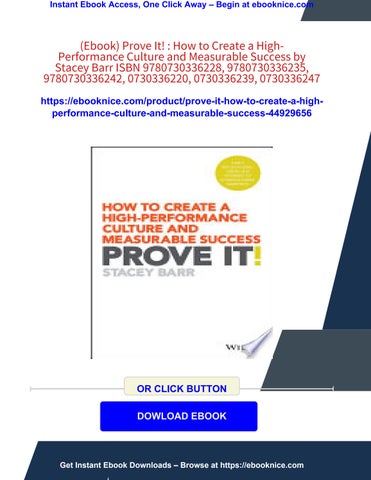
Cover design by Wiley
Printed in Singapore by C.O.S. Printers Pte Ltd
10 9 8 7 6 5 4 3 2 1
Disclaimer
The material in this publication is of the nature of general comment only, and does not represent professional advice. It is not intended to provide specific guidance for particular circumstances and it should not be relied on as the basis for any decision to take action or not take action on any matter which it covers. Readers should obtain professional advice where appropriate, before making any such decision. To the maximum extent permitted by law, the author and publisher disclaim all responsibility and liability to any person, arising directly or indirectly from any person taking or not taking action based on the information in this publication.
If you know me, and you know PuMP, then this book is dedicated to YOU. It’s because of you that I can keep learning and evolving my ideas on measuring organisational performance. Thank you for giving my work a worthy purpose.
About the Author
Stacey Barr is a specialist in organisational performance measurement and its application in evidence-based leadership. She has always loved working with numbers, and organisational performance measurement became her niche early in her career.
Since the late 1990s, she has worked with a wide variety of organisations around the world, particularly in the public sector, to help them make their strategy measurable, develop meaningful measures for what matters, and create a performance culture. Stacey believes in evidence, evidence that helps us learn how to make the impact we want, and helps us celebrate the impact we make.
Outside work, her passion is nature and the outdoors, and just about any physical activity that takes her to it: mountain biking, cycling, trail running, kayaking, and hiking.
Her homebase is in semi-rural south-east Queensland, Australia.
Acknowledgments
Thank you to Ahmed Shoukri, Andrew Garnham, Andrew Phillips, Anneli Karlsson, Anetta Pizag, Becky Thomas, Bryan Dilling, Charles Assey, Chris MacMillan, Claire Janes, Cynthia Abou Khater, Emily Verstege, Emmanuel Aiyenigba, Gerry Prewett, Helen Tilley, Herman Kasro, Jack Spain, Janet Sawatsky, Jennifer Oxtoby, Jesus Garcia, John Morri, Joscelyn Haggarty, Kathleen Simon, Ken McFetridge, Kerrie Donaldson, Lance Jakob, Leanne Ma, Louise Watson, Maryke Savenije, Mike Davidge, Paul Marambos, Peter O’Donnell, Remy Milad, Ruth Hama, Salome Serieys, Scott Maynard, Shahid Hussain Jafri, Todd Pait, Tony Guillen, Ulrike Neumann, Val Purves, and Wayen Miller, who each reviewed the draft of this book and shared additional stories, references and suggestions for style that improved the clarity of the messages I wanted to share. Your encouragement reinforced the need for this book and my confidence in creating it.
Thank you to the team at Wiley particularly Allison Hiew, Chris Shorten, Clare Dowdell, Ingrid Bond, Lucy Raymond and Theo Vassili for your helpful, collaborative and professional approach that made each step of bringing this book to fruition so enjoyable. You’ve all made me a better author.
Finally, thank you to Matt Church for the conversation that inspired the idea and title for this book in the first place.
Preface
This is a book for leaders. Organisations have a mission, a vision and a set of strategic goals. They have these things because organisations exist to achieve something, to make some difference in the world, to serve a purpose. And the job of leaders is to bring that to fruition to make the conceptual goals a tangible reality.
But how can we know how well that’s happening, or if it’s happening at all? How can we know if we are leading our organisations to make a measurable difference? Most leaders talk about productivity, efficiency, effectiveness, quality, engagement, best practice, sustainability and profitability. And yet we struggle to inspire our leadership team, and everyone throughout the organisation, to:
• do what’s most needed to fulfil the mission
• realise the vision
• achieve the strategic goals.
The world is demanding more and more of organisational leaders. The world wants more transparency to see the truth about how organisations are performing. And not just in terms of profit, but also how they treat people and the planet. The world wants more accountability, holding leaders responsible for the performance of their organisations. Many leaders may be kept awake at night, panicked by what transparency might reveal about their organisation’s performance and how they might be held to account.
But the best leaders won’t be panicking. The best leaders already know how their organisations are performing, in terms of profit, people and the planet. They know that performance has improved under their leadership, and they can prove it because they measure it. They can prove it because they practise evidence-based leadership.
If we want to know the impact of our leadership on our organisation if we want to know what legacy we will leave we have to prove it. And to prove it, we have to measure it. What our gut says, and what ‘they’ say, is not proof. A finished improvement project or change initiative or capital investment or new product line is not proof. For proof we need objective measures of the results that these investments were supposed to improve.
Measuring performance is like gravity. It pulls our attention and action toward a centre, toward the most important things we should focus on and improve. When we measure the important performance results, we move more directly toward those results and we achieve them sooner and with less effort.
When an eagle circles the sky, hunting for a meal, she sees her prey, she works out how far it is from her, and she lines up the most direct path toward it. Instinctively, she lets gravity pull her toward her goal, effortlessly and rapidly.
For leaders of organisations, performance measurement is the gravity that speeds up and takes effort out of our pursuit of what we want. So we get bigger and better improvements for less effort. And, on an organisational scale, evidence-based leadership is the process of using measurement as the gravity to draw the whole organisation toward the results that matter most.
Evidence-based leaders can prove how well their organisation is delivering what matters most, measurably and objectively and convincingly.
This book is about a system of evidence-based leadership. It maps out the principles, habits and processes that leaders must master to create high-performance organisations. Organisations that can:
• measure their impact
• demonstrate how well they fulfil their mission and realise their vision
• make the world better than they found it.
The evidence-based leadership map is like any map for a territory we want to explore: there isn’t only one path to follow. My hope is for this book to guide you through the territory of high-performance organisations. I hope it shows you what’s possible, helps you navigate and points out things you otherwise wouldn’t have noticed. Let’s begin our adventure!
Stacey Barr
September 2016
Part I
What are you tryIng to Prove?
Part I is about the decision to practise evidence-based leadership. It’s a choice, after all, so before we explore the framework of evidencebased leadership (in parts II and III), let’s take a little time to make an informed decision. We need to be clear about the:
• territory of high-performance organisations
• concept of evidence-based leadership, how it began and where it is going
• price we pay when we practise evidence-based leadership, and the costs we incur when we don’t
• framework for how to practise evidence-based leadership.
What’s your definition of a high-performance organisation? Let’s start by exploring that question.
ChaPter 1
the terrItory of hIgh PerformanCe
Almost any organisation can prove that it does things. It can prove that it hires people, that those people carry out different tasks, and that money is earned and spent. But what many organisations cannot prove is the most important thing: whether they are fulfilling their purpose or not. High-performance organisations don’t just do stuff. They have an impact ideally, the impact they exist to make. And they can prove how much impact they create.
It starts with purpose
It should be easy to work out the intended impact of any company; it’s stated right there in their mission statement. (After all, that’s what a mission statement is for.) But that’s often not the case! How seriously do you take your organisation’s mission and vision, its values and strategic direction? How seriously does your leadership team take them? And your employees? In many organisations, these things exist but are empty platitudes. They exist because they are supposed to exist, and not because they serve any useful purpose. But they should.
The world has evolved far beyond the style of leadership that expected employees to do what they were told and not question
managers. People give their best when they work for a cause: something they believe in, that’s bigger than themselves and more than their job description. They want a compelling mission and inspiring vision. They want to know that their work is making a difference in the world, and in the future their children will inherit.
Vision and mission statements these days have become pedestrian and clichéd the thin and empty products of jumping through strategic planning hoops. They’ve lost the ability to unite masses of people in a shared cause and have imbued more cynicism into workforces. From my experience, the main reason that visions and missions aren’t measured is because they are deliberately broad for aspirational purposes, and deliberately vague so everyone can find their own meaning in them. Being broad and vague means being immeasurable.
People give their best when they work for a cause.
What impact do you think the organisations with the following mission statements intend to make? Can you even tell what types of companies they are, let alone measure their achievement of these goals?
• ‘To refresh the world ... To inspire moments of optimism and happiness ... To create value and make a difference.’
• ‘To help people and businesses throughout the world realize their full potential.’
• ‘Families Making the Difference.’
The first one is The Coca-Cola Company. The second one is Microsoft. The third is PATH, a nonprofit organisation that provides foster care for children with special emotional, behavioural and medical needs. It wasn’t obvious, was it? How can such statements be guiding lights to drive the focus, energy and activity of people throughout an organisation when they are this broad and vague? If a strategic direction is not measurable, it’s not understandable and it’s not recognisable in the world around us.
My purpose here is not to criticise any of these organisations. It might seem unfair to claim that PATH’s mission is vague and
immeasurable, given that they make such a worthy contribution to the world. If we take that principle to the extreme that nonprofits don’t have to prove their impact it suggests that if you have a worthy mandate, you don’t have to try hard at evidence-based thinking. If nonprofits want to attract more support, and produce the best outcomes possible, they need a clear vision and a measurable impact as much as any organisation.
the importance of clarity
Florence Chadwick was an accomplished open-water swimmer in the 1950s. A legend in her own time, the Californian was the first woman to swim the English Channel in both directions. But when Florence attempted to swim the Catalina Channel a year later, it wasn’t the distance and ice-cold water and circling sharks that stopped her. With only a few hundred metres left to swim before she reached her destination of Palos Verde, she gave in. And her reason was fog. She knew that if the fog had cleared and she could see land, she’d have made it. But she couldn’t see through the fog and couldn’t see that she was making any progress. Only a couple of months later, she tried again. The fog was just as bad, but this time she held a vivid image of her destination firmly in her mind. And she made it. When our vision, our purpose, our direction are specific and clear, they are compelling.
This advice from James Grady, author of A Simple Statement: A Guide to Non-profit Arts Management and Leadership, is certainly true of nonprofit organisations, but I believe it’s equally true for government and business as well: For a non-profit organization, making a profit is not necessarily the definitive measure of success, nor is an increased budget size or staff. The evaluation of success lies in the mission and vision statements and is particular to that organization. Success may represent an increase in audience, in the number of people served by a particular program, or in artistic quality.
The following nonprofit and government organisations’ mission statements reflect how clear they are about their purpose. Can you guess the line of work they’re in, or even which organisations they are?
• ‘... creating a community partnership of knowledge, skills and expertise to enrich the participation in life of people who are blind or have low vision and their families. We will ensure that the community recognises their capabilities and contributions.’
• ‘To prevent cruelty to animals by actively promoting their care and protection.’
• ‘To make Australia the most desirable destination on earth.’
• ‘To make Australian sport stronger to get more people playing sport and to help athletes pursue their dreams.’
The first is from Vision Australia, the second from RSPCA Australia, the third from Tourism Australian, and the last from the Australian Institute of Sport. These are very clear mission statements that make the purpose of the organisation measurable, understandable and recognisable in the world around us.
And what about for-profit companies? Their mission can certainly be more than to make profit. Profit is a by-product of business that is obviously very important to shareholders, but not really important to other stakeholders without whose support the business would simply not exist (customers, the community, employees not rewarded with profit-share). Can you guess which companies (or at least which types of companies) own the following ‘beyond profit’ mission statements?
• ‘To grow a profitable airline ... Where people love to fly ... And where people love to work.’
• ‘To care for the world we live in, from the products we make to the ways in which we give back to society. At [company name removed], we strive to set an example for environmental leadership and responsibility not just in the world of beauty, but around the world.’
• ‘To be earth’s most customer centric company; to build a place where people can come to find and discover anything they might want to buy online.’
In order, the owners are: Virgin Atlantic, Aveda and Amazon.com. These companies know the power of an inspiring mission, but one that is clear and specific too.
Measuring our vision and mission means choosing a small handful of performance measures that track our progress in making them a reality. They provide real and objective evidence that the organisation is indeed excelling. By measuring the mission of our organisation, whether it’s for-profit, nonprofit or government, we take it seriously, we make it tangible and understandable, and we make it easier to align everyone’s attention and goals and resources to fulfilling that mission. Our mission is our purpose, and if we don’t measure it meaningfully, we can’t prove that we’re fulfilling that purpose.
Stever Robbins, the Get-It-Done Guy from one of the Quick and Dirty Tips podcasts, says that the ultimate responsibility that rests solely on the CEO’s shoulders is the success or failure of the organisation. And the CEO’s top two duties, which only they can perform, are building culture and setting strategic direction.
One of the most important things leaders need to feel is ownership of the organisation’s results.
In What You Really Need to Lead, Robert Steven Kaplan says leadership starts with an ownership mindset. One of the most important things leaders need to feel is ownership of the organisation’s results. That means ownership of the organisation’s mission and vision, and ownership of what it takes to make the organisation capable of achieving them.
the high-performance organisation
When we think about high performance in sports, it’s easy to understand the term. It’s about winning, but it’s also about the way the winning is done. Lance Armstrong was everyone’s darling in cycling, winning seven Tour de France titles, all of them after battling testicular cancer. But when his use of performanceenhancing drugs throughout his career was uncovered, his titles
were stripped and cycling fell out of love with him. Despite his achievements, the deceit and cheating mean he’s not a good example of high performance.
The story of Billy Beane and the Oakland A’s baseball team is a different matter. Unlike Lance Armstrong, they were performing at the bottom of the league based on wins. But they challenged many of the long-held traditions about how to build a baseball team. They ignored the highest-paid players and recruited players who were rejected or under-used and not valued by more successful teams. Their strategy seemed insane, but the Oakland A’s rose to the top rungs of the league on a budget a fraction of the size of their competitors’. They revolutionised the game of baseball. They are a great example of high performance.
In simple terms, a high-performance organisation is one that can perform at a very high level in the game it’s playing. The game an organisation is playing is the fulfilment of its mission and the pursuit of its vision. All this means is that a high-performance organisation does well at what it says it wants to do well at.
It’s true that there are organisations that say they want to be profitable, and do well at being profitable. There are plenty of organisations that have done this, and at the expense of their people, their customers, or the planet. In their book How Companies Lie: Why Enron Is Just the Tip of the Iceberg, authors A. Larry Elliott and Richard J. Schroth discuss how companies like Enron, Tyco and Sunbeam haven’t taken care of all their stakeholders: the people that supported them, and whose support they need to last into the future.
Those are not the kinds of organisations that this book was designed for. Profit cannot be the ultimate definition of high performance. It’s more than that, and has to be if an organisation is to stand the test of time. And so high performance is more about the culture of an organisation,
Profit cannot be the ultimate definition of high performance.
and the way it pursues results for all its stakeholders. The high-performance culture is one of:
• continuous improvement
• measurement of performance
• alignment with strategy
• consistently reaching for the right targets, without unintended consequences.
Models of excellence
Organisational excellence models such as Baldrige Performance Excellence, the European Foundation for Quality Management (EFQM) and the Australian Business Excellence Framework (ABEF) have been around since the 1990s. These models have been used by many different organisations around the world in their pursuit of high performance. Each model is used in an awards process, where entrants are evaluated by an accredited team against a collection of criteria organised into (usually) seven categories. The seven categories are:
1. Leadership. How the organisation’s leaders inspire high performance, encourage open communication and transparency, and create a climate for learning, collaboration and success.
2. Strategic direction and planning. How the organisation’s vision and values and direction are derived, how goals are set at all levels and aligned to the overarching direction, and how people are engaged in executing the strategy.
3. Data analysis, measurement, information and knowledge. How the organisation uses data analysis, measurement and reporting of performance and other forms of evidence to inform its decision making, strategy execution and continual improvement of performance.
4. People and workforce. How the organisation values its employees and partners, the culture it nurtures, and how it facilitates a safe, healthy and collaborative working environment.
5. Customer and market focus. How the organisation understands its customers and their needs, ensures a customer focus throughout the organisation, and positions itself within its market.
6. Business processes or operations, products and services. How the organisation has designed the flow of work to develop and deliver its products and services, with an emphasis on systems thinking and cross-functional collaboration, in alignment with strategy.
7. Results. How the organisation has defined and attained success, including its impact on customers, its people and society.
Within each of these categories, entrants must demonstrate how they follow some form of quality management plan–do–study–act (PDSA) cycle:
• Plan. The organisation has a deliberate approach for the category, such as a framework or process or model.
• Do. This approach is deployed or implemented deliberately throughout the organisation.
• Check. The results of deploying or implementing the approach are objectively measured.
• Act. The measures are used to decide what to continue about the approach and what to modify to get better results.
These organisational excellence models encourage a broader definition of what high performance is. Their philosophy is that high performance is a way of being rather than a place to be. Results, the seventh category, are important, but not at the expense of the other six categories.
In the past, as an evaluator for the Australian Business Excellence Awards, I consistently noticed the weakest link for the majority of organisations was evidence-based thinking. So few could demonstrate, measurably, the results they were creating across each of the seven categories. And, not surprisingly, categories 3 and 7 were always evaluated lower than the others. Seeing this pattern back then, and in every organisation I’ve worked with since, made me realise we need
more evidence-based leaders to inspire and guide their organisations along this journey of high performance.
High performance and the bottom line
We are told that the purpose of business is to make a profit. In the public sector, the parallel is to meet budget. While there are moral reasons why profit ought not be the ultimate purpose of business for example, when others have to suffer to make those profits possible there are also sound business reasons why we ought to move away from single measures of success, such as profit. In their book The Balanced Scorecard, Robert Steven Kaplan and David P. Norton argue that non-financial performance is just as important as financial performance. This has led to other scorecards, such as the Triple Bottom Line, also aiming for more balance in our definition of success. A scorecard with balance is one where success is defined by the perspectives of every stakeholder affected by a company, and these perspectives give context to what that company measures, monitors and manages. It’s not just the financial bottom line that counts.
High-performance organisations and companies don’t solely pursue financial results as their definition of success.
A great example of the consequences of a profit-driven strategy is the factory farming of chickens as described in The Ethics of What We Eat by Peter Singer and Jim Mason. To increase profits, some companies maximise the number of birds per square foot of space. (In many operations, chickens get about the size of an A4 sheet of paper to live their lives in.) Aside from the birds’ suffering and the stressful work environment for employees, there are some very significant costs to local communities and ecosystems. The ammonia from the chickens’ waste makes going outside unbearable for whoever is downwind of the factories and causes irritation and health problems to those exposed. When the waste products are flushed from the factory floor, they run off into nearby streams and waterways and kill the aquatic life. These are the costs that don’t make it into the companies’ financial statements or annual reports,
costs that communities and the environment pay (now and in the future) to subsidise those profits.
High-performance organisations and companies don’t solely pursue financial results as their definition of success. They pursue an array of results based on what all their stakeholder groups value most. And they pursue those results in a way that does not depend on other stakeholders paying the costs; how we make the journey to high performance is at least as important as getting there.
So evidence-based leaders start with exceptional:
• clarity about the results that truly do define success for their organisation
• ownership of and responsibility for those results
• care in guiding the organisation to that success. They give more attention and effort to these three things than most leaders seem to these days. These are the three basic principles of evidence-based leadership.
Chapter 2
evidenCe-based leadership
As Pulitzer Prize-winning author Carl Sagan noted in Cosmos:
If we lived on a planet where nothing ever changed, there would be little to do. There would be nothing to figure out. There would be no impetus for science. And if we lived in an unpredictable world, where things changed in random or very complex ways, we would not be able to figure things out. Again, there would be no such thing as science. But we live in an in-between universe, where things change, but according to patterns, rules, or, as we call them, laws of nature ...
I find this quote one of the most inspiring motivations for measuring organisational performance. If the world were completely predictable, organisations would be like perfect machines: every outcome would be produced precisely as intended. Control would be at 100 per cent. At this extreme there is no use for measuring performance, because performance is always perfect, with no variation. But our world isn’t like that. And that’s why performance targets of perfection such as ‘zero injuries’ or ‘100 per cent on-time performance’ feel too confronting for people to commit to, no matter how idealistic or ‘right’ they might seem. Our organisations are not deterministic machines.
Conversely, if the world were completely unpredictable, with no order at all, organisations wouldn’t exist: the concept of organising would be impossible. Control would be at 0 per cent. At this extreme there would be no use in measuring performance: it would vary so randomly that we could not observe patterns of causation, and would be unable exercise any degree of control over performance. But our world isn’t like that either, which is why there is no excuse for decisions to be purely driven by gut feel or hearsay or tradition or whim.
Our world is in between these extremes of perfect predictability and perfect unpredictability. There is variation, but it’s not the product of complete randomness. It’s the product of complexity, and there is order in this complexity. So in our in-between world we have a use for measuring performance, because it helps us quantify the variation and observe patterns of causation. It helps us learn how we can influence performance by using or changing these patterns.
The purpose of evidence-based leadership is to navigate organisations through a world that is somewhere between the extremes of perfect predictability and perfect unpredictability, and measurement is the primary tool of the evidence-based leader. Performance measurement deepens our understanding of the complexity in our organisations, and speeds up our identification of patterns, so we can constantly improve at creating the results we want.
Measurement is the primary tool of the evidence-based leader.
Evidence-based leadership is not a mainstream practice in business. According to authors Jeffrey Pfeffer and Robert I. Sutton in their book Hard Facts, Dangerous Half-Truths and Total Nonsense: Business decisions, as many of our colleagues in business and your own experience can attest, are frequently based on hope or fear, what others seem to be doing, what senior leaders have done and believe has worked in the past, and their dearly held ideologies in short, on lots of things other than the facts ... If doctors practiced medicine the way many companies practice management, there would be far more sick and dead patients, and many more doctors would be in jail.
the rise of evidence-based management
The Harvard Business Review began publishing articles on evidencebased management in the mid 2000s, largely triggered by Pfeffer and Sutton’s book, which describes evidence-based management as follows:
Evidence-based management proceeds from the premise that using better, deeper logic and employing facts to the extent possible permits leaders to do their jobs better. Evidence-based management is based on the belief that facing the hard facts about what works and what doesn’t, understanding the dangerous halftruths that constitute so much conventional wisdom about management, and rejecting the total nonsense that too often passes for sound advice will help organizations perform better.
The Center for Evidence-Based Management (CEBMa) takes this definition of evidence-based management further, by outlining a process for practising it:
Evidence-based practice is about making decisions through conscientious, explicit and judicious use of the best available evidence from multiple sources
We practise evidence-based management to increase the likelihood of achieving the results we want from the organisation we’re managing.
Evidence-based leadership is the application of evidence-based management at the most strategic level in an organisation. It has to be practised and prioritised by all of the senior leadership team, including the CEO and board members. If it isn’t, then evidence-based management at lower levels won’t happen quickly or comprehensively enough for an organisation to fulfil its mission and reach its vision.
leaders hold the space for high performance
Evidence-based leadership is more than evidence-based management. An organisation’s leaders must not only practise evidence-based management to elevate organisational performance at the strategic level they must also inspire and encourage and expect it from everyone else in the organisation.
When we are practising evidence-based management, we are using objective evidence to design and monitor the organisation’s strategy. This evidence primarily comes from performance measures that monitor our progress toward the vision, mission and strategic goals. Other forms of evidence, such as research and case studies and experimental results, inform us of the best ways to make that progress happen sooner, or in larger steps, or with higher returns on our investment.
When we are inspiring and encouraging and expecting evidencebased management from everyone in the organisation, we are making it easier for them to practise it themselves and apply it to what matters most. We need to:
• make it part of our routine language and everyday conversations
• coach others in how to practise it and how to align their decisions with what is strategically important
• recognise and reward the learning and practice of evidencebased management even more than its impact
• support the practice of evidence-based management by providing: how-to processes a clear and measurable strategy evidence-based reporting frameworks analytical tools conversation outlines in-person participation. Leaders are responsible for the direction and the culture of an organisation, and the culture of high performance will come only
when they both practise and inspire evidence-based management. This is what I mean by ‘holding the space’ for high performance. So we might define evidence-based leadership as the following two approaches:
1. The application of evidence-based management at the wholeorganisation level and the active and routine support of its application organisation-wide.
2. The alignment of all decision making and action with the purpose and strategic direction of the organisation.
These two approaches will measurably elevate the overall performance of the organisation and its positive impact in the world.
Managers and supervisors and staff will not practise evidence-based management without it being deliberately led from the top. What the CEO talks about and does, the rest of the organisation talks about and does. Evidence-based leaders routinely talk about:
• the purpose of the organisation
• the evidence that the purpose is being fulfilled
• what that evidence says about how well that’s happening.
There are no short cuts. If we want high-performance organisations, we have to be evidence-based leaders, every single day.