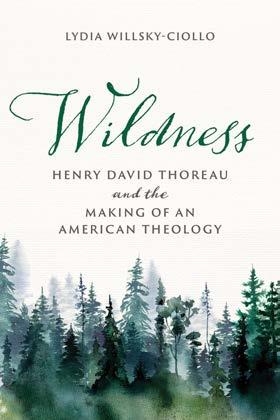
Henry David Thoreau and the Making of an American Theology
Lydia Willsky-Ciollo
Summary
In and through his experience of nature, Henry David Thoreau imagined and developed a distinctly American theology of the wild.
In Wildness: Henry David Thoreau and the Making of an American Theology, Lydia Willsky-Ciollo articulates how Thoreau was enmeshed in a decades-spanning project of crafting a theology of wildness. During Thoreau’s post-college years and his time at Walden Pond, he evolved from hopeful writer to observant theologian, whose primary work as a surveyor enabled his theological vocation.
Willsky-Ciollo skillfully guides readers through Thoreau’s writings and life as his theology emerges and evolves. The focus of Thoreau’s theology—wildness itself— centers on the divinity extant in every person and in every molecule of creation. Definitively American in its ethos, Thoreau’s theology reflects a distinctly American set of tensions: progress and tradition, wilderness and civilization, the destructive and the generative nature of work, the individual and the society, the local and the universal, and the Christian and the pluralist. While remaining critical of dogmatism and institutional rigidity, he formed his theological vision in conversation with the Christianity of his own time and place.
Ultimately, theology is an active process, and interpreting the wild experience of divine revelation is the purview of all. Thoreau left the door open to his readers, who he hoped would pick up the pen where he left off and write their own theologies of wildness.
Contributor Bio
Lydia Willsky-Ciollo is associate professor of religious studies and director of American Studies at Fairfield University. She is author of American Unitarianism and the Protestant Dilemma: The Conundrum of Biblical Authority and co-author with Eugene V. Gallagher of New Religions: Emerging Faiths and Religious Cultures in the Modern World.
Quotes
“In this rich, comprehensive, even lyrical introduction to Thoreau and Transcendentalism, Lydia Willsky-Ciollo seeks to renew both Thoreau and divinity for a secular world. Her bold new argument gives us a Thoreau who still matters deeply, whose ‘theology of the wild’ is deliberate, coherent, well-founded in the history of religious thought, and profoundly meaningful today—an environmental faith not meant to be confined to a bookshelf, but to live and grow in our shared world of natural beauty and spiritual meaning.” —Laura Dassow Walls, author of Henry David Thoreau
“Lydia Willsky-Ciollo has written a book that will become a classic in Thoreau studies. As Thoreau walked by streams, up mountains, and floated on rivers, this book takes the reader on a journey of a discovery of the divinity of and in nature and how Thoreau was—and how we are—connected to it. This is a book to be read, contemplated, and cherished.” —Marc Jolley, senior lecturer in philosophy and Great Books, and director of Mercer University Press
“More than a commentary, this is a vibrant conversation across time, revealing Thoreau as both seeker and prophet. In so doing, Wildness profoundly reshapes the study of Thoreau and Transcendentalism, opening new paths for readers and scholars alike.”
—Morgan Shipley, Foglio Endowed Chair of Spirituality, Michigan State University
9780268211189
Pub Date: 2/15/2026
$30.00
Discount Code: s Paperback
192 Pages
10 b&w illustrations, 4 charts, 2 graphs
9 in H | 6 in W
History / Europe
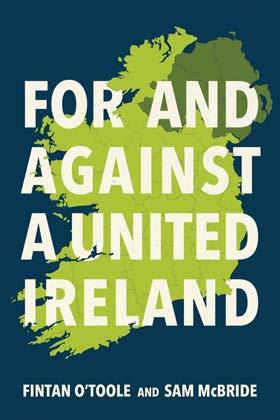
For and Against a United Ireland
Fintan O’Toole, Sam McBride
Summary
In For and Against a United Ireland, renowned journalists Fintan O’Toole and Sam McBride provide an accessible and measured approach to the polarized debate about Irish unification.
The prospect of Irish unification is now stronger than at any point since partition in 1921. Voters on both sides of the Irish border may soon have to confront for themselves what the answer to a referendum question would mean—for themselves, for their neighbours, and for their society.
Journalists Fintan O’Toole and Sam McBride examine the strongest arguments for and against a united Ireland. What do the words “united Ireland” even mean? Would it be better for Northern Ireland? Would it improve lives in the Republic of Ireland? And could it be brought about without bloodshed?
O’Toole and McBride each argue the case for and against unity, questioning received wisdom and bringing fresh thinking to one of Ireland’s most intractable questions.
Contributor Bios
Fintan O’Toole, member of the Royal Irish Academy, is a columnist with The Irish Times and advising editor of the New York Review of Books His many books on Irish history, politics, society and culture include We Don't Know Ourselves: A Personal History of Modern Ireland. He has been awarded the European Press Prize, the Orwell Prize for Journalism, and the Robert Silvers Prize for Journalism.
Sam McBride is the Northern Ireland Editor of the Belfast Telegraph and the Sunday Independent newspapers. He also writes on Northern Ireland for The Economist. He is a former Political Editor of the Belfast News Letter and has made a BBC film about the Northern Bank robbery He is author of The Sunday Times bestseller Burned: The Inside Story of the 'Cash-for-Ash' Scandal and Northern Ireland's Secretive New Elite and is a regular broadcaster.
9780268210557
Pub Date: 3/1/2026
$45.00
Discount Code: x Paperback
450 Pages 9 in H | 6 in W
Philosophy / Ethics & Moral Philosophy
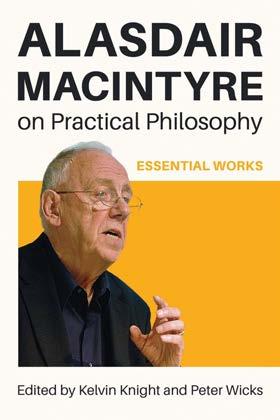
Alasdair MacIntyre on Practical Philosophy Essential
Works
Kelvin Knight (editor), Peter Wicks (editor)
Summary
This vital collection showcases the trajectory of MacIntyre’s thought and the perennial significance of his work.
One of the world’s foremost philosophers for over half a century, Alasdair MacIntyre stands at the forefront of the revival of Aristotelianism in contemporary thought. Alasdair MacIntyre on Practical Philosophy serves as an accessible introduction to MacIntyre’s work while also providing a clear sense of how he continued to develop and refine his philosophy after the publication of After Virtue This essential reader includes some of his most important works on ethics and politics, including unpublished pieces from his Common Goods and Political Reasoning project.
Focusing on the period between After Virtue and MacIntyre’s final masterpiece, Ethics in the Conflicts of Modernity, the collection shows how he came to understand Aristotelianism not merely as a rival to consequentialist and deontological ethical theories, but as a distinctive account of ethical inquiry, one that can illuminate both the sources of our contemporary moral disputes and the conditions under which true moral progress can be made. Alasdair MacIntyre on Practical Philosophy also reveals how MacIntyre found vital resources for understanding and criticizing the irrationalities and injustices of contemporary society and politics in the Aristotelian tradition.
Contributor Bios
Kelvin Knight is reader in ethics and politics at London Metropolitan University. He is the author of Aristotelian Philosophy: Ethics and Politics from Aristotle to MacIntyre.
Peter Wicks is scholar-in-residence at the Elm Institute.
Quotes
“We are in debt to Knight and Wicks for this significant book. They are skilled readers of MacIntyre, as this selection of essays makes clear. MacIntyre is, hopefully, destined to be read for many years. This book will make that possible.” —Stanley Hauerwas, author of Jesus Changes Everything
“On his passing, Alasdair MacIntyre was honored from diverse perspectives for having reinvigorated moral philosophy in our time. This beautifully curated collection of his statements across a lifetime is a kind of testament to just how profound and wide-ranging he was. The book introduces and reintroduces his thought to an intellectual world that still needs it.” —Samuel Moyn, author of Liberalism against Itself
9780268211066
Pub Date: 4/1/2026
$45.00
Discount Code: x Hardcover
276 Pages
8 charts
9 in H | 6 in W
Political Science / Religion, Politics & State
Why Religious Freedom Matters
Human Rights and Human Flourishing
Allen D. Hertzke
Summary
Marshalling unprecedented global scholarship, Allen Hertzke demonstrates how religious freedom is pivotal to democratic, peaceful, and flourishing societies.
The twenty-first century has witnessed a rising crisis of religious repression and persecution. In Why Religious Freedom Matters, Allen Hertzke synthesizes vast evidence from history, ethnography, and worldwide statistical analyses to make the compelling empirical case for the role of religious liberty in shaping a better global future.
In rich detail, Hertzke demonstrates how religious freedom nurtures democracy, fosters prosperity, and cultivates international peace. The book also reveals the surprising ways that religious liberty and equality unleash personal agency that empowers women and uplifts the poor. Religious freedom uniquely matters, Hertzke argues, because it goes to the heart of human personhood and aspiration—the right “to be who we are,” to act on ultimate commitments, and to be treated with equal worth and dignity.
Based on a quarter century of immersion in global networks of scholarship and activism on religious freedom, Hertzke has produced a landmark volume showing how we can navigate the challenge of living with our differences in a shrinking world.
Contributor Bio
Allen D. Hertzke is professor emeritus of political science at the University of Oklahoma. He is author or editor of ten books, including Freeing God’s Children and The Future of Religious Freedom. He served a ten-year term on the prestigious Pontifical Academy of Social Sciences at the Vatican.
Quotes
“With this highly readable and richly documented book, Allen Hertzke shows why everyone concerned about human flourishing should come to the aid of religious freedom. Skeptics will be surprised and human rights advocates heartened by Hertzke’s examples of religious freedom’s demonstrable benefits.” —Mary Ann Glendon, author of In the Courts of Three Popes
“This is a most important book on one of the great problems plaguing the modern world—religious persecution—written by one of the towering figures in the field of religious freedom studies.” —Nilay Saiya, author of Weapon of Peace
“Hertzke’s masterful analysis and deep expertise cogently argues for the global importance of protecting freedom of belief and its far-reaching implications for human flourishing.” —H. Knox Thames, author of Ending Persecution
9780268210632
Pub Date: 4/1/2026
$35.00
Discount Code: x Paperback
240 Pages
9 in H | 6 in W
Political Science / Human Rights
Series: The Center for Citizenship and Constitutional Government Series
The Legal Foundations of Religious Freedom
Human Rights in the United States and Europe
John Witte Jr., Andrea Pin
Summary
The Legal Foundations of Religious Freedom documents the essential interdependence of human rights and religious freedom in the West, from antiquity to the present.
In The Legal Foundations of Religious Freedom, authors John Witte Jr. and Andrea Pin explore the Christian and secular origins of rights in the Western legal tradition and the complex interplay between human rights and religious freedom norms in modern law, religion, and culture They analyze historical documents and recent cases from the United States Supreme Court, the European Court of Human Rights, and the Court of Justice of the European Union to articulate the historical, theoretical, and legal tension of human rights and religious freedom on both sides of the Atlantic The authors contrast the serious threats to new religious minorities and traditional religious accommodations with firm new protections of religious freedoms in both Europe and America.
Ultimately calling for robust protection of the fundamental rights and liberties of all people and faiths, Witte and Pin caution that religious freedom and other human rights claims can only do so much to bridge the widening cultural divides over law and religion in modern Western societies. It is our responsibility to embrace the fundamental goods of dignity, fraternity, and justice.
Contributor Bios
John Witte Jr. is Robert W. Woodruff Professor of Law, McDonald Distinguished Professor of Religion, and faculty director of the Center for the Study of Law and Religion at Emory University He is the author of The Blessings of Liberty: Human Rights and Religious Freedom in the Western Legal Tradition and co-author of Religion and the American Constitutional Experiment.
Andrea Pin is professor of comparative law at the University of Padua, Italy He is the author of The Legal Treatment of Muslim Minorities in Italy: Islam and the Neutral State and Religious Freedom without the Rule of Law: The Constitutional Odysseys of Afghanistan, Egypt, and Iraq and the Fate of the Middle East
Quotes
“The ideal entry point for anyone wanting to gain a general and authoritative understanding of the history and development of religious liberty in Europe and the United States from its origins to the latest judicial developments.” —Paolo G. Carozza, co-author of Regional Protection of Human Rights
“Adroit and penetrating, these renowned masters in their field, have confected a longoverdue and readily accessible text that is authoritative as well as challenging for scholars, practitioners, and judges.” —Mark Hill KC, Distinguished Global Professor of Law, Notre Dame London
“Written by two of the most distinguished scholars in the field of law and religion today, this book provides a robust, reasoned, and reflective defence of the connection of human rights to religious freedom. Crystal-clear, richly-evidenced, and thoughtprovoking, the book is superb: essential for students of law and religion.”
—Norman Doe, professor of Law, Cardiff University, Master of the Bench Inner Temple, and chancellor of the Diocese of Bangor.
9780268210984
Pub Date: 4/15/2026
$40.00
Discount Code: x Hardcover
198 Pages 9 in H | 6 in W
Political Science / History & Theory
Aristotle’s Political Philosophy
An Inquiry into the “Nicomachean Ethics,” “Politics,” and “Rhetoric”
Mark Blitz
Summary
Aristotle’s Political Philosophy offers a concise and accessible overview of Aristotle’s political thought in his Nicomachean Ethics, Politics, and Rhetoric.
Aristotle’s writings on politics are known for their legendary complexity and contradictions. In Aristotle’s Political Philosophy, renowned scholar Mark Blitz draws connections between the Nicomachean Ethics, Politics, and Rhetoric to explain how these texts relate and interact with each other. Throughout the book, Blitz examines the foundations of political action, devoting special attention to Aristotle’s understanding of virtue, justice, slavery, education, friendship, statesmanship, and speech. In doing so, Blitz clarifies the central ethical and political concepts presented throughout these works to articulate how these texts, together, advance a coherent political philosophy.
After offering a comprehensive analysis of Aristotle’s political thought, Blitz ultimately argues that Aristotelian philosophy remains fundamental for understanding modern political opinions, practices, and institutions.
Contributor Bio
Mark Blitz is the Fletcher Jones Professor of Political Philosophy at Claremont McKenna College. He is the author of numerous books, including Reason and Politics.
Quotes
“Blitz has a gift for explaining Aristotle’s thought in a down-to-earth, lucid, and balanced manner that renders that thought helpfully accessible to the contemporary reader.” —Peter J. Ahrensdorf, author of Homer and the Traditional Political Philosophy
“Blitz elucidates the fundamental ethical and political phenomena treated by Aristotle with a directness and conceptual clarity unmatched by anyone writing today, at the same time demonstrating the enduring relevance of Aristotle’s understanding to our modern liberal democratic regime.” —Christopher Lynch, author of Machiavelli on War
“With a remarkably sure hand, Mark Blitz guides the reader through the texts, weaving together summary and quotation with clear and penetrating analysis.”
—Robert Bartlett, translator of Aristotle’s “Art of Rhetoric”
9780268210717
Pub Date: 2/15/2026
$30.00
Discount Code: x Paperback
198 Pages
9 in H | 6 in W
Political Science / Political Ideologies
Athenian Democracy(with a new Introduction) Modern Mythmakers and Ancient Theorists
Arlene W.
Saxonhouse
Summary
Athenian Democracy provides innovative readings of ancient theorists to reveal both the complexity of democracy’s achievements and its limits.
In this classic work, noted political scientist Arlene W. Saxonhouse offers fresh and provocative explorations of ancient political theorists, lending new insights about democracy’s foundations and principles. These insights are more relevant than ever in a moment when the viability of democratic regimes is under scrutiny. Saxonhouse provides an in-depth discussion of the modern mythmakers (Hobbes, Paine, Hamilton, Mill, and Arendt, among others) who, in praising or excoriating Athenian democracy, have in fact distorted it to support their own assessments of democracy. She then offers detailed reinterpretations of the writings on democracy of four ancient theorists who had directly experienced life in the first democratic regime: Herodotus, Thucydides, Plato, and Aristotle.
Saxonhouse argues that the mythmaking that often attends our views of Athenian democracy—whether as a flawed, slaveholding regime that fostered factions and oppressed women or as an ideal regime of egalitarian and participatory democrac blinds us to the deeper understanding of democracies that these ancient theorists can offer
Contributor Bio
Arlene W. Saxonhouse is the Caroline Robbins Collegiate Professor of Political Science, Emerita, at the University of Michigan.
Quotes
“Arlene W. Saxonhouse’s lively and entertaining discussion . . . is ably conducted by a master teacher who has succeeded in conquering the ancient and modern teachings about democracy.” —Perspectives on Political Science
“Saxonhouse’s judicious account is always interesting and the book abounds in useful insights.” —The Review of Politics
“In this clearly written volume [Saxonhouse] searches for those largely untapped veins of ore overlooked by the majority of scholars who have been misdirected in their own pursuits of the ancients by the modern mythmakers of her subtitle.” —Ethics
9780268210878
Pub Date: 3/15/2026
$40.00
Discount Code: x Paperback
326 Pages 9 in H | 6 in W
Political Science / History & Theory
Series: The Beginning and the Beyond of Politics
Love and Virtue in a Secular Age Christianity, Modernity, and the Human Good
Ralph C. Hancock
Summary
In a comprehensive meditation on freedom and reason, Ralph Hancock reveals the pressing need for renewed confidence in virtue and agency.
With an emphasis on reclaiming the moral preconditions of Christian love, Love and Virtue in a Secular Age offers a thought-provoking study on the effects of secularism on Christian morality. Ralph Hancock brings eminent scholars of the Christian Aristotelian tradition, such as Thomas Aquinas and Pierre Manent, into conversation with insights from Leo Strauss’s critique of Christianity. Love and Virtue in a Secular Age sheds light on the various ways in which the increasing prevalence of secular humanitarian sensibility has voided the idea of humanity of its natural substance.
In a probing reflection poised at the intersection of the theological and the political, Hancock outlines a new theological ethic according to which faith must redeem a certain pride and particularism on behalf of real Christian communities and the virtues they enact.
Contributor Bio
Ralph C. Hancock is professor of political science at Brigham Young University.
Quotes
“Ralph Hancock has given himself a most intimidating task: to recover human agency, with its accompanying confidence in the primacy of the Good. He convincingly shows why our post-Christian souls, in order to understand themselves, need a full and accurate engagement with the Christian proposition. This book is a major achievement.” —Pierre Manent, author of Natural Law and Human Rights and Challenging Modern Atheism and Indifference
“Drawing on the best classical, Christian, and contemporary wisdom, Hancock brilliantly rescues Christian love from its thoughtless identification with mere sentimentality and shows that authentic virtue is inseparable from the proud cultivation of moral and political responsibility.” —Daniel J. Mahoney, author of Recovering Politics, Civilization, and the Soul
“Is pride the root of sin or a spur to virtue? With careful attention to Christian theology as well as political philosophy, Ralph Hancock guides the reader through this question and offers a bracing defense of political liberty against progressive humanitarianism.” —James R. Stoner, author of Common-Law Liberty
9780268210793
Pub Date: 3/15/2026
$38.00
Discount Code: x Paperback
250 Pages 9 in H | 6 in W
Philosophy / Ethics & Moral Philosophy
Series: The Beginning and the Beyond of Politics
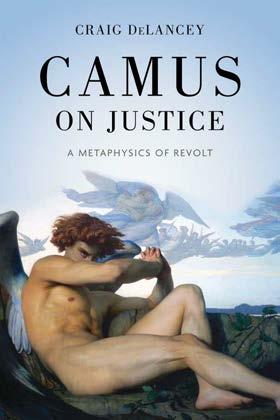
Camus on Justice A Metaphysics of Revolt
Craig DeLancey
Summary
Camus on Justice investigates Albert Camus’s rich and overlooked theory about the relationship between the absurd, politics, and revolution.
What is the purpose of our lives? Camus on Justice grapples with this complex question through a unique look at the work of Albert Camus. Craig DeLancey argues that Camus sees the question of purpose as essentially related to questions of justice: our need for purpose is a revolt against a purposeless universe, and our need to foster a just society where all can pursue purpose is a revolt against human injustice. DeLancey deepens the conversation by juxtaposing Camus’s arguments with Sartre’s and de Beauvoir’s, two contemporaries who profoundly disagreed with Camus. Ultimately, DeLancey offers a new reading of Camus’s understanding of the absurd which in turn develops a fuller understanding of his political and social theories.
This book applies rigorous analytic philosophy to Camus’s work and includes a unique interpretation of The Fall, showing how Camus predicted much of the turmoil of our current day and age. Camus on Justice reveals how Albert Camus’s philosophy offers wisdom not only for his time but also our own.
Contributor Bio
Craig DeLancey is professor of philosophy and chair of the Department of Philosophy at the State University of New York at Oswego. He has published books and papers on metaphysics and logic. His most recent book is Consciousness as Complex Event: Towards a New Physicalism.
Quotes
“This book makes an impressive case for the contemporary relevance and importance of Camus’s political thinking.” —Anthony Rudd, author of The Philosophy of Camus
“In an era marked by moral uncertainty and ideological extremes, Camus on Justice offers a critical lens to navigate the contemporary crisis of values, showing how Camus’s philosophy can serve as a guiding compass in confronting the ethical and political dilemmas of our time.” —Maciej Kałuża, co-editor of Brill's Companion to Camus
“Camus on Justice is the perfect way into the thought of Albert Camus whose work culminates in a revolt against injustice that seeks to avoid perpetrating even more injustice. DeLancey is an unerring guide into a meditation that navigates between the extremes of nihilistic despair and revolutionary excess.” —David Walsh, author of The Priority of the Person
9780268210823
Pub Date: 4/1/2026
$45.00
Discount Code: x Hardcover
376 Pages
4 b&w illustrations
9 in H | 6 in W
Religion / Christianity
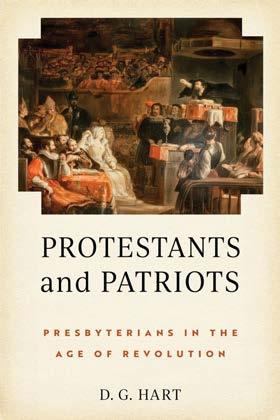
Protestants and Patriots Presbyterians in the Age of Revolution
D.G. Hart
Summary
D. G. Hart chronicles the transatlantic history of Presbyterianism as a political movement from the sixteenth to the nineteenth centuries, tracing its evolution into a modern, liberal religion.
Historians have often described Presbyterianism as a political orientation that leads to rebellion and revolution. Hart interrogates this assumption, presenting instead a complex, larger narrative of Presbyterian understanding of political authority and the role of the church in society
Synthesizing Presbyterian developments in England, Scotland, Ireland, the United States, and Canada from 1560 to 1870, Hart compellingly explains first why Presbyterianism was politically disruptive in Britain for 150 years and then how these Protestants adjusted to liberal democracy The truly revolutionary side of Presbyterianism took place during the religious and parliamentary wars of Scotland and England during the 1630s and 1640s—almost 150 years before the American Revolution. This age of revolution extended up to the American Founding and the formation of the Dominion of Canada. After 1640, Presbyterians remained politically assertive, but switched from state churches and covenanted monarchs to civil and religious liberties and republican government.
Ultimately, as a rigorous faith that refused political compromise, Presbyterianism unintentionally laid the groundwork for religious disestablishment and religious freedom. In so doing, Presbyterians became unlikely defenders of liberal democracy
Contributor Bio
D. G. Hart is professor of history at Hillsdale College. He is the author of many books, including, most recently, Benjamin Franklin: Cultural Protestant.
Quotes
“Protestants in early modern England and Scotland and their heirs in the United States and Canada wrestled with the relationship between church and state in ways that spilled over into civil politics. D. G. Hart has given us the fullest history of these episodes and, as well, an intriguing emphasis on ‘Presbyterians’ as fomenters of the American Revolution.” —David D. Hall, author of The Puritans
“Protestants and Patriots opens up a fascinating history of Presbyterianism. This book is comparative religious and political history at its best.” —Mark A. Noll, author of America’s Book
9780268211141
Pub Date: 5/15/2026
$65.00
Discount Code: x Hardcover
360 Pages 9 in H | 6 in W
Religion / Christian Theology
Series: Notre Dame Studies in African Theology
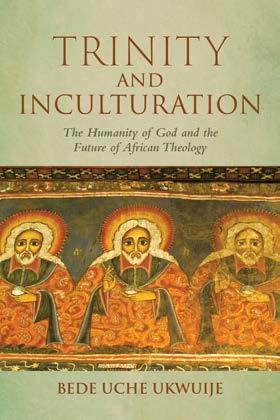
Trinity and Inculturation
The Humanity of God and the Future of African Theology
Bede Uche Ukwuije
Summary
Trinity and Inculturation offers a renewed examination of the naming of God in the context of contemporary fundamental theology and African inculturation theology.
In the past decades, missionary discourse has developed an intentional theological awareness of the intricacies of African traditional religions. Its aim of counteracting the prevalent devaluation of African culture throughout history, however, has come at the expense of foundational components of Trinitarian theology. Trinity and Inculturation seeks to reconcile the disjunction between theology and Christology present in African inculturation theology by re-centering the conversation on the Trinitarian nature of the Christian God revealed through Jesus Christ and the activities of the Holy Spirit.
Father Bede Uche Ukwuije uses the work of German theologian Eberhard Jüngel, and more specifically his idea of the humanity of God, to overcome the dependence of African theology on Western theism. Through this dialogue, Ukwuije crafts a thorough, Trinitarian argument that calls for a reconsideration of fundamental Christian apologetics and the renewal of Christian mission and interreligious dialogue.
Contributor Bio
Bede Uche Ukwuije is a Nigerian Roman Catholic priest and a Spiritan missionary. He is a professor of theology and vice-chair of the Department of Theology at Duquesne University, and serves as the president of the Governing Council of the Spiritan International School of Theology, Attakwu-Enugu, Nigeria. He is the author of numerous publications, including The Trinitarian God.
Quotes
“This book offers a profound and immensely rich reflection on the Christian belief in the Trinity by setting up a conversation that includes Western philosophy, African religious anthropology, and African Christian inculturation theologians, as well as Christian writers in conemporary times.” —Anthony Akinwale, O.P., author of Charism and Contradiction
“Trinity and Inculturation is a solid work of fundamental theology The work sets up critical dialogue between the Lutheran theologian Eberhard Jüngel’s Trinitarian doctrine of ‘the humanity of God’ and the naming of God in African theology of inculturation evidenced in the doyens of African literature, African religions, and African theology.” —James Chukwuma Okoye, C.S.Sp., author of Genesis 12–50: A Narrative-Theological Commentary
9780268211035
Pub Date: 5/15/2026
$35.00
Discount Code: x Paperback
304 Pages
5 diagrams 9 in H | 6 in W
Religion / Islam
Series: Contending Modernities
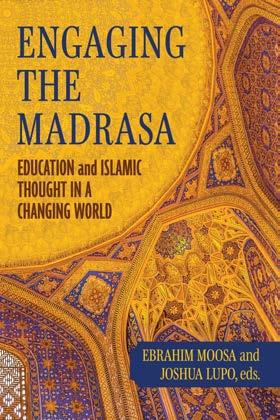
Engaging the Madrasa
Education and Islamic Thought in a Changing World
Ebrahim Moosa (editor), Joshua Lupo (editor)
Summary
Engaging the Madrasa delves into the intellectual and political challenges that the Muslim scholarly community faces across the globe.
The rapid developments of the modern age have given rise to complex theological and philosophical challenges for Muslim scholarly communities To confront these questions, editors Ebrahim Moosa and Joshua Lupo have curated a collection of essays offering balanced and nuanced perspectives that amplify the richness of the Islamic traditions while avoiding both conservative nostalgia or progressive amnesia.
Engaging the Madrasa grapples with the loss and reimagining of tradition in the modern world, bringing together madrasa scholars from India, Pakistan, and the United States to confront themes such as gender equality, the nation-state, colonial legacies, the role of technology, and more. In doing so, the contributors use both modern science and Islamic theological discourse to chart new pathways for Muslim scholars and theologians around the globe to draw on.
Contributor Bios
Ebrahim Moosa is the Mirza Family Professor of Islamic Thought and Muslim Societies at the University of Notre Dame.
Joshua Lupo is the assistant director of the Contending Modernities research initiative at the Kroc Institute for International Peace Studies at the University of Notre Dame. He is the co-editor of Religion, Populism, and Modernity
Quotes
“The work of this volume opens vistas. Within its pages one finds an impressive array of perspectives dedicated to broadening the epistemic horizons of the contemporary madrasa context in dynamic and needed ways. Whether dealing with law and theology or science and pedagogy, each contributor guides us through their respective field of concern with erudition, sophistication, and care.” —Martin Nguyen, author of Modern Muslim Theology
“This marvelous volume details the madrasa tradition, helping us to better understand the complexities involved. It is that rare collection, filled not only with erudition, but also with hope.” —Amir Hussain, author of One God and Two Religions
9780268210908
Pub Date: 6/15/2026
$65.00
Discount Code: x Hardcover
388 Pages 9 in H | 6 in W
Religion / Islam
Series: Contending Modernities
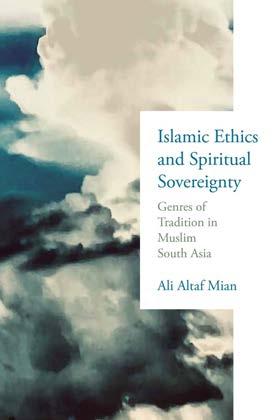
Islamic Ethics and Spiritual Sovereignty
Genres of Tradition in Muslim South Asia
Ali Altaf Mian
Summary
Ali Altaf Mian demonstrates how attention to genre and embodiment illuminates the concepts and practices of the Islamic tradition—and how theologians, Sufi mystics, and ordinary Muslims respond to the incapacitating tribulations of creaturely existence in modernity.
Islamic Ethics and Spiritual Sovereignty is grounded in the vast textual archive of one of modern South Asia’s foremost Muslim theologians and Sufis: Maulānā Ashraf ʿAlī Thānavī (1863–1943). Through a close examination of Maulānā Thānavī’s corpus of writings, Ali Altaf Mian offers new insights into tradition as a discursive and affective crucible of ethical transformation and spiritual sovereignty.
Philologically attuned and philosophically oriented, Islamic Ethics and Spiritual Sovereignty elucidates connections between traditions’ forms of life and forms of language. Mian shows how intended and unconscious movements between genres in the life of tradition attend to the felt and perceived needs of the ensouled body at the dual scales of singularity and collectivity. Through a novel attention to textuality and psychic life, Mian elaborates a trans-genre reading practice to appreciate ritual law and ethical agency in the modern world. Insofar as modernity has been about individualism, the rise of literalism, and the disciplining of desire, religious traditions’ capacity to respond to these hardships depends on renewing community, engaging textuality and the play of genres, and bracing the unknowability of desire.
Contributor Bio
Ali Altaf Mian is the Izzat Hasan Sheikh Fellow in Islamic Studies and assistant professor of religion at the University of Florida. He is the author of many peer-reviewed articles and book chapters on Islam in South Asia, Sufi thought and practice, Hadith studies, Islamic philosophy, critical theory, and psychoanalysis.
Quotes
“Islamic Ethics and Spiritual Sovereignty is an insightful and textured case study of embodied, affective, and transformative elements of the religious tradition. The book opens up new avenues, not only in the study of Islam and modernity, but in broader dimensions of comparative religions and cultures.” —Marcia Hermansen, co-editor of Varieties of American Sufism
“This book is unmatched in the breadth of its engagement with Ashraf ʿAlī Thānavī’s vast oeuvre and in its sophistication. Mian has provided us with an extraordinarily vivid sense of how the constraints of particular genres shape articulations of the Islamic tradition and what it has meant to inhabit and experience that tradition in conditions of modernity.” —Muhammad Qasim Zaman, author of Islam in Pakistan
9780268210946
Pub Date: 2/15/2026
$65.00
Discount Code: x
296 Pages 9 in H | 6 in W
History / Europe
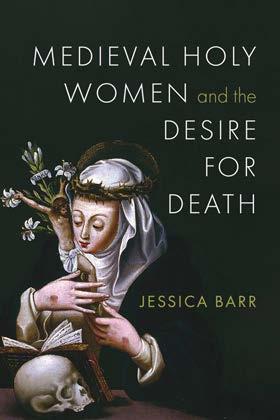
Medieval Holy Women and the Desire for Death
Jessica Barr
Summary
Medieval Holy Women and the Desire for Death investigates the tension between death as necessary for bringing about union with God and as the end of life on earth.
For medieval Christians, only death could offer complete union with God. For medieval women in particular, death was figured as a desirable end to their embodied lives; at least, this is the story told by the clergymen who typically wrote their biographies. Medieval Holy Women and the Desire for Death questions this assumption and studies visionary narratives, treatises, and spiritual reflections by and about medieval Christian women from the thirteenth through the fifteenth centuries to reveal how these women understood their own deaths and how their depictions conformed to or departed from the stories told about them.
Rather than focusing on externalities like rituals, revenants, or miracles, Jessica Barr instead tackles the desire for death from the inside, seeking to elucidate the ways in which medieval people anticipated or experienced biological death on a personal level. In narrating their spiritual lives within the framework of deeply held Christian beliefs, these medieval women mystics illustrate how theology and experience converge—and, not infrequently, diverge.
Contributor Bio
Jessica Barr is a professor of comparative literature at the University of Massachusetts Amherst. She is the author of Willing to Know God and Intimate Reading and co-editor of the Journal of Medieval Religious Cultures.
Quotes
“Through this book, the dead whisper to the living. Jessica Barr’s artful and effective scholarship shows us that medieval Christianity offered no simple answers, and that medieval Christians’ relationship with death could be as fraught with anxiety, pain, uncertainty, longing, and hope as our own.” —Karen A. Winstead, author of Fifteenth-Century Lives
“This erudite book bridges the centuries that separate the modern reader from these women’s lives, addressing something that we still have in common despite that distance: We all will die. How do we approach that death? Where is the meaning therein?” —Jennifer N. Brown, author of Fruit of the Orchard
9780268210595
Pub Date: 3/15/2026
$45.00
Discount Code: x Paperback
346 Pages 9 in H | 6 in W
Poetry / Medieval
Series: The William and Katherine Devers Series in Dante and Medieval Italian Literature
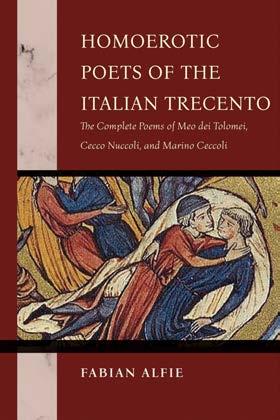
Homoerotic Poets of the Italian Trecento
The Complete Poems of Meo dei Tolomei, Cecco Nuccoli, and Marino Ceccoli Fabian Alfie
Summary
Homoerotic Poets of the Italian Trecento explores same-sex desire in the work of three skilled medieval Italian poets, bringing their verse and expression to English readers.
Thirteenth- and fourteenth-century Italy produced a wide range of literature, from the courtly love of the Sicilian School, to the spiritualized love of the dolce stil nuovo and Dante, to the comic poetry that flourished with authors such as Cecco Angiolieri and Folgore da San Gimignano. Author Fabian Alfie, through his translations of these poets, shows how this cultural context allowed three medieval Italian poets—Meo dei Tolomei, Cecco Nuccoli, and Marino Ceccoli—to openly discuss their sexual relationships with other men in their own poetic verse. These three poets adapted the languages of comic literature and courtly love to the new topic of homoeroticism. The result is a unique form of poetics that blended traditional expressions with innovative material.
While homoerotic subtexts in the canonical works are often highlighted in the scholarship, the expression of same-sex desire ran deeper and was more prominent than in those works alone. For these poets, same-sex desire is not the subtext to their verse—it is the text itself. Through their poems, presented in facing Italian/English format, we are given a glimpse into the range of sexual attraction available to men in medieval Italy.
Contributor Bio
Fabian Alfie is a professor of Italian at the University of Arizona. He is the author and editor of several books on the satires of the Middle Ages and Renaissance, including Comedy and Culture: Cecco Angiolieri’s Poetry and Late Medieval Society
Quotes
“A fascinating and rich body of lyric little-known in general and even less in the English-speaking world.” —Gary P. Cestaro, author of Dante and the Grammar of the Nursing Body
“Alfie’s translations are exceptional. He admirably captures the expressionistic tension, the lively realism, and the vernacular traits of the original language.” —Roberto Rea, editor of Guido Cavalcanti’s Rime
9780268210670
Pub Date: 4/15/2026
$45.00
Discount Code: x Hardcover
228 Pages
32 color illustrations
9 in H | 6 in W
History / Europe
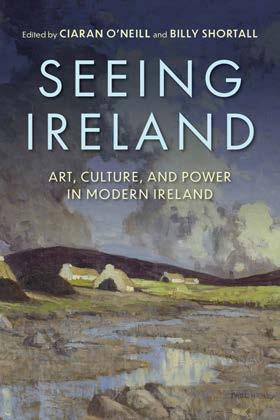
Seeing Ireland
Art, Culture, and Power in Modern Ireland
Ciaran O’Neill (editor), Billy Shortall (editor), Joe Cleary (foreword)
Summary
Prompted by the centennial commemoration of the 1922 Paris Exposition d’Art Irlandais, Seeing Ireland explores the intersection of art and politics in the century that followed.
While the Irish Revival of the late nineteenth and the early twentieth century is often associated with literary figures such as Joyce and Yeats, Seeing Ireland’s focus on visual arts sheds new light on a pivotal era of Irish cultural and national development. The collection explores the 1922 Paris diaspora congress and its associated art exhibition, the development of an Irish school of art, official visual representations of post-independence Ireland, and the continuing intermingling of art and the state in subsequent decades The Paris exhibition happened at a pivotal moment in Ireland’s history, and the administration used Irish art to present a self-defined identity of the new state on the world stage for international consumption. This collection reflects on that event and on the recent Decade of Centenaries commemoration of the Irish revolutionary period.
Academics and practicing artists alike contribute thought-provoking analyses of the exposition, Irish visual culture, and Irish diaspora politics. The collection ends with an exploration of the constantly negotiated relationship among the state, the arts, and memory.
Contributor Bios
Ciaran O’Neill is associate professor of nineteenth-century history at Trinity College Dublin. He is the co-director of the Trinity Colonial Legacies Project. His most recent books include Power and Powerlessness in Union Ireland and Ireland, Slavery and the Caribbean (co-edited with Finola O’Kane).
Billy Shortall is a research fellow at the Irish Art Research Centre, Trinity College Dublin, and co-developed a virtual re-creation and art exhibition of the 1922 Paris World Congress (www.seeingireland.ie). He recently contributed chapters to the Routledge Companion to Irish Art and Hilary Heron, A Retrospective.
Quotes
“A superb collection of essays, this book makes a highly original contribution to the study of Irish art.” —Diarmuid Ó Giolláin, author of Exotic Dreams in the Science of the Volksgeist
“This is a work of high scholarly exigency which will be precious to anyone who wants to know more about the role played by visual art in the definition of a national identity or to find out more about Ireland’s greatest post-independence artists.”
—Sylvie Mikowski, co-editor of The Book in Ireland
“This is the first Irish art history book to set out all the disparate discourses and conflicting claims about national identities aired by politicians, artists, writers, and cultural thinkers at the Irish Race Congress in Paris in 1922 and to examine how contemporary Ireland deals with those expectations in a very different context.”
—Catherine Marshall, co-editor of Art and Architecture of Ireland
9780268101947
Pub Date: 1/15/2026
$25.00
Discount Code: s Paperback
156 Pages 9 in H | 6 in W
History / United States
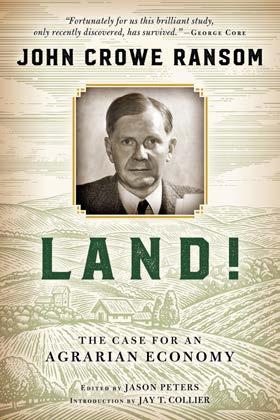
Land!
The Case for an Agrarian Economy
John Crowe Ransom, Jason Peters (editor)
New in Paperback
Previously unpublished, Land! unites John Crowe Ransom’s poetic sensibilities with his argument for an agrarian economy as an alternative to capitalism.
In Land!, the accomplished poet and scholar John Crowe Ransom, leading member of the Southern Agrarian movement, examines economics at the height of the Great Depression. Long thought to have been burned by its author after he failed to find a publisher, Land! is politically charged with Ransom’s aesthetic beliefs about literature and his agrarian interpretation of economics.
After the publication of the Southern Agrarian movement’s manifesto I’ll Take My Stand in 1930, Ransom, who provided the book’s Statement of Principles in addition to its lead essay, became convinced that the book had not adequately proposed an economic alternative to Northern industrialism, which had nearly obliterated the Southern way of life. Land! was Ransom’s attempt to fill this gap. In it he presents the weaknesses inherent in capitalism and argues convincingly that socialism is not only an inadequate alternative but inimical to American sensibilities. He proposes instead that agrarianism, which could flourish alongside capitalism, would relieve the problems of unemployment in America due to its wealth of land. This insightful, long-lost piece of American literature and history speaks to today’s socioeconomic times.
Contributor Bios
John Crowe Ransom (1888–1974) was an American poet and critic whose book The New Criticism (1941) provided the name of the influential mid-twentieth-century school of criticism. He taught English at Vanderbilt University and at Kenyon College, where he founded and edited the literary magazine The Kenyon Review He published numerous volumes of poetry, including Selected Poems (1945, 1969), which won a National Book Award.
Jason Peters is associate professor of English at Hillsdale College and is a founding member of Front Porch Republic.
Quotes
“Land!: The Case for an Agrarian Economy was written in the 1930s by the distinguished poet and critic John Crowe Ransom and only recently rediscovered and edited by Jason Peters for Notre Dame Press. In it Ransom joins Lauck in championing the values fostered by rural and small-town America. Is this just wishful thinking? Perhaps, and yet don’t we sometimes need to step back before we can leap forward?”
The Washington Post
“The modern reader cannot help but be struck by the current timeliness of Ransom’s observations about rootless people condemned as cogs in an economic wheel, liable to be cast aside when they no longer serve the purpose of the moment. Meanwhile, the flight from the farm has continued unabated for nearly a century, while the inherent problems of industrial capitalism that Ransom observed remain.” —The Abbeville Review
“In Land!, his classic statement of agrarian economic thought, John Crowe Ransom offered a trenchant critique of capitalism. Writing in the early 1930s, at the onset of the worst economic crisis in American history, Ransom proposed not only a return to the land but also a retreat from the market as the surest means of ending unemployment. . . . In questioning the progressive ideologies that still enthrall liberals and conservatives alike with visions of inexhaustible power and relentless growth, Ransom . . . affirmed the goodness of life without also disavowing its tragedy. [This] is a legacy not of alluring though unsustainable expansion and wealth but of humane limits and durable hope.” —The University Bookman
9780268201869
Pub Date: 1/15/2026
$30.00
Discount Code: t Paperback
560 Pages
47 b&w illustrations, 4 maps 9 in H | 6 in W
History / Wars & Conflicts
More Precious than Peace
A New History of America in World War I
Justus D. Doenecke
New in Paperback
Justus D. Doenecke’s monumental study covers diplomatic, military, and ideological aspects of U.S. involvement as a full-scale participant in World War I.
The entry of America into the “war to end all wars” in April 1917 marks one of the major turning points in the nation's history. In the span of just nineteen months, the United States sent nearly two million troops overseas, established a robust propaganda apparatus, and created an unparalleled war machine that played a major role in securing Allied victory in the fall of 1918. At the helm of the nation, Woodrow Wilson and his administration battled against political dissidence, domestic and international controversies, and their own lack of experience leading a massive war effort.
In More Precious than Peace, the long-awaited successor to his critically acclaimed work Nothing Less than War, Justus D. Doenecke examines the entirety of the American experience as a full-scale belligerent in World War I. This book covers American combat on the western front, the conscription controversy, and scandals in military training and production. Doenecke explores the Wilson administratio’s quest for national unity, the Creel Committee, and “patriotic” crusades. Weaving together these topics and many others, including the U.S. reaction to the Russian revolutions, Doenecke creates a lively and comprehensive narrative.
Contributor Bio
Justus D. Doenecke is professor emeritus of history at New College of Florida. He is the author of numerous books, including Storm on the Horizon: The Challenge to American Intervention, 1939–1941, winner of the Herbert Hoover Book Award, and Nothing Less than War: A New History of America’s Entry into World War I.
Quotes
“[More Precious than Peace] offers well-chosen anecdotes to bring wartime debates to life . . . an enjoyable read.” Journal of Military History
“Justus Doenecke is a reliable and stimulating expositor and interpreter of the history of the United States in the crucial era of World War I.” Anglican and Episcopal History
“Justus Doenecke’s depth of research and knowledge of secondary sources covering the early 20th century in the U.S. greatly strengthens this book, More Precious Than Peace.” Naval Historical Foundation
9780268207243
Pub Date: 1/15/2026
$30.00
Discount Code: x Paperback
212 Pages 9 in H | 6 in W
Political Science / American Government
American Presidents in Diplomacy and War Statecraft, Foreign Policy, and Leadership
Thomas R. Parker
New in Paperback
By analyzing how America’s greatest presidents displayed their mastery of statecraft, American Presidents in Diplomacy and War offers important lessons about the most effective uses of national power abroad.
American Presidents in Diplomacy and War chronicles the major foreign policy crises faced by twelve American presidents in order to uncover the reoccurring patterns of successful and less successful uses of diplomatic, economic, and military power. In this succinct and highly readable book, Thomas R. Parker reveals how America’s most successful leaders manage events instead of allowing events to control them.
Parker explores how the U.S. presidency, from the days of the early Republic to the present, shaped the world. Ranging from George Washington to George H. W. Bush, Parker shows how successful statecraft requires the understanding of complex situations, the prudent evaluation of various courses of action, the ability to adapt and to anticipate, and personal determination. Parker compares each of these leaders to their contemporaries—reasonable political leaders who nonetheless made serious mistakes, such as Thomas Jefferson and Barack Obama—to examine the dangers of being unable to strike the right balance of aggressiveness and caution and to examine the costs of inexperience and ambivalence toward military power. The book concludes by discussing the increasingly complex international situation of today, particularly the manifold challenges posed by China and Russia to U.S. foreign policy, and the continued necessity of effective statecraft.
Contributor Bio
Thomas R. Parker is a professorial lecturer at George Washington University and author of The Road to Camp David. He worked for thirty years in diplomatic and military affairs for the White House, U.S. Defense Department, State Department, and the intelligence community.
Quotes
“An enlightening and insightful assessment of the foreign policy statecraft of several American presidents.” New York Journal of Books
“American Presidents in Diplomacy and War: Statecraft, Foreign Policy, and Leadership serves up a set of case studies in the exercise of American power by US presidents, offering food for thought to students, scholars, and policymakers about the psychological dynamics of foreign policy decisions by presidents from Washington to Obama.” —H-Diplo
“This is an interesting read, packed with insight. Students at all levels and general readers will find it a useful counter to the simplistic soundbite pontifications of many contemporary aspirants for political leadership.” —Choice
9780268203757
Pub Date: 1/15/2026
$35.00
Discount Code: x Paperback
368 Pages 9 in H | 6 in W
Political Science / Political Ideologies
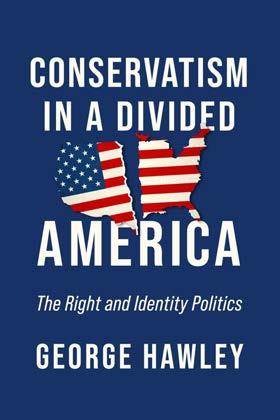
Conservatism in a Divided America
The Right and Identity Politics
George Hawley
New in Paperback
George Hawley, who has written extensively on conservatism and right-wing ideologies in the United States, presents a telling portrait of conservatism’s relationship with identity politics.
The American conservative movement has consistently declared its opposition to all forms of identity politics, arguing that such a form of politics is at odds with individualism. In this persuasive study, George Hawley examines the nature of identity politics in the United States: how conservatives view and understand it, how they embrace their own versions of identity, and how liberal and conservative intellectuals and politicians navigate this equally dangerous and potentially explosive landscape.
Hawley begins his analysis with a synopsis of the variety both of conservative critiques of identity politics and of conservative explanations for how it has come to define America’s current political terrain. This historical account of differing conservative approaches to identitarian concerns from the post-war era until today—including race, gender, and immigration—foregrounds conservatism’s lack of consistency in its critiques and ultimately its failure to provide convincing arguments against identity politics. Hawley explores the political right’s own employment of identity politics, particularly in relation to partisan politics, and highlights how party identification in the United States has become a leading source of identity on both sides of the political spectrum. Hawley also discusses this generation’s iteration of American white nationalism, the Alt-Right, from whose rise and fall conservatism may develop a more honest, realistic, and indeed relevant approach to identity politics.
Contributor Bio
George Hawley is associate professor of political science at the University of Alabama. He is the author of a number of books, including The Moderate Majority, Making Sense of the Alt-Right, and Right-Wing Critics of American Conservatism
Quotes
“[Hawley’s] engaging intellectual and social scientific tour de force helps the reader grasp how the new generation of conservatives and classical liberals is building on the foundations laid by previous generations.” Law & Liberty
“[Hawley] builds a scrupulous case. This has the power to change minds.”
Publishers Weekly
“This is one of the most comprehensive, data driven looks at modern conservatism written in the past decades, an amazing addition to a stellar career.” —Maiseh Review
9780268207366
Pub Date: 1/15/2026
$50.00
Discount Code: x Paperback
530 Pages
9 in H | 6 in W
Religion / Islam
Political Theology and Islam
From the Birth of Empire to the Modern State
Paul L. Heck
New in Paperback
Paul L. Heck’s Political Theology and Islam offers a sophisticated and comprehensive analysis of sovereignty in Islamic society, beginning with the origins of Islam and extending to the present.
This wide-ranging study sets out to answer an unassumingly tricky question: What is politics in Islam? Paul L. Heck’s answer takes the form of a close analysis of sovereignty across Islamic history, approaching this concept from the perspective of political theology. As he illustrates, the history of politics in Islam is best understood as an ongoing struggle for a moral order between those who occupy positions of rulership and religious voices that communicate the ethics of Islam and educate the public in their religious and moral devotions. In this sense, sovereignty in Islam is split between ruling powers and pious communities, whose interactions range from close cooperation to outright competition. Heck shows that it is precisely through these interactions that Islamic conceptions of sovereignty are constructed and negotiated.
Political Theology and Islam’s first section spells out the concepts and methods for the study of politics in Islam as a struggle for a moral order, one not only involving varied claims to sovereignty but also a general determination to realize the righteousness of Islam that stands at the heart of the message that the Prophet Muhammad conveyed to his society in seventh-century Arabia. The following sections demonstrate, through examples from both the past and today’s worldwide Muslim community, the diverse ways in which the umma, the community of Muslims, has struggled for a moral order that recalls its prophetic message. Deftly moving in various political theaters and through a wide range of intellectual traditions, Heck’s book will emerge as a touchstone of scholarship in the field of Muslim politics and intellectual thought.
Contributor Bio
Paul L. Heck is professor of Islamic studies at Georgetown University and founding director of the Study of Religions Across Civilizations (SORAC) project. He is author of Skepticism in Classical Islam: Moments of Confusion and Common Ground: Islam, Christianity, and Religious Pluralism
Quotes
“This monumental work is the fruit of a lifetime of outstanding scholarship on Islam. Paul Heck offers a magisterial overview and vivid interpretation of Islamic political theology from its inception until today.” Islamochristiana
“Paul L. Heck’s ambitious work provides a stimulating and significant Tocquevillian engagement with the meaning of politics across the entire sweep of Islamic history.” Journal of Islamic Studies
9780268206925
Pub Date: 5/15/2026
$40.00
Discount Code: x Paperback
286 Pages 9 in H | 6 in W
Political Science / History & Theory
Series: Catholic Ideas for a Secular World
The Disintegrating Conscience and the Decline of Modernity
Steven D. Smith
New in Paperback
This book considers how the modern concept of “conscience” turns the historic commitment on its head, in a way that underlies the decadence of modern society.
Steven D. Smith’s books are always anticipated with great interest by scholars, jurists, and citizens who see his work on foundational questions surrounding law and religion as shaping the debate in profound ways. Now, in The Disintegrating Conscience and the Decline of Modernity, Smith takes as his starting point Jacques Barzun’s provocative assertion that “the modern era” is coming to an end. Smith considers the question of decline by focusing on a single theme—conscience—that has been central to much of what has happened in Western politics, law, and religion over the past half-millennium. Rather than attempting to follow that theme step-by-step through five hundred years, the book adopts an episodic and dramatic approach by focusing on three main figures and particularly portentous episodes: first, Thomas More’s execution for his conscientious refusal to take an oath mandated by Henry VIII; second, James Madison’s contribution to Virginia law in removing the proposed requirement of religious toleration in favor of freedom of conscience; and, third, William Brennan’s pledge to separate his religious faith from his performance as a Supreme Court justice. These three episodes, Smith suggests, reflect in microcosm decisive turning points at which Western civilization changed from what it had been in premodern times to what it is today. A commitment to conscience, Smith argues, has been a central and in some ways defining feature of modern Western civilization, and yet in a crucial sense conscience in the time of Brennan and today has come to mean almost the opposite of what it meant to Thomas More. By scrutinizing these men and episodes, the book seeks to illuminate subtle but transformative changes in the commitment to conscience —changes that helped to bring Thomas More’s world to an end and that may also be contributing to the disintegration of (per Barzun) “the modern era.”
Contributor Bio
Steven D. Smith, winner of the 2022 Religious Liberty Initiative Scholarship Award, is formerly the Warren Distinguished Professor of Law, co-executive director of the Institute for Law and Religion, and the co-executive director of the Institute for Law and Philosophy at the University of San Diego. He is the author of numerous books including The Godless Constitution and the Providential Republic and Fictions, Lies, and the Authority of Law
Quotes
“This book highlights the enormity, complexity, resilience, danger, disenchantment and importance that accompany matters of conscience, which in turn are inextricably connected to the relationship between law, religion and the state. It offers a novel and convincing defence of conscience as understood both in the context of the pre-modern West and by religious communities and traditions in the modern era.” —International Journal for Religious Freedom
“Appearing in the Notre Dame series ‘Catholic Ideas for a Secular World,’ the basic disposition of Smith’s book will not surprise readers. He has long grappled with the challenge of faithfully adjusting Christian conviction to a political and legal regime once friendly but increasingly hostile. To those, like the present reviewer, sympathetic to this project, his books are trenchant and compelling. Those less sympathetic would also do well to read them as judicious but uncompromising challenges to the regnant academic pieties of the moment.” Review of Politics
9780268208226
Pub Date: 5/15/2026
$40.00
Discount Code: x Paperback
404 Pages 9 in H | 6 in W
Philosophy / Political
Series: Center for Citizenship and Constitutional Government Series
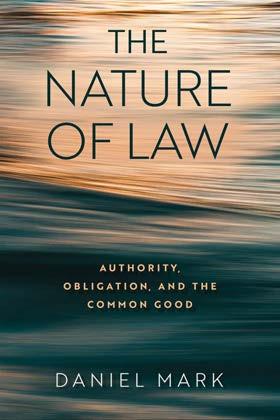
The Nature of Law Authority,
Obligation, and the Common Good
Daniel Mark
New in Paperback
Challenging the prevailing understanding of the authority of law, Daniel Mark offers a theory of moral obligation that is rooted both in command and in the law’s orientation to the common good.
When and why do we have an obligation to obey the law? Prevailing theories in the philosophy of law, starting with the work of H. L. A. Hart and Joseph Raz, fail to provide definitive answers regarding the nature of legal obligation. In this highly original and effective new work, Daniel Mark argues that there is a prima facie moral obligation to obey the law simply because it is the law. In Mark’s view, the best concept of law—one that allows for the possibility of justified authority and obligation—defines law as a set of commands oriented to the common good. Legal obligation, he proposes, shares defining features with moral obligation and with religious obligation while aligning wholly with neither.
This philosophically coherent view of legal obligation offers a viable framework for analyzing important and seemingly paradoxical puzzles about the law, such as why civil disobedience is punished as lawbreaking or why war-crimes trials for legal but immoral acts present a moral quandary. By reconciling the concept of law as command with the role of law in promoting the common good, The Nature of Law provides an original and important scholarly contribution to the fields of legal philosophy and political thought.
Contributor Bio
Daniel Mark is an associate professor in the Department of Political Science at Villanova University, where he is also battalion professor for the Navy ROTC program. He is formerly the chairman of the United States Commission on International Religious Freedom.
Quotes
“[A] comprehensive and expert treatment. . . . [One hopes] that The Nature of Law is but the first in a series of works from Mark that will further elucidate law and all of its complexity and importance for the common good and individual human flourishing.” Reading Wheel Review
“Mark provides an intriguing and intelligent proposal, one that prompts the reader’s hesitation, objection, argument, and reflection, which makes this a very good book indeed.” Religion & Liberty
“The Nature of Law is a highly valuable contribution to general jurisprudence and natural law theory. Mark’s emphasis on the role of commands in explaining the law’s distinctive normativity is both thought-provoking and, in my view, a step in the right direction.” —Jurisprudence
9780268207816
Pub Date: 6/15/2026
$45.00
Discount Code: x Paperback
386 Pages 9 in H | 6 in W
Philosophy / Political
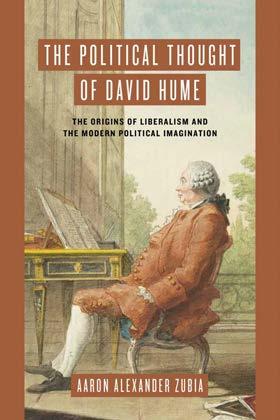
The Political Thought of David Hume
The Origins of Liberalism and the Modern Political Imagination
Aaron Alexander Zubia
New in Paperback
Aaron Alexander Zubia argues that the Epicurean roots of David Hume’s philosophy gave rise to liberalism’s unrelenting grip on the modern political imagination.
Eighteenth-century Scottish philosopher David Hume has had an outsized impact on the political thinkers who came after him, from the nineteenth-century British Utilitarians to modern American social contract theorists. In this thorough and thoughtful new work, Aaron Alexander Zubia examines the forces that shaped Hume’s thinking within the broad context of intellectual history, with particular focus on the ancient Greek philosopher Epicurus and the skeptical tradition.
Zubia argues that through Hume’s influence, Epicureanism—which elevates utility over moral truth—became the foundation of liberal political philosophy, which continues to dominate and limit political discourse today.
Contributor Bio
Aaron Alexander Zubia is assistant professor of humanities at the University of Florida. His work has appeared in the Wall Street Journal, National Review, Political Theory, Interpretation: A Journal of Political Philosophy, and Law & Liberty.
Quotes
“Aaron Zubia has written the next great book on David Hume. The conventionallytitled book—The Political Thought of David Hume: The Origins of Liberalism and the Modern Political Imagination—is unconventional in its framing, brilliant in its methods, morally serious in its ambitions, and deeply philosophic in its orientation.” Law & Liberty
“Zubia argues that Hume’s Epicurean orientation helped to shape the modern liberal way of life, culminating in Rawlsian political liberalism that seeks to purge discussion of moral ends from public discourse.” —Times Literary Supplement
“Aaron Alexander Zubia has given us a superb account of the true nature of Hume’s political philosophy, and a salutary reminder to conservatives to think twice about what it is they are conserving.” The Claremont Review of Books
9780268208080
Pub Date: 6/15/2026
$45.00
Discount Code: x Paperback
356 Pages
24 b&w illustrations, 21 tables 9 in H | 6 in W
Political Science / Comparative Politics
Series: Kellogg Institute Series on Democracy and Development
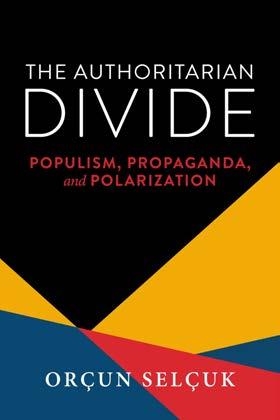
The Authoritarian Divide
Populism, Propaganda, and Polarization
Orçun Selçuk
New in Paperback
In the context of the global decline of democracy, The Authoritarian Divide analyzes the tactics that populist leaders in Turkey, Venezuela, and Ecuador have used to polarize their countries.
Political polarization is traditionally viewed as the result of competing left/right ideologies. In The Authoritarian Divide, Orçun Selçuk argues that, regardless of ideology, polarization is driven by dominant populist leaders who deliberately divide constituents by cultivating a dichotomy of inclusion and exclusion. This practice, known as affective leader polarization, stymies compromise and undermines the democratic process.
Drawing on multiple qualitative and quantitative methodologies for support, as well as content from propaganda media such as public speeches, Muhtar Meetings, Aló Presidente, and Enlace Ciudadano, Selçuk details and analyzes the tactics used by three well-known populist leaders to fuel affective leader polarization: Recep Tayyip Erdoğan in Turkey, Hugo Chávez in Venezuela, and Rafael Correa in Ecuador. Selçuk’s work provides a rubric for a better understanding of—and potential defense against—the rise in polarizing populism across the globe.
Contributor Bio
Orçun Selçuk is an associate professor of political science and the director of the international studies program at Luther College.
Quotes
“The Authoritarian Divide's major contribution is the rich description and discussion of the inclusionary and exclusionary discourse of Chavez, Erdoğan, and Correa. . . . [Selçuk’s] book provides a rich resource for our greater understanding of the operation of populism in power.” —Democratization
“The Authoritarian Divide presents a powerful and timely framework for understanding contemporary debates on polarization, populism, and democratic decline. . . . Selçuk’s work not only deepens existing understanding of polarization and personalist rule but also opens new avenues for research about the durability of polarization, its consequences for democratic rule, and opposition behavior, all of which are increasingly important in an era of democratic erosion.” —Latin American Politics and Society
9780268205751
Pub Date: 2/15/2026
$35.00
Discount Code: x Paperback
214 Pages 9 in H | 6 in W
Religion / Christian Theology
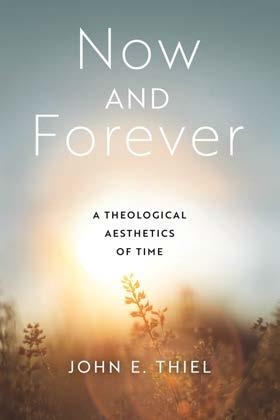
Now and Forever A Theological Aesthetics of Time
John E. Thiel
New in Paperback
Building on the insights of the ressourcement theology of grace, this sophisticated theological aesthetics offers a fresh vision of the doctrine of creation through a consideration of the beauty of time.
Conventional eschatological accounts of life after death tend to emphasize the discontinuity between earthly life and the hereafter: whereas this life is subject to the contingencies of time, life after death is characterized by a stolid eternity. In contrast to this standard view, John E. Thiel’s Now and Forever articulates a Catholic eschatology in which earthly life and heavenly life are seen as gracefully continuous.
This account offers a reconceptualization of time, which, Thiel argues, is best understood as the sacramental medium of God’s grace to creation. Thiel’s project thus attempts to rescue time from its Platonically negative resonance in the doctrine of creation. Rather than viewing time as the ambiance of sinful dissolution, Thiel argues for a Christian vision of time’s beauty, and so explicitly develops an aesthetics that views time as a creaturely reflection of God’s own Trinitarian life. This thesis proceeds from the assumption that all time is eschatological time and is thus guided by attention to the temporality implicit in the virtue of hope, with its orientation toward a fulfilled future that culminates in resurrected life. This interpretation of the beauty of eschatological time in its widest expanse presses further the insight of ressourcement theology that grace is everywhere, while appreciating how time’s graceful beauty manifests itself in the diversity of temporal moments, human communities, and most fully in the heavenly communion of the saints.
Contributor Bio
John E. Thiel is the Aloysius P. Kelley, S.J. Professor of Catholic Studies, Emeritus, Fairfield University. He is the author of seven books, including the award-winning Icons of Hope: The “Last Things” in Catholic Imagination (University of Notre Dame Press, 2013).
Quotes
“Now and Forever extends an abundant but no less accessible vision of graced time, time that draws human beings further up and further in to the joyful eventfulness of God’s divine self-sharing.” —Theological Studies
“As befits an exercise in theological aesthetics, Now and Forever is elegantly argued, and those whose theology lives in symbiosis with a preaching and pastoral ministry will find many well-turned phrases with which to inform their practice.” —The Heythrop Journal
“As its title indicates, John E. Thiel’s Now and Forever: A Theological Aesthetics of Time will be found most relevant by scholars who have closely followed the recent surge of interest in two theological topics: the relevance of aesthetics for the study of religion and the place of temporality in philosophical theology.” —Journal of Religion
9780268205638
Pub Date: 2/15/2026
$35.00
Discount Code: x Paperback
208 Pages
4 color illustrations
9 in H | 6 in W
Religion / Christianity
Series: Catholic Ideas for a Secular World
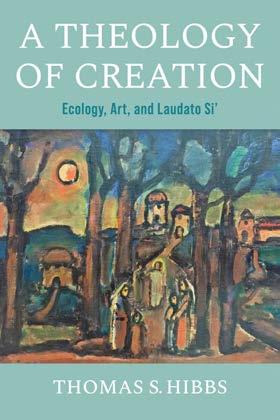
A Theology of Creation
Ecology, Art, and Laudato Si'
Thomas S. Hibbs
New in Paperback
This book provides the first sustained philosophical treatment of Pope Francis’s Laudato Si’ and articulates a theology of creation to recover our place within the cosmos.
In the encyclical Laudato Si’, Pope Francis discerns beneath the imminent threat of ecological catastrophe an existential affliction of the human person, who is lost in the cosmos, increasingly alienated from self, others, nature, and God. Pope Francis suggests that one must reimagine humanity’s place in the created cosmos. In this ambitious and distinctive contribution to theological aesthetics, Thomas S. Hibbs provides the basis for just such a recovery, working from Laudato Si' to develop a philosophical and theological diagnosis of our ecological dislocation, a narrative account of the sources of the crisis, and a vision of the way forward.
Through a critical engagement with the artistic theory of Jacques Maritain, Hibbs shows how certain strains of modern art both capture our alienation and anticipate visions of recovered harmony among persons, nature, and God. In the second half of the book, in an attempt to fulfill Pope Francis’s plea for an “aesthetic education” and to apply and test Maritain’s theory, Hibbs examines the work of poets and painters. He analyzes the work of poets Robinson Jeffers and William Everson, and considers painters Georges Roualt, a friend to Maritain, and Makoto Fujimura, whose notion of “culture care” overlaps in suggestive ways with Francis’s notion of integral ecology.
Throughout this tour de force, Hibbs calls for a commitment to an “ecological poetics,” a project that responds to the crisis of our times by taking poets and painters as seriously as philosophers and theologians.
Contributor Bio
Thomas S. Hibbs is the J. Newton Rayzor Sr. Professor of Philosophy at Baylor University, where he is also dean emeritus, having served sixteen years as dean of the Honors College and distinguished professor of ethics and culture. He is the author and editor of eight books, including Wagering on an Ironic God: Pascal on Faith and Philosophy
Quotes
“A powerful and timely work. [Hibbs] demonstrates the power of authentic art for encouraging and sustaining a humane and ecologically conscious faith in our ecologically fraught time.” —Reading Religion
“Thomas Hibbs takes seriously the dire realities of the climate crisis and Pope Francis’ urgent invitation for an aesthetic education that cultivates receptivity to the beauty of the cosmos and thereby offers a remedy for modernity's reification of nature.”
Theology Today
9780268207601
Pub Date: 1/15/2026
$45.00
Discount Code: x Paperback
284 Pages 9 in H | 6 in W
Philosophy / Ethics & Moral Philosophy
Contemporary Aristotelian Ethics
Alasdair MacIntyre, Martha Nussbaum, Robert Spaemann
Arthur Madigan, S.J.
New in Paperback
This volume provides a thorough introduction to three of the twentieth century’s most influential proponents of Aristotle’s moral philosophy.
Arthur Madigan’s Contemporary Aristotelian Ethics examines the work of Alasdair MacIntyre, Martha Nussbaum, and Robert Spaemann in the context of twentiethcentury Anglo-American moral philosophy. By surveying the ways in which these three philosophers appropriate Aristotle, Madigan illustrates two important points: first, that the most pressing problems in contemporary moral philosophy can be addressed using the Aristotelian tradition and, second, that the Aristotelian tradition does not speak with one voice. Madigan demonstrates that Aristotelian moral philosophy is divided on important issues, such as the value of liberal modernity, the character and provenance of our current moral landscape, and the role of nature in Aristotle’s ethics.
Through his examination of MacIntyre, Nussbaum, and Spaemann, Madigan offers a vision for the future of Aristotelian moral philosophy, urging today’s philosophers to set a clear educational agenda, to continue refining their concepts and intuitions, and to engage with new conversation partners from other philosophical traditions.
Contributor Bio
Arthur Madigan, S.J., is professor emeritus of philosophy at Boston College. He is the author and translator of many books and essays about Greek philosophy, including Aristotle’s Metaphysics: Books B and K 1–2
Quotes
“This structure is ideal for use in college courses. The clarity of Madigan’s writing enables readers unfamiliar with these philosophers to firmly grasp the essentials of their thought. The discussion of these philosophers in relation to Anglo-American moral philosophy and the current state of Aristotelian philosophy also make it interesting to experts.” —Choice
“Madigan succeeds in his goal of showing that contemporary Aristotelian approaches do not speak with one voice. . . . This clear book can be valuable for those in the study of religious ethics.” —Reading Religion
9780268205546
Pub Date: 2/15/2026
$45.00
Discount Code: x Paperback
280 Pages 9 in H | 6 in W
Religion / Christian Theology
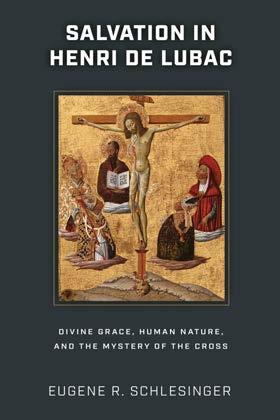
Salvation in Henri de Lubac
Divine Grace, Human Nature, and the Mystery of the Cross
Eugene R. Schlesinger
New in Paperback
This study provides a compelling account of the major works of Henri de Lubac, one of the most influential theologians of the twentieth century, and argues that soteriology provides a lens through which their inner unity can be discerned.
The writings of Henri de Lubac have left an indelible mark on Catholic theology, preparing the ground for, giving shape to, and explaining the seminal event of twentieth-century Catholicism: the Second Vatican Council. Like the Council itself, though, de Lubac remains a contested figure, difficult to classify.
Salvation in Henri de Lubac presents an overview of de Lubac’s major works in light of his own statements that a mystical vision animated them all. De Lubac’s mystical theology hinges upon a vision of salvation, understood as humanity’s incorporation into the triune God through the cross and resurrection of the incarnate Christ. From his writings on the supernatural and theological epistemology, to his treatments of the spiritual interpretation of Scripture, ecclesiology, sacramental theology, and the theology of history, the mystery of the cross looms large, gathering these disparate topics into one focal center while also allowing their distinct contours to remain. By attending to de Lubac’s work in this light, Eugene R. Schlesinger brings important themes from French language scholarship into the English-speaking conversation and clarifies the nature of de Lubac’s ressourcement. Schlesinger claims that unless we understand de Lubac and his work in light of his own motivations and emphases, we risk distorting his contribution, reducing him to a proxy in the struggle for post-conciliar Catholic self-definition.
Contributor Bio
Eugene R. Schlesinger is an assistant professor in the Department of Religious Studies at Santa Clara University. He is the author of Ruptured Bodies: A Theology of the Church Divided and Sacrificing the Church: Mass, Mission, and Ecumenism.
Quotes
“Schlesinger’s mastery of de Lubac’s corpus and the relevant secondary literature is impressive, and his presentation of de Lubac’s thinking on a variety of subjects are judicious and illuminating. The book belongs on the shelf of any serious student of de Lubac and in the footnotes of de Lubac scholarship for years to come.” Reading Religion
“Schlesinger . . . has written a book that is academically thorough yet at the same time accessible and clearly written. It would provide both an excellent introduction for anyone wanting to find their way into de Lubac’s thought and also a great deal to inform and engage those already familiar with it.” Theology
“Salvation in Henri de Lubac offers an insightful point of entry into de Lubac’s theology and confirms Schlesinger as one of the leading interpreters of de Lubac’s thought.” — The Heythrop Journal
9780268205034
Pub Date: 2/15/2026
$45.00
Discount Code: x Paperback
278 Pages 9 in H | 6 in W
Religion / Christian Theology
Hans Urs von Balthasar’s Theology of Representation God,
Drama, and Salvation
Jacob
Lett
New in Paperback
This penetrating study makes a case for the centrality of the concept of representation (Stellvertretung) in Hans Urs von Balthasar’s theological project.
How is it possible for Christ to act in the place of humanity? In Hans Urs von Balthasar’s Theology of Representation, Jacob Lett broaches this perplexing soteriological question and offers the first book-length analysis of Balthasar’s theology of representation (Stellvertretung). Lett’s study shows how Balthasar rehabilitates the category of representation by developing it in relationship to the central mysteries of the Christian faith: concerned by the lack of metaphysical and theological foundations for understanding the question above, Balthasar ultimately grounds representation in the trinitarian life of God, making “action in the place of the other” central to divine and creaturely being. Lett not only articulates the centrality of representation to Balthasar’s theological project but also demonstrates that Balthasar’s theology of representation has the potential to reshape discussions in the fields of soteriology, Christology, trinitarian theology, anthropology, and ecclesiology.
This work covers a wide range of themes in Balthasar’s theology, including placial and spatial metaphors, a post-Chalcedonian Christology of Christ’s two wills, and theories of drama. This book is also a text of significant comparative range: Lett considers Balthasar’s key interlocutors (Gregory of Nyssa, Maximus, Aquinas, Przywara, Ulrich, Barth) and expands this base to include voices beyond those typically found in Balthasarian scholarship, including Dietrich Bonhoeffer and Dorothee Sölle. The overall result is a deeply probing presentation of one of Balthasar’s most significant contributions to contemporary theology.
Contributor Bio
Jacob Lett is a senior lecturer in theology and vice principal of academics at Nazarene Theological College.
Quotes
“Lett has demystified a complicated concept and promoted a healthier understanding of the theology of the cross. In addition, he helps us see that the Christian life includes being advocates and champions for others.” Theological Studies
“Lett proves to be a skillful and lucid interpreter of Balthasar’s challenging body of work, while remaining focused on the substantial theological issues that are at stake.” Theology
Studies in the Age of Chaucer is the annual yearbook of the New Chaucer Society, publishing articles on the writing of Chaucer and his contemporaries, their antecedents and successors, and their intellectual and social contexts. More generally, articles explore the culture and writing of later medieval Britain (1200–1500). Each SAC volume also includes an annotated bibliography and reviews of Chaucer-related publications.
Contributor Bios
Michelle Karnes, professor of English at the University of Notre Dame, is the author of Imagination, Meditation, and Cognition in the Middle Ages.
Misty Schieberle is professor of English at the University of Kansas and the author of Feminized Counsel and the Literature of Advice in England, 1380-1500.
MEMBERSHIP:
Studies in the Age of Chaucer is sent annually to all paid members of the New Chaucer Society.
To join, please visit: https://newchaucersociety.org/account/join.
Or write to:
New Chaucer Society Department of English Saint Louis University 3800 Lindell Boulevard
St Louis, MO 63104 USA
Telephone: (314) 520-7067 • Fax: (314) 977-1514
Email: chaucer@slu.edu
INSTITUTIONAL SUBSCRIPTIONS:
For institutional subscription information to the Studies in the Age of Chaucer journal, please contact: University of Notre Dame Press c/o Longleaf Services, Inc. 116 S Boundary Street Chapel Hill, NC 27514-3808
Telephone: 800-848-6224 or 919-966-7449; Fax: 800-272-6817 or 919-962-2704
Email: customerservice@longleafservices.org
All volumes in the collection of Studies in the Age of Chaucer are now back in print and available in WebPDF formats. Starting with Volume 47, epub editions are also available.
The complete journal is also available online through Project MUSE.
Conservative at the Core
A New History of American Conservatism
Allan J. Lichtman
9780268210304
Pub Date: 9/1/2025
$32.00 USD 376 pages Hardcover
The Dignity of Dependence
A Feminist Manifesto
Leah Libresco Sargeant
9780268210335
Pub Date: 10/1/2025
$28.00 USD 232 pages Hardcover
Between Prison and Freedom Memoir of a Soviet Dissident
Alexander Podrabinek, Marian Schwartz (translator), David Satter (foreword)
9780268209650
Pub Date: 8/1/2025
$38.00 USD 448 pages Hardcover
Abortion and America's Churches A Religious History of “Roe v. Wade”
Daniel K Williams
9780268210458
Pub Date: 10/1/2025
$35.00 USD 384 pages Hardcover
The Light of Tabor Toward a Monistic Christology
David Bentley Hart
9780268210410
Pub Date: 9/1/2025
$28.00 USD 150 pages Hardcover
Black and Catholic Racism, Identity, and Religion
Tia Noelle Pratt
9780268210175
Pub Date: 9/1/2025
$35.00 USD 224 pages Hardcover
The Invisible Source of Authority God in a Secular Age
David Walsh
9780268209575
Pub Date: 7/15/2025
$38.00 USD 188 pages Paperback
Body and Identity A History of the Empty Self
Angela Franks
9780268209681
Pub Date: 8/15/2025
$75.00 USD 414 pages Hardcover
April 1917
The Red Wheel, Node IV, Book 1
Aleksandr Solzhenitsyn, Clare Kitson (translator)
9780268210526
Pub Date: 11/1/2025
$39.00 USD 624 pages Hardcover
Love Thee, Notre Dame
Matt Cashore
9780268210250
Pub Date: 8/1/2025
$45.00 USD 208 pages Hardcover
Prosperity and Torment in France The Paradox of the Democratic Age
Chantal Delsol, Andrew Kelley (translator), Daniel J. Mahoney (foreword)
9780268209735
Pub Date: 8/1/2025
$30.00 USD 156 pages Hardcover
Intimacy and Intelligibility Word and Life in Augustine’s “De magistro”
Erika Kidd
9780268210212
Pub Date: 10/15/2025
$45.00 USD 166 pages Hardcover
Alasdair MacIntyre on Practical Philosophy
American Presidents in Diplomacy and War
Aristotle’s Political Philosophy
Athenian Democracy
The Authoritarian Divide
Camus on Justice
Conservatism in a Divided America
Contemporary Aristotelian Ethics
The Disintegrating Conscience and the Decline of Modernity
Engaging the Madrasa
For and Against a United Ireland
Hans Urs von Balthasar’s Theology of Representation
Homoerotic Poets of the Italian Trecento
Islamic Ethics and Spiritual Sovereignty
Land!
The Legal Foundations of Religious Freedom
Love and Virtue in a Secular Age
Medieval Holy Women and the Desire for Death
More Precious than Peace
The Nature of Law
Now and Forever
Political Theology and Islam
The Political Thought of David Hume
Protestants and Patriots
Salvation in Henri de Lubac
Seeing Ireland
A Theology of Creation
Trinity and Inculturation
Why Religious Freedom Matters
Wildness
Fabian Alfi
Jessica Barr
Mark Blitz
Craig DeLancey
Justus D. Doenecke
Ralph C. Hancock
D.G. Hart
George Hawley
Paul L. Heck
Allen D. Hertzke
Thomas S. Hibbs
Kelvin Knight
Jacob Lett
Joshua Lupo
Arthur Madigan, S.J.
Daniel Mark
Sam McBride
Ali Altaf Mian
Ebrahim Moosa
Ciaran O’Neill
Fintan O’Toole
Thomas R. Parker
Jason Peters
Andrea Pin
John Crowe Ransom
Arlene W. Saxonhouse
Eugene R. Schlesinger
Orçun Selçuk
Billy Shortall
Steven D. Smith
John E. Thiel
Bede Uche Ukwuije
Peter Wicks
Lydia Willsky-Ciollo
John Witte Jr.
Aaron Alexander Zubia
SALES REPRESENTATIVES
CO UMBIA UNI ERSITY PRESS SA ES CONSORTIUM
SOUTHERN US SA ES REPRESENTATI E
Catherine hobbS
Sales Consortium Manager (MD, DC, VA, WV, TN, NC, SC, GA, FL, AL, MS, AR, LA, and TX)
(CO, IL, IN, IO, KA, KY, MI, MN, MO, NE, ND, OH, OK, SD, WI, and WY)
Phone: (773) 316-1116
Email: kk2841@columbia.edu
INTERNATIONA SA ES FOR CANADA A S
TORONTO Phone: 866-849-3819
VANCOUVER Phone: 888-323-7118
Email: https://ampersandinc.ca/contact/
UTP D
Phone: 1-800-565-9523
Fax: 1-800-221-9985
Email: utpbooks@utpress.utoronto.ca
EDI through Pubnet: SAN 115 1134
OR THE U EUROPE MIDD E EAST A RICA ASIA AND THE PACI IC INC UDING AUSTRA IA AND NE EA AND Mare Nostrum Group Ltd
Mare Nostrum Group 39 East Parade
Harrogate, North Yorkshire HG1 5LQ
United Kingdom
Tel: +44 (0) 1423 562232
Email: enquiries@mare-nostrum.co.uk
Website: https://mngbookshop.co.uk
C S B D
Wiley, European Distribution Centre Oldlands Way, New Era Estate
Bognor Regis
West Sussex PO22 9NQ
United Kingdom
Email: trade@wiley.com
Phone: +44 (0) 1243 843291
ORDERS CUSTOMER SER ICE
University of Notre Dame Press c/o Longleaf Services, Inc. 116 S Boundary St Chapel Hill, NC 27514-3808
PHONE: 800-848-6224 or 919-966-7449
FAX: 800-272-6817 or 919-962-2704
EMAIL: orders@longleafservices.org
EMAIL INQUIRIES
customerservice@longleafservices.org
PAYMENTS
Paymentbycheck,moneyorder,ormajorcreditcardis required for all individual orders. Only checks in U.S. funds drawn on U.S. bank accounts accepted. Libraries and bookstores will be invoiced when orders are accompanied by purchase orders.
E AMINATION DES COPY RE UESTS
NotreDamePressbooksareavaluableresourcefor classrooms. Instructors who have adopted or are considering abookforcourseuseareencouragedto requestdeskorex-amination copies by completing the form available at: undpress.nd.edu/exam-copies.
RETURNS
Permission to return overstock is not required provided books are returned within eighteen months of sale. Books must be clean, undamaged, and saleable copies of titles currently in print as listed on our website. Full credit allowed if customer supplies copy of original invoice or correctinvoicenumber;otherwisemaximumdiscount applies. Pleasesendbooksprepaidandcarefullypacked viatraceable method to:
n lea Se i es n am u lishe Se i es 1 5 n am i e ham e s u 1
No returns allowed for ebooks.
t = Trade
s = Short x = Text
PHOTOCOPY PERMISSION
Copyright Clearance Center, Inc. 222 Rosewood Drive Danvers, MA01923
PHONE: (978) 750-8400
FAX: (978) 750-4470 www.copyright.com
SUBSIDIARY RIGHTS
Paul Ashenfelter
PHONE: (574) 631-7415
EMAIL: pashenfe@nd.edu
Prices and details provided in this catalog are subject to change without notice. Please visit our website or contact your sales representative for price and discount information. All prices are in US$
University of Notre Dame Press 310 Flanner Hall Notre Dame, IN 46556
The University of Notre Dame Press is committed to making our scholarly materials available in a full range of digital formats—those that currently exist and those that will be developed in the future—to reach a worldwide community of readers. Whether you own a Kindle, Nook, iPad, or other reading device, you can read University of Notre Dame Press ebooks using any of the following retail channels:
Our library partners include:
Print and digital review copies for books in this catalog may also be ordered through Edelweiss, the internet-based interactive service from Above the Treeline. http://edelweiss.plus
Sign up for our e-newsletter at undpress.nd.edu for information about our publications and special offers.