STANFORD UNIVERSITY PRESS Spring|Summer 2026
STANFORD UNIVERSITY PRESS SPR I N G / SU M M E R 20 2 6
General Interest
1–3
Stanford Business Books 4-6 Anthropology
7–8
Asian Studies
8–10
History 11–15 Humanities
16–24
International Affairs
25–31
Jewish Studies
32–34
Law 34 Middle East Studies
35–40
Sociology 41–43 New in Paperback
44–45
Indices 46–47 Sales Information
48
Recently Published
49
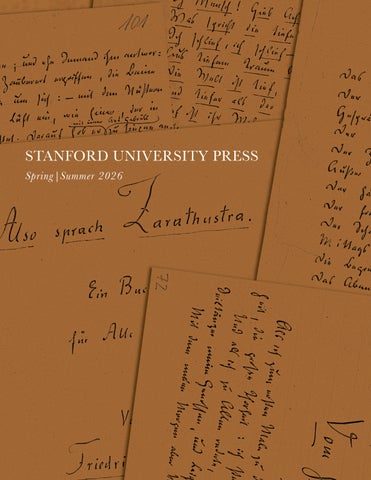
Cover art: Collage by Daniel Benneworth-Gray From Volume 7, The Complete Works of Nietzsche: Thus Spoke Zarathustra, Translated, with an Afterword, by Paul S. Loeb and David F. Tinsley
WE THE VOTERS
The Constitutional Choices That Shape America’s Elections LO R I A . R I N G H A N D
W H AT E X A C T LY D O E S T H E C O N S T I T U T I O N S AY A B O U T OUR ELECTIONS?
Many Americans today are frustrated, unsettled, or just plain perplexed about the rules governing our democracy and who gets to make them. Concern about rigged systems, confusion about the Electoral College, and uncertainty about who’s in charge of it all have shaken our faith in elections as a reliable way to peacefully transfer political power in a deeply fractured nation. In We the Voters, Lori A. Ringhand brings a fresh perspective to these issues. In straightforward and accessible language, she explains how certain questions– who “we the people” are, how they should be represented, and who gets to make the rules governing our elections–have always lurked just beneath the surface of our nation’s most contentious fights about how our elections should work. When there are clear answers to these questions, this book explains them. But its primary purpose is to help readers understand why so many of these questions are genuinely difficult, and how decisions made by past generations both structure and empower our choices today. Using constitutional text, history, and landmark Supreme Court decisions, Ringhand shows how the Constitution often serves less as rigid rule book for our elections and more as general framework, empowering each generation of Americans to engage for themselves the important questions underlying our electoral system by interrogating what is and isn’t working for them. We the Voters is pragmatic, but also optimistic. In the end, the Constitution leaves the defense of our democracy up to us; it equips us with the tools we need to question, debate, and ultimately change how our system of self-government works. This book urges us to take up that call with vigor. .
“We The Voters is a superb introduction to the complexities of the contemporary American system of representative government, particularly with regard to elections, introducing them in an extraordinarily accessible way. I don’t know of any book that in so few pages covers so many important topics so well.”
—Sanford Levinson, author (with Cynthia Levinson) of Fault Lines in the Constitution
“Lori Ringhand has produced the rare work that is thorough, accessible, and scholarly. The neophyte and expert alike will benefit from engaging with her marvelous account of how history shapes how we vote and
Credit: Dennis McDaniel Photography
debate voting.”
Lori A. Ringhand is a J. Alton Hosch Professor of Law and Josiah Meigs University of Georgia Distinguished Teaching Professor at University of Georgia Law School. She is the author or co-author of Supreme Bias (Stanford 2023) and Supreme Court Confirmation Hearings and Constitutional Change (2013). S U P. O R G
MARCH 2026
—Mark Graber, University of Maryland
224 pages | 5.5 x 8.5
Cloth $28.00 (£21.99) HC 9781503645479 eBook 9781503645486 Law
S TA N F O R D U N I V E R S I T Y P R E S S
1
MOVE OVER, MONA LISA Reimagining What We Read, Look At, and Learn PE G GY LE V I T T
C U LT U R E H A S A LWAY S B E E N A T O O L O F I M P E R I A L I S M A N D C O N T R O L . T H I S I S H O W W E D I S M A N T L E I T.
Calls to include a wider range of art, literature, and ideas in the world’s classrooms, libraries, and museums are loud and clear. If so many agree that reforms are needed, why is change so slow? The answer is the inequality pipeline—the multiple obstacles that ideas and art need to overcome to circulate globally. Most strategies to disrupt the pipeline only increase inclusivity, without fundamentally challenging institutional hierarchies. In Move Over, Mona Lisa, Peggy Levitt reveals, through her conversations with creatives, thinkers, and professionals working in the cultural and academic worlds in Argentina, Lebanon, and South Korea, that another approach to combatting global cultural and intellectual inequality is underway. Like-minded actors outside of traditional cultural centers are creating new nodes of power, and new pathways connecting them, that allow art, books, and ideas to “travel from Buenos Aires to Mexico City without having to pass through Madrid.” They are circumventing traditional powerbrokers and boldly reconfiguring the cultural and intellectual order. Levitt’s journey begins where art and literature are first created, then takes us to where they get discovered, circulated, exhibited, and acquired, and concludes where they are researched, published about, and taught. Along the way, we meet visionary artists, out-of-the-box writers, committed activists, and teachers striving to define what it means to train truly global citizens. We also discover how the culture and history of the cities they work from influences what they do. By linking these ideas together, Levitt persuasively demonstrates that what happens in the museum or the library is integrally connected to what happens in institutions of higher learning. With deeply researched novel insights, ambition, and hope, Move Over, Mona Lisa offers nothing short of a new theory of global cultural and intellectual change.
Peggy Levitt is the Mildred Lane Kemper Professor and Chair of Sociology at Wellesley College. She is the cofounder of the Global (De)Centre. She is the author, most recently, of Artifacts and Allegiances: How Museums Put the Nation and the World on Display (2015), among many other publications. 2
S TA N F O R D U N I V E R S I T Y P R E S S
S U P. O R G
“Let me state the bottom line. This book is needed, and there is no one better qualified or positioned to deliver it. Levitt’s book is thoroughly interdisciplinary and brings in other voices, rhythms, and registers, to present a genuinely multi-vocal perspective. ” —Adrian Favell, Radical Humanities Laboratory, University College Cork
JULY 2026 416 pages | 6 x 9 10 halftones Paper $30.00 (£23.99) TP 9781503647206 Cloth $120.00 (£95.00) SDT 9781503645547 eBook 9781503647213 Sociology
THUS SPOKE ZARATHUSTRA Volume 7 FRIEDRICH NIE T ZSCHE , Translated, with an Afterword, by PAUL S. LOEB and DAVID F. TINSLE Y
A M U S T- H AV E T R A N S L AT I O N O F T H I S E S S E N T I A L W O R K BY NIE T ZSCHE .
Thus Spoke Zarathustra stands alone among Nietzsche’s published works as a poetic and narrative rendering of his most sophisticated ideas through the medium of Zarathustra’s uniquely prophetic voice. It is also the first place where Nietzsche proposes his theory of will to power, and it is the only place in his published works where he elaborates his concept of the superhuman and his doctrine of eternal recurrence. Nietzsche himself regarded this book as his most important philosophical contribution because it proposes solutions to the problems he poses but does not resolve in his other works—for example, his cure for the human disposition to vengefulness and his creation of new values as the antidote to nihilism. This translation precisely and consistently renders each element so that readers may experience Nietzsche’s phrasing, wit, and wordplay in equivalent English. The extensive editorial notes in this edition include numerous crossreferences to earlier drafts and variants that are found in his notebooks, and published in Volumes 14 and 15 of The Complete Works, thus allowing the reader to view the evolution of Nietzsche’s thought from first drafts to their final published versions. The Translators’ Afterword includes a discussion of translation issues unique to Zarathustra, and a glossary of key terms, as well as a discussion of Nietzsche’s views concerning this book’s contributions to the development of the German language.
ALSO OF INTEREST:
THE COMPLETE WORKS OF FRIEDRICH NIETZSCHE
Paul S. Loeb is Professor Emeritus of Philosophy at the University of Puget Sound. David F. Tinsley is Professor Emeritus of German and Medieval Studies at the University of Puget Sound.
AUGUST 2026
424 pages | 4.75 x 7.25
Paper $25.00 (£19.99) AC 9781503647282 Cloth $100.00 (£83.00) SDT 9780804728799 eBook 9781503647299 Humanities S U P. O R G
S TA N F O R D U N I V E R S I T Y P R E S S
3
THE AI MARKETING CANVAS A Five-Step AI Plan for Marketers, Second Edition R A J KU M A R V E N K AT E S A N a n d J I M LE CI N SK I
F I V E E S S E N T I A L S T E P S T O TA K E YO U F R O M “ Z E R O T O SUPERHERO” WITH AI FOR MARKETING.
4
S TA N F O R D U N I V E R S I T Y P R E S S
S U P. O R G
Credit: Evanston Photographic Studios Inc
Rajkumar Venkatesan is the Ronald Trzcinski Professor of Business Administration and Academic Co-Director of the La Cross Institute for Ethical AI in Business in the Darden Graduate School of Business Administration at the University of Virginia. Jim Lecinski is Clinical Professor of Marketing at Northwestern University’s Kellogg School of Management. He is the author of Winning the Zero Moment of Truth (2011).
“The new second edition of The AI Marketing Canvas is a smart, practical guide for marketing leaders navigating the AI era. Jim Lecinski and Rajkumar Venkatesan distill complexity into clarity, offering an effective roadmap to move from experimentation to transformation. A must-read for any CMO, in fact for every marketer, serious about unlocking AI’s full potential to drive growth and innovation. ” —Raja Rajamannar, Chief Marketing & Communications Officer, Mastercard
Credit: Susan Wormington
For marketers, the landscape is shifting underfoot. Artificial intelligence is no longer a futuristic concept but a present-day reality, rewriting the rules of relevance, differentiation, and connection. In the newly revised and essential second edition of The AI Marketing Canvas, top MBA marketing professors Rajkumar Venkatesan and Jim Lecinski provide the definitive roadmap. They distill complexity into clarity with a field-tested, five-step plan for marketers at every stage of their AI journey. This is not a speculative look at the future; it is a practical guide for winning your “AI Moment of Truth” now. Rich with case studies, best practices, and the latest insights on AI’s impact on decision-making and customer engagement, this book empowers CMOs and marketers alike to harness AI’s full potential. Whether you are laying the groundwork for AI adoption, scaling across functions, or reinventing your go-to-market approach, The AI Marketing Canvas provides clarity and confidence at every stage of your journey. It’s not too late to be an early adopter, but the train is leaving the station. This book is your ticket to the forefront of marketing innovation.
FEBRUARY 2026 280 pages | 6 x 9 26 figures Paper $28.00 (£21.99) TP 9781503644335 eBook 9781503645851
RIDING SHOTGUN
The Role of the COO, Third Edition N AT H A N BE N N E T T a n d ST E PH E N A . M I LE S
E S S E N T I A L R E A D I N G F O R A N YO N E L O O K I N G T O H I R E A C O O , B E C O M E A C O O , O R E V E N T O O R I G I N AT E T H E R O L E F R O M S C R AT C H .
In today’s fast-moving business world, the Chief Operating Officer (COO) plays a critical yet often misunderstood role. Nathan Bennett and Stephen A. Miles’s Riding Shotgun: The Role of the COO offers a deep dive into what it takes to succeed as a second-in-command. This insightful book explores how COOs support CEOs, drive strategy, and ensure smooth day-to-day operations. Drawing from real-world examples and extensive research, Bennett and Miles uncover the unique challenges and opportunities of the job. Whether you’re a current or aspiring COO, a CEO looking to strengthen your leadership team, or simply curious about executive dynamics, this book provides valuable takeaways. With engaging storytelling and practical insights, Riding Shotgun breaks down the different types of COOs, the skills required to excel in the role, and how businesses can leverage this position for long-term success. It’s a mustread for anyone interested in leadership, corporate strategy, and the power of effective teamwork at the highest levels of an organization.
Nathan Bennett is Professor and Faculty Director of the executive MBA program at the J. Mack Robinson College of Business at Georgia State University. Stephen A. Miles is Founder and CEO of The Miles Group and one of the world’s foremost executive coaches to CEOs and COOs. For over two decades, Stephen has advised top leaders and boards on CEO succession, executive development, and board dynamics.
JULY 2026
272 pages | 6 x 9
Cloth $30.00 (£23.99) SDT 9781503645226 eBook 9781503647152
S U P. O R G
S TA N F O R D U N I V E R S I T Y P R E S S
5
SUSTAINABLE BUSINESS MODEL DESIGN 50 Innovation Patterns for Environmental, Social, and Economic Value F LO R I A N LÜ D E K E -F R E U N D, H E N N I N G BR E U E R , a n d LO R E N ZO M A S S A
T H E U LT I M AT E G U I D E T O D E S I G N I N G I N N O VAT I V E B U S I N E S S M O D E L S T H AT D R I V E E C O N O M I C , S O C I A L , A N D E N V I R O N M E N TA L I M PA C T.
Florian Lüdeke-Freund is Professor of Corporate Sustainability at ESCP Business School, Berlin and Academic Director of the Master of Science program in Sustainability Entrepreneurship & Innovation. He is Founder of the research blog SustainableBusinessModel.org. Henning Breuer is Professor of Business and Media Psychology at HMKW, Berlin and Founder of UXBerlin–Innovation Consulting. Lorenzo Massa is Managing Director of the Business Design Lab and Professor of Strategy and Business Models at Aalborg University Business School. 6
S TA N F O R D U N I V E R S I T Y P R E S S
S U P. O R G
Credit: ESCP Business School
The most forward-looking companies and organizations have understood that making sustainability work requires treating it like an opportunity and an investment and not a mere cost. These companies empower the officer who heads innovation to engage in Sustainable Business Model Design. This book is the first comprehensive guide to sustainable business model design—what it is, why it matters, and how to put it into practice. At its core, the book introduces the most extensive collection of sustainable business model patterns ever assembled—50 empirically and rigorously derived solutions that help integrate sustainability into a firm’s innovation work. Backed by more than 300 real-world examples, and practical indications for how to apply the innovation patterns in real-world settings, this book is a necessary resource for those who care about a more sustainable future and believe in the power of innovation to realize it—a long overdue guide and inspiration for next-generation business leaders.
AUGUST 2026 320 pages | 6.25 x 9.25 Paper $35.00 (£27.99) TP 9781503645233 eBook 9781503647275
BORDERLAND SOLIDARITY Indigenous Law, Media, and Environmental Activism in Kachinland
PLAY TO SURVIVE Disaster Preparedness Along the Ring of Fire CHIKA WATANABE
EMILY HONG
Kachinland is an unrecognized state in the borderlands of Myanmar, India, China, and Thailand. Its geography throws into sharp relief the intersecting dynamics of British colonialism, settler colonialism, and protracted war between the Kachin Independence Army and the Myanmar Army. Kachinland’s rich natural resources— including jade and hydropower—are coveted by the junta-led Myanmar government and its energy-hungry neighbor, China. As resource extraction and land confiscation intensifies, Kachin activists and artists turn to Indigenous law and media to stem the tide of displacement and dispossession. Emily Hong follows a diverse cast of Kachin activists, punk rock musicians, women farmers, and armed group leaders dreaming up new futures for Kachinland. She examines how they draw on the infrastructures of the borderlands—cross-border media tactics, inter-ethnic solidarity, and an expanded sense of the law and political possibility—to sustain activism for the long haul. With critical awareness of the colonial legacies of the region and of anthropology itself, Hong uncovers the limitations and liberatory potential of borderland solidarity, offering a powerful lens for understanding global activism and for navigating collaborative ethnography. Through evocative storytelling and sensory ethnography, Hong’s book challenges readers to move beyond a Western lens on solidarity to ask what activists, artists, and anthropologists alike can learn from centering non-Western ways of theorizing and embodying political sensation and collective action.
We live in a fragile world. This much is evident as stories abound of natural disasters that wipe out communities in an instant. How can we survive the future on such a planet, amid intensifying climate change? This question is particularly poignant along the Ring of Fire, a tectonic belt in the Pacific region that routinely faces some of the most devastating disasters in the world. Based on ethnographic research spanning seven years, Play to Survive examines the work of preparedness training in Japan and Chile, two primary nations along the Ring of Fire that experience frequent and intense disasters. Experts from these countries have often collaborated to create some of the most advanced disaster preparedness systems in the world. Chika Watanabe traces how local city officials, NGOs, and members of neighborhood and grassroots organizations are, counterintuitively, using fun, playful methods to teach preparation for our darkest hours. While there are many important studies of post-disaster response, much less is written about the future-orientation of disaster preparedness. This book shows how a transnational group of preparedness experts orients people toward potential disasters in gentle and hopeful ways, focusing on improvisation and repair. In a time of political and environmental destabilization globally, this book offers a unique look at how playful preparedness can reset relationships to environments, to the future, and to each other.
Emily Hong is Assistant Professor of Anthropology and Visual Studies at Haverford College.
Chika Watanabe is Senior Lecturer in Social Anthropology at the University of Manchester. She is the author of Becoming One: Religion, Development, and Environmentalism in a Japanese NGO in Myanmar (2019).
JUNE 2026
JULY 2026
264 pages | 6 x 9
264 pages | 6 x 9
25 halftones, 1 map
13 halftones
Paper $28.00 (£21.99) SDT 9781503646940
Paper $28.00 (£21.99) SDT 9781503646889
Cloth $110.00 (£87.00) SDT 9781503645042
Cloth $110.00 (£87.00) SDT 9781503646247
eBook 9781503646957
eBook 9781503646896
Anthropology
Anthropology
S U P. O R G
S TA N F O R D U N I V E R S I T Y P R E S S
7
DECOLONIAL ENDURANCE
TORIKAEBAYA MONOGATARI
Lisu Worldmaking Against Chinese Settler Colonialism
A Japanese Tale of Gender-Swapped Siblings
TING HUI L AU
Translated, with an Introduction and Notes, by ROSET TE F. WILLIG, Reissued with a New Introduction by GUSTAV HELDT
What does it mean to live through a world coming undone? How do people carry on amid rupture, loss, and grief? Decolonial Endurance explores these questions through the turbulent lives of Indigenous Lisu subsistence farmers in China’s Eastern Himalayas, bordering Myanmar and Tibet. Like many of China’s Indigenous borderlands, this mountainous region has long borne the force of encroaching Chinese state power. Since the 1980s, the Chinese state has been compelling the Lisu to give up their subsistence lifeways, move into urban settlements, and send their children to government boarding schools. In exchange for the so-called gifts of development— healthcare, income, and education—they suffer environmental and social catastrophes such as mass landslides, strange new illnesses, and toxic food. Drawing on over a decade of engagement with the Lisu, Ting Hui Lau takes readers into the world of ex-shamans, heart-pained mothers, restless spirits, and demon-mad migrants as they grapple with the fallout from state development, which Lau argues is the latest phase in a centuries-long project of settler colonialism along China’s Southwest frontier. At once portraying loss and an ethnography of hope, Lau chronicles Lisu worldmaking amid this destruction, centering their quiet resistance through everyday acts of communal caretaking. As geopolitical and ecological crises escalate, this book calls for a new decolonial politics rooted in the transformative power of endurance.
Torikaebaya monogatari is a twelfth-century Japanese tale like no other. As suggested by its title, which literally translates to “if only I could exchange them” (torikaebaya) “story” (monogatari), it follows the complications that arise when a nobleman has his two children swap genders—his son living as a woman, and his daughter living as a man. What unfolds is a tale of tragicomedy, familial love, and oblique social commentary as the two siblings embark on their secretly gender-crossed adult lives, subverting and satirizing literature of the period—most notably The Tale of Genji. In more recent times, the tale has sparked intellectual debate and creative inspiration in Japan, with its reception over time reflecting the ever-shifting views of gender and sexuality in that country. First published in English under the title The Changelings in 1983, this reissued edition of the translation by Rosette F. Willig, with an illuminating new introduction from Gustav Heldt, makes this enduring and inventive landmark of Japanese literature available to readers for the first time in decades.
Ting Hui Lau is Assistant Professor of Sociology and Anthropology at the National University of Singapore.
JULY 2026
Rosette F. Willig received her PhD in Japanese Language and Literature from the University of Pennsylvania in 1978. Gustav Heldt is Professor of Japanese Literature at the University of Virginia. He is author of Navigating Narratives: Tsurayuki’s Tosa Diary as History and Fiction (2024) and The Pursuit of Harmony: Poetry and Power in Early Heian Japan (2010), as well as translator of The Kojiki: An Account of Ancient Matters (2014).
240 pages | 6 x 9
12 halftones
MARCH 2026 272 pages | 6.75 x 9.875
Paper $28.00 (£21.99) SDT 9781503647183
Paper $28.00 (£21.99) SDT 9781503646544
Cloth $110.00 (£87.00) SDT 9781503645684
Cloth $110.00 (£87.00) SDT 9781503646261
eBook 9781503647190
eBook 9781503646551
Anthropology
Asian Studies
8
S TA N F O R D U N I V E R S I T Y P R E S S
S U P. O R G
A NATION WITHIN North Korean Zainichi in Postimperial Japan By S AYAKA CHATANI, with KUMHEE CHO
The presence of hundreds of thousands of ethnic Koreans in Japan, or “zainichi Koreans,” is one of the visible legacies of Japanese colonialism. A surprising and influential group among zainichi Koreans that persists to this day are the Chongryon, the only pro–North Korean diasporic group based in a capitalist society. Chongryon historically represented the central grassroots force seeking to liberate Koreans from Japan’s imperial and neo-imperial influences. At the heart of the Chongryon community stands a political organization equipped with a central bureaucracy in Tokyo, with a headquarters in nearly every prefecture. Often called a de facto embassy of North Korea, the Chongryon organization has, in effect, functioned as a state within another state—operating hundreds of schools, banks, hospitals, business associations, publishing houses, and many other institutions across Japan. Drawing on extensive archival research and nearly 250 original interviews collected with co-researcher KumHee Cho, who was raised within the Chongryon community, Sayaka Chatani offers a sweeping social history of this secretive, protective community in xenophobic Japanese society. Weaving together personal accounts and situating them in a multi-layered, transnational political context, the book offers a finely textured, intimate narrative of the community’s tumultuous history and decolonial praxis. Through the stories of Chongryon, this book provides a bottom-up analysis of power politics among zainichi Koreans and reshapes our understanding of Japanese history, Korean history, and the Cold War in Asia.
LAHORE AFTER MODERNISM Architecture and Its Histories in Pakistan CHR IS MOFFAT
In the decades after independence in 1947, architects in Pakistan were enlisted to build a postcolonial future—a new world after empire. But the debris of the past could not be so easily swept aside. The recalcitrance of local and regional histories was fiercely evident in Lahore, the centuries-old capital of Punjab and a city scarred by the partition of British India. Studying its streets, neighborhoods, and historic buildings, Pakistani architects came to challenge the global consensus around “development” and its close association with modernist architecture. Their designs and structures became opportunities for thinking anew about the power of history, the boundaries of the nation, and the constitution of community in a postcolonial polity. This book is a pioneering study of architecture and the politics of construction, destruction, and conservation in urban Pakistan. Chris Moffat introduces Pakistan’s first postcolonial generation of architects—figures born around the time of partition, who began practicing in the 1960s and whose early careers navigated popular rebellions, military coups, and emergent, pan-Islamic alignments. Moving from housing schemes to monuments, shrines to shopping malls, Moffat forges a new conversation between histories of architecture and the history of ideas in South Asia, and locates Lahore at the center of debates around contemporary urbanization, postcolonial aesthetics, and the ethics of dwelling in the modern world. Chris Moffat is Senior Lecturer in South Asian History at Queen Mary University of London. He is author of India’s Revolutionary Inheritance: Politics and the Promise of Bhagat Singh (2019).
Sayaka Chatani is Associate Professor of History at the National University of Singapore. She is author of Nation-Empire: Ideology and Rural Youth Mobilization in Japan and Its Colonies (2018).
S T U D I E S O F T H E W E AT H E R H E A D E A S T ASIAN INSTITUTE, COLUMBIA UNIVERSIT Y
SOUTH ASIA IN MOTION
MARCH 2026
JUNE 2026
328 pages | 6 x 9
288 pages | 6 x 9
2 tables, 2 figures, 35 halftones, 1 map
44 halftones, 1 map
Paper $28.00 (£21.99) SDT 9781503646124
Paper $30.00 (£23.99) SDT 9781503646759
Cloth $110.00 (£92.00) SDT 9781503636385
Cloth $120.00 (£95.00) SDT 9781503646254
eBook 9781503646131
eBook 9781503646766
Asian Studies
Asian Studies
S U P. O R G
S TA N F O R D U N I V E R S I T Y P R E S S
9
REINVENTING CASTE
BLACK MARKET INTIMACIES
Islam and Hierarchy in Late Colonial India
The Transpacific Sexual Economy of the Korean War
A SHISH KOUL
JEONGMIN KIM
This book reveals that caste, usually assumed to be a feature of Hindu society, was in fact a trans-religious phenomenon in colonial India, as it is today. Even in an Islamic religious milieu that was supposed to be more egalitarian than hierarchical Hinduism, colonial Indian subjects thought and acted in terms of caste. Through a focus on one agrarian Muslim caste of colonial India known as Arains, Ashish Koul shows how some Muslims transmuted caste and emplaced it within the Islamic tradition of their time. In late nineteenth- and early twentieth-century India, Arain Muslims were derogatively called mali—gardener—instead of what they wished to be seen as—respectable landholders. Seeking to refute such negative portrayals, a group of elite Arain Muslim landholders and educated professionals came together to develop a new Islamic vocabulary for caste. Through a variety of primary sources in English and Urdu, Koul analyzes the intricacies of caste, religion, and politics among Muslims in colonial India. By asserting that being Arain was a true way of being Muslim, elite Arains were able to intervene in significant debates about Muslim identity, colonial law, and political representation. Ultimately, this book demonstrates that in order to understand why caste persists among South Asians, we must examine how caste consciousness has been entrenched within multiple religious traditions.
Black Market Intimacies reveals how illicit exchanges of money and commodities involving sexual encounters between Korean and Japanese women and US soldiers provided the material foundations of the regional economy across Korea and Japan during the Korean War. Against the conventional view that illicit exchanges exist outside the formal economy and legal regulations, Jeongmin Kim examines how the interlinked markets for transactional sex and goods crucially constituted the transpacific formation of US military base capitalism in post–World War II East Asia. Going beyond what is commonly categorized as prostitution and violence in Cold War archives, Kim weaves together stories from the myriads of mundane records scattered around multilingual archives to document larger transnational webs of the war economy. From Korean women who brought camel blankets and whiskey to local markets in Seoul, to middle-aged Okinawan women dealing in US military notes, Kim uncovers the crucial roles that local women played in circulating war supplies and currency across the region through their sexual and intermediary labor. The result is an intimate and global history of the Korean War that urges us to rethink the often antithetical relationship between sexual intimacy and market economies in the context of war and occupation. Jeongmin Kim is Assistant Professor of History and Program Director of Asian Studies at University of Manitoba.
Ashish Koul is Assistant Professor of History at Northwestern University.
SOUTH ASIA IN MOTION JUNE 2026
JUNE 2026 288 pages | 6 x 9
280 pages | 6 x 9
6 halftones
3 tables, 1 figure, 34 halftones, 1 map
Paper $30.00 (£23.99) SDT 9781503646711
Paper $28.00 (£21.99) SDT 9781503646964
Cloth $120.00 (£95.00) SDT 9781503645455
Cloth$110.00 (£87.00) SDT 9781503645691
eBook 9781503646728
eBook 9781503646971
Asian Studies
Asian Studies
10
S TA N F O R D U N I V E R S I T Y P R E S S
S U P. O R G
THE MAN WHO KNEW RUSSIA Richard Pipes, Humanist and Cold Warrior JONATHAN DALY
Richard Pipes was a longtime Harvard University professor, historian of Imperial and Soviet Russia, and influential Soviet expert during the Cold War. A towering figure in his field, Pipes produced work that shaped the study of Russian and Soviet history, and he influenced U.S. foreign policy as a public intellectual and political advisor, including as a member of the National Security Council during the Reagan administration. At the same time, Pipes was a controversial figure; his tendency to swim against the intellectual tide and challenge consensus views alienated some colleagues and angered others. In this biography, Daly cuts through the controversy surrounding Pipes to present a nuanced portrait of his life, thinking, and the philosophical and ethical principles that underpinned his work. Placing Pipes’ scholarship and political career in the context of Russian studies, U.S.–Soviet relations, and the Cold War, Daly elucidates Pipes’ impact, and argues that his broad learning, keen historical judgment, and humanistic approach permitted him to attain a deep understanding of Russia’s historical and contemporary development that continues to resonate today. Jonathan Daly is Professor of History at the University of Illinois Chicago. His previous books include Pillars of the Profession: The Correspondence of Richard Pipes and Marc Raeff (2019) and Seven Myths of the Russian Revolution (2023) with Leonid Trofimov.
SEXUAL HERESIES Religion, Science, and Sexuality in Modern Britain JOY DI XON
Thinking about relationships between religion and sexuality usually focuses on what religion has to say about sex. But new ideas about sex could also transform religion itself. In Britain at the end of the nineteenth century, the new sexual sciences—from anthropological accounts of religion as rooted in ancient fertility cults to psychoanalytic theories that explained religious experience in terms of psychosexual development—characterized religion as closely connected to the sexual. The outcome, as Joy Dixon traces in this book, was a new sense that religion itself could be sexually suspect. One result of that new suspicion was an increasing concern to police “sexual heresies” and to produce a supposedly normal (healthy, monogamous, and heterosexual) religiosity. The overall effect was a narrowing of the sexual possibilities inside “orthodox” religion and the increasing association of alternative forms of religion with dissident and marginal sexualities that continues to shape both religion and secularism today. Considering a wide range of materials emerging from a diverse array of British society, from modernist theologians and practitioners of sexual magic to conservative Christians and radical freethinkers, this book emphasizes the dynamic relationships between the histories of religion and of sexuality and the historical contingency of the categories we have used to understand the relationship between the two. Joy Dixon is Associate Professor of History at the University of British Columbia. She is author of Divine Feminine: Theosophy and Feminism in England (2001).
S TA N F O R D – H O O V E R S E R I E S O N
SPIRITUAL PHENOMENA
A U T H O R I TA R I A N I S M
MAY 2026
APRIL 2026
10 halftones
440 pages | 6 x 9
336 pages | 6 x 9
27 halftones
Paper $30.00 (£23.99) SDT 9781503646674
Cloth $65.00 (£54.00) SDT 9781503645714
Cloth $120.00 (£95.00) SDT 9781503645240
eBook 9781503645882
eBook 9781503646681
History
History
S U P. O R G
S TA N F O R D U N I V E R S I T Y P R E S S
11
THE AMERICAN YAWP A Massively Collaborative Open History of the United States, Second Edition E d i te d b y J O SE PH L . LO CK E a n d BE N WR I G H T In Two Volumes
A T H O R O U G H LY U P D AT E D E D I T I O N O F T H E G R O U N D B R E A K I N G U S H I S T O R Y T E X T B O O K T H AT C O N N E C T S S T U D E N T S W I T H T H E B E S T O F C U R R E N T S C H O L A R S H I P.
The American Yawp is a free, online, collaboratively written American history textbook. Over 500 historians contributed their expertise to create the book they wanted for their own students—an accessible, synthetic narrative that reflects the best of recent historical scholarship and provides a jumping-off point for discussions in the US history classroom and beyond. The American Yawp highlights the dynamism and conflict inherent in the history of the United States, while also looking for the common threads that help us make sense of the past. This Second Edition has been revised and enriched with new material throughout, particularly on Indigenous history, Mexican American history, and twenty-first-century American history. A revised chapter structure improves the chronological flow of the narrative. The fully peer-reviewed edition is available in two print volumes. Volume 1 begins with the Indigenous people who called the Americas home before chronicling the collision of Native Americans, Europeans, and Africans. It traces the development of colonial society in the context of the larger Atlantic World and investigates the origins and ruptures of slavery, the American Revolution, and the nation’s development through the Civil War and Reconstruction. Volume 2 concludes its examination of the nineteenth century before moving through the twentieth, addressing the nation's economic crises, the World Wars, and social, cultural, and political upheaval, bringing the narrative up to the present. Balancing academic rigor with popular readability, this book offers a multi-layered, democratic approach to the American past and enables students to ask their own questions about how the past informs the problems and opportunities we confront today.
“The American Yawp is a clear, accessible, reasonably priced text written by smart young scholars with an eye to the latest research.” —Jefferson Cowie, Vanderbilt University, winner of the Pulitzer Prize
Vo l . 1 : To 1 8 7 7 MAY 2026
528 pages | 7 x 10
150 halftones Paper $28.00 (£21.99) SDT 9781503634787 eBook 9781503647053 History Vo l . 2 : S i n c e 1 8 6 5 MAY 2026
Joseph L. Locke is Assistant Professor and Director of Graduate Studies in History at the University of North Texas. Ben Wright is Associate Professor of History at the University of Texas, Dallas. 12
S TA N F O R D U N I V E R S I T Y P R E S S
S U P. O R G
528 pages | 7 x 10
150 halftones Paper $28.00 (£21.99) SDT 9781503634794 eBook 9781503647060 History
THE TRANSPACIFIC CHINESE DIASPORA
CITIES OF DUST AND MUD
Migration Networks from China to Canada and Beyond, 1788−1898
Urbanism and Bourgeois Fantasy in the Balkans, 1820–1920
ZHONGPING CHEN
Ó MILOŠ JOVANOVIC
Zhongping Chen examines the origins, rise, and reform of the Cantonese-dominated Chinese diaspora in Canada between 1788 and 1898. Combining a diasporic approach with both qualitative and quantitative analyses of Chinese and English documents, including previously untapped archival records of secret societies, community organizations, and family businesses, this book reveals the transnational mobility of Chinese migrants and the expansion of their migration network across southern China, the American West, and Pacific Canada. Chen especially highlights the cross-cultural development of Chinese migration networks through interactions with white and Indigenous peoples as well as Western culture ranging from racism and settler colonialism to constitutionalism. The book features the first intensive examination of Chinese migrants’ engagement in the transpacific Anglo-American fur trade, the gold rushes spreading from California to British Columbia, the construction of the Canadian Pacific Railway, and community reforms across North American Chinatowns. Through innovative theoretical approaches and meticulous analysis of archival sources, Chen demonstrates how the Cantonese-dominated diaspora in Canada exerted profound but long-neglected and under-researched influence on sociopolitical changes in Qing China, Canadian society, and the Chinese communities across the Pacific Rim, including American Chinatowns, going beyond the nation-state frameworks in Chinese Canadian and Chinese American studies.
This book explores the social costs of urban change and the limits of modernity through a comparative study of two Balkan cities, Belgrade and Sofia. Between 1820 and 1920, both cities grew from small Ottoman towns into large national capitals as their bourgeois elites envisioned new, urban societies on the European borderlands. This book traces the lofty ambitions and dire consequences of this project: situated on the periphery of global capital flows, elite-led attempts at remaking Balkan capitals into European cities relied on dispossession, brutal labor control, and real estate speculation, while failing to achieve the goal of exponential growth.
Zhongping Chen is Professor of History at University of Victoria, Canada. He is the author of several books, including Transpacific Reform and Revolution: The Chinese in North America, 1898−1918 (Stanford, 2023) and Modern China’s Network Revolution: Chambers of Commerce and Sociopolitical Change in the Early Twentieth Century (Stanford, 2011).
Drawing on a rich array of archival sources, Miloš Jovanović considers the ethnic cleansing of Muslims in Belgrade, municipal corruption in Sofia, anxieties over sex work and the regulation of intimacy, and attempts at creating docile workers through policing and prisons. Bringing working people to the forefront, he shows how the modernity envisioned by elites failed to transform their lives for the better, and how urban residents developed a nostalgia for the Ottoman city as a critique of their contemporary moment. Going beyond the limits of national frameworks, this book transforms our understanding of Balkan history, national modernization, and the role of fantasy in capitalist societies, offering keen insights for today’s era of growing inequality. Miloš Jovanović is Assistant Professor of History at the University of California, Los Angeles. He is co-editor of Sharpening the Haze: Visual Essays on Imperial History and Memory (2020).
S TA N F O R D S T U D I E S O N C E N T R A L A N D EASTERN EUROPE ASIAN AMERICA
JUNE 2026
JUNE 2026
21 halftones, 1 map
296 pages | 6 x 9
280 pages | 6 x 9
4 tables, 10 halftones, 2 maps
Paper $32.00 (£24.99) SDT 9781503646803
Cloth $70.00 (£58.00) SDT 9781503646278
Cloth $130.00 (£103.00) SDT 9781503646001
eBook 9781503646643
eBook 9781503646810
History
History
S U P. O R G
S TA N F O R D U N I V E R S I T Y P R E S S
13
BA‘THIST IRAQ THROUGH ARCHIVES
PAPER PERFORMANCE Suspicion and Asian American Archives
Reflections, Explorations, and Opportunities
JU YON KIM
Edite d by LIS A BL AYDE S and S AMUEL HELF ON T
The opening of Iraq’s Ba‘th Party archives revolutionized the study of Iraqi politics and history, offering scholars unprecedented access to the inner workings of one of the world’s most impenetrable autocracies. This volume brings together leading scholars to take stock of what we have learned from over a decade of research using the Ba‘thist archives, contributing to a new understanding of Iraq’s history, with wider implications for understanding authoritarianism in general. The contributors show how research in these unique archives challenges previous assumptions about Ba‘thist Iraq and the workings of authoritarian regimes. Their chapters provide fresh insights into how Saddam Hussein’s regime functioned both at the elite level and through everyday bureaucratic practices, shedding light on state power, social relations, and international politics of the Middle East. The volume also critically reflects on the ethical questions posed by the archives, including their origins, the impact of their removal from Iraq, and access barriers for local scholars. Rich in empirical detail yet framed by cutting-edge theoretical questions, this book demonstrates how the Iraqi archives have reshaped debates about authoritarianism, governance, repression, and state–society relations well beyond the Iraqi case. Lisa Blaydes is Professor of Political Science and Senior Fellow at the Freeman Spogli Institute for International Studies at Stanford University. Samuel Helfont is Associate Professor of Strategy and Policy in the Naval War College Program at the Naval Postgraduate School in Monterey, California.
Since the late nineteenth century, various agencies of the U.S. government have attempted to manage “suspect” immigrants, colonial subjects, and activists of Asian descent through bureaucratic procedures involving extensive paperwork and live examinations. These procedures have given institutional authority and form to suspicion but rarely alleviated or contained it: while insisting that there is something to uncover, they have offered less the satisfaction of suspicion than its expansion. Ju Yon Kim explores the modes of engagement and contestation available to those who are subjected by the state to relentless documentation and demands to perform— whether as lawful immigrants, obedient colonial subjects, or loyal Americans. Paper documentation has been critical to authorizing exclusion, surveillance, and incarceration by the state, yet it has also enabled performances with paper that have facilitated transnational passage, mobilized resistance to administration, and troubled the logic of racial and national classifications. Closely examining a range of documents, including immigration interview transcripts, colonial surveillance forms, loyalty questionnaires, and informant reports, Kim argues for a dramaturgical approach to interacting with these archives, one that recognizes suspicion’s tendency to render certain bodies theatrical while also countering its inexorable pursuit of evidence. Linking histories of Chinese immigration exclusion, the U.S. colonization of the Philippines, the internment of Japanese Americans, and FBI surveillance of political groups, Kim brings together studies of paperwork and performance to demonstrate their continued, intertwined impact on Asian American history and culture. Ju Yon Kim is Patsy Takemoto Mink Professor of English at Harvard University. She is the author of The Racial Mundane: Asian American Performance and the Embodied Everyday (2015).
ASIAN AMERICA S TA N F O R D – H O O V E R S E R I E S O N A U T H O R I TA R I A N I S M
JUNE 2026 320 pages | 6 x 9
JUNE 2026
16 halftones
456 pages | 6 x 9
6 halftones
Paper $35.00 (£27.99) SDT 9781503646650
Cloth $60.00 (£50.00) SDT 9781503645301
Cloth $140.00 (£116.00) SDT 9781503639683
eBook 9781503646360
eBook 9781503646667
History
History
14
S TA N F O R D U N I V E R S I T Y P R E S S
S U P. O R G
ARCHIVES OF INTIMACY Racial Mixing and Chinese Lives in the Colonial Port City, 1905–1949 NADINE AT TE WELL
This book offers a rich and innovative study of multiracial social worlds in early-twentieth-century London, Liverpool, and Hong Kong—three port cities linked by their importance to global British shipping networks and circuits of Chinese migration. In these cities, Chinese, Black, South Asian, and European people came together to foster multiracial communities which have been largely forgotten, remembered only through sensationalist fictions that reflected white anxieties about racial mixing. Nadine Attewell considers these vibrant multiracial worlds through the eyes of those who knew them best: people of mixed Chinese descent, for whom interracial intimacies were features of everyday life. Mobilizing a wide range of archival materials, including photographs, community and family histories, and wartime intelligence reports, Attewell reconstructs the social experiences of people like Vera Leung, a working-class woman of Irish and Chinese descent growing up in Liverpool’s interwar Chinatown, and Percy Chang, a Jamaican man of Chinese and African descent with a wide social network in Hong Kong. Rather than centering identity as the focus of mixed-race people’s struggles, she asks what they did and with whom. Drawing on queer and feminist scholarship and integrating British, Asian, and diasporic histories, Attewell presents new ways of thinking about the everyday meanings of interracial intimacy, and practices of relation and survival under global conditions of colonial capitalist rule. Nadine Attewell is Associate Professor of Gender, Sexuality, and Women’s Studies and Global Asia at Simon Fraser University. She is the author of Better Britons: Reproduction, National Identity, and the Afterlife of Empire (2014).
RIVAL MODERNITIES Fin-de-Siècle Celebrity and the United States in the French National Imagination VENI TA DAT TA
What do Buffalo Bill and Gustave Eiffel have in common? These celebrities are both part of Venita Datta’s analysis of competing notions of modernity and French-American relations at the turn of the twentieth century. Fin-de-siècle France saw itself as the premier modern country. A pioneer in the aviation and cinema industries, its capital, Paris, was home to the cultural avant-garde. Nonetheless, the French harbored ambivalent feelings toward modernity and expressed their critiques of a certain type of modernity by denigrating it as “American.” To understand this ambivalence, Datta effectively contrasts four pairs of exemplary French and American figures: inventorentrepreneurs Gustave Eiffel and Thomas Edison, reporters Nellie Bly and Gaston Leroux, celebrity politicians Georges Boulanger and Theodore Roosevelt, and adventurers Buffalo Bill and the Marquis de Morès. Through an examination of the differences in French perceptions of these famous pairs, Datta illustrates that they highlight competing values rooted in national identity, and reflect each nation’s struggles with democracy. Filled with fascinating characters and detail, Datta’s book illuminates both the rivalries between France and the United States and their deep connections at an important yet understudied moment in history. The legacy of these complex Franco-American cultural relations is profoundly relevant to the challenges contemporary democracies face today. Venita Datta is Professor of French Studies at Wellesley College. She is the author of Heroes and Legends of Fin-de-Siècle France: Gender, Politics, and National Identity (2011).
S TA N F O R D B R I T I S H H I S T O R I E S JULY 2026
352 pages | 6 x 9
AUGUST 2026
21 halftones
45 halftones
344 pages | 6 x 9
Paper $35.00 (£27.99) SDT 9781503647107
Paper $35.00 (£27.99) SDT 9781503647251
Cloth $140.00 (£110.00) SDT 9781503646032
Cloth $140.00 (£110.00) SDT 9781503646285
eBook 9781503647114
eBook 9781503647268
History
History S U P. O R G
S TA N F O R D U N I V E R S I T Y P R E S S
15
VICIOUS CIRCLES
THE ECONOMY OF ANONYMITY
Disclosing a History of Critique
Power in the Age of Identification
AR VI S ÄR K EL Ä
HECTOR AMAYA
How can social critique respond to a catastrophic world? From Emerson to Adorno, a tradition of radical social critique has flourished that utilizes methods which disclose rather than judge the form of life: instead of trying to say what is wrong and what would be better, these criticisms seek to show how the world is false and to reveal how we might escape the vicious circles of present society— pointing out its catastrophic state and directing readers to the real possibilities for another form of life. This book presents an incisive history of critical disclosure by looking at its common metaphors. As Särkelä illuminates, circular metaphors continually interact in the works of 19th and 20th century European and American authors including not just Emerson and Adorno, but also Nietzsche, Tarde, Freud, and Dewey. By reconstructing the driving examples of such disclosing critical gestures, Särkelä articulates their similarities and differences, and considers their potential for contemporary social critique. The result points the way toward the cultivation of critical skills relevant for our own age of catastrophe. Arvi Särkelä is Lecturer and Researcher at ETH Zurich. He focuses on the philosophy and history of critique, especially in nineteenth- and twentieth-century Europe and Northern America.
We use avatars to play video games. We use pseudonyms on social media. We use VPNs to mask our identities and activities. In the digital realm, anonymity is everywhere, a persistent option for those who wish to hide, experiment, and deceive. But we are anonymous in more contexts than the digital. In urban settings, we routinely experience the anonymity of the crowd, and routinely use anonymity to participate in political life and social protests. Anonymity matters. This book is a wager that we can learn much about society, humanity, and power by analyzing the structural tensions and possibilities of anonymity, and by analyzing how the economy of anonymity is changing in a modernity defined by computation. While many have explored the connections between surveillance, datafication, and privacy, relatively little has been done to theorize anonymity and its critical role in our lives. This book rebalances our intellectual investments by expanding our understandings of anonymity. Putting the work of Gloria Anzaldúa and Bernhard Siegert into conversation, Hector Amaya examines the contours of anonymity in different social domains—in relationship to individuals, institutions, and contexts; to epistemology and ontology; and to history and society. As the book shows, anonymity entails paradoxical possibilities as it is sometimes experienced as freedom and other times as powerlessness, or subjugation. Hector Amaya is Professor of Communication at USC Annenberg and the author of Trafficking: Narcoculture in Mexico and the United States (2020), among other titles.
C U LT U R A L M E M O R Y I N T H E P R E S E N T MARCH 2026 344 pages | 6 x 9
MARCH 2026 280 pages | 6 x 9
6 figures
1 halftone
Paper $35.00 (£27.99) SDT 9781503645721
Paper $35.00 (£27.99) SDT 9781503645813
Cloth $140.00 (£110.00) SDT 9781503645417
Cloth $140.00 (£110.00) SDT 9781503645554
eBook 9781503645738
eBook 9781503645806
Humanities
Humanities
16
S TA N F O R D U N I V E R S I T Y P R E S S
S U P. O R G
CURRENCY OF NIHILISM AMIN S AMMAN
THE HISTORICAL POEM On the Lives and Afterlives of Romantic Literary Criticism JOEL CHILDER S
What happens to economic life when meaning and value come apart? Drawing on Friedrich Nietzsche, E. M. Cioran, and Jean Baudrillard, this book shows how the latest trends in digital finance restage the dilemmas of nihilism in new ways. From cryptocurrencies and meme stocks to Silicon Valley venture capital and the global boom in artificial intelligence, economic life today thrives on the ambiguous allure of nothingness, annihilation, and disappearance. Amin Samman brings the financial status of contemporary nihilism into focus, connecting its signal moods and sentiments to the system-logics of world finance. All the historical moods of nihilism now circulate through the financial system, he argues, and each further wave of technological advance provides yet more means of speculating on these moods. The result is a lucrative new culture of financial nihilism with no end in sight. For readers interested in philosophy and the history of capitalism, Currency of Nihilism offers an unsettling perspective on the nihilistic structures of feeling that underwrite the contemporary financial system. Amin Samman is Reader in International Political Economy at City St George’s, University of London. He is the author of History in Financial Times (Stanford, 2019).
The Historical Poem takes up Georg Lukács’s classic account of the historical novel to tell the forgotten story of its precursors. For eighteenth-century and Romantic thinkers, these were poems from distant times and places—from ancient and medieval India to the Christian and Islamic Middle Ages. Historical poems were said to bring the past to life, to invite their readers into distant worlds. And they were made to answer many of the era’s most pressing philosophical questions: the nature of human thought, the origin of human civilizations, the formation—and, for some, the hierarchy— of races. In this wide-ranging and innovative study, Joel Childers traces what he calls enterpretation, a hermeneutics of inhabitation and historical feeling. At a time of rapid imperial expansion, Childers shows how enterpretation was used to conceive of a newly human history—an account of the peopling of the globe as an uneven process of migration, conquest, and settlement. At once a literary history and a critical intervention, The Historical Poem combines a detailed study of Romantic thought with chapters on twentieth-century and contemporary literary criticism by Fredric Jameson, Saidiya Hartman, and Theodor Adorno and Max Horkheimer, among others. Joel Childers is Visiting Assistant Professor at Willamette University. He received his PhD in English from Johns Hopkins.
CURRENCIES: NEW THINKING FOR FINANCIAL TIMES MARCH 2026
184 pages | 5.5 x 8.5
MARCH 2026
264 pages | 6 x 9
Paper $28.00 (£21.99) SDT 9781503645868
4 halftones
Cloth $110.00 (£87.00) SDT 9781503645660
Cloth $75.00 (£62.00) SDT 9781503636682
eBook 9781503645875
eBook 9781503646216
Humanities
Humanities
S U P. O R G
S TA N F O R D U N I V E R S I T Y P R E S S
17
I’M SORRY YOU FEEL THAT WAY The New Cultures of Customer Service DIANE NEGRA
A N I N C I S I V E C R I T I Q U E O F T H E WAY C A P I TA L I S M I S SHIF TING THE BAL ANCE OF L ABOR BE T WEEN CUSTOMER A N D C O R P O R AT I O N .
This book is about how twenty-first-century capitalism is remaking the roles of customer and customer service provider, shedding light on why consumer capitalism has come to feel so punishing for so many. In call centers, banks, airports, universities, public transport systems, hospitals, and other key sites, the intensification of profit imperatives alongside hyper-technologization has generated an “antagonistic interface” between customers and workers. Consumers widely report feeling trapped in the vise-like grip of frustrating and confounding systems that waste significant amounts of time. Positioning the poorly served customer as the definitional figure of twentyfirst-century commercial relations, Diane Negra articulates a new corporate authoritarianism that allocates a broad range of digital tasks to customers. Essential to this apportionment are technology platforms with high failure rates, corporate devotion to byzantine bureaucratic procedures, and the conspicuous, constant valuing of high-status customers over low-status ones. Compliance with new stripped-down service protocols is enforced not only directly but through powerful norms and customs, and affective culture is notable for converting service encounters into transactions routinely characterized by frustration, impotence, and fury. In analyzing the service ecology and its media representations, I’m Sorry You Feel That Way reveals how the shift to customer work is now both totalized and thoroughly naturalized. As the book maps out, the changing nature of the service encounter in day-to-day life and in the cultural imagination reveals the emergence of corporate emotions seldom recognized as the assault on dignity they constitute.
Diane Negra is Professor of Film Studies and Screen Culture at University College Dublin. A member of the Royal Irish Academy, she is the author, editor, or coeditor of fourteen books. 18
S TA N F O R D U N I V E R S I T Y P R E S S
S U P. O R G
“Negra brilliantly analyzes the transformation of customer service alongside its affective and mediated dimensions. Extensively researched and deeply original. ” —Laurie Ouellette, author of Lifestyle TV
APRIL 2026
288 pages | 6 x 9
11 halftones Paper $25.00 (£19.99) AC 9781503646506 Cloth $100.00 (£79.00) SDT 9781503645462 eBook 9781503646513 Humanities
NEW WORLD CALCULATION The Making of Numbers in Colonial America MOLLY FAR R ELL
Molly Farrell tells the story of colonial America as a testing ground for new ways of conceptualizing numbers, uncovering overlooked forms of numerical thinking to argue that colonialism and the rise of racial capitalism incited a struggle about what exactly a number is and what it can do. When English settlers began colonizing indigenous lands, they confronted groups of people with very different beliefs about numbers. Meanwhile, Atlantic colonialism required tremendous accounting work, especially to support the trade in enslaved Africans. Numeracy, then, seems to be deeply complicit with the colonial project. Farrell, however, follows the circulation of arithmetic primers, cipher books, and other material traces to show how everyday people repurposed numeracy to serve their own ends—ranging from making a living as a fugitive from enslavement to measuring medicine for at-home abortion. Drawing on book history and Black feminist science and technology studies, New World Calculation argues that we need to restore the math book into its social space in order to disentangle the relationship between quantification and oppression in America’s cultural history. Molly Farrell is Associate Professor of English at the Ohio State University. She is the author of Counting Bodies: Population in Colonial American Writing (2016).
THE HUMANITY OF OTHERS ALI BENMAK HLOUF Translate d by JACOB LE VI
How should we speak of humanism today? To answer this question, Moroccan philosopher Ali Benmakhlouf turns to Montaigne. Through a rich and attentive reading of Montaigne’s Essays, Benmakhlouf reminds us why the sixteenth-century author remains relevant today when the need to recognize the “humanity of others”—from the cry of “Black Lives Matter” to the anonymous deaths of migrants drowning in the Mediterranean Sea—is as urgent as ever. Always alert to his times, Montaigne wrote about the diversity of others who entered into Europe’s consciousness during the Renaissance: natives of the Americas, Turks, or Africans, without forgetting those close at home who, “emaciated from hunger,” begged at the doors of those “gorged with all kinds of commodities.” Montaigne enumerated and detailed these different ways of life but, as Benmakhlouf argues, his main concern was with others in the plural as opposed to the other, an abstract philosophical term. Retracing Western humanism from Pico della Mirandola to Sartre, via Ibn Tufayl, a twelfth-century Andalusian author, Benmakhlouf navigates the plurality of European philosophy. By orchestrating a skillful dialogue between a variety of authors, Benmakhlouf brilliantly demonstrates the topicality of Montaigne. Wishing to rehabilitate humanism as embodied by Montaigne, the author calls for the unity of the human race that can only be found at the heart of real diversity. Ali Benmakhlouf is Professor at the University of Mohammed VI Polytechnic, Morocco, and is Director of the Center for African Studies. He is a Member of the Academy of the Kingdom of Morocco.
AUGUST 2026
280 pages | 6 x 9
C U LT U R A L M E M O R Y I N T H E P R E S E N T
9 halftones
APRIL 2026
Paper $30.00 (£23.99) SDT 9781503646629
Paper $28.00 (£21.99) SDT 9781503646902
208 pages | 5.5 x 8.5
Cloth $120.00 (£99.00) SDT 9781503639751
Cloth $110.00 (£87.00) SDT 9781503646292
eBook 9781503646636
eBook 9781503646919
Humanities
Humanities
S U P. O R G
S TA N F O R D U N I V E R S I T Y P R E S S
19
FORMS OF TIME, NEWTON TO AUSTEN
MAKING COMMON SENSE On the Construction of the Obvious from Antiquity to AI
JE S SE MOLE SWOR TH
MICHAEL NOR TH
Between 1700 and 1800, the English-speaking world came to terms with one of modernity’s most fundamental ideas: the separation of time from its measure, or what Newton described as the distinction between “absolute” and “relative” time. Jesse Molesworth argues that most experienced this encounter not firsthand, through direct exposure to Newton’s writings, but secondhand, through a variety of smaller encounters in art, science, culture, and literature. Enriching our understanding of the connection between science and literature, Forms of Time, Newton to Austen offers the rise of the novel as a case study to examine the relationship between transformations in culture and transformations in literary forms. Through incisive readings of works by Samuel Richardson, Laurence Sterne, Horace Walpole, Ann Radcliffe, Jane Austen, and others, Molesworth reveals that the novel arose by making visible what culture does not or cannot see itself. The emergent “realist” novel did not adopt Newtonian claims wholesale. While the novel accommodated the new physicalist sense of “absolute time” in theme, its formal techniques offered something else: an escape, however temporary, from the claims made by Newtonian time. Jesse Molesworth is Associate Professor of English at Indiana University. He is the author of Chance and the Eighteenth-Century Novel: Realism, Probability, Magic (2010).
APRIL 2026
Common sense is supposed to be so obvious it can go without saying. And yet, it has been hard to pin down, partly because its contents are vague and inconsistent, and partly because it has always been difficult to say what kind of sense common sense is. Making Common Sense is a historical account of attempts, from antiquity to the present, to solve this puzzle. The ambiguity began centuries ago with the merger of the common sense, the sensorium commune, a kind of sixth sense responsible for coordinating the other five, with the sensus communis, a collection of implicit social habits and beliefs. Ever since, common sense, as a power both practical and thoughtful, has promised to split the difference between sensation and reason, the body and the mind, and between individuals and their society. As challenges from medical science and skeptical philosophy accumulated, though, common sense assumed a number of different forms in response. It has been a physical organ, a mental faculty, a body of knowledge, a system of axioms, an ethical principle, and a synonym for culture, until finally, with game theory and artificial intelligence, it becomes a number. Michael North tracks the obvious through these changes, showing why it remains, even now in the age of AI, as dark and mysterious as it was in the beginning. Michael North is Distinguished Professor Emeritus, Department of English, UCLA, and the author, most recently, of What Is the Present? (2018).
264 pages | 6 x 9
22 halftones
MAY 2026
Paper $28.00 (£21.99) SDT 9781503646377
Paper $30.00 (£23.99) SDT 9781503646605
248 pages | 6 x 9
Cloth $110.00 (£91.00) SDT 9781503643567
Cloth $120.00 (£95.00) SDT 9781503646186
eBook 9781503646384
eBook 9781503646612
Humanities
Humanities
20
S TA N F O R D U N I V E R S I T Y P R E S S
S U P. O R G
MARY WOLLSTONECRAFT AGAINST MODERNITY
EXORBITANCE A Grammar of Overdoing STEVEN CONNOR
JULIE MURR AY
For many, Mary Wollstonecraft functions as Western feminism’s indisputable origin point and anchor. Once scorned as scandalous, later rehabilitated by the Victorians as a figure of hardworking traditional femininity, Wollstonecraft is today incorporated into a story of feminism as the West’s cherished export to the rest of the world. With Wollstonecraft as its guide, this book argues that Western feminism and global modernity are not the natural intellectual and political allies they have long been made out to be, but have in fact been at odds for over two centuries. Julie Murray explores those aspects of Wollstonecraft’s work that call us to understand modernity, and the form of white womanhood it celebrates, as a problem with which feminism must contend. Refracting the history of feminism through the reception of Wollstonecraft’s life and thought by contemporaries such as Mary Hays and Elizabeth Hamilton, as well as by twentieth-century thinkers like Hannah Arendt, Betty Friedan, Ruth Benedict, and Margaret Mead, Murray offers a potent critique of how liberal feminism tells celebratory tales of extraordinary women in part to manage its own contradictions. Reclaiming Wollstonecraft from the genre of feminist biography, this book ultimately finds her an astute critic of Western feminism itself.
Although modern life provides many examples of exorbitance—of wealth, growth, information, ambition, consumption, violence— preoccupation with what is “over the top” is not new. What is it about the idea of going unreasonably beyond what is reasonable that exercises fascination? In this wide-ranging work, essayist and scholar Steven Connor reflects on the considerable and persistent force of culture’s appetite for the exorbitant—a dynamic that not only survives despite the disapproval which accompanies it, but thrives on that disapproval. Connor’s discussion of the uses of hyperbole points to the essentially aggrandizing function of all language, while chapters on the contemporary obsession with obsession and the unholy ecstasies of the ascetic fill out the orgiastic exorbitance of precaution. In the proliferations of modern bureaucracy, every attempt at reduction seems to stimulate further expansion. The long history of the ideas of usury and interest allows for new possibilities of exponential bubbles and crashes. The book reaches its climax with considerations of the libido of extremity in religious glory and apocalypse, along with the cultic rapture of the idea of extinction in Anthropocene thinking. Engaging thinkers from Erasmus to Freud and Agamben, Connor reflects on the Protean forms taken by the imagination of the exorbitant.
Julie Murray is Associate Professor of English at Carleton University. Steven Connor is Director of Research of the Digital Futures Institute at King’s College, London. He is the author of Giving Way: Thoughts on Unappreciated Dispositions (2019) and Styles of Seriousness (2023) along with many other books on cultural and historical topics.
JUNE 2026
248 pages | 6 x 9
5 halftones
JULY 2026
Paper $30.00 (£23.99) SDT 9781503646520
Paper $35.00 (£27.99) SDT 9781503646926
368 pages | 6 x 9
Cloth $120.00 (£99.00) SDT 9781503643543
Cloth $140.00 (£110.00) SDT 9781503646193
eBook 9781503646537
eBook 9781503646933
Humanities
Humanities
S U P. O R G
S TA N F O R D U N I V E R S I T Y P R E S S
21
PROFILING How Predictive Algorithms Shape Identity and the Social Fabric PH I LI PPE H U N E M A N
H U N E M A N P U L L S B A C K T H E C U R TA I N O N T H E WAY I N W H I C H A L G O R I T H M S P R O F I L E , P R E D I C T, A N D S H A P E I D E N T I T Y A N D S O C I E T Y.
In this book, philosopher Philippe Huneman aims to offer an unprecedented and systematic understanding of a simultaneously banal and singular phenomenon of modern life: the digital profile. Diving deeply into the algorithms that produce these profiles, Huneman examines the way in which an individual becomes a predictable subject, both as unwilling producer of their digital profile and unwitting subject of digital marketing’s attempts to influence beliefs and behaviors. As the book demonstrates, today’s society of profiling has profound implications for our understanding of self and politics. The book unfolds across three sections. In the first, Huneman explains profiles and profiling as they operate today and describes their contemporary pervasiveness, using examples from a variety of fields and considering the wide range of types of data that can be digitalized—be they traces, search histories, metadata, or the like. In the second section, on profiles, Huneman reflects on who the subject of profiling societies is and what kind of consequences profiling has on individuals—from behavior to memory. And finally, entering into metaphysical questioning, the book shines a spotlight on the feedback loop that develops between algorithmic profiling and reality.
Philippe Huneman is Director of Research and Professor at the Institut d’Histoire et de Philosophie des Sciences et des Techniques (CNRS/Paris I Pantheon Sorbonne) and the author, most recently, of Why? The Philosophy Behind the Question (2023). 22
S TA N F O R D U N I V E R S I T Y P R E S S
S U P. O R G
AUGUST 2026
352 pages | 6 x 9
Cloth $35.00 (£27.99) AC 9781503646315 eBook 9781503646797 Humanities
NEED/EMERGENCY
ADORNED
Political Theater in Exigent Times
The Romantic Poetics of Ornament
BE NJA M I N L E WI S R O BI N S O N
A L E X I S CH E M A
Modern politics is preoccupied with states of emergency, yet emergency politics obscures underlying socioeconomic, infrastructural, and ecological conditions of need. Prompted by Hannah Arendt’s claim that theater is “the political art par excellence,” Benjamin Lewis Robinson treats this political perplexity as a theatrical problem. In the company of Arendt and political thinkers including Carl Schmitt and Giorgio Agamben, Karl Marx and the Frankfurt School, Rosa Luxemburg and Martin Heidegger, Robinson revisits the entwined histories of politics and theater, analyzing plays that stage the political scene as an always asymmetrical coupling of need and emergency. In Arendt’s view, the defining tendency in modern politics is for need to emerge where it has no right to appear, posing a threat to politics as such. The works of theater addressed in Need/Emergency concern moments when, whether it ought to or not, need does appear—demanding justice. Writing in exigent times, Elfriede Jelinek, Heinrich von Kleist, Georg Büchner, Bertolt Brecht, and Friedrich Hölderlin produced formally innovative political theater. Not reducible to the drama of emergency, these plays bring into focus the very need for politics. Moving fluently between theory and theater, Robinson offers a critical study of biopolitics and emergency politics in times of poverty, plague, infrastructural predation, and forced displacement, from the French Revolution to the climate crisis.
Ornamental verses abound in Romantic-era commonplace books, albums, epitaphs, pamphlets, personal and commercial anthologies, newspapers, magazines, and periodicals—that is, in the repositories where historical general audiences read and recorded poetry. Today, by contrast, attachment to ornament is commonly dismissed as a defect of taste, often feminized. The result is that a vast and important body of writing from the golden age of general audience poetry reading has become illegible. Alexis Chema offers a framework for relearning to read this poetry. Following the lead of key spokeswomen for ornament—Hester Piozzi, Catherine Fanshawe, Mary Robinson, Anna Letitia Barbauld, and Letitia Elizabeth Landon—Chema develops a new style-based critical method suitable for analyzing, appreciating, and enjoying an array of popular Romantic poetry, from riddles and alphabet poems to political allegory. Adorned contributes to the scholarly recovery projects that have radically expanded our access to the literature of the past, arguing that reading ornamental verse as poetry in its own right (not just for its sociological interest) is an imaginative necessity if we are to truly recuperate the writing of nonelite authors and diversify the canon. The book is also, at its heart, a defense of poetry. Its broadest claim is that common readers in the Romantic age embraced poetry, or language adorned, as a means of completing, elevating, honoring, and praising—gestures that are as challenging and as essential today as ever.
Benjamin Lewis Robinson is Assistant Professor of German at NYU.
Alexis Chema is Assistant Professor of English Language and Literature at the University of Chicago.
AUGUST 2026 AUGUST 2026
288 pages | 6 x 9
280 pages | 6 x 9
14 halftones
Paper $32.00 (£24.99) SDT 9781503647077
Paper $30.00 (£23.99) SDT 9781503647169
Cloth $130.00 (£103.00) SDT 9781503646018
Cloth $120.00 (£95.00) SDT 9781503645974
eBook 9781503647084
eBook 9781503647176
Humanities
Humanities S U P. O R G
S TA N F O R D U N I V E R S I T Y P R E S S
23
CHINESE MEDIA IMPROVISATIONS
ADRIFT ON THE EARTH Caribbean Romanticism and Geopoetics
Thriving on Deficits
KIR KUIKEN
XUENAN CAO
Xuenan Cao offers an unexpected angle on China’s technological rise, spotlighting the role of deficit-driven improvisation. As Cao demonstrates, where printing paper, computers, and microchips have been in shortage, media improvisations and AI gadgetry have filled the gap and become the unlikeliest accelerants of tech imaginaries. Equal parts media-historical and literary analysis, this book connects several moments in Chinese history: Mao’s Great Leap Forward that demanded the country produce mountains of books, notwithstanding the shortage of papers and printers; the compressed development that pushed key industries—such as China Railway—to informatize amidst hazards; the information-theoretical explosion in which scientists impersonated computing devices when there was none for them to access; and the ironic present, when municipals have scrambled to update their smart-cities with low-budget AI gadget theatrics, such as facial recognition toilet paper dispensers. These are scenarios in which media practitioners—from print to information technologies to AI—have had to improvise in response to political pressure and thrive on a deficiency of funding and materials. Drawing on Chinese communist party archival records, China Railway local archives, newspapers, ersatz college reference books, science journals, and AI-related technical documents, each book section combines archival research and literary readings, narrated through personal history with mediatheoretical extrapolation. Ultimately, Cao persuades that the critique and deconstruction of the canonicity of Western media theory requires an understanding of media improvisations in China. Xuenan Cao is Assistant Professor of Cultural Studies, Department of Cultural and Religious Studies at the Chinese University of Hong Kong.
Kir Kuiken argues for the existence of a geopoetic literary genre extending from the late eighteenth century to the present and addresses its legacies through works of European Romantic authors and contemporary Caribbean writers. Framed by its origin in geology, geopoetics unfolds the aesthetic and political consequences of the Earth’s independence from human existence alongside the realization that this fundamentally independent Earth is also the foundation of all human society. Highlighting this notion of an indifferent Earth, each chapter in this boundary-pushing new book offers an analysis of a Caribbean author—Édouard Glissant, Erna Brodber, Jacques Roumain, Olive Senior, Patrick Chamoiseau, Frankétienne, and Daniel Maximin—as a lens through which to view a Romantic counterpart: William Wordsworth, Friedrich Hölderlin, John Clare, and Karoline von Günderrode. The book invents the term “Caribbean Romanticism” to index an undercurrent in Romantic literature that becomes visible only once the poetic and philosophical experiments to which its themes and forms have been harnessed are made explicit in the context of the present: in the perdurance of neo-colonialism, its role in the acceleration of global warming, and the continued aftermath of the racial hierarchies that scaffolded European colonial expansion. These contemporary problems, anchored in the Romantic era, are addressed directly in much contemporary Caribbean literature. Adrift on the Earth therefore also suggests how contemporary geopoetics continues to address present-day neo-colonialism, offering a set of ideas about new ways of relating to the Earth for the age of the Anthropocene. Kir Kuiken is Associate Professor of English, University at Albany, SUNY, and author of Imagined Sovereignties: Toward a New Political Romanticism (2014).
SENSING MEDIA: AESTHETICS, P H I L O S O P H Y, A N D C U LT U R E S O F M E D I A AUGUST 2026
304 pages | 6 x 9
APRIL 2026
3 tables, 3 figures, 24 halftones, 1 map
3 halftones
312 pages | 6 x 9
Paper $32.00 (£24.99) SDT 9781503647237
Paper $32.00 (£24.99) SDT 9781503646827
Cloth $130.00 (£103.00) SDT 9781503646148
Cloth $130.00 (£103.00) SDT 9781503645981
eBook 9781503647244
eBook 9781503646834
Humanities
Humanities
24
S TA N F O R D U N I V E R S I T Y P R E S S
S U P. O R G
BEYOND THE STADIUM
AFTER LIBERATION
How Sports Change the World
Women and the Politics of Expectations in Rebel-to-Party Transitions
ANDR E W BER TOLI
H I L A R Y M AT F E S S
There are two popular and competing viewpoints on sports. Many consider them a mere distraction from important social and political problems. Others champion sports as a powerful force for good: teaching character, promoting peace, and encouraging racial and gender equality. Andrew Bertoli shows that these dominant perspectives underestimate the full extent to which sports impact modern life. Sports can worsen relations between nations, divide countries internally, and disadvantage individuals from underprivileged backgrounds. Sports can also, however, build social capital, make people feel more connected, and provide participants with physical and cognitive benefits. Much depends on how people approach sports, both at the individual and societal levels. This book highlights some of the profound and startling ways that sports and politics have interacted throughout recent history, including how the Olympic torch relay was started by the Nazis and reflected Hitler’s ambition to dominate Europe; the twentieth-century feminist movement to keep women out of the Olympics and the motivations of the female sports leaders who led it; how Michael Jordan’s determination to stay out of politics during his career may have made him the most politically impactful athlete in history. Bertoli’s insightful analysis challenges many conventional views while also helping readers understand how they can better utilize sports for themselves, their families, and their communities.
War offers opportunities for women to liberate their communities and build a better life for themselves. When women join rebel groups, they often take on new roles, cultivate new social networks, and develop new skills. These rebel women often gain the respect of rebel leaders, their comrades-in-arms, and the communities they’re fighting for. When the guns are silenced, however, women have struggled to maintain the progress and prestige that they gained during war. Hilary Matfess investigates the gendered legacies of conflict and considers why it is so difficult for female veterans to defend the gains they made during war. This book explores how both individual female veterans and former-rebel political parties balance the incentives to continue their wartime activities or moderate them to succeed in the postwar period. The particular balance struck—by party elites and by female veterans—shapes women’s rights and representation after war. Drawing on cross-national statistics and in-depth qualitative case studies of rebel groups—from Ethiopia, Namibia, El Salvador, and Nepal—Matfess advances a theory to explain the postwar legacies of women’s participation in rebellion at both the individual and the organizational levels. This book helps us understand why women that were once lauded as the backbone of the revolution are so frequently relegated to the backburner after war. Hilary Matfess is Assistant Professor at the Josef Korbel School of International Studies, University of Denver.
Andrew Bertoli is Assistant Professor of International Relations at IE University.
MARCH 2026
230 pages | 6 x 9
MARCH 2026
272 pages | 6 x 9
2 tables, 4 figures
8 tables, 5 figures
Paper $25.00 (£19.99) SDT 9781503645493
Paper $30.00 (£23.99) SDT 9781503645936
Cloth $100.00 (£79.00) SDT 9781503645257
Cloth $120.00 (£95.00) SDT 9781503645622
eBook 9781503645509
eBook 9781503645943
International Affairs
International Affairs S U P. O R G
S TA N F O R D U N I V E R S I T Y P R E S S
25
THE COUNTERINSURGENCY DILEMMA
THE US–INDIA NUCLEAR ACCORD History, Analysis, and Reflections
Foreign Fighter Influence on Insurgencies in Afghanistan and Somalia
Edite d by ŠUMI T G ANGULY and DINSHA MISTR EE , with a pre fac e by CONDOLEE Z Z A R ICE
TR ICIA L . BACON
In the wake of the Taliban’s military defeat in 2001, foreign fighters played a critical role in assisting the Taliban to launch an insurgency against Coalition forces. Ten years later, by al-Qaida’s own admission, the Taliban “almost didn’t need” al-Qaida’s non-Afghan fighters. Over time the Taliban grew sufficiently in strength that its need for foreign fighters—and foreign fighters’ influence—virtually disappeared. Somalia shows a similar pattern. Foreign fighters initially played a prominent role in al-Shabaab, helping the group to launch an insurgency against Ethiopian forces, but their influence also declined as al-Shabaab became the dominant insurgent organization and built ties within Somali society. This is the first book to examine how foreign fighters gain and lose influence during insurgencies. Understanding foreign fighters’ impact on conflicts is of increasing importance as the number of foreign fighters who have mobilized has grown in recent years, both in absolute numbers and in terms of the proportion of conflicts in which they are involved. In examining the conditions that contribute to the changes in their effect over time, Bacon explains how and why foreign fighter influence evolves within a conflict and which factors enable and constrain foreign fighter influence throughout an insurgency. Knowing how foreign fighters are situated vis-à-vis local insurgents, specifically the type of relationships they forge, should shape every aspect of counterinsurgency strategies to avoid counterproductive tactics, more effectively counter insurgent movements, and better protect civilians.
The United States–India Civil Nuclear Agreement of 2008 marked a pivotal turning point in the relations between the two global powers, a partnership that has come to be recognized as one of the most consequential bilateral relationships of the 21st century. The groundbreaking agreement formally recognized India’s right to retain its nuclear weapons option while placing its civilian nuclear infrastructure under the full-scope safeguards of the International Atomic Energy Agency (IAEA). The accord helped reset the US– India relationship and provided a base of trust from which future leaders could work together. However, as important as the agreement was, it was not a fait accompli. There were dozens of moments when it could have fallen apart. Bringing together reflections from key decision-makers, this is the first comprehensive account of the motivations and processes that led up to the path-breaking accord. This volume includes original essays from prominent scholars and analysts on various aspects of the agreement—outlining how it has (or has not) lived up to its initial promises—as well as the future of US–India cooperation. Readers are given a simultaneously intimate and wide-ranging view of what is considered a genuine masterclass in diplomatic relations.
Tricia L. Bacon is Professor at American University’s School of Public Affairs and School of International Service.
Dinsha Mistree is Research Fellow at the Hoover Institution, Stanford University.
MARCH 2026
APRIL 2026
392 pages | 6 x 9
Šumit Ganguly is Senior Fellow and Director of the Huntington Program on Strengthening US–India Relations at the Hoover Institution, Stanford University.
296 pages | 6 x 9
15 tables, 2 maps
1 table
Cloth $80.00 (£66.00) SDT 9781503611870
Cloth $80.00 (£66.00) SDT 9781503645615
eBook 9781503646117
eBook 9781503646339
International Affairs
International Affairs
26
S TA N F O R D U N I V E R S I T Y P R E S S
S U P. O R G
SECURITY THROUGH COOPERATION Space, Nuclear Weapons, and US–Russia Relations after the Cold War R O SE G OT T E M O E LLE R
A N E W L O O K AT U S – R U S S I A R E L AT I O N S D U R I N G T H E 1 9 9 0 S , D U R I N G W H I C H T E C H N O L O GY C O O P E R AT I O N P L AY E D A P R O F O U N D R O L E I N E N H A N C I N G I N T E R N AT I O N A L S E C U R I T Y.
Russian officials and experts often voice the view that the United States was hellbent on undermining, even destroying Russia during the turbulent period of the Soviet breakup thirty years ago. The primary US goal, in this telling, was to expand NATO to Russia’s borders to isolate and threaten the Russian state. Rose Gottemoeller, drawing from the historical record and her own professional experience, refutes this notion. Gottemoeller argues that, to the contrary, successive American presidents were convinced that deep cooperation with Russia is essential to international security and stability. This conviction was born during the George H. W. Bush administration and took definitive shape during the administration of Bill Clinton, when he and his Russian counterpart, Boris Yeltsin, agreed to develop technological cooperation that would be useful to both countries. George W. Bush and Vladimir Putin carried the conviction further, and the two countries made enormous strides on cooperation in outer space, counterterrorism, and nuclear energy over the next twenty years. While today is starkly different from the 1990s, Gottemoeller takes the lessons learned and considers what it would take— when Russia exits its horrific adventure in Ukraine and atones for the damage it has done—to resume cooperation for the sake of global security.
Rose Gottemoeller is William J. Perry Lecturer at the Center for International Security and Cooperation in Stanford University’s Freeman Spogli Institute for International Studies.
APRIL 2026
184 pages | 6 x 9
Paper $24.00 (£18.99) SDT 9781503646452 Cloth $95.00 (£79.00) SDT 9781503646155 eBook 9781503646469 International Affairs S U P. O R G
S TA N F O R D U N I V E R S I T Y P R E S S
27
FINANCIAL INCLUSION
THE DIFFERENCE PLACE MAKES
How an Idea Became a Global Agenda
Peacebuilding and Bosnia’s Arizona Market
T YLER GIR AR D
ADAM MOOR E
The number of people in the world with a bank account or money service provider increased by 2 billion over the past decade. This phenomenon reflects what Tyler Girard calls the global financial inclusion agenda. This agenda emerged in the wake of the 2008 financial crisis and quickly became a prominent feature of global economic governance. The core idea of financial inclusion is that all individuals and businesses should have access to and use formal financial services, including bank accounts, payment services, credit, and insurance. Today, the widespread ability to digitally store and transfer money has impacted every aspect of our lives. What explains the emergence and evolution of the global financial inclusion agenda? And what does the politics of the agenda tell us about the impacts of new technologies on global politics and how ideas become global agendas? Drawing on an original collection of primary documents and interviews with elites from Ghana, the United Kingdom, the United States, and Switzerland, this book traces the global financial inclusion agenda over time and interrogates its adaptation in specific contexts and issue areas. Through the concept of participatory ambiguity, Girard offers a novel explanation of the agenda that advances important debates in international relations and international political economy on the distribution of power and authority in global governance.
How do places shape peacebuilding interventions? Put simply, they are eventful. Geographers have long argued that places are constituted by relations with the wider world, relations that are always in flux. In this theoretically and empirically innovative book Adam Moore argues that the inverse is also true: places are generative of relations. People and institutions are constituted by their relations with places, relations that extend beyond a particular place in question itself. Drawing on relational and processual perspectives across the social sciences, Moore analyzes the effects that an infamous black market in postwar Bosnia—the Arizona market—had on peacebuilding projects and actors, and sociopolitical relations across the country more generally. Through encounters with, and narratives about, the market, the relations and politics of various actors in Bosnia at the time—from the UN to ordinary citizens—were transformed. Arizona’s effects also radiated across time and space, even after it was dismantled, influencing political and social relations in Bosnia and further afield up to the present day. Bringing together scholarship in geography and peace and conflict studies, this book is a must-read for both fields and beyond.
Tyler Girard is Assistant Professor in the Department of Political Science at Purdue University.
Adam Moore is Professor in the Department of Geography and the International Institute at the University of California, Los Angeles. His previous books include Empire’s Labor (2019) and Peacebuilding in Practice (2013).
EMERGING FRONTIERS IN THE GLOBAL ECONOMY
MAY 2026
MAY 2026
3 halftones, 3 maps
272 pages | 6 x 9
216 pages | 6 x 9
5 tables, 8 figures
Paper $26.00 (£20.99) SDT 9781503646582
Cloth $75.00 (£62.00) SDT 9781503645172
Cloth $105.00 (£83.00) SDT 9781503645707
eBook 9781503646568
eBook 9781503646599
International Affairs
International Affairs
28
S TA N F O R D U N I V E R S I T Y P R E S S
S U P. O R G
WORLDMAKING AND BORDER POLITICS ANNE MCNE VIN
UNRULY FERTILITY Race, Development, and Decolonial Reproductive Politics T.D. HAR PER-SHIPMAN
The need and desire for people to move from one place to another, including and especially from one state to another, generates responses from fear and hostility to welcome and compassion. At one extreme, closing borders is the most compelling option for many who wish to repel movements they do not endorse. Others struggle for open borders, but their demands are widely considered politically unfeasible. Between these two poles, the majority of public and scholarly debate pits the human rights of the migrant against the sovereign rights of the state. The sense that there is no escape from the tensions between contending rights gives rise to both enthusiastic and reluctant support for border controls, as either the best or the least-worst options available to deal with the existential stakes of human mobility. Anne McNevin shows why this impasse need not define the limits of political possibility. This book offers a vision of a different border politics, drawing on diverse examples, from a site of immigration detention in Papua New Guinea, to Australian Indigenous modalities of sovereignty, to contemporary abolitionist movements. Highlighting inventive practices that prefigure a different kind of world, McNevin makes the case for imagination and experimentation as crucial practical components of geopolitical transformation. Anne McNevin is Non-Resident Research Fellow at the Zolberg Institute on Migration and Mobility at The New School.
Reproductive politics have become acutely urgent as we witness increased sexual and reproductive repression around the world. This reproductive repression is unfolding alongside widespread economic precarity, untenable costs of living, and demands for higher productivity. What feels like the emergence of a novel reproductive and economic dystopia, however, is a long-lasting reality for poor Black women globally. Comparing Senegal and North Carolina, Harper-Shipman shows how states and markets routinely turn to poor Black women’s fertility to resolve enduring social and economic crises. Moving through formative moments that draw reproductive health, gender, race, and labor into closer proximity—from the transatlantic slave trade and colonialism through to the present—Harper-Shipman argues that reproductive health policies are essential to understanding international regimes for regulating resource distribution and recreating future stores of differentiated labor across time and space. Unruly Fertility attends to the innovative and unconventional forms of resistance that poor Black women use to decouple their productive and reproductive labor from state efforts to manage their fertility. These discreet forms of resistance establish new possibilities that scaffold decolonial reproductive politics. Harper-Shipman compels us to view reproductive politics as an enduring battle over which bodies deserve the fruits of modernity and which bodies get perpetually marked as the vehicles for carrying all of humanity forward. T.D. Harper-Shipman is Associate Professor and Chair of Africana Studies at Davidson College.
JUNE 2026
248 pages | 6 x 9
JULY 2026
232 pages | 6 x 9
3 halftones
1 table, 4 figures, 8 maps
Paper $28.00 (£21.99) SDT 9781503646735
Paper $26.00 (£20.99) SDT 9781503647121
Cloth $110.00 (£87.00) SDT 9781503645400
Cloth $105.00 (£88.00) SDT 9781503642317
eBook 9781503646742
eBook 9781503647138
International Affairs
International Affairs
S U P. O R G
S TA N F O R D U N I V E R S I T Y P R E S S
29
DEVELOPING HEGEMONY
THE POLITICS OF COUNTER-TERROR
World Order and the Transnational Field of Development
Islam and Security in the Postcolonial Muslim State NICHOL A S CHAN
R I TA ABR AHAMSEN and MICHAEL C . WILLIAMS
At a time of multiple challenges to the liberal international order, development has become one of the most contentious areas of world politics. Dominant powers have reduced their assistance and overtly fused development with national and security interests, while rising powers like China have become major donors promoting new models and norms. Advancing an innovative Bourdieusian-inspired analysis of global politics as interaction between transnational fields, this book places development in the context of contemporary transformations in world order. It traces the history of development as a field of struggle from 1945 to the present, and argues that development is central to the emergence, maintenance, and transformation of world order. The authors show how the global field of development is characterized by a specific form of interest—an interest in disinterest—that performs the social alchemy of converting economic and military power into the symbolic power that is crucial for international hegemony. In the current geopolitical context, the ability of development to produce this symbolic power is dissolving and transforming, making the field one of the crucial sites where attempts to build an alternative global order are emerging and will be historically tested.
There is a fundamental paradox in counter-terrorism: while Muslim state elites insist that Islam has nothing to do with terrorism, the way Muslim states deal with terrorism has everything to do with Islam. In countries like Morocco and Tunisia, terrorism is treated by governments as if it is a religious problem. Elsewhere, in Malaysia, Islamic actors are relied upon to conduct “deradicalization” programs, Islamic institutions are the key authors of counterradicalization materials, and Islamic expertise is often considered interchangeable with counter-terror expertise. These findings draw attention to a security logic whereby Islam and Islamic interventions became central to solving the problem of terrorism.
Rita Abrahamsen is Professor of African Studies, University of Oxford.
In this theoretically innovative and empirically rich book, Chan argues that Malaysia’s “Islamized” counter-terrorism is an outcome filtered through a matrix of factors, including postcolonial elite status-seeking, modernist state-building, and the immediacies of governmental problem-solving. Drawing from historical as well as contemporary data, including interviews and discourse analysis of firsthand materials, Chan centers the Global War on Terror (GWOT) on Malaysia’s experience and fills a void in the Western-centric GWOT literature that often fails to examine the social dynamics of the GWOT in Muslim-majority settings and its practical implications. This book’s original findings will interest scholars and students of security, international relations, area studies, and Muslim politics.
Michael C. Williams is Professor at the Graduate School of Public and International Affairs, University of Ottawa.
Nicholas Chan is Research Fellow (Asian Security) at the Strategic and Defence Studies Centre, Australian National University.
JULY 2026
STUDIES IN ASIAN SECURIT Y
200 pages | 6 x 9
6 figures
JULY 2026
Paper $25.00 (£19.99) SDT 9781503647022
3 tables, 2 figures, 1 halftone
Cloth $100.00 (£79.00) SDT 9781503646179
Cloth $80.00 (£66.00) SDT 9781503644168
eBook 9781503647039
eBook 9781503647046
International Affairs
International Affairs
30
S TA N F O R D U N I V E R S I T Y P R E S S
S U P. O R G
304 pages | 6 x 9
BATTLING THE BOARD Shareholder Activism, Sustainability, and Social Movements in Australia AINSLE Y ELBR A
THE POLITICS OF SPACE SECURITY Strategic Restraint and the Pursuit of National Interests, Fourth Edition JAME S CL AY MOLT Z
The boards and management of listed companies are under increasing pressure from investors to address urgent environmental, social, and governance (ESG) issues. These include concerns over companies’ contributions to climate change, protection of First Nations people’s cultural heritage, elimination of modern slavery, and workers’ rights more broadly. In the case of Australia, the country’s economic reliance on mineral extraction places questions of environmental harm and reckoning with the rights of the country’s Indigenous population at the forefront of corporate governance. Yet, unlike in comparable liberal market economies, ESG shareholder activism is a relatively new phenomenon in Australia. It is this puzzle—the drivers of the sudden emergence of ESG shareholder activism in a financial–legal system designed to stymy investor voice—that motivates this book. Ainsley Elbra identifies significant governance gaps between societal expectations and corporate behavior. Integrating social movement theory and corporate governance frameworks, Elbra demonstrates the potential of market-based activism to drive change within corporations and industries. She warns, however, that successful social movements can be undermined by government intervention. Battling the Board makes an important contribution to the understanding of how shareholder activists leverage corporate governance mechanisms to shape political economic outcomes that have direct consequences for sustainability and climate change.
As space becomes more crowded with nearly 10,000 active satellites operated by over sixty countries and hundreds of private companies, preventing conflict in this strategic environment has become increasingly important. The Politics of Space Security examines the history of the space age from its origins in national rocket programs of the 1920s and 1930s to the present day, focusing in particular on the political, military, and diplomatic challenges affecting space security. James Clay Moltz analyzes the competing demands of national interests in space against the shared interests of all spacefarers in preserving the safe use of space in the face of emerging threats, such as man-made orbital debris. Since the publication of the first edition in 2008, this book has become recognized as a key source on the political history of the space age. The fourth edition updates the book’s coverage to include the period from 2019 to 2025. Major commercial developments in these years are examined—such as the orbiting of SpaceX’s Starlink mega-constellation—as well as initiatives in space diplomacy and threats posed by growing military counterspace programs. Additionally, Moltz updates the academic literature to include significant works on space security published since the first edition. James Clay Moltz is Professor in the Department of National Security Affairs at the Naval Postgraduate School, where he also holds a joint appointment in the Space Systems Academic Group.
Ainsley Elbra is Senior Lecturer in International Political Economy, University of Sydney. She is the author of Governing African Gold Mining (2017).
EMERGING FRONTIERS IN THE GLOBAL ECONOMY AUGUST 2026
232 pages | 6 x 9
4 tables, 2 figures
AUGUST 2026
Cloth $70.00 (£58.00) SDT 9781503646162
Paper $40.00 (£32.00) SDT 9781503645448
480 pages | 6 x 9
eBook 9781503647145
eBook 9781503647220
International Affairs
International Affairs
S U P. O R G
S TA N F O R D U N I V E R S I T Y P R E S S
31
NAHMANIDES
A LINGERING LEGACY
An Intellectual Biography
The Afterlife of Yiddish in German-Jewish Culture, 1818–1938
ODED YISR AELI
AYA ELYADA
In this innovative intellectual biography, Oded Yisraeli offers an unprecedented, comprehensive portrait of Rabbi Moses b. Nahman, or Nahmanides (ca. 1194–1270), one of the greatest Jewish thinkers and writers of the Middle Ages. Nahmanides’s creative energy spanned his long life, covering diverse fields— Talmudic and halakhic exegesis, biblical commentary, Kabbalah, homiletics, polemics, and poetry—that have all individually been the object of extensive scholarly study. This book brings the many facets of Nahmanides’s work together, and breaks new ground by relating the circumstances of his life to the long arc of his intellectual career. Yisraeli examines Nahmanides’s oeuvre in light of his time and place, reading his writings as a discourse with both movements within the Jewish world of his day and the lively scholasticism of thirteenth-century Western Europe. He takes account of changes over time both in the religious world around Nahmanides, and in his doctrine throughout his career, raising new questions about Nahmanides’s work and the influences on his thought. Rooted in deep historical research and attention to social context, this book offers a new historical and biographical perspective that illuminates Nahmanides’s religious and intellectual world. Oded Yisraeli is Full Professor in Kabbalah in the Goldstein-Goren Department of Jewish Thought at Ben-Gurion University of the Negev.
This book explores a unique and under-researched chapter in German-Jewish cultural history: the engagement of German-speaking Jewish authors, scholars, and intellectuals with their Yiddish literary heritage. From the late eighteenth century onwards, as growing circles of the German-Jewish population shifted from speaking Yiddish to German, the once-popular early modern corpus of Old Yiddish literature ceased to be published in the German-speaking lands. But this rich literary corpus did not entirely disappear from the cultural landscape of modern German Jews. Aya Elyada shows how Old Yiddish texts continued to be retold, translated, adapted, discussed, and explored in the works of nineteenth- and early-twentieth-century German-Jewish authors. In doing so, she uncovers a rich afterlife, in which these beloved Yiddish works not only were newly appreciated as historical monuments but also served as the focus of lively discussions on a range of pertinent topics within modern German-Jewish culture, including tradition and secularization, acculturation and nostalgia, emancipation and antisemitism, gender relations, and religious reform. Illuminating how modern German-Jewish authors engaged with their premodern Yiddish heritage as central to their modern Jewish experience and distinctive cultural identity, this book unfolds a new dimension within German-Jewish history, culture, and literature. Aya Elyada is Associate Professor in the Department of History at the Hebrew University of Jerusalem. She is the author of A Goy Who Speaks Yiddish: Christians and the Jewish Language in Early Modern Germany (Stanford, 2012), and co-editor of German-Jewish Studies: Next Generations (2023).
S TA N F O R D S T U D I E S I N J E W I S H H I S T O R Y A N D C U LT U R E S TA N F O R D S T U D I E S I N J E W I S H M Y S T I C I S M
APRIL 2026
MARCH 2026
10 halftones
224 pages | 6 x 9
312 pages | 6 x 9
Cloth $60.00 (£50.00) SDT 9781503639706
Cloth $75.00 (£62.00) SDT 9781503645998
eBook 9781503644533
eBook 9781503646353
Jewish Studies
Jewish Studies
32
S TA N F O R D U N I V E R S I T Y P R E S S
S U P. O R G
DELIVERING KNOWLEDGE Jewish Midwives and Hidden Healing in Early Modern Europe JOR DAN R . KAT Z
This book offers a new perspective on the history of early modern Jewish communities by centering the experiences of Jewish midwives. In the wake of the Thirty Years’ War, as cities and towns across northern and central Europe placed new emphasis on the regulation of healthcare and childbirth, Jewish midwives stood at the crossroads of tremendous changes in both Jewish communities and the surrounding Christian municipalities. Drawing on previously untapped archival sources, Jordan Katz reveals that Jewish midwives were integral to the expansion of medical bureaucracies, crossing boundaries between genders, between religious communities, and across classes through their work caring for pregnant women and newborn babies. Grounded in rich historical evidence, the book shows how a focus on Jewish midwives illuminates the complex relationships between Jewish communities and local municipalities, showcasing a level of engagement between Jews and Christian civic authorities that has gone unstudied. Through the lens of midwives, this book opens up new understandings of Jewish communal history, the history of women’s healing practices, Jewish-Christian relations, and cultures of record in the early modern period. Jordan R. Katz is Assistant Professor in the Department of Judaic and Near Eastern Studies at the University of Massachusetts Amherst.
HAGIOGRAPHY IN THE AGE OF MASS PUBLISHING Hasidic Writing and the Making of Jewish Modernity CHEN MANDEL-EDR EI
Taking an innovative approach to the study of religious literature and literary modernity, this book examines an overlooked body of texts—collections of Hasidic hagiographic stories about pious leaders, which were mass-produced during the nineteenth century—and makes a compelling argument for reading these works as a crucial part of modern Jewish literature. Despite criticism from members of the Jewish Enlightenment, who dismissed the leisure reading of these Hasidic booklets as lowbrow, the texts found a thriving audience in Eastern European Jewish society. In a nuanced study, Chen Mandel-Edrei challenges the conventional view of Hasidic literature as inherently anti-modern, and demonstrates how these popular stories presented a unique alternative path for Jewish modernity. Placing Hasidic storytelling and publishing in sociopolitical context, Mandel-Edrei centers the reading and writing practices of the ordinary people who drove the success of the hagiographic genre, particularly in Galicia following the 1848 revolutions. She analyzes how Hasidic writers actively engaged with modern political, philosophical, and aesthetic ideas, adapting them to their traditional way of life and reimagining concepts like individuality and communal identity. Deftly combining literary analysis and cultural history, this book illuminates the interplay between religion, mysticism, and the emergence of mass print culture, shedding new light on the history of Hasidism, Jewish literature, and modernity itself. Chen Mandel-Edrei is Postdoctoral Research Fellow at the Mandel Scholion Research Center, The Hebrew University of Jerusalem.
S TA N F O R D S T U D I E S I N J E W I S H H I S T O R Y A N D C U LT U R E
S TA N F O R D S T U D I E S I N J E W I S H H I S T O R Y
APRIL 2026
A N D C U LT U R E
288 pages | 6 x 9
2 tables, 25 halftones
MAY 2026 232 pages | 6 x 9
Paper $30.00 (£23.99) SDT 9781503646391
1 halftone
Cloth $120.00 (£95.00) SDT 9781503644106
Cloth $65.00 (£54.00) SDT 9781503646308
eBook 9781503646407
eBook 9781503646575
Jewish Studies
Jewish Studies
S U P. O R G
S TA N F O R D U N I V E R S I T Y P R E S S
33
RETHINKING THE BEGINNING OF THE KABBALAH
LEGAL MOVES Choreographies of Race, Law, and Empire ANNA JAYNE K IMMEL
T Z AHI WEISS
The Kabbalistic literature, with its enigmatic secrets, vivid mythical depictions, and profound mystical content, along with its exhortations and admonitions to study its contents with great caution, is acknowledged as a cornerstone of the medieval Jewish intellectual tradition. The sudden appearance of this unique body of literature at the outset of the thirteenth century captivated scholars as early as the nineteenth century, establishing itself as a central inquiry within the historiography of the Kabbalah. With this book, Tzahi Weiss reassesses the legitimacy of “Kabbalah” as a term altogether. In his seminal work Origins of the Kabbalah, Gershom Scholem articulated the sudden appearance of this literature as a fundamental question in the history of the Jewish religion. Weiss returns to Scholem’s question, offering a comprehensive historiographic account of the beginning of the Kabbalah for the first time since Scholem. To correct the ahistorical use of the term “Kabbalah” to describe this important body of Jewish thought, Weiss proposes that scholars of this literature focus on the more definitive and concrete phenomenon of the systems of the Sefirot. Along the way, he sheds light on the intricate tapestry of early thirteenth-century Jewish religious thought, unveiling a nuanced spectrum beyond the conventional dichotomy of “Kabbalah” and “philosophy.” Tzahi Weiss is Professor of Literature, Language, and the Arts at The Open University of Israel. He is the author of Sefer Yeṣirah and Its Contexts: Other Jewish Voices (2021).
Legal Moves engages in a project of epistemological disobedience, boldly suturing concepts of dance studies—kinesthetic awareness, fleshly memory, and techniques of the body—to the field of the legal humanities. What opens when we expand our disciplinary methods of law—from the lettered to the embodied? Might we locate a more complete portrait of law, its logic, and its impact for the construction of the human? Anna Jayne Kimmel combs the laws and law-making logics of French imperial order and its postcolonial legacy to surface the already-embedded corporeal attentions and choreographic features of legal studies. The book moves from analysis of seventeenthcentury French legal codes of conduct that structured race and empire within the metropole and its overseas horizons, to twentiethcentury scenes of police and gendarme violence during anticolonial protest in France, to twenty-first-century anxieties of assembly in postcolonial Algeria, to contemporary embodied aesthetics contained within human rights discourse and international law more globally. Kimmel argues laws have long operated as a societal score that scripts movements and conscripts citizens into racialized categories of (non)being. Legal Moves is a call to reimagine the human within Western jurisprudence of the body. Anna Jayne Kimmel is Assistant Professor of Dance at the Corcoran School of Arts and Design at George Washington University.
S TA N F O R D S T U D I E S I N J E W I S H M Y S T I C I S M
AUGUST 2026
JULY 2026
12 halftones
272 pages | 6 x 9
296 pages | 6 x 9
Cloth $75.00 (£62.00) SDT 9781503643888
Cloth $70.00 (£58.00) SDT 9781503646087
eBook 9781503646872
eBook 9781503647329
Jewish Studies
Law
34
S TA N F O R D U N I V E R S I T Y P R E S S
S U P. O R G
THE STATE OF LEBANON Popular Politics and Institution Building in the Wake of Independence ZIAD ABU-R ISH
Lebanon gained its formal political independence in 1943. During the dozen years that followed, women and men across class, sectarian, geographic, and ideological divides built, challenged, and reformed the institutional arrangements that would shape the country. With this book, Ziad Abu-Rish traces shifting patterns of alliances and conflict that shaped the material and representational production of the Lebanese nation-state. Exploring labor regimes, women’s suffrage, the provision of electricity in Beirut, public education, and the armed forces—and the meetings, lectures, pamphlets, delegations, and protests they produced— Abu-Rish demonstrates how elite and popular groups mobilized normative ideas about independence and state power. The State of Lebanon offers a new social and institutional history of post-colonial Lebanon. Abu-Rish challenges common narratives of an absent, weak, or failed state. Instead, state institutional arrangements emerge as objects and subjects of political mobilization by politicians, bureaucrats, party activists, students, and workers. Rather than read history backward from the present, he approaches the past on its own terms. In so doing, Abu-Rish offers significant insights into politics, social life, and the state in Lebanon—grounded in the early post-independence period yet critical to how we understand Lebanon today. Ziad Abu-Rish is Associate Professor of Human Rights and Middle East Studies at Bard College.
COLORBLIND Racial Thinking and Cultural Production in Modern Iran and the Diaspora AMY MOTL AGH
With this book, Amy Motlagh considers how racial thinking underpins cultural practices in Iran and the Iranian diaspora. Despite cultural traditions depicting black people and the documented presence of black Iranians, many have insisted that race is not an important aspect of Iranian culture, that “blackness” does not exist in Iran. Instead, it is the notion of being “Persian” that binds all Iranians together. But, as Motlagh argues, the word “Persian” masks a long racial history that depends on the specter of blackness to define what is truly Iranian. Colorblind critically examines how these concepts express themselves in folklore, ethnography, literature, and films to show how understandings of race and slavery have moved from home country to host, and from host to home. In particular, ambivalence surrounding the concepts of “race” and “blackness” prevents Iranians from fully interrogating their own racial thinking, even while some diasporic Iranians position themselves as racially liminal and non-white. By closely examining these efforts, as well as the cultural and historical foundations they were built on, this book reveals how ideas about race and slavery in Iran have forged a specific conception of modern Iranian cultural identity. Amy Motlagh is Associate Professor and Bita Daryabari Presidential Chair in Persian Language and Literature at the University of California, Davis. She is the author of Burying the Beloved: Marriage, Realism, and Reform in Modern Iran (Stanford, 2011).
S TA N F O R D S T U D I E S I N M I D D L E E A S T E R N
S TA N F O R D S T U D I E S I N M I D D L E E A S T E R N
A N D I S L A M I C S O C I E T I E S A N D C U LT U R E S
A N D I S L A M I C S O C I E T I E S A N D C U LT U R E S
MARCH 2026
MARCH 2026
352 pages | 6 x 9
248 pages | 6 x 9
Paper $32.00 (£24.99) SDT 9781503645820
Paper $28.00 (£21.99) SDT 9781503646063
Cloth $130.00 (£103.00) SDT 9781503645295
Cloth $110.00 (£92.00) SDT 9781503636484
eBook 9781503645837
eBook 9781503646070
Middle East Studies
Middle East Studies
S U P. O R G
S TA N F O R D U N I V E R S I T Y P R E S S
35
ACCELERANT
NEEDS THAT BIND
Energy Infrastructures and the Natural World in Making Modern Iran
Materializing Nationality in Post-Ottoman Regimes ORÇUN CAN OKAN
CIRUCE MOVAHEDIL ANKAR ANI
Between the late 1940s and the end of the twentieth century, natural gas became Iran’s bedrock energy source. Billed as a futuristic fuel for a future world power, gas became an avenue for the country’s developmentalist ambitions. The ability to build technologically sophisticated infrastructures served as a powerful tool of state legitimation, both before and after the 1979 Revolution, and tied top-down politics of modernization to bottom-up feelings of national belonging. Accelerant analyzes the interwoven histories of energy, development, and the environment in Iran. Following the movement of natural gas from underground deposits, through infrastructures of refining and distribution, and into everyday life, Ciruce Movahedi-Lankarani explores the roles of development planners, oil firms, industrialists, engineers, and consumers—as well as the mountain ranges, sedimentary rock, and natural gas itself—to show how natural gas emerged as a crucial enabler of industrialization and a strong impetus for resource nationalism. Tracing the transformation of gas from a waste product into a vital resource, this book offers a history of anticolonial developmentalism in Iran—revealing a key driver toward intensified energy use that suggests why and how societies in the Global South became voracious consumers of fossil fuel energy. Ciruce Movahedi-Lankarani is Farhang Foundation Early Career Chair in Iranian Studies and Assistant Professor of Middle East Studies and Environmental Studies at the University of Southern California.
APRIL 2026
Needs That Bind reconsiders the dismantling of the Ottoman Empire and the construction of new regimes in the decade after World War I to understand the consequential connections that remained among the new republican regime in Turkey and neighboring French and British Mandates in Syria-Lebanon and Iraq. Orçun Can Okan examines how these new states and their people managed problems of state succession through diplomatic, administrative, and legal interactions with and between bureaucracies. He foregrounds pressing questions of nationality as they were experienced by a diverse group of social actors, men and women, rich and poor. Okan tracks previously untapped Ottoman records, now spread across multiple regimes, to investigate claims to retirement pensions, alimony cases between former spouses who became nationals of different states, and disputes over land, property, and assets held in pious endowments. It is through these types of interactions and connections, he argues, that newly emerged post-Ottoman regimes materialized basic norms and understandings about nationality—an understanding more similar to subjecthood to state authority than rights-based citizenship. With an engaging, grounded historical narrative, this book contributes to thinking historically and critically about the tangible stakes and practical significance of nationality in times of profound political change and institutional instability. Orçun Can Okan is Research Associate in the Faculty of History at the University of Oxford.
320 pages | 6 x 9
1 table, 5 halftones, 1 map
APRIL 2026
Paper $32.00 (£24.99) SDT 9781503646223
13 halftones, 1 map
Cloth $130.00 (£103.00) SDT 9781503643871
Cloth $70.00 (£58.00) SDT 9781503645424
eBook 9781503646230
eBook 9781503646346
Middle East Studies
Middle East Studies
36
S TA N F O R D U N I V E R S I T Y P R E S S
S U P. O R G
272 pages | 6 x 9
PORTRAITS OF UNBELONGING Photographic Journeys Across Borders .
Z E YN E P D E V R I M G Ü R SE L
A P R O F O U N D E X A M I N AT I O N O F H O W P H OT O G R A P H S C A N B OT H S E V E R A N D C O N N E C T, T R A C I N G T H E PAT H S O F O T T O M A N A R M E N I A N S A C R O S S S TAT E A N D FA M I LY A R C H I V E S .
In 1896 the Ottoman sultan issued a decree that allowed Armenians—and only Armenians—to emigrate on the condition that they expatriate and never return to their homeland. A key step in this process was sitting for a photograph. The Ottoman state archived the photographs; the Armenian migrants received passports and left for European ports, most of them bound for the United States. Between 1896 and 1908, more than four thousand Armenians sat for such expatriation photographs. Almost two decades before photographs were attached to passports anywhere in the world, Ottoman Armenian expatriation portraiture is one of the earliest examples of the use of surveillance photography for border control. Zeynep Devrim Gürsel encountered these photographs in the Ottoman state archives in Istanbul, Turkey. Produced as documents of exclusion at a crucial moment in Ottoman and Armenian history, in Gürsel’s hands they become invitations to learn from lives lived in radically uncertain times. Portraits of Unbelonging follows the stories of the individuals in these photographs over a century—from the bureaucratic files that unmade them as Ottoman subjects, to the ship manifests that tracked their migration routes and the naturalization records that documented their new lives as immigrants, and finally into the family albums and stories of their descendants living today. Written in conversation with these descendants, working across borders, Portraits of Unbelonging offers both a genealogy of the document-based global security regimes that govern citizenship and mobility today and an intimate history of unbelonging and belonging.
Chopoorian family’s expatriation photograph and document into which it was once sewn. Ottoman State Archives. Photograph by author.
(Left) Agisha Artinian’s emergency passport application, American Consulate of Aleppo, Syria. (Right) 1906 postcard featuring a Navel Orange Tree. Author’s collection.
MAY 2026
Zeynep Devrim Gürsel is Associate Professor of Anthropology at Rutgers University. She is the author of Image Brokers: Visualizing World News in the Age of Digital Circulation (2016) and the director of Coffee Futures (2009).
408 pages | 6 x 9
131 halftones Paper $35.00 (£27.99) AC 9781503646698 Cloth $140.00 (£110.00) SDT 9781503646322 eBook 9781503646704 Middle East Studies
S U P. O R G
S TA N F O R D U N I V E R S I T Y P R E S S
37
COMRADES ESTRANGED
RACE IN TRANSIT Tracing the Politics of Migration from Ottoman Syria through US Empire
Labor and Citizenship in the Twentieth-Century Persian Gulf
R ANDA TAWIL
ALE X BOODROOKA S
In 1975, Kuwaiti workers orchestrated arguably the most powerful citizen-led movement for noncitizen rights in the history of the Persian Gulf. Their efforts built on decades of wide-ranging struggle over the meanings and outlines of citizenship. During the twentieth century, anticolonial nationalists, pro-democracy reformers, feminists, and labor organizers joined forces to fight for a more equitable citizenship regime. In so doing, they won a remarkable series of victories: political independence, constitutional rights, and oil nationalization, reshaping not just Kuwait but the global petroleum order. Comrades Estranged reframes the history of labor activism, citizenship, and decolonization in the Persian Gulf by centering the history of social movements—especially organized labor. Alex Boodrookas traces how workers and their allies shaped the world-historic transformations witnessed across the region: the consolidation of British sovereignty, formation of autocratic states, inrush of hydrocarbon wealth, onset of decolonization, and rise of both mass migration and mass politics. But unions failed to incorporate noncitizens into their movement, and as Boodrookas argues, this fatally undermined the movements’ strength. The contradictions of nationalist and internationalist visions proved insurmountable. Comrades Estranged thus sheds light on both the power, and the limits, of citizenship and the nation-state as the framework for political action.
At the turn of the twentieth century, life in Ottoman Syria was upended by European and US colonial and capital expansion. Many people responded by migrating to the United States. In doing so, they stepped into the world of international migration, where they had to navigate overlapping states and migration infrastructures—shipping companies and ticketing agents, health inspectors and border police, universities and kinship networks—that each facilitated, restricted, and policed movement. With this book, Randa Tawil follows the itineraries of the early Syrian diaspora, stitching together migrants’ travels across archives from Beirut, Marseille, Liverpool, Manila, Washington, D.C., Michigan, and Texas. She reveals the overlapping and contradicting ways in which race was forged globally in the early twentieth century and its effects on Syrians in the United States. Syrian migrants encountered multiple imperial and national legal regimes during transit, and their varying relationships with different empires set the conditions under which migrants were considered “desirable” or “undesirable” once they reached US borders. Focusing on the experiences of those on the move, Race in Transit makes migrants the agents of a world history that has too often relegated them to the sidelines. Randa Tawil teaches at the Jackson School of International Studies at University of Washington.
Alex Boodrookas is Assistant Professor of History at Metropolitan State University of Denver.
JUNE 2026 APRIL 2026
216 pages | 6 x 9
11 halftones, 16 maps
384 pages | 6 x 9
Paper $35.00 (£27.99) SDT 9781503646476
Paper $28.00 (£21.99) SDT 9781503646858
Cloth $140.00 (£110.00) SDT 9781503645653
Cloth $110.00 (£92.00) SDT 9781503638730
eBook 9781503646483
eBook 9781503646865
Middle East Studies
Middle East Studies
38
S TA N F O R D U N I V E R S I T Y P R E S S
S U P. O R G
VIOLENT INTERESTS
PURIST PURSUITS
Capitalism and Social Transformation in the Eastern Mediterranean
Language, Global Ideas, and the Creation of Western Armenian in the Ottoman Empire
K R ISTEN ALFF
JENNIFER MANOUK IAN
Between the 1830s and 1930s, companies established by Beirutbased businessmen emerged among the largest shareholders in major British manufacturing and trading companies. These companies transformed from small family partnerships to large shareholder corporations that wielded significant influence across the Eastern Mediterranean and Europe. People, capital, and ideas flowed from Beirut to Haifa, Alexandria, Liverpool, and London. In so doing, collaboration and competition across companies and regions gave global capitalism its shape.
Purist Pursuits chronicles how and why Armenians in the Ottoman Empire fashioned a new language called Western Armenian. Tracing its rise from the eighteenth to the early twentieth century, Jennifer Manoukian studies the evolution of an ever-changing ideology that undergirded all phases of the language’s formation: linguistic purism. Constituting the primary preoccupation of the Ottoman Armenian intelligentsia, linguistic purism dictated that Armenians needed to abandon Turkish loanwords and fundamentally alter the way they wrote and spoke. While linguistic purism continues to be a powerful force throughout the Armenian diaspora today, its historical roots have not been explored until now.
Violent Interests examines processes of capital accumulation in the Eastern Mediterranean and the dynamic relationships of Beiruti entrepreneurs with centers of capital in Western Europe to reveal the inner workings of capitalism on local, regional, imperial, and global scales. Kristen Alff shows how land, labor, and gender relations were reorganized across the region, and focuses on war—most notably World War I—as powerful points of political economic change critical to the naturalization of capitalism’s new social order in the Eastern Mediterranean. With profit propelled by war and the logic of commodification, the companies of late Ottoman Beirut, Alff argues, advanced the subjugation of social relations to the driving demand of capital accumulation—and transformed the Eastern Mediterranean in ways that endured long after the dissolution of both companies and empire.
With this book, Jennifer Manoukian reimagines what language histories can be for Ottoman-era language communities. She is the first to expose Western Armenian as an ideologically fueled project and to examine the power of global intellectual movements in crafting new language ideologies in the Ottoman Empire. Drawing on untapped Armenian-language sources published in Istanbul, Izmir, Venice, and Vienna, she underscores how examining shifts in attitudes, anxieties, and debates about language can serve as indicators of ideological change and reveal unarticulated global linkages. Ultimately, her work charts a new course in the study of language in the Ottoman Empire.
Kristen Alff is Assistant Professor of History and International Studies at North Carolina State University.
Jennifer Manoukian is Lecturer in Western Armenian at Rutgers University.
S TA N F O R D O T T O M A N W O R L D S E R I E S : C R I T I C A L S T U D I E S I N E M P I R E , N AT U R E , AND KNOWLEDGE JUNE 2026
280 pages | 6 x 9
7 halftones
JUNE 2026
Paper $30.00 (£23.99) SDT 9781503646773
10 halftones, 1 map
Cloth $120.00 (£95.00) SDT 9781503645967
Cloth $75.00 (£62.00) SDT 9781503645677
eBook 9781503646780
eBook 9781503646841
Middle East Studies
Middle East Studies
328 pages | 6 x 9
S U P. O R G
S TA N F O R D U N I V E R S I T Y P R E S S
39
TRANSLATE AND RULE
JEWISH IRAN
Justice, Arabic Literature, and the Colonial Archive
Modern Nationalism in Print
HANNAH SCOT T DEUCHAR
DANIEL AMIR
Over the decades of the nineteenth century, Egypt changed dramatically, from a minor Ottoman province to a major player in global markets and a de facto British colonial territory. Integral to this transformation was legal reform: the Islamic system was replaced by laws adapted from the French Napoleonic code, edited by international committees, rendered in several languages, and applied in multilingual secular courts. Translation made law possible for Egyptians navigating international commerce and imperial rule. But translation also enshrined hierarchies of difference and remade ideas and theories of justice.
Iran is home to one of the largest Middle Eastern Jewish communities outside of Israel, numbering around 10,000 people today. This book explores the twentieth-century history of Iranian Jews as they grappled with global political movements and Iranian national identity. Over the course of the century, Iranian Jews were courted and attracted by Zionism, socialism, monarchism, constitutionalism, and revolution. Engaging these movements, Iranian Jews created syncretic identities, stretching their ideological strictures while maintaining rich intellectual and cultural traditions.
Translate and Rule argues that translation played a central role not only in colonial lawmaking, but also in anticolonial Arabic thought. Combining methods from literary and legal history, Hannah Scott Deuchar shows how translated legal codes in colonial Egypt exacerbated inequities in the courtroom and transformed relations of commerce and property ownership. These legal vocabularies and grammars also transformed Arabic itself, and Scott Deuchar analyzes how Arabophone authors, lawyers, and translators debated and challenged conceptions of language and linguistic exchange in literary and media spheres. As aspects of Egypt’s legal pluralism were adopted elsewhere, seminal literary works from Egypt, Sudan, and Palestine theorized translation’s role in colonial, juridical, and material violence—and offered new modes of reparation and ethical solutions premised on translingual solidarity across incalculable inequivalence.
Drawing on material from the Jewish press, poetry, and archives, as well as oral history, Daniel Amir narrates how the Jewish community responded to new ideas and political flux in Iran. He highlights how minority groups can create a political language that pushes against the exclusivist impulses of nationalism. While histories of the Iranian Jewish community have typically sought to minimize certain elements of the community’s political life—whether Zionism, radicalism, or Iranianness—Amir looks to reconcile them. As he shows, Zionism and Iranian nationalism, Jewishness and Khomeinism, all could be made to coexist, at some times out of will, at others out of necessity. Ultimately, viewing Iranian Jews alongside other marginalized or minority groups, this book opens up new insights into the Iranian and Zionist mainstream. Daniel Amir is Visiting Assistant Professor of Jewish Studies and History at Amherst College.
Hannah Scott Deuchar is Assistant Professor of Comparative Literature at Queen Mary University of London.
JUNE 2026
304 pages | 6 x 9
Paper $32.00 (£24.99) SDT 9781503647008
JULY 2026
Cloth $130.00 (£103.00) SDT 9781503645431
Cloth $70.00 (£58.00) SDT 9781503645950
eBook 9781503647015
eBook 9781503647091
Middle East Studies
Middle East Studies
40
S TA N F O R D U N I V E R S I T Y P R E S S
S U P. O R G
256 pages | 6 x 9
TRADING BEYOND UNDERSTANDING
WALMART
Machine Learning, Risk, and Markets
EILEEN M. OTIS
Made in China
CHR ISTIAN BORCH
Machine learning is fundamentally transforming financial markets. Where trading strategies were once crafted by human experts— executed manually or through pre-coded rules—firms now build models that generate the strategies themselves. These are not just tools but trading automatons: semi-independent systems designed to learn from markets and act on their own. Drawing on over a decade of fieldwork in financial markets, Christian Borch offers a rare inside look at how these systems are built, the risks they pose, and how they challenge our understanding of markets and decision-making. As trading automatons grow more complex and opaque—even to their designers—new sociological questions emerge: What happens when machines become the primary agents in markets? And how should we understand economic action when human judgment is no longer at the center? Trading Beyond Understanding is a powerful investigation of machine agency, market transformation, and the shifting boundaries between technological systems and social life. Christian Borch is Professor of Sociology at the University of Copenhagen. He is the author of The Politics of Crowds (2013) and Social Avalanche (2020), and coeditor of The Oxford Handbook of the Sociology of Machine Learning (2025).
This book tells the story of Walmart’s expansion in China, making the case that it is the story of a major shift in the structure of global capitalism. Walmart, argues Eileen Otis, is a leading actor in the rise of merchant capitalism, wherein the role of the merchant has changed from operating at the whim of industrialists, to leveraging control over large consumer markets. As Walmart’s retail business grew at unprecedented rates across the globe, so too did this business model. Walmart: Made in China documents the business’s expansion into China not as a tale of seamless market entry, but as a case of frictions, improvisations, and labor struggles that reveal deeper transformations in global economic power. Drawing on years of fieldwork in Walmart stores across China, Otis traces an internal supply chain—from warehouse to checkout— where workers stock, promote, explain, and process goods under varying regimes of control. These labor regimes, structured by gender, migration, surveillance, and corporate rules and culture, as well as managerial oversight, reveal how capitalist value is realized, and how it can be contested. At the heart of her analysis is the rise of a new system— merchant capitalism—in which control over consumer markets, rather than production, drives profit. Thus, Walmart: Made in China offers a compelling account of this shift in global capitalism, as it gets made and remade, on the retail floor. Eileen M. Otis is Associate Professor of Sociology at Northeastern University. She is the author of Markets and Bodies (Stanford, 2011).
CURRENCIES: NEW THINKING FOR FINANCIAL TIMES
G L O B A L I Z AT I O N I N E V E R Y D AY L I F E
MARCH 2026
APRIL 2026
256 pages | 6 x 9
208 pages | 6 x 9
1 table, 3 figures
15 halftones
Paper $32.00 (£24.99) SDT 9781503645523
Paper $28.00 (£21.99) SDT 9781503646414
Cloth $130.00 (£109.00) SDT 9781503636804
Cloth $110.00 (£91.00) SDT 9781503641938
eBook 9781503645530
eBook 9781503646421
Sociology
Sociology
S U P. O R G
S TA N F O R D U N I V E R S I T Y P R E S S
41
INVESTED Trust and Ignorance in a Middle-Class Fraud CA M I LO A R T U R O LE SLI E
A S T O R Y O F F R A U D T H AT R E V E A L S T H E C O N T O U R S O F A M I D D L E C L A S S D E F I N E D B Y T R U S T T H AT O U R F I N A N C E S —A N D O U R S E LV E S —A R E S A F E .
To be middle class today connotes a certain prudence when it comes to financial decision making—steadily building one’s nest egg rather than carelessly spending. Constantly enjoined to put their savings to work in shrewd investments, these subjects must constantly guard their class status. In Invested Camilo Leslie contends that these pressures require middle-class adults to engage professionals, experts, brokers, and organizations for help in financializing their futures. These pivotal relationships that comprise the middle-class experience cannot be grasped without an account of trust and, in this case, its betrayal. Leslie takes the case of the Stanford Financial Group (SFG)—the secondlargest Ponzi scheme on record—to explore the vulnerability built into middle classness. The Stanford fraud stands out for its twenty-three-year length, its complex structure, and its geographic breadth, ensnaring victims across the Americas, including this book’s focal populations: investors in Venezuela and the United States. Victims of the scheme were invariably members of the middle class, with sufficient investable funds to participate. The book’s comparative approach reveals how middle classness is made and manifested differently in distinct settings. Tracing SFG’s arc in Venezuela and the U.S. reveals the weight of local political and institutional contexts on middle-class subjects’ propensity to trust. Drawing on interviews with investors, ex-employees of SFG, and a range of professionals with ties to the case, Leslie tells a compelling, often poignant story of an unwieldy category. To be middle class, he shows, is to occupy not just a material location but a moral and epistemic one in which class members are obliged to trust from a place of ignorance.
“It has been a long time since I’ve picked up a book that I couldn’t put down. This is one of the best books I’ve read or reviewed in the past five years—there is simply no other book out there like Invested. ” —Kimberly Kay Hoang, The University of Chicago
C U LT U R E A N D E C O N O M I C L I F E JUNE 2026
264 pages | 6 x 9
2 figures, 4 halftones Paper $25.00 (£19.99) AC 9781503646988
Camilo Arturo Leslie is Assistant Professor of Sociology at Tulane University. 42
S TA N F O R D U N I V E R S I T Y P R E S S
S U P. O R G
Cloth $100.00 (£79.00) SDT 9781503646049 eBook 9781503646995 Sociology
BECOMING BOUNDLESS
AADHAAR BEYOND THE NUMBERS
Indian Transnational Entrepreneurs in the Global Economy
Enduring Inequalities of Citizenship in Digital India PARUL BAX I
MANA SHI R AY
How do Indian men and women migrant entrepreneurs play a part in repositioning India as a pivotal actor in the twenty-first century’s multipolar world order? In Becoming Boundless, Manashi Ray draws on ethnographic and archival research to uncover how they create and participate in transnational networks, and how these networks in turn drive the growth of global capitalism. Ray pays particular attention to the expansive global networks of transnational Indian entrepreneurs between the United States and India and across several other nations. Covering a ten-year period in India’s post-reform era, Ray deftly highlights complex connections between the social and spatial mobility of this diverse, bi-cultural population, and uniquely theorizes the intersection of class, caste, and gender. She questions whether migration reinforces dominant forms of social inequality or transforms it through the redistribution of valued goods and life chances, especially for women in male-dominated sectors. The book therefore recasts contemporary migration as a crucial part of the emergence of transnational economic spaces, and analyzes the ways that these spaces are fragmented and hierarchical. Manashi Ray is Professor of Sociology at West Virginia State University.
MAY 2026
288 pages | 6 x 9
What can the world’s most acclaimed yet controversial stateled universal biometric identification program, Aadhaar, reveal about contemporary Indian society and citizenship? This book studies Aadhaar’s journey from its inception to its implementation and expansion, revealing the making of a new India. Parul Baxi offers a compelling analysis about Aadhaar’s encounter with different groups, everyday citizenship, and stratification in Indian society. The book’s unique methodological focus details the anxieties and aspirations of the technocratic and political elites who launched Aadhaar, the nonprofit leaders who mediate state–poor relations, and the middle-class and poor internal migrants. This book provides insights and opens new spaces of inquiry that call us to urgently examine whether long-lasting change is possible when it is sought from within the very structures it seeks to reform. It offers a unique historical and sociological lens to examine digital identification programs that are driven by a heady mix of technological optimism, political ambitions, and fervent hope in various contexts. Parul Baxi is an independent scholar. Her work has been published in the Journal of South Asian Studies and Sociology of Work.
AUGUST 2026
368 pages | 6 x 9
5 tables, 4 figures
12 halftones
Paper $32.00 (£24.99) SDT 9781503646094
Paper $35.00 (£27.99) SDT 9781503647305
Cloth $130.00 (£103.00) SDT 9781503645387
Cloth $140.00 (£116.00) SDT 9781503614871
eBook 9781503646100
eBook 9781503647312
Sociology
Sociology
S U P. O R G
S TA N F O R D U N I V E R S I T Y P R E S S
43
N E W I N PA P E R B A C K
THE AFTERLIFE OF OTTOMAN EUROPE
THE GUIDE TO THE PERPLEXED
Muslims in Habsburg Bosnia Herzegovina
A New Translation MOSES MAIMONIDES, Translated and with Commentar y by LENN E . GOODMAN and PHILLIP I. LIEBERMAN
LE YL A Ž AMZI-ERDOGDUL AR
The Afterlife of Ottoman Europe examines how Bosnian Muslims navigated the Ottoman and Habsburg domains following the Habsburg occupation of Bosnia Herzegovina after the 1878 Berlin Congress. Prominent members of the Ottoman imperial polity, Bosnian Muslims became minority subjects of Austria-Hungary, developing a relationship with the new authorities in Vienna while transforming their interactions with Istanbul and the rest of the Muslim world. Leyla Amzi-Erdoğdular explores the enduring influence of the Ottoman Empire during this period—an influence perpetuated by the efforts of the imperial state from afar, and by its former subjects in Bosnia Herzegovina negotiating their new geopolitical reality. Muslims’ endeavors to maintain their prominence and shape their organizations and institutions influenced imperial considerations and policies on occupation, sovereignty, minorities, and migration. This book introduces Ottoman archival sources and draws on Ottoman and Eastern European historiographies to reframe the study of Habsburg Bosnia Herzegovina within broader intellectual and political trends at the turn of the twentieth century. Tracing transregional connections, imperial continuities, and multilayered allegiances, The Afterlife of Ottoman Europe bridges Ottoman, Islamic, Middle Eastern, and Balkan studies. Amzi-Erdoğdular tells the story of Muslims who redefined their place and influence in both empires and the modern world, and argues for the inclusion of Islamic intellectual history within the history of Bosnia Herzegovina and Eastern Europe.
Written in Arabic and completed around 1190, The Guide to the Perplexed is among the most powerful and influential living texts in Jewish philosophy, a masterwork navigating the straits between religion and science, logic and revelation. The author, Rabbi Moses ben Maimon, commonly known as Maimonides or as Rambam, was a Sephardi Jewish philosopher, jurist, and physician. In this new translation by philosopher Lenn E. Goodman and historian Phillip I. Lieberman, Maimonides’ warm, conversational voice and clear explanatory language come through as never before in English. Goodman and Lieberman’s extensive and detailed commentary provides readers with historical context and philosophical enlightenment, giving generous access to the nuances, complexities, and profundities of what is widely agreed to be the most significant textual monument of medieval Jewish thought, a work that still offers a key to those who hope to harmonize religious commitments and scientific understanding. Lenn E. Goodman is Professor of Philosophy and Andrew W. Mellon Professor in the Humanities at Vanderbilt University. Phillip I. Lieberman is Associate Professor of Jewish Studies and Law, Classical and Mediterranean Studies, and Religious Studies at Vanderbilt University.
Leyla Amzi-Erdoğdular is Assistant Professor in the Department of History at Rutgers University–Newark.
S TA N F O R D S T U D I E S O N C E N T R A L A N D EASTERN EUROPE MARCH 2026
MAY 2026
332 pages | 6 x 9
704 pages | 6 x 9
1 halftone
10 halftones, 2 maps Paper $35.00 (£27.99) SDT 9781503645899
Paper $30.00 (£23.99) AC 9781503645912
Cloth $75.00 (£62.00) SDT 9781503636705
Cloth $50.00 (£39.00) AC 9780804787383
eBook 9781503637245
eBook 9781503637221
History
Jewish Studies
44
S TA N F O R D U N I V E R S I T Y P R E S S
S U P. O R G
Maurice de Hirsch and the Jewish Nineteenth Century MAT THIA S B . LEHMANN
While in his time Baron Maurice de Hirsch was the subject of widespread praise, enraged political commentary, and conspiracy theories alike, his legacy is often overlooked. Hirsch was one of the emblematic figures of the nineteenth century, and above all, the most influential Jewish philanthropist of his time. Hirsch’s vast fortune derived from his role in creating the first rail line linking Western Europe with the Ottoman Empire, what came to be known as the Orient Express. Hirsch rose to the pinnacle of European aristocratic society, but also found himself the frequent target of vicious antisemitism. In The Baron, Matthias Lehmann tells the story of this remarkable figure whose life and legacy provide a key to understanding the forces that shaped modern Jewish history. Matthias B. Lehmann is Professor of Modern Jewish History at the University of Cologne.
N E W I N PA P E R B A C K
THE BARON
CHILDREN OF A MODEST STAR Planetary Thinking for an Age of Crises JONATHAN S . BL AK E and NIL S GILMAN
Deadly viruses, climate-changing carbon molecules, and harmful pollutants cross the globe unimpeded by national borders. While the consequences of these flows range across scales, from the planetary to the local, the authority and resources to manage them are concentrated mainly at one level: the nation-state. This profound mismatch between the scale of planetary challenges and the institutions tasked with governing them is leading to cascading systemic failures. In the groundbreaking Children of a Modest Star, Jonathan S. Blake and Nils Gilman not only challenge dominant ways of thinking about humanity’s relationship to the planet and the political forms that presently govern it, but also present a new, innovative framework that corresponds to our inherently planetary condition. Blake and Gilman propose a bold, original architecture for global governance—what they call planetary subsidiarity—designed to enable the enduring habitability of the Earth for humans and non-humans alike. Jonathan S. Blake is Associate Director at the Berggruen Institute, where he leads the Planetary Program. He is the author of Contentious Rituals: Parading the Nation in Northern Ireland (2019). Nils Gilman is Senior Vice President at the Berggruen Institute and Deputy Editor of Noema magazine. He is the author of Mandarins of the Future: Modernization Theory in Cold War America (2004).
S TA N F O R D S T U D I E S I N J E W I S H H I S T O R Y A N D C U LT U R E AUGUST 2026
400 pages | 6 x 9
1 table, 6 halftones, 2 maps
MARCH 2026
Paper $20.00 (£15.99) TP 9781503645929
Paper $18.00 (£13.99) TP 9781503645905
Cloth $35.00 (£27.99) HC 9781503630307
Cloth $28.00 (£21.99) HC 9781503637856
eBook 9781503632288
eBook 9781503639072
History / Jewish Studies
Environmental Politics
326 pages | 6 x 9
S U P. O R G
S TA N F O R D U N I V E R S I T Y P R E S S
45
AUTHOR INDEX
SPRING / SUMMER 2026 AUTHOR INDEX Abrahamsen, Rita 30 Abu-Rish, Ziad 35 Alff, Kristen 39 Amaya, Hector 16 Amir, Daniel 40 Amzi-Erdoğdular, Leyla 44 Attewell, Nadine 15 Bacon, Tricia L. 26 Baron, Naomi S. 49 Baxi, Parul 43 Benmakhlouf, Ali 19 Bennett, Nathan 5 Bertoli, Andrew 25 Blake, Jonathan S. 45 Blaydes, Lisa 14 Boodrookas, Alex 38 Borch, Christian 41 Breuer, Henning 6 Cao, Xuenan 24 Caverly, Nicholas L. 49 Chan, Nicholas 30 Chatani, Sayaka 9 Chema, Alexis 23 Chen, Zhongping 13 Childers, Joel 17 Cho, KumHee 9 Connor, Steven 21 Daly, Jonathan 11 Datta, Venita 15 Dixon, Joy 11 Elbra, Ainsley 31 Elyada, Aya 32 Farrell, Molly 19 Ganguly, Šumit 26 Gilman, Nils 45 Girard, Tyler 28 Goodman, Lenn E. 44 Gottemoeller, Rose 27 Gürsel, Zeynep Devrim 37 Harper-Shipman, T.D. 29 Heldt, Gustav 8 Helfont, Samuel 14
46
S TA N F O R D U N I V E R S I T Y P R E S S
Hong, Emily 7 Huneman, Philippe 22 Jovanović, Miloš 13 Katz, Jordan R. 33 Kaye, Dalia Dassa 49 Kim, Jeongmin 10 Kim, Ju Yon 14 Kimmel, Anna Jayne 34 Kohlbry, Paul 49 Koul, Ashish 10 Kuiken, Kir 24 Lau, Ting Hui 8 Lecinski, Jim 4 Lehmann, Matthias B. 45 Leslie, Camilo Arturo 42 Levi, Jacob 19 Levitt, Peggy 2 Lieberman, Phillip I. 44 Locke, Joseph L. 12 Loeb, Paul S. 3 Lüdeke-Freund, Florian 6 Maimonides, Moses 44 Mandel-Edrei, Chen 33 Manoukian, Jennifer 39 Massa, Lorenzo 6 Matfess, Hilary 25 McNevin, Anne 29 Miles, Stephen A. 5 Mistree, Dinsha 26 Moffat, Chris 9 Molesworth, Jesse 20 Moltz, James Clay 31 Moore, Adam 28 Motlagh, Amy 35 Movahedi-Lankarani, Ciruce 36 Murray, Julie 21 Negra, Diane 18 Nietzsche, Friedrich 3 North, Michael 20 Okan, Orçun Can 36 Oliveira, Gabrielle 49 Otis, Eileen M. 41 Proctor, Robert N. 49 Ray, Manashi 43 Rice, Condoleezza 26
S U P. O R G
Ringhand, Lori A. Robinson, Benjamin Lewis Rosen, Jeremy Russo, Chandra Samman, Amin Särkelä, Arvi Schiebinger, Londa Scott Deuchar, Hannah Tawil, Randa Tinsley, David F. Venkatesan, Rajkumar Watanabe, Chika Weiss, Tzahi Williams, Michael C. Willig, Rosette F. Wright, Ben Yisraeli, Oded Zaltman, Gerald
1 23 49 49 17 16 49 40 38 3 4 7 34 30 8 12 32 49
S U P. O R G
SERIES INDEX Asian America 13, 14 The Complete Works of Friedrich Nietzsche 3 Cultural Memory in the Present 16, 19 Culture and Economic Life 42 Currencies: New Thinking for Financial Times 17, 41 Emerging Frontiers in the Global Economy 28, 31 Globalization in Everyday Life 41 Post*45 49 Sensing Media: Aesthetics, Philosophy, and Cultures of Media 24 South Asia in Motion 9, 10 Spiritual Phenomena 11 Stanford British Histories 15 Stanford Ottoman World Series: Critical Studies in Empire, Nature, and Knowledge 39 Stanford Studies in Jewish History and Culture 32, 33, 45 Stanford Studies in Jewish Mysticism 32, 34 Stanford Studies in Middle Eastern and Islamic Societies and Cultures 35, 49 Stanford Studies on Central and Eastern Europe 13, 44 Stanford–Hoover Series on Authoritarianism 11, 14 Studies in Asian Security 30 Studies of the Weatherhead East Asian Institute, Columbia University 9
S TA N F O R D U N I V E R S I T Y P R E S S
47
| SERIES INDEX
Aadhaar Beyond the Numbers 43 Accelerant 36 Adorned 23 Adrift on the Earth 24 After Liberation 25 The Afterlife of Ottoman Europe 44 The AI Marketing Canvas, Second Edition 4 The American Yawp, Second Edition, Volume 1 12 The American Yawp, Second Edition, Volume 2 12 Archives of Intimacy 15 Ba‘thist Iraq Through Archives 14 The Baron 45 Battling the Board 31 Becoming Boundless 43 Beyond the Stadium 25 Black Market Intimacies 10 Borderland Solidarity 7 Children of a Modest Star 45 Chinese Media Improvisations 24 Cities of Dust and Mud 13 Colorblind 35 Comrades Estranged 38 The Counterinsurgency Dilemma 26 Currency of Nihilism 17 Dare to Think Differently 49 Decolonial Endurance 8 Delivering Knowledge 33 Demolishing Detroit 49 Developing Hegemony 30 The Difference Place Makes 28 The Economy of Anonymity 16 Enduring Hostility 49 Exorbitance 21 Financial Inclusion 28 Forms of Time, Newton to Austen 20 Genre Bending 49 The Guide to the Perplexed 44 Hagiography in the Age of Mass Publishing 33 The Historical Poem 17 The Humanity of Others 19 I’m Sorry You Feel That Way 18 Ignorance Unmasked 49 Invested 42
Jewish Iran 40 Lahore After Modernism 9 Legal Moves 34 A Lingering Legacy 32 Making Common Sense 20 The Man Who Knew Russia 11 Mary Wollstonecraft Against Modernity 21 Move Over, Mona Lisa 2 Nahmanides 32 A Nation Within 9 Need/Emergency 23 Needs That Bind 36 New World Calculation 19 Now We Are Here 49 Paper Performance 14 Play to Survive 7 Plots and Deeds 49 The Politics of Counter-Terror 30 The Politics of Space Security, Fourth Edition 31 Portraits of Unbelonging 37 Profiling 22 Purist Pursuits 39 Race in Transit 38 Reader Bot 49 Reinventing Caste 10 Rethinking the Beginning of the Kabbalah 34 Riding Shotgun, Third Edition 5 Rival Modernities 15 Security Through Cooperation 27 Sexual Heresies 11 The State of Lebanon 35 Sustainable Business Model Design 6 Thus Spoke Zarathustra 3 Torikaebaya Monogatari 8 Trading Beyond Understanding 41 Translate and Rule 40 The Transpacific Chinese Diaspora 13 Unruly Fertility 29 The US–India Nuclear Accord 26 Vicious Circles 16 Violent Interests 39 Walmart 41 We the Voters 1 White Flank 49 Worldmaking and Border Politics 29
TITLE INDEX
SPRING / SUMMER 2026 TITLE INDEX
C ATA L O G S A L E S I N F O R M AT I O N
SPRING / SUMMER 2026 CATALOG SALES INFORMATION
General Inquiries
Stanford University Press 485 Broadway, First Floor Redwood City, CA 94063-8460 Tel: 650.723.9434 information@www.sup.org www.sup.org We invite you to subscribe to our newsletters and subject area announcements: sup.org/about/email/ Follow us: facebook.com/stanforduniversitypress stanfordupress @stanfordpress @stanfordpress.bsky.social Blog: stanfordpress.typepad.com
Individuals
Order through your local bookseller or at sup.org.
Examination/Desk Copy Requests To request an examination or desk copy, find the title on our website and complete the electronic submission form. Examination and desk copies are subject to restriction. For detailed information on approval policies visit sup.org/requests.
Media For review copies, submit your request online at sup.org or e-mail us at publicity@www.sup.org. Allow 3–4 weeks for processing and shipping. Please call to confirm any urgent requests. For publicity queries, please contact: Bridget Kinsella Publicist bridgetkinsella@stanford.edu
Libraries Stanford University Press books are available through all major library wholesalers, as well as through our main distributor. Our books are printed on acid-free paper and we participate in the Cataloging in Publication (CIP) program of the Library of Congress.
Corporate and Special Sales Special discounts for bulk purchases are available to corporations, professional associations, and other organizations. For details, please contact: sales@www.sup.org
Distribution NORTH AMERICA AND LATIN AMERICA
Stanford University Press is distributed by Ingram Academic and Professional, an Ingram brand. Customer service and fulfilment enquiries should be directed to: Ingram Content Group LLC One Ingram Blvd. La Vergne, TN 37086 Tel: 866-400-5351 ips@ingramcontent.com
Booksellers
Sales representation in the US and Canada is provided by the Columbia University Press Sales Consortium. Retail and wholesale orders may be sent to: Catherine Hobbs Sales Consortium Manager Tel: 804-690-8529 ch2714@columbia.edu Conor Broughan Northeast Sales Representative Tel: 917-826-7676 cb2476@columbia.edu Kevin Kurtz Midwest Sales Representative Tel: 773-316-1116 kk2841@columbia.edu William Gawronski Western Sales Representative Tel: 310-488-9059 wg2289@columbia.edu Samuel Jaffe Goldstein Sales Associate Tel: 212-459-0600 sj3176@columbia.edu
48
S TA N F O R D U N I V E R S I T Y P R E S S
S U P. O R G
For your best discount, please order from your sales representative, or by selecting “publisher direct” on Ingram iPage. In North America, prices marked HC and TP carry a trade discount; prices marked AC carry an academic trade discount; prices marked SDT carry a short discount. For a full list of in-print backlist titles, visit us at sup.org or contact sales@www.sup.org. View this catalog on Edelweiss by visiting: https://tinyurl.com/S2026-SUP UK, EUROPE, ASIA/PACIFIC, MIDDLE EAST, AFRICA, AUSTRALIA, NEW ZEALAND
Stanford University Press is distributed in these territories by Combined Academic Publishers (CAP), part of the Mare Nostrum Group Orders and sales or marketing enquiries should be directed to: enquiries@combinedacademic.co.uk Customer service and fulfilment enquiries should be directed to: Wiley Distribution Services European Distribution Centre New Era Estate Oldlands Way Bognor Regis West Sussex PO22 9NQ United Kingdom Tel: +44 (0) 1243 843291 mng.csd@wiley.com
Subsidiary Rights
For rights and permissions issues, please contact: Kristen Spina Harrison Rights and Contracts Manager permissions@www.sup.org Information in this catalog, including publication dates, page counts, and prices are subject to change without prior notice.
Demolishing Detroit How Structural Racism Endures Nicholas L. Caverly 2026 Cloth 28.00 (£21.99) HC 9781503640252
Enduring Hostility The Making of America’s Iran Policy Dalia Dassa Kaye 2025 Paper 25.00 (£19.99) AC 9781503644595
Plots and Deeds Agrarian Annihilation and the Fight for Land Justice in Palestine Paul Kohlbry Stanford Studies in Middle Eastern and Islamic Societies and Cultures 2026 Paper 28.00 (£21.99) SDT 9781503645110
Now We Are Here Family Migration, Children’s Education, and Dreams for a Better Life Gabrielle Oliveira 2025 Paper 28.00 (£21.99) SDT 9781503644540
Ignorance Unmasked Essays in the New Science of Agnotology Edited by Robert N. Proctor and Londa Schiebinger 2025 Paper 26.00 (£20.99) AC 9781503643956
Genre Bending The Plasticity of Form in Contemporary Literary Fiction Jeremy Rosen Post*45 2025 Paper 35.00 (£27.99) SDT 9781503644625
White Flank Organizing White People for Racial Justice Chandra Russo 2026 Paper 28.00 (£21.99) AC 9781503644380
Dare to Think Differently How Open-Mindedness Creates Exceptional Decision-Making Gerald Zaltman 2026 Cloth 28.00 (£21.99) HC 9781503644298 Stanford Business Books
S U P. O R G
S TA N F O R D U N I V E R S I T Y P R E S S
R E C E N T LY P U B L I S H E D
Reader Bot What Happens When AI Reads and Why It Matters Naomi S. Baron 2026 Cloth 25.00 (£19.99) HC 9781503643949
49
S TA N F O R D U N I V E R S I T Y P R E S S 485 Broadway, First Floor, Redwood City, CA 94063-8460
www.sup.org
NON-PROFIT ORG U.S. POSTAGE
PAID PALO ALTO, CA PERMIT NO. 31
WHAT’S INSIDE: