97 Main Street, Belfast, Maine 04915
www.mainefarmlandtrust.org
VOLUME 12, NO. 1
(207)338-6575 SUMMER 2013
NEWS
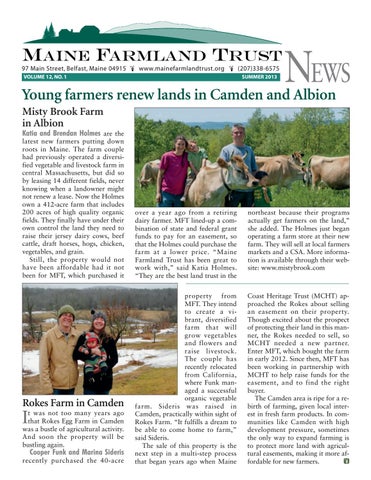
Young farmers renew lands in Camden and Albion Misty Brook Farm in Albion Katia and Brendan Holmes are the latest new farmers putting down roots in Maine. The farm couple had previously operated a diversified vegetable and livestock farm in central Massachusetts, but did so by leasing 14 different fields, never knowing when a landowner might not renew a lease. Now the Holmes own a 412-acre farm that includes 200 acres of high quality organic fields. They finally have under their own control the land they need to raise their jersey dairy cows, beef cattle, draft horses, hogs, chicken, vegetables, and grain. Still, the property would not have been affordable had it not been for MFT, which purchased it
Rokes Farm in Camden
I
t was not too many years ago that Rokes Egg Farm in Camden was a bustle of agricultural activity. And soon the property will be bustling again.
Cooper Funk and Marina Sideris recently purchased the 40-acre
over a year ago from a retiring dairy farmer. MFT lined-up a combination of state and federal grant funds to pay for an easement, so that the Holmes could purchase the farm at a lower price. “Maine Farmland Trust has been great to work with,” said Katia Holmes. “They are the best land trust in the
northeast because their programs actually get farmers on the land,” she added. The Holmes just began operating a farm store at their new farm. They will sell at local farmers markets and a CSA. More information is available through their website: www.mistybrook.com
property from MFT. They intend to create a vibrant, diversified farm that will grow vegetables and flowers and raise livestock. The couple has recently relocated from California, where Funk managed a successful organic vegetable farm. Sideris was raised in Camden, practically within sight of Rokes Farm. “It fulfills a dream to be able to come home to farm,” said Sideris. The sale of this property is the next step in a multi-step process that began years ago when Maine
Coast Heritage Trust (MCHT) approached the Rokes about selling an easement on their property. Though excited about the prospect of protecting their land in this manner, the Rokes needed to sell, so MCHT needed a new partner. Enter MFT, which bought the farm in early 2012. Since then, MFT has been working in partnership with MCHT to help raise funds for the easement, and to find the right buyer. The Camden area is ripe for a rebirth of farming, given local interest in fresh farm products. In communities like Camden with high development pressure, sometimes the only way to expand farming is to protect more land with agricultural easements, making it more affordable for new farmers.
New Program Buys Easements in a Different Way
We will focus on working farms
Another tool to support farmers
that will use the funds to
B
uying an easement on farmland is nothing new. Indeed, there are state and federal programs that have done exactly that for decades. For instance, a portion of the state funds distributed through Land for Maine’s Future (LMF) flow to buy easements on farmland. Since 1989, LMF funds have helped protect over 8,900 acres of farmland in this manner—a great success! But as useful as LMF and other government programs are, MFT realizes that these programs are inadequately funded. Far more farmers want to sell easements (sometimes referred to as “selling development rights”) than there are funds available for this purpose. In addition, the requirements set by these governmental programs are not always well-suited to certain farms. For both reasons, MFT thought Maine needed another tool. So we created our own Purchased Easement Program.
Lots of Dahlov Ipcar children's books, pillows, and other MFT goods available through our online store!
CHECK IT OUT ATcan protect Of course, a farmer
www.MaineFarmlandTrust.org PAGE 2
SUMMER 2013
his land without selling an easement. In fact, most of the farmland that MFT protects is through the generosity of landowners who donate easements. (Donors do so because they want to protect their family’s farming legacy, but by doing so, they are often in a position to receive major tax benefits.) But still, there are some farmers who are simply not in financial position to donate an easement. For many of these famers, selling an easement may be the only alternative to selling the farm. Almost all farmers who sell an easement use the proceeds to directly support their farm operation— perhaps investing in new infrastructure or reducing the farm’s debt. In this way, when a program buys easements on farmland, it is often realizing two goals simultaneously: 1) protecting vulnerable farmland; and 2) helping improve the efficiency of a farm’s operation. MFT crafted our new Purchased Easement Program with these goals in mind. We will focus on working farms that will use the funds to improve their operations, and also on farms that are being protected prior to re-sale, making it possible for an entering farmer to buy the land more affordably and begin to farm in the best financial position possible. One of the key features of MFT’s new program is that we are not wedded to using an appraisal to determine the compensation value. Rather, we can use a formula-based system that takes soil type and development pressure into account. The advantage of this system is that a farmer can know immediately how much he will be paid if the deal goes through. More than one
www.mainefarmlandtrust.org
improve their operations, and also on farms that are being protected prior to re-sale, making it possible for an entering farmer to buy the land more affordably and begin to farm in the best financial position possible.
LMF deal has gone sour when a final appraisal comes in many months after the process began, and it is only then that the farmer knows the level of compensation with certainty. The amount of funds MFT will make available for the program will depend on fundraising success; but MFT hopes to employ at least a million dollars for this purpose by the end of 2014. To date, MFT has awarded about $150,000 to protect three farms totaling 331 acres. (See page 3)
MAINE FARMLAND TRUST
MFT purchases easements on two farms
Winterberry Farm
106 Acres to stay as farmland forever
T
hrough its latest program (see article on page 2), MFT has helped one farms stay in business and helped put another property into production, while protecting 331 acres of quality farmland.
Winterberry Farm in Belgrade operates an impressive CSA and farm stand that local residents love. But the 39-acre farm was at risk of being lost by farmer Mary Perry, given some financial issues. MFT stepped in with funds to help purchase an easement on
this small but locally-important farm, working in partnership with the local land trust, Belgrade Regional Conservation Alliance. A Hay Farm in Carmel: MFT bought an easement on a 67-acre hay farm that was once an active crop farm. We did so in order to lower the price of the property for an incoming farmer, Clint Parsons from Conant Orchards in nearby Etna. Clint plans to expand his farm’s enterprises on this new property with pick-
your-own pumpkins and strawberries. He could not have afforded this property without MFT’s help. MFT’s third project under this new program has been approved, but not yet completed. It involves a 225-acre dairy farm in Central Maine.
We’ve made links in all 16 counties! Have farmland you’re looking to sell or lease? Looking for farmland in Maine? Learn more at www.mainefarmlink.org MAINE FARMLAND TRUST
From southernmost Eliot all the way up north to Perham, from downeast in Jonesport and far western Gilead, we've made links in all 16 counties!
A Glance
at Maine FarmLink
Links to date: 87 Acres Linked: 7,788.5 www.mainefarmlandtrust.org
SUMMER 2013
PAGE 3
From the Field:
Farming’s renaissance won’t happen on its own By John Piotti, Executive Director
I
n MFT’s last newsletter, I made the case for farming’s future, pointing out how Maine’s fundamentals (including abundant land, water, and markets) position us to grow agriculture here significantly. I’ve been making this case—in one form or another—for the past fifteen years. There is no doubt in my mind that Mainers could feed ourselves (and help feed New England). But my message should not be taken as an indication that all is right with farming in Maine. Take dairy as just one example. If you’ve been reading the newspaper over the last few months, you’ve seen the stories about how some farmers have stopped milking—simply shut down the farm because they can’t continue to lose money every day. Whether large or small, conventional or organic, Maine’s dairy farms are struggling—or worse. So how can it be that farming is our future and yet we have so many farmers calling it quits? Well, the truth is that Maine’s agricultural fundamentals are indeed good, even for dairy farming. In fact, Maine is a great place to raise cows—because it’s cool and relatively wet. We grow grass well and could grow a lot more grain. And we have handy access to population centers that drink a lot of milk. But the fundamentals aren’t always enough. In the case of dairy, the fundamentals are trumped by the federal government, which sets the price paid to dairy farmers. I won’t go into any details about the complicated and seriously flawed fed-
PAGE 4
SUMMER 2013
There is no doubt in my mind that Mainers could feed ourselves (and help feed New England). But my message should not be taken as an indication that all is right with farming in Maine. eral pricing system, nor about the highly creative and partially successful way that state law tries to compensate for the fed’s failings. (If you want to learn some of that detail, you can view a piece I wrote entitled “Milk: pure, but not so simple” on MFT’s website.) My purpose in mentioning dairy is not to explain it all, but rather, to make two other points. My first point is that this stuff is complicated. Farming is not a single industry, but an incredibly diverse set of businesses that operate on multiple scales with dozens of different products while serving the broadest spectrum of markets imaginable. (Maine farms distribute products at the most basic levels—perhaps bartering with neighbors or via an honor system box placed beside the barn—and yet also sell products as commodities to some of the largest corporations in the world. And sometimes the same farm is doing both.) On top of that is laid a complex web of state, federal, and international law that often distorts the market. Within such a system, any particular
www.mainefarmlandtrust.org
type and scale of farming could be vulnerable at a given point in time, even if farming’s fundamental are strong. My second point is more specific to dairy—the sector that appears most vulnerable today. Dairy is less than 20% of Maine’s agricultural production, but utilizes over 60% of the farmland. So as dairy farms go out of business, we put considerable acreage at risk. Many dairy farms are well suited to other types of farming, but the bulk of them are too large and/or too distant from good local markets to become the kind of small, diversified, direct-sales farms that have led the recent growth in Maine’s farming. So if a large number of dairy farms go out of business, MFT may need to get actively involved, buying easements or the land outright (for later re-sale to new farmers). That may be the only way to ensure that this farmland remains available for farming’s future needs. Yes, farming in Maine has great promise. But securing that future will require that MFT stands ready and able to continue its important work.
MAINE FARMLAND TRUST
“Now is the critical time for Maine agriculture... The work that MFT and our partners do in the next few years will make all the difference.” –Taylor Mudge
MFT completes Part I of fundraising campaign
W
ith an outpouring of year-end support, MFT met our goal of raising $10 million in private cash by late December. This would be a significant accomplishment for any group in this economy, but even more impressive for a young organiza-
tion like MFT. MFT’s campaign chair Taylor Mudge attributes the success in part to hard work, but also to the fact that more and more people realize the critical importance of what MFT is doing. Raising $10 million is
MAINE FARMLAND TRUST
the first step in MFT’s Securing a Future for Farming campaign, which has as its ultimate goal raising $50 million. That’s the level of resources that will be needed for MFT to protect 100,000 acres of farmland and support a thousand farm families.
www.mainefarmlandtrust.org
MFT will be launching Part II of its campaign later this year.
SUMMER 2013
PAGE 5
Food Access
“Community Farm Share” helps both farmers and low-income residents
A
s part of MFT’s efforts to support farmers, we work to increase farm sales in various ways. Last year, we ran a highly successful “Community Farm Share” program that moved about $100,000 in produce from twenty farmers in Waldo and Kennebec counties into the hands (and mouths) of low-income residents; using grant funds, we could provide these high quality products at reduced costs to hundreds of Maine families. We also began equipping farmers markets to handle “electronic benefits transfer” (or EBT), so that recipients of SNAP (formerly food stamps) could use their benefits to buy local farm products. To date, we have helped five farmers markets in this way.
Staff Update We’ve recently brought on three new members of Lands Staff: Kurt Anderson, Adam Bishop, and Tricia Rouleau. All three are exceptionally qualified, with proven experience doing conservation work. We just hired Ellen Sabina to lead our outreach efforts, attracting the Maine native from the West Coast. Ellen will be supported by Alex Fouliard, a recent college graduate with a passion for farming. And Jamie Wood, another impressive recent graduate, will be guiding our Forever Farms program. Earlier in the year we hired Kim Sanborn to provide office support and Elizabeth Sprague to provide business counseling services to farmers. Elizabeth comes to MFT with a well-established reputation within Maine’s farm community.
In May, MFT’s gallery held the first show in our newly renovated space, featuring the works of one of Maine’s artistic icons, Dahlov Ipcar.
■
Currently, the gallery is hosting our “Summer Stable Show,” which features a dozen artists that are affiliated with MFT.
■
Later this summer, we will be showcasing the works of Joseph Fiore, Johan Selmer Larsen, Jude Valentine, and John Woolsey. ■
SUMMER GALLERY HOURS: Mon-Thu 9am-4pm; Fri 9am-8pm; Sat 10am-2pm
This year’s gallery posters are available for purchase at the MFT Gallery or via MFT’s website. PAGE 6
SUMMER 2013
www.mainefarmlandtrust.org
MAINE FARMLAND TRUST
M A I NE FARMLAND TRUST
Maine Farmland Trust
We’re the only statewide land trust devoted exclusively to farmland protection. Our budget is primarily funded by individual donors and members. Please join us. With your help, we can meet the challenge.
97 Main St. Belfast, Maine 04915 207-338-6575 www.mainefarmland.org ■
■
■
Founded in 1999, Maine Farmland Trust protects farmland, supports farmers, and advances farming. BOARD OF DIRECTORS William Bell, President, Saco Susan Morris, Vice-President, Waldoboro Frank Miles, Treasurer, Cape Elizabeth Taylor Mudge, Secretary, Camden Paul Birdsall, Penobscot Neil Crane, Exeter Julie Dodge, Cumberland Walter Fletcher, Pittsfield Eleanor Kinney, Bremen James Lawrence, Camden Steve Page, Searsmont Cecily Pingree, North Haven Henry Whittemore, Readfield ADVISORY COUNCIL Chris Hamilton, Whitefield James P. Hazstings, Skowhegan Bambi Jones, Alna Jo D. Saffeir, Pownal Arthur Thompson, Presque Isle Adrian Wadsworth, North Turner STAFF John Piotti, Executive Director Kristin Varnum, Associate Director Rachel Taker, Excecutive Assistant Kim Sanborn, Office Assistant LouAnna Perkins, Legal Counsel Reeve Wood, Staff Attorney Nina Young, Lands Projects Erica Buswell, Lands Projects Tricia Rouleau, Lands Projects Kurt Anderson, Lands Projects Adam Bishop, Lands Projects Mike Gold, Farm Viability Holly Ingraham, Farm Viability Tess Cleary, Farm Viability Beth Wade, Maine Farms Realty Sue Lanpher, FarmLink Martin Hayden, Development Andrea Denny, Database Ellen Sabina, Outreach Alex Fouliard, Outreach Jamie Wood, Forever Farms Anna Abaldo, Gallery Erin Herbig, MaineFare Stacy Benjamin, Municipal Services MAINE FARMLAND TRUST
Membership Categories: Basic (e.g., Student).... $20 Individual .................. $30 Family ........................ $50 Contributor.............. $100 Life ........................ $1000
Life Membership: You may also make payments toward Life Membership: (4 payments) ......... $250 (2 payments) ......... $500 Additional donation $ ___________________.
Please contact me about protection options for my farm property. Name
__________________________________________________________________________________
Address
________________________________________________________________________________
Town, State, Zip _______________________________________________________________________ Telephone __________________________________________________________ e-mail _____________________________________________________________
PAYMENT:
CHECK ENCLOSED
VISA
MASTERCARD
Credit Card No.: ________________________________________ Exp. _______ Signature: ______________________________________________________________
Mail to: Maine Farmland Trust, 97 Main St., Belfast, ME 04915. Maine Farmland Trust is a non-profit organization, and membership dues and donations are tax-deductible.
www.mainefarmlandtrust.org
SUMMER 2013
PAGE 7
NON-PROFIT ORG. PRESORT STANDARD U.S. POSTAGE
PAID
PERMIT NO. 30 FARMINGTON, ME
97 Main Street/ Belfast, Maine 04915 207-338-6575 e-mail: info@mainefarmlandtrust.org www.mainefarmlandtrust.org RETURN SERVICE REQUESTED
■
Young farmers renew lands in Camden & Albion, page 1
■
The Purchased Easement Program, page 3
■
331 Acres of Prime Farmland under protection, page 3
■
John Piotti on the state of the Farming Renaissance, page 4
■
Community Farm Share benefits farmers and low income families, page 6
PHOTO BY BRIDGET BESAW
In This Issue
Wednesday July 24, 2013 Winterberry Farm in Belgrade
PHOTO BY BRIDGET BESAW
Tuesday, August 20, 2013 Misty Brook Farm in Albion
Friday, September 6, 2013 and Saturday, September 7 Downtown Belfast
A CELEBRATION For more information visit:
www.foreverfarms.org
of Maine’s local food traditions, farms, farmers, restaurants, chefs, and happy eaters. t For more information visit
and to learn more about Forever Farms summer events! PAGE 8
SUMMER 2013
www.mainefarmlandtrust.org
www.maine-fare.com MAINE FARMLAND TRUST