he Advent and Christmas seasons always catch me off guard. Summer ends too quickly, fall races by, and—bam!—Christmas looms. Our kids’ dressers still overflow with shorts and t-shirts, while bikes and scooters clog the garage. Now hardly feels like the right moment to pause and reflect on the Christ child who came to bring “peace on earth.”
But, of course, this is the perfect moment for exactly that.
I’m reminded of that fourth verse of the hymn, “I Love to Tell the Story.” Katherine Hankey penned: “I love to tell the story, for those who know it best; seem hungering and thirsting, to hear it like the rest.” We have all heard the Christmas story many, many times. And I’m sure we have all been reminded to hear it anew many, many times. The birth of Christ stands at the center of history, and it’s always good to remind ourselves of this beautifully familiar, true story.
Our issue this month looks at three aspects of this familiar Christmas story that are worth reflecting upon once again. Three reminders that God chooses the small and foolish things of the world to shame what we consider wise.
Jessica McCarlson writes about the baby who was born to the young girl named Mary that first Christmas night. The pregnancy was a cause for scandal, and birth is messy and undignified, but this is how God himself arrived in his creation.
Andrea Christenson reflects on the location of this great incarnation. A stable is hardly a place for a king, and the city of Bethlehem would not have been anyone’s first choice for a triumphant coronation, but this is where the creator of all things restored our corruptible flesh and blood.
And finally, Pastor Matthew Ballmann remembers Christ’s first visitors and heralds of the wondrous news. The heavenly host announced the news of Jesus’ birth not to the cultural elite or noble-born rulers, but to simple shepherds. And the star-watching Gentile Magi from the East were among the first to visit Christ, helping us see that our Savior comes to the outcast and unclean.
So many other details of this Christmas story also deserve fresh eyes. The eternal King of the universe was covered in swaddling cloths, divinity wrapped in fragile humanity. Oxen and donkeys, lowly beasts of burden, were among the first to lay eyes on the Savior of mankind, who would single-handedly bear the yoke of our sin.
Today, we often consider Christmas and Easter as two of the most special days on the Christian calendar. These are the days we remember that our Savior took on a human body like ours to save us. Our corruptible, physical bodies would have faded into nothingness had God not become what we are. Now we have the certain hope that our flesh-and-bone bodies—which so often ache and break and fail—will be physically restored and raised imperishable, because the birth of Christ brings incorruption to those who believe in him.
And we also have the guarantee of forgiveness because the Son of God was born in Bethlehem and crucified and raised in Jerusalem. God did not ignore the debt we owed on account of our many failures. The baby born on Christmas took our place on the executioner’s cross and received all the punishment we were due.
We’ve heard the familiar Christmas story many times. But may we never grow weary of hearing about Christ’s victory for us, from the manger to the cross to the empty tomb.
—Pastor Andrew Kneeland
THE LUTHERAN AMBASSADOR
DECEMBER 2025
63 NO. 12
Editor
Pastor Andrew Kneeland laeditor@aflc.org
Managing Editor
Ruth Gunderson ruthg@aflc.org
Circulation
Liz McCarlson lasubscriptions@aflc.org
Editorial Board
Monica Coyle
Pastor Jerry Moan Pastor Craig Johnson
The Lutheran Ambassador (ISSN 0746-3413) (USPS 588-620) is published monthly by the Association of Free Lutheran Congregations, 3110 E. Medicine Lake Blvd., Plymouth, MN 55441 Phone (763) 545-5631
Periodicals postage paid at St. Paul, MN and additional mailing offices.
Postmaster send address changes to
The Lutheran Ambassador, 3110 E. Medicine Lake Blvd., Plymouth, MN 55441.
subscriptions & giving
The Lutheran Ambassador is a free publication of the AFLC. Our non-profit ministry is supported by readers’ gifts. To subscribe and give online, visit our website aflc.org/lutheran-ambassador
Checks may be mailed to 3110 E. Medicine Lake Blvd., Plymouth, MN 55441
Email inquiries can be sent to lasubscriptions@aflc.org
Life in a prison cell may well be compared to Advent; one waits, hopes, and does this, that, or the other— things that are of no real consequence—the door is shut, and can be opened only from the outside.
[Dietrich Bonhoeffer]
Yes, in our world too, a stable once had something inside it that was bigger than our whole world.
[Queen Lucy, “Chronicles of Narnia”]
Man’s maker was made man, that He, Ruler of the stars, might nurse at His mother’s breast. That the Bread might hunger, the Fountain thirst, the Light sleep, the Way be tired on its journey; that the Truth might be accused of false witness, the Teacher be beaten with whips, the Foundation be suspended on wood; that Strength might grow weak; that the Healer might be wounded; that Life might die.
[Augustine]
My soul is waiting for you, Lord, as one who longs for morning; no watcher waits with greater hope than I for your returning.
[Martin Luther, “Out of the Depths I Cry to You”]
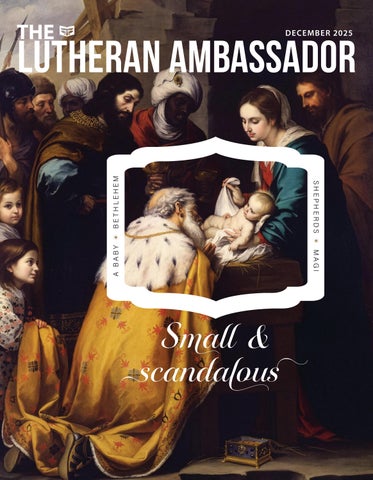
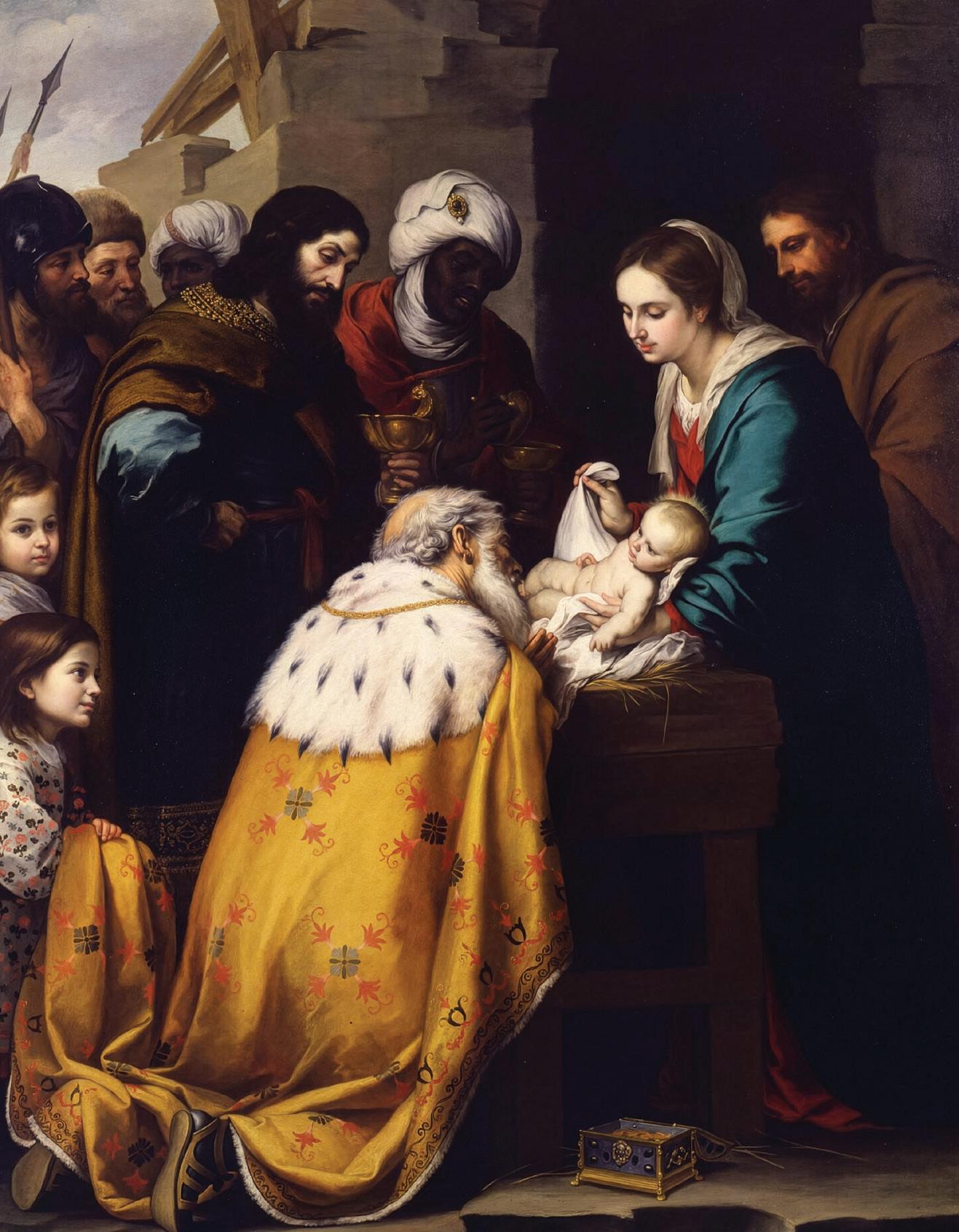
Cover: "Adoration of the Magi," Bartomolé Esteban Morillo, 1655, Toledo Museum of Art.
FEEDING TROUGH
BY JESSICA MCCARLSON
For a child will be born to us, a son will be given to us; And the government will rest on His shoulders; And His name will be called Wonderful Counselor, Mighty God, Eternal Father, Prince of Peace.
There will be no end to the increase of His government or of peace, On the throne of David and over his kingdom, To establish it and to uphold it with justice and righteousness From then on and forevermore.
The zeal of the Lord of hosts will accomplish this.
— Isaiah 9:6–7
hristmas Eve, I would imagine, is a beloved holy day to many in the Church. And with popular Christmas texts like the one above, it is no wonder that the Church rallies around the fulfillment of the promised Messiah this season. However, it is fair to say that many of us celebrate this time in the liturgical year with only half of the significance in the forefront of our minds. We think primarily of the glory, especially following Advent, of our King’s first coming or of the tender innocence of the gift of the Christ child. We cling, and not wrongly so, to the joy and cheer of the season. Think of the Christmas crèche with the smiling baby Jesus, surrounded by his practically glowing parents and pristine shepherds with their obedient sheep and regal kings bearing ornate gifts. It is the idyllic scene we long for.
Christmas Eve holds a tender place in my heart. As the youngest of 12 cousins on my dad’s side, I am fortunate to have
HUMBLE LINEAGE
memories of a mostly settled family Christmas Eve tradition: a Scandinavian American feast, stockings with everyone’s names, holiday songs, my cousin Caleb reading the Luke 2 account, ice cream and pie, Christmas hymns (yes, we sang twice!), passing out gifts from under Grandma’s Christmas tree, hugs and thank yous, and staggering home in the night, intoxicated in the only ways permitted in a pious Scandinavian family—by moderate materialism, lefse, and familial love. Each year there were perhaps slight variations, but for many of my memorable years, that was our rhythm.
One particular—and peculiar—tradition was Grandma’s pre-supper crackers and cranberry juice. As each plate was thoughtfully set, these odd additions took center stage. On multiple occasions, a sibling or cousin would joke, as we sat around the “kids” table in the breezeway, about our “communion.” Indeed, the wafer-shaped Ritz cracker and small glass of juice, although not the usual grape variety we would have on Communion Sundays, did resemble the blessed elements. I never discovered if the parallel to the Lord’s Supper was intentional; perhaps this exposition will spark a new revelation in the family chat! Regardless, those memories are linked with how I think of Christmas Eve— the Word of God core to it all, with family connection and maybe the occasional lutefisk, too.
Why do I share this? Well, for two reasons. One, I think traditions—both in the church and in the family—matter greatly. But I also hope to show that I, too, fall into the trap of making Christmas primarily about joy and cheer. Yet, Christ’s birth was much deeper and more paradoxical than that. It was, to a degree, peculiar and shocking.
Our Savior took on human flesh within the womb of an unmarried, teenage virgin. The setting of his birth was beyond humble. And he was of scandalous lineage. What kind of God and King would choose this? Yet he did. Praise be to God that all in Christ can confess this monumental but also unheard-of reality, that God himself took on flesh. The Son of God became a son of man. He entered into our weak estate, born by suspicious means (Matthew 1:18–19), born in insignificant circumstances (Luke 2:7), and born to a disgraced family (Matthew 1:1–17).
We can’t talk about the scandal of Christ’s birth without pausing on the incarnation (John 1:14). Martin Luther says of the incarnation, “I do not know of any God except Him who was made flesh, nor do I want to have another. And there is no other God who could save besides the God Incarnate” (Sacrament, by Herman Sasse).
We remember Christ’s incarnation not only at Christmas but also when we gather around the Lord’s table to partake of Holy Communion. The incarnation finds its fulfillment with Christ’s bodily death on the cross, a sacrifice that now is delivered into our bodies by the means of his body and his blood. Communion is far more peculiar than my grandma’s cracker and juice tradition, for in the Church’s tradition we eat and drink our Eternal God and Lord—the same Lord born in a stable. Without the incarnate body of our infant King in the manger, we would not have the Savior on the cross nor our Sacrificial Lamb on our lips and in our very being.
This very God made flesh was not born in a palace but in a humble stable, another scandal. We have perhaps grown so accustomed to hearing the word “manger” that we don’t remember the Sunday school lesson that a manger is where the animals would eat. The “Mighty God” foretold in Isaiah was laid in a feed trough! Unlike the cozy nativity scene described above, he was born in utter poverty. But why? Surely the Creator of the universe could have ordained that his parents would be financially well-off and live in a large home with plenty of room to raise a king. But no. In his wisdom, God the Father knew what his Son would need and what we would need.
Most of us in America benefit from comparative wealth. But all of us are spiritually poor and needy. The humble scene of our God among the stench of animals, wrapped in rags, which then becomes the scene of our God covered
in blood, stripped of his clothing—these scenes become a mirror to rich and poor alike. We are weak. We are needy. “For we do not have a high priest who cannot sympathize with our weaknesses, but One who has been tempted in all things as we are, yet without sin. Therefore let us draw near with confidence to the throne of grace, so that we may receive mercy and find grace to help in time of need” (Hebrews 4:15–16). Through the humiliation of Jesus Christ, our own humble estate becomes elevated. We are forgiven, loved, and adopted.
Though we are not adopted into Christ’s earthly family. This, the lineage of Jesus, is the final scandal to consider. As we read the Christmas Eve story in the Gospels of Luke and Matthew, we learn of Christ’s lineage. Perhaps, like me, you skip over this section of Scripture more often than not. But in it we see that Jesus is descended from King David and from Adam. He is the fulfillment of many prophecies in that way. Also, many normal, sinful people are named, much like our ancestry—“for all have sinned” (Romans 3:23). But it is specific sinners in Joseph’s lineage who are worth noting. Rahab the harlot from Jericho, Ruth the foreign widow from Moab, and David the unexpected king who murdered Bathsheba’s husband in order to have her for his own. Throughout the Old Testament, God dealt strictly with Israel. This holy and chosen nation would bring forth the promised Messiah, after all. Yet, God allowed for Rahab and Ruth, Bathsheba and David, and even Mary, this teenage virgin from Bethlehem, to be a part of the Messiah’s recorded lineage.
from Adam were forgiven on the cross, but they were also baptized—or washed—away, making us sons and co-heirs with Christ. God used Mary’s suspicious pregnancy and Joseph’s disgraceful lineage in his redemption plan.
And that brings me to the other reason I treasure Christmas Eve as I do. On Dec. 24, 1989, I was adopted into the family of God through holy baptism. Unlike my extended family traditions, of which I have vivid memories, I don’t recall this significant moment in my life. It wasn’t until the spring of 2020, when going through old family photos with my mom, that I found a photograph of me in my grandma Adeline’s arms, my grandpa by her side, in front of the church’s Christmas tree. On the back, my mom had written that it was my baptism. It is things like photos and stories that tell us of our personal history. Likewise, it is the Word of God that tells us of our greater history as it relates to God’s grand plan. Without this record of history, we would be in the dark about the glorious ways in which God has used strange, insignificant, and scandalous means to deliver his Prince of Peace to us.
This is good news for those of us who are sinners born of sinners, and Gentiles as well. By no merit of our own, we are grafted into God’s holy and chosen people by Christ’s work, delivered in baptism. Just as Christ became a part of Israel through the waters of birth, we have become God’s family through the waters of baptism. The sins inherited
May this Christmas season be filled not just with the brightness of Christmas lights and the joy of holiday festivities, but also the depth of what his Light in our darkness means. I pray as we hear, read, and abide in his Word and sacraments, that he will illumine our hearts to the treasure of Christ—the peculiar infant King, wrapped in human flesh, laid in a feeding trough, and born of sinful mortals. He came for mere humans, to feed us and clothe us in his righteousness as his very brethren. This is a family tradition worth celebrating.
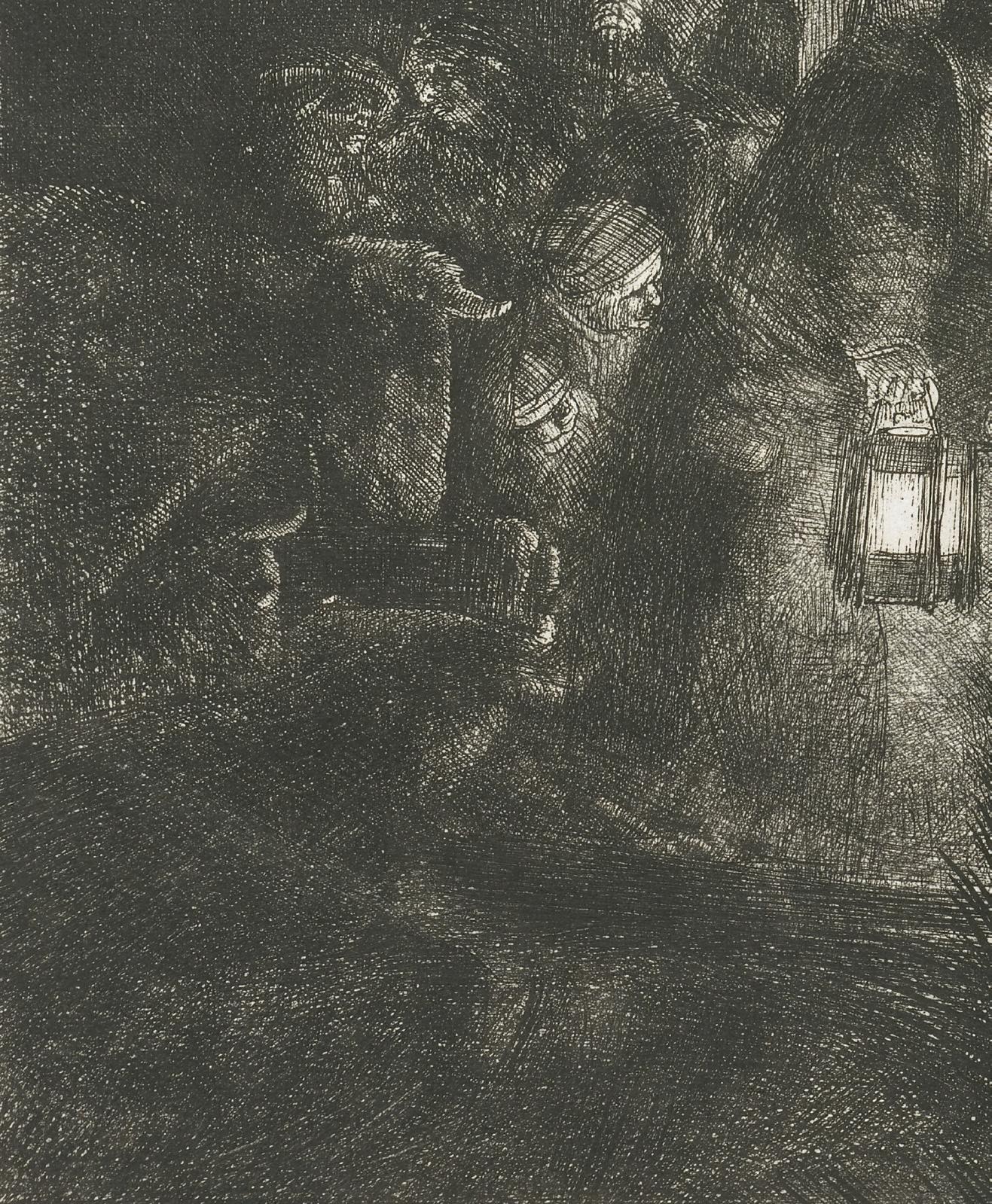
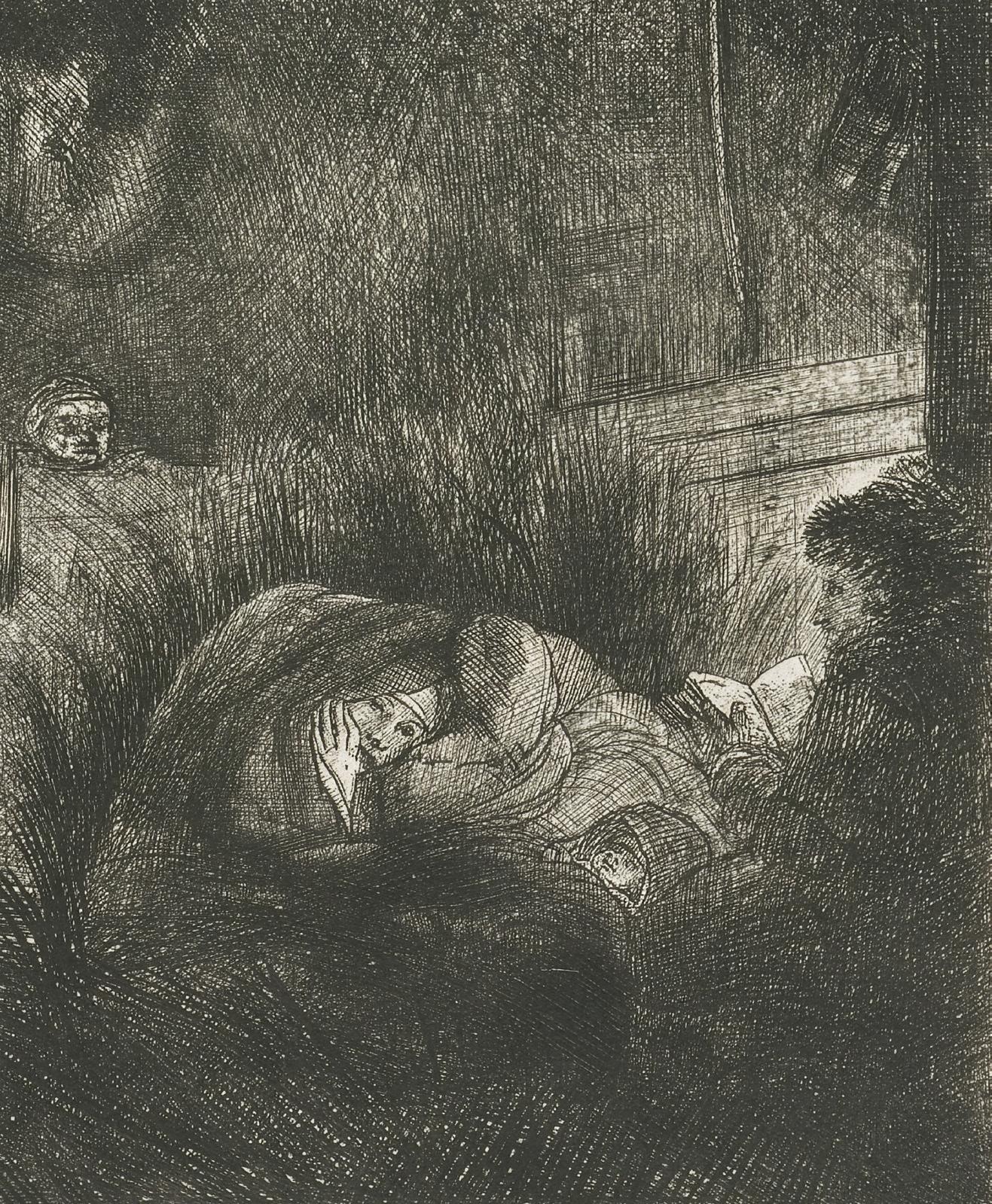
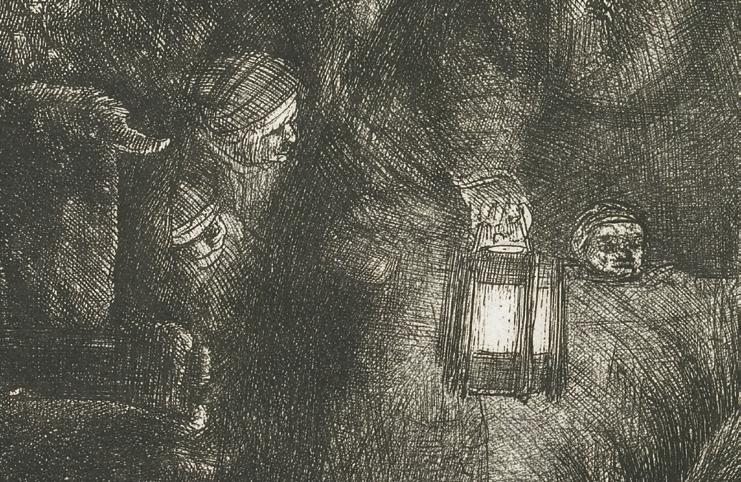
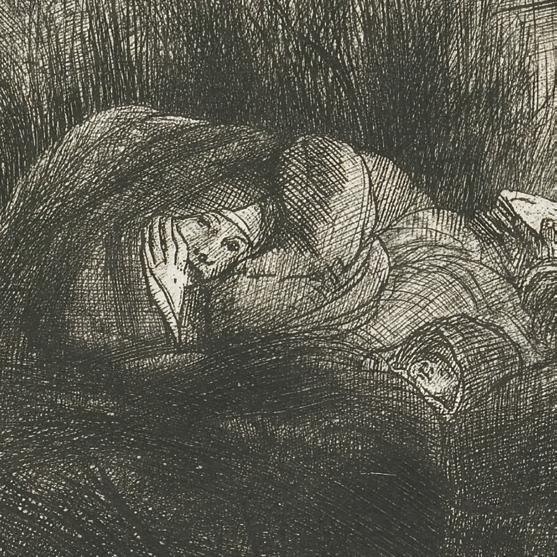
McCarlson lives in Marshall, Minn. Artwork: "The Adoration of the Shepherds," 1657, by Rembrandt Harmensz van Rijn, Rijksmuseum.
BY ANDREA CHRISTENSON
he tradition started out simple. I’d been surfing around online and spotted a fun idea for a Santa-shaped bread at Christmastime.
Loving a challenge and being obsessed with bread baking at the time, I wanted to give it a try. I worked while my children were napping, rolling out four little loaves of bread, carefully shaping and tinting them, snipped and twisted pieces for Santa’s beard, tucked in currants for eyes, and adding a bobble of dough to the end of his hat. Later that night the cutest edible Santas graced every plate of our Christmas Eve table.
As anyone with children can tell you, it only takes once to make a tradition. The next year when Christmas loomed on the calendar, my family started asking, “What is the Christmas bread this year?” Because I had no idea—I hadn’t even known this was a tradition (silly me)—I schooled my face into a mysterious look and replied, “You’ll have to be surprised.”
Enter the second part of the tradition (my fault this time). Now, every year I make a specially shaped bread for Christmas Eve and attempt to keep the shape a surprise from my family. What once was something simple is now an integral part of our celebration. For the past 13 years or so I’ve made wreaths and crowns and penguins and Christmas gifts. I’ve shaped candy canes and stars and snowflakes. I tried for a baby Jesus in a manger one year, but couldn’t quite pull it off. I waffled on that one. Eating baby Jesus falls somewhere between sacrilege and symbolism.
THE HOUSE OF BREAD
It is such a small and simple thing—bread. Made with simple ingredients—flour, water, yeast, and salt—it can serve as the complement to every meal. Bread, while rarely the focal point, almost always occupies part of the menu. Bread can make a simple meal into a gourmet one. Would soup taste as good without a hunk of crusty bread to mop it up? Every culture in the world has some form of bread—from flatbreads like pita and tortillas to iconic breads like a French baguette or Russian black bread. In English, idioms about bread abound: breaking bread together, breadwinner, cast your bread on the waters, the greatest thing since sliced bread … This simple food carries a heavy significance. If you want to know the history of a place, start by getting to know its bread.
BREAD OF LIFE
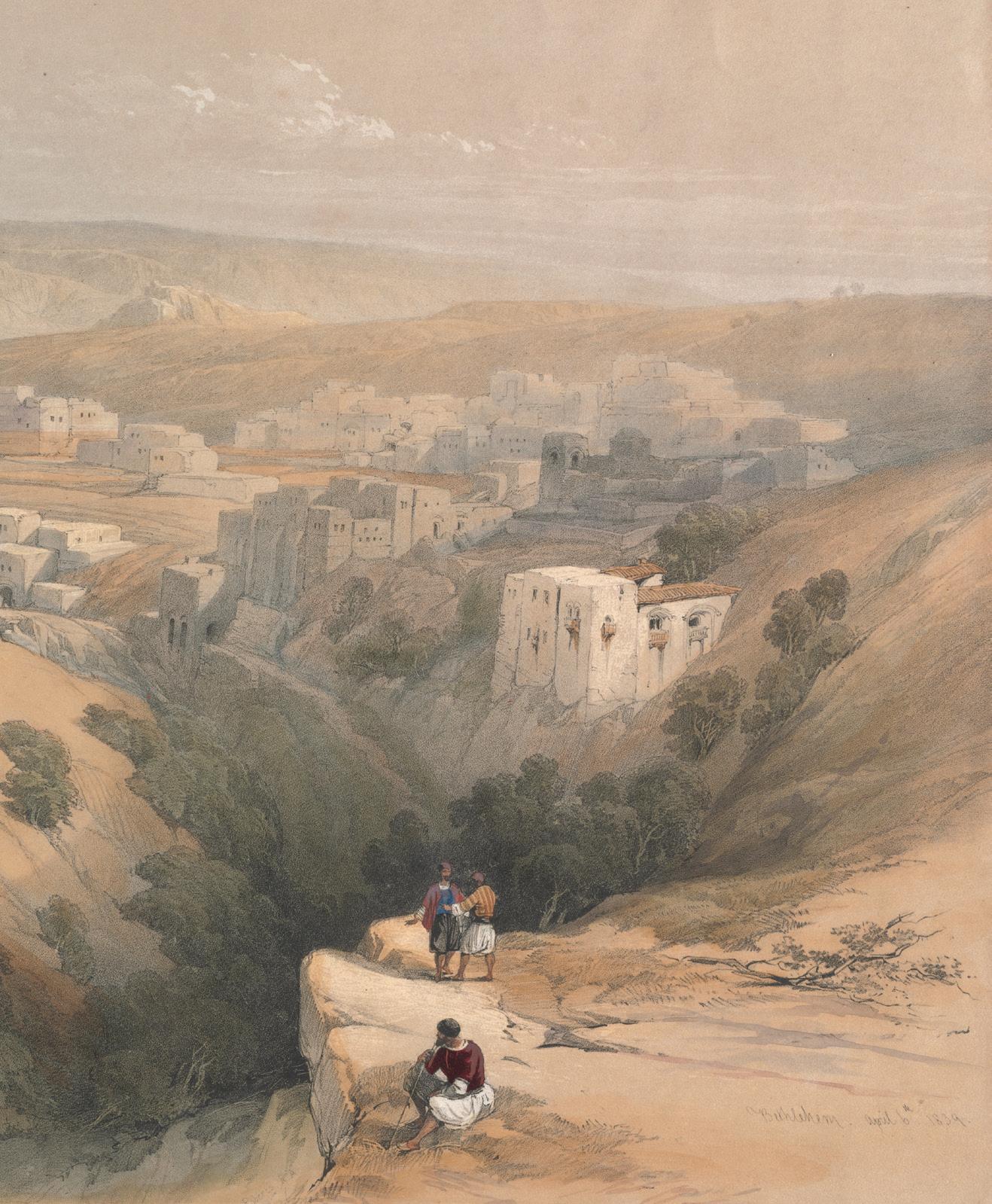
Artwork: “Bethlehem,” by David Roberts, 1839, The Cleveland Museum of Art.
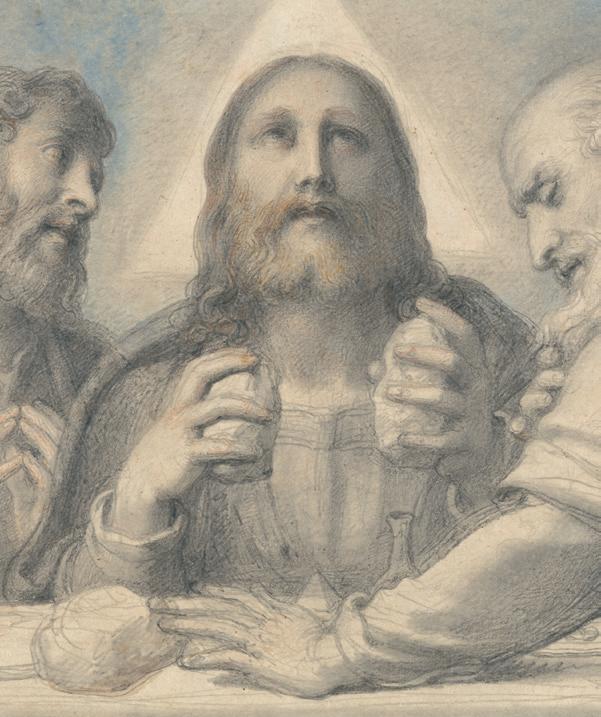
”Supper at Emmaus,” by Richard Cosway, Yale Center for British Art.
Bethlehem is a simple town. A small village, nestled in the hills, just six miles away from Jerusalem. Home to simple people—shepherds keeping watch over their flocks. But even this simple place contains a storied history. It serves as the resting place for Rachel, the mother of two tribes of Israel. Bethlehem became home to Ruth, who married her kinsman-redeemer. It is the birthplace of King David, who needs no introduction. And, one night, just more than 2,000 years ago, it played host to a family whose Son would change the world. This inauspicious place holds the history of our salvation.
Scholars tell us that the name Bethlehem means “house of bread.” Much like America’s Midwest, known as the breadbasket, this region in Israel teems with an abundance of fertile land. Perfect for raising crops, like Boaz did in the biblical account of Ruth, and perfect for raising flocks of sheep. It was here that David learned to be a shepherd, here that Samuel anointed David the future king of Israel. And it was here, in the House of Bread, that the Prophet Micah prophesied that the coming Savior would be born.
“‘But as for you, Bethlehem Ephrathah, Too little to be among the clans of Judah, From you One will go forth for Me to be ruler in Israel. His goings forth are from long ago, From the days of eternity.’
“Therefore He will give them up until the time When she who is in labor has borne a child. Then the remainder of His brethren Will return to the sons of Israel.
“And He will arise and shepherd His flock In the strength of the Lord,
In the majesty of the name of the Lord His God. And they will remain, Because at that time He will be great To the ends of the earth” (Micah 5:2–4).
We know the simple story. A decree went out from Caesar Augustus that all the world should be taxed, part of a census taken in the town of their lineage. Joseph, who was from the line of King David, took his heavily pregnant wife, Mary, to the town of Bethlehem. While there, Mary gave birth to Jesus, wrapped him in swaddling cloths, and laid him in a manger. The Gospel of Luke presents these simple facts. A humble birth, an uncomplicated account of the arrival of the Savior. But what started off small and simple becomes extraordinary when the skies over Bethlehem open and a great cloud of angels begins singing. Their audience? Simple shepherds in the fields. It becomes even more extraordinary with the arrival of visitors from the East who lavish expensive gifts on the tiny baby who is lying in the animal’s food trough.
A small and simple town, a poor and simple family, and a lowly and simple birth, but each piece rich with deeper meaning. This small town was the birthplace of kings, first David, then the greatest King of all: Jesus. This poor family saw the incarnation of Emmanuel, God with us. In many ways, this made them wealthy beyond imagining. This lowly birth transformed into something glorious as prophecies were fulfilled.
There is a belief in some traditions that the flocks roaming around on the hillsides of Bethlehem were the lambs being raised for sacrifice in the temple at Jerusalem. These unblemished sheep were meant to appease God’s wrath and fulfill his law. The flocks in this region, perhaps descendants of the ones shepherded by King David himself, may have been destined for a higher calling than just a spot on the dinner table or as someone’s favorite sweater. If true, what a depth it brings to the words of John the Baptist, who said of Jesus, born in Bethlehem near these flocks of sacrificial lambs, “Behold, the Lamb of God who takes away the sins of the world!” (John 1:29). No longer were lambs needed for the sacrifice for the sins of man; Christ was the lamb for all of us, for all of eternity.
Whether or not this tradition of the lambs is true, it is certainly a fact that Jesus, born in the House of Bread, became the Bread of Life for us. He grew up and began his earthly ministry around age 30. Once, when he was preaching on a hillside, the time of Passover was near. Jesus, seeing the need of the crowd, took five loaves of bread and two fish and used them to feed 5,000 or more people. Shortly after this event, Jesus and his disciples got into a discussion about bread. The disciples remembered
the manna that God sent to the Israelites in the wilderness. Jesus wanted them to see the bigger truth in the simple bread. He said, “For the bread of God is that which comes down out of heaven, and gives life to the world” (John 6:33, emphasis mine). The disciples were, rightly, excited about the prospect, and “then they said to Him, ‘Lord, always give us this bread’” (v. 34). Jesus, perhaps knowing full well that he was about to blow their minds, said to them, “I am the bread of life; he who comes to Me will not hunger, and he who believes in Me will never thirst” (v. 35).
Jesus had not finished comparing himself to the Bread of Life. On one Passover night, the night when he was betrayed by Judas, he presided over the holiday table. “And when He had taken some bread and given thanks, He broke it and gave it to them, saying, ‘This is My body which is being given for you; do this in remembrance of Me’” (Luke 22:19). He knew that in a few short hours his physical body would be broken, he would be led like a lamb to the slaughter, and his life would be given up in sacrifice to save the world. This institution of Communion, a means of grace, stands as a reminder of his sacrifice and our subsequent salvation.
The birth of Jesus in Bethlehem reminds us of an essential truth. God can, and will, and does take the ordinary, simple, small things in our lives and transforms them into something worthy of his glory. Much like the loaves that fed 5,000, he takes our talents and our contributions and multiplies them for his service and for service to his people.
This year as I plan my Christmas bread for our Christmas Eve tradition, perhaps I will forgo Christmas trees and snowmen and holly and instead attempt to fashion a flock of sheep. That way our table will be graced with two small, simple symbols. Symbols that carry deep, rich, not-at-all-small or simple meanings. The bread will remind our family that Christ was born in Bethlehem, the House of Bread, as the precious Bread of Life. And the shape of the bread will bring to mind the Lamb of God, who takes away my sin and the sins of the entire world.
Christenson is a member of Solid Rock Free Lutheran, Anoka, Minn.
THE GOD OF THE MARGINS
BY PASTOR MATTHEW BALLMANN
hroughout history, the birth of a child has often drawn a crowd. The more important the family, the more distinguished the visitors. When a royal heir was born in France or England, courtiers, bishops, and nobles were summoned to stand outside the birthing chamber to verify the legitimacy of the newborn. Trumpets would sound through palace halls, heralds would proclaim decrees, and celebrations might last for days on end. The arrival of a royal child was not simply a private joy; it was a public spectacle of power, lineage, and prestige. The greater the status of the child, the greater the honor of those invited to witness his birth.
But in Bethlehem, heaven rewrote the script. The most significant birth in all of human history—the birth of the eternal Son of God, the Word made flesh—was attended not by princes or priests, but by shepherds and foreigners. The Lord of glory entered the world without fanfare, without courtiers or dignitaries, and without the world even noticing.
For many of us, this story has become so familiar that its wonder barely registers. We’ve heard it read every December, seen it reenacted by children in bathrobes and cardboard crowns, and sung about it in countless carols. Over time it can begin to feel like a scene from a fairy tale or a sentimental movie, distant in culture, time, and place. But before we let this holy story fade into nostalgia, we should pause and look more closely. The guest list of Bethlehem, shepherds from nearby fields and Gentile travelers from distant lands, tells us something astonishing about the heart of God and the type of people his Son came to save.
When we hear certain job titles, our minds instinctively fill with impressions and assumptions—doctor, garbage collector, teacher, lawyer, pastor. Each carries its own image and reputation, some admirable and others less so. In the first century, the title “shepherd” would have triggered an equally clear response, and it was not one of respect.
In the Old Testament, shepherding was an honorable and even royal occupation— think Abraham, Moses, and David. God himself is called Israel’s Shepherd (Psalm 23).
But by the first century, Jewish society, especially near urban and temple-centered Jerusalem, had changed dramatically. Shepherds had become a looked-down-upon class, viewed with suspicion and often contempt.
Shepherds spent their days and nights in the open fields, far from cities and synagogues, living among their animals. Their work made them ritually unclean; they regularly handled blood, dirt, and the carcasses of animals and could rarely keep the Sabbath. Because of that, they were effectively cut off from full participation in worship and community life. Later rabbinic writings such as the Mishnah and Talmud describe shepherds as dishonest and unreliable, their testimony inadmissible in court, and their reputation comparable to gamblers or tax collectors. In short, shepherds were viewed as socially inferior, religiously unclean, and morally suspect. They lived on the margins of society, literally and figuratively. As those on the margins, they were ignored by the powerful and avoided by the pious. Their status makes what happened more shocking. It is these types of people whom God chose to be the first to hear the news: “Unto you is born this day in the city of David a Savior, who is Christ the Lord” (Luke 2:11). Unto you, not the elites, not the religious, not the astute, but the dirty, marginalized, and outcast.
LOWLY & FAR
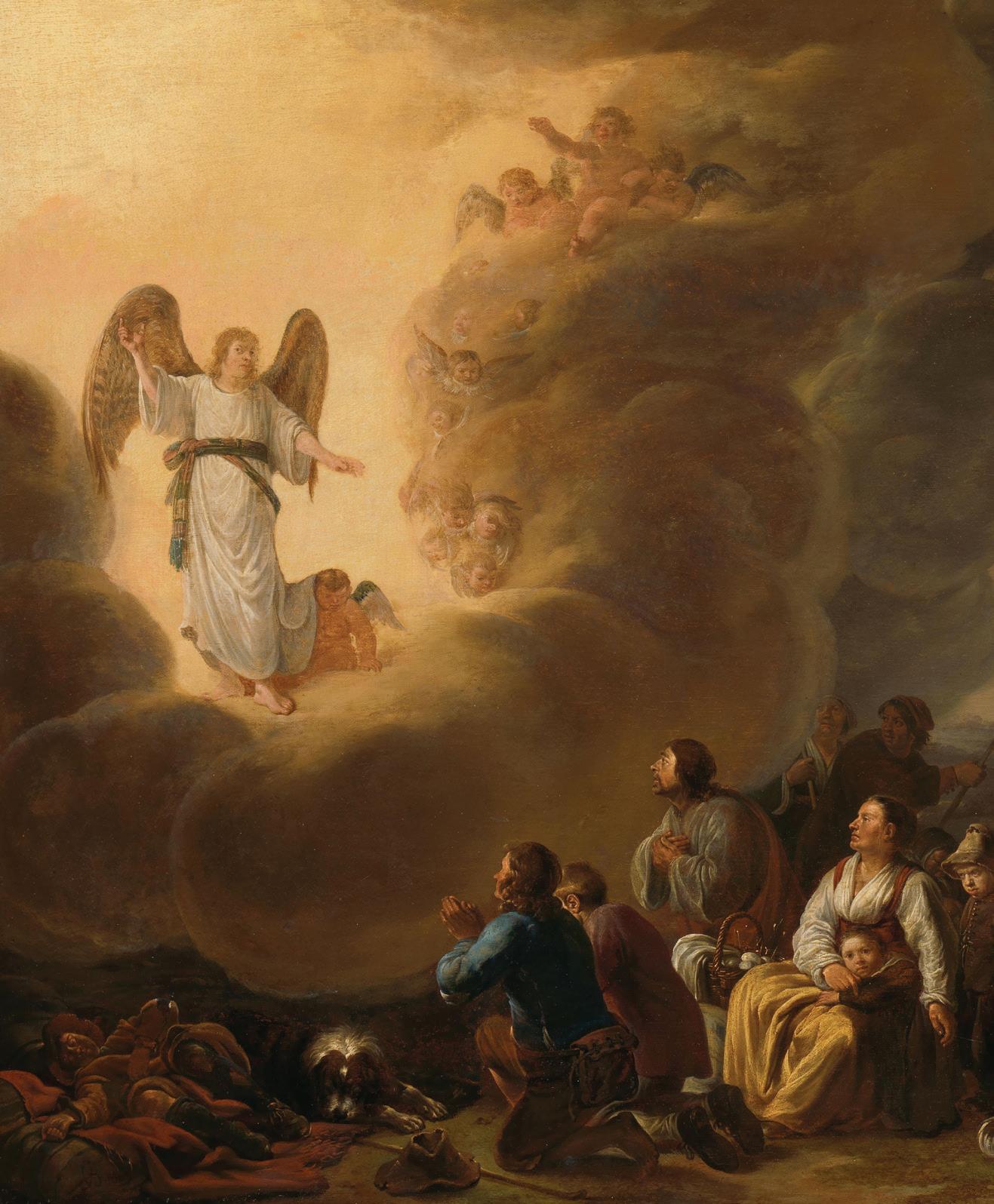
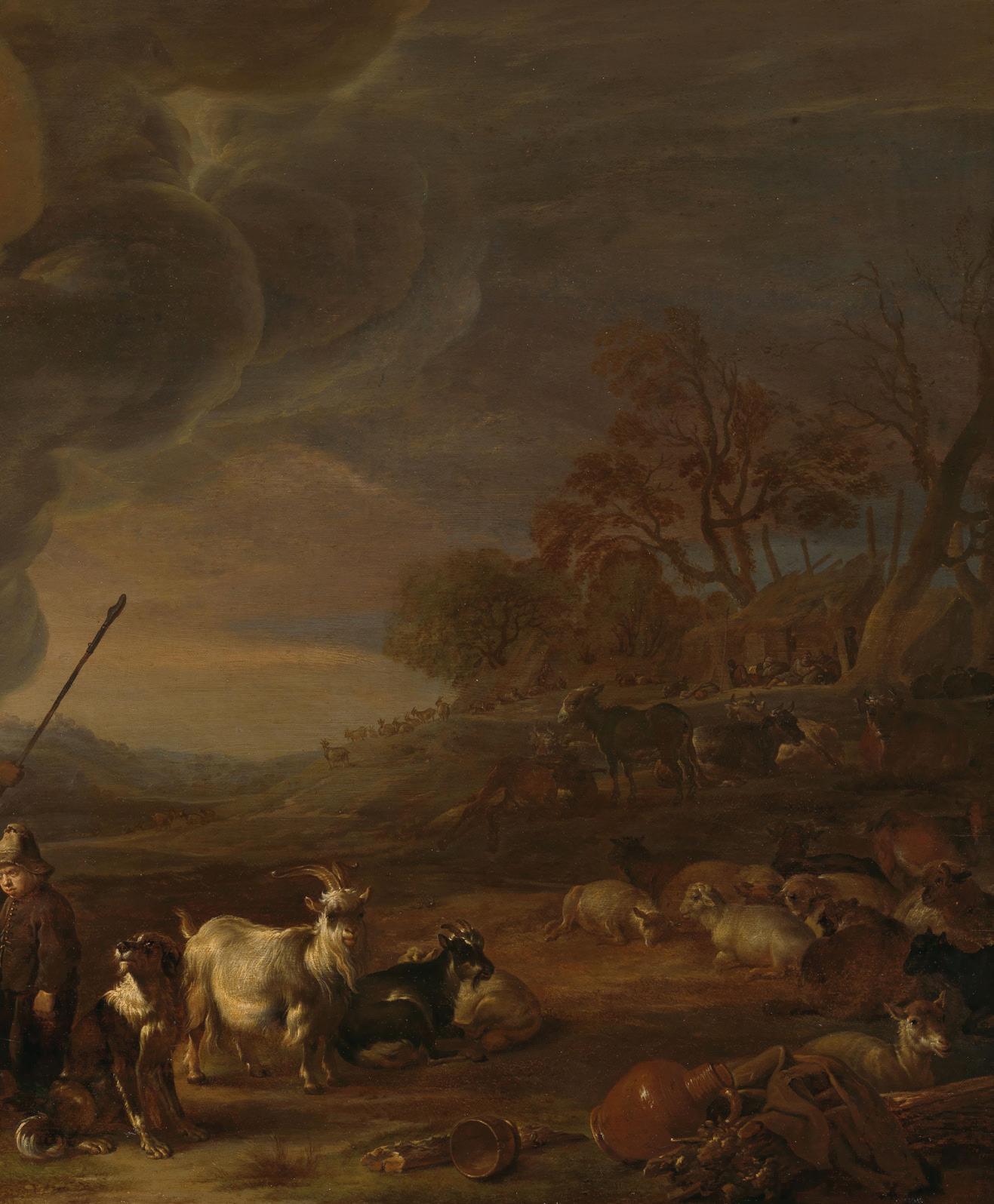
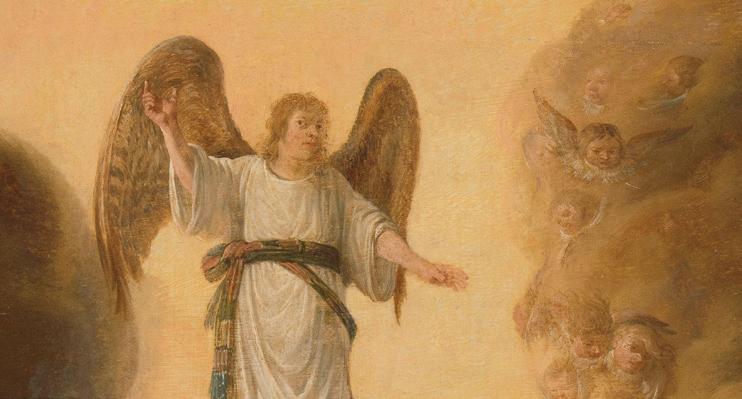
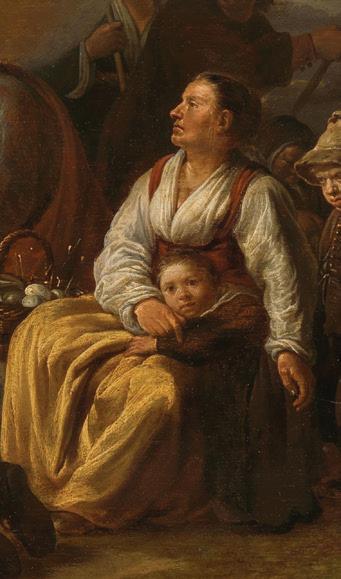
Artwork: “The Annunciation to the Shepherds,” by Cornelus Saftleven, 1655, Rijksmuseum.
The first to hear the gospel were those least likely to be invited to the party—the shepherds who represented Israel’s poor, forgotten, and unclean—the ones who could never get close to God on their own. And now, God had come to them. In the beautiful upside-down working of God, the Good Shepherd’s arrival would be announced to shepherds! The gospel, from its very first announcement, belongs to the lowly and the overlooked.
And that brings us to the second unlikely guests who came to honor the newborn King.
Most nativity scenes show the Magi kneeling beside the manger, yet Scripture suggests their visit came much later. Matthew records that “they entered the house and saw the child with Mary his mother” (Matthew 2:11), not a newborn in a stable, but a young child in a home. Herod’s decree to kill all boys “two years old and under” (v. 16) implies Jesus may have been as old as two when they arrived. While our Christmas scenes unite shepherds and Magi, the shepherds came the night of his birth, and the Magi likely arrived sometime after. But the record of their visit is no less important and jarring for the first-century observer.
If the shepherds represent Israel’s poor and forgotten, the Magi represent the nations beyond Israel’s borders—the world of Gentiles and pagans whom Christ came to redeem.
The word “magi” referred to a class of wise men or astrologer-priests, most likely from Persia or Babylon. They were educated and affluent scholars who studied the stars, interpreted dreams, and practiced a mixture of astronomy, philosophy, and what Scripture would call divination. Some early Christian writers even suggested that they were heirs of the class of scholars Daniel once led in Babylon (Daniel 2:48), men who may have retained some ancient knowledge of Israel’s God and his promises. Whatever their origins, they were Gentile seekers, drawn by a mysterious star across the desert, guided by a revelation they only partly understood, yet compelled by grace toward the One who is the Light of the world.
To devout Jews of the first century, the Magi were about the last people you’d expect to see at the feet of the Messiah. Everything about them made them unclean and unwelcome. They were Gentiles. They stood outside the covenant God had made with Israel. Jewish law warned against close association with Gentiles, especially religious figures, since such contact risked ritual defilement (Acts 10:28).
They were astrologers. Astrology was explicitly condemned in Scripture. The prophet Jeremiah warned, “Do not learn the way of the nations, nor be dismayed at the signs of the heavens” (Jeremiah 10:2). The Torah forbade divination and stargazing (Deuteronomy 18:9–14). Their
entire profession would have been viewed as spiritually dangerous.
They were from the lands of Israel’s old enemies. If they came from Babylon or Persia, these were the empires that had conquered, exiled, and humiliated Israel. To the Jewish imagination, such lands were symbols of idolatry and oppression.
In short, the Magi embodied everything that stood outside of God’s covenant people: foreigners, idolaters, and heirs of Israel’s captors. No pious Jew of the time would have imagined them being welcomed into the Messiah’s story. And yet, God welcomed them first.
The irony of Matthew’s Gospel is deliberate. The Jewish priests and scribes, who knew the Scriptures by heart, could tell Herod exactly where the Messiah would be born—“in Bethlehem of Judea” (Matthew 2:5–6)—but they never bothered to go and see. Herod himself, Israel’s so-called king, trembled in jealousy and fear. But far away, men who knew neither the covenant nor the law saw a single sign of a light in the heavens and began a journey that would end in worship. The outsiders came seeking what the insiders ignored.
When they arrived, they did not find a palace but a humble home. They did not find a crowned prince but a toddler in his mother’s arms. And yet, Matthew tells us, “They fell down and worshiped him” (2:11). They didn’t just honor him; they worshiped him. And this is something no faithful Jew would do before anyone but God himself. In that moment, the nations began to bow before Israel’s King. Their gifts told the story their words could not. They brought gold, fit for a king; frankincense, used in temple worship to signify prayer and divinity; and myrrh, a costly spice used for burial. Even if they didn’t understand the full symbolism, heaven did: the child they adored was born to reign, to be worshiped, and to die.
The greatest event in history was not witnessed by the powerful or the polished, but by those the religious world would never have invited. From his very first breath, Jesus came to meet people on the margins. The incarnation of our Lord reveals a God who does not watch the suffering of humanity from a safe distance. He steps into the dirt and difficulty of our world, not as an observer but as a participant.
The miracle of Christmas is not simply that God came down, but that he came all the way down.
He stooped lower than anyone expected—into straw and shadow, into weakness and want, even to death on a cross (Philippians 2). He entered our poverty so we might share his riches. He entered our weakness so we might know
his strength. He entered our world so we might enter his kingdom. In Bethlehem, heaven stooped to earth and earth was never the same.
Maybe you can relate to those shepherds on the hillside. Perhaps there’s something in your past—a decision, a failure, a broken marriage, an addiction—that makes you feel unworthy. Maybe you live in the shadow of that moment, like a scarlet letter you can’t erase. You feel as though you carry a smell you can’t quite wash off. Or maybe you don’t feel bad, just small. You’re not at the top of your class or the life of the party. You have a job, but it’s not what you dreamed. You’re faithful, but unnoticed. You sometimes wonder if you matter, if anyone really sees you. Or perhaps you are a Christian, but you don’t know the Bible like those who grew up in it or compared to those who went to Bible college.
Take heart! The story of Christmas is written for people like you. God comes not to the best and brightest, but to the broken and bewildered. Not to the strong, but to the struggling. Not to the center of power, but to the outskirts of Bethlehem and to the quiet corners of your life. You may feel unseen, but you are not unloved. You may feel forgotten, but heaven remembers your name. God doesn’t wait for us to climb up to him; he comes down to us. He is still the God who comes to the margins of history, of society, and of our hearts.
The shepherds and the Magi—the lowest and the farthest—stand side by side in the gospel story as living icons of who grace is for. The shepherds show that God’s mercy reaches those at the bottom; the Magi show that his mercy reaches those far away. Together they form the bookends of humanity: the near and the far, the poor and the privileged, the unclean of Israel and the unknowing of the nations. And the angels’ song still rings true for you: “Fear not, for behold, I bring you good news of great joy that will be for all the people” (Luke 2:10). The good news of this season is that Christ has come for all who live on the margins—the lowest, the farthest, the forgotten, and the afraid. Jesus came for you!
Ballmann serves Trinity San Antonio, San Antonio, Texas.
If you are interested in contributing to the HIS Fund under these expanded guidelines, wait until Jan. 1, 2026, to send in your gift. At that time, you can do so by mailing in a check, payable to AFLC, with “HIS Fund” in the memo. Or give online by visiting our website at aflc.org/ give. Click on “General Fund,” and choose “Help in Service Fund” from the dropdown menu.
Hjermstad, a member of Grace Free Lutheran, Maple Grove, Minn., is the president of the AFLC.
BY PASTOR MICAH HJERMSTAD
or many years, the AFLC has operated an account called the HIS Fund. The purpose of this fund “is to assist AFLC pastors and their families with financial needs resulting from various unforeseen circumstances.” The fund is managed by the Benefits Board, and they distribute gifts to pastors and their families based on applications submitted through the AFLC president’s office.
This fund has been an incredible blessing to many pastors and their families because of the generosity of so many in the AFLC. Thank you for loving our pastors so well.
Over the last few years, the Benefits Board and I, along with Katie Johnson, our director of business management, have been considering ways that we can best steward the resources of the HIS Fund. We see many needs that pastors and their families have, but often, those needs don’t qualify for HIS Fund assistance, according to the wording of its current policies and procedures. We want the HIS Fund to be used to bless those who are serving the Lord in ministry, to encourage them, and to love them.
With that in mind, the Benefits Board decided, with the affirmation of the Coordinating Committee, to expand the eligibility requirements for HIS Fund assistance. Applicants will still have to identify and explain the specific need, but the precise language of “unforeseen circumstances” will no longer be the only scenario under which an application will be considered.
There are two other notable changes. First, eligible applicants will now include AFLC lay missionaries and employees of AFLC corporations, in addition to rostered AFLC pastors. Second, the president’s office will be able to apply for financial assistance for projects that would help AFLC pastors, missionaries, and employees. For example, I regularly hear the suggestion that we should provide scholarships for retired pastors to be able to attend the Pastors’ Conference. Many have grown to love the fellowship and camaraderie of the event, but they are not serving a congregation which would normally pay for their registration and travel expenses. We haven’t taken the time yet to process the logistics of how that would work, but that’s just an example of the kinds of things that we’re thinking about.
To maintain the integrity of gifts already given to the HIS Fund, all current funds will only be used to help pastors with unforeseen needs. And starting Jan. 1, 2026, all contributions to the HIS Fund will be tracked separately and available for use with the expanded guidelines. Once the current funds are depleted, we’ll discontinue the use of the old guidelines and move forward with one account, governed by the expanded guidelines.
Our prayer is that the Lord would use the HIS Fund to bless, encourage, and provide for the needs of the workers that God has called into the harvest. To God be the glory!
BY GWEN BERGE
oon after the AFLC was formed in 1962, a Committee on Publications and Parish Education was established to serve the instructional needs of our new association (Robert Lee in “A Fellowship in Progress,” From Freedom to Life, Ambassador Publications). I can imagine drafts of curriculum moving from handwritten ideas to typed workbooks. Marketing, likely by phone and mail, must have been challenging.
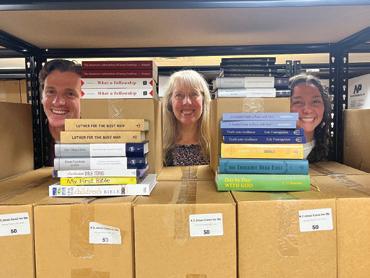
Today, more than 60 years later, AFLC Parish Education and Ambassador Publications continue to serve local congregations by providing biblical Lutheran educational and devotional resources that encourage faithful teaching of God’s Word. However, methods of marketing and delivery have changed markedly. Now you can log in to ambassadorpublications.org and see the familiar lighthouse logo and the verse, “O Send out Your Light and Your Truth.” Beneath this header, you can scroll through and purchase hundreds of resources which faithfully teach the Word.
The online bookstore has incredible potential to provide Sunday school curriculum, devotionals, Bible studies, and more. Yet both past and current Parish Education Boards have recognized that our web store must operate more effectively—to serve users better, build purchasing loyalty, and increase efficiency for our staff.
Over the past summer, the Board of Publications, Director Marian Christopherson, and staff prayerfully reviewed proposals and selected a contractor to implement key infrastructure improvements to the online bookstore. We are excited to announce that the first two phases of updates are under way. We anticipate that these improvements may be “live” in the spring of 2026.
• Phase 1: A New Ecommerce Website and POS (Point of Sale) System
A modernized website will make browsing and purchasing easier, with improved navigation and checkout functionality.
• Phase 2: Barcode Scanning Implementation
This upgrade will streamline behind-the-scenes operations and make large purchases more efficient.
The AFLC Coordinating Committee has generously committed $15,000, covering half of the cost for the first two phases. Additional funding is needed to complete these phases and to begin
• Phase 3: Automated Integration with AFLC Accounting Software.
Please pray for our staff—Marian Christopherson, Jaelynn Kozicky, and Aaron Arneson—as they work with our contractor to meet deadlines and prayerfully consider supporting these infrastructure upgrades financially. We thank God for his provision and for the dedicated team he has brought together for this season of growth. May we continue to work together to share the light of the gospel of Christ.
Your generous gifts enabled us to publish Volume VI in the AFLC Heritage Series, From Freedom to Life: A History of the Association of Free Lutheran Congregations, in 2024. An exciting extension of this project is the production of an audiobook read by the author, Pastor Robert L. Lee, to be released in 2026. Watch for more details on our website and social media.
Parish Education staff members include Aaron Arneson, Marian Christopherson, and Jaelynn Kozicky.
Come and explore our updated website! You’ll find new resources, book reviews, blog articles, and recent Education Spotlights on our AFLC congregations, highlighting cradle roll ministry, opening chapel time in Sunday school, and a book club for youth.
Current funding needs:
• Online bookstore redevelopment
• 2 Peter Bible study
Website: ambassadorpublications.org
Berge, a member of Grace Free Lutheran, Maple Grove, Minn., serves on the AFLC Parish Education Board of Publications.
Pastor Robert Lee reads for an audiobook version of his book, From Freedom to Life.
A look at the 2025 grant requests.
• Applications reviewed: 10
• Range requests: $1,200–10,000
• Applications funded: 8
• Range of granted funds: $1,000–4,600
• Total funds dispersed: $23,846
President: Thomas Asfeldt
Vice President: Dean Nelson
Secretary: Lisa Arneson
Treasurer: Mark Presteng
Members:
Iver Berge
Nancy Langness
Pastor Brandon Marschner
David Moeller
Karen Palmer
Pastor Steve Snipstead
Asfeldt, a member of Abiding Savior Free Lutheran, Sioux Falls, S.D., is the president of the AFLC Foundation Board of Trustees.
BY THOMAS ASFELDT
s Christians we know and believe that we are saved by grace through faith, not by works. Throughout God’s holy Word, this essential foundation of Christianity and salvation is reinforced. Ephesians 2:8–9 tells us, “For it is by grace you have been saved, through faith—and this is not from ourselves, it is the gift of God—not by works …” And Titus 3:5–7 affirms, “… he saved us, not because of righteous things we had done, but because of his mercy. He saved us through the washing of rebirth and renewal by the Holy Spirit, whom he poured on us generously through Jesus Christ our Savior, so that, having been justified by his grace …”
What of our works? James chapter 2 teaches us that faith without works is dead. We do good works as a result of the good work that has been done for us on the cross. “I will show you my faith by what I do” (v. 18). Our work is our joy that comes from a life filled with the Holy Spirit. The work we do may be taking care of widows and orphans or pursuing the Great Commission.
Many works require financial support to be accomplished. The AFLC Foundation was established 30 years ago (1995) to facilitate funding to accomplish the works of our faith. Each year, the Foundation receives requests for money to fund projects through a formal grant-making process. In 2025, some of the eight projects of our AFLC that have been funded through a Foundation grant include:
• The AFLC President will go teach and train pastors of AFLC–India in support of AFLC World Missions.
• The Pastoral and Congregational Care Team (PACCT), in their work to care for and minister to wives of AFLC pastors, will create a digital platform with short videos of AFLC pastors’ wives and a method to connect wives for mentoring and networking, with a particular focus on those in the ministry fewer than 10 years.
• AFLC Parish Education will produce an audiobook of From Freedom to Life: A History of the Association of Free Lutheran Congregations written by Pastor Robert Lee.
Although you will not see our board members in action directly, you will see the work of the Foundation when you see the work of the AFLC. More importantly, we all have the opportunity and—if we are obedient to God’s Word—the call to give to the work of the AFLC through the Foundation.
AFLC Development is your connection to the Foundation. Their staff are eager to discuss how God is calling you to use your riches, no matter the size, for the work of the AFLC. Right now is the best time to make a connection with Mark Sivertson and the Development team. You are invited to call him now.
The Foundation currently manages ten different funds that are used to fund a variety of either very specific or general areas of work. Gifts of all sizes are essential to the success of the Foundation. As each fund grows, it becomes more self-sustaining over time and provides a larger balance for distribution each year. Similar to your retirement fund, as a result of routine contributions, it begins to grow exponentially once it reaches a certain size.
There are many people who have given faithfully over the past 30 years to the Foundation to advance the work of the AFLC and the gospel. Thank you!
BY EMILY OLSON
As the AFLC Pastor and Congregational Care Team (PACCT) continues its mission to care for one another, we invited Emily Olson, wife of Pastor Nathan Olson, to share her thoughts about being a pastor’s wife.
s I reflect back over the years, I’m reminded of all of the various seasons I have gone through as a pastor’s wife.
Some seasons are instigated (hello, parenthood); others are thrust upon us by unforeseen circumstances. Some come as sweet blessings that we hold as treasures in our hearts forever, and others leave marks on us forever for good or bad. Regardless of how they come about, they do in fact come. And they also go.
Now, I can have varying emotions about the coming or going of a season depending on how it affects me personally. But in that, I also know without a shadow of a doubt that just as we experience four amazing seasons here in Minnesota, each with its own upsides and downsides, God has a mission in each one of our seasons of ministry.
Through it all, we can begin to see, as the author wrote in Ecclesiastes 3:11, that “He has made everything beautiful in its time … yet no one can fathom what God has done from beginning to end.”
So, we take time to look to him in surrender to his will and his way. We seek the Holy Spirit’s leading as we celebrate in the joy-filled seasons or weep and persevere in the difficult. And we confess when the seasons are brought on by our own sinful selves.
Whatever the situation, I find great comfort knowing that the Lord will make beautiful every season I have been in, even if I won’t see or understand it all until I see him face to face.
So, until then, lest I fall to despair in the waiting, I will set my eyes on him who is able to give light to my eyes to see the beauty of each season he has me in so I may be his hands and feet in the ministry he has called me to.
PACCT is grateful for every pastor’s wife who faithfully serves alongside her husband. And we pray for God’s grace to nurture and sustain each one of them.
PACCT has created a series of video resources aimed at helping the wives of pastors as they serve in their various capacities. The themes include "Beginnings," "Expectations," and "Boundaries."
Emily Olson is featured in the videos now up on the PACCT website. To view the videos, scan the QR code or visit our website at:
• Website: aflc.org/pastorswives
Olson is a member of Living Word Lutheran, Eagan, Minn.
Pastor Wendell Johnson
Pastor Wendell Eugene Johnson, 92, of Cambridge, Minn., died Nov. 7, 2025. Born May 12, 1933, in Springvale Township, Minn., he was the son of Carl and Alma (Swanson) Johnson. He married Laurel Erickson on July 19, 1959, at Hope Lutheran, Minneapolis.
After graduating from Cambridge High School, Cambridge, Minn., in 1951, he farmed and served in the U.S. Army. Before his call into the ministry, he was a block layer and cement finisher in the Twin Cities. While living in Minneapolis and serving as a youth director at Hope Lutheran, he sensed a call into fulltime ministry. He attended the Lutheran Bible Institute, Minneapolis, and the Free Lutheran Seminary, graduating in 1966. He then served congregations in Dalton, Stacy, and Spicer, Minn. For a time, Wendell and Laurel traveled and did music ministry and evangelistic meetings. He also served on the AFLC Coordinating Committee for 14 years and was involved with local organizations during retirement, including the Isanti County Planning Commission and the Isanti County Historical Society. He helped his son, Joel, farm for many years, especially spring planting and harvest in the fall.
Surviving are his wife, Laurel; three sons, Paul Johnson, Karl (Heather) Johnson, and Pastor Mark (Sara) Johnson; one daughter-in-law, Lisa; 16 grandchildren; and 15 great-grandchildren.
The service was held Nov. 12 at Salem Lutheran Church of Dalbo, Minn., with Pastor Jim Johnson and Pastor Mark Johnson officiating. Burial was in the church cemetery.
Enderlein honored for years with JAARS
Jungle Aviation And Radio Service (JAARS), the technical arm of Wycliffe Bible Translators (WBT), invited past missionaries to a “Gathering of the Eagles” reunion Oct. 24–25 at JAARS headquarters in Waxhaw, N.C. Pastor Eugene Enderlein was invited to the event to represent JAARS missionaries from the 1960s. Enderlein served as the radio transmission operator from the USA base to Wycliffe’s remote bases around the world.
After serving the Lord with WBT/JAARS, Enderlein attended the Free Lutheran Seminary and was ordained in 1971. He served parishes in North Dakota and Minnesota and later became the director of AFLC World Missions.
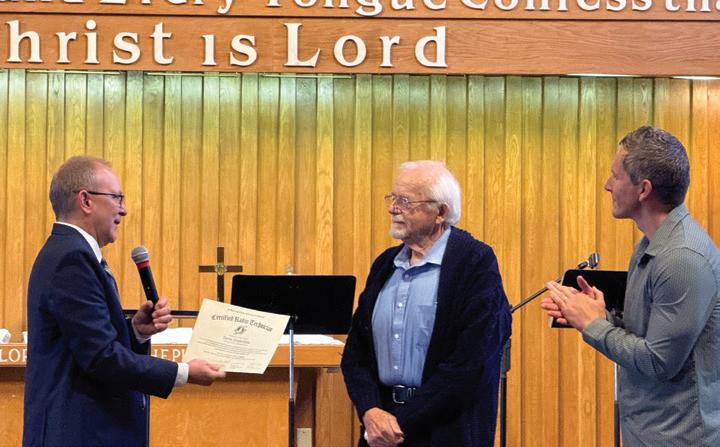
Pastor Enderlein was celebrated on Nov. 2 at Hope Lutheran Church, Minneapolis. Dr. Earl Korhonen, director of AFLC World Missions, and Pastor Ben Sollie, who serves Hope Lutheran, honored Enderlein with a certificate of recognition for his years of missionary service.
January Seminary Symposium on beauty Youth Worker Weekends
With a focus on “Intentional Youth Ministry,” AFLC Youth Ministries will host Youth Workers’ Weekends Jan. 16–18, 2026, at the Association Retreat Center, near Osceola, Wis.
Pastor Jason Gudim, will speak on the importance of leaders going intentionally to the cross; Jeremy Larson will encourage disciplemaking with direct areas of application within the church; Adam McCarlson, Youth Ministries director, will talk about setting intentional boundaries in ministry; and Pastor Seth Moan will give the sending/commissioning message.
Cliff Fegert, who retired from the U.S. Department of Defense, will speak about navigating the helpfulness and dangers of AI technology.
Registration is now open. More information can be found on the AFLC Youth Ministries website at aflc.org/youth.
The Free Lutheran Seminary will host a symposium Jan. 14–15 on the campus of the Free Lutheran Bible College and Seminary in Plymouth, Minn. Under the theme of “beauty,” the symposium sessions will examine the historical relationship between the Church and various art forms, which ultimately point people to the beauty of the gospel.
Dr. Mark Mattes, author of Martin Luther’s Theology of Beauty: A Reappraisal and chair of doctoral studies at American Lutheran Theological Seminary, is the featured speaker at the symposium. His sessions will include “Luther’s Theology of Beauty,” “Luther on Beauty and Music,” and “Luther on the Visual Arts.”
Kirstie Skogerboe, the AFLC’s digital communications coordinator, will lead a session called “Smitten by God: The Violence and Beauty of Repentance.” Pastor Matthew Nelson, Fargo, N.D., will lead a session on the “Beauty and Simplicity in Liturgy and Worship.” And Dr. Brent Olson, FLBCS faculty, will lead a session on “The Exodus Pattern: Its Definition and Importance.”
Following the symposium, the Georg Sverdrup Society will host its fall program and annual meeting beginning with lunch at noon and program at 1 p.m. The program includes a songfest and session led by Gracia Grindal, the author of What a Fellowship: Remembering Augsburg Seminary and the Lutheran Free Church. The annual meeting will follow.
For more information on the symposium, visit flbc.edu/events. For information on the Sverdrup Society, visit georgsverdrup.org.
From left are Dr. Earl Korhonen, Pastor Eugene Enderlein, and Pastor Ben Sollie.
Home Missions hosts conference on mission clarity
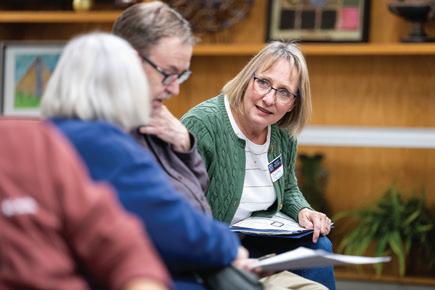
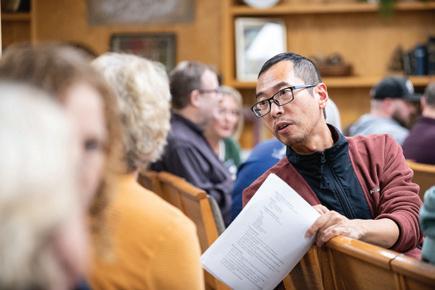
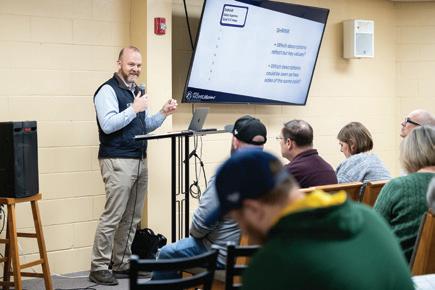
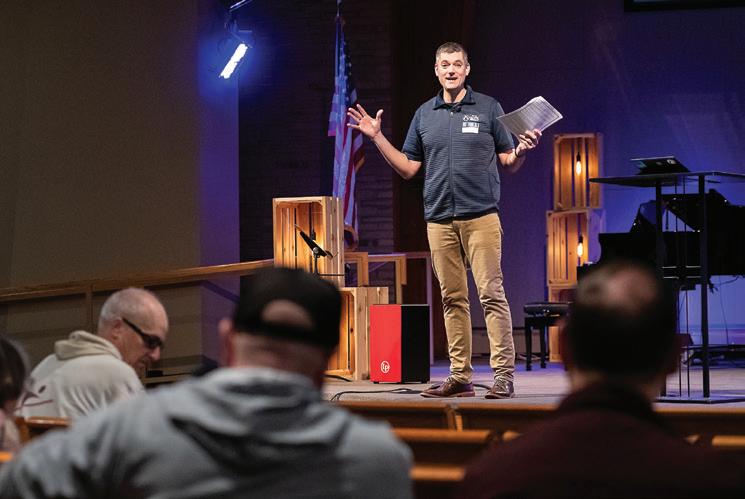
More than 70 people representing 19 congregations attended the AFLC Home Missions conference on mission clarity Nov. 8 at Emmaus Lutheran, Bloomington, Minn. The conference was a mix of theological reflection on God’s mission as well as practical equipping sessions for congregations.
Pastor Andy Coyle (top right), director of Home Missions, led two morning sessions on the theology of missions, holistic missions, and congregational systems. Pastor Matthew Ballmann (center) spoke on leading change.
Following lunch, participants were offered six practical workshops on key congregational systems, aimed to help them recalibrate those systems for greater mission impact. These workshops were offered in three blocks. Pastor Ballmann led a session on the missional worship service, and Dr. Jason Holt (above left) led a session on missional discipleship. In the next block, Nathan Monseth (middle right) spoke on missional hospitality, and Pastor Nick Dyrud spoke on missional assimilation. In the final block, Monica Coyle (below right) spoke on missional communication, and Jeremy Larson led a session on missional outreach.
Participants were given time to discuss each topic during a dedicated time following each session.
Resources used in the conference can be found on the Home Mission’s website at aflchomemissions.org/congregational-resources.
PEOPLE & PLACES
Pastor David Niemela has resigned from United Free Lutheran Church, Greenbush, Minn., effective Dec. 28, and has accepted a call to Abiding Faith Free Lutheran Church, Ortonville, Minn.
Pastor Roger Pahl has resigned from Our Saviour’s Lutheran Church, Zumbrota, Minn.
Pastor Curt Emerson has stepped down as interim pastor at St. John’s Lutheran Church, Newark, Ohio.
Glenn Mellott (non-AFLC rostered) has accepted a call to serve St. John’s Lutheran Church, Newark, Ohio.
Pastor Justin Nelson accepted a call to Redeemer Free Lutheran Church, Canton, S.D., and began on Nov. 2. He previously served as care pastor at Abiding Savior Free Lutheran, Sioux Falls, S.D.
Pastor Richard Turner has stepped down as interim pastor at Faith Lutheran Church, El Campo, Texas.
Pastor Peter Gammell (FR) was installed Oct. 26 at Christ Community Church, Hagerstown, Md., by Pastor Micah Hjermstad, AFLC president.
Pastor Steve Kneeland and Pastor Brent Logeman were removed from the AFLC Clergy Roster.
Dr. Patrick Charles was removed from the AFLC Fellowship Roster
The AFLC Coordinating Committee has accepted a removal request form from Bethany Lutheran Church, Brodhead, Wis.
The Coordinating Committee has accepted a closing request form from Bethany Free Lutheran Church, Bemidji, Minn.
Support the AFLC’s magazine
The Lutheran Ambassador is free for all subscribers. Our ministry is subsidized by your gifts. Thank you! Our mission continues to provide encouraging and informative content. For information on giving, please visit our website at aflc.org/lutheran-ambassador.
Coordinating Committee clarifies retired roster
Recently, members of the AFLC Coordinating Committee contacted many of our older pastors and clarified the “retired” designation on the clergy roster. The retired designation indicates an older pastor is no longer open to a full-time congregational call, though many may still be serving in interim positions, pulpit supply, on boards, or other types of ministry work.
As a result of this communication, many pastors requested the retired designation, as it aligned with their current situation. The large number of names is not the result of a sudden shift in the situation of available pastors in the AFLC. Rather, it correctly reflects the current situation. This update serves the congregations of the AFLC by bringing clarity to which pastors on the clergy roster are available for a regular, full-time call.
The following pastors affirmed being designated for the Retired Clergy Roster. This roster acknowledges that these pastors are no longer open to a call.
Pastor Lyle Aadahl
Pastor David Barnhart
Pastor Craig Benson
Pastor Ron Brubakken*
Pastor Brian Davidson
Pastor Eugene Enderlein
Pastor Richard Ewing
Pastor David Fruehauf*
Pastor James Fugleberg
Pastor Thomas Gilman
Pastor Wayne Hjermstad
Pastor Martin Horn
Pastor Rodney Johnson
Pastor John Kent
Pastor Lyndon Korhonen
Pastor Bill Mitchell
Pastor Kenneth Moland
Pastor Elden Nelson
Pastor Jerry Nelson
Pastor Kris Nyman
Pastor Terry Olson
Pastor LeRoy Petersen
Pastor Jim Rasmussen
Pastor Larry Severson*
Pastor John Skeie
Pastor Steven Snipstead
Pastor Gerald Steele
Pastor Gordon Strunk
Pastor Rich Taylor (FR)
Pastor Gordon Thorpe*
Pastor Don Voorhees
Pastor Joel Walde
Pastor James Westgate*
* Pastors previously moved to the Retired Clergy Roster upon each one’s request. Their inclusion here is for providing a complete list.
FR Fellowship Roster pastor moving directly to the Retired Clergy Roster.
—Submitted by David Olson, chairman of the Coordinating Committee
Bruce Benbo
Mrs. Marion Brandau
Ruth Claus
Shirley Schroeder
Home Missions
Bonnie VanBruggen
Schroeder
Missions
Doyle
BY PASTOR TODD SCHIERKOLK
“Blessed are those who are persecuted for righteousness’ sake, for theirs is the kingdom of heaven. Blessed are you when others revile you and persecute you and utter all kinds of evil against you falsely on my account. Rejoice and be glad, for your reward is great in heaven, for so they persecuted the prophets who were before you” (Matthew 5:10–12).
How is it possible that two very quiet, very respectful, and kind young women could get on the bad side of one of their college professors? Both attended church and youth group faithfully over the years. I was mystified. Then, young people in our church shared more stories of “bullying” that they had experienced, and I began to suspect that something deeper was going on. It wasn’t the high cost of following Jesus paid by so many of our brothers and sisters around the world. But the false accusations, the jealousy, and the mistreatment they experienced were a result of trying to follow Jesus, be like Jesus, and treat people like Jesus. They didn’t expect the negative reaction.
Jesus did expect it. And he willingly endured it. He humbled himself, became a human like the rest of us, and then experienced humiliation and shame that he “despised”—for future joy (Hebrews 12:2). I wonder how high our King’s blood pressure rose when they spat on him. I wonder how deeply he had to breathe when they accused him of blasphemy, or when they played “dress-up” with him, and then stripped him—let alone the whip, the thorns, and the nails.
When Jesus describes us as “blessed” in Matthew 5:10–12 when we are “persecuted for righteousness’ sake,” and “when others revile you and persecute you and utter all kinds of evil against you falsely on my account,” he is affirming us for willingly enduring treatment we generally try to avoid. “Rejoice and be glad.” Jesus was going to win the kingdom through suffering, and we are gifted the kingdom along with suffering.
We get a glimpse of the documentary version of what this looks like a few books later in Acts 5, when the apostles are following Jesus, regularly performing signs and wonders (v. 12), and multitudes of men and women are added to the Lord (v. 14). That’s a sure recipe for provoking jealousy on the part of the ones in
charge of the Judean kingdom. They accuse the apostles of making them look bad. “You intend to bring this man’s blood upon us,” they complain (v. 28). The story ends with beatings and “rejoicing that they were counted worthy to suffer dishonor for the name” (v. 41).
The Apostle Peter shares from his experience when he writes to us about lesser forms of persecution. The “surprise” that comes “when you do not join them in the same flood of debauchery, and they malign you” (I Peter 4:4). For instance, “Oh, you think you’re better than us.” Or “[He] is acting like a judge” (cf. Lot in Sodom, Genesis 19:9). The insults that might be heaped upon you because you are trying to live and act like Jesus (I Peter 4:14). How do we deal with this?
Through all the mistreatment Jesus endured, he remembered who he was and how much he was loved by his Father. “This is my beloved Son” (Matthew 3:17). We also trust that we, indeed, are God’s beloved children, and no mistreatment can redefine us or take away that love (I John 3:1).
Peter reminds us, from his personal experience (I Peter 4), that we need to remember that those who mistreat us will be held accountable (v. 5). They won’t get away with what they say or do to us. People get away with criminal activity all the time here on earth, but not in Jesus’ kingdom. Peter also reminds us that in Jesus’ kingdom, insults equal blessings and serve as evidence that the Spirit of God rests upon us (v. 14).
Jesus also told us that our suffering puts us in a special category. They treated the prophets that way, too (Matthew 5:12). And Peter takes it a step further when he points out that our suffering shows a common bond with Jesus. We can rejoice now because we share “the sufferings of Christ,” and we can also rejoice now because of future joy “when his glory is revealed” (I Peter 4:13).
That’s what helped Jesus endure the treatment he despised— future joy (Hebrews 12:2).
Jesus’ reward? He gets you. Your reward? You get him. And that reward will be so amazing that whatever we had to endure to get it will seem like a distant memory.
Schierkolk is an AFLC missionary serving in Jerez, Zacatecas, Mexico.
SOMETHING TO SHARE
BY RENAH THOMPSON
triving. That’s a bitter word, evocative of struggle without satisfaction or effort that goes unfulfilled. Striving to be loved, to be accepted, to be enough, to be good, to be organized and efficient, to speak with love, to spend my time well, and … okay, really, I’m striving for perfection and improvement in every area of my life all the time. I mean, is that so much to ask? Shouldn’t I be getting better all the time and in every way? I’m following Jesus, after all.
Sometimes, to better understand a concept, it’s helpful to define what its opposite might be. Striving, shame, and a critical spirit are all connected with an ugly perfectionism that turns my face always to myself. So, what are their opposites? Rest. Grace. Love. Perfectionism and shame are only redeemed when I turn my face away from myself and practice the discipline of basking in the light of God’s love.
A friend and I have recently been talking about a variety of themes connected with “striving.” He’s spent his life striving to be loved, working to do enough and be enough to earn love. Imagine that—being sure your whole life that you were not worth being loved and that only what you could do for others was enough to make you matter. As the love of God has captured him, it has been a deep delight to watch him learn to rest from striving and begin to experience the freedom that comes from being fully seen and fully loved.
The reality is that shame, striving, and self-criticism (which
typically leads to criticism of others) are simply not the full story. They are not reflective of the reality of my identity before God. Shame never has the last word for me. My accuser has been conquered, and the real story is that my deepest identity is “beloved by God.” Not shamed or shameful, not guilty, not “too much” or “not enough” or “quick to anger” or “disorganized” or any of the other thousand faults I see in myself. I am both sinner and saint, but my truest, most profound identity is “Loved.”
When I (daily, hourly, constantly, in a slow remaking of my mind) remember that profound truth, I see the slow and beautiful beginning of a whole and integrated life, deeply dependent on and connected to the love of God. Yes, the line between good and evil does run through my heart. I have done things I am ashamed of and will do more in the future. But also, profoundly, God’s unlimited love and good favor rest on me. Christ is for me, fully and completely. Shame pales in comparison to that extraordinary paradox, covered so fully by grace that it is almost irrelevant.
The opposite of striving is rest in my identity as “loved by God,” rest in the complete safety of his kingdom, and rest in Jesus’ work on my behalf. I am totally safe, completely held, in the love of God.
Thompson is a member of Faith Free Lutheran, Kalispell, Mont.