THE
JANUARY 2026
Lutheran AMBASSADOR
ALL LIFE IS
PRECIOUS
EDITOR’S NOTE
THE LUTHERAN AMBASSADOR JANUARY 2026 VOL. 64 NO. 1 he phrase “sanctity of life” evokes a wide range of emotions: fear about our current cultural moment, sadness at the pictures on roadside billboards, resolve to keep fighting for political change, and—for some—shame over past mistakes. To be sure, the evil of abortion should grieve us and drive us to ongoing prayer and action in different forms. It is appropriate to preach about life, to push for political change, and to lovingly minister the gospel to women who regret and grieve past decisions. January is a good month to focus on all these issues. God’s Word calls us to treasure life at all stages and in all forms. The articles in this issue focus on several of the different categories of life that God calls us to value. Pastor Dennis Norby, who serves on the Board of Directors for Lutherans for Life, writes about children and the unborn. Jesus said in Matthew 19, “Let the little children come to me,” and Pastor Norby reminds us that every child is a precious gift bearing God’s image. Isaac Skogerboe writes about God’s love for his creation and our role in stewarding this category of life. Reflecting on his personal experience of working with cattle on a New Mexico ranch, Isaac teaches believers that God’s call to value life also extends to creation. The Psalmist calls God the “father to the fatherless” (Psalm 68:5), and throughout Scripture he often reveals his heart for the orphan. Pastor Nick and Shelly Dyrud have brought children into their home through both foster care and adoption and write about how the church can embody God’s love for orphans. Laurie Nash lost her husband, Pastor Paul Nash, about four years ago and suddenly found herself a member of “an often-overlooked demographic in the church: the widow.” With precious vulnerability, Laurie writes about her experience with grief and loss to encourage us to better care for the widows in our congregations and communities. Scripture is also filled with exhortations to care for the strangers in our midst. Jesus said in Matthew 25:35, “I was a stranger and you welcomed me.” The preacher says in Hebrews 13:2, “Do not neglect to show hospitality to strangers, for thereby some have entertained angels unawares.” What does it look like to value the lives of strangers in our context? Pastor Miao “Holmes” Zhao offers one example: He and his wife lead a ministry to Chinese students on the campus of the University of Minnesota, caring for those who are navigating life in a new country and culture. Finally, Katrina Zeltinger concludes this issue with an article on Scripture’s call to value those nearing the end of their earthly lives. The church’s ministry to the elderly and terminally ill is a vivid enactment of the gospel. God assigns all human life dignity and purpose and would have us care for these dear saints, oftentimes our parents or grandparents, with mercy and compassion. Life at all stages is precious. The dark realities of sin and death cling close during these years, but we can look forward with hope to when Christ will raise our physical bodies to be imperishable. Even the best days we enjoy in this life pale when compared to what we can expect in our life everlasting. One cannot read Revelation 21:4 without a hopeful grin: “He will wipe away every tear from their eyes, and death shall be no more, neither shall there be mourning, nor crying, nor pain anymore, for the former things have passed away.” —Pastor Andrew Kneeland 2
THE LUTHER AN AMBASSADOR
Editor Pastor Andrew Kneeland laeditor@aflc.org
Managing Editor Ruth Gunderson ruthg@aflc.org
Circulation Liz McCarlson lasubscriptions@aflc.org
Editorial Board Monica Coyle Pastor Jerry Moan Pastor Craig Johnson
The Lutheran Ambassador (ISSN 0746-3413) (USPS 588-620) is published monthly by the Association of Free Lutheran Congregations, 3110 E. Medicine Lake Blvd., Plymouth, MN 55441 Phone (763) 545-5631 Periodicals postage paid at St. Paul, MN and additional mailing offices. Postmaster send address changes to The Lutheran Ambassador, 3110 E. Medicine Lake Blvd., Plymouth, MN 55441.
subscriptions & giving The Lutheran Ambassador is a free publication of the AFLC. Our non-profit ministry is supported by readers’ gifts. To subscribe and give online, visit our website aflc.org/lutheran-ambassador Checks may be mailed to 3110 E. Medicine Lake Blvd., Plymouth, MN 55441 Email inquiries can be sent to lasubscriptions@aflc.org
SOUND BITES
Take my life, and let it be Consecrated, Lord, to Thee; Take my moments and my days, Let them flow in ceaseless praise. [Frances Ridley Havergal, Ambassador Hymnal, no. 453]
Human beings at every stage of life, bear the image of God. To destroy image bearers intentionally is an act of high treason against the glory of our God who made man and woman in his image—an image that begins at conception. [Albert Mohler]
So God created man in his own image, in the image of God he created him; male and female he created them. [Genesis 1:27]
Every beating heart matters to God. Whether that life is in the womb of a mother, the cell of a prison, the hallway of a convalescent home, or the corner office of a Wall Street high rise, that life is holy to God. [Max Lucado]
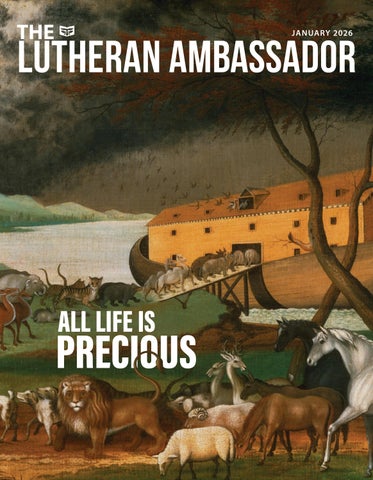
So in this Holy Supper we have the true tree of life again set before us, that sweet tree whose leaves are for medicine and whose fruit is for salvation; aye, its sweetness is such as to destroy the bitterness of all afflictions, and even of death itself. [Johann Gerhard, on the Lord’s Supper] Cover: “Noah’s Ark,” by Edward Hicks, 1846, Philadelphia Art Museum. Januar y 2026
3
THE VALUE OF
CHILDREN R
eports are sometimes offered up describing the costs of the materials that make up our bodies. Researchers have determined the weights and measures of these materials, along with the costs of the various chemical compounds that make up the normal human body. They have even given us dollar figures that correspond to those measurements. A little research shows the numbers are widely divergent depending on the criteria used, which proves how inferior that standard must be for calculating the value of a life. But our value is not simply the sum of our parts. We also hear statements about the cost of raising children—the number of dollars spent on making sure that children are clothed, fed, housed, and educated during the years in which they grow up. I have joked around through the years that our large family was a calculation on my part so that I might have better odds of being taken care of in my old age. “I took care of you; now you should take care of me.” But the value of children is not derived by using some type of return-on-investment formula. We also do not value children simply by how much we might want to have them. That would invite the false implication that
4
THE LUTHER AN AMBASSADOR
BY PASTOR DENNIS NORBY
“THE VALUE OF ALL LIFE IS CONNECTED TO THE CREATIVE WORK OF GOD. LIFE IS VALUABLE BECAUSE GOD IS THE ONE WHO CREATES US AND KNITS US TOGETHER.”
they might be worth less if they were not wanted. The value of all life is connected to the creative work of God. Life is valuable because God is the one who creates us and knits us together (Psalm 139:13–14). Life is never to be simply cast aside like the pagan peoples around Israel when they offered their children to Molech (Leviticus 18:21). The Lord was active in creating Adam from the dust and Eve from Adam’s rib. The Lord is also active in the creation of each life as it grows and develops in the womb of his or her mother. Life is to be cherished. We, of course, do not deny that having children after the fall is difficult. Some never have children. Some, like Rachel (Genesis 30:1) and Hannah (I Samuel 1:1–2), grieve because they are childless and do not know whether children will be welcomed into their homes. When children do come into the world, they come with pain and difficulty (Genesis 3:16). The pain is not just in the labor and delivery but also in the exhaustion and trials of raising children in this sinful world. Because we understand that all life is valuable from the time of conception until the natural conclusion of life, we might ask, “What is the special value of children?” We learn from Psalm 127:3, “Behold, children are a heritage from the Lord, the fruit of the womb a reward.” Children specifically are described as a gift from God to the families they are brought into. Children bring to this world opportunities for us to grow in patience. We grow as we sacrifice for them in vulnerable times, learning more fully about the sacrifices that the Lord has made for us. Children are given to us so that we might exercise our gifts for their benefit. We are to teach them (Deuteronomy 6:1–9). We are to nurture them. We are to love them. Our love for children gives us a glimpse at the manner in which God loves us. As Psalm 103:13 says, “As a father shows compassion to his children, so the Lord shows compassion to those who fear him.” Children remind us that the Lord shapes and molds us. As we see children navigating this world and learning more about it, we can remember when we were children and how our experiences compare to theirs today. We can see them grow and be thankful for the ways that God has helped us mature. We get to experience again the joys of discovery and to hear the surprise when something new is learned. Children also cause us to think and plan as we seek to provide for their needs. What do they need to have a sure, strong faith? What might they need to have their own stable home? What can we pass down to them about basic Christian virtues? Children allow us to consider the legacy and heritage that we are passing down to them. In Scripture, we are taught that children are valuable to God because Christ died for them, he desires to provide his promises to them (Acts 2:38–39), and they are an example of faith for all people (Luke 18:16–17). We rejoice in the gift of children and the many ways they bless us. Pain and difficulties come with children, but so do great joy and contentment. May the Lord help us see more clearly their value as we love them and are loved by them. Norby, a Lutherans for Life Board of Directors member, serves Grace Free Lutheran and Zion Lutheran Green Township, Valley City, N.D. Januar y 2026
5
BY ISAAC SKOGERBOE
O
n an average Tuesday morning in August, I found myself wandering through the woods in the mountains of northern New Mexico, sipping a fantastic, French-pressed cup of coffee and listening to the sounds of forest life. I was searching for a group of recalcitrant cattle that had escaped their enclosure the week prior and had been living with the wild elk herd that was responsible for knocking down our fences. Several times that morning I paused to simply stand in the patches of flickering sunlight as it filtered through the canopy above me and just breathe. I was fighting a cold and had been congested for days, but that morning the sun-warmed mountain breeze lifting off the decaying leaves and slightly overripe berries smelled like earth and felt alive in my chest. Though I carry my “Norwegian Pietist Card” with appropriately reserved pride, I’m also a Skogerboe. Emotions tend to run close to the surface. As I stood there, quite literally basking in God’s creation, I was struck with gratitude for being in this place and for this soil that would continue to produce profound beauty, whether or not I was there to witness it. I admit I may have teared up a bit. I felt the same way in that moment as I feel when God gifts me with a particularly spectacular sunrise on my drive to work, as though this masterpiece were crafted purely to bring me joy. Or maybe he’s just an artist who delights in creating beautiful things, and it’s a gift of his grace that allows me to enjoy it, too. N.D. Wilson says it well in his book Notes From the Tilt-A-Whirl, speaking about God’s prodigal creativity: “[He] never seems capable of moderation.” I thanked God that morning for the opportunity to play an active role in stewarding that beauty. “And God blessed them. And God said to them, ‘Be fruitful and multiply and fill the earth and subdue it, and have dominion over the fish of the sea and over the birds of the heavens and over every living thing that moves on the earth’” (Genesis 1:28). Did you know that just below the surface of the forest floor there is an intricate network of microscopic fungal threads called mycelium that connects all the plant life in a given copse through their root systems, by which individual trees, flowers, and grasses will barter and trade with one another for needed nutrients? Did you know that your body contains more foreign microbes than cells? And don’t get me started on lobster mushrooms. Wild business. If you’ve made it this far, I trust my enthusiasm for fungus won’t scare you off. So why do I share all of this? I think God had a lot of fun designing his creation, and he takes pleasure in his children geeking out about how brilliant he is. Yes, the 6
THE LUTHER AN AMBASSADOR
earth we cultivate often serves the purpose of feeding and sheltering us, and there is beauty in its utility. But the Jesus I know is also an artist. He loves the aesthetic. Beauty for beauty’s sake is valuable. In the Garden, when God breathed life into Adam, he gave him mankind’s first commission, the cultural mandate of Genesis 1:28. It’s important not to miss the significance of the first sentence in that verse: “And God blessed them.” This new job was, and still is, a gift. Just as it is God’s nature to take what is formless and void and create order, it is also within our nature to have dominion over and bring into order what is wild. I believe that our Father delights in the creativity of his children to steward what he has made in a way that it can flourish, not because he needs our help, but because he loves to watch us play in the dirt. He built a system that we are called to explore, protect, guide, and witness. Even after the fall, when our relationship with nature itself was shattered, we can see that our very bodies were designed to be in communion with creation. We were made to put our feet in the grass. We were made to feel the sun on our skin. The biological evidence that we need fresh air, sunlight, and regular physical connection with the earth for our bodies to thrive speaks to God’s intention in how we were crafted. Reappropriating the words of the theologian Jeremy Begbie as he spoke about Communion, creation is an “echo of the future.” By his Word God brought into being all that is, and what we see here now is a foretaste of the feast to come in the new heavens and the new earth. It points us to what will be. It points us to a restored relationship with the world we were made for and the world that was made for us, so that in union with it we might magnify the brilliance and glory of God. So, I encourage you, as a bearer of God’s image and a steward of his beautifully ordered earth, to take seriously our calling to delight in what he has made as we impatiently wait for whatever comes next.
“JUST AS IT IS IN GOD’S OWN NATURE TO TAKE WHAT IS FORMLESS AND VOID AND CREATE ORDER, IT IS ALSO WITHIN OUR NATURE TO ... BRING INTO ORDER WHAT IS WILD.”
Skogerboe is a member of Living Hope, Rogers, Minn., and has worked seasonally in New Mexico.
STEWARDING
CREATION
Januar y 2026
7
CARING FOR
ORPHANS O
ur adoption journey began 10 years ago when Shelley learned of a ministry that takes in children whose parents need respite care. Initially, I was reluctant because we had three children at home—12, 10, and 8—all busy with church, school, and activities. Eventually, after seeking the Lord together and, no doubt, through Shelley’s persistence, we took steps toward hosting our first child, filling out endless paperwork and completing time-consuming training. It was a 10-day placement for a little boy whose unidentified mother was hospitalized and unresponsive
BY PASTOR NICK & SHELLEY DYRUD
due to exhaustion and dehydration. We loved and cared for the 11-month-old baby until his mother was released. It was beautiful, the blessing we shared during the days we hosted him. Our children were so engaged. We witnessed their God-given gifts being shared with this child, who we would never have been given the chance to connect with outside of the Safe Families ministry. When we brought the child to an address in Minneapolis, not far from where we lived, we were shocked by the poverty. The apartment was empty, aside from four blankets in a corner on the floor. When we asked the child’s mother how long she had been staying there, she said nine months. She had been rejected from her Muslim community for having a child out of wedlock. She literally had no place to turn and very little future ahead after losing her job. We called friends from church, and soon people began donating furniture, dishes, food, and milk. I will never forget our children’s reactions to all they had seen that day. Their hearts, along with ours, were moved, and our family’s ministry began. Over the next five years, we took in 36 children. Our kids would eagerly ask us when we were going to host our next child. The ministry included walking with mothers and being open and vulnerable about the joys and struggles of parenting. Our church was very supportive, helping us with provisions during this season of our lives. We would receive
“He brings justice to widows and to children who have no family. He loves the foreign people who live among you. He gives them food to eat and clothes to wear” (Deuteronomy 10:18). diapers, formula, clothes, meals, and even respite care if we needed help watching the children we hosted. Yet it was in this time that we began to ask ourselves, “Might God be calling us to something more?” From 2019 to 2020, we had our third long-term placement of a child whose mother was incarcerated for 13 months. Because of COVID-19 regulations and lockdowns, we could not go to the weekly visits with the mom at Shakopee Women’s Prison. This, in part, aided an especially strong attachment with baby “Rose.” We asked ourselves, “If we could love a child this deeply and have the capacity to raise and disciple someone in need, why should we not consider something more than just respite care?”
Through many days and nights of prayer and with the approval of our children, we began the process of applying for adoption. We were recommended to an agency whose beliefs aligned with ours. We completed the required training. Then we waited. Almost three years passed, and during this time, we felt strongly that God would place a baby girl in our home. Then, we got the phone call. An unborn baby boy with a legally complicated adoption process and exposure to alcohol and narcotics in utero was due in 40 days. We agreed to the placement within 24 hours. Our son was born on March 9, 2022. The next day, our social worker from the adoption agency came and asked us to sit down. She explained that our son had a sister in foster care who was 2 years old and that if the adoption went through, South Dakota Child Protective Services would ask us to consider adopting her, too. Shelley immediately said, “Yes.” I immediately said, “We should talk about this, right?” We had both felt led to pray for a little girl under the age of 3. We had both felt led to continue this journey despite the challenges. Could this be an incredible act of God to keep these two little ones safe and loved and to transform our hearts and our family tree for generations? God is faithful. We took full custody of our daughter six months after our son’s adoption was finalized in a Hennepin County courtroom. We fostered her until the paperwork and termination of parental rights were administered. In August 2024, I stood in a long line outside the Social Security building waiting to file the paperwork to change her name legally to ours. Our adopted children didn’t ask for this story, and we didn’t want it for them, but we will be there each day to show them the love that Christ has shown us— unconditional, unrelenting, and patient love. We will not do it perfectly, though. We rely on the support of our church, friends, and family to lift us up in prayer on hard days and to rejoice with us on good days. Caring for children has both opened our hearts and broken them, too. Is raising children with trauma easy? No. Love is always risky. Would we do it again? Absolutely! Jesus didn’t live a safe life; he was obedient to his Father. He calls us to hurt with the hurting and to love the unloved. So, we trust our Savior and believe that the blessings outweigh the struggles when we are focused on Christ, and as we remain committed to Psalm 82:3: “Give justice to the weak and the fatherless; maintain the right of the afflicted and the destitute.” The Dyruds live in Minneapolis, and Pastor Nick serves Emmaus Free Lutheran, Bloomington, Minn. For a list of recommended ways to support pro-life ministries in your community, please see page 22. Januar y 2026
9
BY LAURIE NASH
LOOKING AFTER
WIDOWS
I
distinctly remember the first time someone introduced me as “Pastor Paul’s widow.” I stood there dumbfounded. I really was a widow! In May of 2021, we had moved to Fergus Falls, Minn., after purchasing a lake lot with plans to build our dream house. Less than five months later, my sweetheart died of COVID-19 at the age of 67. My newfound marital status opened my eyes to an often-overlooked demographic in the church: the widow. I am grateful for the opportunity to share what I have learned over the last few years. I will be painfully transparent with the hope that this will help you effectively minister to the widows in your midst. Our culture does not do grief well. People tend to avoid the subjects of pain, death, and grief. Friends ghost you because they are uncomfortable with your pain and loss. The silence is loud. There is an expectation you feel to move on and be done with your grief. Please do not feel guilty; we do not understand what we have not experienced. Even I did not understand. Grief changes you—especially the death of a spouse. God graciously wrapped me in fog and numbness in those early days, but then the reality of loss began to emerge. Every part of my life changed. From the way I eat and cook (or don’t eat) to the fact that I now go everywhere alone. There is no one with whom to share my joys or concerns. There’s no one to clarify what I mean to say. Loneliness is always present. Half of me is missing. For more than 47 years, our identity was “we.” Who am I now as just “me”? I am still trying to figure out how to be alone. I am also learning from other widows that grief remains a companion; it is not mastered or conquered. I was able to participate in the Grief Share Ministry at a local church. It was a lifeline to me! Here I found community and learned so very much. Look at these statistics: • 50 percent of widows leave their church in the first year of widowhood. • 60 percent experience serious illness in the first year. • They lose about 75 percent of their support system. 10
THE LUTHER AN AMBASSADOR
• Many widows experience poverty for the first time. • One out of three newly widowed women will meet the criteria for clinical depression within two months. (One year later, half of those women are still clinically depressed.) Most widows will tell you that Sundays are just plain hard. The first time I went to church and sat alone was extremely difficult. I held it together until the man in front of me put his arm around his wife and pulled her close. A tsunami of grief pulled me under. It was not jealousy but the realization of loss; we used to worship together. Four years later, Sundays are still hard. Grief Share talks about secondary losses—that loss of 75 percent of your support system. Friends do disappear. Their lives go back to their normal. More loss! Grief changes relationships. You no longer fit into a couple’s world. I am also not the same person, nor can I ever be the old version of “Laurie.” This is a different season, and I am watching God rebuild this part of my life. Caring for widows is a biblical mandate. “[L]ook after orphans and widows in their distress,” says James 1:27, and counselor David Bueno Martin agrees, sharing that “healing from grief happens in community.” Who are the widows in your church community? Do they have family nearby? I am blessed by the support of my wonderful family, but many widows are alone. How can you, as the embodiment of the Church, engage and be that loving community for widows? Here are some simple suggestions: • Sit with her in church. Surround her with love. Invite her for lunch; remember she goes home alone. • Call or visit. She needs you! • Talk about her husband. Share memories. • Don’t be afraid of her pain. Let her cry. Listen to her and don’t judge. • What are her practical needs? House repairs, lawn care, mechanical advice, finances? • Consider organizing a widow’s support group in your church or community. The past four years have been the hardest years of my life! But God. We were enjoying living in an RV at our lake lot when Paul got sick in August. After his funeral in October, camping was not an option in northern Minnesota. Where would I go? But God. He provided temporary housing with my son, and now I am in a beautiful town home. Paul was building an airplane. What do I do with a partially built plane? But God. He provided a mechanic to complete it and someone to sell it. These are just two examples of God’s care. With every situation I have faced, God has been there!
“OUR CULTURE DOES NOT DO GRIEF WELL. PEOPLE AVOID THE SUBJECTS OF PAIN, DEATH, AND GRIEF.”
The words of a favorite song summarize his care for me: “Blessed Assurance, Jesus is mine He’s been my fourth man in the fire, time after time. Perfect submission, all is at rest I know the author of tomorrow has ordered my steps. I trust in God, my Savior The one who will never fail He will never fail.” (“Trust in God,” Elevation Worship, featuring lyrics from “Blessed Assurance” by Fanny Crosby). Nash lives in Fergus Falls, Minn. Januar y 2026
11
WELCOMING THE
STRANGER O
ver the past several years, many Chinese friends have asked me the same question: Why, after earning a PhD in geology, did you not continue in that field? Why did you choose instead to enter seminary and begin in a completely different direction? Whenever I hear this question, I pause. Without doubt, it was God’s calling and the leading of the Holy Spirit. But each time I answer, my mind also returns to the very first way God poured his love into my life—through his faithful servants. I came to the United States for the first time in 2012 at Indiana University Bloomington. You can imagine what it was like for a young man from a city of four million people to suddenly arrive in a small Midwestern college town of only a few tens of thousands. I did not drive; even buying groceries felt overwhelming. And because of a miscommunication, I suddenly lost my place to stay. In that moment of anxiety and uncertainty, the Lord sent help: a Lutheran pastor and his wife opened their home to me. For nearly four months, they welcomed me into their house. They treated me like family—cooking dinner for me, driving me to school, taking me to church on Sundays, and inviting me into their Bible study group. In their home, I saw the light of Christ shining so clearly. So when they later encouraged me to consider seminary training, I didn’t feel it was an unreasonable suggestion. Instead, I felt a deep desire to know the God they trusted like they did—the God whose love had become so real to me through them. And I began to pray that someday, by God’s grace, I might also become a means of blessing to others and bring the gospel to Chinese people who have never heard about Jesus. Years later, by God’s guidance, we began planting a Chinese church at the University of Minnesota, preaching the gospel and making disciples. I truly love this ministry. But after living in the comfort of America for so long, I sometimes forget what it felt like to be a new international student—lonely, confused, and longing for friendship.
12
THE LUTHER AN AMBASSADOR
BY PASTOR MIAO “HOLMES” ZHAO
Recently, during a church board meeting, we reflected on our outreach efforts. Large events are wonderful ways to make first contact with Chinese students. But many who attend do not stay connected afterward. We realized something simple but important: events can open a door, but they cannot build lasting relationships on their own—friendships through which students are willing to come to church, hear God’s Word, and meet Jesus. Though none of us have a perfect formula, one thing is essential: we must love these students with the love of Christ, not seeing them merely as “ministry targets” but as real people we genuinely want to befriend. They feel the difference. My wife Jia recently told me she had spoken with several young Asian mothers. Every one of them said they felt sad because, after years in America, they still had no American friends. They wished people in the church would see them not only as evangelism opportunities but also as true friends worth spending time with. Jia and I feel deeply blessed because the Lord has surrounded us with American brothers and sisters who have truly loved us. But many Chinese students come to America longing to befriend Americans, to experience the richness of cultural exchange—and yet a wall often stands between the two worlds. Cross-cultural friendship is not easy. Differences in culture, language, age, or personality can make us hesitate. But if we focus only on these obstacles, evangelism will always feel hard. The gospel, after all, is the message of God’s love. And when that love fills our hearts, it flows naturally to others. God’s love can cross every cultural barrier and calm every fearful heart. As someone who was once a lonely Chinese student, I still remember the struggles. Yes, sometimes international students face big challenges, but many of their needs are small and ordinary: wanting to buy groceries at an Asian market but having no car, wanting to try a local coffee shop but not knowing which one is good, or sitting alone in a dorm room on Christmas Eve while everyone else has gone home. In those moments, a simple “Merry Christmas,” a pair of warm socks, a heartfelt hug, or an invitation to Christmas dinner can touch a lonely heart in a profound way. Through such simple actions, they begin to understand that Christianity is not a dead religion; it is the living, flowing love of God—the love of the Savior who took on flesh for us sinners. Did you know that more than 80 percent of international students have never been invited by a Christian to their house? We often talk about our global missions budget being too small or about the dangers of sharing the gospel in countries hostile to Christianity. Yet God has brought people from those very places into our own neighborhoods. A simple hello to your newly arrived neighbor, a trip to the outlet mall to help them find warm coats for winter, a coffee outing, or an invitation to dinner may be the doorway through which the gospel enters a heart. God’s Word reminds us: “Then the King will say to those on his right, ‘Come, you who are blessed by my Father … I was hungry and you gave me food, I was thirsty and you gave me drink, I was a stranger and you welcomed me, I was naked and you clothed me, I was sick and you visited me, I was in prison and you came to me.’ Then the righteous will answer him, saying, ‘Lord, when did we see you hungry and feed you … And the King will answer them, ‘Truly, I say to you, as you did it to one of the least of these my brothers, you did it to me’” (Matthew 25:34–40). Every act of love done for “the least of these” is done unto Christ himself. Loving international students and your international neighbors is not only an opportunity for outreach—it is the living testimony of Jesus’ love through us. May the Lord take even our tiniest acts and let his love shine into the darkness of this world. Praise his Holy Name!
“A SIMPLE HELLO TO YOUR NEWLY ARRIVED NEIGHBOR ... MAY BE THE DOORWAY THROUGH WHICH THE GOSPEL ENTERS A HEART.”
Pastor Zhao serves Living Stone Chinese Fellowship, North Saint Paul, Minn. Januar y 2026
13
BY KATRINA ZELTINGER
W
hen COVID-19 started, we all saw the importance of caring for the elderly and heard the stories of some who were left to die alone. In 2020, my own dad’s health quickly deteriorated after a heart bypass surgery, and he needed more help than Mom physically could offer, and their assisted living facility was allowed to provide. So, my husband and I (along with all four of my siblings) decided to remodel our basement to make it handicap-accessible, and Dad and Mom moved in at the end of August. Dad lived for three months with us before he went to his eternal home, and I am so grateful for that time. It allowed my brothers long visits to spend time with my parents, and it allowed my sister and me to really be there for them. Most of my growing-up years I saw my grandma caring for others. She cared for her husband, who was dying of a brain tumor, and her nephew, who had many physical ailments that made living independently impossible. He eventually passed away while in Grandma’s care. Then she took in an older sister, Lala, who didn’t need care but didn’t want to live alone after retirement. When my grandma passed on, my parents took over with Aunt Lala, who by then needed some care. This was the example I grew up with, and I didn’t think anything about it. It was just practical and necessary. All of this is mostly logistics. It doesn’t deal at all with our fears or the emotions that come along with the whole process. It wasn’t easy. And now that I’ve been through it, I realize that it probably wasn’t easy for my grandma or my parents. And I can’t imagine that it was easy for any of those who were dying to lose their ability to care for themselves and have to completely rely on others for everything, the way an infant does. I didn’t realize the example that my grandma and my parents set for me. I am still learning it, and I am a slow learner. I also didn’t realize the example my dad gave me in his dying. He gave up his independence, and while he didn’t give it up voluntarily, he did it with contentment—not anger or fighting. Philippians 4:11–14 speaks to those at the end of their lives and those of us caring for them. “Not that I speak from want, for I have learned to be content in whatever circumstances I am. I know how to get along with humble means, and I also know how to live in prosperity; in any and every circumstance I have learned the secret of being filled and going hungry, both of having abundance and suffering need. I can do all things through Him who strengthens me. Nevertheless, you have done well to share with me in my affliction.” Isn’t this what God wants for us all of our lives, to look to him for our strength and contentment, not to our 14
THE LUTHER AN AMBASSADOR
circumstances? Caring for my dad at the end of his life made this real to me. When your body is failing and there is nothing you or anyone can do, there is Jesus. Only he can see us through with peace and contentment that only he can bring. A failing body asks you to die to self and live for Jesus. My dad didn’t have a choice in giving up his desires. But as I cared for him, he showed me how to make that choice and the good that can come from it. I was able to watch my mom love and care for my dad in such a gentle and kind way that I had never seen before. My kids and my sister’s children were able to sing to my dad before he died. And Mom, my sister, and I were all able to be with Dad as he took his final breath. While I didn’t enjoy that, I’m grateful that we were there, and that Dad’s physical death was an example of the continuous spiritual death to self that I am still learning.
CARING FOR THE
ELDERLY
Mom still lives with us. It’s been five years now, and we tease her that she is going to end up living with us longer than any of our kids did. I am not necessarily the best at caring for Mom, but this is what God has called me to now. When I see all the ways that I fail, I am reminded of hymn no. 400 in the Ambassador Hymnal. All the verses are very good, but verses four and five are what really remind me where my strength comes from: “I look not inward; that would make me wretched; For I have naught on which to stay my trust. Nothing I see save failures and shortcoming, And weak endeavors, crumbling into dust. But I look up into the face of Jesus, For there my heart can rest, my fears are stilled; And there is joy and love, and light for darkness, And perfect peace, and every hope fulfilled.” (“I Look Not Back,” by Annie Johnson Flint). Zeltinger is a member of Grace Free Lutheran, Valley City, N.D.
“WHEN YOUR BODY IS FAILING AND THERE IS NOTHING YOU OR ANYONE CAN DO, THERE IS JESUS.”
Januar y 2026
15
MINISTRIES / YOUTH
BY PASTOR RYAN TONNESON
Intentional Youth Ministry Come to be refreshed and refocused so that you can return to your congregation ready for intentional ministry to teens. Date and time: Jan. 16–18, 2026 Location: Association Retreat Center, near Osceola, Wis. Sessions Session 1: Intentionally Going to the Cross: Jason Gudim Session 2: Intentionally Using Curriculum: Naomi Paige Session 3: Intentionally Navigating AI in Ministry: Cliff Fegert Session 4: Intentionally Setting Boundaries: Adam McCarlson Session 5: Intentionally Making Disciples: Jeremy Larson Session 6: Commissioning: Seth Moan Register at aflc.org/youth Tonneson, who serves Good Shepherd Free Lutheran, Cokato, Minn., is the chair of the AFLC Youth Board. 16
THE LUTHER AN AMBASSADOR
very mid-January, youth workers from across the AFLC and beyond gather at the Association Retreat Center for Youth Workers Weekends (YWWs). Affectionately pronounced why-dubs, YWWs is a time of encouragement and training, fun and fellowship, laughter and learning. As a member of the planning team for the last handful of years, let me pull back the veil a little and give you a behind-the-scenes glimpse into the heart that has guided YWWs over the years. Refresh. Anyone who works in a congregation knows that ministry can be hard work. Ministry to youth is no exception. Maybe you’ve heard the statistic that says that youth workers average only 18 months in ministry before moving on or burning out. More recent research says that the median tenure is closer to three or four years. Whatever the number, it’s on the lower end. That’s why YWWs seeks—first and foremost—to refresh these weary youth workers in the gospel message. We intentionally remind youth workers of the love of God for them in Jesus Christ—and his life, death, resurrection, and ascension. We remind them of their value, their worth, and their identity in Christ. We remind them that, yes, in and of themselves, they are inadequate for the tasks at hand; yet, at the same time, “our sufficiency comes from God, who has made us sufficient to be ministers of a new covenant” (II Corinthians 3:5–6). We are refreshed and strengthened as we partake in the Lord’s Supper together, as believers have done for millennia. Refocus. Whether you are working on your transmission, remodeling your house, or preparing a meal in a kitchen, having the right tools is essential. YWWs seeks to provide youth workers with the tools that they will need in their ministry contexts. A mix of nationally known and in-house speakers from the AFLC have taught and trained, challenged and encouraged, and equipped and outfitted these workers with tools and skills they can implement in their ministries and in their lives. Youth workers are able to huddle together, bounce ideas off each other, provide feedback, and share experiences. Through the generosity of folks in the AFLC, we are able to provide books and other training material for each youth worker who attends. Thank you! Return. Having the proper mindset and the right tools doesn’t do any good if you don’t use them. Youth workers are sent back to their ministry fields, recommissioned with the gospel message, and are equipped to, once again, work the harvest fields. If you have a youth worker in your congregation—paid or volunteer, college-aged or older adult—consider sending them to YWWs and paying the way for them. They will come away refreshed and refocused as they return to the ministry to which you (and the Lord!) have called them.
MINISTRIES / WORLD MISSIONS
BY DR. EARL KORHONEN n a recent visit to Uganda, we were greeted with, “Welcome back to Uganda. We hope to exploit your time when you are here with us.” The warm greeting from Mama Nissi, longtime AFLC friend, Ambassador Institute teacher, and leader, was her way of expressing her heartfelt gratitude for AFLC World Missions’ continued involvement and encouragement of the ministry in Uganda, and she wanted to make each meeting together meaningful. Mama Nissi and several other Ambassador Institute leaders are passionate about the new congregations forming in this Eastern African country. The first two congregations were commissioned as AFLC-Uganda on October 19, 2025. The congregations are testimonies to the work of God through the many years of our AFLC missionaries to Uganda. Seasonal missionary Michael Rokenbrodt has just completed a term with the congregations, helping them understand the AFLC Fundamental Principles and the Unaltered Augsburg Confession and helping them solidify their constitutions. Please join me in praying for the AFLC-Uganda congregations in Jinja and Nabakosi, as well as other congregations that are now just beginning to meet together for worship. Following his time in Uganda, Michael spent two months in Geneva, Switzerland, to encourage the El Shaddai AFLC congregation. Michael shared his gifts of writing and directing dramas by encouraging the congregation in a special Christmas production, preaching, and leading Bible studies. Pastor Augusto Fiuri explains that the congregation has experienced steady numerical and spiritual growth. The enthusiastic church choir helps the worship leader with congregational worship, and there is continued excitement about the cell groups that started 18 months ago, in which nearly everyone in the congregation participates weekly. Pastor Fiuri testifies to God’s faithfulness in providing spiritually gifted people for the congregation’s needs at each phase of its growth. Please pray for wisdom for continued ministry and for the facility needs of the congregation. They are increasingly realizing that sharing a church building limits ministry. They long for a facility that is available mid-week and for more hours on weekends. In Brazil, the AFLC (AILLB) annual conference recently approved plans for a one-year Bible school program to train laymen and laywomen for service in the local congregations. They will focus on training laypeople in the ministry of Sunday school teaching, youth ministry, discipleship, and evangelism. Pray for national Pastor Fernando and missionaries Jonathan Abel and John Lee as they provide guidance for this new venture to serve the congregations in Brazil. Each of our mission fields needs your encouragement. Would you consider joining us on a ministry team? Our AFLC Journey Missions Department invites you to join a 2026 trip to Brazil or Uganda or to consider serving as a missionary assistant. Please reach out to us for more information. Thank you for praying for AFLC World Missions!
Two new AFLC-Uganda congregations were commissioned on October 19. These congregations are served by Pastor Zander (front row, from left), Pastor Godfrey, Pastor Henry, and Pastor Rob. • Ambassador Church, Jinja • Ambassador Church, Nabakosi Korhonen is the executive director of AFLC World Missions. Januar y 2026
17
MINISTRIES / HOME MISSIONS
BY PASTOR ANDY COYLE
2026 Spring Regional Conference on Worship Renewal: Deepening our theology, strengthening our practice, and renewing our love for the congregation.
AFLC Home Missions hosted two regional conferences in 2025: Sioux Falls, S.D., and Bloomington, Minn. Attendees represented more than 40 AFLC congregations. Topics Covered: Congregational Culture Embracing our AFLC Identity Shaping Congregational Culture Ministry Contextualization Theology of Mission Mission & Congregational Systems Leading Change Missional Worship Missional Discipleship Missional Hospitality Missional Assimilation Missional Communications Missional Outreach For more information about the March event, visit the Home Missions website at aflchomemissions.org Coyle is the director of AFLC Home Missions. 18
THE LUTHER AN AMBASSADOR
oin us Saturday, March 7, in Grand Forks, N.D., for a formative and hope-filled gathering created to deepen our theology, strengthen our practice, and renew our love for congregational worship. Rooted in Scripture and the rich heritage of our forefathers, this event invites participants to rediscover the beauty, purpose, and power of God’s people gathered around Word and Sacrament. Throughout the day, you will grow in your understanding of the biblical foundations of worship, cultivate a deeper personal longing for meaningful congregational life, and develop practical skills for leading worship with clarity, confidence, and pastoral sensitivity. Morning plenary sessions are designed to lay a biblical, thoughtful, and historical foundation for considering worship practice. Sessions include: Theology of Worship: This session offers a fast-paced biblical survey of worship through the Old and New Testaments, highlighting God’s design for his gathered people. It then unpacks four core aspects of the nature of worship, giving participants a clear and compelling framework for faithful congregational practice. Worship Alignment: This session helps leaders evaluate the alignment between their church’s beliefs, values, and visible worship practices. Participants will also explore the formative power of worship habits in shaping belief and learn practical tools for discerning drift and realigning their services with clarity and hope. Lutheran Worship in Our Heritage: This historical and practical survey traces the worship life of the LFC into the AFLC and up to the present, revealing both continuity and conviction behind our “simple worship” heritage. Participants will gain fresh insight into what our forebears valued and gently consider how those principles might speak into our current practices and future direction. Afternoon ministry workshops will provide practical training in areas dealing with worship. Each participant will be able to choose two out of the four workshops offered. They include: • Worship Leadership: Learn how theological clarity, spiritual life, and practical preparation equip leaders to guide congregations in Christcentered, well-crafted worship. • Worship as Life: Explore how the rhythms of the church year and everyday habits shape a believer’s worship beyond the gathered service. • Worship Environment: Consider how space, symbols, color, and beauty form a worship environment that teaches and reflects the truths of the gospel. • Worship Shape: Reflect on how gathering, hearing, feeding, and sending forms a gospel-shaped pattern for congregational worship. This gathering is an opportunity to appreciate and connect with our AFLC worship identity while engaging honestly with present realities and future possibilities. Whether you are a pastor, worship leader, musician, or engaged member, you will leave encouraged, equipped, and renewed for the sacred work of leading and participating in worship that glorifies God and nourishes his people.
MINISTRIES / ALASKA
BY PASTOR DAVID GRAVES ave you ever considered that this Great Commission given by Christ was not only for the disciples who witnessed his ascension so long ago, nor only for those with a calling to be a missionary in our day, but for all believers today as well? Have you ever considered how you might play a part in fulfilling this mission? What if I told you that you could travel to just one small village in bush Alaska for a week or two and people from all over the world would come to you, grateful for your care and open to the gospel? This is exactly the wonderfully surprising experience that I, and many others, had this past summer. The Alaska Mission in Naknek is truly a unique opportunity to fulfill the Great Commission as people from distant places gather to catch and process salmon for the season. Within an hour of arriving at Naknek, I had the chance to meet and minister to a man from Pennsylvania who had struggled with alcoholism most of his life but was wanting to change and sensed that Christ was the answer. What a privilege to encourage him to seek the One who sets us free and testify to the transformative power that can save all who believe in him! Over the next few days, I had the opportunity to: • Speak with a man from El Salvador. Truthfully, with his six words of English and my five words of Spanish, we didn’t say much, but he understood enough when I gave him a Spanish Bible. • Meet a Croatian woman who confessed (in broken English) that she was an atheist. Still, she willingly received a Croatian Gospel tract and sat reading it before tucking it into her pocket and thanking me as she left. • Pray with a believer who was grieving the loss of her husband. • Witness to a professed Muslim from Chicago whose father and grandfather had both been preachers and raised him in the Christian faith. He had rebelled in his youth and converted to Islam. We spoke openly about his sins, his fear of death and hell, his lack of assurance of forgiveness from Allah, and the certainty of eternal life for those who call upon Jesus as promised to the repentant criminal on the cross. He allowed me to pray for him, and he received a Bible with tears in his eyes. • Love, testify to, and disciple many others whom I would never have had the opportunity to meet were it not for the work of the Alaska Mission. These are only a few examples of the ministry that is happening in Naknek. From the encounters with workers from distant lands at The Net to the vacation Bible school teams reaching out to children in the surrounding villages, and from the church services in North and South Naknek to the 24-hour radio ministry broadcasting the good news across the tundra and streaming around the world, the Great Commission is being fulfilled in a unique way.
A map at The Net marks visitors’ homes.
“Go therefore and make disciples of all the nations, baptizing them in the name of the Father and the Son and the Holy Spirit, teaching them to observe all that I commanded you ...” (Matthew 28:19–20a),
You can help reach the world for Christ, with or without a passport. For more information about volunteering at the Alaska Mission, contact: • Loren Tungseth: 218.205.6987 laurentungseth@gmail.com Graves serves Ebenezer Free Lutheran, Humboldt, Tenn. Januar y 2026
19
NEWS
Schools present Christmas concerts The Free Lutheran Bible College and Seminary hosted a weekend of Christmas concerts under the theme “And His Name Shall Be Called,” Dec. 5–7. The concerts featured the Proclaim Choir, the Concert Choir, the Handbell Ensemble, and the Symphonic Wind Ensemble directed by Cindy Beck and Esther Rabenberg. A recording of the concert can be found on the FLBC livestream at flbc.edu/live.
20
THE LUTHER AN AMBASSADOR
NEWS
THIS PAGE (clockwise from top left): Seminarian Kyle Erickson played trumpet in the Symphonic Wind Ensemble. Guests lit candles during a congregational singing of “Silent Night.” Members of the Handbell Ensemble accompany the combined choirs during “O Come, Redeemer of the Earth.” Music Director Cindy Beck led the choirs and congregation in a Christmas carol. Dr. Brent Olson gave a meditation on the name of Jesus. OPPOSITE PAGE (clockwise from bottom left): Members of the Proclaim Choir sing “What A Beautiful Name.” Caleb Monseth sings a solo with the Concert Choir in “Is He Worthy.” The Concert Choir sings “The Name Above All Names.” The choirs combined to sing “Holy Forever.” Januar y 2026
21
NEWS
PEOPLE & PLACES Pastor Paul Kneeland, Prescott Valley, Ariz., has accepted a call to serve Christ Lutheran Church, Stover, Mo., beginning in February 2026. He will continue to be involved with the International Orality Institute. Pastor William (Bill) Brandt has stepped down from serving Faith Lutheran, Weslaco, Texas, and has entered hospice care. The 2026 AFLC Annual Conference will be held at Concordia College, Moorhead, Minn. Correction: The Coordinating Committee accepted a closing form from Bethany Free Lutheran, Bemidji, Minn. The type of form was misidentified in the December issue. Correction: Information about the Georg Sverdrup Society’s meeting on Jan. 15 inadvertently included information about its fall 2025 meeting.
Seminary internships given Internship assignments were given to thirdyear students at the Free Lutheran Seminary. The assignments include: • Michael Rokenbrodt: Emmanuel Free Lutheran, Williston, N.D. • Aaron Arneson: Good Shepherd Free Lutheran, Brainerd, Minn. • Hans Tanner: Trinity San Antonio, San Antonio, Texas. • Isak Olson: Atonement Free Lutheran, Arlington, Wash. • Daniel Aichele: Bethel Free Lutheran, Grafton, N.D. • Sam Jagt: Our Saviour’s Lutheran, Thief River Falls, Minn. • David Hein: Prince of Peace Lutheran, Beulah, N.D. (Lutheran Brethren Seminary student colloquizing with AFLC). • Josh Johnson: Maranatha Free Lutheran, Glyndon, Minn. (February–December 2026).
Pastor Adam Osier resigned as the dean of the Free Lutheran Bible College, effective Dec. 19. Osier has served as dean of FLBC since 2019. In a letter to staff and students sent on Nov. 26, Osier wrote of his thankfulness for Pastor Adam Osier addressed the students in his his years on campus, beginning final Bible College chapel service on Dec. 9. as a student at the college and work,” he wrote. seminary, as well as serving as the The AFLC Schools has plans in place men’s resident head. “To then be given for this spring semester, which begins on the blessing of serving as Dean has felt Jan. 7, and does not plan an immediate like a surreal gift for which I will always replacement. Osier is seeking the Lord’s be grateful. It has been a beautiful seat direction for his next steps. from which to view God’s tremendous
Supporting pro-life ministries in your area
Pastor Nick Dyrud (see article on pages 8–9) recommends several ways to support pro-life ministries in your communities, including: • Become a foster parent. • Donate food to your local food shelf. • Bring a meal to a single mom or offer to watch her kids for a day. • Become a mentor at Teen Challenge. • Mentor a mom or become a host family through Together for Good,
which gives emergency supportive care to families in crisis. • Give to Prison Fellowship’s Angel Tree, which supports families of those incarcerated. • Support local pro-life agencies like Minneapolis’ City Life Center. • Support local ministries focused on meeting the physical needs of the poor, like Minneapolis’ the Marie Sandvik Center.
AFLC BENEVOLENCES Januar y 1-November 30, 2025 rec’d in november
total rec’d to date
% of subsidy
prior year-to-date
General Fund
$36,119
$425,761
95
$386,734
Evangelism
11,275
108,835
77
105,360
Youth Ministries
10,244
127,286
82
134,544
Parish Education
17,325
154,526
85
172,336
FLBCS
466,347
1,056,248
135
835,733
Home Missions
34,593
303,827
71
313,508
World Missions
31,203
390,294
78
371,996
Personal Support
56,798
583,978
75
728,201
... in honor of
TOTALS
$663,903
$3,150,756
93
$3,048,413
FLBCS Andy Niemi
For additional financial information for each department, go to www.aflc.org/giving
NOVEMBER MEMORIALS
22
Osier resigns as dean of Bible College
AED Dean Hobelmann
Home Missions Dean Hobelmann
FLAPS Pastor Paul Nash
Parish Education Gloria Lee
FLBCS Charles Peltier Lavonne Hylden Wendell Johnson Wendell Johnson Ruth Claus Jerome Rice
World Missions Dean Hobelmann Mark Lindgren
THE LUTHER AN AMBASSADOR
fund
ENCOURAGING
WORD
BY MICHELE MOBLEY “So teach us to number our days, that we may present to You a heart of wisdom” (Psalm 90:12, NASB). he eve of December 31 betrays personality types. The planner is anxious to fill out all 365 days on the new calendar with maybe a few open blanks for “planned spontaneity.” The procrastinator promises to make a plan at least one week at a time, yet January turns to February without a pencil scratch. The planner and the procrastinator may operate differently in relation to time, but they do share a common trait: both fear wasting their days. I am an expert at counting waste. I have a continual tally of tasks unfinished or yet begun catapulting through my head. But I feel far from being an expert at numbering my days. After all, our days are fleeting. “But do not let this one fact escape your notice, beloved, that with the Lord one day is like a thousand years, and a thousand years like one day” (II Peter 3:8). Notice that God is not saying that one day equals 1,000 years or vice versa. His math is not funky. The comparison reveals our earthly numbering of time as linear while God’s eternal numbering of time is transverse—a cross-section. Martin Luther writes, “For God does not see time longitudinally; He sees it transversely, as if you were looking
T
transversely at a tall tree lying before you. Then you can see both ends at the same time” (Luther’s Works, Vol. 30). The Lord of heaven and earth—the everlasting to everlasting God—hears and knows the groaning and longings of our fleeting days. “Lord, you have been our dwelling place in all generations” (Psalm 90:1). God incarnate. Number it. The body of Christ, broken for you. The blood of Christ, shed for you. Receive it. Our secret sins brought into the light of his presence is the cross-section work of the cross of Christ. Grace upon grace, counted to us without measure. The Alpha and Omega teaches us to number our days, and our hearts are transformed. Fearful hearts transformed by suffering relinquish control of their days. Count it all joy. Restless hearts satisfied each morning by the steadfast love of Christ are made glad—all their days. Each day of affliction is redeemed—eternal rejoicing! Planning unburdened from fear is free of manipulation, unrealistic expectations, and self-preservation. When I manipulate my children’s days to not intrude upon my moments, I am making a fellow imagebearer an object of waste. That’s hard for me to write. But it is true. That child is my neighbor. My children’s interruptions always reveal to me my heart. Those interruptions are an opportunity for me to
present a heart of wisdom to my neighbors. When I set unrealistic expectations upon my spouse, I am making my spouse a tool of my happiness, and in so doing, I waste the opportunity to testify to a broken world the picture of the saving relationship of Christ to the church (Ephesians 5:30–33). When I demand others “stay out of my way,” I’m intent on building my kingdom, robbing my neighbor of the hope of the kingdom to come (Matthew 6:10). Planning unburdened from fear frees us to love our neighbor. Hearts ruled by the love of Christ acknowledge God as their defender. Our disappointments are met with grace, and our hurts are met with forgiveness. Planners, keep planning. Procrastinators, begin planning! But before we do, let us daily stop and ask God to teach us to number our days. Then let us roll up our sleeves and together serve our neighbor. Now, to go sharpen my pencil. “Let the favor of the Lord our God be upon us, and confirm for us the work of our hands; yes, confirm the work of our hands!” (Psalm 90:17, ESV). Mobley is a member of Solid Rock Free Lutheran, Anoka, Minn.
Januar y 2026
23
BUILDING THE BASE \\\ THE FIVE SOLAS \ Part 1
BY PASTOR STEVE SNIPSTEAD y church has a tradition that on Reformation Sunday we give every third grader a Bible. Last October as I watched that ceremony again, I thought back to September 10, 1967, when I received my first Bible from the Ladies Aid of First Lutheran, Ferndale, Wash. It was a black, pressed leather King James Version with the words of Jesus in red ink. I set a goal that I would read a chapter every day. I had no idea then the impact that habit would have on the rest of my life. In the pages of a book, the Bible, we encounter the living God. John’s Gospel illustrates that with these words: “In the beginning was the Word, and the Word was with God, and the Word was God” (1:1). The words are simple, deceptively so. The ideas the words carry are mysterious and amazing, with layers and links to other words and ideas that lead you into a vast network of spiritual, philosophical, and theological concepts. In his Gospel, John
immediately throws us into the deep end of the theological pool and sinks us to the very bottom in verse 14, “the Word became flesh and dwelt among us …” If you want to know more about the Word made flesh, you must look deeply into the written Word. We encounter God in the pages of a book. Scripture and spiritual life are inexorably intertwined. Our understanding of the Bible and our relationship with God grow together. That explains the power of the habit I began so long ago. The Word did what only it can do. The Bible anchored my faith in Jesus and directed my life, and it began with that simple act of reading a little each day. Handle the Bible with care. Exposure to it changes you. Abuse it, and the Bible will harden you. Use it correctly, and it will heal and change you from the inside out. Day by day, year by year, month by month, hearing and doing the Word of God can change your character, your destiny, and your life.
It’s not a process you can hurry. It works with small consistent steps, like reading a little bit each day. Spiritual growth is a gradual process. There are no shortcuts. It takes time. I’m happy to be part of a church that hands out Bibles to our kids. It says we are meant to learn and live the Bible together, study it together, apply it together, and be accountable to one another. This is what the Church is: a people formed, gathered, and guided by the Scriptures. In the pages of this book, we encounter the living Savior of the world, the God incarnate who loved you and me enough to come to us. That’s its power. The Word of God changes the world and will change your life. There is nothing that compares to the Bible. The Word of God stands alone, sola scriptura. Snipstead, who serves on the FLBCS Board of Trustees, is a member of Faith Free Lutheran, Kalispell, Mont.