A TECHNICAL REVIEW OF GROUNDWATER PERSPECTIVES AND METHODOLOGIES FOR ENVIRONMENTAL SUSTAINABILITY
Ali Danladi Abdulkadir1 and Amir Abdulazeez2
1Department of Environmental Resource Management, Federal University, Dutsinma (FUDMA), Katsina State. Nigeria.
2Department ofGeography, Federal University, Dutsinma (FUDMA), Katsina State. Nigeria.
ABSTRACT
This paper carries out a technical review of groundwater perspectives and methodologies for environmental sustainability by exploring and discussing major concepts, themes and methodologies. In order to meet the multidimensional aspect of groundwater research, multidimensional approaches are now used. Both demand- and supply-side management strategies are included in sustainable water resource management. These methods depend on the quantity and quality of data that are available for a given geohydrologic unit, including the groundwater aquifer it is connected to for water recharge and extraction. Under the current climate change situation, a solid data base is therefore essential. This is especially true of the current economic growth model, which is indifferent to the management of natural resources. First, in order to lower water delivery costs while minimizing environmental impacts, sustainable groundwater management calls for optimizing the use of aquifer storage. Second, while not unreasonably constraining land-use activities, it involves optimizing groundwater protection to reduce the need for water supply treatment. Without in-depth study and high-resolution monitoring, assessments and predictions of groundwater systems are subject to a great deal of uncertainty since they are difficult to analyze and sluggish to adapt to change. The world's current institutional and regulatory frameworks for the water sector do not appear to be maximizing investments in groundwater protection and maximizing the use of aquifer storage.
KEYWORDS
Groundwater, potential, vulnerability, sustainability, water security.
1. INTRODUCTION
Water below in saturated zones beneath the surface of the earth is referred to as ground water. Contrary to popular perception, underground "rivers" are not formed by ground water. Sand, gravel, and other subsurface sediments, as well as cracks and pores in underground rock, are filled. In every community, groundwater serves as a crucial but necessary surface water alternative. It is undeniably a hidden, replenishable resource whose occurrence and distribution substantially vary depending on the local as well as regional geology, hydro-geologic context, and to some extent the type of human activity on the land [1].One third of the world's population, or 2.3 billion people, get their drinking water directly from groundwater, according to statistics published by the Joint Monitoring Programme for Progress on Drinking Water and Sanitation in 2012. According to Carter [2], it is plausible to suppose that at least 1.7 billion more individuals, or 25% of the world's population, who use piped water also obtain it through groundwater. The
Life Sciences: an International Journal (LSIJ) Vol. 1, No. 1, 2023
majority of the 780 million people who are still unserved, who are primarily rural, will need to be provided with groundwater [2]
2. CONCEPTS AND THEMES IN GROUNDWATER STUDIES
2.1. Groundwater Potential
The total amount of aquifers' available permanent storage is referred to as groundwater storage potential in this context. The amount of open space in rocks that might retain water and the porosity of the rocks determine how much groundwater can be stored underground. Lithology, stratigraphy, and structure of the geological deposits and formations regulate the type and distribution of aquifers and aquitards in a geological system [3]
In order to provide insight into the processes, materials/lithology, structures, and geologic controls linked to groundwater occurrence as well as groundwater prospects, hydro-geological maps portray significant geological units, landforms, and underlying geology [3]. Older alluvium's shallow, moderately weathered zones contain unconfined groundwater, while joints, fissures, and fractures that extend beyond the weathered zones contain semi-confined groundwater. The weathered zone and fluvio-deltic sediments are the primary source of secondary porosity, which is why groundwater occurs, moves, and is transmitted through them [3]
Four pertinent geomorphological elements that have an impact on groundwater potential were identified [4] while researching groundwater potential in Southern India. They were categorized as four significant erosional and depositional geomorphic units, including valley fills, pediment/pediplain, denudational hills, and denudational plateau. Denudational hills have relatively low groundwater potential (very good potential).
Sedhuraman et al. [4] classified soils according to their potential to hold groundwater as follows: Medium deep, Red clayey soil (Very poor); Deep alluvial clayey soil (Very poor - Poor); Deep lateritic clayey soil (Poor); Deep, Red clayey soil (Poor - Moderate); Medium deep, Red gravelly clay soil (Moderate); Deep lateritic gravelly clayey soil (Moderate - (Good).
2.2. Groundwater Quality and Vulnerability
The term "groundwater vulnerability" refers to the natural ground features that control how easily groundwater may be contaminated by human activity. In a more technical sense, groundwater vulnerability encapsulates the traits of the inherent geological and hydrogeological elements at a location that control the ease of groundwater pollution. Can water and contaminants easily flow through subsurface materials (soil and subsoil) and reach groundwater? is a key question at the heart of the idea of groundwater vulnerability[1]
Thus, the degree to which infiltrating water and potential contaminants may reach groundwater in a vertical or sub-vertical direction determines the vulnerability category given to a site or area. Due to the hydrological connection between all groundwater and the land surface, the relative susceptibility to pollution depends on how well the connection functions. Groundwater that gets water (and contaminants) more slowly and consequently in smaller amounts is thought to be more sensitive than groundwater that receives water (and contaminants) more readily and quickly from the land surface. Additionally, the possibility for attenuation of many pollutants increases with slower movement and longer pathways[1].
2.3. Groundwater Recharge and Sustainability
A hydrologic process called groundwater recharge, deep drainage, or deep percolation involves water moving downhill from surface water to groundwater. The main way water gets into an aquifer is through recharge. The water table top is frequently affected by this process, which typically takes place in the vadose zone beneath plant roots. Groundwater recharge also includes water migrating farther into the saturated zone away from the water table[1]. Recharge can take place both naturally (via the water cycle) and artificially (by "artificial groundwater recharge"), in which precipitation and/or recovered water are sent to the subsurface.
The capacity of infiltration, the stochastic nature of rainfall, and climate conditions all affect groundwater recharge. The natural groundwater recharge is primarily governed by the geographical and temporal distribution of rainfall. Ephemeral streams that flow through wadis in arid areas refresh the aquifer, however the majority of the water is absorbed in the unsaturated zone first. In semi-arid areas, recharge is sporadic and only happens during times of intense rainfall. Recharge occurs primarily in the winter months in humid areas. The majority of the rainfall throughout the summer turns into soil moisture and evaporates. In freezing regions, the quick thawing of ice replenishes the groundwater[1]
3. REVIEW OF METHODOLOGIES IN GROUNDWATER STUDIES
The choice of methodology in groundwater studies is dependent on factors like geology, study objectives, availability of materials, level of expertise and familiarity with methods to be employed as well as cost and convenience. Basically, the most important factor for choosing a methodology as far as groundwater research is concerned is geology [5]. Geologically, a technique that may give 90% success in one structural environment may be as good as useless in another. No technique or piece of equipment is consistently useful in all environments [6].
Methods employed in groundwater studies include geophysical techniques, geo-spatial tools and materials, field measurements and laboratory analysis and local traditional methods and community enquiries. Some of these methods can be used individually while others can be used simultaneously depending on study objectives [7][8].
3.1. Remote Sensing Techniques in Groundwater Studies
The prevalence and orientation of primary and secondary porosity of any surface or terrain greatly influences the accessibility and availability of subsurface water in that surface or terrain [9]. Identifying, demarcating, and mapping various lithological, structural, and geomorphological units are all part of groundwater exploration. The creation of lithological, structural, and geomorphological maps is made easier by satellite-based remote sensing data, especially at a regional level [9]. Due to their synoptic coverage and multispectral capacity, these data demonstrate the main rock groups, structural characteristics including folds, faults, lineaments, and fractures, and various landforms [10][11]
Utilizing fundamental interpretation keys or elements, visual interpretation of remote sensing images is accomplished effectively and efficiently [12]. Combinations of distinguishing characteristics are used in an interpretation key to pinpoint certain items in an image. Size, form, tone, texture, pattern, and color are typical important qualities; several techniques are also accessible for manipulating image data. The physical foundation for the remote identification of earth materials is provided by studies of the spectrum reflectance of rock-forming minerals.
Life Sciences: an International Journal (LSIJ) Vol. 1, No. 1, 2023
Numerous studies have used spectral reflectance to enhance comprehension of the properties of rock formations in a picture (e.g. [13][14][15][16][17])
In research pertaining to tectonics, engineering, geomorphology, and the exploration of natural resources including groundwater, petroleum, and minerals, lineament analysis of remote sensing data plays a significant role (e.g. [18][19][20]). In hard rock locations, mapping lineaments from various remote sensing imageries is a frequent stage in groundwater research. The term "hard rock" refers to hard, dense rocks where the majority of groundwater is present and moves through secondary structures, primarily fractures.
In aerial images or remote sensing data, the surface manifestation of geological structures including fractures (faults, joints, dykes, and veins), shear zones, and foliations is frequently shown or depicted in the form of lineaments. The typical process for extracting geological lineaments from digital remote sensing data entails first digital image improvement, then manual interpretation. However, due to the subjectivity of the human expert's judgment, lineament detection and interpretation still benefit from the evaluation and automatic detection of lineaments and curvilinear characteristics from satellite pictures [21[22][23].
3.2. Geographic Information Systems in Groundwater Studies
When an integrated strategy is used, remote sensing and GIS can be used to their maximum capacity. An effective technique for groundwater investigations has been the integration of the two technologies [24][25]. In order to effectively explore and manage groundwater, it is crucial to conduct integrated studies of the many aspects. Integrating numerous data sets with different groundwater availability indicators might reduce uncertainty and result in "safer" decisions [25] Users can organize, store, edit, analyze, and display positional and attribute information about geographical data using the spatial data management and analytical tools provided by the Geographic information system [24].Over traditional methods of hydrogeological surveys, remote sensing data can be economically used and offer reliable spatial information. The maximum amount of information can be extracted from satellite data, increasing its interpretability. Large volumes of data may be integrated and analysed more easily thanks to GIS technology. Field investigations, however, assist in further validating the conclusions. A greater knowledge of groundwater regulating characteristics in hard rock aquifers may result from integrating all of these approaches [9].
3.3. Other Geo-Spatial Techniques
3.3.1. Geological Triangulation – Maps, Observation and Geophysics
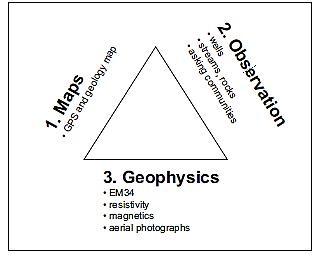
Geological triangulation, a method that combines maps, observation, and geophysics, has been very successful in many groundwater projects [26]. The precise location of villages should be determined using topographic and geological data. Global positioning systems are used to determine each village's coordinates (GPS). Once found, the map shows a general description of the geology of the village's location. Carefully investigate the local geology and make note of the types of rocks that are present. Visits should be made to any areas that the community thinks may have groundwater supplies, as well as the local wet and dry season water sources. Updated map data should be based on this geological information [5][27].Geophysical surveys can be undertaken at sites based upon geological observations made within the village.
3.3.2. Aerial Photographs
For determining the regional geological conditions surrounding a village or hamlet, aerial pictures are particularly helpful [5]. They are interpreted through direct observation with the aid of a stereoscope, which provides a three-dimensional representation of the ground at a scale ranging from 1:5000 to 1:24 000, in contrast to satellite photos that require GIS processing procedures. They frequently work well for locating fracture zones and ground surface cracks, which look as delicate linear patterns. The image can frequently be used to infer changes in the geology [27].
3.3.3. Satellite Imagery Processing and Interpretation (Remote Sensing and GIS)
Remote sensing has become a very useful technology for evaluating, monitoring, and conserving groundwater resources because to its benefits of geographical, spectral, and temporal availability of data covering huge and inaccessible areas within short time [28]. Satellite data gives immediate and practical baseline information on the factors; lithology/structural, geomorphology, soils, landuse/landcover, and lineaments that govern the occurrence and movement of groundwater [29]. Better prospective zone delineation in a region results from a systematic analysis of these parameters, which is subsequently followed by ground truthing [29]. For more than 20 years, visual interpretation has been the primary method for assessing groundwater prospective zones.It has also been found that remote sensing besides helping in targeting potential zones for groundwater exploration provides inputs towards estimation of the total groundwater resources in an area, the selection of appropriate sites for artificial recharge and the depth of the weathering area [29]
3.4. Geo-Physical Techniques
The use of geophysical techniques is often inevitable particularly because in most cases, maps and observation alone do not give sufficient information to help site a successful well or borehole [30]. There are many different geophysical techniques as summarized in the table below.
Life Sciences: an International Journal (LSIJ) Vol. 1, No. 1, 2023
Table 1: Geophysical Techniques in Groundwater Studies
GEOPHYSICAL TECHNIQUE WHAT IT MEASURES OUTPUT DEPTH REACH COMMENTS
Frequency domain EM (FEM)
Apparent terrain electrical conductivity (calculated from the ratio of secondary to primaryEM fields)
Single traverse lines or 2D contoured surfaces of bulk ground conductivity.
50 m
Quick and easy method for determining changes in thickness of weathered zones or alluvium. Interpretation is non-unique and requires careful geological control. Can also be used in basement rocks to help identify fracturezones
Transient EM (TEM) Apparent electrical resistance of ground (calculated from the transient decay of induced secondary EM fields)
Ground penetrating radar (GPR)
Reflections from Boundaries between bodies of different dielectric constant
Output generally interpreted to give 1D resistivity profile
2D section showing time for EM waves to reach reflectors
100 m
Better at locating targets through conductive overburden than FEM, also better depth of penetration. Expensive and difficult to operate.
Resistivity Apparent electrical resistivity of ground
1-D vertical geoelectric section; more complex equipment gives 2D or even 3-D geoelectric sections
10 m
Accurate method for determining thickness of sand and gravel. The technique will not penetrate clay, however, and has a depth of penetration of about 10m in saturated sand or gravel.
Seismicrefraction P-wave velocity through theground 2-D vertical section of P-wave velocity
50 m
Can locate changes in the weathered zone and differences in geology. Also useful for identifying thickness of sand or gravel within superficial deposits. Often used to calibrate EM surveys. Slow survey method and requires careful interpretation.
Magnetic Intensity(and sometimes direction) of earth’s magnetic
Variations in the earth’s magnetic field either along a
100 m
Can locate fracture zones in basement rock and also thickness of drift deposits. Not particularly suited to measuring variations in composition of drift. Fairly slow and difficult to interpret.
30 m
Can locate magnetic bodies such as dykes or sills. Susceptible to noise from any metallic
VLF (Verylow frequency)
Life Sciences: an International Journal (LSIJ) Vol. 1, No. 1, 2023
field traverse or on a contoured grid objects or power cables.
Secondary magnetic fields induced in the ground bymilitary communications transmitters
Single traverse lines, or 2D contoured surfaces.
Source: (Reynolds, 1997; McDonald et.al, 2001).
3.5. Field Measurements and Analytical Techniques
3.5.1. Chloride Mass-Balance Method (CMB)
40 m Can locate vertical fracturezones and dykes within basement rocks or major aquifers
The chloride mass-balance (CMB) technique has been suggested as suitable tool in estimating groundwater recharge in arid regions where measurement of hydrological parameters is not reliable because influx and outflux are very small and difficult to determine [9]. Input of chloride to groundwater comes mainly from rainfall and dry fallout and it can be either oceanic or terrestrial in origin. Chloride is selected due to its conservative nature and its availability in large quantities for measurements with reliability and ease.
3.5.2. Monitoring of Water-table Fluctuation Method
Observations of the seasonal fluctuation of groundwater table are used to estimate groundwater recharge in the various rock units encountered in the study area. High groundwater levels are determined from encrustations on the sides of open wells as well as by enquiring local people about the level to which the groundwater rises during the peak rainy seasons. Measurements of low groundwater levels were made immediately before the start of the wet season. The main assumption is that if the rainfall reaches the water table, the amount of rise is mainly a function of the effective porosity (specific yield) of the strata, which become saturated. If the actual fluctuation in groundwater level is Δs (mm), and the effective porosity of the strata is φ, the recharge (mm) can be calculated as φΔs (mm).
3.5.3. Boreholes Yield Timing Method
This is carried out particularly for hand-pumped boreholes. It involves the pumping of water from a borehole over a period of time, usually one minute and ends with the measurement of the quantity in liters. This method of measuring borehole yield in liters per minute is used to assess performance of boreholes in different groundwater potential zones. It is conducted for different samples and a mean value recorded [31][2]
3.6. Local, Traditional and Enquiry Techniques
3.6.1. Well Yield Testing Method
Currently, there are number of techniques for testing domestic water wells to determine the potential yield. Three of the most common techniques are the well recovery, specific capacity and the peak demand tests. Specific capacity and well recovery are science-based tests and peak demand test is more subjective [32]. Well recovery test is a recovery test is fairly simple to
Life Sciences: an International Journal (LSIJ) Vol. 1, No. 1, 2023
conduct. A well is pumped down a substantial distance from the initial static water level and then water level recovery is monitored and timed [32]
3.6.2.Community Discussions and Village Observation
Tapping into the experience and knowledge of local communities plays an integral part in understanding the geology of a village. Community members have the greatest experience of the surrounding environment and the history of water development within their village. Discussions and observations at a village are usually to help answer the following questions: what is the rock type at the village? Has there been any exploration there before? Where are there current wet and dry water sources? Useful people to meet are any well diggers, women who fetch water and children.
4. UTILIZATION OF GROUNDWATER METHODOLOGIES
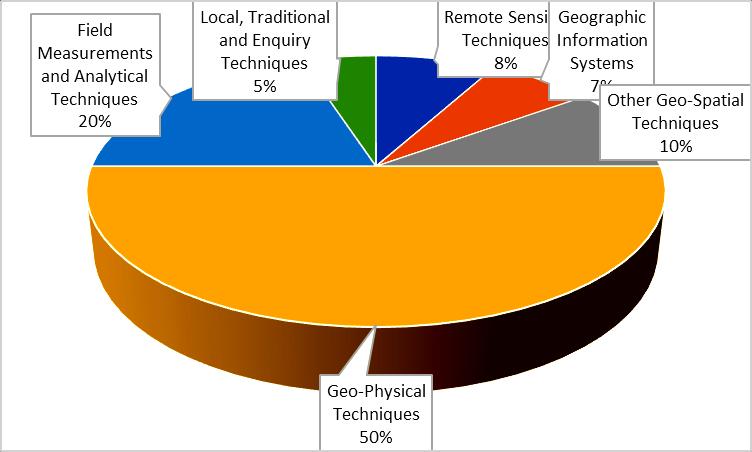
The choice of groundwater research and prospecting methods depends on different factors; location which comes with different geological formations; level of development which determines with technological sophistication; nature of usage and users which may be domestic, commercial or industrial [38] For many years Hydrologists and geo-physicist have found Geophysical techniques to be more reliable [39] because of their familiarity and unambiguity despite the fact that Remote sensing, GIS and modern geo-spatial techniques are gradually taking center stage in global hydrological and environmental research [40]. From Figure 2, Geo-physical techniques (Table 1) are mostly used across most of the continents in the World especially in Africa, Asia and Latin America.
5. THE CONCEPT OF WATER SECURITY FRAMEWORK
The Water Security Framework was developed by Water-Aid, a world-known and reputable Nongovernmental organization that is committed to the cause of water availability, accessibility and safety world-wide. The framework believes that two factors are required to deliver
Life Sciences: an International Journal (LSIJ) Vol. 1, No. 1, 2023
community-level water security. These are well managed and financed water supply services, and well managed, sufficient and good quality water resources.
There is no single, widely accepted definition of ‘water security’. A literature review carried out by Cook and Bakker in 2010 [33] highlighted that ‘water security has multiple definitions depending on the definition of need (human and/or environmental)’. A literature review by Water-Aid found that definitions primarily relate to food security, i.e do we have enough water to grow the food we need?
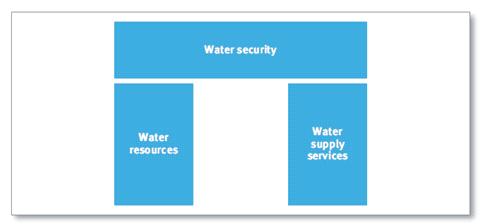
Water-Aid defines water security as: ‘Reliable access to water of sufficient quantity and quality for basic human needs, small-scale livelihoods and local ecosystem services, coupled with a wellmanaged risk of water-related disasters.’
Water security is an outcome that we aim to achieve in a way that is affordable to users without imposing an unrealistic management burden on communities. There are strong relationships between water for basic human needs and water for livelihoods:
Large-scale livelihood water uses can impact on the quantity and quality of water available for basic human needs, for example where uncontrolled irrigation is practised or where return flows from productive water uses are polluted.
If water sources provide for both domestic and small-scale productive uses, for example cattle watering, there can be competition between users for access.
If people do not have ready access to clean water, the time and energy required to fetch water, coupled with the negative health impacts of water-related diseases, affects their ability to farm and work.
Revenue generated from livelihoods can help to fund the on-going maintenance of water sources, ensuring continued access to the resource.
People are dependent on water-related services provided by ecosystems, for example, the purification of water by wetlands or forest zones. Access to water is also affected by disaster events. For this reason, livelihoods, ecosystems and disaster risk feature in Water-Aid's overall definition of water security
Water Demand
6. CONCLUSION
Going by the level of water crisis in parts of Northern Nigeria, it is justifiable to provide a knowledgeable solution to this dilemma. Issues pertaining to groundwater needs more research and enlightenment especially as it involves integration of different approaches.
The scientific promotion of methodological integration in groundwater research, with some methodologies complementing and validating one another will go a long way in developing the sub-discipline. Using satellite imagery analysis to study groundwater controlling features is very popular in India and many parts of Southeast Asia but relatively unpopular in Africa and Nigeria. Although this methodology has been popularly used in groundwater studies in parts of Ethiopia and Eritrea, but only very few have been used in Nigeria.
REFERENCES
[1] Abdulazeez, A.(2018). A Spatial Assessment and Mapping of Groundwater Potentials in Parts of North- Western Kano State, Nigeria. Techno Science Africana Journal. 14(1), 103-114. ISSN: 2006-2273. Published by Department of Geography, Kano University of Science and Technology, Wudil. Available onlineat www.technoscienceafricana.com.
[2] Carter, R. (2012): Rural Water Supply Network Newsletter-October 2012, Rural Water Supply Network (RWSN), Switzerland.
[3] Bhunia, G.S, Samanta, S, Pal, D.K. and Pal, B. (2012): “Assessment of Groundwater Potential Zone in Paschim Medinipur District, West Bengal-A Meso-scale studyusing GIS and Remote Sensing Approach.” Journal of Environment and Earth Science, Vol 2, No.5.
[4] Sedhuraman, M., Revathy, S.S. and Babu, S.S (2014): “Integration of Geology and Geomorphology for Groundwater Assessment using Remote Sensing and GIS Techniques”.Paper published in the International Journal of Innovative Research in Science, Engineering and Technology, Vol. 3, Issue 3, March 2014.
[5] Reynolds, J M. (1997). An Introduction to Applied and Environmental Geophysics. John Wiley & Sons, Chichester.
[6] Adeniyi, E.O. (1998), Administrative Framework for Physical Planning in Nigeria Ibadan: Nigerian Institute for Social andEconomic Research.
[7] Telford, W. M., Geldart, L. P. and Sheriff, R. E. (1990). Applied Geophysics. Cambridge University Press.Pp. 645–646. ISBN 978-0-521-33938-4.
[8] Xing P.I. (2012). A Study of Hydrogeology in South Asia.Translated by Donald McClaren. Translated version Published byNorton Publishers, United Kingdom.
[9] Solomon, S. (2003), ‘Remote Sensing and GIS: Applications for Groundwater Potential Assessment in Eritrea’. PublishedPhD Thesis Environmental and Natural Resources Information Systems Royal Institute of Technology,SE-100 44 Stockholm, Sweden
[10] Siegal, B.S. and Gillespie, A.R. (1980). Remote Sensing in Geology (New York: Academic Press), 702pp.
[11] Drury, S.A. (1990), Image Interpretation in Geology 2nd Edition, Chapman & Hall, London. E-book Version.
[12] Sabins, F. F. (1987). Remote Sensing Principles and Interpretation. (San Francisco, California: W.H. Freeman), 449pp.
[13] Kauffman, H. (1988): “Mineral Exploration along the Aquaba-Levant Structure By Use of TM
Data: Concepts, Processing and Results”. International Journal of Remote Sensing, 9, pp. 16391658.
[14] Amos, B.J. and Greenbaum, D. (1989):“Alteration Detection using TM Imagery: The Effects of Supergene Weathering in Arid Climate”. International Journal of Remote Sensing, 10, pp. 515-527.
[15] Abrams, M.J. and Hook, S.J (1994) ‘Simulated Aster Data for Geologic Studies’. IEEE Transactions on Geoscience and Remote Sensing
[16] Nalbant, S.S. and Alptekin, O. (1995): “The Use of Landsat Thematic Mapper Imagery for Analysing Lithology and Structure of Korucu-Dugla Area in Western Turkey”. International Journal of Remote Sensing, 16, pp. 2357-2375.
Life Sciences: an International Journal (LSIJ) Vol. 1, No. 1, 2023
[17] Younis, M.T., Gilabert, M.A., Melia, J. and Bastida, J. (1997): “Weathering Process Effects on Spectral Reflectance of Rocks in a Semi-Arid Environment”.International Journal of Remote Sensing, 18, 16, pp.3361-3377.
[18] Koopmans, B.N. (1986): “A Comparative Study of Lineament Analysis from Different Remote Sensing Imagery over Areas in the Benue Valley and Jos Plateau Nigeria. International Journal of Remote Sensing, 7, pp.1763-1771.
[19] Kar, A. (1994): “Lineament Control on Channel Behaviour during the 1990 Flood in the Southeastern Thar Desert. International Journal of Remote Sensing, 15,pp.2521-2530.
[20] Philip, G. (1996): “Landsat Thematic Mapper data analysis for Quaternary Tectonics in Parts of the Doon Valley, NW Himalaya, India”. International Journal of Remote Sensing, 17, pp.143-153.
[21] Cross, A.M. (1988): “Detection of Circular Geologic Features Using the Hough Transform. International Journal of Remote Sensing, 9, pp. 1519-1528.
[22] Karnieli, A., Meiseis, A., Fisher, L. and Arkin, Y. (1996): “Automatic Extraction and Evaluation of Geological Linear Features from Digital Remote Sensing Data Using the Hough Transform. Photogrammetric Engineering & Remote Sensing Journal, 62, pp. 525-531.
[23] Suzen, M.L. and Toprak, V. (1998): “Filtering of Satellite Images in Geological Lineament Analysis: Application to a Fault Zone in Central Turkey”. International Journal of Remote Sensing, 19, pp. 1101-1114.
[24] Krishnamurthy, J., Venkatesa, K. N., Jayaraman, V. and Manivel, M. (1996): “An Approach to Demarcate Groundwater Potential Zones through Remote Sensing and Geographic Information System”. International Journal of Remote Sensing, 17,1867-1884.
[25] Sander, P. (1996) ‘Remote Sensing and GIS for Groundwater Assessment in Hard Rocks: Applications to Water Well Siting in Ghana and Botswana’. PhD dissertation, Chalmers Universityof Technology, Sweden. A 80
[26] Carter, R.C, Desta, H, Etsegenet, B, Eyob, B, Eyob, D, Yetnayet, N.E, Belete, M. and Danert, K. (2006): “Drilling for Water in Ethiopia: A Country Case Study by the Cost-Effective Boreholes Flagship of the Rural Water Supply Network.” Federal Democratic Republic of Ethiopia/WSP/RWSN. E-book Version.
[27] Macdonald, A. M., Davies, J. and Peart, R. J. (2001): “Geophysical Methods for Locating Groundwater in Low Permeability Sedimentary Rocks: Examples From Southeast Nigeria”. Journal of African EarthSciences, 32, 1-17.
[28] Ward, A. D. and Trimble, S. T. (2004). Environmental Hydrology(2nd ed.). Boca Raton: CRC Press.
[29] Su, Z. (2000), “Remote sensing of Landuse and Vegetation for Meso-scale Hydrological Studies”, International Journal of Remote Sensing, 21(2), 213-233.
[30] Jeff, D. (2006).‘Forum for Groundwater.’ htt://www.waternet.co.za/groundwater/(3) December 2006. Accessed 17/10/2014.
[31] Food and Agricultural Organization (FAO) (1994): Investigation of Water Resources Development Options in High Potential Areas in Seraye Province. Annex 1, Water Resources Department. Asmara, Eritrea. PDF Version.
[32] Worku, Z. (2014): “Yield Evaluation of Shallow Hand-Dug Wells For Irrigation in Upper Gana and Jawe Kebeles of Lemo Woreda, Ethiopia. Online at www.africa-rising.net. Published by International Livestock Research Institute.
[33] Cook, C. and Bakker, K. (2010) “Water security: Emerging debates in policy and academia”, p 4. WorkingPaper, University of British Columbia, Programme on Water Governance. Available at: www.watergovernance.ca/PDF/WP_WaterAlternatives_Cook_Bakker.pdf.
[34] Water-Aid (2005): Annual Global Report on Water and Sanitation. Electronic Version.
[35] Water-Aid (2013): Water security framework. WaterAid, London. It can be found in the documents section of WaterAid’s website –www.wateraid.org/publications.
[36] Alley, W.M., and Alley, R. (2017), High and Dry: Meeting the Challenges of the World’s Growing Dependence on Groundwater. Yale UniversityPress, New Haven, Connecticut, United States.
[37] Stefano, B. (2018), Legal frameworks for the governance of international trans boundary aquifers: Pre- and post-ISARM experience, Journal of Hydrology: Regional Studies.
[38] Abdulazeez, A., & Adamu, A. U. (2019, October). Spatial and source disparities of groundwater quality in Dawakin-Tofa local government area of Kano State, Nigeria. In IOP Conference Series: Earth and Environmental Science (Vol. 344, No. 1, p. 012027). IOP Publishing.
Life Sciences: an International Journal (LSIJ) Vol. 1, No. 1, 2023
[39] Abdulazeez, A., Ibrahim, A., Adamu, G.K, Kasim, A.A., Suleiman, U.A and Garba, R. L (2021) Evaluation of Landuse Impediments and Adaptations in the Rocky Terrains of the Extended DutsinMa Region of Katsina State, Nigeria. Journal of Conflict Resolution and Social Issues 2 (1), 88-102.
[40] Sarki, U.S., Abdulazeez, A and Tukur, A.I (2020) A Landuse-Based Assessment of Water Qualityfor Urban Irrigation Along Salanta Fluvial Reaches in Kano, Kano State. FUDMA International Journal of Social Sciences (FUDIJOSS), 2(2), 81-95. A Publication of the Faculty of Social Sciences, Federal UniversityDutsin-Ma. Available Onlineat http://journal.fudutsinma.edu.ng/.
AUTHORS
Dr.AliDanladiAbdulkadir is a Senior Lecturer of Resources Management and Food Security in the Department of Environmental Resource Management, Federal University Dutsin-Ma Katsina State. Nigeria. He has over 25 years teaching experience in the college and theuniversity.

AmirAbdulazeez is a lecturer of geomorphology and hydrology in the Department of Geography and Regional Planning of the Federal University Dutsin-Ma, Katsina State Nigeria. He is a Ph.D Candidate with over 10 years teaching experience.