RevegetatewithLocal Plants
Prioritise protecting exisiting vegetation
Encourage natural regeneration
Undertake native revegetation
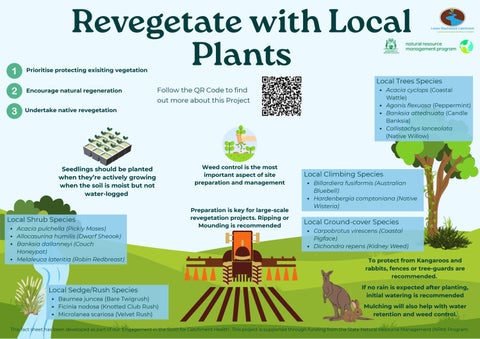
Seedlings should be planted when they’re actively growing when the soil is moist but not water-logged
Local Shrub Species
Acacia pulchella (Pickly Moses)
Allocasurina humilis (Dwarf Sheook)
Banksia dallanneyi (Couch Honeypot)
Melaleuca lateritia (Robin Redbreast)

Local Sedge/Rush Species
Baumea juncea (Bare Twigrush)
Ficinia nodosa (Knotted Club Rush)
Microlanea scariosa (Velvet Rush)
Follow the QR Code to find out more about this Project

Weed control is the most important aspect of site preparation and management
Preparation is key for large-scale revegetation projects. Ripping or Mounding is recommended


Local Trees Species
Acacia cyclops (Coastal Wattle)
Agonis flexuosa (Peppermint)
Banksia attednuata (Candle Banksia)
Callistachys lanceolata (Native Willow)
Local Climbing Species
Billardiera fusiformis (Australian Bluebell)
Hardenbergia comptoniana (Native Wisteria)
Local Ground-cover Species
Carpobrotus virescens (Coastal Pigface)
Dichondra repens (Kidney Weed)

ToprotectfromKangaroosand rabbits,fencesortree-guardsare recommended.
Ifnorainisexpectedafterplanting, initialwateringisrecommended

Mulchingwillalsohelpwithwater retentionandweedcontrol.