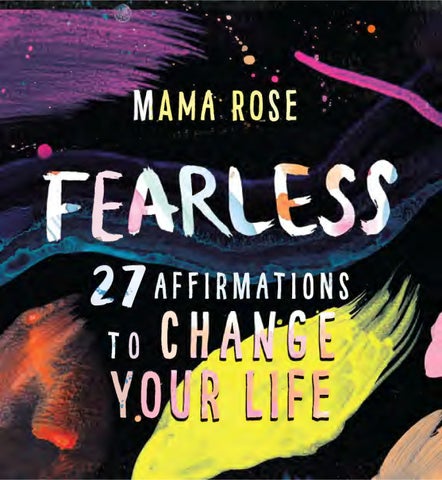
Fearless, by Mama Rose

Page 1


About the Author

Mama Rose is a spiritual guide, musician, mother, and author whose transformative affirmations have helped thousands overcome limiting beliefs. Drawing from her own healing journey through trauma, anxiety, and depression, she offers a compassionate framework for selfdiscovery and personal empowerment. Visit her at MamaRose.blog.

Fearless: 27 Affirmations to Change Your Life Copyright © 2026 by Mama Rose. All rights reserved. No part of this book may be used or reproduced in any manner whatsoever, including internet usage, without written permission from Llewellyn Worldwide Ltd., except in the case of brief quotations embodied in critical articles and reviews. No part of this book may be used or reproduced in any manner for the purpose of training artificial intelligence technologies or systems.

First Edition

First Printing, 2026

Book design by Christine Ha Cover art by Nina Dani Cover design by Shira Atakpu

Llewellyn Publications is a registered trademark of Llewellyn Worldwide Ltd.

Library of Congress Cataloging-in-Publication Data (Pending)

ISBN: 978-0-7387-8234-8

Llewellyn Worldwide Ltd. does not participate in, endorse, or have any authority or responsibility concerning private business transactions between our authors and the public.

All mail addressed to the author is forwarded but the publisher cannot, unless specifically instructed by the author, give out an address or phone number.

Any internet references contained in this work are current at publication time, but the publisher cannot guarantee that a specific location will continue to be maintained. Please refer to the publisher’s website for links to authors’ websites and other sources.

Llewellyn Publications

A Division of Llewellyn Worldwide Ltd. 2143 Wooddale Drive Woodbury, MN 55125-2989 www.llewellyn.com

Printed in the United States of America

GPSR Representation:

UPI-2M PLUS d.o.o., Medulićeva 20, 10000 Zagreb, Croatia, matt.parsons@upi2mbooks.hr

Disclaimer

The material in this book is not intended as a substitute for trained medical or psychological advice. Readers are advised to consult their personal healthcare professionals regarding treatment. The publisher and the author assume no liability for any injuries caused to the reader that may result from the reader’s use of the content contained herein and recommend common sense when contemplating the practices described in the work.

For Maya, Beto, Thomas, and Mason. And for Nathan.

Prologue

I was an anxious child, diagnosed with obsessive-compulsive disorder at the age of five. After many years of suffering, many therapists, medications, and failed attempts at self-regulation through substances, relationships, and addictive patterns, I realized that I needed to change my thoughts. Noticing the need came before realizing that I actually had the power to do this. It seemed like an impossibly tall task. How was I supposed to change my thoughts if I didn’t know what was wrong with them or what to change them into? One day, while in a clinic undergoing a minor but painful procedure, I instinctively began to make mental notes on what I saw in the room. I looked up at a box, framed with drywall in the corner near the ceiling. “Sharp line, meets another line, corner, white, dimpled paint …” I realized that I could keep myself from

worrying about what was about to happen to my body if I just stayed with what was actually happening in that moment.

At that point in my life, even after years of therapy, I had never heard anyone say “the present moment.” I had never heard of “mindfulness,” and I had no framework for anything that would suggest my power to take control of my own thinking. I was told things like “Send the thoughts away in a jar” and “Remember that they are just thoughts and they don’t have any power.” I questioned how something that “didn’t have any power” could be holding me as a prisoner in my own life. Thoughts had shown themselves to be the cause of my avoidant tendencies, my compulsive behaviors, and the crippling self-doubt that cast its forlorn shadow over the potential of my young life.

Then, one day I came across a prompt telling me something strikingly simple and entirely life changing. It said, “Love yourself.” I was curious. I knew I wanted to love myself, but I realized that I had no training on how to do this. I could get straight A’s and overwork myself with ease; in fact, it was one of the main ways I kept from drowning in the emotional waves that accompanied my anxious thoughts. I could appear to be happy and confident, I could speak well in conversation and in public, I could organize my home and my tasks, but I couldn’t, for the very life of me, understand what it could possibly feel like to love myself. I wanted to find out.

I began to write messages to myself on my mirror and place little notes around my home, the same way I wrote “I want a dog” on dozens

of sticky notes when I was a child and placed them everywhere that my parents would go. My mother’s purse: “I want a dog”; the medicine cabinet: “I want a dog”; in between the folded towels in the kitchen drawer … You get it. Now, suddenly, wherever I looked, I was finding a new message. At first, it hurt to read “I love myself.” Each time felt like a lie and was followed by a cascade of evidence as to why I should continue to believe that I was less-than-worthy of love. Everything that said, “No, don’t love yourself!” came up to the surface, and I was flooded with information. I was overwhelmed by my choice to make a change. I knew I needed to establish ways to support myself if I was going to continue this work. I also knew that I needed to continue this work, because, despite everything I had been through, I had a bone-deep determination to prove wrong every single person, book, and article that told me I couldn’t cure my OCD, overcome my PTSD, turn around my depression, and heal from my eating disorder. In other words, I had hope, and that carried me.

I wrote poetry, drew, painted, talked with friends, connected with family, found a new therapist, took a yoga class through the eating disorder recovery program I was a part of, sang, wrote music, and dreamed about a life where I was free. All the while, moments of freedom from my anxiety and depression were finding me more and more often. It seemed that every spacious moment collected a certain flavor of new energy that then magnetized more of itself into my life. I found myself reaching less and stumbling upon more. The woman next to me at the bingo hall had a bag that said “Mindfulness,” a term I had just learned. The beautiful, abandoned

mansion down the street from my new home that I was absolutely dying to tour just happened to sprout a chocolate shop inside it within days after I moved, and they hired me the first time I visited. Things seemed to be lining up. It was at this point that I began to realize that there was power in my intention.

Time went on. More of my dreams were liberated from the shackles of my old, patterned thoughts, and simultaneously, more energy arose from within me to pursue them. Along with it, support was coming to meet me each step of the way, sometimes cloaked in tragedy but always revealing a loving face when I learned to suspend my judgment and trust my process. It appeared that my intention to heal was enough to bypass the fact that I had no idea how to do it.

By the time I reached age twenty-seven, I had two young children, a recent separation from their father, a new partner, a lot of grief, and an expansive excitement for my future. In the spring that came after shifting into single motherhood, I lost my home. For the past six years, I had lived in a duplex with my older sister and her four children, and now, in the face of losing not only my nest but also the built-in support of my family, I was faced with the opportunity to rise to the challenge of cultivating even more inner resources. A fairly new friend of mine offered to house me, my new partner, and my children while we figured out our next moves. Two weeks before I moved out of my home and into my friend’s unfinished basement, I found out I was pregnant with my third child. We moved, Covid hit the following month, and the world shut down.

George Floyd was murdered, my city was literally up in flames—the third precinct burned just blocks from my home—and on top of it all, in June of 2020, I received the hardest news of my life.

My twenty-week ultrasound revealed that my baby had serious heart defects and brain abnormalities that the doctors said, “may make him incompatible with life.” They said he would for sure need heart surgery at birth, but we wouldn’t know until he was born if he had grown enough brain tissue to survive or if he would even be able to handle the most basic human functions, like coordinating breathing and swallowing. The months that followed brought seemingly endless appointments, hard conversations, extreme financial stress, unexpected blessings, and a deep initiation into letting go in the face of the unknown. My ability to navigate this period of time not only with grace but also with and as love came from choosing to hold a perspective that I will share with you in this book. You, too, can take any challenges life gives you and become an empowered creator rather than a victim of your circumstances.

Life continues to be challenging, and I continue to choose gratitude for the opportunity to be living, to be growing, and to live as the love that I came here to be. In the time since I first decided to try to love myself, I have learned that the larger truth is that love is who I am. It’s not something I do, but a way of being. My entire life has become not only aligned with but mobilized by that love. Now, no matter the circumstances, I remember my power to choose, and I am divinely inspired and motivated from the core of my pain, which is also the core

of my heart, to share this writing with you so that you, too, can remember your power.

The affirmations that follow are the words I have spoken to myself throughout my healing journey. They have brought me through harmful self-talk and into self-awareness and an understanding of who I am that has carried me through even the darkest of nights. I continue to use these words and to create new affirmations as I go, with the understanding that every word I speak to myself is a prayer, an opportunity to commune with the Divine that exists within me.

Part 1 will teach you how to use this book. Together, we will build a framework to help you do the work of introducing new statements to your subconscious to help create fertile soil in which they can take root. There were many times that I didn’t know how to move forward or even which direction was forward. I promise, however you are entering this work, you’re in the right place and you’re right on time. Your intention is enough to guide you to success even when you can’t see how.

Part 1

The Framework for the Work

Welcome to the part of your life where you remember the power of your intention, your voice, and your choice. You are here because you are ready, and I invite you to trust this timing. As with all things, you should take this book at your own pace. I have created this book as a companion for your spiritual growth and self-discovery, and that is a lifelong process, which means you’re holding a lifelong companion. These affirmations are written in such a way that they will invite your own truth to rise to the surface of your awareness in all of its layers and multidimensional beauty. What’s true for you today may shift tomorrow. For this reason, I recommend that you revisit this text whenever you feel called to, bringing the same affirmations to the new you again and again.

What Does It Mean to Be Fearless?

Words are funny. Sometimes they hold value for us because they contain parts we can dissect—prefixes, roots, and suffixes that break down easily with meaning we can piece together like a well-kept puzzle. Other times, words are messy, a compilation of sounds born not of order but of a need to communicate something held deeply in the human psyche—sounds that invoke a feeling, a pulse of something almost beyond language. “Fearless” is one of those words that, upon initial investigation, appears to be normal. It talks about fear (“fear”), and it talks about the absence of it (“less”). But we can use it to mean something even more true. We can use it to allude to an inherent truth that doesn’t mean the absence of fear at all. Instead, with the right framework, “fearless” becomes a reminder that there is a part of each of us that exists beyond fear entirely. Maybe a better word would be “fearpast” or “fearbeyond” or some other word that doesn’t exist yet in the English language. But “fearless” achieves something that no other word presently does in quite the same way. It denotes the imagery and feeling of strength, it brings alive something past the ego, and it invites the soul into a position of leadership. This book reminds us of the part of ourselves that is clear and soul-directed, and it provides a guide not just to access that part once or occasionally but to restore it as our normal state of being. No longer will your fears direct the story of your life; soon, they will be restored to their rightful place in your process as messengers.

What Is an Affirmation?

Affirmations are statements that we say to ourselves on purpose to affirm the parts of our identity that we would like to make stronger. There is a voice within each of us that takes the form of our thoughts and beliefs. This is the voice that we retrain to be an uplifting ally when we begin to intentionally choose what we say to ourselves. Affirmations create changes within our lives because they shift the way we view ourselves in relationship to others and the world around us. They rewire the way our consciousness works by transforming the stories we tell ourselves about why things happen and who we are. When you begin this work, you will notice that you are already talking to yourself; you are already affirming something to your subconscious at all times. However, up until now, you may not have questioned whether or not what you’re affirming is supporting you or creating the patterns within your life, health, and relationships that you desire. This work is supplemental and supportive, and it’s also foundational to all other types of inner work, including therapy, twelve-step programs, relationship and spiritual mentorship, and more.

The Option to Journal

Writing is a way to concretely see and explore the way our inner voice is operating at any given time and to make tangible changes to the way we are speaking to ourselves. I have used writing as a tool to move myself from experiencing my life as a victim to directing my life as a creator.

Because of how impactful writing has been in my personal process, I invite you to pull writing prompts from this text and keep a journal dedicated to your journey with this book. One of my favorite tools for self-reflection is looking back at the journals I have been keeping since childhood. Not only does looking back illuminate our patterns and inspire the clarity of hindsight, but it also provides us with the opportunity to accept the past version of ourselves here and now, in the present moment, which is an incredible act of self-love.

As you move through the affirmations that I give you in this book, you will notice that you are speaking “affirmations” to yourself already! In fact, all of your inner words are affirming something about you. Journaling can be an opportunity to look at what you are saying to yourself and see if you are affirming something that you actually agree with and want to continue holding as true. Do these affirmations affirm the parts of yourself that you want to strengthen? Do they sound like your voice, the voice of a parent, caregiver, former lover, or society? Are they loving, or do you have some work to do in learning how to re-parent yourself?

You might choose to create a journal practice with the concepts of this book in some of the following ways:

1. Use each affirmation as a journal prompt. Write it down and then ask yourself a series of questions: What do I notice when I say this affirmation to myself? Does it bring up any thoughts or feelings? If so, write them down.

2. Journal your way through a body scan. For example, when you say one of these affirmations to yourself, what do you feel in your body? Start at your feet and work your way up through each body part, area, or energy center. You will become more aware of your body as well as your energy through this practice. Be careful not to skip any body parts. If you do feel an aversion to checking in with certain parts of your body, write about it! This is not a bad thing but rather a gold mine of information. You will find as much of a way into yourself through the places in your body, mind, and life that you try to avoid as you’ll find in those that you jump into with ease.

3. Free write. Write a page or more nonstop and then read what you’ve written. You can write about something specific or nothing. Just focus on filling the page.

4. Create your own affirmations. As you become aware that you are speaking to yourself all of the time, you will naturally begin to choose your words more carefully. Putting pen to paper is a way to engage with new ideas in a way that speaking alone can’t quite do. Try writing some of the new things you’d like to believe about yourself, even if they don’t feel true yet.

5. Keep a daily log of your process. What is it like for you to be taking on such a big, beautiful task as transforming your inner voice? As your inner voice shifts to become your greatest ally, you’ll go through lots of ups and downs. Journaling can be

a great way to see all of these “goods” and “bads” as simply neutral. In hindsight, even just looking back a week or two at a time, you’ll see how something that felt like a bad thing turned out to be a valuable part of your growth.

How we talk to ourselves matters. We create our reality based upon our inner voice: a series of thoughts and beliefs that we agree with. When this agreement changes, our story changes and our life changes too. Affirmations introduce new truths to our subconscious so that we may create in alignment with what is true for the version of ourselves that is healed and thriving. In this way, we bring ourselves into experiencing that version of self.

Be gentle with yourself through this process. As with any positive change, the old comes up to say goodbye on its way out! You may notice old beliefs, thought patterns, voices from your past, fears, and more coming to the surface. Keep in mind that you are seeing them because they are leaving. Wish them a fond farewell by thanking them for their service. They have attempted to keep you safe and supported. They have attempted to keep your identity intact. Let them know that they are now free to go. This process may be drastic to you, or it may be slow and subtle. Oftentimes the pains that have been yelling for our attention require more time and space to tell their stories than some of our whispers do. Give space to

whatever comes up for you and use these affirmations as boundaries to hold a spacious channel open for your experience. You are safe and ready to go through this transformation.

Accept what comes up. The most important thing that you can do is be present with yourself. Being present is saying yes to yourself. Being present is self-acceptance. When we are honest about what’s here, we have the power to alchemize it. If instead we attempt to reject any aspect of our experience, it will find another way to get our attention. This is where we see symptoms of dis-ease in the mental, emotional, and physical aspects of our being. The healing energy that is available to you in the present moment can absolutely transform your life, but the only way you give yourself access to it is to be present. I’ll teach you.

When you’re on board with your process, all change is positive.

Affirmations are not just positive statements. They are what is true when we strip away the beliefs that have clouded our vision of Self. When brought to the light of present-moment awareness, we begin to see that most of these beliefs are serving a version of us that doesn’t even exist anymore. When our identity begins to shift, we start to shake off a lot of the outdated programs that kept us safe from long-ago threats. Use the affirmations in this book to challenge your currently held view of who you are and to reorient yourself to a perspective that is clear, spacious, and supports your growth.

Restore the inner voice. In time, you will create your own affirmations that come from your deepest desires for yourself and your life. They will be directed at your own pain, blind spots, and the things you desire to grow beyond or overcome. They will be celebrations of how far you’ve traveled and calls to action as you remember your power to choose which thoughts and beliefs you give your precious energy to. Your inner voice is within you and fully operational; there is nothing about it or you that is broken. As you do this work, you will remember that your symptoms, fears, addictions, and false beliefs are your tools to restore the clarity that will allow you to hear and take ownership of your inner voice. Throughout the course of this book, you will learn how to take your average day, your patterned responses, your thoughts, and your emotions and tune them to higher states of consciousness.

The limitations of words. As I’m sure you have noticed, this book is made out of words. I personally love words. I love the way words help ideas travel. But we would be doing ourselves a great disservice if we didn’t also speak to the fact that words are also limiting. Words are a vehicle that transfers energy as well as a tool that initiates energetic alchemy. Each of these affirmations is designed as a cue to shift your energy. It is your work to notice how these affirmations feel to you emotionally as you work with them over time. You may find yourself meeting an affirmation differently each time you speak it to yourself. The limitation and the beauty of these affirmations is that they aren’t exclusively true. For example, both “I know” and “I don’t know” are true. It would be accurate to say that “I am perfect” and “I am imperfect.” Throughout the course of this book, you will be learning to hold multiple truths at the same time even when it seems like they do not agree. This is one of the most valuable life tools that I have learned through my healing process thus far, and I am grateful to be sharing it with you.

The Protocol

You may use this protocol with each affirmation.

First, get in touch with what is . Ask, What is true for me in this moment? How am I experiencing this truth? What do I notice about my thoughts, feelings, and sensations? Be honest with yourself. We liberate the energy needed for change by accepting what is presently operating within our consciousness.

Next, cultivate acceptance . Your experience is real. Simply being present with yourself is a profoundly healing act of self-love. Choose this. You deserve to have someone with you through the hard stuff; be that person.

Last, introduce change. Each affirmation invites you to change what is true for you. Your intention, the guiding principle of this work, need only be to see what changes within you as you go. The change will happen on its own through the magic of your presence. All you need to do is stay with yourself and you’ll see how each thought, emotion, and sensation you experience transforms into a higher expression of itself.

This Is Grief Work

You will find it helpful to continually reintroduce new concepts to the subconscious until they become integrated. You will know they are integrated when you no longer meet them at the level of fear. Fear arises when we offer change to our inner world because the change asks our identity to shift. In order for this new belief to be true, the version of you that believed something else must die. Therefore, this work involves grief. It will benefit you to support yourself through this process as if you were grieving the death of someone you love because you are going to learn to love yourself a whole lot, and you will surely change so much that the version of you who is reading this will become something of the past. At first, it will feel safer to stay the same, and you may find yourself repeating old habits, patterns, and addictions to certain thoughts that used to feel safe. However, the event that created a need for this effort to achieve safety is no longer happening, and you are now learning to create safety from a pure source. The version of you that exists in the future where you are happy, healthy, and fulfilled does not need the same protections that previous versions of you needed. You may now enter a new era of experimentation fueled by a brave curiosity to discover who you truly are. I promise you this: You will become who you tell yourself you are. It’s time to change your story.

Expression to Integration

As we do this work, old stories will rise to the surface, entering your awareness and asking for acceptance. Healing occurs when we offer these stories a space to speak through expression. Expression allows for release, and then integration occurs. Integration is the part of the process when whatever was previously painful to us transforms into a powerful gift that we are able to share with others. This work will teach you to alchemize what plagues you into the medicine that you have to share with the world. Different moments call for different means of expression. There may be times when you choose to journal, sing, dance, or paint, but oftentimes, you’ll be in the midst of your day when you’re using these affirmations. You’ll find out what expression looks like for you in myriad contexts as you move through this work.

The Many Versions of the Self

You have permission to give every part of yourself a voice throughout this practice. You’ve written a million stories of who you are, and each was written from a different perspective in time. I like to think of this as having a million voices. They all sing together to create the version of me that I am now. When I am writing in my own journal, I make a special space for myself. I give permission to every voice to sing. This means that I may have one journal entry that says “I hate cheese” and another that says a love poem to Gouda. It doesn’t matter that these things don’t agree.

The work that you do for yourself is truly for you to experience yourself through the reflection you create when you express, whether that be in writing, an interaction with another person, or the words you say within your own mind.

An Understanding of the Subconscious Mind

The subconscious is like a library to which we hold an unlimited access card. We can visit at any time, day or night, and check out whatever books we like. There are some books we check out often, some we don’t even know are there, and some we checked out ages ago that are long overdue to be returned.

We walk around carrying a backpack full of these books. The books in the backpack are the stories that create the beliefs we are operating with on a daily basis. Maybe we know what’s in there; maybe we don’t. How long has it been since you’ve looked in the backpack?

The backpack gets heavy and the shoulders tire while building up the strength to handle the immense responsibility of carrying so many books. Tension grows, headaches come, the body’s balance is thrown off. New books join the backpack to try to remedy the problem, but their weight only makes things worse. What is the solution?

The solution is a trip to the library. We have to return some books! So, how do we get to the library? There is but one door to the library, and it is the present moment. In order to access deeper aspects of the Self,

we must simply arrive where we are, bringing our conscious awareness into focus and letting all parts of our experience be. Our access to the library expands as we go, and with practice, we can even read multiple books at a time, observing how they are all linked together. After all, they are all written by the same author!

Then, we take off the backpack. We cultivate a connection to self that is clean, clear, and powerful enough to support our exploration of its contents. This happens naturally as we return again and again to the library. As we get comfortable among the shelves and the smell of musty pages, we find ourselves setting the backpack down.

Next, we look inside. We’ve spent some time preparing for this moment. The excitement is palpable, the curiosity is childlike, and we are ripe with readiness! One by one, and often in series, we remove the books and peer inside, exploring the rich stories, the heartbreak, the joy, the challenge. We meet all of the characters who have been living within us: the hero, the martyr, the victim, the child. One by one, as we read each story, sometimes once and sometimes many times, we return each book to its rightful place on the shelf.

As the backpack becomes lighter, we begin to form a new sense of self. No longer do we see ourselves as heavy, slow, and limited by the weight of what we thought we must carry. Now, we know where to find each of our stories. We understand that we have unlimited access to each of them. We know how to get to the library, and we no longer have to carry anything with us at all times.

Now, we are free to form a new self-image, one which is no longer based on the stories of our past. Now, our stories fuel our passions and inspire our actions. Each new experience calls forth new aspects of self to be explored. Each expression of self creates new relationships with the world around us, and we watch it change to meet the new declaration of who we are. It is here that we find our truest self, our fulfillment, our dreams, and the energy to mobilize them.

Energy

Everything is energy, and energy is always moving. When we try to hold something steady, like a belief, it requires energy. What would happen if we let go so the mental energy could move naturally? Would we lose control, or would we gain a much higher form of control, where the innate ability of a living organism to reorganize to harmony naturally takes place?

The mind and heart are a team, as are all other aspects of the body and being. When the mind is holding energy rather than allowing it to pass through, we find ourselves stuck, unfulfilled, and unable to create. The artist might call it a block; sometimes we call it anxiety. For the purpose of this work, we can call it a pattern.

Mental energy moves the world around us. It is a mobilizing force that is both causal and receptive. As mental energy flows into the mind, we receive inspiration and new ideas. As it flows out of the mind, we communicate our thoughts with the world around us through our actions.

So, what happens when the mental energy is stuck in the same pattern? New, inspired thought is not able to enter the mind. Instead, we behave as we always have because we think how we’ve always thought, and thus, we experience what we’ve always experienced.

If, let’s say, we are outwardly focused on the world outside of the library, we see evidence that reinforces our sense of self. It shows us that we ought to keep carrying the books we are carrying because those are the ones that we keep needing. It is not until we liberate the mental energy that the outer world begins to reflect a new identity.

Sure, we can create change in the outer world without ever visiting the library, but we will find that the changes made are still in accordance with our deeply held beliefs about the world and how we fit into it.

Identity

It’s the “me” and “them” mentality. Except, in this case, it’s more like “me” and “not me.” As young children, we begin to learn what we are and what we are not. The budding identity of a baby can be seen as they discover their separation from their mother. Soon, they are no longer experiencing life as a pure witness but rather will begin to experience themselves experiencing. By adulthood, this filter through which we view our experience, or sense of self, is well formed, and we expend immense energy in trying to keep it intact. We are well aware of what we are and what we are not, and the distinction is important so we don’t get lost.

However, we may not realize that there is more flexibility in the lines we draw than we have come to believe. I am me; I am not my computer. I am me; I am not my cat. I am me; I am not the apple in my hand … Or am I?

Consider this: I know that the apple is not me, yet as soon as I eat it, it is. It seems, then, that the only difference between what I am and what I am not, in this case, is the time between me holding the apple and eating the apple. We might say that the apple became us instead of saying that we became the apple, but in truth, these two things became one. When we apply the same concept to identity, we see that the only difference between who we are now and who we are becoming is time. So, what if instead of projecting a past version of ourselves into the future via our thoughts and becoming that, we pause, we find the present moment, we remember our power to choose, and we choose to envision a future version of ourselves that feels empowered? Now, as with the apple, these two become one. This practice creates powerful changes in our identity and liberates us from past beliefs about ourselves that no longer serve us.

What if that future version of ourselves actually exists just because we imagined them? What if they have just as much power to create our present and past selves as we have to create them? What changes when our imagination becomes empowered? What if the cause and effect of our creation process can go both directions? What if we can actually create backward?

What we consume becomes us, which is the same as saying what we consume, we become. So, what if we start to consume some new

thoughts, new stories, and new beliefs about who we are becoming? What changes in our lives if we give purpose to our past by thanking it for allowing us to become the future version of self that is happy, healthy, and empowered? How do we navigate the present moment when we are rooted in an inner voice that speaks to us lovingly and confidently?

You’re Not a Frequency; You’re a Symphony

We can think of the human experience like a great symphony, more magnificent than any music on Earth, with millions of instruments, billions of tones, and trillions of varieties of timbre, which are all intelligent, intricately layered, and in motion. This divine dance of frequencies creates everything we know—from the apple to the sensual experience of it to the thoughts that arise while we’re eating it. Every single aspect of our lives is a part of this energetic orchestra. When one instrument is out of tune, the whole song sounds off. The natural tendency of the symphony is to reorient to harmony, just as the natural tendency of life is to reorient to health and well-being.

Regardless of circumstances, we create our inner world, meaning that we create the experience of our circumstances. Only we decide which books we carry and which books are in the library. We are the librarian, the author, the reader, and the doorway into the room whose walls are lined with our stories. We alone hold the filter through which the

external becomes internalized. It is our responsibility to choose how we experience our own lives. Herein lies our power.

It’s not about the other; it’s about the experience of the self in relationship to the other. This applies to any kind of other, whether the other be your home, spouse, career, government, a situation, or even a thought. We can’t change others; we don’t work from the place that they occupy. We work from where we are. We have the power to affect our inner world, and in doing so, we pull the strings on a level of creative functioning that precedes otherness. We work in the space that comes before the “me” and “not me.” We change the truths we hold, and in doing so, the “other” responds. Shifts within demand shifts without. You have the power to change not just your world but the world around you by changing the world within you.

You’re ready.

Changing your inner dialogue literally reshapes your reality. Mama Rose provides a revolutionary approach to personal transformation through twenty-seven affirmations that evolve alongside you as you re-train your inner voice to become your greatest creative ally.

In this lifelong companion to your spiritual growth, you will find a combination of gentleness, practical wisdom, and true stories that inspire you to create your life on purpose.

Mama Rose makes hard-to-reach concepts like “energy” simple and accessible with this complete and easy-to-follow guide to becoming your authentic self.
Mama Rose is a spiritual guide, musician, mother, and author whose transformative affirmations have helped thousands overcome limiting beliefs. Drawing from her own healing journey through trauma, anxiety, and depression, she offers a compassionate framework for self-discovery and personal empowerment. Visit her at MamaRose.blog.

Facebook.com/LlewellynBooks

X: @LlewellynBooks

Instagram: @LlewellynBooks

www.Llewellyn.com

$16.99 US

Turn static files into dynamic content formats.

Create a flipbook
Issuu converts static files into: digital portfolios, online yearbooks, online catalogs, digital photo albums and more. Sign up and create your flipbook.
Fearless, by Mama Rose by Llewellyn Worldwide, LTD. - Issuu