Foreword

by
Scott Berman
![]()
Foreword

by
Scott Berman
Kelly Ann Street, MS, is a licensed professional counselor who works with adults to navigate life’s darkest moments. She is the creator of Embrace The Dark & The Light, a healing platform and accompanying podcast that explores healing, purpose, and the full spectrum of human experience. Through her therapy practice, writing, and online offerings, Kelly helps people step into their own stories and embrace both the shadow and the light within. Visit her at KellyAnnStreet.com or EmbraceTheDarkAndTheLight.com, or follow her on Instagram and YouTube at @kellyannstreet.
If you wish to contact the author or would like more information about this book, please write to the author in care of Llewellyn Worldwide Ltd. and we will forward your request. Both the author and the publisher appreciate hearing from you and learning of your enjoyment of this book and how it has helped you. Llewellyn Worldwide Ltd. cannot guarantee that every letter written to the author can be answered, but all will be forwarded. Please write to:
Kelly Ann Street, MS, LPC c⁄o Llewellyn Worldwide 2143 Wooddale Drive Woodbury, MN 55125-2989
Please enclose a self-addressed stamped envelope for reply, or $1.00 to cover costs. If outside the U.S.A., enclose an international postal reply coupon.
Many of Llewellyn’s authors have websites with additional information and resources. For more information, please visit our website at https://www .llewellyn.com.
Kelly Ann Street ms, lpc
Embrace the Dark: Heal & Find Balance in Life’s Deepest Shadows Copyright © 2026 by Kelly Ann Street, MS, LPC. All rights reserved. No part of this book may be used or reproduced in any manner whatsoever, including internet usage, without written permission from Llewellyn Worldwide Ltd., except in the case of brief quotations embodied in critical articles and reviews. No part of this book may be used or reproduced in any manner for the purpose of training artificial intelligence technologies or systems.
First Edition First Printing, 2026
Book design by Christine Ha Cover design by Shannon McKuhen
Llewellyn Publications is a registered trademark of Llewellyn Worldwide Ltd.
Library of Congress Cataloging-in-Publication Data (Pending)
ISBN: 978-0-7387-8206-5
Llewellyn Worldwide Ltd. does not participate in, endorse, or have any authority or responsibility concerning private business transactions between our authors and the public.
All mail addressed to the author is forwarded but the publisher cannot, unless specifically instructed by the author, give out an address or phone number.
Any internet references contained in this work are current at publication time, but the publisher cannot guarantee that a specific location will continue to be maintained. Please refer to the publisher’s website for links to authors’ websites and other sources.
Llewellyn Publications
A Division of Llewellyn Worldwide Ltd. 2143 Wooddale Drive Woodbury, MN 55125-2989 www.llewellyn.com
Printed in the United States of America
GPSR Representation:
UPI-2M PLUS d.o.o., Medulićeva 20, 10000 Zagreb, Croatia, matt.parsons@upi2mbooks.hr
The material in this book is intended for informational and inspirational purposes only and is not a substitute for professional medical, psychological, or psychiatric advice, diagnosis, or treatment. Although the author is a licensed therapist, this book is not a therapy manual and is not intended to provide clinical treatment, therapy, or medical advice. The reflections, practices, and exercises offered here draw from the author’s personal and professional experiences but are meant for general self-exploration only. Readers are encouraged to consult a qualified professional when exploring material that brings up intense emotions, memories, or psychological distress and to seek the guidance of a qualified health care provider with any questions they may have regarding a physical or mental health condition.

Exercises xi
Foreword xiii
Welcome xvii
A Note on Memory xix
Introduction 1
Part I: Awakening
Chapter 1: Don’t Be Afraid of the Dark 11
Chapter 2: Tools for Reclamation 15
Part II: Reclaiming
Chapter 3: Welcome to the Journey 57
Chapter 4: Embodiment 63
Chapter 5: Meaning 79
Chapter 6: Becoming 91
Chapter 7: Relationships 103
Chapter 8: Abundance 121
Chapter 9: Calling 137
Chapter 10: Environment 151
Part III: Embracing
Chapter 11: The Integration 167
Chapter 12: Finding Your Light 189
Chapter 13: The Journey Ahead 195
Conclusion 205
Bibliography 209


So much of what draws people toward transformation begins with an image and an ideal. Often it is the kind you see online, where someone steps out of darkness with tears in their eyes, their face softening into something unmistakably open. People assume that moment is the experience. But it is only the echo. The real work happens in the hours no one sees, in the silence, without performance, in the raw and unvarnished truth that comes when everything familiar falls away.
Darkness does not offer peak experiences. It strips away the layers we use to orient ourselves: self-image, control, strategy, performance. It invites us into contact with what is underneath, the nervous system in its unguarded honesty, the old patterns that surface when there is nowhere left to run, the sensations that speak long before we have language for them. The highs never carry anyone through the dark. Honesty does. Simplicity does. Presence does. What Kelly offers in Embrace the Dark is not a burst of motivation or a quick spiritual lift. It is a deeper kind of guidance, the kind that helps you meet what is real rather than escape it. This book does not romanticize descent, nor does it dress it in spiritual glamour. Kelly meets darkness the way it actually arrives in human lives: unexpectedly, inconveniently, and often without mercy. She writes from inside the terrain, not above it and not after it but from the lived, tender, disorienting middle of it. She does not bypass the grief, fear, shame, jealousy, or confusion that marks real inner work. Instead, she turns toward them with curiosity and a depth of compassion that only
comes from someone who has allowed themselves to be changed by what they have lived.
So much of what she names aligns with what we see every day in darknessretreat work. When the world goes quiet and the body becomes the only compass left, the entire inner landscape begins to reorganize around sensation instead of story. The emotional undercurrents that were easy to outrun in the light become impossible to ignore. People imagine darkness as mystical, but it is radically physical. It is somatic before it is anything else. What rises in the dark is not a performance of healing. It is the unfiltered truth of what the body has been carrying.
Just as in a retreat, what Kelly offers here is a form of support. It is an essential companionship that helps a person stay with themselves when things become difficult and begin to fall apart. At SkyCave, we have learned that attuned presence is not a luxury. It is a biological need. When someone enters deep darkness, their nervous system becomes exposed. It becomes tender, reactive, alert. Connection and care help people feel safe enough to let their defenses soften. Kelly’s writing carries that same grounded steadiness. It offers a quiet companionship that lets the reader unclench a little and trust what is unfolding inside them. She does not try to fix the reader or lead them somewhere. She sits beside them, patient and unforced. She trusts the process, and that trust becomes a mirror the reader can lean into.
Her stories are not meant to impress. They are meant to reveal. Through them, she invites the reader into a new ground, one that is not built on effort or idealization but on contact with what is actually here. In this way, darkness becomes less of an obstacle and more of a portal—not a portal into transcendence or spiritual exceptionalism but into a deeper and more intimate relationship with one’s own humanity.
If you are holding this book, you might already feel that pull. You might be someone who has lived with quiet burdens, unspoken disappointments, or patterns you can sense but cannot quite touch. You might be someone who has been hiding parts of yourself for years or someone who feels lost in the liminal space between who you were and who you are becoming. This book will not rush you out of that place. It helps you slow down enough to feel where you actually are. It helps you listen to the wisdom that rises there, in the dark, when everything else becomes still.
What I appreciate most about Kelly’s work is that she does not treat darkness as something to conquer. She honors it as something that reveals. She shows how descent can soften us, how grief can widen us, and how truth can return us to ourselves. She reminds us that healing is not about becoming better versions of who we already were. It is about becoming more honest, more embodied, and more deeply connected to what has always been here. My hope is that you read this book the same way someone enters the dark. Slowly. Gently. Without trying to extract meaning too quickly. Let it sit with you. Let it reflect you. Let it accompany you into places you may have avoided, and let it show you the parts of yourself that are ready to be reclaimed.
This is a book for anyone who is tired of seeking light and ready to meet the truth. It is a book for those who sense that something quiet and essential is waiting inside them. It is a book written by someone who has walked through her own shadows and returned with her hands open.
May these pages be a small lamp, not to pull you out of darkness but to help you walk more honestly within it.
—Scott Berman, SkyCave Retreats

Welcome to Embrace the Dark.
This book was written to be both a companion and a mirror, something you can return to again and again as you move through your own seasons of growth, loss, and becoming.
Throughout these pages, you’ll find invitations for reflection, journaling, and embodied practices. All of these exercises and prompts can also be found at www.embracethedarkandthelight.com, where you’ll discover printable resources, courses, and companion materials designed to support your journey through the dark and into the light.
If you’d like to go deeper, join me on the Embrace the Dark & The Light Podcast, where I share conversations and reflections that continue the themes in this book. You can listen wherever you find your podcasts or watch on YouTube at @kellyannstreet. You can also connect with me on Instagram @kellyannstreet for inspiration, updates, and glimpses of life between the lines.
However you arrived here, I’m grateful you did. May these pages remind you that the dark is not something to escape but something to enter—with courage, curiosity, and the quiet faith that light will follow.
—Kelly Ann Street

Before this book really begins, before the stories are read and the people are judged, myself or anyone else, I wanted to include a note on memory. All my life, I have had what felt like crystal clear images and memories from experiences. It was as if I could replay the movie of my life in my head, living through the joys and pains anytime I chose. Sometimes these memories would fade to black, and I would wonder, What happened there? But I would move on to the next memory and continue talking or thinking about my past, often when beginning a new relationship or starting therapy, again. I had this entire memory bank stored up, full of things that I thought I knew about myself, remembering who I was and what had happened in my life.
When I first began the process of writing this book and filling it with these stories from my childhood, adolescence, and adulthood, I struggled between sharing openly and honestly and then holding back for fear of hurting people I know or love, by including anecdotes that they may have experienced differently than I did.
There is so much that we don’t know about the human mind and body, in general, but specifically as it relates to memory. While we do know some of the mechanisms in place, related to how humans encode memories in our internal data storage bank, how they are run through the filter of our own perception, or even how we store memories as if they are pictures and movies, there is much to be learned about how we internalize things that happen to us before we have the words for them. What we do know is this: The brain stores
explicit memories, such as facts and stories, while the body stores implicit memories, such as sensations and emotions, and our genes carry echoes of the past, represented in how we activate stress or resilience as well as in our genetic expression. Our mind stores, encodes, and retrieves information. But each time we recall that information, or memory, it changes slightly based on what we know now or who we are in that moment of remembering. The body stores memory as an archive of sensation and response, through movement and nervous system response, which is how both fight, flight, and freeze, as well as riding a bike, get imprinted into our memory.
As someone fascinated by the mind-body connection and how we process our experiences, thoughts, emotions, and actions, I try to hold the science of memory with the same reverence as I hold my own lived stories. Both help me understand what it means to be human, to remember, and to make meaning from what we’ve lived.
Many people have heard the saying “there’s your story, my story, and the truth.” I believe that there are layers to the truth, nuances and filters that may alter everyone’s version of the truth. Some things are irrefutable. Gravity, for instance, is a fact and something we experience each time we drop our phones, praying that we didn’t just crack the thin glass on the front of those tiny computers. Other things are subjective truths, such as memories, for example. The version depends on the subject reviewing the footage, which in this case is me. A memory may be fallible, and I have tried to fact-check dates, events, and other details, but hey, we’re all only human, after all.
The conclusion I came to is that the stories I needed to tell are my own— whether they can be fully corroborated by anyone else. The stories are my life, and they illustrate what it looks like to navigate this internal darkness in our modern times. Many of the books and memoirs I read while researching and writing this book became guideposts and anchors for how I could navigate these waters. In Tara Westover’s book, Educated, she writes about trying to confirm details of her life stories, to allow for fallibility and faulty memories. Most of the time, she couldn’t get a perfect confirmation. Some people may feel that this is proof of her or our own memory’s wrongness, but I think it is proof of something else.
We are all, every single one of us, the lead character in our own stories, so the point of view shifts when we ask for these memory confirmations.
Certainly, dates and other facts can be confirmed or denied, but who said what or did what first is subjective unless it can be recorded and played back for posterity. As someone who hears other people’s stories daily, this is especially important to me, to recognize and make room for someone’s truth to be different than my own. In the context of the stories to come, I acknowledge that someone else’s experience may have been different from my mine.

Since I can remember, I’ve been afraid of the dark. Not just the kind of fear where you sleep with a night-light, but red-level, imagination-on-overdrive fear. The kind where gremlins live at the bottom of the stairs and snakes hide in the toilet. The kind that can sometimes keep me up at night when I’m alone. The kind I’m only now beginning to sit with and understand.
As a therapist, I know I’m not alone in this fear. So many of us are hiding from parts of ourselves, whether it be our grief, our anger, our softness, or even our truth. We all have things we’d rather lock away in the closet. But here’s the thing: When we hide from what we fear in the dark, we also miss the beauty sitting quietly beside it.
This book is an offering. It is a guide to help you walk through your own darkness with tenderness and courage, a reminder that there is wisdom in the descent and that even in your most unraveling moments, you are not alone.
I’ve spent the last decade immersed in the transformative works of therapy, somatic practices, psychedelic healing, yoga, movement, breathwork, and time. And while I still fear the dark at times, I’ve learned to walk with it, to let it speak, and to trust what it reveals.
You’ll see my story woven throughout this book, not as a prescription but as a companion. You’ll meet the parts of me that have fallen apart and come back together, again and again. You’ll meet the child who felt invisible, the woman who forgot her voice, and the version of myself who chose to go looking for what was lost.
You’ll also meet your own stories in the tools and practices along the way. This book was born from a concept that many of us experience but few name. A “dark night of the soul” is the complete and utter loss of self—of identity—and sometimes even a death of the soul. Other sources call this an existential crisis or depression. All that I knew, especially as a child, was that I felt alone. I had no language for the depth of that loneliness. This is how many kids feel throughout puberty, and yet, it is a sadness that I have come to feel as soft and steady, despite all the labels and assumptions that can sometimes accompany those feelings and experiences.
Many modern mental health professionals want to label these experiences as a state of depression or anxiety, then encourage you to get a prescription for selective serotonin reuptake inhibitors (SSRIs) or learn practices to quickly manage or stop feeling your feelings. While those tools are helpful, they can also distance us from the lessons we may need to learn. And when those tools of medications or traditional therapy are not effective in blunting or stopping those feelings, the conditions can become what we in mental health fields refer to as treatment-resistant depression. From there, people often become hopeless and afraid that there may never be relief from the internal pain.
Societally, we are raised with an urgency to move away from those dark thoughts, feelings, and sensations as quickly as possible. However, when we can stay with these periods of time and become curious about them, there is sometimes magic in the darkness. This book is an attempt to capture my experiences of darkness and the process through them. I have found my own way to embrace the dark so that I could accept all the parts of myself and move into a state where I became more whole, healed, and integrated.
This process is cyclical. The opportunity to embrace the dark will come over and over, in many forms and figures, popping up just when you need it. Although in those moments it feels much less like you need it and more like an assignment for a class that you never actually signed up for and have no idea how to pass.
In Glennon Doyle’s Untamed she discusses both her and her daughter’s propensity to feel their feelings in big ways. I identify the same way, with swings between happiness and depression happening often throughout my day. As a big feeler, my emotions have often felt too close for comfort. Sadness comes on like a weighted blanket that I can’t shrug off. Happiness borders
on the level of child who has had too much candy, complete with a manic smile and nod. Peace feels like my entire being has become a babbling brook. Anxiety is like an itchy wool sweater that I cannot take off or get relief from, even after it is physically off my body. I have come to terms with my big feelings through my own personal healing cocktail of somatic experiencing, Internal Family Systems (IFS) therapy, yoga, meditation, Kundalini, breathwork, psychedelic therapy, microdosing, reading about other people’s experiences, learning about myself, and good old-fashioned time.
As a therapist, yoga teacher, business owner, wife, stepmother, pet parent, daughter, sister, and human, I bring a little of each part of myself to this book. Yoga has taught me to be in my body and enjoy its presence. As a mental health worker, I have learned to listen to myself and my internal stories as much as I listen to others. As a business owner, I am still learning to allow failure into my life and to have grace for myself in those moments. As a wife, I am learning to let someone else load the dishwasher differently and not feel angry about it. As a parent, I am still learning everything. And as for all of the other things, well, I am still learning how to do all of those in a more authentic and honest way too.
So much of my life was wrapped in not letting people see the sadness and the darkness inside of me. In putting on a good show for everyone, to make sure they saw the parts of me that I was willing to let them see, I kept so much of who I was a secret. That isn’t to say I kept those secrets well. Anyone who has lived with me knows that when I am sad, I do not shower, or I shower too much. When I am anxious, I make food that feeds my inner child. That child really loves Totino’s Pizza Rolls, Kraft Mac & Cheese (fun shapes only, please), and cereal. For periods of my life, I’ve felt consumed by sadness and distance, as if I’m living behind a pane of glass, able to see life but unsure if it can see me. I used to believe I was the only one who felt this way, like everyone else had a map or a rule book I didn’t receive.
Sometimes my darkness has scared people. It feels like such a change from the versions of me that I had allowed them to see, so when the cloud descends, they are unsure exactly who this person in front of them is. It is my goal, as I write, to allow myself to share the darkness within me so that you do not have to feel afraid of yours.
This is a book about darkness. It is also a book about the light that peeks through in those moments. It is my journey in and out of both of those places, mentally, emotionally, and spiritually. It is also a guidebook to help you navigate your own journeys through the dark, with activities to lead you through both spaces in a variety of life areas. Throughout this book, it is my hope that my own life experiences will act as a guide, showing you the way in, through, and then out of the darkness.
The stories throughout this book come from awakenings—moments when I realized I had a choice, even in the darkest times. In my late twenties, it became clear: I could keep letting others dictate my life, or I could begin learning who I truly was and decide what I wanted for myself. One choice didn’t change everything. But one choice led to another and then another. I had to keep going back to reclaim myself, again and again.
Still, after a decade of deep, transformative work, I find myself returning to the darkness to retrieve the parts of me I once left behind.
Each time I turn toward the dark, I feel a familiar knot in my stomach that I know is a fear that maybe this time, there will be too much to face. Each time I let myself go into the dark, I discover that I can make it through. Time passes, tools accumulate, and we learn how to walk through uncertainty with more courage.
When darkness knocks, we can turn away, or we can get curious. We can ask the question, or we shut down the sensation. We can run, or we can stay. There’s power in the dark, even when it breaks us open and lays bare what we’ve only sensed was missing.
One of my many healing paths led me to a women’s retreat I found on Instagram. I didn’t think much about the who, what, or how. The self-help influencer and coleader of the retreat posed these questions: Do you want to rewrite your stories around sisterhood? Do you want to know yourself and other women more deeply? Do you want to let go of the beliefs that have been holding you back and rewrite new ones, inside a safe container held by a group of women?
My body responded before my mind could catch up. I messaged for more info, told my husband I was going to this retreat, and signed up, booking a nonrefundable flight with miles. The high of choosing me was electric. I felt euphoric, empowered by my intuition and the risk I had taken.
Regret didn’t come right away. It crept in slowly in the weeks and months leading up to the retreat. It peaked on our pre-retreat Zoom call, where twenty of the twenty-eight participants showed up. The week prior, I kept nervously saying how wild it was that I’d be spending four days in a house with nearly thirty strangers.
Then the day arrived. After a smooth flight to Austin, I met a few attendees. But even a soft landing didn’t lessen the anxiety. I postured, talking about my therapy practice and my upcoming co-facilitation at another retreat. What I didn’t do was arrive as myself.
When we got to the retreat house and I saw the shiny, beautiful, and magnetic women gathered at the entrance, I left my body. It was like being yanked out by an invisible string. I was there, but not there—still behind the pane of glass I had lived with for too long. That old shield of self-protection returned, leaving me foggy and disconnected. This state, called dissociation, is becoming more commonly known and talked about. It is the way our bodies and brains keep us safe when we become overwhelmed.
Someone must have sensed my dissociation, because they led me to my room and bunk bed so I could collect myself. I stayed in that haze for the first twelve hours, barely registering faces or names and barely sleeping that first night.
Then came the first full day. There was no more hiding. The first activity? A naked circle. All twenty-eight participants and leaders were invited to undress to our comfort level and share our stories of body relationship. I started crying the moment it was announced. My body, exposed like that, in front of strangers? It felt impossible. And still, something inside whispered: Trust the process. Lean in.
It’s worth noting that this was not your typical retreat. It was a radical, body-centered experience designed to break down the walls between ourselves and others. Beginning this way meant I couldn’t stay on the edges. I couldn’t opt out of vulnerability.
In our naked circle, I found myself sitting next to Mary, this activity’s guide. As she shared her body’s story, I wept in solidarity and in fear. When she finished, she said, “I am complete,” and turned toward me. It was my turn. I closed my eyes, breathed deep, and asked for the words I needed to come
through me. My youngest niece appeared in my mind’s eye, and I knew what needed to be said.
“My youngest niece is a ‘naked kid.’ She’s three years old, full of joy and wild energy, and her clothes can barely stay on her. I was that way too. As a toddler, I was free in my body, fierce in my desires, and openhearted. There’s photo and video proof of how much time I spent naked. One video shows me at three, nude on a homemade swing set, pumping my legs and staring fearlessly into the camera. But that was before. Before my body stopped belonging only to me. Before it became something I had to hide to stay safe. Before it was judged for every curve, dimple, and mark.”
There was more that I said in that circle, but this part is what stayed with me. The message had always been hide your body to stay safe. And yet, in that vulnerable moment of being seen, I recovered a piece of who I’d once been.
As a teen, I was told my body was a temptation that could provoke others, bring shame, or cause harm. So I hid it. Then, in rebellion, I went the other way, by exposing everything. But no version felt true. Covered up or exposed, I couldn’t find me. Over the years, I dropped pieces of myself until I hardly recognized who I was. I know I’m not alone in that. When I shared my story, woman after woman followed with their own versions of disconnection, and their stories of remembering.
As the retreat went on, I began calling back the parts of me I had exiled— the naked little girl among them. She returned with other parts of me, ready to live again inside of the woman I was becoming.
Sessions with my coaching and therapy clients confirm how often we disconnect and disown parts of ourselves. Many of us have lost the sacred connection with aspects of ourselves, leaving the sensation of grief and sadness, turning into diagnoses of depression, anxiety, or any number of others.
Through work with IFS therapy, psychedelic therapy, yoga and movement, breathwork, and many teachers along the way, I have been picking up the pieces of myself that began to fall away in early life. This reclaiming has brought back my love of dance and movement. It has brought back my desire to write and share my voice, and it has brought back the parts of myself that felt lost in the dark.
Knowing that I am not alone in this experience, I began to see a purpose and direction in the darkness. I began to see that there was a collective human
experience in this forgetting and remembering. In that women’s retreat and the circle, I saw the mirrors that we could be for one another, reflecting the traits we admire and despise in ourselves.
There are many books about how to embrace your inner badass, focus on happiness, or become a more mindful person, but fewer about how to reclaim the darker aspects of ourselves. We become faced with the darkness in moments of crisis and often we hold on for dear life until the crisis passes, or we find ourselves stuck and unwilling to acknowledge the pain. In grief, we may be confronted with fear, sadness, and loss. At the end of a friendship, we are confronted with loneliness, anger, and obsession. With the loss of a job, we may feel purposeless, self-righteous, or incapable. After a traumatic incident, we may not feel able to hold on to a sense of hope or safety.
May the practices included at the end of each section be a tether for you to guide yourself through the dark. There is hope here, even in the darkest places of yourself, to find and reclaim something that was lost. This process may require pruning away dead branches, the aspects that are no longer needed. Sometimes a coping mechanism is there to get us through a period of time, and then we can ask for movement and transformation into the next stage of life.
The act of bringing ourselves out of the darkness is a journey. We have a way to move forward, but it may include a look at the past to understand, accept, and grow.
This book is broken down into three parts. Part 1 offers tools for the darkness. It is your framework for navigating the unknown, filled with spiritual and psychological tools to support your descent and reclaiming. Part 2 is about the areas of our lives that may bring us face-to-face with the dark— in the body, relationships, work, spirituality, and more. Each chapter includes personal stories from my life and my clients as well as practices to help you along the way. I utilize a Wheel of Life to look at the ways that we experience darkness, shadow selves, and the dark night of the soul in each area of our lives. Part 3 focuses on emerging from the dark. It is about what it means to come back—to integrate what you have learned, to move into the light—and how to move forward. Sometimes you will have to pull yourself out of the darkness, taking breaks from grief and loss, to get a fresh look at your life as you know it. The book ends with a practice to help you do just that.
This is a book about darkness—but it’s also about the light that lives inside it. Wholeness doesn’t mean never breaking. And sometimes, we find ourselves by first getting lost.
If you’re already in the dark or afraid of what’s waiting there, I hope this book will walk beside you as a guide and a light. Let’s begin.


From a very young age, I felt death was coming for me. By the time I was eight, I had attended more funerals than most people do by midlife. Death, I knew, was certain and could happen at any time. Babies, children, teenagers, and adults could all succumb to it, and you never knew when it would happen.
When I was seven, my brother and our cousin were in a serious threewheeler accident during the height of winter. My nine-year-old brother went for help, running across cornfields and through deep snowdrifts to our great-grandparents’ house. My cousin was pinned under the ATV until the ambulance arrived, navigating snowy country roads and the drive through the cornfields. He was rushed to intensive care, where he stayed for two days until his parents had to make the decision that I wouldn’t wish on anyone; they shut down the machines that were keeping him medically alive and allowed his body to rest.
Immediately after the accident, my brother was brought to our family store to rest and recuperate. I had been spending the day helping my parents, and I remember my brother holding a surgical glove, blown up like a balloon, as he rounded the corner to the back room. My seven-year-old instinct was to complain that I wanted one too. My brother stood, numbly, with a frozen look on his face, having experienced something too horrible to imagine. My
mom mumbled something about it being a treat that I was lucky not to have and that my brother deserved it because he was a hero.
There was no talk of therapy. It wasn’t something we did back then in our small town. So instead, for over thirty years, I have held that memory in my mind. It goes in my mental files along with what my cousin looked like in his hospital bed and the deep knowing in my body that things would never be the same again.
The grief, the loss, and the lack of ability to process that experience caused a ripple effect in my family that still holds power to this day. We can choose not to discuss or acknowledge, but the shadows are there, right at the edges of our memory.
In my family, grief was replaced by the certainty of heaven. There was no need to be sad about death because the person was in a better place. Our sadness and grief would only show doubt, a lack of faith in what would certainly be God’s plan.
Faith is a beautiful thing. It is wonderful to rest in a source of power that extends beyond what we can imagine here on Earth, but when it becomes a way to stuff down or ignore our emotions, we lose touch with what it is to be a human having a human experience.
Grief isn’t the only thing that gets pushed into the dark. For many people, hope or joy are just as easily cast aside, in favor of survival. “Don’t count your chickens before they hatch” was a common saying throughout my childhood. This says: Don’t have hope or expectations. Live in reality and wait until you know; don’t take risks.
These are what many refer to as ancestral burdens. Ancestral, or lineage, burdens are the sayings, teachings, and memories that get passed from generation to generation as warnings of how not to behave or be in the effort to keep young ones safe and alive.
Here, I want to share a note on my definition of trauma, because there has been some discord in the mental health about what really qualifies, which rubs against the societal definition that anything and everything could be traumatic. The definition that aligns best with my personal and professional experience comes from Gabor Maté. He says that trauma is a psychological
wound or rupture that occurs as a result of an event.1 The trauma comes not necessarily from the event itself but as a result of the disconnection from the self that happens in response to overwhelming pain or stress during or after the event. This interpretation means that trauma is not necessarily what happens to us but what happens inside of us. One person may not be traumatized by a situation because they have the internal skills or resources to process the event as or right after it happens, while another person in the same situation could experience decades of flashbacks or post-traumatic stress disorder (PTSD) because they became overwhelmed and were not able to process or stay present to the event.
Each and every one of us has files in our personal memory banks linked to the things we have put into long-term storage in our minds and bodies. We all have our own small forms of PTSD, these reactions to situations, sounds, people, or places that take up residence in our beings and become our quirks. These are access points to our darkness. These shadows are your way in and through. As you move through life, I hope that you lean into these memories, thoughts, responses, and behaviors. I hope that you get curious so you can stop being afraid of the dark.
We become afraid of the dark because of the monsters we experience there. We stay afraid of the dark because something inside of us tells us that the monsters will always be there. Often, people are not afraid of the darkness itself. They are afraid of what the darkness may contain. The monsters and the darkness—they are the unknowns. They are the secrets we keep, the places we hide within ourselves, and they are the things that go bump inside of us.
1. Maté and Maté, The Myth of Normal, 20.
“Embrace the Dark is not just a book—it is a sacred journey into wholeness. With practices that invite embodiment through mirror work, journaling, movement, and spirit connection, this guide tenderly leads us through the shadow toward the light that has been waiting all along.”
Stefani
Michelle, author of Chakras and Shadow Work

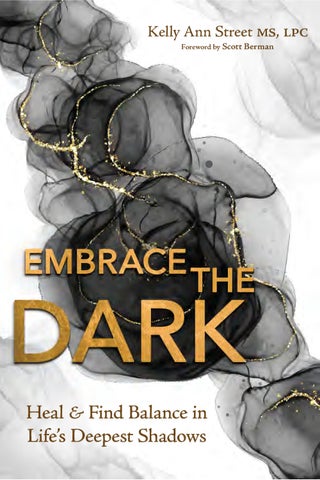
Sharing inspiring stories, psychological insights, and hands-on practices, therapist Kelly Ann Street, ms, lpc, shows you how to pull back the parts of yourself that were cast aside and use them to heal and better understand yourself.
Your darkness can provide profound gifts—even when it seems impossible. Embrace the Dark is your companion for turning life’s toughest moments—those times we call “dark nights of the soul”—into powerful opportunities for personal growth. Kelly walks you through seven areas of life, using personal and client stories as guideposts for processing your experiences. For each of those seven areas, Kelly offers practices that will help you come back to yourself as you journey in, through, and out of the darkness.
Kelly Ann Street, ms, is a licensed professional counselor who works with adults to navigate life’s darkest moments. She is the creator of Embrace The Dark and The Light, a healing platform and accompanying podcast that explores healing, purpose, and the full spectrum of human experience. Through her therapy practice, writing, and online offerings, Kelly helps people step into their own stories and embrace both the shadow and the light within. Visit her at kellyannstreet.com and follow her on Instagram and YouTube at @kellyannstreet.
Facebook.com/LlewellynBooks
X: @LlewellynBooks
Instagram: @LlewellynBooks
www.Llewellyn.com
$19.99 US