Praise for Slava! “A much-needed publication, opening doors for the English-speaking diaspora and enthusiasts of Slavic culture, especially those interested in exploring South Slavic heritage and traditions. Anna’s scope of research includes both the neo-Pagan traditions of Rodnovery (Native Faith) and the old syncretic Dual-Faith practices of the South Slavic common folk, offering a unique synthesis of lore and practices accessible to modern Polytheists, Pagans, and witches alike. The author’s care to interview local Rodnovery groups in several countries, as well as meticulous sourcing of information, is commendable. Complete with examples of historical spoken charms, family recipes for traditional dishes, and contemporary rituals and exercises, Slava! is a homely, cozy, and accessible guide into South Slavic-inspired practice.”
—Joanna Tarnawska, author of Polish Folk Magic “Within these pages, you will encounter tree and plant wisdom, spells, ancestor veneration and considerations, environmental stewardship connections, rites directly from Slavic tradition and those created by the author, deities, fairy-lore, useful tools, and more. This Polytheistic, earth-centered, and, at times, Otherworldly tome looks at the past to pave a road to a lively and meaningful Slavic magick practice of now and the forevermore.”
—Priestess Stephanie Rose Bird, author of Sticks, Stones, Roots & Bones “Anna Uro evi Applegate’s book begins with an exploration of the native, Pagan origins of the Slavic faith, and goes on to examine how this later became coupled with Christianity to survive as a DualFaith Tradition. Uro evi Applegate includes rituals, prayers, and even recipes to provide a truly immersive experience for anyone who would like to learn more about the cultural traditions of Eastern and Central Europe.”
—Alaric Albertsson, author of Wyrdworking
“Uro evi Applegate, priestess and Serbian American witch, invites readers to experience the mythic depths of Slavic faith, ancient and new. Magical stories from the author’s own past and family tradition/history enrich her substantial scholarship with immediacy and depth, showing how strong and fresh the living current of Slavic devotion runs—right here, right now, in this 21st-century time of need. … A comprehensive reference and inspiration both, this book glows in its depictions of Slavic rituals and sacred space, and of the divinities and earthly powers in the Slavic world of the sacred. As a syncretic priestess, Anna brings insight from several traditions (as well as Serbian sources unavailable to the general English-speaking public) into her illumination of Slavic faith. She presents us with many beautiful rituals and suggestions for devotional practice, not neglecting the importance of simple prayer. Slava! entices all who are curious—for knowledge, for connection, for beauty—to be drawn deeper into the rich tapestry of Slavic cultures and, if so called, to make it their own.”
—Paul B. Rucker, visionary artist at paulruckerart.com “A masterful work of ancestral reclamation, demonstrating how folkloric heritage can be woven into a meaningful and beautiful spiritual practice. Equal parts scholarly survey and intimate memoir, this book guides readers through the rich world of Slavic folkways with clarity and care. By and by, Slava! is a profoundly resonant book that contributes much to the growing body of literature on contemporary folk practice and the reawakening of ancestral identity.”
—Kelden, author of The Crooked Path “A richly researched and exquisitely written book that fulfills such an important need, not just from a Pagan perspective, but from a cultural, historical, and sociological one. Right from the first word, I found my heart fully enchanted. Reading even just the acknowledgement and dedication brought me to tears. The deep love which Uro evi Applegate brings to her lived experience alongside her breathtakingly vast historical and cultural knowledge has resulted in a brilliantly crafted, important work. A wealth of practical exercises, journal prompts, and traditional practices allows a welcoming pathway into
engagement. Uro evi Applegate has brilliantly captured just how fluid the influence of belief and practice can be. Even if one had little interest in Pagan practice, this book serves as an important record of historical and cultural patterns and influence. For those who are interested in Pagan literature, but find the current array overly weighted to recognizable themes and topics, Slava! is an engrossing read that offers a perspective both familiar and yet rivetingly new.”
—Tiffany Lazic, registered psychotherapist and author of Psychopomps and the Soul “Uro evi Applegate reveals the magical treasures of the Slavic Pagans. … She weaves together Slavic history, Cunning practices, and her own family traditions into a book that feels like it’s being read to you by the village witch.”
—Chris Allaun, author of Whispers from the Coven “Uro evi Applegate’s work is priceless for any seeker wanting to understand the process of assimilation, syncretism, and survival of Pagan deities and spirits within the Church. … Slava! is much more than a book about the spirituality of the Slavs; it is a reunion of the author with her roots.”
—Ness Bosch, Priestess, Iberian Shamaness, and author of Sacred Bones, Magic Bones “Slava! invites readers of both Slavic and non-Slav background to learn about the nitty-gritty of the traditions and beliefs of a huge area of Europe. More importantly, Uro evi Applegate speaks directly and repeatedly to the question of Dual-Faith, a question many readers from many backgrounds are tackling for themselves.”
—Benjamin Stimpson, author of Ancestral Whispers “One of the most important books to come out of contemporary Polytheism today. … This book is essential for anyone interested in the potent call of gods that predated Christianity by millennia.”
—Galina Krasskova, PhD candidate, Theology, Fordham University; author of A Modern Guide to Heathenry
Slava! Slavic Paganism and Dual-Faith Folk Ways Copyright © 2026 by Anna Uro evi Applegate. All rights reserved. No part of this book may be used or reproduced in any manner whatsoever, including internet usage, without written permission from Llewellyn Worldwide Ltd., except in the case of brief quotations embodied in critical articles and reviews. No part of this book may be used or reproduced in any manner for the purpose of training artificial intelligence technologies or systems. First Edition First Printing, 2026 Book design by Rordan Brasington Cover art by Nata a Ilinči Cover design by Kevin R. Brown Interior illustrations Nata a Ilinči : 38, 55, 109, 121, 131, 135, 143 Llewellyn Art Department: 57, 71, 123 Excerpt from the 2006 bajalica’s charm as quoted in Smiljana or evi -Beli ’s academic essay, “The motif of extinguishing fire with grass and water in one type of Serbian and South Slavic chanting,” reproduced by permission of Smiljana or evi -Beli , Dept. of Folkloristics, Institute for Literature and the Arts, Beograd, Serbia. Copyright © 2016 University Library Svetozar Markovi , Beograd. Further reproduction prohibited. Llewellyn Publications is a registered trademark of Llewellyn Worldwide Ltd. Library of Congress Cataloging-in-Publication Data Names: Applegate, Anna Uro evi author Title: Slava! : Slavic paganism and dual-faith folk ways / Anna Uro evi Applegate. Description: First edition. | Woodbury, MN : Llewellyn Publications, [2026] | Includes bibliographical references and index. Identifiers: LCCN 2025042576 (print) | LCCN 2025042577 (ebook) | ISBN 9780738780672 paperback | ISBN 9780738780948 ebook Subjects: LCSH: Witchcraft—Slavic countries | Folk religion—Slavic countries Classification: LCC BF1584.E85 A65 2026 (print) | LCC BF1584.E85 (ebook) LC record available at https://lccn.loc.gov/2025042576 LC ebook record available at https://lccn.loc.gov/2025042577 Llewellyn Worldwide Ltd. does not participate in, endorse, or have any authority or responsibility concerning private business transactions between our authors and the public. All mail addressed to the author is forwarded but the publisher cannot, unless specifically instructed by the author, give out an address or phone number. Any internet references contained in this work are current at publication time, but the publisher cannot guarantee that a specific location will continue to be maintained. Please refer to the publisher’s website for links to authors’ websites and other sources. Llewellyn Publications A Division of Llewellyn Worldwide Ltd. 2143 Wooddale Drive Woodbury, MN 55125-2989 www.llewellyn.com Printed in the United States of America GPSR Representation: UPI-2M PLUS d.o.o., Meduli eva 20, 10000 Zagreb, Croatia matt.parsons@upi2mbooks.hr
Other Books by Anna Uro evi Applegate In Praise of the Lady of Power: An English-Language Booklet of Prayers Dedicated to La Santa Muerte (Nemetona Press, 2024)
Disclaimer The information regarding plants and herbs included in this book is based on historical record, folklore, and the author’s own experience in devotional ritual use and spellcraft. Any magical, medicinal, or ritual use of these plants is at the sole discretion and responsibility of the reader. Readers are responsible for educating themselves on proper plant identification, safe harvesting and handling, recommended dosages, and contraindications, which are beyond the scope of this book. The author and publisher therefore take no responsibility, legal or otherwise, for any misuse of these plants resulting from poor judgment or misinformation on the part of the reader. The Slavic Native Faith organization websites and individual practitioner’s/musical groups’ websites, social media handles, and other contact information listed in this work are current at publication time, but the publisher cannot guarantee that any site will continue to be maintained.
Acknowledgments I am deeply grateful to Elysia Gallo at Llewellyn Worldwide, who approached me at the 2024 Paganicon, asking me if I would consider writing a book. I also owe huge thanks to her colleagues Bill Krause, Shira Atakpu, Sami Sherratt, Alison Aten, Markus Ironwood, and everyone else on the book midwife team who helped birth this book into the world. I am in awe of the divno cover design and artwork by Nata a Ilin i . Hvala na svemu!/Thank you for everything! I express my heartfelt gratitude to the amazing Fio Gede Parma for their incredible words in the foreword as well as for the vital work they are doing in rewilding witchcraft in our communities around the globe. Onward, Beloved! I also want to express my deepest thanks to my mother, Milanka; my first cousin, Neli; my awesome nephew, Aleksandr; and my American Heathen, witch, and Druid friends Richie, Shanel, Galina, and Katie Jo for their abiding encouragement and support. My wonderful Polish friend from high school, Renata, kindly translated my interview questions into Polish so I could reach out to Slavic Native Faith folks in that country. I am also grateful to the “Polish Folk Witch,” Joanna Tarnawska, for her input on folk observances of Dziady. I am indebted to Dr. Smiljana or evi -Beli , faculty member of Folkloristics Department at the Institut za Knji evnost i Umetnost [Institute of Literature and Arts], Beograd, Serbia, for her permission to reprint a healing charm recorded in 2006 by ethnologists in the field studying modern-day bajalice, or Cunning Women. As for the groups and individual Rodnovers in eastern Europe who were a delight to contact and ultimately befriend, I want to especially thank Croatian artist Dra en Markoti Vega of Su’Vid, Polish musician and artist Maryo Hnoss of Volhv Ridnovir, and Serbian Rodnover Du an Bo i of Lug Velesa for their kindness and cooperation as I worked on my research. Slava na im bogovima! Glory to our native gods!
Dedication For the dead: I dedicate this book to the memory of my father, Uro ; to my brother, Marko; to my uncles, Milan and Mirko; to my aunts, Dobrinka, Du anka, and Vera; to my Deda Milo and my Deda Bogoljub; and to my Nana Milojka and Nana Natalija. Outside of immediate family, I dedicate this book to the memory of a dear family friend, Baba ivka Vulovi (1911–2008), and to two friends from Serbia who towered in the Slavic Native Faith movement and whom I miss dearly: sculptor Jovan Petronijevi (1956–2025) and vra ar and author Radomir Risti (1973–2020). Ve naja Pamjat. For the living: I fervently dedicate Slava! toward the cause of peace and unity among all Slavs worldwide.
!/Mir svima!
CONTENTS Exercise List
xvii
Epigraph
xviii
Foreword by Fio Gede Parma xix Introduction
1
PART I SLAVIC NATIVE FAITH PAST AND PRESENT (Ро на Вера
)
Chapter 1: An Overview of Slavic Native Faith 13 Chapter 2: The Slavic Gods 29 Chapter 3: The Host of Spirit Beings in Nature 59 Chapter 4: The Powers of the Animal World 73 Chapter 5: The Spirits of the Home and Farmstead 83 PART II THE DUAL-FAITH TRADITION (
)
Chapter 6: Christianization and the Dual-Faith Compromise
97
Chapter 7: Gods, Saints, and Celebrations of the Light Half of the Year 111 Chapter 8: Gods, Saints, and Celebrations of the Dark Half of the Year 141 Chapter 9: Bajanje (Healing Magic) and the Magic of Plants 161 Chapter 10: Vra anje (Witchcraft) and the Magic of the Otherworld 177
xvi
Contents
PART III THE WORK (
)
Chapter 11: Ritual Tools and Altars 195 Chapter 12: Spiritual Cleansings, Prayer, and Offerings 207 Chapter 13: Ancestor Work 225 Chapter 14: A Rite of Spring 235 Chapter 15: Kupalo Observance
241
Chapter 16: An Autumn Equinox Rite for Moko a
247
Chapter 17: Ancestor Devotional on Veles’s Night 253 Conclusion 261 Appendix A: Serbian Cyrillic Alphabet and Pronunciation Guide 263 Appendix B: Glossary 267 Appendix C: Slavic Native Faith Resources (Groups, Musicians/Artists)
279
Appendix D: My Family’s Recipes of Classic Serbian Foods 285 Bibliography
291
Index 299 About the Author
327
Exercises Exploring Slavic Lore—A Journaling Prompt 27 Make Homemade Clay Votive Offerings 57 Shifting Your Consciousness with the Serpent’s Breath 75 Cultivate a Relationship with Your Home’s Domovoi
92
Cook ito for Your Own Ancestors 149 Try Healing Spells Using Plants and Trees 174 Create a Working Altar 204 Make Your Own Exorcism Spray and Incense 209 Compose a Formal Prayer Honoring a Slavic Deity 216 Offer Acorns to Perun on Perundan 218 Set Up an Ancestor Altar 227 Cut Your Cord to the Troublesome Dead 230
xvii
“The gods live in the land, in the blood and in the heart and soul of the people. Change any of these things, and our experience of the gods will change.” —Christopher Penczak, Feast of the Morrighan, 56
Foreword
When I was eighteen and recently initiated into the Coven of the Wildwood, I met a young Slavic witch. She began attending our open rituals at the time. She was Czech and her family consciously followed peasant-Pagan practices that they’d brought with them to so-called Australia. She was raised with herbal magic, cartomancy, knowledge of the spirits and magic, and a working understanding of the folklore of her culture. She told me once that if I travelled to the edge of the forest, turned away, hung upside down and looked between my legs—that I might behold an ancient forest god. This made quite the impression on me, and I may have performed this ritual several times. When Anna asked me to write a foreword to this book on Slavic deities, folklore, magic, and ritual, I wondered, why? I admit, I know next to nothing about this topic, though I do know and trust Anna and I am honored to have been asked. As I began to read this book, I quickly realized that the witchcraft and folk ways I practice in my life share much xix
xx
Foreword
in common with what is revealed and discussed in this book. It also dawned on me that we share a particular perspective on culture and magic that is neither endorsed nor desired by the oppressive and controlling dominant paradigm of imperialism and capitalism. Anna and I both grew up in families with members of multiple generations who practice magic and spirit work, in countries that are created by colonization with assimilationist agendas. We both retain enduring links to our parent cultures. I was raised with a syncretic and unique form of Hinduism born of the island of Bali, connected to several living and dead family members who were known spirit workers, seers, and healers. Anna was raised with a Serbian Christian Orthodoxy drenched in the continuing and ever-adapting customs and magical knowledge of her ancestors, of the people of those Slavic lands. Read on and you will discover much richness simply by listening and paying attention to Anna’s reflections and stories of her own family and the magic and lore that was transmitted in daily domestic action, as well as in more mythic storytelling. I come to this book a witch initiated in four traditions of the Craft, traditions that are largely anchored in syncretism, dual- or even tri-faith, and the sheer stubborn evolution and versatility of folk magic and witch story that arises from the cataclysms of the past few hundred years and beyond. I come to this book a priestess who is sworn to Great Spirits who are known to be Greek, Celtic, and Hindu, depending on which way you look. And yet I see my Old Faith and the precious knowings of those old and ever-renewing ways reflected powerfully in these pages. I first met Anna at an intensive I led in Chicago. I have since spent powerfully ecstatic time with Anna at other magical workshops and workings. I have witnessed—each time—a priestess of precise power, intense focus, passionate knowledge, and a depth of dedication who impresses me to no end. Anna is also so many kinds of magic, initiate many times over, and somehow all of it can exist within the largeness of her being that is supported by the blessing of many ancestors, gods, and spirits. The power and gift of Slava! is its precious intimacy. We are invited into the heart and hearth of Anna and her people, with profound insights of neighboring Slavic cultures and communities. Through fierce scholar-
Foreword
xxi
ship, integrated magical prowess and practice, and a sheer enthusiastic desire to share the bounty of Slavic lore, mythos, and history, we become not just acquainted, but touched by these forces and these ancient and revived ways. Each spell, ritual, prayer, and offering in this book hums with a virtue gathered mindfully and humbly by Anna. At her fingertips and through her delightful, poetic, and enriching writing, we are anointed by the sacred oil, we bend our foreheads down to praise Mother Earth, we wrap our brows in the leaves of the birch and the willow, and we recall the strength and vivacity of the witches and cunning folk of Slavic cultures. If you are of Slavic culture or descent and desire a connection to your inheritance, here is one. If you are—like me—not at all Slavic but feel called to these gods or desirous of respectfully engaging the practices of your beloveds with deeper appreciation, here is a book that opens the way fruitfully. As I write this, Ukraine is still being invaded by Russia and many Slavic countries exist in socioeconomic precarity and political turmoil. We are all connected and not one of us is free until we all are free, to paraphrase words spoken by the civil and women’s rights activist Fannie Lou Hamer. This book is a salve in these times of unrest and upheaval, and the magic and insight contained in these pages may help you—the reader—to make sense of your place in the world, in time, and in your relationships with the spirits and capacity to create change in this world. In what is transmitted in these pages, Anna has successfully invoked a Slavic spirit that feels primordial and present in this modern age. A necessary and profound resistance to the forces of domination, hatred, and greed. In focusing on something specific—as always—we end up feeling something far more cosmic, universal, connective. The gods and spirits we meet in Slava! never died. They bear the ancient cunning of many of our ancestral deities, the Old Powers of this earth. They know how to transform and adopt new faces in new times and places. They change their names if they need to, but their prayers and rituals in the world barely shifted. We continue to draw from the spring, turn with the sun, rejoice in and bear witness to the feasts of the year, and give credence and room to the darker, underworldly forces that shape so much of who we are. By Wolf, Serpent, and Bear, we are
xxii
Foreword
led to a treasure trove of magic that links us in with the life force, gathering us home again. May we be strengthened in these times to be evermore fiercely loving, welcoming, artful, and humble as beings of this Great Earth. Fio Gede Parma In the unceded, stolen, Sovereign Lands of the Gadigal and Wangal Peoples April 2025
Introduction
As a child, I felt profoundly embarrassed by my Serbian heritage. My parents emigrated to the United States in 1967 and 1968, respectively (my father arriving first to pave the way for my mother), from the Serbian republic of the country then known as Yugoslavia. They chose to settle in Chicago, Illinois, which has the largest Serbian population of any city in the world outside of Serbia itself.1 My folks raised my brother Marko and me to be bilingual, speaking Serbian in the home; frankly, I detested the sound of my parents’ Slavic language. It didn’t have the musicality, I thought, that I heard in the lilting notes of the Colombian Spanish, the Athenian Greek, the Sicilian Italian, or even the Seoul-ful Korean spoken by my neighboring fellow firstgeneration American friends and playmates in the Chicago apartment building where I grew up. Serbian didn’t sound
1. Pacyga, “Slavic Chicago.”
1
2
Introduction
pretty, period. I wanted to speak English 24-7. My Tata smilingly denied my requests. Besides the language, other things about my ethnicity bothered me. The cuisine, heavy with a variety of grilled meats and a ubiquitous red pepper–based spread called ajvar, which I loathed; there was also way too much onion and garlic permeating every dish. Mark would joke that at least vampires would be kept at bay! In terms of religion, I wished we belonged to an “American” denomination and not the Serbian Orthodox Church, replete with its Julian liturgical calendar that never overlapped with any Gregorian calendar holidays or saints’ feast days taught to me and my classmates in our Catholic school catechism. “Why is your Christmas Eve on January 6?” my Irish American and Filipino American classmates would ask me, their little button noses wrinkled with mild distaste. “That’s so weird! Everybody knows Jesus was born on December 25!” I didn’t have an adequate answer for them. I just wanted to see a hole open in the tile floors of my homeroom—a gaping chasm that I could disappear into forever, traces of my Serbian identity rendered null and void, a place where I’d be able to change my last name to something that sounded “American,” not a last name that non-Slavic folks struggled to pronounce. “Someday, you’re going to not just appreciate, but really treasure your roots!” my mother would emphatically tell me. “Give thanks to God that you’re not like these Americans, people who have no understanding of culture at all, of who they really are, where they come from—people who have no connection to their ancestral language or their roots! Without roots, these people have nothing to anchor them; they drift aimlessly in life, looking for meaning in all the wrong things. That is not you! And that is not Marko. You have roots! You may not see it now, but someday, God willing, you will see the wisdom of what I’m telling you. Be proud of who you are,” she’d say, exasperated that she even needed to issue this reminder to me. The antidote to my ethnic self-loathing, of course, according to her and my father’s reasoning, was to immerse me (Mark also) even more in all aspects of Serbian culture, and that entailed making good use of our passports to spend weeks at a time in Serbia. When school would let out for the
Introduction
3
summer, my family would divide our three months’ worth of vacation time between staying with relatives on my father’s side of the family in the centraleastern town of Gornji Milanovac and with my mother’s parents in the centralwestern Serbian town of U ice in the Old Growth Forest–dominated Zlatibor District, home of the Tara National Park. We would also go on holiday along the Dalmatian coastline of Croatia, staying at villas on the Adriatic Sea, as well as spend a few days in Mostar, Bosnia-Herzegovina, and in Budva, Montenegro. If there was one thing that started to catch my eye in all these distinct locales spread across the six republics within Yugoslavia, it was directly witnessing everyday people’s folk religious observances, folk magical beliefs and practices, and superstitions galore. My scientifically educated mother, a highly regarded civil engineer in both Serbia and Chicago, didn’t like the time I spent with my father’s family due to what she called their “primitive” beliefs. My uncle Mirko could foretell a change in the weather based on which way the sheep in the pen were facing. Mirko’s sister, my aunt Vera, kept a severed viper’s head in a linen bag lined with straw on the same eastern-wall shelf that housed her home’s blessed icons of Orthodox saints. And my own father told me that when he served as a midwife at the birth of a lamb or calf, the skull of a wolf would be brought into the barn, the jaws of the skull opened, and the head of the newborn animal would be placed in the space of the mouth in the hopes that the animal would (a) grow strong and healthy, and (b) never fall prey to the wolves that frequented the hills above the farmstead. Vera loved to embroider but never on a Friday; to do so on that day of the week would invite horrible disaster, even death. My eyes widened upon learning each new taboo among the hundreds of taboos that seemed to govern the lives of my father’s family. Invariably, I’d report my findings to my mother. “You can’t expect to be in civil society when you’re surrounded by uneducated people who believe in primitive things,” my mother would sigh and say. “But this is your father’s family and you’re respectful and helpful, which is good,” she’d say as she wiped my sweat-soaked bangs to the side of my forehead.
4
Introduction “I really like it here, Mama,” I pleaded, my hands folded in prayer. “Can
I spend the whole summer here with Tata and you and Mark go be with your Mama and Tata?” “No, Ankica. In two weeks’ time you’ll be with my mother and brother and your cousins Nena, Tsola, Neli, and Milica. No more baseball shirts and dirty coveralls! Your cousins are ladies and when you’re with them, you’re going to be a lady, too!” my mother prophesied with sheer Virgo determinism. I couldn’t bear the thought of being forced to wear dresses. But at least at my Nana’s house in U ice, I’d have plum orchards to run around in, and cute little lizards sunning themselves on the white stucco walls of my grandparents’ cozy house to catch by their tails and try to bring indoors, if only to scare my reptile-phobic Nana for even just a few seconds. On a more serious note, even as a nine-year-old I noticed the battle lines of sorts being drawn in my mother’s head, the tribalism at work: My mother and Mark and her family were on the “city folk” side, urbane and disdainful of the sights and especially the smells of rural Serbian life; across the dividing line stood “primitive” Tata and I and his parents, siblings, and nephews. We were wilder, somehow less holy. Vipers’ heads and wolf skulls and icons, oh my! I started to feel something stir inside me, besides an inkling of cultural pride. I would eventually come to recognize it as a budding sensibility of my innate predisposition toward all things witchcraft related. In mid-July of 1987, when I was thirteen, Mark (then seventeen), my female first cousins, and I were given a chaperone-free day pass from U ice to explore Tara National Park and Mount Zlatibor.2 I remember feeling strong inner pulsations of déjà vu throbbing throughout my body-mind as we hiked along well-marked trails. I kept looking over my shoulder at the slopes of Mount Zlatibor that we’d just descended. Despite the intense summer heat, I broke out into a clammy, cold sweat. The path ahead continued downward at a relatively steep decline amid a landscape of an intensely green forest of fir and pine trees, with white birch trees adding a smatter2. Its name means “Golden Pine Mountain” due to the beloved beauty of its pine trees (zlata, “gold”).
Introduction
5
ing of pale contrast here and there. The green seemed to shimmer in the late afternoon sun. I had the overwhelming notion that I’d been at this location before, even though that was impossible. Every step I took seemed charged with some type of electricity, physical or spiritual. I also very much felt like my brother, cousins, and I were being watched by one or more Numinous Powers. This was five years before I officially “came out of the broom closet” to my parents and when I would start carrying things on my person like spiritual protection sprays or amulets like hagstones. So at the time I tried to telepathically “speak” to whoever was there at Tara National Park and announce that my intentions as an interloper, at least, were nothing but respectful. I kept my strange sensations to myself that day. It wasn’t until a bizarre dream I had a month later—which would repeat itself exactly twenty years later—that I connected the Slavic mythological dots of Zlatibor together. Even as an uninformed kid, though, I knew I was connecting with the powerful energies of place in an extrasensory kind of way. The Zlatibor area and places like it throughout the Slavic world are places where the gods of my ancestors were actively worshiped, and where the current resurrection of that worship is growing and coming out of hiding despite the vociferous denunciations of the Serbian Orthodox Church. That summer of 1987 experience, coupled with my own innate curiosity about the folk magic I was watching transpire before my very eyes during service on certain “days of power” (to quote my mother) in the Serbian Orthodox Christian liturgical year as well as magic practiced in the home, propelled me headlong into the joyful quest that has captivated and enchanted my heart to this day. It’s the quest of discovering, uncovering, sharing, and translating into lived daily spiritual practice the world of contemporary Slavic Paganism and magic.
Meet the Slavs Slavic languages—grouped into Western, Southern, and Eastern blocs— emerged from what was likely a single language in use until the late ninth century CE; these languages compose the largest branch of the
6
Introduction
Indo-European (IE) linguistic family tree.3 That IE linguistic dominance seems fitting when you realize that the vast geographic territory composed of Slavic nations in Europe—stretching from south-central Europe to the far northeast, bordering east Asia—completely dwarfs Western Europe.4 The Slavic peoples are divided into three main groups: Western Slavs include the nations of Poland, the Czech Republic, and Slovakia. Southern Slavs include Bulgaria and the former Yugoslav republics-turned-independent nations of Croatia, Slovenia, Serbia, Bosnia-Herzegovina, Montenegro, and North Macedonia.5 East Slavs include the nations of Ukraine, Belarus, and Russia.6 Of course, there are large Slavic Diasporas across the planet: in addition to the Slavic countries listed above, Slavic peoples inhabit many countries in Western Europe, the United Kingdom, Scandinavia, the Baltic nations, central and east Asia, North America, and Australia. Linguistic affinity alone is not enough to create ethnic identity, however, so in the case of the Slavic peoples, as with any ethnic group, one has to look for signs of a common ideology, perhaps reflected as “a matter of myths and symbols, memories and values”; a shared history; the evidence of distinctive material culture (the archaeological record); an association with a specific territory; and a sense of solidarity.7 Any ethnicity reflects a particular group’s human experiences of “conferring meaning on their cultural, spatial, and temporal properties of their interaction and shared experiences.”8 As the subsequent chapters explain, there was remarkable uniformity of religious belief and social structure in the world of the pre-Christian Slavs, no matter which part of Europe’s vast landmass they came to settle from the fifth century CE onward in their centuries-long migration period from their ancestral homeland in the marshes of what is now far southwest 3. Gimbutas, The Slavs, 19. 4. Russia’s southern border faces Mongolia, China, the Korean peninsula, and Japan; Johnson, Slavic Sorcery, 5. 5. It is called this to distinguish itself from Greece’s northernmost Peloponnesian territory, which is also called Macedonia. 6. Ivakhiv, “The Revival of Ukrainian Native Faith,” 211. 7. Barford, The Early Slavs, 29. 8. Barford, The Early Slavs, 29.
Introduction
7
Ukraine.9 Regardless of any neighboring cultures—Celts, Romans, Teutons, and Turkic peoples; Huns, Scythians, and Sarmatians; Byzantines, Balts, and Scandinavians—that may have exerted cultural and linguistic influences on them, the early Slavs’ religiosity stemmed from a Polytheistic and animistic worldview that teemed with gods and spirits—beings of the Otherworld, the natural world, and the human world, including the venerated ancestors of one’s family or clan.10 In the wake of the historical event known as the Great Schism of 1054 CE, which divided Christianity into geographically demarcated western and eastern spheres of influence via the Roman Catholic and Eastern Orthodox Churches, respectively, the protracted Christianization process the Slavic peoples experienced took on a far different flavor depending on whether the mediating influence was Catholicism or Eastern Orthodoxy. The historical and anthropological records show that Slavic lands Christianized by the Eastern Orthodox Church retained elements of Slavic Paganism to a far greater degree than the lands Christianized by Catholicism.11 That definitely tracks with my lived experience as a first-generation Serbian American raised in the Eastern Orthodox Church but whose formal education from first grade to twelfth grade was shaped by Roman Catholicism. Both Christian denominations would bring literacy to the Slavs but would also totally control the narratives regarding the Slavs in the process. Slavic temples and “idols” were described in writing by the very people who destroyed them. A chilling example is given by the medieval Christian Danish historian Saxo Grammaticus in volume XIV of his Gesta Danorum (History of the Danes), written in the year 1208 to praise Denmark’s King Valdemar II for his destruction of the West Slavic Vendii tribe’s temple, known as Arkona, which was dedicated to Svetovid, the Slavic god of divination and war.12 Valdemar’s slaughter of the temple clergy and theft of all temple treasures in the late twelfth century CE on the island of Rügen in the Baltic Sea is lauded as a victory for Saxo Grammaticus and his Christian
9. Dvornik, The Slavs, 47. 10. Gimbutas, The Slavs, 135. 11. Ivanits, Russian Folk Belief, 4. 12. Gimbutas, The Slavs, 152.
8
Introduction
compatriots, not just politically but spiritually in terms of the god of Abrahamic monotheism righteously asserting its superiority over the “false” gods of the Slavs. Given the paucity of direct written sources overall, the study of Slavic pre-Christian beliefs and practices is largely a work of reconstruction, piecing together information gleaned from written records, from similar beliefs outlined in Indo-European and Indo-Iranian mythological sources, from surveying the fruits of archaeology in Slavic lands, to the legacy of surviving folklore, or, “the oral epics, songs, tales, enduring customs and superstitions” of the Slavs.13
Reconstructing the Paganism of the Slavs for Today, for All Peoples At the time of writing this book, a quarter century into this new millennium, I’m tremendously excited to see the development—in my parents’ birth country, in neighboring Eastern European countries, and here in North America—of a movement aimed at reviving the Polytheistic, earth-centered, and Otherworld-inspired religious beliefs and practices of the pre-Christian Slavs and adapting them for the use of all peoples today. Why turn to the past? As a Slavic woman raised to place my faith in the traces of these beliefs and practices, there is a conviction that my ancestors’ wisdom is worth preserving for all of us in these by turns marvelous and harrowing times we find ourselves in as human beings facing an uncertain future on an increasingly fragile planet. These Slavic traditions can offer “a secure foundation and an enduring wellspring of inspiration for a profusion of vibrant Pagan movements.”14 For modern Polytheists like me who are of Slavic heritage, there may be a component of wanting to preserve and pass along this element of ethnicity by engaging in this sacred work of reclamation and reinterpretation of the Slavic Pagan past. I do genuinely believe that my ancestors of blood, especially immediate family members such as my father and brother, are guiding, even compelling me to do this work. For others, especially folks 13. Gimbutas, The Slavs, 151. 14. Strimska, “Modern Paganism in World Cultures,” 2–3.
Introduction
9
for whom the issue of preserving a Slavic ethnic identity is not relevant, the study, interpretation, and adaptation of Slavic beliefs and practices can shed new insights into or ways of approaching their own established Pagan or witchcraft practices. I have several Polytheist students in my teaching temple who are people of color. A few have approached me within the past five years, announcing that they perceive the gods and goddesses of my ancestors—Veles in particular—to be “knocking on the head,” as one woman put it, and they’re coming to me to respectfully ask how they might respond to these invitations for contact in a culturally appropriate way. One huge aim of mine with this book is to help them and anyone else interested in establishing a mutually satisfying devotional relationship with Slavic deities to do so. And to do so joyfully, with a heart chakra–expanding attitude that I like to think accompanies the mental state of what Zen Buddhists call “Beginner’s Mind.” There are, sadly, factions of modern Slavic Pagans within the Native Faith resurgence in former Communist countries that politically align themselves with extreme right-wing parties in their given countries and tie the pre-Christian beliefs of their ancestors to a rabid nationalism. They reject Christianity as a Middle Eastern import (these groups appallingly skew anti-Semitic) and uphold an exclusivist mentality that maintains that the worship of Slavic gods should be for peoples of Slavic heritage only. I wholly disavow such thinking and believe it has no place in a world that is increasingly becoming interconnected because it has to if the human race is to survive at all. Certainly, the ideas presented herein and the groups and individuals I’ve interviewed as part of my research for this book are not associated in the least with such ethnic chauvinist–fueled types of Rodnovery. Thankfully, Rodnovery, like the term Paganism itself, is a bit of an umbrella term. It covers a variety of groups, from revivalists of preChristian Slavic Polytheistic and animistic practices that are rooted in the particularities of landscape to more broadly Pagan or Pagan-inspired groups and even groups that promote a fusion of Slavic beliefs with more established/ commodified, Westernized forms of New Age practices (e.g., UFOlogy and
10
Introduction
“pyramid power” cultists and tour groups operating in Bosnia-Herzegovina, New Age healer-shamans in Russia, etc.).15 Part I begins with an overview of Slavic Native Faith today and presents the cosmology, deities, and spirits central to Slavic Paganism past and present. Part II chronicles the impact of Christianization and the continuance of Pagan beliefs and practices under a Christian veneer in folk Orthodoxy, a syncretism known as Dual-Faith. Part III guides the reader in adapting the lore for devotional practices today, from altars and ancestor work to complete rituals. The appendices include a glossary with pronunciation guides to deity names and key Serbian terms, a smattering of my family’s recipes for Serbian foods well suited as ritual offerings, and a vital resource guide of organizations and individuals in the Slavic Native Faith communities within Serbia, Croatia, Poland, and the United States. With the passage of time, I am happy to declare that I agree with what my mother said to me in my childhood all those years ago, when I wished to hide from my Serbian ethnicity: The day has come of me not just appreciating, but truly treasuring my roots. I believe this book is a testament to that attitude of pride in my ethnicity as well as to a Pan-Slavic spirit of cultural celebration and ambassadorship. I hope that the readers of this book will agree. Slava!/Glory! Anna Uro evi Applegate Chicago, Illinois April 2025
15. Ivakhiv, “The Revival of Ukrainian Native Faith,” 223.
PART I
SLAVIC NATIVE FAITH PAST AND PRESENT (
вера
11
)
CHAPTER 1
An Overview of Slavic Native Faith Since the fall of the Soviet Union in 1991, religious movements dedicated to reviving, reinterpreting, and adapting for modern societies the Polytheistic, earth-centered religions of the pre-Christian Slavic peoples have been growing across Eastern Europe and North America. These movements are grouped under the religious umbrella terms Slavic Native Faith or Rodnovery in English, derived from the Common Slavic root terms rod, meaning “kinfolk,” “clan,” “ancestral origin”; and vera, “faith,” “belief.” Languages derived from the three Slavic groups—West, South, and East Slavs—have their own variations on the name: Polish Rodzimowierstwo, Czech and Slovak Rodná Víra, Croatian Rodnovjerje, Serbian Rodnoverje (ро нoверje), Ukrainian Ridnovira ( virstvo (
), Russian Rodnovérije (
and so forth.
13
) or Ridno),
14 Chapter 1 Unlike other modern religions, such as Wicca, which may eclectically draw its theological strands from a variety of sources and cultural influences, Rodnovery places an emphasis on spiritual traditions that are indigenously Slavic and that were at the very least disrupted, if not forcibly suppressed, by the introduction of Christianity into Slavic lands from the sixth to eleventh centuries CE.16 If they’re being honest with themselves and others, Slavic Native Faith adherents aren’t making claims that what they believe and practice is directly passed down in some unbroken chain from their Slavic forebears since time immemorial (if they do claim such things, run). Rather, as with modern-day Heathenry or Celtic/Druid or Hellenic Polytheistic faiths also gaining ground in the Western world today, Slavic Native Faith is a Reconstructionist attempt at reimagining and rebuilding religious traditions from the remnants of the past, in this case the pre-Christian Slavic past. The legacies of that shared past survive in the languages, the landscapes, and the vibrant living folk traditions of the Slavic peoples.
A Profusion of Practices Anchored by Core Tenets It would not do Slavic Native Faith justice to think of it as a monolithic entity. It “encompasses various beliefs and rituals, yet it remains unbound by any single tradition,” explains the American-based Rodnover fellowship Perun Mountain.17 There is no overseeing religious body or authority figure. Individuals and groups alike operate autonomously. “I think that the biggest misconception about Slavic Native Faith is that there’s a single, clear path to follow,” writes ArgonNights, moderator of the American-based Rodnovery forum on Reddit. “In reality, there are many different paths and even more names for the same gods, spirits, rituals … depending on whether you are a Southern Slav or an Eastern Slav.”18
16. This is the abbreviation for Common Era, in reference to the world’s current calendar system, replacing the Christ-centric AD as a year notation. 17. Perun Mountain, Discovering Rodnovery, 8. 18. ArgonNights, reply to “What are some of the biggest misconceptions that people tend to have about Slavic Paganism?”
An Overview of Slavic Native Faith 15 However, whether Rodnovers belong to groups (open or closed) or practice solely in private as a family unit or as a solitary person, there are generally agreed-upon tenets or core beliefs that form the basis of their religious worldview. These tenets are what largely separate Slavic Native Faith from other kinds of Neopaganism that have been flourishing in the Western world since the cultural revolution of the late 1960s. Honoring the wisdom and the legacy of ancestral traditions rooted in/ arising from native Slavic land. Slavic Native Faith aims to honor the wisdom of the forebears of the Slavic peoples—traditions and rituals practiced by folks within a specific Slavic culture whose spiritual essence is mediated by the land itself and the people’s ties to that land and how it provided them with their understanding of who they are. The land can be thought of as “the most sacred manifestation of a timeless reality,” the gateway to accessing Otherworldly powers of deities and ancestors through time-honored practices within a given Slavic culture that have achieved prominent cultural significance over many generations.19 A religion centered on contemporary Polytheism, Animism, and Ancestor Reverence. Belief in the literal, objectively real existences of gods and a plethora of spirits—including the spirits of one’s family dead as well as teeming classes of nature spirits—is fundamental to Slavic Native Faith.20 Religious worship, not magical work, is the main objective of ritual. The notion is that gods/spirits and humans are bound by rules of reciprocity and take turns in the host-guest relationship and the resulting bestowal and receipt of blessings; the core value of hospitality fuels this relationship dynamic. “The pantheon of Slavic gods and goddesses is not a static collection of ancient stories and myths but a living, dynamic tapestry of faith. It continues to evolve and resonate with the Slavic people, adapting to the changing times while preserving the essence of their cultural heritage,” explains Perun Mountain.21 The gods are not reducible to empty personifications of the forces of nature. Nor are they internalized to represent psychological abstractions. 19. Artisson, The Witching Way of the Hollow Hill, 15. 20. Perun Mountain, Discovering Rodnovery, 96. 21. Perun Mountain, Discovering Rodnovery, 23.
16
Chapter 1
They are living forces at work in the world, beings of agency with distinct personalities who are instrumental to upholding cosmic processes and who are believed to take a keen interest in the goings-on of this earthly realm, as well as shape and influence the lives of the devotees who call upon them. “Svi su potrebni, zbog toga i postoje [They are all necessary, that’s why they exist],” says Dra en Markoti Vega, a Croatian Rodnover, artist, and front man of the Slavic Pagan folk band Su’Vid.22 One’s ancestral Slavic homeland and the land where one lives currently throughout the Slavic Diaspora are the touchpoints for accessing these Holy Powers. A profound call to ecological stewardship. Nature’s inherent sanctity requires humans to serve as consciously aware, proactive stewards of finite resources and increasingly fragile ecosystems—ones such as the Bialowieza Forest that straddles the border between Poland and Belarus; it is Europe’s last lowland Old Growth Forest, home to the nearly extinct European bison (Bison bonasus).23 The Slavic worldview holds that humans and nature are engaged in a relationship of symbiosis, where each party is dependent upon and responsible for the others’ well-being.24 Maintaining a harmonious relationship with the natural world is a moral imperative. It is therefore not surprising that many adherents of Slavic Native Faith also choose to commit themselves to environmental causes. Attuning to the cycles of nature finds revelation in communal rituals that are chiefly conducted outdoors and are Pan-Slavic in cultural expression. These rituals, which may reflect cultural and even regional variations within a Slavic culture, nevertheless illustrate profound cohesiveness in symbology and ritual action from one Slavic country to another. That’s because they’re reflective of a calendar that is rooted in the cycles of the seasons and the agrarian fertility cycle, which are part of the shared Slavic experience centuries after Christianization, whether the latter occurred via the Roman Catholic or the Eastern Orthodox Church.
22. Dra en Markoti Vega, interview with the author, October 30, 2024. The English translation is the author’s own. 23. Hance, “Stuff of Fairy Tales.” 24. Perun Mountain, Discovering Rodnovery, 12.
An Overview of Slavic Native Faith 17 Let’s say a hypothetical celebrant participates in a Kupalo or Ivandan ritual, whose energies are aligned with the Summer Solstice. Whether that celebrant happens to be in the Dinaric Alps of Croatia or in a forest clearing outside of Novgorod, northwest Russia, chances are extremely high that circle dances around a bonfire and bathing in a local body of water are going to ensue because those are universally Slavic ritual actions for that Native Faith holiday. The following are the main holidays or sacred feast days that are celebrated by modern Slavic Native Faith believers. Many of the holidays that are deity specific (as opposed to seasonal markers like the equinoxes and solstices) have had their dates determined by reclaiming for the god or goddess the feast day subsequently assigned to the Christian saint whose cult was meant to supplant the deity’s. Some Rodnovers use the modern Gregorian calendar while some in countries where the Orthodox Church became dominant use the Julian calendar (which runs about thirteen days “behind” the Gregorian). Others, like me, celebrate both dates and honor the deity twice! Table 1 notes these dates.
Table 1. Slavic Native Faith Celebrations Seasonal Festival
Deity/Deities Honored
New Year’s Day
Gregorian Calendar Date
Julian Calendar Date
January 1
January 14
Bo i
Da bog, Svaro i
December 24–25
January 6–7
Gromnica
Perun
February 2
February 16
No Velesa/Veles’s Veles Night
February 11
February 25
March 1
March 1
Babinden
Baba Marta
18
Chapter 1 Seasonal Festival
Deity/Deities Honored
Gregorian Calendar Date
Julian Calendar Date Date of astronomical event
Spring Equinox/ Velikdan/Jare więto/Jare Gody
Moist Mother Earth, Vesna, iva
Date of astronomical event
Vrbica
Doda, Lazarica
Saturday Saturday before before Catholic Orthodox Palm Palm Sunday Sunday
Earth Day
Moist Mother Earth
April 22
April 22
Jariljdan
Jarilo/Yarilo/Jurej
April 23
May 6
Vidovdan
Day of Svetovid
June 15
June 28
Summer Solstice
Da bog, Svarog, Perun, Jarilo
Date of astronomical event
Date of astronomical event
Kupalo/Kupala No /Ivandan/Kres
Mara/Jarilo/ June 23 (eve) Moko / and 24 (day) Water Spirits such as the Rusalki
July 6 (eve) and 7 (day)
Perun’s Day
Perun
July 20
August 2
Moko a’s Day
Moko a
August 15
August 29
Harvest/Swięto Plonów
Jarilo, Moko a, Ancestors, Polevoi, Ovinnik, Domovoi
September 23
First full moon after Ivandan
Date of astronomical event
Date of astronomical event
Autumn Equinox/ Moko a, Mara Plodovi/Siewna
An Overview of Slavic Native Faith 19 Seasonal Festival
Deity/Deities Honored
Gregorian Calendar Date
Julian Calendar Date
Dziady/Zadu nice
Ancestors, Veles, Mara
Movable date: second dark moon after Autumn Equinox (Rodnovery); November 1 or 2 (DualFaith, folk Catholicism)25
Saturday before November 8 (Dual-Faith, folk Orthodoxy)
No Velesa/Veles’s Veles Night
October 31
Saturday before November 8
Winter Solstice
Da bog, Triglav, Mara
Date of astronomical event
Date of astronomical event
Koleda/Koliada/ Szczodre Gody/ Sve ki
Ancestors, Svarog, Svaro i , Da bog, Triglav, Veles
December 24 through January 3
January 6 through 18
These seasonal rituals are held outdoors whenever possible by Rodnovers because it is known, historically, that the pre-Christian Slavs worshiped their gods atop hills, in the clearings of wooded groves, and by sacred springs and other bodies of water—places of Otherworldly power consistent with the beliefs of other Indo-European societies.26 In the home, thriving cults to one’s ancestral spirits and the spirits of the home/farmstead, which likely shared a common origin, have survived for centuries after Christianization well into the present day.
25. Joanna Tarnawska, personal communication with the author, August 22, 2025. 26. Gimbutas, The Slavs, 151.
20 Chapter 1 A holistic worldview that unites family, kin, Slavic nations, all Slavs, and ultimately all humans with All That Is. The concept of Rod at the root of Rodnovery is both the name of a creator god as well as the Common Slavic term for “kin,” “ancestry.” As a divine essence, however, Rod is profoundly far-reaching. The interconnectedness implied in Rod embodies not just the sense of the unity within a family unit and its biological kin or even a sense of Pan-Slavism, but a macrocosmic and profound sense of unity with Ultimate Reality. Rod forms the very basis of natural law, “an all-encompassing energy from which everything emerges and to which everything returns.”27 In my personal meditations on Rod as a concept, I find it as a “me-we” phenomenon. Through Rod I reach back into the past and reconnect with my Serbian ancestral traditions. But the essence of Rod permeates the present and inspires my daily lived Slavic Polytheistic practices and my sense of connection not just with the natural world and my gods but with other Slavic peoples, with whom I partake of a collective identity and shared cultural heritage. Rod also extends into the future, into a world of humanity united and dedicated to preserving the planet for future generations. This holistic concept of Rod finds expression in a phrase I like to use ritually as “the Circle of Rodu.” The gods and humans. Living humans and our beloved dead. People and animals/the natural world. The three levels of the Slavic World Tree. The past, present, and future. All That Ever Was, Is, and Will Be. These are all yoked together, in my thinking and lived experiences, in the Circle of Rodu. Rod is far, far more than just having shared DNA. For me, Slavic Native Faith reaches its fullest potential when it embraces this broad and cosmic understanding of what Rod can truly mean. A worldview that emphasizes personal integrity and other virtues. Slavic Native Faith espouses personal liberty as well as a sense of obligation to serve and contribute to the well-being of the greater community. Taking full responsibility for one’s actions is paramount, especially since it’s believed that one’s ancestors and the gods are always taking note of how a believer behaves. Be true to your word. Work hard. Care for the land. Pro-
27. Perun Mountain, Discovering Rodnovery, 48.
An Overview of Slavic Native Faith 21 tect your family. Act with honor. Be hospitable and generous. Love the gods with all of who you are and practice your faith: Pray and do devotionals. These simple, straightforward precepts are proving to be immensely attractive to potential Native Faith followers, especially in Eastern Europe, as these principles are viewed as being in sharp contrast to both the ethos that guided the Soviet Union in the recent past and the hollow consumerist promises of happiness and the ethnicity-nullifying forces currently perceived as dangerously flowing in from the postmodern West.28
Present-Day Native Faith Groups Throughout Eastern Europe in particular, Slavic Native Faith groups have been vying for—and gaining—national recognition within their respective countries as officially recognized religious organizations going as far back as the late 1980s, but the movements really began to accelerate in the mid-1990s. In Poland, the Native Polish Church (Rodzimy Ko ciół Polski) was registered by its cofounders Lech Emfazy Stefański and Kazimierz Mazur on March 24, 1995.29 Overall, the country is currently estimated to have between five thousand and eight thousand Rodzimowiercy actively practicing in registered groups (bear in mind 87 percent of the people in Poland identify as Roman Catholic).30 Ukraine has also served—since the mid-1960s, in fact—as the home to a diverse array of groups that fall under the proverbial Ridnovira big top, from Yazychnyks (the term applied to those who practice pre-Christian Polytheism and animism) to the highly organized RUNVira (the acronym for Native Ukrainian National Faith) movement, which is actually a hybrid of monotheism and panentheism. The pre-Christian god Da hboh is the one honored, and he is seen as the cosmic principle underlying the phenomena of our visible world. RUNVira is centered around the writings of its charismatic founder, Lev Sylenko (1921–2008).
28. Ivakhiv, “The Revival of Ukrainian Native Faith,” 235. 29. Slowianska Polonia, “Poles Promoting Slavic Culture.” 30. Sobolewski, “Roots Revival.”
22 Chapter 1 It’s challenging to obtain reliable figures on the number of Ukrainians involved in one form of Ridnovirstvo or another: Sociologists’ estimates run the gamut anywhere from ten thousand people to roughly eighty thousand people. The country has been evidencing a much broader interest in topics related to Paganism and the revival of publicly performed folk traditions in Kyiv and elsewhere associated with seasonal festivals and markers in the agricultural year. “Interest in folk magic is widespread, even among practicing Christians, and the line between occultism, magic, parapsychology, and religion is much more blurred than it is in many Western countries,” explains Ukrainian Native Faith scholar and believer Adrian Ivakhiv.31 Looking at South Slavic countries and my own ethnic heritage in particular, as of the time of this book’s publication, there are at least three robust Slavic Native Faith fellowships in the former Yugoslavia: one in Slovenia, Dru tvo Slovenski Staroverci, or the Association of Old Believers, whose members include the Polytheist group that goes by the name Veles; one in Serbia, Lug Velesa, or the Valley of Veles, which is centered in the north of the country and puts out educational and beautifully produced Serbian-language (with subtitles) videos on YouTube regarding the pantheon of the Slavic gods and related content; and one major association in Croatia, Savez Hrvatskih Rodnovjeraca, or the Federation of Croatian Rodnovers. One of the groups registered with this latter association is Udruga Perunova Svetinja, which, with the backing of Croatia’s Ministry of Culture, reestablished a public sanctuary to the sky/thunder god Perun at a hilltop site (also called Perun) where such a sanctuary to the god historically once stood: Perun na U ki, on Croatia’s Istrian peninsula. This sanctuary’s official dedication, complete with a beautifully carved nine-foot-tall kipa, or god-pole, of Perun, occurred on July 2, 2013—just one day after Croatia was inducted into the European Union.32 These Native Faith associations in the former Yugoslavia frequently interact with and support one another’s events. Similarly in Ukraine, sociologists have noted the interaction between different Ridnovira 31. Ivakhiv, “The Revival of Ukrainian Native Faith,” 223–224. 32. Svarica, “Postavlanje Kipa Perunu.”
An Overview of Slavic Native Faith 23 groups, leading to a cross-fertilization of ideas and “substantial porosity of membership between at least four different groups.”33 In the United States, my own native city of Chicago, Illinois, is home to a Slavic Native Faith group called Słowiańska Polonia, which serves the Polish Diaspora community. That a Slavic Native Faith group would be located in Chicago is no coincidence: The United States’ third-largest city happens to be home to the largest Polish population outside of Poland (~800,000 people) and the largest Serbian population outside of Serbia (~350,000 people), and it is also home to the second-largest Ukrainian American population in the United States (~100,000 people).34 Communities that are essentially tiny religious minorities in their respective countries should turn to each other and rally for support, especially when there’s a shared heritage in question. As the daughter of Serbian parents who hailed from what was once Yugoslavia, “the Land of the Southern Slavs,” I love seeing the Slovenian, Croatian, and Serbian Native Faith groups simultaneously supporting one another while also serving as cultural ambassadors of their own countries. This is all the more poignant and necessary given the recent traumatic history of secessionist wars and years of being uneasy neighbors with each other due to political tensions. More importantly, these South Slavic Native Faith groups are busy denouncing nationalism, which has sadly become a deeply disturbing political shadow that has unquestionably accompanied the emergence of Slavic Native Faith groups in various countries, especially in East Slavic countries.35 It is to this dark subject that we now turn.
The Perversion of Slavic Native Faith by Eastern European Fascists Sadly, not unlike völkisch (folkish) Heathenry, which is rooted in racism, anti-Semitism, and ethnocentrism, some Rodnover organizations—chiefly in Russia and Ukraine—have allied themselves with extreme right-wing
33. Ivakhiv, “The Revival of Ukrainian Native Faith,” 231. 34. Pacyga, “Slavic Chicago.” 35. The Federation of Croatian Rodnovers has a great statement on their website, which can be translated into English (https://rodnovjerje.com.hr/index.php/hrvatsko-rodnovjerje/).
24 Chapter 1 political factions that openly espouse not only a rabid ethnochauvinism and xenophobia, but white supremacist ideologies as well, especially anti-Semitism. Halyna Lozko—Ukrainian philologist, folklorist, and university lecturer in comparative religions—currently serves as the leader of Pravoslavia, the first Yazychnytstvo (Slavic Polytheist) group to be recognized in her country. Deplorably, she routinely espouses anti-Semitic rhetoric; in fact, her prayer manual, Pravoslav, includes a list of “Pagan Commandments” that include an exhortation to avoid involvement with Jews.36 In other writings, she warns that “monotheistic ideas are the fruit of Judaic religions which aim for global world domination.”37 A pronounced antipathy toward globalism, fear of loss of cultural identity, and the marked alienation of people in modern urban society fuel the xenophobia and exclusionary mindsets of these bad actors in certain Slavic Native Faith groups. But it gets worse. And I cannot wrap my mind around it at all. As the granddaughter of a WWII soldier (my father’s father) who was taken as a prisoner of war and tortured by the Nazis during their occupation of Yugoslavia (1941–1945), I am truly horrified and bewildered by the brazen neo-Nazi element present within some of these Slavic groups. There they are, fighting right now in the Russo-Ukrainian War that is still tragically raging at the time of this book’s writing, openly carrying the universally condemned swastika flag of the Third Reich into battle alongside their Ukrainian national flag. The “they” I am referring to in this instance is the notorious Azov Battalion, which is part of Ukraine’s national guard. It has been known for espousing neo-Nazi ideology and for recruiting neo-Nazis (including fighters from the United States) into its ranks for many years. The US-based nonprofit organization known as the Southern Poverty Law Center, which monitors white supremacist groups worldwide, has frequently reported on the doings of the Azov Battalion and, disturbingly, its incorporation of Pagan imagery into its aesthetics. (The Azov Battal-
36. Ivakhiv, “The Revival of Ukrainian Native Faith,” 234. 37. Ivakhiv, “The Revival of Ukrainian Native Faith,” 229.
An Overview of Slavic Native Faith 25 ion, incidentally, has been tied to the training and radicalizing of US-based white supremacist organizations.)38 The most frequently co-opted Slavic Native Faith symbol is the kolovrat (
), an enclosed wheel with eight spokes that terminate in little
arms. It’s a wholly modern symbol for the Slavic Native Faith movement that is meant to symbolize the spinning sun and thus the cyclicity of time. While the majority of Rodnovers who wear it do so as an outward display of their faith—one that would be recognized by other believers across the Slavic Native Faith Diaspora just as a crucifix on a chain worn by a Catholic would be recognized by Catholic Christians worldwide—they do very much run the risk of the symbol being wrongly perceived as a swastika and themselves as advocates of extreme right-wing, fascistic, or neo-Nazi political leanings. For those reasons alone, I would not openly wear a kolovrat pendant on a necklace here in the United States where, shamefully, anti-Semitic hate crimes have risen 150 percent since 2019.39 The question that anyone seeking to join a Slavic Native Faith group needs to ask is whether the presumed “natural” relationship between the Slavic peoples and their lands automatically excludes the possibility of non-Slavic folks from having a legitimate place in those lands. After all, every Slavic country has its share of ethnic and religious minorities who often can legitimately claim an ancestral connection to that land that dates back several centuries, so on what basis can people be excluded if they are, in fact, indigenous to that land? Fortunately, the individuals and groups in Europe that I interviewed as part of my research for this book advocate for Slavic Native Faith to be an inclusive religion, adapting to the times. As the front man for the Croatian Native Faith folk band Su’Vid explains, “There is no strict rule as to who should respect old Slavic customs. Today, everything is available to people; it is only important that something is truly respected, and knowledge and conviction will come with time and learning.” 40
38. Hayden, “Disinfo Covers for White Supremacy After Buffalo Attack.” 39. Federal Bureau of Investigation, “Hate Crime in the United States Incident Analysis.” 40. Dra en Markoti Vega, interview with the author, October 30, 2024. The translation into English is the author’s own.
26 Chapter 1
Overcoming Other Challenges in the Twenty-First Century Issues of overlapping with extreme right-wing political factions aside, Slavic Native Faith believers in Europe also have other challenges to overcome. One is “the inherent difficulty in reconstructing an ancient faith with limited historical resources.” 41 We certainly have gaps in understanding as to how the pre-Christian Slavs carried out their religious practices. One possible remedy comes in the form of what North American and Western European Polytheistic communities have termed Unverified Personal Gnosis, or UPG: some form of understanding of the divine that has arisen from personal experience, intuition, or perceived direct contact with the gods. UPG has come to be accepted as a subjective source of spiritual authority on daily praxis for the modern-day devotee of a god whose cult, say, has been rendered obscure by Christianization. In the context of zero to little surviving texts or archaeological findings or ethnographic data, UPG can help eliminate the gaps in known religious knowledge. My personal stance on this matter is this saying: “Doing the work will teach you how to do the work.” Often, I find that people who are new to Slavic Polytheism will have decision paralysis, effectively stopping their practices before they even get started. They have noble intentions—they don’t want to “do something wrong” and offend the deity or spirit they are hoping to establish a relationship with—but a preoccupation with replicating historical conditions down to the exact minutiae can lead to just giving up. The most important factors I see in getting started are having an open heart and mind. Another challenge faced by Slavic Native Faith in the twenty-first century is posed by Christianity, the dominant religion in every Slavic country today, whether spearheaded by Roman Catholicism or Eastern Orthodoxy. Generally conservative in outlook in their respective Slavic nations, Catholics and Eastern Orthodox Christians look upon any “Pagan” religion with alarm and hostility. The situation of Hellenic Pagans in Greece, whose religion was only officially recognized by the Greek government in 2017 but
41. Perun Mountain, Discovering Rodnovery, 107.
An Overview of Slavic Native Faith 27 who continue to experience religious hate crimes and vandalism of their public temples, offers close parallels.42 Even with secularized media outlets, reporting on Slavic Native Faith tends to be dismissive at best if not ridiculed or subjected to Christian excoriations. Last, in its efforts to build genuine communities and foster networks between them, Slavic Native Faith adherents—especially in Englishdominant countries—have been steadily turning for the past decade or so to social media platforms. While sites such as Tumblr, Reddit, and Facebook can facilitate the discussion of topics of interest to Rodnovers and share content, post notices of local events, and the like, there’s no way for newcomers in particular to effectively sort out purveyors of helpful knowledge from the traffickers of fakelore and misinformation. And the recruiters for right-wing hate groups are out there in cyberspace as well, so it’s more critical than ever for people turning to the Web to exercise critical thinking skills.
Exercise Exploring Slavic Lore—A Journaling Prompt It’s a good idea to have a journal and reflect on the chapters of this book as you work your way through the content and rituals. Some questions to consider for your first journal entry include the following: • If you’re reading this as a person in the United States or another country in the English-speaking world, does putting an ethnicspecific label on your spiritual practices matter to you? Why or why not? • If you are of Slavic heritage, what has brought you to this threshold? • What is your current spiritual practice like, and what do you hope to find in this book that you can possibly incorporate into your practices? • What is your level of familiarity with the Slavic gods? Let’s learn about the gods in the next chapter. Slava! 42. Souli, “Greece’s Old Gods Are Ready for Your Sacrifice.”
“A much-needed publication, opening doors for the English-speaking diaspora and enthusiasts of Slavic culture. … Complete with examples of historical spoken charms, family recipes for traditional dishes, and contemporary rituals and exercises, Slava! is a homely, cozy, and accessible guide.”
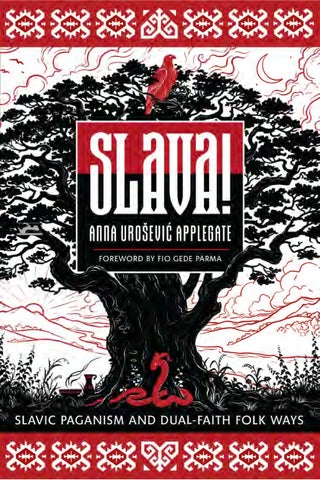
Discover Authentic Polytheistic Practices Rooted in Central and Eastern European Traditions This illuminating guide to the living traditions of Slavic Paganism unveils the rich cosmology of deities, folk magic, and the unique Dual-Faith Tradition that blends Pagan elements with Eastern Orthodox Christianity. Drawing from her Serbian ˇ American heritage and decades of devotional practice, priestess and vracara ´ (witch) Anna Uroševic Applegate introduces powerful gods like Perun and Veles, alongside the nature spirits that inhabit forest, field, and home. Learn to honor ancestors through traditional veneration techniques, create authentic altars, and perform seasonal rituals that connect you to the Slavic Wheel of the Year. No matter your background, this book provides practical tools for incorporating Slavic folk magic into your spiritual path while developing meaningful relationships with these venerated ancient deities.
Chicago native Anna Uroševic´ Applegate is a first-generation Serbian American and ordained legal Pagan clergy. She holds an M.A. in English from Loyola University Chicago. Anna is the founder of an inclusive Rodnovery fellowship known as the Circle of Rodu. Learn more at CircleofRodu.com.
X: @LlewellynBooks Instagram: @LlewellynBooks
www.Llewellyn.com
$22.99 US
APPLEGATE
Facebook.com/LlewellynBooks
SLAVIC PAGANISM AND DUAL-FAITH FOLK WAYS
—Joanna Tarnawska, author of Polish Folk Magic
SlAvA!
Body, Mind & Spirit / Folk Magic