
FORBEGINNERS )
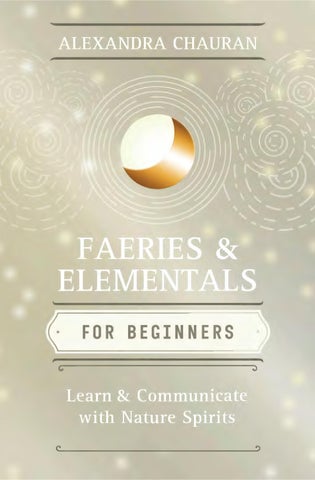
Faeries & Elementals For Beginners

About the Author
Alexandra Chauran is a second-generation fortuneteller, a third degree elder High Priestess of British Traditional Wicca, and the Queen of a coven. As a professional psychic intuitive for over a decade, she serves thousands of clients in the Seattle area and globally through her website. She is certified in tarot and has been interviewed on National Public Radio and other major media outlets. Alexandra is currently pursuing a doctoral degree, lives in Issaquah, Washington, and can be found online at EarthShod.com.
Photo © Sarah O’ Brien
For Beginners Faeries & Elementals
Learn About & Communicate With Nature Spirits
Llewellyn Publications Woodbury, Minnesota
Faeries & Elementals for Beginners: Learn About & Communicate With Nature Spirits © 2013 by Alexandra Chauran. All rights reserved. No part of this book may be used or reproduced in any manner whatsoever, including Internet usage, without written permission from Llewellyn Publications, except in the case of brief quotations embodied in critical articles and reviews.
First Edition
First Printing, 2013
Book format by Bob Gaul
Cover art: Foggy country road © iStockphoto.com/Ben Klaus
Cover design by Ellen Lawson
Editing by Laura Graves
Llewellyn Publications is a registered trademark of Llewellyn Worldwide Ltd.
Library of Congress Cataloging-in-Publication Data (Pending) 978-0-7387-3713-3
Llewellyn Worldwide Ltd. does not participate in, endorse, or have any authority or responsibility concerning private business transactions between our authors and the public.
All mail addressed to the author is forwarded, but the publisher cannot, unless specifically instructed by the author, give out an address or phone number.
Any Internet references contained in this work are current at publication time, but the publisher cannot guarantee that a specific location will continue to be maintained. Please refer to the publisher’s website for links to authors’ websites and other sources.
Llewellyn Publications
A Division of Llewellyn Worldwide Ltd. 2143 Wooddale Drive Woodbury, MN 55125-2989 www.llewellyn.com
Printed in the United States of America
Other books by Alexandra Chauran
Crystal Ball Reading for Beginners Have You Been Hexed? Palmistry Every Day So You Want to Be a Psychic Intuitive?
introduction 1
one: Getting Started with Faeries 9
two: Communicating with Elementals to Understand and Improve Your Life 71
three: Sylphs–Elementals of Air 103
four: Salamanders–Elementals of Fire 121
five: Undines–Elementals of Water 141
Contents
conclusion 183
glossary 189
bibliography 193
Are there winged and glowing beings floating through the air, just on the edge of your field of vision and your imagination? What strange and wonderful creatures may exist in the deepest depths of the ocean, beyond where humans have the capacity to discover? Is there intelligence in the earth or life in a crackling fire? Discovering elementals and faeries for the first time is like exploring the boundaries of where reality, imagination, and spiritual truth meet and intersect. By the time you finish this book, you’ll be ready to start exploring what you believe.
What Are Faeries?
In popular culture, faeries take on the familiar form of small, winged creatures. Indeed, many cultures have versions of faeries
that fit the familiar profile. However, “faerie” (or “fairy”) is an umbrella term that covers many mythological creatures that can range from beautiful sea beasts to nightmarish monsters that stomp through the night.
Faeries are the way that people have understood some of the more magical and mysterious forces of life and nature, from the birth of a particularly beautiful child as a faerie blessing, to a terrible crop yield as a faerie curse. Faeries are the faces we put on real phenomenon so we can propitiate them, ward them away, or even bargain with them.
What Are Elementals?
Elementals are beings made up of energy. Of course, they are not composed of the energy we speak about in scientific terms, like electricity, but spiritual energy. Spiritual energy, or chi, is the life force within all things, and the potential used in magic to manifest one’s desires. In the case of elementals, their energy can be used to manifest their desires and your own. The trick is to make sure that you and the elementals share the same goals.
If you were to gather all the faerie creatures that have ever been imagined across time and cultures, they would all fit into one or more of only four categories: earth, air, fire, and water. For the purposes of predicting the behavior and needs of elementals, they have been classified by their element. Although this would imply that there are only four species of elementals, some cultures label any spiritual entity that watches over any of those domains as an elemental. For example, a deva might be considered an elemental since it loves the earth. In the context of this book, I will instead choose to lump
most natural spiritual entities into the “faeries” category so that you can read about them earlier in the book. The term “elementals” will focus on gnomes, sylphs, salamanders, and undines.
Significance of the Elements and How Elementals Came to Be
Long before the chemical elements were organized into a periodic table, people were trying to classify things on earth. For alchemists—primitive chemists and philosopher magicians that they were—the four elements of earth, air, fire, and water were assumed to be the building blocks for all of creation. Aristotle became one of the first to describe the behavior of elementals, in that they belonged to their respective dominions and naturally were attracted back to their sphere of influence if left alone. Therefore, it takes effort and sometimes even force to make an elemental do something it is not already doing by virtue of its own state of being.
With a little thought, everything could be fit into elemental components. For example, a human is made up of all of four alchemical elements. We breathe air in and out of our bodies. Our blood, saliva, and other fluids are attributed to water. The solid body itself is made up of the element of earth, and the heat that comes from our metabolism is from an inner source of the element of fire.
Though the periodic table of the elements does not include any of these four elements, since they are outdated for the uses of modern science, ceremonial magicians have
continued an unbroken tradition of using the four elements in magic as well as for important ritual structures that are fundamental to understanding of Western magic’s concepts. Many Western forms of witchcraft borrowed heavily from established ceremonial magic traditions, and these included the use of elements.
Not only did ceremonial magicians develop a ritual structure that used the four elements as building blocks in the architecture of magical structures called circles, but they also used a mode of communication with magical entities that was quite forceful and authoritative, calling on elementals to do their bidding and establishing one of the first ways that people could work directly with elementals by taking them out of their element, so to speak.
Elementals in a Religious Context
While ceremonial magicians and many other historical practitioners of magic did not use elementals in the context of worship, elementals have found their place in many world religions and in modern witchcraft’s spiritual component. As soon as elementals became more than just a magical hypothesis, they began to become inextricably bound to nature. Ceremonialist use of elementals remains largely relegated to symbolism within ritual constructs. Yet people from various faith traditions, including Buddhism and Neopaganism, in addition to practitioners of traditional medicines, commune with elementals outdoors among the woods, streams, oceans, lakes, and the furious weather of the natural world.
What Should Your Focus Be? How Can You Incorporate Them into Your Life?
Although elementals find their way into practical use in many religious and healing arts, they are largely theoretical in nature. Understanding elementals is to philosophize about all of existence and how it fits into various categories of understanding. If you are a deep thinker, and enjoy philosophy and theology, the four traditional elementals may be the right focus for you. By using elementals, you can analyze your life critically using the elementals as a tool to rebalance and to seek blessings.
If, however, you find that elementals feel too impersonal, and you don’t want to devote your entire life to their study, you would do best to focus on faeries. These beings are the fun and intriguing faces of elementals that can bring them more easily into everyday life. By incorporating faeries into your daily routine, you can add a little magic and perhaps get a little closer to nature in the process. Faeries let you dip your toe into understanding elementals, and can help the beginner to get started figuring out what you truly believe.
Why Work with Elementals and Other Mythological Creatures?
Why should anyone choose to invoke mysterious and possibly dangerous magical wildlife? It may seem tantamount to inviting a rabid squirrel into your home. Whether the idea sounds fun or daunting, it is impossible to ignore the power that the four elements have as a concept. The four elements persist
because they work to solve life’s problems, and if they work they should continue to be used.
With the use of elementals, you have additional energetic and enthusiastic little friends that can help you. Not only do many hands make light work, but the focus and drive to do what is in their true nature to do can make elementals obsessively devoted to your goals when appropriate aims are selected for appropriate elementals.
As in ancient times, the modern world is still full of mystery. Faeries and elementals are some models that can still be used to explain the way things work. Entertaining the idea of mythological creatures can bring light and magic to everyday situations, such as losing track of your car keys and blaming it on the pixies. And, in some instances, the mythological explanation makes a lot more sense than any rational one … especially if you specifically remember setting your keys down in a specific place only to find them transported to a surprisingly high shelf.
Are They “Real”?
The real question that plagues the more literal-minded type of person reading this book is whether or not little people or elementals are real. Of course, this depends on what you mean by the term “real.” Naturally, faeries and gnomes are not the same ones that you see animated on television or depicted by lawn ornaments. Beyond that extreme, though, the lines intersect between inspiration, imagination, fable, and metaphor. Faeries and elementals have established themselves as workable archetypes for understanding the incomprehensible, and have
rightfully earned a place in the real-world practices of rational adults.
Speaking of archetypes, I should explain how they are different from thoughtforms. Often, archetypes feel a little more “real” in the practical context of working with them. A thoughtform is an idea that can take the form of an entity, like an elemental, but thoughtforms are fueled by the energy of the person thinking about the idea. Usually, the thoughtform exists for a short time so a specific task may be performed. Once the goal is completed and the mind stops feeding energy into the thoughtform, it dissipates. Elementals can also carry out goals, and they are also representative of many ideas. In this way, elementals already exist as archetypes in the human collective unconscious, and can be called upon as needed without ceasing to exist when an individual’s goal has been achieved.
What You Will Learn, Know, and Be Able to Do
Through this book, I will attempt to educate the reader a bit on the history and mythology of elementals and faeries without getting too bogged down in what other people believe. More importantly, I will help you to personify the concepts behind magical creatures so that they can become practical and useful tools and companions to your magical work.
By the end of this book, you will understand which duties fit what elementals and faeries best, how to communicate with them, and how to get them to help you with problems in everyday life. You’ll get a handle on where elementals and faeries fit into your own psychology. You’ll learn how they can
impact your spiritual practice by giving it a structure, philosophy, and multiple ways of going about getting what you want in a world that can be chaotic and have a mind of its own, just like the entities you will come to know.
Most of all, I’d like you to meet elementals and faeries in the common ground of your own mind, your environment, or wherever your biggest hopes and fears collide. I want you to see helpful entities, with your mind’s eye or otherwise, and to startle yourself with observations of an exotic wildlife of mythological proportions. Working with elementals and faeries is something you have to see to believe. Jump right in and get started with some steps you can take to work directly with magical entities. The results you’ll find in your own life will speak for themselves.
one Getting Started with Faeries
Jane loved playing with her kids and how the real world and imagination were always intertwined. As an artist and writer, Jane wanted to keep inspirational traditions woven into her family’s culture at all times. Instead of waiting for Santa to come to town to put out milk and cookies, Sarah’s two daughters helped put out a family offering to the faeries in the garden every night before bedtime.
At dinner, a small plate for the faeries rested always in the middle of the table. Before digging in to eat, each family member placed a crumb of each food they were going to eat. Jane’s youngest, Madison, added an extra big glass of milk to ask the faeries to bring back her favorite doll that had gone missing. After dinner,
her eldest, Tammy, took the plate to the center of the garden in the front yard and left it on a rock right under the bird bath.
Jane smiled as she watched her children giggling and dancing wildly around the bird bath, thanking the faeries for flowers and kittens and everything they thought was joyous and good. A flicker of light caught Jane’s eye. Was it a reflection of light off the water? A glowing dust mote seemed to dance in the orange glow of the setting sun as if it had a mind of its own. Jane sensed a feeling of well-being and happiness. “Tammy, Maddie!” she said. “Did you see a faerie in the sunlight too?” Tammy stopped dancing and hugged her little sister, cocking her head at her mother quizzically. “Of course, Mommy, they’re always there.”
Not all spiritual entities found in nature can be simply classified as a single elemental of one of the four elements. The catchall term of “faeries” includes many other creatures, although they may be more detailed expressions of the classical elements. In this chapter, we’ll examine the outliers called faeries as a whole, and then I will give some example of especially common faeries in folklore, as well as a few that are particularly elemental in nature. Some faeries fit the stereotype seen in popular culture of small winged people. Others may look not humanoid at all in their associated myths and legends. Many faeries are adorable and friendly folk, while many others may be mischievous or downright dangerous and mean.
In general, well-meaning faeries are lumped into the Seelie category, while those that probably wish you harm are called Unseelie. Think of them as a huge kingdom of creatures. Just as you can’t characterize all animals as “nice,” living things
that would make fine pets, faeries vary widely depending on the culture and region that gave them life in literature and through spirituality. Nearly all faeries have been given a bad reputation at some point or another, simply because they are given to pleasures like music and dancing, feasting and drinking, playing and partying. At various points in history, all of those joys have been forbidden or enjoyed only in moderation by people who often thought that faeries demonstrated a disgraceful lack of restraint.
Yet as unspecific as the concept of faeries may be, some magical practitioners connect with them on a deep level. If each of the four elemental types gives a person greater understanding and control of the building blocks of the universe, you can think of faeries as a tangible conceptual connection with nature and the energetic force of life itself. Even if you don’t believe in faeries in the literal sense, it can help to personify the very real powers they represent.
How You Can Communicate with Faeries and Incorporate Them into Your Life
Adding faerie energies to your life can be very useful, and not just because faeries are pretty and cute. Befriending faeries, or at least getting on their good side, can spare you from their faerie misdeeds and gain you some magical help. Faeries might help with chores around the house and garden, and even assist in finding lost objects. Some might say that those lost objects were the very things stolen by the faeries in the first place, so I’ll leave it to you to decide whether they are doing you a favor by returning them. Faeries are healing creatures, especially for
those suffering emotional or spiritual afflictions, as they can bring joy back into life.
Faeries are feral creatures, so they are intimately in tune with both wild and domesticated animals. As such, faeries are naturally inclined to help animals and can be asked to help as intermediaries when you are having a problem with an animal in your care. For example, if your dog seems depressed, ask the faeries to help you find out what’s wrong and let them be your dog’s interpreter in your dreams. Requesting their help to heal a sick horse can help the veterinarian’s work bring about results more quickly. You can ask for the aid of the faeries when dealing with wild animals as well, asking them to keep dangerous or annoying animals away from your home.
As much as faeries are ministers to animals, they are even more in tune with plants, allowing gardens, orchards and crops to grow and thrive with abundance. Consider inviting faeries into your life by designing a garden just for them. A faerie garden should be mostly flowering plants, arranged closely together to create a lush and natural looking field of color. Faeries especially enjoy bell-shaped flowers, which they can play with by tapping them as if ringing a real bell. You’ll need to garden organically, because chemically treated plants are said to be avoided by faeries. You may, however, enhance your garden with manmade art. Decorate with faerie statues, faerie furniture, or water features. If you play music in your garden, you will also find faeries flocking to its pleasant ambiance. Attracting local animals by planting butterfly flowers and putting up bird baths and feeders will bring cheerful faeries who love to be around their animal friends.
I don’t know about you, but I am a terrible gardener and tend to kill the plants I try to keep. If you can’t keep a faerie garden, for whatever reason, but you still want to set something up to attract outdoor faeries, consider building a faerie grotto. If you can build a faerie grotto on your property, start with natural rock features and crystals. If you can, add a fountain, but otherwise you can use a birdbath or an offering bowl of water as a water source. Showing the faeries that the grotto is just for them with statues, faerie furniture, or other art may help. You can make offerings of food or drink nightly to the faeries in the grotto. Since you won’t be cultivating plants there, you can still benefit from the faerie-attracting powers of flowers by offering flowers in a vase or strung into a garland.
Evidence of Faeries
How can you tell if faeries have graced your home or garden? The best way to tell that there are faeries making your life more magical is that the space will feel more peaceful and welcoming to you than before you started inviting their presence. In the garden, flowers should bloom more frequently, for a longer duration, and be larger and more colorful when faeries are around. Likewise, you’ll see the presence of natural wildlife increase, with more sightings of beautiful birds, butterflies, frogs, dragonflies, lizards, squirrels, and deer or other local fauna. In your home, your housecleaning efforts will seem to last for a longer period of time before the smudges and dust bunnies return. You may even catch the scent of faeries working their magic in your home with the aromas of flowers or sweet baked goods.
Faerie rings are my favorite evidence of their presence. A faerie ring is a circle of toadstools. Some say that faerie rings are portals for faeries to jump between dimensions. Others say that faerie rings are like a circle of chairs used for faerie council meetings or dance parties. I saw many a faerie ring of white toadstools in my front yard when I was a child growing up. Every year, I would find one nearly in the same spot as the spring or fall before, and I would sit in the middle of the three to six foot circle of toadstools, feeling nature’s magic. Last year I was delighted to find a faerie ring had appeared in my yard, which awakened old feelings of childhood delight and my early connection with the little people.
Seeing Faeries
Some people see faeries in their mind’s eye, in dreams, or in the corners of their actual field of vision. They might appear as the classic winged creatures of faerie tales, or they may be tiny sparkling lights or fleeting shadows caught only for an instant in your mental picture. You may have heard of phenomena like ghosts being caught on camera, and it has been said that faeries might also allow themselves to appear as light effects on photographs. So, if you have never been able to see a faerie, try creating a faerie garden and then take plenty of pictures around your most beautiful flowers and visiting wildlife. Finding a rock that has a natural hole in the middle is considered a gift from the faeries, a “holey stone.” Hold up a holey stone and look through the hole. You may be able to see faeries with your real eyes for the first time. A holey stone has also been said to give people visions of the future, so such a gift from the
faeries should be treated with reverence. Keep a holey stone on your elemental altar in the area facing north, or make it into a pendant and wear it as a protective amulet from the faeries.
Of course, there are also magical ways to give yourself faerie sight. Traditionally, magic potions smeared on the eyelids were used to see faeries. There are no surviving recipes of ancient magic potions for faerie sight. It may be that such potions were actually tinctures of hallucinogenic plants. After all, potentially hallucinogenic drinks such as absinthe have always been associated with seeing green faeries. Modern faerie lovers have made countless attempts at the potion using plants that are associated with faeries. For example, it is said that if you find a four-leaf clover and blend it with faerie flowers like hollyhock, marigold, thyme, elecampane, and hazel, the resulting dried flowers steeped in an oil such as grapeseed will make a good substitute. Store the oil in a dark bottle in a cool place. When you want to see faeries, take yourself out in nature at dawn, noon, dusk, or midnight. Smear a bit of the oil on each eyelid, and keep a watchful eye on a field of flowers. If you think you see a faerie, hold your eyes still without moving them and especially without blinking. Allow the faerie to choose to move into your field of vision, otherwise he or she will disappear with a blink.
If you are of the proper age, constitution, and mindset to drink alcohol, using a bit of absinthe is the traditional method for bringing you in touch with the green faerie that is an artistic muse. Grab a friend and a bottle of absinthe that contains real grand wormwood (Artemisia absinthium), along with a couple of glasses, some ice, water, sugar cubes, and an absinthe spoon. An absinthe spoon is usually a piece of decorated silver-
ware featuring a large, flat triangle with holes in it at the top. If you can’t acquire an absinthe spoon, a large fork or a serving spoon with holes in it will do in a pinch.
Again, go out in nature at dawn, noon, dusk, or midnight. Start by pouring an ounce of absinthe into a serving glass. Mix a little bit of water with your ice so that the ice water slurry is thick with ice. Place a sugar cube on top of the slotted spoon, and hold it over a serving glass. Slowly pour the ice water mixture over the sugar cube until it is completely dissolved. When done correctly, you should see the absinthe become cloudy. Go outside and take a sip. Use the same method of watching for faeries as with the faerie sight potion.
Getting on Their Good Side
Although different faerie types have varying lore as to how they are best appeased, in general faeries are more likely to be on friendly terms with you if you treat them with respect. Treating faeries with respect means offering them food and drink as you would honored guests, but especially entails treating the environment well. Don’t litter, do your part to conserve natural resources and energy, recycle, and leave a small carbon footprint. Remember that your home is your environment as well, so pick up things that are left scattered about on the floor. Be sure to dust, sweep, mop, or vacuum.
How to Talk to Faeries
Get out in the natural world and talk aloud to the faeries. The best times of day to get their attention are at dawn, noon, dusk, and midnight, when they are most active. A full moon may get
more night faeries flitting about. May and October are the best months to try to first get in touch with faeries. Midsummer, the summer solstice, has traditionally been associated with faerie gatherings. At the end of October, it is said that the veil between worlds becomes thin, so perhaps faeries from other realms can more easily pay a visit to ours.
Get their attention with an offering of something shiny or some sweet food. You can even find a sparkly rock and leave it for the faeries. Remove any non-biodegradable packaging from candy before leaving it outdoors, of course, or they may feel more slighted than treated. Leaving an offering is absolutely vital, or else the light-fingered faeries will simply take an offering that you may not have intended to give. For example, if the faeries desire a shiny trinket, and you did not leave them a sparkly piece of rock candy from your pantry, they might steal your car keys instead, leaving you to look high and low for them.
If you feel moved to do so, faeries respond better if you put your words into song. You can also write a letter and leave it for the faeries, if you’re shy about talking out loud to things that you can’t see. Faeries love children, so if you have kids, invite them to come and talk to the faeries with you, and the faeries may listen to your kids’ request more than your own. You could tell your children to put in a good word for you. In turn, perhaps you can offer to put in a good word with your close personal friend, the Tooth Faerie.
How to Get Rid of Faeries
If you find that your home is infested with the nasty and troublesome sort of faerie that is frightening your family, ruining food, or stealing your belongings, you may wish to encourage them to take their leave. This is called “laying” a faerie. Start by simply asking the faeries to leave. Make sure to refer to them as faeries, since some types of faeries disappear when their true nature is called out. If the faeries try to offer you a parting gift, do not accept it. The gift may be a trick to put you in their debt and thus allow them to demand to stay. If the faeries speak to you, whether it be in your dreams or simply in your mind’s fancy, always reply in rhyme, since that can banish a faerie, almost like you are having a poetry battle. For faeries that don’t speak English, ring a bell around the house, snap your fingers, and clap your hands to frighten them away.
If asking the faeries to leave doesn’t work, you should lay a faerie by offering them an entire outfit of clothes. Make or buy a tiny suit of clothes the size for a doll and lay them out at night. Leaving a sock under the bed may work as well. In many myths and legends, faeries pack up and leave immediately upon being offered clothes.
Finally, there are a few ways to ward away faeries once you have gotten them to vacate the premises. You can keep them from following you back home and infesting your home again simply by crossing water. If you feel you might be under magical attack by mischievous faeries, wash your hair with sage and wear a hat and coat inside out to fend off their onslaughts while you set up the defenses. An acorn kept in a pocket and ashes from a midsummer bonfire in your shoes are protec-
tive charms as well. Start with salt sprinkled around the home as if it were a wall that keeps them out. Placing a few antifaerie charms at the entrances of your home will finish the job. Below are a few examples of such charms:
• A four-leaf clover. This lucky charm will flush faeries out, allowing you to both see and be protected against them.
• St. John’s Wort flowers and daisies woven into a garland.
• An equal-armed cross of sticks of rowan, oak, ash, or hawthorn, bound with red thread.
• Anything made of iron.
• Ashes and kelp mixed with sea salt (especially effective against water faeries).
• A mulberry tree planted near the door.
Common Faerie Types, Characteristics, Origins, and Where They Are Found Angels—Air
Though angels are best known in the West from Christian mythology, there is lore that departs from Biblical angels. Some faeries are said to be fallen angels. That is not to say that all angelic faeries are evil once they leave heaven. Yes, some are naughty. But others are seeking to garner favor to gain entry back into heaven, and doing so by helping humans. Others may have been sent down from heaven to do good work on earth.
In ceremonial magic, the archangels Michael, Gabriel, Raphael, and Auriel are powerful beings associated with the planets and the four elemental quarters. Raphael was associated with the planet Mercury, Gabriel with the moon, Michael with the sun, and Auriel with Mars. The names of these archangels are intoned to raise power for magical purposes. You need only speak their names to have them stand at your side for guidance or protection.
Anthropophagi—Air
These faeries made their written debut in folklore described in Shakespeare’s plays, although they dwelled around England before his time. They are headless, with eyes sitting on their shoulders and tiny brains that reside in their genitals. Gaping mouths are in their chests. They feed on human flesh and should be avoided at all costs.
Apsaras—Water
The Apsara exists in both Hindu and Buddhist spiritual mythologies. Apsaras can change shape, but their true forms are beautiful young females who are the spirits of water, clouds, and gambling. Apsaras have the power of flight, enjoy dancing, and are good at caring for those who have fallen in battle and require healing.
Apsaras are pleased by music that is good for dancing, as well as by the presence of water. Men should take care not to be seduced by an aspara, for according to mythology their hearts will be broken and their minds made numb to the world’s spiritual ideals. Since aspara love to dance so much, they are also honored in it, and have inspired a Khmer dance, Robam
Tep Apsara (“dance of the Apsara divinities”), performed by the Royal Ballet of Cambodia.
Ashrays—Water
In Scotland are beautiful young sea creatures called ashrays, which look like the translucent white ghosts of humans. They are not ghosts, however, but living creatures that dwell in the sea. Their white skin may be due to the fact that they can never see the light of day; sunlight melts them, rendering them into pools of water the colors of the rainbow.
Like any other sea creature, ashrays are most pleased by humans reducing their impact on their watery environment. Unfortunately, you’re unlikely to make contact with them, as they live deep underwater and generally avoid humans.
Attorcroppes—Earth
From Saxony, the attorcroppe is a snake with arms and legs that walks just like a human. It is very small, as many faerie creatures are, but vicious and venomous. They live among rocky areas, especially near wilderness and water. To keep clear of them, one should avoid walking along rocky stream beds at night.
Ballybogs, Bogles, Boggans—Earth
Widespread throughout England, Ireland, Wales, and the Isle of Man, ballybogs are also known as bogles and boggans regionally. Small, round and mud-covered, ballybogs have tiny arms and legs that don’t seem to support their weight. The slimmer English variant, boggans, are the only ones to wear clothes and
to be intelligent enough for speech. The vast majority of ballybogs communicate only in short grunts.
Ballybogs are found near bogs, and they would delight in gifts of peat and peaty alcoholic drinks. Some of their favorite games are footraces and tag. A ballybog can be requested for help finding anything that has been lost in a boggy area, but they do so by physically running to show you, since they are unlikely to be able to communicate to you in words.
Ban-Tighes—Earth
Not to be confused with banshees, ban-tees are female house faeries. Often seen as elderly women, they are so friendly to people that they bond to a house or a family, and stay for generations to protect and help around the house. Ban-tees are especially fond of homes with children or pets, and they love to look after them and tidy up when messes occur.
To make contact with a ban-tee, leave out strawberries and cream as an offering near the hearth during the late fall, winter, and early spring whenever you are too tired to finish your household drudgery. You will know that your gift has been accepted if the chores are finished in the morning, or if you notice somebody making sure that the windows, curtains, and blankets are adjusted to keep children and pets warm.
Basilisk—Fire
A basilisk is a real lizard, but the word also refers to a mythological faerie creature from Greece. The mythological basilisk is a snake with arms gleaming gold and a bright red spiky or frilly comb on the top of its head. Basilisks are vicious and venomous, and can spread their venom simply by breathing
upon, touching, or looking at a human being. Even killing a basilisk is dangerous in and of itself, since the body is filled with its poisonous breath. The good news is that they don’t reproduce quickly. Supposedly, basilisk eggs are laid by roosters and incubated for nine years by toads.
To keep a basilisk at bay, you need only have its natural enemies living in the area: crows, mongooses, roosters, snakes, or weasels. Mirrors can also protect the wanderer from a basilisk, since they can be warded off or possibly even destroyed simply by viewing their own reflections.
Bean Fionns, Greentoothed Women, Jenny Greenteeth, Weisse Fraus—Water
A bean fionn can be found in bodies of water mainly in England, Germany, and Ireland. Though a kiss from this water faerie can render anyone immune to drowning, they are temperamental and as likely to kill a traveler as protect him or her. A bean fionn is the personification of the fear of one’s children being drowned. Nightmarishly, the faeries will reach up from below the water and grab children playing in water or even close to the shore or on a bridge.
These most dangerous of water faeries are most likely to be found in the darkest of lakes, which should be avoided at all costs. Charms against drowning, like an amulet made from a bag of ashes, kelp, and sea salt, may keep away their attacks.
Beansidhes, Cointeach, Cyoerraeth, Washer at the Banks/Fords (of Shrouds)—Water
Sometimes spelled as “banshees,” these terrors announce or portend death with blood-curdling wails, and are originally
from Ireland, Scotland, England, and Wales. In Scotland, a similar male variant also exists called a Ly Erg, who appears as a small soldier with a red hand. If he raises his hand to you, it is to challenge you to combat as a way of foretelling your death. Always female, banshees appear as winged human women, but they are faeries that are sometimes mistaken for ghosts. Banshees appear beside rivers or streams, most often seen washing burial shrouds and keening in grief. They are a normal human size. Banshees are pale, have long hair that appears wet, and are often depicted wearing a white, green, or black gown with a hood that obscures the hair or face. If you see her open her mouth to wail, her teeth will be pitch black.
Banshees are only scary because their wailing foretells of a death, and upon hearing a banshee a person cannot help but wonder if it is oneself or one’s loved ones that are to die. The banshees themselves are not dangerous, and may represent a mother form who absorbs a soul before rebirth. You should probably be very afraid if one shows up at your door or window flapping her wings, but otherwise she should be left to mourn in peace.
Black Anguses—Water
From England and Scotland, a black angus is a creature that is not humanoid, but instead looks like a horned black dog with huge fangs, wet paws, and gleaming yellow eyes. Like banshees, black anguses are not dangerous themselves, but their howling portends a terrible or violent death, especially for those who have done such dark deeds as to expect to have a miserable time in the afterlife.
If a black angus crosses your path at night and leaps in front of you, be afraid that you might die within two weeks. Otherwise, have no fear of this dog faerie passing in the night. Just be relieved in the same way that you might be glad that a passing ambulance is not coming for you. Don’t attempt communication with a black angus—you wouldn’t want to tempt fate.
Blue Hag, Black Annis, Cailleach
Bheare, Stone Woman—Water
There is only one Blue Hag, but she is widespread, like a goddess figure, throughout Celtic lands. She appears to be an old woman in blue (or black) and white torn clothing, with a crow on her left shoulder. She goes out walking on winter nights, and may be temperamental and dangerous. She carries a walking stick made of holly and with the head of a crow at its top. If you were to be touched by her walking stick, you could die. She may be the embodiment of the crone aspect of female divinity, and should be respected as a goddess, if not feared.
Bocans—Air
Bocans are terrifying creatures that robbed and killed people in medieval times. It was not a good idea to travel at night, because on the highways between towns, bocans might be lying in wait. Since nobody ever lived through a bocan attack, there are no physical descriptions of the creatures. Though they were rare even in their heyday, the best way to prevent an encounter was simply to restrict travel to daylight hours and to journey together in large groups.
Boggart, Boogey Men, Goblins, Hobgoblins—Earth
A Scottish or English dwarf creature, a boggart is always male. Boggarts are malicious creatures, but are drawn to keep company with humans for some strange reason. Boggarts will choose a household or a family and stick around for generations, plaguing them with grumpy interactions and greedy thievery of food and belongings. Especially frightening to children, boggarts can jump upon them at night so that the child feels like he or she is being smothered to death.
Like vermin, the boggart chews through objects and destroys them. Wood is a favorite treat, and a boggart can consume pieces of valuable furniture or even the floors and walls of the home itself. Due to their voracious appetites, leaving out wood as an offering will not be enough to satiate their destructive desires.
In the wild, boggarts may have lived in bogs, so the best way to avoid a boggart may simply be to avoid building or buying a home at the side of a bog. If a boggart does take up residence, they are especially stubborn, and it may take more than one attempt to rid your home of malicious boggart activity.
Brown Men,
Moor Men—Fire
Originating from Cornwall or Scotland, brown men are not actually brown. Their hair is reddish, and it is the torn clothes they wear that are brown, as they are made from leaves that have become wet and rotted in the rain. Brown men are short, always male, and have long arms that are quite fat. Brown men tend not to meddle in the affairs of humans. If you call out to them near a moor, chances are that they will
shy away from you. Brown men are quite harmless; they keep their distance and live only in wild places.
Brownies, Choa Phum Phi, Domovoi, Hobs, Little Men, Nis, Yumboes—Earth
Brownies are from Scotland, originally. They are small and normally do not allow themselves to be seen. If you do catch sight of a brownie, he (brownies are usually male) will generally be naked and hairy, or only wearing tattered brown wool. They do not have noses. Two holes in the face mark where a nose should be. They also have no fingers or toes at the ends of their furry arms and legs. Add the fact that they are often seen with tails, and they are strange creatures indeed.
Making friends with brownies can be rewarding, because they help around the house. Brownies tend to befriend a family and stick with it through generations. They can ward the house from trouble, assisting you in calling for help if something goes wrong, making them a bit like a mythical neighborhood watch. They can also do chores around the house gladly and happily, banding together to get a whole day’s work done in a very short time during the night. If you make your brownies unhappy, however, you’ll find yourself saddled with terrible luck as they begin to cause trouble in subtle ways.
Brownies only work at night, after all of the members of the household have gone to sleep. Having house brownies is sort of like having pets, in that food and drink should be offered nightly to them. Only a tiny, token amount need be set out. Offerings that brownies are pleased to accept are bowls of cream and a pancake with honey on top. Like the pixies, brownies will leave a home forever if the owner offers an article
EXPLORE THE MAGICAL WORLD WHERE NATURE SPIRITS DWELL
From sprites to will-o’-the-wisps, this practical beginner’s guide introduces you to a wide assortment of wild and wondrous creatures. Discover how to attract faeries and elementals to your home and garden, as well as how to befriend them. Along with step-by-step instructions for safely finding and interacting with these powerful creatures, you’ll also learn how to:
DZ Identify faeries and elementals associated with each of the four classic elements—air, fire, water, and earth
DZ Perform rituals, meditations, and exercises that help you connect with nature spirits on a personal level
DZ Request help from faeries and elementals for healing, protection, getting a job, attracting love, and more
DZ Determine what roles nature spirits play in folklore and magic throughout the world


Dr. Alexandra Chauran (Port Moody, British Columbia, Canada) received a master’s degree in teaching from Seattle University and a doctorate from Valdosta State University. She is the author of dozens of books, including 365 Ways to Develop Your Psychic Ability, Crystal Ball Reading for Beginners, and Runes for Beginners.
Facebook.com/LlewellynBooks
X: @LlewellynBooks
Instagram: @LlewellynBooks
www.Llewellyn.com
$15.99 US