Implementing ElevatorStack & Analyzing Cable Series Stress
Practical Programming Assignment Samples for University Students
Problem 2: Elevator Stack Implementation Problem
Problem 3: Cable Series Stress and Elongation
Welcome to this presentation on assignment samples for university students. Today, we'll delve into two specific problems: the implementation of an ElevatorStack to manage guard entries and exits, and the analysis of stress and elongation in a series of cables under load. These examples showcase practical applications of programming concepts in solving real-world problems.
In this problem you will implement two member functions of a class, named ElevatorStack, which can be used to create a stack.
The declaration of the class is given in the file ps2_2.h. It consists of an array of structures, named Guard, an integer which indicates the current position in the stack, named position, and a double, named weight, to store the current total weight of the "guards" currently in the elevator. The declaration of the structure Guard is also given in the file ps2_2.h. The prototypes of the functions push() and pop(), which are used for the stack operations, are also given in the file ps2_2.h.
The main() program in the file ps2_2.C is supposed to simulate a stack to represent the entrance (push) and the exit (pop) of guards in an elevator. You should also provide in the file ps2_2.C the definitions of the functions push() and pop(), whose declarations are given in the file ps2_2.h, and the missing code from the externally defined constructor and destructor of the class ElevatorStack.
For the push(char *name, double weight) make sure that you check whether the maximum allowable weight or/and the maximum allowable number of persons in the elevator have been exceeded. In that case the function should provide the user with an informative message for not allowing a push(), i. e. another person to enter the elevator. When it is allowed the data provided by the user should be stored in the members of the structure in the current position. The memory for the name is dynamically allocated according to its length.
For the pop(), which is called whenever the provided name is "POP", you should check whether the stack is empty and have accordingly a message. The function must release the dynamically allocated memory for the name of the guard who is exiting (according to last-in first-out) and reduce the total weight by its individual weight.
Before exiting both push() and pop() the function must inform the user with the current status, i.e. the total weight and number of guards in the elevator.
Please, submit both the printout of the modified code and the output when executing the completed program with the data in the provided file dat2_2.
You may use redirection for both the input and output. e.g.
% ps2_2 < dat2_2 > res2_2 ; ensript -2Gr res2_2
You need to submit both ps2_2.h. and ps2_2.C files, although you should make changes only to the latter file.
ps2_2.h
// Problem Set#2 - Problem#2 [ps2_2.h]
#ifndef PS_2_2_H
#define PS_2_2_H
#define MAX_PERSONS 4
#define MAX_WEIGHT 900
int main (void) ; struct Guard { char *name; double weight; };
class ElevatorStack
{ private: Guard guards[MAX_PERSONS]; int position; double totalWeight; public: ElevatorStack(); // Constructor ~ElevatorStack(); // Destructor void push(char *name, double weight); void pop(void); }; #endif
ps2_2.C
// Problem Set#2 - Problem#2 [ps2_2.C]
#include <iostream.h>#include <stdlib.h>#include <string.h>#include <iomanip.h>#include "ps2_2.h"
int main (void)
{ ElevatorStack elevatorStack; char name[20]; double weight; cin.clear(); while(1)
{ cout << "\n\n Guard's name : " ; cin >> name ; if(cin.eof()) break; if(strcmp(name,"POP")) { -----cout << "\n Weight : " ; cin >> weight ;
elevatorStack.push(name,weight);
} else elevatorStack.pop(); }
cout << "\n\n Exiting the program normally" << endl << endl; return EXIT_SUCCESS ; }
ElevatorStack:: ElevatorStack() {
// The constructor should set the position and // totalWeight to 0 and 0.0, respectively.
}
ElevatorStack::~ElevatorStack() // Destructor {
// The destructor should releasing the dynamically allocated // memory for name of each guard in the array of structures
}
Here you should provide the externally defined member functions push() and pop(). push()
-The push member function should check whether the number of people or their weight has exceeded the allowable limits.
-
In each of the above case it should print an informative message why push is not possible.
-If it is allowable a new "Guard" structure should be added to the stack and the number of people in the elevator and their weight should be updated. This information should be printed to the user.
pop()
-The pop() member function should check whether the stack is empty and in that case print a message -Whenever the message is not empty a "Guard" should be popped out of the stack and the updated information for the number of people in the elevator and their weight should be printed to the user.
sol2_2.h
// Problem Set#2 - Problem#2 [ps2_2.h]
#ifndef PS_2_2_H#define PS_2_2_H
#define MAX_PERSONS 4 #define MAX_WEIGHT 900 int main (void) ; struct Guard { char *name; double weight; };
class ElevatorStack{private: Guard guards[MAX_PERSONS]; int position; double totalWeight;
public: ElevatorStack(); // Constructor ~ElevatorStack(); // Destructor void push(char *name, double weight); void pop(void);
sol2_2.C
// Problem Set#2 - Problem#2 solution [sol2_2.C]
#include "sol2_2.h" int main (void) { ElevatorStack elevatorStack; char name[20]; double weight; cin.clear(); while(1)
{ cout << "\n\n Guard's name : " ; cin >> name ; if(cin.eof()) break; if(strcmp(name,"POP")) { position = 0 ; totalWeight = 0.0; }
cout << "\n Weight : " ; cin >> weight ; elevatorStack.push(name,weight); } else elevatorStack.pop(); }
cout << "\n\n Exiting the program normally" << endl << endl; return EXIT_SUCCESS ; }
ElevatorStack:: ElevatorStack() { cout << "\n Using the default constructor \n";
ElevatorStack::~ElevatorStack() // Destructor { cout << "\nReleasing the memory for the array of structures \n"; for(int i=0 ; i<position;i++) delete [] guards[i].name; }
void ElevatorStack::push(char *name, double weight) { if(position >= MAX_PERSONS && (totalWeight+weight)>MAX_WEIGHT)
cout << "\n Guard " << name << " cannot enter the elevator \n" << "to avoid exceeding of both allowable weight and " << "number of persons";
else if(position >= MAX_PERSONS)
cout << "\n Guard " << name << " cannot enter the elevator \n" << "to avoid exceeding the allowable number of persons"; else if((totalWeight+weight)>MAX_WEIGHT)
cout << "\n Guard " << name << " cannot enter the elevator" << "to avoid exceeding the maximum weight"; else {
cout << "\n - Pushing a guard into the elevator " << endl; guards[position].name = new char[strlen(name)+1] ; strcpy(guards[position].name,name) ; guards[position].weight = weight ; position++ ; totalWeight += weight; cout << " There are " << position << " guard in the elevator " ; cout << setiosflags(ios::fixed) << setprecision(1) << " with total weight of " << totalWeight << " pounds"<< endl ;
void ElevatorStack::pop(void) { if(position==0) cout << "\n Stack is empty \n"; else { cout << "\n - Poping a guard from the elevator" << endl ; position--; totalWeight -= guards[position].weight ; delete [] guards[position].name; cout << " There are " << position << " guards in the elevator" ;
cout << setiosflags(ios::fixed) << setprecision(1) << " with total weight of " << totalWeight << " pounds"<< endl ; }
Pushing a guard into the elevator There are 1 guard in the elevator with total weight of 180.5 pounds
Guard's name :
Weight :
-Pushing a guard into the elevator There are 2 guard in the elevator with total weight of 346.1 pounds
Guard's name :
Weight :
-Pushing a guard into the elevator There are 3 guard in the elevator with total weight of 553.1 pounds
Guard's name :
-Poping a guard from the elevator There are 2 guards in the elevator with total weight of 346.1 pounds
Guard's name :
Weight :
-Pushing a guard into the elevator There are 3 guard in the elevator with total weight of 524.1 pounds
Guard's name :
Weight :
-Pushing a guard into the elevator There are 4 guard in the elevator with total weight of 719.6 pounds
Guard's name :
Weight :
-Pushing a guard into the elevator There are 5 guard in the elevator with total weight of 904.6 pounds
Guard's name :
Weight :
Guard Olivia cannot enter the elevator to avoid exceeding the allowable number of persons
Guard's name :
-
Poping a guard from the elevator There are 4 guards in the elevator with total weight of 719.6 pounds
Guard's name :
-
Poping a guard from the elevator There are 3 guards in the elevator with total weight of 524.1 pounds
Guard's name :
-
Poping a guard from the elevator There are 2 guards in the elevator with total weight of 346.1 pounds
Guard's name :
-
Poping a guard from the elevator There are 1 guards in the elevator with total weight of 180.5 pounds
Guard's name :
-
Poping a guard from the elevator There are 0 guards in the elevator with total weight of 0.0 pounds
Guard's name :
Stack is empty
Guard's name :
Weight :
-Pushing a guard into the elevator There are 1 guard in the elevator with total weight of 246.0 pounds
Guard's name :
Weight :
Pushing a guard into the elevator There are 2 guard in the elevator with total weight of 481.4 pounds
Guard's name :
Weight :
Pushing a guard into the elevator There are 3 guard in the elevator with total weight of 715.4 pounds
Guard's name : Weight :
-
Pushing a guard into the elevator There are 4 guard in the elevator with total weight of 960.4 pounds
Guard's name :
Weight :
Guard Paul cannot enter the elevatorto avoid exceeding the maximum weight
Guard's name :
-
Poping a guard from the elevator There are 3 guards in the elevator with total weight of 715.4 pounds
Guard's name :
-
Poping a guard from the elevator There are 2 guards in the elevator with total weight of 481.4 pounds
Guard's name :
Poping a guard from the elevator There are 1 guards in the elevator with total weight of 246.0 pounds
Guard's name : Weight :
Pushing a guard into the elevator There are 2 guard in the elevator with total weight of 413.4 pounds
Guard's name : Weight :
Pushing a guard into the elevator There are 3 guard in the elevator with total weight of 586.4 pounds
Guard's name : Weight :
-
Pushing a guard into the elevator There are 4 guard in the elevator with total weight of 761.9 pounds
Guard's name : Weight :
-Pushing a guard into the elevator There are 5 guard in the elevator with total weight of 956.9 pounds
Guard's name : Weight : Guard Bob cannot enter the elevator to avoid exceeding of both allowable weight and number of persons
Guard's name :
-
Poping a guard from the elevator There are 4 guards in the elevator with total weight of 761.9 pounds
Guard's name :
-
Poping a guard from the elevator There are 3 guards in the elevator with total weight of 586.4 pounds
Guard's name :
Exiting the program normally
Releasing the memory for the array of structures
Problem 3:
To lower heavy testing equipment for deep underground experiments, it is often necessary to connect a number of cables in series to reach great depths. Supporting the weight of the machinery, the cables will undergo axial stress and extend beyond their original length. Your task is to write a program to determine how much a series of cables will stretch under a given load and to see if the cables will be strong enough to support that load.
Bar and cable elements in series subjected to axial load are governed by the equation of springs in series:
where the stiffness, k, of each element is equal to its area, A, multiplied by its modulus of elasticity, E, divided by its length, L,: k = AE/L.
The program that you need to develop should be able to compute the axial deformation of the element assemblage. In addition, it should check the strength of each cable to ensure its safety against breaking.
In order to simplify the problem, you can assume that the weight of the cables is negligible in comparison to the machinery being lowered and that each cable behaves perfectly elastically until failure. You should use a class named Cable with 3 doubles as private member data: the area, the modulus of elasticity, the length, and the strength of the cable. The class that you should use for a cable element should look as the one below. The member variables area, elastic_modulus, length, and strength MUST be private. class Cable{public: // your functions here private: double area; // area of the cable double elastic_modulus; // modulus of elasticity of the cable double length; // length of the cable double strength; // strength of the cable
};
A cable will fail if its stress exceeds its strength. Since each cable in a series assemblage must support the entire weight, the stress in each cable can be determined by dividing the supported weight by the area of the cable:
Stress = weight / area
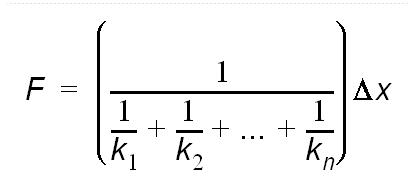
If a cable does not fail, its elongation can be calculated using the following formula derived from Hooke’s Law:
The total elongation of the system can be determined by adding the elongation calculated for each cable.
Alternatively, the total elongation of the system can be determined using the following formula:
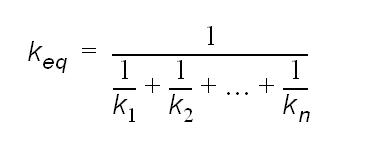
The equivalent stiffness keq is given by the formula:
The data should be stored in an array of Cables , i.e. objects of the class Cable. The array should be dynamically allocated after the user specifies the number of cables. First have the user enter the number of cables in the assemblage and then read the data for each cable and the weight of the machinery. After reading all the information the data should be printed out using overloaded I/O operators. Then, check whether any of the cable will fail under the provided weight. In case of exceeding its strength a warning message should be printed out and the program should exit. If no cable will fail, loop over the array to determine the equivalent stiffness constant for the assemblage, which you should print out to the user. You also need to print the individual elongation and stress for each cable

You should provide your source code for the Cable class in the file cable.C and the declarations in the file cable.h, and the general code in the files ps2_3.C and ps2_3.h. You also need to write a proper makefile, named makePS2, that can be used to compile and link your program. ps2_3.
In this header file you should provide all the declarations of the non-member functions, i.e. all functions that are provided in the file ps2_3.C.
In this file you should provide the main function, which should be kept very short, e.g. less than 10 lines of code. In main you should first call a function to read the cables information and a function to read the weight of the machinery. The first information that should be provided in the former function should be the number of cables in order to allocate dynamically the array of cables. Then, the area, elastic modulus, length and strength of each cable. The input for each cable should be read using an overloaded input operator. The latter function should read the weight of the machinery supported by the cables. In both function you should check that the provided data are positive numbers. Having read all input data another function should be invoked to print out the data of each cable. The output operator should be used for this purpose.
Then, a function should be called to check if any cables will fail. If a cable will fail then this information should be provided to the user and the program should exit after it releases the dynamically allocated memory. If no cable will fail, the elongation and equivalent stiffness constant of the cable assemblage should be printed. The stress and elongation in each individual cable should then also be printed. Finally, the dynamically allocated memory should be released.
A sample main() function is presented below: int main()
{ Cable *cableAssemblage; int numberCables; double weight; numberCables = readCableData(&cableAssemblage); weight = readWeight(); printCableData(cableAssemblage,numberCables,weight); if(checkStrength(cableAssemblage,numberCables,weight))
determineExtensions(cableAssemblage,numberCables,weight);
releaseMemory(cableAssemblage);
return EXIT_SUCCESS;
}
In the file ps2_3.C you should also provide the functions to implement the above functionalities, i.e. check for failure, determine the elongation of the assemblage, and the elongation and stress of each individual cable.
cable.h
In this header file you should provide the definition of the class Cable. All externally defined member function should be provided in the file cable.C.
cable.C
All externally defined member functions as well as the overloaded input and output operators should be defined in this file. You may need to provide functions to calculate the stiffness constant (k), stress and elongation of a single cable, and a function to check if a cable has failed under a given load.
Two sample runs of a program that performs the above functionalities are provided below. In the first one no cable fails so the elongations and stresses are provided as indicated above.
Enter the number of cables in the assemblage: 2
Enter the data for cable 1
Area: A = 0.0025
Modulus of elasticity: E = 200000000
Length: L = 5
Strength: S = 300000
Enter the data for cable 2
Area: A = 0.002
Modulus of elasticity: E = 210000000
Length: L = 6.5
Strength: S = 325000
Enter the weight of the machinery:
500
Cable 1
Area: A = 0.0025
Modulus of elasticity: E = 2e+08
Length: L = 5
Strength: S = 300000
Cable 2
Area: A = 0.002
Modulus of elasticity: E = 2.1e+08
Length: L = 6.5
Strength: S = 325000
Equivalent stiffness constant: Keq = 39252.3
The assemblage will extend 0.0127 units beyond its original length.
Cable 1: stress=2e+05 Elongation=0.005
Cable 2: stress=2.5e+05 Elongation=0.00774
In the second case the stress exceeds the strength of the cable, and, therefore, the program exits after printing an appropriate message.
Enter the number of cables in the assemblage: 1
Enter the data for cable 1
Area: A = 0.002
Modulus of elasticity: E = 200000000
Length: L = 7
Strength: S = 250000
Enter the weight of the machinery:
745
Cable 1 Area: A = 0.002
Modulus of elasticity: E = 2e+08
Length: L = 7
Strength: S = 250000
This assemblage cannot support the machinery. Cable 1 will fail!!!
sol2_3.h
// Problem Set#2 - Problem#3 [sol2_3.h]
#ifndef SOL2_3_H
#define SOL2_3_H
#include "cable.h"
int main();
int readCableData( Cable **c);
void printCableData(Cable *cableAssemblage, int numberCables, double weight); double readWeight(); bool checkStrength(Cable *cableAssemblage, int numberCables, double weight);
void determineExtensions(Cable *cableAssemblage, int numberCables, double weight);
void releaseMemory(Cable *cableAssemblag); #endif
sol2_3.
// Problem Problem#3 [sol2_3.C]
#include "sol2_3.h"
#include <iostream.h>
#include <stdlib.h>
#include <iomanip.h>
int main() { Cable *cableAssemblage; int numberCables; double weight; numberCables = readCableData(&cableAssemblage); weight = readWeight(); printCableData(cableAssemblage,numberCables,weight); if(checkStrength(cableAssemblage,numberCables,weight)) determineExtensions(cableAssemblage,numberCables,weight); releaseMemory(cableAssemblage);
return EXIT_SUCCESS; } int readCableData( Cable **c) { int n,i ; cout << "Enter the number of cables in the assemblage: "; cin >> n;
*c = new Cable[n]; for (i=0; i<n; i++)
{ cout<< "\nEnter the data for cable " << i+1; cin >> *(*c+i); } int main()
{ Cable *cableAssemblage; int numberCables; double weight; numberCables = readCableData(&cableAssemblage); weight = readWeight(); printCableData(cableAssemblage,numberCables,weight); if(checkStrength(cableAssemblage,numberCables,weight)) determineExtensions(cableAssemblage,numberCables,weight); releaseMemory(cableAssemblage); return EXIT_SUCCESS; }
int readCableData( Cable **c) { int n,i ;
cout << "Enter the number of cables in the assemblage: "; cin >> n; *c = new Cable[n]; for (i=0; i<n; i++) {
cout<< "\nEnter the data for cable " << i+1; cin >> *(*c+i); } return n; }
void printCableData(Cable *cableAssemblage, int numberCables, double weight) { for (int i=0; i<numberCables; i++) cout << "\
nCable " << i+1 << cableAssemblage[i]; } double readWeight() { double weight; do {
cout << "\nEnter the weight of the machinery: " << endl; cin >> weight;
if (weight < 0) cout << "Weight must be greater than zero. Try again"<< endl<<endl; }while (weight < 0); return weight; } bool checkStrength(Cable *cableAssemblage, int numberCables, double weight) { for (int i=0; i<numberCables; i++) { if(cableAssemblage[i].fail(weight))
{ cout << "\n This assemblage cannot support the machinery." << endl; cout << "\n Cable " << i+1 << " will fail!!!" << endl; return false;
} } return true; } void determineExtensions(Cable *cableAssemblage, int numberCables, double weight) { double inversesSum=0.0, kEq, dl; for (int i=0; i<numberCables; i++) inversesSum += 1/cableAssemblage[i].kConstant(); kEq = 1/inversesSum;
cout << "\n Equivalent stiffness constant: Keq = " << kEq << endl; dl = weight / kEq;
cout << "\n\n The assemblage will extend "
<< setprecision(3) << dl
<< " units beyond its original length.\n" << endl; for(int i=0; i<numberCables; i++)
{ cout << "Cable " << i+1 << ": stress=" << setprecision(3)
<< cableAssemblage[i].stress(weight)
<< " Elongation=" << setprecision(3)
<< cableAssemblage[i].elongation(weight)
<< endl << endl; } }
void releaseMemory(Cable *cableAssemblage) { delete
[]cableAssemblage; } cable.h
// Problem Set#2 - Problem#3 [cable.h]
#include <iostream>
#ifndef CABLE_H
#define CABLE_H
// Class definition
class Cable
{ public: double getLength() { return length;} double kConstant(); double stress(double force); double elongation(double force); bool fail(double force); friend istream& operator >> (istream &i, Cable &c); friend ostream& operator << (ostream &o, Cable &c); private: double area, elasticModulus, length, strength; }; #endif cable.C
// Problem#3 [cable.C] #include "cable.h"
// Formulas for physical quantities
double Cable :: kConstant()
{ return area*elasticModulus/length;
} double Cable :: stress(double force)
{ return force/area; } double Cable :: elongation(double force)
{ return force/kConstant();
} bool Cable::fail(double force)
{ if ( stress(force) > strength ) return true; return false; }
istream& operator >> (istream &i, Cable &c)
{ do {
cout << "\n Area: A = " ; i >> c.area ;
cout << " Modulus of elasticity: E = " ; i >> c.elasticModulus ;
cout << " Length: L = " ; i >> c.length ;
cout << " Strength: S = " ; i >> c.strength ; }while(c.area<=0 ||
c.elasticModulus<=0 || c.length<=0 || c.strength<0);
return i; }
ostream& operator << (ostream &o, Cable &c) { cout << "\n Area: A = " ;
o << c.area ;
cout << "\n Modulus of elasticity: E = " ;
o << c.elasticModulus ;
cout << "\n Length: L = " ; o << c.length ;
cout << "\n Strength: S = " ; o << c.strength << endl; return o; }
In conclusion, these assignments exemplify the application of programming skills in solving complex, real-world problems. The ElevatorStack implementation teaches important concepts in data structures and memory management, while the cable series stress analysis highlights the integration of physics and engineering principles with software development. By working through these problems, students gain a deeper understanding of both theoretical and practical aspects of programming. We encourage students to explore these examples further, experiment with their own modifications, and apply these techniques to new challenges. Visit us at https://www.programminghomeworkhelp.com/ to learn more and get the help you need to succeed.