


is one of many
Bp. Edward M. Rice
he focus of the homily I presented during the 2025 Chrism Masses in the diocese surrounded the first petition I encountered during Vespers in early April: “Lord, source of all holiness, draw bishops, priests, and deacons closer to Christ through the Eucharistic mystery, may they grow daily in the grace of their ordination.”
When I read that petition, I found it an actual summary of what we are doing today as the clergy of the diocese—deacons and priests united with their bishop, together re- committing ourselves to the service of God’s people. In one sense, it isn’t necessary to renew our priestly promises, which is a special part of the Chrism Mass liturgy. We already laid down our lives at our ordination: literally, prostrated during the Litany of the Saints and figuratively by the promises we publicly professed. The promise to be a “trustworthy coworker with the Bishop;” to preach the Gospel and teach the faith “worthily and wisely;” to reverently and faithfully celebrate “the Sacrifice of the Eucharist and Reconciliation” for the people of God; to “pray without ceasing,” and finally, “to be more closely united each day to Christ the high priest so that we, too, share in the offering of Christ to the father as a pure sacrifice.”
Each priest has already made that commitment: we gave our all on the day of our ordination. And it is in the “giving of all we have” that we are united, bound together as the clergy of Springfield-Cape Girardeau through our common commitment. United to the priesthood of Christ and to one another, we can face the challenges of our culture, face the challenges within the Church, and ‘walk by faith,” building up the Church in southern Missouri.
On the day of our ordination, each priest had his name called and we responded, “Present,” before God and his people. In presenting ourselves, we made an act of surrender to Christ in order to embrace his priesthood. If there is a benefit to renewing our priestly commitment during the annual Chrism Mass, it is that we do so in the midst of God’s people that are there with us in the liturgy. We echo the desire to serve as priests, striving to be an “alter christus,” another Christ, in the world. We are drawn closer to Christ,
especially to the Eucharist where the offering of Christ to the Father is at the same time, the offering of our lives. As Christ is immolated upon the cross, so too are we invited to be immolated with him. This is no mere spiritual or symbolic language of sacrifice, but a real sacrifice that touches our bodies, our lives, especially through the priest living out his vows of chastity, obedience, and a simple lifestyle, forgoing many things that while legitimate to others, can often become a hindrance to the priest, incompatible to the life of an “alter christus.”
The total sacrifice of Christ is lived out in the priest’s total sacrifice, holding nothing back so that with Christ, we not only offer, “that pleasing sacrifice of Christ to the Father,” but WE ARE a pleasing sacrifice to the Father. The one who offers the sacrifice and the sacrifice itself are one and the same. So, too, by extension, each priest offers the sacrifice and is one with that sacrifice.
I believe that this is the hope, the prayer, the expectation of the Holy Mother Church, that the priest offers the Holy Sacrifice of the Mass—and by extension, the deacon, standing at the altar—and is one with the Holy Sacrifice of the Mass. The Eucharistic Sacrifice allows us to have a mystical sharing in the priesthood of our High Priest, a sharing that we cannot fully comprehend, but one embraced with the hope of growing in the grace of ordination.
The entire Church mourns the death of our Holy Father, Pope Francis, on April 21, 2025. In cathedrals, basilicas, parish churches, shrines, and chapels, the Holy Eucharist will be offered for the repose of his soul. Communities and individuals will ask God to bestow his infinite mercy on the man who served the Church as the Bishop of Rome since March of 2013. May he rest in peace: Well done, good and faithful servant of God!
All of this is, of course, for the benefit of the people of God that we serve. To the extent that we strive for holiness, the people of God benefit. In fact, the second petition during the Vespers I mentioned above referred to Christ’s faithful people, “That they may bring into their daily lives the grace they receive through faith and sacrament.” They, in a real sense, depend on priests for their sanctification through the celebration of the sacraments. So the annual Chrism Mass, takes each priest back to the day of his ordination, but it is not just a trip down memory lane. With the blessing of the holy oils to be used for the sacramental life of the diocese, the priest renews his desire for personal holiness. He renews his efforts to offer the sacrifice and be the sacrifice. He renews his desire to pray without ceasing and to be a pure sacrifice to the Lord, for the greater glory of God and the sanctification of his people.
O God, eternal shepherd, who governs your flock with unfailing care, grant in your boundless fatherly love a pastor for your Church who will please you by his holiness and to us show watchful care.
Through our Lord Jesus Christ, your Son, who lives and reigns with you in the unity of the Holy Spirit, God, for ever and ever. Amen.
Excerpt from the English translation of The Roman Missal © 2010 International Commission on English in the Liturgy Corporation. All rights reserved.
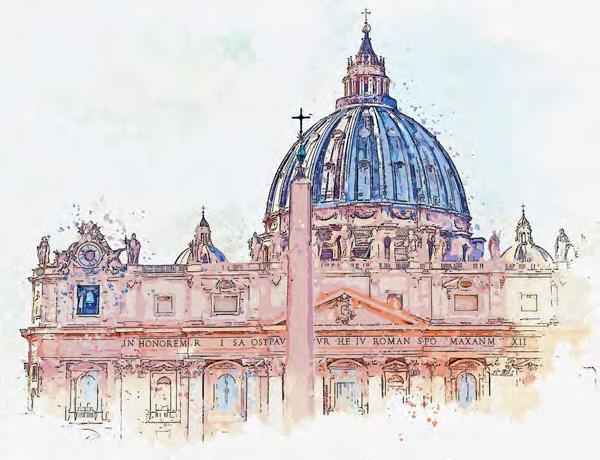
Artwork: The Vatican, pen & ink, by Getty Images
What does this look like on a daily basis? I’m sure that most of you have heard about the senseless killing of the Catholic priest in Seneca, KS. Fr. Raj “Arul” Carasala was shot and killed outside his rectory. When I first heard the news, I called Archbishop Joseph Naumann, of Kansas City in Kansas. He was in the car, on his way to the parish for Mass. He told me that on the day of his
death, Fr. Raj had visited the homebound to bring Holy Communion, then went to the school to teach, and in the afternoon, before his death, he had gone to the local hospital to visit some of his parishioners. He was doing what priests do. And in that sense, he was ready to meet Our Lord on that fateful day. In an interview, Archbishop Naumann said Fr. Carasala was a devoted and zealous pastor who faithfully served: “His love for Christ and His Church was evident in how he ministered to his people with great generosity and care.” May his example inspire each priest in his ministry today.
O Sacrament Most Holy, O Sacrament Divine, all praise and all thanksgiving, be every moment Thine. Christ is Risen: Alleluia! ©TM

Because of the death of Pope Francis, a great deal of scheduled content has been delayed, including the launch of The Mirror’s yearlong 60th anniversary! Keep your eyes peeled for that series to begin soon!


Fr. Tomasz Wilk
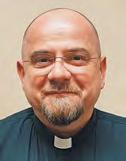
Fr. Tomasz Wilk will celebrate the 20th anniversary of his priesthood ordination on May 28. He serves at St. Augustine Parish, Kelso, and St. Joseph Parish, Scott City. Happy Anniversary, Fr. Wilk!
Statement from The Most Rev. Edward M. Rice on the passing of our Holy Father, Pope Francis - April 21, 2025
As we enter into the joy of the Easter Season, our sorrow at the death of Pope Francis Is tempered by the promise of eternal life won through the victory of Jesus. As Pope Francis stated in his Bull for the Jubilee Year of Hope, “Hope is born of love and based on the love springing from the pure heart of Jesus upon the cross.” And when we stand at the foot of the cross, “Beyond the darkness we glimpse a light: the power flowing from Christ’s cross and resurrection.”
We are grateful for his total dedication to the service of the Church as our Chief Shepherd. To the very end, on Easter Sunday, he made an appearance at St. Peter’s Square to offer his “urbe et orbi blessing,” “to the city and the world,” blessing the crowds gathered for Easter Sunday.
In his Easter message, he highlighted, “those experiencing pain and sorrow, your silent cry has been heard and your tears have been counted; Not one of them has been lost! In the passion and death of Jesus, God has taken upon himself all the evil in this world and in his infinite mercy has defeated it… That is why, today, we can joyfully cry out: ‘Christ, my hope, has risen!’”
To the very end, Pope Francis was a champion of hope!
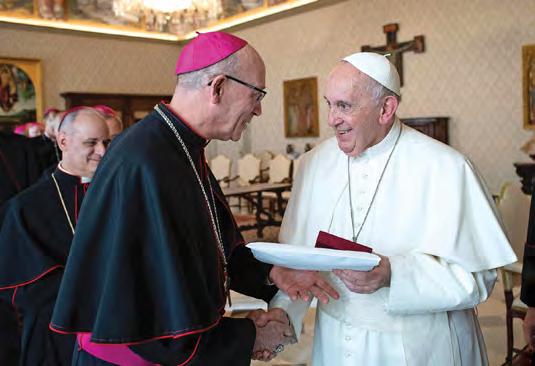
‘AD LIMINA APOSTOLORUM’ (‘TO THE THRESHOLD OF THE APOSTLES’)—Bishop Edward M. Rice greets Pope Francis during the Ad Limina visit for US Episcopal Region IX on Jan. 12-18, 2020. The Ad Limina visit is one that each bishop is regularly required to make to Rome, where he meets personally with the pope and with various officials of the Roman Curia. The visit originated in pilgrimages made by bishops of the Roman province to the threshold of the tombs of the two great apostles: Peter and Paul, for their veneration. Six months prior to his ad limina visit, the diocesan bishop submits to the Holy See a report on the state of the diocese. Episcopal Region IX of the United States includes (arch)bishops in Iowa, Kansas, Missouri, and Nebraska. (Courtesy Vatican Media)
For years to come, we will be challenged by his images of the Church being a “field hospital;” a Church for the poor and of the poor, reaching out to those in the periphery, those who are forgotten. He challenged us to not just work on behalf of the poor but to “Look them in the eye and talk to them.” His love for the poor was obvious, similar to that of St. Lawrence the Martyr in the early Church, who presented the poor as the greatest treasure. He was concerned for the immigrant and the refugee, holding up the Holy Family as a symbol of refugees.
We, in southern Missouri, in a more rural setting, appreciated his concern for the environment and the care of creation where so many of our people: farmers, ranchers and outdoor enthusiasts depend upon nature for their livelihood.
As we honor his memory and pray for the repose of his soul, we commend him to almighty God. Eternal rest grant unto him O Lord and perpetual light shine upon him. May he rest in peace. Amen, Allelujah!

By Bishop Emeritus John J. Leibrecht
Before his retirement in 2008 as the Fifth Bishop of the Diocese of Springfield-Cape Girardeau, Bishop John Leibrecht wrote a standing column in The Mirror entitled, “Walking Together.” At the end of each article, Bp. Leibrecht would normally share a funny story referencing his travels to the schools, or time with friends, family, or other bishops. The Mirror has decided to share a few of these in an ongoing series entitled, “Another walk through: ‘Walking Together.’” We hope you enjoy them.
March 5, 1993 I celebrated Mass with school children on the Feast of the Chair of St. Peter, Feb. 22. In my homily, I talked about St. Peter being the first pope. I then asked, “Can anyone tell me the name of our present pope?” A small boy immediately put up his hand and said very decisively, “Bill Clinton!”
March 12, 1993 Master of ceremonies: “Our speaker tonight needs no introduction. I’m told; however, he often needs a conclusion.”
March 19, 1993 “Do you believe in life after death?” the boss asked one of his employees. “Yes, sir,” he replied. “Then everything’s fine,” the boss said. “An hour after you left yesterday afternoon to go to your grandfather’s funeral, he stopped in to see you.”
By Carol Glatz Vatican City (CNS)
Pope Francis died April 21 after suffering a stroke and heart attack, said the director of Vatican City State’s department of health services. The pope had also gone into a coma.
“I certify that His Holiness Francis, Jorge Mario Bergoglio, born in Buenos Aires, Argentina, on December 17, 1936, resident of Vatican City, Vatican citizen, passed away at 7:35 a.m. on 4/21/2025 in his apartment at the Domus Sanctae Marthae, Vatican City, from: cerebral stroke, coma, irreversible cardiovascular collapse,” said the statement, signed by the director, Dr. Andrea Arcangeli, and published by the Vatican press office.
The doctor said the pope also had a history of: “a previous episode of acute respiratory failure due to polymicrobial bilateral pneumonia; multiple
bronchiectases; arterial hypertension; and type II diabetes.”
A heart monitor or ECG was used to ascertain his death, that is, that there was no longer any heart activity, he wrote on the signed declaration.
The doctor also read the statement aloud during a special prayer service that began at 8 p.m. local time April 21 in the late pope’s residence, the Domus Sanctae Marthae.
U.S. Cardinal Kevin J. Farrell, chamberlain of the Holy Roman Church, presided over the rite, which included the formal verification of the pope’s death, the placement of his body in a coffin, and its transfer to the chapel on the first floor of his residence. The pope died in his third-floor apartment at 7:35 a.m. April 21.
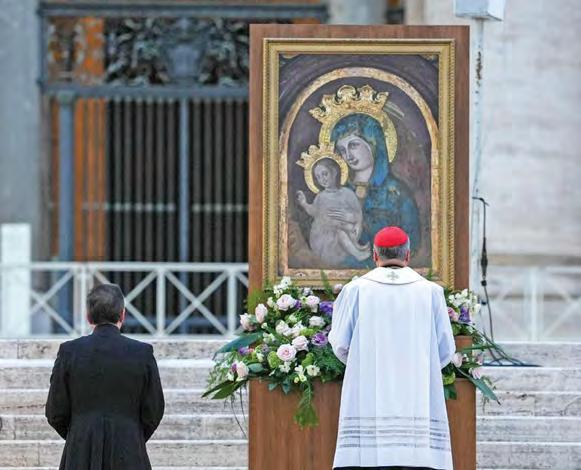
ROSARY FOR DECEASED POPE FRANCIS—Cardinal Mauro Gambetti, archpriest of St. Peter’s Basilica, prays before the icon of Mary, Salus Populi Romani, at the conclusion of a rosary for the repose of the soul of Pope Francis in St. Peter’s Square at the Vatican April 21, 2025 (CNS photo/Lola Gomez)
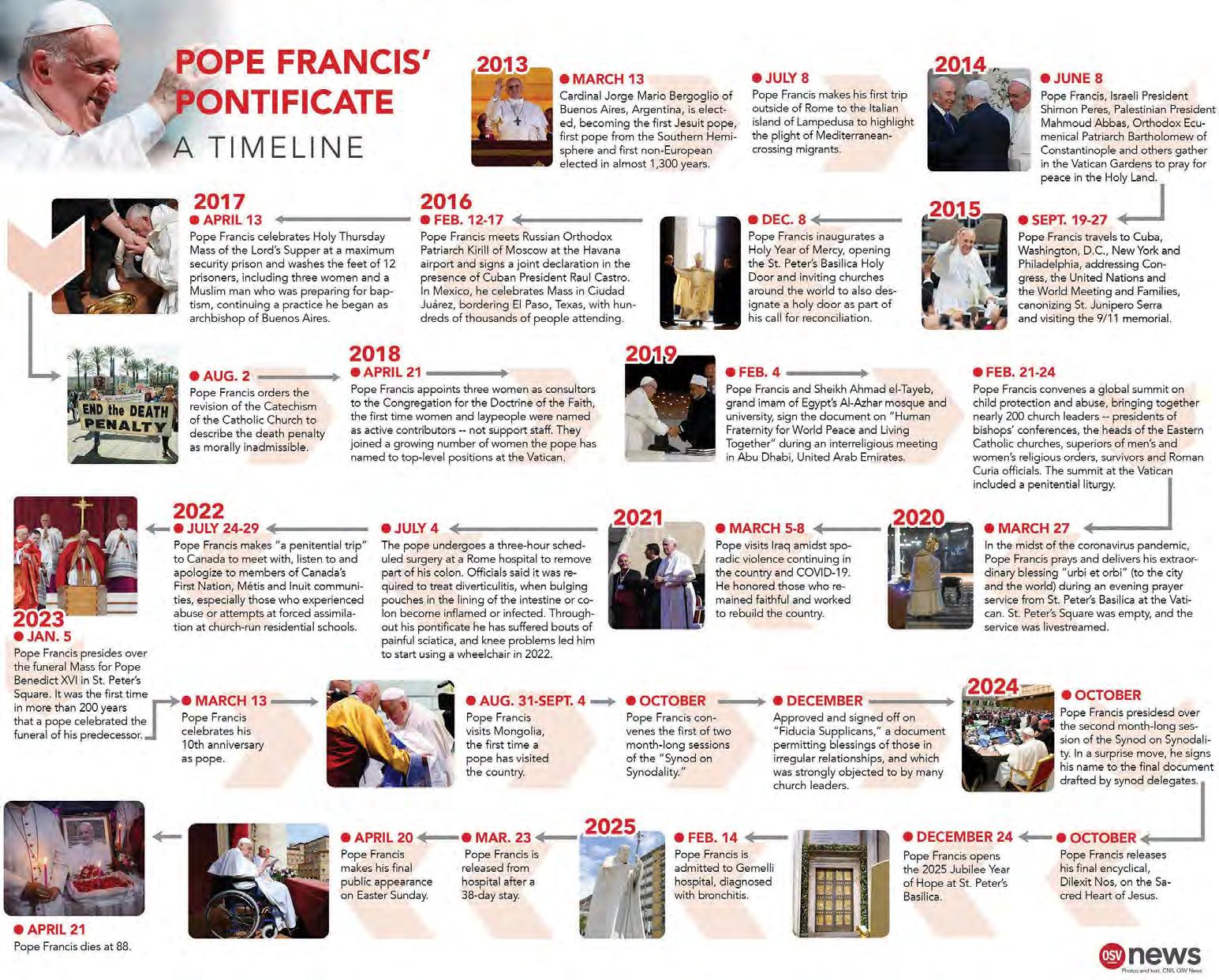
The former Cardinal Jorge Mario Bergoglio of Argentina was elected pope on March 13, 2013. He was the 266th pope and the first from Latin America. He was the first pontiff to take the name Francis.
It is with great sadness that we learn of the passing of our beloved Holy Father Pope Francis who died April 21st in Rome.
As the Church enters into its Nine (9) days of mourning, let us thank God for Pope Francis and his service to the people of God along with prayers for the repose of his soul.
Check with your local parish for opportunities for the rosary, Mass, Adoration, and the pealing of the church bells in remembrance of Pope Francis. May his soul, and the souls of all the faithful departed, by the light of the Resurrection and the mercy of God, rest in peace.
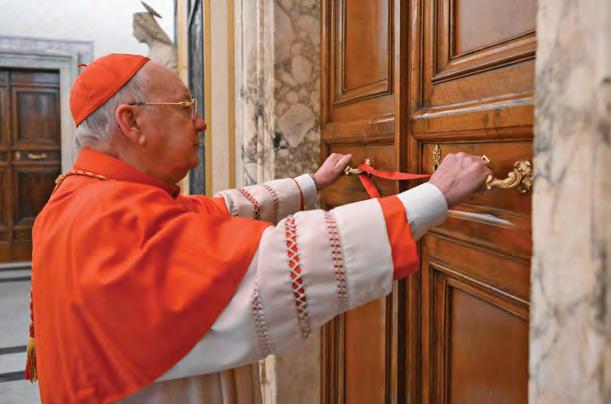
Others present at the closed-door ceremony included Cardinal Giovanni Battista Re, dean of the College of Cardinals; the late pope’s aides, assistants and members of the papal household; Dr. Arcangeli; and Dr. Luigi Carbone, deputy director of the Vatican’s health department and the pope’s personal physician.
This was the first of three rites that are divided into three “stations” based on the place they occur: “at home, in the Vatican basilica and at the burial place,” according to the “Ordo Exsequiarum Romani Pontificis” (“Funeral Rites of the Roman Pontiff”). There will be separate services for transferring the body to St. Peter’s Basilica, the funeral, the burial and the memorial Masses that follow the funeral for the next eight days.
The Vatican press office confirmed that,
according to instructions guiding what happens after the death of a pope, the funeral and burial should take place “between the fourth and sixth day after death,” which would be between April 25 and 27.
The exact date will be determined at a meeting of all the cardinals able to reach the Vatican immediately after the papal death. The first meeting was being held at 9 a.m. April 22 in the Vatican Synod Hall.
The press office said the coffin would probably be brought to St. Peter’s Basilica April 23 for public viewing and prayer before the funeral. Instead of lying on a catafalque, that is, a kind of decorated platform, the body will be placed inside a zinc-lined coffin, which will remain open until the night before the funeral, which will be celebrated by Cardinal Re. ©OSV News
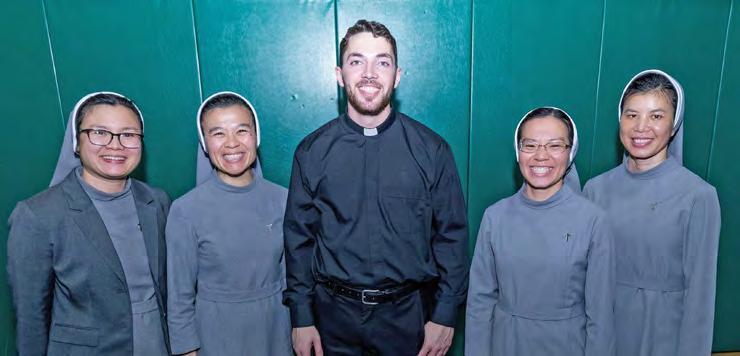
oin Bishop Rice on the First Friday of each month to pray for an increase in Vocations to the priesthood and religious life in the Diocese of SpringfieldCape Girardeau. The Rosary will be prayed following the liturgy. Parishes are invited to do the same as we continue to pray for more vocations to the priesthood and religious life in the diocese.
Fri., May 2
O’Reilly Catholic Student Center, Springfield 12:15 p.m.
Fri., June 6 St. Agnes Cathedral, Springfield 5:30 p.m.
Fri., July 4 St. Agnes Cathedral, Springfield 9 a.m.
Aurora—Holy Trinity Parish will have First Saturday devotion to the Blessed Virgin Mary, every first Saturday with a rosary at 7:30 a.m., followed by Mass at 8 a.m.
Buffalo—St. William Parish will have its 45th Annual Yard, Plant & Bake Sale, Thu., May 15, 8 a.m.-4 p.m., and Fri., May 16, 8 a.m.-4 p.m., in the church hall, located at 404 N. Locust St.
Glennon—St. Anthony Mission Church will have its Annual Spring Dinner, Sun., May 4, 11 a.m.-1:30 p.m., in the parish hall. Kettle beef, dumplings, dressing, and all the trimmings, dessert & drink included. Cost: $14-adults; $8-children, ages 6-12 yrs.), under age 5-free.
Jackson—St. Ann’s Sodality/CCW will have its Rummage & Plant Sale, Fri., June 6, 7 a.m.-5 p.m., and Sat., June 7, 7 a.m.-1 p.m., in the school gymnasium at Immaculate Conception Church. Lots of Nice Stuff at a Nice Price!
Kimberling City—Our Lady of the Cove Catholic Church will have its Spring Garage Sale, Fri., May 9, 8 a.m.-2 p.m,. and Sat., May 10, 8 a.m.Noon. Clothing, furniture, appliances, tools, and much more. Something for everyone! For more information, call the church office at (417) 739-4700.
Leopold—St. John’s PCCW will have its Annual Rummage Sale, Thu., May 8, 7 a.m.-6 p.m.; Fri., May 9, 7 a.m.-6 p.m.; and Sat., May 10, 7-11 a.m., in the Knights of Columbus Hall. Proceeds will benefit activities of the organization. For questions answered, call Geri Geringer at (573) 208-6445.
Marshfield—The Parish Council of Catholic Women will hold a Donation Drive, Sun., April 27, 12-3 p.m.; Mon.,
April 28, 8 a.m.-3 p.m., and Tue., April 29, 8 a.m.-3 p.m., for their Rummage Sale to be held Thu., May 1, 7 a.m.-5 p.m.; Fri., May 2, 8 a.m.-5 p.m.; and Sat., May 3, 8-11 a.m. No televisions, computers, exercise equipment, tires or chemicals can be accepted. Proceeds from the sale benefit the activities of the organization, including Catholic Charities of Southern Missouri, Vitae Foundation, Missouri Right to Life, and many others.
Sikeston—The Catholic Grandparents Association will sponsor Vacation Bible School: The Great Journey With Jesus, June 23-27, 8:30-11:30 a.m., grades K-5 in STFX school. For more information, please call Karen at the Church office, (573) 471-2447.
Springfield—Sacred Heart Parish will hold its Annual Trivia Night, Sat., May 3, doors open at 5 p.m., Trivia begins at 6 p.m. Cost: $15 donation/person, hot dogs & burgers, chips, dessert and drink are included. Get your teameight per table, and plan to join us for a fun-filled evening. Proceeds to benefit the PSR program and Lector workbooks. Reserve your table by contacting the parish office at (417) 869-3646.
Springfield—Catholic Charities of Southern Missouri (CCSOMO), in partnership with Knights of Columbus Council #13681, will hold its Charity Golf Tournament, Mon., June 23, at Fremont Hills Country Club, in Nixa, 12- Noon shotgun start. Proceeds to benefit LifeHouse of Springfield. Sponsorships and teams are available now. Register now at https://ccsomo. org/koc-golf-tournament/ for a day of fun, fellowship, and giving back!
Parishes and organizations are invited to submit notices of future events to be printed on a space-available basis. There is no fee.
Rev. Paul Pudhota, May 06, 33 yrs.
Rev. Matthew Rehrauer, May 08, 33 yrs.
The Very Rev. Shoby Mathew Chettiyath, JCL, V.G., May 09, 19 yrs.
The Very Rev. Jose Thundathil, CMI, May 12, 37 yrs.
Rev. Patrick Wissman, May 22, 61 yrs.
Rev. Michael McDevitt, May 22, 54 yrs.
The Very Rev. Lewis Hejna, May 24, 44 yrs.
Rev. Daniel Robles, May 24, 24 yrs.
Rev. Simon Enudu, May 25, 12 yrs.
Rev. Joseph Stoverink, May 26, 8 yrs.
Msgr. Thomas Reidy, May 27, 58 yrs.
Rev. Nicholas Newton, May 27, 3 yrs.
Rev. Jesse Hiett, May 27, 3 yrs.
Rev. Charles Peirano, May 27, 3 yrs.
Rev. Tomasz Wilk, May 28, 20 yrs.
Rev. David Baunach, May 28, 9 yrs.
Rev. Alexander Sutachan, May 28, 4 yrs.
Rev. David Dohogne, May 30, 33 yrs.
Rev. David Coon, May 30, 32 yrs.
Deacon Kevin Carroll, May 10, 17 yrs.
Deacon Michael Evers, May 20, 8 yrs.
Deacon Daniel Vaughn, May 24, 11 yrs.
Deacon James Farrar, May 26, 7 yrs.
Deacon Mark Kiblinger, May 26, 7 yrs.
Deacon Alvin Stoverink, May 26, 7 yrs.
Deacon James Long, Jr., May 28, 20 yrs.
Prices are all inclusive w/airfare from anywhere in the continental US.
Several trips to different destinations: Holy Land, Italy, Greece, France, Portugal, Spain, Lourdes & Fatima, Ireland & Scotland and much more...
We specialize in custom trips for Bishops, Priests & Deacons!
Currently hiring Deacons to promote our many pilgrimages. ATTRACTIVE compensation.
For more information contact: Karen@proximotravel.com
To register call 855-842-8001 or at www.proximotravel.com.
The Pillar
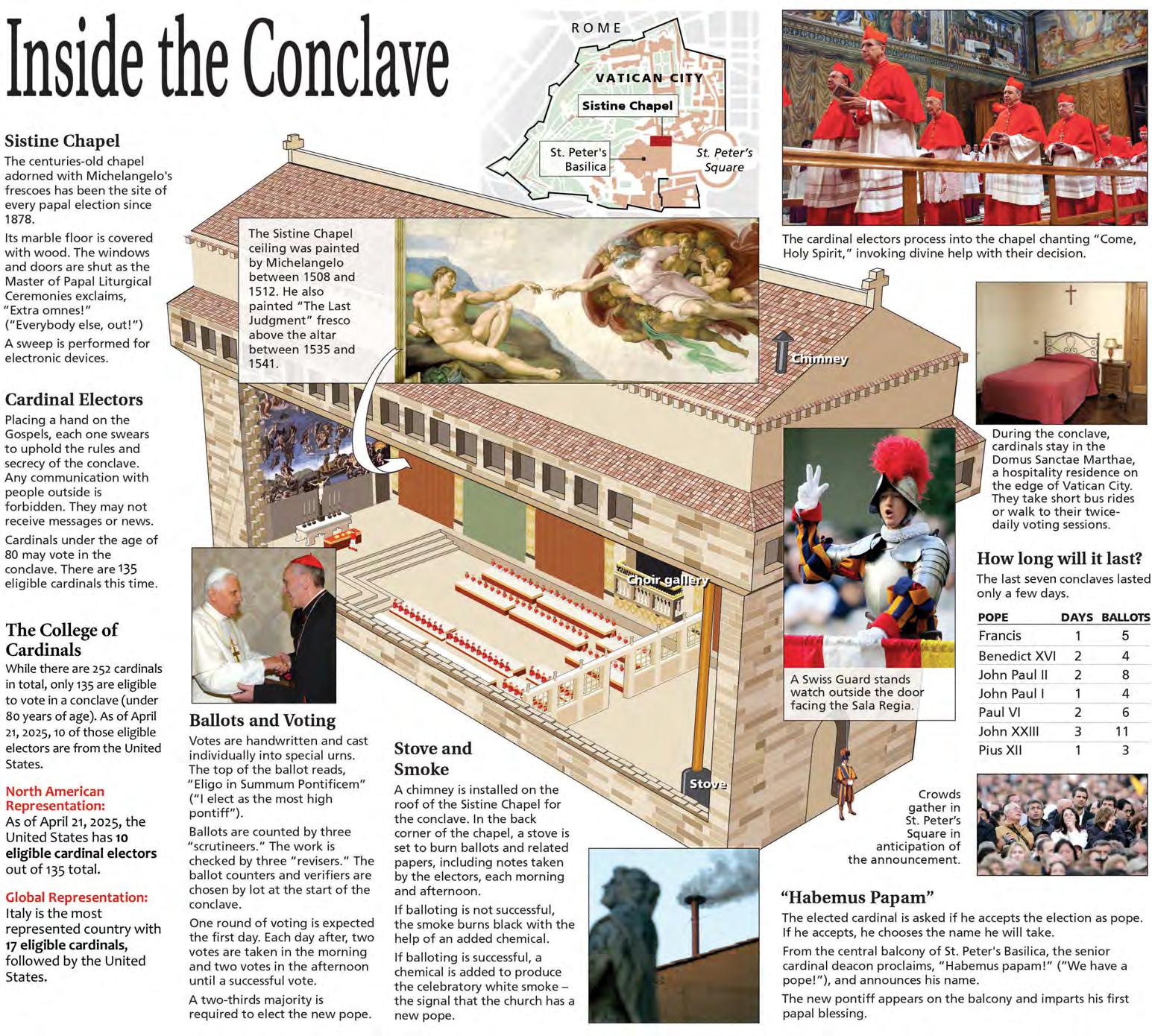
Following the death of Pope Francis on Monday, the See of Rome is vacant. The College of Cardinals are now making their way to Rome from around the world, where they will, in due course, meet in conclave to elect the next successor of St. Peter.
When that happens, they will meet, deliberate, and vote according to a detailed set of laws governing the process. But in the meantime, there are a lot of things that will happen first — and even without a pope the life of the Church continues.
So what happens now, and who is in charge?
The Pillar explains.
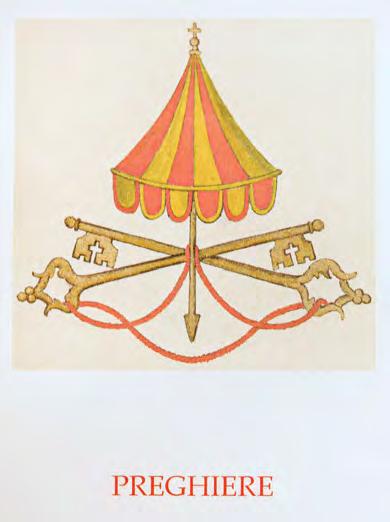
While Pope Francis died on Monday, and was pronounced dead by his doctors, the formal pronouncement of his death will be made after the body had been moved to the papal chapel in the Vatican, by Cardinal Kevin Farrell, the Camerlengo of the Holy Roman Church.
Cardinal Farrell is in turn responsible for informing the Cardinal Vicar of the Diocese of Rome, who in turn has the responsibility to “inform the People of Rome by a special announcement” of the death of their bishop.
In line with the norms of the apostolic constitution Universi Dominici Gregis, the announcement of the pope’s death is made separately to the diplomatic corps accredited to the Holy See and to the heads of their respective nations by the Dean of the College of Cardinals, Cardinal Giovanni Battista Re.
The camerlengo has the job of sealing the papal apartment in the Domus Sanctae Marta Guest house, where Francis chose to live after his election, along with the pope’s private study, and securing his personal papers.
Farrell also has the job of formally taking possession of the Apostolic
Palace, the Lateran Basilica, and Castel Gandolfo.
And it is the camerlengo who will — within carefully defined limits — become the effective chief executor of the Church until the next pope is elected.
Most immediately, it is the camerlengo’s job, in consultation with the most senior cardinals of the college’s three ranks, to make all the decisions and arrangements regarding the pope’s funeral — in line with the existing liturgical norms for the event and any directions left by Francis himself for his own burial.
The Church will have to wait to see if there are any special provisions Francis may have made for his own funeral, but late last year he approved a number of changes to the papal funeral rites, including that his body be placed immediately inside a coffin for the faithful to venerate, instead of the customary litter on which previous popes have laid in St. Peters.
Francis did away with the customary triple coffins of cypress, lead, and oak in which popes have previously been buried, opting for a simpler single coffin, and he also made it known he wished to be buried in the papal basilica
of St. Mary Major in Rome, not in St. Peter’s basilica in the Vatican.
The camerlengo is responsible for deciding by whom, and under what circumstances, the pope’s body can be photographed following his death.
Strictly speaking, the law says that “no one is permitted to use any means whatsoever in order to photograph or film the Supreme Pontiff either on his sickbed or after death, or to record his words for subsequent reproduction.”
Policy does give the camerlengo the final say over photos taken after death “for documentary purposes,” but he cannot “permit the taking of photographs of the Supreme Pontiff except attired in pontifical vestments.”
The period for the official funeral rites for the repose of the pope’s soul — the Church’s formal period of official mourning — lasts for nine days, with the pope to be buried within six days of his death.
The basic rule of law in the Church after the pope has died is that, until the new pope is elected, the College of Cardinals together exercise authority in the Church and provide for its necessary
governance, but “solely for the dispatch of ordinary business and of matters which cannot be postponed.”
But, and it is a big but, “the College of Cardinals has no power or jurisdiction in matters which pertain to the Supreme Pontiff during his lifetime or in the exercise of his office; such matters are to be reserved completely and exclusively to the future Pope.”
While the see is vacant, no big decisions can be made and nothing the previous popes have decreed can be changed.
Of course, while nothing big can be changed without a pope, the life of the Church doesn’t stop entirely. For this reason, a small number of senior Church officials continue in office, even if there is no pope, including the camerlengo and the Vatican’s major penitentiary — responsible for dealing with the forgiveness of reserved sins.
Most others — including the cardinal secretary of state and the prefects of the curial departments together with the members of those Dicasteries — cease to exercise their office, though the sostituto of the Secretariat of State, the Secretary for Relations with States and the secretaries of the Dicasteries of the Roman Curia all remain in charge of their respective offices, and are responsible to the College of Cardinals.
However, they can only use their faculties “for the granting of favours of lesser importance, while more serious or controversial matters, if they can be postponed, shall be exclusively reserved to the future pope.”
The camerlengo, meanwhile, “in the name of and with the consent of the College of Cardinals,” deals with “all matters that circumstances suggest for safeguarding the rights of the Apostolic See and for its proper administration.”
Similarly, “all the civil power of the Supreme Pontiff concerning the government of Vatican City State belongs to the College of Cardinals,” though “unable to issue decrees except

in cases of urgent necessity.”
From the moment when the pope is officially pronounced dead, the cardinal electors — those under 80 who are eligible to vote in a conclave — have fifteen full days to get to Rome, though the College of Cardinals can defer “for serious reasons” the beginning of the election for a few days more if they need to.
Either way, within a maximum of 20 days the conclave has to begin.
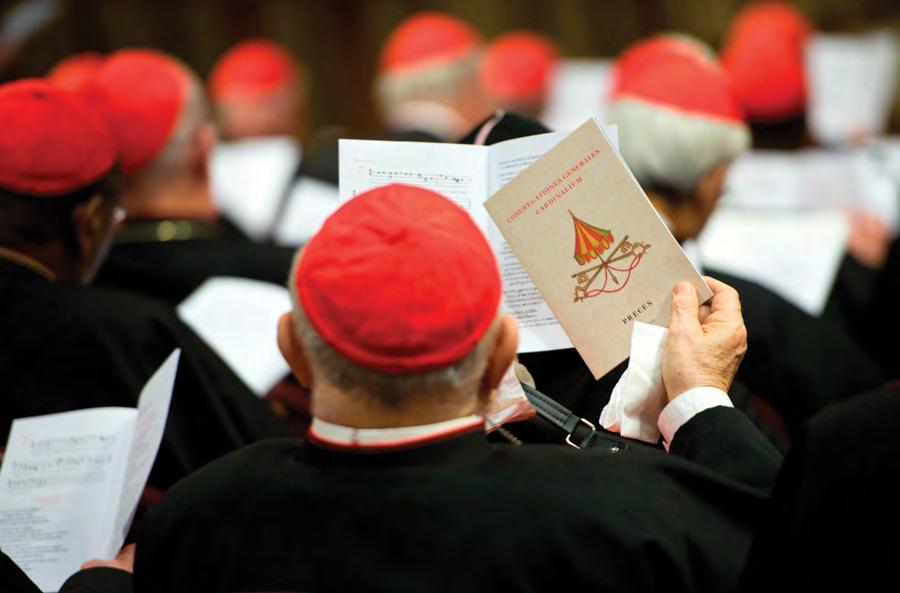
Prior to that, however, the whole College of Cardinals, including those members over 80 years of age, meet in what are called “general congregations.”
expenses for running the Vatican until the next pope is elected, and arrange for the destruction of the Fisherman’s Ring and seal with which Francis authorized legal acts.
The congregations are meetings of the full college, presided over by the dean of the college, and are held daily, beginning on the day chosen by the camerlengo, together with the senior cardinal of voting age from each of the three ranks of the college.
These preparatory congregations are held daily, and among the things they have to decide are when and how the pope’s body will be displayed for “the homage of the faithful” and to make the necessary funeral arrangements — with the pope to be buried between the fourth to sixth day after his death
These general congregations are also responsible for reading and dealing with any documents left for the College of Cardinals by the pope, approve
The cardinals will also select two people known for “sound doctrine, wisdom and moral authority” to present meditations to the cardinals on the problems facing the Church and on the need for careful discernment in choosing the next pope. While these general congregations are meeting, and the cardinals are “meditating” among themselves on who the next pope might be, there are also regular meetings of what canon law calls
“particular congregations,” which are basically executive subcommittees charged with approving the ordinary business of the global Church or Vatican affairs as needed.
The particular congregations are led by the camerlengo, who together with three cardinals chosen by lottery from among each of the three ranks of the college, decide on “questions of lesser importance which arise on a daily basis” — anything major goes to the full general congregation for a majority vote.
Three new cardinals are picked at random every three days until the conclave starts, at which point the governance of the Church shifts from the whole college to the assembly of cardinal electors — the cardinals under 80 — in the conclave, who continue to select three of their number by random
to serve on the particular congregations.
While ordinarily the assembly of cardinal electors would be presided over by the dean, because the current dean and subdean are both too old to participate in a conclave, the assembly is led by the senior cardinal-bishop eligible to vote — Cardinal Pietro Parolin.
Conclave, but not like in the movies
After fifteen days have passed since the death of the pope — unless the College of Cardinals votes to extend it by an extra five — the conclave begins, with the cardinal electors moving into the Domus Sanctae Marta guest house and celebrating a Mass Pro Eligendo Papa and then entering a communications blackout (hopefully) as they repair to the Sistine Chapel to vote.
Since the dean is older than 80, the votes will be chaired by Cardinal Parolin, who will also administer oaths of secrecy and sincerity from the cardinal electors.
Also allowed into the conclave, although they are not eligible to vote, are an assistant chosen by Parolin, the secretary of the College of Cardinals, who acts to secretary of the electoral assembly; the master of papal liturgical celebrations along with two masters of ceremonies and two religious attached to the papal sacristy.
Otherwise, only the cardinals under 80 are allowed in — and those who have lost or resigned their right to participate under Pope Francis (like Cardinal Angelo Becciu) cannot be rehabilitated by the college after his death.
If a cardinal elector doesn’t, for whatever reason, make it to Rome in time for the start of the conclave, it begins without him and he is to be admitted when he does get there.
But, the plots of recent Oscar-bait movies notwithstanding, cardinals named secretly by the pope, in pectore, are not eligible to participate, unless the pope made their appointments known
publicly before his death.
After Mass on the morning it begins, the conclave formally gets underway after a final mediation is given to the electors and the doors to the Sistine Chapel are shut.
The electors vote once on the first afternoon, and four times a day — twice in the morning and twice in the afternoon — on the succeeding days, with a two-thirds majority needed to elect a pope.
If no one is elected after the first three days of voting, the cardinals break for a day of prayer and reflection. They are encouraged to have “informal discussion” among themselves and “a brief spiritual exhortation” is to be given by the senior cardinal in the Order of Deacons — Cardinal Dominique Mamberti, the chief judge of the Church’s supreme canonical court.
The cardinals then vote for another seven ballots, with another break if there is no result.
In the event of a deadlock after 33 rounds of voting, there’s a run off.
While Pope St. John Paul II created the option for the cardinals to elect a pope by simple majority, Benedict XVI did away with that. He instead decided that if there was no pope after 33 rounds, the top two vote-getters would go into a run off.
Once there is a two-thirds result — and a pope is elected, things move fast.
The senior cardinal — Cardinal Parolin — asks the one elected if he accepts his election.
From the moment he says “yes,” the man has the office.
From his yes, he “is immediately Bishop of the Church of Rome, true Pope and Head of the College of Bishops,” according to canon law.
He “acquires and can exercise full and supreme power over the universal Church,” and the conclave ends immediately — unless the new pope says otherwise. After all — at that point, he’s in charge. ©The Pillar, used with permission
In the Name of the Most Holy Trinity. Amen.
As I sense that the twilight of my earthly life is approaching, and with firm hope in Eternal Life, I wish to express my final wishes regarding my burial place.
I have always entrusted my life and priestly and episcopal ministry to the Mother of Our Lord, Mary Most Holy. Therefore, I ask that my mortal remains rest, awaiting the day of resurrection, in the Papal Basilica of Saint Mary Major.
I wish that my final earthly journey conclude precisely in this ancient Marian shrine, where I go to
pray at the beginning and end of every Apostolic Journey to faithfully entrust my intentions to the Immaculate Mother and to give thanks for her gentle and maternal care.
I ask that my tomb be prepared in the burial niche in the side nave between the Pauline Chapel (Chapel of the Salus Populi Romani) and the Sforza Chapel of the aforementioned Papal Basilica, as indicated in the enclosed plan.
The tomb should be in the ground; simple, without particular ornamentation, and bearing only the inscription: Franciscus.
The expenses for the preparation of my burial will be covered by a sum
provided by a benefactor, which I have arranged to be transferred to the Papal Basilica of Saint Mary Major. I have given the appropriate instructions to Msgr. Rolandas Makrickas, Extraordinary Commissioner of the Liberian Chapter.
May the Lord grant the deserved reward to those who have wished me well and will continue to pray for me. The suffering that marked the final part of my life, I offer to the Lord, for peace in the world and brotherhood among peoples.
Domus Sanctae Marthae, 29 June 2022. Daily Bulletin of the Holy See Press Office, 21 April 2025
By Cindy Wooden Vatican City (CNS)
Centuries of experience dealing with the death, or occasional resignation, of a pope has left the Catholic Church with thorough instructions detailing who has responsibility for planning the funeral, preparing for the election of a new pope and taking care of essential business in the meantime.
The instructions are found in St. John Paul II’s 1996 apostolic constitution, “Universi Dominici Gregis,” which was revised by Pope Benedict XVI in 2007 and again just before he resigned in 2013.
The funeral and burial of a pope who dies in office should take place “between the fourth and sixth day after death,” the document said. The exact date is determined at a meeting of all the cardinals able to reach the Vatican immediately after the papal death.
The cardinals also determine when the conclave to elect a new pope should begin, although Pope Benedict’s update of “Universi Dominici Gregis” states that it should be at least 15 days from the death or resignation of the pope and can be no more than 20 days since the vacancy of the papacy.
An earlier start is possible, he said,
“if it is clear that all the cardinal electors are present.” Cardinal electors are those who were under the age of 80 on the day the pope died or resigned.
The funeral marks the start of a mandated nine-day period of official mourning. For the next eight days other memorial Masses are celebrated in St. Peter’s Basilica. The nine-day period is known as the “novendiales.”
With the death of a pope, most toplevel Vatican officials -- including the prefects of dicasteries -- lose their jobs, but that does not mean most Vatican employees get time off. Regular business continues with dicastery secretaries overseeing the steady flow of paperwork, correspondence and meeting planning.
However, the publication of documents, the nomination of new bishops and the approval of statutes for Catholic universities and religious orders are suspended. Anything that must be issued in the name of the Vatican or in the name of the pope must await the election of a new pope and the re-confirmation or appointment of prefects for the various offices.
The two senior Vatican officials who retain their titles and responsibilities are the “camerlengo” or chamberlain, currently U.S. Cardinal Kevin J. Farrell, whose job begins in earnest when a
ABenedictine abbot and a Capuchin cardinal will offer spiritual meditations on the needs of the Catholic Church to the cardinals preparing to elect a new pope, according to the Vatican press office.
Benedictine Fr. Donato Ogliari, abbot of St. Paul Outside the Walls in Rome, will offer the first meditation soon after Pope Francis’ funeral April 26, said Matteo Bruni, director of the Vatican press office.
Cardinal Raniero Cantalamessa, the retired preacher of the papal household, will offer the second meditation inside the Sistine Chapel before members of the conclave begin to vote. Because Cardinal Cantalamessa is 90 years old, he is not eligible to participate in the voting.
The meditations should focus “on the problems facing the Church at the time and on the need for careful discernment in choosing the new Pope,” according to the apostolic constitution, “Universi Dominici Gregis,” containing the rules for running the Church between the death or resignation of a pope and the election of a new one.
The two prelates were chosen April 24 during the third “general congregation,” the title for the daily meetings of cardinals before the conclave
pope dies or resigns, and the head of the Apostolic Penitentiary, Cardinal Angelo De Donatis. The Apostolic Penitentiary is a Vatican court dealing with matters related to the sacrament of confession and to indulgences, so keeping him in office ensures the possibility of absolution for penitents guilty of serious sin and seeking forgiveness.
“Universi Dominici Gregis” also specified that “the almoner of His Holiness will also continue to carry out works of charity in accordance with the criteria employed during the pope’s lifetime.” That position is held by Cardinal Konrad Krajewski, who also is prefect of Dicastery for the Service of Charity.
Everything having to do with the funeral and with preparations for the conclave to elect Pope Francis’ successor belongs to the College of Cardinals.
The rites and rituals used -- from the formal verification of the pope’s death to the eight memorial Masses after the funeral -- are published in the “Ordo Exsequiarum Romani Pontificis”
begins. As of April 24, the cardinals had not decided what day the conclave would begin.
Bruni said 113 cardinals participated in the meeting April 24. Cardinals who arrived in Rome after the April 23 general congregation took their oaths at the beginning of the meeting.
Cardinals are obliged to “promise, pledge, and swear, as a body and individually, to observe exactly and faithfully all the norms” governing the period between the death of a pope and the election of a new one, and “to maintain rigorous secrecy with regard to all matters in any way related to the election of the Roman Pontiff.”
(“Funeral Rites of the Roman Pontiff”), originally approved by St. John Paul II in 1998, but published only the day after his death in 2005.
In late 2024, the Vatican released a newer, simplified version on the orders of Pope Francis.
The physician who directs the Vatican health care service provides a civil certification of the pope’s death, including its cause.
But the ritual verification of the pope’s death takes place in the chapel of his residence and is presided over by the chamberlain, assisted by the dean of the College of Cardinals, the master of papal liturgical ceremonies and the physician.
If it ever was a custom to use a silver hammer to tap on the newly deceased pontiff’s forehead to make sure he is
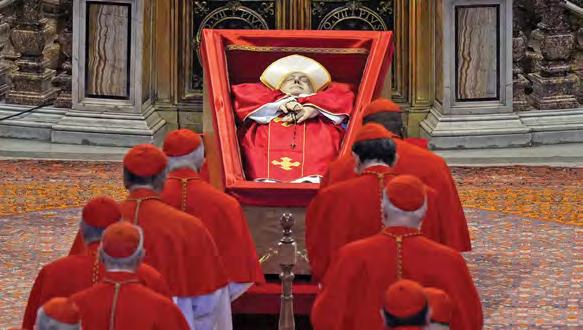
CARDINALS MOURN POPE FRANCIS—Cardinals process past the body of Pope Francis as he lies in state in an open casket in front of the Altar of the Confession in St. Peter’s Basilica at the Vatican April 23, 2025. The pope will lie in state for three days of public viewing and prayer ahead of his funeral Mass April 26. The upcoming conclave to elect a successor will begin no earlier than May 5. (CNS photo/Lola Gomez)
The College of Cardinals currently has 252 members. The 117 cardinals who are ineligible to vote, mainly because of age, are still invited to participate in the general congregations. Bruni said he did not know how many of the 113 present April 24 were cardinal electors. And while many of the cardinals still had not reached Rome, the cardinals began their discussions of the needs of the Church and the world, with 34 cardinals speaking, Bruni said.
As they entered the Vatican to participate in a series of meetings leading up to the election of Pope Francis’ successor, several cardinals spoke to the media, emphasizing that they are still mourning the Argentine pontiff—not yet choosing his successor. “We are not yet speaking about the conclave or the
succession; we are still speaking about Pope Francis, we are still crying for Pope Francis,” said Cardinal Jean-Paul Vesco, archbishop of Algiers, Algeria. He was among the last cardinals created by the late pontiff, in December 2024.
Starting at 8 a.m. Rome time April 24, the cardinals already in the city for the funeral—and soon, the conclave to elect Pope Francis’ successor—made their way to the Synod Hall, a room within the Vatican grounds. There, the general congregations— closed-door meetings of the College of Cardinals— will take place until the conclave begins, no earlier than May 5. ©CNS
dead, it is a long disused practice.
The chamberlain also is responsible for placing seals on the pope’s study and bedroom and officially notifying the cardinal vicar for Rome and the archpriest of St. Peter’s Basilica.
Before the conclave, all the cardinals -- including those over 80 -participate in “congregations.”
The “general congregation,” with all the cardinals, handles “important matters,” according to “Universi Dominici Gregis,” while “questions of lesser importance which arise on a daily basis or from time to time” are handled by the “particular congregation.”
The document says the cardinals draw lots to determine the three
cardinals who will assist the camerlengo by serving three-day terms as members of the “particular congregation.”
However, Pope Francis’ apostolic constitution on the Roman Curia, “Praedicate Evangelium,” said that “one of these is the Cardinal Coordinator of the Council for the Economy,” currently German Cardinal Reinhard Marx of Munich and Freising.
The general congregation meets under the leadership of the dean, Cardinal Giovanni Battista Re, and besides setting the date for the funeral and for the conclave, it is responsible for:
• Ensuring that a commission of their members prepares the Domus
Sanctae Marthae, the Vatican residence where Pope Francis lived, for the cardinals during the conclave. Rooms will be assigned by lot.
• Preparing the Sistine Chapel for the election of a new pope.
• Assigning two clerics “known for their sound doctrine, wisdom and moral authority” to prepare meditations for the cardinals on problems the church faces and on choosing the next pope.
• Approving the expenditures associated with the death of the pope.
• Arranging for the destruction of the
papal fisherman’s ring and the lead seal that had marked Pope Francis’ letters.
Although not as secret as the conclave, the cardinals and those assisting them at the meetings of the general congregation take an oath of secrecy regarding “all matters in any way related to the election of the Roman Pontiff or those which, by their very nature, during the vacancy of the Apostolic See, call for the same secrecy.”
During the general congregation meetings, the cardinals have the services of translators working in Italian, Spanish, English, French and German, as well as ushers and other aides. ©CNS
By David Agren OSV News
Cardinal Jorge Mario Bergoglio of Buenos Aires made history with his election on March 13, 2013, becoming the first Argentine and first Latin American to become Pope.
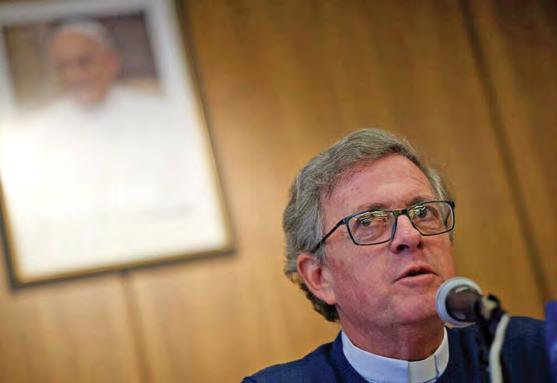
As Pope Francis died in the Vatican April 21 at 88, it was in his Archdiocese of Buenos Aires, where now-Archbishop Jorge García Cuerva remembered him as “the pope for all” and the “the pope of the poor.” The archbishop also remembered him as the pope for all Argentines and exhorted the country to remember their late countryman as a figure of unity in a divided nation.
“Now we’ll have to be a little bit like Francis and also be more merciful to one another. I think the best tribute we Argentines can pay to Francis is to unite. The best tribute we can pay him is to build bridges, to engage in dialogue, to stop constantly confronting each other,” Archbishop García Cuerva said at a Mass celebrated at the Metropolitan Cathedral in Buenos Aires for Pope Francis.
“What greater pain for a father is there than to see his children divided. May Francis go to heaven with the peace of mind that his children will try to live the national unity between us that is still pending.”
The Argentine bishops conference added in an April 21 statement, “We thank God for the life, ministry and testimony of faith of someone who knew how to guide the universal Church with humility, evangelical firmness and
unconditional love for the poor, the discarded and those who suffer.”
The Argentine pope of the people
While his election sparked outpourings of pride, patriotism and hope for reconciliation in a politically divided country — his legacy in his homeland is a complicated one. Few photos of Pope Francis are spotted in Buenos Aires, the Argentine capital, unlike soccer stars Diego Maradona and Leonel Messi, who led their country to World Cup success.
Observers credit the pope’s modest stature in his homeland to politics — with politicians from all sides trying to portray him as a fellow traveler or, in the case of current President Javier Milei, badmouthing the pope for his teachings. The pope’s comments were often scrutinized as much for political sentiments as anything pastoral.
Many Argentines seemingly continued seeing the pope as Cardinal Bergoglio, a figure focused on local matters rather than the leader of the universal church.
“We Argentines have not allowed Bergoglio to be Francis,” Archbishop García Cuerva said at a Feb. 24 Mass, where Argentines prayed for the thenhospitalized pope. “We have always put him in the middle of our sterile discussions, we have put him in our political divides.”
Attendees clutched photos of Pope Francis, wore Argentina’s familiar colors of sky blue and white and carried images of Our Lady of Luján, the national patroness.
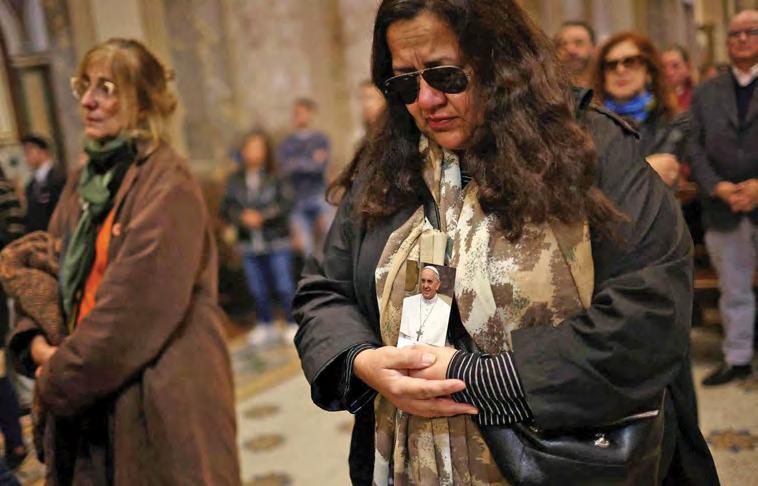
Tejada, who remembers the future pope visiting her parish monthly. She recalled him sipping yerba mate, a popular infusion, and chatting with parishioners.
But there was no avoiding the complicated relationship between the pope and his native country — something Archbishop García Cuerva addressed in comments alluding to Argentine attitudes and those of Catholics further afield.
“We have tried to teach him, almost in a daring way, what it meant to be pope as if we had the manual for that,” Archbishop García Cuerva said in February.
“Yet he loves us, and yet he has us in his heart. He did what a loving father does. That is Francisco, the father of all, but we know that in his heart there is a lot of Argentine and a lot of porteño,” he said of Pope Francis, using a common and affectionate nickname for natives of Buenos Aires.
A complicated legacy
“He confirmed me,” said Felipa Acosta, a parishioner at the Our Lady of Caacupé, named for the patroness of Paraguay.
Acosta recalled Pope Francis visiting the parish in one of the many villas (shantytowns) in Buenos Aires — places avoided by polite society.
“He was always very close to us,” said Claudia
Pope Francis was born in Buenos Aires and raised in the middle-class Flores neighborhood. He served as Jesuit provincial — though his term ended in acrimony, according to observers — and was named auxiliary bishop of Buenos Aires in 1992. He was raised to archbishop in 1998 and cardinal in 2001.
As archbishop of Buenos Aires, Pope Francis was known for his grassroots ministry and confrontations with Argentina’s political elite — particularly with the late President Néstor Kirchner and his wife, former President Cristina Fernández de Kirchner, over their Peronist politics. Though initially icy, Fernández de Kirchner later warmed to Francis, visiting him in Rome multiple times. Still, his papacy has often been entangled in Argentina’s political tensions, with his expressions — or silences — scrutinized by leaders across
the spectrum.
So-called “friends of Francis” also started appearing, along with supposed spokesmen with messages after trips to Rome. This forced the Argentine bishops’ conference to ask people to desist, saying the practice “has generated confusion and justified regrettable distortions of his figure and his words.”
Criticisms also emerged about the pope not visiting Argentina. He visited some countries of South America during his pontificate and twice flew over Argentine territory en route to Paraguay and Chile. He often spoke of visiting, but never did.
“If Francis were to come to Argentina, it would be assumed that he would be used politically in favor of the government in power or against the government in power,” De Vedia said.
“I think that he would have had great popular fervour in the streets” had he visited “and at the same time debates about his positions,” Marianon De Vedia, editor for Argentina’s La Nacion said.
Argentina continued its drift away from Catholicism after Francis’ election. Some 62.9% of Argentines identified as Catholic in a 2019 survey from research institution CONICET, down from 76.5% in 2008. The number of people identifying as non-religious reached 18.9%, outpacing the growth in Protestant and other congregations.
Abortion was decriminalized in 2020 as a feminist movement became influential. Argentina’s bishops bitterly opposed abortion decriminalization, especially as it came during a pandemic in which the church — especially priests in the shanties, known as “curas villeros” — worked to feed and care for populations thrown into economic hardship.
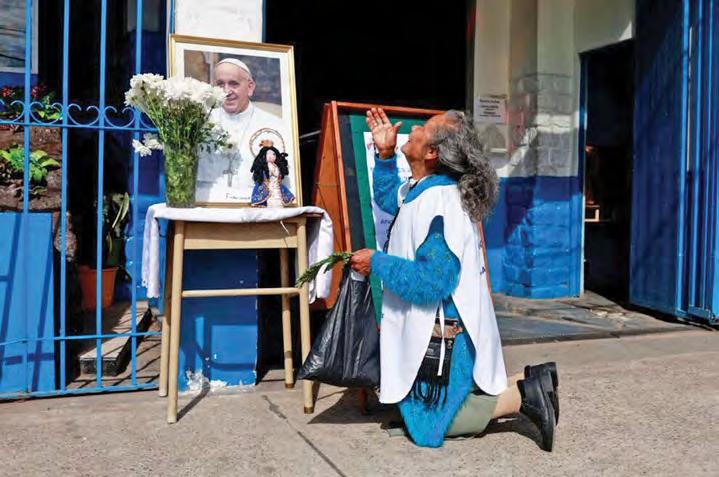
Pope Francis paid special attention to the “villas” at a time when few others would enter the shantytowns, supporting their work serving communities rife with poverty and addictions.
“We felt really close (to him) and that he has acted like a bishop who is present and also seeks to solve the problems,” said Father José María di Paola, a prominent cura villero known as Padre Pepe.
The curas villeros promoted the pope’s vision of going to the peripheries. They took special offense at the rise of President Milei, who once branded the pope a “filthy leftist.” The curas villeros celebrated a Mass of reparation in a shantytown after Milei’s comments.
Milei took office in 2023 on an agenda of slashing the government. Pope Francis was quick to congratulate him.
Milei traveled to the Vatican for a visit and asked the pope to visit.
On April 21 Milei said: “Despite our differences, experiencing his kindness was a true honor.”
The president’s office had formally communicated the news saying that the pope led the Catholic Church “with dedication and love from the Vatican.”
©OSV News


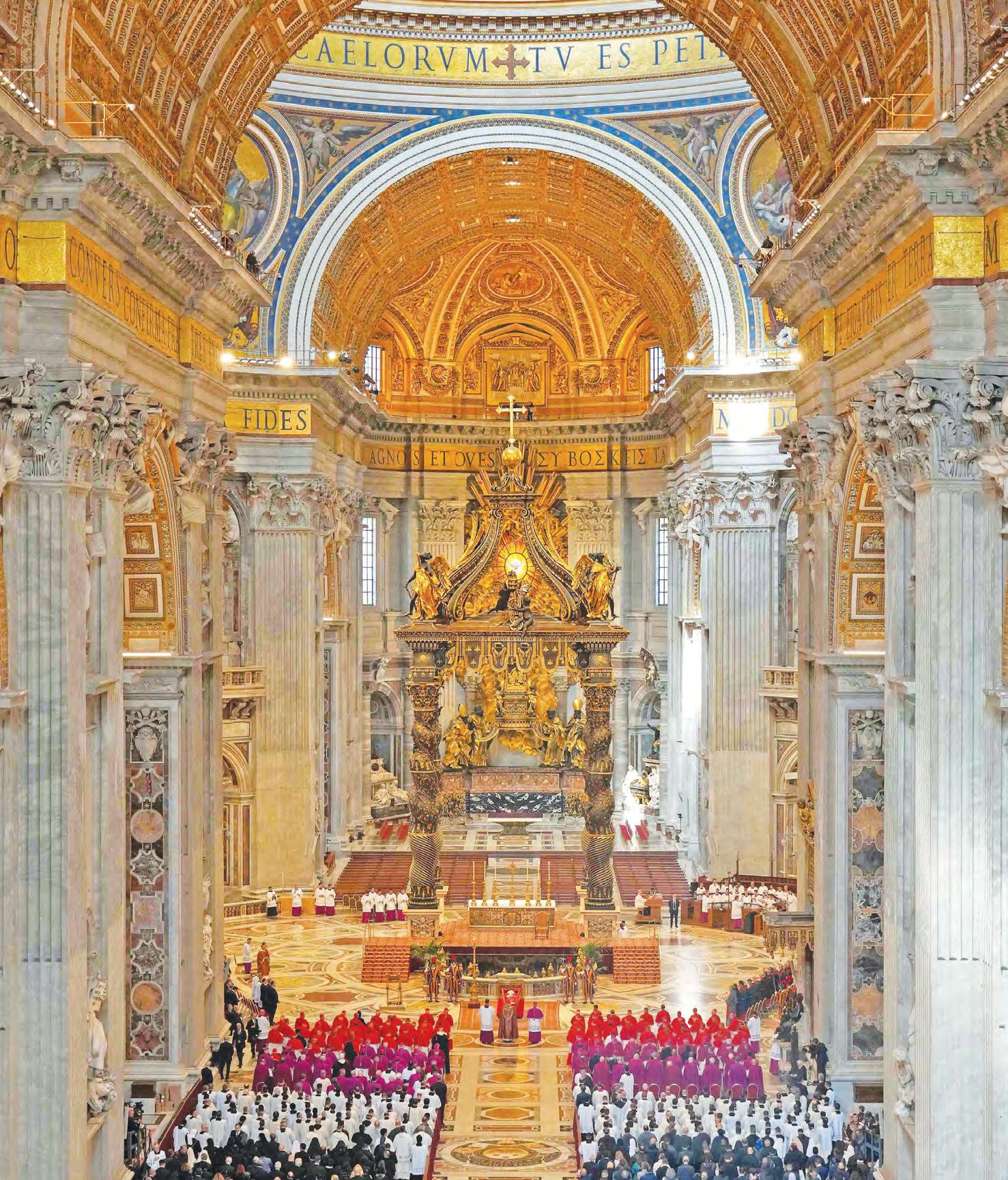
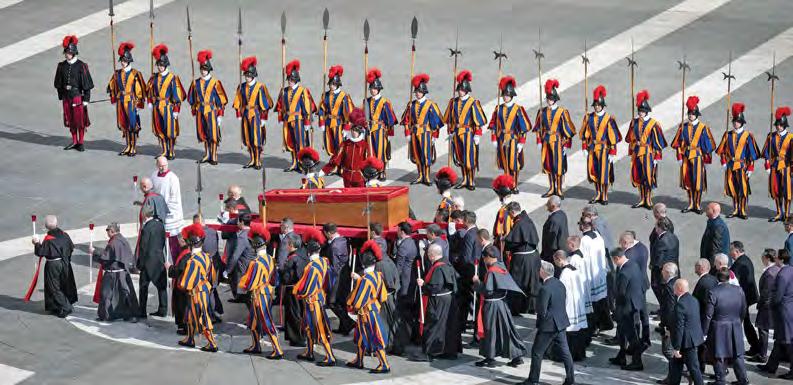
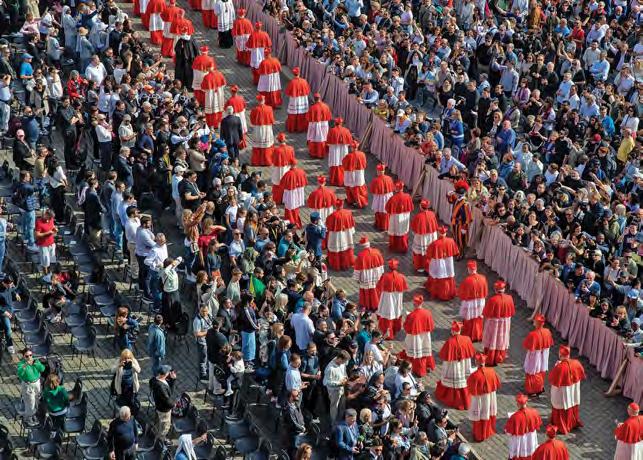
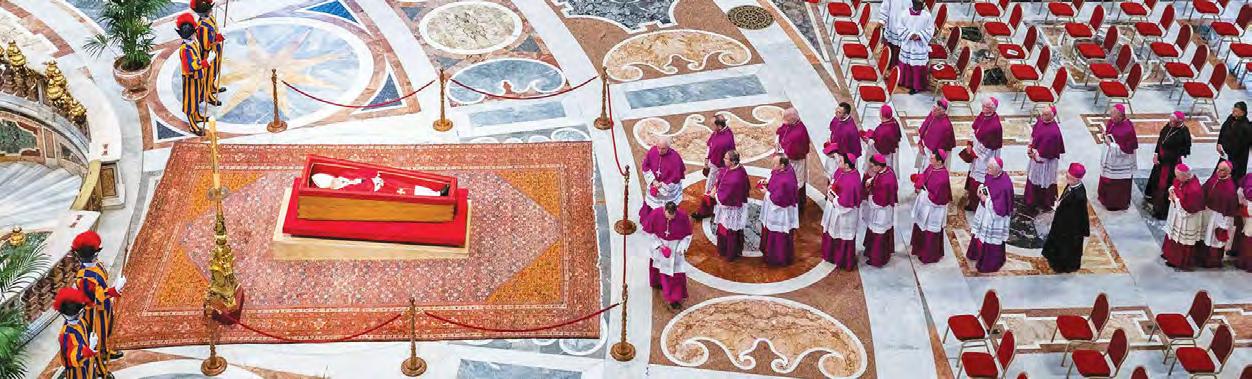
BISHOPS PROCESS PAST the body of Pope Francis as he lies in state in an open casket in front of the Altar of the Confession in St. Peter’s Basilica at the Vatican April 23, 2025. The pope will lie in state for three days of public viewing and prayer ahead of his funeral Mass April 26 (CNS photo/Paolo
By Cindy Wooden Vatican City (CNS)
The funeral Mass of Pope Francis will be celebrated April 26 in St. Peter’s Square, the Vatican announced.
Cardinal Giovanni Battista Re, dean of the College of Cardinals, will preside over the liturgy, which begins a nine-day period of official mourning and daily memorial Masses.
The deceased pope’s body, which was taken to the chapel of his residence late April 21, the day of his death, was carried into St. Peter’s Basilica for public viewing and prayer early April 23.
The public viewing was scheduled to end late April 25 with another prayer service to close the coffin.
Matteo Bruni, director of the Vatican Press
Office, said the Mass originally scheduled for the Jubilee for Adolescents April 27 would be one of the eight memorial Masses that follow the funeral of the pope. Cardinal Pietro Parolin, who was secretary of state under Pope Francis, will preside.
The rites and rituals for dressing the body, moving it to St. Peter’s Basilica and celebrating the funeral are published in the “Ordo Exsequiarum Romani Pontificis” (“Funeral Rites of the Roman Pontiff”).
The rites originally were approved by St. John Paul II in 1998 but were released only when he died in 2005. Modified versions of the rites were used after Pope Benedict XVI died Dec. 31, 2022, and Pope Francis revised and simplified them in 2024.
U.S. Cardinal Kevin J. Farrell, the
chamberlain of the Holy Roman Church, presided over a prayer service for the formal verification of the pope’s death April 21 in the chapel of the Domus Sanctae Marthae, where Pope Francis celebrated an early morning Mass most days before his final illness.
Cardinal Farrell led the prayerful procession to take the pope’s body, already in its coffin, from the chapel, into St. Peter’s Square and then into the basilica.
According to the book of rites, he said, “Dearest brothers and sisters, with great emotion we accompany the mortal remains of our Pope Francis into the Vatican basilica where he often exercised his ministry as the bishop of the church that is in Rome and as pastor of the universal Church.” ©CNS
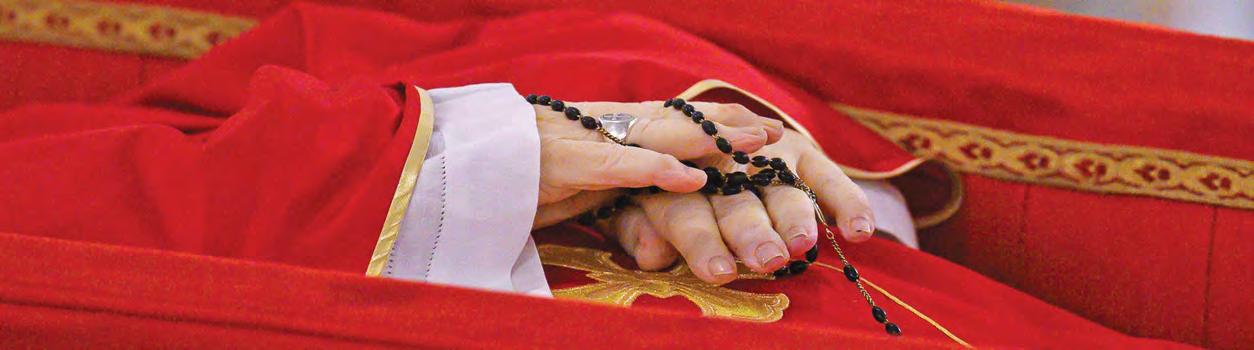
POPE FRANCIS IN HIS COFFIN AT SANTA MARTAE—The hands of Pope Francis, holding a rosary, are seen as he lies at rest in his coffin in the chapel of his residence, the Domus Sanctae Marthae, at the Vatican April 21, 2025 (CNS photo/ Vatican Media)
By Kimberley Heatherington OSV News
“We also have to say ‘thou shalt not’ to an economy of exclusion and inequality. Such an economy kills.”
Among the many pronouncements Pope Francis made during his 12-year papacy, his repeated insistence on the lethal capacity of the worldwide economic system—not just the theoretical, but literally fatal, impact it can exert on people who are poor or marginalized—remains provocative to some and inspiring to others.
His landmark apostolic exhortation, “Evangelii Gaudium” (“The Joy of the Gospel”), delivered in 2013, the first year of his pontificate, linked the “economy of exclusion” with a growing “’throw away’ culture” where the “excluded are not the ‘exploited’ but the outcast, the ‘leftovers.’”
Owing to such observations and teaching—as well as to being the first pope from the Global South, sometimes seen as a post-World War II “laboratory of socialism”—Pope Francis, who died April 21 at age 88, was not infrequently branded an economic radical. But just how revisionist were his pronouncements, compared with the tradition of the Church?
“Despite some of the claims of his critics, there’s actually a direct continuity between what he said on economics and what previous popes have said on economics,” said Anthony Annett, author of Cathnomics: How Catholic Tradition Can Create a More
Just Economy. He added, “If you look at John Paul (II), if you look at Benedict (XVI) ... they certainly had the same message.”
“Just like John Paul II, Francis condemned new liberalism by name,” Annett continued, referring to the use of economic reform to create welfare states with considerable state intervention in the overall economic health of a country.
“And Pope Benedict in ‘Caritas in Veritate’ (‘Charity in Truth’), called for a complete restructuring of the way the economy works after the global financial crisis. It’s a fairly radical document,” he added about the pope’s 2009 encyclical.
Reflecting on Pope Francis’ legacy, Annett finds it inseparable from Catholic social teaching.
“What I think Pope Francis brought was a more passionate, urgent stance and voice to this debate,” said Annett. “He really put Catholic social teaching on economics front and center of his pontificate—the call for a just economy; for social justice; the call—as he called it—to hear the cry of the earth and the cry of the poor. So that’s what I would say would be his main legacy, in terms of Catholic social teaching.”
It’s a continuity Annett doesn’t expect to see broken.
“I will be extremely surprised if the next pope moved away from that. You might not get a kind of passionate language that we associate with Pope Francis, but I think you would get the
documents, including his encyclicals
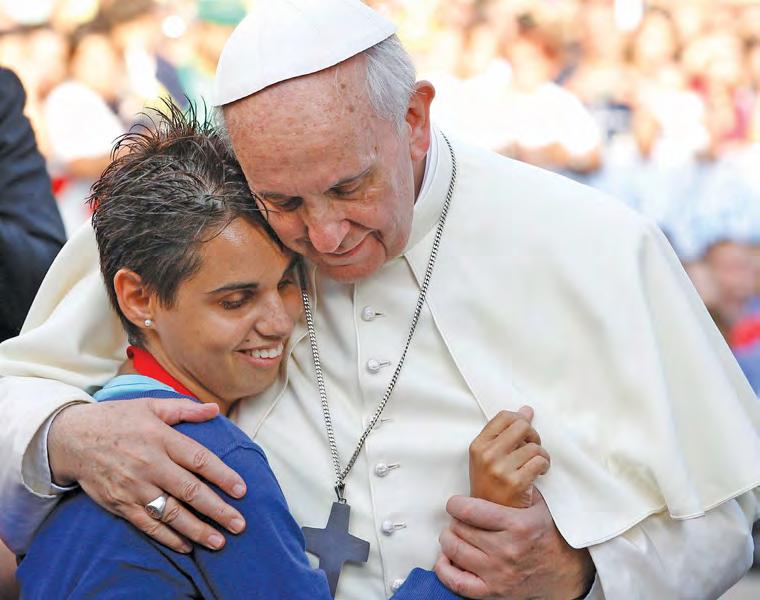
substance—because modern Catholic social teaching has existed in this present form since ‘Rerum Novarum’ in the late 19th century, and that is never going to change.”
“Rerum Novarum” (“Of New Things”)—an 1891 encyclical by Pope Leo XIII outlining Catholic economic and social doctrine in response to the pressures of the Industrial Revolution— is widely regarded as the founding document of Catholic social teaching, exerting its influence upon every pontificate since.
“Catholic social thought is not the agenda of a political party,” explained Jesús Fernández-Villaverde, a professor of economics at the University of Pennsylvania and president of the Catholic Research Economists Discussion Organization, or CREDO.
The late Pope Francis was the first pope in the Catholic Church’s 2,000-year history to choose the name Francis, which he quickly clarified for journalists in 2013 was indeed for the holy Italian friar and not for St. Francis Xavier, a founder of the Jesuits, the religious order to which Pope Francis belonged.
“How I would like a Church that is poor and that is for the poor,” he told journalists three days after his 2013 election. St. Francis of Assisi, he said, was “the man of poverty, the man of peace, the man who loves and protects creation.” The 13th-century Franciscan friar’s words inspired the titles of several of Pope Francis’ key
“Laudato Si’” (2015) and “Fratelli Tutti” (2020), as well as his “symbolic actions” that modeled charity and selflessness. Assisi, meanwhile, was the site of several of Pope Francis’ large gatherings, including an interfaith day of prayer in 2016 and a meeting of economists in 2022.
His other writings on St. Francis included the introduction in a 2023 book in Italian exploring the rule of life St. Francis established for the Franciscans, in which the pope said that St. Francis “shows that Jesus is the only Master” and “the heart of the choice consists in ‘following in the footsteps of our Lord Jesus Christ.’”
Pope Francis died April 21 at age 88 after serving 12 years as pope.
“Catholic social thought is not, ‘ We are going to increase the income tax by 3 percent, or we are going to lower the property tax by 10 percent.’ Catholic social thought is a set of principles, and ideas, and goals, and aspirations,” said Fernández-Villaverde.
“Catholic thought has always emphasized that any economic system needs to be oriented toward the common good; that a market and private property play a very important role in achieving that common good. But at the same time,” he emphasized, “we should not be uncritical with respect to markets—and understand that in many situations, markets do not work well.”
Fernández-Villaverde said the pontiff’s message concerning a “killer economy” was more of a call to a wider circle of awareness than a specific set of
economic proposals or prescriptions. “What I think that Pope Francis was trying to say with that statement is that we are in an economy that, unfortunately, doesn’t put human life at its very center,” he reflected. “And that there are things we can do to change that. You and I may have slightly different ideas about how do we do it in practice—but this is a call.”
Indeed, Pope Francis directly said so in his 2020 encyclical, “Fratelli Tutti, on Fraternity and Social Friendship,” emphasizing that “there is no one solution, no single acceptable methodology, no one economic recipe that can be applied indiscriminately to all.”
Instead, Pope Francis’ “school of economics” reflected the constant, ordinary concern of the Catholic Church for millennia: the poor.
“These days,” Pope Francis said in his 2015 encyclical, “Laudato Si’, on Care for Our Common Home,” the world’s excluded people “are mentioned in international political and economic discussions, but one often has the impression that their problems are brought up as an afterthought, a question which gets added almost out of duty or in a tangential way, if not treated merely as collateral damage. Indeed, when all is said and done, they frequently remain at the bottom of the pile.”
In economic discussions and decisions, Pope Francis believed, the poor deserve a place at the table.
“Stop listening exclusively to
the economic elites, who so often spout superficial ideologies that ignore humanity’s real dilemmas,” he told the representatives of popular movements— activists working on a wide variety of justice causes—in a 2021 talk. He further encouraged them to serve “the people who demand land, work, housing, and good living.”
In his 2013 apostolic exhortation
“Evangelii Gaudium” (“The Joy of the Gospel”), Pope Francis’ censure of trickledown economics—“which assume that economic growth, encouraged by a free market, will inevitably succeed in bringing about greater justice and inclusiveness in the world”—managed to annoy its adherents by questioning their faith in the theory as “a crude and naive trust in the goodness of those wielding economic power and in the sacralized workings of the prevailing economic system.”
“Meanwhile,” Pope Francis admonished, “the excluded are still waiting.”
To those who interpret such criticisms as being anti-capitalist, Joseph Kaboski—a professor of economics at the University of Notre Dame—has a reminder.
“The Vatican keeps a record of every public talk the pope has ever given, and the only times he used the word ‘capitalism’ were to a group on inclusive capitalism, where he commended their efforts to make capitalism more inclusive, and,” Kaboski continued, “in talking to the Economy of Francesco”—an annual gathering since 2020 inspired by the example of St. Francis of Assisi--”where he talked about the shortcomings of ‘our capitalism.’”
“Neither,” observed Kaboski, “seem like the words of someone inherently anticapitalist, but instead a measured critic of the shortcomings of our economy.”
Those economic shortcomings, Kaboski said, are essentially related to human attitudes—which ostensibly, can change.
Pope Francis, Kaboski added, “talked about a ‘throwaway culture’ and an idolatry of money, capital, and profit. Those are attitudes that misplace means for ends—or worse yet, put ourselves above God or things above people.”
As to the pontiff ’s legacy, Kaboski was reflective.
“People’s views on his papacy have become quite polarized, unfortunately,” he noted. “So I’m sure there will be a variety of opinions, for better or worse.”
But ultimately, Kaboski said, Pope Francis was a pastor.
“Not everything he wrote on the economy was perfectly informed,” Kaboski said. “But that is always true of popes—and economists, too!” ©OSV News Kimberley Heatherington writes for OSV News from Virginia.
“At a time when the world feels more chaotic and divided than ever, I have found peace and purpose in walking the path as a Secular Franciscan: living a life of simplicity, service, and a deep connection to faith,” said Julie Schuchardt of Cape Girardeau.
Many Catholics, though they know St. Francis of Assisi, are not aware of the Third Order Franciscans (also known as Secular Franciscans) founded by him and canonically established over 800 years ago. Unlike the First Order (the Friars Minor) or the Second Order (the Poor Clares), the Third Order is made up of lay people who live in the secular world. The Rule of the Third Order Franciscans was drafted by St. Francis in 1221. Since then, it has been revised only three times, most recently in 1978, approved by Pope Paul VI. Many well-known people were members of the Secular Franciscan Order. Among them are St. Francis de Sales, the parents of St. Therese of Lisieux, Michelangelo, and even Christopher Columbus.
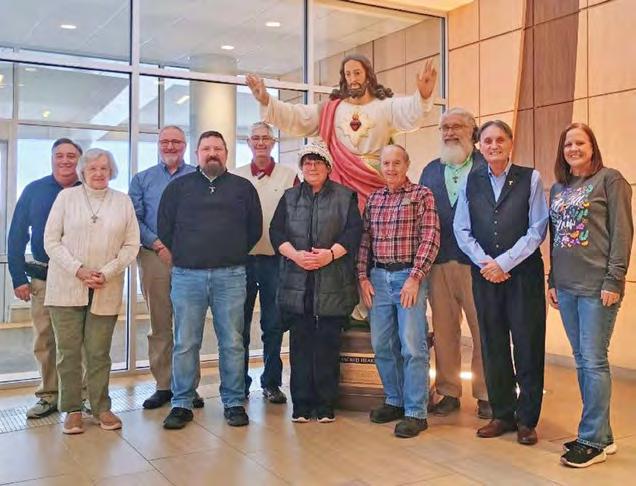
PADRE PIO EMERGING FRATERNITY—The spirituality of St. Francis of Assisi and the Order of Secular Franciscans is to observe the Gospel of Our Lord Jesus Christ by following the example of St. Francis of Assisi, who made Christ the inspiration and the center of his life with God and people. Pictured are The Padre Pio Emerging Fraternity of Secular Franciscans in the Cape Girardeau area (OFS are Professed Secular Franciscans; the others are candidates in formation): Hugh Protzel, OFS (St. Vincent de Paul Parish, Cape Girardeau); Anita Tygett, OFS (St. Vincent de Paul Parish, Cape Girardeau), Dan Williams (St. Mary Cathedral, Cape Girardeau), Shawn Asmus, OFS (Immaculate Conception Parish, Jackson), James Saucier (St. Vincent de Paul Parish, Cape Girardeau), Nancy Mitchell (Sacred Heart Parish, Dexter), Marvin Glueck, OFS (Guardian Angel Parish, Oran), Chuck Burns (St. Vincent de Paul Parish, Cape Girardeau), Bob Antil, OFS (St. Vincent de Paul Parish, Cape Girardeau), and Julie Schuchardt, OFS (St. Vincent de Paul Parish, Cape Girardeau). (The Mirror)
The process of becoming a professed Secular Franciscan involves three stages: Orientation, Inquiry, and Candidacy, leading to a lifelong commitment to live the Gospel according to the rule of St. Francis of Assisi. Secular Franciscans meet regularly in local groups called “fraternities” and we truly feel that we are a family. In these fraternities, the brothers and sisters, led by the Spirit, strive for daily conversion. We pray together, we learn through ongoing formation, and we serve in our apostolates and ministries.
What it means to be a Secular Franciscan
To be a Secular Franciscan means to embrace a Gospel life dedicated to the values that St. Francis exemplified: simplicity, humility, service, and a deep love for God’s creation. Members strive to follow the example of St. Francis by living out these values in their families, workplaces, and communities.
Secular Franciscans do not take vows but make a profession to the order. The profession is not just a personal decision, but a consecration to God’s service, with the Holy Spirit playing an active role in the spiritual transformation of the individual. The Holy Spirit, given to the Apostles at Pentecost is the same Spirit that is called down during Profession and empowers Secular Franciscans to be witnesses of Christ in their daily lives. The profession is a sending forth into the world, where the Holy Spirit will continue to lead them to live their Franciscan vocation with joy, faith, and zeal.
A vocational call to the Secular Franciscan life
The Secular Franciscan Order is a vocation in a worldwide Order approved by the Church with over 300,000 members. In the US, there are over 600 fraternities and approximately 12,000 professed members. There are currently six fraternities in Missouri with two in the Diocese of Springfield-Cape Girardeau: The Followers of Francis Fraternity, in Springfield, and The St. Padre Pio Emerging Fraternity, in Cape Girardeau.
For many, the vocational call to the Secular
Franciscan life is a call to holiness that begins as an internal longing to live a more purposeful, Christ-centered life. In a world that often promotes individualism and materialism, the Secular Franciscan is drawn to a countercultural lifestyle rooted in humility and compassion.
“What drew me to this community was not only the Franciscan way of life, but also the opportunity to journey with others who were equally committed to growing in holiness,” said Schuchardt.
If you feel called to a life of holiness and service in the spirit of St. Francis, you can learn more and find many resources at www.secularfranciscansusa.org or by calling 1-800-FRANCIS. ©OSV News

Secular Franciscan Order
Founder: St. Francis of Assisi in 1221
Motto: Pax et Bonum (Peace and Good)
External Sign: Tau Cross
Spirituality: To observe the Gospel of Our Lord Jesus Christ by following the example of St. Francis of Assisi, who made Christ the inspiration and the center of his life with God and people.
Mission: To build a more fraternal and evangelical world so the Kingdom of God may be brought about more effectively.
Formation Stages: Inquiry, Orientation, and Candidacy lasting 18-36 months.
Website: secularfranciscansusa.org
By Zoe Romanowsky
Like his predecessors, Pope Francis’ pontificate was marked not only by historic events and memorable themes but also by his personality, character, and style. A look at these more personal moments — many of them unscripted and spontaneous — reminds us that beneath the white cassock is always a man who brings his own charisms to the role.
Francis was a pope of notable firsts — the first Jesuit to be elected pope, the first pope from the Americas, and the first shepherd of the Catholic Church from outside of Europe since the eighth century. He orchestrated numerous significant first-time events — such as welcoming the Coptic Orthodox pope to speak during a general audience and to celebrate the Divine Liturgy at St. John Lateran, the Latin pope’s cathedral.
Francis was also a pope of technological firsts — the first to use video conferencing to attempt to broker peace between Ukraine and Russia, and the first to take personal phone calls in the middle of general audiences. There were reports he was the first to snap a papal group selfie, though it appears that was false. (Benedict XVI appeared in a selfie, but only after retirement.)
As the Church and the world reflect on the legacy and papacy of Francis, CNA highlights some of his more personal moments — glimpses into the man and shepherd who took the name of the best-known saint in Christendom and led the Church during difficult times.
Kissing a disfigured man
Francis constantly invited the faithful to seek out the disenfranchised and to always witness to the value of every human life, including the weakest and most vulnerable. Francis put that into practice in a particularly powerful way
one day in St. Peter’s Square when he embraced and kissed an Italian man named Vinicio Riva.
Riva, who suffered from a condition called neurofibromatosis type 1, which caused disfiguring sores all over his body, told CNN that Francis didn’t hesitate to embrace him. “He didn’t have any fear of my illness,” Riva said.
“He embraced me without speaking … I quivered. I felt a great warmth.”
Reuters reported that on Jan. 11, 2022, Francis left his living quarters at the Vatican hoping to pay a quick visit to friends who own a small record store in Rome. The pope reportedly had visited the shop many times before he was elected, sometimes purchasing classical music records and CDs.
While there is no verification of him buying anything during his 15-minute visit as pope, a Rome Reports TV reporter happened to be in the area waiting for a taxi and spotted Francis coming out of the store. He filmed Francis with his smartphone and posted it on Twitter, where it went viral.
Later, the journalist wrote to the pope to apologize, according to the Reuters article. Francis replied that the situation was just “bad luck” and that “one should not lose one’s sense of humor.”
Francis had a soft spot for newlyweds. In 2013, he wore a red nose to greet a newly married couple who were volunteers at a charity that serves children through clown therapy. The image of him joking around with a clown nose spread across the globe as papal watchers remarked at how much Francis seemed to love wisecracks. The Pontifical Mission Societies even launched a #JokeWithThePope initiative in September 2013.
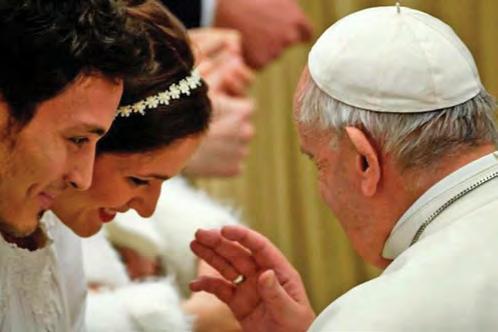
In fact, joy was a theme Francis liked to focus on as he called on the faithful to be joyful and not be “sourpusses.”
In fact, Francis’ first encyclical was called “The Joy of the Gospel.”
35,000
In January 2018, while on a papal visit to Chile, Pope Francis was asked by a Catholic couple — two flight attendants on his flight — if he would bless their marriage.
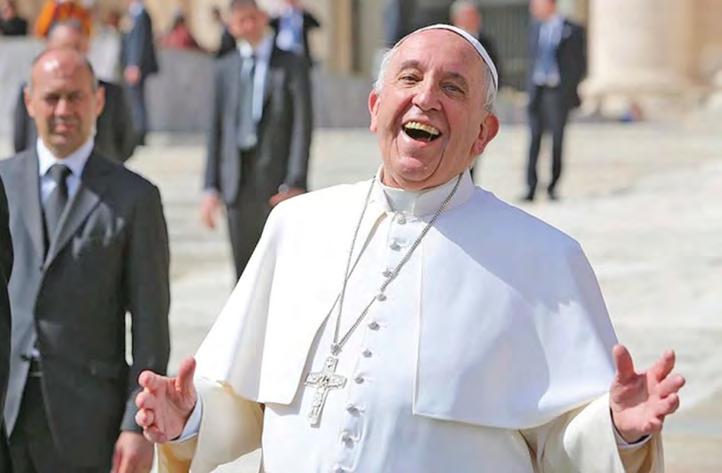
The couple had been married legally but told BBC they were unable to conduct a religious ceremony because of the damage an earthquake did to their church in the Chilean capital of Santiago.
Pope Francis offered to perform a short marriage ceremony for the couple during one of their flights together. A cardinal traveling with him provided a handwritten marriage document that was signed by the newly married couple and their witness.
Interviewed by the homeless
Indicative of his great affection for the poor, Pope Francis granted a group of homeless and disadvantaged people the opportunity to interview him at his residence, Domus Sanctae Marthae (Casa Santa Marta).
Members of Association Lazare, a French organization whose young members help provide shelter to those without homes and jobs, asked questions gathered from impoverished persons from 80 countries. The questions included queries about his salary as pope, his favorite saint (St. Thérèse of Lisieux), and whether he used to have any girlfriends.
The questions, along with the pope’s answers, were then published in a book released in Italian,
Spanish, and French on April 1, 2022, called “In dialogo con il mondo: Il Pape Risponde” (“In Dialogue with the World: The Pope Replies”).
A letter to an artisanal pasta maker
In late January 2025, ACI Prensa, CNA’s Spanish-language news partner, reported on a letter Pope Francis sent to an Italian woman named “Nunzia” who has dedicated her life to keeping alive a long-standing tradition of making orecchiette, a pasta from the Apulia region of southern Italy. Orecchiette has become a symbol of the gastronomic tradition of Bari Vecchia where many women prepare it on the streets of the historic town.
The pope, known for his love of pasta, expressed in his personal letter

walk past the Stereosound record shop, located a few steps from the Pantheon in Rome, on Jan. 12, 2022, a day after the pope’s visit. Pope Francis, a great lover of classical music, was caught leaving the record shop, which is owned by friends of his, in central Rome on Jan. 11, 2022, to bless it after its renovation, for which he received a gift. Before being elected pontiff in 2013, the pope stayed in a residence for religious near the Pantheon and used to buy classical music records when he was a simple bishop.
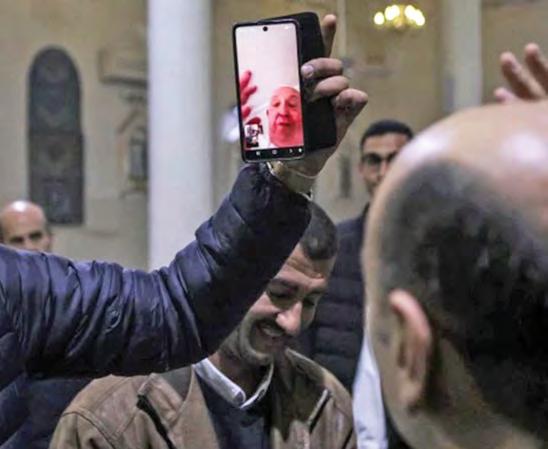
A MAN HOLDS
2024, amid the ongoing war in the besieged Palestinian territory between Israel and Hamas. (Omar Al-Qattaa/AFP via Getty Images)
the importance of “keeping roots and ancient traditions alive and encouraging their integration so they can last over time.”
Moved by his letter, Nunzia said the pope’s words had “made her proud” and “given her strength.”
Personal calls of encouragement and support Pope Francis reached out to many people by phone during his pontificate — especially those affected by illness and the death of a loved one. He called earthquake victims, the dying, and parents who had lost their children. Sometimes he made calls to encourage, to say happy birthday, or to find out more about a project or event.
One of Francis’ personal calls was
to a young parish priest in Naples, Father Michele Madonna, who was organizing “Christian raves” for young people in his community. The pope was curious about this popular ministry and called to ask the priest about it.
A couple of months later, the pope called another priest from Naples — Father Maurizio Patriciello — who had been threatened by the local Mafia and needed security to go about his day. Francis wanted to encourage him.
One Christmas Day Francis also called a young husband and father in the southern Italian town of Pezze di Greco whose 41-year-old wife died of childbirth complications a week after giving birth to twins. The pope’s call was facilitated by the couple’s parish priest, who thought such a gesture would bring comfort to the grieving husband.
Perhaps the personal calls that made the biggest impression were the daily check-ins that Pope Francis made to Father Gabriel Romanelli, the pastor of Holy Family Parish in Gaza. Romanelli said for the past 19 months, the pope maintained constant contact with him.
“He was concerned about how we were doing, whether we had eaten, about the children,” the priest said.
Pope Francis didn’t stop calling to
By Victoria Cardiel
“He told us he was praying for us, blessed us, and thanked us for our prayers on his behalf,” said Father Gabriel Romanelli, the pastor of Holy Family Parish in Gaza, summing up Pope Francis’ last call on Saturday night, April 19, moments before going to St. Peter’s Basilica to pray before the Easter Vigil.
The deeply moved Argentine priest explained in detail to Vatican News the Holy Father’s final gesture of closeness toward them, two days before his death.
“Pope Francis is a pastor who loves and follows this small community of ours. He prays and works for peace,” said Romanelli, noting that since the pontiff’s death, the Christian communities in Gaza — Catholic and Orthodox — have united in prayer for Pope Francis.
The priest of the Institute of the Incarnate Word did not hesitate to convert the parish complex in Gaza into a makeshift shelter during the fighting between Israel and Hamas. The parish currently houses 500 people. The majority are Orthodox Christians, Protestants, and Catholics, but it also serves as a shelter for more than 50 Muslim children with disabilities and their families.
Romanelli recalled how, over the past 19 months, the Holy Father has
console them even when he was sick in the hospital for 38 days with double pneumonia.
He made his last call to the Gaza parish on Saturday night, April 19, moments before going to St. Peter’s Basilica to pray before the Easter Vigil. “He told us he was praying for us, blessed us, and thanked us for our prayers on his behalf,” Romanelli said.
One of the most iconic moments of Pope Francis’ pontificate was the night he walked alone into an empty St. Peter’s Square in the rain at the beginning of the COVID-19 shutdown to deliver a blessing to the world.
The pope’s “urbi et orbi” (“To the city and to the world”) blessing is typically reserved for Christmas Day and Easter Sunday when thousands
of people flock to St. Peter’s Square to receive it. This time, however, the pope was alone, in silence, praying by faint candlelight, addressing the entire world.
Over 11 million people tuned in to watch Pope Francis deliver the hourlong blessing.
He also prayed before the “Miraculous Crucifix,” a wooden cross kept in the Church of St. Marcellus that, according to tradition, helped saved Rome from the plague in 1522.
“For weeks now it has been evening,” Francis said to the world that night. “Thick darkness has gathered over our squares, our streets, and our cities; it has taken over our lives.”
His prayer and blessing invoked God’s mercy and protection and offered words of hope to a world plunged into fear and uncertainty. ©CNA
Zoe Romanowsky is General Assignment Editor at Catholic News Agency. She previously worked for Aleteia.
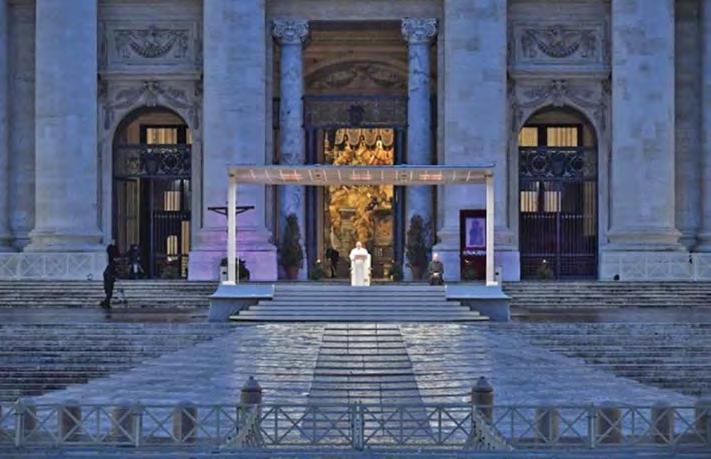
maintained constant contact with Gaza. “He was concerned about how we were doing, whether we had eaten, about the children,” the priest related.
In fact, he didn’t even stop calling to console them during the 38 days he was in Gemelli Hospital for bronchitis that led to double pneumonia.
“We hope that his appeals won’t be ignored: that the bombing will stop, that this war will end, that the hostages will be released, and that humanitarian aid will reach those who are suffering,” Romanelli said. ©CNA

his call for peace for Gaza and the Holy Land in his April 20, 2025, urbi et orbi
This story was first published by ACI Prensa, CNA’s Spanish-language news partner. It has been translated and adapted by CNA.
By D.D. Emmons OSV News
Each year on Aug. 5 the Church liturgical calendar commemorates the dedication of St. Mary Major (in Italian, Santa Maria Maggiore), one of the five great ancient basilicas in Rome, and the place Pope Francis chose to be entombed. Why would that event be a feast day for the universal church? What is our connection to the dedication of a building that took place in Italy over 1,500 years ago?
The history of this church is rooted in the role of Mary as the Mother of God. Its story begins with a fourth-century legend.
According to this legend, living in Rome around the year AD 350 was a wealthy and childless couple who, upon their death, wanted their earthly possessions used in a way that would honor the Virgin Mother. They prayed earnestly for divine guidance. Mary appeared to the husband in a dream, requesting that a church be built for her on a site where snow would fall in midsummer.
The couple quickly reported Mary ’s request to Pope Liberius (reigned 352-366), who claimed to have had a similar dream. On Aug. 5, at the height of the summer heat, snow miraculously fell on an area of Rome called Esquiline Hill, defining the floor plan of the church.
Here, the legend concludes, was built one of the earliest Christian churches in honor of the Virgin Mary. It was called the Liberian Basilica after Pope Liberius.
Archaeological and other evidence suggests that the legend has no historical basis. No mention whatsoever is made of the story until several hundred years
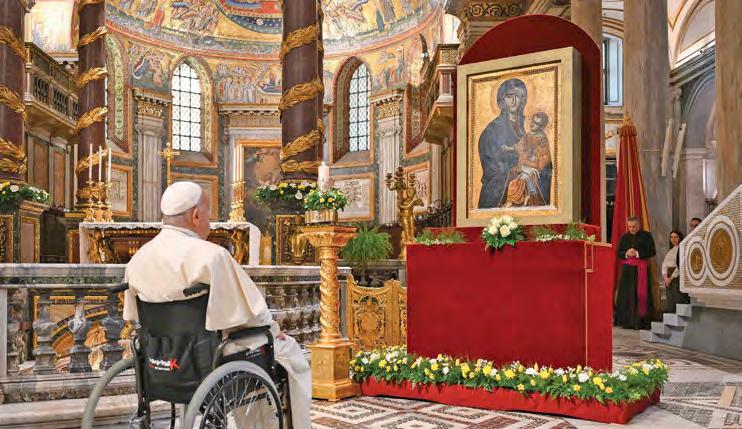
PRAYER FOR PEACE—Pope Francis stopped in prayer before the icon “Salus Populi Romani” (“health—or salvation—of the Roman people”) after praying the rosary for peace in Rome’s Basilica of St. Mary Major Oct. 6, 2024. Pope Francis will be entombed in the basilica. The pope wanted to be buried at ground level and without ornamentation. It’s another example of the humility he has demonstrated throughout his 12 years of pontificate (CNS photo/Vatican Media)
later; even the dedicatory inscription of St. Sixtus III, placed on the church in the fifth century, says nothing about it. Nevertheless, this basilica, rebuilt and magnificently adorned over the centuries, has been a rallying point for popes and laypeople, for Romans and pilgrims alike, to venerate the maternity and life of the Blessed Mother. Extensive reconstruction and expansion of the original basilica took place following the ecumenical Council of Ephesus held in 431. That assembly was called specifically to settle a controversy regarding Mary’s title as the Mother of God.
Nestorius, who had become the patriarch (archbishop) of Constantinople in 428, had used his prominent position to preach the heretical doctrine that Mary was only the Mother of Christ (“Christotokos”), not the Mother of God (“Theotokos”; literally, “God-bearer”).
He and others claimed that there were two separate persons, one human and one divine, within Jesus Christ; and that the human person born of Mary— who was crucified, died, buried, and resurrected—was not divine.
Consequently, Nestorius and his
followers argued that Mary could not be called “Mother of God,” because she was the mother only of the human person in Jesus, not the divine Person.
Leading the opposition to the Nestorian heresy was St. Cyril, patriarch of Alexandria, Egypt. Cyril helped to clarify the Church’s understanding that Jesus is not two persons. Rather, he was born one person in whom are united two natures, one fully human and one fully divine. That one person is the divine, eternal Son of God.
When Mary gave birth to the Word made flesh, she was giving birth to that one divine Person in two natures. Accordingly, Mary is rightfully called the Mother of God.
This controversy was brought to a head at the council in Ephesus during June and July 431. Nearly 200 bishops gathered there. They deposed Nestorius and declared that Mary is truly the Mother of God.
The decision of the council was widely acclaimed and increased the veneration of Mary throughout Christendom. In her Magnificat, Mary had said, “All generations will call me blessed” (Lk 1:48). Now, and for all eternity, not only would she be called blessed, but she would be duly
known by the name of highest dignity, Mother of God.
Though the Council of Ephesus officially condemned Nestorius and the heresy he promoted, the controversy continued to fester. Accordingly, Pope St. Sixtus III (d. 440), who became pope one year after the council ended, immediately began to rebuild the Liberian Basilica. Upon completion of the renovations, he dedicated it to Mary, the Mother of God.
This action by Pope Sixtus further affirmed the Holy See’s approval of the council’s dogmatic declaration in Ephesus. It also linked forever this Roman basilica to Our Lady’s divine motherhood.
For a while the basilica was known as St. Mary of the Crib after it obtained a relic of the Holy Crib, believed to be the one in which Jesus was laid at His nativity. This relic was carried to Rome by Christian refugees from the Holy Land fleeing the Muslim invasion of the seventh century. The basilica still hosts a procession of the Holy Crib every year on Christmas Day.
Upon his election in 1566, Pope St. Pius V had the responsibility to implement and enforce the decisions of the Council of Trent (15451563), which included condemnation of Protestant errors and affirmation of Mary as the Mother of God. In response to the Protestant
reformation, renewed and increased Marian devotion began to spread among the Catholic faithful.
Seeking to perpetuate this renewal, Pope Pius introduced the feast of the Dedication of the Church of Our Lady of the Snow onto the Church’s liturgical calendar, which further emphasized and continually honored the divine motherhood of Mary. While such a feast day had long been observed locally in Rome, it was not part of the universal calendar until 1568.
To commemorate this event, each year on Aug. 5 white rose petals are dropped from the dome during the festal Mass.
The basilica was fully restored and renovated in the 18th century. Its present façade and most of its interior decorations date from this period. Even so, it still contains elements from its ancient beginnings, including a number of marble columns and several fifth-century mosaics. It also features a 240-foot medieval bell tower, the highest in Rome.
The church finally was named St. Mary Major because it is the largest and most eminent of all the 26 churches now in Rome named in honor of the Blessed Mother. In 1969, following the Second Vatican Council, the name of the Aug. 5 celebration was revised to “The Dedication of the Basilica of St. Mary Major.”
Simultaneously, the feast was identified as an optional memorial, meaning the celebration is not obligatory but at the discretion of the priest offering Mass. The feast day is always proclaimed in Rome.
Since St. Mary Major is a patriarchal basilica, it contains a papal altar used only by the pope himself or a priest to whom he has given special permission. Customarily, the pope celebrates Mass here each year on the feast of the Assumption of Mary, Aug. 15.
Some relics of the true cross are preserved in the church, housed in a 14th-century cross-shaped reliquary. An urn on the altar contains the relics of St. Matthew and other martyrs of ancient times.
St. Jerome (c. 341-420), a Doctor of the Church who first translated the entire Bible into Latin, is buried here. Several popes are buried here as well, the most recent being Pope Clement IX, buried in 1669.
Pope Francis said he wanted to be buried at St. Mary Major because of his devotion to Mary, which he expressed through his particular affection for the basilica’s celebrated icon of the Blessed Virgin known as “Salus Populi Romani” (“Health of the Roman People”). This name comes from a miracle in which the icon helped shield the city from the approach of the plague. Legend claims that it was painted from life by St. Luke the Evangelist, but most scholars agree that it dates from the 13th century.
Pope Francis stopped to pray at the icon before and after papal trips. St. Mary Major was also the first place he visited the morning after being elected pope.
In his final testament, issued after his death April 21, Pope Francis confirmed his request, writing, “I wish my last earthly journey to end at this very ancient Marian shrine where I would go to pray at the beginning and end of each apostolic journey to confidently entrust my intentions to the Immaculate Mother and to thank her for the docile and maternal care.”
He wished that his tomb “be prepared in the niche in the side aisle between the Pauline Chapel—the Chapel of the Salus Populi Romani —and the Sforza Chapel” and “be in the earth; simple, without special decoration and with the only inscription: Franciscus.”
The basilica reminds Christians throughout history that they have believed and continue to believe that the young Jewish girl named Mary, chosen among all women to be the fleshly tabernacle of Jesus, is indeed the Mother of God.
This belief is an established truth, a dogma of the Catholic faith. St. Mary Major Basilica stands as an earthly symbol of that important reality. ©OSV News
D.D. Emmons writes from Pennsylvania
‘DEATH IS NOT THE END OF EVERYTHING’: Vatican releases pope’s reflections on aging, dying
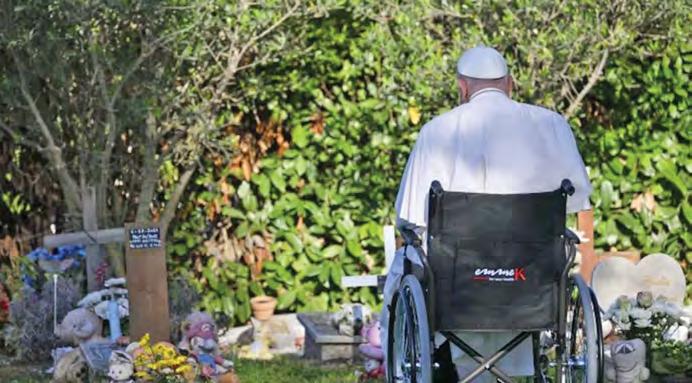
By Madalaine Elhabbal Washington, D.C. (CNA)
The Vatican on April 22 released a previously unpublished text by Pope Francis following his passing on Monday containing the late pontiff’s reflections on aging and death.
“We must not be afraid of old age; we must not fear embracing becoming old, because life is life, and sugarcoating reality means betraying the truth of things,” wrote Francis in the preface to a book in Italian by Cardinal Angelo Scola, Awaiting a New Beginning: Reflections on Old Age, which will be available on Thursday, April 24.
In the late Holy Father ’s introduction to Scola’s book, he expressed gratitude to the former archbishop of Milan for seeking to restore pride in aging, which he said is “too often considered unhealthy.”
The problem, Francis asserted, is not that we grow old but how we grow old. For old age to become a time “truly fruitful and capable of radiating goodness,” Francis stressed that it must be lived “as a grace, and not with resentment,” and accepted “with a sense of gratitude and thankfulness” in spite of suffering.
“Because to say ‘old’ does not mean ‘to be discarded,’ as a degraded culture of waste sometimes leads us to think,” Francis wrote. “Saying ‘old’ instead means saying experience, wisdom, knowledge, discernment, thoughtfulness, listening, slowness… Values of which we are in great need!”
On this note, Francis pointed to the role of grandparents in society, emphasizing their role in promoting the “balanced development of the
young” and a culture of peace.
“Amid the frenzy of our societies, often devoted to the ephemeral and the unhealthy taste for appearances, the wisdom of grandparents becomes a shining beacon, shedding light on uncertainty and providing direction to grandchildren, who can draw from their experience something ‘extra’ for their daily lives,” he wrote. Scola’s writing, he said, “born from thought and affection,” bring the prospect of aging and death to bear in the context of Christianity, which he said “is not so much an intellectual or a moral choice but rather the affection for a person — that Christ who came to meet us and decided to call us friends.”
Ultimately, Francis wrote, “it is precisely the conclusion of these pages by Angelo Scola, a heartfelt confession of how he is preparing himself for the final encounter with Jesus, that gives us a consoling certainty: Death is not the end of everything but the beginning of something.”
“It is a new beginning, as the [book’s] title wisely highlights, because eternal life, which those who love already begin to experience on earth within the daily tasks of life — is beginning something that will never end.”
“And it is precisely for this reason that it is a ‘new’ beginning, because we will live something we have never fully lived before: eternity,” the pope wrote. ©CNA
Madalaine Elhabbal is a staff reporter for Catholic News Agency based at EWTN’s Washington, D.C., bureau. She has been published by CatholicVote and has also worked as foreign language assistant in France. She is a graduate of Benedictine College.
By Cindy Wooden Vatican City (CNS)
Pope Francis’ funeral rites, like those for any pope or any Christian, are meant to “reinforce the hope and witness to the faith” that those who have been baptized in Christ “will rise with him to new life.”
The prayer rituals for the formal recognition of his death April 21, his funeral and eight memorial Mass are designed as moments not of mourning but of prayers for his eternal rest in heaven and for the Church.
The rites and rituals used are published in the “Ordo Exsequiarum Romani Pontificis” (“Funeral Rites of the Roman Pontiff”). The rites originally were approved by St. John Paul II in 1998 but were released only when he died in 2005. Modified versions of the rites were used after Pope Benedict XVI died Dec. 31, 2022.
A revised edition of the red clothbound book was published about a month before Pope Francis’ 88th birthday in December.
Archbishop Diego Ravelli, master of papal liturgical ceremonies, had told Vatican News the revised edition was needed, “first of all because Pope Francis asked, as he himself stated on several occasions, to simplify and adapt some of the rites so that the celebration of the bishop of Rome’s funeral would better express the Church’s faith in the risen Christ.”
And, he said, the revised rites highlight “even more that the Roman Pontiff’s funeral is that of a shepherd and disciple of Christ and not of a powerful man of this world.”
In the book, the text of the rites, Masses and prayer services are given in their original Latin or Greek with Italian translations.
The introduction to the book asks all Catholics to remember in prayer the deceased pope’s relatives and those who worked closely with him.
The prayers, it says, should express “gratitude for the good that the deceased
pontiff did for the Church and humanity.”
In addition, the book says, “due respect” should be paid to the pope’s body, “which with the sacraments of Christian initiation became a temple of the Holy Spirit and with the sacrament of episcopal orders was totally dedicated to serving the people of God.”
Three stages to a pope’s funeral rites
The rites are divided into three “stations” based on the place they occur: “At home, in the Vatican basilica and at the burial place.”
Even the moment of the formal verification of the pope’s death takes place in the context of a prayer service “at home” in the chapel of the Domus Sanctae Marthae where he lived. The Vatican said that ritual would take place at 8 p.m. Rome time April 21.
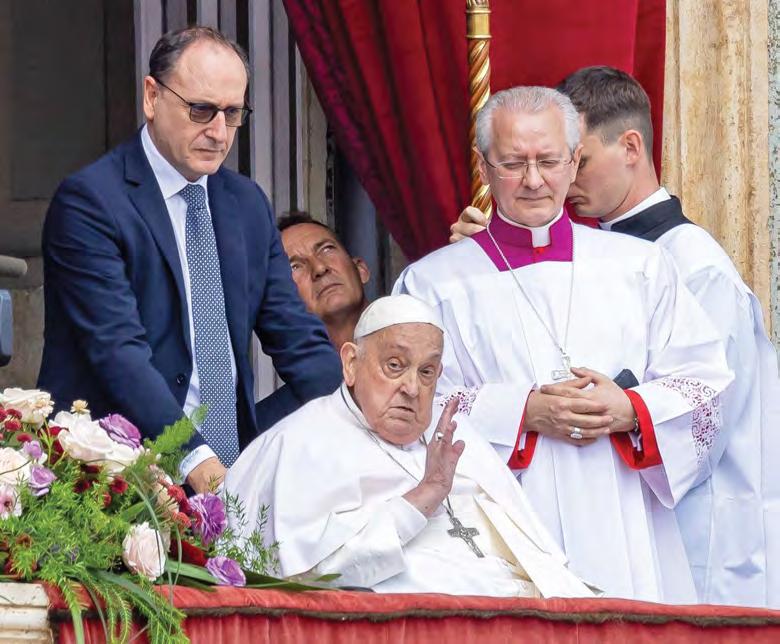
The ritual book has separate services for transferring the body to St. Peter’s Basilica, the funeral, the burial, and the memorial Masses that follow the funeral for the next eight days.
As revised by Pope Francis, the new rites maintain the practice of having the deceased pope’s body placed in St. Peter’s Basilica for public viewing and prayer before the funeral. However, instead of lying on a catafalque, that is, a kind of decorated platform, the body will be placed inside a zinc-lined coffin, which will remain open until the night before the funeral.
Just before the coffin is closed, the pope’s body is blessed with holy water and his face is covered with a white silk cloth, and a small purse containing coins minted during his pontificate is placed in the coffin with the body.
In addition, a metal tube containing a copy of the “rogito” is buried with him. The “rogito” is a legal document, with a brief biography of the deceased pope, that formally attests to his death and burial. It is read during the rite.
The dean of the College of Cardinals, currently 91-year-old Cardinal Giovanni Battista Re, presides over the pope’s funeral Mass wearing red vestments.
The Gospel reading is from St. John’s account of Jesus asking Peter, “Do you love me?” and telling him, “Feed my sheep.”
The funeral Mass includes special prayers recited on behalf of the people of Rome, because the pope was their bishop, and on behalf of Eastern-rite Catholics.
Pope Francis has done away with the practice of a pope’s cypress coffin being placed inside a zinc coffin and then inside a coffin made of unspecified wood. Instead, he will be buried in the same zinc-lined wooden coffin used for the funeral.
Unless a pope chooses another burial place, his coffin is moved after the funeral Mass to the grotto of St. Peter’s Basilica for burial.
When a pope, like Pope Francis, has left instructions that he is to be buried somewhere else, it is the task of the papal master of ceremonies to make the appropriate arrangements.
In his autobiography, released in January (2025), Pope Francis said, “I
ucharistic Adoration is all about placing ourselves before our Lord, who is truly and sacramentally present to us in the Eucharist exposed on the altar in the monstrance. Eucharistic Adoration is about listening to His heart from your heart, about His love and joy for you, His plans and inspirations, His forgiveness and ministry, and His ways of helping you grow in your spiritual life, and service of others. Jesus present in the Monstrance (from the Latin word—monstrare, which means to show, which is the root for—demonstrate) enables us to fix our gaze on him for the reparation for sins; the intercession for healing of the world, among other needs or sources of gratitude.
will not be buried in St. Peter’s but at St. Mary Major. The Vatican is the home of my last service, not my eternal home.”
He also explained, “I will go in the room where they now keep the candelabra,” a small storage closet between the statue of Mary, Queen of Peace, and the chapel featuring the Marian icon “Salus Populi Romani” (“health of the Roman people”) where he prayed before and after each of his foreign trips.
The funeral Mass is the first of nine formal Masses — called the “novendiali” for “nine days” — that are celebrated for a deceased pontiff. While the Masses are open to the public, their celebration is entrusted in rotation to specific groups, including employees and residents of Vatican City State, the Diocese of Rome, the chapters of the major basilicas of Rome, the Roman Curia, the Eastern churches and members of religious orders.
When the nine days have ended, the Church begins following another set of rites and liturgies contained in the “Ordo Rituum Conclavis” (“Rites of the Conclave”). ©CNS
(24 hours a day, seven days a week)
is held in two places in the Diocese of Springfield-Cape Girardeau. Please come and spend time in either of these locations:
Perpetual Adoration at Saint Francis Medical Center, Cape Girardeau Call Donna (573) 450-1451
Perpetual Eucharistic Adoration at Holy Trinity Church, Springfield Call Marilyn (417) 224-4043
By Joseph Pronechen National Catholic Register
Many saw Pope Francis as a grandfatherly figure, especially when he shared bits of practical wisdom on how to get along with one another. Reflecting on the Holy Family’s simple life in Nazareth, on the 2013 feast of the Holy Family, Francis said:
“Let us remember the three key words for living in peace and joy in the family: ‘may I,’ ‘thank you,’ and ‘sorry.’ In our family, when we are not intrusive and ask ‘may I,’ in our family when we are not selfish and learn to say ‘thank you,’ and when in a family one realizes he has done something wrong and knows how to say ‘sorry,’ in that family there is peace and joy. Let us remember these three words.”
This advice became a refrain, as he advised the next year:
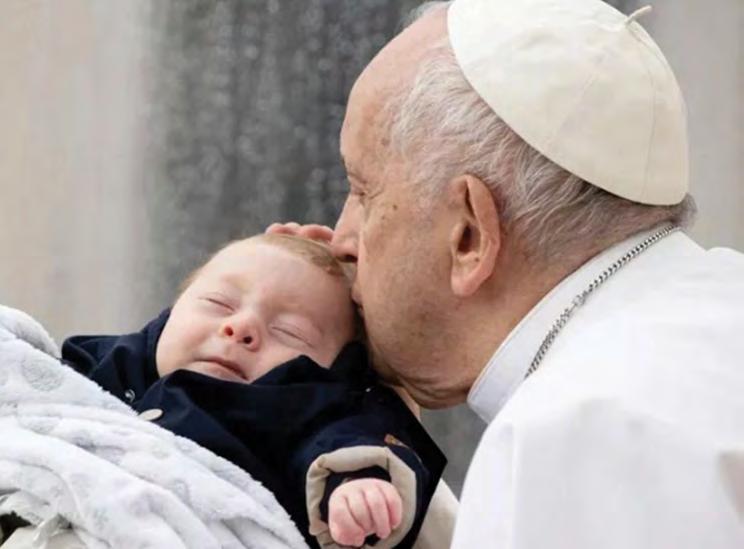
“It is normal that there be a quarrel between husband and wife … but please remember this: Never finish the day without making peace! Never, never, never! This is a secret, a secret to protect love and to make peace.”
Across many homilies, audiences, and off-the-cuff reflections throughout his papacy, Pope Francis offered such grandfatherly advice on marriage, family, youth, the elderly, and other aspects of Catholic life — using signature turns of phrase. Here are some highlights of other times he offered folksy advice to the faithful.
The Holy Father was blunt when speaking to those gathered for a general audience in 2014 — criticizing those who had pets instead of children.
“The other day, I spoke about the demographic winter that exists nowadays: People do not want to have children, or just one and no more. And many couples do not have children because they do not want
to, or they have just one because they do not want any more, but they have two dogs, two cats. ... Yes, dogs and cats take the place of children. Yes, it is funny, I understand, but it is the reality. And this denial of fatherhood or motherhood diminishes us; it takes away our humanity. And in this way civilization becomes more aged and without humanity, because it loses the richness of fatherhood and motherhood. And our homeland suffers, as it does not have children, and, as someone said somewhat humorously, ‘And now that there are no children, who will pay the taxes for my pension? Who will take care of me?’ He laughed, but it is the truth. I ask of St. Joseph the grace to awaken consciences and to think about this: about having children.”
Over the years, Pope Francis attended many youthfocused events — and he encouraged them to excellence.

“I wrote a speech for you, but prepared speeches are boring,” the pope told youth on his trip to Asunción, Paraguay, in 2015. So he spoke spontaneously. “We don’t want ‘nambypambies,’ young people who are just there, lukewarm, unable to say either yes or no. We don’t want young people who tire quickly and who are always weary, with bored faces. We want young people who are strong. We want young people full of hope and strength. Why? Because they know Jesus, because they know God. Because they have a heart that is free.”
He was known for his colorful expressions when “telling it like it is.”
In September 2017, at the Vatican, Francis reminded a group of youth and young adults: “Narcissism produces sadness because you constantly worry about making up your soul every day, to appear better than what you are, pondering whether you are more beautiful than the others. It is the sickness of the mirror. Young people, break
the mirror! Do not look in the mirror because the mirror is deceiving. Look outward; look at others; escape from this world, from this culture around us — to which you referred — which is consumeristic and narcissistic. And if one day you would like to look in the mirror, I will give you some advice: Look in the mirror to laugh at yourself. Try it one day: Look and begin to laugh at what you see there; it will refresh your soul. This brings cheerfulness and saves us from the temptation of narcissism.”
Speaking to an audience in May 2022, Francis focused on the elderly and told them they had plenty to offer, much more than money, and reminded them to pick up the Good Book, too. Summarizing the Old Testament Book of Judith, he emphasized: “Judith is not a pensioner who lives her emptiness in melancholy. She is a passionate elderly woman who fills the time God gives her with gifts. Remember: One of these days, take the Bible and look at the Book of Judith: It is very short; it is easy to read. It is 10 pages long, no more. Read this story of a courageous woman who ends up this way, with tenderness, generosity, a worthy woman. And this is how I would like all our grandmothers to be. All like this: courageous, wise, and who bequeath to us not money but the legacy of wisdom, sown in their grandchildren.”
Don’t be ‘pickled peppers’
The pope didn’t hold back when reminding the faithful of the call to witness to Christian joy.
“Sometimes these melancholic Christians’ faces have more in common with pickled peppers than the joy of having a beautiful life,” Pope Francis said in one of his earliest papal homilies, on the reading from Acts 18, in the chapel of St. Martha’s residence in May 2013. “If we keep this joy to ourselves, it will make us sick in the end; our hearts will grow old and wrinkled and our faces will no longer transmit that great joy, only nostalgia and melancholy, which is not healthy.”
“I tell you the truth,” he told the faithful in St. Peter’s Square. “I am convinced that if each one of us would purposely avoid gossip, at the end, we would become a saint! It’s a beautiful path!”
“Do we want to become saints? Yes or no?” he queried, as the crowds replied: “Yes!”
“Yes? Do we want to live attached to gossip as a habit?” Pope Francis continued. “Yes or no? No? OK, so we are in agreement! No gossip!” ©CNA
This story was first published by the National Catholic Register, CNA’s sister news partner, and has been adapted by CNA
Joseph Pronechen is a staff writer with the National Catholic Register and his articles have appeared in numerous publications including Columbia magazine, Soul, Faith and Family, Catholic Digest, Catholic Exchange, Marian Helper, and Fairfield County Catholic. He is the author of “Fruits of Fatima — Century of Signs and Wonders.” He holds a graduate degree and lives with his wife Mary on the East Coast.
By Elizabeth Scalia OSV News
As the world absorbs the news of the death of Pope Francis — and before the ever-busy oddsmakers and deep insiders begin the game of papabile speculation that accompanies every papal death and conclave — let us rest for a moment and appreciate what were (arguably) the five most memorable moments of the Franciscan papacy:
The Joy of the Gospel. The encyclical “Laudato Si‘” (and its successor, “Laudato Deum“) has gotten wide attention being concerned, as it is, with matters of environment and Christian stewardship. But Francis’ apostolic exhortation “Evangelii Gaudium” actually speaks profoundly to a relevant — truly crushing — issue of our times: Our need to focus on realities over illusions or trending notions and to proclaim Jesus Christ as the incarnate founder of all reality.
Society has descended into a seeming chaos of ideas finding action before consequences are considered or debated, so one appreciates all that Pope Francis cautioned against in this document, including the havoc of ideas given room to run wild, all untethered to what is real: “It is dangerous to dwell in the realm of words alone, of images and rhetoric. … realities are greater than ideas. This calls for rejecting the various means of masking reality: angelic forms
of purity, dictatorships of relativism, empty rhetoric, objectives more ideal than real, brands of ahistorical fundamentalism, ethical systems bereft of kindness, intellectual discourse bereft of wisdom.”
Published in November 2013, the first year of his pontificate, Francis is describing the world we live in, now. His advice to pull away from the folly of unfettered imagination is a valuable call to reality — not because the Christian church lacks vision or compassion, but because she is visionary enough to know that human conceits can arise in even the best-intended actions, and that compassion must exist in substance. And substance is what she serves, in order to feed the spirit: “The principle of reality, of a word already made flesh and constantly striving to take flesh anew, is essential to evangelization. … Not to put the word into practice, not to make it reality, is to build on sand, to remain in the realm of pure ideas and to end up in a lifeless and unfruitful self-centredness and gnosticism.”
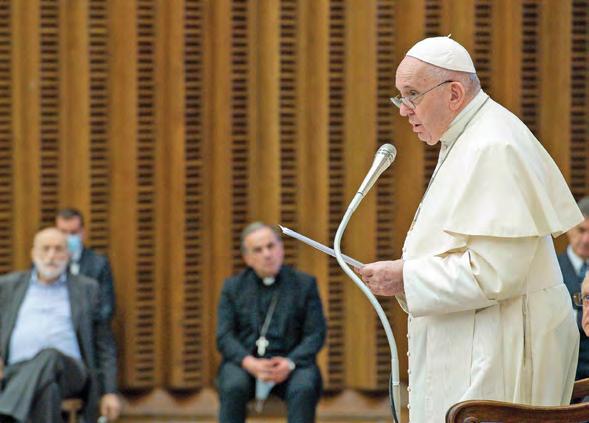
“Who am I to judge?” This one gets a little dicey because of a human inclination to cherry-pick a quote to better fit it for battle — something that has become all-too common in our age but is as old as slyness itself. As the devil can quote Scripture to suit his own purposes, ideologues from every side took those five words from a 2013 inflight press conference, denuded them of context and then swung them about like a Klingon bat’leth. When Francis spoke offthe-cuff, he frequently surprised (and had sometimes been unclear enough to need later clarification) but perhaps never more so than with these words, which — when read in context — are no carte blanche to
unfettered sexual license as some proclaimed and others feared, but a qualified endorsement for Christians to bear with one another, and a recognition of a simple Christian reality: “If someone is gay and he searches for the Lord, and has goodwill,” said the pontiff, “who am I to judge?”
All the huffing hyperventilation that followed only demonstrated how little we have grown since the days of the early Church, when the first pope told Christians, “You must esteem the person of every man” (1 Pt 2:17).
Early in his papacy, Francis had a habit — doubtlessly one that left his security team a bit frazzled — of wading out into the crowds, or making a point of engaging someone who broke through to him.
In July 2013, as the popemobile drove slowly through the adoring throngs in Rio de Janeiro who had gathered for World Youth Day, 9-yearold Nathan de Brito managed to get past the barricades and reach the vehicle. He moved Francis to tears as he called out, “Your Holiness, I want to be a priest of Christ,” and found himself lifted up into the embrace of the pope, who promised to pray for him. But he had a request of the boy: “I ask you to pray for me,” he said, adding, “as of today, your vocation is set.”
Mere months later, in November in St. Peter’s Square, the Holy Father, again putting little space between himself and the people, spotted a severely disfigured man standing apart and made his way to him. The man — his face and head covered with horrific-looking boils due to neurofibromatosis — found himself embraced by the pope, chosen above all others to receive his kiss and reverent blessing as they both prayed. In both cases, the world watched and wept, not in sadness but in quiet wonder.
By the way, Nathan de Brito, that
little boy from Rio de Janeiro, entered a seminary in 2023.
2: In his 2016 apostolic letter “Misericordia et Misera,” Pope Francis established the first World Day of the Poor, later kicking it off in the Paul VI Hall by sharing a beautifully catered luncheon with the destitute of Rome. The meal became a tradition that — after pausing for two years due to the global pandemic — was joyfully reestablished in 2022.
Even earlier, however, the pontiff had arranged for showers to be provided for the homeless near the Bernini colonnades embracing St. Peter’s Square.
The pope’s proclamation was a gentle and demonstrative call to a generosity that, while not really arduous, is nevertheless radical: “The works of mercy affect a person’s entire life. For this reason, we can set in motion a real cultural revolution, beginning with simple gestures capable of reaching, body and spirit, people’s very lives. This is a commitment that the Christian community should take up, in the knowledge that God’s word constantly calls us to leave behind the temptation to hide behind indifference and individualism in order to lead a comfortable life free of problems. Jesus tells his disciples: ‘The poor you always have with you’ (Jn 12:8). There is no alibi to justify not engaging with the poor when Jesus has identified himself with each of them.”
A memorable blessing 1:
With a world in chaos, deeply divided ideologically, secularly and spiritually, Pope
By Gina Christian OSV News
Amid papal mourning, an annual celebration of the Divine Mercy reminds the faithful that Easter joy triumphs over tears, with thousands marking the upcoming feast through liturgy, prayer, and art.
Observed on the Second Sunday of Easter, Divine Mercy Sunday—which in 2025 falls on April 27—was established in 2000 by Pope St. John Paul II during his canonization of St. Maria Faustina Kowalska, a 20thcentury Polish mystic.
every day of the (Easter) octave is a solemnity, and every day of the octave is Easter,” Fr. Alar said. “But … obviously with the loss of Pope Francis, there is mourning.”
As a Sister of Our Lady of Mercy, the unassuming saint shared how she enjoyed numerous visions in which Christ urged her to promote devotion to his mercy through various prayers, an annual feast, and an image featuring rays of blood and water issuing from his heart.
This year, however, the solemnity will take place as the Church and the world grieve the loss of Pope Francis, who died April 21, and whose funeral will take place the day prior to it.
“It’s kind of a dichotomy of emotions,” admitted Fr. Chris Alar, provincial superior of the Marian Fathers of the Immaculate Conception of the Blessed Virgin Mary.
The Marian Fathers oversee the National Shrine for the Divine Mercy in Stockbridge, MA, which is also home to the order’s US provincialate and which hosts an annual Divine Mercy Weekend that draws thousands to its 350-acre campus.
“In one sense, we’re called to celebrate and rejoice … because
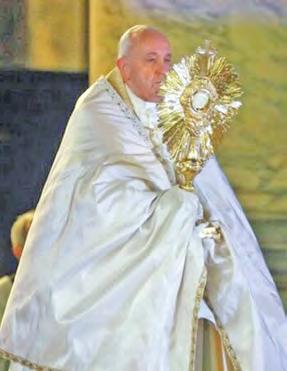
Still, said Fr. Alar, “the eight days of the Easter octave are primary,” and “nothing trumps them, not even the death of a pope, so we have to focus on these eight days of joy and celebration. … This is what the Church has always taught.”
The novendiali, or nine consecutive days of Masses in honor of Pope Francis that will begin with his April 26 funeral liturgy, will then be “our days of mourning,” said Fr. Alar.
On April 22, the St. John Paul II National Shrine in Washington, unveiled a temporary exhibit titled “The Happiest Day of My Life: Divine Mercy with St. John Paul II and St. Faustina,” honoring the Polish pope’s legacy of advancing the devotion while canonizing the saint to whom it was privately revealed. The exhibit, on display through Pentecost Sunday, June 8, includes a first-class relic of St. Faustina, whom St. John Paul named, “the messenger of the Lord’s merciful love.”
That love is needed more than ever, said Fr. Alar, quoting the words of Christ to St. Faustina and describing it as mankind’s “last hope of salvation.”
According to the diary St. Faustina was instructed to keep by her spiritual director, Christ promised to grant to those who fulfill the Divine Mercy Sunday conditions complete forgiveness
POPE FRANCIS holds the monstrance as he gives his extraordinary blessing “urbi et orbi” (to the city and the world) from the atrium of St. Peter’s Basilica at the Vatican March 27, 2020. Pope Francis, formerly Argentine Cardinal Jorge Mario Bergoglio, died April 21, 2025, at age 88.
(OSV News photo/Yara Nardi, pool via Reuters)
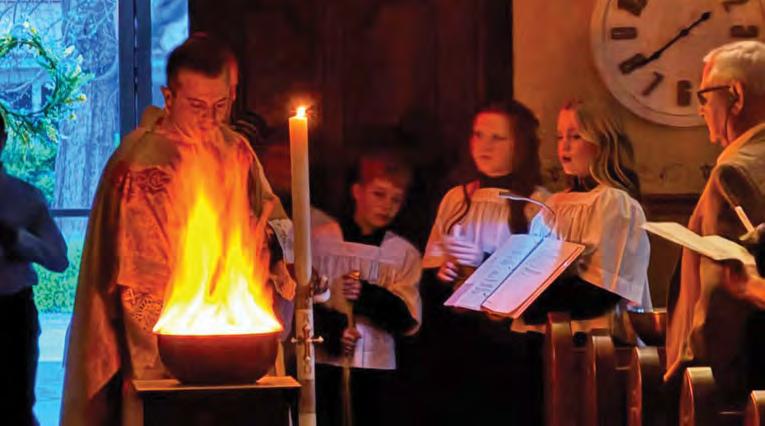
JOY & MOURNING—Father Daniel Belken lit the Easter Candle April 19 during the Easter Vigil Mass in St. Denis Church, Benton, MO. Amid papal mourning, an annual celebration of the Divine Mercy Sunday, on April 27 this year, reminds the faithful that Easter joy triumphs over tears. Observed on the Second Sunday of Easter, ”In one sense, we’re called to celebrate and rejoice … because every day of the (Easter) octave is a solemnity, and every day of the octave is Easter,” said Fr. Chris Alar, provincial superior of the Marian Fathers of the Immaculate Conception of the Blessed Virgin Mary. “But … obviously with the loss of Pope Francis, there is mourning.” Still, said Fr. Alar, “The eight days of the Easter octave are primary,” and “nothing trumps them, not even the death of a pope, so we have to focus on these eight days of joy and celebration. … This is what the Church has always taught.” (The Mirror)
of sins, as well as remission of the temporal punishment they incur.
The Catechism of the Catholic Church (CCC) teaches that sin incurs a “double consequence” (CCC No. 1472). If grave in nature, sin can result in eternal punishment, while temporal punishment—entailed in every sin, even venial—follows from an unhealthy attachment to creatures.
While the sacrament of reconciliation “(restores) us to God’s grace … joining us with him in intimate friendship” (CCC, No. 1468), the “temporal punishment of sin remains” (CCC, No. 1473), requiring purification through works of mercy, charity, prayer, and penance to complete the soul’s conversion. Such temporal punishment can also be remitted, in whole or in part, through indulgences granted by the Church.
St. John Paul granted a plenary indulgence on the Second Sunday of Easter, or Divine Mercy Sunday,
Five Unforgettable Moments //Continued...
Francis’ finest moment came when he quietly and hauntingly brought all sides together, from all corners of the planet, to make prayers of supplication — for healing, for consolation, for mercy and for wholeness — before Christ Jesus.
On March 27, 2020, alone in St. Peter’s Square, Francis carried before him a heavy monstrance, its brilliance not intended to dazzle, but meant only to emphasize
the simple white Host by which Jesus presents his physicality to the world. His hands wrapped in a humeral veil — the better to emphasize that the origin of the blessing came not from human hands or hearts but from Christ, eternal — Francis blessed the entire frightened and locked-down world, placing it into the keeping of the Triune God and Creator.
Those who watch social media will, if asked, recall the astonishingly poignant and perfectly needed action by the
under the usual conditions (receiving sacramental confession and holy Communion, and praying for the pope’s intentions) to faithful who take part in Divine Mercy devotions with complete detachment from affection for sin.
St. Faustina recorded in her diary that in a vision regarding Divine Mercy Sunday, Christ promised special graces to those participating in the devotion, telling her that “the soul that will go to confession and receive holy Communion shall obtain complete forgiveness of sins and punishment.”
“And that way, Divine Mercy Sunday wipes away not only all sin, but all punishment,” said Fr. Alar. “So that’s why we call this like a ‘second baptism.’ It’s not a second baptism, but that’s what it’s like.” ©CNA
Gina Christian is a multimedia reporter for OSV News. Follow her on X at @ GinaJesseReina.
pontiff and the almost unthinkable unanimity of praise that could be found, from left to right, from every religious persuasion, even from unbelievers who perhaps deemed it better to say little in the face of such gravity and transparent intention.
“He did the truly necessary thing,” I tweeted that out into the teeming ether that night. And for once, no one disagreed.
Rest in peace, Franciscus. ©OSV News
Elizabeth Scalia is editor at large for OSV. Follow her on X @theanchoress