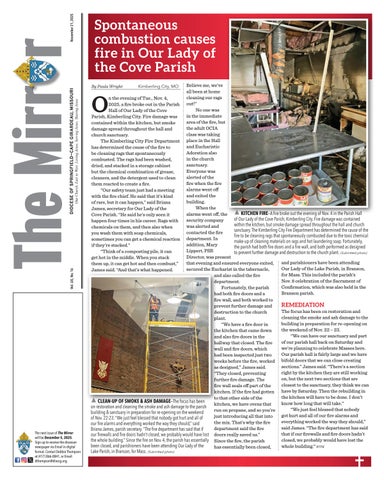
Spontaneous combustion causes fire in Our Lady of the Cove Parish
By Paula Wright Kimberling City, MO
On the evening of Tue., Nov. 4,
2025, a fire broke out in the Parish Hall of Our Lady of the Cove Parish, Kimberling City. Fire damage was contained within the kitchen, but smoke damage spread throughout the hall and church sanctuary.
The Kimberling City Fire Department has determined the cause of the fire to be cleaning rags that spontaneously combusted. The rags had been washed, dried, and stacked in a storage cabinet but the chemical combination of grease, cleaners, and the detergent used to clean them reacted to create a fire.
“Our safety team just had a meeting with the fire chief. He said that it’s kind of rare, but it can happen,” said Briana James, secretary for Our Lady of the Cove Parish. “He said he’s only seen it happen four times in his career. Rags with chemicals on them, and then also when you wash them with soap chemicals, sometimes you can get a chemical reaction if they’re stacked.”
“Think of a composting pile, it can get hot in the middle. When you stack them up, it can get hot and then combust,” James said. “And that’s what happened.
Believe me, we’ve all been at home cleaning our rags out!”
No one was in the immediate area of the fire, but the adult OCIA class was taking place in the Hall and Eucharistic Adoration also in the church sanctuary. Everyone was alerted of the fire when the fire alarms went off and exited the building. When the alarms went off, the security company was alerted and contacted the fire department. In addition, Mary Lippert, PSR Director, was present that evening and ensured everyone exited, secured the Eucharist in the tabernacle, and also called the fire department.
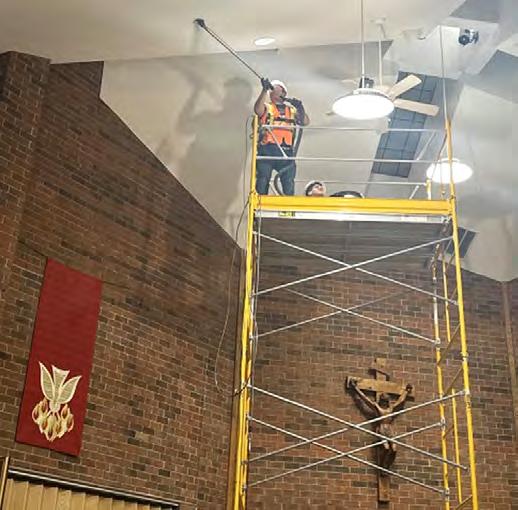
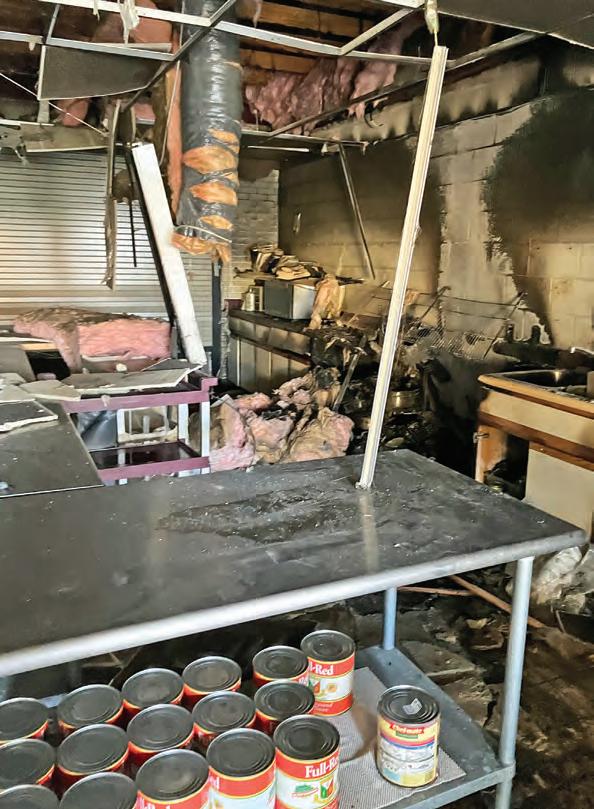
KITCHEN FIRE—A fire broke out the evening of Nov. 4 in the Parish Hall of Our Lady of the Cove Parish, Kimberling City. Fire damage was contained within the kitchen, but smoke damage spread throughout the hall and church sanctuary. The Kimberling City Fire Department has determined the cause of the fire to be cleaning rags that spontaneously combusted due to the toxic chemical make-up of cleaning materials on rags and hot laundering soap. Fortunately, the parish had both fire doors and a fire wall, and both performed as designed to prevent further damage and destruction to the church plant. (Submitted
Fortunately, the parish had both fire doors and a fire wall, and both worked to prevent further damage and destruction to the church plant.
and parishioners have been attending Our Lady of the Lake Parish, in Branson, for Mass. This included the parish’s Nov. 8 celebration of the Sacrament of Confirmation, which was also held in the Branson parish.
REMEDIATION


CLEAN-UP OF SMOKE & ASH DAMAGE—The focus has been on restoration and cleaning the smoke and ash damage to the parish building & sanctuary in preparation for re-opening on the weekend of Nov. 22-23. “We just feel blessed that nobody got hurt and all of our fire alarms and everything worked the way they should,” said Briana James, parish secretary. “The fire department has said that if our firewalls and fire doors hadn’t closed, we probably would have lost the whole building.” Since the fire on Nov. 4, the parish has essentially been closed, and parishioners have been attending Our Lady of the Lake Parish, in Branson, for Mass. (Submitted photo)
“ We have a fire door in the kitchen that came down and also fire doors in the hallway that closed. The fire wall and fire doors, which had been inspected just two weeks before the fire, worked as designed,” James said. “They closed, preventing further fire damage. The fire wall seals off part of the kitchen. If the fire had gotten to that other side of the kitchen, we have ovens that run on propane, and so you’re just introducing all that into the mix. That’s why the fire department said the fire doors really saved us.” Since the fire, the parish has essentially been closed,
The focus has been on restoration and cleaning the smoke and ash damage to the building in preparation for re-opening on the weekend of Nov. 22 – 23.
“ We can have our sanctuary and part of our parish hall back on Saturday and we’re planning to celebrate Masses here. Our parish hall is fairly large and we have bifold doors that we can close creating sections.” James said. “There’s a section right by the kitchen they are still working on, but the next two sections that are closest to the sanctuary, they think we can have by Saturday. Then the rebuilding in the kitchen will have to be done. I don’t know how long that will take.”
“ We just feel blessed that nobody got hurt and all of our fire alarms and everything worked the way they should,” said James. “The fire department has said that if our firewalls and fire doors hadn’t closed, we probably would have lost the whole building.”
COME, AND YOU WILL SEE
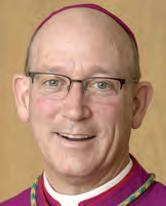
Bp. Edward M. Rice
“Grant your faithful the resolve to run forth to meet your Christ. … Keep us alert, so that when He comes and knocks, He might find us watchful in prayer and exultant in His praise …. Prepare our hearts at the coming of Christ your Son.”
These are just a few of the prayers we will hear as we enter into the Advent Season on Nov. 30. While many will be running around on Black Friday and shopping in the weeks prior to Christmas, we Christians are a different lot—at least we are supposed to be different! We are invited to “run forth to meet your Christ.” If that be the case, then the Advent Season must be entered into, cherished, and we must give ourselves the chance to slow down and allow the images, prayers, and liturgy to form our hearts.
Light is a major theme of Advent. With the lighting of each Advent candle on our Advent wreath, we relish the light in the midst of darkness. As each week passes, the additional lighting of a candle impresses upon us the victory of light over darkness, the victory of life over death. Of course, in the back of our minds is the light shining from the Easter candle. Advent, the preparation of our hearts to receive the Christ child is ultimately a foreshadowing of the victory of Christ over death. I have fond memories of our family Advent wreath. There was an old, worn prayer card that
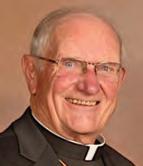
By Bishop Emeritus John
J. Leibrecht
The light of Advent draws us closer to Christ
had a prayer for each week and who was supposed to light the candle. First, the father; then, the next week the mother; then the oldest child and youngest child. I always wanted to light the candle, but I had little chance being the 6th of the 10 children!
With Advent begins the new liturgical year and we will embark on Cycle A readings for Sunday. On the first Sunday of Advent, we hear from the Prophet Isaiah, “O house of Jacob, come, let us walk in the light of the Lord!”
Nov. 30, 2025
Saint Paul encourages us, “Let us then throw off the works of darkness and put on the armor of light.” The Gospel, from Matthew, calls us to be prepared, especially in the “hour of night,” for the Son of Man will come when we least expect.
CALL TO CONVERSION
Moving from darkness to light is the call to conversion. John the Baptist, so prominent during the Advent season, cries out, “Prepare the way of the Lord, make straight his path.” Again, the prophet Isaiah gives us beautiful images: “The desert and the parched land will exalt … feeble hands are strengthened and weak knees are made firm.” We
are called to “Be strong, fear not!” The second reading for the third Sunday is rather unique, coming from the Letter of St. James. We do not read from James that often. And what does he tell us as we draw close to the birth of Christ? He shouts to us: “Make your hearts firm, because the coming of the Lord is at hand.” It is my hope for all of us that this Advent season truly be a time of preparation of the heart. In the midst of decorating, purchasing gifts, and family gatherings, let us not overlook the greatest preparation, the preparation of the human heart! Consult your local parishes for the opportunity for Reconciliation. Challenge yourself to go to Mass more often during Advent. Give yourself the gift of an hour of Adoration of the Blessed Sacrament. How countercultural it is to sit in silent prayer and adoration while the chaos of the world swirls out of control? The business and business of life never goes away, but we can control how we interact with it and take charge of our spiritual journey during Advent. Let our cry this Advent be the cry of the early Church as they anticipated the coming of Christ, “Maranatha, Come, Lord Jesus.”
“O Sacrament Most Holy, O
©TM

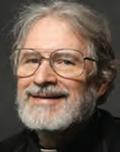
Before his retirement in 2008 as the Fifth Bishop of the Diocese of Springfield-Cape Girardeau, Bishop John Leibrecht wrote a standing column in The Mirror entitled, “Walking Together.” At the end of each article, Bp. Leibrecht would normally share a funny story referencing his travels to the schools, or time with friends, family, or other bishops. The Mirror has decided to share a few of these in an ongoing series entitled, “Another walk through: ‘Walking Together.’” We hope you enjoy them.
April 1, 1994 On the front lawn stood this sign: “Never mind the dog. Beware of the owner!”
April 8, 1994 The cheapest way to trace your family tree is to run for office.
April 15, 1994 A man asked his wife if she would still love him when he put on extra pounds and began to develop a paunch. She said, “Yes, I do!”


CONGRATULATIONS
Fr. James Unterreiner
Retired Fr. James Unterreiner will celebrate the 55th anniversary of his priesthood ordination on December 18th
Happy Anniversary, Fr. James Unterreiner!
Sacrament Divine, all praise and all thanksgiving, be every moment Thine.”
DIOCESAN NEWS
BIG CHANGES ON THE HORIZON FOR CAMP RE-NEW-ALL 2026!
By Paula Wright Fredericktown, MO
With the diocesan purchase in May of the facilities at Camp St. Carlo (formerly Camp St. Vincent) in Fredericktown, Bishop Edward M. Rice has been collaborating with a camp/youth committee on how best to utilize the new facility. The collaborative team includes diocesan staffers Lynn Melendez, Director of Evangelization, Family Life and Youth Ministry; Simon Elfrink, Associate Director of Youth Ministry; Taryn VoganBohrer, Director of Properties and Development; alongside Camp RE-NEW-All staff directors Kim Sellers (Fredericktown) and Rosemary Loecker (Conway). Through extensive prayer and discussion, the decision has been made to hold Camp Re-NEW-All at the diocesan-owned facility, Camp St. Carlo, at one location this summer. Some of the deciding points included:
because it was going up for sale,” shared Lynn Melendez. “The former owner, Deacon Mark Wand, passed away, and it was his dream to have the camp, his and his wife’s, but after he passed, his children eventually made the decision to sell the property. And the asking price wasn’t something the diocese was able to consider, especially since we just purchased the camp in Fredericktown.”
“ We discussed if we could go back to Cassville for camp, however they are in the middle of a renovation and cannot guarantee that they will be completed in time for summer camp,” Melendez said. “Our third possibility was to start searching for another location [in the middle of the diocese or farther west]. Or… to consider putting our time and energy into the camp facility we just bought and what that would look like.”
around having to meld the two camp experiences together,” said Melendez.
But, at the end of the conversations, there was great hopefulness.
“Everyone recognized that this could create a new vision from blending: taking ideas from both camps and putting them together,” said Melendez. “Now we are going to have this unified experience of camp so when you say Camp Re-NEW-All, it means just one Camp Re-NEW-All, and that was exciting for everyone, actually. That was probably the biggest thing that came out of the conversations: All of the kids from across the diocese, from East to West, coming together in Fredericktown and having that unified experience of what camp is about. We all smile big about that.”
• Good fiscal stewardship regarding the new diocesan ownership of a camp facility;
• The loss of the use of the Osage Branch Retreat Center, in Conway (which is being placed up for sale), and the previous camp location of Camp Smokey, in Cassville, presently under renovations;
• The exciting opportunity of uniting youth from across the diocese in one location for an amazing camp experience.
Initially the team had to address the impact of losing the Osage Branch Retreat Center in Conway, which had been used in recent years to host one of two locations for Camp Re-NEW-All.
“ We could no longer use Osage Branch Retreat Center, in Conway,
The camp directors weighed in on their hopefulness and fears about only having one location for camp.
“A fear that was voiced by both camp directors was that although there is a unified vision for camp and the basic activities we do at camp, each camp location has its own personality, and each has developed unique, little differences. For example, something as simple as the chants they do at lunchtime vary. There was some concern about losing or having to change what [each] had. There was a little bit of that tug-of-war
“It was really providential that Rosemary, who was the camp director in Conway, said, ‘I am just seeing God’s hand in this right now. What are the chances we just purchased the camp in Fredericktown; the camp in Conway is being sold without the possibility of us buying it; and Cassville is not an option at this point either because of renovations. I am seeing God’s hand in this, and I think he is saying “give it a try,”’” stated Melendez.
CAMPERS & STAFF IN TRANSITION
Because this is a transition year, the camp directors will work together to help make the transition easier for campers and staff. The camp cooks will be doing the same as they work together on menus and take turns being lead.
“Everyone is so collaborative. They just want to make Camp Re-NEW-All this beautiful experience,” Melendez
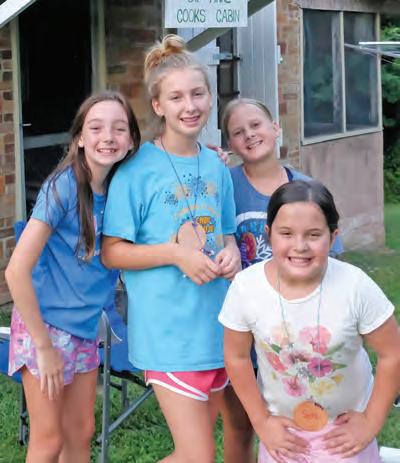
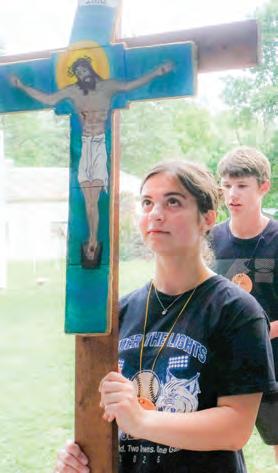
For over 50 years, Catholic children have attended Camp Re-NEW-All, encountering the goodness and love of God through nature, prayer, sacraments, and fun-filled activities with friends. Our belief is that campers deepen their relationship with God while interacting with other campers and staff members, surrounded by the beauty and nature of southern Missouri. Camp activities include sports, swimming, crafts, music, faith formation, celebration of outdoor Mass and confession, and more. All children going into the 5th, 6th, 7th, 8th, and 9th grade (following the camp season) are invited to register. Adult staff (age 18 and above as of the first day of the camp session), and high school staff (entering grades 10-12 in fall) serve along with priests and seminarians as counselors, activities directors, and support staff. ©TM
said. “It was such a relief. They each love Camp Re-New-All so much and they love that they get to experience kids discovering God in nature. So, they were just like, ‘let’s plunge forward with this and work together.’ It is so exciting.”
There will be five camp sessions for the summer 2026 season. To help parents with the drive to Fredericktown, buses are being arranged to provide transportation for those on the west side.
“ We recognize that parents driving or carpooling to bring their kids to camp is probably the most ideal, but we know that doesn’t work for everybody, especially if you have two working parents,” Melendez said. “So, we are going to provide buses for this year and see what the need is going forward.”
“ We look forward to uniting youth from across the diocese in one location for an amazing camp experience! Please be patient with the ‘hiccups and growing pains’ this year,” asked Melendez. “We kindly ask you to join us in praying for God’s blessing on Camp Re-NEW-All and all those who will be serving as staff and joining us as campers!” ©TM
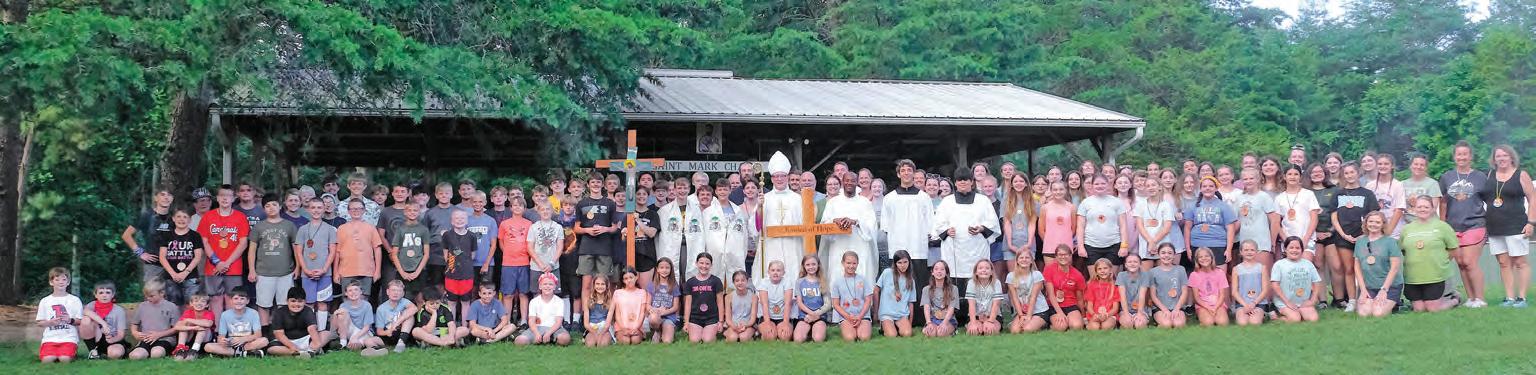
CAMP (ST.) CARLO 2025 Session 3F Camp Re-NEW-All campers, staff, volunteers, and clergy all posed for a panoramic photo at sunset outside of Saint Mark Chapel in Conway, MO. The diocese will be hosting only one location for Camp Re-NEW-All 2026 on property it owns in Fredericktown, MO: “Camp St. Carlo,” named after St. Carlo Acutis. (The Mirror)
$400,000 GIFT MADE TO JOPLIN ENDOWMENT NAMED FOR
SISTER OF
MERCY
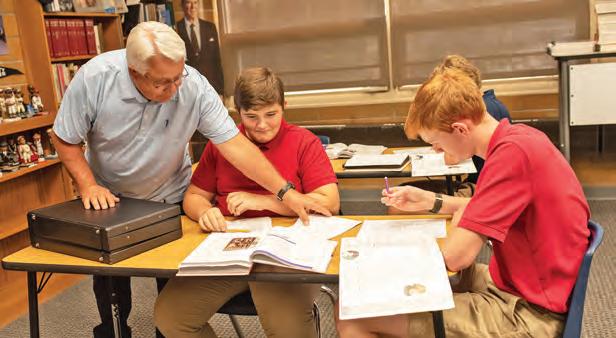
JACS RECEIVES $400K ENDOWMENT DONATION—Students receive instruction in McAuley Catholic High School, Joplin. Joplin Area Catholic Schools (JACS) recently received a donation of $400,000 to its endowment fund in support of staff salaries. JACS is made up of St. Ann Catholic School, Carthage; St. Mary Catholic School, Joplin; St. Peter Middle School, Joplin; and McAuley Catholic High School, Joplin (Submitted photo)
Joplin, MO
Joplin Area Catholic Schools (JACS) has received a $400,000 gift to the Sister Norbert Endowment, made possible by the generosity of anonymous donors who believe deeply in the system’s mission and the vital work of its teachers.
The Sister Norbert Flesch, RSM, Endowment for Staff Salaries was created to support the ongoing growth of teacher salaries within the school system, ensuring that it can continue to attract and retain dedicated educators who help students grow in faith, knowledge, and service each day.
“This remarkable gift is both a testament to the impact our teachers make and a reflection of the community’s confidence in the future of Catholic education in Joplin,” said Jess Sickman, JACS Director of Schools.
This announcement also offers a great opportunity to share a little more about how endowment funds work. An endowment is a lasting fund in which the principal is invested permanently, and only the interest or earnings are used each year to support the designated cause. This
means that gifts to JACS endowments continue to provide support for generations to come.
Joplin Area Catholic Schools is blessed with several active endowment funds:
• Sister Norbert Flesch, RSM, Endowment—supports teacher salaries;
• Legacy of Faith Endowment—provides tuition assistance to Catholic families that qualify; and
• Mercy Scholarship Endowment—funds scholarships for students who qualify.
Each of these funds strengthens the mission of JACS in a unique way, and together they ensure that the schools remain vibrant, accessible, and rooted in faith.
“ We are deeply grateful to our anonymous donors for this extraordinary investment in our teachers and our future,” Sickman said. “Their generosity embodies the spirit of faith, hope, and love that defines our JACS community.”
If you’d like to learn more about the endowment funds or would like to support the JACS mission, please visit https:// www.jacss.org/page/support.
©TM
KQOH 91.9 FM Springfield
K232FF 94.3 FM Cape Girardeau
KHJM 89.1 FM Dexter & the Bootheel
KFSS 94.5 FM Joplin
KJCW 1100 AM Joplin 92.1 FM Carthage
LETTER TO THE EDITOR
Missouri’s Katy Trail Pilgrimage
Recently, Oct. 6-10, I was blessed to take part in the pilgrimage after seeing it announced in our parish bulletin at St. Francis de Sales, in Lebanon. I ended up being the only participant from the Diocese of Springfield–Cape Girardeau, but I was warmly welcomed by everyone along the way. In fact, many of the participants spoke fondly of Bishop Edward Rice, he is very well known and deeply loved throughout that area, which made me feel right at home.
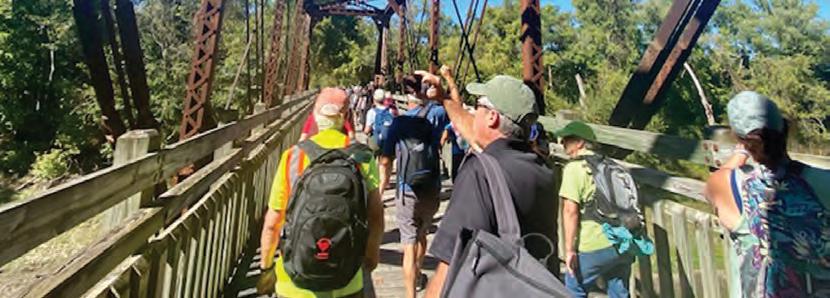
The five-day, 53 miles, seven Catholic churches (one Shrine), two dioceses, a journey along Missouri’s Katy Trail was an incredible experience of prayer, reflection, fellowship, and a “dramatically beautiful way to give your heart to Jesus through Mary.” Each day, we attended Mass and had quiet time for reflection, followed by long stretches of walking through God’s beautiful creation. We prayed the Rosary, shared meals, and encouraged one another in faith and perseverance. The simplicity of walking, praying, and sharing stories made it a powerful spiritual renewal and a reminder that pilgrimages don’t have to take place overseas to be transformative.
This experience deepened my faith and gave me a new appreciation for how local pilgrimages can connect people to God, nature, and each other. I wanted to share this in hopes that others from our diocese might be interested in this special Catholic pilgrimage in the future right here at home.
Thank you for all you do to support and inspire the faithful across southern Missouri. The Katy Trail Pilgrimage was truly a blessing, and I’m grateful to have represented our diocese on this beautiful
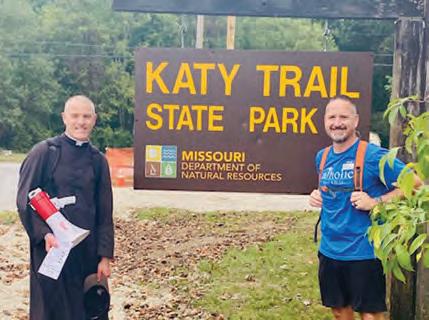
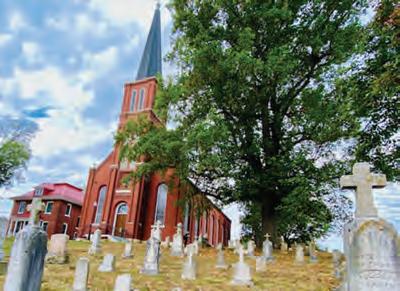
MISSOURI PILGRIMAGE—Organized by Fr. Timothy Foy, of the Archdiocese of St. Louis, the five-day, 53 miles, seven Catholic churches (one Shrine), two dioceses, (Arch StL and Diocese of Jefferson City) a journey along Missouri’s Katy Trail was an incredible experience of prayer, reflection, fellowship, said Dustin Young of Lebanon, MO. The next Katy Trail Pilgrimage is slated for Sept 28 - Oct 2, 2026. Registration opens Aug. 1, 2026; for more information consult https:// www.katytrailpilgrimage.com/. (Photos by Dustin Young)
journey of faith. If interested in sharing please let me know. This was the 9th pilgrimage and they plan to do one yearly.
©TM Dustin Young Lebanon, MO

CONGRATULATIONS
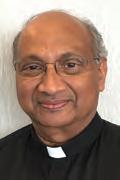
Fr. Vincent Joseph, VC
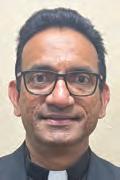
Fr. Vincent Joseph, VC, will celebrate the 40th anniversary of his priesthood ordination on December 27th. He currently serves as Pastor, St. John Parish, Leopold & St. Anthony Mission Church, Glennon. Happy Anniversary, Fr. Joseph!
DIOCESAN NEWS
OBITUARY // Vincentian Fr. John Gagnepain, CM
Father John Gagnepain, CM, a devoted Vincentian priest whose life was marked by service, humility, a ready smile, and a deep love for God’s creation, passed away peacefully Nov. 15. He was 90.
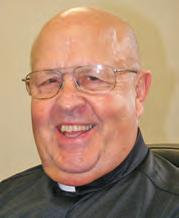
Born on Sept. 2, 1935, in Perryville, MO, to the late Joseph W. “Cy” and Augusta “Gussie” Pouyer Gagnepain, Fr. John Gagnepain, CM, was influenced by Vincentians throughout his entire life. In addition to being the nephew of a Vincentian priest, the late Fr. Henry Francis Gagnepain, CM, Fr. Gagnepain was baptized at the Church of the Assumption at St. Mary’s of the Barrens on the Feast of the Nativity of the Blessed Virgin, September 8, 1935, and attended the parish elementary school. Upon graduation, he moved to Cape Girardeau, MO, to attend St. Vincent’s College High School Seminary. He continued his studies at St. Mary’s of the Barrens Seminary in Perryville, MO, earning a degree in philosophy in 1958 and a degree in theology in 1962. Fr. Gagnepain professed vows as a member of the Congregation of the Mission at St. Mary’s of the Barrens on May 31, 1955. He was ordained a transitional deacon at the Barrens on
October 7, 1961, by Bishop Glennon Flavin. His priestly ordination was also at St. Mary’s of the Barrens on June 10, 1962, by Bishop George Gottwald.
In addition to his theological training, Fr. Gagnepain went on to complete further graduate studies in chemistry, physics, and mathematics at DePaul University and St. Louis University. His talents were put to good use, first as a faculty member then as Rector of St. Louis Prep Seminary and at St. Vincent de Paul Seminary in Lemont, IL. His former students remember him as a good man who could be strict, when necessary, and who made himself available to students who needed to talk. He could be counted on to provide honest feedback. He taught his students to live a favorite quote of St. Vincent de Paul, “Let us love God but with the strength of our arms and the sweat of our brow.” He taught this by example as he spent time roofing and rehabbing homes in the Bootheel of Southeast Missouri. As he worked with young people on these mission trips, he shared not only hard work but his passion for his faith, especially his devotion to the Blessed Mother. Despite his reputation as a disciplinarian, he was very jovial, recognizing good in everyone.
After leaving secondary education, Fr. Gagnepain served as Provincial of the Midwest (now Western) Province of the Congregation of the Mission. Upon
ANNOUNCEMENTS
Belleville, IL—King’s House at the National Shrine of Our Lady of the Snows-Advent Day of Reflection with Sr. Barb Smith, ASC: Advent’s Deepening Call to Welcome the Tender Grace of God-With-Us, Sat., Dec. 6, 10am3pm, at the Shrine Visitors Center. Cost: $60, lunch included. Register at https://kh.snows. org/events/smithasc-dor-2025/
Benton—St. Denis Home & School will host its 26th annual Winter Wonderland of Treasures Craft Show, Sat., Dec. 6, 8am-2pm, in the parish center. Christmas décor, personalized items, jewelry, signs, wreaths, tumblers, candles, lotions, soaps, and much more! Breakfast items, cinnamon rolls, chicken noodle soup, chili, and sweet treats table! For questions or vendor information, contact Crystal Gosche at (573) 264-1217.
Chaffee—St. Ambrose Men’s Club will have a Whole Hog Sausage Breakfast, Sun., Dec. 7, 7:30-11am, in the St. Ambrose Parish Center. Sausage, scrambled eggs, biscuits & gravy. Dine-in and carry-out.
Fredericktown—St. Michael the Archangel Parish will hold its Holiday Craft Fair, Sat., Dec. 6, 8am-1pm. Handmade arts and crafts, quilts, jewelry, Christmas wreaths and arrangements,
completion of his terms as Provincial, he served as Spiritual Director and Director of Continuing Formation of the Clergy for the priests of the Diocese of Springfield-Cape Girardeau in southern Missouri. He was known and respected for his spirit of hospitality as he encouraged the clergy to form an “Intentional Presbyterate,” wherein the clergy worked on developing supportive relationships among the priests of the diocese. He loved his days of driving through rural Missouri and the friendships that developed along the way. Father Gagnepain served in this capacity from April 24, 1997 until his retirement on July 1, 2016.
In November of 2000, Fr. Gagnepain was appointed Superior of the house at St. Mary’s of the Barrens. One of his legacies involved major changes to the Barrens. Looking ahead to the needs of an aging community, Fr. Gagnepain spearheaded the demolition of the old Novitiate and Student buildings and the construction of the Apostle of Charity residence for senior confreres. A series of health challenges led to Fr. Gagnepain being permanently assigned to Apostle of Charity, first as a Confrere in Residence, and finally as a Confrere in Care. Staff there remember Fr. Gagnepain as a deeply caring person who loved and prayed daily for his family, friends, and confreres, as well as for staff and members of the Association of the Miraculous Medal. Age and declining health did not dim
homemade bread, sweet rolls; soup or chili lunch.
Mountain Grove—The Parish Council of Catholic Women will host a Santa 5K & 2.5K Run & Walk, Sat., Dec. 6, 2025. Participation forms can be picked up at the YMCA locations in Mountain Grove, Willow Springs, Cabool, and Seymour, or by sending a request to Andrea Ferguson at agomezferguson@gmail. com. Completed forms should be returned to the YMCA with a $20 registration fee. The race will take place on the square during Winterfest. Check in 11am-12:30pm-pick up race bib, t-shirt, and race bag. Be at the starting line by 12:50pm. Dressing in holiday garb is strongly encouraged! There will be an Ugly Sweater, Most Festive, and Most Festive Dog contests. Medals and prizes awarded based on age groups and overall fastest for the 5K and 2.5K.
Springfield—Sacred Heart Parish will hold its 2025 Vendor & Craft Sale, Fri., Dec. 5, 5-9pm and Sat., Dec. 6, 10am-4pm. Get all your holiday gift shopping done under one roof! We will be selling our Sacred Heart holiday cookies “By the Pound.” This event is being held in conjunction with the Midtown Victorian Christmas Homes Tour.
Parishes and organizations are invited to submit notices of future events to be printed on a space-available basis. There is no fee.
his love of nature, farming, baking, technology, and curiosity to learn how things work. He welcomed challenges, whether learning to play handbells, practicing new hymns, or learning new card games. Provincial office staff remember him as a kind, joyful man who expressed gratitude for any and all services they provided to him and to the province.
Fr. Gagnepain was preceded in death by his parents and his two brothers, Joe and Gene Favier. He is survived by his sister, Lucy Brenner; sister-in-law, Pat Favier; his fellow Vincentian priests and brothers, as well as the staff at St. Mary’s of the Barrens who cared for him.
Visitation was held on November 19, 2025, in the Church of the Assumption at St. Mary’s of the Barrens in Perryville, MO, with a Vigil Service at 7 p.m.
The Funeral Mass was on November 20, 2025, in the Church of the Assumption, with Reverend Joseph S. Williams, CM, Provincial of the Western Province of the Congregation of the Mission, officiating, followed immediately by burial in the Vincentian Community Cemetery in Perryville.
In lieu of flowers, the family kindly requests that donations be made to the Miraculous Medal Shrine, an organization close to Fr. Gagnepain’s heart and reflective of his lifelong devotion to the Blessed Mother and the Vincentian mission. ©TM
ADULT FAITH
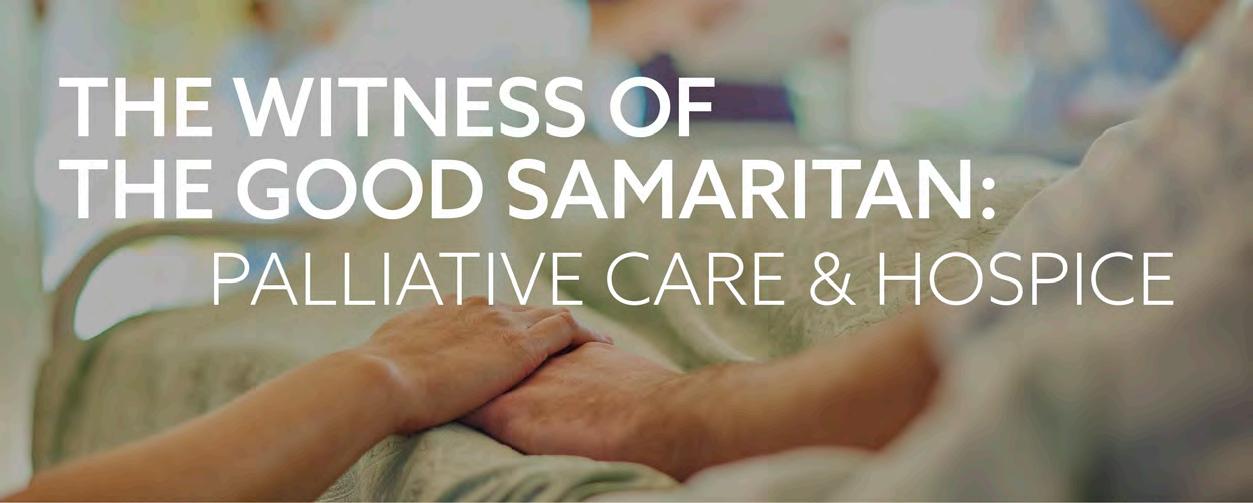
2020, the
” (“on the care of persons in the critical and terminal phases of life”). The letter reaffirms the Church’s teaching on care for those who are critically ill or dying and offers additional pastoral guidance for increasingly complex situations at the end of life. The following offers a brief overview of key points from this important document with a specific focus on what it says about palliative care and hospice.
The ultimate foundation of human dignity lies in the reality that God became man to save us and call us into communion with him. The Good Samaritan, who goes out of his way to aid an injured man, symbolizes Jesus, who encounters humanity in need of salvation and cares for our wounds and sufferings. Despite our best efforts, it can sometimes be difficult to recognize the profound value of human life when we see its full weakness and fragility. Yet, the faithful care of human life until its natural end is entrusted to every person.
In the face of challenges that affect the very way we think about medicine, the significance of the care of the sick, and our social responsibility toward the most vulnerable, the Church reminds us of our obligation to readily accompany those in the critical and terminal stages of life, for all are called to give witness at the side of the sick person. Sadly, the request for death through euthanasia or assisted suicide is often a symptom of disease, aggravated by isolation and discomfort. Care for life is therefore the first responsibility in our encounter with those who are sick. This responsibility exists not only when health may be restored, but even when a cure is impossible. Only human warmth and evangelical fraternity can reveal a positive horizon of support to the sick person in hope and confident trust.
The need for medical care comes
from our vulnerability as human persons. As a unity of body and soul, each person is materially and temporally finite, with a longing for the infinite and a destiny that is eternal. As such, we depend on the mutual support of others, as well as our connection with God. In view of our earthly finitude, medicine must therefore accept that death is part of the human condition. However, even when a cure is not possible, adequate care must still be provided until the very end: “to cure if possible, always to care.” Adequate care—which upholds the dignity and integrity of the person—includes necessary physical, psychological, social, familial, and spiritual support to those who are sick. Palliative care and hospice embody this comprehensive and integrated approach.
Death is a decisive moment in the human person’s encounter with God the Savior. Helping the Christian to experience this moment with spiritual assistance is a supreme act of charity. It encompasses the patient with the solid support of human relationships to accompany them and open them to hope.
Palliative care and hospice are precious and crucial instruments in the care of patients with serious and complex chronic or terminal illnesses, and they help provide comfort to both the patients and their families.
While palliative care cannot entirely eradicate suffering from people’s lives, it provides an authentic expression of human and Christian care—allowing us to “remain” at the side of a suffering person, as the Blessed Mother and the beloved disciple remained at the foot of the Cross. When we follow their example, we participate in the mystery of Redemption. The path of accompaniment until the moment of death must remain open, with appropriate care for body and soul customized to the personal needs of the patient.
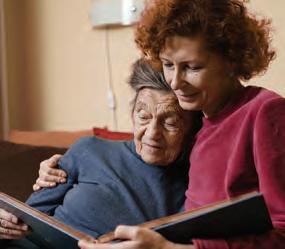
The role of the family is central to the care of chronically and terminally ill patients. In the family, a person is valued in himself or herself, rather
than because of efficiency or utility. It is essential that those who are sick and being cared for do not perceive themselves as burdensome. In times of suffering, a person should be able to experience from others a solidarity and a love that takes on the suffering, offering a sense of life that extends beyond death. All of this has a great social importance: “A society unable to accept the suffering of its members and incapable of helping to share their suffering, and to bear it inwardly through ‘compassion’ is a cruel and inhuman society”.1 Hospice can provide a valuable service by serving those who are terminally sick and ensuring their care until the last moment of life. By doing so, hospice can provide a sanctuary where suffering takes on profound meaning.
It is morally permissible to decide against disproportionate treatments that would provide only a precarious or painful extension of life. The refusal of extraordinary means of care expresses acceptance of the human condition, but it does not seek to hasten death. The suspension of disproportionate therapies must not entail the withdrawal of basic care— including pain relief, hydration, nutrition, thermoregulation, and so forth. In addition, when necessary to relieve pain at the end of life, the Church affirms the moral permissibility of using pain medications that cause the loss of consciousness, and may even hasten the moment of death, as long as this hastening of death is a secondary effect of the medications and not their direct or intended purpose. In such cases, the informed consent of the patient, designated surrogate, or family member(s) must be obtained. Every medical action must always have as its

object the promotion of life and never the pursuit of death. In addition, patients should be provided proper spiritual care so they may consciously approach their death as an encounter with God. The pastoral care provided by family, doctors, nurses, and chaplains can help the patient to persevere in sanctifying
In
Vatican’s Congregation for the Doctrine of the Faith released the letter “Samaritanus bonus
ADULT FAITH/DIOCESAN NEWS/ADVERTISING
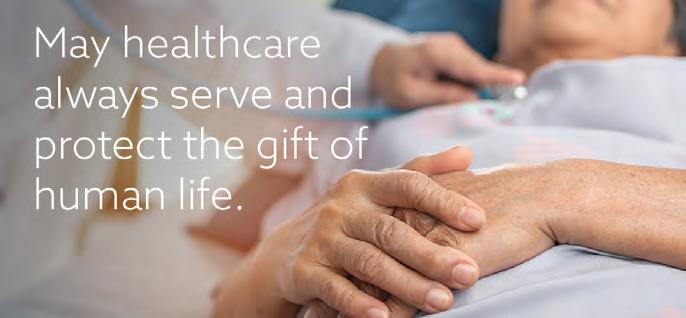
grace and to die in charity and in the love of God.
The legalization of euthanasia and assisted suicide in many places, however, has created great confusion regarding basic obligations to provide care. It should be recognized that the definition of palliative care has, in recent years, sometimes taken on a misleading and deeply harmful connotation. For example, in some countries, national laws regulating palliative care also provide, along with palliative treatments, something called Medical Assistance to the Dying (MAiD), which makes it legal for patients to request euthanasia and assisted suicide. Such legal provisions are a cause of grave cultural and moral confusion. By including provisions for euthanasia and assisted suicide alongside palliative care, these laws imply that it is morally permissible to request such practices.
Equally harmful to the practice of palliative care, and to patients, is when interventions to reduce the suffering of gravely or terminally ill patients are given in order to hasten death. Also problematic is the withholding or withdrawing of hydration, nutrition or other interventions which the patient finds sufficiently beneficial and not excessively [or disproportionately] burdensome. Such refusal of ethically required care is equivalent to a direct action or omission to bring about death and is therefore never morally permissible.
The continued spread of such legislation and practices, and their endorsement by national and international professional societies, constitutes a socially irresponsible and grave threat to many people. A growing number of vulnerable persons who need only to be better cared for and comforted are instead being led to choose death.
Conversely, “the eloquence of the parable of the Good Samaritan and of the whole Gospel is especially this: every individual must feel as if called personally to bear witness
to love in suffering”.2 The Church learns from the Good Samaritan how to care for those who are terminally ill, and likewise obeys the commandment linked to the gift of life: “respect, defend, love and serve life, every human life!”3. Each of us is invited to imitate the Samaritan’s example, to “Go and do likewise” (Lk 10:37).
The parable of the Good Samaritan demonstrates that our relationship with our suffering neighbor must not be characterized by indifference, apathy, bias, fear of soiling one’s hands, or occupation with one’s own affairs. Rather, our relationships should embrace the qualities of attention, listening, understanding, compassion, and accompaniment. At work here is a contemplative gaze that beholds in one’s own existence and that of others a unique and unrepeatable wonder, received and welcomed as a gift.
The mystery of the redemption of the human person is rooted in the loving involvement of God with human suffering. Hope is always possible. To those who care for the sick, the scene of the Cross provides a way of understanding that even when it seems that there is nothing more to do there remains much to do, because “remaining” by the side of the sick is a sign of love and of the hope that it contains. Healed by Jesus, we become men and women called to proclaim his healing power and provide care for our neighbors, until the very end. ©USCCB
1 Benedict XVI, Encyclical Letter Spe salvi (30 November 2007), 38: AAS 99 (2007), 1016. Here Pope Benedict highlights that the true meaning of compassion is to “suffer with” another person in their time of need (com: with; passio: to suffer).
2 John Paul II, Apostolic Letter Salvifici doloris (11 February 1984), 29: AAS 76 (1984), 246.
3 John Paul II, Encyclical Letter Evangelium vitae (25 March 1995), 5: AAS 87 (1995), 407
*Cf. Samaritanus bonus © 2020, Libreria Editrice Vaticana, Vatican City. Summary comprised of quotes, paraphrases, and adaptations used with permission. All rights reserved. Models used for illustrative purposes only. iStock.com/ sturti; iStock.com/Toa55; iStock.com/Yelizaveta Tomashevska; iStock.com/Jovanmandic. Used with permission. All rights reserved. Copyright © 2022, United States Conference of Catholic Bishops, Washington, D.C. All rights reserved.

CURSILLO WEEKEND

SCAN QR CODE for upcoming dates and more info!

All men who have not yet attended a Cursillo weekend (Cursillo means “A Short Course in Christianity”) are invited to attend the upcoming weekend: Dec. 4-7 at Pinecrest Camp near Fredericktown, Missouri. Weekends are also scheduled in the Spring 2026 in case you can make one of these weekends. For more info, contact Dale Gerecke at (573) 450-3335, or dale@gereckelaw. com, or contact a Cursillista in your parish, or search “Cursillo” on the diocesan Website: dioscg.org


What is it?
Project Rachel is the Catholic Church’s ministry of love, support, and healing for those who have been involved in abortion. To implement that ministry, our Diocese has created an integrated network of services, including pastoral counseling, support groups, retreats, opportunities for sacramental forgiveness, and referrals to licensed mental health professionals.
Why are we doing it?
It’s normal to grieve a pregnancy loss, but the loss of a child by abortion can create a hole so deep in one’s heart that it may seem the emptiness can never be filled. With the
forgiveness, hope, and healing provided through Project Rachel Ministries, many women and men have returned to a loving relationship with God.
How do people get help?
Women and men who have been involved in abortion are invited to contact the diocesan Project Rachel Ministry to receive free, compassionate and confidential help. Call (417) 340-0302 or Email projectrachel@dioscg.org to learn more. A list of ministry resources is available at hopeafterabortion.com.
Kim Brayman, Project Rachel Program Coordinator
CURSILLO #128 Sept. 5-8, 2024
ADULT FAITH
THE EUCHARIST BUILDS THE CHURCH
As the Diocese of Springfield–Cape Girardeau joyfully anticipates the celebration of its 70th anniversary, we return with renewed devotion to the mystery that has sustained, shaped, and united our local Church from the beginning: the Most Holy Eucharist. Since the diocese’s establishment in 1956, the Eucharist has been the daily spiritual heartbeat of our communities—from small rural chapels tucked into the Ozark mountains to vibrant parish centers in our towns and cities across southern Missouri.
By The Very Rev. Shoby Chettiyath, JCL, V.G.
2). The one sacrifice of Calvary, offered “once for all” (Heb 10:10), becomes present sacramentally in every Mass (cf. “Lumen Gentium” 3; Catechism of the Catholic Church [CCC] 1367).
This Jubilee year, highlighted by our Diocesan Eucharistic Congress on August 15, 2026, invites us to rediscover the sacrament that not only feeds us but forms us. Chapter Two of Pope St. John Paul II’s, “Ecclesia de Eucharistia” (“On the Eucharist” [EE]) offers a particularly rich theological lens for embracing this moment. In this chapter, the Holy Father teaches that the Eucharist is both the origin and the principle of continual growth for the Church. His well-known affirmation, “The Church makes the Eucharist, and the Eucharist makes the Church” (EE 26), captures a profound truth we have experienced for seven decades in our diocese.
Our anniversary is therefore not simply a remembrance of the past but a call to deepen our Eucharistic identity. When we reflect on chapter two, we see that our diocesan history is, in a real sense, a Eucharistic story: a story that Christ himself sustains through his sacramental presence, week after week and year after year.
Pope St. John Paul II emphasizes in chapter one that the Church “draws her life from the Eucharist” (EE 1). This is not a metaphor. It is a theological principle anchored in Scripture, the early Church Fathers, the teachings of the Second Vatican Council, and the lived tradition of Christian communities across the centuries. The Eucharist stands as both the source and the summit of the Church’s life (cf. “Lumen Gentium” 11). Through the Eucharist, the Church becomes who she is.
The Eucharist as the re-presentation of the Paschal Mystery
John Paul II begins chapter two by rooting Eucharistic theology in the Paschal Mystery. The Eucharist is not merely a symbolic remembrance of the Last Supper; it is the sacramental re-presentation, the making-present, of Christ’s redemptive sacrifice (EE
The Church Fathers, especially St. Augustine, saw in the blood and water flowing from Christ’s side (Jn 19:34) the very birth of the Church. Augustine compares the Church to the New Eve emerging from the side of the New Adam, linking the origin of the Church to the Paschal Mystery.
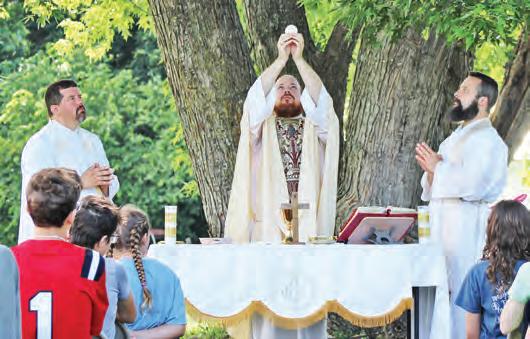
MASS AT CAMP RE-NEW-ALL Father Brian Straus elevated the host at a liturgy celebrated during Session 1C of Camp Re-NEW-All this past summer. Concelebrating the liturgy were Fr. Charles (“Chaz”) Dunn and Fr. Andrew Williams. The Sacrament of the Eucharist makes us who we are: the Church, the Body of Christ, alive in the world. (The Mirror)
The Eucharist, therefore, is the sacrament through which the Church continually reconnects with this origin. Saint Thomas Aquinas deepens this insight, teaching that the Eucharist “contains Christ himself” (ST III, q. 73, a. 3), and therefore possesses a unique power to “build up” the Church. We are gathered in the Eucharist not simply around a memory or a symbol, but around the living Christ, who acts through the sacrament to form his people into his Body.
The reciprocal relationship between the Eucharist & the Church
One of the central teachings of chapter two is the reciprocal relationship between the Eucharist and the Church. John Paul II writes: “The Church makes the Eucharist, and the Eucharist makes the Church” (EE 26). This theological principle draws deeply on the work of Henri de Lubac, whose Corpus Mysticum demonstrated the historical and spiritual unity between Eucharistic communion and ecclesial identity.
The Church makes the Eucharist
Pope St. John Paul II affirms that the Eucharist can only be celebrated by a community already constituted as the Church, gathered around its bishop or a priest in apostolic succession (EE 28; cf. “Lumen Gentium” 26). The priest does not act on his own authority but in persona Christi, within the apostolic mission
SCAN the QR code for more resources, including suggestions for the Year of Spiritual Preparation, and updates to the Congress!
Christ entrusted to his Church (cf. “Presbyterorum Ordinis” 2).
Thus, the Eucharist presupposes the Church’s apostolic structure. A community is not self-authorizing; it receives its identity and sacramental authority from Christ through the Apostles and their successors.
The Eucharist makes the Church
At the same time, the Eucharist forms the Church from within. The teaching of St. Paul, “Because there is one bread, we who are many are one body” (1 Cor 10:17; cf. EE 22), expresses a profound sacramental reality: Eucharistic communion builds ecclesial communion. In receiving Christ, we become more deeply united to him and to one another. Every Mass renews the Church’s unity, identity, and mission.
Ecclesial communion as a Eucharistic reality
John Paul II emphasizes that Eucharistic communion requires full ecclesial communion. This includes unity in faith, sacraments, and hierarchical governance, as taught by the Second Vatican Council in “Unitatis Redintegratio” 2. The Eucharist presupposes and expresses this unity, which is why intercommunion with communities not in full union with the Catholic Church is not ordinarily possible (EE 30–31).
The Eucharist, therefore, is not simply a sign of personal devotion but a sacramental declaration of communion with the Church.
Saint Augustine beautifully summarizes this truth:
“Receive what
you are and become what you receive” (Sermones. n. 272). In receiving the Body of Christ, believers pledge to live as one Body in faith and charity.
Conclusion
Chapter two of “Ecclesia de Eucharistia” offers a rich and coherent vision of Catholic life. It teaches that the Eucharist re-presents Christ’s Paschal Mystery; continually gives birth to the Church; presupposes her apostolic and hierarchical structure; and demands and deepens ecclesial unity. For Pope St. John Paul II, the Eucharist is not an optional devotion—it is the very origin, identity, and mission of the Church.
As we celebrate 70 years of faith and ministry in the Diocese of Springfield–Cape Girardeau, this teaching takes on renewed significance. Our parishes, our vocations, our ministries of service, our catechesis, our unity as a diocesan family—all flow from and return to the Eucharist.
The Diocesan Eucharistic Congress on August 15, 2026, will be a moment of grace to recommit ourselves to this Eucharistic identity. Just as the Eucharist built the early Church and has built our diocese across seven decades, so, too, will it continue to shape our future.
As we look ahead with hope, we give thanks for the countless Masses celebrated, the sacraments administered, the faith handed on, and the lives transformed by Christ present in the Eucharist. May this Jubilee year rekindle in every heart a renewed love for the Eucharist—the sacrament that makes us who we are: the Church, the Body of Christ, alive in the world. ©TM
The Very Rev. Shoby Chettiyath, JCL, V.G., serves as Vicar General, Moderator of the Curia, and Vicar for Religious in the Diocese of Springfield-Cape Girardeau. He is Pastor of St. Francis of Assisi Parish, in Nixa, and Holy Trinity Parish, Springfield.

DURING THIS EUCHARISTIC REVIVAL, FR. DAVID COON OFFERS THE FOLLOWING QUOTE FOR THE REFLECTION ON THE EUCHARIST:
“Jesus waits for us in this Sacrament of love.”
— POPE ST. JOHN PAUL II
Father Coon is Pastor of Sacred Heart Parish, Dexter. He serves the Diocese as Priest Minister for Spiritual Deliverance & Exorcism and the Confraternity of Priest Adorers of the Eucharistic Face of Jesus.
ADULT FAITH
What does World War I have to do with the solemnity of Christ the King?
By D.D. Emmons OSV News
On the last Sunday of the liturgical year, Nov. 23, Catholics celebrate the Solemnity of Our Lord Jesus Christ, King of the Universe, which marks a century this year. A relative newcomer to the Church calendar—established in the 20th century— this feast is designed to give special recognition to the dominion Christ our Lord has over all aspects of our lives. But why and how did it come about? And why is it so important today?
When Cardinal Ambrogio Achille Ratti was elected pope and took the name Pope Pius XI, much of the world was in shambles. The year was 1922, and while the bloodletting of World War I (1914-1918) had ended, widespread peace and tranquility were not evident.
WIDESPREAD DEVASTATION
The war to end all wars had been especially devastating to England and the countries of continental Europe. Additionally, the overthrow of the Romanov tsars by the Russian Revolution had created great upheaval in Russia and brought immense suffering. Governments were in economic chaos, unemployment was rampant, and people in many places were literally starving to death.
The stability of the old social and political orders that had embraced royal houses and crowned heads of state were crumbling. The victorious warring powers sought severe penalties and unreasonable reparations from the vanquished Germans through the Treaty of Versailles.
Pessimism, a sense of helplessness compounded by hatred among the nations, was overwhelming. The time was ripe for the rise of tyrants, and rise they did. The festering philosophies of fascism, National Socialism (the Nazis), and communism now spawned the likes of Benito Mussolini, Adolf Hitler, and Joseph
Stalin.
Pope Pius XI’s predecessor, Pope Benedict XV, had prophetically warned about this in 1920 when he wrote, “There can be no stable peace or lasting treaties, though made after long and difficult negotiations and duly signed, unless there be a return of mutual charity to appease hate and banish enmity.”
In their distress, people clung to anyone who offered them hope, offered some kind of direction out of the chaos and promised to put food on their tables. They gravitated to the emerging dictators, and as they did, they often sought to be selfsufficient to the exclusion of God from their everyday lives.
Many considered the basics of morality and the teachings of the Church to be out of date, no longer relevant in 20th-century society. Modern thinking allowed that, at most, Christ might be king in the private life of the individual, but certainly not in the public world..
LITTLE REGARD FOR CHRISTIAN PRINCIPLES
Nov. 23
hundreds of thousands of pilgrims flocked to Rome, demonstrating great fervor for their faith.
On Dec. 11 of the jubilee year, and in order to acknowledge perpetually the supremacy of Jesus Christ over all men, nations and earthly allegiances, the pope issued the encyclical “Quas Primas,” which added the feast of “Our Lord Jesus Christ the King” to the annual church liturgical calendar.
SOLEMNITY
Some political regimes advocated the banishment of Jesus altogether, not only from society, but from the family as well. As nations were reborn and governments restructured, their foundations, policies, and laws were often being fashioned without regard to Christian principles.
In all these developments, the new Pope Pius XI saw that people were denying Christ in favor of a lifestyle dominated by secularism, material advantage, and false hope created by the tyrants.
He realized that he had to address the political and economic forces that were crowding out the kingship of Jesus. As a start, he dedicated his reign as pope to “The Peace of Christ in the Kingdom of Christ” (“Pax Christi in Regno Christi”).
In 1925, the Church celebrated a jubilee year in honor of the 1,600th anniversary of the Council of Nicaea. The council fathers taking part in that ancient gathering in 325 AD had affirmed the full divinity of Jesus Christ as God the Son, one in being with God the Father. Their pronouncement became a creed that was later expanded into what we now call the Nicene Creed, which we still profess at Mass every Sunday.
Throughout the anniversary year, Pope Pius constantly emphasized the kingship of Christ as declared in the Creed: “His kingdom will have no end.” He stressed that theme throughout the year as it repeatedly appeared in the Church’s celebrations of the Annunciation, the Epiphany, the Transfiguration, and the Ascension. As part of the Holy Year, which was afforded great attention and pomp by the Vatican,
•
Some at the time argued that such a celebration was unnecessary because the ancient feast of the Epiphany already acknowledged Christ as King. But more than 340 religious leaders, including cardinals and bishops, had called for the new celebration, and the pope was glad to grant their request.
The encyclical provided for the feast of Christ the King to be held each year on the last Sunday of October. This date, a week before All Saints’ Day and four weeks before Advent, was carefully chosen: It reminded the people that Jesus Christ is not only King of this world, reigning among nations today; he is also the eternal King, glorified by the saints in heaven, who will one day come to judge all humankind.
REJECTION OF THE GOSPEL
In his encyclical, the pope noted that the continuing disorder of that era, what he called “the plague of society,” had long been festering and was the result of nations rejecting Christ. Later in the encyclical the pontiff pointedly reminded national governments, “Christ, who has been cast out of public life, despised, neglected, and ignored, will most severely avenge these insults; for His kingly dignity demands that the State should take account of the commandments of God and of Christian principles, both in making laws and in administering justice, and also in providing for the young a sound moral education” (No. 32).
The pope instructed the faithful to use this annual celebration as a time to consecrate themselves, or renew their consecration to, the Sacred Heart of Jesus, explicitly tying the celebration to devotion to the Sacred Heart and to the living Christ in the Eucharist. He also called for Catholics to make reparations for the widespread atheism being practiced in many countries.
In 1969, Pope Paul VI took several steps to enhance the witness of the feast day. To emphasize Christ’s universal reign, he changed the name of the celebration to the feast of “Our Lord Jesus Christ, King of All” (“Domini Nostri Iesu Christi universorum Regis”) He also changed the date to the last Sunday in the liturgical year, emphasizing even more strongly the connection between Christ’s kingship and his second advent (coming) to judge the world. In addition, the pope raised the feast to the highest rank of celebration on the Church calendar, that of a “solemnity.”
Today, peace still eludes us; social, political, and economic orders are shaking; and the nations continue in many ways to reject the light of the Gospel. We can be grateful, then, for the chance to celebrate each year the solemnity of Christ the King--for the world needs now, more than ever, our witness to his rule over all things. ©OSV
D.D. Emmons writes from Pennsylvania.
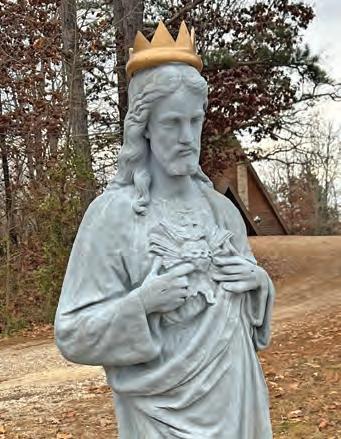
CHRIST THE KING, BUNKER, MO Statuary on the campus of Christ the King Mission Church, in Bunker, MO. (The Mirror)
DIOCESAN NEWS

The VIRTUS Protecting God’s Children Safe Environment training for adults is available online.
Preregistration is necessary: If you are a new registrant please go to www.virtus.org and click on “first time registrant” on the left, and follow the prompts to register for Online training. Instructions for the registration process can also be found on the Child and Youth Protection Page of the diocesan Website.
www.dioscg.org/wp-content/uploads/How-to-Register-for-a-VIRTUS-withOnline-Option.pdf
Both in-person and online training sessions are for adults only.
Before engaging in activities involving minors and/or vulnerable adults, new volunteers or employees are required to complete the VIRTUS Protecting God’s Children training for adults, submit a current Background Disclosure and Authorization Form, and read, sign and submit the annual Code of Conduct, which are available on the VIRTUS Website and the Diocese of Springfield-Cape Girardeau Child and Youth Protection Webpage: www.dioscg.org/childyouth-protection/
For more information, please contact the Office of Child and Youth Protection, childandyouthprotection@dioscg.org; or Bill Holtmeyer, billholtmeyer@dioscg.org; or Shelly Ferry, sferry@dioscg.org, (417) 866-0841.
Nov. 22-23, 2025
During this Jubilee Year of Hope, we are reminded that the poor reveal to us the truth of the Gospel. As Pilgrims of Hope, we draw strength from Christ—the source of all hope—and are called to “Go and Do Likewise.”
At Catholic Charities of Southern Missouri, we serve as the hands of hope and love—helping homeless families, pregnant mothers, veterans, and individuals with developmental disabilities. In 2024, we assisted over 2,000 people across southern Missouri.
As one Church, East to West, let us bear witness to hope, love, and mercy. Please support Catholic Charities of Southern Missouri. Be a Pilgrim of Hope: “Go and Do Likewise.”
DIOCESAN NEWS/ADVERTISING
Would you like to engage in Bible study?
In Springfield area: Holy Trinity Springfield, inperson meetings on Thursdays, 9:30-11:30am
St. Elizabeth Ann Seton Springfield, in-person meetings and Online on Tuesdays, 7:00-9:00pm
St. Francis of Assisi Nixa, in person meetings on Tuesdays, 9:00-11:00am

Prices are all inclusive w/airfare from anywhere in the continental US. Several trips to different destinations: Holy Land, Italy, Greece, France, Portugal, Spain, Lourdes & Fatima, Ireland & Scotland and much more... We specialize in custom trips for Bishops, Priests & Deacons! Currently hiring Deacons to promote our many pilgrimages. ATTRACTIVE compensation. For more information contact: Karen@proximotravel.com

DIOCESAN

PRIESTS
Fr. Vineesh Jose, OSB, Dec. 1, 9 yrs.
Fr. Rabinson Samy, HGN, Dec. 5, 9 yrs.
Fr. Andrew Williams, Dec. 14, 7 yrs.
Fr. James Unterreiner, Dec. 18, 55 yrs.
Fr. John F. Friedel, Dec. 27, 39 yrs.
Fr. Mathukutty Naduchirayil, VC, Dec. 27, 16 yrs.
Fr. Vincent Joseph, VC, Dec. 27, 40 yrs.
Fr. Bejoy Thomas, CMI, Dec. 29, 15 yrs.
Fr. Seban Thanippallil, VC, Dec. 30, 16 yrs.
DEACON
Deacon James Soptick, Dec. 8, 13 yrs.

CONGRATULATIONS
Fr. Bejoy Thomas, CMI
Fr. Bejoy Thomas, CMI, will celebrate the 15th anniversary of his priesthood ordination on December 29th He currently serves as Parochial Administrator, St. Joseph Parish, Billings & St. Susanne Parish, Mount Vernon. Happy Anniversary, Fr. Thomas!