Virginia Turfgrass Journal - November / December 2025
Virginia Turfgrass Journal allows you to get your message directly in the hands of your customers. The magazine is a key benefit of membership in the Virginia Turfgrass Council – providing valuable research, education, and industry information to each member. Readers can also access the Digital Edition through The Turf Zone website. Archived issues ensure that your advertising will be seen indefinitely, for long-ranging impact. VTC members include:
Lawn Care Operators Golf Course Superintendents
Parks & Recreation Supervisors Landscape Contractors
Don’t know about you, but we had a great year. We have so much work booked that I’m worried that the winter won’t be long enough to get the work done before the very busy spring season arrives. I feel very blessed. Seems like the harder we work, the more blessed we become. Many I’ve talked to say the same. What a great industry we work in. Indeed, the future is bright, and I look forward to the new clients and projects that are sure to call wanting service.
The VTC and the VTC Environmental Institutive had a great year also and are looking forward to this coming season. Our future is bright as more and more industry and environmental groups express an interest in working with us.
Our service projects and outreach continue to promote the positive impact our industry has in Virginia, both in protecting the environment and providing Virginians with good jobs. As many of us know, our industry is one where hard work and good ethics can lead to a positive future for families.
The Horticultural Short Course in December was well attended as many understand that there is much more to be gained when you encourage your employees to continue industry education. The employees gain confidence and see their future in the industry is bright and profitable.
Come to the Bay continues to provide pesticide training as well as basic horticultural education. Support from industry professionals willing to give of their time and ‘’secrets for success’’ continues to be a major factor in our success. Again, attendees see how their future can improve by implementing recently acquired knowledge.
The February Road Show in Fredericksburg is gaining popularity and very well attended. Virginia Tech continues to lead in research and technology for the lawn and landscape industry and their commitment to sharing that knowledge is invaluable to our industry. We are finding that northern Virginia is an area where we can grow our presence as other industry groups express interest in working with us. We view this opportunity to build on the foundation we’ve worked so hard to establish as proof that we can continue to strengthen our important work through the VTC and VTC Environmental Institute’s Mission and Vision statements.
As we say good bye to Tom Tracy and thank him for all his efforts to promote the Lawn and Landscape industry over the past decades, we are looking forward to the future of the VTC and the VTC Environmental Institute under the direction of our new Executive Director, Beck Stanley.
Beck will be building on a very strong foundation.
Wes Bray VTC President
Virginia Turfgrass Journal is the official publication of The Virginia Turfgrass Council P.O. Box 5989
Virginia Beach, VA 23471
Office: (757) 464-1004
Fax: (757) 282-2693
vaturf@verizon.net
PUBLISHED BY
Leading Edge Communications, LLC
206 Bridge Street, Suite 200 Franklin, Tennessee 37064 (615) 790-3718
Fax: (615) 794-4524
info@leadingedgecommunications.com
VTC OFFICERS
President Wes Bray Lawns & Gardens Plus (757) 422-2117
Vice President Harris Wheeler, CTP Richmond Public Schools (retired) (804) 475-4561
Secretary / Treasurer Ray Funkhouser PBI Gordon (retired)
Past President Phil Bailey, CGCS Isle of Wight County Parks & Recreation (757) 572-1981
VTC DIRECTORS
Sam Burris
Jack Findling
Richard Linsday
Bruce Sheppard T.J. Skirsky
Craig Zeigler
VTC ADVISORY MEMBERS OF THE BOARD
Mike Goatley, Ph.D. (Chair)
Shawn Askew, Ph.D.
Alejandro Del Pozo-Valdiva, Ph.D.
Jeffrey Derr, Ph.D.
David McCall Ph.D.
Dan Sandor, Ph.D.
Cynthia Smith, Ph.D.
EXECUTIVE DIRECTOR / DIRECTOR OF PROGRAMS
Tom Tracy, Ph.D. (757) 464-1004
VIRGINIA TURFGRASS FOUNDATION
Brandyn Baty (757) 585-3058
Unified for Industry Success
With this article, I am ending over two decades of serving the turfgrass and landscape industry through the Virginia Turfgrass Council (VTC). Many changes, both internal and external, have happened in those years: battery-powered equipment has become normalized; collegiate programs have ebbed and flowed; environmental groups, long considered industry foes, now see the value of working together with us; and many politicians and regulators consistently seek our input on critical issues. As G.K. Chesterton put it in his description of examining historical events: “the truth is that the curtain rises upon a play already in progress.”1 My purpose in this article is to take a peek at the segment of the play I have seen during my tenure with the VTC. My expertise, as limited as it may be, is with associations and industry groups - detailing specific new chemistries of pesticides and fertilizers is beyond my training. Characters and themes in this ongoing play called the turfgrass and landscape industry include segmentation, unlikely partnerships, technological changes, legislators and regulators, and demographics of persons on the stage.
Newspaper writers, members of the General Assembly and city councils, state and local regulators, all share a reliance on facts and public opinion – when accurate, they provide valuable guidance; when false, decision makers pass legislation and enact regulations that can lead to unintended consequences. An extreme example of action taken based on an incorrect perception of facts is Hiroo Onoda, a Japanese soldier who hid on an island in the Philippines for 29 years after WW II ended. Before the American invasion, Onoda was told he was forbidden to commit suicide and that the Imperial Army would one day retake that country. The first command kept him alive; the second kept him in hiding for nearly three decades because he firmly believed Japan was still at war with America. (He only surrendered when the officer who gave the original orders met with him and rescinded the original orders.) Following a deeply entrenched belief that Japan was still at war kept Mr. Onoda operating as a guerrilla fighter for nearly three decades. Although the case on the Philippines is unique, we must never ignore the damage done by well-meaning individuals whose actions are based on lies.
In the early 2000s, virtually all press about the turfgrass and landscape industry was negative; newspaper headlines routinely proclaimed our industry was systematically destroying the environment. One such falsehood regularly published as fact was that at least 50% of all fertilizer applied by industry professionals ended up in streams, rivers, and in the Chesapeake Bay. After yet another factually incorrect headline in a local newspaper, I took the writer to lunch. Our time together was very pleasant, and he admitted that he did not base his article on science.
He just assumed that fertilizers were destroying Virginia’s waters. After all, he said, that 50% figure regularly appears in print. I brought scientific paper after scientific paper, all showing the error of his belief. He read the papers, and he changed – his subsequent articles reflected the truth: fertilizers applied by our industry stay on-site and any amount entering water is against proper procedures.
False beliefs about the damage being done to Virginia’s waters by industry professionals led a member of the General Assembly to introduce a bill that was very harmful to the industry: a piece of legislation we called the “soil test” bill. It would have required a separate soil test from each and every property whenever fertilizer was applied. If passed in its original form, it would have mandated multiple soil tests each year for each property. Fortunately, we were able to develop a coalition of persons to work on that bill before it came to a vote. The coalition consisted of individuals and associations with a vested interest in protecting the environment and with those who did not want to impose unnecessary restrictions on businesses. All parties agreed on the intent of the bill’s sponsors: ensuring fertilizers are applied properly. That agreement led to a total rewriting of the legislation to form the Virginia Certified Fertilizer Applicator program, a brand new endorsement and certification program that satisfied environmental groups and the turfgrass and landscape industry. Through the process, we learned to listen to those with different opinions and that honest disagreement is normal and healthy.
Sadly, segmentation within the turfgrass and landscape industry still exists and, in many cases, instead of uniting to raise the level of all aspects of the industry, different groups compete with each other for resources and influence with legislators and other decision makers. One time we worked with officials in Richmond to have an industry table in the lobby of the General Assembly building during a regular session. That table would be highly visible to legislators, lobbyists, and many other key persons. It was a fantastic opportunity to display unity and to lift up the entire industry. One segment of the industry refused to participate unless they were given an exclusive day at the table; no other industry segment was allowed to be present. That type of exclusivity is called silo. While the lines of separation constantly shift, the movement by some is sadly towards the strengthening of silos of isolation.
One prominent example of the entire turfgrass and landscape industry joining forces to effect regulatory change happened just before the Covid shutdown. Excessive delays at getting permission for persons to take examinations to become Registered Technicians and Commercial pesticide applicators were crippling businesses. Delays of two or three months were not
uncommon. As we explained to numerous members of the General Assembly, our complaint was not with the actual testing, it was with getting permission to take the tests. These delays happened after the applicant completed the requirements to sit for the test and after the proper permission request was submitted. Persons were in testing limbo, unable to apply pesticides of any kind until they took, and passed, the exam - employees who were hired for that very task - were idled for months at a time. Industry representatives traveled to Richmond and met with regulatory officials about the economic hardship imposed by the unreasonable delays. That meeting was followed by a piece of legislation that required the agency responsible for testing to produce an official report to the General Assembly about the delays. We saw the power of legislation when the problem was resolved within weeks of legislation being introduced. Now, what used to take months has been reduced to days.
Although the future is very bright for our industry, I see at least one looming issue that will require unity: the push to allow cities and counties to regulate fertilizers and pesticides, overriding state control of both those items. Virginia has long followed the Dillon Rule principle, a policy that local governments can only act in areas specifically granted to them by the state legislature. In recent years, efforts to undermine that principle and give authority to localities have surfaced in the General Assembly. So far, those efforts have failed, but Dillon Rule opponents gain power each year. Allowing each locality to regulate pesticides and fertilizers will be devastating, especially in metropolitan regions consisting of multiple cities. The industry must unite and be ready to speak as one voice in our efforts to preserve state control over these vital tools we use every day.
Our industry continues to thrive, and as the curtain closes on my small part in it, we must remember the play will continue long after any of us remain on this earth. Players and themes may change but the core challenges such as labor, customer expectations, and being outside in all types of weather will remain constant while new ones will appear. Ignoring the challenges relegates us to the backroom of relevance.
Considering the future, we must remain professional and engaged, keeping in mind these words written about a new university, the University of Austin (UATX), in response to a $100 million gift: “UATX will live and die by the excellence of its graduates and the success they achieve in the world. If UATX doesn’t deliver – in the eyes of its graduates and society – it will cease to exist. And it should.”2 Although we are not a university, and have certainly not been given $100 million, we must always seek to deliver quality, professionalism and environmental protection. Anything less lessens our credibility and destroys the good will we have developed over the past two decades.
Tom Tracy, Ph.D.
VTC Executive Director
REFERENCES:
1. G.K. Chesterton, The Everlasting Man (1925).
2. Jeff Yass, “I’m Betting $100 Million on a New University,” The Free Press, Nov. 5, 2025.
Shawn D. Askew, Ph.D.
Virginia Tech 435 Old Glade Road Blacksburg, VA 24061 540-231-5807
askew@vt.edu
Alejandro Del Pozo-Valdiva, Ph.D.
Virginia Tech
Hampton Roads
Agricultural Research Station 1444 Diamond Springs Rd. Virginia Beach, VA 23455 757-363-3900
adelpozo@vt.edu
Jeffrey F. Derr, Ph.D.
Virginia Tech
Hampton Roads
Agricultural Research Station 1444 Diamond Springs Rd. Virginia Beach, VA 23455 757-363-3912
jderr@vt.edu
Mike Goatley Jr., Ph.D.
Virginia Tech 420 Smyth Hall Blacksburg, VA 24061 540-231-2951 goatley@vt.edu
David McCall, Ph.D.
Virginia Tech 435 Old Glade Road Blacksburg, VA 24061 540-231-9598 dsmccall@vt.edu
Dan Sandor, Ph.D. Virginia Tech 170 Drillfield Dr. 411 Price Hall Blacksburg, VA 24061 540-231-9775 dsandor@vt.edu
WITH SUPPORT FROM: Thomas P. Kuhar, Ph.D.
Virginia Tech Dept. of Entomology 216 Price Hall 170 Drillfield Drive Blacksburg, VA 24061 540-231-6129 tkuhar@vt.edu
Upcoming Event
COME TO THE BAY 2026
January 27 – 29, 2026 • Virginia Beach • Virginia Tech’s Hampton Roads AREC
Tuesday, January 27
PESTICIDE CERTIFICATION
TRAINING and TESTING
8:30 – 11:30 Training
12:00 – 2:00+ Testing (VDACS)
CERTIFIED FERTILIZER
APPLICATOR CERT / RECERT
TRAINING and TESTING
12:00 – 3:30 Training 3:45 – 5:00 Test
COASTAL SHORT COURSE
(Day One of Two: Lawn Focus)
8:00 – 8:15 Welcome
Jeff Derr / Wes Bray
8:15 – 9:00 Turfgrass Selection
Adam Nichols (HR-AREC)
9:00 – 10:00 Common Turfgrass Weeds
Jeff Derr (HR-AREC)
10:00 – 10:15 Break
10:15 – 10:45 Mowing for Client Health
Wes Bray (Lawns & Gardens Plus)*
10:45 – 11:30 Turfgrass Watering & Disease Mgt
Adam Nichols (HR-AREC)
11:30 – 12:30 Lunch (on your own)
12:30 – 12:45 Opening Remarks
12:45 –1:30 Soil Health
Summer Thomas (Va Soil Health Coalition)
1:30 – 3:00 Turf Insects and Emerging Ornamental Insects
Alejandro Del-Pozo (HR-AREC)
3:00 – 3:15 Closing Remarks and End
* focus is on keeping your customers happy
Wednesday, January 28
PESTICIDE RECERTIFICATION
Speakers:
VDACS Regional Inspector
Barry Kessler
Jeff Derr
Alejandro Del-Pozo
COASTAL SHORT COURSE
(Day Two of Two: Ornamental Focus)
8:00 – 8:15 Welcome
Beck Stanley
8:15 – 9:00
Botany, Why It Matters
Wes Bray (Lawns & Gardens Plus)
9:00 – 9:45 TBA
9:45 – 10:00 Break
10:00 – 10:45 Invasive Species Management
Laurie Fox (HR-AREC)
10:45 – 11:30 Tree Health Care
Chad Peevy (William and Mary)
11:30 – 12:30 Lunch (on your own)
12:30 – 1:30 Drone Use in Ornamentals
Alejandro Del-Pozo (HR-AREC)
1:30 – 3:00 Pruning Practicum
Jason Heizer (Bartlett Tree)
Thursday, January 29
PESTICIDE RECERTIFICATION (OVERFLOW)
VIRGINIA TURFGRASS COUNCIL’S 2026 COME TO THE BAY
SPONSORSHIPS
This page is to sign up as a sponsor. Registration is available online at www.vaturf.org/come-to-the-bay
LOCATION
Tuesday / Wednesday (January 27 / 28)
Virginia Tech Hampton Roads AREC 1444 Diamond Springs Road, Virginia Beach 23455
CHOOSE YOUR LEVEL
Presenter ($3,000)
Coffee/Snacks ($400 Daily)
Friend of the Bay ($300)
CONTACT US
Virginia Turfgrass Council P.O. Box 5989
Virginia Beach, VA 23471 (757) 464–1004
http://vaturf.org (click on Bay Conf)
Sponsors may also register and pay online at www.vaturf.org/come-to-the-bay
Make checks payable to Virginia Turfgrass Council and mail with this form to: P.O. Box 5989, Virginia Beach, VA 23471 Or charge to credit card: AMEX VISA MasterCard and fax to (757) 282-2693
Card #: Expiration Date:
Signature: Verification Code:
Name: Company: Address: City: State: Zip Code:
Phone: Fax:
Email:
Upcoming Event
VA TURFGRASS ROADSHOW
February 25, 2026 • Virginia Credit Union Stadium • 42 Jackie Robinson Way • Fredericksburg, VA 22401
7:00 – 8:00 am Registration, Welcome, Review of today’s goals
8:00 – 8:40 am Legal Updates – VDACS
8:40 – 9:20 am What’s the Dirt on Soils? – Mike Goatley, Virginia Tech Extension Turfgrass Specialist
9:20 – 10:00 am The Present and Future of Weed Control – Shawn Askew, Virginia Tech Extension Turfgrass Weed Specialist (Update on new weed control products, strategies, and the future of weed control technology)
10:00 – 10:15 am Break – Visit with vendors
10:15 – 10:55 am AI, Turfgrass, and You – Elisabeth Kitchin, Virginia Tech Graduate Student in Plant Pathology and Precision Agriculture (Overview of machine learning and AI use in Turfgrass Management, and how they can improve efficacy of management to prevent non-target effects)
10:55 – 11:35 am The Present and Future of Turfgrass Disease Control – David McCall, Virginia Tech Extension Turfgrass Pathologist (Update on new disease control products, strategies, and the future of disease management)
11:35 – 12:35 pm Lunch – Provided by sponsors
12:35 – 1:05 pm Set it Before you Spray it – Daniel Sandor, Virginia Tech Professor of Turfgrass Science (Review of Sprayer Calibration Principles)
1:05 – 1:45 pm Variety Trials as a Decision Tool – Geoff Rhinehart, University of Maryland Lecturer and Turfgrass Management Advisor (Using variety trial data to select improved varieties for integrated pest management)
1:45 – 2:25 pm The Bugs and the Bees – Alejandro Del Pozo, Virginia Tech Assistant Professor of Entomology (Insect pest control and pollinator protection update)
2:25 – 2:40 pm Break – Visit with vendors
2:40 – 3:10 pm
3:10 – 3:50 pm
Safety Review Kahoot – Megan Williams, Virginia Cooperative Extension Extension Agent (Attendees compete in a game of kahoot that reviews safety for applicators, the public, and the environment including PPE, application, storage, and disposal)
Ornamental and Aquatic Weed Control – Jeffrey Derr, Virginia Tech Professor of Weed Science, Hampton Roads AREC Director (Discussion on common ornamental and aquatic weeds and the best cultural and chemical strategies in their management)
3:50 – 4:15 pm Paperwork – Required by All Before Departure to Receive Recertification Credits
Promote Your Business in the Next Issue of Virginia Turfgrass Journal Get in touch today to learn about effective and unique advertising strategies that target industry professionals: sales@leadingedgecommunications.com
An Updated Roundup on Glyphosate –History, Use, Issues, and Alternatives
By Jeffrey Derr, Ph.D. and Adam Nichols Virginia Tech, Hampton Roads Ag. Res. & Extension Center
lyphosate continues to be in the news, primarily because of the court cases concerning glyphosate and human health. There are still thousands of lawsuits related to glyphosate and human health (https://www.lawsuitinformation-center.com/roundup-lawsuit.html). In this article we discuss some background information on this herbicide as well as alternatives to this chemical.
A. What is glyphosate?
The glyphosate molecule is similar to the amino acid glycine. The chemical name is N-(phosphonomethyl)glycine, a relatively small molecule compared to newer herbicides. It is the active ingredient in products such as Bayer’s Roundup PROMAX, as well as in generic products sold under a variety of trade names. Since the chemical is off patent (patent expired around 2000), other companies besides Bayer can sell this herbicide under their own trade name. Some examples of other trade names for products that contain glyphosate include Glyphosate, Gly Star, Glypho, and Prosecutor, among others, for terrestrial use. There also are formulations that can be used in aquatic sites, such as Accord, AquaMaster, and Rodeo.
Bayer does not market glyphosate to homeowners, only to commercial applicators. However, glyphosate is still available to homeowners, with one example being Hi-Yield Super Concentrate Killzall Weed & Grass Killer, which is sold in quart containers. Homeowners also can purchase the commercial formulations, such as Razor Pro, Prosecutor, Roundup ProMax, and Roundup QuikPro as there are no restrictions on homeowners purchasing those products. A disadvantage to homeowners is that the commercial products are sold in quantities often too large for homeowner needs, such as 2.5 gallon jugs which can treat 5 acres.
To add some confusion, there are products being sold that do not contain glyphosate but use the Roundup name and are primarily targeted towards homeowners. For example, there is Roundup for Lawns, which contains MCPA, quinclorac, dicamba,
and sulfentrazone. These four herbicides are selective in lawns for general weed control compared to the nonselective herbicide glyphosate. There is Roundup Weed and Grass Killer Concentrate, which contains triclopyr, fluazifop, and diquat and is an alternative to glyphosate for weed control in driveways, along fences, and certain other areas. Roundup Dual Action contains triclopyr, fluazifop, and diquat, along with imazapic to extend the residual control.
B. Formulation
The initial formation of this herbicide was an isopropylamine salt of glyphosate, which is still widely used, although other salt formulations are available now, such as the potassium salt and the dimethylamine salt. This becomes important when comparing products. We need to look at the amount of glyphosate acid in products, not the amount of active ingredient, since the different salt formulations differ in their molecular weight. For example, Roundup PROMAX contains 5.5 pounds per gallon of the potassium salt of glyphosate (ai) or 4.5 lbs/gallon glyphosate acid (ae). Prosecutor Pro contains 4.0 lbs/gallon of the isopropylamine salt of glyphosate (ai) or 3.0 lbs/gallon glyphosate acid (ae). So Roundup PROMAX contains 50% more glyphosate acid than Prosecutor Pro per gallon and applications rates in terms of fluid ounces of product per acre are lower that for Prosecutor Pro.
Besides glyphosate, there are other chemicals in commercial formulations, usually water and a surfactant. As an example of a formulation, Roundup PROMAX contains the potassium salt of glyphosate at 48.7% by weight, surfactant(s) at 8.8%, and water plus minor ingredients at approximately 42%.
Surfactants can aid in the absorption of herbicides by weeds. One example would be POEA (polyoxyethylene tallow amine). Concerns have been raised about the toxicity of this surfactant to aquatic organisms such as tadpoles, salamanders, and frogs. Aquatic formulations of glyphosate either do not contain a surfactant or contain a surfactant that has not shown to be an issue. That is why certain formulations of glyphosate are not labeled for aquatic use – not due to the toxicity of glyphosate but due to toxicity concerns about the surfactant to amphibians and other aquatic organisms. For glyphosate products that do not contain a surfactant, one generally needs to add an approved one for optimum weed control.
C. History
Glyphosate was found to control weeds by a Monsanto scientist in 1970. The herbicide was patented in 1971 and was introduced commercially as Roundup in 1974. Glyphosate use has increased over time, especially when Roundup-Ready crops were introduced, starting with Roundup Ready soybeans in 1996. These soybean lines, and later corn, cotton, and other crop cultivars, were developed to be resistant to glyphosate through biotechnology. For these genetically-modified crops, glyphosate could be applied overtop for selective weed control. Bayer purchased Monsanto in 2018 and continues to market glyphosate to commercial applicators.
D. Mode of action
Glyphosate inhibits the enzyme enolpyruvyl shikimate-3-phosphate (EPSP) synthase, needed for synthesis of the aromatic amino acids tryptophan, tyrosine, and phenylalanine in plants. Animals, including people, do not make these amino acids as they need to get these chemicals in their diet. Plants though must make these amino acids, which are the building blocks of proteins. So glyphosate inhibits a process that occurs in plants but not in animals. Result – a chemical that controls plants with low acute toxicity to animals.
E. Use
Glyphosate is a nonselective postemergence herbicide, meaning that it controls essentially all weeds. The recent development of certain weed species developing resistance, such as glyphosateresistant horseweed, has pushed researchers and growers to find alternative means to control these weed species. However, most weed species are still susceptible to glyphosate.
Glyphosate is systemic, so it moves into and controls underground portions of weeds (roots, rhizomes, tubers, etc.), making it the preferred product for perennial weed control in many situations. This chemical binds to soil particles and has essentially no soil activity, so crops can be planted a week after application.
Glyphosate is used for preplant weed control/site preparation, lawn renovation, spot treatment of weeds in landscape beds, as a directed spray application in fruit and nursery production, and for noncrop weed management, such as guard rails, railroad lines, and parking lots, among other uses. It controls grasses, sedges, and broadleaf weeds, making it a broad-spectrum herbicide.
F. Acute toxicity of glyphosate
One measure of acute toxicity is the LD50, the dose required to kill 50% of the test animal, usually rats. The higher the LD50, the lower the toxicity. The acute oral LD50 for glyphosate is greater than 5,000 mg/kg (Bayer 2023). For comparison, the acute oral LD50 (rat) for aspirin ranges from 200 to 1,500 mg/kg according to the National Center for Biotechnology Information (2025) and ThermoFischer (2025), making aspirin significantly more acutely toxic than glyphosate.
Another point to keep in mind is that risk associated with a given pesticide is based on the toxicity of the chemical along with the exposure level.
G. Health issues about glyphosate
It has been suggested that glyphosate causes non-Hodgkin lymphoma (NHL), a type of cancer, and other diseases, although the link between glyphosate and cancer is inconclusive (see the review articles Boretti 2024, Gonzalez-Moscoso 2023). In a 2020 publication, Boretti states that the link between non-Hodgkin lymphoma and Roundup is shown to be extremely weak.
The International Agency for Research on Cancer (IARC), part of the World Health organization, lists glyphosate as a probable human carcinogen in Group 2A, along with burning of wood, eating red meat, high-temperature frying, night work shifts, being a hairdresser or barber, exposure to inorganic lead compounds, spraying insecticides, and manufacture of art glass, among others (IARC 2025).
In February 2020, the Environmental Protection Agency (EPA) published the interim decision registration review decision (ID) for glyphosate (EPA 2025). As part of that decision, EPA found that when glyphosate is used in accordance with its current label, glyphosate is unlikely to be a human carcinogen. EPA scientists had performed an independent evaluation of available data for glyphosate and found no risks of concern to human health from current uses of glyphosate, no indication that children are more sensitive to glyphosate, no evidence that glyphosate causes cancer in humans, and no indication that glyphosate is an endocrine disruptor. On March 20, 2020, the glyphosate ID was challenged in the U.S. Court of Appeals for the Ninth Circuit. On June 17, 2022, the U.S. Court of Appeals for the Ninth Circuit vacated the human health portion of the glyphosate ID and the EPA determined that withdrawal of the glyphosate ID was appropriate. The EPA is currently updating its evaluation of the carcinogenic potential of glyphosate to better explain its findings and to include the current relevant scientific information.
Another issue that has been mentioned is that glyphosate may affect bacteria in the gut microbiome. Certain bacteria can be adversely affected by exposure to glyphosate. One concern is an impact on the gut bacteria in honeybees, potentially increasing susceptibility to pathogens (Mottaa et al. 2018, Castelli 2021.)
H. Alternatives to glyphosate
We do not have a ready alternative to glyphosate that provides the same level of weed control and use, especially for perennial weeds. There are other chemicals that have little to no soil residual and that affect both grasses and broadleaf weeds when applied postemergence and thus can address some of the uses for glyphosate.
Conventional alternatives
There are contact nonselective chemicals available for control of annual weeds and suppression of perennial weeds that do not have soil residual. This group includes pelargonic acid (Scythe) and diquat (Reward, Diquat), which are targeted towards commercial applicators. These chemicals work very quickly, with injury to weeds often within hours when applied under warm, sunny conditions. Keep in mind that contact herbicides have no effect on underground plant parts, so perennial weeds will regrow from underground tubers, rhizomes, or bulbs, requiring additional applications. Also, large plants of annuals can be harder to control as thorough coverage of weed foliage is required. Ideally, annual weeds are treated when they are less than four inches tall. In addition, annual grassy weeds can be harder to control than annual broadleaf weeds as their growing points are less exposed compared to broadleaf plants.
Ortho Ground Clear is a combination of pelargonic acid, the contact herbicide mentioned above, along with imazapyr, a preemergence and postemergence herbicide. Imazapyr poses a risk to desired trees and shrubs due to the potential for root uptake and systemic injury, thus significantly limiting where it can be applied in homeowner situations.
Another contact herbicide that we have evaluated is Spruce, a product targeted towards homeowners. This product, from Proctor and Gamble, contains geraniol (an alcohol in geranium, rose oil, citronella oil), cornmint oil (from wild mint Mentha arvensis), and sodium lauryl sulfate (surfactant found in coconut and palm kernel oil). It is not EPA registered, but is exempt under the Federal Insecticide, Fungicide, and Rodenticide Act (FIFRA). Also, Spruce is not approved for organic use. Spruce did not perform well in our trial, although we did have some difficult-to-control weed species in that study.
Roundup Weed and Grass Killer Concentrate, mentioned earlier, contains two systemic herbicides, triclopyr for broadleaf weeds, and fluazifop for grassy weeds, along with the contact herbicide diquat. We have not seen the same level of perennial weed control as we have seen with glyphosate products. Also, this
mixture will have a degree of residual activity, potentially poses a concern if seeding a treated area soon after application.
In my opinion, the best alternative to glyphosate is glufosinate, another nonselective postemergence herbicide that is inactivated upon contact with soil. It works faster on weeds than glyphosate, but it is not as systemic as glyphosate. So glyphosate generally provides greater control of perennial weeds, especially perennial grasses, compared to glufosinate. Glufosinate will generally provide better control of perennial weeds than contact herbicides. Commercial formulations of this active ingredient include Cheetah Pro and Finale, among others. One homeowner formulation of this herbicide is BioAdvanced Weed and Grass Killer Super Concentrate which is sold in a ready-to-use container as well as a one quart concentrate, so the quantity sizes are appropriate for homeowners.
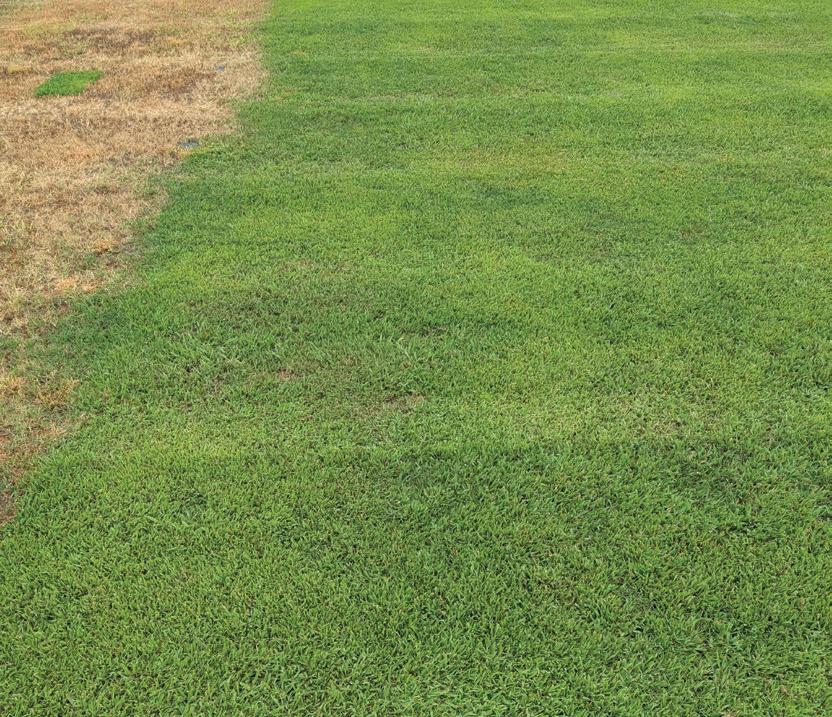
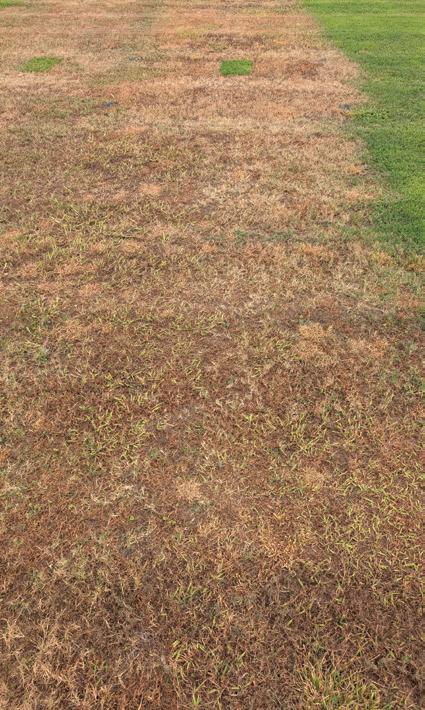
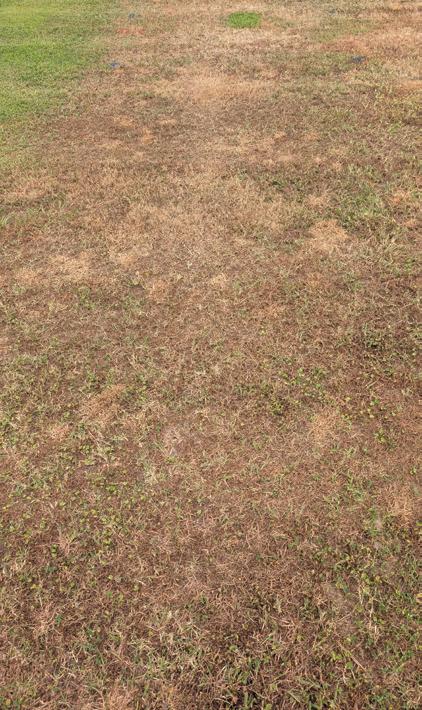
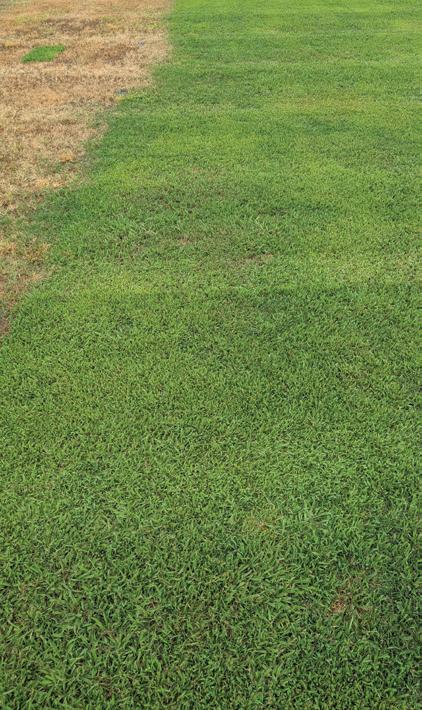
In the study we conducted at the station in 2025, the contact herbicides Scythe and Spruce caused rapid injury to the weed species in the trial. But by 12 days after treatment, the weeds recovered from that injury. Glufosinate (Cheetah Pro) and glyphosate (Roundup Quik Pro), both with systemic action, showed significant weed control at 12 days (Figure 1). We showed those plots at our Turfgrass Field Day in June of this year.
Spruce
12DAT 1
Roundup QuikPro 12DAT 1
Scythe 12DAT 1
Cheetah Pro 12DAT 1
Figure 1. Plots from a study conducted at the Hampton Roads Ag. Res. & Extension Center in 2025.
Organic alternatives
These are chemicals that are OMRIapproved (Organic Materials Review Institute) for weed control. All of the products we have tested are contact herbicides and thus much less effective than the systemic herbicide glyphosate for perennial weed control. One such chemical is 20% acetic acid, sold under such names as Weed Pharm but this formulation carries a danger label. There are long-chain fatty acid products such as ammonium nonanoate (AXXE) and Suppress (capric/caprylic acid). Scythe is similar to these fatty acid products but Scythe is not approved for organic use. There are products based on plant oils, such as citrus oil (dlimonene) sold as Avenger. There are other plant oil-containing products sold, using clove oil, cinnamon oil, or others but some of these products are not approved for organic use. These plant oils have also acted as contact nonselective herbicides.
Keep in mind that you must use products labeled for weed control. Mixing vinegar, table salt, and dishwashing liquid and applying it as an herbicide is not a legal treatment.
I. Decision making
Read the literature cited in this article and determine for yourself the benefits and risks to use of glyphosate and the other chemicals mentioned. Be careful about articles you read on the internet, in newspapers, and in other media. Sometimes claims are made about chemicals that are not supported by scientific research. Ask to see data from published, peerreviewed articles in scientific journals.
If you plan to continue using glyphosate, as we continue to do here at the research station, follow information listed on the label. For example, the Personal Protective Equipment (PPE) for Roundup PROMAX is a long sleeve shirt, long pants, shoes, and socks (https://www.cdms.telusagcg. com/ldat/ld0RI000.pdf) Read and follow all label directions. Make sure the product you use has a label for the site to be treated.
REFERENCES
Bayer. 2023. Roundup Promax Safety Data Sheet. https://www.cdms.telusagcg.com/ldat/mp0RI003. pdf.
Boretti, A. 2024. Comprehensive risk-benefit assessment of chemicals: A case study on glyphosate. Oxico.l Rep. 2024 Nov 7;13:101803. doi: 10.1016/j. toxrep.2024.101803.
Boretti, A. 2020. Glyphosate and non-Hodgkin Lymphoma. Asian Journal of Organic & Medicinal Chemistry 5(4), pp. 340–347. doi: 10.14233/ajomc.2020. AJOMC-P301.
Castelli, L,. S. Balbuena, B. Branchiccela, P. Zunino, and J. Liberti. 2021. Impact of Chronic Exposure to Sublethal Doses of Glyphosate on Honey Bee Immunity, Gut Microbiota and Infection by Pathogens. Microorganisms . DOI:10.3390/microorganisms9040845.
LIED BIOLOGICAL Gonzalez-Moscoso, M., D. MezaFigueroa , N, V. Martínez-Villegas, and M. R. Pedroza-
Montero . 2023 GLYPHOSATE IMPACT on human health and the environment: Sustainable alternatives to replace it in Mexico. Chemosphere (Nov 2023). DOI:10.1016/j.chemosphere.2023.139810.
International Agency for Research on Cancer. IARC Monographson the Identification of carcinogenic hazard to humans. https://monographs.iarc.who.int/ list-of-classifications. Accessed October 3, 2025.
Mottaa, E.V., K. Raymanna, and N.A. Morana,1. 2018. Glyphosate perturbs the gut microbiota of honey bees. Proc. Nat. Acad. Sci. 115( 41):10305–10310.
National Center for Biotechnology Information (2025). PubChem Compound Summary for CID 2244, Aspirin. https://pubchem.ncbi.nlm.nih.gov/compound/ Aspirin#section=Acute-Effects. Accessed October 3, 2025.
ThermoFischer. 2009. Safety data sheet for acetylsalicylic acid. https://www.fishersci.com/ store/msds?partNumber=AC158180500&productD escription=ACETYLSALICYLIC+ACID+50GR&vendor Id=VN00032119&countryCode=US&language=en. Accessed October 10, 2025.
Matt Herrmann
matthew.herrmann@corteva.com 804-599-6747
Jeffrey Derr and Adam Nichols are located at Virginia Tech’s Hampton Roads Agricultural Research and Extension Center in Virginia Beach.