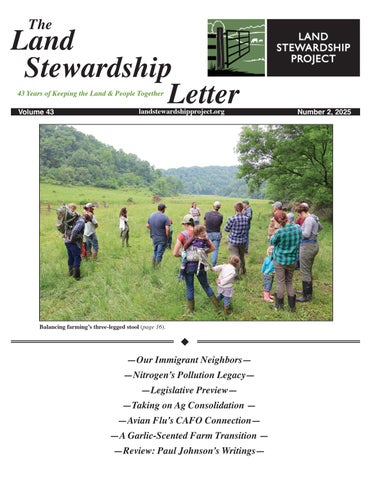
The Land Stewardship Letter is published by the Land Stewardship Project, a private, nonprofit organization. The Land Stewardship Project’s mission is to foster an ethic of stewardship for farmland, to promote sustainable agriculture, and to develop healthy communities. Members of the Land Stewardship Project receive this publication as a benefit. Annual membership dues are $35.
All inquiries pertaining to the Land Stewardship Letter should be addressed to the editor, Brian DeVore, 4917 Nokomis Avenue South, Minneapolis, MN 55417; phone: 612-816-9342; e-mail: bdevore@landstewardshipproject.org.
BOARD OF DIRECTORS
Hannah Bernhardt, Aleta Borrud, Josh Bryceson, Laurie Driessen, Laura Cullip, Dan McGrath, Les Macare, Sara Morrison, Beth Slocum, Paula Williams
STAFF
Southeastern Minnesota
180 E. Main Street, P.O. Box 130, Lewiston, MN 55952; phone: 507-523-3366; e-mail: aromano@landstewardshipproject.org
Annelie Livingston-Anderson, Pam Hartwell, Shea-Lynn Ramthun, Kathryn Rowe, Alex Romano, Karen Stettler, Sarah Wescott
Amy Bacigalupo, Heather Benson, Scott DeMuth, Alex Kiminski, Robin Moore, Nick Olson, Matthew Sheets
Twin Cities
821 East 35th St., Suite 200 Minneapolis, MN 55407; phone: 612-722-6377; e-mail: bdevore@landstewardshipproject.org
Olivia Blanchflower, Sean Carroll, Brian DeVore, Scott Elkins, Natalia Espina Talamilla, Elizabeth Makarewicz, Emily Minge, Timothy Kenney, Madeline Reid, Clara Sanders, Megan Smith, Seth Kuhl-Stennes
• Report: Farm to School’s Opportunities & Challenges
• Farm to School Podcasts
Land Access…24
• A Trusting Approach to Land Access
• What is a Community Land Trust?
Farm Transitions…26
• Full Circle: One LSP Program Launches a Farming Career— Another Wraps it Up
• Resources for Retiring & Beginnings Farmers
• Sign-up for the 2026 Farm Transition Planning Workshop
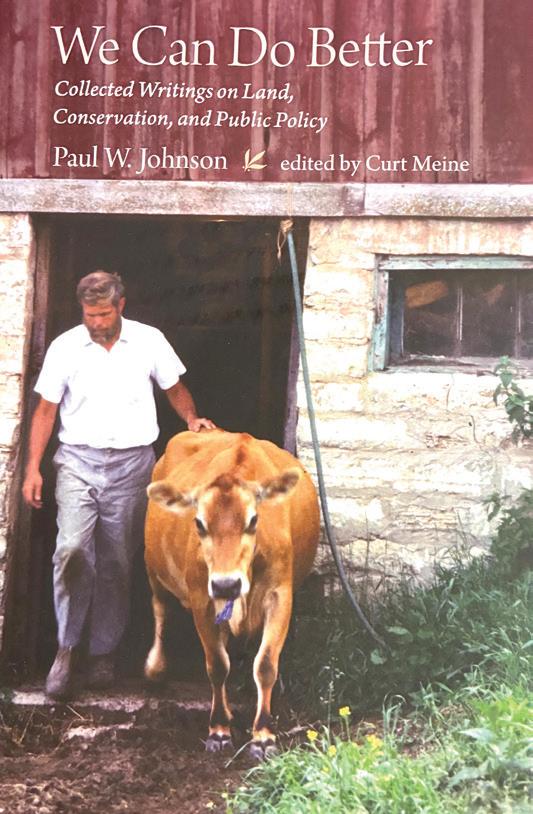
• We Can Do Better
• Dear Marty, We Crapped In Our Nest
Membership Update…34
• LSP’s New Ask Amounts
• A Season of Community Events
• In Memory & in Honor
• Membership Questions?
• New Address?
• Volunteer for LSP
Policy & Organizing…8
• AG & Antitrust Enforcement
• Ag Consolidation Panel
• Avian Flu’s CAFO Connection
• 2026 Legislative Preview
• 2026 LSP Family Farm Breakfast
• Land Stewardship Action
• Farm Aid Marks 40 Years
LSP’s Soil Health Hubs
• Join LSP’s Soil Builders’ Network
Farm Beginnings…22
• 2026-2027 Farm Beginnings Class
• Holistic Financial Planning Course
• Seeking Farmers-Seeking Land Clearinghouse
Poetry…33
• “Taking an interest in human life,” by Suzanne Swanson
• LSP Winter Soil Health Workshop
• Rotating into Resiliency Workshop Series
• Local Foods Forum
• “Land Access: Are You Ready?” Workshop
Stewardship Shop…36
• LSP t-shirts & more
Why LSP Stands With Our Immigrant Neighbors
If We Are to Succeed, Everyone Needs a Chance to Participate in Transforming Our Farm & Food System
By Scott Elkins
Periodically, I get this question from our members, allies, and the general public: Why is the Land Stewardship Project involved in supporting the immigrant community? What does standing with allied organizations as they speak out against unfair treatment of immigrants — documented and undocumented — have to do with our mission of fostering an ethic of stewardship for farmland, promoting sustainable agriculture, and developing healthy communities? It’s a question I welcome, one that is particularly relevant at a time when immigration is at the epicenter of a white-hot political debate.
The short answer is that this is a moral imperative directly connected to our mission. As our current long-range plan (see page 4) makes clear, we center our work around shared values of stewardship, justice, fairness, democracy, health, and community. The kind of world we are trying to create is one in which all people — no matter their age, race, gender, or immigration status — can live safe and productive lives and contribute to their communities. Another way to say it is that we will not have a truly sustainable farm and food system unless it’s sustainable for everyone
rural power tomorrow.
Economic Resiliency of Rural Communities
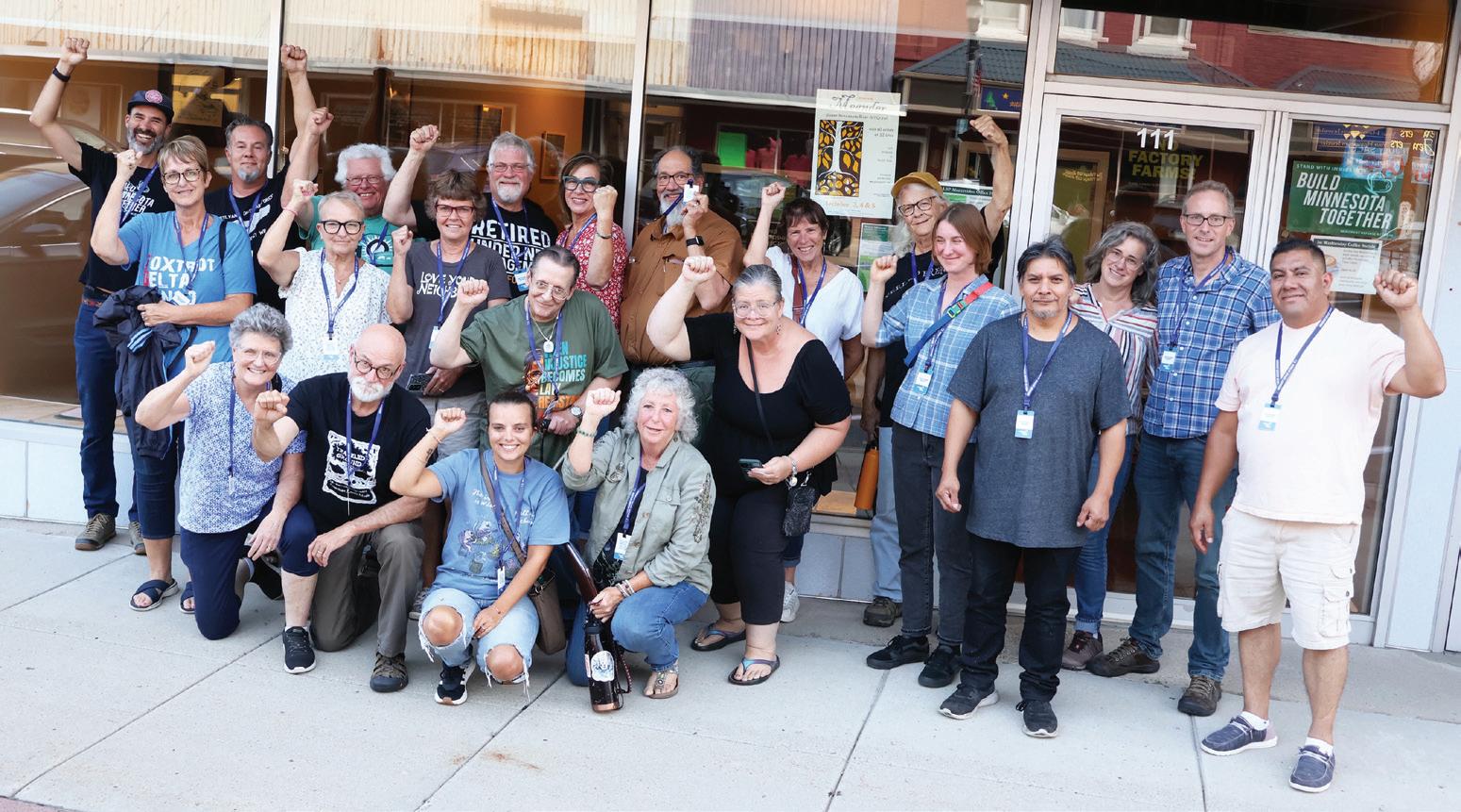
Participants in a recent constitutional observer training held at the Land Stewardship Project’s office in Montevideo, Minn., pose for a group photo. As an active member of the Immigrant Defense Network, LSP is working closely with partners who are on the ground in immigrant communities. (LSP Photo)
But such an answer leaves a lot of room for interpretation, and misinterpretation. So, let’s dig a little deeper into why LSP sees this issue as a priority if we are to be successful in our overall work.
Shared Interests/Threats
As LSP members know well, rural voices have been marginalized and, in many cases,
outright dismissed in the political process, and we’re seeing the results of that in public policy that has emptied our Main Streets, shuttered our schools, consolidated the food and farm system, denied farmers access to a fair and open market, eroded our soil, and dirtied our water. The same force that threatens the demise of small and medium-sized farms — a government/business model that prioritizes corporate profits above all else — also threatens the immigrant community. For example, concentrated animal feeding operations (CAFOs) and large-scale meatpackers depend on an immigrant workforce that is constantly in danger of being deported, and thus lacks the stability required to organize and demand better wages and safer working conditions. Those same CAFOs and packers are pushing small and medium-sized farmers out of business at a record pace.
What I’m saying is that farmers who are resisting the coercive model of corporate ag interests are natural allies with immigrant residents of our rural communities. Dividing us is a strategy of corporate and political interests that want to minimize rural voices. By standing with our immigrant neighbors today, we’re planting the seeds for greater
Studies and real-world experience show that rural communities benefit from the entrepreneurial spirit of new immigrants, whether they be involved with farming itself or an ancillary business that supports agriculture, such as small-scale meat processing, equipment repair, or a grocery store. As Ryan Perez, the director of organizing for COPAL (Communities Organizing Latine Power and Action), explains in episode 373 of LSP’s Ear to the Ground podcast, immigrants have long been a vital part of the food system in the Upper Midwest. The early sugar beet industry started employing many Latino immigrants in the 1920s, and in the 1940s, Mexican laborers came to the region under the “Bracero” program to ease the shortage of agricultural workers. Many of the recent immigrants to the region come from agrarian backgrounds in their home country and have an intense interest in food production. Relyndis Tegomoh, who immigrated to Minnesota from Cameroon, says in our most recent farm transition profile (see page 26) that, “Just one day of farming is so satisfying that it makes up for 25 years of doing something I didn’t like.”
That’s why it’s exciting to see that the Minnesota Farmers Union’s “Solving the Local Meat Processing Bottleneck Project” is reaching out to members of the Hispanic community who may be interested in running a local meat processing business. In recent years, LSP’s Farm Beginnings course, as well as our other educational workshops,
Neighbors, see page 4…
have been attracting an increasing number of people of color, including new immigrants. LSP is working with our allies to figure out how to create a pathway from being a food and farming system worker, to a full-blown entrepreneur. Rodrigo Cala, who, before starting a vegetable and livestock operation in western Wisconsin immigrated here from Mexico, encouraged participants in a recent LSP Spanish-language workshop on land access to look beyond being mere widgets in the food system. He says, “If they are the people who do the work, why aren’t they the people who have the opportunity to handle their own business?”
It’s an All-HandsOn-Deck Moment
If we are to rebuild our dysfunctional farm and food system, we need to create opportunities for everyone to have fair opportunities to participate in creating a more sustainable future. A regenerative farming system requires more eyes to the acre, so we can’t afford to exclude people who are our neighbors, even if they don’t look like us or talk like us.
What Are We Doing?
LSP is involved with supporting our immigrant neighbors in a couple of ways. On the practical side, through our Farm Beginnings (see page 22) course and Spanishlanguage “Land Access: Are You Ready?” workshops, as well as our support of the annual Emerging Farmers Conference, we
are working to provide these folks an opportunity to help us build a vibrant farm and food system from the ground up.
But teaching someone how to do holistic business planning does little good if they are being scapegoated and in general made unwelcome in the community. That’s why we are also standing with our allies as the immigrant community comes under attack by the federal government, and U.S. Immigration and Customs Enforcement agents in particular. Often-violent immigration raids that violate Constitutional rights, separate families, and vilify certain members of our community sow the kind of fear and mistrust
“Get to know people and don’t be a stranger. If you know your people around you, you’re going to be in a better place in your community.”
Ryan Perez
that undermines any efforts to create a fair, just farm and food system.
LSP is working closely with partners who are on the ground in immigrant communities by taking part as an active member of the Immigrant Defense Network (IDN), a partnership of more than 90 Minnesota groups formed to protect the rights of immigrants, and to provide trusted information and education in communities throughout Minnesota. As part of our involvement with IDN, we are co-facilitating the Greater Minnesota caucus, and I am serving on the Network’s steering committee.
It’s also important to note that IDN is a network, not a monolith. IDN and some network members will engage in tactics that we steer clear of, and vice versa. What holds us together is a belief that our immigrant neighbors strengthen and enrich Minnesota’s communities, and that we are stronger together.
Through our connection to IDN and partnership with COPAL, we have been holding constitutional observer trainings in rural communities throughout the state (see page 5) for our members and allies, and taking part in pro-immigrant press conferences and other events at the Minnesota state capitol. We have also created a “Community Care” web page (landstewardshipproject.org/ community-care) that provides resources for immigrants, as well as allies and farmers who may be employing them.
Get to Know Your Neighbor
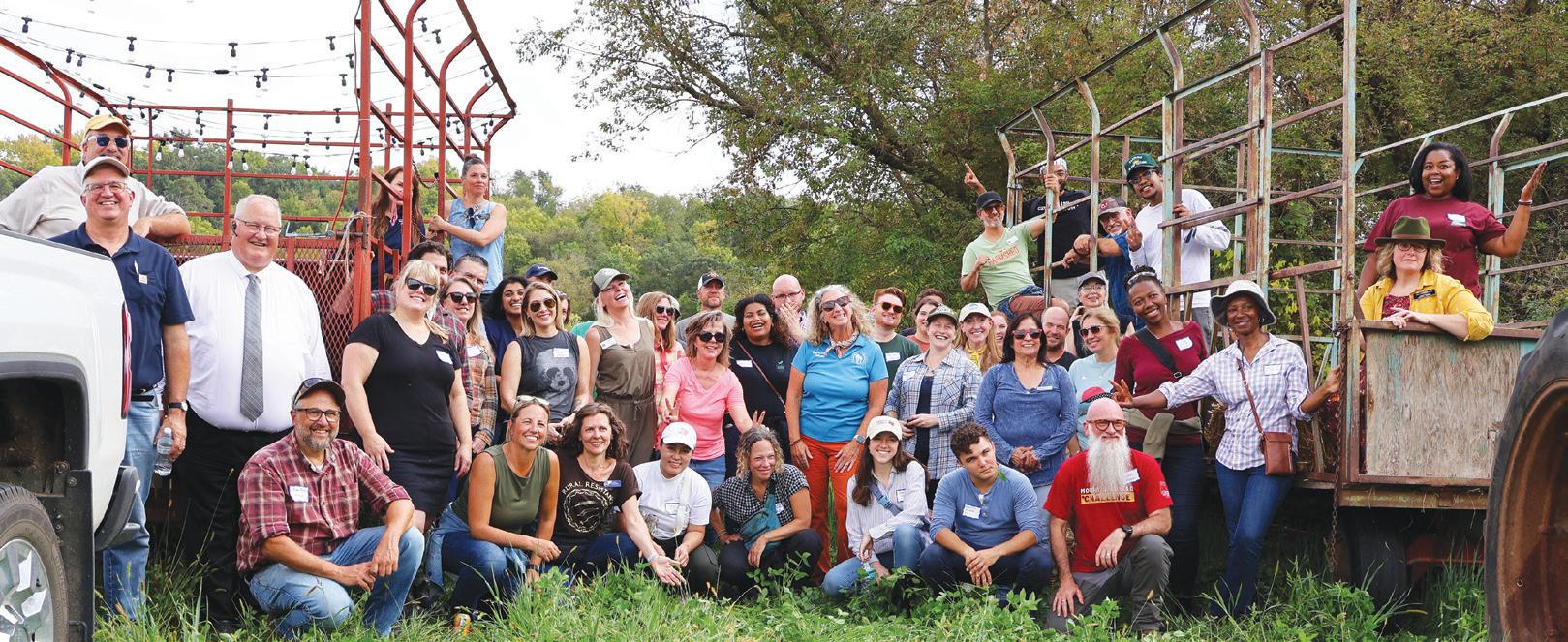
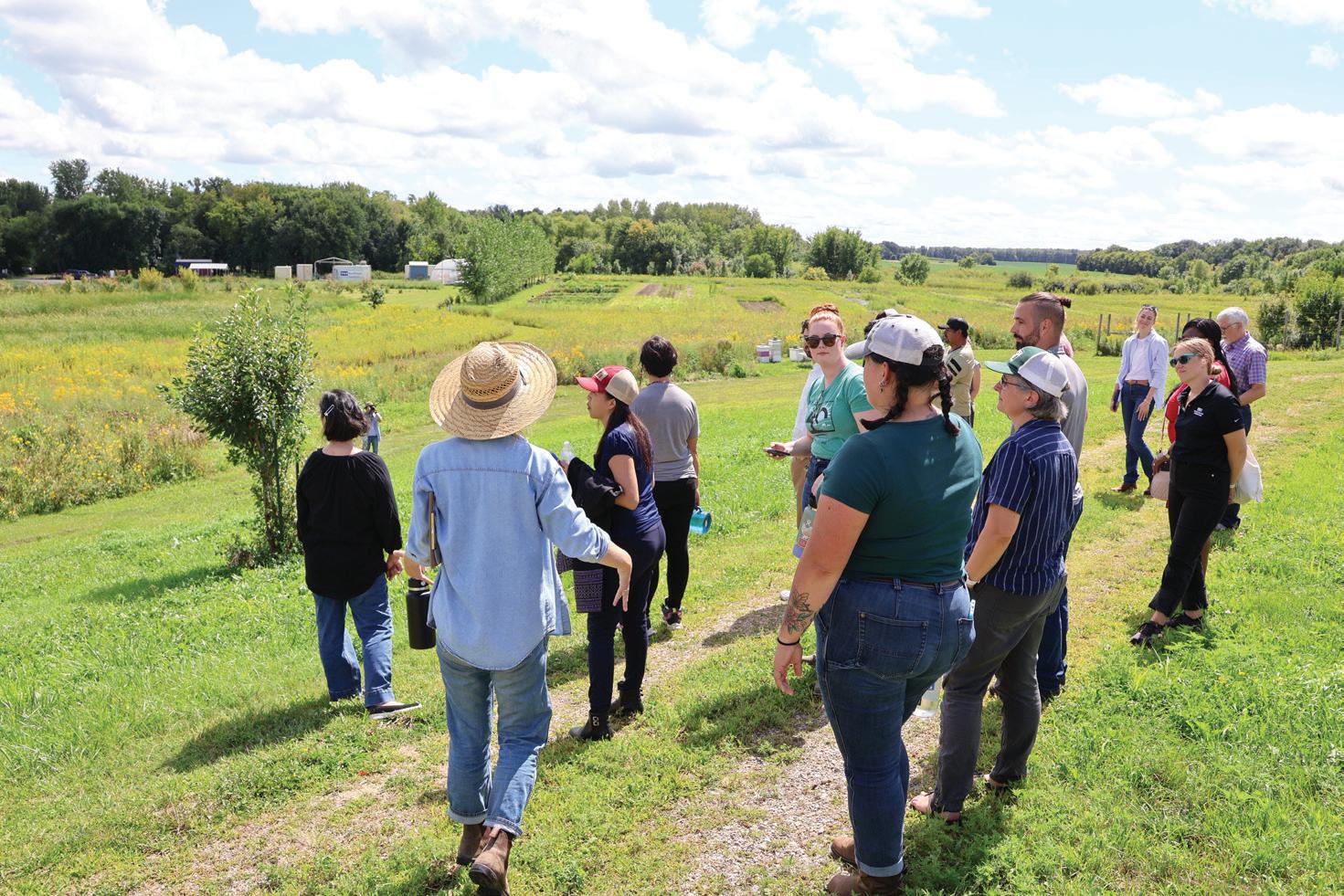
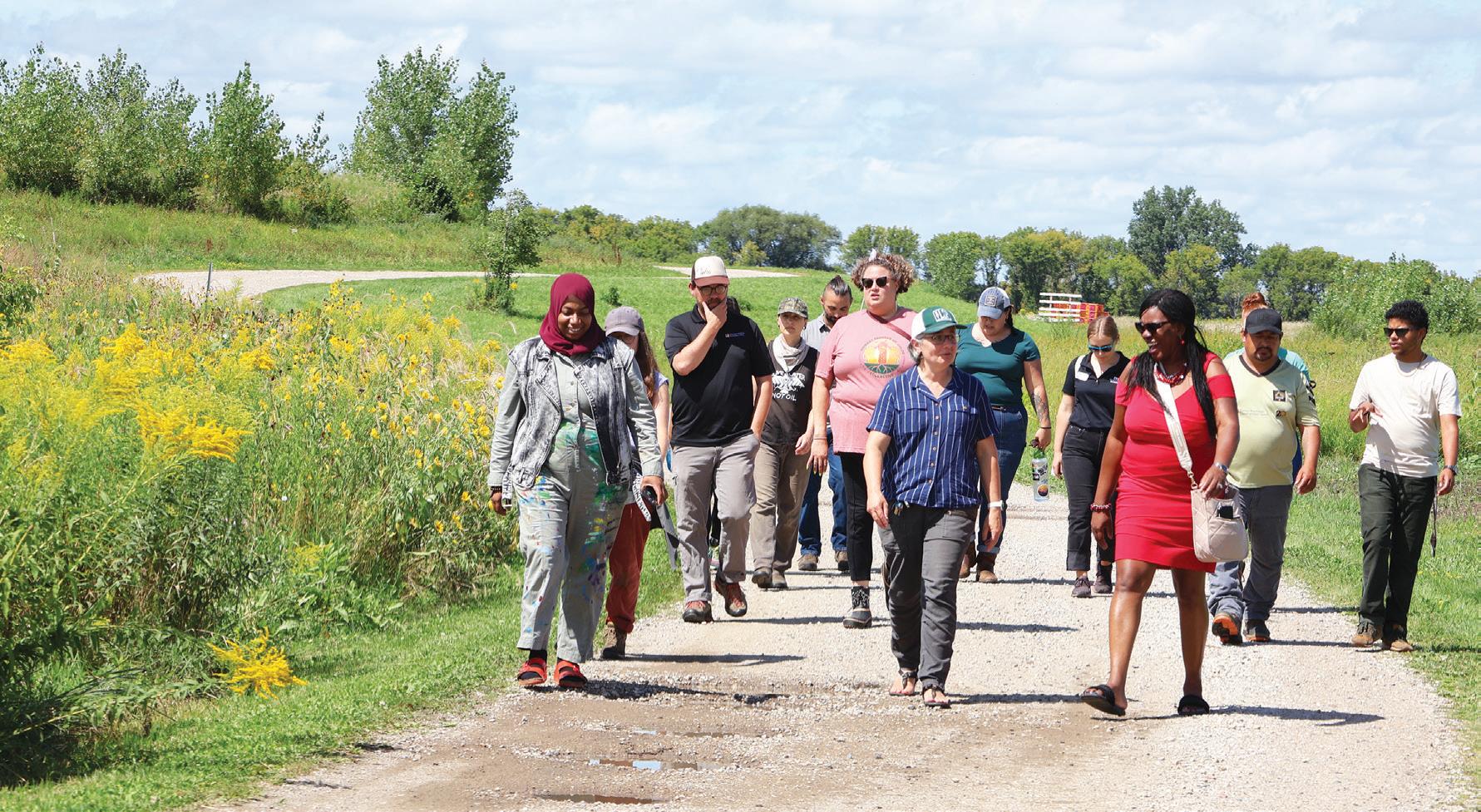
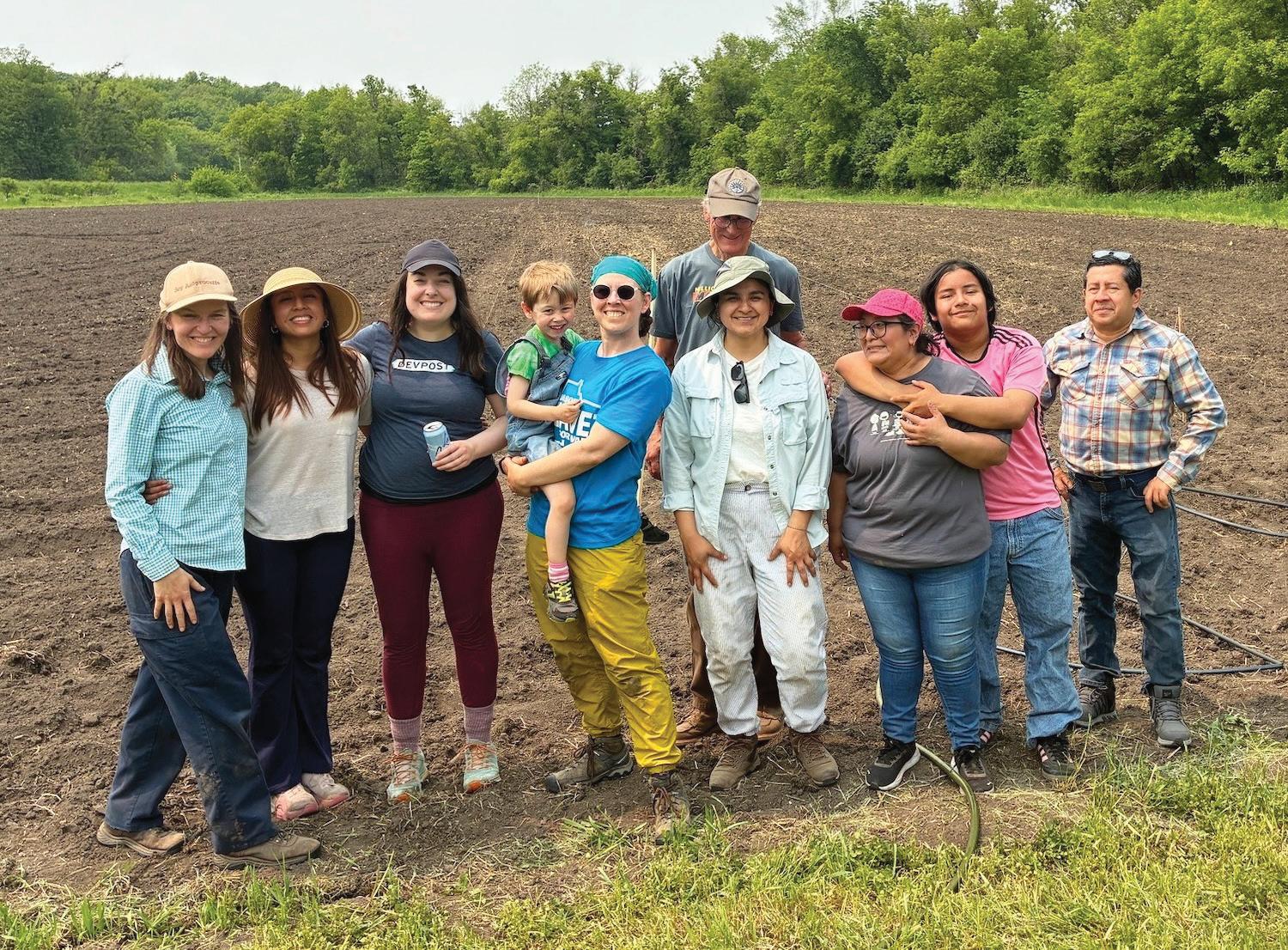
In the end, this is all about making connections with our neighbors, no matter their country of origin. In these politicallycharged times, a lot of us feel isolated. Are there neighbors you feel uncomfortable saying hello to or inviting over for a meal? During the past two summers, LSP has partnered with COPAL to hold events on southeastern farms that bring together white and Latino folks over good food and some good old-fashioned fun (see page 35).
Maybe we can use this moment of fear and anxiety as an opportunity to reach out, even if language barriers and skin color at first make that interaction uncomfortable.
As Perez says, “Get to know people and don’t be a stranger. If you know your people around you, you’re going to be in a better place in your community.”
If you have questions about the Land Stewardship Project’s involvement with standing up for our immigrant neighbors, feel free to contact me. p
LSP executive director Scott Elkins can be reached at selkins@landstewardshipproject. org or 612-722-6377.
Read LSP’s Long Range Plan
To read and download the Land Stewardship Project’s long range plan, The Roots of Resilience: Grow, Challenge, Build & Steward, see landstewardshipproject.org/long-range-plan. Paper copies are available by e-mailing membership@landstewardshipproject. org or calling 612-722-6377.
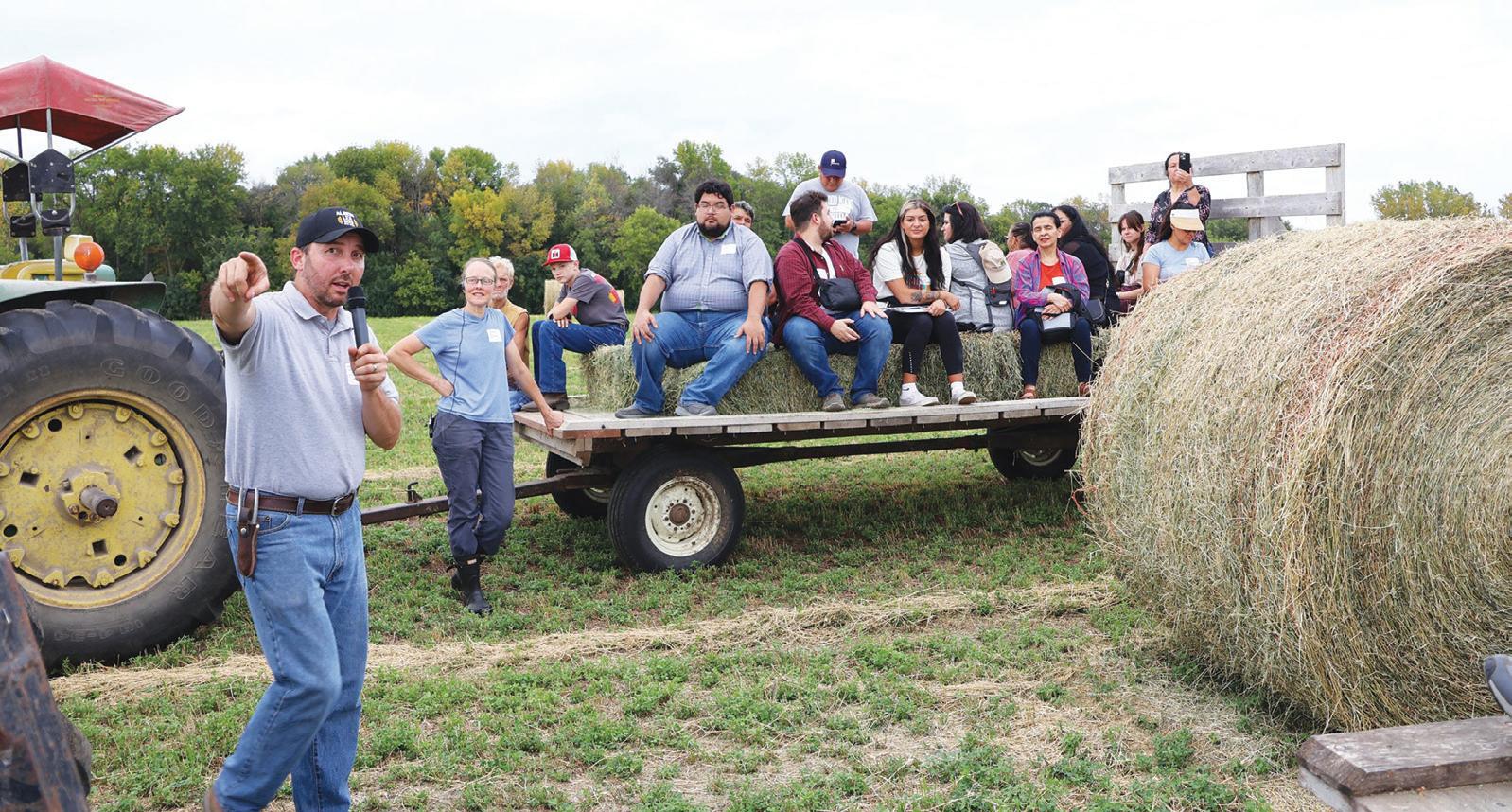
During a 2024 LSP-COPAL tour of the Jon and Ruth Jovaag farm in southern Minnesota, participants had a chance to see regenerative agriculture firsthand, discuss shared concerns about the future of rural communities, and bond over a locally-sourced meal. (LSP Photo)
Justice & Stewardship
Bearing Witness
In
an Era of Legal Confusion, Exposing Civil Rights Violations to the Light of Day
At the outset of a workshop held on an August evening in the western Minnesota community of Montevideo, Nick Olson attempted to provide some assurances to the over two-dozen people gathered in the Land Stewardship Project’s office on Main Street. “It’s okay to feel nervous. It’s okay to feel out of your comfort zone,” he said.
What Olson, an LSP organizer, was about to talk about was how to stand up for the rights of undocumented immigrants who are being snatched off the streets, out of their homes, and from their places of employment and imprisoned by agents working for U.S. Immigration and Customs Enforcement (ICE). As has been well-documented, this flurry of activity has sometimes been characterized by the suspension of basic constitutional rights, such as the right to be brought before a judge to determine if someone’s detention is legally valid. Immigrants with no criminal records are being labeled as violent offenders and shipped off to detention centers such as the so-called “Alligator Alcatraz” in Florida, or deported to countries they are not native to. The ICE agents are often masked and recordings show them refusing to identify their official capacity.
It turns out undocumented immigrants, along with everyone else residing in this country, are guaranteed certain civil rights when being arrested, including the right to seek legal counsel, the right to remain silent and not sign documents, and the right to
refuse entry into one’s home by law enforcement without a warrant signed by a judge.
This summer and fall, LSP partnered with the Immigrant Defense Network (see page 3) to offer rural residents trainings as “constitutional observers.” (The training in Montevideo was co-sponsored by CURE.)
Give it a Listen
InLSP’s Ear to the Ground podcast episode 373, COPAL’s Ryan Perez talks about the long history of immigration in a state like Minnesota, how the current environment around immigration is impacting organizing for a group like his, and what farmers and other rural residents can do to support their immigrant neighbors: landstewardshipproject.org/series/ ear-to-the-ground.
Developed by Communities Organizing Latine Power and Action (COPAL) and South Dakota Voices for Peace, these trainings provide participants the tools to observe and document law enforcement interactions with immigrants and to inform the detainees of their civil rights during the interactions, as well as to provide them resources such as contact information for legal services.
At the Montevideo workshop, several of the rural residents gathered said they were seeking the training because they were concerned about how ICE activities threat-
Being a Constitutional Observer
Whenarriving on the scene of an immigration enforcement action, identify yourself as a constitutional observer and do not interfere with the arrest in any way (constitutional observer ID badges are available from the Immigrant Defense Network). Although members of the general public have the right to record law enforcement actions taking place in public, they are required to provide a certain amount of space between themselves and the arresting officers. If you touch a federal agent, you can be charged with assault, which is a felony. The buffer requirement can vary by state, but a good rule of thumb is eight feet. If you are ordered to step back even further, record yourself complying to that order.
It’s best not to share your recordings immediately on social media, etc. — those images may put detainees at risk. Create a back-up file of any recordings and contact the family of the detainee and/or an
ened their immigrant neighbors, friends, and co-workers.
“I’m just sickened by what’s going on — I have friends from Mexico,” said a woman whose family raises corn and soybeans in the area.
Serving as a constitutional observer (see sidebar below) does not make someone an expert on the law who can provide legal advice. And it does not involve obstructing justice or otherwise participating in civil disobedience. Rather, it’s a way to be a practitioner of a “civil initiative,” as the Immigrant Defense Network puts it.
Olson acknowledged that recording an ICE action can be stressful; in some cases, ICE agents have reacted aggressively to observers. But he reminded training participants that as American citizens, they are less at risk than those being detained.
“We’re in times where this type of action is needed,” he said.
Besides the direct impact ICE’s aggressive campaign is having on detainees who are separated from loved ones with no notice, there is the atmosphere of “fear” it’s spawning. Such an environment threatens to instill a sense within the general public that all immigrants are a danger to society and thus enforcement actions that at times violate their civil rights are justified. Olson said it’s the job of all of us to resist that fear and to get to know our immigrant neighbors as fellow human beings rather than as faceless “villains.”
“Immigrants have stores on Main Street, go to church, have kids in our schools, are an active part of the community, and yet anti-immigrant folks continue to pound this message into us that we are supposed to be afraid of them,” said Olson. “How do we shift this narrative?” p
See page 3 for more on LSP’s involvement with the Immigrant Defense Network.
immigration rights organization or a reputable journalist about the documentation you have.
Constitutional observers should carry “Red Cards” that list an immigrant’s civil rights that they can present to detainees or read aloud to those present during an enforcement action (Red Cards in multiple languages are available at ilrc.org/redcards).
At times, ICE agents have lashed out at people recording their actions, even threatening to arrest observers or to confiscate telephones. The best response is to ask two questions: 1) “Am I being detained?” 2) “Am I free to go?” In general, this is enough to end a threat of arrest. However, if arrested, say, “I want to remain silent and speak to a lawyer.”
For a copy of the Handbook for Constitutional Observers and information on being trained as a constitutional observer, see immigrantdefensenetwork.org.
Myth Buster Box
An Ongoing Series on Ag Myths & Ways of Deflating Them
➔ Myth: When Nitrogen is Gone, it Can be Forgotten
➔ Fact:
Nitrogen, the most abundant element in our air, is also a key component of our corn production system. But this foundation of many a bin-busting harvest is also a vexing source of fertility to wrangle and control. Almost 30% of nitrogen applied as commercial fertilizer or manure is not taken up by plants. One estimate is that in the U.S. on average over 34 pounds of nitrogen is lost on each cultivated crop acre per year.
Nitrogen’s wandering ways create environmental problems, especially when it makes its way into water. And nitrous oxide is a greenhouse gas that’s over 270 times more powerful than carbon dioxide, staying in the atmosphere for a century.
What is perhaps the most frustrating thing about nitrogen pollution is that it does not lend itself to an immediate cause-andeffect solution scenario. When soil-saving practices like no-till, cover cropping, or grassed waterways are put into place, a reduction in erosion can often be noted almost immediately. However, when a farmer decreases fertilizer applications or drops them altogether on a field, nitrate levels in water samples don’t always decrease the following year, or, in some cases, even several years down the road. That’s because “legacy nitrogen” can be stored beneath the surface for a long time.
The long-term role legacy nitrogen can play in polluting the environment far into the future was reinforced recently when a pair of economists examined measurements of nitrogen concentrations in water at thousands of locations throughout the Corn Belt and compared them to what crops were being raised upstream.
The researchers found that the nitrogen load in small rivers and streams increases by about 0.4 pounds annually for each additional acre of corn planted within 50 miles upstream. That’s 50 times less than the nitrogen-based pollution turned up by modeling-based studies. Good news, right?
Unfortunately, no. It turns out we have a very good idea of how much nitrogen is being applied to all that corn and how much the corn actually utilizes to make a crop. There’s a massive black hole of lost nitrogen between those two agronomic realities,
one that weighs in at several million tons. A study in the journal Environmental Research Letters showed that in Iowa and Illinois, 22 to 62 pounds of nitrogen per acre had annually accumulated below ground in recent decades. This wouldn’t be a problem if all that hidden nitrogen stayed put, but in fact it can show up as a pollutant years later.
“Millions of tons of nitrogen are waiting to pollute waterways, a legacy of Corn Belt agriculture,” writes agricultural and resource economist Aaron Smith.
So what do we do? One way to remove legacy nitrogen from the system is to restore wetlands on marginal acres that don’t consistently yield good crops anyway. These habitats are extremely effective at taking up excess
“Millions
of tons of nitrogen are waiting to pollute waterways.”
— economist Aaron Smith
fertility and using it to grow plants.
And it’s clear we must stop putting so much nitrogen into the system in the first place. Over the long term, that means less of a reliance on such a nitrogen-hungry crop as corn. But even the current corn monoculture can be tweaked to make it a little less of a nitrogen nuisance. Innovative soil-health practices such as what members of LSP’s Soil Health Hubs ( see page 16) are implementing — cover cropping, diversifying rotations with small grains, notilling, and managed rotational grazing — have proven effective at not only cutting down the amount of synthetic fertilizer farmers rely on, but in establishing the kind of plant systems that can soak up excess nitrogen.
Despite great strides in recent decades around calibrating fertilizer applications to more closely align with what the corn plant can actually take up, the fact remains that farmers still tend to apply more than needed as “yield insurance.” But University of Minnesota trials show there is not always a linear relationship between nitrogen rate and yield.
In fact, if you’re a farmer, there is probably a financial incentive to use less fertilizer. When U of M Extension recently analyzed financial data from thousands of farms, it found that the most profitable farms spent an average of
$217 per acre on fertilizer for corn while the least profitable farms spent $289 per acre.
Part of the problem is that farmers are often getting their fertilizer recommendations from a sector of the industry which has a big incentive not to see nitrogen applications go down: fertilizer dealers. In 2021, fertilizer prices began to soar and the fertilizer giants — just three companies control the bulk of the North American fertilizer market — blamed it on such factors as the rising cost of natural gas, which is integral to producing their product. Research by the group Farm Action shows that while natural gas costs increased only modestly, fertilizer prices spiked by more than 100%, and corporate profits jumped by nearly 300% over the same period. Meanwhile, farmers were paying two or three times more for fertilizer. Besides support for practices that naturally build fertility, we need to hold fertilizer companies accountable for a system that encourages overapplication. And, as we report on page 14 of this issue of the Land Stewardship Letter , a new policy, processing, and marketing infrastructure that makes farm diversification profitable is long overdue.
More than a century ago, two German scientists revolutionized agriculture when they developed a system for converting atmospheric nitrogen into a form we could use to fertilize plants. That means humans now have power over the nitrogen cycle. As the old saying goes, with great power comes great responsibility.
• “Fertilizer: The Hidden Engine of Corporate Power,” Farm Action, farmaction.us
• Check out more LSP Myth Busters at landstewardshipproject.org/myth-busters.
Correction
The Myth Buster published in the No. 1, 2025, Land Stewardship Letter reported that during a recent period poultry producers had to cull 53.8 birds due to avian flu. In fact, 53.8 million birds were culled.
LSP News
LSP Staff & Board Update
MLSP’s Farm Beginnings course (see page 22) and is the owner/operator of Medicine Creek Farm in northeastern Minnesota, where she raises grass-fed beef and lamb, as well as pastured pork.
elody Arteaga spent the summer as the Land Stewardship Project’s events coordinator (see page 35). During her time with LSP, she coordinated the Boots and Roots event, the Twin Cities Cookout and Potluck, and the Sea of Grass Prairie Walk and Author Talk. Arteaga recently wrote a blog for LSP’s website reflecting on her experience organizing these events: landstewardshipproject.org/
reflections-fromlsps-2025-summer-events.
She previously served as the environmental justice coordinator for Communities Organizing Latine Power and Action (COPAL), and is currently the Minnesota environmental justice coordinator for the Center for Earth, Energy and Democracy.
Hannah Bernhardt has joined LSP’s board of directors. She is a graduate of
LSP All Staff Retreat
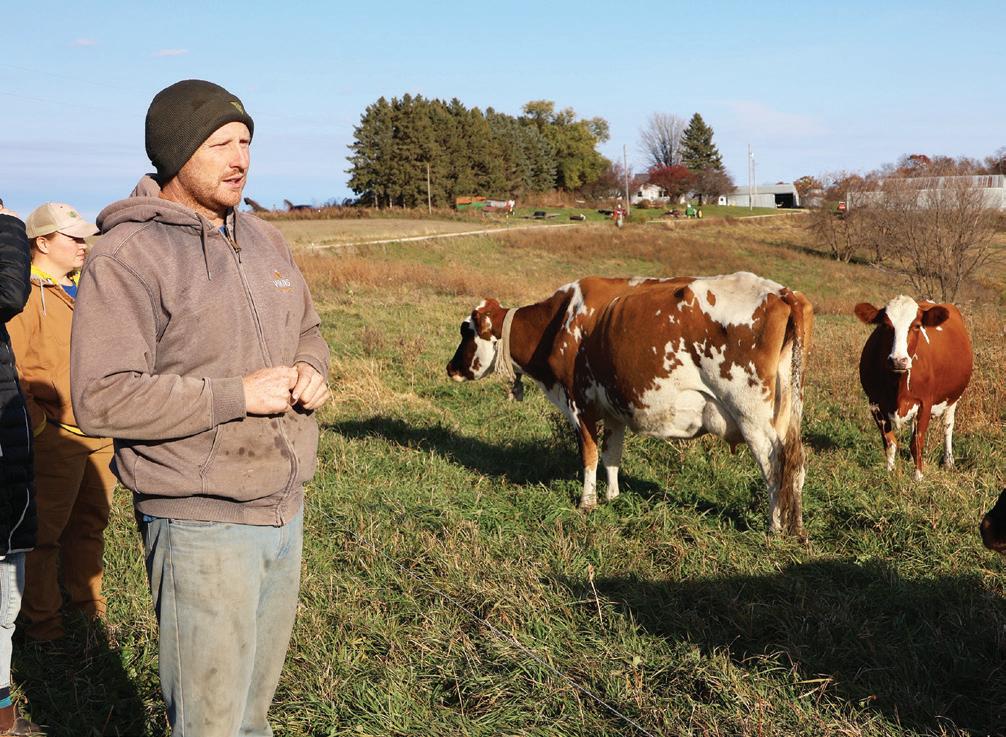
Land Stewardship Project staffers got together in early November for a few days of connecting around ways to advance the organization’s work. During a tour of the Tony and Rihana Hackbarth operation near Houston (right photo), the dairy farmers described why LSP plays such a key role in creating community and advancing peer-to-peer education through its soil health and beginning farmer work.
In addition, artist, poet, and songwriter Ben Weaver facilitated a firebuilding workshop where LSP staffers explored how we navigate change as it relates to our relationship with the land.
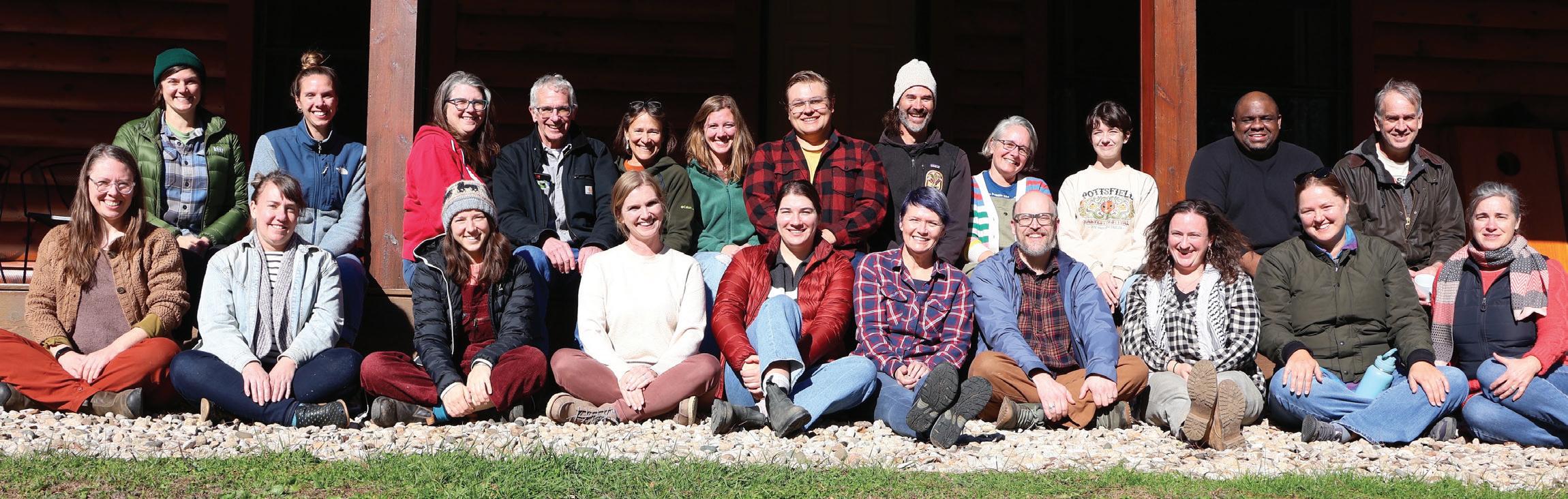
Pictured below for a staff photo are (front, left to right): Elizabeth Makarewicz, Kathryn Rowe, Sarah Wescott, Shea-Lynn Ramthun, Laura Schreiber, Pam Hartwell, Seth Kuhl-Stennes, Clara Sanders, Annelie Livingston-Anderson, Amy Bacigalupo, (back, left to right) Olivia Blanchflower, Emily Minge, Megan Smith, Brian DeVore, Karen Stettler, Alex Romano, Matthew Sheets, Nick Olson, Robin Moore, Madeline Reid, Timothy Kenney, and Scott Elkins. Not pictured: Heather Benson, Sean Carroll, Alex Kiminski, and Natalia Espina Talamilla. (LSP Photos)
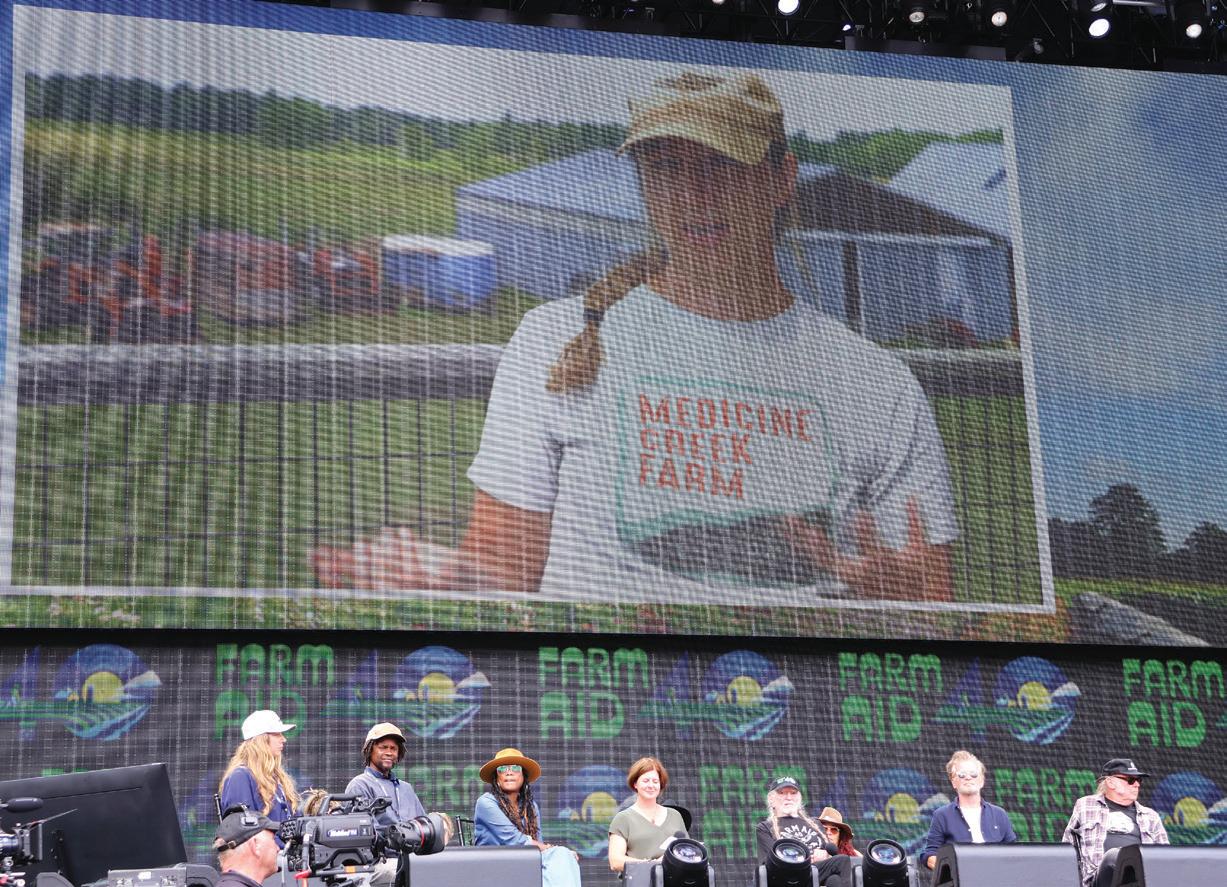
Bernhardt was an inaugural member of the Minnesota Department of Agriculture’s Emerging Farmers Working Group and is the Pine County Farmers Union president. She also serves as the committee chair of LSP’s Program Committee and was recently featured at the press conference that preceded the Farm Aid music festival in Minneapolis (see page 12). p
Contact LSP Staffers
To contact any member of the Land Stewardship Project’s staff, see landstewardshipproject.org/ staff-directory. Information on our offices is at landstewardshipproject.org/contact. For details on LSP’s board of directors, see landstewardshipproject.org/boardof-directors.
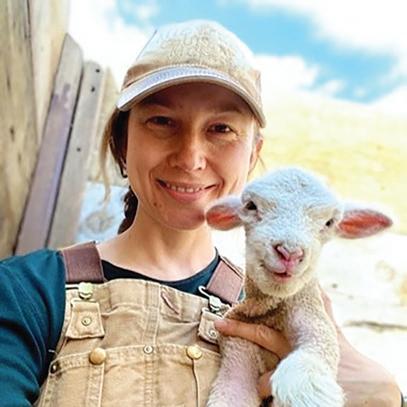
Hannah Bernhardt
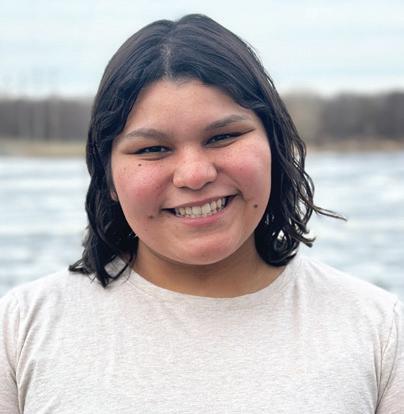
Melody Arteaga
Policy & Organizing
Farmers to AG: Take Action to Counteract Community-Killing Consolidation
Unprecedented consolidation in agriculture is emptying the landscape of farmers, which is having a trickle-down impact on everything from rural schools and churches to Main Street businesses, said three-dozen farmers and other rural residents who gathered on a Sunday afternoon in August for an openair Land Stewardship Project town hall meeting on the shores of Lake Koronis near Paynseville, Minn. Their message was directed toward Keith Ellison, Minnesota’s Attorney General, who traveled from Saint Paul to take questions from the audience and talk about what can be done to enforce laws pertaining to unfair manipulation of markets, among other things.
“I think probably the most important issue facing us in the rural community today is consolidation,” said Darrel Mosel, a Sibley County crop and livestock farmer. “I’ve been farming 47 years, and consolidation is just ripe, it’s just crazy what’s happening in my area.”
shared other examples of how consolidation in agriculture is impacting their communities: from fewer kids riding school buses and agriculture supply businesses disappearing, to pollution of water, destruction of roads, and abuse of workers.
“It’s not just the economics that are impacted, it’s the unraveling of the social
She described several agriculture-related investigations her office is already involved in, including lawsuits challenging John Deere’s restrictions on what repairs farmers can make to their equipment, Syngenta and Corteva’s use of “loyalty programs” to limit farmers’ access to lower-priced generic pesticides, and Agri Stats’s alleged control and manipulation of meat statistics to keep prices high. In order to gather evidence that can lead to a viable case, the Attorney General’s office needs to hear directly from the farmers and others who are being negatively impacted by consolidation, said Odette. She and Ellison emphasized that initial tips can be handled confidentially.
“We want to learn from you all, because we know there are many other agriculture markets that have the same things or similar things going on when it comes to unfair practices,” said Odette, who chairs the antitrust committee of the National Association of Attorneys General.
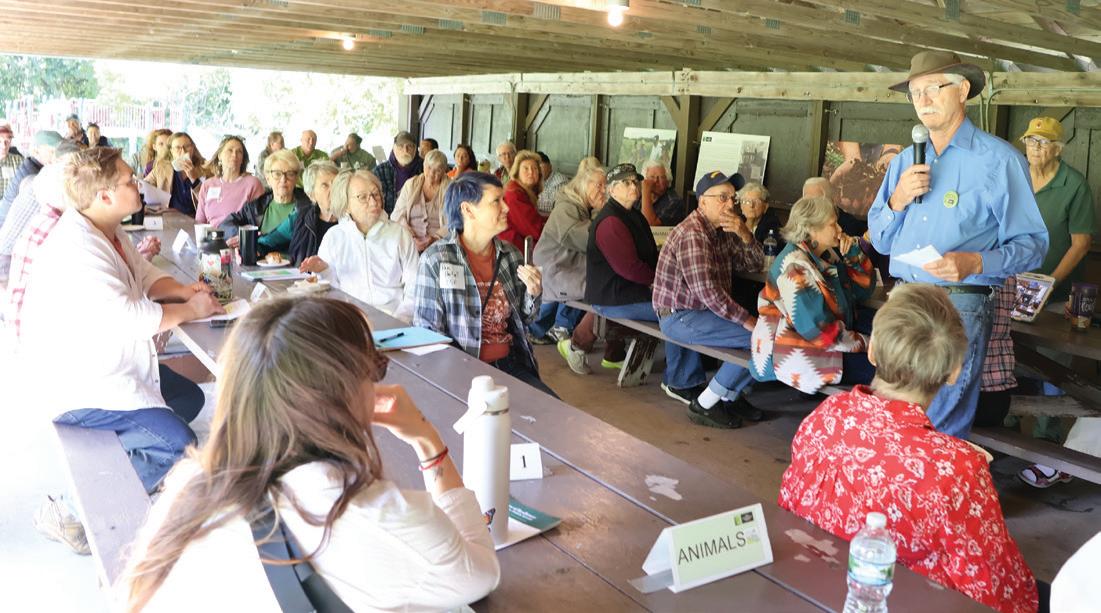
James Kanne, a Renville County farmer, facilitated the town hall meeting on ag consolidation with Minnesota Attorney General Keith Ellison. “I think probably the most important issue facing us in the rural community today is consolidation,” Darrel Mosel, a crop and livestock farmer, told Ellison. (LSP Photo)
The meeting, which was a follow-up to a March LSP town hall involving the Attorney General, was held at a time when four large firms handle 85% of all beef cattle purchases and 67% of all hog purchases. Just seven corporations control roughly half of the grain and oilseed market globally. During a recent 12-month period, Minnesota, the nation’s sixth-largest dairy producing state, saw 146 dairy farms go out of business, a 7% drop. Meanwhile, megadairies with tens of thousands of cows now control more market share than ever, according to industry reports.
Several dairy farmers who attended the meeting shared stories of processors refusing to pick up milk from smaller operations. Mosel, a long-time dairy producer, said he’s had a hard time passing his operation on to a younger generation because of the buyers’ bias against smaller dairies.
“That’s very frustrating and very confusing, because we all know for the most part they are buying milk from the larger dairies,” said Mosel.
During small group discussions held during the Paynesville meeting, participants
fabric and the weakening of the rural community,” said Terry VanDerPol, a retired farmer from Granite Falls, Minn.
Meeting participants asked the Attorney General to investigate whether processors and input suppliers were violating the law through monopolistic control of the markets. A concern brought up by several farmers was whether co-ops that were originally organized by small and medium-sized producers had fallen under the control of a handful of large-scale producers and the industry, and thus were no longer serving the best interests of their general membership.
“We need to take our co-ops back,” said VanDerPol. “They’ve been hijacked by big business.”
Ellison said his office is committed to focusing on consolidation issues in agriculture, and is particularly interested in enforcing antitrust laws. Elizabeth Odette, who is heading up the office’s work related to antitrust enforcement, was on-hand in Paynesville to share what farmers and others need to do to report violations.
Ellison said that a narrative often circulated by large corporations and the government is that a “get big or get out” approach to farming benefits the food system and is inevitable. But, he said, that narrative runs counter to federal laws such as the Sherman Antitrust Act and the Packers and Stockyards Act, which are on the books to prevent big corporations from engaging in practices that make it impossible for small and medium-sized farms to compete.
These laws “don’t say, ‘Get big or get out,’ ” said Ellison. “They say, ‘Stand tall for small.’ Because having a large number of buyers and sellers is good for competition, is good for innovation, is good for workers, is good for the environment.” p
In Minnesota, you can report potential antitrust violations and other unfair competition activities to ag.state.mn.us/ office/complaint.asp#antitrust, or by calling 1-800-657-3787.
Give it a Listen
In episode 389 of LSP’s Ear to the Ground podcast, Minnesota Assistant Attorney General Elizabeth Odette talks about why it’s important for farmers and other rural residents to document and report possible examples of unfair marketing practices and antitrust violations: landstewardshipproject.org/series/ ear-to-the-ground.
Agricultural Consolidation: ‘We’re just living in another Gilded Age.’
Land Stewardship Project members and allies gathered in Lanesboro, Minn., one evening this fall for a discussion about rampant consolidation in agriculture, the impacts it’s having on all of us, and what we can do to create more vibrant rural communities by supporting an economy based on small and medium-sized farmers utilizing stewardship practices.
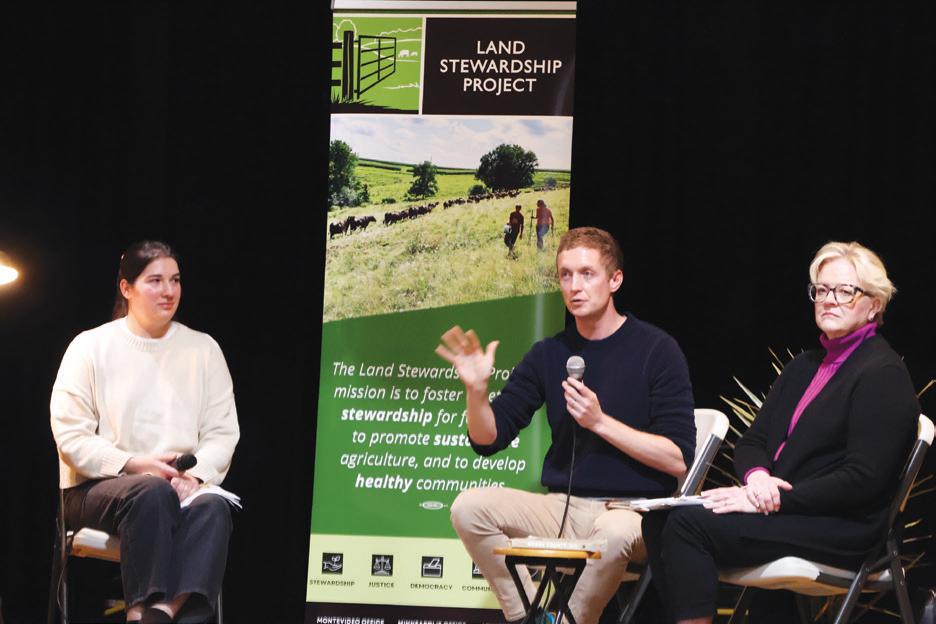
“We’ve been here before,” said Austin Frerick, author of Barons: Money, Power, and the Corruption of America’s Food Industry. “I think we’re just living in another Gilded Age and the beauty is that the last Gilded Age ushered in a reform movement.” Frerick (holding microphone) spoke on a panel with Sonja Trom Eayrs (right), author of Dodge County, Incorporated: Big Ag and the Undoing of Rural America. LSP organizer Laura Schreiber moderated the discussion.
A video recording of the panel talk and resources related to the issues discussed are at landstewardshipproject.org/bigproblems. LSP’s Ear to the Ground podcast features interviews with Trom Eayrs (episode 383) and Frerick (episode 384): landstewardshipproject.org/series/ear-to-the-ground. p
As
Avian Flu Reemerges, LSP White Paper Asks: Are Factory Farms the Victims or the Vectors?
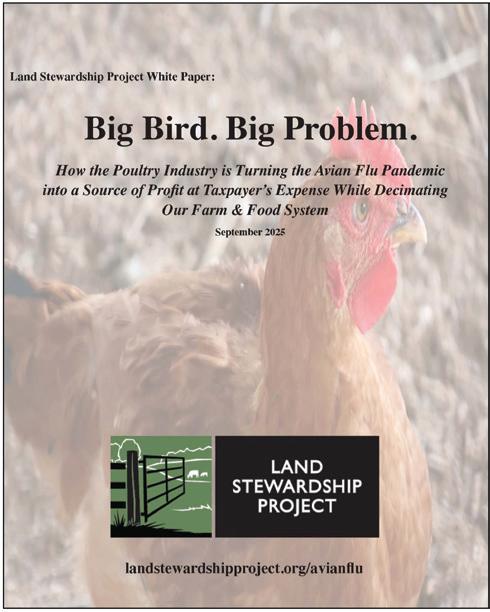
The announcement this fall that a deadly strain of avian influenza has reemerged in Minnesota and other states raises renewed questions about the role large, industrialized poultry operations play in propagating this disease, say authors of a white paper published by the Land Stewardship Project. “Big Bird. Big Problem: How the Poultry Industry is Turning the Avian Flu Pandemic into a Source of Profit at Taxpayer’s Expense While Decimating Our Farm & Food System” examines what questions need to be answered if we are to put an end to a seemingly endless cycle of outbreaks, mass euthanasia, payouts and inflated food prices. The paper argues that this moment of crisis also offers an opportunity to create a food and farming system that is not constantly on the verge of disaster.
Redwood County outbreak, which was the first flare-up of the illness in Minnesota since April 23. However, in just a seven-day period, three more commercial Minnesota turkey flocks tested positive for avian flu, according to the USDA’s Animal and Plant Health Inspection Service. Minnesota is the nation’s largest turkey producer.
enjoy massive profits.
The industry has repeatedly claimed that CAFOs that house tens of thousands of birds in close quarters are the best, most biosecure way to raise poultry, and that this virulent form of bird flu is the rare result of such security features being breached by outside forces that are beyond their control. It’s been suggested that two of these forces are wild waterfowl and farming operations that raise poultry in pasture-based and otherwise “backyard” or non-confined situations.
“There is increasing scientific evidence that factory farms are in fact the perfect environment for a virus like avian flu to survive, thrive, and increase in virulence,” says Doug Nopar, a Winona County, Minn., farmer and a member of LSP’s Avian Flu Steering Committee. “Meanwhile, the strategies being used by the government thus far — pay producers to kill off entire flocks while subsidizing the construction of even larger CAFOs — are perpetuating the problem.”
Minnesota’s latest outbreak of highly pathogenic HFN1 avian influenza was first detected in a commercial turkey operation in Minnesota’s Redwood County, according to a press release issued by the Minnesota Board of Animal Health on Sept. 17. A total of 20,000 birds were impacted by the initial
In February 2022, U.S. poultry operations started reporting outbreaks of a new H5N1 avian flu virus. As of December 2025, over 184 million birds being raised on farms had been affected by the virus, according to the USDA. It’s been detected in flocks in 50 states and one territory. What sets this virus apart from other illnesses that have struck livestock over the years is the speed with which it spreads, as well as its virulence. It’s a highly pathogenic avian influenza virus, which means once a bird contracts it, it results in virtually a 100% fatality rate. And once a few birds are infected, it spreads quickly to the rest of the flock.
Once H5N1 was identified in those first flocks in 2022, the virus raced through largescale concentrated animal feeding operations (CAFOs) in the U.S. at a staggering rate. And because the main solution promoted by the industry, land grant scientists, and government officials is to destroy entire flocks once the virus shows up in a few birds, the bird death rate — directly from the virus itself and as a result of euthanasia — has skyrocketed. Repeated outbreaks of H5N1 have cost taxpayers hundreds of millions of dollars and resulted in higher prices at the grocery store, all while poultry companies
Studies have shown how avian flu, even when introduced by wild swans, for example, doesn’t become deadly until it has an opportunity to incubate and spread in large scale commercial operations. Of the 39 times a low pathogenic avian influenza strain evolved into a highly pathogenic avian influenza strain between 1959 and 2015, 37 of those jumps were reported in commercial poultry production systems, according to a study in the journal Frontiers in Veterinary Medicine. Evolutionary ecologist Rob Wallace says that the CAFO production system makes poultry not only food for humans, but “food for flu.”
The LSP white paper proposes several steps for creating a more resilient poultry production infrastructure, including: ending the subsidization of the current CAFO system, directing public funds to a more regenerative system, supporting a localized and distributed processing system, and funding land grant research that gets at the cause of the problem and sustainable ways of resolving it.
“It’s time we stopped propping up an inherently flawed way of producing food and developed a truly resilient and accountable farm and food system,” said Nopar.
“Big Bird. Big Problem” is available at landstewardshipproject.org/avianflu or by calling 612-816-9342. p
State Policy
Priorities for 2026 Legislature: Soil, Water, Land Access, Consolidation, Farm to School
By Laura Schreiber
When Minnesota lawmakers return to Saint Paul Feb. 17 for the start of the next state legislative session, Land Stewardship Project’s members and organizers will be active in pushing forward our values and priorities. Before we go into what issues we will be focusing on in 2026, I’d like to provide some political context and a little lay of the land.
The 2025 session was characterized by a late start in the Minnesota House, powersharing struggles, special elections, lawsuits, and a chaotic end to finalizing a state budget with the help of a one-day special session.
As is normally the case after passing a state budget, 2026 will be a policy-setting year and lawmakers will spend the bulk of their time focused primarily on no-cost policy changes and laying the groundwork for the next budget-setting year in 2027.
The latest state budget forecast calls for a near-term surplus but a long-term deficit, and that will determine what, if any, supplemental money legislators may have to work with. We can expect that lawmakers will spend much of their time responding to actions at the federal level and figuring out how to deal with a myriad number of program cuts, including to the Supplemental Nutrition Assistance Program (SNAP) and health care subsidies. In addition, the assassination of Speaker Emeritus Rep. Melissa Hortman and her husband, Mark, along with the mass shooting at Church of the Annunciation in Minneapolis, will no doubt make gun violence a major issue of debate at the capitol.
everyone’s mind with all state Senators, Representatives, one U.S. Senate seat, the Governor’s office, and the Attorney General position on the ballot next fall.
In that context, what will LSP be focusing on during the session?
Healthy Soil, Clean Water
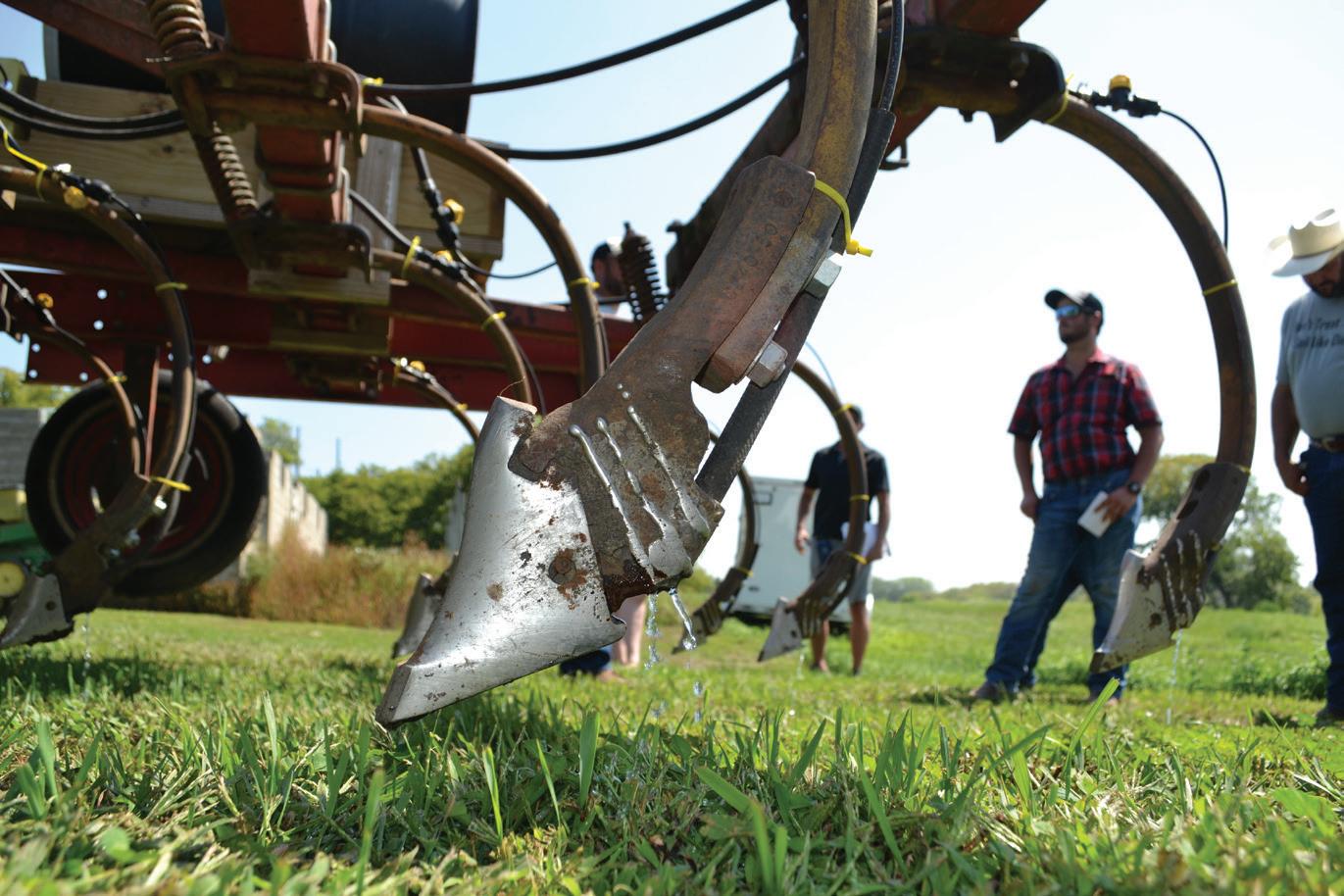
➔ LSP will continue to advocate for programs that support the adoption and scaling up of soil health practices. One such program is the Minnesota Department of Agriculture’s Soil Health Financial Assistance Program, which provides farmers resources for purchasing and retrofitting the kinds of equipment needed to build
strides over the years developing cropping systems that can help diversify our corn-soybean duo-culture; LSP feels it’s critical that this work continues to be supported with publicly-funded research and outreach.
➔ Nitrate pollution of groundwater continues to be a serious problem in southeastern Minnesota. The innovative Olmsted County Groundwater Protection and Soil Health Program has shown great promise for reducing fertilizer runoff by rewarding farmers for putting in cover crops, diversifying rotations, and utilizing regenerative grazing systems. LSP and our allies believe that expanding this program to more counties in the region would benefit the water, rural communities, and farmers.
Taking on Big Ag
➔ As the article on page eight of this Land Stewardship Letter outlines, rural communities are being gutted by unprecedented consolidation and monopolization in agriculture. LSP will be supporting partner legislation that brings additional resources to the state Attorney General’s office in its work to identify and fight the agriculture industry’s use of trusts, monopolies, and other unfair marketing practices.
The Soil Health Financial Assistance Program provides funds to help farmers purchase and retrofit the field equipment needed to implement soil-friendly practices. Pictured is equipment Jordan, Minn., farmers Mike and Dana Seifert modified to help them apply compost extract to crop fields. (LSP Photo)
resilient soil in an economically viable way.
➔ We will also work to bolster supply chains that support the processing and marketing of soil-friendly “continuous living cover” crops like Kernza.
Finally, the 2026 election will be on
➔ The University of Minnesota’s Forever Green Initiative has made great
➔ Minnesota is one of the few states where local government control of development is still strong. That’s why promoters of large-scale factory farms and frac sand mines, for example, show up at the capitol year-after-year in an attempt to weaken local democracy. As we have done in the past, LSP will continue to fight to keep local control strong. We will also be pushing for updating the permitting system for large-scale concentrated animal feeding operations so that it better reflects the reality of the massive volumes of manure these operations produce, store, and handle.
Fair Prices, Fair Markets
➔ As we’ve reported in past issues of the Land Stewardship Letter, recent sessions of the Minnesota Legislature have result-
Legislature, see page 11…
…Legislature, from page 10
ed in solid support for initiatives that get more locally produced food into schools and early child care facilities. However, demand for these resources continues to far outstrip what’s available. That’s why LSP and our allies will be introducing legislation to increase funding for the Minnesota Department of Agriculture’s Farm to School and Early Care program to $10 million so that all school districts that want to can purchase fresh, healthy food from Minnesota farmers.
➔ In recent years, the USDA’s Local Food Purchase Assistance (LFPA) Cooperative Agreement Program proved to be a highly effective way to get farmers paid a fair price for food that is then given to food shelves in their communities. As a result of federal budget cuts, during the 2025 session lawmakers created a Minnesota version of the LFPA. This is an exciting way to get more people fed while supporting a local farm-to-table economy. During the 2026 legislative session, LSP will be supporting proposals to increase funding for this new program so more farmers across the state can have access to viable markets while food access is increased in their communities.
More Farmers on the Land
➔ Since it was launched in 2022 as a way to help beginning farmers with the purchasing of farmland, Minnesota’s Down Payment Assistance Grant Program has been overwhelmed with applications. LSP will introduce legislation to increase funding for this popular initiative and to incorporate requirements that ensure all monies can be used to purchase farmland.
➔ We will also be pushing for the introduction of a bill that directs the state to create an action plan for increased farmland access, especially for beginning and emerging farmers. This legislation should identify policy solutions and investigate alternative land holding mechanisms.
➔ As Midwestern farmers grapple with economic problems that rival the 1980s Farm Crisis, they need more support than ever in the form of mediation services and mental health counselors. LSP will be calling for increased funding for highly effective programs such as the Farmer-Lender Mediation Program and Minnesota Farm Advocates.
Once the session gets going, LSP members will have plenty of opportunities to make their voices heard. You can keep tabs on the Land Stewardship Project’s action
alerts at landstewardshipproject.org/ category/action-alerts. For more information, feel free to contact me at lschreiber@ landstewardshipproject.org. p
Laura Schreiber is LSP’s government relations director. For more on LSP’s state policy work, see landstewardshipproject.org/ state-policy.
Land Stewardship Action
Land Stewardship Action (LSA) is LSP’s 501(c)(4) partner organization that provides the movement with political and electoral tools for reforming our farm and food system.
For more information on LSA and to get involved in such initiatives as voter education and deep canvassing, see landstewardshipaction.org or contact political organizer Emily Minge at eminge @landstewardshipaction.org, 612-4006353.
LSP’s Family Farm Breakfast & Day at the Capitol March 11
The2026 edition of the Land Stewardship Project’s Family Farm Breakfast and Day at the Capitol will be held Wednesday, March 11. Since 2005, the “Best Breakfast in Town” has been an opportunity for LSP members and allies to get together with lawmakers and other public officials over locally sourced food and discuss policy issues related to beginning farmer and emerging farmer support, soil health, water quality, continuous living cover research, farm to school initiatives, markets for small and mid-sized farmers, agricultural consolidation, land access, and local democracy.
The breakfast will be served at Christ on Capitol Hill Church across from the state Senate Office Building in Saint Paul. As in the past, after the breakfast participants will have an opportunity to meet with lawmakers and other public officials at the capitol.
Check the Land Stewardship Project’s website (landstewardshipproject. org) for details and for opportunities to volunteer as they are developed. More information is also available by contacting LSP’s Laura Schreiber at lschreiber@landstewardshipproject.org or 612-722-6377.
Policy & Organizing
Farm Aid Marks 40 Years
By Brian DeVore
In a sense, the fact that the event was back for its 40th iteration is a sign of failure, or at the least that we have a whole lot of work ahead of us. After all, when Willie Nelson launched Farm Aid with a concert in 1985, he thought it would be a one-off fundraiser that would help get farmers through a rough financial patch. But on Sept. 20, here we were, four decades later, “celebrating” a key anniversary of what is inarguably the largest agrarian-centric music festival of its kind. Farm Aid 40 was held at a time when American farmers are facing a dire economic picture that echoes the 1980s Farm Crisis. On top of that, consolidation in the ag industry is at an unprecedented scale and climate change makes producing food on the land increasingly risky.
On the other hand, there was plenty to celebrate: this year’s Farm Aid event was held in Minneapolis, and Minnesota farmers and groups based in the state, such as the Land Stewardship Project, have benefited greatly from the funds raised by Farm Aid over the years (overall, Farm Aid had raised $85 million prior to the 2025 concert). The organization’s support hotline alone (see sidebar on page 13) has undoubtedly saved the lives of farmers in the throes of economic and emotional crises.
Once-a-year, the day-long concert featuring big-name artists helps remind the general public that American agriculture didn’t originate in a chemical company’s lab, a Silicon Valley computer, or a corporate boardroom — it’s rooted in the soil tilled by thousands of small and medium-sized family farms spread across the country, utilizing a variety of methods to raise livestock, grains, produce, and anything else that ends up on people’s plates.
international trade picture, and government policy that rewards all-out production of a handful of commodities, no matter what the impacts are on the land, water, rural communities, food system workers, and eaters. LSP, for one, has received Farm Aid funding to, among other things, help local communities organize against the onslaught of large-scale concentrated animal feeding operations (CAFOs).
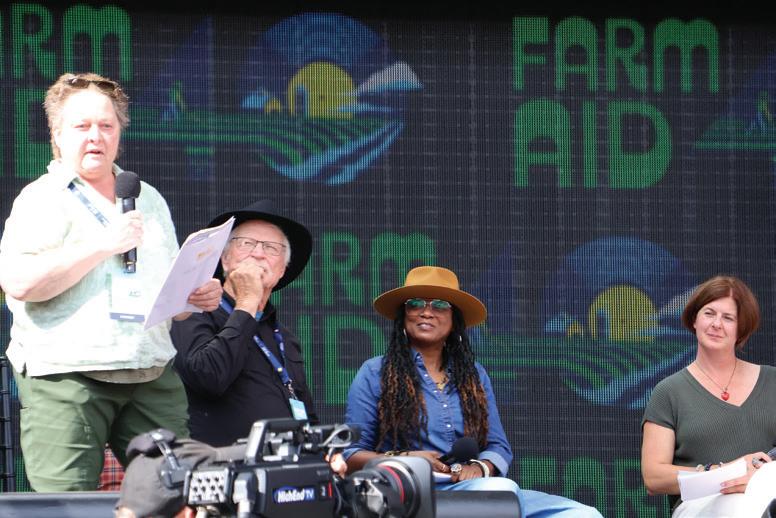
“We need people to be aware so they can talk to their Representatives, their Senators, to make policies and legislation that will work for all farmers, not just the big ones,” said LSP member and southeastern Minnesota farmer Bonnie Haugen at the pre-concert press conference, which was attended by Farm Aid board members Willie Nelson,
southeastern Minnesota farmer Shea-Lynn Ramthun stood in a recently harvested oat field on her family’s farm near Cannon Falls and described to a couple dozen lawmakers a dilemma that’s all-too-common in the agriculture business: she had just successfully raised a bumper crop, only to run into the brick wall of not having access to buyers who will pay a good price.
“As a farmer, I want to produce really sustainable, healthy food for my family and community,” said the sixth-generation crop and livestock producer. “But farmers need to be able to have access to markets.”
Ramthun’s farm was one stop on a legislative tour sponsored by State Innovation Exchange (SIX), a group that works with state lawmakers across the country to connect and strategize together on how to move public policy that prioritizes the health of communities and climate action, among other things. SIX worked with LSP and other groups to bring lawmakers from nine states to two farms in southeastern Minnesota as part of a week of activities held during the run-up to the Farm Aid concert. Many of the lawmakers participating in the tour serve on agriculture and natural resources legislative committees in their respective states.
During a pre-Farm Aid concert press conference, short films featuring people such as Hannah Bernhardt introduced journalists to Minnesota farmers who face challenges but also see opportunities in agriculture.
(LSP Photo)
Neil Young, Margo Price, John Mellencamp, and Dave Matthews. Even more importantly, in attendance were members of the national media.
But reminding folks of this country’s rural roots isn’t enough — the annual music festival’s main goal is to raise funds that help all those farmers fight for survival in a world dominated by corporate consolidation, monstrously large factory farms, a mercurial
Farmer Stories
There’s no better way to inform lawmakers of the challenges farmers face and the role public policy can play in creating a different system than to get them out on the land. Two days before the concert,
Less than an hour’s drive south of Ramthun’s farm near Rochester, Minn., a group of Kenyan immigrants explained to the lawmakers that access to consistent, profitable markets is also a challenge for them, even though they are raising vegetables, not grain.
Five partners in the Farmland Produce operation farm 11 acres they’re renting from a local corn-soybean farmer. Most of the farmers who make up the cooperative have health care backgrounds, and they explained to the lawmakers that since starting the farm last year their focus has been to produce nutritious, fresh food for the community. However, because of lack of access to consistent markets, they often end up giving the food away.
The farmers also described how access to land is another major barrier to the long-term viability of their business. They have received support from Rochester’s Village Agricultural Cooperative to set up infrastructure such as a packing shed and washing station, but because they are on a
Farm Aid 40, see page 13…
…Farm Aid 40, from page 12
year-to-year lease, it’s difficult for them to plan ahead.
“Most of the challenges we have are around land access,” said Benson Arama, one of the farmers. “If we had our own land, we could make a plan and produce in the long-term.”
Moses Momanyi, who farms north of the Twin Cities, has been working with dozens of African immigrants in the state to help them gain access to land and markets. He said that funding provided by the Minnesota Legislature to support food hubs, farm to school purchases, and farmland access for beginning farmers has been of great benefit to the farmers he works with. But as more emerging farmers enter agriculture, the need for support is growing. He encouraged the lawmakers on the tour to find ways to support operations like Farmland Produce, which should be seen as a business that benefits the public good by providing healthy food in an environmentally sustainable manner.
public service for everyone,” said LSP board member and northeastern Minnesota livestock farmer Hannah Bernhardt during the pre-concert press conference. Bernhardt’s Medicine Creek Farm was among several innovative operations featured in videos and photographs that were projected onto giant screens during the press conference and the concert itself.
In a sense, the Farm Aid panel discussions held at the U of M’s Saint Paul campus the day after the SIX tour were where the rubber met the road. It was a place where folks could get together for a day and talk about how we proceed in the fight for a
Street players didn’t come in the form of tours, beautiful images, or panel discussions. It materialized by way of the many farmers and organizers who have been part of the fight since the original Farm Aid, the event that, remember, was supposed to be a oncein-a-lifetime occasion. There was Denise O’Brien, a 75-year-old southwestern Iowa farmer who has been fighting for family farms for over 50 years. During a Farm Aid forum breakout session, she said the economic and environmental damage caused by a corporate-controlled, industrialized form of agriculture doesn’t just impact family farmers like herself.
)
A farmer panel held at Ramthun’s operation also focused on the theme of how public policy can encourage farmers to produce food in a way that’s good for the community. Ramthun said that interseeding nitrogen-fixing red clover into her oats is helping reduce her farm’s reliance on commercial fertilizer, which saves money and benefits water quality. Besides being a farmer, she also works as a soil health organizer for LSP; in that role she helps farmers adopt practices such as cover cropping, no-till, diverse rotations, and managed rotational grazing.
“I hear from a lot of farmers about the need for market access to make soil health and diversifying profitable,” she told lawmakers.
Overall, beginning and emerging farmers, many of whom are practicing regenerative practices based on building soil health through diversity and who are producing food for local markets, had a big presence at this year’s Farm Aid, which besides activities like the SIX farm tour consisted of numerous forums and events where farmer stories were put front and center.
“I’m really excited about the direction regenerative ag is taking us — this is a
family farm-based form of agriculture after Willie and the rest of the concert performers pack up and leave town, taking an international spotlight with them. Farmers from across the country were on-hand for the discussions, as well as staffers for nonprofit organizations, such as LSP, that have been on the receiving end of Farm Aid funding in the past. The discussions ranged from how communities create food sovereignty and the role Indigenous farmers and other farmers of color can play in creating a more sustainable food system, to how citizens can band together to fight consolidation and the spread of large-scale CAFOs. The elephant in the room was also discussed: how corporations have an outsized influence over what land grant institutions like the U of M conduct research on. The Saint Paul campus is home to the school’s agriculture college, and the forum was being held just a stone’s throw from a microbial and plant genetics building with the name “Cargill” emblazoned on it.
“We can talk about how the corporations control everything, and they do,” Jim VanDerPol, an LSP member and western Minnesota hog farmer, said at the forum. “But we also need to take control back.”
Perhaps the biggest source of optimism that we are not fated to a farm and food system controlled by a handful of Wall
“Everybody uses the term ‘extractive economy,’ and that’s exactly what we’re in — suck everything out and leave nothing,” she said.
Such a grim, one-way equation would leave a lot of people feeling overwhelmed, but when, in 2024, 265,000 gallons of liquid nitrogen escaped a fertilizer retailer’s facility and caused a massive fish kill on the Nishnabotna River in O’Brien’s part of the state, she and her neighbors refused to accept it as the cost of doing business. They got together and launched a citizen water monitoring group that’s posted billboards reminding folks in the region that they don’t have to accept polluted water as their future.
“We have to have hope,” said southwestern Minnesota farmer Paul Sobocinski during the forum. He worked for several years as an organizer for LSP and is currently involved with a Minnesota Institute for Sustainable Agriculture initiative to develop a local meat processing infrastructure. “And hope doesn’t just come out of nowhere. It comes out of organizing.” p
Farm Aid Resources
F
arm Aid’s support hotline — 1-800-FARM-AID — is available Monday – Friday, 9 a.m. – 9 p.m., Eastern Time. The Spanish hotline is available Monday – Friday, 9 a.m. – 5 p.m., Eastern Time. Farmers can also submit an online “request for assistance” form at farmaid. org/our-work/supporting-family-farmers. LSP’s farm crisis resources web page is at landstewardshipproject.org/farm-crisisresources.
Lawmakers from nine states participated in a pre-Farm Aid tour of two southeastern Minnesota farms. (LSP Photo
Community-Based Food Systems
Homegrown Grains, Homegrown Value
When the Local Elevator Doesn’t Support a Farm’s Diversification Goals
“Welcome to my midlife crisis,” joked Peter Haugen on a Saturday morning in early August as a couple dozen farmers stood in a semi-circle around him and his wife, Brittany, at the edge of a 12-acre field south of Madison, Minn. The “crisis” Peter was referring to was what was growing in that field: emmer wheat, an ancient variety of grain sought after by specialty bakers. Over the hill was a 15-acre stand of einkorn wheat and down the road was a bright yellow stand of oats. Surrounding all these fields were crops more typically found in this part of western Minnesota: corn and soybeans.
During a Land Stewardship Project “Bringing Small Grains Back to Minnesota” meeting hosted by the Haugens and Madison Mercantile on Aug. 2, participants learned from other farmers, as well as a milling expert, about the potential for diversifying their agricultural enterprises by growing a type of crop that has all but disappeared from rotations in the Upper Midwest in recent decades. The loss of small grains such as wheat and oats is unfortunate, said Peter, given that he’s found that integrating these crops into his rotation helps disrupt pest cycles and builds healthy soil. Interest in small grains has been gaining momentum in Minnesota recently. During a similar small grains event held by LSP in Albert Lea in January, over 150 farmers and ag professionals gathered to learn how others are rebuilding markets and vital infrastructure for small grains.
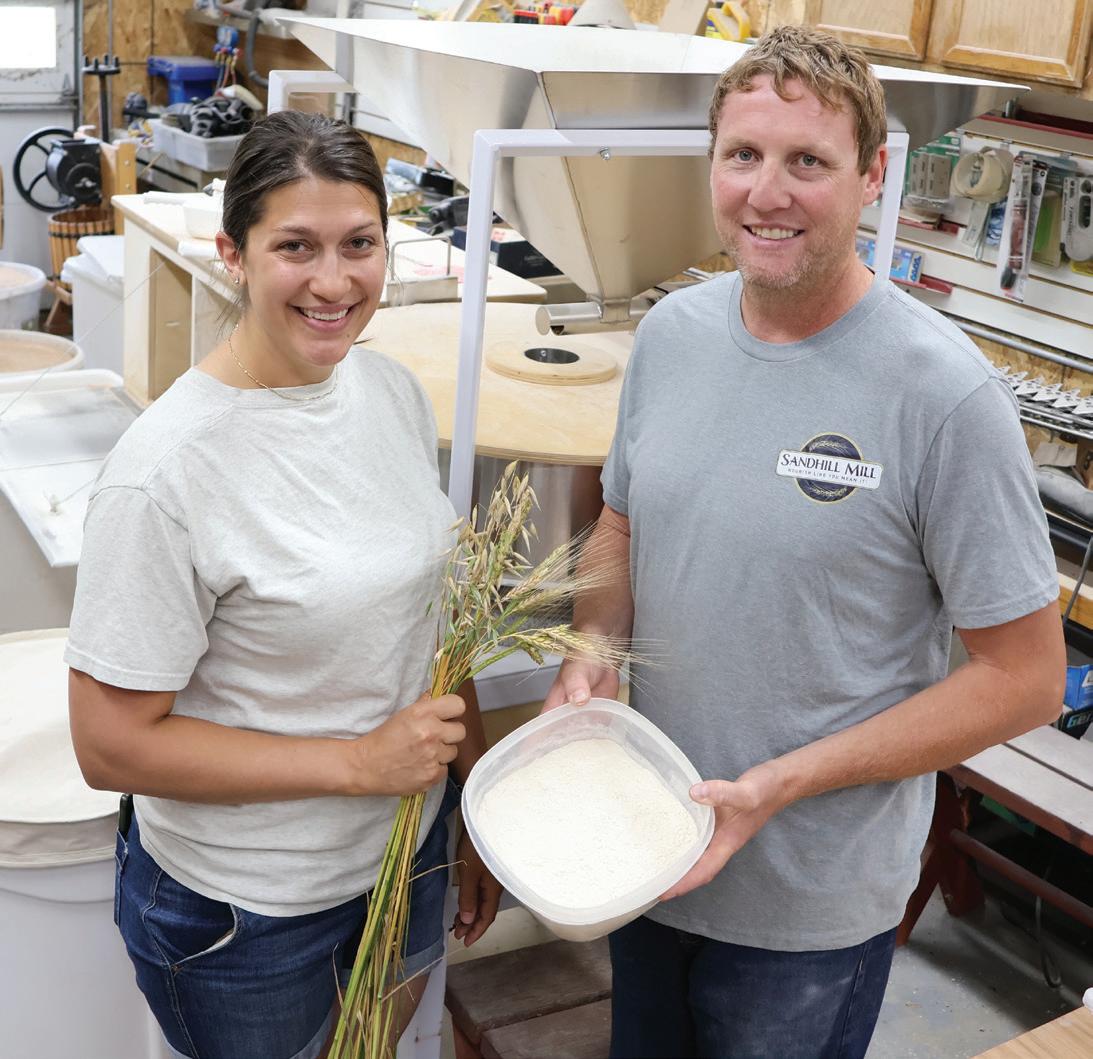
The Haugen farm had grown small grains in the past, and recently got back into them initially to provide a wider planting window for growing cover crops. But Brittany and Peter soon discovered that it was extremely difficult to sell specialty wheat and other small grains via local elevators. So, three years ago they launched Sandhill Mill, an on-farm stone ground mill that sells flour direct to customers. Since the mill was started, the Haugens have not been able to keep up with demand. Brittany is an avid
baker, and has developed branded pancake and brownie mixes from the flour they mill.
“This small grains journey has brought our two worlds together,” said Peter. “Brittany’s learning a little about farming, I’m learning a little bit about baking.”
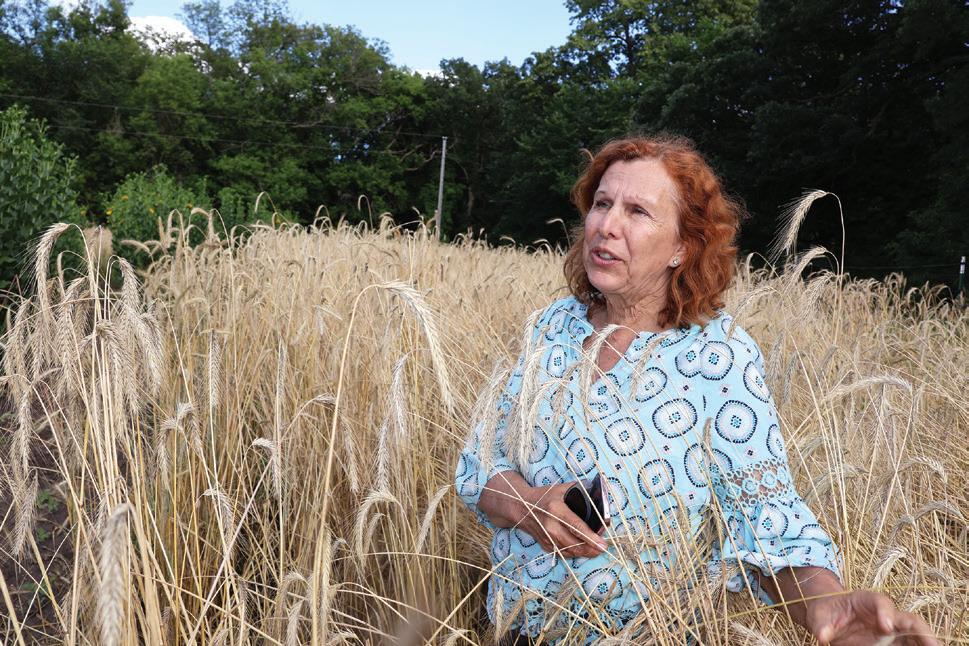
Although processing one’s own small grain production isn’t for everyone, it can be a great way to add value to a crop that otherwise might be undervalued in an undifferentiated market, said Noreen Thomas, who, along with her husband, Lee, owns Doubting Thomas Farms near Moorhead, Minn. During the past three decades, Doubting Thomas has developed a diverse organic operation that raises a variety of crops, including small grains. The farm has some of its small grains processed off-farm into flour and cereal, which it markets locally and across the country.
“Every time you clean or process grain, you add value to it,” Thomas told the meeting participants who gathered at Madison Mercantile after the Haugen field tour.
Gilbert Williams agrees. In 2009, he and a partner launched Lonesome Stone Milling
Give it a Listen
Check out these recent LSP Ear to the Ground podcasts related to how local food systems can help farmers looking to diversify with small grains:
• Episode 381: A Key Ingredient
• Episode 379: Proclaim Your Grain
• Episode 378: Dumping the Doubts
• Episode 377: Flour Power
All Ear to the Ground episodes are available at landstewardshipproject. org/series/ear-to-the-ground or on your favorite podcast platform. For more on small grains, including video presentations from a previous LSP workshop, see landstewardshipproject.org/smallgrain.
in southwestern Wisconsin. During the next dozen years, the mill developed a demand for locally produced small grains by, among other things, using marketing and packaging that informed consumers about who the individual farmers were that supplied the grain. Williams told participants in the Aug. 2 meeting that there is a growing subset of consumers that want the kind of healthy food that can be provided by a system that produces and processes small grains locally. Focusing on health and the mission of supporting local farmers will get buyers’ initial attention, but “flavor will bring your customers back,” and a mill operator must focus on quality control and understanding food safety rules, said Williams, who sold his mill to Meadowlark Farm and Mill in Ridgeway, Wis., a few years ago. As the Haugens have discovered, online/social media marketing has been a major boon to people who are selling value-added specialty grain products.
“I think the market for this is still broad,” said Williams.
During the LSP field day and meeting, farmers and presenters discussed the barriers that stand in the way of getting more small grains integrated back onto area farms. Lack of a regional infrastructure that supports transportation, storage and marketing of small grains, as well as how government programs related to initiatives like crop insurance favor corn and soybeans, are significant problems, they said. And although barriers around marketing, for example, can be overcome via on-farm
Homegrown, see page 15…
Brittany and Peter Haugen, shown with some of the food they produce using their on-farm mill. “This small grains journey has brought our two worlds together,” said Peter. (LSP Photo)
milling and online sales, such strategies are not always feasible for busy farmers.
What’s needed is a general infrastructure that can support diversifying cropping systems in the state, Laura Schreiber, LSP’s government relations director, told workshop participants. That’s why it’s important for farmers and others who want to see more diversity on the landscape to support state and federal policies that promote integrating crops like wheat and oats into a cornsoybean rotation, she said. Working with its allies, LSP has had success during recent sessions of the Minnesota Legislature (see
page 10) in getting public support for farmers who want to sell direct to schools and other institutions and who are interested in setting up local processing and aggregation systems.
“One of the common inflection points for addressing these issues is policy,” Schreiber said, adding that agriculture makes up the smallest portion of the Legislature’s regular budget outlays. “That’s ironic, given what a major role agriculture plays in the state’s economy. We need to make it a priority.” p
Opening the Door to Local
“Every time you clean or process grain, you add value to it,” said Noreen Thomas, shown in a stand of rye growing on her farm in northwestern Minnesota. (LSP Photo)
Survey Highlights Farm to School’s Potential as well as its Challenges
On an October afternoon when the temperature hovered around an unseasonably hot 90 degrees, Jeanine Bowman walked into a cooler that provided a fresh, crisp glimpse at the potential for getting locally produced food into school cafeterias. Sitting on shelves were eggs, along with a variety of fruits and vegetables, all produced by farmers in the region. As she ticked off everything that was present, Bowman was clearly pleased with the bounty of the season and excited about what role it would play on future lunchroom menus.
As the food service director for the Morris Area Schools in west-central Minnesota, she is responsible for providing 850 lunches and 500 breakfasts daily to elementary and high school kids. Bowman grew up on a dairy farm in the region, and has long been interested in sourcing as much of her school’s food as possible direct from the fields, garden plots, orchards, and pastures in the area. With the support of farm to school grants provided by the Minnesota Department of Agriculture, as well as the backing of a school board that includes farmers as its members, Bowan has been able to build up her farm to school initiative to the point that now around 10% of the kids’ meals are sourced from local farmers. Some of those farmers Jeanine deals with directly, but she also relies heavily on the Real Food Hub in Willmar, Minn., an initiative run by Beverly Dougherty that
aggregates food from regional farmers.
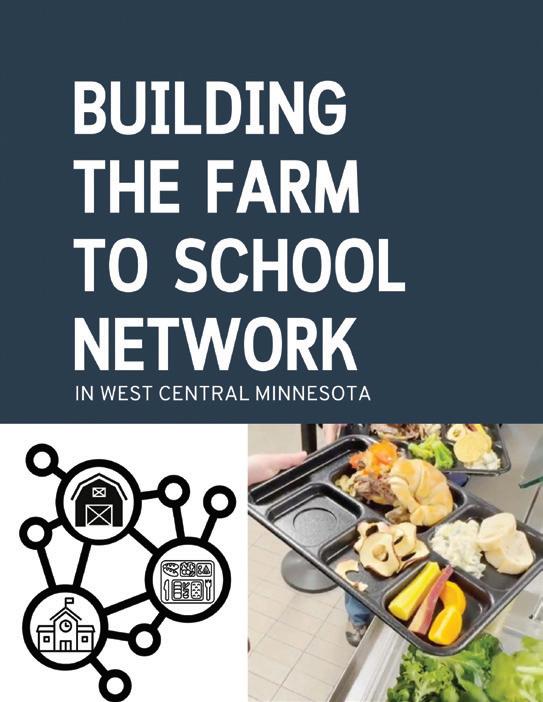
Bowman’s experience with farm to school — the opportunities as well as the challenges — mirrors what other food service providers shared in a recent report the Land Stewardship Project helped put together. “Building the Farm to School Network in West Central Minnesota” is based on interviews with 13 food service directors across 12 school districts in an eight-county region. Results of a survey of 31 farmers in and around the five-county region of the Upper Minnesota River Valley were also included in the report, which LSP did in partnership with educational institutions and government agencies.
Farm to school has been receiving a lot of attention in recent years, given its potential for providing farmers a consistent market for their products while providing healthy food to kids. Such initiatives can also generate a fair amount of local economic activity. An analysis by the Institute for Agriculture and Trade Policy and University of Minnesota Extension shows that for every dollar spent on farm to school in Minnesota, an additional 94 cents is generated in economic activity via businesses such as farm input suppliers.
What the farm to school survey in westcentral Minnesota found is that although not all of the food service directors interviewed are currently purchasing from local farmers, there is a lot of interest in doing so. But, according to the report, numerous barriers
stand in the way of either starting a farm to school initiative or expanding an already existing one, including labor shortages, limited knowledge of how to connect with local farmers and processors, product seasonality, inadequate storage and prep space, and uncertainty about the availability of government grants.
Bowman and her staff at the Morris Schools have been able to overcome some of these barriers. In fact, the walk-in cooler she showed off on that recent October day has allowed her school to partially circumvent the problem of matching up the school year with the growing season. But other challenges remain, including kitchen staffing shortages and being able to connect consistently with the right farmer raising the right product at the right time.
Still, Bowman sees farm to school purchases as another way to bolster farms and small businesses in the community— and that can be a reciprocal arrangement.
She says of that community, “You know, they’re the ones that are supporting you too.” p
“Building the Farm to School Network in West Central Minnesota” is available at landstewardshipproject.org/community-food.
Give it a Listen
On recent LSP Ear to the Ground podcasts (landstewardshipproject.org/series/ear-to-the-ground), food service directors at two rural school districts talk about the challenges and opportunities connected with sourcing food locally for their cafeterias:
• Episode 386: A Farm to School Taste Test
• Episode 385: A Longer Local Lunch Season
Soil Health
A 3-Legged Hub of Activity
What Happens When Farmers Walk Each Other’s Land?
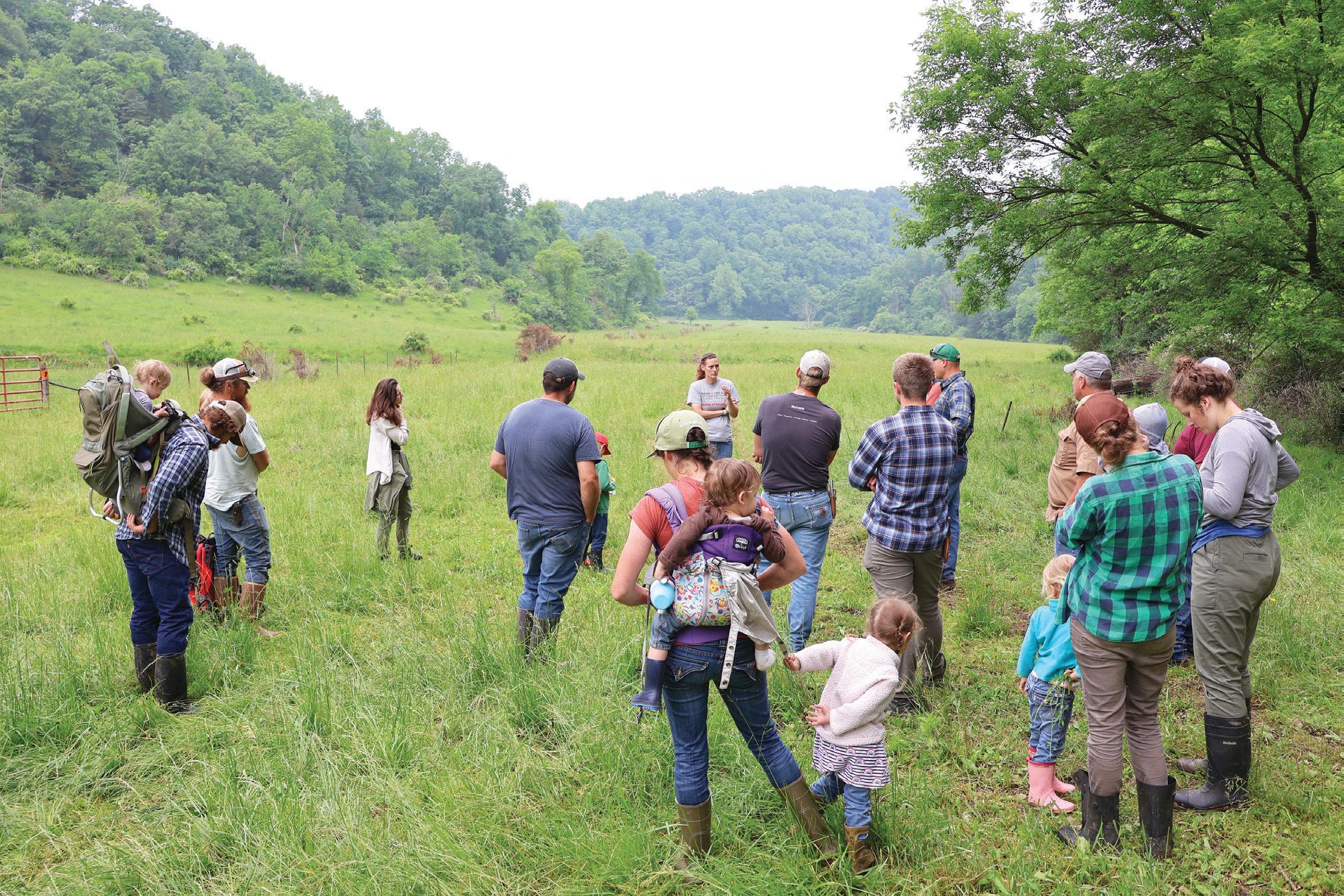
Note: During the summer of 2025, the Land Stewardship Project facilitated a series of meetings on farms across southeastern Minnesota and northeastern Iowa. These “Soil Health Hub” gatherings were not open-to-the-public field days. Rather, they were opportunities for livestock and crop producers to take part in the kind of private peer-to-peer learning required to step out of the mainstream and build a farming system based on living, biologically-rich soil.
The following pages describe how participants in these meetings connect around the so-called “three legs of the stool” when it comes to balancing economic, environmental, and social sustainability. Pages 16-20 discuss how Soil Health Hub participants are grappling with the first two legs. On page 21, LSP organizer Sarah Wescott reports on how farmers use the gatherings to fortify the “social” leg of the stool.
By Brian DeVore
On an overcast morning in June, more than a dozen livestock producers gathered in the on-farm cabinetmaking shop of Leslea and Brad Hodgson, situated in the scenic hills that engulf Minnesota’s Root River. Soon after taking seats on folding chairs arranged in a wide circle, the farmers participating in this Land Stewardship Project Soil Health Hub meeting took on an opening question: “Why am I here?”
That query was fielded by men and women ranging in age from 30-something — a few of those on the younger side had children in tow — to 60-plus, and ranging in the level of experience they had producing livestock utilizing adaptive rotational grazing, a system that moves animals between paddocks in a manner that builds soil health, prevents overgrazing, and extends the forage production season well into the fall/early winter. Some of the participants were just starting out and in the midst of acquiring livestock and setting up their fencing systems; others had decades of experience under their belts.
on how to make adaptive rotational grazing and other regenerative farming techniques more effective agronomically, economically, ecologically, and from a quality of life perspective.
So, it’s no surprise that during the next few hours on this summer day, the participants energetically shared ideas on everything from fencing and watering systems
they are involved in peer-to-peer learning networks of some type. For example, a seminal 1941 study conducted in central Iowa’s Greene County traced the adoption of hybrid seed corn during the 1930s. Through extensive interviews, rural sociologists discovered that the majority of farmers did not accept the innovation immediately from land grant experts, but rather “…delayed acceptance for a considerable time after initial contact with innovation.” Many Iowa farmers who put off planting hybrid seed for years were first made aware of its existence at the same time as their early-adopting neighbors. It turns out these early adopters served a key role: they were willing to jump in feet-first and test this innovation on their own land almost as soon as they heard about it, and they shared the results with their neighbors in a kind of community laboratory setting.
So why were they sitting inside smack dab in the middle of a busy Midwestern growing season? These are farmers who are raising livestock utilizing innovative systems that don’t fit into the mainstream of agriculture. Producing meat, poultry, milk, and eggs on pasture rather than in input-intensive confinement systems requires seeking information that often isn’t available from land grant colleges, extension educators, or input suppliers. That means they need to work just a little harder to get intelligence
to methods for grazing native grasses and setting up sacrifice areas in muddy weather. They also talked about frequency of rotations, the best breeds for grazing, and ways to monitor the effectiveness of various forage management techniques. As one farmer headed home at the conclusion of the gathering, he nodded to the shed-full of folks behind him and said, “There’s a lot of knowledge here.”
Studies going back decades show that farmers are most successful at adopting innovative practices and systems when
More recently, starting in 2009 the Conservation Cropping Systems Initiative helped make Indiana a national leader in integrating cover cropping into the traditional corn-soybean rotation with the help of “Soil Health Hubs” that brought together farmers in small-group settings to share ideas and support each other through thick and thin. And LSP’s Farm Beginnings course (see page 22) is also based on the idea that farmers learn best from other farmers. In fact, the Hodgsons graduated from Farm Beginnings over two decades ago, and credit the networking they gained through that with helping them launch a successful grass-based beef production and marketing enterprise
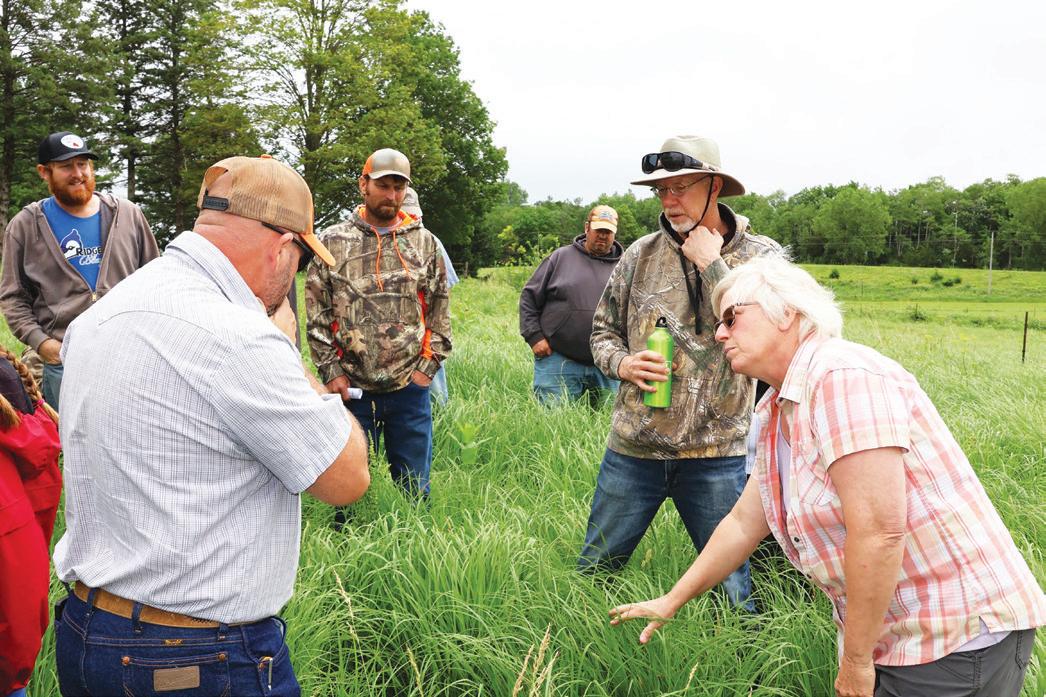
A Soil Health Hub meeting on rented land Eric Klaes (in green hat) is grazing in northern Iowa. Such gatherings can help farmers share information not always available via traditional channels. (LSP Photo)
called Root River Galloways. “That changed everything,” said Leslea of the course.
In 2024, the Minnesota Office for Soil Health sent a survey to 8,000 farmers. The questions centered around, among other things, what factors influenced decisions to adopt soil-friendly practices like no-till, cover cropping, rotational grazing, and diverse rotations. Of the roughly 1,100 farmers who responded, 40% said that having a neighbor use a soil health practice was a major influence on whether they would consider such a technique. Half identified as middle adopters — they tend to take on a new practice after others have demonstrated them to be successful.
Only 10% of respondents had ever participated in a farmer-led group or network of farmers that was focused on soil health. Of the respondents who had participated in such groups, they ranked highly these networks’ influence on their decision-making. Bottom line: farmer-to-farmer learning is highly effective, but suffers from a public relations problem — only 17% of survey respondents had even heard of farmerled groups centered around soil health.
road dropped 400 vertical feet in less than half-a-mile, and a half-inch rain earlier had made the footing greasy with mud. Sensing that this was turning into a less-than-pleasant stroll, Meyer reassured the hikers that the trip would be worth it. “I promise it’s beautiful down here,” she said at one point, gesturing further down the road.
She delivered on that promise — the journey ended in a grass-covered valley split up the middle by a small stream and bordered by more trees. A yellow warbler, a song sparrow, and blue-gray gnatcatcher were singing. As if on cue, an eagle lifted itself from a massive nest on one side of the valley and soared overhead. But Meyer didn’t bring these beef, sheep, dairy, and
Introducing more farmers to the benefits of such peer-to-peer information sharing is one reason LSP facilitated a series of Soil Health Hub meetings on farms across southeastern Minnesota and northeastern Iowa this past summer. During these gatherings, a general theme filtered into the discussions held in barns, sheds, paddocks, and during hikes across farms: how does an agricultural operation balance the three-legged stool of economic, environmental, and social sustainability? It turns out community-building and moral support play a big part in striking that balance. After all, farmer-to-farmer learning isn’t just about transferring information on the best brand of wire reel to use or whether one should clip a pasture to maintain forage quality.
Financial Field-Talk
On a misty early summer morning in northeastern Iowa, Nikki Meyer led half-a-dozen farmers down a field road through a thick stand of oaks and other hardwoods. The going was tough — the
crop farmers down to this piece of paradise just to admire the view. She’s currently renting the pasture in this valley as part of her adaptive rotational grazing enterprise, which supports a 50-head cow-calf herd. The land is adjacent to the roughly 200 acres she and her husband, Cody, own and raise corn and soybeans on, along with the cattle. She’d like to buy this parcel or at least part of it — it’s 150 acres in total — but the owner is asking over $8,000 per acre for it, and she’s having difficulty figuring out how to justify such an investment.
“I can’t cash flow it, but never say never,” Meyer, who is 32, said to the gathered farmers. “So how do I own this?”
That question sparked an impromptu, and energetic, discussion about various ways to make purchasing a piece of land like this pencil out financially. Soil Health Hub meetings involve building a level of trust so that folks are comfortable sharing failures and doubts, as well as successes.
Hence Nikki’s willingness to share her reservations about what role this rented land should play in the future of her family’s farming enterprise. Farming is a business and in order for it to be viable, it has to cash flow. That’s why the vast majority of the discussion that took place during the 2025 Soil Health Hub gatherings focused on the economic leg of the three-legged stool. In the case of Nikki Meyer, the farmers gathered for her meeting responded to her question by throwing out various ideas for making purchased land cash flow. Nikki said that like many farmers this year, she and Cody are finding corn and soybeans to be a financial “bust” — it’s costing them more to raise the crops than they receive at the elevator. And she doesn’t like how annual row crops have the potential to leave this rugged Driftless Region land environmentally vulnerable. “I don’t like erosion,” Nikki said more than once during the meeting. The pros and cons of leasing land out for hunting, logging some of the timber, and perhaps selling off the cow herd and leasing the pastures out for custom grazing were discussed. Of course, continuing to rent the land is also an option. During a July Hub meeting Eric Klaes hosted in northern Iowa’s Floyd County, the beef producer described the good, long-term relationship he has with a landowner who is thrilled to see cattle grazing on land that was once a monoculture of corn and soybeans along the Wapsipinicon River.
Inevitably, the discussion at all of the Hub meetings LSP facilitated this summer circled back to how to make soil-building practices pay off in the marketplace. Nikki currently raises calves for the conventional feeder cattle market. Due to shrunken herds, prices farmers and ranchers were receiving for their animals reached record highs in 2025. However, raising beef cattle on grass takes a significant amount of time and managerial skill, and farmers pursuing this method of production often feel the conventional marketplace doesn’t compensate them fairly for the extra effort. And livestock markets can be infamously fickle and cyclical, especially given the packer consolidation that’s taken over the industry in recent decades.
In fact, one component of LSP’s Soil Health Hub meetings involved participants going around and sharing “thorns” and “buds” in their lives at the moment. Invariably, marketing was a thorn in the side of the
Hub, see page 18…
During a June Soil Health Hub pasture walk on the Brad and Leslea Hodgson farm, participants compared notes on paddock management.
(LSP Photo)
Soil Health
majority of the participating farmers.
“The missing link we all desire is just being paid on quality,” said northeastern Iowa farmer Ross Kurash during one Hub meeting.
One strategy is to capture value by direct-marketing grass-fed livestock to eaters who value regeneratively produced animal products. In fact, some farmers involved in the Hubs are doing that with good success. During a meeting they hosted on their Winona County, Minn., farm in August, crop and cattle producers Mike and Jennifer Rupprecht talked about the directly-marketed beef business they’ve built up via word-of-mouth over the past few decades. Mike conceded that it’s tempting to sell into the red-hot conventional market, but it’s inevitable that it will eventually cycle down and they don’t want to abandon their direct-buyers for short-term gain when those eaters have provided so much long-term loyalty.
hole of endless work and little return on investment.
“We as farmers are horrible at paying ourselves,” said Heins, who was trained as an accountant.
LSP
“Our customers have been so good to us,” he said while standing next to a paddock full of grazing Red Devon cattle.
Nikki runs a seed business and sees direct-marketing as another fulltime endeavor, something she’s not up for right now. “Is it worth it, guys?” she asked the group gathered in the valley pasture when the topic of direct-marketing came up. “I love raising cattle — I don’t like marketing them.”
“It is a job, and it sounds like you have one,” said Kurash, who markets his cattle straight to eaters as well as via conventional channels. Hub members also discussed the idea of using third-party marketers to handle sales, the difficulty of reaching consumers willing to pay for quality, and whether the current boom in the conventional beef market was peaking.
Markets related to livestock weren’t the only topic of discussion during the Soil Hub season. Reed and Denise Duncan, who farm hilly land outside Zumbro Falls in southeastern Minnesota, used their Hub meeting to gather input on how to make a diversified cropping mix of corn, soybeans, and oats, along with the experimental perennial grain, Kernza, pay, all while integrating livestock into the rotation.
What became clear during the 2025 Soil Health Hub gatherings is that no matter what enterprise or technique is being considered, there is no one silver bullet for making a farm profitable. For example, during the July gathering at Eric Klaes’s farm, a couple of farmers made it clear they were offering their host “thoughts” rather than “advice.” This flexible approach is important when trying to build a balanced, but nimble, threelegged stool.
top on her mind, and that’s why she was welcoming other farmers’ thoughts. “How do we make this farmland as profitable as possible?” she asked at one point. But issues like quality of life are also important to her and Cody. He recently left a town job as a mechanic so he could spend more time on the farm and with the family (he and Nikki have two small children). “I want to enjoy the family,” said Nikki. “And I want to enjoy my 32nd year.”
As the growing season wound down in October, Nikki was still contemplating the June discussion she hosted at the bottom of that muddy field road.
“I was just rolling it through my brain again whether we could buy all or some of that land,” she said over the telephone, adding that over the summer she connected with other farmers who had experience with money-making enterprises like leased hunting. She still may not be any closer to making a final decision, but in the end feels a little bit better knowing this isn’t a debate she has to have solely in her own head.
“It was fun to see it was a common struggle for everybody and that I don’t have to think about it alone,” she said.
Birds, Biology & Balance
Some sins against the land can be masked over with deep tillage, chemical inputs, and, when all else fails, moving dirt around with heavy equipment. But you can’t fool a good soil probe. For Mike and Jennifer Rupprecht, that revelation came when a retired soil scientist sunk his equipment deep into a couple spots on their farm in a hilly part of southeastern Minnesota’s Winona County. When the scientist probed one low spot on the Rupprechts’ land, he found roughly three feet of black topsoil had collected there.
Eric Heins, a Winona County farmer who both direct markets his own beef cattle and custom grazes other farmers’ animals, said during a field day he hosted this summer that no matter which path is chosen, it’s key to crunch the numbers and make sure one isn’t pouring all that sweat equity into a black
Maybe selling the herd and grazing someone else’s animals makes sense economically. Or perhaps tearing out the fences and going full-bore into row crop production during a year when corn prices are making bank is the way to go. Inevitably, someone else has been there and done that, or at the least has considered doing what you’re thinking about. A little perspective can be worth a lot.
…Hub, from page 17 Hub, see page 19…
At the outset of her Hub meeting, Nikki Meyer made it clear that one question was
“That black soil on the bottom was coming from up higher in the fields as a result of years of poor soil stewardship and poor farming practices,” recalled Mike. “When I saw that I said, ‘You know what, I’m going to do everything I can to keep these steeper parts of my farm in pasture all the time, just no tillage ever. Because we can’t have soil moving like that.’ ”
The unearthing of damage resulting from
soil health organizer Alex Romano leads a discussion at a Soil Health Hub meeting hosted by northeastern Iowa farmer Nikki Meyer. “How do we make this farmland as profitable as possible?” Meyer asked her fellow Hub members. (LSP Photo)
past practices reinforced the Rupprechts’ decision in the 1980s to break up some of their fields into paddocks, plant grasses and forbs, and rotationally graze cattle. On an August evening over three decades later, the couple was standing on one of their hillsides with around a dozen other farmers, checking out the long-term impacts of keeping their promise to the land.
Their cow-calf beef herd was grazing lush forage on soil that had soaked up and stored the copious amounts of precipitation that had fallen, sometimes in torrents, during the spring and summer of 2025. In one pasture was a Civilian Conservation Corps stone structure erected in the 1930s in an attempt to control the erosion that was rampant in this part of the Whitewater River watershed in those days. Today, the Rupprechts’ use of regenerative practices like rotational grazing and organic crop production has made this structure, and others like it on the farm, mute monuments to an almost forgotten chapter in soil conservation history.
The farmers were gathered on the Rupprechts’ Earth-Be-Glad farm for an LSP Soil Health Hub meeting. Their farm tour offered up a good opportunity for Hub participants to discuss the “environmental health” segment of the three-legged stool. Ecological sustainability can not only be an indicator of whether a farm is on the right path when it comes to building soil health in an economically viable manner, but also offers a way to make farming a little more enjoyable.
“I love the way the animals make the farm work,” said Mike Rupprecht while standing at the top of a sloping field that has been in nothing but grass since 1984. He explained that raising beef on perennial forages not only helps produce a healthy product for their direct-market customers, but works well with their organic crop rotation. The cattle spread fertility around the farm via their manure and urine and help break up weed pest cycles, all while building the soil’s organic carbon levels.
“We’re imitating nature,” Mike said.
But imitating nature isn’t just about doing right by the world beneath one’s feet. During the 1990s, the Rupprechts were among a group of farm families that were part of the Monitoring Project, an initiative facilitated by LSP that brought together live-
stock graziers, scientists, natural resource professionals, and others to develop a set of indicators for measuring the sustainability of a farm from an economic and quality of life point of view, as well as from an environmental standpoint.
It’s not surprising that measuring soil health was a key component of this initiative. But it was a different sustainability indicator that generated the most excitement among the participating farm families. With the help of Tex Hawkins, who at the time was a wildlife biologist with the U.S. Fish and Wildlife Service, the Rupprechts and other Monitoring Team members learned to identify grassland songbirds. It turns out species such as bobolinks, dickcissels, and meadowlarks are what ornithologists call “obligate species,”meaning they require a certain amount of good quality, diverse grassland habitat in order to survive and thrive. And because so much grassland has been plowed up and planted to row crops in recent decades, grassland songbirds are some of the most threatened birds in North America.
What the Rupprechts and other farmermembers of the Monitoring Team learned was that the more grassland songbirds they saw on their land, the higher the probability that they were managing it in a way that grassland habitats were thriving. And the more high-quality grasslands they had, the better their beef and dairy cattle did. For Mike and Jennifer, an equation emerged: more bobolinks = better beef. Once that connection was made, they started to take steps to improve life for their farm’s feathered residents, by, for example, adjusting grazing and mowing schedules to accommodate nesting seasons.
But noting the presence of birds also
Leslea Hodgson (right) says that interacting with farmers like Mike Rupprecht (holding water bottle) not only inspired her to take up grass-based livestock production, but to do it in a way that it benefits the environment. “Our goal was always to farm with nature,” she says. (LSP Photo)
boosted another aspect of the farms’ sustainability: it made doing chores more enjoyable.
“The Monitoring Team meetings often got sidetracked by farmers engaging in good-natured one-upmanship on bird sightings,” recalled Hawkins recently.
Hawkins and the other natural resource professionals participating in the Monitoring Project were thrilled that farmers were able to link healthy wildlife habitat with a healthy bottom line. Such a link was highlighted this year at a June field day hosted by Hoosier Ridge Ranch, which is just up the road from the Rupprechts. Owned and operated by Eric Heins and his wife, Michelle, Hoosier Ridge raises a diversity of crops and uses adaptive rotational grazing to produce livestock. Water running off this hilltop farm feeds three watersheds, and the Heins family is mindful of how they can produce food while building the kind of soil health and diversity that supports a healthy hydrological cycle and the environment in general.
“We want to be conservationists as well,” said Eric during the field day.
In recent years, the farmers have spread that working land conservation ethic beyond the borders of their farm. Since 2019, cattle being raised on Hoosier Ridge Ranch have had a chance to browse the forage available across the road in a reclaimed 15-acre prairie that’s being managed by the Minnesota Department of Natural Resources (DNR). It’s been a win-win: the DNR land provides low-cost forage for the Heins while giving their own pastures needed rest, which improves soil health and supports grassland bird habitat on the home place.
DNR habitat experts, for their part, have found rotating the cattle through the prairie reduces the presence of invasive species and is helping build the soil to the point where it can support deep-rooted native species of plants.
“There’s definitely more diversity in there since we started grazing it,” said Christine Johnson, the wildlife manager for the DNR’s Whitewater Wildlife Management Area, during Hoosier Ridge’s field day. She’s been working with Eric and Michelle to coordinate the rotations in a way that they balance what’s best for the habitat as well as what works for the farmers. “It’s definitely moving in the right direction,” Johnson said of the prairie. That theme of linking a successful farm with a healthy environment emerged repeatedly during LSP’s series of Soil Health Hub meetings this year. For example, one of the farmers attending the Rupprecht Hub meeting in August was
Soil Health
…Hub, from page 19
Leslea Hodgson. Through their experience taking the Farm Beginnings course, she and Brad learned about the Rupprechts’ grassbased beef business; they then decided to pattern their own business and production model after Earth-Be-Glad’s.
But it wasn’t just that the Rupprechts ran an enterprise based on rotational grazing that appealed to the Hodgsons. Earth-Be-Glad’s commitment to linking environmental sustainability with food production also resonated with them.
“Our goal was always to farm with nature, to improve the soil, improve everything we can improve here, and do it in the right way biodynamically,” said Leslea.
Across the road from the Hodgson farmstead, an exposed face of limestone full of cracks and cavities is a reminder that this is country underlaid with karst geology, which means groundwater is extremely vulnerable to being polluted by nitrogen-based fertilizer and other contaminates. And the Hodgson farm is in the Root River watershed, which is on the receiving end of eroded soil and chemical runoff. That pollution eventually makes its way to the Mississippi River downstream.
The Hodgsons were visibly pleased that their grazing paddocks were in good enough shape to impress other livestock producers. But during the rest of the tour, it was clear they also wanted to show off the farm’s ability to produce a bit of wildness. As the Hub participants walked the farm, dickcissels, cedar waxwings, red-winged blackbirds, an eastern phoebe, and a mourning dove were calling. Barn swallows were swooping overhead, snatching bugs out of the air.
Then, while Brad was moving the cow-
sons hadn’t done anything with since early spring because bobolinks were nesting there. “We do try and accommodate the wildlife as much as possible,” said Brad. “It’s part of the ecosystem. They’re depositing nutrients and transferring it around — we’ve just got to incorporate everything to work together.” Such an adjustment in the name of the birds is not as much of an economic sacrifice as it might first appear. Remember: farmers like the Rupprechts have found that more grassland birds means more grass, which results in better livestock productivity. The Hodgsons’ pasture that was left ungrazed during the spring could serve as a source of reserve forage later in the growing season, all while it builds the kind of soil health that can pay dividends in future years.
Since Brad Hodgson sees wildlife such as grassland songbirds as part or the farm’s overall ecosystem, he and Leslea accommodate the critters by, among other things, delaying grazing in some paddocks during nesting season. “We’ve just got to incorporate everything to work together,” he says. (LSP Photo)
During their June Hub meeting, the Hodgsons took participants on a pasture walk that showed off how they are intermingling the domestic and the wild to produce beef. At one point, they guided the group through a 20-year-old stand of big bluestem, a deep-rooted native prairie grass that builds soil and provides good wildlife habitat. The stand was above the knees and thick enough to hide a badger hole, which Leslea stumbled into at one point. Native grasses aren’t always known for being good livestock forage, but the Hub participants were impressed with this stand, which, as a warm-season grass, would produce particularly well in deep summer, when domesticated cool-season grasses tend to go into a slump.
“I don’t know if anyone would be interested in grazing this, but we are,” said Leslea.
“This is a beautiful stand,” said Chad Crowley, who dairy farms near the Mississippi River town of La Crescent, Minn. “I would graze my dairy cows on this.”
calf herd of American Galloways into a new paddock, a black-and-white bobolink, or “giggle bird” as one Hub participant called it, flashed through the grass on the other side of a field road separating pastures. It perched on a tall grass stem and emitted its bubbling call, which some have compared to the sounds the quarrelsome R2-D2 robot makes in the Star Wars movies. Other farmers shared stories of seeing bobolinks in their grazing paddocks; Leslea was ecstatic — here was a visual and audio indication that their livestock production system was working well with at least one aspect of nature.
The Hodgsons explained that striking such a balance doesn’t happen by accident. Leslea calls what they do “pivot grazing” — they might go out with a plan in mind for a certain pasture and it turns out nesting bobolinks have shown up or an abnormally hot, dry period or torrential rains enter the picture. Then it’s time for a pivot to a different grazing plan. Or, as one of the other participants in the Hub meeting put it, to do some “stick shift” grazing, rather than relying on an automatic transmission, so to speak, to move forward.
In fact, there was one pasture the Hodg-
After the cattle were moved, the pasture walk continued, during which the Hub participants carried on a wide-ranging conversation on a variety of topics: the merits of clipping grasses to maintain palatability, watering systems, weed control, pasture seed mixes, the difference between managing forage for beef cattle and dairy cows, breed selection, length of rotations, dealing with sacrifice areas in muddy conditions, and good sources of equipment.
And they also talked about the joy, while moving fence, of seeing and hearing a good-natured black-and-white bird, giggling its way through the grass. p
Join LSP’s Soil Builders’ Network
Interested in profitable ways to build soil health? Join hundreds of other like-minded farmers, natural resource professionals, and others in the Upper Midwest and become a member of the Land Stewardship Project’s Soil Builders’ Network. Members get regular updates on workshops, field days, and on-farm demonstrations, as well as the latest soil health and cover crop research. They also receive a subscription to the Soil Builders’ Network e-letter.
For more information on joining, see landstewardshipproject.org/soil-health or contact Alex Romano at aromano@ landstewardshipproject.org, Shea-Lynn Ramthun at slramthun@landstewardshipproject.org, or Sarah Wescott at swescott@landstewardshipproject.org. You can also contact LSP’s office in Lewiston, Minn., at 507-523-3366.
That 3rd Leg of Sustainability
How Soil Health Hubs Use Community to Build Social Capital
By Sarah Wescott
For soil health practices to be truly sustainable, they must be economically viable, environmentally beneficial, and socially supported. The Land Stewardship Project’s Soil Health Hubs sit at the intersection of these three “legs of the stool.” “Economic” and “environmental” viability may seem like no-brainers, but why is the “social” component of building soil health so key? It turns out that without it, the other two legs of the stool have little chance of remaining balanced longterm. Acquiring information on innovative practices and systems that are not part of the mainstream requires the social connections that come with community. And the social component of the hubs is a two-way street. Farmers socially support LSP’s Soil Health Hubs by participating in them, recruiting their neighbors and friends, and providing essential feedback. In return, they receive invaluable social and community currency — critical resources in the potentially isolating world of farming.
In the rolling hills outside of Zumbro Falls in southeastern Minnesota, Reed Duncan and his wife, Denise, exemplify the social and community value that LSP’s Soil Health Hubs can provide to farmers. This summer, Reed went from being a brand-new Hub member to joining three soil health-related events in under three weeks. He kicked off his participation by hosting a Soil Health Hub meeting on his own farm where he grows Kernza, oats, corn, a four-way blend of cover crops, and hay. This fall he added wheat to his rotation at the request of Denise. He also pasture raises beef cattle, pigs, and laying hens. Reed wanted to host fellow Hub farmers so he could hear their thoughts on his fencing dilemmas and share his own experience growing the perennial Kernza for grain, animal feed, and straw.
coming year. This communication is a life raft for farmers growing crops outside of the conventional corn-soy-corn-soy monocrop rotation, and thus unable to get production information via traditional channels such as land grant universities or input suppliers. Farmers provide each other with lived experience, advice, and diverse perspectives on problem-solving.
Before heading out on a tour of his family’s farm, Reed said to the other farmers gathered in his barn, “I like coming to these things because I like learning what everybody else is doing and then throwing my
animals, avoiding waterways, and working within different government funding programs. As one farmer put it, “You learn from other people’s mistakes or successes.”
The following month, Reed attended two more soil health-related events. First, he attended an event sponsored by the Land Stewardship Project, organized by the Practical Farmers of Iowa, and hosted by Eric and Michelle Heins of Hoosier Ridge Ranch. Later that week, he and his teenaged daughter, Shanae, drove almost 60 miles to attend another LSP Soil Health Hub meeting at Brad and Leslea Hodgsons’ farm near Fountain, Minn.
During these gatherings, Reed participated in meaningful, relevant, and timely conversations that are applicable to operations like his own. At all the meetings that Reed participated in, there was time for both technical farming-focused conversation and community building. Meetings always include a snack or meal that gives farmers time to pull one another aside and talk about specifics, catch up personally, or get to know someone new. Farmers often comment on the value of the from-the-ground-up community building that happens at these events.
If a meeting goes as planned, farmers should leave feeling like they have learned something and have a community to fall back on when they run into problems.
At the meeting, Reed also shared his cover cropping goals. Rather than setting these goals in isolation, Reed and Denise received direct feedback from the other farmers and collectively considered their plan for the
two cents into it if I have any. Now we’re transitioning to organic, and there are a couple of organic guys in this group. I want to get some of their ideas.”
Everyone in Reed’s Soil Health Hub is actively farming, so they can exchange localized technical knowledge that meets the moment. “I like coming to these because it’s local,” said one farmer at the meeting. “I’ve been to a lot [of events] that are a ways away. An hour away can make a big difference in farming practices. I like building off of what works for my neighbors.”
At one point, the group walked over a nearby hill to see an area where Reed and Denise are struggling with fencing a protected waterway. The group threw out ideas and trouble-shot solutions. Rather than a top-down perspective, the Hub members spoke from their direct experience moving
“Once you go to one you would probably want to go to more to keep learning,” said Reed when asked what he would tell a neighbor who might be interested in participating in a Soil Health Hub meeting. “It might not be the most complicated thing; it might be something simple. Like gosh, why didn’t I think of that?”
That’s the power of these Hubs — they weave social sustainability into the farming landscape, one farmer at a time. As we reported on page 16, participants in the Hodgson meeting were asked a simple question at the outset of the gathering: “Why am I here?” Mike Rupprecht, a veteran grazier and organic crop producer, had a clear, concise answer.
“Because I love being around people who are farming like this.” p
LSP soil health organizer Sarah Wescott can be reached at swescott@ landstewardshipproject.org.
Reed Duncan (left) leads a tour of a stand of Kernza during an LSP Soil Health Hub meeting. “I like building off of what works for my neighbors,” says one Soil Health Hub participant. (LSP Photo)
Farm Beginnings
FB Course Accepting Applications for 2026-2027
Beginning and prospective farmers are invited to apply to the Land Stewardship Project’s Farm Beginnings course, a training program that focuses on the goal-setting, marketing, and financial skills needed to establish a successful farm business. The next class will run from December 2026 through March 2027.
The deadline for applications is Sept. 1. The cost of the class is $1,000 for up to two participants per farm. Early bird applications submitted by Aug. 1 will receive a $100 discount if you are accepted into the class; scholarships are available. For more details and to apply, see landstewardshipproject.org/farm-beginnings-class. An example of a class schedule is at bit.ly/FBclass2026. Reach out with any specific questions by contacting LSP’s Annelie Livingston-Anderson at annelie@ landstewardshipproject.org or 612-400-6350. If you’re trying to figure out if farming is the right career path for you, take part in LSP’s Farm Dreams Visioning Exercise at landstewardshipproject.org/farm-dreams-workshop.
You can read profiles of Farm Beginnings graduates at landstewardshipproject.org/category/farm-beginningsprofiles. LSP’s Ear to the Ground “Fresh Voices” podcast series also features interviews with beginning and emerging farmers: landstewardshipproject.org/fresh-voices. p
LSP Holistic Financial Planning Workshop in February
Want to learn how to do the kind of farm financial planning that takes into account quality of life and land stewardship, as well as profitability? The Land Stewardship Project is offering an online Holistic Financial Planning Workshop Feb. 21 and Feb. 23. Holistic Financial Planning creates spreadsheets that help people think differently and more positively about the work involved in financially managing the farm business. This annual planning process is an intentional and strategic approach to financial decision making and management. It helps farmers navigate the intensity and density of farming and farm life, and the delicate balance between healthy profits, stewardship of the land, and quality of life for the family and/or other people involved.
The training incorporates:
➔ Values clarification — defining what is most meaningful to you.
➔ Values-based decision-making as the true driver of financial decisions.
➔ Financial planning as a proactive tool to help meet present and future goals.
Through this workshop, unique concepts around wealth and expenses such as social, biological, and paper wealth, weak links, and wealthgenerating expenses are explored in a way that gets people thinking differently about what is important, what is needed, and what is desired. Participants will learn how to create an annual financial plan which serves as a dynamic cash flow statement that builds profit into the plan up front, puts you in control of your financials throughout the year, and prioritizes reinvestments into the business and one’s life.
The instructor will be Cree Bradley of Worksong Services. Bradley owns and operates Chelsea Morning Farm/Never Summer Sugarbush and has worked with farmers through various farm organizations across the U.S. on holistic goal-setting and financial planning since 2008, when she first directed and led the Lake Superior Farm Beginnings course.
The fee for this workshop is a sliding scale of $50 to $100 per farm; scholarships are available and there is no cost for current Farm Beginnings participants. A computer with internet access and an updated Zoom account is required to participate. Some experience selling farm products recommended, but not required.
For more information and to register, see landstewardshipproject.org/upcoming-events or contact LSP’s Annelie Livingston-Anderson at annelie@landstewardshipproject.org.
Brothers Ben (left) and Andy Klein recently took the Farm Beginnings class to help them manage their southeastern Minnesota crop and livestock operation. (LSP Photo)
Seeking Farmers-Seeking Land Clearinghouse
Are you a beginning farmer looking to rent or purchase farmland in the Midwest? Or are you an established farmer/landowner in the Midwest who is seeking a beginning farmer to purchase or rent your land, or to work with in a partnership/employee situation? Then consider having your information circulated via the Land Stewardship Project’s Seeking Farmers-Seeking Land Clearinghouse. To fill out an online form and for more information, see landstewardshipproject.org/farmland-clearinghouse. You can also obtain forms by e-mailing LSP’s Karen Stettler at stettler@landstewardshipproject.org, or by calling her at 612-767-9885. Below are a few recent listings. For the latest listings, see landstewardshipproject.org/farmland-clearinghouse
Farmland Available
u Lanee Nickelson is seeking a farmer to rent 18 acres (9 tillable and 9 pasture) in Lone Jack, Mo., in Jackson County. There is a metal horse barn with four stalls, fencing, water, and electricity. There is no housing available. Rent is $1,500. Contact: Lanee Nickelson, lnickelson72@gmail.com.
u Sylvester Wetle is seeking a renter for 40 pastured acres in Oxford, Wis., in Adams County. There is no house, but there is an operation shed plus electricity and water on-site. Rent is $500 per month. Contact: Sylvester Wetle, 630-207-5733, smwetle@ att.net.
u Edric Lysne is seeking a farmer to rent or buy 8 acres just outside Northfield, Minn. The land features a mix of woods and clearings, offering potential for small-scale silvopasture or forestry activities, subject to landowner agreement. Outbuildings, including a usable shed and a chicken coop, are available. There is a two-story house. Rent is negotiable, ranging from $2,000 to $2,500 per month, depending on the proposed lease length, number of occupants, and intended land use. Contact: Edric Lysne, 612-7907873, edriclysne@gmail.com.
u Angie Chesney is seeking a farmer to rent 124 acres (54 tillable, 60 forested, and 10 other) in Princeton, Minn., in Mille Lacs County. There is a house available and various outbuildings. There is fencing, water, and the farm is on a dead-end road. Contact: Angie Chesney, angela.chesney@ yahoo.com.
u Myron Swanberg is seeking a farmer to buy 35 acres (17 tillable, 12 pastured, and 6 other) in Eagle Bend, Minn. There is a 32 x 40 two-bay shop, 200-amp panel, a 14 x 26 stick-framed greenhouse with working electricity, a 12 x 12 block pump house, and a 20 x 12 block garage. There is a 1,650-square-foot home. Contact: Myron Swanberg, 320-309-6945, myrons@ midwestinfo.net.
u Domingo Ramos Da Silva is seeking a farmer to buy 11 acres (3 tillable, 2 pastured, and 6 forested) in Plum City, Wis., in Pierce County. There is a house, three barns, and
one garage. The asking price is $280,000. Contact: Domingo Ramos Da Silva, 612-2429122, ervededollc@gmail.com.
u Emily Macdonald is seeking a farmer to rent 80 acres (25 tillable, 15 pastured, 20 forested, and 20 other) in southwestern Michigan in Berrien County. There is a barn, field shelters, and a licensed meat freezer storage/ farm store. There is fencing, animal travel lanes, animal watering pipeline, two wells, internet, sheep equipment, and a stock trailer. There is no house available. The price is negotiable. Contact: Emily Macdonald, 773510-9451, efmaconald92@gmail.com.
u Victoria Ranua is seeking a farmer to join her operation or to work for her in Shakopee, Minn., in Scott County. The city allows only vegetation-based agricultural land use on her rural residential property (hobby scale for chickens and bees and no other livestock). Ranua is looking for someone who is interested in being the boots-on-the-ground for establishing a native plant and vegetable start nursery, as well as vegetables if interested. Also, there is potential for wetland-based food harvesting (cattails/arrowhead root) or native emergent wetland plant starts, as property is on a wetland/lake complex. She has the land resources, including mature fruit trees, local market in sight, and capital capacity, but limited time. Ranua would be interested in partnering as part of a business relationship — either forming a joint business or contracting land. No housing available. Contact: Victoria Ranua, 218-750-3386, victoria@naturalvariations.com.
Seeking Farmland
u John Bergstrom is seeking to buy 40 acres (30 tillable and 10 forested) in southern Minnesota —northern Iowa or southwestern Wisconsin would be okay as well. Bergstrom is looking for at least 40 acres but possibly up to 80 acres of land. A homestead is okay but not required. If there is no house, Bergstrom would need a buildable area. If a house exists, it can be a fixer-upper; would prefer operational well and compliant septic. Contact: John Bergstrom, 651-442-7226, john.bergstrom@ gmail.com.
u Chris Wilke is seeking farmland to rent in western Ottertail County and northern Grant County, Minn. Wilke is open to transitioning land to organic if that is of interest to the landowner. Contact: Chris Wilke, 218-770-9328, christopher. wilke13@gmail.com.
u Kathleen Douglas is seeking 3 acres of farmland to buy or rent in Wisconsin Access to water is required, but no house is needed. Contact: Kathleen Douglas, 254315-1775, douglascasey8888@gmail.com.
u Hannah Burwell is seeking to buy 10 acres (3 acres tillable, pastured and forested) of farmland in Wisconsin — Jefferson, Dodge, and Columbia counties. Burwell has five years of experience growing organic vegetables, fruit, and medicinal herbs and wants to expand her current farm business. A house and barn or outbuilding that could serve as a barn would be necessary. Contact: Hannah Burwell, 920-850-7893, sunandmoonfarmwi@gmail.com.
u Skylar Warehime is seeking to rent 40+ acres in Iowa’s Webster, Calhoun, or parts of Greene and Pocahontas counties Warehime has been farming for 10 years in Webster and Calhoun counties. In the last 5+ years, he has been integrating more cover crops and no-till practices on a larger scale. He currently farms just short of 400 acres on his own as well as farms with family. He owns a few pieces of equipment and rents the rest from his parents in exchange for his labor on their farm. Contact: Skylar Warehime, 515-571-2727, skylarwarehime@ gmail.com.
u Benjamin Hughey is seeking 3-10 acres (tillable, pastured, forested) in northwestern Wisconsin/east-central Minnesota. He has more than 15 years experience in vegetable production and seed development. Hughey is interested in sustainable agriculture, soil health, and land management. He is seeking a homestead for organic and regenerative practices and fresh market farming, including small livestock and flowers. Housing is needed. Contact: Benjamin Hughey, 608-438-2554, hugheyb75@ gmail.com.
Land Access
A Fresh Approach to Farmland Access
Using the ‘Land Trust’ Strategy to Help Beginning & Emerging Farmers
Robin Moore
When, last May, Commons Land Community Farmland Trust purchased a little over half of an incubator farm near Northfield, Minn., it marked an important step in creating a more equitable land access model in the region. Such a model is long overdue — through our Farm Beginnings course (see page 22) and work with transitioning farms to the next generation (see page 26), the Land Stewardship Project has seen firsthand how lack of access to affordable land is a major barrier for beginning farmers who want to participate in a regenerative form of producing food. Lack of access to farmland is particularly prevalent amongst “emerging farmers” — Black, Indigenous, and other people of color (BIPOC), along with new immigrants.
That’s why for the past five years LSP has been fortunate enough to be part of Commons Land Community Trust, which is working to overcome these barriers by offering a different approach to farmland ownership than the classic “family farm” model that’s so prevalent here in the Midwest. I have participated in the Trust since its inception in 2020, first as a volunteer and then more deeply through my role as LSP’s Land Access/Land Legacy program lead.
What is the Commons Land Community Farmland Trust?
The Commons Land Community Farmland Trust emerged from a circle of farmers, land stewards, and organizers who have worked together since 2020 to not only question who owns and controls the use of land, but to build a new land access approach that benefits soil, people, and communities. The Trust’s goal is to identify and acquire farms in strategic locations in Minnesota, permanently removing them from the influence of speculation and development. The Trust’s long-term vision is to steward these farms in partnership with BIPOC farmers and other emerging farmers using regenerative practices to provide healthy food for local communities.
How exactly this works on each farm will be determined by the farmers, the community, and Commons Land together.
This initiative is based on the “community land trust” model (see sidebar on page 25). Such a model allows the removal of lands from the speculative real estate market
making, and ongoing land and community stewardship requires. Commons Land is committed to restoring a commons-based approach that is deeply democratic, intercultural, and tangibly beneficial to BIPOC farmers and others who have been historically marginalized and excluded from owning and stewarding farmland.
A
‘Commons
Cluster’ Framework
As part of this work, we are inviting farmers and community members from across Minnesota who are interested in shared land stewardship to become members of “Commons Stewards Clusters.” These Clusters are geographically specific groups of people who share stewardship values and
We got a glimpse at what a commons approach to land access can look like on the ground when Commons Land Community Farmland Trust purchased 84 acres of the Sharing Our Roots Farm, shown here during a 2024 tour. (LSP Photo)
by putting them into a community-governed and a community-owned “container,” so to speak. As a community land trust, Commons Land represents a legal entity that can hold land in perpetuity, providing permanent protection for community-based farmland tenure and stewardship.
As a 501(c)3 nonprofit organization, Commons Land is not in the business of profiting off the exchange of real estate. Rather, we can focus on the kind of support that working in community, shared decision-
Lack of access to affordable land is a major barrier for beginning farmers who want to participate in a regenerative form of producing food.
are committed to working together to improve access to farmland for emerging farmers. This Cluster focus emerged from several listening sessions involving farmers and community leaders who expressed an interest in the importance of shared economies supported by physical and social infrastructure in specific geographic regions. Later, a mapping process helped us define priority Cluster geographies by assessing proximity to markets, availability of land, and the strength of the social farmer landscape.
The First Trust Farm
All of this work is pretty preliminary, but earlier this year we got a glimpse at what a commons approach to land access can look
Commons, see page 25…
…Commons, from page 24
like on the ground when Commons Land Community Farmland Trust purchased 84 of the 164 acres of the Sharing Our Roots Farm, an organization and incubator farm with a legacy of land sharing, soil health remediation, and preservation of critical wetland habitat. The movement of land into the Trust ensures the long-term stewardship and tenure for Sharing Our Roots farmers and allows the incubator to devote its full energy to doing what it does best: stewarding the land and empowering growers.
Through an invitation from the Sharing Our Roots board, Commons Land began a conversation with the operation on how the Trust could help ensure long term access and stability for farmers. After several months of meetings about how we can align around values, needs, and agreements, Commons Land purchased the parcel using funds from its 2021 Bush Foundation Community Innovation Grant.
Sharing Our Roots focuses on providing land access, creating shared economies, and modeling resiliency through the use of regenerative farming practices. Since 2017, the Sharing Our Roots Farm has worked with emerging farmers to incubate innovative land sharing models and has demonstrated how to restore working lands and natural lands simultaneously. Its onthe-ground efforts provided inspiration for Commons Land and the farm has served as a key collaborator from the beginning.
In practice, Sharing Our Roots works with a commons-based approach rooted in sharing an ethic of land stewardship, critical farming infrastructure (barns, pack shed, irrigation), equipment (tools, tractors), and knowledge of farming practices. In addition to resource sharing, farmers work collaboratively with the Sharing Our Roots team to establish communal expectations, priorities, and procedures based on the needs of the cohort — within the capabilities of Sharing Our Roots. Farmers there have land and infrastructure leases and agree to meet regularly throughout the year to share feedback on how to improve systems and stewardship of the space. This constant feedback and participation in shaping the work of the organization and long-term vision of the farm is an example of folks practicing unconventional “commoning” in a conventional landscape.
Community Land Trusts
The International Center for Community Land Trusts defines a community land trust as “a nonprofit organization that holds land on behalf of a place-based community, while serving as the long-term steward for affordable housing, community gardens, civic buildings, commercial spaces, or other community assets on behalf of a community.” The core concepts of a community land trust are:
1) Long term community ownership.
2) Permanent affordability with a one-time investment.
3) Stewardship including the folks who community land trusts serve, the lands, the funds, the structure itself.
In the U.S., community land trusts arose out of the civil rights movement of the 1960s, and the nonprofit organization credited with being the first such entity is New Communities, Inc., founded in southwestern Georgia. For more information on the community land trust movement, see cltweb.org.
Sharing Our Roots is a mosaic of land holding strategies, including those involving a family trust, individual landowners who rent land to the farm, a nonprofit, gifted land with a covenant, and the Dakota County Land Office. Commons Land’s ability to hold some of that complexity in one place via ownership of 84 acres helps secure and simplify community access to the land.
Showing What’s Possible
From the work we’ve done the past few years and through conversations with emerging farmers, it’s become clear to LSP and our allies that there is a deep hunger
for community owned land and cooperative farming. We’re just getting started on this exciting journey, so stay tuned for further developments.
Want to get involved or just want to learn more about the commons approach to land access? You can contact me at rmoore@ landstewardshipproject.org or learn more and sign up for a newsletter at the Commons Land website: commons.land. p
Robin Moore, LSP’s Land Access/Land Legacy manager, is based out of the organization’s western Minnesota office in Montevideo.
In 2024, Sharing Our Roots hosted a tour and discussion centered around providing farmland access for emerging farmers. Sharing Our Roots works with a commons-based approach rooted in sharing an ethic of land stewardship, critical farming infrastructure, equipment, and knowledge of farming practices. (LSP Photo)
Farm Transitions
Coming Full Circle
One LSP Course Helped Launch Melissa Driscoll & Jay Hambidge’s Ag Career — Years Later, Another Helped Wrap It Up
By Brian DeVore
Sometimes a successful farm transition requires a shoulder season — a period when the current owners are still present, still have their hands in the soil, so to speak, but the newbies are taking a significant step toward ownership and long-term stewardship of the operation. On Seven Songs Organic Farm, the 2024 garlic planting day represented just such a linkage between the past and the future.
When Melissa Driscoll and Jay Hambidge owned and operated the farm, each fall they invited neighbors and friends over to their seven-acre organic produce operation near the southeastern Minnesota community of Kenyon for the labor-intensive endeavor, which involves sticking thousands of garlic heads into the ground in preparation for the following growing season. During last year’s garlic planting day, two new faces — Relyndis and Marius Tegomoh — were on-hand to help. Beginning in 2025, they would be the farmers harvesting and selling the results of this mass planting. In other words, within a few months of the 2024 garlic planting, the Tegomohs would become the official owners of the farm, a culmination of months of planning, paperwork, telephone calls, and dinner table conversations. For Driscoll and Hambidge, the planting of garlic for the next owners of their operation was a major milestone in their transition out of farming, and an indication that the Tegomohs were serious about taking up the baton and running with it.
The couple felt confident handing over a farming operation they had spent years building up from scratch thanks in part to a Land Stewardship Project Farm Transition Planning Course (see page 31) they participated in the previous winter. Through the course, Driscoll and Hambidge were not only exposed to the legal, financial, and logistical steps for a successful farm transition, but figured out how such a major life shift fit with their own personal goals.
“The Farm Transition course was mission critical for our move,” says Driscoll.
… And Another 5 Years
In a sense, Melissa and Jay’s use of an LSP workshop to step out of farming brings them full circle, given that it was their enrollment in another initiative facilitated
2009, and in 2010 purchased their farm. After farming for several years, they took a follow-up LSP course, called Journeyperson, which at the time provided advanced farm business planning and a mentorship connection with an established farmer. (You can read a Farm Beginnings profile of Seven Songs at landstewardshipproject.org/ a-home-away-from-home.)
Over the years, the couple built up a successful produce and egg-laying operation that utilized a combination of farmers’ market sales, wholesale contracts, a delivery service (in the case of the eggs), and valueadded products such as pesto to sell food to eaters in the Twin Cities area. They refurbished an old barn as a packing and storage facility and added a greenhouse to one side of it. Driscoll and Hambidge also erected hoop houses and instituted certified organic methods. Melissa says that over the years she felt she was able to achieve several goals for the farm, including gaining consistent access to profitable markets, utilizing rotations between cover crops and chickens to build soil health, and showing that she could juggle several thriving enterprises.
But they knew that their time was limited on the farm. Both Driscoll and Hambidge are originally from the Twin Cities area, and Jay, in particular, had always felt very strongly about moving back to Minneapolis eventually. In addition, vegetable farming can be hard on the body, and Driscoll was starting to feel the effects of spending countless hours in the plots and hoop houses planting, weeding, and harvesting.
“You come to a different point where you’re still in love with farming but you’re like, it could eat me alive if I let it,” she says.
“It’s like, we’re going to go through with this, they’re going to go through with this,” says Hambidge while sitting in the South Minneapolis house he and Driscoll purchased in January 2025 after moving off the farm.
by the organization, Farm Beginnings, that helped launch their agricultural career in the first place. For over a quarter-century, Farm Beginnings (see page 22) has been offering training that focuses on the goal-setting, marketing, and financial skills needed to establish a successful farm business. Through the Farm Beginnings class, LSP organizers introduce students to holistic business planning; in addition, established farmers, as well as experts on farm financing, marketing, and other topics, give in-depth presentations. Driscoll and Hambidge took Farm Beginnings during the winter of 2008-
Driscoll had served on a land access and emerging farmer committee convened by LSP and through that learned that it can take as long as 10 years from the time a farmer begins planning a transition until it’s completed. Driscoll is 59 and Hambidge is nine years older.
During the winter and spring of 2023, the couple enrolled in LSP’s Farm Transition Planning Course. The online workshop offers sessions on the legal and financial logistics, as well as long-term care considerations, of transitioning a farm to new owners. Not surprisingly, participants are encouraged to do such things as calculate
Circle, see page 27…
Melissa Driscoll (left) and Relyndis Tegomoh planting garlic in 2024 on what was then Seven Songs Organic Farm. (Photo by Jay Hambidge)
their financial needs for retirement and describe the communication style that they prefer. But the workshop also has participants do homework around their goals and values as they pertain to their own quality of life, the land, the next generation, money, and the kind of legacy they’d like to leave. Do you want to make sure children or other family members are farming the land after you leave it, or are you okay with the idea of non-family members working it? How do you want that land farmed? How willing are you to “let go” of being involved with the operation of the farm once you retire? Those questions and more are mulled over by course participants during a series of visioning sessions.
Driscoll and Hambidge found the sessions on navigating the legal and financial logistics of passing on the farm useful, but it was the homework they did around values and goal-setting that really prepared them for seriously taking the next steps toward passing on Seven Songs. They each wrote down their own individual goals, and then compared them.
Jay, who now works with outreach to Twin Cities youth who are homeless or in danger of homelessness.
Melissa, for her part, wanted to have more of an opportunity to hike, canoe, and do other things in nature — the irony of an outdoor job like farming is it doesn’t leave much room for actually enjoying off-farm out-of-doors activities. She also
“You come to a different point where you’re still in love with farming but you’re like, it could eat me alive if I let it.”
— Melissa Driscoll
nearly double the percentage of overall farm loss, according to the U.S. Census of Agriculture. The Ag Census reports that 95 farmers in Minnesota identify as Black.
For Jay, the desire to see Seven Songs farmed by people of color is personal. It turns out that before the Civil War his forbearers, the Hairston family, once owned 45 plantations in four states, with combined holdings of over 10,000 slaves, reputedly making them the largest slaveowners in the South. Jay says he literally had nightmares about his family’s connection to such a horrific legacy, and feels a strong urge to do something about it.
Marius and Relyndis Tegomoh at Kisheri Farms. “I don’t want to go and say, ‘What if?’ Just one day of farming is so satisfying that it makes up for 25 years of doing something I didn’t like,” says Relyndis. (LSP Photo)
“If it takes 10 years, I’m going to be in my late 60s and Jay would be in his late 70s when I actually transfer the farm,” Driscoll recalls thinking. The couple started talking about the need to sit down and plan their postfarming future. It was easy to put off that discussion — maybe they’d have it in one year, two years, or five years?
“And Melissa suddenly one day said, ‘You know, we could always be looking at five years down the road,’ ” says Jay. “We need to start the clock now. There are personal goals for our lives, and some of them were all these things in life I want to do, and they didn’t involve being on the farm. And it was interesting for me to see that Melissa had a bunch of goals that didn’t involve the farm, either.”
Jay’s long-term goal was to move back to Minneapolis, and, among other things, work with homeless people. For several years, while delivering Seven Songs eggs to customers in the city, he would drive through homeless encampments.
“It bothered me deeply, it broke my heart, and I wanted to do something about it,” says
felt she could use her food production skills to support nonprofit organizations in the city.
But perhaps even more importantly as far as the future of the farm was concerned were the goals and values the couple shared: both wanted the land to stay organic and be stewarded using regenerative methods — not a given in an area where conventional cornsoybean production dominates. In addition, they wanted the farm to go to a person of color. Through her work with LSP’s land access committee, Driscoll had learned about the barriers farmers of color face in getting started farming.
A century ago, there were an estimated one million Black farmers in the U.S. Systemic racism, unfair USDA policies, discrimination on the part of lenders, and land title disputes, along with general economic challenges in agriculture, have combined to whittle that number down to less than 42,000 Black farmers, owning less than 1% of the country’s farmland. Farms with at least one producer reporting as Black decreased by 13% between 2017 and 2022,
Both Driscoll and Hambidge acknowledge there is a big difference between the discrimination relatively new immigrants from an African nation may face (the Tegomohs immigrated from Cameroon a few decades ago), and the long legacy of racism and trauma that comes with being the descendants of slaves. However, they still feel strongly about passing Seven Songs on to emerging farmers who may face barriers to land access not experienced by their white counterparts. Soon after taking the Farm Transition Circle, see page 28…
More Farm Transition Stories
You can read more about farmers passing their operations on to the next generation on the Land Stewardship Project’s “Transition Stories” web page: landstewardshipproject.org/transitionstories. In a long-running series of articles, Farm Beginnings graduates talk about the challenges of launching a farm business, how the course got them started on their path, and what their goals are. Read these profiles at landstewardshipproject. org/category/farm-beginnings-profiles. LSP’s Ear to the Ground “Fresh Voices” podcast series also features interviews with beginning and emerging farmers: landstewardshipproject.org/fresh-voices.
Farm Transitions
Planning Course, Melissa started looking for a new owner. She reached out to Big River Farms, a Twin Cities-area incubator operation for new immigrant farmers, as well as the Latino Economic Development Center. She also listed Seven Songs in LSP’s Farmland Clearinghouse (see page 23), as well as other regional farmland clearinghouses. In all, 30 or 40 farmers contacted Melissa; and as many as two-dozen were serious enough to actually visit the farm for a tour, in some cases participating in a work day. Melissa told visitors that she would get the farm appraised to Farm Service Agency standards, and after she received the appraisal, she e-mailed them to inform them of the price.
Eventually, Seven Songs was sold for $10,000 under the appraised value. Melissa says she purposely underpriced it because of what she had learned through LSP’s land access committee about the barriers farms of color face. It turns out farmland ownership plays a big role in helping families amass the kind of wealth that can be passed on from generation-togeneration.
“My family has generational wealth, and I feel lucky,” she says. “So I was like, ‘You know what, I can afford to do this.’ ”
box of garlic bulbs in one corner and various battery-powered tools in various states of being charged in another.
But it was what lay outside the house that really won Relyndis over. She liked the dark richness of the soil, and that there was a mixture of trees and grass present. A lifelong raiser of vegetables with an entrepreneurial streak, she also liked that Driscoll and Hambidge had set up infrastructure such as hoop houses, a greenhouse, and a packing shed. She and Marius were also familiar with raising chickens, so were thrilled to see the farm was set up to produce eggs.
“It just clicked — it was fate,” says Relyndis.
In some ways, the farmer feels she has been preparing her whole life for that moment she stepped onto those seven acres
to grow food.”
Eventually, they found a house in Roseville with a big backyard that had plenty of room for raised beds, a composting system, even chickens. Marius works at Saint Thomas University and over the years Relyndis worked as a home health care assistant before opening a successful hair braiding business. In 2020, she had to close that business as a result of the COVID-19 pandemic. With more time on her hands, Relyndis decided to scale up her production of food. She and Marius dug up the entire backyard and started selling vegetables.
“But then, I knew that for it to be a successful business, I needed to know how to run a farm business,” says Relyndis.
One of the first people to call Melissa back after receiving the e-mail about the farm’s price was Relyndis Tegomoh. She had a simple message to convey: “Don’t sell my farm.” Melissa was a little taken aback, and responded with a laugh: “ ‘Your farm, Relyndis? Really?’ ”
‘Everybody Farms’
Over a year after that fateful call, Relyndis laughs about how forthright she was about purchasing Seven Songs. She recalls stepping into the house on the farm and noting immediately how the inside was painted the same color as her home in the Twin Cities suburb of Roseville.
“I was just laughing. It was like I had walked into my house,” she says while sitting in the living room of the Kenyon farmhouse on a recent October afternoon, a
near Kenyon. In the Tegomohs’ native Cameroon, she says, “practically everybody farms,” even if they have a town job. In Relyndis’s case, she worked as a high school teacher, but also raised a variety of fruits and vegetables to supplement the family budget. In the mid-1990s, the Tegomohs immigrated to the U.S. to escape political upheaval — Marius had lost some of the fingers on one hand as a result of the violence and came to Minnesota for reconstructive surgery. As soon as they rented a house in Saint Paul, Relyndis put in a raised bed for vegetables. Later, when they went looking to purchase a house in the Twin Cities area, her desire to grow vegetables played a major role in their home tours.
“Every time we looked at a house, I wanted to look at the backyard,” recalls Relyndis. “That was my priority — being able
She attended the Emerging Farmers Conference and through that experience became aware of Big River Farms, where she eventually raised vegetables on a plot that was provided. She also took classes on such things as how to manage a high tunnel and basic farm business management. Finally, feeling confident that she could scale up her farm business, a few years ago Relyndis began looking for a farm outside the city. After meeting Melissa at the Marbleseed Conference and touring Seven Songs a few times, Relyndis and Marius made it clear they were serious about buying the place. Besides being from Cameroon, one thing that sets the Tegomohs apart from the “typical” beginning farmer in the area is their age: Relyndis is 60 and Marius is 59, and they have three adult children. Relyndis acknowledges that she has fewer years ahead of her than behind, but approaches this new phase of her life with lots of infectious vigor.
“Even if I do it for just five years, and I die, I would have done what I wanted to do in life,” she says. “I don’t want to go and say, ‘What if?’ Just one day of farming is so satisfying that it makes up for 25 years of doing something I didn’t like.”
Driscoll and Hambidge are aware of how difficult it can be for a person of color to settle into a community mostly made up of white people, as Kenyon is. After the farm was sold, they invited their farm neighbors to meet the Tegomohs at a restaurant in the town. Relyndis says that community gathering helped — they’ve connected with
Jay Hambidge and Melissa Driscoll, standing in their garden plot in South Minneapolis. “People keep asking me, ‘Are you missing the farm?’
And you know, I think I was ready to leave it,” says Driscoll. (LSP Photo)
a neighbor that provides manure for their composting system, and a corn-soybean farmer in the area notifies them when he’s going to spray chemicals.
“One neighbor promised me a cat,” says Relyndis with a smile. “I’m going to go get a kitten from them.”
Paper Prep
Once the two parties decided to pursue the transition, they made constant communication (see sidebar on page 30) a priority during the four-to-fivemonth period before the sale was finalized in January 2025. That became particularly important because the Tegomohs were utilizing a USDA Farm Service Agency (FSA) Beginning Farmer Loan to help finance the purchase. Such loans are known for involving a labyrinth of paperwork and for taking a significant amount of time. The drawn-out process can be particularly difficult for beginning farmers who may be beaten to the punch by larger, more established farmers who have financial resources on-hand to buy up land. Driscoll and Hambidge had seen other transitions get stymied by the red tape-prone FSA loan process.
seller and the buyer are both holding up their end of the bargain by providing information when it’s asked for. Relyndis concedes that “I just want to farm,” and that communication and paperwork are not her forte. But Marius excels at that sort of thing, and through her experience with the hair braiding business, Relyndis knew how to apply for credit. Jay has a background in the law, and Melissa used to handle land appraisals for the Minnesota Department of Natural Resources, so they both had experience plowing through bureaucratic blizzards (they did hire an attorney to help with the legal portions of the transition process). Relyndis
2 Families — 2 Directions
While she and Marius provide a brief tour of one of the farm’s high tunnels on an October afternoon, Relyndis talks about her first production season on the operation, which is now called Kisheri Farms (kisherifarms.com); Kisheri means happiness/joy in Relyndis’s native language, Lamnso. She calls this her “learning year” and is excited to build on that experience in 2026.
“Everything that could happen happened,” she says.
The Tegomohs had good success selling at the Mill City Farmers’ Market in Minneapolis, and they were able to take over the Seven Songs egg delivery business after Melissa shared her client list. They even got a chance to market vegetables through a farm to school contract and by selling wholesale to other vendors. But a hailstorm in September cut short their school sales and damaged both high tunnels on the farm, and for a time in 2025 Relyndis was dividing her time between managing plots at Big River, their home in Roseville, and the farm in Kenyon.
Early in the transition process, Jay, Marius, Relyndis, and Melissa sat down for a “get-to-know-you” meal at the farm. “The intention was, ‘Who are you, how do we share this process, and what do you care about, what do we care about?’ ” says Jay. (Photo by Jay Hambidge)
“We knew FSA would be slow, so that was helpful because we weren’t like, it has to happen immediately,” says Melissa. “We can wait — this is going to happen when it happens.”
One thing highlighted during LSP’s Farm Transition Planning Course is to make sure paperwork deadlines are met and that the
appreciated how prompt the sellers were when questions came up.
“One thing, Melissa and Jay, their paperwork was coming, they didn’t drag. Like if FSA would ask for something like a well water test result, they would produce it,” she says.
Resources for Retiring & Beginning Farmers
“It was a lot of driving,” she says.
She cultivated a wealth of knowledge during the 2025 growing season, and now feels confident enough to take steps such as hiring help in 2026. Relyndis also has plans to add another high tunnel and to expand into the production of meat chickens. She and Marius are constantly pushing to lower the farm’s carbon footprint as much as possible. They are adopting tools and equipment that run on electricity and would like to put in a solar array eventually.
“We are trying our best to take care of the little parcel of Earth that we have, that we
Circle, see page 30…
The Land Stewardship Project has various tools and support available to help beginning farmers, as well as retiring farmers and nonoperating landowners, navigate the transition of land and other agricultural resources to the next generation. For details on publications, workshops, tax credits, and other LSP transition resources, see landstewardshipproject.org/land-transition-tools. In the southeastern Minnesota region, contact LSP’s Karen Stettler at stettler@landstewardshipproject.org or 612-767-9885; in western Minnesota, contact Alex Kiminski at akiminski@landstewardshipproject.org or 320-269-2105.
Are you a landowner who would like to set up a lease agreement that promotes and supports good conservation practices? See landstewardshipproject.org/conservation-leases for resources, including sample lease agreements. You can also contact LSP’s Robin Moore at rmoore@landstewardshipproject.org or 320-269-2105.
Farm Transitions
have been put in charge of, so we can contribute to what nature has already done, and the next generation,” says Relyndis. “I’m just full of energy, I want to get things done. There’s a lot to do.”
Such a dedication to stewardship is music to Driscoll and Hambidge’s ears. But the Tegomohs are taking steps to put their own
Eunique stamp on Kisheri Farms as well. For example, after examining the finances of the egg business, Relyndis decided some adjustments needed to be made to the management of the chickens to make it more profitable. She is now relying more on restaurant scraps and spent grain from a brewery to feed the birds, and less on the expensive organic feed Driscoll and Hambidge used. Relyndis says the adjustment is working and has made the poultry enterprise on the farm more profitable and manageable.
Back in South Minneapolis, Melissa and Jay are settling into a post-farming life. Jay loves his work as a youth counselor, and Melissa is volunteering with a local com-
Steps to a Successful Farm Transition
very farm transition is unique, but the passing of the torch between Melissa Driscoll/Jay Hambidge and Relyndis and Marius Tegomoh offers some guidelines for a successful changing of hands:
1) Write It Down
Whether you are working with a commercial lender or the Farm Service Agency, good recordkeeping is crucial. Relyndis acknowledges that she hasn’t always been the best at keeping good financial records. But a few years ago, when she started thinking seriously about buying a farm, she decided to work on her weaknesses. She took classes and eventually enrolled in the Minnesota Farm Business Management Program, which provides enrollees access to an expert who will help them manage ag finances. While she farmed, Driscoll was also enrolled in that program, and says she found it a tremendous resource for managing finances and connecting with other resources.
“I think we’re extra fortunate that we met a farmer like Melissa who was also really good at keeping records, and was willing to share those records with us,” says Relyndis.
Many a farm transition has been derailed by lack of communication, or, in some cases, miscommunication, between the various parties involved, which includes not only the retiring farmers and beginning farmers, but lenders and any government agencies that might be part of the process. During the Land Stewardship Project’s Farm Transition Planning Course, one presenter shared a story of how poor communication undermined her attempt to …Circle, from page 29
purchase a farming enterprise.
“That was super helpful to hear that,” says Hambidge. “It was just as important as the success stories because it showed how important it was to sit down and get clear right up front who we are and what we want.”
In the case of the Seven Songs-Kisheri transfer, both parties responded as quickly as possible when lenders asked for documentation. They were also willing to get on the phone or send a text when questions came up. “Whenever we were worried about something, we communicated, and they did too,” says Hambidge.
One thing that helped develop the kind of trust that smooths channels of communication was that early in the process, Melissa, Jay, Relyndis, and Marius sat down for a “get-toknow-you” meal at the farm. “The intention was, ‘Who are you, how do we share this process, and what do you care about, what do we care about? Why are we driven to do what we’re doing?’ ” says Hambidge.
munity garden that donates produce to a food shelf. She would like to eventually use her farming skills to support groups that are working with beginning and emerging farmers. And she’s brought a little of the farm to the city. After a late summer rainstorm passes, Melissa and Jay show off a 40 x 50 plot behind the house growing an impressive variety of vegetables.
“People keep asking me, ‘Are you missing the farm?’ And you know, I think I was ready to leave it,” says Driscoll, adding that perhaps the hardest part of passing on the operation is realizing that the new owner won’t do everything exactly as she did it. “I’m like, ‘Step back, let it go, let it go.’ ” p
looking for such add-ons — they wanted to farm vegetables organically and sell direct to eaters, as well as via wholesale markets. What they didn’t want to do is take on the pesto business, which involves a fair amount of processing during a busy part of the growing season. In the end, the Tegomohs took over the egg business Sevens Songs had set up, but Driscoll and Hambidge sold the pesto enterprise to another local farmer.
4) Have a Backup Plan
“I needed to experience the things that a lot of handholding would not have helped with.”
Relyndis Tegomoh
3) An Appraisal May Not Value Everything
Driscoll and Hambidge knew they had to have the farm appraised to satisfy lenders who may be lending money to the Tegomohs. What they learned was that ironically, the appraisal they had done didn’t put much value on infrastructure like a hoop house or greenhouse, or even that the land was certified organic.
Those types of “add-ons” may be of value to a buyer, or in some cases they may just be pieces of infrastructure they’d rather not deal with. It turns out the Tegomohs were
Early on, the Tegomohs approached the USDA’s Farm Service Agency about borrowing money for the Seven Songs purchase. They also applied to the Minnesota Department of Agriculture’s Down Payment Assistance Grant Program. But Relyndis says they didn’t go into the transition process assuming those avenues would work out. She and Marius had saved up money, and were willing to go to a commercial lender if need be, even with the higher interest rates that would come with such an option. In the end, the Down Payment Assistance Grant didn’t come through for them — since it was launched a few years ago as a result of efforts on the part of the Land Stewardship Project and its allies, the demand for the program has far exceeded resources available. The Farm Service Agency process took several months, but the agency’s loan ended up covering 45% of the purchase price; Compeer Financial pitched in 50%, and the Tegomohs covered the remaining 5% with their own savings.
5) Do the Homework
Participants in LSP’s Farm Transition Planning Course find there is a fair amount of “homework” involved. This involves writing down what values drive you, as well as laying out goals for your farm and for your life once you leave the land. It can be tempting to skip such self-evaluation. Don’t, say Driscoll and Hambidge. They both maintain that it helped them clarify what kind of buyer they were looking for, as well as what kind of life they’d like to have post-farming. Such visioning can help show where a farming couple, for example, shares goals and visions, as well as where they may differ.
“We’d set aside time where Melissa
For
worked on her part of it and I worked on mine, and then we’d come back together to share,” says Hambidge.
6) Know When to Step Away
Whether the transition is within or outside the family, it can be extremely difficult to turn over the reins of an operation one has spent years building up. Driscoll says she also had to accept that although the Tegomohs were interested in farming the way she and Hambidge had raised food, it was clear they needed to follow their own path. She’s willing to help out when they ask for it, but doesn’t want to be overbearing.
Relyndis, for her part, says she felt that especially during her first growing season on the farm she needed to “get to know the
land” and learn things the hard way. When the farm suffered a major hailstorm in September, Relyndis called Melissa to share the news with someone who knows that nature can occasionally throw agriculture a curve ball. Jay and Melissa came out to the farm to teach the Tegomohs how to put new plastic on the high tunnels, which were damaged by the hail. But as far as the overall growing season is concerned, the Tegomohs wanted to get a feel for the farm on their own.
“And if I had let her, she would have been here to help,” says Relyndis. “But I needed to experience the things that a lot of handholding would not have helped with.”
On the other hand, the farmer can’t wait to learn from Driscoll how to use a seeder that Relyndis bought from her. “She swears it will make my life easier. I trust her.” p
its 10th Round of Transition Workshops, LSP Expands Course to SD
Farmers/Landowners in Region Offered 2 Options for 2026 Session
The Land Stewardship Project’s long-running course for farmers and other landowners looking to transition their agricultural operations to the next generation is expanding into South Dakota in 2026. The Land Stewardship Project’s winter Farm Transition Planning Course, which enters its 10th iteration in 2026, provides a holistic opportunity to dig into important topics and learn from experienced farmers and professionals about the options that farmers and landowners have when looking to pass their farm on.
“It is never too early to start thinking about your farm transition,” says Karen Stettler, who works on farm transition issues for LSP. “This course provides an opportunity to join with other farmers who are pondering their next transition steps and to develop goals while assessing land, legacy and financial considerations.”
March 10. The sessions build on one another, so attendance at all sessions ensures the greatest understanding and planning opportunities. The course fee is $250 per family, and registration is available at landstewardshipproject.org/transition2026.
The South Dakota course, led by Dakota
are: Jan. 31, Feb. 3, Feb. 10, Feb. 17, Feb. 24, March 3, and March 14. As with the fully online course, the course fee is $250 per family. To register for the South Dakota course, visit qrco.de/farmtransitions2026.
Presenters at both workshops will include other area farmers who are implementing farm transition plans, as well as professionals representing the legal and financial fields as they relate to agricultural businesses. Workshop participants will have an opportunity to begin engaging in the planning process as well as to learn about resources for continuing the process after the workshop has ended.
Harvey Benson and Bonita Underbakke, along with Aaron and Amy Bishop, on the farm Harvey sold to the younger couple after he and Bonita took LSP’s Farm Transition Planning Course. A new LSP video that tells their story is at landstewardshipproject.org/transition-stories. (LSP Photo)
New in 2026 is an expanded course offering for South Dakota attendees as part of a partnership LSP has formed with Dakota Rural Action and Rural Revival.
The standard Zoom online LSP course will be held on seven Tuesday evenings starting on January 27 and running through
Rural Action and Rural Revival and using the LSP curriculum, includes seven weekly in-person sessions, with a full-day Saturday kick-off session, and another full-day session to close the training. Sessions two through six will take place on Tuesday evenings for two-and-a-half hours. The dates
“One of the most important decisions that a landowner will ever make is ‘Who will I turn over care of this land to?’ The Farm Transition Course helped us to better define our values and set goals for the farm,” says Bill McMillin, a retired Minnesota dairy farmer who participated in a previous LSP Farm Transition Planning Workshop. “Whenever a difficult decision or unforeseen issue arose, we went back to our values and goals to help us make our decision. It was also great to hear how other farmers were dealing with the transition process.” For more information, contact Stettler at stettler@landstewardshipproject.org or 612767-9885. p
We Can Do Better
Collected Writings on Land, Conservation, and Public Policy
By Paul Johnson
Edited by Curt Meine
281 pages Ice Cube Press icecubepress.com
Reviewed
by
Brian DeVore
There’s a pretty nasty narrative currently circulating in this country when it comes to public sector employees on the local, state, and federal level: they are at best incompetent, and at worst deviously working to undermine the average person’s life via nefarious activities that benefit only themselves and a handful of powerful special interests.
We Can Do Better: Collected Writings on Land, Conservation, and Public Policy is a reminder that a lot of public good can be provided by public servants. It’s a collection of letters-to-the editor, newspaper commentaries, and other writings produced by the late Paul Johnson, a northeastern Iowa farmer who, over a period of a few decades, served as a state legislator, chief of the USDA’s Natural Resources Conservation Service (NRCS), and head of the Iowa Department of Natural Resources.
No matter if he’s just offering constituents a weekly update on happenings at the Iowa state capitol, writing an in-depth newspaper commentary, or penning an introduction to a book, Johnson’s writing adheres to a laser-focused theme: a naturebased form of agriculture can play a key role in cleaning our water, building soil health, providing wildlife habitat, and in general making rural communities better places to live. And, he argues, public policy can play a key role in helping farmers reach their potential as resource stewards.
a degree in forestry from the University of Michigan, he and his wife, Pat, settled near Decorah and started farming in 1974. They milked cows and raised sheep and crops. Johnson’s background in forestry and interest in the outdoors had already cultivated his passion for environmental protection, but it was while farming the rugged hills that surround the Upper Iowa River that he became enamored with the concept of “working lands conservation” — the idea that a working farm or ranch could actually benefit water, soil, and wildlife while producing a living for a farmer. He practiced what he preached on his own farm, and then, thankfully, pursued a career that helped other farmers put into practice what conservation pioneer Aldo Leopold called the “land ethic.”
Seuss’s The Lorax. More than one legislative update ends with a question: “What do you think?” One gets the sense that Johnson was genuinely looking for input from the public, even if folks didn’t always agree with him. He was a Democrat, but was known for his ability to reach across the political aisle, and to work with groups such as the Iowa Farm Bureau, which often disagreed with his desire to protect the environment with a combination of carrots and sticks. Despite Johnson’s willingness to listen and compromise, when it came to the land, he had certain lines he wouldn’t cross.
Curt Meine, the author and editor of several books, including a biography of Leopold, has done us a great service by pulling together Johnson’s writings. As Meine makes clear in the introduction, Johnson never considered himself a “writer” per se. Rather, he saw writing as a way to collect his thoughts and help the public see why, for example, he was supporting (or not supporting) a particular policy. A few years before his death in 2021, I had the great fortune to travel to Johnson’s farm and interview him (bit.ly/johnsonhope). At the time, I knew about his role in creating groundwater protection legislation that would eventually launch the highly influential Leopold Center for Sustainable Agriculture at Iowa State University. I also was a big fan of the groundbreaking 1996 publication he oversaw while chief of the NRCS: America’s Private Land, A Geography of Hope
Johnson’s writing adheres to a laser-focused theme: a nature-based form of agriculture can play a key role in cleaning our water, building soil health, providing wildlife habitat, and in general making rural communities better places to live.
Johnson’s point of view was formed by his passion for the outdoors, as well as his in-the-dirt experience working the land. After serving in the Peace Corps and getting
This collection of writings provides insights into the thinking that goes into grappling with public policy on the state and federal level while viewing things through a stewardship lens. For example, Meine re-prints some of the farmer’s legislative updates that he wrote for constituents while he served in the statehouse. These succinct reports mix nuts-and-bolts summaries of legislative proposals with references to Leopold’s A Sand County Almanac and Dr.
Before debate on the Leopold Center legislation began, 400 members of the Iowa Chemical and Fertilizer Dealers Association showed up at the state capitol rotunda for an angry protest. Johnson was unapologetic — he made it clear what he stood for. In a 1987 commentary for the Des Moines Register where he defended the creation of the center and why it was named after a paragon of conservation, Johnson argued it was past time to talk about the benefits of farming in harmony with nature, and time to start taking on-the-ground action.
“We have a long way to go, don’t we?” Johnson wrote. “As I write this we are planting fencerow to fencerow and drainage ditch to drainage ditch (except where the government pays us handsomely not to). Twenty million acres of Iowa land are being blanketed with pesticides and ‘white torpedoes’ are rolling over the Iowa landscape injecting into its soil 300 million dollars’ worth of nitrogen, half of which will never enter a cornstalk and a large share of which will end up in our surface water and groundwater. As we presently practice them, are these methods sustainable? Are they the result of a land ethic that views us as members of a biotic community?”
I found myself saddened as I finished reading this collection. Johnson’s writings are presented in chronological order, tracking his career — he would invariably return to his beloved farm after each hitch as a public employee, only to be called back to D.C. or Des Moines to serve yet again. His earlier writings are full of the optimism that public entities like the Leopold Center and the NRCS would help agriculture fulfill its potential as a positive force for the environment. However, in 2017 the Leopold Center
was defunded by the Iowa Legislature after intense lobbying by Big Ag. The NRCS has been decimated by budget cuts and work on the part of current Agriculture Secretary Brooke Rollins to weed out any work related to “climate change.” Nitrate pollution of groundwater and surface water is worse than ever in Midwestern corn country, and in Johnson’s home state scientists are alarmed by increasing cancer rates in rural communities. Hanging over all this is the continued disappearance of diversified small and medium-sized farms, which Johnson saw as the cornerstone of working lands conservation (while serving as a state legislator, Johnson participated in a 1985 Farm Crisis rally at Iowa State University, which I covered as a journalist).
But Johnson possessed the optimism of a farmer in winter, always looking to the next spring and knowing that past growing seasons can set the stage for a greener future.
In “This Old House,” a 2020 essay he wrote not long before his passing, Johnson conceded that working lands conservation had taken several steps backwards since he had retired from public life. But he also knew that he and others had propagated seedlings that couldn’t be easily stomped out of existence. “The flickering light of land stewardship is not completely gone yet,” Johnson wrote in the essay, which reflects on the public state of affairs as well as his own personal and familial situation.
He’s right.
The Leopold Center was able to conduct hundreds of field trials and research projects before its budget was gutted, and the resulting science has had a profound impact on the regenerative agriculture movement. Despite recent setbacks, the NRCS has played a significant role in supporting the current soil health movement, thanks in large part to Johnson’s work to guide the agency in a more holistic direction. I’ve traveled to his neck of the woods several times in recent years and interviewed innovative farmers who were greatly influenced by Johnson’s example and supported by his policy work. And perhaps the best legacy of all is that we now have a collection of writings from a true steward: of the land, his community, and the public trust. p
Land Stewardship Project managing editor Brian DeVore is the author of Wildly Successful Farming: Sustainability and the New Agricultural Land Ethic. For more on Paul Johnson’s work and legacy, see landcommunity.org.
Dear Marty, We Crapped In Our Nest
Notes from the Edge of the World
By Art Cullen
185 pages
Ice Cube Press icecubepress.com
Reviewed by Brian DeVore
Taken as a whole, Paul Johnson’s We Can Do Better (see page 32) is a thoughtful reflection on the threats to the land and what we can do about it. Art Cullen’s essay collection, We Crapped In Our Nest: Notes from the Edge of the World, is angrier. Johnson’s writings are a cool, satisfying, drink of water; Cullen’s a jolting shot of Wild Turkey bourbon.
Despite their contrasting styles, both Johnson and Cullen write out of an overwhelming affection for their home state of Iowa. Like Johnson, Cullen knows of what he writes about, both from a lived life and because of the facts gathered and observations made during a long career in newspapering. He’s the editor and co-owner of the Storm Lakes Times Pilot, and he won a Pulitzer Prize in 2017 for a series of editorials that exposed how Big Ag was undermining efforts to clean up watersheds.
Cullen knows how to connect the dots, touching on the history of how corn became king, and how that’s linked to factory farming, the gutting of Main Street, consolidation of our food system, and mistreatment of migrant workers.
He’s also mindful of the polarization that’s festering in rural communities, and lays it at the doorstep of Big Ag and Big Food, which finds the animosity between environmentalists and farmers, different races, conservatives and liberals, to be a handy way to divert attention from the real threat: the corporate takeover of our economy.
Cullen wrote these essays as a kind of “long letter” to a high school classmate of his on the eve of their 50th reunion, and he can, at times, take on the “ain’t it awful” tone that folks who have been around awhile tend to adopt. (As an oldster, I’m guilty as charged.)
But Cullen believes in people and community, and he calls for
a “center,” a place of agreement. “Rightto-repair is not left or right,” he writes. “Neither is enforcement of antitrust laws...Nobody expects to get rich, but they expect respect and a wage that lets them get ahead.”
Cullen is inspired by farmers like Ron Rosmann and Zack Smith, who are utilizing regenerative methods to benefit the environment, their families, and their communities. And he reports on an Iowa Farmers Union panel where a Black man, Native woman, and an immigrant from El Salvador share a moment of racial and cultural reconciliation.
Writes the hard-bitten journalist, “...there is always a way forward if we only talk to each other earnestly.” p
Taking an interest in human life
trees, yes the serviceberry’s life deciding to take up space, a north star cherry I have dreamed of for years. and forbs because I like sometimes
to be a bit more formal when speaking of flowers. which flowers do I hope will flourish in my newly planned garden? blazing star always any variety, rattlesnake master for its name its alien silver, anise hyssop magnet
for bumble bees, mining bees, leaf cutter bees, sweat bees. These flitting lives
also interest me, the way they know proteins and sugars, how they hitch pollen heavy to their legs fly it flower to flower to make fruits seeds.
How they do not take an interest in human life, need none, feed us anyway.
— Suzanne Swanson
Land Stewardship Project member Suzanne Swanson’s poems have appeared in numerous publications, including Water~Stone Review, Salamander, and Poets Reading the News, as well as the anthology All You Need Is One Avocado
Poetry
The Financial Resources LSP Needs to Get the Work Done
Why We Are Raising Our Suggested Membership Rates
By Clara Sanders
The Land Stewardship Project became a membership organization in 1994, 12 years after we were founded. The people leading the grassroots work knew that to realize a positive transformation of the farm and food system, we had to be organizing people, ideas, and money.
Becoming a member by making a financial contribution has always been both:
➔ taking action on shared values, and
➔ providing flexible income that LSP can direct as needed to emerging work.
This past July, we marked the beginning of a new budget year for the Land Stewardship Project, and it also marked another first in LSP’s history: raising the suggested amounts we ask people to contribute toward their membership.
In early 2025, LSP’s Membership Team convened a group of LSP members to discuss and develop recommendations to grow and deepen our Membership Program. One recommendation that emerged from that group was to reflect the value of membership by increasing our payment levels. This decision came after 30 years of setting the basic membership payment level at $35.
Now, it has always been and will continue to be LSP’s practice to consider a contribution of any amount as enough to make someone an LSP member. We know that everyone has a different capacity to give. What’s important is that people are taking action on their shared values by contributing from the resources they have.
Why ask for specific amounts, then?
Well, our basic membership payment level reflects some of the costs that go into administering a membership, like printing and mailing the Land Stewardship Letter and maintaining our systems for membership outreach around events and action alerts. We don’t offer “tiered” levels that reflect
different benefits, because we believe that the person who gives $10 out of their fixed income should receive the same benefits as the person who can distribute $1,000 out of their retirement account.
There’s a lot of research to support the power of suggestion when it comes to fund-
sponsibility to be realistic with our members about what we need to get the work done.
There are now different amounts on our website donation form and mailers: $45, $75, $150, and $300. You can check out our new web page to find out why membership matters and to get inspired by the stories of LSP members taking action: landstewardshipproject.org/membership.
raising, so we give people options when deciding what works best for them. Members who can pay double the basic ask make it possible for us to offer membership to those who need to give below the basic ask.
Are we divulging some of the “secret sauce” when it comes to fundraising? Well, maybe. But that’s because LSP members aren’t just donors; they are the ones directing and inspiring our work, testifying at the Legislature, hosting soil health workshops, and volunteering their time.
They are members because they believe in our vision of vibrant rural communities being places of belonging and opportunity for everyone. Our members take action on their values because they know that clean water, healthy soil, and more farmers on the land are vital to sustaining our communities and our planet.
At a time of rising costs, it’s LSP’s re-
Ask Someone!
The number one reason people become dues-paying members of LSP is because they were asked. In this spirit, I am asking you to ask one other person in your life to become a member of LSP, giving them an opportunity to invest in a farm and food system that works for everyone. You can also gift a membership to someone that you would love to see get more involved! Together, we can continue to build a stronger, deeper, and more diverse network of members who are committed to the grassroots transformation of agriculture and land stewardship. p
LSP membership organizer Clara Sanders can be reached at csanders@ landstewardshipproject.org.
LSP’s membership fees help cover the costs of putting on community events, like the Sea of Grass “Prairie Walk & Author Talk” held in western Minnesota in August. (LSP Photo)
A Season of Community Events
During the summer of 2025, the Land Stewardship Project organized a handful of events around Minnesota to bring together folks around food, music, and camaraderie. In June, LSP kicked off the season with a “Boots and Roots” event (bottom photo) at Dream Acres near Spring Valley in southeastern Minnesota. In July, LSP held its 2025 Twin Cities Cookout & Potluck (right photo) in the side yard of our Minneapolis office. This event featured a potluck, square dancing, line dancing, Bachata lessons and, of course, LSP’s famous pie raffle.
In August, Dave Hage and Josephine Marcotty, the authors of Sea of Grass: The Conquest, Ruin, and Redemption of Nature on the American Prairie, joined LSP members at Lac qui Parle State Park in western Minnesota (see page 34) for a “Prairie Walk and Author Talk.” In October, members of LSP and Communities Organizing Latine Power and Action (COPAL) gathered at the Young-Walser farm (bottom right photo) in the Sogn Valley near Cannon Falls, Minn., for a tour, a communal meal, and a discussion about the two groups’ involvement with the Immigrant Defense Network (see page 3). For details on upcoming Land Stewardship Project events, see our web calendar: landstewardshipproject.org/upcoming-events. (LSP Photos) p
In Memory & in Honor…
TMembership???
he Land Stewardship Project is grateful to have received the following gifts made to honor and remember loved ones and friends:
In Memory of Shirley Wehrspann
u Margit Bonnema
u The Fiesta Flora Society
u Rick Stermer & Ellen Moore
u Gregory A. Payne
u George Mueller
In Memory of Nancy Paddock
u Eric L. Olson
In Memory of Donna M. Speltz
u Joe & Mary Sue Speltz
In Memory of JoAnn Thomas
u John Campbell & Colette Hyman
In Memory of Kenneth Gowdy
u Jean Novak
u Mary & Richard Falvey
u Karla Rust
u Therese Rothman
u Carol Gregorson
In Honor of Don Marketon’s 80th Birthday
u Sister Kathleen Mary Kiemen
In Honor of the School Sisters of Notre Dame who are Celebrating Jubilees of 50, 60, 70 & 75 Years of Dedication
u Sister Kathleen Mary Kiemen
To donate to LSP in the name of someone, contact Clara Sanders at 612-400-6340 or csanders@landstewardshipproject.org. Online donations: landstewardshipproject.org/join.
I f you have questions about your Land Stewardship Project membership, contact Clara Sanders at 612-400-6340 or csanders@landstewardshipproject.org To renew, mail in the envelope included in this Land Stewardship Letter , or see landstewardshipproject.org/join.
New Address?
T o update your address, see landstewardshipproject.org/address. Make sure you use the e-mail address you have on file with LSP so your data updates correctly.
Volunteer for LSP
LSP could not fulfill its mission without volunteers. They help us do everything from stuff envelopes and make phone calls to enter data and set up meetings. Remote opportunities are available. To volunteer, go to landstewardshipproject.org/volunteer-for-lsp, or contact LSP’s Clara Sanders at csanders@landstewardshipproject.org, 612-400-6340.
821 E 35TH ST STE 200
MN 55407-2102
Address Service Requested
Your timely renewal saves paper and reduces the expense of sending out renewal notices. To renew, use the envelope inside or visit landstewardshipproject.org/join.
Stewardship Calendar
➔ JAN. 27 — LSP Winter Soil Health Workshop — “Beyond Exports: Rebuilding Local Markets,” Rochester, Minn. (see article on this page)
➔ FEB. 5, 12, 19 — LSP Rotating into Resiliency Workshop, in-person & online (see article on this page)
➔ FEB. 17 — 2026 session of the Minnesota Legislature convenes (see page 10)
➔ FEB. 20-21 — LSP-U of M Extension Climate Resiliency Workshop for Specialty Crop Farmers, Twin Cities, Minn. Contact: bit.ly/specialtyclimate
Sign up for the LIVE-WIRE e-letter to get monthly updates from the Land Stewardship Project sent straight to your inbox. Details are at landstewardshipproject. org/live-wire-sign-up. p
Wear Your Stewardship Support with Pride
TheLand Stewardship Project’s new t-shirt was created by graphic designer Meg Studer. It’s a visual representation of some of LSP’s strongest qualities: bridging communities across geographies, keeping the land and people together, and representing a diverse cross-section of farmers. The shirts are made of high quality organic cotton and are selling for $25.
To order a t-shirt and other LSP-themed merchandise — caps, bandanas, bumper stickers, barn signs, and more — visit our online store at landstewardshipproject.org/shop, or call the Minneapolis office at 612-722-6377.
‘Rotating into Resiliency’ Workshop Series in Feb.
Are you a crop producer interested in integrating small grains into your rotation as a way to build resiliency in the face of increasingly extreme weather, volatile markets, and a sometimes-overwhelming workload? The Land Stewardship Project, in collaboration with University of Minnesota Extension, is offering a free “Rotating into Resiliency” winter workshop series during the first three Thursdays of February — Feb. 5, 12, and 19, from noon to 2 p.m. — that will help participants navigate the agronomic, economic, managerial, and environmental challenges of diversifying their operations. The series will consist of three sessions that will be offered in a hybrid format — there will be an option to participate in-person at LSP’s offices in Montevideo and Lewiston, Minn., as well as online. Lunch will be provided at the in-person venues.
The sessions will feature panel discussions involving farmers and others who have extensive experience in the areas of marketing, financial management, diverse crop production, managing extreme climate conditions, and goal-setting/planning. Participants will also have a chance to do problemsolving, discuss issues, and share ideas with
other cohort members. Participants can develop a resiliency-based, diversified cropping plan that they can implement during the 2026 growing season.
For details and to register, see bit.ly/ rotatingresilience. p
LSP Winter Soil Health Workshop Jan. 27
The theme of the Land Stewardship Project’s 2026 winter soil health workshop will be “Beyond Exports: Rebuilding Local Markets.” This free event will be Tuesday, Jan. 27, from 9 a.m. to 3 p.m., at the Rochester, Minn., International Event Center.
There will be sessions on the economics of diversifying rotations, marketing alternative crops, de-risking diverse rotations, taking back power via cooperation among farmers, farmer-buyer networks, and alternative crop options. Martin Larsen, a southeastern Minnesota farmer and a founding member of the “Oat Mafia,” will be the keynote speaker.
For more information and to register, see landstewardshipproject.org/beyondexports. You can also contact Shea-Lynn Ramthun at slramthun@landstewardshipproject.org or 651-301-1897. p