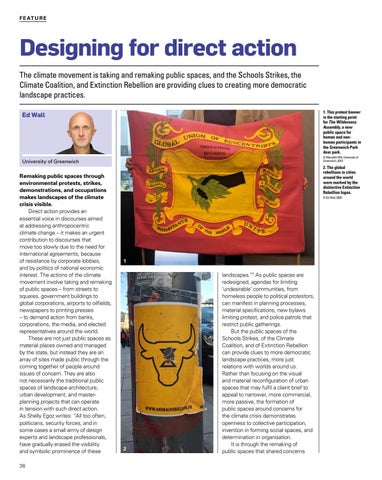
2021 Issue 4
landscapeinstitute.org
Making COP26 count
DESIGN TANK PHOTO NICOLAS TOURRENC
Forum & April Go
Designer
Produced in
Espen Voll, Tore Borgersen & Michael Olofsson
Scandinavia
Warranty
Colours
Lifetime anti-rust warranty
200 RAL colours
vestre.com
WELCOME
PUBLISHER Darkhorse Design Ltd T (0)20 7323 1931 darkhorsedesign.co.uk tim@darkhorsedesign.co.uk EDITORIAL ADVISORY PANEL Stella Bland, Head of Communications, LDA Design Marc Tomes, Landscape Architect, Allen Scott Landscape Architecture
A fractured planet
Peter Sheard CMLI, Landscape Architect. John Stuart-Murray FLI, Landscape Architect. Jaideep Warya CMLI, Landscape Architect,The Landscape Partnership. Jo Watkins PPLI, Landscape Architect. Jenifer White CMLI, National Landscape Adviser, Historic England.
LANDSCAPE INSTITUTE Commissioning Editor: Paul Lincoln, Executive Director Creative Projects and Publishing paul.lincoln@landscapeinstitute.org Copy Editors: Jill White and Evan White President: Jane Findlay PLI CEO: Sue Morgan Landscapeinstitute.org @talklandscape landscapeinstitute landscapeinstituteUK Advertise in Landscape Contact Saskia Little, Business Development Manager 0330 808 2230 Ext 030 saskia.little@landscapeinstitute.org
Print or online? Landscape is available to members both online or in print. If you want to receive a print version, please register your interest online at: mylandscapeinstitute.org Make sure you also check that your mailing address is up to date.
Landscape is printed on paper sourced from EMAS (Environmental Management and Audit Scheme) certified manufacturers to ensure responsible printing. The views expressed in this journal are those of the contributors and advertisers and not necessarily those of the Landscape Institute, Darkhorse or the Editorial Advisory Panel. While every effort has been made to check the accuracy and validity of the information given in this publication, neither the Institute nor the Publisher accept any responsibility for the subsequent use of this information, for any errors or omissions that it may contain, or for any misunderstandings arising from it.
Landscape is the official journal of the Landscape Institute, ISSN: 1742–2914
In 2007, Landscape published its first edition devoted to the topic of climate change. The cover showed a tree half-alive, and a landscape both arid and fertile. Two years ago, Landscape published its second edition devoted to the same topic. This time it used the familiar image of a lonely earth viewed from space. And for this edition, we have followed the imagery adopted by COP26. But the image is fractured. Over this period, the LI has declared a climate emergency and published a Climate and Biodiversity Action Plan. It has also published a paper on Greener Recovery and Landscape for 2030 demonstrating how landscape practice can respond to the climate crisis. This edition of the journal goes one stage further. We ask those responsible for the future of the profession to speculate on what needs to change to achieve any hope of reaching net zero. We ask students to consider how education needs to change by 2030 [page 16] and we ask tutors to explain how they will be teaching net zero [page 28]. We publish the IFLA Climate Action Statement, a world-wide call to action; and we complement this with a summary of the work that members of UK Landscape Architects Declare have undertaken over the past two years [page 10] and the LI’s policy position [page 7]. We examine a collaboration between landscape and architecture students in Bangladesh and Birmingham [page 22], and we explore the pioneering research on water management led by Newcastle University in Colombia [page 40].
Judy Ling Wong considers the links between landscape practice and citizen energy in achieving climate justice and climate equity [page 44], and Ed Wall looks at designing for direct action [page 36]. We visit Glasgow to see how it is preparing to welcome COP26 from Sauchiehall Street [page 52] to the City Council [page 47], and we contrast approaches to tackling climate emergency in Bradford [page 56] and in a national park [page 61]. A new website from HTA [page 63], a review of the Pathfinder Carbon Calculator [page 65] and an interview with climate activist Alice Bell about her new book [page 67] bring together a catalogue of ways in which students, academics and practitioners can make both a personal and a professional commitment to making COP26 count for the landscape profession and for all of us. Paul Lincoln Commissioning editor
2021 Issue 4
landscapeinstitute.org
Making COP26 count
© 2021 Landscape Institute. Landscape is published four times a year by Darkhorse Design.
3
SECTION TITLE
Contents BRIEFING
6
Making COP26 count Sue Morgan, the LI’s new CEO, looks forward to COP26 and beyond
7
10
UK Landscape Architects Declare
14
What is COP26 and why is it important?
IFLA Climate Action Commitment
Understanding its significance for the landscape profession
A world-wide call to action
Teaching Net Zero
Exploring UN Sustainable Development Goals in north-east Bangladesh
Lecturers from across the UK consider how to teach climate action
26
36
The current plant palette may no longer be resilient enough
4
16 17 19
Knowledge transfer in the era of climate emergency Creative research methods in the Anthropocene Extract from a conversation
28
Working together to help a village grow sustainably
Plants for a changing landscape
Class of 2030: learning net zero
RESEARCH
FEATURES
22
16
An update on progress
Designing for direct action The climate movement is providing clues to creating more democratic landscape practices
40
Collaborative research in Colombia Newcastle University is forging partnerships to address global concerns
SECTION TITLE
Cholderton Estate:
FEATURES
No inorganic nitrogenous ferƟlizer, no pesƟcides, within a 10 year rotaƟon
44
52
Year 4; arable with undersown ley
59
Years 1-3; arable
Advocating for Climate Justice and Climate Equity
Walking down the avenue where you live
The Pursuit of Landscape broadGreatness h
Bringing together landscape practice and citizen energy
An enduring legacy in Glasgow’s Sauchiehall Street
Transforming a private golf course on the site of a Capability Brown Park
47
56
61
Urban Outfitter
Beautiful Bradford GNIVAP ENOTS GNITSIXE FO NOITNETER SNOISSIME NOBRAC NO SEVAS UTIS NI
The Glasgow City Urbanist looks to the future legacy of COP26 on his city
Landscape planning for climate emergency RUBOR SUCREUQ EKIL EERT SUOUDICED EGRAL A
6 years graz
herb-ric reduces m
edg es
nitrog atmo
YGRENE YB DEILPPUS SI GNITHGIL SLENAP RALOS MORF DETARENEG
12 seq
Tackling climate emergency in a national park Activists share of acting no grotheir undexperiences water on climate change polluƟon
EMITEFIL S’TI NI 20C FO GK 0057 RETSEUQES NAC
PRACTICE
INTERVIEW
65
63
Rus in Urbe
Climate Positive Design – Pathfinder Carbon Calculator
NAC 2M REP STNALP .ON 5 DEB NEDRAG A NI EMITEFIL RIEHT NI 20C FO GK94 RETSEUQES
HTA outlines its approach to tackling biodiversity and climate crises
67
Our Biggest Experiment
DNA ESAB BUS GNIDULCNI ,GNIVAP ETERCNOC 2M REP 20C FO GK171 TIME NAC ,GNICROFNIER
The Pathfinder app was launched in 2019, Gillespies has been evaluating it
EHT MORF DECRUOS GNIVAP ENOTSDNAS 2M REP 20C FO GK23 TIME NAC KU
Interview with climate activist Alice Bell
CPD AND TRAINING
72
Landscape Institute CAMPUS
Follow the LI COP26 blog with regular updates on our work landscapeinstitute.org/blog
5
BRIEFING: MAKING COP26 COUNT
Making COP26 count Sue Morgan joined the Landscape Institute as CEO at the beginning of September. Together with the President, she will be representing the LI at COP26.
Sue Morgan
CEO, Landscape Institute
I am delighted to be attending COP26. Whatever the outcome of this hugely important gathering, we must plan what we do next carefully. How we translate the dialogue and discourse that takes place into action and how we continue to present our change manifesto as one which is achievable, with real impact, will be the key to success. As landscape users, practitioners, policy makers and advocates, we need to appreciate how each aspect of climate emergency interacts with the need for both climate equity and justice. And we must learn one of the most significant lessons of the COVID-19 crisis: that major catastrophes generally affect those who are the most disadvantaged. Working with collective effort and across sectors is key to success. I am heartened and encouraged by the zeitgeist of thinking that is placing social and environmental value at the centre of funding policy. For example, Flora Samuels at Reading University1, Mariana Mazzucato at UCL and the IIPP2 as well as the National Infrastructure Commission3 and the Quality of Life Foundation4, are all developing frameworks to show value for the environment, health and social equity. Seeing practical application through government backed innovation, such as Vinnova in Sweden5, and Architecture Design 6
Scotland6, is inspiring and shows how government-backed initiatives can make a difference. Seeing new enthusiasm and regulatory compliance by finance institutions to develop new products and services to fund green initiatives and address the UN Sustainable Goals is also exciting. A good example of this is the new Green Finance Institute7. We know as a profession that our work is inherently collaborative, that we have the ability to work across disciplines, that climate change is causing problems with nature and land. The landscape profession thinks holistically, we therefore understand systems of both nature and climate, so we are essential actors in the staging of the COP26 discourse and beyond COP. It is essential, therefore, that we play our role and make our voices heard. One of the people who most eloquently expresses the complexity of tackling climate emergency is the poet Zena Edwards says in her blog ‘When I think about climate change, my default mode is to think environmental justice, visualise all the small grass roots community projects and movements around the world as an interconnected web of hive minds on the ground, with dirt in their fingernails, skin darkened by the sun and food that they bring to kitchen tables hard won by their agricultural and conservational labour.’8 We may start with COP26 but ultimately, we need to draw a thread across the landscape connecting global aspirations with the dirt in our fingernails. I am delighted to join and lead the LI, and be part of this hugely important journey.
© JOHNSON BANKS
Flora Samuel is Professor of Architecture in the Built Environment, University of Reading. Mapping social values, The Journal of Architecture, 2021. Her project on social value mapping with communities won the RIBA President’s Award for Research, Cities and Community category. 1
Mariana Mazzucato is Professor in the Economics of Innovation and Public Value at University College London where she is the founding director of the UCL Institute for Innovation and Public Purpose. https://marianamazzucato.com/ 2
The National Infrastructure Commission is seeking to ensure the UK’s infrastructure is prepared for the major challenges of the future – such as the impacts of climate change and population growth. https://nic.org.uk/ 3
The Quality of Life Foundation is an independent, charitable organisation that aims to raise people’s quality of life by making wellbeing central to the way we create and care for our homes and communities. https://www.qolf.org/ 4
Vinnova is the Swedish Agency for Innovation Systems, set up to promote sustainable growth through the development of Swedish innovation systems in the areas of technology, transport, communications and working life, and by financing needs-driven research. https://government.se/government-agencies/swedishagency-for-innovation-systems/ 5
Architecture and Design is Scotland’s design champion. https://www.ads.org.uk/about-ads/ 6
The Green Finance Institute brings together global experts and practitioners to co-design sector-specific solutions that channel capital towards an inclusive, net-zero carbon and resilient economy. https://www.greenfinanceinstitute.co.uk/ 7
Blog: Tackling climate change and building an inclusive movement Zena Edwards, September 2021. https://zenaedwards.com/ 8
BRIEFING: MAKING COP26 COUNT
What is COP26 and why is it important? The climate ‘Conference of Parties’ – or COP1 as we know it – was created with the purpose of monitoring and reviewing the implementation of the United Nations Framework Convention on Climate Change (UNFCCC). Dilraj Sokhi-Watson provides the context.
1. 100 political Heads of Government have confirmed their attendance to The World Leaders’ Summit at #COP26. This is the largest political gathering that the UK has ever hosted.
Dilraj Sokhi-Watson
1992
1988
United Nations created and adopted a global climate change treaty called the United Nations Framework Convention on Climate Change (UNFCCC).
The United Nations Environment Programme (UNEP) and the World Meteorological Organisation (WMO) established the Intergovernmental Panel on Climate Change (IPCC).
The objective of the UNFCCC is to ‘stabilise greenhouse gas concentrations in the atmosphere’ to a level which is short of being harmful. This treaty has been ratified by 197 states or ‘parties’ (including the UK).
The objective of the IPCC is to provide governments at all levels scientific information to help formulate climate policies. The UNFCCC is guided by scientific assessments from the IPCC.
The UNFCCC secretariat supports all institutions involved in the international climate change negotiations, particularly the Conference of the Parties (COP). The purpose of the climate COP is to monitor and review the implementation of the UNFCCC.
To date the IPCC has delivered five Assessment Reports, the most comprehensive scientific reports about climate change produced worldwide. Part 1 of the 6th Assessment report was published in August 2021 and will likely influence COP26 negotiations.
The Landscape Institute Policy and Partnerships Manager, Scotland
The United Nations Framework Convention on Climate Change (UNFCCC) is an international multilateral agreement, which defines global climate action: stabilising past and present global greenhouse gas emissions (GHG). In the early 1990s, the scientific assessment body for climate evidence – the Intergovernmental Panel on Climate Change (IPCC), published the First Assessment Report, providing the foundation for negotiating2 the UNFCCC. In 2021 nearly three decades later, as the world gets ready for COP26 in Glasgow, another landmark IPCC report3 has sounded the emergency klaxon. In August 2021, the IPCC published Part 1 of the Sixth Assessment Report. The report confidently concludes that climate change is happening now, that recordbreaking weather events (such as heat waves, floods, and wildfires) are already occurring across the globe, and without ‘immediate, rapid, and largescale reductions’ in GHG emissions, global warming of 1.5°C and 2°C will
COP takes place every year, with this year’s being the 26th meeting. COP26 summit themes: • clean energy; • clean transport; • nature-based solutions; • adaptation and finance.
1
be exceeded. COP26 (the 26th meeting of the COP) in November is therefore a watershed moment, which will determine the scale of action to limit global warming in the next decade. This puts particular attention on the UK’s emission reduction commitments
as the host to COP26, and on its broader environmental targets, including how resilient the UK is to the impacts of climate change.
7
BRIEFING: MAKING COP26 COUNT
LI Climate Change Case Studies | Spring 2021
Landscape for 2030 How landscape practice can respond to the climate crisis
2. Goal 13 calls for urgent action to combat climate change and its impacts. It is intrinsically linked to all 16 of the other Goals of the 2030 Agenda for Sustainable Development. 3. Landscape for 2030. © Landscape Institute
4. Climate and biodiversity action plan. © Landscape Institute
5. Greener recovery. Kindly Supported by
3 May 2020
Climate and biodiversity action plan The Landscape Institute’s commitment to addressing the climate and biodiversity emergencies
2
4
How can landscape professionals deliver on COP26 ambitions and beyond? Landscape professionals have the skills to design, plan, and manage resilient spaces. They uniquely span the built and natural environment sectors, and can respond to the interconnected, complex issues of climate change, by: – providing an integrated view on green infrastructure, extending through every stage of the planning and design process, at every scale of development. This can be demonstrated through measures such as urban green infrastructure designs for natural flood management and energy and carbon efficient strategies (green roofs and water-efficient design), which can also enhance climate resilience. – implementing good design practice, which at any scale aims to strike a balance between the different elements of functionality, durability, understanding of local natural 8
and cultural elements, and visual appeal. This holistic approach is a cost-effective way of providing sustainable solutions, such as visual impact and management of climate risks. – applying a holistic approach to project planning, design and management landscape professionals can make key contributions to reducing construction costs, making more efficient use of land and using sustainable materials in construction practices, thereby ensuring high standards of delivery against climate and economic objectives. – providing landscape solutions in urban spaces, recommending nature-based solutions within land use development and through environmental impact statements, landscape professionals set goals and aspirations for statutory organisations and associated practitioners for quality environments4.
LI Policy Paper | Autumn 2020
GREENER RECOVERY
Delivering a sustainable recovery from COVID-19 How investing in better places can support the UK’s recovery from Coronavirus while tackling climate change
Supported by
5
COP- As the apex, decision making body responsible for implementing the Convention, the climate COP brings together 197 nations and territories- called ‘Parties’ that have signed on to the UNFCCC, to negotiate on climate targets. 1
IPCC (1995)- Second Assessment Report Climate Change https://www.unep.org/resources/report/ climate-change-1995-report-intergovernmental-panelclimate-change 2
IPCC, 2021: Summary for Policymakers. In: Climate Change 2021: The Physical Science Basis. Contribution of Working Group I to the Sixth Assessment Report of the Intergovernmental Panel on Climate Change. 3
© Landscape Institute
BRIEFING: MAKING COP26 COUNT
What does the Landscape Institute want from the UK at COP26?
To limit global warming to 1.5°C, transformative change is required within the energy, land, urban and infrastructure (including transport and buildings), and industrial systems.
Equal consideration to mitigation and adaptation
The UK’s annual mean temperature has increased by 0.9°C and the average rainfall has increased by 6% over the last two decades5. Expected changes in the UK’s climate by 2050 are- warmer wetter winters, hotter and drier summers and continued sea level rise. Some of the threats identified are risks to terrestrial species and habitats, risks to natural carbon stores and sequestration from changing conditions, risks to communities, built environment from flooding and risks to infrastructure networks from cascading failures6. To limit global warming to 1.5°C, transformative change is required within the energy, land, urban infrastructure (including transport and buildings), and industrial systems. Following the publication of the Special Report on Global Warming of 1.5°C7 and the UK Government’s commitments to net zero emission targets, the Landscape Institute (LI) has further strengthened its commitment to deliver transformative climate and naturebased solutions within the landscape sector. The LI’s 2020 Greener Recovery8 report addresses questions on how the landscape sector can deliver a sustainable recovery from the pandemic. An unintended, yet welcome outcome of the pandemic lockdowns has been an improvement in local and global environmental conditions9. The reduction in social, economic and industrial activity led to improved air quality in urban spaces, cleaner rivers, reduced noise pollution and improved conditions for local wildlife. To maintain environmental gains and to achieve transformative change our key asks for the UK Government for COP26 are:
Green infrastructure measures such as sustainable drainage systems (SuDS), green roofs, rivers, urban trees and community green spaces provide an opportunity to enhance biodiversity outcomes, mitigate climate change through carbon storage, and adapt to its effects. ‘Urban greening’ through the design and development of urban parks, green roofs and urban gardens, can for instance reduce the impact of urban heat island, helping to cool places that climate change will make much hotter. Improving urban biodiversity and climate resilience objectives through investment in key green infrastructure measures, as recommended by the Climate Change Committee is vital, and therefore adaptation measures should be given the same consideration as mitigation at COP26.
The European Landscape Convention (2021): Urban Landscapes and climate change: the contribution of Landscape Architects to improve the quality of life https://www.iflaeurope.eu/assets/docs/CEPCDCPP_%282021%29_7E_-_Report_Landscape_ Architects.docx%282%29_.pdf
For the UK’s third Climate Change Risk Assessment (CCRA3) https://www.theccc.org.uk/wp-content/ uploads/2021/07/Independent-Assessment-of-UKClimaDte-Risk-Advice-to-Govt-for-CCRA3-CCC.pdf
4
Kendon, M., McCarthy M., Jevrejeva, S., Matthews, A., Sparks, T., Garforth, J., (2021) State of the UK Climate 2020 International Journal of Climatology, Vol41, Number S2 https://rmets.onlinelibrary.wiley. com/doi/10.1002/joc.7285 5
Climate Change Committee (2021): Independent Assessment of UK Climate Risk: Advice to Government 6
Taking a natural capital approach to government housing and infrastructure investment
Public investment should be directed towards projects which generate economic returns as well as restoring and enhancing nature. For example, all new infrastructure and housing should employ a landscapeled approach and publicly funded infrastructure should meet even higher environmental, social and economic objectives, and deliver environmental net gain. The Government should also provide economic stimulus packages which step up a low carbon economic transition and embed natural capital considerations in all stages of planning and decision making10.
7
Special Report on Global Warming of 1.5 °C
8
LI’s 2020 Greener Recovery report
Arora, S et al (2020) Coronavirus lockdown helped the environment to bounce back https://www.ncbi.nlm.nih. gov/pmc/articles/PMC7323667/ 9
IPBES-IPCC co-sponsored workshop report on biodiversity and climate change; IPBES and IPCC. DOI:10.5281/zenodo.4782538. 10
Investment in green skills, digital and data processes The UK’s climate commitment entails a cross sectoral, market wide transformation to a low carbon economy. Forecasts within the Green Jobs Taskforce Report indicate that transition to net zero is likely to create a 10% increase in demand for skills in the tech and innovation sectors12. However, there is still a skills shortage within the built environment sector to help deliver green infrastructure outcomes, as well as structural workforce issues13. An increase in implementation of adaptation and mitigation measures, should directly lead to a growth in landscape and green infrastructure jobs. It would also provide the opportunity within the built environment sector to enhance its digital capacity and productivity. For example, platforms such as Transforming Construction Challenge and BIM could be further enhanced by embedding data on the embodied carbon of materials, or on the biodiversity potential of different habitats, which could deter waste-intensive, high-carbon infrastructure processes. By investing in green processes and skills, working with industry experts and professional bodies to deliver training, apprenticeships, and accreditation and investment in green digital processes, the Government could create pathways to low carbon jobs. This would not only provide support to workers transitioning from high-carbon industries2 but also address the skills shortage in the landscape sector.
State of Natural Capital Annual Report 2020 Natural Capital Committee https://assets.publishing.service.gov. uk/government/uploads/system/uploads/attachment_ data/file/858739/ncc-annual-report-2020.pdf 11
Green Jobs Task Force Report (2021) Report to Government, Industry and the Skills sector https:// assets.publishing.service.gov.uk/government/uploads/ system/uploads/attachment_data/file/1003570/gjtfreport.pdf 12
Landscape Institute sector statistics, referenced at: https://www.landscapeinstitute.org/news/ government-confirms-addition-of-landscapearchitectsto-shortage-occupation-list/ 13
9
BRIEFING: MAKING COP26 COUNT
UK Landscape Architects Declare UKLAD is a part of Construction Declares. One of its founding members provides an update on progress. Andrew Grant
Grant Associates
I
f we don’t change the way we think, plan, design and act, then the world as we know it will be gone. I think we are all trying to figure out how we as individuals, landscape practices and institutions can respond to this crisis. In late 2019 I got a call from Peter Clegg, one of the founders of Architects Declare, to say they were encouraging
10
other professions to establish the equivalent campaigns under the Construction Declares banner, and to ask if I would be able to organise a UK Landscape Architects Declare (UKLAD) group. Within a few days, I had made contact with a number of other practices, and it was clear there was a big appetite to establish such a campaign – one both independent from institutions and sponsors but also representing a collective opinion between landscape practices. Whilst wanting to echo the Architects Declare and the subsequent Engineers Declare commitments, we recognised the need to shift the emphasis towards matters that have greater relevance to us as landscape professionals and to fill
the gaps left by the other manifestos. Our list of commitments came through a collaborative review between the initial group of founding signatories, and I consider it a powerful call to arms for the landscape and environmental design world (read it on the https://uk. landscapearchitectsdeclare.com site). Within UKLAD, we now have a Steering Group of four landscape architects representing different perspectives on the profession. These are Lise Benningen from Grant Associates, Carolyn Willitts from CW Studio, Carwyn Thomas from Colour, and David Finch from Churchman Thornhill Finch. Since going live in 2020 we quickly gained support, and at the time of writing (in July 2021), we have 146
1. IPPC report press coverage. © Copyright Licensing Agency
BRIEFING: MAKING COP26 COUNT
signatories representing almost a third of all UK landscape practices. We have also encouraged the setting up of equivalent international signatory groups, such as Singapore Landscape Architects Declare, which has adapted the manifesto to the needs of South East Asia. Whilst this collective support for the manifesto is really encouraging, the more difficult task is to know and understand whether it is being enacted and to what extent it has influence? In early 2020, just as we were really starting to mobilise our collective ideas and approaches to the challenge, the COVID-19 pandemic hit, adding a different and immediate survival challenge. It is interesting to reflect on this past year, since it has highlighted the fragility of our individual and collective ambition and has shone a light on the challenges ahead. Here are some of those challenges and opportunities. Construction Declares This collective movement of architects, engineers, project managers, contractors and landscape architects now has over 6000 signatories of organisations worldwide, of which just over 150 are landscape architects. The CD vision is for “a transformed built environment – planned, constructed and operated within planetary boundaries, delivering positive social impacts for all.” The power of CD comes from its cross-industry representation and the cumulative strength of its arguments and proposals. Despite that, there remains an ongoing debate about how CD can optimise the messages coming from this significant body of organisations within a political and institutional context of competing opinions, inaction and prevarication. Making our small but important landscape voice heard in such a discussion, that is inevitably focussed on carbon and climate, is often very difficult and whilst many architectural and engineering practices have been able to allocate full time individuals to the cause, it is less easy for smaller organisations to commit such resources. The challenge to us is to be forensic about what we can add to the debate and not try to duplicate the extraordinary work of the
The Earth is in a death spiral. It will take radical action to save us. George Monbiot The Guardian 14 November 2018
other professions. In such sessions, we have learned to focus our contributions on ecosystem thinking and nature – soils, water, ecology and biodiversity. As Lise Benningen suggests: “it is crucial that ecosystems need to be at the front of the discussion. Biodiversity is fundamental to natural capital, and the collapse of ecosystems will result in permanent destruction of our environment.” Luke Engleback of Studio Engleback, a founding signatory, echoes this: “The climate and biodiversity emergencies are linked as one affects the other. Natural systems are complex, and much biodiversity is unseen, but essential to keep them running. Biodiversity provides the spares, repairs and player substitutes to enable ecosystems to provide an array of services that benefit people – including sequestration and storage of atmospheric carbon; with less biodiversity there are fewer (or no) spares, poorer repairs, and only injured substitutes are available; that is why regenerative landscape design and planning is about improving the functionality of biodiverse landscapes in urban or rural contexts.” Lynn Kinnear of Kinnear Landscape Architects, another founding signatory, says: “As a group we have the tools to initiate a fundamental shift in the way that we view development and the relationships between the city and ecology. Prioritising geography,
ecology and natural systems and making new places which are intrinsically sustainable and adapting our cities to prioritise these goals is the way forward. Making change at grass roots, such as eating seasonal, locally-grown plant-based diets, up to city wide strategic manoeuvres, such as allowing rivers to take their natural course with development placed lightly. Scientific progress alone will not heal the wounds, we also need to look back and remind ourselves how to live with and respect our natural systems.” It’s an emergency! We know what needs to be done, and we know we need to do it today, but how can we as a group of landscape professionals influence the pace of change? Government bodies, local authorities, commercial clients and large organisations are bound within procedures, risk assessments and management protocols that are often incapable of urgent action. Construction Declares believes the collective voice of the professions has greater weight to influencing Government policy, and greater capacity to offer viable options for all organisations commissioning and funding new development. Meanwhile, many members of UKLAD are represented in a variety of organisations and influencing bodies that seek to influence policy and action. Along with fellow landscape architect Louise Wyman, I am pleased to be part of the 11
BRIEFING: MAKING COP26 COUNT
National Infrastructure Commission Design Group, which has published Design Principles for National Infrastructure projects based around climate, people, place and value. This places a clear focus on the need to plan and design major infrastructure around positive responses to the climate and ecological emergencies. Bernie Foulkes, LDA Design, founding signatory, says: “LDA Design is authoring research on behalf of the RTPI with Vectos and City Science that looks at how an 80% reduction in carbon emissions from surface transport can be achieved by 2030, and how this can then find its way into spatial planning and design guidance. This is only one part of the challenge, but it’s a good start.” Environmental accreditation and assessment lottery On one level, it is brilliant that there are now multiple tools available to assess carbon in construction and operation, and multiple accreditation options to give credence to the environmental, social and sustainable performance of construction projects – but with such diversity comes distraction and delay. In terms of ecology, soils and biodiversity however, we are less well served with authoritative tools and standards, once again making it more difficult to hold our own in wider discussions within the industry, where data is increasingly driving decisions. Kim Wilkie, founding signatory, says: “We have to reach a position where the long-term health of soil, water and food are all mutually supportive, and make good productive and financial sense.” Putting words into action A change in mindset is needed to create a change in behaviour, but with all the best will in the world, I think we have all found it difficult to fully deliver against the commitments in the manifesto – partially because of some of the points above, but also because we are all on a fast learning curve and struggling with the idea we need to totally change how we operate. Almost 40 years of practice have not prepared me for the paradigm shift in direction we must all take, and whilst there is a 12
clear improvement in the way projects are being planned and designed to address the climate and ecological emergencies, it is not yet universal and nowhere near fast enough. Mary Bowman, Gustafson Porter + Bowman, founding signatory, says: “We had started by analysing our own in-house professional and personal practices including our transport habits, recycling, purchasing and procurement etc. Then COVID hit and we all vastly reduced our carbon footprints by default. We committed to giving everyone a day off specifically for CPDs related to sustainability issues with the aim of better educating ourselves. We now have a regular in-house sustainability workshop where we share films, projects, recent events and topics to do with sustainability. In my experience, real progress only happens through policy change. It has been interesting working in the city of Paris who gave their name to the Climate Accord and who try through their environmental policies of the 15-minute city, regreening the city and looking at site wide strategies to force architects, landscape architects and contractors to up their game.” Armel Mourgue, Gillespies, founding signatory, says: “Building on the objectives of the manifesto, we are changing our working patterns to tackle these issues, using project charrettes to test our proposals against principles of mitigation, adaptation and resilience, as well as design quality. We have also started to test global carbon calculator tools on some pilot projects, planning through thought leadership how we could relate those to a UK setting and widen their use within the profession. “Looking ahead, we are engaging with the next generation, and have approached a number of education providers to help with the curriculum promoting the profession of landscape architecture, and focus learning about people, the environment and how we can create a more sustainable and resilient future.” Johanna Gibbons, J+L Gibbons, founding signatory, says: “Transformative action is significantly less costly than the delay in ‘bending
the curve’ of biodiversity loss. Critical infrastructure is the soil that lies beneath our feet, the water we drink and the air we breathe. Our place as landscape architects is to communicate through design, to inspire and effect action through our work, whether leading a group of teenagers through an open mosaic habitat, instigating a soil resource management strategy, or advocating for urban forestry. Incremental yet progressive interconnections are fundamental to reverse a pervasive detachment with nature, while ironically, a cascade of policy and guidance documents tumble forth in anticipation of COP 26 and in the light of everyday reoccurrence of what are now termed, ‘extreme events’. Optimistically, we find creative enabling of community participation, on the ground from grass roots up, does render remarkable enthusiasm, and change in attitude. Whether at the British Library in Yorkshire transforming building blocks to woodland blocks, or at the Dalston Eastern Curve Garden, where cultural hub intersects with community composting, Biodiversity Net Gain is more than a metric. Its purpose is the radical reconnection with reality – human health and the health of our planet are inextricably linked.” Are we being radical enough? Even the best intentions of the UKLAD signatories and the ambitious commitments in the manifesto seem inadequate against the rapid spiralling destruction of the global environment. When the Amazon is no longer sequestering carbon but releasing it, we know things are way worse for us than we hoped. Paul Hawken wrote: “We have an economy that tells us it is cheaper to destroy Earth in real time rather than renew, restore, and sustain it.” Changing the economic model is key to restoring the biodiversity and the climate. In her latest book ‘Under a White Sky (the Nature of the Future)’, Elizabeth Kolbert emphasises how global society, politics and economies are not acting fast enough to respond to these challenges, but that radical technologies and science are already
BRIEFING: MAKING COP26 COUNT
1 1. Logo from UK Landscape Architects Declare. © UKLAD
being tested that may offer some respite, although these will inevitably bring their own problems. Meanwhile, the scientist E.O. Wilson has proposed that half of Earth can and should be set aside for nature “Like it or not, we are the stewards of the living world. Our own ultimate future depends upon that understanding” (Half Earth – our planet’s fight for life, 2016). What is the equivalent radical global landscape solution to retain the richness and diversity of global cultural landscapes and biodiversity, and how do we as a profession help to achieve that? Bernie Foulkes, LDA, Founding signatory, says: “From now on, we surely must regard landscape as the fundamental physical and environmental building block that sustains life. Something way beyond beauty and aesthetics. Landscape is the best and most versatile term we have for the planet and our connection to the planet. Our purpose as landscape architects is to hold humanity to account for this, and to ensure that landscape in all its extraordinary forms and in its widest meaning is never optional and only ever essential. It is simply arguing for the planet and arguing for life. Maybe the time has
come to issue a rallying call to the landscape profession to work together and with others in the built and natural environment and work with the Government of the day to draw up a radical strategy and a grand plan to remake the British landscape from national to regional to subregional to city scale. This strategy would help determine clean growth, it would supercharge city greening, point us toward food and energy security, plan for water when its scarce and manage it during deluge and help nature recover from the furthest and remotest places right to our doorstep. It’s New Lives and New Landscapes once again.” David Finch, Churchman Thornhill Finch, founding signatory, says: “We are a relatively very small proportion of the number of professionals signed up under the banner of Construction Declares, but it has become increasingly clear to me that our role should be the holistic advocate for the health and wellbeing of our communities and planet, whilst looking to minimise our carbon output, or even capturing of carbon. The loudest conversation is centring around carbon, and understandably so, but in our world of interconnected networks of systems and habitats we need to raise awareness of the potential harm of singular approaches – scientists are just recognising this flaw and combining the two strands in decision making. It won’t be a world saving without the biodiversity that our survival depends on. We all need to understand the biological implications of our actions – what are the damages on habitats caused by the production, maintenance and disposal of this product or finish? How is the maintenance of this tree or plant community, both past and in the future, impacting the local biodiversity and water cycle?
UK Landscape Architects Declare – future We see our ongoing role in Construction Declares to keep reminding other professions of the fundamental links between biodiversity and climate change and to approach all solutions through ecosystem thinking. UKLAD is all about using our collective voice within the bigger and broader voice of Construction Declares to mobilise radical change. The more members we have and the more active and vocal they are, the greater our contribution to the biggest challenge of our age. Carolyn Willitts, CW Studio, says: “We have the first UK heat wave amber alert. There is flooding in Germany and Siberia is on fire. New York is hazy with wildfires and more than one billion marine animals along Canada’s Pacific coast are likely to have died from a recent heatwave. It’s 100 days until COP 26. Please sign up to Landscape Architects Declare if you haven’t already.” Dan Pearson, Dan Pearson Studio, says: “It is now clearer than ever that our approach to everything requires a fundamental shift in perspective. No longer can human desire be the only engine for development. As landscape practitioners no-one is better placed to see the impacts of the climate emergency on the world around us. Starting with soil health, ecosystem integrity, water management and food production, it is our responsibility to make the invisible visible. To help make clear the interconnectedness of everything. To steer our clients towards a more radical view of environmental responsibility. To know when we are proposing too much intervention. To aim to tread lightly. To understand when less really is much more. To know when to take the lead from nature and to have the humility to see that nature knows best how to heal itself.”
Andrew Grant is founder and director of Grant Associates He writes on behalf of UK Landscape Architects Declare 13
BRIEFING: MAKING COP26 COUNT
IFLA Climate Action Commitment Under the aegis of the International Federation of Landscape Architects (IFLA), landscape architects from around the world have come together in a call to action – The IFLA Climate Commitment. For five months, Pamela Conrad, ASLA, as the Commitment task group chair, coordinated collaborations between volunteer landscape architects and sector practitioners from around the world. With involvement from organisations including ASLA, CSLA, AILA, LAF and The Landscape Institute.
T
he 2021 report of the Intergovernmental Panel on Climate Change (IPCC) reported on the looming crisis in global warming, and the resultant impacts it will have on environments and communities throughout our world. IFLA believes that the key to solving the climate crisis is vested in the reduction of emissions, in the resilience and transformation of human society and in the sustainability of the natural environment. Landscape architects are uniquely qualified to help prevent catastrophic global environmental and societal breakdown. Through planning, design and management, our work protects and repairs global ecosystems; fosters human health, wellbeing and happiness; cools the environment and draws down atmospheric carbon. Landscapes include complex, interactive systems that provide a wide range of goods and services. With 70% of global populations living in cities by 2050, holistic landscape interventions are critical to transformation and sustainability. As a creative discipline, we bring expertise on naturebased solutions, technological innovation, and strategic thinking that deliver for nature and people. We accelerate city afforestation to sequester carbon, generate urban biodiversity, and protect cities from extreme heat – a growing threat to human survival. Beyond urban environments, we work at all scales: global, regional, local, and human, to strengthen, protect and enhance the wider functional ecosystems. We amplify biodiversity and societal prosperity, fostering resilient communities better prepared for a changing climate. Landscape architects connect people to nature and to each other to fulfil our deepest human needs. Society needs new approaches to decision-making, progressive policies, and a universal commitment to innovative ideas. In support of sovereign governments accelerating their Nationally Determined Contributions we call on our peers and allied professions to help strengthen our actions through interdisciplinary collaboration. With sustained private and public sectors investment in transformative landscape projects, we can achieve the scale of renewal and restoration required.
14
Over 70,000 landscape architects around the world are taking action as global citizens to limit planetary warming to 1.5°C. As a global profession, we commit to: ADVANCING THE UNITED NATIONS SUSTAINABLE DEVELOPMENT GOALS (UN SDGS). Through each of the 77 nations represented by the International Federation of Landscape Architects (IFLA), landscape architects within our member associations accelerate our work to repair global ecosystems. ATTAINING GLOBAL NET ZERO CARBON EMISSIONS BY 2040. We will dramatically reduce operational and embodied carbon emissions produced by our work, harness the unique capacity of landscapes to draw down carbon dioxide, and advocate for clean and multi-modal transport systems. ENHANCING CAPACITY AND RESILIENCE OF LIVABLE CITIES AND COMMUNITIES. Implementing green infrastructure approaches, landscape architects will work to mitigate urban heat island effect, and reduce the risks associated with fire, drought, and flood.
ADVOCATING FOR CLIMATE JUSTICE AND SOCIAL WELLBEING. Landscape architects will increase support for equity and equality, food security and the right to clean water and happiness for all.
LEARNING FROM CULTURAL KNOWLEDGE SYSTEMS. We commit to respecting and working with indigenous cultural land management knowledge to mitigate climate change impacts and continue work towards reconciliation.
GALVANIZING CLIMATE LEADERSHIP. Landscape architects are uniquely placed to galvanize and lead a built environment response to this crisis. We will continue to collaborate with clients, suppliers, and allied professions to champion climate positive design.
Landscape architects deliver climate solutions at scales that matter.
Transform your indoor & outdoor walls or structures
Quick to assemble & install using basic tools Design of sealed cells protects walls / structures from damp & improves airflow (AutoCAD’s available) Structurally robust system with a 25-year design life Pocket ‘drip through’ slots supply water to all plants & prevent overwatering Irrigation ready with clips for 13 -16mm pipe Available in 0.25m2, 0.5m2 & 1m2 starting from £55 excl. VAT
1
2
3
4
HP Garden Des
ign
“Specify with Confidence“
www.platipus-anchors.com
BRIEFING
Class of 2030: learning net zero What recommendations will students currently at university make for those who need to tackle the demands of climate emergency by 2030?
Knowledge transfer in the era of climate emergency Nikolett Puskas
University College London
COP26 is coming up – we had COP25 in 2019 and the Paris Agreement (adopted in 2015). What have we achieved from the targets set then? Are we on track for a favourable future scenario? How does the declared state of climate emergency translate to everyday practices of different sectors and stakeholders? How are we, as individuals, professionals, firms, unions, and higher institutions addressing the pressing challenges the emergency poses on us? Are we doing the best we can, or even ‘enough’? What possible actions can we take to ‘build back better’ (to quote the UN on the pathways out of the global pandemic)? Teaching anad learning will have to start with some critical self-reflection and courage to avoid shying away from tough questions. We have to unlearn. We have to co-create knowledge around the global challenges, and their tangible impacts on our everyday lives. Then, as we collaboratively explore and gain deeper understanding, can we develop strategies and responses to successfully address ambitious climate change targets. We have to change our old ways that got us here, and I think this change will only come from 16
deeper understanding. Professionals have to connect theory and practice and, in my opinion, this means we have to ‘get out there’, reconnect with and get to know the spaces we address as landscape architects, planners and managers. The next generation of professionals in these fields should be encouraged to adopt this approach, and become facilitators and advocates for more inclusive and transformative approaches. It would also be of crucial importance to facilitate knowledge transfer and co-creation in outside physical spaces that are under study/ design/subject to climate-conscious transformation. This would be a step towards both reclaiming the right to the city and the right for environmental justice. As a good practical example to illustrate the above, I would like to reference Extinction Rebellion, which started in the UK in 2018 and became a global environmental direct-action movement. As a personal example to illustrate the important quality of
1
authenticity or leading by example and that no act is too small, I would like to invite everyone to look at our MOVE! Beirut project: www.instagram.com/ movebeirut/. It is funded by a UCL Beacon Bursary, realised to address people’s mental and physical wellbeing after the Beirut explosions on 4th August 2020, and demonstrates access and multiple possibilities to use public spaces. The project was a close collaboration between Muay Thai teacher, Kru Yai Rocky Kiblawi from Team Shogun and myself from UCL, with additional local venue partners in Beirut. It is an example of how academic research and theory can be put into practice for public good – free and accessible to all, situated in public spaces. Nikolett Puskas is a PhD candidate at the Institute for Global Prosperity, University College London, holds an MSc in Leadership for Global Sustainable Cities, an MA in Sustainable Design, and a BSc in Light Industrial Engineering.
1. Classes of MOVE! Beirut taking place at Nation Station, an abandoned petrol station reclaimed by a group of grassroots activists in Geitawi. The initiative provides free classes whilst demonstrating the multi-use possibilities of public spaces. © Christy Samaha
We have to co-create knowledge around the global challenges, and their tangible impacts on our everyday lives.
BRIEFING
Creative research methods in the Anthropocene Francesco Carer and Charlotte Veal
Newcastle University
In this discussion piece, two early career voices in landscape at Newcastle University examine the role of interdisciplinary creative methods in deepening our understanding of, and response to, the climate and biodiversity crises. As current and future teachers, their conversation reflects on key areas for landscape research, practice, and teaching. Charlotte Veal [CV]: What methods in your field might prove beneficial if applied to the biodiversity and climate emergency? Francesco Carer [FC]: A method
used in landscape archaeology that might provide a significant contribution to climate change mitigation strategies is Historic Landscape Characterisation. This method, also known as HLC, is based on the identification of a series of landscape character types that define a specific landscape. The historical origins of these types are also investigated, and each type is mapped through a geodatabase. I believe HLC can help us understand how climate change has affected and is affecting the distinctive character of historic landscapes. This, in turn, will enable us to manage the future transformation of historic landscapes in a sustainable way.
CV: Landscape studies have explored the promises of arts-led methods. In my research on international borderscapes – pinch-points for current/future climate and biodiversity crises – I combine dance practice and choreography to provide creative responses to issues of security and landscape. Dance acts as a provocation for sociopolitical thought, the generation of new perspectives, and novel techniques to learn about the Anthropocene. This might include climate-induced cross-border migrations which displace multiple species and where border-walls hinder their ability to adapt. FC: At what landscape scale can your method have applications for climate change mitigation and biodiversity preservation? CV: Scale is central to understanding the Anthropocene and the uneven global impacts for people and nonhuman species alike. Using dance, I traced cross-border flows and the impacts of security techniques on local communities. More importantly, dance works at the micro-scale. This
2. Fragmentos. An original contemporary ballet choreography inspired by the movement of people across borders and the sacrifices made by immigrants to start a new life. Choreographed by Reniel Basil for El Paso Ballet Theatre. Executive Director Marta Katz. © B.H. Giza 2017
2 17
BRIEFING
3. Transformations of the historic landscapes in Anatolia. Traditional farmland and rangeland in the Göksu river valley (Mersin province, Turkey) are increasingly replaced by irrigated fruit tree plantations. Temporal trends and spatial patterns of this process have been highlighted using Historic Landscape Characterisation. © F. Carer
3
can refocus attention onto the lived experiences of the Anthropocene and provide rich knowledge into individual and collective practices and behaviours. I echo calls to think with scale. FC: For me, the character types of HLC are calibrated according to the specific nature and history of the investigated landscapes, as well as on the expertise and questions of the compiler. Therefore, each HLC is unique and focuses on small areas, which are more uniform than large regions. This suggests that HLC could be more effective for climate change mitigation and biodiversity preservation if applied to address local location-specific issues. CV: And this has implications for participation. To what extent can creative methods enrich and attract the participation of people for the achievement of climate and biodiversity goals? FC: The definition of landscape character types is the result of an 18
analysis of the landscape, usually carried out by an expert. However, local stakeholders are increasingly engaged in this process, as they provide different expertise and points of view. Recent projects have also involved local communities to understand the value (individual or collective) of each landscape character type. This shows that HLC is an ideal platform to foster participation and develop new ideas for the landscape, including climate change mitigation and biodiversity protection. CV: As COP26 approaches, enthusiasm is mounting for using arts to engage communities. Choreography facilitates discussion and debate with audiences on landscape injustices and offers alternative political-aesthetic frames to those envisaged by government and media. And while dance might remove barriers to engagement, demystify techno-scientific discourse, or offer up multi-sensual, affective knowledge (e.g. on climate change), translatable to the experience of ordinary people, we
must remain cautious of downplaying the skills required to deliver genuine solutions to this emergency. Dr Francesco Carer is a NUAcT Fellow at Newcastle University. He is a landscape archaeologist and his work combines field archaeological methods, historical ecology, ethnographic approaches and computer applications. https://www.ncl.ac.uk/nuact/fellows/ profiles/francescocarer/ Dr Charlotte Veal holds a Fellowship in Landscape in the School of Architecture Planning and Landscape at Newcastle University. Charlotte sits on the International Advisory Board for Landscape Research, is a Fellow of the Royal Geographical Society with the IBG, and a member of the Landscape Research Group. https://www.ncl.ac.uk/apl/people/ profile/charlotteveal.html
Footnotes Dabaut N. & Carrer F., 2021. Historic Landscape Characterisation: technical approaches beyond theory. Landscapes (in press) Veal, C., 2016. A choreographic notebook: Methodological developments in qualitative geographical research. Cultural geographies, 23(2), pp.221-245.
BRIEFING
1. Lenka Rajmont BA2 – ‘Eat the Wood + Play the Wood’
Social change or artistic discipline? Anushka Athique, Charlotte Parsons, Gemma Hoult, Lenka Rajmont and Silas Basley University of Greenwich
Lecturer Anushka Athique (AA) discusses teaching net zero with landscape architecture students Charlotte Parsons (CP), Gemma Hoult (GH), Lenka Rajmont (LR) and Silas Basley (SB). AA: What will you need to tackle the climate emergency as future landscape practitioners? LR: The thing I need the most is access. Access to books. Access to a workshop. Access to studios. CP: This is so important, to encourage a more diverse student cohort with different life experiences who can design from those experiences.
GH: The whole programme could be even more interdisciplinary, learning from economics, engineering, climate science, because ultimately that is what should happen. You manage different teams and different skill sets, and different communities with different ideas and beliefs. SB: I’ve been studying economics over the summer, and it’s opened my eyes to the possibilities of a multidisciplinary approach to education. Engagement from project managers, economists and engineers would encourage a collaborative approach. There should be an economics and ecology crossover. AA: Both words have the same root meaning, from the Greek word ‘house’. So these studies are intimately connected.
All of the systems we talk about, from economics to statistics, are a Western ideological way of looking at things. We have to ask ourselves what comes after that.
SB: It’s all related. They are both similar in relation to understanding complex systems. LR: All of the systems we talk about, from economics to statistics, are a Western ideological way of looking at things. We have to ask ourselves what comes after that.
1
AA: What if we were to turn that on its head and say economics needs to take a landscape approach?
GH: That’s where landscape is so exciting. With a very basic understanding of these systems, knowing how integral they are to each other, that is where landscape can really challenge the conversation on climate. We get to a point where we can say ‘Look at all these other ways of understanding’ and lead with design that way. For example, seed sovereignty. Seeds would have been shared hand to hand. They wouldn’t have been bought and sold. As landscape practitioners, we don’t often consider where seeds come from. We are driving injustice without realising it. Opening up the conversation of where we get our building blocks from is really important. LR: Even in a non-metaphorical meaning, a physical tool or plant is the tool that we use to shape the surrounding areas. But the tool doesn’t just appear on its own. AA: So, it’s about understanding the tools that we use in their entirety. LR: And unlearning how we use these tools. CP: To think of landscape as social change rather than an artistic discipline is really exciting, because it is a tool for social change, and we can make cities so much better. GH: We can bring far more knowledge and usefulness into this conversation by really looking at materiality and saying what we’re not going to accept. If there’s enough of that conversation going on, working together, and sharing knowledge, we could be in a position to lead change in the industry. LR: There is a massive disconnect, 19
BRIEFING
2. Meredith Will MLA – Thames Rising 3. Altan R. Dervish MLA2 – The Generators
2
because the linear approach in building is not how any of this works. The climate is now not on a steady curve, and I think we can all understand that now. We are told that design is not linear. We learn to rethink, and reiterate our ideas, and this just doesn’t align in any way with the world that is outside of academia. GH: But we need to push against existing frameworks and reshape how we think about ourselves, to look where the connections are, and how we can learn from them. Ultimately look for ways to deal with the climate crisis collaboratively, because we’re not going to get very far if we don’t learn from each other. Lenka Rajmontova is BA (Hons) Landscape Architecture Student. Lenka is passionate about trees, exploring contemporary issues of landscape, and interdisciplinary working. Lenka recently taught on the University of Greenwich Summer School.
20
Ultimately look for ways to deal with the climate crisis collaboratively, because we’re not going to get very far if we don’t learn from each other.
Charlotte Parsons. Prior to studying MA Landscape Architecture, Charlotte studied Horticulture and Fashion Design. She spent five years working as a designer in New York, which is where her interest in landscape was inspired.
Act 3: Ruse Collage
Gemma Hoult is a second year MLA student. She comes to landscape from degrees in Anthropology, Migration and Development Economics; work in rail construction, and volunteering with local community groups. Silas Basley is studying MSc Architecture, Landscape and Urbanism at the University of Greenwich. He is interested in integrating data, systems and analytics into his ecologically focused work. Anushka Athique teaches Landscape and Urbanism at the University of Greenwich. She runs her own practice as a designer and researcher looking at the somatic experience of landscape.
3
www.solusdecor.com www.solusdecor.co.uk info@solusdecor.com info@solusdecor.co.uk
0208 8191-877-255-3146 1495 Fire & Water products designed to make the most of your outdoor space
UK Showroom now open at Cedar Nursery, Horsley Road, East Horsley, Cobham, KT11 3JX
F E AT U R E
Working together to help a village grow sustainably
1
An international collaboration between Birmingham City University (BCU) and Shahjalal University of Science and Technology (SUST) was inspired by Abubokkar Siddiki’s visit to his parents’ village of Kazirgaon in 2018, located in an area of wetlands in north-east Bangladesh. The project explores UN Sustainable Development Goals, rapid urbanisation in rural settings, as well as transnational education. Abubokkar Siddiki and Eccles Sze Ng Greenwich Public Health and Birmingham City University
Kazirgaon village and its bazaar have grown exponentially over the past 10 years. The rate the village has grown shows the potential to become a small town, merging the eight surrounding villages together over the next 15-20 years. However, there are no architects, landscape 22
architects, urban planners, or planners to help the villagers to plan their built environment. The local high street is imploding, faced with issues such as lack of drainage, lack of access to clean drinking water, poor hygiene and fire safety, and lack of proper planning. The village also needs increased access to education and basic health care facilities, and population growth is leading to rapid unplanned expansion of the village and the boundaries of the bazaar. There is a need to tackle the issue of rapid growth on a village level. A well-planned village infrastructure with all the basic amenities and technology
1. Walking tour. © Kawshik Saha
As we seek to rebalance the urban-rural divide and the need to address rural-urban migration, the physical implementation of secondary city plans is one of the areas that can have the most positive impact in the coming decade. HRH The Prince of Wales, The Prince’s Foundation, Rapid Planning Toolkit, 2020
F E AT U R E
2. Image of the Haor wetland area of Bangladesh.
will create opportunities within the village for all generations. This would encourage people to stay within their local district and reduce migration and rapid urbanisation in larger cities. To tackle the issues of rapid growth and expansion in Kazirgaon, an international collaboration was formed between Birmingham City University (BCU), Shahjalal University of Science and Technology (SUST) in Bangladesh, and Abubokkar Siddiki, a British Bangladeshi Architect and a committee member of the RIBA Southeast London Architects Group (RIBA SELAG) in the UK. The Co-Lab module (an existing system developed by BCU) was created specifically for the students to learn and apply the Prince’s Foundations Rapid Toolkit on a pilot project, to address the issues of the local community and develop a sustainable masterplan for the village of Kazirgaon. The project was led by professor Kawshik Saha of Shahjalal University of Science and Technology in Bangladesh, Eccles Ng, who is a deputy course director of BA (Hons) Landscape Architecture at Birmingham City University, and Abubokkar Siddiki. The Co-Lab project explored population growth and accommodating the growth expansion sustainably over the next 10-20 years. The initial intent of the project started with a conversation with the local communities, local authorities, and the village panchayat (village council). The students started by looking at current issues faced by the villagers, how their problems can be managed, how to plan the village growth and expansion sustainably, and create a catalyst for economic growth that reduces poverty and provides housing solutions for the poor. The structure for the project was inspired by The Prince’s Foundation’s Rapid Planning Toolkit, which has been created in collaboration with a number of partners including UNHabitat and the Commonwealth Association of Planners. The toolkit is a four-step process designed to guide a multidisciplinary approach in the inclusive planning and design of rapidly growing cities and towns. The toolkit is currently being used in secondary cities in Sierra Leone, Ghana and The Gambia to collaboratively plan for the
expansion of urban areas, thereby reducing the chance of needlessly depleting natural resources, ensuring adequate sanitation, reducing vehicle use, and allowing walkable access through planned roads and routes. Kazirgaon sits within a unique seasonal wetland ecosystem in the northeast area of Bangladesh called Haor. During monsoon season, Haor become a vast inland sea and the villages appear as islands. During the dry season, this becomes a vast stretch of agricultural land. Due to climate change, seasonal flooding and economic influences, the lives of local people have increasingly become separated from their connection to the water. The brief for the students was to work in groups to create a new vision for the village, which is located approximately 40km southwest of Sylhet. The students had a challenging task, as they had to deal with the consequence of the diversion of water from the river of Kazirgaon, causing the local area to dry up. However, to protect the ecosystem and the livelihood of the local communities, students felt it was important to maintain river-basin flows and bring the river back to its former self. Though the toolkit is designed to be used in towns and cities, Gramer Haor applies it to a growing village in Bangladesh. This process has encouraged the students to understand the United Nations 2030 Sustainable Development Goals (SDGs) with a holistic approach to reach everyone in every segment
The river was full of life, heavy currents, people used to swim in it, they used to go fishing in it and it was also a route for commuting via engine boats. Historically this river also had ships flowing through it. This has all changed as the river was diverted, and the surrounding areas, much of it has dried up. Abubokkar Siddiki – childhood recollection. of life – the goals including education, employment, inequality, accessibility of settlements and the environment. Bangladesh is experiencing one of the highest urbanisation growths globally, however, the number of professionals who are able to help plan this urban growth is small. That is why this transnational education and international collaboration is important – to develop the students with skill sets now to become the professionals who can shape the future of the country. The project provides a platform for UK students to have the experience of working on an international live project in Bangladesh that addresses the climate change issues in a rural context. It also gives students in Bangladesh the chance to think about the environment in which they live. The development of villages is crucial to
2 23
F E AT U R E
urbanisation in this part of the world. There were three sites under consideration in the village. The bazaar, which is the equivalent to a local high street; Bhumin, which is social housing; and a residential area which is expanding. Data is scarce in rural Bangladesh; however, this provided an opportunity to gather information first hand through community engagement with the villagers. This approach follows the toolkit guidelines which the students were following. The students and staff carried out a walking tour of the entire village, spoke to the local residents, took photographs and the students then produced surveys of the three areas, the village bazaar, Bhumin area and the main village (the oldest neighbourhood). Through the conversation with the villagers and the meeting with the village leaders and stakeholders, they were able to establish the approximate population in 2011 and the population increase by 2020. Based on the workshop and conversation carried out by the staff and the students, it was evident that the population is increasing rapidly
‘The collaborative laboratory was a totally new and different experience for us. We had to go through different process of learning and method. We used some digital platforms and media which we had never used before. As it was a group project, we have our group mates from SUST and also from BCU. Working with another university from another country was a challenging part for us. Everything is different here. The culture, language, manners, way of thinking – everything differs. The time difference bothered us most. Our group really worked hard to bring our most suitable solution for each problem.’ Mahmuda Haque, SUST student
24
3. Overlaying the initial sketch of the high street onto the street photograph. © Ferdous Rahman Mugdho
4. Young people in the village, curious about the students’ proposals. © Ferdous Rahman Mugdho
3
4
and a solution was needed to accommodate the population growth. Due to COVID-19 restrictions and other commitments, BCU students were unable to travel to the village of Kazirgaon, therefore the SUST students were their eyes and ears, and carried out site visits and reported back to their designated groups. Members of the project included students on the MA and BA Landscape and Architecture courses. Many of the UK students had a part time job and studied full time, whereas students in Bangladesh are fully focused on their studies. This made it challenging for the students to make time to do their projects and have meetings. The time difference also had a huge impact on how they approached working together as a part of the team. The Bangladesh group really appreciated
this opportunity, as the experience was quite unique. They had not done online collaboration before, linked to an international university, collaborating on Teams and Miro boards, and it was quite a cultural shock. All the students had to learn very quickly to adapt, assimilate and progress. International lectures have enhanced the learning and teaching experience to give it a more global vision. The international collaboration where west meets east was a huge learning curve for both sides. We started by looking at what the village meant to each of the students and brought together elements from both sides to create a narrative. The danger was that the students may end up designing and planning a village that was an immediate response to what is already there, rather than creating a
F E AT U R E
5. One group’s vision of a new bazaar public realm, a catalyst for economic growth by creating a new central focal point.
During this collaborative process, I was able to see a variety of ways in which people connect and collaborate as a team. This experience pushed me to form new partnerships, adapt to new ways of working due to remote working, and develop new skills, all while completing a project with a coherent theoretical concept… We formed a symbiotic unity of minds, sharing and combining our approaches to explore an out of the box creative project.
© Ahmad Zubay
Ahmad Zubayr, BCU student
As a child, I did not want to have a connection with Bangladesh, however, now as a professional I want to do something about the situation in the village. I am in a privileged position to be able to offer my skillset to plan the growth of the rural area and to give back to the communities in Bangladesh, and in essence, this is what we are developing the students to do to help them to learn the skills that would then benefit the community.
more sustainable long-term solution. For example, the end results were architectural solutions that took the typical village typology and married it with a western contemporary approach, using local resources and materials, and incorporated landscape architecture into the master planning of the village. Landscape architecture is not something that is discussed or considered when building a house in the village, fruit
trees are planted more for functional or economical purpose rather than for aesthetics or environmental purpose. The collaboration has created this dialogue between architecture, landscape, planning and sustainability. To carry out village planning, it was important to have a bottom-up approach, talk to local residents, understand how they live their lives, what it is they need, listen to their historical accounts, plan with them and capture their narrative, and most importantly, the changes made should enhance their lives. The workshops, site visits and conversations have got the villagers thinking about expansion of the village to accommodate population growth, planning of the village and the bazaar. The villagers want to have basic infrastructure within their village, better road connections, drainage, clean water, sanitation, electricity, technology, education and there has been a huge emphasis on healthcare. They would like to have more opportunities so that there is less pressure to leave their village. This whole process has given them hope that their village may receive development that would improve their lives. Kazirgaon is faced with issues of rapid growth and, due to the doubling
of the population over the last 10-15 years, this has caused the boundaries of the village to shift. Settlements have formed around the village, demands are growing for clean water, drainage, sanitation, health services, education and employment. In order for the village to grow sustainably, urban solutions are required from professionals to find solutions to the already increasing problems. Our plan is to continue this project with further groups from both universities with support from the Commonwealth Association of Planners. We also hope to engage alumni from the courses in future developments. Abubokkar Siddiki is a British Bangladeshi Architect and a committee member of the RIBA Southeast London Architects Group (RIBA SELAG) in the UK and currently completing his MA in International Planning and Sustainable Development from Westminster University. Eccles Ng CMLI is Deputy Course Director of the BA (Hons) Landscape Architecture course at Birmingham City University.
Abu Sidiki
5 25
F E AT U R E
Plants for a changing landscape The current plant palette for each climatic zone may no longer be resilient enough to cope with the effects of climate change, nor provide the appropriate services in the most effective manner. Ross Cameron
University of Sheffield
Research at the Department of Landscape Architecture, University of Sheffield, is closely aligned with the UN Sustainability Goals on Climate Action and Sustainable Cities. Landscape architects have a huge role to play in adapting our cities to climate change. Specifically, this means using landscape and its associated vegetation to cool our cities, mitigate floods, trap atmospheric carbon and enable our built infrastructure to save energy. Green infrastructure is fundamental in ensuring our cities remain liveable in the forthcoming decades, and green
infrastructure largely means ‘plants’ – but which plants? Sadly, the current plant palette for each climatic zone may no longer be resilient enough to cope with the effects of climate change, nor provide the appropriate services in the most effective manner. We need to think more imaginatively to ensure our green infrastructure actually survives and remains functional in the future. Our research has been evaluating the impacts of climate change on landscape plants. We have tried to identify future ‘winners’ and ‘losers’ through a better understanding of how key plant traits affect both a plant’s capacity to survive (resilience) and to continue to provide the services we desire (functionality), as the climate warms. Understanding these traits may help us identify appropriate landscape taxa for future use, without the need for extensive, long-term trialling (Cameron and Blanusa, 2016). Traits include obvious factors such as leaf size, but also aspects such as the capacity
to regulate their internal life systems when under stress. These approaches are analogous to food crops, where science is trying to identify those traits that ensure survival but also underpin a viable crop yield. Predicting The Future? It is a brave person that predicts the future, but powerful modelling based on CO2 emissions has allowed us to develop different future scenarios; so called Representative Concentration Pathways (RCP). Most scientists believe we are on the RCP6 pathway, which represents an increase in mean global temperature of between 1.4 and 3.1oC. As this is mean temperature, that equates to a UK climate by 2100 roughly equivalent to northern Spain today. What does this mean for landscape plants? If climate change meant a smooth transition from one climate to another, and that this transition was slow enough, 1. The ‘wild’ native primrose has traits and strategies that helped it cope with a range of stress factors associated with a changing climate. © Ross Cameron
1 26
F E AT U R E
2. Within a genus such as Viola, cultivars with smaller and less complex flowers (e.g. bottom left) were often the most resilient. © Ross Cameron
The challenge for future selection is not only to ensure plants survive, but that they also enhance their functional uses.
References Cameron, R.W. and Blanuša, T., 2016. Green infrastructure and ecosystem services–is the devil in the detail? Annals of Botany, 118(3), pp.377-391. Lewis, E., Phoenix, G.K., Alexander, P., David, J. and Cameron, R.W., 2019. Rewilding in the Garden: are garden hybrid plants (cultivars) less resilient to the effects of hydrological extremes than their parent species? A case study with Primula. Urban Ecosystems, 22(5), pp.841-854. Sjöman H, Hirons AD, Bassuk NL (2015) Urban forest resilience through tree selection—variation in drought tolerance in Acer. Urban For Urban Green 14(4):858–865
some existing plant taxa would adapt. The current situation though means that climates are changing very rapidly and this puts pressure on the adaptation processes. For example, it is asking a lot of an individual native rowan (Sorbus aucuparia, for instance) street-planted in 2005 to deal with the conditions prevalent in 2065. Moreover, these transitions are unlikely to be smooth at all, and we will see much more unpredictable weather. For example, a very warm February which causes plants to rapidly de-harden (from their protective winter state), followed by a cold March, can subsequently kill plants that would survive a more conventional spring. It is this latter point (the rapid oscillations between one weather pattern and the next) that will challenge certain landscape plants, and result in only those resilient taxa surviving. What determines resilience? Our research implies plants that have a wide natural range, or that are found naturally across different environmental conditions, may do best in future. Having traits that allow plants to persist (e.g. large roots for starch storage, or possess the capacity to exploit a new niche) are likely to do best – dandelions (Taraxacum spp.) will continue to do well! We used Primula as a model genus to better understand the concept of resilience, using controlled environments to represent future climate scenarios. The results showed that the widelydistributed primrose (Primula vulgaris) did better than ‘more specialised’ species, like cowslip (Primula veris) – adapted to dry soils – and oxlip (Primula elatior) – adapted to damp conditions. It was P. vulgaris’ capacity to cope with both a degree of ‘wet’ and ‘dry’ that gave it greater resilience. Interestingly, some cultivated forms of P. vulgaris also outperformed the two other species. It was observed, however, that the most ornamental, ‘showy’ hybrids demonstrated least resilience overall. We found similar trends in Viola. This suggests taxa that are investing a lot of resources in aesthetics, such as large flowers, are the most susceptible. If we take another genus, Rosa for example, we might find that the robust Rosa rugosa continues to do well, new English shrub roses do OK, but weaker-
2
growing hybrid teas suffer. Although traits that confer resilience will be one aspect, we can still learn much by studying current native distributions and linking that to key environmental parameters – temperature, annual rainfall and soil type. Based on this, Rhododendron and Hydrangea will find the drier east more gruelling, whereas Bougainvillea and Lagerstroemia become common in the south. Again, species that demonstrate competitive advantage across environmental variables, and feature genes from different provenances, are those to consider first for future plantings. Ideally, from a biodiversity perspective, we might suggest native plants, but future rapid warming may force us to rely on nonnatives, particularly in cities with enhanced heat islands (Lewis et al., 2019; Sjoman et al., 2015). Remaining Functional? The challenge for future selection is not only to ensure plants survive, but that they also enhance their functional uses. These have traditionally been to look good and attract wildlife. Increasingly though, landscape species are considered because of the additional ‘services’ they provide. For example, their capacity to hold back rainwater, improve air quality, insulate buildings and enhance human
wellbeing. Plants need to be used more effectively for these purposes, and that involves careful plant selection. Thus, we are trying to link traits to ecosystem services too, so we can accurately predict which genera to utilise in future. For example, to insulate buildings from excessive heat, Clematis, Lonicera or Actinidia Kolomikta or Hydrangea Quercifolia are considered optimal, as they provide shade but also high evaporative cooling. Conclusions Green infrastructure will be vital for the future viability of our cities, but we need to be sure now that we are selecting the right plants. Simply speaking, we need taxa that will survive, but also mitigate the effects of climate change itself. Research aims to assist, but we also require discussion with respect to policy and practice. We cannot assume that our native stock will adapt in time, nor that we can put a pin in the map and say that flora will be well-adapted simply because it currently grows 2000km south of us. Dr Ross Cameron is Director of Research at the Department of Landscape Architecture at the University of Sheffield. He specialises in Landscape Science and Management. 27
F E AT U R E
Teaching Net Zero Lecturers from across the UK present their thoughts on how to teach climate action and illustrate their approach with examples from current student work.
Teaching Climate Action Ross McLean and Tim Waterman
University of Edinburgh and Bartlett School of Architecture, UCL
Transforming to a climate neutral society will radically change the environment around us, but what environmental and societal implications are caught up in this transformation? Academic institutions play a significant role in exploring these issues, stirring debate and proffering visions of
adaptive industries, economies and infrastructures, ecosystem and material performances, alongside social justice, cultural and political motivations. While climate transition encompasses broad scale behavioural change that promotes environmental and social adaptation, it also requires identifying existing environmental components and social practices that significantly contribute to climate change resilience. For instance, while the climate emergency may seem a contemporary concern, scientific knowledge about climate change dates back to the 18th Century, while many communities have had to adapt to local climatic impacts for decades. Adaptation must be placed as a historical trajectory of insights and events, thinking forward through the past. The Bartlett School of Architecture
Border Dynamics: Park as Parliament. Pin Chu Chen, MA student
This project explores how centuries of geopolitical dispute and conflict have had an impact on the local flora and fauna of a site at the border of Norway and Russia. He designs a series of endangered plant and lichen gardens across the border to function as political meeting spaces.
Midwinter
28
recently hosted an online international symposium called ‘Intersectional Climates’, celebrating climate practices that prioritise ecological, political and poetic engagement with communities, places and disciplines, and which recognise that ideas and practices must be dealt with intersectionally – that issues of inequality are inseparable from climate change and biodiversity loss. Such practices enable greater societal solidarity for tackling the Climate Crisis as we look ahead to the forthcoming UN Climate Change Conference (COP26) in Glasgow. Two seminars, ‘Climate Change Practices’ and ‘Reinventing Planetary Practices and Imaginaries’, involved eight invited keynote speakers, including Vandana Shiva, Paul Gilroy, and visionary landscape architects Anuradha Mathur and Dilip da Cunha. These seminars preceded discussion events with
Spring-winter
Pin Chu Chen explores how centuries of geopolitical dispute and conflict have had an impact on the local flora and fauna of a site at the border of Norway and Russia. He designs a series of endangered plant and lichen gardens across the border to function as political meeting spaces.
F E AT U R E
A Climate Action Working Group has been tasked with identifying ways to adapt teaching practices and curriculum design to better address the climate emergency.
students and staff which aimed to extend intersectional practices across the Bartlett’s curriculum, but also across multiple disciplines: from architecture and landscape architecture to the arts, humanities, sciences and technologies, and from within different regional communities. Edinburgh School of Architecture and Landscape Architecture (ESALA) has established ‘ESALA Declares’, providing a collaborative platform for events that confront the climate crisis, allowing staff and students to interchange ideas with figures across academia and industry. Stemming from this, a Climate Action Working Group has been tasked with identifying ways to adapt teaching practices and curriculum design to better address the climate emergency. In landscape architecture, we have mapped out areas of teaching that touch on climate action, but require a more explicit focus on this issue, allied with ecosystem design to counteract loss of biodiversity. On the MA (Hons) Landscape Architecture at ESALA, climate awareness is introduced at a key point in undergraduate students’ learning through the year 2 ‘Landscape Armature Studio.’ This studio has an
Spring
explicit focus on climate change, asking students to rethink urban planning at a river catchment, as opposed to city, scale. Students work with a network of sites, which act as spatial armatures, with the potential to form a new framework for socio-ecological resilience. The relationship with the river catchment brings climatebased issues into focus, allowing students to envision new synergies between differing environmental components, such as productive social space, hydrology, and ecosystem design. In year 3, the Lifescape Studio asks students to consider ecosystem design and human cohabitation with other species. Students develop a strategic grasp of land use changes for a coastal post-mining site, from which they formulate a “lifescape vision.” This involves students considering how future resilience is not predicated on ecology alone, but where socio-economic interests, such as energy and food production, can coexist with environmental systems, including hydrological and habitat design. While these thematic studios place explicit emphasis on tackling climate related issues, most areas of teaching across the programme now touch on a variety
of climate action and ecosystem design, which is also reflected in the two-year post-graduate Masters programme. At ESALA, the most noticeable transformation in teaching is a shift to new conventions of spatial practice, where systemic and performance related thinking increasingly underpin design studios. At the Bartlett School of Architecture, similarly, all landscape studios grapple with issues of climate and biodiversity, and there are a handful of notable studios that engage directly. Studios mix students from both years of the programme. Studio 5’s ‘No Man’s Land’ brief brings theory to practice and the sociopolitical to the ecological by incorporating ideas from posthumanism and new materialism: “the dawn of a new school of thought”, in which a “generation of designers and philosophers are questioning the human perspective and focus altogether.” Bringing this broad and entangled thinking to ‘wastelands’ and their transformation allows an engagement with the ethics of human and more-than-human relations to land and landscape. Studio 6, ‘Extractive Topographies’, is more concerned with the process of
Summer
29
F E AT U R E
wasteland creation at the far north of Europe and Asia, where extractive industries shape vast swathes of landscape, and where an icy northern place is thawing and changing those processes of extraction. Eurasian borders and transhumant indigenous cultures whose livelihoods are destroyed through ecocidal practices offer further grist for thought and action. Finally, Studio 9, ‘Unstable Ground: How Mountains Move’, inhabits the seismic landscapes of Abruzzi, which layer up an additional set of fears and risks of earthquakes, which propose landscape change on a cataclysmic timescale alongside the more slowly unfolding apocalypse of climate change. Pressing questions of drawing, making, and language to communicate this interplay of immense forces, the studio insists that landscapes of risk – “and,
we contend, the climate crisis – can be considered landscape architecture problems in that they are as much a crisis of communication as they are of representation.” A climate-neutral future will only be achieved by teaching a new generation about the values of cooperation and collaboration, while exposing students to complex environments where multiple aspects and scales of interpretation require engagement with diverse disciplinary perspectives. However, the way forward requires a broader culture change in teaching; to fight the insane culture of overwork in landscape architecture schools and in the profession, because it stops people from having ideas; to adapt curricula to more explicitly respond to the parallel emergencies of climate change and loss of biodiversity; and to collapse
the wall between theory and practice. We need theoretical frameworks and modes of practice that are in and of the world, as perceptive processes of unravelling, imagining, and projecting radical yet pragmatic near-futures. Ross Mclean is programme director of the MA (Hons) Landscape Architecture at the University of Edinburgh. He is author of Transformative Ground: A field guide to the post-industrial landscape and co-director of The Surface Agency. Tim Waterman is Associate Professor of Landscape Theory at the Bartlett School of Architecture, UCL. His most recent book is Landscape Citizenships, with Jane Wolff and Ed Wall, his next book, is The Landscape of Utopia
Creating sustainable futures for climate vulnerable sites Anna Rhodes, Chris Rankin and Lisa Mackenzie
Edinburgh School of Architecture and Landscape Architecture
How as landscape architects can we tackle social and environmental issues in the context of the climate emergency and biodiversity crisis? This is a question that we hope has become ingrained in the minds of ESALA’s Landscape Architecture students and that has been posed from day one of their courses. As we approach COP26, ESALA’s graduating students and academics take a moment to reflect on a year-long journey together, and on the resulting student design projects which demonstrate how we can contribute to a sustainable and resilient future. ESALA’s landscape architecture studio briefs are designed to raise environmental consciousness, giving students an awareness of their role in shaping sustainable futures for climate vulnerable sites through design. This year the final year student-led projects 30
were framed by three design studio units: ‘Dear Green Glasgow’, ‘Rethinking the Urban Park’ and ‘The Cromarty Firth’. Common across the three studios, and fundamental to the ethos of the school, is an ambition to foreground understanding of territory through physical and environmental readings rather than being led by political and economic rationales. The ‘Dear Green Glasgow’ Studio The ‘Dear Green Glasgow’ studio was directly influenced by the opportunity to step up climate action in Scotland; to make our voices heard, take action now and more importantly to speculate on the legacy of this moment in time. The upcoming COP26 climate conference is set to animate the inner-city banks of Glasgow’s River Clyde. An area of former shipyards once key to Glasgow’s identity and
economy, the last event to activate this area was the Glasgow Garden Festival in 1988. Conceived as a regeneration tool to encourage investment in the area and to ameliorate the negative impacts of deindustrialisation the popularity of and investment into the festival offered potential to resurrect Glasgow’s riverside heritage and reconnect the city to the Clyde. Though portions of the site are economically successful, now referred to as the ‘media quarter’, today the social and environmental legacy of this area is questionable. Beginning their investigations by considering a recontextualisation of the Glasgow Garden Festival to align with the goals of COP26, students designed show gardens to establish and highlight important landscape concerns or demonstrate the feasibility of landscape design-led
F E AT U R E
Specific Place. Nikki Petrova MA4 “In a world where resources are scarce, we can no longer afford to waste them. In an ever-growing urban context, where open space is no longer easily attainable, but instead a privilege, it is unwise to make less than the most of the space we do have. ‘’This project recognises the importance of neighbourhood parks for local people, the wider city and for ecology. It is a project, which tries to understand why certain parks are more loved than others, and what it is
that makes a place “specific”. It aims to apply this knowledge to three physically similar, though contextually different settings to enliven and enrich them. Through long-lasting, sustainable design with a high focus on tangible use, Specific Place aspires to positively transform the places, which have the greatest and most immediate impact on the outdoor life of locals.’’
Grounded. Benjamin Jones MLA “‘Grounded’ transforms the site of Glasgow Airport into a saltmarsh public park, restoring contaminated land, reconnecting communities of humans and non-humans to the landscape, and creating a dynamic and resilient space that will protect communities from the effects of the climate crisis – and allow them to react to future changes. This is facilitated by the creation of Y.our Land, an app that empowers citizens to monitor, nurture, and advance the formation of their landscape over the next 200 years and beyond. The project taps into the unrivalled carbon storage potential of saltmarshes, utilising the remediating ability of sediment and marsh vegetation. Glasgow Airport acts as a catalyst for the creation of a wider saltmarsh network to protect and reconnect communities of humans and non-humans well into the future.”
Carbon Farming Meshwork. Lucy Elderfield–Sheehy MLA “The Allt Graad river network encapsulates the entangled complexity of the Anthropocene. The Carbon Farming Meshwork project outlines a route map for the local community to reclaim and re-inhabit this land whilst enhancing ecological carbon sinks. The proposal explores four threads: ‘Wild Carbon’ delineates reduced human intervention and reintroductions of ecosystem engineers, such as beavers, to restore self-regulating riparian woodland and peatlands. ‘Carbon Commons’ explores shared ownership among human and non-human communities within silvopasture and silvoculture commons. ‘Cultivated Carbon’ utilises regenerative agricultural practices and paludiculture to enhance soil carbon and provide economic value to the local community. ‘Carbon Lore’ fosters common knowledge creation through Carbon Trail Observatories and rituals of care, such as micropropagation of sphagnum moss distributed via drone across remote peatlands to restore degraded blanket bog.”
31
F E AT U R E
The Glasgow Neurons. Alex Tsz Yin Yung MLA “This project analyses and critiques Glasgow’s dominating car culture that deprives the vitality of other living organisms. The car culture and infrastructure in Glasgow, as a mark of the Anthropocene, involves significant exploitation of nature and subsequently the
opportunities of the city’s inhabitants to thrive – to express their vitality. Informed by theories of degrowth and recovering landscape, ‘The Glasgow Neurons’ project demonstrates ecocentrism as a manifesto landscape.”
To this day, creating a contemporary kind of park remains one of the most difficult tasks for our profession.
‘Intelligent Wilderness: Creating resilience in the climate crisis’. Kate Saldanha MLA Winner: ECLAS Outstanding Masters Student Award 2021 ‘At the heart of this project is an openness to the unpredictability of nature and the current climate that we are now in. The Intelligent Wilderness looks at how to replenish natural resources lost to industry through a strategy of wilding to help the return of biodiversity, natural systems and processes to the landscape. This project embraces modern technological advancement, suggesting the creation of a
32
Critical Zone Observatory Network. This technological infrastructure is designed to monitor and diagnose the changes occurring in the surroundings as it undergoes the process of wilding and sustains the impacts of climate change. This landscape of the Intelligent Wilderness offers a profitable future without deteriorating the wealth of resources from which it is built.’
F E AT U R E
solutions. Launching from the scale and locations of their show gardens, students grew their projects to reimagine Glasgow’s urban territory as living, adaptable and resilient landscape. ‘Rethinking the Urban Park’ Studio Gunther Vogt has stated, ‘To this day creating a contemporary kind of park remains one of the most difficult tasks for our profession’. The great urban parks of the 19th and 20thC have their roots in a desire to positively affect public health through access to open space and fresh air, combined with the promotion of an idealised vision of ‘nature’. The MA4 studio asked how the park for the 21stC and beyond should be conceptualised and designed, in the current context of climate breakdown, health inequalities and biodiversity loss. The student work developed in this studio demonstrated the vital role that landscape architects can play in reimagining tired and often under used local spaces that
nonetheless remain full of potential in positively contributing to the physical and mental health of citizens. With ideas deeply rooted in place students developed speculative and imaginative proposals focussing on both the regeneration and retrofitting of several existing parks and how underused spaces could be reimagined as parks for the future. ‘The Cromarty Firth’ Studio, The Black Isle, Highland Region Few disciplines deal with socioenvironmental issues through the range of scales that landscape architects necessarily deal with in the practice of their daily working lives. Understanding the landscape entity of a Firth within its national territory allowed students to engage with overlapping landscape scales (often highly complex and difficult to comprehend) whilst maintaining the touchstone of a readable spatial unit in a region. The studio supported the students
in identifying both social and environmental forces that act upon a landscape, ultimately leading to landscape change. This ability was considered critical not only to the ethos of the studio but also in laying the groundwork for the contribution that early career landscape architects can make as they enter the profession. The studio challenged existing planning methods that often prioritise control and designation over means of understanding space as dynamic and fluctuating. In taking this position, the studio brief requested imaginative project scopes that were inherently open in their intent. The speculative design futures authored by the students represented issues of community, economy, politics, ecology and empowerment. Anna Rhodes and Chris Rankin are lecturers in Landscape Architecture. Lisa Mackenzie is a senior lecturer in Landscape Architecture.
Futureproofing food landscapes in a world of volatility, uncertainty, complexity and ambiguity Peter Hobson, Saruhan Mosler and Poone Yazdanpanah
Writtle University College
Factors driving human-induced climate change are complex, and in most cases are deeply linked. In particular, growth in human population, the global economy and the way we produce food. Large swathes of tropical forest are cleared annually to make way for farmed beef cattle and palm oil – two products that feature high in retailed ‘luxury-end’ food. In simple terms, food and forest are inextricably linked. Current expansion and production in one are causing rapid decline in the other; and without forests our capacity to provide enough food for a growing population is greatly diminished. At the
same time, as forests are being cut down to create more land for food, 1 billion people in the world remain food insecure (Lal, 2010). The future of food is uncertain. How we produce, distribute and consume food is going through fundamental changes, which yields huge uncertainty, but also amazing opportunities. In the UK, the ambitions of the National Farmers Union (NFU) to achieve net zero greenhouse emissions by 2040, ten years ahead of the UK government’s own plans, synchronises with a defining moment in the UK’s agricultural policy through the introduction of
the Agricultural Bill. This forms the impetus for radical change. Sustainable food production and mitigating environmental degradation are now firmly centre stage of UK strategies and targets for meeting the sustainable development goals. Writtle University College is transitioning much of the curricula it delivers at higher education towards interdisciplinary theory-topractice models of student learning with a focus on concepts of social and environmental sustainability. Specifically, the Masters in Landscape Architecture incorporates landscape ecology and environmental science 33
F E AT U R E
Grow Social: A new food-led community urban centre in New Cross and Telegraph Hill London. James McGarath, MA student ‘Grow Social’ is a proposal for a new community-led urban farm located near New Cross and Telegraph Hill in Lewisham, South London. This project demonstrates how cities can use derelict spaces to establish sustainable and resilient systems to produce nutritious food for local communities. The UN sustainable development goals to tackle food insecurity (SDG 2), promote healthier lifestyles (SDG 3) and to create sustainable urban environments (SDG 11) were instrumental in the development of Grow Social. The project proposes a mixture of monoculture and polyculture planting, including an orchard, protected and unprotected cropping, and a forest garden. Key resources required for growing produce are to be managed through rainwater harvesting, solar panels, on-site composting, and nitrogen-fixing planting. The design supports an activity program to engage with local communities to educate and create awareness about growing, harvesting, production and cooking food. This program ranges from teaching unskilled people agricultural and cookery skills to weekly gardening sessions with local primary school children.
Tiny forests for human wellbeing: “A new Design Model for Urban School Settings to Restore Nature Connectedness”. Keely Williams, MA student Trees in the urban landscape contribute to our mental and physical health by providing contact with nature. The aesthetic and cultural value of trees are well recognised by communities, as is their importance in improving air quality, in reducing surface water flooding, mitigating the urban heat island effect and supporting biodiversity. The UK Government recognises the socio-environmental benefits of many more trees and woods in our towns and cities, and it has pledged in its manifesto a commitment to plant 50,000 urban trees across the country. The project Woodland Wellbeing applies the concept of ‘Tiny Forest’ to Cathedral Primary school playground located in the city of Chelmsford, to help tackle problems related to health and wellbeing, and also as part of a broader green infrastructure plan to reduce the effects of climate change (Fig 4 and 5). The thinking behind the proposed design concept builds on the UN sustainability goals 3, 4, 11, 13 and 15. By utilising the ecosystem service benefits of a ‘Tiny Forest’ in a school playground, it is anticipated gains will be made in heat and noise reduction, cleaner air, carbon sequestration, flood mitigation, and nature-based health improvements. 1
into sustainable landscape design theory and practice for both urban and rural environments, with a strong reference to green infrastructure, health and wellbeing. The two pillars of the global sustainable goals – good health and wellbeing, and climate action – underpin the student learning experience. Two Masters student 34
IUCN (2021) Bonn Challenge approaches target to restore 150 million hectares of degraded land. https://www.iucn.org/news/secretariat/201609/bonn-challenge-approaches-target-restore-150million-hectares-degraded-land
design projects showcase design proposals for integrating urban green infrastructure and urban agriculture into the urban environment. Peter Hobson is Professor of Biodiversity Conservation and Sustainability, Centre for Economics
& Ecosystem Management. Saruhan Mosler is Senior Lecturer, Landscape Architecture, School of Sustainable Environments and Design. Poone Yazdanpanah is Senior Lecturer, Landscape Architecture, School of Sustainable Environments and Design.
Take Out
by Landscape Forms
Connected seating with refined lines & improved versatility Creating comfortable & lasting connections bsfg.co.uk 01625 322 888
F E AT U R E
Designing for direct action The climate movement is taking and remaking public spaces, and the Schools Strikes, the Climate Coalition, and Extinction Rebellion are providing clues to creating more democratic landscape practices. 1. This protest banner is the starting point for The Wilderness Assembly, a new public space for human and nonhuman participants in the Greenwich Park deer park.
Ed Wall
© Meredith Will, University of Greenwich, 2019
University of Greenwich
Remaking public spaces through environmental protests, strikes, demonstrations, and occupations makes landscapes of the climate crisis visible. Direct action provides an essential voice in discourses aimed at addressing anthropocentric climate change – it makes an urgent contribution to discourses that move too slowly due to the need for international agreements, because of resistance by corporate lobbies, and by politics of national economic interest. The actions of the climate movement involve taking and remaking of public spaces – from streets to squares, government buildings to global corporations, airports to oilfields, newspapers to printing presses – to demand action from banks, corporations, the media, and elected representatives around the world. These are not just public spaces as material places owned and managed by the state, but instead they are an array of sites made public through the coming together of people around issues of concern. They are also not necessarily the traditional public spaces of landscape architecture, urban development, and masterplanning projects that can operate in tension with such direct action. As Shelly Egoz writes: “All too often, politicians, security forces, and in some cases a small army of design experts and landscape professionals, have gradually erased the visibility and symbolic prominence of these 36
2. The global rebellions in cities around the world were marked by the distinctive Extinction Rebellion logos. © Ed Wall, 2020
1
2
landscapes.”1 As public spaces are redesigned, agendas for limiting ‘undesirable’ communities, from homeless people to political protestors, can manifest in planning processes, material specifications, new bylaws limiting protest, and police patrols that restrict public gatherings. But the public spaces of the Schools Strikes, of the Climate Coalition, and of Extinction Rebellion can provide clues to more democratic landscape practices, more just relations with worlds around us. Rather than focusing on the visual and material reconfiguration of urban spaces that may fulfil a client brief to appeal to narrower, more commercial, more passive, the formation of public spaces around concerns for the climate crisis demonstrates openness to collective participation, invention in forming social spaces, and determination in organisation. It is through the remaking of public spaces that shared concerns
F E AT U R E
3. Walk Out is the winning proposal in a competition organised by the Royal Parks, Museum of Architecture, Zaha Hadid Design, and University of Greenwich. The manifesto is a basis for new interactions with the Wilderness in Greenwich Park. © Nicola Ida, University of Greenwich, 2019
4. The Extinction Rebellion protests in London led to a clampdown on public assembly through The Police, Crime, Sentencing and Courts Bill 2021 that grants the police new powers to restrict public protest. © Ed Wall, 2019
References 1 Egoz, S., Jorgensen, K. and Ruggeri, D. (2018). Defining Landscape Democracy: A Path to Spatial Justice. Cheltenham: Edward Elgar 2 Mitchell, D. 2015. Claiming a right to place in the urban landscape: planning resistance and resisting planning in Glasgow. In Egoz, S. (Ed.) 2015, Hva betyr landskapsdemokrati? Defining Landscape Democracy, As: Centre for Landscape Democracy, NMBU, pp. 16-17. 3 Mitchell, D. 2003. The Right to the City: Social Justice and the Fight for Public Space. New York: The Guilford Press. pp. 142) 4 Tonkiss, F. 2005. Space, the City and Social Theory. Cambridge: Polity Press pp. 66) 5 Orff, K. 2020. What is Design Now: Unmaking the Landscape. In: Wall, E. (ed.) The Landscapists: Redefining Landscape Relations. Wiley/Architectural Design
3
are revealed, whether they are public spaces reconfigured through planning and design, reconstituted for events, or claimed and occupied during civic actions. The geographer Don Mitchell writes that “any movement or struggle to create an alternative spatial organisation of society must necessarily take and produce new spaces.”2 Environmental movements, political ideologies, and commercial agendas reveal themselves in the remaking of public spaces – from marketplaces to civic squares, from built-over green spaces to pedestrianised thorough-fares. Mitchell reminds us that public spaces “are produced through constant struggle in the past and in the present.”3 Climate protests are moments in wider landscapes of the climate crisis. These are landscapes that make visible associations between fossil fuel corporations and coastal flooding, between debating chambers of national governments and the lack of progress in addressing wildlife destruction, between marketplaces of global banks and destructive resource exploitation, between printing presses of media conglomerations and the denial of global warming by corporate interests. The urban sociologist Fran Tonkiss explains: “The sites of urban protest in this way are politicized in terms of a much larger spatial system of global relations and inequities.”4 Climate protests in public places provide an intense illustration of these
interconnected planetary landscapes. Defending, and advocating for these sites of environmental protest are also landscape practices. It is no longer sufficient just to plant trees that reduce heat-island effect, to design spaces that reduce stormwater flooding, to specify materials that have lower embodied carbon. Finding ways to support and inform structural change is also an increasingly urgent landscape practice. Landscape architects need to support climate movements in their diverse forms and practices, through designing spaces that enable public gathering, by advising clients of the importance of democratic public spaces, by defying clients who seek to impose new restrictions that undermine spaces of politics, and by calling out development that builds on shared, green, and open spaces. Contesting public spaces is one of many landscape practices that can engage with the climate crisis. The slow movement of policy makers, of corporate interests, and of public behaviour suggests that professionals with knowledge and concern for landscapes impacted by global warming must claim their role in making change. Referring to ‘radically unbuilding’, the American landscape architect Kate Orff writes: “The act
of unmaking the errors of the past, of gathering, and of recognising each other and the earth as worthy of deep care is one of the most profound challenges before us.”5 To do this, we must support landscape practices of environmental protest to make visible and force open conversations about the climate crisis and its impact on marginalised communities and threatened landscapes around the world. Acknowledgements: I would like to thank all the Landscape Architecture and Urbanism students at the University of Greenwich for embracing our 2019 brief of designing for direct action. Ed Wall is Associate Professor of Cities and Landscapes, Academic Portfolio Lead for Landscape Architecture and Urbanism, co-lead Faculty Postgraduate Research, and co-lead of the Advanced Urban research group at the University of Greenwich. He is also Visiting Professor at the Polytechnic University Milan, Director of Project Studio, Founding Editor of TestingGround: Journal of Landscapes, Cities and Territories, and External Examiner at the Architecture Association.
4 37
B
Bold Engineering
Streetlife’s bridges are engineered to conform with local standards and approved by external engineers conform national legislation of your project location: Eurocode + Nat. Annex Short delivery times are possible, with approximately 12-14 weeks required for production once the drawings have been approved. As our bridges are delivered almost completely prefabricated, installation takes just a few hours.
Installing a Single Swan Bridge Severnside
Solo Bridge Wood Hvittingfoss (NO)
S Streetlife’s strengths
• • • • •
Ribbon Bridge with integrated LED lightning a monolithic bridge constructed from a single material, CorTen Steel
Use of sustainable materials. Bold & Contemporary architectural design, in the ‘natural style’ of Streetlife. Clear and effective communications using three-dimensional images and CAD drawings for accelerating decision-making process. Design, engineering and manufacturing in one country and (optional) placement. Drawings, images and static calculation for planning permission purposes No upfront design cost.
More information about the Streetlife Bridges Collection is to be found on www.streetlife.com or in the themed brochure Walking on Water.
Leiden, Nederland t. +44 (0) 20 30 20 1509 enquiriesUK@streetlife.com www.streetlife.com
Crossline Bridge University of Cambridge
Streetlife BV in social media FSC® licence number: FSC-C105477
Bold Engineering The basic function of a bridge is to make the connection between A and B, for example over water, a swamp or over a swale. This crossing can be constructed in various ways. A bridge can almost invisibly blend into its surroundings or be an iconic statement that helps determine the image and identity of a place. Designing a bridge is a challenging assignment to bring construction and aesthetics together. In addition, the bridge is also part of an urban development assignment. In what way can a bridge be more than just a crossing, and can it contribute to the perception and experience of the environment as a meeting place, a lookout point or even a playground?
/ Bridges
For Streetlife the landscape is seen as the starting point for the bridge design. We strive for a certain timelessness with a natural style.The Bridge Collection consists of sustainable bicycle and pedestrian bridges with a contemporary look, using sustainable materials. There are four types of sustainable decking systems available. The Streetlife Collection includes bridges that can be integrated into both an urban and a rural context.
Bowie Bridge CorTen Groningen (NL)
RESEARCH
Collaborative research to support water security and sustainable development in Colombia Newcastle University is forging partnerships with international and UK academics and water-based practitioners, policymakers and other stakeholders to address global concerns which will be discussed during COP26 in Glasgow.
Maggie Roe, Diana Marcela Ruiz Ordonez, Helen Underhill, Miguel R. Peña-Varón
Newcastle University
As the UN’s Sustainable Development Goal 6 (Clean Water and Sanitation) makes clear, water security is essential to human life, food and energy security, health and wellbeing, and economic prosperity. Yet, nearly 80% of the world’s population live in areas where water security is thwarted by pressures such as climate change, conflict, ecosystem damage, extreme weather, gender inequalities, land degradation, over-abstraction, pollution, poor governance, and uncontrolled urbanisation. In response to this urgent need, the Water Security and Sustainable Development Hub (https://www.watersecurityhub. org/) at Newcastle University was initiated in 2019 as a five-year project with the goal of investigating how water security could be improved for a more resilient future. The Hub is a significant international and interdisciplinary endeavour focused on place-based research in four countries: Colombia, Ethiopia, India, and Malaysia. Each country faces different development transitions that illustrate the global 40
challenges to sustainable water security. Interdisciplinarity is key to this project, which emphasises the significance of sociocultural factors and participatory research methods alongside the work of hydrologists, engineers, and scholars of water governance. With over 100 staff from 12 institutions, including early career researchers, established academics,
and a team of operational staff, the Hub also draws together community groups and local charities, global nonprofits, government ministries, regional and local environmental authorities, regional and municipal governments, and utilities’ companies. Newcastle University acts as the host institution for this project, backed by UK Research and Innovation’s 1. Thermal springs of San Juan, in Puracé. Source: Martínez J.2018
1
RESEARCH
2. Paramo ecosystem and Laguna San Rafael, in the national natural park Puracé, a protected area for conservation. Source: Martínez J.2018
(UKRI) Global Challenges Research Fund. Country teams, known as ‘Collaboratories’, focus on an area of the landscape defined by hydrological boundaries of selected river basins. Valuation of water in the landscape The research across the Hub is based on an interdisciplinary approach rooted in building a better understanding of the socioecological dynamics of the landscape of each country. The approach considers the wider context within which the flow of water, people, ideas, and interventions takes place. Particularly significant is the adoption of an analytical method based on
Primero estaba el mar. Todo estaba oscuro. No había sol, ni luna, ni gente, ni animales, ni plantas. Solo el mar estaba en todas partes. El mar era la Madre. Ella era agua y agua por todas partes y ella era río, laguna, quebrada y mar y así ella estaba en todas partes. Así, primero, sólo estaba la Madre. irst there was the sea. Everything was dark. F There was no sun, no moon, no people, no animals, no plants Only the sea was everywhere. The sea was the Mother. She was water and water everywhere and she was river, lagoon, creek and sea and so she was everywhere. So first, there was only the Mother. From the creation myth of the Kogis, indigenous peoples of the Sierra Nevada de Santa Marta, Colombia. recognising and understanding the various systems in the landscape and considering how these can be transformed for greater sustainability. This aims to recognise the complex links between mitigating the impacts of climate change, such as drought and flooding, and developing new solutions for water management and the treatment of wastewater. A range of research methods are used, including community-based coproduction tools to find solutions for water sustainability at the water basin level. This aims to reveal the voices of those currently marginalised from decision making in
order to develop expressions of water values that can inform more equitable water management and governance. Working towards water sovereignty for marginalised communities depends on recognising plural values of water, and the development of holistic, creative, participatory methodologies. This approach is identifying the ‘hydrosocial territories’ at various scales. The hydrosocial cycle is a concept related to the hydrologic cycle. However, while the hydrologic cycle separates water from its social context, the hydrosocial cycle is a way of thinking about water’s social and political nature and is particularly useful as an analytical tool to understand the problems of injustice and unfair access to water resources for the most vulnerable social groups. Upper Cauca River Basin (UCRB) Case Study Through a series of PhD projects in collaboration with stakeholders, the research examines the following areas of work: – Indigenous and Local Ecological Knowledge (LEK) related to water management – The links between water, food and land sovereignty – The development of theories related to plural values – Participatory zoning of hydrological ecosystems services within areas of environmental significance – Using a ‘systems approach’ to integrating understandings of domestic water use practices – A political ecology of water use; environmental justice and values – Armed conflict and the environment – The impact on water use of land use and the cultivation of monocrops such as sugar cane. Furthermore, the application of analytical tools based on Materials Flow Analysis (MFA) and Social Metabolism will allow for the appraisal of sustainability indicators such as the water footprint and carbon footprint in the hydrosocial territories under study. The research is informing the development of an integrative approach for a ‘waterscapes’ perspective based on hydrosocial thinking. Whereas existing research and concepts around waterscapes
has mostly focused on the politics and governance of water, the aim here is to think more holistically about the tangible physical environment and processes, the politics that surround water, and its sociocultural characteristics. These characteristics include the meanings, traditions, associations and cultural practices embedded within the landscape which are essential to a full appreciation of the whole water environment. The Colombian team takes the landscape of the Upper Cauca River as their case study. As Colombia recovers from long-term conflict and the resulting complex governance, the Colombian Collaboratory is working to help recover the water regulation services in the area; implement agroecological systems for equitable water management and increased resilience to extreme climatic events; and to integrate planning tools within and across government. The complexity of the issues related to water security and sustainability in the Upper Cauca River Basin (UCRB) has (currently and in the past) exacerbated the conflicts between communities, which have a long-held understanding of the need to work with natural processes, and stakeholder institutions which approach water management in more technical terms in order to control the processes. The situation on the ground is complex, and while the landscape is rich, the necessary transformation of the UCRB needs to address land use conflicts derived from socioeconomic processes that encourage intensive farming and other productive activities over communities’ needs for water. This impacts vulnerable ecosystems when poor farmers are displaced into areas such as the paramos and the Andean Forest. Unplanned urban expansion increasingly fragments the
2 41
RESEARCH
landscape and impacts hydrological processes while pollution that comes from agro-industrial and domestic processes limits the clean water supply for both communities and healthy ecosystems downstream. Taking a landscape – or waterscape – perspective is helpful as it recognises the interactivity of human and natural systems, and that they are complex, dynamic systems which provide a high degree of uncertainty in developing management processes. In the process of the research, the team recognises the need to integrate different views and knowledge around water dynamics for management. This is a process that connects to the local socioecological context, the needs of the communities, and the possibilities to integrate planning tools within and across government. In the next three years the aim is to generate synergies between institutions and communities to make water management processes more dynamic and responsive to community needs. An important lesson learned from the pandemic is the need to develop a better understanding of the connectedness of rural and urban environments, so that if those providing food and managing the land for clean water upstream are unable to do so, downstream cities will run short of both. In particular, it is important to develop co-responsibility on the part of water users in urban
3 42
4
areas to help improve the quality of life and wellbeing of rural communities. Researchers are helping to develop the implementation of sustainable water security strategies and the development of new agroecological production processes, management and conservation actions in areas of hydrological importance and/or socioecological vulnerability. Conclusions The Water Hub is an example of how Newcastle University has forged partnerships with international and UK academics and water-based practitioners, policymakers and other
stakeholders to address the global concerns which will be discussed during COP26. The University is working with early career researchers to enable the next generation of practitioners and researchers to play a significant part in tackling water security and the climate emergency. Over the last two years, the Water Hub has established the four Collaboratories that provide a co-creative stakeholder engagement process for solving complex problems. These formed around the shared principle of being inclusive and open to all stakeholders to meet on a basis of mutual respect, to question, discuss, and construct new interdisciplinary ideas to resolve water security issues. Each has adapted to its local landscape and development context, ambitions and cultures. The University is taking a number of initiatives related to climate change through teaching as well as research projects internationally and in the UK. An important development is the establishment of multidisciplinary research centres including a Newcastle University Centre for Excellence in Landscape co-directed by Maggie Roe. The Landscape Centre will link disciplines and build on existing partnerships to reach out and both instigate and respond to novel areas of future research.
3. Small farmers in Las Piedras River basin, Department of Cauca, in the community work of planting with agroecological practices for food sovereignty. Source: ASOCAMPO 2019.
4. San Francisco river canyon, upper Cauca river basin, department of Cauca. Source: Martínez J.2018
RESEARCH
Four researchers working on the project reflect on their experiences Miguel “As Co-Primary Investigator for the Colombian Collaboratory, it is both a challenge and privilege to help put into practice our team’s integrated approach to the characterisation and understanding of the waterscape of the UCRB. This challenges us to develop from working in a multidisciplinary academic context into a collaborative transdisciplinary approach with academics, stakeholders and communities outside academia. Using our combined knowledge, know-how, experience and discussions will yield a vision of the socio-ecological transitions required to develop future water security in our study area. We view this as a dynamic co-adaptive process, where robust discussions will be the basis for the co-creation of new knowledge and its sharing in wider networking between our international partners across the Water Security Hub.” Diana “As a Water Hub researcher, I’ve had the opportunity to meet people with great academic and personal qualities, who complement and challenge me to be increasingly inclusive and interdisciplinary in my work. Key to this is understanding interactions between local conditions and global dynamics that affect decision-making processes involving water. From considering these interactions, I’ve identified the need
Maggie Roe is an Academic Fellow of the Landscape Institute and Reader in Landscape Planning Research & Policy Engagement at Newcastle University. Her focus within the UKRI GCRF Water Security and Sustainable Development Hub is on understanding socio-cultural values, in mentoring Early Career Researchers and developing interdisciplinary research methods.
to develop synergies between the visions and perceptions of water that communities have, and water system policy and management which can contribute to their quality of life. This includes the implementation of specific actions such as efficient water management in agriculture and rainwater harvesting as well as strengthening water management through indigenous and small farmers associations.” Helen “As a Water Hub researcher based in the UK, I am currently lucky to be ‘working from home’ from a 60-foot narrowboat. Researching water values while living afloat involves paying close attention to the waterscapes which I move through on a daily basis – noting subtle differences between the canal (as a heritage and leisure environment which links urban and rural areas), and rivers (particularly unique ecosystems such as chalk streams that intersect with the navigation on the Kennet and Avon, where I am currently based) and exploring the ways people interact with these landscapes. Due to COVID travel restrictions, although fieldwork with our Collaboratory colleagues is not currently possible, I am travelling the UK inland waterways, developing visual and ethnographic research methods for recording the socio-cultural aspects of water. As I do this, working closely – albeit remotely – alongside colleagues from
Dr. Diana Ruiz is a researcher at the University of Cauca, Colombia, working with the Hub and local projects for water and food sustainability. Dr. Helen Underhill is a Research Associate within the Hub at Newcastle University, developing creative methods for research on socio-cultural values of water.
Colombia continually challenges me to adopt an expansive, holistic approach when documenting and reflecting on these waterscapes.” Maggie “In 1989, as part of my student year in practice, I spent three months investigating reafforestation projects in Colombia and Ecuador funded by a Landscape Institute Travel Award. I interviewed a number of people while travelling, including three influential landscape architects in Colombia: Martha Fajardo, Gloria Aponte and Lyda Caldas de Borrero. My diary of the time records some hair-raising experiences, but it also reflects how kind and courteous these three were in particular, and also the wonderful work they were doing in spite of the extraordinarily difficult context at that time. It would not be an exaggeration to say that this trip changed the course of my career. As Co-Investigator for the Water Security & Sustainability Hub, I now feel privileged to be working with colleagues in Colombia, where an integrated and collaborative approach to consideration of water in the landscape seems to be second nature. We in the UK are learning a lot from exchanges, even though these are currently at a distance. I really look forward to being able to revisit Colombia soon, and I feel privileged to be working with an excellent group of early career researchers in the UK and across all four Collaboratories.”
Professor Miguel R. Peña-Varón is an environmental scientist at the University of Valle, Colombia working in the interface between natural and social science focusing on the human:nature relationship. Miguel is in charge of coordinating the Colombian research team.
43
F E AT U R E
Working together towards Climate Justice and Climate Equity 1
Bringing together landscape practice and citizen energy is essential to achieving justice and equity, argues Judy Ling Wong. Judy Ling Wong
President Black Environment Network
Minorities in the UK are local and global people, in touch with the reality of lives across the world through consistent contact with our countries of origin. We have yet to fulfill our natural role of bringing the story of the world to the table to set the agenda for climate justice and climate equity. The principle is that affected communities should lead. 44
We are living in extraordinary times. The death of George Floyd has sent a wave of emotion across a multicultural world, giving historically significant impetus to action for diversity, equality and inclusion. COVID confronts us with the dire outcomes of ignoring global interconnectedness. Minorities in the UK are representatives of the ethnic majorities of the world. White people make up only 11% of the world’s population. Layers of awareness are shifting the status of ethnic minorities. Climate justice and climate equity are core to the critical negotiations at COP26 to endeavour to ensure a positive future for all of us. The presence of minorities inform negotiations with a mix of vulnerability and strength, fears and hopes that
reflect the precarious position of processes that should take into account the legacy of racism and colonialism. Looking into the deep heart of climate change, I see a moral and spiritual failure of two pivotal relationships: the relationship of people with nature, and the relationship of people with each other. If we love nature deeply enough, we cannot damage it to the extent that we do, and if we love people deeply enough, we cannot damage them as we do. Against the bleak language of policy, the human face of minorities urges the integration of social, cultural, environmental and economic concerns through people-centered environmental policy. The local and the global are one
1. Back gardens combine to form a green space for everyone. © Judy Ling Wong
F E AT U R E
2. Movable skip gardens extend opportunities within meanwhile spaces. © Judy Ling Wong
There is no such thing as a purely environmental initiative. A so-called purely environmental initiative is one that has rejected its social, cultural and economic dimensions.
in the hearts and minds of ethnic minorities. Our impassioned personal stories can stimulate the identification of the UK mainstream population with the world at large. A shift of the atmosphere within which vital policy decisions are framed cannot be underestimated as we move towards hosting COP26 in the UK. Who we are and what we can achieve depends on how we see ourselves against the enormous pressure of how others see us. COP26 challenges all of us to confront ourselves with the fact of the power of gatekeepers in an unequal world. The goal posts need to move. We know enough to recognise that our survival is not about “them” and “us”, Global North versus Global South. It is about a common fate. We need to move faster as one. We are one race, the human race, on a single shared earth. On home ground, the UK’s ethnic minorities are generally urban people, with a substantial stake in action for greening cities, with the prime target of transforming where we live and work for the better. Against the fact that cities do not have substantial space to create more public parks, gardens or green spaces, seeking
2
out other opportunities to reimagine a range of spaces within the built environment is part of the solution. The landscape profession is uniquely placed to make a contribution to the multifaceted manipulation of urban spaces. While other sectors struggle to break out of their silos, landscape practice, having to work across many sectors to respond to the needs of the environment and of people, has a broad approach. It is ahead of the game. In addition, beyond the ringfenced arena of design, professionals are citizens that can be active in their chosen focus of grassroots action. The combination of wide-ranging expertise and communal energy can be a formidable force for addressing climate justice and climate equity. We are far from being at square one: there is a rising generation of multicultural activists. A hundred of us are listed in the open database Climate Reframe. Over 30 years ago, in 1987, Black Environment Network posed the challenge that “there is no such thing as a purely environmental initiative. A so-called purely environmental initiative is one that has rejected its social, cultural and economic dimensions.” This was recently echoed at the UN
Habitat Assembly 2019 in Nairobi, with the formation of the First Global Stakeholders Forum to strategically underpin the New Urban Agenda that links the theme of the natural environment to human settlements. At the World Urban Forum in Abu Dhabi, I witnessed the declaration of culture as the fourth pillar of sustainability. What drives humans to achieve more goes far beyond the bare bones of mere survival. It extends into the richness and beauty of being fully human, expressed through culture. The hunger for nature unleashed by the COVID experience confirms this. However, even as there is movement in the right direction, we need a greater sense of urgency. The landscape profession can make a vital contribution to climate justice and climate equity on two significant fronts. The first is to give a focus to improving the environments where minorities live and work to counter the impact of climate change and deliver better health, the basis for resilience and adaptation. The second is to play a role in building the overall framework for diversity, equality and inclusion, meeting the challenge of Black Lives Matter to address structural change to facilitate the meaningful co-creation of policies, strategies and actions. To escape the smell of diesel and the noise of huge rumbling lorries, I often walk off the A3 into a side street that I know, quickly emerging into a local green oasis. This is a residential area with typical old houses that we see all over London in deprived areas. Ordinary people have worked a miracle here: front garden plants are allowed to spill onto the pavement, bushes grow out of old garbage cans and large pots, there are flowers in tree pits, paving stones have been lifted up for giant bushes, and there are chairs and benches outside front doors. This is reclaimed green outdoor territory. A tolerant and flexible local authority has made the agency of people possible. As long as a buggy and wheelchair can get through, there is no problem. The lushness of the place is such that one hardly notices the parked cars – one’s senses are too occupied with the colour and the birdsong. 45
F E AT U R E
We often talk about the canopy of the urban forest, but here is some food for thought: let’s be excited about such projects that can inspire efforts to visualise and develop the potential forest floor of our great city too. Biodiversity, sustainability, COP26, local and global action, mental and physical health, wellbeing, climate justice, and climate equity are all words that come to mind as I wander. The driving force is hearts and minds set within a communal vision, a little imagination and support from public bodies and time for places to mature. Every single residential area of London can be like this! All of us can hone our ability to read the urban landscape differently. There are alternatives for so many bleak spaces. It is well known that in many boroughs, the area of the poor-quality green space around social housing exceeds that of all the public parks and gardens put together. There are acres of hard spaces too, waiting for transformation right outside the windows of our most deprived populations. They can be multiuse spaces, spaces for food growing, container gardens, wildflower meadows, with facilities for play and social interaction. Increasing biodiversity, countering the heat island effect, providing enjoyment or informal learning can all be on the agenda. Lambeth Plots is a great example. Myatt’s Fields Park is working with ARUP, combining GIS mapping and citizen-led investigation to identify land for increasing food growing and addressing food insecurity. We need a bank of good ideas to fuel the replication of solutions on a grand scale. Partnerships, bringing the expertise embodied within landscape practice and the energy and ideas of citizens together, can be formidable. Seeking out grassroots movements such as London National Park City, backed by over 50% of London’s wards, or Camden’s Think & Do community space with its direct link to the local council, can unlock the power and agency of citizens. They are shortcuts to effective engagement frameworks that are already in place. Whether it is at the local or international level, underpinning 46
people-centered environmental policy with the necessary structures for diversity, equality and inclusion lays down the foundation for effective actions for climate justice and climate equity. The key themes are representation, engagement and provision. The following actions apply to any disadvantaged group, as we have much in common: – A principle of representation is that affected communities should set the agenda. High profile diversity champions within organisations can forge policy and release the needed resources. Established multicultural voices need to be given platforms, while emerging voices need training and support. – Engagement will unlock a vast missing contribution. Ongoing relationships with local minorities are core to building trust and enabling meaningful co-creation. True equal partnership with powersharing enables culture-specific dimensions to reveal themselves. Cultural visions and indigenous knowledge should be valued. – Provision moves on various fronts. Cross-sector collaboration facilitates integrated policies and actions, recognising the interconnectedness of environment, health, diversity, equality and inclusion. Information can enable people to act to protect themselves against the impact of climate change, and improving places where minorities live and work lays down the foundation for good health, the ultimate basis for resilience and adaptation. We should be looking forward to a wave of new green jobs as part of the UK’s legal pledge to achieve net zero. Minorities need access to their fair share of the cake. We know so much of what we need to do. The local and global are of equal importance. The point is to act – at scale. Judy Ling Wong CBE is a poet, painter and environmentalist best known as the Honorary President of Black Environment Network. She was awarded an OBE for pioneering multicultural environmental participation and a CBE for services to heritage.
3
Resources Links to multicultural environment participation on Black Environment Network website http://www. ben-network.org.uk/resources/ publs.aspx
3. Temporary installations bring life to urban spaces. © Judy Ling Wong
Climate Reframe open database of multicultural activists https:// climatereframe.co.uk/ Think & Do community space, Camden https://www. thinkanddocamden.org.uk/ London National Park City https:// www.nationalparkcity.london/ Declaration of the First Global Stakeholders Forum. UN Habitat https://unhabitat. org/sites/default/files/ documents/2019-07/20190529_ new_clean_first_global_ stakeholder_declaration_un_ habitat_assembly_1.pdf Green Jobs Taskforce Report https://www.gov.uk/government/ groups/green-jobs-taskforce Culture as the fourth pillar of sustainable development. World Urban Forum 10 https:// www.global-taskforce.org/ sites/default/files/2020-02/ Statement%20of%20the%20 World%20Assembly%20of%20 Local%20and%20Regional%20 Governments%20in%20Abu%20 Dhabi_0.pdf
All of us can hone our ability to read the urban landscape differently.
F E AT U R E
Glasgow prepares for COP26 Glasgow’s first ever city urbanist explains his hopes for the long-term legacy of COP26 for the city where he lives and works. 1. Glasgow Climate Plan.
Brian Evans
© Glasgow City Council
Glasgow City Urbanist
COP26 is not an event, it’s ‘the Conference of Parties’. It’s not necessary to specify which conference, for it is the global conference on climate change. COP becomes an event by being a significant point in time, and will be remembered for what it did or did not achieve. We hold our breath in hope, if not expectation, that COP26 will be the moment when, collectively, we stepped back from the brink. This global conference is being staged in my hometown – Glasgow.
1
As I write this, there are under 100 days until COP26, and the IPCC 2021 report has just landed with the deafening thump of what its authors have described in the press as a “Code Red” alert for humanity. At just shy of 4000 pages, it’s a lengthy and challenging read. We all know the need for individual action, we certainly need national action, but above all, we now need international and global action. We need the global community and world leaders to heed Greta Thunberg’s plaintive, simple and blindingly obvious cry: “Don’t listen to me, listen to the scientists!” There is now no hiding place. So how do we listen to the scientists at the local level? And more importantly, how do we act at the local level – at the level, say, of the COP host city? “Build back Better” was the phrase of 2020. But better than what? And to what end? To me, this means
recovery through climate responsive action. Bringing economic and social recovery together with climate mitigation action. COVID-19 has had an immediate and visceral effect with potentially serious consequences for the individual as well as communities and nations. After a stumbling start, we reconfigured lots of city spaces to make them safer for people to physically distance, and in so doing developed a new urban aesthetic – the boardwalk placed in the street – enabled though emergency and temporary roads regulations. In April 2020, after suggesting such a thing, I was told “that’ll never happen here” – and then it did, after Paris and Milan showed the way and we saw the elegant ‘kit of parts’ designed by Vinnova, the Swedish Design Agency. In the book ‘Adventures in the 21st Century: The Future starts here’, John Higgs has outlined the paradox of our times. It goes like this: “if we are to build the city of the future, we must first imagine it and what happens to our collective consciousness and mental health if the only futures we can imagine are apocalyptic and dystopian” We need to factor in hope. In recent work for the Long Now Foundation of San Francisco, Peter Leyden looks back from a perspective 80 years out and distinguishes between inexorable processes and the inevitability of their outcomes. Leyden reminds us that, as the Architects of the Anthropocene, we have agency that can influence the inevitability of its outcome. So, as we imagine our way out of the pandemic, we must migrate the urgency of that collective response into action, to influence the inexorable forces of extreme weather events and increased sea levels as a result of ice-melt and warming oceans, and in order to generate the imperative 47
F E AT U R E
to alter an otherwise inevitable and dystopian outcome. The task ahead is daunting. Switching the energy source of cars and public transport from fossil fuels to electricity or hydrogen and introducing a circular economy is only the start. We need to retrofit and decarbonise all of our existing buildings, move on from our dependency on gas, and we need to deal with water. Not just the water coming down our rivers from increased rainfall and extreme weather events, but the water coming up our firths and estuaries from increased sea-levels which if Jeff Goodell and others are to be believed is now inevitable. Most of the population of the UK lives on or near the coast or tidal waterways. All this and without even considering populations displaced by climate change. How, then, are we to imagine this, how are we to afford it, and how are we to exhort people to follow of their freewill and positively contribute? More emergency powers and regulations, without a fairer system, grants and financial incentives seems a big ask. First of all, we need to deconstruct strategic action directed to demographic, climate and technological challenges into local action dealing with quality of life and quality of place for everyday people at what the policy makers refer to as the granular, or community level. We need to find a way to wrap enlightened thinking, policy and action
2 48
around people. This means establishing the means to engage with people about the future of their places and the quality of their lives by having strategic programmes designed to be applied at the local level. That will take skill, belief, commitment and courage from politicians and professionals alike. The two key themes which characterise Glasgow’s 3 approach to the climate emergency can be summarised as: (a) a commitment for Glasgow to achieve net zero carbon emissions by the year 2030; and (b) a corresponding aim to ensure that a just transition takes place for the city’s people, businesses and institutions. This will mean confronting and overcoming four strategic challenges: 1. Decarbonisation and a deep retrofit of entire building stocks – residential, office, retail, and every other landuse; 2. Decarbonisation and a deep retrofit of entire movement systems in a shift to mobility as a service (MAAS); 3. Climate adaptation of the entire drainage network, the entire river systems and sea-level change; and 4. Balancing decarbonisation, retrofitting and climate adaptation with social justice. We do not yet have the technology,
programmes nor finance to ensure any of this happens. This is where the legacy of COVID-19 and COP26 should come through by using reality to facilitate a step-change. Legacy for Glasgow may be the preparedness of the city to address these challenges by forging international partnerships and play a leadership role among Scottish, UK and international city networks and taking the people of the city along for the ride. A positive legacy for COP26 and for Glasgow as host city comes if the conference pulls it off and Glasgow21 enters the lexicon as a beacon of success like Rio92, Kyoto97 or Paris2015. That means humanity might have made some progress. Globally this means recommitting to Agenda 2030, to the SDGs, to their targets and maybe introducing climate sanctions to force a move to a redesigned system. For Glasgow and its people, a positive legacy would be one where the city has used its position as host to become a city-network player, with its people fully engaged in transformation through a designed response to the strategic challenges outlined above. If properly resourced, if we trust in our people and if we engage the imagineers pouring out of our design schools perhaps we will achieve these great goals. It will take courage and a hefty budget, but there does not appear to be a viable Plan B. Glasgow gets noticed, the City can’t help it. November 2021 is a chance to be noticed for the right reasons. Brian Evans is professor of Urbanism & Landscape at the Glasgow School of Art and is Glasgow’s City Urbanist.
2. The Vinnova kit of parts for streets: how a street might look with various parklet elements added. © Utopia Arkitekter
3. The Vinnova kit of parts for streets: how the same street might look with more extensive remodeling. © Utopia Arkitekter
The task ahead is daunting. Switching the energy source of cars and public transport from fossil fuels to electricity or hydrogen and introducing a circular economy is only the start.
SONOBE
www.factoryfurniture.co.uk A 100%FSC Manufacturer
THE KEY TO
Establishing the future urban landscape
LONG TERM GREEN INFRASTRUCTURE IS BELOW GROUND
Kings Crescent, Hackney
GreenBlue Urban is the worlds leading tree pit specialist. With more than 30 years of experience in establishing green and blue infrastructure in the urban landscape. greenblue.com | 0800 018 7797
49
F E AT U R E
The Avenues: future proofing Glasgow’s Streets 1
As the world’s attention turns to Glasgow, an enduring legacy has been created in Sauchiehall Street. Ian Hingley
Urban Movement
Sauchiehall Street Avenue was completed in 2019, transforming a hostile, degraded and vehicle dominated four-lane highway into a humanised public space. Traffic was squeezed into a single running lane with a second lane for bus stops, taxi ranks, loading and disabled parking. This created room for the new public spaces and more favourable conditions for life on the street with calmed trafficresulting in reduced noise and air pollution. The initial £6.5 million investment in Sauchiehall Street has given Glasgow a new high functioning public realm, that is equipped to meet the needs of the 21st century citizen, setting the 52
standard for the upcoming Avenues.It provides an infrastructure that enables more of life to be lived out in the street in safe, comfortable and accessible spaces and will act as catalyst for an active travel revolution in a city where obesity levels are relatively high and life expectancy is relatively low. Encouraging more people to walk, cycle and use public transport, rather than drive, is one of the programmes primary objectives. In addition to providing the actual physical infrastructure (footways, cycle tracks and bus shelters etc.) Sauchiehall Street now demonstrates all of the ten indicators of TfL’s ‘Healthy Streets’ initiative. The design introduced two new principal components: a 2.5m wide multifunctional verge / furniture zone next to the carriageway (which hosts the trees, seats, cycle stands, decorative lighting and all other street furniture), and a 3m wide bidirectional cycle track. These new components, when combined with the widened and resurfaced footway, create a single linear ‘public’ space on the north side,
framed by the trees. On the southside, the footway was also widened, decluttered and resurfaced, and now has ample licensable space outside cafes and bars along with extensive public seating. The most dramatic new physical element, however, are the trees. A single straight line of thirty-eight semi-mature (40-45cm girth, 7m high) mixed species deciduous and fastigiate trees run down the centre of the street. They were planted into a 2m wide trenched rootzone, created with structural crates and surfaced with Caithness slabs and detailed with permeable joints to allow surface water to penetrate. The new segregated cycle track allows cyclists to travel west, legally, for the first time since the introduction of the one-way system, and initial counts by the council show that cycling levels have increased by 80% eastbound and 600% west-bound. Walking is encouraged by increasing the width available to pedestrians by widening footways,
1. Sauchiehall Street Avenue. © Ian Hingley
F E AT U R E
2-3. Sauchiehall Street Avenue. © Ian Hingley
Sauchiehall Street is now more social, active and economically buoyant as people occupy the street in ways they previously couldn’t.
creating furniture zones, removing trade waste bins and resurfacing with Glasgow’s standard Caithness stone slab. Footway ‘continuity’ across side roads helps to encourage pedestrian and cyclist priority and remove trip hazards created by the traditional upstand kerb arrangement. Accessible seats, all with backs and arms rests, were arranged at regular intervals to offer places to rest and socialise. Sauchiehall Street is now more social, active and economically buoyant as people occupy the street in ways they previously couldn’t. This is evidenced by the number of people simply out in the street with pavement café culture the new norm. Glasgow City Council’s Derek Dunsire had secured the City Deal funding and prepared an open, pan-European tender to find a design consultant to develop Sauchiehall Street. He had been intrigued by Urban Movement’s holistic approach to street design, which focused on making streets humanised public spaces, structured around active travel and green and blue infrastructure that were not subordinate to `highways’ requirements. Urban Movement eventually won the tender for the Sauchiehall Street Avenue and later a second commission, partnering with Civic Engineers, to design the first tranche of the Avenues, which included Argyle Street, Dixon Street and St Enoch’s Square amongst several others. Glasgow city centre has very few public open spaces, street trees or seats. To help address this shortfall, Sauchiehall Street was simply reconceived as a linear public space that met the Avenues programmes’ sustainable infrastructure and active travel objectives. The street design was informed by principles set out in ‘Designing Streets’ (the Scottish equivalent of ‘Manual for Streets’) as well as best practice from across the UK and Europe, particularly Copenhagen and Berlin and earlier Urban Movement projects in Clapham and Brighton. Establishing pedestrian and cycling priority at the side roads was a difficult challenge, as traditional highway design prioritises vehicle movements,
making pedestrians wait, step down and cross the road when there is a gap in the traffic. One of the biggest constraints on the layout were the under-ground conditions, specifically the location of utilities. Thorough site investigation allowed us to (reasonably) accurately predict their location, which determined that the trees should be planted down the middle of the street. Visually impaired people were (and still are) concerned that the cycle track, located at the same level as the footway and the verge, would not be easily identified by either long cane or guide dog users. To help with detection, a contrasting material was used to surface the track along with a raised profile edge unit. This was felt
to be the best compromise solution, as a ‘stepped track’ detail would create a barrier for mobility impaired people and those pushing buggies. Raingardens to manage surface water runoff were originally planned for Sauchiehall Street, but were not built due to fears over the proximity of basements. They will, however, be included in all future Avenues.
Ian Hingley is a chartered landscape architect and urban designer with over thirty years of experience, specialising mainly in the design of streets and the public realm.
2
3 53
w w w.ha bitat-mat ters.co m
Protecting Habitats together through collaborative knowledge sharing With over 41% of species declining in the UK, it’s never
been more important to protect the UK’s biodiversity and habitats to prevent future loss.
The Campaign Habitat Matters aims to inspire, connect and empower people to improve the quality of our built environment through biodiversity design. Formed through a
collaboration of 60 partners and supporters, we have come together to show how collectively we can help address
nature and biodiversity decline, and tackle the challenges faced when safeguarding urban habitats.
Our aspiration is to help the UK Construction sector,
maintenance bodies and the public, to understand the
intricate relationship between humans, infrastructure and
the environment through education and collaborative tools.
Delivered by ACO
If you are interested in learning more about Habitat Matters and how we can better protect biodiversity, then please visit:
www.habitat-matters.com
Roadmap
Webinars
Join our series of webinars and podcasts
leading up to COP26 and beyond. Hear from a
7
range of industry voices and discover how we
can incorporate natural systems into the built
environment; protecting the natural world from
ecological and climate breakdown. All webinars
8
and podcasts are available live and on-demand.
Help protect the UK’s biodiversity and habitats
6
6
We all have an important role to play in the
future of our habitats. Whether it’s changing
5
our own habits, or participating in initiatives
which embrace nature, we can all play a part in
4
influencing a sustainable future.
2
3
Our Focus Education
1
How have we COP to this?
Date: 29.07.2021
Delivered through a series of webinars and
2
Bristol “Habitat and species conservation”
thought provoking content, exploring biodiversity
3
London “Future cities encompassing natural systems”
4
Birmingham “Habitat connectivity”
Our ambition is to utilise interactive mapping
5
Manchester “Healthy connection to habitat”
platform, hosting data pertaining to biodiversity
6
Belfast & Newcastle “Habitat by design”
7
Inverness “Design & management of high quality green spaces”
podcasts, we have launched a programme of protection within the built environment.
Interactive mapping
to create an open source, knowledge-based and habitats within the UK.
Partnership
We are collaborating with a broad range of industry organisations, charities and the public to explore how we can better engage with nature to protect urban habitats, now and in the future.
Date: 11.08.2021 Date: 26.08.2021 Date: 10.09.2021 Date: 24.09.2021 Date: 08.10.2021
Date: 21.10.2021
8
Glasgow “Habitat Matters at COP26” Date: 28.10.2021
F E AT U R E
1
Beautiful Bradford Saira Ali’s work over the past seventeen years demonstrates the massive impact that a local authority landscape team can bring to all aspects of a council’s work. Saira Ali
Bradford Council
Bradford is a city with a grand past and a very culturally diverse present. It was the home to wool mills and industries associated with the production of milling equipment. The wider region is rich in coal, York stone and iron. This, coupled with canals and later rail transport, brought it to prominence during the Industrial Revolution. The city has a history of welcoming immigrants – a third of the population (540,000) are from Black, Asian and Minority Ethnic (BAME) groups. As one of Europe’s youngest cities, with around 56
a quarter of the population under 16, we are ideally placed to influence hearts and minds, and harness the growing passion for better resilience and sustainable living across our community. As a city, we experience all the challenges of urban deprivation, but the district is two-thirds rural, and boasts gems such as the Saltaire UNESCO World Heritage Site. The spirit of innovation that built Bradford into a 19th century industrial powerhouse is again coming to the forefront in addressing climate and ecological challenges, social progress and sustainable growth. Bradford Council declared a climate emergency in 2019, and set out its Sustainable Development Action Plan in March 2020, which commits the district to a cleaner, greener economy, achieving net zero carbon emissions by 2038. The plan endorses the UN’s Sustainable Development
Goals, and will cut carbon, help to reduce household bills through better energy efficiency, improve health and well-being, and generate new jobs and sustainable economic growth through investment in recovery and a modern economy. Research suggests1 that clean growth could add £11bn to the Leeds City Region economy and create 100,000 extra skilled jobs for local people. The work of the landscape team plays a pivotal role in ensuring the successful launch of Bradford’s Clean Air Zone in January 2022, as well as in the delivery of blue and green infrastructure projects over the next few years. This reflects the critical and growing position of the natural environment in quality of life, public health and crucially Bradford District’s future prospects. When I embarked on my career in landscape almost 20 years ago, such a top table role would
1. Naturalising Bradford Beck – Draft proposals. This Transport Fund and ERDF financed project offers a great opportunity to naturalise a heavily modified length of beck to create a new linear park. Daylighting the beck will help reduce flood risk, enhance biodiversity and improve amenity value for the local community. © Landscape, Design and Conservation Team, BBMDC
https://www. the-lep.com/allnews-and-blogs/ leeds-city-region-sambitious-agenda-forclimate-change-action/ 1
F E AT U R E
2. Kirkgate Public Realm Improvements. Quality green spaces created to compliment the city’s rich heritage and shopping area while creating attractive and relaxing areas where people can rest and spend time, people friendly street creating better connectivity for pedestrians and cyclists and links to City Park. © Saira Ali
3. Top of Town Public Realm – North Parade, Draft proposal. The Townscape Heritage Scheme and ERDF financed project will retrofit high quality street trees and rain gardens into a traffic dominated urban landscape. The enhanced streetscape will favour pedestrians, promote sustainable transport modes, reduce flood risk and help promote local businesses. © Landscape, Design and Conservation, CBMDC
have been unthinkable. That the work is now at the heart of the decisionmaking process demonstrates the continuing confidence that Bradford Council has in the public realm and its landscape, design and conservation team – one of the biggest local authority teams in the country – and our ability to create a better, more sustainable tomorrow for us all. Our home-grown skills add a different dimension to the way we build a new Bradford District that truly reflects our diversity, our creativity, and our ambition. The team reflects the cultural diversity of the population, which is also a real aid to understanding problems and finding solutions. We are an integral part of the Department of Place – Planning Transportation and Highways embedding best-practice design principles across placemaking and place management. Bradford has been among those communities hardest hit by the COVID-19 pandemic, yet we are determined to build back healthier, safer, fairer, and greener – and, unusually for the public sector, our landscape-led thinking is central to the delivery of the Council Plan 2021-25. These include the Top of Town Public Realm Improvement Scheme, bringing climate change mitigation and biodiversity enhancements into city centre regeneration, and the Green Blue Gateways and Naturalising
Our city centre streets will be greener, more social, active and economically buoyant as people occupy them in ways that they previously couldn’t
2
Bradford Beck projects, which will bring increased sustainability into highways infrastructure projects. The only way to help these projects achieve their full potential has been to seek funding to supplement the resources available to the Council. For these three blue green infrastructures (BGI) projects, this has been secured through bids to the European Structural and Investment Funding programme, administered by the European Regional Development Fund. Another stand-out project is the £47m Bradford Shipley Route Improvement Scheme, which proposes a raft of measures to cut journey times, improve air quality, reduce road casualties, and make the surrounding environment more ecologically friendly. We are working with ecological campaign group Friends of Bradford’s Becks (FoBB) to restore and rewild the neglected waterway as it flows through Shipley and improve public access. The project will support West Yorkshire Combined Authority’s transport strategy which aims to boost sustainable transport with a 25% projected increase in bus use, 75% rise in train use, and an incredible 300% in cycling. Traffic congestion is currently a major problem on these routes, especially during morning and evening peaks. This reduces air quality and hampers the economic potential of the area
3
and district. Working together, we have ensured that the plans are spearheaded by a shielded section of the highway, connecting green, open space corridors as desirable active travel paths for cycling and walking. The Bradford Beck – once dubbed “Mucky Beck” – will be opened up from its artificial culverted flow and renaturalised, providing better habitats for wildlife, boosting biodiversity and amenity use. As a result, the river’s water quality will be improved and the area’s flooding risks reduced. A further illustration of our commitment to co-create a more sustainable, climate-change ready district is our work in delivering sustainable drainage. This is built in urban areas to manage rainfall where there is no natural way for flood water to be absorbed or to drain off. Our focus is primarily on nature-based solutions for SuDS, modelling land to divert water flow, creating ponds, wetlands or by using permeable paving, the installation of raingardens, and planting street trees rather than engineered SuDS solutions, such as buried tanks with hydrobrakes. We are applying SuDS to a number of Council schemes, including an ongoing LIFE CRITICAL project at Horton Park, part of the EU Life Programme supporting environmental, nature conservation and climate action projects with natural landscape design and getting the local community involved in monitoring the changes to temperature, air quality, wildlife and 57
F E AT U R E
plants; and the North Street Keighley SuDS Scheme, which will aid drainage and encourage biodiversity. Council teams are also delivering natural flood management of moorland sites on Ilkley Moor and Harden Moor, to prevent water flowing to land below. This involves digging out ditches and creating dams, rewetting the land to create peat bogs to store a significant amount of carbon, and planting sphagnum moss. On behalf of team Bradford, I was proud to pick up the Rising Star of the SuDS World award at a virtual ceremony in July run by Susdrain. Research conducted by the Bradford Institute for Health Research in the field of childhood development is inspiring new initiatives. The Council’s landscape architects are helping to deliver Better Place Bradford – identifying and overseeing improvements to local parks and outdoor spaces with the aim of providing a healthier and happier environment for babies, young children and families, and providing opportunities for children to play and enjoy nature, facilitating safe and quality spaces for walking, and improving air quality. We are working with Active Bradford and JU:MP (Join Us: Move. Play.) to help deliver environmental improvements which will help older children and their families to be active. Landscape design plays a crucial role in active lifestyles, so we are partnering with our active travel team to create low- traffic neighbourhoods and school streets, and our Shipley Streets for People project (based on the healthy streets principles) aims to increase footfall for local shops and the market as well as improving links to the town centre, local amenities and the railway station. We are planting a tree for every primary school child in the Bradford district as part of our ongoing commitment to take climate action. Working together with Trees for Cities, Forest of Bradford (BEAT), Fruit Works in Bradford, Town Councils and our communities, 55,000 trees will be planted over the next two years. Sustainability is often misinterpreted as a solely environmental and climate 58
4. Award winning City Park, a collaboration between Bradford Council and Gillespies – this is the UK’s largest city centre water feature. Since its opening it has proved to be a highly successful city space for residents and a great inspiration and has delivered regeneration benefits for the city. © CBMD
4
change issue and often overlooked is the importance of a strong, active and participatory community. A fair and just transition involves working with the people of Bradford. The next decade will see a major focus on investment in recovery, regeneration and resilience across the whole of the district. Every watercourse, every public space is critical as we adapt and shape our places for the demands and opportunities of the 21st century, becoming a thriving Northern District and a testbed for clean growth. As the Victorians did with formal parks and landscapes, so must we become stewards and custodians of our places for our children and future generations. As landscape architects, we are in a unique position to really make a difference: through our designs, we can create and build a better, healthier Bradford. We must show strong leadership, creativity and innovation, and collaborate to achieve better health, environmental, social and economic outcomes for our cities through place making. From citywide strategies to the redesign of local parks, we must work to make places and spaces more
sustainable and productive. We need to encourage our communities to demand more, and collaborate with the public and other stakeholders to achieve desired project outcomes, with a particular focus on the inner-city area and young people from disadvantaged backgrounds to make sure they have quality outdoor spaces. Saira Ali has a first-class BA (Hons) and Graduate Diploma in Landscape Architecture from Leeds Metropolitan University. Since 2015 she has been the Team Leader for the Landscape, Design and Conservation Team at Bradford Council. Saira started her professional career in private practice, at Barton Willmore, before moving to Chris Blandford Associates and later David Huskisson Associates (now David Huskisson Brown). She completed an Erasmus year at Laurenstein, Velp Netherlands and moved back to Bradford in 2003. She took up the role of Gateway Officer, having the responsibility for the development, commissioning and coordination of the Environmental Improvement Strategies of the Council’s Key Gateways.
F E AT U R E
1. Aerial view across the grounds, as spectators watch the big screen at The Championships 2021. © AELTC/Joe Toth
The Pursuit of Landscape Greatness A private golf course built on the site of a Capability Brown Park is being transformed into a public park and home to an extension to the All England Lawn Tennis Club (AELTC) Andy Wayro
All England Lawn Tennis Club
Being responsible for delivering “Wimbledon” to the world every year since 1922 (with exceptions for the two World Wars and 2020) is a unique privilege. The Championships – the only Grand Slam on grass in the world – is arguably one of Britain’s most treasured events. Living and breathing this history whilst staying at the forefront of international tennis means we must push boundaries for continuous improvement in order to preserve and honour our traditions. We aim to apply our core values of excellence, heritage, respect and integrity to all aspects of our organisation. Our acquisition in 2018 of the Wimbledon Park Golf Course – comprising 29ha of Grade II* Registered Park & Garden (RPG) currently registered as ‘Heritage at Risk’ – represents a fantastic opportunity to test these values and deliver on our commitment to the UN Sport for Climate Action Framework and to our own AELTC Environment Positive strategy. This encompasses the key pillars of net zero carbon, biodiversity net gain, resource efficiency and inspiring wider action by 2030. We have the opportunity to deliver a truly world class venue for tennis whilst championing a landscape and ecology-lead approach. The site’s history is rich and layered with change. In 1765, Lancelot
‘Capability’ Brown was employed by the great grandson of the Duchess of Marlborough, Earl Spencer, to transform this landscape into an idealised English Parkland Estate. Brown ‘painted’ the landscape with a palette of water, grassland and trees. Wimbledon Park was once regarded as one of Brown’s finest works. Only a fragment of his landscape survives, but with this project we have a unique opportunity to recapture some of his design and vision. Designing 39 lawn tennis courts and associated paths and infrastructure within this landscape was a challenge risen to by our landscape architects at LUC. It meant integrating the lawn tennis courts sensitively amongst the veteran trees on a sloping site, working carefully with the contours to create as natural a result as possible. Proposed paths are sinuous and kept to the minimum to reduce impact. Tree planting echoes Brown’s style of ‘clumps’ and ‘scatters’, and is used to reveal and frame vistas, to disrupt and soften lines and to help reunite the fragmented RPG.
Brown dammed two brooks, creating a lake that remains largely intact. This was pragmatic as well as aesthetic, and has provided enormous benefits to people, animals and birds over the centuries. It is one of the largest freshwater bodies in south London and is a registered reservoir. Over time, the southern end of the lake has disappeared, the brooks that feed the lake have been forced underground and the lake has slowly silted up. We will reverse all these changes and in partnership with the lake owner, LB Merton, we will desilt the lake, increasing water depth and quality. Extensive planting including reedbeds, waterlilies and pockets of wet woodland will create protected areas of rich habitat for flora and fauna, creating a wide and diverse lake ecosystem. Our site-wide hydrology strategy provides a holistic and dynamic response to water across the site (with its heavy clay pan soil profile and perched water table) modelled for 100‑year flood plus climate change. Margin and Bigden brooks will be
1 59
F E AT U R E
‘daylighted’ from their narrow culverts to alleviate prolonged localised flooding. An extensive connected system of swales, ponds, and open water will provide greatly increased capacity for the site to slow, clean and hold water. Our site is a part of a larger and important ecological network which extends across much of south-west London. We are working with LUC ecologists and local experts to make sure we take every opportunity to strengthen this network and respond to local and regional priorities. For example, the soils below the golf course top layer are rare and unusually low in phosphorous. They are ideally suited to the creation of acid grassland, a Local Priority habitat, hence we will create large areas, valuable for biodiversity and carbon capture, using locally sourced seed. Whilst we await the passing of the Environment Bill, we have taken a pro-active approach, using the latest Defra BNG guidance and metric as an iterative design tool, to push for increasing environmental net gain. We are on track to achieve an Urban Greening Factor score of .97 and over 10% Biodiversity Net Gain. The latter was challenging as we are
2
3 60
starting from a baseline of an almost entirely green and blue site with over a thousand trees. The population of 41 veteran trees supports extremely valuable fungi, bacteria and invertebrates. We procured individual management plans and specialist surveys to help us protect and enhance them. Last year, we harvested acorns and began a propagation programme to capture the genetic legacy of the Brownian veteran oaks. We now have several thousand young saplings growing on in nurseries. Tree planting is central to this project; from the start we made it a priority to ensure delivery of a strong, healthy, genetically diverse tree population using species best suited to the site, its design history, our changing climate and biodiversity. Currently there are around one thousand trees on site, varying widely in condition; by 2028 there will be more than double this number, of British sown and grown provenance. Our landscape architects are working with leading nurseries and specialists to help ensure we specify for maximum resilience against climate change, pests and diseases and for maximum provision of green infrastructure services such as improved thermal performance. We are writing a strict biosecurity policy to be applied across the AELTC estate. We are committed to the stewardship of this landscape and its history. We know it to be a precious resource and an important legacy. Long-term ecological and biodiversity monitoring and evaluation will be a critical piece. Our estate-wide management strategies are designed as live documents, helping us to meet and exceed best practice and to test, trial and adapt innovative sustainable techniques. There is currently no public access to the site – it is a private golf course. We proposed to open the southern parkland (9.4 hectares) to the local community throughout the year so everyone can enjoy this new highquality ecologically and historically rich green space. We are also creating a circular route all around the lake which will greatly increase public access to nature with all its health and wellbeing
4
benefits. A new accessible east-west route will connect Church Road to the public park creating active green links between neighbourhoods. We must ensure that our new venue works to fight all three interrelated crises of climate change, biodiversity loss and threats to human wellbeing, We have taken ownership of this landscape at a critical moment in society when we must all change the way we look after our natural resources and decisively shift towards protecting and restoring nature on an unprecedented scale. With our high public profile, we hope to inspire other organisations and individuals to reorientate their priorities. We are committing to the whole journey, not just the beginning. From local and grass roots involvement through to the international arena, we will continue to strive for exemplary stewardship.
Andy Wayro is Landscape Design Manager at The All England Lawn Tennis Club
2. Visualisation of the proposed parkland during The Championships. © AELTC
3. Visualisation of the southern parkland – A new park for London. © AELTC
4. Historical Wimbledon Park Plan – Attributed to John Haynes (c.1770-1785) with AELTC existing (purple) and proposed site (green) overlayed. © AELTC
F E AT U R E 1. Diagram by Merrick DentonThompson with terra firma for regenerative agriculture as carried out at Henry Edmunds’ Hampshire farm.
Cholderton Estate:
Intensive agriculture: arable
No inorganic nitrogenous ferƟlizer, no pesƟcides, within a 10 year rotaƟon Year 4; arable with undersown ley
Years 1-3; arable
80% of chalk farms in southern England
6 years grazing sheep and caƩle herb-rich grass pasture reduces methane emissions
broad hed ges
reduced hedges
25% nitrous oxide nitrogen xed from the atmosphere by herbs
lifeless soil
128 tons carbon sequestrated per hectare
no ground
1
water polluƟon
25% nitrates
65 tons carbon sequestrated per hectare
ound water polluƟng gr
chalk aquifer
Exploring climate emergency in a national park Activists share their experiences of how a rural community is seeking to use the momentum of COP26 to act on climate change. Lionel Fanshawe
Terra Firma
In early June this year, I was approached by our local councillor to join one of three Action Groups being pulled together to explore climate change issues within the East Hampshire area, with a view to reporting to a community event in October before COP26 in Glasgow at the beginning of November.
Led by the office of the local MP Damien Hinds, the intention is to discuss these global issues in a manner that might inform and engage residents and raise awareness of the environmental emergency and local initiatives that could be most effective to address it. The three groups meet under the headings of Buildings, Transport, Land Use and Agriculture, the latter being the panel of ten of which I am part. Chaired by a former Permanent Secretary to the Home Office, it is a diverse group, including farmers, representatives of climate change action groups, a leading forest scientist, the ex-Chair of the South Downs National Park, and two landscape architects (Kim Wilkie and I).
By way of background, East Hampshire is a largely rural area of just over 500km2 administered by East Hampshire District Council that includes the towns of Alton, Bordon and Petersfield, and has a population of just over 122,000. The area is known for its scenic beauty, and 57% of the District lies within the designation of the South Downs National Park. The majority of East Hampshire
61
F E AT U R E
is farmland. Farming is well known for being in crisis economically, and among the farmers there is understandable concern for their livelihoods, need for diversification and not knowing what funding will come with ELMS, the Environment Land management Scheme which is due to come into place in two years’ time to replace the Common Agricultural Policy. Some good examples of pilot studies that are pioneering farming practices that provide the public benefits of improved carbon capture and biodiversity alongside sustainable production were shared with the group as were the benefits of common approaches with shared resources demonstrated by farm clusters. There has been much discussion in the group around the need for regenerative agriculture, to concentrate on carbon capture, the central place soils have in this and that future grant aid must focus on this. One session included looking at woodlands (a large part of the area), the need to compensate for losses from Chalara (Ash dieback) and ambitions for large scale tree planting. The work of Dr Andy Moffatt with volunteers from the Petersfield Society in producing the Petersfield Tree Location Survey
2 62
has given an evidence base for the type and condition of tree cover in the town (surprisingly lower than the national average). Using GIS tools, it has not only quickly created an audit of the current stock but also identified 31,000 square metres where new trees might be possible in public areas, as well as guidance for private gardens, accounting for climate resilience. Planning is an area that we are particularly familiar with as landscape architects and of course has an important role in new development and ensuring that the bar is raised in provision of green infrastructure and ecosystems services. The South Downs National Park Authority is a committed exponent of this landscape led approach but it does need to extend to the areas of EHDC outside the park boundaries and permissions checked and enforced at delivery. All this requires human resources. Central to the emerging conclusions of the half dozen or so ‘Teams’ meetings that must have taken place over the 3 months of this process are likely recommendations for far stronger commitment and leadership from central and local government and much better education, information and communication.
3
It is impossible to deal with climate change issues without collaboration, and it has been a shame that as we near the end of the process, that there has been no interaction between the individual groups and the opportunity to meet with the others on buildings and transport. We know that these are both areas accounting for far bigger emissions than land use and in the case of transport, the reduction in need to travel, shift to less carbon intensive modes and improvements of technology will have been a complex debate for a rural area. It is hoped that there will be a common call to set real net zero carbon targets that the local authority commits resources to leading. This process is expected to result in recommendations that will be presented and discussed at an open conference with an accompanying exhibition to be held in Alton on the 8th October. Local authorities will be invited, and the findings will not only be circulated to them and the community for action, but also shared with Alok Sharma, president designate of COP26 ahead of the summit. Lionel Fanshawe is a landscape architect and director at terra firma.
2. Wildflower Verges campaign. 3. Petersfield Community Tree Location Survey.
PR ACTICE
1. South Quay Plaza, Isle of Dogs for Berkeley Homes. The scheme consists of 3 x residential towers at 68, 54 and 36 storeys designed by Fosters + Partners, the refurbishment of an existing office block, with 1.78 ha of public realm by HTA. © South Quay Plaza (Nick Harrison),
1
Rus in Urbe
The launch of a resource website by HTA Design points to the consolidation of a new approach to tackling the biodiversity and climate emergency crises. James Lord
HTA Design
This summer saw the launch of a new HTA Design website and information hub, Bringing Nature Home (https://bringing-naturehome.htadesign.co.uk) We want to sow the seeds of a resource that could become the go-to place for anyone with information needs or knowledge to share about the crisis of our collapsing biosphere, equipping us all better to reverse the decline before it is too late. We welcome contributions from anyone willing to share practical tips, key contact information, campaigns, volunteer activity or inspiring examples of success in creating or enriching biodiversity. To kick things off, we will be reporting with a diverse range of
blog posts, videos, and advertising for events for and from professionals, policy makers, and the public. Great placemaking relies on the integration of knowledge and skills about how to design the spaces between buildings. This requires a profound understanding of human behaviour in relation to our context, the ability to integrate a rich natural environment with hard-wearing public realm that encourages people to interact with each other and with the natural world. As Jan Gehl, the celebrated urbanist, has famously said, “First life, then spaces, then buildings – the other way around never works.” Our landscape team have come a very long way since I joined the practice twenty years ago. We have developed an approach that has made demands on our clients to think of their contribution as more than a decorative afterthought at the end of the design process, intended only for the purposes of approval. We have been on a journey with clients which began with a fundamental misunderstanding
that our role was to provide planting in beds outlined by architects on application drawings. Now, the success we enjoy derives from a shared understanding that landscape-led masterplanning is about creating a template for development, connecting a network of green infrastructure, reducing natural resources inputs, sustaining human wellbeing conserving natural resources and enhancing biodiversity. It’s therefore the starting point, not the finishing flourish. Around this green armature can be placed built form, one of the functions of which is to enhance amenable microclimate for people and nature – sheltering from the wind and trapping sunlight. We have been open with clients about our objective to influence design of places to allow people and nature to live side by side and to make places that are more resilient to the effects of climate change and biodiversity loss. We have found, typically, that we are pushing against an open door. Informed clients understand the need 63
PR ACTICE
2. Website. © HTA Design LLP
2
to act in the interest of the planet and that it makes financial sense too; they are also increasingly compelled to do so by their investors and by their customers, many of whom are reappraising their appetite for traditional ie grey, urban living in favour of places with access to ‘natural’ greenspace. Latterly local and national planning policy has reinforced the need for green and biodiverse spaces and places but it’s something we have seen long in the making, a shift in perception that like so many things the pandemic has accelerated and made more mainstream. Never has this approach been more important than in the aftermath of the COVID-19 pandemic – a time when we have come to understand just how important our relationship to nature is for both our physical and mental health. When the pandemic is eventually behind us, the even greater challenge of restoring the damage we have done to the biosphere remains. 2020 was the year when human artefacts on our planet outweighed for the first time the biomass clinging to its surface, the former increasing as we exploit the world’s natural 64
resources and the latter collapsing as we destroy natural habitats. The World Wildlife Fund 2020 ‘Living Planet’ report found that global populations of mammals, birds, fish, amphibians and reptiles has plummeted by almost 70% since 1970. A catastrophe awaits unless we all change our approach to development, regeneration and renovation of the built environment. Moreover, we were reminded that for many, access to greenspace is still a luxury, reserved for those with private outdoor space or who live within walking distance of public parks. Conversations have shifted to how we design not only our future housing stock but also urban spaces, so that nature and greenspace can be made more readily available. Landscape-led development is a solution to outdoor provision and biodiversity gains whilst uniting communities. In response to this, our landscape designs have become less formal and more biodiverse. The improved environment this creates makes walking and cycling more enjoyable – as a result, people do these things more, and are therefore healthier. It’s biophilia. We all seek connections with
nature and other forms of life. Perhaps an even greater satisfaction yet than receiving the President’s Award is that Cator Park also won the Sir David Attenborough Award for Enhancing Biodiversity. To have done so with a scheme adding commercial value at the heart of a Berkeley Homes development may, I hope, encourage us all to believe that we have something to offer in this time of environmental crisis. As Sir David Attenborough has warned the leaders of the G7 nations of the need to step up in the fight for nature and against poisoning and wasting the natural environment, and as we build up to COP26 in Glasgow this November, we hope you will join us in creating a network that can play a part in transforming our work in designing, building and maintaining the built environment, and the neighbourhoods in which we live, so that we can restore the damage done to nature before it is too late. James Lord is head of landscape architecture and Partner at HTA Design.
Conversations have shifted to how we design not only our future housing stock but also urban spaces, so that nature and greenspace can be made more readily available.
PR ACTICE
1. Carbon emission considerations for the Leeds City square design competition. © Gillespies LLP
Climate Positive Design – Exploring the Pathfinder Carbon Calculator The Pathfinder app was launched in 2019 – Gillespies has been evaluating its UK application. Kara Heald
Gillespies
As landscape architects, we are increasingly responsible for considering our work’s carbon footprint and climatic impact. This is set in the context of the Landscape Institute’s (LI) 2019 recognition of the climate and biodiversity emergency and subsequent publication of their Climate and Biodiversity Action Plan in May 2020. The Action Plan sets out objectives and actions about how
the LI will respond to the emergency and help equip practitioners to do the same. Two such objectives of the Action Plan, focusing on the carbon impacts of our work, are highly practical and tangible: – Develop and/or signpost towards tools to measure the carbon impacts of different design decisions at a landscape scale. – Work with partner organisations, suppliers and their supply chains to accelerate clearer information on embodied carbon/sequestration potential for hard and soft landscape materials, and provide sustainable specification guidance for practitioners. One such carbon calculation tool which the LI can promote or work with to measure the carbon impacts of design
decisions is Pathfinder (https://app. climatepositivedesign.com/). This is part of Climate Positive Design launched by Pamela Conrad, Principal at CMG Landscape Architecture, in 2019. Pathfinder is North Americabased but can be used for projects around the world. Gillespies began using Pathfinder on our projects in 2021, most recently on our shortlisted competition entry for Leeds City Square. Speaking at the Landscape Architecture Foundation Innovation and Leadership Symposium in 2019 to launch Pathfinder, Pamela Conrad recognised that “as landscape architects and designers of the built environment, we have the tools in our everyday toolkit to sequester carbon, to take it out of the atmosphere.”
LIGHTING IS SUPPLIED BY ENERGY GENERATED FROM SOLAR PANELS
RETENTION OF EXISTING STONE PAVING IN SITU SAVES ON CARBON EMISSIONS
A LARGE DECIDUOUS TREE LIKE QUERCUS ROBUR CAN SEQUESTER 7500 KG OF C02 IN IT’S LIFETIME
SANDSTONE PAVING SOURCED FROM THE UK CAN EMIT 32KG OF C02 PER M2
CONCRETE PAVING, INCLUDING SUB BASE AND REINFORCING, CAN EMIT 171KG OF C02 PER M2
IN A GARDEN BED 5 NO. PLANTS PER M2 CAN SEQUESTER 49KG OF C02 IN THEIR LIFETIME
1 65
PR ACTICE
She is right; it comes down to the simple actions of more shrub and tree planting, less paving and hard materials, careful selection of hard materials, consideration of sources, and sustainably-minded specifications and operation and maintenance regimes. Not only do we have the tools to sequester carbon, but we also have the opportunity to make our projects carbon positive, meaning that they sequester more carbon than they emit. Pathfinder is a valuable resource to help practitioners achieve this. Pathfinder is free for anyone to use, allows practitioners to measure the carbon footprint of their projects, and actively encourages users to achieve carbon positive projects in recommended timeframes. In essence, Pathfinder works out how much carbon is emitted by the use of materials and construction, how much is sequestered by planting, and how long it would take for a project to start sequestering more carbon than it has generated, offsetting its carbon footprint. Pathfinder accounts for the embodied carbon of materials used in the project (comprising the extraction, manufacture, transportation, installation, use/maintenance and replacement of construction materials), emissions generated from demolition prior to construction, and emissions from the installation of planting and soils. The Pathfinder platform is intuitive to use, allowing practitioners to consider both the baseline site condition and test options for design proposals. A site location can be selected internationally, and the extent of the site drawn out so that a total site area is calculated. Project works are divided into ‘Materials’, ‘Plants’, and ‘Operations’, and preprogrammed items, such as stone paving or trees, are available as standard with carbon data pre-set – so it is as simple as measuring a project design and quantifying areas/ items for all hard and soft materials and operations that will be undertaken during use. It is important to recognise that some materials in Pathfinder are suited to a North American context, and materials will differ in some cases for a UK environment. In order to make 66
the tool more specific and accurate for a UK or European context, there is an option to create custom elements. As such, availability of UK specific data is key to making Pathfinder more accurate and will continue to expand among suppliers if the LI seeks to work with them to accelerate more precise information on carbon. Vestre has plans to integrate their products into the tool so that they can be selected from a preprogrammed set of furniture. Marshalls are already providing the carbon footprint of their natural stone paving on datasheets, so the carbon footprint of Yorkstone quarried in the UK can be compared to a granite quarried in China. Barcham tree specialists are now providing the sequestration rates for all their trees, so again a custom element can be added to Pathfinder for a specific tree species. Information on the data and metrics on which Pathfinder is based is available to download through the website. Practitioners should be aware that emissions for transport, construction and end of life process are assumed as 30% of the emissions from production, so it should be recognised that, depending on project location and material sources, this will in reality vary project to project. It is also worth noting that supplier data is unlikely to include emissions for transport, construction and end of life process, given this can vary so much, so it should be checked and recognised if the data is not available. The pre-set data provided by Pathfinder combined with sourcing data for custom elements relevant to the UK makes clear the benefit, in carbon terms, of tree planting in our projects, and also helps us understand the nuances of carbon emissions. For example, a highly maintained lawn emits carbon overall due to the use of mowing equipment, irrigation, and fertiliser. In comparison, a ‘no mow’ lawn, or perhaps low maintenance wildflower meadow in the UK context, sequesters carbon. We have the data to consider the carbon benefits of reusing materials onsite, sourcing products more locally, and selecting low carbon product options. In essence, Pathfinder gives practitioners data to back up the simple
design actions we are already taking to make our projects more sustainable. For a project to become carbon positive, Pathfinder relies on the sequestration of carbon by planting and trees, outweighing the embodied carbon from the use of materials for construction. It is also worth considering how forms of renewable energy generation might be accounted for in Pathfinder (balancing the embodied carbon for fabrication with clean energy produced over their lifetime). While not sequestering carbon, they are providing clean energy without directly emitting carbon, so a project that uses energy for elements such as lighting or a water feature can consider how clean energy could be used to reduce carbon emissions. Pathfinder is a very helpful tool for practitioners to understand the carbon footprint and climate impact of their work. With UK and European-specific Environmental Product Declaration data starting to be provided by suppliers, it can be more focused on our local context. Considering the climate impact of our work should begin from the outset of any project, starting with initial client discussions, to make clients aware that as landscape architects, we have the tools to inform better decisions concerning carbon emissions. This must still sit in the context of how we as practitioners continue to consider the longevity of materials, suitability of materials specific to a project, and client cost considerations, taking a balanced approach and utilising Pathfinder as a tool to inform our decisions for more climate-positive design. Kara Heald is a Principal Landscape Architect at Gillespies, the UK’s largest independent landscape architecture and urban design consultancy. She is committed to advocating and helping all landscape professionals take responsibility for protecting and enhancing the environments we work and live in.
BOOK REVIEW
Our Biggest Experiment – an interview with climate activist Alice Bell In a change from her regular column, Claire Thirlwall interviews author and climate activist Alice Bell, who works at climate action group Possible, about her new book “Our Biggest Emergency – a history of the climate crisis.” Claire Thirlwall
Thirlwall Associates
In your opening chapter, you make the point that “one of the slippery things about the climate crisis is that is doesn’t hit people with a clearly identifiable thud.” From your research for the book and your work as a climate campaigner, do you have any techniques to persuade clients and colleagues of the urgency of taking action?
I think the trick to engaging people with climate change is to give them an opportunity to take meaningful action. It’s all too easy to look at the impacts of climate change and – even when they hit at their most horrifying (sometimes precisely then) – avoid looking it in the eye. If people feel they can be part of the solution though, that’s where long-term activism (and action) can be built. You feel like you have somewhere to take all that pain and fear and turn it into something productive, so it’s easier to let yourself really feel it and appreciate the problem. That’s the basis of everything we do at Possible), finding new opportunities for everyday people to be part of action on climate change.
Having read your book, it strikes me that most of the actions that have led to the climate crisis are due to the decisions of a relatively small group of influential and wellconnected individuals. Do you think that we now might have to rely on a similar group of individuals to find the solutions? We need to throw everything at the climate crisis. I think democratising our energy systems will be key to decarbonising – we need to offer people more of a stake in energy changes for them to support them at the sort of speed and scale of change we need. One of the things that really hit home researching the book is that the 67
BOOK REVIEW
oil industry didn’t suddenly become the baddies in the 1980s when they started promoting languages of climate scepticism and delay. There were already problems with how the oil industry worked, and some of their approaches to pushing back on climate action were based on PR strategies that date back decades to earlier fights about air pollution. And maybe if we’d built the oil industry differently, they’d have reacted to climate change in a different way. With that in mind, I think it makes sense to try to change some of the structural issues with our energy industry, otherwise we’re arguably just setting up new problems for ourselves. British politicians love to talk about how we need a new “green industrial revolution”, but I’m really not sure that the Industrial Revolution is the model of technological change we should be working from. As well as all the pollution and unintended consequences it produced, so much of it was based on slave labour. Surely, we can aim for something better with our vision for a new green future. 68
The antagonists in the story of the climate crisis use a variety of techniques to encourage investors and the public to support their innovations. Are there any ideas that you think we could now use to counter their actions? One of the things it was a joy to reread when researching this book was Ruth Schwartz Cowan’s essay on how the refrigerator got its hum, the history of the fight between electric versus gas fridges (which electric, humming fridges won) and in particular how much of that was a PR battle. You don’t win a tech fight simply by having the most efficient, cleanest or cleverest ideas (or the most moral ones), it’s about persuasion. The pioneers of the fossil fuel industry persuaded us to do something as ludicrous as setting fire to long-dead beetles and bits of old plants to power not only factories but cars and planes. As we think about how we need to sell the idea of green futures to people, we need to be better at PR, and appreciate how much work it involves. It’s easy to think about PR as a bit of spray-on glitz at the end of a project, but really helping people build relationships with new tech is hard work, and it’s a big part of the puzzle when it comes to rapid decarbonisation. For me, the heroes of the book are the individuals who doggedly recorded data, such as CO2 levels and temperature, and fought to create the data sets that now prove the changes in climate and CO2 levels. Who are your heroes from the book? It’s interesting you say that because I really think we owe a
lot to those data collectors too! I loved learning about Ida Tarbell, whose journalism took down John D Rockefeller and led to the break up of Big Oil back at the start of the 20th century. That said, I’m not sure I had too many heroes. When I set out to write the book, I said it wasn’t going to be a simple story with evil exploitative fossil-fuel baddies on one side and the goodies of renewable energy, environmentalism, and climate science on the other, simply because it’s more complex (and interesting!) than that. And I think I pretty much kept to that. Even people like Marcus Samuel who founded Shell. He’s really quite terrible in all sorts of ways, but there’s also something sympathetic and amazing about him too. Or on the other side, I had a lot of admiration for scientists like Roger Revelle, but there were times I think he slipped up too or framed climate science in a way that didn’t necessarily turn out for the best, and there were times I found myself kind of angry with him. A book that focuses on the characters, actions and events that led to the climate crisis may not seem an obvious choice for landscape architects, but I feel that the greater our understanding of the history and context, the greater our chance of understanding the impacts and finding solutions. “Our Biggest Experiment – a history of the climate crisis” was published by Bloomsbury Sigma in July 2021. Claire Thirlwall is a director of Oxfordshire based landscape practice Thirlwall Associates. Her book “From Idea to Site: a project guide to creating better landscapes” for RIBA Books was published in January 2020.
CREATING WORLD CLASS PLAYGROUNDS
For more information on how we may be able to assist you, please contact us WWW.TIMBERPLAY.COM - INFO@TIMBERPLAY.COM - +44(0)114 282 3474
Civils & Green Urbanisation
WATERSHED
MOMENT.
Meeting Carbon Net Zero and the wider challenges of climate change needs innovation, vision and a fundamental change to urban development. A breakthrough in water management will help unlock the solution - Green Urbanisation.
Green Urbanisation • • • • •
Utilises surface water to introduce and sustain urban green assets Promotes biodiversity and ecological regeneration Reduces potable water demand and energy consumption Delivers multi-functional environmental, health and wellbeing benefits Enhances resilience to flooding, drought and population expansion
Unlock the future at polypipe.com/watershed
69
2021 Issue 2
landscapeinstitute.org
2021 Issue 1
landscapeinstitute.org
2020 Issue 4
landscapeinstitute.org
Illuminating the landscape
2021 Issue 3
How light and sound are changing the face of landscape practice
landscapeinstitute.org
Building infrastructure in the age of climate crisis
The Landscape of Power
Issue 3 – 2020
landscapeinstitute.org
Bringing nature into the city Place and health in the age of COVID-19
Greener Recovery:
Food and land use Transforming the high street
Issue 2 – 2020
tackling climate emergency and COVID-19
Climate and Biodiversity Emergency issue
landscapeinstitute.org
Issue 4 – 2019
Aiming for net-zero carbon landscapeinstitute.org
issuu.com/landscape-institute 70
71
ADV ER TO R IAL
LI Campus The future of CPD: the digital platform from the LI is now online LI Campus offers access to all LI recorded events including three years of online events and conferences.
campus.landscapeinstitute.org
Selux LI Webinar: Street lighting through history Watch on LI Campus Over the years, Berlin has been responsible for more lights and lanterns than any other city world¬wide. In 1882, the first permanent electric street lights in the world were erected in Berlin. With the city in the midst of a phase where, due to its role both presently and historically, it is seen as a major centre for innovation and reconstruction in street lighting and other fields, sensibility for the city’s historical landscape and responsibility for projects affecting its urban space go hand-in-hand. Since the 1980s, Selux has been developing both faithful reconstructions of historic lanterns (from both East and West Berlin) and new designs, which have critically transformed the ideas inherent in historic models into creative, contemporary styles. In developing replicas of the original lanterns, care is taken at all times to ensure these look both historically authentic and meet the high demands of modern lighting technology. Proof that historical reconstructions of electric and gas lanterns remain a relevant consideration for the landscape can be seen from the Hardenberg lanterns on the Kurfürstendamm and the Witzleben lanterns in Kreuzberg and the area around the Schloss Charlottenburg. Since 1998, Schupmann lanterns can once again be found lighting up the area in front of the Brandenburg Gate and Berlin’s grand boulevard. More recently, we have been commissioned to produce LED replicas for Amsterdam old town’s Gratchen lanterns. As we are driven to achieve 72
circular economics, we anticipate that the demand for reconstructions of this type can only increase. Selux’s light museum hosts a large number of original historical luminaries from the period 1850 - 1914 as well as the classical replica lanterns produced by Selux. The virtual tour also includes an icon of industrial design, Peter Behrens’ magnificent economy arc lamp (Sparbogenlampe – 1907) and a demonstration of a fully functioning 120-year-old arc lamp. Norman Emery has been a leading influencer in the lighting industry for decades. From his early industry experience in South Africa, he has led Selux UK’s operations since the early 1990s. Selux itself has been a leader on external lighting research, development and manufacture for 73 years, and Norman collaborates closely with Selux engineers as well as working with technical researchers, lighting designers and landscape architects to help realise their visions and make truly unique spaces to live and work.
1
https://www.selux.com/gbr 2
Jupiter Play LI Webinar: A virtual tour of Poole Park – Bespoke Play Space Design in Practice 5 October 2021, 11am With the planning reforms on the political agenda, this is a time to contemplate what impact the new framework and
design code can have on people, place and environment. Nestled deep into the masterplanning framework is the unsung hero and glue of our community – the humble play space. But the impact a play space can have can be the difference of helping to connect a neighbourhood and community or creating isolated environments for people to live within.
1. The Schupman Luminaire. © Selux
2. Poole Park. © Jupiter Play
ADV ER TO R IAL
at Bournemouth, Christchurch & Poole Council to showcase how a play space can become the destination and heart of a community. Rosie Mayer started working for Jupiter Play in 2016 and is Jupiter’s bespoke design specialist, with great working relationships with the international suppliers. She was awarded the Pro Landscaper 30 under 30 award, Class of 2020 last year after being nominated by her team. Amazing hand drawn illustrations feature heavily in her designs, most notably the recently installed Poole Park.
3
https://jupiterplay.co.uk/
Marshalls LI Webinar: An Introduction to Landscape Protection with Marshalls 19 October 2021, 11am
4 3. RhinoGuard Crisina Planter. © Marshalls
4. Goodmans Fields. © Ustigate
“The long-standing, fundamental principles for good design are that it is: fit for purpose; durable; and brings delight” National Design Guide, Ministry of Housing, Communities & Local Government 2021 Enter the bespoke play space designers. Our mission is to create play spaces that create a sense of wonder. How do we do that? By embedding ourselves into the fabric of the project. The most creative solutions evolve because of a clear collaborative route that helps the client, the landscape architect and the community to create a concept, a design and product that enhances the space and draws the community in. Poole Park in Dorset is a project that embedded the bespoke design methodology into the heart of the overall play space design process and even right through to procurement. The outcome is a design that is unexpected for a harbour side location. The collaboration of key stakeholders enabled a process of concept building to product design that delved deep into the history of Poole Park to create a space that brings delight. Our webinar will take you on a virtual tour of Poole Park, with unique insights from the bespoke play space designer, the contracts manager and the client
As a division of Marshalls Plc, Marshalls Landscape Protection helps to create better spaces and futures for everyone, with a continued mission to offer designled protective products which blend seamlessly into their surroundings. We believe in the importance of creating a safe, attractive and inviting atmosphere, and regenerating spaces where people want to relax and spend time. With our range of protective and non-protective street furniture products, we have everything needed to help keep people safe and protect our infrastructure, creating a safer outdoors and better landscapes for all. Our Landscape Protection CPD covers the importance of striking the right balance between protecting spaces, while also preserving environmental aesthetics and creating a welcoming feel. Installing lots of heavy-duty bollards or concrete barriers might do the trick in terms of physical protection, but from a psychological perspective it can actually have the opposite effect, increasing citizens’ sense of unease by making the space feel oppressively fortified. The CPD reviews the approach to providing proportionate measures by assessing risks and how to select the right products. It also covers how to approach specific site requirements found on most projects in the right way. Along with why we have the standards and how they have developed over the years, this presentation aims to give you peace of mind about selecting the right products whilst developing an
understanding of how to mitigate risk using the various options available to protect public and private assets. Within the slides are some of the influencers that have made this whole topic a very important piece of work, as can be seen by some of the collaborating bodies involved. The presentation also discusses what factors should be considered when specifying and installing Hostile Vehicle Mitigation (HMV) solutions, what areas are considered most at risk, and details to the Specification Standards and the testing methods. Paul Haggerty began as a Key Contractor Manager, then moved into the Technical Role of Walkways and Canopies which progressed into HVM. He has been involved in the early concept and design stages of many delivered large projects all around the world, including Saudi Arabia, UAE, USA and Europe, and many iconic, public and sensitive assets within the UK including Sellafield, London Wall, Trafalgar Square, Leicester Square, Battersea and Crossrail Woolwich. https://www.marshalls.co.uk/
Ustigate LI Webinar: Design and build of inclusive and sustainable water attractions 26 October 2021, 11am Enjoying our great outdoors has never been more important, and water is unique and wonderful in its ability to enhance both rural and urban locations and to please and benefit all ages and abilities. Water features come in all shapes and sizes and a combination of types and choices for all locations. Many water features are often installed in populated areas to improve the visualisation of the public realm and to install the added values that include a reduction in air temperature and an improvement to air quality. Fountains or cascading water features are often placed in busy environments because their acoustics reduce ambient noise and white noise has been scientifically proven to have a calming effect on our brains, heart and blood pressure. At one end of the spectrum, Ustigate design and establish calming water features to promote tranquillity, peace of mind and wellbeing, and at the other end, Ustigate design and establish aquatic play facilities to excite, energise and engage people in active group play. 73
ADV ER TO R IAL
This CPD session introduces a number of projects that have already been established in the UK, where Ustigate have utilised water and their artistic and engineering skills to positively influence a place and deliver a favourite water attraction for every age and ability. This CPD is an A - Z journey of what you need to know and think about when exploring the feasibility of an inclusive and sustainable water attraction. Water is one of the most valuable resources we have in life and we must use it wisely. The session includes information on water management and ways in which Ustigate design to conserve, recycle and repurpose. Established in 1966, Ustigate have specialised in the design and build of water features and aquatic play facilities for 55 years. This CPD will share Ustigate’s collaboration with sculptor Giles Rayner on the Arches of Oman that stands 12 metres tall and the award winning water features that bring Hamish Mackie’s Goodmans Fields Horses to life! Patrick Smith’s career has been dedicated to the enhancement of green and blue infrastructure for twenty years. It is a career that began in the horticultural trade, working with scientists to produce award winning compost to promote thriving plants and led to Patrick working closely with Staffordshire University to evidence plants reduce particulate matter in our atmosphere and noise pollution. This peer reviewed research led to several green living walls and roofs being established in Victoria, London; resulting in an end to localised flash flooding, cleaner air, a nicer and quieter Victoria environment and an award presented by Mayor of London Boris Johnson in 2012. https://www.ustigate.co.uk/gallery/ https://www.ustigatewaterplay. co.uk/gallery/
74
Vectorworks LI Webinar: Good to Great – The Flywheel Effect 9 November 2021, 11am In his now classic book ‘Good to Great’, Jim Collins introduced the Flywheel Effect – how incremental, accumulative improvements make a company great. It’s often easy to forget about this – there’s a tendency to look at the big shiny things you can do to improve your work and focus on these. Then we have the seemingly small changes that makes a world of difference. Under this heading, you’ll find two new features in Landmark – the Plant styles improvements and the Existing tree group import. Vectorworks has used plant styles for a long time. Every species is a style and consists of three components – 2D and 3D geometry and data (parametric and botanical data for the species). The new setup, though, is more in-line with the style-concept for the rest of the software. You’ll find the familiar buttons for specifying if a data piece is locked to the style setting or if you can change it by instance (some information is constant, while you often change things like size or form). This will lead to a more personal workflow in how style changes are affecting already placed plants in a document – you can decide how they should react to suit you, depending on how you set up the plants in your library. The biggest change, however, is that you can now apply a 2D and 3D representation of both root ball and excavation pit for each plant, and of course also get the volumes calculated. The root ball comes in a selection of sizes, but is fully adjustable to fit everything from the smallest whip to the biggest Air-Pot. This is the result of a question from one of our clients, FPCR. They asked if it was possible to import hedges according to the centre line, and groups of trees where surveying was not possible on an individual tree basis. Landmark has long had the ability to import a “csv” file with all the BS 5837 required data and automatically create 2D/3D trees from it at the correct N/E coordinate points. However, from Landmark 2022 you can also import groups of trees and hedges based on their lat/long coordinates and get them represented by a simple polygon in your drawings while keeping the data connected to the group. This ability opens up the import of
5 other survey data – it doesn’t have to be trees. Any habitat survey data is now easily transferred into Vectorworks, and you can keep track of it through your design workflow. Give these new features a try and let us know what you think – it’s from feedback that we know how to set up our roadmap for development. If you’re interested in what we’re working on, go to https://www. vectorworks.net/en-US/public-roadmap and see what’s on the horizon. Leave your comments and let us know where you think we should put in the most effort. Katarina Ollikainen is a landscape designer and the Landscape Industry Specialist at Vectorworks UK and is involved in the continuous work on BIM implementation. Her main focus is on workflow, collaboration and information exchange, as well as working with the development team on making Vectorworks Landmark as user friendly as possible. Katarina’s most recent job was as Senior Designer for Ann-Marie Powell Studio where she had the opportunity to run some of the studio’s largest projects. https://www.vectorworks.net/
5. Illustration of the way in which the root ball can be customised to a specified tree. © Vectorworks
ADV ER TO R IAL
Vestre Specifying furniture for inclusivity 30 November 2021, 11am This CPD session considered the needs of users of the external environment in terms of accessibility and inclusivity. These wide-ranging requirements must be met if truly sustainable landscapes are to be provided, where everyone can thrive. Encompassing social, environmental, and physical aspects, this is a vast subject that requires consideration at both a broader level and also a focus on the detailed needs of specific user groups. The information provided will enable designers and managers to ensure they are acting in accordance with the requirements of BS8300-1:2018 and The Equality Act 2010. An overview of the need for inclusive and accessible furniture was provided, with key points to consider when designing outdoor environments that are supportive of all users. It’s understood that many elements of furniture can greatly improve people’s quality of life by providing facilities to rest, park a bicycle, or enjoy more greenery in an urban area. However, all these opportunities for seating, cycle parking, litterbins, etc., come with specific accessibility requirements, and these were discussed in terms of users with, for example, reduced mobility or impaired vision. There is much to consider around ergonomics and dimensions, backrest/armrest details, materials, tonal contrast, comfort, and even post-COVID design – to name just a few of the points covered. In the simplest of ways, a bench offers so much for both the physical and mental wellbeing of many communities, including the potential to combat the modern-day epidemic of loneliness. Yet this one element is also often considered a blight and magnet for anti-social behaviour.
© Vestre
Current issues around the provision of furniture, such as hostile design and other measures that increase broader inequalities in public spaces (for instance around gender), were also considered, along with proposals to counter these. Romy Rawlings is a Chartered Landscape Architect and Commercial Director for Vestre, a Norwegian manufacturer of street furniture. Romy’s career has been based entirely in the landscape sector, and she is passionate about the impact of good design upon those using outdoor space. https://www.eventbrite.co.uk/o/ landscape-institute-337604806 www.vestre.com
GreenBlue Urban Green Our Planet 25 January 2022, 11am GreenBlue’s webinar in January 2022 will look back at highlights of COP26 –the most important summit on climate change for a generation. As part of our #Greenourplanet campaign, we will look at the mitigation and adaptation measures being taken to prevent and reduce the impacts being caused globally, including the commitment to keeping global temperatures well below pre-industrial times, and for all 197 members to set targets to reduce emissions. Tree planting has become the foundation of many environmental campaigns in recent years. The call to plant trees is everywhere is seen as a simple and effective way to help reduce the impact of carbon emissions and restore natural ecosystems. Managing our urban forests to help them retain and, more importantly, increase their carbon storage potential can maximize the ability of trees to mitigate climate change. We must recognize the value of this benefit by providing for our urban tree populations, implementing urban tree planting best practices, and avoiding urban and rural deforestation wherever possible. A UK government cash boost of nearly £4 million to plant hundreds of thousands of trees was announced back in December 2020, £2.5 million of which is to support schemes in our towns and cities, including along rivers to reduce flood risk and help meet the government’s commitment to increase planting to 30,000 hectares per year across the UK by 2025.
If trees are to play a part in carbon reduction strategies, a lot needs to happen quickly. GreenBlue can help with urban planning to ensure they reach maturity and offer the full extent of their benefits. GreenBlue Urban has long concentrated on UK manufactured products: this forethought means that shipping delays have little effect on our business, as well as reducing the carbon footprint of the business. By manufacturing the range of products from 100% recycled materials, GreenBlue Urban are supporting the circular economy – rather than disposing of end of use plastics in landfill or by incineration, we use a recycled polymer to assist trees to grow and sequester the carbon produced by the manufacture of the original material. We have also launched the RootSpace Ocean, manufactured from reclaimed marine waste – further reducing the impact on the environment. Tune in to discover more on the efforts GBU is making to reduce their carbon footprint to support the government’s initiative to become carbon net-zero by 2050. – Assistance in evaluating project plans and tree pit designs – Guidance on best practice planting methods – Quality service, specifications and detailed “nothing hidden” costs – On-site support on planting – ArborAdvance, Maintenance guarantee for the health of a tree for a minimum of 15 years Howard Gray is an enthusiast for successful urban trees. He has been planting trees in urban areas for over 40 years and is passionate about making sure that every tree has the same opportunity of realising its species potential. Understanding the many conflicts, both financial and engineering, with planting in our congested towns and cities, he can work with designers and contractors to achieve the best results. Having worked on a number of SuDS schemes across Europe, with both local authorities and developers, he is uniquely positioned to present the vision – enabling sustainable cities through the use of green and blue infrastructure. www.greenblue.com
75
Elephant Park.
SECTION TITLE
Unforgettable memories for generations to come. Elephant Park sets itself the high ambition of being among the most sustainable inner-city urban regeneration projects in the world; to truly deliver above and beyond what is expected and to make a real difference for the area, ensuring it becomes part of London’s already rich tapestry of green environments. The Park and the landscaping have been specifically designed to enhance biodiversity in the area, featuring a balanced ecosystem that combines dry and moist areas, with hundreds of new trees, as well as retaining many mature trees. 600 colourful Prima Porphyry stone blocks and boulders, an igneous rock formed 230 million years ago, were meticulously sourced by Hardscape from a quarry in the Albiano region of northern Italy. Right from the start of the project, Elephant Park has committed to be net-zero carbon in operation by the time the project completes in 2025. Location: Elephant Springs, Elephant Road, London Client: Lendlease and Southwark Council Landscape Architects: Gillespies Artist: Mel Chantrey (The Fountain Workshop) Contractor: PJ Carey and (Buro Happold - Civil Engineers) For further information on all our paving products please visit: www.hardscape.co.uk or telephone: 01204 565 500.
76
Images courtesy of Lendlease. Produced for the Landscape Institute’s Journal special edition reference to COP 26, the UN Climate Change Conference, Glasgow from 1st-12th November 2021.