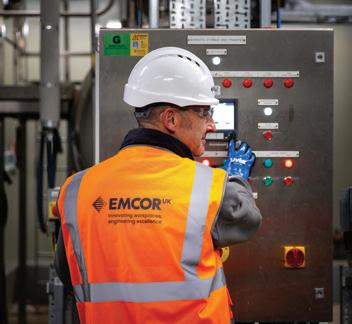
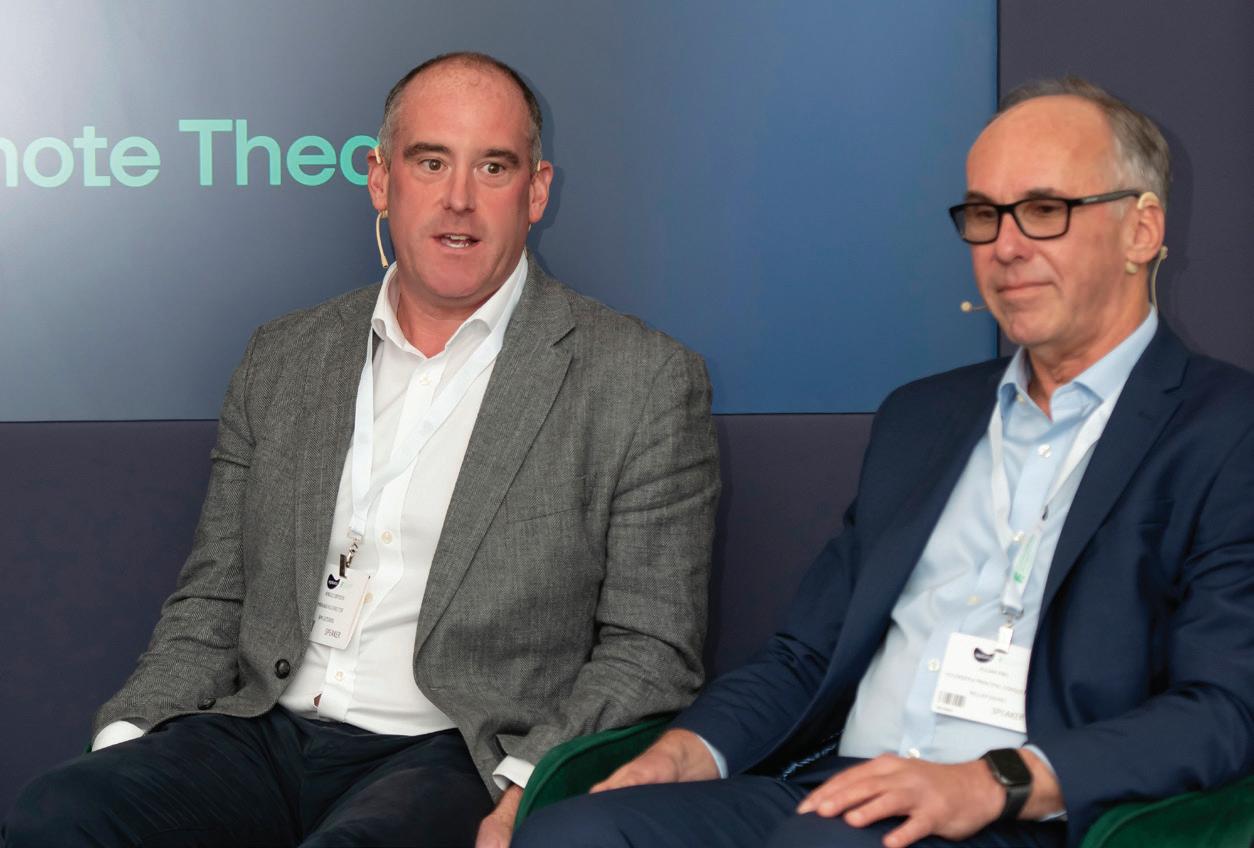
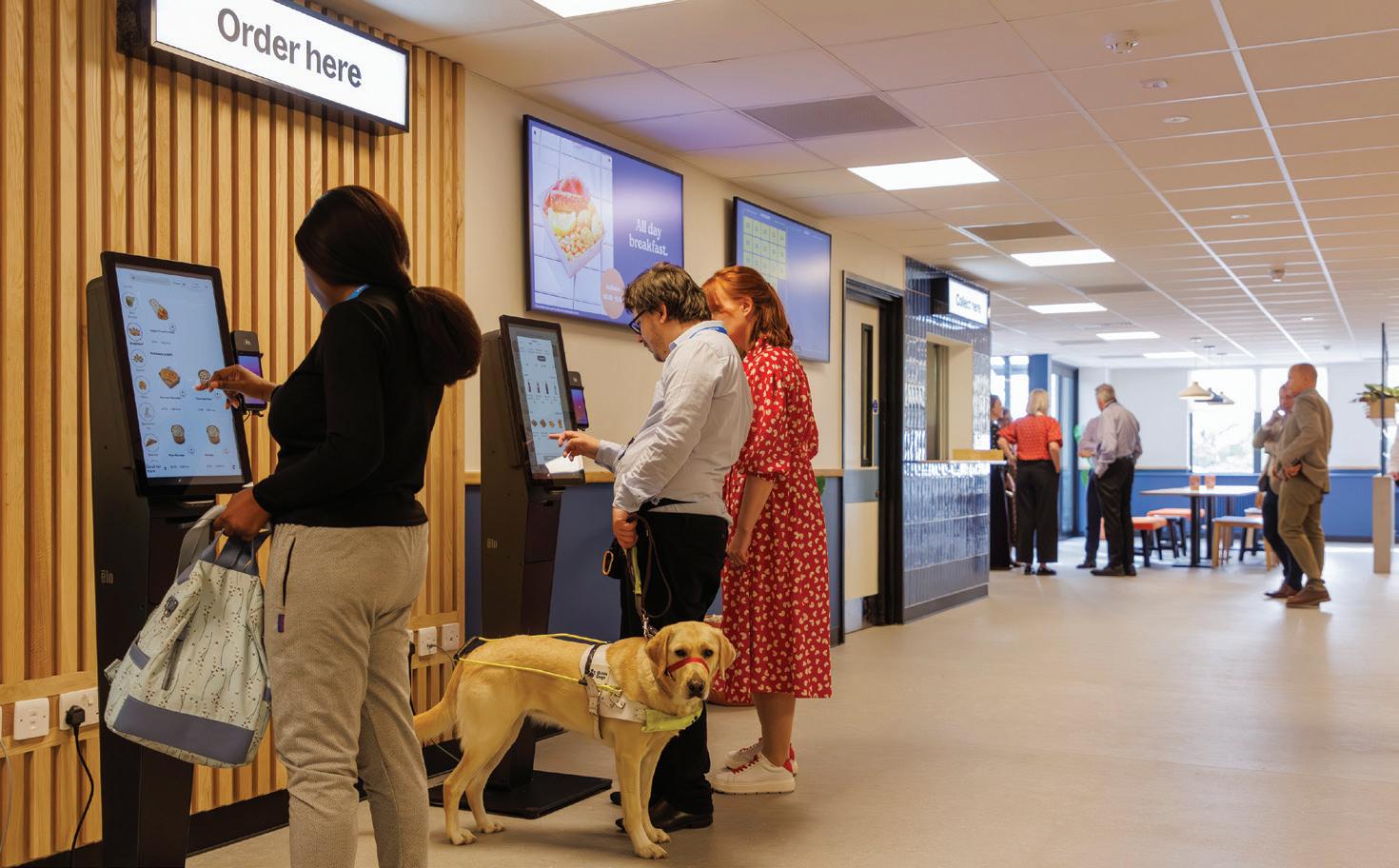
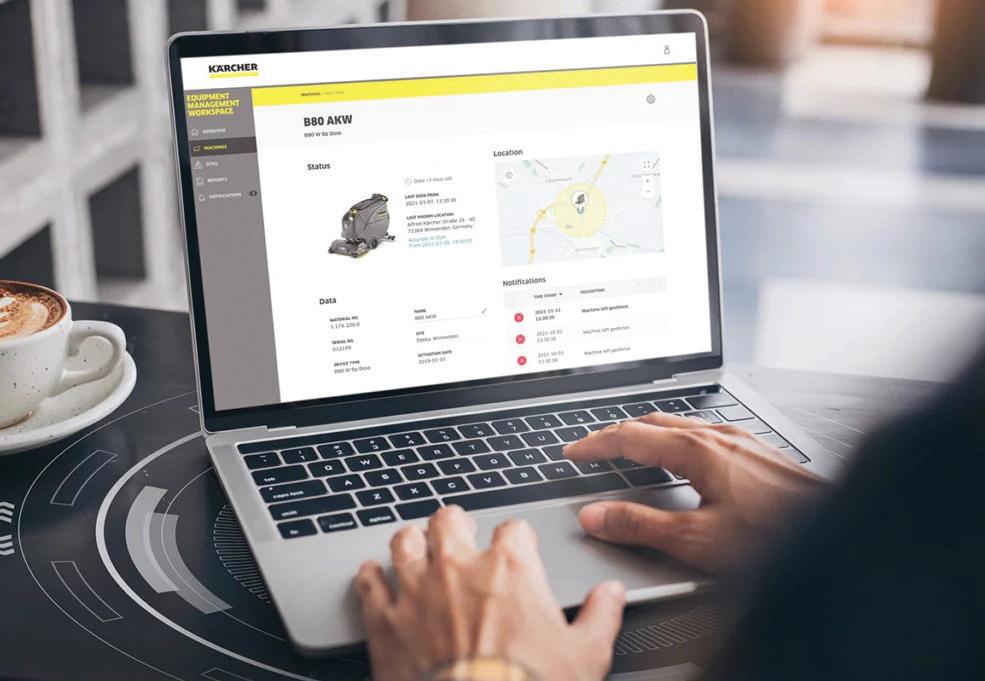
We invest in dedicated teams for all our key sectors, ensuring we deliver innovative and sustainable solutions that truly make a difference. Our growing portfolio of industryleading clients is a testament to our dedication to exceptional service.
Market-Leading Technologies
Our advanced digital platforms streamline operations, improving efficiency, safety, and performance. With continuous innovation, we elevate your experience and help you achieve your goals.
The Industry’s Best People
Handpicked for their talent and passion, comprehensively trained, and expertly managed, our people are dedicated to delivering exceptional results across every sector.
Exceptional FM Services Delivered with Passion & Expertise
Committed to a Better Tomorrow
Sustainability and inclusivity are core to our vision. We work tirelessly to reduce our carbon footprint, embrace diversity, and uplift local communities.
kpm media Unit 1 Mill Place, Platt Business Estate, Maidstone Road, Sevenoaks, Kent TN15 8TB Tel: 01322 662289
Editor Sara Bean sara.bean@kpmmedia.co.uk
Assistant Editor & Social Media Development
Sarah O’Beirne sarah.obeirne@kpmmedia.co.uk Tel: 01322 476815
Director & Designer Warren Knight warren.knight@kpmmedia.co.uk Mob: 0780 1947757
Sales Director Danny Grange danny.grange@kpmmedia.co.uk Mob: 07867 418994
Business Administrator & Circulation Maxine Howell maxine@kpmmedia.co.uk
Editorial & Events Assistant Madeleine Ford madeleine@kpmmedia.co.uk
Accounts Diane Jarvis accounts@kpmmedia.co.uk
Group CEO Nigel Copp
Editorial steering committee
Alan Hutchinson, Facilities Director, Howard Kennedy LLP
Alex McCann, Senior Facilities Manager – EMEA & APAC Global Support, Informa Group Plc
Darren Miller, Group Head of Real Estate & Workplace, Experian
Ian Wade, Head of UK Estates, British Medical Association
Jenni Gallop, Director of Estates & Facilities and H&S, Provide Community (NHS)
Lucy Hind, Senior FM Lecturer, Leeds Beckett University
Paul Cannock, EFM Consultant. Former Head of the Estates and FM, European Space Agency
Russell Burnaby, Head of Facilities Management, Finance & Resources, Brent Council
Simon Francis, Director of Estates and Facilities, The Institute of Cancer Research
Simone Fenton-Jarvis, Group Director of Workplace Consultancy and Transformation, Vpod Solutions
Wayne Young, Facilities Manager at DB Cargo (UK)
Total Average Net Circulation
14,670 July 2024 to June 2025 SUPPORTED BY
kpm media adopts a sustainable policy of using paper from managed forests. Printed in the UK by The Gemini Print Group www.gemini-print.co.uk
The publisher does not necessarily agree with the views and opinions expressed by contributors. No material may be reproduced in part or whole without written permission from the editor. Editorial contributions are accepted on an all-rights basis only. Letters to the editor may be published in their entirety or in edited form and remain the property of kpm media. While due care is taken to ensure the accuracy of information contained in this magazine, the publishers cannot be held responsible for any errors in editorial articles or advertisements. Subscriptions are available to non-qualifying and overseas readers at £120 p.a. (UK), £160 p.a. (EU countries) and £240 p.a. (overseas-other).
For the first issue of the year, we’ve included our traditional round up of views from FM thought leaders on the direction of travel in this month’s FM Clinic (page 20). It’s very heartening to learn that our commentators not only agree on the major issues but predict some real opportunities for facilities managers over the coming months.
Reading through their contributions they see hopeful signs that the facilities management sector is moving out of a long period of disruption. Dealing with the impact of the pandemic which led to the uptake of hybrid working and navigating a cost-of-living crisis has shown a level of resilience which FMs can utilise to take the profession forward.
Problems remain, including an ageing FM leadership, a sta ing crisis across both hard and so services and continued pressure to meet sustainability goals. None of these challenges can be solved overnight but there is hope, particularly for FMs ready to embark, albeit judiciously on the growing adoption of the latest so ware solutions, including AI.
I’ve recently hosted a couple of webinars, both of which discussed the major benefits of using AI in FM. The first looked at the benefits of optimising a Building Management System (BMS) with AI tools, and the second on how AI can help breach the comms gap in the management of assets. Both discussions revolved around the impact of this tech in enabling FMs to move on from reactive firefighting and better manage resources and people.
However, as Harry Dodd-Noble of askporter says in his blog on page 18, FM teams must be careful not to rely on a myriad of siloed systems, which can cause more problems than they solve. The future he says is in adopting the right set of specialist tools that delivers a unified approach to data.
You can view both webinars on the FMJ website.
As always, we’d welcome your feedback about any aspect of the magazine, together with your insight into what’s happening in the FM sector.
sara.bean@kpmmedia.co.uk
Data centre services
Tank installation & decomissioning
Fuel supply contracts
Fuel testing & polishing
Non-destructive testing (NDT)
Renewable fuel supply
Fuel system inspections Rafibra tank lining systems
Fuel tank cleaning
THIS MONTH...
This month’s summary of everything that has hit the headlines in the FM sector.
08 The latest news and views from membership organisations.
Tawanda Majasi, Head of Facilities Management, Townhall Events Ltd introduces his theory on the anatomy of the intelligent building.
Circularity has become a core element of washroom management, with the emphasis on renewal say the experts at KimberlyClark Professional.
14 Schools need to evidence real climate action reporting in 2026. Jamie Livingston, School Estates & Sustainability Mentor, iAM Compliant explains how.
16 Say goodbye to cumbersome clipboards. Erol Ayvaz, CEO at Serve First explains how AI is modernising FM compliance and cleaning audits.
18 Harry Dodd-noble, Chief Product O icer at askporter on how fixing FM failures demands integrated specialist tech.
20 The FM sector faces a range of challenges in 2026. Our panel discuss how the sector can meet these challenges and create opportunities this year.
CASE STUDY
24 Matt Kent, Director of Engineering, and Jessica Rauf-Thomas, Head of Operational Asset Management at EMCOR UK explain the riskbased maintenance approach that helped a national water utilities provider reduce planned maintenance time by 35 per cent.
LIGHTING
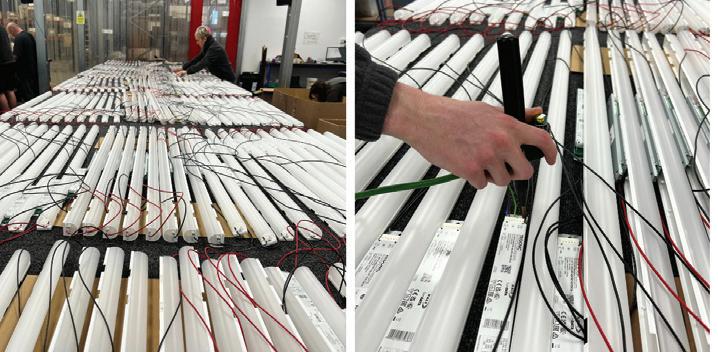
30 Ulysse Dormoy, Chief Executive O icer Atrium Ltd explains why acoustic lighting is the hidden link to productivity and comfort in commercial buildings.
Nigel Harvey, CEO Recolight, presents critical considerations for facilities managers striving to meet net zero targets.
WELLBEING
34
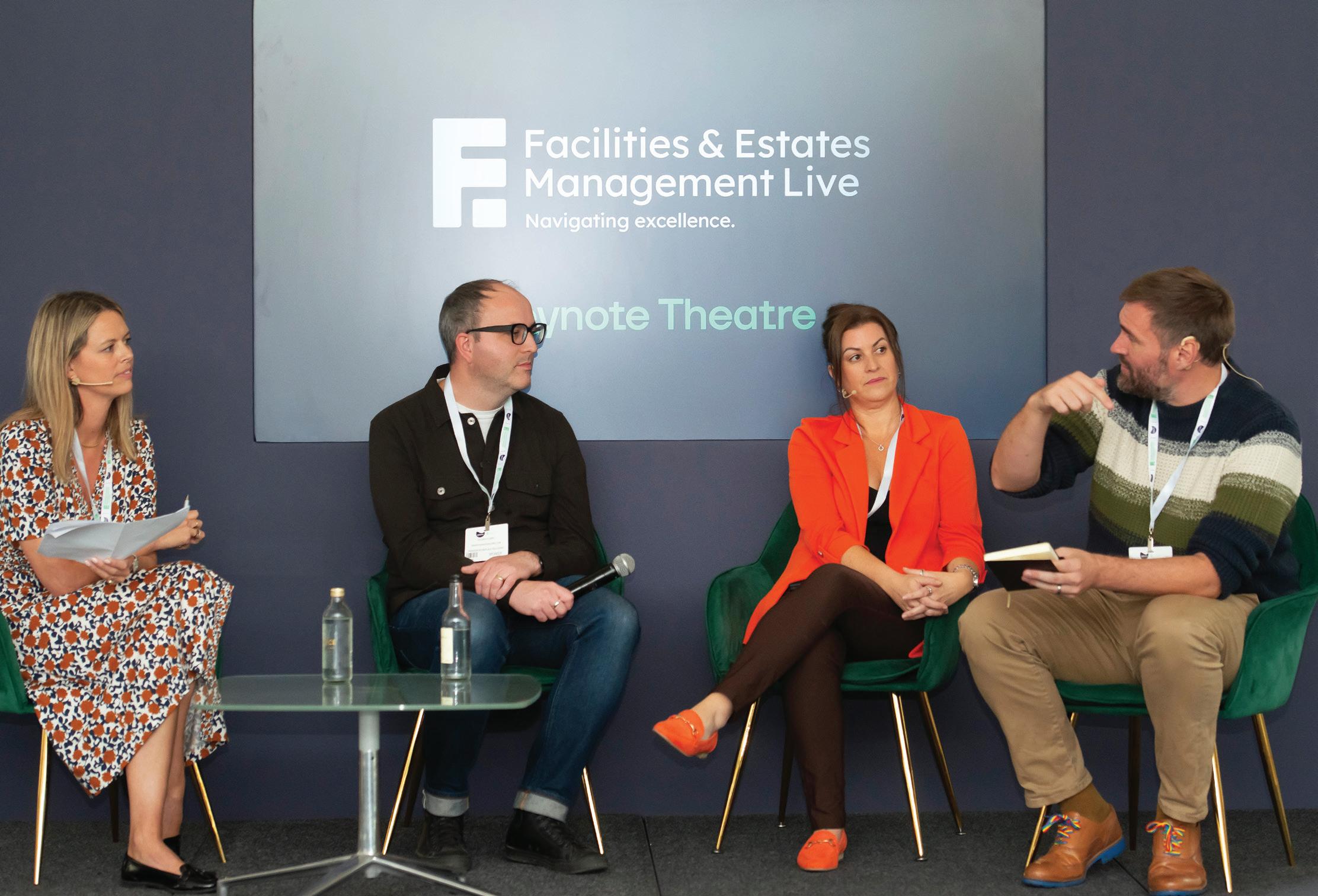
At a keynote panel at Facilities & Estates Management Live, Lauren Stirling, Head of HR & People Development at Elior UK, chaired a discussion on the wellbeing of employees in a multigenerational workplace.
FLOORING
37
Jamie Woodhall, UK Technical & Innovations Manager at Initial Washroom Hygiene wih advice on choosing the right floor mats for your business.
38
Patrick Martin, Co-Founder and Director of Sanaway, explains why specifying matting correctly helps keeps employees safe, floors protected and reduces costs.
CATERING
40
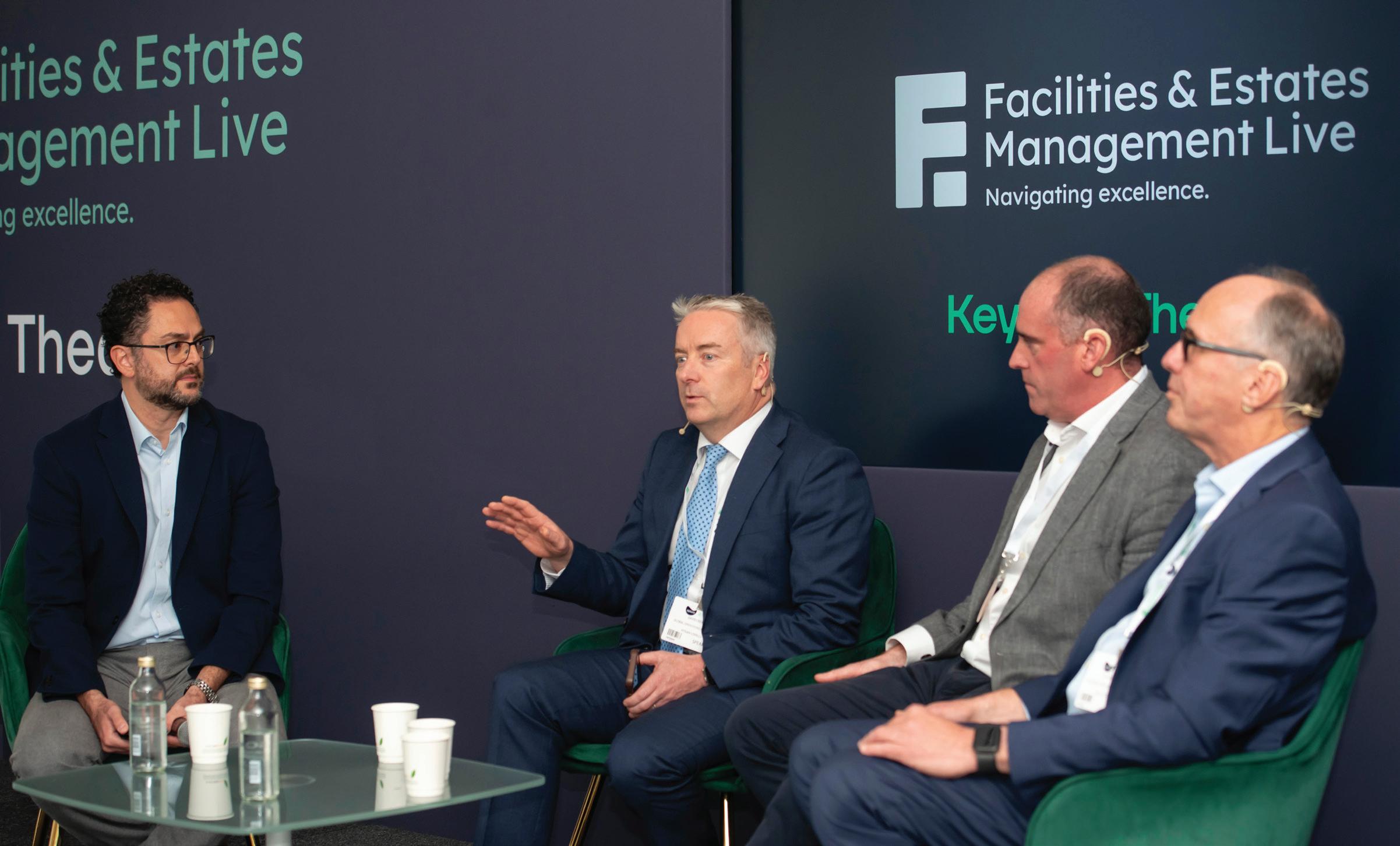
Piers Zangana chaired a discussion with Caterer Angus Brydon, FM and Food Service Consultant Julian Fris and catering client David Crew at Facilities & Estates Management Live on the provision of foodservices in an ever-changing workplace.
42
Jason Lindsay, Sodexo UK & Ireland describes how a people-centred approach, along with the judicious use of apps has transformed Colchester Hospital’s foodservice experience.
51 Find out who’s moving where in the facilities management profession.
RECRUITMENT
52
Meeting operational and strategic goals is essential in FM, but explains Matt Garner, Litmus FM, team development is also a key priority for the sector.
TRAINING
53 Kate Gardner, International Workplace explains why training may be needed for a clear understanding of the recent changes to UK health, building and fire safety law.
CAREERS
54 A brief roundup of the latest careers news in the facilities management sector.
Next Edition
In March’s issue we present the experts’ top tips for post-winter and pre-spring grounds maintenance. Our training article explores the future of HVAC education with the opening of the Zehnder training academy. We explore the recruitment and career opportunities of working in FM hospitality and the challenges employers face in finding and retaining the right people. We reveal the results of a joint MRI/FMJ survey which explores the role of AI and IoT in shaping the future of FM and discover how digital technology is helping FMs implement more predictive and sustainable maintenance. And in HVAC, with around 92 per cent of the working day now spent indoors, we investigate the e ect indoor air quality (IAQ) has on our overall welfare.
LEGAL VIEW NEW BSRIA GUIDE HELPS BUILDING MANAGERS IDENTIFY THE BEST SMART BUILDING TECH
IMPACT OF PROPOSED RENT CONTROL LEGISLATION
Richard James, Head of Commercial Property at Taylor Rose law firm
The government is proposing a ban on upward-only rent hikes on commercial property in a bid to support small businesses with costs. The proposed ban can be found in an amendment to the English Devolution and Community Empowerment Bill, which is still passing through parliament.
Under the legislation the government intends to abolish upward-only rent reviews, meaning landlords will have to use other methods, such as CPI-linked (Consumer Price Index) or turnover-based rents which are commercial lease structures where the rent amount is partially or wholly determined by the actual gross turnover (sales) generated by a business, rather than a fixed, traditional, open-market rate.
These alternatives must allow for both rises and falls, so rent could go down at review. Today, inflation-linked reviews usually include a minimum annual increase, but this would no longer be permitted. Despite this, many landlords may still favour CPI-linked reviews, as inflation typically trends upward.
The reforms are not expected to take effect until 2027–2028. The bill has cleared the House of Commons but is still progressing through the House of Lords, where further changes are possible. Until the legislation is finalised, the commercial property market faces an extended period of uncertainty.
MARKET IMPLICATIONS
With commercial property leases, it is possible that landlords may seek to increase rent through alternative mechanisms such as fixed periodic increases agreed at the start of the tenancy rather than upward-only rent reviews. It is also possible that landlords could be more inclined to insist on contracting out of the security of tenure provisions under the Landlord and Tenant Act 1954, to avoid being tied to a tenant for an indefinite period and risk a declining rent once they are in occupation.
The proposed reforms which are contained within the English Devolution and Community Empowerment Bill, are likely to create a period of adjustment as the market recalibrates. Differences between sectors, locations and asset quality may become more pronounced. Some landlords may seek higher initial rents to offset the new risk of downward rent reviews, while both CPI-linked mechanisms and turnover rents are expected to become more widely used. Turnover-based arrangements may increasingly be paired with landlord break clauses triggered by declining tenant performance. Together, these changes represent a shift away from rents determined solely by market value. With the guarantee of non-falling rental income removed (assuming tenants remain solvent), some asset classes could experience downward pressure on capital values. The long-term effects are difficult to predict, but the market will almost certainly adapt over time, just as it did, following previous structural reforms such as the introduction of VAT on property and the end of privity of estate.
PREPARING FOR THE CHANGES
The restrictions will apply only to new leases and lease renewals completed after the legislation takes effect. Landlords may aim to bring forward renewals so that new leases are finalised in 2026 rather than 2027–2028.
Landlords may undertake a realistic review of their portfolios and assess how property type and quality should influence their strategy. For prime assets, higher initial rents or hybrid turnover/CPI structures may be achievable, potentially with break clauses tied to falling turnover. For other assets, simpler CPI-linked reviews, whether annual or on a five-year cycle, may be more appropriate.
BSRIA has published an essential resource for professionals looking to install or renew smart building systems.
The new guide ‘BG 91/2026 Procuring Smart Building Technology’ covers the full procurement process, from defining needs to delivering benefits, ensuring the right people, process and technology are in place to maximise the return on investment. This is practical guidance for both technical and non-technical decision-makers, advising on capital and operational expenditure for a single building or a portfolio.
From IoT sensors and building analytics platforms to fault detection diagnostics (FDD) and Artificial Intelligence Applications, the guide provides a refreshingly straight-forward framework for making informed decisions when purchasing smart building technology. Additionally, it gives practical guidance on the system and process changes needed to optimise building operations, reducing energy and maintenance costs, and enhancing sustainability and occupant experience.
To read the new guide visit https://bit.ly/3O1LysW
UK COMMERCIAL PROPERTY SECTOR SHOWS SIGN OF STABILISATION
According to the latest RICS UK Commercial Property Monitor for Q4 2025, the UK commercial property market remains subdued, but early signs of stabilisation are emerging as sentiment improves modestly across occupier and investment markets.
While elevated borrowing costs and a challenging macroeconomic backdrop continue to weigh on activity, survey respondents reported a gradual improvement in confidence. Notably, 32 per cent of contributors now believe market conditions are consistent with the early stages of an upturn, up from 27 per cent in Q3.
The Occupier Sentiment Index improved slightly to -10, from -12 in the previous quarter, signalling that downward momentum may be easing. Tenant demand continues to fall overall, with the steepest decline still seen in retail, while o ice and industrial sectors showed marginally less negative trends.
Available space continues to rise across all major sectors, although the pace of increase has moderated. Landlords continue to o er higher incentives to attract occupiers, reflecting competitive market conditions. However, rental expectations for prime assets edged higher, with prime o ice rents now forecast to grow by 2.5 per cent over the next 12 months, and prime industrial rents by 2.1 per cent. On the other hand, secondary assets remain under sustained pressure.
Investment market sentiment remains negative overall, with the Investment Sentiment Index registering -9, although this represents a slight improvement on Q3. Investor enquiries remain weak across o ices, retail and industrial property.
One notable positive development is the improvement in lending conditions. The credit availability indicator turned positive in Q4, suggesting that access to finance is slowly easing, albeit unevenly.
Capital value expectations have also been revised upwards for some prime assets. Prime industrial values are expected to rise by two per cent, while prime o ice values are forecast to increase by 1.9 per cent over the coming year. In contrast, secondary o ice and retail values are still expected to decline, underlining the continued bifurcation between prime and secondary property.
London continues to demonstrate relative resilience, particularly in prime o ice and retail markets, where rental and capital value growth expectations exceed national averages.
Overall, the Q4 2025 results suggest the UK commercial property market may be approaching a turning point, but recovery is expected to be gradual and uneven.
Mitie reports continued strategic momentum, with revenue up 10 per cent
UK technology-led Facilities Management, Transformation and Compliance company, Mitie, has released its trading update for the three-month period (Q3 FY26) and the nine-month period (Q3 YTD) ended 31 December 2025.
Mitie Group has reported a sustained double digit revenue growth in Q3 FY26, up 10 per cent to £1,447m (Q3 FY25: £1,314m), including four per cent organic growth against a strong prior year comparative, and £71m generated in free cash flow in Q3 YTD (FY25 YTD: £59m).
Mitie won, extended or renewed contracts with up to £0.9bn TCV (Q3 FY25: £1.1bn). Contract wins and extensions or renewals of £4.7bn in the nine months to 31 December 2025 were at a similar level to the prior year (FY25 YTD: £4.8bn).
Mitie also reports its pipeline of bidding opportunities is up 28 per cent to £30.4bn (end FY25: £23.7bn), comprising Facilities Management opportunities of £24.3bn (end FY25: £18.9bn) and Projects opportunities of £6.1bn (end FY25: £4.8bn).
Looking ahead, Mitie says it remains on track to deliver double digit revenue and operating profit.
BUILT ENVIRONMENT COMPETENCE HUB LAUNCHES
Launched by BSI, the Built Environment Competence Hub is a new national resource designed to bring together standards, competence frameworks, guidance and trusted industry insight in one central place.
The digital Hub has been created to act as a central point of reference for competence-related information. It brings together key standards, competence frameworks, guidance and insights in one place, designed to help professionals, organisations and stakeholders navigate an increasingly complex regulatory and professional landscape.
Managed by BSI and developed in collaboration with the Industry Competence Steering Group (ICSG) and the Building Safety Regulator (BSR), the Hub responds to concerns in the sector that competence information is o en fragmented, di icult to navigate and inconsistent across roles and disciplines. The Hub aims to address this by providing a shared space for industry to engage on competence, exchange best practice and access authoritative resources that support greater clarity, consistency and confidence across the built environment lifecycle.
Anthony Burd, Director of Built Environment, BSI Knowledge Solutions, BSI, said: “The Built Environment Competence Hub has been designed as a living resource, shaped by ongoing industry input and able to evolve as competence requirements, standards and best practice continue to develop. By improving access to authoritative information and supporting a more consistent understanding of competence, the Hub also aims to play a vital role in helping the sector respond to regulatory reform following the introduction of the Building Safety Act 2022.” For more information on the Built Environment Competence Hub visit https://competence.bsigroup.com
If you have any knowledge of FM news from across the world, please feel free to get in touch with our assistant editor Sarah O’Beirne email sarah.obeirne@kpmmedia.co.uk
IFMA & SIMPLAR FOUNDATION RELEASE FM PULSE REPORT
The International Facilities Management Association (IFMA) and the Simplar Foundation have released the Facilities Management Pulse Report. This first-of-its-kind report delivers a global, data-driven snapshot of the facilities management market, anchored by IFMA’s new FM Workload Index (FMWI), which captures how workload, budgets, sta ing and projects are expected to shi over the next year.
Based on more than 1,400 global responses to IFMA’s Q3 2025 Facilities Management Index and Economic Pulse Survey, the FMWI estimates workload expectations on a scale from −100 to +100. Scores above zero indicate expected increases; the farther from zero, the stronger the lean. The inaugural FMWI reading is +43, which means more Facilities professionals expect their overall workload to rise.
The survey asked Facilities professionals worldwide whether they expected their overall workload to increase, decrease or stay about
the same. Respondents included Facilities practitioners across 80 countries, managing 3.2 billion square feet (300 million square meters) and representing a wide range of industry sectors. Consequently, the FMWI provides a consistent barometer across sectors, regions and future survey waves, providing FM leaders with a simple way to compare conditions and track change over time.
“FM leaders face steady workload growth supported by modest budgets and constrained sta ing,” said Nickalos Rocha, IFMA’s Director of Benchmarking. “Organisations that align planning, sourcing and risk management early will be best positioned to sustain momentum, meet demand and deliver consistent results.”
The Facilities Management Pulse Report is based on more than 1,400 survey responses, including nearly 1,200 Facilities practitioners, 200 vendors or service partners, and a small group of professionals in other roles. Results presented in this report
RICS INAUGURATES PRESIDENT FOR 2026
focus primarily on FM respondents, representing countries across North America, Latin America, Europe, Africa, the Middle East and Asia-Pacific, as well as sectors such as professional, scientific and technical services; public administration; finance and insurance; health care; education; manufacturing and utilities.
“Thanks to the participation of our respondents, we’re able to provide Facilities professionals the strategic foresight to skilfully navigate and capitalise on evolving risks and demands,” said Michael V. Geary, CAE, IFMA’s President and CEO. “The findings, and specifically the FMWI, are of immense value in understanding industry drivers, challenges and expectations across regions and sectors. It helps ensure that FMs and their organisations are not caught o guard by factors influencing market dynamics but are better prepared to respond to supply and sta ing issues, scope changes, economic conditions, regulatory impacts, and other risks and opportunities.”
To access the Facilities Management Pulse Report, visit: https://bit.ly/3ZcLjha
TheRoyal Institution of Chartered Surveyors (RICS) inaugurated its 144th president, Nick Maclean OBE RD FRICS, on the evening of Thursday 22 January at RICS headquarters in Westminster.
In his inaugural address, the RICS President set out an ambitious vision for the Institution, centred on education, influence and confidence as the guiding priorities of his presidency. Reflecting on RICS’ recent period of reform and recovery, he highlighted the organisation’s renewed strength, resilience and readiness to play an even more significant role in shaping the built and natural environment for the public advantage.
Speaking to members and guests, the President rea irmed RICS’ long-standing mission to advance knowledge and uphold professional standards, placing particular emphasis on widening access to the surveying profession, strengthening educational pathways, and ensuring that RICS qualifications remain the global gold standard.
He also underlined RICS’ responsibility to be at the heart of public policy and regulatory decisionmaking, noting the depth of expertise held by its 144,000 members operating across 76 countries, and the Institution’s ambition to act as a trusted advisor to governments and regulators worldwide. Finally, the President emphasised the importance of confidence - amongst members, sta , stakeholders and the public - grounded in integrity, professionalism and service to the public good, values that continue to define RICS as more than a professional body, but an institution with a clear civic purpose.
Alongside the inauguration, a presidential team manifesto was launched. Titled Together Towards Tomorrow, the manifesto outlines several key goals for 2026:
Enhancing RICS’ influence with governments, regulators and key decision-makers.
Closing skills gaps through collaboration between industry, academia and policymakers.
Championing digital transformation, innovation and sustainability across the built and natural environment.
Strengthening member engagement, diversity and global relevance.
IOSH HELPS SHAPE EUROPEAN MOVE ON ASBESTOS RISK
Policy experts at the Institution of Occupational Safety and Health (IOSH) have secured key changes to new European Commission (European Union) guidelines for managing asbestos-related health and safety risks at work.
In December 2025 the Commission adopted new guidelines aimed at supporting national authorities, employers and workers to manage risks related to workplace exposure to asbestos. IOSH influenced the final wording, most notably in two key areas, mining –identifying migrant workers as a high-risk group and emergency services.
“It’s always heartening to see our expertise, experience and commitment to safer, healthier workplaces being recognised and acted on by our global partners,” said IOSH Head of Policy and Public A airs, Ruth Wilkinson.
“Asbestos remains a global issue and is the world’s biggest cause of occupational cancer,” she added.
Nick Maclean OBE RD FRICS President
With 20% reduction in running costs,* 10% more energy efficiency and 6% smaller footprint, the new City Multi R32 VRF YXM range will help you heat and cool your building, whilst helping you on the road to net zero.
Your building, our solutions. Launching Spring 2026.
To find out more about the new City Multi R32 VRF YXM range, visit https://citymultiyxm.com/
*Compared to 30kW R410A YNW model
ANATOMY LESSONS
Tawanda Majasi, Head of Facilities
Management,
Town
Hall
by Bottaccio, introduces his theory on the anatomy of the intelligent building
The Facilities Management industry su ers from a profound strategic branding crisis: despite overseeing 70-80 per cent of all operational expenditure, the executive board views us merely as a reactive cost centre.
This negative perception severely limits vital capital investment and exposes organisations to significant, unnecessary operational and financial risks.
The root cause is a fundamental communication gap: FM speaks uptime and Planned Preventative Maintenance (PPM), while the board demands the language of risk mitigation, capital preservation, and Return on Investment (ROI).
To bridge this strategic gulf, we must abandon technical acronyms and instead deploy a powerful, relatable metaphor: ‘The Anatomy of the Intelligent Building’. This framework positions the facility as a responsive, living organism, making the case for technology investment clear, strategic, and financially compelling, e ectively elevating FM to a crucial, value-generating function that sustains the entire enterprise.
THE CENTRAL NERVOUS SYSTEM: CAFM BACKBONE
If the modern facility is a living organism, your Computer-Aided Facilities Management (CAFM) system is the Central Nervous System. It is the hub that governs immediate response, coordinates complex actions, and retains all institutional memory.
In many organisations, CAFM is treated merely as a simple maintenance scheduler, yet the intelligent building demands the CAFM system be elevated to the core strategic command hub. It must process information; prioritise workloads
based on asset criticality and financial impact and determine the operational rhythm.
The central nervous system must integrate key data streams:
» Asset Register: As the memory and identity of every component this living database tracks service histories and cost-to-maintain metrics, allowing for informed, strategic disposal or renewal decisions, moving beyond simple reactive replacement.
» Compliance Schedule: The regulatory framework that guides system health. The CAFM must automatically log, track, and flag required inspections and certification renewals. Failure to utilise this systematic oversight risks massive legal exposure and fiduciary liability.
» Resource Allocation: This is the command centre that prioritises technicians based on financial impact. It uses algorithms to schedule work based on potential downtime costs, ensuring that high-value, revenue-generating assets are fixed first. A failure of this system is strategic paralysis that exposes the entire organisation to systemic risk.
THE BLOODSTREAM: FINANCIAL VALUE AND CAPITAL PLANNING
The budget and financial records (including ROI, cost avoidance, and CapEx forecasts) are the intelligent building's bloodstream, managing the financial energy vital for health and growth. FM must actively demonstrate how its strategic investments fuel this life source to include:
» Proactive Cost Avoidance (PCA): This helps quantify "invisible" savings with details on how a small predictive task (for example a £500 sensor intervention) helps the system avoid catastrophic
failure requiring a £50,000 replacement and £150,000 in lost revenue. This proves FM's essential role in protecting the company's income stream.
» Capital Planning: As the primary, data-driven driver, FM uses historical data to forecast critical asset end-of-life cycles, preventing sudden, unbudgeted expenditure ("financial haemorrhaging").
» Strategic Asset Insight: This enables FM to utilise operational performance data, for instance Total Cost of Occupancy (TCO), to inform executive decisions on the portfolio (sell, refurbish, or expand). This transforms property from a cost liability into a strategic profit enabler.
THE FIVE SENSES: IOT, AI, AND STRATEGIC FORESIGHT
The most profound shi in FM is the development of the Five Senses which encompass IoT sensors, BMS, and AI integration. These advanced sensory organs allow the building to perceive its environment in real time, enabling the shi from reactive (pain) to predictive (wellness) management:
» Sight (occupancy/HVAC analytics): Real-time data informs dynamic cleaning and HVAC schedules, ensuring resources are deployed only when needed. This drives utility savings and improves the employee experience.
» Hearing (vibration/acoustic sensors): Predictive maintenance sensors listen to critical rotating assets, detecting subtle frequency shi s and degradation long before catastrophic failure.
» Touch (temperature/air quality/humidity): Maintaining the optimal internal environment (IEQ). These inputs link FM directly to human capital wellness and productivity metrics, which is a key ESG initiative.
When the building lacks these senses, the central nervous system is blind and deaf. This is why an investment in the five senses is an investment in strategic foresight, ensuring optimal e iciency and minimal risk exposure.
ACTIVATING THE VALUE CHAIN
The era of justifying facilities management by simple metrics like square footage and utility costs is over. The Anatomy of the Intelligent Building provides executives with a clear, powerful framework which demonstrates why investing in technology and strategic FM sta ing is not a discretionary expense but is fundamental to the operational and financial integrity of the entire organisation.
By consistently using this strategic, valuefocused language, which prioritises risk mitigation, capital preservation, and competitive advantage the facilities management remit moves decisively out of the reactive cost centre column and is elevated to an essential, proactive value driver. The future of FM is not about maintenance; it is about mission assurance and strategic enablement.
Protect people .
Prevent explosions .
Stay compliant .
Adler & Allan delivers:
Adler & Allan helps facilities managers move beyond reactive compliance to build scalable, strategic DSEAR programmes that are remediation-ready.
Explosion Protection Document (EPD) support
ATEX equipment audits & maintenance
COMPEX training & competency reviews
Site-specific risk assessments & hazardous area drawings
RENEWED THINKING
Circularity has become a core element of washroom management, with the emphasis on renewal say the experts at Kimberly-Clark Professional
With
rising sustainability expectations and growing legislative pressures, facilities managers are evaluating how waste is handled across their estates. Washrooms, once viewed as simple hygiene spaces, are becoming key to driving measurable impact. Through smart design, recovery programmes and supplier partnerships, circularity in the washroom is emerging as a practical and scalable strategy to reduce emissions, meet wider environmental goals, and lower costs. As organisations work toward net zero, and new policies like Extended Producer Responsibility (EPR) tighten the screws. The outdated take-make-dispose model is not just ine icient, it’s unsustainable.
Today, circular economy thinking is transforming how facilities are managed. Nowhere is this shi more tangible, or more overdue, than in the washroom. O en overlooked, these spaces are high-footfall, high-consumption, and high-waste. Yet until recently, their potential as drivers of sustainability has gone largely untapped.
THE WASHROOM: A NEW FRONTIER FOR CIRCULAR FM
For years, the FM industry focused its circularity e orts on big-ticket areas like energy use and packaging. But the humble washroom is now under the spotlight, o ering quick wins and deep impact when circular principles are applied at scale. Paper towels and dispensers are essential consumables, but also persistent contributors to waste volumes. The opportunity lies in designing washrooms around the principles of reduction, reuse, and recovery.
What’s driving this change is not just a sense of
environmental duty; it’s also about reputation, compliance, and resilience. Clients want visible sustainability, legislators want accountability, and with more FM contracts including environmental, social and governance (ESG) KPIs, washroom circularity has become a competitive di erentiator. Suppliers like Kimberly-Clark Professional are pioneering new ways to make hygiene spaces more sustainable. Its ReNew programme, which launched in 2025, builds on the legacy of its RightCycle programme o ering end-to-end recycling for hard-to-handle items like used paper towels and dispensers. It even accepts competitor products. It is a simple model: used products are collected, processed, and turned into raw materials for new items. In the UK, for instance, paper towels collected through the programme are sent to Kimberly-Clark’s mill in Koblenz, Germany, which is on track to move to 100 per cent renewable energy by 2029. Here, they are turned into recycled tissue products, enabling full-circle resource recovery, this has resulted in more than 35 tonnes of postconsumer paper towel waste being recycled in 2024 alone. That’s the equivalent of saving nearly 800 trees and eliminating 5.58 tonnes of CO2 equivalent.
CUTTING WASTE WITHOUT COMPROMISING HYGIENE
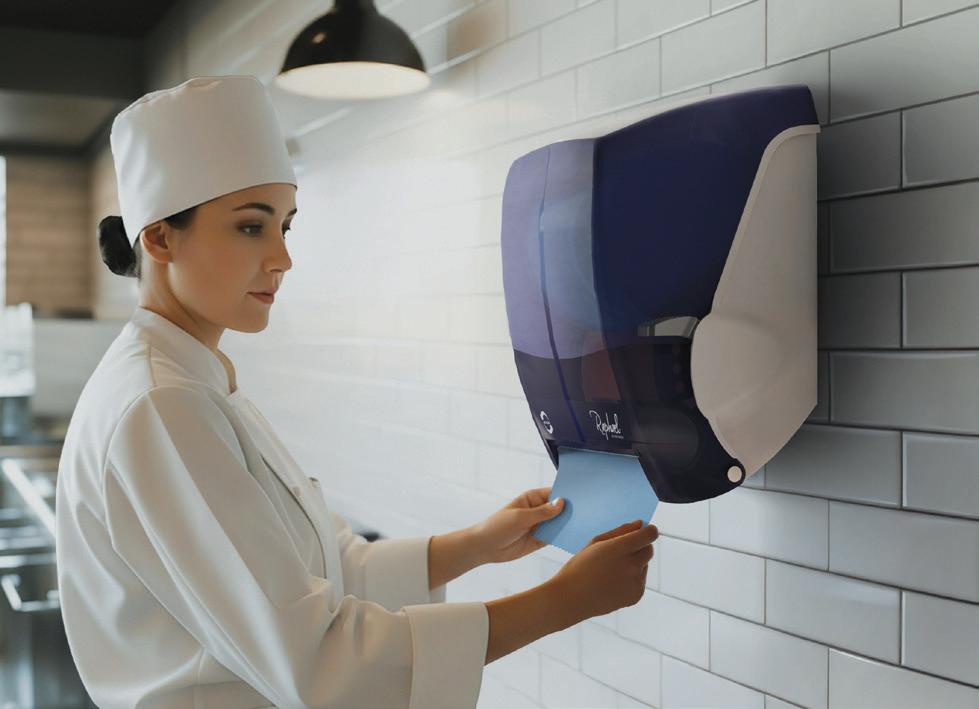
Of course, washrooms are about more than waste, they’re critical to hygiene, safety and user satisfaction. Circularity initiatives must meet these standards, or exceed them, to be viable. Solutions like controlled dispensing systems of hand towels o er dual benefits. By regulating usage to one sheet per pull, they minimise unnecessary consumption
while reducing refill frequency and maintenance time. The result? Lower costs, better service e iciency, and reduced environmental impact. In a major roll-out across nine hospitals, traditional paper systems were replaced with controlled dispensing units. The results were dramatic: 23 million fewer metres of paper used, £394,603 saved, and over 1.1 million fewer units requiring refilling in just six months.
As corporate ESG reporting grows more complex and scrutinised, clear metrics matter. The ReNew programme provides customers with regular reports tracking waste diversion, emissions savings, and progress against zero waste goals. These aren’t just stats for internal dashboards; they’re evidence points for audits, stakeholder updates, and public disclosures. For FM leaders this means instead of chasing fragmented data across suppliers and contractors, they gain a single, streamlined source of data, making sustainability demonstrable.
It also reduces risk. With regulatory frameworks evolving rapidly across the UK and Europe, such as the expansion of EPR schemes and incoming plastic bans, having traceable data and circular systems in place protects businesses from future non-compliance.
Perhaps the most powerful aspect of circularity in the washroom is its scalability. From a single o ice to a nationwide hospital network, the principles hold. What starts with a switch in dispensers or towel collection can evolve into an enterprise-wide waste recovery programme. And the incentives are stacking up. Clients are demanding greener service models. Governments are tightening regulations. And frontline sta are more engaged when they see their actions translating into environmental impact. With growing interest in plastic recovery, compostable materials, and alternative waste streams, the infrastructure built for washroom circularity is opening doors for broader applications across the built environment.
The washroom may have been a sustainability blind spot. But today, it’s a proving ground for what modern FM can achieve. Through smart design, strong partnerships, and data-backed programmes, facilities teams can turn hygiene waste from a problem into a platform for progress. Circularity is no longer an ambition, it’s a blueprint for smarter, leaner, and greener FM operations. In the race to net zero, every stream matters, and in facilities management, the journey to circularity might just begin in the washroom.
COMPLIANCE
CLIMATE ACTION IN EDUCATION
ESchools need to evidence real climate action reporting in 2026. Jamie Livingston, School Estates & Sustainability Mentor, iAM Compliant explains how
nergy ine iciency has become an educational tax. Schools spend more than half a billion pounds a year on energy, with costs now sitting only behind sta ing as the biggest line in the budget. At the same time, the Department for Education’s (DfE) sustainability expectations are moving from gentle encouragement to clear direction. Every school must have a sustainability lead and a Climate Action Plan (CAP) and although formal mandatory reporting isn’t yet universal, the sector should expect far sharper scrutiny from this year onwards.
A combination of rising costs and expectations has created a pressure point that’s reshaping estates management in schools and trusts. The schools that act now, and can evidence that action, will be both better prepared for future reporting requirements and protect their core budgets at a time when every pound matters.
UK schools spend around £543 million a year on energy, and roughly £135 million of that is estimated to be wasted through avoidable ine iciency. For a typical secondary school, simple operational changes can release £21,500 annually, which is enough to fund a newly qualified teacher or maintain essential support sta . This is why ‘evidencing climate action’ needs to be understood in practical, operational terms.
Below are four areas where schools can simultaneously cut costs and produce the kind of data that governors, auditors and the DfE will soon expect to see.
BOILER FLOW TEMPERATURES
Many schools run boilers hotter than necessary but lowering flow temperatures by only 5-10°C can recover 10-15 per cent in gas e iciency. Logging these changes and comparing meter data provides clear evidence of improvement, as well as making classrooms more comfortable in winter.
For FM teams, this is a textbook, low-cost amendment that’s quick to implement, easy to reverse if needed and straightforward to evidence through trend data.
USE BUILDING MANAGEMENT SYSTEMS
PROPERLY
Most schools have a BMS, but settings o en dri
over time. You’ll cut hours of wasted runtime by resetting start and stop times, widening heatingcooling deadbands and setting proper holiday shutdown modes. These too are measurable adjustments that create data trails for governors to see.
Exporting screenshots or logs from the BMS provides valuable documentation for internal and external reporting, which is something auditors increasingly look for across public sector estates.
RUN A BASELOAD AUDIT
Overnight or weekend energy use o en reveals equipment le running unnecessarily. Checking servers and vending machines, and then correcting them, shows instant results in consumption data, which provides evidence for reporting.
A termly repeat of the same walk through also allows you to show a pattern of continuous improvement rather than one-o intervention, which is vital for long-term reporting frameworks.
ENGAGE STUDENTS IN MONITORING
Behavioural change, when made visible, works. Involving pupils in energy checks or classroom switch-o campaigns helps to create a culture where energy use becomes part of the school’s shared responsibility. The impact is measurable and easily reportable, giving the school a great story to include in CAP reports. This also reduces reliance on estates teams alone. Many schools find that community-driven monitoring identifies issues long before they show up in the data.
None of this requires capital expenditure, and none of it depends on installing new technology.
The point here is a shi from reactive management to monitored, documented practice. That’s where many schools currently have a gap; the actions are happening, but the evidence is not.
IMPROVE REPORTING STRUCTURES
Establishing a simple internal reporting rhythm closes that gap. These can include a termly sustainability update for the resources committee, a short energy section in Senior Leadership Team (SLT) papers, and a CAP progress tracker that logs completed actions and supporting evidence. Together, these create the paper trail schools need to show that everyday improvements add up to real, strategic progress.
This structured reporting approach mirrors broader FM governance requirements, particularly around statutory compliance, asset lifecycle planning and risk management. Framing sustainability data within these existing processes makes it easier for estates teams to integrate climate action into their routine workload rather than treating it as an additional demand.
Digital tools help here, not by replacing expertise but by reducing the administrative load. Systems that convert meter readings into carbon figures, track CAP actions and store evidence (photos, checklists, invoices, BMS logs) give schools the audit trail they need without piling more work onto already stretched teams. These tools also help standardise reporting across multi-site estates, bringing school portfolios in line with the kind of portfolio-level reporting already expected in corporate FM.
The message for the sector then is that schools do not need to wait to start proving progress. The data needed for tomorrow’s compliance can be made today through small, sensible, financially driven actions. In a year when budgets will continue to feel the squeeze, evidencing real climate action will protect scarce resources now and leave schools far better prepared for reporting requirements in 2026. Training, documentation and collaboration between estates, maintenance, and leadership teams are key. When water safety is treated as a shared responsibility rather than a niche compliance issue, schools and public facilities are far better equipped to prevent problems before they occur.
PPL Training
Unchanged Excellence.
Entering the year with a New Logo...
Revealing our visual alignment with the Apave Group However these changes are largely cosmetic, PPL Training continues its commitment in driving your teams technical competence, with the same team, providing the same training expertise. Learn
CHECKLISTS TO SMART CHECKS
FMJ AIMS TO SUPPORT TECHNICAL EXPERTISE IN THE FM MARKET
Say goodbye to cumbersome clipboards. Erol Ayvaz, CEO at Serve First explains how AI is modernising FM compliance and cleaning audits
Walk into almost any building at the crack of dawn, and you’ll find the same scene: A cleaner ticks o a paper checklist. A supervisor files it. By the time someone spots an issue, there have been three complaints online. This type of facilities management routine hasn’t changed in decades. But the world around it has.
Regulations are tighter. Budgets are leaner. And customer issues are brought into sharp focus by social media and AI. It’s time to move beyond paper checklists. From Internet of Things (IoT) sensors to digital feedback terminals, AI has shown what compliance and cleaning management can look like. Less reporting. More resolving.
WHAT’S BROKEN TODAY?
Facilities management is full of systems designed to help. However, they o en make things harder. Siloed systems and technology platforms that don’t talk to each other, with multiple logins, feedback that lags by days or weeks, cleaning standards that vary wildly site-to-site, with no easy way to prove compliance when you need to.
Meanwhile, on the ground, frontline sta such as cleaners chase tasks without clear priorities, supervisor’s firefight all day and managers drown in online dashboards. The gap between problem and action creates frustration for the customer, the team and ultimately, the business. Slow escalation of paper trails turns small issues, such as blocked drains or empty dispensers, into complaints, reputational damage, and avoidable costs.
WHY AI MATTERS
AI in facilities management isn’t about replacing people it’s about replacing guesswork in favour of a virtual analyst and dispatcher rolled into one. It consolidates disconnected data in real time and spots problems and patterns that can be easy to miss manually. Then it proactively suggests instant actions for the right person at the right time. In cleaning, this creates a digital audit trail of who did what to address which issue, where and when, shi ing from routine schedules to responsive schedules to make sure any issues are resolved faster.
HOW IT LOOKS ON THE GROUND
front line doing the work. AI addresses this by providing role-specific prompts straight to the right person on the right shi , matched to that site’s standards. AI essentially acts as the connective tissue between feedback, brand standards, and action.
Meanwhile, supervisors can see progress in real time, be alerted to missed actions instantly, and support frontline sta at the time. The tone shi s from blame to proactive teamwork.
At Serve First, we’ve seen how this approach works. Our AI-driven platform puts tailored insights in everyone’s hands, from cleaners and supervisors to FM directors. It helps teams act faster and businesses prove compliance, with less time spent managing data and more time managing outcomes.
MAKING COMPLIANCE EASIER TO PROVE
To bring this to life, here are some realworld cleaning cases forward-thinking operators have implemented that make a visible di erence:
» Dynamic washroom cleaning: Footfall sensors detect tra ic spikes in real time. The AI automatically pings the nearest cleaner’s mobile device, “Extra clean needed in Zone B in 10 minutes”.
» Consumables control: The AI recognises low-stock patterns every Friday a ernoon. It automatically adds a soap dispenser refill reminder at 2pm and alerts a supervisor if it’s missed.
» Slip risk management: Weather data and footfall trends flag slip risk alerts. AI schedules an extra mat inspection and surface check. Proof of compliance is captured automatically.
» Mid-shi cleaning gaps: AI links spikes in customer complaints to missed mid-shi cleans and adds micro-tasks to protect standards during busy periods, cutting hygiene-related complaints.
EMPOWERING FRONTLINE STAFF
Most systems fail because they’re built for managers, not the people on the
For FM leaders and auditors, AI enables what’s o en been missing: a single version of the truth across sites and suppliers. Every clean, check, or inspection is logged automatically with time, date, location, and evidence. Reports build themselves, showing trends over time. Non-conformances trigger follow-ups with clear service level agreements (SLAs) and proof of resolution.
When a client, regulator, or senior manager asks for evidence, it’s ready in seconds. Not a pile of paper, but a live record of action. That’s the shi from compliance for compliance’s sake to compliance that has an impact, boosting performance and reducing complaints.
FROM REACTIVE TO PREDICTIVE
AI’s biggest impact may yet be still to come. The more connected the data, the smarter the system becomes, helping FM teams move from firefighting to forecasting. And this isn’t on the horizon - Serve First is already working with the likes of Elior Group and Aramark: the technology is very much here now, and early adopters are already shi ing from “what went wrong yesterday?” to “what can we prevent tomorrow?”
The future of FM and cleaning compliance isn’t about collecting data but connecting data. AI won’t replace your people; it will free them to do their best work and fix issues before they become a problem. Because when technology handles the paperwork, people can focus on delivering cleaner, safer, better spaces for everyone.
Are you simply meeting the WEEE Regulations, or Redefining Responsibility?
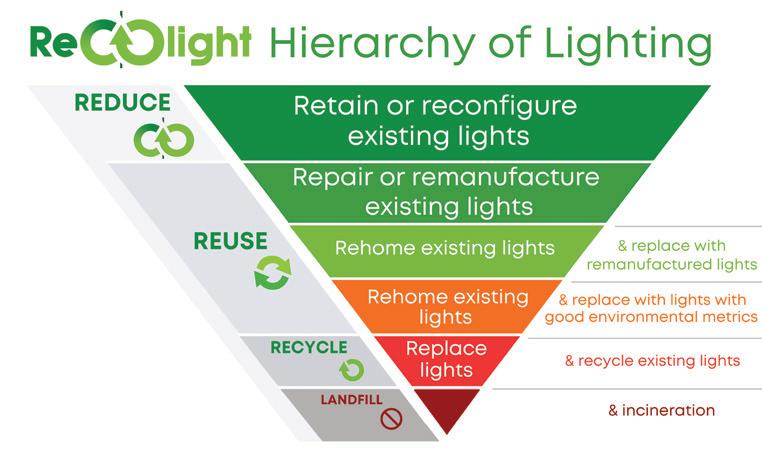
Recolight isn't just about recycling, we help the lighting industry take real steps toward a sustainable future. With a Reuse Hub and Circular Lighting Live Conference, to workshops, webinars, and Life Cycle Assessments. Supporting businesses in taking practical actions to embrace the Circular Economy. What’s more, we can provide carbon footprint data for every waste collection. Make your lighting more sustainable. Make it circular.
@VertasGroup We’re supporting @Samaritans’ #BrewMonday. We know bad days don’t follow a calendar, and sometimes a chat can make all the difference. We spoke with our Mental Health First Aiders, who shared their tips for helping someone open up when something’s up: https://bit.ly/4pKiCTu
@theCIOB Our in person ‘Heritage That Works’ conference, taking place on Thursday 23 April at Hilton Tower Bridge, London, will reframe conservation as a sector defined not by exclusivity, but by collaboration and relevance. Find out more and book your place via: https://brnw.ch/21wZccB
@BritSafe Excited to join Safety, Health & Wellbeing Live in Manchester this February! Ian Cooke will share insights on supporting organisations. Register now https://ow.ly/m6Hw50XZzkc
@RICSnews RICS Dispute Resolution Service (DRS) turns 50 this year. John Fletcher, Executive Director of DRS, reflects on five decades of Alternative Dispute Resolution development http://ms.spr.ly/6019tNJfU
@BICSc_UK Exciting News! BICSc is proud to announce that we’ll be at The Manchester Cleaning Show 2026 on 18th-19th February! Stay connected for all the latest updates –we’ll be sharing more details soon across our social channels.
@mitie Did you know replacing one daily car commute with a bike ride for 200 days saves up to half a tonne of CO2 annually? Find out more in our latest ESG Report > https://hubs.ly/Q03zt4QY0
@BidvestNoonan We are really pleased to have been named finalists in five categories at the FM Awards. These include Innovation in Technology & Systems, Client and Service Provider Partnership, FM Project of the Year, and Excellence in Health & Safety.
@CIBSE CIBSE welcomes the UK Government’s Warm Homes Plan and its £15bn commitment to upgrade five million homes by 2030, providing much-needed policy certainty while helping tackle fuel poverty, cut carbon emissions and improve health and wellbeing. More at https://buff.ly/zJbbWJt
HARRY DODD-NOBLE, CHIEF PRODUCT OFFICER, ASKPORTER
FIXING FM FAILURES DEMANDS INTEGRATED SPECIALIST TECH
Facilities management is at an important moment. A new report from askporter, ‘Overcoming sta shortages and quality gaps with technology’, reveals a worrying issue that is undermining technology adoption and creating ine iciencies.
The research found that 75 per cent of FMs are experiencing an operational disconnect that interrupts technology integration. This crisis is not due to a lack of solutions, but a failure of existing building systems to communicate, creating costs and frustration for both sta and end-users.
Historically focused on reactive maintenance and cost control, the FM industry is moving to a strategic approach, yet the complexity of current systems makes this transition near-impossible.
FM teams can operate with four to six di erent siloed systems, including CAFM, IoT, and ERP. This lack of streamlining has severe consequences:
Compliance Risk: 44 per cent of professionals report that half or less of their compliance tasks are traced and automated within their systems, exposing businesses to legal, commercial, and reputational risks.
Reactive Operations: 73 per cent of teams are forced into reactive problem-solving weekly, limiting the time they can spend on proactive maintenance.
Talent Crisis: The chaotic, manual environment makes it di icult to retain skilled talent, as highvalue technicians are forced to perform dull, administrative data entries.
When data is fragmented across systems, it creates significant compliance blind spots. Important details, like the full maintenance history of a critical fire alarm, can be siloed and inaccessible, posing danger to residents and exposing building owners to substantial regulatory and reputational risk.
This friction is a design error, the result of platforms trying to solve too many jobs with a single tool, becoming “technically wide but functionally shallow.”
The classic comparison is the sofa-bed. It can serve both purposes but rarely excels at either.
In FM technology, this plays out when a system forces an o ice worker or tenant to raise an issue through a generic form. That poor interaction is not a user error; it is a design error. The product is doing too many jobs and performing none of them particularly well.
My product philosophy leans heavily towards modularity and depth of capability. FM teams don’t need one giant platform; they need to
assemble the right set of specialist tools for their specific building, people and processes.
Specialist, dedicated tools are designed to gather information from end-users with far less friction and in the way that suits them. These can be customised to adapt to local processes, leading to faster operational workflows that work for the businesses that use it.
The core principle is to use technology to eliminate the repetitive, predictable, or manual actions that add operational drag. This informs every design decision, from conversation flows to how tasks are pushed into the FM’s systems.
If FM teams are to have the freedom to choose their best-in-class stack, then interoperability is critical. Data must move cleanly and predictably between systems without expensive bespoke work.
This is why FMs should ensure their system can easily connect with others using open APIs and proven integration methods. Crucially, it should work alongside other specialised systems, filling in the gaps, rather than attempting to replace them all.
The 75 per cent operational disconnect is not just an inconvenience; it is a strategic threat leading to spiralling costs, accelerated asset decay, and a failure to meet modern ESG targets. The future of maintenance is unified data.
The Webinar held by FMJ and askporter: How to overcome the comms gap in FM with AI and tech tools is available to download.
This webinar which took place on January 29th provides a valuable overview of the main findings of the report by askporter followed by a panel discussion by FM thought leaders on practical, strategic solutions that can help close this communications gap.
You can view the webinar here www.fmj.co.uk/?p=173137
Harry Dodd-Noble, Chief Product O cer, Askporter
Dependable Door Control Solutions
We recognise the critical role that doors and their hardware play in the safety and security of any building.
Our core product range includes:
• Door Closers
• Access Control
• Electric Locking
• Door Hardware
• Locks & Security
• Fire Door Ironmongery
• Panic Hardware
Whatever your project requires, you can depend on Door Controls Direct.
FM CLINIC
The facilities management sector faces a range of challenges in 2026. These include dealing with economic pressures, attracting and retaining talent, navigating rapid technological changes and increasing sustainability demands. How do you think the sector will meet these challenges and create opportunities this year?
resilience of critical national infrastructure. Energy, transport, healthcare and defence systems depend on FM’s ability to maintain, adapt, and repurpose assets under pressure. Failure to invest in lifecycle expertise and operational agility risks exposing vulnerabilities that could compromise essential services and, ultimately, national security. Technology plays a critical role. AI, IoT, and predictive analytics promise e iciency and agility, but they only succeed when underpinned by robust data governance and cybersecurity. Without these foundations, tech
In FMJ's regular monthly column, our team of FM experts answer your questions about the world of facilities management
THE STRATEGY AND DEVELOPMENT DIRECTOR’S VIEW
DAVE HARRIS, VINCI FACILITIES
As 2026 begins, facilities management stands at a crossroads.
Dave Harris
Economic pressures are real, but the bigger challenge and opportunity, is perspective. The opportunity to look beyond short-term fixes and embrace strategies that deliver future resilience, sustainability and innovation. At the heart of this is collaboration and evidence-based decisionmaking, decisions driven by data and insight, rather than reactive cost-cutting, can create lasting value for customers, suppliers, and communities alike.
The past five years have been defined by disruption, from global health crises to energy shocks, and FM has adapted time and again. The lesson is clear: uncertainty is a constant, and the organisations that thrive are those that can adapt to it, not fear it. This year is not about bracing for unprecedented turbulence; it’s about building on the resilience that has long been a defining strength of the sector.
That resilience now carries a national dimension. Geopolitical tensions and the ongoing conflict in Ukraine remind us that disruption is not hypothetical, it is here. These risks amplify the importance of robust asset management and infrastructure capability, not only for commercial continuity but for the
adoption risks wasted investment and operational vulnerability. The goal is not to replace people with platforms; it is to empower expertise with tools that enhance decision-making. Predictive maintenance can prevent costly failures, and energy dashboards can optimise consumption in real time but only when combined with human insight and disciplined processes. Sustainability must be embedded in every decision. Compliance with sustainability legislation and regulation matters, but it is not a strategy. True progress means integrating sustainability into everyday operations; lean processes, collaborative partnerships, and outcome-focused planning. Innovation should be purposeful and holistic: solutions that deliver multiple benefits, such as rewilding for biodiversity while mitigating flood risk, or EV installations paired with solar PV and battery storage to reduce reliance on grid capacity. These steps are not optional; they are essential for resilience, reputation, and regulatory compliance. Crucially, they are achievable now, in 2026. Organisations that act decisively will not only meet regulatory demands but also enhance value and trust.
The opportunity for FM in 2026 lies in breaking down silos and thinking holistically. Economic pressures, talent shortages, sustainability demands and operational resilience are not separate battles, they are interconnected challenges. Teams that combine human expertise, asset management capability, data-driven insight, and collaborative partnerships will not only navigate uncertainty but lead transformation. Success will come from agility and responsiveness, supported by technical depth and a willingness to challenge assumptions.
Ultimately, 2026 is a year of possibility. By investing in capability, harnessing technology responsibly, and embedding sustainability into core operations, FM can continue to move from reactive cost-cutting to proactive value creation. Those who act collaboratively and boldly will define tomorrow’s standards and set the pace for an industry that is resilient and ready.
THE INSTITUTE OF WORKPLACE AND FACILITIES MANAGEMENT'S (IWFM) VIEW ANDREW HULBERT, CHAIR OF IWFM
The facilities management sector moves into 2026 with plenty on its plate, but also with real chances to move the industry forward. We all know the pressures are building. Costs are rising, it is getting harder to find and keep good people, technology is changing faster than most teams can absorb, and sustainability expectations keep climbing. The question for FM leaders is how to prioritise all this in a way that keeps buildings running smoothly while opening the door to new opportunities.
communication, better reporting, and linking FM decisions directly to organisational outcomes can help shi the perception of FM from cost centre to strategic partner.
A good starting point is to protect the essentials. Buildings still need to be safe, well maintained, and fully compliant. When budgets tighten, cutting back on these basics can feel tempting, but it always creates bigger problems later. A steadier approach is to hold the line on core services, and look for smarter ways to reduce waste, improve planning, and free up time for teams who are already stretched.
Talent remains one of the biggest conversations in FM. Recruitment and retention matter more than ever, and employers will need to think about apprenticeships, clearer career paths, and development routes that attract people into the industry. Upskilling existing teams in digital tools and sustainability will be vital. This is also an area where IWFM can play a powerful role by shaping training standards, supporting professional development, and helping the sector promote FM as a modern, skilled career.
Technology will continue to shape the sector, but it does not need to be overwhelming. Many FM teams are already seeing the benefits of small, targeted pilots, like predictive maintenance systems, energy monitoring tools, and smarter workspace platforms. The goal is to use data to make better decisions, reduce downtime, and improve the occupant experience. If teams focus on the technologies that truly solve a problem, rather than chasing buzzwords, technology becomes a huge enabler rather than a burden.
Sustainability is shi ing from a nice to have to a genuine business driver. Organisations want to reduce energy use, cut carbon, and demonstrate progress to stakeholders. FM sits right at the centre of this. Beginning with low-cost improvements, and building a clear roadmap towards net zero, can create operational savings and position FM teams as leaders in environmental performance. IWFM is already helping here too by giving the industry guidance, tools, and research to navigate the transition.
Another opportunity is to elevate the voice of FM. This is the moment for teams to show how their work supports business continuity, productivity, and employee wellbeing. Clear
And finally, collaboration will be key. FM cannot operate in isolation. Stronger links with HR, IT, procurement, and sustainability teams will create more joined up solutions and deliver value faster. Sharing lessons across sites, and learning from industry bodies and peers, will keep the sector moving forward together.
So yes, 2026 brings real challenges, but it also brings space to reinvent how FM works. By focusing on people, strengthening professional standards, choosing technology wisely, and putting sustainability at the heart of operations, the sector has a real chance to step forward. With IWFM supporting capability development and raising the profile of the profession, FM is well placed to turn a di icult year into one filled with progress and opportunity.
THE FM CONSULTANT’S VIEW
BERNARD CROUCH, ACUMEN FM
‘We are spending too much’ is a common refrain from facilities managers. But reductions are likely to have knock on e ects, a less secure building when 24/7 manned guarding is reduced to a working hours presence. Cleaning standards in decline when daytime cleaning is removed, and we know what happens when planned maintenance is replaced by reactive maintenance.
Sta ing is a huge concern for the sector. The UK has increasing sta ing costs including National Insurance, the National Minimum and National Living Wages. Clients are not always willing to pay more for these increased costs and may expect the service provider to cover these increases.
A possible solution is the introduction of robotics and AI. A robot cleaner cleans the floor while a cleaner carries out other tasks nearby, AI can be used to analyse data from IOT devices located on assets to reduce the cost of maintenance with faults detected and fixed before they become expensive breakdowns.
There is a growing trend to streamline processes in FM reducing the amount of time spent on admin and speeding up helpdesk response times with data available in real time leading to improved service delivery and less sta admin time being spent. Although there is an initial outlay, this is a way to reduce the cost of services.
Our FM workforce is largely aged 50+ the FM sector still doesn’t manage to reach and attract enough young people. One area where we are making headway is with ex-service personnel, over 14,000 ex-servicemen and ex-servicewomen become available each year typically with excellent skills. FM companies looking to recruit should consider ex-military personnel as a viable option in
Andrew Hulbert
Bernard Crouch
FM CLINIC
various roles.
We can improve sta retention by ensuring that there is clear pay progression, realistic workloads and clear promotion pathways.
Technology is another growing area for FM to navigate. A tender document hits my desk. Something feels ‘o ’. What I am reading has clearly been created by some form of AI. Using AI or Chat GPT, saves time, but it needs very precise instructions, then a read through to humanise it and personalise it, you will have saved time whilst also producing something the recipient will want to read! So, use this tech judiciously!
However, a major benefit of using AI in FM is to reduce the amount of ‘firefighting’ that we do and to become much more proactive instead.
with colleagues, customers, suppliers and wider communities. In 2026, FM organisations that lead with fairness and integrity can set standards far beyond box ticking, delivering genuine cultural change while still tackling the external headwinds facing the industry. At Mitie, we’re already putting this into practice, embedding responsible business principles across everything we do. Examples of these include:
Putting People First
Sustainability remains key with increasing pressure to reduce the environmental impact of our buildings. Large organisations with ambitious carbon reduction targets are keen to not only to meet these targets but also to report regular progress in the right direction in their annual reviews.
Using technology is an obvious way that we can reduce the carbon footprint of a building, sensors gather data that is used to optimise the heating cooling and lighting in the building with resultant energy savings.
Colleague wellbeing has long been a priority for us and is essential for any employer aiming for a productive working environment which invites and nurtures talent. This kind of culture is built on strong foundations demonstrating integrity and respect such as championing the Real Living Wage. Beyond this, having robust Equality, Diversity and Inclusion (ED&I) practices in place to give people from all backgrounds opportunities to thrive brings new perspectives to our industry and ultimately makes us stronger.
In 2026, FM organisations that lead with fairness and integrity can set standards far beyond box ticking, delivering genuine cultural change while still tackling the external headwinds facing the industry. At Mitie, we’re already putting this into practice, embedding responsible business principles across everything we do.”
FM needs to fully align with ESG commitments, we should ensure that we have engaged with all the various stakeholders and especially focus on improving energy e iciency, where we can make significant wins.
THE MANAGING DIRECTOR’S VIEW
JASON TOWSE, MITIE
The arrival of a new year is a great opportunity to consider the challenges and opportunities that lie ahead. As an industry, we have to balance a number of competing demands, from navigating economic pressures, the evolution of technology, through to grappling with how AI can streamline operational support without compromising on personal touch. At the same time, the ongoing war on talent and skills development means people must be prioritised alongside technology, investing in clearer career pathways to attract and retain talent. Furthermore, with sustainability expectations constantly rising, FM teams must increasingly be strategic partners in reducing net zero emissions.
Jason Towse
Organisations that embrace these pressures as interconnected opportunities, rather than competing demands, are well positioned to thrive. These challenges are also an opportunity to prioritise responsible business practices, in turn strengthening relationships
JasonTowse
championing Living Wage. Beyond this, having robust
practices in place to give people from
Earning Trust Through Ethical Action
Focus on colleagues is just one aspect of building business resilience. By making ethical sourcing and strong relationships with suppliers the standard, we build trust and demonstrate our commitment to doing the right thing. Our business depends on our customers and their communities, so we must continue to evolve our practices to exceed their expectations.
our commitment to doing the right thing. Our business depends on our customers and
Stepping up Sustainability
As an industry, we need to step up our environmental considerations and strategically cut carbon emissions. For us, that commitment has meant electrifying our fleet. Mitie already has more than 6,500 EVs on the road, and we’re integrating sustainable innovations throughout our FM practices, such as through our sustainable cleaning robots. FM organisations can also invest in targeted training and skills development to build a workforce better equipped with the expertise to deliver sustainability initiatives and keep pace with evolving environmental expectations.
Responsibility as the Foundation for Stability
Responsible business practices play a significant role in helping organisations stay resilient, more stable and better prepared for challenges in both the FM industry and the wider economy. Frameworks such as the Good Business Charter set clear expectations for ethical behaviour and we are proud to have achieved accreditation alongside other values-driven organisations, both large and small.
Organisations that recognise the impact of their business decisions are better positioned to foster thriving communities and drive sustainable growth in 2026.
Do you have a question that you’d like answered by the FMJ Clinic?
Email: sara.bean@kpmmedia.co.uk
Easy Remote Auditing
Trusted by 45,000+ users across 20,000+ properties – Vantify CAFM runs your buildings even when you’re off duty, giving you full control over your facilities, assets, and daily operations.
See your assets and make decisions from anywhere.
Planned Preventative Maintenance
Update jobs in real time with clear audit trails.
Improved Supplier Performance
Track KPIs and supplier efficiency with confidence.
PREDICTIVE ADVANTAGE
Matt Kent, Director of Engineering, and Jessica Rauf-Thomas, Head of Operational Asset Management at EMCOR UK explain the risk-based maintenance approach that helped a national water utilities provider reduce planned maintenance time by 35 per cent
Facilities management has long been challenged by the complexity of managing a single organisation with varied occupancy profiles and asset criticalities across multiple sites. In large estates, poor asset data integrity and inconsistent maintenance regimes are common, potentially leading to excessive planned maintenance on low-risk assets and insu icient servicing of critical plants.
A national water utilities provider which had multiple dispersed sites and assets to manage, wanted to determine whether
a risk-based maintenance strategy could be implemented to support more robust budget planning, despite uncertainties in asset lifecycle data. It also needed to align maintenance investments with regulatory planning cycles, reduce operating expenditure and improve asset reliability. Over a period of six months, EMCOR UK’s Asset Dynamics service helped its long-standing utilities customer create an optimised maintenance strategy. We strengthened our approach by creating a framework for long-term strategic planning. As a result, we reallocated 35 per cent of
planned maintenance hours across four sites to support asset failures and increase first-time fix rates.
TRANSITIONING FROM INDUSTRY STANDARDS
A key question arose during the planning period: could the utilities organisation move away from SFG20 industry standard maintenance towards a more tailored risk-based approach? We proposed a trial using Business Focused Maintenance (BFM) analysis.
This required an accurate asset register
for our foundation. All asset attribute data needed to be updated and decommissioned assets removed to deliver e ective maintenance and asset management. This process enriched the data for 28,500 assets with over 280,000 data points, which standardised criticality, condition, and lifecycle information. The data was verified and stored in the Computer-Aided Facility Management (CAFM) digital asset register.
The team initially surveyed three sites to understand where the trial could deliver the most value. A er enriching the asset register, we conducted detailed surveys and implemented a six-step BFM analysis framework.
COMPLEX OPERATIONAL CHALLENGES
Operating multiple dispersed sites created immediate logistical challenges for the plan. We needed to coordinate access, arrange attendants for surveyors to access sites and work around the daily operational demands of site teams who could not pause their work to facilitate surveys. This approach required careful planning and flexibility between us and our customer.
The operational context and lifecycle stages of each asset required us to create a bespoke maintenance approach, in contrast to SFG20’s generic approach to service timings and frequencies. For example, a computer room air conditioning unit in a server room that runs continuously is fundamentally di erent from an o ice air conditioning unit that switches o over evenings and weekends, but if the industry standard is followed, they are treated identically. This lack of contextual di erentiation meant the customer was potentially over-maintaining some assets
and under-maintaining others. Additionally, decisions needed to be informed by Ofwat’s five-year Asset Management Period (AMP) framework schedule, titled AMP8, which runs from 2025 to 2030. These elements all fed into our methodology.
RISK-BASED MAINTENANCE METHODOLOGY
Our six-step BFM analysis framework created a comprehensive risk profile for every asset:
Assessment of business needs and consequence of failure
This stage required deep consultation with the customer to understand business priorities. For example, a pump removing water from a room carries a di erent criticality than an HVAC unit in a server room, even if both are technically important.
Preparation of functional block diagrams and assessment of functional resilience
Through functional block diagrams and visualisation, the team could identify dependencies and understand cascading failure risks. An asset that will normally score highly might receive a lower score if redundancy exists elsewhere in the system, allowing smooth degradation over time, rather than complete failure.
Conducting condition assessments to analyse past failures and identify any recurring failures
We assessed both the current condition and past asset failure data. Recurring failures prompted a deeper investigation into root causes and informed scoring decisions.
Calculating the BFM risk score from the previous three steps
Our Asset Dynamics service created a single asset register from multiple data sources, recording 28,500 assets with more than 280,000 data points. This analysis identified 26 per cent of assets as critical, which informed our customer where to focus resources.”
We used a scoring table out of 100 to assess the likelihood of failure. These scores then determined the next step of either reducing operations and saving costs, reallocating actions, or enhancing approaches based on condition-based monitoring or predictive maintenance strategies available.
Using the score to determine whether to reduce maintenance, continue with SFG20 optimal maintenance, or enhance with condition-based monitoring
Assets scoring very low could a ord reduced maintenance, indicating they had not failed, maintained good status, and were not problematic. Removing these maintenance activities from schedules generated cost savings. Assets in the optimal range could continue with SFG20 standard maintenance. Assets scoring in the optimal-plus range, those failing frequently or critical to operations, became candidates for enhanced maintenance approaches.
Implementing these maintenance changes and periodically reviewing their e ectiveness.
For the top-scoring assets, we considered enhanced monitoring through IoT sensors or additional BMS sensors to enable the shi towards condition-based and predictive maintenance. The goal was to identify the optimal intervention spot on the Potential to Functional Failure, the P-F, curve. The curve represents the period of graceful degradation during which maintenance intervention is most e ective before catastrophic failure can occur. But this implementation is only as
e ective as the assets it is applied to. Some assets, like lightbulbs, provide no warning before failure, and no amount of sensor implementation would predict their failure. So, selecting which assets would benefit from enhanced monitoring and selecting specific strategies for each was key.
COLLABORATIVE IMPLEMENTATION DECISIONS
Our analysis revealed that we could reduce planned maintenance hours by 35 per cent, providing significant potential cost savings. The utilities provider chose not to simply take these savings but rather to reallocate the hours saved to supporting additional works and remedial activities identified during planned predictive maintenance (PPM). This reallocation of resources allowed better use of labour and created flexibility in the contract to mix between self-delivered services and those that were contracted out. Cost savings were ultimately taken from subcontracting arrangements rather than reducing overall maintenance activity. Our datadriven recommendations provided the foundations, but final decisions remained with the customer, based on factors beyond pure asset performance, including employee experience with assets like li s.
For HVAC assets scored as critical, we worked with specialists to explore condition-based monitoring options. The carbon team implemented demand logic,
analytical so ware that processes BMS data to identify energy e iciency opportunities within HVAC systems. This revealed excessive demand patterns, such as systems switching on and o out of hours, indicating unnecessary wear and tear. These insights enabled targeted interventions without wholesale system changes.
STRATEGICALLY VALUABLE RESULTS
Our Asset Dynamics service created a single asset register from multiple data sources, recording 28,500 assets with more than 280,000 data points. This analysis identified 26 per cent of assets as critical, which informed our customer where to focus resources.
This approach enables monthly, quarterly and annual ongoing reviews that allow us to adjust our strategy based on performance data. Long-term budgeting accuracy for investment strategy has improved, which addresses the organisation’s key challenges for Ofwat’s AMP cycle planning.
The shi towards proactive risk-based maintenance has optimised resource allocation, extended asset lifespan and focused attention on critical assets. By moving away from a purely time-based maintenance approach towards one informed by actual risk and condition, the water utilities provider gained both e iciency and e ectiveness.
The Head of Facilities Management and Estates at the customer site said of these changes: “EMCOR UK delivered accurate asset information that drives our collaborative operational and investment asset maintenance planning, to achieve reliable, e icient and cost-e ective workplace operations.”
THE ONGOING APPROACH
Business Focused Maintenance cannot end at the implementation stage. It requires periodic reviews to validate the strategy and check that it is delivering on its intended outcomes. To date, our decisions have not been reversed, but this review process still provides an important safeguard.
SFG20 updates monthly, and we maintain a standard process for taking the customer through the changes that a ect its assets. When new statutory requirements emerge, our team reviews all new implementation changes, but these depend on the asset context.
Overall, our Asset Dynamics approach provided improved cost certainty for budgeting and planning by combining comprehensive asset data with risk-based maintenance strategies. The solution balances those key elements - e iciency, compliance, and operational reliabilityacross an estate that is far from simple.
New fan coils or refurbishment:
Does fan coil refurbishment improve operational performance?
The answer, in most cases, is yes. There are instances where full replacement with new FCUs may be the best option, but fan coil refurbishment can bring energy e iciency benefits to the asset manager at a lower cost than the installation of new units. It is o en more convenient and causes less disruption and is therefore worth considering first. Most installed fan coil units manufactured before 2005 feature AC motors. Modern fan coil units use EC motors and are around 50-80% more e icient, with much improved speed control and quieter operation. Installed FCUs with AC motors can be upgraded through the installation of EC motors during refurbishment. The resulting increase in motor e iciency results in improved specific fan power (SFP) values to 0.25 W/(l/s) or less and lower energy consumption. This reduces operational cost but also the operational carbon emissions of a building.
WHAT ARE THE SIGNS THAT YOUR FAN COIL UNITS NEED TO BE REFURBISHED?
Signs of a fan coil system in need of a refurbishment can include increased operational noise, system water leaks or insu icient volume of air leaving the FCU to cool or heat spaces. An increased level of maintenance and repair is likely to keep the system running, lack of temperature control. Breakdowns become more frequent.
WHAT ARE THE COST BENEFITS OF FAN COIL REFURBISHMENT OVER REPLACEMENT?
Refurbishing fan coil units can be more coste ective than replacing them with new units. O en, only a few components need replacing to enhance performance. This helps to reduce purchase, installation and other labour costs. Significantly, FCU refurbishment can help minimise construction waste and carbon emissions and negate the need to manufacture and transport new units.
CAN
FAN COIL
UNITS BE REFURBISHED IN SITU?
Fan coil unit refurbishment can be done in situ. The extent of the refurbishment will determine how best to proceed. The work can be carried out with the FCU installed, but if full access is required, the unit can be removed, refurbished on site and refitted. To minimise the impact on the building and businesses therein, fan coil refurbishment is o en carried out at weekends or a er working hours. This eliminates the cost of finding alternative space for people and equipment. It also avoids an unwelcome disruption.
WHAT IS THE PROCESS OF REFURBISHMENT OF A FAN COIL UNIT?
With most FCU refurbishment providers, the first stage of the process of fan coil refurbishment is a preliminary survey carried out to establish the types of FCUs in the building and their overall condition. Ideally, the building’s O&M manuals will provide useful information, such as whether the FCUs are concealed or exposed, their exact locations within the building, and crucially, maintenance and fault and repair history. Following the survey, a report detailing refurbishment
options, recommendations and provisional timescales should be issued.
If this report supports the decision that fan coil unit refurbishment is required, a survey and work schedule will be completed to provide the building owner or facility manager with all relevant information before the work proceeds. The schedule usually details the FCU parts, such as casings, fans, coils, condensate trays, insulation, spigots and control valves that require repair or replacement. The FCU refurbishment provider will provide confirmed pricing and a timeline for the works at this stage.
Ability by Dimplex have years of experience in carrying out fan coil refurbishments for commercial buildings of all sizes across the UK. The fan coil refurbishment service includes a free of charge initial report prepared by the service team. They will investigate your system on-site and provide refurbishment recommendations that best suit your needs. This includes when FCU refurbishment can be a more cost-e ective option than replacement and where component upgrades or unit maintenance can result in increased system performance.
We can o er fan coil unit refurbishment services on FCUs from any other manufacturer, and also for FCUs that are no longer in production. Contact the Ability fan coil refurbishment team to find out more.
Who is Manutan and what does it do?
Manutan is a leading European distributor of industrial and office equipment. We supply businesses with a wide range of products for workplace environments, including storage solutions, handling equipment, safety products, office furniture, and more. Manutan operates through e-commerce, e-procurement and managed accounts, helping organisations improve efficiency, compliance, and employee well-being.
Ruth Harrison-Wood, Managing Director at Manutan UK explains how Manutan can support Facilities Management teams
How can Manutan improve cost control and efficiency for FM?
We offer competitive pricing, rebates, and multi-purchasing options, along with a wide product range from a single supplier, reducing procurement complexity. We also deliver Manutan Private Label items with quality assurance at prices typically 20% lower than branded alternatives. Our advanced e-commerce and e-procurement platforms streamline ordering, while inventory management support and just-intime delivery help reduce storage costs and optimise operations.
How can Manutan assist with compliance, safety, and risk management?
Our customers benefit from expert guidance on regulatory standards for products. We supply certified safety equipment and compliant workplace solutions, including ergonomic and health-focused measures to reduce workplace injuries whilst ensuring full traceability and auditready documentation.
How is Manutan leveraging smart technologies?
Advances in our e-commerce platforms have enabled seamless procurement, provided data-driven insights to optimise purchasing decisions, and supported exploration of IoT-enabled solutions, such as smart storage and monitoring systems, to enhance workplace efficiency. For instance, a smart bin equipped with sensors can notify facilities managers via mobile connectivity when it’s full, reducing unnecessary checks and improving waste management efficiency.
How can Manutan create environments that support employee satisfaction and productivity?
We love creating environments that support employee satisfaction and productivity. We provide solutions for collaborative spaces and flexible working arrangements and supply a broad range of products that enhance workplace safety and well-being. For instance, ergonomic furniture and equipment can improve comfort, while anti-fatigue matting reduces strain on employees who stand for long periods, improving health and boosting productivity.
How can Manutan support supply chain and service integration?
By acting as a single-source supplier, Manutan supports supply chain and service integration. We simplify procurement and reduce administrative complexity. By integrating seamlessly with customers’ ERP and e-procurement systems, we improve efficiency and accuracy, while offering reliable next-day delivery and strong stock availability to minimise downtime and keep operations running smoothly.
What role can Manutan play in helping FM teams achieve better business outcomes?
We aim to reduce procurement complexity and costs, support compliance and risk management, and enhance workplace environments, thereby boosting productivity and employee well-being. We also provide scalable solutions aligned with sustainability goals, enabling FM teams to meet both operational and environmental objectives.
What actions can FM teams take to support net-zero goals?
FM teams could prioritise energy-efficient equipment and sustainable materials, implement waste-reduction and recycling programmes, and select suppliers with strong environmental commitments. Monitoring and reporting carbon footprints across facilities is essential for tracking progress and identifying further improvement opportunities. Manutan reinforces these efforts through its commitment to the circular economy, promoting product reuse, refurbishment, and recycling to extend product life cycles and reduce environmental impact.
What advice would you give to facilities managers planning for the next three to five years?
FM managers could prioritise strategies that embed resilience and sustainability into their operations. This includes investing in technology for smarter facilities management, creating flexible, employee-centric workspaces, and ensuring compliance with evolving regulations. They may also future-proof their environments by selecting high-quality, durable equipment that reduces the need for frequent replacements and by embracing circular-economy principles such as recycling, refurbishing, and extending product life cycles. Additionally, FM teams could strengthen supply chains, choose partners with strong sustainability credentials, and implement practices that support netzero goals, ensuring their facilities remain efficient, adaptable, and environmentally responsible.
SOUND&VISION
Ulysse Dormoy, Chief Executive
O cer,
Atrium explains why acoustic lighting is the hidden link to productivity and comfort in commercial buildings
The modern workplace has undergone a dramatic transformation over the past decade, with open-plan o ices, collaborative zones, flexible meeting spaces, and exposed concrete ceilings becoming the standard. While these layouts encourage interaction and creativity, they also introduce challenges that can significantly impact employee wellbeing and productivity. Two of the most influential factors in this regard are lighting and sound.
Research consistently shows that the quality of light and the acoustic environment in a workspace are not just aesthetic considerations; they are fundamental to how people feel, think, and perform throughout the day. Poor lighting can lead to fatigue, headaches, and
reduced motivation, while excessive noise can cause stress, distraction, and even long-term health issues.
In fact, studies reveal that conversational distractions are the number one factor a ecting o ice productivity, with 80 per cent of workers reporting that chatty colleagues disrupt their focus and 70 per cent citing o ice noise as a major concern. These distractions do more than irritatethey cost businesses billions. One research firm estimated that distraction among knowledge workers costs the U.S. economy $588 billion annually, while the European Union calculates losses of around €40 billion due to excessive noise. This is particularly troubling given that knowledge workers represent a growing share of the workforce and their intellectual output is
among an organisation’s most valuable assets.
SCIENCE OF SOUND
Acoustics, the science of sound within a space, plays a critical role in addressing these issues. At its core, acoustics refers to the properties of a room that determine how sound travels and is perceived. When sound waves encounter surfaces, they can either be absorbed or reflected. Sound absorption occurs when materials reduce the energy of sound waves, preventing them from bouncing back into the room. This is essential for reducing echo and reverberation, which occur when sound waves layer on top of each other and arrive at the ear at di erent times, making speech di icult to understand.
Excessive reverberation forces people to raise their voices, increasing overall noise levels and stress. In contrast, soundproofing - o en confused with absorption - aims to block sound from entering or leaving a space entirely, which is rarely practical in open o ices. To measure acoustic performance, designers use metrics such as the Noise Reduction Coe icient (NRC), which indicates how well a material absorbs sound, and Sabins, which account for both the material’s absorption capability and its surface area.
Higher NRC and Sabin values mean better acoustic control, leading to slower sound reflections, lower background noise, and a more comfortable environment.
Noise levels are typically measured in decibels (dB), and understanding these figures is crucial for workplace design.
Human auditory perception begins at 0 dB, while normal conversation averages around 60 dB. Research shows that the ideal background noise for focused work is approximately 50 dB, and anything above 65 dB becomes distracting.
In open-plan o ices, where conversations, phone calls, and collaborative discussions occur simultaneously, these thresholds are o en exceeded, creating an environment that hampers concentration and increases stress.
Cornell University research found that excessive workplace noise not only reduces productivity but also contributes to illness, fatigue, and declining morale. Millennials, in particular, report being highly sensitive to noisy environments, and surveys confirm that the ability to focus without interruption is the most valued workplace attribute. Despite this, many o ice designs still fail to
prioritise acoustic comfort, treating noise as a minor inconvenience rather than a significant hazard.
LIGHTING AND WELLBEING
Lighting, too, is a critical component of wellbeing. Good lighting enhances alertness, reduces eye strain, and supports circadian rhythms, while poor lighting can lead to discomfort and decreased motivation. The challenge for designers is to create spaces that balance visual and acoustic comfort without compromising aesthetics or functionality. This is where acoustic lighting comes in - a solution that elegantly combines two essential functions: illumination and sound mitigation.
Acoustic lighting fixtures are designed with sound-absorbing materials and installed in the space between the desk and ceiling, an area o en underutilised but crucial for controlling reverberation. By targeting this zone, acoustic lighting addresses the problem at its source, reducing echo and improving speech intelligibility while providing high-quality light.
The benefits of acoustic lighting are manifold. First, it makes e icient use of space, integrating acoustic treatment into lighting fixtures rather than requiring separate panels or ba les. This dual-purpose approach not only saves space but also reduces costs, as companies can achieve two objectives - lighting and noise control - with a single investment.
Second, acoustic lighting improves the overall acoustic environment, reducing distractions and enhancing speech privacy. This has a direct impact on cognitive performance, supporting critical listening, memory retention, and e ective communication.
Third, by creating a more comfortable and less stressful environment, acoustic lighting contributes to employee wellbeing, which in turn drives productivity and job satisfaction. In short, it is a holistic solution that aligns with the growing emphasis on wellness in workplace design.
LIGHTING QUALITY AND NOISE CONTROL
Acoustic lighting is particularly suitable for spaces where both lighting quality and noise control are priorities. Open-plan o ices benefit greatly, as these environments are most vulnerable to conversational distractions and reverberation. Meeting rooms and video conferencing spaces also require excellent acoustic conditions to ensure clear communication, especially as hybrid work models make virtual collaboration more common.
Breakout areas, designed for informal meetings or focused work, can also be
enhanced with acoustic lighting, creating zones that feel inviting and functional. Case studies demonstrate that combining acoustic lighting with other sound-absorbing finishes, such as carpets and mineral fibre ceiling tiles or other acoustic ceiling types, can significantly reduce reverberation times, meeting recommended standards for di erent room types. For example, a typical meeting room with carpet but with an exposed concrete ceiling might start with a reverberation time of one second, far above the recommended 0.4 to 0.6 seconds. Introducing acoustic lighting fixtures can bring this down to acceptable levels, improving both comfort and clarity.
DESIGNING FOR WELLBEING
As workplaces continue to evolve, the importance of designing for wellbeing cannot be overstated. Noise and poor lighting are not just minor irritants; they are factors that influence mood, health, and performance daily. Organisations that invest in solutions like acoustic lighting demonstrate a commitment to creating environments where people can thrive. By addressing two critical aspects of comfort in one elegant product, acoustic lighting represents a forward-thinking approach to workplace design - one that acknowledges the complex interplay between physical space, human behaviour, and organisational success. In an era where talent retention and productivity are paramount, such innovations are not just desirable; they are essential. The future of work will be shaped by environments that prioritise wellbeing, and acoustic lighting is poised to play a central role in that transformation.
NEXT FRONTIER
As energy e ciency in lighting becomes the standard, the next frontier lies in material e ciency and reducing embodied carbon; critical considerations for facilities managers striving to meet net zero targets. Nigel Harvey, CEO, Recolight
The waste hierarchy is a well-established system to prioritise the most sustainable actions. At its simplest is the mantra “Reduce –Reuse – Recycle”. In an amended format, focused on lighting, Recolight’s “Hierarchy of Lighting” provides facilities managers with a framework that orders strategies according to their impact beyond energy e iciency, and into material e iciency.
REDUCE
This means not buying new lighting if the old lighting does the job – or only replacing lighting which is not energy e icient and cannot be upgraded. Use daylight wherever possible, both to reduce the number of lights that are installed and to reduce the amount of time they are in use.
REUSE OR UPGRADE LIGHT FITTINGS
A growing trend in the lighting sector is the upgrade and reuse of existing fittings, particularly through retrofitting LED technology. This approach not only improves material e iciency but also preserves embodied carbon; the emissions associated with manufacturing and distributing new products. There may be real commercial opportunities for FMs to be involved in the provision of such services, working with a manufacturer to ensure ongoing compliance with relevant product standards. Upgrading to LED does not have to involve wholesale replacement. Instead, existing fluorescent fittings can be retrofitted, reducing disruption,
avoiding additional ceiling work, and o en delivering cost savings. Most importantly, the embodied carbon emissions are significantly lower compared to installing new luminaires which is a key consideration for organisations with carbon reduction commitments.
Upgrading a luminaire and returning it to its original location is typically more straightforward and less resource-intensive than relocating it or supplying it to a third party. Industry estimates suggest that retrofitting existing fittings with LED sources can halve the embodied carbon compared to new products.
Recolight operates with a range of partners that can help organisations looking to reuse lighting products. The Recolight Reuse Hub is a dedicated platform designed to connect organisations looking to donate or acquire used lighting equipment. We also work alongside the Finishes and Interiors Sector (FIS) to identify luminaires and ceiling tiles that are scheduled for removal during building renovations, but which could be reused.
DONATE A LIGHT INITIATIVE: The ‘Donate-A-Light’ initiative enables manufacturers, distributors, and organisations to pass on new, unused, surplus or depreciated lighting stock so it can be put to meaningful use. By donating high-quality lighting products that are no longer required commercially but remain in perfect, unused condition, the industry supports projects that benefit from free lighting equipment. Typical recipients are charities, faith and community groups, and similar.
STANDARDS AND CONFIDENCE IN
REMANUFACTURE: To support consistent and reliable upgrades, a new code of practice, BS8887:221 (2024), has been developed. This specification provides a systematic approach to the remanufacture of lighting products, giving clients the confidence that remanufactured luminaires are compliant and fit for purpose.
RECYCLING: THE LAST RESORT
While recycling is o en seen as a responsible choice, a circular economy approach requires that it should be the final option a er all possibilities for reuse and upgrade have been exhausted. Recycling destroys much of the embodied carbon invested in the original product, recovering only raw materials and losing the energy expended in manufacturing and distribution. For facilities managers, this underscores the importance of prioritising reuse and upgrade strategies over recycling when planning lighting projects.
DRIVING SUSTAINABILITY THROUGH PROCUREMENT
Where upgrade or reuse is not possible, and new
lighting is essential, facilities managers can play a pivotal role in embedding sustainability into procurement decisions. This involves scrutinising suppliers’ sustainability credentials, including their commitments to decarbonisation and net zero.
Key questions to ask include:
Are Environmental Product Declarations (EPDs) available for the products?
Is the environmental performance of the products independently verified?
Does the supplier provide TM65 (embodied carbon) or TM66 (circularity) data on the products?
Does the supplier report on short-term decarbonisation actions as well as long-term net zero targets?
Do their net zero targets cover all relevant emissions scopes (1, 2, and 3)?
By making sustainability a core purchasing criterion, facilities managers can drive meaningful change across their estates.
PRACTICAL STEPS FOR FACILITIES MANAGERS
Audit Existing Lighting: Assess whether current systems can be upgraded rather than replaced. Engage with Manufacturers: Seek out suppliers o ering upgrade and remanufacture services.
Prioritise On-Site Upgrades: Where possible, upgrade fittings in situ to minimise disruption and resource use.
Evaluate Embodied Carbon: Factor embodied carbon into decision-making, not just operational e iciency.
Scrutinise Sustainability Claims: Ensure suppliers’ net zero commitments and product sustainability data are credible and independently assessed.
CONCLUSION
For facilities managers, moving sustainability in lighting beyond energy e iciency means embracing a holistic approach, prioritising reduction, reuse, and upgrade over replacement and recycling. By leveraging industry standards, engaging with forward-thinking suppliers, and embedding sustainability into procurement, facilities managers can make a significant contribution to their organisation’s sustainability, circularity and net zero journey.
MIND THE GENERATION GAP
At a keynote panel at Facilities & Estates Management Live, Lauren Stirling, Head of HR & People Development at Elior UK, chaired a discussion on the wellbeing of employees in a multigenerational workplace. Madeleine Ford reports
The panel, which consisted of Lucy Hayes, HR Director at Q3 Services, Andrew Hulbert, Chair of the Institute of Workplace and Facilities Management (IWFM) and Vice Chair of Pareto, and Steven O’Leary, Transformation Director at Paragon Workplace Solutions, opened by highlighting the importance of this topic due to the fact this is the first time in history that we’ve got five generations working side by side. How do we build careers that engage everyone? How
do we retain talent across generations? How do we make sure that every colleague feels seen, valued and can thrive?
GENERATIONAL DIVIDE
By 2050, one in four people in the UK will be over 65. Looking at these numbers, we see a generational workforce that is getting older, and in the future we may end up with six generations in
the workplace at once said Andrew Hulbert. While generational mix at work isn’t a new thing, there is a challenge posed by the position of the workplace in the generations and how they view the o ice in general, as Steven O’Leary suggested. He elaborated: “Broadly speaking, our research shows that people who are more advanced in their career are happier to work from home, and those entering their careers want to be part of something and have a workplace to go to. Making that work is
the challenge.”
their lives. Now, Hulbert explained, we have the generation behind them that aren’t impacted by Covid and do want the sense of belonging and in-person collaboration.
Accepting that di erent age groups/ generations will work di erently is important. The topic of wellbeing in the workplace tends to come back to the onesize does not fit all approach, and that is no di erent here.
IS GENERATION THE RIGHT LENS?
Perhaps instead of ‘generations’ we should be looking at life stages, values, or personal circumstances. Is it a broader spectrum than labelling people as baby boomers or Gen Z? We must remember that when looking a er the wellbeing of employees that they are people, no matter their age or life stage. As Lucy Hayes further explained: “Just because you’re a baby boomer doesn’t mean you aren’t tech savvy, we get too encompassed with these generational marks. We need to be very careful that individuals remain at the core of the culture we are trying to build.”
Steven O’Leary added: “The point of personal circumstances is really important. I have three young children and if I was asked to go into an o ice 9-5 five days a week, I wouldn’t and couldn’t do it, equally someone later in life may have responsibilities as a carer for a parent or something similar. Managing
a change in the structure of the workforce. At all stages of our lives, regardless of all our other attributes, we need the business to be flexible with us.”
Hulbert went on to discuss how by 2030 more people will be leaving the workforce than joining it. With this in mind, it is incredibly important to create workplaces and productive environments for various groups in order to retain and attract talent because there is going to be less choice.
BURNOUT & THE YOUNGER GENERATION
Research suggests that Gen Z report lower satisfaction and higher burnout than any other group. “I think there is an expectation for them that they aren’t allowed to switch o . Growing up with social media as a huge part of their everyday and working lives means it’s constant for them. For millennials like me, we have that ability to switch o because we didn’t have that growing up”, said Hayes.
She continued to say that businesses should encourage a culture where is it okay to say ‘no’ and to set boundaries, for example finishing at the time you’re supposed to and not feeling pressured to work overtime.
Another important note with social media is that of comparison. It is so easy to see other people of the same age succeed and being promoted for example, and if you’re not exactly where you want to be in your life it’s easy to feel that you’re doing something wrong and not moving as fast as you need to be, whereas 20 years ago, social media didn’t exist to serve as a constant reminder.
huge influence on this
We have to think flexibly”, Andrew Hulbert a rmed, “yes you can have five generations, and we need to focus on them all individually, but this is a movement and a change in the structure of the workforce. At all stages of our lives, regardless of all our other attributes, we need the business to be flexible with us.”
It is no surprise that Covid has been a huge influence on this and impacted di erent generations in terms of working life very di erently. For example, when those individuals in their 50s who had been working in an o ice for their whole career realised that they could do their job from home, a lot of them didn’t really want to come back. Additionally, the generation that entered the workforce during or just a er Covid, didn’t have that o ice interaction and so it isn’t a part of
the individuals based on their personal circumstances rather than a collective team is far more e ective.”
“We have to think flexibly”, Andrew Hulbert a irmed, “yes you can have five generations, and we need to focus on them all individually, but this is a movement and
THE OVER 55S
A 2024 Robert Walters report found that 73 per cent of employees over the age of 50 feel overlooked for promotions, and 59 per cent of those believe their age stops them from being considered for training. How can leaders change this and harness the skills and loyalties of older colleagues?
Hulbert shared how upon founding Pareto, they hired a lot of people in their early 50s who had experienced a career, made a lot of mistakes, had their kids, and had time to give back. “For me, over 50s have so much life experience that they’re able to bring a level of calmness and consistency to the role. Additionally, most people will be working until they’re 65 or 70 now so there is whole other career you can have when you get into your 50s.” However valuable they are to the workforce, the reality is that they are sometimes overlooked and people can be ageist. His tips to help curve this are removing your date of birth from your CV
and perhaps your earliest work experiences if it was some time ago. Remove the option for people to have those prejudices.
BRIDGING THE GAP
and it’s the incidental stories and chats that can share that tacit knowledge.”
Hayes suggested that businesses should implement mentorship in order to bring the generations together. “Have the older colleagues be mentors to the younger ones as they bring so much experience, calmness and a great wealth of knowledge. It’s something that has helped me in my career.”
The panel also highlighted that when colleagues or the whole team are in the o ice, making the most of the opportunity for connection and collaboration is important. Whether that’s knowledge sharing, getting that sense of community or just human connection that is o en craved when working remotely. Chair
calmness and a great
Mentoring is beneficial to both sides of the exchange not just the individual who is at the beginning of their career. “I have done a lot of mentoring, about 100 people now,” said Hulbert, “and I got so much more out of it by being the mentor. Yes, you’re there in a mentoring capacity, but you’re sharing knowledge with each other
what they want. Unless you ask your people how they feel about a space, about where they work, what they want it to look like etc. it will fail. As an employer you must understand what your employees want from a workspace and go from there.”
Have the older colleagues be mentors to the younger ones as they bring so much experience, calmness and a great wealth of knowledge. It’s something that has helped me in my career.”
important. Whether
Lucy Hayes agreed and added: “Treat them as individuals, wellbeing in the workplace across generations is situational, it’s not just about generational trends.”
Andrew Hulbert explained: “It’s about understanding that the workforce is getting older, as well as redesigning o ice space, and culture at work. Additionally, how we accommodate the kids coming in who have a di erent view of things.”
Lauren Stirling added that there isn’t much point going to the o ice just to sit on teams calls all day and not speak to anyone.
CONCLUSION
isn’t much point going to the o ice just to sit
LOOKING TO THE FUTURE
Stirling asked each member of the panel for their one piece of advice for employers looking to make their workplaces truly multigenerational.
Steven O’Leary stated: “Ask employees
The discussion closed with Stirling highlighting that while generations bring di erent experiences and expectations, the best workplaces don’t focus on age, they focus on belonging, flexibility, and they focus on purpose. “Whether it’s rethinking how we design the workspace, create inclusive policies or simply how we listen to people- it’s about making sure everyone, whatever their life stage, feels valued and part of something bigger. A huge thank you to the panel.”
A MATTER OF CHOICE
Jamie Woodhall, UK Technical & Innovations Manager at Initial Washroom Hygiene with
advice on choosing the right floor mats for your business
February
o en brings wet and stormy weather, meaning facilities managers may feel that keeping the floors clean is like fighting a losing battle.
The condition of your floors says more about your business than many people might think. To customers, they’re an indicator of cleanliness, safety standards, and attention to detail. Floors are one of the first things you notice when walking into a property, so good maintenance (including choosing the right floor mats) is essential for maintaining a positive business reputation.
Mats serve a variety of purposes. They can reduce costs, enhance brand image, keep floors cleaner for longer, and can even protect businesses and customers from potential accidents. This means there are many factors to consider when choosing the most appropriate floor mats and products, which can make it challenging to know where to start. Understanding the purpose you want your new mat to serve is essential in making it a worthwhile investment.
WHY FLOOR MATS MATTER
Well-designed floor mats reduce the amount of dirt and water tracked into a building by visitors, particularly during periods of wet weather. By placing mats in areas of high foot tra ic, facilities managers can collect excess dirt and protect the floor beneath.
Mats that use a high proportion of microfibres (small strands that attach themselves to microscopic
dirt particles) are most e ective for optimum floor protection. Some floor mats can absorb several litres of water and multiple kilograms of dirt that would otherwise be tracked around the building.
Used correctly, floor mats therefore reduce the amount of money spent on cleaning costs and floor maintenance bills for the wider building. They can be regularly serviced and returned clean, and the protection they o er reduces the long-term costs associated with replacing worn flooring. They can also play an important role in keeping buildings safe for visitors. Particularly during wet weather. It is important to remember that it is a business’ responsibility to prevent slips and falls on their premises. Proper precautions, including using appropriate floor mats, demonstrate that businesses care about the safety of their visitors, and reduce the likelihood of any potential compensation claims.
MAKING THE RIGHT CHOICE
Choosing the right floor mats for your premises depends on their intended purpose and location, as well as what industry you’re operating in.
While hospitality and retail businesses will benefit from entrance mats that reduce the spread of dirt and improve the appearance of the foyer, manufacturing businesses may require durable industrial mats capable of absorbing heavy spills.
For some hospitality jobs, mats can also enhance wellbeing. Anti-fatigue mats can be a great way to support
sta who spend long periods standing in one spot, as they help to relieve pressure and aches, while preventing the risks associated with slips and falls.
For premises such as pubs and bars, or in leisure centres and gyms where spillages occur frequently, non-textile mats are recommended. These reduce movement on wet, hard surfaces and minimise the risk of slips and trips, and therefore the likelihood of injury to employees or customers.
Consider placing logo mats outside your premises or in entrance areas where they can add a splash of colour, while demonstrating an enhanced level of consideration and care to your visitors. For example, Initial’s Outdoor Logo Scraper Plus Mat not only collects dirt and water as people enter the
building but can be customised with a business’ logo to communicate brand messaging to anyone who enters the building.
FLOORCARE BEST PRACTICE
Facilities managers must enforce floorcare best practice, not only to enhance their premises aesthetically, but to protect visitors, customers and colleagues.
Choosing the mat for your unique professional environment is essential. If you’re unsure which floor mats could benefit your business the most, don’t be afraid to consult the experts. They will carefully consider your unique business needs, as well as any facilities challenges you experience, to choose the most e ective floorcare solution.
WHY MATTING MATTERS
Patrick Martin, Co-Founder and Director of Sanaway explains why specifying matting correctly helps keeps employees safe, floors protected and reduces costs
Companies have a legal obligation to safeguard their employees and visitors against workplace hazards under the Workplace (Health, Safety and Welfare) Regulations 1992. The British Standard BS 7953 Code of Practice specifically recommends the use of appropriate entrance flooring systems to reduce soil and moisture ingress to the lowest practicable levels, helping businesses meet their legal obligations and reduce liability risks.
The correct specification of both indoor, and as importantly, outdoor matting not only helps reduce the risk of slips, trips and falls but additionally reduces water ingress and prevents up to 80 per cent of collected dirt being bought into your building.
Rain, sleet and snow increase the ingress of
water, moisture, and dirt being tracked into buildings, which in turn, substantially increases the occurrence of floor damage and the risk of slips, trips and falls (STFs). Yet, though the winter weather brings with it a visual cue to audit your matting requirements, floor safety and protection is a year-round requirement.
Dry spells can lead to the increased transfer of dust, stones and fine debris into buildings, and these microscopic abrasions can dull the appearance and damage natural wood and hard floor surfaces as well as carpets over time.
INVEST TO SAVE
Repairing or replacing damaged floors is a costly and an unwelcome cost when budgets are consistently under pressure to deliver more for less. Dirty floors can increase the amount
and nature of cleaning required to have them presentable. By investing in the right engineered matting solution, you can keep dirt and moisture to a minimum and help minimise cleaning costs, while maintaining a safe, clean and welcoming environment for employees and visitors.
REDUCE THE RISK OF SLIPS, TRIPS AND FALLS
According to the Health & Safety Executive, STFs cost UK employers approximately £512 million per year in lost production, as well as other costs, and are the single most common cause of non-fatal injuries in UK workplaces. Whilst not all STFs can be attributed to wet and dirty floors, providing e ective matting significantly reduces moisture and debris ingress, and reduces the STF risk that may otherwise leave your company open
to a liability claim.
REDUCE WEAR AND TEAR
Unsightly floors don’t look hygienic or portray a standard of professionalism and care. Dust, rain, snow, mud, stones, grease, road grit and salt are just some of the materials that can be transferred into buildings and lead to the damaging of floor surfaces. A properly placed matting solution not only minimises most dirt and moisture ingress but also prolongs the life of the building floor surfaces.
CHOOSE MATTING THAT SUITS YOUR BUSINESS
OUTDOOR SERVICE MATTING: Outdoor mats tend to be made from a coarser nylon twist that is e ective in removing heavier detritus and physical elements, compared to indoor ones that will have a finer pile.
STANDARD SERVICE MATTING: Durable and e ective mats that are generally made from nylon and polypropylene will trap dirt and absorb moisture to reduce the nature and amount of cleaning on floors. These mats are loose lay and are laundered on a service frequency to suit individual requirements. They may be provided on rental or purchase options, with or without servicing by the mat provider. The advantage is that your supplier will provide you with a clean replacement on a one-in-one-out basis while the dirty mats are laundered o -site, meaning you’ll always present clean mats that maintain safety and first impressions.
FIXED ENTRANCE MATTING: In areas of extremely high footfall, fixed entrance matting is more hard wearing, for instance, at entrances to shopping centres, leisure centres and large o ice estates. These mats are high quality, durable but are not adjustable due to their fixed nature. Unlike removable entrance matting, fixed mat cleaning involves a combination of vacuum cleaning and hot water extraction carpet cleaning machines on-site. It is very rare
that these tough mats are damaged, but they will become worn over time, requiring replacement.
LOGO MATTING: Entrance matting is one of the first visuals that visitors to building premises will see and is a branding opportunity that is o en missed. Personalised logo matting (see pictures) is particularly popular with independent schools and leisure facility customers that want to present their brand to building visitors from the moment they step through their doors. These mats have the same performance qualities as non-branded mats and can feature the company’s logo and messaging. They really create an impactful first impression.
Site audits free of charge.
A range of leading matting brands to include tile, grid and rubber backed matting systems.
A range of type and colours to suit individual décor and environments that might require mats for safety, wet areas, and anti-fatigue or electrical matting.
Advice provided for ongoing maintenance
A range of service frequencies from weekly, 2 weekly or 4 weekly to suit individual environments.
A sustainable provision by providing mats made from recycled materials that can be disposed of at their end of life through auditable zero waste to landfill services that use energy from waste.
CASE STUDY
The Royal Alexandra & Albert School (RAAS) is a co=educational state boarding school located at Gatton Park in Surrey. Founded in 1758, the school occupies a 260-acre estate of beautiful parkland, woods and gardens. With over 1,250 students and sta , the school experiences heavy year-round footfall from students, external clubs and public activities outside school hours and during holidays.
Unsightly floors don’t look hygienic or portray a standard of professionalism and care. Dust, rain, snow, mud, stones, grease, road grit and salt are just some of the materials that can be transferred into buildings and lead to the damaging of floor surfaces...”
The site encompasses a range of historic and modern buildings that contain a variety of flooring surfaces, both old and new that require protection from dirt and moisture ingress, as well as providing a means to prevent accidents from trips and slips on wet or muddy floors.
PROTECTING OLD AND NEW FLOORS
A large proportion of our matting services are with schools and other buildings that have a mix of modern floors and historic wood and tiled floors. Some of the older, historic wood and tiled floors cannot be replaced or would carry significant expense to do so. That’s where appropriate matting can help conserve them by reducing the damage inflicted upon them from dirt and moisture ingress.
NEXT STEPS IN SELECTING THE RIGHT MATTING
Invite a service provider to carry out an audit of your premises. They will identify risk points where indoor and outdoor matting would be advised and ensure that the floor matting system is specifically designed to create a safe and hygienic barrier for your building. Look for matting suppliers that provide:
The school’s Domestic Services Manager, Elaine Groenewald said: “I invited Sanaway to audit our school for indoor and outdoor matting across the estate and help solve some operational issues we were encountering. Since then, the regular mat servicing has meant noticeably less dirt and mud transferred to our floors, especially in winter, and keeps the mats clean and fresh, creating a hygienic environment for students and visitors to the school.”
CATERING CHALLENGES
Piers Zangana chaired a discussion at Facilities & Estates Management Live on the provision of foodservices in an ever-changing workplace
PARTICIPANTS
• Piers Zangana, Susa Comms
• Angus Brydon, MD at catering specialists
BM Caterers
• David Crew, Global Operations Director at Hogan Lovells
• Julian Fris, Founder & CEO Neller Davies
Helping to set the scene, Piers Zangana asked David Crew to describe the current catering arrangement within his organisation. Crew said that you can’t ignore the fact that the last five years have changed the way that we utilise o ices. This requires he said, organisations to be quite nimble compared to before the pandemic when catering was far more of a vanilla o ering.
He explained: “I think now we need to be far more flexible with our head count and one of the things that we’ve seen is, not only do we want to get people back into the o ice we need to
anchor them there by helping them celebrate and collaborate.
“One of the things we’re noticing is that we’re holding a lot more events than we did before, and that has really changed the landscape regarding the catering o er that we provide in our o ices.”
For his part Angus Brydon agreed that catering is now more of an emotionally led o ering which demands that as the catering partner, his priority is to innovate to serve the workforce to the best level he can while also doing the right thing for the client.
OUTSOURCING CONSIDERATIONS
With outsourced FM now making up twothirds of the FM market, collaboration between suppliers and clients isn’t just a side show, said Zangana, it’s how most FM gets done. He asked the panel: “In your experience, what are the key conditions for genuine
collaboration, and how do they change outcomes compared to more transactional contracts?”
All the panel agreed that while clients want to see value for money, to ensure the best service and food quality, an essential part of the mix requires a partnership relationship between supplier and client.
“We’ve seen organisations experiment with the insourcing/outsourcing hybrid” said Zangana, “is there a situation where either works best?”
From the client perspective Crew explained Hogan Lovells doesn’t outsource its entire facilities operation – as the aim is to benefit from the ‘best of breed of a mix of suppliers’ combined with some in-house provision.
When it comes to catering, though he said:
“We’re not the experts so we rely on BM to give us the leading edge, ensure that we’re compliant, keep things seasonal, fresh and
that people are interested in the o erings that we provide.”
According to Brydon - ultimately, the supplier is there to serve the clients and to make sure that they o er the best service and delivery, so whether foodservices are outsourced or in-house the aim is to ensure that everyone works as one team.
Zangana asked the panelists to reference some examples where collaboration has worked along with times when a lack of collaboration has led to issues.
Taking on the positive example Crew described how Hogan Lovells is moving from its main o ice in Holborn viaduct in 2027 which resulted in one of the two retail units’ underneath being le empty.
score for the lowest price, and then you’ve got a five-year contract, and it all goes horribly wrong. The customer doesn’t want the supplier there and both parties spend the next five years trying to make the thing work, draining resources, and feeling very negative.”
Places where insourcing is a preferred approach may depend on the way the original system was set up, advised Catering & FM consultant Julian Fris. For instance, he’s worked on bringing catering contracts back in-house for NHS hospitals that have experienced poor service delivery from their contractors. But in most cases, he added there are a good cross section of companies in the market who can deliver the services people want and clients must also keep in mind that, “if it doesn’t work out, you’ve always got a get out clause”.
CATERING FRAMEWORKS
Procurement frameworks are a favoured way to procure services and supplies for larger organisations (especially in the public sector). “When this works well,” asked Zangana, “do they enable clients to access good practice more quickly, avoid reinventing the wheel and help build innovation at some pace and speed?”
Crew revealed he was wary of framework contracts across all FM services as he believes, “you’re not buying widgets, you’re buying professionalism, and what you get in one location is not what you’re going to get somewhere else.”
Brydon explained that with many catering contracts you’ve got to be on the framework to have the opportunity of going to tender, but once the vetting part’s been done and the credentials all stack – with catering being an emotionally led-service the people that are actually going to deliver the contract need to make sure they meet the people they’re going to be working with to ensure the relationship is a success.
Fris explained that frameworks are not for every scenario: “I think a di erent process particularly in quite di icult situations, requires more of a filtration exercise to get down to the people you actually want to talk to and the frameworks can be a little bit blind to that because you would just get somebody who can tick boxes as opposed to a partnership where your culture aligns.”
COLLABORATION IN CATERING
With the right partnership being crucial,
My take on it is that all the companies can cook great food and can present it well, but it’s the people and the approach which matters most, when you get that right, you’re going to be successful.”
He said: “With just two years le on the lease we were never going to get a provider to come in and take a lease for such a short period - so Angus and I came up with this crazy idea that we would open a co ee shop that’s a social enterprise. It’s called Nova and it is in collaboration with the Luminary Bakery, but we o er the space rent free. We provide some of the services that we already provide within the building to maintain that space, and Bartlett Mitchell then run that as a social enterprise, not for profit.”
On the positive side of this he added, when clients go through a situation like this, it gives them and the catering consultant the opportunity to start again, start from scratch and manage the next foodservice contract with a more vested collaborative approach.
A CHANGING LANDSCAPE
Bringing the discussion to a close Zangana asked the panel what do people need to be equipped with moving forward to deal with how catering is changing? What kind of skills are required?
Where catering partnerships can go wrong said Fris is usually where: “somebody writes a tender, passes it out to a number of bidders who come through a remote source and not through a framework - none of whom know the culture of the company. They’re locked out of the communications with no bidders meeting or site visits – just the data pack.
“There may be some experts somewhere along the line looking at various aspects of the qualitative bid, but even then, in those circumstances, most of the stakeholders including the people who know what is required are probably kept on the outside.
“The bid goes to somebody with the best
Fris re-emphasised the importance of a partnership approach between all parties which fosters a fair and transparent relationship. Crew agreed, adding that it is important that clients keep their minds open and are clear on not only what they want but can articulate that back to the caterer to give them the opportunity to be as innovative as possible.
“A trusted advisor will always highlight what’s going on and why and how this could impact the foodservice” he said.
Brydon added it’s about e ectively having an open door - with good communications good interaction and trust.
Summing up the discussion Zangana said that what came through is the whole piece around trust and openness and a willingness to share risks and rewards. Or as Fris concluded: “My take on it is that all the companies can cook great food and can present it well, but it’s the people and the approach which matters most, when you get that right, you’re going to be successful.”
POWERING EFFICIENCY
Jason Lindsay, Retail Director, Health & Care, Sodexo UK & Ireland describes how a people-centred approach, along with the judicious use of apps has transformed Colchester Hospital’s food service experience
Researchshows that NHS frontline teams are time short and when they do have breaks they need a fast e icient food service, with filling, wholesome food in an environment where they can relax and recover.
Driving e iciencies and creating better workplace experiences is essential in modern healthcare settings, where time is precious and frontline teams are under increasing pressure. When sta have quick access to nutritious food, comfortable places to unwind, and streamlined retail services, it not only boosts wellbeing but also supports productivity and morale. These e iciencies matter, not just for individuals, but for the overall performance of healthcare environments.
While nutritional provision in hospitals is understandably focused on patients, the needs of those caring for them are equally important. A recent survey of 8,573 NHS sta working in hospitals and mental health trusts across the UK revealed that 53 per cent were unable to take regular breaks, with 16 per cent saying they o en only had time to grab a quick snack like crisps or chocolate. Long shi s and unpredictable workloads mean that even a 30-minute break can be spent navigating to food outlets, queueing, ordering, and eating, leaving little opportunity to truly switch o .
MODERNISING RETAIL IN HEALTHCARE ENVIRONMENTS
When Sodexo was awarded the contract with East Su olk and North Essex NHS Foundation Trust (ESNEFT), transforming the restaurant at Colchester Hospital became a core priority. As one of the Trust’s two main acute hospitals, serving 370,000 people across North East Essex and South Su olk, it required
a modern, e icient space capable of supporting both sta and visitors.
The existing restaurant needed a complete refresh to meet the demands of a busy hospital environment. We gutted the previous space and started from scratch, deploying our global Kitchen Works brand with a fully digital food ordering service, designed to maximise sta break times by reducing queueing, speeding up ordering and collection, and providing a welcoming space to recharge.
Through an app, customers can pre-order from wherever they work in the hospital and use click-and-collect, or they can choose to order in-restaurant at our Kitchen Works kiosks. Whether dining in or taking away, their food is ready on arrival. The app also allows customers to customise and save favourites, adding convenience to every visit.
To ensure the new restaurant meets evolving needs, we actively seek feedback through traditional comment cards and in-app submissions. So far, responses have been overwhelmingly positive, with an average satisfaction score of 4.44 out of 5. Comments such as “New restaurant was a surprise! Lovely to see a new clean updated place to come when at hospital. Well done!” highlight the impact of the transformation.
GOOD FOOD MADE EASY
information.
From classic hot and cold dishes to themed days, global flavours, and chef specials, there’s something to suit every preference. Street food pop-ups under our Hawkers brand bring tastes from India, Greece, Lebanon, Korea, the Caribbean, and more. Sta discounts and loyalty programmes also make healthy choices easier and more accessible.
Kitchen Works sits alongside other brands operated by Sodexo in hospitals across the UK, including Costa, Starbucks, Greggs and Subway, providing care providers a range of choice for their sta and visitors.
24/7 ACCESS FOR A 24/7 WORKFORCE
With nearly 60 per cent of day sta and 78 per cent of night sta reporting that hunger or thirst sometimes a ects their work, round-the-clock access to food is essential. Although the lunchtime window remains busiest, a third of transactions now occur outside peak hours. To meet NHS England’s requirements for 24/7 food provision, we introduced a comprehensive grab-and-go section o ering salads, soups, sandwiches, drinks, and snacks at all times, supporting sta across every shi pattern.
SPACES DESIGNED TO UNWIND
Breaks are not only about food, they’re about recovery. The redesigned restaurant includes a range of seating options tailored to di erent needs: breakout spaces and so seating for quick downtime, larger community tables for teams and families, and traditional restaurant tables for relaxed sit-down meals.
DRIVING EFFICIENCIES BEYOND THE RESTAURANT
This new digital concept doesn’t just give time back to people—it also delivers measurable e iciencies for our clients, another demonstration of how the power of outsourcing services to experts in their field can unlock innovation and operational improvements across retail services.
Kitchen Works supports frontline teams’ wellbeing
Kitchen Works delivers convenienceled dining with a wide choice of a ordable, sustainably sourced meals. Menus are dietitian-designed, fully compliant with CQUIN standards, and provide complete nutritional and allergen
By reducing queueing, simplifying service, and enabling sta to make better use of their breaks, Kitchen Works supports frontline teams’ wellbeing while also driving productivity and organisational e iciency. The combination of high-quality food, smart technology, and thoughtful design ensures we deliver on our promise of good food made easy. Colchester Hospital is now setting a benchmark for what enhanced retail environments can bring to healthcare settings, improved wellbeing, better experiences, and a more e icient workplace for all.
Facility management
Conference room booking Scan
Service requests
Maintenance planning
Space allocation
Space utilisation
Building access management
Work order management
Eptura connects your people, places, and assets in one intelligent platform. With all your data in one place, you can make smarter, more informed decisions for the future. Eptura's solutions help you improve space utilization, boost productivity, and maximize your real estate ROI - all while driving growth and reducing costs.
BISLEY EXPANDS ITS BESMART PORTFOLIO WITH THE LAUNCH OF PRIMARY+ THE SMART, DURABLE LOCKER BUILT FOR MODERN LIFE
Bisley, the leading British storage and furniture manufacturer, is proud to reveal Primary+, the smart enabled evolution of its trusted Primary locker range. Designed to bring durability, simplicity and digital convenience to the spaces people use every day, Primary+ marks a significant expansion of the BeSmart portfolio.
Made from robust, all-steel construction and engineered to withstand busy environments, Primary+ retains the clean lines and practicality of the original Primary locker design while introducing full compatibility with Bisley’s BeSmart locking technology. The result? A reliable, long-lasting locker that is smarter, more flexible and easier to integrate into modern workplaces, education settings, gyms, events and temporary installations.
Available in one to five door options and three standard widths, Primary+ can be configured to suit any space or flow of people. Customers can choose ventilated or unventilated doors, helping belongings stay fresh throughout the day, while the steel body -
available in 37 Bisley finishes - allows the lockers to fit beautifully within any colour palette.
Primary+ has already been utilised by leading immersive experiences, including the Tutankhamun Immersive Experience and the recently opened Pompeii Immersive Experience at ExCeL London, as well as The Legend of the Titanic Immersive Experience at Dock X. In each setting, these large runs of lockers help manage high daily footfall and provide
visitors with secure, streamlined storage.
As part of the BeSmart family, Primary+ works seamlessly with Bisley’s full suite of intelligent lock options, including hardwired, wireless and batterypowered solutions. It provides an ideal entry point for organisations looking to introduce connected storage at scale without unnecessary complexity or cost.
Key Features & Benefits
Built to last - All-steel, UK-made construction
Smart-enabled - Fully compatible with the Bisley BeSmart digital locking ecosystem
Fresh and functional - Optional ventilated doors help contents stay fresh throughout the day
Cost-conscious - A value-driven smart locker solution ideal for large-scale or temporary installs
Flexible configurations - Choose from 1–5 door layouts across three standard column widths
Colourful - Available in 37 finishes
Designed to integrate
Made in the UK - 5-year guarantee
THE IMPORTANCE OF TECHNOLOGY AND INNOVATION IN OPERATIONAL EFFICIENCY
Garreth Anderson, Technical Sales Manager - Robotics & Digital at Kärcher UK, discusses how technology and innovation systems can revolutionise a business’ day-to-day operations.
For those in the cleaning and FM sectors, the transformative impact of technology is unmistakable. Driven by digitisation, automation, and data-powered solutions, the industry is moving beyond labourintensive practices and embracing a more e icient and future-focused way of working.
As the role of technology in these industries continues to evolve, Kärcher UK aims to be at the forefront of harnessing the power of innovation. And at the heart of this is new systems such as Kärcher Connected Cleaning (KCC), a unique piece of tracking so ware which can be fitted into a BR 35/12C sized machine and upwards. KCC connects a machine to the web with data protected by GDPR-compliant security standards. The so ware simplifies fleet management by linking machines through smart connected modules, which are available in plugin and machine formats. KCC then transmits data autonomously and provides backup features for consistent updates.
Free of charge user application is available which provides access to the Kärcher web portal with regular reports and critical notifications ensuring businesses have the information needed to monitor their fleet e ectively. There is a free-of-charge data API application for third-party solutions, and a Connected Cleaning Platform which allows shi and sta management.
KCC o ers a centralised view of all cleaning equipment, improving team co-ordination and resource allocation. Automated tracking reduces
unplanned downtime, boosting e iciency and reliability, while detailed machine histories and cloudbased access provide transparency, compliance, and real-time collaboration.
KCC supports smarter cost control and asset lifecycle management. Extensive logging enhances accountability and safety, while shared real-time data improves response times. Attractive features include one-time pricing.. What’s more, a strong service network e ectively supports a companies’ entire fleet of Kärcher machines.
With sustainability a central part of Kärcher’s ethos, KCC also helps businesses with their green goals: by optimising maintenance and cleaning routes, the so ware extends equipment lifespan, reduces waste, and lowers energy and resource consumption. Ultimately, so ware systems such as KCC can be immensely helpful for businesses in streamlining their operations. As technology in cleaning and FM continues to advance, investing in systems like KCC is vital for businesses looking to stay ahead of the competition.
BRITANNIA FIRE LAUNCHES COMPOSITE SOLAR PANEL BLOCK-OUT SOLUTION IN UK
As the UK pushes toward ambitious net zero and renewable energy targets, leading UK fire extinguisher manufacturer, Britannia Fire, has launched PVSTOP, a solar panel block out solution, in lightweight, composite units for easy use and transport. PVSTOP’s liquid coating acts like a blanket, instantly blocking light and safely shutting down solar panels during an emergency.
Organisations in the private and public sector are increasingly embracing solar technology to power their premises and reduce their carbon footprint. While this growth brings enormous environmental benefits, it also presents new safety challenges for maintenance crews and firefighters.
Solar panels generate electricity whenever exposed to light and cannot simply be ‘switched o ’ in an emergency. This 'DC Danger Zone' creates persistent electrical hazards that exist regardless of isolator switches, rapid shutdown systems, or other electrical controls. PVSTOP addresses this fundamental problem by blocking light at source, immediately stopping power generation on contact. Even with partial coverage, it e ectively breaks the electrical circuit and renders panels electrically safe.
The system allows first responders and maintenance teams to safely isolate panels in the event of a short circuit, storm damage, or at the first signs of smoke or arcing, long before a situation escalates out of control.
PVSTOP is the only solar safety solution to achieve ISO 14034:2016 Environmental Technology Verification, with independent testing confirming e ectiveness. The technology has been operationally validated by major fire services worldwide, including London Fire Brigade, Fire Department of New York, and Singapore Civil Defence Force.
PVSTOP is non-flammable, fire-retardant,
weatherproof, and can be safely used on both wet and dry surfaces. E ective on all types of solar panels, the liquid coating solidifies and peels away easily without damaging solar panels. It can remain in place for up to 12 months. Water-based and non-toxic, it is safe to dispose of with general waste.
Britannia Fire’s durable composite P50 units provide the perfect delivery system for PVSTOP.
Composite cylinders are up to 50% lighter than traditional steel models, making them easier to handle and transport. They are corrosion resistant, ideal for outdoor or coastal solar installations, fully recyclable, and environmentally friendly. PVSTOP is available in 6L and 9L units which do not require costly annual servicing.
EMPOWER PARTNERS WITH LEADING WATER & WASTEWATER MECHANICAL SERVICES PROVIDER, ROSEWOOD ENGINEERING
Empower is delighted to announce that Rosewood Engineering, a specialist provider of mechanical engineering for the water sector, has joined the Empower Group.
Founded in 1990 and headquartered in Blackburn, Rosewood has built a trusted client base comprising UK utility companies in addition to principal civil and mechanical contractors. The company carries out a range of mechanical installations, maintenance and refurbishment projects for essential water and wastewater treatment equipment.
Nigel Feeney & Mark Feeney, Managing Directors of Rosewood, commented: “We all are excited to become part of the Empower Group and to work alongside Nick Manning and his team. Joining the Empower Group will now provide the backing and support to push the company forward and continue to deliver a high-quality service for our valued customers.”
Nick Manning, CEO of Empower, said: “We are very
excited to welcome Rosewood into the Empower Group. Nigel & Mark have built a great business, with deep technical expertise of the water industry, allowing us to expand our o ering in the sector. We see significant potential for the business and look forward to helping the team grow even faster under our stewardship.”
The acquisition of Rosewood further solidifies
Empower’s presence in the UK water sector. Rosewood is the third acquisition completed by the Empower group in 7 months, following its formation in May 2025. Empower’s mission is to build a market leader in UK technical services, uniting complementary capabilities with outstanding entrepreneurs to deliver cohesive end-to-end solutions for commercial and industrial clients.
EVOTECH TECHNICAL SERVICES WELCOMES NEW HEAD OF CUSTOMER SUPPORT
Evotech Technical Services, a leading facilities management company specialising in building performance, is delighted to announce the appointment of Bren Peach as Head of Customer Support.
This strategic appointment underlines the company’s commitment to delivering service excellence. Bren will play a pivotal role in further strengthening Evotech’s customer support function, ensuring every client interaction is seamless, positive, and exceeds expectations.
Bren joins with a wealth of experience in the facilities management sector, particularly within the hard FM arena. Throughout her career, she has successfully led high-performing teams, introduced e ective support processes, and spearheaded transformational change initiatives that have driven measurable improvements in customer satisfaction and operational e iciency.
Commenting on the appointment, Operations Director, Matt Carver, said: “We are thrilled to welcome Bren to the Evotech team. Her proven expertise, leadership qualities, and passion for delivering exceptional customer service align perfectly
with our vision. By fostering a culture of continuous improvement and proactive problem-solving, Bren will make a significant impact as we continue to grow and evolve. We look forward to the positive contribution Bren brings as she continues to build on the company’s strong foundations of customer care.”
Based at Evotech’s headquarters, Bren will focus on enhancing communication channels, refining service delivery models, and embedding customer
insight at the heart of decision-making. Working closely with operational and engineering teams, she will champion consistency, responsiveness, and transparency across all contracts. Her remit includes developing talent, leveraging data to anticipate client needs, and supporting the adoption of innovative technologies that improve outcomes. This appointment reflects Evotech’s ongoing investment in people and processes, reinforcing its mission to deliver reliable, sustainable, and high-performing services that support clients’ operational goals. This ensures resilience, accountability, and consistent value throughout the full client lifecycle journey.
NORTHWOOD MAKES DEBUT AT THE MANCHESTER CLEANING SHOW STAND NO: E27
Northwood Hygiene Products Ltd – the leading manufacturer and supplier of away-from-home (AfH) professional paper hygiene and wiping products – will be making a strong debut at the Manchester Cleaning Show with a trio of popular value-added brands, plus the launch of an exciting new washroom brand.
Northwood is keeping the launch details under wraps until the show, but the new washroom solution is billed as being able to deliver convenience and value for customers. The Northwood team is calling for people to visit the stand for the grand unveiling.
As well as the big reveal, visitors to the stand will also be able to see Northwood’s established brands – Raphael, North Shore and Whisper – which continue to evolve to meet customer demand.
The business will be showcasing its new collection of Raphael washroom dispensers, which are now made from recycled material. The new dispensers are manufactured with 100% recycled content, with no virgin plastic resin used to make them.
The recycled dispensers are part of Northwood’s trusted Raphael range, which is ideal for demanding
washrooms, whilst also saving money and reducing waste. The Raphael collection includes two toilet tissue and four hand towel dispensers, plus a soap dispenser. Raphael brings the high-capacity proprietary toilet roll dispenser – the TwinJumbo – which holds up to 800m of roll to minimise the need for frequent replenishment.
O ering a comprehensive range of dispensers and compatible products, the North Shore premium proprietary washroom system delivers improved washroom standards, whilst also reducing waste. With its industry-leading capacity and supreme cost-in-use benefits, the range includes the Orbit four roll infinity dispenser, which has a capacity of up to 5,000 sheets of toilet paper.
Northwood’s recently improved Whisper range of premium pure pulp toilet rolls, facial tissues and airlaid hand towels delivers superior comfort, luxury and unmatched performance. The range has now been enhanced with a selection of new and improved facial tissues which bring superior so ness and a quality feel.
www.northwood.co.uk
RUBBERMAID COMMERCIAL PRODUCTS LAUNCHES NEW RANGE OF STYLISH YET FUNCTIONAL SOLUTIONS FOR SMALL SPACES
• New waste and recycling range combines elegant design with practical performance
• Specifically created for light-tra c areas and small spaces
• Expanded Rubbermaid Commercial Products lineup features solutions for every area of the facility
Rubbermaid Commercial Products (RCP) has announced the expansion of its waste and recycling range with stylish solutions designed for light tra ic areas under their “Rubbermaid” brand.
Combining elegant aesthetics with practical performance, the five new bins help to make waste management e ortless, even in areas where space is limited. Ideal for boardrooms, receptions, washrooms and front-of-house - the new products feature dual-stream capacity to help boost recycling rates in locations where e iciency, style and sustainability are key priorities.
Designed to impress, built to perform
Changing demands are driving modern facilities to explore new solutions for e ective waste management. There’s a growing need for aesthetically pleasing products that blend into interiors. At the same time, legislative pressure and changing regulations mean that customers are looking to products that can ensure recycling takes place in every part of their facilities, including areas where it would not have been previously possible.
Available to order now, RCP’s waste and recycling range features five new designs that meet these needs, bringing function and elevated aesthetics to any facility:
hands-free operation and a slow-close lid, it's ideal for hotels, o ices, and front-of-house spaces.
Streamlined and e icient, the Rubbermaid Elite 60L Dual Stream features colour-coded liners for easy waste separation. With hands-free operation, a quietclose lid, and fingerprint-resistant finish, it's ideal for workplaces, hotels, and o ice facilities.
Rubbermaid Premier® Series II 46L Pedal Bin, Charcoal
Built for performance and designed to fit with modern facilities, this bin is ideal for small o ices and hospitality environments.
Rubbermaid Premier® Series 71L Pedal Bin, Charcoal, Single or Dual Stream
The perfect marriage of form and function, this large-capacity bin features a stainless-steel foot pedal, integrated LinerLock, and interior venting to make removing rubbish bags simple.
Waste management, reimagined
The new products in the waste and recycling range are welcome additions at a time when facilities are under increasing pressure to improve recycling rates in order to cut costs and deliver on sustainability.
“We’re thrilled to unveil our expanded range of stylish yet functional Waste & Recycling solutions,” said Emilio Capelli, VP Sales & Marketing, RCP EMEA.
Rubbermaid 6L Stainless Steel Round Pedal Bin
Wastebasket, Charcoal
Compact and low maintenance, this bin is ideal for professional washroom and hospitality environments. It features a slow-close lid, hands-free pedal, removable liner and bag cinch system, in a charcoal stainless-steel finish that hides fingerprints, smudges, and dirt.
Rubbermaid Elite™ 45L Stainless Steel Pedal Bin
Sleek and modern, the Rubbermaid Elite 45L features a low-maintenance finish that hides fingerprints. With
“We have always strived to develop solutionbased products that support the hard workers who keep the world working. Right now, those workers need solutions that help them deliver on waste management and recycling in every area of their operations. But they also need stylish solutions designed to fit in seamlessly into environments, keeping bins on brand with their facility. That’s why we have expanded our range so that light-tra ic areas can benefit from the same waste management systems as every other area of your facility.”
For more information about the RCP waste and recycling range visit: www.rubbermaid.eu
MILLARS PUMPS LAUNCHES AS EXCLUSIVE UK DISTRIBUTOR OF IDROELETTRICA FIRE PUMPS
A new specialist company, Millars Pumps, is bringing innovative Italian engineering solutions to the UK fire protection market, as the exclusive distributor of Idroelettrica Spa fire pumps and controllers. Fire protection contractors, installers and facilities management professionals across the country will have access to high-quality, Italian fire pump solutions, along with dedicated customer service from a knowledgeable, UKbased team. The new o ering provides FM teams with reliable equipment, ensuring long-term building safety compliance and simplified maintenance.
Idroelettrica is a leading Italian manufacturer renowned for its commitment to quality and precision in the manufacture of fire pump-set and pump-house equipment. It o ers cost-e ective, bespoke solutions and options that meet a wide range of international, European and British industry standards including FM, NFPA, EN, and BS. The recent expansion of its manufacturing and in-house testing facilities in Modena ensures swi delivery times along with robust quality control.
The launch of Millars Pumps responds to growing
demand for reliable fire pump solutions in both new-build and retrofit projects across the UK, driven by stricter fire safety standards and planning requirements. As more commercial sites and high-rise residential buildings upgrade or install sprinkler, water mist and hydrant systems, Millars Pumps will support customers with compliant, reliable and space-e icient equipment.
Along with its wide range of end suction, split case, vertical turbine and submersible pumps and associated equipment, Millars Pumps will introduce Firebox. Idroelettrica’s flagship solution, Firebox is a ‘plug-and-play’ prefabricated pump room which
arrives complete and ready to install. An e icient and cost-e ective alternative to constructing a traditional pump house, Firebox is fully customisable to clients’ specifications and space requirements. The innovative design means that all sides can fully open, providing 360° access for easy maintenance, inspection, or future upgrades.
Giovanni Vaccari, Sales Export Manager at Idroelettrica Spa commented: “The launch of Millars Pumps in the UK is exciting news for any company looking to install or upgrade fire pumps for sprinkler or water mist fire protection systems. The combined expertise of Millars Pumps and Idroelettrica will ensure UK customers are fully supported at every stage of the process, from specification through to delivery, installation and maintenance.”
HÖRMANN BOLLARDS SECURE SANDERSON TRANSPORT’S DISTRIBUTION HUB
FBS Hörmann has recently completed the installation of five Hörmann Security Line automatic bollards at the main entrance to the East Midlands storage and distribution facility operated by Stephen Sanderson Transport. The new bollards have been installed to enhance tra ic management and site security, complementing the company’s existing automated gate and security systems.
The Hörmann Security Line automatic bollards provide a highly reliable and flexible solution for controlling vehicle access at busy logistics sites. Designed for continuous operation, the bollards can be fully raised in just 1.5 seconds, allowing for rapid response in emergency situations. Integrated battery back-up systems ensure continued functionality and site protection even during power outages.
Safety is a key feature of the system, with each bollard incorporating force limitation technology. In the unlikely event of pedestrian contact during operation, the bollard automatically retracts to prevent injury. The installation also includes a fully integrated safety control system featuring induction loops, photocells, and a tra ic light interface, ensuring
safe and e icient access control for vehicles and personnel alike.
The project was fully project-managed by FBS Hörmann’s Perimeter Protection division, working closely with civil contractors and the Sanderson Transport team to coordinate installation and commissioning.
This latest installation reinforces the long-standing partnership between Hörmann and Sanderson Transport. Previous projects at the site include the installation of 3-metre-high automated swing gates spanning an 8-metre opening, a 16-metre automated sliding gate, and a set of master/slave automated
barriers, plus the installation of Decotherm industrial roller shutter doors across the goods handling and storage areas.
Chris Sanderson, of Stephen Sanderson Transport, commented: “Security and e iciency are essential to our operations, and Hörmann’s systems have consistently delivered both. The new bollards provide added control and reassurance at one of our busiest access points. As their transport partner we have worked with Hörmann over many years, and when it comes to updating and securing our sites we value their technical expertise and attention to detail.”
For further information on FBS Hörmann please visit hwww.fen-bayservices.co.uk/perimeter-protectionsystems
SIMONSVOSS LAUNCHES ACCESS CONTROL READINESS SURVEY FOR FACILITIES MANAGEMENT TEAMS, AHEAD OF MARTYN’S LAW ENFORCEMENT
As the Terrorism (Protection of Premises) Act 2025 - better known as Martyn’s Law - approaches enforcement, it looks to set a legal duty for facility management teams across a wide range of industries to strengthen their approach to security.
SimonsVoss a leader in digital access control, is now o ering facilities teams a way to assess their internal access control readiness in preparation for the new rules.
The company has launched an Access Control Readiness Survey which will provide high-footfall sites, with a quick, confidential way to evaluate how prepared they are across key access control factors - including internal door security, role-based permissions, lockdown capabilities, and audit logging.
“This isn’t about scaremongering or selling systems,” said Bruce Donald, UK Sales Manager at
SimonsVoss. “It’s about giving venues a simple way to identify potential gaps and begin making changes before the law makes it a requirement.”
Martyn’s Law applies to venues where 200+ people may gather and introduces clear obligations to protect the public from the risk of terrorism. It will be
overseen by the Security Industry Authority (SIA) and is expected to be fully enforceable within the next 18–24 months.
While Martyn’s Law encompasses a range of preparedness factors - including evacuation procedures, sta training, and risk assessments - this survey focuses specifically on internal access control, an area where SimonsVoss, along with its integration partners, o ers deep expertise and proven solutions.
SimonsVoss is known for its work with a huge range of facility management teams, such as those at Northampton Saints Rugby Club, Ravenswood House NHS and Cheadle Parish Church helping them move from traditional locking to intelligent access control across multiple zones.
The new survey is now open and free to complete: Is Your Venue Ready for Martyn’s Law? | SimonsVoss UK https://bit.ly/4bMqfFA
Respondents will receive a free Martyn’s Law Readiness Checklist and may be eligible for a consultation or on-site review.
JOHNSONS ASSET 360 - AWARD-WINNING TECHNOLOGY AT THE CORE OF YOUR BUSINESS
Johnsons 1871, the UK leader in workplace change and sustainable asset management, has announced the launch of Johnsons Asset 360, a completely rebuilt, next-generation digital platform designed to transform how organisations manage, reuse, and report on their physical assets.
At the heart of the platform is CORE, Johnsons Asset 360’s four-stage, data-driven methodology that underpins every asset journey:
Johnsons Asset 360 gives organisations real-time visibility, control, and measurable ESG outcomes across the full asset lifecycle, from survey and storage to repair, reuse, donation, and compliant disposal.
Developed in-house the platform replaces spreadsheets and manual tracking with a single, intelligent system that delivers complete transparency and traceability.
Using Johnsons’ digital FF&E process, every item is captured at source, tagged, checked, and logged to create an accurate, auditable baseline inventory.
Asset data is then organised within Asset 360, providing a centralised, searchable view of assets by type, condition, location, utilisation, and lifecycle
status.
Once catalogued, each item is routed through the most appropriate lifecycle pathway, relocation, reuse, repair, donation, storage, or compliant disposal, with full tracking and chain-of-custody visibility throughout.
Finally, live dashboards evaluate performance in real time, providing insight into inventory status, movements, cost savings, carbon reduction, and social value outcomes.
At the core of Johnsons Asset 360 sits Johnsons’
proven Reuse Hierarchy, a structured framework that prioritises internal reuse, refurbishment, and donation before recycling or disposal.
Through its integrated donation programme, the platform connects clients’ surplus furniture and IT equipment with charities, schools, and community organisations via Johnsons’ Social Showroom and Assets4Change network.
The system also supports repair and remanufacture, with skilled Johnsons technicians inspecting and restoring assets to extend their usable life. This approach helps clients reduce procurement costs, achieve zero-waste ambitions, and deliver tangible ESG outcomes.
Johnsons Asset 360 goes beyond reporting to deliver actionable insight. Clients can access live dashboards showing: Asset utilisation, condition, and lifecycle status; Carbon and cost savings; Reuse, repair, and donation volumes; Social value metrics, including community and ESG impact.
The result is a single source of truth for asset and sustainability data, helping organisations demonstrate compliance, support CSR and ESG reporting, and make confident, evidence-based decisions.
NEW MD AT CONDAIR
Humidity control specialist, Condair, has appointed Steve Winslet as its new Managing Director. Steve joins Condair with over 20 years’ experience in leading companies across the manufacturing and building products sectors. With a track record of successfully boosting growth in companies such as EcoTherm, SiG, Armarii and Victorian Sliders, Steve brings a wealth of strategic and commercial expertise to the UK’s leading humidifier manufacturer.
Steve comments: “I am delighted to have joined such a well-established company in the HVAC sector and am proud to take on the leadership of such an experienced team. It’s remarkable that over half the company’s employees have been with the organisation for more than 10-years. For me, this really shows the organisation’s commitment to creating a positive environment for its employees, which shines through in its first-class customer service.
SIMPLE TESTING OF FIRE AND CO ALARMS WITH THE NEW KIDDE ALARM CONTROL SWITCH
Kidde Safety Europe has introduced a new Fire and CO Alarm Control Switch that enables remote testing and silencing of interconnected Kidde FIREX hardwired alarms, providing a practical solution for properties where alarms are installed in locations that are di icult to access or require regular inspection.
The Fire and CO Alarm Control Switch makes the process easy with a convenient Test/Hush button that eliminates the need for physical access to the alarms.
This is particularly valuable for elderly or disabled individuals and in properties with high ceilings. It also enhances safety and compliance where alarms are installed in non-occupied areas, such as lo s with photovoltaic (solar) equipment.
The new control unit features separate visual indicators for fire and carbon monoxide detection to provide a quick and clear identification of the hazard.
“I’m greatly looking forward to getting to know the business and its customers. It is a particularly interesting time to join with the company’s global expansion into manufacturing of evaporative cooling media and a focus on developing the dehumidification market alongside its core humidification portfolio,” Steve concludes.
www.condair.co.uk uk.sales@condair.com
ALTRO’S LATEST SUSTAINABILITY REPORT PUBLISHED
Altro has published its latest sustainability report, providing a comprehensive overview of the company’s ongoing commitment to sustainable practices, with an increased focus on transparency and accountability.
‘Building better futures’ contains detailed information on Altro’s environmental impact and e orts to reduce carbon emissions; initiatives and programs that promote social responsibility within its communities; innovations in sustainable product development and supply chain management; as well as key performance metrics and benchmarks that track the company’s sustainability goals.
Richard Kahn, Altro’s CEO says: “Altro’s commitment to innovation drives sustainable progress, transforming our products and processes to set new standards for environmental responsibility. Our holistic approach ensures that we are making a positive impact on the planet while delivering high-quality solutions to our customers.
“This report shows the progress and impact we all can make when we focus our e orts on the things that really matter, as well as the breadth and depth of the initiatives underway across our global operations. For example, we’ve seen a phenomenal 90% reduction in Scope 2 emissions, with our operations in the UK, Germany, Sweden and Australia all contributing significantly. We are committed to transparency, providing detailed figures in this report, fully aware of the work still to do as well as all that’s already achieved.”
Read the report here: www.altro.com/uk/sustainability/sustainability-report
For simplicity, it also has a single multifunction button. To test the system, users simply press the button, and all the alarms will sound. In the event of an activation, pressing the Test/Hush button will silence all alarms in the system except the initiating device – this allows for easy and convenient alarm source indication.
The solution aligns with BS 5839-6:2019, the British Standard for domestic fire detection systems.
www.kidde.com/fire-safety/en/uk
technical.kiddesafetyUK@kgsolutions.com
DULUX PARTNERS WITH NOOKU TO HIGHLIGHTS IMPACT OF WATER-BASED AND 99.9% VOC-FREE PAINT ON INDOOR AIR QUALITY
AkzoNobel has announced a new partnership between Dulux and nooku, the indoor air quality monitor, to showcase the measurable benefits of choosing water-based and low-VOC paints, such as Dulux Trade Diamond Matt 99.9% VOC Free Emulsion, Dulux Easycare Kitchen and Dulux Walls and Ceilings ranges, on indoor air quality.
Formulated to support BREEAM and LEED requirements, these Dulux Trade products give specifiers and contractors confidence that their product choices meet recognised air quality and sustainability standards.
Developed alongside leading air quality scientists, nooku indoor air quality monitors make the invisible visible. Providing real-time feedback on the quality of the air, from Great to Poor and Bad, the monitors track VOCs, humidity, temperature, CO2 and other airborne pollutants, revealing exactly what’s in the air around you. This partnership with Dulux allows you to see the benefits of using low-VOC and water-based decorating products as you paint.
Becky Orton, Dulux UK&I Partnerships Marketing Manager at AkzoNobel, commented: “Our latest partnership with nooku highlights what’s occurring in the air during painting, allowing us to see firsthand the benefits of our reformulated, environmentally friendly paint ranges. The nooku device shows that selecting a water-based, 99.9% VOC-free product is a smarter choice for the health of decorators, building owners, and homeowners – protecting both people and the environment without compromising quality.”
www.dulux.co.uk
duluxcare@akzonobel.com
WILLMOTT DIXON INTERIORS NAMES NEW MD
Adam Worrall has been appointed as the new Managing Director of commercial fit-out company, Willmott Dixon Interiors. He steps into the role following his tenure as Deputy Managing Director since July 2024.
Worrall brings more than 25 years’ experience across the Willmott Dixon Group, having progressed through roles on site to Director.
Under his leadership, Willmott Dixon Interiors will continue to focus on its core sectors: health and commercial retrofit; with a clear emphasis on growing its o ice fit-out o ering. This builds on the work already taking place across the business, while keeping user experience at the heart of every project.
Worrall said of his appointment: “What a privilege to step into the Managing Director’s role for Willmott Dixon Interiors. I’m excited to continue working with brilliant people as we continue to grow the business in the years ahead.”
JOHAN JOUBERT TAKES ON BUSINESS DIRECTOR ROLE AT LEXINGTON RECEPTION SERVICES
Johan Joubert has been appointed to the role of Business Director at Lexington Reception Services (LRS), part of Lexington Catering. The appointment reinforces the company’s commitment to growth, innovation and the delivery of best-in-class reception and workplace services.
Joubert will focus on market growth, service excellence and innovation across LRS. He will work closely with existing clients while identifying and capitalising on new business opportunities, further strengthening LRS’s position in the market.
Joubert brings more than 25 years’ experience across hospitality, real estate and workplace transformation. He most recently held the role of Digital Placemaking Programme Manager at British Land, having previously worked at CBRE. He rejoins LRS a er a previous three-year tenure as Business Development Manager and a subsequent role as Transformation Manager at Lexington Catering.
NEW CEO FOR SODEXO’S HEALTH & CARE BUSINESS
Rob Jepson has been appointed as CEO for Sodexo UK & Ireland’s Health & Care business.
Prior to joining Sodexo Jepson was Group Director of Estates and Facilities at Manchester University NHS Foundation Trust (MFT), one of the largest acute Trusts in the UK with 10 hospitals across seven separate sites and a longstanding client partner of Sodexo.
Sodexo Health & Care has over 7,500 employees delivering a balanced portfolio of food and FM services including patient nutrition, retail services, environmental care and infection prevention; technical services; facilities management, estate management, and property management; hotel services, security, and portering services, across di erent healthcare environments.
Jepson brings to the role extensive operational and leadership experience in FM across the public and private sectors. He is passionate about people development and an advocate for apprenticeships for people at all levels.
Looking for FM candidates?
• Cost-e ective recruitment advertising
• Exposure to over 25,000 FM professionals
• Package deals
• Includes social media promotion
• Advert can run until position filled –no fixed term
• Listings from as little as £250
UNLOCKING FM POTENTIAL
Meeting operational and strategic goals is essential in FM, but explains Matt Garner, Director at Litmus FM, team development is also a key priority for the sector
In facilities management, we are rightly focused on systems. Compliance frameworks, asset registers, performance dashboards, KPIs and audit trails dominate our conversations - and for good reason. Buildings must be safe, resilient and e icient. However, in focusing so heavily on infrastructure and metrics, it can become easy to overlook the single biggest determinant of FM success: the people managing it all.
We visit both public and private sector organisations across the UK on a monthly basis. In every case, the spotlight naturally falls on frontline delivery – whether that’s teachers, clinicians, care sta or manufacturing teams. Yet the facilities management teams supporting those environments o en operate quietly in the background - rarely invested in or strategically developed.
That’s a missed opportunity. Because FM is not just a technical discipline - it’s a people-driven one.
THE HIDDEN GAP IN FM LEADERSHIP
As both a FM professional and a business coach, I’ve seen first-hand that when FM teams underperform, it’s rarely because systems or processes are broken. More o en, the issue is disengagement, misalignment, or a lack of confidence and clarity. Processes may be sound, but if the people
LATEST JOBS ON FMJ
HEALTH + SAFETY MANAGER
Salary: Up to £40,000 + bens
Location: Dorset/Somerset based https://bit.ly/3ZdBnE8
TECHNICAL FACILITIES MANAGER
Salary: £55k per year +
Location: Clacton-on-Sea
https://bit.ly/3NRehki
HEAD OF MAINTENANCE
Salary: £65k - 70k per year +
Location: London
https://bit.ly/3Z9TU4f
responsible for delivering them feel disconnected from the wider mission, performance will plateau.
Senior leadership teams routinely receive coaching, facilitated personal development sessions and time to reflect on how they work together. FM service delivery teams, by contrast, are o en overlooked for similar investment.
This creates a gap. Facilities managers are highly skilled professionals, o en juggling complex compliance demands, budget pressures and stakeholder expectations. FM leaders can be technically excellent but stretched thin, firefighting daily issues while struggling to bring their teams with them. Many are promoted into leadership roles with limited support around people management - how to motivate teams, manage conflict, build trust or lead through change. They’re not short on competence; they’re short on space to develop as leaders.
WHEN SYSTEMS AREN’T THE PROBLEM
One of the most common misconceptions we encounter is that underperformance must mean something is wrong with the system. The instinctive response is to restructure, reprocure or introduce another layer of process.
But when we pause and really listen, the challenges o en come back to people. Teams unclear on priorities. Individuals who don’t feel heard. A lack of shared understanding about how FM contributes to the organisation’s success.
Facilities management is inherently collaborative - spanning health and safety, sustainability, finance, HR and operations. If FM teams aren’t aligned internally, or confident in their role externally, that collaboration breaks down.
At its simplest, whether the service is contracted
out or in-house, FM is about people providing a service to other people.
ADOPTING A COACHING MINDSET
This is where FM leaders can learn from coaching principles. A coaching mindset shi s the focus from control to clarity, from instruction to empowerment.
Rather than asking, “Why isn’t this being done?” we ask, “What’s getting in the way?” Rather than assuming resistance, we explore understanding. Rather than driving compliance alone, we build commitment.
When FM leaders invest time in uncovering the ‘why’ with their teams, through regular check-ins, shared goal-setting and honest dialogue, people start to see how their work connects to the bigger picture and why it’s important. Confidence grows. Accountability becomes collective rather than imposed.
ENGAGEMENT AS A PERFORMANCE DRIVER
People need a sense of purpose to perform at their best. FM teams are no di erent. A team that feels connected to the outcomes of the organisation it supports, and recognised for those contributions is far more likely to be engaged. For example, a cleaner in a healthcare environment who identifies themselves as 'just a cleaner’ is likely to feel less engaged that a cleaner who understands they provide a critical function in providing a clean environment. A function that reduces the chance of the patient acquiring further infection and therefore helps them recover and be discharged quickly. Why is engagement important? Other than creating a great place to work where people take accountability for their own - and their team’s performance – it improves retention. The resourcing challenges in FM are well documented. What we’ve found is that it’s o en not recruitment that is the issue; it’s retention. This is where we have observed opportunities for e iciency - a stable team is far more e ective than one where there is constant churn.
The impact can also be seen within the facilities too. Instead of just maintaining buildings, engaged FM teams enhance environments. They communicate proactively and collaborate more e ectively with service users. They understand that compliance isn’t a tick-box exercise - it’s about protecting people and enabling performance.
A CALL FOR A SHIFT IN PERSPECTIVE
It’s time for a mindset shi . Facilities management should no longer be seen as a background function focused solely on assets and assurance. It is a strategic, people-led discipline that underpins organisational success. Those that perform at their best recognise that leadership, communication and culture are just as critical as compliance schedules and condition surveys.
FM CAREERS - TRAINING
CLEARLY RESPONSIBLE
Kate Gardner, Tutor & H&S Consultant International Workplace explains why training may be needed for a clear understanding of the recent changes to UK health, building and fire safety law
Facilities management sits at the intersection of people, buildings and risk. In recent years, significant changes to UK health, safety, building and fire legislation have reshaped what good practice looks like. For facilities managers, simply knowing the rules is no longer enough. They must also understand the purpose behind them and how recent legal reforms a ect their day-to-day responsibilities.
Historically, some organisations treated compliance as a box-ticking exercise: follow the checklist, pass the audit, and move on. Modern regulation takes a very di erent approach, and facilities managers are now expected to demonstrate informed, proactive and responsible safety management. Being able to understand the rationale behind laws and standards is critical.
Better decision-making in complex situations
No regulation can cover every scenario a facilities manager might face. When unexpected issues arise such as equipment failures, building alterations, or emergency situations, managers who understand the intent behind safety laws can make better, safer decisions rather than blindly following procedures that may no longer fit the circumstances.
Stronger safety culture rather than just a compliance culture
FMs understand that fire, health and building safety laws exist to protect lives and not just to avoid fines, and that in turn is then more likely to foster a positive safety culture within their teams.
More e ective risk management
FMs are responsible for ongoing building safety, not just periodic inspections. Understanding why risks exist such as fire spread, structural failure, or hazardous materials allows managers to identify potential problems early and act before incidents occur.
Improved communication with sta , contractors and residents
A manager who can explain the reasoning behind safety measures is more likely to gain cooperation and compliance from others.
5. Greater professional accountability
Recent legal changes place far more responsibility
on those managing buildings, particularly high-risk residential properties. Understanding the underlying principles of safety helps facilities managers fulfil these duties responsibly and ethically.
FIRE SAFETY
Fire safety has seen the most significant regulatory change in recent years, driven largely by the Building Safety Act 2022 and amendments to existing fire legislation.
Changes to the Regulatory Reform (Fire Safety) Order 2005 mean that Responsible Persons must now keep more detailed and transparent fire safety records. This includes:
Properly documented fire risk assessments
Clearly defined responsibilities
Evidence that safety measures are actively managed rather than reviewed sporadically.
Updated Fire Safety Design Guidance (BS 9991:2024) for residential buildings has placed greater emphasis on safe evacuation strategies, protection for vulnerable residents, and clearer rules around building height and escape routes. This is particularly relevant for taller or more complex residential properties where Personal Emergency Evacuation Plans (PEEPs) means an increasing expectation that buildings will have tailored evacuation plans for individuals who may need assistance in an emergency. Facilities managers must ensure these plans are in place, regularly reviewed, and e ectively communicated.
BUILDING SAFETY ACT
The Building Safety Act 2022 created a new regulatory regime for higher-risk residential buildings (generally those 18 metres or taller) along with a new enforcement body, the Building Safety Regulator.
The Regulator operates within the framework of various laws and codes of practice aimed at maintaining high standards of safety in construction and building maintenance. It collaborates closely with other regulatory bodies, such as local authorities to enforce compliance with safety regulations and address any breaches or concerns regarding building safety.
Facilities managers working in such buildings may need to contribute to or maintain a formal Building Safety Case, demonstrating how risks are identified, controlled and monitored over time.
Many will take on roles of ‘Responsible Person’ and ‘Accountable Person’ meaning facilities managers must have a clear understanding of where legal responsibility lies in multi-occupied buildings. As part of these changes developers and contractors are now required to provide complete fire safety documentation at the point of building completion. This ensures that facilities managers taking over a building have a full understanding of its safety design and systems.
While fire and building safety have dominated recent reforms, wider health and safety expectations are also evolving. With regards to asbestos management, there is growing emphasis on maintaining up-to-date asbestos surveys, live registers, and robust management plans and it is essential that FMs, contractors and clients work together to ensure that stringent asbestos management controls are properly understood and implemented.
Health and safety is no longer focused solely on physical hazards. There is increasing recognition that mental health and wellbeing form part of an employer’s duty of care, influencing how facilities managers design and manage work environments.
The modern facilities manager must be both a compliance professional and a safety leader. Recent changes in UK law make it clear that managing buildings is not just about maintenance - it is about protecting lives.
The correct training will enable facilities managers to apply laws more intelligently, manage risk more e ectively, communicate better with stakeholders, and foster a stronger culture of safety.
Majority of employees experience mental health symptoms, yet many are delaying seeking help
SMES BRACE FOR LEGISLATION CHANGES AND TALENT SHORTAGES IN 2026
UK organisations are caught in a mental health crisis with 81 per cent of workers experiencing mental health symptoms – including stress, anxiety, depression, burnout and loneliness – in the past 12 months. This is according to a new survey of 3,000 working adults by integrated employee care platform, Sonder, which also finds that one third (34 per cent) of respondents have delayed seeking medical support. These delays risk a worsening of conditions, leading to longer, more complex recovery for individuals as well as prolonged absenteeism for the organisation.
UK workers already believe in self-help to manage their anxiety and wellbeing – half (49 per cent) takes physical exercise to control these symptoms, and the same proportion relies on social connections to do so. However, employees’ endorsement of more systematic and farreaching mental health support measures suggests a huge opportunity for UK organisations to do more to address workforce anxiety and burnout issues.
The World of Work in 2026: top 20 trends for the year ahead
WORKTECH Academy, a leading online knowledge platform and membership network exploring the future of work and the workplace, has published a new trends report identifying the forces reshaping work, workplace and workforce strategy in the year ahead.
They position 2026 as a year of recalibration, where organisations prioritise human capability, adaptability and long-term resilience over speed, spectacle or short-term gains. The trends the report outlines are:
• O ices are shi ing from productivity theatres to performance enhancers. Organisations are redesigning workplaces around bio performance, ergonomic integrity and so skills as core capabilities.
• The workplace is evolving into a fluid ecosystem where physical, digital and cultural experiences blend.
• AI no longer appears as a standalone megatrend but as a foundational layer across work, AI is becoming embedded, visible and collaborative rather than abstract and imposed.
• Service quality and job security are the real drivers of return to o ice. Experience-as-a-service models replace amenity overload, while stable hybrid policies outperform volatile mandates.
• The report closes with ‘The Future Mundane’: a call for more nuanced, responsible and human-centred approaches to predicting, and designing, the future of work.
New data from international recruitment firm, Robert Half, shows rising concerns among Small & Medium Enterprises (SMEs) as the Employment Rights Act moves closer to implementation following Royal Assent.
According to the recruiter’s latest research, while 53 per cent of SMEs identified adapting to changing labour laws and compliance requirements as one of their top hiring challenges for 2026, this concern did not feature among the top five challenges for mid-sized or large organisations. Beyond compliance, SMEs are also grappling with a competitive talent landscape. A shortage of skilled applicants (61 per cent) and di iculty attracting candidates with specialised or niche skills (59 per cent) remain pressing issues. Cultural fit is another priority, with 57 per cent of SMEs citing alignment with company culture as a key challenge.
To overcome these hurdles, SMEs are taking proactive steps to strengthen their appeal to candidates. The majority (82 per
cent) are investing in employer branding and corporate culture to stand out in a crowded market. Process improvements are also high on the agenda, with 81 per cent streamlining recruitment workflows and 77 per cent increasing transparency through clear salary ranges and defined timelines. Flexible working arrangements are a major draw, with 75 per cent o ering hybrid or fully remote options, alongside enhanced perks and benefits to secure top talent.
Matt Weston, Senior Managing Director UK & Ireland at Robert Half, said: “SMEs are now navigating a transformed regulatory landscape, with the Employment Rights Act marking a turning point. This means adapting to new regulations such as enhanced day-one rights and protections for flexible workers, could feel hard to navigate for some. The businesses that succeed will be those that embrace these changes proactively, strengthen their employer brand, and create recruitment processes that are both compliant and candidate friendly.”
The o ce plant report 2025: Greenery proven to cut stress and boost focus
More than a quarter of working Brits feel least productive in January, with an estimated two million people a ected by low mood and reduced motivation as daylight hours shorten.One of the most e ective is the introduction of plants and greenery into workspaces, as those who spend at least 120 minutes a week around some form of nature are more likely to report good health and psychological wellbeing with lower stress, improved cognitive function, better mood regulation and increased concentration in both o ice environments and home-working setups.
William Stokes, CEO at o ice infrastructure company Co-space, said: “People underestimate how deeply our brains respond to nature. When we bring greenery indoors, we create environments where people can think more clearly, feel more grounded and stay in a productive rhythm. It’s one of the simplest, most a ordable ways businesses can improve wellbeing.”