The Hague Security Delta
Safe Cities, Hot Cities
HSD Issue Brief 2/2014
Many global cities today are developing a recognizable international profile to become vibrant and attractive hubs to live, work and play. They maximize the attention they receive for particular attributes such as their architecture, historical buildings, quality of life, or creative industries. Hosting prominent international institutions can also be an important asset enhancing a city’s international reputation. In addition, global summit meetings are now seen as great opportunities for cities and countries to demonstrate their global citizenship credentials.
In this context, The Hague now profiles itself as the international capital of peace, justice and security. The centerpiece to realizing this ambition is its International Zone, which is home to institutions such as the International Court of Justice (ICJ), the Organization for the Prohibition of Chemical Weapons (OPCW), Europol and the International Criminal Tribunal for the Former Yugoslavia (ICTY). The Hague’s global standing has been further boosted through the Nuclear Security Summit (NSS), the largest conference ever held in the city involving the most comprehensive security precautions ever seen on Dutch soil.
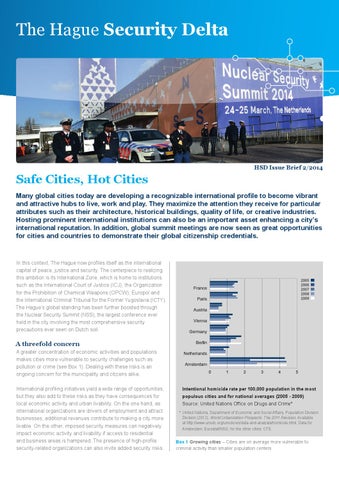
A threefold concern A greater concentration of economic activities and populations makes cities more vulnerable to security challenges such as pollution or crime (see Box 1). Dealing with these risks is an ongoing concern for the municipality and citizens alike. International profiling initiatives yield a wide range of opportunities, but they also add to these risks as they have consequences for local economic activity and urban livability. On the one hand, as international organizations are drivers of employment and attract businesses, additional revenues contribute to making a city more livable. On the other, imposed security measures can negatively impact economic activity and livability if access to residential and business areas is hampered. The presence of high-profile security-related organizations can also invite added security risks.
Intentional homicide rate per 100,000 population in the most populous cities and for national averages (2005 - 2009)
Source: United Nations Office on Drugs and Crime* * United Nations, Department of Economic and Social Affairs, Population Division Division (2012). World Urbanization Prospects: The 2011 Revision. Available at http://www.unodc.org/unodc/en/data-and-analysis/homicide.html. Data for Amsterdam: Eurostat/NSO; for the other cities: CTS.
Box 1 Growing cities – Cities are on average more vulnerable to criminal activity than smaller population centers