The 20th century: the coming of the age of photography The previously very complicated procedures involved in photography were as good as resolved during the 20th century. Cameras were easier to use and the growing numbers of photographic shops developed the photographs and sold the necessary equipment and accessories. Anyone who could afford a camera could start taking photographs immediately. The number of professional photographers and photographic studios increased enormously during the 20th century, as did their area of distribution. At least one photographic studio could be found in almost every large town throughout the archipelago.26 It is noteworthy that there were comparatively fewer European photographic studios than in the 19th century: now they were primarily run by Chinese and Japanese. Photographic studios seemed to reflect the social hierarchy: European photographers served the colonial upper class, while
those who could afford photographs, but found the European photographers too expensive, went to the more affordable Chinese tukang potret. These were craftsmen who sometimes made their own, modest wooden cameras that they fitted with German lenses. Chinese photographic studios were family businesses. Cousins or former fellow-villagers travelled directly from China or sometimes from Singapore and worked as apprentices, after which they opened their own studios and in turn taught an apprentice who likewise came from China. This phenomenon gave rise to a steadily growing network of photographers and appears to have been widespread throughout South East Asia.27 The Chinese studios also sold photographic equipment and accessories and processed films brought in by clients. In all likelihood the Chinese photographers also worked for their own Chinese community, but this falls beyond the scope of this study. The Tropenmuseum’s collections probably include more photographs by Chinese photographers
PHOTOGR APHS O F TH E N ETH ERLAN D S EAST I ND I ES AT THE TRO PENMU SEU M
Photo_p001_152_HT.indd 25
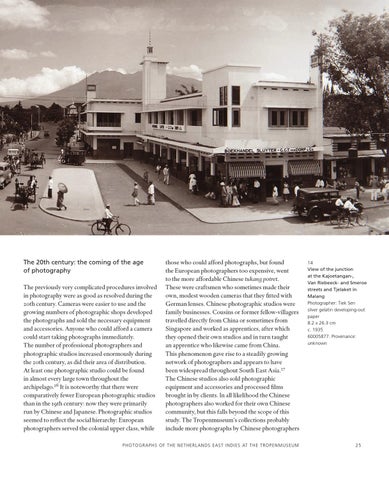
14 View of the junction at the Kajoetangan-, Van Riebeeck- and Smeroe streets and Tjelaket in Malang Photographer: Tiek Sen silver gelatin developing-out paper 8.2 x 26.3 cm c. 1935 60005877. Provenance: unknown
25
07-08-12 19:58