Right Educational Experience for Your Child
CHARTER SCHOOL a tax-supported public school that is independently run, allowing for greater educational choice for parents in the community.
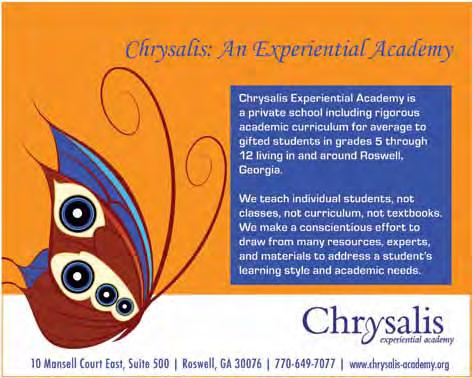
ExPERIENTIAL LEARNING an educational approach using applied, hands-on methods of learning.
INTERNATIONAL BACCALAUREATE (IB) a specifically designed comprehensive academic program emphasizing traditional disciplines while instilling a global perspective in its students.
MAGNET SCHOOL a public school that offers a specific or enhanced curriculum designed for students of special interest or ability.
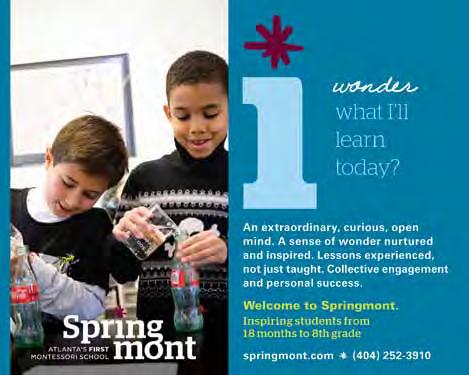
MONTESSORI a school following the principles developed by Dr. maria montessori focusing on the unique individuality, self-reliance and independence of children.
SPECIAL NEEDS a school or program for children who have mild-tomoderate learning differences. It usually features smaller class sizes, individualized attention and multisensory learning methods.
ACCREDITATION official certification that guarantees a school provides an education of a reasonably high quality. Schools must prove levels of quality and maintain continuous standards of improvement.
ACT an alternative to the SaT, this national college admissions examination consists of subject area tests in English, mathematics, Reading and Science, with an optional 30-minute writing test.
ADEqUATE YEARLY PROGRESS (AYP) a measure of year-to-year student achievement on statewide assessments as required by the No child Left Behind act.
CRITERION-REFERENCED COMPETENCY TESTS (CRCT)
Tests designed to measure how well students in grades 1 through 8 acquire the skills and knowledge described in the Georgia Performance Standards.
EARLY CHILDHOOD EDUCATION
Education that applies to children from birth to age 8, focusing specifically on their development, including physical, emotional, sensory, communicative, cognitive and social needs.
GEORGIA HIGH SCHOOL GRADUATION TESTS (GHSGT)
all students seeking a Georgia high school diploma must pass four content areas as well as the Georgia high School Writing assessment.
GEORGIA PERFORMANCE
STANDARDS Statewide standards of academic content for all subjects k-12, to which every school must adhere and on which students are annually tested.
HOPE SCHOLARSHIP (Helping Outstanding Pupils Educationally) a scholarship in Georgia, funded by the Georgia Lottery, that rewards academically achieving students with financial assistance to attend eligible public and private Georgia colleges and universities.
MISSION/PHILOSOPHY a statement outlining the guidelines a school follows to achieve its goals or maintain performance standards.
NO CHILD LEFT BEHIND ACT
a federal law passed in 2001 designed to ensure that all children have a fair and equal opportunity to obtain a high-quality education and meet state academic standards of proficiency.
NOTIFICATION DEADLINE
The date by which an independent school notifies families of the acceptance of a child for enrollment to the school.
OPEN HOUSE an event held at a school, at which parents can learn more about the school and its offerings.
PSAT a standardized test that offers students practice for the SaT Reasoning Test and allows them to qualify for the National merit Scholarship Program.
REPLY DEADLINE The date by which parents must notify an accepting school of their commitment to enroll their child.
SAT This standardized test measures the critical thinking, writing and mathematical reasoning skills of students planning to attend college.
Did You Know:
There were 1,657,507 students enrolled in Georgia public schools during the 2012-2013 school year.
SECONDARY SCHOOL ADMISSIONS TEST (SSAT) The admissions test that many independent schools require students to take in order to be considered for enrollment.
SUMMER CAMP a common destination for children and teenagers during the summer, at which they can participate in a variety of activities or classes.
critical communication
Deciphering associations and organizations
many local and national organizations work to bring out the best in summer camps and public, private and boarding schools by identifying schools that meet certain standards through accreditation. These groups also set policies, research educational advancements and offer services to the educational communities both in atlanta and in Georgia. The following are just some of the associations and organizations you should know in your search for the best educational experience for your child.
AdvancED www.advanc-ed.org
The parent organization for the Southern association of colleges and Schools, advancED advances education excellence through accreditation and school improvement.
American Camp Association (ACA) www.acacamps.org
accredits camps that meet industry-accepted and
government-recognized standards, educates owners and directors and establishes guidelines.
The Association of Boarding Schools (TABS) www.boardingschools.com
This organization of 300 boarding schools serves the professional development needs of boarding schools and provides information to potential students and their families.
Association of Christian Schools International (ACSI) www.acsi.org acSI strives to enable christian educators and schools worldwide to teach effectively using christcentered curricula and programs.
Association Montessori Internationale (AMI) www.montessori-ami.org
Recognizes schools that strongly adhere to montessori principles and practices.
Atlanta Area Association of Independent Schools (AAAIS) www.aaais.org although not an accrediting agency, aaaIS is an affiliation of independent schools and operates under analogous principles and a common code of ethics.
The Council of International Schools (CIS) www.cois.org
The premier organization in international education for the accreditation of schools and the development of best practices.
Department of Education (DOE) www.doe.k12.ga.us a statewide, policy-driven organization governing the public school system of education in Georgia for grades k-12, the Georgia DoE operates under the direction of the state superintendent of schools.
Georgia Accrediting Commission (GAC) www.coe.uga.edu/gac Gac offers four levels of approval: preparation status, provisional accreditation, accreditation and accreditation with quality.
Georgia Association of Christian Schools (GACS) www.gacs.org uses generally accepted indicators of quality, voluntary self-improvement and peer review to measure christian schools.
Georgia Association of Educational Leaders (GAEL) www.gael.org
This statewide umbrella organization of six professional associations provides unity among school leadership organizations in Georgia.
Georgia Association of Private Schools for Exceptional Children (GAPSEC) www.gapsec.org
This state organization is for schools that serve students with learning issues.
Georgia Charter Schools Association (GCSA) www.gacharters.org a membership organization whose mission is to be an effective advocate and service provider for all charter public schools in Georgia.
Georgia Independent School Association (GISA) www.gisaschools.org an association of private, independent and parochial schools throughout the state whose mission is to advance excellence and collaboration among private, independent and parochial schools.
Georgia Partnership for Excellence in Education (GPEE) www.gpee.org
This nonprofit organization of business, education, community and government leaders aims to shape policy and reform public education in the state.
Georgia Private School Accreditation Council (GAPSAC)
www.gapsac.org association of k-12 private schools whose students are recognized and approved by the Georgia DoE for transferring credits to public schools on the same basis as students from public schools.
Georgia Professional Standards Commission (PSC) www.gapsc.com a state organization responsible for setting and applying high standards for the preparation, certification and continued licensing of Georgia public educators, as well as
conduct of public school teachers and staff.
Georgia School Boards Association (GSBA) www.gsba.com
Representing Georgia’s 180 elected boards of education, GSBa provides leadership and services to local school boards.
National Association for the Education of Young Children (NAEYC) www.naeyc.org
The NaEyc focuses on the quality of educational and developmental services for children, from birth to age 8, including day care and pre-k centers. It is a national network of more than 300 local, state, and regional affiliates, and a growing global alliance.
National Association of Independent Schools (NAIS) www.nais.org
This association values and works to maintain the independent nature of each member school by promoting high standards of educational quality and ethical behavior.
National Association of Private Special Education Centers (NAPSEC) www.napsec.org
Represents private specialized education programs and their leaders u
by promoting high-quality programs and services for individuals with disabilities and their families.
National Christian School Association (NCSA) www.nationalchristian.org an organization that accredits member schools, overseen by a board of administrators from christian schools and universities.
National Council for Private School Accreditation (NCPSA) www.ncpsa.org a consortium of several private school organi-
zations dedicated to preserving the integrity of the accreditation process for thousands of private schools across the nation.
Southeastern Association of Boarding Schools (SABS) www.sabs.org an association of 23 boarding schools committed to promoting and supporting boarding education opportunities in Southeastern states, including the carolinas, alabama, Tennessee, Georgia and Florida.
Southern Association of Colleges and Schools (SACS) www.sacs.org member schools meet research-based standards and maintain continuous school improvement and quality assurance.
Southern Association of Independent Schools (SAIS) www.sais.org Members meet quality standards, receive peer evaluation and implement a school plan focused on strategic improvement.
For more information about these and other organizations and associations that ensure quality education among camps and schools, visit the websites of the Georgia Department of Education (www.k12.ga.us) or the u.S. Department of Education (www.ed.gov).
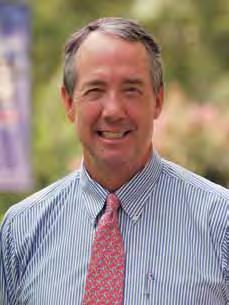
Thomas c. Whitworth III
Headmaster, Darlington School
Since 2005, Tom Whitworth has served as headmaster of Darlington School, an independent, coeducational collegepreparatory day and boarding school in Rome, Ga. Founded in 1905, Darlington is a culturally diverse and high-achieving learning environment.
What is your educational philosophy? my philosophy is that every decision a school makes should protect and grow the interests of the children at the school. It should be every school’s commitment to build programming and curriculum that can meet the needs of all students.
What do you love most about your job? I love talking with and getting to know the students. I also love helping to grow leaders, both in our student body and in our faculty, staff and administration.
How can parents best contribute to the educational process? make connections with your child’s teachers, coaches, advisor and administrators. allow your child to take risks and chances—this is an important part of the learning experience.
How is the field of education changing? We are preparing our students for jobs that don’t even exist yet. By teaching
students to think critically, to communicate effectively, and to understand (but not lean on) technology, we have a good start on building 21st century learners who will be prepared for any challenges they might face.
What advice would you offer parents about their children’s education?
Find a school whose mission and outcomes correspond with your family’s values, expectations and, more specifically, with your child’s strengths and goals.
THE ESSENTIALS: THE DARLINGTON SCHOOL
Emphasis: Empowering students to learn with passion, act with integrity and serve with respect.
Year Founded: 1905
Grades: Pre-k through 12
Students: 818
Avg. Class Size: 13
Tuition Range: $10,000 - $49,200
Accreditations or Affiliations: SacS, SaIS, mSa, TaBS, aaIS, GISa, cSEE, Nacac, NaIS
Location: Rome, Ga.
Contact: 706-235-6051 www.darlingtonschool.org
Special needs Resources
Information on Finding a School for Children with Learning Difficulties
What is a Special Needs School?
Special needs schools are those that serve children who struggle with learning disabilities or don’t perform well in a conventional school environment. these schools use alternative approaches to instruction in order to help children learn more effectively, and achieve success in the classroom and in social settings.
What is a Learning Disability?
A learning disability is a neurological disorder that affects how your child processes certain information. children with learning disabilities are as smart as or even smarter than other children, but may face challenges with reading, writing, spelling, reasoning and other functions. As a result, they often struggle to achieve in traditional classrooms. there are many types of learning disabilities, from Attention deficit disorder (Add) and dyslexia to more serious forms such as autism.
if your child exhibits more intelligence than his or her schoolwork demonstrates, contact your physician or a licensed psychologist for an evaluation.
How Do I Find the Right School?
As you begin searching for the right school for your child’s situation, here are some questions to keep in mind:
• Will your child fare better in a school that focuses on his or her specific learning disability, or would you

rather that he be able to interact with students with a wide range of learning capabilities?
• Does the school serve a specific age range, or work with students on all grade levels? Many students with learning disabilities have trouble transitioning to new schools.
• Does the school offer a variety of sports, after-school activities and arts programs?
• Is the school accredited? If so, by which organizations?
• Is the staff certified to instruct students with your child’s particular learning difficulty?
• Does the school offer financial assistance?
Where to Turn: A Directory of Special Needs Schools
Atlanta and the Southeast boast many public and private schools that serve students with learning difficulties. here are some schools to help you with your search.
PUBLIC SCHOOLS
H.A.V.E.N. Academy
Students with emotional behavior disorders and autism. Grades 1 through 12. two campuses in Smyrna. 678-842-6930 (hawthorne School), 678-842-6899 (Fitzhugh lee School). www.cobbk12.org/haven.
Margaret Harris
Comprehensive School Special education school for students
with severe and multiple disabilities. Pre-K through 12. 678-874-7000. www.dekalb.k12.ga.us/margaretharris.
INDEPENDENT SCHOOLS
The Academy at SOAR
Adhd and learning disabilities. Grades 6 through 12. 828-456-3435. www.academyatsoar.org.
Alexsander Academy
Students with learning difficulties. Grades 2 through 8. 404-839-5910. www.alexsanderacademy.org.
The Bedford School
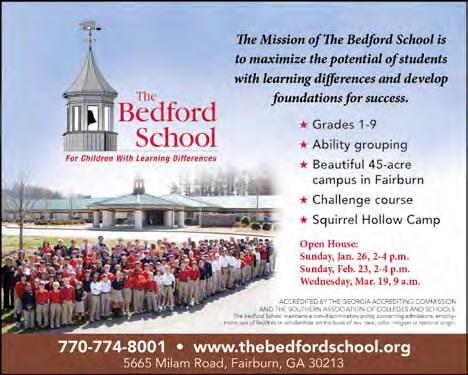
Add, Adhd, Asperger’s syndrome, dyslexia, central auditory processing disorder and other learning disabilities. Grades 1 through 9. 770-774-8001. www.thebedfordschool.org. u
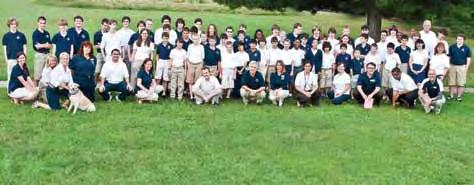
ACS & GAC Accredited
• O pen Enrollment
• Robotics, Drama, Chess • SB10 Approved • Social Skills
• Low Student-Teacher Ratio
• Summer Programs
Center Academy
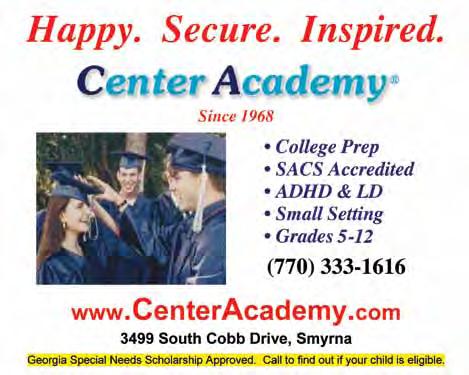
Add, dyslexia and other learning difficulties. Grades 5 through 12. 770-333-1616. www.centeracademy.com.
ClearWater Academy
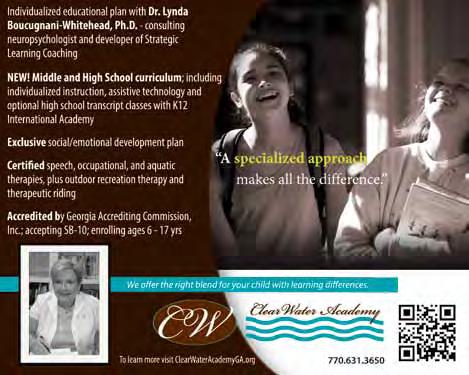
Add/Adhd, Asperger’s and other learning differences. children 6 to 17. 770-631-3650. www.clearwateracademyga.org.
Cumberland Academy of Georgia
Add/Adhd, autism, Asperger’s syndrome and learning disabilities. Grades 4 through 12. 404-835-9000. www.cumberlandacademy.org.
Eaton Academy
Average, gifted and students with learning challenges. K through 12. 770-645-2673. www.eatonacademy.org.
The Hirsch Academy children 5 to 13 with learning differences. 404-378-9706. www.hirschacademy.org.
Mill Springs Academy
children with average to superior abilities who have Adhd or learning differences. Grades 1 through 12. 770-360-1336. www.millsprings.org.
Porter Academy
Adhd, dyslexia and other differences. Pre-K through 8. 770-594-1313. www.porteracademy.org.
The Schenck School
Students with dyslexia. K through 6. 404-252-2591. www.schenck.org.
For an index of additional special needs schools, please turn to page 113.

INDEPENDENT SCHOOLS
HOW THEY PREPARE STUDENTS FOR COLLEGE AND BEYOND
BY RUKSANA HUSSAIN

When parents begin considering how to prepare their children for college, one of the first topics to arise is usually whether a public or independent school will provide a better foundation. A recent College Board Group Profile Report showed that metro Atlanta independent schools boasted average SAT scores nearly 200 points higher than those of the highestachieving local public schools, although there’s no conclusive data that independent school students have a leg up when it comes to college acceptance. And the metro Atlanta area is home to many great public schools, including charter and magnet schools, which do an excellent job of preparing students for college.
If you don’t have access to a quality public high school in your area, or simply want to explore other options, an independent school can position your child for success. Here are some of the ways that independent schools can lay the groundwork for excellence in college before your child even enters high school.
Curriculum and Special Programs
One advantage of independent schools is that many offer a stimulating academic curriculum that challenges students from an early age.
“We strive for a traditional yet innovative approach to education in the 21st century, offering diverse academic opportunities, strong art and athletic programs and state-of-the art facilities,” says F. Stuart Gulley, president of Woodward Academy, which serves more than 2,700 students from pre-K through grade 12 in College Park and Johns Creek.
Atlanta Girls’ School, which serves more than 200 female students in grades 6 through 12, offers a college-preparatory curriculum designed to foster each girl’s academic and social growth. Students also participate in two customized internships and a required global travel program.
“Families who choose Atlanta Girls’ School value—and are willing to pay for—particular qualities in their daughters’ educational experience that they are not able to get anywhere else in metro

Atlanta,” says Academic Dean Corinne M. Dedini.
In addition, a number of schools like Greater Atlanta Christian School (GAC) and Pace Academy offer college counseling programs that help students with everything from developing a list of prospective colleges to preparing for the ACT and the SAT. GAC’s Learning Center offers individualized academic assistance in core subjects, as well as an elective SAT-preparation course.
Smaller Class Sizes
“Independent schools ensure students are well prepared for life beyond school walls.”
CORINNE M. DEDINI Atlanta Girls’ School
Another benefit offered by independent schools is smaller class sizes, which are
often linked to better academic results.
“Independent schools provide much lower teacher-student ratios,” says Lynne Floyd, director of development at Eastside Christian School a pre-K through eighth grade school in Marietta. Those lower ratios provide for more individual attention between the student and the teacher.
“It is the personal relationship with families, and teachers knowing their students individually, that helps us meet the needs of students in a personal way,” she says. “Most families form lifetime relationships with staff and teachers, and we al-
ways hear back from them, expressing the worthiness of their investment.”
Gulley at Woodward Academy echoes that sentiment. “We provide wide individual instruction at every step of the process, be it interviews, admission or college placement,” he says. “We also respect varied learning styles and accommodate children of all learning abilities, compensating for our large size with the laser focus on individual students.”
During the summer of 2013, Atlanta Public Schools voted to hire additional teachers with an eye toward having class sizes as large as 25 students at the kindergarten level and as large as 35 in high school.
By comparison, The Friends School, a pre-K through eighth grade school in Decatur, averages 9 students per class, while Sophia Academy, which serves preK through high school, boasts an average class size of 10 and Eastside Christian School averages 14 students per class.
Character and a Global Perspective
In addition to their curricula and smaller class sizes, independent schools can help instill character traits and provide a wider perspective that can greatly benefit a student in his or her college years and beyond. “Independent schools ensure students are well prepared for life beyond school walls,” says Dedini of Atlanta Girls’ School.
As opposed to public schools, which mostly serve students within a set geographic boundary, independent schools attract students from across the metropolitan area. This often results in vibrant student bodies made up of many different backgrounds and nationalities. In this way, students are exposed to many different cultures, which prepares them for life in an increasingly global world.
“We have a deep respect for difference,” says Gulley with Woodward Academy. “We are diverse in that 40 percent are students of color and we cater to a 23-county area in Atlanta, which gives us a wide geographical reach.”
Many independent schools also focus on “character education,” stressing such values as empathy and respect to help mold students into involved members of society. The curriculum at Atlanta Girls’ School, for example, places a special emphasis on service and leadership. “AGS graduates develop the knowledge, skills, and strength of character to realize their dreams,” Dedini says.
At Eastside Christian School, “We instill personal responsibility at a young age, focusing on embracing the joy of lifelong learning and preparing for success,” says Floyd. “Children are encouraged to work together so they develop the capacity to enjoy accomplishments individually as well as that of fellow students.”
By offering a stimulating academic experience with a focus on individual attention, building character and a global perspective, independent schools provide an experience well worth the financial investment: an education that will pay dividends for a lifetime.
HELPFUL RESOURCES
Atlanta Area Association of Independent Schools www.aaais.org
Georgia Independent School Association www.gisaschools.org
National Association of Independent Schools www.nais.org
Southern Association of Independent Schools www.sais.org

Finding a Special Needs SCHOOL
SELECTING THE RIGHT FIT FOR CHILDREN WITH LEARNING DIFFICULTIES
BY MARY WELCH
Finding the right school for your child’s educational needs can be a challenge. But it can be even more difficult if your child is what some educators call “nontypical,” meaning he or she struggles with learning disabilities or doesn’t perform well in a conventional school setting.

How do you find the school that best meets your child’s needs when you don’t know what options are available, and may not know the exact nature of your child’s difficulties?
Fortunately, the Atlanta area is rich in schools dedicated to helping such children. Many of these schools focus on children with specific disabilities such as autism, dyslexia, attention deficit disorder (ADD) or attention deficit hyperactivity disorder (ADHD), while some more traditional schools offer help for children with learning issues in addition to their general curriculum.
Identify Your Child’s Issues
The Atlanta area is rich in schools dedicated to helping special needs children.
average intelligence but don’t perform well in a traditional classroom setting may be struggling with dyslexia, ADHD or Asperger’s Syndrome, a high-functioning form of autism, among many other possible diagnoses. If your child is more intelligent than his or her schoolwork demonstrates, it’s critical to have the child tested by a professional immediately.
“There really needs to be an evaluation, especially a psychology exam, so that the parents and the schools know what they’re dealing with,” says Betsy Box, executive director of the Bedford School.
So how do decide which school best suits your child’s educational needs? The first step is to identify his or her issues. Students who exhibit average or above-
If a professional diagnoses your child with a specific learning disorder, and your child is currently enrolled in a public school, an Individualized Education Program (IEP) evaluation may be in order. The Individuals with Disabilities Educa-

tion Act requires all U.S. public schools to develop an IEP for learningdisabled students who meet special education requirements. An IEP details how the child learns, sets measurable goals and outlines what the child’s teachers and other professionals can do to help him or her learn more successfully.

Armed with information, parents can start searching for schools that cater to their child’s specific difficulties. But there’s much more to finding schools than typing a few words into a search engine.
“Think about where you see your child long-term so that you can help them achieve the skills they need in order to get where you want them to go,” says Stefanie Smith, executive director of Alexsander Academy.

Know Which Questions to Ask It’s important to interview potential schools to determine their suitability. “You need to keep asking questions until you find a school that you are comfortable with that will have learning techniques that will work with your child,” says Ava White, founder of Ava White Academy and Tutorials, a learning center in Gainesville.
For instance, some schools focus on a specific disability: The Schenck School caters to students with dyslexia. Schools such as Mill Springs Academy and the Howard School cater to students with learning difficulties who plan go to college. Some, like Eaton Academy, don’t specifically target those with learning disabilities, but teach students across all

levels of learning who have had difficulty in a traditional classroom.
“Is the school more geared for students with strong academics and poor social skills,” asks Box, “or is it more for students with learning disabilities who learn in different ways?”
Other considerations include whether the school offers a variety of sports, afterschool activities and arts programs. Are there summer programs? Does it offer financial assistance? Is it accredited? And if so, by which organizations? Are the teachers certified to instruct special education or special-needs children?
The transition from middle school to a new high school can be a challenging one for many students with learning difficulties. Does the school serve a specific age range, or work with students on all grade levels?
After parents sort through the schools and come up with a short list of candidates, it’s time to make some calls. Con-
sult professionals such as your family doctor, who may be aware of schools that specifically cater to your child’s needs.
Then it’s time to visit the schools you’re interested in. This is crucial, as talking to the staff will give parents a sense of how they interact with students. If possible, talk to parents or students who have graduated. Ask for referrals of parents whose children exhibited learning behaviors similar to your child’s.
“Go With Your Gut”
At this stage of the process, it’s important to bring as much information on your child as possible. The more the school knows about your child, the better prepared it is to assess whether it and the child are a good match. In addition to the results of a psychological exam, bring a sample of the child’s schoolwork. “That way we see where the child is academically,” says Debbie Scarborough, co-founder of the Cumberland Academy of Georgia.
Once parents have done all the work and gathered all the information—having their child tested, finding schools in their area, researching and visiting them—the final choice may be easier than they think.
“Parents know their children better than anyone,” says Betsy Box of the Bedford School. “There may be more than one school that could be appropriate for your child. Go with the school that you think will work best for your child. Go with your gut.”
FOR MORE INFORMATION
For additional information on learning disabilities and special needs resources, including tips for finding the right school and a list of schools, please see our Special Needs section on page 20, and a list of special needs advertisers in this issue on page 113.

Learning Centers FINDING HELP OUTSIDE THE CLASSROOM and TUTORS
BY DANIEL BEAUREGARD

Every child learns differently. As a result, some students need more help than others, and may even require assistance outside of the classroom. Whether your child has trouble grasping a particular subject or just needs a hand organizing his or her study habits, help is available. From one-on-one tutors to learning centers, the Atlanta area offers resources that can help identify your child’s particular challenges and customize their instruction to fit his or her needs.
Sometimes a child doesn’t know when or how to ask for help. Fortunately, there are several warning signs that can indicate that your child may be in need of extra help, the most obvious being a drop in his or her grades.
“A couple of signs are consistent struggling in getting homework finished, or struggling with weekly quizzes,” says Jim Lawlor, owner of Appleton Learning, which has locations in Marietta and also Roswell. Other signs include “lack of motivation … attention problems, disorganization, procrastination or stress,” says
Carol Chandler-Wood, founder and CEO of Total Learning Concepts, a tutoring service with three metro Atlanta locations.
Once you’ve determined that your child needs help, the next step is figuring out the best way to help them. C2 Education, a national chain of learning centers with 16 locations in metro Atlanta, administers tests to evaluate what the students know.
“Then, the parent, student and a C2 program director review the results and discuss the student’s goals—what they and the parent want to get out of the experience,” says Jessica Stephens, C2’s marketing manager.
Maureen Sullivan, director of the Dunwoody location of Mathnasium, a learning center specifically dedicated to mathematics, speaks to students about their favorite and least favorite parts of math to figure out why they’re struggling.
“They might say, ‘I loved math up until last year and I hate it now,’ and that’s a red flag that something went wrong last year,” she says. u

Customized Instruction
Appleton Learning takes a different approach. Its “geniuStyle” program identifies a child’s learning style, including “how they like to receive information, process information and organize information,” says Lawlor. Students are classified as belonging to one of eight different learning styles—each named for a famous thinker or artist such as Aristotle, Da Vinci, Plato or Socrates—and instruction is customized accordingly.
Heather Love, associate director for Atlanta Tutors, speaks with parents and administers practice tests to gain insight into a student’s particular strengths and challenges, and tailors her approach to meet those needs.
“If a student is more of a visual learner, then a tutor can take the time to draw diagrams or use instructional videos,” she says. “For the auditory learner, a tutor can teach the student songs that incorporate math facts or grammar rules.”
Customization is also a key component at Total Learning Concepts. “We
tailor our work very specifically to each student, rather than plugging them into pre-existing, ‘canned’ programs of study,” Chandler-Wood says.
At Appleton, a large part of tailoring instruction to each student is frequent communication between all parties involved. “We are constantly in communication with parents, students and teachers,” Lawlor says. Likewise, Stephens says communication with parents is “a key part” of the C2 Education process.
The benefits of supplemental instruction aren’t limited to children who are having trouble with a particular subject. Tutors and learning centers like Kaplan and Applerouth can also help students prepare for standardized tests such as the SAT, ACT, CRCT and SSAT.
Enhancing Classroom Learning
In addition, some learning centers offer students the chance not just to catch up to their classmates, but to enhance their current coursework. Centers like C2, Mathnasium and Appleton even offer
different summer programs to help students prepare for the coming school year or gear up for standardized tests. “Summer sessions at Total Learning Concepts may involve enrichment work, such as previewing material for the next school year in subjects the student believes will present him or her with the most challenges,” says Chandler-Wood.
The goal, says Stephens, isn’t just to help students with their current classes, but to prepare them for the future by teaching them how to become independent learners who can succeed on their own outside of school.
“We don’t want students to just come in and memorize everything and then regurgitate those facts onto a test,” she says. “We want them to take this knowledge and these abilities with them on to college and beyond.”
FOR MORE INFORMATION
Applerouth Education
404-728-0661, www.applerouth.com
Appleton Learning
770-971-1500 (Marietta), 770-998-1500 (Roswell), www.appletonlearning.com
Atlanta Tutors
678-412-5457, www.atlantatutors.net
C2 Education
888-901-4755, www.c2educate.com
Kaplan 954-515-3993, www.kaplan.com
Mathnasium
877-601-6284, www.mathnasium.com
Total Learning Concepts 770-381-5958 (Lilburn), 770-466-8282 (Loganville), 770-271-7544 (Dacula), www.totallearningconcepts.com

metro atlanta area map
REGIONS FOR INDEPENDENT SCHOOLS N
For features of independent schools, turn to Education At-a-Glance on pg. 38. For public school system information by county, turn to pg. 88.
3 3
2
2
1 1
5 5
Boar ding Schools Connecticut, Georgia, Florida, Illinois, Kentucky, New Y ork, North Carolina, South Carolina, Virginia,
School County Guide
Educational Resources Tutoring, Summer Camps and Activities, Field T rips and Outreach Programs.
REGION 4: Atlanta South/ Southeast/Southwest
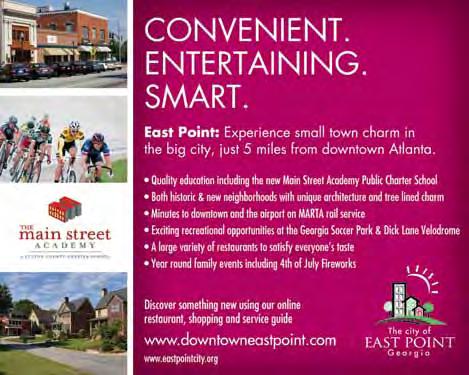
Atlanta South, Altanta Southeast, College Park, Downtown McDonough, Eagle’s Landing, East Point, Fairburn, Kedron ar ea, Locust Grove, Newnan
REGION 5: Atlanta W est Kennesaw, Lithia Springs, Marietta, Powder Springs, Smyrna/Vinings Area
REGION 1: Atlanta North/Northwest
Alpharetta, Buckhead, East Cobb, Marietta, Roswell, Sandy Springs
REGION 2: Atlanta North/Northeast
Alpharetta, Cumming, Duluth, Dunwoody , Johns Creek, Northeast Atlanta, North Fulton, Sandy Springs, Suwanee
REGION 3: Atlanta East Ansley Park, Athens, Dacula, Decatur, Druid Hills, Lawrenceville, Lilburn, Midtown
Education At-a-Glance
INDEPENDENT SCHooLS
REGIoN 1: ATLANTA NoRTH/NoRTHwEST
2: ATLANTA NoRTH/NoRTHEAST
Education At-a-Glance
INDEPENDENT SCHooLS
56 REGIoN 3: ATLANTA EAST
REGIoN 4: ATLANTA SoUTH/SoUTHEAST/SoUTHwEST
Education At-a-Glance
INDEPENDENT SCHooLS
71 REGIoN 5: ATLANTA wEST
independent schools
Alpharetta Once a small farming community, Alpharetta’s growth has exploded in recent years and is now one of Atlanta’s most affluent neighborhoods, creating the perfect mix of country living and city amenities.
Buckhead A development group is currently creating what is being referred to as the Rodeo Drive of the South, where luxury retailers and high-end restaurants will be the feature. Luxury condos offer residents city living at its finest.

“I’ve always believed that if a student can’t learn the way we teach…we should teach the way a student can learn.”
TWEETIE L. MOORE, Founder




BUCKHEAD
The Heiskell School







SANDY SPRINGS
Independent Schools
RegIon
Duluth A successful mix of small-town charm and booming economic growth, Duluth plays host to many major corporations and is also home to numerous golf clubs, private tennis clubs and parks. The city prides itself on accommodating a growing, diverse population.
Dunwoody A popular community among young and established professionals alike, Dunwoody is often referred to as the “tennis set” neighborhood because of its numerous recreational outlets. Its location provides suburban living close enough to the city.






ATLANTA NORTH SCHOOL


Atlanta
the
School is committed
Challenging Academic Curriculum
Small Class Sizes
Quality Leadership
Up-to-Date Technology
Music Program
Fully-equipped Science and Art Studio

• Children ages 18 months to 6 years
• Montessori-certified teachers
• Developmentally appropriate, high quality materials
• Vibrant classroom communities
• Child-centered, holistic Montessori education
“Education should no longer be mostly imparting of knowledge, but must take a new path, seeking the release of human potentialities.”
– Dr. Maria Montessori







World
1 Pre-K (4) through 5th grade elementary program
1 High curriculum standards & creative learning environments
1 Interactive Technology in every classroom (whiteboards & laptops)
1 Rosetta Stone Spanish in all classes
1 Extracurricular Activities (ballet, jazz, chorus, drama, Tai-Kwon-do, piano)

Independent Schools
Decatur The county seat of DeKalb County, Decatur’s small-town charm revolves around the Courthouse Square, which features trendy restaurants and shopping, entertainment options and special events, including its annual summer beach bash.
Lawrenceville Located in the heart of Gwinnett County and known as “Crepe Myrtle City,” Lawrenceville is Atlanta’s second oldest city. Its historic downtown square, which has been revitalized, is home to a variety of shops, restaurants and community events.
decatur • dacula












Independent Schools
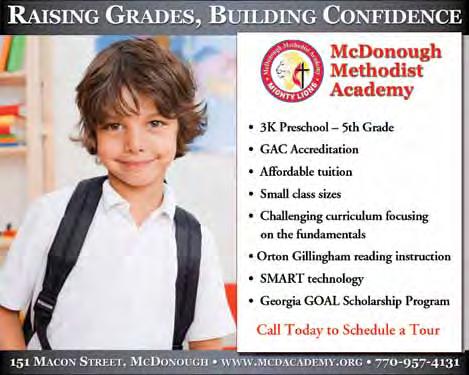
McDonough One of the fastest-growing neighborhoods South of Atlanta, McDonough is the county seat of Henry County and features many historic structures around its town square. The city has ample green space and is a favorite destination for antique shoppers.
Peachtree City A master-planned city comprised of several smaller villages, Peachtree City’s many amenities include golf courses, lakes and an amphitheater. The city is renowned for its network of golf paths connecting its neighborhoods.
ATLANTA S o UTHEAST







agle’s l anding • east point
d
d

d Individualized Instruction
d Accredited Curriculum (A.C.E.)
d Tuition assistance / Scholarships available


BAR TO W
Independent Schools
FULTON
Acworth Surrounded by two lakes and 12 parks, Acworth offers plenty of recreation opportunities, including the Cobblestone Golf Course, one of Golfweek’s 2010 Best Municipal Courses. Located 35 miles northwest of Atlanta, the town is convenient to both I-75 and Highway 41. Acworth is designated as a Georgia Main Street City.
Douglasville A quick trip west of Atlanta on I-20, Douglasville has easy access to all that Atlanta offers—including Six Flags, 10 minutes away—but plenty of its own charm, too. Listed on the National Register of Historic Places, Downtown Douglasville’s historic district is an outstanding example of a turn-ofthe-century southern railroad town.
n e I ghbo R hood S of n ote
K ENNESA






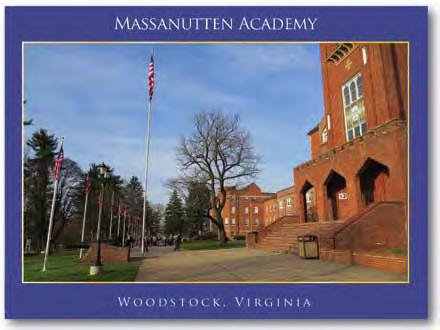

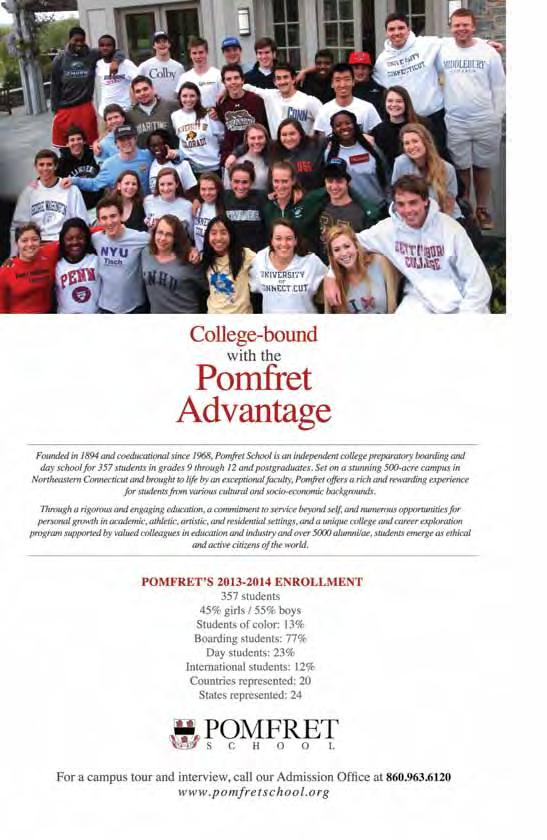
There are many benefits of a boarding school education. Boarding schools are an option for students seeking a more independent learning experience. Because students generally live on campus, learning takes place in and out of the classroom almost on a 24-hour basis.
When selecting a boarding school, it is important to visit the school campus, but representatives from many boarding schools visit metro atlanta throughout the year—contact each school for specific dates.
Boarding School



north carolina •

LINA

Ben Lippen School
A Christian, coed, college and calling preparatory boarding and day school for 7th-12th grade students

Join our globally diverse community instilling respect, responsibility, and integrity in the lives of young people. Stretch yourself academically as you develop your interests and pursue God’s calling for your life.

Located on the campus of Columbia International University in Columbia, SC

variety of improvements and innovative programs in Georgia’s public school systems have resulted in many stellar elementary, middle and high schools across the metro area. Different school systems feature specialized programs and academic opportunities, such as magnet, charter, vocational or alternative schools to suit their respective students, parents and communities. however, despite variations in programming and academic offerings, all public schools must offer the core curriculum as determined by the Georgia Board of Education. here is a county-by-county guide to metro atlanta’s public school systems. For more information about the Georgia Department of Education, call 404-656-2800 or visit www.gadoe.org. u

chaRTER SchooLS
According to the Georgia Department of Education, a charter school operates according to the terms of a charter, or contract, that has been approved by the local and state boards of education. The school is held accountable by the state for meeting the performance-based objectives laid out in the charter, as well as state curriculum standards; however, students, parents and teachers enjoy more decision-making freedom.
Time-tested approach. Brand new choice.
Atlanta Classical Academy is a tuition-free public charter school opening for the 2014-2015 school year for grades K - 8 (scaling to K-12).
Content-rich, liberal arts approach emphasizing virtuous living, traditional learning, and civic responsibility
Open enrollment process begins January 1, 2014. Families must reside within the Atlanta Public Schools district to attend.
Learn more!



2013 Average CRCT Scores
3rd: (R) 850.42 (M) 846.52
5th: (R) 837.19 (M) 845.18
8th: (R) 841.01 (M) 823.34
2013 Average SAT: 1440
Top 3 Schools by Average
What’s New
The Adairsville High School SkillsUSA Team took home the national championship in the TeamWorks competition over the summer. The competition tested their carpentry, masonry, electrical wiring and plumbing skills.
What’s New
Bascomb Elementary’s Kim Hellenga and Hasty Elementary’s Sarah Weiss were awarded $1,000 worth of classroom supplies by OfficeMax and AdoptaClassroom.org.
2013 Average CRCT Scores
3rd: (R) 832.55 (M) 820.74 5th: (R) 829.79 (M) 832.86 8th: (R) 834.12 (M) 821.09
The
2013 Average CRCT Scores
3rd: (R) 853.32 (M) 848.56
5th: (R) 842.43 (M) 854.01
8th: (R) 848.01 (M) 844.40
2013 Average SAT: 1515
Top 5 Schools by Average 2013 SAT Score
Board of Education
770-426-3300
www.cobb.k12.ga.us
Total # of Students: 108,496
Spending per Student: $8,240
What’s New
Keheley Elementary School was one of only 267 schools honored by the Alliance for a Healthier Generation for its focus on health and wellness for students and staff. Keheley is the first Cobb County school to receive the award.
Board of Education 770-254-2800
www.cowetaschools.org
What’s New
Coweta County’s three high schools achieved average 2013 SAT scores higher than the state average. The district’s average score of 1475 beat the state average of 1452 by 23 points. Additionally, Northgate High’s average of 1501 outscored the national average of 1498.
What’s New
Sureka Taylor of The Champion School was one of three Georgia teachers selected as finalists for the Presidential Award for Excellence in Mathematics and Science Teaching. The winners will be announced in the summer of 2014.
DoUGlaS
2013 Average CRCT Scores
3rd: (R) 846.38 (M) 845.63
5th: (R) 838.37 (M) 848.46
8th: (R) 841.05 (M) 824.17
2013 Average SAT: 1338
Top 5 Schools by Average
2013 SAT Score
Alexander High 1414
Douglas County High 1404 Chapel Hill High 1358
New Manchester High 1247
Lithia Springs High 1227
Board of Education 770-651-2000 www.douglas.k12.ga.us
What’s New
Lithia Springs High School’s Reading Bowl team took home top honors at the Helen Ruffing Reading Bowl State Championship in the high school division.
What’s New
The school system and the Fayette County Chamber of Commerce have implemented V.I.T.A.L. (Volunteer Initiative To Assist Learning) to attract volunteer help to county schools.
2013 Average SAT: 1580
Top 5 Schools by Average
What’s New Forsyth Central High School’s STEM (Science, Technology, Engineering and Mathematics) Academy was honored as Georgia’s best high school STEM program during the second annual Georgia STEM Education Awards.
Board of Education 770-229-3710 www.spalding.k12.ga.us
Spending per Student: $9,237
What’s New
2013
1567
Top 5 Schools by Average
High 1672
High 1667
McClarin High School, an open-campus, non-traditional school, has been awarded a $3.4 million School Improvement Grant by the Georgia Department of Education to help student achievement and improve the school environment.
2013 Average SAT: 1331 Top 2 Schools by Average 2013 SAT
What’s New Spalding High teacher Lindsey McDaniel received a $1,000 New Teacher Assistant grant in October courtesy of Georgia Power. The grant is designed to recognize and encourage new teaching talent and goes toward classroom supplies and materials.
2013 Average CRCT Scores 3rd: (R) 853.01 (M) 854.67 5th: (R) 843.18 (M) 857.77 8th: (R) 848.37 (M) 848.36
2013 Average SAT: 1513
Top 5 Schools by Average 2013 SAT Score
1612
Gwinnett High 1512
High 1578
Ridge High 1572
1546
of Education 678-301-6000 www.gwinnett.k12.ga.us What’s New Gwinnett County’s 2013 SAT scores outshone both the state and national averages. The district’s average score of 1513 is 15 points above the national average of 1498 and 61 points above the state average of 1452.
Board of Education 770-534-1080 www.hallco.org/boe
Board of Education
770-957-6601
www.henry.k12.ga.us
www.paulding.k12.ga.us
Number of Schools
Total # of Students: 26,740
Spending per Student: $7,796
What’s New
2013 Average CRCT Scores
3rd: (R) 842.14 (M) 833.54
5th: (R) 833.17 (M) 836.85
8th: (R) 838.69 (M) 829.52
2013 Average SAT: 1399
Top 5 Schools by Average
2013 SAT Score
North Hall High 1519
Flowery Branch High 1414
Johnson High 1375
West Hall High 1372
Chestatee High 1365
Hall County Schools received the 2013 Safe School Leadership Award from the National Association of School Resource Officers over the summer.
2013 Average CRCT Scores
3rd: (R) 847.31 (M) 838.71 5th: (R) 840.02 (M) 846.63
Top 5 Schools by Average
Total # of Students:
Spending per Student: $7,666
What’s New
1369 Dutchtown High 1350
Unity Grove Elementary teacher Amanda Cavin was awarded a $2,000 prize, and the school system a $5,000 grant, through the state’s Innovation in Teaching competition.
2013 Average CRCT Scores
3rd: (R) 853.21 (M) 853.46
5th: (R) 840.93 (M) 849.57
8th: (R) 842.29 (M) 835.67
2013 Average SAT: 1354
Top 5 Schools by Average
2013 SAT Score
North Paulding High 1404 East Paulding High 1356 Hiram High 1345 Paulding County High 1340 South Paulding High 1317
What’s New
Paulding County Schools has announced a new school safety initiative designed to improve schools’ current procedures. School visitors and volunteers will be registered and issued a photo ID when they are on school grounds.
HALL
Board of Education
770-483-4713
www.rockdale.k12.ga.us
atlanta PUblIC SChoolS
Total # of Students: 15,309
per Student: $9,282
What’s New
2013 Average CRCT Scores
3rd: (R) 845.68 (M) 843.41
5th: (R) 837.60 (M) 848.11
8th: (R) 842.93 (M) 831.56
2013 Average SAT: 1378
Top 3 Schools by Average 2013 SAT Score Heritage High 1426 Rockdale High 1375
High 1312
Rockdale County elementary and middle schools scored above the state average in the 2013 Georgia College and Career Ready Performance Index.
What’s New
Nine Atlanta Public Schools high school students were recently named National Merit Semifinalists. These academically gifted students will learn in February whether they are finalists in the running for prestigious National Merit Scholarships.
Board
770-945-5035
www.bufordcityschools.org
What’s New
2013 Average SAT: 1495
Buford High School was named one of Newsweek’s 2013 top high schools in the nation. The list recognizes public schools that have proven most effective in producing college-ready graduates.
Board of Education
404-370-4400
www.csdecatur.net
2013
What’s New
2013 Average SAT: 1528
Oakhurst Elementary was named a 2012 Georgia School of Excellence by the Georgia Department of Education in August for being the fourth-highest ranked school on the state’s College and Career Ready Performance Index.
770-536-5275
www.gcss.k12.net
2013 Average SAT: 1364
What’s New
Students of the Fair Street School moved into their new campus in October, after being housed at Wood’s Mill Academy during construction. The previous Fair Street building was demolished in 2012.
2013 Average SAT: 1456
What’s New
The Marietta Center for Advanced Academics was one of 236 high schools in the nation recognized as a 2013 National Blue Ribbon School. The STEM-focused magnet school serves students in grades 3 through 5.
EDucaTIoNaL



S UMMER C AMPS & A CTIVITIES

C AMPS & A CTIVITIES











& oUTREACH





ADVERTISER INDEX
Boarding Schools
Early Education
Special Needs & Learning Difficulties
Tutoring & Study Skills