Education that applies to children from birth to age 8, focusing specifically on their development, including physical, emotional, sensory, communicative, cognitive and social needs.
EVERY STUDENT SUCCEEDS ACT
(ESSA) The main federal law for K-12 general education covers all students in public schools.
GEORGIA MILESTONES Tests designed to measure how well students in grades 3 through 12 acquire the skills and knowledge outlined in the state-adopted content standards. They replaced the CRCT and involve both multiplechoice and free-response questions.
GEORGIA PERFORMANCE
STANDARDS Statewide standards of academic content for all K-12 subjects, to which every school must adhere and on which students are annually tested.
HOPE SCHOLARSHIP
(Helping Outstanding Pupils Educationally)
Funded by the Georgia Lottery since its founding in 1993, this is a scholarship in the state that rewards academically achieving students with financial
Did You Know?
Atlanta Public Schools recently announced a grading policy change, giving students a 50 instead of a zero on incomplete assignments.
assistance to attend eligible public and private Georgia colleges and universities.
MISSION/PHILOSOPHY A statement outlining the guidelines a school follows as it works to achieve its various educational goals and/or maintain its performance standards.
NOTIFICATION DEADLINE
The date by which an independent school notifies families of the acceptance of a child for enrollment to the school.
OPEN HOUSE An event held at a school where parents can learn more about the school and its offerings.
PSAT A standardized test that offers students practice for the SAT Reasoning Test and allows them to qualify for the National Merit Scholarship Program
REPLY DEADLINE The date by which parents must notify an accepting school of their commitment to enroll their child at the school.
SAT This standardized test, known as the Scholastic Aptitude Test, measures the reading, writing and mathematical reasoning skills of students planning to attend college.
SECONDARY SCHOOL ADMISSIONS
TEST (SSAT) The admissions test that many independent schools require students take in order to be considered for enrollment.
SUMMER CAMP A common destination for children and teenagers during the summer, at which they can participate in a variety of activities or classes.
Deciphering Associations and Organizations
Many local and national organizations work to bring out the best in summer camps and public, private and boarding schools by identifying schools that meet certain standards through accreditation. These groups also set policies, research educational advancements and offer services to the educational communities both in Atlanta and in Georgia. The following are just some of the associations and organizations you should know in your search for the best educational experience for your child.
AdvancED advanc-ed.org
The parent organization for the Southern Association of Colleges and Schools, AdvancED advances education excellence through accreditation and school improvement.
The Association of Boarding Schools (TABS) boardingschools.com
This organization of 250 boarding schools serves
the professional development needs of boarding schools and provides information to potential students and their families.
American Camp Association (ACA) acacamps.org
Accredits camps that meet industry-accepted and government-recognized standards, educates owners and directors and establishes guidelines.
Association of Christian Schools International (ACSI) acsi.org
ACSI strives to enable Christian educators and schools worldwide to teach effectively using Christcentered curricula and programs.
Association Montessori Internationale (AMI) ami-global.org
Recognizes and provides support, training and development to schools that strongly adhere to Montessori method principles.
Atlanta Area Association of Independent Schools (AAAIS) aaais.org
Promotes the highest standards and best administrative practices for accredited independent schools.
Cognia cognia.org
Formed from the merger of two organizations (AdvancED and Measured Progress), it advances education excellence through accreditation and school improvement initiatives.
Georgia Association of Educational Leaders (GAEL) gael.org
This statewide umbrella organization of six professional associations provides unity among school leadership organizations in Georgia.
Department of Education (DOE) gadoe.org
A statewide, policy-driven organization governing the public school system of education in Georgia for grades K-12, the Georgia DOE operates under the direction of the state superintendent of schools.
Georgia Association of Christian Schools (GACS) gacs.org
Uses generally accepted indicators of quality, voluntary self-improvement and peer review to measure Christian schools.
Georgia Association of Private Schools for Exceptional Children (GAPSEC) gapsec.org
This state organization of independent schools for students with learning disabilities maintains a code of ethics.
Georgia Charter Schools Association (GCSA) gacharters.org
A membership organization whose mission is to be an effective advocate and service provider for all charter public schools in Georgia.
Georgia Independent School Association (GISA) gisaschools.org
An association of Georgia’s private, independent
and parochial schools dedicated to serving the professional growth, advocacy and interscholastic needs of member schools.
Georgia Partnership for Excellence in Education (GPEE) gpee.org
This nonprofit organization of business, education, community and government leaders aims to shape policy and reform public education in the state.
Georgia Private School Accreditation Council (GAPSAC) gapsac.org Association of K-12 private schools whose students are recognized and approved by the Georgia DOE for transferring credits to public schools on the same basis as students from public schools.
National Association for the Education of Young Children (NAEYC) naeyc.org
A professional membership organization working to promote high-quality early learning for all young children, birth through age 8, by connecting early childhood practice, policy and research.
National Association of Independent Schools (NAIS) nais.org
This association values and works to maintain the independent nature of each member school by promoting high standards of educational quality and ethical behavior.
National Association of Private Special Education Centers (NAPSEC) napsec.org
Represents private specialized education programs by promoting quality programs and services for individuals with disabilities and their families.
National Christian School Association (NCSA) nationalchristian.org
An organization that accredits member schools, overseen by a board of administrators from Christian schools and universities.
Southern Association of Independent Schools (SAIS) sais.org
Provides accreditation services, professional growth opportunities and leadership development programs for 390 independent U.S. schools.
For more information about these and other organizations and associations that ensure quality education among camps and schools, visit the websites of the Georgia Department of Education (gadoe.org) or the U.S. Department of Education (ed.gov).
Information on Learning Disabilities, Education Options and More
What is a Learning Disability?
A learning disability is a neurological disorder that affects how your child processes certain information. Children with learning disabilities are as smart as or even smarter than other children, but may face challenges with reading, writing, spelling, reasoning and other functions. As a result, they often struggle to achieve in traditional classrooms. There are many types of learning disabilities, from Attention Deficit Hyperactivity Disorder (ADHD) and dyslexia to more serious forms such as autism.
What is a Special Needs School?
Special needs schools are those that serve children who struggle with learning disabilities or don’t perform well in a conventional school environment. These schools use alternative approaches to instruction in order to help children learn more effectively and also achieve success in the classroom and in social settings. Other schools don’t specifically target those with learning disabilities, but may teach different kinds of students who have had difficulty learning in a typical class-
room setting. Others may teach average or even above-average learners while also offering additional programs and classes for students with learning differences.
How to Tell if Your Child Has a Special Needs Situation
First, it’s important to identify your child’s specific challenges. Students who exhibit average or above-average intelligence but often seem distracted and don’t perform well in a traditional classroom setting may be struggling with dyslexia, Asperger’s syndrome, ADHD or some other disorder that affects their ability to learn effectively. Also, disruptive or aggressive children may be exhibiting frustration brought on by a learning disability.
If you suspect your child may have a learning dis-
ability, it’s critical to have him or her evaluated by a mental health professional. A diagnosis is necessary in order to address the child’s educational needs.
After a Diagnosis: What’s Next?
A professional evaluation is crucial in order to evaluate your child’s educational needs.
If your child is diagnosed with a learning disability and attends public school, talk with the principal, school counselor or another administrator about developing an Individualized Education Program (IEP). All public schools are required to create an IEP for students with learning disabilities who meet special education requirements. An IEP is a document that specifies your child’s learning situation and educational needs and outlines a course of action for teachers and other professionals to follow to help make sure your child learns to the best of his or her ability. u
If you feel your local public school isn’t the right environment for your child or simply want to explore all your options, there are many quality independent schools in metro Atlanta devoted to helping children with special needs and learning issues. Visit the Georgia Association of Private Schools for Exceptional Children’s website (gapsec.org) or our listings for special needs schools on page 98 to help you with your search.
How Do I Find the Right School?
All special needs schools are not the same. The first step is to identify those schools that can address your child’s specific learning difficulty, and offer the level of special needs instruction that you (and perhaps a professional) feel is best for your child.
You may be more comfortable enrolling your child in a school that focuses specifically on his or her needs, or you may want a more diverse environment where he or she can interact with many different kinds of students. Familiarize yourself with the different options offered by each kind of school.
Traditional independent schools that offer special needs programs as part of a larger curriculum can offer that kind of environment, but may have larger class sizes than schools that specialize in specific learning disabilities. These kinds of schools may also focus more on academics than on the therapeutic aspects of special
needs education. Independent special needs schools can offer more individualized instruction and a more structured and predictable environment, and are likely to address nonacademic issues such as social skills and self-esteem.
As you begin searching for the right school for your child’s situation, here are some questions to keep in mind:
• Will your child fare better in a school that focuses on his or her specific learning disability, or would you rather that he or she be able to interact with students with a wide range of learning capabilities?
• Does the school serve a specific age range or work with students on all grade levels? Many students with learning disabilities have trouble transitioning to new schools.
Identify those schools that can best address your child’s specific learning difficulty.
• Does the school offer a variety of extracurricular activities, including arts and sports programs?
• Is the school accredited? If so, by which organizations?
• Is the staff certified to instruct special needs children or those with your child’s specific learning difficulty?
• Does the school focus more on academics or on addressing the child’s therapeutic needs?
Financial Assistance
Many independent special needs schools participate in the Georgia Special Needs
fees at participating private schools authorized by the State Board of Education. According to the Georgia Department of Education, scholarship amounts range from $2,500 to $13,500, with an average amount of around $6,000.
The Qualified Education Expense Tax Credit program provides another scholarship option. Donations are made to an organization known as a Georgia Student Scholarship Organization (GaSSO), which uses the money to award scholarships to students in pre-K through grade 12. Many schools also offer their own scholarships or tuition assistance programs as well.
QUESTIONS TO ASK TO FIND THE RIGHT FIT HOW TO INTERVIEW A SCHOOL
BY H.M. CAULEY
For parents looking for educational options for their children, one of the best developments in education is the availability of a wider range of school choices than ever before. At the same time, this abundance of choice can be a source of stress when searching for a school, as parents work to weigh a greater number of alternatives objectively. When searching for the right school for your child, there’s no more important part
of the process than asking questions of the faculty and staff. From a school’s educational philosophy to its test scores and what it serves for lunch, it’s crucial to get as much information as possible to help you make the right decision. But what questions should you ask?
ACADEMICS
The first thing to ask about is a school’s academics. Cory Edwards, director for the
office of student assignment and records for Atlanta Public Schools (APS), says parents should first do some online research on the schools in their prospective community before buying a home or signing a rental agreement. “After some parents move here, then they want their child to attend a particular school,” he added. Edwards encourages parents to visit not only the school district’s website, but also each individual school’s website to get a feel for each school.
And for parents who decide that they want to transfer their child to another school in the district, whether they’re new to metro Atlanta or not, the state offers a program within each district to allow that move, with each district’s website providing info.
Nicole Evans Jones, an educational consultant with 360 Strategy Consulting, encourages parents to consider just what they want their children to learn. “The course offerings and the extracurriculars may not fit your child’s needs,” she says. “Look at the course of study and talk about what the kids are learning.”
Kimbrell Smith, head of school at Atlanta Girls’ School (AGS), agrees. An Atlanta native, she has two daughters: one an eighth-grader at AGS and the other a fifth-grader at The Howard School. Prior to coming to AGS in 2021, Smith spent 12 years as an educational consultant and specialized in helping parents find the bestfitting schools for their child. “I tell parents and follow my own advice, which is to consider your child first,” she says. “What kind of school shares the values for your child? What needs might they have that different schools could provide?”
For both students and schools, standardized test performance is only a snapshot of academic achievement, but it should be considered. Look at a school’s average test scores, and compare them to results for the
past three to five years to determine if they are trending upward or downward. If a test area is weak, determine if there’s an underlying cause. A science and technology magnet school may score slightly lower than average in English, for example. What’s as important as the score is what’s being done to address any deficiencies and to keep improving.
For parents of middle and high school students, college preparation is of critical importance. Asking about the percentage of students at a school that go on to college and which colleges can help you learn about not just a school’s academic rigor, but also how well it supports a commitment to learning in its students.
Other topics to ask about regarding academics include: How often is homework assigned and how much time does it require? Are tutoring and study assistance available? What programs and support are available for special needs or academically
Visiting a school can demonstrate all aspects of the school’s culture, including how open and enthused the staff and faculty are.
gifted students? What extracurricular activities are offered?
It’s also important to ask about teachers. Review the educational background and qualifications for individual teachers and note how these relate to the subjects they teach. While class size and student-teacher ratio are good indicators of how much individual attention can be expected, especially in the lower grades, how it’s computed can make a difference. For a clear picture, ask if the school includes staff such as librarians in its teacher count when determining its published ratio.
COMMUNITY, CULTURE AND COST
Every school has a unique culture and its own concept of involving the family in its approach to learning. The answers to ques-
tions about a school’s recent accomplishments and outstanding features can speak volumes about a school’s mission and values, and how it might make decisions affecting your child going forward.
Cindy Kinchen, principal at Gwinnett County’s Duluth Middle School, says parents also can get a feel for a school’s culture from visiting its social media pages. She also encourages parents to ask about a school’s non-academic programs such as sports and community service.
Other questions relating to a school’s culture include: Are uniforms required? Is transportation available for students who live at a distance? What are the behavior and discipline policies?
One important topic, whether you’re interviewing a traditional public, charter or independent school, is funding. Are there
booster clubs, foundations or stakeholders that support the school?
Also, find out about tuition: what does it cover? Are there added fees for extracurricular activities, events outside of class or equipment and supplies?
VISITING IN PERSON
“I think spending time in the school is the most important factor in making a good decision. I say that because to me school culture, and the look and feel of the environment, are really what makes the day-to-day experience,” Smith says, adding AGS has a student shadowing program called Hurricane for a Day, named after the school mascot. She says prospective students should go beyond school tours and check out a school’s extracurricular activities. “If they’re a soccer player, go to a soccer game. If they’re into theatre, go to a play.”
A school visit can demonstrate all aspects of the school’s culture, including how open and enthused the staff and faculty are. “How are you welcomed at the front desk?,” Kinchen says. “Do you hear laughter? Do you hear other languages spoken? Do you hear the whole child is being addressed other than just academic achievement?”
After discovering as much as possible about a school, the final decision about whether or not to enroll a child there comes down to one thing, says Smith, referring back to Hurricane for a Day. “We think that is the most important part: to see a mutual fit.”
1. What is the school’s educational philosophy or mission?
2. What are its safety and security procedures?
3. How does the school help students meet grade-level standards?
4. How is technology used at the school?
5. Does it offer strong arts or extracurricular programs?
6. How do students fare on the SAT and other standardized tests?
7. How does it work with students with learning difficulties or other challenges?
8. Does it have gifted/talented or other programs for exceptional students?
9. How do students get to school?
10. Is the school accredited, and if so, by which organizations?
FINANCIAL AID FOR INDEPENDENT SCHOOLS AND COLLEGES
BY EVERETT CATTS AND LAURA RAINES
Whether you’re considering an independent school for your child or helping your teenager explore college options, one of your largest challenges is likely figuring out how to pay for it. With tuition steadily rising at colleges and independent K-12 schools across the country, more families need assistance paying for education. Fortunately, there’s a plethora of scholarship programs, grants and other options that can help pay for your child’s college or K-12 education.
SCHOLARSHIPS FOR INDEPENDENT SCHOOLS
While there are lots of top public school systems in metro Atlanta, many parents may wish to explore whether an independent school is the best fit for their child. According to Private School Review, there are nearly 900 independent schools in Georgia, and many offer some kind of need-based or merit-based financial aid. But not all of these programs are created equal.
“Different schools use different vehicles to
evaluate need, though they all use the same data,” says Mary Helen Bryant, director of admissions at Greater Atlanta Christian School (GAC), adding some schools offer a limited number of large scholarships and others provide many small scholarships. After parents determine which schools fit their child best, they should obtain info on each one through the schools’ websites and financial aid offices.
Metro Atlanta independent schools begin accepting financial aid applications as early as October for the following school year, with deadlines in February or March.
Parents can also apply for K-12 loans to help finance their child’s independent school education via services like Your Tuition Solution or Sallie Mae. Interest rates and minimum and maximum loan amounts vary for each organization. Your Tuition Solution tops out at $50,000, and Sallie Mae does not have a limit.
One increasingly popular source of funding is the Qualified Education Expense Tax Credit program. Donors can receive a tax credit for every dollar they contribute to a student scholarship organization (SSO), which is authorized by the state to receive donations and disburse them in the form of scholarships to independent schools. Georgia places a max of $120 million on the tax credits available through the program each year, and this year’s amount is more than double what the state offered in 2013.
The program “has empowered more Georgia families to be able to choose private K-12 schools by removing some of the financial barriers,” says Lisa Kelly, president of the Georgia GOAL Scholarship Program. From its inception in 2008 through July 31, 2023, the SSO has awarded 68,853 scholarships worth $297 million to 26,661 students, according to its website.
Parents of special needs children can benefit from the Georgia Special Needs Scholarship (GSNS). Public school students on an Individualized Education Plan (IEP) a document that outlines the needs of a child with learning disabilities and creates a plan for meeting those demands may be eligible to transfer to a better public or private institution and counteract some of the costs with a scholarship that ranges from $2,500 to $13,500. Grants may also be available through school alumni associations, foundations, religious denominations and other organizations.
FINANCIAL AID FOR COLLEGE
While lots of college scholarships are awarded to athletes and academic standouts, others are based on geographic location, ethnic background, religious affiliation, musical talent and even community service. u
While lots of college scholarships are awarded to athletes and academic standouts, others are based on geographic location, ethnic background, religious affiliation, musical talent and even community service.
Jonathan Ferrell, Pace Academy’s director of college counseling, says students should start their college scholarship search with a large group of schools before narrowing down their choices based on academic and other interests plus financial needs to create a balanced list. “A balanced list means different types of selectivity,” he says. “If you’re looking for merit scholarships, that should be a factor in the number of schools a student is applying to.”
In addition to online research, your first stop should be your high school’s college counseling office, which has resources and specialized knowledge of local and national scholarships. Civic organizations, churches and employers may also offer scholarships or grants. Even small awards can add up.
Whether it’s talking to your school’s college counselor or a college’s admissions office, Ferrell says students should be open and honest. That way the counselor has a complete picture of that student and the college can answer questions that may seem silly but important to the student.
The Georgia Student Finance Commission (GSFC), a state agency that provides financial aid to Georgia students, is another valuable resource. It annually hosts outreach events at over 1,500 schools across the state to educate middle and high school students and their parents about scholarship opportunities.
And then there’s Georgia’s HOPE Scholarship. HOPE, which is funded entirely by the Georgia Lottery for Education,
has helped more than 2.1 million academic achievers attend Georgia public colleges, paying out more than $14 billion in financial assistance, according to its website.
The HOPE Grant, a separate program from the HOPE Scholarship, helps pay for diploma and certificate programs at Georgia technical colleges. Another grant, the Georgia Tuition Equalization Grant, pays $500 per semester to qualified students enrolled in private Georgia colleges.
Students are cautioned to use only legitimate websites recommended by college counselors and should never have to pay for a scholarship match program or provide personal financial information. And don’t let financial aid deadlines sneak up on your child, Ferrell says.
Early in the process, parents should have an honest conversation with their teenage children about the amount of money they can contribute to their kids’ college education, which can be difficult. “Just being honest financially about what you’re able to contribute or willing to contribute is really important,” Ferrell says.
For More Information
FOR INDEPENDENT SCHOOLS: Georgia Student Scholarship Organization georgiasso.com
Sallie Mae salliemae.com/K12
Your Tuition Solution yourtuitionsolution.com
For more information on scholarships and a list of SSOs, visit the Georgia Department of Education at gadoe.org.
FOR COLLEGE: The College Board bigfuture.collegeboard.org/ scholarship-search Fastweb fastweb.com
here are a lot of factors parents have to consider when searching for a school for their child. What is the school’s mission or philosophy? What is its reputation in the community? If it’s an independent school, how much is the tuition?
One thing parents may not know to ask is: What is the school’s curriculum?
Many people think of a curriculum as the subjects being taught at a particular school, and perhaps certain textbooks and other materials. But a school’s curriculum can also include the experiences students have while they’re learning the material, as well as the skills and abilities they’re expected to gain.
In short, a school’s curriculum encompasses more than simply what’s being taught at the school it also refers to how
students learn those things.
For parents, having a firm idea of a school’s curriculum, and how it’s taught, can help decide whether a school is the right fit for your child.
A FOCUS ON ACADEMICS
The first thing many parents look for in a school, whether it’s a public, independent or religious school, is academics. These are the core building blocks of a traditional education, subjects that tend to require a fair amount of reading, study and reasoning: English, mathematics, science and history. Foreign languages also fall into this category.
Many Atlanta-area schools pride themselves on a strong academic focus. At Mount Paran Christian School in Kennesaw, “the curriculum standards followed vary by discipline, but most use the Georgia
Performance or Georgia Standards of Excellence,” says Assistant Head of Middle School Alison Wilbur. The Georgia Performance Standards and Georgia Standards of Excellence are academic guidelines or expectations set out by the Georgia Department of Education.
“In grades six and seven, we offer advanced courses in math and language arts,” Wilbur says. “In grade eight, we also offer advanced science.”
Woodward Academy, an independent school with campuses in College Park and Johns Creek, also boasts a strong academic program. “At Woodward students are able to mix and match the level of challenge for their courses to help them flourish in areas where they have strong aptitude and to get support in areas where they need more reinforcement,” says Nigel A. Traylor, Woodward’s vice president for academic and student life. “We take the time to get to
know every student so they can grow to their fullest potential.”
At The Walker School, an independent school in Marietta, “we begin teaching Singapore math concepts as early as Pre-K, which ensures students learn mathematical concepts, not simple memorization,” says Michael Arjona, assistant head of school for academics.
“World language instruction begins with our 3-year-olds, and four languages are offered beginning in middle school.”
As students progress, they have more choice and agency in their academic plan, Arjona says, including instruction in artificial intelligence and machine learning, multivariable calculus and forensics. Walker students can also engage in original science research and internships through the school’s public health and engineering concentrations.
HOW WILL YOUR CHILD LEARN?
But academics is only half of the equation. To help produce well-rounded students, these schools also offer robust arts and extracurricular programs. Mount Paran students, for example, have the opportunity to explore courses and afterschool participation in art, drama, dance, team sports, fitness, band, chorus and world culture and languages.
And, of course, introducing students to a broad range of subjects doesn’t guarantee that students are going to learn and retain what’s in those textbooks and lesson plans. That’s why most schools today combine academics with different educational philosophies and teaching methods.
“Beginning in prekindergarten, Woodward students learn skills like computer literacy, coding, robotics and digital
citizenship,” Traylor says. “Our STEAM specialists meet with students weekly and collaborate with teachers to integrate technology into social studies, science and language arts.”
At Walker teachers focus on “critical thinking and problem-solving, which guide learning and instruction through the entire curriculum,” says Arjona. “Our intentionally structured reading and writing program, along with a consistent focus on publicspeaking skills, ensure students in all grades become effective communicators.”
ASKING THE RIGHT QUESTIONS
So how does a parent know what to look for? What are the right questions to ask when exploring various curricula?
Before you begin looking at schools, it’s crucial “to understand what your individual child needs to succeed in the classroom academically, emotionally and socially,” says Rebekka Whitehead, founder of Atlanta’s Whitehead Learning Group, which specializes in educational consulting. Knowing what you’re looking for can help you narrow your search.
To get a sense of a school’s curriculum, Whitehead recommends asking questions
like: What teaching methodology does the school embrace? Does the school have a track record of showing academic progress? What honors and Advanced Placement classes does it offer? How is technology used to support teaching and learning in the classroom? What extracurricular and enrichment activities does the school offer?
Familiarizing yourself with the different aspects of a school’s curriculum its academic offerings, arts and physical education courses, extracurricular activities and educational methods—will give you the best tools to determine whether your child will flourish and succeed within its environment.
DIFFERENT TYPES OF
CURRICULA
MIGHT INCLUDE:
Inquiry-based learning: The teacher poses a question or problem that the students try to answer or solve, rather than the students being “instructed to.” An inquiry-based approach promotes curiosity, research and developing problem-solving skills.
Project-based learning: Students design and/or create something to demonstrate what they’ve learned. They work together, contributing different things they’ve learned.
Play-based learning: Children are encouraged to play with different objects or participate in different activities. Teachers help them understand what they learn during the process.
Montessori: Children lead their own learning, choosing the lessons they want to learn, as teachers track their understanding of what they learn.
Atlanta offers a wide variety of faith-based schools to choose from, which means you can find exactly the right environment for your child’s values, academics and foundation.
Faith-based schools, or religious schools, are independent schools that are supported by or affiliated with a particular church or religious organization, and incorporate elements of that religious faith into their curriculum.
The following profiles represent some of the faith-based schools in the metro Atlanta area.
CHEROKEE CHRISTIAN SCHOOLS
Since 1986, Cherokee Christian Schools has sought to impart the knowledge, tools and skills that students need to walk wisely and serve redemptively in God’s world. Its approach incorporates the traditional, fiveday-a-week model to place your children in a learning environment where they can be known. Believing Christian education requires more than curricular materials, Cherokee Christian operates on a covenant agreement between its families and the school. Parents become partners and students become citizens in the work of education. With its convictions informed by Scrip-
ture and sound doctrine, the school remains unswervingly loyal in its dedication to the clearest presentation of the Truth possible. The Bible informs everything from its discipline policies to its curricular distinctions. Integration occurs not just as students learn, but also as they allow themselves to conform to the standards of truthful living. All of its programs provide daily Bible instruction as well as weekly corporate worship in chapel. Cherokee Christian is located at 3075 Trickum Rd., Woodstock GA 30188. For more information, call 678-494-5464 or visit cherokeechristian.org
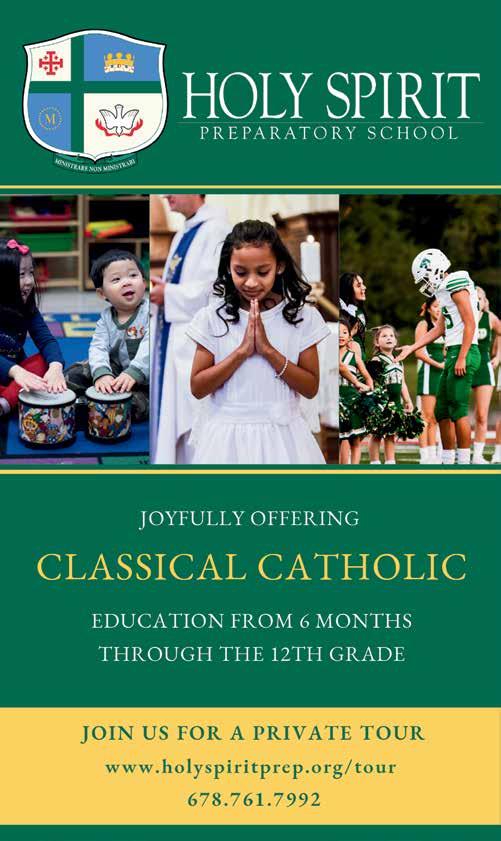
HOLY SPIRIT PREPARATORY SCHOOL
Holy Spirit Preparatory School is an independent, Catholic college-preparatory school serving preschool through 12th-grade students with a profound educational vision. Its curriculum combines the best of classical pedagogical traditions in a joyful, engaging and thoroughly Catholic environment. This curriculum includes STEM-based coursework, fine and performing arts and a very active athletic program. Through these means, the school seeks to enkindle in students the desire to pursue excellence in every endeavor they undertake and provide them with all the tools necessary to lead successful, rewarding lives in a manner consistent with the sublime end for which they have been created: eternal life with God.
This vision deeply informs Holy Spirit Prep’s curriculum and animates its efforts to help students grow in virtue and to know and love truth, goodness and beauty, the three divine attributes upon which all authentically classical, Catholic education is grounded.
“A saint,” the beloved late Pope Benedict XVI observed, “is one who is so captivated by God’s perfect truth and beauty as to be progressively transformed by it.” The school strives to provide a learning environment that advances this noble aspiration, so its students are fully prepared to go into the world firm in
faith, joyful in hope and active in charity. Holy Spirit Prep’s educational competitors are few, and for many reasons including:
• The freedom to design its own rigorous curriculum rather than having it mandated by other educational offices or organizations.
• The advantage of teaching and discussing the classical literature from an explicitly Catholic perspective rather than a purely secular one.
• The distinction of a vibrant fine arts program which includes concert and jazz bands, chamber ensembles and four choirs including a Schola Cantorum (sacred music choir).
• The blessing of having priest chaplains on both campuses to provide sacramental and devotional opportunities for students on a daily basis.
Do not hesitate to contact the school with your questions, and please schedule a time to visit it. Holy Spirit Prep would love to hear from you! The school is located at 4449 Northside Dr., Atlanta, GA 30327 (high school campus). For more information or to schedule a tour, call 678-904-2811 or visit holyspiritprep.org.
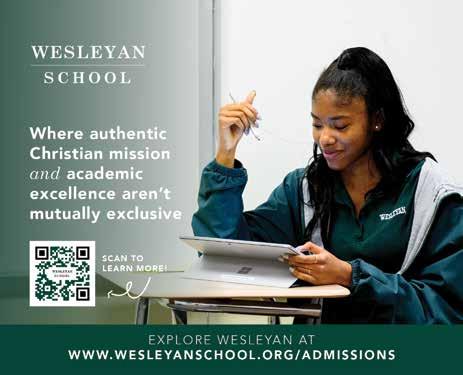
WESLEYAN SCHOOL
Wesleyan School believes faith and intellect are great partners with each other. At Wesleyan, it’s not a matter of choosing faith or intellect, but rather using both to create the best possible education for your child. Its leadership and faculty work to provide students with an atmosphere that is challenging, reinforces the value of hard work and emphasizes character and integrity above accomplishment. Wesleyan prepares students
for each stage of life and provides them with the opportunity to see all the possibilities that lie before them. Wesleyan’s school motto is JOY-Jesus, Others, Yourself, and every aspect of school life is oriented to reinforce this philosophy of putting Jesus first and others ahead of yourself.
In this college-preparatory environment, students have access to a wide range of academic opportunities along with athletics, arts, service and other extracurricular activities. Wesleyan’s 85-acre campus in Peachtree Corners provides state-of-the-art academic facilities along with on-campus practice space for athletics and arts.
Located just outside of I-285 in Peachtree Corners, at the start of the 2023-24 school year Wesleyan enrolled 1,206 students in grades K-12. Morning and afternoon bus routes are available throughout the metro Atlanta area. Supervised care before school is included in the cost of tuition and after care is available (K-8) until 6 p.m. at an affordable rate.
The school is located at 5405 Spalding Dr., Peachtree Corners, GA 30092. For more information, call 770-448-7640 or visit wesleyanschool.org.
area map
REGIONS FOR INDEPENDENT SCHOOLS N
For features of independent schools, turn to Education At a Glance on pg. 34. For public school system information by county, turn to pg. 77.
3 3
2
2
1 1
5 5
Boarding Schools Florida, Georgia, Illinois, Maine, Maryland, North Carolina,Tennessee, Virginia, West Virginia
Public School County Guide
Educational Resources Tutoring, Summer Camps and Activities, Field Trips and Education Programs.
REGION 4: Atlanta South/ Southeast/Southwest Carrollton, Eagles Landing, Fairburn, Fayetteville, Locust Grove, McDonough, Metro-Atlanta, Sharpsburg/Peachtree City p.63
REGION 5: Atlanta West Buckhead, Kennesaw, Powder Springs, Smyrna/Vinings
REGION 1: Atlanta North/Northwest Buckhead, Chastain Park, East Cobb, Marietta, Roswell, Woodstock p.46
REGION 2: Atlanta North/Northeast Alpharetta, Dunwoody, Johns Creek, Peachtree Corners, Roswell p.51
REGION 3: Atlanta East Ansley Park, Athens, Dacula, Decatur, Midtown, Morningside, Northeast Atlanta p.38
REGION 3: Atlanta East Athens, Bethlehem, Brookhaven, Collins Hill, Decatur, East Atlanta, Loganville, Midtown, Morningside/Ansley, Stone Mountain
Education At a Glance
INDEPENDENT SCHOOLS
REGION 1: ATLANTA NORTH/NORTHWEST
REGION 2: ATLANTA NORTH/NORTHEAST
Education At a Glance
INDEPENDENT SCHOOLS
REGION 3: ATLANTA EAST
REGION 4: ATLANTA SOUTH/SOUTHEAST/SOUTHWEST
Education At a Glance
This information reflects the latest available data at publication time. Please confirm with each individual school.
INDEPENDENT SCHOOLS
Peter Rooney
President, Atlanta Youth Academy
In his 12th year at AYA, Rooney has nearly 40 years in education, including experience in collegiate undergraduate liberal arts settings and Atlanta independent schools. Peter has a bachelor’s degree from Rhodes College and a master’s degree in educational leadership from Kennesaw State University.
What is your educational philosophy?
I believe in an old-fashioned style of education that still focuses on reading, writing and arithmetic. The world we live in requires technology and other specialized skills, so of course we all must put some focus on those.
How is the field of education changing?
I believe there is a trend in our society to always deflect blame. Kids are learning that it’s never their fault … never their family’s fault. This is not a healthy learning environment. We must push for a true partnership of mutual responsibility for the benefit of these young ones.
How can parents best contribute to the education process?
I hope and pray that parents understand the partnership that is created between the school, the teacher, the parent and the student. It is a unique partnership that can only yield the best results when everyone is fully on board.
What do you love most about your job?
There is nothing better than walking down our hallways and seeing an interaction between a well-trained, loving teacher and an individual student.
What advice would you offer parents about their children’s education?
Making the choice to send your child to a school like AYA often requires great sacrifice in time, effort and finances … but is well worth it!
ATLANTA YOUTH ACADEMY
Emphasis: To provide an excellent, Christcentered education to low-income urban communities.
Tuition Range: not to exceed 8% of household income
Year Founded: 1997
Grades: PreK–8th grade
Students: 151
Avg. Class Size: 15 Accreditations or Affiliations: GISA/ Cognia, CASE, NAIS, SAIS, AAAIS
Location: 2120 Forrest Park Road, Atlanta, GA 30315
Contact: 404-370-1960, atlantayouthacademy.com
REGION 1
Independent Schools
NEIGHBORHOODS OF NOTE
Roswell With its mix of stately neighborhoods and new developments, its quaint downtown area and miles of trails that meander through forests and along the Chattahoochee River, Roswell attracts many families and nature-loving residents to its city limits.
Sandy Springs Newbie, Sandy Springs became its own city in 2005, and multitudes of boutiques, bars and restaurants line Roswell Road, its main thoroughfare. Residents also enjoy the community’s many family-centered events held throughout the year.
BUCKHEAD
BUCKHEAD
BUCKHEAD • EAST COBB
CHASTAIN PARK • EAST COBB
ROSWELL
ATLANTA NORTH • NORTHEAST
Independent Schools
NEIGHBORHOODS OF NOTE REGION
Norcross Founded in the late 1800s as a resort town for wealthy Atlantans, Norcross is Gwinnett County’s second oldest city. Today, with over 8,000 residents, it is a quiet city filled with upscale yet charming residential and retail developments.
Cumming Called the “Gateway to Leisure Living,” Cumming offers the best of small-town living, but in recent years, it has seen rapid commercial and residential development, attracting many new residents with its prime location near the magnificent Lake Lanier.
ALPHARETTA • DUNWOODY
JOHNS CREEK • DUNWOODY
JOHNS CREEK • PEACHTREE CORNERS
Independent Schools
NEIGHBORHOODS OF NOTE
Stone Mountain More than just a mountain park, Stone Mountain also refers to a charming community of antique shops, art galleries and restaurants. Residents of Stone Mountain enjoy natural scenery and miles of walking and biking paths available in the nearby park.
Lawrenceville Strolling the brick-paved sidewalks in the revitalized historic downtown of Lawrenceville, you’ll feel instantly at home. Chartered in 1821, the city has gone through many changes over the years but has maintained its gracious small-town Southern charm.
ATLANTA EAST
BROOKHAVEN • ATHENS
DECATUR
EAST ATLANTA • COLLINS HILL •
Independent Schools
NEIGHBORHOODS OF NOTE
Newnan Established in 1828 and home to more than 30,000 residents, Newnan is one of the fastest-growing cities in Georgia. It has many new residential developments and boasts six historic districts on the national register filled with stately Southern homes.
College Park College Park is home to a small-town main street and the busiest airport in the world—Hartsfield-Jackson Atlanta International Airport. The city is attracting young professionals and families by combining the historic elements with new developments.
EAGLES LANDING • FAIRBURN
LOCUST GROVE •
FULTON
Independent Schools
NEIGHBORHOODS OF NOTE
Kennesaw Home to the popular Kennesaw Mountain National Battlefield Park, the city of Kennesaw takes pride in its excellent recreation opportunities and parks, rich history and thriving downtown. Kennesaw State University is well known for academic programs in business, education, and nursing.
Smyrna With its unique charm, the city of Smyrna offers many fresh, trendy lifestyle options, and the Market Village plays host to numerous restaurants, bars and upscale shops. Known as the “Jonquil City,” because of the thousands of jonquils that flourish in gardens and along the streets in early spring.
ATLANTA WEST
KENNESAW • BUCKHEAD
POWDER SPRINGS •
There are many benefits of a boarding school education. Boarding schools are an option for students seeking a more independent learning experience. Because students generally live on campus, learning takes place in and out of the classroom almost on a 24-hour basis.
When selecting a boarding school, it is important to visit the school campus, but representatives from many boarding schools visit Metro Atlanta throughout the year—contact each school for specific dates.
Boarding Schools
BOARDING SCHOOL DIRECTORY
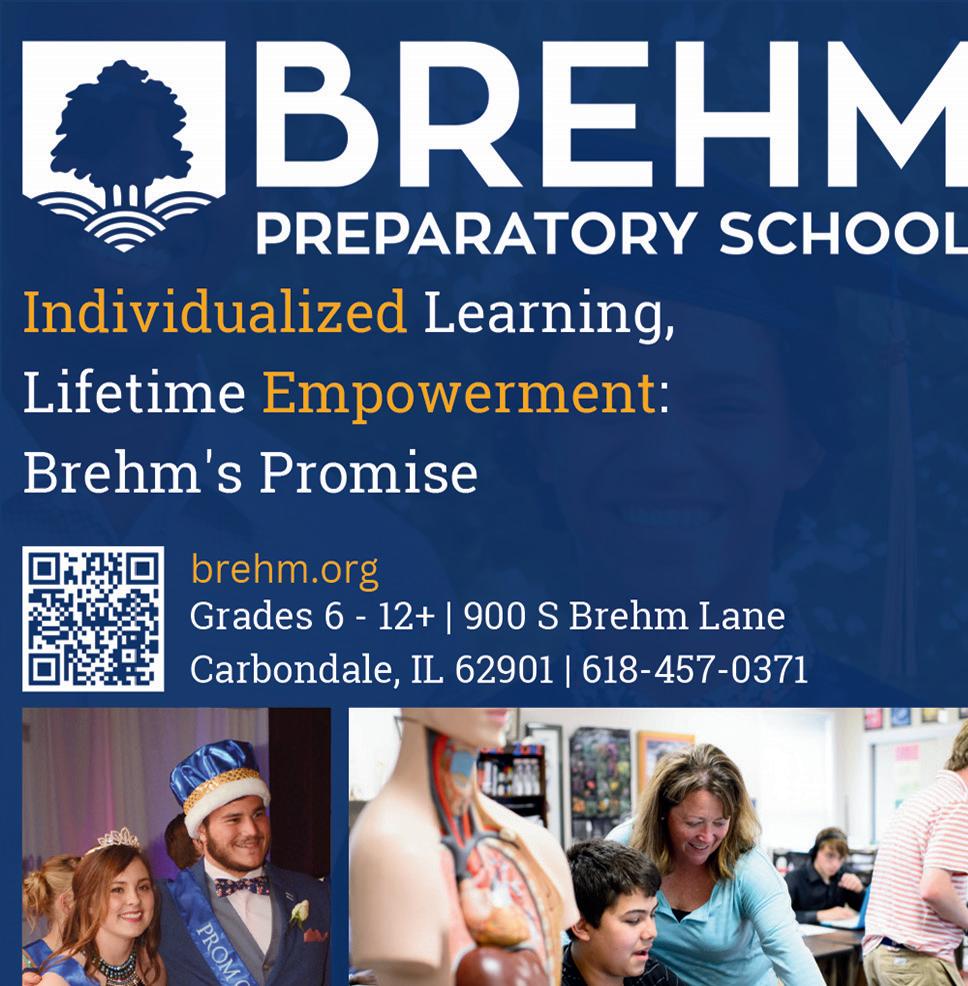
BREHM PREPARATORY SCHOOL TOP BOARDING SCHOOLS
At Brehm Preparatory School, the mission is to empower students with learning disabilities and differences to recognize and optimize their potential throughout their lives. Serving grades 6-12, the school understands that every student is unique and adopts an empathetic approach to support their academic, social, and emotional needs.
Every Brehm student has access to quality education. Through personalized instruction, the school adapts its teaching methods to meet individual needs to cater to diverse learning styles.
Similarly, the renowned cognitive training program, Arrowsmith, which is rooted in neuroplasticity, targets and strengthens weak cognitive areas to enhance memory, attention, processing speed, and executive functioning skills; its speech-language pathologists work closely with students to target their communication needs; Brehm’s counselors teach safe and productive emotional processing strategies; and its boarding program focuses on independent living skills to prepare students for life beyond the classroom. Equipping students with essential life skills, including time management, organization, self-advocacy, and personal responsibility, the school’s students gain the confidence and independence that they need to succeed.
Brehm is located in Carbondale, Illinois. For more information, call 618-457-0371 or visit brehm.org.
ILLINOIS
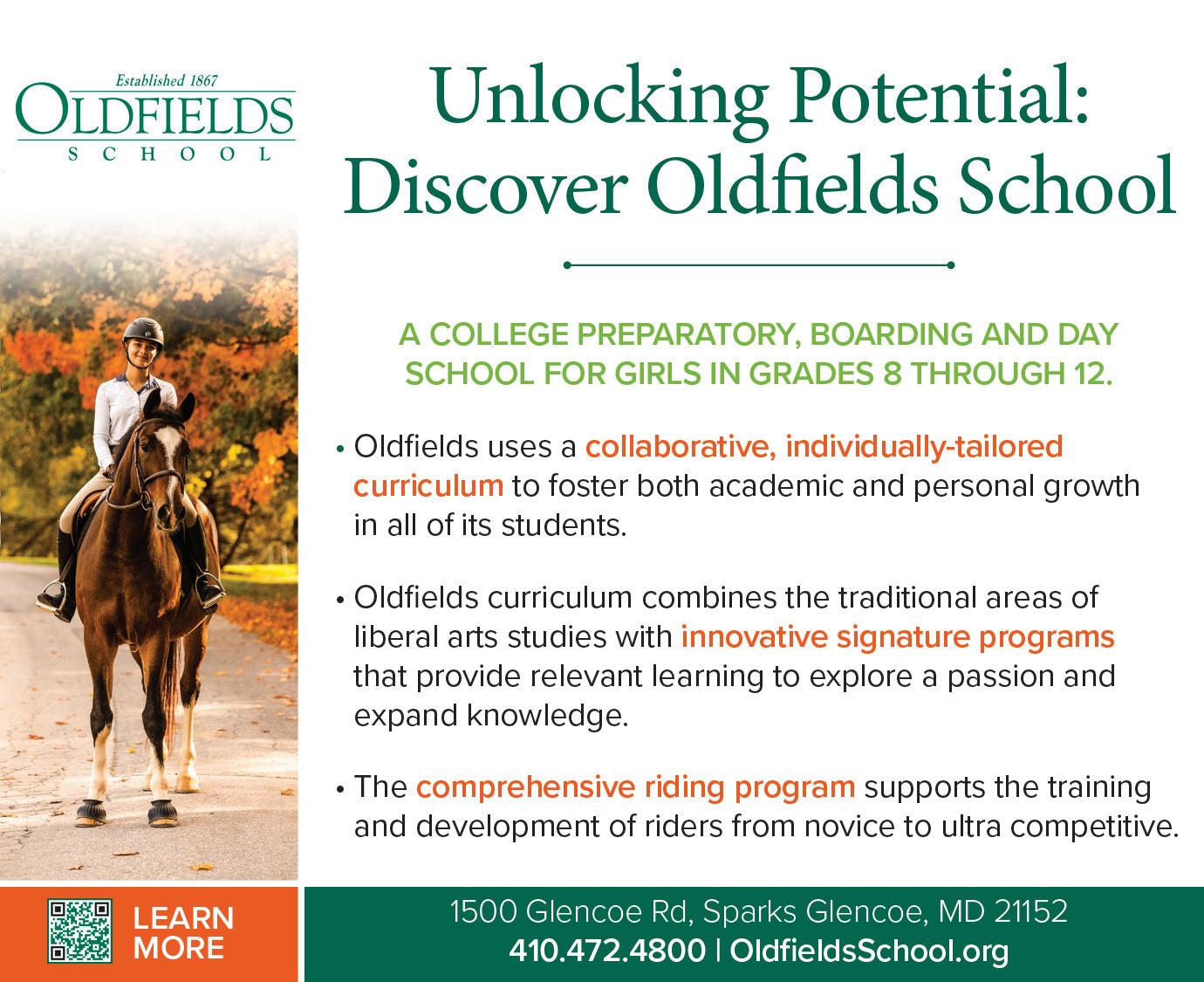
OLDFIELDS SCHOOL
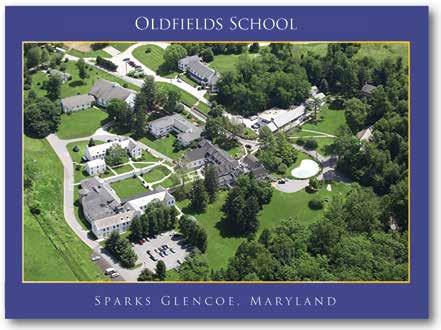
Founded in 1867, Oldfields School is a private, college-preparatory boarding school for girls in grades 8-12. Located north of Baltimore, on 140 acres in the heart of Maryland horse country, Oldfields’ nurturing environment and purposely small enrollment allows students to be well-known, develop genuine friendships, take risks and be valued for who she is as much as who the school believes she can become.
Oldfields’ collaborative, individually-tailored curriculum fosters both academic and personal growth. Its curriculum combines the traditional areas of liberal arts studies: science, math, history, English, world languages and the arts with innovative signature programs that provide relevant learning to explore a passion and expand students’ knowledge.
Signature programs include an arts
concentration as well as a comprehensive riding program. The arts concentration provides a focused yet flexible program for students at all levels. The Oldfields riding program supports riders from novice to ultra-competitive and includes an equine science concentration for post-graduation pursuits.
Each girl is encouraged to find and pursue her passion, all the while receiving a complete academic and practical grounding.
For more information, email Admissions Coordinator Ashley Cares at caresa@oldfields school.org, or visit oldfieldsschool.org
NORTH CAROLINA
TENNESSEE
WEST VIRGINIA
SPOTLIGHT ON METRO ATLANTA’S SCHOOL SYSTEMS
Avariety of improvements and innovative programs in Georgia’s public school systems have resulted in many stellar elementary, middle and high schools across the metro area. Different school systems feature specialized programs and academic opportunities, such as magnet, charter, vocational or alternative schools, to suit their respective students, parents and communities. However, despite variations in programming and academic offerings, all public schools must offer the core curriculum as determined by the Georgia Board of Education. Here is a county-by-county guide to metro Atlanta’s public school systems. For more information about the Georgia Department of Education, call 404-656-2800 or visit gadoe.org. u
CHARTER SCHOOLS
CHARTER SCHOOLS
CHARTER SCHOOLS
BARTOW
Number of Schools
Elementary 12
Middle 4
High 3
Career Academy 1
Virtual Academy 1
Total # of Students: 13,079
Student Spending: $11,470
2023 Mean Georgia Milestone Scores:
3rd: (ELA) 498 (M) 524
5th: (ELA) 509 (M) 511
8th: (ELA) 508 (M) 512
2023 Average SAT: 1027
Top 3 Schools by Average 2023 SAT Score
Woodland High 1058
Adairsville High 1019
Cass High 1011 BARTOW
Board of Education
770-606-5800
bartow.k12.ga.us
CHEROKEE
What’s New: The Bartow County Schools four-year graduation rate has reached 95%, an all-time high for the district. This exceeds the Georgia state rate by more than 10%. Adairsville High leads the county with a graduation rate of 98.6%, including a 96.3% rate for students with disabilities.
2023 Mean Georgia Milestone Scores:
3rd: (ELA) 517 (M) 537
5th: (ELA) 524 (M) 535
8th: (ELA) 519 (M) 526
2023 Average SAT: 1094
Top 5 Schools by Average 2023 SAT Score
Board of Education
770-479-1871
cherokeek12.net
CLAYTON
Total # of Students: 41,472
Student Spending: $10,580
Sequoyah High 1112
Creekview High 1102
Woodstock High 1098
Cherokee High 1092
River Ridge High 1081
What’s New: Hasty Elementary School Fine Arts Academy received a $5,000 grant from the newly opened Burlington store at Canton Marketplace. The national discount retailer donated the money through its partnership with AdoptAClassroom.org.
2023 Mean Georgia Milestone Scores:
3rd: (ELA) 467 (M) 495
5th: (ELA) 486 (M) 476
8th: (ELA) 495 (M) 483
2023 Average SAT: 919
Top 5 Schools by Average 2023 SAT Score
Elite Scholars Academy 1123
M. E. Stilwell School of the Art 980
Morrow High 959
Jonesboro High 928
North Clayton High 922
What’s New: As part of increased security protocols, Clayton County Public Schools is now issuing student identification cards.
Board of Education
770-426-3300
cobbk12.org
COWETA
Board of Education
770-254-2800
cowetaschools.net
DEKALB
Board of Education
678-676-1200
dekalbschoolsga.org
2023 Mean Georgia Milestone Scores:
3rd: (ELA) 518 (M) 527
5th: (ELA) 523 (M) 522
8th: (ELA) 524 (M) 524
2023 Average SAT: 1104
Top 5 Schools by Average 2023 SAT Score
Walton High School 1255
Wheeler High 1184
Lassiter High 1183
Alan C. Pope High 1179
Kell High School 1063
What’s New: Two Cobb middle schools, Griffin and Palmer, were were among those awarded the title of America’s Healthiest Schools by the Alliance for a Healthier Generation.
2023 Mean Georgia Milestone Scores:
3rd: (ELA) 519 (M) 530
5th: (ELA) 521 (M) 519
8th: (ELA) 520 (M) 518
2023 Average SAT: 1068
Top 3 Schools by Average 2023 SAT Score
Northgate High 1105
East Coweta High 1057
Total # of Students:
Newnan High 1055
What’s New: The Coweta County School System Transportation Department has replaced their older Bus Status system with the new Bus Bulletin notification system.
2023 Mean Georgia Milestone Scores:
3rd: (ELA) 489 (M) 508
5th: (ELA) 500 (M) 492
8th: (ELA) 504 (M) 493
2023 Average SAT: 993
Top 5 Schools by Average
2023 SAT Score
Total # of Students:
Chamblee Charter High 1176
DeKalb School of the Arts 1131
Dunwoody High 1109
Lakeside High 1100
Druid Hills High 1095
What’s New: The Local Initiatives Support Corporation presented Stone Mountain High and the DeKalb County School District with a $250,000 grant to complete the artificial surface at Stone Mountain High’s practice football field.
PUBLIC SCHOOL COUNTY GUIDE
PUBLIC SCHOOL COUNTY GUIDE
DOUGLAS
Board of Education 770-651-2000 dcssga.org
Number of Schools
Elementary 20 Middle 8 High 5 Centers 3
Charter 1 Virtual 1
Total # of Students: 25,707
Student Spending: $11,592
2023 Mean Georgia Milestone Scores:
3rd: (ELA) 498 (M) 511
5th: (ELA) 506 (M) 496
8th: (ELA) 517 (M) 500
2023 Average SAT: 984
Top 5 Schools by Average 2023 SAT Score
Alexander High 1026
Chapel Hill High 1004
Douglas County High 996
Lithia Springs High 944
New Manchester High 928
What’s New: The Carrollton Douglasville alumni chapter of Kappa Alpha Psi Fraternity Inc. and the Community Diamonds Foundation presented Douglas County Schools with a check for $15,800 earmarked for paying school lunch balances.
2023 Mean Georgia Milestone Scores:
3rd: (ELA) 535 (M) 544
5th: (ELA) 538 (M) 542
8th: (ELA) 544 (M) 553
2023 Average SAT: 1123
Board of Education
770-460-3990
fcboe.org
FORSYTH
Total # of Students: 19,596
Student Spending: $12,155
Top 5 Schools by Average 2023 SAT Score
McIntosh High 1175
Starr’s Mill High 1164
Whitewater High 1115
Sandy Creek High 1063
Fayette County High 1027
What’s New: Fayette County Public Schools is offering helpful parenting education tips and resources on its website. Topics covered include sleep, structure, chores, discipline and screen time.
Number of Schools
2023 Mean Georgia Milestone Scores:
3rd: (ELA) 537 (M) 557
5th: (ELA) 541 (M) 562
8th: (ELA) 538 (M) 554
2023 Average SAT: 1177
Top 5 Schools by Average 2023 SAT Score
Board of Education
770-887-2461
forsyth.k12.ga.us
Total # of Students: 52,347 Student
Lambert High 1254
Alliance Academy 1239
South Forsyth High 1218
Denmark High 1168
Forsyth Central 1133
What’s New: SPARK! 4 Kids is a free, federally funded program facilitated by Forsyth County Schools. SPARK! seeks to support the growth and success of all learners through weekly sessions with families and their child(ren) ages birth to 5, at-home resources and activities, and technology training for parents.
DOUGLAS
Board of Education
470-254-3600 fultonschools.org
Board of Education
770-229-3700
gscs.org
Board of Education
678-301-6000 gcpsk12.org
Total # of Students: 88,326
Student Spending: $13,019
2023 Mean Georgia Milestone Scores:
3rd: (ELA) 525 (M) 540
5th: (ELA) 529 (M) 528
8th: (ELA) 529 (M) 520
2023 Average SAT: 1085
Top 5 Schools by Average
2023 SAT Score
Northview High 1263
Chattahoochee High 1225
Johns Creek High 1219
Alpharetta High 1214
Milton High 1163
What’s New: Fulton County Schools has launched a program for its educators to further their careers through a partnership between the district and Georgia State University. This professional learning opportunity prepares participants for higher roles.
2023 Mean Georgia Milestone Scores:
3rd: (ELA) 474 (M) 498
5th: (ELA) 484 (M) 482
8th: (ELA) 490 (M) 489
2023 Average SAT: 970
Total
Top 2 Schools by Average
2023 SAT Score
Spalding High 1006 Griffin High 929
What’s New: The Griffin-Spalding County School System and Caterpillar Inc. have announced a pilot program called Train, Learn, Grow. The program will offer opportunities to high school juniors and seniors to work side by side with industry professionals and mentors with practical, hands-on training at a Caterpillar facility, gaining invaluable experience in industrial maintenance.
2023 Mean Georgia Milestone Scores:
3rd: (ELA) 513 (M) 530
5th: (ELA) 519 (M) 524
8th: (ELA) 520 (M) 526
2023 Average SAT: 1091
Top 5 Schools by Average
2023 SAT Score
Gwinnett School of Math, Science, and Technology 1393
North Gwinnett High 1192
PUBLIC SCHOOL COUNTY GUIDE
Total # of Students:
Brookwood High 1135
Paul Duke STEM High 1135
Mill Creek High 1134
What’s New: Stripling Elementary students will participate in STEM activities utilizing the engineering design process to contribute to the design, build and functionality of a community garden.
PUBLIC SCHOOL COUNTY GUIDE
HALL
Board of Education 770-534-1080 hallco.org
HENRY
Total # of Students:
26,713
Student Spending: $10,785
2023 Mean Georgia Milestone Scores:
3rd: (ELA) 485 (M) 511
5th: (ELA) 498 (M) 503
8th: (ELA) 501 (M) 506
2023 Average SAT: 1040
Top 5 Schools by Average 2023 SAT Score
North Hall High 1085
Flowery Branch High 1085
Chestatee High 1021
Cherokee Bluff High 1016
East Hall High 1012
What’s New: Da Vinci Academy at South Hall Middle School completed a $1.75 million renovation and expansion of its Museum of Inspired Learning in time to celebrate its 15th anniversary.
2023 Mean Georgia Milestone Scores:
3rd: (ELA) 489 (M) 508
5th: (ELA) 501 (M) 491
8th: (ELA) 507 (M) 495
2023 Average SAT: 990
Top 5 Schools by Average 2023 SAT Score
Board of Education
770-957-6601
schoolwires.henry.k12.ga.us
PAULDING
Total # of Students: 42,435
Student Spending: $10,422
Union Grove High 1048 Ola High 1044
Eagle’s Landing High 994
Dutchtown High 980 Woodland High 976
What’s New: The Henry County Board of Education has implemented a layered weapons detection system for all 10 high school stadiums for home events.
2023 Mean Georgia Milestone Scores:
3rd: (ELA) 504 (M) 521
5th: (ELA) 514 (M) 512
8th: (ELA) 516 (M) 509
2023 Average SAT: 1017
Board of Education
770-443-8000 paulding.k12.ga.us
Total # of Students:
Top 5 Schools by Average 2023 SAT Score
Paulding County High 1038
North Paulding High 1030
East Paulding High 1000
South Paulding High 996
Hiram High 996
What’s New: Construction continues on Paulding County’s 10th middle school. Built to alleviate capacity issues at McClure Middle School, the facility will be located on property between Seven Hills Boulevard and Westbrook Creek Road and Garnet Drive in northeast Paulding County. The new building is slated to open in August.
HENRY
HALL
ROCKDALE
ROCKDALE
Board of Education
770-483-4713
rockdaleschools.org
ATLANTA PUBLIC SCHOOLS
Total # of Students: 15,203
Student Spending: $13,712
2023 Mean Georgia Milestone Scores:
3rd: (ELA) 480 (M) 501
5th: (ELA) 501 (M) 483
8th: (ELA) 513 (M) 496
2023 Average SAT: 969
Top 3 Schools by Average 2023 SAT Score
Rockdale High 1001
Heritage High 962
Salem High 911
What’s New: Rockdale County Public Schools has announced a new app for parents and students. This free app manages notifications, events, grades, bus routes, job opportunities, school lunch payments and more.
Board of Education
atlantapublicschools.us
BUFORD CITY SCHOOLS
Total # of Students: 48,707
Student Spending: $21,766
2023 Mean Georgia Milestone Scores:
3rd: (ELA) 492 (M) 511
5th: (ELA) 503 (M) 498
8th: (ELA) 501 (M) 494
2023 Average SAT: 949
Top 5 Schools by Average 2023 SAT Score
Atlanta Classical Academy 1133 Midtown 1121 North Atlanta High 1070 KIPP Atlanta Collegiate Academy 1044 Charles R. Drew Charter High 999
What’s New: Deerwood Academy has opened up a new outdoor learning space, which includes seating for one class, a white board and two vegetable beds. The space was made possible by donations from Atlanta United and Royal Foods, and is a joint effort between Atlanta Public Schools and Out Teach.
Board of Education
770-945-5035
bufordcityschools.org
Number of Schools
Total # of Students: 5,742
Student Spending: $11,776
2023 Mean Georgia Milestone Scores:
3rd: (ELA) 548 (M) 557
5th: (ELA) 545 (M) 554
8th: (ELA) 551 (M) 572
2023 Average SAT: 1161
What’s New: Buford City Schools remains the No. 1 public school system in Georgia according to Niche for 2024. This is Buford’s ninth consecutive year receiving this distinction. Niche determines rankings based on many factors.
PUBLIC SCHOOL COUNTY GUIDE
CITY SCHOOLS OF DECATUR
Board of Education
404-371-3601
csdecatur.net
Total # of Students: 5,477
Student Spending: $15,089
2023 Mean Georgia Milestone Scores:
3rd: (ELA) 549 (M) 559
5th: (ELA) 551 (M) 558
8th: (ELA) 547 (M) 537
2023 Average SAT: 1147
What’s New: CSD ranks in the top five school districts in Georgia for average SAT scores and highest in the Metro Resa region for the fifth consecutive year. Additionally, CSD’s class of 2023 achieved an average ACT composite score of 25.1, which is higher than both the state and national averages.
GAINESVILLE CITY SCHOOLS
Board of Education
770-536-5275
gcssk12.net
Number of Schools
Total # of Students:
7,530
Student Spending: $11,678
2023 Mean Georgia Milestone Scores:
3rd: (ELA) 475 (M) 501
5th: (ELA) 487 (M) 491
8th: (ELA) 493 (M) 490
2023 Average SAT: 955
What’s New: Gainesville City Schools aims to assist two unique groups of students with its new Horizon Academy program: those who are new to the country and acclimating to American schools, as well as seniors who are behind in credits and need support to graduate. Over 150 students enrolled for the 2023-24 school year.
MARIETTA CITY SCHOOLS
Board of Education
770-422-3500 marietta-city.org
Total # of Students: 8,558
Student Spending: $14,571
2023 Mean Georgia Milestone Scores:
3rd: (ELA) 518 (M) 534
5th: (ELA) 516 (M) 521
8th: (ELA) 509 (M) 506
2023 Average SAT: 1052
What’s New: Marietta City Schools (MCS) has welcomed Barney, a crisis response canine, as an emotional and sensory support for students in need. The canine will work alongside Officer Paul Hill, MCS’s elementary school resource officer. Officer Hill will utilize Barney’s skills for various functions, including calming children experiencing behavioral or emotional concerns.
EDUCATIONAL RESOURCES
Ways to Enhance your Child’s or Student’s Learning
FIELD TRIPS & EDUCATION PROGRAMS
FIELD TRIPS & EDUCATION PROGRAMS
ALLIANCE THEATRE
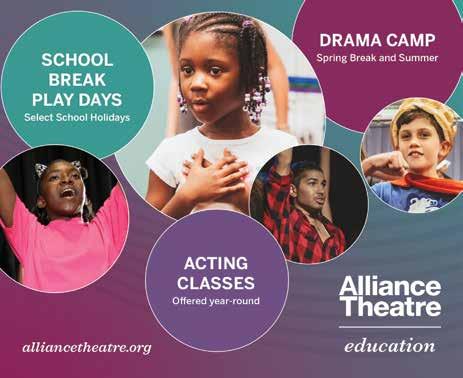
The Alliance Theatre provides educational programming for infants to age 18. From classes and camps to professional productions specifically designed for every age group, families will learn, grow, and create together.
developmentally appropriate field trips for preschool through 12th grade. Working with the country's top theater talents, these world-class productions create the powerful shared experience of theater for a diverse audience. Independent research from the University of Arkansas' National Endowment for the Arts Research Lab showed students who attend multiple arts field trips have higher levels of social-emotional skills, stronger school engagement, and higher standardized test scores. Title I and group discounts are available.
The Alliance Theatre is located at 1280 Peachtree St. NE, Atlanta, GA 30309. To book a field trip, call 404-733-4690 or email allianceschoolday@ woodruffcenter.org. For more information, visit alliancetheatre.org/education or alliancetheatre.org/fieldtrips.
MUSEUM OF ILLUSIONS ATLANTA
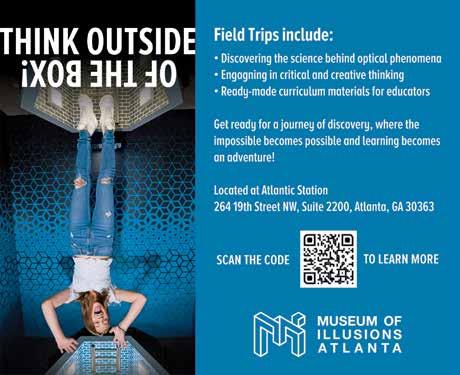
In addition, the Alliance Theatre offers In a world of endless distractions, the Museum of Illusions Atlanta offers a unique opportunity to foster curiosity, ignite imagination and encourage students to think outside the box.
Located in Midtown’s Atlantic Station, the museum’s more than 80 interactive exhibits and hands-on activities create an inspiring learning environment for students in grades 3-12. Students will be mesmerized by visual illusions, mystifying puzzles, holograms and gravitydefying spaces with educational opportunities.
• Engage in critical and creative thinking
• Discover the science behind optical phenomena
• Be guided by inquiry-based questions
The museum’s accompanying curriculum provides educators with resources to maximize their museum visit to create a memorable experience for all.
Georgia Elite Taekwondo said, “The staff is amazing! Very patient with the kids and very knowledgeable of all the exhibits. I had kids
ranging from age 4 to 14 and all of them had a blast.”
To book your visit, contact Julissa.Noyola@ moiatlanta.com or visit moiatlanta.com/fieldtrips. Field trip discount rates are available for camps, homeschool groups and public, private and Title I schools in Georgia.
Get ready for a journey of discovery, where the impossible becomes possible and learning becomes an adventure!
FIELD TRIPS & EDUCATION PROGRAMS
TRIPS & EDUCATION PROGRAMS
MICHAEL C. CARLOS MUSEUM: FACE THE WORLD WITH CURIOSITY
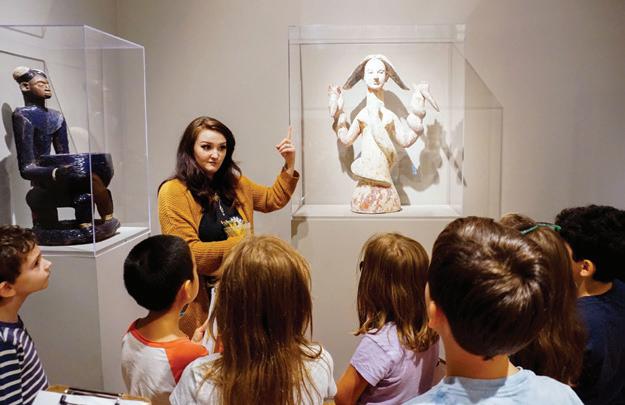
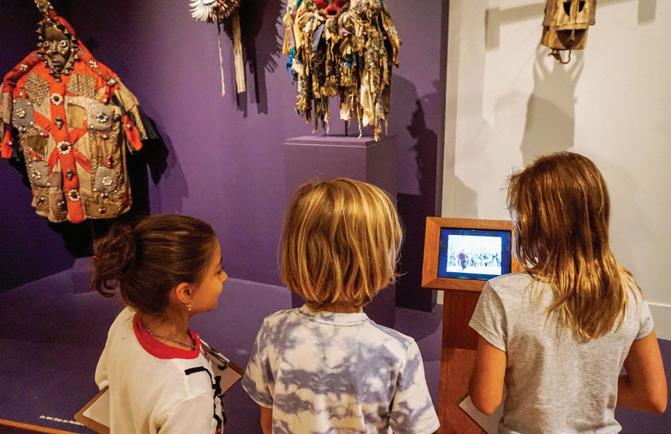
Immerse yourself in the vibrant world of art and culture at Emory University's Michael C. Carlos Museum. Through interactive and interdisciplinary thematic tours, students explore Africa; ancient Egypt, Nubia and the Near East; ancient Greece and Rome; the Indigenous Americas; and South Asia. Highly trained docents facilitate inquiry and discussion by encouraging
observation, analysis, communication and critical thinking. Embark on a captivating journey across cultures throughout time at the Carlos Museum.
The museum is located at 571 S. Kilgo Circle, Atlanta, GA 30322. For more information, visit carlos.emory.edu/tours or call 404-727-3187.