JANUARY 2022
3
WFEC Renewables Report
4
Operation Round Up report
A supplement to the Oklahoma Living
4
Energy Efficiency Tip of the Month
Lig ght Post
the
the future
OF ELECTRIC RATES
Kiamichi Electric Cooperative (KEC), along with most energy utilities have concerns about the future of electric rates. These concerns are due to the rise of cost associated with the components that impact the cost we all pay for electricity. Factors currently or soon to be affecting electric rates are the February’s 2021 Polar Vortex costs, current natural gas prices and the rising costs of materials and equipment. This is how each of these components will affect your electric bill: THE POLAR VORTEX
The winter storm that occurred in February 2021 was a major winter event. This storm brought frigid air across much of the central U.S. from February 14 through the 20th including some states that are unaccustomed to severe winter conditions. February 15, 2021, was the coldest day in Oklahoma’s history at -.7 degrees. The coldest 2 and 3 day periods in Oklahoma’s history also occurred in February of 2021 when historically temperatures for this period are in the high 30’s to low 40 degrees. The Southwest Power Pool (SPP) is a
regional power market that serves a 14-state region in the central US, excluding Texas. Many utilities purchase power from this market including OG&E, PSO and Western Farmers who is KEC’s primary power supplier. SPP has never had to deal with an event like the polar vortex in their 80-year history. The bulk electric power system was stressed to its limits, resulting in the implementation of rolling blackouts. SO, WHAT HAPPENED?
While there was enough generating capacity in the SPP footprint to serve the load, fuel delivery - primarily natural gas delivery - became a severe problem. Frozen wells and well heads drastically restricted the flow of natural gas to the power plants. Capacity requirements exceeded capabilities so rolling blackouts were implemented to protect the electric grid integrity. The extraordinary demand for natural gas coupled with the severely restricted gas supply pushed fuel prices to extreme levels. Some power suppliers spent more on natural gas in this 2-week period than is typically spent all year. Typical gas prices historically
PUBLISHED FOR MEMBERS OF KIAMICHI ELECTRIC COOPERATIVE
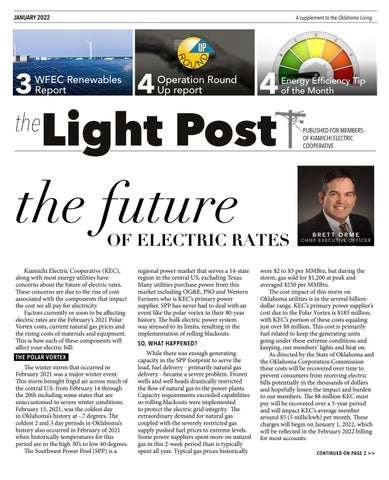
BRETT ORME
CH I EF EX E C U T I V E O F F I C E R
were $2 to $3 per MMBtu, but during the storm, gas sold for $1,200 at peak and averaged $250 per MMBtu. The cost impact of this storm on Oklahoma utilities is in the several billiondollar range. KEC’s primary power supplier’s cost due to the Polar Vortex is $183 million, with KEC’s portion of these costs equaling just over $8 million. This cost is primarily fuel related to keep the generating units going under these extreme conditions and keeping, our members’ lights and heat on. As directed by the State of Oklahoma and the Oklahoma Corporation Commission these costs will be recovered over time to prevent consumers from receiving electric bills potentially in the thousands of dollars and hopefully lessen the impact and burden to our members. The $8 million KEC must pay will be recovered over a 5-year period and will impact KEC’s average member around $5 (5 mills/kwh) per month. These charges will begin on January 1, 2022, which will be reflected in the February 2022 billing for most accounts. CONTINUED ON PAGE 2 >>
2 | the Light Post
The future of electric rates, continued from page 1 THE CURRENT PRICE OF NATURAL GAS
Kiamichi Electric Cooperative 944 SW Highway 2 PO Box 340 Wilburton, Oklahoma 74578 tele: (918) 465-2338 toll free: (800) 888-2731 FAX: (918) 465-2950 www.kiamichielectric.org email: support@kiamichielectric.org HOURS OF OPERATION Monday-Friday 8 am to 5 pm 24-HOUR OUTAGE HOTLINE (800) 888-2731 BOARD OF TRUSTEES Mark Ichord, President DISTRICT 6
KEC’s power supplier does have a diversified portfolio of generating capacity that includes renewables, coal, and natural gas. Depending on the demand for electricity the most economical generation is used first to provide the cheapest power possible. Fuel accounts for 60% of the costs to generate electricity and power costs in 2021 (excluding the polar vortex) have been up as much as 63% from the same time last year. A key factor that contributes to these rising costs is the significant demand for natural gas and limited storage due to current demand as well as low inventories due to the polar vortex. Our power suppliers have historically paid approximately $2 to $3 per MMBtu, they are now seeing $5 to $6 per MMbtu and in some cases even higher. Expectations and forecasts are for gas prices to remain at this level through spring of 2022. This increase in natural gas prices will affect the average KEC member by $3 (3 mills/kwh) per month. KEC’S COST IMPACTS
Like many other industries KEC has been affected by supply chain issues for materials, transformers, and equipment. With a low supply and a high demand, this has caused costs to increase and lead times to drastically
Ron Pelaconi, Vice President DISTRICT 3 Russell Shaw, Treasurer DISTRICT 1 Amy Miller DISTRICT 2 David Ray DISTRICT 4 Don Parr DISTRICT 5 Larry Culwell DISTRICT 7 Brett Orme Executive Vice President-CEO Kiamichi Electric provides reliable and affordable electricity to members in Pushmataha, Leflore, Latimer, Atoka and Pittsburg Counties.
KEC visited Haywood Elementary in early December for its Safety Show with lineman Justin Wade. If your school is interested in hosting a KEC Safety Show, please contact Michelle Warmuth, mwarmuth@ kiamichielectric.org or by calling 918-465-2338.
expand. We are working hard to stay ahead of these lead times so that we can ensure KEC members’ service and reliability are not adversely impacted any more than necessary. KEC’s average material costs have increased by approximately 30% since 2020 and in some cases have more than doubled! We have also seen equipment costs increasing by as much as 25%. KEC has been fortunate in that we have experienced a 10% growth in revenue from 2020. This is very good because historical numbers have been relatively flat, and this growth will help offset increases in costs. KEC is planning to complete a cost-of-service study during the first quarter of 2022. The results of this study will determine if the need exists to restructure rates and to re-evaluate KEC’s base charges. I realize currently there is not a lot of positive news concerning rates other than your system is growing. I do want to assure you we will do everything we can to keep rates as low as possible while still providing safe and reliable power to you, our members. Everyone will be kept up to date and informed concerning your cooperative and the rapidly changing industry. Thank you for being the best part of Kiamichi Electric!
the Light Post | 3
Are Portable Space Heaters Efficient for My Home? By Abby Berry Small space heaters are meant to do exactly as their name says: heat a small space. But unfortunately, many people use portable space heaters to heat their entire home, which can really take a toll on your energy bills. The truth is, whether you should use space heaters really depends on your home’s efficiency and energy needs. If you’re using a space heater to compensate for problems in your home, like inadequate insulation, drafty windows and exterior doors, or an inefficient heating system, space heaters are not a practical solution. Your best bet is to improve the overall efficiency of your home. If you’re on a tight budget, caulking and weather stripping around windows and exterior doors is a lowcost, easy way to save energy. Depending on the size of your home, adding insulation can be a great next step. Loose fill insulation typically costs $1 to $1.50 per square foot. Taking these proactive energy-saving measures rather than relying on space heaters
for supplemental warmth can reduce your heating and cooling bills for years to come. Perhaps your home is energy efficient but you’re cold-natured and want a specific room to be cozier than the rest. In this case, a space heater may work for your needs. A good comparison is ceiling fans; we use ceiling fans in the summer to cool people, not rooms. A space heater can be used in a similar way during winter months. Only use a space heater in small spaces that you’re occupying and, if possible, try to shut off other rooms to contain the warmth provided by the space heater. If you decide to use a space heater to heat a small area in your home, make sure the heater is properly sized for the space; most heaters include a general sizing table. A word about safety: the U.S. Consumer Product Safety Commission estimates more than 25,000 residential fires are associated with the use of space heaters every year, resulting in more than 300 deaths. If you must use a space heater, purchase a newer
model that includes the most current safety features and make sure it carries the Underwriter’s Laboratory (UL) label. Choose a thermostatically controlled heater to avoid energy waste and overheating, and place the heater on a level surface away from foot traffic when in use. Always keep children and pets away from space heaters. Consider alternative ways to stay warm like extra layers of clothing or UL-approved electric blankets. If you have hardwood or tile floors, lay down area rugs to provide additional insulation (and appeal!) and maintain warmth. We know it’s cold out there, but remember in addition to safety concerns, space heaters can greatly increase your energy bills if used improperly. If you’re looking for alternative ways to save energy and increase comfort in your home, contact Michelle Warmuth at mwarmuth@kiamichielectric.org. We’re here to help you manage your energy use.
Abby Berry writes on consumer and cooperative affairs for the National Rural Electric Cooperative Association, the national trade association representing more than 900 local electric cooperatives. From growing suburbs to remote farming communities, electric co-ops serve as engines of economic development for 42 million Americans across 56% of the nation’s landscape.
Renewables Report
TIPS TO DITCH THE SPACE HEATER
Space heaters are energy hogs, and older models can be extremely dangerous. This winter, ditch the space heater and try these alternative solutions to stay cozy. • Use an electric blanket to keep warm during the night.
35% Renewables Data collected from Western Farmers Electric Cooperative — KEC’s wholesale power provider — reflects generation during September 2021, which shows 35 percent of the power generated by WFEC came from renewable sources.
• Caulk and weatherstrip around all windows and doors to prevent heat loss. • Consider adding insulation to your attic and around duct work.
4 | the Light Post
operation round up M O N T H LY U P D AT E Operation Round Up® is a voluntary bill roundup program that benefits local communities, organizations ,and needy families. Funding applications are available at Kiamichi Electric, local social services, or online at www.kiamichielectric.org. YEAR-TO-DATE COLLECTIONS 2021: $26,515.55 YEAR-TO-DATE DISBURSEMENTS: $14,630.79 TOTAL COLLECTED SINCE INCEPTION: $1,711,463.93 TOTAL DISBURSEMENTS SINCE INCEPTION: $1,637,867.81
Energy Efficiency
Tip of the Month Maximize your heating system’s performance by inspecting, cleaning or replacing air filters once a month or as needed to reduce energy costs and prevent potential damage to your system. Make sure radiators, baseboard heaters and warm-air registers aren’t blocked so air can flow freely. Source: Energy.gov
Manage your KEC account from wherever you are with our free mobile app
RECIPE
Monkey Bread INGREDIENTS 3 (12 ounce) packages refrigerated biscuit dough 1 cup white sugar 2 teaspoons ground cinnamon ½ cup margarine
1 cup packed brown sugar ½ cup chopped walnuts (Optional) ½ cup raisins
DIRECTIONS Preheat oven to 350 degrees F (175 degrees C). Grease one 9 or 10 inch tube/ Bundt® pan. Mix white sugar and cinnamon in a plastic bag. Cut biscuits into quarters. Shake 6 to 8 biscuit pieces in the sugar cinnamon mix. Arrange pieces in the bottom of the prepared pan. Continue until all biscuits are coated and placed in pan. If using nuts and raisins, arrange them in and among the biscuit pieces as you go along. In a small saucepan, melt the margarine with the brown sugar over medium heat. Boil for 1 minute. Pour over the biscuits. Bake at 350 degrees F (175 degrees C) for 35 minutes. Let bread cool in pan for 10 minutes, then turn out onto a plate. Do not cut! The bread just pulls apart. Recipe from AllRecipes.com
3 View bill & make payments 3 Sign up for auto-pay 3 Go paperless 3 Monitor energy use and savings 3 Report outages 3 Set up text alerts 3 And more!
Use your smartphone’s camera to scan the QR code and download the mobile app
W W W. K I A M I C H I E L E C T R I C . O R G