A meme has been circulating around the internet claiming that February 2026 is a so-called “MiracleIn” month that only happens “once every 823 years,” whereby the month contains exactly four of each day of the week. Some versions of the meme even claim that this month will include a 25-hour day.
As usual when it comes to internet memes and claims, it’s all hooey. What is true is in looking at February 2026 on the calendar, the four weeks line up perfectly, with the first day of the month starting on Sunday and the 28th day of the month falling on the fourth Saturday. It’s very symmetrical and pleasing — the “perfect month.” But the term “MiracleIn” has no recognized meaning in science or, well, anywhere, despite internet dorks writing purple prose about it, which they claim is a Ukrainian word that means “by the hand of God” — also false. These same claims keep getting copied again and again, and they ricochet off the walls of the internet so dimwitted people can post something on their Facebook pages.
The “MiracleIn” myth is likely related to another false internet rumor that states if a month has five Fridays, Saturdays and Sundays, the Chinese refer to it as “silver pockets full” or “money bags,” because these calendar months (which also have been claimed to occur once every 823 years) are supposedly lucky. Wrong again. And what’s with the 823 years thing?
Is it possible we have successfully dumbed ourselves down so much that the average internet user is confusing leap years with... whatever this “trend” is?
This same false claim also popped up online in February 2022, when internet users spammed message boards talking about an extremely rare calendar phenomenon that happens “every 823 years,” and fact-checkers like me reminded people that this is just not true at all. There was also a claim that spread in 2015 about the same “once in every 823 years” cycle when the last “perfect month” occurred in February.
For those who start their calendars on Mondays instead of Sundays, the last “perfect month” occurred in 2021 and will happen again in 2027 — or, if you have manure in your brains, in the year 2849.
band perks
One of the perks of having a band named Harold’s IGA is the occasional gift of vintage Harold’s gear from old-time locals. The lighter pictured above was given to me by Lance Miller, who told me he saw them for 10 cents when Harold’s was closing and grabbed a handful of them. Liz Stephenson also surprised me last year with the original window to the cafe along the Fifth Avenue side of Harold’s, which I’m hoping to repurpose when I build a backyard art studio later this year.
DEAR READERS,
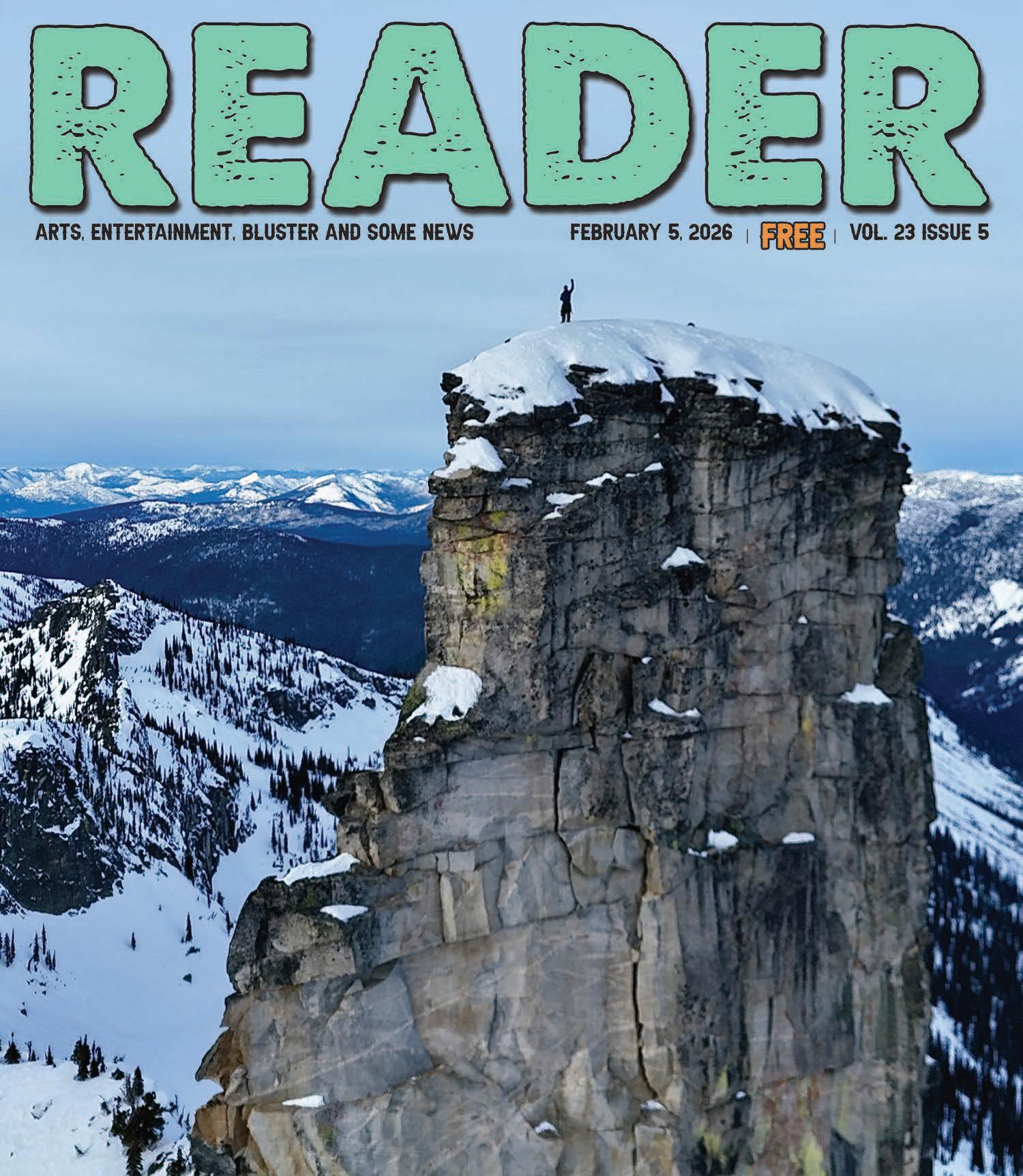
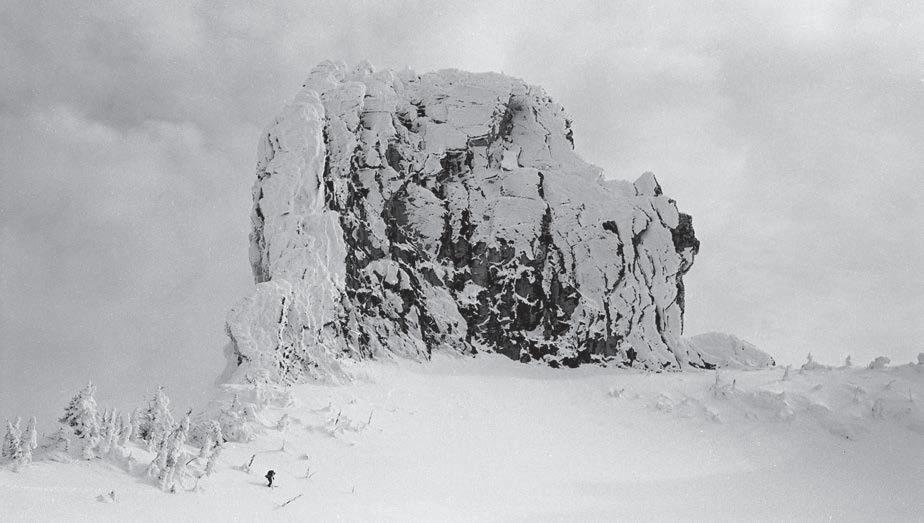
Our cover photo this week comes from E.G. Lunceford, who wrote a story about ascending Chimney Rock in wintertime (see Page 15). He took it with a drone after making the rare trip to the top. I really appreciated receiving the story, as we enjoy highlighting the accomplishments of area residents. Kudos to Lunceford for not only making the winter ascent, but also for highlighting historical climbs by locals over the years.
There is a subculture of outdoor adventurers here in North Idaho that exists if you know where to look. The hardy few who embark on feats outside the bounds of the norm deserve praise; they embody the spirit of what it really means to live here.
You might never know the person having a pint next to you at the bar climbed Chimney Rock in winter or skied down the Monarchs or swam the length of Lake Pend Oreille, because they don’t do it for accolades. They do it because it’s difficult and because it’s there.
Cheers to you adventurers out there. Don’t ever change.
–Ben Olson, publisher
111 Cedar Street, Suite 9 Sandpoint, ID 83864 208-946-4368 sandpointreader.com
Editors Emeriti: Lyndsie Kiebert-Carey Cameron Rasmusson John Reuter
Advertising: ben@sandpointreader.com
Contributing Artists: E.G. Lunceford (cover), Ben Olson, Kyle Pfannenstiel, Chris Kopczynski, Gary Stitzinger, Gary Johnson, Randy Wilhelm, Zach Hagadone, Bill Borders
Contributing Writers:
Zach Hagadone, Ben Olson, Soncirey Mitchell, Lorraine H. Marie, Brenden Bobby, Brian Hilland, Kyle Pfannenstiel, E.G. Lunceford, Mark Sauter, Marcia Pilgeram
Submit Stories To: stories@sandpointreader.com
Printed Weekly At: Tribune Publishing Co. Lewiston, ID
Long live Harold’s.
Subscription Price: $200 per year
Website Designed By: Keokee
The Sandpoint Reader is a weekly publication owned by Ben Olson, Zach Hagadone and Soncirey Mitchell. It is devoted to the arts, entertainment, bluster, politics and lifestyle in and around Sandpoint, Idaho.
We hope to provide a quality alternative by offering honest, in-depth reporting that reflects the intelligence and interests of our diverse and growing community.
The Reader is printed on recycled paper using soy-based ink. Leftover copies are collected and recycled weekly, or burned in bonfires to appease the gods of journalism. For back issues, contact the publisher.
Letter to the Editor Policy:
We welcome letters to the editor on all relevant topics. Please, no more than 200 words, no excessive profanity or libelous statements and no trolls. Please elevate the discussion and stay on topic. Letters will be edited to comply with the above requirements. Opinons expressed in these pages are those of the writers, not necessarily the publisher. Send to: letters@sandpointreader.com
About the Cover:
This week’s cover features a drone shot of E.G. Lunceford atop Chimney Rock in winter (see Page 15 for the story).
Sandpoint council votes to proceed with City Beach RV park improvements
By Zach Hagadone Reader Staff
Unanimous vote sidelines Averill Hospitality’s proposal to redirect use at the property
The regular Feb. 4 meeting of the Sandpoint City Council featured a packed agenda and a full crowd, with robust public testimony given surrounding the future of the City Beach RV park, which the Parks and Recreation Commission recommended be renovated with an already-secured $950,000 grant from the Idaho State Department of Parks and Recreation.
Councilors voted unanimously — with almost no discussion — to proceed with the Parks and Rec. Commission’s recommendation, stymying a proposal fronted by Whitefish, Mont.-based developer Averill Hospitality to contribute $950,000 for design and construction of an alternative use for the RV park property, plus $50,000 a year to partially offset lost revenue to the city.
Sandpoint officials have for months been considering whether to apply the state grant — plus $50,000 from the Parks Capital Improvement Fund — to improve the existing RV park, though that option ran afoul of Averill, which is planning to construct a luxury resort hotel across Bridge Street to the north.
According to a building permit application submitted Dec. 29, the five-story, approximately 226,000-square-foot hotel’s construction is valued at $57 million. Developers have pressed for some other use for the almost two-acre, publicly owned RV park property, claiming that it would detract from the guest experience if operated as-is in the future.
Though a survey of about 900 area residents overwhelmingly favored using the state grant and city dollars to improve the existing RV park — and the Parks and Rec. Commission voted 7-1 (with one abstention) at its Jan. 14 meeting to recommend doing so — Averill subsequently came forward with a new
funding proposal, which was roundly rejected by members of the public who testified at the Feb. 4 council meeting.
“Blackmail didn’t work at previous meetings, and it won’t work again here,” said Sandpoint resident Julie Perchynski.
Fellow resident Nancy Hastings urged the council to “stand up to Averill’s constant land grabs,” while resident Jayce Bordenave described Averill’s funding proposal as “financial nonsense.”
“Quite frankly, the people of Sandpoint are pissed,” he said. “Crap or get off the pot; build your hotel or not.”
In exchange for the financial contributions to the site redevelopment, Averill proposed it be granted a 30-year, rent-free lease for 20 boat slips south of the RV park, along with use of five slips at the Windbag Marina that were leased from the city by the previous owners of the hotel property from 2007’17. The staff report added, in part, “The Averills have indicated that access to boat slips is a critical factor in the feasibility of their proposed hotel redevelopment ... .” Finally, Averill wanted free use of the redeveloped community space, provided it scheduled that use in advance.
Continued public access to the boat slips proved to be a critical sticking point for many who testified at the Feb. 4 meeting, including Dakota Blaese, who serves as rear commodore for the Sandpoint Sailing Association.
Speaking on behalf of the SSA, he said the board had already been approached by Averill representatives about
the five Windbag slips (which the nonprofit organization also uses) and voted to “categorically reject the acquisition of the slips — a stance the SSA still maintains to this day.”
Other residents who testified questioned why Averill continued to be allowed a negotiating position with the city, as the company bought the former Best Western Edgewater Resort property knowing of its features and limitations.
“Who is still giving Averill a seat at the table?” asked resident Erin Riseborough.
Taylor Long, who serves as vice commodore of the SSA and chair of the Parks and Rec. Commission, said that while he was speaking as a private citizen, he found it “interesting” that Averill chose to include the Windbag slips in its funding proposal — considering the lease agreement with the former Edgewater owners and the city for use of those slips expired in 2017.
“I think this is all a bunch of smoke and mirrors and that’s the ultimate goal,” he said, suggesting that Averill’s intention is to provide preferential access to the marina for its future hotel guests and condo owners.
According to the staff report, Averill indicated that if “an agreement could be reached with the city addressing these issues, they would intend to proceed with payment of outstanding permit fees, demolition and construction, with a target opening in early summer 2028.”
Though the company has filed a building permit application, it has yet to pay
$210,000 in related fees, though has 180 days from submission to do so. Meanwhile, as part of the updated funding proposal, Averill asked the city to consider how a previously agreed-to $400,000 parking in lieu payment would be applied, since that payment was originally intended to improve parking at the RV park.
Despite what some critics have suggested in widely shared social media posts, Welker told the Reader in an email that Averill’s proposal “does not include rescinding the parking in lieu fees — $400,000 would still be invoiced with other fees at time of issuance of building permits.”
“They are as tone deaf and arrogant with these requests, these demands, as they’ve ever been,” said resident Paul Vogel.
Of the residents who testified, only former-City Councilor and restaurateur Justin Dick and local realtor Paul Reizen testified in any way other than outright opposition.
Dick, who previously owned and operated Trinity at City Beach, which was located at the Edgewater, said the community has viewed the RV park issue as “a very binary choice,” and offered a third option: to convert the RV park into expanded parking and increased public access to Sand Creek.
Using the $400,000 parking in lieu payment from Averill, “we could do that today,” Dick said.
“A parking lot can still be a gathering space down there,” he added, describing the inclusion of picnic tables and shade structures.
For his part, Reizen said he was “scared about our future,” owing to a string of weak winter seasons and their effect on local small businesses. “How are we going to survive in downtown Sandpoint without something like this resort?” he said. “We have to make this resort happen in some way.”
Following public comment, Sandpoint Mayor Jeremy Grimm prompted loud disapproval from both councilors and the public when he invited Brian Averill and the company’s local representative Ben McGrann to provide a presentation on their proposal — despite it not being included on the agenda.
At the advice of City Attorney Fonda Jovick, Grimm reopened general public comment to give Averill the opportunity to speak within the allotted two-and-a-halfminute limit.
“I think our goal is honestly to be a good steward in the community, and I wanted to try to demonstrate that,” Averill said.
Addressing councilors, longtime resident Duane Ward said, “You represent the residents of this city, of this area — this property belongs to them and it is your responsibility to not take it from them, not sell it, not lease it, not make any deals with it because it is their property. ...
“To me, this is more of a moral issue than it is of money,” he added. “I don’t blame Averill Hospitality — they’re business people, they want to make money ... but not at the expense of the residents of this area.”
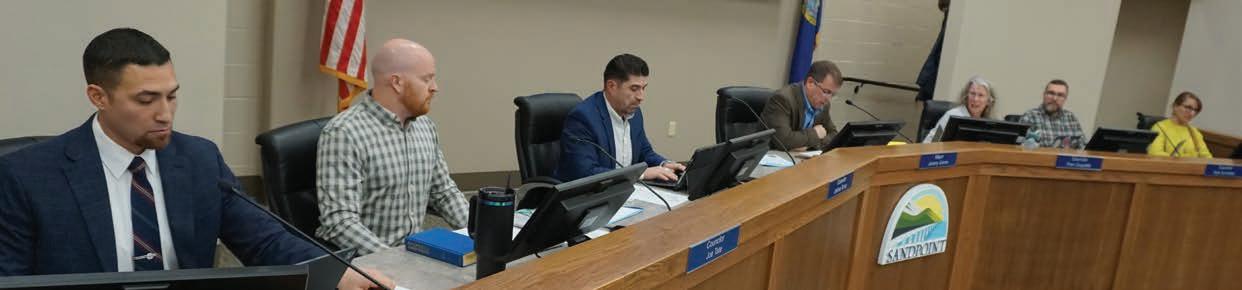
Sandpoint City Council. Photo by Ben Olson
‘ICE Out’ protest draws nearly 500 people to Sandpoint
By Ben Olson Reader Staff
For the second consecutive week in Sandpoint, residents took to the streets to protest the overreach of Immigrations and Customs Enforcement in U.S. cities after fatal shootings that have left the country on edge.
The local event was tied to a larger national protest, which saw an estimated 300
demonstrations across all 50 states and Washington, D.C., organized by the national grassroots organization 50501.
An estimated 400-500 people gathered from noon-2 p.m. on Jan. 31 in front of the Bonner County Courthouse, many holding signs that criticized ICE and President Donald Trump’s surging immigration enforcement across the country. A week before,
demonstrators stood along Fifth Avenue in Sandpoint to protest the fatal shooting of ICU nurse Alex Pretti by ICE agents in Minneapolis.
“People are really concerned about our civil liberties being violated,” event organizer Rachel Castor told the Reader. “They’re concerned about our government turning into a private police force. They’re concerned about peo-
ple being shot in the street.”
The Sandpoint protest was organized by Sandpoint 50501 and Sandpoint Indivisible.
Castor said the protests in Minneapolis in the wake of Pretti’s killing have inspired people to get involved.
“A lot of people are saying, ‘This isn’t what we voted for, this isn’t what we wanted,’” Castor said. “‘We didn’t want people abducted in the streets.
We didn’t want people shot in the streets. We didn’t want every brown and Black person in the United States to be afraid to leave their houses.’ ...
“Congress, the Senate and even Trump backed down from their positions, so I think it’s working,” Castor added. “People want to be a part of the change they see happening.”
Legislature to consider bill slashing regulations for short-term rentals
By Zach Hagadone Reader Staff
Though Sandpoint’s short-term rental regulation ordinance was on the agenda for the Feb. 4 meeting of the City Council, the Reader was unable to report on it before press time. However, also on Feb. 4, a bill was introduced at the Idaho Legislature that would strip counties and cities of nearly all their powers to establish rules regulating STRs in any ways other than they would for traditional single-family dwellings.
Introduced by House Speaker Mike Moyle, R-Star; Rep. Jordan Redman, R-Coeur d’Alene; and Sens. Kelly Anthon, R-Rupert, and Todd Lakey, R-Nampa, House Bill 580 dramatically alters the current state statute related to
STRs. The bill, which has been referred to the Business Committee, states in part:
“A county or city may enact or enforce such reasonable regulations as are necessary to safeguard the public health and safety as long as the reasonable regulations do not impose different different restrictions or obligations on short-term rentals than are imposed on single-family dwellings or similar structures not used as short-term rentals, or unless the regulations are permitted by this section.”
For instance, municipalities could not separately regulate STRs based on owner occupancy, requiring professional property management, requiring additional insurance, reporting of use or other statistics, additional fire protection, additional or improved means of access,
additional parking, structural modifications or inspections.
In addition, the bill would prohibit requiring STRs to have any internal or external signage, notices or diagrams; impose a limit on the number of days the property can be rented; requiring notification to neighboring properties; requiring increased sewer or other utility capacity, or a conditional use permit in a residential zone.
H.B. 580 would also bar municipalities from limiting proximity to other STRs, restricting the number of STRs in a county or city, or requiring the property be improved to meet current building codes unless those same improvements would be required regardless of STR use.
Finally, among other stipulations, H.B. 580 prohibits
municipalities from requiring STRs to obtain a license, permit or certification, or pay a fee or register in order to operate.
Based on the current language of the bill, virtually every aspect of the amended STR ordinance recommended for approval by the Sandpoint Planning and Zoning Commission and considered by the City Council on Feb. 4 would be removed.
“Basically it supersedes cities’ ability to regulate STRs at all,” Sandpoint Planning and Community Development Director Jason Welker said at the top of the Feb. 4 City Council meeting.
H.B. 580 only allows municipalities to require that all STR sleeping areas be equipped with smoke alarms; properties have a functioning fire extin-
guisher and a carbon monoxide detector on each floor; include removable escape ladders for rooms above the ground floor; abide by occupancy limits as outlined in the International Building Code; and make available a handout to tenants describing the locations of exits, fire extinguishers and first aid kits, as well as provide a phone number to be used to contact an owner or manager in case of emergency.
Welker said Feb. 4 that H.B. 580 could go before the Business Committee as early as Tuesday, Feb. 10. Track committee agendas at legislature. idaho.gov/sessioninfo/agenda.
Sagle Republican Rep. Cornel Rasor now serves on the Business Committee. He can be contacted at CRasor@ house.idaho.gov, 208-2907403 or 208-332-1185.
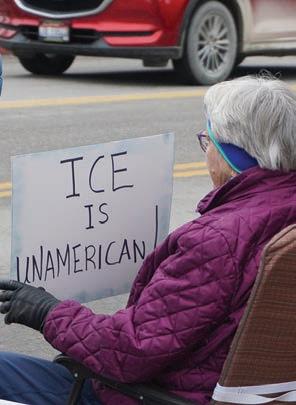
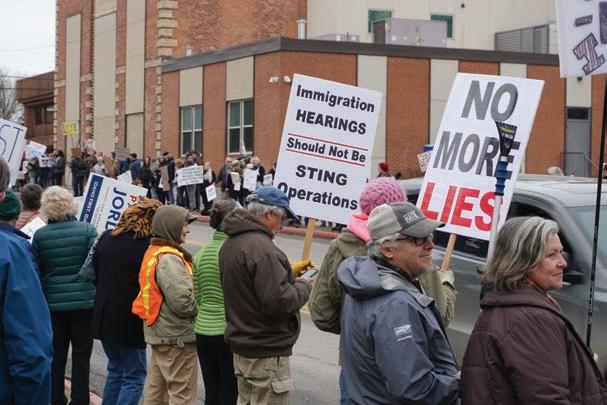
Scenes from the Jan. 31 “Ice Out” protest in Sandpoint. Photos by Ben Olson
Sauter provides update on 2026 Legislature at local town halls
Topics include state budget, health care funding and access, lake management
By Zach Hagadone Reader Staff
Rep. Mark Sauter, R-Sandpoint, met with constituents throughout District 1 at a series of legislative town halls Jan. 31, including in Bonners Ferry, Priest River and Sandpoint.
Fellow Dist. 1 Rep. Cornel Rasor, R-Sagle, attended the Bonners Ferry event, but “something came up,” Sauter said, and his colleague was unable to take part in the other gatherings. Dist. 1 Sen. Jim Woodward, R-Sagle, was unavailable due to a family emergency, in which his 26-year-old son suffered a serious work injury and is undergoing treatment in Seattle.
That left Sauter “carrying the show,” as he put it, providing about 100 attendees at the Sandpoint Community Hall with a summary of the 2026 legislative session so far and fielding questions about policy priorities.
Leading off the presentation — which took place as about 500 demonstrators lined First Avenue outside the Community Hall in an “ICE Out” protest over immigration enforcement — Sauter said the Legislature underwent a leadership “shakeup” in the fall of 2025, as several committee chairs were replaced following vacancies.
In the 2026 session, which gaveled into session on Jan. 12, lawmakers are facing a headline-grabbing projected budget shortfall, which has resulted in wide-ranging proposed budget cuts — even as revenue figures remain in flux and the impact of federal tax conformity remains to be seen.
“There’s been a lot of different changes in the past few months,” Sauter said, noting that some have been “good,” while others need more analysis. Meanwhile, arriving at a balanced budget is the overarching goal — “after all, that’s the No. 1 priority for the Legislature,” he added.
While much of the commentary and reporting on the projected state budget deficit over the past several months has been about imbalances between spend-
ing and revenue, Sauter said the other question is whether Idaho has “a cash flow issue” — specifically related to the new tax provisions contained in the federal One Big, Beautiful Bill Act passed in July 2025, which statewide businesses began applying before lawmakers approved legislation on how (or whether) to conform to it.
As of Jan. 31, Sauter said that may result in $155 million in revenue that the state won’t collect.
“We’re getting the best information that we can, and we’ll continue to try and make the best decisions that we can, but it’s a moving target between new people, new leadership and a lot of different facts that are flying around the room,” Sauter said.
He addressed a number of budget holdbacks, including $22 million from behavioral health programs, which have been opposed by law enforcement officials around the state — including Bonner County Sheriff Daryl Wheeler — who fear that cutting back those programs will result in undue burdens on hospitals and jails, while also threatening public safety.
“It may very well turn out that we end up costing our communities $100 million to $150 million dollars,” with those reduced behavioral health services, Sauter said.
“Everybody’s concerned, because if we don’t take care of our behavioral health issues, we fill up hospital beds — it’s expensive. It takes up space, fills up jail cells,” he added. “There are problems that come with behavioral health issues, so we don’t want that from a public safety perspective. So, we’re trying to take care of that issue, but it’s a work in progress.”
Meanwhile, following Gov. Brad Little’s directive that state agencies reduce their budgets by 3% in Fiscal Years 2026 and ’27, Sauter said the co-chairs of the Legislature’s Joint Finance-Appropriations Committee have also called for
< see SAUTER, Page 7 >
Bits ’n’ Pieces
From east, west and beyond
After the removal of the slavery exhibit at the President’s House historical site at Independence Hall in Philadelphia, U.S. District Judge Cynthia M. Rufe called the actions “dangerous” and “horrifying,” according to ABC News.
The exhibit included details about nine people enslaved there by George and Martha Washington. The Department of Justice told the judge they were honoring President Donald Trump’s call for “restoring truth and sanity to American history.”
A brief, partial government shutdown ends this week with a $1.2 trillion spending package, passed 217-214, various media reported. It will extend through September. A short-term carve-out was made for the Department of Homeland Security budget. After federal agents killed two Minnesota citizens in January, Democrats want DHS reforms such as an end to masking of agents and clear agent identification.
Five-year-old Liam Ramos and his father, detained by Immigrations and Customs Enforcement on Jan. 20, were recently released from immigration detention in Texas and returned to Minnesota. Nationwide media reported the Ramos family came from Ecuador in 2024 and had an active asylum case with no deportation orders.
In detention, Liam suffered lethargy, stomach pain, fever, vomiting and depression. While a facility doctor identified no cause, detainees and Liam’s attorney reported bad water, food with worms and poor medical care.
The release order handed down by U.S. District Judge Fred Biery called the father-son detention “ill-conceived and incompetently-implemented,” “cruel and unconstitutional” and part of meeting deportation quotas of 3,000 per day, “even if it requires traumatizing children.”
Quoting from the Declaration of Independence, Biery wrote that England’s King George “has sent hither Swarms of Officers to harass our People” and “He [the king] has excited domestic Insurrection among us.” The judge also referenced the Bible: “Let the little children come to me ... for the kingdom of heaven belongs to such as these.”
The DOJ released a new batch of late-sex offender Jeffrey Epstein’s files, saying it had now met its legal obligations, media reported. But critics soon found fault with the definition of those legal obligations, citing redaction failures. As well, 2.5 million pages remain concealed.
Trump Deputy Attorney General Todd Blanche said no files would be released showing “death, physical abuse or injury.”
Those examining the files say they
By Lorraine H. Marie Reader Contributor
include a “who’s who” of powerful people. The DOJ’s sloppy redactions were disturbing for Epstein survivors, whose information and depictions of nudity were included, while powerful people’s names were shielded. Twenty survivors stated that the lack of redactions means they are being re-traumatized.
Meanwhile, former-President Bill Clinton and first lady, Sen. and Secretary of State Hillary Clinton have finalized an agreement to testify in the House’s Epstein investigation. The former president is not accused of wrongdoing, while Hillary Clinton’s name is not in the files
The National Rifle Association wants a full investigation into Alex Pretti’s death in Minnesota last month, expressing displeasure with Trump saying, “You can’t have guns” [at protests]. Two Border Patrol agents who killed Pretti have been identified, according to ProPublica, with calls for their prosecution following a medical examiner’s ruling that Pretti’s death was a homicide, The Hill and other media reported.
Elsewhere in Minnesota, CBS News reported that ICE officials claimed a handcuffed man “purposefully” ran into a wall and shattered his skull at a Minneapolis hospital, prompting “skepticism” from doctors. In Maine, agents shattered the driver’s side window of a vehicle and dragged a man into custody — in the process, “glass sprayed” over a 1-month-old’s car seat, with glass shards found in the blanket wrapping the infant, the Portland Press Herald reported. The family — asylum seekers from the Republic of Guinea in West Africa with “no known criminal history” — was driving home from an appointment to secure a passport for the baby, according to the Press Herald
According to CNN and The New Republic, a leaked DHS memo directs ICE and its own officials in Minneapolis to “capture all images, license plates, identifications and general information on hotels, agitators, protestors, etc., so we can capture it all in one consolidated form.” Some demonstrators reported being followed home by agents and threatened.
Blast from the past: It’s the 50th anniversary of the conservative majority of the Supreme Court ruling in Buckley v. Valeo that money in politics is not corruption, and is constitutionally protected free speech. That was followed 16 years ago with Citizens United v. FEC. Current polling shows fewer than one in five believe spending unlimited amounts on political campaigns should be protected free speech.
Rep. Mark Sauter speaks to constituents at Sandpoint Community Hall on Jan. 31. Photo by Ben Olson
Idaho bill to ban local protections against LGBTQ+ discrimination heads to House
By Kyle Pfannenstiel Idaho Capital Sun
An Idaho House committee on Feb. 2 advanced a bill that would block local policies that ban discrimination on the basis of sexual orientation and gender identity.
House Bill 557 would prevent local governments in Idaho from having or enforcing anti-discrimination policies that go beyond state law.
Rep. Bruce Skaug, a Nampa Republican, is sponsoring the bill, which was written by the Idaho Family Policy Center, a conservative Christian lobbying group.
Skaug said local anti-discrimination policies “are often weaponized against different businesses and people.”
“It’s happened across the country. We see those in the headlines. We’ve heard stories: the bakers, the photographers, the wedding venues being forced to participate in ceremonies — which they hold a close religious belief that they cannot do that,” Skaug told the committee.
The bill comes after more than a decade of failed efforts in the Republican supermajority-controlled Idaho Legislature to add LGBTQ+ discrimination protections to state law. Idaho state law prohibits discrimination on the basis of race, color, religion, sex, national origin or disability.
More than a third of Idahoans — over 720,000 people — live in Idaho communities with local non-discrimination ordinances, the ACLU of Idaho estimates. Since 2011, 13 Idaho cities and towns passed non-discrimination ordinances, including Sandpoint, Boise, Idaho Falls, Moscow, Lewiston, Meridian, Ketchum, Hailey, Bellevue, Driggs, Victor, Pocatello and Coeur d’Alene. In 2020, Ada County, home to Boise, passed its own.
Nikson Mathews, who is transgender, told the com-
mittee that the issue is more than just about cake orders or weddings.
“What we are talking about is people having the right to have a home, to have a home for themselves and for their families,” Mathews said. “We are talking about the right for people to have a job in order to make a living for themselves and their families.”
Lone Republican opposed the bill, arguing state shouldn’t interfere with local government
The Idaho House Local Government Committee advanced the bill to the full House on a nearly party-line vote on Feb. 2. All but one of the 14 Republicans on the committee supported the move, and the committee’s two Democrats opposed it. In the coming days or weeks, the bill could go up for vote in the House, before it would advance to the Senate.
Rep. Rick Cheatum, of Pocatello, was the sole Republican to vote against the bill. He said he opposed it because it preempts local decisionmaking.
“I don’t think the state should be fiddling with what happens in local government,” he said. “Let local government officials manage their own affairs.”
Rep. Steve Berch, a Boise Democrat, told lawmakers they need to recognize why the ordinances are in place.
“It is not a special right to not be fired from your job. It is not a special right to [not] be evicted from your apartment,” he said. “It is not a special right to [not] be asked to leave a restaurant because of who you are.”
Officials: Boise hasn’t prosecuted under its non-discrimination ordinance
The Association of Idaho Cities opposed the bill over it preempting local policies, said the organization’s deputy director Jonathan Wheatley.
In November, Sandpoint repealed its non-discrimination ordinance after public complaints claimed a transgender woman used a local women’s locker room, the Spokesman-Review reported.
The North Idaho city was the first Idaho city to pass a local non-discrimination ordinance. [Editor’s note: Find the Reader’s coverage of the local NDO vote at sandpointreader.com.]
Sandpoint Mayor Jeremy Grimm testified in support of the bill. He cast tie-breaking votes in the City Council’s decisions to effectively repeal the town’s anti-discrimination ordinance recently.
“That decision was not about withdrawing protections. It was about restoring clarity, consistency and defensibility to our local code and acknowledging the limits of municipal capacity,” he told the committee.
The city of Boise opposed the bill. Boise’s government affairs director, Kathy Griesmyer, told the committee that since Boise adopted its ordinance in 2012, no business complaints have been filed with the city, and there haven’t been “any prosecutions against any business
<
1% to 2% cuts, including to health and welfare and K-12 education.
However, Idaho Superintendent of Public Instruction Debbie Critchfield, Secretary of State Phil McGrane and Attorney General Raúl Labrador have all “stood pat” and indicated they will not make those cuts, Sauter said. Whether those officials are compelled by JFAC to make the cuts before their budgets are approved is unclear, and Sauter said it will be “a battle that we’ll have to just watch play out.”
Less than a month into the session, Sauter said there were as many as 100 bills working their way through the Statehouse. However, the legislation that he and Woodward crafted in the 2025 session to include a health-ofthe-mother exception in Idaho’s strict abortion statute is “stuck.”
“So far, [House State Affairs Chair Brent Crane] will not hear it, so that’s the power of the chairs,” Sauter said, adding, “Now I’ve taken that whole issue and literally plopped it on the speaker of the house’s chair ... I don’t think that’s a good choice for our area.”
At the same time, though Sauter said he has met with state transportation officials about U.S. 95 improvements — including a bypass at McArthur Lake — funding at the Statehouse has been essentially stopped for any projects that weren’t already poised to start.
resulting in their market departure.
“Instead, this false reasoning is being used to advance state legislation that restricts city authority while severely harming our LGBTQ residents in our community,” she told the committee.
The bill would allow Idaho Attorney General Raúl Labrador and local businesses and property owners to sue local governments that violate the block on local anti-discrimination policies.
To become law, Idaho bills must pass the House and Senate, and avoid the governor’s veto. If the bill becomes law, it would take effect July 1.
This story was produced by Boise-based nonprofit news outlet the Idaho Capital Sun, which is part of the States Newsroom nationwide reporting project. For more information, visit idahocapitalsun.com.
Likewise, the picture for funding rural health care is murky. One portion of the Big, Beautiful Bill includes about $900 million for rural health care, but Sauter said, “it’s to be determined how that’s all going to work out.”
Sauter also gave an update on the Lake Pend Oreille economic impact report, which he and Woodward helped shepherd to fruition over the past year, and told town hall attendees that the final analysis shows that, “If the lake was managed differently, it appears that our community would be more in the black by like $20 million to $25 million a year.”
Convincing the U.S. Army Corps of Engineers and other regulators to change their policies will be a heavier lift than completing the study, but Sauter said having solid numbers to back up arguments about keeping higher lake levels will help make the case.
Also related to management on Lake Pend Oreille, Sauter reported that so far the Lakes Commission is safe from the Idaho DOGE effort, which has placed a number of agencies and programs on the block to reduce expenditures, and he will “go to every meeting I can to save that.”
“There’s lots of sobering things to work on,” he said.
Listen to a recording of the full town hall event at krfy.org/podcast.
Demonstrators protesting anti-LGBTQ+ legislation dropped 48,000 handmade hearts — meant to represent LGBTQ+ Idahoans — down the rotunda of the Idaho State Capitol Building in Boise on April 2, 2024. Photo by Kyle Pfannenstiel for Idaho Capital Sun
Bouquets:
GUEST SUBMISSION:
• “Bouquets to all the wonderful neighbors that keep their holiday lights on throughout the winter. It sure does brighten up these long winter nights. And sorry for you skiers with expensive season passes. We need more snow for you all and to keep away those summer fires.”
— By Denise Dombrowski
Barbs:
• While the majority of reader interactions have been positive the past few years, occasionally I’m reminded that we live in a strange, divided world. I received an email from a Sandpoint man who informed me — after calling me a “Marxist, socialist and communist” in Swedish, no less — that I was no longer allowed to reference my ancestors moving to the U.S. from Sweden because, “We don’t like it.” How foolish of me! I didn’t realize I was speaking to the ambassador of the Swedish people. I called the guy and invited him to speak those same words to me over the phone, then did my best to listen to his points until he brought up fringe conspiracy theories like the “great reset,” then claimed people who brought guns to protests “deserved what they got.” It was at that point I stopped trying to argue using logic, because there is no logic with some people. As the old saying goes: “I learned long ago never to wrestle with a pig. You both get dirty and the pig likes it.” So it goes. Sure, we’re all entitled to our opinions, but I refuse to waste my precious time on this Earth wallowing in the toxic sludge that has seeped into every argument in America lately. I’ll let this ignorant fool retain his anonymity, but not before giving him one final send-off appropriate for his porcine arguments: Go wrestle yourself.
‘Women’s health isn’t “niche”’…
Dear editor,
Once again, I see women’s health care under fire. Seventy percent of Panhandle Health District care is women’s health — that’s a problem? We lost four gynecologists, who provided women’s health care. Sure, most visits are related to women’s health; but, to call this a “niche” service, — Mr. Pennock, medical director PHD — is derogatory. He might as well have said they’re seeking Botox.
As to Commissioner Ron Korn’s comment, “sound[s] a lot like Planned Parenthood. … I think the federal government defunded Planned Parenthood,” over 95% of PP services are full-scope women’s health care, screening for cancer (cervical and breast), and checking for sexually transmitted infections to protect women’s fertility. Healthy women tend to have healthy babies. Our community needs women’s health care. When comparing PHD, in Sandpoint, to the Heritage Health Clinic in CDA, you might as well say women can go to Boise. Services two hours away do not serve community needs. Idaho legislation drastically cut OB-GYN physicians. Why punt this to BGH? Isn’t the mission of the health department to meet the needs in the community?
Women’s health isn’t niche, but necessary.
Cynthia Dalsing MSN CNM Ret. Sandpoint
Achilles focuses on constituents’ needs, not partisan politics…
Dear editor,
Todd Achilles, Independent candidate for the U.S. Senate, met with more than 50 people at the Sandpoint Community Hall on Jan. 16 to discuss his campaign and answer questions from the audience. Topics ranged from Venezuela to school vouchers, from local housing affordability to health care.
Todd sees himself as a bipartisan candidate, focused on creating a middle ground in politics focused on constituent priorities. Together with other Independent candidates around the country, he explained how they could have an outsized influence due to slim majorities in Congress. He supports term limits for Congress, and has signed a pledge to limit his service to two terms if elected.
Kathleen Painter Sandpoint
aire playboy in his younger days and loved to party. While playboying about Moscow he became a KGB asset by being filmed/recorded in compromising situations (fetish for girls).
Putin, a former KGB agent — you know killing people was in his job description, right? — has the recorded video of Trump’s bad-boy doings in Moscow and is blackmailing him with it.
The Putin blackmail explains why Trump did not stop thousands of armored Russian personnel on the Ukrainian border, before they attacked and (once attacked) refuses to give Ukraine the weapons it needs to win, and why Trump is facilitating Putin’s dream of breaking up of NATO because he sees Europe as easy pickings without NATO.
In conclusion: Where are the Epstein files?
George Rickert Sandpoint
Will
ICE raids lead to demise of the republic, or unite us?…
Dear editor, ICE operations merit exposure, as the evidence shows the law is being violated.
I write this because ICE has not followed legal policies, as described in The Bulwark article “Target of Viral Botched ICE Raid Was Already in Prison.”
Imagine ICE coming to the wrong residence and bashing in the doors in our area. We have guns and dogs. I didn’t have to imagine much, as I’ve read Every Knee Shall Bow by Jess Walter.
What would Randy Weaver think about ICE operations?
Joyce Vance wrote on the Fourth Amendment in a recent post at joycevance.substack.com. I wonder if we are closer to the demise of the republic than many think, or might ICE operations unite us?
Mary Ollie Bonners Ferry
Election
Day fudge…
fudge. And everyone loved Elona’s fudge. Hope elections were held in the Community Center, behind the railroad tracks. One Election Day a train stopped on the tracks and the guys came into the center and said, “It’s Election Day. Did Elona bring fudge?” Don’t know how they knew, but they got fudge before continuing on their route.
Jane Holzer Hope
‘A
very deliberate strategy’…
Dear editor,
Do you believe the ICE activity in Minneapolis is an example of the Trump administration’s overreach?
I don’t think so — I see it as a very deliberate strategy with these elements: using ICE, etc., to encourage violence from the public; pretending that violence, whether actual or not, is insurrection; invoking the Insurrection Act; and, thereby imposing authoritarian rule.
If the authoritarian rule succeeds, it will not be a surprise that the midterm elections will be corrupted, even by destroying the elective process in resistant communities.
How successful will this strategy be? It’s not clear yet. Certainly there is wonderful resistance, even as far away as Sandpoint with its recent anti-ICE protests.
However, the Minneapolis debacle spawned by the administration has unwitting supporters. These folks are accepting the administration’s claim that resistance to its authoritarianism (which includes murders) is “domestic terrorism.”
Essentially, those who resist are labeled as “domestic terrorists” and consequently have no rights. If a large enough segment of the population swallows this lie (or pretends they do), the strategy may succeed. That segment does not even need to be a majority, if joined by our state and federal representatives.
Richard Sevenich Sandpoint
please discard it. Not sellable: If an item is broken or no longer usable, then it is trash to the thrift store as well. Please discard it. If you have dirty stuffed animals, broken glass picture frames, sewing machines that do not run or puzzles missing half the pieces, please discard them.
One of the largest expenses a thrift shop faces is their dumpster trash bill. Please, please, please be mindful of what goes into your donation box. Your heart may be in the right place, but take a minute to think about whether someone would buy it. If not, toss it into your own garbage can.
Cheers to cleaning your closet in 2026!
Jay Pietsch-Schuck Sandpoint
‘What
was our mayor thinking?’...
Dear editor,
It was extremely disappointing this week to see, splashed all over state media, our mayor’s face and comments in support of a bill that would mean less autonomy for local government — not to mention encourage the further erosion of equal rights for every Idahoan.
It’s bad enough (although not surprising) that Dist. 1 Rep. Cornel Rasor cast a vote to send House Bill 557 on to the House floor for a vote. The bill is called “anti-discrimination,” but prevents cities from enacting non-discrimination ordinances.
But that our mayor had to testify in support of it? Although he recently cast the tie-breaking vote in our City Council’s decision to effectively repeal Sandpoint’s longstanding NDO, still, wouldn’t it make more sense to align himself with the Association of Idaho Cities, which opposed the bill over it preempting local policies?
Dear editor,
Dear editor, Thanks for the letter to the editor in the Jan. 29 issue of the Reader about the Elmira Store [“Elmira Store is cabin fever relief”...]. Several years ago, a similar thing happened in Hope to a 60-year volunteer of the Bonner County election board, Elona Yaryan. We election volunteers had a reputation of providing cookies for folks who came in to vote. So every volunteer brought a batch of cookies, but not Elona — she brought
‘Mindful
donating’...
Dear editor, Just like hitting the gym, the new year signals it’s time to declutter our stash of unused, never-worn or outgrown items. It’s a “feel good” new year ritual! Everything can be an upgrade for someone, right? There may be truth in that way of thinking, but please be mindful of your donations. Clothing: If it has stains, holes, tears or is dirty,
Was he concerned that the new, more progressive makeup of the council would mean a reinstatement of our NDO? Who knows. In any case, H.B. 557 is so wrong on so many levels and we encourage you to write your legislators urging them to oppose this measure.
Karen Matthee Chair,
Bonner County Democrats Sandpoint
Send letters to the editor to letters@sandpointreader.com. The word limit is 200 words. Please no libelous statements. Please elevate the conversation. Trolls will be ignored.
Trump was a globetrotting million-
Sandpoint library leaders eyeing policy amendment after upset over petition-gathering
By Zach Hagadone Reader Staff
Some area residents are upset over petition-gathering at the Sandpoint Branch of the East Bonner County Library, triggering a minor social media furor after former-Dist. 1 Sen. Scott Herndon posted on Facebook Jan. 24 that “pro-abortion activists are collecting signatures for a ballot initiative to make all abortion legal in Idaho.”
According to both Herndon and EBCL Director Vanessa Velez, two individuals gathered outside the front doors of the library to gather signatures for a petition to put the Reproductive Freedom and Privacy Act on the Idaho ballot as a citizens’ initiative.
Herndon, who is also president of the Bonner County Republican Central Committee and announced last year that he would seek the Dist. 1 Senate seat currently held by Sagle Republican Jim Woodward, went on in his Jan. 24 post to state:
“They are doing this on the taxpayer funded property right at the doors of the library at the expense of Bonner County’s taxpayers.
“The doors are at least 100’ into the library property.
“Will the public library taxing district file an in-kind donation to the organization collecting these signatures?”
In a Jan. 29 email to the EBCL Board and shared with the Reader, Velez wrote that the petition gatherers “had not reached out to me ahead of time, so I was unaware of their presence until alerted by staff. When I spoke to them, they told me they thought their supervisor had obtained permission for them to be there.”
Going on, Velez wrote, “After understanding they were exercising their First Amendment right to petition, I provided a copy of our Code of Conduct and reviewed the relevant section with them. I did not ask them to leave library property as petitioners have always been allowed in the past and disallowing any based on their viewpoint would be discriminatory.”
According to Velez’s email, petitioning is addressed in the library’s Code of Conduct, specifically that, “petitioning, soliciting, conducting surveys or selling merchandise on library property” is not allowed without the “express permission of the director
or their designee.”
If permitted, petitions on library property are prohibited from blocking, hindering, or otherwise interfering with visitors and staff wishing to access or leave the buildings, “nor intimidate patrons or staff into signing a petition or accepting information.”
However, Velez wrote, the policy is problematic in that “it implies that the ‘director or their designee’ has the authority to deny expressive activities protected by the First Amendment. It also implies that petitioners on library property are ‘approved’ by the library, when they have no affiliation with or connection to the library.”
Because of that, she told the Reader that she plans to propose amending or drafting a new policy at the Monday, Feb. 9 EBCL Board meeting, which is scheduled for 4 p.m. in the Community Room at the Sandpoint library (1407 Cedar St.).
Velez’s recommended amendment states:
“Visitors may not engage in petitioning, leafleting, soliciting or conducting of surveys (collectively ‘petitioning’) inside any library building. Petitioners on library property must remain 15 feet from all entrances and may not block, hinder, or interfere with patrons or staff wishing to enter or exit the buildings, nor intimidate patrons or staff into signing a petition or accepting information. Anyone wishing to engage in petitioning shall inform library staff during normal business hours of their desire and intent to petition.”
Meanwhile, those upset by the petitioning activities have sent out a rallying call for attending the Feb. 9 meeting, writing in part, “Families (including children) were pressured and accosted while trying to enter a public, taxpayer-funded building.”
The petitioning incident isn’t the first time the library entrance has been political, with People’s Rights protesters gathering there in tense confrontations with library staff over COVID-19 masking and social distancing policies in 2020. Several other demonstrations and political gatherings have taken place on the Division Avenue sidewalk abutting the library and in the library’s garden space.
Go to ebonnerlibrary.org/events/ monthly-board-meeting for more information.
Science: Mad about
stardew valley
By Brenden Bobby Reader Columnist
Video games have made a large cultural impact on our society — on par even with books, movies and TV shows. Love them or hate them, video games have altered our society and how we interact with each other in ways never seen before. Just pay a couple hundred dollars for a console and $70 bucks for a game of your choice and you can set sail on the high seas as a pirate, hold up a bank with your friends or explore new planets from the comfort of your own couch.
Video games have had such an impact on our society that many memes that shape our social media feeds were extracted directly from them and have entered the public lexicon, whether you play games or not.
My partner, who has never played a game in her life, knows exactly what I am referencing every time I poke my head through the bedroom door and utter: “So, you’re finally awake” — an iconic reference to 2011’s The Elder Scrolls V: Skyrim
Many of these games were created by hundreds of thousands of worker-hours across months or even years. World of Warcraft has been online for more than 21 years, allowing it to legally drink in the U.S., and has been continuously developed with 11 expansion packs and hundreds of content updates.
These are staggering efforts by hugely well-funded studios comparable with any other mega-entertainment
company, with titles like Call of Duty: Cold War employing 8,000 people under a $700 million budget.
Then there is Stardew Valley
Stardew Valley is an anomaly in the world of video games. It is an indie game in the truest sense of the word, created from start to finish by a single developer: Eric Barone, also known online as ConcernedApe.
Any time someone refers to a piece of art as an indie title, my mind drifts to a half-baked black-and-white film that’s too pretentious for its own good. Stardew Valley is not that.
Despite having been released in 2016, Stardew Valley is a love letter to 16-bit games of the 1980s and ’90s, particularly the Harvest Moon franchise.
Released in 1996, Harvest Moon was one of the earliest forms of “cozy games,” in which the goal isn’t to rush to the end of the game or beat some big, bad evil guy, but instead simply exist, farm, and build friendships and romances in a small, tight-knit community.
The Harvest Moon series did this very well up until about 2003, when Harvest Moon: A Wonderful Life released. Whether the developers were struggling with rapidly evolving technology or fans just weren’t picking up what they were laying down is uncertain. What is certain is that it left a bad taste in Barone’s mouth, who decided to make a clone of the series on his own after earning a computer science degree from University of Washington Tacoma in 2011.
Barone began work on Stardew Valley in 2012, using Microsoft XNA, which is a freeware program developed by Microsoft that gives users the toolkit to develop their own games. It has been used at the AAA-level of development as well for indie developers. A similar product you can see at your local library is the Unity editor, as well as Godot.
The coding that went into programming the game was done with C#. This language is very commonly used in video games and entertainment, as it is an intermediate, high-level programming language with a lot of flexibility. Used in Unity, it’s another programming language you can learn at your local library through the curated Udemy page in the digital library.
Stardew Valley was picked up by the publisher Chucklefish Games in 2013, which redesigned the game’s website, promotion and distribution, though the programming, art, story and sound design were all handled by Barone.
Stardew Valley has sold more than 41 million copies and is believed to have made at least $500 million. It stands as a testament to what can be achieved by a dedicated creative with a vision and an extra helping of gumption and grit.
Meanwhile, Barone has shifted to a new cozy retro game, Haunted Chocolatier, of which there is very little information available to the public so far. It seems to have an art style reflective of Stardew Valley; but, aside from that, we know very little
about it.
Overall, the cozy game genre has grown in popularity — by no coincidence alongside the stressors of the world. It only seems logical that a lighthearted escape into a little digital farm where you can control every outcome would be appealing, right?
Interestingly, cozy games will often include a feedback loop effect to keep you coming back for more. A neigh-
bor always needing something new, the shopkeeper dying to get a freshly baked bagel and needing it right away, the local dog looking for a pet by 9:30 a.m. every Wednesday.
While I’ve enjoyed my time in Stardew Valley, I’m a simple man. Give me a giant dragon and a flaming sword to slay it with, and I’ll be right as rain.
Stay curious, 7B.
Random Corner
•Ancient Egyptians used perfume to celebrate religious ceremonies as early as 3000 B.C.E. We know this because recipes were inscribed on the walls of temples built in Ptolemaic Egypt. Recipes referenced a technique to make perfume later called “enfleurage” by the French, and used ingredients like moringa, linseed, sesame and castor oils. Perfumes were also used for mummification because ancient Egyptians considered a pleasant smell a sign of holiness.
•Ambergris is a popular additive to perfumes that was first used in the 10th century. It is made from the intestines of sperm whales and can cost as much as $7,500 per pound.
•Along with ambergris, perfume makers also use civet, castoreum and musk — all obtained from the anal glands of different animals.
•Eau de toilette (literally translated as “grooming water”) was invented by an unknown Hungarian man in the 14th century and remains the most-sold type of fragrance because it’s less expensive. The first alcohol-based perfume,
called Hungary Water, was made for Queen Elizabeth of Hungary at her command. It used lemon, orange flower, thyme and rosemary.
•Eau de Cologne (“water of Cologne”) was first made in the 18th century by Johann Maria Farina who wrote that he made the scent because it reminded him of “an Italian spring morning, of daffodils and orange blossoms after the rain.” Farina named his invention after where he lived after emigrating from Italy — Cologne, Germany. Napoleon Bonaparte loved its scent so much, it’s said he ordered 50 bottles of eau de Cologne every month.
•Celebrity perfumes began to launch in the 1980s. Sophia Loren was the first A-list performer to launch her own scent in 1981, followed by Cher’s “Uninhibited,” and Elizabeth Taylor’s “Passion” in 1987 and “White Diamonds” in 1991.
•Scientists have been trying to recreate Cleopatra’s perfume since 2012. The scent was called Mendesian, described as intense, spicy and slightly musky, and consisted of myrrh, cinnamon and essential oils.
‘Freedom for me, but regulations for thee’
By Brian Hilland Reader Contributor
I have to hand it to the Bonner County commissioners for shutting down the Panhandle Bike Ranch. It’s about time we got some common sense back in the woods. Living in one of the nation’s most beautiful BNSF rail corridors — Sagle, Idaho — we know a thing or two about constant peace and quiet.
But a new, quiet bicycle park?
Quite a nuisance.
I love the crisp sound of jet skis on the lake, a Stihl dropping a larch at 7 a.m. on a Sunday morning, and the rhythmic thunder of one or two trains bellowing through Sagle every hour. But bicycles? Come on! That’s just loitering with wheels. It’s got no motor and it ain’t natural.
“Bicycle ranch”? If the Lord intended us to move through timber that way, He wouldn’t have given us Cummins turbo-diesels, two-stroke motorcycles and high-performance snowmobiles. Real nature is ripping brodies in the dirt until it’s stacked to your truck door handles.
Pro-bicycle folks whine about “selective enforcement.” They ask why the paintball place is OK, but bikes aren’t. Simple: paintball involves shooting stuff. And that massive nonprofit youth camp? Well... it’s “grandfathered in,” OK? If the noise of thousands of screaming kids has been here a long time, it’s “Historic Rural Heritage.”
So, thank you, Bonner County officials, for finally proving that hiding behind an appointed position gives you the power to override the decisions we actually voted for you to make. Using the heavy boot of an unelected bureaucrat to crush a private landowner, simply because we don’t agree with their flavor of the “pursuit of happiness”?
That is tax money well spent. It upholds the true Idaho way — freedom for me, but regulations for thee.
Now, I’m gonna idle my diesel for a while and blow up some tannerite. You know — good ol’ peace and quiet. Don’t tread on me.
Brian Hilland is a Sagle resident.
Festival at Sandpoint announces first concert of 2026 season
By Reader Staff
The Festival at Sandpoint announced the first act of its 2026 summer concert series with a movie-in-concert performance on Sunday, Aug. 9 featuring How to Train Your Dragon 2. The Festival at Sandpoint Orchestra will perform the score while the movie is projected on the big screen.
Sandpoint local Jason Moody will serve as concertmaster for the orchestra. Since his solo debut with the Spokane Symphony at age 16, Moody has performed across the U.S., Europe and Japan, also receiving fellowships for the Aldeburgh Festival, the Spoleto USA Festival, the Masters Music Festival and the Lancaster Festival. Moody serves as an adjunct faculty member at Whitworth University and Edmonds College, teaching violin, viola and chamber music.
Conducting the performance will be Morihiko Nakahara, who spent 16 years as resident conductor of the Spo-
kane Symphony. He is also the music director of the South Carolina Philharmonic and the director of orchestra studies at the University of Massachusetts Amherst. Nakahara is well known for his charismatic presence on and off the podium, his innovative and audience-friendly programming skills, and his thoughtful interpretations of both standard and contemporary repertoire.
A movie-in-concert means audiences will watch the entire film with dialogue on a large screen. Only the in-film score has been removed and instead will be performed live-to-picture by a 70-person orchestra below the screen on stage.
Tickets are $54.75 for adults, $15.83 for kids aged 6-12 years and free for kids aged 0-5 years.
There will also be a Cheers Tasting Event from 5-7 p.m. before the concert, with add-on prices of $17.95 for day-of or $15.85 if purchased in advance.
Learn more and purchase tickets at festivalatsandpoint.org.
How to Train your Dragon 2 movie-in-concert slated for Aug. 9
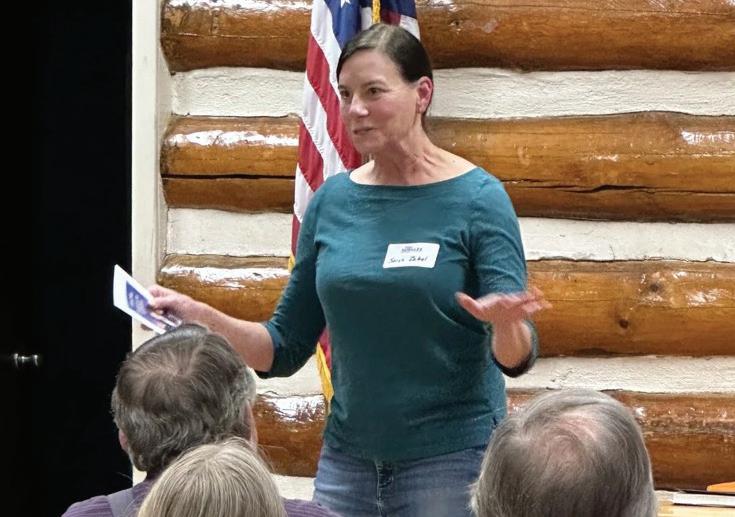
FEATURE Independent Idaho congressional candidate Sarah Zabel talks with the Reader
By Zach Hagadone Reader Staff
Sarah Zabel is running as an Independent for the First Congressional District of Idaho in the November 2026 election — a race that also includes incumbent Republican U.S. Rep. Russ Fulcher and Democratic challenger Kaylee Peterson, both of whom the Reader has interviewed (find those articles at sandpointreader.com).
A Bayview resident since 2018, Zabel is a retired Air Force major general specializing in communications and computer systems, a RAND Corporation adjunct and author of Fighting Chance: How Science Explores, Explains and Leads the Battle Against Depression. She visited the Reader offices in January for an interview ahead of a series of statewide campaign appearances, including on Monday, Feb. 9 from 5:30-8 p.m. at Evans Brothers Coffee (524 Church St., in Sandpoint).
The following conversation has been edited for length and clarity.
ZACH HAGADONE:
I think it’s pretty interesting that you’re running from North Idaho — we don’t usually get statewide candidates from anywhere north of, like, Moscow or Lewiston, or really the Boise area. ... Maybe we could start with a little bit of biographical information. What brought you to Bayview and how long have you been there?
SARAH ZABEL:
I’m retired military. I served for a little more than 30 years — 31 and a half years — and I retired at the very end of 2018. Before that, I was looking forward to retirement. Even though I joined the military from Texas, I moved all over the U.S. One of my sisters settled in the Spokane area, another one in the Seattle area. So I was looking around up here. ... It’s pretty — it’s so dramatic. ...
I bought some property and then, after I retired, I built a house there. But, as soon as
I retired, I really retired into elder care, because my father was in his 90s with Alzheimer’s disease, so I was looking after him full-time. COVID started not so long after that, so it was really full-time. He passed away a couple of years ago, and I went to work parttime for RAND Corporation.
ZH:
What led you to running for office?
SZ: Coming up on the election in ’24 and then after the election in ’24, I was just so frustrated with our options and with what’s going on — the direction that our country was going under Biden, and then the direction that (especially now, even more intensively) the country is going under Trump. And after the election, wanting to tear my hair out, I finally thought, “OK, what can I do about this?” And that’s what got me into this. First, I was looking for: “Who is the candidate that I can support and be out there and vocally supporting?” And I, frankly, didn’t find one. So, I started thinking, “OK, well, maybe I need to put my hat in the ring and do this.”
ZH:
What are some policy priorities or key issues for you?
SZ:
[W]e have so many things frustrating us right now, like the costs — cost of living and health care, you know, screamingly so. This is eating our lunch and our dinner. ... I studied Social Security and the trust funds projected to run out in 2033. At that point, the payroll contributions will only cover about 77% of what’s currently being paid out now. These are crises that we see coming up. You look at the debt and how it’s growing. And can we do anything about that? And so I spent a couple of months reading and researching, getting online,
getting into books to see what we can do. And I found that, yes, actually, we can solve these problems. In fact, some of them, we’ve tackled and overcome equivalent problems before, right?
After World War II, our national debt was like 100% of GDP, and we got that down to 30% of GDP. They took some pretty strong actions. I don’t think we need to be quite as rigorous as they were, but we can get it down, and the first thing you do is you fix taxation, and people who are making the highest incomes have to pay more. You have to collect revenue.
You look at what the current administration has done with the One Big, Beautiful Bill Act — they’re absolutely going the wrong way. We’re increasing debt and the sort of breaks that they’re giving to the highest 10% of earners,
earners. ...
This is a self-inflicted wound, and I think we need better choices — other choices — and Idaho really needs to speak. We are colored darkred only; we’re not the way they rest of the country and the rest of the world looks at us, as if we are this dark-red smear over here. It’s much more complex.
ZH:
[Y]our perspective and your candidacy does feed into that idea that we’ve gotten so partisan and tribal over the past 10, 15, even 20 years that no matter what happens — even if it was your “team” that was screwing up — you were still going to raise your pom-poms and be in favor because you disfavor the others so strongly that you’d rather see your enemies lose than you win. ... Was that part of your calculus? Just seeing this moment as maybe the time when people are willing to look past the letter at the end of the [candidate’s] name?
SZ:
the highest 1% of earners — they’re willing to devastate the country to do that. ...
Their tax breaks add up to about $105 billion a year, and that comes from the Congressional Budget Office, the Joint Committee on Taxation. What does that cover again? That’s the 1%. ...
The amount that they wanted to make from public land sales? You’re looking at $10 billion over 10 years, so that’s just a drop in the bucket. Medicaid, PEPFAR [the President’s Emergency Plan for AIDS Relief], USAID, all of that could go in the hole that they created by giving tax breaks for the top 1%. All of those things could be funded every year, including the entire workforce for the National Park Service and the backlog of maintenance on national parks — that all fits into the tax break for the top 1% of
That letter at the end of the name is the hardest part. ... It’s not that this is the best moment; it’s just that I cannot live with myself if I do not do something, but this is a good moment because of the midterms and this matters for ’28. If we can get our voice out there and really make a noise, that’s when the parties should take note of what they learn in ’26 ... and it’s actually affecting how the parties behave and react. ...
We have to raise the taxes on the very high-income people — we have to. We have to raise corporate taxes. Those are things that are very uncomfortable for both parties; but, again, if both parties know it has to be done, they don’t want to have their presidential candidate running on that sort of platform in ’28. ... So this might be the
< see ZABEL, Page 13 >
Retired Major General Sarah Zabel is running as an Independent for the First Congressional District of Idaho. Courtesy photo
moment when it’s actually possible to have them swallow something they don’t want to swallow. ...
Before 2017, the highest corporate tax rate was like 35%, and went down to a flat tax of 21%. The Democrats were proposing, “Hey, let’s bring it up to 28% corporate taxation.” That’s a hard one, because it’s much easier to bring it down than it is to bring it back up. ... I don’t have a better number, so I’ll say 28% for that — a decent tax rate, a normal tax rate.
ZH:
So, beyond Social Security, health care affordability and taxation — like you mentioned — what are some other priorities for you?
SZ:
Another big one is — and it’s actually not one of the old problems, it’s one of the new problems — and that’s the way that AI is consuming our brain space. I think we need responsible limits on AI. We don’t want to crush ourselves so much that we get dominated by something like Chinese AI, but we need responsible limits. And, some of the very early things we can do is make sure people and companies are accountable for what they put out. And I’m thinking here about the sorts of deepfakes and the sorts of information that is going to flood us going into the ‘26 and ’28 elections. We need to get on top of that.
ZH:
I don’t know if you agree with this or not, and I guess I’m asking if you do, but is the reluctance to look at these issues related to campaign finance — Citizens United? ... It feels to me like all these [issues] sort of connect in certain ways, right? ... You’re talking about getting health care costs down, but at the same time, the taxation piece that you talked about?
SZ:
You have campaign finance, but you also have to look at the media billionaires — the people who screen and filter and provide content for what ordinary people see on TV and what they get in their
social media feeds. That’s very influential in how they perceive their options, how they vote. That’s not necessarily a Citizens United issue. Citizens United is more directly about campaign finance — this is influence and the influencers, and they are right up there among the multi-billionaires.
ZH:
One of the things that I think most people agree on, no matter what their party is, is that the Congress is not working. ... If you were elected, where would you see yourself in the matrix of the coalitions that could actually get things going?
SZ:
[E]specially with the Republicans, it’s a matter of, “Oh, if you want to keep your job, it’s not just, ‘please Mr. Trump.’” It’s, “If you want to keep your job, you have to please your constituents. You have to work for them.”
So that’s a big, screaming message that hopefully wakes people up going into ’28. ... They start looking to their people rather than looking to the White House. ...
There’s a Problem Solvers Caucus ... people who are trying to get the job done. ... It’s Not about the party.
ZH:
We talked a lot about domestic policy, but there’s definitely a lot of foreign policy stuff going on that ... given your military background, I’m curious to hear your thoughts about.
SZ:
So, I retired, like, seven years ago. In the military, the people who are three-stars and four-stars now are my contemporaries. I was a two-star. I retired as a two-star. What is going on now in Venezuela? What they’re threatening with Greenland? They know Venezuela is illegal. It is illegal from the first boat strike on. Is not a gray area. It’s not debatable, it’s illegal, and they’re doing it ... and I am so disappointed in them. ...
[T]o our understanding, the military was introduced into hostilities on Sept. 2, so you can take a look at the War Powers Act. Some people
have claimed that the authorization for use of military force signed after 2001 and for 2001 applies. It does not. ...
It means all of our service members involved in that are part of an illegal war. And like I said, the military leadership knows this. They know this, they know it. ... Survivors from the first strike on Sept. 2, that they watched for an hour and then killed ... that is illegal, and that is a war crime. And the admiral who said that he ordered it, that he knew it — nobody told him to do it. He ordered it. He was protecting Mr. Hegseth, whatever. He needs to face the court martial.
[O]f course, he has a right to a vigorous defense. He has the presumption of innocence. It is a court, but he needs to face the court marshal; and, honestly, all the generals and admirals involved, they need to face the American people. The leadership needs to face the American people on what they’ve done there.
ZH:
cyber operations — it seems to me in my layman’s opinion that if we fracture or destroy this alliance system, which has kept a balance between various parties and adversaries, it opens us up to a lot more of the cyber aspect of conflict. ... We look at places like Russia and all the bot farms that we see in Africa operating, and in China — what are the stakes? ... What are the implications for the the U.S. if we start going alone without our alliance system for cyber security?
SZ:
It’s more likely to come to a coerced transfer of territory rather than bullets flying, but it’s very serious.
ZH:
Maybe you could speak to the implications for the dissolution of NATO? I assume that, in your position, you worked with allies.
SZ:
“I think we need better choices — other choices — and Idaho really needs to speak. We are colored dark-red only; we’re not the way the rest of the country and the rest of the world looks at us, as if we are this dark-red smear over here. It’s much more complex.”
— Sarah Zabel
I’m thinking about the Greenland stuff, too, and the destruction of NATO. Is it saber-rattling, or is it more than that?
SZ:
I think it’s dead serious.
Yes, on multiple levels. My position is, America has a preeminent position in the world — we are the top of the heap, but we’re not — by ourselves — superior to the rest of the world. ... We do have the strongest military; but, again, put our next two adversaries together and we’re not that big. We’re in our position because of our allies — because of our economic strength and because of what had been soft power: goodwill or at least nullification of bad will. We built our position in the world at least since the end of the Cold War. ... It’s been a strategy of enlightened self-interest, and it goes all the way from fighting AIDS in Africa to providing help to different countries ... and all of that is under the axe.
ZH:
Because of your specific experience — working in
Being able to count on the information that we get from our allies across the world — that is hugely important, because the world is networked. Financial systems are networked. Communication systems are networked across the world. ... The fact is that without that really strong relationship — where we have to keep working and improving and making sure that our systems and our networks are defended broadly with cooperation — without that cooperation we’re hugely vulnerable. ... [W]e’re struggling with a lot of problems that hit us very hard. ... It’s just too much, you know? What can we do about it? But, like I said, it’s lots of working hard. We can beat those current problems back, and we really have to look at the “brave new world” — “brave’s” not the right word — the “fearful and angry new world” that we’re entering.
ZH:
It sounds to me like your perspective is that the old partisan matrix is only going to make it more fearful and angry.
SZ:
Yeah, they’re really locked in. ... They had, what, 44 days of shutdown? They could have been working through all of those things, but instead, it’s like each one’s in their little foxholes, and they’re so focused on their positions and the leadership personalities that they are not focusing on the bigger policies — they’ve lost sight. They’re deep in, and not focused on broad policies that they need to be focused on.
Sarah Zabel speaks with potential voters at Sandpoint Community Hall. Courtesy photo
Legislative update
While the state budget draws the most attention, local issues still need tending
By Rep. Mark Sauter, R-Sandpoint Reader Contributor
Greetings from Boise. Last Friday, Jan. 30, marked the end of three weeks of legislative activity. Many bills have been introduced; though few have been voted on by the representatives on the House side of the Capitol.
Deciding how Idaho will conform with federal tax rules and forecasting the state revenue for Fiscal Years 2026 and ’27 have taken most of the legislators’ attention.
Looking ahead, bills directing local agencies on which flags they may fly to avoid fines, how they must stream public meetings and how the non-discrimination ordinance process may work will soon be considered by the 70 members of the House.
All the while, our local issues continue to call for attention.
The University of Idaho
Economic Analysis of the impacts of the Lake Pend Oreille lake level decisions will be available soon. This report took a little longer than we had hoped, but the early results shared at the Lakes Commission meeting in October supported what many had thought. The uncertainty of when the lake fills each spring and the early draining of LPO in the fall seriously hurt our economy.
Last week I submitted a research request to the Idaho Water Resources Research Institute . This spring they will be evaluating the effects of the water level of LPO on water hydraulics, river flows, power generation and how it impacts aquifer recharge. The IWRRI work should provide the research needed for Idaho to make the best
decisions regarding water levels and use of state water rights. Congress recently adopted language directing the U.S. Army Corps of Engineers to work with Idaho to reevaluate the operating curve for LPO.
Our local behavioral health system has suffered serious funding cuts. The Idaho Sheriffs’ Association has pointed out the problems associated with these cutbacks and forecasted the costs other service providers in our area will likely be saddled with.
The sheriffs believe the $22 million cut in December will grow to a $100 million dollar increase for rural hospitals and law enforcement. I’m working with several legislators to address the budget shortfall and to shore up the programs. Holding people in hospitals and jail cells is considerably more expensive than the services to provide daily preventative care.
Many of the 27 critical access hospitals in Idaho are struggling. Costs are steadily increasing and profit margins are thin. Many hospitals are nervous about making payroll. Hospitals are finding that it takes considerably longer to get paid for the care they provide.
Last week, a rural health care committee was organized to work with the federal government to address some of the problems our country faces with health care delivery once away from urban areas. The funding comes from the Big, Beautiful Bill. It’s my hope the funds will be used to make long-term improvements for our hospitals and to support a sustainable rural system. I plan to track this committee closely.
I introduced our first property insurance bill last week. This bill will extend the period a policyholder will have to find a new insurance carrier or to work out an agreement with their carrier to maintain coverage. We have another insurance bill ready for introduction to address the communications and information shared by insurance companies with policyholders.
Another piece of property insurance is funding for the Idaho Department of Lands. Our local fire and EMS districts provide us 24/7 emergency response for structure fires, accidents and medical calls. However, we also need IDL for the larger forest and wildland fires like the Sunset fire last summer.
IDL provides fire staffing, equipment and the aerial firefighting resources for such “campaign” fires. These resources are important to direct fire away from structures. When structures are involved, it’s the local fire districts that extinguish those fires. A bill to expand the fee schedule for IDL was introduced last week and made it out of the House. For homeowners living outside the boundaries of a fire district, IDL helps to keep them insured.
It’s an honor to serve this community and to represent you in Boise. If you have thoughts or opinions, please send them to msauter@ house.idaho.gov.
Rep. Mark Sauter is a second-term Republican legislator representing District 1A. He serves on the Agricultural Affairs; Education; and Resources and Conservation committees.
Rep. Mark Sauter. File photo
FEATURE Selkirk alpinism Chimney Rock in winter
By E.G. Lunceford Reader Contributor
The first winter ascent of Chimney Rock was driven by a fierce but friendly competition between Chris Kopczynski, John Roskelley and Jim Spearman — all from Spokane. Over the course of five years, Kopczynski attempted the ascent twice with snowmobiles and twice purely by skis, sometimes traveling all the way from Coolin, when the East Shore Road was not plowed. Portering 110-pound packs over 26 miles on skis finally brought Kopczynski success on Feb. 22, 1973, when he and Will Parks aided the heavily rimed West Face Direct, rated 5.7 A2.
The second winter ascent quickly followed in March of the same year by Gary Stitzinger, Gary Johnson and Dan Kurtz. They used the West Face Standard Route pioneered by the first ascent party in 1934. Kurtz and Stitzinger were Sun Valley ski patrollers, while Johnson was a smokejumper and marine deputy. Stitzinger was also a smokejumper until he broke his femur on a jump outside of Plains, Mont. from striking a subalpine fir tree going 25 miles per hour. Like the first ascent party, the trio skied all the way in from East Shore Road in a single 10-plusmile day.
The third known winter ascent of the tower was also the first winter ascent of its taller, more imposing east face. Fremont Shields aid climbed the Free Friends route in his telemark boots, making sketchy free moves sans crampons to gain the little roof on the last pitch. Alex Broughton — a willing partner but not much of a climber — belayed, and Fremont’s dad, Royal, spectated.
Johnson, who was on the second winter ascent team, was family friends with the Shields family. Johnson had, in part, inspired Fremont’s
brother, Kip, to become an Alaskan smokejumper. Johnson had perhaps also planted the seed in Fremont’s mind to make a winter ascent of his own. Fremont was 20 years old and made the trip over Christmas break while he was home from the University of Idaho in December 1997.
The last known winter ascent of the tower was done by the author with the use of a snowmobile to reach the Horton Ridge trailhead. From the trailhead, I skied a few miles to the west ridge of Mount Roothaan (7,326 feet) and pitched my tent like the parties before me. The next morning, with avalanche conditions being stable, I skied down the north face of Roothaan and skinned/ front-pointed up to the base of the tower. I built an anchor designed for upward force, flaked out my eight-millimeter rope and began the cumbersome task of self-belaying on a clove hitch and micro traxion.
The first pitch is always the crux in my mind, and this day was no different. The ledges formed by the overlapping flakes were covered in ice thick enough to swing an axe into.
I was relieved when the first pitch was behind me, even though it is only rated 5.5 (an extremely moderate difficulty-grade). The second pitch is my favorite and felt smooth and easy with the exception of a 30-second moment when my front and secondary points got snagged in between loose, stacked blocks that shifted and vibrated when I tried to wriggle my foot loose.
The drama having passed, I reached the belay and rapped back down to retrieve my equipment before top-rope soloing back up on my micro trax. The final pitch involves a step-across move — where you span your legs over a void, wrap your fingers over a good, sharp edge and shuffle around to the tower’s northwest edge.
Here I encountered snow climbing, before a final steep mantel before arriving on top. I relished the sunshine and moderate temps before rigging my rappels and skiing out of the basin. Back on the west ridge of Roothaan, I packed my tent and skied off through a challenging crust. I was very cautious not to catch any edges that would launch
me head-first into a tree well, but once came very close. My 55-pound pack made me top heavy, but it was an absolute joke compared to the 110-pound packs carried by the first winter ascent team.
Returning to my snowmobile, I found that it would not run properly, and I decided to ski back to my truck, several miles away. Shards of hoar frost sparkled in my headlamp beam and the rimed tree needles gave me a peaceful feeling, almost making me forget how bad my thighs were burning trying to control my speed over the icy and crusted snowmobile track.
Even after reaching the truck, I still wasn’t out of the woods. The road conditions were treacherous, and I came close to sliding off. Except for that, I was able to steer into the bank, ride up on it and almost flip the truck before coming miraculously to a stop on a sheet of polished ice.
I was home and well by 11 p.m., happy that I’d completed a little novelty climbing mission I had dreamed of doing for a decade. My smarter friends went roadside ice climbing in Troy, Mont.
— suspecting that I would subject them to some mishap or another. They may still get dragged into helping with a snowmobile recovery.
E.G. Lunceford is an avid, longtime local climber and outdoor enthusiast.
Above: Will Parks ski approaching to the base of the west face of Chimney Rock. Photo by Chris Kopczynski. Top right: Dan Kurtz (left) and Gary Johnson (right) atop the summit, c. 1973. Photo by Gary Stitzinger. Right (second from top): Looking down the first pitch while ascending. Photo by E.G. Lunceford. Bottom right (second from bottom): Gary Stitzinger (right) and Dan Kurtz (left). Photo by Gary Johnson. Bottom: Dan Kurtz on summit. Photo by Gary Johnson.
Corps seeks comment on Natural Resource Master Plan for Albeni Falls Dam
By Reader Staff
Officials with the U.S. Army Corps of Engineers are seeking feedback on revisions to the Albeni Falls Dam Project Natural Resource Master Plan. Members of the public have until Friday, Feb. 27 to submit comments on the plan, which includes a draft Environmental Assessment to address the potential environmental impacts of implementation.
Submit public comments to AlbeniFalls.MasterPlan@usace.army.mil.
Corps staff members conducted public scoping through two workshops held in Priest River and Sandpoint during the summer of 2024. Required
by policy, the master plan is a strategic land-use document that guides the management and development of all recreational, natural and cultural resources associated with the project — covering management objectives, staff direction on supporting outdoor recreation and environmental sustainability on public land, and ensuring compliance with federal law, policy and regulations.
Last updated in 2018, the plan does not address fish passage, lake level management, dam operations or the current spillway gate restrictions.
Review the plan and draft environmental assessment at bit.ly/CorpsPlan.
Local artist Randy Wilhelm to feature in post-retirement retrospective
By Reader Staff
The Pend Oreille Arts Council is inviting the community to celebrate the creative legacy of longtime educator and artist Randy Wilhelm with Three Decades of Coloring Outside the Lines, a post-retirement retrospective exhibition honoring his 27 years of teaching art at Lake Pend Oreille Alternative High School.
The exhibition opens with a public reception on Friday, Feb. 6, from 5-7 p.m. at the POAC Gallery (313 N. Second Ave., in downtown Sandpoint).
Born and raised in Sandpoint, Wilhelm’s life and career have remained rooted in the community. The exhibition focuses on the work he created alongside his students, presenting his own interpretations of classroom assignments in media ranging from scratchboard and ceramics to papier-mâché, pastel, acrylic and watercolor. Anecdotes displayed with the pieces offer visitors insights into what it was like to teach, learn
and create together.
“I always told my students, ‘I don’t care if you love it or hate it, as long as you can’t walk by it and ignore it,’” Wilhelm said of his philosophy toward artistic expression.
Three Decades of Coloring Outside the Lines is Wilhelm’s first retrospective exhibition, marking both a celebration of his retirement from the school district and his continued connection to arts education. Though retired, he remains active in the local arts community and teaches through POAC’s Expressions youth program.
Wilhelm will be present at the opening reception, with the show remaining on view through the end of February. Admission is free and open to the public.
Western Pleasure Guest Ranch transitions Snowshoe Roundup to ‘Mud Madness’ race
By Reader Staff
Western Pleasure Guest Ranch is hosting its 13th annual Snowshoe Roundup on Saturday, Feb. 7 — but, due to a lack of snow in the area, organizers are choosing to redefine the event to a “Mud Madness” race.
Rather than the traditional 5K and 10K snowshoe races, the ranch will host 5K and 10K distance courses akin to an early spring trail race. Locations will depend on existing conditions at race time, with participants invited to show up wearing whatever footwear they desire, with
trail running shoes recommended.
“Wet and muddy conditions will be featured,” organizers stated. “Be sure to dress appropriately.”
Finisher awards and cookies will be available.
In addition to the 5K and 10K options, participants aged 6 and younger are invited to join the untimed, short-distance Buckaroo Race. No experience is required and members of the public of all ages are invited.
Registration is $25 and available online — along with more information — at westernpleasureranch.com/ events.
For more information about the exhibition or POAC programming, visit artinsandpoint.org or call 208263-6139. To view Wilhelm’s work, visit RandyWilhelmArt.com.
A painting of the Lake Pend Oreille High School by Randy Wilhelm. See more of his work at the POAC Gallery from 5-7 p.m. on Friday, Feb. 6.
Send event listings to calendar@sandpointreader.com
Artist reception for Susie Snider
5-7pm @ Pend d’Oreille Winery
Meet the artist and learn about her unique painting style
Live Music w/ Frytz Mor
8-11pm @ Roxy’s Lounge
Live Music w/ Mike and Sadie
5-8pm @ Pend d’Oreille Winery
Father-daughter duo Mike and Sadie.
Classic rock, pop, folk. Jaco on guitar
Live Music w/ Double Shot Band
5-7pm @ Connie’s Lounge
Live Music w/ Wolfchild
5-7:30pm @ Matchwood Brewing Co.
Live Music w/ Monarch Mountain Band
5:30pm @ Barrel 33
Live Jazz w/ Bright Moments
6-8pm @ Baxters on Cedar
Live Music w/ Lucas Brookbank Brown 7pm @ Eichardt’s Pub
Live Music w/ Ian Newbill
5-8pm @ Pend d’Oreille Winery
Country and classic rock
Live Music w/ Dario Ré
5:30pm @ Barrel 33
Live Music w/ John Daffron
6-8pm @ Connie’s Lounge
Live Music w/ Luke Stuivenga
6-8pm @ Smokesmith BBQ
Live Music w/ The Real McCoy 9pm-midnight @ 219 Lounge
Open mic night
5:30-7:30pm @ Evans Brothers Coffee
Sandpoint Chess Club 9am @ Evans Brothers Coffee
Live Music w/ Fiddlin’ Red
1-4pm @ Barrel 33
Sandpoint Lions Super Bowl party
3pm @ Sandpoint Lions Den, 609 S. Ella Bring a delicious finger food and wear your coziest pajamas
Monday Night Blues Jam w/ John Firshi 7pm @ Eichardt’s Pub
Outdoor Experience group run 6pm @ Outdoor Experience
tuesDAY, february 10
THURSDAY, february 5
Live Music w/ Liam McCoy and friends 7pm @ Eichardt’s Pub
Line dancing lessons at 7:30pm ($10) country music starts at 8:30pm ($15)
Live Music w/ BTP 8-11pm @ Roxy’s Lounge
Live Music w/ Hannah Siglin
6-8pm @ Idaho Pour Authority
Live Music w/ Angel Urrea
6:30-9:30pm @ MickDuff’s Beer Hall
SATURDAY, february 7
Old Time Fiddler Jam
2-4pm @ Sandpoint Senior Center
Play: Cheaper By The Dozen
1pm @ Panida Theater
Music w/ DJ Sterling 9pm-midnight @ Roxy’s Lounge
Ltl Wlf EP release show coheadlined by
Star Family Singers and potluck
5pm @ Idaho Pour Authority
Potluck starts at 5pm, Ltl Wlf (Josh Hedlund and Justin Landis) EP release show and Star Family Singers concert
Live Music w/ Kerry Leigh and Bill Krutz
6-9pm @ MickDuff’s Beer Hall
SunDAY, february 8
Magic with Star Alexander 5-8pm @ Jalapeño’s
Super Bowl party at Smokesmith BBQ 3pm @ Smokesmith BBQ 10 screens and the famous big screen. Seat reservations $20/person, goes toward your bill. Draft specials
monDAY, february 9
Open bluegrass jam night 5pm @ Connie’s Lounge
Trivia w/ Ben 6-8pm @ Idaho Pour Authority
Free calligraphy class • 10-11am @ Sandpoint Library Register: peaceanjel@gmail.com
5:30pm @ Hope Elementary School Fundraiser with dinner at 5:30pm
Live trivia ($5/person entry) 7pm @ Connie’s Lounge
Open Mic Night hosted by BioBeat 7pm @ Eichardt’s Pub
Line dancing lessons 6pm @ The Hive $10/person, 21+, every Thursday
Cribbage tournament
6pm @ Connie’s Lounge $5/person
Fly me to the moon... please?
Space films to satisfy that itch to leave Earth behind
By Ben Olson Reader Staff
Let’s be honest here: There have been better times to live on planet Earth. When the terrestrial woes heap you under their big, dumb weight, consider taking a cinematic trip away from Earth. Here are a handful of films that take us far, far away.
The Martian
The 2015 Oscar-nominated film adaptation of Andy Weir’s iconic novel covers a lot of ground. The Martian chronicles an astronaut’s struggle to survive on Mars after accidentally being left behind and NASA’s attempts to return him to Earth. Botanist/astronaut Mark Watney is played to perfection by Matt Damon, who adds dashes of humor to the survival tale that relies heavily on actual science to propel the story. It’s a favorite for math and science nerds alongside film buffs.
Apollo 11
The more I learn about the amazing efforts of NASA to put a man on the moon, the more I’m blown away by
this achievement, especially when you consider that the average smartphone has thousands of times more computing power and memory than the Apollo 11 guidance computer that helped take astronauts Neil Armstrong, Buzz Aldrin and Michael Collins on their historic trip to the moon. The 2019 documentary film Apollo 11 features never-before-seen footage and audio recordings of the launch and mission that captivated the world in July 1969. It’s arguably one of our finest hours in America, and this film’s stunning large format archival footage puts the viewer right in the cockpit. Stream it on Netflix.
Apollo 13
While the moon landing mission went off without a hitch, the Apollo 13 mission proved to be just the opposite. Plagued by difficulties and logistical launch problems from the start, Apollo 13 tested the new space program to its limit and relied on the combined intelligence and abilities of hundreds of people to see the astronauts return home safely to Earth. The 1995 feature film directed by Ron Howard achieved both the realism and terror
the astronauts Jim Lovell, Jack Swigert and Fred Haise went through on their doomed mission. With stars like Tom Hanks, Kevin Bacon, Bill Paxton, Gary Sinise and Ed Harris drawing the viewer into the amazing story of survival, Apollo 13 is steeped in realism, technical accuracy and drama for what turned out to be NASA’s greatest rescue mission.
Event Horizon
Mixing horror and sci-fi, 1997’s Event Horizon doesn’t receive nearly enough credit for how great of a film it is. Sam Neill, Laurence Fishburne and Kathleen Quinlan play a rescue crew tasked with investigating the mysterious reappearance of a spaceship that had been lost for seven years, only to find the real truth behind its disappearance is something more terrifying than anyone imagined.
Contact
Also released in 1997, Robert Zemeckis’ Contact blew audiences away with its portrayal of how society might react after receiving radio proof of extraterrestrial intelligence that sends plans to build a mysterious ma-
TheRoyalTenenbaums comes to the Panida as part of Wes Anderson film series
By Zach Hagadone Reader Staff
Auteur Wes Anderson first came to audiences’ attention with Bottle Rocket and Rushmore in 1996 and 1998, respectively, but his 2001 film The Royal Tenenbaums cemented his place as a major director with a singular vision.
Garnering an Oscar nomination for Best Original Screenplay, Tenenbaums is the inimitably quirky portrait of the family of eponymous patriarch Royal Tenenbaum (Gene Hackman), his estranged wife Etheline (Anjelica Huston) and their adult children, all of whom are thwarted geniuses. Anderson established his talent for assembling A-list ensembles with Tenenbaums, pulling together Ben Stiller and Luke Wilson as biological brothers Chas and Richie and Gwyneth Paltrow as their adopted sister, Margot. (That’s in addition to Bill
Murray, Owen Wilson and Danny Glover as an assortment of love interests, erstwhile husbands and frenemies to members of the family.)
The core of the film is the trauma and dysfunction of the Tenenbaum clan — its younger members feeling the disappointment of the unrealized aspirations of their brilliant childhoods and failing to deal with the longtime abandonment by their self-absorbed, rakish dad Royal.
Suffering various personal crises, the Tenenbaum kids converge on their stately though slightly worse-for-wear family home at the same time as Royal — down on his financial luck — fakes a terminal cancer diagnosis in order to claim an unearned position as head of the family.
On paper, that plot setup might seem like the recipe for a real downer of a film, but Anderson and his cast infuse every scene with wry humor
and deftly crafted emotional beats that make Tenenbaums a deeply felt and genuine comedy-drama about love, loss and forgiveness.
Sponsored by La Chic Boutique and the Pend d’Oreille Winery — and featuring a Sandpoint High School student art show — The Royal Tenenbaums will screen Thursday, Feb. 12 as part of the Wes Anderson film series at the Panida Theater (300 N. First Ave.). Doors open at 5:30 p.m. and the show starts at 7 p.m. Tickets are $5 and available at the door or panida.org.
chine. Starring Jodie Foster, Matthew McConaughey and Tom Skerritt, Contact is based on the 1985 novel by Carl Sagan.
Honorable mentions include Interstellar, The Hitchhiker’s Guide to the Galaxy, Moon, Alien, WALL-E and, of course, various films and shows from the Star Wars universe.
Tickets on sale for final Follies
By Reader Staff
Tickets went on sale Feb. 2 for the risque variety show The Follies, an annual fundraiser hosted by the Angels Over Sandpoint to raise money for school supplies to local students.
Organizers announced that the 2026 Follies would be the final event in the nonprofit’s long history, with the theme “Farewell to the Queen” picked for the two shows on Friday, March 6-Saturday, March 7 at the Panida Theater (300 N. First Ave., in downtown Sandpoint).
The show is billed as a “politically incorrect variety show” and is rated R for “risque, racy and ridiculous.” As there is adult content in the various acts, attendees must be 21 or older.
Tickets are available at panida. org for $30 each, or VIP tickets with early entry and reserved seating are available for $50 (only 76 of these are available each night). Those interested in attending should purchase tickets quickly, as this event will sell out.
Courtesy photo
Archival footage from the 2019 documentary Apollo 11. Courtesy photo
By Marcia Pilgeram Reader Columnist
Mamma mia! Here I go again.
This coming October, I’m heading out on another adventure with a favorite group of intrepid peers — older, wiser and fun-seeking women. This time, we’re off to the idyllic destination of Greece.
Most of these ladies have traveled with me before, and we’re a like-minded lot. Of course, we’re going for the ancient ruins, the diverse cultures and the incomparable blues of the Mediterranean Sea. But at the top of our list (or at least mine) are the food experiences. No surprise there, right?
We aren’t looking for Michelin-starred plates topped with seafoam or garnishes that require long-handled tweezers for placement. What we want instead is authenticity and stories. We’ll search out tavernas that still use recipes passed down for generations — or even centuries — and silver-haired waiters who have been clearing the same wooden tables for decades and are more than happy to share house recommendations and their stories. It’s like dining in a living archive — like biting into history.
Greek food, especially, is a perfect example of cultural evolution. Staples like olive oil, yogurt, lemons, olives and bread have been around for thousands of years. And judging from their longevity, I’d say the Greeks were on to something long before we Americans became obsessed with the Mediterranean diet.
Older restaurants understand this instinctively. They
The Sandpoint Eater Mamma mia!
don’t reinvent themselves every season with a clever new menu. In fact, the only menu might be affixed to a whitewashed stucco wall, scribed by the current owner — likely the grandson of the woman who first fired up the weathered grill decades ago. The tables are worn smooth by generations of elbows.
The recipes may be adjusted slightly over time, but the soul of the plate will always belong to Yιαγιά
Traveling with like-minded women sharpens these experiences for me. We have our own well-seasoned stories and recognize endurance when we see it. We know that what lasts is rarely flashy. Like a lifelong friendship, a great dish is built slowly, patiently and with forgiveness for im-
perfections. We come to revel, not review.
There’s something deeply comforting about eating food that has outlived us; sitting at a table where thousands have sat before we were born, ordering something that has been prepared for a hundred years — or more. In a world obsessed with the new, there’s something profoundly satisfying in choosing the old.
This trip isn’t about ticking boxes or checking off sights. It’s about slowing down enough to notice how recipes mirror lives — how they adapt, endure and deepen over time. The best ones don’t belong to a single person but to a place, a family, a culture, evolving authentically and ever so slightly.
Maybe that’s why food
matters so much when we travel. Long after souvenirs are shared and photos fade, we remember how something tasted, how it made us feel, who we were sitting with, laughing with when we ate the food, shared the wine and recounted the day’s highlights.
In Greece this fall — at Psaras Tavern in Athens, and Xeri Elia in Hydra (a favorite of past Hydra resident Leonard Cohen) — we’ll be listening to stories and clattering plates heaped with family-style dishes shared by patrons for generations. Every single bite will be savored.
When you sit down in an old taverna in Greece, you may find — just as in Spain or Italy — that they often don’t bother with menus in English. These are places where
recipes evolve not because of trends, but because of history, hardships and survival. A dish may look simple on the plate, but it carries the weight of the ingredients — and the history — that came before it.
And finally, the desserts! Often they arrive as a gift: a small slice, a spoonful or a tiny glass of something special from the kitchen. It’s not about indulgence, it’s about hospitality: sweetness offered after the meal, simply because you’re there, and you’re kind and gracious.
We’ve earned our sweetness, and sweetness is always worth sharing — especially this Greek-inspired dessert. It’s the perfect grand complement to any meal. You might even consider making and sharing it for Valentine’s Day. Opa!
Crispy lemon custard cake
This cake is not only delicious, it’s beautiful and perfect as a celebration dessert. Omit the glaze and drizzle lightly with honey, or dust lightly with powdered sugar and a sprinkle of almond slices. Yields 8-12 slices.
INGREDIENTS: DIRECTIONS:
•1 16-oz box of phyllo dough sheets
•½ cup melted butter
•3 eggs at room temperature
•½ cup whole Greek yogurt
•⅓ cup sugar
•¼ cup fresh squeezed lemon juice
•2 tsp lemon zest
•1 tsp almond extract
•½ tsp salt
For the optional glaze:
•¾ cup powdered sugar
•1 tbs lemon juice
Preheat the oven to 350 degrees Fahrenheit.
Unroll the phyllo dough and lay it on a damp kitchen towel to make it easier to keep soft and prevent tearing.
Using 1 piece of dough at a time, fold it accordion-style and place it in a circular pattern around the perimeter of a 9” springform cake pan, pressing firmly but gently against the side of the pan, as you work toward the center in smaller circles, using a gentle touch when working them into the pan. You will use all or most of the phyllo dough. The final roll will be quite small and rose shaped.
Brush (or drizzle with a spouted cup) the melted butter over the tops and into the folds of dough. Avoid buttering the outer edges of dough against the pan.
Place in the oven and bake for 10-15 minutes, until golden brown.
While the dough is baking, begin the custard by whisking the eggs in a large bowl. Add the yogurt and sugar and continue to whisk until smooth. Add the juice and zest of the lemon to the egg mixture. Add the almond extract and salt and whisk.
Once the dough has baked, remove from oven and pour the custard in an even layer over all the cake. Tap very gently to settle the custard into the crevices. Return to the oven and bake for 20-25 minutes, until it’s golden brown and set. Cover with foil if the top is getting too brown. Remove and allow to cool.
To make the glaze, whisk the powdered sugar with the lemon juice until smooth. Drizzle over the top of the cake and serve.
Cut with a serrated knife using a sawing motion. Cake is best eaten the same day while the phyllo is crisp. Refrigerate leftover cake.
MUSIC
Ltl Wlf and Star Family Singers to co-headline potluck birthday show at IPA
By Ben Olson Reader Staff
Fans of listening shows in Sandpoint will be stoked to hear that Ltl Wlf is joining the Star Family Singers to put on a special no-cover potluck birthday concert starting at 5 p.m. on Saturday, Feb. 7 at Idaho Pour Authority (203 Cedar St., in downtown Sandpoint).
The potluck will start at 5 p.m., and attendees are asked to bring a dish if they’d like to participate, while the music will start around 6:30 or 7 p.m.
Ltl Wlf — the duo consisting of Sandpoint locals Josh
Hedlund and Justin Landis — has captivated audiences for years throughout the panhandle. With raw, beautiful songs penned by Hedlund that speak of love, loss and everything between — as well as a voice that skewers your soul — Hedlund is matched only by Landis’ intricate electric and bass guitar accompaniment punctuated by his haunting vocal harmonies.
The night also doubles as a birthday party for Hedlund, who co-owns IPA, as well as an official release show for Ltl
Wlf’s new EP, Longshot. There will be CDs and cassette tapes
available for purchase, as well as T-shirts. All physical media includes digital download codes.
Co-headlining the concert is the Star Family Singers, the project of Sandpoint-born Kjetil Lund and his partner Charlie Powell. Lund is the winner of the 2021 Festival at Sandpoint’s Charley Packard Memorial Songwriting Scholarship.
“I think he writes really honest and pure songs,” Hedlund said of Lund. “They’re just freewheeling, rambling troubadours.”
Hedlund said the listening shows at IPA have been
well-received.
“We’ve been surprised at how much respect people have for the atmosphere when we have a listening show,” he said. “It’s tough to get a room full of people to engage for a couple of hours, but I think it’s becoming a thing. People know what they’re signing up for when they come to a listening show.”
A snapshot of notable live music coming up in Sandpoint
Portland, Ore.-based duo Wolfchild describes their music as “cinematic folk rock,” which makes sense if you listen to any song off of their four studio albums. The brothers Gabriel Wolfchild and Elion TruthHeart take inspiration from their Pacific Northwest, hippie upbringing, putting deeply personal stories to music with string and woodwind parts that feel like they belong in a film soundtrack. The duo’s sound is
reminiscent of Lord Huron with the harmonies of Fleet Foxes, often highlighting — in true folk fashion — themes of love, nostalgia and grief. Their music has a kind of pervasive melancholy that’s cathartic to listen to and makes every show feel intimate.
— Soncirey Mitchell
5-7:30 p.m., FREE. Matchwood Brewing, 513 Oak St., 208-7182739, matchwoodbrewing.com. Listen at wolfchildmusic.com.
Phrases like “jamergey” and “sweet, jammy goodness” are often applied to The Swingin’ Jays, a duo consisting of well-known local songsters Jason Perry and Erick Johnson. Kicking out some acoustic grooves at Smokesmith BBQ on Friday, Feb. 6, Perry and Johnson will serve as an appetizer for a weekend of festivities at the ’cue joint, with Luke Stuivenga following on Saturday, Feb. 7 with his
This week’s RLW by Zach Hagadone
READ
Though published by Current Affairs in 2022, “Why Conservatives Hate the Government But Love the Cops,” by Nathan J. Robinson, has only gotten more relevant in recent weeks. The article deconstructs the seemingly hypocritical demand for limited government while also being in favor of domestic state violence. As his subtitle puts it: “The core right-wing principle is a belief in hierarchy, not the limitation of state power.” Find it at currentaffairs.com.
LISTEN
brand of blues and Americana on the eve of Super Bowl LX. Smokesmith will show the big game Sunday, Feb. 8 with $20 reservations and loads of specials. Can we spend every day taking in live music, barbecue and big-time sports? Let’s find out.
While Puerto Rican phenom Bad Bunny isn’t my typical jam, his track “Debí Tirar Más Fotos” off his Album of the Year-winning record of the same name is a song that comes at its perfect historical moment. Full of life and verve, it’s almost like an anthem for the times. Find it everywhere, and plan on probably hearing it on Super Bowl Sunday, when Bad Bunny performs the halftime show.
WATCH
As of press time, we’re halfway into the new HBO series A Knight of the Seven Kingdoms, a six-part prequel spinoff of Game of Thrones. Critics seem enamored with the quotidian adventures of Duncan the Tall (“Dunc”) and his diminutive squire “Egg.” However — opposite of a spoiler — almost nothing has happened in the story. It’s pleasant enough, but I’m reserving full judgment until the final installments, which air on Sundays (other than the next episode, which drops on Friday, Feb. 6 to accommodate the Super Bowl).
Left: Justin Landis and Josh Hedlund are Ltl Wlf. Right: Kjetil Lund and Charlie Lowell are the Star Family Singers. Courtesy photos
From Northern Idaho News, February 6, 1912
WILL BUILD BRIDGE AT BONNERS FERRY
Again the county commissioners have approved a petition for the building of a steel bridge across the Spokane International railroad tracks just north of the bridge across the Kootenai river at Bonners Ferry. A petition signed by 150 taxpayers in the road district in which the bridge is to be built, was filed with the board at their January meeting and a notice was published stating that the petition had been filed with the board and that they had set February as the date on which the application would be considered. When the board met yesterday to consider the proposition the applicants were present with their attorney, but the taxpayers who had enjoined the commissioners from building the bridge on the first order failed to show.
M.M. Fry, one of the applicants, was sworn and testified concerning the needs of a new bridge at that place. Mr. Fry said:
“I consider that the bridge in its present position is very dangerous as well as being very inconvenient to the people who are compelled to use it. There is such a steep pitch in getting on and off the bridge that it is almost impossible to haul a heavy load. The grade in getting off the present bridge is 11 per cent and I understand that the grade in getting off the proposed bridge would be only 7 per cent. The proposed bridge would also be more convenient to the people and would be absolutely safe. I strongly believe that we are entitled to a new bridge.”
BACK OF THE BOOK
Holy shed II
Contemplations on safe spaces — both public and private — and defending your peace
By Zach Hagadone Reader Staff
It’s been hard to feel good about much over the past few weeks; and, like many, I’ve been feeling the whiplash-mixed-with-burnout being offered up in what feel like minute-by-minute portions by the all-hungry news cycle.
However, the best news in my little corner of Sandpoint has been the recent completion and near-total furnishing of my long-awaited backyard writing shed. If you know or converse with me regularly, you’re probably sick of hearing me say the word “shed.” I’m sick of it, too, but certainly not sick of the finished product.
Since getting my desk, chairs, end tables, couch and various gimcracks installed, it’s been a real struggle to leave the space. I swore to my wife and kids that I wasn’t going to move out of the house altogether — and I really can’t, since the shed has no plumbing — but I’ve certainly been ducking out an awful lot to revel in the solitude and contemplative peace I’ve found.
The last time I wrote about this topic, in a “Back of the Book” essay titled “Holy shed” in July, I wrote in part: “The term ‘safe space’ has gotten a bad rap — specifically from people who make spaces unsafe — but that’s exactly what we all need.”
Having spent the past week or so periodically ensconced in my own “safe space,” I can attest that it’s definitely something we all need, and now more than ever.
Having lunch with an old friend the other day, I found myself showing
STR8TS Solution
him pictures of the shed on my phone like it was one of my kids. It got us talking about these kinds of personal spaces — and not just the physical ones, like a shed, shop, studio or garage, but the notion of fighting for and defending your “peace.”
It’s not as easy or self-helpy as it sounds. At a time of such broad-based and intrusive unrest, it feels almost obscene to be seeking solace in retreat of any kind. When I look around my shed, I am keenly aware that it is an enormous luxury.
There are uncounted millions of people around the world who are displaced — either with no roof over their heads at all or, in so many cases, under the roof of some authoritarian regime. Yet here I am, sitting in just under 200 square feet of fully insulated, heated space with high-speed internet, electricity and a lock on the door on property that I own — no mean feat even in Sandpoint, which is admittedly far from any of the real battlelines in our current world.
But I return to that notion of defending your peace because, on many levels, I think that’s what people of good faith are currently trying to do — defending the peace of their families, friends, neighbors and themselves.
Rather than a retreat, I’m starting to feel like a safe space (whether it be a “holy shed” or a whole neighborhood where people aren’t terrified of going outside lest they be pepper-sprayed, arrested without due process or far worse) is actually a position of strength, and maybe the strongest
Sudoku Solution
position of strength.
For many centuries, “sanctuary” was the offering of churches and only made possible by the power they wielded to transcend the claims to authority by the outside world of kings, barons or other tyrants.
That’s because refuge requires protection and protection requires strength, and that’s what I feel when I’m in my shed and experiencing the calm and clarity I find there — and when I’m among my many fellow humans who have been reclaiming their public spaces for peace so that private spaces may be made more peaceful.
Crossword Solution
I’d liked to see a nude opera, because when they hit those high notes I bet you can really see it in those genitals.
The Holy Shed, where the sausage is made.
Photo by Zach Hagadone
Solution on page 22
Laughing Matters
By Bill Borders
CROSSWORD
ACROSS
1.Bird sound
6.Chats
10.Lackluster
14.It comes from bees
15.Double-reed woodwind
16.Freshwater mussel
17.Not inner
18.Sketch
19.Types of dessert
20.University instructors
22.Opera house box
23.Place
24.Protective covering
25.Tiger Woods’ sport
29.Confined to certain regions
31.Cut short
33.Fiasco
37.Batting order in baseball
38.An isolated fact
39.Robber
41.Problem
Word Week of the
1. lying or exaggerating to an abnormal degree.
“The mythomania of the Trump administration is evident every time the president opens his mouth.”
Corrections: Did anyone catch my typo joke in the corrections box last week? Does anybody actually read this thing except LKC?
42.Of motion
44.College bigwig
45.Denude
48.Last
50.Prevaricates
51.Being at the right time
56.Flatfoot’s lack
57.Module
58.Honorable
59.Blue-green
60.Twisted
61.Hand drum
Solution on page 22
Solution on page 22
62.Glimpse
63.Border
64.Overweight
DOWN
1.Hack
2.60 minutes
3.Put ____ words
4.Coral formation
5.Funeral piles
6.Blessing
7.Overseas
8.Hopped on
9.Stitches
10.Replicated
11.Labor organization
12.Feudal lord
13.Not a winner
21.Increase (an incline)
24.Besmirch
25.Ladies
26.Death notice
27.Individual
28.Capriciously
30.Pertaining to medicine
32.Liliaceous plant
34.Arrived
35.Capital of Peru
36.Distinctive flair
40.Cultivated
41.Kitchen set
43.Scheduling
45.A type of writing tablet
46.Rubber wheels
47.Review
49.Transitional state
51.Hollow cylinder
52.Neophyte, in modern slang
53.Sea eagle
54.Droops
55.Blackthorn
createinnova ea • portunities_byfostering �rrn.mity,individuality, imagination.