I sat down the other day for an hourlong interview with Sarah Zabel, who is running for Idaho’s District 1 congressional seat as an Independent. Also seeking that seat in the November 2026 election are incumbent Idaho Republican U.S. Rep. Russ Fulcher and Democratic challengers Kaylee Peterson and Ken Brungardt. We still have a primary election to get through in May; but, regardless of the outcome, it’s shaping up to be a three-way race, which is always interesting. Even more interesting is that Zabel is a Bayview resident, and it’s been a spell since we had a congressional candidate from our immediate neck of the woods. A retired two-star Air Force general and former RAND Corporation adjunct — and author — she brings a lot of unique ideas to the race. Not to stump for her, nor scoop myself, consider this a teaser that we’re planning to publish my interview with her in the Thursday, Jan. 29 edition of the Reader. Meanwhile, we’ve also conducted interviews with Fulcher and Peterson, which you can find on sandpointreader.com.
creepy states
This may stray into the realm of “Read, Listen, Watch,” but as I’ve been working on painting the interior of my backyard writing shed over the past week, it’s been to the History’s Dark Corners Podcast on YouTube. Hosted by Melissa Hamblin, it’s an unusually unsensationalized retelling of a specific mystery, legend, bizarre crime or otherwise eerie topic related to a specific state. Unlike a lot of “creepy history” podcasts, Hamblin’s series follows a more structured and research-based approach that outlines the subject as it was understood at the time, then layers in broader context that almost always turns on analysis of regional folklore, then ruminates on the various explanations. She’s a pleasure to listen to, too, and releases new installments every Tuesday (I can brag that I was only the sixth YouTube viewer on the most recent episode). Hamblin hasn’t gotten to Idaho, yet, but I’m excited to listen to what she comes up with. You can find History’s Dark Corners on YouTube, but also Apple Podcasts, Podbean, Audible and apparently any other podcast streamer.
news flash
One of my favorite pastimes over the past week has been reading the online freakout by right-wingers over supposed “leftists” in places like Minnesota going around openly carrying firearms in an effort to project strength and security in their neighborhoods amid brutal federal immigration raids. I don’t know exactly how it makes me feel to read how ultra-conservative gun-toters are suddenly calling for people to be arrested for open-carry in public, but I’m sure there’s a German word for it. It’s not quite schadenfreude (pleasure in another’s misfortune), nor is it fremdschämen (embarrassment on another’s behalf). Maybe it’s just satisfaction in the confirmation that the people who’ve been menacing normal folks for years with their tacticool nonsense at the grocery store for no reason are suddenly realizing that it’s really disconcerting to see rando Rambos packing heat at Walmart, and they never really cared about the Second Amendment unless it was for them to exercise. News flash gun nuts: liberals are and always have been armed, too — they just don’t make it their entire identity.
DEAR READERS,
It’s another week and another Reader
This is one of those weeks when I don’t have much to say in this little box, so I thought I’d put this cool picture one of our contributors sent for Photos of the Week that we didn’t have room for.
Thanks for the great picture, Ron Bedford!
Have a great week.
– Ben Olson, publisher
111 Cedar Street, Suite 9 Sandpoint, ID 83864 208-946-4368 sandpointreader.com
Editors Emeriti: Lyndsie Kiebert-Carey Cameron Rasmusson John Reuter
Advertising: Ben Olson ben@sandpointreader.com
Contributing Artists:
Ed Ohlweiler (cover), Ben Olson, Pat Sutphin, Janenne Russell, Ian Newbill, Tricia Florence, Renée Fisher, Bill Borders
Contributing Writers:
Zach Hagadone, Ben Olson, Soncirey Mitchell, Lorraine H. Marie, Brenden Bobby, Clark Corbin, Emma Epperly, Kyle Pfannenstiel, John Robison, Lauren Necochea, Tim Bearly, Marcia Pilgeram
Submit Stories To: stories@sandpointreader.com
Printed Weekly At: Tribune Publishing Co. Lewiston, ID
Subscription Price: $200 per year
Website Designed By: Keokee
The Sandpoint Reader is a weekly publication owned by Ben Olson and Keokee. It is devoted to the arts, entertainment, bluster, politics and lifestyle in and around Sandpoint, Idaho.
We hope to provide a quality alternative by offering honest, in-depth reporting that reflects the intelligence and interests of our diverse and growing community.
The Reader is printed on recycled paper using soy-based ink. Leftover copies are collected and recycled weekly, or burned in bonfires to appease the gods of journalism. For back issues, contact the publisher. Free to all, limit two per person, please.
Letter to the Editor Policy:
We welcome letters to the editor on all relevant topics. Please, no more than 200 words, no excessive profanity or libelous statements and no trolls. Please elevate the discussion and stay on topic. Letters will be edited to comply with the above requirements. Opinons expressed in these pages are those of the writers, not necessarily the publisher. Send to: letters@sandpointreader.com
About the Cover:
This week’s cover was drawn by Ed Ohweiler.
IDLEG budget committee adopts more optimistic revenue forecast
JFAC
By Clark Corbin Idaho Capital Sun
forecast comes in $152.5 million higher than governor’s; state now projecting surplus
The Idaho Legislature’s budget committee voted unanimously Jan. 19 to adopt a more optimistic revenue projection than Gov. Brad Little recommended to base the state budget around.
After delaying the vote by one day on Jan. 16, the Idaho Legislature’s Joint Finance-Appropriations Committee voted to adopt the Economic Outlook and Revenue Assessment’s recommended revenue projection of more than $5.6 billion for the current Fiscal Year 2026 and about $5.8 billion for FY ’27.
In both cases, the revenue figures were higher than the revenue projections Little recommended in conjunction with his State of the State address on Jan. 12.
JFAC’s adopted revenue total is about $152.5 million, or 2.8% more than Little’s this year, and $137.4 million, or 2.4% more than Little’s next year.
JFAC for short, is a powerful legislative committee that sets all of the budgets for every state agency and department.
January revenue report for Idaho looks strong
Adopting a revenue figure is an important part of the budget-setting process because the revenue figure essentially represents the upper limit of what can be spent in the state budget. The Idaho Constitution requires the state to pass a balanced budget where expenses do not exceed revenues.
Rep. Josh Tanner, an Eagle Republican who serves as one of the two co-chairs of JFAC, said he felt safe adopting the Economic Outlook and Revenue Assessment Committee’s recommendation because the projection is lower than the Idaho State Tax Commission’s $6.3 billion projection for FY ’27.
Tanner also referenced a strong new January state monthly revenue report that showed a dramatic increase in corporate income tax collections, and now projects the state budget to end the FY ’26 with a budget surplus of $106.2 million.
December revenue collections were so strong that they reversed a projected $40 million budget deficit, to the point Idaho is now projecting a budget surplus for the first time in months.
“So we’re sitting heavy as we sit right now,” Tanner said.
Although all JFAC members eventually agreed to adopt the same revenue targets unanimously, there was some confusion along the way to reaching agreement. Shortly before voting to adopt the revenue projection, JFAC members voted down an earlier motion to accept the revenue report from the Economic Outlook and Revenue Assessment Committee.
In the end, different members of JFAC appeared to have different reasons for supporting the higher revenue figure they all agreed to vote for.
Senate Minority Leader Melissa Wintrow, D-Boise, said she appreciated the more optimistic revenue number because it may mean the Idaho Legislature does not have to cut programs and services as deeply in order to balance the budget.
Sen. Jim Woodward, R-Sagle, said he hopes the higher revenue figure means Idaho will have more money to invest in wildfire suppression and transportation infrastructure.
Rep. Kyle Harris, R-Lewiston, said he favored the higher revenue target because it leaves more room in the budget for tax cuts and full compliance with federal tax cuts championed by President Donald Trump in the One Big Beautiful Bill Act.
Rep. Rod Furniss, R-Rigby, said after the Jan. 19
meeting adjourned that he favored the higher revenue figure because it gives legislators more of a cushion to leave a larger ending cash balance at the end of the budget year to guard against economic uncertainty.
This year, JFAC adopted a revenue projection much earlier in the year than during the past two legislative sessions. While Jan. 19 marked the eighth day of the 2026 legislative session, JFAC did not adopt a revenue target last year until March 5, which was 59 days into the legislative session. Last year, some members of both political parties criticized JFAC for setting the revenue projection after passing major budgets and tax cuts.
This story was produced by Boise-based nonprofit news outlet the Idaho Capital Sun, which is part of the States Newsroom nationwide reporting project. For more information, visit idahocapitalsun.com.
The Idaho State Capitol Building in Boise as seen on Jan. 14, 2026. Photo by Pat Sutphin for the Idaho Capital Sun
Sandpoint preps to enforce outdoor lighting code
By Zach Hagadone Reader Staff
Sandpoint City Hall is advising residents that it will step up enforcement of its outdoor lighting code, often referred to as the “dark sky ordinance,” which seeks to “protect public safety, reduce glare and light trespass, preserve neighborhood character, and safeguard Sandpoint’s night skies while ensuring that necessary lighting for security and circulation remains effective and efficient,” officials stated in a Jan. 16 news release.
Following a period of outreach and education, the city will begin enforcement efforts in the spring. Compliance with the ordinance requires that exterior lighting — with some exceptions — must meet a number of standards:
• All exterior lighting must generally use “full cutoff” (that is, fully shielded) fixtures that direct light downward and “prevent any light from being emitted horizontally or upward into the night sky.” In addition, the bulb must not be visible from surrounding properties or public rights-of-way.
• Unshielded fixtures are permitted only if they produce fewer than 260 lumens per fixture and have an opaque top.
• Partially shielded fixtures are allowed up to 640 lumens per fixture, but only if the bulb is not visible from other properties and the fixture has an opaque top.
• “Area lights,” including parking lot and yard lights, must be fully shielded and meet foot-candle standards for light levels as outlined by the Illuminating Engineering Society.
• Exterior lighting cannot spill onto neighboring properties or public streets, “and
must be installed or adjusted to prevent glare and unwanted illumination beyond the property boundary.”
• Other than in limited, engineered situations allowed by City Code, lighting is prohibited from being directed upward into the sky.
• Though with limited exceptions, freestanding light poles are limited to 20 feet in height.
• Canopy and service station lighting must be recessed so that no light source is visible and no glare is cast onto streets or adjacent properties.
• Non-essential commercial lighting is strongly encouraged to be turned off after business hours, with timers or motion sensors recommended.
Non-compliant exterior lighting will trigger a notification to the property owner from the city and guidance on how to bring it in line with code. Property owners will then have 10 to 60 days to bring their lighting into compliance.
“The city’s primary objective is to work collaboratively with property owners to achieve compliance,” officials stated. “In the event that non-compliant lighting remains uncorrected after notice and ample opportunity to resolve the issue, the city may take additional steps available under state law to address the situation.”
City Councilor Pam Duquette has been a longtime advocate for dark sky policies, and brought up code enforcement at the Jan. 7 meeting of the council, to which Planning and Community Development Director Jason Welker responded, “We enforce our dark sky code with every permit application.”
“That doesn’t help what’s already been done and [is]
being done,” Duquette said, going on to refer to one of her neighbors, who she said has complained numerous times to the city about obtrusive lighting at a nearby business, but to no avail.
“It’s just really ruining the dark, the night sky,” she said, later adding, “We have a code that people are not following, and people don’t know we have a code.”
To that, Sandpoint May-
or Jeremy Grimm promised to look into how to “elevate the level of enforcement of that section of code,” and make it “a high priority” for City Hall.
“[It’s] probably not a high priority with everybody, but it is a code that isn’t being enforced, and it’s something that’s near and dear to my heart,” Duquette said.
Staff members with the Sandpoint Building Division
can help property owners understand the code and identify compliant fixture options. For more information or to schedule a compliance review, call the Building Division at 208263-3423. For more information about compliant lighting, go to bit.ly/Sandpoint-DarkSky.
Woodward, Sauter to host Dist. 1 legislative town halls
By Reader Staff
With the commencement of the 2026 Idaho legislative session Jan. 12, District 1 lawmakers announced a series of town halls in Bonner and Boundary counties.
Sen. Jim Woodward, R-Sagle, and 1A Rep. Mark Sauter, R-Sandpoint, will gather with citizens on the last Saturday of the month through March.
The first town hall is scheduled for Saturday, Jan. 31 from 9-10:30 a.m. at the Bonners Ferry Visitors Center (6373 Bonner St.), followed by noon-1:30 p.m. at the Sandpoint Community Hall
(204 S. First Ave.) and from 3-4:30 p.m. at the West Bonner Library (118 Main St., in Priest River).
Subsequent town halls will be held Feb. 28 and March 28, with times and locations
to be determined.
“Please join us for an update and, more importantly, to provide your thoughts and feedback,” Woodward stated in a recent newsletter. “I hope to see you there.”
Rep. Mark Sauter and Sen. Jim Woodward speak to constituents at a town hall meeting in 2025. Photo by Ben Olson
An image of dark sky ordinance guidelines. Courtesy image
W. Bonner School Dist. paid formersuperintendent Branden Durst $67,500 in settlement
By Emma Epperly IdahoEdNews.org
The West Bonner School District paid former superintendent Branden Durst $67,500 to settle a lawsuit, according to documents obtained Jan. 19 by Idaho Education News through a public records request.
The settlement marks the end of a saga that began in 2023, when the district hired Durst, who sought to obtain an emergency superintendent certificate. The Idaho State Board of Education denied his request, saying he did not meet required qualifications.
Durst worked as superintendent for nearly four months and appeared to resign in September 2023, when he penned a letter announcing his “decision to seek an amicable and fair exit.” Durst sued the district in 2024 after trustees terminated his contract.
The Idaho Counties Risk Management Program, West Bonner’s insurance provider, paid the settlement, according to Superintendent Kim Spacek. The parties settled in December, shortly before a scheduled trial.
The document included a breakout of settlement costs, including:
• $20,500 for lost wages;
• $20,000 for general damages;
• $27,000 for attorneys fees.
An expert hired by Durst argued the district owed him more than $400,000 in lost wages and damages.
Durst did not respond to EdNews’ questions of whether or not the dollar amount covered his attorneys’ fees. He also declined to share the settlement amount.
“It was never about the amount. It was about fairness,” Durst told EdNews earlier this month.
Spacek said that while he knew little about the circumstances behind the lawsuit, he and the district wish Durst the best.
“For both parties, it sounds like he has his feet in education, like he wanted, and you know the district settled and we’re both moving forward,” Spacek said. “Best of luck to him.”
Durst is head of school and sport for Brabion Academy, a charter school set to open next fall in Nampa.
“For over two years I have tried,
repeatedly, to reach a fair agreement. Unfortunately, some trustees at my former employer were unwilling to do so until this late date,” Durst wrote in an email to EdNews. “While the settlement agreement makes clear that my former employer is admitting no fault, in my opinion, it substantiates my claims and demonstrates that ‘my side of the story,’ which the media refused to tell or at the very least obscured, was an accurate reflection of reality.”
Spacek wouldn’t speculate on what going to trial would have cost the district’s insurance company, but he said settling before trial is almost always more cost effective.
“People just wanted it over — everyone wanted it over — and want to move forward,” Spacek said.
Idaho Education News is a nonprofit online news outlet based in Boise and supported by grants from the J.A. and Kathryn Albertson Family Foundation, the Education Writers Association and the Solutions Journalism Network. Read more at idahoednews.org.
Bits ’n’ Pieces
From east, west and beyond
According to Democracy Docket, the Department of Justice has not released all the Jeffrey Epstein files in defiance of congressional demands. Headline: “Did Wall Street Hide Epstein’s dirty money?”
Some 60 countries confirmed they’ve received an invitation to join President Donald Trump’s “Board of Peace,” ostensibly intended to end conflict in Gaza — so long as they each spend $1 billion to buy a three-year seat. Various media — including The Times of Israel — reported that the charter does not actually mention Gaza. Other media sources, such as The Wall Street Journal, described Trump’s peace board as an “alternative to the United Nations.” Meanwhile, CBS News reported that as of Jan. 20, more than 10 countries have signed up.
The draft proposal suggests Trump will control funds and hold sole veto powers. Russian President Vladimir Putin was among those invited to join.
In a letter to Norwegian Prime Minister Jonas Gahr Støre, Trump wrote that because of his Nobel Peace Prize “snub,” he has no obligation now to “think purely of peace.” The prime minister does not award Nobel Prizes. The letter raised alarm for its immature content, numerous media reported, and is a call for Republicans to finally constrain Trump.
Immigration officers in Minneapolis are approaching people and demanding proof of U.S. citizenship, various media reported. The video-recorded encounters prompted influential podcaster Joe Rogan — who has repeatedly aligned himself with MAGA and libertarian viewpoints — to ask, “Are we really going to be the Gestapo?”
Minnesota attorney and legal professor David Schultz told NBC News that U.S. citizens don’t have to show identification or prove citizenship when walking or standing in a street or in public. He advised keeping one’s composure if confronted. Schultz advised to ask if you are under arrest; if not, ask if you are free to go.
Volunteers in Minnesota are using cell phone videos, whistles and honks to raise alerts about federal agents who’ve been violently apprehending people — including citizens. Reported by Slate and elsewhere, an agent said to an ICE observer in an apparent reference to Good, “Have you not learned your lesson when we killed that lesbian bitch?”
The Associated Press reported that federal immigration agents are using aggressive crowd-control tactics, including pointing rifles, using chemical irri-
By Lorraine H. Marie Reader Contributor
tants, breaking car windows to pull out occupants, scuffling with protesters and shoving them to the ground. According to The New Republic, there was another non-lethal shooting in Minneapolis on Jan. 15.
From The New York Times article “Your ICE Questions”: “Does the law allow agents to detain observers who are filming them without impeding their operations?” Answer: No. “What percent of the immigrants ICE arrests have no criminal records?” Answer: 33%. All told, 30% have charges, but no convictions. ICE appears to be failing to go after “hardened criminals,” St. Paul, Minn. Mayor Kaohly Her said.
Minnesota Attorney General Keith Ellison told a Times reporter, “This is tyranny. ... We now don’t have to speculate as to what American fascism looks like. It’s right outside the door.”
U.S. Military Archbishop Timothy Broglio said that troops could refuse Trump’s orders in any potential action against Greenland, saying that soldiers who are “put in a situation where they’re being ordered to do something that is morally questionable” could disobey according to their conscience, though recognized “that’s perhaps putting that individual in an untenable situation,” according to the Catholic News Agency.
The AP reported that Trump has threatened eight European countries with 10% tariffs for opposing U.S. control of Greenland. Also according to the AP, Greenlanders are braving near-freezing temperatures to march against Trump’s takeover threats.
The New Republic reported that NATO countries are sending troops to Greenland to defend the territory against U.S. aggression after talks collapsed, while Nebraska Republican Rep. Don Bacon told the Omaha World-Herald that the votes are there in Congress to impeach Trump if he invades Greenland. Finally, The Intercept reported that “Danish forces are mandated to fire back” if the U.S. attacks Greenland. Blast from the past (a year ago): “I’d vote for Trump over Biden, because while Trump is stupid and a blatantly ignorant person, I don’t think either will make executive decisions that will dramatically impact our country, and I think Trump would be far more entertaining. It would be for entertainment value. He’s funny to listen to, and he doesn’t have any etiquette at all — he’ll just say whatever.” — 23-year old voter James Cain, interviewed for a Nation article prior to the 2024 election.
Brandon Durst speaks with reporters after a canceled West Bonner County School District board of trustees meeting in 2023. Photo by Ben Olson
ID Gov. Little tells agencies to coordinate responses on legislators’, journalists’ questions
Spokesperson: Practice applies year-round, and started before Little took office
By Kyle Pfannenstiel Idaho Capital Sun
Ahead of the 2026 legislative session, Idaho Gov. Brad Little’s office told state government agencies to work with the governor’s office before responding to questions from state lawmakers and journalists.
The same day as Little delivered his State of the State address Jan. 12, unveiling plans to cut state government spending to avoid a budget shortfall, the governor’s Chief of Staff Zach Hauge released a memo to state agency directors.
“Agencies must respond to all requests for information in the Legislature in a timely manner,” Hauge wrote in the Jan. 12 memo, according to a copy that the Idaho Capital Sun obtained in a public records request.
“Inform your Governor’s Office contact and [Division of Financial Management] analyst immediately following the request.”
In a statement Jan. 20, Little’s Communications Director Emily Callihan said the policy requires agencies to coordinate with the Governor’s Office before responding to legislators’ requests, and that it applies even when the Legislature is not in session.
The practice was in place in Idaho before Little became the governor in 2019, and it is common in other states, she added.
“As head of the executive branch, Gov. Little works closely with state agencies on policy, budgeting, operations and communications to best serve Idahoans,” Callihan said in response to questions about the policy on replying to journalists’ questions.
“Coordination between the Governor’s Office and agencies — including on responses to certain media inquiries — is a common practice among governors’ offices nationwide and predates Gov. Little’s administration. This coordination also helps ensure the
administration is aware of issues generating public interest across agencies.”
Little tells agencies how to testify to Legislature’s budget committee
The memo also outlined other coordination with the Governor’s Office related to the legislative session and the state’s budgeting process, such as:
• To testify on bills not related to executive agency legislation — which has already been vetted by the Governor’s Office — prior approval from the Governor’s Office “is required.”
• At hearings of the Legislature’s budget-writing committee, called the Joint Finance-Appropriations Committee, agencies “must support the Governor’s Executive Budget recommendations.” For line items recommended by the governor, agencies “should provide JFAC with further explanation and justification.” For line items not in the governor’s budget, “the agency should simply respond ‘no’ if asked for comments beyond the [Legislative Services Office] analyst introduction.”
“Idaho’s economy is strong and we will continue to thrive, but balancing our budget is more challenging now than what we have experienced in recent years. It is imperative that we work together to preserve the investments we have made without relying on draining reserve accounts or adopting large tax hikes like our neighboring states,” Hauge wrote. “For this agenda to be successful, frequent contact with your Governor’s Office liaison is critical.”
Governor’s Office stressed coordination ‘before’ replying to journalists
The memo also stressed that agencies should collaborate with
GOP House member’s new bill would shield public officials when communicating with legislators
By Zach Hagadone Reader Staff
the Governor’s Office before replying to journalists’ questions that are related to the agency’s budget or legislative bills.
“If you or your staff receive requests from the news media for information or comment on anything related to your budget or legislation impacting your agency, please coordinate with the Governor’s Office before responding,” Hauge wrote, underlining and italicizing the word before. “We understand this may not be possible if a reporter confronts you in the Capitol building.”
His memo directed agency heads to coordinate with staff in the Governor’s Office “to discuss the question before responding.”
Callihan said in a statement that the practice on media communications has also been happening before Little took office, and that it “occurs year-round, not only during the legislative session.”
Former Idaho Gov. Butch Otter required state agencies to share ‘ALL media inquiries’
In 2008, Little’s predecessor then-Idaho Gov. Butch Otter’s office told state agencies that they “must inform his office of ‘ALL media inquiries,’” the Spokesman-Review reported at the time.
Little’s office did not agree to an interview, but sent statements in response to written questions from the Idaho Capital Sun.
The Governor’s Office’s memo last week, Callihan added, “is a routine communication sent to agency directors at the start of each legislative session, a practice that was in place before Governor Little took office.”
This story was produced by Boise-based nonprofit news outlet the Idaho Capital Sun, which is part of the States Newsroom nationwide reporting project. For more information, visit idahocapitalsun.com.
The same day that the Idaho Capital Sun reported on Idaho Gov. Brad Little’s memorandum establishing “executive branch protocols” for the session — focused on communications both inside and outside the Statehouse — the Sun also reported on a new bill that would halt those directives.
Rep. Dustin Manwaring, R-Pocatello, introduced legislation Jan. 21 in the House State Affairs Committee that would shield public employees from “adverse action” for communicating with legislators. Specifically, the bill would “bar employers from restricting public employees from communicating ‘in good faith’ with state lawmakers, legislative staff or committees in the Idaho Legislature,” the Sun reported.
“This is really about good governance and government transparency,” Manwaring told the House State Affairs Committee, according to the Sun.
He told the Sun that his new legislation wasn’t in response to Little’s recent memo; rather, he was prompted to introduce the bill by his experience in the Statehouse and after conversations with fellow lawmakers.
“I’ve had enough personal experience with just having issues where I feel like sometimes we’re not getting the best information, or we would just get better information if this protection was in place for employees to just be able to talk to us freely,” he told the Sun in an interview.
In response to that reporting, the Idaho Joint Democratic Caucus issued statements to statewide media, writing that the governor’s policy “comes as Little pushes budget cuts and Idahoans want straight answers about what those cuts will mean. Instead, the governor is inserting his staff between agency experts and the public.”
Senate Democratic Leader Melissa Wintrow, of Boise, stated:
“This memo doesn’t build trust; it reads like a gag order. If a cut will mean fewer services, longer waits, or higher costs pushed onto families and local communities, Idahoans deserve to hear that plainly from the people who know. Requiring agencies to clear answers through the Governor’s Office is about hiding the harm, not serving the public.”
Boise Rep. Illana Rubel, who serves as leader of the Democrats in the Idaho House, wrote:
“Legislators need straight information to do our jobs. Agency staff are the subject-matter experts, and they shouldn’t have to look over their shoulder before answering a lawmaker’s question. When communication is censored or slowed down, the Legislature makes decisions with less information, and Idahoans pay for it later. Idaho should put clear protections in place so public employees can communicate in good faith with legislators and legislative staff without fear of retaliation for being honest.”
It was immediately unclear when — or if — Manwaring’s bill would receive a full hearing in committee, which would include public testimony, prior to moving to the House.
Bouquets:
• I really appreciate having so many dedicated and thoughtful people who read this newspaper. Your notes of encouragement, gifts of whiskey and donations are a life ring for us. What a time to be alive.
Barbs:
• I will freely admit I don’t willingly associate with those who voted for our current president. That being said, I’m genuinely curious what these MAGA faithful are saying about the state of the union these past few months. We are seeing masked federal agents pulling U.S. citizens off the street, sometimes going door to door to check citizenship documents. We are seeing Trump single-handedly dissolve relations with our strongest allies, while threatening to “take” Greenland, Canada and the Panama Canal. We are seeing extrajudicial missile strikes of supposed drug boats in the Caribbean (without publicly released evidence), the illegal seizure of a foreign president from his own country, leaked military chat logs... the list goes on. For years, MAGA followers have called for releasing the Epstein list, seeking full transparency to identify and hold responsible those who took part in the disgusting sex-trafficking ring, which included children. I once saw Trump supporters lurking with long guns behind teenagers protesting in support of the Black Lives Matter movement on our Long Bridge. I saw these same people filling Facebook with chatter about “fighting tyranny” and raising hell about having to wear a mask during the pandemic. How is any thinking person supposed to make sense of the complete 180-degree turn that Trump supporters have apparently undertaken? The truth is, the same extremists who were ready to burn down the world because M&M’s chose a “less sexy” cartoon mascot aren’t standing against any of the tyranny they spoke so loudly about for years. The tyranny is acting in their favor now, and their ignorance and lack of empathy is obvious. I weep for this country that I loved.
‘This isn’t family values — it’s family neglect’...
Dear editor,
Reducing paid parental leave in the Idaho Attorney General’s Office from eight weeks to just two is shortsighted, harmful, contradictory and deeply out of touch with the realities facing working families.
Two weeks is not parental leave. It barely allows physical recovery from childbirth, let alone bonding and stability for a newborn. For families who rely on child care, this raises an obvious question: How are parents supposed to afford or even find daycare for a 2-week-old infant? It was already difficult at eight weeks.
This policy directly affects the affordability of life in Idaho. When parents are forced back to work immediately, they face higher medical costs, impossible child care expenses, lost income or pressure to leave the workforce entirely.
This policy does not support families or reflect family values. Instead, it undermines them. If leaders are concerned about declining birth rates and Idaho’s future, cutting parental leave is the wrong approach. These policies discourage people from having children and push parents — especially mothers — out of the workforce.
Calling this responsible stewardship rings hollow. Idaho already offers modest parental leave. Eliminating it will not solve budget shortfalls, but it will increase stress, inequality and turnover. Idaho families deserve better.
Kari Saccomanno Sandpoint
‘Disappointed’…
Dear editor, I was disappointed at the lack of coverage of the Ice Out protest in Sandpoint in the recent edition of the Reader. On a cold damp Saturday, 200 people with signs gathered and protested the murder of an innocent woman for no reason at all by an ICE agent. Two hundred people stood on First Avenue for two hours peacefully protesting this heinous act. The organized protest should have made the front page.
[Reader Publisher] Ben Olson mentioned the “negative energy invading our lives” by the dismantling of our democracy. Peaceful protests rekindle that energy toward bringing down those who are killing our Constitution and rule of law.
Thank you Sandpoint Indivisible and 50501 Sandpoint for organizing the protest on such short notice.
Beth Allen Sandpoint
‘Risch
who?’…
Dear editor,
It is mid-January, but we are fast approaching Groundhog Day. Evidently it is also time for 82-yearold Idaho Sen. Jim Risch to come above ground. He has been dormant for most of his 18 years in the Senate, although he has amassed a fortune during that time that ranks him as one of the wealthiest senators in the U.S.
As far as representing Idaho citizens, he has been persona non grata, except when it comes to voting against their best interests. He has voted against affordable health care, voted against affordable housing and voted against individual constitutional rights.
Even though he has mysteriously come above ground, he has not explained any of his voting record that has greatly harmed the vast majority of Idaho citizens.
He voted to increase our national debt again, he voted to strip vulnerable people of their health insurance, he voted to give tax cuts to the wealthiest people in our country, and he voted to give away the duties and responsibilities of Congress.
So why did Risch suddenly wake up from his 18-year nap?
Maybe somebody told him he has a young, experienced, exciting independent candidate running against him in November?
Steve Johnson Sagle
Misleading ‘Misleading’ letter…
Dear editor, Responding to the “Misleading Initiative” letter to the editor [Jan. 15, 2026], I suggest that letter itself is misleading. Abortion is health care. The American Medical Association and the American College of Obstetricians and Gynecologists both consider abortion an essential component of comprehensive health care for women. They certainly are the best judges of health care.
Referencing I.C. 18-622, the author neglected saying that the law provides exceptions only in cases where rape or incest are reported to police. Most women don’t report rape to the police. Research shows that families rarely report incest. This
reality means these victims cannot terminate any resulting pregnancy.
I.C. 18-604 does allow an abortion to save the life of the mother. The author neglects to disclose that this law doesn’t consider complications relating to concurrent health problems if the pregnancy continues. Future fertility and other health issues, such as history of heart problems, are not sufficient to allow an abortion under the current law.
This law puts medical staff in the difficult position of determining what to do without worrying that the best medical decision may be breaking the law and that they could be facing criminal charges in addition to the loss of income and medical licensure.
Kam Majer Sandpoint
‘Misleading Initiative’ letter misses critical context …
Dear editor, I was sorry to read that Annette Thompson felt misled about the Reproductive Freedom and Privacy Act [Letters, “‘Misleading Initiative’...,” Jan. 15, 2026].
She is correct that current Idaho law allows abortion in cases
of rape or incest and to save the life of the mother. But the restrictions of current law go too far.
Currently, doctors must put off the decision to abort until the mother’s life is in danger. They cannot act to save a woman’s health or her ability to bear more children. They cannot act in accordance with medical best practices.
For this reason, 43% of Idaho’s obstetricians/gynecologists have left the state in the years since the current law was passed. Bonner County has lost all of its OB-GYNs, and the birthing center at our local hospital has closed. This affects more than just pregnant women — all women have lost local access to vital health care services.
The initiative takes the decision to have an abortion away from the government and returns it to the pregnant woman and her doctor.
Petitioners need to better communicate how this Act restores women’s health options, and to be upfront that, yes, one of those options may be the difficult decision to have an abortion.
Cate Huisman Sandpoint
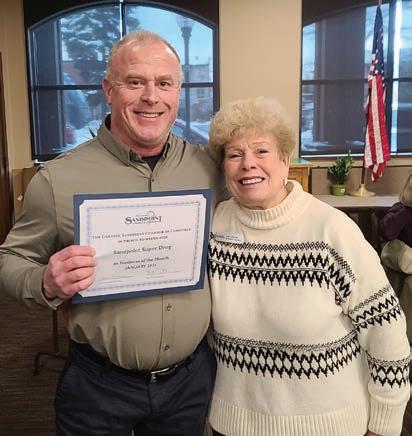
Chamber honors Sandpoint Super Drug as January Business of the Month
By Reader Staff
The Greater Sandpoint Chamber of Commerce honored Sandpoint Super Drug as its January Business of the Month, highlighting the longtime local institution’s role as a family-owned and operated pharmacy that also provides a range of home and health needs for the community.
In business since 1973, Sandpoint Super Drug offers Ace Hardware, a clinical nutrition center, home health, pharmacy, housewares, yard and garden, seasonal items and one of the best gift stores in town — “all in addition to the exceptional customer service you expect and deserve from your local drug store,” the Chamber stated.
Sandpoint Super Drug has for decades offered financial
contributions to the community in support of a wide range of causes and organizations dedicated to bettering the quality of life and improving neighborhoods.
“They are committed to helping good folks every day,” the Chamber added.
Chamber Executive Director Joan Urbaniak with Scott Porter of Sandpoint Super Drug.
Courtesy photo.
PERSPECTIVES
Idaho deserves a BLM chief who won’t sell public lands, access to lakes and waterways
By John Robison Reader Contributor
The jewel thieves at the Louvre captured international attention for their brazenness in stealing some of France’s most treasured possessions. In terms of national treasures in the U.S., we don’t have much in the way of crown jewels, but what we do have are our public lands and waters.
And our public lands, rivers and lakes are not some inert relics in a museum, but are living and breathing parts of our communities. These shared resources are the source of family stories and traditions, home for abundant native fish and wildlife, and economic force multipliers for our communities. Public lands and waters mean freedom.
The Bureau of Land Management manages more than 20% of Idaho’s land base — nearly 12 million acres in the state and about 245 million acres nationwide. While most BLM lands in Idaho are located in the southern part of the state, there are also parcels in North Idaho that the public cherishes. If you’ve watched wildlife at Gamlin Lake or hiked the Mickinnick Trail, you’ve been on BLM land.
While Idahoans may have differing opinions about how these lands should be managed, there is broad agreement on one point: public lands belong in public hands.
Recently, some have floated the idea of selling public lands for affordable housing and other development. While much of Lake Pend Oreille’s shoreline is public, roughly 90% of the shoreline around Lake Coeur d’Alene is already privately owned. Many of the remaining public access sites on Lake Coeur d’Alene — such as the Blackwell Island boat launch — are managed by the BLM.
If these parcels were ever sold, they would not become affordable housing. They would become luxury homes with private lake access. For most families, that would mean losing access to the water altogether
— unless they happen to have friends in high places.
U.S. Sen. Jim Risch, R-Idaho, has rightly called our public lands “the heart and soul of Idaho.”
Risch, along with U.S. Sen. Mike Crapo and Rep. Mike Simpson, both R-Idaho, stepped up on behalf of Idahoans last summer and prevented the outright sale of millions of acres of public lands to developers.
So Idahoans might be surprised that the latest nominee to serve as the national BLM director, Steve Pearce, is an ardent supporter of selling off public lands. Pearce is an oil executive and former Congress member from New Mexico (2003’09 and 2011-’19). In a 2012 letter to then-Republican House Speaker John Boehner, Pearce made the following recommendation to reduce the deficit:
“[d]ivesting the federal government of its vast land holdings could pay down the deficit and reduce spending. The federal government owns roughly 650 million acres of land, or one-third of the entire landmass of our country. Over 90% of this land is located in the Western states and most of it we do not even need.”
In a 2012 speech at the Colorado Conservative Political Action Conference, then-Rep. Pearce boasted:
“we’ll reverse this trend of public ownership of lands.”
Confirming Pearce would be the equivalent of hiring one of the “smash-and-grab” jewelry thieves to manage the national treasure of our living public lands and waters. Of course, any good thief should know that the public is now watching, so we should also beware of under-the-table handouts for billionaires with proposals to “scale back” current land protections.
Our BLM lands are already in enough trouble — understaffed, underfunded and under increased pressure from invasive species, wildfires, development and other risks. We do not need an auctioneer to hold a fire sale of our public lands to the highest bidder or transfer them to the states (where they would inevitably be sold off).
Instead, we need a BLM director who treasures our public lands and waters in the same ways that we do. We need someone who can build relationships, bring people together with collaborative solutions and work in good faith to restore, protect and steward our public lands and waterways for future generations of Idahoans.
Idaho has an important voice in this decision. Risch serves on the Senate Energy and Natural Resources Committee, which will vet Pearce. Risch is well known for asking tough questions. Idahoans deserve to know if Pearce still supports the sale of America’s public lands. We encourage Risch to oppose Pearce’s nomination.
If you care about these places, contact Risch and let him know that you oppose Pearce’s nomination by calling his office at 202-224-2752 or using the form on his website at risch.senate.gov/public/index.cfm/ contact.
John Robison is the Idaho Conservation League’s public lands and wildlife director and has been working on public lands issues since 2002.
John Robison. Courtesy photo
Science: Mad about
hagoromo chalk
By Brenden Bobby Reader Columnist
Have you ever made a purchase that fills you with pride every time you think about it?
I’ve made a number of purchases recently that went the other way, where manufacturers seem to be racing to the bottom of the quality chain as fast as they can.
A recent shelf purchase from Amazon came included with resin screws spray-painted chrome to look like metal.
Hagoromo chalk went the other direction, showing that a product that costs 20 times more than its competitors can still reliably sell to a dedicated clientele while being worth every penny.
The chalk has been praised by instructors throughout the world, particularly in Japan and South Korea. It has a smooth, nearly dustless application along with bright and vibrant colors that match the quality of its basic white chalk line. Anyone who has used Crayola chalk knows how dusty and abrasive it can be. Using Hagoromo, by comparison, is like wielding a paint marker after having used a brick of charcoal to write your entire life.
So what makes this chalk so special? Chemical composition.
Hagoromo is primarily made up of calcium carbonate. Calcium carbonate has a huge variety of uses from medications to paint and even glassmaking. You will most likely recognize it as the chalky substance that gives Tums and other antacids their distinctive mouthfeel.
Competitors will often use
gypsum, which is a soft mineral that is also highly abrasive due to minerals like quartz making up its structure. At its core, this is why Hagoromo chalk simply feels different and seems to glide right onto a blackboard surface. It’s also why Hagoromo chalk erases easily, as gypsum will dig in and scratch the board when an eraser is applied.
Some colors of Hagoromo do incorporate gypsum as part of their pigment, but the other chemical processes in their production are an industry secret.
You may be wondering why anyone would pay 20 times over the nearest competitor for chalk, of all things. Chalk in the digital age seems to be fading into extinction. Actually, the need for chalk by those that use it has risen — maybe not for the masses, but certainly for specialty teachers and professors.
University-level mathematics in the digital age has a tremendous need for specialty chalk. Vibrant colors clearly illustrating different components of an equation and how it translates into a diagram is vital for recorded sessions. Students need to be able to clearly see what the professor is demonstrating, and chalk on a blackboard provides a level of control that a digital pen just can’t muster without some serious fiddling.
What does it look like inside the chalk-making process?
The Sejong Mall production facility in South Korea is relatively small — a far cry from a massive industry manufacturer. It contains a number of specialized machines that were once owned
and developed by the previous producer, Hagoromo Bungu, in Japan.
The first step is a specialized machine that mixes the components into a chalkdough, much like Playdough or clay. The machine rolls and kneads the dough before letting it rest overnight to allow moisture to escape the mixture. Once it’s ready, it’s fed through a special machine that slices and rolls the dough into chalk sticks. This machine was originally developed to uniformly shape thick ramen noodles for consumption.
The chalk sticks are then left to dry for another day. If they were heated up at this point, the moisture releasing from inside the sticks would cause them to bend and warp. Moisture on the outside is added after this process to keep them from sticking, as it will evaporate off during the drying process and not warp the interior structure of the stick.
The sticks are fired in a kiln between 160 and 180 degrees Fahrenheit for eight hours before heading off to the next step. Each stick is stamped by a machine using a rubber stamp dipped in ink to brand the chalk. Afterward, they are dipped into a special liquid coating that keeps the dust from sticking to users’ fingers.
The supply of Hagoromo chalk nearly halted completely in 2014, causing a buying panic that mirrored the toilet paper panic during the COVID-19 epidemic. Hagoromo Bungu owner Watanabe Takayasu was suffering from advanced stomach cancer and unable to find
a successor to take over his company. He announced that the factory would close and the product would no longer be produced.
South Korean math teacher Shin Hyung Seok, who had been using and importing the chalk through Sejong Mall, contacted Watanabe about buying the machines and carrying on the Hagoro-
mo legacy across the Sea of Japan. Watanabe reluctantly agreed and shared the secret formula for the chalk, ensuring its production would continue after the closure of his company. He sold his machines for pennies on the dollar and allowed for the specialty product to continue production to this day.
Stay curious, 7B.
Random Corner
Don’t know much about NATO? We can help!
• NATO is the North Atlantic Treaty Organization, a defense organization and security alliance between 32 independent nations in Europe and North America. NATO’s operating principle is that an attack on one member state is an attack on all members, promising a collective defense.
• NATO was established on April 4, 1949 when the U.K., France, Belgium, the Netherlands and Luxembourg formed an alliance called the Western European Union. When those five members joined Canada, Denmark, Iceland, Italy, Norway, Portugal and the U.S. in signing the North Atlantic Treaty in Washington, D.C., they ushered in the birth of NATO.
• Article 5 of the NATO agreement stipulates that an attack on any NATO member constitutes an attack on all its members. It has only been invoked once: in response to the 9/11 terrorist attacks in 2001.
• In 1958, French President Charles de Gaulle was critical of the United States’ dominance over
NATO’s management and, as a result, France withdrew from NATO’s military command in 1966. France rejoined NATO’s military command structure in 2009.
• Other notable articles of the treaty include member states agreeing to settle disputes peacefully and to refrain from the use of threat or force. Member states also agree not to enter into international engagements that conflict with the treaty and member states commit to promoting stability and well-being in the North Atlantic region.
• NATO intervention has occurred at various times over the treaty’s lifetime: Bosnia and Herzegovina in 1995, which helped end the Yugoslav Wars; a bombing campaign in Kosovo in 1999; the war in Afghanistan after 9/11; Iraq training missions in 2004; a protection mission in the Gulf of Aden in 2008; Libya in 2011; actions on the Turkish border in 2012; and a military initiative launched in response to Russian drone incursions into Polish airspace in 2025.
Little’s budget protects giveaways while families pay the price
By Lauren Necochea Reader Contributor
Gov. Brad Little just laid out his budget proposal for the year ahead. It shows what he’s willing to invest in and what services he wants to take away. It speaks volumes about what — and who — he values.
Little is telling Idaho families they must swallow cuts to health care, education, public safety and more. In the same breath, he’s defending reckless giveaways that blew a $450 million hole in our budget, including legislation he admitted we couldn’t afford before signing it anyway. Now the bill is coming due, and it will be paid by your family, your community and all of our kids.
Notably, Little’s budget is an all-out attack on Medicaid. Idaho already made a 4% cut to reimbursement for hospitals, nursing homes and other care providers. Essential therapies for kids with disabilities have been slashed.
Now Little is proposing eliminating these therapies altogether, along with a slew of other services. His proposals will prevent children from reaching their full potential, force people with disabilities into expensive institutions and block preventive dental care, to name a few of the harms.
Cuts like this strain our entire health care system, endangering care for all Idahoans.
Your neighborhood school will feel the pinch of this budget. Idaho schools face a $100 million funding gap for special education. When the state won’t step up to serve kids with special needs, your district either seeks levies or cuts services.
Water bills will reflect these choices. The plan pulls back support for drinking water and wastewater upgrades. Cities still have to fix pipes and treatment systems, so rates rise or repairs get delayed while the price tag grows. If you drive to work or move products on Idaho roads, this budget affects you. His plan pulls $275 million from transportation, including $110 million for local highway districts, and sweeps $375 million from local transportation projects. That means road and bridge projects delayed, safety improvements pushed back and higher repair costs later.
While pushing these deep cuts,
the governor ignores commonsense solutions. He could repeal the $50 million voucher scheme that sends public dollars to private and religious schools with little accountability. He could also reverse the latest round of tax giveaways for the rich.
Then comes full federal tax conformity. The governor says it costs $155 million. Independent estimates put it far higher, including $435 million from the Idaho Center for Fiscal Policy. That is a massive revenue hit that mostly benefits profitable corporations, including companies getting tax advantages for investments made out of state. Idaho should adopt changes that help working people and reject the rest.
Show me your budget, and I’ll tell you your values. Little’s budget shows he’s not looking out for you.
Lauren Necochea is chair of the Idaho Democratic Party and a former District 19 legislator. Necochea spent a decade leading nonprofit programs dedicated to research and advocacy in tax policy, health care and children’s issues.
Lauren Necochea. File photo
PERSPECTIVES
By Tim Bearly Reader Contributor
Greetings, fellow sycophants, political hacks, grifters, desperate ladder-climbers and podcasters with questionable funding. Welcome to my masterclass on “Narrative Control.”
Some of you, I’m sure, were sent here by the people upon whom you depend for money, so you can more efficiently shill on their behalf. Others came of your own accord, eager to refine your... “talents.” In this course, you will learn to do more than merely hollow out whatever morality you may still possess — you will acquire the subtle, professional techniques needed to siphon it from the masses, as well. By invoking terms like “personal responsibility” and “accountability,” you will cloak indifference in virtue, transforming moral abdication into a kind of performance art.
By the time we are finished, you won’t just be adept at strategically shaping how others perceive events — you will have elevated it into a spectacle, eagerly applauded by your financiers and the rest of your tribe.
Before we dive in, it is essential to
remember: When engaging in sophistry — like, say, victim-blaming — your first and most crucial consideration is whether the victim (and, of course, the perpetrator) belongs to your ingroup or some out-group. This single factor outweighs any actual transgressions that may have occurred and will ultimately dictate how — and to whom — blame is assigned.
Also always remember: A victim in the out-group is guilty until proven inconvenient, and a perpetrator in your in-group is innocent until expedient.
Our first topic involves attribution bias. Just as a member of your tribe shall never be held accountable for their transgressions, a victim outside your circle will be held responsible for that which they are not even guilty of.
When a fellow ideologue falters, apply external attribution liberally: “The deck was stacked against them”; “Someone was out to get them”; or, “They never intended harm.” Conversely, when a member of the opposition commits the same transgression, the cause must be internal: “They are flawed”; “They made their own destiny”; or, “They invited it upon themselves.”
When a friend loses their job, it’s the economy, automation or corporate greed at fault. When an enemy loses theirs? “Clearly, they are just lazy.”
Next, we turn to selective empathy. At first glance this may seem like a digression, but it is in fact inseparable from how we assign blame. We all claim to believe that every human life has value — of course, some lives simply count more than others. Their worth is determined not just by the group to which they belong, but by their rank within it. When one of our own is killed, we mourn loudly, sanctify their memory and elevate them to martyrdom. When someone from the
opposing camp meets the same fate, we respond with indifference, justification or even celebration, quiet or otherwise.
Often, we do this openly — sometimes even proudly — while still insisting that we are the more benevolent group. And, thanks to a convenient lack of critical thinking, few will notice the contradiction. We will also teach you how to blame individuals for the actions of institutions. Despite the fact that no one has full control over all the variables that shape their failure or success, we will carefully avoid pointing to the powerful people and systems that created the crisis in the first place. That would require change — unpleasant things like regulations, and, worst of all, democracy. Instead, we will focus on the personal flaws of the plebeians — e.g., bad choices and moral weakness.
By ignoring systemic failure and emphasizing individual blame, we ensure that the main beneficiaries of the system remain comfortably beyond scrutiny, while those it has crushed are left disoriented by the theatrical glow of the gaslight.
You will learn how to leverage disasters to advance unrelated agendas. By blaming every tragedy on the opposition, you can transform grief into political capital — winning elections, advancing your career and laundering ambition through outrage. Crises become opportunities, not to fix what broke, but to break it even more, so that you may masquerade as the savior needed to fix the problem. As Winston Churchill said, “Never let a good crisis go to waste.”
We will fine-tune your ability to appeal to emotion. It is well understood that when emotion usurps reason, people become much easier to manipulate — willing to view any given tragedy through whatever lens
you provide. Once an audience is whipped into a manic state, and its members’ critical faculties diminished, you can steer them in any direction of your choosing.
You will be given guidance on how to deploy ad hominem attacks whenever your opponent appears to be gaining traction and winning the argument. In public debate, attacking the arguer instead of the argument is by far the most effective strategy. Let your opponent waste time defending the details of some tedious proposal while you dismantle their credibility with a barrage of personal insults.
Your audience won’t care whether anything you said was actually true — they will only care that you emerged as the victor. After all, this isn’t a courtroom... this is the octagon!
Last but not least, we will master the shrewd tactic of projection — accusing the opposition of precisely what we ourselves are guilty of. When implemented with precision, observers will become bewildered and cynical, unable to tell who is actually at fault, as everyone appears to be pointing fingers at everyone else.
This concludes today’s seminar. For those interested in next week’s lesson, “Style Over Substance,” there are sign-up sheets in the back. Also, anyone who would like some refreshments, we have some KoolAid and Machiavellian nuts in the back.
Thank you! Now go forth, fellow scoundrels and psychopaths, and manipulate the masses! Do not burden yourselves with honesty or integrity — they are liabilities in the pursuit of wealth and power.
Remember: At the top of the pyramid, it is never about being right; it’s about being convincing!
Top left: Maggie Russell packed along a copy of the Sandpoint Reader on her travels to the ancient Mayan ruins in Coba, located on the Yucatan Peninsula in Mexico. Photo by Janenne Russell.
Top right: A stunning sunset over Lake Pend Oreille, taken at the marina in Hope by Ian Newbill.
Bottom left: A snowy moment at Sandpoint City Beach. Photograph by Tricia Florence.
Bottom center: No, this isn’t New York City, which got hammered with snow while this photo was taken at Sandpoint City Beach. Photo by Renée Fisher.
Bottom right: Denise and Terry Plaza with Jeanelle Shields, officiant, for their 50th anniversary vow renewal ceremony in Yosemite Lodge on the night of the Winter Solstice. Congratulations Plazas!
To submit a photo for a future edition, please send to ben@sandpointreader.com.
FEATURE
So, you want to play DungeonsandDragons?
Tips for getting into the world’s favorite role-playing game
By Soncirey Mitchell Reader Staff (and Dungeon Master)
Most people have heard of the tabletop role-playing game Dungeons and Dragons, which has been synonymous with nerd culture since the mid-’70s. Whether in Stranger Things or The Big Bang Theory, DnD is often portrayed as an overly complicated, dorky pastime that’s either impossible to get into or too niche to appeal to 99% of people. While the game does have a lot of rules and background, it’s simpler than most people think to get started — all you need is an internet connection and a little bravery.
As a TTRPG, DnD takes place mainly in the “theater of the mind.” The Dungeon Master, who runs the game, describes various settings and situations, and the players then create and embody characters that fit into the DM’s overarching plot. Depending on how you want to play, that plot can be about a group of adventurers staving off the end of the world or a gaggle of farmers looking for their lost sheep; simple or complex, thrilling or relaxing, fantasy or science fiction, DnD is whatever you want it to be.
There are rules and dice to roll beyond that, but the majority of the game is playing make-believe with your friends and consulting the Player’s Handbook (in print or online at bit. ly/2014DnD) every so often until you eventually remember the rules. Even then, most of the time, all you need to do is say, “My character does a backflip,” and then roll a 20-sided die. If you roll a 19, your character does a perfect flip; if you roll a 2, they fall on their face. The rules are mostly intuitive and easy to remember, so the biggest and least-discussed hurdle to starting to play DnD is simply finding people to play with.
Gather your players
DnD needs at least two people to get started, and if you’re committed to learning, neither one needs to have played before. Still, since the DM will be the one running the game and enforcing the rules, it’s easier if they have experience and can teach their players. If, after working through your contact list, you don’t have a buddy with the knowledge and willpower to run a game, then it’s time to turn to
local and international resources.
Here in Sandpoint, the go-to place for clubs and activities is East Bonner County Library (1407 Cedar St.), which already hosts related adult and teen events like minifigure painting. Visit the calendar on ebonnerlibrary. org or reach out to Exploration Coordinator (and Reader columnist) Brenden Bobby at brenden@ebonnerlibrary. org to see if anyone’s advertising games or associated events.
Sandpoint’s library is also the home of Sandemonium — the local com ic con and point of connections for North Idaho’s proud nerds. The an nual gathering usually takes place in summer, but anyone can reach out to organizers and enthusiasts through the group’s website, 7bcon.com, and its linked Discord group, to find local clubs or DMs looking for new players.
If all else fails in person, it’s time to turn to the wide world of online DnD — specifically, Roll20.net.
Roll20 is the easiest and safest site to meet other players online and join new groups. Not only can you look through dozens of upcoming games made for players of all skill levels, but the free software includes access to rules, tutorials, virtual dice and guided character creation.
If you succeed at finding players but not a DM, and you have a pas sion for telling stories and a lot of free time, then you can consider running the game yourself.
an-esque adventure focused on exploration and friendship. Theoretically, you can make your character Mr. Murder McDeath and have him try to stab his shipmates and steal their riches, but you’re not going to be popular with your DM or fellow players. This is a group activity, and everyone gets their chance in the spotlight, so make sure your character is easy to play and
low Sandpoint player, Cole, said the best trick is to bake in awkwardness. Playing make-believe for the first time since elementary school can feel weird at first, and you will have moments when you pause, stutter or say the wrong thing, so plan on it.
“You’re going to be awkward, so just make it a part of them,” he said. “Have them be homeschooled or from a different culture, so they can be confused and ask questions.”
To make things easier, visit Roll20, DnDbeyond.com or dmsguild.com to find pre-made adventures, characters and other resources to help you create an easy starter adventure so you and other beginners can learn by playing.
Who are you?
Once you’ve found a game, it’s time to start creating a character. Remember: You can be whoever you want, but you’ll have the most fun — and be better friends with everyone involved — if your character suits the world and the adventure. When you begin a game — called a campaign — your DM will give you some information about the world and the story’s themes and vibes. For example, it may be a lighthearted, Pirates of the Caribbe-
or four sentences that will help influence how your character acts in the game. Consider these core questions: Am I a good person? Who or what do I love? Who or what do I hate? What’s my biggest flaw? What’s my ultimate goal? Anything else, you can figure out later.
To finish off your journey of self-discovery, think about how you want to play — and the limits of your current improv skills. It can be tempting to adopt a sad, brooding persona, but if you’re a naturally goofy person, you may find it challenging to stay in character and end up throwing out everything you prepared. You have to be this person, so ensure it’s someone you relate to.
When asked about the process of building his first character, a fel-
Next, it’s time to consult the and choose a race, class and background. There are nine core races, 12 classes and 12 backgrounds to choose from, so this part requires a bit of reading. The important things to look out for are descriptions that lend themselves to the backstory you’ve dreamt up.
Continuing with the pirate-themed example, you may want to play a character from a good, peaceful place that fell on hard times and had to resort to the sailor’s life. Gnomes are generally good and peaceful, so that’s an easy race to choose. Your background could be “sailor” or “urchin,” if your character had an especially hard childhood. The choice that has the most impact on gameplay will be class, which will determine how you fight and generally interact with the world, so be careful.
Using magic requires additional mechanics and points to keep track of, so avoid Wizard or Sorcerer classes for your first character. The class that lends itself best to a swashbuckler character would be a Rogue, but if you want to punch bad guys or swing a big sword, then Barbarian or Fighter works too.
The rest of the process is as simple as writing it down using the book to guide you (and rolling a few dice). Once you have a solid character, all that’s left is to dive into the game and learn as you go.
You’re going to love it — I promise.
Barrel 33 hosts masqueradethemed murder mystery night
By Reader Staff
Don your finest mask and dress to impress for the in-person, interactive “Masquerade and Murder: A Night of Murder Mystery” on Friday, Jan. 23 at Barrel 33 (100 N. First Ave., in downtown Sandpoint).
From 6-8 p.m., participants will take part in a suspenseful whodunit, during which secrets are unfolded behind the masquerade — and everyone gets to play a part, though not all will make it to the final act.
Meanwhile, enjoy wine and bites in a theatrical atmosphere. Costumes are strongly encouraged, with the possibility of prizes for the best-dressed or most mysterious guest.
“Think glamorous masks, dramatic flair, vintage elegance or dark intrigue — the more mysterious, the better,” organizers stated.
Tickets are $28.52 (including taxes and fees), and available at barrel33sandpoint.com/events-list/murdermystery.
Despite the delayed onset of the snowy season, the 2026 Sandpoint Winter Carnival is gearing up for more than a week of local events Friday, Feb. 13-Sunday, Feb. 22. Meanwhile, for the first time, nominations are open for carnival royalty, with a deadline of 5 p.m. on Friday, Jan. 30.
Nominations for a carnival king and queen will be accepted, with the selection based on volunteerism in the community. Online voting for the final selections will begin after the nomination period is closed.
Submit your nomination using the Carnival Royalty Nomination Form at sandpointwintercarnival.com/carnival-royalty.
According to organizers, candidates should “demonstrate a long-term and broad-based commitment to making life more livable, pleasant and enjoyable — both for the people who live here and for those who visit.”
Volunteer activities can be organized or self-motivated, and can be as diverse as organizing a major community event or shoveling a neighbor’s sidewalk.
“The committee is seeking people who help others independently, not people who are in professions that help or care for others,” the organization stated.
Learn more about the 2026 Sandpoint Winter Carnival — including parade details, sponsorships and more — at sandpointwintercarnival.com.
National nonprofit Petco Love awards grant to
Better Together Animal Alliance
By Reader Staff
Better Together Animal Alliance recently announced that it received a $2,500 grant from national nonprofit Petco Love, meant to support the organization’s work for pets in North Idaho. Since its founding in 1999, Petco Love has invested more than $430 million in adoption and other lifesaving efforts for pets.
“Our investment in BTAA is part of more than $12 million in investments recently announced by Petco Love to power local organizations across the country as part of our commitment to create a future in which no pet is unnecessarily euthanized,” stated Petco Love President Chelsea Stanley. “Our local investments are only part of our strategy to
empower animal lovers to drive lifesaving change right alongside us.”
In partnership with Petco and more than 4,000 organizations — like BTAA — across North America, the national nonprofit has helped find homes for more than 7.1 million pets and counting.
“Support from Petco Love gives us the flexibility to respond where the need is greatest,” stated BTAA Executive Director Mandy Evans. “From lifesaving medical care to adoptions and low-cost spay and neuter services, this investment helps us continue supporting pets and the people who care for them across North Idaho.”
For more information about BTAA, visit bettertogetheranimalalliance.org. Learn more about Petco Love at petcolove.org.
dumb of the week
By Ben Olson Reader Staff
In today’s foray into our World of Dumb, we’re reprinting an entire letter President Donald Trump sent to Norwegian Prime Minister Jonas Gahr Støre on Jan. 18.
About halfway through reading — when brain matter starts leaking out of your ears — you might be tempted to ask someone, “Is this real?” You bet it is, Bubba.
You might also ask, “How in the hell did we elect this maniac as president?” I don’t have enough time nor enough whiskey to answer that. All I can do is wake up every morning uttering the words, “What fresh hell is this?”
Without further ado, and with all formatting and grammar exactly as it was written, here is Trump’s staggeringly Dumb letter to Gahr Støre:
Dear Jonas,
Considering your Country deciding not to give me the Nobel Peace Prize for having stopped 8 Wars PLUS, I no longer feel an obligation to think purely of Peace, although it will always be predominant, but can now think about what is good and proper for the United States of America.
Denmark cannot protect that land from Russia or China, and why do they have a “right of ownership” anyway? There are no written documents, it’s only that a boat landed there hundreds of years ago, but we had boats landing there, also.
I have done more for NATO than any other person since its founding, and now, NATO should do something for the United States.
The World is not secure unless we have Complete and Total Control of Greenland.
Thank you!
President DJT
Whew. I’ll give you all a moment to transition back into the land of reality. Take a shower if you need to.
There’s a diesel truck bed full of Trumpian bullshit packed inside those few lines, but let me attempt to use facts to parse through the details. I know it’s a post-truth world and stating facts is like trying to forge a smartphone out of wrought iron, but I’m old-fashioned and believe facts still make excellent points:
• Trump’s lede paragraph is total gibberish. It’s merely a run-on sentence that ends without a conclusion. It’s the famous “Trump weave” that his supporters oddly liken to him playing 5-D chess, when it’s really closer to an old drunk with a load in his diaper rambling to a coat rack that he
thinks is a person.
• Trump claimed “your Country” decided “not to give me the Nobel Peace Prize,” but that’s not how it works. The government of Norway has zero involvement with who receives the prize. Instead, it’s awarded by the independent Nobel Committee. Again: Not the Norwegian government.
• No, Trump didn’t stop “8 wars.” Several news outlets, including the BBC, PBS and the Associated Press have published lengthy articles poking holes in this bombastic claim. He’s lying. If he means he “started” multiple wars, he might be onto something there.
• Trump’s claim that Denmark doesn’t have a “‘right of ownership’” over Greenland because “a boat landed there hundreds of years ago” is so rich in irony it hurts your teeth. I mean — *looks around* — what do you think happened in North America? Also, try “thousands of years ago.” Erik the Red settled in Greenland after being banished from Iceland in the 10th century. Bonus: The first known Europeans to land a boat on this continent were Norse in the 11th century and came by way of — wait for it — Greenland. Swing and a miss.
• Trump refers to “no written documents” related to Greenland’s sovereignty, but that, after a simple Google search, is also wrong. Danish rights to Greenland were confirmed by the U.S. on Aug. 4, 1916 and signed by U.S. Secretary of State Robert Lansing.
The reality of this situation is dire. When Trump started bringing up “taking Greenland” in 2024, his supporters thought it was just a brilliant move to “own the libs,” and swore up and down on the internet he was just trolling people. Now, as European countries are sending troops to the island and Trump’s posturing becomes more and more erratic, it seems we’re headed to a point of no return. This is all about ego, folks.
After this ridiculous letter, it appears that Trump wants Greenland because he feels slighted at not receiving a Nobel Prize. Greenland and Denmark have stated in no uncertain terms the island is not for sale, nor will it ever be. Meanwhile, Trump is threatening to upend the alliance we’ve held with Europe since we fought fascists like him in World War II, all because he didn’t get an award he doesn’t deserve.
Can’t we just give him a tin trinket that says, “You’re awesome!” and exile him on St. Helena like Napoleon, where he can fill his diapers in peace and leave the rest of us alone?
FEATURE Don’t go soft, play hard
Men’s Adult and Senior Baseball Leagues seeking new players
By Ben Olson Reader Staff
There’s nothing that compares to the feeling of putting on a uniform, trotting onto the diamond and playing baseball. It’s a sport that continues to captivate people of all ages, but after high school and college, the opportunities to play competitive hardball diminish drastically.
That is, until the Men’s Recreational Baseball League came along. The national organization is entering its 30th year of offering adult and senior men the chance to relive the glory days on the baseball diamond.
The Inland Northwest Mens baseball league is actively seeking new players across Bonner and Boundary counties for the 2026 season, with hopes to form a North Idaho team.
The league is separated into four divisions, including 18+, 30+, 45+ and 60+. Play across all four divisions
spans from May to October, with nationally-sanctioned tournaments held throughout the year. Each division concludes with playoff games and, for two lucky teams, a chance to play in the World Series games held in Arizona and Florida every fall on professional-level fields.
The league is open to anyone with a love of baseball to participate. Winter workouts start in January at the Spokane’s Airdrome NW Sports Complex, which has both fielding and batting areas available for practice.
League tryouts and draft will be held on April 12 at Hart Field in Spokane and all skill levels are welcome to tryout. Both full- and part-time players are welcome, and games are played on local high school and college fields.
Greg Peterson founded the local league in 1996 and served as its first president until 2001. For Peterson, playing recreational hardball was a great way to connect back to his glory days while also making good friends along the way. It has become Peterson’s passion to expand the league, as well as to find enough players to form a North Idaho team.
“I say play until you can’t play no more,” he told the Reader. “Putting on that uniform, playing the games and having a beer and something to
eat with the guys afterward, that really makes you feel young again. You’ve got truck drivers, accountants, all different professions. We have fathers and sons playing together. ... We even had four guys in their 70s, one was 78 and the other 79, who carpooled from Coeur d’Alene to play baseball.”
Peterson is also hoping to schedule a tryout session here in Sandpoint. Check the Reader events calendar to see when it will be held.
Peterson said the league utilizes courtesy baserunners after the hitter reaches first base, and players avoid collisions at all costs.
“We’re a recreational league,” he said. “It’s just like softball, but we’re playing hardball.”
The future looks bright, Peterson said, to add another team from North Idaho, with Toby Fry of Priest River already slated as manager.
“We’ve had thousands of players coming through our league over the years,” Peterson said. “We expect 350 to 400 players this year alone. Don’t be intimidated by the tryouts. If you come, you will get on a team. We’ll get you on the baseball field.”
Learn more and sign up at playhardball. org, or contact League President Bret Fink at 208-641-9255 or bret@yourt1Wifi.com
Courtesy photo
Sandpoint Chamber welcomes Polaris Medical Direct Primary Care
By Reader Staff
The Greater Sandpoint Chamber of Commerce recently hosted a ribbon-cutting for Polaris Medical Direct Primary Care, marking its membership with the local business organization.
Polaris Medical was founded by Dr. Tessa Reinke, a board-certified family medicine physician dedicated to providing comprehensive primary care for patients of all ages. Her practice emphasizes patient education, wellness, disease prevention and chronic disease management through a direct primary care model designed to improve access and strengthen long-term patient-physician relationships.
Reinke studied sociology and public health at Dartmouth College before earning her medical degree from the Dartmouth Geisel School of Medicine. She completed her residency at Texas A&M Family Medicine Residency, where she received extensive training
in women’s health and full-spectrum family medicine.
Her professional experience includes work in rural eastern Washington and North Idaho, as well as international clinical service in Kenya, Honduras and Papua New Guinea.
Joining the practice is Dr. Byron Haney, a board-certified family medicine physician with more than 30 years of experience. Haney is known for his commitment to patient-centered, evidence-based care with an emphasis on prevention and wellness. At Polaris Medical, he continues to advocate for the direct primary care model, focusing on accessibility, collaborative care and long-term family health.
The clinic’s team also includes Clinical Coordinator and Certified Medical Assistant Jamie Cullum, who brings nearly a decade of experience in patient-centered health care. Cullum previously worked for Dr. Aaron Reinke for almost eight years, supporting
Join FSPW for a Winter Pint Night to swap stories and support Winter Tracks program
By Reader Staff
Friends of Scotchman Peaks Wilderness invites community members to come together Friday, Jan. 23 for a Winter Pint Night at MickDuff’s Brewing Company (419 N. Second Ave., in downtown Sandpoint).
Cozy up with a few brews from 5-8 p.m. and swap winter trail stories, connect with fellow Scotchmans supporters and raise funds to support the organization’s Winter Tracks program.
Winter Tracks provides a day-long outdoor field trip for area fourth- and
fifth-graders who meet face-to-face with experts in forestry, wildlife biology and ecology — all geared toward giving students the opportunity to learn more and deepen their relationship with their local environment.
“Whether you’re a longtime supporter, a winter recreation enthusiast, or just looking for a good beer and good company, we’d love to see you there,” FSPW stated. “Stop by to say hello, learn what we’ve been up to this winter and raise a glass for wild places.”
For more information on FSPW, go to scotchmanpeaks.org.
clinical workflows, patient communication and practice management.
Located on the first floor of the Sandpoint Center (415 Church St.), Polaris Medical’s approach highlights lifestyle-based care, including the role of nutrition, sleep and physical activity
in maintaining health and managing chronic conditions.
Visit polaris-dpc.com for more info.
Quinn and Quill Publishing holds author meet-and-greet
By Reader Staff
North Idaho-based Quinn and Quill Publishing will hold a meet-andgreet event with four local authors on Saturday, Jan. 24 from 10 a.m. to 3 p.m. at The Bernklau (316 Pine St., in Sandpoint).
Short story writers J.Q. Wenzel, Kendra Oliveira, Mark P. Ready and Michael Desind will be on hand to discuss their solo work, as well as the published anthologies they’ve contributed to under Quinn and Quill.
The online and print publisher Quinn and Quill focuses on Christianity-inspired writing and fantasy, and and all four featured authors have contributed, in one way or another, to
the organization’s main anthologies: Newfound Fables, a series of fairy tales; Voices of the Advent, a collection of original Christmas stories; and the fantasy collections Imaginings of the Beyond and Realms Beyond
In addition to these collections, Wenzel regularly publishes on his personal Substack under the handle @johnqwenzel. Oliveira is the most prolific of the group, with two ongoing series — Tales of Mourer, a space-pirate romance, and The Rise of Listchen, a Christian-and-mythology-inspired trilogy — available on her website, kendrasbooks.com.
For more information or to find the online publications, visit quinnquillpub.substack.com.
Panida Board thanks the community
By Reader Staff
As most community members know, the Panida Theater doesn’t just bring in funds from the box office and rentals — it also relies on donations and grants. As organizers stated in a recent news release, “monies earned from Panida Presents’ ticket sales often evaporate in overhead costs, and the Panida receives limited income from non-Panida sponsored events.”
Sustaining the theater comes from community members and organizations who commit to long-term
support, and the Panida Board recently extended a thank-you to a few of them, stating, “We couldn’t survive without amazing people like these”:
• Ting, for its contribution match that secured substantial donations for the Panida Century Fund. “Their support was vital in establishing a strong foundation for the fund,” the theater stated. “Special thanks to Kari Saccomanno for stepping up to make this happen”;
• Equinox Foundation, for its threeyear grant to support the Century Fund — “it really helped get the ball
rolling for us,” organizers wrote;
• Chris Bessler, who served on the board from 2002-2005, ushering in the Panida purchase of the Little Theater space. In 2022, he became a Century Fund campaign champion and was instrumental in creating the Panida’s Strategic Plan in 2022;
• Foster Cline, who served on the board for six years, submitting many grants that brought substantial resources to the theater.
Numerous other community members have provided ongoing volunteer
support, including the cleaning crew, event and office volunteers, and maintenance/repair workers.
“You have all been — and continue to be — crucial to the Panida’s ongoing success as North Idaho’s premier venue for cultural and artistic events, as well as a place for community connection,” organizers stated.
“Thank you all for your dedicated support of the Panida Theater,” the board added. “We look forward to ushering in our next 100 years with your continued advocacy.”
For more info, go to panida.org.
L-R: Chamber Ambassadors Steve Sanchez and Beryl Ryan, Executive Director Joan Urbaniak, Dr. Tess Reinke, Dr. Byron Haney, Jamie Cullum, Chamber Ambassadors Corrie Kinman and Alisha Kowalski. Courtesy photo
Send event listings to calendar@sandpointreader.com
Live Music w/ Liam McCoy and friends
7pm @ Eichardt’s Pub
Game Night w/ Alaina
6-8pm @ Idaho Pour Authority
$3 Thursday
Live Music w/ Frytz
8-11pm @ Roxy’s Lounge
Live Music w/ Benny Baker and Sheldon Packwood
8-11pm @ 219 Lounge
Live Music w/ Wiebe Jammin’
5-8pm @ Pend d’Oreille Winery
Live Music w/ Tucker James 5pm @ Connie’s Lounge
Live Music w/ Picked Up Pieces
5:30-8:30pm @ Barrel 33
Live Music w/ Ron Green
6-8pm @ Smokesmith BBQ
Live Jazz w/ Bright Moments
6-8pm @ Baxters on Cedar
Live Music w/ Way Down North
7pm @ Eichardt’s Pub
Montana Americana duo, covers, OGs
Live Music w/ Zach Simms
5-8pm @ Pend d’Oreille Winery
Live Music w/ Marcus Stevens
5:30-8:30pm @ Barrel 33
Live Music w/ Double Shot Band
6pm @ Connie’s Lounge
Live Music w/ Homebrew String Band
6-8pm @ Smokesmith BBQ
Live Music w/ Oak Street Connection
8-11pm @ Roxy’s Lounge
Live Music w/ Jason Perry Band
9pm-midnight @ 219 Lounge
Sandpoint Chess Club
9am @ Evans Brothers Coffee
THURSDAY, january 22
Paint and Sip 5:30-7:30pm @ Barrel 33
$45 includes instruction, supplies and your first beverage
Wilderness for this cozy winter pint night. Live music by Matt Lome.
Toyota Ski Free Friday
All day @ Schweitzer Drive a Toyota? Ski free!
Live Music w/ Devon Wade
8-11pm @ Roxy’s Lounge
Live Music w/ Scott Taylor 6-8pm @ Idaho Pour Authority
SATURDAY, january 24
Swan Lake by The Grand Kyiv Ballet 7pm @ Panida Theater Tchaikovsky’s Swan Lake performed by the Ukrainian National Opera and Ballet Theater. SOLD OUT
Live Music w/ Sheldon Packwood
6-9pm @ MickDuff’s Beer Hall
Winter Farmers’ Market
10am-2pm @ Sandpoint Library
Live music, festive vibes and seasonal shopping held in the community rooms
Drop in swing class 4-6pm @ Barrel 33
Country swing dance classes $15/person
SunDAY, january 25
Live Music w/ Fiddlin’ Red 1-4pm @ Barrel 33
Magic with Star Alexander 5-8pm @ Jalapeño’s
monDAY, january 26
January 22 - 29, 2026
Family night at the Museum 5-6:30pm @ BoCo History Museum Kids’ games and complimentary refreshments. Farewell to the “Come What May, We Will Play” exhibit. Free, open to the public
Learn about new tracking technology for monarch and other butterfly species’ migration patterns. Hosted by Mighty Monarchs Conservation Group and wingsrising.org
‘Masquerade & Murder: A Night of Mystery’ 6-8pm @ Barrel 33
Immersive night of deception, intrigue, wine and twists you won’t see coming. RSVP online
Karoake nights (Fri/Sat/Sun) 6pm @ Tervan Tavern
‘READY! for Kindergarten free parent workshops
10am @ Farmin-Stidwell Elementary School Free early childhood education 90-minute workshops for parents of kids aged 0-5 years. Register at panhandlealliance.org
Author book signing 10am-3pm @ Sandpoint Library
Featuring J.Q. Wenzel, Kendra Oliveira, Mark P. Ready and Michael Desind
Live Music w/ Truck Mills 6-8pm @ Idaho Pour Authority
Live Music w/ Mason Van Stone 6-8pm @ Baxters on Cedar
Live Music w/ Travelin’ Huckleberries 3-5pm @ Idaho Pour Authority
New and returning shows for your escapist pleasure
By Zach Hagadone Reader Staff
There’s been a lot to absorb in the real world over the past few weeks, and many of us may be looking for some escape. There are lots of healthy ways to do that: exercise, pursuing a hobby, reconnecting with old friends, reading an actual book. But let’s be honest, the pull of the boob tube is strong. Don’t feel bad if you can’t resist it. Luckily, a number of series have either recently premiered on various streaming services or returned with new seasons in recent weeks. Here’s a brief rundown of a couple of shows that have caught my eye:
Fallout Season 2
This post-apocalyptic horror-comedy-drama again delivers on stellar world building, set design and production value, and pitch-perfect performances. We’re still following Vault-dweller Lucy on her quest to find her dad. This time, though, she’s not trying to save him — she wants to bring him to justice, since it turned out that he was one of the top villains of the wasteland all along. Scene-stealing radiation zombie The Ghoul is also back, as well as our favorite knight of the Brotherhood of Steel, who has gotten himself in far too deep with the religio-fascist-techno cult that he once wished so much to join. With a 95% on Rotten Tomatoes, 8.3/10 on IMDb and currently ranked No. 1 on Amazon, tune in every Wednesday to see what all the fuss is about.
Primal
This bizarre series has stolen my heart. Fans of adult animation and high-concept fantasy will also fall in love with grunting caveman Spear and his trusty T. rex sidekick Fang as they barrel through an imaginary world filled with terrifying danger and nonstop ultra-violence in a far-dis-
tant past. Created by Genndy Tartakovsky, it’s a splendorous production that manages to be thrilling and affecting at the same time — all with hardly any dialogue (and what there is of it is barely articulate and/ or in an unsubtitled “primitive” language). Now in its third season, we encounter Spear following a resurrection that has left him in a revenant state and with about a quarter of his skull missing. It’s hard to tell where it’s all going at this point, but I can’t wait to find out. New episodes on Sundays on HBO.
Star Trek: Starfleet Academy
The latest addition to the Star Trek franchise premiered with two episodes on Jan. 15, focused on the first class of cadets in Starfleet since it was destroyed by a mysterious disaster more than a century before. Well-informed Trekkies know that Starfleet Academy is a follow-up to Star Trek: Discovery, which ended in 2024. Set in the 32nd century, things are perilous on the final frontier, with civilizations, empires and factions fractured by the collapse of the Federation, whose remnants seem to have become far more militaristic than in the old days. Rebuilding the academy — and thus the Federation — will be hard work, and the young adults at the center of the story are going to have to do the heavy lifting with the guidance of their academy chancellor and captain, Nahla Ake (Holly Hunter). Trump Chief of Staff Stephen Miller hates it for being too “woke,” which is all the recommendation I need to keep tuning in. Episodes are Thursdays on Paramount+.
A Knight of the Seven Kingdoms
This much-anticipated spinoff prequel of Game of Thrones aired its first episode on Jan. 18 on HBO, and has so far been a bigger hit with critics than audiences (95% vs. 72%, respectively, on Rotten Tomatoes). Based on the novella The Hedge Knight by GoT
author George R.R. Martin, AKotSK takes place about 100 years before the dragons-andwhite walkers showdown of the original series and centers on dimwitted but good-natured and lovable Ser Duncan the Tall and his plucky little
bald-headed squire Egg. With only one episode as of press time, all I can say is it’s a pleasure to look at and entertaining enough, but totally lacking in the sweep, drama, grandeur and stakes of GoT or its other spinoff House of the
Dragon (the latter which was a dud). Overall, it feels awfully generic, but we’ve only just begun to see what Dunc and Egg get up to. New episodes on Sundays.
A screenshot from Fallout Season 2. Courtesy photo
By Marcia Pilgeram Reader Columnist
Lately, my social media and email have been blowing up with Super Bowl hype. Even though I’m still not sure what a first down is, I’m sure down for the fun recipes that accompany the barrage of content coming my way — because any excuse for a party, right?
I can’t say I’ve ever been a huge football fan, but I’ve been flanked by friendly rivalry banter between my son, Zane, and sons-in-law John and Russ for years. I have a fair idea of which teams are hot (and which teams are not).
I think my boy Zane was born a 49ers fan; and, as luck would have it, back in the early ’90s, former 49ers coach George Seifert was a regular guest at a gentleman’s ranch near Missoula, Mont., where I often catered dinners for the ranch owner.
The owner and most of his guests were from San Francisco and were frequent visitors throughout the summer. There was a stocked pond on the ranch, and after fly-fishing lessons, the guys would gather back at the house for cocktails and a menu created from smoked fish and wild game. They were all gentlemen, and I have only fond memories of those days cooking for them.
Breaking my own company rule of being familiar
The Sandpoint Eater Super memories
with guests, I finally asked George for an autograph for Zane. One evening, a couple of months later, George presented me with a few treasures for Zane, including an autographed jacket and passes for a game.
I still treasure the photo of my boy at that game, decked out in his autographed team jacket, with a smile as wide as Candlestick Stadium. Zane says he still remembers that game — the plays and the score — as if it were yesterday. Me? I remember the price of a paper cup of hot chocolate and a stadium hot dog (times a family of five)!
Today, my son’s family
is deeply divided, as he’s raised a diehard Seahawks disciple — his namesake, 18-year-old Zane — and an equally devoted Buffalo Bills fan, 11-year-old Riley. I’ve yet to get those boys to an NFL game, but it’s still on my bucket list for them. A few years ago, I did manage a VIP Seahawks tour for young Zane at Lumen Field that was quite impressive, even without a game.
Now, as we’re just days away from learning who’ll be playing in Super Bowl LX, like many folks around here, I’m rooting for the Seahawks. Whoever is playing, I’m sure I’ll turn the game on, though I will
probably see more of the halftime show than the actual game.
For many years, I catered extravagant Super Bowl parties for clients and once even oversaw a private train charter to a Super Bowl in New Orleans. I’ve hosted plenty of simpler affairs in my own home, too.
Funny how it doesn’t matter the crowd — large or small — the location, the demographics or the socioeconomics of the guests, the menus I’ve prepared over the years (by request) almost always looked about the same: wings, baked potato bar, nachos, and both chili and gumbo, always accompanied by cornbread.
Classic moist cornbread
I think cornbread is one of the greatest sides to any menu. It’s quick and easy for those who can’t leave well enough alone, and there are myriad variations. Some recipes call for the addition of creamed corn, jalapeños, cheese, or cooked and crumbled meats like bacon or sausage.
I like to keep mine simple. But I also like it moist, and you’ll find my technique for that in this week’s recipe.
Big games this weekend, so you can make a super practice batch before the even bigger game on Sunday, Feb. 8. May the best (your) teams win!
Best cornbread recipe, ever! It’s a perfect complement for stews and soups and hearty chili. Let your culinary imagination be your guide for adding extra ingredients. 4-6 servings.
INGREDIENTS: DIRECTIONS:
• 1 cup stone-ground yellow cornmeal
• 1 cup all-purpose flour
• 1 tbs baking powder
• 1 tsp kosher salt
• 2 tbs sugar
• 2 large eggs
• 1½ cups whole milk or buttermilk
• ½ cup melted butter, plus more for the pan
• ½ cup sour cream or Greek yogurt
In a large bowl, whisk together cornmeal, flour, baking powder, salt and sugar. In another bowl, whisk the eggs, milk, melted butter and sour cream. Combine the wet and dry ingredients just until mixed — don’t overwork it.
This is the most important step: Cover the bowl and let the batter rest at room temperature for 45 minutes to an hour. While resting, butter (or use bacon grease) an 8” round cast-iron skillet generously, place skillet in oven and preheat the oven to 400° F. Before pouring batter into skillet, add any additions and give it a good stir. Remove hot skillet from oven, pour the batter into the skillet and return to oven for 25-30 minutes, until the top is golden and a knife inserted in the center comes out clean. Rub with a bit
of soft butter. Let it cool slightly before slicing into wedges.
The result is cornbread that’s soft, rich and perfect for soaking up stews and chilis, or slathering with soft butter and a bit of honey.
Cornbread is not a good keeper, so eat it up!
MUSIC
Liam McCoy and Friends play every Thursday night at Eichardt’s
By Ben Olson Reader Staff
Eichardt’s Pub has hosted live music longer than some of the people who play there have been alive. The iconic pub is a comfortable, cozy spot to dip into for a pint and a hot meal to check out some of the area’s best musicians do their thing.
One of the most prolific new musicians to grace Sandpoint stages is Liam McCoy, a young guitar phenom who plays his axe with a grace usually seen in much older players.
McCoy has played and sat in with numerous local bands over the past few years, always bending his electric guitar to the limit of its abilities. His proficiency on guitar is
evident with his masterful licks. He’s even played on the biggest stage in town while sitting in with The Real McCoy during Community Night at the 2025 Festival at Sandpoint at War Memorial Field.
Since Eichardt’s publican Jeff Nizzoli is always one to promote the arts and local culture of Sandpoint, McCoy now hosts a weekly music night with a revolving cast of players. Liam McCoy and Friends play the Pub every Thursday evening at 7 p.m.
The “friends” part of the ensemble always includes Sheldon Packwood on bass, with a grab bag of Sandpoint’s notable musicians joining in when they can.
“It’s always guaranteed to be me and Sheldon, but it really depends week to week,”
McCoy told the Reader. “Sometimes John Firshi will swing in. Benny Baker recently said he was going to come join. It’s really casual, never set in stone.”
McCoy likens the Thursday session to the Monday Night Blues Jam at Eichardt’s, which began in the 1990s with Truck Mills originally hosting and has been carried on with host John Firshi. McCoy himself has sat in with the band on Monday nights, always adding a zesty vibe to the gigs. The main difference between the Monday Night Blues Jam and Liam McCoy and Friends on Thursdays is the curated aspect of the latter.
“There’s not a whole lot of planning that goes into it,” McCoy said. “It’s sort of a living room vibe. The biggest
difference is that Monday nights are more of an open thing where everyone can join in. We’ve tried to not do that as much because it’s a lot harder to manage. It’s a little more invitational, but the same casual on-the-fly vibe of it.”
Liam McCoy and Friends play a healthy mix of tunes from a variety of genres, usually rock, folk, country and blues.
“It depends on the night,” he said. “Some nights we’ll go way more one way than we have before and next week there will be a little more variation. It’s always a mixed bag.”
Catch Liam McCoy and friends every Thursday night at Eichardt’s (212 Cedar St., in downtown Sandpoint). Music starts at 7 p.m. and there’s never a cover charge.
Americana duo set to play the Pub
By Ben Olson Reader Staff
Cory Chopp and Tina Bertram are at home playing the bars and backrooms of the American west. The duo, known as Way Down North, hail from Northwest Montana and perform a spirited mix of Americana originals and covers.
Chopp and Bertram bring
a mixture of four different instruments and vocals to their sets and have opened for some pretty famous names, including Railroad Earth, Shakey Graves, Spafford, the Kitchen Dwellers and The Last Revel to name a few. The band will play Eichardt’s Pub on Saturday, Jan. 24 at 7 p.m.
Pop, acoustic and soul require a special set of musical skills to pull off — hard rocking is one thing, but communicating with sonic sincerity and nuance is a whole other game.
Spokane Valley-based singer-songwriter Ron Greene knows exactly what he’s doing with his catalog of immaculately produced radio-ready songs, which move with ease through
uptempo jams, hook-rich yet mellow pop ballads and delicate crooners — all showcasing his impressive vocal prowess.
— Zach Hagadone
6-8 p.m., FREE. Smokesmith BBQ, 102 S. Boyer Ave., 208-920-0517, smokesmithidaho.com. Listen at rongreenemusic.com.
The bluegrass group Homebrew String Band certainly lives up to its name with a traditional sound that feels like it should go hand-in-hand with backwoods moonshine and barefoot dancing. With Alyse Read on the bass and banjo, Gary Read on the guitar and mandolin, and Brad Keeler on everything else, the trio has been introducing audiences around the Inland
This week’s RLW by Ben Olson
READ
Fans of the picaresque will enjoy one of my favorite novels, The Adventures of Augie March, by Saul Bellow. The book follows the eponymous Augie March, who grows up during the Great Depression and goes on to live a fascinating life. It’s Bellow’s best work, filled with wit, sass and wonder. It’s one of those books you’ll want to clear the decks for, gulping it down in hourslong chunks.
LISTEN WATCH
The music world is filled with tragic, beautiful stories. The indie rock and pastoral folk group Sparklehorse is one of those stories. Fronted by Mark Linkous until his untimely suicide in 2010, the band had a sound that was haunting, strange, vintage and new. It was raw and poignant, tender and rough to the touch. My favorite album is 1998’s Good Morning Spider, which is filled with songs you can’t get out of your head.
Northwest to unknown gems of the nation’s folk and Americana songbook for years. Listen to their three-part harmonies on Saturday, Jan. 24, to feel like you’re living history.
— Soncirey Mitchell
6-8 p.m., FREE. Smokesmith BBQ, 102 S. Boyer Ave., 208-9200517, smokesmithidaho.com. Listen on reverbnation.com/homebrewstringband. A snapshot of notable live music coming up in Sandpoint
Birders are a different breed, but “listers” (those who list the birds they see or hear) can be downright wacky. Listers: A Glimpse Into Extreme Birdwatching is a documentary by brothers Owen and Quentin Reiser that captures this world in a unique, hilarious way. Imagine a stoner finding his grandpa’s bird book and launching into a “big year” to see as many bird species as possible in a calendar year. It’s entertaining, it’s informative and it’s free to watch on YouTube. Also, it’s funny as hell.
Tina Bertram and Cory Chopp are Way Down North. Courtesy photo
From Northern Idaho News, January 24, 1911
DANCING IN SCHOOLS IS PROHIBITED
The resolutions passed at the meeting of the Ministerial Union held last Wednesday in which the matter of using the public school buildings for dancing was deplored has been the occasion of a great deal of comment among citizens of Sandpoint during the past few days.
It appeared that there has been a misunderstanding in the matter and that the school board and City Superintendent of School Irions, have been placed in a wrong light as it is well known even among the school children that dancing in any of the school buildings is strictly against the rules, and the school board as well as the head of the public schools of the city have never given their sanction to using the gymnasium of the Farmin building for the purpose of dancing.
“Asked if he had read the resolutions and what he had to say in regard to the matter, Prof. Irions said today: “... By a special ruling of the board of education early last year the students are not allowed to use the gymnasium for dancing. ... It was decided that since many good people are opposed in principle to this particular amusement it would be advisable to prohibit the giving of dancing parties there by the high school people.
“The school directors reasoned that since the schools are maintained by the whole people and since all the people differ much in beliefs it would be fair to prohibit what might offend the conscience of any. They were actuated by the same principle which incorporated in our state law prohibiting the reading of the Bible in the public schools.”
BACK OF THE BOOK Houseplant hospital
How to keep your plants alive over the winter
By Soncirey Mitchell Reader Staff
Winter is peak mortality season for desk cactuses and bathroom ferns, which suddenly seem to brown and wilt when the weather gets cold. They may be toasty indoors, but houseplants still enter into a dormant period in the winter; and, when combined with a heated home, that means the usual care methods just don’t cut it. Below are a few tricks to combat common cold-weather issues.
Most people water their houseplants once a week without thinking about it, which works for most of the year. With the decrease in sunlight in winter, though, most plants go dormant and stop producing new growth, even if the old growth stays green. Because they aren’t expending energy creating new leaves, plants don’t need the same levels of water or fertilizer, and feeding them the usual amount as in the summer will damage the roots.
Constantly moist soil encourages fungal growth, root rot and pests that feed on decaying plant matter. Keep the plant food on the shelf, and always poke around in the soil with your finger to make sure it’s completely dry before watering.
Though they’re taking in less water through their roots, most houseplants originate in tropical climates and rely on humidity to keep their foliage healthy and hydrated. This makes winter an especially hostile climate for them, even though they’re toasty inside, because the heaters and stoves suck the moisture from the air.
The easiest way to counteract this — and help your sinuses — is to run a
STR8TS Solution
humidifier throughout the cold months. If that sounds too expensive, thoroughly rinse an old spray bottle of cleaning supplies (or buy a new one) and mist the plants by hand every other day.
Be sure to locate vents and air patterns in the home to ensure plants aren’t directly exposed to warm air, as this will quickly crisp the leaves, no matter the humidity.
Winter is also the time when indoor pests that have been dormant in the soil or in the folds of the plant come out to wreak havoc. You might begin to see thick spiderwebs appearing around the leaves of a plant, accompanied by small white, brown and/or red specks. These are spider mites, and they’re sucking the moisture out of your leaves.
To treat spider mites, first quarantine the plant and any others touching it, and remove damaged leaves. Take the plant into the shower or kitchen sink and spray down the pot, stems and leaves, wiping away the fine webs. Next, create a mixture of one part alcohol, four parts water and a few drops of dish soap, and use it to thoroughly coat the plant.
This can damage some species’ leaves; so, before applying, Google the species or begin with a tester leaf and wait a few days to see if it survives. With the plant coated, use an old paintbrush or toothbrush to push the concoction into the plant’s crevices, sweeping up any leftover eggs or webs and paying special attention to the undersides of leaves. Finally, set the plant in front of a fan to dry, and repeat the process every four days for two weeks or until the problem is gone. After all is said and done, rinse the plant off with plain water.
Sudoku Solution
While spider mites are likely, fungus gnats are inevitable — and worse, they can fly, making quarantining them a difficult prospect. The insects look similar to minuscule mosquitoes, flying up and around plants and landing in people’s drinks while their larvae feed on plant roots. Allowing plants’ soil to dry out before watering helps starve them out; but, once the adults appear, the only way to kill them is through yellow sticky traps (available at most home and garden stores) or cups of apple cider vinegar mixed with dish soap, both of which lure them to their deaths.
To kill the offending larvae and eggs hidden in the soil, drench the dirt evenly with a mixture of one part 3% hydrogen peroxide and four parts water every three to seven days for two weeks, or until you stop accidentally inhaling bugs.
Shepherding plants through the dark months can be a bit of a challenge, but having cleaner air and a pop of color when the world is gray is worth it in the long run.
Crossword
Love is not something that you can put chains on and throw into a lake. That’s called Houdini. Love is liking someone a lot.
Laughing Matters
Solution on page 22 Solution on page 22
By Bill Borders
CROSSWORD
ACROSS
Water vapor
Mindful
Depraved
Beer maker
Fearful
S
Recants
Once around the track
Not barefoot
Utiliser
Riot spray
Domestic
Cultural doings
Ripped
Sleigh
Sticky stuff
Not idles
Without protective armor
Interior layout and furnishings
[adjective]
Week of the Corrections: A haiku for you:
(of a classical building) wholly or partly open to the sky.
“The hypethral office building had a large quad in the middle, offering workers a sunny place to eat lunch and listen to the birds chirping.”