Peter Zeldin | 401-421-4111, ext. 160 pzeldin@jewishallianceri.org
CONTRIBUTORS Bob Abelman, Ruth Marris Macaulay, Sarah Greenleaf, Robert Isenberg
COLUMNISTS Michael Fink, George M. Goodwin, Patricia Raskin, Rabbi James Rosenberg, Daniel Stieglitz
VOLUME XXXII, ISSUE XI
JEWISH RHODE ISLAND (ISSN number 1539-2104, USPS #465-710) is published monthly except twice in May, August and September.
PERIODICALS POSTAGE PAID at Providence, R.I
POSTMASTER Send address changes to: Jewish Rhode Island, 401 Elmgrove Ave., Providence, RI 02906.
PUBLISHER
The Jewish Alliance of Greater Rhode Island, President/CEO Adam Greenman, Chair Marisa Garber, 401 Elmgrove Ave., Providence, RI 02906. 401-421-4111; Fax 401-331-7961
MEMBER of the Rhode Island Press Association.
COPY DEADLINES: All news releases, photographs, etc., must be received on the Wednesday 10 days prior to publication. Submissions may be sent to: editor@jewishallianceri.org.
ADVERTISING: We do not accept advertisements for pork or shellfish. We do not attest to the kashrut of any product or the legitimacy of advertisers’ claims.
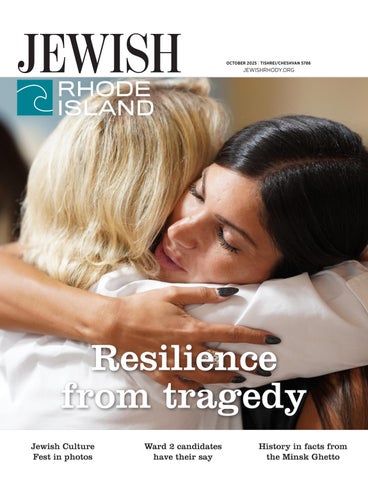
ON THE COVER : Emotions at the Oct. 5 event to commemorate Oct. 7, 2023. PHOTO | GLENN OSMUNDSON
Come work with us!
Jewish Rhode Island is looking for a part-time advertising sales representative. Use your sales skills to help local businesses see the value of advertising in our Jewish community newspaper. For more information and to apply: https://bit. ly/40FzaSU
Blessings of childhood memories
I SPENT THE High Holy Days immersed in family. Rosh Hashanah was celebrated with children and grandchildren. My son and his wife hosted us for dinner. What a change to not have the family at our house as we are accustomed to doing. Yom Kippur found me at my childhood home making sure my mother’s absence didn’t diminish the observance of the day of remembrance and atonement. We didn’t want my father to be alone.
We broke the fast with toasted chicken sandwiches, a family tradition for as long as I can remember and apparently longer than that. Slices of the roasted chicken from erev Yom Kippur are sandwiched between two fairly fat slices of challah. Additions include lettuce, tomato and whatever spread you might want. The sandwiches go under the broiler for a quick toast (and are carefully turned so as not to fall apart), and they are done! Apparently, these sandwiches were a feature of his mother’s post-fast table more years ago than we really want to remember. This got me thinking about my own childhood and brought forth many memories.
Many of these memories are centered in the kitchen. No surprise there. Like many of you, we ate dinner together every night without fail. Breakfast was a hurried affair. Everyone was off to school at a different time. But the smell of burning bread still takes me back as there was a burned toast lover in the family!
And what about the old-fashioned manual egg-beater? Remember that contraption with the handle that could whip up a couple of eggs for scrambled eggs in no time? No electricity needed. It’s still in the drawer in my parent’s kitchen, and we used it on Sunday to make breakfast. I was curious so I did a little research. Just in case you were wondering, you can still buy one at Target!
Our yard, still fenced with chain link, was the scene of a lot of play years ago. The highlight of my memory, though, is a large white rose bush at the back of the yard that my mother called the “Prom Rose Bush.” It was usually in full bloom in June and was the scene of many prom night photos. The beautiful white blossoms still appear each year, more than 60 years after it was planted!
Staying at your childhood home for a few days really can take you back a few years. The neighborhood is still there but few people from the ’60s and ’70s still live there. The neighborhood association publishes a directory of residents and when they moved in. My folks bought their house in 1966; the northern Virginia subdivision of about 375 homes was built about 1960. I counted about a dozen people from that era who still live there. It’s not an exact number because you have to pay your neighborhood association dues to be listed in the directory. But the friends and neighbors I remember are long gone. And
times have certainly changed. I saw few children on bikes riding up and down the streets, running between houses or out waiting at the bus stop for the school bus as I remember we did.
This is a particularly good time of year for these reflections. We all have childhood memories, good and bad. I’d love to hear some of yours if you’d like to share. Send to me online at editor@jewishallianceri.org or via mail: Editor, 401 Elmgrove Ave., Providence, RI 02906. I’ll do a round up in November or December.
Fran Ostendorf Editor
THE MISSION OF JEWISH RHODE ISLAND is to communicate Jewish news, ideas and ideals by connecting and giving voice to the diverse views of the Jewish community in Rhode Island and Southeastern Massachusetts, while adhering to Jewish values and the professional standards of journalism. ALL SUBMITTED CONTENT becomes the property of Jewish Rhode Island. Announcements and opinions contained in these pages are published as a service to the community and do not necessarily represent the views of Jewish Rhode Island or its publisher, the Jewish Alliance of Greater Rhode Island. We reserve the right to refuse publication and edit submitted content
Meet Matthew Miller, better known as the performer Matisyahu UP FRONT
BY ROBERT ISENBERG
In the mid-oughts, Matisyahu stunned hip-hop audiences with his mashup of Hasidic attire and reggae rhythms. The idea of a Jewish rapper –decked out in a long beard and black fedora – was peculiar enough, but Matisyahu was also a gifted performer, spinning rhymes out of his personal life and spiritual ponderances. Born Matthew Miller in 1979, Matisyahu grew up in White Plains, New York. His biography is a patchwork of periods and influences; these days, he’s left the beard and suit behind and embraced his silvering hair, and he’s become a vocal supporter of Israel since the terrorist attacks of Oct. 7, 2023. His new album, “Ancient Child,” dropped this month, sparking a world tour. We caught up with Matisyahu to talk about running, blending cultural traditions and a renewed sense of purpose.
Have you been to Rhode Island before?
Yeah, many times. I’m not very touristy, I don’t like the typical touristy things. I’m from New York, and I’ve never been to the Statue of Liberty or the Empire State. But one of the ways I really have memories from the last 20, 25 years of traveling and touring is the runs I’ve taken. Often, I can’t remember the show, I might not remember the year, but the memories I have mainly are from runs that I take. I don’t know if it’s that you get a runner’s high when you’re running, but I’ll be walking down a street, and then [the memories] will flood back.
How long have you been running?
which continent, which country. I was in a park. I made a little bit of money, and I had just purchased a pair of Nike Air 360s. I wasn’t flashy, but if you look at early pictures of me, you’ll see that I always had sneakers. I bought those sneakers, I loved them. And something just made me want to run. I was just running, like the Forrest Gump moment, I literally just
I didn’t get running at all [when I was young]. Like, in gym, when we had to run, I just didn’t understand. And then I was either in Australia or South Africa, I don’t remember
be. But one thing you can always count on is you just bring your running shoes. There were times I had security, where they had to follow me. There’s times I got lost with no phone and had to have someone bring me literally to the show. You know, some funny stories from running over the years. But right now, I’m back into it. And I’m loving it.
I don’t think it’s any secret that your Jewish background combined with reggae and hip-hop was pretty novel when you started out. I think a lot of people see you as a sort of bridge between cultural traditions. How do you feel about that characterization now?
started running in the park, and I loved it. And from that point on – you know, when you’re touring, you don’t know where you’re going to
I think it’s a part of who I am, at a very essential level. Even just musically speaking – I was listening to Nas and Wu Tang with friends,
and I was listening to Nirvana, The Grateful Dead, and Phish, and my parents’ Tracy Chapman albums. There was an influx of great music that I absorbed as a child and a grownup. I guess I am a bridge, right? Like all those different things are like different bricks or pieces of material that are part of the bridge. People were like, “How do you bridge being a Hasidic Jew with reggae music?” Well, there are these references to the Old Testament in legendary classic reggae songs. Bob Marley sings “Exodus”: “We know where we’re from. We’re leaving Babylon. We’re going to the fatherland.” Where are you going to hear that outside of reggae music? If you’re a 13-year-old Jewish kid growing up in White Plains, New York, and you listen to Bob Marley and you hear that, you’re going to be like, “Whoa, that’s directed to me. I’ve only heard that in
Hebrew school, nowhere else.” And when I heard them in Hebrew school, they were not sexy like this. So from a very early age, you know, I listened, I absorbed. What I realized is that Rastafarians and reggae music drew this inspiration from the Old Testament, and there’s obviously a twist in its own direction. I knew from the depth of my core that, me doing this, there’s nothing foreign about it. You’ve had such a journey in your life, and you’ve had so many chapters. Where is Matisyahu now? What is this chapter about?
It’s an interesting time for me personally, and you know, what’s going on in the world with Jews and where I sit with all of that. [Before Oct. 7th, 2023] I was not in a big period of really going up or down. Working on certain things but not really feeling pushed very much.
Matisyahu
PHOTO | CHRISTOPHER TOWNSEND
Confronting mortality with kindness and love
BY RABBI MICHAEL FEL
Many people can easily describe the rituals that accompany joyous lifecycle moments. We know about brit milah and simchat bat ceremonies. We gather for b’nei mitzvah celebrations and weddings. But when it comes to the final stage of the lifecycle, many of us are unsure.
WE KNOW ABOUT FUNERALS
We know about Kaddish.
But what happens to the body of a loved one between death and burial? Who takes care of it, and how? How can we express love and respect for the physical body of someone we cherished, even after their soul has departed?
For centuries, Jewish communities have answered those questions through the quiet, sacred work of the Hevra Kadisha, the “Holy Society.” This group of volunteers is entrusted with preparing bodies for burial through the ritual of taharah —ritual purification. At its most fundamental level it is about washing the body (both physically and spiritually). It is a task performed without public recognition and without expectation of reward. In Jewish tradition, it is called
chesed shel emet - “a true kindness.”
In Providence, historically, the local Orthodox community has faithfully maintained a Hevra Kadisha for decades. Its members have lovingly prepared countless bodies for burial, ensuring that the deceased are treated with dignity and respect. We owe them our deep thanks. Recognizing both the need and the desire to broaden participation in this sacred obligation, the rabbinic leadership of several local synagogues, along with dozens of volunteers, joined forces to create the Community Hevra Kadisha of Rhode Island.
Over the past two years, this new hevra has studied the practices of other com-
munities across the country and carefully crafted a ritual that is both deeply traditional and rooted in Rhode Island’s communal character.
When members of the Hevra Kadisha gather for a taharah, they begin by forming a circle and humming a niggun – a wordless melody with roots in Rhode Island. They recite a prayer asking for compassion and strength, then address the deceased directly:
“(Name of the deceased), we ask your forgiveness for any distress we may cause you during this taharah. Everything we are about to do is for the sake of your honor.”
The ritual itself is simple, deliberate, and profoundly reverent. The body is washed from head to toe, hair is gently brushed, nails and hands are cleaned, and the body is aligned in a dignified manner. Then, a continuous stream of water is poured over the body while members declare three times:
‘The ritual itself is simple, deliberate, and profoundly reverent.’
“Tahor hu” or “T’horah hi ” — “He/She is pure.”
Finally, the deceased is dressed in tachrichim – plain
white linen garments, identical for every Jew, reminiscent of the vestments of the High Priest on Yom Kippur. Verses from Isaiah and the Priestly Blessing are recited before the body is placed in the casket with dignity and love.
As a rabbinical student in New York City, I participated in my first taharah. To be honest, I didn’t quite know what to expect. It was simultaneously one of the most surreal and most beautiful moments I’ve ever experienced. By the end of the ritual, I knew I had just spent the last hour performing the holiest, kindest act of my life.
Participating in the Hevra Kadisha is not for everyone. It requires time, emotional readiness, and a willingness to face mortality directly. But for those who feel drawn to this sacred work, the Community Hevra Kadisha of Rhode Island is eager to welcome new volunteers as it begins offering services later this fall.
The Hevra Kadisha asks us to care for others in their death. This sacred work reminds us that life is fragile and temporary.
But the love and care we show toward every person, and the respect we convey, endure far beyond our days on this earth.
If you are interested in learning more, you can reach out to Marsha Miller at CommunityHevraRI@ gmail.com.
RABBI MICHAEL FEL is the senior rabbi at Temple Emanu-El in Providence.
October 10 5:52pm
October 13 5:47pm Erev Shemini Atzeret
October 14 5:47pm Erev Simchat Torah
October 17 5:41pm
October 24 5:30pm
October 31 5:21pm
Kind of comfortable, to some extent, in my life. Being an adult, basically – making sure my taxes are paid, my adults school bills are paid. Watching the Giants and barbecuing and drinking beer.
You know, I’ve climbed the mountaintop. One of the first albums, “Light,” like the light at the beginning of my career, and the religion and family and all of that, and traveling and performing and being kind of a bit of a star. Then after letting go of the major label, taking on my own music. Who do I want to work with? How do I want to make videos? How
Statement of Ownership
JEWISH RHODE
do I want to present myself? That leads to “Ada,” and that’s a very personal album. The songs are the most close to my heart. There was a wave that I was riding, and it took me to the top of that mountain. Then the question is, what happens after that? Now, I find myself having moved back from the West Coast. In New York, I’m living in this big, old, haunted Victorian house. Just back home, and back to my natural tendencies. It’s almost like, “Who is Matt Miller?” Eventually, COVID hits. I found a partner, I’m kind of rebuilding my life, picking up a lot of the pieces of things that have fallen
apart over the years. I was comfortable just chilling.
And then Oct. 7th happened. I was stepping into a role that’s very natural for me, and I’ve been in before. Fueled with a certain fire that’s unavoidable, unquestionable. I started to realize that responsibility, that I have to be a certain way. I feel like God is calling on me, on all of us, to step into a role and a light. That light comes in balance of the darkness. I feel something special is happening with myself. I’ve really tried to clean up my act a bit. So with that comes the release of this music, “Ancient Child,” and this
owner and publisher, at 401 Elmgrove Avenue, Providence, RI, and is published Monthly. The editor is Fran Ostendorf. Circulation: (A) Average number of copies each issue during the preceding 12 months, ending September 30, 2025, (1) net press run 6,500 (2) paid circulation to term subscribers by mail carrier
new tour. And I have to say, I’m very excited.
ROBERT ISENBERG is a freelance writer and multimedia producer based in Providence. His latest book is “Mile Markers: Essays on Cycling.”
WANT TO
HEAR HIM LIVE?
Matisyahu brings his Ancient Child tour to the Greenwich Odeum in East Greenwich on Oct. 16 at 8 p.m. For tickets (from $65-$81), go to greenwichodeum.com.
RABBI MICHAEL FEL
CALENDAR HIGHLIGHTS
FOR COMPLETE MONTHLY LISTINGS, VISIT JEWISHRHODY.ORG
Ongoing
Kosher Senior Café and Programming. 11 a.m.-1 p.m. Monday – Thursday at the Bonnie & Donald Dwares JCC, 401 Elmgrove Ave., Providence; Fridays at Temple Sinai, 30 Hagen Ave., Cranston. In-person (and on Zoom most Tuesdays, Wednesdays and Thursdays) programming 11 a.m.-noon followed by lunch and discussion noon-1 p.m. Monday – Thursday. On Wednesdays, programming is chair yoga. Upcoming no café dates: 10/13, 10/14, 10/15. For seniors aged 60 and older as well as younger adults with a disability; all faiths and backgrounds are welcome. Suggested donation: $3 per lunch. The Kosher Senior Café is a program of Jewish Collaborative Services supported by the Jewish Alliance of Greater RI and Blackstone Health. Information and RSVP, Neal or Sherri at neal@jcsri. org, sherri@jcsri.org or 401-4214111, ext. 114.
Temple Emanu-El Mahjong. Tuesdays (with the exception of holidays). 11 a.m.-1 p.m. 99 Taft Ave., Providence. Information, Shoshana Jacob at shosh@teprov.org or 401331-1616.
Hebrew Classes Fall Session at Temple Emanu-El. Tuesdays thru 11/11. Beginner class 5-5:45 p.m. All other levels 6-7 p.m. 99 Taft Ave., Providence. Five levels of in-person Hebrew conversation classes offered: Beginner, Introduction to Prayerbook Hebrew, Advanced Beginners for Spoken Hebrew, Intermediate and Advanced. Cost: $100 per person plus cost of book; scholarships available. Offered jointly with the Jewish Alliance of Greater RI. Information, Toby Liebowitz at tobyaane@gmail.com.
Temple Beth-El Adult Beginner Hebrew. Tuesdays 10/21 thru 12/16. 7-8:30pm. 70 Orchard Ave., Providence. No classes: 11/11, 11/25. $150 for members, $180 for nonmembers. Information, Judith at 401-331-6070.
Temple Beth-El Teen Night. Thursdays 6 p.m. 70 Orchard Ave., Providence. Join us for fun conversation and a delicious dinner. Information, Jude Weinstein at jweinstein@temple-beth-el.org or 401-331-6070.
Temple Sinai Hebrew Lessons. Thursdays thru 12/18. 7-8 p.m. Zoom classes, led by Cantor Gelber, will be a mix of lectures and then divided into four smaller breakout rooms. Pick up the textbook in the temple’s office. No class: 11/27. Information, Templesinairi.org, dottie@templesinairi.org or 401942-8350.
Delve Deeper: “The Land of Israel in the Religious Imagination from Antiquity to Present.” Thursdays thru 12/18. 6:30 p.m. Bonnie & Donald Dwares JCC, 401 Elmgrove Ave., Providence. Explore texts that discuss the holiness of Israel with focus on traditional Jewish texts. Led by Michael L. Satlow, Ph.D., professor of Judaic studies and religious studies at Brown University. Offered in person and via Zoom. Cost: $250 (scholarships available). Information, Morty Miller at mortymiller1945@gmail.com.
Cape Cod Synagogue Family Shabbat Services and Dinner. Second Friday of the month 5:30 p.m. 145 Winter St., Hyannis, Mass. In-person and livestreamed services on website, Facebook, Cape Media, YouTube and Community Television Comcast channel 99. Followed by Community Shabbat Dinner. Information, 508775-2988 or capecodsynagogue. org.
Cape Cod Synagogue Shabbat Services. Fridays 7 p.m. 145 Winter St., Hyannis, Mass. With Rabbi David Freelund. In-person and livestreamed on website, Facebook, Cape Media, YouTube and Community Television Comcast channel 99. Information, 508-7752988 or capecodsynagogue.org.
Temple Beth-El Torah Study. Most Saturdays 9 a.m. 70 Orchard Ave., Providence. Join Temple Beth-El clergy and delve into the weekly portion. Information, Jude Weinstein at jweinstein@templebeth-el.org or 401-331-6070.
Temple Sinai Breakfast and Torah Study. Saturdays 9:30-11 a.m. 30 Hagen Ave., Cranston. Breakfast followed by weekly Torah study (also on Zoom) at 10 a.m. Information, Templesinairi.org, dottie@templesinairi.org or 401942-8350.
Temple Habonim Torah Study. Saturdays 10-11 a.m. Rabbi Howard Voss-Altman leads Torah study on current portion. Via Zoom. Information, Adina Davies at office@ templehabonim.org or 401-2456536.
Cape Cod Synagogue Shabbat Services. Saturdays 10:30 a.m. 145 Winter St., Hyannis, Mass. With Rabbi David Freelund. In-person and livestreamed on website, Facebook and YouTube. Information, Cape Cod Synagogue at 508-7752988 or capecodsynagogue.org.
Temple Sinai Morning Shabbat Service. Saturdays 11 a.m.-noon. 30 Hagen Ave., Cranston. Join us in the chapel or on Zoom. Information, Templesinairi.org, dottie@ templesinairi.org or 401-942-8350.
Friday | October 10
Temple Torat Yisrael Kabbalat Shabbat Service. 5:45-6:15 p.m. 1251 Middle Road, East Greenwich. In-person service with Zoom available. Information, temple@ toratyisrael.org.
Temple Beth-El Shabbat Service. 5:45-6:45 p.m. 70 Orchard Ave., Information, Jude Weinstein at jweinstein@temple-beth-el.org or 401-331-6070.
Temple Sinai Evening Service. 6-7 p.m. 30 Hagen Ave., Cranston. In the Chapel. Information, Templesinairi.org, dottie@ templesinairi.org or 401-942-8350.
Temple Beth-El Kadima Samosas in the Sukkah. 7-9 p.m. 70 Orchard Ave., Providence. Enjoy a festive Shabbat meal with the Young Professional Kadima friends as we celebrate Sukkot with delicious Indian food. Information, Jude Weinstein at jweinstein@templebeth-el.org or 401-331-6070.
Saturday | October 11
Temple Torat Yisrael Shabbat Services. 9:30-10:30 a.m. 1251 Middle Road, East Greenwich. In person or via Zoom. Information, Temple@toratyisrael.org.
Sunday | October 12
Ronald McDonald House Women’s Classic 5K Race/3K Walk. 10 a.m. Brown University Stadium, 400 Elmgrove Ave., Providence. 5K (3.1 miles) and 3K (1.8 miles) courses weaving through the East Side. Proceeds benefit the Ronald McDonald House of Providence, supporting families with children in local hospitals. Fee: $40 | $10 elementary, high school and college students. Information, Rob Castellucci at rcastellucci@ jewishallianceri.org.
Thursday | October 16
Sandra Bornstein Holocaust Education Center: The Holocaust in Latvia. 6-7:15 p.m. Bonnie & Donald Dwares JCC, 401 Elmgrove Ave., Providence. Dr. Harry Merritt of Rhode Island College explores the impact of Nazi and Soviet occupation on Latvian Jews and everyday life in Latvia during World War II. Free. Open to all. Information and RSVP, hercri.org, info@hercri.org or 401-453-7860.
Friday | October 17
Temple Sinai Evening Service. 6-7 p.m. 30 Hagen Ave., Cranston. In the sanctuary or on Zoom. Information, Templesinairi.org, dottie@templesinairi.org or 401942-8350.
Saturday | October 18
Temple Torat Yisrael Shabbat Services with Yizkor led by Rabbi Saks. 9:30-10:30 a.m. 1251 Middle Road, East Greenwich. In person or via Zoom. Information, Temple@ toratyisrael.org.
Kids' Night Out: Space. 5-9 p.m. Bonnie & Donald Dwares JCC, 401 Elmgrove Ave., Providence. Parents enjoy a night out while kids enjoy an assortment of activities including arts & crafts, games and a movie. Dinner included. For grades K-5. Cost: Member: $60 | Non-Member: $75 | Member Sibling Price: $35 each | Non-Member Sibling Price: $37.50. Information, Rachel Accetturo at raccetturo@ jewishallianceri.org or 401-4111, ext. 140.
Sunday | October 19
Citizens Pell Bridge Run and Post-Run Brunch. 7 a.m.-noon. 44 Long Wharf Mall, Newport. All paces welcome at this beautiful sunrise run over Narragansett Bay. Afterward join the Dwares JCC team for an exclusive brunch at Temple Shalom in Middletown. Cost: $60 (includes t-shirt and brunch). Information and RSVP, Rob Castellucci at rcastellucci@ jewishallianceri.org.
Temple Torat Yisrael Adult Ed with Rabbi Saks. 9-10 a.m. 1251 Middle Road, East Greenwich. Please stop by and join in the discussion. Topic to be determined. Information, Temple@toratyisrael. org.
Temple Emanu-El Sisterhood Sunday Speaker with Leah Koenig. 11:30 a.m.-12:30 p.m. 99 Taft Ave., Providence. Join award-winning cookbook author Leah Koenig for a talk that gently pushes the boundaries of Jewish food, focusing on the distinct but interrelated cuisines of three Jewish communities: Ethiopia, India and Rome. Cost: $5. Information, Shoshana Jacob at shosh@teprov. org or 401-331-1616.
Hadassah Walk & Talk. 1-2:30 p.m. Members will meet in Providence to stroll in a beautiful park while catching up with old friends and meeting new ones. The walk is related to Sukkot, being in nature and united as the Jewish people. Bring a canned good to donate. Information (including Providence venue) and RSVP, Judy at ChapRI@ Hadassah.org.
RICI Annual Fundraiser/ Sy Dill Mensch of the Year Event. 4-7 p.m. Celebrate our accomplishments and set our sights on future progress standing up for Israel and the Jewish people.
Enjoy music from The Dorons, kosher food from Ahava Catering, drinks, desserts, silent auction and speakers. Keynote speaker Mark Patinkin will receive the annual award. Cost: $54-$120. Information (including Providence venue) and RSVP, maria@ricoalitionforisrael. org.
Wednesday | October 22
Temple Torat Yisrael Movie Night: “Holy Lands.” 7 p.m. 1251 Middle Road, East Greenwich. A retired American cardiologist leaves everything behind to become a pig farmer in Israel, which doesn’t endear him to the community rabbi and intolerant neighbors. Based on the book by Amanda Sthers. Refreshments will be served. Information and RSVP (by 10/20), temple@toratyisrael.org.
Thursday | October 23
Happy Hour (45+). 5-7:30 p.m. Moniker Brewery, 432 W. Fountain St., Providence. Join us for an evening filled with laughter, stimulating conversation and expertly served beverages. This event is for those 45+. Cost: $12 (includes 1 drink). Information and RSVP, Samantha Kaufman at skaufman@jewishallianceri.org.
Temple Sinai Discussion Group. 7-8:30pm. Join Rabbi Goldwasser and Professor Arthur Urbano, Professor of theology at Providence College, on Zoom for a discussion about Christians and Jews 60 years after Nostra Aetate. Upcoming dates: 10/30, 11/6. Each week will be a presentation and discussion unto its own. Information, Templesinairi.org (has Zoom link and reading material), dottie@templesinairi.org or 401942-8350.
Friday | October 24
Temple Torat Yisrael Virtual Kabbalat Shabbat and Torah Services. 5:45-6:15 p.m. Via Zoom only. Information, temple@ toratyisrael.org.
Temple Sinai Evening Service. 6-7 p.m. 30 Hagen Ave., Cranston. In the sanctuary or on Zoom. Information, Templesinairi.org, dottie@templesinairi.org or 401942-8350.
Saturday | October 25
Temple Torat Yisrael Shabbat Services. 9:30-10:30 a.m. 1251 Middle Road, East Greenwich. In person or via Zoom. Information, Temple@toratyisrael.org.
Cranston. Meeting in the Tree of Life room, this group discussion will be led by Rabbi Heather Shore. Information, Templesinairi.org, dottie@templesinairi.org or 401942-8350
Temple Sinai People of the Book. 2-4 p.m. 30 Hagen Ave., Cranston. Join us as we discuss “How to Share an Egg,” Bonny Reichart’s moving exploration of heritage, inheritance and self-discovery. Information, Templesinairi.org, dottie@templesinairi.org or 401942-8350.
Monday | October 27
Judaism 101: Understanding the Fundamental Ideas that makes Judaism…Jewish! 7 p.m. Four online sessions with Rabbi Saks via Zoom beginning 10/27. Each session will explain, discuss and dissect topics that help make Judaism more relevant and meaningful. Upcoming dates: 11/3, 11/17, 11/24. Information and Zoom link, Deanna at 401-885-6600.
Tuesday | October 28
Temple Beth-El and the Jewish Alliance present Ward 2 City Council Candidate Forum. 7 p.m. Temple Beth-El, 70 Orchard Ave., Providence. Meet and hear from the candidates about their vision for the future of Ward 2 and their ideas on the important challenges facing the city. Free and open to the public. Information, Emily Gaudreau at egaudreau@ jewishallianceri.org.
Thursday | October 30
Temple Sinai Discussion Group. 7-8:30pm. Join Rabbi Goldwasser and Professor Arthur Urbano, Professor of theology at Providence College, on Zoom for a discussion about Christians and Jews 60 years after Nostra Aetate. Upcoming date: 11/6. Each week will be a presentation and discussion unto its own. Information, Templesinairi.org (has Zoom link and reading material), dottie@templesinairi.org or 401942-8350.
Friday | October 31
Temple Torat Yisrael Virtual
Kabbalat Shabbat and Torah Services. 5:45-6:15 p.m. Via Zoom only. Information, temple@ toratyisrael.org.
Temple Sinai Evening Service. 6-7 p.m. 30 Hagen Ave., Cranston. In the sanctuary. Information, Templesinairi.org, dottie@ templesinairi.org or 401-942-8350.
Sunday | November 2
PJ Library and the Jewish Alliance present the “What Are You Doing for Kindergarten?” Fair. 10:30 a.m.-noon. Bonnie & Donald Dwares JCC, 401 Elmgrove Ave., Providence. Meet representatives from Wheeler School, Moses Brown School, The Gordon School, PCD/HBS, The French American School, The Croft School, Lincoln School, The Grace School, JCDSRI, International Charter School and Achievement First. Information and RSVP (by 10/31), Lyndsey Ursillo at lursillo@ jewishallianceri.org.
Temple Torat Yisrael Sisterhood Holiday Crafts Fair. Noon-4 p.m. 1251 Middle Road, East Greenwich. Inaugural Holiday Crafts Fair in the Social Hall. Information, email TTYsisterhood@gmail.com.
Monday | November 3
Judaism 101: Understanding the Fundamental Ideas that makes Judaism…Jewish! 7 p.m. Second of four online sessions with Rabbi Saks via Zoom. Each session will explain, discuss and dissect topics that help make Judaism more relevant and meaningful. Upcoming dates: 11/17, 11/24. Information and Zoom link, Deanna at 401-8856600.
Thursday | November 6
Temple Sinai Discussion Group. 7-8:30pm. Join Rabbi Goldwasser and Professor Arthur Urbano, Professor of theology at Providence College, on Zoom for a discussion about Christians and Jews 60 years after Nostra Aetate. Information, Templesinairi.org (has Zoom link and reading material), dottie@templesinairi.org or 401942-8350.
COMMUNITY VOICES
Two peaceful and beautiful neighbors
BY GEORGE M. GOODWIN
ONCE A YEAR , usually in the summer, Betsey and I return to Los Angeles, my hometown and the place we met. Our primary pleasure is visiting my twin brother, Theo, and our younger sister, Betty, and their spouses. Theo and Susan live in suburban Sacramento, and Betty and Keith live in the neighborhood near UCLA where we siblings grew up. Indeed, for 25 years, Betty and Keith have lived in the home that our parents built three-quarters of a century ago.
USINGS
Alas, our longest surviving grandparent passed away in 1978, and all our uncles and aunts have also left this earth. We no longer have any first cousins still living in Southern California. Fortunately, Betty and Keith’s son, Aaron, still lives in L.A., and on our most recent visit, in August, he introduced us his gregarious girlfriend.
On visits home, I eagerly visit many of my favorite museums, which are spread across the metropolitan area, from Santa Monica to Pasadena. Even when staying for a week, however, there is never enough time to see them all.
If I were simply interested in a one or two periods of European or American art, I could focus on a few museums. But I often seek collections and exhibitions far beyond the Western canon and in a plethora of media. I often visit the Skirball Cultural Center, whose focus is American Jewish history. Indeed, my mother, Madeline, donated her mother’s wedding gown, woven in 1920, to its collection. In 1977, I introduced myself to J. Paul Getty, when both of us happened
to be visiting London’s National Gallery. For many reasons, I almost always visit one of his two L.A. museums, whose extraordinary architecture and settings are at least as glorious as their collections. Fortunately, both Getty museums survived the recent Palisades Fire, which forced Betty and Keith to evacuate their home for several days and nights. I almost always visit the Los Angeles County Museum of Art, which for more than five years has been constructing a major new complex on its Wilshire Boulevard campus. As a high school kid, I remember watching the construction of LACMA’s new campus, consisting of three buildings, which was dedicated in 1965. Indeed, I wrote part of my doctoral dissertation about this museum and two others, which also evolved in unforeseeable ways.
Betsey and I always find time to visit Hillside Memorial Park and Mortuary, where most of my paternal relatives have been laid to rest. These include my grandparents, Isadore and Sadie, as well as my parents, Eugene and Madeline, but also an uncle, an aunt and her husband and their only child, my eldest cousin, who passed away two years ago. There being no family plots, it is necessary to walk short distances to visit the Goodwin and Gould graves.
Hillside, located in Culver City, is the only major Jewish cemetery on L.A.’s West Side. Though owned by a Reform congregation, Temple Israel of Hollywood, burial is nondenominational.
In 1855, our family’s Reform congregation, Wilshire Boulevard Tem-
ple, consecrated the city’s first Jewish cemetery, which was later relocated to Boyle Heights, east of downtown. Known as Home of Peace, it contains the graves of only two of our relatives, Mom’s uncle and aunt, Rabbi Edgar Magnin and his wife Evelyn.
Hillside, built in 1941 on gently sloping terrain, is a beautiful resting place. The graves, lawns, shrubs and trees are lovingly maintained. Vertical tombstones are prohibited, so graves are identifiable by horizontal metal or stone inscriptions. A semi-enclosed pergola serves as an indoor and an outdoor chapel.
The first funeral I attended at Hillside, in 1971, was for Dad’s older sister, Ruth. One of the most moving was for one of Dad’s younger brothers, Marvin, when Rabbi Magnin officiated at the burial of his former son-inlaw. How wonderful that our parents were eulogized by their children and grandchildren, who came from near and far. Despite its lovely appearance, visiting Hillside still remains a difficult but obligatory experience.
In August, after paying our respects on a Sunday morning, Betsey and I drove nine miles north to one of my favorite places. This is not an art museum in an ordinary sense.
The Franklin D. Murphy Sculpture Garden, named for a former chancellor, is located on UCLA’s northern periphery. Its five verdant acres are almost magically concealed by classroom buildings, a library and an auditorium as well as jacaranda, sycamore, and eucalyptus trees.
Lacking gateways or guards, the sculpture garden is open to anybody who can find a parking space. Indeed, when wandering amidst this serene setting, most UCLA students and many professors probably have no idea that this is a highly significant
collection of avant-garde art created since about 1900. Major sculptors such as Rodin, Maillol, Lipchitz, Lachaise, Miro, Moore, Noguchi, David Smith and George Rickey are represented by both imposing and diminutive pieces. While various metallic forms prevail, other sculptures are shaped by wind and water.
Inevitably but gloriously, many sculptures portray the female body. By contrast, there are also many abstract pieces. What I lament is the disappearance of open spaces, signifying the collection’s completion. I wish there was room for more.
Unlike other portions of the UCLA campus, the Murphy Sculpture Garden has never been burdened by political issues. There are many pieces by women artists as well as by religious, ethnic and racial minorities because artistic quality has always prevailed. On my most recent visits to Hillside and the Murphy Garden, it struck me how much they have in common. Though relatively young, both are orderly, inviting and tranquil places. They encourage and reward silence, contemplation, respect and gratitude. Perhaps a visit to both may seem mysterious, but one enclave primarily celebrates humankind, the other divinity. Nevertheless, perhaps neither sphere can be fully fathomed. Somehow, peace and beauty sustain and strengthen each other. Yet, in both settings, words and images, which are usually complementary, do not always suffice.
GEORGE M. GOODWIN , of Providence, is the editor of Rhode Island Jewish Historical Notes.
Embracing Creation in all its forms
I/WE HAVE saluted Sukkot with different symbols over the years, but this time I hope to bless all the species that share our planet and our universe, Creation in its entirety.
Kids used to call me “Nature Boy” to tease me and mock my Career Book in junior high school. There was a requirement that we lay a plan for a grown-up ambition. The song “Nature Boy” was orginally written by eden abhez in 1949. He was part of the Back-to-Nature
Movement in California. Musicologists have found echoes of it in Dvorak’s “New World Symphony” and in Eastern European Jewish folk music. Nat King Cole made it a surprise hit. All that remains of my future career prediction is the cover painting that I framed, a work of art by my mother, who had covered the kitchen walls with depictions of fledglings eating .... propaganda art to get me to eat more and put on a few
pounds.
My current concept of Sukkot is that our Jewish calendar needs to embrace respect for Creation in all its forms. Not just for human profit or progress but for the beauty of birds and beasts. As we revere the diversity of species, we learn lessons in modesty, diversity and the dignity of observing the lives around us, among us: we welcome the hummingbirds at our kitchen window feeder, and gasp at the glory of the Baltimore orioles ...as well as the otters that seek shelter underneath the house foundation.
We need to widen our perspective with each holiday
of our Jewish calendars, and to respect diversity perhaps especially with our sacred autumn migratory architectural “huts” that remind us of our wandering and that inspire simplicity and respect for the diverse creatures among us.
My mother told and taught me about a horse they had in Montreal . “Don’t toss its hay, feed it with respect, even courtesy, she said.” When I asked her what was her favorite pet species, she would ask for a drive to go and visit the horses in Lincoln Woods.
I never refuse to write a check for the protection of work horses, from donkeys
to mules, and this year my Sukkot will invite you, dear readers, to add to the blessings of the forthcoming autumn and its memories of the pleasures of sunshine, special salutes to the species that share our destinies, designs and dignity. Special prayers for Israel and for the Jewish American culture and its immeasurable contributions to the American Dream.
MIKE FINK (mfink33@aol. com) is a professor emeritus at the Rhode Island School of Design.
MIKE FINK
COMMUNITY VOICES
Resolving conflict with Jewish values and High Holy Days principles
JEWISH VALUES are at the core of goals to resolve conflicts. These values are honesty, respect, communal responsibility, ethical conduct, honest self-assessment, seeing each other’s perspective, restorative justice and striving for peace
The following is an outline of five steps to resolve conflict.
1. Define the conflict:
• Acknowledge that there is a conflict
• Name the conflict
• Identify the root causes
2. Begin the dialogue in a safe space:
• Respect the dignity of all involved
• See each perspective fairly
• Keep the intent positive
3. Engage in active and empathetic listening:
• Focus on underlying needs rather than surface-level demands
• Separate the people from the problem
• Listen deeply before reacting
• Model the value of curiosity in disagreement
4. Seek solutions through problemsolving
• Together, identify paths forward
• Use collaborative problem-solving to restore relationships (restorative justice)
• Aim for resolution that is acceptable and beneficial for all
In all these steps it is important to prioritize the needs of the community over individual desires
EALTHY LIVING
• Create discussion that is rooted in honesty and humility
5. Commit to a plan and follow-up
• Agree upon a solution
• Pursue justice and peace
• Make a clear commitment to implement actions and prevent recurrence
• Schedule follow-through to ensure accountability
Core Jewish principles involved in this process are rooted in ancient legal and ethical frameworks and they form the basis for many practices now common in the field of dispute resolution. These principles are fostering a culture of respect, honesty and collective well-being throughout the conflict resolution process. Corresponding actions are compromise, active listening, mediation when needed and the pursuit of peace.
In his article “Understanding the High Holidays” on Aish.com, Rabbi Emanuel Feldman writes,“Bear this in mind: the overarching theme of Rosh Hashana and Yom Kippur is ‘change:’ to change from what we were before and to become new individuals. The motif behind it all is accountability. We are responsible for our actions. We do not live in a
Creating childhood together
BY SARAH GREENLEAF
WHEN WE THINK of parenting what we are often thinking about is children, how to get them to do what we want, how to stop them from doing what we don’t and how to do things in a way that doesn’t make us lose our minds. I was reminded the other day, when talking to someone about distress tolerance, that so often we frame things in terms of a child’s behavior, that are in fact, parental behaviors. What if we shifted our focus solely from what our kids are doing to what we are doing and feeling and demonstrating?
The Jewish High Holy Days are a whirlwind of celebration, introspection, atonement and celebration, again. With all the doing it can be easy to get lost in the scheduling and hosting and attending and forget to take the time for the reflection that the season invites and requires. As I have spent time turning inward and reflecting, I have concluded (for the
thousandth time) that being on my phone makes me feel bad and I want to be on it less. At the same time, I have no interest in creating elaborate activities for my toddler so that I can “drink my coffee while it’s hot.” Instead, I am looking for a middle ground, for things she and I can do together that aren’t just for her or just for me.
In her Substack, The Analog Family, Katherine Martinko writes, “But there is another aspect to parental modeling that matters more than all of these other tactics combined, which is, do you exhibit joy and wonder and curiosity about being in the real world? If we want our children to revel in reality, then the most effective way to teach them that is to do it ourselves.” And this, I think, is why so many of the activities aimed at toddlers fail or are so short-lived, because we as parents aren’t interested in doing them ourselves.
The other morning, I took the early shift to let my wife sleep in and, needing
a moment of calm, took out my own journal and started cutting things out to collage into it. My daughter was up on the chair next to me in a flash, excited that scissors were being used and curious about what I was doing with a huge pile of her drawings and stickerings. She sat next to me, and we formed a little collage assembly line, I cut, she glued, we both stuck things down on paper.
There was no color sorting, or butcher paper, just a little pile of crumpled things destined for the recycling or trash and our attention. We made something that will live on in my notebook for as long as it survives, not some throwaway activity that would take me longer to set up than it would take her to do. I was reminded that children are interested in being in our world, not endlessly pandered to in the false confines of the child world.
My daughter, who is almost three, has started to pay close attention to what is on the ground in our neighborhood.
vacuum. What we do or say has an impact and a resonance in the world. Yom Kippur represents the potential for a human being to change and return: we are not eternally condemned to follow a certain habitual path; we do have the ability, if we so choose, to change our ways.”
The High Holy Days are a time to review the past and the current time and make changes for the future. In doing so, we can make course corrections so that past mistakes become powerful learning lessons. Suggested steps are keeping a journal, analyzing the process not just the outcome, seeking perspective from friends, mentors and colleagues and to do a “premortem” during which we spot risks before they occur.
PATRICIA RASKIN, owner of Raskin Resources Productions, is an award-winning radio producer, business owner and leader. She has served on the board of directors of Temple Emanu-El, in Providence. Her “Positive Living with Patricia Raskin” podcast can be heard on voiceamerica. com.
“Trash!” she’ll yell, pointing at a candy wrapper, or discarded beer bottle, or yet another plastic bag. Because she is small, she often sees things I miss, our sightlines at entirely different registers. And, because she is small, she is highly observant and not one to let things go. I’ve struggled this year now that she is old enough to do something, but not so old that she can really participate in everything, to find things that allow us to celebrate all the highs and lows of the holiday season together. Her obsession with trash led me to reverse tashlikh.
Traditional tashlikh is the practice of casting bread into the water in a symbolic act of casting away one’s sins. Reverse tashlikh, made popular by Jewish environmental groups in recent years, is the practice of picking up trash, often near a body of water, instead of throwing in bread that is harmful to wildlife. The spiritual side is still tied to casting off our sins, but instead of throwing them
away, we gather them up to be dealt with.
This year my daughter and I will spend some of our time walking in nature, something we both like to do, noticing and picking up trash. She will ask me questions I can answer and ones I can’t and will point out to me beautiful things I would have missed. Together we will create an activity for both of us, one that allows me to be introspective and calm and allows her to lead and play. We will meet one another where we are and create meaning together.
SARAH GREENLEAF (sgreenleaf@jewishallianceri.org) is the digital marketing manager for the Jewish Alliance of Greater Rhode Island and writes for Jewish Rhode Island.
BRAIDING TIME IS a new essay series exploring the nuances and beauty of Jewish family life from the practical to the profound.
PATRICIA RASKIN
LETTERS
Rabbis: Open letter to Jewish community
RECENTLY A LETTER (see below) was sent to rabbis worldwide. To date, over 1,200 have signed. We, Rhode Island Rabbis, have proudly signed on to this letter, and we want to share these thoughts with the RI Jewish community:
The Jewish People face a grave moral crisis, threatening the very basis of Judaism as the ethical voice that it has been since the age of Israel’s prophets. We cannot remain silent in confronting it.
As rabbis and Jewish leaders from across the world, including the State of Israel, we are deeply committed to the wellbeing of Israel and the Jewish People.
We admire Israel’s many and remarkable achievements. We recognize, and many of us endure, the huge challenges the State of Israel relentlessly confronts, surrounded for so long by enemies and facing existential threats from many quarters. We abhor the violence of such nihilistic terrorist organizations as Hezbollah and Hamas. We call on them immediately to release all the hostages, held for so long captive in tunnels in horrendous conditions with no access to medical aid. We unequivocally support the legitimacy of Israel’s battle against these evil forces of destruction. We understand the Israeli army’s prioritization of protecting the lives of its soldiers in this ongoing battle, and we mourn the loss of every soldier’s life.
But we cannot condone the mass killings of civilians, including a great many women, children and elderly, or the use of starvation as a weapon of war. Repeated statements of intention and actions by ministers in the Israeli government, by some officers in the Israeli army, and the behavior of criminally violent settler groups in the West Bank, often with police and military support, have been major factors in bringing us to this crisis. The killing of huge numbers of Palestinians in Gaza, including those desperately seeking food, has been widely reported across respectable media and cannot reasonably be denied. The severe limitation placed on humanitarian relief in Gaza, and the policy of withholding of food, water, and medical supplies from a needy civilian population contradict essential values of Judaism as we understand it. Ongoing unprovoked attacks, including murder and theft, against Arab populations in the West Bank, have been documented over and over again.
We cannot keep silent.
In the name of the sanctity of life, of the core Torah values that every person is created in God’s image, that we are commanded to treat every human being justly, and that, wherever possible, we are required to exercise mercy and compassion;
In the name of what the Jewish People has learnt bitterly from history as the victim, time and again, of marginalization, persecution and attempted annihilation;
In the name of the moral reputation not just of Israel, but of Judaism itself, the Judaism to which our lives are devoted,
We call upon the Prime Minister and the Government of Israel
To respect all innocent life;
To stop at once the use and threat of starvation as a weapon of war;
To allow extensive humanitarian aid, under international supervision, while guarding against control or theft by Hamas;
To work urgently by all routes possible to bring home all the hostages and end the fighting; To use
OPINION
When art is witness to the Holocaust
THE UNITED STATES Holocaust Memorial Museum opened its doors on April 22, 1993. I visited the museum for the first time several years ago, along with the Rev. James C. Miller, then the executive minister of the Rhode Island State Council of Churches. Patrick Kennedy, our Congregational Representative in those days, had invited the two of us to join with him at the annual National Prayer Breakfast at a Washington, D.C., hotel.
Following the prayer breakfast, Kennedy led us on a vigorous walk to the Capitol, where he took us first to his office and then treated us to a leisurely lunch at one of the Capitol’s dining rooms. As our congressman was saying goodbye, he handed us two tickets to the Holocaust Museum and bid us on our way. On this first visit to the museum, I was especially concerned with how Jim Miller, whom I knew to be a man with a deep and abiding social conscience, was processing what was clearly a painful, almost devastating experience for the two of us. Unsurprisingly, our dinner discussion at a restaurant on the Potomac that evening did not focus on our menu.
On my second visit to the Holocaust Museum, I was with my wife Sandy and my father, Benson Rosenberg, not long before his death at the age of 86. While he was born in Elizabeth, New Jersey, his parents and three of his four siblings were born in Lithuania, not far from what English speakers have called Kovno. I remember walking with him into a claustrophobic exhibit room plastered with black-andwhite photos of Lithuanian victims of Hitler’s madness. My father’s old and tired face was painted with pain; I have never seen his face like that… before or since. Voiceless, as if paralyzed.
My wife and I have been supporting members of the
Holocaust Museum in D.C. since its founding. For the past several years, the museum has been sending its members a yearly calendar featuring artists who experienced the Holocaust; their work has survived to bear witness, even when many of the artists themselves perished during those years of sound and fury. This year I have been taking a closer look at each month’s work of art, at the man or the woman who created it and at the fate of each of the artist April shows a watercolor, circa 1940, by Eva Liebhold; the picture, captioned “Gemueseputzen Frauen” (vegetable cleaning women), features 13 women imprisoned in the Gurs work camp in France. The bright colors and cheerful camaraderie of the women at work, in what seems to be a kitchen, stand in ironic contradiction to Liebhold’s tragic circumstances. She was murdered at Auschwitz just before her 21st birthday in 1942.
The June calendar offers an oil-on-canvas self-portrait of the well-known Czech artist, Gertrud Kauders, recovered in 2018 by a demolition crew in Prague, where hundreds of Kauders’ pictures “tumbled from a house’s walls and floors.” At the age of 59 Kauders was murdered at the Majdanek death camp in 1942. However, more than 600 of her works of art were safely stored at the home of a non-Jewish friend.
The artist Emeric Lazar’s 1945 watercolor, titled “My Studio quai Jemmapes,” graces the calendar page for July. Hungarian born Lazar was imprisoned in Drancy as a “foreign national.” Released in 1943, he spent the remainder of the war hiding with friends in Paris. Unlike Eva Liebhold and Gertrud Kauders, Lazar survived the war, married a
US army nurse and pianist, in 1946, and found the strength to resume his career as a musician. The editors of this year’s Holocaust Museum calendar wrote these words at the bottom of Lazar’s watercolor: “In his sunlit portrayal of his Parisian apartment, Emeric Lazar reflected his relief and hope after liberation.”
As most readers of Jewish Rhode Island know, one of the most significant prayers in our Siddur (prayer book) – if not, the most significant – is the Shema: Shema Yisrael, Adonai Eloheynu, Andonai Echad “Hear, O Israel, The Lord is our God, The Lord is one.” What is not so widely known is that the last letters of both the first word and the last word of the six-word prayer are written extra-large in every Torah scroll in the world (Deuteronomy 6.4). These two enlarged letters spell out the Hebrew word AyD, which translates to the English word, “witness.” Tradition teaches us that these two enlarged Hebrew words remind us that every time we Jews recite the Shema, we are bearing witness to God.
After Auschwitz, it was difficult, or impossible, for many of our fellow Jews who suffered during the Holocaust to bear witness to God. What cannot be denied is that all of them, in one way or another, have borne witness to the Holocaust itself; and for the artists among them, their art has borne witness. Even when the artists themselves were murdered by the Nazis, their art often survived to bear witness to one of the greatest human catastrophes in world history. The Hebrew word is shoah: utter destruction, horror beyond description, when all language is helpless. But by bearing witness, their art continues to live and to break through the silence.
JAMES B. ROSENBERG is a rabbi emeritus at Temple Habonim in Barrington. Contact him at rabbiemeritius@templehabonim.org.
RABBI JAMES ROSENBERG
Two years in, some are asking if the war in Gaza is changing Judaism
BY ANDREW SILOW-CARROLL
(JTA) – In the two years since the attacks of Oct. 7, the Jewish discourse over the war in Gaza has been agonizing and polarizing. Jews have argued over the Israeli government’s military aims, over what it means to “bring the hostages home,” over the left’s betrayal of its Jewish allies and over the influence of Israel’s far-right ministers.
Since the summer, however, a number of Jewish religious and thought leaders are debating another assertion: that the war in Gaza is not just a military, ethical or diplomatic challenge, but a crisis of faith. They are warning that the death toll and humanitarian crisis in Gaza and the settler violence in the West Bank are shaking the beliefs and practices of engaged Jews.
“What we are facing today is a spiritual catastrophe, and what is at stake is not just the future of the state of Israel, but the very soul of the Jewish people,” Rabbi Sharon Brous, leader of the independent IKAR congregation in Los Angeles, said in a Rosh Hashanah sermon.
Most, but not all, of these spiritual critiques are coming from liberal Zionist thinkers and rabbis from the non-Orthodox denominations, not to mention pundits opposed to or disillusioned with Zionism. Critics of their stances, meanwhile, say the real spiritual hazard is that Jews abandon Israel and the hostages during a just war that Israel didn’t ask for.
But the latest discourse suggests that among many Jews in the mainstream, the second anniversary of the attacks is raising difficult questions about Israel, Judaism and Jewish identity.
In an interview in August, the journalist Peter Beinart asked Rabbi Ismar Schorsch how he would respond to a fellow Jew who might be dismayed over Israel’s actions in Gaza and the West Bank.
“What would you say to someone,” Beinart continued, “whose very belief in God and whose belief in Judaism had been brought into question by what Israel is doing in Gaza and the West Bank?”
Schorsch, 89, the chancellor emeritus of the Jewish Theological Seminary, accepted the premise of Beinart’s question, replying:
I think that in some ways, Judaism is at [a] critical moment. Are we going to be able to defend Judaism, which has the burden of the chillul Hashem [desecration of God’s name], taking place on the West Bank and on Gaza? Will we be able to live [with] that Judaism, and if we don’t speak out now, it may be too late. This may
be our final moment. In raising the ethical constraints that need to be imposed on the Israeli government, we are defending Judaism, and Judaism is going to have to survive this catastrophe. And how will we be able to live with ourselves if we were silent?
The response was surprising, perhaps, coming from a historian who from 1986 until his retirement in 2006 as head of Conservative Judaism’s flagship was not known for either fiery rhetoric or public criticism of Israel. In some rabbis’ forums, there was dismay that Schorsch had aired his views in conversation with Beinart, an observant Jew whose very public drift from Zionism has been the subject of debate and much ridicule.
But Schorsch had aired similar misgivings about the spiritual toll of the war over the summer, in an essay for the fast day of Tisha B’Av. “The unremitting violence against helpless Palestinians in Gaza and their wholly innocent coreligionists on the West Bank will saddle Jews with a repulsive religion riddled with hypocrisy and contradictions,” Schorsch warned. “The messianism driving the current government of Israel is sadly out of kilter with traditional Judaism – and an utter moral abomination.”
In her sermon, Brous describes Hamas as a “formidable foe who has repeatedly expressed its intent to repeat the massacres of the 7th of October again and again and again.”
And yet she excoriates Israeli Prime Minister Benjamin Netanyahu for “the perpetuation of a war now nakedly advanced to keep in power a craven prime minister,” and government ministers who “openly share their feverish anticipation of a full resettlement of Gaza at all costs.”
Beyond what could be read as a partisan political sermon from a wellknown liberal Zionist, Brous also speaks of the spiritual costs of what she calls “manifest disregard for Palestinian lives.”
“To be clear, core to our Jewish faith is the notion that every human being is created in God’s own image, which means that the death of any innocent is a moral catastrophe. A moral catastrophe,” she said. “And yet the devastation continues to rain down on Gaza. And I must wonder, have those leaders completely divorced themselves from Jewish history, from our Jewish tradition?”
Brous quotes the Israeli historian Yuval Noah Harari, who in August called the war “a spiritual catastrophe for Judaism itself.”
“What is happening right now in Israel could basically, I think, destroy 2,000 years of Jewish think-
ing and culture,” Harari said on “The Unholy” podcast. Driving his grim prediction for Judaism’s future, he said, were “an ethnic cleansing campaign in Gaza and the West Bank,” the “disintegration of Israeli democracy” and the creation of a new Israel which is based on “an ideology of Jewish supremacy and the worship of what were completely anti-Jewish values for the last two millenia.”
It’s not just liberal Zionists like Brous and Schorsch and critics of Zionism like Beinart – whose latest book is titled, “Being Jewish After the Destruction of Gaza: A Reckoning” – who are talking about the war’s impact on Judaism.
In August, 80 mostly Modern Orthodox rabbis, representing a staunchly Zionist cohort, signed a letter calling for “moral clarity” in response to the hunger crisis in Gaza. The letter expressed their critique in terms of Jewish texts calling for “justice and compassion.”
“They are the foundations of our ethical obligation – to demand policies that uphold human dignity, to provide humanitarian aid wherever possible, and to speak out when our government’s actions contradict the Torah’s moral imperatives, no matter how painful this may be to accept,” according to the letter.
The letter’s author, Rabbi Yosef Blau, told JTA that he wrote the letter in part to defend Judaism and its Orthodox practitioners from the consequences of policies that he called antithetical to tradition. Blau, a former spiritual adviser at Yeshiva University, said the letter was intended in part for the secular Israeli Jew who might say, “I don’t see a Judaism that stands for moral values that I can identify with.”
For some critics – and Blau and his colleagues had plenty, within Orthodoxy and beyond – public moralizing about the war is dangerous because it gives rhetorical ammunition to Israel’s enemies. They also accuse those who call the war a spiritual crisis of cherry-picking Judaism: In addition to its calls for justice and compassion, they say, Jewish tradition justifies war in the name of self-defense and in securing the land of Israel against its enemies.
They also point to some polling and anecdotal evidence showing that the trauma and stress of war inspired many Jews to intensify their engagement with Judaism.
“Their sermons are not courageous; they are capitulating,” the author and rabbi Shmuley Boteach wrote in an angry response to the rabbis’ letter. “Their statements are not moral; they are derelictions of duty.”
Jews on college campuses and
those attending synagogues, Boteach continued, “need spiritual leaders who roar with pride. Rabbis who declare that Israel is our shield, our heart, our destiny. Rabbis who teach that Israel’s war is not only just but holy — a fight for the survival of the Jewish people against the forces of annihilation.”
Jonathan S. Tobin, editor-in-chief of JNS.org, similarly urged rabbis and pundits to resist the impulse to “virtue-signal their ambivalence about a war against a truly evil opponent,” and instead “join in solidarity with Israel’s efforts to extinguish Hamas.”
“Inevitably, many of the resulting reflections often have more to do with political opinions than dispassionate moral judgments,” wrote Tobin. “And that can be particularly egregious when applied to the efforts of those who serve its cause in the middle of an armed conflict with the genocidal Islamist forces that head the Palestinian national movement.”
Tobin was responding to a column by Yossi Klein Halevi, a senior fellow at the Shalom Hartman Institute. An American-born Israeli who leans center-right, Klein Halevi had written in advance of the High Holidays that Israel and its supporters should undergo a process of “moral self-critique” in keeping with the holidays’ themes of introspection and repentance – within limits.
“Even when fighting an existential war against enemies without moral restraint, there are limits to what is morally permitted to the Jewish state,” wrote Halevi in the Times of Israel. “And given the nature of our enemy and the threats against us, there are limits to the self-recrimination Jews should assume.”
Nevertheless, he writes, “something has gone very wrong in Gaza,” citing the humanitarian crisis, the high civilian death toll, the messianic intentions of Netanyahu’s cabinet and, beyond the war itself, the settler rampages on the West Bank. Writes Halevi:
This season of self-reckoning that begins with the Hebrew month of Elul and culminates on Yom Kippur is intended not only for individual Jews but also – in fact primarily –for the Jewish collective. Undergoing this process as a people doesn’t weaken us. It provides spiritual protection.
Just as we need a language for defending ourselves against the lies and distortions, we need a parallel language in which we struggle with the moral dilemmas raised by this war. Those of us who love Israel must not forfeit the moral conversation to Jews who have despaired of Israel or who openly side with our enemies.
US Jews change response amid antisemitism many now see as ‘normal’
BY GRACE GILSON
(JTA) — American Jews are installing security systems and buying guns in large numbers, according to survey data released nearly two years into the Israel-Hamas war in Gaza.
The surveys by the Anti-Defamation League and Jewish Federations of North America took the pulse of U.S. Jews as the second anniversary approached of Hamas’ Oct. 7, 2023, attack on Israel that triggered the war and a wave of anti-Israel and antisemitic incidents around the world.
The analysis found that nearly one in five American Jews were the victim of an assault, threat or verbal harassment due to their Jewish identity over the last year.
Although the surveys are not directly comparable, that is lower than a similar survey taken one year after Oct. 7 by the American Jewish Committee, which found that a third of U.S. Jews had directly experienced antisemitism in the previous year.
But the new analysis shows a high level of sustained experiences of antisemitism — 55% of respondents said
CONTINUED FROM PAGE 13
they had experienced or witnessed antisemitism, including online, or felt excluded or minimization based on their Jewish identity. It also points to dramatic changes by U.S. Jews in response to the ongoing threat.
According to the new findings, a third of American Jews said they had discussed with others how to plan for a “worst-case scenario,” with 14% developing a plan to flee the country, 13% installing new security systems and 9% purchasing a gun.
Among those who had been assaulted, threatened or harassed directly, those proportions were higher.
The analysis marks the first public data point supporting anecdotal evidence that some Jews have taken up arms in the wake of Oct. 7. Gun ownership among congregants has surged so much that Jewish security experts have urged synagogues to impose stronger regulations.
Additionally, 20% of American Jews who wore something distinctively Jewish prior to Oct. 7 have since decided to take it off — though about half as many have begun wearing such symbols at the same time,
An observant Jew and journalist who has covered both sides of the Israeli-Palestinian conflict, Halevi is comfortable using the language of Jewish tradition in discussing politics and policy.
Pulpit rabbis are typically more hesitant. Unlike retired university administrators like Blau and Schorsch, they face congregants who may, and do, revolt over a sermon they don’t agree with. In her sermon at New York’s Central Synagogue on the first day of Rosh Hashanah, Rabbi Angela Buchdahl told her congregants, “I have never been so afraid to talk about Israel.”
Buchdahl, one of the country’s best-known pulpit rabbis, went on to discuss the spiritual hazards of the war, but was careful to describe defects among both Israel’s critics and its defenders. She framed her talk around the Torah portion read on the first day of Rosh Hashanah, which is about the conflict between Abraham’s wife Sarah and her handmaid Hagar. Judaism’s ancestors chose to have the
potentially as an act of resistance.
“It is so profoundly sad that Jewish Americans are now discussing worst-case scenarios,” said Jonathan Greenblatt, the CEO and national director of the ADL, in a statement. “When American Jews — who have built lives, careers and families here for generations — are making contingency plans to flee, we must recognize this as a five-alarm fire for our entire country. This is not just a Jewish problem; it’s an American problem that demands immediate action from leaders at every level.”
The analysis does not prescribe any policy solutions. It comes as the ADL faces a wave of criticism from conservatives and as the Trump administration has invoked concerns about antisemitism while pursuing a broad agenda against universities and immigrants.
The analysis is based on two surveys taken independently earlier this year.
An ADL survey sampled 2,982 Jewish American registered voters between May 27 and July 6. The JFNA survey included 1,877 Jewish Americans between March
story read on Rosh Hashanah when, she said, “our tradition asks us to take a cheshbon hanefesh, an accounting of our souls.”
The story is about empathy, which has been lacking on both sides, said Buchdahl. Israel’s critics refuse to acknowledge the vulnerability Israelis feel after Oct. 7 and “take the worst accusations against Israel at face value,” while the defenders have become callous toward the children in Gaza “who are suffering, exiled, and desperate.”
“This war has tested our empathy. All of us,” she said. “I see the ways that my fear has disabled my empathy response. I still struggle to find the emotional bandwidth to read the tragic stories coming out of Gaza while my extended family is still held captive, while calls to ‘blacklist Zionists’ or to ‘globalize the intifada’ still ring around the world, and even this city.
“But who do we become when we harden our hearts?”
Jay Michaelson, a rabbi and contributing columnist at the Forward,
5 and March 25. The margin of error for the ADL survey ranged for each question but maxed out at 3.2 percentage points, according to a spokesperson.
The ADL’s annual antisemitism audit released in April found that antisemitic incidents had reached an all-time high in 2024, with the majority of all incidents being related to Israel or Zionism.
The new analysis found that 44% of respondents had experienced some type of antisemitic exclusion or minimization, which the survey defined as “acts or communications that minimize or discredit Jewish lived experience,” and 22% reported they had been blamed for the actions of the state of Israel.
It also found that Jews most commonly experienced antisemitism online, at 44%, compared to in public spaces, at 21%, or in educational settings, at 13%.
The surveys found that younger U.S. Jews and those who identify as Republicans were more likely to report facing antisemitic exclusion or minimization.
Nearly three-quarters said they did not report their antisemitic experience, with
suggests the discussion over how the war might change Judaism is the latest expression of an age-old tension between universalism and particularism. Liberal Jews, he writes, tend to favor the universal aspects of tradition that cultivate “compassion for everyone, not only Jews or even primarily Jews.” Israel’s right-wing government, and the observant Jews who support it, represent a “hyper-particularist” strain for whom “Judaism is about the love of other Jews, first and foremost.”
Michaelson rejects this particularism in favor of a Jewish path “committed to human rights, justice, love and universalism.” In some ways, he writes, he practices “a different religion, a different way of life, from at least half the religious Jews in the world,” and appears reconciled to that division.
Schorsch, meanwhile, thinks the moral stakes demand rebuke. He directs his remarks at fellow clergy, calling it their responsibility to denounce the “excesses” being carried out by Israel and being condoned
half of American Jews saying the reason they would not speak out was due to concern about expressing “politics” in public. The analysis also found a marked decline in the proportion of U.S. Jews who feel certain of “non-Jewish support in fighting antisemitism” — though half of U.S. Jews say they remain sure of that support.
While 57% of Jews said they believe that antisemitism is now a normal Jewish experience, the analysis also found that over half of Jews who had directly experienced antisemitic harm are more likely to still seek out increased engagement with Jewish life — a trend that JFNA has termed “the surge” and made a centerpiece of its response to Oct. 7.
“Rather than retreating in fear, American Jews are choosing to stand together, strengthen their bonds and affirm their identity,” said Eric Fingerhut, the president and CEO of the Jewish Federations of North America, in a statement. “This surge in Jewish engagement represents hope and determination in the face of hate.”
by right-wing rabbis.
In his interview with Beinart, Schorsch sympathized with rabbis who do not feel comfortable using their pulpits to question Israel, but said they should do it anyway in the spirit of the self-correcting tradition of the Jewish prophets – and for the sake of Judaism itself.
“The prophets were the critical spokesmen that limited the authority of the monarchy, and the voice of the prophets is silent today,” he said. “There is nothing more destructive of religion than hypocrisy and for us to defend what is happening on the West Bank and in Gaza religiously is simply hypocritical, and I think will be a burden for the future history of Judaism.”
ANDREW SILOW-CARROLL is editor at large of the New York Jewish Week and managing editor for Ideas for the Jewish Telegraphic Agency. The views and opinions expressed in this article are those of the author and do not necessarily reflect the views of JTA or its parent company, 70 Faces Media.
The Dr. James Yashar & Judge Marjorie Yashar Fund at the Jewish Federation Foundation
The Bliss, Gross, Horowitz Fund
Jewish Federations of North America's 2025 Emergency Security Fund in Partnership with The Tepper Foundation
FOOD
New book from Danielle Renov features bundt cakes
Funfetti cake
INGREDIENTS
Cake:
2½ cups flour
2 teaspoons baking powder
½ teaspoon baking soda
½ teaspoon salt
½ cup avocado oil
1¼ cups sugar
2 large eggs
1/3 cup vegan yogurt
2 teaspoons vanilla extract
½ teaspoon almond extract
¾ cup almond milk
½ cup colored sprinkles
Glaze:
2 cups confectioners’ sugar
1/8 teaspoon salt
2 tablespoons almond milk
¼ cup sprinkles, for sprinkling!
DIRECTIONS
Preheat oven to 175°C (350°F), grease and flour a bundt pan. In a medium bowl, add flour, baking powder, baking soda, and salt. Stir to combine. Set aside. In the bowl of a stand mixer fitted with the paddle attachment, add oil and sugar. Mix for 1 minute on medium-low speed and then add eggs one at a time. Add yogurt, vanilla extract, and almond extract. Mix on low speed for 1 minute. With the mixer still on low speed, add half the flour mixture. Mix for 30 seconds and then add almond milk. Continue to mix for an additional 30 seconds. Turn mixer off. Add
CONTINUED FROM PAGE 12
the forces of law and order to end settler violence on the West Bank and vigorously investigate and prosecute settlers who harass and assault Palestinians; To open channels of dialogue together with international partners to lead toward a just settlement, ensuring security for Israel, dignity and hope for Palestinians, and a viable peaceful future for all the region.
“I am a Jew because our ancestors were the first to see that the world is driven by a moral purpose, that reality is not a ceaseless war of the elements, to be worshipped as gods, nor history in a battle
remaining flour mixture and sprinkles and use a spatula to mix it into the batter. Pour into prepared bundt pan, place in oven and bake for 40-45 minutes until toothpick inserted in the center comes out clean. Remove from the oven and allow to cool for 10 minutes.
Use a plastic knife to loosen cake from the sides of the pan and carefully flip onto cake plate. When cake is completely cooled, make the glaze.
In a bowl, add sugar and salt. Add 1 Tbsp almond milk at a time, mixing for at least 1 minute before adding next tablespoon. The mixture will seem thick and crumbly at first, but as the sugar absorbs the liquid, it will also begin to liquify and loosen. Once the mixture is the consistency of a thick cake batter (pourable but not too runny), spoon over the top of the cake and let it sit for 10 minutes so the glaze can slowly settle over the cake. After 10 minutes, sprinkle the sprinkles over the top of the cake. Allow glaze to set completely before covering.
Reprinted from Micro Peas - The Mini Cookbook Series: Bundt Cakes by Danielle Renov and Chana Sara Posen with permission from the copyright holder, ArtScroll Mesorah Publications.
in which might is right and power is to be appeased. The Judaic tradition shaped the moral civilization of the West, teaching for the first time that human life is sacred, that the individual may not be sacrificed for the mass, and that rich and poor, great and small, are all equal before God.”– Rabbi Jonathan Sacks, Radical Then, Radical Now (London 2000).
Signed by:
Rabbi Alan Flam, Rabbi Irvin Wise, Rabbi Wayne Franklin, Rabbi Andrew Klein, Rabbi Vanessa Ochs, Rabbi Andrea Gouze, Rabbi Howard Voss-Altman, Rabbi James Rosenberg
The best of Jewish culture in Rhode Island
BY FRAN OSTENDORF
JEWISH CULTURE FEST 2025 is in the books, and it was a good day for Jewish culture in Rhode Island. Sponsored by the Jewish Alliance of Greater Rhode Island, with a whole host of local contributors, the event took place in front of
the Bonnie & Donald Dwares Jewish Community Center on Elmgrove Avenue in Providence.
If you had a chance to check out the festivities on Sept. 14, you might not be surprised that the crowd was estimated at about 1,300 people. That’s more than the first Jewish Culture
Fest, held in June 2024. The day was sunny, for the most part. A few raindrops around 3 p.m. caused an early end to the event, which was scheduled from 11 a.m. to 4 p.m.
FRAN OSTENDORF (fostendorf@ jewishallianceri.org) is the editor of Jewish Rhode Island.
A few other Culture Fest numbers from the organizers: Kosher pickles up for sale: 8 gallons
Kosher hot dogs available for purchase: 250
Shofars constructed at the Shofar Factory: 43
Number of vendors and information tables: 30+
Visitors to the Sandra Bornstein Holocaust Education Center: 150
The crowd applauds for Nefesh Mountain before the rain.
GLENN OSMUNDSON
Nefesh Mountain performs their last song before the rain stopped the show.
Yonah Ibrahim, 12, of Pawtucket, blows a shofar he helped make.
Adam Greenman, Alliance president and CEO, welcomes the crowd.
Checking out the Bouncy House.
Neal Drobnis sells his blown glass.
Anthony Marrapese, of Cranston, passes a balloon sword to young boy.
Marc Trachtenberg, of Lincoln, played the keyboard for Rock-a-Baby.
Rachel Linsky and Dancers perform.
Rachel Linsky, center, leads dancers moving to the music of Ezekiel’s Wheels.
COMMUNITY
Commemorating Oct. 7: An evening of remembrance and resilience
BY STEPHANIE HAGUE
On Oct. 5, 2025, our community gathered to mark 731 days since the devastating Hamas terrorist attack on Oct. 7, 2023 – a day seared in the mind of the Jewish community around the globe. The Jewish Alliance of Greater Rhode Island brought community members together mourn the 1,200 victims of that day and pray for the release of the remaining hostages and for the dignity of families still waiting to lay their loved ones to rest.
THE IMPACT has been felt acutely at home, where antisemitic incidents have exploded in both frequency and severity – from school campuses and synagogues to busy streets and peaceful gatherings across North America. Yet even amid this darkness, the Jewish community’s strength and resilience have created a
remarkable surge of unity, philanthropy, and activism.
Voices of Experience and Hope
Natalie Lyalin, chief experience officer at the Jewish Alliance, welcomed the group and shared on the ongoing pain and impacts of Oct. 7, and how our Jewish world shifted after that day. Lyalin’s cousin, Anita Lisman z”l, was killed on Oct. 7 while fleeing the Nova music festival, with her fiancé, Segev Shushan z”l.
Rabbi Barry Dolinger offered meaningful reflections before introducing Naama Krispel, a representative from the Tribe of Nova Foundation. Naama provided context about foundation’s vital work supporting survivors and families affected by the tragedy at the Nova Music Festival, where 410 people
were murdered and dozens taken hostage.
The heart of the evening was May Hayat’s powerful personal testimony, sharing her own experience and journey of survival at the Nova Music Festival. She shared, “I saw the worst of humanity, and I’m still here – to speak, to honor, to remember.” On Oct. 7th, 32-year-old May Hayat was working at the Nova Music Festival bar with her best friend, Liron Barada z”l, when their world turned into a nightmare. Liron tragically lost her life, while providing medical care to other injured attendees, and was posthumously recognized by the President of Israel for her service.
As Hamas terrorists attacked, May took shelter in what would later be known as the “death ambulance.” She miraculously escaped just moments before it was struck by an RPG. Fleeing with a fellow festival goer, Avi Dadon z”l, she hid in a pit – only to be found by eight terrorists. May witnessed Avi’s murder. Then, through unimaginable strength and presence of mind, she convinced the lead terrorist to let her go. She lay silently among bodies, waiting for the army to arrive.
Today, May dedicates her
voice to telling their story –to honor Liron’s memory, to bear witness and to remind us what it means to live fully. She has continued to do that.
Unity in Action
In her closing remarks, Marisa Garber, chair of the Jewish Alliance of Greater Rhode Island, reminded the audience of the power of community and remembrance. The evening was made possible by the generous support of Judy and Robbie Mann. Judy shared in her closing remarks how personally impacted she was after visiting the Nova exhibit in Miami and emphasized the importance of community and hope in these difficult times. As attendees departed, the commitment to remembrance, resilience and unity resonated clearly – a testament that even 731 days later, we continue to remember the horrors of Oct. 7, commit to building a safer and more peaceful world for all, and stand with the people of Israel during this painful and challenging moment.
STEPHANIE HAGUE (shague@ jewishallianceri.org) is chief strategy officer at the Jewish Alliance of Greater Rhode Island.
May Hayat speaks at the Special Commemoration of the events of October 7, 2023 on Oct. 5 at the Jewish Alliance of Greater Rhode Island.
Judy Mann, May Hayat and Adam Greenman at the Special Commemoration of the events of Oct. 7, 2023.
Hostages posters.
GLENN OSMUNDSON
COMMUNITY
Temple Beth-El’s annual marketplace returns with new and favorite artisans
BY AMY SHAPIRO
PROVIDENCE – Mark your calendars for a delightful day of shopping and community! The Sisterhood of Temple Beth-El is thrilled to announce its much-anticipated annual Artisan Marketplace, Scholastic Book Fair and Judaica sale, a vibrant event promising something special for everyone. Join us on Sunday, Nov. 9, from 9 a.m. to 3:30 p.m. at Temple Beth-El, 70 Orchard Ave.
This isn’t just any shopping event; it’s a juried show featuring an exquisite array of high-quality handcrafted goods. You’ll find stunning jewelry, unique pottery, captivating paintings, and so much more. Talented vendors from prestigious studios and workshops across the state are bringing their finest creations, offering you a chance to discover truly one-of-a-kind gifts and treasures. Whether you’re searching for a special present or a treat for yourself, the Marketplace boasts varied and exciting gift possibilities for discerning shoppers of all budgets.
The Marketplace co-chairs, Judy Goldberg and Mona Goldenberg, have curated a collection that promises to impress, with new artists joining this year alongside returning favorites from last year. New to the Marketplace will be Erica Klein of Hot Fluff, offering her whimsical jewelry and other items for the young and the young at heart. Rhode Island Glassworks will make their Mar-
ketplace debut with elegant, hand-blown items that turn everyday objects into usable art. Erin Hazlett’s Violet Orange shop offers the perfect gift for environmentally conscious loved ones with her beautiful textile napkins, paperless towels, placemats, and more. RISD alum Tracy Farricker’s Mount Cornwall Bindery will offer stylish gifts for the writer in your life with hand-made books, journals, boxes and notecards.
Returning to the market is a talented group of artisans, ready to captivate you with their unique creations. Neil Drobnis of Caste Glass will be showcasing his beautiful hand-blown glass birds, each one a delicate sculpture that seems to hold a piece of the sky. Then, Holly Wach of Holly Wach Art will bring nature to life with her ethereal water color paintings of birds. These delightful works are available in various sizes, both framed and unframed, so you can bring a piece of the wild into your home.
The market is truly a community affair, with several returning vendors who are also Temple Beth-El congregants. Lesley Bogad will be back with her exquisite ceramics, offering everything from functional, everyday pieces to artistic, decorative displays. Henry Goldenberg’s photography returns with a collection of stunning prints, capturing the subtle beauty of nature and the grandeur of architectural design. Meanwhile, Jonathan Kabak’s
Holly Wach's artwork captures beauty and strength in nature.
For “reasons of conscience”: an Israeli teen’s refusal to serve in the IDF
BY MICHAEL SCHEMAILLE
BARRINGTON – The 2019 documentary, “Objector,” follows Israeli teen Atalya Ben-Abba’s refusal to serve in the Israel Defense Forces (IDF) due to objections over the IDF’s presence in Gaza and other Palestinian Territories. Explaining her decision, Ben-Abba wrote, “My objection to serving in the army is grounded in reasons of conscience; I believe that in order to bring security to all people in Israel and Palestine, government policy must change, and the occupation must end.” CONTINUED
AS A RESULT, Ben-Abba was sentenced to Israeli military prison for a total of 110 days. She was denied Conscientious Objector status, instead being classified as unfit to serve due to “severely bad behavior.” These events received international media attention and raised awareness of occupation-related issues. They also made Ben-Abba a prominent voice of the growing “refusenik” movement, and she has been speaking out since.
In September of 2025, BenAbba and Brooklyn-based Jewish educator/activist T Wise embarked on an eightUS-city speaking tour titled “A Path Forward: Conversations with an Israeli Peace Activist.” The goal of the tour, presented by Fellowship of Reconciliation and Refuser Solidarity Network, is to build partnership between American communities and the Israeli consci-
entious objector movement. The tour’s second stop was on Sept. 11, at Temple Habonim in Barrington; approximately 100 people attended the event. Following introductory remarks from Rabbi Howard Voss-Altman, Wise opened with the statement that “Jewish people are charged to be rodfei shalom, to be pursuers of peace.” He continued with the question, “Are Jewish people right now giving their all to going after peace?” before introducing Ben-Abba as a “pursuer of peace.”
Ben-Abba began by describing her childhood “in a very specific part of Jerusalem, called Musrara, on the border of Palestinian and Israeli Jerusalem.” She said, “Growing up there influenced my relationship with Palestinians…at some age I understood that the people just across the road don’t have the same rights I do…I grew up knowing
what oppression looks like.”
Ben-Abba explained that she refused service due to her feeling that upholding Palestinians’ oppression was not a meaningful way to serve all everyone in her country. She named another refusenik as her inspiration to object, and said, “When I went to prison, I got a platform to speak out very honestly, and very clearly, about why I did what I did.” Having a platform connected Ben-Abba to other refuseniks, amplifying her voice and those of others.
Discussing that platform led Ben-Abba and Wise to speak of Israel’s growing refusenik movement. Wise described refusal as
an organizing strategy, stating that nearly 40% of recalled reservists have refused service. Quoting a secular Israeli teen protestor, Wise read, “The struggle against the war is not enough. We must fight the structural mechanisms enabling it.” Wise also quoted “an ultra-orthodox Jewish Israeli” at the same protest, saying, “We must not provoke the nations. We must compromise on what is possible, because the most important thing is life — not death.”
Ben-Abba explained how this surge in refusal and protest reflects current Israeli society, “People feel abandoned by the govern-
ment; [they] are against occupation and oppression.” She explained that protest groups, including one comprised of “hundreds of reserve soldiers,” have stated, “We did not enlist to occupy Gaza…we know that military actions don’t bring the hostages back,” and “We refuse to become war criminals.”
She continued, “People who have already been uprooted are being uprooted again. People are being murdered, people die of starvation every day. We have to keep fighting against it. It is our responsibility, and one I cannot shake off. I think
New door for museum
THE RHODE ISLAND Jewish Museum housed in the Sons of Jacob synagogue proudly welcomes a more secure front door, thanks to a generous anonymous donor who learned of his great-grandfather’s connection as the first president of the synagogue. “The first President of the syna-
gogue was William Elowitz, whose life was closely connected with the synagogue life till his last breath of his earthly existence,” writes Rabbi Carol Klein in 1946. In this same article, 12 additional names are listed. Perhaps, one of your relatives is on it. Contact Shelley Parness if you too want to honor
someone connected to this historical monument frozen in time for future generations to visit.
The museum and synagogue are at 24 Douglas Ave., Providence. Parness can be reached at shelleyparness@verizon.net.
Submitted by RI Jewish Museum
Shelley Parness in front of the new door at the RI Jewish Museum.
Atalya Ben-Abba and T Wise
PHOTO | MICHAEL SCHEMAILLE
COMMUNITY
Corporate sponsorship: a win-win for community and local business
BY BRAD SWARTZ
COMMUNITY ENGAGEMENT
and corporate responsibility are more important than ever. Partnerships between businesses and nonprofit organizations are proving to be powerful engines for partnership and growth. A standout example is the most recent community event, the more than 1,300 attendees at the Jewish Culture Fest, a collaboration between local businesses and the Jewish Alliance of Greater Rhode Island, an organization committed to enriching Jewish lives, fostering belonging and strengthening the Jewish fabric of the Ocean State.
Supporting community life
More than a cultural institution, the Jewish Alliance is a cornerstone of the Rhode
CONTINUED FROM PAGE 22
that’s true for everyone in Israel, even if they don’t see it like that — it is all of our responsibility that so much death and harm is being done in our name.”
Wise spoke of the early refusenik movement and its roots in early Zionism, saying, “Martin Buber, Gershon Scholem, Rabbi Judah Magnes said, ‘If a Jewish state is possible only through warfare, and if it will lead to more and continued warfare, it is not worth it.’” Reinforcing this point, Wise cited Israeli pacifist Joseph Abileah’s 1948 trial for refusing to serve; the refusenik movement stemming from 1967’s Six-Day War; and the creation of Yesh Gvul (“There is a limit”), a movement founded in 1982 at the outbreak of the Lebanon War.
Ben-Abba described having witnessed Palestinians’ vulnerability, lack of protection and “exposure to insane amounts of violence,” which she described as a form of ethnic cleansing and explained that Palestinians “have no choice but to escape or to die.” She also described how escalating cycles of violence between Israelis and Palestinians reduce everyone’s safety. Wise reinforced Ben-Abba’s
Island Jewish community. Its wide-ranging programs, including formal and informal education, human and social services, ongoing advocacy and cultural enrichment, serve individuals and families of all ages and backgrounds. Corporate sponsorship plays a vital role in sustaining and expanding this critical impact. With support from local businesses, the Jewish Alliance can launch new initiatives that promote diversity and inclusion, provide scholarships and support services to underserved populations, host events that build bridges across faiths and cultures and maintain programs and facilities that serve thousands each year. These partnerships enable the Jewish Alliance to adapt alongside the evolving needs of the communities it serves.
statements with statistics, stating that both Hamas and the IDF have reported that “83% of the 61,000-plus people who have died are civilians. Wise also stated that “90% of the people in Gaza have been displaced at least once; almost three-quarters of the structures in Gaza have been destroyed.” Following those numbers, Wise asked BenAbba, “What do you think, as a Jewish Israeli, would actually create safety and security in that land?”
Ben-Abba replied, “I’ve experienced shared humanity with Palestinians. The only future I can imagine is when we have equal rights for all, where Palestinian people aren’t deprived of their freedom of movement, or safety, or work…inequality doesn’t offer us anything. We can’t imagine a future without Israel having to correct and recognize the harms it’s done. We have to live together with Palestinians.”
The evening concluded with a brief audience Q&A, shared song, and a reception. “Objector” is available to rent or buy on Amazon Prime.
Why it makes (business) sense
For local businesses, sponsoring the Jewish Alliance isn’t just about philanthropy – it’s a strategic investment opportunity. Nadav Minkin of Rock Spot Climbing said, “We believe in the importance of partnership and sponsorship with non-profits, like the Jewish Alliance. We share critical values of community and wellness. We get to connect with the community that supports us, and together, we build a stronger future for everyone.”
Corporate partners gain a mix of tangible and intangible benefits that extend beyond name recognition to include:
Community connections: Sponsors are seen as active, engaged members of
the local community, building authenticity and goodwill among customers and clients.
Brand alignment: Aligning with a nonprofit grounded in values and vision reinforces a company’s commitment to education, equity, and social responsibility.
Employee engagement: Employees feel a greater sense of connection and motivation when their workplaces support causes that make a real difference both for them and their communities.
Networking opportunities: Sponsorship opens doors to exclusive events and connections with civic leaders, philanthropists, and other business owners
Partnership with purpose
Corporate sponsorship of the Jewish Alliance of Greater Rhode Island is more than a donation – it’s a shared commitment to building a stronger Jewish future. It gives businesses a meaningful way to give back, elevate brands and play an active role in shaping a vibrant Rhode Island. As the Jewish Alliance continues to grow, these partnerships are key to creating a more connected and resilient Jewish community. Supporting the Jewish Alliance isn’t just good for the community – it’s good for business.
To learn more about sponsorship opportunities, contact Brad Swartz, Fundraising and Partnership Manager: bswartz@jewishallianceri.org.
MICHAEL SCHEMAILLE is a freelance writer based in Taunton, Massachusetts.
The history of the Minsk Ghetto
BY EUGENIA NARODITSKIY
I BECAME INTERESTED in the history of the Minsk Ghetto because my grandmother, Epstein, and my aunt Genya Epstein, along with her young daughter, perished there.
I never saw them because I was born shortly after World War II in Moscow, where my parents lived. Nearly 3 million Jews of the Soviet Union were killed during the Holocaust.
After returning from the warfront, my father, Yakov Epstein went to Minsk in 1944 to find out what had happened to his mother and sister. Neighbors told him that the Nazis had herded all the Jews of Minsk into the ghetto, where they were exterminated from 1941 to 1943.
In this review, I tried to answer the question of why so many Jews perished in the Soviet Union during WWII.
Why did the Jews of Minsk and other cities of Belarus fail to evacuate to those vast areas of the Soviet Union not occupied by the Nazis—Siberia, Kazakhstan, and other republics?
To answer this question, we must turn to historical facts.
Before WWII, about 3.02 million Jews lived in the Soviet Union (1939 census). In August 1939, under the Molotov–Ribbentrop Pact, Stalin and Hitler agreed to divide Eastern Europe, and the USSR annexed eastern Poland, adding the western oblasts of Ukraine and Belarus.
This pact doomed almost all the Jews of the Nazi-occupied Soviet territories to destruction.
In the summer of 1940, the USSR annexed Bessarabia, Northern Bukovina and the Baltic states, adding about 1.9 million Jews to its population. When Germany invaded on June 22, 1941, no evacuation was organized, and only 10–12% of Jews in the western oblasts managed to escape.
According to various sources, 2,700,000 (or 2,800,00) Soviet Jews found themselves under occupation
On June 28, 1941, the sixth day after the Nazi attack on the USSR, German troops occupied Minsk, where 80,000 Jews lived.
I was told about the situation in the
CONTINUED FROM PAGE 21
woodworking shop offers a selection of finely crafted, handmade wooden items, and Roberta Schwartz’s beaded jewelry is sure to add a touch of sparkle to any outfit. So, be sure to browse their tables and find the perfect, one-ofa-kind gift for those special people on your list.
Complementing the artisan offerings, the Scholastic Book Fair is set to ignite young imaginations and foster a life -
Minsk Ghetto, and escape from it to the forest partisans in interviews for The Rhode Island Messenger by its prisoners. They had been children when they entered the ghetto: Albert Lapidus (8), David Nalibotsky (10), Berthold Vilner (11), and Vladimir Vilner (5½).
From Albert Lapidus’s recollections [4: Albert Lapidus, Memoirs, The Rhode Island Messenger, Apr 2014]:
In the first days of the war, Minsk was heavily bombed. From German loudspeakers mounted on trucks came the shouts: “Juden kaputt, Juden kaputt!”
From Vladimir Vilner’s recollections [5: “A Real Escape Story,” The Jewish Voice & Herald, 28 Apr 2006], [6: Escape from the Minsk Ghetto,” The Jewish Voice & Herald, 21 Dec 2012]
To avoid the ghetto, my mother, Feiga Lia Ginzburg, managed to obtain papers under a Ukrainian surname and got a job as a cleaner in a German military hospital. She spoke German fluently. In early 1942, after a denunciation, my mother was arrested. My brother and I were sent by the Germans to an orphanage inside the Minsk Ghetto. What was the Minsk Ghetto like?
Albert Lapidus: The ghetto was a huge district of Minsk fenced with barbed wire, comprising about fifteen streets built mostly with single-story wooden houses. Adults were allotted 1.5 square meters of space; children did not count. The ghetto was guarded by Germans and local policemen. We starved terribly.
Jews from Slutsk, Dzerzhinsk, and other nearby places were herded into the ghetto.
Where did the ghetto prisoners work?
Many Jews worked at the factories, plants, the railway depot.
When and how did the extermination of the Jews in the ghetto begin?
David Nalibotsky recalled [7: David Nalibotsky, Memoirs, The Rhode Island Messenger, 2010]
My father was shot in the ghetto together with other men soon after we
long love of reading. Discover a wide selection of books spanning the crucial developmental stages from preschool through eighth grade. It’s the perfect opportunity to stock up on engaging stories, educational materials, and exciting new adventures for the children in your life.
The Sisterhood of Temple Beth-El is an active, inclusive group deeply rooted in Reform Judaism. Its mission is to inspire leadership, intel-
arrived there. Prisoners were killed not only by bullets but also by hunger. Those who worked received once a day a ladle of watery soup and 200 grams of bread; the rest—nothing. Some survived by bartering things for food through the barbed wire.
From Albert Lapidus’s recollections: The first pogrom took place on Nov. 7, 1941, killing 13,000. Soon after, Himmler inspected the Minsk Ghetto, one of the largest, and on Nov. 20 another 7,000 were murdered. The third Aktion on March 2,1942 targeted 5,000, beginning with orphaned children. They were lined up at a pit, shot, or thrown in alive, while Gauleiter Ferdinand Kube tossed them sweets. The massacre was filmed for newsreels.
Seeing that they could not reach the planned number of victims, Kube ordered the shooting of returning labor columns.
Besides Belarusian Jews, Jews from Germany and Austria were deported to the Minsk Ghetto.
According to various sources, about 120,000 Jews passed through the Minsk Ghetto, where at least 105,000 perished. Between 6,000 and 10,000 people managed to escape, about 5,000 survived.
The ghetto was completely liquidated on Oct. 23, 1943
When was the underground organization in the ghetto created?
Albert Lapidus: Already in September 1941, an underground group began to operate. My father, Israel Lapidus, formed from ghetto prisoners a combat-ready group that he later led into the forest to the partisans. It was completed on April 10, 1942.
Independent escapes from the ghetto
David Nalibotsky: On September 22, 1943, the day Gauleiter Kube was killed, roundups began. Expecting a pogrom, five of us left the ghetto in the morning and reached a village safely that same day.
From Vladimir Vilner’s recollections: When we arrived at the Ghetto, Bertold immediately planned our escape. One dark morning in April 1942, we slipped past the guards,
lectual curiosity, spiritual growth and personal development. Through its commitment to tikkun olam (repairing the world) and the power of building friendships, they strive to embrace and enrich their membership, their congregation and the wider community. The Sisterhood of Temple Beth-El is dedicated to making a positive impact, and your participation directly contributes to its meaningful initiatives. A percentage of
crawled under the barbed wire, and ran. We went to Elena Pavlova, a Russian friend of our parents, who hid us while contacting the partisans and gathering food. She risked her life and her children’s yet saved us. In gratitude, trees honoring her, and her daughter Irina, stand on the Avenue of the Righteous at Yad Vashem. Once she arranged contact, we set out, avoiding villages and sleeping in haystacks, until after a week, we reached a partisan detachment. We lived in partisan-held villages, helping with chores, and remained with them until Minsk was liberated in 1944.
Did partisan commanders always want to accept Jewish fugitives from the ghetto?
David Nalibotsky: I heard that partisans did not want to take fugitives from the ghetto.
Some commanders’ reluctance to accept Jews was explained by a Stalin order and by their antisemitism. In November 1942, Moscow sent a radiogram to underground party bodies and partisan commanders forbidding them to take rescued Jews into their units. This openly anti-Semitic directive, originating with Stalin, led to the deaths of thousands of Jews who had miraculously escaped the ghettos. Jews were forced to form their partisan detachments.
Operating from the deep Belarusian forests, detachments carried out raids to destroy the Germans: blowing up bridges and rail lines, derailing troop trains, assassinating generals and officers, planting mines in headquarters, gathering intelligence.
EUGENIA NARODITSKIY is Editor-inChief of Vestnik of RI (the Rhode Island Messenger, published by The Jewish Alliance of Greater Rhode Island). This material is based on documentary evidence and her interviews with former ghetto prisoners who, as children, were imprisoned there and managed to escape to the partisans during the Holocaust. The interview was reviewed and prepared for publication by Laura Auketayeva
the artisans’ sales will be donated to support the Sisterhood’s ongoing projects. These funds empower them to support charitable organizations, enrich projects that serve the community, and benefit religious and school students. Don’t miss this wonderful opportunity to support local artisans, discover fantastic books and contribute to a worthy cause. Come for the shopping, stay for the community spirit, and leave with
treasures that bring joy and meaning.
The Sisterhood encourages anyone interested in becoming a member to attend the Marketplace to get to know the community. Anyone with questions about joining may email tbesisterhood70@gmail.com.
AMY SHAPIRO is a new member of the Sisterhood Board, who loves the ceramic seder plate she purchased at last year’s Marketplace.
New cardio equipment comes to JCC Fitness Center
BY NATALIE LYALIN
As we move through the High Holy Days, a season dedicated to reflection, renewal and return, we are thrilled to announce the arrival of new cardio equipment that will serve the JCC community for years to come. The timing feels especially meaningful – just as we have returned to our spiritual practices and reconnected with our values, we now have enhanced tools to support our physical well-being.
CONSIDER THIS: a treadmill in a commercial fitness space can accumulate approximately 11 million yearly steps. The recently replaced treadmills at the Bonnie & Donald Dwares JCC have been in use for eight years, which potentially adds up to around 90 million steps total – a journey that represents countless moments of showing up and dedication by our awesome members.
The revamped fitness collection includes 8 new treadmills, 3 new ellipticals, 1 new adaptive motion trainer (AMT), 2 new stair climbers, 2 new upright bikes, 3 new recumbent bikes, and a curl/ extension combo machine. Some of these machines are already in place, racking up steps, strides and weight lifts. While a few others are making their way to the fitness center, even as you read
this article. The leg curl/ extension combo machine is the result of the generous giving of our JCC members during the Lift the J campaign. This campaign raised over $35,000 which has gone to support the Dwares JCC operational costs, and meaningful upgrades around the building including new kickboards and pool noodles, tumbling mats and art tables.
As we welcome these new tools for physical wellness, we’re also reminded of a deeper truth about fitness and community. The High Holy Days teach us about teshuvah, the practice of return. We return to our better selves, to our communities and to our commitments. Perhaps nowhere is this concept more relevant than in fitness. The most important thing about any wellness journey is not how
far you’ve gone or how long you’ve been away – it’s that you return. Whether it’s been a day, a month, or a year since your last workout, the door is always open. The equipment is always waiting. Our fitness center has always been more than a room with machines – it’s a space for renewal, for community and for personal growth. With this new equipment, we’re doubling down on that commitment. We’re creating an environment where everyone, regardless of fitness level or how long they’ve been away, can find a path back to wellness. Just as we move forward from this season of return, we invite you to visit the fitness center and try out the new equipment. Take a step. Take a thousand steps. Take your time. Every return – no matter
the
JCC.
Bernhardt, Goldowsky and Silverstein foundations seek applications for grants
PROVIDENCE – Are you affiliated with a tax-exempt nonprofit organization seeking grant funds? If so, please consider applying for a grant from the Helene and Bertram Bernhardt Foundation, the Gertrude N. and Seebert J. Goldowsky Foundation and/or the Pearle W. and Martin M. Silverstein Foundation.
Established in 2005 through the estates of the late Helene and Bertram Bernhardt, the Bernhardt Foundation’s mission is to support nonprofit organizations, with a specific preference given to Jewish nonprofit organizations in Rhode Island, and to nonprofit organizations that Helene and Bertram Bernhardt supported
during their lives. The Foundation also distributes a limited number of small grants (up to $250) to local charities that support the broader community.
Over that time, the Bernhardt Foundation has distributed more than $8 million to such nonprofit organizations as Temple Beth-El, the Jewish Alliance, Jewish Collaborative Services, Brown/RISD and URI Hillel and the Miriam Hospital, among others.
The Goldowsky Foundation was established in 2006 through the estates of Gertrude N. and Seebert J. Goldowsky. Its mission is to support nonprofit organizations, with con-
sideration given to those supported by the Goldowskys during their lifetimes, and with a focus on the local Jewish community, education, medicine, public health and history.
The Goldowsky Foundation seeks to award grants in amounts between $250 and $10,00 to advance these funding priorities.
The Silverstein Foundation was established in 1989 through the estates of Pearle W. and Martin M. Silverstein. Its mission is to support nonprofit organizations, with consideration given to those supported by the Silversteins during their lifetimes, and with a focus on the local Jewish community, education, the
arts and social justice. The Silverstein Foundation seeks to award grants in amounts between $250 and $5,000 to advance these funding priorities.
To receive the application forms and funding guidelines, contact Samuel Zurier, Secretary, by email at sdz@ zurierlaw.com, by telephone at 401- 8610200 or by U.S. Mail at 123 Dyer St., Suite 135, Providence, RI 02903.
The deadline to submit Bernhardt Foundation applications is Dec. 1, 2025. The Goldowsky and Silverstein Foundations consider applications on a rolling basis.
how small – is worthy and welcome here at
Dwares
NATALIE LYALIN (nlyalin@ jewishallianceri.org) is the chief experience officer at the Jewish Alliance of Greater Rhode Island.
New treadmills at the JCC Fitness Center
A variety of new machines at the JCC Fitness Center
Orthopedic rehabilitation: ‘unbelievable things that can be done with injured people’
BY FRAN OSTENDORF
No one escapes muscle or bone aches or pain or tears or breaks in life. Hopefully you’ve only suffered a few of those. But at some point, everyone can relate to orthopedic rehabilitation. Whether you have knee or back problems, an injury or surgery or know someone who has, there is more to recovery than you ever dreamed. Getting better after some of these kinds of injuries can take months.
DR. HAGAY AMIR knows about the challenges of recovery. He is director of orthopedic rehabilitation at the Lowenstein Rehabilitation Hospital in Raanana, Israel. Amir is an orthopedic surgeon and spent most of his career in the military. Recently, he spent a day in Rhode Island, and we had a chance to hear about the hospital’s groundbreaking rehabilitation efforts.
“I realized (about 20 years ago) that I really didn’t know how to treat people that didn’t need an operation, and I decided to look at other things and get tools to treat people that don’t need operations.” So, he went back and studied rehabili-
tation medicine in Chicago, where he saw “unbelievable things that can be done with injured people,” he said.
Eleven years ago, he joined the Lowenstein Hospital to head its department of rehabilitation medicine, and six years ago, he became the medical director. Lowenstein is doing innovative, state-of-the-art treatment for its patients along with research and is known for its work around the world.
“Rehabilitation is not known enough by doctors,” he said. “Nobody sends the students to see what rehab is.”
But it’s a critical part of
the treatment for physical injuries.
“It is basically looking at the patient as a whole. It is looking at the surroundings as a whole and how can we get him focused on how to cure the diseased, but the diseased is a person, and the person has feelings, and so do the people around him.”
Amir would argue that this holistic approach is working wonders on patients, and he is passionate about this subject.
“It is a specialty. We know how to make everyone work together; how to time the work to get the outcome instead of each one working by himself. We are known to be a passionate profession. We see every person, the family. Give him the best tools to get to the end of the day.”
The hospital has treated more than 400 soldiers since the beginning of the Israel-Hamas War. At the start, most were in-patient. Now, most are ambulatory. They come in, do their rehab and go home to sleep.
“The spirit that they have elevates the spirit in the hospital. It helps us be full
of hope,” said Amir. “We see a good future for every one of the people in the hospital.”
On the day we talked, Amir had met with Brown University medical students, and he presented a program at Temple Emanu-El in Providence. His visit was hosted by the Rhode Island-Israel Collaborative (RIIC) in collaboration with the Consulate General of Israel to New England. His work is especially poignant given the recent anniversary of the Oct. 7 massacres, the hostages still held in Gaza and the fighting that continues.
“It is important to have the Jewish nation behind us. Everyone is giving his life to treat those warriors along with everyone else. It is important to come
Broadway film series brings big screen classics to the JCC
This winter, the Jewish Alliance is bringing the magic of Broadway to the big screen with a special film series featuring “Jersey Boys” (Nov. 18), “Annie” (Jan. 22, 2026), “Les Misérables” (March 5, 2026) and “Wicked” (May 14, 2026). Each of these beloved musicals does more than entertain – they highlight timeless values that resonate deeply with Jewish tradition and culture.
IN “JERSEY BOYS,” the story of Frankie Valli and the Four Seasons reflects the Jewish value of kehilla (community). Despite hardships and mistakes, the group discovers the importance of loyalty, forgiveness and standing by one another
– reminding us that we are strongest when we remain connected to community.
“Annie” brings to life the value of tikvah (hope). Annie’s optimism in the face of adversity shows how hope can carry us through dark times,
a central Jewish theme that has sustained our people across generations.
Victor Hugo’s “Les Misérables” powerfully expresses tzedek (justice) and teshuva (repentance). Jean Valjean’s transformation and commitment to righteousness echoes the Jewish call to pursue justice and the belief in the human capacity to change for the better.
Finally, “Wicked” explores b’tzelem Elohim (the belief that all people are created in the image of God), challenging us to look beyond appearances and assumptions. The story reminds us of the Jewish teaching not to judge others harshly but to seek understanding and compassion.
and say thank you to those people that are helping us. To show them that we are doing good things with their money and their help. Their money goes to hard work, and there are wonderful outcomes.”
FRAN OSTENDORF (fostendorf@jewishallianceri.org) is the editor of Jewish Rhode Island.
Together, these musicals uplift values at the heart of Jewish life: hope, community, justice, repentance and compassion. We invite you to join us for the Broadway Series at the Bonnie & Donald Dwares Jewish Community Center, 401 Elmgrove Ave., Providence. Experience the joy of storytelling that entertains, inspires and connects us to our deepest values. Tickets are $5 and are available in advance at https://www. jewishallianceri.org/events/broadway-film-series-jersey-boys-2
SAMANTHA KAUFMAN (skaufman@ jewishallianceri.org) is the manager of adult programming and engagement at the Jewish Alliance of Greater Rhode Island.
SAMANTHA KAUFMAN
COMMUNITY
City Council Ward 2 candidates respond to JRI question
To help our readers make an informed decision in the upcoming special election to fill the Ward 2 Providence City Council seat now vacant after Helen Anthony’s recent resignation, Jewish Rhode Island reached out to all the candidates in the Democratic primary as well as the one unopposed Republican candidate and asked them to respond to the following question: How should city leadership respond to concerns from the Jewish community about safety, representation, and inclusion in public decision? They were asked to keep their responses to 350 words or less. These are the unedited responses.
THERE WILL ALSO be a candidates forum on Oct. 28 at Temple Beth-El where you can get more information from the candidates. Remember to vote in the primary on Nov. 4 and in the special election Dec. 2.
Jeff Levy (D)
THE JEWISH COMMUNITY has good reason to be concerned about our safety. As Rabbi Fel said during his Yom Kippur sermon at Temple Emanu-El, history tells us that antisemitism increases during times of economic instability. I would argue
that the same is true for political instability. Our country is polarized, and the continuing war in Israel and Gaza has provoked antisemitic rhetoric across the political spectrum.
Add to that the President’s willingness to tolerate and even encourage violence against what he calls “the enemy within,” and it’s clear that we are living in perilous times.
It’s not only the Jewish community that’s at risk.
Trump’s cruel polices threaten Jews, Muslims, our queer and trans neighbors, and immigrants, among others. Organizations providing essential services to our most vulnerable residents are losing critical funding; increased ICE raids in Providence threaten the security of our immigrant community; health insurance premiums for tens of thousands of Rhode Islanders will likely double in 2026 and healthcare costs will increase for everyone. The list goes on
and on.
The most important thing city leadership can do right now is to be proactive about fighting Trump and ensure that his eSorts to divide our country and our community will not be tolerated here.
The Mayor and the City Council should convene a working group of city representatives and community members to address these threats as they arise, and whenever possible before they arise. The Jewish Alliance should have a seat at this table, both to ensure that our voice is heard and to demonstrate our commitment to supporting and protecting all our neighbors regardless of their religion, gender identity or immigration status.
The Jewish community in Providence has a longstanding commitment to social justice and inclusiveness. Now is the time – once again – to put our values into action. Providence will be safer and stronger for everyone when we join with other communities, neighborhoods and organizations to practice tikkun olam here at home.
WHEN NEIGHBORS ask why I am running to represent Ward 2 on the Providence City Council, my answer always comes down to tikkun olam. I am running because I have a lifetime of experience of bringing people together to make
the world a better and more just place for all of us. For more than 20 years, I have lived on Elmway Street with my three sons and my husband Kevin. If you know my block, you know that this is a very active and very Jewish spot. The Dwares JCC and Jewish Alliance, Temple Emanu-El, Providence Hebrew Day School, Congregation Sha’arei Tefilla, the Jewish Community Day School, the Sandra Bornstein Holocaust Education Center and more are nearby, and these are some of the institutions and sacred spaces that define our community. My own kids grew up
Jill Davidson (D)
COMMUNITY
right here, proud, confident and independent as they walked to religious school at Temple Emanu-El and to shoot hoops at the J. But as the years have passed, we all see more and more evidence of the need for protection – and evidence of that protection itself. As we greet a Providence
Dave Caldwell (D)
Matt McDermott (D)
PROVIDENCE IS STRONGEST when every community feels safe, represented and included in the decisions
AS A RESULT of my campaign, I have
do about Jewish hate in
Police officer stationed at services or navigate the necessary security to feel safe in Jewish spaces, we are reminded that partnering with the City of Providence to address risks is a constant requirement. As the Ward 2 City Council representative, I will make that partnership a top priority, both for the Jewish community as a whole and in ways that are responsive
PROVIDENCE WAS FOUNDED on the principles of religious freedom and tolerance, and it is important that those values continue to be upheld by creating a safe space representative and inclusive of all its neighbors. The Jewish community has long been an important and vital part of the Providence community. Troubling trends in the rise in antisemitism in recent years – specifically following the unspeakable tragedy of Oct. 7 –cannot be ignored.
It must also be acknowledged that when one form of hatred rises, they all do. Antisemitic incidents in the United States have risen by 344% in the past five years, and 70% of religion-based crimes have been against
that shape our city, and that must include our Jewish community.
For me, these concerns are not abstract. I’ve spent my career working to expand representation and ensure underrepresented communities have a seat at the table. Whether advancing voting rights, reproductive freedom and civil rights, or serving as co-chair of the LGBTQ+ Victory Fund to help elect barrier-breaking leaders, I’ve seen throughout my career what it means when our democracy lives up to its promise, and the harm when it does not.
I am running for City Council because I believe Providence must be a city where every community feels safe, valued and included in shaping its future.
In recent years, antisemitic incidents have risen across the nation.
Ward 2. This is a question I had not expected for a local election, nor did I expect my stance on the Israel-Palestine conflict to come into question. And that is the crux of the matter, the Jewish question, not that of the Marxian sense, but one that questions their place in the American fabric. For that, I ground myself firmly in the belief that the question should remain inherently American and that the issues abroad, while percolating down to our mainland, may have an effect, but there is still the question of what role they play in our society. This is to say that I believe there is immense potential in their involvement with our local community and that this should be the central focus of the question. Not a matter of statehood, but a matter of community.
I believe that the City Council has
to the specific needs of the differences within Jewish life in Ward 2 (and beyond!).
We also need to make sure that city boards, commissions, elected bodies, and other decision-making entities invite and reflect the diversity of our Jewish community. For many years, as a parent of kids who attended public schools in Providence, I made
Jews. The stark reality and valid concern of the Jewish community in Providence, and beyond, must be addressed with strong leadership. It is incumbent upon the leadership of Providence to take action with firmness and conviction. Specifically, Providence leadership should immediately condemn any act of antisemitism and all forms of hatred. Furthermore, education and understanding must play an integral role in leadership and community during this challenging time. Providence leaders must be committed not only to educating their communities, but also to continually educating themselves – so they can better serve, foster belonging and ensure a sense of
Families in Providence are right to want leaders who will take their safety seriously. I will be that partner in City Hall by making sure our government works with synagogues, schools and community organizations to secure needed resources, from safety investments to coordinated responses when threats arise. No family should ever have to question their safety when sending a child to school or gathering for services. But safety is only part of it. Representation and inclusion matter too. I believe leadership starts with listening and showing up early, not just after decisions are made. Because when you don’t have a seat at the table, you’re too often on the menu. Government works best when policies are shaped with the community, not handed down to them. As someone
connections with families from all over the city to make sure our voices were included in conversations about education. Similarly, Jewish community members should be part of conversations about what matters in Providence. This means that we need to invite participation and remind city leaders that Jewish voices matter.
safety for all.
City leadership must continue to strengthen – and actively invest in – partnerships between our many outstanding community organizations, Jewish and interfaith leaders. By nurturing strong relationships and supporting coordinated community events, we can ensure that Jewish residents feel both protected and embraced. This collaborative approach not only enhances security but also signals that the city stands firmly against antisemitism and is committed to building a community where all faiths and cultures feel safe, visible and valued.
“These guys do such a great job and at such a reasonable price compared to the dealership. I’ve had both my cars, an Audi A4 and BMW 535 serviced here, and have always been exceptionally pleased with the quality of the work performed on my vehicles.”
–William C., BMW 5 Series
no business having a foreign policy. As a city councilman, I expect to be focused on working on high property taxes, budget problems, affordable housing, a clean environment, and improving education (something I am already working on as a volunteer at several nearby public schools and at a public library). When we set aside our ideological differences and stereotypes, we can agree that we all belong to the same community, tied together with the same issues and woes that our local, state, and federal governments have incited. And no, I do not mean we exist in a melting pot, nor do I want this. What I want and hope is for people, no matter their belief system, to come together as one towards the end of flourishing. We are all one and divided we are defeated by the political machinations of those in power.
who has built coalitions across lines of race, religion and identity, I will bring that same commitment to the council — engaging directly with Jewish leaders and residents, building trust and ensuring their voices are part of the conversation from the very beginning.
Inclusion also means solidarity. Just as I’ve stood up nationally for civil rights and equality, I will stand against antisemitism and all forms of hate here in Providence. That means not only condemning hate when it arises but affirming that our Jewish community is and will remain a vital part of the fabric of our city.
Providence deserves leaders who lead with values, understand the stakes of inclusion and refuse to shy away from tough fights. That’s the kind of council member I intend to be.
“Bought in my 15-year-old A5 convertible. Got the regular service plan and excellent advice about the technical condition of the car. Gerry is quite a trustworthy person.”
Axel Brito (R)
been asked on numerous occasions what I would
Family Style Thanksgiving Meals
Pre-cooked – Just Heat & Serve – Serves 4 generously
Each Meal Includes: 2.5 lbs All White Meat Turkey Breast, 12 Rolls, 1 quart Gravy, 3 lbs Squash, 4 lbs Mashed Potatoes, 2.5 lbs Stuffing, 2 lbs Peas and 1 pint Cranberry Sauce.
RHODE ISLAND Coalition for Israel (RICI) partnered with the Cape Verdean Museum in Pawtucket last month to host an exclusive tour and presentation about Cape Verdean Jewish history and legacy. The group was honored to hear from anthropologist and visiting Brown University professor Dr. Alma Gottlieb about her work studying this topic, high-
lighting previously unknown aspects of Cape Verdean Jewish history. Turns out that anywhere from 20-60% of Cape Verdeans have Jewish roots. A few local Cape Verdeans who attended had recently found out about their Jewish ancestry.
Submitted by Rhode Island Coalition for Israel
OBITUARIES
Bruce Borger, 75 LOS ANGELES, CALIF. –
Bruce Elliott Borger, formerly of York, Pennsylvania and Fort Lauderdale, Florida, died on Sept. 16, 2025, in Los Angeles where he lived the past two years. He was the son of the late Samuel and Adele Borger of York, Pennsylvania, and Tamarac, Florida.
He leaves behind two sisters, Hara Borger Cohen of Los Angeles, California; and Karen Borger of Providence. He is also survived by his nephew Ben Cohen (Brooke) of Seattle, Washington, his niece Ashley Cohen (Aaron Winslow) and his greatnephew Arthur Winslow Cohen of Los Angeles.
Donations in his memory may be made to: JAFCO Children’s Ability Center, 5100 N Nob Hill Road, Sunrise, FL 33351. https://jafco. org/ what-we-do/childrens-ability-center/.
Dennis Branham, 95 PROVIDENCE, R.I. – Dennis
Edward Branham, of Providence, formerly of Titusville, Florida, and Cabin Creek, West Virginia, passed away on Aug. 29, 2025, in his home surrounded by his loving family.
Dennis was born in Kayford, West Virginia, one of
eight children of the late Willie Branham and Cora (Artis) Branham. He spent his childhood school years in Dawes, West Virginia, and attended high school in Ohio.
Dennis was a devoted American and served his country in the U.S. Air Force from 1948 until 1952, specializing in aerial photomapping as part of the 28th Recon Tech Squadron. He also represented the Lowry Air Force Base on their boxing and track teams, where he ran his first sub-five-minute mile at 4 min. and 39 secs.
While on leave, Dennis met the love of his life, Frances Rogers, at a church picnic. The minister’s wife paired them up to bob for apples. This led to a courtship, and after earning the approval of Frances’s parents (and her 10 siblings!), they were married on April 7, 1951.
Dennis was an enthusiastic and essential part of the 20th-century space program. After working in the coal mines of West Virginia and uranium mines of New Mexico, he was inspired by John F. Kennedy’s 1961 speech to put a man on the moon. Dennis moved his family to Florida and worked at Kennedy Space Center for 30 years (1965 to 1996). He was an Electrical Technician on Launch Support for every Apollo mission (Launch Control Center, Launch Pads A and B) as well as the first 77 shuttle missions supporting shuttle landing light systems in the U.S., Spain and Senegal.
Dennis was a committed athlete and world-class Masters runner. He ran 22 marathons including six Boston Marathons (2 hr. 46 min.), and at the age of 85, Dennis ranked #1 in the world in the 85-89 age group for the 800 and 1500 Meters. In 2011, he was inducted into the New England 65+ Runner's Club Hall of Fame.
Most of all, Dennis loved family – his “clan.” He is survived by his loving and devoted wife of 74 years, Frances (Rogers) Branham; three children, Denise Acerra [Steve], Randal Branham and Joan Branham [Gary Glassman]; three grandchildren, Nathan Danus [Jenny], Audra Danus [Abel] and Manya Branham Glassman; great-granddaughter, Amelia Frances Falk, and her cousin, Carmella Barrett. Dennis is also survived by his sister, Connie Sue Barnett Marshall.
In addition to his parents, Dennis was preceded in death by six siblings, Eula (Branham) Baughman, Howard Branham, Claude Branham, Kathleen (Branham) Kidd, Neil Branham and Bonnie (Branham) Parish.
May his memory be a blessing.
Dennis enjoyed workouts and training with members of the Ronald McDonald House of Providence Running Club. In his memory, donations may be made to the Ronald McDonald House Charities here: Rmhprovidence.org.
Fred Brown, 90 BOYNTON BEACH, FLA.
– Fred M. Brown, of Boynton Beach, died peacefully on Sept. 6, 2025. He was born in Providence on Sept. 10, 1934. He was married for 68 years to Sandra (Castleman), and they had two children, Jeffrey Brown (Nancy Engelhardt), of Needham, Massachusetts, and Glenna Hornstein (Richard z”l), of Delray Beach, Florida, whom he loved very much. He was blessed with three grandchildren, Daniel DiPiero (Skyler Tucker), Beverly Strickland (Skylar) and Alina Brown. Fred was excited to welcome his first great-grandchild due in November.
He is also survived by his beloved sister and brother, Toby Smolokoff (Sheldon) and Phillip Brown (Ann). He was a beloved uncle to several nieces and nephews. He was
the son of the late Jack and Marion (Blumenthal) Brown. Fred graduated from Hope High School in Providence in 1952. He attended Bryant College, where he met his future wife, Sandra. He lived a very vibrant life full of passion for his performing in plays, his love for travel, his political beliefs, spending time at Narragansett Beach riding the waves and many other activities. His biggest love was for his friends and family. Fred was loyal to both and described by many as the ultimate “family” man. He was the family patriarch for his siblings, cousins and his children and their families.
He worked for 30 years for Gilbane Building Company as an accountant working on numerous construction projects in New England and Florida.
Upon retiring to Florida in 1997, he embraced retirement with his same passion as always. He became an active member at Temple Beth Kodesh in Boynton Beach and served on the board of directors and two terms as president. He continued to be active while acting in plays, continuing to work part time and eventually moving to Discovery Village, in Boynton Beach, two years ago, where he made many new friends and became involved in community activities.
The family is grateful to Trustbridge Hospice in Boynton Beach, where he spent the last days of his life.
Donations may be made to Temple Beth Kodesh at 501 NE 26th Ave., Boynton Beach, FL 33435 .
Max Dressler, 93 LINCOLN, R.I. – Max Burton Dressler, of Lincoln and formerly of Wellington, Florida, and Warwick, passed away on Sept. 4, 2025, at the Atria Lincoln Place in Lincoln. He was the loving husband of the late Rona Mae (Snyder) Dressler, with whom he shared 62 wonderful years of marriage.
Born in Providence, the son of the late Hyman and Esther (Zuckerman) Dressler, he lived in Warwick for many years, moving to Florida 20 years ago before returning to Rhode Island this past November.
Max was a 1951 graduate of Pawtucket West High School and earned a bachelor’s degree in chemistry from the
University of Rhode Island in 1955. An avid New England sports fan, he enjoyed playing tennis and golf, he loved spending time with his grandchildren, but most importantly, he treasured the 62 years that he spent with his beloved wife.
He is survived by his three children, Chuck Dressler, and his wife, Melissa, of North Kingstown; Beth Dressler, of Cumberland; and Jodi Fownes, and her husband, Ian, of Cumberland. He is also survived by five grandchildren, Cara Dressler; Shelby Cunningham, and her husband, Mike; Thomas Fownes, and his wife, Casey; Matthew Fownes, and his partner, Camille; Samantha Dressler; and many nieces and nephews. He was also greatly anticipating the arrival of his first great-grandchild in March 2026.
He was predeceased by his five siblings and their spouses, Naomi Keller and her husband, Harry; Laura Bernstein and her husband, Sidney; Earl Dressler and his wife, Doris; Priscilla Baker and her husband, Louis; and Ileane Hamer and her husband, Morton.
Contributions in his honor may be made to HopeHealth Hospice Care, 1085 North Main St., Providence, RI 02904.
Larry Fain, 86 OCOEE, FLA. – Larry Fain, of Ocoee, died on Aug. 26, 2025, at AdventHealth Apopka hospital after a brief illness. Born in Providence, he was the only son of Alfred and Sylvia Fain. He worked for many years in retail sales and management before retiring at age 65. He was honorably discharged from the U.S. Air Force.
Larry is survived by his son, Marc Fain, and his partner, Lizabeth Lurgio; and his grandchildren, Brandon, Shannon and Cameron. He also leaves behind his dear friends, Melissa Gonzales and Kim Barrows. He was predeceased by his wife, Susan (Baker), and his son, Brett Fain.
Larry enjoyed playing cards with his friends and was in two regular weekly games right up until three days before his passing. He was an avid baseball and football fan and a collector of sports memorabilia. He was
OBITUARIES
also a member of the Winter Garden, Florida, Elks club.
Donations can be made to the Isabella Gonzales Scholarship Fund, 442 Drexel Ridge Circle, Ocoee, FL 34761.
Hope Fish, 97 CRANSTON, R.I. – Hope R. Fish died on Sept. 17, 2025, at Anchor Bay in Johnston. She was the beloved wife of the late Warren Fish for 68 years. Born in Providence, she was the loving daughter of Louis and Fannie (Cohen) Soren. She resided in Cranston for well over 75 years.
Hope is described as a supermom by her devoted daughters, Deborah and Arlene. She was a fiercely independent woman who provided a safe and nurturing environment while Warren traveled for work. She was a competitive bridge and mahjong opponent who confidently led her teammates to victory, she was a proud member of the Buttonwoods Bridge Club. She was an avid golfer when playing alongside Warren, they frequented the Potowomut Golf Club.
Hope is survived by her loving daughters, Deborah and her husband, Lewis Thomas, Jr., of New London, Connecticut; and Arlene and her husband, Gil Lantini, of Johnston. She was a dear grandmother of Gil Lantini II, his wife, Michelle; and Ryan Lantini. She was the cherished great-grandmother of Nina and Victor. She was predeceased by her parents, her husband and her sister, Miriam Sundlun.
Contributions may be made to HopeHealth Hulitar Hospice Care, 1085 North Main St., Providence, RI 02904.
Dennis Forman NEW LONDON, CONN. – Dr. Dennis S. Forman of New London, formerly of East Providence and West Warwick, died at his residence in New London on Sept. 5, 2025. He received a bachelor's degree from URI and a doctor of optometry from Pennsylvania College of Optometry. He had a successful private practice in Rhode Island before working at various optometric locations throughout New England and Philadelphia.
Dennis was the son of the late Emanuel and Estelle (Bromley) Forman. He is survived by his son, Ryan Forman; his sister, Lorrie Forman Wiseman, and her
husband, Milton; and his cousins, Bruce and Neal Bromley. Dennis was also the long-time partner of Linda Pelletier.
Contributions in his memory may be made to the charity of your choice.
Samuel Goldman, 81 WARWICK, R.I. – Samuel Goldman died on Sept. 12, 2025, at his home on Lakeshore Drive. Born in Providence, a son of the late Sanford and Esther (Port) Goldman, he was a lifelong resident of Warwick.
He was a graduate of Warwick Veterans High School, Class of ’63, and Bryant College, Class of ’68. Sam worked in sales and management for Scott Laboratories in West Warwick for 24 years, previously working for Teva Pharmaceuticals, and retired from Dr. Reddy’s in 2018. He was an Army Reserves veteran, serving stateside during the Vietnam War.
He was the devoted father of Rachel Goldman Graves and her husband, Jeremy. He was the dear brother of Sandra Goldchein, Jonathan Goldman and Louis Goldman. He was the loving grandfather of Alison and Jackson. He was the cherished uncle of Michael and Brian. He was the beloved great uncle to Keira, Abigail, Leah and Nathan.
Contributions may be made to Prostate Cancer Foundation, 1250 Fourth St., Santa Monica, CA 90401 or the cancer research charity of your choice.
Allan Gourse, 80
WARWICK, R.I. – Allan M. Gourse, of Warwick, died peacefully on Sept. 2, 2025, after a sudden decline. He celebrated his 80th birthday on July 5 with family and friends.
Allan was born to Samuel Gourse (deceased 2016) and Dorothy Berger Gourse Friar (deceased 2012) on the Orlando, Florida, Army Air Force base in the final months of World War II, returning to Fall River, Massachusetts, after the war ended.
He graduated from Durfee High School and Southeastern Mass. Technical Institute (later UMass Dartmouth). He worked primarily in clothing stores like his father, grandfather and great-grandfather before him.
Allan is survived by his beloved daughter, Rebecca Gourse, of Arlington, Vir-
ginia; her mother and his former wife, Ellen Gourse; his brother, Richard Gourse, and his wife, Wilma Ross, of Madison, Wisconsin; his sister, Judith Hoffman, and her partner, Edward Oslund, of Warwick; his nephew, Alex Gourse, and his spouse, Jenny Gold, of Berkeley, California; his nephew, Marcus Hoffman, and his partner, Rob Fischer-Gilson, of San Jose, California; his niece, Alicia Hoffman, and her spouse, Kelly Farrell, of Dedham, Massachusetts; and grandnephews, Isaac and Eli Gold Gourse.
He is also survived by his stepsisters, Sue Hynes, and her husband, Tom Hynes, of Libertyville, Illinois; Janet Friar, of Sydney, Australia; stepbrothers, William Geffner, of Madison, Wisconsin; John Friar, and his wife, Kathy Friar, of Fall River, Massachusetts; Donald Friar, and his wife, Joanne Friar, of Somerset, Massachusetts. His stepbrother, Peter Friar, died in 2024 as did his former spouse, Elizabeth Gourse. His stepmother, Bernice Markoff Gourse, (deceased 2017), and stepfather, David Friar (deceased 1993), were involved parents along with Sam and Dorothy throughout Allan’s adult life.
Allan enjoyed many enduring and newer friendships, including his decades-long poker group and those he met through the Touro Fraternal Association. He was known for his great sense of humor and excellent memory about Fall River history. He read constantly and loved to watch the Red Sox with his roommate and friend, Kevin Dorr, at West Shore Health Center.
The family is so grateful to the dedicated, patient and kind staff of West Shore Health Center and, before them, the equally wonderful staff of St. Elizabeth Community Assisted Living. We will always remember how they cared for Allan with compassion through the height of the pandemic and beyond.
Contributions in memory of Allan may be made to Touro Fraternal Association or the Jewish Alliance of Greater RI.
Karyn Hill, 51
EAST GREENWICH, R.I. –Karyn Jill Hill died at home with her loving family by her side on Oct. 2, 2025. Born in New Haven, Connecticut, she was the beloved daughter of Dr. Jerrold and Gloria (Newman) Lehrman. She had lived in East Greenwich for
18 years, previously living in Lincoln. Karyn attended Cheshire High School in Cheshire, Connecticut, graduating in 1992. She continued to Ithaca College in New York where in 1996, she earned a bachelor’s degree in Speech Communication.
Karyn was a devoted mother to Joshua, Jeffrey and Ashley, all of East Greenwich. She was the dear sister of Amy Blache of Fredrick, Maryland; Deborah Waterman of Glen Mills, Pennsylvania; and Jodi Gilbert of Washington, D.C.
Contributions may be made to: METAvivor, 7780 Elmwood Ave, Suite 130, Middleton, WI 53562 (https://metavivor. org/give/donate-now/) or the American Cancer Society, P.O. Box 6704, Hagerstown, MD 21741 (https://donate. cancer.org).
Bernard Jacobson, 100 CRANSTON, R.I. – Bernard “Bernie” Jacobson, of Cranston, passed away on Sept. 6, 2025, in Kent County Memorial Hospital. He was the husband of the late Helen (Lombardo) Jacobson.
Born in Providence, a son of the late Samuel and Rebecca (Shapiro) Jacobson, he lived in Providence for many years prior to moving to Cranston in 1961.
A veteran of the United States Army, he served during WWII in Normandy, Northern France, Rhineland and the Battle of the Bulge, earning the Eastern African Middle Eastern Theatre Campaign Ribbon and Good Conduct and Victory Medals.
Bernie went to the Watch-
makers School in Denver, Colorado, and was a certified master watchmaker and jeweler. He was the proud owner of Jacobson Jewelry on Dorrance Street in Providence for over 60 years, retiring at the age of 90. He was the past president of the RI Watchmakers Association, the past president of the Providence Chapter of Yoga Society and a member of the screen actor’s guild.
He is survived by one daughter, Linda Jacobson, and her husband, James E. Myers, of North Kingstown; one son, Gregory Samuel Jacobson, and his wife, Evelyn, of Johnston; two grandchildren, Gregory Samuel Jacobson, Jr., and his girlfriend, Kelly Carroccio, of East Greenwich; and Rebecca Marie De Jesus, and her husband, Gary, of Johnston; one great-granddaughter, Gemma Marie De Jesus; and many nieces and nephews. He was the brother of the late Sydney, Bertha and Donald Jacobson.
Jerrold
Lavine, 85 PROVIDENCE, R.I. – Jerrold L. Lavine, a devoted husband & father, civic leader & entrepreneur whose work touched Rhode Island’s public, business, & nonprofit communities – passed away Sept. 22, 2025, surrounded by family. Born in Providence, he remained a lifelong Rhode Islander.
Educated at Boston University, Jerry built a distinguished career as a serial entrepreneur, leading & operating several distribution companies, most notably
OBITUARIES
Globe Distribution formerly one of the nation’s largest auto parts & accessories distributors, and later serving as chairman & CEO of The Freeman Group, Ltd. His steady leadership, professional instincts, & mentorship shaped careers across the region’s business community.
Answering a call to public service, Jerry served as director of administration to Governor Bruce Sundlun, helping steer RI through a period of change. He also chaired the RI Solid Waste Management Corp., bringing a pragmatic, business-minded approach to state operations.
Jerry poured equal energy into civic life. At Roger Williams University, he served for many years on the Board of Trustees – including as treasurer & co-chair of the presidential search committee & was awarded an Honorary Doctor of Business Management in 2009. The University recognized the Lavine family’s generosity with the naming of the Lavine Family Lobby at the Gabelli School of Business.
Jerry also received the university’s initial President’s Medallion of Honor for a lifetime of devotion to Roger Williams.
Deeply committed to Jew-
ish community life, Jerry was a pillar of Temple Emanu-El in Providence, serving as endowment chair emeritus & supporting countless congregational initiatives with his wife, Barbara. He also supported regional healthcare as a life governor of The Miriam Hospital Foundation.
Above all, Jerry cherished his family. He is survived by his beloved wife & life partner of 64 years, Barbara (Showstack) Lavine; & their four children: Jeffrey & his wife, Jennifer; Jonathan & his wife, Jeannie; Marc & his wife, Lori; & Elisa Buchsbaum & her husband, Gordon. His greatest joy was time he & Barbara spent with their nine grandchildren & five great-grandchildren, who knew Jerry for his stories, humor & unwavering encouragement.
Jerry’s life – rooted in Providence & Rhode Island – was defined by service, creativity, & a generous spirit. He leaves a legacy of institutions strengthened, communities enriched & a family bound by his example.
Leonard Mandell, 94 PALM BEACH GARDENS,
FLA. – Leonard I. Mandell passed away on Sept. 18, 2025, at his home in Palm Beach Gardens. He was the beloved husband of the late Sarah R. (Lovitt) Mandell for 68 years. Born in Providence, he was a son of the late Jack and Betty Mandell. Leonard was an alumnus of Hope High School, graduating in 1949.
He was the owner of Beatrix Jewelry in Pawtucket for 25 years, retiring in 1983. Following his retirement, he set roots in Palm Beach Gardens where he remained until his passing. Leonard was a Korean Conflict Army veteran who remained stateside. Leonard was a golfer, a Freemason, a general fix-it man, and a founder and president with the 100 Club Chapter of RI. Leonard was a blessing to his family, community and friends. He was a warm welcoming guy who brought comfort and understanding to the ones who loved and cared for him.
He was the devoted father of Jane Mandell of Warwick and the late Lynn Mandell Sady. He was the dear brother of the late Harold Mandell and Estelle Weiner. He was the loving grandfather to Evan, Rebecca and Joshua.
In lieu of flowers, contributions in his memory may be made to the American Cancer Society, P.O. Box 6704, Hagerstown, MD 21741.
William Mayer, 97
BRISTOL, R.I. – William L Mayer weighed anchor and left the harbor for the last time on Sept. 26, 2025, ending a 97-year run of frenetic activity that included speed skating, football, sailing in the familiar waters of Narragansett Bay and further afield to Bermuda, Halifax, the Bahamas and other less exotic places (including Cuttyhunk in near hurricane conditions). In keeping with his love of the sea, he was elected commodore of the Bristol Yacht Club in 1971. A requisite of the office was having a wife who could organize Wednesday night race diners, so he promptly proposed to Nancy. He ran nine marathons, including Boston, pedaled furiously in countless bike centuries, ski patrolled, played tennis, struggled with golf, & indulged in high intensity lawn care with his old, balky tractor.
Left behind on shore to fondly remember his
indomitable spirit, thirst for adventure and occasional stubbornness are Nancy Mayer, his beloved wife of 54 years, his daughter Ellen Mayer & her husband, Peter Bullock; his son David Mayer & his wife, Charisse Locke Mayer; stepdaughters Judy Leand, Marjorie Leand Foss & her husband , Edward Foss, six grandchildren Nellie Fleischner, Sam Fleischner, Albert Mayer, Zachary Mayer, Austin Mayer, & Matison Harrelson & 10 great-grandchildren.
He also leaves behind a faithful crew of supporters & close friends including Neil Thompson, who could solve almost any problem, & John Arruda, who fixed whatever needed was broken. His assistants Marie Ferreira & Eileen Tavares were close to his heart, & instrumental in creating order out of chaos. Dot Sinnott tried to make his surroundings neat & tidy, with limited success.
Bill was born in Chicago in 1928, the son of Esther & Lazare Mayer. Lazare was a fiercely independent Alsatian who was 50 years old when Bill was born. After graduating from New Trier High School in Winnetka, Illinois, where he competed in baseball, football, & speed skating, Bill boarded a train in Chicago, got off in Providence, walked up College Hill, & matriculated at Brown University where he was a classics major. This past spring he proudly celebrated his 75th reunion.
He had a varied business career, including a long stint in structural steel fabricating as president of Tower Iron Works, manufacturing industrial fasteners at Gripnail, building a cable television system in Puerto Rico, consulting to several machine tool companies, & lastly importing continuous casting equipment used in the copper & brass industries.
His home base & the place he loved the most was Bristol, where he attended many 4th of July parades & watched the glorious fireworks over Bristol Harbor. He also loved Arizona, the peaceful solitude of the desert, the blazing sunsets over red rock, & the riotous colors of cactus in bloom. In Arizona he enjoyed the Mulligans, his nine-hole golf group in which he occasionally won a few dollars in their weekly games, which made him happier than winning the lottery.
When the tide rushes out
of Bristol Harbor in the coming days, that will be Bill Mayer saying goodbye & wishing fair weather to all.
Lois Madoff, 86
BOYNTON BEACH, FLA. –
Lois Madoff, of Boynton Beach, passed away Sept. 1, 2025. She was the loving wife of the late Harvey Madoff.
Born in Boston, she was the daughter of the late Morris and Frances (Weinstein) Goldstein. She had lived in Boynton Beach for many years.
Lois earned a bachelor’s degree from Boston University and was a social worker for a few years before stepping aside to raise her family. She was a talented and competitive golfer and a prolific shopper.
She is survived by her two sons, David Madoff, and his wife, Donna, of East Greenwich, and Steven Madoff, of Bangkok, Thailand; her brother, Richard Goldstein, and his wife, Mindy, of Mattapoisett, Massachusetts; three grandsons, Justin Madoff, Drew Madoff and Brandon Elder; and two great-grandchildren, Mia and Mac Madoff.
Annette Port, 96 SANDY SPRINGS, GA. –
Annette Pearl Port, of Sandy Springs, passed away on Sept. 1, 2025. She was the loving wife of the late Jerome Leonard Port.
Born in Providence, a daughter of the late Philip and Dora (Kaufman) Zalk, she and her husband moved to Georgia many years ago to open a one-hour photo store.
Annette also did some bookkeeping and part-time work at Marshalls before retiring.
She is survived by three children, Marshall Port, of Roswell, Georgia; Linda Weis, of Sandy Springs; and Cheryl Port, of Roswell; two granddaughters, Marla Weis and Rachael Wheaton and her husband, Scott Wheaton; a great-granddaughter, Ava Wheaton; and several nieces and nephews. She was predeceased by her son, Michael Port, and siblings, Milton, Irving (Ernie), Isobel and Leah Zalk.
Certified by the Board of Rabbis of Greater Rhode Island Jacquelyn Aubuchon, Funeral Director
OBITUARIES
Alan Sadwin, 76 WANTAGH, N.Y. – Alan Bruce Sadwin, of Wantagh, passed away surrounded by his family on Sept. 14, 2025, at the NYU Langone Hospital in Long Island. He was the husband of Sandy (Israel) Sadwin, with whom he shared 36 years of marriage.
Born in Providence, a son of the late Daniel and Rebecca (Kilberg) Sadwin, he had lived in Long Island for over 40 years.
Mr. Sadwin was an engineer working in defense contracting for over 40 years.
Alan was a very active member of several clubs: SCCA, ATC, MCC, LICC, EPMYC and LICOA, which help to promote the many hobbies he enjoyed. Alan was a car enthusiast. He loved car racing, participating in them and watching them, especially live at Lime Rock, Indy and Formula One. Alan also loved sailing his model boats. He loved music and took up guitar lessons. Alan was fond of meeting new people and socializing. He also enjoyed everything space related and would attend talks and meet astronauts at the Cradle of Aviation.
In addition to his wife, Sandy, he is survived by four siblings, Sheldon Sadwin of New Port Richey, Florida; Leisa Winrich of North Smithfield; Brian Sadwin also of North Smithfield; and Sharon Sadwin Felch and her husband, Robert, of Somers, Connecticut; his brother-inlaw, Howard Israel and his wife Carla of East Brunswick,
NJ and several nieces and nephews.
Contributions may be made to Cradle of Aviation Museum, Charles Lindbergh Blvd, Garden City, NY 11530, Attn: Carol Nelson
Beverly Schneider, 77 NARRAGANETT, R.I. –
Beverly Gorden Schneider died on Oct. 1, 2025, at home. She was the beloved wife of the late Stephen Alan Schneider. Born in Providence, a daughter of the late Joseph and Anne (Glassman) Gorden, she had lived in Narragansett for eight years, previously living in Warwick.
She was a gifted student who graduated a year early, in 1964, from Pilgrim High School in Warwick. She went on to attend Johnson and Wales and then moved to Washington, D.C., where she studied at the George Washington University. In the late 1960s she went to work on Capitol Hill in the offices of Sen. Claiborne Pell and Rep. Edward Beard, among other lawmakers.
After working on the Hill, Beverly worked for the Democratic National Committee and later for its chairman, Charles T. Manatt. Beverly worked as a paralegal in a variety of law offices like the then Garvey Schubert Barer and Manatt, Phelps and Phillips Law in Washington D.C. Later in her career, Beverly owned and operated her own floral business providing and arranging events like weddings. She loved flowers and was incredibly proud of her wonderful garden. She also loved decorating her home. With her keen eye for design, she was devoted to
comfort and simple beauty which was expressed through her amazing garden and floral designing abilities.
In 2007, Beverly and Stephen moved from the D.C. area to Warwick to begin their retirement.
She was the devoted mother of Billy Moss and his partner, Cynthia, of Brooklyn, New York; Jeremy Schneider and his wife, Dana, of Adamstown, Maryland; and Jenny Schneider and her partner, Matt, of Charlottesville, Virginai. She was the dear sister of Roberta Johnson of Warwick, and the late Norman Gorden. She was the loving grandmother of Sylvia, Avi and Zev. She is also survived by her first husband, Richard F. Moss.
Beverly will be deeply missed by those who loved her and remembered for her exuberance, sweetness, humor, sensitivity, intellect, generosity, and feistiness.
Contributions may be made to Lustgarten Foundation for Pancreatic Cancer Research, 504 RXR Plaza, Uniondale, NY 11553.
Sheldon Scoliard, 90 SOUTH KINGSTOWN,
R.I. – Sheldon Ronald Scoliard died on Sept. 3, 2025, at South Kingstown Nursing & Rehabilitation. He was the beloved husband of Charlotte E. (Michael) Scoliard for 35 years and was the father of Jennifer Scoliard. Born in Providence, a son of the late Elisha and Esther (Lubin) Scoliard, he had lived in South Kingstown for nine years, previously living in Narragansett.
Sheldon attended and graduated from Providence College in 1957, continuing to
Ohio State for his juris doctor. He was admitted to the Rhode Island Bar and began his career in law in 1963. He practiced law for over 30 years at his law firm, Halpert & Scoliard.
Sheldon was a devoted and loving husband and father. He was also an adoring pet parent. He was an avid non-fiction enthusiast with a keen interest in historical non-fiction. He loved cooking and entertaining as well as outdoor pursuits of cycling and rowing. Those who knew him referred to him as a true gentleman and charming individual.
He was predeceased by his wife, Janice M. Scoliard, and his brother, Louis Scoliard. Contributions may be made to the Michael J. Fox Foundation, Grand Central Station, P.O. Box 4777, NY, NY 10163.
Henry Stern, 98
BOCA RATON – Hank Stern (Henry, officially) passed away on Sept. 2, 2025 . He was born in Germany on Feb. 20, 1927 and was 98 and a half when he passed.
Hank fled Germany in 1938 with his family, settling in the Bronx in NY. At the age of 17, he enlisted in the Navy where he served on an LST in the South Pacific during the last year of WWII.
Upon returning, he found work in the costume jewelry industry, starting at H & S Originals sweeping the floors, then working in shipping, as a traveling salesman, inside sales, and eventually working his way up to where he ran the whole operation. In 1970,
he purchased E.D., a small costume jewelry company, and a few years later moved it to Rhode Island and changed the name to Rencliff. He located the company first on Atwells Avenue and later in Cranston, and built a house in East Greenwich.
After the war, Hank met Rena Katzenstein at Jewish gathering. When they first started dating, her family did not think he was religious enough, so she had a "beard." For their early dates, Hank had a friend pretend to be the suitor, pick up Rena, then take her to the malt shop where Hank would take over the real date. Hank and Rena were married on Dec. 24, 1950. At the time of her passing on Nov. 18, 2020, they had been married almost 70 years.
Easing into retirement, Hank and Rena spent part of their time in Florida, part in RI starting in 1996, eventually selling the East Greenwich house and settling full time in Boca Raton. Although his physical health declined over the past 10 years, his mind was sharp and he spent much of that time managing Rena’s care as she declined. He remained sharp until the end.
Hank and Rena are survived by their three sons Cliff, Ken and Gordon; their spouses Karen, Michele and Barbara; grandchildren Jonathan, Laura, William and Sofia and great-grandchildren Cecilia and Nicholas.
Find a more "entertaining" eulogy Hank would have approved of, at https://www. dignitymemorial.com/obituaries/providence-ri/henry-stern-12517695
Month in History
WHAT IS ROSH HASHANAH? Why do we build a succah? What’s the Hebrew “letter of the month”? For years, young readers could pick up the Jewish Herald and find a two-page spread dedicated to them: “Noah’s Ark: A Magazine for Jewish Children.” This early example from October of 1978 anticipates more than a decade of “Noah’s Ark” printings, right through the early 1990s. Like “Cricket” and “Highlights” – other popular periodicals from the time – this syndicated column gave kids their own polished-looking material to read, complete with trivia, illustrations and quotes crowdsourced from elementary-aged fans.
Newspaper courtesy Rhode Island Jewish Historical Association