


■ The University hosted a fireside chat with 2025 Justice Brandeis Practitioner in Residence, Andrea Joy Campbell.
ASHHWIKA
Massachusetts Attorney General Andrea Joy Campbell visited Brandeis University on Monday, Oct. 21 to speak about her experience as the first Black female Attorney General in Massachusetts and to answer questions regarding her tenure and aims for her re-election campaign. The event was held at the Carl J. Shapiro Campus Center Theater and was a part of the Justice Brandeis Practitioner in Residence Program. There were over 250 attendees including students, faculty and local officials. Hosted by COMPACT and the ENACT program, the event took the form of a fireside chat moderated by Prof. Melissa Stimmel (LGLS), the director for ENACT. Local political leaders including the State Representative Thomas Stanley, Waltham City Councilor Paul Kates and former State Representative Jake Hoffman were in attendance, emphasizing the community-wide interest in Campbell’s message about justice, equity and democracy.
Campbell reflected on her journey to become the first Black woman to serve as Attorney General in Massachusetts. Raised in the Boston public housing system, she described growing up in poverty, experiencing family incarceration and suffering the death of her twin brother while he was in state custody. She said, “I share my story because our testimonies give us power,” and stated that her background helps her relate and mitigate problems in the Massachusetts system. She said, “I use the tools of the government to bring about positive outcomes for families like mine.” Her tone, personable but firm, blended her biography with a broader message about leadership rooted in empathy and faith. Campbell credited her perseverance to her Christian faith and her community’s support. “I’m protected by the God I serve,” she said. She continued to say, “When you know your purpose, when you know you’re serving something bigger than yourself, you stay grounded.”
Throughout the conversation, Campbell emphasized that democratic institutions are being tested by polarization, misinformation and declining public trust. When a student asked her about the United States Supreme Court’s recent rulings weakening
civil rights protections, Campbell provided a direct answer, “It’s deeply disappointing to see the court dismantle hard-fought progress, if we aren’t careful, we risk aligning with a fascist society.” Nonetheless, she maintained faith in democracy itself and in potential for reform through civic action. She explained that Americans have the power to shape who sits in their courts, legislatures and local offices, and they cannot give up on that power. Campbell elaborated that democracy is not self-executing but rather requires vigilance and participation.
Campbell also touched upon her office’s work to defend civil rights and immigrant communities. She condemned what she described as "cruel" and "egregious" enforcement action by federal agencies such as the United States Immigration and Customs Enforcement, which she said have sown fear and distrust in immigrant neighborhoods across Massachusetts. Nonetheless, she also stated that the arrests being made by the Immigration and Customs Enforcement department, whether publicly liked or not, are valid. However, she does not negate that the implications have led to fear of these federal agencies in the minds of every immigrant. Campbell stated that the Attorney General office has filed active litigation and expanded the "know your rights" initiatives to ensure immigrant residents and international students understand their legal protections. She stated, “Immigrants are not criminals, they are workers, students and families which strengthen the state every day. Our job is to protect them.” She also encouraged students to take part in civic participation beyond voting, including community organization and public service careers.
Campbell also addressed the ongoing battle over reproductive rights, reaffirming Massachusetts' position as a national leader in healthcare access following the Supreme Court 2022 Dobbs v. Jackson decision which overturned Roe v. Wade. She highlighted the state’s Shield Laws 1.0 and 2.0, which protect abortion providers and patients from out-of-state prosecution. “Reproductive healthcare is a personal choice, Massachusetts will continue to step up and protect that right,” Campbell said. She described the story of one woman who was forced to carry a nonviable pregnancy due to legal barriers in the state of Texas. She emphasized the disproportionate impact these laws have on low-income women of color.
In one of the event’s most forward-looking segments, Campbell discussed the intersection of technology, civil rights and regulation, particularly regarding Artificial Intelligence and surveillance. She
In conversation with Yoni Appelbaum: how laws can create immobility
■ The Deputy Executive Editor of The Atlantic discussed housing, social mobility and equality in America.
By BRIANNA EARLE AND ARIANA AGARWAL JUSTICE FEATURES EDITOR AND STAFF WRITER
On Oct. 24, Deputy Executive Editor of The Atlantic Yoni Applebaum M.A. ’10 Ph.D ’14 was welcomed back by the University for Alumni Weekend to discuss his new book, “Stuck: How the Privileged and the Propertied Broke the Engine of American Opportunity.” His book delves into the importance of mobility in the American definition of equality. He argued that, increasingly, zoning laws and housing scarcity restrict individuals to one area, limiting social mobility and exacerbating inequality.
The conversation was guided by Prof. Neil Swidey (JOUR) and Prof. Sarah Mayorga (SOC) and explored how Appelbaum conducted research for the project and how it was received by the public. When asked about how zoning has changed perception of social and economic mobility Appelbaum said, “the right to move comes with the ability to have the right to stay.”
Appelbaum also emphasized the need for wellbalanced policies to restore mobility so that housing laws do not become exclusionary or based solely on social status. He noted that individuals in Europe were born with an identity that did not change. In contrast, Americans created a new right, allowing individuals to decide where they wished to live. This right was instrumental, as housing had always been seen as a measure of social status, which had previously been unchanging. Appelbaum added that mobility matters for equality because certain areas have better economic opportunities; therefore, if individuals are restricted to one area, their economic opportunities are limited.
Appelbaum explained that America was historically unique in that people were not bound to the places they grew up and it was not uncommon to move frequently. However, the creation of zon-
ing legislation complicated that mobility, creating “racist and negative effects.” For instance, he discussed how Chinese immigrants, who came to the United States seeking gold, faced hostility when opening laundry shops in white neighborhoods, as these shops signaled the presence of a Chinese community. Chinese Americans were restricted to Chinatown by white Americans through a series of constitutional laws to ensure they would not intermingle with the white population.
Many have attempted to mend the impacts of zoning over the years. “You can't judge public policy by intent, you have to judge it by impact,” said Appelbaum. People need to be able to challenge governmental policies through legal changes that hold the government accountable when it does not uphold citizens’ interests. He also noted that individuals with the least influence and power often bear the consequences of housing development. While the laws were originally designed to protect the vulnerable, they now allow “prescriptive restrictions,” rules dictating where individuals can live based on standards such as income.
He observed that this reflects the mindset of the older generation, while younger generations see dense public family development as a way to safeguard the environment. Although mobility was previously part of the American dream, newer generations have other pressing concerns, such as environmental activism. Appelbaum stated that those who moved from their original areas performed better economically, became more optimistic about the future and were more involved in their communities and personal success. Those who do not move, he noted, tend to view life as a “zero-sum game” and become suspicious of the world around them.
He described the tenement as a “Darwinian trap,” where the media portrayed that only the worst of humanity could survive. He explained that families live there and that the media often selects the worst tenements to create propaganda about inhabitable properties despite the fact that the U.S. government generally reports that immigrant housing looks clean and secure. People live in tenements to seek a better life and be closer to their jobs, which allows children to access education and supports immigrant communities.
■ The Center for Spiritual Life’s six-week program takes a deeper look into the spiritual influences in George Lucas’ iconic space saga.
By CHAVA THIELL JUSTICE STAFF WRITER
On Thursday, Oct. 23, the Center for Spiritual Life held their third session of a six-week event delving into the spirituality of one of the most beloved movie franchises of all time, “Star Wars.”
The program is led by the University's Christian Chaplain, Karl LaClair. Alongside his work as a religious leader, LaClair is an avid “Star Wars” fan and has been for over 30 years. He carries a deep passion for the franchise and is the host of a weekly podcast called “The Wampa’s Lair,” which has run for 14 years.
LaClair explained that the event would be structured similarly to that of a Christian devotional
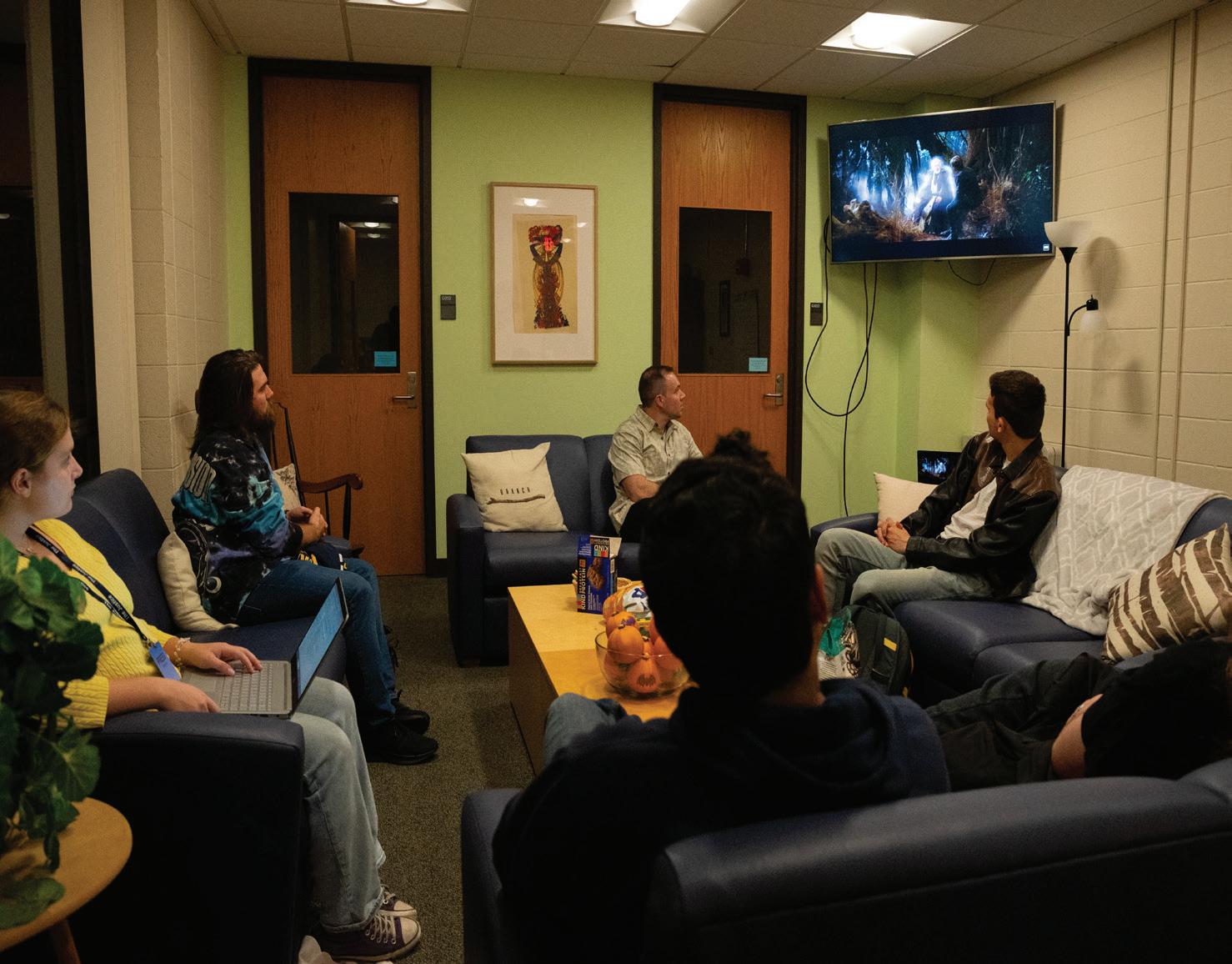
in which one reads sacred texts and uses them to further their spiritual understanding. However, LaClair said that they would be treating clips from the movie as their “texts” for this devotional in order to both better understand the unfolding plot and the greater lessons the movie had to offer. As a Christian chaplain, LaClair has more insight into one faith than others. However, he felt that in order to analyze movies like “Star Wars,” denomination had little part to play, especially because some of the spiritual messaging, including emphasis on themes such as justice, compassion and care for others, is so universally understood. He emphasized this quality as being critical when understanding the spirituality of “Star Wars,” especially to assure attendees that this program was not only for those of a certain faith background. The event had four attendees, and while sparsely attended, the group shared there had been higher attendance in previous weeks. LaClair began with an icebreaker question that allowed for the establishment of a comfortable environment. The event was held in the intimate, relaxed setting of the Center for Spiritual Life’s lounge area, making the program feel conversational and easy to en-
Elevators all across campus have expired inspection certificates.
By BRIANNA EARLE

By MIKEY TERRENZI
HOFFMAN
ANIKA JAIN
BEN KHAYAT
Oct. 17—There was a medical emergency for an individual experiencing an allergic reaction. They were transported to a local hospital for treatment.
Oct. 17—An individual had an asthma attack and was transported to a nearby hospital.
Oct. 18—An individual reported having too much to drink and requested an examination from BEMCo. They refused further medical treatment.
Oct. 18—There was a medical emergency for a community member experiencing difficulty breathing. They were transported to a local hospital.
Oct. 18—A person with an injured ankle was transported to a local hospital for further care.
Oct. 19—There was an intoxicated student transported to a local hospital.
Oct. 19— An intoxicated individual fell out of bed and was transported to a nearby hospital.
Oct. 19—There was a medical emergency for a community member experiencing a seizure.
Oct. 20—There was a medical emergency for an individual who twisted their ankle. They refused medical treatment.
Oct. 20—An individual got their finger stuck inside a PVC pipe. They refused further medical treatment.
Oct. 20—There was a medical emergency for someone experiencing an allergic reaction. The patient was transported to a nearby hospital for treatment.
Oct. 21—The caller reported that they were experiencing stomach pains. BEMCo responded, and they refused further medical treatment.
Oct. 21—There was a medical emergency for a community member who may have experienced a seizure. They refused medical treatment.
Oct. 22—A caller stated that they had a chemical burn and was en route to the health center and wanted to let them know in advance. The health center was notified and the patient refused medical treatment.
Oct. 23—There was a medical emergency for a person experiencing stomach pain. They were transported to a hospital.
Oct. 18—A residence lot’s after hours motion alert was set off. All appeared to be in order.
Oct. 18—Two individuals were witnessed going through a buil-
ding’s front desk. They told officers that there was early morning competition for the equipment that they were looking for. The situation was cleared.
Oct. 23—A suspicious individual was reported. Officers spoke to them and they left the scene. All appeared to be in order.
Oct. 19—There was a chemical leak reported in one of the residence halls. The Department of Community Living was notified to respond.
Oct. 23—Vandalism to a bulletin board was reported. Services were rendered in response.
Oct. 29—A caller reported an ongoing noise complaint regarding the dorm room next to them. The Area Coordinator on Call was notified to respond to the situation.
Oct. 23—There was a report of harassment. There will be an investigation to follow.
Oct. 23—There was an ash tray fire put out by a unit. The situation was cleared.
Compiled by Sophia De Lisi
The Student Union convened at 7 p.m. on Oct. 26 for their regular weekly meeting. Due to low attendance, the senators decided to lower the voting quorum for the meeting to twelve. The Student Union President, Ria Escamilla-Gil ’27, was not present, and the meeting was led by Sarah Jafary ’28 and Daniel Shin ’27.
The meeting began with a presentation by Marley Wilson ’26, the co-chair of the Allocations Board. He shared his concerns surrounding the future of funding for clubs at the University, and a desire to exert scrutiny when chartering new clubs. He explained that club funding comes from the student activity fee and that there has been a surplus in recent years due to the lack of events during the COVID-19 pandemic. Wilson expressed a desire to return to pre-COVID spending habits. As more clubs are chartered, each one will receive less funding. He stressed the importance of ensuring that each club fulfills a unique purpose for the student body. When asked how limited the budget is, Wilson responded that “we have 200+ clubs. The amount of clubs that participated in Marathon this last spring was 248 … We had over $2 million a few years ago, and that amount is decreasing year by year.”
The Student Union’s next order of business was to hear pitches from two new clubs and decide if they should enter probationary club status, which is the first step towards becoming a chartered club on campus. The first group of students pre -
sented their case for a “Pre-Med Society,” asserting that the club would provide academic and professional development opportunities for pre-med students. It would serve as an organization for all students interested in a career in medicine and would be welcome to students of all majors.
The senators discussed whether this club would fulfill a unique need, since Brandeis has several medical-related groups, including Minority Association of Pre-Medical Students, Brandeis Emergency Medical Corps, National Society of Black Women in Medicine and Global Medical Brigade. They ultimately decided to approve the club. They ultimately decided that it did fulfill a unique need for the community since the other clubs serve particular niches, and that similarly to Brandeis’ Pre-Law Society, a Pre-Med Society would greatly benefit the student body.
The next presentation was for the Armenian Students’ Association. Co-president Ani Poghosyan ’26 advocated for the club as a space for Brandeis students to foster a community of Armenians, share history and culture and host events to bring students together. The club had its first event earlier this month, during which they shared different types of Armenian bread while discussing Armenian history and their goals for the club. The Student Union had no concerns about the uniqueness of this club, as there are no similar organizations on campus. They voted to approve its status as a probationary club.
Each committee evaluated and ensured their responsibilities were being handled. The Student Advocacy Committee shared their plans to bring a petting zoo to campus again, due to last year’s success, and shared their hope to improve prepathway resources for students. The Internal Operations committee shared a desire to clean and improve the Student Union office.
The Student Union additionally discussed roles for Family Weekend and divided tasks among the Union to ensure that everything gets completed. They decided which students would be present during various Family Weekend events. They ended by moving to expedite the Senate Money Resolution for the petting zoo, in order to avoid last-minute contractual issues that occurred last year. Everyone voted yes and this motion moved forward. They ended by voting on the Senate Money Resolution itself, once the expedition had been approved. The Union also approved on this motion.
The meeting adjourned at 7:55 p.m.
The Usdan Student Center and the Farber and Goldfarb Libraries were shut down due to a water leak on October 16
On Thursday, Oct. 16, 2025, the Usdan Student Center and the Farber-Goldfarb Libraries were shut down. The pathway between them leading to the Rabb steps was also closed.
“Facilities staff ... identified a significant underground water leak between the Usdan Student Center and the Library near Dunkin,” wrote Matthew Rushton, the University’s Associate Vice President for Public Safety and Campus Operation, in an email sent out to the Brandeis community.
The shutdown involved five of the food providers on Brandeis campus: The Hive, the Usdan Kitchen, the Farber Library’s Starbucks, Dunkin’ and the Hoot Market.
To compensate for this closure, the schedules for some of the other food options on campus were reorganized. The Stein was opened from 11 a.m to 2:30 p.m., featuring the Global and Pasta Bake menu from the Sherman Dining Hall. Friday morning, some of Usdan’s food operations — The Hive, Dunkin’ and the Usdan Kitchen — remained closed but had reopened by lunchtime.
■ A news article incorrectly wrote, “Boston Commons.” It should have read “Boston Common.” (October 21, Page 1).
■ A sports photostory credit incorrectly attributed photos to “COLE HAMMER.” It should have read “COLE HAMNER.” (October 21, Page 12).
The Justice welcomes submissions for errors that warrant correction or clarification. Send an email to editor@thejustice.org
Mail delivery services were delayed all Thursday and were reopened on Friday. An Americans with Disabilities Act accessible detour was available to all students through the Usdan Courtyard for community members who needed access to nearby buildings. At press time, Rushton did not respond to The Justice for a comment.

■ The Economics Department has announced the launch of a new major that will concentrate more closely on mathematical methods.
By ANIKA JAIN JUSTICE ASSOCIATE EDITOR
Brandeis University’s Economics Department has announced the creation of a new Quantitative Economics major, designed to give students a deeper grounding in mathematical and empirical methods.
According to the department’s Undergraduate Program Director, Prof. Scott Redenius (ECON), the QE major requires the same six core classes as the existing Economics major, plus MATH10A, 10B, 20A and linear algebra.
While both majors share the same foundational courses — Introduction to Micro -
economics (ECON 10A), Microeconomic Theory (ECON 80A), Macroeconomic Theory (ECON 82B), Statistics for Economic Analysis (ECON 83A) and Econometrics (ECON 184B) — the QE track places a stronger emphasis on higher-level math and quantitative analysis.
In addition, QE students must take all upper-level electives, of which at least two must be designated quantitative courses. In contrast, the standard Economics major requires four electives, two of which must be upper-level. “Approved MA and Ph.D. classes can also count as upper-level electives and quantitative upper-level electives,” said Redenius in an Oct. 21 email to The Justice.
“All Economics faculty will support the new major. Obviously, the faculty who teach the quantitative upper-level electives will support that critical requirement of the new major,” he added.
The Department has circulated the idea for a quantitative track for several years.
“A QE major has been suggested by faculty and students from time to time,” Redenius wrote. “At a faculty meeting in the spring it was raised again. Given the number of
quantitative classes that have been added to the major in recent years, it was clear that everything was in place to offer a QE major. We just needed to write up the proposal and get it approved.” The previous chair Prof. Nidhiya Menon (ECON) and Redenius wrote the formal proposal and submitted it to the general faculty for approval. “In terms of designing the major, there was support and input from the entire Economics faculty,” he added. “Students have also asked about it in advising conversations and suggested it in exit surveys and focus groups.”
Redenius emphasized that the new major will help students interested in advanced study or data-driven careers. “We hope the new QE major will help students who are interested in Ph.D. programs, more quantitative/theoretical MA programs, and quantitative careers signal their qualifications,” he said. The University also hopes that the QE major will attract prospective students.
“The timing was right since we now had the necessary classes in place,” Redenius explained.
Despite its rigorous coursework, the department intentionally kept the number of
By


economic classes the same as in the existing major. “We did not want to limit the ability of QE majors to complete other majors or minors as well,” Redenius said.
Student interest has already been strong: “We receive inquiries every week from students with questions about the new major and wanting to declare it.” However, the Department expects the QE major will remain smaller than the existing major.
The QE major joins Brandeis’ growing range of interdisciplinary and specialized programs, including the new Philosophy, Politics, and Economics (PPE) major, which caters to students with a strong interest in economic policy.
Students will be able to formally declare the QE major soon.


CELEBRATING THE PUBLICATION OF VALI NASR’S IRAN’S GRAND STRATEGY: A POLITICAL HISTORY
A Conversation with AMBASSADOR BARBARA LEAF and VALI NASR Moderated by NAGHMEH SOHRABI
Thursday, October 30
4:30–6:00 PM

Rapaporte Treasure Hall In Person & Online
Registration required for virtual attendance.
Free and open to the public. Middle Eastern food and refreshments will be served.
cautioned that algorithms used in hiring, policing and social media can replicate human bias if left unchecked. “AI can discriminate just like a human can,” she warned. Campbell and her office must hold technology to the same legal and ethical standards as any other decision-maker. To that end, Campbell’s office recently issued an advisory, affirming that state anti-discrimination laws apply equally to AI-driven systems, a move she suggests is a game changer for civil rights in the digital era. When a student asked how young people can engage meaningfully in politics, Campbell responded, “Run for office,” adding that the Attorney General’s Office needs greater diversity and youth perspective in Massachusetts. Echoing her words, “Don’t wait to be asked, lead.” She also pointed to her office’s youth advisory council, a group that fo-
cuses on issues affecting the youth workers including fair pay and safe working conditions. Campbell said the initiative helps ensure that the voices of young people are not just heard but acted upon. She added to this notion, saying youth workers are essential to the U.S. economy and deserve to be treated fairly. Campbell also urged students to align their academic and professional choices with their values. “You can’t monetize purpose,” she stated. “Whatever you do, make sure it connects to something meaningful because that’s what will keep you going when it's rough.”
Throughout the conversation, Campbell combined faith and representation stating, “When I walk into a courtroom or a meeting and see people who never imagined someone who looks like them in this
Therefore, he emphasized, common narratives about tenements are misleading.
“What you don’t see is the silent change that happens if you preserve a neighborhood of 19thcentury townhouses. The lived residential density is going to be about a third of what they originally housed,” stated Appelbaum. He explained that shops often close because there are not enough people on the street to justify keeping them open. He identified two
choices in public policy: preserve the physical form of a community or allow new changes and preserve its memory.
“Housing used to be a commodity,” he said. Viewing housing as a right is uncomfortable, he argued, because those who have housing may claim it as inherent, reflecting an 18th-century world with no mobility.
“Housing is not an end goal. It is a means to an end,” he said. This perspective asks people to accept uncomfortable changes
in the community so that it can improve. The talk concluded with a Q&A session, where he advocated lowering housing costs so that everyone can receive support regardless of income. Appelbaum’s panel emphasized that preserving housing mobility is important not only for individual opportunity but also for a more equitable society.

position, that’s change.” Prof. Stimmel praised Campbell’s candor and her willingness to engage with students’ questions. She said, “Andrea embodies what it means to lead with integrity and purpose."
In her closing remarks, Campbell called on the audience to connect their local actions to national challenges reminding everyone that “we are living in a test of our values, but every generation has a chance to renew them, that includes yours” The event highlighted the University’s mission to foster ethical leadership and social responsibility. In an age of division, Campbell’s message struck a hopeful note: Democracy endures not through institutions alone, but through people who believe in their power to shape it.

gage with. Especially because most students and attendees had vast knowledge of the franchise, it was easy to engage in the discussion.
The group examines a different movie each week, beginning on Oct. 9 with “Episode IV - A New Hope.” For the evening of Oct. 23, the group analyzed the sixth installment, “Return of the Jedi.” In the following weeks, they will examine the three prequel movies before the program concludes. The discussion veered in several directions as it moved through the unfolding plot of the movie, much of which focuses on protagonist Luke Skywalker’s efforts to help his father, formerly known as Anakin Skywalker, now Darth Vader, to find the light again. Much of the discussion centered around Luke’s presentation of confidence as a clear representation of his increased sense of spirituality. LaClair went so far as to describe spirituality as a “maturation of a sense of confidence,” and emphasized the importance of how
knowing oneself often develops into holding greater confidence in one’s beliefs. He also discussed how Luke is posited as a prophetic figure who is responsible for telling others when they “fall short.” This idea is most evident in his passionate plea to his father to “let go of your hate.”
The discussion also veered into focus on political issues including polarization and an ability to recognize issues from various points of view. LaClair discussed how the unfolding plot in “Return of the Jedi” parallels some of the problems the world is witnessing in the current political climate, especially how conflict often arises as a result of people being unwilling to acknowledge different points of view.
He also pointed to the parallels the movie holds to that of political activism, referencing Luke’s plea to his father to abandon the dark side and comparing it to the political idea that “we can be better than this.”
Much of the discussion focused on the importance
of being inclusive and willing to acknowledge differences and “be open to what they [others] can teach you.”
LaClair also felt it was important to clarify the differences between spirituality and theology. To him, spirituality is more about turning belief into action in a way that helps one live a more authentic lifestyle. This is part of why he finds the saga to be so compelling: it touches on spirituality in general in a way that encourages people to live a better, more authentic life.
When asked about why he feels it is important to hold events like these, LaClair said he felt that it was a way of engaging with contemporary myths that people were interested in while allowing them the space for discussion and exploration of spirituality in a broader sense. Eventually, LaClair would like to turn the content of this program into a course but acknowledged that he would need to do more work
to prepare for something of that caliber and that it is ultimately a long-term goal.
LaClair also offered some insight into his own perspective within the “Star Wars” fanbase. While he shared that it is exciting to be part of a group of people that shared a similar passion for the saga, it could sometimes be disappointing because of those who try to make it an exclusionary community by controlling who is and isn’t allowed into the fandom.
LaClair said he feels the mission of the movies is to be inclusive and teach lessons about compassion for others, and for the fanbase to counter those messages with exclusionary sentiment is hypocritical. This program is hosting three more sessions, which will take place on Nov. 6, 13 and 20 in the Center for Spiritual Life lounge.

If liberty means anything at all, it means the right to tell people what they do not want to hear.
The Statue of Liberty was formally dedicated to the United States in 1886.
Mirrors in elevators provide the illusion that the space is bigger to help alleviate anxiety and claustrophobia.
Aiden Powers ’26, an undergraduate studying Applied Mathematics and Physics, spends hours and hours observing patterns too small to see with the naked eye. In the Duclos Lab, he studies how proteins behave on three-dimensional membranes and tries to decipher the rules governing how proteins organize themselves, a process critical to life at a cellular level.
Powers first joined the Duclos Lab his junior year in order to gain lab experience before applying to graduate school.
His research was initially inspired by the experiments of a postdoctoral researcher
Amelie Chardac ’24 who studied the active form of MinE, a protein in E. Coli, which produces traveling
waves through its movement. These are essentially moving patterns that sweep across the membrane of the cell like a wave across a surface. After confirming the system worked consistently, Powers expanded the study to the static form of MinE, which mostly stays in place and forms stationary spots or standing waves.
Now, Powers’ research focuses on two proteins in E. coli, MinD and MinE, which form the “Min system,” guiding bacterial cells to find their midpoint and divide evenly. Traditionally, these proteins are studied on flat, two-dimensional membranes, which are easier to work with but do not fully replicate a cell’s threedimensional environment. Powers’ work examines
By SAAYA DAGA JUSTICE STAFF WRITER
how Min proteins behave on curved surfaces, providing a more accurate model of cellular geometry.
To create the threedimensional membranes, Powers uses liposomes which are tiny spherical vesicles made of lipid bilayers that mimic cell membranes. He prepares these liposomes in advance then mixes them with MinD and MinE proteins and ATP, the molecule that powers cellular reactions. The mixture is flowed between microscope slides coated with polyethylene glycol acrylamide, which prevents the membranes from sticking to the glass. Once assembled, the system can be observed under a microscope as the proteins form visible patterns.


Interestingly, these patterns vary widely. Some are static, forming spots or standing waves, while others travel across the membrane like ripples or spirals. Through his experiments, Powers realized that the patterns depend on the relative concentrations of MinD and MinE: More MinD elongates waves while higher MinE often produces more static spots. Powers systematically varies these ratios, developing a better understanding of the link between protein concentration and observed behavior. Interesting patterns emerge from the interactions between the proteins. MinD binds to the membrane first then MinE displaces it in a cyclical process. This binding and unbinding produces rhythmic movement that generates visible shapes. Slight
changes in the concentrations of MinD or MinE can dramatically alter the resulting patterns, demonstrating the sensitivity of the system.
Beyond protein ratios, Powers is also investigating how membrane size affects pattern formation. Larger liposomes provide more surface area, producing waves and spirals that differ from those on smaller spheres. He is also exploring experiments where proteins are contained in droplets rather than open solutions, mimicking the crowded environment inside cells.
These setups could reveal how spatial constraints influence protein behavior.
Although the work is exploratory, it has broader implications for understanding basic cellular processes. The Min system is essential for proper bacte-
rial cell division, and studying its dynamics offers insight into how cells organize themselves. The principles of pattern formation also apply to other cellular phenomena, making this research relevant beyond bacterial systems. As he researches his senior thesis, Powers is expanding his dataset of protein concentrations and resulting patterns. He also plans to test smaller liposomes and protein containment in droplets to see how these factors influence pattern formation.
With some luck, one day, the work that Powers and the team at Duclos are doing will allow us to do less handwaving when describing the fundamental complexity of living things, leading to us asking better questions and understanding more deeply the rules that govern life.
The inconsistency of elevator licensing on campus may be a symptom of an inspector shortage.
By BRIANNA EARLE JUSTICE FEATURES EDITOR
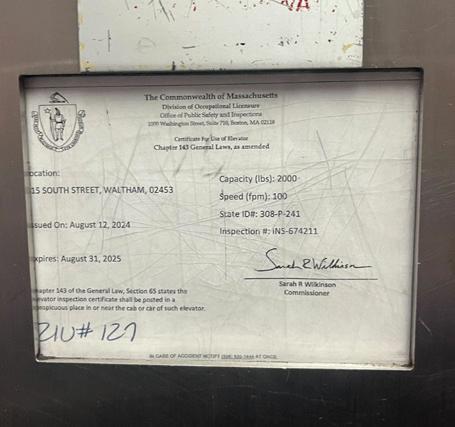
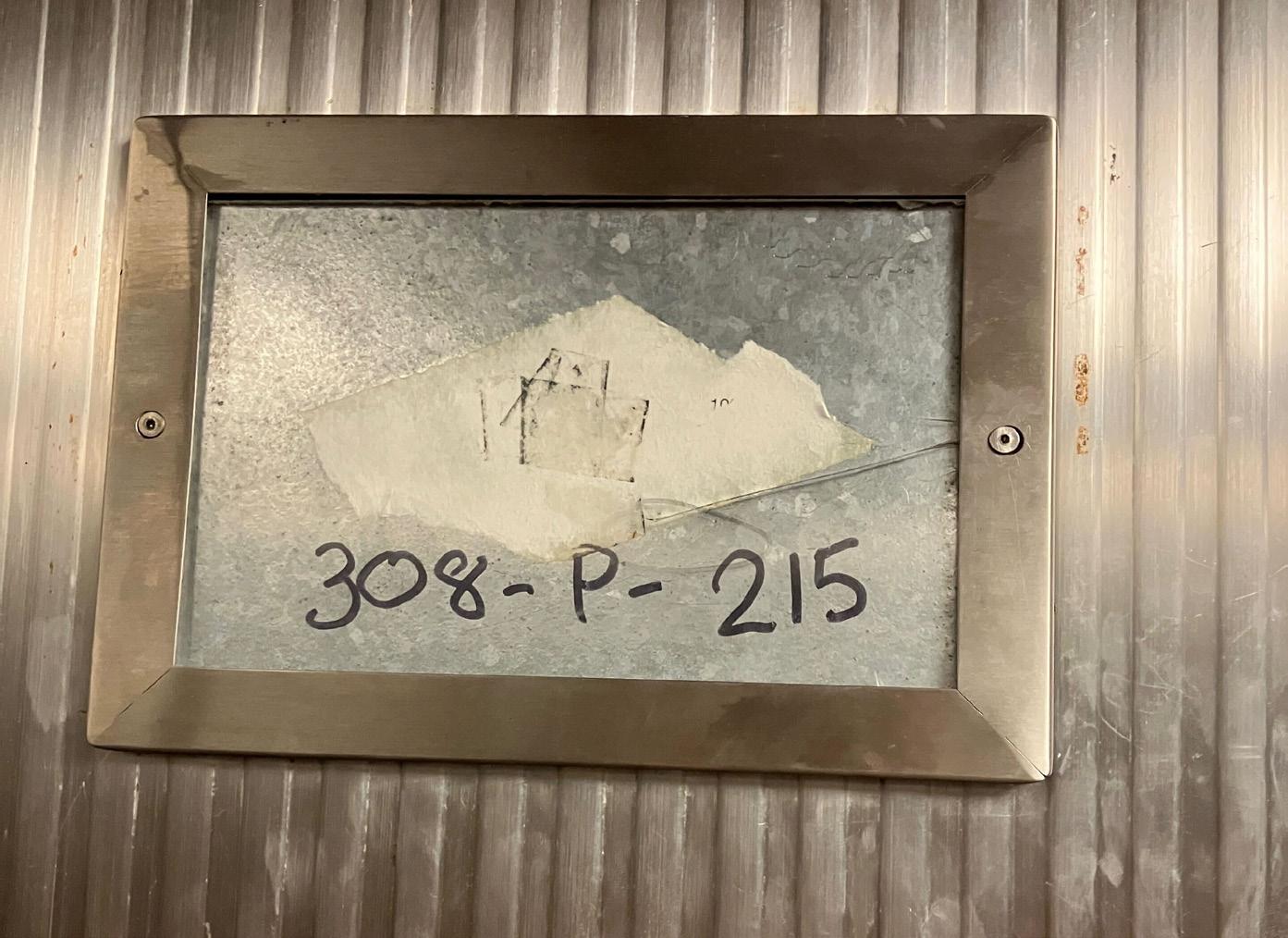
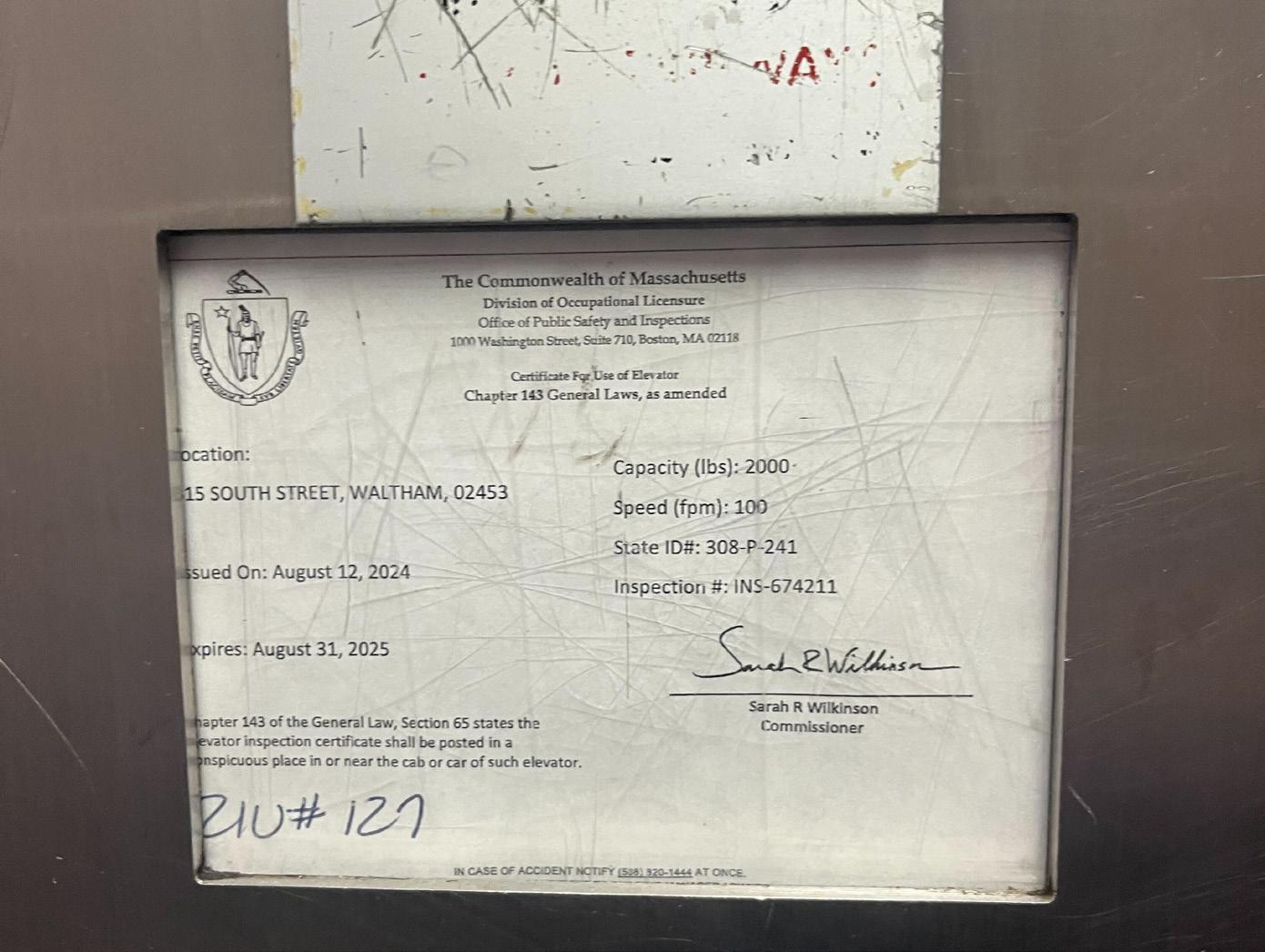
With a creaking noise and a stutter, the elevator door of the Ziv 127 residence building is anything but a smooth ride. Stepping in, the door lags to a close. Pressing the button to the fourth floor, just above the keys is the proof of inspection. This is not unordinary: Every elevator in the state of Massachusetts is required to display their inspection certificate.
As the elevator begins to lift, observers may notice the date on the displayed piece of paper: Aug. 24, 2024 valid through Aug. 24, 2025. Either this elevator hasn’t been inspected in over a year or the University has neglected to update its signage.
As the University has expanded over the years, and continues with the new dormitory project set to open in 2027, elevators have become a necessary feature of new buildings for convenience and accessibility purposes.
It’s not to imply that the University has been negligent — this may actually be a problem that expands beyond Loop Road and across the greater Boston area. In Massachusetts, there is a lack of elevator inspectors and businesses are expected to schedule inspections months in advance.
Local reports dating back to 2019 suggest that thousands of elevators all across the Commonwealth are operating with expired certificates as their requests for reinspection remain on a backlog.
According to an article published by the Boston Herald in 2018, “Massachusetts has 54 inspectors for 41,000 elevators, and can get to only about 75 percent of them before their annual inspection certifications expire.”
The issue dates back more than a decade. The Boston Globe reported in May 2010 that an audit found that a third of the elevators across the state had expired inspections, and many of them had been expired for several years. Despite calls on the state to reform their elevator inspection process, it seems that the backlog continued to grow.
The elevators with updated certifications seem to be in locations that are likely to see the most traffic. At the bottom of campus, the elevator in the Shapiro Campus Center displays a certificate with an expiration date in August 2026.
However, that pattern does not remain completely consistent. The elevator located in the Mandel Center for the Humanities has a certificate that expired in July of this year.
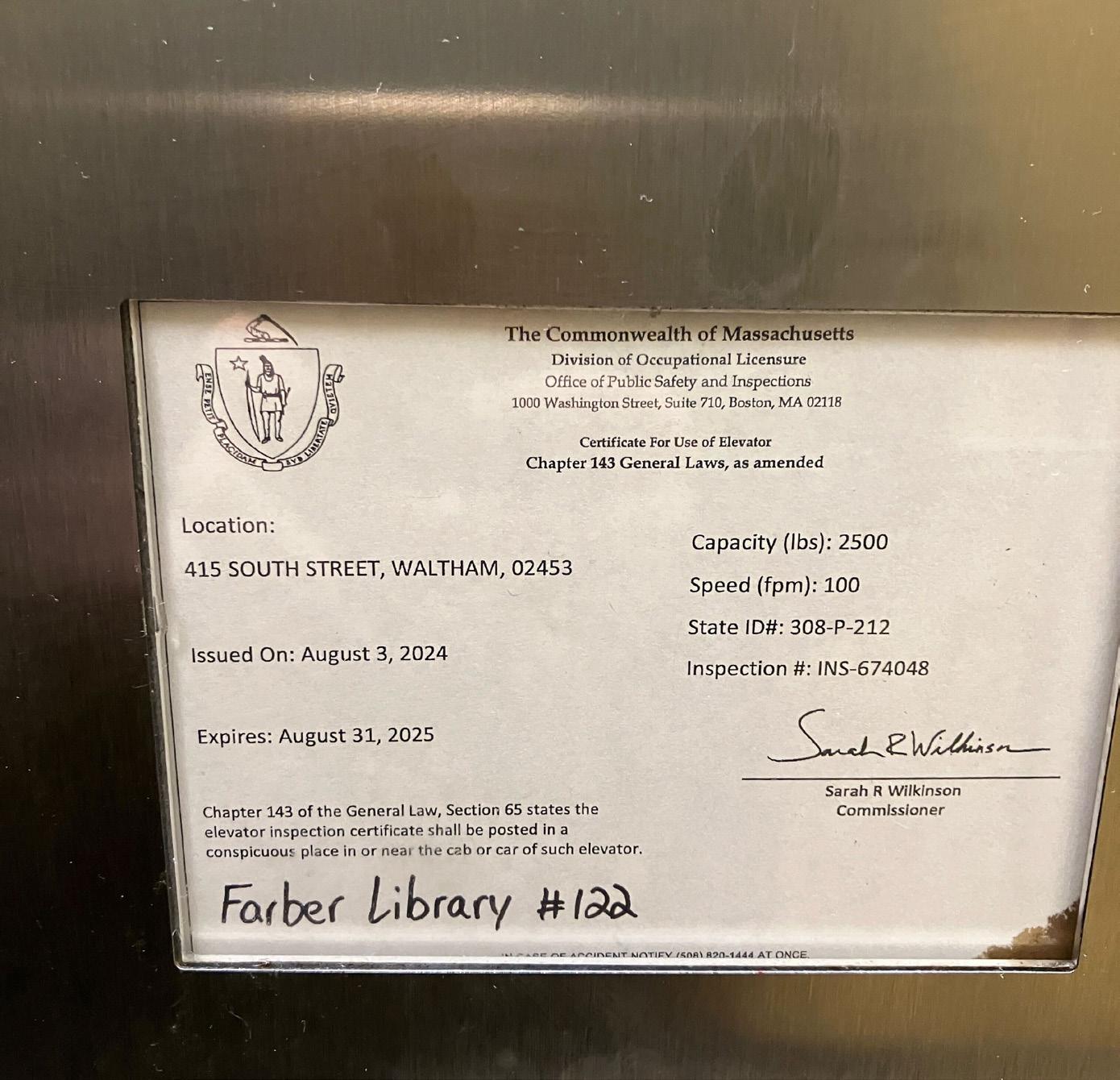
What about the elevators that don’t display any signage? Well, it’s illegal in Massachusetts, but it is not unheard of. While working in the Goldfarb Library, Jaiden Van Bork ’26 encountered this issue firsthand when all she could find was a handwritten number where the certificate is meant to be displayed. She told The Justice in an Oct. 23 interview, “no license is even displayed in the elevator, the number might lead to a public record though.”
The other elevator located in the Farber Library, however, is up to date on its inspection. Most of the elevators on campus are accompanied by a QR code in case the elevator is broken, but what happens when the license is expired or nonexistent?
The code, which brings scanners to the facilities service request page, does not give an option for reporting an expired inspection.
Scott Hamel, Building Trades Supervisor at Brandeis, told The Justice on Oct. 27 that the University is aware of the expired inspections across campus. According to Hamel, “the elevators are being inspected as we speak. This is a work in progress, as they get inspected the certificates of inspection are being put in.” Facilities and the University did not comment any further on the process of inspection.
The inspection delay and potential inspector shortage may be a symptom of the nationwide labor crisis in the United States. A report conducted by the Bipartisan Policy Center, a non-profit that promotes policy work across party lines, suggests that the labor crisis in
the construction and transportation sectors is set to increase. Their report found that worker shortages will increase in the coming years due to an aging workforce, lack of interested applicants and inconsistent compensation.
Other than raising general concern among students and the broader Brandeis community, the lack of elevator inspection also poses a threat to accessibility on campus.
Brandeis Student Accessibility Support has raised concerns over the inspection delays.
Kim Johnson, the director of SAS, said that they are aware of the issue and it is in ongoing discussion within the Campus Accessibility Committee here on campus. Unfortunately, the repairs are beyond the scope of SAS. Johnson told The Justice on Oct. 27, “While SAS advocates for accessibility-related concerns, elevator maintenance and inspections fall under the purview of Facilities Services.”
The Accessibility Committee was chartered in February 2025 and is composed of students, faculty and staff, aimed at addressing concerns for accessibility within the community. While
CAC is pushing for more transparency about the elevator certifications, the fate of the inspections are solely in the hands of Brandeis Facilities.
This is not the first time that the University has encountered issues with accessibility. In February 2024, The Justice published an editorial highlighting inconsistencies with accessibility across campus. These instances include buildings without elevators, residence halls like those in East Quadrangle with completely inaccessible infrastructure and the absence of ramps and automatic doors in academic buildings.
Although Brandeis has made efforts to make the campus more accessible for students with disabilities, such as the construction of a ramp to the Brandeis Counseling Center building, there are still inconsistencies with their commitments.
As of press time, it is unclear how many elevators remain uninspected on campus, and the University has not provided a timeline for when all of the elevators will be up to code.
Brandeis University
Established 1949
Sophia De Lisi, Editor in Chief
Julia Hardy, Managing Editor
Eliza Bier, Anna Martin, Senior Editors
Grace Doh, Nemma Kalra, Zoe Zachary, Deputy Editors
Lily Chafe, Xilei Ceci Chen, Anika Jain, Jonas Kaplin, Diane Meyer, Sara Samuel, Bryan Wolfe, Associate Editors
Iyla Lichtenfeld, Lucia Thomas, News Editors
Brianna Earle, Features Editor
Esther Balaban, Forum Editor
Maeve Coakley, Arts & Culture Editor
Skye Entwood, Reuben Gartenbach, Photography Editors
Miriam Grodin, Rivka Resnick, Copy Editors
Joan Cogliano, Layout Editor
Keira Shear, Advertising Editor
Ellie Harris, Online Editor
As we get to the half-way point of the semester and everyone’s work begins to ramp up, The Justice’s editorial board wishes to share all the ways we destress in the build-up to finals after a seemingly endless midterm season.
A common way to get away from the chaos of everyday life is to retreat into the wilderness and reconnect with the Earth. Luckily, there are quite a few spots near the Brandeis campus where one can spend time in nature.
The Sachar woods behind the International Business School is a great place for wild animal sightings, and the Mount Feake cemetery is perfect for mushroom hunting. For views of the New England fall foliage, this board would recommend walking through Prospect Hill Park or by the Charles River, an entrance to which can be found by the Charles River Apartments. This board’s favorite parks to picnic and peoplewatch include Nipper Maher Park in Waltham and the Boston Common or Boston Public Garden for those willing to travel. If you’re too bogged down with homework to touch grass, and are instead looking for a study spot with the opportunity to gaze longingly at grass, we’d recommend the first floor of the Shapiro Science Center or the third floor of the Mandel Center for the Humanities. Furthermore, if you’d like to get work done off-campus, Common Good is an excellent cafe on Moody Street for your studying and lavender lemonade needs.
Engaging in non-academic activities is vital for maintaining one’s sanity in the difficult times preceding finals. Some of this board’s favorite on-campus activities include going to the gym, doing pottery at Pottery Club’s instructor hours and playing the piano. You can find pianos on campus at the Slosberg Music Center, Charles River Apartments, Intercultural Center, Polaris Lounge, Shapiro Campus Center and the Village. Some non-academic activities to do from home include reading Vogue Magazine, watching hockey, curating a playlist, playing the New York Times games, coloring, rewatching shows and looking at pictures of your pets. Fun ways to bond with your friends could be to dance in the rain together or, for a less wholesome option, engaging in public discourse on the Sidechat app. Leaving Waltham and engaging in opportunities the greater Boston area has to offer, such as line dancing, provides a wellneeded distance from Brandeis that’s helpful for resetting your mental state.
Self-care should be prioritized in the activities one chooses to engage in. The activities we
find healthiest for our state of mind include meditating on the large platforms by the Leo Gerstenzang Science Library, journaling, listening to music while riding the BostonCambridge shuttle, buying fresh flowers to decorate our living spaces and painting our nails. This board cannot understate the importance of having a good sleep schedule. Finally, this board understands the importance of good food for one’s emotional well-being. For this reason, we would like to share the foods on or around campus that have brought us the most comfort during our time at Brandeis. Our on-campus options include: a Dunkin’ plain iced coffee, glazed chocolate donut, hot chocolate and mini everything bagels, gummies from the Hoot Market and hot chocolate from Einstein’s Bagels. For offcampus favorites, our orders include: Asia Wok’s boneless ribs, chicken teriyaki and crab rangoon; Pho & Spice’s tom yum noodle soup and drunken noodles; Absolutely Asia’s pork dumplings; Playa Bowls’ Dragonberry bowl with Nutella and gluten free granola; a Panera smoothie; In a Pickle’s french toast; Guanachapi’s Mexican and Latin Food’s birria tacos; and Taco Bell’s deluxe box, which we have learned takes an astounding two hours to arrive to campus. If you’re taking a study break to head to a convenience store, we’d recommend Ben & Jerry’s Dublin Mudslide, Granny Smith apples with Nutella, the ingredients for a grilled cheese sandwich and agave-based beverages.
The Justice Editorial Board urges you all to take care of yourselves as best you can and to make time for yourselves outside of your academic responsibilities. Remember that your grades are not the end-all-be-all of your academic career and that your well-being is infinitely more important in the long run. This board would also like to assert that the onus for students’ mental health is not only on the students themselves, but that professors and the University play a large part in the wellbeing of the student body. We urge professors to be considerate of their students and the struggles they will be facing in the remainder of this semester. For those struggling with their mental health, we urge you to talk to the counselors at the Brandeis Counseling Center or to check out resources from the Health and Wellness Promotion. We wish you luck with the remainder of the semester and hope this guide inspires you to partake in self-care today.

Democratic states should make contingency plans for secession By Jon Hochschartner
I don’t think it’s an exaggeration to say that, in the current moment, President Donald Trump’s fascist regime views Democratic-controlled states as occupied territory. Perhaps the most dramatic example of this can be seen in the White House sending National Guard troops from Republican states to subdue fabricated unrest and crime in Democratic states, against the wishes of liberal governors. But that’s just one example of many.
Trump is also redirecting federal funds from blue states to red states. For instance, White House budget director Russel Vought recently announced he was illegally cancelling nearly $8 billion in clean-energy investments planned in 16 states, all of which voted for Vice President Kamala Harris in the 2024 election. Similarly, Trump pledged to cut off federal funding to New York City if Democratic nominee Zohran Mamdani wins the mayoral election.
“He is going to have problems with Washington like no Mayor in the history of our once great City,” the president wrote on social media. “Remember, he needs the money from me, as President, in order to fulfill all of his FAKE Communist promises. He won’t be getting any of it, so what’s the point of voting for him?” Needless to say, withholding such funds is against the law, but, under the current Supreme Court, the law seems to matter little. It sould also be noted blue states give significantly more money to the federal government than they receive. As Jeffrey Sonnenfeld and Stephen Henriques wrote for the Time Magazine website, “From 2018 to 2022, individuals and organizations from blue states contributed nearly 60% of all federal tax receipts but only received 53% of all federal con-
tributions to states in the form of either direct payments, grants, contracts, or wages.”
In other words, blue states are helping red states pay their bills. I’m not opposed to this, but when a Republican president is simultaneously enforcing martial law in Democratic states and withholding funding to the same, it becomes politically unsustainable. Democratic governors need to begin making contingency plans for seceding from the union. It’s not an outcome I’d like to happen, but the present course can’t be tolerated. The anti-fascist coalition has a wide variety of policy goals. For instance, as an animal activist, I want to see a massive infusion of public funding into cultivated-meat research. The new protein is grown from livestock cells without slaughter. I view the commercialization of this product as the most promising means of reducing nonhuman suffering and premature death. But none of our goals can be achieved under a rightwing dictatorship.
Again, secession should be viewed as a last resort, but Democratic governors must make it clear to this fascist White House there are limits to the amount of abuse their constituents will take. Beginning these difficult conversations is both a practical necessity and an important way of communicating a basic political reality. More than 75-million people voted against this madness in the 2024 presidential election. We cannot sit idly by as Trump consolidates a far-right, authoritarian state.
Jon Hochschartner lives in Connecticut. He is the author of a number of books, including The Animals’ Freedom Fighter: A Biography of Ronnie Lee, Founder of the Animal Liberation Front. Visit his blog at SlaughterFreeAmerica.Substack.com.
Bans reinforce cultivated meat’s potential By
Jon Hochschartner
As an animal activist, I’m a vocal proponent of cultivated meat. For those who don’t know, the new protein is grown from livestock cells, without slaughter. I view developing the nascent field of cellular agriculture as the most promising means of reducing nonhuman slaughter and premature death. It offers a number of potential public health and environmental benefits as well.
Still, I occasionally wonder if all the hope I’ve invested in this technology is misplaced. After all, I’m not a scientist. I have to take the word of experts who say mass producing cultivated meat at a price competitive with — if not lower than — slaughtered meat is eventually feasible. Similarly, I’ve never tasted the new protein, early iterations of which are only available in limited locations. I can’t say how close cultivated meat is now to the taste of slaughtered options. From what I understand, various qualities, like texture, remain a work in progress. It would represent an immense failure, in my mind, were the new protein only ever to become an improved offering for existing vegans and vegetarians. My deep wish is a mature cellular agriculture will be transformative.
Amidst these doubts, a number of states, most recently Texas, have preemptively banned the sale of cultivated meat. This is undoubtedly a bad development. I don’t really want to try to spin it otherwise. That said, in an odd way, it’s also been somewhat reassuring to me, reinforcing my belief that cellular agriculture is a threat to animal agriculture, and my activism is on the right track.
There’s a risk here of assuming the livestock industry, which frequently backs such bans, is completely rational. I don’t think that’s the case. Just because a campaign, or in this case, a technology, is the focus of government
repression, doesn’t mean it’s the most effective vehicle for change. Still, I’d be a little worried if the livestock industry was totally unconcerned by cultivated meat. I also do my best to remember it’s not an all or nothing proposition. I certainly hope cultivated meat will some day relegate slaughterhouses to the trash heap of history, but even if this doesn’t come to pass, the field has the potential to do an immense amount of good. Very low rates of cultivated-meat adoption among existing omnivores could save billions of animals a year.
So I plan to continue picketing my elected officials, calling on them to support public funding for cellular-agriculture research. This isn’t an unprecedented demand. Such funding has been allocated at both the state and federal level before. For instance, in 2024, the Massachusetts government invested a little over $2 million in the Tufts University Center for Cellular Agriculture.
I’m unaware of other forms of animal activism which have anything close to the promise of accelerating cultivatedmeat development. As an example, campaigns against vivisection, fur farming, and zoos face industries where the total number of yearly animal victims is counted in millions. Given the ubiquity of nonhuman exploitation, I believe some degree of triage is necessary.
Cultivated-meat bans are reprehensible and should be fought, and yet they are very much to be expected. If cellular agriculture has anything like the potential we hope it does, cultivated meat represents a threat to the livestock industry. Maybe it’s only a threat to one percent of the existing meat market. But this preemptive legislation suggests it’s a threat the industry takes seriously.
Jon Hochschartner lives in Connecticut. He is the author of a number of books, including The Animals’ Freedom Fighter: A Biography of Ronnie Lee, Founder of the Animal Liberation Front.
By AARON KLEIN & MAX KLEIN JUSTICE STAFF WRITERS
Klein : Good morning, Mr. Klein, and welcome back to “Klein, unrelated.”
Klein : It’s nice to be back and mix things up this week.
Klein : And for those who are new to campus, can we take a second to explain what this column is all about?
Klein : Of course! Seeing as how we are two guys with the last name Klein who happen to be unrelated to each other, last year we decided to start a food review section dedicated to local restaurants near campus.
Klein : Which means, naturally, we went to Olive Garden in Portland, Maine.
Klein : It is truly the capital of Italian food. I felt like I was in Rome … but like … if Rome had better food.
Klein : Yeah. I’m never gonna get a job in journalism if this is my product, am I?
Klein : No way. You’re screwed.
Klein : Yep.
Klein : O.K., let’s move on to the food itself. What did you get?
Klein : I got the Grilled Chicken Margarita. It’s chicken topped with fresh tomatoes, that good mozzarella and lemon garlic sauce. I also got the bottomless salad which was not “gas” but was very crunchy. I was rather pleased with the texture.
Klein : The texture?
Klein : Yeah. Have you ever chowed down on some super crunchy salad? Every forkful of lettuce packed with refreshing layers of crisp snap? And the best part: it was bottomless! I
had two full family-sized bowls!
Klein : You’re a weird dude, you know that, right?
Klein : I’ve heard that before, yeah. So, you’re not a salad fan … but tell us, what did you get?
Klein : I got the Fettuccine Alfredo. It was good, but an absolutely diabolical amount of calories. Including the breadsticks and soup, I think my meal was over 2000 calories.
Klein : How about the ambiance?
Klein : Splendid! Yeah, it was a lot of fun. We were there for a frisbee tournament with the Brandeis Tron Ultimate Frisbee team. Some of those guys are 1 of 1.
Klein : O.K., so what are you rating the food on a scale of 613?
Klein : Why 613?
Klein : It’s the 112th prime number?
Klein : Is that really true?
Klein : I’m not sure. Does it really matter?
Klein : Nope, I guess not. I would say it was about a 496.
Klein : Sick. For me, it was about a 313.
Klein : Great. So, do you think you’d go again?
Klein : Look, if you want an insane calories per dollar ratio this is the place for you. If I really need that type of food I would absolutely go again.
Klein : I agree. It’s not the type of thing I can eat normally but on special occasions it’s a good place.
Klein : Well, that concludes another beautiful edition of “Klein, unrelated.” See you next time.
By ANIKA JAIN JUSTICE ASSOCIATE EDITOR
Since 2011, more than 14 million Syrians have fled their homes. At the height of the Syrian refugee crisis in 2015, the EU neither provided adequate protection for asylum seekers nor distributed asylum burdens equally across Member States. Turkey accepted 2.5 million refugees — double the number of refugees accepted by the EU as a whole. Within the EU, Germany accounted for more than a third of all asylum applications submitted by Syrians. The EU’s failure to address the Syrian refugee crisis illuminated flaws in asylum policy. This article will explain how the EU’s burdensharing initiatives have remained ineffective due to a free-rcombination of structural and policy-related pull factors, free-riding problems and implementation gaps caused by the EU’s prioritization of symbolic over effective cooperation.
For some context, the Dublin Regulation — introduced in 1990 and updated in 2013 — assigns asylum responsibility to the country of first entry. It led to an asymmetric distribution of refugees due to both structural and policy-related
factors that created a collective action dilemma — a social dilemma in which all individuals benefit from cooperating but fail to do so due to conflicting interests between individuals that discourage joint action — with some countries shouldering the majority of the burden while others free-ride. Additionally, its non-binding nature undermined the principle of free movement within the Schengen Area, prompting some countries to reinstate unilateral border controls that violate migrants’ agency, safety and human rights. The European Pact on Migration and Asylum, set to take effect in 2026, aims to establish a common asylum system to relieve these migratory burdens.
EU burden-sharing initiatives are categorized into external and internal approaches. External initiatives, such as the controversial EU-Turkey Deal, involve agreements with third party countries like Turkey, which prevented Syrian refugees from entering the EU in exchange for financial aid and visa liberalization. Meanwhile, internal initiatives focus on redistributing refugee burdens within the EU. In his paper
“Why Refugee Burden-Sharing Initiatives Fail: Public Goods, Free-Riding and Symbolic Solidarity in the EU,” Associate Professor Eiko Thielemann at the London School of Economics and Political Science identifies three internal initiatives: sharing rules, sharing money and sharing people. Sharing rules, also known as policy harmonization, creates common asylum standards across Member States to prevent regulatory competition. However, this approach results in what Thielmann calls “lowest common denominator” outcomes, where the EU implements policies that align with restrictive countries. Sharing money refers to financially compensating countries hosting large numbers of refugees to alleviate their financial burden and incentivize more equitable sharing. Lastly, sharing people involves relocating refugees within the EU, often through binding quota-based agreements to ensure a balanced distribution of refugees across Member States.
Why Do Disparities in Distribution Exist?
According to migration literature, structural pull factors such as geographic proximity, historical or economic ties and visa leniency make host states more attractive to asylum seekers. Migrants decide where to relocate based on income maximization and risk minimization. Policy pull factors like the Dublin Regulation — which, as previously mentioned, assigns responsibility to the country of first entry — also influence the distribution of refugees. Since migration routes heavily depend on geographic advantages, countries that are not landlocked such as Greece, Spain and Italy, naturally receive more migrants than others. Meanwhile, public goods literature attributes the unequal distribution of migrants to free-riding opportunities that arise when states interpret EU standards more restrictively to shift the burden to other countries. This issue is reflected by differing recognition rates for the same group of applicants across Member States. For example, Iraqi claimants faced a 0% acceptance rate in Greece, 24% in the United Kingdom, 64% in Germany and 81% in Sweden. The EU must restrict free-riding to achieve substantive solidarity over symbolic cooperation.
Has the “Communitarization” of Asylum Policy Made a Difference?
While Eurosceptics, those opposed to increasing the powers of the EU, argue that the shift from an intergovernmental to a supranational approach — which transcends national or governmental boundaries — has worsened asylum policy, studies show it increased transparency and accountability. Critics of “communitarization” subscribe to the “Fortress Europe” thesis, which blames EU cooperation for restrictive asylum policy due to mechanisms like venue shopping, securitization and lowest common denominator standards. Comparative analysis with other developed nations challenges this thesis and proves that EU cooperation has not uniquely led to restrictive policies. Although the restrictive nature of asylum policy persisted, there were gradual liberal shifts, particularly in protecting asylum seekers. However, the council, influenced by interior ministers and center-right groups, pushed for restrictive measures that maintained national flexibility over harmonization. Nonmajoritarian institutions, such as the European Commission and the Court of Justice of the European Union, play a vital role in shaping asylum policy by promoting liberal standards and protecting minority rights. Less influenced
by electoral pressures, these institutions can set agendas, influence decisions and ensure compliance with EU laws. Implementation gaps and Non-compliance Despite the advantages of a supranational approach, significant implementation deficits persist due to varying cultural models, differences in state capacity and discretion allowed in interpreting EU laws. How can the EU address these gaps? The answer lies in how responsibility is allocated amongst Member States. There are three primary solidarity mechanisms: market solidarity, where asylum seekers are free to choose which EU state to apply to for protection; voluntary solidarity, where Member States voluntarily agree to take on more responsibility to balance refugee distribution; and mandatory solidarity, where binding quotas or regulations such as the Dublin Regulation assign responsibility to specific MS. During crises like the Yugoslav War (1991–2001), the Syrian War (2011–) and the Russia-Ukraine War (2022–), the EU applied different solidarity mechanisms. During the Syrian crisis, a combination of all three mechanisms was used, whereas the EU relied solely on market-based solidarity during the Yugoslav and Ukrainian crises. These variations suggest that a balance of free choice and harmonized standards may produce better redistributive outcomes compared to voluntary or poorly enforced mandatory initiatives.
The EU relies too heavily on symbolic cooperation, with public goods literature calling for more effective cooperation. To tackle bigger redistributive challenges, the EU must develop market-based mandatory allocation mechanisms. Historically, the EU relied on symbolic measures due to the complexity of balancing protection, national self-determination and individual selfdetermination. However, delegating Member States to accept additional responsibilities resulted in minimal change. Voluntary solidarity maximizes national self-determination at the expense of equitable responsibility sharing; free choice maximizes individual self-determination but undermines national self-determination and responsibility sharing and mandatory measures challenge both national and individual selfdetermination by restricting Member States’ and asylum seekers’ autonomy. These dynamics create inevitable trade-offs — it is impossible to satisfy all three objectives. Yet, EU policy discussions fail to address these trade-offs, instead focusing on voluntary and mandatory solidarity while downplaying the impact on national sovereignty. With the influx of Ukrainian refugees, the EU must confront these challenges: the current instruments leave gaps in asylum protections and the broader integration process.
Conclusion In conclusion, the EU’s burden-sharing initiatives have been insufficient due to structural and policy-driven pull factors, freeriding issues and implementation gaps, all of which stem from the EU’s emphasis on symbolic cooperation rather than substantive action. Reforms such as a Tradable Refugee-Admission Quota System offer potential solutions, but disparities in responsibility-sharing remain a significant concern. EU reforms like the European Pact on Migration and Asylum need more honest discussions, not just about policy trade-offs but also ethical trade-offs, considering the stakes for protection seekers and the larger European integration process.

Ben Khayat '28 summarizes the explosive start to the NBA season featuring electric performances and FBI involvement on Pg. 11
Tuesday, October 28, 2025
By JULIA HARDY JUSTICE MANAGING EDITOR
While the Winter Olympics are months away, figure skating competitions are in full swing around the world as athletes continue to train and prepare. The International Skating Union Grand Prix of Figure Skating series is made up of six events that take place around the world. The first of the season was the 2025 Grand Prix de France that took place in Angers, France from Oct. 17-19.
In Angers, Ilia Malinin made a tremendous impression, winning the Grand Prix de France by a total of 40 points — a runaway victory. In his free skate, he landed a total of five quadruple jumps and finished with an overall score of 321.00.
Malinin came into the 2025 Grand Prix series with a lot of expectations on him having earned Grand Prix Final victories in 2023 and 2024. He did not disappoint. In fact, the win in France extended his winning streak to almost two years. His last loss was at the ISU Grand Prix competitions in 2023 at the same event.
Although he is only 20 years old, Malinin has an impressive resume backing up his recent victory in France. He has competed in the last three ISU World Figure Skating Championships with stellar results. In his first championship in 2023, Malinin earned a bronze medal. In the 2024 and the 2025 Figure Skating World Championships, Malinin took the gold. However, even before he was winning championships, Malinin’s career was impressive. His international debut took place in 2019 on the junior circuit, where he won the Philadelphia Summer Championships.
Malinin was born in Fairfax, Virginia, and he represents the United States in competitions. However, he spent much of his life living in Vienna. Malinin’s parents have been instrumental in his development as a skater as both of them were professional figure skaters as well. Tatiana Malinina was at the top of the sport in the 1990s. She was medaled in both the ISU Championship and the ISU Grand Prix, the first skater representing Uzbekistan to do so. Malinin’s father, Toman Skorniakov, competed at two Winter Olympics. Both parents quickly assumed the role of coach for their son. Since he began figure skating at the age of six, Malinin’s talent has continued to grow and evolve throughout his career. Not only does Malinin win championships, but he does so with extraordinary talent that has earned him a spot in the history books.
In addition to his competition success, Malinin also has phenomenal skating skills. As of 2022, he is the only skater who has landed a quadruple axel in competition, which is an incredibly challenging figure skating jump that involves an astounding four and a half rotations. There are a total of six types of jumps, and axels are considered the hardest, because the skater jumps facing forward but lands back on the ice going backwards. As a result of his mastery, Malinin has adopted the nickname “Quad God,” which he has incorporated into his Instagram account ilia_quadg0d_malinin. Based on his past performances, he has lived up to this nickname.
On the nickname, in a Oct. 23, 2025 interview with WUSA9, Malinin said, “it is a nickname that I embrace and sometimes it does help me get through you know competitions like yes you are skating and there’s a lot of people watching but you are the Quad God and you know sometimes that helps me just like focus and gives me like a standard to live up to.”
Given his outstanding competition results and the high degree of difficulty of his performances, Malinin is the favorite heading into the Winter Olympics in 2026. With competitions like the ISU Grand Prix events, Malinin is constantly preparing. In an Oct. 19 article published on the Olympics website, Malinin said, “but as years went on and now starting last year and this year I have a really different approach to it. I really want to try and maximize the just amount that I can revolutionize the sport and really take this to its next level.”
Like every athlete, Malinin has also faced challenges when it comes to competing. When Malinin was preparing to skate for the 2025 World Championship, he was greatly impacted by an accident involving a passenger jet and an army helicopter that had happened that same week. This accident hit close to home for Malinin as some of the passengers who died were skaters from his club, Washington Figure Skating Club.
In a New York Times article published March 29, Malinin said, “skating usually helps me handle hard things going on in my life, but it was just too emotional to be there.”
According to that same article, Malinin returned to the rink and honed his skills in order to dedicate his skating performance to those who had died in the accident. His hard work and fine-tuning worked, and Malinin skated to victory.
In light of all his successes, other professionals have taken notice of Malinin’s dominance. For instance, Yuma Kagiyama — who competed against Malinin in the 2025 World Championships and earned silver in the Beijing Olympics — said to the New York Times in that same article, “I’m starting to think he’s invincible.”
Malinin’s talents are truly extraordinary, placing him at the top of the game as he continues to revolutionize the sport. While there are still many competitions and much training to come, Malinin has entered the season in top form, and he is on track to succeed at the 2026 Winter Olympics.

■ Why do the United States service academies have college football, and how can they compete?
By BEN KHAYAT JUSTICE SPORTS EDITORIAL ASSISTANT
If a team is undefeated through the ninth week of the college football season, they are very solidly one of the best teams in the nation. This season, six teams can claim the feat of going 8-0 at this point in the season. Classic powerhouse programs like The Ohio State University and Texas A&M University have yet to lose, which isn’t particularly surprising for teams of their caliber. Some up-and-coming programs like Brigham Young University and University of Indiana-Bloomington remain undefeated as well, establishing themselves after creating promise last season. Georgia Institute of Technology crashed the party this season, led by head coach Brent Key and potential Heisman candidate Haynes King, blowing expectations out of the water. The last undefeated team this season, perhaps surprisingly, is the United States Naval Academy. Every member of Navy’s athletic teams is in training to become a member of the military while playing their sport. Student-athletes at the service academies aren’t exempt from any of the experience of being in training for the military. All of the athletes eat the same mess hall food, take the same
advanced classes and sleep in the same barracks as the rest of their cohorts. With the amount of moving parts in the lives of service academy members, how can they still find a way to be one of the few undefeated football teams left in the country?
The only service academies that play at the NCAA D-I Football Bowl Subdivision are the United States Air Force Academy, United States Naval Academy and United States Military Academy. In athletics, the schools are better known as Air Force, Navy and Army respectively. There are other service academies, though they compete at lower levels of the NCAA. There are other institutions that are affiliated with the military and have college football, such as Texas A&M University and Virginia Military Institute, but these schools are under a different designation than the other service academies. There are a few traits that make Navy particularly unique as a football program. To start, every single one of the Naval Academy’s 4,500 students are required to attend every home football game Navy plays, creating one of the best home-field advantages in college sports. That has been particularly apparent this season with their narrowest win coming on the road at Temple University, a 32-31 victory that required a last-minute drive to put the game away.
With the era of the Transfer Portal and Name, Image and Likeness upon us, the way teams fill out their rosters is completely different to what it was just a few years ago. Having players with tenure on a team has become even more important, and smaller schools will often lose their best players to powerhouse programs. Players who play for service academies are completely exempt from everything NIL and are not allowed to enter the transfer portal, with one exception. After a player’s sopho-


■ Basketball is back — and we’ve already seen historic performances, gambling scandals and involvement from the Italian mafia.
By BEN KHAYAT JUSTICE SPORTS EDITORIAL ASSISTANT
The 2025-26 NBA season is only a week in session and we’ve already seen historic performances, big surprises and involvement from the FBI. The season kicked off last Tuesday with an instant classic between the Oklahoma City Thunder and Houston Rockets. The game went to double overtime and came down to a single missed shot from the Rockets’ Jabari Smith Jr. to decide the game, with the Thunder coming out with the season’s first win. This game would prove to be prophetic of what would come over the next week.
The other game from Tuesday night between the Golden State Warriors and Denver Nuggets also went into overtime, but after four consecutive Nikola Jokic misses, Stephen Curry and the Warriors were able to eke out an opening night win. The real story of this game is Nuggets forward Aaron Gordon going for a career-high 50 points plus shooting 10/11 from 3-point range. A shooting clinic like this was fairly unprecedented for Gordon, especially considering he only became a reliable shooter a few years into his career. Over his first three seasons, the most efficiently he ever shot from beyond the arc was an abysmal 29.6%. The rest of the Nuggets team didn’t help Gordon out very much. Nikola Jokic took more shots than Gordon did and was only able to find 21 points all night. The Nuggets bounced back with a 133-113 bloodbath against the Phoenix Suns on Saturday night, featuring a more typical high-scoring Jokic performance.
In a shocking report on Thursday, just two days into the season, it came to light that multiple highprofile individuals affiliated with the NBA had been arrested by the FBI. Most notably, former player Damon Jones, current Miami Heat guard Terry Rozier and Portland Trailblazers head coach, Chauncey Billups had all been taken into custody under suspicion of gambling violations in separate but related cases. Rozier had been investigated by the NBA themselves last season for match fixing, but he was eventually cleared to play again without punishment. He is suspected of the same infraction by the FBI, and will not return to play for the remainder of the season. Billups was arrested in connection with rigging poker games in relation with the Italian mafia. However, the details of the case indicate that the Trailblazer’s coach could have rested key players to rig games in favor of sports bettors. In a similar

incident two seasons ago, Toronto Raptors center
was
for life from the
it was discovered that he had faked injuries to help pay off gambling debts he had accrued.
On a more positive note, this season has already featured some electric performances from young players. On opening night, Philadelphia 76ers rookie VJ Edgecombe erupted for 34 points in his debut against the Boston Celtics to help secure a 117-116 win. Former NBA Most Valuable Player Joel Embiid played limited minutes and only chipped in four points, so the 76ers needed every single one of Edgecombe’s 34 points. Memphis Grizzlies rookie Cedric Coward had a great debut as well, putting up 14 points without missing a shot or turning the ball over all night to help push past the New Orleans Pelicans. On Sunday, he followed that up with a gorgeous 27 points that included a perfect six for six on his 3-point shots. Memphis opened the season already marred by injuries, so his contributions have been crucial to build some momentum. Washington Wizards sophomore guard Kyshawn George has opened his season averaging 20 points and nine rebounds per game, partially making true the promise he showed at the end of last season. He dragged the Wizards to their first win of the season against a tough Dallas Mavericks team with a 34-point, 11-rebound, three-block performance, with the rest of the Wizards starting lineup scoring a combined 36 points.
Across the entire league, the best player through the first week of the season has almost unanimously been Victor Wembanyama. After deep-vein thrombosis in his shoulder abruptly ended his season in 2025, the San Antonio Spurs center spent his offseason getting back into form, which included training at a Shaolin monastery in Tibet and practicing with Hall of Fame center Hakeem Olajuwon. Victor Wembanyama spent no time heating back up. He put up a ridiculous 40-point, 15-rebound dismantling of the Dallas Mavericks in his first game since February. Wembanyama’s great season has been more than just his box score — he has shown he can do at least a little bit of everything in just two games. As for his defense, it’s been way more than a little bit. He put up nine blocks en route to a win over the Pelicans on Saturday, and is averaging a ridiculous six blocks per game thus far. As impressive as it still is to see a 7 foot 5 inch human doing the things he can do, it’s more impressive that he hasn’t really shown a weakness yet. Even skills that centers aren’t typically good at, such as passing and shooting, Wembanyama has shown at an elite level already. The season is still young, but until opposing teams can find any kind of weakness to exploit, it’s hard to think Victor Wembanyama will be stopped anytime soon. In just a week, the NBA has been consistently churning out noteworthy events, and with that, many questions. Will Cedric Coward and VJ Edgecombe stay hot as the season goes on? How will the Terry Rozier and Chauncey Billups controversies impact the future of the NBA? Will anyone be able to stop Victor Wembanyama? What new questions will arise with so much drama being created every single day?
CONTINUED FROM 10 more season, they are given the option to sign a contract to stay for the next two years plus five more years of active military service. Players can also go directly to professional football and have their service requirement voided. Very few players choose to leave at the halfway point, thanks to the comradery they’ve developed with their teammates. The service academies that are not getting transfers are the equivalent of a professional team not being able to make trades.
Having such limited access to the transfer portal is a doubleedged sword. Recruiting for service academies is basically completely limited to finding the diamonds-inthe-rough of high school football, which is easier said than done. Beneficially, keeping players around is a big advantage when compared to other programs that constantly have players coming in and going out. It also means that when a service academy has a good player, they’re probably there to stay.
Navy’s senior quarterback, Blake Horvath, is a good example of this. Horvath was a zero-star recruit coming out of high school in Ohio, but chose to head to Navy and continue his football career there. He didn’t play a single game as a freshman and only appeared in four games as a sophomore, but still chose to stick around. In his breakout junior season, Horvath led the Midshipmen to a 9-3 record that included an upset win against the University of Memphis and a clean sweep of the
other service academy teams. This season, Horvath has seven touchdowns compared to just three interceptions and has been one of the better rushing quarterbacks in the nation. He put away the aforementioned Temple game with a 51-yard quarterback sneak. Horvath currently sits at eighth in D-I rushing yards, and that includes running backs. Navy’s offensive line has been a huge help for Horvath, only allowing a single sack all season thus far.
Navy plays in the solidly competitive American Athletic Conference, but still have their toughest games ahead of them. The Midshipmen will truly be tested over the next five weeks, with games on the road against one-loss teams in the University of North Texas and the University of Memphis, plus another away game against the University of Notre Dame. They get a slight reprieve with a single home game against the University of South Florida, but close their year with their most important matchup by far: the ArmyNavy game.
The Army-Navy game is a cornerstone rivalry in college football, with this year being the 126th installment. Before each game, a “prisoner exchange” occurs where students who are spending the semester at the other academy get to watch the game with their original classmates. Navy is the favorite in this game, with Army having losses to weaker teams such as East Carolina University and
Tarleton State University. Truly anything could happen considering the gauntlet Navy has to run in the weeks leading up to the game and the rivalry of the game itself, but we’ll have to wait and see how the academies fare for the rest of their seasons.
The United States Coast Guard Academy, one of two D-III service academies, played possibly the most action-packed game of football I have ever heard of against Nichols College earlier this season. They opened the game with a 35-point first quarter that included a touchdown pass thrown by wide receiver Matt LaBouliere. They put up 29 in the second quarter to bring their total to 64 compared to 28 for Nichols at the half. After a quieter third quarter for both teams, both Nichols and the Coast Guard put up three touchdowns apiece in the fourth, including an 88-yard kickoff return by Coast Guard senior Amr Baadani. The game ended as a 92-60 barnburner in favor of the Coast Guard Academy, good for the most combined points ever scored in a DIII football game. By all stretches of the imagination, the service academies should not be very good. However, through leveraging the few advantages these schools have over the rest of the field, they can still create a very competitive and entertaining football team.
■ Sinner defeats Alexander Zverev in the Vienna Open in three sets.
By JULIA HARDY JUSTICE MANAGING EDITOR
On Oct. 26, Jannik Sinner played Alexander Zverev in the finals of the Erste Bank Open — commonly known as the Vienna Open. The two players previously met in the 2025 Australian Open in January, where Zverev had fallen to Sinner in straight sets with a score line of 3-6, 6-7, 3-6. In Vienna, Zverev had a chance to redeem himself, but he fell short again.
Sinner defeated Zeverev in a three set match with a score line of 3-6, 6-3, 7-5. The Australian Open is a grand slam, so the matches are played best out of five sets. However, the Vienna Open is categorized as an ATP Tour 500 series tournament, so it is played best out of
three sets, so Sinner did not have a straight set victory. In fact, Sinner had to battle from behind after losing the first set to Zverev. The match lasted roughly two hours and 28 minutes, with Zverev taking four out of the first five games. While Sinner did lose the first set, he won the first three games of the second set, making the score 3-0. He ultimately served for the set at 5-3. The two competitors were neck and neck in the third set, reaching a score of five sets to five at one point. However, Sinner was able to break Zverev’s serve in the eleventh game, allowing him to serve for the match at 6-5.
This was Sinner's second victory in Vienna, the first being in 2023. This win also allowed Sinner to continue his streak of 21 wins on indoor hard courts. Additionally, this is Sinner’s second title of the month, having clinched a victory at the start of October at the China Open. While Sinner has won a number of titles, he posted on his Instagram about his win, “This one feels very special [trophy emoji]
Thank you all for the support [red heart emoji]”
In a British Broadcasting Corporation sports article published on Oct. 26, a quote by Sinner says, “[the win] feels amazing. It was such a difficult start for me. I tried to stick in there mentally, trying to play my best tennis when it counts.”
This tournament also holds significance as Sinner works to dethrone Carlos Alcaraz as world number one. After this victory, Sinner is only 840 points behind Alcaraz. After Sinner’s loss to Alcaraz in the 2025 U.S. Open, Sinner lost his number one ranking. While Sinner still has ground to make up, every point matters on the search for number one.
For today, Sinner can revel in his win in Vienna. In the same BBC article published on Oct. 26, Sinner is quoted as saying, "It has been such a special week. It is always the highlight of my calendar to come and play here in Vienna." A truly accomplished player, Sinner has a bright future ahead.


>> Pg. 14
By ALYSSA WU JUSTICE CONTRIBUTING WRITER
Brandeis’ latest theater production, “Our Town,” directed by Hannah Rae ’27, captures the everyday life in a small town, filled with simple routines and ordinary moments. Set in two humble homes with plaid tablecloths and white picket fences, the minimalist design never distracts. This play and its characters feel both nostalgic and familiar.
What stands out most is the play’s dual storytelling. Two families live their separate days side by side, their lives happening in parallel. Lighting cues and smooth direction allow the audience to move between homes without losing the thread. Carefully choreographed hand gestures and invisible props fill the gaps. Each member of the audience could tell how much each movement was handled with care.
Every actor embodied their role with warmth. Each character feels local, part of the same town, but also uniquely themselves. The show’s narrator, Franny Gindi-Chiafullo ’28, who weaves through the play’s many moments, deserves special mention for her confident stage presence. They took the audience through moments of laughter, but also reflection. The audience slowly becomes part of the town, privy to all the happenings and little secrets.
Another highlight includes the two children, Yasmine Fischler ’28 as Rebecca Gibbs and Cole Simmons ’26 as Wally Webb, whose personalities mirror their families’ differences. Cole Simmons, has amazing comedic timing that got genuine laughter from the audience. In the final act, the young married couple, Natalie Conklin ’29 as Emily Webb and Luke Benanav ’29 as George Gibbs, deliver one of the production’s most moving scenes.
The coordination between actors, sound cues and prop handlers was impressive. Scene changes are fluid, transitions never fail and the entire show feels like the result of extensive rehearsal and shared trust. The ending ties everything back to the beginning, creating a feeling of coming full circle.
Overall, this story was heartwarming and helps viewers find warmth in the mundane. The cast reminds audiences that even the smallest stories can resonate when told correctly.
— Editor’s Note: Justice Contributing Writer, Luke Benanav ’29 partcipated in this production and did not edit or contribute to this article.
By LAUREN GOODMAN JUSTICE STAFF WRITER
The second annual Albertine French Film Festival is now in full swing at the University. Last year, the festival’s inaugural week showcased a sweeping selection of contemporary French films at the Wasserman Cinemateque free of charge. Now in its second run, the festival presented by the French and Francophone Studies Program of the Department of Romance Studies spotlights even more French films, each of which pack a strong cultural punch. The festival began on Friday, Oct. 17, with the dark yet vibrant film “Disco Boy” (2023), providing the festival’s “Spotlight on Drama.” This week, the festival moved on to its “Spotlight on Documentary” with the haunting one-hour documentary “Dahomey” (2024), directed by Mati Diop. With a restrained and dreamlike meditation on colonialism and the effectiveness of restitution, this film follows 26 stolen royal treasures of the Kingdom of Dahomey as they are returned from Paris to their country of origin, the modern-day Republic of Benin.
In 1892, French colonial troops invaded the African Kingdom of Dahomey, robbing them of around 7,000 artifacts. After being locked away in the Parisian Musée du Quai Branly for decades, the spoils were finally returned to their home in 2021. There are still, of course, some unsavoury elements to this seemingly triumphant return: Of the thousands of priceless treasures stolen away from the people of Dahomey, only 26 were returned. The Republic of Benin is no longer the rich, formidable kingdom it used to be. Even as a celebratory parade has citizens singing cultural songs for the return of their artifacts, the nation continues to suffer the aftershocks of colonialism and struggles to understand how
they should accept the returned treasures.
“Dahomey” refuses to offer a straightforward answer; instead, the film compels its audience to think, to sit in the uncertainty and even to mourn at times. Even amidst mundane shots of museum workers packing the artifacts away and shipping them off, there exists a degree of atmospheric discomfort, most of which stems from the artifacts themselves which are figuratively and literally given a voice. The deep, distorted echoes of the 26 returned treasures sound like thousands of voices combined. They haunt the narrative by speaking on the horror of being taken from their land and by calling out the hypocrisy of the French government’s half-hearted restoration efforts. The back half of the documentary features a crowd of Benin citizens holding a spirited debate on the return of the artifacts. Diop expertly uses this debate to prioritize Beninist voices and bring several different points of view to the forefront — some celebrate the return while others call it “a savage insult” — all while never deciding which one is “correct,” because none of them are. Despite this victory for the Kingdom of Dahomey, the after-effects of colonialism are something that will continue to be felt for years to come.
The Albertine French Film Festival will continue into March 2026. The rest of the film lineup includes 2024’s “When Fall Is Coming” (Oct. 30), 1969’s “Army of Shadows” (Feb. 27), 2024’s “Ghost Trail” (March 5) and 2024’s “Meeting with Pol Pot” (March 12). All films are free to watch in the Wasserman Cinemateque.
P o P corn and P hiloso P hy
By ASHHWIKA SONI JUSTICE STAFF WRITER
When “Oppenheimer” (2023) swept the Oscars two years ago, it was not just a cinematic triumph, but also a philosophical one. The film’s haunting exploration of scientific responsibility left the audience wrestling with moral questions that went far beyond Los Alamos. Around the same time, “Barbie” (2023) had moviegoers asking what it means to be real, to be free and to define yourself outside others’ expectations.
It turns out that the biggest blockbusters of recent years are also the most philosophical. Behind the popcorn and Computer-Generated Imagery, they ask the same timeless questions that individuals from Aristotle to Immanuel Kant to Simone de Beauvoir have pondered: What’s right and what is wrong? What makes life meaningful? How do we balance emotion, an empirical value or a posteriori knowledge that is a knowledge gained through experience, and reason, an a priori judgement that is truth derived in alignment with the universal law of morality? In other words, today’s pop culture is giving us a crash course in Philosophy 101, whether we consciously realize that or not.
Philosophers have long used thought experiments, including Plato’s caves, Rene Descartes’ demon, Robert Nozick’s experiment machine, Friedrich Nietzsche’s eternal recurrence, etc. to probe human nature. Now films have taken up that role. When Christopher Nolan places J. Robert Oppenheimer before the atomic bomb, he restages an ancient dilemma: If knowledge grants you world-ending power, do you use it? This is a question that Kant deals with through the groundwork of metaphysics of morals, one of his main works wherein he lays a foundation for his further theories. He views a truly moral being as one who would never use knowledge in a way that violates moral law or treats others merely as a means to an end.
On the other hand, if “Oppenheimer” is about the ethics of action, “Barbie” explores the philosophy of identity. Director Greta Gerwig satirically asks: How do we construct meaning in a world that’s already defined us? When Barbie leaves Barbieland, she undergoes an existential awakening. Like Plato’s prisoner leaving the cave, she sees reality for what it is and cannot return. Many called the movie a manifestation of Simone de Beauvoir’s ideals meeting pop culture, asking what it means for women to define themselves, not just be defined. Barbie’s final choice to become human is a radical act of authenticity since she’s choosing reality over perfection.
More than two decades after its release, “The Matrix” (1999) still stands as one of pop culture’s most vivid explorations of truth and illusion. The premise is based around the notion
that the world we perceive might be a simulation. Although debated by various philosophers, most notably J.L Austin and Barry Stroud, the film brings an important question to light and begs the question, which pill would you choose? Neo choosing the red pill is him choosing knowledge over comfort, choosing the truth over an illusion. What if our world is in fact a simulation? Does that mean that everything we know is a lie? “The Matrix” tackles these questions head on, leaving the viewer wondering about the world around them.
Similarly, the renowned television show “Severance” (2022-25) asks one of the most haunting questions philosophy faces: What happens when we look at our work-life balance in a way that separates one identity in two? Employees at Lumon Industries have their memories surgically split between an “innie” and an “outie,” creating two versions of the same person who never meet. The innie is the version of the employee that attends work and the outie recalls only their memories made outside of work. The show can be summarized as Descartes’ mind-body dualism meeting modern capitalism as it forces viewers to question where the true self resides. In doing so, it transforms the Cartesian search for self-awareness into a critique of modern capitalism, where identity and autonomy become commodities controlled by corporate power. Are we still whole if parts of our mind are walled off? In the eerie minimalism, “Severance” exposes the dangers of alienation and the cost of living without integrated selfhood.
On a lighter note, Pixar’s “Inside Out 2” (2024) presents Riley, a teenager, with the new emotions of Anxiety, Envy, Ennui and Embarrassment, forcing her to find balance. It is a deeply Aristotelian idea suggesting that virtue lies between extremes. Pixar reminds us that moral development isn’t just about reason but about learning to feel the weight of every emotion. Riley learns that every emotion has value, a cinematic echo of stoic wisdom that peace comes not from avoiding emotions but from understanding and embracing them.
Individuals dismiss pop culture as shallow, but many miss the point. As Plato understood, storytelling is how humans explore the truth. Movies democratize philosophy. You don’t need to read Kant to ponder morality, sometimes all it takes is watching a pink plastic doll question her purpose. Not only do these films make you question yourself and your reality, they help explore questions of the universe and plant seeds of morality, existentialism and human consciousness, challenging viewers to confront not only ethical dilemmas but also the nature of truth itself.
By MIKEY TERRENZI JUSTICE STAFF WRITER
This Friday, Oct. 25, “Portals” opened its doors to the public in a grand reception worthy of much praise. “Portals” is the Brandeis Alumni Art Gallery’s most recent exhibition, highlighting a continuum of artists across 50 years of Brandeis history. Tama Hochbaum ’75, Bekka Teerlink ’00 and most recently Ally Sukay ’24 post-baccalaureate ’25, presented a large corpus of their works. The exhibition is currently open to the public at the Faculty Club. Instead of describing each artist individually, it may be better to consider these artists as they are in relation to the University. Whether these talented alumni left Brandeis recently or years ago, we — the Brandeis community — can understand their works better through the lens of their experience at Brandeis. Without a doubt, the artist that has captured the most recent Brandeis experience is Ally Sukay, who finished her post-baccalaureate program in 2025.
As we step into a small cafe, soft smells of coffee and pastries, bitter and sweet, greet us. The soft furniture sits on hard ground that carries our feet to a table. Our eyes move upwards and we see three students, all Brandeis students like us, either working, conversing or softly touching. Sukay presents us this beautiful moment in “Cafe on the Common,” a 2024 piece originally inspired by a screenprint she made. A convincing and unique colorist, Sukay’s large-format oil painting describes the genre of Brandeis life exterior to campus. We all know Cafe on the Common on Main Street in Waltham, yet Sukay brings it to life in shades of pink and green. Restricting herself to these two colors allows for a deep exploration of representation and environment. The pink may appear overwhelming but actually softens as it touches the green hues of plants, seats and street signs.
While this may appear overwhelming, the foliage of the greens cascades down to organize the painting as leaves touch the frame. Tama Hochbaum expresses these similar floral works in her new series “The Return: Drawing on Photography” in which she takes inspiration from the garden: composites of photos printed on paper, digitally drawn to highlight the formal aspects of the photographic quasi-mosaic that pieces itself together before the viewer in deep purples, bright warm oranges and soft greens. Many of her works can be seen in this exhibition, all of them showcase composition as an integral part of the pieces but also the ensemble of these works at the Faculty Club. Hochbaum’s work is an important view of photography and is rendered incredibly well. While these works may not be immediately recognizable as Brandeisian, it is important to remember that these photographs, as Hochbaum describes, are reflections of life and of herself — and as we peer into these reflections, framed by florals, we see ourselves as a composite of experiences.
Bekka Teerlink’s work may be the most enigmatic of them all, as translucidity, ephemerality and figure mix together in song-like domestic landscapes. As archways permit the figures to move through spaces, Teerlink casually makes connections between the physical passage and a psychological movement between what could be space. While roofs of these works fade into constellations, whirlpools and the skyline, soft parquet floors remain in a careful reconstruction of the space. While we move through space, we perform the action of these figures no longer anchored in reality.
BEAUTIFUL BOSTON BOOK FESTIVAL
The Brandeis Alumni Art Gallery is one of the many spaces on campus where you can see not only art, but also the true uniqueness of a space dedicated to representing the Brandeis community. As many of us prepare to graduate amidst times of uncertainty, it is refreshing to see that the Brandeis community remains strong in its fervent support of our futures.

This past weekend, Oct. 23-25, was the annual Boston Bookfest. From October 2009 to present day, Boston has put on this weekend-long fest filled with free books, keynote speakers and anything else book-related you can think of. This year was no different with keynote speakers from across the country, authors and more. The headliner of this year’s 2025 Boston Bookfest was none other than Shonda Rhimes, television producer and author alike. Rhimes has a resume many Hollywood stars dream of, producing shows like “Grey’s Anatomy,” “Scandal,” “Bridgerton” and “How To Get Away With Murder,” to name just a few. A Hollywood name and now a New England resident herself, Rhimes spoke on the tenth anniversary of her memoir, “The Year of Yes: How to Dance It Out, Stand In the Sun and Be Your Own Person.” In her memoir, Shonda Rhimes speaks of her personal experience of taking a year to say yes to every opportunity that arose in her life. From mundane yes’s such as taking trash out for someone to saying yes to appear on the Ellen Show, Rhimes spoke of this freedom found in choosing positive over negative. As a self-described introvert, Rhimes said she found herself often declining invitations to be seen promoting her shows or book on live TV. She stated, “I didn’t think I needed to be the one up there, it was my characters that were telling their stories.” It is hard to believe that Rhimes, the reason these truthfully groundbreaking stories were on air, preferred to literally and figuratively hide from the screen rather than choose to lend her face and presence to the promotion of such popular pieces of media.
Rhimes’ humility was displayed throughout her speech. She discussed the need to make her characters great because she “wouldn’t accept anything else.” Rhimes was not only an inspiration; Just as she was in her book, she was candid, down to earth and just as groundbreaking as her shows. Her memoir, “The Year of Yes,” elaborates on her journey in navigating a life through yes’s, but it also speaks of a life of no’s. Rhimes talks of this concept of being
By SOPHIA GARCIA JUSTICE STAFF WRITER
used to not saying yes and how, because of that, she wasn’t living but truthfully barely surviving. To honor her now decade-old year of saying yes, Rhimes now promises to say yes to one new thing every day. This decision has led her to not only have a life framed around positivity but also made her a New York Times Bestseller on top of her amazing screenwriting career.
What was very striking about Rhimes was her understanding of the power she has. Rhimes never once apologized for being a woman in power and was beyond proud of her position, as she frankly should be. However, what was so incredible about her acknowledgement of her position was that she used it to make a difference. Rhimes spoke about her production of the show “Scandal,” stating, “I wanted to do it right. I didn’t want to close doors making a show with one of the only women of color leads on TV. I wanted to open doors for more women of color to be seen, and with that I had this enormous pressure to do it right.” Her willingness to not only master her craft but to make sure she was the catalyst for other women of color in Hollywood to act and produce was so awe-inspiring to see. Watching this woman with the TV world in her hands do something so amazing with it was truly magical in a sense. To close out her inspirational talk, Rhimes brought it back to her book. In “The Year of Yes,” she wanted her audience to not only feel her in the pages but learn how to make their own yes’s come true. She spoke about how, as a woman, she has seen other women talk about their imposter syndrome. She stated, “I don’t understand imposter syndrome. If you got there you deserve to be there.” Rhimes explored the concept of understanding your worth and that the only person who can ever take away your power is yourself. Shonda Rhimes is a woman of many accomplishments and talents, and one who has dedicated the last ten years to saying yes. After learning how to live in a world where yes is not only possible but exists as an everyday decision, Rhimes asked her audience to consider what their yes’s would be.

By LUCA D. JORDAN JUSTICE SPORTS EDITORIAL ASSISTANT