ARTS PAGE 21
SPORTS The most loyal women’s basketball fans 12
DAVID PRITCHARD
FORUM Greek life keeps growing 11 THE INDEPENDENT STUDENT NEWSPAPER
the
OF
BRANDEIS UNIVERSITY SINCE 1949
Justice www.theJusticeOnline.com
Volume LX, Number 23
Waltham, Mass.
Tuesday, March 17, 2009
ROSE FAMILY SPEAKS OUT
CAMPUS SPEAKER
Ayers visit may be canceled
BUDGET
French: $5M gap remains ■ A $5 million gap for
fiscal 2009 remains and there is a projected $6.9 million gap in fiscal 2010. By MIRANDA NEUBAUER
■ High security costs and
JUSTICE SENIOR WRITER
low funding may threaten the visits of Bill Ayers and Robert H. King to campus. By DESTINY AQUINO JUSTICE STAFF WRITER
An event that would have brought Bill Ayers to speak at Brandeis may be canceled in part due to a lack of funding, according to one of the members of the group hoping to bring Ayers to campus. Democracy For America member Lev Hirschhorn ’11 told the Justice that DFA and Students for a Democratic Society, the two main sponsors of the event, are having financial difficulties with the proposed event. Security costs in addition to Ayers’ speaker fees are both clubs’ main monetary concerns, Hirschhorn said. He added that the groups lacked funding in part because of the Union Judiciary’s decision to overturn a $900 Senate Money Resolution to be given toward the event. Hirschhorn, who is also the senator for the Class of 2011, stated that “the previous financial information regarding the Ayers event that was printed in other [campus] publications is now unclear, and we [the event planners] are further discussing with [Director of Public Safety Ed Callahan and Vice President of Campus Operations Mark Collins] the final price tag of the event.” Hirschhorn declined to comment further on the specifics of the event. The Hoot wrote March 13 that the total cost of the Ayers visit will cost around $7,000. That total includes a security cost of $4,500, according to Collins. Hirschhorn told the Justice March 3 that Ayers asked for $2,500 in speaking fees and Robert H. King asked for $1,000. However, Liza Behrendt ’11, DFA event coordinator, said that “all previously released numbers … have been incorrect.” She explained, “The numbers we have
See SPEAKER, 8 ☛
MAX BREITSTEIN MATZA/the Justice
SYMPOSIUM STATEMENT: Meryl Rose, center, presents a Rose family statement condemning the closing of the Rose museum.
Roses condemn Univ ■ About 50 members of the
Rose family compiled a statement denouncing the recent Rose Art decisions. By ALANA ABRAMSON and HANNAH KIRSCH JUSTICE STAFF WRITERS
MAX BREITSTEIN MATZA/the Justice
RUSH WEIGHS IN: Rose Director Michael Rush addresses the audience at the Rose Art Museum last night.
The Rose family presented a statement condemning the proposed changes to the Rose Art Museum at an interdisciplinary symposium titled “Preserving Trust: Art and the Art Museum” Amidst Financial Crisis at the Rose last night. The statement, according to copies provided at the symposium, was written on “behalf of over 50 members of the Rose Family” and urges “the current university president and the trustees to restore the use, budget, staffing and activities of the Rose Art Museum until a final decision is issued by a court.” Meryl Rose, a spokeswoman for the Rose family, a Rose Museum Board member and an art collector, read the statement to assembled Brandeis faculty and students, about 20 members of the Rose family, Rose museum staff and members of the intellectual community at the symposium.
The statement also says that “repurposing the museum is closing by another name. It would not be the Rose. Any other understanding of the university’s current plan is disinformation.” Meryl Rose said in an interview with the Justice that the Rose family collectively decided that a written statement condemning the University’s actions toward the Rose was necessary because of the family’s attachment to the museum. “We just felt that we had to say something. We had to be proactive.” While Meryl Rose described Brandeis as a “wonderful institution,” she said that the administration needs to acknowledge its errors in the way it handled the situation with the museum. “Personally, what I would love to see is for [the administration] to say, ‘We made a mistake,’” she said, adding that “there would be no shame if they admitted they made a mistake. It would be seen as a very big, bold move.” Meryl Rose also said that the museum’s closure will have future implications for her family’s donations. “Anything we give [to institutions in the future] would have documents attached to it that would be scrutinized by several lawyers,”
See MUSEUM, 8 ☛
The administration is discussing how to close another $5 million gap in fiscal 2009 and a $6.9 million gap in fiscal 2010, Executive Vice President and Chief Operating Officer Peter French said at last Thursday’s faculty meeting. French also projected a 30-percent decrease in Brandeis’ endowment to $480 million for fiscal 2009 after having previously projected a 25-percent drop from $712 million to $549 million at the end of this December. The administration will meet today with the Senate Council and the Faculty Budget Committee to address the budget gaps, French said at the meeting. French said that his department is recommending a 3.9-percent tuition increase instead of an original recommendation of a 4.25-percent increase because the vast majority of comparable institutions to Brandeis were under 4 percent. The University also has to increase the percentage of funds going to financial aid by 6 percent, French wrote in an e-mail to the Justice. “For [fiscal 2009], we do have to
See BUDGET, 8 ☛
SEASON ENDS
DAVID SHEPPARD-BRICK/the Justice
The women’s basketball team’s historic NCAA Tournament run ended with a loss to Amherst College in the Sectional Finals. For more, see pages 12, 13 and 16.
A leader departs
Enforcing justice
No second term
■ Cassidy Dadaos ’09 ended her career on top of her game.
■ Justice Rosalie Silberman Abella of the Supreme Court of Canada speaks about human rights reelection.
■ Student Union President Jason Gray ’10 announced he will not run for re-election.
SPORTS 16 For tips or info call Let your voice be heard! Submit letters to the editor online (781) 736-6397 at www.thejusticeonline.com
INDEX
NEWS 3
FEATURES 8
ARTS
17
EDITORIAL FEATURES
10 9
OPINION POLICE LOG
11 2
SPORTS LETTERS
16 11
COPYRIGHT 2009 FREE AT BRANDEIS. Call for home delivery.
2
TUESDAY, MARCH 17 , 2009
●
THE JUSTICE
NEWS POLICE LOG
AP BRIEF Madoff pleaded guilty Thursday and faces up to 150 years in jail NEW YORK—Bernard Madoff pleaded guilty last Thursday to 11 charges, including fraud, perjury and money laundering, in what could be the biggest swindle in Wall Street history. He faces a maximum sentence of 150 years in prison, and the judge immediately jailed him. In arguing for his release, Madoff’s lawyers say they would have a hard time preparing for his sentencing without the ability to see him frequently to review his finances. They say they expect Madoff will be kept in solitary confinement with limited contact with his lawyers. Madoff and his wife had $823 million in assets at the end of last year, including $22 million in properties stretching from New York to the French Riviera, a $7 million yacht and a $2.2 million boat named “Bull,” according to a document his lawyers filed Friday. The document, prepared for the Securities and Exchange Commission at the end of last year, was contained in papers filed with the 2nd U.S. Circuit Court of Appeals in an effort to get Madoff freed on bail. Among the couple’s assets: a $12 million half-share in a plane, $65,000 in silverware and a $39,000 piano. It values their four properties in New York; Montauk, No. Yo; Palm Beach, Fla; and Cap d’Antibes, France at $22 million and the furniture, fine art and household goods in the homes at $8.7 million. But the bulk of Madoff’s assets, according to the document, consists of an estimated $700 million value put on his investment business. Madoff said during his plea that the market-making and proprietary trading side of his business were “legitimate, profitable and successful in all respects.” The couple’s monthly expenses included $100,000 for legal fees, $140,000 for personal security, $2,860 for a housekeeper and $885 for a gardener, the document said. On Thursday, Madoff took all the blame for his fraud and tried to create a wall between himself and his family. Given the size of the paper trail, a $65 billion scam, 5,000 victims and monthly statements going back nearly two decades, experts say it could be six months to a year before charges are bought against any accomplices. The FBI has refused to discuss the status of the investigation, but experts say Madoff’s closest relatives and associates are high on authorities’ list of people who may have known what was going on. Among those under scrutiny is Madoff’s wife, Ruth, who withdrew $15.5 million from a Madoff-related brokerage firm in the weeks before his arrest, including a $10 million withdrawal Dec. 10. Also on investigators’ radar is Madoff’s brother, Peter, who was instrumental in building Madoff's investment firm. Madoff’s sons also worked for their father in a trading operation he has insisted was separate from his fraudulent investment advisory service. Besides the family, investors have questioned the role of Frank DiPascali, chief financial officer of Madoff’s money management business.
Medical Emergency Mar. 10—A caller in the Gosman Sports and Convocation Center reported that a weight crushed a student’s finger and requested BEMCo. The student was treated on-scene with a signed refusal for further care. Mar. 11—Psychological staff in the Mailman House requested University Police and an ambulance to transport a party to the Newton-Wellesley Hospital. Mar. 13—University Police received a call of a party having difficulty swallowing. The party was treated on-scene with a signed refusal for further care. Mar. 14 — BEMCo requested an ambulance for an intoxicated female at Pachanga in the Usdan Student Center. The student was transported to the Newton-Wellesley Hospital.
Miscellaneous Mar. 9—A party reported a
raccoon in Ridgewood Quad. University Police checked the area and found the animal, noting that it appeared sick. The Waltham Police Department responded to assist. The raccoon was euthanized, and Facilities Services was notified to remove it. Mar. 9—A community development coordinator in Rosenthal Quad confiscated a drug substance. University Police took custody of the substance. The CDC will seek University judicial charges. Mar. 11—A party in the Castle reported that a suitcase was left unattended for about five hours and requested that University Police check the suitcase. University Police found that the suitcase contained personal items but no identification. University Police deemed the suitcase safe and left it. Mar. 12—University Police’s detective office investigated a
possible credit card fraud involving a Brandeis student at the request of the Danville, Va. Police Department. University Police compiled a report. Mar. 12—University Police received a report of a wild turkey in Foster Residence Lot pecking cars. University Police responded and escorted the turkey off campus without incident. Mar. 12—University Police responded to a complaint about dogs running around unattended in the area of the Charles River Apartments and found two golden retrievers with phone numbers on their collars. The owners were asked to pick up their dogs. Mar. 13—A custodian reported a group of students drinking alcohol behind the Lown School of Near Eastern and Judaic Studies. University Police responded and found a group of students who were not
The Justice welcomes submissions for errors that warrant correction or clarification. E-mail jsw5@brandeis.edu.
Gray talks about new residency requirement
REBECCA NEY/the Justice
God and Evil Alex Flyax Ph.D. ’13 participates in a debate between members of Chabad and Brandeis Humanists at “God and Evil,” which was moderated by Distinguished Visiting Prof. James Carroll (POL).
The Justice is the independent student newspaper of Brandeis University. The Justice is published every Tuesday of the academic year with the exception of examination and vacation periods. Editor in Chief office hours are held every Thursday from 3:30 to 4:30 p.m. in the Justice office.
Main Line News Forum Features Sports Arts Ads Photos Managing
(781) 736-3750 (781) 736-6397 (781) 736-3746 (781) 736-3754 (781) 736-3745 (781) 736-3753 (781) 736-3751 (781) 736-3752 (781) 736-3567
The Justice Brandeis University Mailstop 214 P.O. Box 549110 Waltham, Mass. 024549110 E-mail: justeditor@brandeis.edu
Student Union President Jason Gray ’10 spoke about the new residency requirement of seven semesters and said that it may not pass at the second faculty meeting this week because it does not have a large support. Gray stated that he will not be seeking another term as president. The Senate introduced a bylaw that would require a chief of elections to notify constituencies of ongoing elections and how to vote in said elections. The Senate swore in Jenna Rubin ’11 as the new East Quad senator and Alex Norris ’11 as the new North Quad senator. Akash Vadalia, Senator for the Class of 2012, reported that the Midnight Buffet budget is down to $3308.01. Director of Community Advocacy Andrew Hogan ’11 announced the reinstatement of the “take your professor to lunch” program, which will relaunch after April break. Hogan also reported that the cell phone amplifier in Lower Usdan would be working shortly. The Senate introduced and tabled a Senate Money Resolution that would sponsor the Brandeis 5K Charity Run April 5. The Senate granted an emergency Senate Money Resolution for door hangers that would inform students about their senators and the Student Union. An emergency SMR regarding the food that will be offered to students at the ’DeisBikes and the Meet the Senators events on March 23 was also granted. The Senate tabled a SMR regarding the addition of compost bins for the Charles River Apartments and the Foster Mods. The Senate approved an emergency SMR that would create a helmet box for the ’DeisBikes programs. Senator for the Transitional Year Program Terrence Johnson announced that he would no longer serve as senator because he is withdrawing from the University. The Senate tabled a motion to decharter several clubs that have been inactive but chartered the Academic Leadership Alliance, a club interested in creating leaders and philanthropic events. —Destiny Aquino
ANNOUNCEMENTS State of the Union
theJustice
—Compiled by Brian Fromm
SENATE LOG
CORRECTIONS AND CLARIFICATIONS An article in News last week incorrectly spelled the surname of the Dean of Arts and Sciences. His name is Adam Jaffe, not Adam Jaffee. (Mar. 10, p. 1). A photo caption in News last week incorrectly identified a student’s class year. Eli Katzen’s class year is 2010, not 2009. (Mar. 10, p. 2). An article in News last week stated that Kalynn Cook ’11 told the Justice that the Student Union Senate had considered getting circus performers to perform at Midnight Buffet. The Senate never considered hiring outside entertainment. (Mar. 10, p. 3). A headline in News last week misleadingly stated that the University Web site has been redesigned. The University Web site is in the process of being redesigned, but the redesign has not been completed. (Mar. 10, p. 4). An article in News last week incorrectly spelled the name of a search engine. The search engine is JSTOR, not JSTORE. (Mar. 10, p. 4). An article in News last week incorrectly identified a student’s class year. David Baumgold’s class year is 2010, not 2009. (Mar. 10, p. 4). An article in Features last week incorrectly spelled a student’s last name. The student’s name is Hannah Janoowalla, not Janoowall. (Mar. 10, p. 6).
drinking. University Police advised the students not to loiter behind buildings, and the students left without incident. Mar. 14 — A student reported that she was assaulted by another student in the Charles River Apartments. The community development coordinator was notified, and University Police compiled a report. An investigation will follow. Mar. 14—A party reported a group of girls who were arguing in Hassenfeld Lot, got into the same vehicle and pulled onto Loop Road. University Police checked the area, but the girls and the vehicle were gone. Mar. 14— An intoxicated male at Pachanga in the Usdan Student Center was placed in protective custody due to inappropriate behavior. The student was transported to the Waltham Police Station without incident.
Join Student Union President Jason Gray ’10 as he delievers this semester’s address on student life, the financial crisis’ impact on the student body, academic changes, student rights and the Union’s advocacy initiatives. Today at 6:30 p.m. in Rapaporte Treasure Hall.
‘An Exile’s Journey’ Author Joyce Zonana will discuss her latest work, Dream Homes: From Cairo to Katrina, an Exile’s Journey. Zonana’s memoir recounts the struggles of an Egyptian-Jewish American as she forges an identity that bridges a number of apparent divides: Muslim and Jewish, gay and straight, dutiful daughter and independent woman. A panel discussion will follow with Boston writers Tehila Lieberman and Susan Freireich to discuss the process of writing about the self and writing about the world through a gendered lens. Admis-
sion is free, but RSVP is required. Wednesday at 3:30 p.m. in the Hadassah Brandeis Institute. For more information, e-mail hbi@brandeis.edu.
The Life of America’s Most Fascinating Senator Come hear Boston Globe journalist and lawyer Peter Canellos discuss his new biography of Sen. Edward M. Kennedy. From growing up in the nation’s most famous political family to the deaths of his brothers and finally to his race for the presidency, Kennedy has lived a remarkable and uniquely American life. Wednesday from 7 to 8:15 p.m. in the Zinner Forum, Heller School for Social Policy and Management. For more information, e-mail jonahsel@brandeis.edu
Can Economics Work for Workers? Join the Brandeis Labor Coalition as they host a forum on economic perspec-
tives on international labor practices. Speakers will include Brandeis’ Economics department chair Prof. Rachel McCulloch, the International Business School’s Prof. Michael Appell, and University of Massachusetts at Boston Prof. Jerry Friedman. They will offer diverse scholarly opinions on the ethical and economic ramifications of globalization on workers. Thursday from 7 to 9 p.m. in Rapaporte Treasure Hall. For more information, e-mail shakeman@brandeis.edu.
Film Screening with Q-and-A session As a part of the Student Union Committee on Disabilities’ awareness month, there will be a film screening of Darius Goes West. The screening will be followed by a question-and-answer session with the film’s director and the cast. Darius will also be present at the session. Sunday at 7 p.m. in Rapaporte Treasure Hall.
THE JUSTICE
●
TUESDAY, MARCH 17, 2009
STUDY ABROAD
STUDENT UNION
UCC approves new study abroad criteria
Gray won’t run again
■ The criteria includes the
academic and intellectual fit of the program and an intercultural learning plan. By ALANA ABRAMSON JUSTICE STAFF WRITER
The Undergraduate Curriculum Committee unanimously approved the selection criteria for the Brandeis study abroad applications last Thursday, according to Dean of Academic Services Kim Godsoe. The criteria, according to the minutes from the Advisory Committee to Study Abroad’s meeting March 5, is divided into four parts: academic and intellectual fit of the program, intercultural learning plan, academic achievement and preparedness and personal preparedness. Each facet has different weights of importance: academic and intellectual fit of the program is weighted as 30 percent of the application, intercultural learning plan as 20 percent, academic achievement and preparedness as 30 percent and personal preparedness as 20 percent. Godsoe said that the selection criteria do not represent a large number of changes to the current system but provide a more definitive system for reviewing applications. “This criteria formalizes the criteria we have been using informally. A student’s level of preparation for the challenges of living abroad has always been a factor, but the new criteria adds more detail to the framework,” she said. Godsoe initially distributed the selection criteria at the Advisory Committee to Study Abroad meeting on Feb. 5, according to the minutes from that meeting. The criteria were reviewed at the March 5 ACSA meeting before it was presented to the UCC last Thursday. Maggie Balch, the associate dean of student life and a member of the committee, said that the overall goal of the selection criteria is to ensure that students take the option of studying abroad seriously and think out the process. “The members of the committee want to see that the program for which students are applying meets their academic interests, and that students have seriously consid-
ered the implications and challenges of living abroad,” Balch said. According to the minutes from the March 5 meeting, “There was some disagreement voiced early in the discussion with the percentages assigned to various categories, but those who raised those concerns later said they felt comfortable with the categories.” Godsoe explained in an interview that overall, the criteria received “overwhelming support” from the students, faculty and staff on the committee. Hanna Rosenthal-Fuller ’09, a student member of the committee, said, “The criteria seems to be very consistent with students’ goals for study abroad because it enables them to articulate specifically why they want to go abroad and is representative of the committee’s goals and options as a way of judging students’ applications.” While the committee generally supported the criteria, the issue of students’ judicial records still remained a source of contention. This issue was brought up at the previous meeting Feb. 11. The minutes from that meeting state that currently students are only ineligible from going abroad if they are on active probation, but students applying to study abroad programs have to give the faculty access to their judicial files. The March 5 minutes state that “while no consensus was reached, it was very clear that judicial issues are very individual, thus a nuanced and balanced review of any past or pending judicial issues would be necessary.” “The only question that repeatedly emerges is to what degree a student’s prior experience with judicial action should impede their ability to go abroad,” said Godsoe, adding that there were a “wide range of opinions on the subject.” “I think assessing the judicial aspect on an individual basis is the best way of approaching the issue,” Godsoe said. Rosenthal-Fuller also confirmed the debate over the issue of prior judicial action but did not specify which members of the committee thought it should prevent students from going abroad. She also did not say which members thought it should not be a factor.
■ Student Union President
Jason Gray ’10 announced that will not run for re-election next month. Gray won the Union elections last year. By NASHRAH RAHMAN JUSTICE EDITOR
Current Student Union President Jason Gray ’10 will not run for a second term in the upcoming Union elections and will not hold an official role in the Union after a new Union president is elected next month, he said. Gray announced his decision tnot to run for president at the beginning of last Sunday’s Senate meeting. Elections for this year’s Union President will occur in early April. “I think that it is important every year to continue to have fresh leadership. I think that I have done my service to the community and that it is time for someone else to be in charge,” Gray said in an interview with the Justice. Although he will not have an official role in the Union, Gray told senators at the meeting that “while my service as the Union president will soon be over, I will still be here as a mentor and as a support to assist the Union and our student body in any way that I can.” Gray won the Union elections last April with 693 votes, defeating Justin Kang ’09. Gray was the former director of Union affairs before he was elected as Union president. Gray told senators at the meeting that he remembered campaigning to transform the Union’s relationship with students and administrators while advocating improvements to campus life. Gray explained to the Justice that the culture of the Union has changed
so “that it is more about working for students and less about a pretend government club.” He continued that the Union’s relationship with the administrators “is one of mutual respect, … and it hasn’t always been like that in the past.” In an interview with the Justice, Gray listed the creation of the Office of Student Rights and Advocacy, the pursuit to integrate of the Student Bill of Rights into The Rights and Responsibilities Hanbook and the fundraisers held for a Springfield church and Hurricane Katrina victims as some of the Union’s main accomplishments. “Fighting for student involvement and defending student rights were at the core of the things that we accomplished,” Gray told the Justice. Commenting on the ongoing improvements the Union should make, Gray told the Justice that he believes that there should be a continued effort to engage students in the academic and financial changes that are taking place. He cited the town hall meetings held to allow students to voice their opinions on campus issues as examples of how the Union had worked toward its goal to encourage student participation. “Right now, every single person who goes to Brandeis has the ability to impact big changes at this University, and we need to get as many people engaged in that process as we can,” he said. He emphasized that “there is a lot of stuff that needs to be continued,” such as the efforts of the Office of Student Rights and Advocacy, the Committee on Ethics Endowment and Responsibility and the Dining Committee that is reviewing the University meal plans. He also said that “if people don’t continue [the relationship established with the administrators] it’s going to roll on back.”
3
Senior Vice President for Students and Enrollment Jean Eddy wrote in an email to the Justice that she, along with Dean of Student Life Rick Sawyer and Assistant Vice Gray President for Students and Enrollment Frank Urso, routinely met with Gray, of whom she is “a huge fan.” “He is not shy about representing student interests and has convinced me on more than one occasion to look at things in a different way,” she wrote. Union Director of Communications Jamie Ansorge ’09 said that Gray has put in “tremendous time and energy” over his tenure as Union president. “I kind of feel like he’s done his part and that [Gray] should also have a college experience,” Ansorge said. Union Director of Executive Affairs Jess Blumberg ’09 said that she respected Gray’s decision and that he has done “an incredible amount of work over the last two years to bring the Union to where it is now.” She emphasized that the Union must continue to “make sure that the University stands by its commitment to the Student Bill of Rights.” Blumberg believes that OSRA has been “a huge thing that was born under [Gray]” and should be supported in its efforts to protect student rights.” Nipun Marwaha ’12, the Massell Quad senator, thinks that the Union should “mainly continue to pressure administration and higher-ups about getting students involved in all the [academic and financial] issues that are going on.” Reflecting on his term as Union president Gray said, “I’ve loved it this year; it is a lot, but I’ve enjoyed it.”
ADMISSIONS
Recruitment project not an immediate success ■ Dean of Arts and
Sciences Adam Jaffe also said changes will be made to how Open House is run. By REINA GUERRERO JUSTICE STAFF WRITER
The admissions recruitment project to recruit the top 500 applicants for the Class of 2013 has not been successful, according to Dean of Arts and Sciences Adam Jaffe. Jaffe stated that about 90 faculty members had volunteered to be in the recruitment initiative. However, he said that he is unsure about the number of students who have been in contact with faculty members. The project, undertaken by the Office of Admissions and the Office of the Dean of Arts and Sciences was initiated to encourage student enrollment by putting the top admitted students in touch with with a member of the Brandeis faculty. Prof. Steven Burg (POL) said, “My understanding is that fewer [prospective] students asked to talk to a faculty member.” Burg added that, “the success [of the program] is bringing the class in.” Prof. Sarah Lamb (ANTH) said,
[The faculty welcomes] any opportunity that lets us chat more with the prospective students. If it can help recruit an excellent class, we’re excited about that because students are what really make the University successful.” Prof. Timothy Hickey (COSI) said, “There is a feeling that this kind of one-on-one interaction with prospective students can be really helpful for recruitment, and there is an effort to expand it.” Jaffe also said the decision to change how Open House is run was made last week. Open House will move from “the impersonal setting [of Gosman Sports and Convocation Center] to the nicer academic buildings,” Jaffe said. Jaffe explained that students who will attend Open House and are interested in the creative arts will go to Spingold Theater Center, whereas those interested in the sciences will be in the new Carl J. Shapiro Science Complex. Students interested in the humanities and the social sciences will meet in Rapaporte Treasure Hall. Lamb explained, “It helps [prospective] students see other important spaces on campus, and it helps that [the academic buildings] are a little bit smaller and more attractive than Gosman.”
JULIAN AGIN-LIEBES/the Justice
Hornstein anniversary President and CEO of Timberland Jeffrey Swartz delivered the 40th Anniversary Lecture for the Hornstein Jewish Professional Leadership Program at the University. The event, titled “Jewish Leadership in the 21st Century: Social Entrepreneurship in Recessionary Times,” was held in Rapaporte Treasure Hall in Goldfarb Library last Sunday.
just
Classifieds For Rent Large apartments–close to Brandeis, perfect for you and your friends. Six-bedroom, three-full bath–very spacious apartment, laundry, eat-in kitchen. $3,300 per month. Available June 1. Also, an identical six-bedroom, three-full bath apartment available Sept. 1. Call for details and immediate showings. Won’t last long. (978) 501-2632.
Bombay Mahal Restaurant AUTHENTIC INDIAN CUISINE 458 Moody St. Waltham, MA (781) 893-9988
www.bombaymahal.com
10% discount for Brandeis students and community with ID
FREE DELIVERY FREE DINNER (Up to $8.00 Value) Buy 1 Dinner, Get 2nd Dinner Of Equal or Lesser Value
FREE
This could be YOUR ad here.
On- and off-campus organizations: Mention this ad and receive a 10-percent discount on your next ad in the Justice.
E-mail justads@brandeis.edu for more information.
Excluding Special Dinners for Two & Lunch Buffet PLEASE PRESENT COUPON WHEN ORDERING. Cannot combine coupon with other discounts.
Hooked on theater? Be a theater reviewer for justArts!
E-mail artseditor@yahoo.com.
THE JUSTICE
●
TUESDAY, MARCH 17, 2009
5
CAMPUS SPEAKER
STUDENT LIFE
Ticchi speaks about disability
University participates in recycling competition
■ Dr. David A. Ticchi who is
legally blind discussed the treatment of disabled people in the workforce.
■ Brandeis is taking part in
RecycleMania with 202 other schools. The winner will be notified in March.
By SAM DATLOF JUSTICE STAFF WRITER
Special Assistant to the President of Legal Seafoods Dr. David A. Ticchi, who has been legally blind since birth, discussed discriminatory attitudes shown toward people with disabilities in the workplace at an event sponsored by the Student Union Committee on Disabilities. Ticchi, who is also the supervisor of the School-to-Career program at Newton High School, explained that his vision is so diminished that he can only distinguish whether it is daytime or nighttime. However, he emphasized that his father encouraged him “to do virtually everything” in order to ensure that he could lead a normal life with his condition. Ticchi related that although “no public school system was under any legal obligation to accept a student with a disability [until 1973],” he was able to attend public school because of his parents’ efforts to address discrimination within the community. Ticchi noted that special education did not exist until after the 1950s. At the time, most students went to Perkins School for the Blind, but he said that his parents made sure he went to the West Bridgewater Public School System because they wanted him to be educated with his peers regardless of his disability. Ticchi said it was not until after college that he first began to feel the harsh realities of discrimination. Although he wanted to work more than anything, Ticchi found himself unable to land a job due to what he perceived as discrimination. So instead of working, he chose to join a
By DESTINY AQUINO JUSTICE STAFF WRITER
JULIAN AGIN-LIEBES/the Justice
DISCRIMINATION DISCUSSION: Dr. David A. Ticchi, special assistant to the president of Legal Seafoods, spoke to the Brandeis community last Wednesday. Jesuit volunteer corps, and he taught in a Native American reservation in New Mexico. He eventually realized that he loved to teach and chose to attend Harvard University, where he received a master’s and doctorate in education. Throughout the discussion, Ticchi frequently offered advice gained through his experience dealing with discrimination and codependency. “What is most important in life is how we treat others and how trustworthy we are,” he said. He stated that even he, a blind man, cares about his own appearance; de-
spite the fact that he can’t tell if his hair is combed or his clothes match, he still wants to make a good impression. Chair of the Student Union Committee on Disabilities Rebecca Schulman ’09 thought that the event was a success. She said that it was “You could tell that [Ticchi] cared about educating students and educating them about disabilities.” Otis Monroe ’12 said that he “did not know anything at all about how someone who is blind deals with [his or her disability],” until hearing Ticchi speak.
Brandeis is taking part in RecycleMania, a recycling competition among 202 universities that aims to encourage college students to recycle more in order to reduce waste, according to the Brandeis Web site. Participating schools are ranked according to which collects the largest amount of recyclables per capita, has the least amount of trash per capita or has the highest recycling rate. Over a 10-week period, such data is collected and compared with results from other universities. The winner will be announced at the end of March. RecycleMania is a project of the College and University Recycling Council and is governed by a committee composed of professionals involved with sustainability issues on college campuses. Since January Brandeis’ recycling percentage was 8 percent, according to Sustainability Coordinator Janna Cohen-Rosenthal ’03. She explained that the recycling rate is calculated as the percentage of waste against the percentage of recycling. Cohen-Rosenthal said that the latest data as of mid- February states that Brandeis is ranked 183 out of 202 colleges and universities in the RecycleMania. Eco-Reps, student helpers to the sustainability coordinator in each quad or housing area, have been assisting in RecycleMania efforts by giving recycling grades and comments to each individual floor, according to Cohen-Rosenthal.
Cohen-Rosenthal believes that in light of Brandeis’ low recycling rate, it is unlikely that the University will win. However, she said that it is still crucial to continue efforts to increase the University’s recycling rate and decrease overall waste. If the recycling rate doubles to 16 percent, there will be free ice cream available for the entire University campus on Earth Day, April 22, said Cohen-Rosenthal. She coordinated the prize with Aramark in order to create excitement over RecycleMania. Students for Environmental Action is working to promote and aid the Eco-Reps in their efforts to teach students about RecycleMania, according to President of SEA Matt Schmidt ’11. Schmidt said, “We are not taking a huge role this year because we have the Eco-Reps. … We are launching a new recycling awareness programs with posters and flyers to help rid some of the confusion that recycling can cause.” He said that the initiatives will begin before the end of this month. Cohen-Rosenthal said, “In general, just reducing your use of something as simple as plastic coffee cups can really help the environment [and] help the school increase the RecycleMania rates because it is not a percentage of how you [the school] recycles; it’s a percentage of how much [the school] recycle versus how much waste [the school] produces.” Brandeis plans to continue to participate in RecycleMania in future years, said Cohen-Rosenthal and Schmidt. Cohen-Rosenthal, as well as the Eco-Reps and SEA, hopes the school can double their rate because “it would be a huge success and step toward making Brandeis a more environmentally conscious university.”
Read the Justice Anytime, anywhere. www.thejusticeonline.com
the
Justice Forum section is looking for talented writers to share their opinions.
Get your voice heard on campus.
If you’re interested in writing for the Justice, contact rblady@brandeis.edu for more information.
THE JUSTICE
STUDENT UNION
●
TUESDAY, MARCH 17, 2009
7
STUDENT UNION
Student bill of rights under review UJ votes ■ A draft of the Student Bill
of Rights is currently being reviewed to be included in University judiciary policy. By HARRY SHIPPS JUSTICE STAFF WRITER
The University Counsel is currently in the process of reviewing the Student Bill of Rights before it is added to University policy, according to Student Union President Jason Gray ’10. A draft of the bill was submitted to the counsel last week by Dean of Student Life Rick Sawyer, who worked in conjunction with Director of Student Rights and Advocacy Laura Cohen ’09 and Gray. Both Gray and Cohen believe that Sawyer will approve the bill. “I expect that within the next few days, the Student Bill of Rights will be signed by the Department of Student of Life and the Student Government,” Gray said. Sawyer could not be reached for
comment by press time. One of the major changes proposed by the Student Bill of Rights deals with the right of a student to have an adviser question another student in the case of sexual misconduct or physical assault. Gray said that he began the Student Bill of Rights initiative last year when he was a member of the Student Union Executive Board. Gray said that the policy at that time was “lacking clear definition of what students’ rights were; it was cumbersome, hard to read, ambiguous and at times [it] didn’t afford students the rights they deserved.” At that time, Gray convened a committee of students to decide what rights students wanted and needed. With those proposals in hand, Gray and Cohen began working with the Department of Student Life to produce a student bill of rights. Both Cohen and Gray cited the proposed changes to the current policy dealing with sexual misconduct and assault hearings as important aspects of the Student Bill of Rights. According to Cohen, the current
guidelines dictate that the accused and accusing students must question each another in judicial processes. Cohen wrote in an e-mail to the Justice, “This can be a traumatic experience, especially in the event of a sexual misconduct or physical assault hearing.” Cohen wrote, “The most current language [in the Student Bill of Rights] would specifically allow a student (either accused or accusing) to ask his/her [adviser] to question the opposing student in the case of either a sexual misconduct or physical assault hearing.” Cohen explained in the e-mail that “This right is particularly important because having served as an [adviser] in several hearings; it can be a traumatic and deeply uncomfortable experience to question the opposing student.” Director of Student Development and Conduct Erika Lamarre wrote in an e-mail to the Justice, “Student rights are already protected as a matter of University policy. The rules and rights of Brandeis stu-
dents are communicated in the Rights and Responsibilities handbook and through the communication faculty and staff have every day with students. … When a student is documented for a violation of Rights and Responsibilities he/she is protected by confidentiality and every student is treated fairly, informed of their rights and gets to participate fully in their conduct process.” Gray, however, said that the Rights and Responsibilities section of the University Handbook is “20 pages long, [and] no one reads it. It was important, especially given some of the rights-related questions we had last semester, to actually have a document” that outlines the actual rights of students. Gray said that there has been overwhelming student support for the Student Bill of Rights. Cohen wrote that if the bill is passed, it will appear as an addition to the Rights and Responsibilities section of University policy. Lamarre, however, wrote that she was unaware of any plans to add the bill to Rights and Responsibilities.
JULIAN AGIN-LIEBES/the Justice
Immigration implication Director of Research at the Center for Immigration Studies Steven Camarota speaks at the Zinner Distinguished Lecture titled “After the Crossing: Implications of Alternative Policy Responses to Illegal Immigration” last Wednesday.
BUDGET
Student Union halts UPMIFA lobby effort ■ The Student Union has
decided to hold off on the initiative because of its currently large agenda. By MICHELLE LIBERMAN JUSTICE STAFF WRITER
The Student Union has put on hold its initiative to lobby the Massachusetts state legislature to adopt the Uniform Prudent Management of Institutional Funds Act, which would ease endowment restrictions on nonprofit institutions, according to Union Director of Communications Jamie Ansorge ’09.
“Due to the currently large agenda of the Student Union, we’ve decided to hold off on the project,” Ansorge wrote in an e-mail to the Justice. While the Student Union was originally excited about the large-scale advocacy project, Ansorge said in an interview with the Justice that “there is much to be done on campus, and that will remain our focus.” Student Union President Jason Gray ’10 and Ansorge originally held a meeting with campus leaders to discuss the possibility of a campaign in support of UPMIFA March 1. Ansorge told the Justice that the campus leaders in attendance included Daniel Millenson ’09 from Student Anti-Genocide Coalition, David
Emer ’09 from College Democrats and Shanna Rifkin ’11 from Democracy for America. Vice President and Chief Operating Officer Peter French wrote in an e-mail to the Justice that when he was approached by students who tried to organize the project, he told them “that the University encouraged their efforts and that their efforts would likely be helpful.” French wrote in e-mail to the Justice that he still believes that a change to the current UMIFA law would be a positive change for Brandeis. Ansorge wrote in his e-mail that the Union still supports the Association of Independent Colleges and
Universities in Massachusetts in its effort to lobby the state legislature to adopt UPMIFA. “We are glad that Brandeis has joined these calls for change. However, a lobbying effort of the state legislature is a very complicated, time consuming and long term project,” Ansorge wrote. Ansorge also wrote that although the Union will not organize the student initiative at this time, “if the Brandeis administration asks for our assistance in the effort, we will heed the call.” During this time, “[the Union] encourages students to write their state representatives in support of UPMIFA,” Ansorge wrote.
against Ayers SMR ■ The Union Judiciary
overturned a Senate Money Resolution to fund Bill Ayers’s visit. By DESTINY AQUINO JUSTICE STAFF WRITER
The Student Union Judiciary ruled unanimously that a $900 Senate Money Resolution to help bring Bill Ayers and Robert H. King to campus violated the Union’s constitution because the events were not “Union projects,” according to the UJ’s majority opinion. The statement released by the Union Judiciary last Tuesday stated that “in order to qualify as a Union project, the project must, at the very least, represent a true collaborative effort between the Union and another individual or group.” The case was brought before the UJ March 7, when Senator for the Class of 2009 Eric Alterman filed a petition against the Senate and Senators for the Class of 2011 Alex Melman and Lev Hirschhorn, who supported the Union’s SMR, whichwas passed March 1. Alterman claimed the SMR was in violation of bylaw Article IX, Section 1. The Bylaw states, “All Senate Money Resolutions must be used for Student Union Government projects and/or operations.” Hirschhorn and Melman argued that the Ayers event was always meant to be a Senate project. As the Ayers’ visit had the support of the Social Justice Committee, Melman and Hirschhorn argued that it was a Senate project. Referring to previously passed SMRs such as the Brandeis Open Mic Series’ presentation on activist poet Jason Paul and the Winter Gala in support of hopeFound, the majority decision, written by Chief Justice Rachel Graham Kagan ’09, stated, “Just because these instances were never ruled on by the UJ does not make them useable as precedent. Precedent based on a flawed reading of the rule is not legitimate and incorrect past practice is no justification for future action.” UJ Associate Justice Judah Marans ’11 told the Justice “that it is important to remember that what the senators were attempting to do, [bringing the event to campus], was not disingenuous. Simply the way in which they went about doing it, [seeking money from the Senate for a non-Senate project], went against the spirit of the written Student Union law.” Alterman commented, “I think that worthwhile projects where the planners want to involve the Union in a significant way will still be able to bring their projects before the discretionary fund as long as they show that they’re not solely involving the Union for financial reasons.” Hirschhorn stated, “I feel the ruling sets a bad precedent because the Senate Discretionary [Fund] should be used to support and fund projects on campus, and I think this severely limits the Senate’s ability to support projects that were originally created by clubs.” Castle Senator Nathan Robinson ’11, the Union’s counsel, said, “I do feel the verdict sets a poor precedent for future uses of Senate money and greatly restricts what the Senate can do with its discretionary money, which should be left up to [the Union’s] discretion.” He added, “I do think a number of our arguments and points were misinterpreted or misconstrued by the justices. Perhaps it’s our fault for not presenting in the most clear way we could.”
8
TUESDAY, MARCH 17 , 2009
●
THE JUSTICE
MUSEUM: Rose family condemns Univ CONTINUED FROM 1 she said. Boston attorney Edward Dangel III, who has been hired by Chair of the Rose Board of Overseers Jonathan Lee to pursue legal blocks to the administration’s decision to close the museum, said that the administration needs to address the “very serious question” of “if Brandeis is allowed to break up this collection and close this museum, [whether] other people in America who have important collections and important things to give and a specific intent in mind for that gift will give in the future.” Prior to Meryl Rose’s presentation of the statement, Michael Rush, the director of the Rose Art Museum, told the audience that “the Rose Art Museum as we know it will not exist after the middle of May [because] the University saw the museum as a plan to assist its fiscal crisis.” The panelists who presented after Meryl Rose’s statement, literary scholar and Harvard professor Stephen Greenblatt, former Poet Laureate and Boston University professor Robert Pinsky and novelist Claire Messud, stressed the importance of art and the preservation of culture. Greenblatt stated that “a university without a modern art museum cannot fully make good on the cognitive life of introducing arts to the university.” “We must have a Rose Art Museum because we cannot teach children of the 21st century how to solve problems without modern and contemporary art,” Greenblatt said during his presentation. Pinsky said in an interview with
the Justice that the administration’s decision to close the museum would have a detrimental effect on students. “It’s as though the University is risking saying to the students, ‘We don’t know how to take care of you,’” he said. Prof. Mark Auslander (ANTH), who moderated the event, said in an interview that the Rose family statement showed the impact of the University’s decision on its benefactors. “The Rose family statement is enormously powerful because it shows the impact of closing the museum on the wider philanthropic community,” he said. Provost Marty Krauss, who attended the event, said in an interview with the Justice that the symposium would not affect the administration’s decisions regarding the museum. “This is a community event for intellectuals who love the art to talk about the nature of the art. It is not a strategy meeting. The type of event tonight is not designed to make policy but to give people a space to talk,” she said. Pinsky said, “[The symposium] is not a policy meeting. It is a meeting about values. Values should determine policy. If policy meetings are only determined by policy, they’re tautological, they’re futile.” However, Beccah Ulm ’11, who organized the Rose sit-in protest on Jan. 29, said that she hoped the event would influence the policy toward the Rose. “I find it frustrating that we’re only taken seriously when we go through the avenues set up by the administration,” Ulm said. Prof. Mary Baine Campbell (ENG) later said in a phone interview with the Justice, “The detrimental
MAX BREITSTEIN MATZA/the Justice
ROSE INTERVIEW: A news crew interviews Prof. Jerry Samet (PHIL) after the Rose family presented a statement Monday night. effects [of closing the Rose] for the University as a liberal arts institution are especially frightening to me not just for practical reasons, but that I believe it is possible to lose a part of the human heritage.” The symposium occurred shortly after Krauss announced by e-mail the formation of a new committee to handle the future of the Rose Art Museum. The tentatively named Committee on the Future of the Rose will be chaired by Prof. Jerry Samet (PHIL) and will consist of fac-
BUDGET: French: Univ still faces a $5 M budget gap CONTINUED FROM 1 move pretty fast,” French said at the faculty meeting, adding that the University has some more time until April and May to make decisions about fiscal 2010, which starts July 1. Brandeis has already undertaken budget adjustments of $9.7 million in fiscal 2009, which ends June 30, French said. This includes $4.7 million in one-time funds such as bequests, “a gift received after death pursuant to a will,” French wrote in an e-mail to the Justice, and $5 million in budget cuts and other revenues such as income from the Heller School for Social Policy and Management and the International Business School. By the end of fiscal 2009, Brandeis have will reduced its Academic staff by 5.4 percent and staff in French’s department by 9.5 percent, as part of a total staff reduction of 6 percent. French said that the University previously “felt there would be additional deficits for this fiscal year.” In an e-mail to the Justice he wrote, “... now, 9 months into the fiscal year, we have more information about spring-semester revenues and actual income from short-term investments, so that we can make more accurate year-end projections.” French said that there has been a reduction of student-related revenues due to a smaller midyear class this semester. The Faculty Budget Committee’s Feb. 26 presentation noted that there were 40 fewer students this semester. French also said that more students opted to leave this semester due to the lower than expected midyear enrollment, students moving offcampus or graduating early. “We’ve also seen a drop in occupancy in the residence halls more than we’ve experienced [before],” French said, citing increases in off-campus housing.
French said that there has been a complete elimination of interest from working capital, funds the University moved from money market funds to U.S. treasury bonds last fall. French explained in an e-mail to the Justice that the treasury bonds protect the principal value of the funds while the money market funds were losing value. In prior years, interest earned on working capital was a source of revenue for the University’s operating budget, he wrote. “[Now] those treasuries have in essence been paying zero,” he said at the faculty meeting. He added that the University is currently readjusting its gift target for both fiscal 2009 and fiscal 2010, projecting a decrease to $11 million. French said one source of additional funds could be added use of the $85 million reserves, but he said, “We’re getting awfully close to overusing them.” He said the administration has been in discussion with Board of Trustees about using another $2 million from the reserves. The University is projecting another $1 million in bequests, adding up to $3 million. “We do have need for another $2 million” to fill the rest of the $5 million budget gap, French said. French discussed a number of preliminary options the University could take in order to close the budget gap. “None of these are great options,” French said. “President [Jehuda] Reinharz, the trustees and the senior administration all want to avoid actions that negatively affect our dedicated and hardworking faculty and staff,” he wrote in an e-mail to the Justice. French explained that the University still needs to close a $5 million gap during this fiscal year and a $6.9 million gap in the next year. “The reality is, however,
that we must consider such options, just as other colleges and universities are doing in this terrible economy. French also said there had been discussion about raising parking fees, noting that there were plans to form a committee of faculty, staff and students to consider how to implement such a fee. He projected that the University could earn $700,000 from such a fee. “We could go back to reducing the operating budgets,” French said. He explained that it was too late to do this for this fiscal year, but that for next fiscal year “we’d be looking at 12- to 15-percent [cuts] of all operating expenses.” Another possibility would be to ask for another $2 million from the $85 million reserves, which are projected to run out at the end of next fiscal year. “[We had a] very long extensive discussion with key board members today,” he said. “They would not do that; they did not think that was prudent [given] how close we are to exhausting [the reserves].” In fiscal 2010 the University could also sell assets, French said. Other options the University is considering include staff furlough, where staff members would be out of work with no pay for two weeks this fiscal year and for six weeks next fiscal year, reducing faculty and staff salaries by eight percent this fiscal year and six percent next fiscal year and suspending payments into retirement funds for three months this fiscal year and for nine months next fiscal year. “Our goal is to minimize impact on students and academic programs,” he wrote in an e-mail to the Justice. French explained that an implementation of these options could involve a mixing and matching of these possible options.
ulty, staff, alumni and graduate and undergraduate students, according to the e-mail. Samet wrote in an e-mail to the Justice, “The committee will only make recommendations; it will not make final decisions. The broader Brandeis community will have an opportunity to digest and comment on the report, and the administration will ultimately make a recommendation to the Board of Trustees.” Samet wrote in his e-mail that the committee will try to develop a
Univ policies changed The faculty voted in a first reading to increase the student residency requirement from seven semesters to eight semesters and also voted in second readings to pass the Business major and the Justice Brandeis Semester. Dean of Arts and Sciences Adam Jaffe explained that with the Justice Brandeis Semester, which counts for one semester of credit, students could elect to complete two JBS semesters under the current residency requirement of seven semesters. “We could end up with students who are on campus doing ordinary courses for only five semesters, which many of us think is not academically recommendable,” he said. Jaffe also said that between five and seven percent of non-midyear students elect to graduate in December. “By giving them the option of leaving early, we lose money when they do so. … It’s hard for us to replace them.” A number of faculty still expressed reservations about the Justice Brandeis Semester. “I can never remember the faculty approving a program with so little information,” Prof. Jerry Cohen (AMST) said. “Compared to the business school, there is no specificity in this suggestion,” he added. Prof. Marya Levenson (ED) spoke in favor of the proposal, saying “I think we should give a liberal arts message as well as a business message.”
timeline at its first meeting this coming Thursday. Krauss said in an interview with the Justice, “Based upon the reaction on campus to news about the Rose Art Museum, it was clear that we needed a broader representation of different constituencies of the University,” she said. “My hope is that our recommendations will contribute to the formation of a plan for the Rose Art Museum that will be embraced by the community at large,” Samet wrote in an e-mail to the Justice.
SPEAKER: Ayers visit in question CONTINUED FROM 1 now are confidential because we do not want discussion of these numbers to hinder further communication with outside parties regarding these numbers. We will release them when they are set.” Callahan could not be reached for comment, while Collins declined to elaborate on his comments to The Hoot. Senator for the Class of 2011 and DFA member Alex Melman, who is helping to plan the event along with Hirschhorn and the rest of DFA, also declined to comment. The Senate voted 10-8 at its March 1 meeting to provide $900 of Senate Discretionary Fund money to help fund Ayers’ and King’s visits to campus. King, a former member of the Black Panther Party, spent 32 years in prison after being wrongly convicted of murder. However, the UJ ruled that the SMR went against the Union Constitution last Tuesday. Carrie Mills ’12, a member of DFA, said that she could not disclose the budget of the Ayers visit. “[Hirschhorn] is specifically working with Ed Callahan and Mark Collins to bring the event to a different venue that would provide approximately 200 students the opportunity to attend with adequate security that is still in [DFA’s] budget.” She said that the 200 students would be chosen through a lottery. Mills also pointed out that “there is still a very good possibility that Ayers will come to campus. [The coordinators] are just caught in the logistics of the entire situation.” Nicole Chabot-Wiefeich of the Office of Student Activities said in an interview, “I have no recent information about where the Ayers event would be held or if it is still active.” Hirschhorn told the Justice March 3 that DFA was contributing $500 and SDS was contributing $1500, as well as that the clubs had also received $400 from the Brenda Meehan Social Justice in Action Grant.
THE JUSTICE
just
features
●
TUESDAY, MARCH 17, 2009
VERBATIM | Thomas Edison Opportunity is missed by most people because it is dressed in overalls and looks like work.
ON THIS DAY...
FUN FACT
In 1990, Mikhail Gorbachev was elected the first executive president of the Soviet Union.
Dogs and cats consume over $11 billion worth of pet food a year.
A Supreme Court justice of Canada speaks about opportunity and equality By IRINA FINKEL JUSTICE CONTRIBUTING WRITER
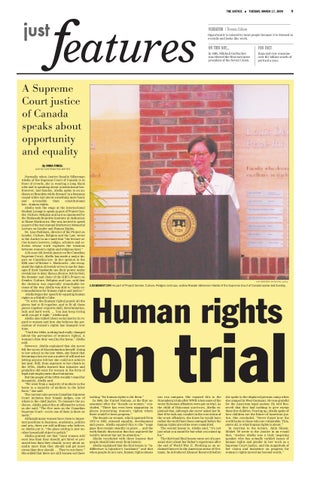
Normally when Justice Rosalie Silberman Abella of the Supreme Court of Canada is in front of crowds, she is wearing a long black robe and is speaking about constitutional law. However, last Sunday, Abella spoke to an audience at Brandeis while dressed in a business casual white suit about something more basic and accessible than constitutional law—human rights. Abella took the stage at the International Student Lounge to speak as part of Project Gender, Culture, Religion and Law as sponsored by the Hadassah-Brandeis Institute in dedication to Diane Markowicz. She was invited to speak as part of the 2nd Annual Markowicz Memorial Lecture on Gender and Human Rights. Dr. Lisa Fishbayn, director of the Project on Gender, Culture, Religion and the Law, wrote to the Justice in an e-mail that “the lecture series honors lawyers, judges, scholars and activists whose work explores the tensions between women’s rights and religious laws.” A 62-year-old Jewish justice on the Canadian Supreme Court, Abella has made a major impact on Canadian law. In her opinion in the 2008 case of Bruker v. Markowitz , she recognized the rights of Jewish wives to sue for damages if their husbands use their power under Jewish law to deny them a divorce. Sylvia Neil, the founder and chair of the HBI’s Project on Gender, Culture, Religion and Law, said that the decision was especially remarkable because of the way Abella was able to “make accommodations for human rights and justice.” Abella began her speech by equating human rights to a Rubik’s Cube. “To solve the [human rights] puzzle all the pieces had to fit together, and to fit all these pieces together requires skill, determination, luck and hard work. … You just keep trying until you get it right,” Abella said. Abella also talked about social justice in regard to women and how she believes the perception of women’s rights has changed over time. “Until the 1960s, nothing had really changed [about the perception of women’s rights]. A woman’s first duty was [in] the home,” Abella said. However, Abella explained that she never felt the scorn of discrimination herself. Going to law school in the late 1960s, she found that becoming a lawyer was a matter of will and not letting anyone tell her she could not achieve her goal. Still, from exposure to her clients in the 1970s, Abella learned that injustice and prejudice did exist for women in the form of legal and employment discrimination. But the people of the 1970s wouldn’t stand for inequality, Abella said. “We went from a majority of mothers in the home to a majority of mothers in the labor force,” she said. The current nine-person Canadian Supreme Court includes four female judges, one of whom is the chief justice. To reassure the audience, Abella poked fun at affirmative action as she said, “The five men on the Canadian Supreme Court—every one of them is there on merit.” Although many women have risen to important positions in business, academics, politics and arts, there are still millions who believe, as Abella put it, “the glass ceiling is just another household object to polish.” Abella pointed out that “most women still earn less than they should, get hired or promoted less than they should, worry about assaults more than they should and get more stress than they should. … They’re out there.” She added that there are still women out there
MAX BREITSTEIN MATZA/the Justice
JUDGEMENT DAY: As part of Project Gender, Culture, Religion and Law, Justice Rosalie Silberman Abella of the Supreme Court of Canada spoke last Sunday.
Human rights
on trial waiting “for human rights to hit them.” In 1990, the United Nations, at the first assessment after the “decade on women,” concluded, “There has even been stagnation in places [concerning women’s rights] where there would’ve been progress.” The decade on women, which spanned from 1976 to 1985, stressed equality, development and peace. Abella equated this to the “wage gaps that remain steadily in place … and the work-family discussion that has captured the world’s interest but not its attention.” Abella concluded with three lessons that people should take away from history. Abella explained that the first lesson is “indifference is injustice’s incubator” and that when people do not care, human rights abuses
9
can run rampant. She equated this to the Nuremberg trials after WWII when some of the worst Holocaust offenders were put on trial. As the child of Holocaust survivors, Abella explained that, although she never asked her father if he took any comfort in the conviction of the worst offenders, she knew he would have rather the world have been outraged before the human rights atrocities were committed. The second lesson is, Abella said, “it’s not just what you stand for but what you stand up for.” The third and final lesson came out of a personal story about her father’s experience after the end of World War II. Working as an acclaimed lawyer in the American sector of Germany, he introduced Eleanor Roosevelt before
she spoke to the displaced persons camp when she camped in West Germany. He was grateful for the American legal system. He told Roosevelt that they had nothing to give except these few children. Tearing up, Abella spoke of how children are the future of American justice. She concluded, “Never forget how the world looks to those who are vulnerable. This, above all, is what human rights is about.” In reaction to the lecture, Julia SimonMishel ’09 wrote to the Justice in an e-mail that, “Justice Abella was a truly inspiring speaker who has actually tackled issues of human rights and gender in her work as a Supreme Court justice, and the magnitude of her vision and insistence on progress for women’s rights moved me beyond words.”
10
TUESDAY, MARCH 17, 2009
●
THE JUSTICE
the Justice Established 1949
Brandeis University
MIKE PRADA, Editor-in-Chief ANDREA FINEMAN, Managing Editor HANNAH KIRSCH, Deputy Editor J OEL HERZFELD, SHANA D. LEBOWITZ, DAVID SHEPPARD -B RICK and DANIEL D. SNYDER, Associate Editors JILLIAN WAGNER, News Editor NASHRAH RAHMAN, Acting News Editor REBECCA KLEIN, Acting Features Editor REBECCA B LADY, Forum Editor IAN CUTLER, Sports Editor JUSTINE ROOT, Arts Editor JULIAN AGIN -LIEBES and MAX B REITSTEIN MATZA, Photography Editors B RIAN B LUMENTHAL, Acting Layout Editor B RIAN FROMM, Copy Editor C OURTNEY B REEN and SARA ROBINSON, Advertising Editors
Club exclusivity is justifiable A Cappella Etc., an umbrella organization that encompasses the University’s 11 a cappella groups, recently received chartered status from the Student Union, allowing them to request funding from the Finance Board. The umbrella organization must exist because, according to the Student Union bylaws, the Union will only charter clubs that are “open to all members of the Brandeis community,” meaning exclusive clubs like a cappella groups, which hold auditions, cannot receive F-Board funding. But these groups should not need the hassle of an umbrella organization to obtain funds. The Union should have simply removed this clause from its bylaws. Instead of punishing exclusive organizations, it should celebrate the talents of our peers. While we understand that the Union wants all members of the Brandeis community to be able to participate in any club they choose, the Union should also take an interest in ensuring appropriate club quality. Clubs like these a cappella groups deserve Union recognition to receive the funding necessary to properly display their talents. Furthermore, if an a cappella group does not accept a prospective member, that individual student can always audition for a different group or start his or her own. A cappella groups are not the only
No need for umbrella group exclusive student clubs at Brandeis. Several of Brandeis’ student-run theater groups, such as Tympanium Euphorium, hold auditions, and although anyone can contribute to the production of the show, the club does not cast every student who auditions in an acting role. Yet these groups are still chartered and still request and receive money from the F-Board to use for their performances. Why shouldn’t a cappella groups receive similar privileges so that they can enhance their performances as well? It appears to us that the Union is already disregarding its exclusivity policy in the case of theater groups. We know that students are concerned about exclusivity with regard to Greek life on campus; however, changing this bylaw would not affect Greek life as there is already specific language in the bylaws that bans fraternities and sororities. In place of the current blanket policy against exclusive clubs, the Union should determine on a case-by-case basis whether clubs are justifiably exclusive. A policy that will permit clubs a reasonable amount of leeway with respect to student qualifications would actually be more inclusive by allowing more student organizations to access club resources while still preventing an unfair exclusivity rule.
Reconsider Midnight Buffet This past week, the Union Senate voted to cut the budget for the annual Midnight Buffet from $5,000 to $3,000, citing current economic hardships and the need for such events to remain “cost-beneficial.” While this editorial board supports this prudent action, we believe that the event could have been cut entirely. It’s true that the Midnight Buffet has been a staple of the final exam period and is welcomed by many tired and overworked students, but it is a luxury we could certainly do without. Without taking the budgetary scalpel to every event on campus that features food and music, it is important to note that regardless of the Midnight Buffet’s status as an established tradition, it is neither an event of cultural appreciation and remembrance, à la Culture X, nor an artistic endeavor like Liquid Latex. With talk of fiscal wisdom cluttering conversation campuswide, it seems that such an indulgent event should be the first item cut from the list. Though $3,000 is a small sum in the scope of the University’s larger budget crisis, the money available to students for extracurricular activities is in far shorter supply as evidenced by Finance Board’s Regular Marathon results this semester. The sum saved by canceling Midnight Buffet could be used to fund other clubs by being contributed to the pool the F-Board draws from for Emergency Request meetings, or it could have been used to increase the resources used toward other Union initiatives such as DeisBikes or used to restore a steady flow of paper towels
Event an unnecessary luxury to our restrooms. Midnight Buffet has always been a fun event for students to come together in a common love of pizza, doughnuts, Tiki House cuisine and, of course, the chance to win free T-shirts simply by attending. In years past, Brandeis students have enjoyed the chance to let their hair down for a night of frivolity at the hands of the Union Government Fund. However, in light of the University’s current hardships, it is not perhaps in the best taste to continue one of the less characteristic and unique of our coveted campus traditions. Only two weeks ago, this editorial board cautioned against spending $3,000 on a cell phone signal amplifier for Usdan at a time when contract professors are concerned for their employment. To spend an equal sum on what is essentially a party—something that doesn’t endure, like the signal amplifier—leads the student body further into fiscal irresponsibility. All this is not a condemnation of Midnight Buffet. Perhaps this fall, after the Rose Art Museum’s Warhol is in the hands of a Russian collector, the University will be flush with contract professors and $3,000 sums alike. Until then, we students ought to engage in some of the same belt-tightening that our administrators imposed on University spending several months ago. The party planned to relieve our stress before finals can wait until we can honestly afford it.
ELI TUKACHINSKY/the Justice
To promote real change, social justice groups need to strategize better By JACKIE SAFFIR JUSTICE CONTRIBUTING WRITER
The job of a true human rights crusader is never finished. And that is why it is surprising that a student body that claims to be so politically aware is so quiet at a time when there is so much at stake. As a student at Brandeis, I often encounter the campaigning of social justice groups and groups like the antigenocide organization STAND. The focus of STAND and related organizations seems to be promoting change by telling the student body that genocide is happening in Darfur, a claim that the International Criminal Court arrest warrant disputes, and that genocide is bad—something that I hope that no one would question. If these organizations aim to end these human rights atrocities and if Brandeis chapters want to effectively motivate students to play a role, their strategy seems to be ineffective. The reason their campaigns don’t compel Brandeis students and Americans in general to act is that they do not tell us anything we don’t know already. While campus advocacy for humanitarian aid is undeniably important, if we truly care about making a difference, we must acknowledge that awareness and aid alone are not enough. These problems call for a strategy change for students on campus who are interested in increasing awareness, creating dialogue and ultimately, bringing about political change. This starts with changing the dialogue from one of “what” to one of “how.” An example of this is not only telling us that people are dying in Darfur but also debating the political solutions that might stop it. The fact that the International Criminal Court issued arrest warrants on Wednesday for the Sudanese President Omar al-Bashir gives a fresh opportunity for this. Given the refusal of the Sudanese government to turn over their president, what should Western countries be doing? Should they use political sanctions and leverage? Should they cooperate with governments and groups like underlings to al-Bashir that are perhaps politically “sketchy,” just so they can potentially bring such people to court? And should the United States and its allies be willing to destroy Sudanese military aircraft if it continues to violate the United Nations ban on offensive military flights? While these questions may divide the political power of the groups involved when individuals advocate for different solutions, it makes that advocacy that much more specific and thus much stronger. But in order to promote real change, we have to do more than change the topic of discussion. We also have to apply our standards for political action across the board. While a group that strives to end all human rights abuses is bound for heartbreak, it is not enough to stand against human rights abuses only in some cases. Though they in no way diminish the atrocities in Darfur, bigger wars like the one that has killed 5.5 million people in the Congo get only a fraction of the attention. There is no discussion of the convictions of the rebel leaders responsible for maiming thousands in Sierra Leone. No discussion of the human rights trials trying the leaders of the Khmer Rouge, the group that killed 20 percent of the population in Cambodia. No discussion of the fact that those trials may end because there is not enough funding. No one fighting for action against the totalitarian government of Burma. No one fighting to prevent the total absorption and cultural destruction of Tibet. Though there is some effort to push awareness on a couple of these issues, when it comes to human rights advocacy, we should expect more of ourselves to raise awareness of these issues among our peers. As in elections, even the candidate who stands for the best causes can lose with an unconvincing campaign. If we ever want to see an end to abusive and oppressive governments, we cannot just address the problem at its fringe. To paraphrase French thinker Bernard-Henri Lévy when discussing Bosnia, if it is a just cause, to respond with the delivery of humanitarian aid is like bringing sandwiches to the gates of hell.
OP-BOX Quote of the Week “She’s left her mark. As a coach, I mean, that’s why we coach. Kids like [Cassidy Dadaos] are why you coach.” —Women’s basketball head coach Carol Simon praises Captain Cassidy Dadaos ’09 after the Sectional Finals of the Division III NCAA Tournament. (See Sports, page 16)
Brandeis Talks Back What are your thoughts on the housing lottery process?
BECKY KUPCHAN ’09 “I’m glad I don’t have to deal with it.”
SHARON SPIVAK ’11 “I am not a fan of the housing lottery.”
JERRY SAUNDERS ’11 “I think it’s pretty fair compared with other universities’ systems.”
DEBORAH MIRABAL ’10 “It sucks for juniors and seniors who can’t live in the Village.”
THE JUSTICE
READER COMMENTARY Teach Business properly at Brandeis To the Editor: In view of today’s aggrandizing business practices, I have been wondering what, exactly, is taught in the business schools. Our businesspeople seem intent on squeezing consumers dry. This, I believe, is a destructive, even anti-businesslike practice. The current mindset of predatory capitalism has consumed the idea of free enterprise and led to what could be called government enterprise. Greed, it appears, is not good. Greed represents the “ambitious sacrifice of the many to the aggrandizement of the few,” according to Federalist Paper No. 57. It would be helpful if the nation had one business school that recognized the importance of cooperative capitalism to the economy, an approach that could revive the idea of free enterprise, which, of course, is a function of liberty. It would be fitting if that school carried the name of Louis D. Brandeis, the great jurist who believed that business profits came from serving, not exploiting, employees and consumers. —David R. Zukerman ’62
Reusing water bottles is practical To the Editor: I am currently studying abroad in South America. Yesterday I was gratefully refreshed by refilling my BPA-free reusable water bottle from the bathroom faucet of a rural elementary school in Chile. The only consequence was my own happy hydration. No illness. No diarrhea. No bad taste. In the United States and in the cities of Massachussets in particular, our tax dollars support one of the cleanest, most regulated water supplies in the world. I encourage you to at least try to change your habits. You will be pleasantly surprised with the quality and convenience of public water sources, and your wallet and our planet will thank you. —Ned Crowley ’10
BUECHLER AND SO ON
Is Bill Ayers really the type of person we should pay to come speak at this University? I’m asking this question under the general impression that the man will not be speaking about elementary education, his area of professorial expertise. If I am mistaken and that is indeed the case, I applaud Democracy for America and Students for a Democratic Society for their desires to share their interest in education reform with the rest of the University. Unfortunately, that doesn’t seem to be the case. DFA campaign coordinator Liza Behrendt ’11 stated in an earlier interview with the Justice that she first contemplated bringing Ayers to campus during the 2008 presidential campaign. At that time, Ayers was on the media’s radar as a misleadingly divisive topic of conversation regarding then-presidential candidate Barack Obama’s associations with him. However, we shouldn’t bring Ayers here simply because of a media storm that came and went during the campaign. According to Behrendt, “Ayers has unique historical insight to share … especially in light of Brandeis’ reputation for activism.” She also referred to Ayers’ tendency to participate in “extreme activism,” and offered that bringing Ayers here might allow us to question “the limits of activism.” But exactly what activism are we talking about? The tactics Ayers employed were unproductive and certainly not aligned with any social justice mission we seek to follow at this University. Ayers was a founding member of Weathermen. Later known as the Weather Underground Organization, this radical leftist group was responsible for creating domestic chaos in the late 1960s and early 1970s. Among other activities, Ayers and others in the organization detonated bombs in loud protest to the United States’ role in the Vietnam War. In interview after interview, Ayers defends his radical actions by noting that WUO bombings never hurt or killed a single person. This is, of
Write to us
TUESDAY, MARCH 17, 2009
11
It’s time to accept Brandeis Greek life By ANDREW RAMIREZ SPECIAL TO THE JUSTICE
A fifth fraternity has joined Greek life at Brandeis. But what does that mean to this University? Sigma Alpha Mu now joins Phi Kappa Psi, Zeta Beta Tau, Alpha Delta Phi and Alpha Epsilon Pi on the list of unrecognized organizations on campus. Although these are some of the biggest names in the fraternity world, they are still subject to the University’s unfaltering disapproval and thus forced to remain independent, secretive organizations. Over 20 years ago, the Board of Trustees voted to prohibit all organizations whose membership is determined by competency or interest and therefore not open to all students. Formation of fraternities and sororities is “inconsistent with the principles of openness to which the University is committed,” according to the Rights & Responsibilities Handbook. However good-natured as this rule may seem, the University is in fact making the process of joining existing fraternities and sororities even more selective by limiting their presence. If the University recognized such organizations, a greater number of national fraternities and sororities would be more likely to establish chapters on campus, and more students would be able to be a part of them. Because the University chooses not to recognize Greek life, the five fraternities are ultra-selective, directly contradicting Brandeis’ rule. Our school shouldn’t continue to ignore the presence of Greek life: It’s here, it’s happening and it’s popular. Fraternities and sororities will remain an integral part of Brandeis’ student life whether the University recognizes them or not. Many current and prospective students are drawn to participate in fraternities and sororities. There are many prospective students who would be more likely to consider Brandeis because of increased availability of Greek life. Of course, Brandeis is going to uphold its original decision until it is convenient to overturn it—much like Brandeis' dedication to the arts
PHOTO COURTESY OF ETHAN LUSTIG-ELGRABLY
GUYS GONE GREEK: The brothers of Sigma Alpha Mu pose with their flag at their founding ceremony. was one of its highest priorities up until this year, when principles were replaced with budget cuts. As the economy continues to worsen, perhaps Brandeis will reconsider going against its stated values again with an opportunity to gain revenue by recognizing Greek organizations. This is not a foreign concept: The University plans to close the Rose Art Museum and use the profits to reduce our deficit despite its claim to be committed to the arts. Once Brandeis realizes the added revenue that fraternities would have to pay in “Greek fees” to the University, it could choose to exploit this new source. It is upsetting that our school goes back on its beliefs because of rough financial times, but it is apparent that they do. Though this is not an admirable habit, it could ultimately help encourage the growth of Greek life on campus. Another point that many fail to realize is how much money our school can potentially make by encouraging the establishment of more fraternities and sororities. Let’s say the University purchased a few frat houses. For $389,000, the
Think twice about inviting Ayers to Deis Hillel
●
course, excluding those members of the organization that were killed when a bomb exploded prematurely in their Greenwich Village apartment in New York City. Yet if there was never intent to kill or hurt anyone, then what was the point of even using bombs? This question may seem facetious, but there’s something to it. If Ayers’ goal was a just and violent revolution to completely eliminate the possibility of any further atrocities at the hands of a tyrannical government, then the use of bombs at least makes sense. You usually need weaponry to overthrow a government, so if that had been his goal then using bombs makes perfect sense. But that wasn’t his goal. Ayers was trying to send a message. Obviously, using bombs to target buildings such as the Pentagon was meaningful in a rather twisted way. But aside from making a very loud point, a bomb is always a bomb. Dangerous protest maneuvers such as bombings accomplished even less with regard to altering U.S. foreign policy than the U.S. aerial bombings from the skies over Southeast Asia accomplished with regard to containing communism. Bombs put people’s lives at risk, bombmakers and bystanders alike. If injuring and killing were not Ayers’ intentions, then there was no reason for him to have used bombs. The WUO’s bombs changed nothing. The U.S. involvement in Vietnam finally began to wane not with the superficially meaningful detonation of a bomb in some government office but with the Paris Peace Accords of 1973. It was the politics behind the war that changed—for all sides involved. Maybe bombing some noteworthy locations during the Vietnam War granted Ayers the illusion he was doing something worthwhile. But we don’t need to feed into such a fruitless ideology or a now distant media cycle that obsessed over it. I don’t particularly mind that Ayers is unrepentant of the risks he took with his actions. That’s his business, not mine. But such risks do not fit in with any concept of social justice that this University represents. And we don’t need to spend thousands of dollars to figure that out. Now, education reform, on the other hand— that’s something I’d certainly love to hear more about. But with the skyrocketing costs of bringing Ayers to campus, I’m sure that we’re capable of locating a less expensive person to come and talk to us about that.
The Justice welcomes letters to the editor responding to published material. Please submit letters through our Web site at www.thejusticeonline.com. Anonymous submissions cannot be accepted. Letters should not exceed 300 words, and may be edited for space, style, grammar, spelling, libel and clarity, and must relate to material published in the Justice. Letters from off-campus sources should include location. The Justice does not print letters to the editor and op-ed submissions that have been submitted to other publications. Op-ed submissions of general interest to the University community—that do not respond explicitly to articles printed in the Justice—are also welcome and should be limited to 800 words. All submissions are due Friday at 5 p.m.
The opinions stated in the editorial(s) under the masthead on the opposing page represent the opinion of a majority of the voting members of the editorial board; all other articles, columns, comics and advertisements do not necessarily. For the Brandeis Talks Back feature on the opposite page, staff interview four randomly selected students each week and print only those four answers. The Justice is the independent student newspaper of Brandeis University. Operated, written, produced and published entirely by students, the Justice includes news, features, arts, opinion and sports articles of interest to approximately 3,000 undergraduates, 800 graduate students, 500 faculty and 1,000 administrative staff. In addition, the Justice is mailed weekly to paid subscribers and distributed throughout Waltham, Mass. The Justice is published every Tuesday of the academic year with the exception of examination and vacation periods. Advertising deadlines: All insertion orders and advertising copy must be received by the Justice no later than 5 p.m. on the Thursday preceding the date of publication. All advertising copy is subject to approval of the editor in chief and the managing and advertising editors. A publication schedule and rate card is available upon request. Subscription rate: $35 per semester, $50 per year.
Fine Print
University could have a four-bedroom house on Main Street. Six to eight students could live in this house. The cost of an on-campus double is more than $5,800 per year, on average. If Brandeis charged the same to fraternity members to live in this house, the property would be completely paid off in eight years. Brandeis would be smart to invest in real estate that has the potential to increase in value over time. It is not surprising that Greek life continues to thrive. Students clearly want it, and considering the general nature of adolescents to rebel against authoritative figures, they will continue to join Brandeis’ unsanctioned fraternities and sororities regardless of the University’s standpoint. This aspect of college life seems important enough for students to go against rules and do it anyway. Brandeis should realize that Greek life is something that needs to be recognized.
The writer is a founding father and vice president of the Gamma Chi chapter of Sigma Alpha Mu.
Ayers, King are Brandeis ideals By ZACHARY MATUSHESKI JUSTICE CONTRIBUTING WRITER
The University Senate Judiciary committee ruled last week that the $900 to bring Bill Ayers of Weather Underground and Robert H. King of the Black Panther Party was unconstitutional. By the letter of the law, this may be true. But in a case like this, we must look beyond the law to the spirit and history of Brandeis in order to fully understand what Ayers and King have to teach students. Two radical conceptions were sustained in the founding of Brandeis University. Sometimes, students forget just how radical they were. The first principle that Brandeis was founded on was fairness in admissions; the second, justice across the board for all people. Brandeis was a beacon of hope and fairness in 1948 when lynching was still a way for whites to terrorize blacks and many residents of suburbs were discriminating against blacks, Catholics and Jews. Some of the great agitators against segregation and ending a shameful war came from Brandeis. The hilarious Abbie Hoffman used to walk our campus grounds. He practiced guerrilla theater and actually tried to nominate a pig for president in 1968. Though he has since passed away, his unique legacy as an activist lives on. Angela Davis graduated from Brandeis in 1965. Once placed on FBI’s top 10 most wanted list because a gun registered in her name was used in a murder, her trial and acquittal were among the most influential in the last 50 years. When Ronald Reagan was governor of California, he waged a war against her academic career. In 1970 he circulated a memo firing Davis for her political sympathies. He swore she would never teach in the University of California system. She boldly ran against Reagan as vice president on the Communist Party ticket and now teaches at UC-Santa Cruz. Davis and Hoffman were both harsh in their criticisms of the government and society. Likewise, Brandeis’ existence itself in the late 1940s was a criticism of the problems with the government and society in
The Staff For information on joining the Justice, write to justeditor@ brandeis.edu
American way of life. Bill Ayers and Robert H. King represent contemporaries of Hoffman and Davis. In the spirit of Brandeis’ foundation, we should embrace these two personalities and welcome them to Brandeis wholeheartedly. Distinguished alumni like Davis and Hoffman fought for social justice. This tradition of social justice survives in the Student Union’s Social Justice Committee. While the image of the Black Panthers, King’s group, has been skewed in the public eye as a radical leftist group, this group was primarily dedicated to the virtue of social justice that we still value today. The Black Panthers advocated community solidarity. They pioneered social programs, some of which are a great deal like the federal programs. They exercised their Constitutional right to carry guns in order to point out California police officers’ biased tendency to follow a shootfirst-ask-questions-later policy. Both the Panthers and the Weather Underground Organization, Ayers’ group, did unseemly things. Later on in the group’s history, the Panthers tried to extort money from the producers of The Mack. Some paranoid Panthers shot people they thought were FBI undercover agents. The Weather Underground participated in open violence to end a war that was more violent than many can really imagine. Because of these errors, members of these groups can teach students. Both the Panthers and the WUO were filled with young, idealistic, passionate people searching in sometimes extreme ways to fix clear wrongs. Regardless of whether you agree with their politics, these people have a special perspective. They can teach students at a University founded on radical ideas how far to take those ideas. They paid for their activism and they know the errors of youth better than most. Their messages and thoughts on their experience provide excellent learning opportunities for students in how to properly and intelligently enact the ideals of justice that Brandeis was founded on and that inspired alumni like Hoffman and Davis. For such a valuable lesson, $900 is a small price for the University to pay.
Arts: Daniel Baron, Wei-Huan Chen, Sean Fabery, Laura Gamble, Caroline Hughes, Rachel Klein, Emily Leifer, Wei Sum Li, Daniel Orkin, Alex Pagan, Shelley Shore, Ben Strassfeld, Brad Stern Photography: Rachel Corke, Rebecca Ney, Adina Paretzky, Michelle Strulovic STAFF Sports: Andrew Ng, Sean Petterson, Adam Rosen Senior Writers: Miranda Neubauer, Jeffrey Copy: Ariel Adams, Emily Kraus, Marissa Linzi, Danielle Myers Pickette, Melissa Siegel Illustrations: Lisa Frank, Gail Goldspiel, Eli Tukashinsky Senior Photographers: Sara Brandenburg, Layout: Kathryn Marable, Lee Marmor David Brown, Hsiao Chi Pang News/Features Staff: Alana Abramson, Destiny Aquino, Sam Datlof, Reina Guerrero, Michelle Liberman, Ruth Orbach, Greta Moran, Michael Newborn, Harry Shipps Forum: Richard Alterbaum, Hillel Buechler, David Litvak, Ethan Mermelstein, Doug Nevins, Eileen Smolyar, Naomi Spector
EDITORIAL ASSISTANTS ARTS: Sarah Bayer
12
TUESDAY, MARCH 17, 2009
●
THE JUSTICE
SPORTS Looking at the loyal fans of women’s basketball By MIKE PRADA JUSTICE EDITOR
AMHERST, Mass.—It’s Friday, March 13, which means Mary Bassett has a doctor’s appointment scheduled back home in Menton, N.Y., near Rochester. She said she had waited a long time to schedule the visit unaware she would have to miss it. When she learns that the women’s basketball team, led by her granddaughter, Jessica Chapin ’10, is set to play Muhlenberg College in the Sweet 16 of the NCAA Tournament, Bassett knows her appointment can wait. Bassett hasn’t missed one of Chapin’s basketball games since middle school and isn’t planning on breaking that streak when her granddaughter takes part in Brandeis’ deepest NCAA Tournament run in its history. “I said, ‘I’m not going [to the appointment],’” Bassett says, later joking that “[Chapin] gave me orders last week that I had to cancel the doctor’s appointment.” At 9 p.m. on Thursday, March 12 in Healdsburg, Calif., near San Francisco, Evelyn Radunich, 89, prepares to board a red-eye flight to Logan International Airport. Radunich does not have a streak on the line like Bassett, but she tries to go watch her granddaughter, Cassidy Dadaos ’09, play as much as possible. Dadaos’ parents, Merrilee and Jim Dadaos, join Radunich on the flight, though for them, the trip is far more routine; they have rarely missed a home game this season. “A lot of parents drive six hours to see their kids play,” Merrilee Dadaos says. “The only difference is that we fly.” Bassett and Radunich are just two of the many family members that attended the Judges’ Sweet 16 and Round of Eight games last weekend to watch their kids play. The players’ relatives made up the majority of the Brandeis cheering section, as the Department of Athletics did not send a fan bus to either game, as they did when the men’s basketball team played in Plattsburgh, N.Y. in last year’s NCAA Tournament. “A lot students [sic] told us they appreciated the fan bus option but preferred to drive themselves. So only 11 seats on the fan bus sold in advance. This wasn’t enough to cover the cost, and, therefore, we canceled it,” Director of Athletics
A family
affair
DAVID SHEPPARD-BRICK/the Justice
LOOKING ON: Mary Bassett, left, watches her granddaughter, Jessica Chapin ’10, right, during the Judges’ Sweet 16 game against Muhlenberg College last Friday. Sheryl Sousa ’90 wrote in an e-mail to the Justice. She added that she “was pleased with student turnout overall, and particularly on Friday night [against Muhlenberg].” The fans that did attend were certainly active in the games, particularly the parents. Sitting two rows behind the Brandeis bench, Bassett said at halftime that “I’m not as active as [Superfan] Alan Karon,” but with the Judges leading 34-16 against Muhlenberg last Friday, Bassett, annoyed by what she thought was an offensive foul on the
Mules, jokingly offered the referee her glasses. “I just love going and I really love sports,” Bassett says. “I have four grandchildren, and three of them are really active in sports.” Bassett says she can’t remember exactly when she started attending all of Chapin’s sporting events, but the six-hour trip to Brandeis from Menton hasn’t stopped her or Chapin’s parents. Radunich, however, has earned a cult following in the Judges during Dadaos’ career. Radunich says her
granddaughters call her “Tutu,” and the nickname stuck when Dadaos joined the Judges. Now, everyone on the Judges call her Tutu. “[Guard] Carmela Breslin [’10] came up to me and said, ‘Oh, hi Tutu,’” Radunich recalls. “The whole team now calls me Tutu; even [coach] Carol Simon calls me Tutu [now]. When asked how the tradition began, Radunich praised her granddaughter, saying “Cassidy’s the kind of person to start it. … She’s a
leader without being pushy, and so the girls, being as close as they are, all continued.” While the families were unable to propel the Judges to a Final Four appearance, the players said they appreciated their presence. “It’s pretty special that we have people willing to give up days in the office and other commitments,” Cassidy Dadaos told reporters after the Judges’ win over Muhlenberg. “We’ve all given about 15 years to the sport, and they’ve given up just as much as we have.”
INDOOR TRACK
Ben Nun earns All-America honors at NCAA Championships ■ Anat Ben Nun ’09 and Ali
Sax ’09 competed at the NCAA Championships in the triple jump last weekend, where Ben Nun was named an All-American. By SEAN PETTERSON JUSTICE STAFF WRITER
Anat Ben Nun ’09 and Ali Sax ’09 knew that this past weekend’s Division III National Championships would be the last indoor track meet in which they would compete together. Ben Nun finished sixth in the triple jump, while Sax finished 10th in the same event, earning Brandeis three points, the second-best finish of all University Athletic Association teams behind Emory University. Wartburg College won the women’s
championship. Entering the NCAA Championships, Ben Nun confidently said that her goal was to “jump more than I have jumped at Brandeis over the past four years.” She was almost able to accomplish her goal. Ben Nun entered the NCAA Championships seeded ninth, but she leaped ahead of her preliminary group of eight on her second of three preliminary jumps with a seasonhigh 11.77-meter leap to qualify for the finals. Entering the final three jumps, Ben Nun had the fourthlongest jump, but she failed to improve on her second jump in the finals and ultimately finished sixth. Ben Nun was victimized by the strength of this year’s competition, as her 11.77-meter jump would have placed her second last year. Nonetheless, Ben Nun was named an All-American for the third time in her career after missing her entire
junior season due to a knee injury. “The girls who jumped over 12 meters definitely deserved it more than I did, but I did my best,” Ben Nun said. “It’s my best at Brandeis so far, and I wish it would have taken me farther, but I think sixth is good too.” Prior to the meet, Sax said in an interview that she knew exactly what she needed to do going into the NCAA Championships. “I’m not ranked very high up so I’m going to have to improve,” she said. Sax came into her first trip to the NCAA Championships seeded 14th out of 14 jumpers, but she quickly rose up the rankings, rising all the way to 10th place with a leap of 11.46 meters. Sax ended just shy of a chance at the championship, however, finishing .06 meters and one place away from qualifying for the finals. “I feel really good about how I performed,” Sax said. “The competition
was tough, to get so close was a bit of a disappointment, but I’m really happy with how I did.” The NCAA Championships also capped Ben Nun’s indoor track career, which included three allAmerica honors, three UAA championships in the triple jump and second- and third- place finishes at the NCAA Championships in her first two seasons. When asked about her proudest moment during her career, Ben Nun said she would remember the Reggie Poyau Memorial Invitational this season, her first home meet since her knee injury. “[It was great] being able to come back after so many people told me that I wouldn’t be able to, and I had so many doubts about being able to compete again.” Ben Nun won the triple jump at the Bowdoin Invitational, Reggie Poyau Memorial, the Tufts Invitational and the UAA Championships.
“She meant a lot [to the program] she has good form, good technique, and she’s a good person,” coach Mark Reytblat said. Sax has improved throughout the season, building on a 10.72-meter jump in the triple jump at the Husky Invitational Dec. 6. “I’ve been doing a lot more technical training and a lot more sprinting workouts instead of working out,” Sax said. “I think I’m a lot stronger this year because I’ve been sprinting more.” Sax also credited Ben Nun for being a helpful teammate. “She pushes me, and is also very supportive,” Sax said. “It’s great having her there because she knows how I feel and knows what to say.” Reytblat said was happy with Sax and Ben Nun. “Only the top 14 triple jumpers in the country made it, and I’m proud that [Sax and Ben Nun] were in it.”
THE JUSTICE
●
TUESDAY, MARCH 17, 2009
13
SPORTS
WBBALL: Judges fall in Sectional Finals 68-54
SIDELINED STARTER
CONTINUED FROM 16
DAVID SHEPPARD-BRICK/the Justice
JUST WATCHING: Guard Lauren Rashford ’10, sits injured on the bench with coach Carol Simon, left, in the first round March 7.
Rashford talks NCAA run ■ Injured point guard Lauren
Rashford ’10 watched the women’s basketball team make history with a trip to the Sectional Finals. Lauren Rashford ’10 began the year as the starting point guard for the women’s basketball team but tore her ACL during a Feb. 3 practice and missed the team’s final 11 games. Before her injury, Rashford averaged 8.1 points per game, 4.2 rebounds per game and 2.6 assists per game. Despite her absence, the Judges finished with their strongest season ever, advancing all the way to the Sectional Finals. Brandeis went 7-4 without Rashford in the lineup and finished the season 20-8 overall. JustSports spoke with Rashford after the Judges’ 68-54 loss to Amherst College last Saturday about her injury and the team’s play in her absence. JustSports: Generally, what did you think of the team’s run to the Round of 8 in the NCAA Tournament? Lauren Rashford: The loss [to Amherst] was bittersweet, but I’m so
proud of these girls. We had a hell of a run; we really did. We have nothing to be ashamed of, going to the Elite 8. We just made Brandeis history. JS: How is your knee doing right now? LR: It’s feeling good. I have surgery planned for [next] Friday. My plan is to be back by next season. Oct. 15 is what I am shooting for, so I’m looking forward to that. I’m really looking forward to getting back on the court. It’s going to be a long [rehabilitation] process and it’s going to be hard work, but I know I’m going to do anything to get back on the court. JS: How do you think the team has been able to make it so far without you on the court? LR: [Jessica Chapin ’10] has really stepped up, and the whole team has really stepped up. [Chapin] has been the only true point guard on the floor, and she really hasn’t backed down. She’s made the most of her opportunity. She’s just a really great player. She really picked up that role and put it on herself and just done a great job. JS: How do you think the team was able to deal with having only one primary ball handler with you injured? LR: I just think we executed our
offense really well. It is really nice that we’ve had two or three other guys really step it up. We really moved the ball around and started to push the ball up the floor with the pass, and we were just able to really execute our offense. JS: What do you think about the job Morgan Kendrew ’12 did stepping into your starting spot? LR: As a freshman, she just did incredibly well. Obviously, for freshmen, it’s a learning year, but she’s definitely been playing really great recently. She’s learned a lot and she’s really grown as a player. She’s really stepped up. JS: How do you think minutes are going to be distributed next year with you, Chapin, Kendrew, Kelly Ethier ’12 and Diana Cincotta ’11 all returning to the team? LR: I think it’s all going to depend on the flow of the game. Different games are going to have different situations, but I think all of us are capable of playing a lot. It’s definitely a good thing that Kendrew and Ethier have been able to get experience playing a lot this year, and that’s definitely going to help us out next season.
close as 34-28 with 15 minutes left in the game but could not get any closer. Amherst scored the next seven points to take a 13-point lead and never let the Judges cut the deficit to single digits the rest of the game. “We definitely tried to get the ball inside early, ... and I thought early on in the game we definitely did that,” Amherst coach G.P. Gromacki told reporters. “But we knew they were going to be sending more post players, and we still went at them, and it opened up our outside game a little bit.” The Judges struggled against Amherst’s defense, which came into the game allowing 48.4 points per game, second best in Division III. Brandeis came into the game averaging 5.8 three-pointers per game, but the Lord Jeffs allowed the Judges to hit just one three-pointer last Saturday. Amherst rookie point guard Shannon Finucane led all scorers with 22 points and confounded the Judges defense with her quickness. Coach Carol Simon said the Judges’ initial plan was to make her shoot outside jump shots instead of getting into the paint, but the strategy did not work as expected. “I’ll take the blame on [our defensive game plan],” Simon told reporters after the game. “Honestly, I think it didn’t make us as aggressive as we needed to be defensively.” The Judges were paced by their two senior starters. Orlando had a team-high 14 points, while Dadaos had her second career double-double with 13 points and 11 rebounds. Coming into the tournament, Brandeis had the second strongest schedule in the nation while Amherst’s schedule was No. 49 in the same category. “I thought our schedule was pretty tough,” Gromacki told reporters. “It’s hard to compare schedules when you are looking at other teams, and I think the thing to look
at is how well a team’s playing at that time, and right now we’re playing as good as anyone in the country I feel.” Prior to last Saturday’s loss, the Judges defeated No. 18 Muhlenberg College last Friday night to advance to the Sectional Finals for the first time in school history. Brandeis fell behind 10-9 early in the first half before going on a 20-0 run to take a 29-10 lead with just under eight minutes left in the half. The Mules went on an 8-0 run to get within 36-24 at halftime and got within seven points with 5:42 left but could not get any closer. All five Judges’ starters scored in double figures against Muhlenberg, led by 17 from Chapin. Meanwhile Brandeis’ defense held Mules’ rookie Alexandra Chili, who came in averaging 3.2 three-pointers per game, to just 2-7 from that range. “We hurried a few shots that sometimes you make and sometimes you don’t, and we just fell in a hole,” Muhlenberg head coach Ron Rohn said. “You had to stay on her, there was no dig off on Chili; she’s just too good,” Simon told reporters. Brandeis will lose two of its starters and one of its key bench players next year with the graduations of Dadaos, Orlando and forward Amanda Wells ’09. Orlando and Dadaos were second and third on the team in scoring, averaging 10 and seven points per game respectively, while Wells was fourth on the team with 100 rebounds. The Judges backcourt will be wellstocked next season, led by Chapin, their leading scorer this season. Starting guard Diana Cincotta ’11, and rookie guards Morgan Kendrew ’12 and Kelly Ethier ’12, who each got significant playing time in the NCAA Tournament will also return, while point guard Lauren Rashford ’10, who missed the last 11 games of the season after tearing her ACL in practice Feb. 3, should also return.
—Mike Prada
SOFTBALL
Team loses final two contests ■ The softball team went 3-
5 at the University Athletic Association Championships last week in Florida. By ANDREW NG JUSTICE STAFF WRITER
The softball team seemed to be off to a strong start in its final game of the University Athletic Association Championships. Shortstop Brittany Grimm ’12 executed a successful suicide bunt off University of Rochester pitcher Beth Ameno in the top of the first inning, scoring second baseman Melisa Cagar ’11. However, the Judges faltered in the bottom of the first by giving up three runs and never recovered, eventually losing 17-2. The Judges competed in eight games at the UAA Championships in Altamonte Springs, Fla. from March 10 to March 14 and finished 3-5 on the week and drops to 3-7 overall. “[Losing to Rochester] was disappointing because we had just beaten [Rochester] 3-2 earlier in the week, and we proved that we can play with them. Because we had beaten them once, we may have come into today’s game thinking we could do it again without giving it much second thought think-
ing that we still have to play hard,” Cagar said. “The pitcher we faced today pitched in a game earlier in the morning. We assumed that she would be tired, but we didn’t take advantage of that and couldn’t string hits together.” The Judges’ only other run was an unearned run scored by catcher Erin Ross ’10 in the fourth inning. Ross scored on an error by Rochester junior catcher Juliana Nicholson. Still, Brandeis could not recover from the Yellow Jackets’ hot start. “Once [Rochester] pushed three runs across the board in the first inning, it deflated us. The intensity was a little low, and Rochester just ran away with it,” Cagar said. Pitcher Emily Vaillette ’10 allowed five runs in one-plus innings after allowing three runs in the first and two in the second before she was pulled for relief pitcher Caroline Miller ’12. “Vaillette also had a gutsy performance. She was hit under the ribs with a line drive in the [Washington University in St. Louis] game the day before, but she still competed hard against Rochester [last Saturday],” Cagar said. The Judges were able to compete against the top teams in the nation, with a 3-2 win against No. 16 Rochester earlier in the week and 3-2 and 6-2
defeats to No. 6 Emory University, both losses occurring in the final innings of each game. “We stayed right with Emory and Rochester for the majority of the games, but we can’t continue to be a five-inning team,” captain and outfielder Chelsea Korp ’10 said. Some of the players said the Judges were at a disadvantage because teams such as Emory had already competed in 16 games in Florida before Brandeis had arrived to Altamonte Springs. “[We] did very well considering some of the teams had already played over a dozen games before we arrived,” third baseman Danielle Lavallee ’11 said, “We did well for the amount of time we spent on the field, but we know we can improve on our performances this week.” The week of the UAA Championships has historically been the toughest part of the Judges’ schedule, as the UAA remains one of the strongest leagues in Division III. However, this season the Judges will face opponents such as No. 27 Wellesley College and No. 26 Rhode Island College when they return to New England. Brandeis next plays a doubleheader at Wellesley College tomorrow at 3 p.m.
DAVID SHEPPARD-BRICK/the Justice
STOPPED SHORT: Forward Lauren Orlando’s ’09 shot is contested last Saturday.
14
TUESDAY, MARCH 17, 2009
●
THE JUSTICE
TENNIS
BASEBALL
Teams fall to top squads ■ The women’s tennis team
was 1-1 at Middlebury College last weekend while the men’s team went 0-3. By ADAM ROSEN JUSTICE STAFF WRITER
Just 19 days after a road trip to Orlando, Fla. that saw the men’s and women’s tennis teams go a combined 73, the competition back in the Northeast did not prove to be as sunny. The two squads combined for a 1-4 record last weekend at Middlebury College. The men’s team lost 6-3 to Connecticut College last Sunday and fell to No. 4 Middlebury 9-0 and University Athletic Association rival New York University 6-3 last Saturday, while the women defeated NYU 7-2 but lost to No. 13 Middlebury 9-0 last Saturday. The men’s team is now 5-5 this season, while the women’s squad is 7-3. In its match against Connecticut College, the men’s team won three of the six singles matches. Steven Nieman ’11 was able to knock off senior David Kellogg in No. 1 singles 7-5, 76 (4), Simon Miller ’11 defeated rookie Jeffrey Weisberger 6-3, 6-2 at No. 3 singles, and Seth Rogers ’10 beat rookie Colin Tasi 6-2, 6-0 at No. 4 singles. But the Judges dropped all three doubles matches, putting them in a 3-0 hole from which they could not recover. It was the third consecutive match in which the Judges lost all three games in doubles, as they also were swept in doubles by Middlebury and NYU. “We’re not playing big in doubles. That’s the bottom line,” coach Ben Lamanna said. He added: “In the ninepoint system, if you don’t win a doubles match … it’s a real, real long ways to go to get back, and we’re not quite dominant enough in singles that we can go out there and win five out of six singles matches to clinch a match.” Against the Camels, Miller and Scott Schulman ’09 paired at No. 1 doubles and fell in a close decision to Kellogg and sophomore Trevor Prophet, 8-6.
Neiman and Mayur Kasetty ’11 teamed at No. 2 doubles, while Rogers and Josh Bookman ’12 were at No. 3 doubles, both of which lost their matches by a score of 8-3. “It’s always hard coming off three tough losses, but we can’t dwell on those,” Nieman said. “We have to learn from our mistakes, which is we need to come out to a better start. The great thing about this game is that there are many more matches to come.” The women’s team was able to knock off NYU 7-2 last Saturday, led by wins from their No. 1 and No. 3 doubles teams. Rachel Rosman ’11 and Mackenzie Gallegos ’11 defeated freshman Elizabeth Stachtiavis and senior captain Stephanie Tu 8-3, while captain Gabrielle Helfgott ’09 and Nina Levine ’12 defeated sophomore Sarah Joo and senior Jennifer Gottleib 8-4. Gallegos had switched with Helfgott as Rosman’s partner for the match, but Lamanna said Gallegos would continue to play No. 1 doubles “for the foreseeable future.” The Judges won five of their six singles matches, as No. 1 Rosman (6-1, 6-2), No. 2 Helfgott (3-6, 6-1, (10-3), No. 4 Gallegos (6-1, 6-1), No. 5 Emily Weisberger ’10 (6-2, 6-1), and No.6 Levine (8-3) all emerged victorious in their matches. Levine played only one superset because the team match had already been decided. “We’re a good singles team,” Lamanna said. “It really all depends on our doubles and how confident we are.” In the 9-0 loss to Middlebury, No. 4 Gallegos and No. 5 Weisberger were the only two Brandeis players to take their singles matches into a third set. Gallegos and Weisberger both lost the first set 6-0, and both rebounded to win the second set 7-5, but Gallegos dropped the third set tiebreak 11-9, and Weisberger fell in hers, 10-5, falling to senior Elizabeth Stone and rookie Alyssa Puccinelli, respectively The men’s team will next compete this Saturday at home against Lamanna’s alma mater Bates College at 10 a.m. The women’s team will also take on Bates at home at 4 p.m.
Judges fail to repeat at UAAs ■ The baseball team went
2-4 at the University Athletic Association Championships last week. By ELI HARRINGTON JUSTICE CONTRIBUTING WRITER
Once again escaping Waltham for the sunny fields of the south after earlier playing in a series of games in Peoria, Ariz., the baseball team hoped to defend the University Athletic Association coChampionship title they won last year in the annual UAA Baseball Championship. But with two losses in the final weekend of the tournament after splitting their first four games, the Judges went from contenders for the title to dead last in the span of 24 hours. Brandeis lost to the University of Rochester and Emory University in its two games last Saturday after splitting games with Washington University in St. Louis, beating Case Western Reserve University in walk-off fashion and losing to Rochester earlier in the week. The Judges finished the tournament at 2-4 and fell to 4-7 overall. “We had high expectations going into the week,” captain and outfielder Mike Alfego ’09 said. “We obviously wanted to defend the title, but it’s a very strong league-a league of parity-and anybody can beat anybody else in the league on any given day. So now we've got to come back and work harder, so we can move forward.” Last Saturday's game against Rochester was essentially a championship game for both teams as Rochester needed the tiebreaker over Brandeis and the Judges needing two wins on the day to get a share of the UAA title. The Judges sent captain James Collins '09 to the mound to face a Yellow Jacket offense that has a
team batting average of .347. Collins lasted five innings and left the game with the Judges only trailing 5-3. Brandeis came to within 6-5 and cut a 9-7 Rochester lead to 9-8 in the ninth inning but would not come any closer. “Throughout the game, we basically spotted them four runs on mental mistakes that hurt us bad. If we cut out on those mistakes then it's a very different game,” assistant coach Brian Lambert ’97 said. “But we fought back and finished the game with two men on base and a line drive that their first baseman made a great play on. Tony Deshler ’11 led the Judges by going 3-for-5 with 3 RBIs and two runs scored. Catcher Zach Wooley ’11 finished the day 2-for-5 with two RBIs, including an eighth-inning home run, the first of his career. High school teammates infielder Nick Gallagher ’09 and Alfego combined to go 5-for-8 on the day. “It was a really tough loss, a back-and-forth game,” Gallagher said. “It seemed like we'd come back and score three runs, they'd score four, we'd score one, they’d score one and so on. ... We just couldn't close that gap.” Lambert said he appreciated the Judges' effort. “[Last Saturday's game] shows that we have some fight, which is a good sign,” he said. “We just need to get that consistent effort and focus to play well when the game's on the line in the fourth inning, not just the ninth.” With their UAA title hopes dashed, the Judges were never in the game against Emory later in the day. Emory jumped on Brandeis immediately, batting around its order in the first inning to get out to a 9-0 lead that eventually turned into a 12-0 shutout that ended after seven innings because of the lopsided score. Pitcher Pat Nicholson '11, pitching on three days’ rest after a complete game 3-1 victory over
WashU March 10 in which he took a no-hitter into the seventh inning, started for Brandeis against Emory and gave up eight earned runs, lasting just a third of an inning. David Packard ’09, John Clark ’09 and lefthander Jonah Mandell ’09 followed Nicholson and all saw their earnedrun averages rise, giving up four more runs over the next 3 2/3 innings as Emory extended the lead to 12-0. “It ended pretty bad, and of course it's disappointing. We went into a big day with a chance to win the whole thing and ended up in last place.” captain Mike Alfego ’09 said. Lambert said he was also disappointed with the way the team closed out its annual trip to Florida. The Judges went 2-2 earlier in the week, with the most dramatic game occurring against Case Western Thursday. The Spartans took a 4-1 lead before Brandeis responded with three runs in the bottom of the sixth inning to tie the score at 4-4 heading into the ninth inning. The Spartans broke the tie in the top of the ninth inning, taking a 5-4 lead, and were just one out away from the victory. But Case Western rookie pitcher Sam Alexander walked Sean O'Hare ’12, loading the bases for Deshler. Deshler eventually singled, sending home two runners to give the Judges the walk-off win. “It was a big game, and it was huge to get those runners on base. With two outs, I was just thinking about trying to get a pitch to hit and get it through the infield,” Deshler said. Lambert said the team is still trying to find a lineup that will work moving forward. “We’ve still got more to see, but we just want to find the nine guys who are going to work hard and play hard all of the time,” he said. The Judges will next play tomorrow at Bridgewater State University at 3 p.m.
THE JUSTICE
■ The second baseman leads the softball team in five statistical categories after last week’s University Athletic Association Championships.
2
straight seasons that a Brandeis basketball team was knocked out of the NCAA Tournament in the Sectional Finals by Amherst College. The men’s team lost last season 65-55 while the women’s team lost this season 68-54 last Saturday.
1 4
run allowed by pitcher Pat Nicholson ’11 in a completegame win over Washington University in St. Louis March 10. Nicholson had seven strikeouts and hit two batters in the Judges’ 3-1 victory.
graduating seniors on the women’s basketball team: guard Lauren Goyette and forwards Cassidy Dadaos, Lauren Orlando and Amanda Wells. The Judges advanced to the National Sectional Finals for the first time in school history this year after making the NCAA Tournament four consecutive seasons.
3
All-America honors for jumper Anat Ben Nun ’09 in her collegiate career after finishing sixth in the triple jump and the NCAA Division III Indoor Track and Field Championships last Saturday.
5
players for the women’s basketball team who scored in double figures in the Judges’ 82-70 Sweet 16 win over Muhlenberg College to advance to the Sectional Finals for the first time in school history.
JULIAN AGIN-LIEBES/the Justice
ing the tying run as the Judges earned a 32 comeback victory. Batting first in the lineup, Cagar leads the team with 10 hits, seven runs scored, a .400 batting average and a .483 on-base percentage. She also added one home run and two runs batted in.
“I feel that my offense improved as the week progressed,” Cagar wrote. “Getting off on a fast start will help me push forward and use that as a baseline [for] my role on the team.”
—Jeffrey Pickette
NCAA TOURNAMENT WOMEN’S BRACKET Sectionals March 14 on campus
Semifinals March 20 at Holland, Mich.
Final March 21 at Holland, Mich.
Semifinals March 20 at Holland, Mich.
George Fox
Sectionals March 14 on campus
Ill. Wesleyan
George Fox
WashU
Hope
WashU
NATIONAL CHAMPION
1 p.m. ET, Holland, Mich. CBS CSN Live
Scranton
Amherst
Amherst
TCNJ
BRANDEIS
TCNJ
COMPILED BY BRIAN BLUMENTHAL WITH DATA FROM D3HOOPS.COM
FINAL TEAM LEADERS WBball (points per game)
WBball (rebounds per game)
Guard Jessica Chapin ’10 led the team with an average of 14.1 points per game.
Guard Jessica Chapin ’10 led the Judges with an average of 6.7 rebounds per game.
Player Jessica Chapin Lauren Orlando Lauren Rashford Cassidy Dadaos Diana Cincotta
Player Jessica Chapin Cassidy Dadaos Lauren Orlando Lauren Rashford Amanda Wells
PPG 14.1 10.0 8.1 7.0 6.9
RPG 6.7 5.5 4.7 4.2 3.6
UPCOMING GAME OF THE WEEK Baseball vs. Rochester Institute of Technology The Judges play RIT at home in a double header starting Saturday at noon.
6
RBIs for catcher Erin Ross ’10 in the first eight games for the softball team. The team is 3-5 after the annual University Athletic Association Championships in Florida last week.
15
Mississippi State University wins SEC Tournament in upset victory
Melisa Cagar ’11
Judging numbers
TUESDAY, MARCH 17, 2009
AP BRIEFS
ATHLETE OF THE WEEK
Last season, second baseman Melisa Cagar ’11 led the softball team with 10 stolen bases in 47 games played. Just last week, after eight games this season against University Athletic Association competition in Florida, she has already compiled six steals on only six attempts. “I feel that I am more confident this year and have realized that I need to utilize my base running skills better,” Cagar wrote in an e-mail to the Justice. “When I am on base I always try to put pressure on the defense.” Cagar wrote that she takes into account the “strength of the catcher’s arm [and] the tracking of the ball when it is released from the pitcher’s hand” among other factors when she is deciding whether to attempt to steal a base. Of her six steals, arguably the most significant one came in the fifth inning of last Thursday’s game against the University of Rochester. With the Judges trailing 2-1, rookie right fielder Samantha Gajewski ’12 was on first base and Cagar was on second with rookie designated hitter Marianne Specker ’12 up at bat. Cagar wrote that head coach Jessica Johnson instructed Specker to bat righthanded, even though she typically bats left-handed, in order to obstruct the Rochester catcher’s throwing path to third base. As a result, Gajewski and Cagar pulled off a double-steal. Gajewski and Cagar came around to score later in the inning with Cagar scor-
●
The baseball team will play its home opener against the Rochester Institute of Technology in a doubleheader starting Saturday at noon. The Judges are 4-7 this season after opening the season with a new spring training trip in Peoria, Ariz. and the University Athletic Association Championships in Sanford, Fla. Brandeis won two of its first three UAA games with a 3-1 win over Washington University in St. Louis and a 6-5 victory over Case Western Reserve
University. However the Judges dropped their final three UAA games against WashU and the University of Rochester by close margins of 8-6 and 98, respectively, but were handled by Emory University 12-0 last Saturday. RIT is 2-6 this season and has allowed over 20 runs in a game twice this season. The first time was against Wartburg College (Iowa) losing 25-5, and the second time was in its most recent game against St. Cloud State University (Minn.), a 22-4 defeat.
TAMPA, Fla.—Mississippi State University showed all those bubble teams from the Southeastern Conference how to get into the NCAA Tournament. Phil Turner scored seven of his 12 points in the final 1 minute, 35 seconds last Sunday, and the Bulldogs knocked off Tennessee 64-61 to win the SEC tournament championship and the league’s automatic NCAA berth. Turner, who had 10 rebounds, hit a big three-pointer to put Mississippi State (23-12) in front for good, then made two free throws with 8 seconds left to help the Bulldogs hold off the Volunteers (21-12) in a wild finish. Cameron Tatum’s long three-pointer bounced off the rim and Mississippi State’s Barry Stewart rebounded as time ran out on Tennessee’s hopes of winning the tournament for the first time in 30 years. Wayne Chism led the Volunteers with 15 points, but he missed seven of nine three-point attempts a day after going 4-of-6 to key a victory over Auburn in the semifinals. J.P. Prince had 14 points, and leading scorer Tyler Smith had 12 on 2-of-14 shooting. The victory was the sixth straight for Mississippi State, which entered the tournament needing a strong run to improve its chances of making the NCAA field. The Bulldogs’ first SEC title since 2002 ensures the league three spots, with Tennessee and regular-season champion LSU considered locks. Mississippi State’s run was reminiscent of the University of Georgia’s stunning march through the SEC tournament last year. Georgia won four games in three days to earn an improbable NCAA berth after finishing last in the regular-season conference standings. Stewart and Ravern Johnson both scored 11 points for Mississippi State, which also got 10 points, seven rebounds and six blocks from tournament MVP Jarvis Varnado. The Bulldogs held Tennessee to 29 percent shooting and forced two of the Volunteers’ 14 turnovers with the game on the line. Mississippi State accepted the championship trophy, landed Varnado and Stewart on the all-tournament team and cut down the nets in the half-empty St. Pete Times Forum, which drew a crowd of just 10,093 for the final. Overall, the tournament drew 132,181 for six sessions over four days—the lowest attendance for the league’s showcase event since 1991, when it was played in Nashville, Tenn., and without perennial SEC powerhouse University of Kentucky, which was on probation. For Tennessee, it was more postseason disappointment under coach Bruce Pearl, who had hoped winning the crown would improve his team’s seeding in the NCAA Tournament. The Vols hadn’t been in the SEC final since 1991 and hadn’t won it all since 1979. The Bulldogs will play the University of Washington in Portland, Ore. in the first round of the NCAA Tournament Thursday at 9 p.m. Tennessee will play Oklahoma State University Friday at 12:25 p.m. in Dayton, Ohio.
Binghamton earns its first NCAA Division I Tournament berth VESTAL, N.Y.—Senior forward Reggie Fuller had 19 points and 10 rebounds, D.J. Rivera added 16 points, and Binghamton beat defending America East champion the University of Maryland, Baltimore County 61-51 on Saturday for the conference title and the school’s first NCAA Tournament berth. It was the 11th straight win for the top-seeded Bearcats (23-8) and their first America East title since moving to Division I in 2001. UMBC (15-17), the sixth seed and the last team to beat Binghamton, made its first NCAA Tournament appearance a year ago but saw its chances of a second vanish when the Retrievers failed to score in the game’s final 4 minutes, 49 seconds. Rich Flemming led UMBC with 14 points and 11 rebounds, conference scoring champion Darryl Proctor had 12 points and 11 rebounds, and freshman Chauncey Gilliam had 10 points. The raucous green-and-white-clad, standing-room-only home crowd of 5,342, the largest in the history of the school’s Events Center, celebrated the first title of any kind in the program’s 63-year history, storming the court at the final buzzer amid a sea of green confetti. Binghamton shadowed UMBC guard Jay Greene with a taller player at every turn, and the strategy worked. Greene was just 3-for-10—1-for-6 from beyond the arc—and finished with seven points, four assists and five turnovers in playing every minute. Binghamton took control by scoring 12 straight points spanning the halftime break, and then held on at the end when the Bearcats had difficulty finding openings in the UMBC defense. Emanuel Mayben’s layup that gave Binghamton a 56-47 lead with 7:32 left was the last basket of the game for the Bearcats. UMBC had plenty of chances to challenge after moving within 57-51 but they all failed. In the final four minutes, Greene missed a 3, Proctor was called for a charge as he made a layup, then missed another drive to the basket and a pair of free throws. In the final frantic minute, Flemming missed a follow and a three-pointer, and Gilliam missed a three-pointer and a layup. The Bearcats led for most of the first half and threatened to break open the game early as Fuller went 7-for-7 from the field for 14 points. After Flemming’s jumper from left wing pulled UMBC within 17-15 at 11:14, Binghamton went on a 12-4 run to gain a 29-19 lead. Then, just like that, the Bearcats went scoreless for more than four minutes, missing five straight shots, and the Retrievers rallied, moving within 29-27 on Proctor’s layup with 1:41 left. Binghamton halted the slide and scored seven straight points to close the half, the final basket a long three from the top of the key by Mayben with 3.8 seconds left. It was his only basket of the period. The Bearcats will play Duke University as a No. 15 seed in the NCAA Tournament this Thursday at 9:40 p.m. in Greensboro, N.C. Duke is the Atlantic Coast Confernce champion.
just
Sports
Page 16
NATIONAL LEAP Anat Ben Nun ’09 and Ali Sax ’09 jumped at the NCAA Championships last weekend, p. 12
Tuesday, March 17, 2009
Waltham, Mass.
WOMEN’S BASKETBALL
Squad’s historic run ends at Amherst ■ The women’s basketball
team was eliminated from the NCAA Tournament in the Sectional Finals by host school Amherst College 6854 last Saturday. By MELISSA SIEGEL JUSTICE SENIOR WRITER
AMHERST, Mass.—As the clock dropped closer to zero in the women’s basketball team’s Round of Eight loss, many of the Judges players were seen with tears in their eyes at the prospect of their season’s end. But half an hour later, the satisfaction of the squad’s historic season had returned, for the players were all mingling with family members and smiling as they took their team photo. The No. 25 Judges lost to No. 11 Amherst College 68-54 last Saturday in the Round of Eight at Amherst a day after defeating No. 18 Muhlenberg College 82-70 in the Sweet 16, but despite the loss, the team advanced further in the NCAA Tournament than it ever had in school history and reached the 20-win plateau for the fifth time in six seasons. “I think we brought the program to a whole different level, and we’re truly an NCAA program now,” forward Lauren Orlando ’09 told reporters after the loss. “We’ve proven that everyone in the community that we can go out and play.” The Lord Jeffs will face Brandeis’ University Athletic Association rival, Washington University in St. Louis, in the Final Four in Holland, Mich. The Bears upset top-ranked Illinois Wesleyan University 58-53. Amherst got out to a quick 3-2 lead on Saturday and never trailed after that, going up 31-22 at the break. Forward Cassidy Dadaos ’09 kept the team close in her final collegiate game with 11 points and nine rebounds in the first half. Meanwhile, guard
DAVID SHEPPARD-BRICK/the Justice
END OF THE RUN: Guard Diana Cincotta ’10, left, and forward Lauren Orlando ’09, right, sit sadly on the bench as time expired on the Judges’ season last Saturday night. Jessica Chapin ’10, the Judges’ leading scorer this season with a 14.1 pointper-game average, was held to one point in the first half and ultimately
hit just two of her 13 field goal attempts. “They put great pressure on me the entire game,” Chapin told reporters.
“And that’s tough. You can run me off of so many screens or I can try and create shots but [Saturday] the shot wasn’t falling, and they were putting great
pressure on me so you got to give them some credit.” In the second half the Judges got as
See WBBALL, 13 ☛
Looking beyond the box score Cassidy Dadaos ’09 led the Judges By ADAM ROSEN JUSTICE STAFF WRITER
AMHERST, Mass.—Captain Cassidy Dadaos ’09 was still leading the women’s basketball team, even after the Judges’ 68-54 loss to Amherst College in the Sectional Finals of the Division III NCAA Tournament last Saturday. Her career was now over, but even so, Dadaos was the first player to leave the court and enter the Judges’ locker room, with all of her teammates following behind. Dadaos, who said she was playing each NCAA Tournament game with the hopes of prolonging her basketball career, played some of her best games in her four years at Brandeis during this year’s tournament run. In the loss to Amherst, she finished the game with 13 points as well as a career-high 11 rebounds, her second career double-double. Despite averaging no more than seven points per game in any season of her four-year career, Dadaos was given the ball on most of the team’s possessions as if she were the Judges’ primary scorer inside. In last Friday’s 82-70 victory over Muhlenberg College in the Sweet 16, Dadaos tied a career-high in points with 14 to go along with a team-high seven rebounds. Though Dadaos was able put up
some of her best numbers in the two biggest games of her career, she said she has always taken pride in doing the intangibles to help her team win. “I’m not a big scorer, I’ve never been a big scorer,” she said after Friday’s win. “But I want to be able to do the smaller things and the defensive stops and the rebounding and know the plays and be vocal on the court.” Dadaos, who also served as a team captain during her junior year, has earned the respect and praise of teammates and coaches. Amber Strodthoff ’11, a forward whom the Judges will lean on heavily next year with Dadaos graduating, said that Dadaos has been a huge aide in her transition to college basketball and has helped her mature as a player. “Those are big shoes to fill, let me just start off by saying that,” she said after the team’s loss to Amherst. “The things she does for all of us on and off the court are just incredible. … In practice, she plays me hard with everything she’s got, and she’s constantly in my ear telling me what I did great, what I did bad, and just trying to get the best player out of me. Off the court, she’s just someone you can always go and talk to with anything; she’ll do anything for you. Her heart and soul was this team and all of the
girls on it.” Head coach Carol Simon praised Dadaos’ ability to keep her composure and encourage teammates even when the team was struggling. “She was really the stabilizing factor for the team,” Simon said. “Either way, if things were bad, she’s always the one that rallies up the team and just kind of calms us down and was like ‘OK, let’s take a deep breath, let’s do what we do, and let’s get it done.’” Dadaos often answers questions about her achievements by speaking about the team’s accomplishments. That occurred again after the Amherst loss last Saturday, when she was asked about her legacy at Brandeis. She spoke about the way this year’s team raised the bar for all future squads, adding that she believes the team “set the standard in terms of being good all-around people and good all-around role models.” Dadaos is not the only senior, as forwards Lauren Orlando and Amanda Wells and guard Lauren Goyette will also graduate, but while the Judges will miss each player’s on-court contributions, Simon praised Dadaos’ character and effect on the program. “She’s left her mark,” Simon said. “As a coach, I mean, that’s why we coach. Kids like [Dadaos are] why you coach.”
DAVID SHEPPARD-BRICK/the Justice
INSIDE DRIVE: Cassidy Dadaos ’09 tries to shoot in the paint last Saturday.
March 17, 2009
just
ARTS
Lydians take listeners on a musical journey at the Rose p.22
Photos and Design by Julian Agin-Liebes/the Justice.
18
TUESDAY, MARCH 17 2009
●
THE JUSTICE
POP CULTURE
INSIDE ON CAMPUS
18-22
■ DJ/rupture 19 A founding member of the ensemble Nettle, which begins a residency at Brandeis this week, spoke about his group’s global focus.
19 ■ ‘Freakshow’ Zach Handler ’09 performed a provocative selection of monologues by Eric Bogosian for his senior thesis. 21 ■ David Pritchard The Justice spoke to the producer of ‘Captain Abu Raed,’ which will screen at Brandeis as part of the upcoming SunDeis festival. 22 ■ Lydian Concert The prolific quartet of music professors played a globally conscious selection of music at the Rose Art Museum in the latest installment of their monthly concert series.
OFF CAMPUS
22-24
22 ■ ‘All I Ever Wanted’ The latest album by Kelly Clarkson stretched the Idol’s vocal talent but wasted her genrebusting potential with typical pop fare. 23 ■ Melting Pot The chain’s helpful staff enabled diners to enjoy a confounding but delicious menu. 23 ■ ‘Rivals in Renaissance Venice’ Paintings by three Venetian artists were beautifully brought together in an exhibit at the Museum of Fine Arts.
CALENDAR
Q&A by Shelly Shore
It’s that time of the week again, when we play our favorite game: what sort of trouble is Lindsay Lohan in this time? The occasional actress, most recently famous for her constant fights with girlfriend Sam Ronson, made headlines again this week when Hollyscoop learned that there was a warrant out for Lohan’s arrest. The warrant, stemming back to her 2007 DUI, is due to failure to meet with her probation officer or failure to complete a mandatory drug test. A Los Angeles-based attorney told Hollyscoop on Friday that if Lohan failed to comply with either of the above, a judge could issue a warrant for her arrest. The fine for the warrant was set at $50,000. On Saturday morning, Lohan, apparently the last to hear the news of her impending arrest, sent a statement to Perez Hilton, writing: “This warrant for my arrest is completely fabricated, and it’s a horrendous lie. This will make me lose every single deal that I have right now.” However, despite Lindsay’s protests, TMZ learned that the warrant was served due to Lindsay’s failure to comply with probation procedures, which included enrolling in an alcohol education program. However, Lohan’s camp is fighting the charges: “Since her case was resolved, Ms. Lohan has been in compliance with all the terms and conditions of her probation and all orders of the court,” Lindsay’s lawyer Shawn Chapman Holley said in a statement Saturday. “The warrant issued on Friday was, in our view, born out of a misunderstanding which I am confident I can clear up next week.” A hearing on the matter is set for Monday morning in a Beverly Hills courtroom. “The judge apparently has indicated that Ms. Lohan should be in attendance,” L.A. DA spokeswoman Sandi Gibbons said Saturday. And what was Miss Lohan doing while the
Trio gets ready for its reunion ■ The Leonard Bernstein Scholars of 2010 prepare for senior year after taking time to study abroad. On campus music aficionados may already be familiar with Karen Lowe ’10 and Joshua Chakoff ’10, if not by name then by sound; the two musicians, as recipients of the Leonard Bernstein Scholarship (a prestigious award given to the school’s best musicians), have been in the spotlight since 2007 when they first began performing at Brandeis with fellow LBS recipient Yoon-Jin Kim ’10. They recently gave e-mail interviews to the Justice.
EVAN AGOSTINI/The Associated Press
FULLY LOADED: Lohan’s run-in with the law may pose a threat to her career and her relationship. LAPD staked out the house she shares with Ronson? According to TMZ, she spent the evening in a screaming fight with her girlfriend. “Sam and Lindsay have gotten into a nuclear fight at Sam’s house. The police are at their front door to talk to Lindsay and Sam, but they will not open the door. The two are definitely still in the house,” a source told TMZ on Friday night. A word to the wise, Lindsay: If you’re already in trouble with the po-po, don’t make it worse by adding a “disturbing the peace” offense to their list of charges against you.
What’s happening in Arts on and off campus
‘Dream Homes: From Cairo to Katrina, an Exile’s Journey’ The Hadassah-Brandeis Institute at Brandeis University will welcome author Joyce Zonana to campus to discuss her latest work, Dream Homes: From Cairo to Katrina, an Exile’s Journey . Zonana’s memoir recounts the struggles of an Egyptian-Jewish American as she forges an identity that bridges a number of apparent divides between Muslim and Jewish, gay and straight, Eastern and Western, urban and suburban, dutiful daughter and independent woman. A panel discussion will follow with Boston writers Tehila Lieberman and Susan Freireich to discuss the process of writing about the self and about the world through a gendered lens. Prof. Melanie Braverman (ENG) will moderate. Refreshments will be provided, and books will be available for purchase. Admission is free, but RSVP is required. For more information or to RSVP, e-mail hbi@brandeis.edu or call (781)7362064. Wednesday from 3:30 to 5:30 p.m. in the Epstein Lecture Hall. PHOTO COURTESY OF GORDON LITTLE
‘Prospect I: Post-Baccalaureate Exhibition’ opening reception
INTERNATIONAL ARRIVAL: The electronic-acoustic group Nettle begins its residency this week with a concert at Slosberg. From left to right: Jen Jones, Abdel Hak, DJ/rupture and Khalid Bennaji.
“Experience the imaginations and techniques of the post-baccalaureate studio artists with an exceptional group show featuring original work in painting, sculpture, drawing and printmaking.” (www.brandeis.edu/arts/calendar.html ) Wednesday from 3:30 to 5:30 p.m. in the Epstein Lecture Hall.
‘Beyond Hatred’
MusicUnitesUS: Nettle
“ Beyond Hatred , a documentary about a murder victim’s family struggling to heal, is an example of a film whose style doesn’t merely suit its story but amplifies its meanings. The film recounts the death of François Chenu, a gay man in his 20s who was killed in Rheims, France by skinheads who were hoping to attack an Arab but settled for an available target. When Mr. Chenu defiantly declared his sexual orientation, the skinheads beat him unconscious, assumed he was dead, then dumped him in a river where he drowned. Beyond Hatred follows Mr. Chenu’s parents, siblings and lawyers as they seek justice through the courts, try to understand his killers and carry on with life. The filmmaker, Olivier Meyrou, works in the style of direct cinema, a school of nonfiction filmmaking perfected by the likes of Robert Drew ( Primary ) and the Maysles brothers (Salesman)” (Matt Zoller Seitz, The New York Times). This film is part of an ongoing showing of award-winning French and Francophone films. Thursday at 7 p.m. in Shiffman 219.
Comprised of an African-American DJ, a Scottish cellist and two Moroccan musicians (all of whom met while living as ex-pats in Barcelona), Nettle embodies the far-flung movement of people, ideas and cultural practices so common in our globalized age. And during a special on-campus concert the group will perform their unique blend of North African folksong, free improvisation and hip-hop breakbeats, which create a powerful sonic space where World Music clichés are abandoned. Advance tickets are $20 while those purchased at the door will cost $25. Saturday from 8 to 10 p.m. in the Slosberg Recital Hall.
SunDeis Student Film Screenings The SunDeis Film Festival will screen works submitted by student filmmakers. This event is one of many composing the festival, an annual event held to acknowledge the creativity of college students who specialize in the film medium and to bring awareness to movie-making resources available on and off campus. Other SunDeis happenings will include a question-and-answer session with producer David Pritchard, a 48-Hour Film contest, a film careers workshop and a Red Carpet Awards Ceremony for SunDeis participants.) Wednesday and Thursday from 7 to 9 p.m. and Saturday from noon to 2:30 p.m. in the Shapiro Campus Center Atrium.
WHAT’S ON?
Vocal Student Showcase Concert Students of Prof. Pamela Wolfe (MUS), Prof. Pamela Dellal (MUS) and Prof. Jason McStoots will perform during an event that is free and open to the public. Sunday at 7 p.m. in the Slosberg Recital Hall.
JustArts: I’m sure getting the LBS scholarship contributed to your choosing Brandeis. However, why did you choose to apply to Brandeis over a music school like Berklee? Karen Lowe: I knew about Brandeis because my dad went here. When I was applying to schools, I knew that Brandeis would be a good fit for me in terms of location and size but also because it had strong academics outside of music. I wasn’t sure if I even wanted to major in music when I got to school, and I wanted to make sure that I was going to a school that had other options. (Usually music schools have weak academics outside of strictly music classes.) Joshua Chakoff: I actually had ruled out applying to conservatories a number of years before the college application process. I was always serious about music, attending music camps and devoting almost my entire weekend to violin in high school, but never felt that I wanted to dedicate my life to it. Dual-degree programs, such as the Juilliard-Columbia and Rochester-Eastman programs, briefly appealed to me, but I quickly realized that they were far too large of commitments, especially since I was fairly certain that I did not want to become a professional musician. JA: How have your various study abroad plans affected your development as a group? KL: I went abroad last semester to Buenos Aires, and so Josh and Yoon-Jin were in the chamber music class. Now that Yoon-Jin is abroad, Josh and I are playing together as a duo, and we are taking the class, too. JC: While we haven’t been together as a complete group since last spring, this time has allowed all of us to spend some time in the chamber music class, co-taught by Judy Eissenberg and Evan Hirsch. Since we had already been coached by all the Lydian String Quartet members other than Judy, it has been interesting to be coached by her, as well as by Evan, who especially helps because he is a pianist and is able to offer insight to some piano-specific issues that the quartet members cannot always comment on. When Karen was abroad in the fall, Yoon-Jin and I even played in separate groups, which was almost a shock to the system after exclusively playing with the same group for two years. Regularly playing in front of a class, and observing other groups perform and receive suggestions, is also a great experience that we were not able to get our first two years, since the chamber music component of the LBS program is structured as an independent study. I think that when we get back together in the fall, we will be a better group as a result even though we won’t have played together for over a year. JA: What’s next for you guys, when Yoon-Jin returns from abroad? What direction do you think you’ll take as a group during your senior year? KL: I know that we were thinking about playing this beautiful Schoenberg, but it’s not really meant for piano trio and I don’t think it would be worth learning. Personally, I’d like to play [something] totally different than what we have played before, although the three of us always disagree on what we want to play. JC: For each of the successive end-of-semester concerts during our first two years, it seemed like we were steadily growing a regular following. So I’m really hoping that we can maintain that momentum into next year! Though we haven’t discussed our plans as a group that much, I am fairly certain we will continue to prepare a full program each semester.
—Andrea Fineman
Top 10s for the week ending March 17
Box Office
College Radio
Billboard
WBRS
1. Race to Witch Mountain 2. Watchmen 3. Taken 4. Tyler Perry’s Madea Goes to Jail 5. Slumdog Millionaire 6. Paul Blart: Mall Cop 7. He’s Just Not That Into You 8. Coraline 9. Miss March 10. Confessions of a Shopaholic
1. Animal Collective – Merriweather Post Pavilion 2. Andrew Bird – Noble Beast 3. M. Ward – Hold Time 4. Dan Auerbach – Keep It Hid 5. Matt and Kim – Grand 6. A.C. Newman – Get Guilty 7. Vetiver – Tight Knit 8. Antony and the Johnsons – The Crying Light 9. Lonely, Dear – Dear John 10. Bird and the Bee – Ray Guns Are Not Just The Future
1. U2 – No Line On The Horizon 2. Taylor Swift – Fearless 3. Neko Case – Middle Cyclone 4. Lady GaGa – The Fame 5. Nickelback – Dark Horse 6. Jamie Foxx – Intuition 7. The Fray – The Fray 8. Beyonce – I Am ... Sasha Fierce 9. Soundtrack – Slumdog Millionaire 10. T.I. – Paper Trail
1. Mirah – “Country of the Future” 2. Hot Chip – “Hold On” 3. Abi Tapia – “The Easy Way” 4. Sonic Boom Six – “Northern Skies” 5. M. Ward – “Stars of Leo” 6. Zion I – “Antenna” 7. Lady GaGa – “Poker Face” 8. Cursive – “From The Hips” 9. Malajube – “333” 10. Siren – “Turn Away”
Album information provided by Billboard Magazine. Box office information provided by Yahoo!Movies. Radio charts provided by CMJ.
THE JUSTICE
●
TUESDAY, MARCH 17, 2009
19
ON CAMPUS MUSIC
Globetrotters ready to play at Deis ■ DJ/rupture spoke to the Justice about his quintet Nettle, a global group that will take up residency at Brandeis later this week. This semester’s edition of the yearly MusicUnitesUS program brings something altogether different than did its predecessors. In past years, MusicUnitesUS has featured classical Chinese instrumentalists, a classical Indian vocalist and an Afro-Brazilian dance group. This year, the electronic-acoustic project Nettle, which draws from electronic music, classical Arabic and North African folk traditions, will grace the stage of the Slosberg Music Center as well as provide a number of extra performances throughout the week. The group’s residency begins Thursday with open classes and concerts and culminates in the keynote concert in the Slosberg Recital Hall Saturday night at 8 p.m. Jayce Clayton, a.k.a. DJ/rupture, one of the founding members of Nettle, sat down with the Justice to discuss his music and the band’s upcoming performance residency. JustArts: I understand that Prof. Wayne Marshall (MUS) helped put together your concert. How did you become acquainted with Wayne? Jace Clayton: I became acquainted with Wayne through a friend of mine named Jake Trussle, a.k.a. DJ C, … and the funny thing is that Wayne and I went to college together, and we both attended Harvard and overlapped, but I had no idea who he was until many years later and that initial 12-inch that my friend Jake Trussle released by [Wayne] had kind of brought him to my attention, and some point soon after we got in touch I realized we had all these things in common, like blogging. JA: How would you describe your music? JC: We’re a five-piece band, and it began as a project with myself and electronics and violin and banjo, myself working with a guy named Abdelhak Rahal, and for a while it was just us. The initial idea was mixing electronic music with Arabic music. … This started probably in 2002, 2003 and slowly over the years—I released a Nettle album in 2001 that was more of a solo project, called Build A Fort, Set That On Fire and then we got together for a remix I was doing, and then we hit it off really well so we just kept on working together, and it’s expanded
PHOTO COURTESY OF GORDON LITTLE
MUSICIANS WITHOUT BORDERS: The members of Nettle met in Spain and hail from three countries. From left to right: Abdel Hak, Khalid Bennaji, DJ/rupture and Jen Jones. now. So we’ve got Abdel primarily on violin; we’ve got a guy named Khalid Bennaji on a Moroccan instrument called a guembri (it’s a three-string bass); we’ve got a guy named Brett Arnold who plays cello; a percussionist [named] Grey Filastine; and myself, and so the sound is quite similar to what it was in the beginning. So it sounds like these strings, cello and violin, but a lot of times it’ll be routed through the electronics, processed by, so I’m interested in the boundaries between beat-based music or something electronic and [something] live, more organic. JA: What kind of music will you
be playing at Brandeis—mostly new music or music from throughout your career? JC: Each time we bring new members to the group, each person will come with some musical background, and it’s constantly evolving, and that’s kind of what makes it interesting. And so our concerts are nothing like what they were, say, five years ago. Those days are gone. It’s totally different. It’s fun that we had that repertoire for a while. It’s like with each new member, things will grow and change, so I’m very interested in the idea that it’s not a fixed thing of any sort. JA: I want to ask you about the set
format of these MusicUnitesUS concerts—there’s usually a mid-week performance and master class and other appearances, so to speak, before the Saturday night concert. What do you guys expect from those kind of auxiliary performances? How is that going to work? I’ve been told that not everyone in your group speaks English, and that you have a common language that isn’t English, so how do you see that playing out over your residency at Brandeis? JC: That’s an interesting question. I should say, the project began in Barcelona, where I’ve lived for many years. I’ve met everybody in Barcelona, … and I’m pretty sure
that Brandeis is sorting out translators from Spanish to English or Arabic to English for those of us who don’t speak any English. I don’t know what to expect; I’ve never been to Brandeis, … and so it’s up to you guys, as it were. We’re going to do what we do, and we’re excited to be doing this. It’s totally amazing for us to be able to come to the States. Brandeis is helping us get the necessary visas to come into the country. It’s been a huge and exciting time for us. … We’re interested that other people are curious as to the thoughts behind our music.
—Andrea Fineman
THEATER
‘Freakshow’ is a carnival of strange characters ■ Zach Handler ’09 acted in his senior thesis based on the writings of Eric Bogosian, making for a bizarre and funny theater experience. By SAMANTHA REID JUSTICE CONTRIBUTING WRITER
The playwright and actor Eric Bogosian once said, “I write my plays to create an excuse for full-tilt acting and performing.” If ever a performance fulfilled the intents and objectives of the work’s author, it was Zach Handler’s ’09 senior thesis, Freakshow. Freakshow features a compilation of monologues from several of Bogosian’s solo shows, including “Pounding Nails in the Floor with My Forehead,” “Wake Up and Smell the Coffee,” “Sex, Drugs, Rock & Roll,” “Men Inside,” “Funhouse” and “Drinking In America.”
Handler’s magnum opus was born of a long-term relationship, one that formed from the moment an adolescent Handler first read Bogosian’s “Pounding Nails in the Floor with My Forehead.” Through his characters, Bogosian haunts, demands, screams and preaches on a multitude of topics from bigotry to masturbation. Although still in middle school, Handler determined then and there that he would someday perform Bogosian’s opulently dark work. After years of interest, a semester of writing and three months in rehearsal with director Mike Martin ’09, Freakshow may embody the words of Eric Bogosian, but the talent and drive that is apparent to the audience is that of the performer, Handler. As per Bogosian’s stage directions, a desk, a chair and a podium were the only set pieces, elongating the stage in Spingold’s Merrick Theater. Four props—a telephone, a magazine (one of questionable or ‘Bogosian’ content), a box and a microphone alternately pro-
vided context and comic relief. Handler’s arrangement provided a range of characters and subject matter as well as an “excuse for full-tilt acting and performing.” Freakshow explores a multitude of levels, from the physical—standing on a box shouting to sitting calmly at the edge of the stage—to the intangible—characters range from a manipulative insurance salesman to a street-corner hustler. Although each monologue was distinct, it took Handler mere seconds to transform into a new character, adopting different voices, mannerisms, movements and relations with the audience. Staying true to his inspiration, Handler provided a variety of material from the hysterical to the disturbing. In a program note to spectators, Handler mentions that his favorite aspect of Bogosian’s work is its visceral quality. In no portion of Freakshow is Bogosian’s visceral effect as evident as in “Fantasy.” The monologue “Fantasy” featured a character standing behind a desk
and pleasuring himself while talking graphically to a dirty magazine. This segment—besides justifying the program’s disclaimer, “For Mature Audiences Only”—had the audience laughing, gasping and feeling torn between shock and amusement. Although difficult to watch, Handler’s delivery of “Fantasy” clearly achieves Bogosian’s goal of “full-tilt acting.” As Fred Stanley from “Mutual Insurance,” Handler’s one-sided telephone conversation evoked raucous laughter from the spectators. This particular monologue featured schemes familiar to anyone who’s interacted with a telemarketer—only, in true Bogosian manner, taken one step further. Upon finding out that the wife of his prospective client is employed, Handler’s calculating character proceeds to set up gruesome hypothetical situations: “You get mugged, a gun goes off, you get a bullet in the brain, you’re in a coma for months and months and months.” Continuing to spin vivid scenarios in
which the client’s family is left injured, unable to work and financially ruined, Handler’s character connives and charms until he achieves his goal. Despite the fact that the individual monologues come from another’s work, the triumph of Freakshow lies in Zach Handler’s creative abilities. His senior thesis amused, bewildered, enlightened and shocked, following its original creator’s intent. Handler’s characters are opinionated, loud, persuasive, preachy, angry and shamelessly penitent. Few audience members will forget the character from “Confession,” kneeling beneath a single light in center stage. Although begging forgiveness for a multitude of sins, Handler exuded ironic indifference, sending the audience into fits and shouts of laughter. “Sexy, strange and superprovocative. I loved it,” proclaimed Eli Cohen ’09. There doesn’t seem to be any dispute among the spectators—Freakshow was an absolute success.
THE JUSTICE
●
TUESDAY, MARCH 17, 2009
21
BRINGING THE MIDDLE EAST TO THE WEST
PHOTO COURTESY OF DOMINION3
PRAGMATIC PRODUCER: David Pritchard, whose production credits include such television shows as ‘The Simpsons’ and ‘Family Guy,’ hopes the film ‘Captain Abu Raeb’ will reach and inform a wide range of people.
Pritchard discusses bridging gaps ■ Through the film ‘Captain
Abu Raed,’ the producer hopes to educate audiences on Arabic culture. Through reading David Pritchard’s press bio in preparation for the interview, I came to realize how important a figure he is in film and television. A self-described “crazy person” who I had the “auspicious opportunity” to interview on March 6, Pritchard is a humble, compassionate and humorous person who, despite his astounding success (numerous award nominations and five Emmy awards) in the worlds of business, film and television, possesses a genuine interest and concern for his fellow human beings. These attributes are highly apparent in his most recent endeavor, the acclaimed Jordanian film, Captain Abu Raed (directed by Amin Matalqa), which was screened at Sundance Film Festival and opens in Boston in June. I encourage everyone to attend Brandeis’ screening of the film on Saturday, March 21, at 4 p.m. I know I will, and not simply because Pritchard threatened to send me “a dirty note and … dirty pictures” if I did not. JustArts: I know that a major purpose of the film is to promote cross-cultural communication between the Middle East and the West. What progress has been made on that front in regard to the film, and do you find differing degrees of willingness to engage in dialogue from one side versus the other? David Pritchard: There are very few ways to communicate to a wide range of people that is not electronic, that is not video and audio. The fastest and most penetrating manner of communicating who we are, socially, culturally and privately is through film. And, I believe that so many of Western films about the Arabic world ... contain Arab actors and Arab people and are pretty skewed toward violence and anger and political and religious people. I can give you a very specific example of this: I screened [Captain Abu Raeb] at Sundance in January of 2008 for 1,200 junior and high school students in Ogden, Utah at 9 a.m.—I was frightened. Ogden, Utah, is a very conservative religious community—Mormon, ... and you’re getting a bunch of junior high and
high school students to come at 9 in the morning to see a foreign language film in Arabic. So, I was expecting the worst, but these kids were engaged … they were laughing at all of the jokes; they were moved by all of the conflict. They were especially moved by the conflict between the old man and the father and the son who Abu Raed helped. And, at the end of the film these kids were joking around with each other and saying Arabic words that were presented on the screen in English subtitles in Arabic. So they were saying to each other salam, mahaba, shufi, ... [and] using that language breaks down cultural barriers instantaneously because now you have 1,200 kids there who know three or four words of Arabic, and when they meet an Arab they’re going to use those words even if they do it in kind of a goofy way. The girls in that theater ... deeply related to the plight of the the female airwoman in her film, and after the film they all wanted her autograph. They were getting their picture taken with her, and she had stood up on the stage after the film— the actress who played Nour in the film, she got up on stage—and she said to them, “I’m a very strict Muslim.” ... And these young girls wanted to talk to her to find out what it was like because they had never met a Muslim woman and when, by the way, when [the actress] said it, all the guys in the theatre—you could hear them [gasp] because they were like “Whoa,” because this is some hot woman and she’s a Muslim? So just that experience tells me that the more people that see the Arab world in its honest presentation as the film has done, the higher the probability that the cultural barriers and the cultural differences are going to get reduced. In the Arab world they embrace this film wholeheartedly because it was the first time somebody showed a cross-section of society without having it all be about politics or religion—there’s no mention of politics or religion in the film. JA: As a follow-up to the last question, how did the goal of the promotion of crosscultural communication influence your decision to hire a production crew composed of people from at least four continents? DP: Well it was really important for us to make the majority of the crew coming from Jordan and the rest of the Arab world, so we specifically tried to fill every
key crew member that we could with Arab-language crew members. Now there weren’t skilled people in Jordan, so we had to go into Tunisia, Morocco, Lebanon and Syria and Algeria, and then there were people from Sweden and Germany and Canada, and the United States and England. So, it was a pretty wide range of crew, and we wanted ... to get as many Arab crew members as possible, and of course the cast was completely Jordanian. And by the way, the boys and girls in the film are all refugees, and 11 of them are orphans, so they all live in very, very austere—pretty poor—conditions in refugee camps in Jordan. … Most of them don’t have fathers. So you know it was important for us to have mostly Arab members on the crew, and it was also important that we have crew members who you know were going to be flexible and understanding. You’re in a foreign country; you’ve got to adhere to different morals, different cultural taboos and different ways of talking to each other. … On the set there were nine different languages spoken at different times. JA: Captain Abu Raed is the first Jordanian film to be exported worldwide. What was the Jordanian filmmaking industry like before the production of Abu Raed, and what effects has international reception of the film had on potential growth and development of Jordanian film? DP: Well, it’s the first film in 50 years. There have been a couple of other films, but they have not had this kind of theatrical structure and budget. And the budget on this was about $2 million. There have been a lot of other films—there’s a very active film community in Jordan that was started by King Abdullah and Queen Ranyah, and … there’ve been a lot of films made there in Jordan—including the new Transformers movie [which] was shot in Jordan—the one that’s coming out this summer, so there’s a lot of films that are produced in Jordan. Most of them are war films where they’re trying to have Jordan double for Iraq or Iran or Lebanon or some other war zone. This is the first one that’s come out of there that’s actually a dramatic narrative film that’s actually not about war or religion. And, one of the things that was really important to all of us who were associated with this film is that … we actually demonstrate to the
world that the Arab world is not just about death—that it’s about the people. The effect on the Jordanian film industry, I mean there’s a film school that has inducted the first class, [which] is graduating next year, and the film school’s in Aqaba, Jordan, in the south of Jordan and, … that school is in association with the University of Southern California film school, so that the professors from USC are over there teaching young Jordanian [and] other Arab kids from around the Arab world how to make films and television shows. So, I think this film is going to have a dramatic impact, and … what I’m hoping is that it encourages other filmmakers in the Arab world to make films like this that actually inspire young people to tell their personal stories and their personal journeys. And I think that it’s important that the film is being exported around the world. The film is being distributed in practically every country in the world—all over Europe and all over South America and all over Asia and in the United States, and it starts in theaters in the United States in June. … What that does for Jordan is that it’s a copyright that’s controlled by the investors in Jordan, and that copyrighted film is being exported commercially all over the world, so it’s a way for Jordan to build a net export business ... [and] create a product that’s selling all over the world, and that product has residual value to Jordan—it’s expressing their culture and their society and their people in a way that is really, really constructive and positive. So, it has a double impact: You’ve created a product that you actually make money on, and at the same time you’re telling a story that represents the truth about your country as opposed to some skewed media presentation. So, I think in terms of it being positive all around—I don’t think anything is more positive than that. JA: Brandeis University recently announced its new Film [Studies] major and is seriously discussing adding a Business major as well. For students interested in one or both fields as a long-term career goal, would you emphasize undergraduate and graduate work, practical experience or both as the most valuable means to achieve it? DP: Well, having a formal education in any subject is a necessity, and it’s because of the process you have to [go] through to
get that information. It’s not about filling the mind with information as much as it is the sparking the inquisitive nature of the mind, and what I believe is that when you’re getting a degree—especially in a college as prestigious as Brandeis—you have to work, you have to apply yourself, you have to get up early, you have to read, you’ve got to be prepared, you have to manage your time, you have to have a capacity to present, to defend your position. All of those things happen at a university campus. In four years you grow so much that you don’t really remember all the skills that you’ve adapted or that you’ve learned from your experiences at a university, but they stay with you forever. And so the formal education is absolutely a requirement, and the practical experience teaches you how to get along with people—how to not make the same mistake twice—because that’s the difference between people who are successful and people who aren’t: They learn from their mistakes. And the other thing is if you want to be good at anything, you’ve got to just keep doing it. There’s a great book—you know Malcolm Gladwell has written this book called The Outliers (he’s written a bunch of great books—you know, many of them are pop culture-oriented). But in The Outliers, Mr. Gladwell says that if you put 10,000 hours into a particular subject or into a particular process that you’re going to become pretty much an expert at it. But 10,000 hours is a lot of time, and the practical experience on top of the formal education, I think, prepares you to do anything, and I would encourage anybody who wants to major in the film business to understand the financial and business side of it because it is a commercial enterprise and it requires financial discipline to be successful … and vice-versa. you can’t do it as just a business. You’ve got to understand dramatic structure, and you’ve got to understand literature and human motivation because that’s what makes a story compelling. Same as in The Simpsons; The Simpsons is funny, and you keep watching it. And, you know those characters, but you keep watching it because there’s a lot that goes into what those characters say and do. It’s entertaining, but it’s really good dramatic structure and really good literature.
—William-Bernard Reid-Varley
22
TUESDAY, MARCH 17, 2009
●
THE JUSTICE
REFINEMENT AT THE ROSE
JULIAN AGIN-LIEBES/the Justice
SPEAKING THE UNIVERSAL LANGUAGE: From left, Profs. Daniel Stepner (MUS), Joshua Gordon (MUS) and Mary Ruth Ray (MUS) played Dohnányi’s ‘Serenade in C Major for String Trio, Op. 10’ and Mendelssohn’s ‘Quartet in A Minor, Op. 13.’
Lydians continue their musical journey ■ During a Music at Noon session, the group played two pieces that embodied its current musical cycle, “Around the World in a String Quartet.” By ANDREA FINEMAN JUSTICE EDITOR
At last week’s Music at Noon, a for-the-most-part monthly performance by the Lydian String Quartet in the Rose Art Museum, I counted only two other students, both sitting next to me in the back. I’d estimate the average age of the crowd, nearly
60 people, to be just that—at least 60 years. It’s certainly a Brandeis cliché to mourn the lack of students at campus events; however, during this era in the University’s history, I think it merits examination. For those who aren’t avid fans of Brandeis’ in-house string quartet, the Lydian String Quartet consists of Profs. Daniel Stepner (MUS), first violin; Judith Eissenberg (MUS), second violin; Mary Ruth Ray (MUS), viola; and Joshua Gordon (MUS), cello. The group chooses its programming in five-year cycles; the current cycle, titled “Around the World in a String Quartet,” began in the fall of 2006 and has led the four professors to investigate string quartet music from composers of all
nations. Last Saturday’s concert, for which the Music at Noon performance served as a sort of preview, featured two traditional European composers, Beethoven and Mendelssohn, as well as Ernö Dohnányi, a Hungarian composer whose anti-Nazi sentiments led him to resign his post as director of the Budapest Academy in 1941. Ultimately, Dohnányi emigrated to the United States and taught at Florida State University for ten years, until his death in 1960. Though Wednesday’s program was not exactly to my tastes (it consisted of two pieces—Dohnányi’s Serenade in C Major for String Trio, Op. 10 and Mendelssohn’s Quartet in
A Minor, Op. 13), one certainly cannot question the Lydians’ consummate skill. In light of Eissenberg’s recent elbow surgery, the quartet was missing its second violinist during the Dohnányi piece. (A substitute violinist, Danielle Maddon, joined the group to play the Mendelssohn piece that followed.) Yet even without one of their members, the group had no trouble filling the gallery with a deep, rich sound. A highlight of the performance was an introduction to the Mendelssohn quartet—a short song called “Frage” (“Question”)—performed by Katherine Schram ’09. The song, written by Mendelssohn at the age of 15, was short and sim-
ple, but Schram’s performance was absolutely wonderful. The quartet that followed, which Mendelssohn wrote about three years after the song, drew from the themes of the short song over the course of its movements. Despite being reduced to a parttime status as part of the University’s economic “belt-tightening,” the group has a lot on its plate this spring. Besides its usual Saturday night concert, the group is working on a plan to record Beethoven’s last five string quartets. However, Stepner warned me that next season’s concert schedule (which corresponds to the 2009 to 2010 academic year) may be cut back due to the group’s reduced salaries.
ALBUM REVIEW
Clarkson returns with a candy-coated album ■ The pop star’s latest record, ‘All I Ever Wanted,’ features songs that are once again Top 40 friendly. By BRAD STERN JUSTICE STAFF WRITER
You’ve got to hand it to Clive Davis—the man knows how to stick it to his detractors. After caving in following a rather public disagreement with Kelly Clarkson and subsequently allowing the pop star to release her moderately successful self-described “expression” piece, My December, he finds himself back in the producer’s chair, and you can bet he’s chuckling himself to tears. Just look at the album cover he’s chosen: a tight-lipped, teethclenched Clarkson who has been re-
touched to near-Mariah proportions and photographed against a schlocky, candy-coated backdrop of color. The cover has also been paired with a blinged-out glittery font featuring what will surely go down as one of the most loaded album titles in some time: All I Ever Wanted. Now that’s one hell of a way to say, “I told you so.” After once openly scoffing at the notion of covering unused Lindsay Lohan session tracks for her last album, Clarkson now finds herself waist-deep in Katy Perry rejects on All I Ever Wanted. Examples include the moderately appealing, upcoming, second single, “I Do Not Hook Up,” a hook-heavy ode to antipromiscuity that, when released, may very well fashion Clarkson as the next Pat Benatar for the Promise Ring generation. If not a Perry castaway, most of the album’s tracks still ooze with a
Top 40 familiarity, which is neither a compliment nor a particularly stinging criticism given the genre in question. The up-tempo electrorocker “If I Can’t Have You” wedges itself nicely between Rihanna’s “Disturbia” and the crunchier elements of Miley Cyrus’ “Fly On The Wall,” while “Already Gone” proves unsurprisingly identical to Beyoncé’s “Halo” (both tracks were overseen by the same producer, Ryan Tedder). But the most obvious of all is the album’s flagrant shift in the direction of P!nk-friendly pop-rock—give one listen to the chorus of “Don’t Let Me Stop You” with both eyes closed and tell me that couldn’t be a single straight off of Funhouse. Similarly, many of the other album’s squeaky-clean confections, including “Long Shot” and the unfortunately titled “Whyyawannabringmedown,” deliver a hearty punch of driving guitar and raging drums
that rival the raucousness of the 2007 rebellion piece My December—only this time relying on a heavy dose of overly produced instrumentation. As a result, Clarkson teeters dangerously close to the limit of her vocal capabilities from time to time (“All I Ever Wanted”), as the album features no less than three toe-curling power notes that threaten to snap her vocal cords like a piano wire under high tension. Fear not, as they’re still intact—though a light touch of rasp now graces the singer’s lower register after years of abuse. Power ballads including “Cry” and “Impossible” provide the album’s highest artistic points, featuring sluggish drum pacing and concert-ready power vocals sure to be met with the glow of a thousand swinging cell phones lifted high during the next tour. “Ready” is another success, transforming the alreadycatchy acoustic rendition that
leaked last year into an encouraging electro-flourish of swaying guitar and uplifting vocals. Make no mistake—despite enough “guilty pleasure” cheese lyrics and clever production techniques to qualify for the Radio Disney queue, Clarkson’s latest is in many ways an aural smash, delivering a solid collection of slap-happy pop bangers and arena-lite ballads guaranteed to provide the soundtrack to many a lip-synch session on long road trips and rainy days. Sure, it’s far from all I ever wanted to see coming from Clarkson. After all, if I had my way, she’d be strapping on a guitar at this very minute, growing out her hair to grungy proportions, roughing up the drunks at the local dive bar and trailblazing the revival of Lillith Fair. But until then, I suppose I’ll keep dreaming.
THE JUSTICE
●
TUESDAY, MARCH 17, 2009
23
ART
Venetian rivalries arrive at MFA ■ The works composing the museum’s new exhibit, “Titian, Tintoretto, Veronese,” embody the artists’ artistic interactions and conflicts. By SAMANTHA REID JUSTICE CONTRIBUTING WRITER
Beneath the filtered light of a room whose layout subtly echoes that of an Italian cathedral—long and rectangular, with window-shaped ceiling tiles diffusing fluorescent lights—one experiences momentary escape and is transported back to an age when artists were just beginning to explore the breathtaking potentials of canvas as a medium for large-scale, permanent oil paintings. To see the intricate diamond weave in the deliberately creased and starched linen tablecloth in Titian’s “Supper at Emmaus,” a detail only achievable with canvas, one must lean close enough to the painting to make the museum guards nervous. Hidden treasures such as this abound in “Titian, Tintoretto, Veronese: Rivals in Renaissance Venice,”a collection of works from three master Venetian painters during the Italian Renaissance. This is a unique exhibit in which the paintings were grouped to showcase three artists’ mutual influence and interaction. Here, Frederick Ilchman, assistant curator of paintings at Boston’s Museum of Fine Arts, explores nearly three decades of artistic rivalry. Titian (né Tiziano Vecellio), the oldest of the three and born just north of Venice, arrived in the “City of Water” at the start of the 16th century. After studying under influential Italian Renaissance painter Giovanni Bellini, Titian established himself as a frontrunner in the Venetian school by his early 20s, receiving a salary from the city’s senate. Although well-known for his landscapes and portraits, Titian’s paintings in this exhibit focus on a variety of themes he shares with Tintoretto and Veronese. Jacopo Robusti was nearly 30 years younger than Titian. The son of a cloth dyer, Robusti became known as “little dyer,” or “Tintoretto.” Tintoretto, the sole native Venetian of the exhibit, inextricably linked his career to his rivalry with Titian. Paolo Caliari, widely known as Veronese (a native son of the city of Verona), did not arrive in Venice
until Titian was more than 60 years old and Tintoretto had garnered fame and commissions to rival the older master. The young Veronese surpassed his teachers in Parma and brought with him considerable talent and training. The exhibit juxtaposes works from each artist in thematically-centered groupings. Unlike most exhibits, the paintings are not chronological, but rather grouped by subject matter, allowing the viewer to compare influence and technique among the three contemporaries. From nude mythological icons to tunic-clad religious images, Titian, Tintoretto and Veronese created masterpieces featuring creamyfleshed goddesses and Biblical figures robed in garments richly detailed with highlights, mimicking many fabrics, including linens, satins and silks. Details such as these elevate the enjoyment and clarity of the exhibit’s purpose. Reading a little about the artists or the exhibit ahead of time or getting an audio tour may increase your attention to detail and thus your understanding of the display’s goal. By positioning works in this manner, each grouping encourages the viewer to seek and appreciate elements that they otherwise may not have noticed. Comparing the rivals’ commonalities and differences invites the viewer to interact with the paintings. Just as part of the collection’s intent is to provide a new perspective on an old rivalry, so too have the restorations necessary for several of the paintings unearthed new discoveries. Nearly halfway through the exhibit is a room dedicated to a scientific theme—the science of using X-rays and infrared light to look beneath layers of centuries-old oil paints. Previously unseen images appear, revealing, among other secrets, that Tintoretto’s “The Nativity” was constructed from previously used canvases, which were cut, resewn and repainted to create the work seen today. In keeping with the exhibit’s theme of rivalry, Titian and Veronese are not to be overlooked— each artist has a featured painting that revealed hidden mysteries. Organized by the Museum of Fine Arts, Boston and the Musée du Louvre, Paris, Titian, Tintoretto and Veronese can be seen at the MFA from March 15 through August 16 in the MFA’s Gund Gallery. Ticket and visiting information can be found at the exhibit’s Web site: h t t p : / / w w w . m f a . org/venice/visit.html.
PHOTO COURTESY OF BOSTON’S MUSEUM OF FINE ARTS
WILTING “FLORA”: This painting by Titian, which was created between 1516 and 1518,was painted on canvas with oil paints.
FOOD
Melting Pot burns patrons with high prices ■ While the fondue-centric restaurant served up a delicious dessert, the locale was plagued by exorbitant fees and a confusing menu. By CAROLINE HUGHES JUSTICE STAFF WRITER
The Melting Pot dining experience contains contradictions that begin with its very name. I, for one, have never witnessed the process that the name describes, yet the term sums up the culinary event that occurs at each table. As a chain of fondue restaurants all over the United States, the Melting Pot provides a strange palate- and mindchanging meal. A band of myriad musicians played in the bar as I waited for my table. Their music was soothing after the hostess informed me I would have to wait for three other groups to be seated before me despite my reservation. I was finally seated 15 minutes after my originally ordained time. It was the first contradiction: I didn’t like waiting, but the Elton John look-alike on the keyboards softened my initial nega-
tive impression. The high tables and winding corridors provided a private and quiet atmosphere with each group situated in its own little nook. Each nook was equipped with a square table and a bench that circled around three corners of the table, leaving one side free for the server. The Melting Pot makes fondue interactive; the patrons are put in charge of manning their own fondue pots, and double boilers sit atop a black stove on each table. (Fondue, for those unacquainted with the word, means melted in French and usually consists of melted chocolate or cheese with various dippers like strawberries or bread, respectively. Because chocolate and cheese are so delicate, they require double boilers to ensure they do not burn). Another contradiction lay inside the menu. It was one of the most confusing menus I have ever seen—the servers need to explain the process before customers can even begin the laborious process of deciding what to order. Most entrées come with a choice of fondue and salad and a choice of “preparation style.” The fondue choices include Swiss cheese, cheddar cheese or spinach and artichoke dip with fontina cheese. The salads are noth-
ing unusual, ranging from a house salad to Caesar salad, but the Melting Pot makes its own dressing to accompany the dish. Steak, lobster, shrimp, chicken or vegetables can be entrées, with coq au vin, mojo style with citrus and mint, Cajun or simple broth available as preparation styles. Our server was knowledgeable and as a chef herself, gave helpful suggestions on what to order. She brought over the ingredients for the cheese fondue and prepared the appetizer herself, mixing vegetable broth, spinach, garlic, artichokes and two kinds of cheeses for the spinach and artichoke dip in the double boiler on the table. The cheese fondue was served with a bowl of three kinds of bread, fresh, raw carrots, cauliflower, celery and Granny Smith apples to dip inside the pot. The bread was a tasty accompaniment to the thick, viscous cheese and the sweet and tart apples enhanced the salty flavor. For the entrée, the server prepared the mojo sauce inside the pot, creating a thin broth of lemon, mint and garlic, and placed down a plate of raw chicken, barely cooked steak and raw shrimp. She explained the process of cooking the meal, though her less-than-clear explanation involved cooking times for the meat and a suggested procedure of drop-
ping the vegetables directly into the pot for cooking. I believe my date and I are both intelligent people, but it took us far too long to realize we needed to spear the meat and dip it inside the fondue pot to cook it. I had not fathomed that a fondue restaurant would actually include meat fondue and I worried about a restaurant that would trust its customers to cook their own meat. With the estimated cooking times of two minutes for chicken and steak, a minute and a half for the shrimp and five minutes for the vegetables, we prepared our own meals, one slow piece of meat after another. We only had four fondue forks and could only cook a few bites at a time. According to popular legend, the taste of food is directly proportional to the effort it takes to prepare it. In that case, the slow process of cooking each bite of chicken individually enhanced its taste exponentially. With six different sauces for the meat and vegetables, the meal slowly became delicious. But I had come to the Melting Pot for one thing: chocolate fondue. We picked the Chocolate S’mores, which consist of marshmallow cream and graham crackers blended and flambéed with liquid milk chocolate. Again, the server
mixed all the ingredients tableside and handed us a plate divided in half, one side for each person. We dipped strawberries, pound cake, brownies, cheesecake, bananas, marshmallows and rice crispie cubes into the marshmallow, chocolate, graham cracker mixture. The chocolate had a perfect texture, thin enough to dip easily without getting stuck but thick enough to taste the flavors of each component. However, the food at the Melting Pot was extremely overpriced and would not fit the budget of those college students who lack doting parents to take them out on a weekend. Certainly, by cooking our own entrees, one would assume the price of the meal would be reduced. But, for one cheese fondue, one salad, one entrée and one chocolate fondue, we paid $85 (including tip), an exorbitant amount for two moderately hungry people and for the energy expended in the process. I suggest visiting just to order cheese and chocolate fondue; skip the salad and entrée. There are three Melting Pot restaurants in Massachusetts: off Route 9 in Framingham near the Natick Collection, down the road from the Burlington Mall in Burlington and in Boston’s Back Bay neighborhood.
24
TUESDAY, MARCH 17, 2009
●
THE JUSTICE
ARIES (March 21 to April 19) Although you tend to bore easily and leave others to finish what you start, this is one time when you’d be wise to complete things on your own. Then you can move on to something new. TAURUS (April 20 to May 20) Your indecision about a personal situation might come out of those mixed signals you’re getting. Best not to make any commitments until you have a better sense of how things are going. GEMINI (May 21 to June 20) A dispute appears to be getting out of hand. But you should be able to step in and bring it all under control soon. Be patient. News about a potential career move might be delayed. CANCER (June 21 to July 22) Career obligations could interfere with important personal plans. But using a combination of common sense and compromise helps resolve the dilemma to everyone’s satisfaction. LEO (July 23 to August 22) A stressful situation drains some of your energy reserves. But you soon bounce back in time to finish your tasks and enjoy a well-deserved weekend getaway. VIRGO (August 23 to September 22) This is a good time to throw a party for friends and colleagues and surprise them with your dazzling domestic skills. You might also want to reconsider that career move you put on hold. LIBRA (September 23 to October 22) A sudden change of mind by someone you relied on could cause a delay in moving ahead with your plans. But those whom you’ve helped out before are prepared to return the favor. SCORPIO (October 23 to November 21) You start the week feeling too shy to speak up in front of others. However, your self-assurance ACROSS 1. Urban fleet 5. Sleep phenom, for short 8. Afflictions 12. Huge snake 14. $50 Monopoly payment 15. Labyrinth critter 16. Notion 17.Fleur-de- — 18. Straighten things 20. Alumni 23. Conflagration 24. Charged particles 25. Least 28. Roscoe 29. Cartons 30. Vast expanse 32. Mosque tower 34. Mends cuffs 35. — and crafts 36. Praise 37. No alternative? 40. The stuff we breathe 41. Lambs’ dams 42. Ores 47. Unescorted 48. Lift 49. Entreaty 50. Tier 51. Bigfoot’s Asian cousin DOWN 1. Rotating part 2. Blackbird 3. Proscribe 4. Berates 5. Genetic acids, briefly 6. School’s Web address suffix 7. Strict disciplinarian 8. In the same place (Lat.) 9. Gentlewoman 10. Stead
soon takes over, giving you the confidence you need to make yourself heard. SAGITTARIUS (November 22 to December 21) One way to deal with a pesky personal dilemma this week is to meet it head-on. Insist on an explanation of why the situation reached this point and what can be done to change it. CAPRICORN (December 22 to January 19) The creative Capricorn finds several outlets for her or his talents this week. Also note that while a romantic connection looks promising, remember to allow it to develop on its own. AQUARIUS (January 20 to February 18) You stand out this week as the best friend a friend can have. But be careful that you don’t take too many bows, or you might see gratitude replaced with resentment. PISCES (February 19 to March 20) What seems to be an ideal investment should be checked out thoroughly before you snap at the offer and find yourself hooked by an expensive scam. BORN THIS WEEK: Your wisdom is matched by your generosity. You are a person whom people know they can rely on.
BRANDEIS
Through the Lens
Solution to last issue’s crossword.
REBECCA NEY/the Justice
Carbon copies This sculpture outside the Faculty Club outlines the bodies of two men within a double helix structure. The sculpture reminds us that
Sudoku
11. Rebuff a masher 13. Cole Porter’s “Miss — Regrets” 19. Eye part 20. Showbiz job 21. Wander 22. Opposed to 23. Repairs 25. Charlie McCarthy’s pal Snerd 26. Secondhand 27. Note to the staff 29. Say “bow-wow”
31. Donkey 33. Extreme disgust 34. “Yippee!” 36. Ukraine capital 37. Iodine-rich seaweed 38. MPs’ quarry 39. Part of N.B. 40. From the beginning 43. U.N. work agcy. 44. Chowed down on 45. Parcel of land 46. — Lanka
King Crossword Copyright 2007 King Features Synd., Inc.
■ It was Scott Adams, best known as the creator of the “Dilbert” comic strip, who made the following observation: “Give a man a fish, and you’ll feed him for a day. Teach a man to fish, and he’ll buy a funny hat. Talk to a hungry man about fish, and you’re a consultant.”
■ If you’ve got extra money on your hands—a lot of extra money—the next time you’re updating your wardrobe, you might take a look at Escada’s couture line of jeans, which, with prices starting at $7,500, is the most expensive in the world.
■ Many people believe that 24-karat gold is pure, but that’s not true—it has a small amount of copper blended with the gold. The reason is practical: Pure gold is so soft that if you were to find an absolutely pure sample, you would be able to mold it with your bare hands.
■ During the Revolutionary War, the British hired mercenary Hessian soldiers to fight for them against the colonists. The reward for putting life and limb at risk for a cause not theirs? A grand total of 25 cents per day.
■ You may be surprised to learn that the third president of the United States, Thomas Jefferson, was more than a revolutionary leader and politician—he was also the inventor of the dumbwaiter.
■ Do you suffer from misoneism? Quite a few people these days seem to. It’s a hatred or fear of change or innovation.
■ Attention fisherfolk: If you happen to catch and gut the species known as the garfish, you’ll find green bones inside it.
Thought for the Day: “The average, healthy, well-adjusted adult gets up at 7:30 in the morning feeling just plain terrible.”—Jean Kerr
Enter digits from 1 to 9 into each blank space so that every row, column and 3x3 square contains one of each digit.
Sudoku Copyright 2007 King Features Synd., Inc.
humans have a lot in common with each other: 99 percent of a person’s DNA is identical to that of all other humans.