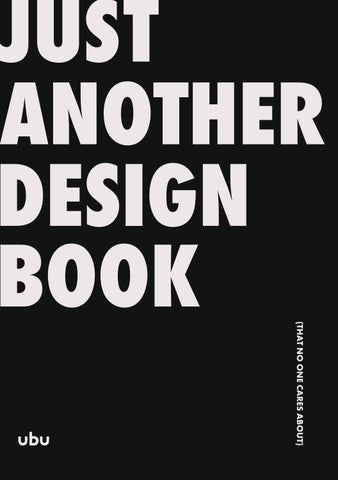
ABOUT)CARESONENO(THAT BOOKDESIGNANOTHERJUST
(THAT NO ONE CARES ABOUT)
BOOKDESIGNANOTHERJUST
BOOKDESIGNANOTHERJUST
(THAT NO ONE CARES ABOUT)
JÚLIA MARIACORDEIROCARMO
JUST ANOTHER DESIGN BOOK (THAT NO ONE CARES ABOUT)
Fontes: Futura PT, designed by ParaType Acumin, designed by Robert Slimbach
Ficha Técnica
Manifestos: First Things First 2000 Manifesto, escrito e publicado pela revista Adbusters in 1999
Maria Tavares Pinto Ferreira Carmo - 201904816 Editora Ubu
Free Font Manifesto, por Ellen Lupton
Dangerous Ideas on Design Education, por James ExemplarPorto,Maio1ªVictoreediçãode2020Portugalúnico digital
Maio de Faculdade2020deBelas Artes da Universidade do Porto Júlia Cordeiro Melo - 201902404
Índice First Things First Manifesto Ellen Lupton: Free Font Manifesto Dangerous Ideas on Design Education You can do it! - a Design Manifesto 42-5722-4114-216-13
FIRSTTHINGSFIRST
2000
FIRst thIngs FIRst 2000 8 JUST ANOTHER DESIGN BOOK
the undersigned, are graphic designers, art directors and visual communicators who have been raised in a world in which the techniques and apparatus of advertising have persistently been presented to us as the most lucrative, effective and desirable use of our talents. Many design teachers and mentors promote this belief; the market rewards it; a tide of books and publications reinforces it.
We,
FIRst thIngs FIRst 2000 9 JUST ANOTHER DESIGN BOOK
Encouraged in this direction, designers then apply their skill and imagination to sell dog biscuits, designer coffee, diamonds, detergents, hair gel, cigarettes, credit cards, sneakers, butt toners, light beer and heavy-duty recreational vehicles. Commercial work has always paid the bills, but many graphic designers have now let it become, in large measure, what graphic designers do. This, in turn, is how the world perceives design. The profession’s time and energy is used up manufacturing demand for things that are inessential at best.
Many of us have grown increasingly uncomfortable with this view of design. Designers who devote their efforts primarily to advertising, marketing and brand development are supporting, and implicitly endorsing, a mental environment so saturated with commercial messages that it is changing the very way citizenconsumers speak, think, feel, respond and interact. To some extent we are all helping draft a reductive and immeasurably harmful code of public discourse.
There are pursuits more worthy of our problemsolving skills.
FIRst thIngs FIRst 2000 10 JUST ANOTHER DESIGN BOOK
Unprecedented environmental, social and cultural crises demand our attention. Many cultural interventions, social marketing campaigns, books, magazines, exhibitions, educational tools, television programmes, films, charitable causes and other information design projects urgently require our expertise and help.
We propose a reversal of priorities in favour of more useful, lasting and democratic forms of communication - a mindshift away from product marketing and toward the exploration and production of a new kind of meaning. The scope of debate is shrinking; it must expand. Consumerism is running uncontested; it must be challenged by other perspectives expressed, in part, through the visual languages and resources of design.
In 1964, 22 visual communicators signed the original call for our skills to be put to worthwhile use. With the explosive growth of global commercial culture, their message has only grown more urgent. Today, we renew their manifesto in expectation that no more decades will pass before it is taken to heart.
FIRst thIngs FIRst 2000 11 JUST ANOTHER DESIGN BOOK
FIRst thIngs FIRst 2000 12 JUST ANOTHER DESIGN BOOK
The 2000 manifesto was signed by a group of 33 figures from the international graphic design community, many of them well known, and simultaneously published in Adbusters (Canada), Emigre (Issue 51) and AIGA Journal of Graphic Design (United States), Eye magazine no. 33 vol. 8, Autumn 1999 and Blueprint (Britain) and Items (Netherlands). The manifesto was subsequently published in many other magazines and books around the world, sometimes in translation. Its aim was to generate discussion about the graphic design profession’s priorities in the design press and at design schools.
The First Things First 2000 manifesto, written and launched by Adbusters magazine in 1999, was an updated version of the earlier First Things First manifesto written and published in 1964 by Ken Garland, a British designer.
about this piece:
FIRst thIngs FIRst 2000 13 JUST ANOTHER DESIGN BOOK
JessicaMiltonKenVinceSimonGertWilliamChrisLindaSiânMaxBrettevilleSheilaIrmaHansAndrewBellBlauveltBocktingBoomLevrantdeBruinsmaCookvanDeursenDixonDrenttelDumbarEstersonFrostGarlandGlaserHelfand Steven BobRudyTealJanErikLucienneRickJ.ArmandKatherineEllenZuzanaJefferyTiborAndrewHellerHowardKalmanKeedyLickoLuptonMcCoyMevisAbbottMillerPoynorRobertsSpiekermannvanToornTriggsVanderLansWilkinson
Jonathan Barnbrook Nick
FREEFONTMANIFESTO
MANIFESTOELLENLUPTON:
FREE FOnt MAnIFEstO 16 JUST ANOTHER DESIGN BOOK A small publictypefacesareandofgrowingbutnumberdesignersinstitutionscreatingforthedomain.
These designers are participating in the broader open source and copyleft movements, which seek to stimulate worldwide creativity via a collective information commons.
“This web page provides information and airs ideas about the concept of free fonts. Its annotated appearance reflects my conversations with type designers about the danger and necessity of free fonts.”
- Ellen Lupton
FREE FOnt MAnIFEstO 17 JUST ANOTHER DESIGN BOOK
A free font is not just a typeface that you don’t have to pay for. A stolen (or illegally copied) typeface isn’t free. A free font must be freely given by its maker. And to be truly free, it should be available to everyone, not just to a circle of friends or to the buyers of a particular software package or operating system. Many of the so-called free fonts that are distributed on the Internet don’t meet this description. Like open source software, the freedom of the fonts shown on this page is made explicit through their licensing, which allows other people to not only use the fonts but to modify them (granted that they change the name of the typeface if they alter its design).
What is a free font?
FREE FOnt MAnIFEstO 18 JUST ANOTHER DESIGN BOOK
FREE FOnt MAnIFEstO 19 JUST ANOTHER DESIGN BOOK
Should all fonts be free?
Typeface design is a profession and a business. If all fonts were free-or even if every type designer created just one free font-the business of typeface design might be destroyed. Today, the free font movement is addressing typeface needs that are not being adequately met by the typeface industry. Most typefaces created in the free font movement are designed to serve relatively small or underserved linguistic communities. They have an explicit social purpose, and they are intended to offer the world not a luxurious outpouring of typographic variation but rather the basics for maintaining literacy and communication within a society.
What makes a typeface “good”?
FREE FOnt MAnIFEstO 20 JUST ANOTHER DESIGN BOOK
Currently, most fonts created in the open source spirit are produced for small or underserved linguistic populations. Such fonts are “good” in the moral sense. In the future, designers may choose to make free fonts in the service of other social needs as well. For example, in developing countries graphic designers who seek to build a typographic culture in their home regions require more than a bare-minimum typographic vocabulary, and they often rely on pirated typefaces to do so. A richer selection of legitimate free fonts, clearly labelled and promoted as such in an educational way, might help to build respect for the larger commercial ecology of typeface design.
Perhaps the free font movement will continue to grow slowly, along the lines in which it is already taking shape: in the service of creating typefaces that sustain and encourage both the diversity and connectedness of humankind.
Is a typeface a meaningful gift to humanity?
FREE FOnt MAnIFEstO 21 JUST ANOTHER DESIGN BOOK
In the scheme of things, a typeface may seem like a small gift, so maybe designers and software companies should devote their charitable efforts to more urgent causes. However, I believe that typefaces are valuable, powerful, and beautiful cultural tools, worthy of legal protection and deserving of the price they bring in the Western marketplace. Moreover, a gift of typography makes good on a unique body of skill, knowledge, and passion.
EDUCATIONIDEASDANGEROUSONDESIGN
A MANIFESTO BY JAMES VICTORE
I learned to design the same way I learned to swear: I had to pick it up in the street.
DAngEROus IDEAs On DEsIgn EDuCAtIOn 24 JUST ANOTHER DESIGN BOOK
I failed out of a university and was asked to leave a design school. But as destiny would have it, I’ve spent the last 20 years teaching in the classroom, running my own workshops and lecturing around the world, and I’ve developed my own ideas about how to teach design, encourage creativity and even inspire creative courage.
I’m no expert on design education’s merits or faults; this treatise is more of an “If I were king of the forest” scenario. I have no scathing account of how design schools got it all wrong; there are islands of creativity out there, hothouses of experimentation, but education on the whole has become an industry (“20 years of schooling and they put you on the day shift,” as Bob Dylan said), and design education is no different. My own purpose in teaching design has always been to help shepherd strong, opinionated creative individuals capable of handling this tool. My job is to make it hard for my students, to set a high bar. I ask them to seek answers inside of themselves, then make the huge leap of faith to believe in those answers. In doing so, they learn not only that they will not die, but also to trust their intuition, their gut, in order to make new, unique, exciting work. My ideas are not for everyone, and I don’t care.
DAngEROus IDEAs On DEsIgn EDuCAtIOn 25 JUST ANOTHER DESIGN BOOK
DAngEROus IDEAs On DEsIgn EDuCAtIOn 26 JUST ANOTHER DESIGN BOOK
As a teacher, I’m a dreamer and an idealist. People follow dreamers and idealists. Our work demands these qualities from us because good work inspires us. When we see freedom in someone’s work, it frees us up; when we see intelligence in someone’s work, it makes us smarter; and when we see vulnerability in the work, we feel closer, more human. Many of my peers see this as dangerous—I am the fox in Pinocchio, leading the good little boys and girls off to a life in the circus. “But however will they find a JOB?!” they ask. When pushed to invite danger into their work, my students find something much better than a job—they learn to create their own place in this world. I want them to learn to embrace danger. Danger requires bravery. It requires us to risk everything, to do our best work, embrace failure and leave it all on the track.
Herein are a few dangerous ideas about design education.
Weird is good.
Students are attracted to design in the first place because they see the world in a different way, slightly askew. They are weird. Most of them have heard this many times in their lives—and it was not intended as a compliment. But Weird is good; it’s an anomaly and it’s unique. I teach on the simple premise that the things that made you weird as a kid make you great as an adult—but only if you pay attention to them. If you look at any “successful” person, they are probably being paid to play out the goofiness or athleticism or nerdiness or curiosity they already possessed as a child. Unfortunately for most people, somewhere along the road their weirdness was taught out of them or, worse, shamed out of them. Crushed by the need to “fit in,” they left their quirks and special powers behind. But it is our flaws that make us interesting. We need to not only hang on to them but hone them.
DAngEROus IDEAs On DEsIgn EDuCAtIOn 27 JUST ANOTHER DESIGN BOOK
I don’t try to make my students “Designers.” I want to make them “free-er.” It’s my job to teach them to look inside, to covet their weirdness, to help them direct it and take the rough edges off—or even add a few new ones. It’s my job to help students understand and cultivate their individuality and innate weirdness and turn them into a powerful tool. Weird is good, but only if we put it in your work.
Design is not math. This is what makes the work hard. There are no right answers and very few wrong answers. I’ve always thought of design more as an innate skill set that we are born with—a small ember waiting to be coaxed into a larger flame. What I see as problematic is when we teach design as if it is something outside of us. As if the students are in an assembly line holding empty shoe boxes, waiting for them to be filled with rules and theories and Photoshop. These tools are important, but they will only get you so far. I don’t believe design can be “taught”, but rather that it can be “reminded”. We need to remind students to use what they already have inside: their history, their loves, their fears.
DAngEROus IDEAs On DEsIgn EDuCAtIOn 28 JUST ANOTHER DESIGN BOOK
DAngEROus IDEAs On DEsIgn EDuCAtIOn 29 JUST ANOTHER DESIGN BOOK
We have to teach students how to use their brains, to make their senses of association and imagery sharp and flexible and urge them to seek their own way and express their individuality. We have to push them to think for themselves, form an opinion—and know that their opinions matter. Essentially, we have to “teach” them to be themselves and put it in their work. In my classroom, the first crit question is always, “What do YOU think?” A student’s explanation of her work may start, “When I was a kid, my dad took me to the beach, where we collected stones. …” Brilliant! This is relatable. When you do a good job of telling me your story, your fears, your loves, I see my story, my fears, my loves. Your particular story has meaning to a wider audience. So, I spur my students to look inside for answers, not to constantly look outside and drown in a sea of reference materials or look for regurgitated, ready-made answers.
They never have to make up a story. They have the story and need only look inside. This frees them from being in the peoplepleasing business—looking over their shoulders for a “popular” answer. Thus, they avoid the world’s worst question— “What do THEY want?”—and they understand that the far better question is, “What do I have to say?”
DAngEROus IDEAs On DEsIgn EDuCAtIOn 30 JUST ANOTHER DESIGN BOOK
Through this process they learn what others respond to in their work. This trains them to learn who their audience is. They learn that their audience is not me, nor the other students nor other designers, and certainly not onanist (look it up) design competitions. They learn that their job is not to try to appeal to everyone (a patently impossible task) but to tell THEIR story and find THEIR audience. Ultimately, they’ll make work that makes them happy, and they’ll get paid for it. The more we love what we do, the better off the field will be.
After I was asked to leave design school, I began interning for one of my professors, a prolific book jacket designer named Paul Bacon. Paul was a master letterer and could draw and paint like a genius. But what he taught me about was wine and auto racing and well-told jokes, and he inspired in me a love of jazz. With these passions and a few of my own, I realized that I had everything I needed to be a successful designer.
DAngEROus IDEAs On DEsIgn EDuCAtIOn 31 JUST ANOTHER DESIGN BOOK
Humans come before design.
DAngEROus IDEAs On DEsIgn EDuCAtIOn 32 JUST ANOTHER DESIGN BOOK
Most of my college students jumped straight out of high school into a design degree. Personally, I think this is crazy because (apologies …): You don’t know shit. As a teacher, I am searching for interesting, qualified people. In order to teach you to be a designer, I have to first ensure that you’re a compassionate, curious, intelligent being. I need to figure out if you have something to say, if you are talented, strong, smart and can handle the responsibility of access to the public. My best students have always been the ones who failed some other course of study or life choice—because they carry with them the fire of that experience. Their peripheral vision is stronger; they can pull from their outside sources, interests and experiences beyond graphic design. I believe in taking a wider view. I think we should encourage everything else, and then design.
… Fuck specialization in branding or advertising. Most branding is cookiecutter boring, made by specialists. The obsessive concern with the intricacies of any tiny branch of design proves a myopic point of view. You know a lot about a little. I understand the importance of learning the complex rules of typography, but it’s like hygiene— know about it, but don’t obsess over it. Specializing is something a student should learn or be drawn to on their own. What makes a good designer is how they think. My students’ interests in cartography or magic tricks or motorcycle repair makes them better, more interesting and stronger. The best designers are interesting people first. Smart, funny and curious. Learn everything. Then forget it. THEN design.
DAngEROus IDEAs On DEsIgn EDuCAtIOn 33 JUST ANOTHER DESIGN BOOK
Creativity can be killed.
Design is a commercial field, a business. Creativity and business do not always make the best fit. Creativity seeks the “New”—new tools, new ways of doing and seeing things. But new is not always welcome. In fact, “new” is generally accepted only after it’s been accepted. In any form, whether it’s fashion, music, culture, even product—“new” is seen as a threat to the status quo. Design is no different. Business is the opposite of creativity. Business wants tried-and-true. Business wants safety. Business would like to be creative, but only after the value of that creativity has been proven. Business likes to be in second place because first place is dangerous.
DAngEROus IDEAs On DEsIgn EDuCAtIOn 34 JUST ANOTHER DESIGN BOOK
DAngEROus IDEAs On DEsIgn EDuCAtIOn 35 JUST ANOTHER DESIGN BOOK
As educators we want to do our students a service, understanding that they’ll accrue debt and need to make a living. In order to make their parents happy and shield our young charges from financial failure, we teach to-the-business. We teach cowardice. In order to get a “job,” students are taught that goal No. 1 is “Please the Client.” Newly weighed down by the practicalities of making other people happy in order to get paid, students lose sight of themselves and the reason they started out on this path. We all know that “acceptable” is not good and will never be great. Hell, anyone can hold down a job. As Joseph Campbell put it, “I think the person who takes a job in order to live—that is to say, for the money—has turned himself into a slave.” I want students who have a vision and keep their eyes fixed on that goal to avoid getting waylaid along their path.
The problems start down the road. On my YouTube channel “Burning Questions,” we often find ourselves answering queries from mid-career designers who have lost their way, unsatisfied by the doldrums of creating color-corrected, acceptable work. They were conditioned to leave the “creative” part of the business out, and replace it with the merely “clever”—well-behaved little ideas that match the carpet and are so bland that they can pass through a focus group’s anus unscathed. Boring work that succeeds for the mere fact that it offends the fewest number of people.
DAngEROus IDEAs On DEsIgn EDuCAtIOn 36 JUST ANOTHER DESIGN BOOK
My first and main concern is to foster confident, creative individuals that the world cannot ignore. It’s my job to urge their spark into a flame—to make their worlds larger, not smaller. Larger means to see the potential of human-to-human communication, the power of images and words, the strength in their opinion and personal histories—the freedom from “making shit up.” Smaller means catering to the whims of a client or constantly seeking the approval of others, guessing what other people want.
DAngEROus IDEAs On DEsIgn EDuCAtIOn 37 JUST ANOTHER DESIGN BOOK
Of course I want my students to be extremely well-paid for their work, but what my students do with their flame, the commercial application, is their own damn business. Whether their highest esteem is to pay rent or to shoot for greatness is up to them. It is not the teacher’s role to preen students for cubicles and fluorescent lighting, but to prepare them for the longer road, to prepare them for careers 10 and 15 years down the road. In a field populated more and more by MBAs with color swatches, I push my students for creativity. I want to fill them up with a myriad of creative possibilities—not only the obvious and logical and marketable answers. As educators, we need to push for experimentation, risk and failure, not supply a safety net and easy access to a 401(k).
Know#01 that not all clients deserve your attention. Designers are Ask#02one-size-fits-all.notthequestions.
Why are we doing this? What are we contributing to the world?
DAngEROus IDEAs On DEsIgn EDuCAtIOn 38 JUST ANOTHER DESIGN BOOK
Here is a short list of a few “added bonus” ideas I like to impart on my students to help them on their path:
Have#03 boundaries. Be able to say NO and to never learn the taste of shit. Ask for More— more time, creativity and always more money.
Learn#04 about Enjoy#05management.moneyyourworkand the process. If you don’t enjoy it, how can you expect anyone else to?
DAngEROus IDEAs On DEsIgn EDuCAtIOn 39 JUST ANOTHER DESIGN BOOK
Your work is a gift.
DAngEROus IDEAs On DEsIgn EDuCAtIOn 40 JUST ANOTHER DESIGN BOOK
The highest ideal I can try to get my students to understand is that their work is a Gift. This is a truly dangerous idea. When your work is a Gift, it changes how you think about it. It changes why you work, what you make and even who you work for. When your work is a Gift, your goal is no longer to satisfy a boss or client—or even to gain a paycheck. You now work to make yourself happy, and in turn speak directly to your audience because you give them something of value: a piece of yourself. Designers should understand that this is how they will be paid best: to be themselves.
What I propose is a difficult and dangerous path, but then again, my ideas are not for everyone. Just the sexy people.
What motivates and excites the world is to witness one person, engaged, energized and empowered. This is the path to creativity. This is the way to great work. And ultimately, this is what makes us attractive to clients.
DAngEROus IDEAs On DEsIgn EDuCAtIOn 41 JUST ANOTHER DESIGN BOOK
YOU CAN DO IT! A DESIGN MANIFESTO
IT!CANJÚLIAMARIACORDEIROCARMO
YOu CAn DO It 44 JUST ANOTHER DESIGN BOOK We don’t really feel that we can design fearlessly (and we don’t know if we ever will), but here’s a few things that we’ve learned and thought would be interesting to share.
“The truth is: most designers don’t work alone. They’re part of teams or communities. They seek insight and knowledge from those folks with subject-matter expertise. You want your designer to redesign a complex healthcare service? Yep, they shouldn’t be doing that alone. It’s hard work – it’s about process and it’s about collaboration.”Johnny Rae-Evans, head of creative at Capgemini.
YOu CAn DO It 45 JUST ANOTHER DESIGN BOOK 1 2
“From the perspective of a graphic design educator, one of the biggest misconceptions my students have had about the design industry is that it’s 100 percent digital” says Rob Walker, Wakefield College lecturer. “It’s true that a great deal of design output is digital, however the path to getting the desired result can often be multidisciplinary.” Also don’t think that just because something’s digital manufactured, it was easier to make. Actually, a lot of the times it can be even harder than if it was done manually. Don’t be afraid to experiment as many materials and mediums as you can.
Not everything is all digital
The best design is conducted by a team
It’s common to think that creativity is something that you’re born with (as a divine gift) or that it just relies on sudden moments of inspiration. And that belief could not be more wrong. Creativity is, above all, a process. And, as every other process, it has to be taught. Some people are naturally more creative than others, indeed, but it doesn’t mean anything if you don’t know how to use it or work with it. Creativity is an acquired skill, that requires effort and practice. Anyone can learn and train their creativity.
Creativity can be taught
YOu CAn DO It 46 JUST ANOTHER DESIGN BOOK 3 4
Good design is not absolute
Design is wholly subjective and carries different opinions, personality and ideas. The decisions made during the creative process are subjective and so are neither right nor wrong. Design is as much about opinions as it is about following objective principles. Everything from choice of colour to typeface is made based on how it makes the designer feel or what they think it will make others feel. Ultimately design is about creating something that is just as functional as it is beautiful and fulfils the purpose that it was created for.
Efficiency is more important than aesthetics
A strong and purposeful hierarchy is a pretty powerful tool. Within the realm of design, hierarchy concerns the arrangement of visual elements in order to signify importance. So, the more important elements are made to hold the most attention through scale, color, type, etc, and the least important elements are made to hold less attention.
Have a hierarchymeaningful
YOu CAn DO It 47 JUST ANOTHER DESIGN BOOK 5 6
Efficiency as a vital part of the work. It helps you to promulgate your message as best as you can. The primary purpose of design is communication, so it makes sense that the readability and legibility of your type is a top priority.
Use your grids
YOu CAn DO It 48 JUST ANOTHER DESIGN BOOK 7 8
Grids come in many shapes and sizes and you can build them to be flexible, adaptable and to suit your design. Grids help designers align elements on the page in relation to each other which often produces a neater, more logical design. Developing some basic grid skills is probably one of the first steps any fledgling designer should undertake. A wellimplemented grid is a bit like a fairy godmother, it can transform your design from something average to something clean, clear and effective.
Know your audience
Most designs start out with a brief; even if it’s a personal project, a designer will often (consciously or subconsciously) brief themselves with the basic information. One of the more important elements of a brief is the question “who am I designing for?”. Every design has an intended audience, the people that will be viewing the design and receiving the communication, so it makes sense to keep them in mind.
Define the problem correctly in order to achieve
an accurate solution:
White space is an important part of the design
White space is one of those diverse and effective tools that can add something special to your design. Well used white space can have many beneficial effects for your design. It can help put more focus on a specific aspect of your composition, it can let your design ‘breathe’, it can help balance out your elements or it can add some sophistication to your design. Another thing that white space can do is add meaning to your design without adding in another physical element.
The first step in conceptual design is to clearly understand and define the problem to be solved. The information needs of the organization are to be identified and understood in this step, which can be determined by understanding the mission, objectives and operating plans for the business.
YOu CAn DO It 49 JUST ANOTHER DESIGN BOOK 9 10
Mind the gap
YOu CAn DO It 50 JUST ANOTHER DESIGN BOOK 11
Many people who go into some form of creative work do so in part because they have good taste. You’re able to judge quality in the creative discipline(s) you choose to pursue. Unfortunately, early on there’s a gap between what you know to be good and what your skills allow you to create. When you look at your finished work you know it isn’t good. It tries to be good and has potential to be good, but it’s lacking something that truly makes it good. What’s happening is your taste and ability to judge quality is ahead of your skills to create quality, which opens a gap leading to disappointment in your own work. Most all creative people go through years of this gap where taste is more developed than skill. Unfortunately, many quit before they reach the point where skills catch up to taste. The best thing you can do to close the gap is a lot of work. Keep doing more projects. Create as much as you can to gain the experience you need. As you create more work, you’ll inevitably close the gap. Your skill will catch up with your taste if you keep at it. I think there’s more to the story.
The gap is more than one between taste and skill. It exists between theory and practice. Both theory and practice are important parts of learning. At any point in our careers we can open the gap by taking in more theory. We learn design principles. We study how to communicate visually to greater effect. More practice then closes the gap again. Theory expands what you’re capable of achieving and practice actually achieves it. Practice alone won’t take you past theory. No matter how much you practice you aren’t going to create a gap where skill outstrips knowledge. To continue improving we need to consistently open and close the gap. Ideally, you’ll always be both learning new theory and practicing the theory you’ve learned so the gaps you ultimately open and close don’t need to be very large. In fact, you may never notice them once you’ve reached a certain point. Opening the gap sets the new baseline you can reach. Closing the gap reaches the baseline.
This gap you feel is normal, and it can be used to improve
YOu CAn DO It 51 JUST ANOTHER DESIGN BOOK 12
Don’t let fear block you, failing is part of the process
As people, we are filled by a collection of desires, experiences, likes and dislikes that manifest into our sense of that which we want and that which we don’t. However, this collection may feel like a maze of constant unknowing at times. When we are lost in this labyrinth,
Clarity and consistency in our life reflects in our work as well
YOu CAn DO It 52 JUST ANOTHER DESIGN BOOK 13 14
Anxiety, discouragement, and overly thinking plagues our minds when we move into avoidance from the discomfort we feel sometimes about creating something new. If we take action to step into it wholeheartedly, knowing we will either fail (which never feels good, but is so temporary) and learn a lesson or we will fly and yield abundance.
YOu CAn DO It 53 JUST ANOTHER DESIGN BOOK
our thinking becomes discombobulated to the point where we cannot even articulate that we want or need in the moment. A lack of clarity leads to sensations of being overwhelmed and anxiety that create this underlying feeling of inadequacy, so we don’t impact or change ourselves. Clarity is a form of insight that the mind and body needs in order to flourish in the present. It’s okay not to know all the answers and to not know entirely who you are because our entire life is an evolution of self-actualization. The first step to clarity is grounding, or the rooting into the present moment. Direct your attention to your vitality. Journaling or creating lists are excellent ways to see how you feel and what you want. Dissect this list and then take action to move into those things you desire or need in your life. It is not always easy to remain accountable to the things we love and the things that serve us. However, if we neglect our self-care, the repercussions could wreck our health and our peace. We cannot serve an empty vessel. Routine and structure generate the conduit to show up for ourselves and others. Consistency in our wellness is imperative. Without the maintenance, imbalance will surface once again.
54 Just AnOthER DEsIgn BOOKYOu CAn DO It
No one knows everything about design, and no one should ever think that they do, because it’s impossible (so don’t worry). If you keep on working and practicing for your improvement, embracing your failures, not overthinking things, creating stuff that comes from your heart and soul and focusing on your passion, then you’re on the right path. And, in that path, every bump is key to your personal growth.
55 Just AnOthER DEsIgn BOOKYOu CAn DO It
6 Common Misconceptions about the Design Industry misconceptionscreativebloq.com/features/design-industry-
Conceptual Design of a System systemvarious-steps-involved-in-the-conceptual-design-of-a-meant-by-the-conceptual-design-of-mis-discuss-ecomputernotes.com/mis/system-design/what-is-
YOu CAn DO It 56 JUST ANOTHER DESIGN BOOK
A quote of Ira Glass: nobody-tells-this-to-people-who-are-beginners-i-wishgoodreads.com/quotes/309485-
References for this chapter
20 design rules you should never break canva.com/learn/design-rules/
The Innate Design: Implementing Self-Healing Techniques for the Modern Patient shorturl.at/xyKOW
YOu CAn DO It 57 JUST ANOTHER DESIGN BOOK
How To Create Designs You Know To Be Good vanseodesign.com/web-design/taste-skill-gap/
5 Common Misconceptions about Design Global Brand design/discoverglobal.co.uk/5-common-misconceptions-about-
This book was produced for the Typography subject at the Faculty of Fine Arts of the University of Porto in May 2020.
This book contains four design manifestos. Enjoy. Hope it helps you.
BOOKDESIGNANOTHERJUST