CONDITIONS OF SALE
All items are in good antiquarian condition unless otherwise noted and are offered subject to prior sale, with prices net and subject to change without notice. The costs of shipping and insurance are additional Orders are customarily shipped via USPS Priority Mail or Federal Express. Sales tax will be added to the invoices of NewYork State residents.
Orders may be placed by e-mail (info@lubranomusic.com), telephone (516-922-2192), or on our secure website (www.lubranomusic.com) by entering the ID number of the desired item in the SEARCH box at the upper right of our homepage.We ask that you kindly wait to receive ourinvoice to ensure availability before remitting payment. Libraries may receive deferred billing upon request.
We accept payment by:
-ACH (Automated Clearing House), inclusive of all bank charges
- EFT (Electronic Funds Transfer), inclusive of all bank charges
- PayPal to info@lubranomusic.com
- Checks in U.S. dollars drawn on a U.S. bank
- International money order
- Credit card
We fully guarantee that all items offered for sale by J & J LubranoMusicAntiquarians LLC are absolutely authentic without time limitation to the original purchaser provided that said items conform exactly to our description as supplied at time of purchase.All items remain the property of J & J Lubrano MusicAntiquarians LLC until paid for in full.
Please visit our website at www.lubranomusic.com
where you will find full descriptions and illustrations of our catalogued inventory
Members
Antiquarian Booksellers’Association ofAmerica
International League ofAntiquarian Booksellers
ProfessionalAutograph Dealers’Association
Music LibraryAssociation
American Musicological Society
Dance StudiesAssociation &c.
Cataloguers
John Lubrano, Jude Lubrano, Benjamin Katz
© J & J Lubrano MusicAntiquarians LLC December 2025
Composer of the Beautiful Miserere
1. ALLEGRI, Gregorio 1582-1652
Portrait etching. 1711.
Image size to platemark 122 x 83; sheet size 131 x 93 mm. Long bust-length image of the composer holding a sheet of music of his noted Miserere with his left hand within a rectangular border with three lines of biographical text to cartouche below and "Fortunato Santini Rom. fece incidere" under image. Very slightly worn, foxed, and stained; verso with dates in ink to lower margin and minor remnant of mounting tape to upper margin.
British Museumnumber1944,1014.455. Kinsky p. 162, no. 5.
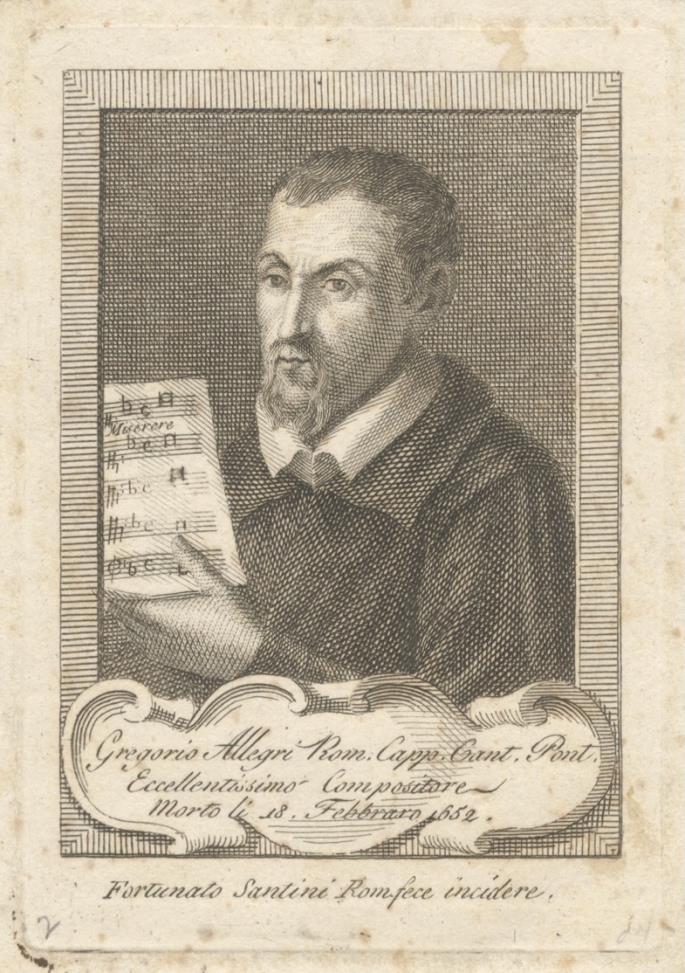
Allegri was an Italian composer and singer whose "fame stems largely from his Miserere, a setting of Psalm li, which, up until 1870, was traditionally sung by the papal choir during the Tenebrae Offices of Holy Week. ... [His] best music is in the a cappella style, much of it for two choirs: it was copied and recopied into Cappella Sistina manuscripts for at least a century. A fine example is the six-part Missa ‘Vidi turbam magnam’; based on his own motet it shows that the stile antico, far from being insipid, could be the vehicle for superbly controlled sonority and counterpoint, using syncopation to lead to a climax and with a bass line entirely harmonic in function." Jerome Roche, revised by Noel O’Regan in Grove Music Online. (41167) $250
2. BERG, Alban 1885-1935
Georg Büchners Wozzeck Oper in 3 Akten (15 Szenen) ... Op. 7. Klavierauszug von Fritz Heinrich Klein. Eigentum des Komponisten. [Piano-vocal score].
[Vienna]: [Privately published by the composer] [PN AB4], [1922].
Folio. Half dark brown pebbled cloth with marbled boards, original publisher's light green printed wrapper printed in dark green laid down to upper. 1f. (recto title, verso blank), 1f. (recto facsimile dedication to Alma Mahler, verso blank), [i] ("Szenarium"), [i] ("Besetzung des Orchesters"), [i] ("Personen"), [i] (performance notes, instructions for performing Sprechstimme), [9]-231, [i] ("Gestochen und gedruckt von der WaldheimEberle A. G. Wien") pp. With occasional annotations in pencil (pp. 189 and 227), possibly in Polnauer's hand. Binding slightly worn, rubbed, and bumped. Minor internal wear and soiling.
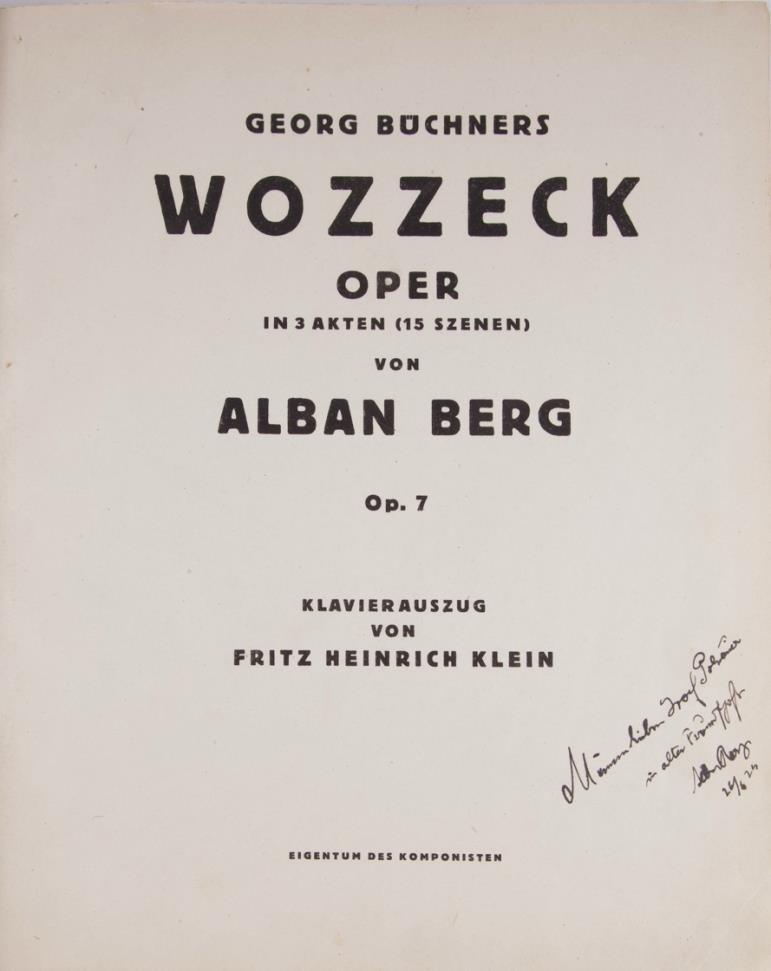
With Berg's autograph dedication signed in full to blank lower outer portion of title "Mein lieben Josef Polnauer in alten Freundschaft Alban Berg 26/6/2[?4]."
First Edition, first issue. Plate number B4 to p. 182. Crawford p. 42. Alban Berg Studies Band 1, Katalog der Musikhandschriften, p. 23 (the composer's corrected copy).
First performed in December 1922.
The arranger of the present edition, Fritz Heinrich Klein (1892-1977), was a student of Berg. The publication of the piano-vocal score was made possible by the financial support of Alma Mahler; hence, the dedication.
Georg Büchner's (1813-1837) fragmentary drama Woyzeck was written in 1836, but remained unpublished until 1879 and did not see the stage before Max Reinhardt produced it in Munich in 1913. Its Viennese premiere, in 1914, prompted Berg to compose his opera - the first atonal opera in history.
"Wozzeck was an epoch-making work that broke new ground musically, emotionally and dramatically. If Büchner's play was discovered and first performed at a time when its techniques and concerns seemed strikingly contemporary, it also appeared at a moment when its extreme states were peculiarly suited to Berg’s musical language – an atonal language that, constantly hovering on the edge of tonal confirmation, becomes a perfect musical metaphor for the emotional and mental state of the opera's chief protagonist. The world that the opera presents is a projection of the tortured mind of Wozzeck himself: a world without normality or humanity and
peopled by grotesques, a haunted world of strange, hallucinatory voices and visions and of natural phenomena indifferent to the human tragedy being played out." Douglas Jarman in Grove Music Online
Polnauer (1888-1969), a noted Viennesemusicologist, studied with both Berg andSchoenberg. Osterreichisches Musiklexikon Online
A significant association copy of what is arguably one of the greatest operas composed in the 20th century (40975)
$8,000
18th Century Portrait of this Composer, Harpsichordist, and Teacher
3. BERNIER, Nicolas 1664-1734
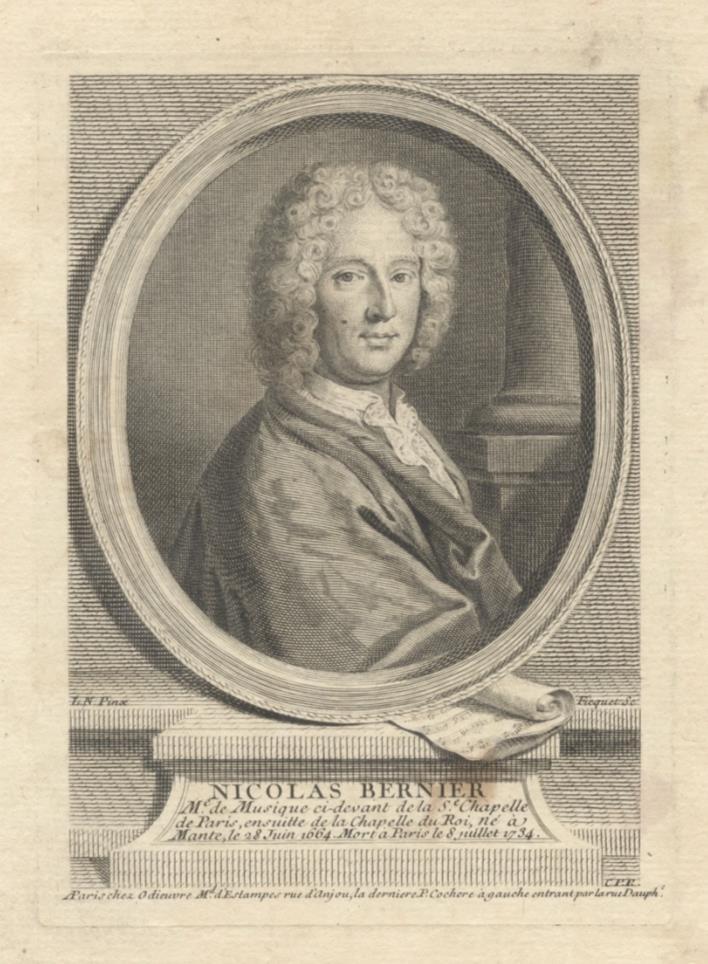
Portrait etching and engraving by Étienne Figuet (1731-1791) after "L.N." Paris: n.p., [1755-1765].
Image size to platemark 153 x 110 mm; sheet size 200x150mm. Thecomposeris depicted bust-length within an oval border by Pierre Edme Babel with a leaf of partially rolled music manuscript resting on a plinth. With 4 lines of biographical text to cartouche below. Extracted from Jean Françoix Dreux du Radier’s L'Europe Illustré published in Paris by Odieuvre & Breton, with "A Paris chez Odieuvre Md. d'Éstampes rue d'Anjou, la derniere P. Cochere à gauche entrant par la rue Dauphe" below image. Very slightly worn, browned, and stained; upper corners of verso slightly abraded with small tear to blank upper left corner repaired witharchival tape.
Reprint by Michel Odieuvre (1687-1756), French painter, dealer, and publisher of prints. British Museum number 1914,0228.2131 (variant, without "Babel invenit et Sculpsit" to foot). See Kinsky p. 220, no. 3.
Bernier was a French composer, harpsichordist, theorist and teacher. "[He] offered a personal solution to the union of French and Italian tastes. He achieved equilibrium between the two styles in his first book of French cantatas, a genre of which he was one of the first creators together with Jean-Baptiste Morin. ... Most of his Principes de composition is devoted to two-part counterpoint; the work resembles the treatises of Nivers and Masson." Jean-Paul Montagnier in Grove Music Online. (41166) $250
“A
Personal Solution to the Union of French and Italian Tastes”
4. BERNIER, Nicolas 1665-1734
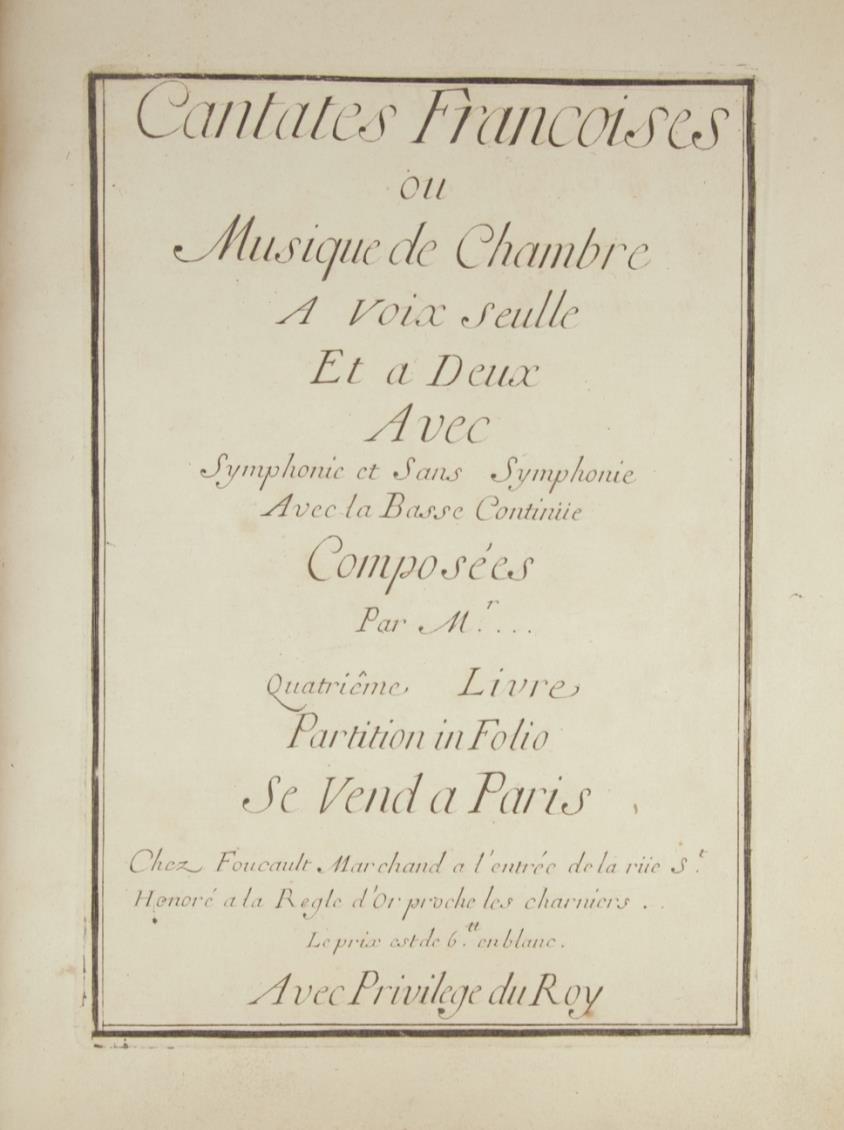
Cantates Francoises ou Musique de Chambre a Voix Seulle et a deux Avec Symphonie et Sans Symphonie avec la Basse Continüe ... Quatriême Livre Partition in Folio ... Le Prix est de 6₶ en blanc
Paris: Chez Foucault Marchand a l'entrée de la rüe St. Honoré a la Regle d'Or proche les charniers. ... Avec Privilege du Roy, [1703].
Folio. Full contemporary dark tan mottled calf with raised bands on spine in decorative compartments gilt, dark red leather title label gilt, marbled edges and endpapers. 1f. (recto title, verso "Table des Cantates et des Airs"), 125, [i] (blank) pp., with privilege to lower portion of final page of music. "Vanburleck D. B. Sculpsit" to foot of final page below privilege. Engraved. With original blue silk ribbon marker. Small circular handstamp in red ink to recto of rear free endpaper "Ex Libris Adrian Rose" with pencilled "7" in manuscript. Binding slightly worn, rubbed, and bumped; minor loss to edges; front hinge partially cracked. Very minor internal wear; light uniform browning; occasional small stains and soiling.
Cantatas include L'Amour Sans Esperance; L'Inconstant fidelle; Les Jardins de Sçeaux; Medée; Bachus; and Jupiter et Europe.
First Edition. Lesure p. 45. RISM B2103 (1 copy only in the U.S., at the Library of Congress).
"The eighteenth-century French cantata differs from its German and Italian counterparts both in its subject matter (which is nearly exclusively secular) and in the artistic means it applies. It is therefore distinguished in music history as the cantate française. It features a clear-cut division into the Italian-type aria or the more French-style arietta, the French recitative, and, in later years, also a large-scale instrumental ritornello. The cantatas were originally written for solo voice (usually a soprano), more rarely for two or three voices with basso continuo. These works were strongly influenced by their poetic model, which made composers search for a sound language adequate to the new poetic discourse; it also increased the awareness of the relations between words and music. Since allegory and the subject’s emotions are key elements of these music works, rhetoric plays an important role in them and is present in all the musical parameters." Malgorzata Gambrat: JeanBaptiste Rosseau's poetic cantatas and their place in the culture of France. A preliminary study in Roczniki Humanistyczne Tom LXIX, zeszyt 12 – 2021, p. 234.
Bernier was a French composer, harpsichordist, theorist and teacher. "[He] offered a personal solution to the union of French and Italian tastes. He achieved equilibrium between the two styles in his first book of French cantatas, a genre of which he was one of the first creators together with Jean-Baptiste Morin. Vigorous recitatives and da capo airs, with or without an initial motto, follow each other freely, while the expressive melody, with few wide intervals or long melismas, is rooted more in the French tradition. ... The 45 petits motets, the 36 grands motets and the 39 cantatas exhibit a stylistic feature peculiar to Bernier: the often systematic repetition of a motif, whether or not it is transposed." Jean-Paul Montagnier in Grove Music Online
"Bernier succeeded Marc-Antoine Charpentier as "maitre de musique" at the Sainte-Chapelle in Paris in 1704. In 1723, with Campra and Gervais, he succeeded Lalande in the position of "sous-maitre" at the King's chapel. "Bernier's known output encompasses a wide range of sacred music; he is one of the few leading French composers of his time who did not compose for the stage." TNG Vol. 2, p. 627. (40577) $2,200
With the Autograph Signature of the Composer
5. CHAMINADE, Cécile 1857-1944
Callirhoë Ballet Symphonique de Elzéard Rougier
Danses réglées par Victor Natta ... Partition Piano seul réduit par l'Auteur Prix net : 10 Fr. [Piano reduction].
Paris: Enoch Frères & Costallat ... 27, Bould. des Italiens [PN no. E.F. & C.1505], ca. 1888.
Quarto. Quarter dark tan leather with sepia cloth boards, raisedbands on spine with titlinggilt, marbled endpapers 1f. (recto title within ornate architectural border printed in sepia, verso blank), 1f. (recto "Personnages .... Table des Morceaux ... Divertissement," verso blank), 99, [i](blank)pp. With ten blank leaves of graph paper following title, a reproduction photograph of Chaminade at the piano laid down to first leaf. Slightly worn; uniform light browning; upper outer corners slightly creased; tape repair to final two pages; title leaf slightly trimmed at upper margin, affecting upper portion of letters of dedicatee's name.
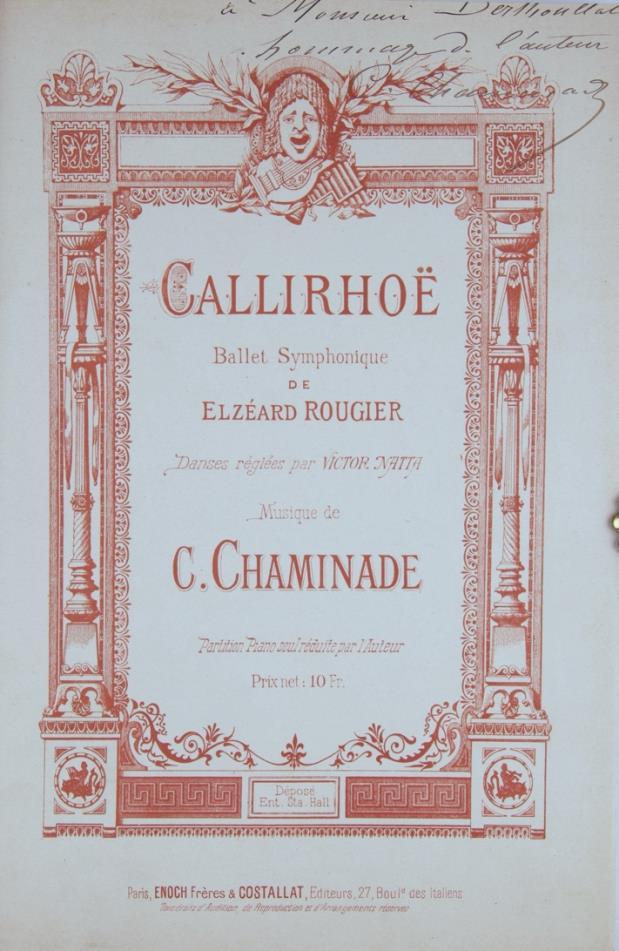
With composer's autograph dedication signed to head of title: "à Monsieur Bethoullat, homage de l'auteur, C. Chaminade."
First Edition. OCLC 21823758, 497288440, 631354862.
Chaminade was a noted French composer and pianist. "While it is striking that nearly all of [her] approximately 400 compositions were published, even more striking is the sharp decline in her reputation as the 20th century progressed. This is partly attributable to modernism and a general disparagement of late Romantic French music, but it is also due to the socio-aesthetic conditions affecting women and their music. ... She essayed an opéra comique, La Sévillane, which had a private performance (23 February 1882). Other major works of the decade were the ballet symphonique Callirhoë op. 37, performed at Marseilles on 16 March 1888. ... From 1892 she performed regularly in England and became a welcome guest of Queen Victoria and others. ... Meanwhile, enthusiasm grew in the USA, largely through the many Chaminade clubs formed around 1900, and in autumn 1908 she finally agreed to make the arduous journey there. She appeared in 12 cities, from Boston to St. Louis. With the exception of the concert at Philadelphia’s Academy of Music in early November, which featured the Concertstück, the programme consisted of piano pieces and mélodies." Marcia J. Citron in Grove Music Online (40619) $275
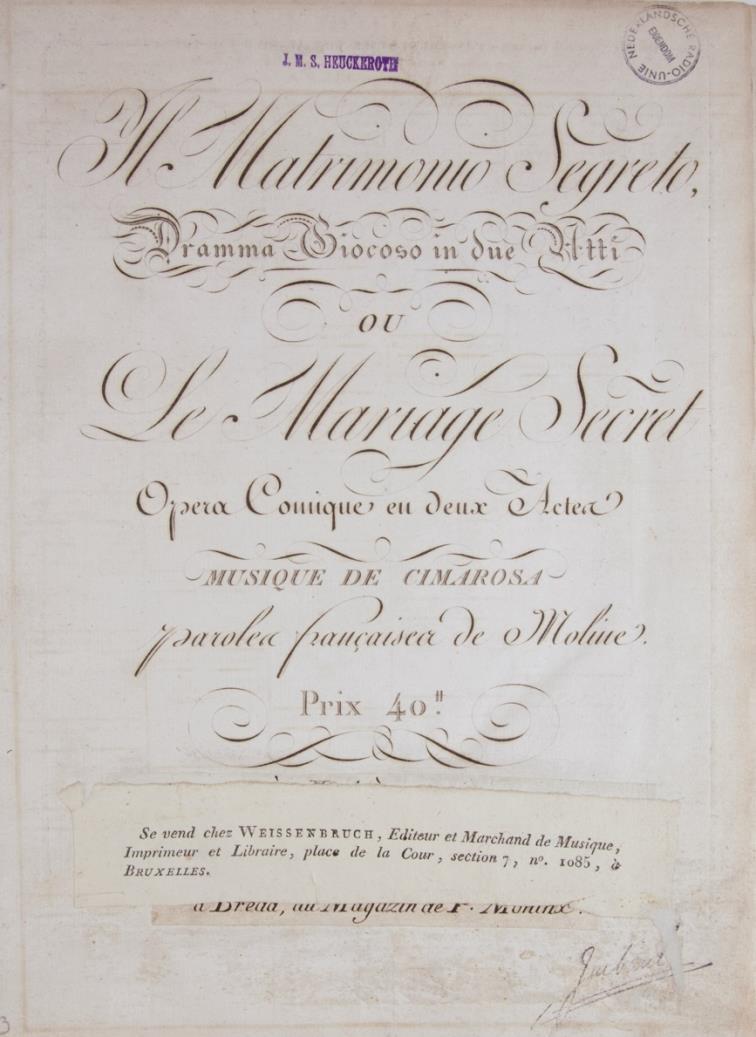
First Edition, Ex Libris Noted Dutch Musician and Conductor Heuckeroth
6. CIMAROSA, Domenico 1749-1801
Il Matrimonio Segreto. Dramma Giocoso in due Atti ou Le Mariage Secret Opera Comique en deux Actes ... paroles francaises de Moline. Prix 40₶. [Full score].
Paris: Imbault [PN 738], 1801 or 1802.
2 volumes. Folio. Half contemporary ivory vellum with teal blue marbled boards, decorative cut paper labels titled in manuscript to uppers. Act I: [i] (title), [iv] ("Catalogue de Musique Vocale et Instrumentale mise au jour par Imbault" ), [i] (table of contents), 259, [i] (blank) pp.; Act II: [i] (blank), 260-492 pp. Text in Italian and French. Overpaste "Se vend chez Weissenbruch, Editeur et Marchand de Musique, Imprimeur et Libraire, place de la Cour, section 7, no. 1085, à Bruxelles" to title of Act I and first blank page of Act II. Publisher's facsimile signature handstamp "Imbault" to lower outer corner of title; "142" in contemporary manuscript to blank outer margin of p. 335. Bindings worn, rubbed, and bumped. Occasional wear, light soiling, foxing, and small stains, mostly
marginal; some light dampstaining, heavier to final leaves of both volumes; a few signatures partially detached; small binder's hole to blank inner margins. Quite a good copy.
Provenance
Jacob Martain Severinus Heuckeroth, prominent Dutch musician and conductor (1853 to 1936), with his handstamp ("J.M.S. Heuckeroth") to title label, title, and final page of music; handstamp of the "Nederlandsche Radio-Unie Eigendom" title label, free front endpaper, and title.
First Edition. Sonneck: Dramatic Music, p. 88. BUC p. 191. Hirsch II, 137. RISM C2304 (4 copies in the U.S.).
In two acts to a libretto by Giovanni Bertati after George Colman the elder and David Garrick’s play The Clandestine Marriage, Il Matrimonio Segreto was first performed in Vienna at the Burgtheater on 7 February 1792.
"Cimarosa was always able to write music suffused with lightness, elegance and finesse. ... One of [his] strengths was the composition of witty and vivacious ensembles. Il matrimonio segreto, an ensemble opera in the style of Mozart’s Le nozze di Figaro, is composed of eight arias, four duets, three trios, a quartet, a quintet and two finales featuring all six characters. Frequently his operas begin with a trio or a quartet, and he excelled at creating large-scale chain finales. Although Cimarosa’s characters do not display layers of Mozartian complexity, he was capable of depicting human emotions in a touching but not over-sentimental manner, as in the opening duet ‘Cara non dubitar’ from Il matrimonio segreto." Jennifer E. Johnson and Gordana Lazarevich in Grove Music Online (40438) $1,450
Early 18th Century Cantatas in First Edition Ex Libris Geneviève Thibault, Comtesse de Chambure
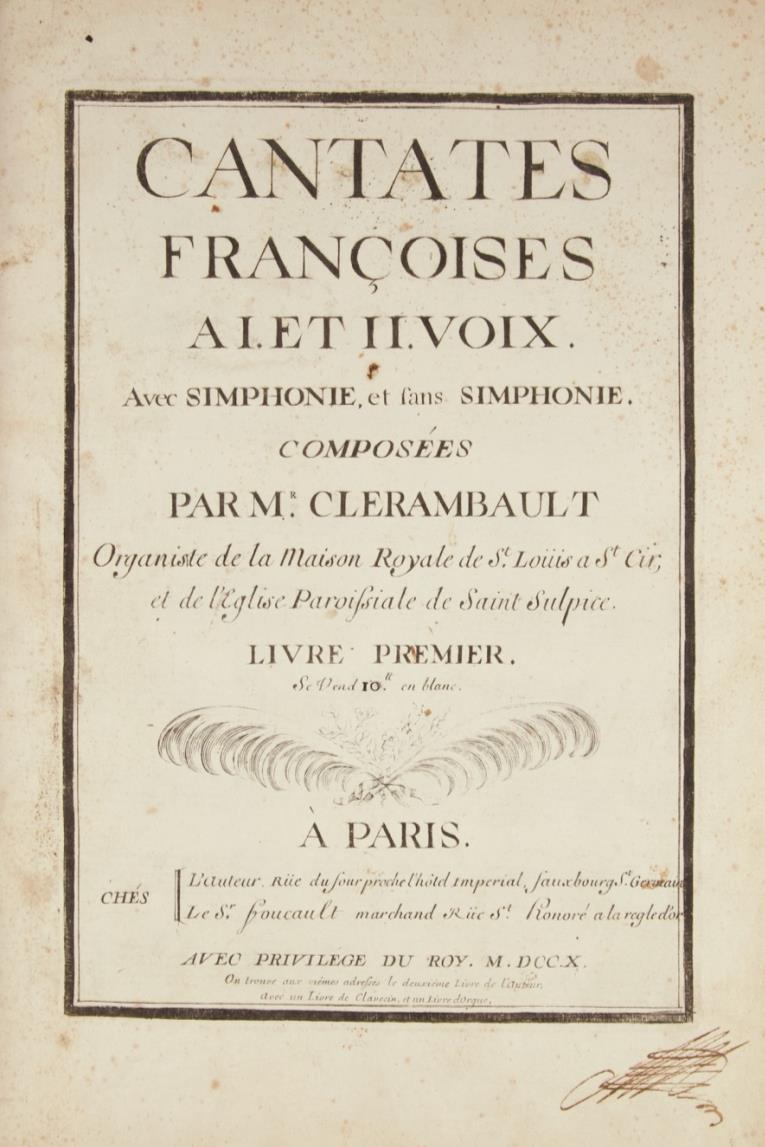
7. CLERAMBAULT, Louis-Nicolas 1676-1749
Cantates Francoises a I. et II. Voix. Avec Simphonie, et sans Simphonie. Composée par Mr. Clerambault Organiste de la Maison Royale de St. Loüis a St. Cir, et de l'Eglise Paroissiale de Saint-Sulpice. Livre Premier [-IIéme]. Se Vend [10]₶ en blanc. [Score].
Paris: Chés L'Auteur, Rüe du four proche l'hôtel Imperial, Fauxbourg St. Germain. Le Sr. Foucault marchand Rüe St. Honoré a la regle d'or. Avec Privilege du Roy ..., 1710.
2 volumes. Folio. Full contemporary mid-tan calf with raised bands on spine in decorative compartments gilt. Music in diamond-head notation. Engraved throughout. Bindings worn, rubbed, and bumped; hinges cracked; free rear endpaper to Livre IIlacking; pastedowns with remnants of red sealing wax. Some internal wear, foxing, soiling, staining, dampstaining, and small tears, mainly to blank margins, more pronounced to Livre I
Livre I: 1f. (recto title, verso blank), 104 pp. With "Table des Cantates" to foot of final page including L'Amour Piqué; Le Jaloux; Orphée; Poliphême; Medée; and L'Amour et Baccus.
Livre II: Cantatas Françoises Mellées de Simphonies Dediées a Son Altesse Electoralle Monseigneur Le Due de Baviere. ,M. Livre IIéme. ... Prix [10]tt. en blanc. Paris:L'Autheur... Foucault, 1713. 1f. (rectotitle, versoblank), 1f. (dedication), 123, [i](privilege)pp.With"TabledesCantates"tofootoffinalpageofmusicincluding Alphée, et Arethuse; Leandre, et Hero; La Musette; Pirame, et Tisbé; Pigmalion, and Le Triomphe de la Paix.
Control paraphs to blank lower outer corner of each title, possibly in the hand of the composer
Provenance
Noted musicologist and collector Geneviève Thibault, Comtesse de Chambure (1902-1975), with her small engraved armorial bookplate incorporating a crown, a standing bear, a lion, and three crested birds to front pastedown. With "choix l'aimée" to front free endpaper of Livre I (cancelled) in contemporary manuscript, and "Melle. Choix l'aimée" to front endpaper of Livre II.
First Editions, early issues of both volumes, with Leclair in the imprint, but with price amended to 10₶. Lesure p. 126. RISM C3163 (Livre I) and C3168 (Livre II).
"[Clerambault] was widely regarded as one of France’s finest organists, while as a composer of French cantatas his reputation soared beyond all others. ...
It was in his cantatas that Clérambault’s most fruitful union of French and Italian styles was achieved. The French cantata as a characteristic 18th-century form had been established only a few years before the appearance of Clérambault’s first volume of Cantates françoises à I. et II. voix avec simphonie et sans simphonie (1710); in the cantatas of Morin, Bernier, Stuck and Campra were to be found the essentials of the form to which
Clérambault gave the stamp of real individuality. His cantata Orphée, for high voice, violin, flute and continuo, in this first volume, shows what heights of eloquence could be reached when Gallic lyricism was infused with italianate warmth and brilliance, qualities which Clérambault was able to bring together in a wholly convincing and natural way, for like Rameau he absorbed the foreign techniques into a personal style. He published 25 cantatas, 20 of which are found in five volumes appearing from 1710 to 1726. As well as intense and dramatic cantatas like Orphée, Le jaloux and Médée, there are simple and charming ones like L’Amour piqué par une abeille and La musette; within each cantata there is also considerable variety." David Tunley in Grove Music Online. (40440)
Early 19th Century Manuscript of the Duo for Two Pianos, Op. 24
8. CRAMER, Johann Baptist 17711858
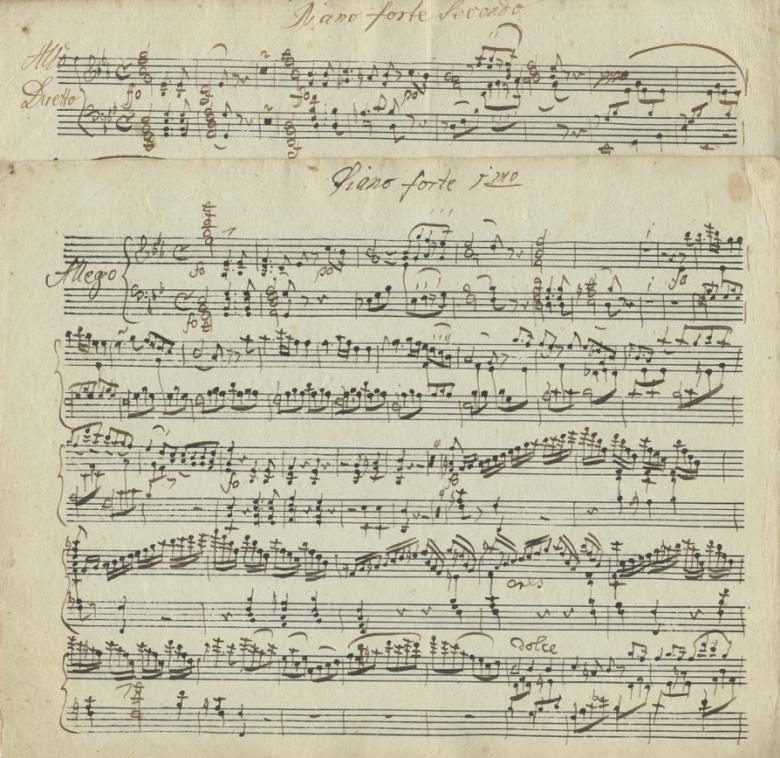
Grand Duo pour Deux Forte Piano [Op. 24]. [Copyist manuscript]. Italy, ca. 1805.
Oblong folio (241 x 332 mm). Sewn. Notated on 10-stave rastrum-ruled paper. Watermark 3 large half moons. With "Sabbadini" to the head of each title, possibly that of Italian composer and theorist Luigi Antonio Sabbatini (?1732-1809). Slightly worn, soiled, and stained; some minor abrasions.
Pianoforte p[rim]o: [i] (title), 15 pp.
Pianoforte secondo: [i] (title), 15 pp.
Milligan: Johann Baptist Cramer ... A Thematic Catalogue of His Works, p. 89. Clementi's 1801 London edition was followed soon after by editions in Paris (Sieber, Nadermann, and Erard) and Vienna (Cappi).
$3,800
Cramer, a German composer, pianist, and publisher "was the most outstanding member of the family. As one of the most renowned piano performers of his day, he contributed directly to the formulation of an idiomatic piano style through his playing and his compositions. ... There is some evidence that Beethoven occasionally borrowed from Cramer’s sonatas, and Schumann considered Cramer and Moscheles the only outstanding sonata composers of their generation." Jerald C. Graue, revised by Thomas Milligan in Grove Music Online (40344)
$250
Provenance
Ex Libris Christopher Hogwood
9. DANDRIEU, Jean-François 1681/16821738
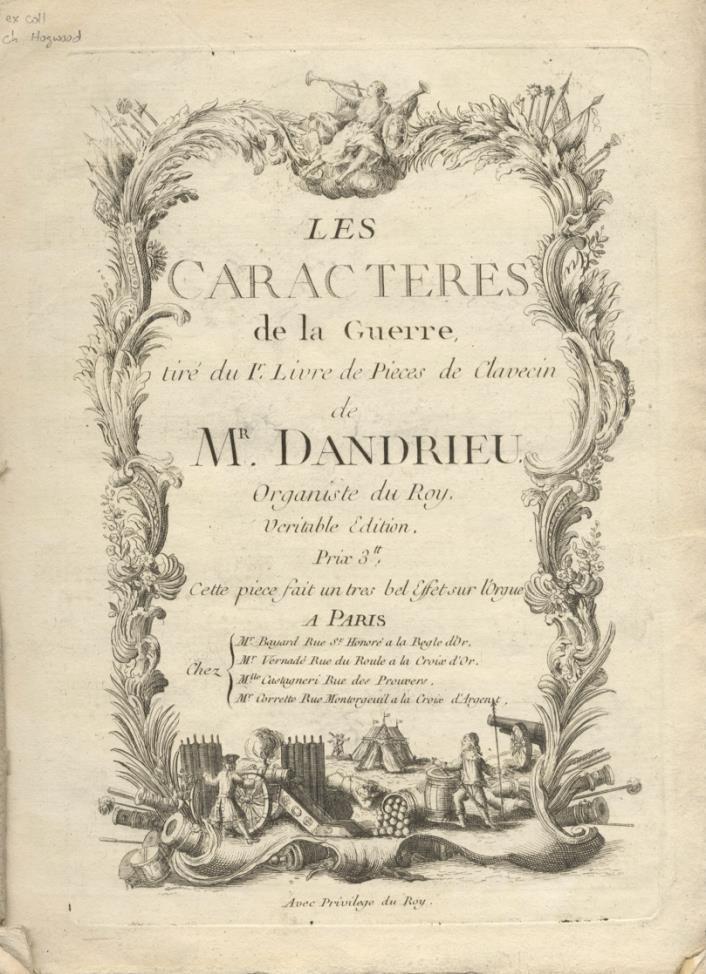
Les Caracteres de la Guerre tiré du 1r. Livre de Pieces de Clavecin de Mr. Dandrieu Organiste du Roy Veritable Edition. Prix 3₶. Cette piece fait un tres bel Effet sur l’Orgue.
Paris: Chez Mr. Bayard Rue St. Honoré a la Regle d'Or. Mr. Vernadé Rue du Roule a la Croix d'Or. Mlle. Castagneri Rue des Prouvers. Mr. Corrette Rue Montorgeuil a la Croix d'Argent. Avec Privilege du Roy, [1738].
Folio. Early plain wrappers. [i] (recto title within decorative border), 10-19, [i] (blank) pp. Engraved. Titling within elaborate engraved border incorporating an allegory of Victory playing a trumpet to head, battle scene with soldiers and cannons to foot, floral motifs, and military motifs including drums. Wrappers quite worn and frayed, with small tears.
The piece, depicting a battle, is in nine movements: La Bouteselle; La Marche; Premiere Fanfare; Seconde Fanfare; La Charge; La Mèlée; La Victoire; Double de la Victoire; and Le Triomphe.
Christopher Hogwood (1941-2014), noted conductor, harpsichordist, musicologist, and collector. Early annotation in manuscript to upper outer corner of upper wrapper.
Second edition in this form, as a stand-alone keyboard piece independent of a larger collection. Lesure p. 154. RISM D895 (1 copy only in the U.S., at the University of Michigan, Ann Arbor).
Originally scored for orchestra, this piece was later transcribed by the composer for harpsichord, first published in his first book of harpsichord pieces, 1724. The present version, published in 1738, contains numerous differences in texture and figuration, as well as the added Le Triomphe at the conclusion.
Dandrieu was a French composer and organist, nephew of Pierre Dandrieu (1664-1733). "After Couperin and Rameau, he was the most celebrated harpsichord composer of the 18th century. ... Dandrieu wrote one rather jejune piece for orchestra, Les caractères de la guerre, to be danced in an unidentified opera. Like so many others of his pieces, it too reappeared again and again, first in the harpsichord book of 1724, then in revised and separately issued re-editions. ... Dandrieu’s considerable body of music, nearly all of it attractive and very skilfully composed, yet almost never played, richly merits revival; but its greatest fascination lies in the multiplied possibilities of observing the composer at work, revising and recomposing his own and his uncle’s music, sometimes more than once." David Fuller in Grove Music Online (40733) $650
Mid-18th Century Portrait of the Noted Violinist and Composer
10. DE FESCH, Willem 1687-1761
Portrait etching and engraving by François Morellon de la Cave (1696-1768) after Andrea Soldi (ca. 1703-ca. 1771). Dated 1751 in the plate.
220 x 182 mm. The composer is depicted halflength, turned to the right, holding a quill and a leaf of music manuscript paper. Slightly worn, browned, and soiled; small rust stain to lower margin, just touching image; very minor paper loss to blank lower left margin; trimmed to within platemark to border of image, affecting identification to lower margin; remnants of mounting paper to verso.
British Museum number K,59.53 (O'Donoghue 1908-25 / Catalogue of Engraved British Portraits preserved in the Department of Prints and Drawings in the British Museum (1), purchased from the estate of Dr. Charles Burney in 1818).
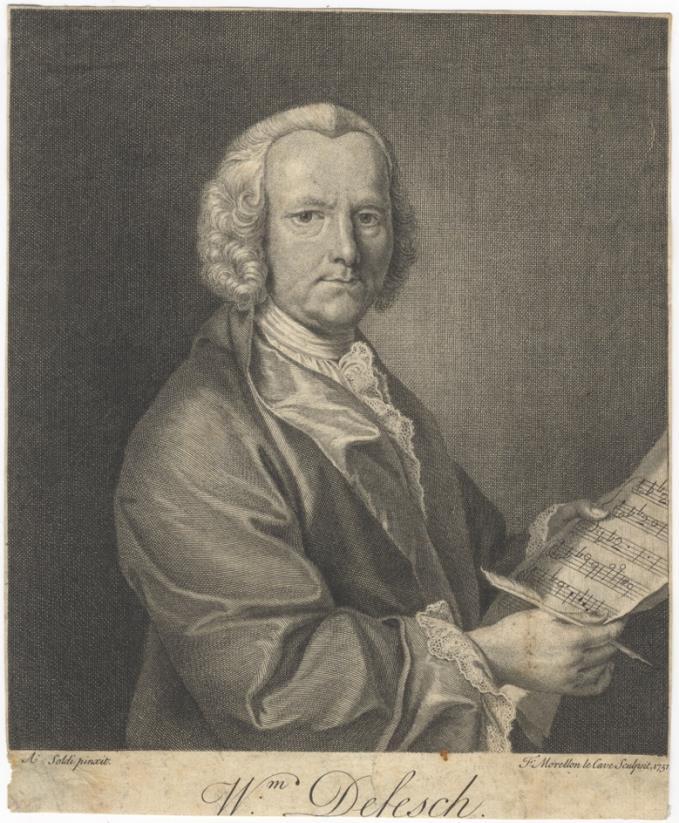
"If De Fesch was a good and an accepted violin virtuoso of his time, he was also an accomplished and even a pioneering composer. In his compositions, which ranged from the grandly conceived oratorio, mass and concerto to duets, solo and trio sonatas and simple songs, a clear development can be seen which largely coincides with the different stages in his career. ... De Fesch’s thematic and formal language can be described as strongly Italian, or more specifically as Vivaldian, in flavour. Vivaldi’s strong, masculine allegro themes and his firm formal principles must have appealed strongly to a composer of De Fesch’s temperament. ... Nevertheless, his works, particularly those in the smaller genres, show a distinctive personal vein. For the basic worth of his own compositions and for the influence that he exercised on his contemporaries, De Fesch may be counted as one of the most important musicians of the Low Countries and England in the second quarter of the 18th century." Frans Van Den Bremt and Rudolf A. Rasch in Grove Music Online
Morellon de la Cave was a French-born painter and engraver active in Amsterdam; Soldi was an Italian painter active in Britain who specialized in portraits. (41164) $200
Rare Autograph Musical Manuscript Sketches from Ibéria
11. DEBUSSY, Claude 1862-1918
Ibéria. Autograph musical manuscript sketches from Part 2 of the three Images for orchestra.
Oblong quarto (200 x 289mm). 1 page. 10 measures notatedin ink on 2 systems of 3 staves each and 8 measures notated in pencil on 2 staves, the whole on 14-stave paper cut down from a larger leaf. Unsigned and undated, but ca. 1906-1908. Very slightly worn.
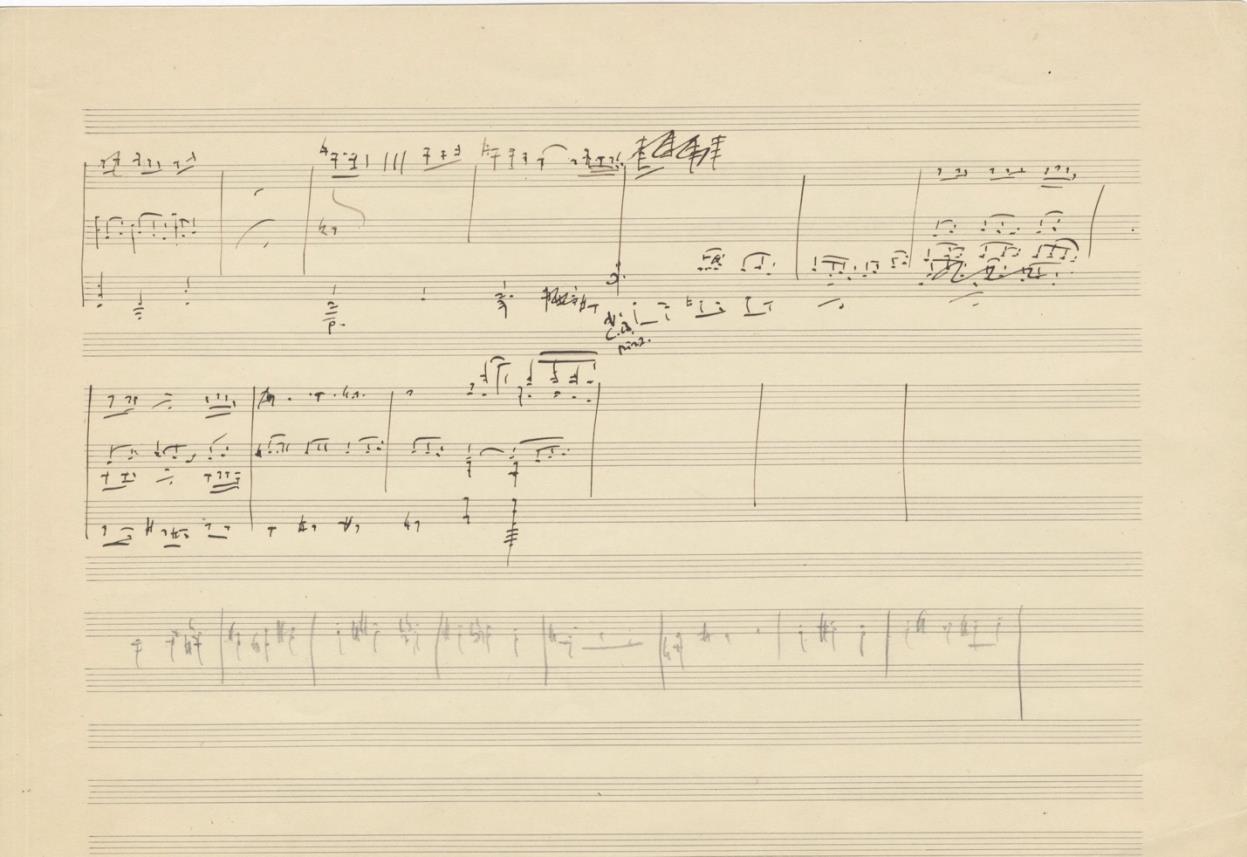
The first sketch in condensed score relates to the theme in the coda of the third movement "Le Matin d'un jour de fête." (see from measure 107 on of the full score).
The second sketch is also from the third movement, and relates to the accompanimental passage in the first violins (the two lower parts of a four-part divisi passage, from measures 76-83 of the full score).
Lesure p. 127.
Ibéria is the second part of the well-known triptych, Images, for orchestra. The work was composed between 1906 and 1908 and was premiered on 20 February 1910 at the Concerts Colonne under the direction of fellow French composer Gabriel Pierné.
The autograph of the full score, together with sketches similar to the present manuscript, are held at the Bibliothèque nationale in Paris; otherimportant autograph sources are in the R.O. Lehman Collection on deposit at The Morgan Library and Museum in New York.
"La Mer is the greatest example of an orchestral Impressionist work. ... It is significant, therefore, that Debussy's principal orchestral works written after La Mer, namely the three Images (Gigues, Ibéria, and Rondes de Printemps), were originally conceived not for orchestra but for two pianos or piano duet. Though the orchestral Images are not strictly Impressionist works in the sense of La Mer or even in the sense of the two sets of Images for piano, they retain much of the impressionist character, the visual imagination is kept constantly alive by their kaleidoscopic succession of images ..." Lockspieser II, p. 29.
Autograph sketches of major works by Debussy are rare to the market. (41113) $6,800
Influenced by C.P.E. Bach, Kirnberger, and Marpurg
12. EGLI, Johann Heinrich 17421810 et al.
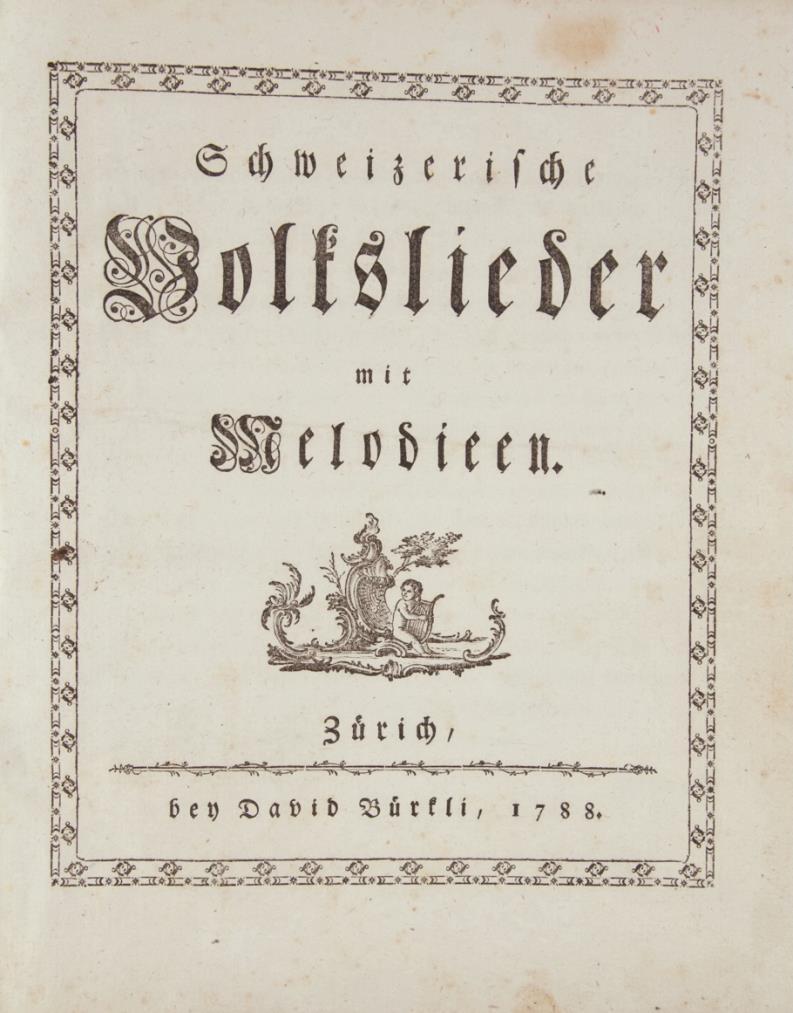
Schweizerische Volkslieder mit Melodien.
Zürich: David Bürkli, 1788.
Quarto. Contemporary green boards. 1f. (recto title, verso blank), [i] ("Vorrede"), 4-105, [i] ("Alphabetisches Register") pp. Typeset throughout. Binding worn, rubbed, bumped, and stained; spine lacking. Some internal wear; minor to moderate foxing; occasional small stains; tear to pp. 19/20 repaired with archival tape.
Contains fifty songs, 26 of which are by Egli, scored for 1-4 voices with figured basso continuo, including settings ofpoetry byJ. C. Lavateretal.
First Edition. OCLC 1331855512.
Egli was a Swiss composer and music teacher. "He was taught music by Johannes Schmidlin and on his own studied the works of J.P. Kirnberger, F.W. Marpurg and C.P.E. Bach, which strongly influenced his own compositions. From about 1760 he lived in Zürich, where he played the violin in the collegium musicum but earned his living as a sought-after teacher of singing and the piano. His many friends included the musician H.G. Nägeli and the poet–pastors Jakob Hess and J.C. Lavater; Egli set many poems (notably on patriotic themes) by Lavater, who was a leading figure in religious aspects of the Sturm und Drang.
Egli’s songs are largely indebted to the Berlin lied school, with an emphasis on naturalness and simplicity that appealed to the Swiss middle class. ... [His] numerous patriotic pieces were of major importance in the development of solo and choral song in German-speaking Switzerland, particularly in their influence on H.G. Nägeli. Egli’s Zwölf Kinderlieder (1789) show his interest in teaching. Four of his pieces are still in the hymnbook of the German-Swiss Reformed Church. He published more than 400 of his own songs and edited a two-volume anthology, Musikalische Blumenlese für Liebhaber des Gesangs und Claviers (1786–9), including songs by C.P.E. Bach, J.A.P. Schulz, C.G. Neefe and J.F. Reichardt." Jürg Stenzl in Grove Music Online (41154) $500
“One of the Most Important Composers for the [Bass Viol] of His Time”
13. FINGER, Gottfried ca. 1660-1730
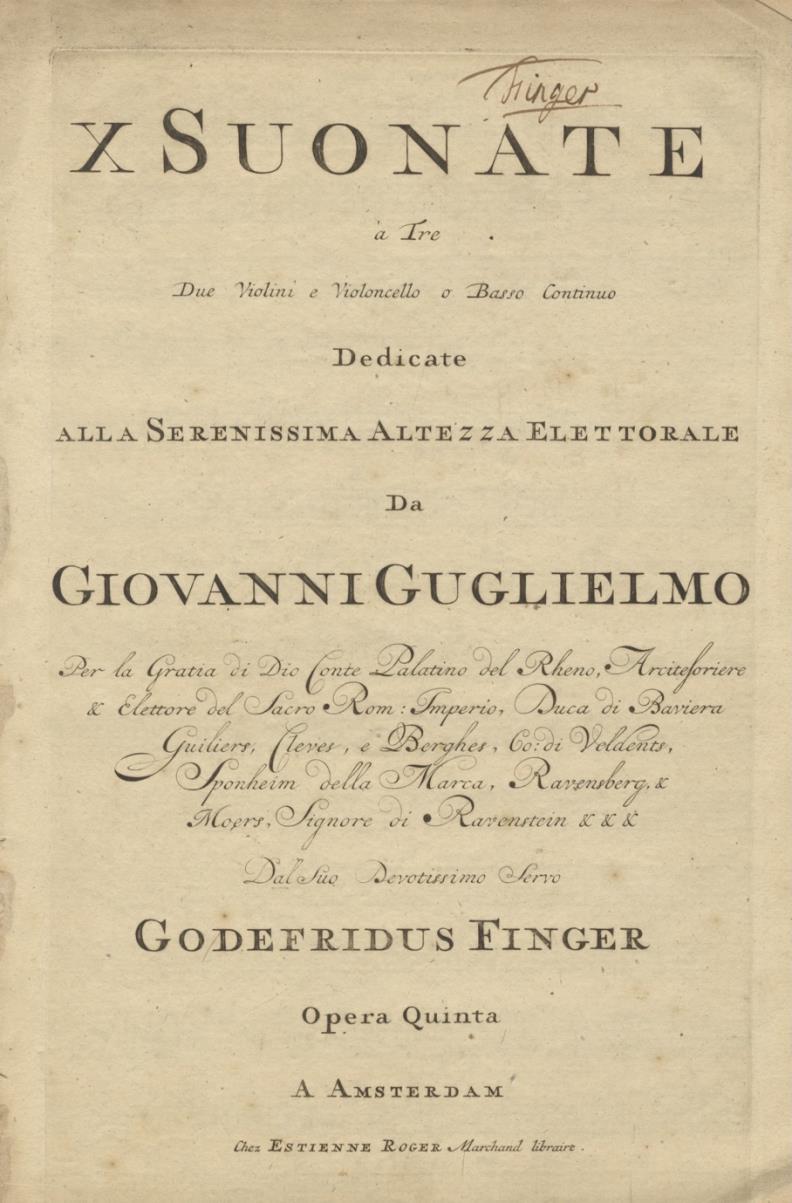
X Suonate à Tre Due Violini e Violoncello e Basso Continuo Dedicate Alla Serenissima Altezza Elettorale Da Giovanni Guglielmo Per la Gratia di Dio Conte Palatino del Rheno, Arciteforiere & Elettore del Sacro Rom: Imperio, Duca di Baviera Guiliers, Cleves, e Berghes, Co: di Veldents, Sponheim della Marca, Ravensberg, & Moers, Signore di Ravenstein & & & ... Opera Quinta. [Set of parts].
Amsterdam: Chez Estienne Roger, 1702.
Folio. Disbound. Laid into plain wrappers with manuscript titling, owner's name "J. Steward," and incorrect date of 1688 to uppers. Engraved. With signature "Finger" to head of each title (most probably not autograph) and Seward's neat biographical notes on Finger to verso of title of Violino primo part.
Violino primo: 1f. (recto title, verso blank), 14 pp.
Violino secondo: 1f. (recto title, verso blank), 14 pp. The tenth sonata in this partis anindependent bass-clef part for violon or bassoon.
Organo e violoncello: 1f. (recto title, verso blank), 11 pp.
Organo e violoncello [duplicate]: 1f. (recto title, verso blank), 11 pp.
First Edition. Rare. Lesure p. 205. BUC p. 336. RISM F852 (no copies in the U.S.).
Finger was a Moravian viol player and composer. "According to Riemann, Finger was in Munich in 1682, and he was in London by spring 1687: he received a post in James II's new Catholic chapel by a warrant dated 5 July 1687, backdated to 25 March. In 1688 he published his op. 1, which he dedicated to James II, stating that the music was intended for use in the Catholic chapel. Finger did not follow the king into exile in 1688, but remained in London and started a successful freelance career. ... [He] was a bass viol virtuoso, and was appointed to teach the instrument in the abortive scheme for a Royal Academy in 1695. He did not publish any solo bass viol music, but manuscript sources (GB-Ob and D-SÜN) reveal him to have been one of the most important composers for the instrument of his time." Peter Holman and Robert Rawson in Grove Music Online
Finger left England in 1701, working thereafter in Berlin, Mannheim, and Düsseldorf. (40582) $2,800
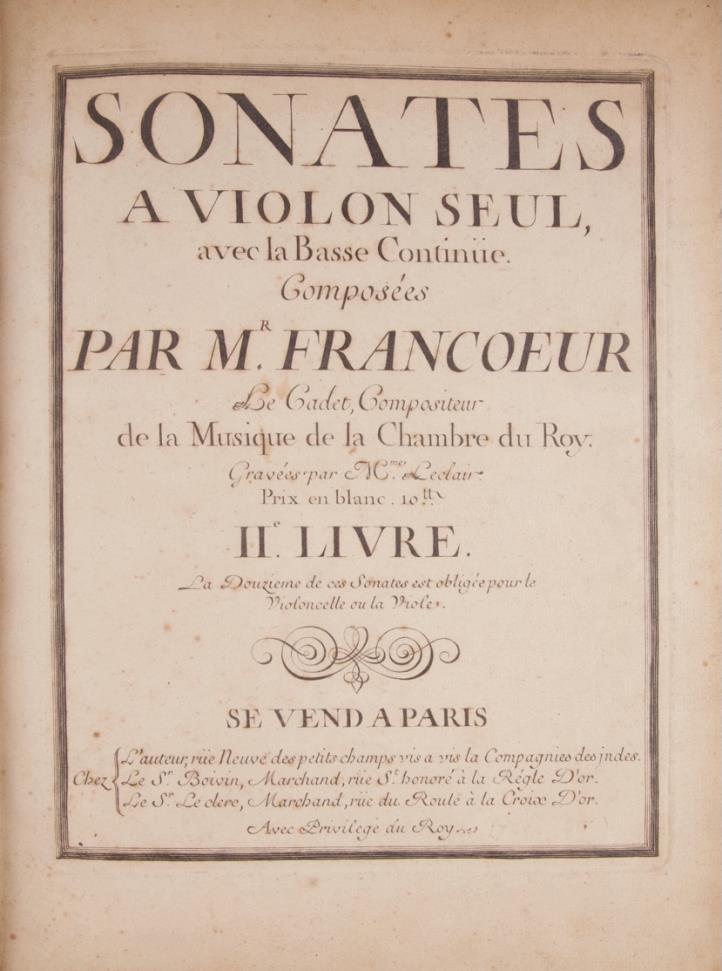
Early 18th Century Violin Sonatas
Signed by the Composer
14. FRANCOEUR, François 1698-1787 [12] Sonates a Violon Seul, avec la Basse Continüe Composées par Mr. Francoeur Le Cadet, Compositeur de la Musique de la Chambre du Roy. Gravées par Mme. Leclair. Prix en blanc 10₶ IIe. Livre. La Douzieme de ces Sonates est obligée pour le Violoncelle ou la Viole. [Score].
Paris: Chez L'auteur, rüe Neuve des petits champs vis avislaCompagnies des indes. Le Sr. Boivin, Marchand, rüe St. honoré à la Régled'Or.LeSr. Leclerc, Marchand, rüedu Roule à la Croix D'or. Avec Privilege du Roy, [1733].
Folio. Modern dark olive-green leatherbacked early blue paper boards, spine in giltruled compartments with titling gilt. 1f. (recto title, verso blank), 81, [i] (privilege) pp., including nine blanks. Engraved. Binding slightly worn, rubbed, and bumped. Light uniform browning, slightly heavier to title; several small stains to p. 51. With "12 Sonates de Francoeur le Jeune 2e. Livre. 6 Sonates de Fritz ... 3" in early manuscript to front pastedown.
With the autograph signature of the composer to foot of first page of music.
First Edition. Lesure p. 214. BUC p. 349. RISM F1806 (2 copies only in the U.S., both at the Library of Congress).
Francoeur was a French composer and violinist, son of Joseph Francoeur. "A violin pupil of his father, he began his long association with the Paris Opéra at the age of 12 as a dessus de violon in the Grand Choeur; shortly afterwards he became a member of the Musique de la Chambre du Roi. The privilege he acquired on 22 August 1720 preceded the publication of his first set of violin sonatas in the same year. Also in that year, he took part in Lalande's ballet Les folies de Cardenio. In 1723 Francoeur and François Rebel left France in the retinue of General Bonneval, travelling to Vienna and Prague. Marpurg commented on the importance of his exposure to the operatic music of those two centres to the composer’s later development: ‘The arias of his composition clearly indicate that their composer had ventured beyond the borders of France’ (Historisch-kritische Beyträge, i/3, p.237).
In 1726 the professional collaboration between Francoeur and Rebel ..., to last about 45 years, began in earnest with the production of Pyrame et Thisbé, the first of many such joint creations. So close was their association that it is virtually impossible to differentiate the two men's contributions; it is no wonder that the public regarded them as one dual personality. They remained inseparable until Rebel's death in 1775, an event that greatly saddened Francoeur's last years.
In the lyrical field Francoeur and Rebel remained devoted to the tradition of Lullian opera, even in their arrangements for revivals. Francoeur's style is more modern in his chamber music, however, which bears comparison with contemporary Italian sonatas." Michelle Fillion, Catherine Cessac, and Lois Rosow in Grove Music Online. (40742) $2,500
“One of the Greatest Keyboard Composers of the First Half of the 17th Century”
15. FRESCOBALDI, Girolamo 1583-1643
Portrait engraving by Claude Mellan (1598-1688).
Image sizeto platemark137 x104 mm; sheet size199 x 149. The composer is depicted bust length within a oval border lettered "Hieronymus Frescobaldus Ferrariensis Organista Basilicae S. Petri ..." with "Cl. Mellan Gall. delin. et sculp." to lower margin and "A Paris chez Odieuvre Marchand d'Estampes, Quay de l'Ecole vis-à-vis le côte de la Samaritaine, àla belle Image" to lower margin. On laid paper.
Early 18thcentury reprint by Michel Odieuvre (16871756), French painter, dealer, and publisher of prints. British Museum number 1866,1110.1126 (variant). IFF / Inventaire du Fonds Français: Bibliothèque Nationale, Département des Estampes (157.I). Montaiglon 1856 / Catalogue raisonné de l'oeuvre de Claude Mellan (188).
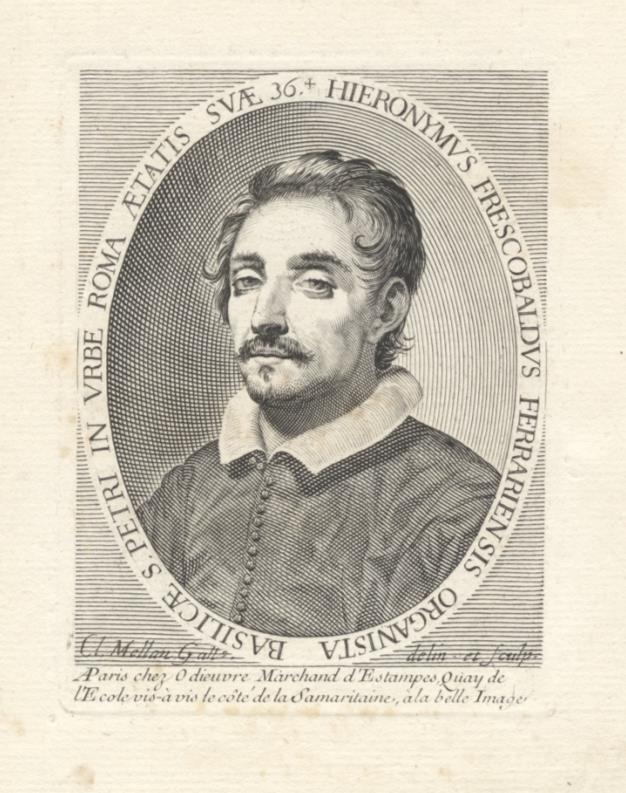
Frescobaldi, an Italian composer and keyboard virtuoso, "was one of the greatest keyboard composers of the first half of the 17th century and also left a substantial body of vocal and instrumental ensemble music." Frederick Hammond and Alexander Silbiger in Grove Music Online
Mellan was a noted French draughtsman, engraver, and painter. (41177)
$250
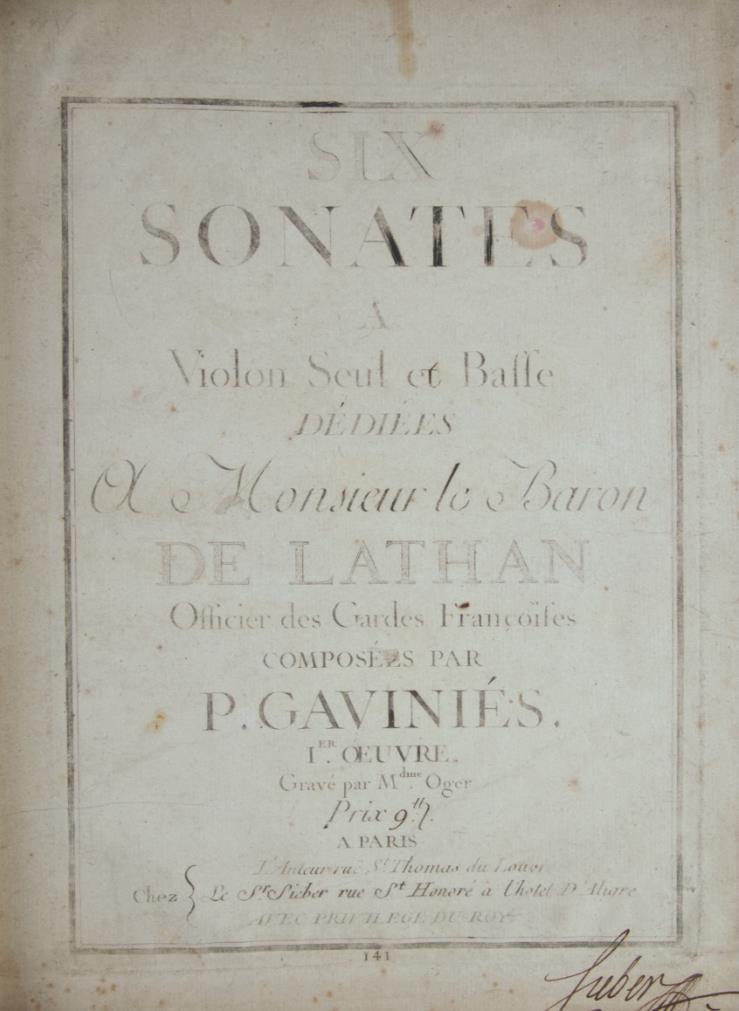
“[His] Works for the Violin ... Reveal Something of His Own Virtuosity”
16. GAVINIES, Pierre 1728-1800
Six Sonates A Violon Seul et Basse Dediées A Monsieur le Baron de Lathan Officier des Gardes Françoises ... 1er Œuvre. Gravé par Mdme. Oger. Prix 9₶.[Score].
Paris: Chez L'Auteur rüe St. Thomas du Louvre. Le Sr. Sieber rue St. Honoré à l'hoteld'Aligre. AvecPrivilegeduRoy[PN 141], [1760].
Folio. Half modern mid-tan morocco with marbled boards, titling gilt to spine. 1f. (recto title, verso blank), [i] (blank), 2-27. [i] (blank) pp. Notated on two staves: solo violin and figured bass. Engraved. Signed by Sieber at lower outer corner of the title. Endpapers stained at corners. Title slightly worn, faded, soiled, foxed, and stained; some foxing, primarily to blank margins; small inkstains throughout; signature to title slightly trimmed. 20th century bookseller's description to front pastedown with bibliographical notes in manuscript; note to rear pastedown "correct collation, 10/14/70 Fredericksburg, Va. S.H." [Sidney Hamer, music specialist and longtime proprietor of the Leamington Bookshop in Washington, D.C.].
First Edition, second issue. Lesure p. 225 (first issue). Hirsch III, 212 (first issue). BUC p. 364. RISM G737 (1 copy only inthe U.S., at the Universityof California, Berkeley). The presentissue does not containthe privilege.
"Gaviniés was best known to his contemporaries as a violinist; nearly every aspect of his playing was praised ... [His] works for the violin, comprising sonatas, duos, concertos and études, reveal something of his own virtuosity. All of the sonatas and duos have three movements. Many of the slow middle movements are romances. In the early works, some of the finales take the form of a moderate theme and variations or a minuet. The first movements of the second set of sonatas usually have two strongly contrasting themes. The entire range of the violin is exploited, with unusual emphasis on the lower register. Double stopping is employed in various ways and there is much ornamentation, despite the broad, sweeping, melodic curves. Gaviniés was extremely explicit regarding dynamics and articulation, although fingerings were added infrequently. In the duos, the violins have parts of equal importance." JeffreyCooper, revisedbyAnthonyGinterin Grove Music Online. (40743) $550
“The Greatest Performer in Europe”
17. GIARDINI, Felice 1716-1796
Troisème Livre de Sonatas a Violon Seul et Basse Dédiées a Madame Isabelle Comteße de Carlisle ... Oeuvre V. Prix 6₶.
Paris: aux Adreßes Ordinaires de Musique avec Aprobation et Privilege du Roy, [1758].
Folio. Loose in contemporary stiff marbled wrappers with heart-shape blank paper label to upper. 1f. (recto title, verso blank), [i] (catalogue), 2-22, [i] (blank), 24-33, [i] (blank) pp. Engraved. Wrappers and endpapers worn, frayed, and with minor worming. Slightly worn and soiled; occasional small tears and worming, mainly to blank margins but heavier to upper portions of final leaves, affecting notation; title leaf frayed, with small loss to blank outer margin and minor worming, soiling; dampstaining to upper outer corners through p. 10.
First Edition. Lesure p. 231. RISM G1914 and GG1914 (2 copies only in the U.S., at NYPL Lincoln Center and the Library of Congress).
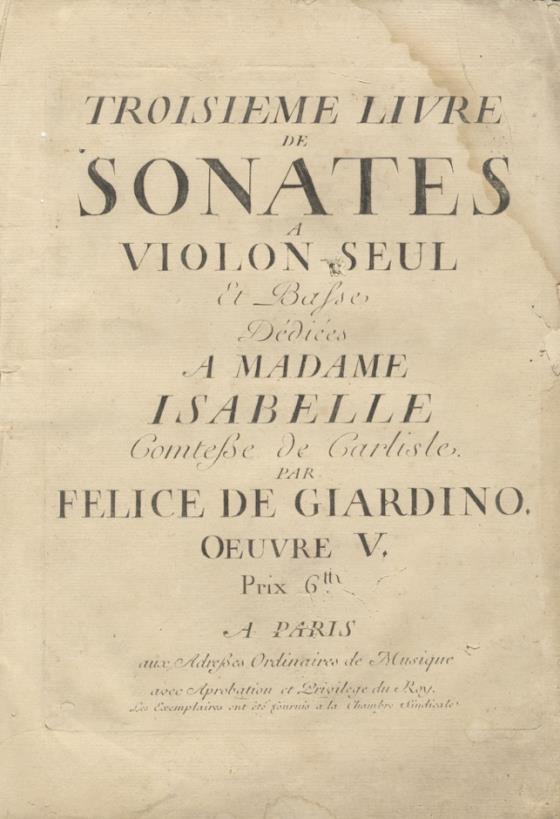
Giardini was a French-born Italian composer and violinist. "He showed an early talent for the violin, but his father sent him to Milan as a cathedral chorister, and to study singing, composition and harpsichord with Paladini. He returned to Turin to study violin with G.B. (not Lorenzo) Somis, and while still a youth joined an opera orchestra in Rome. Soon after, he moved to the Teatro S Carlo in Naples, and quickly advanced from the back desks to the position of deputy leader. ... Despite the appearance of a serious rival in Wilhelm Cramer, who made his London début in 1773, and later competition from Salomon, Giardini maintained his position as a player; Burney called him ‘the greatest performer in Europe’. He took part in the Bach-Abel concerts (sometimes playing the viola), and also appeared in the provinces, taking charge of the orchestra for the Three Choirs Festival from 1770 to 1776. He was in great demand as a teacher and held important morning concerts for his violin, singing and harpsichord pupils in his house." Christopher Hogwood and Simon McVeigh in Grove Music Online. (40744) $225
With a Detailed Publisher’s Catalogue
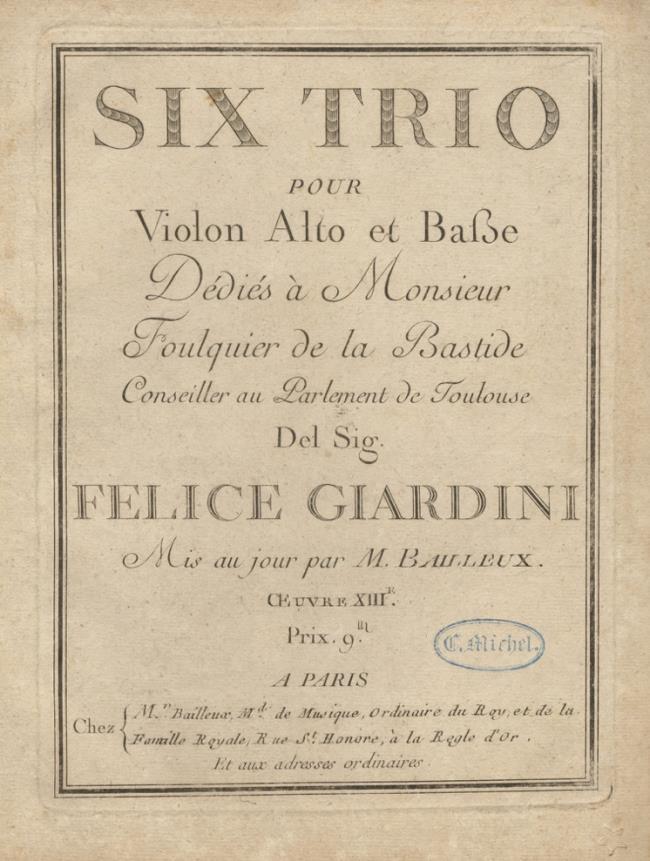
18 GIARDINI, Felice 1716-1796
Six Trio pour Violon Alto et Baße Dédiés à Monsieur Foulquier de la Bastide Conseiller au Parlement de Toulouse ... Œuvre XIIIe. Prix 9₶. [Set of parts].
Paris: Chez Mr. Bailleux, Md. de Musique, Ordinaire du Roy et de la Famille Royale, Rue St. Honore, à la Regle d'Or. Et aux adresses ordinaires, ca. 1775.
Folio. Engraved. Oval handstamp of "C. Michel" totitles of each part and tofoot of publisher's catalogue. Spines reinforcedwithearly ivorypaper. Light uniform browning;occasionalminor soiling, foxing, worming, and early ivory paper reinforcement; upper margin of catalogue trimmed, slightly affecting printed area.
Late 18th Century Concert Ticket
With Engraved Illustration by Bartolozzi
19. [GIARDINI, Felice 1716-1796]
Concert ticket "For the Benefit of Mr. Giardini." Engraved by Francesco Bartolozzi (1728-1815) after G. B. Cipriani (1727-1785). [London], 1775.
Etching with engraving. Sheet size 111 x 140 mm. Small early collector's circular monogrammatic handstamp in dark red ink to verso. Slightly trimmed to within platemark; two small inkstains to blank margins; collector's stamp to verso partially trimmed.
Melpomene (the god of tragedy) is seated on a parapet at left holding a dagger in her right hand; two putti are at
Violino:1f. (rectotitle, verso blank), [i] (publisher's catalogue "De Musique Françoise et Italienne Vocale et Instrumentale ..."), 2-13, [i] (blank) pp.
Viola: [i] (title), 2-13, [i] (blank) pp.
Violoncello: [i] (title), 2-13, [i] (blank) pp.
Later edition. First published by Blundell in London as Op. XX. Not in Lesure or BUC. RISM G1960 (no copies in the U.S.).
The detailed publisher's catalogue includes "Simphonies; Quatuors; Trios; Duos; Sonates; Clavecin Sonates; Clavecin Concertos; Concertos de Violon et Flute; Cantatilles dans le gout Italien; Operas Comiques; Recueils d'Airs pour la Guitarre; Recueils d'Airs pour la Harpe; Recueils d'Airs Avec accompagnemet. de Violon et Clavecin; Musique d'Eglise; Methodes et Instructions sur la Musique; Journal d'Ariettes Italiennes; Recueils de Menuets; and Recueils de Contre-Danses." (40748) $400
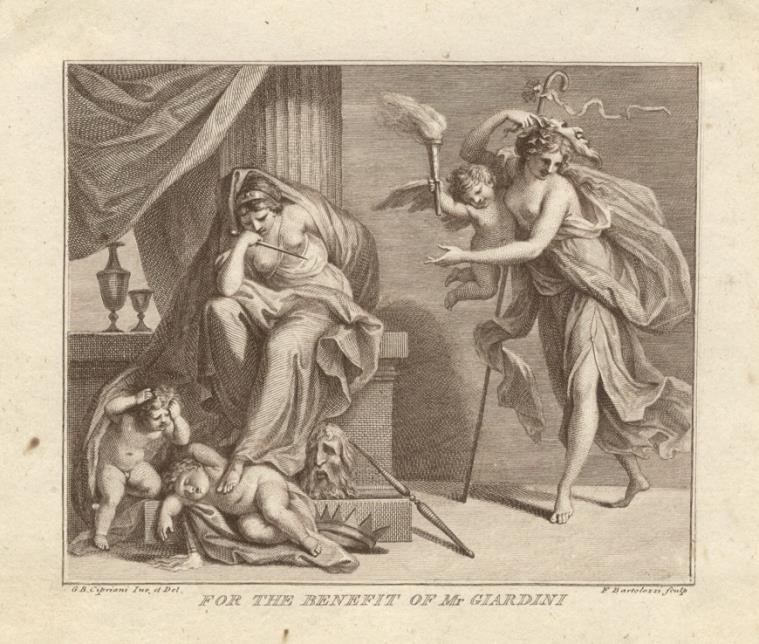
her feet, one lying dead, the other standing and pulling his hair; Thalia (the god of comedy) stands at right, accompanied by a putto holding a torch.
British Museum Online Catalogue C 3.8. Calabi & De Vesme: Catalogue of Engravings by Bartolozzi ,1928. "Giardini settled to a career of solo violin playing (saying later that he had given up the harpsichord after hearing the playing of Mme de St Maur, a pupil of Rameau), and he left Italy to begin a concert tour of Europe. After great success in Berlin, he came to England by way of France, making his first public appearance at a benefit for the aging Cuzzoni on 27 April 1751. The enthusiastic reception, amplified by the support of such aristocrats as Mrs Fox Lane (Lady Bingley), soon established him with the English public." Christopher Hogwood and Simon McVeigh in Grove Music Online
Cipriani was a noted Italian painter and engraver, many of whose drawings were engraved Bartolozzi. (41151) $300
1780 Concert Ticket
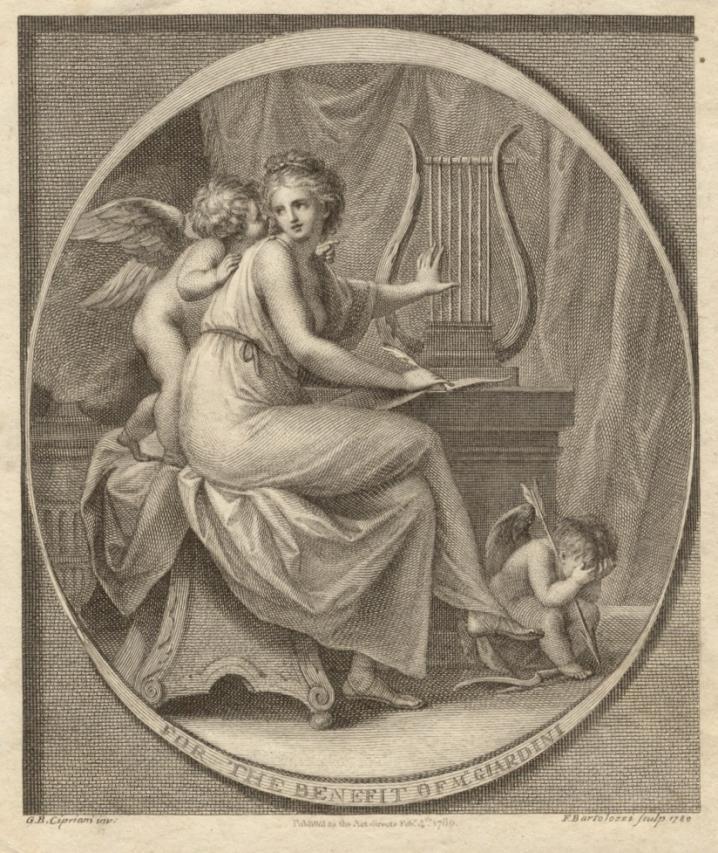
20. [GIARDINI, Felice 1716-1796]
Concert ticket “For the Benefit of Mr. Giardini.” Engraved by Francesco Bartolozzi (1728-1815) after a drawing by G. B. Cipriani (1727-1785). [London], 4th February, 1780.
Etching with engraving. Sheet size 122 x 104 mm. Slightly worn; trimmed within platemark.
A young woman sits on a pedestal touching a lyre on a table with her left hand and holding a quill in her right, turned, looking towards a putto who stands behind her. Cupid is seated on floor at the right holding an arrow, covering his face with hands.
British Museum Online Catalogue C, 3.11 (state before title and printer's name). Calabi & De Vesme: Catalogue of Engravings by Bartolozzi, 1923. (41157) $300
Portrait Published Shortly After Handel’s Death
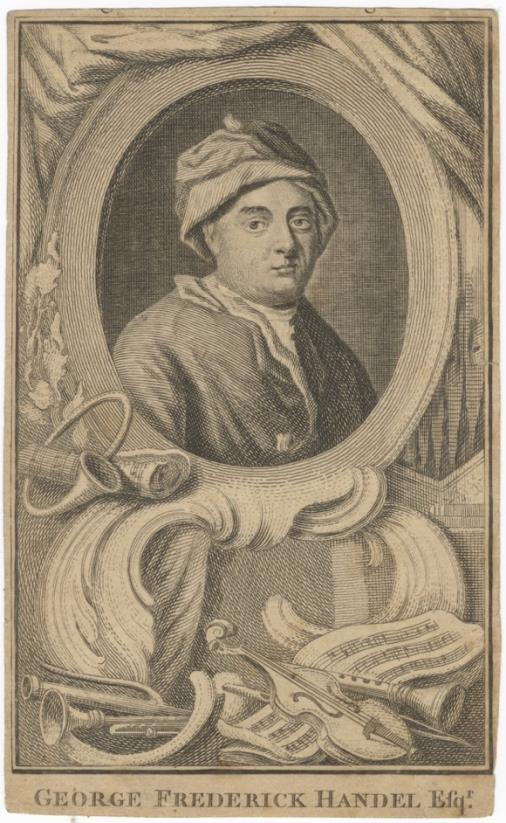
21. HANDEL, George Frideric 1685-1759
Portrait engraving and etching. [London]: [Printed for J. Hinton at the King's Arms in Newgate Street], ca. 1760.
Sheet size 170 x 105 mm. The composer is depicted wearing a jacket and plain cap within an oval with border incorporating wind and brass instruments, a viol, and an open book of music. On laid paper. Published in the Universal Magazine Somewhat worn and browned; slightly unevenly trimmed to within platemark, thus without "Engraved for the Universal Magazine" at upper margin and imprint below image; minor remnants of former mount to verso.
British Museum number K,60.117 (purchased from the estate of Dr. Charles Burney in 1818). (41179) $135
Full Length Engraved Portrait
22. HANDEL, George Frideric 1685-1759
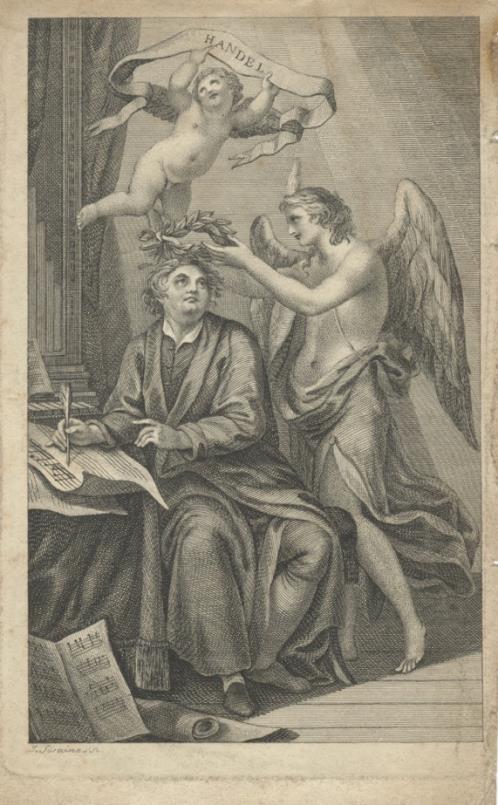
Portrait engraving by John Swaine (1775-1860) after Giovanni Battista Cipriani (1727-1785). [London], ca. 1800.
Sheet size 170 x ca. 107 mm. The composer is depicted full length, seated, a partial view of an organ to his right; a quill pen in his left hand is poised above a sheet of music manuscript paper with another bifolium at lower left; a putto above his head holds a bannerlettered "Handel," awinged figure places alaurel wreath on his head. On wove paper. Somewhat worn and browned; trimmed to within platemark at upper and right margin; right margin with small stitching holes, evidence of disbinding.
National Portrait Gallery (London), NPG D3209 and 3210 (variant; the present print with"J. SwaineSc."tolower left below image, that of the NPG prints with "Engraved by J. Swaine" to lower right below image. "The original painting or drawing by Cipriani that Swaine copied does not appear to be among the most famous, standard portraits of the composer, which include works by artists such as Thomas Hudson and Jacob Houbraken)."
National Portrait Gallery website
Swaine was a noted draughtsman and printmaker, Cipriani a painter and engraver. (41181) $100
Hawkins’s Monumental 5-Volume History of Music, With “Valuable Information About Early 18th-Century Musical Society in London”
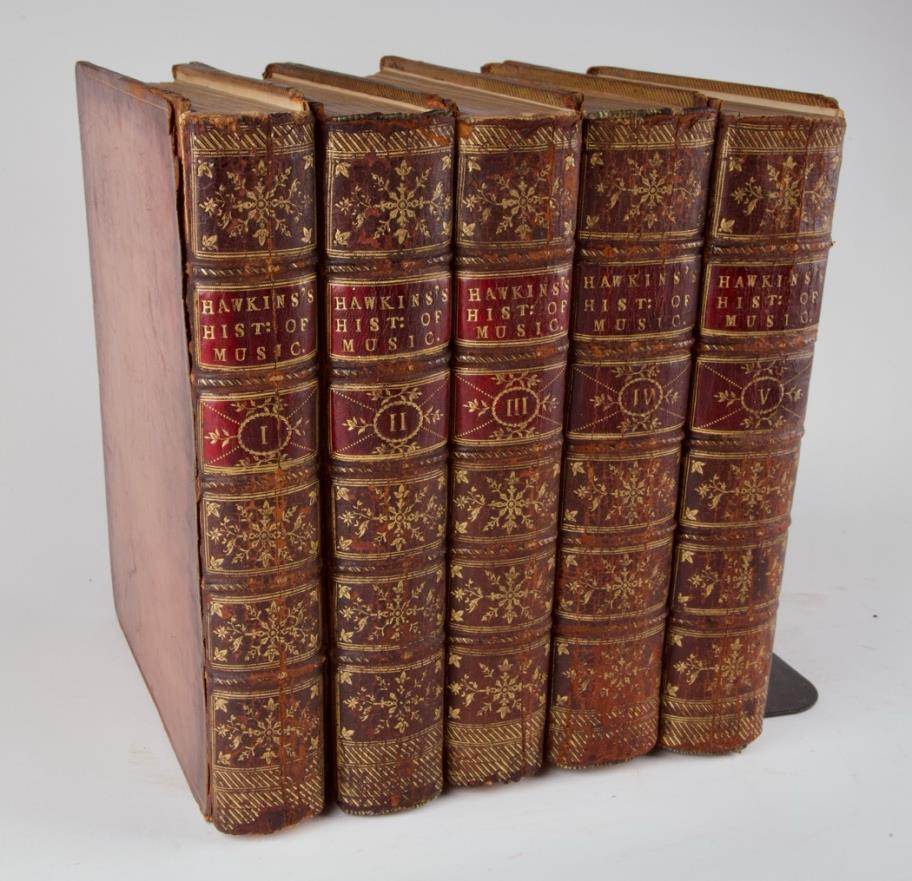
23. HAWKINS, John 1719-1789
A General History of the Science and Practice of Music ... In Five Volumes. Volume the First [-Fifth].
London: T. Payne and Son, at the Mews-Gate, 1776.
5 volumes. Quarto. Full mid-tan calf with raised bands on spine in decorative compartments gilt, dark red leather title labels gilt, marbled endpapers. With numerous engraved portraits, most by Grignion or Caldwall (including 4 of women including Arabella Hunt, Anastasia Robinson, Francesca Cuzzoni Sandoni, and Signora Faustina), engraved musical examples, illustrations of musical instruments, and diagrams throughout. Engraved armorial bookplateofSyston Park, the importantlibraryofSir John Hayford Thorold (1773-1831)soldatauctionin 1884, to front pastedowns. Bindings slightly worn, rubbed, and bumped; some hinges and joints split. Minor signs of internal wear including some light browning, foxing and soiling; occasional small stains and loose signatures. Lacking half-titles. In very good internal condition overall.
Vol. I
1f. (recto blank, verso fine full page frontispiece), 1f. (recto title, verso blank), 1f. (recto dedication to George the Third, verso blank), vi (preface), lxxxiv ("Preliminary Discourse"), 51 [ii] (engraved tables), 465, [i] (blank) pp. With 5 full-page engraved plates of musical instruments.
Vol. II
1f. (recto title, verso blank), 544 pp. With extensivemusicalexamples, a Guidonian hand (p. 184), anillustration of Aron (p. 344), and emblematic portraits of Philippe de Monte and Orlando di Lasso.
Vol. III
1f. (recto half-title, verso blank), 535 pp. With extensive musical examples from the works of William Byrd, JohnBull, andNicholasLaniere;tables;diagrams;illustrationsofmusicalinstruments;andengravedemblematic portraits of Christoforo Morales after Angelo Rossi (p. 86); Palestrina after Rossi (p. 168); Giovanni Maria Nanino da Vallerano after Rossi (p. 190); Felice Anerio (p. 192); Ruggiero Giovanelli da Valletri (p. 193); Claude de Jeune (p. 204); Hercole Bottrigaro (p. 206); and Scipio Cerretus Musicus Partenopeus (p. 235).
Vol. IV
1f. (recto title, verso blank), 548 pp. With extensive engraved musical examples, illustrations of musical instruments, and diagrams, many large, and engraved emblematic portraits of William Heythe (p. 30); Orlando Gibbons (p. 34); John Hilton(p. 46); Henry Lawes (p. 48);John Wilson (p. 57);PaoloAgostino (p. 79);Gregorio Allegri ([p. 89); Marin Mersenne (p. 104); Hieronymus Frescobaldi (p. 174); Jean Baptiste Lully (p. 236); Francesco Foggia (p. 264); Antimo Liberati (p. 266); Matteo Simonelli Romano (p. 285); Arcangelus Corellius [Corelli] (p. 308); Bernard Smith organ maker (p. 353); Christopher Simpson (p. 398); Christopher Gibbons (p. 412); William Child (p. 414);Matthew Lock (p. 417); Thomas Mace (p. 450); John Playford (p. 468); John Blow (p. 486); Henry Purcell (p. 495); Guilielmus Holder (p. 541); and Mrs. Arabella Hunt (p. 545).
Vol. V
1f. (rectotitle, verso blank), 432;[433]-479 (Appendix), 480-482 ("ExplanationoftheAppendix"), [lvii](index), [ii] (Errata) pp. With extensive engraved musical examples and emblematic portraits of Henricus Aldrich (p. 9); Thomas Britton (p. 70); William Croft (p. 94); Andrea Adami (p.114); Henry Needler (p. 124); Thomas D'Urfey (p. 159); John Bannister (p. 175); Harry Carey (p. 184); Johann Christoph Pepusch (p. 194); Antonio Vivaldi (p. 213); Francesco Geminiani (p. 238); George Frederic Handel (p. 262); Giovanni Buononcini (p. 274); Attilius Ariosti Bononiensis (p. 290); Mrs. Anastasia Robinson (singer), later Countess of Peterborough (p. 301); Francesco Bernardo Senesino, castrato (p. 306); Francesca Cuzzoni Sandoni, singer (p. 309); Signora Faustina, singer (p. 310); and Carlo Broschi, castrato (p. 319).
First Edition. Cortot p. 94. Wolffheim II, 207. Hirsch I, Anhang 30. Gregory-Bartlett p. 119. RISM Écrits Imprimés p. 399.
"For many years, Hawkins had been accumulating material for a General History of the Science and Practice of Music, mainly from his own research in the British Museum (from October 1761 to May 1775); from his own extensive collection of manuscripts, which now included much of Pepusch’s library (he probably acquired it in 1763); from the Bodleian and college libraries at Oxford and Cambridge; from the private libraries of John Stafford Smith and William Boyce; and from information supplied by Horace Walpole, the Rev. William Gostling (son of the famous bass John Gostling), George Steevens, the Duchess of Portland and others. Hawkins was engaged for 16 years on his mammoth task ... published complete in November 1776, almost seven months after the publication of the first volume of Charles Burney’s rival history ...
In general Hawkins amazed his contemporaries by his erudition and discernment ...
A comparison of the histories by Burney and Hawkins is inevitable, although they are complementary rather than conflicting. Hawkins’s contains valuable information about early 18th-century musical society in London, largely collected from survivors of the period, and emphasizes the achievement of 16th- and early 17th-century composers, who were treated condescendingly by Burney. Burney, on the other hand, had a considerably greater knowledge and insight into European musical trends and society and his musical analyses are technically superior to those of Hawkins. His literary style also was celebrated for its grace and wit, qualities which Hawkins lacked; and his work was better organized than Hawkins’s. In many respects, however, Hawkins was a pioneer, to whose work Burney owed a great deal although he publicly ignored Hawkins’s accomplishment ... Some sections of Burney's History are, in fact, based in whole or part on Hawkins's work." Percy A. Scholes in Grove Music Online
A cornerstone of the literature. (41171) $1,200
Clementi’s Arrangement of Haydn’s Grand Military Symphony
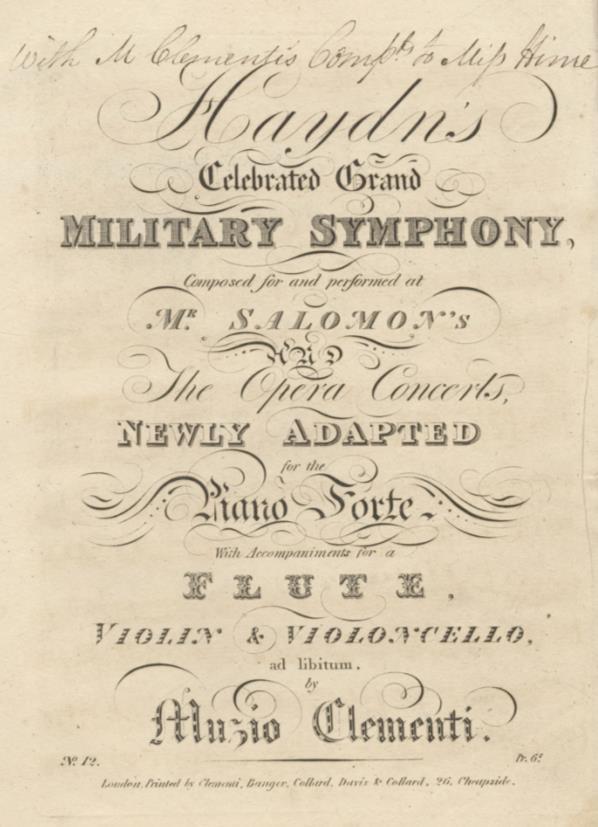
24. HAYDN, Joseph 1732-1809
Haydn's Celebrated Grand Military Symphony Composed for and performed at Mr. Salomon's and the Opera Concerts, Newly Adapted for the Piano Forte With an Accompaniment for a Flute, Violin, & Violoncello, ad libitum by Muzio Clementi. No. 12 ... Pr. 6s. [Hoboken I:100, arr.]. [Piano part only].
London: Printed by Clementi, Banger, Collard, Davis & Collard, 26, Cheapside, ca. 1813.
Folio. Disbound. 1f. (recto title, verso blank), [i] (blank) 2-19 pp. Engraved. Watermark 1813. "With M. Clementi's Comp[limen]ts to Miss Hime" in contemporary manuscript to head of title in an unknown hand. Slightly worn; occasional scattered foxing and minor creasing.
Tyson p. 130. OCLC 1314089583 (2 copies only in the U.S., at Princeton and Duke).
An adaptation of that of Salomon (flute, string quartet, and piano ad lib., Hoboken I, p. 208: S.Coll.Sy.15a), but for reduced forces of piano, accompanied by flute, violin, and cello ad lib.
"The last six symphonies are even more brilliant (clarinets are added, except in no. 102); Haydn’s determination to conquer new territory with each work is palpable. No. 99 in E♭is his most elaborate symphonic essay in remote tonal relations; it also features a particularly warm slow movement (in G major), with extensive wind writing (much commented on at the time). No. 101 (‘Clock’) has by far the longest minuet and trio Haydn ever composed and a particularly brilliant rondo finale. No. 100 (‘Military’) rapidly became his most popular, owing to the slow movement based on a romance (from the lyre concerto hVIIh:3), overlaid by massive percussion outbursts that audiences found deliciously terrifying." Georg Feder and James Webster in Grove Music Online (40615) $175
Haydn’s Works in 18th Century Keyboard Arrangements by Wenck and Fodor
25. {HAYDN, Joseph 1732-1809]. Wenck, August Heinrich d. ca. 1814 and Carolus Emanuel Fodor b. 1759, arrangers
Collection of 18th century keyboard arrangements of Haydn's works.
Paris, ca. 1790.
Folio. Disbound. Engraved. Slightly worn, browned, and soiled; a few small tears.
[Wenck, arr.]. La Chasse Grande Simphonie de J: Haydn, Arrangée pour le Clavecin ou Piano-Forte; Avec Accompagnement de Deux Violons et Basse (à Volonté,) par A. H. Wenck. Prix 4₶. 4s. [Hob. I/73]. [Keyboard part only]. Paris: Chez Wenck Rue de la Michaudiere, Maison de Mr. Garnier et chez les principaux Mds. de Musique. Gravé par Le Roy, l'aîné, Place de Cambray ... 10e. Ca. 1785. [Keyboard part]. [i] (title), 2-15, [i]
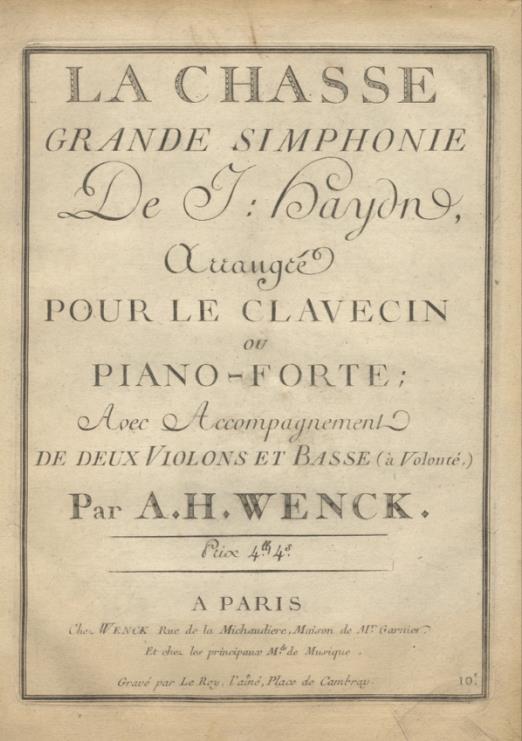
(blank) pp. With "No. 14" in contemporary black ink to head of first page of music. RISM H4478 (1 copy of the keyboard part only, at the Biblioteca civica musicale "A. della Corte" in Milan.
Bound with:
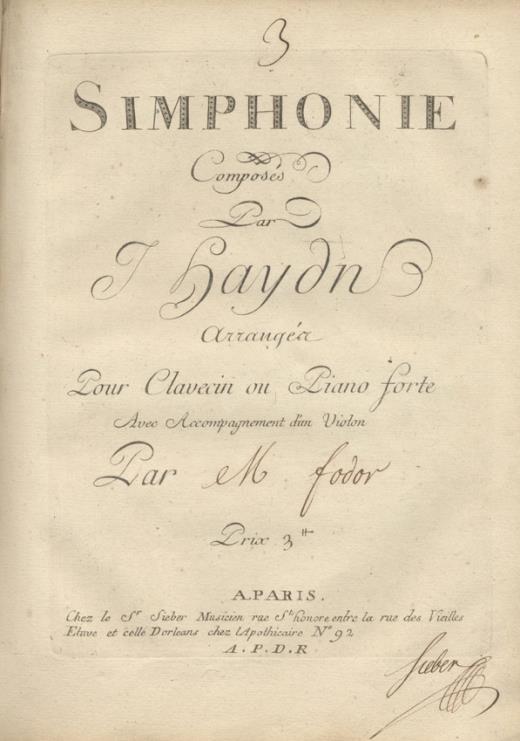
[Fodor, arr]. Simphonie Composés Par J Haydn Arrangées pour Clavecin ou Piano forte Avec Accompagnement d'un Violon Par [M Fodor]. Prix [3₶]. [Hob. I/47]. [Keyboard part only]. Paris: Chez le Sr. Sieber Musicien rue St. Honore entre la rue des Vieilles Etuve et celle Dorleans chez l'Apothicaire No 92 A. P. D. R. Ca. 1790. 1f. (recto title, verso blank), [i] ("Catalogue de Musique Vocale et Instrumentale appartenant à Mons. Sieber Rue St. Honore entre la Rue des Vielles Etuves et celle d'Orleans chez l'Apothicaire No. 92"), 2-13, [i] (blank) pp. With Sieber's control signature to lower outer corner of title, "3" to head of title, and "No 15" to head of first page of music in contemporary manuscript. Outer margin of publisher's catalogue very slightly trimmed, just touchingtextin severalinstances. RISM H4498 (1copyofthe keyboard partonly, attheBibliothèque nationale).
Bound with:
[Wenck, arr]. Quatuor Détache de l'Œuvre XXXIIIe. de M. Haydn Arrangé pour le Piano-Forte ou Clavecin avec Accompagnement de Violon et Violoncelle, (à volonté) par M. Wenck. [Op. 33/5, Hob. III:41]. [Keyboard part only]. Paris: Chez M. Wenck, rue de la Michodiere, Maison de M. Garnier. Et Chez Melle. Rivet au Palais Royal à côté du Caffé de foy. No. 55. Prix 3₶.12f. ... 12e. . [i] (title), 2-11, [i] (blank) pp. With first ten measures printed to head of title. "No. 16." in contemporary manuscript to head of first page of music. Not located in RISM.
Haydn "began his career in the traditional patronage system of the late Austrian Baroque, and ended as a ‘free’ artist within the burgeoning Romanticism of the early 19th century. Famous as early as the mid-1760s, by the 1780s he had become the most celebrated composer of his time, and from the 1790s until his death was a culturehero throughout Europe. Since the early 19th century he has been venerated as the first of the three ‘Viennese Classics’ (Haydn, Mozart, Beethoven). He excelled in every musical genre; during the first half of his career his vocal works were as famous as his instrumental ones, although after his death the reception of his music focussed on the latter (except for The Creation). He is familiarly known as the ‘father of the symphony’ and could with greater justice be thus regarded for the string quartet; no other composer approaches his combination of productivity, quality, and historical importance in these genres. In the 20th century he was understood primarily as an ‘absolute’ musician (exhibiting wit, originality of form, motivic saturation, and a ‘modernist’ tendency to
problematize music rather than merely to compose it), but earnestness, depth of feeling, and referential tendencies are equally important to his art." Georg Feder and James Webster in Grove Music Online
Wenck was a German composer and glass harmonica player. "According to Gerber, he studied the violin with Hataš and the harpsichord and composition with Georg Benda. He went to Paris with the latter in 1778 and stayed there until at least 1792 as an arranger of popular overtures and airs. On his return to Gotha he became honorary ducal secretary, lived on his small estate, made pianos that were much sought after, and worked at perfecting the glass harmonica, with which he toured as a virtuoso. In 1788 he launched a periodical music collection which was intended to appear quarterly but which seems never to have got beyond its first issue: Variétés musicales pour le piano-forte ou clavecin avec accompagnements … mêlées de chant avec paroles italiennes et françaises. In addition he published overtures and airs from favourite operas, mostly for piano or harpsichord with violin accompaniment but in one case for string quartet. He also published a set of Six petites sonates op. 1 (n.d.) and another of Sonates et pièces op.2 (four of each) for keyboard with violin ad libitum, as well as a Ier simphonie op.3 for the same combination. These last two were advertised in 1783; the simphonie, in the style of a piano reduction of orchestral textures, was to have been the first of six. In addition, Gerber reported three violin trios and a bassoon concerto in manuscript. In 1798 Wenck made improvements to the metronome of Sauveur and Duclos, which he described in Beschreibung eines Chronometers (Magdeburg, 1798) and which he sold in quantity. In 1806 he moved to Holland, settling in Amsterdam, where he was still living in 1810." David Fuller in Grove Music Online
Fodor was a French harpsichordist of Dutch birth. "One of the foremost harpsichordists of his time, in about 1780 he settled in Paris, where he gave concerts, and taught and composed harpsichord concertos and sonatas, as well as a symphony and music for piano and strings." Elizabeth Forbesin Grove Music Online. (41127) $750
With Extensive List of Subscribers From the Meyer Collection
26. HAYES, Philip 1738-1797
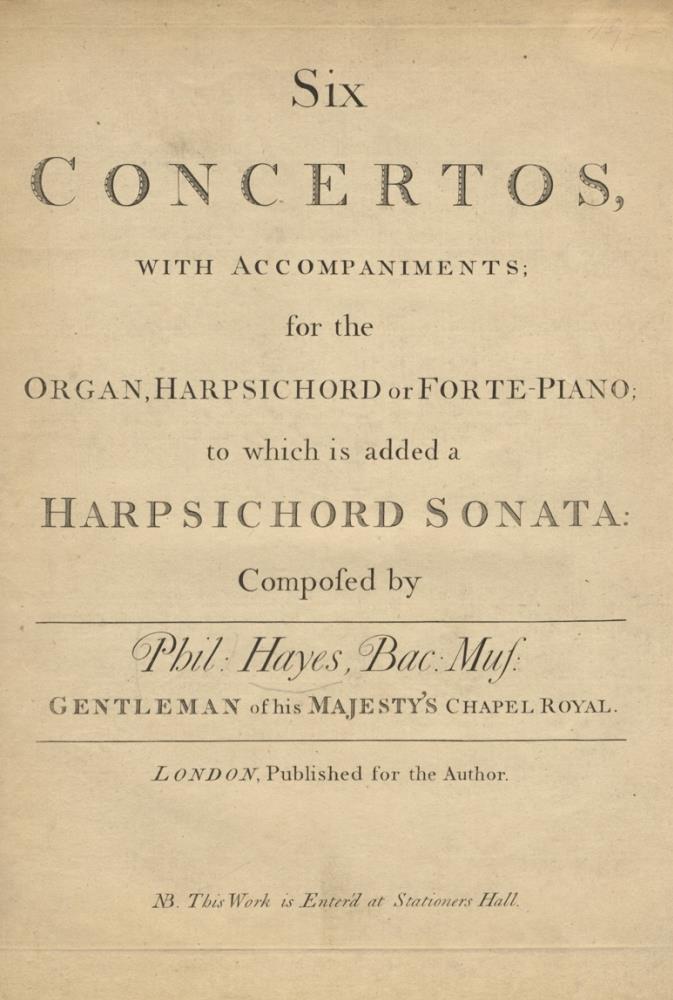
Six Concertos with Accompaniments for the Organ, Harpsichord or Forte-Piano to which is added a Harpsichord Sonata: Composed by Phil. Hayes Bac. Mus. Gentleman of his Majesty’s Chapel Royal.
London: Published for the Author, [1769].
Folio. 1f. (recto title, verso blank), 1f. (recto dedication to William Wykam, verso blank),1f. (recto "Advertisement," verso blank), 2ff. ("List of the Subscribers"), [i] (blank), 2-34, [i] (blank), 36-43, [i] (blank) pp. Dedication, advertisement, and list of subscribers typeset, title and music engraved. Spine reinforced with narrow strip of black paper. Uniform light browning; occasional soiling; title moderately browned with some minor soiling; inkstain to p. 13; small loss to blank outer margin of final page of music.
The more than 250 subscribers include composers Samuel Arnold and William Boyce, publishers Robert Bremner and William Randall, and noted organists, musical instrument makers, musicsellers, dancing masters, professors, and scholars.
Provenance
Noted collector André Meyer (1884-1974), Paris, with his handstamp to blank verso of title: "Provenant de la collection musicale d'André Meyer Décédé en Mai 1974 F. Meyer Octobre 84."
First Edition. BUC p. 473. RISM H4884 and HH4884.
Hayes was a noted “English composer, organist and singer, second son of William Hayes. He received his musical education under his father. He matriculated at Magdalen College, Oxford, and received the degree of BMus on 18 May 1763. He was appointed a Gentleman of the Chapel Royal on 30 November 1767, and lived mainly in London until 1776 when he succeeded Richard Church as organist of New College, Oxford. On the death of his father in 1777 he was appointed professor of music and organist of Magdalen College and the university church, and received the DMus on 6 November. To these numerous posts he added that of organist of St John’s College on the death of Thomas Norris in 1790, all of which, including the Chapel Royal post, he retained until his death. Soon after his appointment to the music professorship he began the practice of delivering ‘lectures’ which took the form of specially composed odes or oratorios performed in the Music School. ... As a conductor Hayes was active in Oxford and London where he directed the annual Festival of the Sons of the Clergy after the death of William Boyce and concerts of the charitable New Musical Fund. He appears to have been one of the first English musicians to use a roll of paper with which to beat time. ... As a composer Hayes’s natural language was a mixture of galant and early classical idioms allied with a characteristically English preference for simple, symmetrically phrased melodies and an assured technique founded upon a thorough acquaintance with the works of Handel. His six keyboard concertos (1769) were the first published in England to offer the option of performance on the fortepiano, and beginning with the masque Telemachus (1763) his large-scale works often included parts for clarinets.
He was greatly interested in the works of earlier composers, particularly those of Purcell and his contemporaries. Annotations in his hand are frequently found in 17th- and 18th-century English manuscripts, for he was often consulted for his expert knowledge in this field. He was a careful and accurate copyist and a reliable editor. The published sale catalogue of his music library (partly inherited from his father) reveals a wide-ranging collection covering vocal and instrumental music dating back to the 16th century. Many of the manuscripts of his own compositions, together with those of his father, passed to the Bodleian Library in 1801." Peter Ward Jones and Simon Heighes in Grove Music Online
The Meyer collection, formed over a period of some 75 years, was one of the most important 20th century collections of printed music, books on music, and musical autographs. (40773) $750
Highly Important Source of Henley’s Music
27. HENLEY, Rev. Phocion 1728-1764
18th century manuscript collection of English glees, anthems, cantatas, marches, minuets, etc. England, ca. 1770.
Folio (223 x 279 mm). Disbound. Full contemporary calf with decorative gilt border to boards. Binding heavily worn, rubbed, and bumped; spine lacking; endpapers worn, soiled, foxed, with small tears, and partially detached. Some internal wear; numerous signatures and leaves detached; occasional showthrough; a few instrument names partially trimmed at outer margin.
Musical manuscript in black and occasionally dark red ink on 12-stave rastrum-ruled paper, rendered in an uncommonly clear and precise hand. Approximately 135 pp. in total. Watermark of English papermaker J. Whatman incorporating an image of a crown and "GR."
1r-1v: Recit Accompd. ... Ye Woods, & Lakes. Scored for strings, voice, and figured basso continuo.
1v-7r: Listen to your shepherds lay. Scored forsoprano, alto,tenor, andbass voices, accompaniedbytwo violins, two oboes, viola, and figured basso continuo.
7v-8r: Hail meek Angel. Scored for voice and figured basso continuo.
8v: blank
Henley's The Cure of Saul (adaptation?): 9r-18v.
9r-10v: N. 1. ... Wake my Lyre. Scored for soprano, alto, tenor, and bass voices. Preceded by a note: "The Words of this, & the five following Hymns are alter'd from the Cure of Saul. They are design'd to express in a regular series the effects of David's Music upon the disturbed mind of Saul and the progress of his Recovering from Melancoly & his Return to Heav'n & Repentance. N.B. The first time, the Treble is to be sung by itself accompany'd only with the Harpsichord: the 2d time, to be repeated as chorus."
10v-12r: N. 2 ... Chorus of Priests. An Ode to Repentance. ... Come fair repentence from the skies. Scored for two soprano voices and one bass voice.
12r-13v: No. 3. ... Chorus of Priests, on perceiving a change beginning ... see the signs of grace appear. Scored for two soprano voices and one bass voice.
13v-15r: N. 4. Saul's supplication assisted by the Chorus of Priests. Scored for soprano, alto, tenor, and bass voices. Preceded by a note: "N.B. the first time, the treble is to be sung singly Accompany'd only with the Harpchd. 2d. time, with the chorus.”
15v-16r: No. 5 ... Chorus of Angels ... Happy King. Scored for two soprano voices and one bass voice.
16v-18v: No. 6 ... Symphonia .... See descending Angels bring. The symphonia is scored for strings, followed by a chorus for soprano, alto, tenor, and bass voices.
18v-19v: Aria Lentamente ... oh what a change of fortune is this. Scored for voice and unfigured bass, with introductory and closing music for keyboard or an instrument at the beginning and end of the song; with occasional instrumental harmony (or alternate vocal lines?) added to the voice part.
20r-23r: An Elegy: upon the Death of a young Lady ... To fair Fideles Grassy Tomb. Scored for soprano, alto, tenor, and bass voices. A strophic elegy in five verses.
23v-26v: Cantata ... Tell me lovely Cœlia. Scored for voice, two treble instruments, and unfigured basso continuo. In two movements, an 'Affetuoso' in 3/4 and a "Ciciliana moderato" in 12/8.
27r: An Epitaph. Catch for 4 Voices ... My Wife's dead.
27r-31r: [Henley] Cantata Words by John Sampson AB Scolar of Wadham College ... Twas in a lonely cypress shade. Scored for voice and unfigured basso continuo, with occasional instrumental interludes in treble clef; a series of alternating recitatives and arias. From the point of view of Cœlia.
31v-32r: Glee, for 4 voices, the upper part at first, design'd for a country Dance. ... Come ye Nymph. Scored for soprano, alto, tenor, and bass voices. Published in 1795 (see Hannan: A Culture of Curiosity, p. 172).
32v: blank
33r-38r: Cantata by the Revd. Mr. Henley ... Twas in a lovely Cypress shade. A series of alternating recitatives and arias, incorporating many elements of the cantata of the same name found earlier in the volume (27r-31r), especially at the beginning, but diverging in form and content to create an altogether different piece, from the point of view of Damon; the 'sister-cantata, 'Twas in a lovely Cypress shade, is delivered from the point of view of Damon's lover, Cœlia. With occasional ornamentation added in smaller notation.
38r- 39r: Henley. To a child of 5 Years old by Dr. Cotton, sett by the Revd. Mr. Henley. ... Fairest flow'r all flow'rs excelling. Scored for voices: two sopranos, two altos, tenor, and bass. A strophic song, with the three additional verses after the music. This song appeared in print in 1778 (see BUC p. 477).
39v: blank
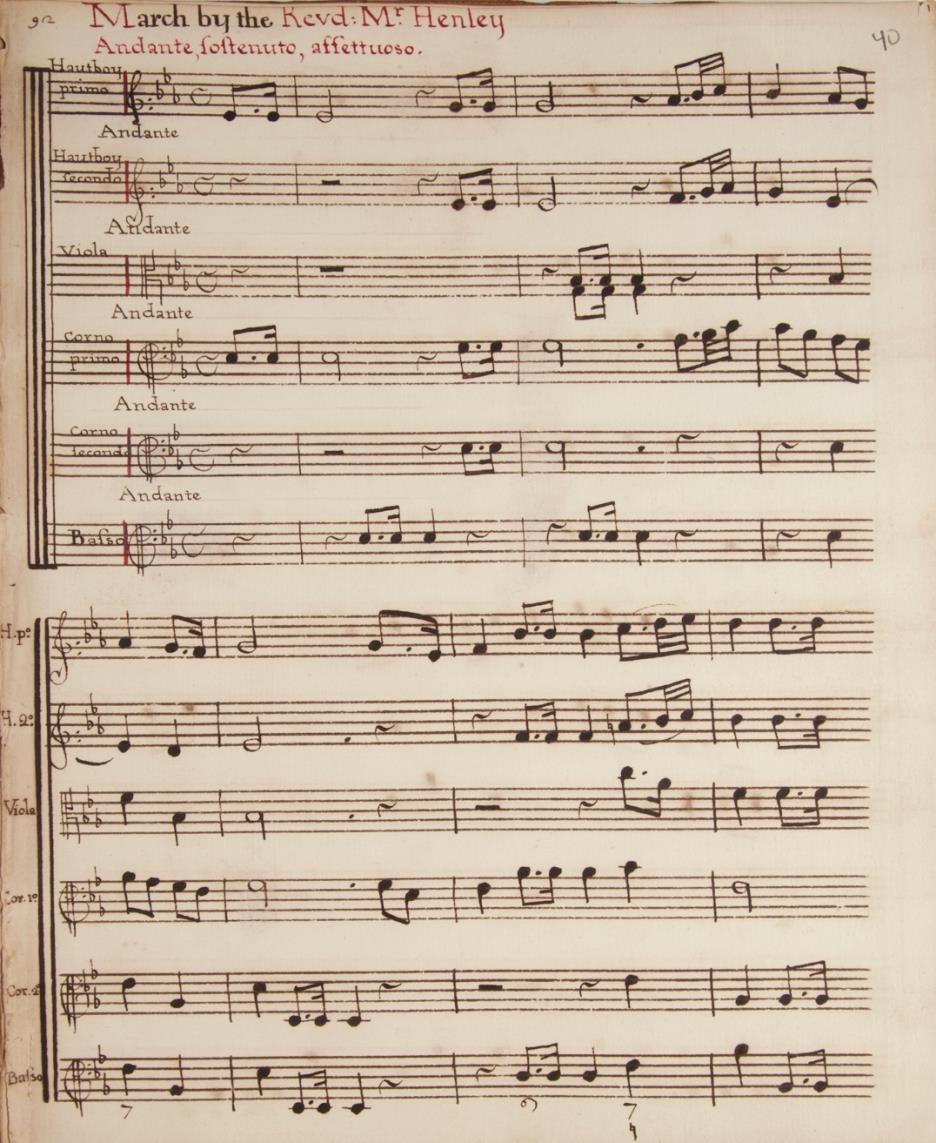
40r-42r: 92 March by the Rev. Mr. Henley ... Andante, sostenuto, affettuoso. 40r-47v and 50v-61r scored for two oboes, viola, two horns, and figured basso continuo.
42v-44r: 93 Minuet
44v-45r: 94 [Minuet]
45r-45v: 95 Minuet
46r-47v: 96 March
48r-50r: 96 March. Scored for two oboes, two horns, figured basso continuo, and timpani.
50v-52v: 115 March
53r-54r: 116 Minuett
54v-55v: 117 March
56r-57r: 118 Minuett
57v-59r: 119 March
59v-61r: 120 [March]
61v-62v: [Untitled]. A trio sonata movement, without tempo indication but likely slow and affettuoso. Scored for two treble instruments and figured basso continuo.
63r-65v: Marchia pma. In two sections, andante and allegro, both scored for unspecified instruments, the first for two trebles, alto, and figured basso continuo, and the second for two trebles and figured basso continuo.
66r-67v: Aria Affettuoso. Scored for unspecified instruments (two trebles, alto, and figured basso continuo).
68r-68v: blank
Bound with:
- An Ode on the Marriage of the Prince of Brunswick and Princess Augusta. Jan: 16: 1764. ... Valiant Prince whose Deeds recorded. England, ca. 1764. Quarto. [i] (blank), 2, [i] (blank) pp. Engraved. One copy located in the British Library (OCLC 497453283).
- An Ode on Peace ... See Peace resumes her genial reign. England, ca. 1760. Folio. [i] (blank), 2, [i] (blank) pp. Engraved.
Both odes scored for soprano, alto, tenor, and bass voices, accompanied by two horns, two violins, two oboes, viola, and figured basso continuo ("Violoncello or Organo"). The melodic style, orchestration (similar to the marches and minuets in the manuscript), and the performance note (in the first ode) advising the performers to deliver each verse first with soprano and continuo, then with full choir (see similar instructions for The Cure of Saul in the manuscript) all suggest that these two odes may be by Henley.
- [?]Henley. Alexis ... The Words by Mr. Matthew Prior ... "Alexis shun'd his fellow Swains. England, ca. 1730. Folio. 1, [i] (blank) pp. Engraved. BUC p. 21, with the poet cited as "M. Prior" (another issue?).
The engraved music is bound into the manuscript between 62v and 63r.
Provenance
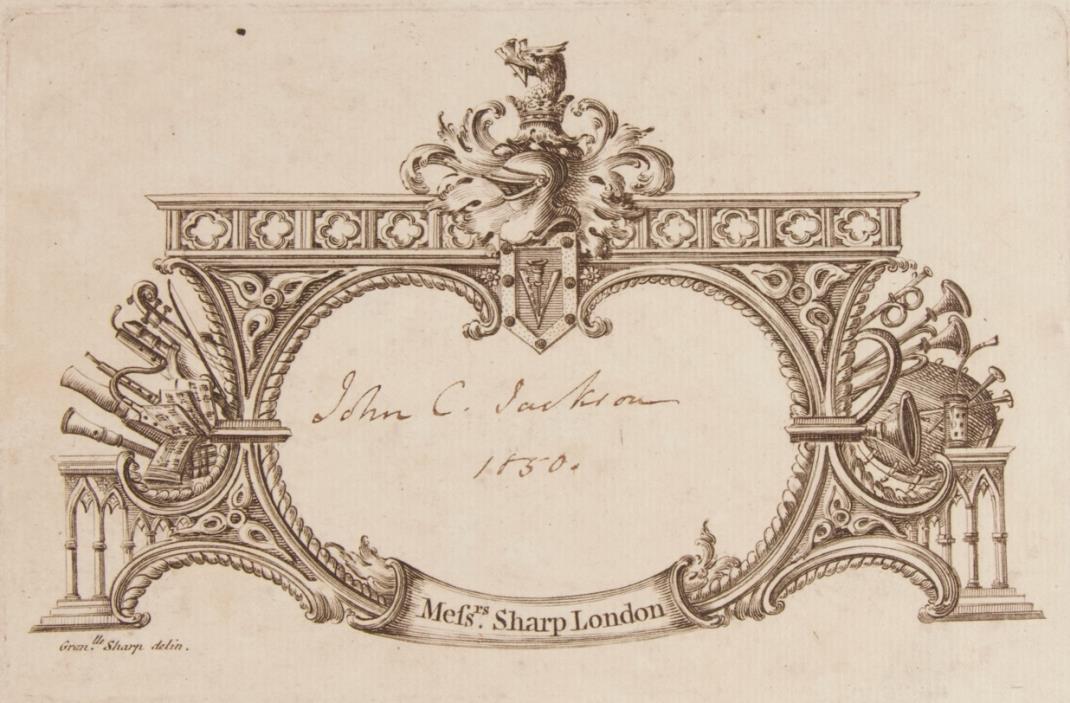
With signature "John C. Jackson, 1850" to large bookplate designed by Granville Sharp (1735-1813) to front pastedown with text "Messrs. Sharp London" to lower margin, referring to Granville and his brothers William and James; the brothers performed in concerts together (See King: Some British Collectors of Music, p. 173); Granville was a noted scholar, abolitionist, philanthropist, and amateur musician whose collection was sold at Sotheby's on 7 February 1814. "Edward Forster" in manuscript to head of front pastedown (possibly the writer, cleric, and antiquarian, 1769-1828; "Leadenhall street" in early manuscript to upper outer corner of front free endpaper, with annotation in pencil "Miscellaneous music Saul &c supposed to be unpublished by the Rev Phocion Henley."
Henley was a composer and Church of England clergyman. "As an undergraduate, he spent much time studying music, and was to compose several chants and anthems. He apparently published a collection of six hymns, The Cure of Saul (not traced) [it has in fact been traced and is now present in the 2011 modern edition of Henley], and, some years after his death, his Divine Harmony, being a Collection of Psalm and Hymn Tunes in Score appeared; it was republished by John Page, with four psalm tunes by Thomas Sharp, in 1798. ... An edition of Henley’s hymns was published online in 2011, edited by Robert Barr and Francis Roads; his church music was performed as an exemplar of eighteenth-century hymnody, composed for gallery musicians rather than the organ." R. F. Sharp, revised by K. D. Reynolds in Oxford Dictionary of National Biography
Granville Sharp was an "English philanthropist and amateur musician. Best known for his fight to abolish slavery, he was also a keen amateur musician who played the flute, clarinet, oboe, flageolet and kettledrums. He had a good bass voice and his Short Introduction to Vocal Musick was published in 1767. Together with his
brothers, William (1729–1810), surgeon to George III, and James (d 1783), an engineer, from 1775 until 1783 he held concerts on two barges on the Thames, attended by ‘not only men of the most eminent talents and skill, but also those of the highest and most distinguished rank’ (Hoare). This activity was recorded in a famous painting by Johan Zoffany which shows 15 music-makers, many of them members of the family, on their barge. The brothers also hosted fortnightly concerts of sacred music on Sunday nights in London.
The Sharp brothers owned a significant collection of music, a library established by their father, Thomas (1693–1758), Archdeacon of Northumberland; a manuscript catalogue is preserved in the New York Public Library. It included works of Handel, solo concertos, catches and glees, symphonies and overtures, as well as a substantial collection of Anglican sacred music; over 350 composers are represented. The description of the orchestral works includes musical incipits and the number of performance parts. A large part of the collection was sold by Leigh & Sotheby at auction in 1814. Some of the Sharp family instruments are now on loan to the Bate Collection of Historical Instruments in the Faculty of Music at Oxford." Lenore Coral in Grove Music Online
The watermark in the present manuscript is identical to that found in Sharp's catalogue of his music collection (see Holland and LaRue: The Sharp Manuscript, London, 1759–c1793: A Uniquely Annotated Music Catalogue in Bulletin of the New York Public Library, 73, 1969, p. 152). The article does not reproduce the catalogue in full, but provides a list of composers and Henley is among them. It is possible that Granville Sharp and Henley were personallyacquainted: Granville's fatherThomas and Henley were both posthumously featuredin the 1798 religious music publication Divine Harmony.
The present collection is a particularly comprehensive and important source of Henley’s music; most of the musicin themanuscript is, apparently, unrecorded Possibly assembledas amusicalmemorialtoHenley, who died young after catching a fever from one of his parishioners. (35785) $7,500
Influenced by Corelli and Vivaldi, “Characteristic of all the Music is a Rhythmic Energy”
28. HUMPHRIES, John ca. 1707-1733
XII. Concertos in Seven parts for the following instruments ... Opera Terza Engrav'd & Corrected from ye Original Score. NB: The Parts belonging to the Hautboys, German-Flute, and Trumpets, are placed in the first, and second Ripieno books. [Set of parts].
London: Printed for, and sold by Benj. Cooke, at the Golden Harp in New Street, Covent Garden ... Publish'd by His Majesty's Royal Licence, [1741].
Quarto. Disbound. Organo part sewn. Engraved Numbered in contemporary manuscript 63-74, starting with the first concerto, in each part. Binder's holes to inner margins; light browning; some lower margins closely trimmed, not affecting text or notation; occasional minor soiling, stains, and tears; some leaves detached; portion of blank outer margin of title to Violino primo concertino lacking, with minor repair to blank verso with archival tape.
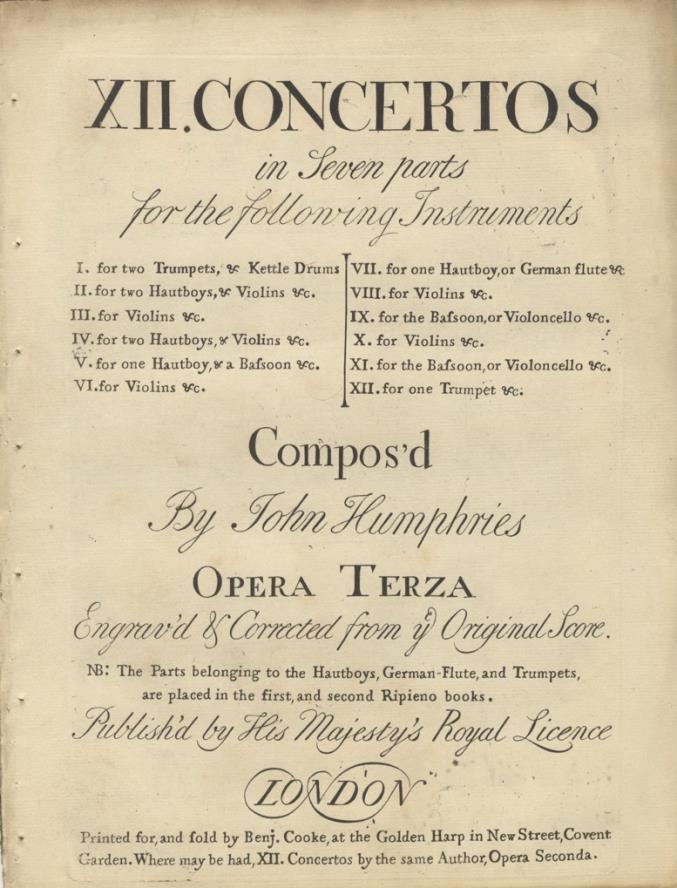
Violino primo concertino: 1f. (recto title, verso blank), [i] (blank), 2-23, [i] (blank) pp.
Violino secondo concertino: f. (recto title, verso blank), 16 pp.
Trombo[!] primo, Oboe o Violino primo ripieno, Traversa: 1f. (recto title, verso blank), [i] (blank), [i] (unpaginated Trombo primo ... Concerto I), 14, [i] (blank), 15-16, [i] (blank) pp. Trombo[!] secondo, Oboe o Violino secondo ripieno: 1f. (recto title, verso blank), [i] (blank), [i] (unpaginated Trombo primo ... Concerto I), 13, [i] (blank) pp. Alto viola: 1f. (recto title, verso blank), 12 pp.
Violoncello [figured bass]: 1f. (recto title, verso blank), 19, [i] (blank) pp. Organo ó tympano [figured bass]: 1f. (recto title, verso blank), 14 pp.
The solo instruments of each concerto are listed on the titles, as follows:
I. for two Trumpets, & Kettle Drums
II. for two Hautboys, & Violins &c.
III. for Violins &c.
IV. for two Hautboys, & Violins &c.
V. for one Hautboy, & a Bassoon &c.
VI. for Violins &c.
VII. for one Hautboy, or German flute &c.
VIII. for Violins &c.
IX. for the Bassoon, or Violoncello &c.
X. for Violins &c.
XI. for the Bassoon, or Violoncello &c.
XII. for one Trumpet &c.
First Edition. BUC p. 516. RISM H7923 and HH7923 (no copies in the U.S.).
Humphries was a noted English composer and violinist. "Generally [his] musical idiom is strongly influenced by Italian models: op .2 no. 6 ends with a long pastorale in the style of Corelli's op .6 no. 8, and Vivaldi is clearly the model for the bassoon concerto op. 3 no.11, with its strong unison ritornellos. Phrase lengths are often uncomfortably short, but characteristic of all the music is a rhythmic energy, and the use of syncopation and repeated notes." Richard Platt in Grove Music Online (40772)
Attractive Early 18th Century Portrait
$1,250
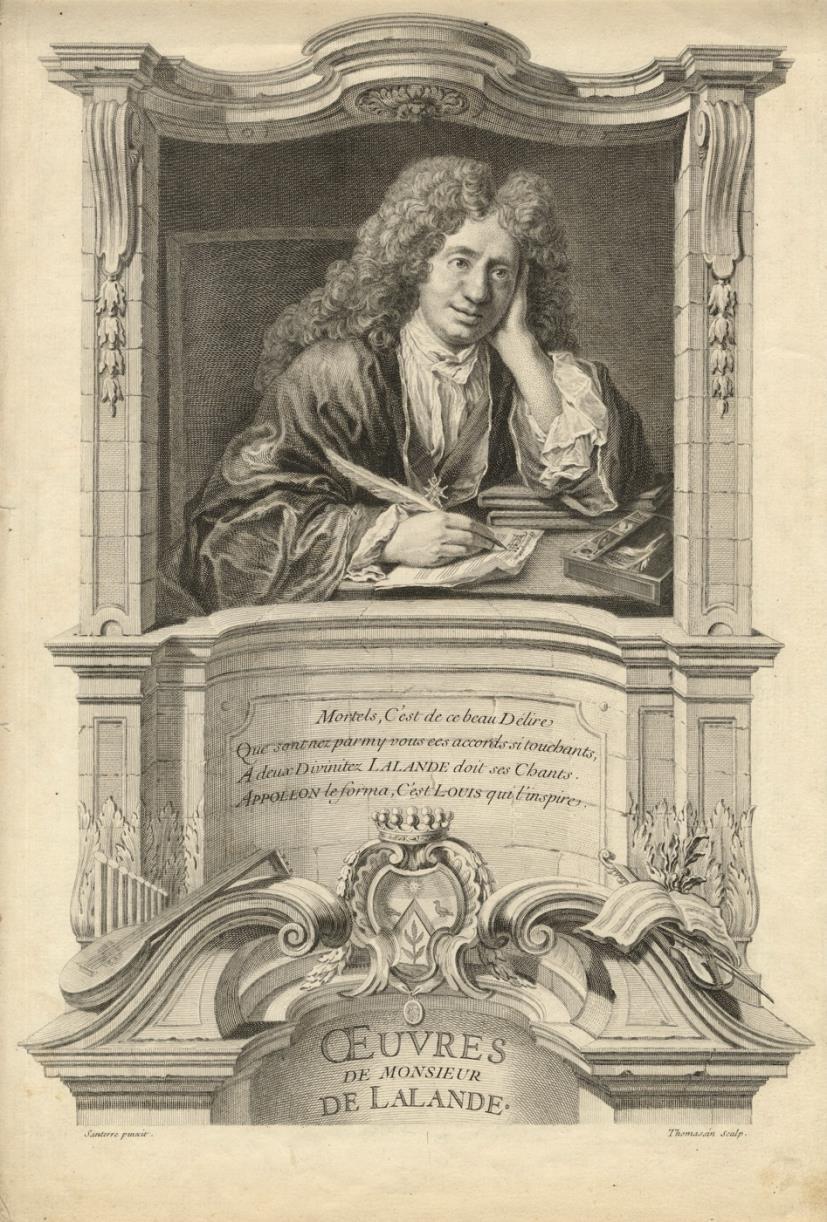
29. LALANDE, Michel-Richard de 1657-1726
Large portrait engraving and etching by Simon Thomassin (16551733) after the painting by JeanBaptiste Santeere (1651-1717). [Paris]: [Boivin], 1729.
Large folio (456 x 297 mm). On laid paper. Slightly worn, browned, and soiled; trimmed to within platemark.
The composer is depicted halflength, wearing a long wig, seated at a desk writing music, with the words "Beatus Glorium" and three notes visible on the sheet; he holds a long quill in his right hand and is leaning onto his left arm. The scene is set within a somewhat elaborate architectural frame incorporating poetical text in praise of Lalande's music: "Mortels, C'est de beau Délire/ Que sont nez parmy vous ees accords si touchants,/ Á deux Divinitez Lalande doit ses Chants./ Appollon le forma, C'est Louis qui t'inspire," with "Ouvres deMonsieur de Lalande "
The present engraving was used as the frontispiece to Vol. I of the monumental edition of Lalande's motets published by his widow in 20 volumes from 1729-1734. Sawkins: A Thematic Catalogue of the Works of Michel-Richard de Lalande, R7, reproduced on p. 36. (41156) $700
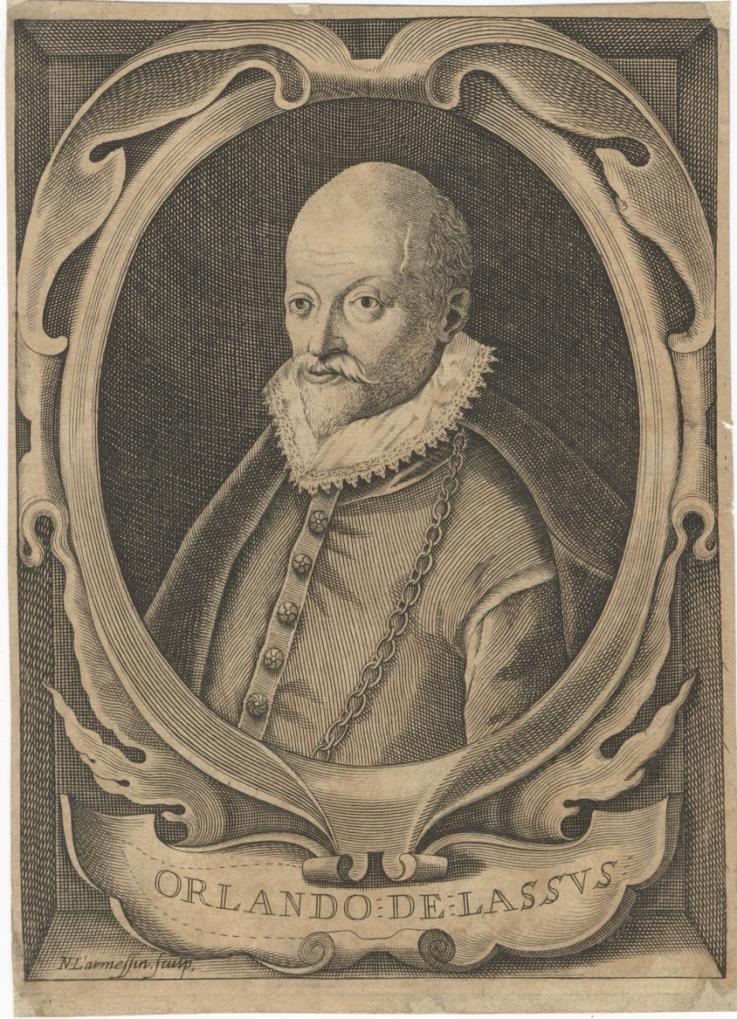
Portrait Engraving Possibly Based on the Lost Oil Painting of Ca. 1580
30 LASSO, Orlando di 1532-1594
Portrait engraving of the composer age 62 by Nicolas de l'Armessin (1638-1695) after Jacob van Campen. [1682].
190 x 138 mm. The composer is depicted bust-length within an oval border, wearing a lace collar and a chain around his neck, with cartouche identifying the sitter below. Slightly worn, browned, and foxed; trimmed to within platemark; minor loss to upper and lower margins reinforced with narrow strips of backing paper to verso with remnants of two small hinges. Extracted from Bullart: Académie des Sciences et des Arts, Bruxelles, 1682, with letterpress text to verso.
British Museum number 1868,0328.819. IFF / Inventaire du Fonds Français: Bibliothèque Nationale, Département des Estampes (403-565). Muller II 1853 / Beschrijvende catalogus van 7000 Portretten, van Nederlanders (undescribed). van Someren 1888 / Beschriivende catalogus van Gegraveerde Portretten van Nederlanders. Vervolg op Frederik Mullers catalogus van 7000 Portretten van Nederlanders. (3155).
Apparently based on the Johann Sadeler engraving of 1593, the source of both prints possibly the lost oil painting of ca. 1580. See Leuchtmann: Orlando di Lasso, plates II, 22, 18 and 16a.
Lasso "was one of the most prolific and versatile of 16th-century composers, and in his time the best-known and most widely admired musician in Europe." James Haar in Grove Music Online. (41169) $400
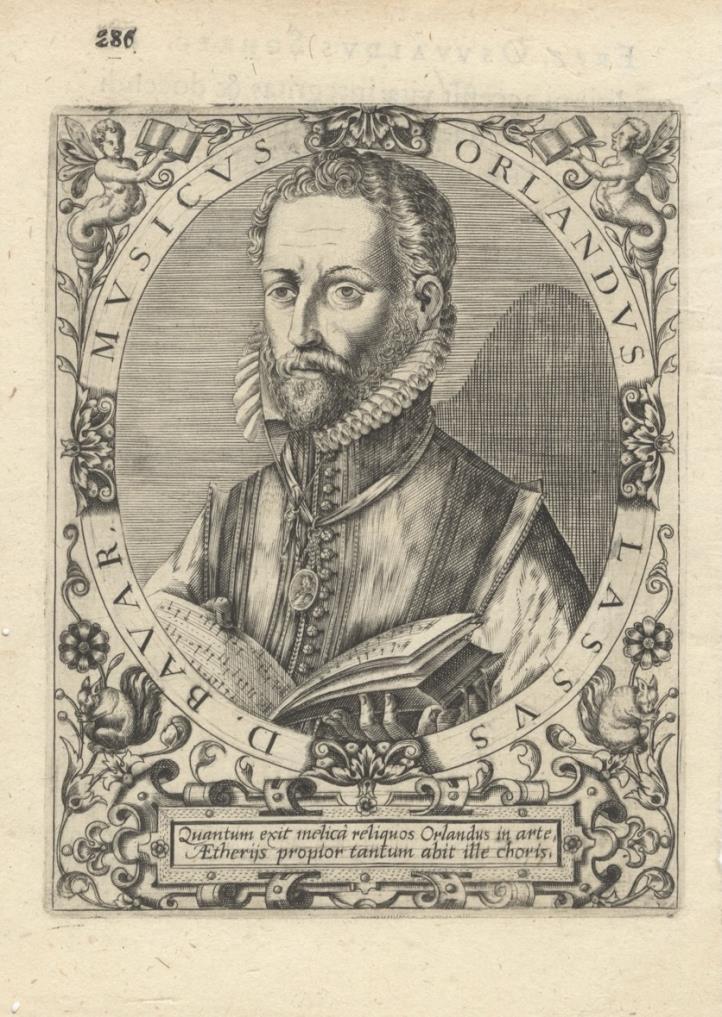
Portrait Engraving Published One Year After the Composer’s Death
31 LASSO, Orlando di 1532-1594
Portrait engraving by Theodor de Bry (1528-1598). [1599].
Image size to platemark ca. 147 x 115 mm; sheet size 191 x 148 mm. The composer is depicted bust-length within a lettered oval border wearing a ruff, a medallion around his neck, holding an open book of music, within a decorative border incorporating floral motifs, squirrels, and cherubs with 2 lines of text to cartouche below "Quantum exit melicâ ... abit ille choris." On lightweight laid paper. With page number "286" to upper margin. Very slightly worn and browned; minor creasing to lower margin; four small holes to blank left margin.
British Museum number 1864,0611.43. Hollstein / Dutch and Flemish etchings, engravings and woodcuts c.1450-1700 (225-314). Muller II 1853: Beschrijvende catalogus van 7000 Portretten, van Nederlanders (undescribed). van Someren 1888: Beschriivende catalogus van Gegraveerde Portretten van Nederlanders. Vervolg op Frederik Mullers catalogus van 7000 Portretten van Nederlanders (undescribed). Komma 230. Kinsky p. 89, no. 3.
The present engraving was published in the famous 16th century biographical work Icones Quinquaginta virorum illustrium doctrina & eruditione [Icons of Fifty Illustrious Men Outstanding in Doctrine and Erudition] by Jean Jacques Boissard (1528-1602) containing engraved portraits of prominent cultural figures by noted Flemish goldsmith and engraver de Bry. (41173) $650
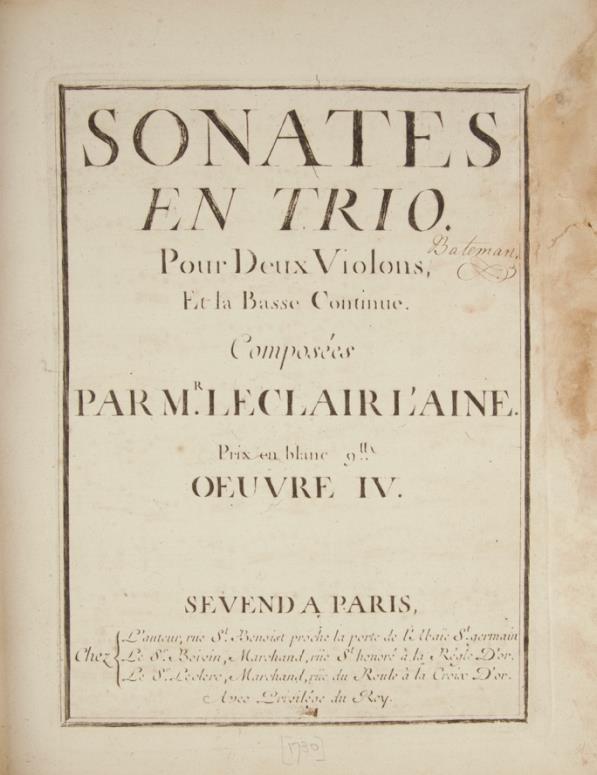
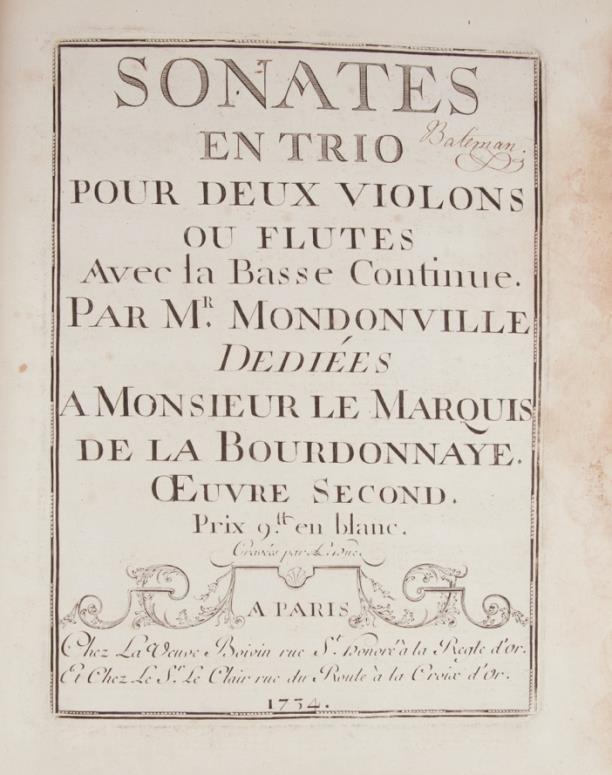
Early 18th Century First Editions of Leclair and Mondonville Sonatas From the Dolmetsch Collection
32. LECLAIR, Jean-Marie 1697-1764 and Jean-Joseph Cassanéa de Mondonville 1711-1772
Sonates en Trio pour Deux Violons et la Basse Continue ... Prix en blanc 9₶. Oeuvre IV. [Set of parts].
Paris: Chez L'auteur, rue St. Benoist proche la porte de l'Abaïe St. germain. Le Sr. Boivin, Marchand, rüe St honoré à la Régle D'or. Le Sr. Leclerc, Marchand, rüe du Roule à la Croix D'or. Avec Privilége du Roy, [1730].
Violino primo: [i] (title), 2-28 pp. (including two blanks)
Violino secondo: [i] (title), 2-30 pp. (including three blanks)
Organo / Violoncello: [i] (title), 2-27 pp. (including two blanks)
First Edition. Lesure p. 379. BUC p. 606. RISM L1317.
Bound with:
Mondonville. Sonates en Trio Pour Deux Violons ou Flutes Avec la Basse Continue ... Dediées a Monsieur le Marquis de la Bourdonnaye. Œuvre Second. Prix 9₶ en blanc. Gravées par L. Hue. Paris: Chez La Veuve Boivin rue St. Honoré à la Regle d'Or. Et Chez Le. Sr. Le Clair rue du Roule à la Croix d'Or, 1734.
Violino primo: 1f. (recto title, verso blank), 1f. (recto dedication, verso blank), [i] (blank), 2-23 pp. (including one blank)
Violino secondo: 1f. (recto title, verso blank), [i] (blank), 2-23 pp. (including two blanks)
Violoncello: 1f. (recto title, verso blank), [i] (blank), 2-21 pp. (including one blank)
The Largo of Sonata VI features an obbligato cello part in the tenor register, notated on its own stave above the lower continuo line.
First Edition. Lesure, p. 437. RISM M3203 (1 copy only in the U.S., at the Library of Congress).
Figured bass to cello parts of both works. With Bateman" in contemporary manuscript to front pastedown of Violino primo and Violoncello parts, titles, and "Bateman 1745" to blank recto of first page of music of first violin part.
Provenance
Arnold Dolmetsch (1858-1940), musicianand pioneerin theEarly Musicrevival, with his small inventory label to spines and with handstamp ("Dolmetsch Library") and shelfmark ("IID37,1) to foot of first page of music of all parts of Leclair and verso of title of all parts of Mondonville.
3 volumes. Folio. Full contemporary green vellum with titling gilt to uppers, red edges. Engraved. Binding somewhat worn, rubbed, and bumped. Occasional small stains and minor soiling; blank outer margins of first violin and continuo parts browned and dampstained, with some paper loss, not affecting printed area.
Leclair, a French composer, violinist, and dancer, "is considered the first great figure of the French violin school ... His influence on French violinists persisted to the end of the 18th century ” Neal Zaslaw in Grove Music Online
Mondonville was a French composer, violinist and conductor. "With Jean-Philippe Rameau, he was one of the outstanding figures of French music in the 18th century. ... In 1731 he settled in Paris and made his début as a violinist at the Concert Spirituel on Palm Sunday 1734, on which occasion the Mercure de France praised him for his virtuosity. At about this time he also published his first collections of instrumental music, a set of violin sonatas op. 1 (1733) and the Sonates en trio op. 2 (1734). He was first violin in the Concert de Lille when, in 1738, he published Les sons harmoniques op. 4, a set of violin sonatas with an introduction setting out, for the first time, the technique of playing harmonics on the violin by lightly touching an open string." Marc Signorile in Grove Music Online. (40504) $1,800
Mid-17th Century Engraved Portrait of this Dutch Composer and Organist
33. LIBERTI, Henricus ca. 1610-1669
Portrait engraving by Petrus de Iode after Anthony van Dyck. [1640-1645].
Image size 271 x 194 mm. + narrow margins; sheet size 274 x 204 mm.The subject is depicted three-quarter length, wearing a shirt and semi-buttoned doublet, three chains across his left shoulder, holding a sheet of music in his right hand titled "Canon A 4," text commencing "Ars longa." With 2 lines of text in Latin below image: "Henricus Liberti. Groeningensis Cathed. Ecclesiae Antverp. Organista, and "Anton. van Dÿck pinxit." to lower left, "Petrus de Iodesculpsit."tolower right. On laid paper. Very slightly worn and creased; trimmed to just outside platemark; small notation in ink to lower right corner. A very good impression.
British Museum number 1863,0509.859. New Hollstein (Dutch & Flemish) / The New Hollstein: Dutch and Flemish etchings, engravings and woodcuts 1450-1700 (144.IV) (Van Dyck) (144.IV). Hollstein / Dutch and
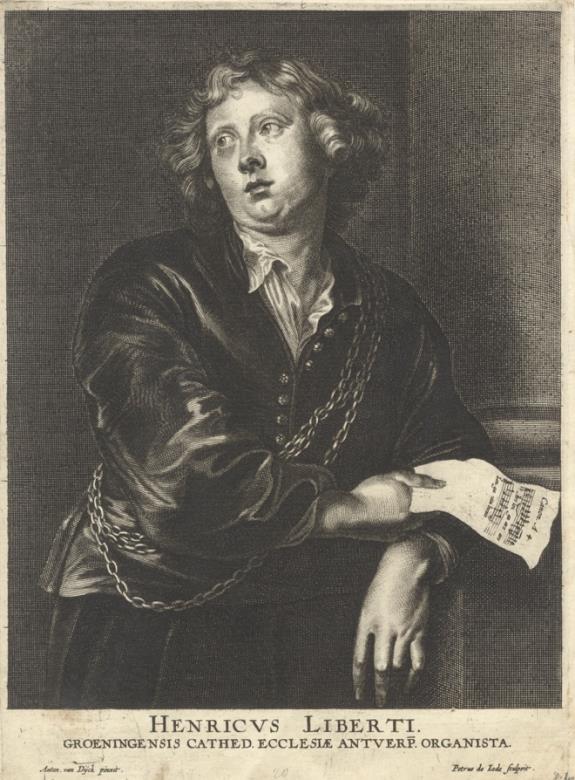
Flemish etchings, engravings and woodcuts c.1450-1700 (117). Mauquoy-Hendrickx 1991 / L'Iconographie d'Antoine Van Dyck, Catalogue raisonné (172.IV). Muller II 1853 / Beschrijvende catalogus van 7000 Portretten, van Nederlanders (3217).
Liberti was a Dutch composer and organist. "Only his cantiones natalitiae survive enough to be studied; they are homophonic carols on Dutch texts in a strophic binary form. Liberti’s portrait, painted by Anthony van Dyck about 1630, exists in at least eight copies and was also engraved. Its popularity may have been due to its suitability as a prototype for ‘the exalted artist’." Rudolf A. Rasch in Grove Music Online
Pieterde JodeII (1606-1674)was anotedFlemish printmaker andclosecollaborator of leading Flemish Baroque artist Anthony van Dyck (1599-1641); he was the son of noted printmaker Pieter de Jode the Elder (1570-1634), active in Antwerp. (41168) $485
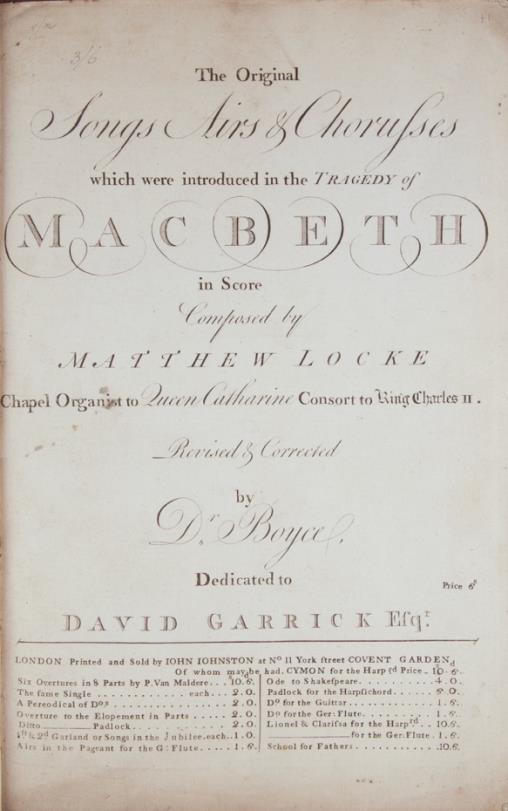
“The ‘Famous Music’ of Boyce’s Revision of 1770”
34. LOCKE, Matthew 1621-1677
The Original Songs, Airs & Choruses which were introduced in the Tragedy of Macbeth in Score. Composed by Matthew Locke Chapel Organist to Queen Catharine Consort to King Charles II. Revised & Corrected by Dr. Boyce, Dedicated to David Garrick Esqr. Price 6s.
London: Printedand soldby IohnIohnstonatNo 11York Street Covent Garden, ca. 1770.
Folio. Full mid-gray textured paper boards with dark green leather title label to spine gilt. 1f. (recto title, verso blank), 1f. (recto dedication, verso blank), [i] (blank), 2-29, [i] (blank) pp. Engraved. With list of 15 publications available printed in two columns below imprint, with first entry at upper left "Six Overtures in 8 Parts by P. Van Maldere s10. d6." and final entry at lower right "School for Fathers 10.6." Annotation in pencil to front pastedown: "R. Harding / The date at present accepted for this /publicationis [1770]."Bindingworn, rubbed, andbumped; head and tail of spine slightly defective; endpapers browned. Minor internal wear and soiling; light uniform browning; outer margins slightly trimmed, not affecting notation.
First Edition. BUC p. 625. RISM L2631.
Locke, an English composer and organist, "was the most important, influential and prolific English composer of his generation, contributing to most genres of the time." Peter Holman in Grove Music Online
Dedicated by the publisher to celebrated actor David Garrick (1716-1779). "The `famous music' of Boyce's revision of 1770, in which he attributed the music to Locke and which was exceedingly popular until well into the 19th century, is not by him, except that his `Witches Dance' is retained." TNG Vol. 11, p. 113.
Most of the music is now thought to have been composed by the noted English bass and composer Richard Leveridge (1670-1758). "For more than half a century Leveridge was a leading singer on the London stage and a popular composer of songs." Olive Baldwin, revisedbyThelmaWilson in Grove Music Online. (40762) $950
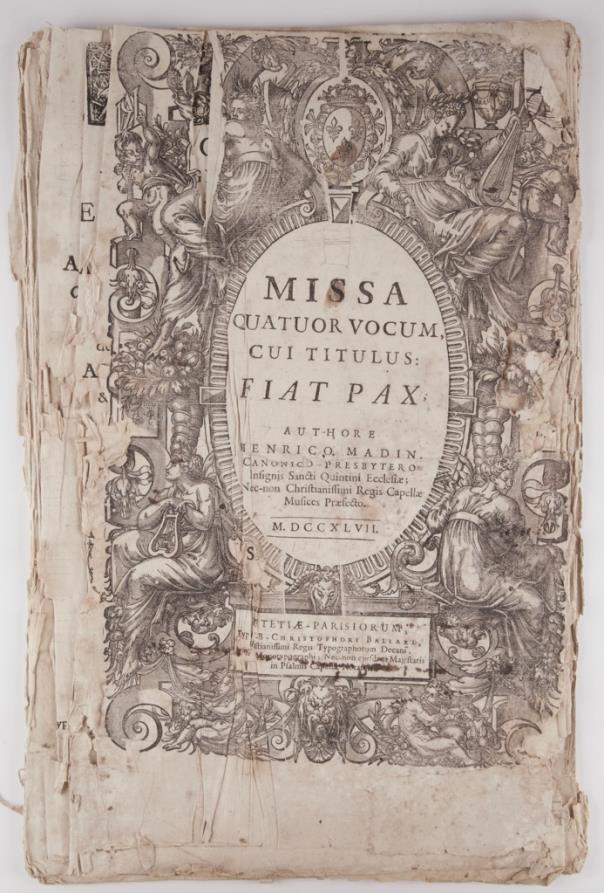
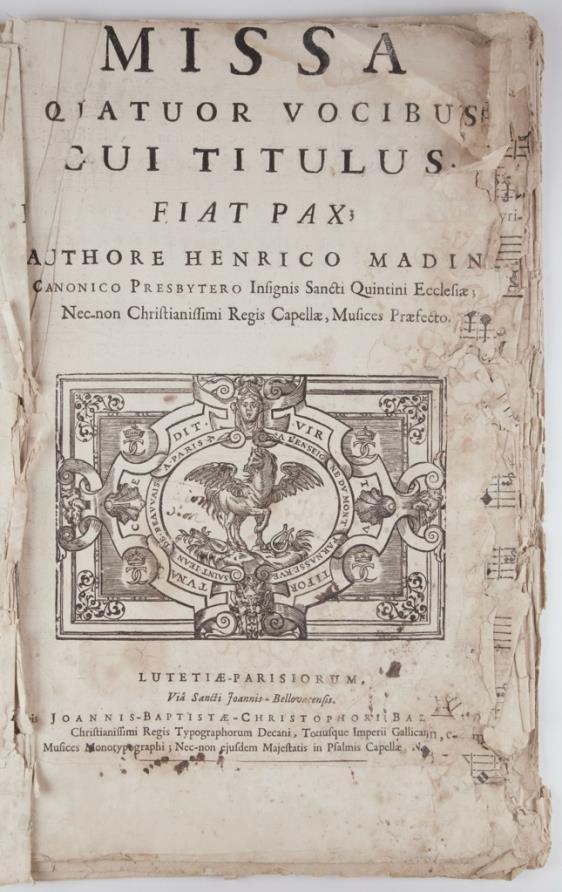
Rare French Baroque Mass
35. MADIN, Henri 1698-1748
Missa quatuor vocum cui titulus: Fiat Pax. [HM5]. [Setting for 4 voices: Superius, Tenor, Contra, and Bassus in choirbook format].
[Paris]: Christophori Ballard, 1747.
Tallfolio. Disbound. 2ff. (elaboratepreliminarytitle, dedication), [i] (secondarytitleincorporatinglargevignette featuring a winged horse), 2-39, [i] (notice attesting to the Royal privilege Ballard enjoyed to print music in France). Typeset music in diamond-head notation. With woodcut headpieces and historiated initials. In poor condition generally, with numerous tears and loss of mostly small printed areas, particularly to first and last leaves and outer edges; occasional minor staining. In need of archival restoration.
With three measures of musical notation in manuscript and some early humorous drawings to verso of second leaf, possibly executed by a young chorister. Occasional additional markings in manuscript.
Not in Lesure, BNF online catalogue, or RISM.
A manuscript score is recorded at the Bibliothèque municipale, Cambrai (F-CA) and a manuscript set of parts is recorded at the Fonds S. Bavonis in Gent (B-Geb). The Mass has otherwise been designated as lost; a single copy of the printed edition is, however, recorded at the Bibliothèque du Centre de Musique Baroque de Versailles.
Montagnier includes Henri Madin in a group of first class French composers from the period encompassing the last years of the reign of Henry IV to the eve of the Revolution who composed polyphonic masses; moreover,
he notes that the present work is among a small group of masterpieces of this genre. See Montagnier: The Polyphonic Mass in France, 1600-1780. The Evidence of the Printed Choirbooks, p. 87.
The Mass Fiat Pax was the last of four masses composed by Madin. It was dedicated to Louis-Guy Guérapin de Vauréal, bishop of Rennes. Montagnier proposes that the mass was composed to celebrate the victory of King Louis XV in the successful battle of Lawfeld on July 2,1747, in the war of the Austrian Succession (1740-1748).
"Henri Madin stands among those composers still too overlooked by French Baroque music specialists, even though he occupied one of the most sought-after musical positions in the kingdom, that of sous-maître de la Musique de la Chapelle du Roi. Born in Verdun in 1698, he was the only son of Jacques Maddin (James Madden?), an Irish soldier from Galway ... As a choirboy at Verdun cathedral, and later as a student at the city's Jesuit college, he received a comprehensive musical, religious, and intellectual education that led him to be tonsured, and soon afterwards to be ordained a priest in his native diocese. ... Madin was established as an accomplished musician, composer, theorist, and pedagogue who left an abundant output behind him. His great human and professional qualities helped him to attract the favour of Cardinal André-Hercule de Fleury and of Louis XV himself, and to garner the approval of his contemporaries." Montagnier: The War of the Austrian Succession and the Masses by Henry Madin (1740-1748) in Music & Letters Vol. 100 No. 3 (2019) pp. 391, 411-414. (41159) $1,200
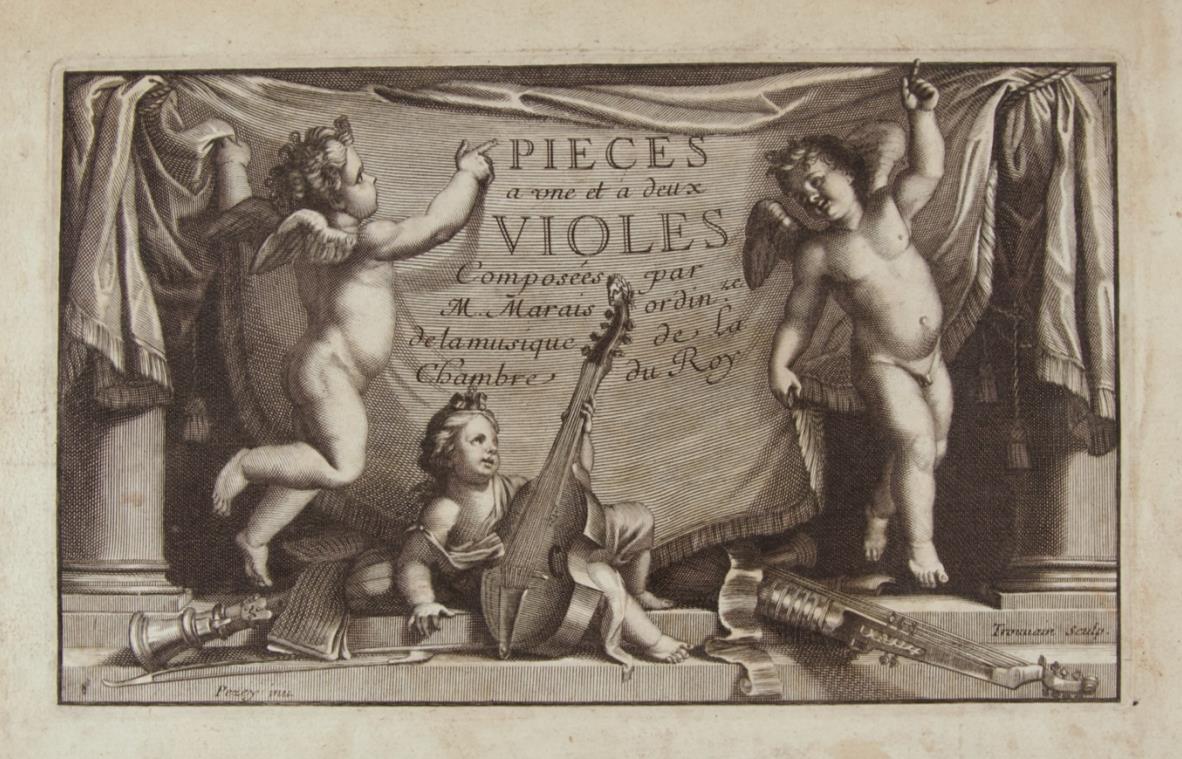
The First Published Music for Viola da Gamba by “One of the Outstanding Figures in French Music of the Baroque”
36 MARAIS, Marin 1656-1728
Pieces a une et a deux Violes Composées par M. Marais ordin[ai[re de la musique de La Chambre du Roy. Pezey inv. ... Trouvain sculp. [Livre 1]. [Viola da gamba part].
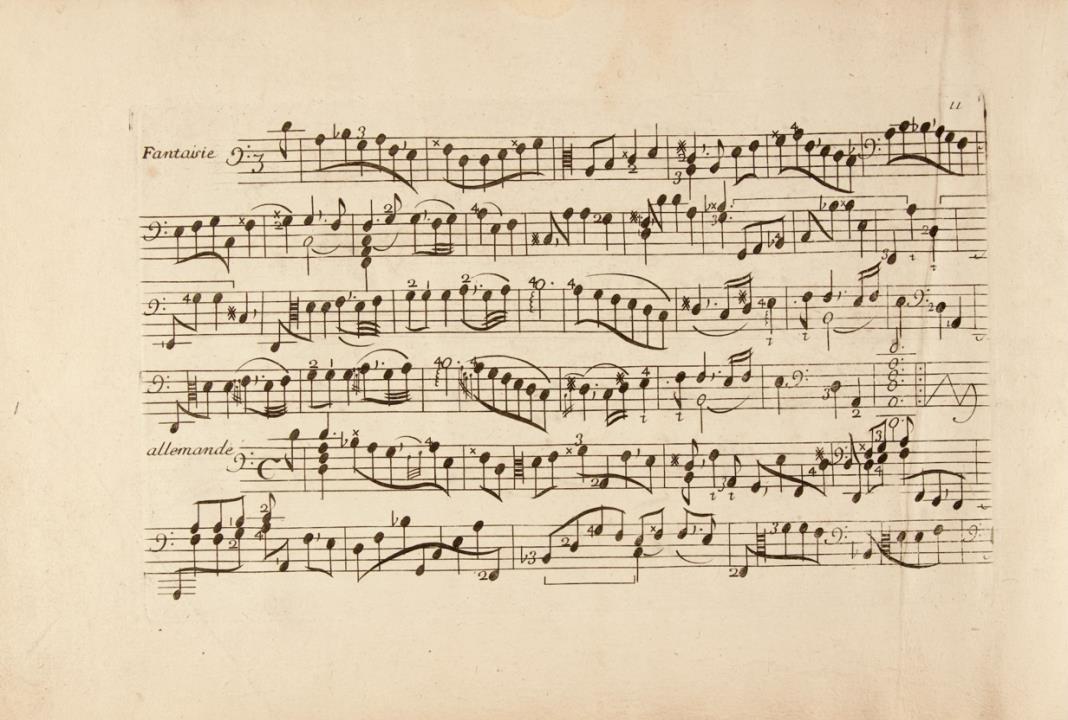
[Paris]: Chez l'Autheur Ruë du jour proche St. Eustache du costé de la ruë Montmartre. Et ean Huret faiseur d'Instruments pour la musique du Roy, ruë des Arcis a l'Image St. Pierre, 1686.
Oblong folio. Full contemporary dark brown mottled calf. [4]-[5] ("Avertissement"), [6] ("Extrait du Privilege du Roy"), 7-119 pp. music.
The fine engraved illustrated title incorporating a viol, lute, sheet music, putti, and drapery has been laid down to the verso of the upper board, and an elaborate engraved illustration from another publication (Sonate o partite ad una o due viole da gamba con il basso continuo, D'Augusto Kühnel, Cassel, 1698) of two men playing viols accompaniedbyawomanattheharpsichord, etc., laiddowntotherectoofthelowerboard. Bindingconsiderably worn, rubbed, andbumped, with loss to portions of leather; spine lacking; boards nearly detached. Light uniform browning, somewhat heavier in spots; some internal wear, soiling, and small stains; 17 leaves defective, with tears and abrasions resulting in loss to text to "Avertissement," and notation on pp. 21, 44, 45, 59, 63, 75, 91, and 95;teartopp. 70/71, 79, 111repairedwitharchivaltape;p. 120, followingblank, anddedicationleaflacking; engraving to recto of lower board worn and browned, trimmed, lacking upper inner and lower outer corners. Lacking 7 leaves (pp. 1-3, 42/43, 48/49, 98-101, and 120).
First Edition Rare. Lesure p. 412. BUC p. 647. RISM M383 (3 copies in the U.S., at Yale, Eastman, and the Library of Congress).
Marais was a French composer and viol player. "He is one of the outstanding figures in French music of the Baroque period. ... A viol virtuoso, Marais was one of the first French instrumentalists to make his mark as a soloist. Gifted with a remarkable technique he developed it, adding new complexities. His pleasing tone had a rare power, thanks to an ‘airy’ style of playing which made full use of open strings and their harmonics. However, his virtuosity always took second place to his musicality. His performances, full of charm and ‘fire’, captivated his contemporaries, who said that he played ‘like an angel’. Composer and performer were closely linked, for at this time soloists concentrated almost exclusively on playing their own works at concerts. Between 1686 and 1725 Marais published five books of pieces for viol and continuo, and several suites for two and three viols – a total of 596 pieces grouped into 39 suites, two of them for three viols." Jérôme deLa Gorce and Sylvette Milliot in Grove Music Online
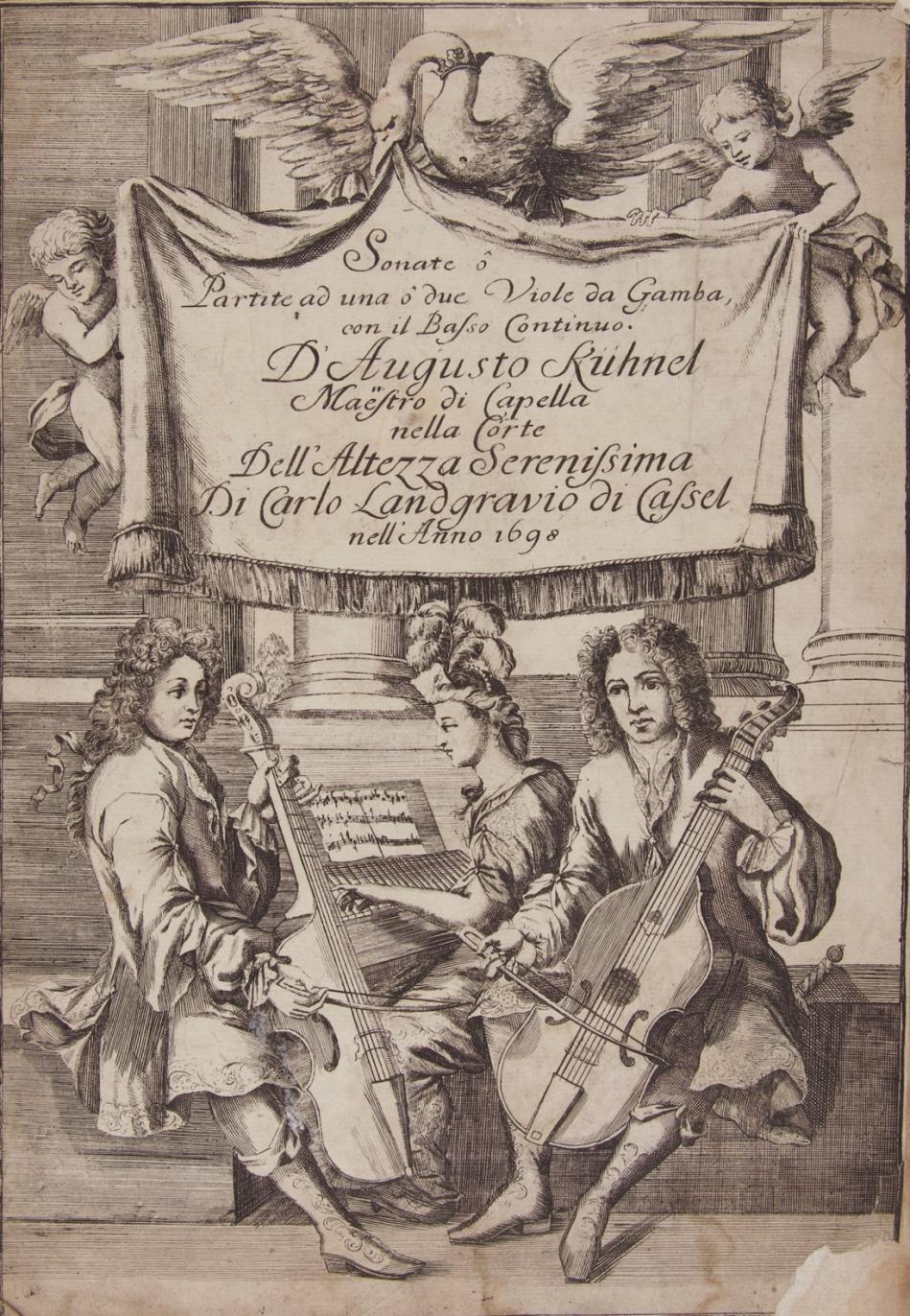
Works of both the artist, Antoine Pezey (16??-16??), and the engraver, Antoine Trouvain (1656-1708), of the title page are held in major museum collections.
The present work constitutes the first published music for viola da gamba by Marin Marais, the greatest viol-player of the Baroque era (40526) $3,200
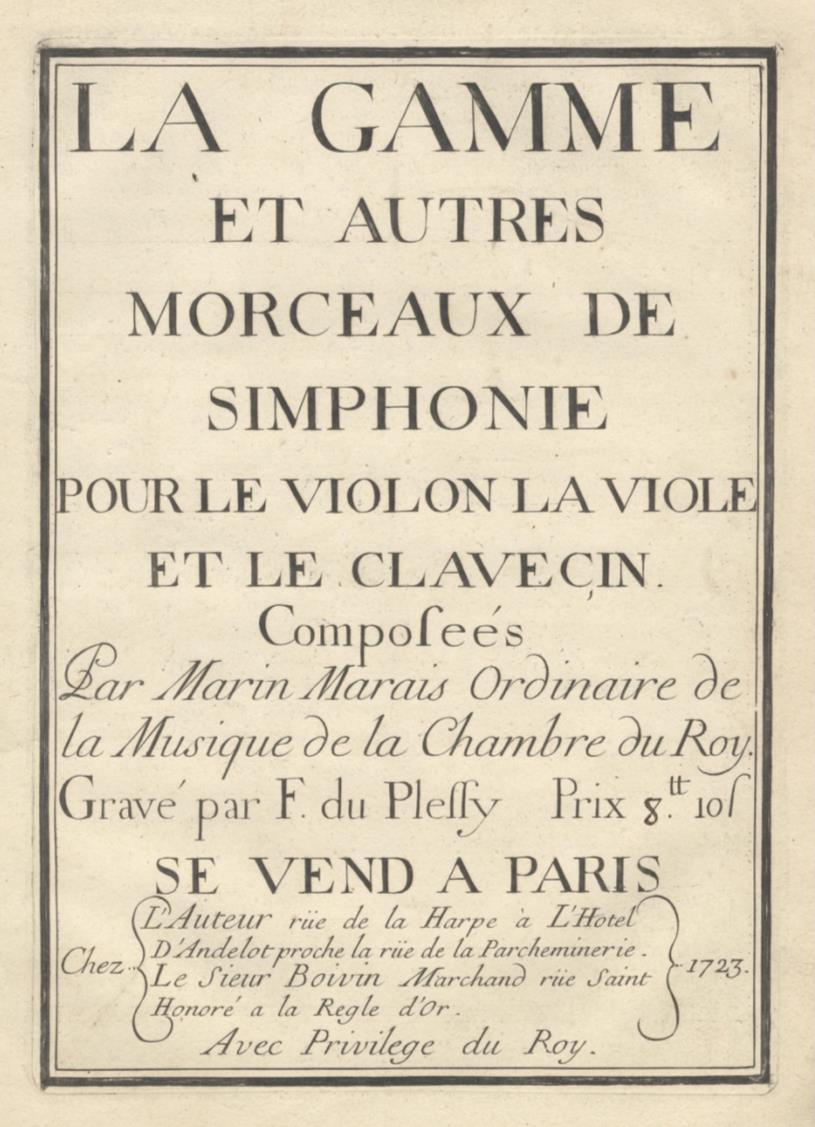
Very Rare Early 18th Century Music by this Baroque Master
37 MARAIS, Marin 1656-1728
La Gamme et Autres Morceaux de Simphonie pour le Violon La Viole et le Clavecin ... Gravé par F. du Plessy. Prix 7[amended in manuscript to 8]₶ 10s. [Score].
Paris: Chez L'Auteur rüe de la Harpe à L'Hotel D'Andelot proche la rüe de la Parcheminerie. Le Sieur Boivin Marchand rüe Saint Honoré a la Regle d'Or. Avec Privilege du Roy, 1723.
Folio. Disbound. 1f. (recto title, verso blank), 1f. (recto "Avertissement," verso "Avvertimento"), 59, [i] (privilege) pp. Engraved. Slightly worn;occasionalminorsoiling, small stains, andfoxing; lowerportionof final page of music torn away, resulting in loss of final three measures of continuo in the "Sonnerie." Quite a nice, wide-margined copy overall
Contains:
- La Gamme En Forme de petit Opera. For violin, viola da gamba, and continuo. Pp. 1-36.
This piece (in the manner of a sort of "opera without words") moves through the following keys, with dramatic contrasts and changes of mood along the way: C major (Ut), D minor (Re), E minor (Mi), F major (Fa), G minor (Sol), A minor (La), B minor (Si), C major (Ut), B minor (Si), A minor (La), G major (Sol), F major (Fa), E major (Mi), D minor (Re), C major (Ut). The "Avertissement" explains how, in the absence of viola da gamba, its part can be adapted for violin or cello. The presence of the same "Avertissement," as well as the suggestion that the viola da gamba part be played by a more Italianate instrument, may represent Marais's interest in fusing French and Italian styles; his colleague François Couperin published his Les Goûts-réunis (1724)justa year after La Gamme, a work premised on achieving such a harmonious fusion of national styles.
- Sonate a la Maresienne. For violin and continuo. Pp. 36-45. This piece incorporates some of the scale-based composition techniques of "La Gamme."
- Sonnerie de Ste. Genevieve du Mont de Paris. For violin, viola da gamba, and basso continuo. Pp. 46-59. One of Marais's most iconic pieces; the bass, an ostinato consisting of three notes (Re, Fa, Mi), is based on an the tones of an actual Parisian church bell.
First Edition Very rare. Lesure p. 412. RISM M402 (1 copy only, at the Bibliothèque nationale de France).
JISC (a copy at The British Library). (40511) $4,200
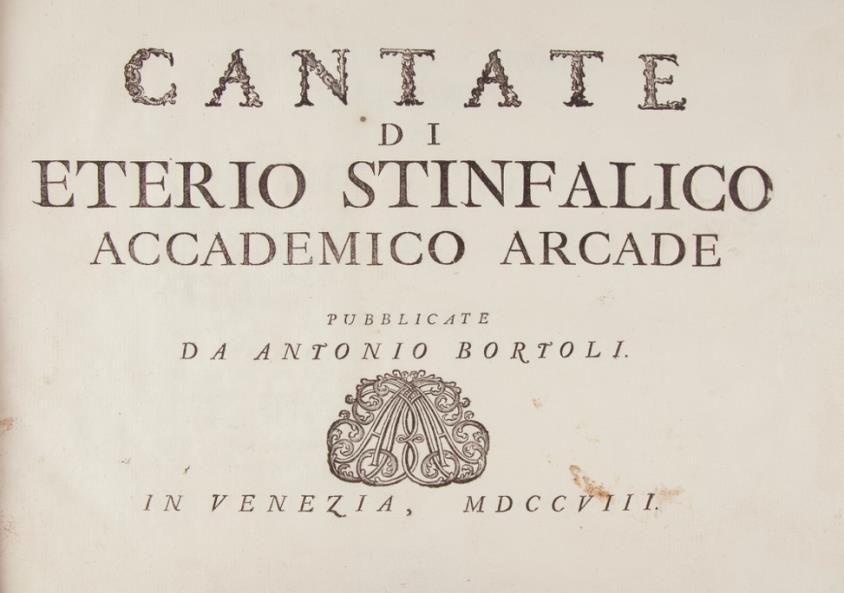
Elegantly Printed Early 18th Century Cantata
38. MARCELLO, Alessandro 1673-1747
Cantate di Eterio Stinfalico Accademico Arcade. [For voice and basso continuo].
Venezia: Antonio Bortoli, 1708.
Oblong folio. Contemporary full dark brownmottledcalf with decorativecoatofarmsto upperwithin decorative gilt rules and cornerpieces, all edges gilt. 1f. (recto title, verso blank), 1f. (recto "Tavola delle cantate," verso blank), 75, [i] (blank) pp. Typeset in diamond-head notation with decorative monogrammatic woodcut device to title and decorative woodcutinitials, end- andtailpieces throughout, two (duplicated) quite large. On fine quality
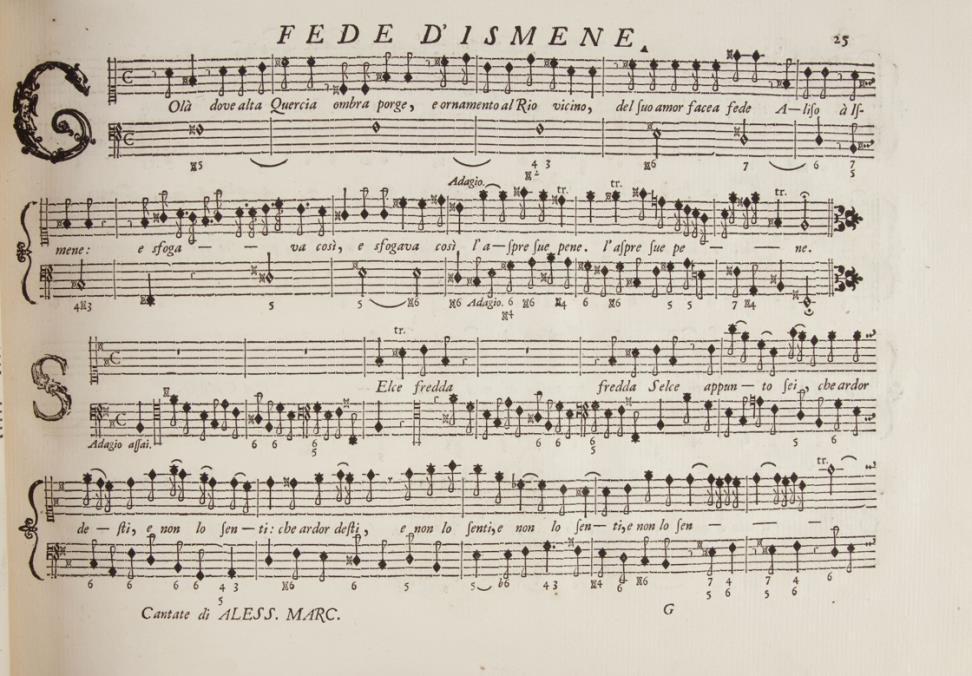
laid paper. Bindingvery slightlyworn; endpapers stained; split at hinges. A few very small stains totitle;pinhole to blank lower margin of first ten leaves. A highly attractive, crisp, and wide-margined copy.
Contains 12 cantatas, 6 for soprano and 6 for contralto, each with figured bass.
First Edition. RISM M419 (6 copies in total, with only 2 in the U.S., at U.C. Berkeley and the University of Chicago).
Marcello "excelled in many fields and led a rich and varied life; his greatest contributions to the history of music came through his role as a Venetian academician. ...
Alessandro’s most conspicuous activities as a composer seem often to have coincided with his advances in government service. For example, in 1708 he was appointed to the Quarantìa (which dealt with criminal matters), published a volume of cantatas dedicated to the Roman noblewoman Livia Spinola Borghese, and began a lawsuit against his brothers Benedetto and Gerolamo over the ownership of some boxes in the Teatro S Angelo. ...
By 1719 Alessandro had become principe of the Accademia degli Animosi, a long-established Arcadian colony in Venice. Although he still indulged in painting, drawing, the writing of poetry and other creative activities, his particular interest as an academician seems to have been in collecting musical instruments for the galleria di strumenti which he maintained. ...
His cantatas, character pieces which assume the roles of well-worn pastoral figures, and include personal and local allusions in their texts, are more exceptional for having been lavishly published than for their inherent musical qualities. He used black notation to express the irrationality of love. In 1712 Alessandro spent some time in Rome with the Borghese family. Some of the cantatas that survive in manuscript may have been given there, for they carry cues for Farinelli (not in Venice until 1729) and Checchino (Francesco de Grandis). Alessandro had access to very gifted female singers, including Benedetto’s pupil Faustina Bordoni in Venice (towards whom Alessandro was rumoured to have had amorous intentions) and Laura and Virginia Predieri in Rome." Eleanor Selfridge-Field in Grove Music Online
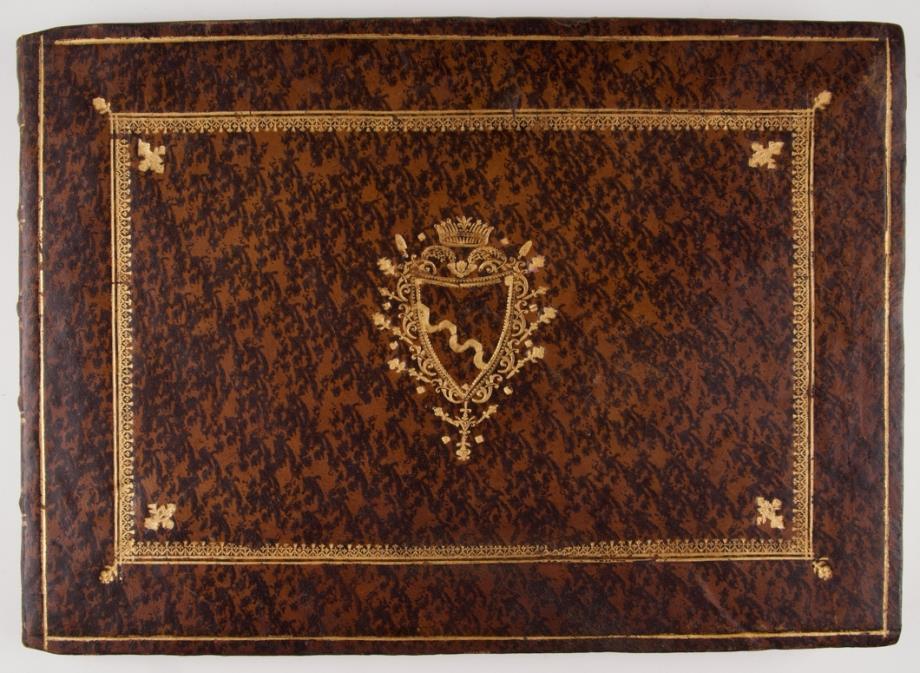
Antonio Bortoli was a music publisher and printer in Venice from ca. 1700-ca. 1740. one of the very few typographic music printers in 18th century Italy. Krummel & Sadie: Music Printing and Publishing, p. 191. He published editions of music by Lotti, Marini, Sinlio, Luigi Taglitti, and Vivaldi; liturgical books; and music treatises by Tevo, Gasparini, and Torino.
The only work of vocal music by the brother of noted composer Benedetto Marcello (1686-1739).
Elegantly printed, the present work is a notable exampleof the high quality of typographic music printing executed by Bortoli at the beginning of the 18th century (40359)
Marcello’s Opus 1
“[His] Cultivated Intellect Exerted ... a Major Influence on Italian Musical Thought and Performance”
39 MARCELLO, Benedetto 1686-1739
VI Sonate a Violoncello e Basso Continuo ... Opera Prima. Prix 6₶ [Op. 1].
$3,500
Paris: Chez Mr. Le Clerc, rüe St. Honoré vis a vis l'Oratoire chez le bonelier. Mr. le Clerc, Md. rüe du Roule à la Croix d'Or. Madame Boivin, Md. rüe St. Honoré à la Regle d'Or. Avec Privilege du Roy, ca. 1743.
Folio. Modern dark brown half calf with marbled boards, raised bands on spine with dark red title label gilt. 1f. (recto title, verso "Catalogue de Musique Françoise et Italienne"), 25, [i] (blank) pp. Engraved. Occasional annotations in pencil. Scattered minor soiling and small stains; small wormhole to blank outer margins of pp. 716. A very good copy.
Lesure p. 413. Selfridge-Field: The Works of Benedetto & Alessandro Marcello. A Thematic Catalogue, C74651. RISM M450 (2 copies only in the U.S., at Yale and the Library of Congress.
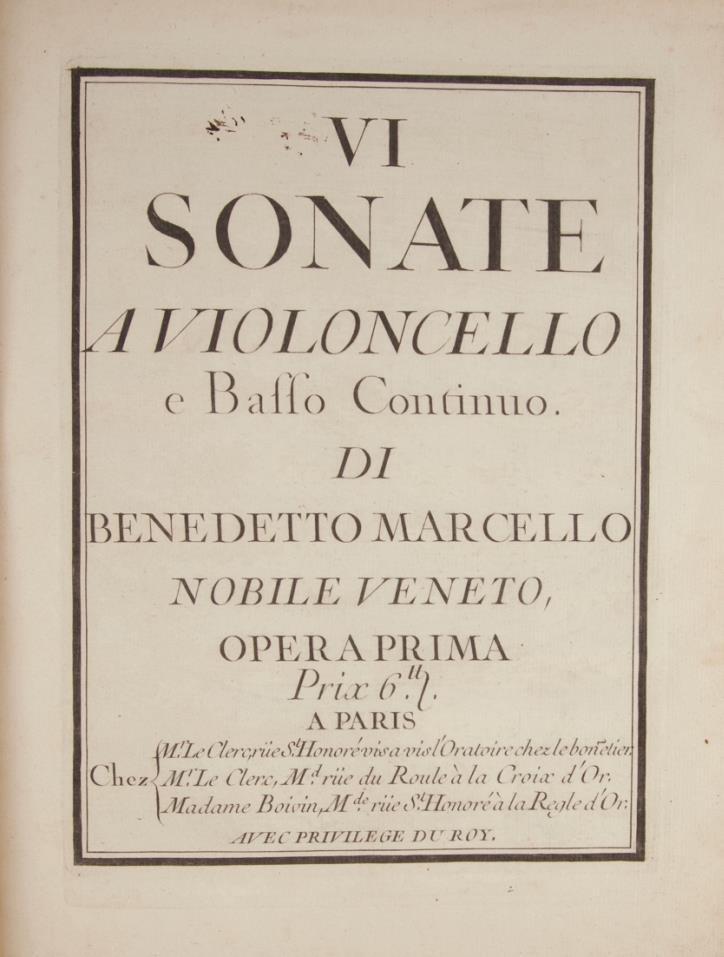
"It is not easy to segment the musical continuum of Marcello’s life, since he held no regular appointments of a musical nature and the majority of his musical works are undated. This demonstrates how severely separated in social experience dilettante composers were from the common ranks of musical maestri. Nonetheless, Marcello’s cultivated intellect exerted, particularly through his psalm settings and cantatas, a major influence on Italian musical thought and performance throughout the 18th century and, to various degrees, on the musical practices of many other European countries until the end of the 19th century. ...
His cello sonatas, which are among his most widely performed works today, were probably composed much earlier than their date of publication suggests and, in fact, their authenticity is not beyond question." Eleanor Selfridge-Field in Grove Music Online
The publisher's catalogue is of considerable interest. In addition to offering works by French and Italian composers, it includes works by a number of German and other composers influenced by those national styles. (40356) $900
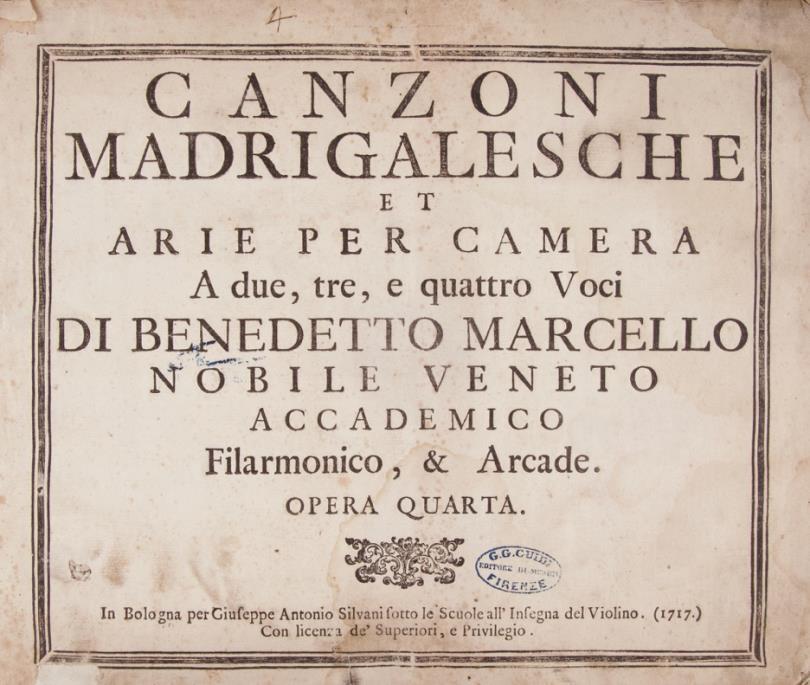
Fine Example of Early 18th Century Italian Typographic Music Printing
40 MARCELLO, Benedetto 1686-1739
Canzoni Madrigalesche et Arie per Camera a due, tre, e quattro voci ... Opera Quarta. [Score].
Bologna: Giuseppe Antonio Silvani sotto le Scuole all' Insegna del Violino ... Con licenze de' Superiori, e Privilegio, 1717.
Large oblong folio. Contemporary mid-tan mottled calf-backed flexible marbled boards with manuscript titling to spine. 1f. (rectotitle, verso blank), 1f. (recto preface, versoblank), 103, [i] ("Tavola") pp. Typeset indiamondhead notation. With attractive decorative woodcut initials and bracketing throughout. Small oval handstamp of "G.G. Guidi Editore di Musica Firenze" in dark blue ink to lower portion of title. Binding worn; free endpapers lacking. Internal wear including browning, soiling, foxing, some staining, small tears and chips; title soiled and stained, with minor early repair to lower margin; moderate browning to several leaves; several signatures split.
Manuscript additions with part designations to final page.
First Edition. Rare. Selfridge-Field p. 392. BUC p. 647. RISM M422 (1 copy only in the U.S. and 1 only in the U.K.)
The present work contains 12 songs and 6 arias. Marcello explains in the preface to the work that his madrigallike Canzoni will not only interest connoisseurs of counterpoint as fine models of that rarefied art, but can also serve as practice pieces for good singing. The last two canzoni, he explains, are a capella "all'uso de Madrigali antichi senza Cembalo, ò altro accompagnamento."
A rare and interesting example of early 18th century Italian typographic music printing (40357) $2,600
Portrait Engraving of this Noted Harpsichordist, Organist, and Composer
41. MARCHAND, Louis 16691732
Portrait etching and engraving by Charles Dupuis (1685-1742) after Paul Ponce Antoine Robert de Séri. After 1732.
Image size to platemark 110 x 152 mm; sheet size 197 x 152 mm. The subject is depicted bust-length, with powdered wig, wearing a jacket and a cravat tied in a bow with a star pinned to his breast, allwithinan oval border, with "Robert Pinx," below image to left, "Ch. Dupuis Sculp."below image to right, 4 lines of text with biographicaldetailtocartouchebelow image, and "A Paris chez Odieuvre Md. d'Estampes quai de l'École vis à vis alSamarite. ala bellImage C.P.R." to lower margin. Very slightly worn, foxed, and stained.
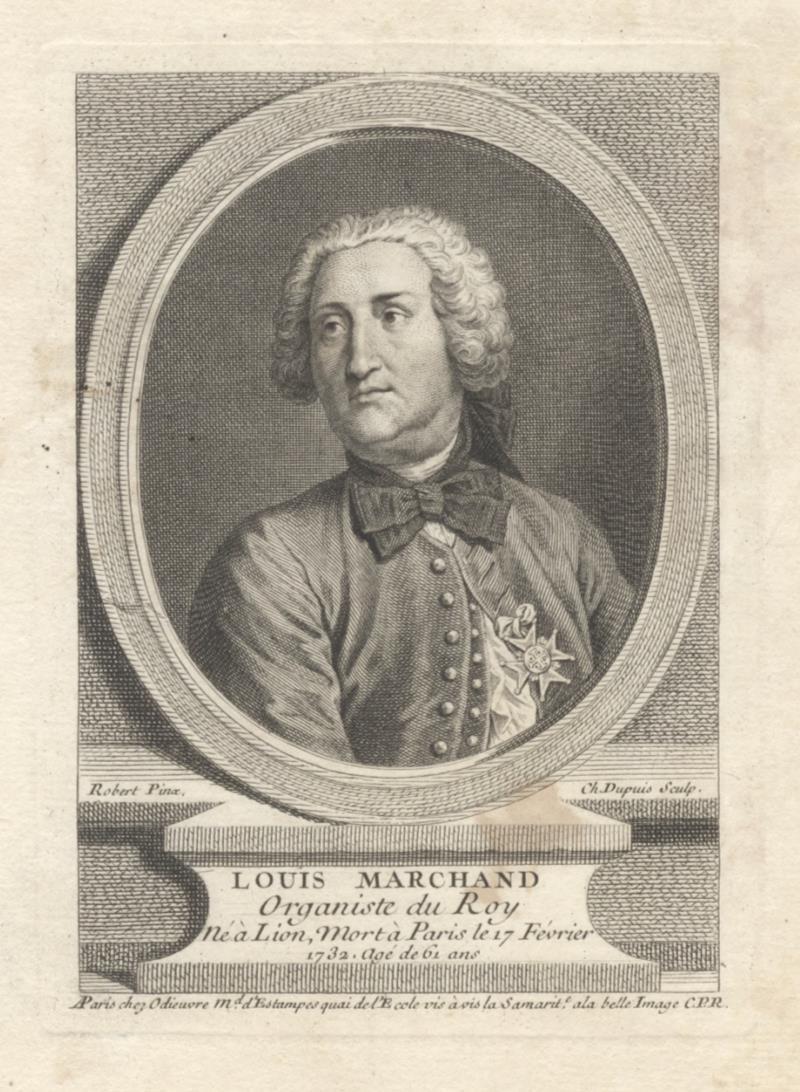
Reprint by Michel Odieuvre (16871756), French painter, dealer, and publisher of prints. British Museum number 1944,1014.324. Firmin-Didot 1875-77 / Les graveurs de portraits en France catalogue raisonné de la collection des portraits de l' École Française (undescribed). IFF /Inventairedu Fonds Français:Bibliothèque Nationale, Département des Estampes (31). See Kinsky 220, no. 4.
AFrenchharpsichordist, organist, andcomposer, "[Marchand] was so gifted that he obtained the post of organist at Nevers Cathedral when he was 14 and at Auxerre when he was 24; he later moved to Paris where he was offered almost all the posts then vacant. ... No source ... fails either to praise Marchand’s virtuosity at the keyboard or to mention his fame as a virtuoso." Edward Higginbottom in Grove Music Online
Dupuis was a well-known French engraver, basing many of his prints on paintings at Versailles and the PalaisRoyal. (41172) $250
Ticket for a Concert by the Great Castrato
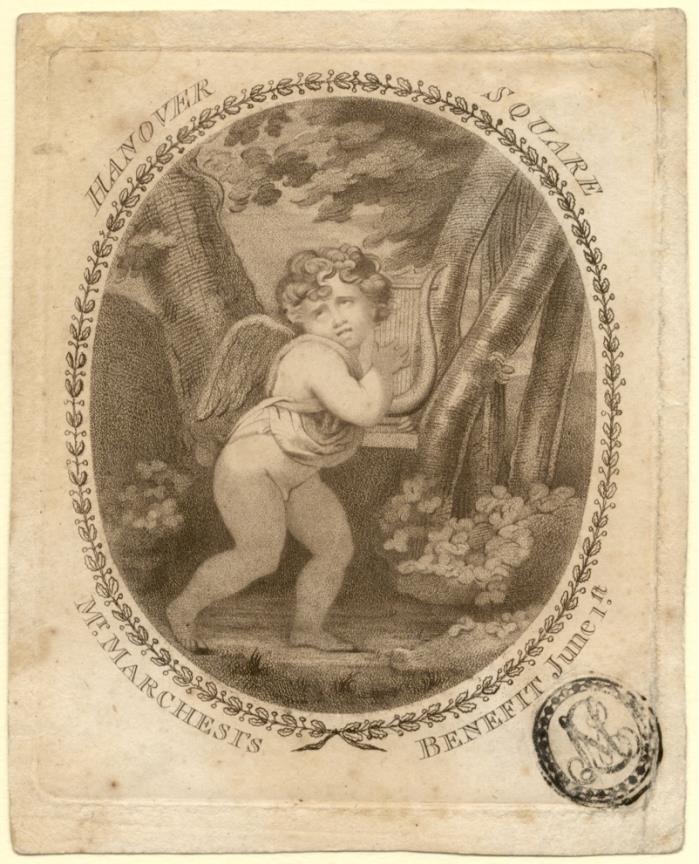
42. MARCHESI, Luigi 1755-1829
Concert ticket for "Mr. Marchesi's Benefit June 1st. Hanover Square." Most likely engraved by Luigi Schiavonetti (1765-1810), a follower of Francesco Bartolozzi (1728-1815) after a drawing by leading English portrait painter Richard Cosway (1742-1821). 1788-1790.
Oval stipple engraving depicting a cherub with a lyre in a wooded setting. Plate impression 131 x 103 mm + ca. 5 mm margins. With early collector's small circular monogrammatic handstamp to lower outer corner. Slightly worn and browned; minor splitting at platemark.
"Marchesi was indisputably one of the greatest castratos of his age. Medals with his image were struck on three occasions, and at his death the Allgemeine musikalische Zeitung estimated that he had earned over 1,500,000 francs during his career, much of which he had given to needy musicians. Burney found him ‘not only elegant and refined to an uncommon degree, but often grand and full of dignity’. ... With his range of g to d‴, Marchesi was known as the most celebrated castrato of opera seria." Sven Hansell in Grove Music Online. (41152) $325
“A Figurehead of Italian Instrumental Music in France”
43. MASCITTI, Michele 1663-1760
Sonate a Violino Solo col Violone ò Cimbalo e Sonate A due Violini, Violoncello é Basso Continuo Dedicate All' Altezza Reale del Duca d'Orleans ... Opera prima. ... Le prix des deux Livres en blanc est de 8tt ... Gravé Par H. de Baussen. [Score].
Paris: Se Vend Chez Foucaut, marchand à l'entrée de la rue St. honnoré[!], à la régle d'or, 1704.
Oblong folio. Early 20th century flexible marbled boards. 1f. (recto title in early manuscript facsimile, verso blank), 59, [i] (privilege) pp. Engraved. Boards worn, rubbed, bumped, and partially detached; spine lacking. Slightly worn; moderately browned; minor tears, stains, and soiling; occasional dampstaining; some signatures detached. Lacking title, dedication, pp. 5-6 (all supplied in manuscript facsimile), and separately-issued second violin part.
First Edition. Lesure p. 422. RISM M1212 (1 copy only in both the U.S. and the U.K.).
Mascitti settled in Paris in 1704, where all nine of his published collections were issued between that year and 1739. "[He] became a figurehead of Italian instrumental music in France and was regarded as the peer of
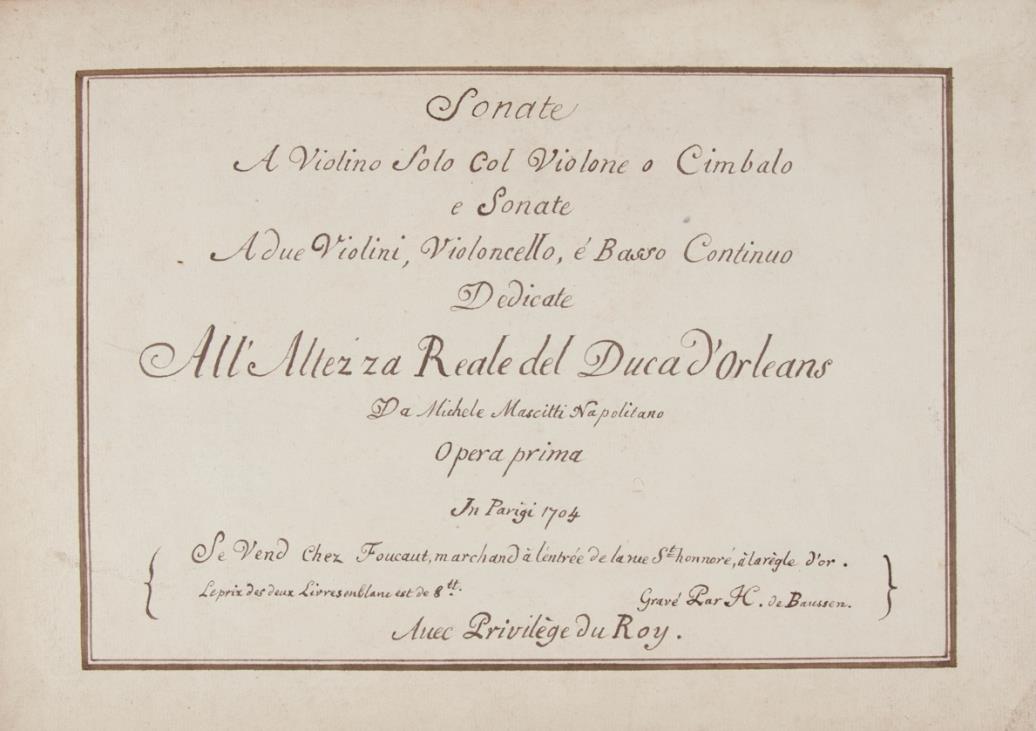
Corelli [who had been his teacher in Rome] and Albinoni. ... Mascitti enjoyed enormous popularity with the French public." TNG Vol. 11, p. 746.
"The success of his sonatas in his own day is evidenced by their several reprints throughout the century ... and the high praise for them to be found in the writings of Daquin, Le Blanc, and La Borde, among others." Newman: The Sonata in the Baroque Era, pp. 368-369. (40535) $850
“A
Leading Figure in the Development of Opera Seria”
44. MAYR, Simon 1763-1845
Scena e Duetto Parto se vuoi mia vita. [Duet in full score from the opera Lodoiska]. [Copyist manuscript]. France, ca. 1800.
Oblong quarto (211 x 290 mm).
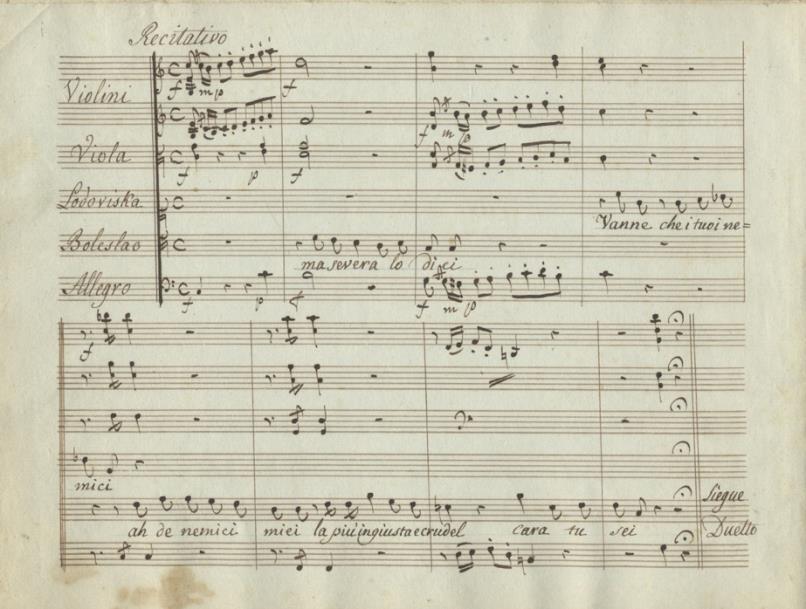
Sewn. [i] (title), [i] (blank), 24, [i] (blank) pp. Notated on 11-stave rastrum-ruled paper. Watermark of a bunch of grapes, countermark "Bouchet." With small oval handstamp of the Glasgow Society of Musicians in dark purple ink to lower inner corner of title, with "136" in manuscript in red ink above stamp; "36" in contemporary manuscript to upper margin of title. Slightly worn and soiled; small stains to blank lower margins of first two and final five leaves.
Scored for sopranoandaltovoices (Lodoviskaand Boleslao)accompaniedby strings, oboes, clarinets, bassoons, horns, and trumpets, preceded by a recitative accompanied by strings.
We have not located a contemporary published full score.
La Lodoiska, in three acts with a libretto by Francesco Gonella, was first performed at the Teatro Le Fenice in Venice on 26 January 1796 and ina revised version in two acts in Milan at the Teatro alla Scala on 16 December 1799.
Mayr, a German composer, teacher and writer on music, "was a leading figure in the development of opera seria in the last decade of the 18th century and the first two decades of the 19th. ... [His] first major success, Lodoiska, is a ‘Polish opera’ in the tradition of Cherubini’s Lodoïska (1791) and Faniska (1806). ... Despite their concurrence on the broad outlines of the action, the two versions present significant differences. ... [Mayr] provided numerous replacement arias and duets and expanded the finales of what had been Acts 1 and 2. He added a connecting scene to bridge the original Acts 2 and 3, while eliminating from the original Act 3 several scenes ... The Biblioteca Civica in Bergamo has a third, incomplete version of Lodoiska (without recitatives), partly in Mayr’s hand, which appears to be an opera semiseria and which is not closely related to the other two versions." Scott L. Balthazar in Grove Music Online (40332)
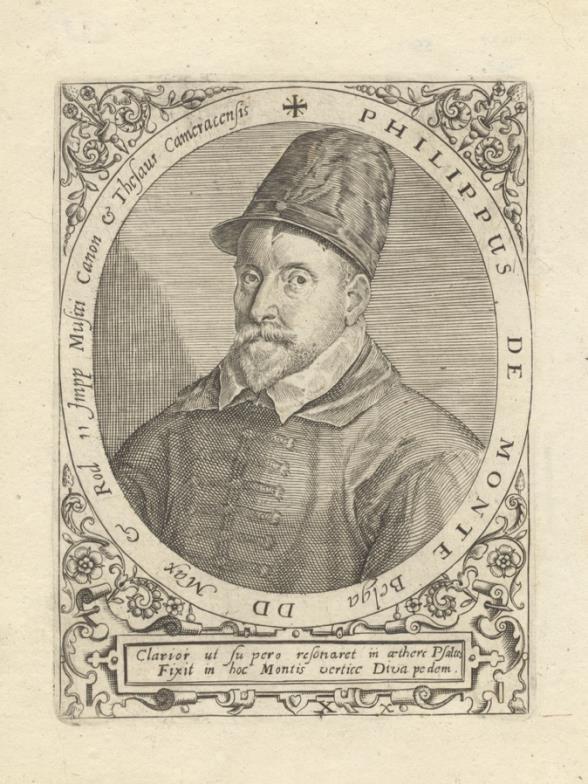
16th Century Engraving of this Important Madrigal Composer
45. MONTE, Philippe de 1521-1603
$275
Portrait engraving by Theodor de Bry (1528-1598). Frankfurt, 1598-1599.
Image size to platemark 142 x 107 mm; sheet size 178 x 138 mm. The composer is depicted bust-length within an oval border lettered "Philippus de Monte Belga DD Max et Rod 11 Impp Musici Canon et Thesaur Camaracensis" withinadecorative borderincorporatingfloralmotifs. He wears a short full beard, is in simple dress, and wears a tall cap. With 2 lines of text to cartouche below. On lightweight laid paper.
Komma 256. Le Blanc 143. Hollstein 255-314. The present engraving was also published in the famous 16th century biographical work Icones Quinquaginta virorum illustrium doctrina & eruditione [Icons of Fifty Illustrious Men Outstanding in Doctrine and Erudition] by Jean Jacques Boissard (1528-1602) containing engraved portraits of prominent cultural figures by noted goldsmith and engraver de Bry. It is most probably after the Raphael Sadeler portrait of 1594.
"[Monte] was an important representative of the last generation of great Flemish composers of the Renaissance, and was one of the major composers of Italian madrigals." Robert Lindell and Brian Mann in Grove Music Online. (41174) $550
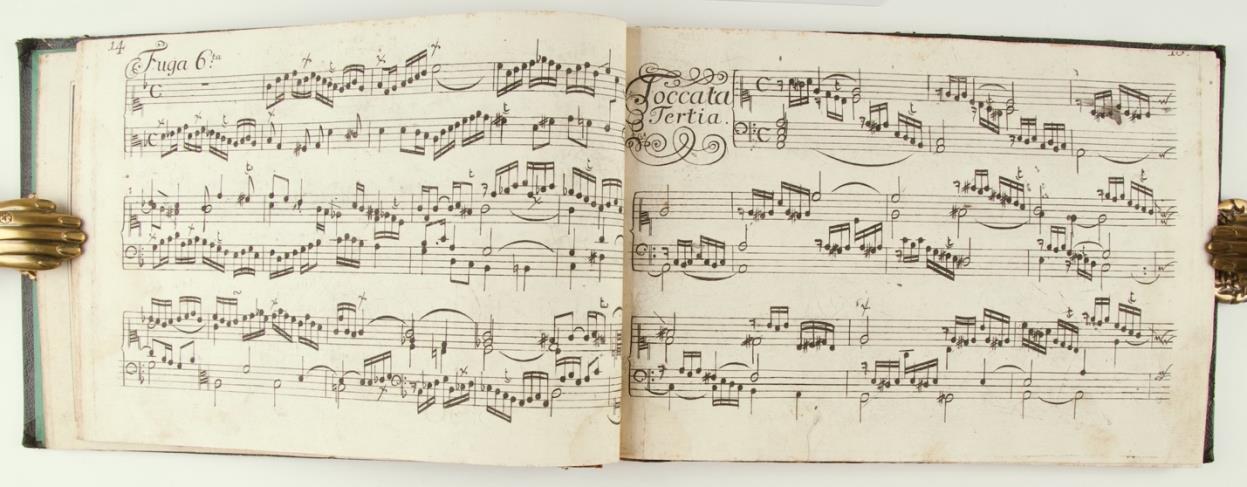
Rare Collection of Early 18th Century Organ Music, the Composer’s First Published Work With Distinguished Provenance
46. MUFFAT, Gottlieb 1690-1770
[72 Versetl Sammt 12 Toccaten besonders zum Kirchen-Dienst bey Choral-Aemtern und Vesperen dienlich ... F.A. Dietell sc.].
[Vienna]: n.p., [1726].
Oblong quarto. Dark brown leather-backed black textured paper boards with octagonal label to upper titled in manuscript. 2ff. (dedication to Abbot Blasius of Schwarzwaiden and composer's preface), 87, [i] (table of ornaments) pp. Engraved. With attractivecalligraphic flourishes to manytitles. Titleidentificationin inkto front free endpaper. Binding worn, rubbed, and bumped. Some wear, soiling, and staining; minor worming to some blank upper margins; several leaves slightly trimmed at upper margin, just touching page numbers; remnants of early paper to blank inner margin of dedication; portions of margins of two following pages reinforced with narrow strip of early paper; occasional additional minor paper repairs; small hole to final leaf affecting one note. Lacking title (as in many copies).
Provenance
Celebrated pianistand collector Alfred Cortot (1877-1962), with his distinctive bookplate and brief annotations in pencil to front pastedown. Later acquired by André Meyer (1884-1974) and sold at the auction of his important music collection in Paris in 2012.
BUC p. 716. RISM M8133 and MM8133 (1 copy only in the U.S., at the University of Pennsylvania).
Muffat is considered "the leading keyboard composer in Vienna in the early 18th century. ... [He] was appointed official court organist in 1717: he was required to play for services in the Hofkapelle and to provide continuo accompaniment for performances of operas. ... Subsequently, he acquired additional duties at court, including the tuition of various children of the imperial family, among them the future Empress Maria Theresa. ... After the death of the Emperor Karl VI in 1740 and with the accession of Maria Theresa, the resources of the Hofkapelle were reorganized, bringing Muffat his final promotion to first organist in 1741. ...
He came at the end of a long line of Baroque organists and keyboard composers working in Vienna and was the only contemporary of Bach there to make a substantial contribution to the keyboard repertory in both quantity and quality. ...
[His] versets, like his ricercares, belong to a well-established tradition. His chief predecessors in this field were Kerll (Modulatio organica, 1686), the anonymous author of the Kurtzer, jedoch gründlicher Wegweiser (Augsburg, 1689) – an organ tutor containing versets for practice – Speth (Ars magna, 1693) and Murschhauser (Octi-tonium, 1696). These publications were all familiar to Viennese organists in the early 18th century. Muffat used the same kind of external structure as they did, arranging his pieces according to the order of the church tones, with a short introductory toccata and a regular number of versets in each tone. He followed their internal structure also in the miniature fugal form of his versets. Like Murschhauser he left the function of the versets open and avoided reference to chant, so they are not restricted to one part of the liturgy. The elimination of chant is one aspect of a general process of secularization of style culminating with Muffat: more than his predecessors, he used strongly secular, even rustic, subjects (often in dance rhythms). He also applied a wide range of ornamentation symbols and provided an explanatory table similar to the one in the Componimenti. Although French composers were using copious ornamentation and secular dance styles in liturgical organ music from at least the mid-17th century, Muffat was the first among Austro-German composers to absorb these trends fully into the traditional verset." Susan Wollenberg in Grove Music Online
None of Muffat's autographs appear to be extant.
Only the second copy to have come to auction in over 70 years. The Meyer collection, formed over a period of some 75 years, was one of the most important 20th century collections of printed music, books on music, and musical autographs.
A rare and elegantly-printed collection of 72versets and 12 toccatas intended as liturgicalaccompaniment during choral offices and vespers.
The composer’s first published work. (40500) $6,500
A Composer “Extremely Active in the Three Main British Musical Centres”
47. PASQUALI, Nicolo ca. 1718-1757
Sonate a Violino e Basso ... dedicate All'Illustrissimo
Signor Giacomo Nelthorpe. Opera Prima.
London: Printed for I. Walsh, in Catharine Street, in the Strand, 1744.
Folio. Modern marbled boards with paper label titled in manuscript to upper and spine. 1f. (recto title, verso blank), 22 pp. Slightly worn; uniform light browning; lower outer corners soiled; occasional foxing and small stains.
First Edition. Smith and Humphries 1170, p. 261. BUC p. 764. RISM P989 (2 copies only in the U.S., at Colonial Williamsburg and the Library of Congress).
Pasquali was an Italian composer, violinist, theoretician and impresario. "According to Burney he came to London about 1743 and from then on was extremely active in the three main British musical centres. ... Much of Pasquali’s music is no longer extant. He was a fluent, prolific writer,
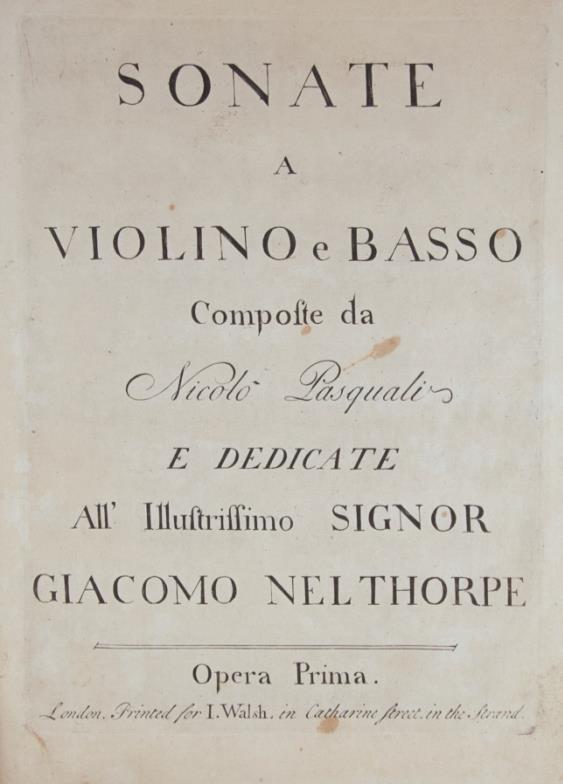
accustomed to working in the theatre; he probably learnt a great deal from Handel. Cudworth suspected that he had a valuable influence on Boyce. Several of his Twelve Overtures of 1751 have sub-titles which show they belonged to theatrical productions for which the rest of Pasquali’s music is lost.
Pasquali also wrote a figured bass instruction book, Thorough-bass made Easy, which was published in Edinburgh in 1757 at the end of his short, energetic career. It went through at least three British editions and –translated into French and Dutch – one in Amsterdam; it contains excellent advice which is still of value, e.g. on different ways to break chords when accompanying recitative. In retrospect it seems to be Pasquali’s most important achievement." David Johnson in Grove Music Online. (40628)
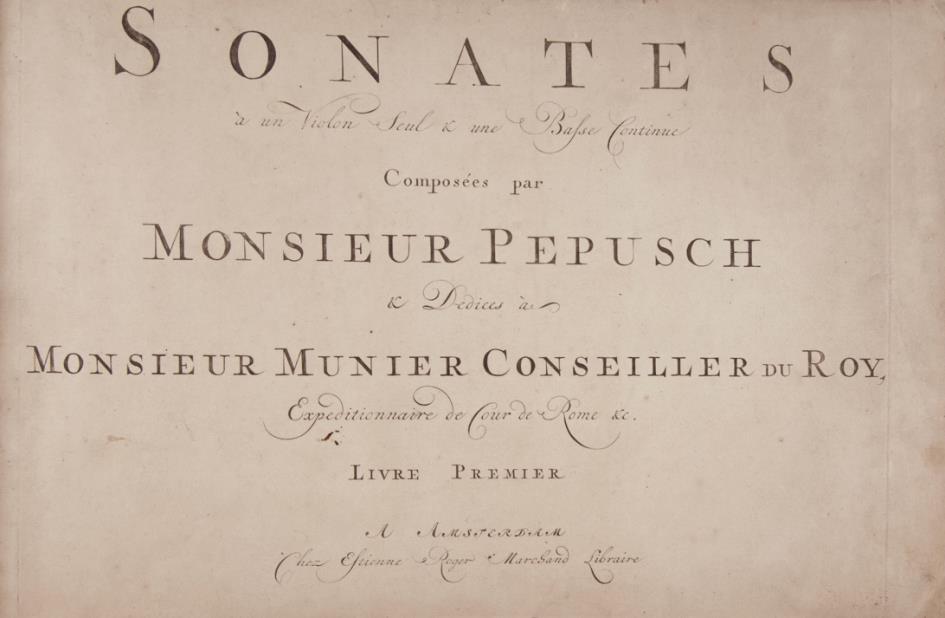
Sonatas by this Noted German Composer and Theorist
48. PEPUSCH, Johann Christoph 1667-1752
$700
Sonates à un Violon Seul & une Basse Continue ... Dediées à Monsieur Munier Conseiller du Roy Expeditionnaire de Cour de Rome &c. Livre Premier [-Second]. [Op. 2].
Amsterdam: Chez Estienne Roger Marchand Libraire, [1706].
2 volumes bound in one. Oblong folio. Modern half dark tan calf with marbled boards, titling gilt to spine. Slightly worn; light uniform browning, slightly heavier to title of Livre Premier; minor soiling, stains, and foxing; small wormhole to title of Livre Premier; short tear to blank lower margin of p. 28 of Livre Second repaired with archival tape.
Livre Premier: 1f. (recto title, verso blank), 1f. (recto publisher's dedication, verso blank), 3-23, [i] (blank) pp. Livre Second: 1f. (recto title, verso blank), [i] (blank), 27-46 pp. 16 sonatas in total. Engraved.
First Edition. Very rare. BUC p. 769. RISM P1262 and PP1262 (1 complete copy only, at the British Library; Livre Premier only at the Bayreuth Stadtarchiv).
Pepusch was a noted German composer and theorist. "After travelling through Holland, some time after September 1697 he settled in London, where he remained for the rest of his life. ... The unprecedented popularity of The Beggar’s Opera, for which Pepusch may have supplied only the basses and an overture that uses one of the opera’s popular tunes, has tended to overshadow his own music. His earliest surviving works are mostly instrumental and include well over 100 violin sonatas and several recorder and flute sonatas. These are mostly modelled on the four-movement plan of Corelli, whose sonatas and concertos Pepusch later edited for publication in London. Particularly interesting are the manuscript sets of sonatas composed for various English violinists, each containing 16 works in as many different keys, thus anticipating (and going beyond) the similar arrangement of Bach’s two- and three-part Inventions. (Pepusch included B major in addition to the keys that Bach used)." MalcolmBoyd, revisedbyGraydonBeeksandD.F. Cookin Grove Music Online (40624) $3,800
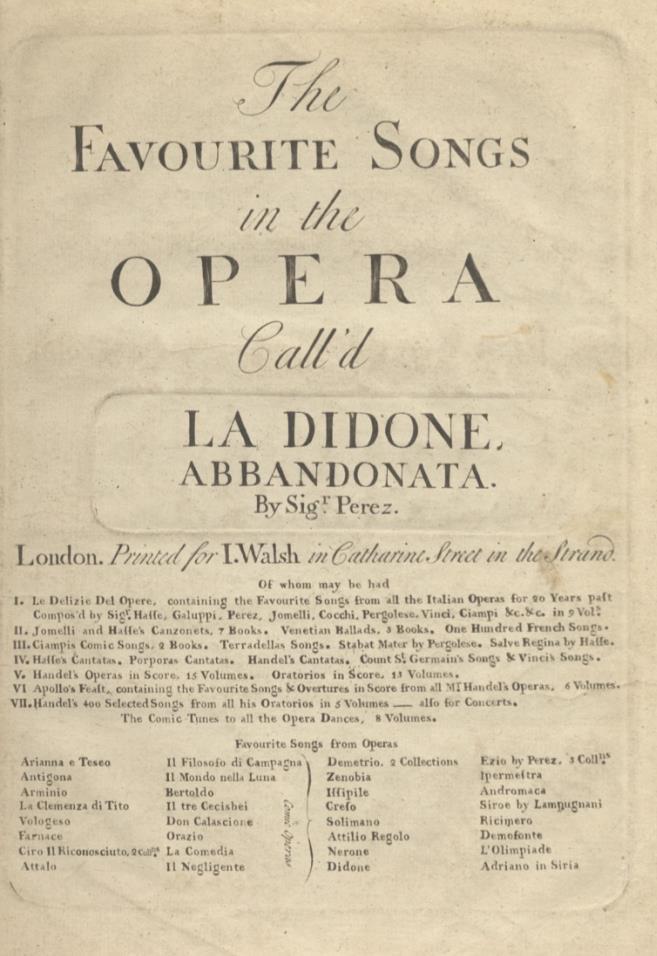
49. PEREZ, David 1711-1788 and Baldassare Galuppi 1706-1785
The Favourite Songs in the Opera Call'd La Didone Abbandonata. [Score].
London: Printed for I. Walsh in Catharine Street in the Strand, 1761.
Folio. Full modern carta rustica. Sewn. 1f. (recto passepartout title, verso blank), 20 pp. With publisher's detailed list of available works by other composerstotitle. Engraved. Slightlyworn, soiled, and browned; a few minor stains and occasional light foxing. A very good, crisp copy overall.
Contains five arias (three by Perez and two by Galuppi), with named singers including Sigr. Elisi and Sigra. Mattei.
Smith and Humphries 1188, p. 265. BUC p. 770. RISM G274, GG274, P1328 and PP1328.
The arias are drawn from operas on the same subject by Galuppi (premiered Modena, 1740) and Perez (premiered Genova, 1751)
Perez, an Italian composer "composed more than 45 dramatic works between 1733 and 1777, about half of which were operas written between 1744 and 1755, the period during which he concentrated almost exclusively on the genre. Excerpts from Arminio, La Didone abbandonata, Ezio, Il Farnace, Solimano and Vologeso were published in London by John Walsh, and many works exist in manuscript. ... 18th-century critics often ranked Perez with Hasse and Jommelli; Burney found ‘an original spirit and elegance in all his production’. 19th- and 20th-century commentary, based for the most part on a few earlier operas, has generally downgraded this judgment. A more complete examination of his works affirms the stature his contemporaries assigned to him. While he was essentially a transitional figure in 18th-century opera, he was nevertheless one of the great composers of opera seria, and as a church composer, he wrote some of the finest Roman Catholic music of the 18th century." Mauricio Dottori and Paul J. Jackson in Grove Music Online
Galuppi, an Italian composer, "was a central figure in the development of the dramma giocoso and one of the most important mid-18th-century opera seria composers. ... Galuppi was an extraordinarily popular composer of both serious and comic operas and a prolific composer of sacred and keyboard music. His facile, elegant and flexible melodic style, joined to Goldoni’s witty and sometimes poignant poetry, created the central watershed for the dispersion of drammi giocosi throughout Europe after 1749; works such as Il filosofo di campagna have few peers in that regard. Yet his serious operas were no less important; their performances exceeded his comic operas in number. Galuppi’s stage music embodies the principal Italian tradition of charming and beautiful melody, clear and lucid accompaniment, and virtuoso or emotive display; as he described it to Burney, good music contained ‘vaghezza, chiarezza e buona modulazione’." Dale E. Monson in Grove Music Online (40625) $785
Pergolesi’s “Most Famous Work”
50. PERGOLESI, Giovanni Battista 1710-1736
Stabat Mater ... Price 8s. [Score].
London: Printed& Soldby Robt. Birchallat hisMusicalCirculating Library, No. 133, New Bond Street, Watermark 1818.
Folio. Contemporarymid-tan quartercalf withmarbled boards, dark red decorative leather title label gilt to upper, spine with double-gilt ruled compartments. [i] (title), 2-43, [i] (blank) pp. Binding worn, rubbed, and bumped; upper detached. Occasional wear and foxing; moderate browning and showthrough to several leaves.
With the autograph signature of the British organist and composer William Henry Monk 1823-1899) dated March 1845 in manuscript to free front endpaper and "W. H. Monk March 1845" and "J.A." in the same hand to title.
Paymer 77. BUC p. 771. RISM P1349 and PP1349 (3 copies in the U.S. only, at Harvard University, the Curtis Institute of Music, and San Francisco State College).
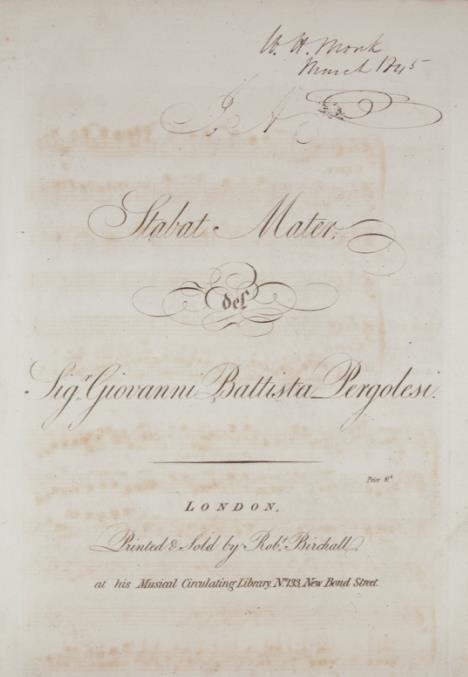
"For two solo voices and strings, [Pergolesi's] most famous work was evidently written in competition with Alessandro Scarlatti’s Stabat mater for the same voices and instruments. A comparison between the works shows Pergolesi’s new approach to the concertante vocal movement and his development of the ‘church aria’, as well as the earliest application to sacred music of the style of expressive sensibility. The work stirred considerable controversy at home and abroad for its religious propriety and musical style. Padre Martini’s traditional views towards counterpoint incited some to criticize Pergolesi’s setting, while others found it ‘galant’, expressive and new." Helmut Hucke, and Dale E. Monson in Grove Music Online
"After holding similar posts at St George’s, Albemarle Street (1843), and St Paul’s, Portman Square (1845), (Monk) was appointed choirmaster (1847) and organist (1849) at King’s College, London... In 1857 Monk was made musical editor of Hymns Ancient and Modern (1861) for which he wrote ‘Eventide’, his famous tune for Abide with me. He wrote many other popular hymn tunes as well as anthems and service music, and edited several collections of hymns and metrical psalms." Bernarr Rainbow in Grove Music Online
Pergolesi's most celebrated sacred work. (40644) $375
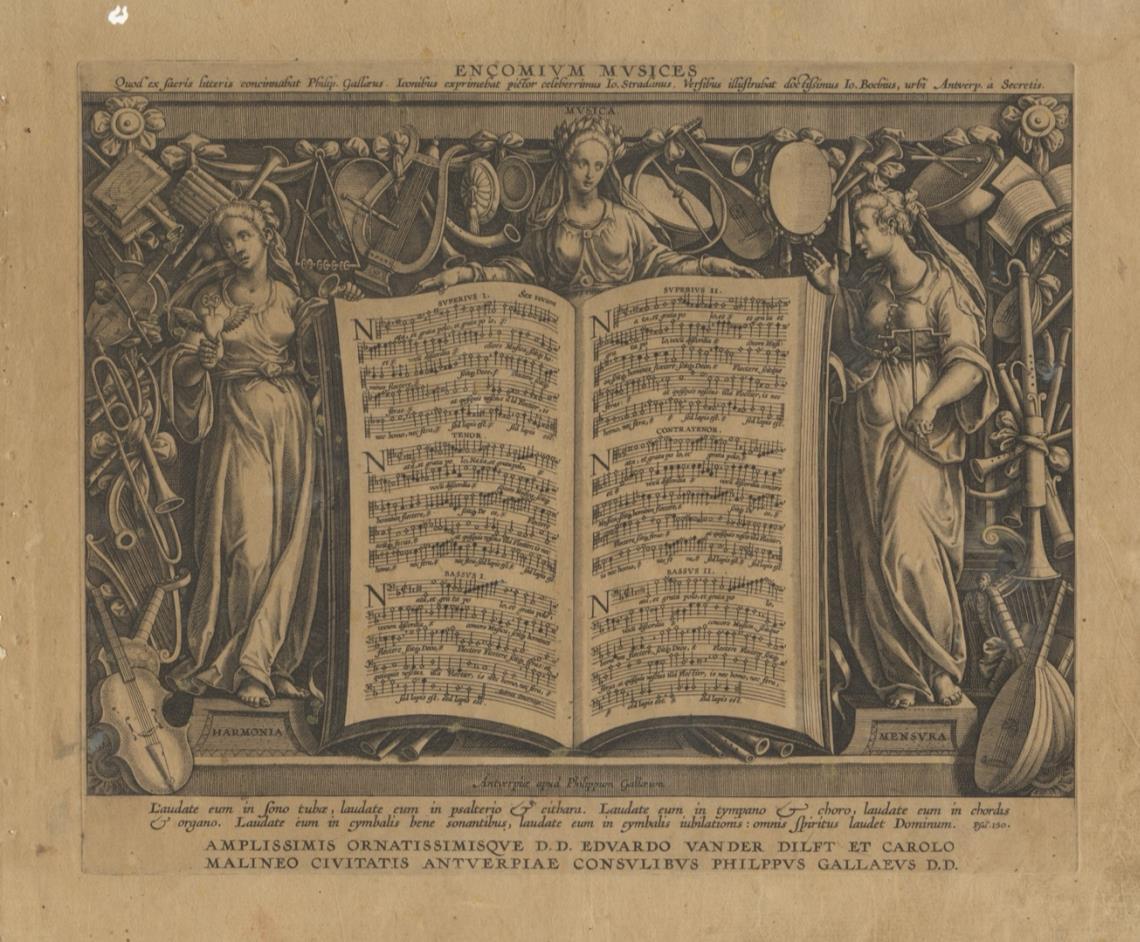
16th Century “Picture Motet”
One of the Earliest Depictions of Engraved Music
51. PEVERNAGE, Andreas 1542/3-1591
Nata, et grata polo ... Psalm 150. Motet for six voices. Fine title page of Encomium Musices [Praise of Music]. Engraved by Adriaen Collaert (ca. 1560-1618) after the drawing by Johannes Stradanus (1523-1605). Antwerp: Philipp Gale, 1585-1586.
1f. Oblongfolio(235x285mm. +widemargins). "1"inredink toblankupperoutercorner. Uniformlybrowned; slightly soiled and stained; small holes to blank margins; binder's holes to edge of left margin.
With an open book of music surrounded by an elaborate design incorporating three female figures representing harmony, melody, and rhythm, together with a plethora of musical instruments. The text of the hymn set by Pevernage is by Antwerp's city scribe, Johannes Bochius.
The entire suite of 17 plates constituting Encomium Musicus is very rare; Otto Erich Deutsch was able to locate 5 complete copies only. "The title page and page 17 are remarkable as incunabula, being two out of a dozen of the earliest engravings of music." Deutsch: Encomium Musices. Facsimile reprint and commentary, Harrow Replicas no. 6, London, 1943. Kinsky: A History of Music in Pictures, p. 152, no. 1. Vignau-Wilberg: Music For a While, pp. 172-174, no. 64.
Pevernage was a noted Flemish composer of chansons, motets, and madrigals of the late Renaissance.
The present print offers one of the earliest depictions of engraved music and is also of considerable significance to the study of contemporary organology (41158)
$1,800
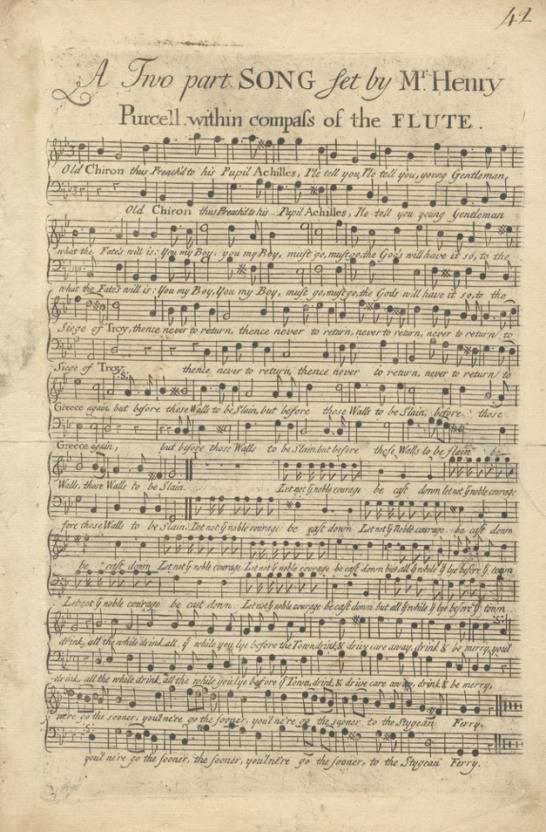
Ascribed to Michael Wise
52. PURCELL, Henry 1659-1695
Old Chiron thus preach'd to his pupil Achilles ... A Two part Song Set by Mr. Henry Purcell within compass of the Flute.
London: n.p., ca. 1705.
Folio. Disbound. 1f. (recto caption title and music, verso blank) pp. Engraved. "42" in contemporary manuscript to upper outer corner of recto. Slightly worn and soiled; small split at central horizontal fold repaired with tape to verso. Scored for treble and bass voices.
First Edition in this form. BUC p. 865, Doubtful and Spurious Works: "In Playford's 'Catch that Catch can, or the second part of the Musical Companion' (1685), this duet is ascribed to Michael Wise."
Wise (ca. 1647-1687), an English composer, "was one of the earliest group of choristers of the Chapel Royal following the Restoration of Charles II in 1660. He left the choir on the changing of his voice in September 1663, and from 1665 to 1668 he was a lay clerk of both St George’s Chapel, Windsor, and Eton College. On 29 April 1668 he was admitted as organist, lay vicar and instructor of the choristers of Salisbury Cathedral. He rejoined the Chapel Royal as a Gentleman in January 1676, while retaining his Salisbury appointments. ... There is only a small amount of secular music by Wise and no instrumental music at all. His significance rests exclusively on his church music. ... His verse passages, though expressive of the words and displaying a true sense of accent, are truly melodic in their phrasing and are rarely restricted simply to declamatory methods. His pathetic and expressive qualities are considerable, and he is also capable of great charm. ... The anthem Open me the gates of righteousness and the Evening Service in D minor may be regarded as his finest works." Watkins Shaw, revised by Michael Smith in Grove Music Online. (41125) $85
53. ROSETTI, Antonio ca. 1750-1792
Sonate per Cembalo o Pianoforte Con Accompagnamento d'un Violino. [Piano part].
Venezia: Presso Antonio Zatta e Figli, ca. 1780.
Oblong folio. Disbound. [i] (title), 8-15, [i] (blank) pp. Title typeset, music engraved. "9" in contemporary manuscriptto head ofall pages. Lightfoxingto blank margins of first leaf;binder's holesto inner margins;minor dampstaining to lower margins.
RISM R2627 and RR2627 (1 copy only in the U.S., at the Library of Congress).
These pieces, consisting of sonata forms, rondos, and romances, call for violin accompaniment; absent a violin, however, they stand on their own as keyboard solos.
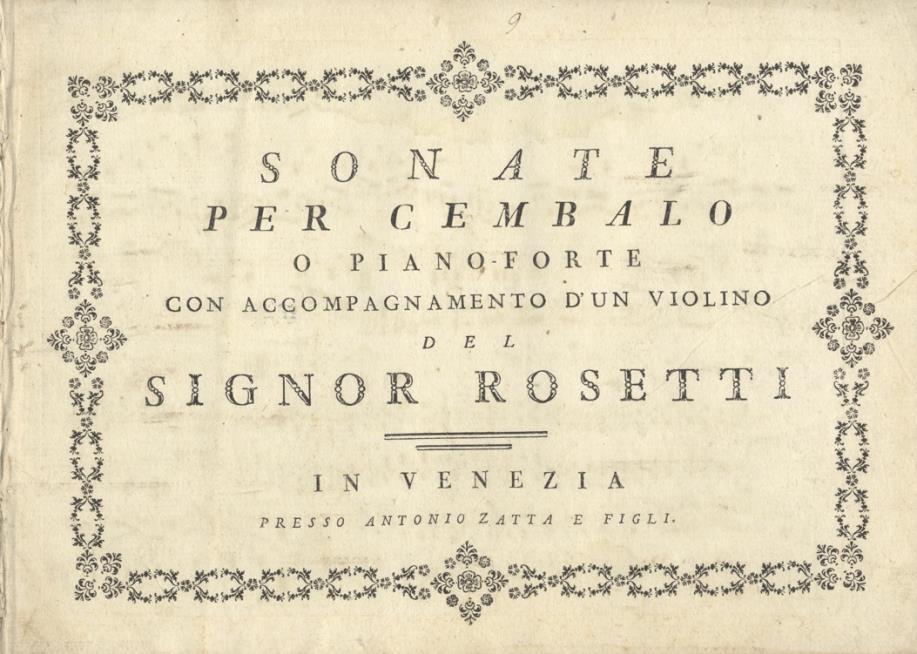
Rosetti was a Bohemian composer and double bass player. "Two distinctive features distinguish his style: an economical treatment of materials, which often results in tight musical structures held together by discernible motivic relationships, and a sure and imaginative employment of wind instruments." SterlingE. Murrayin Grove Music Online
An attractive example of late 18th century Venetian music printing. (40657) $375
Early 20th Century Ballet
54. ROUSSEL, Albert 1869-1937
Le Festin de l'Araignée Ballet-Pantomime de Gilbert de Voisins ... Op. 17 Partition pour le Piano Réduit par l'Auteur Prix net: 10 francs. [Piano score].
Paris: A. Durand & Fils [PN D. & F. 8778], [1913].
Folio. Original publisher's ivory wrappers with titling printed in red. 1f. (title), 1f. (dedicationto Jacques Rouché), 1f. (named cast list for the first performance), 54 pp. Wrappers slightly worn and soiled; tears to spine; signature of A. Boisard in pencil to free front endpaper.
First Edition. CPM Vol. 49, p. 216. OCLC no. 8906509.
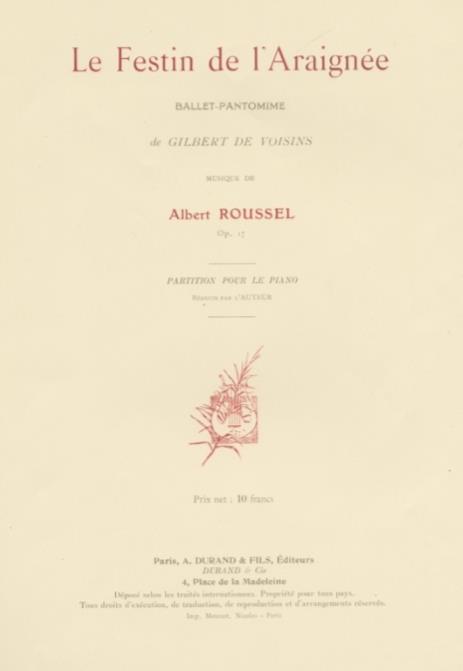
Le Festin d'Araignée was first performed at the Théâtre des Arts in Paris on April 3, 1913. "Following the resounding success of Evocations, Jacques Rouché, then director of the Théâtre des Arts, asked Roussel to write the ballet score Le festin de l'araignée (1913). This was so successful that Rouché, newly appointed director of the Opéra, next commissioned an opera from Roussel to inaugurate his term of office there. .. Though he was touched by the successive waves of impressionism and neo-classicism in French music, [Roussel] was an independent figure, his music harmonically spiced and rhythmically vigorous." Nicole Labelle in Grove Music Online (41175) $100
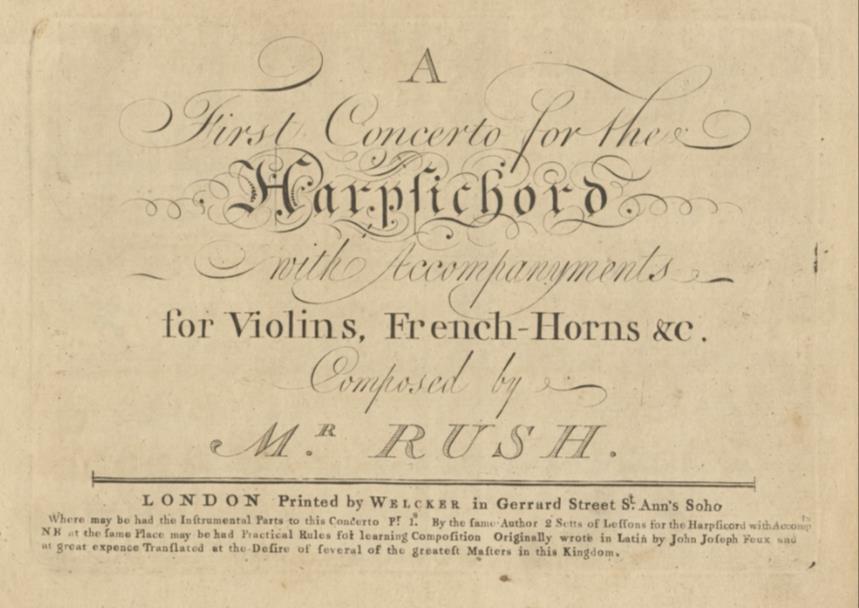
“[His] Instrumental Works are ‘Advanced’ and Pre-Classical”
55. RUSH, George fl. ca. 1760–80
A First Concerto for the Harpsichord with Accompaniments for Violins, French-Horns &c. [Harpsichord part].
London: Printed by Welcker in Gerrard Street St. Ann's Soho, ca. 1773.
Oblong quarto. Disbound. 1f. (recto title, verso blank), 5, [i] (blank) pp. Engraved. With a printed note under the imprint advertising other publications available from Welcker: the instrumental parts for the concerto, Rush's harpsichord pieces, and "Practical Rules for learning Composition. Originally wrote in Latin by John Joseph Feux and at great expense Translated at the Desire of several of the greatest Masters in this Kingdom." Slightly worn and browned; a few small stains, mainly to blank margins; binder's holes to blank inner margins.
In three movements, "Allegro Assai," "Largo," and an additional "Allegro Assai," with occasional figures above left hand part. Although the present concerto had accompanying instrumental parts, it also succeeds as a freestanding keyboard solo.
Second edition. BUC p. 907. RISM R3197 (1 complete copy only in the U.S., at the University of California, Berkeley, and the harpsichord part only in every other citation).
Rush was an English harpsichordist and guitarist. "According to Dibdin, he travelled and studied in Italy before emerging as a theatre composer in London. His greatest success came with two English operas performed in 1764 at Drury Lane Theatre, where Rush may have played in the orchestra. The Royal Shepherd, with a libretto devised by Richard Rolt from Metastasio’s Il re pastore, was staged on 24 February 1764. Intended as competition to Arne’s Artaxerxes, playing at Covent Garden, it was all-sung and required an enlarged orchestra. The overture was popular as a concert piece, in part because of the still exceptional use of timpani. ...
Rush was also active in instrumental music. He supplied overtures to both parts of the programme of Signora Gambarini’s benefit concert, advertised 21 January 1760. On 22 March 1770 he conducted and performed his works at a concert for the Lord Mayor, Sir William Beckford. His published series of concertos, of which the first (in F) was especially popular, suggests that he was successful as a harpsichordist. Rush’s instrumental works are ‘advanced’ and pre-Classical, and reveal a blend of national styles. Although Dibdin and the ABC Dario categorized Rush’s operas as too Italian for English tastes, these works must be granted a historical niche in a period of transition from the ballad opera to the age of Dibdin.
An extended visit to Holland, perhaps under the patronage of Sir Joseph Yorke (Baron Dover), minister to The Hague, was postulated by Roscoe; the notion is given credence by the publication of several works there." Ronald R. Kidd in Grove Music Online (40792) $325
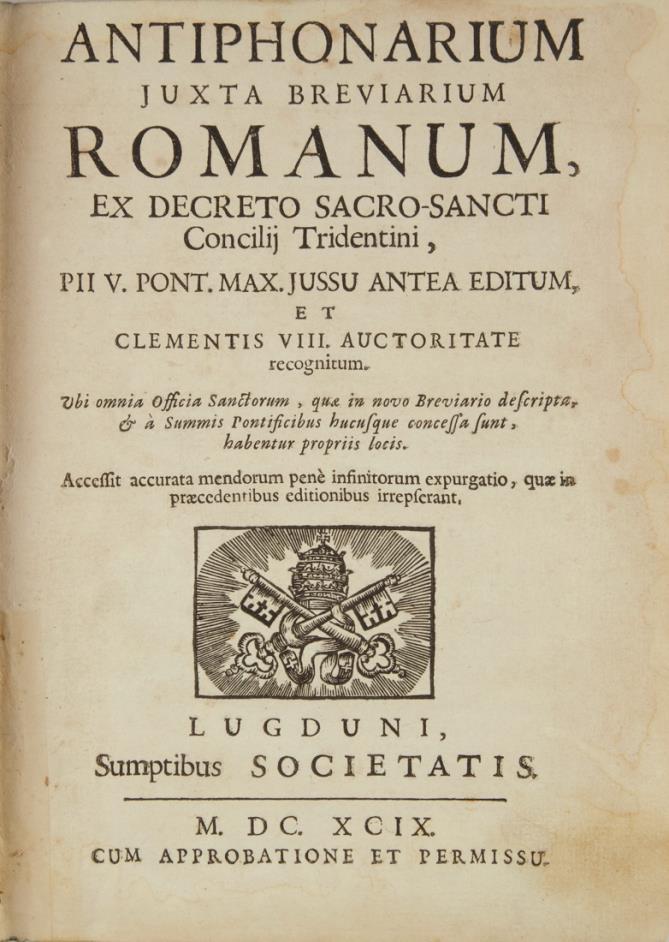
Late 17th Century Antiphonary
56. [SACRED MUSIC - 17th Century - French]
Antiphonarium Juxta Breviarium Romanum, Ex Decreto Sacro-Sancti Concilij Tridentini, Pii V. Pont. Max. Jussu Antea Editum, Et Clementis VIII. Auctoritate Recognitum. Ubi omnia officia sanctorum, quæ in novo breviario descripta, & à summies pontificibus hucusque concessa sunt, habentur propriis locis. Accessit accurata mendorum penè infinitorum expurgatio, quæ in præcedentibus editionibus irrepserant.
Lugduni, Sumptibus Societatis: [Ex Typographia Petri Valfray, in vico Mercatorio, sub signo Coronæ Aureæ] ... Cum Approbation et Permissu, 1699.
Small quarto. Full contemporary dark brown mottled calf with raised bands on spine in decorativecompartments gilt, dark red leather label gilt, marbled edges. 1f. (recto title with woodcut armorial device incorporating crown and keys, verso blank), 1f. (Index, "Approbatio," "Permissio"), 304, lxxxviii, 19, [i] (blank) pp. Typeset, with neumatic notation on 4-line staves, scored for solo voice. Binding slightly worn and bumped. Browned; occasional very minor staining, foxing, dampstaining, and soiling
Withengravedarmorial bookplatebyT. DupontofFrenchwriterandbookcollectorA. Kuhnholtz-Lordat (18201893) to front pastedown.
A collection of antiphons and other sung parts of the Divine Office
OCLC 805034285, 956360819. (41146) $650
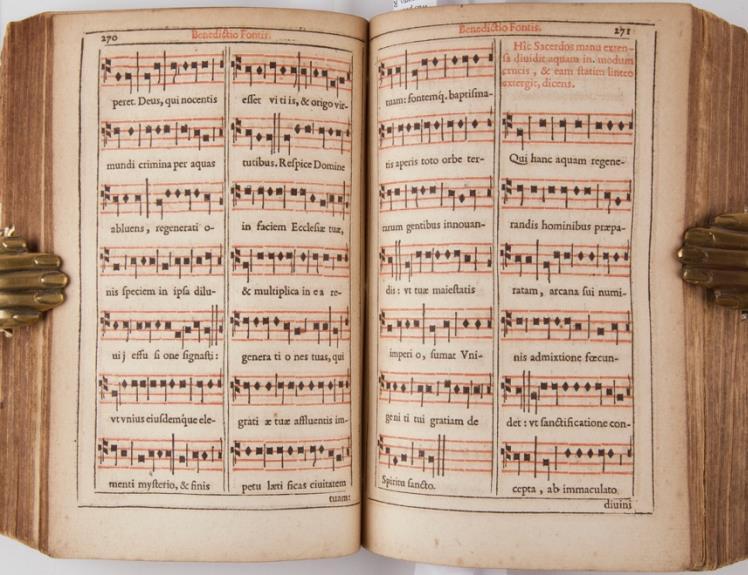
Reflecting Revisions to the Mass Authorized by Pope Clement VIII in 1604
57. [SACRED MUSIC - 17th Century - Missal]
Missale Romanum, Ex decreto Sacrosanti Concilii Tridentini restitutum, PII V. Pont. Max. iussu editum, Et Clementis VIII auctoritate recognitum
Antverpiæ: Ex Officina Plantiniana, Apud Ioannem Moretum, 1605.
Octavo. Disbound. Full dark brown contemporary leather with decorative deviceincorporating acrucifix to both upper and lower boards, leather label gilt to spine. 1f. (recto title with engraved illustration of saints and Vatican coatofarms, versoblank), [ix](memorials), [i](privilege), [xxiii](tablesandliturgicalcalendar), [liv]("Rubricæ Generales Missalis"), [vi] (index), [i] (full-page woodcut illustration of the Annunciation), 672, cxxvi, [i] ("Licentia et Approbatio"), [i] (blank) pp. Printed in red and black in two columns within double line border. With woodcut historiated initials throughout,10 full-page woodcut illustrations of religious scenes. Later manuscript ownership inscription to front free endpaper "Anne [?]Denning Hunter." Binding considerably worn, rubbed, and bumped; spine partiallylacking;boards detached. Slightly worn;browned; smalltears to blankouter margin of title; minor to moderate foxing to blank margins.
Contains ca. 60 pp. of chant in neumatic notation on red 4-line staves.
5 pages of densely written 18th century manuscript annotations in Latin to second front free endpaper and to final blank page continuing onto rear free endpaper in several hands.
OCLC 835271133.
The manuscript text comments on various aspects of Church practice and doctrine, especially as relates to the Liturgy and the Mass, including reference to rubrics, the order of the Mass including specific prayers and blessings, the role of theconsecration, and the practice of communion. It contains remarks touching on historical context, such as a potential conflict between a papal insinuation and the Emperor in 1660 and compares and contrasts ancient Christian practices with those of the Church at the time the annotations were written (after 1728). Various theological points are debated or referenced, citing authorities such as Ambrose, the Council of Trent, and other historical figures and texts. Specific feast days are mentioned, includingthe Purificationand the Feast of Saint Benedict.
Published by the important Flemish printer and publisher Jan Moretus (1543-1610), son-in-law and successor to Christoffel Plantin, noted Belgian music printer.
The present edition of the Missal reflects the revisions made to the Mass and authorized by Pope Clement VIII in 1604. (41153) $350
18th Century Parisian Processional
58. [SACRED MUSIC - 18th Century - French]
Processional Parisien, Disposé pour les Processions & les Messes de Saint Marc, des trois jours des Rogations, de l'Ascension, du Jour & de l'Octave du Saint Sacrement, & de la Fête de tous les Saints. Suivant le nouveau Bréviaire & Missel de Paris ... Aux dépens des Libraires associés pour les Usages du même Diocèse.
Paris: [De l'Imprimerie de Jean-Baptiste Coignard, Imprimeur du Roi], [1740].
Octavo. Full contemporary dark brown mottled calf, spine in decorative compartments gilt with titling gilt, marbled endpapers. 1f. (recto title with woodcut armorial device, verso blank), 3-18, 2ff. (contemporary manuscript chant in black ink on 10-four-line-stave rastrum-ruled paper), 21-112 pp. Typeset throughout, with music in neumatic notation on 4-line staves to most pages, scored for solo voice. Binding quite worn, rubbed, and bumped; lower portion of spine lacking; hinges cracked; endpapers worn and faded. Occasional wear and minor staining; several tears and holes, particularly to lower inner margins, with more substantial loss to lower portion of pp. 63-64. Lacking pp. 19-20, supplied in contemporary manuscript.
Annotation in contemporary manuscript to blank verso of title "On vous prie de remettre ce livre a la [?]Sacristie and, in another hand, "Mr. Millet." Manuscript text to head of p. 3 canceled.
OCLC 919167683, 467696334, 918609709. (41145) $300
Mid-18th Century Music for Holy Week
59. [SACRED MUSIC - 18th Century - Italian - Copyist Manuscript] Feria Quinta in Cena Domini; Feria Sexta in Parasceve; Sabbata Sancto. [Musical manuscript parts for tenor and bass]. Italy, ca. 1750-1780.
Folio (226 x 312 mm). Sewn. Notated on 10-stave rastrum-ruled paper, with lowermost stave of first page, of the Tenore part hand-drawn, with music and text added in another hand. Watermark letters within a circle above a star. Occasional moderate soiling and small stains; first leaf of Tenore part partially detached.
Music for Holy Thursday, Good Friday, and Holy Saturday of Holy Week in the Christian calendar: - Feria Quinta in Cena Domini. Tenore. 4 pp. Bound with Feria Sexta in Parasceve, Basso, 6 pp. and an additional bass part headed Sabbato Sancto, 6 pp. - Feria Quinta in Cena D[omi]ni. Basso, 6 pp. Bound with Feria Sexta in Parasceve, 6 pp. + Sabbato Sancto, 6 pp., 1f. (blank).
With short semi-chanted homophonic liturgical pieces: In Monte Oliveti, Tristis est anima mea, Ecce appropinquat, Ecce vidimus, Vere languores, Amicus meus, Flius quidem hominis, Unus ex vobis, Eram quasi agnus innocens, Seniores populi, Revelabunt celi iniquitatem, Omnes amici, Velum Templi, Vinca mea, Tamquam ad latronem, Tenebre facte sunt, Barabbas latro dimittitur, Tradiderunt me, Jesum tradidit, Sicut ovis, Sepultro Domino, Jerusalem Iuge, Plange quasi virgo, Recessit Pastor, O Vos omnes, Caligaverunt oculi mei, Ecce quomodo, Æstimatus sum, Agnus Dei, and Lustris sex, qui. (40349) $650
Mid-18th Century Manuscript Litany for 3 Voices
60. [SACRED MUSIC - 18th Century - Italian - Sacred - Manuscript] Littanie a 3. Voci. [Copyist manuscript]. Italy, ?1750.
5 parts. Quarto and two bifolia. Notated on 10-stave rastrum-ruled paper. Watermark letters within a circle.
Contains:
P[ri]mo Ten.[or]e: 1 p. Text commencing "Tantum ergo sacramentum" and Genitori Genitoque," "P Mro Martini" to head.
P[ri]mo Ten.[or]e (music different from above): 1 p. Text commencing "Tantum ergo sacramentum" and Genitori Genitoque."
Basso: 1 p. Text commenting "Tantum ergo sacramentum" and "Genitori Genitoque," with "Tantum &c. a 3 Voci Ripieno" to head.
Secondo Tenore: 2 pp. Text commencing "Pange lingua," "Nobis datus," "Verbum caro," and "Genitori Genitoque." With "à 3. Voci TT. e B." to head of first page.
2o. Ten[or]e: 1 p. Text commencing "Tantum ergo" and "Genitori Genitoque." With "P Mro Martini" to head. 2o. Ten[or]e: 3, [i] (blank) pp. Text commencing "Sancta Maria," "Sedes sapienti," "Regina Martyrum," and "Agnus Dei." With "Littanie a 3. Voci" to head.
Basso: 3, [i] (blank) pp. Text commencing "Kyrie," "Virgo potens," "Regina Angelorum," and "Agnus Dei." With "Littanie a 3. Voci" to head.
A few small stains. (40348) $700
Ecclesiastical Chants for Holy Week
61. [SACRED MUSIC - 19th Century]
Cantus Ecclesiasticus Passionis D. N. Jesu Christi Secundum Matthæum Marcum, Lucam et Joannem Excerptus Ex Editione Authentica Majoris Hebdomadæ. [In three fascicles].
Ratisbonæ, Neo Eboraci et Cincinnatii: Sumptibus Chartis et Typis Friderici Pustet, S. Sedis Apost. Et S. Rit. Congr. Typographi, 1889.
Folio. Disbound. Some signatures uncut. With illustrations of religious scenes and numerous pages of neumatic chant notation in black ink on a red 4-line stave.
- Fasiculus I: Chronista. [i] ("Adprobatio"), [i] (imprimatur), [i] ("Typographus Lectori"), 60 pp.
- FasiculusII: Christus – Lamentationes 1f. (rectotitle, verso"Adprobatio"), [i] (imprimatur), [i]("Typographus Lectori"), 48 pp.
- Fasiculus III: Synagoga - Præconium Paschale 1f. (recto title, verso "Adprobatio"), [i] (imprimatur), [i] ("Typographus Lectori"), 39 pp. "Adnotationes" to lower wrapper.
Wrappers worn and soiled. Minor internal wear, soiling, and small tears to edges; signatures separated.
OCLC 799639737, 69163805. (41149) $125
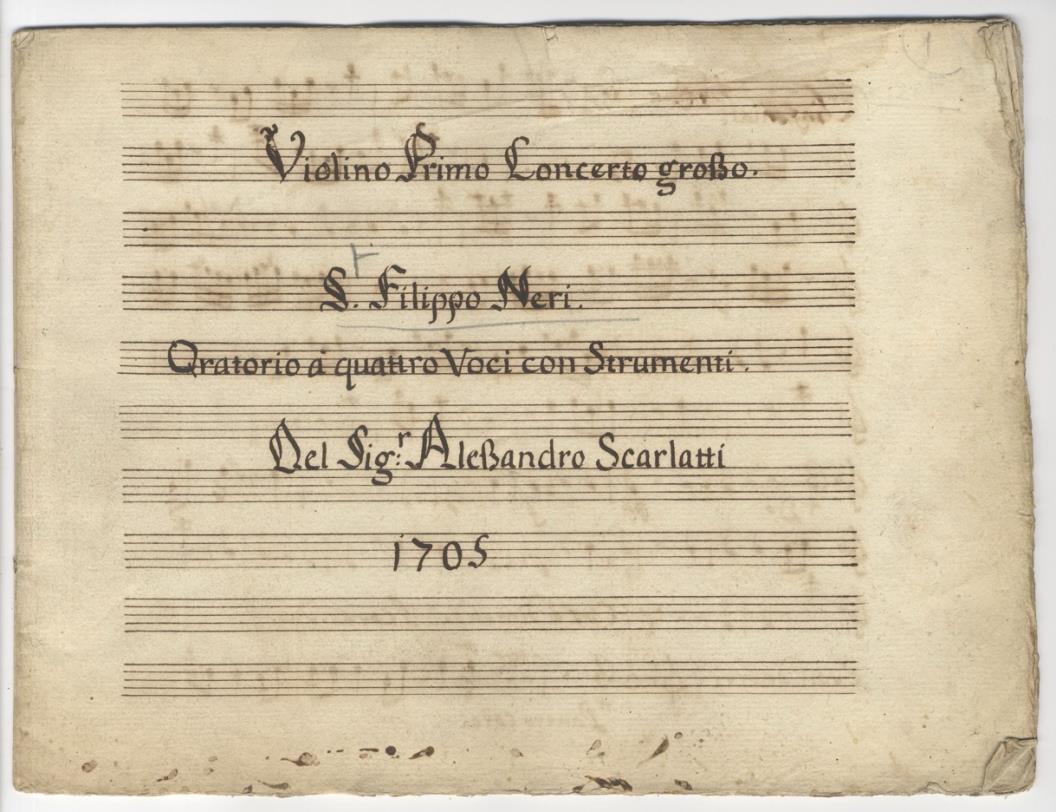
Rare Unrecorded Source
62. SCARLATTI, Alessandro 1660-1725
S. Filippo Neri. Oratorio à quattro Voci con Strumenti ... 1705. [Incomplete set of parts]. [Copyist manuscript]. Rome, 1705.
Quarto (214 x 284 mm). Notated in black ink on 10-stave rastrum-ruled paper. Watermark fleur-de-lis within a double circle (unlocated). Slightly worn, soiled, and stained; occasional showthrough, dampstaining, and small holes; loss of 1-1/2 measures to uppermost system of final page of viola part; inkstains to four lowermost blank staves of final page of part for Carità, not affecting notation.
- Violino primo concerto grosso: [i] (title), 12, [ii] (blank) pp.
- Violino secondo concerto grosso: [i] (title), 12, [ii] (blank) pp. Two systems canceled on penultimate page.
- Violetta: [i] (title), 14 pp.
- Parte della Carità [soprano voice]: [i] (title), 23 pp. "Fine della P[ri]ma. Parte" after final system.
Originally scored for S,A, A, T, trumpet, strings, lute, and basso continuo.
An unrecorded source. Rostirolla p. 502, no. 18. No contemporary published edition of the score. RISM Manuscripts Online cites two manuscript sources only, one at the Bibliothèque Royale Albert 1er in Brussels formerly in the collection of Fétis (see Catalogue de la Bibliothèque de F.J. Fétis, Paris 1877, no. 2170, RISM ID no.: 700005808) and the other at the Diözesanbibliothek in Münster, Germany, RISM ID no.: 451023171.
First performed in Rome at the Palazzo della Cancelleria on 26 March 1705. The libretto, with anonymous text, was published in Rome in that same year.
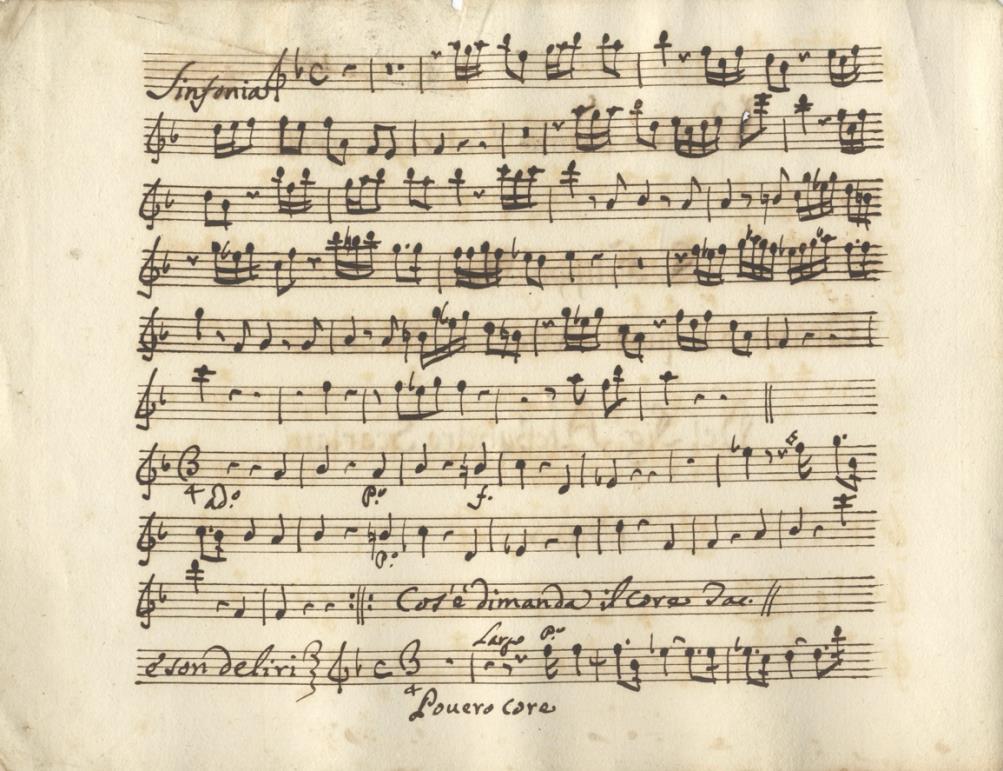
The viola ("violetta") part and the vocal part for Carità include a stave for the bass, with the copyist entering the bass line at strategic moments in order to serve as cues.
"A more mystical and less ascetic example is the anonymous 'San Filippo Neri' ... In this work Faith, Hope, and Charity converse with and reflect on the life of St. Philip - who, having rejected riches and the world, yearns for a mystical union with God." Smither: A History of the Oratorio Volume I, p. 302.
" 'San Filippo Neri' ... is one of his [Scarlatti's] best oratorios. There is a real feeling of sincerity about it, though not all of it is in accordance with modern taste. The simile of a ship on a prosperous voyage leads St. Philip into vocal ripplings which are pretty, but rather out of place, and in the air "Son come destriero" the pawing and champing of both voice and violins throw Handel's frogs quite into the shade. But where genuine human feeling comes in Scarlatti rises to the occasion. There is something seraphic in the brilliance of Charity's high soprano airs; Faith speaks with a large Handelian dignity, and the pathetic recitative stromentato is worthily followed by the quiet and beautiful air in which St. Philip acknowledges the divine call." Dent: Alessandro Scarlatti: His Life and Works, pp. 133, 135.
"On 9 January 1703 [Scarlatti] was appointed assistant to Giovanni Bicilli, the elderly maestro di cappella of the Congregazione dell’Oratorio di S Filippo Neri at the Chiesa Nuova. ... Given the importance of oratorio in Roman musical life, and the important position of the Chiesa Nuova di S Maria in Vallicella in the genre, Scarlatti’s work there assumes particular importance." Roberto Pagano in Grove Music Online
Rendered in an accomplished professional hand. The date of "1705" and the practical nature of these parts (with extensive cues) indicate that they may have been used for the original performance of the oratorio, under the directorship of Scarlatti himself
A rare and previously unrecorded source. (40318) $4,800
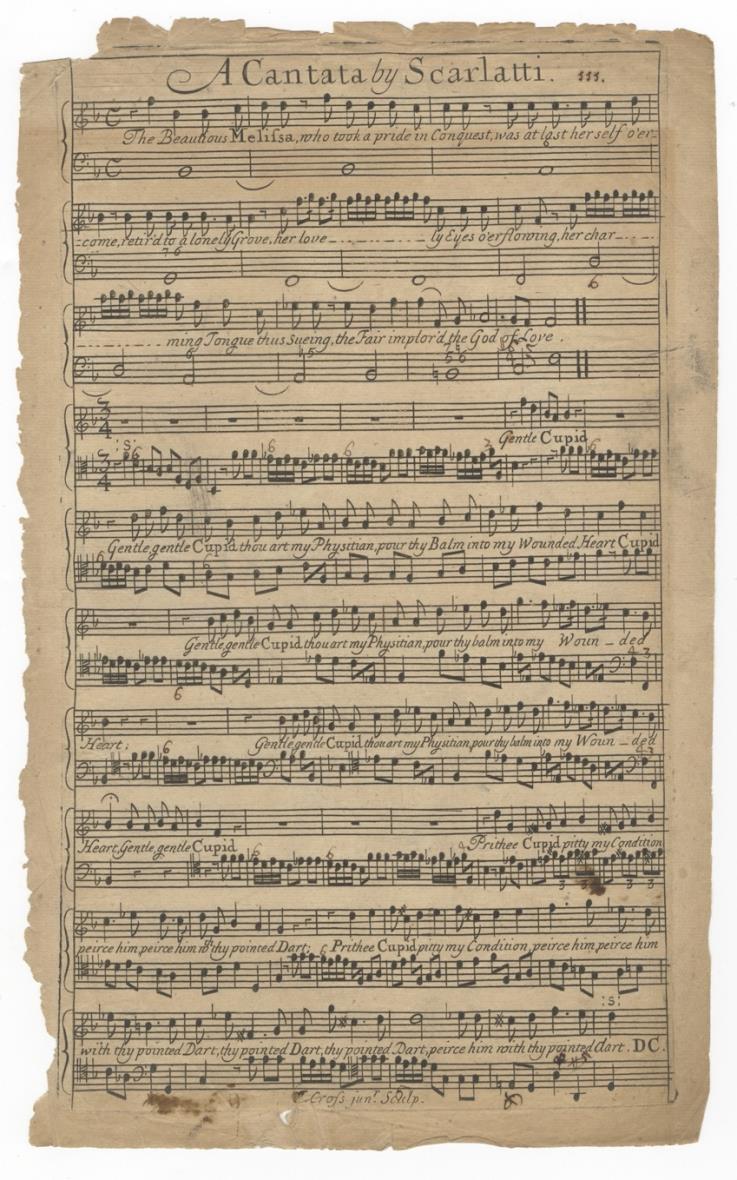
“The
Beautieous Melissa”
63 SCARLATTI, Alessandro 1660-1725
A Cantata by Scarlatti ["The Beauteous Melissa"]. T. Cross jun[io]r. Sculp[sit]. London, ca. 1710.
Folio. 1 page. Engraved. With "111" in contemporary manuscript to right of title. Occasional figured bass in contemporary manuscript. Browned; two small ink stains; margins chipped and frayed with minor loss, not affecting text or notation; small repairs with archival tape to verso.
A short cantata consisting of a recitative, "The Beauteous Melissa," and a da capo aria, "Gentle Cupid."
Rare. RISM S1186 (1 copy only, at the British Library). Worldcat (1 copy only, at the Library of Congress). (40338) $135
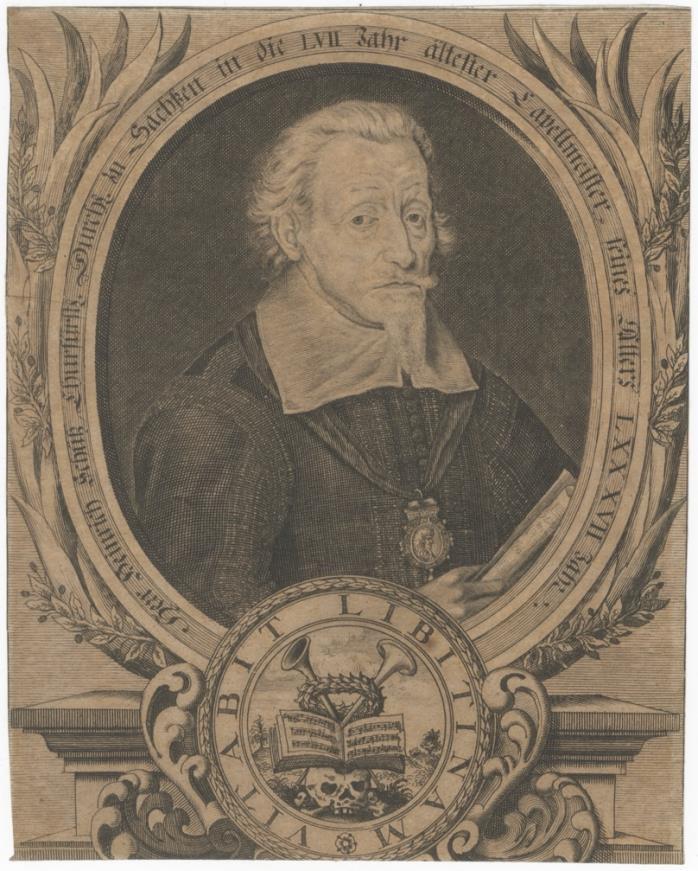
64. SCHÜTZ, Heinrich 1585-1672
Portrait engraving by Christian Romstet (1640-1721) after the painting by Christoph Spetner. Ca. 1672.
Image size 177 x 143. The composer is depicted bust-lengthwithin a decorative oval border incorporating floral motifs with a smaller circular device below the portrait incorporating an open music book and crossed horns atop a skull surrounded bythe motto "Vitabitlibitinam." Hewears a medallionaround his neck and holds a sheet of rolledmusicpaperinhisrighthand. Moderately browned;trimmedto withinplatemark, justtouching borders; narrow strip of white paper to upper margin of verso.
Kinsky p. 166, no. 1; the original painting (1650s) reproduced in both Grove Music Online and MGG.
“Two authentic portraits of Schütz have come to light. The earlier, an engraving by the Dresden artist August John (1603–after 1678), shows the composer at the age of 42 in resplendent court dress with a medallion bearing the image of Johann Georg I. The second portrait, executed in oils by the Leipzig painter Christoph Spetner (1617–99) and housed today in the Bibliothek der Leipzig Universität, portrays a considerably older Schütz in his Kapellmeister’s robe, with a rolled sheet of music in his hand further indicative of his station ...; this work provided the model for Romstet’s engraving in the funeral sermon." Joshua Rifkin and Eva Linfield in Grove Music Online
"[Schütz] was the greatest German composer of the 17th century and the first of international stature. Through the example of his compositions and through his teaching he played a major part in establishing the traditions of high craftsmanship and intellectual depth that marked the best of his nation’s music and musical thought for more than 250 years after his death." Joshua Rifkin, Eva Linfield, Derek McCulloch and Stephen Baron in Grove Music Online (41162) $275
65. SCRIABIN, Aleksandr 1872-1915
24 Préludes pour Piano ... Op. 11 ... Inst. Lith. de C. G. Roder Gm.b.H. Leipzig. [Piano solos].
Leipzig ... St. Pétérsbourg: M. P. Belaïeff ... chez J. Jurgenson, Morskaja 9 [PNs 1383, 1384-1387], after 1897.
Folio. Original publisher's gray printed wrappers with titling in French and Russian within decorative border. 1f. (recto title printed in dark green, verso blank), 3-37, [i] (blank) pp. With publisher's catalogues to verso of upper and both sides of lower wrapper "Compositions pour Piano publiées par M. P. Belaïeff à Leipzig." Small oval handstampinlightpurple inktoloweroutercornerof upper wrapper. Wrappers slightly worn; rustmarks to gutter. Slightly browned; signatures loose.
First Edition, later issue. OCLC 1263261. (41121) $75
“Widespread
Critical Acclaim ... Finally Arrived”
66. SCRIABIN, Aleksandr 1872-1915
Le Poème de l'Extase pour grand Orchestre Op. 54 ... Inst. Lith. de C. G. Röder, Gm.b.H. Leipzig. [Full score].
Leipzig ... St. Petersbourg: M. P. Belaïeff ... dépôt général chez JJurgenson, Morskaïa 9 [PN 2795], 1908.
Folio. Original publisher's gray printed wrappers with titling in French and Russian within decorative border. 1f. (recto title printed in dark green, verso list of orchestral instruments), 3-101, [i] (blank) pp. With printed price list to title "Partition d'orchestre Pr. M. 10 / R. 3.50. Parties d'orchestre Pr. M. 25 / R. 8.75. Parties supplémentaires à M. 140 /R. _50 ... Réduction pour piano à quatre mains par l'Auteur Pr. M./R." and London distributor's handstamp "J. & W. Chester 22 Gt. Marlborough St. Lond. N. W." to foot.
Publisher's catalogue to verso of upper and both sides of lower wrapper "Edition M.P. Belaïeff à Leipzig." Two small oval handstamps of J. & W. Chester, London, in red ink to foot of title. Wrappers worn and partially detached.
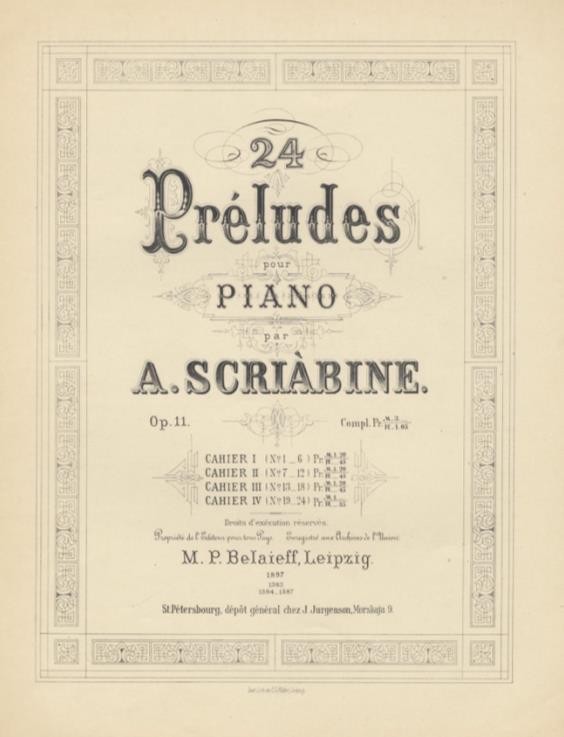
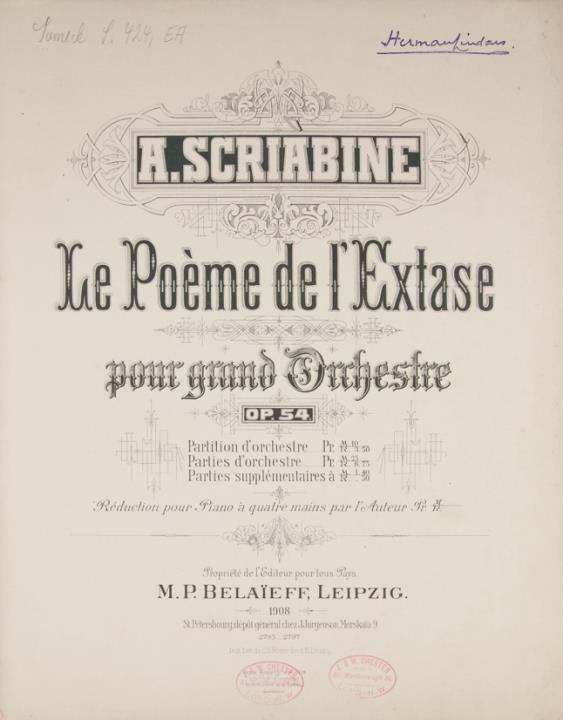
Autograph signature of conductor Herman Lindars (1899-1981) to upper outer corner of title, with his performance markings in pencil to score.
First Edition. Rare. Sonneck Orchestral Music p. 424.
“Freed from his teaching duties, Skryabin spent summer 1902 at Obolenskoye with [his wife] Vera, starting work on his Third Symphony, the Bozhestvennaya poema (‘Poème divin’), along with several shorter works. ... He was welcomed back into the Belyayev fold [in 1906] by Lyadov, who was promised a ‘big poem for
orchestra’, the Poema ėkstaza (‘poème d'extase’). ... Skryabin's return to Russia in January 1909 was heralded by a concert in St Petersburg which included the Poème d'extase, conducted by Felix Blumenfeld, and solo piano works. Widespread critical acclaim, so long denied Skryabin in Russia, finally arrived." Jonathan Powell in Grove Music Online. (41123) $400
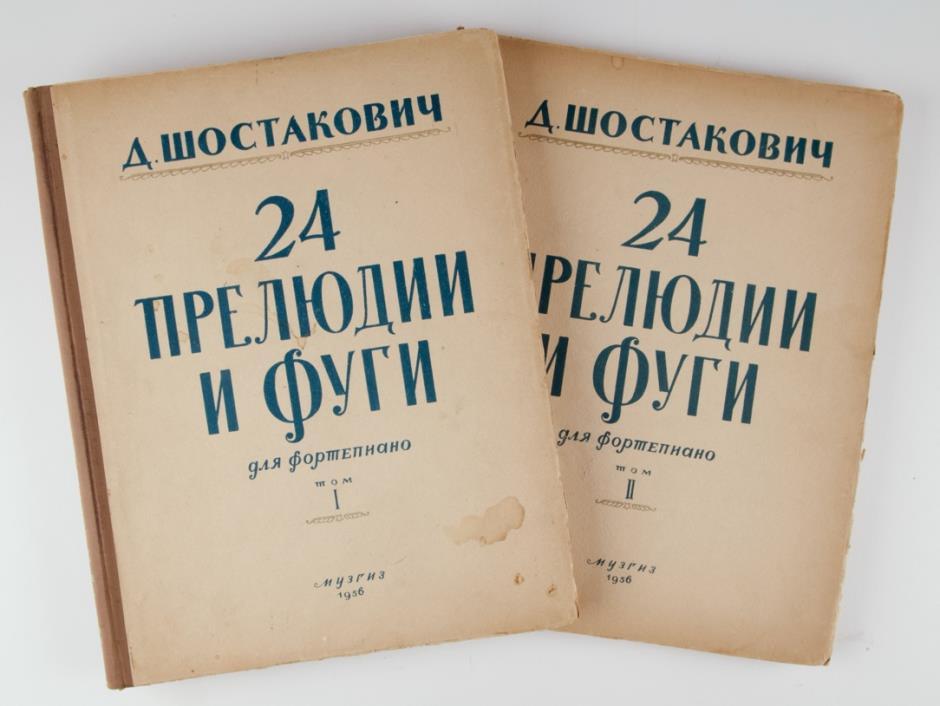
“His
67 SHOSTAKOVICH, Dmitri 1906-1975
24 Preliudii i fugi dlia fortepiano Tom I (Nos. 1-12) ... Tom II (Nos. 13-24). [Op. 87]. Twenty-four preludes and fugues for piano. Vol. I [nos. 1-12] ... Vol. II [nos. 13-24].
Moskva: Gosudarstvennoe muzykal'noe izdatel'stvo [State Music Publishers] [PNs M. 23149 G., M. 23150 G.], 1956.
2 volumes. Folio. Original publisher's light brown cloth-backed ivory boards with titling printed in teal blue to uppers, titling gilt to spine. Binding worn, rubbed, bumped, and slightly shaken; a few minor stains to upper of Vol. I, with scribbling in blue pencil to endpapers. Minor internal wear; light uniform browning.
Vol. I: 1f. (recto title, verso blank), 3-117, [i] (contents and colophon); Vol. II: 1f. (recto title, verso blank), 3121, [i] (contents and colophon).
Colophon to both volumes dated "25/I 1956" (25 January 1956).
First Edition, secondissue;thefirstedition, firstissue was published in1952. Hulme p. 341. Prelude and Fugue no. 7 and Prelude and Fugue no. 24 werepreviouslypublished ina supplementtothejournal Sovetskaia muzyka, 1952, issue no. 10 (October).
"Shostakovich habitually turned to contrapuntal composition when he experienced a creative block. ... Part of his rehabilitation strategy after his fall from grace in 1936 had a Bachian aspect, evident in three of the five movements of the Piano Quintet and the opening movement of the Sixth Symphony. With the cycle of 24 Preludes and Fugues for piano of 1950–51 he confirmed his second return to creative life [after the 1948 resolution of the Soviet Composers' Union] in the most monumental of his Bachian homages. ... The purity of the C major Prelude and Fugue suggests a tabula rasa, a new beginning from untainted sources. Like the Third Symphony, this work quarries out all sorts of musical gestures and motifs which would sustain him in his following works ... The last Prelude and Fugue, in D minor, not only makes an impressively defiant culmination to the cycle; it also adumbrates motifs and textures crucial to the first movement of the [Tenth] symphony." David Fanning in Grove Music Online (41124) $200
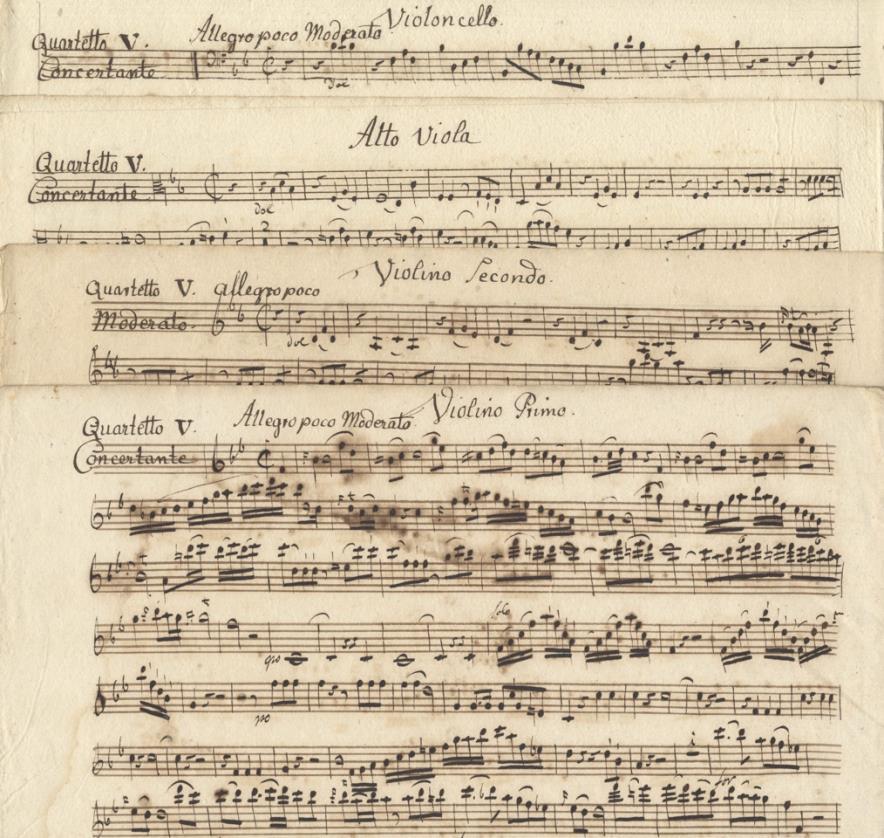
- Violino primo: [i] (title), 4 pp.
- Violino secondo: 4 pp.
- Viola: [i] (title), 3 pp.
- Violoncello: 4 pp.
A scribal copy of Stamitz's fifth quartet from his Op. 4 collection (Paris, 1776).
“A Major Contributor to the Literature of the Symphonie Concertante and Concerto”
68. STAMITZ, Carl 17451801
Quartetto V Concertante à Violino Primo Violino Secondo Alto Viola et Basso. [Op. 4]. [Set of parts]. [Copyist manuscript]. France, [1780-1800].
Oblong folio (246 x 328 mm). Notated in black ink on 10stave rastrum-ruled paper. Untrimmed. Early ownership signature "Celier de Bouville" to lower outer corner of Violino primo part, with "No. 7" in contemporary manuscript to lower inner corner. Slightly worn; occasional small stains; some showthrough.
Stamitz was a Bohemian composer and violinist, viola and viola d’amore player. "He was a leading member of the second generation of Mannheim orchestral composers, a widely travelled performer, and a major contributor to the literature of the symphonie concertante and concerto." Fritz Kaiser, Jean K. Wolf, and Eugene K. Wolf in Grove Music Online. (40321) $200
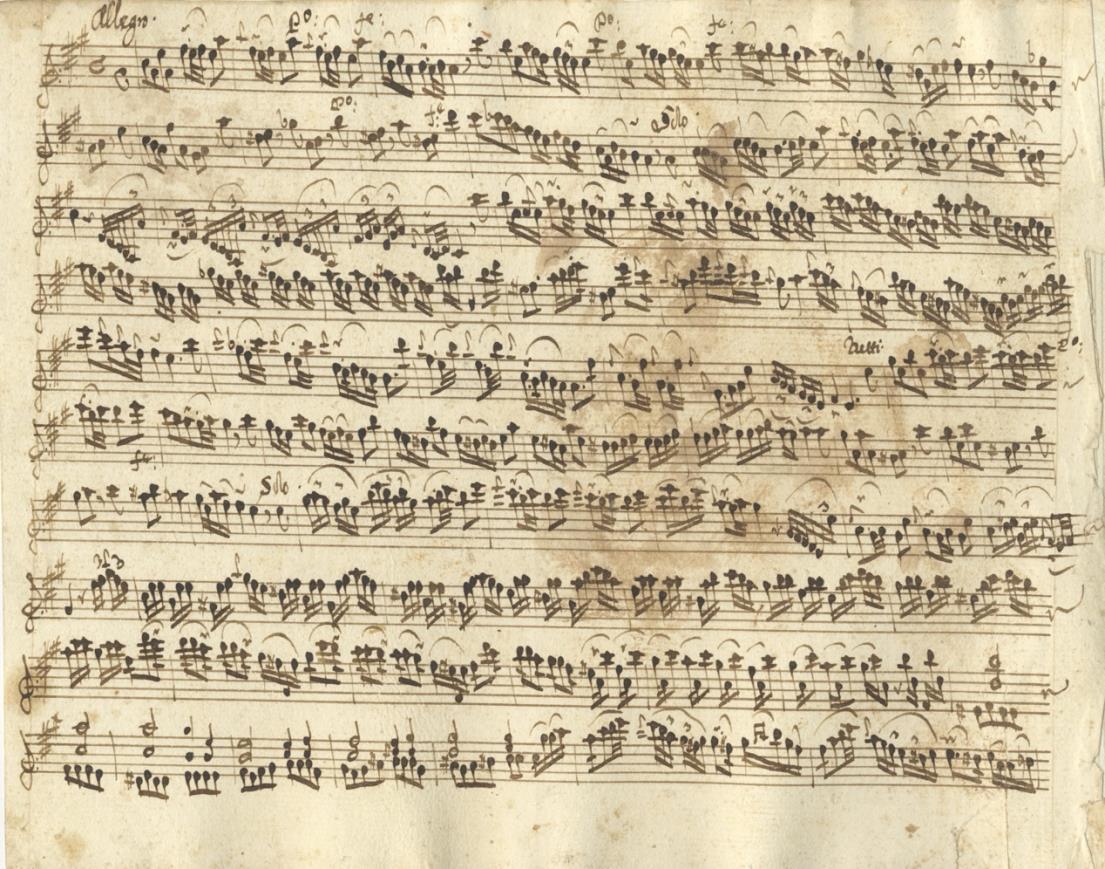
An Unrecorded Source Of Particular Interest to 18th Century Performance Practice
69 TARTINI, Giuseppe 1692-1770
Concerto en la [Violin concerto in A major]. [Set of parts]. [Copyist musical manuscript]. [?]Italy or France, ca. 1770.
Oblong folio. Unbound. Violino principale part 221 x 283 mm, all other parts 229 x 314 mm. Notated in ink on 10-stave rastrum-ruled paper, with single smaller oblong octavo leaf 113 x 212 mm notated on 7-stave rastrumruled papertipped-in to violino principale part. Watermark of3 half-moons andtheletter"A," similarto Duckles WM 16.
Violino principale: [i] (title), 6 pp.
Violino primo ripieno: 4 pp.
Violino 1o. ripieno: 2 pp.
Violino 2o. ripieno: 2 pp.
Violino secondo obligato: 4 pp.
Alto viola: 1, [i] (blank) pp.
Violoncello obligato: [i] (title), 5 pp.
Spines of violino principale and violoncello obligato parts and upper outer corner of final leaf of violino principale part reinforced with contemporary rastrum-ruled music manuscript paper. Slightly worn; occasional stains, soiling, and dampstaining; edges slightly frayed.
Catalogo tematico della composizioni di Giuseppe Tartini online, GT1.A16. Dounias p. 286, 103. Duckles p. 350, no. 87.
No autograph is known; no contemporary editions published. Other sources include a copyist manuscript full score at the Bibliothèque nationale and copyist sets of parts at the Biblioteca Antoniana in Padua and the University of California, Berkeley.
The tipped-in leaf is of great interest. It begins with an incipit of the concerto ("Del concerto") and continues with a "Grave Lavorabo," apparently a virtuoso violinist's personal elaborated version of the Grave movement of the concerto;theconclusionis an unmeasured cadenza. The style of ornamentation is extremely florid, replete with grace notes, slurred melismas, high notes, and rapid 32nd and 64th notes.
Tartini, a violinist, composer, music theorist, and pedagogue, was a central figure in the history of the violin in the 18th century.
An unrecorded sourceoffering significantinsight into18th centuryperformancepractice (40319) $4,500
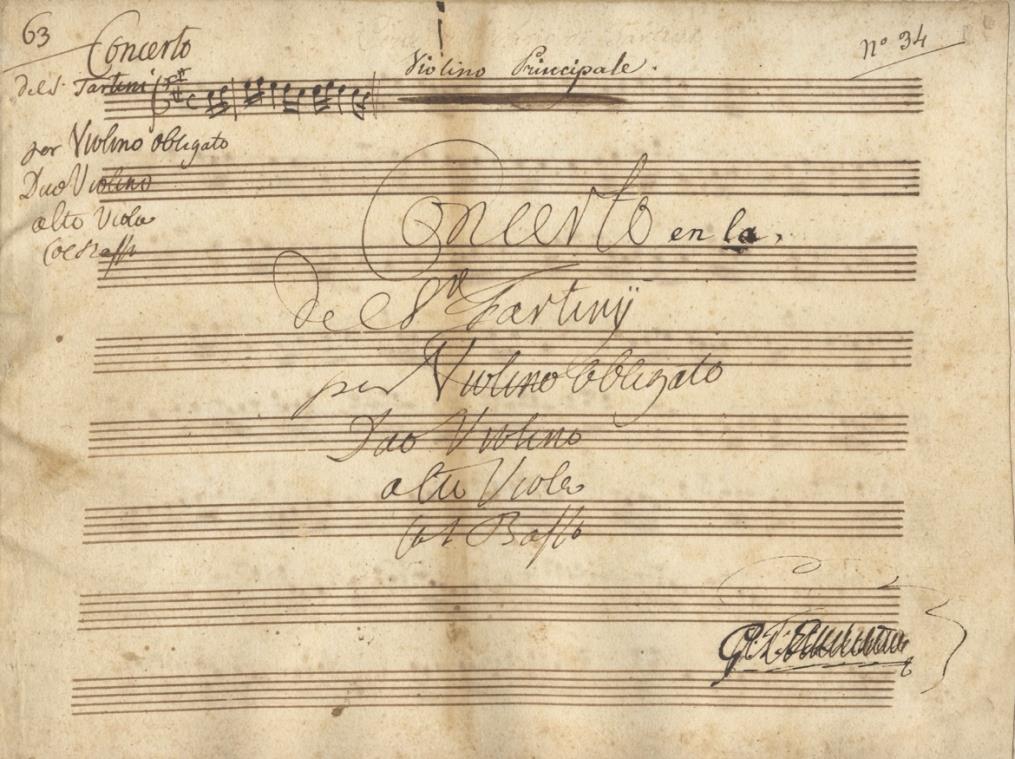
Manuscript of the Violin Concerto in A Major, GT1.A11
70. TARTINI, Giuseppe 1692-1770
Concerto en la de Sr. Tartinÿ per Violino obligato Due Violino alto Viola et Basso. [Violinconcerto in A major]. [Set of parts]. [Copyist musical manuscript]. [?]Italy or France, ca. 1770.
Oblong folio. Unbound. Various watermarks, including 3 half-moons. In two different hands. Early signature to lower outer corner of violino principale part title, overwritten by another early signature both indecipherable. "No. 34" in contemporary manuscript to upper outer corner and "63" in manuscript to upper inner corner; "No 34" in manuscript to first page of violino primo obligato part; "O" in manuscript to all parts, except first violino principale and violino primo obligato parts; incipits totitles of Violino principale and basso parts. Slightly worn; some light soiling and small stains; Violino principale part slightly browned with central stain to first leaf with minor showthrough to following leaves; small binder's holes to blank inner margins.
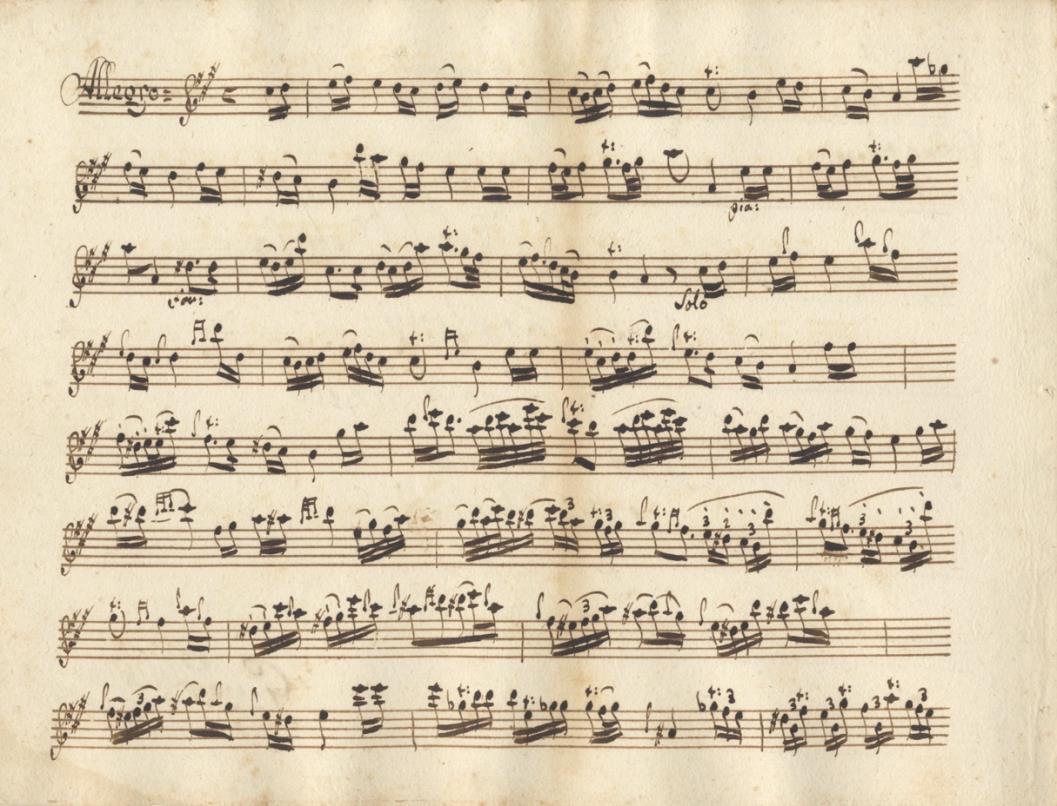
Violino principale: [i] (title), 7 pp.
Violino principale: 4 pp.
Violino primo obligato: 2 pp.
Violino primo obligato: 2 pp.
Violino secondo obligato: 2 pp.
Alto viola: 1, [i] (blank) pp.
Basso: [i] (title), 2, [i] (blank) pp.
Catalogo tematico della composizioni di Giuseppe Tartini online, GT1 A11. Dounias p. 284, 98. Published as part of an edition of VI Concerti in Amsterdam in 1760.
Autograph manuscript score held at the Biblioteca Antoniana in Padua; copyist manuscript score held at the Staatsbibliothek in Berlin; copyist manuscript parts held at the Bibliothèque nationale in Paris and at the Biblioteca Antoniana in Padua. (40317) $2,500
Manuscript of the Violin Concerto in C Major, GT1.C14
71 TARTINI, Giuseppe 1692-1770
Concerto per Violino [in C major]. [Set of parts]. [Copyist musical manuscript]. [?]Italy or France, ca. 1770.
Oblong folio. Disbound. Notated in ink on 10-stave rastrum-ruled paper. Watermark of 3 half-moons. Slightly worn; occasional small stains and soiling; some small tears to edges; minor dampstaining to lower outer corners.
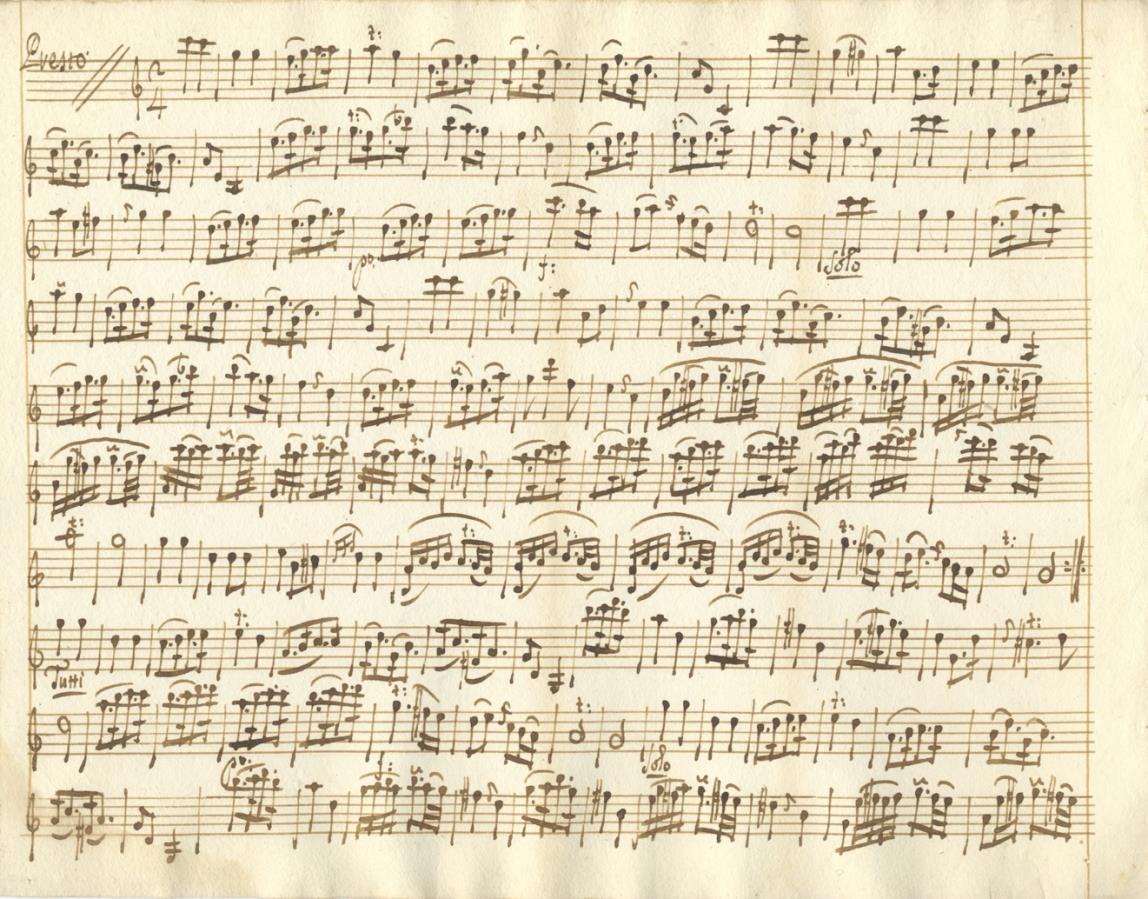
Violino principale: 6 pp.
Violino primo obligato: 3 pp.
Violino secondo: 3 pp.
Violetta: 2 pp.
Basso: [i] (title with incipit), 2 pp.
"No 35" inmanuscript to upper outer corner of violino principale, violino primo obligato, and basso parts; basso part (unfigured bass) marked "Cembalo" on title above a musical incipit from the first movement.
Catalogo tematico della composizioni di Giuseppe Tartini online, GT1.C14. Dounias p.149,14 (without movements b and d). Duckles p. 332, no. 12 (a manuscript copy). Other manuscript sources are held in Split, the Glazboni Cathedral Archive, the municipal library in Ancona, the state archive in Verona, and the University of California, Berkeley.
Dounias calls for 5 movements; the present manuscript is in 3 movements, conforming to the autograph held at the Bibliothèque nationale. (40320) $1,800

“A Direct Influence on Many Composers of the Next Generation”
72. VINCI, Leonardo 1690-1730
Twelve Solos for a German Flute or Violin with a Thorough Bass for the Harpsicord or Violoncello Compos'd by Sigr. Leonardi[!] Vinci and other Italian Authors. [Score].
London: Printed for I. Walsh, in Catharine Street, in the Strand, [1746].
Folio. Disbound. 1f. (recto title, verso blank), 10, [i] (blank), 12-32 pp. Engraved. Somewhat worn; minor to moderate staining; numerous paper repairs to blank outer margins and upper outer corners; minor worming to blank outer margin; small loss to blank outer margin of final leaf.
Scored for flute or violin and figured basso continuo.
First Edition. BUC p. 1043. Smith and Humphries 1513. RISM V1656.
Vinci's "music exerted a direct influence on many composers of the next generation, notably Pergolesi and Hasse, and also made an impact on older composers such as Vivaldi and Handel, whose later works incorporate elements of the style of Vinci and his colleagues." Kurt Markstrom in Grove Music Online. (41133) $475
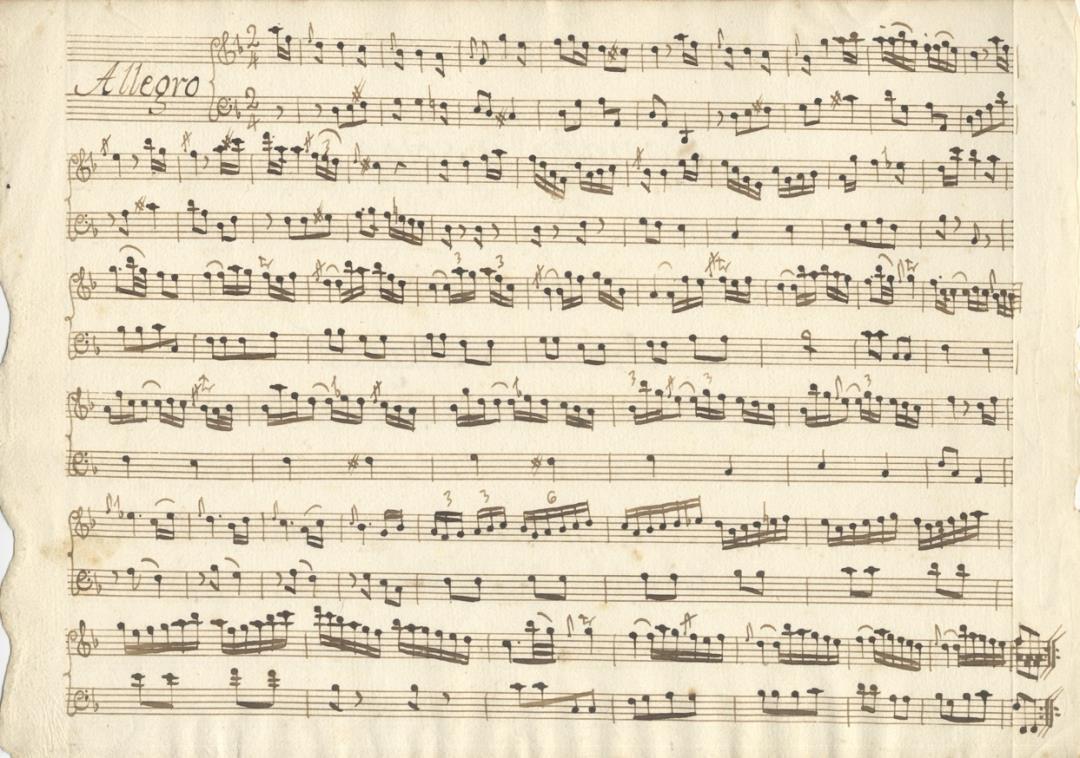
Late 18th Century Spanish Sonata for Violin and Basso Continuo
73 [VIOLIN - 18th century - Spanish - Manuscript]. Anon. Sonata a Solo de Violin y Bajo. [Sonata for violin and basso continuo]. [Copyist musical manuscript]. Spain, ca. 1770.
Oblong folio (217 x 304 mm). Sewn. [i] (title), 6 pp. Notated in ink on 12-stave rastrum-ruled paper. Bass line unfigured. Watermark indecipherable. "33" to upper inner corner and "No. 9" to upper outer corner of title in contemporary manuscript. Slightly worn; occasional light soiling and showthrough; small holes to blank central inner margins; some margins reinforced with narrow strip of early ivory paper.
Unlocated
A work in D minor for violin and basso continuo in three movements, allegro (2/4), andante (3/4), and presto (2/4). The first movement has a melancholy character with bursts of florid lyricism, the second is sentimental, and the final one is a fiery essay in perpetual motion, punctuated by dramatic fermatas.
An inventive and attractive piece of music, rendered in a fluent copyist's hand. (40322) $750
“Among the Finest Examples of Classical Violin Music”
74 VIOTTI, Giovanni Battista 1755-1824
Six Trios a Deux Violons et Basse Dedié au Celébre Monsieur Pugnani Sur Intendent de la Musique de Sa Majeste le Roy de Sardaigne ... Œuvre 2 ... Prix 9₶. [Set of parts].
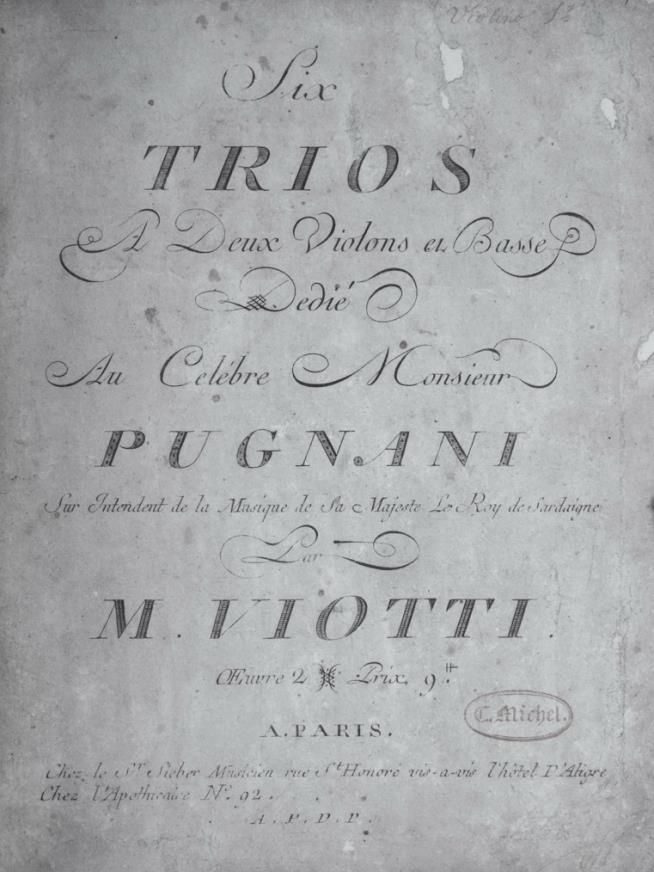
Paris: Chez le Sr. Sieber Musicien rue St. Honoré vis-a-vis l'hôtel L'Aligre Chez l'Apothicaire No. 92 A. P. D. P., ca. 1787.
Folio. Dark blue wrappers with decorative cut-paper labels titled in manuscript to uppers. Engraved. With small oval handstamp "C. Michel" in red ink to lower outer corner of publisher's catalogue and titles. Several contemporary manuscript annotations to final page of music of basso part, cancelling some slurs and adding others. Titles and final blank pages of each part soiled and stained; title of Violino primo part laid down to backing leaf, with minor loss to blank margins; some corners repaired; minor repairs to other
Scored for two violins and unspecified bass instrument.
Violino primo: 1f. (recto title, verso blank), [i] (publisher's catalogue "de Musique Vocale et Instrumentale a Mons. Sieber Rue St. Honore entre la Rue des Vielles Etuves et celle d'Orléans chez l'Apothicaire. No. 92"), 223, [i] (blank) pp.
Violino secondo: [i] (title), 2-12, [i] (blank), 14-17, [i] (blank) pp. Basso: [i] (title), 2-15, [i] (blank) pp.
First Edition. Giazotto 19-24. Lesure p. 635. Devriès and Lesure I, p. 144. RISM V1900 and VV1900 (2 copies in the U.S. only, at the University of Michigan Ann Arbor and the Eastman School of Music's Sibley Library).
Viotti, an Italian violinist and composer, "was the most influential violinist between Tartini and Paganini and the last great representative of the Italian tradition stemming from Corelli. He is considered the founder of the ‘modern’ (19th-century) French school of violin playing, and his compositions, among the finest examples of Classical violin music, exerted a strong influence on 19th-century violin style." Chappell White, revised by Warwick Lister in Grove Music Online (41132) $500
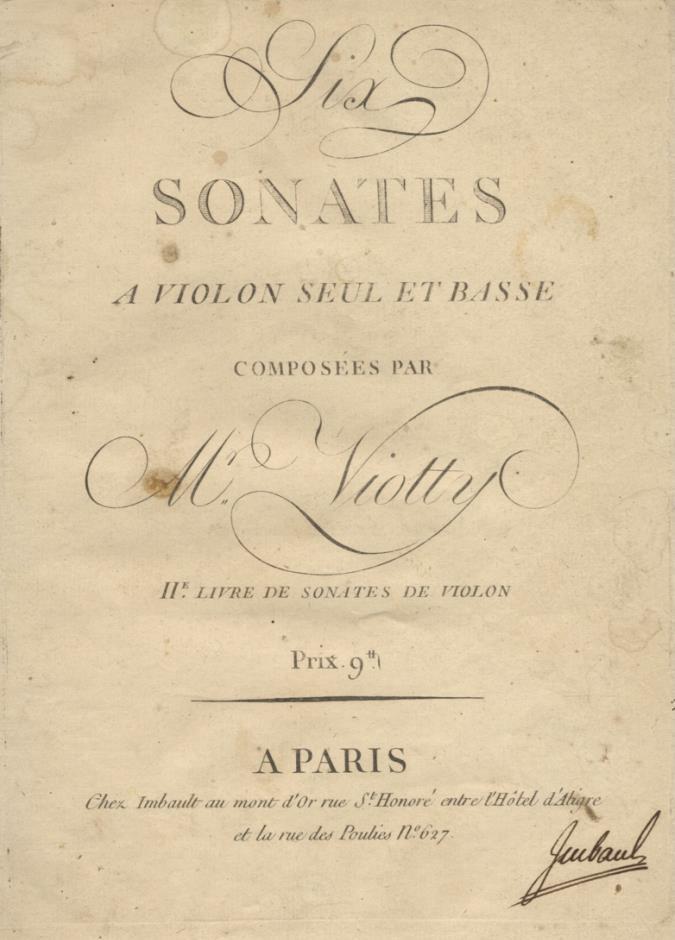
“The Last Great Representative of the Italian Tradition Stemming from Corelli”
75. VIOTTI, Giovanni Battista 1755-1824
Six Sonates a Violon Seul et Basse ... IIE. Livre de Sonates de Violon. Prix 9₶. [Score].
Paris: Chez Imbault au mont d'Or rue St. Honoré entre l'Hôtel d'Aligre et la rue des Poulies No. 627 [PN 180], ca. 1789.
Folio. Contemporary wrappers. 1f. (recto title, verso blank), [i] (blank), 2-51, [i] (blank) pp. Engraved. With Imbault's control signature to lower outer corner of title. Verso of lower wrapper with brief inscription in contemporary manuscript "[?]Adelaide" and contemporary drawing in ink of a bust of a turbaned man smoking a pipe; two mysterious, nearly-identical geometrical drawings in black and red ink to verso of upper wrapper and recto of lower. Wrappers slightly worn, soiled, and stained. Minor internal wear and small stains; inner margins of first three leaves dampstained, just touching notation
Scored for solo violin and an unspecified bass instrument.
First Edition. White No. V, 7-12. Giazotto 35-40. Devriès and Lesure I, p. 85. RISM V1940 and VV1940. (41131) $550
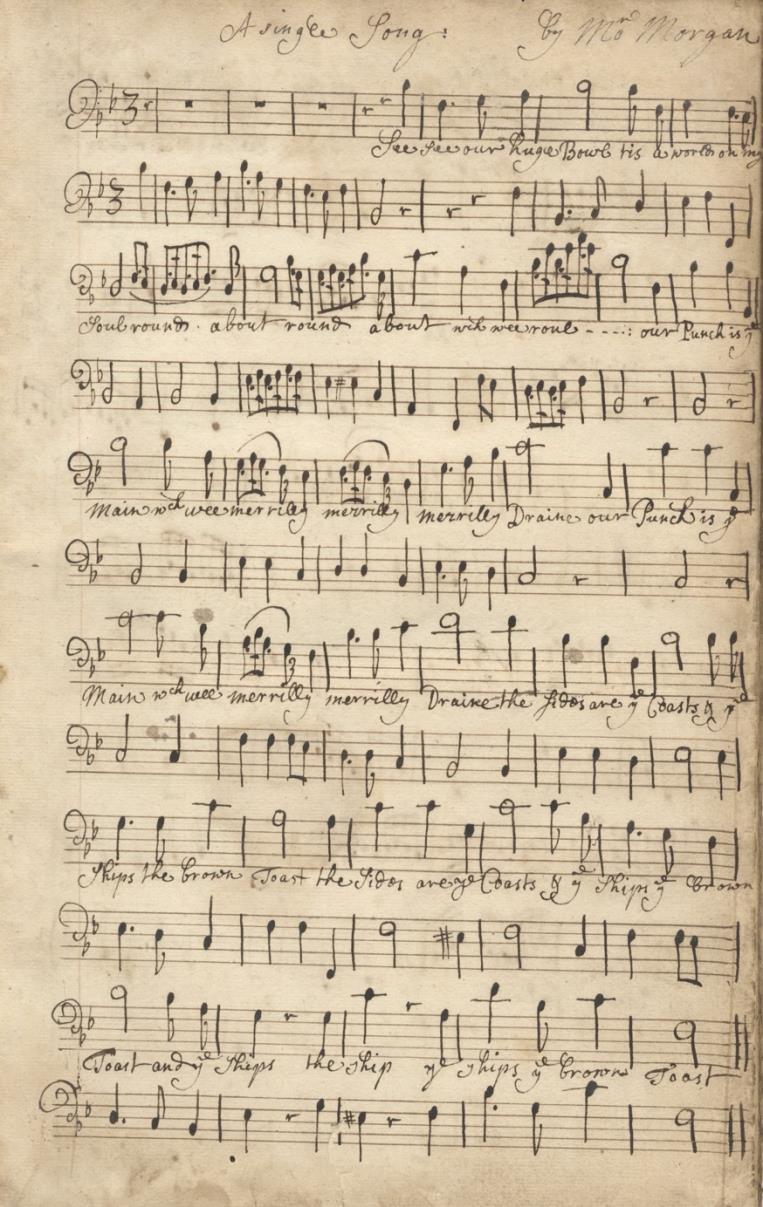
Unrecorded Songs, Ca. 1700
76 [VOCAL MUSIC - Ca. 1700 - English - Manuscript]. MORGAN, Thomas fl. 1691-1699 and John Barrett ca. 1676-1719
Two previously unknown songs London, ca. 1700.
Folio. Disbound.
9 pp. musical manuscript, [i] (blank). Notated on 12-stave rastrum-ruled paper + 23ff. (rastrum-ruled staves without notation). England, ca. 1698-1705. Worn and slightly browned; small tears repaired with archival tape; trimmed at outer margin, not seriously affecting notation or text but just touching staff lines on one page; signatures separating; some showthrough.
MORGAN, Thomas
A single Song, with text commencing See, see our huge bowl. 3 pp. in total. Scored for bass voice and unfigured basso continuo. A drinking song with some melodic and harmonic similarity to the famous Anacreontic Song. The present song, with a bounding melody in 3/4, incorporates divisions of running 16th and dotted rhythms. Unlocated.
Morgan, an organist and composer, was "probably Irish. It seems very likely that the ‘Mr Morgan’ to whom a number of late 17th-century songs and instrumental pieces are attributed was the Thomas Morgan appointed organist of Christ Church Cathedral, Dublin, in 1691, who left almost immediately for England to ‘endeavour to attain the perfection of an Organist’. Mercurius musicus (1699) contains a song stated to be ‘the last he made in Ireland’. His Collection of New Songs … and a Sonata for Two Flutes (1697) contains pieces from Motteux’s Europe’s Revels (1697) and Powell’s Imposture Defeated (1697). ... Further details are given in C. Price: Music in the Restoration Theatre (Ann Arbor, 1979)." Ian Spink in Grove Music Online
Bound with:
BARRETT, John
A Song by Mr. Barrett, with text commencing When to Cloris I sigh. 5 pp. in total. Scored for soprano voice and figured bass. Structuredwiththreecontrastingarioso sections, withan intervening recitative before the final one.
Barrett was an English composer, organist and music master. "From about 1686 to 1691 he was a chorister in the Chapel Royal under John Blow. He became organist of St Mary-at-Hill on 25 August 1693 and was appointed music master at Christ’s Hospital on 28 September 1697. He held both these posts until his death. He contributed a poem in homage to Blow to Amphion Anglicus (London, 1700) and was elected to the Amicable Society of Blues in about 1704. ...
Like many of his contemporaries, such as Jeremiah Clarke, John Eccles and Daniel Purcell, Barrett composed mainly for the theatre, and his many songs, mostly of the double-barrelled art song variety, are both tuneful and attractive, as are the several little keyboard pieces published in the first three books of The Harpsicord Master (1697–1702) and various other early 18th-century anthologies. The style is essentially Purcellian, but the use of motto openings in almost all the extended songs reveals an awareness of rather more up-to-date Italian vocal practice, and in one case (Begone, begone, thou too propitious light, n.d.) Barrett actually produces what must be one of the very first English recitative–aria–recitative–aria cantatas as such (though the term ‘cantata’ is not used). His incidental music for Shadwell’s The Lancashire Witches was popular, and no fewer than 30 performances at Drury Lane between 1713 and 1729 are recorded; like that of several other plays to which he also contributed, however, it is no longer extant." Christopher Powell, revised by H. Diack Johnstone in Grove Music Online
Bound with: ANON.
A new Scotch song (Sung by Mrs. Reading), with text commencing With tunefull pipe and merry glee. London, ca. 1705. 1 p. With melody line transposed for the flute to lowermost three systems. BUC p. 1087 (citing a published edition naming "Redding" as singer). Possibly a scribal copy of this or a previously unknown imprint.
A new manuscript source for post-Restoration era vocal music, with two apparently previously unknown songs by Thomas Morgan, a composer who worked with several important playwrights of his day including Aphra Behn and John Dryden, and John Barrett, one of the first British composers to create an Italian-style cantata in English. (41071) $2,200
77. WALTON, William 1902-1983
Belshazzar's Feast for baritone solo, mixed choir, and orchestra the text selected and arranged from the Bible by Osbert Sitwell. [Full score].
London: Oxford University Press, 1978.
Folio. Quarter black cloth with decorative boards, titling gilt to spine, illustrated endpapers. 1f. (recto statement of limitation, verso "head of Sir William Walton ... reproduced from the sculpture by Elisabeth Fink), 1f. (recto title, verso imprint), 1f. (recto contents, verso blank), 1f. ("The Origins of 'Belshazzar's Feast' by Michael Kennedy," verso blank), ix-xii, [i] ("Belshazzar's Feast: the Text"), [xiv]-[xxi], [i] (blank), 1f. (recto secondary title, verso dedicationtoLordBerners), xxv(orchestration), [i] (blank), 165, [i](blank)pp. Indecorativeslipcase.
With the autograph signature of the composer to limitation statement.
Limited to 350 copies, this no. 2. OCLC 11335147.
"Noted above all for his orchestral music, [Walton] is one of the major figures to emerge in England between Vaughan Williams and Britten. ... An uninhibited Italian vivacity animated ... the cantata Belshazzar’s Feast (1930–31). The success of this highly dramatic choral work confirmed Walton’s place as an prominent figure in the British musical world. ... His early discovery of the basic elements of his style allowed him to assimilate successfully an astonishing number of disparate and apparently contradictory influences, such as Anglican anthems, jazz, and the music of Stravinsky, Sibelius, Ravel and Elgar, to name a few. Walton’s allegiance to his basic style never wavered and this loyalty to his own vision, along with his rhythmic vitality, sensuous melancholy, sly charm and orchestral flair, gives his finest music an imperishable glamour." Byron Adams in Grove Music Online (41130) $250
Rare Edition Corresponding to the 10 November 1824 Production
78. WEBER, Carl Maria von 1786-1826
The Overture, and the Whole of the Music in Carl Maria von Weber's Celebrated Romantic Opera of Der Freischütz, The Poetry by George Soane Esqr. as Performed at the Theatre Royal, Drury Lane, Adapted to the English Stage, and produced under the direction of Henry R. Bishop. Composer to the Theatre Royal Drury Lane. Price 30s. [Piano-vocal score].
London: Goulding, D'Almaine & Co., 20 Soho Square, and to be had at 7 Westmorland St. Dublin, [ca. 1824].
Folio. Contemporary quarter dark brown pebbled cloth with light brown boards. 1f. (recto full-page lithograph frontispiece "Zamiel Appearing to the Summons of Kaspar in the Wolf's Glen ... printed by Hullmändel," verso blank), 1f. (recto title, verso blank), 164 pp. Text in English only. Music engraved. Watermark 1823. Pagination to outer upper corners of overture continuing to center of each page; each selection with secondary pagination to upper outer corners. With label titled in contemporary manuscript to front pastedown and "Samuel Dudley [?]Sumner" in contemporary manuscript to upper outer corner of frontispiece; publisher's handstamp "Printed by Goulding & Co." to foot of several pages Binding worn, rubbed, and bumped; hinges cracked. Frontispiece partially detached at lower edge, with blank margins soiled, foxed, and dampstained; occasional small stains, minor soiling, small tears, and foxing. Quite a good copy overall,.
Rare. JISC (1 copy only, at the Royal College of Music, London. Not in Jähns.
Der Freischütz premiered in Berlin at the Schauspielhaus on 18 June 1821.
"[It] was the culmination of an important phase in Weber’s struggle to realize his conception of German opera. His idea of combining the resources of drama, music and the visual aspect of theatre in a unified art work was only partly realized in Der Freischütz; but, owing much to the example of French opera, he moved far beyond the limitations of Singspiel as it was practised by the majority of his German contemporaries. Along with Spohr (Faust, 1813) and Hoffmann (Undine, 1816), who had similar aims, he attempted, with considerable success, to express the essential elements of the drama in his music. Like them, Weber used tonality, musical motif, orchestral colour and various formal and structural devices." Clive Brown in Grove Music Online
"A prototypical 19th-century musician-critic, [Weber] sought through his works, words, and efforts as performer and conductor to promote art and shape emerging middle-class audiences to its appreciation. His
contributions to song, choral music, and piano music were highly esteemed by his contemporaries, his opera overtures influenced the development of the concert overture and symphonic poem, and his explorations of novel timbres and orchestrations enriched the palette of musical sonorities. With the overwhelming success of his opera Der Freischütz in 1821 he became the leading exponent of German opera in the 1820s and an international celebrity. A seminal figure of the 19th century, he influenced composers as diverse as Marschner, Mendelssohn, Wagner, Meyerbeer, Berlioz, and Liszt." Michael C. Tusa in Grove Music Online
This rare edition, representing the 10 November 1824 production at Drury Lane, consists of the overture and 17 individually-issued numbers, each with separate caption title, price, pagination, and (in some cases) named singers. (40791)
79 WEBER, Carl Maria von 1786-1826
$500
Oberon Romantische Oper in drey Acten Nach dem Englischen des J. Planche von Theodor Hell ... KlavierAuszug von Componisten. Eigenthum des Verlegers Mit allergnäd. Königl. Preußischen, Baierischen, Sächsischen und Großherzogl. Darmstädtischen Privilegien gegen Nachdruck aller Arrangements. ... Preis: 6 Rthlr. 15 Sg. (12 ggr.). [Op. 306]. [Piano-vocal score].
Berlin: In Ad. Mt. Schlesinger's Buch-und Musikhandlung, Unter den Linden No. 34. [PN 1376], [1826]. Folio. Original publisher's gray printed wrappers with titling within decorative border . 1f. (recto title, verso blank), [i] ("Personen" and thematic index), 4-157, [i] (blank) pp. Engraved. With publisher's small
monogrammatic handstamptoblanklowerinnermargin of title. Occasionalannotations inpencil. Contemporary signature "Emilie von Wolzogen 1826" to foot of title and foot of upper wrapper (without date), most likely Dorothea Therese Emilie vonWolzogen (1797–1872). RISM ID Number people/144470. Wrappers worn; edges frayed; upper detached. Some signs of wear; minor to moderate foxing to blank margins; a number of signatures split. Quite a good, wide-margined copy overall.
First German edition, including the fifth aria for the first time, and published shortly after the first London edition. Jahns 306, p. 392. Hirsch IV, 1298. Fuld pp. 395-396. Hoboken 15, 367.
Oberon, a romantic opera inthreeacts to alibrettoby James Robinson Planchéafter Christoph MartinWieland’s poem Oberon, was first performed in London at Covent Garden on 12 April 1826.
"The whole nature of Oberon ... both in its subject and in the method of treating it which Weber was led to adopt, is orchestral rather than vocal; yet the freshness and charm of his melodies is if anything at its peak in the disjointed numbers which comprise it." Warrack: Carl Maria von Weber, p. 326. (41134) $800
Early 19th Century Quadrilles
80 WEIPPERT, J. T. fl. ca. 1800, arranger
Favorite Quadrilles, With there[!] proper Figures in French & English, as Performed at the Nobilities Assemblies Arranged for the Piano Forte Harp, or Violin ... Price 3s. Bland & Weller's [Second] Collection. [Score].
London: Printed & Soldat theabove Music Warehouse 23, Oxford Street, ca. 1813.
Folio. Sewn. 1f. (recto title, verso blank), 7, [i] (blank) pp. Engraved. Watermark dated 1813. With an elaborate full-page illustrated title printed in dark blue incorporating figures in Greco-Roman garb, an angel, architectural motifs, and a fortepiano. Notated on two staves (treble/bass) for piano, harp, or violin. With printed dance performance instructions to first five quadrilles in French and English. Spine reinforced with old paper tape. Some very minor staining and soiling,
Contains La Kerbourg La Pantalon; La Driondrille De L'ete; La Desbassagnes ... La Poule; La Bagneux ... Trenis; La Robertine ... La Finale; The Moscow Waltz; Danish Waltz; and The Cottage Waltz
Not in OCLC or JISC. (41126) $400