CONDITIONS OF SALE
All items are in good antiquarian condition unless otherwise noted and are offered subject to prior sale, with prices net and subject to change without notice. The costs of shipping and insurance are additional Orders are customarily shipped via USPS Priority Mail or Federal Express. Sales tax will be added to the invoices of NewYork State residents.
Orders may be placed by e-mail (info@lubranomusic.com), telephone (516-922-2192), or on our secure website (www.lubranomusic.com) by entering the ID number of the desired item in the SEARCH box at the upper right of our homepage.We ask that you kindly wait to receive ourinvoice to ensure availability before remitting payment. Libraries may receive deferred billing upon request.
We accept payment by:
-ACH (Automated Clearing House), inclusive of all bank charges
- EFT (Electronic Funds Transfer), inclusive of all bank charges
- PayPal to info@lubranomusic.com
- Checks in U.S. dollars drawn on a U.S. bank
- International money order
- Credit card
We fully guarantee that all items offered for sale by J & J LubranoMusicAntiquarians LLC are absolutely authentic without time limitation to the original purchaser provided that said items conform exactly to our description as supplied at time of purchase.All items remain the property of J & J Lubrano MusicAntiquarians LLC until paid for in full.
Please visit our website at www.lubranomusic.com
where you will find full descriptions and illustrations of our catalogued inventory
Members
Antiquarian Booksellers’Association ofAmerica
International League ofAntiquarian Booksellers
ProfessionalAutograph Dealers’Association
Music LibraryAssociation
American Musicological Society
Dance StudiesAssociation &c.
Cataloguers
John Lubrano, Jude Lubrano, Benjamin Katz
The Star Spangled Banner
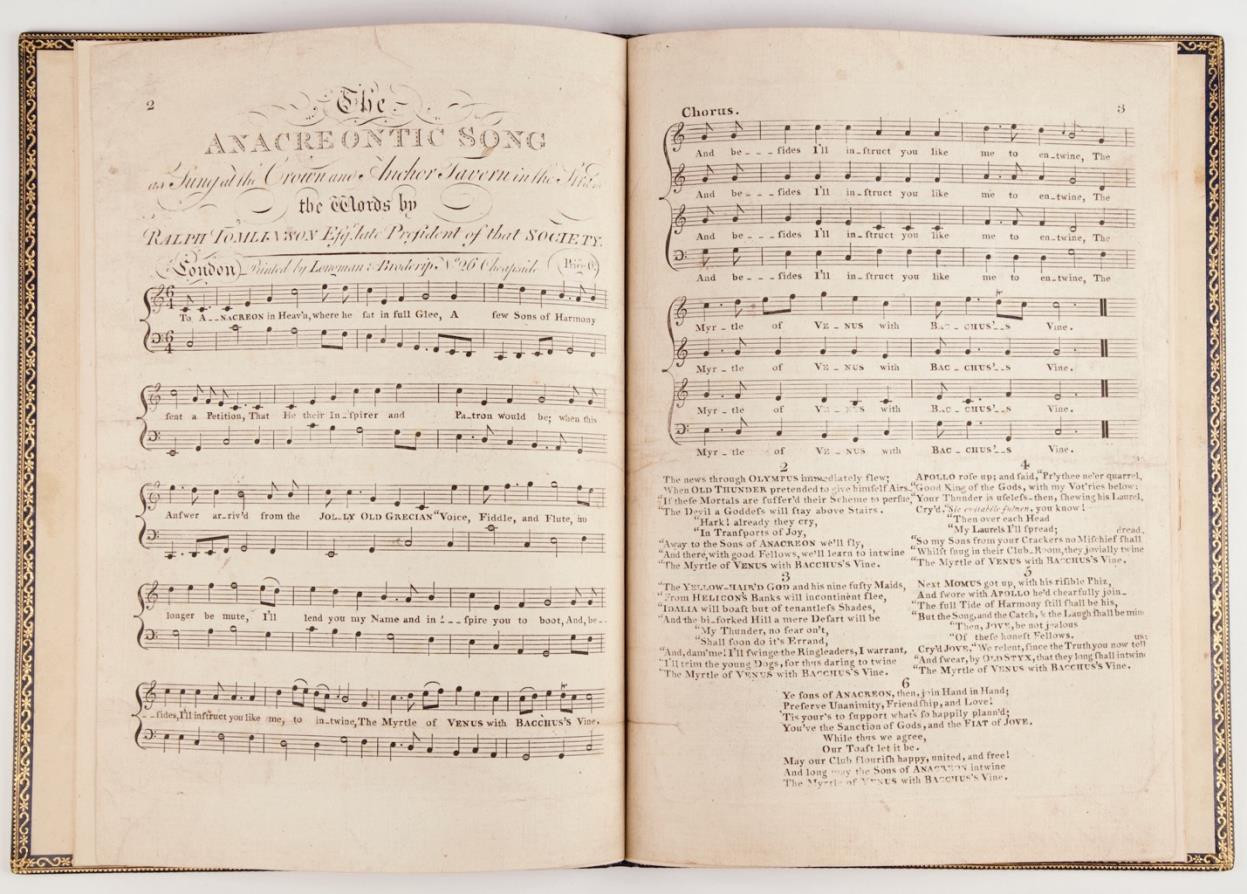
1. [AMERICAN MUSIC - The Star Spangled Banner] Smith, John Stafford 1750-1836
The Anacreontic Song as Sung at the Crown and Anchor Tavern in the Strand the Words by Ralph Tomlinson Esqr. Late President of that Society. ... Price 6d.
London: Longman & Broderip, 26 Cheapside, [1779-80].
Folio. Full dark blue morocco with titling gilt to spine, edges and inner dentelles gilt. [1] (blank), 2-4 pp., with chorus and 5 additional verses to lower portion of page 3 and versions "For the Guitar" and "For the German Flute" to page 4. On good quality laid paper. Several minor tears to inner blank margins professionally repaired. An attractive copy, handsomely bound.
First Edition, first issue, of the tune that became known as The Star Spangled Banner. Very rare. Sonneck: The Star Spangled Banner (1914) 1a, p. 41. Muller p. 15. Filby and Howard: Star-Spangled Books S1, p. 127. Fuld pp. 529-534. College Music Symposium 18/2, Fall 1978, pp. 34-81. BUC p. 1011. RISM S3705 (not distinguishing among issues).
The present first issue carries only the Cheapside address of the publisher; the second and third issues were entirely re-engraved and carry the "No. 13 Hay Market" address as well.
The song was written in the 1770s as the constitutional hymn of the Anacreontic Society, a gentlemen's club of amateur musicians in London that met at the Crown and Anchor tavern to sing catches and glees. John Stafford Smith had a considerable reputation as a composer in this genre, and his Anacreontic Song quickly became
immensely popular, especially in the United States. More than 80 settings to various texts appeared in America before 1820; American author and amateur poet Francis Scott Key (1779-1843) wrote the words of The StarSpangled Banner in 1814 to Smith's tune. In this form, the tune soon became a popular patriotic song and, with some melodic alteration, was canonized as the official national anthem of the United States in 1931.
Of considerable rarity, having been printed primarily for members of the Anacreontic Society, which numbered only approximately 50 at the time (39303) $18,500
An Important 16th Century Treatise With a Fine Woodcut of Aron Instructing His Pupils
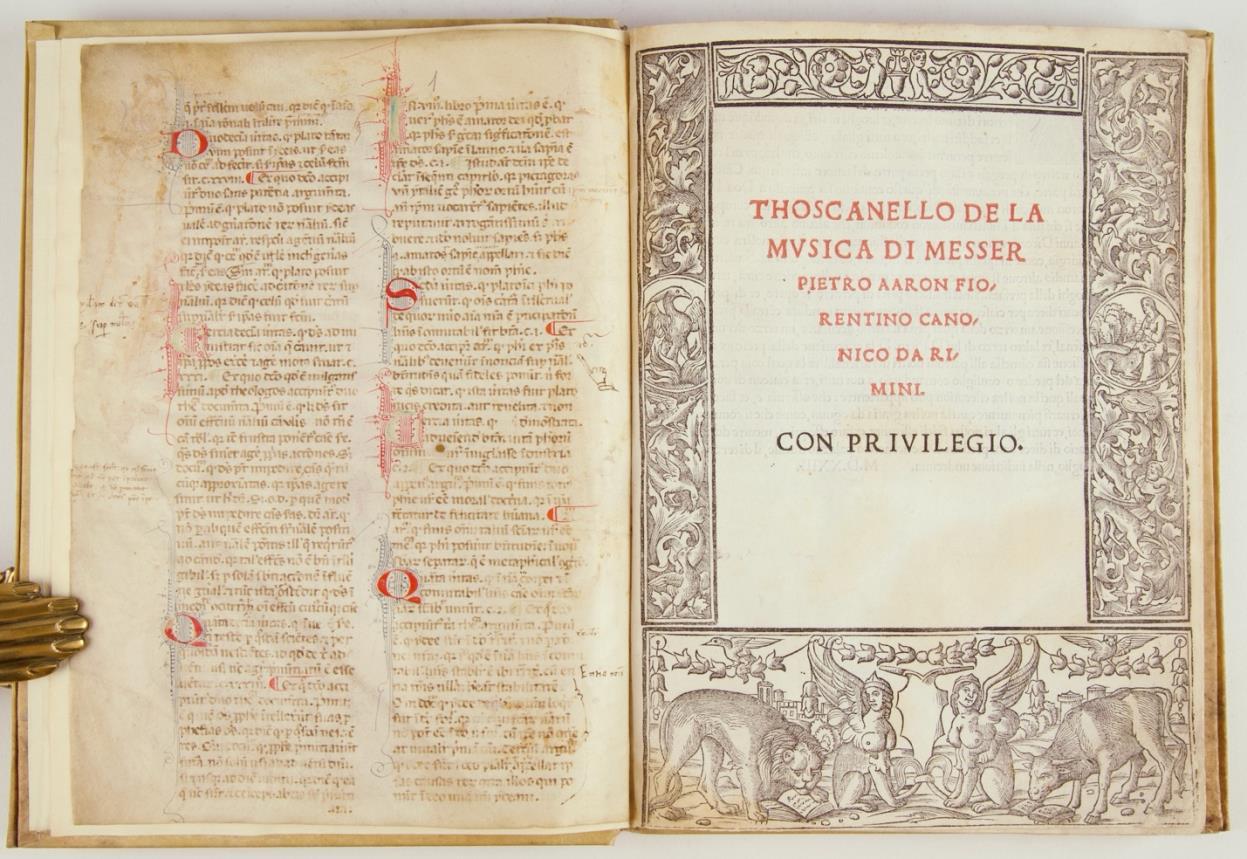
2. ARON, Pietro ca. 1480-ca. 1550
Thoscanello de la Musica di Messer Pietro Aaron Fiorentino Canonico da Rimini. Con Privilegio.
Venice:Impressa inVinegia permaestroBernardino et maestro Mattheo di uitali fratelli Venitiani, 24July 1523.
Full vellum with titling gilt to spine. 1f. (early manuscript on vellum with decorative initials in red ink and decorative penwork in red and blue, decorative pointers in black), 1f. (recto title printed in red within highly decorative woodcut border, verso privilege), 1f. (dedication to Sebastiano Michele) with historiated initial), 2ff. (contents and full-page woodcut portrait of Aron), 21ff. Libro Primo, 1f. (recto full page plate "Coligatio Notvlar," verso blank), 28ff. Libro Secondo, 1f. (early manuscript). With occasional decorative and historiated initials. With numerous finely-printed musical examples and diagrams throughout. Unpaginated, but 54ff. in total, with L4 blank, as issued. In Italian. Binding slightly worn and soiled; ties lacking. Minor internal wear and
soiling; occasional foxing and staining; staining to many lower blank margins and gutters; title slightly trimmed and frayed at lower and outer edges; minor annotation to one page with inking to several notes on following page resulting in staining to preceding and following leaves
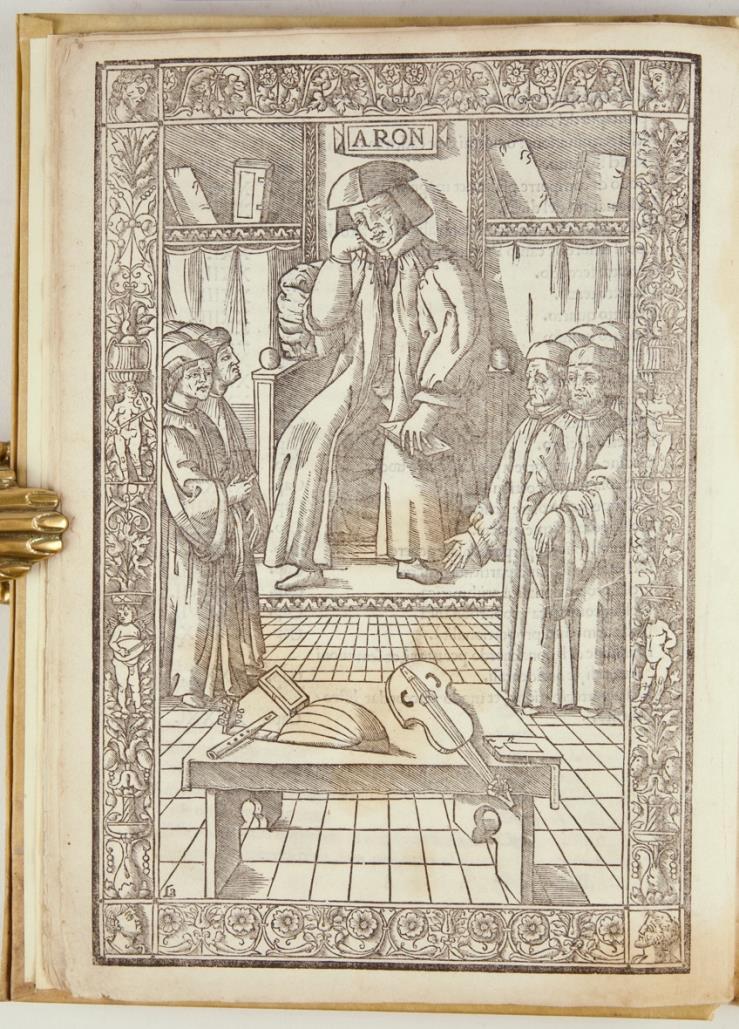
The fine full-length portrait of Aron depicts the author seated surrounded by his pupils, with a viol, lute, recorder and books on a table in the foreground, all within a densely floriated border incorporating small figures playing musical instruments.
First Edition. This edition not in Cortot, Gregory-Bartlett, or Wolffheim. Cowden: A Collector's Journey: Notable Music Books Written Prior to 1800, no. 12. Davidsson: Bibliographie der Musiktheoretischen Drucke des 16. Jahrhunderts, p. 11. Gaspari 1, 185. Reese: Fourscore Classics of Music Literature, 36. Hirsch I, no. 2. RISM Écrits Imprimés p. 97.
"Born in tenuous circumstances (Toscanello, preface), Aaron seems to have been largely self-taught; this may be the reason for his less systematic approach and questionable statements (especially in his first treatise), but also for his valuable insights into contemporary practice: from his first treatise onwards he promises to divulge ‘many of the secret chambers of this art, never heretofore revealed’. He is especially informative on counterpoint and compositional process (distinguishing older and newer procedures), the modal system in polyphonic music, and the application of musica ficta. He is one of the first theorists to discuss meantone temperament. His Toscanello, among the earliest vernacular music treatises, was highly successful and ran to four editions." Bonnie J. Blackburn in Grove Music Online
First published in 1523, "Toscanello ... is probably the best general treatise of its generation, invaluable for its clever and progressive discussions of musical practice, particularly counterpoint. ... Aron wrote extensively about practice, scarcely ever touching on speculative theory. His ideas are derived from earlier writers, notably Tinctoris, Gaffurius and Spataro, but he frequently extended or modified traditions." TNG 6, Vol. 1. pp. 2-3.
"Aron's published works on musical theory comprise the Libri III de institutione harmonica (1516), the Trattato della natura e cognizione di tutti gli toni di canto figurato (1525), the Lucidario in musica (1545), and the Compendiolo di molti dubbi (without date). His chief writing, however, is the Toscanello in musica (1523, and four later editions), which contains the best exposition of contrapuntal rules to be found before Zarlino. Aron is the first theorist to recognize the practice of composing all voices of a composition simultaneously." Strunk: Source Readings in Music History, p. 205
The full-page woodcut of Aron instructing his pupils, with musical instruments in the foreground, represents a significant record of the history of the student/teacher relationship of the period. See Kinsky: A History of Music in Pictures, p. 109, no. 2.
An important work, and a fine example of a very early treatise in the vernacular. (39382) $23,500
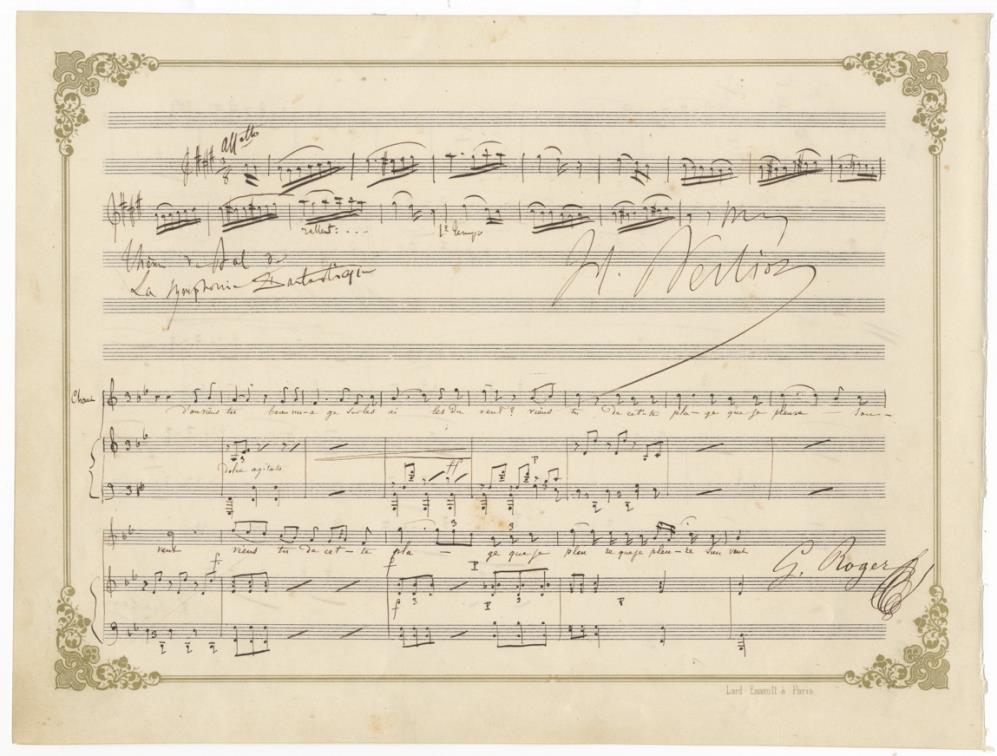
Autograph of the Main Theme of Un Bal from the Symphonie Fantastique
3. BERLIOZ, Hector 1803-1869
Autograph musical quotation signed from the composer's masterpiece, the Symphonie Fantastique. Together with quotations by Roger, Adam, and Halévy.
15 measures, titled and signed below the music: "Thème e Bal e La Symphonie Fantastique. H. Berlioz." Undated, but ca. 1840-1850. The complete main theme of the second movement, "Un Bal," carried by the violins in measures 38 to 54 of the full score. 1 leaf. Notated in dark brown ink within decorative dark gold borders on Lard-Esnault paper. Oblong quarto (227 x 300 mm).
With:
- ROGER, Gustave-Hippolyte 1825-1879. Autograph musical quotation signed "G. Roger,"beinga 12-measure song for voice and piano commencing "d'autiens tu beau miage" to lower portion of recto.
With, to verso:
- ADAM, Adolphe 1803-1856. Autograph musical quotation signed "Ad. Adam," being a 16-measure waltz for piano
- HALÉVY, Fromental Halévy 1799-1862. Autograph musical quotation signed "F. Halévy," being a 22measure work for piano titled Suite.
"The composition of the 'Symphonie fantastique' was a momentous event in Berlioz's career, his first full-scale masterpiece, and equally momentous in the history of music as the first unequivocal declaration of romantic ideas in style and musical language, and its echo has pervaded all music of passion and personal experience to this day ... Of Harriet Smithson's identity as the 'beloved', portrayed by an 'idée fixe' in the form of an obsessive theme that recurs in all the movements, there can be no question." MacDonald: Berlioz, p. 18.
A unique artifactincorporatingararequotation fromoneofthe mostoutstanding works of thesymphonic repertoire of the Romantic period, the whole uniting Berlioz with three important French musical figures of the mid-19th century. (39291)
Autograph from the Opening Theme of the Eighth Symphony
4. BRUCKNER, Anton 18241896
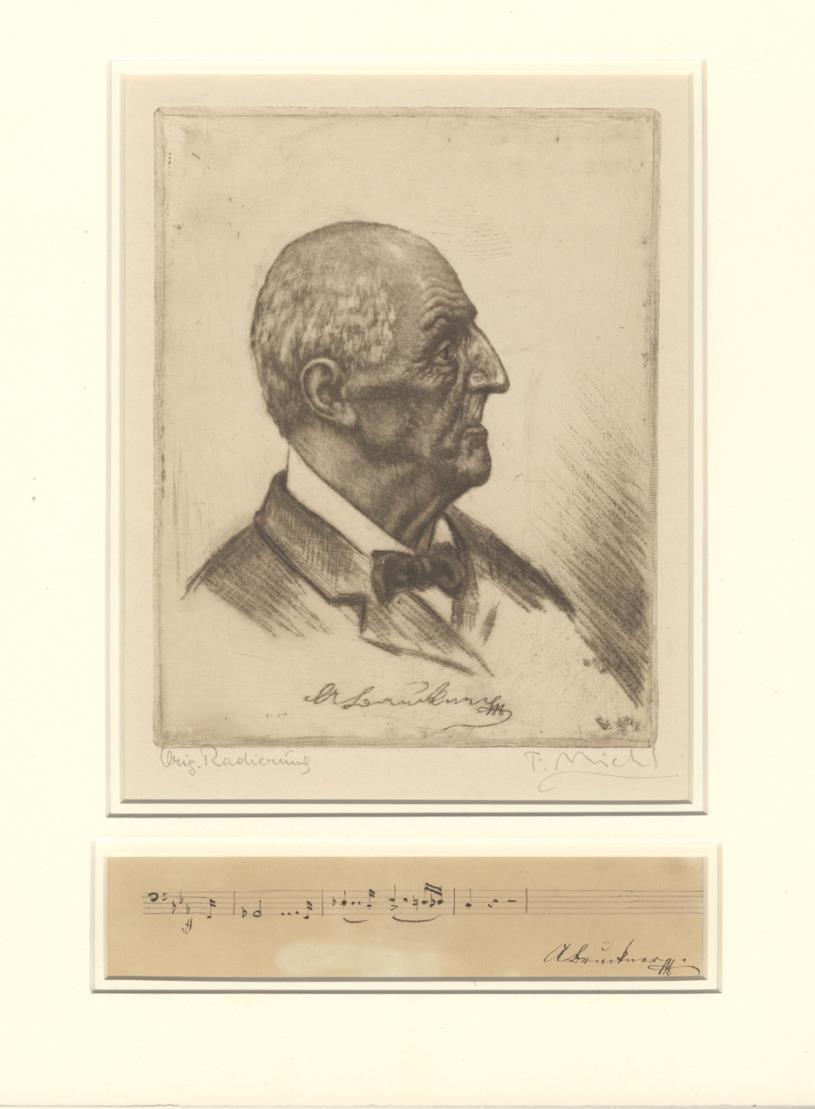
Autograph musical quotation signed "A. Bruckner" from the dramatic opening theme of the first movement of the composer's Eighth Symphony in C minor. Undated, but ca. 1892.
One small oblong leaf (48 x 26 mm; 1.8" x 8.1"). 4 measures (correspondingto measures 24-27of the first movement). Notated in black ink on a single hand-ruled stave. Browned; small slightly lighter area to blank lower margin; ink very slightly feathered. Matted with a fine original head-andshoulders etching of the composer looking left, signed in pencil by the noted Viennese artist Ferdinand Michl (1877-1951) at lower right margin. 212 x 170 mm.
Bruckner composed his Eighth Symphony between 1884 and 1887 and revised it extensively between 1889 and 1890. The revised version had its premiere in Vienna on 18 December 1892 with considerable success.
$13,500
"The origin of the Eighth Symphony, in C minor, which Bruckner believed to be his finest, presents the picture of a titanic struggle with its recalcitrant material, the skepticism of friends and foes and the increasing physical disabilities of oncoming old age. It is a work conceived on a heroic scale and the reflection of a truly heroic soul, undaunted by failures and disappointments." Redlich: Bruckner and Mahler, p. 99
Autograph music by Bruckner is rare to the market. (39699)
$12,000
Rare Music for Harpsichord
From the Distinguished André Meyer Collection
5. DAQUIN, Louis-Claude 1694-1772
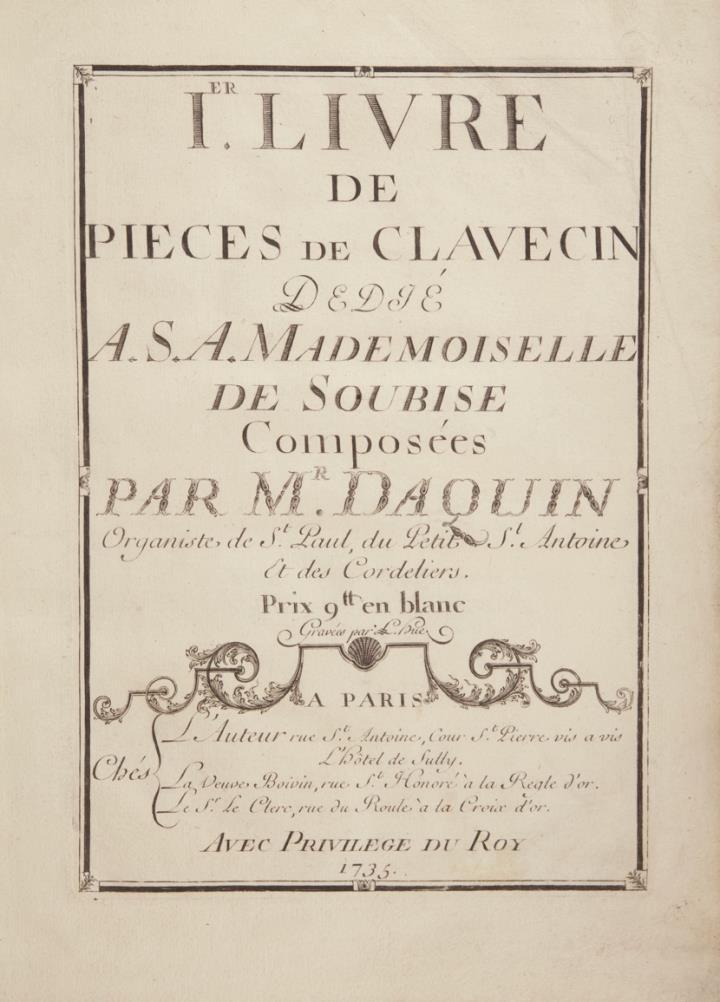
Ier. Livre de Pieces de Clavecin Dedié A. S. A. Mademoiselle de Soubise ... Prix 9 [livre] en blanc Gravés par L. Hue
Paris: L'Auteur ... La Veuve Boivin ... Le Sr. Le Clerc Avec Privilege du Roy, 1735.
Tall folio (38.2 x 28.1 cm). Full polished tree calf with triple blind rules to edges, raised bands on spine in decorative compartments gilt, dark red title label gilt. 1f. (recto title, verso blank), 1f. (recto dedication, verso blank), [ii] ("Avertissement," including notes on performance), [i] (table of contents), 2-49, [i] (blank) pp. Engraved. Lower portion of p. 15 (blank staves) completed with music incontemporary manuscriptin black ink: an anonymous monophonic piece in C major with trio in C minor (with two flats only), notated in French violin (G1) clef, untitled but most probably for violin. Occasional small stains; edge tears; professional repair to pp. 43-44; some leaves slightly dampstained at outer edge; dedication leaf soiled at upper right corner with three small holes. A very good copy overall.
Provenance
André Meyer (1884-1974), Paris.
First Edition, first issue. Rare. Lesure p. 155. Gustafson and Fuller: French Harpsichord Music 1699-1780, pp. 112-114, with full inventory of contents. RISM D1046 (copies in the U.S. at the Library of Congress and the University of California, Berkeley).
"Louis-Claude [Daquin] was an infant prodigy. After taking some harpsichord lessons from his godmother Elisabeth Jacquet de la Guerre, and composition lessons from Nicolas Bernier, he was capable of playing before Louis XIV at the age of six and of conducting his own Beatus vir in the Sainte-Chapelle at the age of eight. ... Daquin was the best virtuoso improviser of his generation, and his published works give only a faint idea of his art. His most elaborate work is the Livre de pièces de clavecin (printed twice, in January 1735 and in 1739). Although some of the pieces (such as L'hirondelle) are more or less direct imitations of François Couperin, most of them display great originality: the Trois cadances, in almost perfect sonata form, owes its title to the triple trill which Daquin was the first in France to use, and Le coucoû is an example of his taste for the single melodic unit which he repeats throughout the piece instead of developing its thematic possibilities. Except for the gavotte in the Plaisirs de la chasse, Daquin's pieces hardly seem to have been influenced at all by Rameau's." Jean-Paul Montagnier in Grove Music Online
A rare and elegantly printed collection, with distinguished provenance; the Meyer collection, formed over a period of some 75 years, was one of the most important 20th century collections of rare printed music, books on music, and musical autographs. (39316) $8,800
An Important Contribution to 16th Century Music Theory
6. DENTICE, Luigi ?1510/20-before 1566
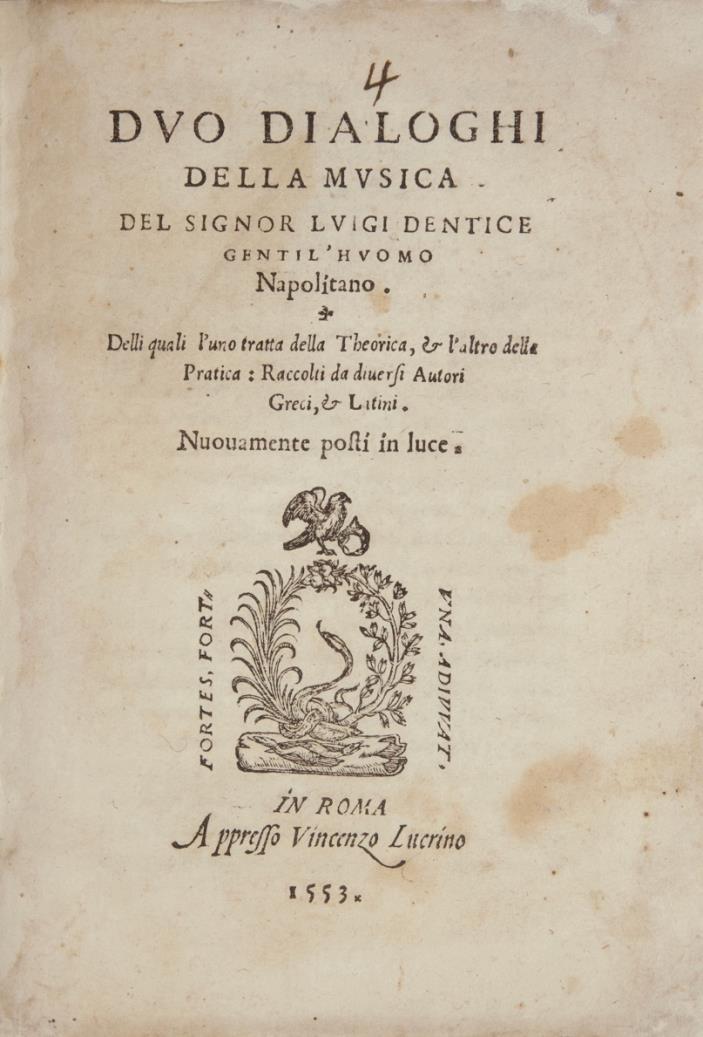
Duo dialoghi della Musica del Signor Luigi Dentice Gentil'huomo Napolitano. Delli quali l'uno tratta della Theorica, & l'altro della Pratica: Raccolti da diversi Autori Greci, & Latini. Nuovamente posti in luce.
Roma: Appresso Vincenzo Lucrino, 1553.
Octavo. Full carta rustica. 1f. (recto title with woodcut device, verso blank) + 39ff. (A in two, B-K in four, L in two). With diagrams, several musical examples, and historiated woodcut initials and head- and tailpieces. In a custom-made ivory vellum-backed box with octagonal vellum manuscript title label to upper. Early manuscript additions to several pages (verso of C4, recto of D1, verso of F4, recto of G1, verso of G2, and verso of L2) and "4" in manuscript to head of title. Binding slightly worn, soiled, and foxed. Minor internal wear; title slightly soiled, small holes archivally repaired; title and following leaf slightly browned; box worn.
Rare secondedition ofthe work firstpublished one year earlier. Cortot p. 60. Davidsson p. 26. Gregory-Sonneck p. 72. Hirsch I, 142.
Wolffheim I, 591. RISM Écrits Imprimés, p. 260 1552 edition). Only two copies recorded at auction by Rare Book Hub, one in 1990 and the other in 1995, with no copies coming to auction since.
Dentice was a Neapolitan composer, theorist, singer, and lutenist, admired by Henry VIII. His most notable contribution to music theory is the present work, a collectionof classical Greekand Latin writings on music with his own commentary, including reflections on contemporary music and musicians, musica ficta, and monody. The section on performance practice contains a description of a concert and includes observations on both instrumentalist and singers, naming Giaches da Ferrara (possibly the composer Giaches de Wert 1535-1596, a Flemish composer active in Italy) and a male soprano.
The "Duo dialoghi (Naples, 1552), dedicated to Giulio Cesare Brancaccio, benefited from his long conversations with Angelo di Costanzo (a manuscript copy, possibly an autograph, with four anonymous textless, four-voice compositions appended, is in I-Fc). In the first dialogue he discussed Greek music theory and in the second the technique of counterpoint and a few aspects of performing practice." Keith A. Larson in Grove Music Online (39473)
$8,500
Rare Autograph Sketchleaf from the Eighth Symphony “Among Dvořák’s Most Independent and Original Symphonic Works”
7. DVOŘÁK,
Anton 1841-1904
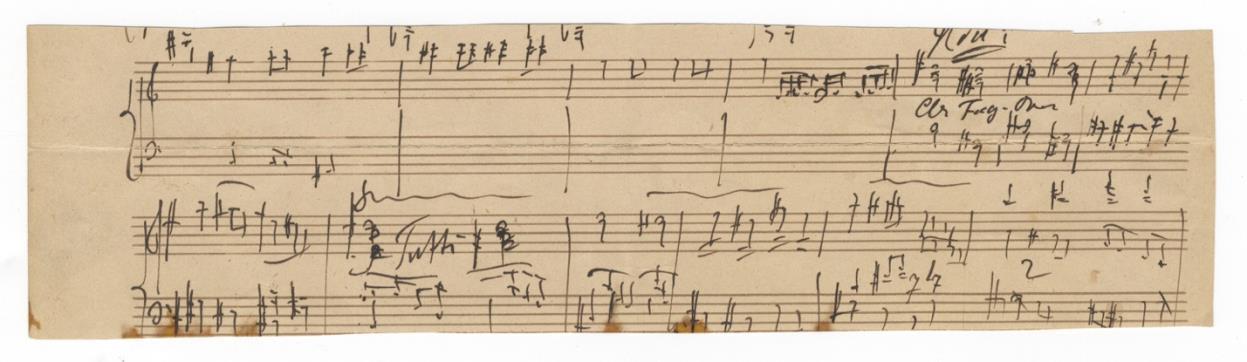
Autograph musical manuscript sketch leaf from the composer's Eighth Symphony.
23 measures in total in short score. Notated in black ink on both sides of a fragment of rastrum-ruled music manuscript paper 239 x 62 mm., cut from a larger leaf, with 12 measures on recto and 11 on verso. Unsigned and undated, but ca. 1889. Slightly worn and browned; minor staining to lower margin, slightly creased at horizontal fold; trimmed at lower margin, with some loss of notation to final 6 measures of recto and final 6 measures on verso.
A working manuscript containing thematic material from the first movement of the symphony, with corrections and deletions
Together with:
A bust-length postcard photograph of the composer, with "Printed in Germany" to verso.
Dvořák's Eighth Symphony, op. 88, inGmajor, was firstperformedinPragueon 2February 1890bytheNational Theatre Orchestra, with the composer conducting. Burghauser 163. Sourek 109.
"In its formal aspect ... the G major symphony ranks among Dvořák's most independent and original symphonic works." Sourek: The Orchestral Works of Antonin Dvořák, p. 128.
"The influence of folk music is heard ... clearly in the Eighth Symphony ... with which Dvořák allegedly (Šourek) hoped ‘to write something different from his other symphonies and shape the musical content of his ideas in a new manner’. The variety and diversity of those ideas is striking, and they are often expressed in a musical language peculiar to them (with imitations of natural sounds, pastoral subjects, signals, fanfares, the suggestion of a funeral march and the idiom of a chorale). Sonata form is loosely applied and gives way to a more rhapsodic unfolding of ideas, but musical coherence is maintained through related melodic motifs and above all by rhythmic structures. In both the enhancement of musical language and the relaxation of formal structure, the Eighth Symphony reflects for the first time in a large instrumental work the new poetic element in Dvořák’s music after the spring of 1889.
With Smetana, Fibich and Janáček he is regarded as one of the great nationalist Czech composers of the 19th century. Long neglected and dismissed by the German-speaking musical world as a naive Czech musician, he is now considered by both Czech and international musicologists Smetana’s true heir. He earned worldwide admiration and prestige for 19th-century Czech music with his symphonies, chamber music, oratorios, songs and, to a lesser extent, his operas." Klaus Döge in Grove Music Online
Autograph working manuscripts of Dvořák are quite rare, especially as relates to one of his most highly regarded works (39375) $18,500
Virtually Complete Archive of Autograph Manuscripts of this Noted Contemporary American Composer
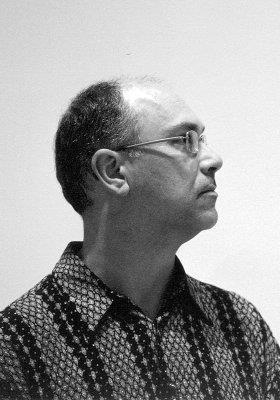
8. FELDER, David b. 1953
An important archive of autograph musical manuscripts and sketches by the noted contemporary American composer.
The archive consists of materials relating to 31 works, representing virtually all of the composer's output to date: Shamayim, Insomnia, Stuck-stuecke, So Quiet Here, Dyonysiacs, RRRings, Memento mori, Partial [Dist]res[s]toration, Shredder, Incendio, In Between, a pressure triggering dreams, Three Pieces for Orchestra, Linebacker Music, Inner Sky, Canzone XXXI, November Sky, Six Poems from Neruda's Alturas, Journal, Between, Third Face, Another Face, Three Lines from Twenty Poems, La Dura Fria Hora, Crossfire, Boxman, Coleccion Nocturna, Passageways II [and I], Rocket Summer, and Rondage/Cycle.
Together with:
A collection of demo recordings in CD format and DAT tapes of performances of Felder's works; cassettes, video and reel-to-reel tapes of recording sessions; and source materials used in compositions. Over 200 items in total, many of which are not commercial available.
"Felder combines his deep knowledge of the past and the present with a constant searching on a philosophical, human and musical level - a Gustav Mahler for the 21st century."
"David Felder has long been recognized as a leader in his generation of American composers. His works have been featured at many of the leading international festivals for new music including Holland, Huddersfield, Darmstadt, Ars Electronica, Brussels, ISCM, North American New Music, Geneva, Ravinia, Aspen, Tanglewood, Music Factory, Bourges, Vienna Modern, IRCAM, Ars Musica, and many others, and earn continuing recognition through performance and commissioning programs by such organizations as the New York New Music Ensemble, Arditti Quartet, American Composers Orchestra, Buffalo Philharmonic, American Brass Quintet, and many others. Felder's work has been broadly characterized by its highly energetic profile, through
its frequent employment of technological extension and elaboration of musical materials... and its lyrical qualities... [He] has received numerous grants and commissions including many awards." atlanticcenterforthearts.org
Felder held the Birge-Cary Chair in composition at SUNY Buffalo and was Director of the Center for 21st Century Music as well as Artistic Director of the "June in Buffalo" Festival there for many years.
Further details available upon request. (19224)
Very Rare Collection of Early 18th Century Dances In Beauchamp-Feuillet Choreographic Notation, with Music
9. FEÜILLET, Raoul Auger 1659-1660 to 1710
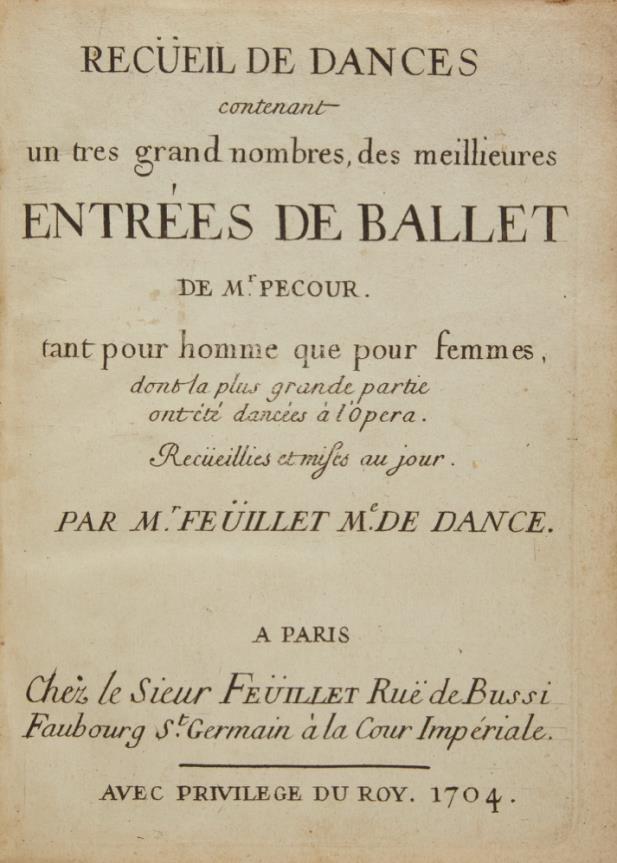
Recüeil de Dances contenant un tres grand nombres, des meillieures Entrées de Ballet de Mr. Pecour. tant pour homme que pour femmes, dont la plus grande partie ont été dancées à l'Opéra. Recüeillies et mises au jour. Par Mr. Feüillet Me. de Dance.
Paris: Chez le Sieur Feüillet Ruë de Bussi Faubourg St. Germain à la Cour Impériale. Avec Privilege du Roy, 1704.
Quarto. Full contemporary dark brown textured calf with raised bands on spine in decorative compartments gilt, dark brown title label gilt. Housed in a fine mid-tan leather custom-made box with choreographic notation gilt
to both upper and lower, titling to spine gilt by master contemporary book binder Antonio Perez-Noriega, and with his mark "Antonio P.N." stamped into the inside of the box lower spine.
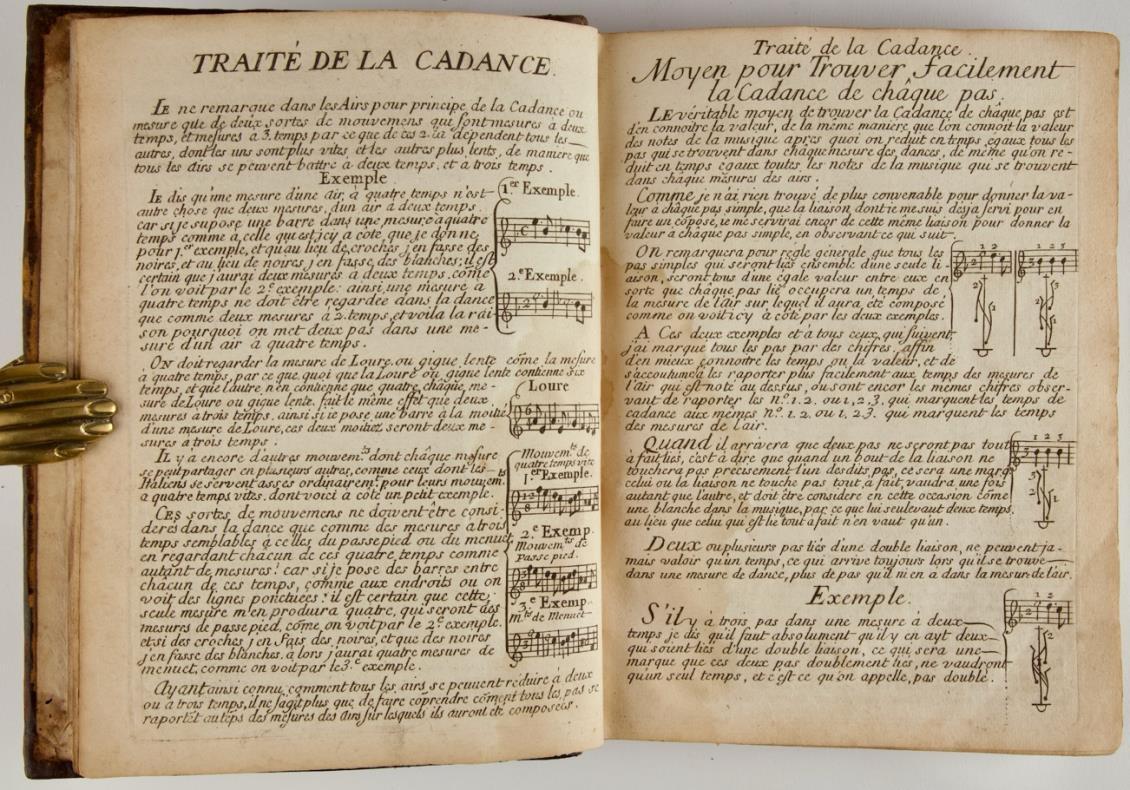
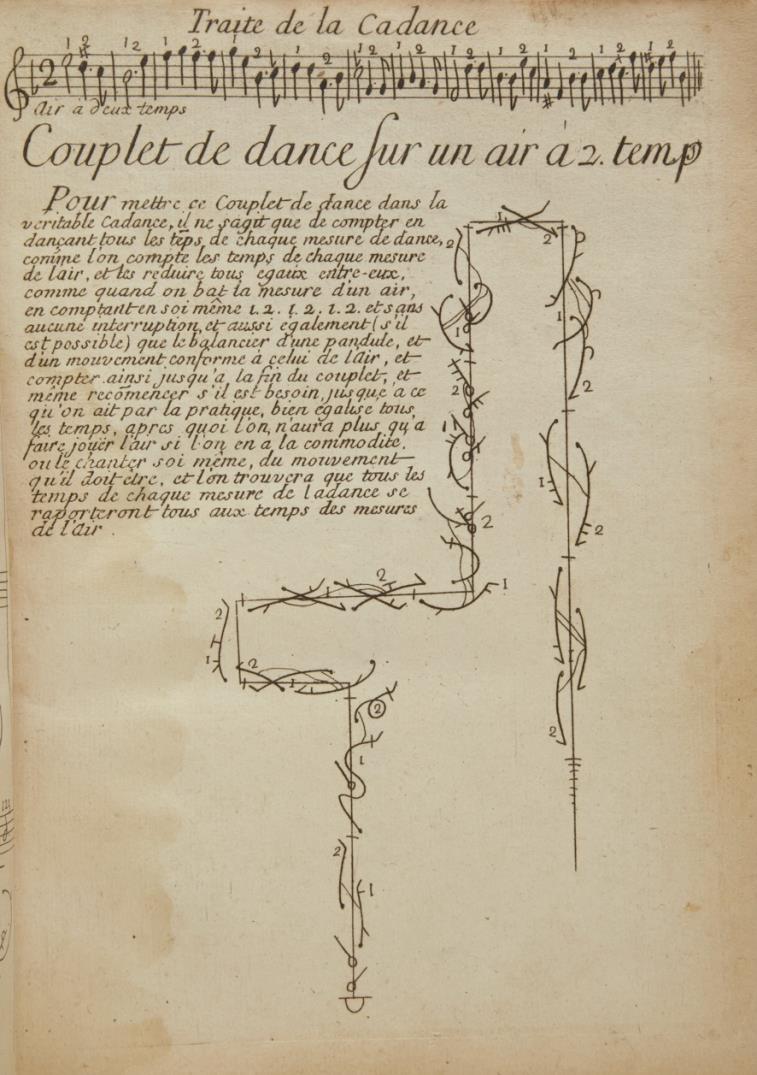
1f. (recto title, verso blank), 1f. (dedication to the duc D'orleans), 4ff. ("Preface," "Traité de la Cadance," "Exemples pour les mesures à deux et trois temps," etc.) + 228 (misnumbered 128) pp. choreographic notation for 35 dances + 16 pp. "Air des Dances contenuës en ce Recueil") + 1f. index in contemporary manuscript. With Privilège du Roy to lower portion of final leaf. Engraved throughout.
With 35 dances in Feuillet notation, for both men and women and for one and two persons. With melody for each at head and additional music in 16-page appendix.
Contains:
- Sarabande pour une femme. Sarabande
- Entrée pour une femme Dancée par Mlle. Victoire au Ballet du Carnaval de Venise. Forlane
- Chacone pour une femme. Chacone de Phaeton
- Passacaille pour une femme Dancée par Mlle. Subligny à l'Opera de Scilla. Passacaille
- Entrée Espagnolle pour une femme. Dancée par Mlle. Subligny au Ballet de l'Europe galante
- Gigue pour une femme Dancée par Mlle. Subligny en Angleterre. Gigue
- Menuet à deux Pour une homme et une femme. Dancé par Mr. du Moulin l'Aîne et Mlle. Victoire,. au Ballet des Fragmens de Mr. de Lully. Menuet
- Entrée pour deux femmes Dancée par Mlle. Dangeville. au Ballet des Fragments de Mr. de Lully. Forlane
- Entrée Pour un homme et une femme Dancée par Mr. Balon et Mlle. Subligny a l'Opera d'Omphalle. Menuet Rondeau
- Entrée Pour un homme et une femme Dancée par Mr. Balon et Mlle. Subligny. à l'Opéra de Thézée. Aimons tout nous y convie
- Entrée pour un homme et une femme Dancée par Mr. Balon et Mlle. Subligny. au Ballet des Fragments de Mr. de Lully. Joüissons des plaisirs
- Entrée Espagnolle pour un homme et une femme Dancée par Mr. Balon et lle. Subligny. au Ballet de l'Europe galante. Rondeau
- Passacaille pour un homme et une femme Dancée par Mr. Balon et Mlle. Subligny à l'Opera de Persée. Passacaille de Persée
- Entrée pour un homme et une femme Dancée par Mr. Balon et Mlle. Subligny à l'Opera de Persée.
- 2e. Entrée de Percée. Dancée par les mêmes. Bourée
- 2e. Couplet
- Entrée a deux Dancée par Mr. Dumirail et Mlle. Victoire à l'Opera dHésionne. Gigue lente
- Autre Entrée à deux Dancée par Mr. Balon et Mlle. Subligny à l'Opera dHesionne. Rondeau
- Entrée à deux Dancée par Mr. Balon et Mlle. Subligny. à l'Opera d'Aretuse. Rondeau
- Sarabande à deux Dancée par Mr. Blonde et Mlle. Victoire à l'Opera de Tancrede. Sarabande
- Contre-Dance à deux Dancée par Mr. Dumirail et par Mlle. Victoire à l'Opera de Tancrede. Mouvement de Gigue. Contre-Dance
- Entrée pour un Berger et une Bergere Dancée par Mr. Dumoulin l'ainé et Mlle. Danjeville à l'Opera d'Vllisse. Rondeau
- 2e. Entrée Dancée par les mêmes. Bourée
- Entrée pour deux hommes Dancées par Mr. l'Evêque et Mr. Danjeville l'ainé. à l'Opera de Cadmus. gravement
- Sarabande pour deux hommes Dancée par Mr. Piffetot et Mr. Chevrier à l'Opera de Alside. Sarabande. gravement
- Canary pour deux hommes Dancée par Mr. Piffetot et Mr. Chevrier. à l'Opera de Didon. Canary
- Entrée pour deux hommes Dancée par Mr. Piffetau et Mr. Cherrier. au Ballet de l'Europe galante. Entrée espagnolle. gravement
- Loure pour deux hommes Dancée pour Mr. Blondy et Mr. Philbois. à l'Opera de Scilla. Loure
- Chaconne pour un homme non dancée a l'Opera. Chaconne
- Chaconne de Phaeton pour un homme non Dancée a l'Opera. Chaconne de Phaeton
- Entrée d'Appolon pour un homme non dancée à l'Opera. Entrée d'Appolon
- l'Aimable Vainqueur Entrée non dancée à l'Opera. Loure
- Sarabande pour un homme non dancée a l'Opera. Sarabande
- Entrée pour un homme non dancée a l'Opera. Entrée
- Folies d'Espagne pour un homme. Folies d'Espagne
- Sarabande pour un homme non dancée a l'Opera. Sarabande
Attractive 18th century armorial bookplate to front pastedown incorporating two lions flanking a crest topped by a crown with a central image of a butterfly, with printed "Ex libris Papillon minoris Gravé par de Monchi." Binding slightly worn; gilt to spine faded; endpapers worn, browned, and stained. Slightly worn and soiled; uniform light internal browning, a bit heavier to blank margins; mostly minor dampstaining to gutters primarily affecting first portion of volume, occasionally just touching text; minor tears to blank outer margins of pp. 97/98 and 223/224 repaired with archival tape; very occasional minor stains. In very good condition overall.
First Edition. Very rare. Beaumont pp. 73-74 (with incorrect pagination). Derra de Moroda 935. Fletcher 16. Little and Marsh p. 96 (one copy only in the U.S.). Magriel p. 98 (lacking the 16-page musical supplement). Schwartz & Schlundt I, 26. Not in Malkin. RISM P1127 (4 complete copies only).
The prefatory "Treatise on Cadence" contains important material supplementary to the author's Chorégraphie, in particular as relates to the fitting of the dance steps to the music.
Little and Marsh list the full contents of the work along with the names of individual dancers, the dances, and the operas or ballets from which the dances originate for 25 of the 35 dances. According to the authors, this is the earliest collection of theatrical dances in which performers' names are provided
Feuillet was a highly important French choreographer, dancing-master, and author. "He worked at the court of Louis XIV. His fame rests on his Chorégraphie, a book describing a system of dance notation that was used in Europe throughout the 18th century. He probably did not invent the system himself (although he said he had) but derived it from the original work of Pierre Beauchamps, Louis XIV's personal dancing-master. Unlike previous methods, which describe movement verbally and use letters to refer to the sequence of steps, Feuillet's system is a track notation. It represents symbolically not only the steps of the dancer, with his turns, leaps and slides, but also the floor pattern in which he is to travel. The dance music is printed at the top of the page, and the steps are marked off in a manner corresponding to the structure of the music. ...
The publication of the Beauchamp-Feuillet notation meant that specific dances could easily be distributed throughout Europe. It also added to France's pre-eminence in the world of dance. Today the system makes it possible for scholars to study some of the dances in use in the late 17th and early 18th centuries, an important period for the development of the classical French ballet style and technique. ...
In 1704 there was published a superb collection of theatrical dances choreographed by Pécour and written by Feuillet." Meredith Ellis Little in Grove Music Online. (40188) $25,000
Three of the Most Important 18th Century Dance Books Bound Together With Choreographic Notation
10 FEUILLET, Raoul-Auger ca. 1653-ca. 1709 and Jacques Dezais fl. early 18th century] A sammelband of three highly important early 18th century dance books, with choreographic notation.
FEUILLET and DEZAIS
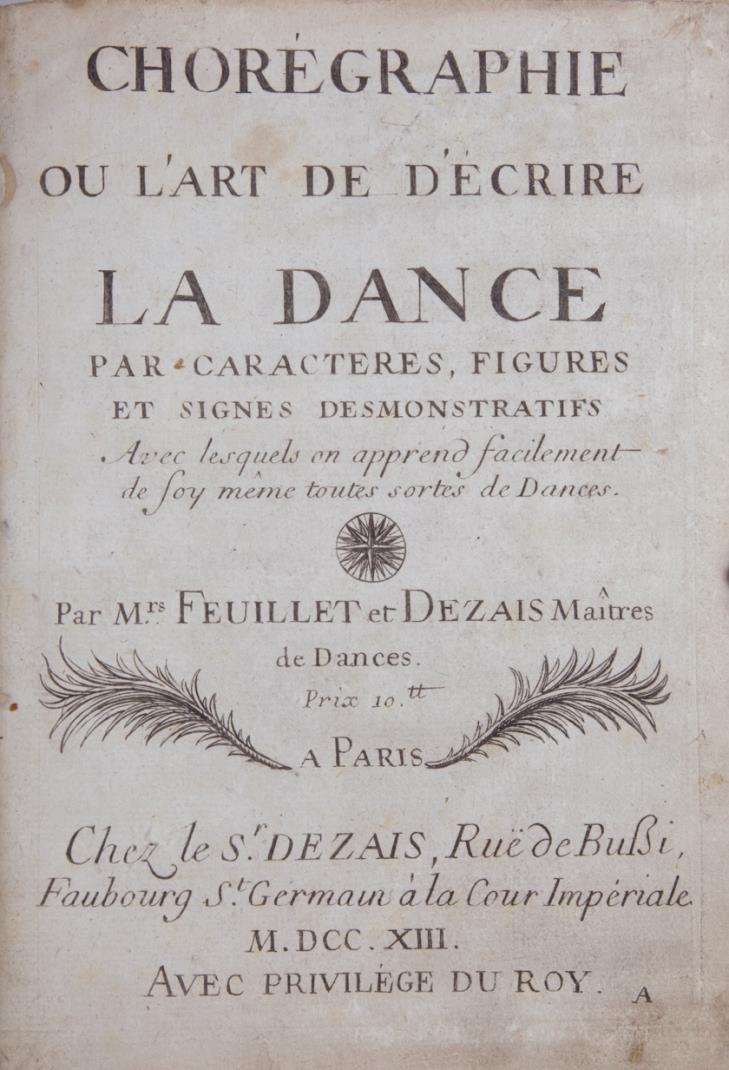
Chorégraphie ou l'art de décrire la dance, par caractères, figures et signes démonstrifs, avec lesquels on apprend facilement de soy-même toutes sortes de dances. ouvrage très utile aux maîtres à dancer et à toutes les personnes qui s'appliquent à la dance. Par Mrs. Feuillet et Dezais Maîtres de Dances. Prix: [...].
Paris: Chez le Sr. Dezais, Ruë de Bussi Faubourg St. Germain à la Cour Impériale ... Avec Privilége du Roy, 1713.
1f. (recto title, verso blank), [i] dedication ("A Monsieur Pécour Pensionnaire des Menus Plaisirs du Roy et Compositeur des Balets de l'Académie Royale de Musique de Paris"), [ii] (Préface), [i] ("Extrait du Privilege du Roi"), 95, [i] (blank) pp. Engraved throughout.
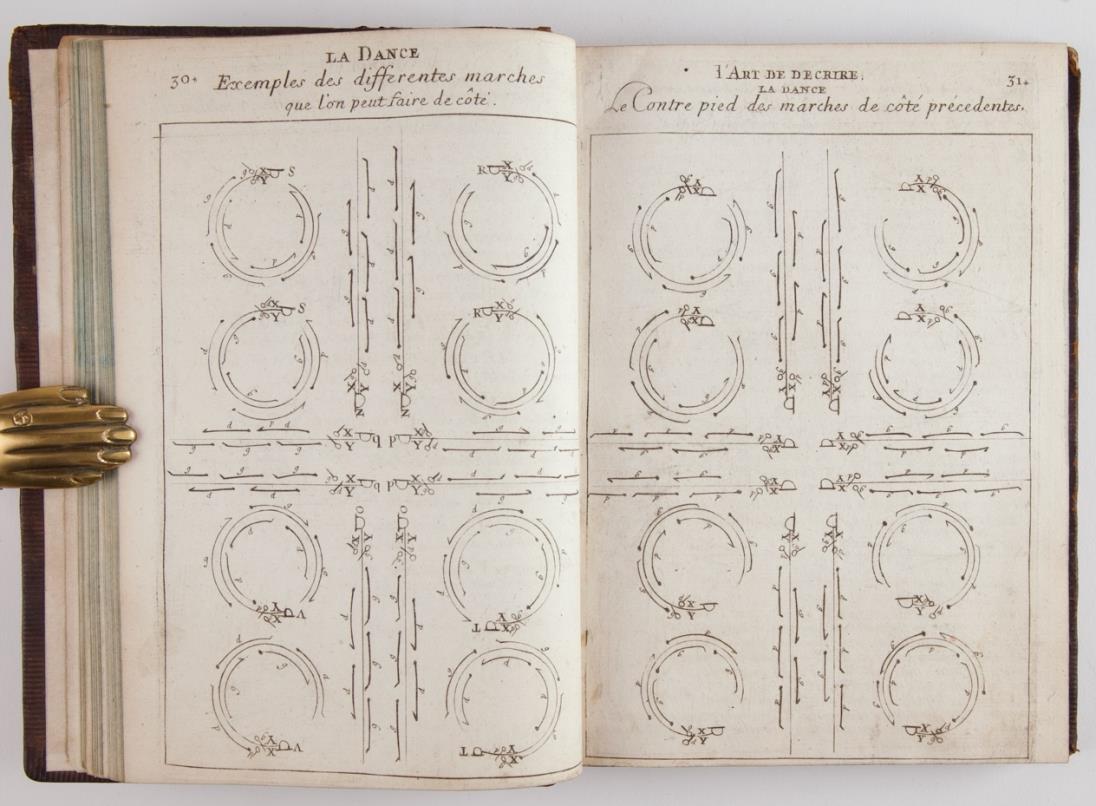
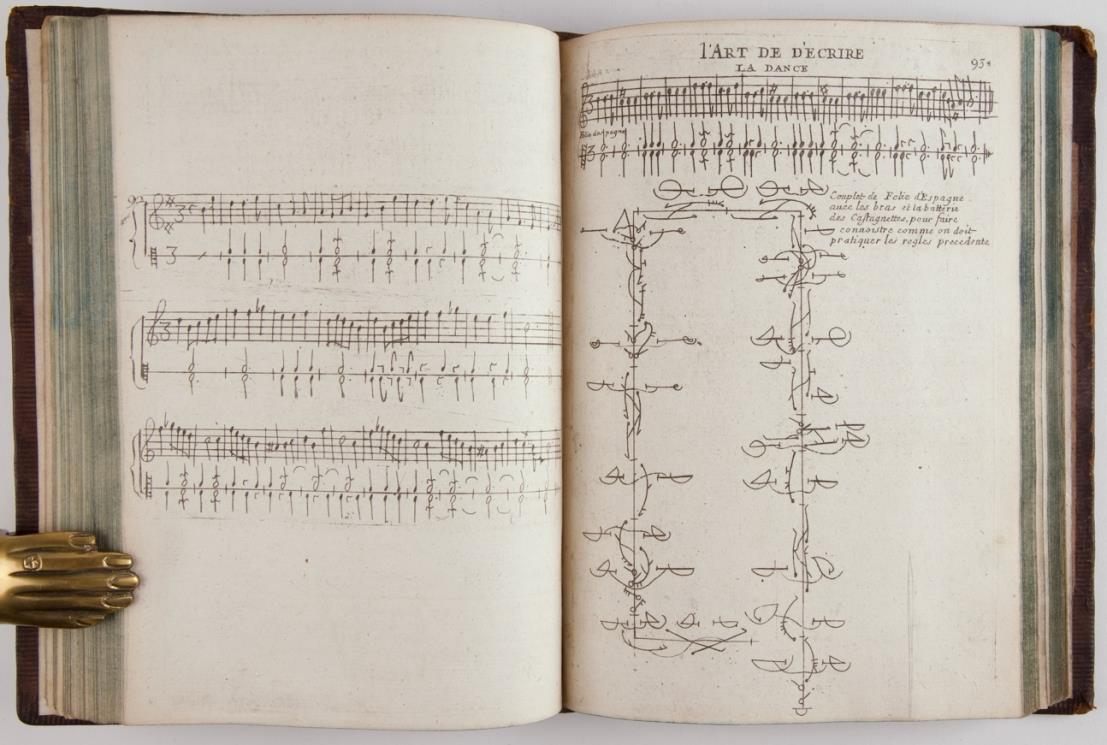
The revised fourth edition of this seminal work, first published in 1700. RISM Écrits Imprimés p. 314 (2 copies only of all editions in the U.S.: one of the first [1700]edition, at the NYPL, and one of the present edition, at the Library of Congress). Beaumont p. 72. De Moroda 938. Schwartz and Schlundt 21. This edition not in Cortot, Hirsch, or Malkin.
"A rather less known choreographer is Jacques Dezais. He lived in the first half of 18th century and regarded himself as a follower of R. A. Feuillet. In 1726 he published a collection of dances named Premier Livre de Contre-Dances à Quatre, à six & à Huit. Unfortunately the publication was lost when the famous Anna-Amalie Library in Weimar burned in 2004." earlydance/news/8138-les-cotillons-de-jacques-dezais
Bound with: FEUILLET
Recueil de Dances Composées par Mr. Feuillet Maître de Dance.
Paris: Chez l'Auteur rue de Bussi Faubourg St. Germain à la Cour Imperiale, Avec Privilége du Roy, 1709.
1f. (recto title, verso blank), 84 pp. Engraved throughout.
Contains 18 dances in Feuillet notation, with melody for each at head, as follows:
- Le Rigaudon de la Paix, pp. 1-2
- 2e Rigaudons, pp. 3-7
- Gigue à deux, Gigue de Roland, pp. 8-11
- Entrée a deux, Rigaudon, pp. 12-16
- Autre Entrée a deux, Rigaudon, pp. 17-20
- Sarabande pour femme, Sarabande, pp. 21-24
- Sarabande pour homme, Sarabande, pp. 25-28
- Sarabande Espagnole pour homme, Sarabande Espagnole, pp. 29-32
- Folie d'Espagne pour femme, Folie d'espagne, pp. 33-38
- Canary à deux, Canary, pp. 39-40
- Gigue pour homme, Gigue, pp. 41-44
- Entrée pour homme, pp. 45-48
- Autre entrée pour homme, entree, pp. 49-52
- Entrée grave pour homme, pp. 53-59
- Entrée d'Apolon, Entrée Apolon, pp. 60-66
- Balet de neuf Danseurs, entre graue, pp. 67-72
- Canary, pp. 73-74
- second canary, p. 75-84, with pp. 77-84 folding
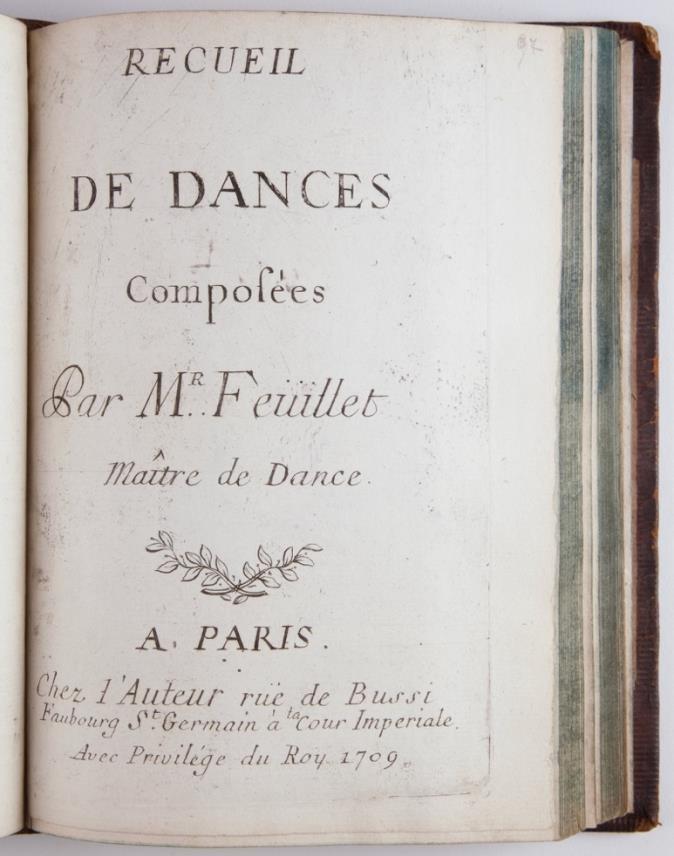
First published in 1700. Little and Marsh 1709-Feu, p. 103 (for a list of editions and issues see 1700-Feu). De Moroda 938. This edition not in Malkin, Niles & Leslie, Schwartz & Schlundt, or RISM
"All but one of the dances in Feuillet's collection are solos or duets, ranging from easy to difficult; the single exception is a piece for eight dancers and a soloist - the only known example in Feuillet notation of a French ballet entry for more than two persons." Little and Marsh p. 91
Bound with: FEUILLET
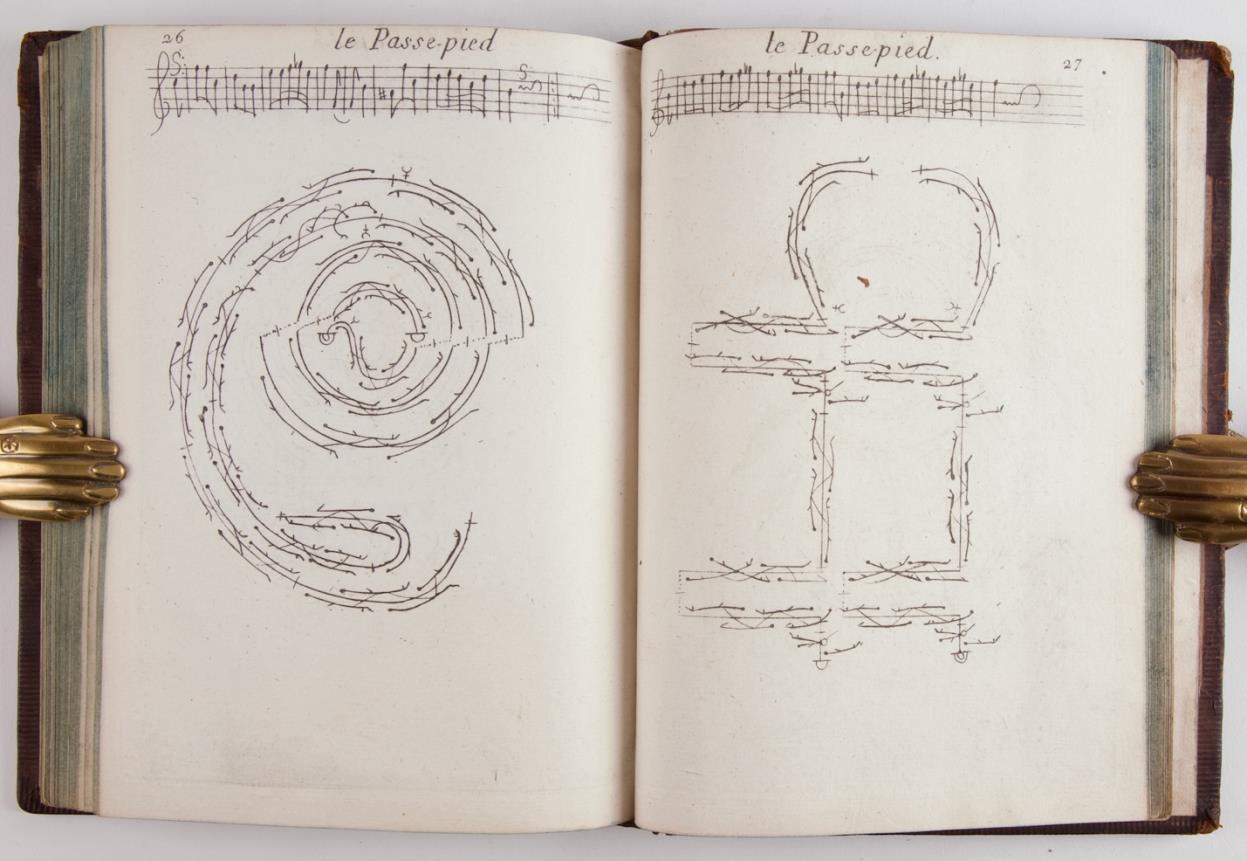
Recueil de Dances Composées par M. Pecour, Pensionnaire des menus Plaisirs du Roy et Compositeur des Balets de l'Academie Royale de Musique de Paris et mise sur le Papier par M. Feuillet. Maître de Dance
Paris: Chez l'Auteur rue de Bussi Faubourg St. Germain à la Cour Impériale Avec Privilege du Roy, 1709. 1f. (recto title, verso blank), 72 pp. Engraved throughout.
Contains 15 dances in Feuillet notation, with melody for each at head, as follows:
- la Bourée d'Achille, Bourée, pp. 1-3
- menuet, pp. 4-11
- La Mariée, la Mariée, pp. 12-21
- le Passepied, passepied, pp. 22-23
- 2e. Passepied, pp. 24-31
- la Contredance, Gigue, pp. 32-36
- le Rigaudon des Vaisseaux, Rigaudon, pp. 37-39
- 2e. Rigaudon, pp. 40-42
- la Bourgogne, Courant, pp. 43-44
- Bourée, pp. 45-46
- Sarabande, pp. 47-48
- PassePied, pp. 49-53
- la Savoye, Bourée, pp. 54-61
- la Forlana, la Forlana, pp. 62-67
- la Conty, Venitienne, pp. 68-72
First published in 1700. Little and Marsh 1700-Péc, p. 93. De Moroda 1341. This edition not in Malkin, Niles & Leslie, Schwartz & Schlundt, or RISM.
"Pecour's Recueil was bound and sold with Feuillet's Chorégraphie and Feuillet's Recueil ... (for a survey of editions and issues, see comments under 1700-Feu). This collection contains a variety of pieces for ball dancing in vogue in 1700; many of them are quite difficult. According to the preface to Feuillet's Chorégraphie, Pécour himself went over the proofs to eliminate errors in notation." Little and Marsh p. 93.
Louis Guillaume Pécour (?1651-1729) was an important French dancing-master and choreographer. He worked closely with celebrated royal choreographer Pierre Beauchamp (1631-1705), Louis XIV's personal dancing master.
Octavo. Full dark brown mottled calf with raised bands on spine in decorative compartments gilt, dark brown title label gilt.
Binding worn, rubbed, and bumped, with some abrasions; head of spine, joints, and edges chipped, with minor loss; endpapers slightly worn, soiled, and foxed. Occasional minor signs of wear, soiling, and foxing; several titles very slightly cropped. Very good copies overall of all three works.
Feuillet was a highly important French choreographer, dancing-master, and author. "He worked at the court of Louis XIV. His fame rests on his Chorégraphie, a book describing a system of dance notation that was used in Europe throughout the 18th century. He probably did not invent the system himself (although he said he had) but derived it from the original work of Pierre Beauchamps, Louis XIV's personal dancing-master. Unlike previous methods, which describe movement verbally and use letters to refer to the sequence of steps, Feuillet's system is a track notation. It represents symbolically not only the steps of the dancer, with his turns, leaps and slides, but also the floor pattern in which he is to travel. The dance music is printed at the top of the page, and the steps are marked off in a manner corresponding to the structure of the music. ...
The publication of the Beauchamp-Feuillet notation meant that specific dances could easily be distributed throughout Europe. It also added to France's pre-eminence in the world of dance. Today the system makes it possible for scholars to study some of the dances in use in the late 17th and early 18th centuries, an important period for the development of the classical French ballet style and technique." Meredith Ellis Little in Grove Music Online
"With the invention of his dance notation system in the eighteenth century, Raoul-Auger Feuillet revolutionized the dance world. Published in 1700, his Chorégraphie ... was conceived as a self-teaching device, not a way of preserving dance. Yet owing to its immense popularity throughout Europe, even today a large body of theatrical and ballroom dances from that period in both printed and manuscript forms can still be found in most archives. ... Chorégraphie was reprinted three times in thirteen years, translated into English by John Weaver in 1706, and appeared in various "improved" versions in France, Germany, Spain, and Portugal. Voltaire (1751) ranked the invention among the "achievements of his day" and Denis Diderot (1763) devoted ten pages to the subject in his Encyclopédie." International Encyclopedia of Dance Vol. 2, p. 588.
An extraordinary presentation of three of the most important early choreographic works, all major factors in confirming France's preeminence in the world of 18th century ballet (40499) $18,500
Highly Influential Contribution to Renaissance Music Theory and Practice
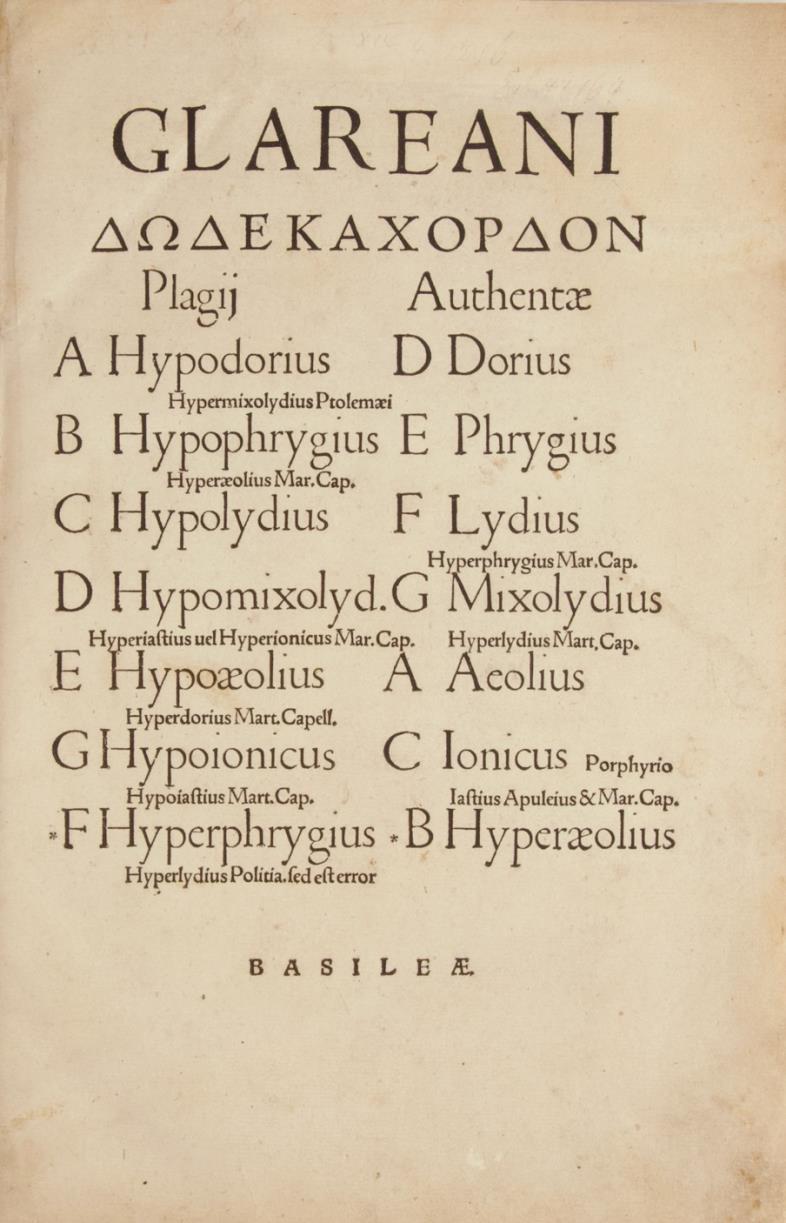
11 GLAREAN, Heinrich 1488-1563 Dodecachordon.
Basileae: Henrichvm Petri, Septembris 1547.
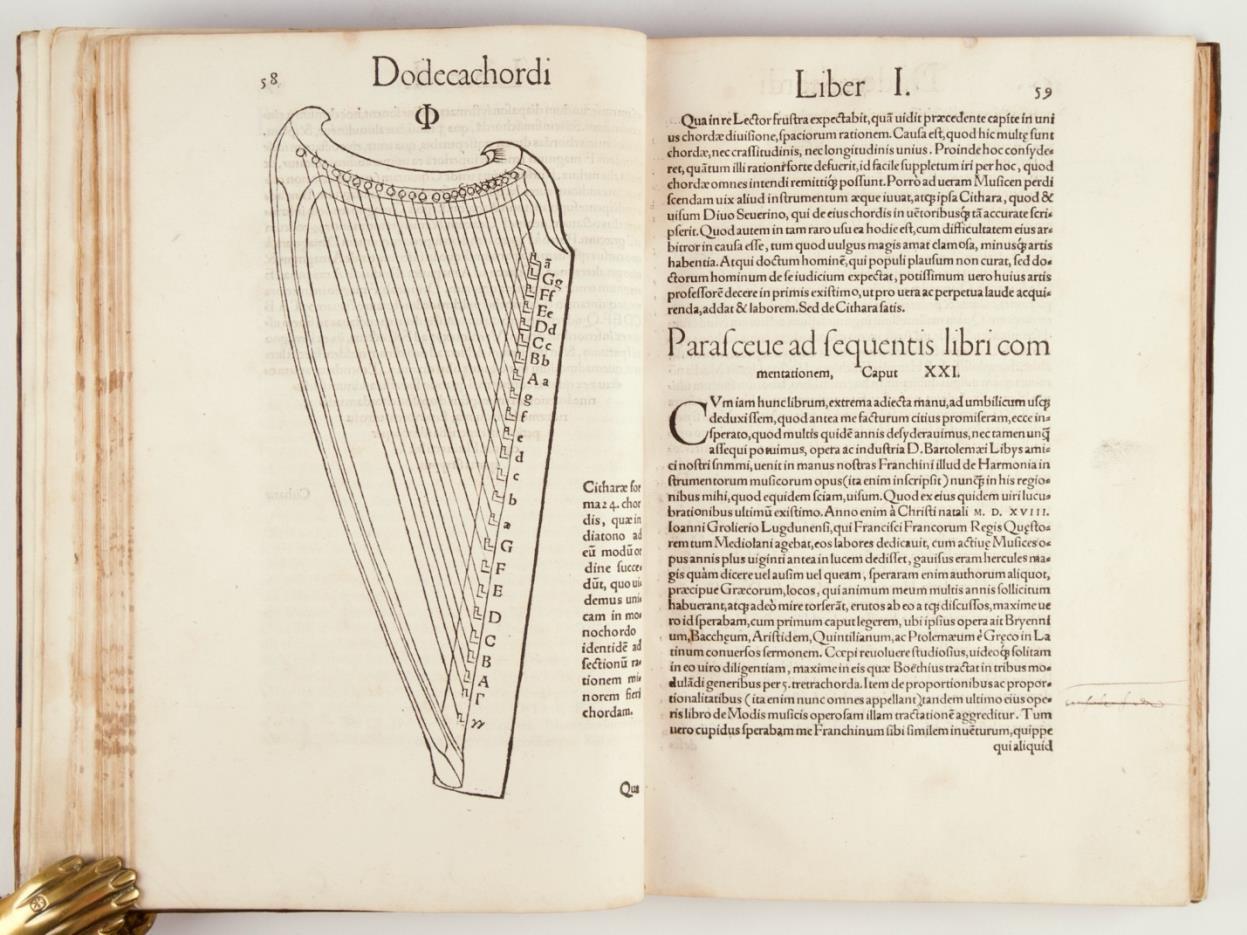
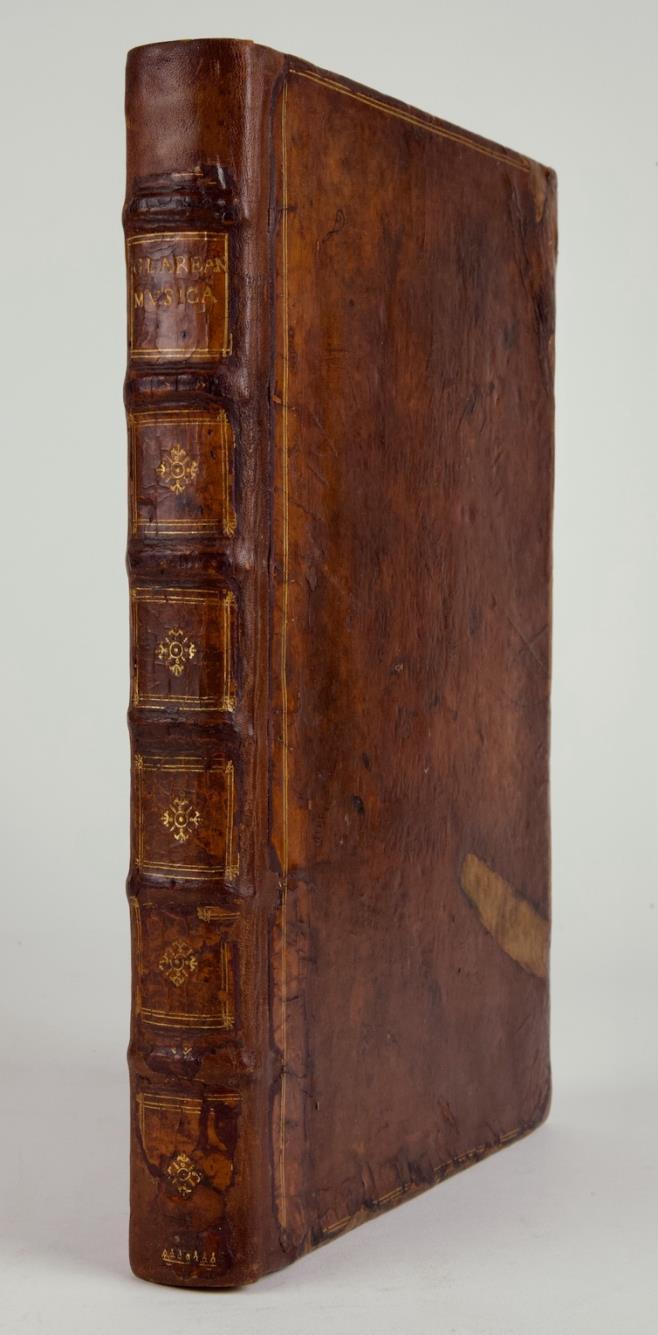
Folio. Full mid-tan mottled calf with double rules gilt to edges of boards, raised bands on spine in decorative compartments gilt. 1f. (recto title, verso blank), 2ff. (preface), [i] ("Authorum, qui in hoc opere citantur Nomenclatur"), [iii] (contents of Liber I-III), 1f. ("Cantiones Mensurales" index), 4ff. (index), 470 pp. + [v] (errata), [i] (printer's device) pp. Extensively illustrated with type-set musical examples in square and diamondhead notation and woodcut illustrations, diagrams, and tables throughout, including a full-page illustration of a 24-string zither. With occasional historiated and decorative woodcut initials. Binding somewhat worn, rubbed, bumped, with evidence of cracks and cuts; recornered and rebacked, with early spine laid down; small area of
restoration to upper; edges slightly stained. Occasional minor browning, soiling, and staining; upper outer corners slightly creased; small hole to pp. 47/48 resulting in loss of 2-3 letters of text; very occasional minor mispagination; pp. 247 and 263 slightly trimmed at lower margin, just affecting text; recto of final leaf with loss of several words to last line of text and portion of colophon, with loss to colophon completed in manuscript; careful professional repair to lower outer portion of leaf, with narrow strip of paper reinforcement to gutter of verso. A very good, crisp, wide-margined copy overall.
Corrections and some annotations in early manuscript to numerous leaves; one name on list of authors crossed out.
In three books:
“Book I, based principally on Boethius and Gafori, deals with several aspects of traditional music theory: definitions of music solmization, the structureof the gamut, mutation, transposition, consonance anddissonance, the smaller and larger semitones, the eight church modes, and music theory as applied to the monochord and some other stringed instruments; there is also a discussion of the section on the modes in Gafori's De Harmonia instrumentorum musicorum opus. This forms a prelude to Book II which introduces the "new" modes, for which Glareanus is justly famous.
Book II is concerned entirely with modal theory; to the eight traditional modes Glareanus proposes the addition of six, viz., the Aeolian, Hypoaeolian, Ionian, Hypoionian, Hyperaeolian, and Hyperphrygian modes. The first authenticplagalpaircorresponds tonaturalminor, the secondtomajor. Thelasttwomodes (nowusuallyreferred to as the Locrian and Hypolocrian) are dismissed by him as impractical, although, for purposes of illustration, he includes monophonic examples of all fourteen modes.
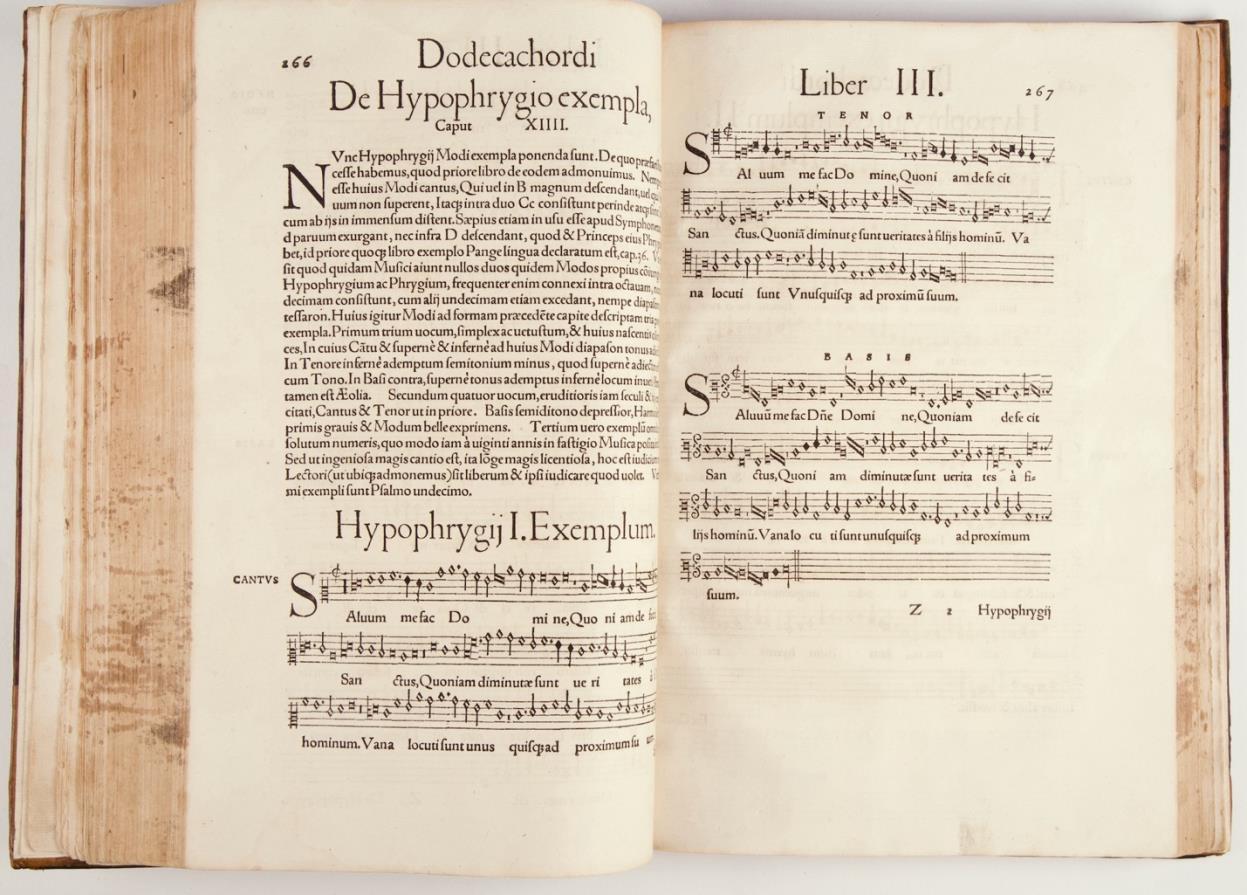
Book III, which applies to Glareanus' modal theories to the analysis of polyphonic music, begins with an exposition of mensural notation (including achapter on thetactus) with examples basedmostly on Gafori; it also contains numerous polyphonic examples by composers of the recent past, illustrating the twelve usable modes of Glareanus’ system. The book concludes with mostly laudatory comments on the skill of Josquin des Prez, Pierre de la Rue, Ockeghem, Obrecht, Brumel, Isaac, and Mouton." Reese: Fourscore Classics of Music Literature, no. 40.
First Edition ofthis highly influential contribution to Renaissance musictheory and practice by the noted Swiss musical theorist, poet, and life-long friend of Erasmus, who described him as "the champion of Swiss humanism." Glarean's treatise was revolutionary for its proposal of twelve musical modes, not the long-assumed eight. The product of more than 20 years of work, the three books discuss various aspects of music theory in detail and also contains a virtual anthology of over 120 musical compositions by Josquin des Prez, Obrecht, Ockeghemandothersas wellassettings ofvarious Horatianodes including(onpp. 189-190) Quis multa gracilis, translated by Milton.
Reese 40. Cortot p. 89. Gregory Bartlett I, p. 109. Hirsch I, 226. Wolffheim I, 673. Damschroder & Williams, pp. 107-108. RISM Écrits Imprimés p. 366.
"Since the title-page [in Greek] of the Dodecachordon advertises the modal names of his new system, it is clear that Glarean considered it the outstanding contribution of his treatise. To the medieval eight modes he added four more, an Ionian and Hypoionian with finals on C, and an Aeolian and Hypoaeolian with finals on A. He attempted to show that his system was based on the old Greek modes and believed that it was a renewal of modal usage in antiquity. But its value lay in his recognition of Ionian (or major) and Aeolian (or natural minor). He asserted that the Ionian was the mode most frequently used in his time. In applying his system to polyphony
Glarean analysed the mode of individual voices. If onevoice is in an authentic mode the adjacent voice range (above or below it) usually will be in the plagal of the same mode; sometimes, however, his analyses are polymodal. ...
The impact of the Dodecachordon on Renaissance musical thought was considerable. Although Glarean's system was by no means universally adopted, it was acknowledged either openly or tacitly by many writers. In 1558, 11 years after the publication of the Dodecachordon, Zarlino's Istitutioni harmoniche reproduced Glarean's modal system but without naming Glarean as its author. The Stralsund cantor Eucharius Hoffmann wrote both musical compositions and a theory book (1582) based on Glarean's teaching. Other writers who acknowledged his modal contribution include Cerone, Morley and Zacconi. From a musical point of view the most fruitful results of Glarean's modal principles are found in the many instrumental compositions of late Renaissance composers who applied his ideas. Such men as Merulo, Padovano, and Andrea and Giovanni Gabrieli wrote toccatas and ricercares in all 12 modes, or ‘tones’ as they were almost invariably called. For modern scholars the value of the Dodecachordon consists in the extraordinary diversity of its contents. Ambros, for example, called Glarean the founder of musical biography and praised the breadth of his text. Others have stressed the work's significance as a musical anthology, since it contains over 120 compositions (29 by Josquin des Prez, the remainder by Obrecht, Ockeghem, Isaac and others). Some modern writers have praised the work's contribution as a monument of musical humanism, or cited its exhaustive treatment of the polyphonic method of composition of the FrancoNetherlandish school, or pointed out its subtle defence of Catholic orthodoxy." Clement A. Miller in Grove Music Online
"This rare and valuable treatise was written by Henricus Loritus, Poet-laureate, better known as Glareanus, having been born in the Canton Glarus. The object of the work was to prove that there were really twelve ecclesiastical modes, and that these were identical with the ancient Greek modes. Its great interest, however, to modern musicians consists in the examples which it contains of the works of the older musicians such as Josquin de Pres, H. Isaac, Okeghem, Pierre de la Rue and others." Wolffheim p. 113.
A cornerstone of the literature (39362) $23,500
Rare Unrecorded First Edition, First Issue With Gluck’s Autograph Signature
12 GLUCK, Christoph Willibald 1714-1787
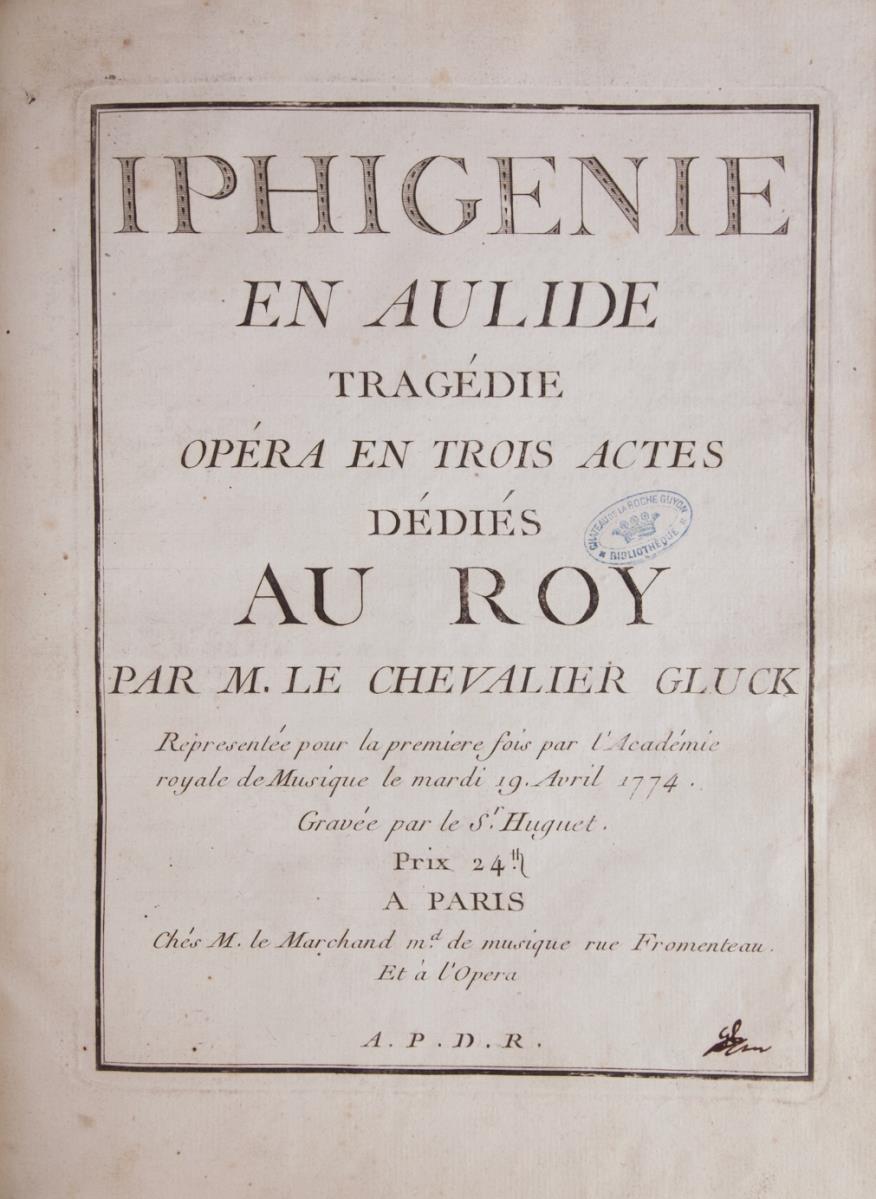
Iphigenie en Aulide. Tragédie Opéra en trois actes dédiés au Roy ... Representée pour la premiere fois par l'Académie royale de Musique le mardi 19. Avril 1774. Gravée par le Sr. Huguet. Prix 24th. ... A.P.D.R. [Full score].
Paris: Chés M. le Marchand md. de musique rue Fromenteau Et à l'Opera, [1774].
Folio. Full contemporary green vellum with dark red leather title label gilt to spine, all edges red, marbled endpapers. 1f. (recto title, verso blank), 1f. (recto composer's dedication to the King, verso blank), 298 pp. Engraved throughout. Preserved in a custom-made mid-tan linen clamshell box with mid-tan leather title label giltto spine. Binding veryslightlyworn, rubbed, andwarped. Occasionalveryminorsigns ofwear;several small stains; some corners very slightly creased; single very small binder's hole to upper margins; ca. 2 cm loss to
blank edge of pp. 57/58; light to moderate browning to pp. 119126, 227-230, and 263-266. A very attractive copy in original state.
Early manuscript text added to pp. 238-241, repeating the sung text printed in other vocal parts.
With what is believed to be the composer's abbreviated autograph control signature to lower outer corner of title.
The same signature appears on copies of this first issue heldby the Morgan Library and Museum in New York City and by the Staatsbibliothek in Bamberg, Germany; the title page with signature of the Morgan Library copy is reproduced in Grove 6, Vol. 7, p. 465. We have not located a copy of the present work at the Bibliothèque Nationale in Paris. We would like to thank Prof. Dr. Daniela Philippi and her colleagues at the GluckGesamtausgabe, Institut für Musikwissenschaft, GoetheUniversität, Frankfurt for advice regarding the Gluck signature.
Provenance
From the distinguished library of the Chateau de la Roche-Guyon, with their small oval handstamp to title. This famous library was largely dispersed by Sotheby's in Monaco in 1987.
First Edition, unrecorded first issue, with misspellings. Rare. See Hopkinson 40A. Wotquenne pp. 210-11. Lesure p. 238. Sonneck Dramatic Music p. 56. Hirsch II, 273. RISM G2747.
Iphigenie en Aulide, to a libretto by Marie François Louis Gand Leblanc, Bailli du Roullet (1716-1786) after the play by Jean Racine (1636-1699), itself after Euripides, was the first of Gluck's Paris operas; it premiered at the Opéra on 19 April 1774.
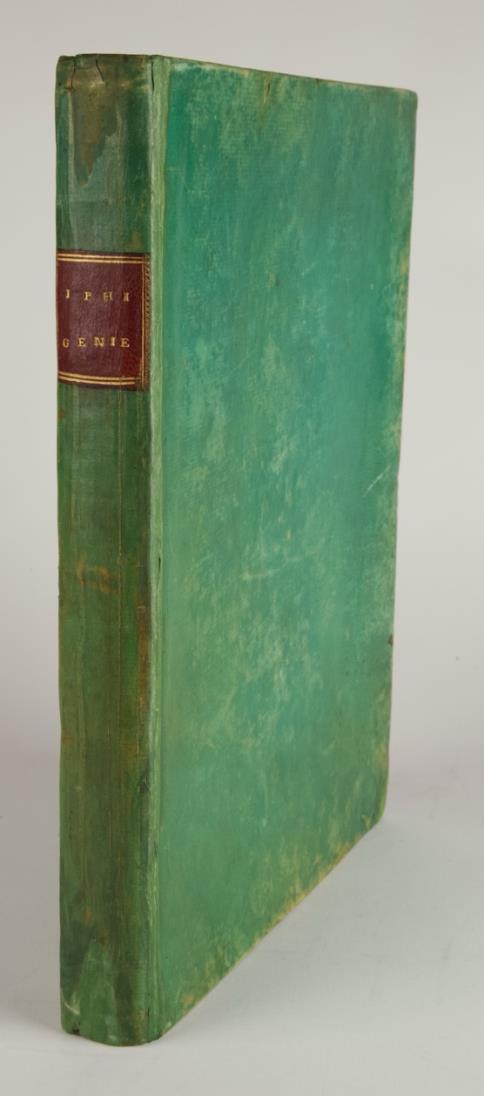
"Gluck and Roullet made careful preparations for their conquest of the Académie Royale de Musique, beginning by publishing open letters to one of its directors in the Mercure de France offering Iphigénie en Aulide for performance and outlining Gluck’s Italian operatic reforms and his intentions in Paris. But when they saw the score of Iphigénie en Aulide the directors of the Académie Royale were reluctant to mount a production of the opera unless Gluck undertook to write five more for them, because they feared that the work’s boldness and originality would drive all the existing French operas off the stage. As resilient as ever, Gluck enlisted the support of the French dauphine, his former singing pupil in Vienna, Marie Antoinette, and he eventually arrived in Paris towards the end of 1773 to begin rehearsals for Iphigénie en Aulide ... The première of Iphigénie en Aulide in April 1774 was a triumph, but the run of performances was interrupted by the death of Louis XV a month later." JeremyHayes in Grove Music Online. (40361) $12,000
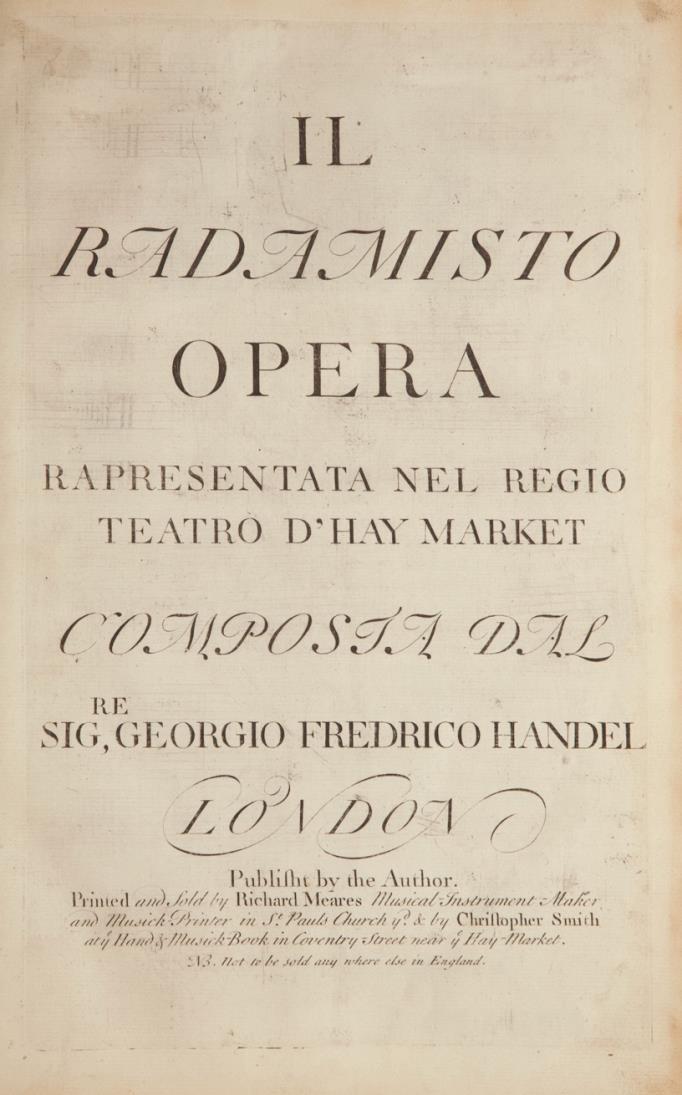
Rare First Edition, First Issues of both Radamisto and the Arie Aggiunte
13. HANDEL, George Frideric 1685-1759 Il Radamisto Opera Rapresentata nel Regio Teatro D'Hay Market. [HWV 12a-b]. [Full score].
London: Published by the Author. Printed and Sold by Richard Meares Musical-Instrument-Maker and MusickPrinter in St. Pauls Church yd. & by Christopher Smith at ye. Hand & Musick-Book in Coventry-Street near ye Hay-Market. N.B. Not to be sold any where else in England, [1720].
1f. (recto title, verso blank), 1f. (recto typeset privilege and dedication to King George I with woodcut armorial device, verso blank), [i] (blank),121 pp. Engraved throughout. Occasional mild soiling to margins; very small crease to lower right corner of several leaves.
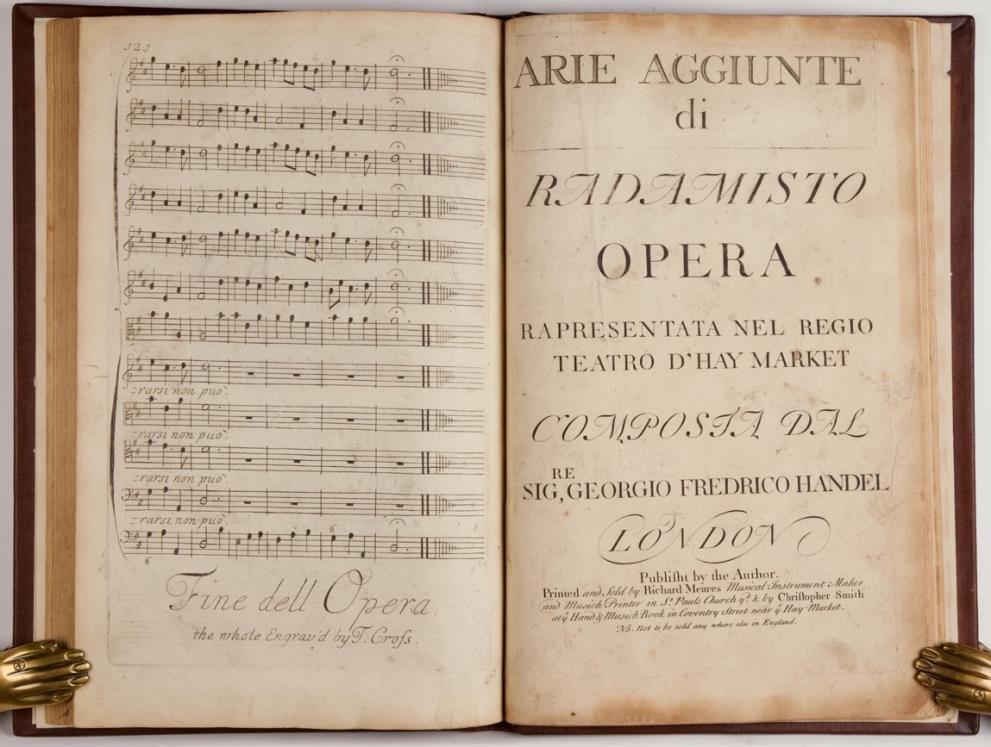
Bound with: HANDEL
Arie Aggiunte di Radamisto.
London: Published by the Author. Printed and Sold by Richard Meares Musical-Instrument-Maker and Musick Printer in St. Pauls Church yd. & by Christopher Smith at ye Hand & Musick-Book in Coventry-Street near ye Hay-Market. N.B. Not to be sold any where else in England, [1721].
1f. (recto title, verso blank), 38 pp. Engraved throughout. Title slightly browned and soiled; small hole to corner of first leaf; occasional small stains and soiling with music unaffected.
Two volumes in one. Tall folio. Full modern dark brown leather with raised bands on spine with titling gilt. In very good condition overall.
First Edition, first issue of both parts. Rare. With the Privilege not present in some copies. Händel-Handbuch I, 172. Smith p. 53, nos. 1 and 2. BUC p. 429. Hoboken Vol. 5, 29 and 30. RISM H258 and H261.
First performed in London at the King's Theatre on 27 April 1720, with text by Nicola F. Haym after the Italian drama L'Amor tirannico O Zenobia by D. Lalli; revised, with the addition of 13 new pieces, for a performance at the King's Theatre on 28 December 1720.
"The printing of the score was heralded by a publicity campaign. A press announcement on 12 July 1720 stated that it ‘ is now Engraving finely upon Copper Plates by Richard Meares, Musical Instrument-Maker and MusickPrinter ... NB To make this Work the more acceptable, the Author has been prevailed with to correct the whole.’ On 3 December 'the Printer presumes to assert that there hath not been in Europe a Piece of Musick so well printed, and upon so good Paper.'... It appeared on 15 December, fortified by a Privilege of Copyright granted to Handel on 14 June ... The name of the engraver, Thomas Cross, appears on the last page of the score, which
is indeed a handsome volume. Smith's name confirms that Handel was concerned in the publication, but there is no proof that he corrected the plates or supplied the bass figuring ...
On 14 March 1721 Meares advertised 'several Additional Songs' ... These Arie Aggiunte di Radamisto, comprising the ten new arias and duet composed for the December 1720 revival, but not the quartet or accompanied recitative, were published a week later on 21 March, and the two collections subsequently sold together." Dean: Handel's Operas 1704-1726, pp. 365-66.
" ... on April 27, Radamisto, Handel's first opera for the Academy, was presented to a full house, the King and "his ladies," as well as the Prince of Wales, being in the audience. Mainwaring says that "several gentlemen were turned back, who had offered forty shillings for a seat in the gallery" (usually selling for two shillings and sixpence). The success was tremendous, and indeed Radamisto is one of Handel's great operas. It has a good libretto, and the work is well and tightly composed even though the proportions are large. Radamisto contains elaborate instrumental numbers, ritornels and preludes, in addition to a wealth of great arias." Lang: Handel, pp. 174-75.
"Radamisto proved to be one of the greatest operas [Handel] ever produced in England. ... The crowds flocked to Radamisto like a modern mob to a notorious prize-fight, and the opera had an unbroken run till the season ended on 25th June. ... Radamisto was easily the most popular opera of its epoch. ... The airs from Radamisto were being sung everywhere." Flower: Handel, pp. 128-29.
One of the rarest and most desirable of all Handel's opera scores, bound with the volume of supplemental arias often lacking (39632) $10,000
Rare First Edition, First Issue “One of His Most Dramatically Compelling Operas”
14 HANDEL, George Frideric 1685-1759
Julius Caesar: An Opera. [Full score].
London: Printed at Cluer's Printing Office in Bow-Church-Yard, and sold there, and by B. Creake at ye Bible in Jermyn Street St. James, [1724].
Octavo. Newly bound in quarter dark tan calf with marbled boards, raised bands on spine in compartments gilt, dark red decorative title label gilt. 1f. (recto engraved title, verso blank), 1f. (recto privilege dated June 14th 1720, verso blank), 1f. (index), 118 pp. Engraved. With an exceptionally fine illustrated title depicting performers playing on the harpsichord and bass viol, with "James's" ([?]the engraver) to lower right. Versos of first three leaves with simple watercolor drawings of a horse and flowers; final blank leaf with a carefully noted calligraphic ownership marking: "George Waltons Book 1805." Margins of title very slightly stained. A very attractive copy overall.
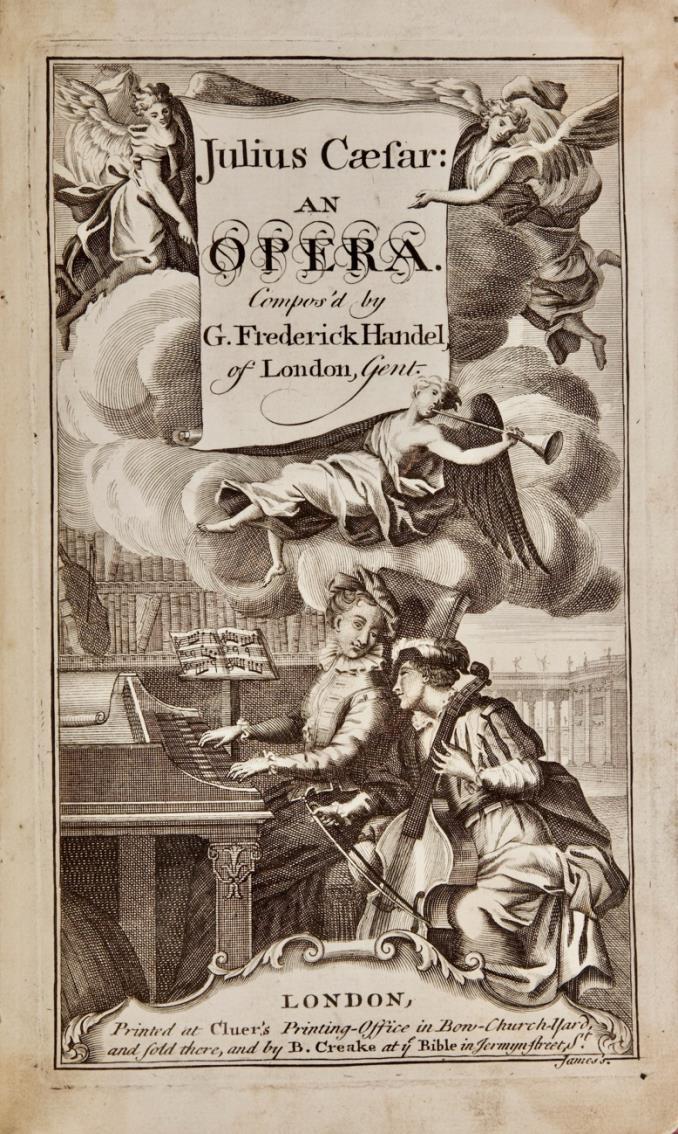
Names of singers printed within the score include Senesino, Robinson, Durastanti, Berenstadt, Cuzzoni, and Boschi.
Provenance
Highfill, Burnim and Langhans record a “Mr. Walton” as a countertenor whom Burney stated was a performer at the Handel Memorial Concerts at Westminster Abbey and the Pantheon in 1784, possibly the former owner of the present volume, George Walton, referred to above.
First Edition, first issue. HWV 17. 39476. Fraenkel: Decorative Music Title Pages, no. 152. Schaal: Musiktitel aus fünf Jahrhunderten, no. 82. Smith 1, pp. 30-31. BUC p. 427. RISM H166.
Julius Caesar, in three acts to a libretto by Nicola Francesco Haym adapted from Giacomo Francesco Bussani’s Giulio Cesare in Egitto (1677, Venice) and a later version of the same libretto (1685, Milan) was first performed in London at the King’s Theatre on 20 February 1724. It was a resounding success and had an initial run of 13 nights. Handel made some changes and revived the work on 2 January 1725, after which it ran for 10 performances.
"The score of Giulio Cesare was by far Handel’s most sumptuous to date, not only in its stylistic variety and melodic richness but more specifically in its use of the orchestra, which included two pairs of horns crooked in different keys and a stage band with harp, theorbo and viola da gamba. It is also one of his most dramatically compelling operas, despite the over-frequent suicide attempts and assaults on Cornelia’s virtue. The character of Cleopatra in all her ‘infinite variety’ is painted with special insight and understanding ... Her two arias of grief, ‘Se pietà’ and ‘Piangerò la sorte mia’, are among Handel’s finest in that vein, while ‘V’adoro, pupille’, with its ravishing instrumental sonorities, is surely unsurpassed as an exemplar of seductive song. Caesar’s role includes some fine accompanied recitative (notably the moving ‘Alma del gran Pompeo’) and the remarkable aria with solo horn, ‘Va tacito’." Anthony Hicks in Grove Music Online
Rare to the market. (39495) $8,500
Autograph Incipits from all of Haydn’s London Symphonies, Including Music from the Famous Gypsy Rondo
15 HAYDN, Joseph 1732-1809
Autograph musical manuscript, consisting of musical incipits of the composer's 12 London Symphonies, together with an autograph musical sketch of the slow movement of the "Gypsy Rondo" from Haydn's Piano Trio No. 39. [Hob. I:93-104; XV:25]. London, 1795. Unsigned.
Large oblong quarto (241 x 309 mm.). Notated in dark brown ink on the verso of the second leaf of a bifolium (i.e., page 4) on 10-stave rastrum-ruled paper of British manufacture. Watermark dated 1794. Late spring or early summer, 1795 (see H.C. Robbins Landon: Haydn Chronicle and Works, Volume III, p. 495). Very slightly worn, browned, andsoiled;minorfoxingandveryshortsplitstocentralfold;verticalcreasetocenterofbifolium; lower edge with several miniscule tears.
With pencilled note in another hand to first page: Haydn autograph notes of the 12 English Symphonies. Haydn misquotes the 2nd.
In addition to noting the musical incipits, which comprise 25 measures spread out over 4 staves, Haydn identifies the key, time signature, and year in which each symphony was first performed (in noting the performance date of Symphony 97, however, Haydn makes an error and cites 1791 instead of 1792).
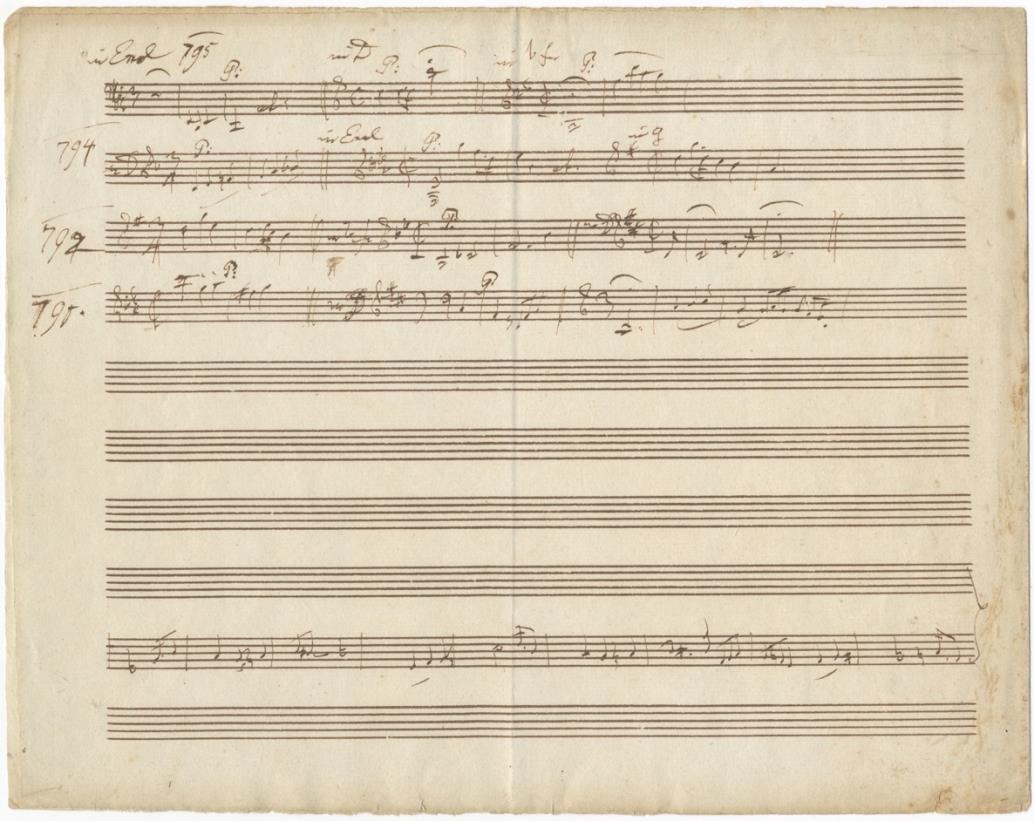
The sketch for the piano trio Hob. XV:25 is notated 5 staves below the symphonic incipits and consists of 9 measures of melodic material for the famous third movement.
Provenance
Leo Liepmannssohn auction catalogue, Berlin, 1907, lot 91. The Westley Manning Collection, Sotheby’s London, 12 October 1954, lot 207.
The London Symphonies were commissioned by the London impresario and violinist Johann Peter Salomon (1745-1815) and composed over the period 1791-95. Salomon was responsible for bringing Haydn to London where he became immensely popular, largely through performances of his music at Salomon's concerts.
"Haydn’s London symphonies (nos. 93-104) crown his career as a symphonic composer. Not only do they outdo the Paris symphonies stylistically, but he produced them in person for rapturous audiences; this interaction stimulated him to ever bolder and more original conceptions. ... The last six [London] symphonies are even more brilliant [than the first six]. ... Haydn’s determination to conquer new territory with each work is palpable." James Webster in Grove Music Online
"The finale of Hob. XV:25 is the famous rondo "in the Gypsies Style." It seems that a composer's most popular works, if not spurious, are at least unusual manifestations of his style, and this rondo fits this characterization. ... Even though this finale was best known during the eighteenth century as a separate piece in many different settings, its impact is best appreciated within the context of this keyboard trio cycle, for the Andante and Poco Adagio (the first and second movements) hardly prepare one for its burst of energy." A. Peter Brown: Joseph Haydn's Keyboard Music Sources and Styles, p. 377.
"... the G major Trio (39) turned out to be Haydn's most popular piano piece, because of the 'Gypsy Rondo' Finale. ... [It] became an enormous favourite, first in England and immediately afterwards on the Continent." Robbins Landon III, pp. 431-432.
A unique and interesting manuscript, being a virtual catalogue of all the London Symphonies and including music from the famous Gypsy Rondo, representing some of Haydn's best works dating from his important London period (39430) $38,000
Haydn’s “Greatest Single Accomplishment” With the Composer’s Handstamp
16 HAYDN, Joseph 1732-1809
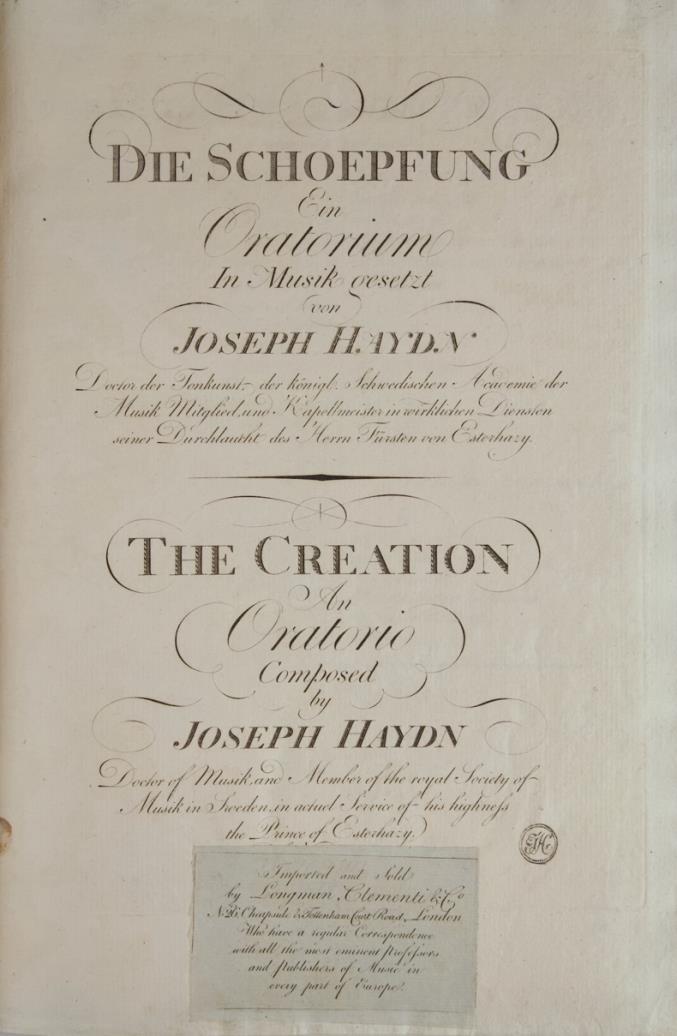
Die Schoepfung Ein Oratorium ... The Creation An Oratorio. [Hob. XXI:2]. [Full score].
Vienna: [The Composer], [1800].
Folio. Contemporary quarter dark tan mottled calf with ivory vellum-edged marbled boards, titling gilt to spine. 1f. (recto title, verso blank), 4ff. (subscribers list), 303, [i] (blank) pp. Text in German and English. Title and music engraved, list of subscribers typeset. Binding worn, rubbed, and bumped; minor loss to head and tail of spine. Occasional small stains and moderate browning; some signatures partially split at lower portion. In very good internal condition overall.
With Haydn's small circular monogrammatic handstamp ("JH") to foot of title.
First Edition. HWV Vol. II, p. 36. Hirsch IV, 799. Leipzig catalogue p. 19. Vecsey 303. Eitner V, p. 66. BUC p. 456. RISM H2521.
The Creation, to a libretto by Gottfried von Swieten, was first performed at the Palais Schwarzenberg in Vienna on 29 and 30 April 1798; its first public performance took place on 19 March of the following year at the Burghteater in Vienna.
"There is hardly any doubt in the mind of the average music-lover that Haydn's Oratorio The Creation is, tutto sommato, his greatest single accomplishment, and certainly ranks as one of the greatest products of any eighteenth-century mind. It occupies a central position in choral literature and its composition and first performances were the dominant features of Haydn's life in the late 1790s." Robbins Landon: Haydn Chronicle and Works Vol. IV: Haydn The Years of 'The Creation' 1796-1800, p. 12.
Copies of the first edition of this monumental work containing the subscribers list are very scarce to the market. (40127) $9,500
Rare 16th Century Theoretical Work With
Numerous Musical Examples
17 HEYDEN, Sebald 1499-1561
De Arte Canendi ... libri duo.
Nürnberg: J. Petreius, 1540.
Small quarto (182 x 137 cm). Modern half mid-tan calf with speckled boards, raised bands on spine in decorative compartments gilt, darkredleather titlelabel gilt, red edges. [i] (title with woodcut device), [xi] ("Epistola," with indices to both books to final leaf), 163, [i] (blank) pp. With numerous musical examples type-set in diamond-head notation, diagrams, and small decorative woodcut initials throughout. With earlysignature ("Oswold") totitle, additional musical notation and annotation to margin of p. 17, and manuscript presentation inscription to upper margin of blank verso of finalleaf. Uniformlightbrowning; upperand lower margins very slightly trimmed, not at all affecting printed text but just touching signature to title and inscription to final leaf. A very good, crisp copy overall.
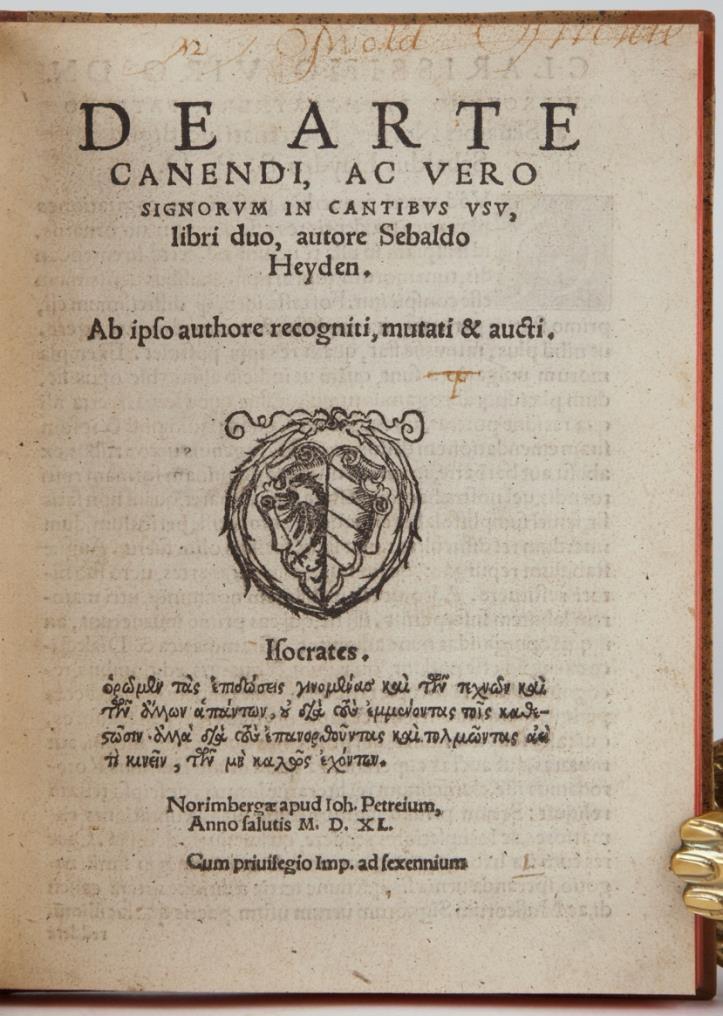
The second, expanded edition of the work first printed in 1537. Rare. Davidsson p. 43. Gregory-Bartlett p. 123. Hirsch I, 246 (title in facsimile). Reese no. 38. Wolffheim I, 705 (the 1537 edition). Not in Cortot, Cowden, or Damschroder and Williams. RISM Écrits Imprimés p. 412 (only 4 copies in the U.S.).
"Designed for the instruction of the boys at the St. Sebaldus school in Nuremberg, where Heyden was the rector, De arte canendi is a clear and comprehensive musical manual, written in question-and-answer form. ... Book I treats of such fundamentals as the gamut, solmization, and note-shapes; Book II deals with mensural notation
and the modes. This work reflects the disintegration of the old church-mode system, induced by the demands of polyphony. ... The De arte canendi contains many musical examples from contemporary and earlier composers; one of Ockeghem's two catholica ... is included, and the information Heyden gives about it provides modern scholarship with important clues leading to the correct resolution of the piece." Reese
Heyden's Musica (Ars canendi) (1537) ... "was outstanding for its many examples, drawn, according to the author’s prefatory statement, from the works of the best and most renowned composers – Josquin, Obrecht, La Rue, Isaac, Brumel, Ghiselin – not only as the most useful examples but also as demonstrations of great music. The examples are presented mostly without texts or with incipits only. The treatise De arte canendi, effectively a second edition of Musica (Ars canendi), appeared in 1540; though considerably enlarged it covers similar subjects. There are also more music examples, particularly of the works of Ghiselin and Obrecht, and Senfl is referred to as ‘the chief of all Germany at this time for Music’. Some of the anonymous polyphonic examples may be by Heyden himself." Victor H. Mattfeld in Grove Music Online
Rare Book Hub records only one copy of the present work having come to auction in recent times (Sotheby's London, 1966).
An attractive copy of this very rare and important 16th century theoretical work (39467) $14,500
“In His Time the Best-Known and Most Widely Admired Musician in Europe"
18 LASSO, Orlando di 1532-1594
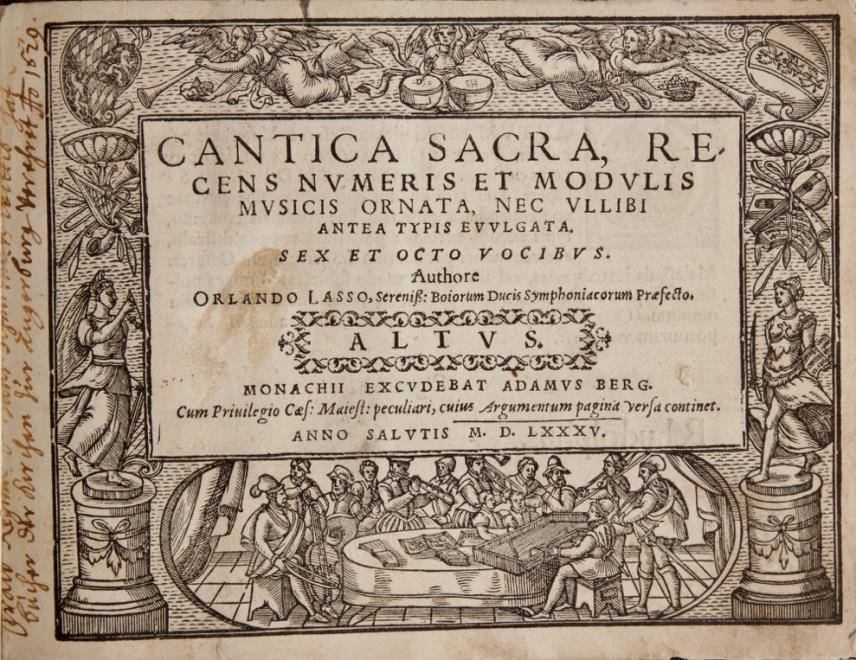
Cantica Sacra, Recens Nvmeris et Modvlis Mvsicis Ornata, Nev Vllibi Antea Typis Evvlgata. Sex et Octo Vocibvs ... Altvs. [Alto part only].
Monachii [Munich]: Adamvs Berg, 1585.
Oblong quarto (146 x 192 mm). Modern dark brown speckled boards with light brown printed paper label to spine gilt. 1f. (recto title with elaborate woodcut border, verso privilege) + 19ff. (unnumbered), with dedication to first page and index of the 24 pieces in the collection to final page.
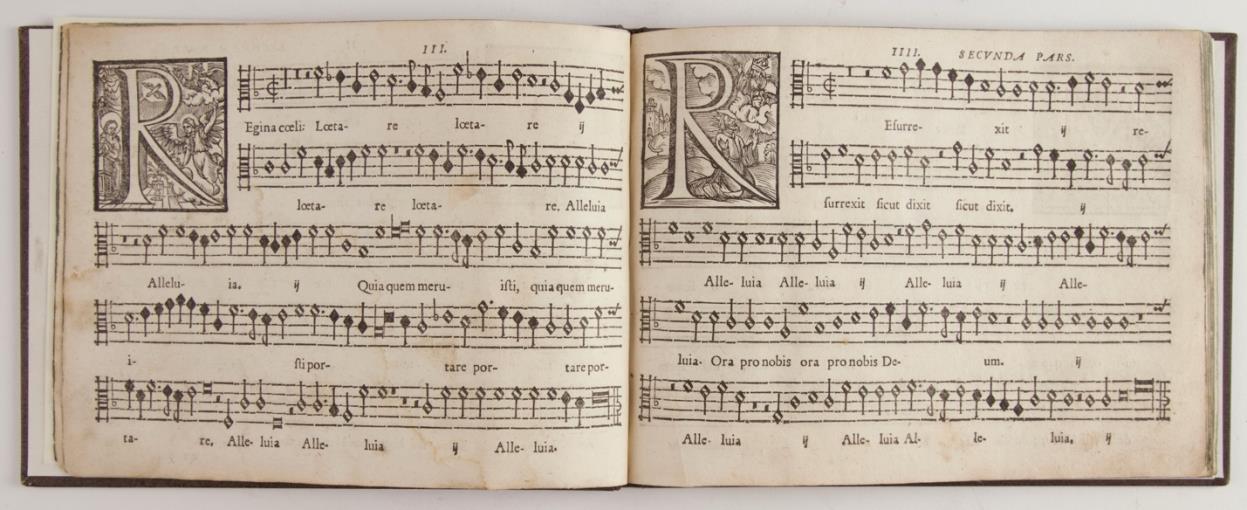
20ff. in total (signatures [aa] 1-4 to [ee] 14). In diamond-head notation. Typeset throughout. With fine large woodcut historiated initial representing a religious scene to 22 of the 24 pieces. Title within elaborate woodcut border incorporating floral motifs, flying angels playing trumpets, musical instruments including cornetto, lute, trombone, and harp, asaintholdingamusical score, andabanquet scenedepictingmusicians playingandsinging around a table with musical scores and instruments including viol, lute, cornetto, sackbut, transverse flute, and harpsichord.
Early annotation to inner margin of title dated 1629 reads "Frau Regina v. [...] Wittib hat Bücher der Kirchen für Augesburg verehret A[nn]o 1629" [Mrs. Regina v. [...] widow has donated books to the church for Augesburg [Augsburg] Anno 1629-."
Binding slightly worn and bumped. Slightly worn and soiled; light uniform browning; small stains to title, with pinhole and moderate soiling to narrow blank margins; paper repair to upper margin and woodcut border of title; stains to privilege and dedication; small tear to blank lower margin of bb2.
The alto part of a collection of sacred vocal music for six and eight voices.
First Edition. Rare. BUC p. 600. RISM L956 and LL956 (most copies incomplete, with no holdings in the U.S).
Lasso "was one of the most prolific and versatile of 16th-century composers, and in his time the best-known and most widely admired musician in Europe." James Haar in Grove Music Online
The only example of the present work having been offered at auction is a copy of the Quinta part only, sold at Sotheby's London in 1967. (40566) $9,000
Autograph of “The Leading Figure in French Music”
19. LULLY, Jean-Baptiste 1632-1687
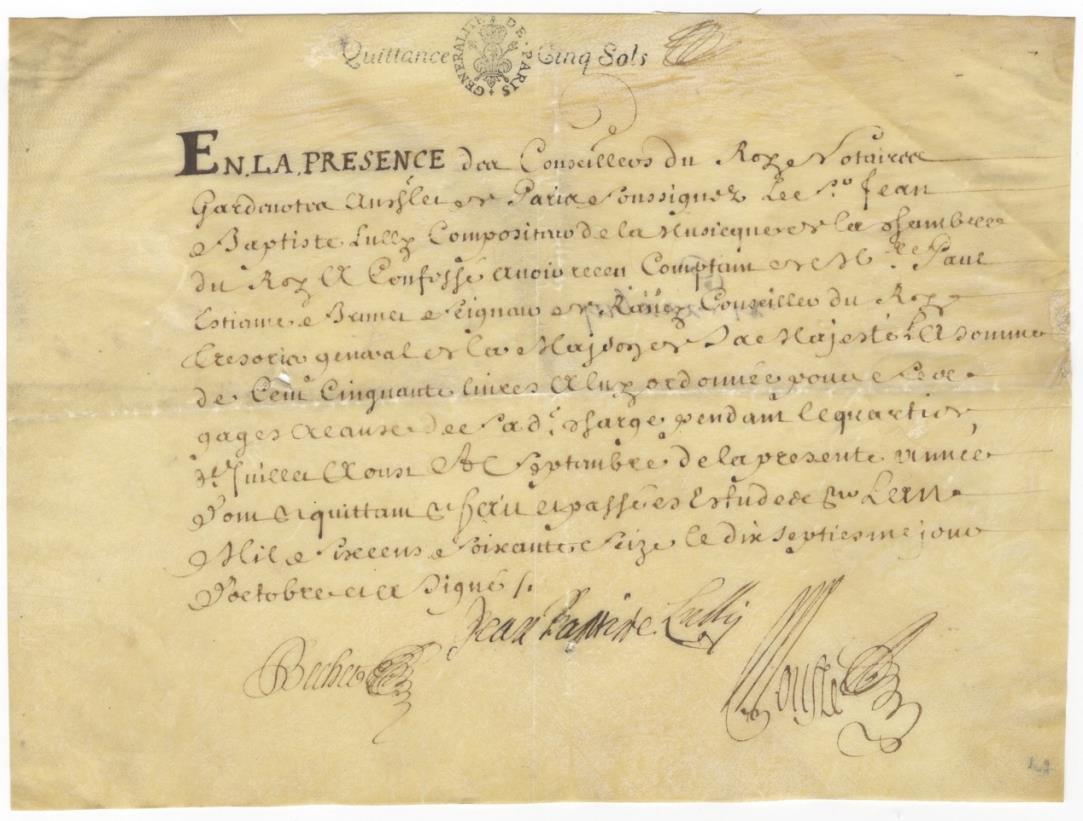
Manuscript document on vellum signed by the composer.
Addressed to Lully as "Compositeur de la Musique de la Chambre du Roi." Large oblong octavo (179 x 240 mm.). Lullyacknowledges receiptof wagesincashtheamount ofoneandfiftylivres, his salaryforthepreceding quarter (July-September) of the current year. Dated 17 October 1676 at conclusion and signed in full, Jean Baptiste Lully. With small oval duty handstamp to head of royal device surrounded by the words "Generalité de Paris," with "Quittance" to left of device, "Cinq Sols" to right. Vellum very slightly browned; some creasing; two small holes, just touching the word "cent" and the descender on the "p" of Lully's signature.
"Lully, regarded throughout Enlightenment Europe as the leading figure in French music, created a style which was truly his own, drawing on many sources which he was probably better able to assimilate than anyone else in his time. The language he forged, and to which he sometimes brought exceptional breadth, could leave no one indifferent, and it still attracts audiences today with its power, clarity, equilibrium, coherence, poetry and exquisite sensitivity." Jérôme de la Gorce in Grove Music Online
As none of Lully's musical autograph manuscripts have survived, documents such as this, dating from his important ballets de cour period, are among the only examples of his hand extant
A fine example from a leading 17th century composer, regarded as the creator of the French Baroque tradition in opera and ballet. (39496) $8,500
Bellerophon and the Idylle sur la Paix Two Lifetime First Editions
20. LULLY, Jean Baptiste 1632-1687
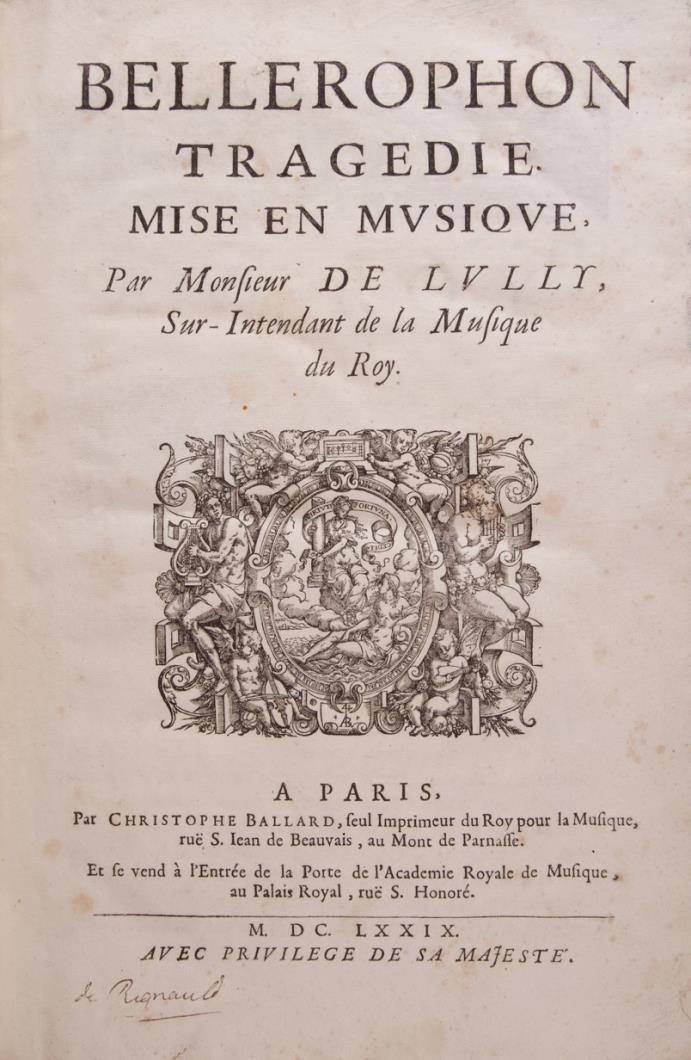
Bellerophon. Tragedie. Mis en musique, par Monsieur de Lully Sur-Intendant de la Musique du Roy. [LWV 57]. [Full score].
Paris: Christophe Ballard, seul Imprimeur duRoy pourlaMusique, ruë S. Iean de Beauvais, auMont de Parnasse Et se vend à l'Entrée de la Porte de l'Academie Royale de Musique, au Palais Royal, ruë S. Honoré. ... Avec Privilege de Sa Majesté, 1679.
Folio. Full contemporary dark brown mottled calf with raised bands on spine in decorative compartments gilt, marbled edges and endpapers. 1f. (early manuscript index), 1f. (blank), 1f. (recto title, verso blank), 1f. (dedication), 308, [i] (blank) pp. on 154 foliated leaves. Occasional woodcut head- and tailpieces. Typeset throughout, with music in diamond-head notation. Slightly worn, browned, and stained. Elaborate woodcut devicetotitleincorporatinghorticulturalandarchitecturalmotifs withcentralimagewithinovalborderdepicting allegorical personifications of Fortune and Virtue with "Virtuti Fortuna Cedit" (Fortune Yields to Virtue) at Virtue's head with cherubs playing lute and viol and Orpheus with lyre; a satyr playing a panpipe flanks the central image, with two additional cherubs displaying a short musical phrase above. With early ownership
signature("deReynauld")tolowerinnercorner oftitleandfirst pageofmusic, inalllikelihoodAntoine-François de Reynauld, 1682-1766, of the l'Académie des Sciences et Belles-Lettres.
First Edition. Schneider p. 315. Sonneck Dramatic Music p. 99. Lesure p. 405. BUC p. 634. Hirsch II, 535. RISM L2974.
Bellerophon was a favorite subject for 17th and 18th century libretti. Lully set his work for the Paris Opéra to a libretto byT. Corneille and Fontenelle after Hesiod's Theogeny; it was first performed there on 31 January 1679. "Here the various magical incantations and other supernatural events provide an excuse for the extensive use of the chorus coupled with dramatic symphonies." Lois Rosow and Marita P. McClymonds in Grove Music Online
"From Bellérophon (1679) onwards [Lully] ... adopted the Italian practice of using the string ensemble to provide greater density at certain dramatic moments. At the same time he also developed this practice in various airs." Jérôme de La Gorce in Grove Music Online
The opera is considered one of Lully's finest and most successful works; it was initially performed continuously for 10 months.
Bound with: LULLY
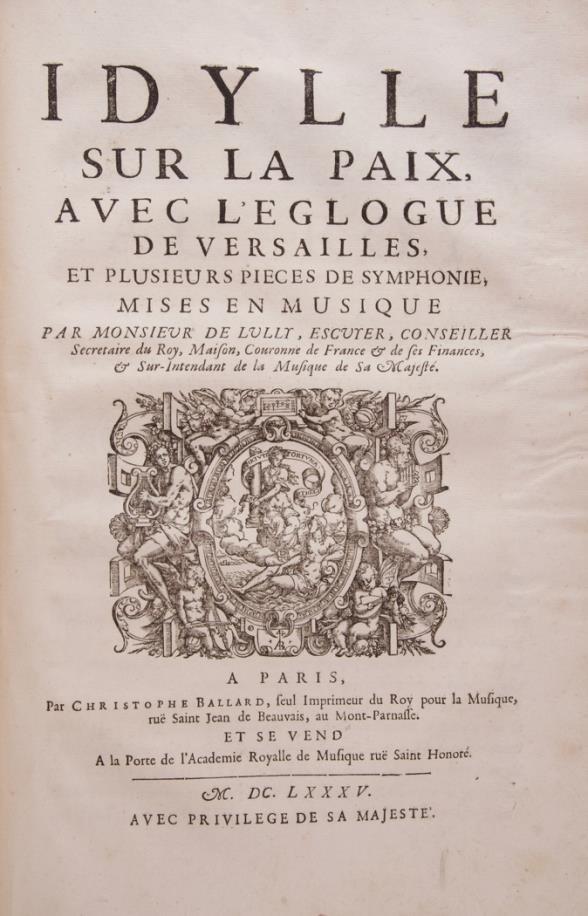
Idylle sur la Paix, avec l'Eglogue de Versailles, et Plusieurs Pieces de Symphonie. [LWV 68].
Paris: Christophe Ballard, 1685. 1f. (recto title, verso blank), 1f. (dedication), 140, [i] (blank) pp., 1f. (recto index in early manuscript, verso blank). With woodcut device to title as above. Typeset throughout, with music in diamond-head notation. Libretto by Jean Racine (1639-1699).
With Lully's control paraph to final page of music and monogrammatic handstamp to foot of page 1. Occasional markings in manuscript.
First Edition. Schneider p. 449. Sonneck Dramatic Music p. 99. Lesure p. 406. BUC p. 634. Hirsch II, 540. RISM L3044.
The Idylle Sur La Paix and Eglogue de Versailles were site-specific entertainments designed to complement the palace and garden of Versailles, with music designated for specific parts of the estate, including the Groves and Orangery. The libretto is inspired by Classical poetic models, including Virgil's Eclogues. The dances at the end of the printed edition include a menuet, passepied, and chaconne pour Madame la Princesse de Conty.
Binding somewhat worn, rubbed, and bumped; repair to lower outer corner of upper; endpapers worn.
Two attractive lifetime first editions, documenting the composer's collaboration with Jean Racine, one of the most celebrated writers of his time, and the vibrant bespoke musical entertainments created for the iconic palace of Versailles during its heyday under Louis XIV, the Sun King. (39587) $10,000
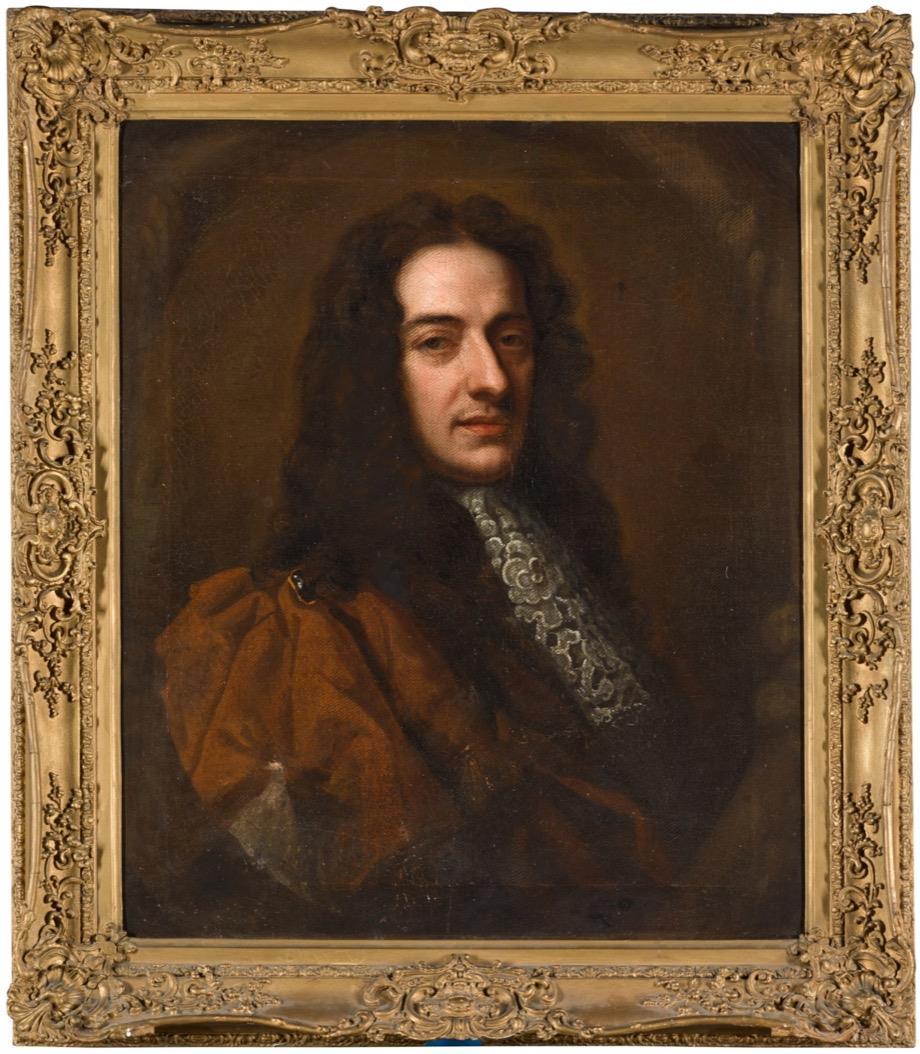
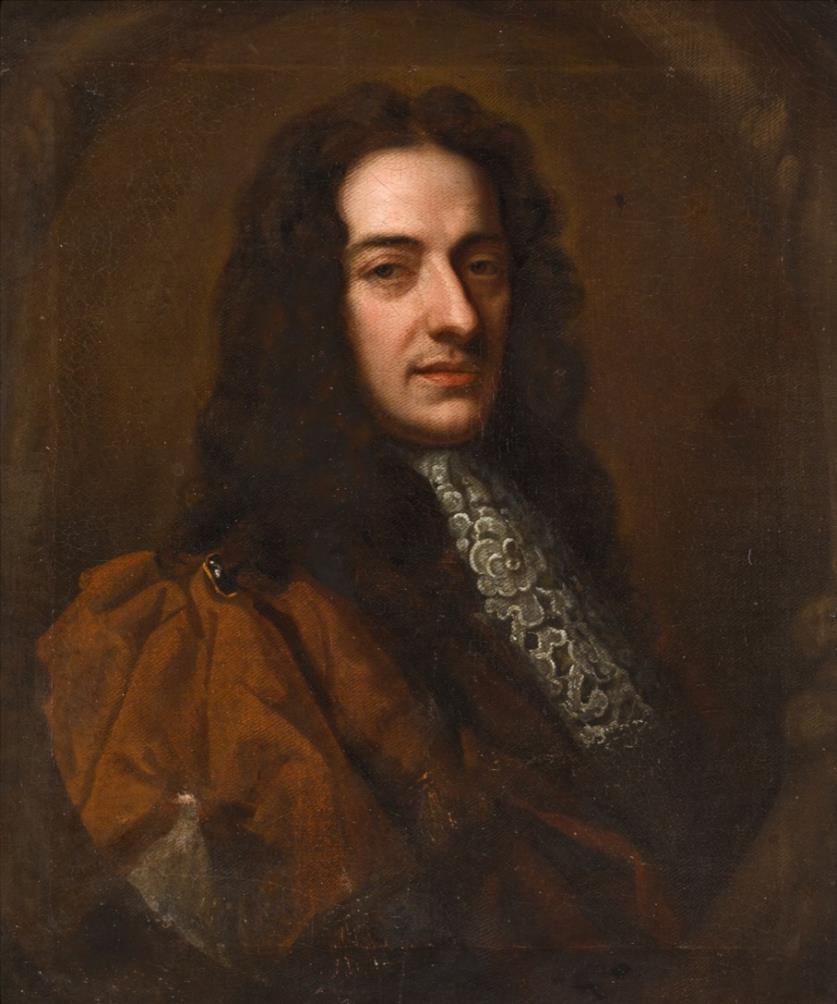
The Only Known Image of this Important 17th Century Violinist, Guitarist, and Composer
21. MATTEIS, Nicola fl. 1671-after 1713
Fine original oil portrait painting by the British artist Sir Godfrey Kneller (1646-1723). On canvas. Unlined.
The only known portrait of this noted Italian violinist, guitarist, and composer. 1682.
Image size 30 x 25.5 inches (76.8 x 64.8 cm). In an ornate painted wooden frame, 37.25 x 32.25 inches. (94.8 x 81.8 cm). The subject is depicted turned quarter-left, with long hair (possibly a wig), wearing a rich dark brown jacket pinned at the right shoulder and a green and white cravat. With "Nicola Matteis / G. Kneller Fecit / 1682" in manuscript to verso. Minor surface wear. Frame slightly worn, with small 1/2" area of upper edge of lacking.
Provenance
Old label to verso indicating that the painting once belonged to Lord Anglesey. It is later recorded as belonging to William Barrow of Llandudno in the 1960s and by descent to his heir, Miss D. Weir. Last sold at Sotheby's sale of Old Master & British Paintings in London on 10 April 2013 (lot 35): "This signed and dated work is the only known portrait of the first notable Italian Baroque violinist to have settled in London. A composer of
significant popularity in his time and a virtuoso performer he revolutionised the use of the violin in London and introduced the Italian style of playing the instrument into English taste." Sotheby's catalogue entry
Reproduced in Michael Tilmouth's important article on Matteis in The Musical Quarterly, Vol. XLVI, No 1, between pp. 28 and 29.
Although Matteis referred to himself as a "Napolitano" in several of his musical publications, he seems to have taken up residence in England in ca. 1670. "[He] was clearly an extraordinary violinist and a key figure in the development of violin playing in England. ... Matteis was active as a teacher and, according to North, had ‘many scollars’. He was to have joined Purcell, Draghi, Keller and Finger on the staff of the proposed Royal Academy (1695). In 1696 John Walsh (i) advertised ‘A Collection of new Songs set by Mr Nicola Matteis made purposely for the use of his Scholars.' " Peter Walls in Grove Music Online
In addition to various collections of instrumental and vocal works, Matteis published the important treatise "Le false consonanse della musica" in London, ca. 1680, issued in an English translation as "The False Consonances of Music." It is considered "... an important ground-breaking treatise on thorough-bass realization for the guitar (though Matteis several times stressed the applicability of his instructions to other continuo instruments and included some general advice on performance and composition)." ibid
The German-born artist Sir Godfrey Kneller (1646-1723) was a leading portrait painter in England. His works are held inmany prominent museum collections including the National Portrait Gallery, The Victoria and Albert Museum, TheRoyal Society, Kensington Palace, and Buckingham Palacein London; atHamptonCourt; Oxford University; and the National Portrait Gallery in Dublin. (39777) $32,000
A Cornerstone of the Literature Including the Earliest Example of Music Engraving in France and Important Commentary on Musical Instruments and Acoustics
22. MERSENNE, Marin 1588-1648
Harmonicorum Libri In Quibus Agitur De Sonorum Natura, Causis & effectibus: de Consonantiis, Dissonantiis, Rationibus, Generibus, Modis, Cantibus, Compositione orbisque totius Harmonicis Instrumentis.
Paris: Guillelmi Baudry, 1635 [-1636].
Two parts bound in one. Folio. Early full dark brown panelled leather. With 21 fine engraved illustrations and more than 100 woodcut illustrations, mainly of musical instruments; numerous musical examples (some in lute tablature) and diagrams throughout; occasional woodcut head- and tailpieces, ornaments, and decorative initials. Typeset. Text in Latin. Binding slightly worn, rubbed, and bumped; restored and rebacked;endpapers slightlybrownedatmargins. Slightly worn and browned; light to moderate dampstaining throughout;title slightlytrimmed, soiled, and withsmall holes to blank areas, minor chips to margins, laid down to backing sheet; Part II with small hole to pp. 67/68, just touching illustration to p. 67 and affecting several letters of text to p.

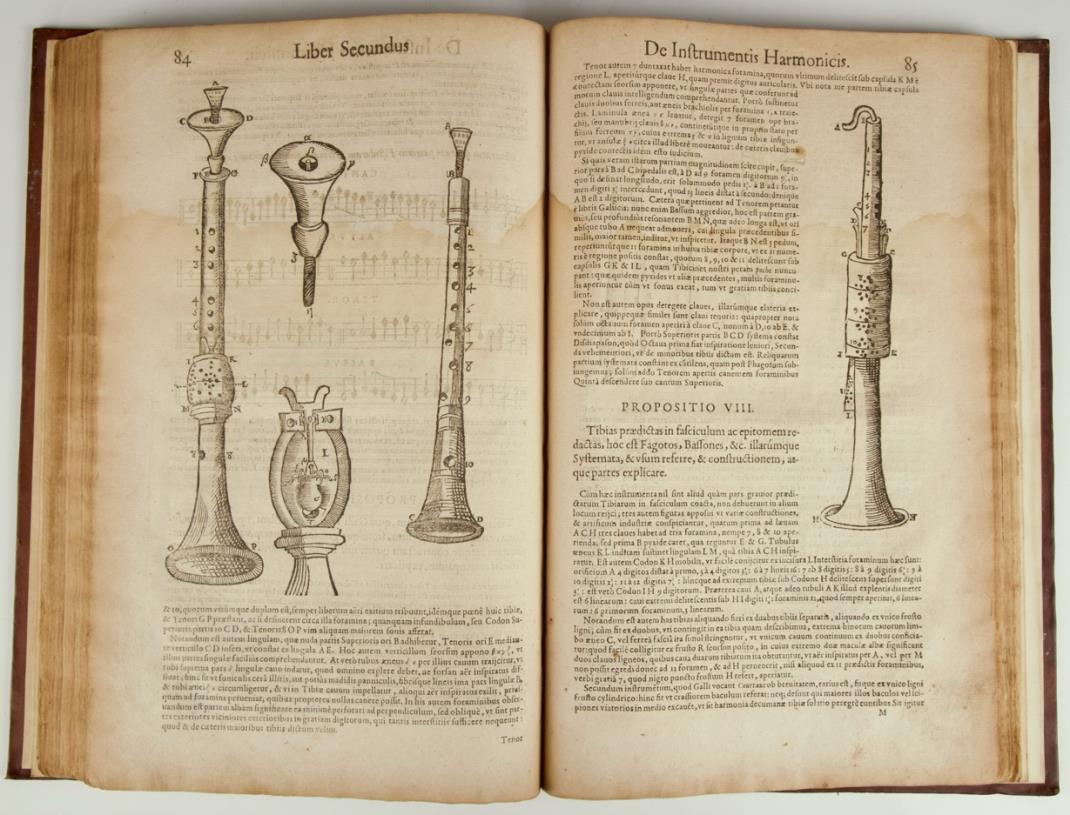
68; lower outer corner of pp. 159/160 lacking, just touching lower outer corner of illustrative plate; occasional minor defects. Part I lacking signatures R and X4 (pp. 125-132 and 153-160), as is often the case in early issues; lackingpp. 163-166;pages 43-46mispaginated. PartIIlacking pp. 35-38;pages148, 149, and167mispaginated.
Part I
1f. (recto title, verso blank), 1f. (dedication), 4ff. (preface), 184 pp.
Bound with:
Part II. Harmonicorum Instrumentorum. 168 pp.
Provenance
Sir Frederick A. Gore Ouseley (1825-1889), English church musician, composer, professor of Musicat Oxford University, and collector of music and music theory books, with his signature in pencil to free front endpaper. Some early notation in pencil to Vol. I, most likely in Ouseley's hand.
First Edition. Charbon (The Hague Gemeentemuseum) I, p. 95. Cortot p. 135. Gregory-Bartlett pp. 178-79 (with pp. 126-31 and 154-59 lacking in Vol. I). Hirsch I, 405. Wolffheim I, 836. Wood (Harvard) 988. RISM Écrits Imprimés p. 572.
Part I contains the earliest examples of music engraving in France
Part II is an important study of musical instruments of the late Renaissance and early Baroque
Mersenne was a "French mathematician, philosopher, music theorist and savant. He was one of the leading French thinkers of the 17th century, and his work is central to the academic and scientific movements of the second quarter of the century; an important part of it is devoted to the science, theory and practice of music. He was a transitional figure at a crucial confluence of Renaissance and Baroque ideas in France, summing up the
accomplishments of the past and posing the difficult questions for the future inherent in the new attitudes of his own time." Albert Cohen in Grove Music Online
"An examination of [the Harmonicorum] will at once show how much it was in advance of anything published up to that time, and it is the first in which the science of acoustics is applied practically to the study of Music. Perhaps to us in the present day the greatest interest is in the last four Books, treating of the various instruments known at that time, divided into stringed and wind instruments (the organ having a book to itself) and instruments of percussion, as bells and drums. These are illustrated profusely with woodcuts, as well as with engravings on copper, both printed in the text. It is worthy of notice that in treating of the organ, several schemes are given for dividing the octave into more than twelve semi-tones, so as to be able to use it in the keys impossible with unequal temperament." Matthew: The Literature of Music, p. 53.
Mersennealsoauthoredanearlyandinfluential workonmusic theory, Harmonie Universelle, publishedinParis, 1636-37, addressing the relationship between music and mathematics and containing the earliest presentation of what have become known as "Mersenne's Laws" describing the harmonics of vibrating strings; he is thus often referred to as the "father of acoustics." A cornerstone of the literature. (39451) $9,000
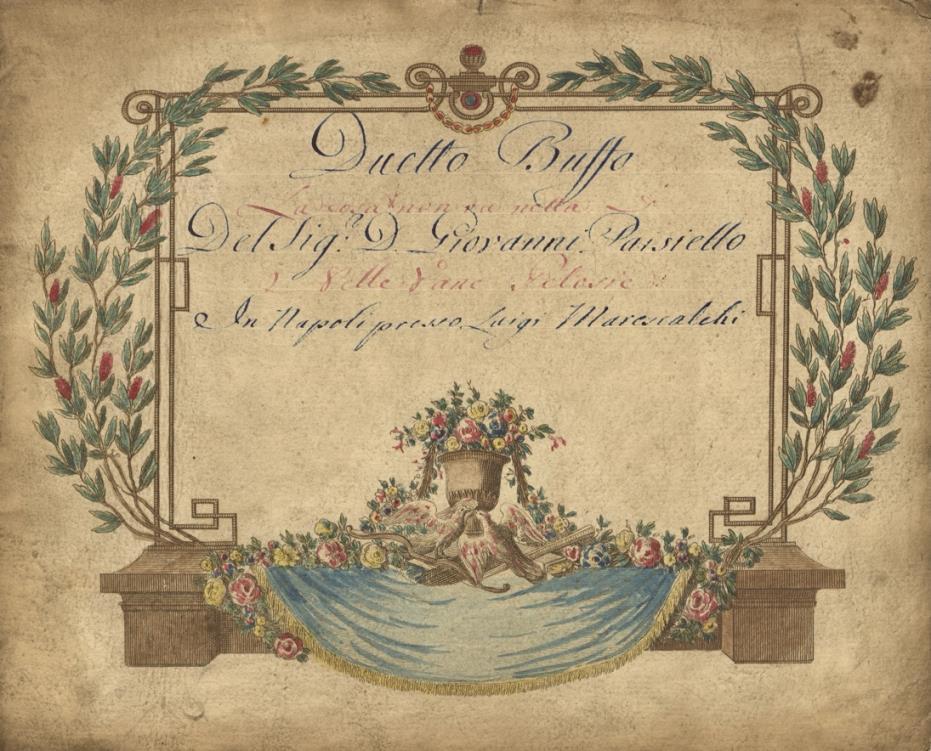
Large Archive of 18th and Early 19th Century Musical Manuscripts
23. [MUSICAL MANUSCRIPTS - 18th & 19th Centuries - Italian]
Archive of approximately 100 copyist musical manuscripts, primarily Italian.
Contains manuscripts of works by Anfossi, Aprile, Asioli, Belli, Beauharnais, Cantone, Carafa, Carlini, Caruso, Clari, Clementi, Czerny, Dalvimare, Eichner, Fioravanti, Giordani, Hasse, Haydn, Herz, Isola, Jommelli, Kreutzer, Labriola, Lanza, Leo, Macagnani, Mancinelli, Mercadante, Meyerbeer, Morandi, Pacini, Paisiello, Pergolesi, Perugini, Pratelli, Raimondi, Roggero, Romani, Ricci, Rossini, Sampieri, Sarti, Scandellari, Scarlatti, Schuster, Tartini, Traetta, Tunca, Tritto, Verdi, and Zingarelli.
Provenance
Predominantly from the collections of Luigi Ricci (1893-1981), Italian musician assistant conductor, vocal coach, and friend of Mascagni and Puccini and the long-time London music antiquarian, William Reeves
Of considerable research value.
A detailed inventory is available upon request. (41129)
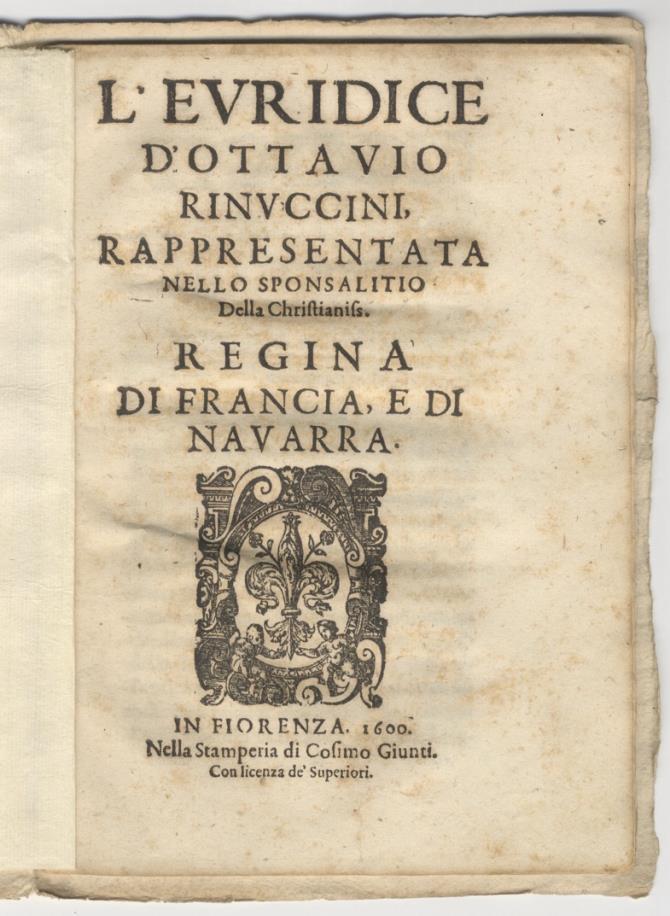
for the Earliest Opera for Which Complete Music Survives
24. PERI, Jacopo 1561-1633 and Giulio Romolo Caccini 1551-1618
$25,000
L'Euridice d'Ottavio Rinuccini, Rappresentata nello sponsalitio della Christianiss. Regina di Francia, e di Navarra. [Libretto].
Fiorenza: Nella Stamperia di Cosimo Giunti. Con licenza de' Superiori, 1600.
Small quarto. Contemporary carta rustica. 1f. (recto title with woodcut Medici coat of arms, verso blank), [iii] (dedication "Alla Christianissima Maria Medici" dated "Di Firenze il dì [blank] Ottobre 1600"), [i] (blank), 1f. (recto cast list, verso blank) + 16ff., with large woodcut Medici coat of arms to final page. Typeset. With decorative woodcut headpiece and initial to first page of text. Slightly worn; edges browned; occasional minor stains and foxing; some irregular and incorrect printed foliation (e.g. "7" printed twice); first letters of names of cast members only partially inked. With correction in early manuscript to leaf 5.
First Edition, second variant (with comma after Rinuccini to title). Allacci col. 317. Fuld p. 95 (not assigning precedence). Gaspari V, p. 393. Hirsch IV, 1391. Sartori II, 9398. Sonneck I, pp. 460-461. Watanabe O'Kelly and Simon 1229. Wotquenne p. 66.
Euridice, an opera in 5 scenes with music mainly by Peri with additions by Giulio Romolo Caccini (1551-1618) to a libretto by Ottavio Rinuccini (1562-1621) after Ovid's Metamorphoses (Book 10) with borrowings from Virgil's fourth Georgic and Poliziano's Orfeo, was first performed in Florence at the Palazzo Pitti on 6 October 1600 as part of the celebrations of the wedding of Maria de’ Medici and Henri IV, King of France; Peri himself played the part of Orpheus.
"In Euridice, Peri goes further than he had in his Dafne (1597/8) in the devising of ways of writing a drama with continuous music. There are choruses to end each of the five scenes, and several set pieces - Orpheus’s invocation of nature, Tirsi’s strophic song of celebration, and the messenger’s moving description of Eurydice’s death, all in the second scene, Orpheus’s lament before the gates of hell in the fourth and his strophic song of celebration and joy in the fifth. Euridice gives a clear impression of Peri’s theatrical style and the nature of his contribution to the development of opera, of his special gift for expressive recitative and his imaginative use of dissonance and striking harmonies." Howard Mayer Brown, revised by Barbara Russano Hanning in Grove Music Online
Rinuccini, an "Italian, courtier and author of lyric and dramatic poetry, is considered to be the first librettist and his libretto to the present work, in itself, a very important document relating to early opera. In his dedication to the Queen, Rinuccini states that it "has been the opinion of many" that Ancient tragedy was sung in its entirety, that he had longed believed it impossible to recreate this because of the weakness of modern music, but that Peri had overcome these doubts with his beautiful settings, first of Dafne and now even more so by his even greater setting of Euridice." Barbara R. Hanning in Grove Music Online
"Although Caccini’s name is inextricably linked with that of Peri in the creation of the first Florentine operas and although his setting of Euridice was the first such opera ever to be published, Caccini should primarily be viewed as a composer of songs." H. Wiley Hitchcock in Grove Music Online. His contributions to Euridice include Euridice’s arias, some of the shepherd’s and the nymph’s, and the choruses ending scenes 1, 2, and 4 (Al canto, al ballo, Poi che gli eterni imperi and Sospirate, aure celesti).
Peri was an Italian composer, singer and instrumentalist. "His most significant contribution was his development of the dramatic recitative for musical theatre. His most characteristic examples of this style are found in Euridice (1600), the earliest opera for which complete music has survived. ... Euridice received high praise, particularly from Marco da Gagliano, who was impressed not only by the work but also by Peri’s own expressive singing. .... Peri and Rinuccini’s second collaboration, Euridice, is a significant advance on the experimental Dafne. The longer libretto has a more intricate design, and the music a wider range of expressive techniques." William V. Porter and Tim Carter in Grove Music Online
An attractive copy of the libretto for the earliest opera for which complete music has survived (41101)
$12,500
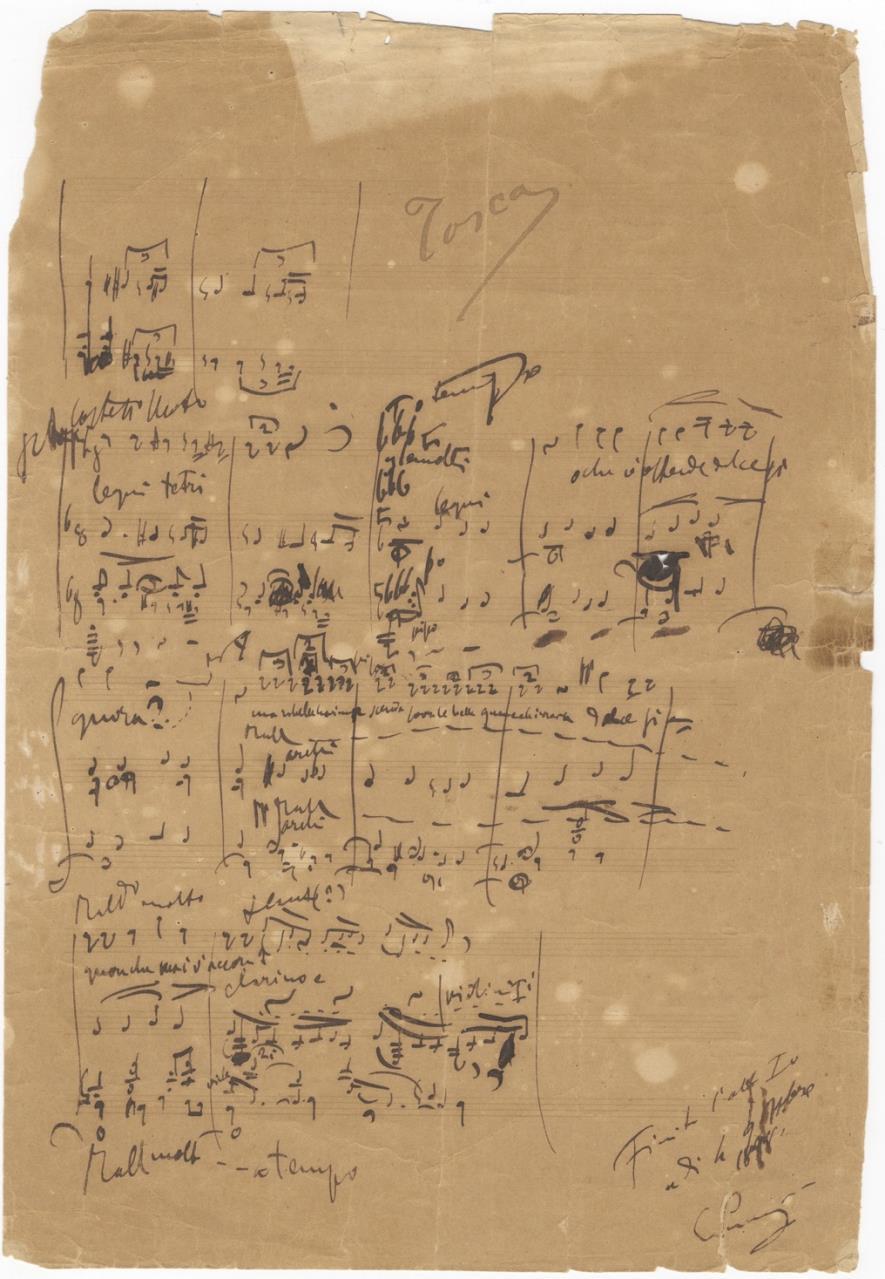
Autograph Working Manuscript from Tosca 25 PUCCINI, Giacomo 1858-1924
Autograph musical manuscript sketchleaf for the composer's opera, Tosca. Signed and dated "4 9embre [September] 1898 "
One large leaf. Folio (378 x 260 mm). Notated on 4 systems of 3 staves each in dark brown ink on 12 stave music paper. Worn, browned, and creased; edges frayed and with small tears; some spotting; small ca. 1 cm hole, not affecting music; vertical tear through signature, with no loss.
With autograph titling Tosca at head and inscribed Finito l'atto lo a di 4 9embre 1898 G. Puccini at lower outer corner.
13 measures in condensed score from Act I, commencing 4 measures before figure 75. "The passage occurs towards the end of Act I, when Scarpia, in a monologue over a characteristically obsessive pattern of alternating chords, accompanied by bells, organ, drum beast to stimulate cannon fire and growling bassoons, gloats at the prospect of capturing Angelotti and enjoying Toscar's favours. Puccini's note note of the date of completion of Act I indicated that he discarded drafting material at the conclusion of each section of the opera. The opera as a whole was not competed until October 1899 ..." Christie's London 1 December 2004 catalogue description
Tosca, to a libretto by Luigi Illica and Giuseppe Giacosa after Victorien Sardou, was first performed in Rome at the Teatro Costanzi on 14 January 1900.
"None of Puccini’s operas has aroused more hostility than Tosca, by reason of its alleged coarseness and brutality; yet its position in the central repertory has remained unchallenged. Not only is it theatrically gripping from start to finish: it presents the composer’s most varied and interesting soprano role, hence its perennial appeal for the great operatic actress. In contrast to Sardou’s heroine, against whose ignorance and simplicity the playwright can never resist tilting, Puccini’s Tosca is a credible woman of the theatre, lacking neither intelligence nor humour, and capable of genuine dignity." Julian Budden in Grove Music Online
"Tosca is still one of the operas most vividly present in the collective imagination. Its vitality is derived above all from Puccini’s technical skill. The composer stuck faithfully to his intention to represent a reality, real surroundings and characters, putting the music at the service of the drama. Imaginative tone colour, melodic inventiveness and motivic elaboration have their origin in economy and lead on to still bolder achievements in structure which bring him in line with the developments in European opera of the time. Combining the late 19thcentury sensibility of the play by Sardou with modern modes of expression, ardently admired by Arnold Schoenberg and Alban Berg, though no less passionately deplored by Mahler, Puccini, in the best way possible, ushered in the 20th century." Michele Girardi in Grove Music Online
Autograph working manuscripts fromPuccini'smajoroperasrarelycomeonthemarket. (39771) $24,500
4 Ballets in First Edition
From the Collection of Geneviève Thibault, Comtesse de Chambure
26 RAMEAU, Jean-Philippe 1683-1764
L’Enlevement d’Adonis Ballet en un Acte détaché des Surprises de L’Amour ... Représenté sur le Theâtre de L’Academie Royale de Musique en 1757. Prix en blanc 6tt. Bound with La Lyre Enchantée, Anacreon, and Les Sibaris.
Paris: Chez Mr. Daumont rue St. Martin près St. Julien. Mr. le Clerc rue du Roule a la Croix d'or. Mr. Bayard rue St. Honoré a la Regle d'or. Mlle. Castagnery rue des Prouvaires a la Musique Royale. Mr. Lemenu rue du Roule a la Clef d'or. Avec Privilege du Roy, [ca. 1757].
1f. (rectotitle, verso blank), 57 pp. Lesure p. 526. BUC p. 871. First Edition. RISM R135 andRR135 (nocopies in the U.S.).
Bound with:
La Lyre Enchantée Ballet en un Acte detaché Des Surprises de L'Amour ... Représenté sur le Theâtre de L'Academie Royale de Musique en 1757. avec les Changements qui ont êté fait en 1758 Prix en blanc 6tt. Paris: Chez Mr. Daumont ... Mr. Le Clerc ... Mr Bayard ... Mlle Castagnery ... Mr Lemenu, [1758]. 1f. (recto title, verso blank), 55 pp., [i] (blank). First Edition, second issue.Lesure p. 527. BUC p. 872. R161and RR161. Final leaf creased.
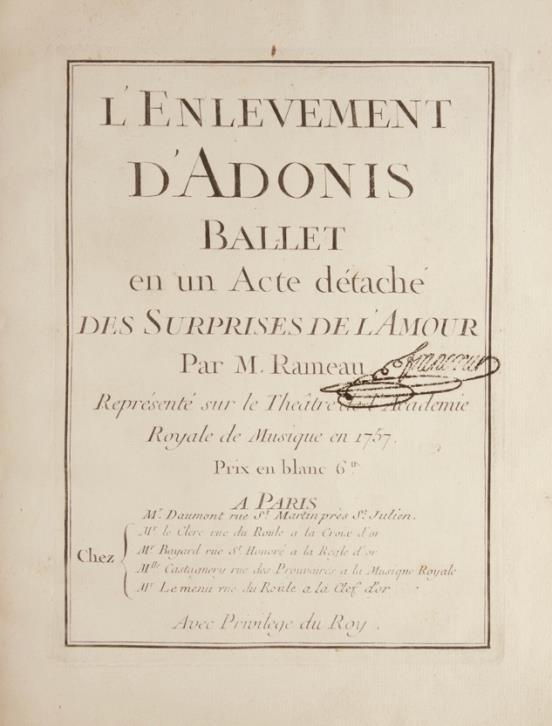
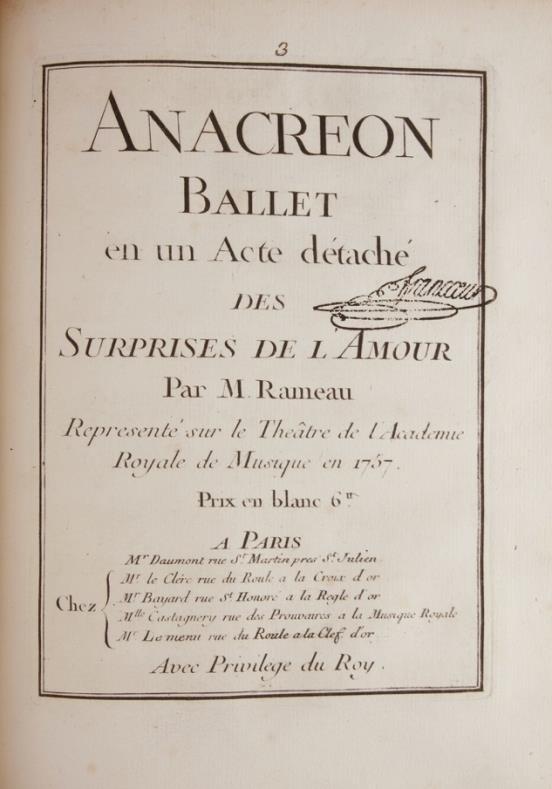
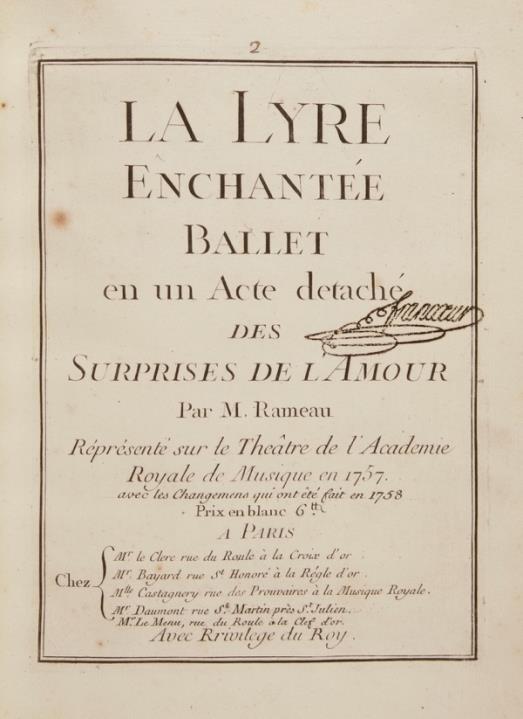
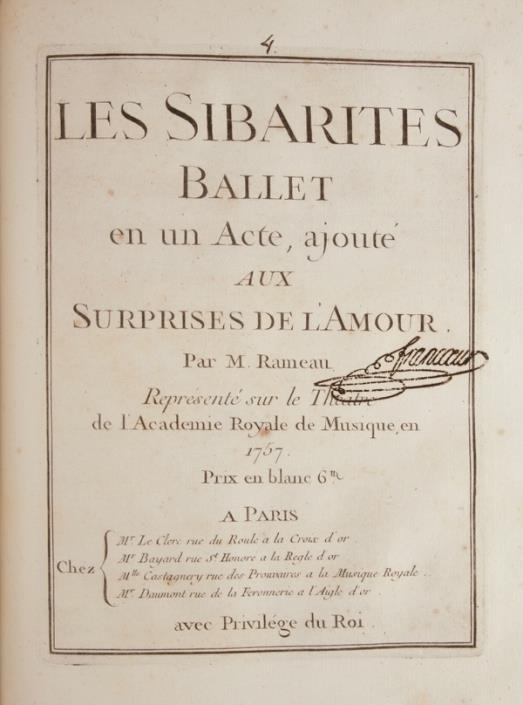
Bound with:
Anacreon Ballet en un Acte detaché Des Surprises de L'Amour ... Représenté sur le Theâtre de L'Academie Royale de Musique en 1757. Paris: Chez Mr. Daumont ... Mr. Le Clerc ... Mr Bayard ... Mlle Castagnery ... Mr Lemenu, [ca. 1757]. 1f. (recto title, verso blank), 65, [i] (blank) pp. First Edition, second issue. Lesure p. 525. BUC p. 871. RISM R125 and RR125 (one copy only in the U.S., at Harvard).
Bound with:
Les Sibaris Ballet en un Acte, ajouté aux Surprises de L'Amour. ... Représenté sur le Theâtre de L'Academie Royale de Musique en 1757 Prix en blanc 6tt. Paris: Chez Mr. Le Clerc ... Mr Bayard ... Mlle Castagnery ... Mr. Daumont, 1757. 1f. (recto title, verso blank), 56 pp. First Edition. Lesure p. 527. BUC p. 872. RISM R165 and RR165. Les Sybarites (Sibaris), with text by Marmontel, was first performed at FontainebleauinNovember of1754. "In 1757 it was included in a revival of Les Surprises de l'Amour." Girdlestone p. 471.
Provenance
Noted musicologist and collector Geneviève Thibault, Comtesse de Chambure (1902-1975), with her small armorial bookplate to front pastedown. Facsimile signature handstamp of violinist and composer Louis-Joseph Francoeur (1738-1804) to titles and numerous leaves; contemporary numbering in manuscript to upper margin of title of each volume.
Folio. Contemporary dark brown mottled calf with dark red leather title label to decorative spine gilt, decorative edges gilt, marbled endpapers. Very good, crisp, clean, and wide-margined copies overall.
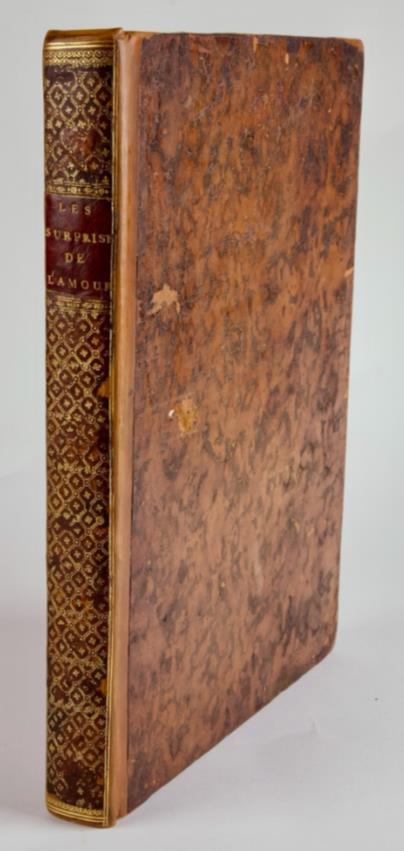
Binding slightly worn, rubbed, and bumped; rebacked and recornered. Minor internal wear; occasional light foxing.
Les Surprises de l'Amour, to a libretto by Pierre-Joseph Bernard, premiered at the Palace of Versailles on 27 November1748. CommissionedbyMadamedePompadour,theballetwascomposedincelebrationoftheTreaty of Aix-la-Chapelle and provided the inaugural performance for the opening of the Grand Escalier des Ambassadeurs at the palace. The work was originally written with a prologue (Le Retour d'Astrée) and two entrées, Adonis and La Lyre Enchantée, in which Madame de Pompadour sang both primary soprano roles (Uraniaand Venus). For the31 March 1757 performanceatthe Palais-Royal, the prologue wascutand Anacreon added as the final entrée.
Louis-Joseph Francoeur was a French violinist, composer, and editor, son of French violinist and composer Louis Francoeur (ca. 1692-1745). He was maître de musique at the Opéra from 1767-1779 and associated with the administration there on and off until 1799.”La Borde praised Francoeur highly for his reorganization of the Opéra administration and the high standards of performance under his leadership.” Michelle Fillion, Catherine Cessac, and Lois Rosow in Grove Music Online
A fine collection of Rameau lifetime first edition ballets with distinguished provenance. (39760) $12,000
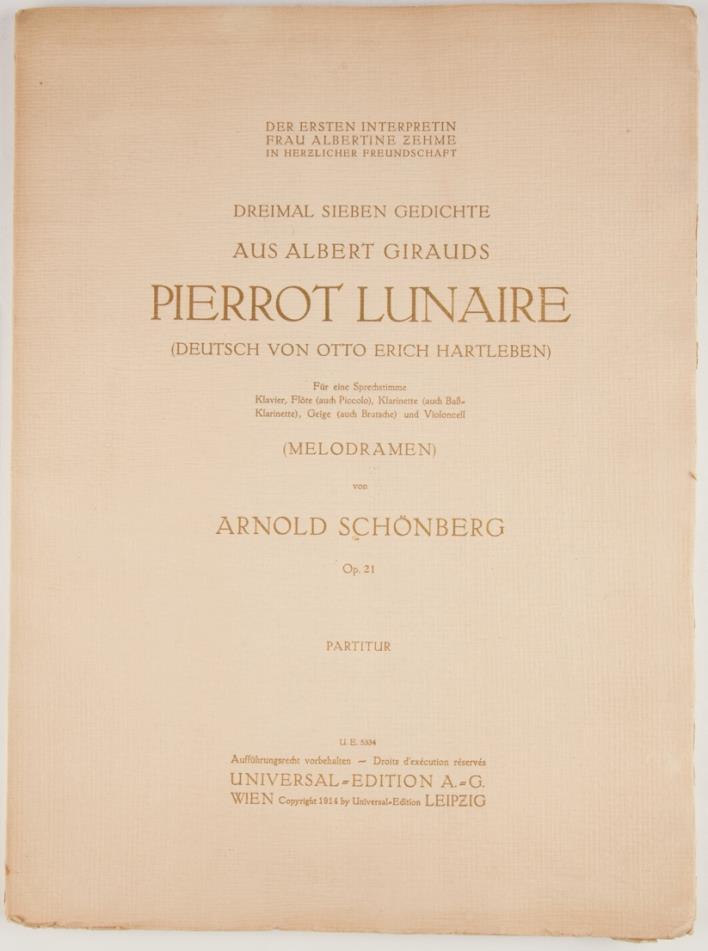
“One of the Most Representative Works of the Twentieth Century”
27. SCHOENBERG, Arnold 1874-1951
Dreimal sieben Gedichte aus Albert Girauds Pierrot Lunaire (Deutsch von Erich Otto Hartleben). Für eine Sprechstimme Klavier, Flöte (auch Piccolo), Klarinette (auch Baß=Klarinette), Geige (auch Bratsche) und Violoncell. (Melodramen) ... Op. 21 Partitur. Numerierte orzugsausgabe auf Bütten. [Full score for voice and chamber orchestra].
Wien ... Leipzig: Universal=Edition [PN U.E. 5334. 5336.], [July 30, 1914].
Folio. Original publisher's textured ivory wrappers with titling gilt to upper. 1f. (recto blank, verso with "No. 22" and Schoenberg's autograph signature), 1f. (recto title, verso blank), [i] ("Vorwort" by Schoenberg), [i] (contents), [ii] (text of the 21 poems), 5-78, [ii] (blank) pp. Music engraved. With printed note to lower inner corner of first page of music ("Copyright 1914 by Universal-Edition") and printed note to lower outer corner of first page of music ("Stich und Druck von Breitkopf & Härtel in Leipzig"). Printed on fine handmade paper with a crown watermark. Housed in an attractive dark brown calf-backed dark ivory linen archival folding case with raised bands and titling gilt to spine. Edges very slightly worn and browned. In exceptionally good condition overall.
Signed by Schoenberg and with printed number "22" to verso of first leaf.
First Edition, first (deluxe) issue, limited to 50 signed and numbered copies, this no. 22. Rare. Rufer (Engl.) pp. 38-40. Ringer p. 314. Tetsuo Satoh pp. 13-16. Crawford p. 441.
The first printing consisted of 50 numbered copies printed on high-quality laid paper, signed by the composer and 200 unsigned copies printed on regular paper. The copies on laid paper carry the printed note "Numerierte Vorzugsausgabe auf Bütten" to title. Hitherto unrecorded is the fact that all copies of this issue bear the note "Stich und Druck von Breitkopf & Härtel in Leipzig" to the lower outer corner of the first page of music. The note "Weag" [Waldheim-Eberle A.G.] to p. 78, mentioned in the Schoenberg Complete Edition (Abteilung VI, Reihe B, Band 24, 1, critical report by Reinhold Brinkmann), is found only in the second issue of 1923.
Pierrot Lunaire, Schoenberg's setting of 21 selected poems from Belgian writer Albert Giraud's eponymous cycle, was first performed at the Berlin Choralion-Saal on 16 October 1912 with soprano Albertine Zehme as vocalist. "Schoenberg, who was fascinated by numerology, ... makes great use of seven-note motifs throughout the work, while the ensemble (with conductor) comprises seven people. The piece is his opus 21, contains 21 poems, and was begun on March 12, 1912. Other key numbers in the work are 3 and 13: each poem consists of 13 lines (two four-line verses followed by a five-line verse), while the first line of each poem occurs three times (being repeated as lines 7 and 13)." Wikipedia
"Pierrot Lunaire is one of the most representative works of the twentieth century, as much as Pablo Picasso's Man with the Guitar or James Joyce's Ulysses. As a creative effort in a single consistent style, as an artistic phenomenon, it stands alone among Schoenberg's compositions. The era of 1912, the sunset of a long epoch of peaceful construction in Central Europe, found an unmistakable expression interest in it." Stuckenschmidt pp. 71-72.
"This melodrama is numbered among the unique, unrepeatable creative works which, both positively and negatively, point the way for, and mark the destiny of, the art of music. Seen in this lofty historical perspective, it takes its place in the line of works such as Mozart's Don Giovanni, Beethoven's Missa Solemnis or late quartets, Wagner's Tristan, Mahler's Song of the Earth, and Richard Strauss's Elektra. This is not a matter of drawing comparisons; when I place Pierrot Lunaire alongside the works just mentioned, it is only to point out that, like them, it was, in a sense, created at as crucial moment for music." Reich p. 79. (39304)
Rare Autograph Musical Manuscript Full Score of the Complete Song
28. SCHUMANN, Robert 1810-1856
$8,500
Der traurige Jäger, Op. 75, no. 8. Autograph musical manuscript full score of the complete partsong. Unsigned and undated, but Dresden, 1849.
2 pp. Folio (303 x 230 mm). Notated for soprano, two altos, tenor, and bass on on 14-stave paper with three systems of four-five staves per page. Housed in a modern dark green cloth-backed marbled board portfolio with dark green title label gilt to upper. Slightly worn; uniformly browned; minor soiling; creased at folds; professionalrepairsincludingtocentralhorizontalfoldwhereupperandlowerportionofleafhavebeenrejoined. In very good condition overall.
The Stichvorlage, with occasional markings by the printer in lead and red pencil.
With text in German by Joseph Freiherr von Eichendorff commencing "Zur ew’gen Ruh’ sie sangen die schöne Müllerin."
McCorkle: Robert Schumann. Thematisch-Bibliographisches Werkverzeichnis, pp. 325-329, records the full score of the present song as well as song number 9 as being lost. The first edition of Der traurige Jäger was published in 1850 by Whistling in Schumann's Romanzen und Balladen, Book 2.
"While best remembered for his piano music and songs, and some of his symphonic and chamber works, Schumann made significant contributions to all the musical genres of his day and cultivated a number of new ones as well. His dual interest in music and literature led him to develop a historically informed music criticism and a compositional style deeply indebted to literary models. A leading exponent of musical Romanticism, he had a powerful impact on succeeding generations of European composers. ...
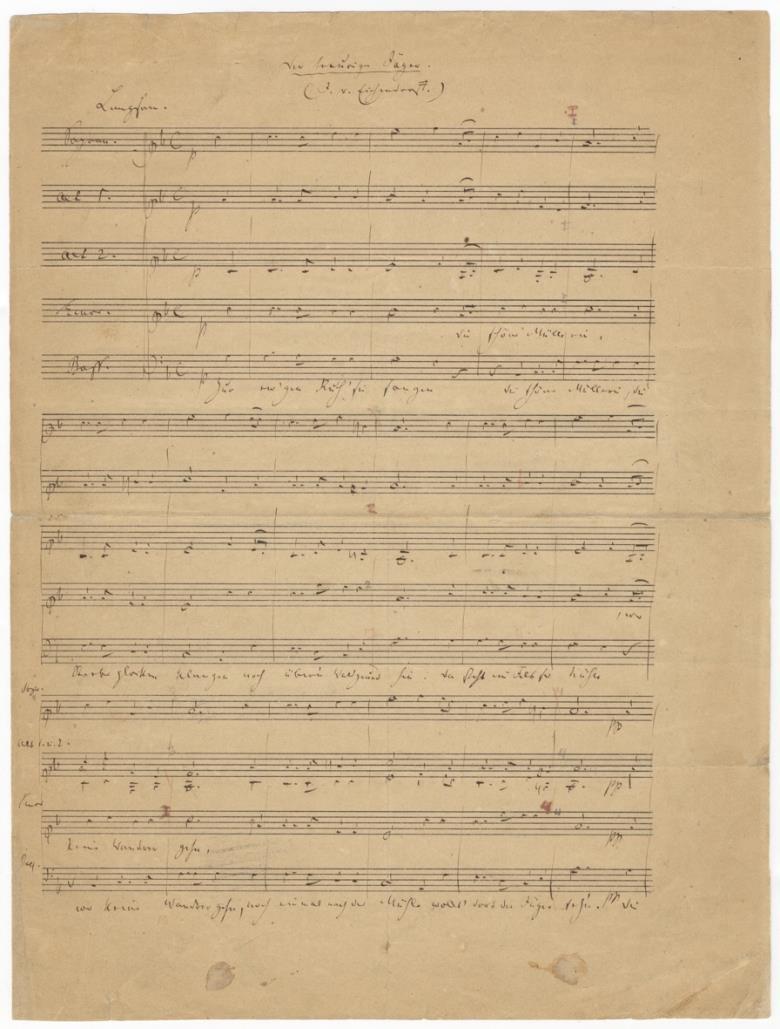
In 1849, Schumann’s most productive year, he focussed alternately on Hausmusik (character-pieces for instrumental ensemble, choral partsongs, lieder) – from which he could expect handsome financial returns –and on more imposing forms involving vocal and instrumental soloists, chorus and orchestra. Just as significant as the individuality of the genres is their interdependence in Schumann’s hands. Like his poetic cycles for keyboard, his song cycles may be viewed as constellations of lyric fragments. ...In a letter to Hiller (10 April 1849), Schumann juxtaposed the surge in his productivity with the upheavals wrought by the mid-century revolutions: ‘For some time now I’ve been very busy – it’s been my most fruitful year – it seemed as if the outer storms compelled people to turn inward’. Indeed, in 1849 alone Schumann completed nearly 40 works, many of them sizable. Nor was this creative outburst without its financial rewards; Schumann’s annual income from composing increased from 314 thalers in 1848 to 1275 thalers in 1849. He further supplemented his earnings, beginning in November 1848, by giving private instruction to Heinrich Richter. The productive phase reaching into the early part of 1850 also proved to be a period of physical and psychological well-being." John Daverio and Eric Sams in Grove Music Online
"Prominent among Schumann's works for unaccompanied mixed voices are the four volumes of Romanzen und Balladen, Opp. 67 and 75 (1849), 145 and 146 (1849-51). As their title would suggest, and like the similarly named collections of solo songs, these are short, simple settings, in German folksong style, of narrative verses." Halsey in Walker, ed.: Robert Schumann. The Man & His Music, p. 359.
"In Der traurige Jäger (The Mourning Hunter), we are moved by the ostinato passage, representing the sad hunter playing his horn calls 'while his heart is breaking.' " Fischer-Dieskau: Robert Schumann. Words and Music. The Vocal Compositions, p. 152.
Eichendorff (1788-1857) was a noted German poet. "Although his first published work was a novel, Eichendorff may be considered the German Romantic lyricist par excellence. Music plays an important part in many of his works, especially his best-known prose tale, Aus dem Leben eines Taugenichts (1826). Despite the rather limited vocabulary of his poetry and the seemingly untroubled note of calm confidence emanating from most of his bestknown works, Eichendorff is anything but the simple, predictable, pious optimist he is sometimes held to be. Among the many composers who have set his lyrics are Brahms (6 lieder, choral works), Franz (13 lieder), Mendelssohn (5 lieder, 10 partsongs, a duet), Schumann (16 lieder, 6 partsongs) and Wolf (26 lieder and 6 choruses). Even in the 20th century the calm and occasionally melancholy beauty of his verses has drawn composers as disparate as Burkhard (a choral piece), Medtner (5 lieder), Paumgartner (an opera, Aus dem Leben eines Taugenichts), Reger (2 lieder, a chorus, a duet), Schoeck (more than 40 songs, choral works and an opera, Das Schloss Dürande), Ethel Smyth (4 lieder) and Richard Strauss (a lied and a choral piece). Pfitzner’s cantata Von deutscher Seele and his 19 song settings deserve particular mention." Peter Branscombe in Grove Music Online
An exceptionally emotive song, recounting a hunter's lament at the death of a beautiful miller's wife.
Autograph musical manuscripts ofcompleteworks bySchumann are raretothemarket. (40889) $48,000
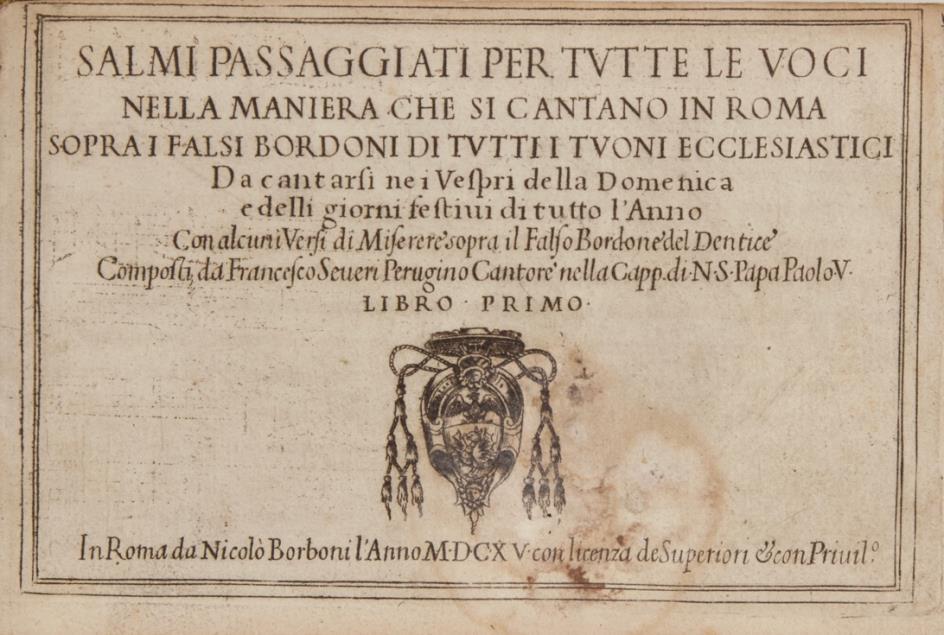
“One of the Most Valuable Documents for the Performance of Early 17th-Century Vocal Music”
29. SEVERI, Francesco ca. 1595-1630
Salmi Passaggiati per Tutte le Voci nella Maniera che si Cantano in Roma sopra i Falsi Bordoni di tutti i Tuoni Ecclesiastici da cantarsi ne i Vespri della Domenica e delli giorni festivi di tutto l'anno con alcun Versi di Miserere' sopra il Falso Bordone' del Dentice' Composta da Francesco Severi Perugino Cantore nella Capp. di N.S. Papa Paolo V. Libro Primo ... con licenza de Superiori & con Privilo.
Roma: Nicolò Bordoni, 1615.
Oblong octavo. Contemporary limp ivory vellum with blindstamped edges and spine gilt, contemporary manuscript note to upper. 1f. (recto title, verso dedication), 1f. ("Ai Lettori"), 75 (music), [i] ("Tavola") pp. Engraved. First two leaves with text within triple-ruled borders. With decorative publisher's device to title and fine decorative devices throughout. Binding worn, soiled, and stained, with small holes to outer corner of upper; gilt faded; endpapers worn and stained with minor loss, free front endpaper with small circular dampstain and resulting hole to lower blank margin. Slightly worn and soiled; some margins slightly browned and foxed; light staining to lower portion of title and following several leaves, not affecting legibility. Margins very slightly trimmed, occasionally within platemark and just touching part identification or page numbers to upper margins in several instances
Contains:
Dixit Dominus Primo tuono, p. 1; Confitebor tibi Domine Secondo tuono, p. 8; Beatus vir Terzo tuono, p. 15; Laudate pueri Quarto tuono, p. 22; Laudate Dominum omnes gentes Quinto tuono, p. 29; Magnificat Sesto tuono, p. 33; Nisi Dominus Settimo tuono, p. 41; In conuertendo ottavo tuono, p. 47; In exitu Misto tuono, p. 54; and Miserere mei Deus, p. 61
Contemporary manuscript annotations to front free endpaper Libro di Canto figurato 1660 and rear endpapers.
First Edition. BUC p. 941. Gaspari II, p. 311. Lesure p. 576. RISM S2847 (9 copies in total, only one of which is in the U.S.).
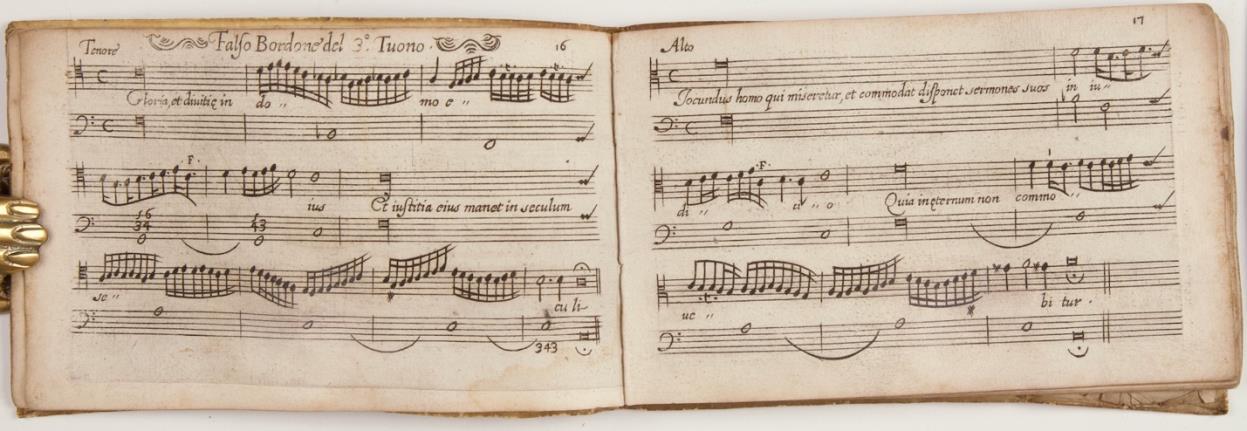
"Salmi passaggiati, Severi’s first and most important publication, is one of the most valuable documents for the performance of early 17th-century vocal music, and shows that he was a leading exponent of the florid style of ornamentation favoured in Rome at the time. It contains verset settings, mostly for solo voice and organ, of eight vesper psalms, the Magnificat and the Miserere. The voice part consists of elaborate divisions on falsobordone, which in the Miserere was composed by Fabrizio Dentice and in the other items is based on the psalm tones. Detailed instructions on performance are found in Severi’s preface, which says that such embellishments were normally improvised and that his psalms are typical of the Roman style, which was cultivated especially by the castratos of the papal choir and is echoed in the toccatas of Frescobaldi." Colin Timms in Grove Music Online (39815) $9,500
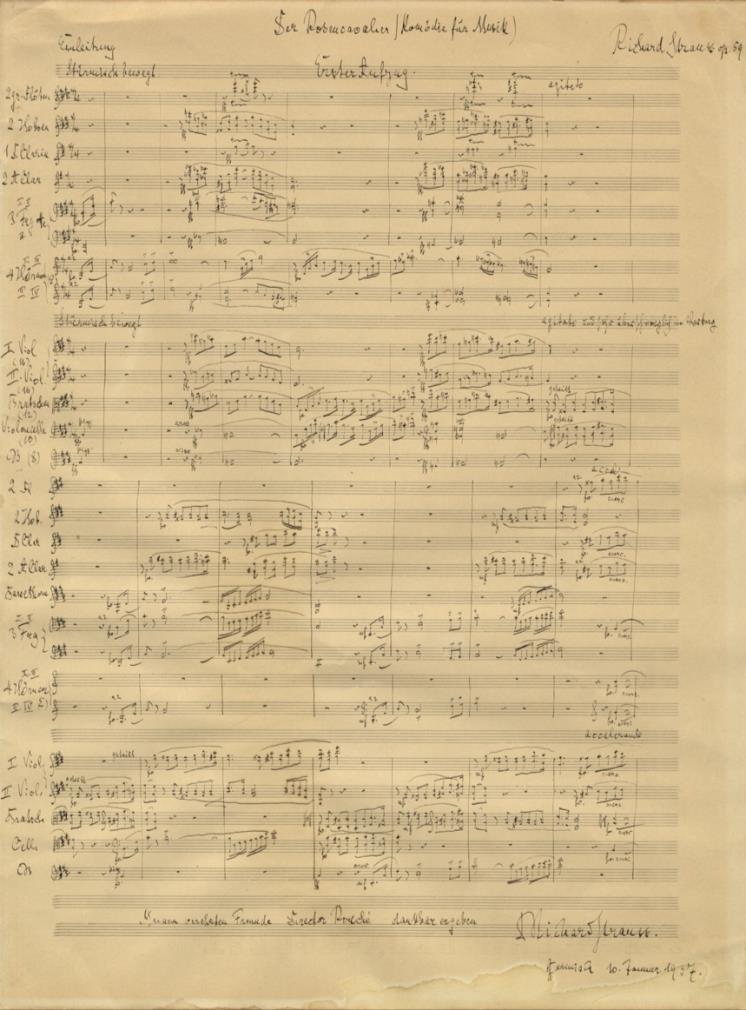
Autograph Manuscript of the Opening Measures “With this Opera, Opera Itself Reached a New Level of Endeavour"
30. STRAUSS, Richard 1864-1949
Der Rosencavalier (Komödie für Musik) ... Op. 59. Autograph musical manuscript full score. [?]1910-11.
Large folio (400 x 300 mm.). 1 page. The opening 15 measures of the first act of the opera Notated on the recto of thefirstleafofabifoliuminblackinkon32-stavepaperwith watermark "Papeteries deLeysse pres Chambrey = F." Some light browning and staining to lower margin; remnants of sewing thread to spine. In very good condition overall.
With autograph titling, signature, and annotation "Erster Aufzug. Einleitung" and "Stürmisch bewegt" to head of page and with a dedicatory inscription to the director of the Paris Opéra and Opéra Comique, Jacques Rouché (1862-1957) to foot, signed and dated Garmisch, 10 January 1937
Mueller von Asow I, 467. Trenner 227.
Der Rosenkavalier, a comic opera in three acts to a libretto by Hugo von Hofmannsthal, was first performed on 26 January 1911 in Dresden at the Königliches Opernhaus with great success, quickly entering the international repertory.
"The music glories in Hofmannsthal’s text, which satisfied Strauss like nothing before. It was cheerful and knowing, fluent and down-to-earth, and yet made room for sumptuous effects and some elevated intensity. His ‘symphonic’ facility got full scope, but also his modern penchant for inserting chamber-scale music amid his opulent orchestral tapestries. In all previous operas (at least since Monteverdi’s time), if there was dialogue with the quick cut-and-thrust of sophisticated conversation it was set as recitative, or else in formal ensembles; but such conversations make the very texture of Der Rosenkavalier, and here Strauss outdoes Wagner with dramatic music in which distinctions between recitative, arioso and formal set pieces are continuously blurred. Unaccompanied lines may have as much lyrical force – and even as much weight in the musical argument – as the big tunes, and Strauss tacks mercurially between those modes. Again and again he invests the uttered words with the poignant sense of their unspoken sub-text, and in unstinting sympathy with each of Hofmannsthal’s characters. With this opera, Opera itself reached a new level of endeavour." David Murray in Grove Music Online. (39280)
Autograph from Tannhäuser
Inscribed to British Concert Manager and Critic, John Ella
31. WAGNER, Richard 1813-1883
Autograph musical quotation signed from the "Pilgrims' Chorus" from Act III, scene I of the composer's opera, Tannhäuser, 1846.
Oblong octavo (101 x 160 mm. ). The first 8 measures. Notated in black ink on four staves, the four vocal parts incorporated into one stave. Inscribed below the quote Gesang der Pilger aus Tannhäuser, und der Sängerkrieg auf Wartburg ... von Richard Wagner. With the date Janu. 3d, 1846 in the hand of the British concert manager and critic John Ella (1802-1888) at lower left, presumably the day on which Wagner both penned the quotation and presented it to Ella.
Together with:
An original 19th century photograph of Wagner, 82 x 53 mm. The composer is depicted half-length, turned left, with his right hand extending into jacket pocket.
Together with:
$28,500
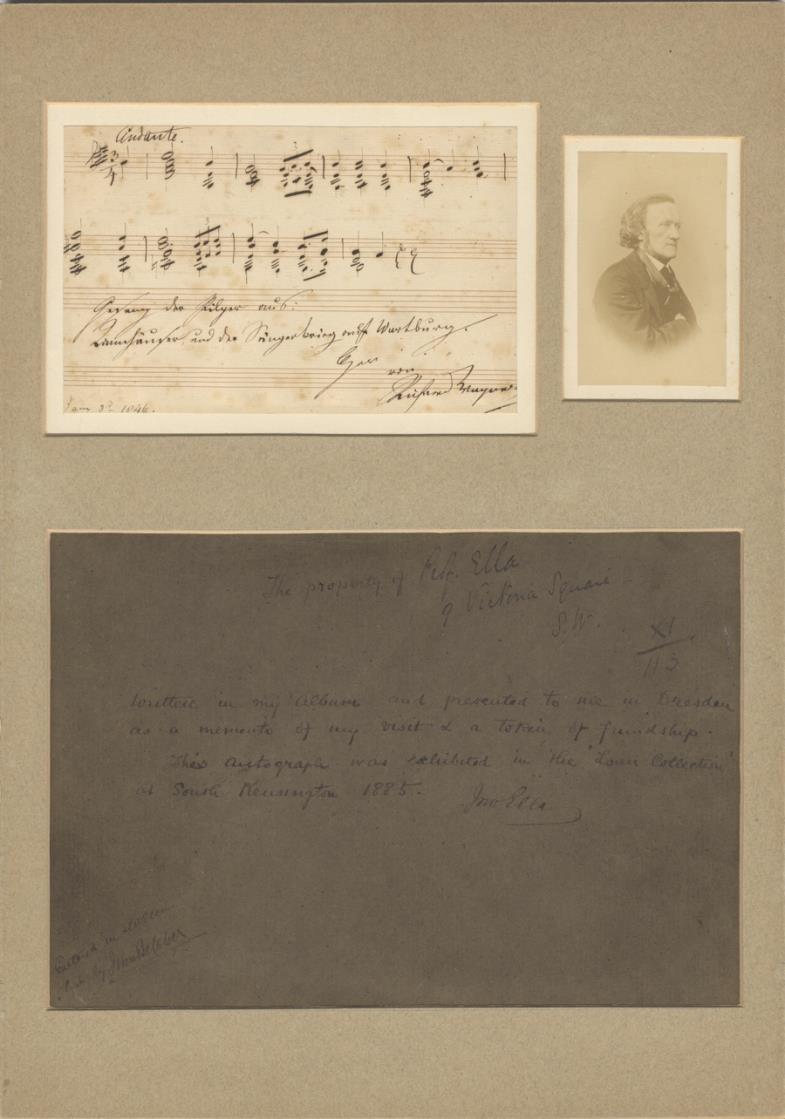
A 1-page (167 x 245 mm.) autograph statementinElla'shandrelatinghow he acquired the present autograph: The property of Prof. Ella, 9 Victoria Square S.W, XI/113. Written in my Album and presented to me in Dresden as a memento of my visit & a token of friendship. This Autograph was exhibited in the 'Loan Collection' at South Kensington 1885 Jno Ella. Entered in collection list by John Belcher.
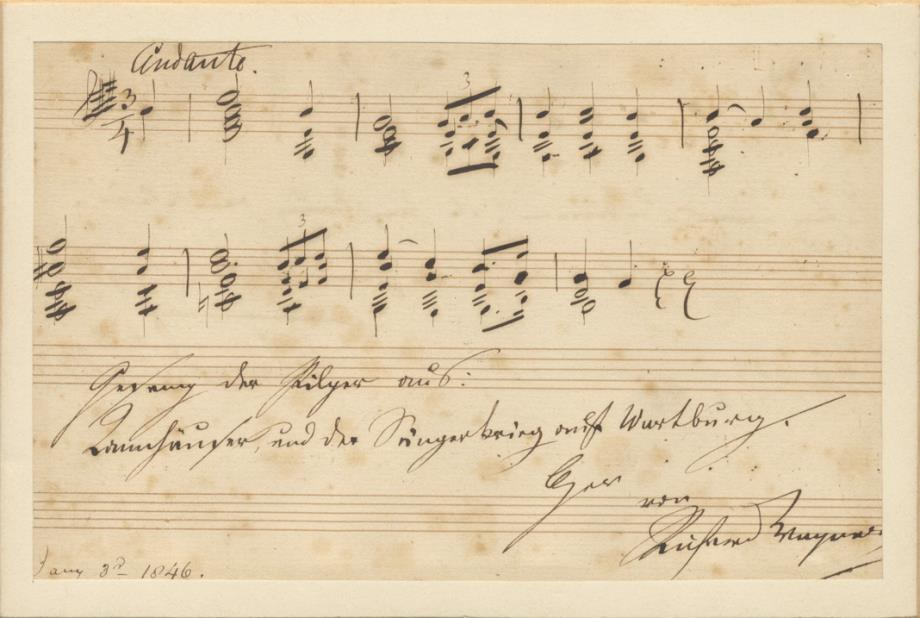
The three items laid down onto a triple-windowed mat, 360 x 278 mm. Minor foxing to Wagner autograph; photograph slightly faded. The ensemble in very good condition overall.
Tannhäuser, a grand opera in three acts to a libretto by the composer, was first performed in Dresden at the Hoftheater on 19 October 1845.
"Wagner’s text is a conflation of two separate medieval legends: those concerning Tannhäuser, believed originally to have been a crusading knight from Franconia, and the song contest on the Wartburg – drawing on a number of 19th-century versions, notably those of Ludwig Tieck, E. T. A. Hoffmann, Heinrich Heine, Friedrich de la Motte Fouqué and Joseph Eichendorff. The anachronistic linking of the two legends was originally made by Ludwig Bechstein, in Der Sagenschatz und die Sagenkreise des Thüringerlandes of 1835–8 (see Spencer 1976), and reinforced by a contemporary scholar, C. T. L. Lucas. ...
The uncomprehending response of the audience at the first performance on 19 October 1845 was largely due to the inability of Joseph Tichatschek, the singer of the leading role, to grasp the principle of melos towards which Wagner was progressing. His abnormal vocal demands also took their toll on Wilhelmine Schröder-Devrient (Venus), his niece Johanna Wagner (Elisabeth) and Anton Mitterwuizer (Wolfram). However, by the mid-1850s the work had established itself in the repertory of more than 40 German opera houses. An invitation from Emperor Napoleon III to stage Tannhäuser in Paris led to one of the most celebrated débâcles in the annals of operatic history ...
Tannhäuser, with its frequently abrupt contrasts and rudimentary motivic integration, falls well short of the mature Wagnerian music drama. Yet it marks a considerable advance over Der fliegende Holländer in the deployment of the orchestra, continues Wagner’s preoccupation with the dramatic conception or ‘poetic intent’, and shows some awareness of what he later referred to as ‘the beautiful, convincing necessity of transition’."
Barry Millington in Grove Music Online
"Tannhäuser is based on two German legends: ‘Tannhäuser’, the mythologized medieval German Minnesänger and poet, and the tale of the ‘Wartburg Song Contest’. The story centers on the struggle between sacred and profane love, and redemption through love, a theme running through much of Wagner's mature work. One of the most famous parts from the opera is the 'Pilgrim's Chorus'. The theme of this chorus is already present in the overture of the opera and concludes this mighty stage work with the same music in the form of a majestic hymn, which glorifies the victory of pure love over sinful passion." Baton Music Online
"Throughout his career Ella made regular trips to Europe, where he forged important contacts with foreign musicians. Thalberg, Meyerbeer and Berlioz were among his friends. ... John Ella contributed meaningfully to musical life in London during the 19th century and promoted many musicians and singers who are still regarded today as preeminent among their contemporaries. His published writings include Musical Sketches, Abroad and at Home (London, 1869, 3/1878) and Lectures on Dramatic Music and Musical Education (London, 1872)." Christina Bashford in Grove Music Online (39462) $17,500
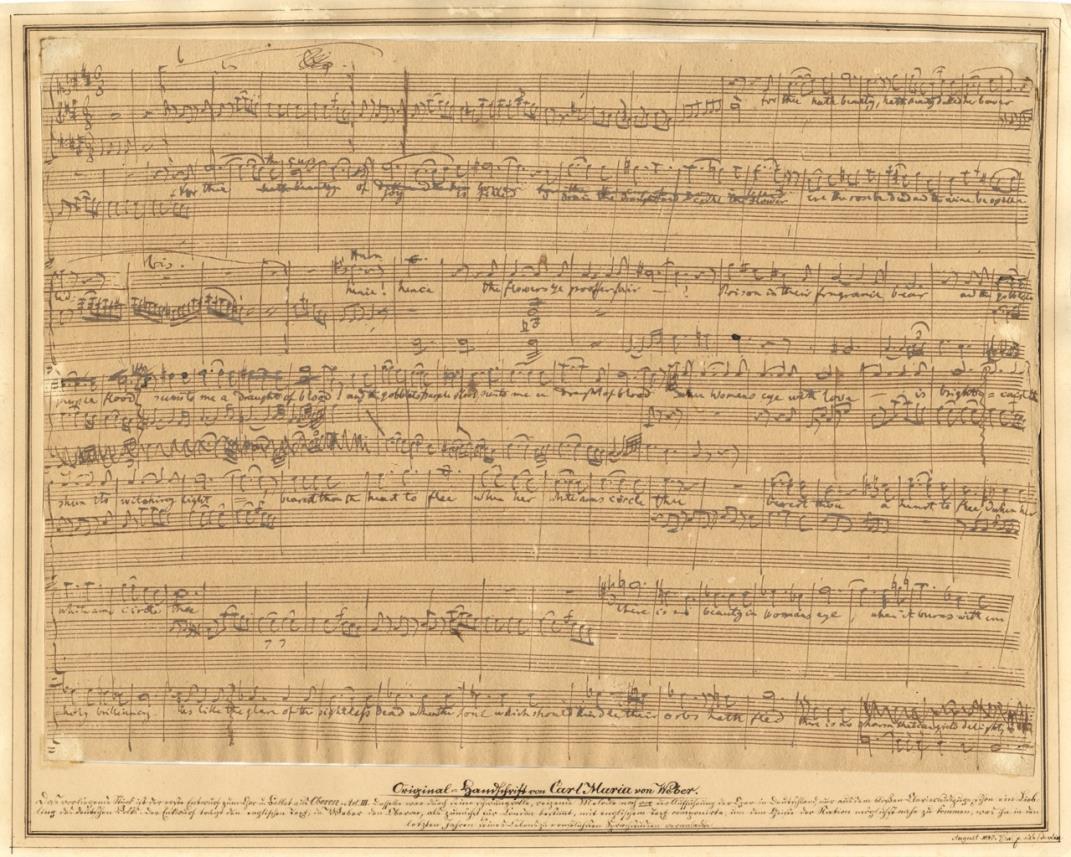
“Some ... Delightful Music from this “Seminal Figure of the 19th Century”
32. WEBER, Carl Maria von 1786-1826
Oberon. Autograph musical manuscript working score of the complete chorus and ballet, number 21 from the third act of the opera. Ca. 1826.
Oblong folio (236 x 322 mm.). 2 pp. 206 measures of music notated on 20 hand-ruled staves in dark brown ink on both sides of a single leaf. Mostly on 3-stave braces, but also on 2- and 4-stave braces. Browned, but on good quality laid paper and in very good condition overall. Attached at corners to thin window mat, at the foot of which is an inscription in an unknown 19th century hand in German identifying the manuscript as follows (in translation) Original manuscript by Carl Maria von Weber. The present piece is the first draft of the chorus and ballet from the third act of Oberon. Thanks to its bouncy, exquisite melody, it became a favorite of the German people even before the opera's first performance, based solely on the piano-vocal score. The draft has English text because Weber composed Oberon, which was destined for London, with English text to get as close as possible to the spirit of the nation. This prompted him to a most serious study of the language in his final years. August 1847 [Signed with Initials] [? Etw] ... Berlin
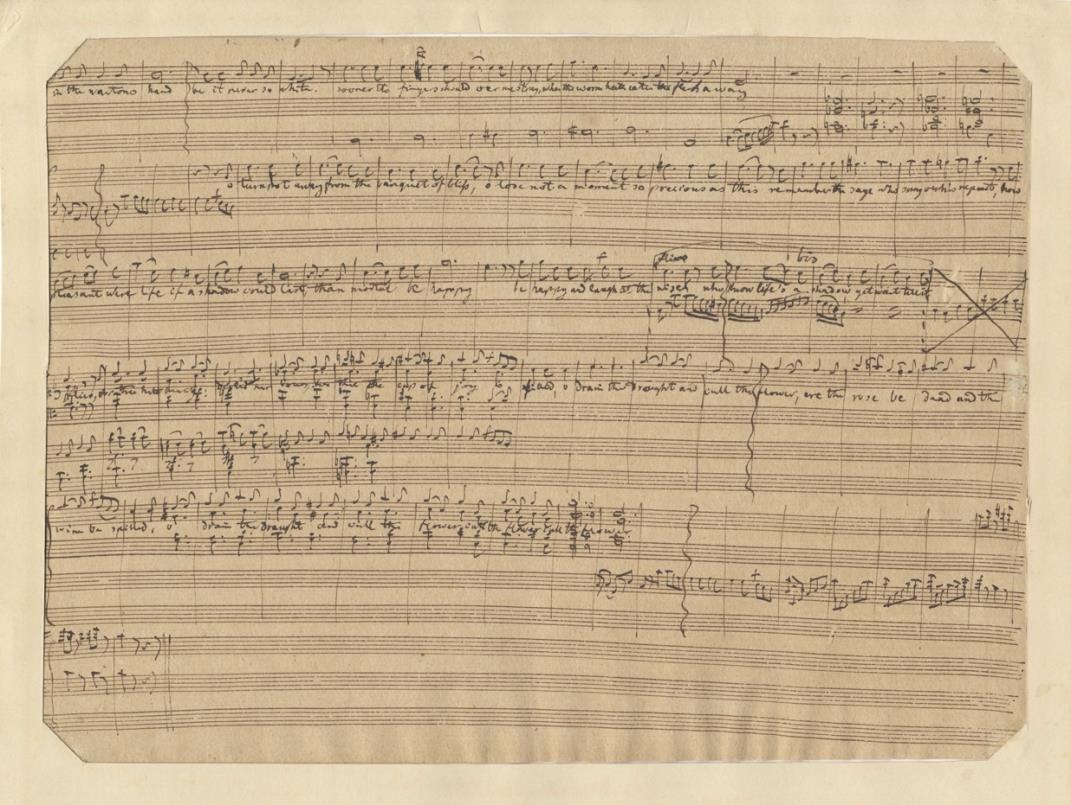
With numerous corrections, deletions, and corrections; 2 entire measures canceled.
For an account of various manuscript sources of Oberon, see Jähns 306, p. 391.
Oberon, to a libretto by James Robinson Planché after Christoph Martin Wieland's eponymous poem, was first performed in London at Covent Garden on 12 April 1826. "The première ... was a great success, with lavish settings and spectacular scenic effects that impressed even Weber, and the opera remained popular throughout the season. ... It contains some of Weber’s most delightful music, which has assured the work a permanent, if peripheral, place in the repertory. ... The brilliant overture opens atmospherically with Oberon’s horn-call, which acts as a motif throughout the work.
With the overwhelming success of his opera Der Freischütz in 1821 [Weber] became the leading exponent of German opera in the 1820s and an international celebrity. A seminal figure of the 19th century, he influenced composers as diverse as Marschner, Mendelssohn, Wagner, Meyerbeer, Berlioz, and Liszt." Paul Corneilson, Clive Brown, et al. in Grove Music Online (39278)
$38,000