
OpinionTheJewish Special Edition Post& Presenting a broad spectrum of Jewish News and Opinions since 1935. Volume 90, Number 1 • September 16, 2023 • 1 Tishrei 5784 www.jewishpostopinion.com • https://go.usa.gov/xn7ay Cover art by Karin Foreman (see About the Cover,p.2) Comfort for the Bereaved
Grief and Mourning in the SeasonHoliday
The Jewish month of Elul ushers in some of our most meaningful and memory filled holidays.The festivals of Rosh Hashanah and Yom Kippur ,followed quickly by Sukkot,are often tied to memories of smells,tastes,sounds,and familiar prayers that can make us smile but can also bring pain and sadness when grieving the loss of a loved one.
“Mourning”is the term for the process one goes through in adapting to a death, while “grief”and “bereavement”are words used to explain our personal experience of this loss.Terminology aside,it can be hard to enjoy the rituals and traditions the holidays invoke while grieving.
Both Judaism and secular knowledge can help us to get through these often bittersweet weeks. The recitation of Kaddish and the Yizkor service itself can precipitate tears as we recall the people we often celebrated with who are no longer here.We also light candles while reciting blessings,tasks whose multi-sensual steps emphasize the importance of the lost relationship but can
also be cathartic.
In the wider world therapist Elizabeth Kubler-Ross created a framework for grieving.Decades ago,she wrote “On Death and Dying,”teaching that everyone grieves by experiencing Denial,Anger, Bargaining,Depression,and finally, Acceptance.More recently experts posit that most people do not proceed linearly through these stages but rather flow back and forth with these emotions in processing grief.
Today we understand that mourning helps us accept the reality of the loss, endure that pain,and adjust to a world without the deceased while experiencing a multitude of emotions.This newer conceptualization also recognizes those with complicated grief in which the one who died may have caused pain or ambivalence,for example when abuse, absence,or emotional distance were part of the relationship.
Judaism naturally incorporates ways to contemplate and experience grief.Our traditions naturally prompt the recollections so important for keeping a person’s memory alive and sharing these recollections with others. Or we can use those memories as a basis for creating our own new rituals,for example passing around photos of the beloved relative or friend, singing a favorite song or prayer,or using a precious
L’Shana Tova!
object or recipe to keep us connected.
We can also heal by using our senses in other ways.Exercise,massage,counseling, practicing a new or favored craft,volunteering,time alone or time with beloved friends,neighbors and relatives can ease the pain of loss at this time of year.
There is no one “right”way to grieve just like there is no one “perfect”relationship. Creating a new life which incorporates memories of those we miss takes time.We can derive hope and strength from our community,professionals,and from being patient with ourselves.
Jennifer Berday is a licensed clinical social worker who works primarily with seniors and their families in their own homes. She can be reached at jberday@gmail.com.
jAbout the Cover
Rosh Hashanah
 By Karin Foreman
“R osh Hashanah”is a Mixed Media piece and was crafted by using acrylic paint and textured paper.The white outlines were created in Illustrator.
The Jewish New Year marks the beginning of a 10-day long period of planning to better one’s life through self-examination, reflection, prayer and repentance.This journey is represented by ten swirly elements that resemble pathways.
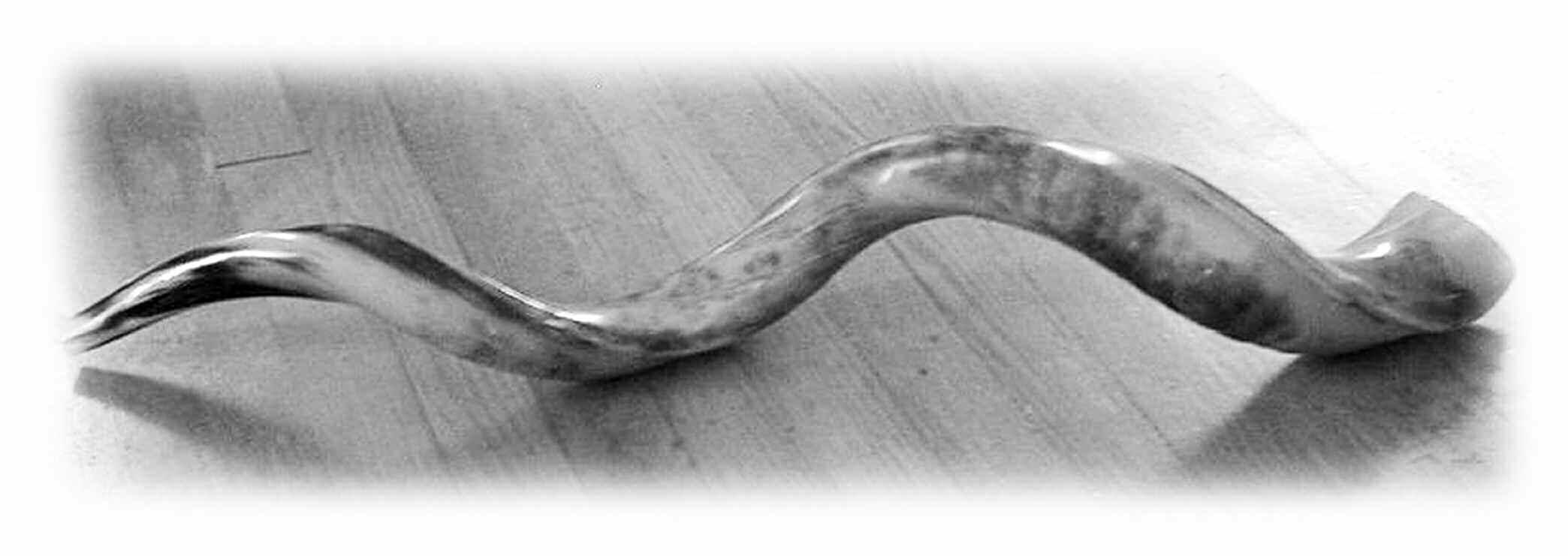
The artwork includes some traditional elements associated with the holiday.One is the shofar (ram’s horn),which is to be sounded on this day.The other is the pomegranate.It is customarily consumed and represents fruitfulness,knowledge, learning and wisdom as well as symbolizing righteousness.
One ritual of this holiday is Tashlich – the symbolic casting off of sins by throwing bread crumbs into a natural body of flowing water like a lake or sea.This body of water is represented in this piece with the blue oval. The circle stands for the round challah to be eaten for a sweet New Year.
Karin creates artwork, graphic designs, and award-winning inspirational nature photography.Foreman has won The Exposure Award and is featured inThe Nature Collection. Her photography was honored at a private reception at the Louvre Museum in 2015.Her work was also featured at 4 Times Square in New York (2016) and was displayed in August 2017 at the Amsterdam International Art Fair held at the Beurs van Berlage.See much more of her beautiful art on her website at www.karinforeman.com.She can be reached by email at karin_foreman@yahoo.com.
(Previously published Aug. 30, 2017.)
2 The Jewish Post & Opinion – NAT September 16, 2023
✡ ✡
✡ ✡
iK. Foreman
B Y J ENNIFER B ERDAY,MSW,LCSW
At first glance,this edition looks like it is only for those mourning the death of a close friend or relative,but at some time in everyone’s life,one experiences the grieving of a loss,to some degree.It could be the loss of a job or a house that one was hoping to keep,or it could be the end of a relationship,marriage,or business partnership.It could be loss of good health,having to move away from the neighborhood one loved or becoming an empty nester – a parent whose children have grown up and left home.
It can be challenging to cope when a person has gotten used to living a certain way and that changes.So some of these words by rabbis,counselors,and social workers in this special edition are here to help you when you are adjusting to your new situation.
Over the summer,I listened to a podcast by Anderson Cooper titled, All There Is.It is approximately eight 30 minute sessions where he interviews people who have experienced the passing of close family members and how they coped. For the last couple of them he had asked the listeners to call and leave a message of how they coped with their loss so that he could share those,which he did in the last podcast.After listening to all of those good heartfelt messages,I realized that in none of these four hours of the podcasts was there any mention of the Jewish mourning rituals which have helped people cope going back thousands of years.
About 30 years ago I did a essay on the Jewish mourning rituals for a class (see excerpt p.20).At the time I showed this to a Christian friend who had been a classmate in the fourth grade.She had lost her older brother and sister in a car accident back then.They were ages 13 and 17.She said she wished she had known about these at that time because no adults – parents,teachers or ministers – were able to help her process the loss and so she repressed it until she was in premarital counseling at age 32.For the first time,the tears that should have come back then started flowing.
I wanted to do this special edition on Comfort for the Bereaved so that Jews and others who are not aware of these rituals could learn about and benefit from them.
In 1993,when I interviewed Rabbi Amy Eilberg on the subject of Jewish Hospice (see an excerpt of that on page 17),one of the questions I asked her was “Does Judaism have anything like the last rites in Catholicism?”
Part of her answer was this: “We do have a final confessional prayer called the Vidui,which is essentially a prayer for
forgiveness including the recitation of the Shema.This ritual is not as dogmatically held nor as universally known about as the last rites,but it is the Jewish way of easing the transition.It is preferably said by the dying person but can be said on behalf of the dying person if that person is no longer able to speak.I,often where possible,will gather the family around and recite it together and it becomes a family ritual of farewell.”
While preparing for this edition,I received an email from The Blue Dove Foundation (thebluedovefoundation.org) about the Vidui said during the High Holidays.The foundation was created to address mental illness and addiction in the Jewish community and beyond.They work with organizations and communities both Jewish and interfaith across the country and around the world.Below in italics is what they wrote about this Vidui prayer.
During the High Holidays, we reflect on ourselves and the year we’ve had. In doing so, we often analyze our actions and behavior, which can result in a labeling of who we are as people. For example, if someone gave a lot of charity, they might call themselves a “kind” person. If someone volunteered a great deal, they might say they are a “giving” person. Or, if someone just helped a friend out, they might call themselves a “thoughtful” person. But not everyone is lucky enough to have such a positive reflective experience. For many people suffering from mental illness, their experience with themselves can be overwhelmingly negative, leading them to define themselves in less positive terms such as “selfish,” “arrogant,” “self-involved,” etc. Or, they might define themselves by their illness: “I’m depressed,” “I’m suicidal.”
This kind of self-flagellation can most easily come to a head in the recitation of the Vidui prayer, said most often during the High Holidays. Vidui is a confessional prayer consisting of a list of misdeeds that we confess to doing, even if we don’t remember committing those sins ourselves. The prayer ’s formulation highlights the idea that we aren’t always aware of our misdeeds, and this prayer is a catch-all for any misdeeds we may have done unwittingly. But, while people can recognize that they aren’t truly guilty of all of these sins, reciting the Vidui has the potential to exacerbate feelings of low self-worth and self-hatred in someone who is already suffering from those feelings.
Rabbi Abraham Isaac Kook, the first Ashkenazi chief rabbi of the modern land of Israel, wrote that during the High Holidays, it is just as important to recall our good deeds and mitzvot as it is to recall our sins and misdeeds. To that end, there have been a plethora of new Vidui-style prayers written in the last few decades listing good deeds and mitzvot. One such prayer was written by
September 16, 2023 The Jewish Post & Opinion – NAT 3
Editorial Inside this Issue 1389 W 86th St.#160 Indianapolis,IN 46260 email: jpostopinion@gmail.com website: www.jewishpostopinion.com publisher & editor: Jennie Cohen graphic designer: Charlie Bunes OpinionPost& TheJewish Jewish News and Opinion since 1935. Jennifer Berday: Grief and Mourning in the Holiday Season .........................2 About the Cover ......................................2 Jennie Cohen: (Editorial) 3 Rabbi Irwin Wiener: (Wiener’s Wisdom) Healing From Loss 4 Amy Lederman: (Jewish Educator) Grief 4 Rabbi Rebecca Schorr: Finding Strength in Difficult Times .................5 Rabbi Nancy Flam: Prayer for Patient Who Has Died .........................6 Rabbi Steven Z. Leder: From Curses to Blessings 7 Ethical Wills 7 Rabbi Norman Koch, z”l: The Gifts of Death 8 Etz Chaim: Visiting HHDRabbi 8 Arnie Goldberg: Coping with the Loss of a Family Pet......................9 Miriam Zimmerman: (Holocaust Educator) Unique Ways to Heal After the Holocaust 10 Rabbi Shea Hecht: Comforting the Grieving 11 Jennie Cohen: Bereavement Support 13 Rabbi David Wolpe A Prayer for Caregivers & More .....13 Advice for a Shiva Call ......................13 Rabbi Leon Olenick: (Jewish Chaplain) Hallelujah 14 Hooverwood Living: Hospice and Grief and Bereavement.....................16 Rabbi Amy Eilberg: (The Interview) Jewish Hospice 17 Rabbi Roy A. Walter: Yizkor – Enduring Love .....................18 Eileen Levinson: A Yizkor For Miscarriage 18 Bereavement Support Group 19 Jennie Cohen: About the Mourner’s Kaddish 20 Mourner’s Kaddish 21 The 23rd Psalm of David 21 Rabbi Wayne Dosick: Kavannah Before Kaddish ..................22 Jennie Cohen: Yikzor on Shemini Atzeret 22 (see Editorial, page 5) Follow us on Facebook at: Jewish Post & Opinion, newspaper
Wiener’s Wisdom
BY RABBI IRWIN WIENER,D.D.
Healing From Loss
Here we are again saying goodbye to yesterday.How do we do justice to memories? Someone we love has died.It is such a stark realization.No more smiles or laughter.No more touching or caressing. There is so much of no more.Now,however,is not the time to think about all that was missed.Now is the time for memory to replace existence.Now is the time for healing to begin so that the remembrances of our loved ones have meaning. That is how we do justice to memories.
We also remember because the quest for immortality will be realized.The soul that was breathed into our beloved has been returned and our part in the process of eternal reward can be found in our thoughts and actions.
The people we remember today do not have tomorrows,but they are always with us. We are their tomorrows.But what happens when we are gone – who will continue to remember? The angels will continue to sing their names and God will always remember.The candles that we light year after year will remain burned in the stars that shine forever.That is God’s promise of eternity for all of us.
Think of mothers and fathers and children who left us too soon or suffered too much.Think of them knowing that our thoughts can bring them back even for a fleeting moment.It is okay to cry and even smile as we remember.
Today,at this time,we concentrate on the memories of all who were dear to us and who no longer journey the path of life with us.Their memories should remind us that time is precious.And we should share every moment with someone we care
Rabbi Mendel and Fraidel
Schusterman and family of the Indiana Jewish Discover Center
wish you a Happy and Healthy Shana Tova!
Email:
rabbi@INjewishdiscovery.org
Website:
injewishdiscovery.org
Jewish Educator
BY AMY HIRSHBERG LEDERMAN
Grief
My husband Ray died on June 15, 2015, exactly 3 years, 7 months and 6 days after he was diagnosed with lung cancer. Since that hot Tucson day in June, I have traveled up both coasts and through alternating worlds of numbness and unrelenting emotion. This is a piece I wrote while at the gym about seven months after Ray died. It came to me as a quasi-revelation, the ideas fully formed as if the words had already been written. I jumped off the treadmill and grabbed my cell phone to record it before the words faded from the page imprinted upon my mind.
There is a certain need to examine this thing called grief – something between curiosity and compulsion.I take it out and hold it in my hands, like a trinket. I turn it over,rub my fingers along its sharp contours,knowing that inside,it is as nebulous as shadows at dusk.Perhaps,I think, if I look at it closely and long enough, I will gain some understanding of its sub-
about or who needs us to lend a helping hand. Then we will truly do honor to the memories that are part of our feelings –right now – right here – at this solemn time we dedicate to remembering.
And if I go while you are still here –know that I live on, vibrating still to a different measure behind a thin veil you cannot see through.
You will not see me, so you must have faith.
I wait the time when we can soar together again, both aware of each other.
Until then, live your lives to the fullest. And when you need me, just whisper my name in your heart – I will be there.
Let us now whisper the names of those we miss and know that they are always with us.
Rabbi Irwin Wiener, D.D. is spiritual leader of the Sun Lakes Jewish Congregation near Phoenix, Ariz. He welcomes comments at ravyitz@cox.net. He is the author of two books: Living with Faith, and a modern and contemporary interpretation of the Passover Haggadah titled, Why is This Night Different? (This column was published in the JPO Healing Edition, June 24, 2009.) ✡ ✡
stance and be able to conquer it over time.
It is uncomfortable to examine grief in this way,as if I am a voyeur looking at the mangled car and distraught bodies of an accident I witnessed.But not looking at it doesn’t feel right either,as if somehow,in not looking,I do dishonor to my husband. And so I concede that I am drawn to my grief as a way of being in relationship with the man I loved.But it is not the only way to remain close and I am grateful to know this as well.
I find great comfort in writing.My journal naturally takes the form of letters to Ray which I write before I go to sleep.It replaces what I miss: the whispered sharing of daily events as we lay in bed together,the give and take of dealing with life and its complexities.So I vent,wonder and question – with pen and paper – and the process provides me with a form and structure to help me during one of the most difficult times of day – bedtime.
At first,my need to write to Ray feels almost religious,like a ritual I shouldn’t change. I want and need to honor him,to connect to “us”in a specific way.But over time, I find that I am writing less and only do so when I have something I want to remember – like a dream I had or a bit of wisdom that has helped me.As time passes, I become aware that I have internalized our relationship; the external giving way to the internal because he is a part of me now.
I saw a baby in a stroller at a restaurant a few weeks ago.The baby was about six months old.I studied her beautiful face, realizing that she did not yet have words to describe her world or reality.I watched her curious eyes as she looked at her surroundings: the people walking by,the waitress asking for an order,the plates of food being set on the table.She took in so many images without seeming to mind and yet, I knew that her ability to understand what was happening was limited.
My grief is only seven months old and like a baby, I don’t have the words or ability yet to fully navigate or understand the world around me. But with each passing month,I can see that I am acquiring new skills to survive in a landscape that has been forever altered by my loss.
A friend, who lost her husband years ago,wrote a card to me after Ray died.The words,which helped her in her grief,gave me perspective and a sense of optimism.
“There will always be a big hole in your life but at some point, you will stop falling into it.”
I know I am not falling anymore.I am slowing inching my way through my grief, peering into the hole but no longer finding myself at the bottom of the pit. Deep down I know that it is essential to examine my grief in order to accept it.And in doing so, I am certain that both grief (see Lederman, page 5)
4 The Jewish Post & Opinion – NAT September 16, 2023
j i
Finding Strength In Difficult Times
 BY RABBI REBECCA EINSTEIN SCHORR
“If you and Daddy get dead and I am still a children,who will be my Mommy and Daddy?”
Benjamin’s question brought our dinnertime conversation to a momentary standstill.He wasn’t really inferring that we, his parents,are replaceable.Rather,he was asking,“Who will take care of me if you aren’t here to do it?”
Children are often able to verbalize the fears that we as adults find difficult to express.Their innocence and candor permit a freedom that is lacking once we enter adulthood.The topic of death is a very adult topic,but the fears of abandonment and loneliness are ageless.
When our loved ones die,we experience loneliness,and the sense of abandonment can be palpable. We learn of the psalmist’s anguish in Psalm 22:
My God, my God, why have You abandoned me; why so far from delivering me and from my anguished roaring? My God, I cry by
(see Schorr,page 6)
EDITORIAL
(continued from page 3)
Rabbi Avi Weiss, founder of the Hebrew Institute of Riverdale, Yeshivat Chovevei Torah and Yeshivat Maharat.
We need to be mindful of the complexity of human life and its ups and downs, and that we are far more than any one label, misdeed or illness. Just as the Vidui serves as a catchall for misdeeds we might have done that we might not even have been aware of, we should recognize there are plenty of good deeds we performed as well without realizing it.
In Jennifer Berday’s article on page 2 she writes about the feelings or stages that people grieving the loss of a close friend or family member tend to go through –denial,anger,bargaining,depression,and finally,acceptance.When I read this Good Deeds Vidui prayer (see image right),I thought it would be beneficial for almost anyone at any time to recall the positive actions they have taken,but for the person who is grieving a loss at this time of year, this is the perfect antidote for the sad feelings they are experiencing.
We wish our dear readers a Shana Tova U’metukah,a New Year 5784 filled with good health, happiness,prosperity,learning, and growth.

Jennie Cohen, September 16, 2023
LEDERMAN
(continued from page 4)
and I will change.
Amy Hirshberg Lederman is an author, Jewish educator, public speaker, attorney, and award-winning writer. Visit her website at amyhirshberglederman.com. (Published in JPO, March 23. 2016.)

September 16, 2023 The Jewish Post & Opinion – NAT 5
✡ ✡
j i
✡
✡
Prayer for Patient Who Has Died
BY RABBI NANCY FLAM
A donai natan, va’Adonai lakach, yehi Shem Adonai mevorach. The Lord has given,the Lord has taken away. Blessed be the name of the Lord.May it be your will,O God,to grant eternal rest and peace to the soul of ________.Grant that his/her passing to the world to come be gentle and full of love.Although I knew ________ for only a short time,I truly cared for him/her.My heart grieves for his/her passing.Be with those friends and family who need strength in this hour of their sadness.And give me the strength to continue my work of compassion and goodness toward other people under my care.Help me to grow in wisdom and judgment.And let me remember to be humble amidst the holy moment of life and death.Amen.
Rabbi Nancy Flam helped to found the Institute for Jewish Spirituality (www.jewish spirituality.org) and was their first Executive Director. She served for many years as a Senior Program Director, teaching and overseeing the innovative Prayer Project. She also co-founded the National Center for Jewish Healing and directed the Jewish Community Healing Program of
(see Flam,page 9)
SCHORR
j(continued from page 5)
iday – You answer not; by night, and there is no respite. (Ps.22:2–3)
In our darkest moments,it is so very natural to feel distanced from God. It can truly feel as though God has betrayed us, and that very distance acts as proof of God’s rejection.How then can we find our way back?
When I am desolate and afraid,I turn to the Psalms. I hear in them a keening not unlike my own.And then I hear the hope. The trust in God’s Presence.The reconciliation between the psalmist and God.
I put my hope in the Eternal; God inclined toward me and heeded my cry. God lifted me out of the miry pit…and set my feet on a rock, steadied my legs. (Ps.40:2–3)
Our Tradition gives voice to our full range of emotions. How blessed we are to have such a legacy from which we can garner strength!
Rabbi Rebecca Einstein Schorr was serving Congregation B’nai Tzedek, in Fountain Valley, Calif., when this article was published Jan. 18, 2006. On Twitter: @RebeccaSchorr

6 The Jewish Post & Opinion – NAT September 16, 2023
✡ ✡
From Curses to Blessings
BY RABBI STEVEN Z.LEDER
Atrue story; a miracle witnessed by a clerk in a cemetery office
Every week,for several years,the mild, little man received an envelope from a woman he did not know.The envelope always included a money order and note instructing him to put fresh flowers on her son’s grave.Then one day he met her face to face.A car drove up to the cemetery gates and a chauffeur came into the clerk’s office to speak to him.
“The lady outside is too ill to walk,” he explained. “Would you mind coming with me to speak with her?”
The shy clerk walked over and looked into the car where a frail,elderly woman with sad eyes sat in the back seat.A great bundle of flowers was in her arms.
“I am Mrs. Adams. Every week for years I’ve been sending you a money order.”
“For the flowers!” the clerk exclaimed. “I’ve never failed to place them on your son’s grave.”
“I came here today myself because the doctors have told me I have only a few weeks left. I’m not sorry really. I have nothing left to live for. But before I die I wanted to take one last look at my son’s grave and to put the flowers there myself.”
“You know ma’am. I was always sorry you kept sending the money for the flowers.”
“Sorry?”
“Yes – because the flowers last such a short time, and no one ever gets to see them or smell them. You know there are thousands of people in hospitals and nursing homes that love flowers, and they can see them and smell them. But there isn’t anybody in that grave. Not really.”
The old woman did not answer.She sat for a while and left without a word.
The clerk was afraid he had offended her.But a few months later he was surprised with another visit. But this time there was no chauffeur.The woman sat at the wheel, driving herself.
“I take the flowers to the people myself,” she said to the clerk with a smile. “You were right, it does make them happy. And it makes me happy. The doctors don’t understand what’s making me well. But I do.”
Tragedy and sorrow come to us all – it’s part of what it means to be human and alive.So if we have one miracle to make our own, one strength – let it be the strength to turn curses into blessings,to learn joy from sadness,and life from death.Let it be the strength of an old woman and her flowers calling out in the face of what it means to be human and proclaiming in
Ethical Wills
So Your Values Live On
BY RABBI STEVEN Z.LEDER
Below in italics is an Ethical Will I created for my children.While ordinary wills tell our loved ones what to do with our material possessions,an ethical will teaches our values that we hope will live on.More about ethical wills or leaving a spiritual legacy can be found in books such as, So That Your Values Live On by Jack Reimer and Professor Nathaniel Stampfer.Also,one can find different examples of ethical wills – some going back hundreds of years – on the internet. These are valuable for the insight they give us into the cultural and social life of the individual Jew of a particular land at some specific time.Unlike a legal will in which one allocates one’s accumulated material possessions,for the ethical will –a spiritual legacy – a person must think about what one has learned from years of
spite of our sadness: mah tov! – how good! – how very good our lives can be.
Rabbi Steven Z. Leder is senior rabbi of Wilshire Boulevard Temple in Los Angeles. (This is from their June 11, 2007 bulletin.)
life experience.Then after much thought, one decides what is so important that it is worth writing down in order to leave a record of “who you are”to those who will live on and those yet unborn.
Dear Aaron and Hanna,
Most of all I want you to know that you and your mother are the joy of my life. All other accomplishments pale by comparison. I want you always to be good Jews, because then I know you will be good charitable, loving, disciplined, decent people. Live more for today than for tomorrow. Be forgiving to a fault. When you do something, do your very, very best. Tell many jokes both dirty and clean. Always try to have enough money so that you are never afraid to have someone else’s power over you, but use your money to help the powerless. Never pick a fight, but if someone picks one with you never back down. If you have done someone good, see it as a small thing. If someone has done you wrong, see that as a small thing, too. See the world, dance, and give. Let good food, warm bread, and wine grace your table. Study Torah diligently. Be welcome in each other’s homes. Light a yahrzeit candle for your mother and me when we are gone. Most of all, remember that I love you deeply and forever.
Dad
(First published in JPO edition Sept. 3, 2014.) ✡
September 16, 2023 The Jewish Post & Opinion – NAT 7
WISHING YOU AND YOUR FAMILY A HEALTHY NEW YEAR THE BOARD AND STAFF OF THE ARTHUR M. GLICK JCC 4
L’SHANA TOVA TIKATEVU
✡
✡ ✡
j i
The Gifts of Death
BY RABBI NORMAN KOCH, Z”L
In our Siddur, Gates of Prayer,one of the meditations before the Mourner’s Kaddish reminds us,“The contemplation of death... should make us see things in their true light.For all things which seem foolish in the light of death are really foolish in themselves.”The reading then goes on to remind us that things like social distinctions, petty jealousies,and the pursuit of money or fame are not the important things in life. Having recently confronted the near death of a loved one,I take this opportunity to remind you of some of the self-evident truths we all too often forget: One cannot say “I love you”too many times.Tomorrow may be too late to talk about important matters. Resolve disputes,learn to appreciate differences,and give compliments while life is full and vibrant.Don’t let distance and the all too hectic pace of life leave you taking those you love for granted; call them regularly,say hello,say I love you. Judaism is very realistic about death; it comes to each one of us. It cannot be
escaped,and we are encouraged to shape our lives within this reality.Our mortality should serve to remind us about what really matters in our lives.It should goad and guide us to live more in concert with our highest goals and aspirations.We have but a brief span of years in which to work as God’s partners,leaving a world better than the one we found,using our talents, energy,and skills to act with kindness and compassion toward those with whom we share this globe.
Death deserves its place in our discussions of life.An open acceptance of its inevitability can help us overcome fears as well as find focus for our hopes and dreams.Our culture has worked hard to isolate us from death and that estrangement often overwhelms us with anxieties in the face of the process of dying.I want to be with my loved ones when it comes their time to go; I want to be surrounded by those I love when I breathe my last. While I am vibrant and healthy,I want to acknowledge the fundamental fact that my life is limited.I wish to share my thoughts,fears,and desires with those who fill the most intimate spaces of my life; I want to know their thoughts and feelings. I want no doubts, no unsaid words,no unexpressed feelings to linger in those I will leave when I die.
Etz Chaim HHDRabbi
Etz Chaim Sephardic Congregation is delighted to welcome visiting Rabbi Nissim E lnecave f rom Miami for the High Holidays this year.They also plan on having classes available during the week and anyone in the local community is welcome to attend all events. Rabbi Mendel Schusterman of Indiana Jewish Discover Center will co-lead.
Rabbi Elnecave was born in Mexico City to a Turkish Ladino family and received his Rabbinical training in Jerusalem at the Shehebar Sephardic Center and Yeshivat Porat Yosef,focusing on the traditions of the Ladino-speaking Sephardic Jews of Turkey,Greece,and the Balkans.
Life and living should be our focus.Yet it is the lens of death that often provides the clearest picture of life.In our acknowledgment of all the deaths we will know, may we come to a fullness of life and living it well.
Rabbi Norman Koch, z”l, (Oct 6, 1948Feb. 6, 2015) served Temple Sholom in New Milford, Conn. for 35 years, 1979-2014. (Published in JPO edition Jan. 26, 2000.)
Shana Tova
Tizku leshanim rabbot
8 The Jewish Post & Opinion – NAT September 16, 2023 B′′H
Communityforthecomingyear!
Bestwishes,goodhealthandhappinesstotheentire
✡ ✡
✡ ✡ ✡ j i
Coping with the Loss of a Family Pet
BY ARNIE GOLDBERG
Our pets are family members,too.They have an uncanny ability to wiggle their way deep into our hearts.From kittens purring on laps to dogs wagging their tails excitedly upon their owner’s return,the bond between humans and their pets is profound and heartwarming.
Just like human relationships,shared experiences strengthen the bond between pets and their families.Walks,playtime, vacations,or even cozy evenings spent together contribute to a reservoir of shared memories.
Taking care of a pet fosters feelings of responsibility and attachment.By providing for their needs,family members feel more invested in their pet’s well-being, leading to a stronger bond.The bond between pets and their families is multifaceted and deeply rooted in shared experiences,emotional connections,and mutual care and trust. As family members invest time,emotions,and care into their pets,these animals reciprocate with loyalty, love, and companionship, making them inseparable from the family fabric.
Grief, Healing, and Remembrance
The loss of a beloved pet is never easy.
Often considered as much a part of the family as any human member,pets provide us with companionship,love,and boundless joy.Their passing can leave a gaping hole in the lives of the families who loved them.Each person’s grieving process is unique,but there are common experiences and strategies families can employ to cope with the pain.
Trying to understand grief and the acceptance of emotions are certainly very challenging.However,it is essential to understand that grieving for a pet is natural and necessary.People might experience a range of emotions, from sadness and anger to guilt and even relief, especially if the pet had been suffering. Allowing oneself to feel these emotions is crucial.Children may have difficulty comprehending the concept of death,and the loss of a pet might be their first encounter with it.Their grief can manifest in various ways,from asking repetitive questions to acting out.Open communication is key to helping them process their feelings.
(continued from page 6)
Ruach Ami: Bay Area Jewish Healing Center. She earned a B.A. from Dartmouth and was ordained by Hebrew Union CollegeJewish Institute of Religion. (Her prayer was published in the JPO healing edition, Jan. 26, 2005.) ✡ ✡
Healing Together
Sharing Memories: Talking about the pet,sharing stories,and reminiscing about the good times can be therapeutic.This act of remembrance celebrates the pet’s life and the joy it brought.

Memorializing: Many families find comfort in creating a memorial for their pet.This can range from a photo album,a special spot in the garden,a memorial stone,or even an online tribute.
Seeking Support: It’s okay to seek help. Many communities and online platforms offer pet loss support groups,where families can share their experiences and feelings. Sometimes,talking to people outside the immediate family who’ve undergone similar loss can provide a sense of comfort and understanding.Holding a small ceremony or ritual can provide closure.This can be as simple as saying a few words of goodbye,lighting a candle,or planting a tree in the pet’s memory.
Give it Time: The adage “time heals all wounds” holds some truth. While the pain (see Goldberg,page 11)
September 16, 2023 The Jewish Post & Opinion – NAT 9
j i
FLAM
Holocaust Educator
BY MIRIAM L.ZIMMERMAN,ED.D.

Unique Ways to Heal After the Holocaust
Jews do grief and mourning very well; we have a lot of practice.Burial customs, periods of mourning with specific rituals, reciting Kaddish (a special prayer in honor of the deceased at prescribed times), observing Yahrzeit (lighting candles yearly on the anniversary of the death of a loved one),all help the mourner grieve and can hasten healing.
How to heal after the Holocaust hinges on who is doing the healing.Are we talking about survivors and their descendants or perpetrators and their descendants? Israel or Germany? Poland or the rest of Europe? Jews in the Diaspora or non-Jews anywhere? The Roman Catholic Church or other churches? Grief and mourning are psychological processes that can be described on the micro-level of individual experience or on the macro-level of religions,groups,or nation-states.
During the week Eva Kor and I were together in Auschwitz on the 50th anniversary of the liberation of Auschwitz, she explained to me how forgiveness helped her heal: “Forgiving – the minute you are able to say,‘I forgive you for what you have done,’”makes you feel you have the spirit to rise above what happened.“At the same time,you are giving the other person the feeling that they no longer have to worry about their crime,freeing them to do something decent in return….I would like to hear,‘I’m sorry.’
“We know that forgiving makes the forgiven feel better.We are talking about the Jews forgiving the Nazis….” Eva concluded,“Fifty years after Auschwitz,there can be no justice. Justice [for the victims] does not exist. What is the next best thing? Forgiveness and truth.”I have kept in touch with Eva’s son,Dr.Alex Kor.In an August 29 email,Alex confirmed to me that Eva regarded herself as healed from the Holocaust, “Without a doubt, YES!”
more than pistols and Molotov cocktails.
In contrast,in 2005,the United Nations General Assembly proclaimed January 27 as International Holocaust Remembrance Day.Tied to the 60th Anniversary of the Liberation of Auschwitz-Birkenau,the largest Nazi extermination camp, images of gas chambers and piled bodies subtly reinforce the Jew as victim.However,for this Second Gen Holocaust educator, there cannot be too many Holocaust remembrance days.Perhaps it is akin to having two Yahrzeits.Both dates,27 of Nisan and January 27,are opportunities for learning, commemoration,and healing.
which,for a few years,was a required text for my Holocaust class at Notre Dame de N amur University,in Belmont,Calif. However,most of my students could not understand why Wiesenthal refused to forgive the Nazi.My Christian students had an almost reflexive duty to forgive. Presenting the teachings of Maimonides made no difference to them.
Rabbi Samuel Chiel and Henry Dreher, in their book, For Thou Art with Me, elucidate 15 Psalms for their healing power.The Rabbi distinguishes “healing” from “curing.”Curing refers to alleviating physical disease and restoring health. Healing is much broader,including the psychological,spiritual,and emotional; thus,both physical and mental well-being are involved.
Jews and the rest of the world have different ways of commemorating the Holocaust.Israeli and many Diaspora Jews observe Yom HaShoah v’HaGevurah,the Day of Remembrance of the Holocaust and the Heroism,on the 27th day of the Hebrew month of Nisan Tied to the anniversary of the Warsaw Ghetto Uprising,the yearly observance connects to the spiritual resistance of the Jews,who staved off the Nazi assault for almost a month,with little
In January 1995,I made a pilgrimage to Auschwitz with Mengele Twin Eva Kor and her CANDLES group of surviving twins. See full article on this at the following link: jewishpostopinion.com/forgiving-the-nazis/. On January 27,Eva and SS Dr.Hans Münch made statements at one of the crematoria describing their experiences; he,from a perpetrator’s perspective; she, from a victim’s. Eva seized the opportunity to forgive this SS doctor in front of international media,the first time she publicly forgave a Nazi.Subsequently,she became an international advocate for forgiveness.
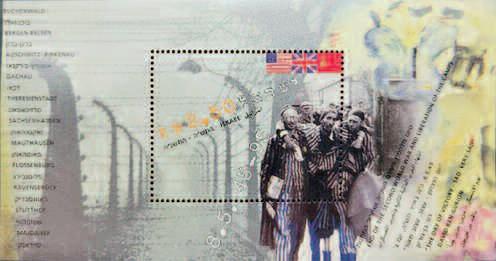
For Jews,forgiveness is complicated, following the prescriptions of the 12th Century sage,Maimonides.Jews can forgive only those who have wronged them. Survivor turned Nazi-hunter Simon Wiesenthal, z’l , could not forgive the mortally wounded SS officer who,from his hospital bed,begged Wiesenthal to forgive him. Wiesenthal details this incident in his book, The Sunflower ,

Research has proven that prayer can be healing.Rabbi Chiel cites a pioneering study from the mid-1980s by cardiologist Randolph Byrd,M.D.,of the University of California,San Francisco.Dr.Byrd discovered that prayed for patients had significantly better outcomes than comparable groups for whom no one prayed. Neither patients nor doctors knew who was prayed for and who was not.
My rabbi,Nathaniel Ezray of Congregation Beth Jacob in Redwood City,Calif.,loaned me Rabbi Chiel’s book,knowing I was coping with the imminent passing of my dear sister.Ruth died on Aug.6,2023,in Chicago.As I write this,I am in Shloshim, the 30-day period of mourning after the funeral of a loved one. I am finding comfort in observing Jewish ritual practices of
10 The Jewish Post & Opinion – NAT September 16, 2023
“Liberation of the Concentration Camps” Stamp Minisheet, Israel 1995.
(see Zimmerman, page 15)
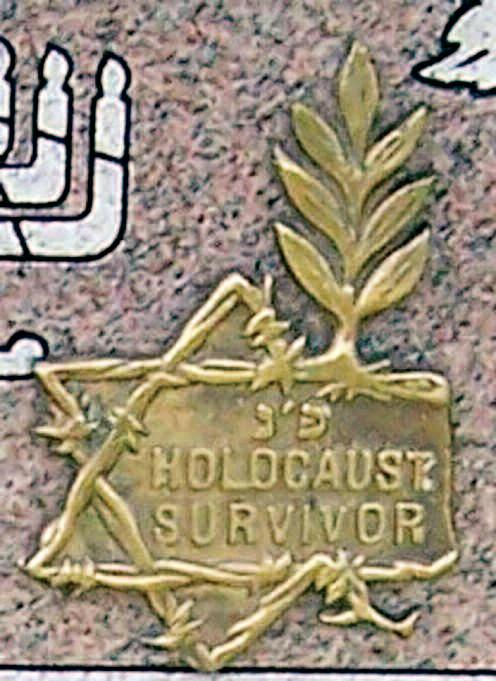
Gravestone of a Holocaust survivor.
“Holocaust Resistance Leaders” Stamps Minisheet, Israel 1983, (left) Josef Glazman, Vilna Ghetto, (right) Mordechai Anielewicz, Warsaw Ghetto Uprising Leader
Comforting the Grieving
BY RABBI SHEA HECHT
A few weeks ago a cousin of mine passed on.He was 48 years old and in the prime of his life.My cousin was a father, a grandfather,a Rosh YeShiva,and a very accomplished person in general.He was not well for a long time,and his death was expected; nonetheless he was a young man – with a living father,thank G-d –who was torn from us,leaving so many bereaved by his death.
I couldn’t go to Israel to pay a personal Shiva call,like many of my family members,and I was therefore left to resort to a Shiva phone call.
What is there to say to a father who has lost a son? Though,unfortunately,I have had to pay Shiva calls to parents who have lost children,it was the first time I had to do this for such a close relative, and I was really at a loss for words.Being a rabbi for close to three decades, I went by the very rule of thumb that I have been preaching all these years,which is,if you don’t know what to say,say exactly that: “I don’t know what to say.”
A death in a Jewish home necessitates the Jewish rituals of mourning.The mourning of a loved one can be viewed from two perspectives.One perspective is that of the mourner Our sages were brilliant in the establishing of Shiva,since it’s unquestionably the smartest way to deal with the death of a loved one.
A mourner is in pain and needs comfort. When people spend a week sitting and talking about their loved one and their loss,it is a healing experience.Additionally, sitting with friends and family allows mourners to fortify friendships and gain support and moral strength from those who care about them.
Sitting Shiva is better than therapy in dealing with the loss of someone who is loved.A dear friend who sat Shiva for his father told me at the Shiva house,“You know I’m not that religious, but Shiva and Shiva calls are very clever.The ritual forced me to memorialize,speak about,and share memories of my father,which has helped in my healing.Also,there is a certain reality I faced when speaking about my loss.”
As pleased as I was with this comment,I know it was not unique or uncommon. Many people who feel that they were forced to sit Shiva since they don’t really “believe in it”are surprised by its healing effects.
Jeff,another fellow I know,lost his father a few years prior to our forming a
friendship,and he told me the following story: Before his father died,he called him and said,“Jeff,I’m dying,but I don’t want you to mourn my death.I want you to celebrate.”Being that he was a traditional Jew,the son would have sat Shiva, but he thought he was being a good son by listening to his father instead of his rabbi.
Jeff told me that instead of sitting Shiva, he went out to a bar to celebrate.The next two years were very difficult for Jeff both personally and professionally.He ended up in therapy,and after a few sessions the therapist looked him in the eye and said, “Jeff,there’s nothing wrong with you. You simply have to mourn the death of your father.”
Jeff got together with some family and friends,and he cried and mourned and was finally able to move on.Needless to say,our rabbis who established Shiva understood human psychology and understood that mourning is part of the healing process.
Even though Shiva is considered therapeutic,we must realize that by disrespecting the needs of the family,our visit can become burdensome.
The first time I heard of a family leaving a note on the door with visiting hours for Shiva,I thought it was strange.I heard of posting times for prayer,but who posts hours for Shiva? However,after witnessing a scene in a different Shiva house,it became clear to me why someone would post hours. That house had many people sitting Shiva in it,and late in the afternoon they had to beg the visiting people to leave the Shiva house for 15 minutes so they could eat breakfast.
The second part of the Shiva process is the responsibility of the consoler.There is a Talmudic dictum not to console a person while the deceased is lying before them. Simply said,funerals are not a time for comfort.A person is not open for consolation at that point.I have been told by many people that those who try to console at that point generally provoke anger and cause more pain.The best thing to say at a funeral is to acknowledge the magnitude of the loss and then give words of encouragement such as “May G-d give you strength.”
Within the Shiva house,consolation can be broken down into three parts: Firstly, we must provide a shoulder to cry on and a listening ear.Secondly,we must acknowledge a mourner’s pain by showing sympathy and empathy.Thirdly,we must offer encouragement and strength.
My father, z”l, used to say that death is a part of living. Even though this is true, many people feel anxious and unsure of themselves with Shiva rituals and are even reluctant to pay a Shiva call. They worry. What is the correct thing to say when you
GOLDBERG (continued from page 9)
might never completely go away,it often becomes more bearable as time progresses.
Consider a New Pet: Some families might want to adopt a new pet shortly after their loss,while others might need more time.It’s essential to recognize that getting a new pet is not about replacement but about opening one’s heart to another companion.
Stay Connected: Continued communication among family members is vital. Everyone grieves differently; being patient and understanding with each other can aid in healing.
The passing of a family pet is an emotional journey,fraught with sadness and loss.By leaning on one another and finding ways to remember and honor their furry friend,families can navigate this challenging time.Embracing the memories, seeking support,and allowing oneself to grieve are essential steps toward healing. The bond shared with a pet is eternal,and their impact on our lives remains long after they’re gone.
Arnie Goldberg is an author, entrepreneur, speaker, trainer, and university instructor. More available at: www.arniegoldberg.com and www.dakisms.com
pay a Shiva call? Or better yet,is there a correct thing altogether? Can it be that one thing is right for one person but wrong for someone else?
A successful Shiva call can be broken down into three parts:
Firstly,those who go to pay a Shiva call should provide a shoulder to cry on and a listening ear.This can be accomplished by following a few guidelines:
The Talmud states that the first three days of Shiva are set aside for crying.There are some people who understand this to mean that one should not pay a Shiva call in these three days; however, though the three days are for crying,there is comfort in crying with someone to whom you feel close.
My sister,who was in Israel for a cousin’s Shiva,said the hardest part of the Shiva was the first three days when the family was hurting and few people showed up to pay Shiva calls.They sat those three days and looked at each other, each in his own pain. How much easier it would have been for them if close friends had come over and sat with them those difficult first three days.
The Talmud says that when paying a Shiva call,one should allow the person sitting Shiva to start to speak first; therefore,we should be conscious that we permit the mourner to choose to speak if (see Hecht, page 12)
September 16, 2023 The Jewish Post & Opinion – NAT 11
✡ ✡ ✡
j i
HECHT
(continued from page 11)
he wants to.Additionally,should a mourner choose to speak,he should address the topics he wants to.This will allow him to grieve as he feels comfortable.
Something else we must keep in mind is that people have different ways of grieving. There are those who can’t cry at all and those who can’t stop crying.We should be sure not to make someone feel uncomfortable because of their method of grieving – be it more or less than what was expected.Everyone mourns differently in every situation.This is especially true of children who mourn loss in “age appropriate”ways that may seem callous or uncaring to an adult.
Another very important point to keep in mind when going to pay a Shiva call is not to sound like you’re judging another person’s loss.Every loss in a person’s life hurts on some level.
The loss of an unborn child or an old or sick person also hurts. We may not say to someone who is grieving, “You’ll have other children,” or,“You have others who can comfort you,”or,“At least he’s not suffering any more,” or,“Thank G-d he lived to a ripe old age.”Every loss hurts. All of those are seemingly judgmental
comments that sound like they’re gauging another person’s loss.
Secondly,when paying a Shiva call,we must show sympathy and empathy and recognize a mourner’s loss and pain. Sometimes,though,the best way to do this is to simply say the words,“I’m sorry for your loss,but I don’t know what to say.”
I have found that the best time to practice this maxim is when someone suffers a loss of any kind that I have never experienced.When I was 14 years old,a good friend and classmate of mine lost a father. I recall spending quite a bit of time in his home during the week of Shiva.I found that my classmates and I did very little talking to the boy who was sitting Shiva for his father.
I remember the frustration we felt that we could not find the correct words to say, yet wanting to give comfort to our friend who was suffering.In retrospect I realize that since none of us was in the same situation,the best thing would have been to say,“I don’t know what to say.”
Thirdly,we should give the bereaved encouragement and strength when going to a Shiva house.
So often I meet someone who tells me, “I took over my father’s business after he died, and I did a great deal today. I felt my

father’s presence with me.”
I tell them it’s true.Their loved one was present.The Zohar says that when a person dies,their spirit can be with those they care about.A soul is infinite and can be in many places.We should encourage a person to take strength in this fact and utilize the loving presence of the deceased as a daily source of fortification.
Furthermore,when a person dies,those who are left behind feel a void.When the positive work of a loved one is continued, the vacuum is filled,and the person’s memory lives on,which strengthens a family and community.A consoler can encourage a mourner to satisfy that void by continuing the good deeds in which their loved one took special pride.
In conclusion,when paying a Shiva call, we should provide a shoulder to cry on and a listening ear,show sympathy and empathy,acknowledge the mourner’s pain,and offer encouragement and strength to those sitting Shiva.Concentrating on these three areas will allow the consoler to feel comfortable walking into a house of mourning and the mourner to feel cared for and consoled.
Rabbi Shea Hecht is chairman of the board of the National Committee for the Furtherance of Jewish Education. Acommunity leader
(see Hecht, page 19)
12 The Jewish Post & Opinion – NAT September 16, 2023
Bereavement Support
BY JENNIE COHEN
I n August 2007,I wrote about a bereavement support group I was attending to help me cope with the challenge of losing my father,Gabriel Cohen (1908–2007).
For the benefit of the other group members,I had made a list of excerpts from sympathy letters that relatives and friends had sent to my father when my mother, Helen Cohen (1916–1999) died.I had written,“Some of those words are here for you in hopes that if a time comes when you need to hear or offer words of comfort,they will be helpful.”
Recently I found myself looking again at these words of wisdom below.After rereading these excerpts,I recognized that since my original writing,some of these letter-writers have themselves passed away.It made me realize that one is still able to receive comfort from a loved one even though that person is no longer living.
“It is difficult to accept the reality of death,but we are born with the awareness that life is temporary.We old-timers with enough experience know that there is an end to our temporal existence and [we] develop our own philosophical outlook and personal faith.” Rabbi Gedalyah Engel, West Lafayette, Ind.
“We invest a lot of ourselves in our loved one,so that she becomes an integral part of our own life. No one can replace her…As you know,we must accept God’s inscrutable will.God’s intended imperfections of our life and the universe was to inspire us to make our life better.We are partners with God, and perhaps someday we will be able to conquer some of these diseases and physical imperfections. In the meanwhile, we must live this life, with all of its challenges as well as fulfillments,the best way we can.” Rabbi Harold L. Gelfman, Jacksonville, Fla.
“Your departed dear one has bequeathed innumerable fond and deathless memories,which will keep her alive in your hearts and minds for an enduring blessing.” Rabbi Morton M. Applebaum, Boca Raton, Fla.
“[Even with the best choice of] words,it is difficult to assuage the pain which is yours.Prayerfully,the knowledge that you shared her life for so many years in a constructive and rewarding manner will bring you some measure of comfort in these difficult days. You and others were immeasurably enriched by her life and now diminished by her passing.” William Z. Novick, Chicago, Ill.
“Words of comfort are difficult to accept at a time like this,I know,but having the knowledge that so many of your friends
A Prayer for Caregivers, Bereavement Counselors, Mortuary Staff, and Rabbis
BY RABBI DAVID WOLPE
“Dear God,I am called upon to care for others.Each day I am aware of the privilege and the burden of this blessing.I feel my inadequacies and rejoice in the moments when I touch another heart.But sometimes I am laid low; my own sorrows and challenges envelop me.I wonder how to help another when I seem to be tangled in disappointments,in tasks undone, words unsaid,love unspoken.Please enable me to nurture the seeds of my own soul.Help me to understand that limitations are not failings.Let me see expectations as hopes,not demands that twist me up inside and freeze the flow of goodness I feel within me.God,let me be open from within and spread that warmth,Your warmth,to others.For Your sake.In Your name.Amen.”
This prayer was posted on Rabbi Wolpe’s Facebook profile and was published in the JPO edition on June 12, 2013. ✡ ✡
share your loss will,I hope,be an ameliorating factor.May the fond memories and good times shared…be a source of comfort and serve as a means of easing your sorrow.” Philip Lax, Maplewood, N.J.
“Even while we mourn the death of a cherished one, there is room in our hearts for thankfulness for that life. We have lost what we have had. For those years of love and comradeship,there is no adequate compensation.Impoverished as we are by the passing of our beloved,we would be poorer by far if we never tasted the joy and richness of that union.May the pain of parting be mitigated by faith in a divine providence, which permits no life to be utterly destroyed.” Author Unknown
“It is so difficult to know what to say at a time like this.I hope and pray that soon your feelings of loss and grief will transform to acceptance and peace.” Miriam Zimmerman, San Mateo, Calif.
These last three quotes were not from the sympathy letters, but were added later.
“Tragedy and sorrow come to us all – it’s part of what it means to be human and alive.So if we have one miracle to make our own,one strength – let it be the strength to turn curses into blessings,to learn joy from sadness,and life from death.” Rabbi Steven Z. Leder, Los Angeles, Calif.
“Even our greatest grief is a sign of love, for if we did not love what we have lost, we would feel no grief.Our mourning is not simply a sign of our having lost,but an affirmation of having dared to love.” Rabbi Rami Shapiro, Nashville, Tenn.
Advice for a Shiva Call
BY RABBI DAVID WOLPE
Mourning is very personal.Some will weep,others will be stoic.Do not measure the depth of love by the degree of evident emotion.There is no ‘right’way to grieve. You are there to comfort,not to judge.
Do not compare pain.“At least you had your husband for 40 years; my husband died after only 20 years of marriage”is, unsurprisingly,not a comfort to one who is in mourning.Respect the pain that is before you without diminishing it.We all know that things could be worse in virtually any situation.Saying it is no help.
Share any stories about the one who died.These are precious bits,the lifeblood of continual survival in this world.What you remember,relate.
Don’t assume a false or exaggerated somberness. Be serious but not maudlin, unless that is how the family wishes you to be.Give space for the mourner to guide the reaction.
If you have a question – should I call/ should I visit,will it be welcome? Here is the answer – call.Visit.Staying away will not be seen as delicacy,but as indifference. Better an unwanted visit than an unexplained absence.
As the poet Joseph Brodsky said,“If there is a substitute for love,it is memory.”Help them remember It is a great mitzvah
Rabbi David Wolpe is rabbi emerita of Temple Sinai in Los Angeles and author of several books including Why Faith Matters. He was voted #1 rabbi in America by Newsweek and named one of the 50 most influential Jews in the world by The Jerusalem Post.(This teaching was posted on his Facebook profile www.facebook.com/ RabbiWolpe, and was published in the JPO edition on Jan. 16, 2013. ✡ ✡
“The Torah teaches God blessed Abraham with ‘everything’(Gen.24:1).Yet Abraham left his native home,drove one son away,nearly sacrificed the other,was forced by famine to flee to Egypt,feared for his wife,fought a war and witnessed both wickedness and destruction.How is that ‘blessed with everything’? To be blessed is not only to have comfort and ease. Blessing entails struggle and uncertainty as well as sweetness.‘Everything’is a full palette life – all the colors – sting and honey,loss and hope.” Rabbi David Wolpe, Los Angeles, Calif.
Jennie Cohen, (from JPO August 15, 2007). ✡ ✡
September 16, 2023 The Jewish Post & Opinion – NAT 13
j i j i
Jewish Chaplain
 BY RABBI LEON OLENICK
Hallelujah
I was in a deep sleep when I heard my pager go off.I glanced at the clock on my night table.It was 3 a.m.I stumbled to the telephone and called the office.They told me that there was a death and a family was in need of spiritual support.They gave me the address.I washed my face and threw my clothes on and proceeded to my car.As I gradually faded out of the embrace of sleep,I realized that this address was in one of the more violent parts of town – there were often shootings and robberies and I was afraid to proceed, though I knew that I had to.
I locked my car doors as I searched the desolate and dark streets of this Miami neighborhood,for house numbers.The houses were falling apart, and there were no street lights.I thought I had entered a third world country.Signs of poverty were everywhere. My thoughts turned to the people in our world that are oppressed
and who cannot live with dignity.How an we,a nation of plenty,allow this to appen? I knew this went on in our society,but was shaken when I found myself actually occupying the space where the richest country in the world had failed miserably.
Finally,I found the street I needed to be on,though it seemed like more of an alley than anything.The space was large enough for one car to drive into it from either direction.As I approached the house I saw many people in the street blocking the way.They were people of color.I am white,and was probably becoming whiter with fear.There were probably 30 people outside the house.I parked my car and made my way through the crowd and to the doorstep.I entered the house and introduced myself as the Chaplain.The house was neat and clean, the furniture reminded me of the furniture of my grandmother’s house when I was growing up in Philadelphia.I was warmly greeted,and then escorted to the room where the body was kept.
In the bed I saw the remains of an elderly woman who had lived past 90 years. Her frail body revealed her bones and she could not have weighed more than 60 pounds.Her huge black eyes were covered by strands of gray knotty hair,and
she had a look of contentment on her face.I went to her side and invited the immediate family in the house to join me.
The family spoke of her with love and respect,and told me how she was the matriarch of the family.The family told me that she taught them about love,respect, dignity and honor.She taught them right from wrong,and always spoke of how lucky they were to have all that they had, and the blessing of being able to live free. She never complained when she came home from work after cleaning other people’s houses all day.She provided for all their physical and emotional needs. They loved her.We all gathered at her bedside and joined hands.
“Holy One,here before us is Millie.Her soul has come to join you.Please open your arms and welcome her into your garden. Let her be greeted by familiar faces of her ancestors.Allow her soul to know she did good for her family and her values will live with them through the generations.Send your angels to escort her through the valley of the shadow of death without fear. Allow her family to know she is safe in your arms,and bless her soul.”
After completing my paperwork and waiting for the funeral home to pick Millie up,I sat with this wonderful family and shared in their stories of life. I hugged them and bid them farewell.
I started to walk to my car.By this time there were well over 60 people in the street.I was no longer in fear – it melted away in the presence of this holy family. Millie’s oldest son took my arm and asked that I please join them. We formed a circle, and held hands while we sang songs of praise,old fashioned gospel songs for God. The energy was sacred.My heart was completely opened as I became part of the extended family of these people.I feared them a few hours ago and now we traveled together into a holy spiritual space.Time stopped.
When I did return to my car it was about 6 a.m.I was not tired and I felt that I did not have to recite my traditional prayers this morning.I already prayed straight to the source.
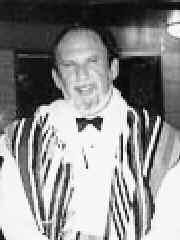
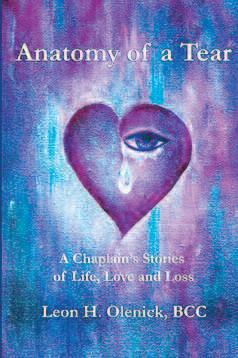
Leon H. Olenick is a rabbi and board certified chaplain. This story is from a book of short stories, Anatomy of a Tear. His intention in sharing his real-life stories is to help people who are facing difficult health, caregiving and end of life issues. The stories are true, only the names have been changed. (Published in the
14 The Jewish Post & Opinion – NAT September 16, 2023
✡ ✡
The Rabbi, Board of Directors, Sisterhood, and Members of Congregation B’nai Torah extend the best New Year ’s wishes to the entire Jewish Community!
Jan.
✡ ✡
JPO of
16, 2013.)
ZIMMERMAN
(continued from page 10)
mourning.Also healing for me,has been reading these Psalms as prayer. A postage stamp as a source of healing?
On August 22,2023,Israeli Genie Dina Meitner Doron lectured to the Judaica Thematic Society,an international group of Jewish philatelists,on“Paper Monuments: H olocaust Commemoration on Israeli Postage Stamps.”Ms.Meitner Doron presented a chronology of themes,decade by decade,that illustrate changes in Israeli attitudes about the Holocaust.Pre-statehood 1943 Israeli stamps,issued by the Jewish National Fund (JNF),had overtones of “like sheep to slaughter”.
After Israeli statehood in 1948,the Israeli Postal Authority (IPA) emphasized resistance and heroism,consistent with the Knesset ’s (Israeli Parliament) 1959 enactment of Yom HaShoah v’HaGevurah. A series of stamps depicted Mordechai Anielewicz,leader of the Warsaw Ghetto Uprising; and paratroopers from Israel, including Hannah Senesh (originally Szenes), who went to Europe to help the Jews.The sheep to slaughter motif became subdued, replaced by images of youth from post-Holocaust European orphanages, who were encouraged to join settlements in Israel.
In the 1960s,changes in the issuance of Holocaust postage stamps were brought about by two big events: the 1960 trial of Adolf Eichmann which, for the first time, according to Meitner Doron,resulted in actual discourse internationally about the Holocaust; and the 1967 Six-Day War, which gave people the opportunity to see the necessity of the State of Israel,creating a different narrative.


In the 1980s,new concepts were introduced by the IPA: the acknowledgment of heroism among other nations,e.g., Denmark’s rescue of almost all its Jews and other “Righteous among the Nations.” Suffering was acknowledged publicly through a postage stamp.For the first time, Kristallnacht,the Night of Broken Glass,known as “Reichspogromnacht”in Germany,was depicted.
In the 2000s, there were many collaborations between Israel and other countries,for example,Germany,Poland, Austria,and even the United Nations. A joint issue in 2005, between Germany and Israel,acknowledged 40 years of Israel-Germany diplomatic relations. That Israelis consider Germany Israel’s second-best friend,after the United States,indicates a considerable amount of healing between Germans and Jews. Another example of healing featured on stamps were the Violins of Hope,restored instruments formerly played in concentration
camps; listening to the violins,all of which are “survivors,”too,is healing.In the 2020s, more new concepts were introduced: Jews rescuing other Jews,sometimes dying in the process.Stamps now depict art about the Holocaust or art by Holocaust victims.

There are many ways to heal after the Holocaust.As I struggle with my own healing after the loss of my beloved sister, I am encouraged by this immersion into healing and grateful to publisher Jennie Cohen for inviting me to write this article.

I am working on collecting more words of survivors for a future edition.
Dr. Miriam Zimmerman is professor emerita at Notre Dame de Namur University (NDNU) in Belmont, Calif., where she taught the Holocaust course for 25 years. She can be reached at mimzim@aol.com. The daughter of a Holocaust survivor, she was born and raised in Terre Haute, Ind.
September 16, 2023 The Jewish Post & Opinion – NAT 15
“Joint Issue” stamps: Germany (above) and Israel (right) honoring 40 years of diplomatic relations, 2005.
✡ ✡
Hospice and Grief and Bereavement

Grief support is an important part of hospice care as it assists hospice patients and their caregivers/loved ones handle the emotional stress of death in a healthy manner.It offers a safe and understanding place for people to feel comfortable and find purpose in end-of-life care.Grief support can be anything from counseling, therapy,and spiritual care,to practical assistance such as funeral planning and referrals for legal matters.
What is Bereavement Care in Hospice?
Bereavement support is a way to help patients and their families/caregivers address the emotional stress surrounding the end-of-life journey.It can include help with managing sorrowful feelings that are present when a loved one passes away (this can include depression, anxiety,and feelings of helplessness).
Support for Someone in Hospice
This type of support includes counseling, therapy,and spiritual support.Social workers can assist patients dealing with stress and can offer tools for managing challenging behaviors.Spiritual coordinators can provide hospice patients introspection into finding meaning in their end-of-life experiences.
This support can also provide assistance for patients and their family/caregivers in funeral planning,advanced directives,and some legal issues.This type of counseling can provide peace of mind to both the patient and caregivers during this difficult time.

Support for Caregivers/Loved Ones/ Family Members

Support in hospice is not only for the patients.Family members,friends,caregivers, and significant others of patients also benefit from the support.When a person is close to the hospice patient, they can have difficulty in processing their grief, sadness,and anxiety.Some people even feel guilt or are uncomfortable about the future without their loved one with them. Hospice can supply grief and bereavement assistance to those loved ones/caregivers who need to work through the stress and emotions and explore healthy ways to cope with these feelings.
Hospice provides grief support for thirteen months after the death of a hospice patient.This support continues to engage the loved ones/caregivers of the patients admitted into hospice care.Loved ones,family members,and people close to a hospice patient can use the bereavement program to share their thoughts and feelings.
The Hospice Team
From the medical director and nurses to the social workers,volunteers,and chaplains everyone plays a role in supplying support for the hospice patient and their family and loved ones.This team has the experience and expertise to provide compassionate care during the end-of-life journey.They act as the guide for patients and their family/caregivers in the grieving process.
16 The Jewish Post & Opinion – NAT September 16, 2023
✡
✡
The Interview
WITH RABBI AMY EILBERG
Jewish Hospice
Below is an excerpt of an interview with Rabbi Amy Eilberg from 1993 on the topic was Jewish Hospice. Some of her answers are included here not only because they will be helpful for those grieving a loss, but also for those caring for someone who is near the end of life. The full interview can be found at: https://www.nli.org.il/en/newspapers/indiana jpost/1993/07/14/01/page/13
Jennie Cohen: What might help the survivors cope with their own doubts, fears, sadness and grief?
Rabbi Amy Eilberg: Community.The time of grieving both before and after the loss is the time to call upon every conceivable source of support that you have in your life and to look for new ones.It is a time to turn to family and friends,professional caregivers and spiritual resources.
The classic Jewish way of searching out a new source of support is attending services regularly and saying the Kaddish (prayer for mourners). When this proves to be beneficial, it is because community and structure help people put one foot in front of the other in the midst of overwhelming feelings.Also this helps one recognize that this is a process of life that everyone goes through at one time or another
In my experience,people grieving who know that they have already said everything that needs to be said before the person died,have a much easier time, relatively speaking,than those who did not. There is no way to prevent the feelings of sadness,anger and grief but it would be wise to anticipate,“What will I be sorry for if I don’t say and do?”and do just that. Otherwise one could end up having to deal with feelings of regret and guilt in addition to the feelings of grief.
Cohen: How would you answer the previous question if the survivors were young children.
Eilberg: Definitely tell them that death has happened and acknowledge the sadness.The worst thing for kids is to be left to their own imagination to explain why everyone is crying or why the other people who care for them are suddenly unavailable because they are wrapped up in their own grief. Leave open space for the child to express what they feel in words or actions. For a child,that will probably be sporadic over a long period of time because they cannot sit down and talk through their feelings.Sometimes
they display their grief indirectly and sometimes they ask the same questions over and over again.
Do not say to young children that the person who died has gone to sleep because that can make some kids afraid to go to sleep.Differentiate between the kind of sick that someone dies from and the kind of sick that healthy kids get. Don’t make things up or say things that you cannot say with integrity because kids know if you mean what you say.For example,“I don’t know why she died.I’m not sure.I know where her body is now, I’m not sure where her spirit is.”
Cohen: What can we learn from the terminally ill that could improve our lives?
Eilberg: An important lesson we can learn from the dying is to live each day fully. I often think about the misunderstanding in the teaching in the Torah that says if one does certain mitzvot,one will be blessed with “length of days.”The rabbis knew that physically and chronologically speaking that was not true.Just because a person has done a lot of mitzvot does not guarantee them a long life.However,doing mitzvot, that is to say,touching into the life of the spirit, by living in gratitude of the blessings each day, does guarantee depth of living. It does not ensure how long one will live but it does ensure fullness of days.
Some people only begin to live fully when they know they are going to die.I have certainly seen people who were filled with anxiety but changed in their dying process and in a sense lived a lifetime’s worth of beauty and connectedness in the end.
A famous Jewish teaching that encourages one to live fully,leaving no unfinished business is: “Do t’shuvah (repentance) the day before you die.”At first glance that sounds incomprehensible,however,since no one knows for sure when they are going to die, the teaching is saying, review your actions every day and if you have transgressed,ask for forgiveness.
Cohen: In Change Your Mind, Change Your Life by Gerald Jampolsky and Diane Cirincione, they say when they work with the
terminally ill they look on each individual as their teacher. Also they found that frequently it was not necessary to say or do anything. Just sitting with the person was all that was needed. Are there any scriptures or teachings in Judaism for caregivers to help keep them from getting stressed out?
Eilberg: There is no quick fix that guarantees protection against burnout.Caregivers need to balance the intensity of this kind of work with lots of joy and love in other parts of their lives.Frequently,when someone is dying,the message is: “Do it now.Squeeze as much joy out of every day as you can.”So I think the work inspires one to do precisely what one needs to do.
I think it is important for one to respect one’s own cycles.This is a time to practice asking for help and support in physical, emotional spiritual ways.This is very hard work and we need to give ourselves a lot of love and support.If one is experiencing a time of low energy,one may need to take a break or reduce the amount of work.Also I think it is very important to talk to someone about upsetting experiences,keeping that within the limits of confidentiality.
One of the biblical resources that I use that is nourishing to me is “Kol haneshama t’halelya ”To me it means,with every breath one can give praise to God.One can make every breath a prayer,an awareness of the joy of life.
Another favorite teaching which is from psalms and we use is in Hallel is,“This is from God,it is wondrous in our eyes,this is the day that God has made.” I used to daven this thinking it meant only Pesach or Sukkot or that day that Hallel is said. Then I realized it means every day is special.
Rabbi Amy Eilberg is the first woman ordained as a Conservative rabbi by the Jewish Theological Seminary of America. She serves as a spiritual director, peace and justice educator, and teacher of Mussar (a classical Jewish system of spiritual development). She recently served as the Coordinator of Jewish Engagement for Faith in Action Bay Area, a
(see Eilberg,page 19)
September 16, 2023 The Jewish Post & Opinion – NAT 17 The Jewish Funeral Home of Greater Indianapolis ARN Aaron Ruben Nelson 317-873-4776 11411 N. Michigan Road just north of I-465
Yizkor –Enduring Love
BY RABBI ROY A.WALTER

Yizkor as you all know is a time to remember loved ones.Over the years I have read more accounts than I can remember of why Yizkor is observed at the times it is held.Most of them attempt to relate it somehow to the theme of the holiday: We have Yizkor on Yom Kippur because of forgiveness; we have it on Sukkot because of the harvest; we observe it on Pesach because of the theme of redemption; and on Shavuot again for its connection to harvesting.
But the more I have thought about Yizkor and why it falls when it does,the more I have realized that it probably has nothing to do at all with the theme of the individual holidays.It probably relates to a common theme…the fact that all these holidays are a time for gathering…times we get together as family.What more appropriate occasion for remembering deceased loved ones than when those we are here to remember also sat around the table with us. Whether we’re gathered around the Seder table for Pesach or sitting together in shul all day on Yom Kippur and then breaking fast together,at such times the memories can’t help but flood our lives. How can we forget Aunt Sophie’s recipe for kugel,even though she’s not here to make it, or Uncle Dan’s penchant for bad jokes,even though he’s not here to tell them! Who could forget Grandpa’s stories of the old country,which you attempt to pass on to your children,or the smell in Grandma’s house when you walked in her door! We sit together and share the memories that bind us together as a family
Rabbi Avi & Nini Grossbaum, Rabbi Eliezer & Chana Zalmanov, Rabbi Avrohom & Shaindy Gluck, Rabbi Yehoshua & Zlata Chincholker, Rabbi Zalman & Sarah Gansburg, Rabbi Dovid & Chana Grossbaum, Rabbi Levy Yitzchok & Sheina
and Rabbi Levi &
Yizkor is in essence the attempt of Judaism to encourage us to hold on to those memories and share them,talk about them, pass them on to the next generation.
The Seder plate we use at our Seder is an old,chipped piece of china.It’s not a sleek,modern,contemporary plate with divisions for karpas and maror and egg.It’s just an old,chipped china plate.But it was my grandmother’s grandmother’s Seder plate.Even though I never met her and have no idea what she looked like,I think of her every time Pesach comes and the plate comes out.
The candlesticks Linda uses on Shabbat and yontif were her mother’s wedding gift to us.Using them reminds us of her; I think what joy she would have seeing how the children have grown,if she were alive sitting at the table with us.I think of how my parents would kvell to see all they have accomplished in the years since their death. Yizkor time is family time,so family is vividly alive in my mind at yontif.
Each Yizkor,when we light a Yahrtseit light, I think of all those whose lives were entwined with mine. Some are still part; some are no longer here to share life with me physically but are truly part of every day in some way.
Those are the kinds of things Yizkor is about.The special memories we cherish and share with the next generation – the feeling inside when you think that a loved one would be happy to know you lit a candle for them,because they lit candles for their deceased loved ones.
The plate, the candlesticks, the bracelet, the watch,the memories – all the little things that remind us of the people we love,even though they are no longer there to love in person.
In the final analysis,that’s really what Yizkor is all about – enduring love.Love that transcends death and the grave,love that lasts even longer than we do,as we pass that love on to our children and grandchildren. Enduring love,that special divine gift that binds families together through space and time,around the world and down through the generations.
And what better time to celebrate that enduring love than when families are together, creating the memories that will be shared in future generations.Thus, Yizkor on Pesach,and Shavuot and Sukkot and Yom Kippur, because those are times when we are gathered together as families.
And why a service? Why not just let the memories flow around the table? Because we are so busy creating and sharing that we often forget to give thanks,to appreciate what we have. You see, Yizkor is a time not only to remember,but to give thanks to God for those who created the memories for us, whose love created us.
May this Yizkor be a powerful remem-
A Yizkor For Miscarriage
CONTRIBUTEDTO RECUSTOMBY EILEEN LEVINSON
People experiencing fertility challenges or pregnancy loss can find the High Holidays especially tough to navigate. Recustom (formerly Haggadot.com) offers resources with this in mind. Email info@recustom.com for more information.
This is prayer for our unseen grief, A prayer for the dreams we lost. A prayer to find meaning in the unknown, For recognition that this too matters. A prayer to name that not all is replaceable, No matter how hard we try. A prayer for grace,for ourselves, And those trying to understand. This is a prayer for the unsolvable For the unknowable,for the unfair. This is a prayer to make our invisibility known.
To make our grief feel deserving today. Lives that we hoped would be. Remembered quietly,privately. Source of life,help us find peace. Help us embrace one another in uncertainty.
Open hearts to our healing,together. Give us strength to share our troubles, And bear witness to the hardest parts. Let our losses be meaningful. Let our stories be meaningful. Let our love be meaningful. And may each memory be a blessing.
Info about Recustom:
Judaism is at a moment of transition and possibility.And while tension in the mix of old and new has always been central to both the faith and culture,many feel unable to adapt rituals to meet their needs.
That’s where we come in.Recustom is a platform designed to help people create, remix, and explore rituals from the Jewish tradition and beyond.Drawing on insights from our deep history,our own lived experiences, and the wisdom of our community and partners,we offer abundant tools and resources to help shape rituals that work for each of us. We lead with creativity and welcome play – no pressure and no goal of perfection.When we celebrate that there’s no one right way to ritual,the possibilities become endless.
bering for you.And may it be a time of thanksgiving for having in your life the people you love – those who are with you in person and those who are with you in memory. Zichro-nam livracha – may they all be with you as an abiding blessing. Amen Rabbi Roy A. Walter served as Senior Rabbi of Congregation Emanu El in Houston, Tx. from 1978–2011. (This is from their May 2007 bulletin.) ✡ ✡
18 The Jewish Post & Opinion – NAT September 16, 2023
Cunin,
Leah Danow of Lubavitch of Indiana send Best Wishes for a Joyous and Inspiring New Year. May all be inscribed for a year of life! Join us for Free High Holiday Services at the Chabad Center, Carmel, IN
✡ ✡
j i
Hope and Healing –A Jewish Bereavement Support Group
“Hope and Healing”is an open discussion group in Indianapolis,Ind.facilitated by Hilary Bercovitz,MSW,LCSW.Meeting are usually on the second Thursday of each month at 6 p.m.,at Jewish Family Services,6905 Hoover Rd.
While everyone processes grief and loss differently,healing is enhanced by sharing with others who have experienced loss. The group will address the social,emotional,and spiritual dimension of grief from a Jewish perspective.All adults are welcome to attend.
HECHT
(continued from page 12)
during the Crown Heights conflict in New York over a decade ago, he was recognized with numerous awards by both government and private organizations for his work in fostering racial harmony. He was a member of New York Mayor Giuliani’s task force on police/community relations and received the C ommunity Relations Award from the American Jewish Committee for his leadership of the Crown Heights Coalition, seen as a model for healing a polarized community. For seven years Rabbi Hecht was a commissioner of human rights for the city of New York. (This column and bio. originally appeared in the first JPO healing edition January 26, 2005.)
Is there a period of time after the death of a loved one where it would be too soon to attend the group? It’s a personal choice, and people are welcome to attend whenever it feels right.Sometimes it takes two to three months after a loss before one feels comfortable enough to talk about it in a group setting.
For more information please contact Julie Sondhelm, MSW, LCSW, at jsondhelm@ jfgi.org or at (317) 529-5497.
Note: Groups are available through many Jewish Federations across the country. ✡ ✡

(continued from page 17)
multi-faith, multi-racial social justice organization in the San Francisco Bay Area. Prior to that, she directed the Pardes Rodef Shalom (Pursuer of Peace) Communities Program, teaching Jewish civil discourse to rabbis, synagogues and Jewish organizations. She currently serves as Chair of the Racial Justice Subcommittee of the Conservative Movement's Social Justice Commission and Chair of Congregation Etz Chayim's AntiRacism Impact Team.
iHer book, From Enemy to Friend: Jewish Wisdom and the Pursuit of Peace, was published by Orbis Books in March 2014. She received her Doctor of Ministry degree from United Theological Seminary of the Twin Cities in 2016. Previously, Rabbi Eilberg helped found the Bay Area Jewish Healing Center, where she directed the Center’s Jewish Hospice Care Program, and served as Founding Co-Director of the Yedidya Center for Jewish Spiritual Direction. Nationally known for her work in Jewish healing, spiritual direction, and peacebuilding, she lectures and writes on issues of spiritual direction, spiritual practice, and the pursuit of peace and justice. She was Chaplaincy Rabbi at Methodist Hospital in Indianapolis in the 1980s. More at www.rabbiamyeilberg.com.
September 16, 2023 The Jewish Post & Opinion – NAT 19
EILBERG
✡ ✡
j
✡ ✡
About the Mourner’s Kaddish
BY JENNIE COHEN
The Kaddish prayer (see page 21) is recited during a Jewish prayer service for up to one year in honor of a deceased parent and 30 days for other immediate family members.It is also recited on the Yahrzeit (anniversary of the death date),as well as during the four Yizkor memorial services of the year (see page 18).The origins of the prayer is uncertain,but it was probably formulated after the destruction of the first Temple and recited primarily after a lecture or discourse on a Torah theme.Sometime in the Middle Ages it became associated with mourning.
Reciting the Kaddish has a dual purpose. It is to redeem the life of the deceased and to help the mourner reclaim one’s own life. Curiously,there is no mention of death in the Kaddish,it is actually a prayer of praise to God.Also,the prayer makes a distinction between our world, created according to God’s will, and God’s perfected world. The prayer expresses hope that in our lifetime, the two worlds will become one.
Part of the effectiveness of the Kaddish comes from hearing it spoken.It is written
it Aramaic,and it has a soothing rhythm. The way it is recited with alternating responses of leader and congregation sounds much like a meditation.
The Kaddish is the major tool to help the mourner change from the physical relationship with the deceased to a spiritual relationship.“Through the vehicle of Kaddish we can still confront the deceased, expressing the words and feelings we did not or could not share while he or she was alive. Kaddish keeps the conversation going until we have said all that we need to say.”(Rabbi Anne Brener,in Mourning and Mitzvah,1993,p139.)
Traditionally,the Kaddish cannot be said alone.It is recited as part of a prayer service which requires the participation of a minyan (a Jewish prayer quorum of ten Jews).This provides the support of a caring community.One way to expand the tradition of saying Kaddish is to keep a journal of thoughts and feelings either just before or after reciting Kaddish.
Saying Kaddish provides the mourner with a sense of historical connection with all of humanity.By saying Kaddish for the one who died, the mourner is also saying it for those people for whom the deceased said it. The mourner is saying Kaddish now together with others who have lost a loved one. When we die, there will beloved ones
saying Kaddish for us.And many years from now,there will be those who say it for the ones who said it for us.
Reciting Kaddish is probably the most widely practiced of all the Jewish mourning rituals.The mourner commonly feels the need for the daily,communal support that it offers. There are Jews,though,who do not identify with any Jewish religious practices.Yet often in those cases,when a parent has died, they feel the need to fulfill the obligation to honor their parent with saying Kaddish regularly.Many times then over the course of the year of coming to the synagogue to say Kaddish,they gradually become interested in other activities as well.Possibly some friendships develop and there is a return to more involvement with Judaism.
“The Kaddish possesses wonderful power. Truly,if there is any bond strong and indissoluble enough to chain heaven to earth,it is this prayer.It keeps the living together and forms the bridge to the mysterious realm of the dead.One might almost say that this prayer is the watchman and the guardian of the people by whom alone it is uttered; therein lies the warrant of its continuance.Can a people disappear and be annihilated so long as a child remembers its parents?”(Leopold Kompert,1822–1886,quoted in Hertz , 1920, pp199–200.) ✡ ✡
20 The Jewish Post & Opinion – NAT September 16, 2023
Mourner’s Kaddish

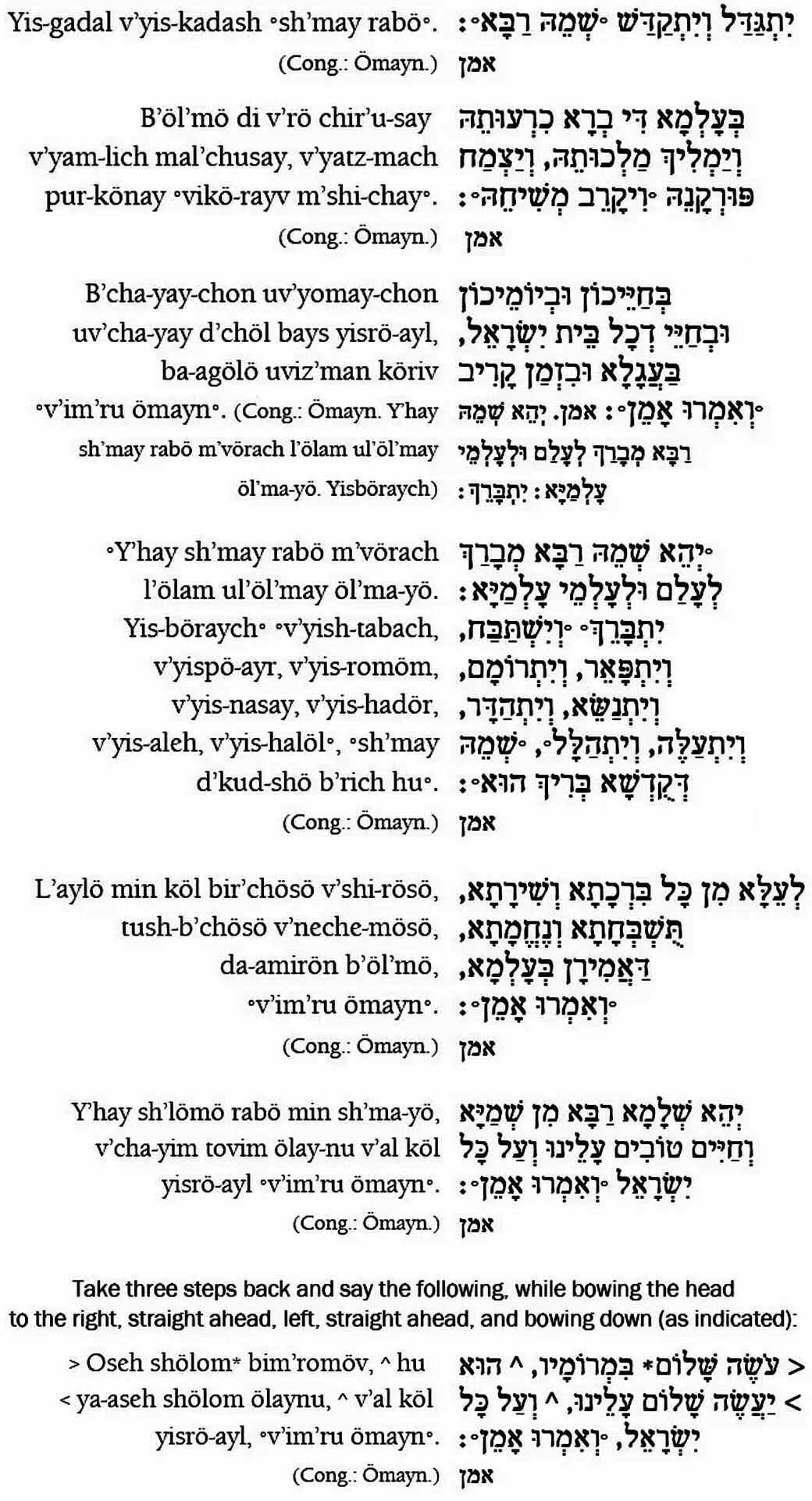
English Translation:
Exalted and hallowed be His great Name.
(Congregation responds: “Amen.”)
Throughout the world which He has created according to His Will.May He establish His kingship,bring forth His redemption and hasten the coming of His Messiah.
(Cong: “Amen.”)
In your lifetime and in your days and in the lifetime of the entire House of Israel, speedily and soon,and say,Amen.
(Cong: “Amen. May His great Name be blessed forever and to all eternity, blessed.”)
May His great Name be blessed forever and to all eternity.Blessed and praised, glorified, exalted and extolled,honored, adored and lauded be the Name of the Holy One,blessed be He.
(Cong: “Amen.”)
Beyond all the blessings,hymns,praises and consolations that are uttered in the world; and say,Amen.
(Cong: “Amen.”)
May there be abundant peace from heaven,and a good life for us and for all Israel; and say,Amen.
(Cong: “Amen.”)
He Who makes peace
(between Rosh Hashana and Yom Kippur substitute: “the peace”) in His heavens,may He make peace for us and for all Israel; and say,Amen.
(Cong: “Amen.”)
(All three verson from Chabad.org.) ✡ ✡
The 23rd Psalm of David j i
The Lord is my shepherd; I shall not want. He makes me to lie down in green pastures, He leads me beside the still waters. He restores my soul.
He guides me in straight paths for His Name’s sake.
Yea, though I walk through the valley of the shadow of death, I will fear no evil For Thou art with me.
Thy rod and Thy staff, they comfort me. Thou preparest a table before me in the presence of mine enemies.
Thou anointest my head with oil, My cup runneth over. Surely goodness and mercy shall follow me all the days of my life, And I shall dwell in the House of the Lord forever. ✡ ✡
September 16, 2023 The Jewish Post & Opinion – NAT 21
Kavannah Before Kaddish
BY RABBI WAYNE DOSICK
Particularly when saying Kaddish alone. In the Name of God,Source of All Being: I call upon the Heavenly Hosts, who surround the Place of Glory; And I call upon the Archangels, who fashion and shape the universe; And I call upon the Angels, who serve the Divine will; And I call upon the Guides and the MasterGuides, who watch over me and protect me; And I ask you All: Be with me now, and give power to my words. In the Name of God, Source of All Becoming: I say to my (choose one or more) holy/revered/beloved/ devoted/sweet father, mother, brother, sister,son,daughter,husband,wife (name) In every place and in every space in this great cosmos, it is known and revealed that you have left your Earthly body and this physical world. God has called you home. I remain everglad and evergrateful for the Divine gift of your life, and though my heart still yearns for your physical presence, with love, with honor, and with blessing, I give you back to God,and release you to eternity.
I celebrate your soul-journey to the Light –to that awesome place of revelation and knowing, of redemption,and salvation, of peace and harmony, of grace,and compassion,and infinite love. I am comforted and enheartened knowing that you dwell in God’s Sheltering Presence, immersed in God’s Holy Spirit. For,with God, it is safe, and sweet, and good. To the Name of God,Source of All Blessing: I come before You at that most sacred and wondrous place Where Heaven and Earth touch. I stand with all those of the Divine Assembly, and with all who desire to do holy work, to speak these words that echo through there, and here,and everywhere, through then, and now, and forever; these words of hope and promise, transformation,and evolution, faith and love.
Yikzor on Shemini Atzeret
BY JENNIE COHEN
I n the September 15,2004 issue I mentioned a useful book, Mourning & Mitzvah: AGuided Journal for Walking the Mourner’s Path Through Grief to Healing by Anne Brener.I had also hinted that it could be beneficial for one coping with any type of loss because it could help the person to end up stronger than they were before the loss.
One of the most interesting parts of the book is the section on Yizkor from the chapter,“Yizkor, Yahrzeit,and the Cycle of Seasons”. Yizkor is the memorial service associated with the conclusion of major Jewish holidays. Yizkor is a prayer which asks God to remember the soul of the deceased.It is said four times a year on the holidays of Yom Kippur,Shemini Atzeret, Pesach,and Shavuot.
Brener corresponds the themes of these holidays to the major phases in the mourning cycle.For example,because Yom Kippur is the time to resolve unfinished business with other people and God, Brener states that Yizkor on Yom Kippur is a good time to absolve guilt and resolve resentments or other lingering issues between the mourner and the deceased.
Of the four, the one that I have used repeatedly for guidance since I first read the book 10 years ago is Yikzor on Shemini Atzeret.The name translates in English to “eighth day of assembly.”The root of Atzeret in Hebrew is to stop, brake, detain. This holiday takes place on the day between two joyous celebrations.They are the last day of Sukkot, the autumn harvest festival and Simchat Torah, which marks the ending of one cycle of reading the
To You,O God, I speak these ancient and ageless words of praise and glory, to Your Great and Holy Name. Yitgadal v’yitkadash s’may rabbah...
Rabbi Wayne Dosick, Ph.D., is the spiritual guide of The Elijah Minyan, an adjunct professor at the University of San Diego, and the Director of The Soul Center for Spiritual Healing. He is the awardwinning author of six critically acclaimed books, including Golden Rules,Living Judaism,and Soul Judaism: Dancing with God into a New Era.
This is reprinted from JPO Healing Section on July 15, 2007. Originally it was published in The Forward, September 5, 2003, and was dedicated to the memory of Dosick’s father, Hyman Dosick, zt”l on his second yahrzeit . In January 2004, this appeared in the San Diego Jewish Times. ✡ ✡
Torah and the beginning of the new cycle.
Brener writes that on Shemini Atzeret, a quiet holiday,we pray for rain and prepare for the winter,the season of diminished light and a time for contemplation. Yizkor on this holiday is similar to the most difficult part of mourning.We do not want to let go of the autumn,the colorful leaves and crisp,cool air,knowing that the cold will follow.
“But praying for rain,while remaining in the sukkah embodies a truth about mourning: filled with the memory of a loved one, we are unwilling to let go.We do not welcome the tears that can transform our pain.We do not want to make the sacrifice and give ourselves over to the rain.We resist the change of seasons,despite the knowledge that without rain the cycle cannot continue and the world cannot be in its proper order.But this flow – the rain and the tears – will move us through the cycle of our emotional seasons into another time of harvest.”(p.222)
Over and over again I have applied Brener’s wisdom about coping with loss of a loved one to coping with change because change is loss of the familiar, and facing the unknown which can be scary.A common saying of my mother’s was,“The only sure thing in life is change.”
Since change is inevitable, it is wise to have some mechanism in place to help one cope with it. Anytime I find myself anticipating the unknown future with trepidation,I remind myself about Brener’s analogy with the seasons and I tell myself that I may not be looking forward to the upcoming winter (change), but without going through it,there will be no spring.
Anyone who has lived with winters of snow and ice where it gets so cold it hurts to be outside, understands what a relief it is when spring arrives.The trees have been in hibernation with bare branches, and gradually little green buds can be seen.The temperatures rise,one can smell the scent of flowers in the air,and renewal is all around.
Familiarity is comforting,but even after a simcha without letting go and moving forward there will be no chance for more simchas,no chance for self-improvement, to make amends for past mistakes,for reconciliation,for new experiences,learning and growth.
A recent example of this was the day after my friend’s wedding. Her mother called her to say how depressed she was. My friend is the only daughter in a family with five children. This was not surprising to hear because the preceding year had been filled with exciting plans and arrangements,shopping,dress fittings,
(see Jennie,page 24)
22 The Jewish Post & Opinion – NAT September 16, 2023
j i
With the growing threat of a war with Hezbollah, we can’t ensure this Rosh HaShanah will usher in a peaceful year. But with a new campaign to add 300 urgently needed ambulances to MDA’s fleet, we can save lives no matter what 5784 brings.

Make a donation today or contact us about how you, your family, or synagogue can provide the ambulances MDA will need.
Visit afmda.org/give or call 866.632.2763.
September 16, 2023 The Jewish Post & Opinion – NAT 23
As Israelis rejoice in the sound of the shofar, we’re also preparing for the wail of the siren.
Authors Music More!
1389 W 86th St.#160 Indianapolis,IN 46260
JENNIE
(continued from page 22)
looking forward to seeing family and friends that live far away,and having them all together under one roof.
It was an amazing outdoor wedding with temperatures in the 70’s and blue skies with a few puffy white clouds. The flowers were gorgeous,the dresses,music, and ceremony were lovely,the atmosphere of the reception and dinner was haimish,and the dancing was exuberant.
I certainly understand after a fairy tale affair like this was over,the next day would be a

huge let down.It was probably something my friend’s mother had looked forward to since her daughter’s birth and now it was over.But without this change there would be no chance for grandchildren and all of the joy that comes with new life.
Jennie Cohen, (from JPO 9/29/2004) ✡ ✡
See searchable Historical Digital Issues of The Jewish Post & Opinion since 1933 at nil.org.il/en/newspapers/indianajpost
Read recent digital issue online at: www.jewishpostopinion.com
24 The Jewish Post & Opinion – NAT September 16, 2023
TheJewish PRESORTED STANDARD US POSTAGE PAID INDIANAPOLIS, IN PERMIT NO.1321
OpinionPost&
in part by the Irwin and Oct 23–Nov 13 25th
Funded
✡