






Bikur Cholim Ladies Brunch
Rav Moshe Hillel Hirsch Inspires the Community
K’hal Lev Avos Melava Malka and Groundbreaking









Iknow that in two weeks’ time I will not be able to look at another doughnut.
But on Sunday night, when Chanukah begins, those doughnuts will look oh-sotempting. For me, nothing beats a fresh custard doughnut with chocolate frosting. I’m old-fashioned in that way. No lotus butter or pistachio cream for me, please.
Although Chanukah is eight days, sometimes I feel like it’s not enough time to enjoy the yom tov. Between the parties and get-togethers and giving out presents, do we have a moment to contemplate the miracles that happened millennia ago?
But Chanukah shouldn’t be about presents. Instead, we should spend the time being present with our family, with the menorah, with ourselves. In this way, we can really contemplate the beauty and miracle of our nation’s survival.
Every family has developed their own traditions when it comes to Chanukah. There aren’t many things we have to do on Chanukah – although some may say that latkes are mandatory – and so each family has carved out activities or things that have become their Chanukah rituals. One woman once told me that she makes a scavenger hunt for her kids to find their presents. Her
kids are now in their 20s; she’s been doing it for years and expects to be doing it for her grandchildren, too. Another person spoke about the special games they play at their Chanukah parties. One friend suggested that we have a special Chanukah-themed food at each night’s dinner.
In this week’s issue, I noticed that we shared quite a few articles on people either becoming frum or converting to Judaism. It brought to mind how the light of Yiddishkeit is more than just the mitzvos that we observe. As we keep the Torah, our lives become transformed, and we become more elevated people. Sometimes, we can’t even recognize the exaltedness that our lives embody. It takes someone from the outside to notice our light – and that leads them to uplift their lives as well.
Wishing you a wonderful, lichtige Chanukah,
P.S. We’d love to see how you are spending your Chanukah! Send in your Chanukah photos of your favorite people eating doughnuts, spinning dreidels, frying latkes, or lighting the menorah to editor@fivetownsjewishhome.com. Can’t wait to join in your fun!

Yitzy Halpern, PUBLISHER publisher@fivetownsjewishhome.com
Yosef Feinerman, MANAGING EDITOR ads@fivetownsjewishhome.com
Shoshana Soroka, EDITOR editor@fivetownsjewishhome.com
Nate Davis Editorial Assistant
Nechama Wein Copy Editor
Rachel Bergida
Shana Brecher
Lani White Design & Production
Gabe Solomon Distribution & Logistics
P.O. BOX 266
Lawrence, NY 11559
Phone | 516-734-0858
Fax | 516-734-0857
Classified Deadline: Monday 5:00PM classifieds@fivetownsjewishhome.com text 443-929-4003
PAYMENT VIA CREDIT CARD MUST BE SUBMITTED ALONG WITH CLASSIFIED ADS
The Jewish Home is an independent weekly magazine. Opinions expressed by writers are not necessarily the opinions of the publisher or editor. The Jewish Home is not responsible for typographical errors, or for the kashrus of any product or business advertised within. The Jewish Home contains words of Torah. Please treat accordingly.






Dear Editor,
I feel for the young woman in the dating column who is dealing with this conundrum. It is certainly not easy when you feel that you connect with someone who is not on the same level as you. Still, as with many situations, I would love to hear what the guy is thinking. He is certainly not as religious as she is. Is he planning on staying this same level or is he a growing person? Does he expect her to change her religious standards or will he respect and allow her to keep those standards in their home?
This is a very sticky situation. I believe that it can only work if she is a strong person who is strong in her convictions and if he is someone who is respectful, curious and growing. Oh, and she should make sure to have a mentor or rav or rebbetzin who she can speak with – that’s really important.
If not, she should stay far away. Don’t compromise on your values when going into a marriage.
Etti Weinbach
Dear Editor,
The article this week in your dating section highlights a very sad phenomenon that many people in our community are facing. As they get older and are not yet married, they sometimes find themselves with less than an ideal social life. As such, some of their socializing occurs at work, even if they don’t work in frum

environments.
There are programs in our community that help these people find connection. I know of one in Inwood where the organizers host programs each month for women. These programs are fun and casual and help young women connect with others and enjoy time together.
There are also many volunteer opportunities in our community.
Young men and women in our community should not feel ostracized or lonely because they are still searching for their bashert! They should feel loved and connected within our community and know that they are valued and cared for. In this way, socializing at work will take a backseat to the connection they feel in our community.
Efraim Tessler
Dear Editor,
It was quite upsetting to have read the article this past week in your paper on Estrangement.
As one suffering through estrangement, the author’s overall positive tone was jarring and belittling to those cut off from close family members. What I did not hear was any attempt to meet with both sides and try to foster open communication and connection. Perhaps that would be counterproductive to her agenda or bottom line. It is exactly these therapists that have fueled the no contact movement that has swept both the religious and secular circles.
Continued on page 18

Hoping for more objective and constructive articles going forward regarding family dynamics from your publication.
Sincerely,
Waiting for connection
Dear Editor,
ness – not even an old school power outlet plug. In 2025, this is a standard necessity everywhere. Explain this concept to me.
Last year, when flying back to JFK from Toronto, they damaged my bag – AGAIN, the second time in one year. (Thank goodness they gave me back my money for my damaged bags with minimal hassle.)

We want to see what makes Chanukah special to you. But you have to act fast! The photos must be sent in by Tuesday, December 16 at 2 p.m. Make sure the photo includes the people you love most. Send us your photo(s), and we’ll send you a $10 Berrylicious gift card!
end u s your photo(s) of what Cha nu ka h means to you – it could be you r fami ly lig ht ing c and les, you and your siblings at your Cha nu ka h par t y, ba k ing Chanuka h cook ies, Bubby play ing dreidel, or Z eidy eat ing a jel ly doug hnut (or t wo… or three!). TJH so Tuesday, December 16 2
There are eight days of Chanukah –yay! Many families have get-togethers and events that they have to attend. But the eight days give you an opportunity to think of others. What about using one night to share the joy of Chanukah with a person who may not have a family of their own?
Consider inviting a divorcee, widow, single mom, older person…to your menorah lighting or for dinner one night. Maybe you’d like to drop off latkes or doughnuts or a small gift?
In this way, you can light up someone else’s life during the beautiful yom tov of lights!
Shari Heller
Dear Editor,
Over the last several years, I was in a position to frequently fly Delta Airlines, despite it being one of my least favorite methods of travel. Costs and timing have been the top two reasons for this.
Over the last two years, they gave me more of a reason to avoid flying them. Here’s what happened based on my own experience:
First and foremost, when flying between JFK and Toronto and Chicago, aside from their planes being extremely old, they did not offer any option for people to charge their phones, in all serious-
Their Wi-Fi never worked, except for the flight I took between JFK and Israel, not the opposite way.
When flying them in 2024 from Jacksonville to JFK, none of their IFE had closed captioning. As a deaf person, this was extremely annoying, to say the least.
Their seats were rather cramped, too. I can deal with no IFE on short flights (reading a book suffices instead), but again, people need a way to charge their phones at all times, in all places, especially when traveling. It’s really a joke how they don’t even have an outlet.
Meanwhile, both times when I flew JetBlue, first in January 2012 between Buffalo-JFK, then JFK-Jacksonville in 2024, I was extremely impressed. Their IFE was top-notch with closed captioning available, the Wi-Fi was on target, planes were modern, I had room to sit and move around, and I got my luggage back in one piece.
To my knowledge, not offering closed captioning on IFE content is a violation of the ADA.
I thus decided to avoid Delta, except when necessary.
I say that Delta stands for: Damages Everyone’s Leisurely Travel Adventures Sincerely, Fly JetBlue Instead



According to Lebanese Foreign Minister Youssef Rajji, the terror group Hezbollah will not disarm unless Iran tells it to do so.
In an interview published Saturday, Rajji told news outlet Saudi Al Arabiya that he has discussed the matter with Iranian FM Abbas Araghchi, adding that the terror group’s disarmament is among the Lebanese government’s top demands.
In October 2024, year-long skirmishes between Israel and Hezbollah escalated into a full-blown war, with the Jewish state launching a ground campaign into Lebanon. In November, the two sides agreed to a ceasefire, which conditioned Israeli withdrawal upon Hezbollah disarmament. However, because the terror group has still failed to disarm, the Israel Defense Forces have yet to withdraw from five strategic border posts.
“Hezbollah won’t hand over its weapons without an Iranian decision,” Rajji said. “Right now, [Hezbollah] is concerned with preserving itself and regaining power.”
He added that Hezbollah, an Iranian proxy group, is focused on “rebuilding itself in many ways” and restoring its power, as its war with Israel left it weak.
Rajji also expressed disappointment in Hezbollah’s refusal to disarm, adding that disarmament would be in the best interests of both Lebanon and Hezbollah, as a political party.
“The credibility of the state today depends on the extent to which it extends its authority over all Lebanese territory and confines the weapons of all armed groups to the legitimate security forces in its own territory and with weapons exclusively in its hands,” he said. “Disarming Hezbollah and dismantling its military structure are a Lebanese demand, regardless of the in-
ternational demand.”
He noted Hezbollah’s ineffectiveness, contrary to its own claims, highlighting the terror group’s failure to “support Gaza, liberate Jerusalem or defend Lebanon.”
According to Rajji, the Lebanese Armed Forces aim to have confiscated all Hezbollah weapons in southern Lebanon by the end of 2025. In the beginning of 2026, Lebanon plans to expand its operations further north, seizing weapons in other regions.
He added that Hezbollah “provokes the government every day with the talk by its chief, Sheikh Naim Qassem, about rearming.” On Wednesday, Qassem alleged that Beirut was giving Israel a “free concession” by sending a civilian rather than a military envoy to Lebanon’s first direct talks with Israel in decades. The talks, which are aimed at advancing last year’s ceasefire, took place at the U.N. peacekeeping forces’ headquarters in Naquora, Lebanon, with National Security Council Deputy Director for Foreign Policy Uri Resnick representing Israel and former ambassador to the U.S. Simon Karam representing Lebanon.
Rajji said the decision to send a civilian instead of a military official to the meeting would hopefully prove to be a “positive step” which could “spare Lebanon a large-scale military operation by Israel.” Such an operation is possible if Hezbollah does not disarm.
Officials from Israel called the meeting productive and said economic cooperation proposals were discussed. Lebanese Prime Minister Nawaf Salam, however, downplayed the likelihood of economic cooperation between the two countries. Rajji said that the talks only concerned “military issues.” Lebanon has said it would only normalize relations with Israel if a Palestinian state is established.
A day after the meeting, Hezbollah weapons depots in southern Lebanon were targeted by Israeli airstrikes.


Agency, the Chernobyl nuclear disaster site’s steel protective shield was severely damaged in what is believed to be a Russian airstrike.
A week ago, the IAEA visited the site and found that the shield, which is called the New Safe Confinement (NSC), was no longer working, having “lost its primary safety functions, including the confinement capability.”
The shield, which officials built in 2016, was meant to stop the spread of radioactive material from the Chernobyl power plant’s Reactor Four. It covers a smaller Soviet-built concrete structure called the Sarcophagus. The NSC was built following Reactor Four’s catastrophic explosion in 1986. The NSC’s installation cost $1.75 billion.
According to Ukrainian officials, a Russian drone in February hit the area, triggering a fire that engulfed the NSC for weeks, leaving it with a 160-square-foot hole in the shield, which is 360 feet tall at its peak.
“Limited temporary repairs have been carried out on the roof, but timely and comprehensive restoration remains essential to prevent further degradation and ensure long-term nuclear safety,” said IAEA Director General Rafael Mariano Grossi.
Russia has denied Ukraine’s claim that it deliberately targeted the Chernobyl site. Russia originally captured the site in 2022 but later withdrew.
Emergency firefighting work led to 330 openings in the NSC’s outer cladding. Now, the shield requires significant repairs for it to function again.

On Monday, China’s General Administration of Customs announced that the country’s trade surplus with the rest of the world has, for the first time, risen above $1 trillion, with exports increasing by 5.4% as compared to last year, when it had a surplus of $990 billion. China’s trade surplus is rising despite tariffs from the United States and other

countries.
“Put simply, China’s price competitiveness is extremely strong,” Xu Tianchen, a senior economist for the Economist Intelligence Unit in Beijing, said. “The main reason behind the continued growth of China’s exports … is not … because the overall size of global trade has expanded, but because China is claiming a larger share of the existing trade landscape.”
In November, exports to the U.S. were 28% lower than they were in November 2024. In October, they were 25% lower than figures recorded in the same month last year, official data showed.
These numbers follow a meeting between U.S. President Donald Trump and Chinese leader Xi Jinping, who arrived at a trade agreement in October, which saw the U.S. roll back tariffs on Chinese imports in exchange for China’s commitment to continue buying U.S. soybeans and postponing restrictions on rare earth minerals for a year. The two leaders plan to have further meetings next year, with Xi suggesting he might return to the U.S. in early 2026, and Trump saying he’ll probably visit Beijing in April. Before then, the leaders hope talks will lead to a more permanent trade agreement.
China has weathered U.S. tariffs, partly by boosting exports to Southeast Asia by 8% this year. According to Xu, “A large part of that is likely products that were ultimately destined for the U.S. but now make a stop in Southeast Asia.” While U.S. exports to the rest of the world dropped, Chinese exports rose.
The European Union, which last month had an annual export growth rate of 14.8%, has reason to worry about China’s rising trade surplus, with French President Emmanuel Macron, following a recent state visit to Beijing, threatening China with tariffs if its surplus doesn’t drop.

months of U.S. military operations against Venezuelan drug boats. Instead, the socialist leader is waiting to see whether U.S. President Donald Trump’s threats of an attack are serious. Maduro has boosted his security and has limited his appearances in public in fear of an attempt on his life.
According to officials, the U.S. is considering scenarios in which Maduro’s regime is replaced by the opposition and how the Venezuelan military would act in such a situation.
Last month, Trump and Maduro reportedly had a cordial conversation on the phone, during which Trump suggested he wants Maduro to leave his post. However, Trump introduced no ultimatums, and the phone call ended with the two leaders promising to speak again, according to three individuals with knowledge of the matter.
Despite U.S. pressure, Maduro has reportedly remained “in good spirits,” privately and publicly. However, he has expanded his security detail. Recently, he canceled a public interview with a Western news outlet, in fear that it might be a trap. Now, the only public appearances he makes are at unannounced rallies, during which he’s surrounded by supporters.
Last week, he declared at a Caracas rally, “We have lived through 22 weeks of psychological terrorism, which has tested us.”
His inner circle, including his vice president, interior minister, defense minister, and National Assembly president, has thus far stayed intact and shows no signs of internal cracks.
The U.S.’s operations have caused the already failing Venezuelan economy to struggle more. A number of airlines canceled flights after Trump declared Venezuela’s airspace to be closed. Locals are saving money for food and necessities instead of holiday gifts, fearing that war might be imminent, despite Maduro’s decision to declare an earlier holiday season.
The U.S.’s military buildup has mostly leveled off since the U.S.S. Gerald R. Ford carrier strike group came last month.
Both the Trump and Biden administration refused to recognize Maduro as his country’s legitimately elected president. Last year, Maduro declared victory in the presidential election, despite independent ballot audits showing his rival Edmundo Gonzalez winning by over twothirds of the vote.
demand that he resign, following five
Those close to him say Maduro could potentially agree to resign, though it would have to be on his terms. It’s unknown what would compel him to leave

his post, though, if he goes into exile, Turkey might be his best bet.
According to U.S. internal documents that discuss post-Maduro plans drafted by opposition leader María Corina Machado, a task force would be established to stabilize Venezuela in the first 100 hours and 100 days following Maduro’s departure, and elections would be held in the first year. Machado won the 2025 Novel Peace Prize for “her tireless work promoting democratic rights for the people of Venezuela and for her struggle to achieve a just and peaceful transition from dictatorship to democracy.”
The opposition maintains that it would only oust and prosecute 20% of Venezuelan officers, whereas the rest are believed to be anti-Maduro or neutral.
More than 5,000 people took part in a marathon on Kish island in Iran on Friday. But some women running the race did so without their hair covered. On Saturday, Iranian authorities opened a criminal case against the organizers of the marathon, after images emerged of
women competing without a hijab.
The law enforcing the Islamic republic’s strict dress code for women – including a hijab – was enshrined into law in the early 1980s.
“Despite previous warnings regarding the need to comply with the country’s current laws and regulations, as well as religious, customary, and professional principles…the event was held in a way that violated public decency,” the local prosecutor was quoted as saying in the judiciary’s official news outlet, Mizan Online.

“Considering the violations that occurred and based on the laws and regulations, a criminal case has been filed against the officials and agents organizing this event.”
Conservative-aligned outlets including Tasnim and Fars had earlier condemned the marathon as indecent and

disrespectful to Islamic laws. Adherence to hijab laws have become more sporadic since protests rocked the country after the death of Mahsa Amini in 2022. The morality police had arrested the young woman in Tehran for allegedly flouting the strict Islamic dress code for women. She died in custody.
Hundreds of people, including dozens of members of the security forces, were killed during the protests across the country, and thousands of demonstrators were arrested and several of them executed.
Earlier this week, a majority of lawmakers in Iran’s parliament accused the judiciary of failing to uphold the hijab law. Chief Justice Gholamhossein Mohseni Ejei later called for stricter enforcement.
Iran’s government under President Masoud Pezeshkian has refused to ratify a bill passed by the parliament that would have imposed tough penalties for women who do not observe the dress code. Since coming to power in July 2024, Pezeshkian has maintained that women cannot be forced to wear the hijab.
According to a 2014 religious decree, or fatwa, issued by supreme leader Ayatollah Ali Khamenei, women must dress in such a way as to leave only the face and hands visible.
In May 2023, the head of Iran’s athletics federation resigned after women without headscarves took part in a sporting event in the southern city of Shiraz.

A Mexican National Guardsmen shot and killed three fellow service members at a barracks over the weekend in the western Mexican state of Michoacan, where the government has surged security forces in the wake of recent high-profile killings.
A fourth servicemember was wounded in the shooting.
The suspect was taken into custody in Michoacan.
The shooting occurred on Saturday hours after a car bomb exploded in Coahuayana, Michoacan, killing five people outside a local police station. Three oth-
ers were injured in the attack. Three of those killed were police officers.
The explosion and National Guard shooting came as the federal government has stepped up security activities in the state, sending in additional troops after two recent high-profile assassinations.
Last month, President Claudia Sheinbaum sent 2,000 troops — in addition to the 4,300 permanent ones and 4,000 in neighboring states – to Michoacan following the killings of an outspoken representative of the lime growers and a popular mayor standing up to the cartels.
At least three of the six drug cartels that the Trump administration designated as terrorist organizations — Jalisco New Generation, United Cartels and The New Michoacan Family — operate in Michoacan, in addition to many homegrown armed splinter groups, some supported by the Sinaloa Cartel.

Thailand and Cambodia are accusing each other of violating a peace plan brokered two months ago by U.S. President Donald Trump, with the two Southeast Asian countries attacking each other in a series of escalating attacks. Trump’s plan is now in jeopardy of falling apart.
The Thai military said it targeted Cambodian military infrastructure with airstrikes on Monday, in retaliation for an attack earlier that left a Thai soldier dead and seven people wounded.
Maj. Gen. Winthai Suvaree, an army spokesperson for Thailand, said that the “target was at Cambodia’s arms supporting positions in the area of Chong An Ma Pass” and accused Cambodia of using “artilleries and mortar launchers to attack the Thai side at Anupong Base.”
Thailand’s army accused Cambodia of targeting the Thai border with “activities that could escalate military operations and pose a threat to the Thai border area,” mobilizing heavy weapons, and repositioning combat units at around 3 a.m. local time. Cambodia’s Ministry of National Defense has rejected those reports as “false information,” with the country’s


military accusing Thailand of launching “an attack” at around 5:04 a.m. local time, against which the defense ministry said it “did not retaliate at all.”
Cambodian spokesperson Maly Socheata accused Thai troops of burning houses, injuring civilians, and “prompting people to leave” border villages. Cambodian Minister of Information Neth Pheaktra claimed that Thai forces killed at least four Cambodian civilians, injured many others, and displaced tens of thou-

Several hundred works in the Louvre’s Egyptian department were damaged in a water leak in November. The museum revealed the incident this week.
“Between 300 and 400 works” were affected by the leak discovered on November 26, said the French museum’s deputy administrator Francis Steinbock, describing them as “Egyptology journals” and “scientific documentation” used by researchers.
The damaged items date from the late 19th and early 20th centuries and are “extremely useful” but are “by no means unique,” Steinbock noted.
“No heritage artefacts have been affected by this damage,” he said, adding: “At this stage, we have no irreparable and definitive losses in these collections.”
A month before that, in October, four people raided the world’s most-visited art museum in broad daylight, stealing jewelry worth an estimated $102 million in just seven minutes before fleeing on scooters. At least five people have been arrested in connection to the heist, but none of the jewels have been recovered.
The Louvre’s most senior officer said that 20 “emergency measures” had been implemented in November to bolster security at the sprawling facility.
The Louvre said there would be an internal investigation into the November leak, which was caused by the accidental opening of a valve in the heating and ventilation system that led to water seeping through the ceiling of the Mollien wing, where the books were stored.
sands.
At the end of July, Cambodia and Thailand agreed to a ceasefire, following the two countries’ deadliest skirmishes in years. The ceasefire was reached after President Trump held calls with Cambodian and Thai leaders. In late October, Trump and Malaysian Prime Minister Anwar Ibrahim oversaw an official ceasefire ceremony between the two countries.
“President Trump is committed to the continued cessation of violence and ex-
pects the governments of Cambodia and Thailand to fully honor their commitments to end this conflict,” said a senior U.S. administration official.
On Monday, Ibrahim said he was “deeply concerned by reports of armed clashes between Cambodian and Thai forces” and urged both sides to stop fighting. U.N. Secretary-General Antonio Guterres also called for a de-escalation.
The “completely obsolete” system has been shut down for months and is due to be replaced from September 2026, the museum administrator said.
As for the works, they will “be dried, sent to a bookbinder to be restored, and then returned to the shelves,” he added.
The Louvre is the world’s most visited museum, with 8.7 million visitors in 2024. Around 69% of those visitors were from abroad. In late November, the Louvre said it would raise ticket prices for most non-EU visitors, meaning U.S., British and Chinese tourists among oth-

ers will have to pay 32 euros (about $37) to get in.
The museum said that the 45% price hike aims to boost annual revenues by up to $23 million to fund structural improvements at the cultural institution.

More than 300 children were kidnapped from a Nigerian Catholic school in Papiri on November 21. The church learned over the weekend that 100 of those children were released, although more than 100 others remain in captivity.
At least 303 schoolchildren were seized together with 12 of their teachers when gunmen attacked the St. Mary’s Catholic School. Fifty of them managed to escape in the hours that followed. It was not immediately clear how the
100 schoolchildren were freed or if any arrests were made. No group has claimed responsibility for the abductions. Locals blamed the armed gangs that target schools and travelers in kidnappings for ransoms across Nigeria’s conflict-battered north.
The Niger state attack was among a spate of recent mass abductions in Nigeria and took place four days after 25 schoolchildren were seized in similar circumstances in neighboring Kebbi state’s Maga town, which is around 100 miles away. A church in the southern Kwara state was also attacked around the same time; the 38 worshippers abducted in that attack last month have been freed.
U.S. President Donald Trump has alleged that Christians are being targeted in Nigeria’s security crisis. Nigerian President Bola Tinubu has promised he will not relent until all hostages are freed.
On Tuesday, at least 22 people lost their lives when a fire ripped through a seven-story office building in Indonesia’s capital, Jakarta.

The fire, which broke out around midday, is believed to have started on the first floor of the building in the Kemayoran neighborhood before spreading to other floors, Central Jakarta police chief Susatyo Purnomo Condro said.

Hundreds of personnel and 29 fire trucks were deployed to try to contain the blaze. The cause of the fire is still under investigation.
Many workers in the building, which was used as a sales and storage office for a drone company, were out for lunch when a battery started sparking in a storage and testing area, Condro said.
After three hours of intense effort, the fire was successfully extinguished. The remains of at least seven men and 15 women, including a pregnant woman, were recovered. Most of them perished due to smoke inhalation.
Firefighters helped dozens of trapped workers escape, including those from the sixth floor using an emergency ladder. Each person had to be lowered oneby-one from the building, and several struggled to breathe because of the thick smoke while waiting for their turn.
“We will comb through the entire building again,” Condro said. “Firefighters are cooling down the scene because the smoke is still thick and it is not yet possible for us to enter the structure.”

The International Criminal Court (ICC) sentenced a Sudanese militia leader to 20 years in prison for atrocities committed during a civil war more than two decades ago.
Ali Muhammad Ali Abd-Al-Rahman had been convicted in October on 27 counts of war crimes and crimes against
humanity in the Darfur region. This week, he received the prison sentence.
Known as Ali Kushayb, he was one of the leaders of the Janjaweed, a government-backed group that terrorized Darfur, killing hundreds of thousands of people.
Kushayb, 76, is the first person to be tried by the ICC for atrocities committed during the civil war. In his defense, he says that the charges were a case of mistaken identity.
Presiding judge Joanna Korner said, “Abdal Raman not only gave the orders which led directly to the crimes but... also personally perpetrated some of them.”
Survivors described how their villages were burned down, people were slaughtered, and women were taken into slavery.
Judge Korner said Kushayb had given orders to “wipe out and sweep away” non-Arab tribes and told soldiers “don’t leave anyone behind. Bring no one alive.”
The charges against Kushayb centered on attacks committed between 2003 and 2004.
The civil war lasted from 2003 and 2020 and was one of the world’s gravest humanitarian disasters, with allegations of ethnic cleansing and genocide against the region’s non-Arabic population. Now, five years later, Darfur is a key battleground in another civil war, this time between Sudan’s army and the paramilitary Rapid Support Forces (RSF), whose origins lie in the Janjaweed.
The Darfur war began after the Arab-dominated government at the time armed the Janjaweed, in an attempt to suppress an uprising by rebels from black African ethnic groups. The Janjaweed systematically attacked non-Arab villagers accused of supporting the rebels, leading to accusations of genocide.

It’s been one year since President Bashar al-Assad was forced to flee Syria as rebels overtook the capital. For fourteen years, the country was embroiled in a civil war that left half a million people


dead and millions others displaced.
Assad’s downfall was the end of the Assad family’s 50-year rule of Syria.
Assad’s abdication came as a shock, even to the insurgents who unseated him. In late November 2024, groups in the country’s northwest — led by Hayat Tahrir al-Sham, an Islamist rebel group whose then-leader, Ahmed al-Sharaa, is now the country’s interim president — launched an offensive on the city of Aleppo, aiming to take it back from Assad’s forces.
They were shocked when the Syrian army collapsed with little resistance, first in Aleppo, then the key cities of Hama and Homs, leaving the road to Damascus open. Meanwhile, insurgent groups in the country’s south mobilized to make their own push toward the capital.
The rebels took Damascus on December 8 while Assad was whisked away by Russian forces. He remains in exile in Moscow.
first Syrian president to visit Washington since the country’s independence in 1946. Despite the acclaim on the world stage, the situation is far from perfect in Syria. Outbreaks of sectarian violence in which hundreds of civilians from the Alawite and Druze minorities were killed by pro-government Sunni fighters have marred the south. Local Druze groups have now set up their own de facto government and military in the southern Sweida province.
There are ongoing tensions between the new government in Damascus and Kurdish-led forces controlling the country’s northeast, despite an agreement inked in March that was supposed to lead to a merger of their forces.
Israel is also wary of Syria’s new Islamist-led government, even though alSharaa has said he wants no conflict with the country. Israel has seized a formerly UN-patrolled buffer zone in southern Syria and launched airstrikes and incursions since Assad’s fall. Israel also intervened amid the clashes in Sweida, responding to calls from its own Druze community. Negotiations for a security agreement between Israel and Syria have stalled.
Syria still needs to rebuild. The World Bank estimates that rebuilding the country’s war-damaged areas will cost $216 billion. For now, most rebuilding is done small-scale, with owners of businesses and homes paying to fix their own properties.

Russia, a longtime Assad ally, did not intervene militarily to defend Assad and has since established ties with the country’s new rulers and maintained its bases on the Syrian coast.
Since his sudden ascent to power, alSharaa has launched a diplomatic charm offensive, building ties with Western and Arab countries that shunned Assad and that once considered al-Sharaa a terrorist. Just last month, President Trump hosted the Syrian leader in the White House, the
Former Honduras president Juan Orlando Hernandez was pardoned last week by President Donald Trump while he was serving a 45-year prison sentence for drug trafficking charges in the United States. This week, Honduras’s attorney general said that his country had issued an international arrest warrant for Hernandez. Hernandez, 57, is wanted for money laundering and fraud, in connection with allegations that his 2013 political campaign used stolen public funds.
“We have been lacerated by the tentacles of corruption and by the criminal networks that have deeply marked the life



of our country,” Honduran attorney general Johel Antonio Zelaya Alvarez wrote in a post on social media. Alvarez said he had instructed law enforcement to arrest Hernandez and had alerted Interpol for assistance.
Hernandez was released on December 1 from U.S. Penitentiary Hazelton in West Virginia.
Hernandez was president of Honduras from 2014 to 2022. He worked hand-inhand with the U.S. government to combat the drug war. Still, he was convicted last year of helping move at least 400 tons of cocaine into the United States, while protecting traffickers from extradition and prosecution. U.S. prosecutors said that he built his political career on millions of dollars in bribes from traffickers in Honduras and Mexico.
It is unknown where Hernandez is, although his wife and children are in Honduras.
His wife has said that Hernandez was in a “safe place” in the United States for his security following his release but was “very eager to get in touch with the Honduran people.”
Trump said he had issued the pardon after he agreed with advisers who told him that Hernandez’s conviction had been a “Biden setup.”
“I looked at the facts, and I agreed with them,” Trump told reporters on the day before the pardon.
to head the Shin Bet. Zini, in October, was sworn in, following weeks of court petitions and appeals to prevent his appointment. Now, the Advisory Committee for Senior Appointments must review Netanyahu’s pick for the Mossad, though they aren’t expected to object.
“Gofman is a highly distinguished officer,” Netanyahu’s office stated. “His appointment as the prime minister’s military secretary in the midst of the war… proved that he possesses exceptional professional capabilities, from his rapid entry into the role to his immediate and significant involvement in the seven arenas of the war.”
Netanyahu’s office added that Gofman “maintained continuous coordination with all intelligence and security agencies, especially the Mossad” and praised his “creativity, initiative, ingenuity, deep knowledge of the enemy, complete discretion, and strict confidentiality,” adding that the prime minister sees Gofman as “the most qualified and suitable candidate to serve as Mossad director and wishes him great success in this important role.”
On Thursday, IDF Chief of Staff Lt. Gen. Eyal Zamir met with and congratulated Gofman on his appointment. The IDF said that Zamir “emphasized that cooperation between the organizations is important for the security of the state and that the IDF will stand behind him and assist as needed in order for him to succeed in his role.”

On Thursday, Prime Minister Benjamin Netanyahu appointed Maj. Gen. Roman Gofman, the premier’s military secretary and friend, as the next Mossad director. Gofman is expected to replace David Barnea, the agency’s current chief, when his five-year term expires in June 2026. Netanyahu selected Gofman over two people recommended by Barnea.
Netanyahu’s pick of Gofman is not nearly as controversial as his decision to select David Zini, a former IDF general,
Gofman’s family made aliyah in 1990 when he was 14 years old, moving from Belarus, where he was born and raised. Since 2024, he has served as Netanyahu’s military secretary. As part of that role, he traveled on Netanyahu’s behalf and supervised the implementation of the premier’s IDF directives.
In 1995, Gofman joined the IDF’s Armored Corps. Eventually, he became a tank commander in the 188th Armored Brigade. He became the commander of the 7th Armored Brigade’s 75th Battalion in 2011 and rose to the rank of operations officer of the 36th Division in 2013. He became leader of Judea and Samaria’s Etzion Regional Brigade in 2015. In 2017, he returned to the Armored Corps and led the 7th Armored Brigade. In 2020, Gofman was selected as the 210th “Bashan” Regional Division’s commander, taking charge of the Israel-Syria border. In 2022, he led southern Israel’s Tzeelim training base and was injured while fighting with Hamas terrorists at Sha’ar Hanegev Junction on October 7, 2023. From there, he briefly served as the chief of staff at the Defense Ministry’s Coordinator of Government Activities in the
Territories (COGAT), before becoming Netanyahu’s military secretary.
Gofman has been involved in a handful of controversial matters over the course of his career. He has urged IDF officials to stop avoiding the use of ground forces and has suggested that Israel should keep control of the Gaza Strip even after the war ends and Hamas is defeated. A few years ago, he was also involved in a scandal that involved a teenager leaking clas-
sified information as part of an unauthorized social media influence campaign.
On Thursday, the body of Sudthisak Rinthalak, a Thai agricultural worker who was murdered and taken hostage during the October 7 massacre, was re-
and killed on October 7 while defending the community of Alumim from Hamas. The final remaining living hostages were freed on October 13, after a U.S.-brokered ceasefire went into effect. The remains of 27 murdered hostages had been released over the past seven weeks.
The Prime Minister’s Office expressed its condolences to the Rinthalak family and said that Israel is “determined, committed and working tirelessly” to bring Gvili home for burial.

“For 789 painful days, Sudthisak was held hostage in Gaza,” President Isaac Herzog said. “His family back in Thailand have waited in agony for his return. Now, Sudthisak can finally be laid to rest with dignity.”
He added, “When we say we won’t stop until every last hostage is home, we mean it.”
“On behalf of the people of Israel, I send my deepest condolences to King Maha Vajiralongkorn of Thailand, Sudthisak Rinthalak’s family, and the entire Thai people,” Herzog added. “I also express my appreciation for the Thai community in Israel, who continue to contribute so much to our country.”
On October 7, Palestinian terrorists killed 39 Thai nationals and took hostage 31 of them, 28 of whom were returned alive. The other three were killed.
turned home. He was 43 years old when he was killed.
The Palestinian Islamic Jihad said that they found his body on Wednesday morning in northern Gaza. The next day, the Red Cross gave over his remains to the IDF.
Now that Rinthalak’s remains are home, the only remaining murdered hostage in Gaza is Master Sgt. Ran Gvili, a police officer who was kidnapped
Rinthalak’s loved ones and Boonyarit Vichienpuntu, the Thai Ambassador to Israel, expressed “their thanks and deep recognition to Israel for the efforts to return Sudthisak and the constant support for the family since the war broke out.” The Thai Foreign Ministry’s spokesperson, Nikorndej Balankura, thanked Israel for ensuring the release of all the Thai hostages and said it notified Rinthalak’s family of his return.
Rinthalak, who was previously divorced and had no children, leaves behind his parents, Thong Ma and Orn, and his older brother, Thepporn. He was from the Rattanawapi District of Nong Khai province in northeastern Thailand. He moved to Israel three months before the October 7 massacre.
“He was employed by farms in the Gaza border region, where he was known


as hard-working and well-liked by his coworkers,” the Hostages and Missing Families Forum said.
Rinthalak supported his family overseas with the money he made as an agricultural worker in Kibbutz Be’eri. His brother said he encouraged Rinthalak to go to Israel, adding that Rinthalak hoped to find a wife in Israel. Some time before his murder, his family asked him to come home, as they hadn’t seen him in a while.
All homes damaged in the two worsthit neighborhoods of Kibbutz Be’eri near the Gaza border will be demolished. One home will remain standing as a memorial to the destruction and bloodshed of the October 7, 2023, Hamas attack.
The house will initially remain stand-
serve the memory of the October events, in a way that respects the narrative that the community chooses for itself, and will leave it in full control of the story.”
The preserved building will form a part of the community’s testimony, along with documents, visual materials, and objects. The latter have been selected as part of a special visual history program at the Yad Ben Zvi research institute.

On October 7, 102 residents of Kibbutz Be’eri – a tenth of the community – were murdered. Thirty residents of the kibbutz – some murdered and some alive – were kidnapped and taken into Gaza and have since been returned.
A kibbutz spokeswoman related that most of the 62 homes in the two neighborhoods slated for demolition were burned or damaged and that all would be pulled down, except the one to be left for testimony. There were no plans to rebuild on the site.
New construction is underway on the other, eastern side of the community, where 80 houses are being built with funding from the Tekuma Directorate, the state agency tasked with rehabilitating the Gaza border area.
Around 80 Be’eri residents have returned to the kibbutz, while most are in temporary accommodations at Kibbutz Hatzerim, also in the Negev region of southern Israel. They expect to return home next summer.
“We rebuild, remember, commemorate, and continue to live,” said Gitai.
ing for five years. The kibbutz did not specify which home will be preserved.
Ofer Gitai, Be’eri’s community director, said on Monday, “Between the desire to move forward and the obligation to leave testimony for future generations, we have chosen a path that allows for both.”
The decision by the members of the kibbutz followed months of discussion, consultation, and community dialogue.
Gitai said the move would help “pre-

This week, the Interior Ministry awarded municipal emblems to eight settlements in Judea and Samaria that have either recently been legalized by the government or were formerly neighborhoods of separate settlements that have now been recognized as independent.

The bestowal of a municipal emblem by the Interior Ministry is a symbolic step that completes the legalization process.
The settlements that were formerly illegal outposts are Harasha, Adei Ad, and Ahiya, while Nofei Prat, Tal Menashe, Migron and Shvut Rachel were until now considered neighborhoods of nearby towns. Additionally, the old settlement of Sa Nur, which was evacuated in 2005 but is in the process of being rebuilt and repopulated, had its former emblem formally reauthorized.
A month ago, the commander of IDF Central Command, Maj. Gen. Avi Bluth, approved and signed off on the jurisdictional boundaries of the eight settlements following preparatory work carried out by the Civil Administration department of the Defense Ministry, which is under the authority of Finance Minister Bezalel Smotrich.
“We are advancing de facto sovereignty [of Judea and Samaria] on the ground to prevent any possibility of establishing an Arab state in Judea and Samaria,” said Smotrich in announcing the new emblems. He thanked the Interior Ministry, Bluth and others for pushing through the legalization process.

Netflix announced on Friday its intentions to purchase Warner Bros. in a groundbreaking and controversial $82.7 billion deal. As part of the deal, the streaming service company would acquire Warner Bros.’s studio and streaming business, including Netflix’s competitors HBO Max and HBO. Warner Bros.’s cable business would be spun off, after which the deal is expected to close.
The deal requires approval from federal regulators, which Netflix is “highly
confident” it will receive, according to coCEO Ted Sarandos.
“Our mission has always been to entertain the world,” Sarandos declared. “By combining Warner Bros.’ incredible library of shows and movies—from timeless classics like Casablanca and Citizen Kane to modern favorites like Harry Potter and Friends—with our culture-defining titles … we’ll be able to do that even better. Together, we can give audiences more of what they love and help define the next century of storytelling.”
Lawmakers from both political parties voiced concerns over the deal.
“A Netflix-Warner Bros. would create one massive media giant with control of close to half of the streaming market,” Senator Elizabeth Warren, Democrat from Massachusetts, said. “It could force you into higher prices, fewer choices over what and how you watch, and may put American workers at risk.”
She called on the Justice Department to “enforce our nation’s anti-monopoly laws fairly and transparently” and said that the deal seems like “an anti-monopoly nightmare.”
Democratic Rep. Pramila Jayapal of Washington echoed Warren’s concerns, as have a number of Republican lawmakers.
“This potential transaction, if it were to materialize, would raise serious competition questions—perhaps more so than any transaction I’ve seen in about a decade,” said Sen. Mike Lee of Utah a few days before Netflix won the bidding war. “Netflix built a great service, but increasing Netflix’s dominance this way would mean the end of the Golden Age of streaming for content creators and consumers.”
The Writers Guild of America said the deal “must be blocked.”
“The world’s largest streaming company swallowing one of its biggest competitors is what antitrust laws were designed to prevent,” the guild wrote in a statement. “The outcome would eliminate jobs, push down wages, worsen conditions for all entertainment workers, raise prices for consumers, and reduce the volume and diversity of content for all viewers. Industry workers along with the public are already impacted by only a few powerful companies maintaining tight control over what consumers can watch on television, on streaming, and in theaters. This merger must be blocked.”
Meanwhile, the Directors Guild of America, on Thursday night, said it hoped to meet with Netflix to discuss its “concerns.”


“We believe that a vibrant, competitive industry—one that fosters creativity and encourages genuine competition for talent—is essential to safeguarding the careers and creative rights of directors and their teams,” the Directors Guild said. “We will be meeting with Netflix to outline our concerns and better understand their vision for the future of the company.”
Netflix has said that Warner Bros.’s TV streaming exclusives would join its catalog and added that it would continue Warner Bros.’s tradition of putting out theatrical releases for its movies.

Last week, Costco became the first and, thus far, only major retailer to take
the Trump administration to court over the issue of tariffs.
Costco is the largest company suing the U.S. Customs and Border Protection in the Court of International Trade, joining many others, including canned foods maker Bumble Bee, motorcycle manufacturer Kawasaki, and Ray-Ban parent company EssilorLuxottica, among others.
Last month, the Supreme Court heard arguments regarding whether President Donald Trump is legally allowed to impose tariffs on almost all countries. In the weeks or months to come, the court is supposed to rule. If the court rules against the administration, Costco and other companies may receive major refunds for costs incurred due to the tariffs.
Around one-third of Costco’s sales are imported goods, according to Chief Financial Officer Gary Millerchip. The company’s tariff payments were set to be liquidated by customs officials by December 15.
The Trump administration has defended its sweeping tariffs measures by framing trade restrictions as a means of reducing the U.S.’s annual trade deficit, which Trump declared a “national emergency” earlier this year.
Unlike other major retailers, Costco can afford to clash with the Trump ad-
ministration, due to its size and growing and loyal following. Costco has over 145 million members around the world, and its membership grows 6% annually. Earlier this year, after the Trump administration crusaded against diversity, equity, and inclusion initiatives, Costco insisted on keeping DEI, despite political ramifications.
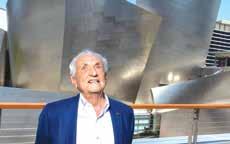
Frank Gehry, who was dubbed the greatest architect of all time, passed away at his Santa Monica home on Friday at age 96, following a brief respiratory illness. Gehry’s buildings doubled as works of art. He was acclaimed for his creativity and originality — for his unusual and artistic designs — and was responsible
for the Guggenheim Museum in Bilbao, Spain; The Walt Disney Concert Hall in Los Angeles; Berlin’s DZ Bank Building; and other masterpieces. He won every architectural prize in existence, including the Pritzker Prize, as well as the Royal Institute of British Architects gold medal, the Americans for the Arts lifetime achievement award, and the Companion of the Order of Canada, his native country’s highest honor.
Gehry was born in Toronto on February 28, 1929, to Polish Jewish parents. His real name was Ephraim Owens Goldberg, but he changed it at the behest of his first wife, who thought that his career could be held back by antisemitism — a decision he later said he wouldn’t have repeated.
As a young teenager, he was not religious. However, he acknowledged in a 2018 interview with the Jewish Journal that Judaism played an important role in his career.
“There’s a curiosity built into the [Jewish] culture,” he said. “I grew up under that. My grandfather read Talmud to me. That’s one of the Jewish things I hang on to probably — that philosophy from that religion… I was brought up with that curiosity. I call it a healthy curiosity. Maybe it is something that the religion



has produced. I don’t know. It’s certainly a positive thing.”
His family moved to Los Angeles in 1947. In 1954, he earned a degree from the University of Southern California in architecture. Afterwards, he went on to study urban planning at Harvard University. He founded his architectural firm, Gehry Partners LLP, in 1962.
It took time for Gehry’s career to take off. Though he always had inventive architectural ideas, he initially played it
safe, crafting plans that were typical. That soon changed.
In his 90s, he still worked as an architect. And even after his firm grew to over 130 employees, he still personally oversaw every project.
In 2011, he became a professor of architecture at his alma mater, the University of Southern California. He also lectured at Columbia and Yale University.
Some criticized Gehry’s designs as too complex, big, and messy. His works were
the Council on American-Islamic
tions (CAIR) and the Muslim Brotherhood as foreign terrorist organizations.
“Florida is designating the Muslim Brotherhood and the Council on American-Islamic Relations (CAIR) as foreign terrorist organizations,” DeSantis wrote on X on Monday.
According to the executive order, the state says that both organizations have ties to anti-Israel groups, including Hamas, Hezbollah, and other Palestinian organizations.

Additionally, it authorizes the Florida Department of Law Enforcement and the Florida Highway Patrol to take steps to prevent what it describes as unlawful activities connected to the groups. It also blocks individuals or entities that have provided material support to CAIR or the Muslim Brotherhood from receiving state contracts, funding, or benefits.
On Tuesday, CAIR and CAIR-Florida released a joint statement on Facebook in response to the designation.
“From the moment Ron DeSantis took office as Florida governor, he has prioritized serving the Israeli government over serving the people of Florida,” CAIR stated. “He hosted his very first official cabinet meeting in Israel. He diverted millions in Florida taxpayer dollars to the Israeli government’s bonds. He threatened to shut down every Florida college’s Students for Justice in Palestine chapter, only to back off when CAIR sued him in federal court.”
revolutionary but not simple. Despite his undeniable artistic genius, he ultimately thought of himself as an architect, not an artist.
Florida Governor Ron DeSantis issued an executive order this week naming
The statement added, “We look forward to defeating Governor DeSantis’ latest Israel First stunt in a court of law, where facts matter, and conspiracy theories have no weight. In the meantime, we encourage all Floridians and all Americans to speak up against this latest attempt to shred the Constitution for the benefit of a foreign government.”
On X, CAIR also added, “Unfortunately for Mr. DeSantis, none of his political stunts work out. He has been politically irrelevant ever since Donald Trump handed him a humiliating defeat on the campaign trail. We will do the same to Mr. DeSantis in a court of law, G-d willing. See you there soon, Ron. We hope you have better lawyers than Greg Abbott. By the looks of your provably false

and clearly unconstitutional proclamation, you’re going to need them.”
In November, Texas Gov. Greg Abbott had designated the Muslim Brotherhood and the CAIR as foreign terrorist organizations and transnational criminal organizations.
“The Muslim Brotherhood and CAIR have long made their goals clear: to forcibly impose Sharia law and establish Islam’s ‘mastership of the world,’” Abbott said in a press release. “The actions taken by the Muslim Brotherhood and CAIR to support terrorism across the globe and subvert our laws through violence, intimidation, and harassment are unacceptable.”
Abbott argued in a proclamation that the Muslim Brotherhood was founded as a jihadist movement dedicated to establishing a caliphate and had already been banned or limited in Austria, Bahrain, Egypt, Jordan, Saudi Arabia, and the United Arab Emirates due to engaging in terrorism or destabilization.
He noted that branches of the Muslim Brotherhood, such as the Arms of Egypt Movement and Liwaa al-Thawra, had already been designated by the U.S. as terrorist groups, as had Hamas, which was born from the movement’s Palestinian branch. The governor added that Hamas
had kidnapped and murdered American citizens during the October 7, 2023, massacre.

President Donald Trump was awarded the new FIFA peace prize on Friday at the 2026 World Cup draw.
FIFA president Gianni Infantino, a close ally of Trump, has said he thought Trump should have won the Nobel Peace Prize for his efforts to broker a ceasefire in Gaza.
In awarding the FIFA prize, Infantino told Trump it was a “beautiful medal for you that you can wear everywhere you want to go.” Trump promptly placed the medal around his neck. The certificate that Infantino handed Trump recognizes
the U.S. president for his actions to “promote peace and unity around the world.”
Infantino also presented Trump with a gold trophy with his name on it that depicts hands holding up the world.
“You definitely deserve the first FIFA Peace Prize for your action, for what you have obtained in your way,” said Infantino.
“This is truly one of the great honors of my life,” Trump said, adding that “most important, I just want to thank everybody. The world is a safer place now.”
The Nobel for peace was awarded this year to Venezuelan opposition leader Maria Corina Machado, who said shortly after the prize was announced that she was dedicating it in part to Trump for “his decisive support of our cause.” Machado will receive the award at the traditional Nobel Peace Prize ceremony in Oslo, Norway, on December 10.
It’s been five years, but they finally made an arrest. Last week, the FBI announced that it arrested Brian J. Cole Jr. of Woodbridge, Virginia, on explosive charges stemming from two pipe bombs that were placed outside the headquar-
ters of the Republican and Democratic national parties in Washington in 2021. The FBI and Justice Department declined to elaborate on what led them to the suspect. But authorities attributed the arrest to a reinvigorated investigation and a fresh analysis of already collected evidence and data.
Attorney General Pam Bondi said there was no new tip or witness that led officials to Cole. “Just good, diligent police work and prosecutorial work,” she said.

Investigators have, over the years, sought the public’s help in identifying a person shown in surveillance video taken the night before the January 6, 2021, events.
Law enforcement officials used credit purchases of bomb-making materials, cellphone tower data and a license plate reader to zero in on Cole, according to an FBI affidavit filed in the case.

His bank account and credit card information showed he bought materials in 2019 and 2020 consistent with those used to make the pipe bombs, according to court papers. This included galvanized pipes and white kitchen-style timers, according to the affidavit. The purchases continued even after the devices were placed.
The two explosive devices found at the scenes were each roughly 1 foot long and packed with gunpowder and metal.
Cole lived with his mother and other family members in a five-bedroom house on a quiet Virginia cul-de-sac about 30 miles south of the U.S. Capitol. He has no criminal record and was not registered to vote. One of four children, he worked in the office of his father, a bail bondsman. His mother works as a realtor. Cole’s parents divorced in October 2020.
Todd Combs, stock-picker at Berkshire Hathaway, is jumping ship to JPMorgan Chase. The shakeup takes place just weeks before Warren Buffett hands over his CEO role to Greg Abel.
Berkshire also announced that longtime finance chief Marc Hamburg was retiring and that the company had tapped Snap’s Michael O’Sullivan as general counsel.

Berkshire is on the cusp of a new era: Abel, the company’s vice chairman and the lead executive of its many non-insurance businesses, will take over as chief executive officer in January. And while he hasn’t publicly addressed his plans for Berkshire, Combs’s exit suggests Abel is already beginning to put his stamp on the company, including its massive investment portfolio.
Buffett hired Combs, a successful, if little-known, hedge-fund manager, in 2010 to help manage Berkshire’s enormous investment portfolio. He then landed atop Geico, where the 54-year-old executive is credited for orchestrating its successful revamp. Buffett last year called his improvements “spectacular.”

Combs’s performance at Geico made him a top candidate to succeed insurance chief Ajit Jain, who is 74 years old. Combs also had an enviable stock picking record, having earned a net cumulative 34% while running his own fund from 2005 to 2010, a financial crisis-era period when the S&P 500 produced 1.15%.
“Todd made many great hires at Geico and broadened its horizons,” Buffett said in a statement. “JPMorgan, as usually is the case, has made a good decision.”
Combs will lead a $10 billion strategic-investment group within JPMorgan’s new security-and-resiliency initiative and act as a special adviser to Chairman and CEO Jamie Dimon. He has served as a director at the bank since 2016 but will step down from that role now that he is joining in an executive role.
Buffett, 95, said last month he would be “going quiet” as he prepares to step down from the company he has led since the 1960s. In May, the billionaire investor revealed his plans to step down as Berkshire’s chief executive at the end of this year.
Berkshire said Nancy Pierce, who has worked for Geico for four decades and most recently served as chief operating officer, will succeed Combs at the helm of the insurer.
JPMorgan Chase also named tech billionaires Jeff Bezos and Michael Dell, plus an all-star cast of retired generals and politicians, to an advisory council for advice on its plans to finance $1.5 trillion in capital for companies deemed critical to national security, including the $10 billion of its own funds Combs will oversee.
living dog. The Oklahoma dog nabbed the crown when his mouth muscle’s length was confirmed to have exceeded that of Bloomington, Ill., dog Rocky, whose tongue was measured at 5.46 inches in 2023.
“He has always had a tongue that sticks out of his mouth, ever since he was born,” Pick told Guinness World Records. “But there’s nothing medically wrong with him, we’ve had him looked at a couple of times by a veterinarian, and there’s no dental issues or anything – it’s just abnormally, awkwardly long!”
She said Ozzy’s tongue isn’t as much of a slobber-risk as its size might indicate.
“It’s funny, for his tongue to be the way that it is, he doesn’t really lick a whole lot,” she said. “He doesn’t give kisses – he gets in your face and kind of loves and rubs noses, but he doesn’t really lick on a lot of stuff!”
Takes a lickin’ and just keeps on tickin’.

Sarwagya Singh Kushwaha is just three years old, but he’s already reigning as a world champion.

Ozzy loves to lick things with his gigantic tongue.
The French mastiff and bull mastiff mix belongs to Angela Pick and her family. Recently, the dog earned a Guinness World Record for his tongue, which measures a whopping 7.83 inches long.
Ozzy is now the proud holder of the title for the world’s longest tongue on a
At the age of 3 years, 7 months and 20 days, Sarwagya became the youngest chess player to earn an official rating from chess’s international governing body. He was rated 1572 in rapid chess by FIDE after beating opponents many times his age. The rating is considerably higher than the minimum 1400 required.
To be rated by the International Chess Federation, a player must score points against at least five already rated players at official events.
Sarwagya, who comes from the central Indian state of Madhya Pradesh, joins a growing list of young Indian players who have come to dominate the sport in recent years.
He started playing chess when he was just 30 months old.
His father, Siddharth Singh, said, “We pushed him into chess last year because we noticed his mind was a sponge and he would pick up things very quickly. In a week of being taught chess he could name all the pieces accurately.”
Now, the toddler plays chess for four

48 to five hours a day, including one hour at a training center.
His victories this year have included matches against Yogesh Namdev, 20, with a rating of 1696; Abhijeet Awasthi, 22 (1542); and Shubham Chourasiya, 29 (1559).
Sarwagya broke the record by almost a month, dethroning another Indian boy, Anish Sarkar, who last year was rated 1550 at the age of 3 years, 8 months and 19 days.
India’s growing prowess culminated in an iconic moment in June, when Gukesh Dommaraju, 19, defeated Magnus Carlsen, 35, who is widely considered one of the greatest players of all time and who ended the match by slamming his fist on the table. Last year, Dommaraju became the youngest-ever world champion.
Sarwagya could also train to become a grandmaster, his father said, following in the footsteps of Indian stars such as Dommaraju and five-time world champion Viswanathan Anand.
The record for youngest grandmaster is held by the American Abhimanyu Mishra, who in 2021 became one at the age of 12 years, 4 months and 25 days, three months earlier than Dommaraju. Checkmate.

A raccoon drank a bit too much last week and passed out in a liquor store.
An animal control officer was summoned to the store in Virginia where the pest had broken in, ransacked the shelves and passed out drunk in the bathroom.
Hanover County Animal Protection and Shelter said on social media that an officer responded over the weekend to a report of an animal break-in at the ABC store in Ashland.
The officer found the Black Friday break-in had been perpetrated by a raccoon that had “ransacked several shelves,” sampled multiple different varieties of liquor from broken bottles, and then settled down to sleep it off on the floor of the store’s bathroom.
The raccoon’s “liquor-fueled ram-
page” came to an end when the officer “secured our masked bandit and transported him back to the shelter to sober up before questioning,” the post said.
The especially trashed “trash panda” was found to be uninjured, “other than maybe a hangover and poor life choices,” officials wrote.
The animal spent some time at the shelter sobering up and then was released into the wild.
Sure hope he learned his lesson.

Although police knew they had their suspect, it took them quite a few days to gather evidence in this case.
On Friday, New Zealand Police said that they recovered a James Bond-inspired Fabergé pendant. The necklace had been swallowed by a suspect in an
Auckland jewelry store six days prior. Authorities had to wait until the pendant made its way through the suspect’s body before gathering their evidence.
The limited-edition, Fabergé egg pendant was inspired by a 1983 James Bond film in which a jewel-smuggling operation involves a fake Fabergé egg.
The egg and its long chain – along with the price tag – survived the journey inside the person’s body. The jewelry is worth around $19,000.
The store’s website says the egg, one of only 50 made, was crafted from gold, painted with green enamel and encrusted with 183 diamonds and two sapphires. The pendant is 3.3 inches tall and is mounted on a stand.
“The egg opens to reveal an 18 carat yellow gold octopus nestled inside, adorned with white diamond suckers and black diamond eyes,” an item description said.
The man was arrested inside the store on November 28 shortly after the alleged theft. He made an appearance the next day, but he didn’t enter a plea to a charge of theft. Since then, he’s been in police custody and officers had been stationed round the clock with the man to wait for the evidence to reemerge.
A great egg-sample of good police work.




Hundreds of community members gathered on Sunday morning, December 7, at the Sephardic Temple in Cedarhurst for the Annual Shalom Task Force Brunch, an event that highlighted the community’s steadfast commitment to supporting survivors of domestic abuse and promoting healthy relationships within the Jewish community. The morning brought together leaders, advocates, students, and supporters in a powerful show of unity for Shalom Task Force’s vital mission. It was a powerful reminder that meaningful and lasting change takes form with a supportive community.
The program opened with welcoming remarks from board member Chaya Katzman, who greeted several elected officials in attendance, including Nassau County Executive Bruce Blakeman, NYS Assemblymembers Ari Brown, Sam Berger, and David Weprin. Board Co-President Rachel Marks expressed deep gratitude to all those who continue to stand with Shalom Task Force, emphasizing the crucial impact of community support for


victims and survivors of domestic abuse. Shalom Task Force CEO Keshet Starr, Esq., offered reflections on the agency’s work over the past year, centering the mission that guides the organization every day. “One thing I learned the very first time I worked with a survivor of abuse is that for too many people in this world –and in our community – home is the least comfortable place,” she shared. “Together, we’re building a community that is just as beautiful on the inside as it is on the outside, because it’s the inside that always matters most.”
Rabbi Axelrod, rabbi of the Young Israel of Woodmere, then delivered meaningful divrei bracha, recognizing the importance of standing together as a community to support those in need of our help.
Following a moving video presentation showcasing Shalom Task Force’s impact, the Young Leadership Community Impact Award was presented to North Shore Hebrew Academy seniors Sofia Asher, Molly Feldschreiber, Eve Gelberg, and Hili Zubli, whose leadership as part of the Purple Fellowship last year left a


lasting mark on their school community. Their coordination of “Go Purple Day” in February energized their peers and inspired greater awareness and involvement in Shalom Task Force’s work.
Judge Esther “Micky” Morgenstern was then honored with the Community Impact Award in recognition of her decades of service on the bench of the Kings County Integrated Domestic Violence Court. Her unwavering dedication has ensured that victims have a clear and compassionate path through the court system, and her thoughtful leadership has been especially influential for Jewish victims navigating sensitive and complex situations.
The brunch continued with a tribute to Guests of Honor Esther and Howard Kopel, whose longstanding involvement has strengthened Shalom Task Force’s work at every level. Esther has devoted countless hours volunteering across multiple areas of the organization, offering dedication and support to programs that uplift survivors and promote healthy relationships. Howard has served as a passionate and vocal advocate for STF in
the broader community, using his public platform to raise awareness about domestic abuse and championing the essential services the agency provides to families in need.
The morning concluded with remarks from Brunch Co-Chair Daniella Graff, who spoke about the collective responsibility to build a stronger and brighter future for everyone in the community. Her message underscored the theme of the day: that when a community stands together with compassion, action, and commitment, we create pathways to safety, healing, and hope.
Shalom Task Force has been offering support and education to the Jewish community for the last 32 years. If you or your loved one has questions or concerns about relationships or are currently in an unhealthy or abusive relationship – we are here for you. Please call, text, or WhatsApp the confidential Shalom Task Force Hotline at 888-8832323 or chat with a live advocate at shalomtaskforce.org.

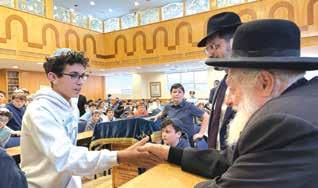
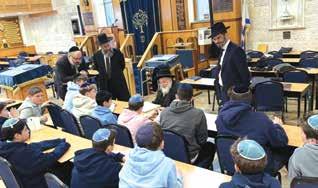
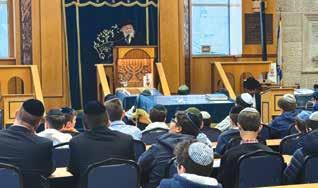
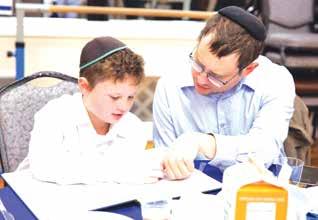
The “kol Yaakov” became more powerful when TAL Academy celebrated its fifth grade boys’ Haschalas Gemara.
Fathers and grandfathers joined their sons and grandsons to celebrate this milestone, as the boys took this exciting step in their growth as bnei Torah. A celebratory breakfast was enjoyed by all the guests, complete with doughnuts in anticipation of Chanukah. The event began with the school’s founding principal, Mrs. Sara Taib, thanking the many guests, many of whom had traveled significant distances to recognize this achievement.
TAL Academy is a school for bright boys and girls whose language-based learning disabilities necessitate a special-
ized approach to their childhood chinuch Mrs. Taib emphasized how much effort the boys put in to reach this occasion and how impressive their dedication to learning has been as they overcame personal obstacles along the way.
The boys’ rebbi, Rabbi Avi Karr, shared several stories with the audience that emphasized the greatness of learning Torah Sheb’al Peh. Rabbi Karr stressed that it is through the study of Gemara that a Jew enjoys the special relationship with Hashem that has been promised to us, and that this is what makes us a truly unique and prized people. After the rebbi’s speech, the audience was treated to a video presentation of the boys acting out the beginning of Eilu Metzios, showing

that our Torah is a Toras Chaim that applies for all time and place.
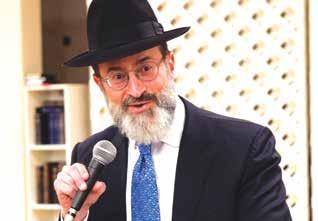
After a short learning seder, the boys and their guests were privileged to hear divrei chizuk from the guest speaker, the ma’ara d’asrah of TAL Academy, HaRav Eytan Feiner, shlit”a. HaRav Feiner spoke about the significance of beginnings and how essential it is that they be without corruption or defect. Connecting the start of the boy’s learning Maseches Bava Metzia to Inyanei D’Yoma, HaRav Feiner explained how, although the mitigating circumstances technically allowed the victorious Jews to use impure oil for the Menorah, the fact that it constituted a new beginning of Torah fulfilment meant that complete purity was required. HaR-
av Feiner encouraged the boys to strive for a purity and excitement in their learning, similar to that of the Chashmonaim in their rededication of the Bais HaMikdash. Afterwards, each boy received personal words of chizuk from HaRav Feiner, with a photograph being taken to ensure they remember this special beginning forever.
The celebration ended appropriately with a fun quiz organized by Rabbi Karr, in which the boys and their fathers and grandfathers answered questions on the Mishna and Gemara they have learned so far. The boys and their guests all left with a renewed appreciation for Torah, and especially for the privilege of learning Gemara.
The Young Israel of Far Rockaway has been hosting amazing family Chanukah parties for the past few years for the entire community. This year, on December 21, 2025, the seventh day of Chanukah, we are proud to host a fun-filled day of Chanukah activities that the entire family will enjoy. Beginning at 8:30 AM, we will have a beautiful Chanukah davening followed by a musi-
cal Hallel with renowned singer Rabbi Ophie Nat. This will be followed at 9:45 by a joyous soulful concert and kumzitz that all can enjoy in honor of Chanukah.
At 10:30, we will be entertained by the amazing magician Baruch (Bruce) Robinson who will mesmerize both young and old. Our afternoon then will be followed with many more fun activities such as Chanukah photo booth, a live band, face
painting, raffles and many other treats and surprises that the whole family can enjoy – guaranteed to be a fantastic event!
This magical musical extravaganza will take place at Young Israel of Far Rockaway, 716 Beach 9th Street, Far Rockaway, NY 11691. We can’t wait to see everyone there!
Additionally, everyone is invited to
join our Shabbos davening, which is truly soulful, conducted by our new associate rabbi, Rabbi Moshe Hamel, and a wonderful meaningful speech given our very own Rabbi Shaul Chill. We always have an amazing davening followed by an elaborate Shabbos Kiddush that we all enjoy. Come join us – you will be glad that you did!



The Bais Yaakov Ateres Miriam Pre-1A girls had a very special visitor this week. It was The Nekudos Bubby! She was dressed in her zany nekudos outfit and adorned in adorable tzeireh glasses over her einayim, The Nekudos Bubby read a fun book called Nekudah Land. The highlight of

the visit was the gift of nekudos decorated placemats accompanied by sweet, delicious candy to place on top to form their own edible nekudos. The squeals of laughter and excitement were a sight to see! Thank you Nekudos Bubby for the fun visit!


The FM Home Loans MAY 5K has become a hallmark event at Mesivta Ateres Yaakov, capturing the spirited ruach that defines the yeshiva. Held a few weeks ago and organized by the Student Government, the annual race generates tremendous excitement among the talmidim while raising essential funds for the tuition scholarship fund and student-focused programming. Since its inception, the MAY 5K has raised over $1,000,000 for these vital initiatives.
To celebrate this year’s success, the G.O. hosted the 5K Incentive Breakfast,
where the highlight was the presentation of hundreds of impressive, hard-earned prizes to the bochurim who devoted themselves to fundraising. Incentives included Traditions gift certificates, pickle ball sets, JBL Charge 6 speakers, custom sneakers, AirPods, and even an iMac computer.
MAY extends heartfelt thanks to FM Home Loans, the event’s title sponsor, as well as to the many sponsors, volunteers, and participants who helped make this year’s MAY 5K an unforgettable accomplishment.

The Village of Lawrence is proud to invite the community to celebrate the holiday season with special events that bring light, joy, and togetherness to our neighborhood.
The Village will illuminate the Business District with festive holiday lighting, adding warmth and charm to our local shops and streets. Residents and visitors are encouraged to stop by, enjoy the decorations, and support our local businesses throughout the season.
In addition, the Village will host Nightly Menorah Lightings at Village Hall, each evening of Chanukah. Families, friends, and neighbors are invited to gather as we kindle the lights and celebrate the spirit of the holiday together. See VillageofLawrence.org for schedule.
“We look forward to welcoming the community as we bring light to Lawrence during this special time of year,” said Mayor Samuel Nahmias. “These events reflect the unity, tradition, and vibrancy of our Village.”
All are welcome to attend. For more information, please contact Village Hall.
Mayor Samuel Nahmias and Hempstead Town Supervisor John Ferretti joined more than 200 mayors and municipal leaders at the 2025 North American Mayors Summit Against Antisemitism, hosted by the Combat Antisemitism Movement (CAM) and the City of New Orleans, December 2-4.
This high-impact, bipartisan summit equips cities with real tools — from model ordinances and crisis communication guidance to law enforcement training and community-building strategies — empowering leaders to take clear, united action against hate.
Mayor Samuel Nahmias, who was recently honored by the Holocaust Memorial & Tolerance Center of Nassau County for his commitment to community and justice, reflected on the experience, “I learned from colleagues across government about the diverse and meaningful ways they are addressing the antisemitic incidents their constituents face. Antisemitism is a persistent, destructive force—one that spreads hatred and seeks to destabilize democratic societies. His-
The Rabbi Shlomo Gottesman z”l Beit Midrash in HANC’s Reinstein Family Campus in West Hempstead was filled with excitement as the parents, siblings and grandparents of the second grade students waited with great anticipation for the children’s Chagigat HaChumash Celebration. Accompanied by the joyful melodies of HANC’s music teacher, Mrs. Kari Levine, a HANC alumna and parent, the children marched in with enthusiasm emanating from their faces. Dressed in blue and white and wearing glittering Torah crowns on their heads, the students eagerly took their places on stage. The excitement in the air was palpable, and it was evident that the audience was about to witness an inspiring milestone in their children’s lives.
Rabbi Ouriel Hazan, Head of HANC’s nursery through eighth grade campus, welcomed the families into the gathering of happy Chumash recipients. In his opening remarks, Rabbi Hazan noted that this year’s second graders were especially privileged to be the first group of second graders to receive their Chumashim in the new campus, which is a historic milestone for the entire HANC
tory shows that it rarely stops with one group; hatred aimed at Jews or Israel eventually expands to target other minority communities as well. This is why our fight must be united, consistent, and unwavering at every level.
“In recent months, we have also witnessed troubling displays of hostility toward Israel, including decisions by some government bodies to divest from Israeli investments. These actions—often taken under political pressure—ignore Israel’s profound contributions to the world. From life-saving drug discoveries and groundbreaking medical devices to cutting-edge technologies that shape our daily lives, Israel has been a global leader in innovation, science, and humanitarian advancement. The world would be markedly less advanced without Israel’s ingenuity and collaboration. Instead of turning our backs, we should recognize and support the immense value Israel brings to the international community.
“As a mayor, I have witnessed how these patterns repeat. Each time we believe society has moved past this point, we

see antisemitism reemerge in new forms. It often begins with hostility toward Jewish communities and Israel, then spreads across the United States and to other parts of the world. This dangerous trend threatens the values and shared understanding we have worked so hard to build.
“We must continue to bridge divides, strengthen communication, and act with empathy and solidarity. Through unity, vigilance, and a commitment to our shared humanity, we can confront antisemitism in all its forms and ensure our communities remain safe, inclusive, and resilient.”
community.
Throughout the electrifying performance, the children sang a series of songs focusing on the importance of learning Torah and how happy they were to be receiving their first Chumash. As the children delivered their speaking parts and sang their inspiring songs, the students’ enthusiasm was felt throughout the room. In one of the songs, as the children sang about lighting up the world with Hashem’s Torah, the lights were turned off and the children waved glow sticks to exemplify the light of Torah that each of them possesses and can share with the world.
Following their spirited performance, Mrs. Michal Wasser, principal of the Elementary School, addressed the children, “The Torah begins with learning about the Avot and Imahot. Why doesn’t it begin with mitzvot? Each one of the patriarchs and matriarchs has their own story and we can learn from each one of them. In your beginning learning of Chumash, you will learn lessons through them about responsibility and values, and then you will be ready to perform mitzvot. In keeping with our school theme this year, together we form one nation, Am Echad,

and we will rise higher together. Last year, when you received your siddur, you were able to speak to Hashem through tefillah. This year, as you are about to receive your Chumash, Hashem will be speaking to you.”
The much anticipated moment finally arrived. Each student was called forward by Mrs. Michal Wasser and was presented with a beautiful Chumash with a leather cover that was personalized with their full Hebrew name. In addition to receiving their Chumashim, the students were also presented with a photograph of themselves receiving their Chumash with the teachers and administrators. The children also received a large cookie with the image of the cover of their Chumash embedded on the delicious treat as a symbol of the sweetness of learning Torah.

HANC wishes to thank the second grade teachers: Morah Leah Rauch, Morah Yocheved Silverman and Rabbi Eli Tessler and the rest of the second grade team for all of their hard work in preparing the children for this special milestone event. Thank you to Mrs. Kari Levine for the many hours she spent rehearsing with the children and enabling them to sing so magnificently. Special thanks to the PTA for its continued support and the generous Chumash sponsors for the beautiful personalized covers that created a truly magnificent gift of lifelong learning for our students. Tremendous hakarat hatov to Mrs. Michal Wasser for her assistance with so many details to make this program a resounding success. Mazal tov to all of the students and may their families derive much nachat in the future from their wonderful children.


In Mrs. Mayer’s third grade ELA class at YOSS,
Students learned that no strength is ever lost.
This week they took a moment to see “What’s the best part of me?”
Instead of things they’d hide away, They focused on their strengths today.
An introspective, thoughtful quest To choose the part they love the best. They paused to think and look and see Their own unique identity. Noticing, from head to toe, What helps them learn and shine and grow.
Some chose hands that help and build,
Kind and steady, calm and skilled. Others picked bright eyes that see Tiny details carefully.
A few chose feet that help them play,
Jumping, running through the day.
Many wrote of caring hearts.
The kindness that true friendship starts.
The classroom sparkled, row by row, With children learning how to glow. Discovering strengths in every place, And seeing beauty in each face.
Pride and joy filled up the room
As confidence began to bloom. Each student smiled, brave and free, Thinking introspectively.
Now displayed for all to view Is work that’s honest, brave, and true.
A celebration of each child’s voice, Of recognizing strengths by choice. So take a moment to look and see How bright third grade at YOSS can be
A class of stars who learned this week: The best part of you makes YOU unique.


for

Led by Mr. Miles Ehrenkrenz, YCQ dominated at last week’s Debate Tournament at SAR. Avigail Cohen and Loren Moradov took top honors as Best Team with Avigail winning Best Speaker as well. In a historic display, Cohen and Moradov achieved a combined perfect score of 120 in one round, with
Cohen setting the all-time YCQ individual record at 118/120. Additionally, Leah Vaysband and Abigail Inoyatov secured Second Place Team. The overall performance was unprecedented, featuring multiple scores of 58, 59, and 60 that far exceeded the typical threshold needed to win.

The talmidos of the Ganger Early Childhood of TAG are always excited when Dr. Metz appears in their Pre-1A classroom to present a
science experiment. In keeping with the Chanukah theme, Dr. Metz enLIGHTED them with an experiment involving lights.



On Motzei Shabbos, December 6, K’hal Lev Avos of North Woodmere hosted a beautiful dual-purpose Melava Malka, celebrating the kehilla’s ten-year anniversary as well as the groundbreaking of its long-awaited new building.
What began in 2015 as a small group of families responding to North Woodmere’s rapid growth has blossomed into a vibrant makom Torah u’tefillah. In those early days, Avi and Penina Sipzner
graciously opened their living room to serve as the shul’s first home. Soon after, the kehilla welcomed its beloved rav, Rabbi Shmuel Weinberg, great-nephew and talmid of the “Nesivos Shalom,” together with his wife, noted historian Rebbetzin Dr. Tzipora Weinberg, to lead the burgeoning congregation. Under their leadership, the shul flourished, quickly outgrowing its original space and moving to its warm and welcoming home at 500 Hungry Harbor Road.
That home, too, soon became insuffi-


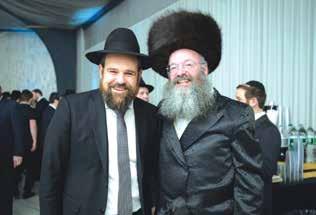
cient as membership once again surged. Recognizing the need for a true, longterm home, K’hal Lev Avos embarked on the ambitious mission of constructing a full building that would serve its members and the greater North Woodmere community for generations to come.
The Melava Malka brought together men and women of the kehilla, along with parents, grandparents, and friends, for a beautifully arranged seudah marking this milestone. The shul was honored by the presence of many other North Woodmere rabbonim, as well as Hempstead Town Supervisor John Ferretti and former U.S. Representative Anthony D’Esposito, both dear friends of the kehilla who played instrumental roles in helping the shul reach this moment.
The program opened with remarks from Shul President Yitzi Gross, who expressed deep gratitude to the many members whose generosity of time, resources, and spirit enabled the Shul to reach its groundbreaking. He was followed by founding member Avi Langer and former president Rabbi Yosef Friedler, who reflected on the origins of the kehilla, the significance of the name Lev Avos, and the profound hakaras hatov owed to Irving and Itta Bauman for their extraordinary partnership in enabling both the
original and the new building.
Rabbi Weinberg delivered the keynote address, drawing a poignant parallel between the shul’s current juncture and the conversation in Sefer Melachim between Elisha and his students. When the talmidim shared that their existing space had become too small, they sought permission to go to the Yarden to gather wood and expand. After Elisha granted permission, they asked him to accompany them, a seemingly unnecessary request for the leader of Klal Yisroel. Rabbi Weinberg explained that the students did not need Elisha’s carpentry skills; they needed his spiritual guidance. Any physical expansion must be accompanied by a spiritual one. So too, he noted, this groundbreaking represents not merely the construction of a larger building, but the opportunity – and responsibility – for the kehilla to grow in its spiritual capacity as well.
The evening concluded with a lavish dessert and a spirited kumzitz, leaving participants uplifted and inspired as they look ahead to the next chapter of K’hal Lev Avos. More information about the kehilla can be found at khallevavos.org


On Monday, December 8, Shulamith School for Girls had the privilege of welcoming Dr. Yoni Schwab for a meaningful and engaging day of learning centered on healthy technology use. Dr. Schwab, a respected educator, speaker, and psychologist, addressed the students about the importance of being mindful of screen usage. Through interactive discussions and relatable examples, Dr. Schwab encouraged the girls to think critically about their digital habits. He highlighted the value of being fully present with family and friends, as well as the emotional and social downsides of excessive screen time. Students described Dr. Schwab as
both engaging and knowledgeable, noting how his presentation helped them reflect on their own technology use.
Following his session with the students, Dr. Schwab met with the Shulamith staff to discuss strategies for supporting healthy digital habits in the school environment. In the evening, he continued the conversation with the parent body. A team from TAG was also on site to assist families in making appointments to filter and safeguard their devices.
It was an informative and impactful day at Shulamith, one that strengthened our school community’s commitment to responsible and intentional technology use.

Photos by Yoel Hecht


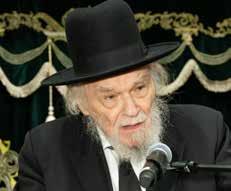
Hundreds of yeshiva bachurim, kollel yungeleit, roshei yeshiva, and rabbeim from throughout Far Rockaway and the Five Towns packed the main beis medrash at Yeshiva Darchei Torah to joyously welcome—and be inspired by—Maran Rav Moshe Hillel Hirsch, shlit”a. Rav Hirsch, one of the roshei hayeshiva of the Slabodka Yeshiva in B’nei Brak, was visiting the United States on behalf of his yeshiva. For Rav Hirsch, the trip to Far Rockaway was a homecoming of sorts. A prime talmid of Maran Rav Aharon Kotler zt”l in Lakewood, he also studied in his youth at Yeshiva Rabbeinu Jacob Joseph, Yeshiva Toras Emes Kamenitz, and—until the age of eight— at the Hebrew Institute of Long Island (HILI). As HILI’s campus is now Yeshiva Darchei Torah, the visit marked a return

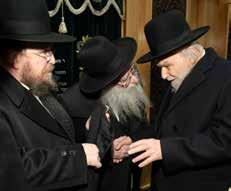
to the very grounds where he learned as a child.
Today, the Slabodka Rosh Yeshiva carries the mantle of leadership together with Maran Rav Dov Landau, shlit”a, guiding not only their yeshiva, talmidim, and alumni, but the global Olam HaTorah as well.
After being welcomed with extended, spirited singing and live music fit for a gadol b’Yisrael, Rav Hirsch addressed the crowd in fluent, native English. Drawing on the parshas hashavua and his own experiences growing up in America, he inspired the assembled to strive for greater heights in Torah, Avodah, and Yiras Shomayim.
It was a rousing ma’amad of kavod HaTorah whose afterglow will linger for a long time to come.
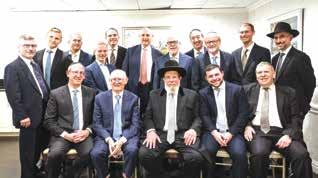
Meeting with rabbinic and lay leaders before the


On Monday, November 24, the Chief Rabbi of Israel, Rabbi Kalman Ber, together with his wife, Rabbanit Dafna Ber, arrived in New York and began a whirlwind week of engagement with communities and institutions across the NY/NJ area. Their first stop was the annual Yeshivat Kerem B’Yavneh Alumni Gathering. Rabbi Ber is not only an alumnus of KBY but also spent four decades at the yeshiva as an avreich and later as a Ra”m.
Throughout the week, the Chief

KBY

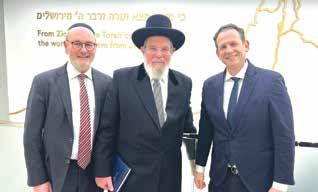
Rabbi and Rabbanit met with lay leaders, rabbinic leaders, and educators in schools, shuls, and homes across Riverdale, Teaneck, and the Five Towns. They visited DRS, SKA, MTA, YU’s Beren Campus, Heichal HaTorah, and YU’s Wilf campus, where the Chief Rabbi delivered a well-received shiur on Chanukah. They also met with leadership of the OU and the RCA.
A major highlight was a joint community symposium at Congregation Ohr HaTorah, bringing together the commu-

At a lay leader and rabbinic gathering at the home of Rabbi Judah and Erica Cohen in Woodmere, NY L-R: Rabbi Dr. Chaim Abittan (KBY 1985), Rabbi Judah Cohen (KBY 1985), Rabbi Dr. Aaron Glatt, Chief Rabbi Rav Kalman Ber (KBY 1975), Rabbi Shalom Axelrod (KBY 1987), Rabbi Isaac Rice, Rabbi Aryeh Lebowitz (KBY 1995), Rabbi Uri Orlian (KBY 1993), Rabbi Elie Weinstock (KBY 1993)


Meir Goldwicht (KBY
and Rosh Yeshiva, Rav Hershel Schachter
nities of Rabbi Sobolofsky and Rabbi Rothwachs for an uplifting evening of Torah and inspiration.
The week concluded with a deeply inspiring Shabbaton, organized by Rabbi Axelrod and the Young Israel of Woodmere and hosted by Beis HaKnesses of North Woodmere, Young Israel of Woodmere, and the Young Israel of Lawrence-Cedarhurst, all led by proud KBY alumni. The pinnacle of Shabbos was a stirring Mussaf at the Young Israel of Woodmere led by Ohad Moskowitz, fol-
lowed by an address from the Chief Rabbi attended by over 800 people, including Rabbi Hershel Schachter, Rabbi Shalom Axelrod, Rabbi Dr. Aaron Glatt and Rabbi Shay Schachter.
The visit left a powerful impression throughout the NY/NJ community, strengthening the bond between local institutions and the Torah leadership of Israel.

At Ohel’s 56th annual gala dinner, left to right, Shlomie Dachs, Pinny Hikind, City’s Comptroller’s office, and David Mandel
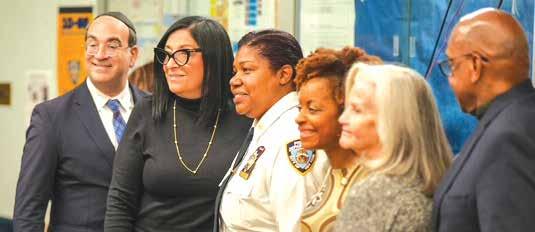
Community leaders gathered to thank and bid farewell to Deputy Inspector Carol Hamilton, who has served as the commanding officer of the 100th Precinct since 2023. DI Hamilton will be transitioning to a new role at the NYPD’s Internal Affairs Bureau.
“Deputy Inspector Hamilton brought love, compassion, and unwavering dedication to the Rockaways and beyond,”
said Pesach Osina, candidate for Assembly.
See here: Pesach Osina; Councilmember Joann Ariola; Deputy Inspector Carol Hamilton; Council Member Selvena Brooks-Powers; Dolores Orr, Chairperson of Queens Community Board 14; and Joe Edward, Executive Director for Congressman Gregory Meeks.
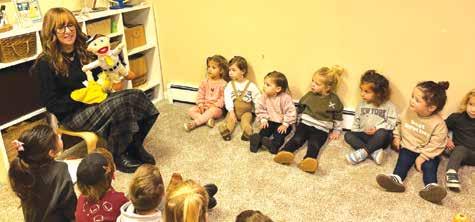
Gan Chamesh’s Feelings program is off to a great start. Every month, Morah Suzanne, the co-director of the preschool, visits each classroom, along with her puppets, Rena and Simcha. They teach the children all about feelings and encourage them to use their words to express how they feel. Last week’s lesson focused on feeling happy and sad and dealt with situations
Lev Chana has been buzzing with excitement about Chanukah! Students have spent time in class making Chanukah related projects, and parents were invited to join their chil-
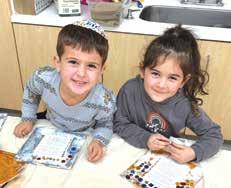
dren for Chanukah workshops. Between the art projects, singing, dancing, and laughing, everyone has been having a great time!

This past Sunday, HAFTR proudly welcomed its second graders to the annual Chagigat Chumash celebration, a heartwarming milestone as each child received their very first Chumash. The event marked an exciting step in their Torah journey, filled with meaning, joy, and a deep connection to Jewish heritage.
Families, parents, grandparents, and even great-grandparents gathered to share in this special moment, witnessing the intergenerational bond that Torah study inspires. Each student held their Chumash with pride, ready to embark on a new chapter of learning, growth, and connection to Am Yisrael.

excitement.
that might bring about those emotions. The physical manifestations of emotions were also discussed, such as smiles that indicate feeling happy, or slumped posture and frowns that go along with feeling sad. The feelings program helps the children identify, label and express their feelings, thereby increasing their levels of emotional awareness.
HAFTR Lower School Mashgiach Ruchani, Rabbi Asher Klein, offered a heartfelt bracha, encouraging the students to approach Torah with enthusiasm and commitment: “This is the foundation of a lifelong connection to Torah.” The second-grade morot and rebbeim, Mrs. Shari Bennett, Mrs. Julia Dweck, Mrs. Miriam Green, Mrs. Jamie Haberstumpf, Mrs. Rachael Lavian, Mrs. Michaella Lepkowsky, and Rabbi Shmuel Schroff, prepared the children beautifully, guiding them through meaningful songs and moments of reflection that brought Torah to life. Students recited Shehechiyanu as they held their Chumashim for the first time, a moment radiating gratitude and
The celebration continued with handson workshops that deepened students’ appreciation for Torah. They explored the details of a Sefer Torah (having learned about the creation of one from Tzvios Hashem), created personalized Chumash covers, wrote notes to commemorate the day, and participated in interactive games to reinforce their learning.
The Chagigat Chumash reflected the joy of Torah study and the power of community, highlighting once again how HAFTR is makom shelanu. It serves as a place where every student belongs, grows, and thrives.
The next day, students eagerly opened their Chumashim, ready to continue their learning journey with pride, purpose, and connection.

This past Sunday, the Israel Chesed Center (ICC) marked an exciting milestone with the official launch of ICC Teens, a new youth-driven initiative designed to empower and inspire the next generation of Jewish leaders through chesed, advocacy, education, and community action.
Dozens of teens from local high schools gathered at the ICC for the inaugural event, which featured an emotional and inspiring presentation by Jen Airley, mother of fallen IDF soldier Binyamin Airley, HY”D. Her message of resilience, responsibility, and Jewish pride set a profound tone for the program’s mission. Connecting her words to the themes of Chanukah, Jen reminded the teens that “we are living in a time that is greater than the Chanukah story,” urging them to seize the moment and rise as modern-day Chashmonaim.
Following her talk, the teens rolled up their sleeves for their first major project: assembling hundreds of beautifully pre-
pared welcome-gift bags for the guests of Beit Binyamin, the new retreat center in the heart of Tzfat named to perpetuate Binyamin’s memory. Beit Binyamin offers respite, relaxation, and recovery to combat soldiers, bereaved and displaced families, and others suffering from the traumatic effects of the war.
The energy in the room was electric as students from schools across the area worked side by side — packing toiletries, comfort items, and treats to help Beit Binyamin’s guests feel cared for and supported.
After the event, Mrs. Airley shared her gratitude: “I am so grateful. The teens are unbelievable! I’m looking forward to the faces of the Beit Binyamin guests when they see all these goodies packed with love!”
The event also reflected ICC’s expanding mission. Founded in the days following October 7, the Israel Chesed Center originally focused on urgent humanitarian aid for Israel’s soldiers and civilians. As the needs have evolved from
acute crisis to long-term recovery, ICC has broadened its scope to include advocacy, education, and community engagement — with teens playing a central role.
“The teens asked for this — and they built it themselves,” said ICC co-founder Moshe Bodner. “They wanted a place to make a difference, to learn, to take action, and to stand proudly for Israel. ICC Teens is their platform, and Sunday showed just how much passion and leadership they already have.”
The kickoff was organized by the founding ICC Teen leaders — Moshe Pollack (MTA), Rachel Sipzner (Shulamith), and Avigayil Ranells (Shulamith) — who recently created a WhatsApp group that quickly grew to more than 200 members. With guidance from ICC leadership and strong support from parents, schools, and community volunteers, ICC Teens is now preparing a robust calendar that includes hands-on chesed projects, advocacy and media-literacy workshops, opportunities to meet Israeli heroes and

speakers, community events and holiday programming, and leadership development sessions.
Sunday’s event marks the beginning of what organizers hope will become a movement of empowered, informed, compassionate young Jews — stepping forward with confidence, pride, and purpose. For more information or to join ICC Teens, please contact the Israel Chesed Center or follow ICC Teens on social media.
You generally do not have to sell your home to qualify for Medicaid for nursing home coverage. However, it’s possible for the state to file a lien against your home after you die. So, you may want to take steps to protect your house.
If you get help from Medicaid to pay for the nursing home, the state must pursue estate recovery. This is an attempt to recoup from your estate whatever benefits it paid for your care. The only property of substantial value that a Medicaid recipient is likely to own at death is their home. If at all possible, consult with an elder law attorney before you enter a nursing home (or immediately afterward) to discuss ways to protect your home.
In most states, Medicaid will not count your home as an asset when you’re applying for Medicaid if the equity of the home is under $713,000 (in 2024). In all states, you may keep your house with no equity limit if your spouse or another dependent relative lives there.
Transferring a Home to Your Children
In most states, transferring your house to your children (or someone else) may lead to a Medicaid penalty period. This
can disqualify you from Medicaid benefits for a certain length of time.
Depending on your circumstances, it can be legal to transfer a house, however. Consult with one of our attorneys before making any transfers. You may freely transfer your home to the following without incurring a transfer penalty:
Your spouse
A child who is under age 21 or who is blind or disabled
-A trust for the sole benefit of a disabled individual under age 65 (even if the trust is for the benefit of the Medicaid applicant, under certain circumstances)
-A sibling who has lived in the home during the year preceding the applicant’s move to a nursing home and who already holds an equity interest in the home
A caretaker child of the applicant who lived in the house for at least two years prior to when the applicant moved into a nursing home and who, during that period, provided care that allowed the applicant to avoid a nursing home stay
While you can sell your house for fair market value, it may disqualify you for Medicaid. In addition, you may have to apply the proceeds of the house sale to your nursing home bills.
Except in certain circumstances, Medicaid may put a lien on your house for the amount of money spent on your care. If the property is sold while you are still living, you would have to satisfy the lien by paying back the state. The exceptions to this rule are cases where a spouse, a disabled or blind child, a child under age 21, or a sibling with an equity interest in the house is living there.
If your spouse, a disabled or blind child, a child under age 21, or a sibling with an equity interest in the house lives in your home, the state can’t file a lien for reimbursement of Medicaid nursing home expenses. However, once your spouse or dependent relative dies or moves out, the state can try to collect. Again, this is known as estate recovery.
Tenancy by the Entirety
But there are some circumstances under which the value of a house can be protected from Medicaid recovery. The state can’t recover if you and your spouse owned the home as tenants by the entirety. (Under tenancy by the entirety, married couples can jointly own property. If one spouse passes away, the surviving spouse automatically takes ownership of
the house without any debt.)
It also cannot recover it if the house is in your spouse’s name and you have relinquished your interest. If the house is in an irrevocable trust, the state cannot recover from it, either.
Undue Hardship
In addition, some children or relatives may be able to protect a nursing home resident’s house if they qualify for an undue hardship waiver. For example, if your daughter took care of you before you entered the nursing home and has no other permanent residence, she may be able to avoid a claim against your house after you die. Consult with one of our qualified elder law attorneys to determine whether the undue hardship waiver applies to you.
Work With an Elder Law Attorney
To learn more about your options, consult with one of our qualified elder law attorneys.
To learn how to protect you and your family visit www.haaszaltz.com or call 516-979-1060. You can also email them at info@haaszaltz.com.

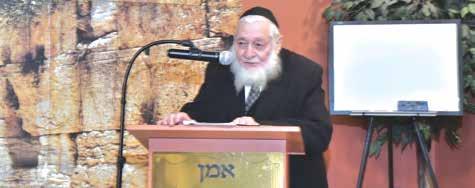


The Far Rockaway community is preparing for a momentous Shabbos as Khal Machzikei Torah welcomes its new Mora D’asrah, Rabbi Daniel Cooper, shlita. The anticipation and enthusiasm throughout the kehillah reflect the deep respect and admiration for a rav who has already impacted hundreds of talmidim with his warmth, dedication, and commitment to Torah.
Rabbi Cooper is a talmid of Rabbi Tzvi Berkowitz of Ner Yisroel in Baltimore. His years of learning under one of the great mashgichim of our generation shaped him into a marbitz Torah known for sincerity, clarity, and an unyielding
passion for avodas Hashem.
In addition to his role in our kehillah, Rabbi Cooper serves as a beloved rebbe at DRS High School. Generations of students describe him as a rebbe who understands them, guides them, and believes in them. Rabbi Cooper is also a rebbe in the Shaar Kiruv Program here in the Five Towns. His influence spans a broad spectrum of the community. His talmidim, from both near and far, often say that he is the rebbe who changed the trajectory of their lives.
Rabbi Cooper has earned a reputation as an exceptional mechanech who gives every talmid the feeling that he is
the only one in the room. He has invested countless hours into guiding young men through challenges and milestones, and hundreds proudly consider him their rebbe for life. His care does not end in the classroom. He opens his home, his heart, and his schedule to anyone seeking advice, support, or connection.
Khal Machzikei Torah looks forward with excitement and optimism as Rabbi Cooper assumes the role of Mora D’asrah. His leadership, vision, and genuine love for every member of the kehilla promise to bring growth and inspiration to all.
This Shabbos marks the beginning
HAFTR recently concluded its engaging and meaningful Bar and Bat Mitzvah program, designed to prepare students to approach this milestone with joy, respect, and thoughtfulness. The two-part series combined hands-on workshops, impactful chesed projects, and a Mock Bar/Bat Mitzvah ceremony to help students understand the values of tradition, community, and celebration.
The program began with an interactive workshop where students and their special guests explored the significance of mitzvot connected to becoming Bnei and Bnot Mitzvah. They examined texts that highlight their growing roles in the Jewish world and practiced essential skills like simcha dancing. Students also participated in meaningful chesed projects: this year, the students will be contributing part of their chesed to the One Family organization, which provides meaningful financial services to children in Israel who lost a family member to ter-

ror. This allows their Israeli counterparts to celebrate their Bnei Mitzvah in a way that they might not have been able to otherwise.
The second part of the program brought students to Congregation Beth Sholom for a Mock Bar/Bat Mitzvah. There, they learned about ceremony etiquette, from giving and receiving mazal tovs to writing thoughtful notes and listening attentively to speeches by family
of a new chapter for the shul. The entire Khal Machzikei Torah kehillah joins together in offering Rabbi and Rebbetzin Cooper a heartfelt welcome.
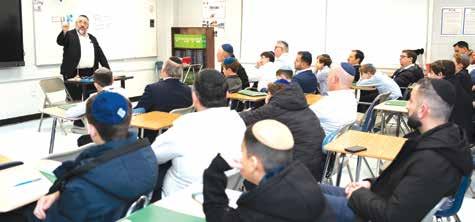
and rabbis. Principal Josh Gold shared, “We want to teach you how to elevate, not detract from the simcha.” Students then put their skills into action during a joyful mock celebration, complete with dancing and meaningful moments.
“This program empowers our students to contribute to the joy of every simcha while deepening their understanding of Jewish tradition,” said Associate Principal Yali Werzberger. Through
initiatives like this, HAFTR continues to guide students in becoming thoughtful, responsible, and culturally aware members of the Jewish community.
HAFTR thanks Congregation Beth Sholom for graciously hosting this program, and thanks Mrs. Nechama Landau, Ms. Ariana Wolfson, Rabbi Yisroel Moshe Siff, and Rabbi Asher Klein for their work in creating and elevating each aspect of the program.

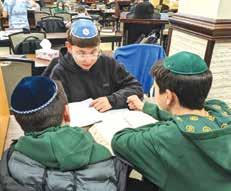
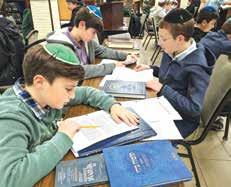

At the LCFD Holiday Appreciation event

The second grade boys at HALB celebrated receiving their new Chumash at the Chagigat Chu-


A-list, a prominent store on Central Avenue, opened its doors on Tuesday night for chessed. A-list sponsored toys and partnered with the Leon Mayer fund and the JCC to deliver the toys for children in our community
mash on Sunday. The boys are so excited to get started learning with the rebbeim inside their very own Chumash!


for Chanukah. There was Chanukah music, doughnuts and an inspiring and fun atmosphere as members of the community came out to wrap the sponsored gifts. They wrapped over 200 toys in one hour.
EDC Training and Tactics, founded by master instructor Hudi Schiffer, recently celebrated its milestone “10K Range Day,” drawing participants from across New York and highlighting the strong trust it has built within the Jewish community.

Known for delivering professional, real-world defensive training rarely available to civilians, EDC provides advanced instruction to men, women, and law enforcement officers, led by Hudi’s 30+ years of shooting experience and extensive national training. Supported by a team of certified male and female instructors, EDC offers comprehensive defensive-tactics courses and the full New York CCW curriculum. As the organization continues to grow, the team invites the community to join upcoming classes and build true competence, confidence, and preparedness. Visit edctraining.net or follow @edc_training_and_tactics for more information.
By Chaya Feldstein
It’s hard to believe that in just a few days we will be lighting the first candle for the yom tov of Chanukah! It seems like just yesterday we were prepping for the month long Chagim in Tishrei. Time has a way of passing by so fast…but maybe not for everyone. For those who sit alone and wait for weekly Shabbos invites, each day of each week can feel a strenuous and filled with endless pressures.
Be My Guest is gearing up for its third night of inspiration to be held b’ezras Hashem on Monday, December 29 at the White Shul (that’s the Monday after Chanukah). Rabbi Joey Haber, worldwide sought-after speaker who touches every kind of Jew, has been invited as guest speaker. Rabbi Yaakov Bender, the Rosh Yeshiva of Yeshiva Darchei Torah, with his myriad of Yeshiva and communal responsibilities has given his time to this in-
credible project by offering divrei bracha. All this could not happen without the backing of the mora d’asra of the White Shul, Rabbi Feiner, who lends a listening ear not only to the Kehilla but the entire Am Yisrael are the beneficiaries.
Our event committee representing Far Rockaway and each of the Five Towns is committed to spreading awareness about our event to encourage each member of our amazing chessed-oriented community to strive higher and, most importantly, to join. Looking forward to greeting each of you!
For more information, please reach out to bemyguestforShabbos@gmail. com
In the meantime, be sure to ignite another fellow Jew’s light this Chanukha! Eight days can be very long or you can make them feel short…


Awave of excitement is sweeping through the community as plans for a new birthing center continue to gain momentum, drawing large crowds at meet-and-greet events held across Five Towns, Crown Heights, and Williamsburg. The center’s recent Five Towns open house attracted so many attendees that the Barbacoa party room was filled beyond its seating capacity, leaving guests standing along the walls as they eagerly learned about the services and philosophy behind this new addition to local maternal healthcare.
Guests were introduced to the center through a visually rich presentation that offered a glimpse into its modern birthing suites, developed for supporting waterbirth. The video highlighted the posh environment designed to support families throughout pregnancy, labor, and postpartum. Attendees were also given an overview of the center’s comprehensive clinical offerings, which include gynecologic care, maternal-fetal medicine consultations, ultrasound, newborn care, and full-spectrum prenatal and postpartum support.
One of the evening’s key components was a panel conversation featuring doulas with experience in both hospital and community birth settings. They spoke
about why they have chosen to support community births, emphasizing what they have consistently observed regarding safety, individualized care, and overall patient satisfaction. Their perspective offered valuable insight into the unique strengths of community-based maternity care. The audience also heard from a mother who has had three community births with the center’s team after previously delivering in a hospital. Her honest reflections and willingness to answer questions helped many attendees envision what this model of care could mean for their own families.
The center’s leadership—co-founders Drs. Joshua Klein and Judy Ribner, along with the medical and midwifery directors—shared their vision for the project. Drawing from decades of combined experience across hospital labor-and-delivery units and community practice, they explained how the birthing center aims to integrate clinical rigor with a deeply personalized, respectful approach to childbirth. Their message struck a chord with guests who have long felt that the county needed more options that prioritize both medical safety and the emotional experience of birth.
Interest in the birthing center is not limited to the Five Towns area. In Crown

Heights, the team hosted a gathering at the Artesian Bake Shop that quickly became standing-room only as birth workers and families packed the space. A similar turnout occurred in Williamsburg, where the crowd’s enthusiasm led many to request additional future sessions. The team is preparing to bring this conversation to Boro Park next, where early responses indicate another huge turnout is anticipated.
Across all locations, the reaction has been overwhelmingly positive. Families from multiple neighborhoods have already begun enrolling for prenatal care, and the center will open its doors for scheduled tours at its Brooklyn site starting in January. Older community members shared that they wished such an option had been available during their own childbearing years, while young-

er parents expressed excitement that a long-awaited alternative is finally becoming accessible.
The birthing center’s leadership emphasized their commitment to ongoing dialogue with the community, promising to carefully consider feedback as they continue to expand services. They also announced plans to release their firstyear clinical data so that families can better understand outcomes and feel informed in their decision-making. With strong attendance, rising interest, and growing support across several boroughs, the new birthing center is quickly becoming one of the most talked-about developments in local healthcare—signaling a shift toward more choices, more transparency, and a more individualized approach to childbirth.
More than a thousand young professionals gathered recently at Pier Sixty in New York City for the 2025 Friends of the Israel Defense Forces (FIDF) Young Leadership Gala—an inspiring evening that united the community to honor IDF soldiers, spotlight extraordinary heroism, and draw attention to the rising humanitarian needs facing the brave young men and women on Israel’s front lines.
The sold-out event showcased the powerful impact of FIDF’s life-changing programs, especially in the aftermath of one of the most challenging periods in Israel’s history. The event emphasized a simple but profound message: while IDF soldiers stand on Israel’s frontlines, FIDF stands behind them.
Since October 7, IDF soldiers, reservists, and their families have endured unprecedented physical, emotional, and financial strain. The evening’s purpose
was to raise awareness and support for FIDF’s mission: providing mental-health support, medical care, trauma recovery programs, financial relief for reservists, support for wounded soldiers, educational scholarships, and assistance for bereaved families.
Major General (Res.) Nadav Padan, FIDF CEO and National Director, delivered remarks emphasizing that as the war evolves, the needs of soldiers do not diminish — they intensify. He also underscored the essential role of young leadership, noting that today’s young professionals are not just supporters, but peers to the soldiers on Israel’s front lines — and the future stewards of FIDF’s mission.
One of the most moving moments of the evening came from Corporal “E,” a soldier in the FIDF-adopted Unit 414, who shared the personal story of his brother, First Sergeant Aviel Joseph. Aviel, a proud soldier in the Nahal Reconnaissance Battalion, was killed in Gaza on
January 13 at just 20 years old. Corporal E recounted the shock of losing his brother while he himself was in training — and the moment he chose to continue serving in his combat role, knowing Aviel would have wanted him to keep going.
Last summer, Corporal E participated in FIDF’s Legacy program, a cornerstone initiative designed for bereaved soldiers and siblings. Through shared experiences, healing workshops, and emotional support, the program helped him find connection and begin rebuilding after unimaginable loss. “Being with others who shared the same pain helped me feel normal again,” he said.
The audience also heard from two officers who played key roles in Operation Rising Lion, described as one of the most complex and consequential IDF operations in recent history. Their remarks shed light on the precision, responsibility, and courage required in the face of nuclear-level threats — and the critical role FIDF’s
support played during the most intense stages of the war. Their stories highlighted the extraordinary weight these young men and women carry, often at the same age as the young professionals in the room.
Gala Co-Chair Hunter Janoff delivered a closing call to action: “As they fight the war of our generation, the organization the IDF turns to in the U.S. to meet their soldiers’ growing humanitarian needs is us — Friends of the IDF. We are the force behind the forces. Our mission is now, and we are here for good.”
With tickets generously donated by sponsors, nearly 50 former IDF soldiers and reservists attended as honored guests, deepening the evening’s sense of connection and purpose. The night concluded with a powerful feeling of unity — a reminder that supporting Israel’s soldiers is not simply an act of charity, but a commitment and responsibility proudly embraced by the next generation of Jewish leaders.


Championship Sunday brought to you by FM Home Loans and Smash House delivered peak JSL excitement — comebacks, record-breaking scoring, first-time champions, and unforgettable finishes across every grade. The fall season officially wrapped up with incredible displays of hustle, heart, and sportsmanship. Here’s how Championship Week unfolded: K/P Hockey – Championship Tournaments
Smash House stormed back to defeat Stand Out Care 5–4, claiming the K/P Hockey Tournament Championship!
Jack Schlessel delivered an MVP-worthy performance with 3 goals and 2 assists, leading the comeback charge. Yeled LI Panthers rolled to victory behind a record-setting 9 goals from Moshe Homnick, dominating Marciano PD in one of the greatest scoring displays in K/P Hockey history. Maidenbaum won the 11:00 AM K/P Hockey Tournament, outlasting a strong challenge from SD Shades, 9–7. Asher Prince was unstoppable, scoring 6
goals to secure the trophy. Marciano PD earned a big win over Demo & Cleanouts, led by Aryeh Stigman, who tallied 2 goals in a standout performance.
1st Grade Hockey –Championships
Posh Home & Bath completed the perfect season, defeating 5 Towns Central in a championship thriller! Eliyahu Dancykier was unstoppable, scoring multiple goals and driving the offense all game long.
2nd/3rd Grade Hockey –Championships
Styles Design Interiors handed Sushi Tokyo Ninjas their only loss of the season, winning the championship 8-4. Gav Prince rose to the moment, scoring 6 goals and dominating every shift.
4th/5th Grade Hockey –Championships
In a defensive battle for the ages, #3 seed Styles Design Interiors edged out Cinderella-story #8 seed Tal Academy, 1-0. Ari Pearlman broke the tie late, scoring the only goal of the game to secure the

championship.
6th–8th Grade Hockey –Championships
Emporio earned the title in a 7–6 thriller over SD Shades, thanks to the clutch goaltending of Yoseph Treuhaft, whose big saves down the stretch proved to be the difference.
1st Grade Basketball –Championships
Marciano PD fought off a late Growtha push to win 6–5, behind the steady scoring of Moshe Obadia, who continued his strong postseason play.
2nd Grade Basketball –Championships
After trailing 6–0, Rita’s mounted an incredible comeback to defeat Wieder Orthodontics, powered by the trio of Nechemia Oratz, Izzy Knobel, Julius Berger – a true championship effort from all three.
3rd Grade Basketball –Championships
Tikva Fire claimed the title thanks to Danie Grabie, who once again took over the game offensively and powered
his team to victory over Central Pizza Co.
4th/5th Grade Basketball –Championships
Newman Dental secured the championship behind dominant performances from Dovid Bauman and Asher Melool, who proved too tough for Addictive Ads to contain.
6th/7th Grade Basketball –Championships
In a stunning finish, Tal Academy made JSL history, becoming the first #4 seed to defeat Maidenbaum in a gritty, back-and-forth championship matchup. A monumental win for the Tal Academy program.
Men’s Basketball – Championships
Kol Ve’or, the #3 seed, took home the Men’s League Championship, in a 50-49 thriller, knocking off previously undefeated Town Appliance and handing them their only loss of the season. Yitz Bennett earned MVP honors with a commanding performance and crucial twoway play that shut down Town’s offensive firepower.
Cross River Bank (“Cross River”), a New Jersey State chartered FDIC-insured bank and Equal Housing Lender known for its Commercial Banking Group (CBG) and real estate lending platform, has completed a milestone $288 million commercial mortgage-backed securities (CMBS) transaction. The securitization converts a seasoned pool of commercial real estate loans into bonds purchased by a range of institutional investors, broadening Cross River’s funding base and freeing balance-sheet capacity to support continued
loan origination. The deal underscores the Bank’s strategy to diversify funding beyond traditional deposits and build consistent access to capital markets, strengthening liquidity and capital efficiency. The underlying loans were originated by Cross River’s Commercial Banking Group. The Sole Lead Manager and Sole Bookrunner of the transaction was Cantor Fitzgerald, with Greystone Structured Products serving as the Advisor and Cadwalader, Wickersham and Taft serving as issuer’s counsel. The senior tranches of the
CMBS were rated AAA by Moody’s and Morningstar DBRS, reflecting the agencies’ assessments of the transaction’s structure and credit characteristics.
“This transaction is a major step forward in our capital and funding strategy,” said Shimon Eisikowicz, Executive Vice President, Chief Lending Officer, and Head of the Commercial Banking Group at Cross River. “It showcases our ability to originate, structure, and bring institutional-quality assets to market, while creating new avenues to support our clients and manage growth.”
“Diversification of funding is central to our long-term vision,” said Bhavik Khatri, Vice President of Syndications at Cross River.
By bringing assets to institutional investors, Cross River continues to expand its role in the capital markets arena while executing on its broader strategic goal: a sustainable, diversified funding platform that supports future growth across its commercial lending businesses.
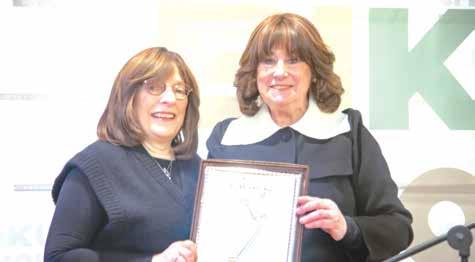

This past Sunday, an overflowing crowd filled The White Shul for the annual Bikur Cholim Ladies Brunch—a morning built around this year’s theme: “A Gift to Our Community.” It was a celebration of the women whose chesed uplifts families every single day, and of an organization whose impact continues to grow in remarkable ways.
The brunch paid tribute to Simi Greenbaum, the guest of honor, along with this year’s Tehillim Award recipients, Esther Feigenbaum and Fraidy Osina—women whose warmth, devotion, and readiness to help embody the very essence of the event’s theme. Following the Tehillim recipients, Rebbetzin Batya Goodman A”H was honored, celebrating her enduring legacy of kindness and generosity.
Throughout the morning, one message echoed again and again: Bikur Cholim is making waves in our community. Powered by dedicated volunteers and
generous supporters, the organization has expanded far beyond its early beginnings. Today, it provides meals for those in need, mental health support, hospital visitation, home medical equipment, transportation to vital medical appointments, care packages, and significant financial assistance for families facing overwhelming medical-related expenses.
These services have become a lifeline for countless households. They are, quite literally, a gift to our community, restoring strength, dignity, and hope to families in their most difficult moments.
The brunch captured what makes Bikur Cholim so extraordinary: a community united by compassion, volunteers whose hearts lead their hands, and supporters whose generosity continues to turn challenges into comfort and fear into relief.
To be part of this ongoing gift and support Bikur Cholim’s vital work, please visit BikurCholimFR5T.org.

By Yitzchok Saftlas
There is an expression, “Good enough is not good.” Likewise, 9:05 am is not 9:00 am. The concept of commitment to timeliness is conveyed in many areas of the Torah. The incident with Avraham, Sarah, and the angels is well known. The angels informed Sarah that she would bear a child. However, they did so in a unique manner that imparts a valuable lesson in adherence to time-related commitments.
And he [the angel] said, “I will surely return to you at this time next year, and behold Sarah your wife will have a son.” [A few pesukim later the expression is repeated,] ... “At the appointed time I will return to you at this time next year, and Sarah will have a son” (Bereishis 18:10, 14).
Sarah and Avraham were informed by their angelic visitors that they would have a son at this time, next year.
The Chumash itself doesn’t tell us Yitzchok’s exact date of birth, and we don’t have birth certificates from that era, but we have a better source – the Gemara (Rosh Hashanah 10b -11a) that quotes both R’ Eliezer and R’ Yehoshua that Yitzchok was born on Pesach. That was the appointed time to which the angel referred.
The Midrash Tanchuma (Vayeira 13) quotes a sage named Zavdi the son of Levi who says that the angel drew a line on the wall of Avraham and Sarah’s tent and explained that when the sun reaches the same angle and “touches” that mark next year, Sarah will have been remembered, meaning, she will have had a child.
There appears to be an important lesson that mortals can glean from this fascinating episode. What purpose did the exercise of creating a time stamp on the wall serve? Perhaps it conveys a timeless lesson about temporal commitments, punctuality, and adhering to stated deadlines. I was fortunate to begin my career

under the mentorship of the inimitable visionary and pioneering founder of ArtScroll/Mesorah, Rabbi Meir Zlotowitz.
He once asked me when a particular project that I was working on would be ready. I responded that it would be ready by 11:30 am.
“Are you 100% sure you will have it in at 11:30?” he asked.
Before I could answer, with a glint in his eye, R’ Meir added: “I’d rather you tell me, ‘I’ll have it at noon’ and show up with the project 15 minutes early at 11:45, than tell me ‘I’ll have it 11:30’ and show up 15 minutes late, at 11:45.”
Every minute of R’ Meir’s time was precious, and I appreciated how he imparted the value of setting realistic deadlines and committing to them.
As an aside, I have been privileged to work with many skilled writers, editors, and publications, and have seen how even one missed deadline can throw the entire team’s schedule off kilter.
1.Embrace deadlines – There’s always a temptation to give yourself too much leeway when negotiating deadlines. Be bold and accept some tight deadlines. You will gain great confidence when you meet them or beat them.
2. Plan accordingly – When preparing a presentation, factor in ample time to allow for proper editing, design, layout, and for any potential production issues.
3. Arrive on schedule – When traveling to a meeting, whether by car, public transportation, air travel, etc., always factor in extra time to account for potential delays.
Practical Lesson
When committing to a deadline, or any time-related obligation, make sure that you are equally as honest with yourself as with others. Honor your commitments and complete your tasks on schedule. Being punctual reflects professionalism, consideration for colleagues, family, and friends, and establishes your reliability.
Reprinted from A Practical Guide to Winning Relationships by Yitzchok Saftlas, with permission from the copyright holder, ArtScroll Mesorah Publications.

On Tuesday, December 2, Shulamith High School students went to the federal courthouse in Central Islip to argue their own case as part of the Long Island MOOT Court Competition.
Each member of the team presented her argument before at least one justice and demonstrated her prowess over the material and case law through her prepared speech and thinking on her feet to answer questions posed by the justices. Winning two rounds, Shulamith High School students proved their ability to argue a case, in the words of the justices, “as well as professional lawyers.”



So, how are you going to burn off those jelly doughnuts? The key is exercise. If you want, you can join my exercise regimen of:
Jumping to conclusions
Climbing the walls
Beating around the bush
Swallowing my pride
Passing the buck
Throwing my weight around
Dragging my heels
Pushing my luck
Making mountains out of molehills
Hitting the nail on the head
Wading through paperwork
Bending over backwards
Jumping on the bandwagon
Balancing the books
Running around in circles
Eating crow
Tooting my own horn
Climbing the ladder of success
Pulling out the stops
Adding fuel to the fire
Opening a can of worms
Putting my foot in my mouth
Starting the ball rolling
Going over the edge
Picking up the pieces
You are given two coins for Chanukah gelt. Together they add up to thirty cents, and one of them is not a nickel. What are they?

Answer: A quarter and a nickel
Two menorahs are sitting in the window.
The first one says, “Wow, it’s getting hot with all these candles.”
The second one says, “Wow, a talking menorah!”


So, are you one of those people who takes a selfie with your food every time you go out to eat? (You look great near that penne alla vodka). Well, you can keep those photos. However, we’d love to see your Chanukah photos. Send in your Chanukah, Chanucka, Channnuka or even your Chanukcah pictures in order to win a gift certificate to Berrylicious! See details on Letters to the Editor page (the place serious people air their grievances). Hey, do me a favor? Smile big in the pictures, no sour faces, OK?
Happy Channuuukkkcckckhhaaa!
Your Favorite Centerfold Commissioner
1. How many pounds of potatoes does the average American eat each year?
a. 14 pounds
b. 27 pounds
c. 48 pounds
d. 110 pounds
2. In which country did the Potato Famine of 1845-1849 take place?
a. England
b. Ireland
c. Scotland
d. Finland

c. “Jeopardy!” host Alex Trebek
d. Former “Tonight Show” host Jay Leno
5. Who introduced French fries to America?
a. Ronald McDonald
b. Thomas Jefferson
c. Benjamin Franklin
d. George Auguste Escoffier
6. Which U.S. state grows the most potatoes per year?
a. Utah
3. Potato chips were invented in Saratoga Springs in 1853 by Chef George Crum. Why did he create this crunchy treat?
a. He realized that packaged snacks were becoming popular so he invented chips.
b. He worked at an old age home, and he realized that they were a good alternative to cookies.
c. A frustrated customer thought his French fries were too thick and repeatedly requested that they be made thinner.
d. There was an excessive amount of potatoes, and he needed to figure out what to do with them.
4. Who famously misspelled the word potato, while participating in an elementary school spelling bee, by spelling it p-o-t-a-t-o-e?
a. Former vice president Dan Quayle
b. Former Scripps Spelling Bee champion Vasvvvavvauch Vvasilaivlovivav

complained that the fries were too thick. Although Crum made a thinner batch, the customer was still unsatisfied. Crum finally made fries that were too thin to eat with a fork, hoping to annoy the extremely fussy customer. The customer, surprisingly enough, was happy – and potato chips were invented!
4) A- The other thing he is famous for? Nothing.
b. Iowa
c. Idaho
d. California

7. In 2015, a group of students at Binghamton University, called the “Potato Posse,” smashed the record for mashed potatoes. How many pounds of mashed potatoes did they make?
a. 355 pounds
b. 744 pounds
c. 983 pounds
d. 2,641 pounds
Answers:
1) D- (Remember that the “average” American eats 110 pounds, but you cholent and kugel eaters should add around 100 pounds a year. So, you basically eat your weight in potatoes every year.)
2) B

5) B- Jefferson, having encountered them while serving as American Minister to France from 1784 to 1789. He served them at a White House dinner in 1802…and America has never looked
6) C- Idaho grows an average of 13.8 billion pounds of potatoes per year. While speaking at the 90th annual convention of the Idaho Grower Shippers Association, Idaho Potato Commission President Frank Muir noted that the Idaho potato industry ships 412 pounds of potatoes every second, which translated to 2.2 million pounds shipped during his 90-minute presentation. (Wait, he spoke about potatoes for 90 minutes…and people didn’t throw potatoes at him?)
7) D
Potato Log:
6-7 correct: Mr. Muir, when you were a child, did you say, “I’d like to grow up to be the president of the Idaho Potato Commission?”
3) C- Crum was a chef at the Moon Lake Lodge resort in Saratoga Springs, NY. French fries were popular at the restaurant, and one day a diner
3-5 correct: You know a thing or two about taters…
0-2 correct: Mr. Quayle, you don’t do too well with the potatoe; stick with the tomatoe!

My Dear Children, Last year, around the end of the school year, one of you asked me what I thought was an appropriate way to show hakaras hatov to a child’s rebbi or morah. That question turned into a letter — one that many of you mentioned stayed with you. So, as we approach Chanukah, I want to follow up.
Chanukah is a time of light — ner mitzvah v’Torah or. We celebrate those who brought light into a dark world. And I can think of no one who embodies that more, in the daily rhythm of our lives, than a child’s rebbi or morah.
Your mother and I no longer have children in school. We don’t stand at bus stops or rush to PTA meetings. But we remember it vividly — and we watch you now, raising your children with that same devotion and love, baruch Hashem. What a privilege to see.
generous way. That envelope you give to a rebbi or morah isn’t just a “thank you.” It’s a declaration that you see them as partners in raising your children, shutafim b’Torah u’b’chinuch.
I’ve lived long enough to realize how easily we take that for granted. You send your son off each morning, and he comes home a little stronger, a little more confident in his davening or his learning — and you forget that somewhere in between, a rebbi noticed him, guided him, davened for him, maybe even lost sleep over him. You don’t always see the quiet moments: the morah who notices Aliza’s downcast eyes or the rebbi who spends his break figuring out how to reach Donny after a rough week. But it’s happening. And it’s real.
This isn’t about campaigns or pressure. It’s about perspective. We all spend money on things that show what we val-
You forget that somewhere in between, a rebbi noticed him, guided him, davened for him, maybe even lost sleep over him.
But there’s something that age and distance have taught us, something I want to gently remind you of, especially during these days of Chanukah. The light your children receive in yeshiva and school doesn’t come automatically. It’s tended, day after day, by people who pour their hearts and souls into teaching Torah and building neshamos.
When you think of giving out Chanukah gelt, or writing checks for gifts, think also of the inyan — mentioned by many Gedolim — of supporting talmidei chachamim during Chanukah. It’s a time of harchavas hadaas, of showing gratitude not just with words, but in a tangible,
ue — clothes, vacations, new phones, dinners out. That’s normal. But take a moment and ask yourself: what message am I sending my children about what we truly honor? If you give Chanukah gelt to the kids (as you should!), consider setting aside something meaningful for those who light up their world every day — their rebbi or morah.
It doesn’t have to be an extravagant amount. If things are tight, give what you can. Even a modest amount, given with warmth and a personal note, can go straight to the heart. Tell them specifically what they’ve done for your child — that you noticed, that you appreciate

it. That sincerity is often worth more than the dollars inside.
And if you’re in a position to give more, don’t hold back. Many rebbeim and moros live with dignity but also with strain. Chanukah vacation often means extra expenses — not extra income. A gift at this time can bring real relief, and real encouragement. It’s not charity. It’s kavod haTorah.
I write this not as a rebbi, not as a fundraiser, but as a father and grandfather who has seen the long arc of chinuch. You children were shaped by your teachers, and now your children are being shaped by theirs. These are the
people who hold up the light of Torah for the next generation. They deserve to feel seen, appreciated, and supported, especially on Chanukah.
May the candles you light this year reflect the inner light you’ve helped kindle — in your homes, in your children, and in those who guide them every day.
With love and pride, Abba
P.S. May you and your spouse continue to see the same nachas from your children that we’ve been blessed to see from all of you.
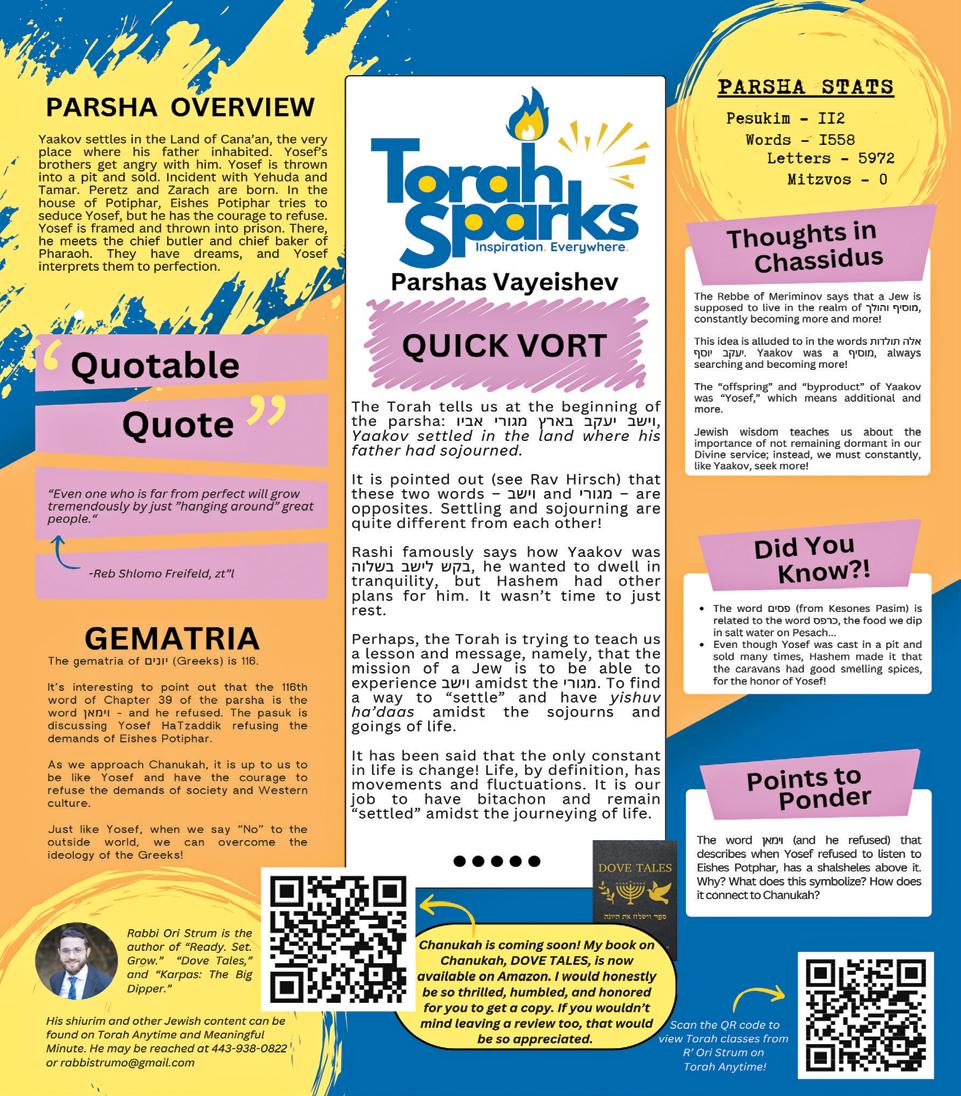

SBy Rabbi Berel Wein z”l
o our father Yaakov wishes to spend the rest of his days in peace and serenity, enjoying his grandchildren and pursuing his spiritual growth. Is that not what all of us wish for ourselves as we grow older and we feel that the major battles of life are already behind us? Yet, as Rashi points out, based on difficult tests of Yaakov in his life – Lavan, Eisav, Shechem, etc. –the Lord, so to speak, is dissatisfied with this plan of Yaakov’s.
The great drama of Yosef and his brothers still lies before him. This situation can be seen as one of external enemies, and Yaakov is steeled to the task of opposing them, for such is the way of the world – certainly of the Jewish world. But Yosef and his brothers is a test of internal rivalries and enmities, a situation at the end of Yaakov’s life that threatens to destroy all that he achieved in his lifetime. Yaakov feels that he is entitled to rest on his laurels and savor his accomplish-


ments. He has somehow overcome all of the wiles and aggressions of his external enemies and sees only peace and serenity ahead. He is unprepared for the internal struggle within his own beloved family that, in the words of Rashi and Midrash, “now leaps upon him.”
His very longing for the peace and serenity that has eluded him his entire lifetime is his very undoing because he does not choose to see the festering enmities
go from strength to strength.”
We all need times of leisure and rest in order to build up a reservoir of physical and mental strength to deal with the problems and vicissitudes of life. Judaism does not know of the concept or value of “retirement” as it is formulated in modern parlance. It certainly allows for changes in circumstances, occupations and interests. But “man was created for toil.” One must always be busy with
Wishes and desires, illusions as to how things should be, often blind us to the realities of how things really are.
and jealousies that are brewing within his own house and family.
Wishes and desires, illusions as to how things should be, often blind us to the realities of how things really are, and we are therefore blindsided by events that could have been foreseen had we not indulged so mightily in our fantasies.
I think that is what Rashi and the Midrash had in mind when they quoted G-d, so to speak – that the righteous should not expect serenity in this world. The Talmud even goes so far to say that even in the World to Come the righteous are not at tranquil rest but rather are bidden “to
productive matters – Torah study, good deeds, self-education, etc. – even till the end of life.
And one must always be vigilant and realistic about the problems of life – externally caused or internally present in one’s own household – in order to make certain that gains made in one’s earlier years will not be squandered by illusions and wishful thinking later in life. This is true nationally as well as personally. We all desire peace and serenity but only realism and vigilance can protect us from our own errors and self-made problems. Shabbat shalom.

The yom tov of Chanukah is almost upon us. As we dust off our dreidels, it reminds us that we are all like the dreidel. Sometimes life hands us a “gimmel,” and things are very good. Sometimes we spin a “hey,” and things are alright. Other times we get a “nun” and break even. And unfortunately, sometimes we roll a “shin,” and our circumstances seem anything but good.
Yosef Hatzaddik’s life is also like the dreidel, except that he only seems to spin “gimmels” and “shins.” Everything either goes very well for him or very badly. His story is the story of Jewish history which is filled with “gimmels” and “shins” and very little in between. At the beginning of his life, everything is wonderful. He is the favorite son of Yaakov Avinu, and all is well with the world. Suddenly, his world falls apart, and he is thrown in a pit and sold into slavery. Afterward, he attains a relative state of success when he is put

By Rav Moshe Weinberger
Adapted for publication by Binyomin Wolf
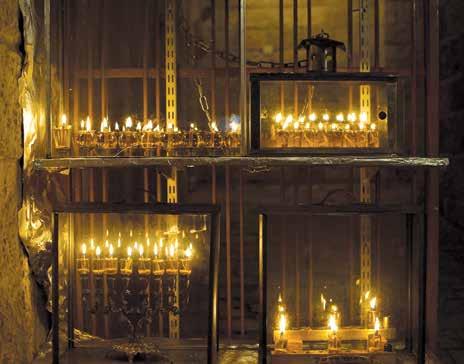
in charge of a very important household in Egypt. Unfortunately, that success is also shattered when the wife of Potiphar attempts to seduce him day after day for a full year. After he passes that test, one would think that he would have been entitled to see better days. But even after passing such a difficult test, he is thrown into prison for a full twelve years.
The Nesivos Shalom asks a question which we are all asking. How was Yosef able to be mechazek, to strengthen, himself during this time period? As far as he knew, his family and his father had forgotten about him, and no one was looking for him. And after all of his efforts to be good, he is thrown in jail! At some point, it would seem that Yosef would have given up trying to be good and holy. If we understand how Yosef succeeded even during his darkest hours, maybe we can learn how to strengthen ourselves during our times of darkness and smallness.
The Nesivos Shalom points out an interesting nuance with regard to Yaakov Avinu’s refusal to be comforted with regard to Yosef’s “death.” It says (Bereishis 37:35), “Vayima’ein l’hisnacheim, and he refused to be comforted.” It does not say, “V’lo yachol l’hisnacheim, and he could not be comforted.” Rather, it says that he “refused” to be comforted. This is difficult to understand. Normally, the way of a tzaddik is to serve Hashem with simcha, joy. When things do not go as he would have wanted, a tzaddik usually accepts the reality and moves on. As it says with regard to Avraham Avinu after Sarah’s death (Bereishis 23:3), “Va’yakam Avraham mei’al pnei meiso, and Avraham got up from before his deceased.” Why did Yaakov not take this approach? In addition, Yaakov had no ruach hakodesh, Divine inspiration, during Yosef’s entire absence (Rashi on Bereishis 45:27). This intimate connection with Hashem was an enormous sacrifice
for Yaakov and was what he lived for. What could have been so important that he would give that up by adamantly refusing to allow himself to be comforted?
According to the Nesivos Shalom, Yaakov knew, deep inside, that Yosef was still alive. He did not know where he was or what he was going through, but he knew that his circumstances must have been bad and that he was in a place of tumah, impurity. There was nothing Yaakov could do for Yosef to help him through whatever he was going through except continue to believe in Yosef and never forget about him. By never giving up on Yosef, Yaakov did the only thing he could to help his son. Yosef did not know any of this, though. For all he knew, Yaakov had moved on with his life and forgotten about him.
In Yosef’s darkest hour, after a year of temptation, according to one opinion in the Gemara (Sota 36b), Yosef was planning to give up and give in. “There is a dispute be -
tween Rav and Shmuel [about the verse (Bereishis 39:11) which states that Yosef went into the house “to do his work”]: One says he was literally going to do his work, and the other says that he was planning to succumb to temptation.” What stopped him? The Gemara there continues: “at that moment the image of his father came and appeared to him in the window.” When that happened, Yosef rediscovered his inner strength and “vayima’ein, and he refused.”
According to the Nesivos Shalom, Yaakov was able, through his belief in Yosef, to cause Yosef to believe in himself and thereby have the strength to emerge from the darkness and refuse to sin. Through the vision of his father, Yosef was reminded, “Ha’od avi chai, I have a father who is still alive” and who is thinking about me and connected to me. The word vayima’ein only appears in these two places in the Torah and has the same letters as the word emunah, faith. Yaakov Avinu’s vayima’ein l’hisnacheim, belief in and refusal to give upon Yosef, gave Yosef the ability vayima’ein, to have faith in and refuse to give up on himself.
Yosef saw his father’s image specifically in the chalon, the window. The letters of the word chalon are the initial letters of the words “l’hadlik ner Chanukah, to kindle the Chanukah candle.” When we light the Chanukah candles in the windows of our homes, we can also tap into our Father’s belief in us.
According to the Ramban in Parshas Be’ha’aloscha (Bamidbar 8:1), Aharon Hakohen is the inner source for the yom tov of Chanukah. What was Aharon Hakohen known for? In Pirkei Avos (1:12), it says Aharon “oheiv es ha’briyos u’mekarvan l’Torah, loved all creatures and brought them close to the Torah.” The word briyos, creatures, implies the lowest people. His love included those people about whom the best thing that can be said is that they are alive. They have nothing else going for them. Nevertheless, Aharon Hakohen loved them and believed in them. He believed they could be good. And that was how he was able to be mekarvan l’Torah, bring them close to Torah. They saw that the tzaddik believed in them and that gave them the strength to believe in themselves. Similarly, at the time of the Greek occupation of Eretz Yisroel, the Chashmonaim were among the very small number of people who refused to give in and accept the Greek lifestyle. Most Jews had ceased believing in themselves, but the Chashmonaim still believed in them. Through their belief that the Jewish people could serve Hashem and did not have to capitulate to the Greek way of life, they
lit the way for generations to come in the long winter of our exile.
It is no coincidence that we light the neiros Chanukah, the Chanukah candles, at night during the coldest time of the year. It is when our lives are shrouded in darkness and difficulty that we most need the remembrance of looking into the windows and seeing the Chanukah lights which remind us of Aharon Hakohen, Yaakov Avinu,
a convent to prepare to convert and marry this man. The chassid was beside himself and made the difficult journey to his Rebbe, the Skernovitzer, to ask for help.
The chassid told Reb Shimon everything that happened and that his daughter was already in a convent preparing to convert and marry a non-Jewish man. The chassidus of Amshinov is known for ahavas Yisroel, love of the Jewish people. The
When we light the Chanukah candles in the windows of our homes, we can also tap into our Father’s belief in us.
and the other tzaddikim who appear to us and tell us, “I am with you! I believe in you! You can do it!” This is why we emphasize “al yidei kohanecha ha’kedoshim, through Your holy kohanim.”
In Tehillim 92:3 we say, “L’hagid b’boker chasdecha v’emunascha b’leilos,” we relate “your kindness in the morning and your faith at night.” We have faith in Hashem, but what does it mean that we relate Hashem’s faith at night? What does Hashem have faith in?
It means that at night, during our dark times when we are tested and do not see Hashem’s light, Hashem has faith in us that we can succeed. When we say in davening “ha’aderes v’ha’emunah l’chai olamim , strength and faith are His who lives eternally” and “rabbah emunasecha, great is your faith,” we also refer to Hashem’s emunah, Hashem’s faith, in His people. If we think about the fact that Hashem and His tzaddikim believe in us, this can give us the chizuk, the strength, to pass our most difficult tests.
There is a story of the Rebbe Reb Shimon Skernovitzer, a grandson of the Amshinover Rebbe, brought down by R’ Shlomo Katz in his book in the name of R’ Shlomo Carlebach.
He brings down that Reb Shimon had a chassid who was the only Jew in his village. This Jew had a daughter, and sadly, she became involved with a non-Jewish man. This man was also an alcoholic and an abuser. But as we know sometimes happens, if a woman feels that she will not find anyone better, she will tolerate the worst things. She therefore planned to marry this man. Because the man’s family refused to allow him to marry her if she did not convert, the chassid’s worst nightmare came true, and his daughter left home to stay at
Rebbe asked his chassid exactly where the convent was, and he gave him the location. The Rebbe then took his gabbai and traveled to the place where the convent was. The building was like a fortress with a high wall. The Rebbe stood outside the high convent wall and bribed a priest going in to deliver a note to the Jewish girl inside which simply read, “I, Shimon of Skernovitz, am waiting for you on the corner.”
The Rebbe then waited one, two, and three days. During the entire time, he never left the corner. He davened there without going to shul or anywhere else for three days. On the night after the third day, the girl came out of the convent and ran to the Rebbe. They ran away for a period of time, and when they had put some distance between themselves and the convent, the Rebbe asked her to explain how she got the strength to leave when she was ready to convert and get married. She knew who Reb Shimon was from her father, so she answered that she had the strength to leave because “I knew you would never leave without me.”
When a person knows and feels that the tzdadik, Rebbe, parent, or that Hashem will never leave without us, it gives us the strength to leave any type of impurity.
As we light the neiros Chanukah, may we remember that our Father still loves us and still remembers us even in our moments of darkness and that He will never stop believing in us and He will never leave us behind.
Rav Moshe Weinberger, shlita, is the founding Morah d’Asrah of Congreagation Aish Kodesh in Woodmere, NY, and serves as leader of the new mechina Emek HaMelech.


By Rabbi Shmuel Reichman
There was once a public debate between a rabbi and an astrophysicist regarding the nature of our universe. The astrophysicist, representing the atheist perspective, confidently approached the podium and began addressing the audience: “I don’t know much about Judaism, but I believe I can sum it up in a few words: Do unto others as you would have them do unto you.” With that, he went on to detail how physicists could now adequately explain the nature of our universe, without the need for religion.
When he finished his speech, it was the rabbi’s turn to address the audience and represent the religious approach. With a sparkle in his eye, the rabbi turned to the crowd and said, “I don’t know much about astrophysics, but I believe I can sum it up in a few words: ‘Twinkle, twinkle little star; how I wonder what you are.’”
With that, he went on to deliver the rest of his speech.
Spiritual debate has been a recurring phenomenon since the beginning of time. Chanukah is when we tap into the spiritual debate between the Jews and the Greeks, as the Greeks specifically attempted to destroy our spiritual way of life. They aimed to cut off our connection with Hashem and replace it with the worship of the natural, physical world.
Yavan, the Hebrew name for the Greeks, means quicksand (Tehillim 69:3) – the Greeks sought to “drown” us in their secular culture, replacing spirituality with atheism and hedonism. The Midrash says that the Greeks attempted to darken our eyes, “hichshichah einei-

hem” (Bereishis Rabbah 2:4). Darkness represents a lack of clarity, the inability to perceive true form. Physical darkness prevents physical clarity; spiritual darkness prevents spiritual clarity. This was the Greek attack on the Jewish People: a distortion of truth, a darkening of knowledge and perception. For this reason, the Jewish People went to war against the mighty Greek army, and to this day, we carry on that fight against Greek culture, a culture that we view as damaging and antithetical to Judaism.
However, if we take a deeper look into Jewish literature, we find a strikingly different picture of the Greek nation and their culture. In Parshas Noach, Noach blesses his two sons, Shem and Yefes, with a seemingly peculiar bracha: “Yaft Elokim l’Yefes, v’yishkon b’ohalei
Shem,” Hashem will grant beauty to Yefes, and he (Yefes) will dwell within the tents of Shem.
Yefes is the precursor to the Greeks, and Shem to the Jews. This seemingly paints the Greeks in a positive light, as a beautiful nation fitting to dwell within the framework and boundaries of Judaism. In a similar vein, the Gemara (Megillah 9b) states that despite the general prohibition of translating the Torah into different languages, it is permissible to translate the Torah into Greek due to the beauty of the language.
According to both of these sources, it seems as though Greek culture does not contradict Judaism but is meant in some way to complement it, harmonizing with Jewish ideology. How can we understand this contradiction?
In order to explain it, we must first develop a deep spiritual principle.
How do we understand and perceive Hashem? Is Hashem within time and space, limited to this world alone, as Pantheists believe? Or is Hashem completely transcendent, beyond time, space, and this physical world, as many of the ancient philosophers believed?
The Jewish approach, as explained by the Rambam, Maharal, Ramchal, and others, is a beautifully nuanced blend of these two approaches. Hashem is transcendent, completely beyond our physical world of time and space, and yet, He is also immanent, within our physical world.
This principle applies to all spirituality; we believe that the spiritual and transcendent are deeply connected to the limited and physical world. In other words, our physical world is a projection and emanation of a deeper, spiritual reality. This is the meaning behind the famous Midrash, “Istakel bi’Oraisa, u’bara alma,” Hashem looked into the Torah and created the world (Bereishis Rabbah 1:1). This means that the physical world is an emanation and expression of the Torah, the spiritual root of existence. To give an analogy, imagine a projector: the image you see on the screen is emanating from the projector. The projector and film are the source; the image on the screen is the expression. Similarly, each and every one of us was once a zygote, half a male and half a female genetic code. From that single cell, a fully developed and expressed human being ultimately manifested. The same is true regarding the physical world, it stems from a spiritual root, a transcendent dimension.
Thus, we are able to understand and experience the spiritual through the physical, as the two are intrinsically connected. If you’re wondering how to understand this concept, consider the way other human beings experience, relate to, and understand you. All they have ever seen is your physical body. They’ve never seen your thoughts, your consciousness, or your emotions. The only way they can understand you is by relating to how you express yourself and your internal world through your physical body. Through your words, actions, facial expressions, and body language, other people experience what’s going on inside of your body, inside of your head, inside of you.
The same is true regarding our experience of Hashem and the spiritual. We can’t see spirituality only physicality. We must therefore use the physical to connect back to the spiritual root.
The Greeks sought to uproot this Jewish perspective, to detach the physical world from its higher root. They claimed that human beings have no connection to anything higher than the physical world itself and that it’s therefore impossible to connect to Hashem. As the Ramban explains (Ramban Al Ha’Torah, Vayikra 16:8), the Greeks believed only that which the human intellect could grasp. Anything that requires spiritual sensitivity, that transcends rational proof alone, was dismissed as false. Even the Greeks gods were glorified humans, as anything that transcended the physical, human world was dismissed. In essence, the Greeks served themselves.
The Jewish approach is much more nuanced. We embrace human intellect and reason but are aware of a realm that transcends it. We recognize the wisdom of science, medicine, psychology, math-
ematics, and other forms of worldly wisdom but also recognize a higher form of wisdom, the Torah. As the Vilna Gaon explains, where logic and human intellect ends, Jewish wisdom begins. The reasoning behind this principle is based on the aforementioned idea: the physical world is an expression of the spiritual
even have a Megillah; it is completely of rabbinic origin. Furthermore, it doesn’t even have a Mishna; the only canonized source for Chanukah is a few Gemaras which mention Chanukah in an almost coincidental manner. Why is this so?
Chanukah represents the battle against the Greeks. The Greeks claimed
It was to reveal that even the human intellect can connect to Torah.
world. Just as the physical world stems from a higher, spiritual realm, physical wisdom is an expression of a higher form of wisdom, the Torah. While the wisdom of the physical world is true, it stems from a higher truth, the Torah. Torah is the absolute foundation and root; all physical wisdom is its expression.
The Ideal Relationship
The ideal is for the physical wisdom of the Greeks and Yefes to reside within the tent of Shem, for science and the wisdom of the world to be in harmony with Torah. The problem occurred only once the Greeks denied the existence of anything beyond their independent intellectual wisdom. This was the battle of Chanukah. The Greeks tried to destroy the Torah, which contradicted their ideology, and the Jews were forced to fight for their beliefs, to defend their spiritual connection with Hashem and the transcendent wisdom of Torah.
Rav Yitzchok Hutner, zt”l, explains that Chanukah is the chag of Torah Sheba’al Peh, the Oral Torah. Chanukah is the one holiday with no source in Torah Shebiksav. Unlike Purim, it does not
Rabbi Shmuel Reichman is an international speaker, bestselling author, business coach, the CEO of SMA, and a TED Talk Speaker. His online content reaches millions of people every month, and he lectures internationally on topics of Torah thought, psychology, leadership, and business – uniquely blending many areas of Torah and wisdom together. His bestselling book, The Journey to Your Ultimate Self, serves as an inspiring gateway into deeper Torah thought. After receiving his BA from Yeshiva University and Semicha from Yeshiva University’s RIETS, Rabbi Reichman received a Masters degree in Philosophy and Religion from the University of Chicago. As part of his Masters Degree at the University of Chicago, Rabbi Reichman received an Ivy Plus Scholarship to Harvard where he spent a year studying Religious Philosophy and Literature as an Ivy Scholar. Additionally, he received a Masters degree in Educational Psychology from Azrieli Graduate School and a Masters degree in Jewish Thought from Yeshiva University’s Bernard Revel Graduate School. As a business and leadership coach, Rabbi Reichman provides a unique 1-on-1 coaching program where he helps high-achievers, coaches, and business owners achieve their financial and personal goals. To learn more or to get in contact with Rabbi Reichman, visit his website: ShmuelReichman.com
that the only source of truth is the human intellect – nothing transcends human logic. The Jews not only showed that there is a transcendent source of truth but took it one step further. When done appropriately, with humility and proper recognition of the Torah’s transcendent root, the limited human being can actually use his human intellect to participate in the creation of Torah. This is the unbelievable nature of Torah Sheba’al Peh: human beings are given the ability to participate and even create novel Torah ideas and insights. The
greatest victory over the Greeks wasn’t to simply prove that transcendent Torah exists; it was to reveal that even the human intellect can connect to Torah –even limited human beings can connect to the infinite.
The Greeks tried to spiritually destroy our Beis Ha’Mikdash, the point of connection to the transcendent, where Hashem most intimately connects to this physical world. After our victory on Chanukah, we reignited the flame of that spiritual building, and every year since, we must reignite that same flame within our own homes; we must inaugurate our own personal Beis Ha’mikdash. Every day, we get to choose whether we’ll become further entrenched in secular and Greek culture, or if we’ll build our connection to the infinite, the transcendent, and carry the message of Chanukah deep within our hearts. Our life is like building a personal Beis Ha’Mikdash, building an ever-deeper and ever-closer relationship with Hashem. It’s the result of every brick we lay down. Every day is like another brick, another opportunity to add to our eternal home, our eternal self, our eternal existence.

By Rabbi d aniel g latstein
There is a principle that the Shabbos that precedes a yom tov contains the sanctity and spiritual energy of the upcoming yom tov. The parsha of that Shabbos is likewise connected to the yom tov that follows. Parshas Vayeishev is typically read on the Shabbos that precedes Chanukah. Let us uncover a new element of meaning contained in Parshas Vayeishev that is relevant to the upcoming yom tov of Chanukah.
This parsha contains one of the most dramatic and heart-wrenching stories in the Torah: the sale of Yosef. A fresh analysis of this episode will provide a new insight into the yom tov of Chanukah as well.
Why Is TheRe no m asechTa foR chanuK ah?
Many halachos guide the observance of Chanukah, especially those pertaining to the lighting of the menorah. While there are a few blatt on the subject of Chanukah in Maseches Shabbos in Perek Bameh Madlikin, it is no comparison to the entire masechta dedicated to Purim. Why is there no masechta dedicated to Chanukah?
Chanukah is mentioned six times in Mishnayos:
- Bikkurim tells us that if one brings bikkurim to Yerushalayim between Sukkos and Chanukah, he does not recite the parsha of bikkurim
- Rosh Hashanah discusses the months of the year on which beis din would send shluchim, messengers, to publicize when Rosh Chodesh was. On Rosh Chodesh Kislev, messengers were sent out so all would know when Chanukah was scheduled to begin.
- Taanis teaches us that in a time of drought, public fast days are declared as times of tefillah to Hashem, asking Him to send rain. However, the Mishnah states, we do not designate a fast day during Chanukah.
- Megillah discusses Krias HaTorah, stating that we interrupt the usual reading for various yamim tovim, including Chanukah.
- Moed Kattan discusses the halachos of aveilus on Chanukah.
- Bava Kamma discusses one who wants to publicize the miracle of Chanukah and opts to light his menorah in a public location. If a camel then knocks over the menorah and the ensuing fire causes dam-

age to nearby buildings, the person who lit the menorah is not liable for the damages caused.
Why are these halachos pertaining to Chanukah scattered throughout Shas? Why isn’t there a single masechta — or at least a few perakim in one masechta — dedicated to Chanukah?
Rabbeinu Avraham ben haGra authored the sefer Midrash Aggadas Bereishis. In the introduction, he quotes his father, the Vilna Gaon, who stated that among the masechtos ketanos, small masechtos, such as Maseches Kallah and Maseches Sofrim, which are found in the back of the volumes of the Vilna Shas, there was formerly a Maseches Chanukah. However, even if there had originally been a small Maseches Chanukah, it is still not the same as a full masechta in Shas dedicated to the yom tov.
Mechiras Yosef: hoW could They?
When reviewing the episode of mechiras Yosef, the sale of Yosef HaTzaddik, we are astounded at how
such an event could have taken place. How could the Shevatim, the holy sons of Yaakov Avinu, want to kill Yosef, an all-time righteous tzaddik? How could they cause their brother — and more importantly, their saintly father — such tremendous anguish?
The Shevatim were sanctified people whose names are engraved on the Choshen! The Shelah HaKadosh teaches us that the Shevatim were holier than the angels. They were so holy that they correspond to the twelve Tzeirufei Sheim, the twelve permutations of Hashem’s Name.
Is it fathomable that such holy personages, who were constantly propelling themselves ever greater, would contemplate killing another human being, let alone their own flesh and blood? Even the lowest Jew would not consider committing such a heinous act! How can it be that these tzaddikim wanted to harm their brother, who was also a righteous person? How do we understand that this sibling rivalry resulted in murderous intent and eventual sale into slavery?
The Shelah HaKadosh quotes the Midrash Tanchuma, whose words serve to increase our incredulity. When Yosef eventually revealed his true identity to his brothers, the Shevatim wanted to kill him! An angel was dispatched to prevent them from killing Yosef right there in the palace of Pharaoh.
The Shevatim had declared, “Indeed, we are guilty concerning our brother” (Bereishis 42:21) and admitted that they were embarrassed by their efforts to harm Yosef and they expressed regret at having sold him. How can it be that a short while later, when they finally came face-to-face with their long-lost brother whom they had regrettably sold into slavery, that their reaction is to finish what they started: to kill him?
We must wonder if their “regret” was actually sincere.
Furthermore, asks the Shelah HaKadosh, we are taught that the Shevatim instituted a cheirem onto anyone who would reveal what they had done to Yosef. They even enlisted Hashem in their plan, and HaKadosh Baruch Hu partnered with them in their association of opposition to Yosef. How is that possible? Why would Hashem participate?
When considering future events, Rashi tells us, Yaakov addressed the sagas of Korach and Zimri: “ Into their conspiracy may my soul not enter! With
their congregation do not join, O my honor!” (ibid. 49:6). Yaakov did not want his name associated with these nefarious actions. Why would Hashem want to be partner to an event such as mechiras Yosef ?
The Shelah’s curiosity continues, as he quotes the question of the Ramban. The Torah tells us, “ These are the chronicles of Yaakov: Yosef, at the age of seventeen years, was a shepherd with his brothers by the flock, but he was a youth with the sons of Bilhah and the sons of Zilpah” (ibid. 37:2). Yosef had a special relationship with the sons of Bilhah and Zilpah. They were especially close, and they were very fond of Yosef. One of the complaints, as it were, that Yosef brought to his father was that the other Shevatim used a demeaning and derogatory nomenclature when referring to the sons of Bilhah and Zilpah, referring to them as avadim, slaves. These brothers should have defended Yosef and protected him from the other brothers, rather than participating in the plan to eliminate him!
Throughout the parshiyos dealing with mechiras Yosef, when the brothers unknowingly interact with Yosef, we find that it was almost exclusively Yehudah who stepped up into a position of leadership and spoke to him. Why specifically Yehudah rather than Reuven, the firstborn? Why was it only Yehudah who interacted with Yosef?
Why does The ToR ah dIg Ress?
As we journey through Parshas Vayeishev, we predominantly focus on the story of Yosef’s falling victim to his brothers. He is sold, and eventually he finds himself in an Egyptian jail, making friends with the warden. However, as the Torah relates the details of what happened to Yosef, there is another anecdote inserted into the parsha that seemingly has no connection to the story of Yosef.
In the middle of the narrative, the Torah shifts its focus to Yehudah and his eventual encounter with Tamar. After we read about the birth of Tamar’s twins, the storyline returns to the details of Yosef’s enslavement.
Why does the Torah tangentially insert the incident of Yehudah and Tamar here? Why do we interrupt the storyline of Yosef’s descent to Egypt to read about what happened to Yehudah?
The shelah’s Revolu TIonaRy appRoach
The Shelah HaKadosh provides an incredible way to understand mechiras Yosef, an insight that will allow us to perceive this enigmatic episode in a completely new fashion.
There are three crowns in Judaism.
Kesser Kehunah, the Crown of Priesthood, was given to Shevet Levi. Kesser Malchus, the Crown of Royalty, was given to Yehudah. Kesser Torah was given to Yosef. “Eileh toldos Yaakov Yosef,” Yaakov spent fourteen years of uninterrupted Torah study in the yeshivos of Shem and Eiver; he then transmitted all of this Torah to Yosef.
Malchus seems to be a foreign concept in Judaism. What is the function of one person being “above” the rest of the nation? Aren’t we all brothers? The concept of Malchus in Klal Yisrael is to promote Malchus Shamayim, a reflection of the Kingship of the Ribbono Shel Olam. A Jewish king on the throne of royalty gives a degree of koach, strength, and stability to Malchus Shamayim here on earth.
Every king needs a throne. Hashem’s Throne, the Kisei HaKavod, stands on four legs. The four legs of the Kisei HaKavod are Avraham, Yitzchak, Yaakov, and David HaMelech. David HaMelech was from Shevet Yehudah, where malchus originates. Thus, Shevet Yehudah, the fourth leg, gives stability and longevity to the Kisei HaKavod. Without David, without Shevet Yehudah’s contribution, the Kisei HaKavod would be unstable, with only three legs, so to speak.
The Shelah HaKadosh calls attention to the name Yehudah, advising us to examine the name, for it contains wonders. The name Yehudah contains the name of Hashem, Yud Kei Vav Kei, with the addition of the daled, representing the fourth leg of Hashem’s throne. Yehudah is the Name of Hashem, with the regel revii, the fourth leg, holding it up.
When the first few Shevatim were born, the Torah tells us, “Va’tahar va’teiled, and she became pregnant and bore [a son].” When Yehudah was born, however, the pasuk changes the wording to say, “Vata’amod mi’ledes, then she stopped giving birth.” The root of the word “vata’amod” is amod, standing; thus, literally, “she stood up from — i.e., stopped — giving birth.” This usage of amidah, standing, is indicative of permanence, because with the birth of Yehudah, Hashem’s Throne achieved stability and longevity.
The Shelah HaKadosh uses this principle to explain what the Gemara states: Anyone who argues against Malchus Beis David is considered to be disagreeing with the Shechinah, with Hashem Himself. Undermining the Royal House of David is not merely undermining human royalty; it is considered to be an attempt to undermine Hashem Himself.
Yehudah is Malchus; Yehudah upholds the Throne of Glory. However, Yehudah can come onto the scene only after someone else has already paved the way. The first step lays the needed foundation, and only then can the palace be built. Malchus needs a foundation to rest upon, which obviously must be present beforehand. The foundation needed before Yehudah can take the reins of Malchus Yisrael is provided by Yosef. Throughout our history, we see Yosef functioning as the foundation for Malchus Yehudah.
Yosef had this unique skillset, this ability to conglomerate the people, to unite the masses despite their differences. He could forge the people into a single entity, and then Yehudah could begin his reign. Yosef had the middah of Yesod, Foundation, upon which the malchus could then be built.
Shlomo HaMelech, a king from Shevet Yehudah, built the first Beis HaMikdash. However, the Beis HaMikdash was preceded by Mishkan Shiloh, which was in the chelek of Yosef HaTzaddik.
David HaMelech was the first king of Malchus Yehudah. But he was not the first king of Klal Yisrael. Prior to his reign, Shaul HaMelech reigned; while Shaul was from Shevet Binyamin, the Shelah HaKadosh reveals to us that he was attributed to the middah of Yosef. The source of Shaul’s name is the word she’eilah, borrowing. Shaul did not take Malchus. He merely borrowed it on a temporary basis in order to establish the nation’s foundation, so that eventually a man of Shevet Yehudah could become king.
Thus, the character trait of Yosef HaTzaddik is Yesod, establishing foundations, uniting the people into nationhood. Yehudah can then exert Malchus. This is what transpired in the above-cited examples, and it is what will im yirtzeh Hashem occur l’asid lavo, in the future, when Mashiach will come. We will first greet Mashiach ben Yosef, and only then will Mashiach ben David reveal himself.
This is the verdict of history.
The fIRs T c ase of yosef pavIng The Way
The Shelah HaKadosh writes that the first example of this concept, the first time in history that “Yosef” laid the foundation, occurred with Yosef HaTzaddik himself when he was sent down to Mitzrayim to pave the way for the Jewish people. His presence there was intended to create a welcoming environment for the Jewish people in a land replete with tumah and promiscuity, to create a haven of sorts that would ensure that the Jewish people would be able to maintain at least some semblance of their holy identity. He prepared Goshen for their arrival and mandated that all of Mitzrayim’s males undergo circumcision.
Yosef HaTzaddik would function in a role similar to that of Shaul HaMelech many years later. He would set the tone, creating a foundation for Yehudah.
yosef pRovIdes The foundaTIon
David HaMelech was the first king of Malchus Yehudah. Before he could assume the throne, a foundation was needed, a nation over which the Malchus Yehudah would be able to rule. “Ein melech b’lo am, there can be no kingdom without citizens,” and the preceding ruler would need to set about uniting the people under one banner, establishing a nation over which David HaMelech could then rule.
“B’tzeis Yisroel m’Mitzrayim… When Klal Yisrael went out of Mitzrayim, [and they were now considered a] Bais Yaakov [departing] from a foreign nation,” only then is groundwork laid so that “Ha’yisa Yehudah l’kadsho, Yehudah became His sanctuary, Yisrael His dominions” (Tehillim 114:1-2). Only now can Yehudah exert influence. The first person to jump into the Yam Suf was Nachshon ben Aminadav, from Shevet Yehudah. The first degel, flag, to travel in the Wilderness was Yehudah’s. But this could happen only after Yosef had established himself as the yesod of Am Yisrael.
The Shelah HaKadosh adds that the Shevatim did not realize what Yosef HaTzaddik was doing.
Yosef came to them and related his dreams about bundles and stars bowing down to him. His brothers were shocked and dismayed, as the pasuk tells us, “ His brothers said to him, ‘Would you then reign over us? Would you then dominate us?’ And they hated him even more — because of his dreams and because of his talk” (Bereishis 37:8). They said, “You want malchus!? You are not the king! Yehudah is the melech! You are contending Malchus Beis David, and as a moreid b’malchus, as a usurper of the kingship, you are simultaneously contending against the Shechinah!”
They subsequently ostracized Yosef out of concern for what they perceived to be an ambition to take the throne for himself. They incorporated Hashem in their decision, since they truly believed that by challenging Malchus Yehudah, Yosef was thereby rebelling against Hashem as well. They felt Yosef was expanding past the role of Yesod, Foundation, and attempting to enter the realm of Malchus, Royalty, and that could not be tolerated.
Herein lay their mistake. Yosef had no intention of taking the malchus for himself; he was merely striving to forge a rock-hard foundation to Klal Yisrael so that he could eventually turn the reins over to Shevet Yehudah.
Based on this Shelah, we can suggest the following chiddush: The Shevatim took Yosef and placed him into a pit, as the pasuk states, “Then they took him and cast him into the pit; the pit was empty, no water was in it” (Bereishis 37:24). Rashi explicates, “There was no water in the pit, but it did contain snakes and scorpions.”
Why did they want to kill Yosef with snakes? Of all the methods in the world available, why snakes?
The very same Gemara quoted above that states that one who contends against Malchus Beis David is considered to be arguing against the Shechinah also states, “One who contends against Malchus Beis David is fit to be bitten by a snake!”
The Shevatim therefore reasoned that even if they were not completely certain that Yosef was guilty of capital punishment for the perceived desire for malchus, throwing him to the snakes would give them their answer with certainty. If the snakes did not attack him, then the brothers would see that they had erred. However, if he were to succumb to the venom of a snake, then their judgment would be confirmed, and it would be obvious that he was contending against Malchus Beis David.
Interestingly, when we look at the Gemara quoted by the Shelah, our text does not contain what the Shelah had sought to explain. The Gemara as we have it does not state that a contender against Beis David is a contender against Hashem. Our version is that one who disagrees with Malchus Beis David is fit to be bitten by a snake, and that one who argues with his rebbi is likened to one who is disagreeing with Hashem. The Shelah seems to combine these two statements when he states that arguing with Malchus Beis David is tantamount to arguing with Hashem.
Herein lies the mistake of the Shevatim. They erroneously thought that Yosef’s intentions were to usurp malchus from Yehudah. Yosef’s true intent was to exercise a limited degree of authority in an effort to create a nation over which Yehudah could subsequently rule. True, Yosef had dreams of grandeur, but he only wanted to “borrow” malchus in the same manner that Shaul HaMelech had, similar to the way Mishkan Shilo preceded the Beis HaMikdash.
This is why the Bnei Bilhah and Zilpah took issue with Yosef. True, they were grateful for his attention and for his treating them nicely. But this was a halachic psak that superseded any personal affection they may have had toward him. Despite their close relationship with Yosef, when it came to what they viewed as an act of treason, they stood together with
The fact that we can learn Torah today is directly due to the efforts of the Chashmonaim.
their brothers in finding Yosef guilty. They felt that since Yehudah was destined to be king, Yosef had no right to aspire to any sort of authority. Malchus, in its entirety, belonged to Yehudah, and only to Yehudah.
The Abarbanel writes that until his time, “ad hayom,” all the leaders of Klal Yisrael came from Shevet Yehudah. This, the Abarbanel advances, includes Torah leadership throughout the ages. (Coincidentally, the Abarbanel himself was a descendant of David HaMelech.)
VaYeishe V as e xplaIned By The shelah Parshas Vayeishev does, in fact, contain only one thematic episode. It is the history of Yosef establishing the Jewish people, Am Yisrael, as the first step toward instituting Malchus Beis David.
The journey begins with seventeen-year-old Yosef who had dreams and aspirations of forming Am Yisrael. He dreamed of the bundles and of the sun, moon, and stars. The Shevatim discounted his dreams and did not believe him, but as for Yaakov, the Torah states, “V’aviv shamar es ha’davar, but his father kept the matter in mind” (Bereishis 37:11). Yaakov knew these dreams would come true, and he was watchfully waiting to see them come to fruition.
The Torah then tells us how Yehudah married Tamar, a relationship that would produce a son,
Peretz, whose progeny Oveid and Yishai led to David HaMelech and the establishment of the meluchah. Once we learn about Yehudah’s establishing the royal lineage, the Torah’s focus shifts back to Yosef and to how he was manipulating events for Yehudah’s eventual assumption of the throne.
The story of Yehudah and Tamar is thus not a separate incident, a digression from the main events of the parashah. It is an integral part of the establishment of Malchus Beis David, which is what Yosef was seeking to accomplish throughout the entire parashah. It serves to explain the entire purpose of what was happening: The sole purpose of the sale of Yosef HaTzaddik was to ultimately establish Malchus Yehudah; i.e., Malchus Beis David.
The Shelah adds that the Shevatim did not dislike Yosef HaTzaddik at all, and they did not have any personal issues with him. Halachically, however, they felt that he was usurping meluchah inappropriately, and they took this as an affront against Hashem: “Kol hacholek al Malchus Beis David k’cholek al haShechinah.” This is why they felt the Ribbono Shel Olam was in partnership with them regarding the sale of Yosef.
Over the course of time after Yosef was sold, the Shevatim began to doubt themselves. Perhaps they had been too hasty to judge, and Yosef never really had dreams of grandeur and visions of being king. Maybe their assessment had been premature and erroneous, and they should not have sold him.
But when Yosef ultimately revealed himself, “Ani Yosef, I am Yosef” (Bereishis 45:3), he did so while dressed in royal garb, wearing the crown of the viceroy to Pharaoh. This sent a confirmatory message to the Shevatim. They had been correct in their understanding of Yosef’s actions. In their eyes, their brother was someone who did, in fact, want to take meluchah for himself. Yosef’s appearance, bearing, and status at the time that he informed his brothers of his true identity was enough to make them feel that they had judged him correctly, and they then wanted to finish what they had started. They had to follow through with the sentence of someone who is moreid b’malchus: They had to kill Yosef.
As noted above, the malach stopped them, and Yosef reassured them, “G’shu nah eilai, come close to me if you please” (ibid. v. 4). Yosef explained that he was not trying to become king, and he had no aspirations to rule over Klal Yisrael. He was only trying to provide the foundation, the yesod, by establishing Klal Yisrael as a unified nation over which Yehudah would be able to rule.
chashmonaIm: KIngs noT fRom yehudah In Parshas Vayechi , Yaakov Avinu told Yehudah, “ The scepter shall not depart from Yehudah nor a scholar from among his descendants” (ibid. 49:10). The Ramban wonders how we could then have
had many kings after David HaMelech who were not from Shevet Yehudah. The Ramban , in fact, concludes that these kings violated the command of Yaakov Avinu. They relied on a prophecy from Achiyah HaShiloni, who foretold that eventually meluchah would be removed from Yehudah. Therefore, based on this prophecy, they had been allowed to install kings from other Shevatim — but only on a temporary basis. However, says the Ramban , when they opted to keep appointing kings from other Shevatim, and they did not steer the meluchah back to Shevet Yehudah, they were disobeying Yaakov Avinu. The violators of Yaakov’s command were then punished for this.
The Ramban directs us to the Gemara that discusses the awful fate of the Chashmonaim. Hordos was a slave who worked for the Chashmonaim. One day, he was privileged to hear a bas kol, a Heavenly voice, proclaim that any slave who rebelled on that day would be successful. He murdered his masters, the entire Chashmonai family, except for a single girl whom he desired to marry. She knew his intent. Standing on the roof of her home, she called out, “Anyone who states he is a descendant of the House of the Chashmonaim is a liar; he is a slave.” She then threw herself to her death.
The Ramban understands this fate to be a punishment to the Chashmonaim for holding onto the meluchah, rather than returning the throne to Yehudah.
The Ran and the Abarbanel disagree with the Ramban , positing that the Chashmonaim did nothing wrong. Rav Tzaddok HaKohen creatively explains how to read the Gemara according to their opinion. When the daughter of the House of Chashmonaim jumped to her death, many other members of the family were, in fact, alive and well. Her proclamation was not that no members of the family remained. Rather, she was saying that anyone who would state that he was from the Chashmonai family was a slave, since all the Chashmonaim had gone into hiding and did not publicize who they were. Hordos was trying to eliminate the entire family, and they were afraid for their lives. None of them would publicly reveal his identity, and therefore anyone who would claim to be one was not really a member of the family.
The Ramban’s approach is that they were, in fact, wiped out, as a punishment for holding on to the meluchah. A Kohen has Kesser Kehunah, the Crown of Kehunah, and should not have maintained Kesser Malchus. They assuming the throne in a manner of permanence was a violation of the ethical will of Yaakov Avinu.

supremely righteous, and were it not for the Chashmonaim, Torah would have been forgotten. The fact that we can learn Torah today is directly due to the efforts of the Chashmonaim.
Ruach HaKodesh , he sought to limit the prestige attributed to the Chashmonaim, in response to their infraction in not relinquishing the throne to Shevet Yehudah.
The Ramban is quick to point out, however, that the Chashmonaim were chassidei elyon,
chanu K ah and yosef a Re connec T ed
The brothers thought that Yosef was doing precisely what the Chashmonaim did. This offers insight into why there are many remazim to Chanukah related to Yosef HaTzaddik.
Yosef prepared Mitzrayim, and the Torah expresses this as “v’chimeish, he shall prepare” (ibid. 41:34); the Chidah explains that this word alludes to the three mitzvos that the Yevanim prohibited: Chodesh, milah, and Shabbos.
Throughout our history, we see Yosef functioning as the foundation for Malchus Yehudah.
There is a distinct connection between Chanukah and Yosef HaTzaddik. This is because they both had the same intentions. Yosef knew and maintained his place: to establish the nation and then to take a step back. He would not go farther than that. His brothers thought he had overstepped his boundary, but in reality, he had not. The Chashmonaim, on the other hand, took their stewardship slightly too far, and that is why they were punished.
Why TheRe Is no m aseches chanuK ah
Rabbi Yehudah HaNasi redacted the Mishnah with Ruach HaKodesh , Divine inspiration. He was a descendant of David HaMelech, and the Abarbanel writes that Rav Yehudah HaNasi’s reign and power were further fulfillment of “ The scepter shall not depart from Yehudah .” Chanukah culminated with the Chashmonaim assuming the throne. Out of respect to his family, who should have had the meluchah, Rav Yehudah HaNasi opted to omit any mention of Chanukah in the Mishnah. He did not incorporate a masechta for Chanukah, as, through
We can suggest that the Chashmonaim ultimately will achieve tikkun, rectification of their error. After Yosef revealed himself to his brothers, he told them, “ Thus G-d has sent me ahead of you to ensure your survival in the land and to sustain you for a momentous deliverance” (ibid. 45:7). The Shelah ponders about the internal consistency of the pasuk . “She’airis ” means remnant , leftovers . It is the crumbs that remain. This is quite the opposite of “peleitah gedolah, a great refuge.” Which was it?
The Shelah HaKadosh explains that Yosef HaTzaddik is alluding to two distinct times when he established himself as the yesod of Klal Yisrael.
The first time was in Mitzrayim. There, it was not the ultimate foundation, since we, as a nation, had to go into exile four additional times. Therefore, in Mitzrayim, the yesod was referred to only as a she’airis, remnant It was an incomplete foundation.
L’asid lavo, however, before Mashiach comes, Yosef HaTzaddik will correct one thing. The meluchah had broken away from David HaMelech, from Shevet Yehudah, when Yeravam ben Nevat assumed the throne. Yeravam was from Shevet Yosef, and this removal of meluchah from Yehudah to Yosef will have to be corrected before Mashiach’s arrival.
At the time of the ultimate Geulah, Mashiach ben Yosef will come first. He will then succumb in battle, being moser nefesh for the klal. He will receive no prestige or honor. With this complete sacrifice, he will serve to forge Klal Yisrael into the nation that is ready for the ultimate: Mashiach ben David. In this sense, Yosef was envisioning the peleitah gedolah, since Mashiach ben Yosef will serve to create the everlasting foundation prior to the coming of Mashiach ben David.
Rabbeinu Bachya writes that the word Chanukah means inauguration . Chanukah serves as an inauguration of the Third Beis HaMikdash, may it be built speedily in our days. Chanukah plants the seeds of the miracles of l’asid lavo. The Gemara states that the history and miracle of Chanukah is not to be written as part of Tanach, since Megillas Esther describes the last of the miracles. The Sfas Emes explains that this is because Chanukah is the beginning of the Acharis HaYamim, the End of Days. It is the start of the Final Redemption and therefore belongs to a completely different era than the events that preceded it.
Even though the Chashmonaim did commit an infraction by taking and keeping the meluchah for themselves, they did gift us the yom tov of Chanukah, which will ultimately usher in Malchus Beis David, bimheirah veyameinu. This article has been printed from The Light and the Splendor by Rabbi Daniel Glatstein, published by Artscroll.
Daniel Glatstein is the Mara D’asra of Kehilas Tiferes Mordechai in Cedarhurst, NY, and author of numerous seforim in Lashon Hakodesh and in English for ArtScroll. He is an international lecturer and maggid shiur. His thousands of recorded shiurim are available on Torahanytime.com, podcast, his website rabbidg.com, and other venues.
By Rabbi Avrohom Sebrow
Shimon and Boruch had just closed their Gemaras after finishing the daf. Boruch leaned back with a grin.
“Wow,” he said. “Today’s daf was incredible. We just learned tadir v’she’eino tadir, tadir kodem in Zevachim 89. I’m officially a posek now—ready for any shailah that comes my way.”
Shimon chuckled. “I’m happy to discuss, but just for the record—this is only for informational purposes. Any actual shailah should be asked to your rabbi.”
Boruch frowned. “Why are you telling me that?”
Shimon shrugged. “I don’t know… Somehow, every private conversation we have ends up published in a newspaper! Anyway, let me give you a scenario. At the end of davening on the second day of Rosh Chodesh Elul, the custom is to say Borchi Nafshi because it’s Rosh Chodesh. But we also begin saying L’Dovid Hashem Ori because it’s the first day of Elul. Which should be said first?”
Boruch waved dismissively. “Easy! Borchi Nafshi is only said once or twice a month. L’Dovid is recited for over a month and a half straight, all the way to Shemini Atzeres. So L’Dovid is much more common—you say the more common one first.”
“Nice logic,” Shimon replied. “But actually, we say Borchi Nafshi first. L’Dovid is said only once a year, even if for many days. Borchi Nafshi is said at least eleven times a year. So Borchi Nafshi is more tadir.”
Boruch nodded slowly. “Wow… interesting.”
Shimon continued. “Okay, next case: Sefiras HaOmer versus Kiddush Levana Which comes first?”
Boruch brightened. “You won’t catch me here. You’re going to argue that Sefiras HaOmer is once a year—49 days—but Kiddush Levana is 12 or 13 times a year. So
Kiddush Levana should be tadir.”
“Good catch,” Shimon said. “But practically, Sefirah is said first, because ein ma’avirin al hamitzvos, you don’t skip over a mitzvah. After Maariv, Sefirah is right in front of us. Kiddush Levana requires going outside. But if the shul is already davening outside, you can re-ask the question.”
Boruch laughed. “Fine. So how about Chanukah? Does tadir play a role there, too?”
“Definitely,” Shimon said. “On Shabbos Rosh Chodesh Chanukah we take out three Sifrei Torah. Which Haftorah do we read: the weekly one, Rosh Chodesh, or Chanukah?”
“Easy,” Boruch said confidently. “We always read a special Haftorah on a special day. So it’s down to Rosh Chodesh vs.
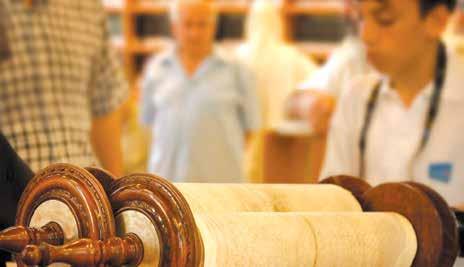
desh comes first.”
Boruch blinked. “But you said pirsumei nisa defeats tadir!”
“For the Haftorah, where we pick only one,” Shimon clarified. “But here we’re reading both regardless. So the more common one goes first.”
Boruch nodded slowly. “OK… so what about Motzei Shabbos Chanukah in the home—Havdalah or candle lighting?”
“Well,” said Shimon, “since we’re going to do both anyway, tadir suggests doing Havdalah first, even though Chanukah candles have pirsumei nisa.”
“ Tadir is a simple rule, but it takes you to some very deep places.”
Chanukah. Rosh Chodesh happens more often, so its Haftorah should come first— tadir kodem!”
Shimon smiled. “Sorry—we read the Chanukah Haftorah, because pirsumei nisa, publicizing the miracle, overrides tadir. But now tell me: after the weekly parsha, which laining comes first—Rosh Chodesh or Chanukah?”
Boruch replied instantly. “Chanukah! You just told me pirsumei nisa beats tadir.”
Shimon shook his head. “Nope. Here we read both Rosh Chodesh and Chanukah. The miracle will be publicized either way. When choosing which order to read them in, we apply tadir —so Rosh Cho -
“Right,” Boruch said. “That matches what you said before.”
“Correct,” Shimon said. “Many Acharonim say exactly that. But it isn’t so simple. We don’t like rushing to say goodbye to Shabbos. True, you can’t light candles while it’s still Shabbos, but the formal goodbye— Havdalah—is something we prefer to delay. So some say light candles first. The Mishnah Berurah writes that whichever one you do, you have valid opinions behind you.”
Boruch snapped his fingers. “I remember Rav Yosef Chaim Sonnenfeld had a clever workaround.”
“Yes,” Shimon said. “His wife prepared the menorah so that when he arrived home,
the first mitzvah he encountered was Chanukah candles. Then, applying ein ma’avirin al hamitzvos, he’d light first. Very elegant.”
He leaned forward. “OK, final case: There’s a bris milah in shul on Purim. Which comes first—the bris or Krias HaMegillah?”
Boruch answered without hesitation. “Bris Milah, of course! A bris happens far more often than Megillah, which occurs only once a year. Even if Megillah has pirsumei nisa, you said earlier that when doing both, we do the more common one first. Havdalah was a special exception because we delay ending Shabbos.”
“Excellent,” said Shimon. “Some Acharonim indeed say the bris comes first. But it’s not exactly comparable. All our earlier examples—Havdalah, laining, Kiddush Levana—are regularly scheduled mitzvos A bris on Purim isn’t scheduled; it could have fallen out on any day. So some Acharonim argue that it’s not tadir on Purim, and therefore Megillah reading should come first.”
Boruch sat back, impressed. “Wow. Tadir is a simple rule, but it takes you to some very deep places.”
Shimon smiled. “Welcome to the world of Zevachim.”
Rabbi Avrohom Sebrow is a rebbe at Yeshiva Ateres Shimon in Far Rockaway. In addition, Rabbi Sebrow leads a daf yomi chaburah at Eitz Chayim of Dogwood Park in West Hempstead, NY. He can be contacted at ASebrow@gmail.com.
By Rabbi Yair Hoffman
For twenty years, the residents of Far Rockaway had lived with a maddening injustice born of nineteenth-century railroad engineering: the train tracks to Manhattan passed through Nassau County.
It didn’t matter that Far Rockaway sat squarely within the five boroughs. When residents stepped onto the LIRR platform each morning, the fare system treated them as Long Islanders. While a resident of Jamaica could purchase a CityTicket for $7 peak, the Far Rockaway commuter paid $13.00. Nearly double. For a trip that began and ended within the same city.
And then came August 20, 2023.
The MTA unveiled something unprecedented—a first in the 189-year history of American commuter rail. The Far Rockaway Ticket would mirror CityTicket pricing exactly: $7.00 peak, $5.00 off-peak. To prevent abuse, the TrainTime app would verify via GPS that purchasers were physically present at Far Rockaway station.
For Far Rockaway, it was liberation day.
The Far Rockaway Branch doesn’t terminate at Far Rockaway. The tracks continue through Lawrence, Cedarhurst, Woodmere—the Five Towns, home to one of the largest Orthodox Jewish communities in North America.
These communities share shuls with Far Rockaway. Their children attend yeshivos together. A Lawrence resident can walk to Far Rockaway in twenty minutes.
But on August 20, 2023, that invisible county line became a six-dollar chasm. Far Rockaway to Penn Station: $7.00. Lawrence to Penn Station—same train, same destination: $13.00.
And so began a new chapter involving morning shiurim and evening minyanim, GPS coordinates and halachic categories.
The She’eilah
Reuven, a Lawrence resident, attends a morning Daf Yomi shiur in Far Rockaway. He legitimately purchases a Far Rockaway Ticket at the station for $7 to travel to Penn Station. On his return trip: May he exit at Lawrence—his actual home—rather than riding to Far Rockaway and walking back?
The Case for Prohibition
Several arguments suggest Reuven may not exit at Lawrence:
Gneivas Da’as (Deception): The Gemara in Chullin (94a) states this prohibition applies universally. The Far Rockaway Ticket was created, as MTA Chair Janno Lieber stated, specifically “for Far Rockaway riders.” The GPS system was engineered to ensure only those in Far Rockaway could purchase this ticket. When Reuven uses it to travel to Lawrence, he deceives the MTA about the fundamental nature of his trip.
A Form of Geneivah: As the Chofetz Chaim rules in Ahavas Chessed regarding the verse “midvar sheker tirchak ,” when deception is used to avoid paying money legitimately owed, it constitutes theft. The $6 discount exists solely for Far Rockaway residents—a justification that doesn’t apply to Lawrence, which sits in Nassau County.
Dina D’Malchusa Dina: The MTA’s fare structure is established law. Using the Far Rockaway Ticket to reach Lawrence circumvents the entire structure the MTA established.
The Prohibition of Lying Through Action: Rav Yavrov, zt”l, in Niv Sfasayim, based on the Sefer Chassidim, rules that even alluding to a lie through physical action is forbidden, derived from “hin tzedek ”—that our “yes” must be truthful

The Case for Leniency
However, compelling counter-arguments exist:
Reuven Paid for MORE Than He Is Using: Unlike classic Geneivah cases, Reuven is declining to use the full value of what he purchased. He paid $7 for a journey to Far Rockaway. Lawrence is before Far Rockaway. The MTA has gained, not lost—they sold a longer trip and provided a shorter one.
The Rashi-Tosfos Distinction: Rashi holds that Gneivas Da’as applies only if someone actively says something deceptive. If no deceptive words are spoken, the other party is considered to be “deceiving himself.” Reuven boards the train, shows his valid ticket, says nothing false, and simply exits at Lawrence.
Minhag HaSochrim: It is universally understood that passengers may exit at any stop along their route. No train system requires passengers to ride to the final destination printed on their ticket. If someone purchases a ticket to Montauk and exits at Babylon, has he committed Gneivas Da’as? The same principle should apply here.
The GPS System Defines the Parameters: The MTA deliberately chose to verify location, not residency, not intent, not destination. If Reuven is in Far Rockaway—for any reason—he may purchase a Far Rockaway Ticket. The MTA did not create rules requiring Far Rockaway residency or riding to Far Rockaway. Those rules simply don’t exist.
No Explicit Rule Is Violated: The Far Rockaway Ticket “can be used for direct travel between Far Rockaway and sta -
tions in LIRR Zone 1.” Nowhere does the MTA state: “You must ride to Far Rockaway” or “You may not exit at intermediate stops.”
The Human Element
Reuven’s presence in Far Rockaway each morning is an act of mitzvah—daily Talmud study. His desire to return home efficiently is driven by shalom bayis and chinuch habanim . The $6 daily savings—$3,000 annually—supports Torah education for his children. Must he trudge through winter weather, arriving home 25-30 minutes later, his children missing his presence at dinner?
The Conclusion
There is also the issue of Chillul Hashem and Kiddush Hashem. We pay more money for a mehudar esrog; why shouldn’t we do so to avoid possible chillul Hashem?
Ultimately, one must ask his rav or posek. Those who wish to adopt the stricter view—riding to Far Rockaway and walking home, or simply paying the extra fare—are acting with extra piety. But those who rely on the lenient view have solid halachic ground on which to stand.
So ask your rav: “The train stops at Lawrence. May Reuven step off if he bought that special Far Rockaway ticket?”
This article should be viewed as a halachic discussion and not practical advice. The author can be reached at yairhoffman2@ gmail.com.
By Larry Domnitch
The Chanukah of 1967 signaled change, a new era for Spain which made amends for sins of its past. Currently, the significance and impact of that new era is in doubt.
Almost five hundred years after the expulsion of Jews from Spain, freedom finally arrived.
On June 28, 1967, after much debate, law number 44 was passed in Spain’s Parliament granting religious freedom to all non-Catholics to worship publicly. Spanish Jews, Protestants and Muslims were finally granted that freedom.
Spanish Jewry had experienced a long history of antisemitism. The Visigoths in the seventh century forced conversions upon Jews. Islamic Almohade invaders in the 12th century established a caliphate and also subjected the Jews to forced conversions. The Christian Reconquista (re-conquest) of Spain resulted in anti-Jewish massacres. In the pogroms of 1391, tens of thousands of Jews were massacred, and many adopted Christianity and in subsequent years under duress. In 1478, Spain institutionalized the Inquisition to discover those Jews who converted but were covertly observing their traditions. The mass expulsion of Spanish Jewry was enacted in 1492, and for the following centuries living as a Jew in Spain was prohibited as the Inquisition was imposed until 1834.
In 1967, living and praying openly as Jews as a community was finally officially permitted.
Tolerance was in the air. Primary schools removed offensive reference to Jews. The Jewish community of Madrid was growing.
The Beth Yaakov Synagogue of Madrid officially opened in December of that year. A dedication ceremony marking its
opening was held during Chanukah, on December 16, 1968, attended by six-hundred local figures and Jewish dignitaries worldwide. That day, the Spanish Minister of Justice Antonio Oriol had officially repealed the Alhambra Decree of Expulsion of 1492.
Chanukah in Madrid in 1969 brought with it an official dedication of a synagogue and a rededication by Spain of freedom for all its inhabitants.
Their Chanukah event was a vindication that the might of tyrants does not extinguish the light of freedom.
While religious freedom was granted, Spain still did not recognize the State of Israel. To the contrary, in 1979, Spain had invited and hosted PLO leader Yassir Arafat. In response, member organizations of the Conference of Presidents of Major American Jewish Organizations had even considered boycotting Spain, but by 1986, relations with Israel were finally officially established.
Recently, darkness has returned to Spain.
Spain has become an environment of increasing Israel hatred fueled by its Prime Minister Pedro Sanchez and his leftist coalition allies. Sanchez has broken ties with the Jewish State as he peddles anti-Israel canards reminiscent of antisemitic libels of the past.
On May 14, Sanchez stood before parliament and accused Israel of being a “genocidal State,” an inflammatory and dangerous lie. Five days later, he did not back down but called for Israel’s expulsion from the annual Eurovision song contest while again falsely pointing the accusing finger at Israel and declaring solidarity with “the people of Palestine who are experiencing the injustice of war and bombardment.”
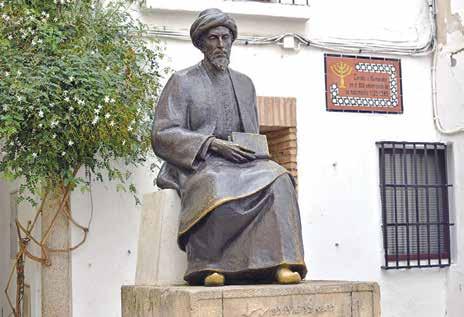
On September 8, 2025, Spain announced a total arms embargo of the Jewish State. Sanchez, invoking Hamas propaganda, stated in regards to the decision, “There is a difference between defending your country and bombing hospitals or starving innocent children.”
Sanchez called for Israel to be barred from international sports events after pro-Palestinians disrupted the finale of the Vuelta cycling race in Madrid, prompting a response by Israel’s Foreign Minister Gideon Saar, who accused the prime minister of being “an anti-Semite and a liar,” as he asked, “Did Israel invade Gaza on October 7 or did the Hamas terror state invade Israel and commit the worst massacre of Jews since the Holocaust?”
Sanchez had the gall to issue the following reproach and admonition, “Spain, as you know, does not have nuclear bombs. Nor does it have the aircraft carriers or large oil reserves. We alone cannot stop the Israeli offensive, but that does not mean we still stop trying.”
Prime Minister Benjamin Netanyahu responded, calling his words a “blatant genocidal threat to the world’s only Jewish state.” He continued, citing Spain’s past persecution of the Jews, “Apparently, the Spanish Inquisition, the expulsion of the Jews from Spain, and the systematic mass murder of Jews in the Holocaust is not enough for Sanchez.”
Members of Sanchez coalition have also expressed their animus towards the Jewish State. Labor Minister and 2nd
Deputy Prime Minister Yolanda Diaz, who leads the leftist Sumar party, publicly repeated the often-heard chant from anti-Israel protesters, “from the river to the sea.” Despite her denials, its message is clear. Such statements are calls to dismember the Jewish State. They are not about policy disagreements.
Member of Parliament Gabriel Rufian made an outrageous statement that equated Gaza with Auschwitz: “The difference between Gaza and Auschwitz is the world still has time to stop what’s been happening in Gaza.”
Spain has seen a significant rise in antisemitic activity, which includes public taunts at soccer games against Israelis, massive and often raucous anti-Israel protests in the streets, anti-Israel graffiti on synagogues, and physical attacks upon Jews.
In May 2024, Spain formally recognized a Palestinian state, a move consummate with its recent anti-Israel stands. The Sanchez government has brought shame to Spain for forsaking truth for Hamas propaganda and leading Spain towards its dark antisemitic past.
One can only hope that dignity will someday be restored to Spain.
On Chanukah 1968, Spain rose from its shameful past. Presently, its government has lost its way.

About a year and a half ago, with the help of Renewal, my friend Jerome, who was struggling with potential kidney failure and was about to go on dialysis, got a new life. Due to a series of circumstances, Jerome switched doctors and hospitals and got a new kidney.
Jerome never had to start dialysis.
Renewal is an extraordinary organization that has facilitated over 1,000 transplants through their “swab” initiative. In addition, Renewal supports the donor, the recipient and their families throughout the entire process. Renewal creates communities of donors and recipients that are populated by people in need who are matched with selfless ones who are fueled by a desire to help someone “live.”
On the anniversary of Jerome’s transplant, the two families got to meet each other. They were hosted in the home of a couple whose husband is also a kidney donor. It turns out that Jerome’s donor is a former nursery school student of his wife Sharyn. She had been the director/owner of a prestigious nursery school in Far Rockaway. Morah Sharyn also taught all of the donors’ siblings and cousins.
The donor’s parents live around the corner from Sharyn and Jerome.
Searching through her school archives, Morah Sharyn was able to locate the donor’s family’s class pictures; she brought them with her to the meeting which included his wife and family.
This week, my friend Melissa donated a kidney to a frum Jew from Panama. She had placed her name on the Kidney Donor Registry more than four years ago. At the end of this past summer, her blood sample came up as a match; out of the blue, she got a call.
To qualify as a donor, there are multiples of benchmarks that have to be met in order to donate. In Melissa’s case, she also needed to travel to the Cleveland Clinic to take all of the pre-donor testing and for the actual surgery. A donor must be in perfect health to qualify.

By Barbara Deutsch
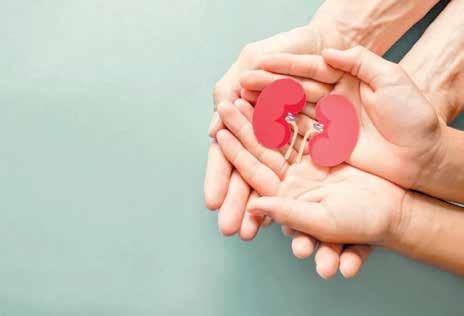
Aside from the hours of testing and time spent away from family and work, the recovery is not a “one and done.” Melissa describes it as “being hit by a truck.” As I write, she is recovering while waiting to go home for future weeks of recuperation.
Melissa’s recipient’s name is Dovid ben Rochel – her father’s and mother’s names. The surgery was done on her actual birthday. As Melissa put it, “How appropriate is it to be able to give someone life on the day that I was given life.”
My friend Vivian left Israel this week to go back to America to help her son Eli’s young family; Eli is donating a kidney.
When Anyu, Bob’s mother, was starting to fade, her kidneys needed dialysis. Our daughter Meredith offered one of hers. Anyu refused; as an Auschwitz survivor she lived life and faced death on her own terms.
A growing number of dear relatives and friends, Mindy, Amy, Debby, Scott, Yaffa and Lisa, are all donors. My late friend Richard was a recipient; as a result of his transplant, he enjoyed many quality years before passing from cancer.
Jews as a whole, though small in number as compared to the world’s pop -
ulation, disproportionately make up the majority of kidney donors.
Every single donor I spoke to says it was their best decision.
Mi k’amcha Yisroel.
My former Torontonian, now Israeli, cousin Mindy has a close friend Marissa; she was living a miserable life. Donating a kidney would immeasurably help her friend find elusive health. When Mindy swabbed, she was no match. But, it turned out that she was a close match for a complete stranger, Binyomin bat Mina.
Mindy’s Hebrew name is Mina. The Indian kidney surgeon’s mother’s name is also Mina; it is a very popular Indian name.
Mindy’s primary care physician is Meredith, our daughter. “She was so supportive! When everyone else told me I’m too old, too fat, too out of shape, etc., Meredith said, “You’re going to do it!”
Ironically, when a close friend of Mindy’s heard about her kidney donation, this friend was inspired to donate one as well; she was a close match for Marissa.
Mitzvah goreret mitzvah.
Bob and I talked about it but never
followed through. At this point, I may be too old.
What qualities does a person need to become a donor? I think about that a lot. Is it totally a selfless act, or is there some “bargain” that one makes with Hashem to ward off or sway some evil edict that may be in your future?
Does the reason matter? A donor’s selfless generosity, an act of kindness, saves a life.
Debby : “It was a really hard time in my life. For various reasons, I had to move from the house I loved; I gave up living on a block that was like family to me. I’ve never worried about my health (I am lucky), and it really didn’t seem like a big deal. But also – maybe unwittingly – I was making a deal with G-d. I’ll help someone else, but can You help me?
“Who knows? All I know is that I saw an article about Renewal in a newspaper – and it just spoke to me. It was a wonderful distraction when I needed one.”
I remember visiting Debby after her surgery; recovery was slow and far from simple.
Melissa : “I saw this as an opportunity to help someone, so I did. I had swabbed four years ago for Renewal when they were doing a drive for a man in my neighborhood. I went into it knowing that if I matched I would do it. Four years later (in July), they called me with the news that I matched with someone who was in dire need of a kidney.
“I didn’t really think about it. Baruch Hashem, I was healthy and could live with one kidney; this man had no quality of life. It wasn’t such a hard decision.”
Lisa : “My initial swabbing was at a friend’s Renewal event, and I did it just because, kind of like “why not,” they’d never accept me anyway. I wasn’t a match and didn’t give it another thought.
“A year and a half later, my phone rang, and the caller ID said Renewal. I was curious so I answered the call. It
turned out I was a perfect match for a Sephardi man (whose mom, coincidentally was named Lisa). I hung up the phone promising them I would think about it and talk to my husband and get back to them. Even before I hung up the phone, I knew inside that I would do it. How could I not save someone’s life, given the opportunity?
“In the back of my mind I felt that my donation should be a zechus for someone in my life that needs a refuah It’s one of the best things I have ever been privileged to do.”
Scott: “I always wanted to do it but kept pushing off swabbing. Finally, Renewal did a drive in Queens, so I ran over there and swabbed. Got a call a month later and donated two months after that.
“I’m O-type blood so I knew it would happen quickly. Jaclyn was supportive throughout.
“I just knew it was the right thing to do and had plenty of people I respected who did it, so figured why not me?”
Scott and his wife Jaclyn have two boys. He is a dear friend’s son-in-law, and he is still in his 20s. They plan to make aliyah this summer.
Richard (as told by Marilyn):
“Richie had a kidney transplant thirteen years ago. Although we had our own donor, Renewal handled the logistics; Renewal was still in its beginning years. The donor was a friend of ours from our neighborhood who came for -
mire anyone who donates, especially to someone they do not even know. A true mitzvah!”
My dear friend Ruchi’s brother Avi’s family all donated kidneys; first his twin girls, then his wife Frady, and not to be outdone, Avi, too.
As Melissa put it, “How appropriate is it to be able to give someone life on the day that I was given life.”
ward as soon as she heard of the need. She is now a member of our family.
“The amazing thing was that all through Richie’s cancer illness, including chemo and radiation, his kidneys always functioned. The doctors were amazed at how strong they were; his cancer never affected them.
“Thank G-d, he never needed dialysis, and the results of the transplant on his life were miraculous. I truly ad-
Jerome continues to improve and is hoping to travel soon. He and Sharyn are looking forward to a granddaughter’s wedding and playing with their growing family of great grandchildren.
Because of the life I now find myself living in Israel, I have acquired a whole new set of friends, some of whom were acquaintances in the past. I find
that many kind-hearted people want to make shidduchim for newly minted singles and widows. I had lunch with a new friend this past week; she is soft-spoken, charming and smart. Apart from both of us mourning the loss of our life partners, we had many other things in common to talk about over our leisurely after-shiur brunch.
When I told her I don’t like being alone, her response was “I am never alone; I am by myself.”
Her comment continues to resonate with me.
During Chanukah, a season of giving, perhaps it would be good to consider becoming a donor and giving the ultimate gift, life!
Maybe I should swab?
Barbara Deutsch is the former associate principal at HANC, middle school principal at Kushner, and Dean of Students at Yeshiva of Flatbush. A not-retired educator, she is trying to figure out life in Israel through reflections on navigating the dream of aliyah as a wife, mother, grandmother, great-grandmother and friend.

By Talia Bonilla

During Chanukah, we say Hallel, offering praise and gratitude as we celebrate light and remember the miracles that carried us. And when I think about love and gratitude, I think about the way this community has shaped my life.
I grew up near TAG, on Meehan Avenue, surrounded by the sounds and sights of Jewish life, the minivans rushing by, the kids on scooters, people walking everywhere. As a kid, I thought they were always walking somewhere. I went to the elementary school on Hicksville Road, and we shared a courtyard with the yeshiva next door, so even in school I saw that separation and was aware of it. It was just part of the background of my life. I saw it, but I didn’t really know what it was.
Then life took me in a different direction for a while. I moved away from Far Rockaway and went to college, building a life of my own – never imagining I’d return to that same neighborhood. After graduating, I thought I had done everything carefully to ensure things would go as planned, but life didn’t unfold that way. Years later, Hashem brought me back to the community, this time to work for two Jewish families living not far from where I grew up. That return became the quiet turning point, the moment when everything began to shift.
This time, I wasn’t just seeing the community
from the outside. I was seeing Judaism from within. Through those families, I saw what it means to build a home filled with warmth, purpose, and faith. I watched how Jewish women led their homes with such strength, sensitivity, and heart. And little by little, without even realizing it, I started absorbing all of it, the way every detail had meaning, and the way everything seemed so intentional.
It wasn’t that I understood it, yet it was just something that felt deeply familiar. I think I just needed a space where that part of me could be nurtured. Even though I didn’t know why, it all felt natural to me, even before I understood what it meant. It just made sense. It made me feel whole. It was never about being perfect; it was about being present, about living with purpose.
Over time, those families, the Shapiros and the Weiss’s, became fam ily to me. That’s where my journey really began surrounded by love, kindness, and connection. That journey of connection eventually led me to the hardest and most beautiful decision of my life: choosing Hashem. After so much sacrifice, study, and

learning to reshape and realign my life, I stood before a Beit Din on the 21st of Tammuz and became Talia. Before the life I’m living now, I lived what many would call a great life. It was fun, free, and full, and I truly loved so much about it. I lived without restriction, I did whatever I wanted, whenever I wanted. And yes, don’t worry, I didn’t forget: I also ate whatever I wanted. But at a certain point, something inside me began to shift. Even though I had everything that looked like happiness, I realized something was missing. It was like having a glass of water that kept overflowing and yet somehow never felt full. So much was happening – good things, exciting things – but none of it gave me the kind of peace I was searching for.
I didn’t understand it at the time, but what I was really craving wasn’t more. It was meaning. So when I began this path, I chose Hashem even without knowing exactly where it would lead. I followed blindly, trusting that His plan was better than mine.
Now I live a life that some might see as full of limits, but I see it as an embrace from Hashem. It gives

life meaning. It brings peace.
Every morning, I wake up with purpose. Everything I do has direction. And it’s fulfilling in a way that freedom alone never was. Having seen both worlds, I can say honestly this life, the Jewish life, is the one that fills the soul. It teaches you to value what you have, to be humble, and to live with gratitude.
My first mitzvah as a Jewish woman a few hours after I converted was hafrashat challah. I had baked
It’s about the light that keeps returning in our homes, in our people, in every moment we choose hope over despair.
challah before, but this time it was different. This time, it counted. It was my mitzvah.
It was a Thursday, right in the middle of the day, but so many women from the community came together. Some were in the middle of work, some were just nearby, but they all stopped by even if just for five minutes to give me a hug, to say mazal tov, to share that
moment. It showed me how united the Jewish community truly is, especially here in the Five Towns.
Recently, at a community Challah Bake, I was reminded of that same feeling, the power of women coming together with heart, with faith, with warmth. And in a way, that’s what Chanukah reminds us, too. Because Chanukah isn’t only a story about oil that lasted or flames that burned. It’s about the light that keeps returning in our homes, in our people, in every moment we choose hope over despair.

Since October 7, that message has felt especially real. When tragedy struck, no one stood alone. The pain, the fear, the prayers – they bound us together. Across the world, Jews gathered to make challah, to daven, to write letters, to donate, to comfort.E ach act was another flame.
That’s the power of Am Yisrael, and it’s the same strength I saw when I first stood in a Jewish kitchen years ago, watching light flicker from a Shabbos candle and not yet knowing what it meant .Now, as I light my menorah, I think about how far that light has traveled from those homes I once admired to the home I now keep. Each candle feels like a small thank you for
Hashem’s guidance, for the families who showed me what faith looks like in motion, and for the community that embraced me fully.
This Chanukah, may we all keep finding ways to share that light through kindness, through faith, through being present for one another.
Because what starts as one flame or one act of connection has the power to illuminate so much more than we’ll ever see.
You can reach Talia and see her continuing journey on Instagram at @frumsoultosimmer

By Eliyahu RosEnBERg
People always say that the purpose of music is to bring people together. But i think we’re in an era, we’re in a time, where we need to bring people to themselves. We need to inspire people to accept themselves. a nd that’s my music. That’s my message.
i chose what chose me. i chose what chose me to be in israel. i chose what chose me to grow up in a Jewish family in north Tel aviv, writing music in israel, and serving in the army... something against all odds chose me to be here. a nd learning about a m yisrael, i realized that it’s a nation that, against all odds, still exists. nations have tried to destroy us, but a m yisrael still remains. a nd somehow, from all the souls in the world, hashem chose little howie from the Philippines for this journey.
My adopted grandmother was a holocaust survivor, and she always smiled. a nd she always said, ‘Think good, and it’ll be good.’ you could always find reasons why everything is bad, especially nowadays. you could talk about politics and get angry; you could talk about society and how everything just doesn’t make sense anymore; you could talk about inflation. There are always reasons to complain. But we can’t live like that. We have to find something good... We want to make sure that the next generation grows up in a positive and great world. so, let’s make it better. l et’s see the good in the world and concentrate on that.
During Howie Danao’s upbringing, he wandered the streets of North Tel Aviv — his mind a haze, his soul lost, and his identity crushed beneath the weight of countless unanswerable questions.
“Who am I?” he wondered. Was he an Israeli? A Christian? A Filipino boy?
“Why am I here?” Why did his mother leave the Philippines and move to Israel, where he was born and raised?
“Why am I fighting for this country?” Why was he, as an IDF reservist, risking his life to protect a land and a people he didn’t belong to?
There were many parts of his background and life that confused him. Why did he love music? Why was he raised by his mother and an adopted Jewish family? Why was his life the way it was?
To him, it seemed as though he had little agency, virtually no control over his destiny — that his life and fate had been predetermined by the actions of others. Howie recalls asking his mother one day: “Why Israel? When you left the Philippines, why did you move to the most conflicted country in the world?” Her answer wasn’t very satisfying. It just “felt right,” she replied, offering Howie a response that only confused him more.
As an adult, he would think long and hard, hoping that contemplation would resolve his troubling identity crisis. But he’d always arrive at the same conclusion, no matter how long he thought: His questions had no answers. Simply put, Howie realized that he didn’t choose his life; his life chose him.
* * *
“My childhood felt normal to me,” Howie recalls. “But to most people, I
have a unique story: My mother came from the Philippines to Israel. She wanted to work as a nurse, but things didn’t really work out. So, she worked as a housekeeper for a secular Israeli family, and at the same time, she found out that she was pregnant with me. So, instead of going back to the Philippines, her employers offered to raise me with them. So, I was raised by my biological mother and two adopted Israeli parents. So, I have my biological mother, who I call Mommy, and I have two adopted parents, who I call Imma and Abba, and I have brothers and sisters from them. I have two mothers and one father. And for me, that was normal.”
At home, he felt like he belonged. In his words, “It didn’t feel separated. It felt like one big family.” His adopted siblings were, as far as he was concerned, his real brothers and sisters. But out in the real world, he struggled. He was the only Filipino kid in his neighborhood and school. In his mind, at least, his race made him stick out like a sore thumb. And unlike most Israeli children, he was raised Christian.
“At first, I also had a language barrier. My mother spoke English, so I used to hear a lot of English when I grew up. I only formally learned Hebrew when I was five years old,” he recalls. “So my first language was either Tagalog — that’s the Filipino language — or English. And then I started to learn Hebrew, but everything just mixed up.
“But, like I always say, music is my main language. Give me an instrument, and that’s how I communicate.”
Howie was just 10 years old when he discovered his passion for music. At that
age, he began writing songs, driven to fill the void within him. He didn’t have many friends, so he dedicated his free time to hobbies. Later, as a teenager, he would compete as a singer in Israel’s version of American Idol.
Howie’s identity crisis intensified after he reached adulthood and joined the IDF.
“Every day, I experienced an identity crisis. Because what am I serving? Let’s say, G-d forbid, I go out to fight one day, and I don’t come back? What did I serve?” Howie shares. “My mindset and perception of Judaism, Israel, and Am Yisrael was that I wasn’t a part of it and that they’re against me… I always saw Judaism as just a religion, which means you could choose to be a Jew, just like you could choose to be a Christian or Muslim. And I always thought that religion wasn’t important; that it’s not the thing that defines you. Most of my perception about Judaism came from extremes: seeing Charedim on TV burning a dumpster or protesting. That’s the only thing I knew. When it came to Judaism, all I knew was that they’re against me. They’re against everything I believe in. They’re against my lifestyle. And that’s how I developed this really big hatred towards Judaism and the people who represent it.”
* * *
For a while, he carried his questions in silence. They were always inside him, but it wasn’t until he joined the IDF that he had the courage to really consider them. As he explains, he was previously too afraid to ask his questions because he feared that they’d lead him to answers he didn’t want — the sort of answers that would force him to change his life. But after participating in Nativ, a program that is meant to connect non-Jewish IDF soldiers to Israel and Judaism through an educational trip around the country, Howie finally mustered up the courage to face his identity crisis head-on.

an atheist — that I don’t believe in anything. But for most of my life, I was mad at something. I was mad, but I didn’t know who to be mad at. I felt like I just wanted to shout at someone,” Howie recounts. “When I grew up Christian, I couldn’t say J—. When I went to church with my mother and everybody prayed, I always said, ‘I don’t know who You are. I don’t know what You are. You’re not J—. But You are something.’ Something in me just felt that there could only be one G-d. There has to be one singular power, a higher power that controls everything. And I always had that spark in me.
“With all my questions, I always had one answer: That there’s no answer at all. None of us chose to be here. None of us chose to grow up the way we did. And for me, thinking about my life story, I always knew I was different. But I didn’t realize that my situation wasn’t only unique and unusual; it was special. What’s the probability and possibility of me growing up in Israel in North Tel Aviv, being Filipino, Israeli, Christian, and writing music?” he continues. “I didn’t choose any of this. But I realized that something had chosen me. None of us have the power to control our life stories. So, there has to be something much bigger than us that exists and creates our stories, lives, and realities. You know, people always tell me, ‘That’s not true. You chose to be a Jew.’ But that’s not accurate: I chose what chose me. I chose what chose me to be in Israel. I chose what chose me to grow up in a Jewish family in North Tel Aviv, writing music in Israel, and serving in the army.”
Howie adds: “Something against all odds chose me to be here. And learning about Am Yisrael, I realized that it’s a nation that, against all odds, still exists. Nations have tried to destroy us, but Am Yisrael still remains. And somehow, from all the souls in the world, Hashem chose little Howie from the Philippines for this journey.” * * *
one of the first mitzvot Howie did was completing a minyan. He chose that one, he explains, because it’s a mitzvah that represents being a part of a nation. “It’s about being a part of a nation that has this unbreakable contract with Hashem,” he says.
Recently, Howie visited the United States for the first time in his life. He came to New York to inspire American Jews through his story and music. But upon arriving in the States, he felt lost again. He had trouble connecting to and embracing Jews in chutz la’Aretz . He didn’t know what to think.
After speaking to his rabbi about the issue, he realized that his relationship with others is a reflection on his relationship with himself. The fact that he had trouble accepting American Jews meant that he had neglected to accept something about himself.
“There’s two types of teshuva: teshuva with yirah , with fear. And teshuvah with ahavah, with love. And for a while, my whole journey was teshuva from fear — fear of not going back to where I came from,” Howie explains. “There’s something that I didn’t accept about myself. I realized that I hadn’t forgiven myself, I hadn’t forgiven this part of me that used to be a goy
“For a long time, I thought that there’s one way to be a Jew. But the truth is that every Jew feels different in the Jewish world,” he adds. “And that’s the beauty about Judaism: that nothing could measure your Judaism. Nothing could measure your essence. They can say you’re not Jewish enough, or you’re too Jewish, or you’re a good Jew, or a bad Jew, or you’re not Jewish at all. But at the end of the day, no one could really measure your essence, your identity. And when I came to the U.S. and I realized that for the first time, that’s when I made my teshuva of ahavah.”
his identity. And when he accepted himself for who he is and was, that’s when he learned how to accept others. “Teshuva isn’t about erasing and denying a part of you,” he declares. It isn’t about deleting the past; it’s about resolving it.
Today, Howie is a proud Jew. He recently got married. And he’s working hard to use his musical talents to inspire his brothers and sisters.
“People always say that the purpose of music is to bring people together. But I think we’re in an era, we’re in a time, where we need to bring people to themselves,” Howie shares. “We need to inspire people to accept themselves. And that’s my music. That’s my message.”
“I love it when people stare, when people ask me questions. Why? Because it gives me an opportunity to explain to them who I am; to tell them my story,” Howie declares. “And my story is just my story. If you don’t feel like you belong in the Jewish world, you probably have your own story. Share that story. Share that light and explain it. When people ask you questions and you feel judged, you have two choices: You could push them away from you. Or you could bring them closer.”
Howie advises us to choose the latter. He explains that judgement, more often than not, stems from ignorance, not malice. Hatred and disrespect come from distance. Love comes from familiarity.
“Choose to bring them closer. Think about the next person that they’d speak to,” Howie concludes. “When people react to me in a certain way, I know it’s because they never had the opportunity to really talk to someone like me. And I know that after we’d speak, after we communicate, after I tell my story, after they listen to me — the next time they see someone who’s different from them, their thinking will be different.
“For a while, I thought I was
It took three years for Howie to become a Jew. On the day of his conversion,
When Howie converted, he took on the Hebrew name “Yosef.” He likens his conversion to a spiritual rebirth, but he realizes that the “Howie” in him — and his past as a non-Jew — is still a part of
“So, if you feel different in the Jewish world, you actually have a gift. You have the power, not just to bring that person closer to you, but to bring that person closer to everyone.”

By David Brummer
Allison Jacobson grew up in Westchester, New York, attending public school and Hebrew school three times a week. She had a bat mitzvah at 13, reading from the Torah like many Jewish kids her age. But when her mother passed away earlier that year, everything changed. She found she was distancing herself from her Judaism. She stopped attending youth group activities. The holidays became something she observed with family, more out of habit than connection. Judaism became background noise in what she describes as “a normal American life.”
At the University of Pennsylvania, Allison encountered religious Jews for the first time. They invited her to Shabbat dinners in their homes. The warmth surprised her. The rituals felt authentic. Still, she figured it wasn’t for her. She appreciated the experience from a distance, almost like watching a movie about someone else’s life. After college, Allison moved to Atlanta, where her boyfriend Joshua Jacobson lived. They got engaged. She worked as a registered nurse. Jewish friends became scarce. The distance from her community grew wider.
Then came October 7th. Allison was at the gym when the videos started flooding her news feed. One image stopped her cold. A girl who looked just like her. A girl named Naama Levy.
Allison couldn’t shake the thought that kept circling through her mind. “This girl’s great-grandparents settled in Israel. Mine settled in New York. That single accident of history created two completely different realities. The randomness of it haunted me.”
At work, some colleagues said things about Jews that made her uncomfortable. She began to feel like maybe Jews didn’t belong as much as she’d assumed. The ground beneath her feet felt less stable. She needed to find her people again. She joined Atlanta Jewish Experience, a
group run by two Orthodox couples. At first, it was purely social. Shabbat dinners. Women’s Wednesday classes. But something unexpected happened.
“The classes weren’t just about ritual or tradition. They explored mindset, character development, and how to be a better person. I’d never associated those topics with Judaism.”
One class hit particularly hard. The title was simple but profound: Are You Ready to Meet G-d? The question forced Allison to look inward. If she met G-d tomorrow, would she be satisfied with who she’d become? The world felt increasingly chaotic. The question demanded honest self-reflection.
“Every Torah class left me with something tangible,” she said. “Meanwhile, my nursing job, supposedly so fulfilling and caring, left me exhausted. The contrast became impossible to ignore. The Torah
Shabbat,” Allison recalled. “The question stunned me. How did they even know what that was? I admitted that I wasn’t that type of Jew. Of course, I knew what Shabbat was, but I never really experienced it.”
Allison started wondering what being Jewish actually meant. Was it just about culture and having Jewish friends? Or did it involve learning and living what you learned? Taking knowledge and turning it into daily practice?
“Those deep questions followed me home,” she reflects. “My fiancé and I started asking each other what values mattered to us and what kind of home we wanted to build.”
A young couple came to speak at the Atlanta Jewish Experience. The wife grew up Catholic. The husband grew up in Reform Judaism. They shared their journey toward becoming Orthodox, their time
“If I could go back 12 years and talk to my younger self, I’d say one thing. ‘Give Judaism another chance.’”
classes refreshed my spirit in ways my professional work couldn’t.”
Allison was the only Jew in her hospital unit, and her resurgent experience left her wanting to give voice to her burgeoning passion for the religion. She decorated for Chanukah. She talked to coworkers about Israel when they asked questions. Two of her colleagues, one from Jamaica and one from Kenya, were Seventh-Day Adventists. They kept Shabbat in their own way.
“One day in the break room, while eating pepperoni pizza gifted to the staff by a patient’s family, they asked me if I kept
foundation in marriage. The lessons covered things she’d never considered: How to create a home rooted in Torah values. How a husband and wife could grow together spiritually. The classes provided a roadmap she didn’t know existed. But Atlanta had its limits. The growth felt constrained by geography and resources. Israel offered something different. Full immersion. Allison enrolled in AISH’s Aspire program in Jerusalem. The variety of classes amazed her. One class in particular stood out: Ellie Horowitz’s Gender and Judaism course redefined feminism for her.
Allison shares, “I learned that wanting a family and embracing traditional Jewish women’s roles wasn’t something to apologize for. It was something to celebrate. The world might frown on it, but Torah wisdom said otherwise.”
learning in Israel at yeshiva and seminary, respectively. The story opened Allison’s eyes.
“I hadn’t realized you could actually become Orthodox,” she said. “I thought you could learn about it, admire it from afar, and attend other people’s Shabbat dinners. But actually transforming your own life? That seemed like something only people born into it could do.”
Allison and her fiancé decided to take their Judaism seriously. They connected with Orthodox rabbis who helped them prepare for their wedding ceremony. They took classes on building a Jewish
Reflecting upon her experience at AISH, Allison said, “If I could go back 12 years and talk to my younger self, I’d say one thing. ‘Give Judaism another chance.’ I almost threw it away, thinking it was antiquated and purposeless. I thought it was just repetitive prayers on Saturday mornings before soccer practice and movies with friends. I had no idea about the depth of Torah wisdom.” The guidance on relationships, marriage, raising children, and building a meaningful and purposeful life. All of it was there, waiting to be discovered.
Allison’s boyfriend-turned-husband Joshua is also learning and is even considering attending AISH for the summer. They’re building something together, a life rooted in tradition but fully their own. From Westchester to Philadelphia to Atlanta to Jerusalem, Allison’s Jewish journey brought her home. Not to a place but to herself.

Moderated by Jennifer Mann, LCSW of The Navidaters

Dear Navidaters
Thank you for the opportunity to ask my question. I’ve been dating a guy for five weeks, and things are going well. For reference, I am 26 years old and have been dating since I’m 22. We seem to align religiously and also based on our life goals and the way we look at things.
The thing is, though, he has some hobbies that I’ve absolutely no interest in. He enjoys playing golf, sports, loves going hiking. Personally, I really don’t enjoy any of those things. On a Sunday, I would much rather go shopping, a nice cafe, or chill somewhere indoors.
I realize that a guy like this is not coming along often so I don’t want to let him go. But I also don’t want to continue if it’s just a mismatch between us. I haven’t really told him I don’t enjoy those things yet... I’ve just told him what I prefer to do instead.
Is something like this a deal breaker situation, and if it can work out, how?
Thank you,
Laya*
Dear Readers,
We want to offer YOU an opportunity to be part of the discussion!
Please email us at MichelleMondShadchan@gmail.com, subject line “reader’s response,” if you would like to participate in the new “A Reader’s Response” columnist spot. We will send you a question and publish your answer in an upcoming Navidaters edition.
If you have a question you would like the Navidaters to answer, please reach out to this email as well.
Looking forward! Michelle, the “Shadchan”
Rebbetzin Faigie Horowitz, M.S.
Laya, this is not a deal breaker.
Mature people know that they each have to have their own space and interests in a relationship, not just shared space and interests. One half of a couple has to be a person in their own right and respected as such. Both need to be able to make choices and be involved separately in activities, growth, and pastimes.
It would be helpful to talk about the fact that you have different interests and explore some opportunities for joint activities such as volunteering, hosting, and working on a community project with others. Life is not just about your own interests and hobbies. The question you want to answer is can you and he support each other in your separate interests (accompany each other, for example) and give time and effort to matters that matter to both of you (working against antisemitism, delivering for Tomchei Shabbos, kiruv, tutoring a child who is struggling in school, to name some examples).
If either of you cannot and do not spend time outside your own interests and needs, it may be a sign of selfishness and lack of ability to give.
Michelle Mond
Dear
Laya,
The fact that you’ve
who you enjoy spending time with and share common goals, values, and hashkafos is something to celebrate. In regards to your concern, while there are some couples who enjoy all the same hobbies, there are others who simply don’t, and it can work out.
What you will have to do is respect his interests and give him space to pursue them. This might mean encouraging him to play golf with his friends on a Sunday, while you go with your friends to a cafe. You can also broaden your horizons and accompany him on a nice hike, even though it’s not your favorite activity.
Part of growing up and starting a life with someone is recognizing how two different people can be flexible and respectful despite their differences. You can have a respectful conversation with him about this topic. As long as he is on the same boat about being respectful of your differences, you are really in a good place! Think about how many women go from a Sunday afternoon “coffee clutch” while single to accompanying their husbands and sons to Sunday afternoon football league. It’s just a matter of recognizing change in life is normal, if one wants to move forward in life.
As long as flexibility and respect is there, there should be no problem navigating life like this.
Hatzlacha!
Dr. Jeffrey Galler
ating a good guy who shares your perspectives, goals, and values is
very special. He sounds like a wonderful, potential life partner.
Many years ago, my wife and I agreed that she would not expect me to go shopping with her, and I would not expect her to sit in front of the TV to watch a Yankees game with me.
(Have you ever noticed a few husbands, in the far corner of a women’s clothing store, sitting on extremely uncomfortable chairs, pretending to be busy with their cell phones, looking absolutely miserable, while their wives hunt busily through the racks? Please, ladies, never subject your husbands or boyfriends to this indignity.)
Here’s the important point. There are some activities that couples should be doing together, and there are other activities that folks do by themselves or with their friends.
Specifically, it is healthy for you to stroll leisurely through your favorite
A relationship where you have to do everything together can quietly become suffocating.
stores, without a guy constantly checking his watch and offering unsolicited fashion advice. And, it is equally healthy for a guy to play a very competitive game of basketball or handball with his buddies, without female participation. Nevertheless, you can also try to

blend some activities. A pleasant visit to a nice café could be a great shared experience. Just avoid taking him to a place that caters exclusively to feminine tastes, where the menu features nothing but trendy salads and acai bowls.
Similarly, even if you are not outdoorsy by nature, you might, nevertheless, enjoy a relaxed, not-too-rigorous, walk in a park together. That is, of course, as long as he doesn’t expect you to scale mountains with him.
If you share the same goals, values, and aspirations, and not only tolerate, but also support, each other’s individual interests, this could be the start of a wonderful relationship.
Meanwhile, may I respectfully suggest that you buy him a Yankees (or Mets) baseball cap or wristband for Chanukah. And, if the young man is reading this column, he would be wise to delight his girlfriend with a Sephora gift card.
Kayla Lasson Navidaters’ Reader
Laya, it sounds like you really like this guy and are trying to work through
The Navidaters
Dating and Relationship Coaches and
Dear Laya,
This is such a real question and one so many people quietly stress about early on. And I want to start by saying this plainly: you are not wrong for wondering if lifestyle differences matter. They absolutely can. And they also don’t always mean what we think they mean at five weeks in.
Here’s the honest truth. Some couples really do share everything. They hike together, train together, travel the same way, spend Sundays the same way. That works beautifully for them. Other couples are total opposites on weekends. One is outdoorsy. One is indoorsy. One wants movement, one wants calm. And that works, too. There is no one right model.
There is also a middle space that no one talks about enough, which is compromise with love. Sometimes, we do the
hike even if it’s not our favorite thing because being with our partner matters. Sometimes, our partner shops with us even though it’s not their ideal Sunday. Not every shared activity has to be your dream activity. Part of building a life with someone is learning when to stretch and when to rest in yourself.
And just as important as togetherness is separateness. Healthy couples are not fused. It is actually a good sign when two people can enjoy different things, trust each other with independence, and come back together with stories, energy, and space to miss one another.
A relationship where you have to do everything together can quietly become suffocating.
What matters most is not whether
a “rough patch.” However, I do not think of this as a “rough patch” at all.
Here is what you should do. Plan two separate dates. For the first date, you will join him for one of his preferred hobbies, like hiking. For the second date, he will join you at an indoor cafe. An extra date if you’re interested will be both of you trying a new hobby together.
This is only a “mismatch” if you believe it is. I don’t doubt that you can find hobbies and activities to enjoy together as a couple. If you really like each other – which it sounds like you do –spending quality time together can only strengthen your relationship regardless of which activity you choose.
Lastly, to address you not sharing an interest in what he prefers to do, you should feel comfortable with him and it may actually bring you two closer together if you tell him, “I don’t think I’ll
Part of building a life with someone is learning when to stretch and when to rest in yourself.
enjoy golfing, but I am willing to give it a try because it is important to you and I enjoy spending time with you.” You may surprise yourself by realizing you do actually like sports!
Good luck.
you like hiking. It is whether:
- You feel comfortable being honest about not liking it.
- You respect that he genuinely loves it.
- You can sometimes join without feeling trapped.
- And you both can also live full lives without needing the other to mirror you.
You mentioned that you “don’t want to let a guy like this go because he doesn’t come along often.” I want to say this gently. You should never stay because someone is rare. You stay because the connection is alive, mutual, and emotionally safe. Scarcity thinking has kept a lot of people in relationships that slowly made them smaller.
You also shared that you haven’t fully told him you don’t enjoy those things. That is actually the most important part of your question. Because five weeks in is
a dating or relationship question to the panel anonymously, please email JenniferMannLCSW@gmail.com.
not the time to perform compatibility. It is the time to build honesty. You are not asking him to give up who he is. You are simply showing him who you are.
This is not a deal breaker right now. It becomes one only if:
- You feel pressured to constantly bend.
- You feel guilty for having your own rhythm.
- You start abandoning yourself to keep the relationship intact.
So yes, this can work. And yes, it’s also OK if you discover it doesn’t. The next step isn’t a dramatic decision. It’s a truthful conversation. Let him meet the real you. Not the flexible version of you that is afraid to lose him.
That’s where real answers come from.
Warmly, Jennifer


By Aliza Beer MS, RD, CDN

Chanukah is a beautiful time that spans eight nights and is filled with family gatherings. Unfortunately, Chanukah can also pose challenges for maintaining healthy habits, especially when it comes to foods like latkes, doughnuts, and chocolate. However, with a mindful and realistic approach, you can enjoy Chanukah without compromising your health goals.
The first step to navigating Chanukah healthfully is shifting your mindset. Chanukah is meant to be enjoyed, and traditional foods are part of the experience. Rather than labeling foods as “bad,” consider them as treats that should be limited. Eating with awareness can help you enjoy these foods without overindulging.
Make Traditional Foods Healthier
Many traditional Chanukah foods
can be modified without losing their taste or form. For example:
• Latkes: Instead of deep-frying in large amounts of oil, try baking them in the oven with a light brush of olive oil or using an air fryer. You can also go beyond just adding vegetables by making fully zucchini or cauliflower latkes without any potatoes to help minimize carbs.
• Doughnuts: If doughnuts are made at home, try using whole-grain flour or baked versions to reduce sugar and fat content. However, when buying, the key strategy here is portion control. Instead of eating a whole doughnut, have half or even less. It also helps to enjoy treats earlier in the day rather than late at night, since you have more opportunity to burn off the extra calories. This tip applies to all indulgences since timing and portion size make a big difference. For example, if you really want that lotus doughnut, eat just half for breakfast and make the rest of the
day super clean and healthy.
Small swaps like these allow you to maintain flavors while reducing calories and saturated fat.
It is easy to overeat simply because the food is plentiful and readily available. Mindful portion control is key. Use smaller plates, serve yourself one portion at a time, and avoid snacking throughout the evening. When it comes to treats like chocolate, allow yourself 1-2 pieces rather than an entire bar. Pairing sweets with protein or fiber-rich foods, like nuts or fruit, can help stabilize blood sugar and reduce cravings.
Many Chanukah gatherings center around food. Social interactions can distract us and make it easy to simply keep snacking and overeating without realizing. Mindful eating is about
paying attention to your food and your body’s signals rather than eating on autopilot. Eat slowly and notice your hunger and fullness in order to prevent overeating.
Use these party strategies to enjoy the celebration without feeling deprived or overwhelmed:
• Bring a Healthy Dish: Contribute a healthy option like roasted vegetables, a salad, or a lighter version of a traditional recipe. This ensures there’s at least one dish you can enjoy without guilt.
• Offer to Make Food: Taking part in the cooking gives you more control over ingredients and portions, allowing for healthier swaps without compromising tradition.
• Fill Your Plate Strategically: Use a large plate for salads so you can load up on vegetables and add a good source of protein. It’s important to fill up on vegetables and protein first before adding in-
dulgent items. This helps satisfy hunger and slows the pace of eating, making it easier to enjoy smaller portions of richer foods. For the rest of the meal, stick to a smaller plate to help manage portions. Aim to keep it a one-plate meal and avoid going back for seconds.
• Sample, Don’t Overload: It’s OK to taste desserts and treats, but limit yourself to small portions.
• Focus on Socializing: Shift your attention from the food to conversations, games, or shared activities. Engaging fully in the social aspects of the holiday can help reduce mindless snacking.
While fried and sugary foods often take center stage during Chanukah, there’s plenty of room for nutrient-dense options. Incorporating roasted vegetables, fresh fruit platters, or whole-grain side dishes not only adds fiber and essential nutrients but also helps balance heavier, indulgent foods. Even small swaps, such as serving baked apples
restricting calories—you should never go into a celebration starving. Avoid the temptation to “save calories” by skipping breakfast or lunch, as this often leads to overeating later in the evening. Instead, choose nutrient-dense, balanced options like eggs, yogurt, vegetables, or salads to help keep your hunger steady and your energy stable throughout the day.
Before heading to the party, drink at least two cups of water to help curb excessive hunger and prevent mindless eating once the celebration begins.
Balance with Activity
Chanukah is a perfect time to incorporate family-friendly movement. Short walks after meals, dancing to music, or even playing games with children can help offset extra calories and boost your mood. If you have an established exercise routine, aim to maintain it, even if sessions are shorter. The key is consistency rather than perfection.
Avoid the Guilt
Finally, it’s important to practice
Eating with awareness can help you enjoy these foods without overindulging.
or fresh berries alongside latkes and doughnuts, can boost flavor and nutrition. This also gives you the chance to fill up with healthy foods first, making the unhealthy treats less tempting. Get creative by giving healthy dishes a festive Chanukah twist, making them both appealing and fun! (See apple recipe below!)
Parties often include beverages that can contribute hidden calories, such as sweetened coffees, wine, or cocktails. Moderation is important. Try to stick to water or sparkling water, and limit the alcoholic or sugary drinks. This strategy reduces unnecessary calorie intake while keeping the celebratory feel intact.
Rather than focusing solely on individual meals, think about your overall week. If you know a big Chanukah dinner is planned, aim for lighter breakfasts and lunches earlier in the day. This doesn’t mean skipping meals or severely
Ingredients
• 10 oz. frozen cauliflower rice defrosted in microwave for 1 min.
• 3 TBS oat flour
• 1 small onion, blended in food processor
• 2 eggs
• 1 tsp avocado oil
• Avocado oil spray
• 2 turns Trader Joe’s garlic salt
• 1 tsp onion powder
• 1 tsp garlic powder
• ¼ tsp pepper
• 2 tsp sea salt
Preparation
• Preheat oven to 350°F.
• Combine eggs, avocado oil, oat flour, and spices.
• Then, add blended onion and the defrosted cauliflower rice. Mix well.
• Preheat a non-stick skillet and spray with avocado oil spray.
• Scoop the cauliflower mixture into the hot pan and try to flatten out the mixture.
• Pan fry on both sides, about 1-2 minutes a side.
• Transfer to a parchment lined baking sheet.
• Bake in the oven for 6½ minutes until firm
self-compassion. Chanukah is meant to be joyful, and perfection isn’t the goal. If you overindulge one night, avoid guilt or drastic compensatory behaviors. Focus on returning to your healthy habits the next meal or day. Mindfulness, moderation, and balance are far more sustainable than over-restriction.
Celebrating Chanukah in a healthy and realistic way is all about balance and intentional choices. By planning ahead, modifying recipes, practicing portion control, staying active, and focusing on nutrient-rich foods, you can fully enjoy the chag without compromising your health.
Wishing all of my readers a freilichen Chanukah!
Aliza Beer is a registered dietitian with a master’s degree in nutrition. She has a private practice in Cedarhurst, NY. Patients’ success has been featured on the Dr. Oz show. Aliza can be reached at alizabeer@gmail. com, and you can follow her on Instagram at @alizabeer
Ingredients
• 4 large apples, sliced ½” thick (Honeycrisp, Fuji, Granny Smith)
• 2 cups trader Joe’s 72% dark chocolate chips
• Popsicle sticks
• Topping Ideas: coconut flakes, freeze dried strawberries
Preparation
• Wash/dry apples thoroughly. Slice vertically into 1/2” rings and core.
• Using a paring knife, cut a slit in the apple. Carefully insert a popsicle stick or cake pop stick into the bottom of each slice, pushing it about halfway into the apple.
• Melt the chocolate chips.
• Dab the sliced apples dry with paper towels immediately before dipping in chocolate. If the apples are moistened with juice, the chocolate will not adhere.
• Dip the dried apple slices into the chocolate to coat. Be sure to cover the whole slice, just past where the popsicle stick meets the apple.
• Lay the slices on a baking sheet lined with parchment paper and decorate with toppings.
• Refrigerate the apples for 5-10 minutes, until the chocolate is set.
By Michal Goldman, LCSW
What happens when two people fall into a pattern of scorekeeping with each other?
Let’s take a fictitious couple, Masha and Mendy. The problems started for Masha and Mendy once they had two children. Both spouses were working full time and taking care of their kids and household. We can suffice to say that it was a very hectic time for them. Masha and Mendy loved each other deeply and tried to think of each other and be there for each other. However, they started noticing a routine argument that they fell into. Masha would come home from work and make some comment like “I’m so tired, I’ve been running around all day. Can you give the kids their baths?” Mendy, who was also depleted from the day, would answer, “I’ve also been really busy today, and I’ve been giving the kids baths every day for the past week.” Masha’s turn: “Well, you’ve been giving them baths because I’ve been doing all the dinners and putting the kids to bed.” “That’s not true – you only put them to bed last night. I did all the other nights.”
And with that, the couple fell into an argument trap. They were now locked in a contest, keeping score of their respective contributions rather than seeking mutual support.
I like to call this trap the “scorekeeping trap.” This is a really common cycle for couples to fall into, especially when they’re in the middle of a busy period of their life. It usually starts from a place of one or both partners feeling overwhelmed and depleted, and then the other partner, who feels similarly, starts to defend themselves.
So how do we work through this argument trap?
Our first line of treatment is to help the couple understand the cycle that they’ve fallen into. A great way to do this is to use the formula: The more I XYZ, the more you ABC, and the more you ABC, the more I XYZ.
With Masha and Mendy, this played

out as: the more Masha overexplained and defended her request, the more Mendy responded defensively. The more Mendy responded defensively, the more Masha criticized him and overexplained her position. And the cycle continued from there.
Once both spouses understood how they were both contributing to this dynamic, they were able to start to feel more like a team fighting a tough situation and less like the tough situation was coming in between them and causing them to fight each other.
At this point, Masha and Mendy were ready for the next step to break this cycle. In this step, I wanted both of them to share their underlying feelings and vulnerabilities which came up from the conversation with each other and to be able to comfort each other from those places.

being seen for her needs, which led her to overexplain and criticize, or as I sometimes like to call it, amp up the pressure in the room with the hope that Mendy will then see her needs. On the other hand, when Mendy heard criticism from Masha, he felt like he kept failing at being there for his wife. He tried to push down those feelings for himself and Masha by defending himself and what he did, which led Masha to feel less seen.
• Notice the cycle you’ve fallen into. Use the formula: “the more I __, the more you __,” and repeat it until you see the interconnectivity between both of your reactions. This can help you shift from a place of blame to working together as a team. If you can do this together, that is ideal, but if even one of you does it, it can start to change the dynamic.
Once we can get clear on where we’re coming from, we’re in a much better position.
Masha’s work here was to understand what was happening in that moment for her.
When couples fall into the scorekeeping trap, the most common vulnerabilities that get touched are feelings of not being taken care of, not feeling seen, and not feeling successful in the relationship (or, to a more extreme level, feeling like a failure in the relationship). These are called “attachment needs,” and everyone has them, although some which are stronger in one person can feel less intense in another person, and vice versa. Once each person is able to get clear on what vulnerability they are experiencing, and then they are able to share with their spouse and get comfort, the cycle will automatically soften.
Let’s bring this back to Masha and Mendy. Masha felt fear that she wasn’t
Mendy turned to Masha in their session and shared his fear of failing his wife. When Masha was able to understand where he was coming from, her anger dissipated, and she moved to a place of understanding and comfort.
At this point, Masha was able to share her fear of not being fully seen with Mendy. Mendy heard her pain and turned to comfort her.
As the couple practiced sharing their underlying fears, the frustration of earlier cycles started happening less and less. When they would start their “scorekeeping trap,” the person who would realize it would either remind them both, which became a shared joke between them, or they would share their underlying pain, which would lead them both to a place of more connection instead of more disconnect.
• Notice your underlying vulnerabilities. We all have these vulnerabilities or attachment needs, and once we can get clear on where we’re coming from, we’re in a much better position. At that point, if you both are touching the more vulnerable needs and are in a place to share and receive from each other, sharing them with your partner can completely change the dynamic.
• Reframe the cycle as something that you are fighting together, instead of you both fighting each other. This can be done by naming the cycle or creating some other shared joke around it. Bringing humor in if you’re both on board can be really healing!
Michal Goldman is a licensed clinical social worker in Queens specializing in helping individuals and couples navigate relationship challenges. She can be reached through her website at www.michalgoldmanlcsw. org, via email at michalgoldmanlcsw@ gmail.com, or by phone at 917-590-0258. If you have questions that you would like answered here, you can submit them to the email provided. This content is for educational and informational purposes only and is not a replacement for therapy.
By Sara Weissman
In middle school, before every basketball practice, my teammates and I would gather in a circle and stretch. We took this ritual very seriously. The scene played out like a military movie, with the team captains aggressively barking the countdown from the middle of the circle. I assumed that stretching before exercise was essential. Perhaps it would help me run faster or make me less sore the next day. Some scientists must have proved that it was needed, right?
The traditional stretches that our basketball team did are called “static stretches.” These are stretches where you hold a muscle in an elongated position without moving the rest of your body. Typically, the position is held for 20-60 seconds at a time. It has been theorized that these stretches increase mobility, lower the risk of injury, and reduce soreness.
Once I picked up running, I noticed that many other runners skipped these short stretches before their workouts. Someone was wrong, and I was starting to wonder if it was my basketball team (that lost every game).
After doing some research, I was surprised to see very little data that supported pre-workout static stretches. In fact, there was some data that suggested the opposite.
A review paper from 2010 looked at all the studies that have examined the effect of stretching on sports injury and performance. Because of mixed results, it concluded that there is no clear evidence that static stretching before exercise reduces soreness or prevents injury. Shockingly, it showed that static stretching of a muscle before an activity reduces that muscle’s strength. Studies suggest that static stretches decrease motor neuron excitability. Simply put, after static stretching, the nervous system sends weaker signals to the muscle. This loss of strength is most detrimental in sports that rely on quick, strong movements. Sprint and jump power are going to be impacted, al -

though low-intensity running may not. Interestingly, the strength lost by static stretching seems to come back when a warmup is done after.
Static stretching before exercise seems to be a losing strategy, but there is a different type of stretching that shows much more promise: dynamic stretching. Instead of holding a posi -
Unlike static stretching, dynamic stretching before exercise does not result in strength loss. On the contrary, in some studies, it seemed to enhance performance. This is especially effective for athletes relying on explosive movements, like sprinting or jumping. While dynamic stretching is widely used by athletes, its effect on injury prevention
I find static stretching after a workout to also be a great time to slow down, find my zen, and reflect.
tion, this involves moving continuously to stretch your muscles. Think of it as a combination of a warmup and traditional stretching. Examples of dynamic stretches are leg swings, walking lunges, high knees, and arm circles. Dynamic stretching is now an integral part of the warmup for elite athletes, from track stars to NFL players.
has not been studied as extensively as static stretching, and conclusions can’t yet be made.
As with static stretching, there are only theories to explain the effects of dynamic stretching. One hypothesis is that dynamic stretching warms up the muscles, which has been found to increase the speed of nerve signals. This
prepares your body for powerful, coordinated movement when it’s time to put the pedal to the metal.
Flexibility is an important part of being healthy. Low flexibility is associated with worse posture, increased risk of injury, and even an increased risk of early mortality. Both dynamic and static stretching improve flexibility. Although static stretching is not ideal before exercise, it can still remain a part of your routine. The right time to do it is after you exercise, when blood flow is increased and muscles are less tense.
Stepping away from the science for a bit, I find static stretching after a workout to also be a great time to slow down, find my zen, and reflect.
My recommendation is to avoid static stretching before exercising and instead opt for dynamic stretching. This applies to team sports like basketball, soccer, and hockey, along with endurance sports like running and cycling. Choose a few dynamic stretches that target the muscle groups you will be using. Do about 30 seconds of each, and repeat for a few reps. This should take less than eight minutes. If you want to do static stretches, do them after you exercise.
Can I blame my middle school basketball team’s embarrassing record on the static stretches? I wish, but we were a lost cause from the start. However, there is no reason to be married to a losing stretching strategy. “Everyone does it” is not proof that a ritual works. We should be looking at the science for how to best prepare our bodies for exercise rather than just following the herd. Having a flexible and open mindset will help us stretch to reach our best potential.
Sara Weissman is a high school psychology teacher, biochemistry researcher, former adjunct professor of biology, and distance runner. Follow her running adventures on Strava @Sari Weissman. If you have feedback or suggestions for future articles, contact Sara at sara.lifshitz18@gmail.com.
By Sara Rayvych, MSEd
For eight days, we light up our homes with humble but powerful flames. A little light illuminates so much darkness. The simple beauty of the flames personifies so much of our nation – we appear small, but we have a tremendous impact. Our little light shines throughout the world, bringing warmth and life to those around us.
One of the hallmarks of Chanukah was the specific focus of the Yevanim. They were not out to destroy our bodies, rather our hearts and souls. It was the spiritual presence of the Torah Jew they couldn’t handle. They recognized who we are deep in our core, and that was unbearable for them. Their goal was to make us embrace their culture, beliefs and (lack of) morals.
Our generation is greatly challenged to keep our beliefs, customs and standards in a world ever decreasing in its own. This moral decline is very noticeable to many of us but is far less clear to children and young adults. I know every generation seems very good at lamenting any observed declines, but we certainly have what to shake our heads at.
We are blessed to live in such a wonderful country – a medinah shel chessed. In many ways, this only increases the challenge. We are given access to all areas of American life. We can receive a high level of education and a job in any profession we qualify for. We’re invited to “holiday” parties and encouraged to join all areas of society. We’re accepted – and that just may be where our greatest challenge lies.
We have a different way of life than the world around us. We have a constant awareness of Hakadosh Baruch Hu accompanying us, with the Torah as our guide and generations of mesorah to lead us. Life can be confusing, but we at least have a light in that darkness. We need to pass on our appreciation for the beauty of that flame to the next generation.
Attitude
I’ve heard many supposed “chachomim” mock, assuming we live only in an ancient – and irrelevant – world. “How
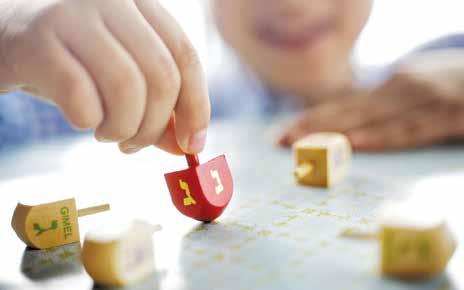
could you know it’s forbidden to drive on Shabbos when cars didn’t exist back then?”
“Really, you think anyone cares what you eat?” It’s amazing what a little ignorance can do. I could waste more time on such nonsense, but there is no need. It’s difficult to explain that the Torah contains principles that are applicable to all situations and isn’t simply a “do and don’t” list. It’s called a “Toras chaim,” a living Torah, for a reason, and it’s a source of life to those who embrace it.
Jewish children should be proud of who they are, and shouldn’t, chas v’shalom, feel like they’re less than others. Only by being aware of who they are, and proud of their status, will they be less vulnerable to the temptations of those around them. Recognizing that a particular behavior is beneath your status keeps your priorities straight. We want to build them up with an awareness of who they are, not leave them vulnerable to outsiders that can’t see the same. Pride isn’t the same as being conceited, and the two shouldn’t be confused. Children should not look down at others nor treat others with disrespect. It’s a sign of insecurity to feel the need to put down others, and many children will wrongly try to push someone down rather than build themselves (and others) up. It’s the child who is truly secure in themselves that wants to elevate others.
We also need to remember that knowledge is power. Without a solid chinuch it’s impossible to stand up to the storm outside our homes. The formal education they receive is a crucial component of this, and our community stresses chinuch for good reason. A major part of knowing who we are is having in-depth proficiency in all areas of our heritage. Others may ask them questions, and they will need to have answers.
More than having answers for others, they need to have answers for themselves. We forget some of the less obvious parts of their chinuch. Children have questions, and questions demand answers. We assume children understand all of the foundations of Yiddishkeit, yet there can be gaps, and those require a serious response. Many areas of hashkafa will come up as questions to parents. Perhaps the child is embarrassed to ask it in school, or maybe they are having difficulty formulating their thoughts. We can take time to think before responding or to ask others for help, but we can’t ignore their queries.
The very honest truth is that these questions will make us uncomfortable. We may not know how to answer, or we may ask ourselves why they need to know them. It’s challenging to go out of our comfort zones, but we still need to answer them. Our answers need to be true and respectful of the questioner. We also need to be careful not
to make them feel bad or embarrassed.
Children should view the Torah lifestyle with happiness. It’s very ineffective to say, “Do this because you’re supposed to – even if you’re miserable.” There should be simcha in their day, and Chanukah is the perfect example. We can easily make the minhagim of Chanukah meaningful and joyous. We can do the same with all other areas – even if it requires a bit more forethought. Rather than see our lifestyle as restrictive, we should do what we can to help them recognize the joy in it. Torah should be a source of simcha, and truly feeling that will make everything sweeter.
What we (their parents) value should be clear to everyone who sees us. Our children should understand what our values are because we live them. With kids, there is no faking it, and we can’t pretend to be someone we are not. Our children know what’s important to us because they hear our conversations and they see our behavior – fortunately, they can’t actually read our thoughts.
With all areas of parenting, it’s our personal example that speaks loudest. Lectures are not popular and will only turn kids off if we appear hypocritical. Criticizing kids is rarely effective. Parents may think it’s their duty as part of chinuch, but putting kids down or speaking hurtfully is never helpful. We want to build our children up, not cut them down.
Chanukah is a special, meaningful and fun time of the year. There is so much to appreciate and value, as we bring light and happiness into our homes. May this light and simcha remain with us always. Chanukah sameach!
Sara Rayvych, MSEd, holds a master’s degree in general and special education. She has been homeschooling for over 15 years. Sara provides personalized parent mentoring services, addressing a variety of general and specific parenting concerns. She can be contacted at Sara. Rayvych@gmail.com with comments, questions or for private consultations.
By Etti Siegel
Q:Dear Etti,
My 5-year-old daughter is having a very hard time adjusting to school this year. To be honest, she wasn’t very compliant last year either, but things seem worse now. Her teachers say she wanders around during circle time, refuses to join the group, runs up to the board to try to erase what the teacher is writing, takes things away from the other children, and is generally very disruptive.
The school called us in for a meeting, but no one seems to have any concrete answers or guidance. What does the school want from us? We obviously can’t show up every day and sit next to her to make sure she follows the rules!
Sincerely,
Concerned and Confused
A:Dear Concerned and Confused, First, I want to reassure you that there are some young children who do struggle with structure, transitions, and group expectations, especially in the early grades. At five years old, children’s self-regulation skills are still forming, and some children simply need more time, modeling, and support to learn the routines that school requires. What you’re describing is challenging, but it’s not hopeless.
Let’s break this into a few parts so you know what’s realistic, what’s helpful, and what might be going on beneath the surface.
1. What the school really wants from you Schools do not expect parents to come in every day and sit next to their child. What they are hoping for is a partnership:
• They want to see your willingness to acknowledge that your daughter is struggling.
• They want to see your openness to a plan.
• They want to know you are ready to collaborate in reinforcing the same language and expectations at home. The school is not trying to assign blame. They are asking for teamwork.
2. Why she may be acting this way
Children don’t act out because they’re “bad.” They act out because a task is too hard, too overwhelming, too unstructured, too uncomfortable, or too confusing. When she wanders the room or races to the board, she is communicating something, because behavior always communicates something, and it is often one of the following messages:
• The expectations are unclear or feel too long for her attention span.
• She has trouble staying still without support.
• She is seeking connection or attention in the only way

she knows how.
• She is struggling with being part of a group and wants to be the only one getting attention.
• Transitions feel stressful or unpredictable to her.
• She may need more sensory input or movement to stay regulated.
None of these are moral failings. They are developmental challenges.
3. What the school can put in place
Children don’t act out because they’re “bad.”
A productive meeting should lead to actual interventions, not just describing the problem. Effective supports might include a spot to sit near the teacher or assistant teacher, visual schedules and timers, movement breaks built into her day, clear, consistent language for expectations (“first circle, then play”), and an adult who takes her out of the room when she is disruptive.
Your daughter should feel successful, not punished. She might require a paraprofessional/shadow, an adult who is hired to dedicate her time focusing and helping only her, as the teacher has other students and cannot give your daughter the undivided attention she seems to be craving from an adult.
4. What you can do at home (that doesn’t require you sitting in class!)
Here are a few gentle, realistic things that can help a lot:
• Practice short “sit and listen” moments at home with a story, a game, or a simple routine. Celebrate small successes.
• Play turn-taking and direction-following games like “Simon Says,” “Freeze Dance,” or “Red Light, Green Light.” These actually build early self-regulation.
• Use language like, “In school, the teacher is the leader. Your job is to follow the leader, even if you don’t feel like it.”
• Keep mornings calm and predictable; dysregulated mornings equal dysregulated school days.
• Notice if you are being firm and clear with her when
you ask her to do something or if you allow her to dictate how life runs in your household. If she does not have boundaries and rules at home, she might be struggling with the fact that there are boundaries and rules at school.
5. When to request additional support
If the behaviors persist despite consistent routines and scaffolds, it is appropriate to ask for the school’s support staff to observe her. Early childhood consultants, occupational therapists, and behavioral specialists can pinpoint what is triggering her behavior and recommend specific strategies.
Early support is not labeling; it’s giving her the tools she needs. Be open to hearing and following their suggestions.
6. Have a long view
The vast majority of children who struggle at 4-5 years old do learn to regulate, participate, and thrive. What they need is consistency, patient adults, clear expectations, and a plan that everyone sticks to
Your daughter is telling the adults in her world, “I need help managing school.” With the right approach, she can absolutely succeed.
I know several mothers who wisely sought out parenting support when they realized that some of their approaches, though well-intentioned, were not serving their children in the long run. With guidance, they gained the tools and perspective to parent in ways that truly support their child’s development and emotional growth.
You’re not expected to be in the classroom with her. But your willingness to partner with the school, combined with the school’s responsibility to implement real strategies, can make all the difference.
I’m rooting for her, and for you. Let’s help her grow into school one step at a time.
- Etti

By Mordechai Schmutter
It’s time once again for our annual Chanukah gift guide – the only gift guide that has to excuse itself every year because of the people who think gifts are goyish, because, apparently, Jews don’t believe in giving people things for no reason. Especially their own kids. Steal my afikomen, and then we’ll talk.
But in case your kids have stolen your menorah, here’s a list of things you can get them:
Oz V’hadar One-Volume Shas ($108)
This is a Gemara that contains the entire Shas in one volume, and it achieves this by putting four amudim on every page.
Whenever you hear a non-Jew claim he’s read the whole Talmud cover to cover, this must be the one he means.
It definitely makes Daf Yomi more of a challenge. Instead of one daf, you learn four daf, but you walk away with such a migraine that you need three days off to recuperate.
It’s a great gift to get if you promised your nephew a Shas for his bar mitzvah, and then you got to the store and realized how much a Shas costs. Or for your daughter’s chosson, if you’re not crazy about him.
It’s also great for travel. So many times you’re going somewhere and you’re like, “I want to learn Gemara while I’m out, but I haven’t decided which mesechta. I want to see how the mood strikes me.”
Great for the person on your list who’s fleeing the next Hurricane Sandy.
(Temu $146, Amazon $209)
In these amazing times, everyone needs to think about home security. Particularly in middle of the night, when any bump you hear is something your wife thinks you should investigate. But what weapons do you have, other than a Shabbos lamp?
Enter the self-defense nightstand. It’s one of those simple, round nightstands

with one leg, but in an emergency, you can snap the whole thing apart so the leg becomes a wooden bat and the tabletop becomes a small shield.
No more do you have to go downstairs with no regard to your own safety, because you have a shield! Made of bamboo. Is the guy attacking you with arrows? Are you parrying fireballs across the room? Are you going into battle against someone who broke in with his own collapsible nightstand?
But imagine someone breaks into your house and he hears from upstairs the crash of you trying to disassemble your nightstand in the dark, and your alarm clock falling off, and your lamp, and your glasses, and your one-volume Shas, and then you come downstairs with your little shield. The intruder will be long gone by then, which is what you want. But if he isn’t, you can chuck the shield at him like a frisbee.
There are actually different versions of this item. In one, the pieces snap apart, but in another, you have to unscrew the tabletop from the leg. So now you’re just frantically spinning your night table around in the dark, with things flying off?
Experience Tube (Meowwolf, $30)
Do you ever try to have a conversation with someone and find them constantly getting distracted by their device or by whatever’s going on outside the window?
(“What do you want from me?! I’m trying to drive!”)
Or you’re trying to have a private conversation with your spouse out of earshot of the kids, and he keeps looking down at his sefer?
(“I’m trying to finish my tiny Shas!”)
The Experience Tube is this long, wide sock, like just the neck part of a turtleneck but four feet long. It goes over your head, and the other end goes over the head of whoever you want to talk to in private in a public setting. And just like that, no one else will want to talk to either of you! Thus ensuring your privacy.
The Experience Tube! It’s definitely an experience.
Great for chavrusos!
It’s also good for keeping a pet snake warm.
It’s also great for students who want to schmooze during class! Or share a snack without everyone schnorring. As
long as it’s a snack you don’t need hands for. Like fill the middle up with popcorn! And blow it at each other.
Basically, it’s like a finger trap for your face. Just two people in what is literally the opposite of a social-distancing mask, blowing popcorn at each other.
“So what did you want to talk about?”
“I wanted to discuss the buyer’s offer!”
“Oh, OK. Is this your snake?”
Can also double as an emergency tichel for two women traveling together.
This item is in case you’ve had too much time in the experience tube and need to get out for some air but also get back to your phone. It’s one of those floppy sun hats that people wear that everyone makes fun of, because it’s nerdy to not want to get sun on only your head, but this hat says, “Hey, since you’re out in the sun anyway, why not have solar panels on the brim so you can plug a wire into the side of the hat and charge your device?”
Who’s nerdy now?
Sure, you can shlep a power bank around, but why should you have to?
The hat has two ports, so you can charge two devices at the same time. How many devices are running out while you’re out there? Or you can also charge your power bank so you can charge your phone again later.
And if you wear this when you’re out with other people, it’ll instantly make you more popular. Everyone will keep flocking around you and handing you devices to charge! You’ll be that guy! At least until the brim catches the wind and blows off with everyone’s phones attached.
I see no reason the Jewish community can’t develop a nice davening hat with solar panels in the brim. (“Which one’s your weekday hat?” “The one with the outlets.”) In case you’re ever davening outside somewhere and your siddur runs out of power…
Snittens (Hahabrand, $20)
And speaking of being outside, are you ever out somewhere on a particularly cold day and you need tissues, but you’ve blown through all of them already? Or you have tissues, but you don’t want to take your gloves off to fish them out of your pockets?
Enter the Snitten, which is a mitten you can wipe your nose on. This is a great item for the person on your list to whom you want to say, “I might pick you up a little later than I say I will.”
According to the company, the back of the glove is good for your nose, while the front is good for tears. What is happening to the person wearing these?! I feel like they’re saying these gloves are great for funerals. And you can offer one glove to the person standing next to you!
big for spoons. People might think you’re weird, but you’ll have the last laugh when they’re licking off their fingers afterward and you’re licking off this thing. It also slows you down from plowing through the whole bag.
Great for eating on a date! Or if you’re wearing Snittens. They should have these at shmorgs.
Chanukah
Latke Peeler (Greenfield Judaica, $6)
This is a potato peeler for Chanukah, and you know it’s for Chanukah because there’s a smiling latke on the handle. According to the promotional materials, it makes peeling potatoes fun!
To an extent. It’s still peeling potatoes.
It’s such a cute peeler that it won’t be
According to the company, the back of the glove is good for your nose, while the front is good for tears.
In fact, the promotional material says, “Absorbs 28 times its weight.” So the whole crowd can use it.
Great for cutting onions when you’re sick!
What I want is a front that can scrape ice off your car and a back that can unfog your glasses.
“Is there a snowball side?” you ask. Yeah, it’s the tears side.
It also has a logo on the back, so you can know never to shake hands with someone wearing Snittens.
Chip Grabber Arm (Amazon, $5)
For the person on your list who loves to snack, this is a small, 7-inch arm that you stick into a bag of chips so you can grab them without people going, “Ew! With your fingers? We don’t know where those have been!”
I have a similar thing for picking up trash in the backyard, and that one’s big enough to grab chips from across the table, but everyone knows where those have been.
Because if you think about it, why is it okay to eat chips with your hands? Eat them like a mensch. But forks and knives will shatter them, and they’re too
until after you pay for it that you’re going to ask, “Wait a minute. Why does someone need a Chanukah-themed peeler? Who sees our prep tools in the kitchen? Am I putting these out at the party? At what Chanukah party are we making everybody peel their own potatoes?”
“Now, it’s a party!”
The person who receives this will not be able to wait to run into the kitchen and start peeling you some potatoes.
“Where am I storing this? With the menorahs?!”
Just imagine the look on their face when they unwrap this and think, “I don’t care what you say; I’m putting this away for Pesach.”
Maybe it’s to get the kids excited to peel potatoes.
“Guess what! We got everyone potato peelers!”
When you think about it, this is a great gift for a family that doesn’t hold of Chanukah presents.
Mordechai Schmutter is a freelance writer and a humor columnist for Hamodia and other magazines. He has also published eight books and does stand-up comedy. He can be contacted at mschmutter@gmail.com.



By Nati Burnside
MEAT opened its doors in Crown Heights in 2019 to the delight of many residents. Having a high-quality steakhouse with great ambiance in the neighborhood was a big step up during the time period in which restaurant expansion was at an all-time high, especially in Brooklyn.
But MEAT was no flash in the pan. It proved to be a spot dedicated to seasonal changes, locally sourced ingredients, and inventive menu items. That reputation carried them through COVID into today’s restaurant landscape, and it will ensure that they are around for years to come.
When I was invited to MEAT, I was inclined to start with some meat. Luckily for me, the Arrosticini were staring back at me from the menu, and I went with an order of those. First, let me say that these skewers of beef were terrifically crispy, and the salsa verde provided a nice punch of acidity that was a great way to start off the meal. But perhaps the most shocking thing about this appetizer was the price. I don’t think you can get much of anything made of beef for $10 at high-end kosher restaurant these days, so the price tag was a real shocker. And even though these aren’t the largest skewers, they were certainly an amazing buy for the price, plus they were delicious.
Onto the Lingua di Manz as a light salad before we start with the heavier courses. Followers of this column will note that I almost never feature salads at fleishig restaurants. Not only that, but it’s possible this is the first time that I’ve ever done so at a high-end place. That said, I’m not passing up a salad that features pieces of beef tongue, a poached egg, and a light truffle aioli. Not only
were the flavors a good match, but the difference in textures compared to a normal salad was a welcome change of pace.
Speaking of things that I felt virtually obligated to order at MEAT, the Gran Tagliere is a charcuterie platter featuring almost a dozen types of cured beef. If that wasn’t enough, it comes with a plate of bread, olives and jams for you to pair with the meats. What were some of my personal favorites? Glad you asked. I loved the spreadable andouille sausage as it went nicely on the sourdough bread, the mortadella had that signature pasty texture that those who keep kosher just don’t have that much access to, and the coppa piccante had a really nice kick to it. It should also be noted that this is an incredible amount of charcuterie for the price tag considering what some boards go for on the open market.
Before I sat down at MEAT, there was one menu item I knew I wanted to try, and it didn’t disappoint. The Spaghetti Carbonara was everything I thought it might be and maybe even more. The reason I was so excited to try it was that the word “carbonara” just doesn’t really appear on kosher menus due to the ingredients being a dairy sauce and either guanciale (basically pig cheek) or pancetta (salt cured pork belly). Well, I’m happy to say that Executive Chef Roger Mifsud was able to do a pretty great job with the cream-based sauce and used beef cheek to make the “guanciale” to achieve the effect of the “carbonara.” Now, I’ve never actually had carbonara, but I will say that this was one of the best fleish pasta dishes with imitation dairy I’ve ever had. The sauce was creamy, the pasta was



soft, and the guanciale had that perfect crispiness and saltiness that were the highlight of the dish.
For a true main course, the Brasato is a great choice, especially if you’re the type of person who likes smoke. The bourbon braised short rib is served with its traditional companions of mashed potatoes and charred onions. It’ll come to your table with a cloche of applewood smoke that looks very impressive when removed, and even after it’s gone, you’ll remember it was there. If you aren’t in the mood for steak, this is certainly a nice alternative as the meat is super soft, and it won’t disappoint.
Let’s get to the steak, because, af-



ter all, the restaurant is called MEAT. Much like the name, the steak offerings at MEAT are fairly basic. You’re choosing if you want your steak imported, choice, or prime, then wet aged or dry aged, then for one, two, three, or four people. That’s it. Everything is a ribeye, everything is cooked over coal fire, and everything is delicious.
So, if you’re looking for meat, go get some MEAT. With real value in the apps and charcuterie, great ambiance for a special occasion, and real thought put into the construction of the dishes, MEAT has been around a while, and it doesn’t look like it’s going anywhere anytime soon.
Meat - Italian Steakhouse - Waiter Service
123 Kingston Avenue, Brooklyn, NY 11213
516-888-1730
mdr.MEATNY.com
Orthodox Union (OU)


By Naomi Nachman
I recently had Morah Tziri Preis, who has a children’s podcase called Inkredible Kids, on my cooking show Sunny Side Up on kosher.com. Together we made Chanukah-inspired deli roll, and she shared practical ways to involve kids in the kitchen, such as offer compliments (the ones they want to hear) and help them feel proud of what they create!
◦ 1 sheet Gefen Puff Pastry dough
◦ 2 tablespoons garlic mayonnaise (store-bought)
◦ 1 (6 oz.) package pastrami, chopped into small strips (or any deli)
◦ 1 Tablespoon olive oil
◦ 1 small onion, chopped OR 2 cubes frozen sautéed onions
◦ 1 cube frozen garlic (or 1 clove minced garlic)
◦ 1/4 cup duck sauce
◦ “Everything but the Bagel” seasoning OR sesame seeds
Make the Pastrami Filling
1. Heat olive oil in a frying pan over medium heat.

Assemble the Roll
1. Preheat oven to 375°F. Line a baking sheet with parchment paper.
2. Place the defrosted puff pastry sheet flat on the baking sheet. Spread a thin layer of garlic mayo evenly over the pastry.
3. Spread the pastrami mixture evenly over the puff pastry sheet.
4. Starting from one side, roll it up jelly-roll style. Place the seam side down on the baking sheet.
5. Brush the top with duck sauce.
2. Add chopped onion (or frozen onion cubes). Sauté until soft and fragrant.
3. Add garlic (frozen cube or fresh) and stir for about one minute.
4. Add the chopped pastrami strips and sauté for about three minutes, stirring continuously, until the meat is heated through, slightly crisp in spots, and well combined with the onions and garlic.
5. Remove from heat and let it cool slightly.
6. Sprinkle with “Everything but the Bagel” seasoning or sesame seeds, or for a Chanukah-inspired look, use Chanukah-shaped cookie cutters to cut out shapes from additional pastry dough. Place the shaped dough onto the deli roll log, and sprinkle only the shapes with sesame seeds/poppy seeds/everything seasoning.
7. Bake for 20-30 minutes, until golden, puffed, and cooked through. Keep an eye on it so it doesn’t burn.
8. Slice into thick pieces and enjoy warm!
Naomi Nachman, the owner of The Aussie Gourmet, caters weekly and Shabbat/ Yom Tov meals for families and individuals within The Five Towns and neighboring communities, with a specialty in Pesach catering. Naomi is a contributing editor to this paper and also produces and hosts her own weekly radio show on the Nachum Segal Network stream called “A Table for Two with Naomi Nachman.” Naomi gives cooking presentations for organizations and private groups throughout the New York/New Jersey Metropolitan area. In addition, Naomi has been a guest host on the QVC TV network and has been featured in cookbooks, magazines as well as other media covering topics related to cuisine preparation and personal chefs. To obtain additional recipes, join The Aussie Gourmet on Facebook or visit Naomi’s blog. Naomi can be reached through her website, www.theaussiegourmet.com or at (516) 295-9669.


For years, the Dems treated criminality like it was another lifestyle choice and now we have a guy who wakes up in the morning thinking, “How many narco boats can I vaporize before lunch?” And there really is no harm in bragging about it. In fact, bragging gets that message out, and that message is “no mos’ amigos,” which is Spanish for, “Your…boat is on fire!”
- Greg Gutfeld
Historically, this front has been underfunded and sabotaged at every opportunity – and that is before we get on to a total lack of message discipline within the Israeli government and to politicians making statements, geared toward their base, that end up doing tremendous damage to us internationally.
- Eylon Levy, who served very effectively as the spokesperson for Israel in the immediate aftermath of October 7 (until Netanyahu fired him allegedly at the behest of Sarah Netanyahu), talking to the Jerusalem Post about why Israel is losing the PR war
In the end, it’s a combination of things: a vicious and premeditated information war against Israel designed to delegitimize it, and a state apparatus that is basically ignorant of the threat and hasn’t dedicated the necessary resources to it.
We’ve achieved everything we have as a country and somehow, over 250 years, we’ve gotten where we are without the help of Somali refugees, which is really a testament to our skill as Americans.
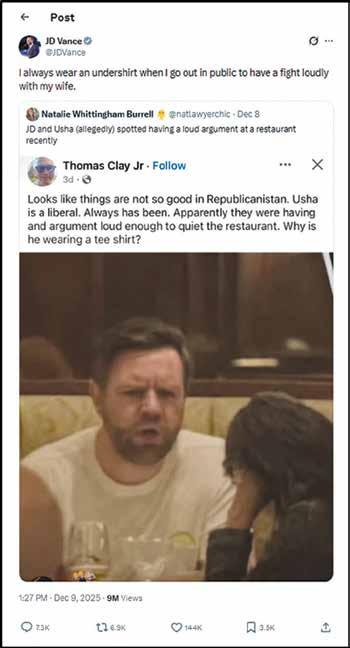
- ibid.
They didn’t care about the … kids being attacked, or the [assaults], and they didn’t care about the victims of recidivism. They didn’t even care about the victims that we talked about for years, women being thrown in front of subway trains. They only care about victims when it becomes political, expedient, when they see an election approaching.
- Greg Gutfeld, responding to Democrat outrage over the Trump administration blowing up drug boats
It doesn’t – they don’t know. Suddenly, they’re experts on war crimes. They all went on AI, and went like, what’s a war crime? Could this really happen? You know, I do not believe they care. I refuse to invest any amount of caring on those people on the boat because they are terrorists. If you have not developed the hoax instinct after the last 10 years and your reflex is still to say, wow, this sounds really bad, you need to reverse lobotomy.
- ibid.



He did not just write this book—he lived it.
- Erika Kirk talking about her husband Charlie’s book that he
and was
released, titled “Stop,
Charlie didn’t write this book without doing what he’s talking about in this book. That’s not the way he was, not the way he operates. We have over 50 books on our bookshelf about the Sabbath. He wanted to know it so deeply, and he saw the fruit of what it was like to actually detach from the world, stop the noise, stop the scrolling and just put pause on everything and just focus on your family.
– ibid.
At first, it started with an hour, two hours, but then once he fully incorporated it into his life, he totally elevated. He became a next-level husband.
- ibid.
I understand the focus on ‘28 and all that. But there will be a marble bust of me in Congress. I am a historic figure like any vice president of the United States ever was.
- Kamala Harris when asked by The New York Times if she plans on running for president in 2028
Thousands of people are coming to hear my voice…thousands and thousands.
- ibid.

One of the factors that drives use in the United States is demand. Most narco traffickers are not in those boats. They pay people to do that. Usually, people are not significantly involved with narco traders. It’s the way they make money.
- Sen. Jack Reed (D-RI) defending the drug traffickers that transport fentynal and other deadly drugs in to the U.S.
Hmm…so they are just trying to make a buck. You know, Trump can do anything…including getting a Democrat to come out in favor of capitalism.
– Greg Gutfeld
Blow them to smithereens.
- Sen. Rick Scott (R-FL), when asked at a conference if he condones the U.S. military targeting suspected drug traffickers in Latin America
Anyone who sees the video that I saw would see the American military attacking shipwrecked sailors.
- Rep. Jim Himes (D-CT), referring to drug traffickers as “shipwrecked sailors”
When you look at mainstream newspapers on the constitutionality of blowing up boats bringing fentanyl here, I guarantee you, if that fentanyl was killing people at schools we went to, potentially your kids are going to, it would be constitutional to blow up those boats.
- Palantir CEO Alex Karp at the New York Times DealBook Summit
Our country has selective empathy for everybody but working class, particularly white males.
– ibid.
I actually don’t read The New York Times anymore... Occasionally people send me articles and there’s just this fever swamp…I read this article, “President Trump is slowing down.” It is hundred percent fake. He only called me twice at two in the morning last week instead of three.
- Treasury Secretary Scott Bessent ripping The New York Times at the New York Times’ DealBook Summit
When you look at what happened with football in the United States, soccer in the United States. We seem to never call [soccer] that, because we have a little bit of a conflict with another thing that’s called “football.” But when you think about it… this is football. We have to come up with another name. It really doesn’t make sense.
- Pres. Donald Trump speaking at the FIFA World Cup Draw at the Kennedy Center


New details suggest Ilhan Omar may be related to some of the Somali fraudsters. She denied this saying, “If she was related to them, she would already be married to them.”
– Greg Gutfeld
I wouldn’t wish upon anyone what I have been through, and I support the Second Amendment as well.
- Erika Kirk when asked at the NYT DealBook Summit whether she still supports the Second Amendment
I don’t expect everyone to understand. It’s not because you’re weak, it’s not because you think what the assassin did was correct. That’s the exact opposite. Forgiveness is…for those of you who’ve been wronged, you know what it feels like to forgive someone. And in a way, where it frees you from a poison, and it frees you to be able to think clearly and have a moment where your heart is free and you’re not bound to evil. - ibid.

Rosie O’Donell promised her therapist that she wouldn’t blast Trump for a few days but only lasted a few hours. But thankfully, it still gave her therapist time to fake his own death.
– Greg Gutfeld



By David Ignatius
The past two years of war brought death and destruction to the Middle East, but they also created remarkable openings for change in Gaza,
Lebanon, Syria and Iran. Sadly, those opportunities might be squandered because of mishandling and delay by the United States, Israel and the Arab states.


“Everything is stuck,” a senior Israeli defense official told me this week. Because diplomats have failed to capitalize on the disarray of Iran and its allies, “all the fronts in the Middle East are still open,” he warned. Most of Gaza’s population is still controlled by Hamas, Lebanon hasn’t fully regained its sovereignty from Hezbollah, and Iran is rebuilding its battered military.
President Donald Trump’s bold peace initiative ended the Israel-Gaza war and raised hopes that breakthroughs might be possible across the region. But the lack of follow-through by Washington and its partners leaves a Middle East that’s still waiting for a stable “day after.” Other than the release of all living Israeli hostages from Gaza, most of the goals of Trump’s 20-point peace plan appear stillborn.
Israel achieved some stunning successes in its bloody campaigns against Hamas, Hezbollah and Iran. But Robert Satloff, director of The Washington Institute, cautioned in an interview this week that “the Israelis so far have failed to translate battlefield victories into political achievements. These are sad and regrettable lost opportunities.”
Gaza illustrates the limits of Israeli military power to achieve political results. More than 70,000 Palestinians died in the war that followed Hamas’s Oct. 7, 2023, terror attack. But analysts tell me that Hamas still controls about half of Gaza – where roughly 85 percent of the population lives. Trump’s peace plan called
for an International Stabilization Force to disarm Hamas and a “Board of Peace” to oversee a massive reconstruction effort there. But for now this vision of a revitalized postwar Gaza is just a fantasy. What’s going wrong? Nations that had volunteered to join the international force, such as Indonesia and Azerbaijan, have been backing away, and donor countries are refusing to begin reconstruction projects until there’s security in Gaza. Jared Kushner, Trump’s son-in-law and one of his Gaza envoys, has proposed building “alternative secure communities” in the half of Gaza controlled by the Israeli military, hoping that magnet might draw Palestinians. But skeptics doubt that many Palestinians will cross the line into Israeli-controlled areas.
How can Trump and his partners break this logjam? They can recognize the screamingly obvious fact that the only force that can effectively disarm Hamas will be Palestinians, allied with a reformed version of the Palestinian Authority. Many Israeli military and security officials have long embraced this view. It’s time for Trump to face that reality, too – or watch his peace plan crumble into dust.
An opportunity to reanimate the Trump Gaza peace effort could come this week, as Mike Waltz, Trump’s ambassador to the United Nations, visits Israel and Jordan. Waltz was forced to resign as national security adviser in May after a trivial flap over use of the private messaging app Signal. But he’s one of the ad-
ministration’s most capable officials, and perhaps he can restart the stalled Gaza peace process.
Lebanon is the second missed opportunity – but it, too, is salvageable with some work. Israel’s attacks broke Hezbollah’s stranglehold on the Lebanese state. That gave the country a chance to regain its sovereignty – and, with a nudge from the Biden administration, it did so, electing Joseph Aoun, its army commander, as president. But to fully achieve this prize, Lebanon has to act like a sovereign state by disarming Hezbollah and reclaiming a monopoly of force.
Sadly, Lebanon is failing that test. Aoun has disarmed Hezbollah south of the Litani River but not to the north, as was promised would happen by the end of this year. Israel is striking Hezbollah targets on its own, but that just repeats the old “mow the grass” formula. Israel needs a real Lebanese government as much as Beirutis do. Trump should press Aoun to deploy the Lebanese Armed Forces everywhere. As Satloff says, “If the LAF can’t do it now, when will they ever be capable?”
Lebanon finally seems to have realized that a perpetual state of war with Israel is idiotic. Aoun said in October, after
the Gaza ceasefire, “Today, the general atmosphere is one of compromise, and it is necessary to negotiate.” Satloff believes that Lebanese peace talks with Israel are now “a real opportunity.” But Israel, which proclaims that it wants peace with all its neighbors, is balking. It should take yes for an answer.
Social post Monday: “It is very important that Israel maintain a strong and true dialogue with Syria, and that nothing takes place that will interfere with Syria’s evolution into a prosperous State.” Meaning, get it done, Bibi. Netanyahu countered Tuesday that Israel was ready for a deal with Syria but only if it gained a buffer zone.
Trump’s problem is that he’s juggling so many diplomatic balls at once that some of them will inevitably tumble to the ground.
Israel is missing an opportunity with Syria, too. Trump has made good relations with President Ahmed al-Sharaa a personal project, and he’s eager to broker a security agreement between Damascus and Jerusalem. But Israel doesn’t want to lose its freedom of action in Syria, so it’s wary. Here again, Israeli Prime Minister Benjamin Netanyahu should find his way to “yes.” Trump prodded him with a Truth

Iran is the citadel of the status quo in the Middle East, and it was rocked by Israel and America in the 12-day war in June. Trump imposed a ceasefire there, too. But he didn’t cap the victory with a diplomatic deal that could constrain Iranian military power in exchange for the economic help the country desperately needs. Opportunity knocks at the U.S.-Iranian door. An Iranian message propos -
ing renewed peace talks was carried to Washington last month by Saudi Crown Prince Mohammed bin Salman, according to a Reuters report confirmed to me by a source close to the Saudis. Supreme Leader Ali Khamenei disavowed the reported letter as “pure lies.” But the source close to the Saudis tells me that quiet conversations with Iran are taking place through Saudi, Omani, Emirati and Qatari emissaries to see if serious dialogue with the U.S. are possible.
Trump’s ambition as a peacemaker appears boundless. “Iran does want to make a deal … I am totally open to it,” he said during the crown prince’s visit. Trump’s problem is that he’s juggling so many diplomatic balls at once that some of them will inevitably tumble to the ground. That’s what happened after his Gaza peace deal. He promised far more than he has so far delivered.
Trump is now trying to broker a desperately needed Ukraine peace agreement. But his credibility as an omnidirectional mediator will be enhanced if he can demonstrate that he not only announces projects with fanfare but gets them done.
© 2025, Washington Post Writers Group


The Post reported last week that, based on a “spoken directive” from Secretary of Defense Pete Hegseth, the U.S. military carried out what is known as a “double-tap” strike in the Caribbean Sea – hitting a Venezuelan vessel that had the signature of a drug boat, then launching a follow-on strike that sank the boat and killed the survivors. The Post quoted experts suggesting that second strike was a “war crime” that could subject those involved to future prosecution.
Hegseth said Tuesday that he was unaware of that there had been any survivors or a follow-on strike until hours later. But even if he had directly ordered the second attack, there is nothing unlawful about hitting a military target multiple times to make sure it has been eliminated.
President Barack Obama did it all the time. Indeed, in targeting cartels it has designated as foreign terrorist organizations, the Trump administration appears to be closely following the playbook pioneered by Obama.
On taking office, Obama dramatically escalated the use of drone strikes against terrorism targets after ending the CIA’s terrorist interrogation program – finding it was simpler to vaporize enemy combatants rather than capture them alive for questioning. So Obama forged what The New York Times called at the time a “take-no-prisoners policy,” ordering over 540 drone strikes on terrorists in Pakistan, Somalia and Yemen (including one that killed a U.S. citizen, Anwar al-Awlaki, leader of al-Qaeda in the Arabian Peninsula).
The strikes Obama ordered were similar to those Trump has carried out in the waters off of Venezuela. Obama used what were called “signature strikes” in which the U.S. targeted
By Marc A. Thiessen

patterns of behavior denoting terrorist activity (“signatures”) even when the precise identity of the individuals being targeted was unknown. And he routinely carried out so-called “double-tap” strikes – hitting a target once and then striking again to take out any survivors or other terrorists who rushed to the scene after the initial hit.
“We used double-taps all the time,” said David Shedd, former deputy director and acting director of the Defense Intelligence Agency in the Obama administration. “You would get the initial signature off of a target that’s been hit,” he told me in a podcast interview, “and if you saw that they ‘squirted’ and were injured … you hit them again.” In fact, he said, “there was often a second predator ready to go … that was fully expected to be used if you didn’t have a 100 percent coming out of the first hit – and maybe a third hit,” adding that “it was done routinely” and there “was bipartisan support on the Hill for doing it.”
Obama personally approved the “kill lists” for these strikes. “Turns out I’m
really good at killing people,” Obama reportedly declared to aides. According to one estimate, the strikes Obama authorized killed an estimated 3,797 people.
So, anyone who wants to charge Pete Hegseth with war crimes should charge Barack Obama first.
Obama declared that his strikes were legal, effective and necessary. Well, so are Trump’s. This year, the administration formally designated eight international drug cartels as Foreign Terrorist Organizations and Specially Designated Global Terrorists. His administration then notified Congress that “the United States is in a non-international armed conflict with these designated terrorist organizations” and had “reached a critical point where we must use force in self-defense and defense of others.” The Justice Department’s Office of Legal Counsel issued a classified legal opinion that set the parameters for this military campaign to ensure that it is carried out in compliance with U.S. law and the laws of armed conflict.
Pentagon spokesman Sean Parnell
told The Post in November that “lawyers up and down the chain of command have been thoroughly involved in reviewing these operations prior to execution” and were given “the opportunity to disagree” and “no lawyer involved has questioned the legality of the Caribbean strikes.”
Even if one did not accept that Trump’s terrorist designation justified strikes against the cartels, there is another legal basis for military action: The administration has also argued in court that cartels – including Tren de Aragua and Cartel de los Soles – have “infiltrated” the Venezuelan regime’s “military and law enforcement apparatus” and “taken control over Venezuelan territory” resulting in a “hybrid criminal state.” As John Yoo, former deputy assistant attorney general in the Office of Legal Counsel, told me, if the cartels are part of the Venezuelan regime, then they are effectively “an auxiliary attachment to the regular armed forces and the intelligence agencies in Venezuela” and are thus legitimate targets of military action against the Venezuelan state.
No doubt the Pentagon will investigate this strike to determine that it was carried out according to the OLC’s legal guidance and the laws of war. But the Trump administration’s military campaign against the drug cartels is backed up by sound legal reasoning and legal precedent set during the Obama-Biden administration.
Which means everyone should take a breath before throwing rhetoric like “war crime” around. Because if Barack Obama can launch double-tap strikes to take out terrorists, so can Donald Trump.


Jewish fears in August about increased threats to their security collided with their liberal ideology and beliefs about opposing any limits to immigration—legal or illegal—which many, if not most, American Jews still believe in. Unsurprisingly, progressives chose ideology, even if it placed their communities at risk.
Four months later, Americans are trying to process news about incidents that make plain the cost of policies that so many Jews have wrongly imagined to be intrinsic to their faith. The recent murder of a National Guardsman in Washington, D.C., by a refugee from Afghanistan, coupled with the massive fraud committed by many Somali immigrants in Minnesota that led to billions in federal funds being stolen and diverted to (among other things) an Islamist terror group, have made headlines not so much for the outrageous nature of those crimes but because of liberal outrage about the way President Donald Trump has spoken about them.
Both examples help illustrate the madness of open borders and misguided refugee-admission policies that were pursued by the Biden administration, as well as supported by Jewish groups like HIAS and a laundry list of other liberal and left-wing organizations.
Still, it would appear that nothing will change their minds.
The belief that virtually anyone who wants to come to the United States should be let in, regardless of whether they have the legal right to do so or whether they support Islamist ideologies and antisemitism, isn’t just wrongheaded and contrary to the rule of law. It’s now incontrovertible that such policies are causing potential harm to Jews and the entire nation. Yet even that isn’t
By Jonathan S. Tobin

enough to shake their convictions.
What happened in Washington, D.C., and Minnesota is just a symptom of a broader problem afflicting more than just liberal Jews.
A generation of leftist indoctrination of students from colleges all the way down to K-12 schools led to many people believing that the principal problem facing the country, if not the world, was American racism and xenophobia. It led to the moral panic about race that allowed the toxic myths of settler-colonialism, intersectionality and critical race theory to dominate the way they thought about the world.
The result was the imposition of the woke catechism of diversity, equity and inclusion (DEI) that not only exacerbated racial divisions (while also helping to legitimize the mainstreaming of antisemitism) due to the way that the progressive
doctrine falsely defined Jews and Israel as “white” oppressors.
Another consequence of this mindset was the way so many Americans, including the Biden administration, embraced the notion that any defense of American sovereignty against those who wished to erase the nation’s borders was illegitimate.
This led to the entry into the country of millions of illegal immigrants—adding to the tens of millions who were already here—that helped drive down the wages of working-class Americans and raised housing prices. It also facilitated criminal efforts to smuggle massive amounts of drugs, like fentanyl, into the country by drug cartels. That has caused an opioid crisis that is killing more than 100,000 Americans a year and dooming countless others to lives of misery and despair.
The ensuing frustration was a significant factor that fueled support for Trump’s election victory in 2024. Nevertheless, Trump’s willingness to keep his promise to do something about it by cracking down on illegal immigration, deporting those who arrived in the United States without permission, and using whatever power necessary to halt the trafficking of illegal drugs is—at least, according to the president’s opponents and their corporate media cheerleaders—deeply controversial. Liberal Jewish groups are among those who have not merely criticized Trump’s policies but sought to demonize the efforts of Immigration and Customs Enforcement (ICE) agents to enforce the law and arrest illegals.
And they are joining with the same crowd of usual suspects who are denouncing the administration’s use of force to take out drug-running boats operated by cartel operatives that have been rightly designated as terrorist organizations. Mistakes, which are an inevitable part of any armed conflict with the narco-terrorist forces orchestrating this threat, may have been made. Yet Trump’s opponents seem to think that the things he or Secretary of Defense Pete Hegseth says or does in pursuing this necessary policy are of greater concern than the peril to the American people posed by the trafficking of deadly drugs or the negative impact of massive illegal immigration on communities and the lives of everyday citizens.
That the credentialed elites who dominate the political left are not experiencing that impact in the same way as those whose families are being destroyed by the consequences of open borders partly explains their indifference to the problem. But even if well-off Jewish liberals don’t care about the plight of the
working class anymore—albeit while still disingenuously declaring that a passion for “social justice” defines their political and religious faith—they should recognize that one aspect of this folly is the way it is fueling antisemitism, which does affect them.
For liberals, it’s taboo to mention the fact that facilitating the entry into the United States of massive numbers of persons—whether designated as refugees, students, legal immigrants or illegals— from countries where Islamist beliefs dominate is creating a growing constituency for Jew-hatred in America. Indeed, anyone who does so is quickly labeled Islamophobic, though in recent years, that term, which is supposed to define prejudice against Muslims, has come to describe anyone who has the temerity to call out widespread antisemitism and support for Islamo-fascist ideas about governance and jihad against the West that is widespread in that community.
Even those Jews who despise Trump and/or are critical or unsupportive of Israel have been forced to realize that since Oct. 7, secular liberals are also being targeted by members of the bizarre redgreen alliance of Marxists and Islamists for intimidation and violence. After the murders this year of Jews in Boulder, Colo., and in Washington, D.C., and the attempted firebombing on Passover of the Harrisburg residence of Pennsylvania Gov. Josh Shapiro, the need to ensure Jewish security is a priority for the entire community. Not to mention, of course, more than two years of pro-Hamas, anti-Israel activity on college campuses.
And still, those Jews who call themselves “progressives” seem to think that ensuring open borders and non-enforcement of immigration laws is a much more important issue.
However, in August, they were faced with a difficult choice. They wanted to apply for the federal funds made available by the U.S. Department of Homeland Security that Jewish institutions need to pay for enhanced security measures made necessary by a surge of antisemitism. In order to receive those funds, they were going to have to agree to conditions that DHS had placed on the grants.
The conditions were far from unreasonable.
One involved forswearing the implementation of DEI policies, which were the foundation of the hate facing Jews on university campuses, in the streets
of major American cities and elsewhere. Another forbade them from participating in the discriminatory, antisemitic BDS campaigns promoting the boycotting of Israel and Jews.
And they were also required to state that their facilities—synagogues, community centers, organizational offices, etc.—would not be used to shelter illegal immigrants and that they would not bar federal officers from entering them while enforcing the law.
It wouldn’t seem to be too much to ask that people applying for federal money promise not to violate federal law. But not according to these liberals.
They were outraged about the idea that to receive funds to help protect them against potential violence, they would be
its job as assisting those who simply want to live in America, regardless of whether they are Islamists, other extremists or share the values of the democratic country.
Indeed, even after evidence of what happens when the floodgates are opened to allow in those hostile to America has become undeniable, they remain ideologically committed to open borders at all costs. For instance, they oppose common sense efforts by Trump administration officials to rescreen hundreds of thousands of Afghan refugees who were admitted to the United States in the wake of former President Joe Biden’s disastrous handover of that country to the Taliban. Many were never properly vetted.
They all seem to have bought into the fraudulent claim that illegal immigrants trying to evade the laws of the United States are somehow analogous to Jews like Anne Frank hiding from Nazis trying to exterminate them.
prevented from engaging in antisemitic boycotts or closing their doors to ICE agents seeking to arrest lawbreakers. So great was their outrage that many of them joined together in a letter to say they would not apply for such grants if those were the conditions.
While leading liberal groups like the Jewish Council for Public Affairs and HIAS didn’t join in the letter, they opposed the conditions and even advised groups to accept them only in the hope that, at some point, they would be reversed by the courts. The Jewish Democratic Council of America also opposed the provision about not closing the doors of synagogues to ICE agents. They all seem to have bought into the fraudulent claim that illegal immigrants trying to evade the laws of the United States are somehow analogous to Jews like Anne Frank hiding from Nazis trying to exterminate them.
HIAS once played an essential historic role in bringing Jews over from pogrom-ridden and war-torn Europe to join family members in America and, once there, helping immigrants adjust to life in the United States. Now it sees
Biden—were responses to genuine crises in those countries.
While still extolling America as a liberal mosaic where all are treated equally and which has been a uniquely welcoming place for Jews, support for unlimited immigration from nations where antisemitism is rife is undermining the foundation for Jewish acceptance, success, and, now, even security.
Choose Western Civilization over Islamism
Jewish beliefs have always been a mix of factors that included particularist religious and ethnic-group identity with universalist principles. Modern Jewish liberalism has skewed the traditional balance between the two to the point where its adherents are even willing to oppose Jewish security or the rights of Jews to their ancient homeland to identify with the desires of supposedly downtrodden people who want to kill them.
The choice is clear.
Liberal Jewish attitudes toward open borders are, at least in part, understandable when placed in the context of history and the fact that most American Jews are only a few generations removed from immigrant forebears. That said, the conditions of the country then and the willingness of new arrivals to embrace America and its ideals are very different today.
Trump may be the greatest friend Israel has ever had in the White House and willing to use the government to fight antisemitism in a way none of his predecessors ever did. But the opposition to him from the majority of Jews who are politically liberal is instinctive, and as much a product of blind partisan allegiances and distaste for his often-vulgar manner and willingness to say things out loud that others only think, such as his disparagement of the Israel- and Jew-hating Rep. Ilhan Omar (D-Minn.), herself from Mogadishu as “garbage.”
It’s also true that the admission of huge numbers of Islamist populations— whether admitted from Somalia in the 1990s by former President Bill Clinton or the Afghans who were welcomed by
The creation of large new constituencies of people who hate Jews—and who can influence elections to harm the U.S.-Israel alliance and elect antisemitic members of Congress like Omar or Rep. Rashida Tlaib (D-Mich.), or even creating a situation where the largest funder of the Al-Shabaab branch of the Al-Qaeda terrorist group is American taxpayers, is contrary to Jewish interests. But avoiding these calamities means discarding outdated Jewish beliefs about immigration. If you like the version of America that sees itself as an expression of the Judeo-Christian tradition and Western civilization, then don’t repeat the mistake that Europeans made when they allowed massive immigration from Muslim and Arab populations who oppose those ideas. Doing so will only replicate what is happening there with respect to the national identity of those nations and the way Jews no longer feel safe there.
It’s time for liberal Jews to stop opposing policies that defend the rule of law and would make it more difficult for antisemites to be allowed into the United States. It might also be a good idea to stop wrongly labeling those who want to defend American sovereignty and not see apologists of terrorism in the U.S. government as racists or Islamophobes. That’s true even if one of them is named Donald Trump.
Jonathan S. Tobin is editor-in-chief of JNS (Jewish News Syndicate).
By Vivian Nereim

RIYADH, Saudi Arabia — Saudi Arabia has banned alcohol for more than 70 years, so when whispers spread that an unmarked store in Riyadh, the capital, was quietly selling whiskey and Champagne to wealthy foreign residents, it did not take long for a queue of cars to form outside.
In recent weeks, the liquor store — previously open only to diplomats, who are exempt from the prohibition — has been selling to non-Muslim foreigners who hold an expensive “premium residency” permit, according to five customers interviewed by The New York Times.
Premium residency is a limited status, generally conferred on wealthy or highly educated foreigners who work for government-owned entities, or in strategic sectors like health care.
The customers, a mix of premium residents and diplomats, spoke on the condition of anonymity because of local sensitivities around the topic, and in some cases because they feared disrupting their newfound access to alcohol.
No public announcement has been made about a change in the conservative Islamic kingdom’s alcohol policy. But
on a recent sunny morning, I camped outside the Riyadh store and saw that business was brisk.
The beige complex containing the store resembled dozens of others in the city’s Diplomatic Quarter, a secluded neighborhood filled with embassies. The store was distinguished only by an enigmatic sign that read, “VAT EXEMPT GOODS FOR DIPLOMATS ONLY,” referring to value-added tax, which is similar to a sales tax.
A succession of high-end SUVs approached a metal gate, where a security guard peered at drivers’ IDs, deciding if they could pass.
Shoppers who emerged from the store described a frenzied scene of eager new buyers crowding the aisles, purchasing thousands of dollars’ worth of booze. The loosening of entry procedures coincided with a new dual-pricing system: Diplomats were charged one set of marked-up prices, and premium residents paid an even higher set, several of the customers said. I saw a receipt that showed a middling bottle of white wine cost roughly $85, more than five times its price in the United States.
Although it is unclear who owns the store, several details about how it operates suggest the government is involved. Customers said they were allowed to buy a monthly quota that was linked to their government-issued ID number, and the smartphone app that diplomats use to gain access to the store was created by the tax and customs authority.
The Center for International Communication, a Saudi government media office, did not respond to a request for comment.
The system’s vagueness, and the official silence around it — not to mention the black bags that customers haul back to their cars — are in keeping with the rapid but sometimes nebulous ways in which Saudi Arabia has transformed under Crown Prince Mohammed bin Salman.
In the span of a decade, Crown Prince Mohammed has remade the kingdom from top to bottom. Once infamous for its religious police, strict dress code and ban on women driving, Saudi Arabia now hosts mixed-gender raves, and Saudi women are free to drive, work and travel abroad as they please.
The path to greater social openness has been bewildering. Officials are often publicly ambiguous on policy changes that could prompt a backlash, leaving it unclear whether there was, in fact, a change.
“This is similar to how Saudi authorities approached a lot of social policies,” said Andrew Leber, an assistant professor at Tulane University in New Orleans and an expert in Saudi politics. “Allow relatively incremental changes under the surface without making a big announcement, giving them plausible deniability in case they want to pause or roll back the policy at some point.”
For instance, as recently as 2018, all commercial establishments across the kingdom closed several times a day to mark prayer times. They no longer do, but there was no formal announcement of this shift. Instead, business practices changed haltingly over several years — causing a great deal of confusion.
Just a few weeks ago, a senior adviser to the crown prince even told the Times that he was not aware of any plans to legalize alcohol.
“Nothing has changed so far,” the
adviser, Ahmed al-Khateeb, who is the minister of tourism and head of the kingdom’s “Quality of Life” program, said in an interview in November. “We’ll see how things go in the future.”
Even finding the store is difficult. It does not appear on online maps, so friends discreetly share its GPS location.
New customers were also uncertain about the conditions to enter the store, and whether they could legally serve the alcohol to friends or resell it.
The Saudi government officially outlawed alcohol in the 1950s. At the time, a report in Time magazine said the prohibition came after a son of Saudi Arabia’s founding king killed a British diplomat during an alcohol-fueled dispute. The ban has its roots in religion, as the Quran advises Muslims to avoid alcohol.
As in the United States during Prohibition, the strict embargo belies a brisk black market. For decades, homemade spirits and high-end imported bottles have been poured at private parties, in gated residential compounds and in well-stocked Saudi homes.
Branded alcohol often entered the informal market through embassies, which were able to import an unlimited supply of alcohol in diplomatic ship -
ments, until the government ended that system in January 2024.
The new Riyadh store opened as an official alternative but allowed only non-Muslim diplomats to enter and limited them to a monthly quota of alcohol.
In local media, Saudi officials framed this as a crackdown on illicit trade. Even
cause of the sensitivity of the matter.
At the time, some residents whispered that the new store was a pretext to broaden access to alcohol. Once the new system was in place, expanding the customer base would be relatively easy.
For Saudi authorities, there are many motivations to allow alcohol sales.
The system’s vagueness and the official silence around it … are in keeping with the rapid but sometimes nebulous ways in which Saudi Arabia has transformed under Crown Prince Mohammed bin Salman.
so, some embassies tried to carve out exceptions, seeking higher buying quotas in the store. Others, citing an informational security risk, resisted the requirement that diplomats download a Saudi government smartphone app to enter, according to three diplomats who spoke on the condition of anonymity be -

The kingdom’s ostensibly sober social life has inhibited Crown Prince Mohammed’s drive to attract more highly educated foreigners to work there. Saudi Arabia is hosting the men’s soccer World Cup in 2034, and many foreign attendees would expect to be able to buy alcohol.
Officials are also under pressure to expand tourism and increase the government’s non-oil revenue, both key parts of Crown Prince Mohammed’s economic diversification plan.
The government “can’t have missed that alcohol sales and associated taxes are a huge moneymaker for neighboring Dubai,” said Leber, the expert in Saudi politics. In Dubai, the largest city in the United Arab Emirates, alcohol is widely available, including for Muslims.
Despite its vast oil wealth, Saudi Arabia is currently experiencing a budget crunch, and it is expected to face fiscal deficits in the coming years.
While officials appear to be moving cautiously to avoid pushback from Saudis who oppose the legalization of alcohol, a yearslong political crackdown has left few dissenters willing to speak out.
The recent expansion of alcohol sales has received no coverage in local media and no comment from the grand mufti, the kingdom’s official religious leader, whom Crown Prince Mohammed recently appointed.
© The New York Times

By Maria Abi-Habib and José María León Cabrera

GUAYAQUIL, Ecuador — Fighting an international alliance of gangs, guerrilla groups, drug cartels and mafias, the Ecuadorian military found itself alone.
By 2022, the government had lost control of major prisons, with gangs running them as recruitment centers. Killings were rising fast, and it was clear that far more cocaine was moving through the country than the authorities could ever hope to seize.
But when the U.S. ambassador at the time, Mike Fitzpatrick, phoned Washington to convey Ecuador’s plea for help, his calls fell on deaf ears, he said.
“‘Where is the fentanyl? That’s our focus right now,’” he recalled being told by senior State Department officials. “Ecuador didn’t have a fentanyl hook to sell to Washington, it’s all cocaine.”
Since President Donald Trump first took office in 2017 and continuing through President Joe Biden’s term, the United States largely shifted its focus to combating fentanyl, the drug driving a national overdose crisis.
Given the soaring fentanyl deaths in the United States, making it a priority made sense, officials say. But the severity of the switch gave room for cocaine traffickers, once a prime target of U.S. law
enforcement, to thrive — so much that Ecuador nearly collapsed into the grip of criminal groups, according to five current and former U.S. and Ecuadorian officials.
In the decades-long war against drugs, cocaine, it seemed, was no longer a priority.
Even now, after the United States eventually mustered a response and increased financial aid to help Ecuador’s military fight drug groups, its government is struggling to keep control.
Several of Ecuador’s cities now rank among the world’s most dangerous — a situation unthinkable just four years ago when the country was known for its safety, roses and Galápagos tortoises. Car bombs terrorize civilians, and gangs frequently clash with military troops. Officials describe a criminal culture so powerful that schoolchildren aspire to join gangs.
“This is an existential war,” said Giovanni Davoli, the Italian ambassador to Ecuador, who compared the fight to Italy’s struggle against mafias. “Ecuador is not a narco state, but it needs help.”
The Trump administration has launched an aggressive military campaign in the region, attacking boats it says are smuggling drugs, but it is unclear whether those strikes will make a dent in the resurgent cocaine trade.
Nor is it clear whether that is its ulti-
mate goal.
While U.S. officials have called the campaign a counterdrug operation, they have offered little evidence that the boats carried drugs. The operation has also focused on Venezuela, whose role in the drug trade is fairly limited. Privately, U.S. officials have made clear that the Trump administration aims to drive Venezuela’s authoritarian leader from power.
Many Ecuadorians now feel torn between wanting U.S. help and fearing the Trump administration’s assertion of dominance over the region. When Ecuador held a referendum in November on whether to let foreign military bases in the country — which analysts called a thinly veiled invitation for U.S. forces — voters rejected it.
Yet when several fishermen on the Pacific were stopped by Ecuador’s navy on a recent day, they were glad to see any military presence at all. Criminals ran the waves, they said, extorting fishermen who dared go farther to sea.
“Things have taken a turn for the worse,” said one man, speaking on condition of anonymity for fear of reprisal from criminals. “Out there, you either pay the gangs, or you don’t come back.”
A “Cocaine Superhighway”
For decades, Ecuador was a pillar of
stability next to neighbors such as Colombia and Peru, which were racked by drug violence and political disarray.
From that place of relative security, Ecuador pushed the United States away, closing a U.S. military base in 2009. In response, the U.S. Embassy shut down its military office and main State Department drug-fighting program in Ecuador. By the time Trump first became president, Mexican cartels, lying low in Ecuador, were consolidating their power.
The cartels worked with Colombian groups to push cocaine into Ecuador, where gangs then exported the drug using speedboats, submarines and hijacked cargo containers bound for Europe and the United States. As the trade grew, those partnerships expanded to include European mafias, officials say.
The alliances transformed Ecuador into what U.S. officials called a “cocaine superhighway.” Ecuador’s president has estimated that as much as 70% of the world’s supply flows through his nation. That change took place as fentanyl became a leading cause of death in the United States, fueling an overdose crisis that Trump and Biden both made a priority. In 2023, nearly 73,000 overdoses were linked to fentanyl, compared with 6,000 deaths tied to cocaine unlaced
with other drugs, according to U.S. government statistics.
“Cocaine came to be seen by many as ‘bad, but not going-to-kill-you bad,’” said Fitzpatrick, the ambassador to Ecuador from 2019 to 2024. Regarded by some as “one step up from marijuana,” he said, the drug was no longer a top concern for Washington.
But in Latin America, the drug was the main driver of terror and violence, killing and maiming civilians as it made its way to buyers mostly in the United States and Europe.
And cocaine use has been surging, health authorities say. Some 25 million people across the world used the drug in 2023, up from 17 million a decade earlier, according to U.N. figures. Consumption has increased 154% in the western United States and 20% on the East Coast since 2019, according to a drug-testing company, Millennium Health.
A group of State Department officials — calling themselves the CACA brigade, for Care About Cocaine Again — have argued that the United States should not lose sight of the drug. Cocaine trafficking, they said, caused instability that fuels domestic American issues, like mass migration.
Even if the U.S. ramped up its anti-narcotics efforts in Ecuador sooner, the lack of results in its broader war on drugs show the country may still have been flooded with cocaine, analysts said. Others noted that Washington only had so many resources.
“We can walk and chew gum at the same time, but we are putting out fires everywhere,” said Todd Robinson, assistant secretary of state for international narcotics from 2021-25. “In the face of 100,000 Americans dying every year, our instructions were to figure out what to do about fentanyl.”
As violence crept up in Ecuador in 2022, Fitzpatrick received the call from Ecuador’s president, Guillermo Lasso, asking for help.
“Mr. President, it’s a good thing you are calling me early, before things get worse. I’ll see what we can do,” Fitzpatrick recalled telling the president.
Lasso was caught off guard. “Early?”
“Well, at least you don’t have bodies hanging off of bridges yet,” Fitzpatrick countered.
Days later, two corpses were found hanging from a bridge near a port city — a common show of force by Mexican cartels, but an ominous first for Ecuador.
The Drug War’s Resurgence
Once Ecuador had Washington’s atten-
tion, officials tried to act fast.
“It may have appeared that we missed the signals in Ecuador, but I don’t think that was the case,” Robinson said. “As soon as the level of violence skyrocketed there, we shifted law enforcement and security resources.”
The State Department’s anti-narcotics office in Quito, the capital of Ecuador, went
to reach $3.52 billion, but navy officials say criminal groups seem to have endless weapons and funds. Young men, driven by poverty, are easy gang recruits, while military training takes years. Corruption is widespread and leaks have foiled missions before.
Those suspicions were on display one recent morning before a joint mission, as
The alliances transformed Ecuador into what U.S. officials called a “cocaine superhighway.”
from one person in 2019 to nearly 30 last year, and U.S. aid — mostly security assistance — rose from $88.5 million in 2021 to $252 million in 2022.
Although the Trump administration has slashed U.S. spending around the world, the State Department said it had not cut any anti-narcotics efforts in Ecuador.
In 2023, Ecuadorians elected a new president, Daniel Noboa, a billionaire. In office, he deployed soldiers into the streets and oversaw a crackdown that critics say undercut civil liberties.
Criminal groups have flexed, too. In the last two years, they have kidnapped police officers, briefly seized a major television station, and made car bombs, once a rare threat, a gory fact of life. In October, a blast ripped through a commercial center during evening traffic in the city of Guayaquil, killing one person outside of Noboa’s family offices.
Noboa decisively won reelection this year, and many military officials, watching Noboa meet Trump and court his allies this year, had pinned their hopes on U.S. help.
But even before November’s referendum, Trump’s interest in Ecuador was unclear. He removed Biden’s ambassador from the post in April and has not appointed a replacement.
“Sometimes, you think this war is never going to end,” said a navy commander who spoke on condition of anonymity, in line with security protocol. “The drug traffickers have the economic power, and people will go wherever they get paid the most.”
Raids and Fears
Because Ecuador is an export hub for cocaine, the navy is waging much of the battle. Its forces, like other militaries around Latin America, often feel outmatched.
Security spending rose 15% last year
navy troops and the police eyed each other warily. The authorities had received a tip about the whereabouts of gang members who were allied with a Mexican cartel and suspected of being involved in some recent bombings.
Under the moonlight, a commander shouted a pep talk — “Be agile, be quick, be safe, let’s go!” Some 250 naval forces and police filed into buses, trucks and armored personnel carriers.
The vehicles eventually screeched to a
halt outside an apartment complex. Troops and police officers fanned out while a tactical unit raided the building.
From outside, an interrogation could be heard — slaps and shouts, a man yelling, “Call my mother, don’t hit me!”
In the street lay a broken statue of Santa Muerte, a shrouded, scythe-wielding skeleton revered by many Mexican drug traffickers, the latest sign of cartels’ influence.
While the cartels’ power in Ecuador grows, so, too, do their links with European mafias as the demand for cocaine rises worldwide.
When a senior U.S. official recently relocated to Europe from Ecuador, he loaded his personal effects onto a cargo ship bound for Antwerp, Belgium, one of the world’s largest seaports. When port authorities checked one of his containers, none of his belongings were inside, according to Fitzpatrick and the diplomat, who asked to remain anonymous to discuss a sensitive investigation. It became clear that the diplomat, whom the investigation cleared, had become a victim of “narco-pirates.”
All that remained in the container, he and Fitzpatrick said, were packages of cocaine.
© The New York Times

By Avi Heiligman



World War II was fought on many battlefronts across the globe. This included fighting in all types of environments – urban and jungle terrain as well as in the in the skies, land and the depths of the ocean. Both traditional and unconventional tactics were used, and cloak and dagger operations took place in areas that weren’t on the front lines. Many of these intelligence and undercover operations remain largely unknown to the public, including one mission that succeeded against all odds. Undercover operations required special training, and soon several special forces units were formed to fill these specific needs. The British SOE, Special Operations Executive, was created in 1940 and specialized in espionage, reconnaissance and sabotage in Axis-controlled or friendly areas. One of their early operations took place at Fernando Po, Spanish Guinea (now Equatorial Guinea). Spain was a neutral country during the war but had leanings towards to the Axis powers. Any operation against their territory could be seen as an act of war. This didn’t stop the British as they were desperate to stop the menacing German U-boat offensive in the Atlantic that was sinking Allied ships at an alarming rate. British intelligence had gotten word that the U-boats were using Vichy French and Spanish areas in Africa to refuel. Two German ships, the tugboat Likomba and barge Bibundi, as well as the Duchessa, an Italian merchant ship, were the targets as they were suspected to be
refueling the U-boats.
Permission for Operation Postmaster, the name for the mission, came from the top as local British authorities were afraid that any mission could cause way more harm than good. The plan had to be good, and the men selected to go on the mission were some of the most elite troops in the British military. No. 62 Commando, also known as the Small Scale Raiding Force, was led by Major Gustavus Henry
commandos went to the city and posed as diplomats while gathering intelligence for the upcoming mission. They convinced the pro-German local governor to borrow his plane to photograph the harbor. Another commando came up with a cover story that he needed to row across the harbor to deliver mail and happened to come across one of the target ship’s anchor chains. He then was able to take accurate measurements of the chain, resulting in the com-
They convinced the pro-German local governor to borrow his plane to photograph the harbor.
March-Phillips. The objective was to board the ships in the harbor and bring them into international waters where a Royal Navy ship would take control. International law stated that enemy ships in international waters can be seized by opposing forces. Strategists in Britain had pre-planned a press release with the story stating that the German and Italian sailors were unhappy with their pay and had mutinied. They then had brought the ships into international waters where British ships had found them and taken control.
Before the mission was to take place, the commandos needed intelligence of the harbor and Fernando Po. Several
mandos knowing how much explosives were needed to blow it up without damaging the ship. Another SOE agent, Richard Lippett, had a cover job with a local shipping company and went on board one of the enemy ships when the crew held a party. He found critical information about the crew’s schedule and the sea readiness of the vessel. The final piece of preparation they needed was to have the enemy ships empty of any officers. Lippett achieved this by throwing a party for the German and Italian officers the night of the operation. The mission was ready to begin.
On January 11, 1942, the commandos left their base and arrived at the harbor
three days later. Then they boarded folding kayaks, and other commandos on two friendly tugs were ready as the boarding parties. Explosives were attached to the anchor chains on the Likomba and Bibundi, and the friendly tugs took the ships in tow once they were free from their chains. Another tug towed the Duchessa after the commandos had taken the ship’s crew prisoner. Even though the explosions caused concern among the local population, the harbor’s guns did not fire at the tugs towing the Italian and German ships.
The entire operation took just 30 minutes with no casualties to the British. The next day, they were far out enough into the sea that another British ship “found” them and captured the enemy ships.
While the mission was able to hamper German U-boat operations is highly debatable, the ramifications of the action helped solidify the SOE’s place in future British operations. British Prime Minister Winston Churchill had sent the Germans and the Axis powers a message: that the Allied forces could strike anywhere and that their methods would not always be the conventional. The ingenuity and bravery of the commandos in Operation Postmaster is history to be remembered.
Avi Heiligman is a weekly contributor to The Jewish Home. He welcomes your comments and suggestions for future columns and can be reached at aviheiligman@gmail.com.

classifieds@fivetownsjewishhome.com • text 443-929-4003
DU N DURT
Power & Soft Washing
We clean siding, stucco, decks, driveways, concrete, pool patios, pavers & sidewalks. Say goodbye to grime, mold & allergens!
Call/WhatsApp: 718-688-2964 Email: dundurtny01@gmail.com
THE LEATHER SHOPPE
The spot for all your custom leather Judaica. Tallis/tefillin bags, lulav and esrog bags, havdallah sets, challah covers, shtenders, pesach sets, matzah/afikomen bags. WhatsApp: (732) 523-0007 or email: theleathershoppe732@gmail.com for a full catalog. We ship.
PEACEFUL PRESENCE STUDIO
Men’s private yoga, Licensed Massage & Holistic Health Guidance 436 Central Ave, Cedarhurst Info. & free video training www.peacefulpresence.com 516-371-3715
GERBER MOVING
Full Service Moving Packing Moving Supplies
Local Long Distance. Licensed Insured 1000’S Of Happy Customers Call Shalom 347-276-7422
HANDYMAN AVAILABLE
For big or small jobs, Sheetrock, carpentry, painting, electrical, plumbing, install & repair appliances Call Ephraim at 347-593-4691
MANAGEMENT STAFF WILL ASSIST
you with: * Obtaining Medicaid and Pooled Income Trust
* In-home Assessments, Individual and Family Counseling
* Securing reliable home care assistance
* Case and Care Management services
Dr. S. Sasson, DSW, LCSW (718) 544- 0870 or (646) 284-6242
VACUUM SALES AND REPAIR
All areas call Max Flam 718-444-4904
HAIR COURSE:
Learn how to wash & style hair & wigs. Hair and wig cutting, wedding styling Private lessons or in a group Call Chaya 718-715-9009
ZEVIZZ WOODTURNING JUDAICA
Challah knifes, batei mezuzah, besamim holder, kiddish cups, havdalah candle holders, yad for sefer torah, pens, stenders, bowls and more 952-356-2228
MY MOTTO IS DON’T WAIT TO buy real estate
Buy real estate and wait
Your realtor for life
516-784-0856 Alexandra at Realty Connect USA
REAL ESTATE MANAGEMENT
Services – Do Not Manage Your Properties Alone!
Contact Aliyah Suites for all your real estate management needs and affordable office space near you! (516) 366-1049
Management@aliyahsuites.com
Marc Jeret (MJ) Team Leader & Licensed Real Estate Agent






















CEDARHURST
Prime Restaurant Location For Lease. For more information: Call/Text/WhatsApp Owner: (516) 206-1100
5 TOWNS - OFFICES FOR LEASE
250SF to 500SF Offices in Inwood & Cedarhurst Utilities, Internet & Parking incl. with some Kosher kitchen - Minyan Next to LIRR - No broker fee Call/text/Whatsapp: 516-206-1100
Don’t Get Stuck With a Two Story House Ya Know, It’s One Story Before You Buy It But a Second Story After You Own It!
Call Dov Herman For An Accurate Unbiased Home Inspection InfraredTermite Inspection
Full Report All Included NYC 718-INSPECT Long Island 516-INSPECT www.nyinspect.com
DELIVERY PERSON NEEDED to deliver this Newspaper every Thursday morning to locations in Brooklyn. Must have Mini van or SUVand availability to work Consistently every week.
Good pay - Please email gabe@fivetownsjewishhome.com or call (917) 299-8082
REGENTS EXPERT
Tutoring regents in Algebra and Geometry A Darchei Torah instructor. Guaranteed results Text 347-491-8045 WhatsApp 347-767-1755
ARE YOU A DOULA?
Or have a passion to be? Come join our great referral group and get access to a vast new clientele through Medicaid.
JUST CALL 347 668 7886



ZAREINU
Is seeking a Co-teacher position for this year for a seventh and eigth grade girls class in a the 5 Towns M-TH 2:00-4:30 & Friday 8:15-12:45.
Great pay! Warm environment with administrative support! Email resume: info@zareinu.org or call 718-406-8343 ext 229
JEWISH PRESCHOOL
In Merrick seeks warm, loving, experienced toddler teacher for 2-year-olds.
Mon-Thu 9-3, Fri 9-2. Email admissions@jewishelc.org or call 516-833-3057 ext 110.


YESHIVAT KOL YAAKOV
In Great Neck, NY, is seeking general studies teachers for both the elementary and middle schools, for the upcoming academic year. Mon-Thur afternoons. Competitive salary, warm and supportive environment. Send resume to m.kalati@kolyaakov.org
SEEKING ELEMENTARY TEACHERS and assistants for General Studies for the ‘25-’26 year. Assistants should have skills to take over for teachers if needed. Far Rockaway area boys’ school, M-Th, PM hours, strong support. Excellent salary. Send resume to teachersearch11@gmail.com.

5 Towns area Nursing Home management office seeking a Regional/Corporate level MDS Nurse to work in our office.
Must be an RN. Regional experience preferred. 2-3 years MDS experience with good computer skills required.
Position is Full Time but
Part Time can be considered. Great Shomer Shabbos environment with some remote options as well. Email: officejob2019@gmail.com
A multi-tasker needed for general office work. The ideal candidate is someone who is detail-oriented, responsible, and can take ownership. Looking for someone who is eager to learn, and expand his/her skill set while possessing the ability to work independently and as part of a team. Experience with Excel required. Five Towns location. In-office position only, not remote. Please send resume to 5tpart.timecareer@gmail.com
A Five Towns Real Estate Company is seeking a full-time Bookkeeper. The right candidate must be proficient with QuickBooks and Excel. They must also be self-motivated, organized, detail oriented, reliable, and able to work independently or as a team player. Warm, frum office environment with excellent salary & benefits. Please email resume to HR@capsprop.com

IMMEDIATE OPENING: Zareinu is
seeking a P/T afternoon Teacher or Co-teacher for this year for a small,
seventh and eighth grade girls’ class in the 5 Towns. The hours are: M-TH
2:00-4:30pm. Great pay!
Warm environment with administrative support plus an assistant teacher!
Email resume to info@zareinu.org, or call 718-406-8343.
HASHAVAS AVEIDA
Apple airpods found on Wednesday morning on the way to the Woodmere dock. To claim, 516-351-8105.
SHMIRAS HALASHON
Text 516-303-3868 with a time slot of your choice to be careful on lashon hara. Be a part of the 1,000 people for klal yisroel!
BEIS HAMEDRASH CONG. Chasdei Uvois Oshpitzin Talmidei chachomim are willing to learn mishnayos, say kaddish and be the shliach tzibbur to daven for the umid on the yartzeit yom hashanah of your parents or close relatives or loved ones To arrange please call Rabbi Miller 917-445-6220


2 family luxury townhouses on the beach, private balconies, access to private beach and dock.
Ayelet (516)993-9561 STARTING AT $1.15M

Newly renovated, legal 2 Family, 5 bedrooms, 3 bath townhouse
Ayelet (516)993-9561
$949K










Move right into this beautiful 4br home in heart of N. woodmere on an oversized lot. Sarah (347)524-9147 $1.199M

$3,600/M



By Rivki D. Rosenwald Esq., LMFT, CLC, SDS
Siddur plays, Chumash plays, hockey games, dance recitals, etc. It’s all starting again. Families – parents, grandparents, everyone – are adjusting their schedules to be at these milestones and weekly events in their kids’ lives.
In the summer, we send the kids away. We only have two major obligations: 1) write or email them, and 2) suffer through the tears on Visiting Day. The tears that fall can be yours or theirs, usually brought on by you missing them, or their homesickness, or from the dread of getting back into the car for the heavily trafficked trip back home again.
But, in the winter months, besides scheduling concerns, there are endless obligations.
First, there are the obligatory doctor appointments, checkups, therapists and dentists. Then there are the school requirements: buy endless school supplies, arrange carpools, and attend parent-teacher meetings.
Usually what would seem the very least essential to attend – the preschool parent-teacher meetings –becomes the one that both parents are vying to attend enthusiastically. This is because that’s the one no parent wants to miss since, at this point in their child’s education, the reports are predominantly about how delicious and adorable and brilliant their child is. Who doesn’t want to hear that?!
Soon enough, as elementary school begins, though, these meetings become: your child has some very nice qualities, HOWEVER…. And that is where the parent’s tortured journey begins – years of hearing what they think your child can do to improve or what diagnosis they think your kid has.
And what about those carpools? Remember when you first got your license? You looked for any opportunity to drive the car. You volunteered for every run… “Sure, I’ll drive him to school.” “Sure, I’ll pick up the groceries.” “Sure, I’ll go back and pick him up again.”
Well, by the time you are a parent, those days of enthusiastic driving have long gone. The need to carpool every-

where is enough to make you want to give up your license altogether and move to a kibbutz – walking distance to everything!
And let’s not forget about getting the school supplies. It used to be notebooks, pencils, erasers, and a few other items. Now, there’s locker decor, new knapsacks yearly, and endless knickknacks. The getting chachkas, picking colors, and incurring costs are all quite overwhelming.
have given birth to a “student.” However, if you have a basically, regular kid, then often this is where endless time commitment and stress may rear its head.
After a long day of sitting and learning and learning – with fewer and fewer breaks as the years go up and the burdens pile on – that post-daytime responsibility called HOMEWORK creates a whole new obligation.
The need to carpool everywhere is enough to make you want to give up your license altogether and move to a kibbutz – walking distance to everything!
All those obligations are just for starters.
What about playdate arrangements for your younger kids? That’s a full-time job in and of itself.
And of course, figuring out after-school activities for each kid!
But then there’s the most triggering obligation…
If you’ve been blessed, you possibly
Your child hasn’t seen you all day and instead of being able to come home and process their day with you, or talk, hug, or cuddle, you and them must go into a DANCE that may create parent-work, instigate tension, or become a large bore of the whole night activity.
The dance:
“Do you have your homework, sweetie?”
“It’s in my knapsack.”
“Yes, well, I didn’t think it was levitated here on its own. Can you get it?”
“I don’t know where my knapsack is.”
“Well, where did you put it?”
“I don’t remember.”
“Oh, I remember. I fell over it when I came through the front door. Can you please get it?”
“OK.”
“What do you want to start with?”
“A vacation.”
“I mean, which subject?”
“It’s not fair!”
“What’s not fair?”
“Baby Benny doesn’t have to do homework!”
“Baby Benny doesn’t even crawl yet!”
“Well, if I knew that this was where it would lead to, I never would have started crawling either.”
And so on, and so on, and so on.
The house needs running, the kids need dinner, bathing, and changing. And there you are beginning a long night of having to get homework done.
Now you must add teacher, tutor, and major negotiator in yet another area of your parenting to your role as parent. As if you needed more?!
So yes, we love the nachas additions to our schedules in the winter. And we love to see our children thriving. But it would be terrific if we could somehow feel less overextended by it all.
It would be great if instead of waiting for self-driving cars and AI robots to come around, we could get some nachas-assist robots – like carpool robots and AI homework helpers to show up –for starters.
Listen, it’s just a thought!
Rivki Rosenwald is a Licensed Marriage & Family Therapist working with both couples and individuals and is a certified relationship counselor. Rivki is a co-founder and creator of an effective Parent Management of Adolescent Years Program. She can be contacted at 917-705-2004 or at rivkirosenwald@gmail.com.