





Father-Daughter TAG Melava Malka
MAY Annual Dor L’Dor Breakfast
YKLI Haschalas Mishnayos Mesiba









My sister recently sent me a short video of a speaker addressing her audience of mostly women. She was reading from a book in which the author was detailing her mother’s nightly routine. “Well, I’m heading to bed,” said the mother in the book. But then, before putting on her pajamas, she threw in a load of laundry, rinsed out the dessert bowls, prepared the children’s lunches for the next day, set the table for breakfast, sewed on some buttons, ironed a shirt, and performed various other tasks...all while she was “heading to bed.”
The women in the audience were laughing as the speaker read from the book. Why? Because they knew how true it was – they were all doing those same tasks before “heading to bed” in their houses, too.
Being a mother is a constant juggling act. Nowadays, as most mothers work outside the home too, we are being pulled in many directions at once. We all want to be home for our children as they come off the bus, be able to do homework with them, and serve them nutritious, delicious dinners, but work and our other obligations can sometimes get in the way of our best intentions. And even when we’re home and able to focus on our family, we are also faced with many tasks to be completed all at once –do we do homework with our second grader or give the younger child a bath? Do we sit down with our fifth grader as he relaxes on the couch, or do we read a bedtime story to the littler ones? Do we drive one child to basketball or stay
home and play with the others? Do we listen to our teenager’s friendship conundrums or build a Magnatile tower with the toddler?
There are so many choices.
Malkie Bobker addresses this topic in her article in this week’s issue. She gives real, practical advice to mothers who are facing this alltoo-common tug-of-war within themselves. But perhaps the most important piece of advice that Malke offers is the realization that we are not meant to be perfect parents.
Mr. Richie Altabe was interviewed in last week’s issue of TJH. He also pointed out that the best parents are the ones who don’t chase perfection. They are the ones who are genuine, caring individuals. They strive to do their best and be their best, but they know that perfection is elusive to even the best parents.
The phrase, “Perfection is the enemy of the good,” is often attributed to Voltaire. Truthfully, the philosopher said, “Le mieux est l’ennemi du bien,” which means “the best is the enemy of the good.” But it has come to mean that when someone only is satisfied with perfection, they will inevitably be disappointed with any progress that they make.
Instead, we should strive for perfection and understand that hitting any goalpost along the way should be considered an accomplishment in its own right. Hitting a benchmark of “good” should elicit the sweet taste of success in our minds as we move in the right direction.
Wishing you a wonderful week, Shoshana

Yitzy Halpern, PUBLISHER publisher@fivetownsjewishhome.com
Yosef Feinerman, MANAGING EDITOR ads@fivetownsjewishhome.com
Shoshana Soroka, EDITOR editor@fivetownsjewishhome.com
Nate Davis
Editorial Assistant
Nechama Wein Copy Editor
Rachel Bergida Shana Brecher
Lani White Design & Production
Gabe Solomon Distribution & Logistics
P.O. BOX 266
Lawrence, NY 11559
Phone | 516-734-0858 Fax | 516-734-0857
Classified Deadline: Monday 5:00PM classifieds@fivetownsjewishhome.com text 443-929-4003
PAYMENT VIA CREDIT CARD MUST BE SUBMITTED ALONG WITH CLASSIFIED ADS
The Jewish Home is an independent weekly magazine. Opinions expressed by writers are not necessarily the opinions of the publisher or editor. The Jewish Home is not responsible for typographical errors, or for the kashrus of any product or business advertised within. The Jewish Home contains words of Torah. Please treat accordingly.





Dear Editor,
Nobody should ever have to spend Shabbos with a loved one in the hospital, but unfortunately, I ended up in that situation at the last minute with my father.
Totally unprepared with even the basics (although I did manage to grab my spare pressed Shabbos shirt), I immediately left a voicemail with Achiezer upon arriving at the emergency room, who returned my call within 5 minutes. They sent a Shabbos meal package for me, my father, and the couple who stayed with me in the bikur cholim hospitality room and helped arrange sleeping accommodations for me in the hospital to look after my father on Shabbos.
If it weren’t for the husband (I lucked out in this case), I wouldn’t have gone to shul on Shabbos morning; I now know how to get to shul should this situation arise in the future (which we hope does not).
I, and certainly my father, were extremely uncomfortable with this situation, to say the least. Yet, Achiezer and the local Bikur Cholim literally saved Shabbos for both of us. Without them, Shabbos, especially for me, would have meant, in all seriousness, sleeping in a hallway chair and eating bags of chips. All that being said, I’d like to make a PSA:
If you’re in any bikur cholim room, please avoid taking food, unless you are

really that desperate, and if there are any untouched leftovers, kindly return them to the freezer, or at least the refrigerator. You never know who, that keeps kosher, needs a meal at 2 a.m. on a Wednesday or worse, arrives at the hospital 15 minutes before Shabbos and needs meals. It would be an understatement to say this to both Bikur Cholim and Achiezer, but thank you, thank you, thank you, and thank you again for making Shabbos in the hospital a bit more bearable.
Sincerely,
A father and son who spent Shabbos in the hospital
Dear Editor,
Rabbi Benny Berlin’s article was wonderful this week and touched on a really deep concept, although he never used the real word for it: fahrgin. Although it may be hard, we should all try to be fahrgin others in their happiness. We should take joy in other people’s joys. We should be happiness in their success. Sometimes, jealousy may be our initial reaction, but we can train ourselves to truly understand that all blessings come from Hashem. With that understanding, we can truly fahrgin others successes and happinesses and be happy for all the bounty that Hashem showers on others. Ilana Hartstein
Continued on page 18




Dear Editor,
This week’s dating column rubbed me the wrong way. How could people in a family sit by when a father makes uncomfortable comments to a young girl dating his son? Doesn’t it show a really unhealthy dynamic?
Either the family all thinks the dad is funny (break up with him now!), or they are used to it (sounds a bit controlling to me), or they are scared of him (big red flag), or they are also uncomfortable with what he says but know he’s never gonna change (eww!)…
In any case, you can have a heartto-heart discussion with the guy you’re dating about it, but unless he reassures you that he is really not OK with inappropriate comments and will shield you once you build your own home together, I would walk (run) away.
Believe me, this dad isn’t going to get better. People who do this get worse as they age. If you don’t set boundaries now – or better yet, get out of this situation –the worst is yet to come.
A Reader
Dear Editor,
I recently got a leopard gecko for my son, and it has become part of our family. We often prop it on our shoulders to bond with it, giving it an overlay of our home.
It has a beautiful practice. In the early dawn hours, it basks under an overhead heating lamp. It can only remind me of our own basking in the glory of G-d.
In future messianic times, G-d’s glory is framed as light. Already in the third verse of Bereishis, we find the words “Vayehi ohr — and there was light,” which Rabbeinu Bechaya connects to the verse that beckons Moshiach: “Arise, shine, for your light has dawned; the Presence of the L-rd has shone upon you” (Yeshayahu 60:1).
Yalkut Shimoni (378:6) notes a further reference to light—G-d Himself— who will provide the light, as the verse says: “For G-d shall be your everlasting light” (Yeshayahu 60:19).
We can experience G-d’s light in this world as well by engaging in the study of Torah and the fulfillment of mitzvos, as the verse says: “Ki ner mitzvah, Torah ohr — for the commandment is a lamp, the teaching is a light” (Mishlei 6:23).
By following G-d’s commandments, we personally glorify His name, as so poetically noted by the Mishnah Berurah (1:1), who quotes the verse: “All who are called by My name, and for My glory I have created” (Yeshayahu 43:7). This individualized kiddush Hashem exists between the individual and G-d. In addition, we stand as witnesses to a true and moral G-d, thus glorifying His name to all peoples.
Like the leopard gecko that basks in the light of dawn, we look forward to a new dawn when we will bask in G-d’s new light. For now, we experience G-d’s light through His commandments, which give us the character to reflect His name throughout the world.
Steven Genack
Dear Editor,
I read the interview with Mr. Richie Altabe with interest because I have noticed his journey from school to school and have found him to be understanding, caring and compassionate. One line stood out to me from the article and really stayed with me over the weekend. Mr. Altabe expressed that parents should not try to be perfect – they should be real. If only we all internalized that message consistently. We should all do our best, but perfection is out of our hands. A real, genuine, loving person is the best parent a person can hope for.
Sincerely,
Rena Newman



Pedro Castillo, former president of Peru, was sentenced by Peru’s Supreme Court last week to 11.5 years in prison for conspiracy to commit a rebellion in 2022, when he tried to dissolve the Congress as lawmakers prepared to impeach him.
A special panel of the highest court also banned Castillo, 56, from public office for two years. Castillo has been in custody since being arrested in December 2022.
Two of Castillo’s former ministers were also sentenced to 11.5 years in prison for the same crime. One of them is exPrime Minister Betssy Chávez. She was granted asylum by Mexico and remains inside the Mexican embassy in Peru’s capital, Lima.
The Peruvian government severed diplomatic relations with Mexico over the asylum to Chávez.
Castillo and the ministers are able to appeal the court’s decision.
Castillo was the second Peruvian ex-president sentenced last week. A different court on Wednesday sentenced former leader Martín Vizcarra to 14 years in prison after finding him guilty of taking bribes while serving as governor of a southern state.
Castillo promised to be a champion of the poor when he took office in 2021, becoming the first president in the nation’s history to come from a poor farming community. He assumed the presidency without any political experience.
Castillo was replaced by his Vice President Dina Boluarte, who in October was also removed from office after a deeply unpopular government and amid a crime wave affecting the South American nation. The current president is José Jerí, who was the Congress leader.

According to a report released this week, the world’s biggest weapons-producing companies saw a 5.9% increase in revenue from sales of arms and military services last year. Demand for arms was fed by the wars in Ukraine and Gaza as well as countries’ rising military spending.
The Stockholm International Peace Research Institute, or SIPRI, said the revenues of the 100 largest arms makers grew to $679 billion in 2024, the highest figure it has recorded.
Most of the increase came from companies in Europe and the United States.
Thirty of the 39 U.S. companies in the top 100 — including Lockheed Martin, Northrop Grumman and General Dynamics — posted increases. Their com-
bined revenue was up 3.8% at $334 billion. But SIPRI noted that “widespread delays and budget overruns continue to plague development and production” in major U.S.-led programs, including the F-35 fighter jet.
Twenty-three of the 26 companies in Europe, excluding Russia, saw their arms revenue increase as the continent boosted spending. Their aggregate income rose by 13% to $151 billion, fueled by demand linked to the war in Ukraine and the perceived threat from Russia.
Czech Republic’s Czechoslovak Group saw big gains, with revenue soaring by 193% thanks in part to a government-led project to source artillery shells for Ukraine. Ukraine’s JSC Ukrainian Defense Industry saw a whopping 41% gain.
The two Russian companies in SIPRI’s list, Rostec and United Shipbuilding Corporation, saw arms revenues rise 23% to a combined $31.2 billion, despite sanctions leading to a shortage of components. SIPRI noted that domestic demand was more than enough to offset falling arms exports, though a skilled labor shortage is a challenge.
Arms revenue also grew in the Middle East. The three Israeli companies in the ranking had a 16% increase to $16.2 billion.



It’s hard to hide in plain sight – or maybe it isn’t, if you’re not really hiding.
According to declassified documents reported by Fox News on Sunday, the Argentine government had maintained a detailed dossier on Nazi war criminal Josef Mengele, ym”sh, who led a relatively carefree life in the country until he fled to Paraguay in 1959.
Mengele, notoriously known as the “Angel of Death” for the brutal and sadistic experiments he conducted at Auschwitz on prisoners, initially entered the country on a fake Italian passport in 1949 under the name Helmut Gregor.
It was a well-known secret at the time that the Argentine government harbored Nazis who fled Europe after the war. By
the 1950s, the government was aware that the twisted “physician” was in the country, an analysis of the documents by Fox showed.
Up to 5,000 Nazis are said to have settled in Argentina, including Mengele and Holocaust architect Adolf Eichmann, who was captured by Israeli agents and executed after a trial in Jerusalem.
Mengele felt so comfortable in Argentina that in 1956, he began to use his real name. He asked for his original birth certificate from the West German Embassy in Buenos Aires and requested his ID cards to be remade with his original name.
A memo from Argentina’s Federal Coordinate Directorate in 1960 demonstrated the country’s knowledge of Mengele’s identity, citing his explanation of why he used a fake name to enter the country when he came forward to change his official identity.
“Thus, it appears that, while maintaining his real name, the subject belonged to the SS Society […] during which time he demonstrated being nervous, having stated that during the war he acted as a physician in the German SS, in Czechoslovakia, where the Red Cross labeled him a ‘war criminal.’ He had studied Anthropology and was known to the Justice in the

courts of Nuremberg, especially regarding the study of skulls and bones, but that union was considered a crime in National Socialist Germany,” a translation of the document said.
By the time the memo was written, Mengele had fled to Paraguay after international pressure increased on Argentina to extradite him, following a request by West Germany.
The notorious Nazi arrived in Brazil around 1960. He lived there until he died in 1979 from a stroke that he had when he was swimming in the sea off the Brazilian coast. He was buried under the name Wolfgang Gerhardt.
According to the documents, Argentine intelligence tracked the Nazi throughout his life in South America.
Mengele, a German SS officer and physician, was notorious for his sadistic experiments on twins, pregnant women, and individuals with physical abnormalities, often without anesthesia and with lethal results.
He played a central role in the selection process upon prisoners’ arrival at Auschwitz, the Nazi death camp where Yad Vashem estimates that one million Jews were murdered, deciding with a flick of a hand who would be sent to forced labor and who would be killed immediately.

Former Honduran President Juan Orlando Hernandez was pardoned this week by U.S. President Trump.
The 57-year-old two-term president was sentenced last year to 45 years in U.S. prison for helping drug traffickers safely move hundreds of tons of cocaine north through his country to the U.S.
At the start of his trial in February 2024, a U.S. prosecutor said Hernandez had even boasted at a meeting with drug dealers that “together they were going to shove the drugs right up the noses of the gringos.”
On Friday, Trump said that the prosecution of Hernandez was unfair, noting that the former president of Honduras was “treated very harshly and unfairly.”
On Sunday, U.S. Senator Tim Kaine, D-Va., ranking member on the Senate Foreign Relations Subcommittee on the Western Hemisphere and a Hernandez critic while he was still president, called Trump’s decision to pardon Hernandez “shocking.”
“He was the leader of one of the largest criminal enterprises that has ever been subject to a conviction in U.S. courts, and less than one year into his sentence, President Trump is pardoning him, suggesting that President Trump cares nothing about narcotrafficking,” Kaine said on CBS’s “Face the Nation.”
Hernandez was president of Honduras from 2014 until January 2022. At one point, U.S. officials supported Hernandez and saw him as an ally in the war against drugs. But less than three weeks out of office, no longer of use to the U.S. government, prosecutors in the Biden administration moved for his extradition and the chance to make him an example in a region wracked by corruption.
Hernandez maintained throughout the prosecution that he was innocent and was the victim of revenge by drug traffickers he had helped extradite to the United States.
Trial witnesses included traffickers who admitted responsibility for dozens of murders. They said Hernandez was an enthusiastic protector of some of the world’s most powerful cocaine dealers, including notorious Mexican drug lord Joaquín “El Chapo” Guzmán, who is serving a life prison term in the U.S. Judge P. Kevin Castel called Hernandez a “two-faced politician hungry for power.”

Over the past year, Iran has given Hezbollah hundreds of millions of dollars in funds through money exchanges and businesses in Dubai, according to individuals with knowledge of the matter.
Hezbollah, a Lebanese terror group and Iranian proxy that used to be the best-armed non-state militia in the world, has been struggling to recover from its



two-month war with Israel last year. The war left the terrorist organization financially and militarily weak. Hezbollah relies on Iran for funding. Typically, Iran has smuggled funds to Hezbollah through Syria. But since the fall of the Iran-backed Syrian regime of Bashar al-Assad last year and the emergence of new efforts by the Lebanese government to crack down on illegal transfers, Iran has been searching for new channels through which to send Hezbollah money.
Now, Tehran is using its earnings in Dubai — from oil sales from Iran-affiliated exchange shops, private companies, businessmen, and couriers — to fund Hezbollah. Those earnings are transported to Lebanon through the centuries-old Hawala method, which allows individuals to send money solely on the basis of trust. A dealer in Lebanon pays out the funds, which are deposited with a dealer in Dubai.
Though Iran has, for years, relied on the United Arab Emirates to dodge sanctions and illegally transfer funds, the U.A.E. has reaffirmed its commitment to ending illegal financial dealings conducted in its territories. In 2022, the Financial Action Task Force placed the U.A.E. on its “gray list” for failing to prevent widespread money laundering and terror finance. Two years later, the group took the U.A.E. off the list, citing major oversight improvements.
Since the beginning of the year, Iran’s Quds Forces, which supports Tehran’s overseas proxies, has given Hezbollah over $1 million, with most of the money coming from money exchange companies, according to a November statement by the Treasury Department, which sanctioned three Hezbollah terrorists.
Hezbollah incurred major costs from its war with Israel, which left it weak. Now that the terror group is trying to rebuild, its budget has increased dramatically, according to Hanin Ghaddar, a senior fellow at the Washington Institute, who noted that their previous annual budget – one billion dollars – is no longer enough for the group.
According to a senior United States official, the U.S. is also concerned about Hezbollah receiving funds that were smuggled through Turkey and Iraq.
In November, the Treasury’s undersecretary for terrorism and financial intelligence, John Hurley, visited the U.A.E. and Turkey before his trip to Lebanon, to speak about efforts to prevent Iranian money laundering and terror finance.

French President Emmanuel Macron announced, in a speech delivered in southeastern France recently, that a new 10-month military service for young people would start next summer.
The program, in ways, resembles European military programs during the Cold War era, when much of Europe required men to train in the military after becoming adults. However, unlike service during the Cold War, this program will be voluntary, as France’s mandatory military service ended in 1997.
The military’s initial goal is to recruit 3,000 young adults, mostly between the ages of 18 and 19, for the new service. By 2035, recruitment would reach 50,000 a year. Macron said that the draft would only be reinstated if Parliament approves of it during a “major crisis.” The president noted that France would not resort to conscription for now but needs to mobilize.
Germany has, similarly, been amping up efforts to recruit troops. In preparation for a hypothetical draft, the country is constructing a database with details about young people, including their fitness and aptitude. Additionally, Germany has started a similar voluntary service program with ambitious recruitment goals. If Germany fails to meet those goals, it may make service mandatory.
Officials in Europe fear a conflict with Russia may be only three to four years away. As such, many European countries have been scrambling to rebuild their shrunken armies and prepare themselves for a potential war. Though much of the French public opposes mandatory service, around 62% of 18 to 25-year-olds are in favor of reinstating forced service, according to a 2024 Defense Ministry study.
Macron has clarified that this program’s recruits would not be going to Ukraine or anywhere abroad.
The service will include one month of basic training and nine months of active army duty. Afterwards, participants can choose to join the army full-time or join a reserve force.

The launchpad Russia uses for sending astronauts and cargo to the International Space Station is out of commission after a mishap last week during the liftoff of a Soyuz rocket.
The rocket itself headed to space without incident, taking three astronauts — Sergey Kud-Sverchkov and Sergei Mikaev of Russia and Chris Williams of NASA — to the space station. But the force of the rocket’s exhaust shoved a service platform used for prelaunch preparations out of its protective shelter. The platform fell into the flame trench below.
Photos and videos of the launch site the next day showed the platform out of place and mangled.
“It’s heavily damaged,” said Anatoly Zak, who publishes RussianSpaceWeb.
com, a close tracker of Russia’s space activities, “and so probably it will have to be rebuilt. Maybe some of the hardware can be reused. But it fell down, and it’s destroyed.”
This is the latest embarrassment for the once-proud Russian space program, which the United States relied on from 2011 to 2020 to get NASA astronauts to orbit. The incident also raises questions about the future of the International Space Station if the launchpad cannot be quickly repaired.
“This has been the only launchpad serving the Russian part of the ISS program since 2019 — that means Russia today lost its ability to launch humans into space, something that has not happened since 1961,” Vitaly Yegorov, a space commentator, said in a post on Telegram.
Other spacecraft, like SpaceX’s Dragon, could provide transportation for astronauts and cargo. But only a Russian Progress cargo vehicle, lifted to orbit by a Soyuz rocket, can carry propellant that is used by the thrusters on the Russian segment of the space station. The thrusters are a critical system for maintaining the attitude, or orientation, of the space station so that it is lined up correctly for dockings and to prevent it from spinning out of control.
The next Progress launch is scheduled
for Dec. 20, but it will almost certainly be delayed.
NASA issued a statement that downplayed the mishap. “Station has sufficient capability for reboost and attitude control, and there are no expected impacts to this capability,” it said. (© The New York Times)

On Wednesday, the military in Guinea-Bissau purportedly staged a coup, taking over the West African country, arresting President Umaro Sissoco Embaló and others, and delaying the release of Sunday’s election results. Following the coup, the army’s General Horta N’Tam was sworn in as the country’s transitional head of state, a position that lasts one year.
Last Sunday, Guinea-Bissau held a presidential election in which the incumbent, Embaló, faced off against Fernando Dias. The results were supposed to be released last Thursday, with both candidates declaring victory. However, the military takeover occurred on Wednesday.
The military said on state TV that it was responding to a plot that involved unnamed politicians with “the support of a well-known drug baron” destabilizing the country. Officials also announced a nighttime curfew and shut down the borders.
In addition to Embaló, several others were reportedly taken into custody, including Dias, former Prime Minister Domingos Pereira, Interior Minister Botché Candé, Gen. Biague Nat Ntan, and his deputy, Gen. Mamadou Botché Candé.
The African Union’s election observation missions and the West African bloc Ecowas expressed deep concerns about the coup. The foreign minister of Portugal, which was in control of Guinea-Bissau until 1974, called for a return to constitutional order and for “all those involved to refrain from any act of institutional or civic violence.”
Embaló, 53, sought to become the country’s first president in 30 years to win a second consecutive term. At first,


he said he wouldn’t seek re-election, with his opposition asserting that his term should have ended in February.
Embaló’s opponents have alleged that the incumbent staged the coup to delay the election results, fearing that he had lost.
Guinea-Bissau, which the United Nations branded a “narco state,” is among the world’s poorest countries. It is home to over two million people.

Hong Kong saw its deadliest fire in some 80 years break out last Wednesday afternoon, consuming a high-rise apartment complex, leading to a rising death toll of at least 128 people, and leaving 200 others missing. Rescue operations have concluded, according to officials.
“We do not rule out the possibility that more bodies could be discovered when police enter the building for detailed investigations,” Hong Kong Security Chief Chris Tang said.
Hong Kong’s Independent Commission Against Corruption announced eight arrests on Friday after detaining individuals suspected of playing a role in starting the fire. The anti-corruption body also detained three others on Thursday before starting a task force to investigate potential corruption in the complex’s renovation project.
The Wang Fuk Court complex, located in the northern district of Tai Po, was home to over 4,600 residents. Seven of its eight 32-story blocks were quickly consumed by the flames. The fire led to at least 79 injuries, including those of 12 firefighters, Tang said, adding that the complex’s fire alarms were not fully operational. During the renovations, the complex was wrapped in bamboo scaffolding and green mesh.
The last time Hong Kong saw a fire this deadly was in 1948, when a warehouse fire killed 176 people.
Though residents complained about fire hazards introduced by the ongoing renovation, authorities told them last year that the fire risk was relatively low, according to Hong Kong’s Labor Department.
Among the eight individuals arrested in connection to the blaze were an engineering consultant, a scaffolding subcontractor, and an intermediary. On Thursday, officials detained two directors and an engineering consultant of Prestige Construction, who had been working on the complex’s renovation project for over a year.
John Lee, the leader of Hong Kong, announced a HK$300 million ($39 million) fund to help locals. Meanwhile, major Chinese companies pledged donations, and volunteers helped victims.

United States officials recently met with a Ukrainian delegation in Florida to discuss an end to the country’s ongoing war with Russia. The talks addressed several issues, including future elections, land swaps, and security guarantees.
For over four hours, U.S. Secretary of State Marco Rubio and special envoy Steve Witkoff, as well as Jared Kushner, the son-in-law of President Donald Trump, met with a Ukrainian delegation led by Rustem Umerov, the secretary of the National Security and Defense Council of Ukraine, who replaced Andriy Yermak, an official who recently resigned over a corruption scandal. On Monday, Witkoff and Kushner went to Russia to continue the talks.
“We don’t just want to end the war –we also want to help Ukraine be safe forever so never again will they face another invasion,” Rubio said after the meeting. “There’s more work to be done. This is delicate, it’s complicated, there are a lot of moving parts, and obviously there’s another party involved here that’ll have to be a part of the equation.”
Umerov called the meeting “productive and successful” and said that their “objective is a prosperous, strong Ukraine.”
This round of negotiations started in October, when Kushner and Witkoff crafted an initial 28-point peace plan with Kirill Dmitriev, a negotiator selected by Russian President Vladimir Putin. The plan, which leaked in mid-November,
raised concerns in Ukraine and Europe, as the deal seemed to favor Russia’s demands. The plan proposed a cap on the size of Ukraine’s army, but not Russia’s, and an agreement to block Ukraine’s entry into NATO.
Whether Putin would be willing to make concessions at this point is unclear, though he said he was prepared for “serious” discussions about ending the war once Ukraine withdraws its troops from the Donbas region’s Donetsk and Luhansk, including places that Russia has yet to seize.
Discussions regarding security guarantees have been complex, as have talks on land swaps, as Ukraine is not constitutionally allowed to give up land unless a national referendum permits it.

Cyclone Senyar hit several countries in Asia last week, leading to destructive floods and landslides, over 1,100 deaths in the span of a week, and a search and rescue operation complicated by the mass devastation. Meanwhile, another storm hit Sri Lanka.
On Monday, Indonesian President Prabowo Subianto visited evacuees staying in the north of the Sumatra island, which was the hardest-hit region in Indonesia. According to the Indonesian government, at least 604 people were killed in the storms as of Monday, while over 460 people were missing. The army and police are reportedly on the ground, helping victims.
Extreme weather in southern Thailand killed at least 176 people across the Strait of Malacca, according to the country’s disaster agency. The storm impacted nearly 2.8 million people, with authorities airlifting many victims.
Thailand’s hardest-hit area was Hat Yai city, which experienced heavy rains that are usually only seen once in 300 years. The city was hit by over eight-feethigh floodwaters, which cut off access to a maternity ward with 30 newborn babies. The Songkhla region, of which the city is a part, declared an emergency last Tuesday.
Sri Lanka was separately hit by Cyclone Ditwah, which impacted over 1.1
million people, killing at least 390 people. Another 352 are missing, according to the country’s Disaster Management Center. According to reports, over 25,000 homes were destroyed, and 147,000 people were forced into state-run temporary shelters, many without power or phone reception.
Senyar, followed by a tropical storm, killed at least two in Malaysia after it made landfall on Friday shortly after midnight. The storm forced nearly 34,000 evacuations.

Partial results of Sunday’s presidential election in Honduras show the two leading candidates basically tied.
Nasry Asfura, a conservative former mayor who was endorsed by U.S. President Donald Trump, led with a 0.2% lead, securing 40% of the vote, with around 56% of the total votes counted as of Monday. According to a partial digital tally, Asfura led by just 515 votes against Salvador Nasralla, a right-wing sportscaster, making it a “technical tie,” according to National Electoral Council (CNE) head Ana Paola Hall.
The other candidate is the ruling Libre Party’s Rixi Moncada, a leftist, lawyer, and former finance and defense minister. Polling showed Moncada far behind her opponents.
Trump endorsed Asfura, a 67-yearold former Tagucigalpa mayor and construction entrepreneur, and announced a pardon for unpopular former Honduran President Juan Orlando Hernández, who was convicted last year in the U.S. on drug-trafficking charges. Hernández is part of Asfura’s National Party.
“Tito and I can work together to fight the Narco-communists, and bring needed aid to the people of Honduras,” President Trump said, referring to Asfura by his nickname and calling the candidate’s opponents, including Nasralla, communists.
Asfura has alleged that Libre and the Honduran army may attempt to “steal” the election if they lose. That accusation recalls 2017, when concerns regarding election fraud sparked mass protests.



The European Union and Organization of American States have voiced concerns over the election’s legitimacy, and the U.S. has vowed to respond “swiftly and decisively” to any efforts to meddle with the results.
Nasralla has previously aligned himself with Libre but decided to run against the party during this election, vowing to put an end to the reign of President Xiomara Castro and her husband, former President Manuel Zelaya, both of whom have been at the center of major drug trafficking allegations.
Several issues were on the ballot, including corruption, crime, and the cost of living.
tors “unanimously” decided to leave the bullet in place.
“We may need to operate again to remove the bullet from the heart, we may choose to remove it by catheterization, and there is definitely a possibility that the bullet will remain where it is,” Bolotin explained. “Today, he is already recovering and communicating with those around him.”
The soldiers were wounded early Friday morning as the IDF carried out an arrest operation inside Syrian territory, which the military said targeted two members of the al-Jama’a al-Islamiyya (Islamic Group) terror organization who were allegedly planning attacks on Israel. The two brothers were arrested at home. When troops left the house, assailants targeted the IDF soldiers.

Two soldiers were critically wounded last week in southern Syria during clashes with gunmen and are now in stable condition. Surgeons at Haifa’s Rambam Medical Center managed to save the life of one of them who had arrived at the hospital with a bullet lodged in his heart.
The two soldiers were among six wounded during the brief battle, which took place as the IDF carried out an operation to arrest members of the al-Jama’a al-Islamiyya terror group in the Syrian village of Beit Jinn a few miles east of Israel’s border.
One of the soldiers was shot in the chest, and the bullet penetrated his vest and stopped inside the heart.
“The surgery was complex and challenging and included opening the chest both from the side and from the center in order to stop the source of the bleeding,” said Prof. Gil Bolotin, director of the Cardiothoracic Surgery Department at the hospital.
The bullet passed between the heart’s septa, the walls of tissue that separate the heart into different chambers. The doc-
The military said the troops returned fire, and the Israeli Air Force also provided support with strikes from helicopters and drones. Fighter jets also conducted several strikes on predetermined targets, the IDF said.
Following the incident, Syria condemned the operation as a “war crime.”
“Syria denounces…the criminal aggression” of the IDF, Syria’s Foreign Ministry said in a statement, charging that such acts aim to “ignite the region” in conflict.
The IDF has been deployed to nine posts inside southern Syria for nearly a year, since the fall of the Bashar al-Assad regime in December 2024. They are mostly within a UN-patrolled buffer zone on the border between the countries. Two posts are on the Syrian side of Mount Hermon.
Troops have been operating in areas up to around 15 kilometers (nine miles) inside Syria, aiming to capture weapons that Israel says could pose a threat to the country if they fall into the hands of “hostile forces.”

the former chief was obtained by Haaretz and was published in the newspaper last week.
According to the audio, Cohen states that Mossad operatives are active on Iranian soil. Iran is “not a place where we operate by proxy,” Cohen can be heard saying in the clip. “We go in to recruit and to bring intelligence.”
Cohen was head of the intelligence agency for five years, stepping down in 2021, though he reportedly continued to work behind the scenes, including in hostage talks following Hamas’s massacre in southern Israel on October 7, 2023.
In the recording, which Haaretz said was made in the past few days, Cohen referenced public claims by U.S. President Donald Trump about the destruction of Iranian nuclear sites during the 12-day war in June: “Trump said ‘total dismantlement.’ I say, if not total dismantlement — then at least, and this is a lot — a very substantial halt.”
He also warned that Tehran still retains a nuclear capability, saying, “The Iranian regime has not given up its nuclear ambitions.”
The former spy chief also discussed the diplomatic track with Riyadh, describing meetings with Saudi Crown Prince Mohammed bin Salman while he headed Israel’s intelligence service.
“A peace deal with Israel is possible, including a way to skip over the Palestinian issue,” said Cohen of the ongoing normalization efforts, suggesting that Saudi domestic politics could allow a deal that delays or sidelines an immediate resolution of the Israeli-Palestinian question.
The kingdom has publicly insisted on a credible pathway to Palestinian statehood in exchange for establishing formal relations with Israel, a condition rejected by the Israeli government. Prime Minister Netanyahu declared during an interview last week that “there will not be a Palestinian state,” even at the cost of normalization with Riyadh.
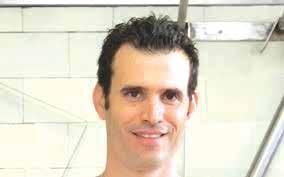
After 782 days in Gaza, the body of Dror Or was returned to Israel last Tuesday. Or, a 48-year-old father, husband,
and cheesemaker, was killed in Kibbutz Be’eri on October 7, 2023, and his body was brought to the Gaza Strip.
On Sunday morning, Or was buried alongside his wife, Yonat, who was also killed during the Hamas-led massacre.
“I will never in my life really understand how this could have happened to you and to Yonat — how you were attacked like that in your beautiful home, with such terrible evil,” Or’s older brother, Elad, said in a eulogy. “And how you somehow managed to tell Alma and Noam to run, and then they caught you. I never want to understand it.”
Elad added that he would “never forget nor forgive the unbearably long time during which we had to beg for help and for rescue from the ongoing terror of your captivity.”
In her eulogy, Dorit Or, the deceased hostage’s mother, said her son and daughter-in-law were “people of freedom and light, of spirit and creativity, who knew how to dream and turn dreams into reality.” She recounted Or’s love of basketball, his travels, his time in culinary school, his childhood, and the like. She remembered Or and his wife as parents with “immense love and endless patience.”
Or’s death was confirmed on May 2, 2024.
During the October 7 massacre, as terrorists approached his home and set it ablaze, Or and his wife told their two younger children, 17-year-old Noam and 13-year-old Alma, to jump out of the window, escape from their home in Kibbutz Be’eri, and run away. The two kids were then kidnapped by Hamas and were later freed on November 23, 2023, during the first ceasefire of the war. Their older brother, Yahli, wasn’t home at the time, as he was volunteering in the north in a year of national service. Liam Or, their cousin from Kibbutz Re’im, was visiting the family at the time and was also abducted. On November 29, 2023, Liam Or was freed.
Now, Hamas is only holding the bodies of two hostages: Ran Gvili and Sudthisak Rintalak. Since the ongoing ceasefire started, Hamas has released 20 living and 26 deceased hostages.
Many people attended Dror and Yonat Or’s funeral, including Gvili’s parents and sister and hundreds of Be’eri residents, such as Eli Sharabi, a former hostage, and Reuma Aroussi, the mother of 13-yearold former hostage Gali Tarshansky and Lior Tarshansky, the latter of whom was murdered by Hamas.
On October 7, Kibbutz Be’eri was one of the worst hit border communities, with 101 civilians and 31 security personnel



killed, and 30 residents and two additional civilians kidnapped by Hamas. Be’eri residents, for hours, fought terrorists. Around 1,000 residents lived in the kibbutz prior to the attack.

Two IDF soldiers were lightly injured on Tuesday morning in a stabbing attack near Ateret in Judea and Samaria. The terrorist was shot dead by the soldiers.
The attack came hours after a soldier was lightly hurt in a car-ramming near the city of Hebron. The attacker was killed during a subsequent attempt to arrest him.
Tuesday’s stabbing occurred after troops were dispatched to question a suspicious individual seen near Ateret, north of Ramallah. Soldiers stopped the man and began inspecting him when he pulled out a knife and stabbed two of them before being shot and killed, the army said.
The Palestinian Authority health ministry identified the terrorist as Mohammed Asmar, 18, from the nearby village of Beit Rima.
After the attack, the IDF put up roadblocks around nearby Palestinian towns.
Hours before the stabbing attack, on Monday night near Hebron, a terrorist accelerated his vehicle into troops stationed at the Yehuda Junction, injuring one servicewoman. The car fled the scene as troops fired at it. The injured soldier was taken to a hospital for treatment.
The army then set up roadblocks in the area and conducted extensive searches. Eventually, the attacker was spotted in Hebron in the car used in the attack. During the arrest attempt, the suspect “tried to escape while endangering the fighters, the forces reacted with gunfire, and he was eliminated,” according to the army.
The Palestinian Authority health ministry identified the terrorist as 17-year-old Mohannad al-Zughayar.
Violence in Judea and Samaria has surged since Hamas’s attack on Israel in October 7, 2023. According to the Palestinian Authority, over 1,000 Palestinians have been killed by Israeli forces or set-
tlers since then. The IDF has said that most of those killed were gunmen, rioters clashing with troops, or terrorists carrying out attacks.
During the same period, 63 civilians and Israeli security personnel were killed in terror attacks in Israel and Judea and Samaria. Another eight members of security forces were killed in clashes during raids in Palestinian cities in Judea and Samaria.
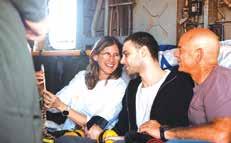
Alon Ohel was kidnapped from the Nova music festival on October 7, 2023. He was finally released in a hostage deal in January 2025.
Alon spoke with Channel 12 in an interview released on Monday.
“Anyone who wasn’t there won’t be able to understand it. You’ve never experienced hunger, you’ve never been chained for a year and a half. Chained like a monkey, eating like a dog. There, you’re not a human being, you’re an animal,” he said. Alon, now 24, was taken captive along with Hersh Goldberg-Polin and Eliya Cohen. Hersh was murdered in captivity, while Eliya was released in a hostage deal in January 2025.
On October 7, Alon fled the Nova music festival into a roadside bomb shelter along with Aner Shapira, Hersh, and more than two dozen other people.
As Aner tossed out grenade after grenade that terrorists were throwing into the bomb shelter, Alon turned to him and said, “Everything will be okay.”
“He didn’t even look me in the eye. He was a madman, and he saved us all,” Alon said of Aner, who managed to toss back seven grenades before the eighth exploded and killed him. Hersh tried to follow suit, but he held onto the grenade for too long, it exploded and he lost his left arm.
The terrorists subsequently threw Alon, Hersh and others into the back of a pickup truck and took them into Gaza.
On the way into Gaza, with searing pain from shrapnel that struck his shoulder and arm, Alon told himself, “No matter what, I choose life.”



As Alon recalled the horror he experienced, he began to tremble.
“They take you from your life in an instant. I’m a 22-year-old kid. What do I know about life? In just one second, they tore me out of my reality and put me in hell.”
For the first 52 days of his captivity, Ohel was held aboveground. Then — after a weeklong ceasefire in November 2023 — he was taken underground, where he met fellow hostages Eli Sharabi, Hersh, Almog Sarusi and Uri Danino.
Alon and Eli were separated from the others, and Alon became close to Eli Sharabi, 53, who became a father figure to him.
“From the very first moment, he and I connected,” he said.
Alon recalled a moment when he lost his temper over the lack of food they were given and punched a wall, which may have broken his hand. Eli was there to comfort and hug him. “It was a father’s hug.”
“He would hold me and lift me up,”
even know are taking to the streets and holding up my signs, who am I to even consider giving up, even for a moment? There’s no way,’” Alon recalled. Alon was eventually moved to a different part of the tunnel. There, he met fellow hostage Guy Gilboa-Dalal. The two of them had served in the Navy together and recognized each other immediately. Hamas would later publish footage of the encounter in what was the first clip showing Alon alive since his captivity.
The pair were later told to write letters to their families.
“To my family — Mom, Dad, (and siblings) Ronen and Inbar, I miss you and love you so much. I’m fine. I’m alive and breathing. I hope to see you soon. You are the strength that has helped me to continue to survive here — what keeps me here day after day in this never-ending nightmare. I’m thinking about our vacations together, and the ones to come,” Alon wrote.
In October, Izz al-Din al-Haddad — who had become Hamas’s Gaza military leader after all of his superiors were killed in the war — appeared in the tunnel where Alon was being held to inform him that another hostage deal had been reached. He was handed over to the Red Cross, which brought him to the IDF.
When he finally reunited with his family, Alon made a point of keeping his composure so as to assure them that he was still sane and healthy.
Shortly thereafter, however, he began to break down, particularly upon learning of the fate of Eli Sharabi’s family.
“For two years I was a dead person,” Alon told Channel 12. “I prayed to this light that someone would save me. But I also discovered that I am strong, that I can do anything, and that I am not a victim.”
Alon still has a long road to recovery ahead, including surgeries to repair his shoulder and the vision in his left eye.
“I am not looking for self-pity. I have been through what I have been through. I am taking it and growing, continuing to learn and develop. I am going to conquer the world,” he declared.
Alon continued. “He carried himself and me on his back.”
At one point, Eli and Alon were tied together with chains. “We would go to the bathroom together… We did everything.”
At one point, Alon’s captors took out a laptop and showed him a picture of an Israeli at a protest in Tel Aviv’s Hostages Square holding a placard with his picture and a piano in the background.
“I told myself, ‘Now there’s really no way I’m giving up. If people who I don’t
On Thursday morning, a 6.0-magnitude earthquake rocked the Anchorage, Alaska, metropolitan area, according to the U.S. Geological Survey.

The quake struck at about 8:11 a.m. local time at a depth of around 43 miles, according to the USGS. Its epicenter was located 7 miles west-northwest of Susitna, Alaska, an area about 67 miles northwest of the city. There were no immediate reports of significant damage.

Municipal inspectors also did not find any issues in key public infrastructure after the earthquake, according to a social media post by Anchorage Mayor Suzanne LaFrance.
Some residents found humor in the situation and were calling the Thanksgiving holiday “Shakesgiving” online.
Alaska is the most earthquake-prone state in the U.S. and one of the most seismically active regions in the world, according to the USGS. The state experiences a magnitude 7 earthquake almost annually.
Thursday’s quake is the largest to hit
the south central part of Alaska since 2021.

Even at a time of inflation, tariff concerns and economic uncertainty, Americans opened their wallets on Black Friday, chasing deep discounts and stretching their budgets where they could.
Data released Saturday showed that shoppers seized on Thanksgiving and Black Friday deals, spending significantly more than last year online and slightly more in stores, though they grew more selective about what they put in their carts.
Shoppers made an estimated $11.8 billion in online purchases Friday, a 9.1% increase from last year, and spent $6.4 billion online on Thanksgiving, according

to data from Adobe Analytics, a data collection and analysis platform.
Another metric from Mastercard SpendingPulse, which measures retail sales across cash, credit cards and digital payments, found that online sales on Black Friday rose by 10.4% and in-store sales increased 1.7% over last year. Apparel and jewelry were among the top spending categories, as retailers promoted steep discounts.
Economists are looking at this year’s holiday sales as an indicator of how the economy is doing amid economic challenges: the longest government shutdown, changes to Supplemental Nutrition Assistance Program benefits and a weakening job market. Despite the strong Black Friday sales this year, analysts say that may not reflect how retailers will perform overall this holiday season.
The numbers released on Saturday offer an early look at how the holiday shopping season is shaping up. The National Retail Federation is set to update its figures on Tuesday.
The holiday season, which stretches through November and December, has arrived as many households are feeling squeezed. Consumer confidence has wavered as prices remain elevated and incomes show signs of flattening, all while some businesses grapple with the added strain of tariffs. The most recent federal data showed retail sales rose a modest 0.2% from August to September, missing expectations, though sales were still up 4.2% from a year earlier.
And while retailers’ sales numbers have improved, shoppers were selective in their Black Friday purchases. According to real-time data from Shopify, a provider of software to retail businesses, the top product categories by volume among its clients Friday included vitamins, T-shirts and skin care items.
The National Retail Federation said earlier this month that it expected holiday sales to rise 3.7% to 4.2% over last year and predicted sales would reach as much as $1.02 trillion. Deloitte also forecast that holiday retail sales would top $1 trillion. (© The New York Times)
According to a study published this week in the journal Cell, the shingles vaccine may also slow the progression of dementia.
The shingles vaccine not only offers
protection against the painful viral infection, but a new study suggests that the two-dose shot also may slow the progression of dementia.
Shingles, caused by the varicella-zoster virus, presents as a painful rash along one part of the body. It is estimated that about 1 in every 3 people in the United States will develop the illness in their lifetime. The vaccine is given as two shots. The risk of shingles and serious complications increases with age, which is why in the United States, two doses of the shingles vaccine is recommended for adults 50 and older.

The vaccine is estimated to be more than 90% effective at preventing shingles in older adults.
“We see an effect on your probability of dying from dementia among those who already have dementia,” Dr. Pascal Geldsetzer, assistant professor of medicine at Stanford University and senior author of the new study, said about the potential effects of the shingles vaccine.
“That means that the vaccine doesn’t just have a preventive potential, but actually a therapeutic potential as a treatment, because we see some benefits already among those who have dementia,” he said. “To me, this was really exciting to see and unexpected.”
The new study comes just months after Geldsetzer and his colleagues previously found evidence that shingles vaccination may offer a “dementia-preventing” or “dementia-delaying” effect.
In that previous study, the researchers analyzed the health records of older adults in Wales, where a shingles vaccination program for adults in their 70s was introduced on September 1, 2013. The program indicated that anyone who was 79 on that date was eligible for the vaccine for one year, but those who were 80 or older were not eligible for the vaccine.
In the study in Wales, researchers found that receiving the shingles vaccine reduced the probability of being newly diagnosed with dementia by 3.5 percentage points over a seven-year period, compared with those not receiving the vaccine.
“We know they [the people in the study] should have similar physical activity level, diets, etc.,” Geldsetzer said. “So,

we’re much more confident that what we’re actually looking at here is cause and effect, rather than just correlation.”
While the new study turned a spotlight on the possible relationship between shingles vaccination and dementia outcomes, it did not specifically uncover why the vaccine may have these potential effects.

At around 2:15 p.m. ET on Wednesday, a terrorist fired shots in Washington, D.C., near the Farragut West Metro Station, hitting two National Guard soldiers who had been patrolling the area.
Shortly after being shot, Sarah Beckstrom, a 20-year-old from West Virginia, died of her injuries. The other victim, 24-year-old guardsman Andrew Wolfe, also from West Virginia, was in critical condition and had to undergo surgery.
At a press conference on Thursday, President Donald Trump announced Beckstrom’s death.
“Sarah Beckstrom of West Virginia, one of the guardsmen that we’re talking about, highly respected, young, magnificent person, started service in June of 2023, outstanding in every way. She’s just passed away,” Trump said. “She’s no longer with us. She’s looking down at us right now. She was savagely attacked; she’s dead now.”
He added that Wolfe is “in very bad shape,” but hopefully “we’ll get better news with respect to him.”
The suspect was named as Rahmanullah Lakanwal, a 29-year-old Afghan national from the province of Khost,
whom Trump has called an “animal” who committed a “monstrous, ambush-style attack.”
For 10 years, Lakanwal reportedly fought in the CIA-backed Afghan Army during the War on Terror alongside U.S. Special Forces. According to The New York Post, a friend of Lakanwal said he “struggled for years” dealing with trauma induced by the war, which he had fought in since age 16.
According to Homeland Security Secretary Kristi Noem, Lakanwal arrived in the U.S. in 2021 as part of Operation Allies Welcome, a program started by the Biden administration that was meant to give a new home to around 76,000 Afghans who helped the U.S. fight the Taliban.
CIA Director John Ratcliffe noted, “The Biden administration justified bringing the alleged shooter to the United States in September 2021 due to his prior work with the U.S. government, including CIA.”
In April, the Trump administration granted Lakanwal’s asylum application.
After arriving in the U.S., the shooter worked as a delivery driver in order to financially support his family, which included his wife and five kids. He reportedly coped with post-traumatic stress by smoking marijuana and playing Call of Duty, a violent military-style first-person shooter video game. The family has been living in Bellingham, Washington State. He drove over 2,600 miles to the District of Columbia to commit the heinous crime.
The FBI is investigating whether the attack was an act of terrorism, according to senior U.S. officials. Lakanwal has reportedly been, thus far, uncooperative with the investigation. He is still receiving treatment in a hospital for what are believed to be non-life-threatening injuries, according to Jeffery Carroll, executive assistant chief of D.C.’s Metropolitan Police Department.
In the wake of the attack, the U.S. Citizenship and Immigration Services agency said it would immediately and indefinitely pause “processing of all immigration requests relating to Afghan nationals”
until a security review is conducted and protocols are vetted. Trump added that he would “permanently pause” migration from “all third world countries.”
Lakanwal ambushed the two guardsmen and shot them with a .357 revolver. The assailant was then stopped and held down by other National Guard soldiers, following a gunfire exchange, until law enforcement arrived. According to D.C. Mayor Muriel Bowser, the incident was a “targeted” shooting.
Last Thursday, Jeanine Piro, the U.S. Attorney for the District of Columbia, said that Lakanwal would be charged with three counts of assault with intent to kill while armed. Because Beckstrom has since died, the suspect will probably be charged with first-degree murder, as well.

Northwestern University in Illinois will pay the U.S. federal government $75 million to settle complaints about antisemitism on the campus. The agreement between the university and the U.S. Justice Department will restore $790 million in federal funding to the university that the Trump administration had frozen in April and closes federal investigations into the university.
As part of the settlement, the university agreed to revoke the so-called “Deering Meadow Agreement” that the campus administration made with anti-Zionist protesters in 2024.
work to improve Jewish life on campus through an advisory council, hire an external party to monitor the campus climate for Jewish students, and implement mandatory antisemitism training.
Northwestern will also clarify its policies regarding protests and ban masking on campus.
“Today’s settlement marks another victory in the Trump administration’s fight to ensure that American educational institutions protect Jewish students and put merit first,” said U.S. Attorney General Pamela Bondi.
The university will pay the $75 million over the next three years.
The Trump administration froze funding to a number of elite universities, citing campus antisemitism, and has settled a series of the investigations in recent months.
The agreement with Northwestern was the second-highest payment from a university. Columbia University in July agreed to pay $200 million.
Interim university president Henry S. Bienen said in a statement that Northwestern had agreed to the deal because the funding freeze had caused severe damage to research, and litigation would have taken years to resolve and incurred huge costs.
“This has been an extremely difficult time for our community, and I believe this agreement was the best path forward for us to be able to turn the page,” Bienen said.
Did you know?
You can escape quicksand quite easily.
Just sit or lie back, keep your arms up, and wiggle your legs side to side or back and forth.
In that deal, the university agreed to protesters’ demands to set up an advisory committee on university investments, to fund two Palestinian faculty per year and five Palestinian undergraduates, to create a house for Muslim students, and to allow protests with some restrictions in order to end demonstration against Israel on campus.
The agreement was widely criticized by Republicans and Jewish groups, with the American Jewish Committee’s branch in Chicago calling the deal “cowardly.”
As part of the agreement announced on Friday, the university said that it will uphold civil rights protections for Jews,

Illinois’ Cook County, the second-largest county in the United States, has launched a permanent guaranteed basic income program, with the county’s Board of Commissioners unanimously approving $7.5 million for the program. The program has been piloted in many parts of the county since 2022. Because the pilot version was successful, officials have decided to make it permanent. Officials based their assessment of the program’s success on an April survey that indicated that three-quarters of participants said they feel more financially secure, while

94% said they used the funds to help them through financial crises. The program reportedly helped locals’ mental health and lowered their stress levels. The funds were mainly used for essentials, including food, rent, utilities, and transportation.
Similar programs have been started across the U.S., with Mayors for Guaranteed Income, a coalition of 150 mayors, advocating for more such programs.
For two years, the Cook County Promised Guaranteed Income Pilot, with $42 million in federal funding from the American Rescue Plan Act, gave households free monthly payments of $500 to $3,250.
Many have criticized the move.
“Cook County is making its guaranteed income pilot permanent and committing millions to a failed strategy already shown to leave people with less work experience and lower earnings,” said Illinois Policy Institute (IPI), a state public policy think tank.
IPI’s head of policy, Josh Bandoch, added, “That should alarm anyone who wants real, long-term progress for low-income residents. A recent pilot program in northern Illinois, including Cook County, decreased workforce participation and lowered individual income (before transfers).”
The commission defended the pro-
gram, saying that “outcomes and impacts vary depending heavily on program design: amount of cash, frequency/duration of payments, eligibility criteria (income-based, place-based, etc.), and local cost of living.”
“Cook County is partnering closely with the Inclusive Economy Lab at the University of Chicago to conduct a comprehensive evaluation of the Promise Pilot. We will then design our next program in a thoughtful way that considers shortand long-term outcomes,” the commission added.

StopAntisemitism has been collating a list of “Antisemite of the Year” for the past few years. This year’s finalists were

announced on Sunday.
The list included Tucker Carlson. Other “nominees” included pro-Palestinian celebrities Ms. Rachel, Cynthia Nixon and Marcia Cross; mixed-martialarts athlete and Holocaust denier Bryce Mitchell; two personalities associated with left-wing network The Young Turks; and social media personalities on both the far left (Guy Christensen) and far right (Stew Peters).
Followers are encouraged to vote for whoever they feel is most deserving.
Nick Fuentes, the openly white nationalist and antisemitic live-streamer whose “groyper” movement has gained a toehold this year among young Republicans, was left off the list.
“Why wasn’t I nominated for antisemite of the year,” Fuentes posted on X after the finalists were revealed, apparently wounded by the omission.
In a follow-up post, StopAntisemitism said it does not nominate people more than once and has nominated Fuentes in previous years. “While he was a finalist a few years back, his absence from this year’s cycle does not erase his antisemitism. Rather, it allows us to focus attention on other individuals who are spreading hate,” the group explained.
A watchdog presence with more than 300,000 followers on X, StopAntisemitism regularly mobilizes against activists and social media posts. The group has faced criticism for what some perceive as an inordinate focus on Muslim personalities, pro-Palestinian actions, and non-prominent individuals. Its defenders deny that, pointing out that StopAntisemitism also regularly spotlights neo-Nazis and Holocaust deniers on the right.
“From downplaying white supremacy to promoting the antisemitic ‘great replacement’ theory, Carlson has built a career turning extremist dog whistles into broadcast-ready talking points, legitimizing voices that traffic in Holocaust revisionism, conspiracy, and hate,” StopAntisemitism wrote in its nomination of Carlson.
The group nominated Ms. Rachel, the children’s YouTube personality who has become an outspoken advocate for children affected by Israeli airstrikes in Gaza, because it said she “has used her massive platform to spread Hamas-aligned propaganda.”
Last year’s “winner,” far-right pundit and conspiracy theorist Candace Owens, was also absent from the list despite her recent resurgence promoting conspiracy theories accusing Israel of involvement in Charlie Kirk’s assassination. Previous “winners” have included Reps. Rashida Tlaib and Ilhan Omar, as well as rapper
Ye and a board chair of Ben & Jerry’s, the progressive ice cream company founded by Jews.

Homeland Security Secretary Kristi Noem is recommending that the Trump administration’s travel ban list include between 30 to 32 countries. The current list has 19 countries.
Nationals of countries on the travel ban list face restrictions on travel to the United States. It is unclear which countries are being added to the list and when they’ll be announced.
The recommendation to the White House comes on the heels of the shooting in Washington, D.C., in which an Afghan national, Rahmanullah Lakanwal, killed one National Guard member and critically wounded another.
Lakanwal had worked with the U.S. in Afghanistan and resettled in Washington state under the Biden administration. He was granted asylum under the Trump administration.
Noem said Monday that, following a meeting with President Donald Trump, she recommended a “full travel ban” on “every [darn] country that’s been flooding our nation with killers, leeches, and entitlement junkies.”
The current list of 19 countries with full or partial restrictions include Afghanistan, Burma (Myanmar), Chad, the Republic of the Congo, Equatorial Guinea, Eritrea, Haiti, Iran, Libya, Somalia, Sudan, Yemen, Burundi, Cuba, Laos, Sierra Leone, Togo, Turkmenistan and Venezuela.
Trump has previously said that some countries had “deficient” screening for passports and other public documents or have historically refused to take back their own citizens.
The Trump administration has also ramped up its immigration crackdown, citing the shooting in Washington, D.C. Senior Trump administration officials have accused the Biden administration of insufficiently vetting the suspect and argued that the current immi-

gration system needs to be overhauled.
Last week, the U.S. Citizenship and Immigration Services announced that it will reexamine all green cards issued to people from the 19 countries currently facing full or partial travel restrictions. The agency’s director, Joe Edlow, also announced updated guidance that authorizes USCIS officers “to consider country-specific factors as significant negative factors when reviewing immigration requests.”
That same day, the Department of Homeland Security, which oversees USCIS, said the administration was also reviewing all asylum cases that were approved under former President Joe Biden.
A day later, Edlow announced the United States was pausing all asylum decisions “until we can ensure that every alien is vetted and screened to the maximum degree possible.”

What is the “right” age to get your child a smartphone? It’s a question that vexes many parents — torn between their pleading tweens and researchers who warn about the potential harms of constant connectivity. But new study findings strengthen the case for holding off.
The study, published in the journal Pediatrics on Monday, found that children who had a smartphone by age 12 were at higher risk of depression, obesity and insufficient sleep than those who did not yet have one. Researchers had analyzed data from more than 10,500 children who participated in the Adolescent Brain Cognitive Development Study — the largest long-term look at children’s brain development in the United States to date.
The younger that children under 12 were when they got their first smartphones, the study found, the greater their risk of obesity and poor sleep. The researchers also focused on a subset of children who hadn’t received a phone by age 12 and found that a year later, those who had acquired one had more harmful mental health symptoms and worse sleep
than those who hadn’t.
“When you give your kid a phone, you need to think of it as something that is significant for the kid’s health — and behave accordingly,” said Dr. Ran Barzilay, lead author of the study and a child and adolescent psychiatrist at Children’s Hospital of Philadelphia.
The new study shows only an association between getting a smartphone earlier in adolescence and poorer health outcomes, not cause and effect. But the researchers point to previous studies that suggest that young people who have smartphones may spend less time socializing in person, exercising and sleeping — all of which are essential for well-being. Adolescence is a sensitive time when even modest changes to sleep or mental health can have deep and lasting effects, they note.
The purpose of the study is not to shame parents who have already given their children devices, Barzilay said. He is realistic about how ingrained smartphones have become in American adolescence.
The takeaway, he said, is that age matters.
“A kid at age 12 is very, very different than a kid at age 16,” he said. “It’s not like an adult at age 42 versus 46.” (© The New York Times)
opens to reveal a removable tiny basket of bejeweled quartz flowers symbolizing spring.
The sale price, which included a buyer’s premium, topped the $18.5 million paid at a 2007 Christie’s auction for another Fabergé egg created for the Rothschild banking family.
Craftsman Peter Carl Fabergé and his company created more than 50 of the eggs for Russia’s imperial family between 1885 and 1917, each elaborately unique and containing a hidden surprise. Czar Alexander III started the tradition by presenting an egg to his wife each year. His successor, Nicholas II, extended the gift to his wife and mother.
Czar Nicholas II commissioned the egg for his mother, Dowager Empress Maria Feodorovna, as a present in 1913. It was one of two eggs created by female designer Alma Pihl; her other egg is owned by Britain’s royal family.
The Romanov royal family ruled Russia for 300 years before the 1917 revolution cut them down from power. Nicholas and his family were executed in 1918.
There are 43 surviving imperial Fabergé eggs, most in museums.
comfortable. The judge would wear an Elvis Presley wig in the courtroom and would play the singer’s music from his phone during court proceedings. But his antics have made the state board all shook up, prompting the St. Louis judge to face a six-month unpaid suspension to avoid a disciplinary hearing.
According to the deal, after the suspension, Thornhill would serve 18 more months on the bench before resigning from the St. Charles County Circuit Court.
The agreement, reached last month, is pending before the Missouri Supreme Court, spokeswoman Beth Riggert said on Friday.
Thornhill wrote that he intended “to add levity at times when I thought it would help relax litigants.” But, he added, “I now recognize that this could affect the integrity and solemnity of the proceedings.”

This is no yolk.
A rare crystal and diamond Fabergé egg crafted for Russia’s once-ruling family shattered records this week when it sold at auction for $30.2 million.
The Winter Egg, which has been compared to the iconic Mona Lisa, was just one of seven of the opulent, precious eggs remaining in private hands, according to Christie’s London auction house.
The 4-inch-tall egg is made from finely carved rock crystal, covered in a delicate snowflake motif wrought in platinum and 4,500 tiny diamonds. It
The egg that shattered records this week was bought by a dealer in London when some of Russia’s treasures were auctioned off by Communist authorities in the 1920s. At that time, it sold for 450 pounds. Since then, it changed hands numerous times. It was believed to have been lost for decades until it was auctioned by Christie’s in 1994 for more than $5.6 million. It sold again in 2002 for $9.6 million.
Each time the egg has sold, it has set a world record price for a Fabergé item, Christie’s said.
Margo Oganesian, the head of Christie’s Russian art department, called the egg “the ‘Mona Lisa’ for decorative arts,” a superb example of craft and design.
In other words, it’s a good egg.
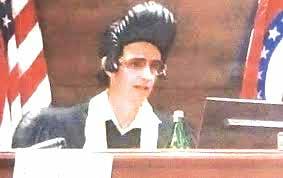
Judge Matthew Thornhill wanted to make people in his court feel a bit more
While the Commission on Retirement, Removal and Discipline also faulted Thornhill for talking about politics from the bench, it highlighted his affinity for the “King of Rock ‘n’ Roll” first. The court file is sprinkled with photos of Thornhill on the bench or posing with staff in a plastic Elvis wig and sunglasses.
According to the commission, Thornhill routinely wore the wig in the courtroom and would offer people options on how they wanted to be sworn in before testifying, including an option where he played Elvis’ music from his phone. Thornhill also sometimes played the songs while entering the courtroom, court records show.
The board also said Thornhill sometimes mentioned Elvis lyrics or the singer’s date of birth or death during court, even though it wasn’t relevant.
All the Elvis references violated rules requiring a judge to maintain “order and decorum” and “promote confidence in the integrity of the judiciary,” the commission found, without saying how long the behavior had been going on.
Thornhill is the longest-serving judge in St. Charles County and a former assistant prosecutor there. He was elected an associate circuit judge in 2006 and a circuit judge in 2024. His primary assignment is family court.
Sounds like he needs to be returned to sender.





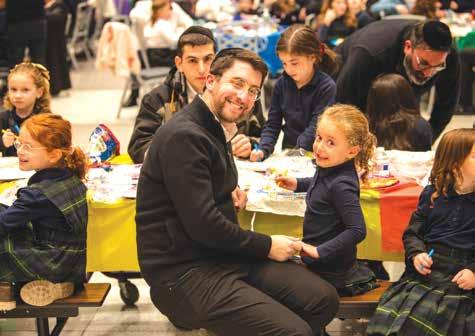
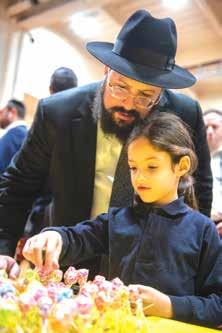
With the cool temperatures outside last Motzei Shabbos, the usual TAG warmth was in full force. And while our girls experience this every day, getting to share it with their fathers made it even more special. Pre1A and first grade girls enjoyed a lively Melava Malka Carnival that brought real energy and fun to the beyond capacity
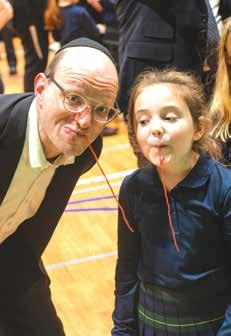
TAG auditorium.
The room was filled with music, brightly colored balloon arches and banners, and the excited chatter of girls proud to spend a night out with their fathers or grandfather. The program centered around simple, hands-on activities that let fathers and daughters play, laugh, and connect.


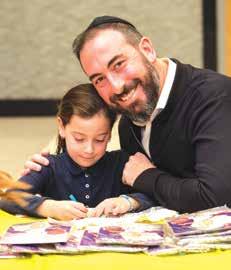
The carnival-style competitions were as popular as ever. Our girls and their guests teamed up to guess the number of jelly beans in a jar and the licorice-eating contest drew plenty of smiles. Between rounds, girls lined up for face painting or headed to the inflatable slides. Pizza and treats were available for anyone who needed a break, and the steady flow made
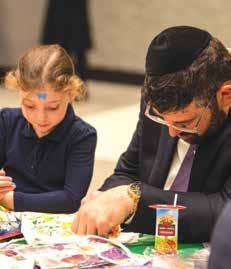
it clear they hit the spot. One of the most meaningful moments was the apron-decorating craft. Many fathers leaned in to help with letters and patterns, turning a simple project into a shared memento. It was a beautiful evening, one that will be cherished for a long time to come.



Always a delight to have Andrew Galitzer, author of Torah Comics, visit HAFTR’s third graders.
The students even got to design their own comic! These sorts of programs make our students excited about learning.

Isaac Weiner, Avi Terebelo, Marvin Jacobs and Penina Langer
The Five Towns Premier Rehabilitation and Nursing Center was proud to honor and celebrate the extraordinary milestone birthday of resident Marvin Jacobs, who turned 103 years old on November 29, ka”h.
Born in Poland, Mr. Jacobs survived eight concentration camps during the Holocaust and has spent his life embodying courage, resilience, and strength. Today, he continues to live out his golden years as an active and cherished member of the Five Towns Premier community.
“All of our staff send Marvin heartfelt congratulations,” shared Administrator, Avi Terebelo. “He truly exemplifies resil-
iency, and it is our privilege to celebrate this incredible achievement with him.”
The Five Towns Premier Rehab and Nursing Center has long been home to many Holocaust survivors, providing a person-centered, trauma-informed care approach (PCTI) grounded in compassion, respect and dignity. The facility remains committed to supporting Holocaust survivors with the highest standard of care while honoring their life experiences and individual needs. For more information about The Five Towns Premier, please call (516) 5883200.



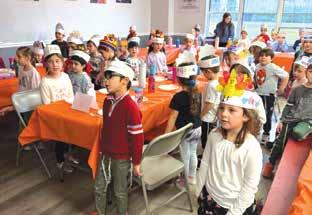
Playoff intensity was at its peak this week across the JSL! Overtime winners, Cinderella runs, clutch performances, and championship berths highlighted an action-packed slate of games. Here’s everything that went down:
Smash House kicked off the tournament with an overtime thriller, edging Yeled LI Panthers to advance. In a unique twist, Yehuda Aidelson stepped in for Smash House—despite normally suiting up for Yeled LI Panthers—and made a huge impact in the win. Maidenbaum earned a strong win over Marciano PD, powered by a dominant two-way effort from Nosson Tzvi Fogel, who controlled the blue line and added 2 goals. SD Shades took down Demo & Cleanouts behind Shimmy Biegeleisen’s 3-goal performance, providing all the scoring his team needed to move on.
Maidenbaum topped 5 Towns Central with a buzzer-beating game-winning goal, capping off an exciting matchup where both teams played outstanding from start to finish.
Posh Home & Bath, the undefeated #1 seed, opened their postseason with a convincing 12–7 win over Tikva Fire. Harry Wilheim delivered multiple goals and assists in another standout performance. 5 Towns Central also advanced, defeating SR Whee 12–7 in a game filled with hard play, teamwork, and great sportsmanship from both sides.

Sushi Tokyo Ninjas kept their season alive with a gritty 4–3 win over Newman Dental, thanks to a massive 2-goal performance from Dovy Stein. Styles Design Interiors punched their ticket to the next round with a 4–1 victory over Built By Nate, capped off by a beautiful wraparound goal from Gavi Prince to seal the win.

4th/5th
Tal Academy’s Cinderella story continues! The #8 seed advanced all the way to the championship game, with Efraim Joseph scoring his first goal of the season after transitioning from goalie—an unforgettable moment. Styles Design Interiors also advanced to the finals with a 5–3 win over Wieder Orthodontics, led by Dovid Krigsman, whose precise court vision guided the offense.
6th–8th Grade Hockey – Playoffs
Emporio held off a late push from Wieder Orthodontics to win 6–5. Eli Sherman’s 2 goals proved to be crucial in the narrow victory. SD Shades, the top seed, earned a convincing 8–3 win over Sperling Productions, with Gavriel Abbitan adding another multi-goal playoff performance to his incredible season.
Growtha advanced with a 10–6 win over Seasons, as Hillel Shulavsky played well and carried himself with great middos and attitude. Marciano PD defeated Posh Home & Bath 12–4, behind another strong outing from Moshe Obadia, who continues to shine in big moments.
Wieder Orthodontics rolled past 5 Towns Landscaping, led by Ephraim
Lowy, who delivered another huge twoway performance. Rita’s topped Rip It thanks to Nechemia Oratz, who stepped up with a big all-around game to lead his team to victory.
Central Pizza Co. defeated Seasons Express 15–4, fueled by Nissi Berman’s offensive firepower and a highlight-reel coast-to-coast layup. Tikva Fire advanced past Elegant Lawns, with Danie Grabie once again scoring at will and finding open teammates throughout.
4th/5th Grade Basketball –Playoffs
Addictive Ads won 16–6 over Wieder Orthodontics, behind Zach Lerer’s impressive 8 steals, controlling the defensive end all game long. Newman Dental advanced with a 27–11 win over Rip It, led by a dominant all-around performance from Akiva Scharf.
6th/7th Grade Basketball –Playoffs
Maidenbaum earned a 42–15 win over Eden Gardens, with Sruly Newman delivering a big offensive game. In the day’s biggest upset, #4 seed Tal Academy knocked off #1 seed Elegant Lawns, behind Mordechai Wiener’s incredible all-around performance to send his team to the championships.
Men’s
A shorthanded Town Appliance continued to find ways to win, beating Hewlett Auto Body 59–51 behind Shelby Rosenberg’s 23-point performance. Kol Ve’or, the #3 seed, defeated #2 seed Emporio 77–54, led by Yitz Bennett, who scored a team-high 26 points to send his squad to the Championship!

Gan Chamesh held its first Coffee & Conversations, a warm and inspiring discussion led by Rebbitzen Chanie Wolowik. Parents explored the idea of creating a family mission statement by identifying the Torah values they want their home to reflect and finding simple ways to live those values each day.
The discussion also touched on Chanukah and the deeper meaning of giving Chanukah Gelt. Since the Greeks opposed Judaism’s connection to G-d, giving Gelt teaches our children that even something physical, like money, can be elevated through kindness and Tzedakah.
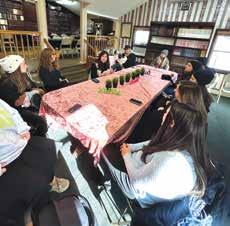
Coffee and Conversations is off to a wonderful start, and we look forward to many meaningful mornings ahead.

This year’s annual Day of Gratitude at SHS centered on the theme “Grateful for Miracles.” Mrs.
Shelly Shem Tov, mother of former hos-
tage Omer Shem Tov, shared stories of her remarkable positivity, emunah, and gratitude that helped her survive the 505 horrific days she waited for his return.
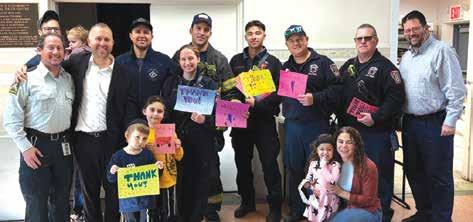
On Thanksgiving morning, the BACH Jewish Center hosted a special program recognizing the dedication and service of Long Beach’s first responders. The event highlighted the essential work of the Long Beach Police Department, Long Beach Fire Department and Emergency Medical Services.
During davening, the kibbudim (honors) were given to a local Jewish police officer, a Jewish Long Beach firefighter and three Jewish Emergency Medical Services professionals, symbolizing the community’s gratitude for those who safeguard Long Beach each day. Following prayers, synagogue members, first responders and their families gathered in the social hall to share a festive Thanksgiving breakfast. This initiative is part of the BACH Jewish Center’s ongoing commitment to honor those who serve the community with courage and selflessness. The gathering offered a meaningful opportunity to
express appreciation for the collective efforts of all first responders, who routinely respond to emergencies, protect residents and support the well-being of Long Beach and its surrounding neighborhoods.
“Our sages teach that the actions of parents leave lasting impressions on their children, maaseh avot siman labanim,” said the BACH’s Rabbi Benny Berlin, who also serves as chaplain for the Long Beach Police Department. “By celebrating our first responders openly and community-wide on Thanksgiving morning, with each generation participating in its own way, we hope to instill in our children the value of gratitude and the importance of recognizing those who dedicate their lives to helping others.
“Thanksgiving provides a natural moment to express thanks, but the appreciation we feel for our first responders is something we carry every day. Their service strengthens the fabric of our city and reflects the unity and mutual responsibility that define our community,” he added.
n conjunction with our unit on
“Light, and in honor of Chanukah, the Bais Yaakov Ateres Miriam Kindergarten explored many different kinds of light in the dark. The girls observed light beams growing and shrinking, experimented with all sorts of fascinating shadows, compared neon glow-in-thedark lights to regular flashlights, and even enjoyed an all-out glowing dance party. It was an exciting—and truly enlightening—experience!



Learning doesn’t start or end at the classroom door; it grows from the relationships that surround every child. Designed around this core belief that education is a shared endeavor among teachers, family, and the wider community, Grandparents and Someone Special Day at Mercaz Academy invited students to share their school life with family and special guests last week in an event filled with music, creativity and connection.
The event, including a collaborative craft that students and guests did together, special performances, and refreshments, spanned a weekend. Students in the upper grades paired up with their guests in their classrooms on Friday to create a keepsake craft before coming together to perform a moving concert of Hebrew and English songs. On Monday, the youngest learners got their turn to give their guests nachas, performing three songs on stage before joining their visitors to make personalized family trees.
The kvelling went two ways: students were eager to proudly show off their school, pointing out their work, introduc-

ing friends and teachers, and touring the spaces where they learn and play, while grandparents glowed with pride as they enjoyed the proof of what they’ve known all along – that they have the smartest, kindest, and most talented grandchildren in the world.
Relatives traveled from near and far to be part of the day. One grandparent shared, “It’s wonderful to spend time with the kids and do something creative together.” Another added, “I’m always impressed by the love and care this school pours into educating our grandchildren. You can feel it the moment you walk into the building.”
This Chanukah, choose a menorah that is a true work of art.
Every Hazorfim menorah is crafted by master silversmiths, led by master silversmith Yakov Merdinger. Hazorfim uses only the finest Italian silver, prized worldwide for its purity, sheen, and durability. The result is a stunning, unique collection of exquisite menorahs, pieces that were created to be cherished today and passed from generation to generation.
Each design is meticulously hand-finished, with careful attention to balance, proportion, and detail. When the flames are kindled, the silver seems to come alive, reflecting not only the light of the candles, but the story of a family, a heritage, and a living tradition.
This season, take advantage of our special offers, not only on menorahs but all Hazorfim items! You are invited to browse in person at the Hazorfim Williamsburg branch at 67 Lee Ave or visit www.hazorfim.com to purchase by

phone/WhatsApp and have it delivered to your door. Just call 1-800-551-8068. It’s an ideal opportunity to choose a menorah that will illuminate your home this year and grace your family’s celebrations for decades to come.

The fifth grade students of Yeshiva of South Shore worked hard on biography book report projects that required them to write about the character traits of significant historical figures. The figures chosen were diverse – from Neil Armstrong, Albert Einstein, and Martin Luther King Jr. What stood out was not just the facts they gathered
but rather the character traits they wrote about, namely honesty, generosity, courage, and kindness. Learning wasn’t just about amassing more knowledge or facts. Rather, each student took to heart the importance of middos tovos. It’s what’s on the inside of each person that counts. Walking on the moon is cool, but courage is cooler. While Albert Einstein was
recognized for his brilliance and intellect, the students at YOSS were more impressed with his desire to seek out the truth. What was most notable about the projects was how the students internalized the lessons these historic figures imparted.
The boys at Yeshiva of South Shore took home more than just facts that day.

In the months after October 7, as Israel reeled from loss, shock, and pain, thousands turned to OneFamily, Israel’s national organization assisting victims of terror and war for nearly 25 years. Faced with an avalanche of need, the organization had to greatly – and immediately – expand the number of volunteers and coordinators. In a beautiful show of resilience, healing, and bravery, many who have been on the receiving end of OneFamily’s care stepped up to help the newly bereaved.
OneFamily’s therapeutic, financial, and emotional assistance is designed to accompany people through every stage of grief and rebuilding. It is a testament to the success of this commitment, that those once shattered by loss are now reaching out to help others.
Turning Pain into Purpose
Yael Shevach’s husband, Rabbi Raziel Shevach, was murdered in a 2018 terror attack near their home in Havat Gilad. A mohel, rabbi, and senior paramedic, he was also a loving husband and father to six children.
“During shiva, OneFamily came to visit,” Yael says. “They told me that when everyone else goes home, they would stay. And they did. Every step of the way.”
At first, it wasn’t easy for Yael to accept help. “I was raising six kids alone. I was in survival mode. I didn’t know what I needed, or what my kids needed, and I didn’t like having to accept help. But OneFamily kept reaching out, suggesting babysitting, inviting us to retreats. They didn’t give up, and they knew what we needed more than I did. Our first step in OneFamily was when my kids wanted to attend OneFamily camp. They came home glowing.”
Over time, Yael came to appreciate what the organization understood her needs before she did, and just how much help her family truly needed. She de-
scribed how supported she felt, especially during COVID. “The whole country felt isolated. Everyone. But they made sure my children knew they weren’t alone.”
“OneFamily is completely unique in that they never made me feel like they were giving and I was receiving. They don’t just have a ‘menu of services’ that they offer people. They act like family— you help your loved ones with what they need, when they need it. That’s what OneFamily does. They accompany you, not as a case, but as a person.”
After October 7, Yael began visiting newly bereaved widows, just as others once did for her. Soon after, OneFamily formalized a new role for her as a “milava,” a special liaison to widows.
“I see this as a personal mission, a way to help others and express my profound gratitude to OneFamily,” she explains. “This is not just an organization to me. It’s home.”
Yael brings a rare emotional fluency to her work. “OneFamily never made me feel pitied. They didn’t just provide help. They walked with me, and I want to do the same for others. We are healing together.”
When Lazar Amitai’s wife was killed in a terrorist attack in Gush Katif 25 years ago, he suddenly became a single father to four young children. During the shiva, OneFamily representatives visited and quietly promised to return “after everyone else has gone home.” And they did.
“Someone from OneFamily called and got to know us,” Amitai says. “My kids started going to OneFamily camps, traveling with them, and attending special Shabbatons. They were hooked. It gave them so much support.”
As his children grew up and built their own lives, Amitai felt called to give back. After October 7, OneFamily urgently needed more coordinators to serve the influx of bereaved families. Lazar trained to become a regional coordinator for Israel’s south.
“Every time I meet a grieving family, I start by just listening. Then I give hugs. Only then do I explain what OneFamily can do to help,” he explains. “And every time I feel like I’m giving them what I received.”
One recent case weighed heavily on him: four siblings, aged 12 to 20, who lost their mother on October 7, were being raised by their father—until he died in a car accident. “So many pieces in their situation require navigating bureaucracy and giving emotional support in a sea of change and tragedy. I can often connect with families more closely and earlier because of my own story. People know I’m not just anybody. I’m one of them.”
Though offered compensation, Amitai does not accept a salary. “I do it out of gratitude,” he says. “My experience gives me a unique ability to help others, and I need to use it.”
A Mother’s Mission
For Cheryl Mandel, OneFamily became her anchor after her son, Lieutenant Daniel Mandel, was killed in Nablus in 2003. At her first OneFamily event, Cheryl met co-founder Chantal Belzberg.
“I met her at a large event where OneFamily had a booth. I told Chantal my story and she started to cry,” Cheryl recalls. “I couldn’t believe that someone who spends every day hearing such stories could still care so deeply. That moment told me this organization was something different.”
What started with yoga classes and quiet companionship became a decades-long bond. “I met other bereaved mothers who were slowly rebuilding. Over time, I found that I could do the same,” Cheryl says.
Cheryl began going abroad on behalf of OneFamily, speaking on Israel’s Memorial and Independence days, two of the hardest days of the year for any mother of a fallen soldier. That led to additional speaking opportunities abroad where as a native English speaker, she could share Daniel’s
story and advocate for the organization.
“When I speak abroad, I’m not just sharing Daniel’s memory. I’m giving voice to 25,000 bereaved mothers who can’t travel or speak for themselves. I consider it a privilege.”
Cheryl has also taught art and dance at OneFamily events over the years. “OneFamily has helped members of my family each in their own way,” she notes. “I would do anything for them as a way to express my gratitude.”
Now two decades into her own journey through grief, Cheryl reflects: “Some of the people who supported me - my yoga teacher, my massage therapist - were also bereaved parents. They found a way to give back. I followed their example.”
The Power of a Lifelong Embrace
The stories of Shevach, Amitai, and Mandel reflect a truth OneFamily has seen time and again: healing deepens when compassion is shared.
“When someone who has lived through tragedy walks into a shiva house or speaks to a newly bereaved parent, something powerful happens,” says OneFamily CEO Chantal Belzberg. “It’s not just empathy – it’s credibility. They show that life can go on, that love and purpose can return.”
Over the last two decades, dozens of current staff members, volunteers, and group leaders have come from within OneFamily’s community of survivors. It is the most profound measure of success imaginable, demonstrating the successful management of grief to growth, developing new roles and acts of purpose and meaning over time.
Belzberg adds: “These are people who were once on the receiving end. They still need and receive support, but now they are the ones leading the way…like members of a family, which is really what we are.”
To contact OneFamily Fund, reach out to Naomi Nussbaum at (646) 289-8600.

The Yeshiva of Central Queens proudly announces its honorees for the upcoming Annual Scholarship Dinner, to be held on Motzei Shabbos, December 13, at RAM Caterers in Old Westbury. This year’s distinguished awardees represent the very best of the YCQ community: devotion, leadership, and a steadfast commitment to the school.
The Dyckman Family is the embodiment of the Dor L’Dor spirit, linking generations through deep commitment to Torah, tzedakah, and communal responsibility. Selma and Jacob Dyckman have spent over 60 years rooted in Kew Gardens Hills, creating a home known for warmth, chesed, and generosity. Their children, Deborah, Ezra, Daniel, Joshua, and Jonathan, have carried on this tradition of giving, inspired by the example of their parents.
The family’s connection to YCQ is strong and multigenerational. Ezra’s sons, Moshe (‘09) and Eli, Valedictorian of the Class of 2020, are proud alumni. Ezra himself is serving his third year on the Board of Trustees, working tirelessly behind the scenes, while Jonathan’s family is also deeply involved. His wife, Daniella, is a beloved Kindergarten morah, and their children, Talia (‘24), Moshe (Grade 7), and Hadassah (Grade 7), have called YCQ home.
Selma and Jacob Dyckman have long dedicated themselves to philanthropy, hosting annual fundraisers for the Slonimer Yeshiva in Israel and actively participating in community organizations such as AMIT (Mizrachi Women). Their home has been described as a “Grand Central Station” of generosity, always welcoming guests for Shabbat and Yom Tov, and instilling a lifelong sense of tzedakah in their children. Through their decades of devotion, the Dyckman Family truly exemplifies the Dor L’Dor Legacy Award.
Parents of the Year:
Laya & Evan Daniel Laya and Evan Daniel of West Hempstead are being honored as Parents of the

Year in recognition of their unwavering dedication to family, community, and the YCQ family. Their commitment spans two decades, during which they have become central figures in the life of the yeshiva.
For Evan, the honor reflects both his role as a father to his four children, Jake (Class of ’23), Allie (Grade 8), Hailey (Grade 5), and Brandon, and his nearly 20 years as a Wildcats basketball coach. In that role, he has mentored hundreds of players, building lasting relationships and celebrating milestones, including the 2011 Championship with a dedicated group of athletes he affectionately calls his “kids.”
Laya, a devoted educator for 19 years, has contributed tirelessly to the school community. She has played a key role in the PTO, organized meaningful hakarat hatov collections for teachers and staff, and spoken at countless school events, from Siddur plays to graduations, expressing gratitude and fostering community connection.
Together, Laya and Evan manage a busy household filled with school, sports, dance, and extracurricular activities, demonstrating teamwork and dedication that inspire those around them. Their children motivate them to be better parents each day, and they credit YCQ for providing a community that is much more than a school, it is a true family.
Hakarat Hatov Award:
Rachel & Yisroel Orenbuch
Rachel and Yisroel (Yissy) Orenbuch personify the definition of active partnership in education. Since joining the YCQ family in 2007, they have operated under a simple yet powerful philosophy: take action rather than complain. For the Orenbuchs, being a parent at YCQ means rolling up one’s sleeves to improve the school not just for their own family, but for the entire community. Even after moving from Kew Gardens Hills to West Hempstead, the Orenbuchs have remained extremely involved in YCQ, doing whatever they can to help in any way they possibly can.
Rachel and Yissy have become fixtures of daily life at the yeshiva, often working

behind the scenes on essential but overlooked tasks. Rachel has served as a dedicated member of the PTO and, since 2020, has acted as a parent liaison on the Board of Trustees. They are perhaps best known for their hands-on, tireless efforts, specifically their deep involvement in organizing and managing the school’s Lost & Found, ensuring that misplaced items find their way back to their owners. Their family vehicle, affectionately known as the “OrenBUS,” is a familiar sight, frequently utilized to transport their children’ s friends to events, haul equipment and supplies, and assist with logistics whenever the school has a need.
The Orenbuchs’ approach to school challenges has always been one of collaboration, viewing the administration and faculty as true partners. They credit this drive to their own parents, who taught them that while one may not always be able to write the largest check, one can always contribute time, talent, and energy. This legacy is being passed down to their seven children, all of whom have called YCQ home: Elazar (‘17), Daniella (‘19), Simcha (‘20), Chani (‘22), Levi & Shimmy (‘23), and Benny (Grade 7).
From their older children currently serving in the IDF and Sheirut Leumi, to their youngest currently walking the halls of YCQ, the entire family has learned the value of giving back. Rachel and Yissy Orenbuch are true pillars of the Yeshiva, teaching us all that the most valuable gift one can give to a school is the gift of their time.
Distinguished Service Award: Mr. Gregorio Cruz
For Mr. Gregorio Cruz, the role of security at the Yeshiva of Central Queens extends far beyond the physical safety of the building. With every patrol, he safeguards the very spirit and positive atmosphere of the students and faculty who walk through its doors each day. A true fixture at YCQ since October 2012, Mr. Cruz has dedicated well over a decade to ensuring that every school day begins and ends with positivity. His remarkable consistency and warm presence have made him an indispensable part of the institution.
His personal philosophy is simple and profound: when you look in the mirror in the morning, you choose the attitude you will present to the world. For Mr. Cruz, that choice is always to greet others with an authentic smile and an open heart, believing that a warm and genuine welcome can instantly change the trajectory of a student’s entire day. He understands that for some children, his friendly face may be the first positive interaction they have before classes even begin.
Mr. Cruz begins his day long before sunrise. Arriving by 5:30 AM, he secures the facility, checks surveillance cameras, and conducts a physical walk-through to ensure the safety of those arriving for Shacharit. Yet the operational aspects quickly give way to what he considers the most meaningful part of his work: human connection. Mr. Cruz views himself not only as a security professional but as an accessible mentor and listener. He takes time to engage with the students, answer their unexpected questions, and offer small pieces of advice, words he hopes will stay with them as they navigate the challenges of growing up.
A devoted father and doting grandfather, Mr. Cruz offers counsel both to his own family and the broader YCQ family, consistently advising everyone to take life “one day at a time.” Drawing inspiration from the quiet wisdom found in classic Disney movies, he often reminds others to “let it go” and not carry unnecessary stress home. He is immensely grateful to the YCQ staff and administration for welcoming him as part of their extended family. Mr. Gregorio Cruz remains a steadfast pillar of the community, protecting the school with unwavering vigilance and always leading with his heart.
Please join us at the Dinner at 7:30 pm on Motzei Shabbos, December 13, 2025, at RAM Caterers, 21 Old Westbury Road, Old Westbury, NY. For reservations and journal ads, visit ycq.org/dinner before Monday, December 8.

On Motza’ei Shabbos, November 8, Yeshiva Sha’arei Zion High School for Girls welcomed prospective parents and students to its annual Open House at its Rego Park campus. Guests registered, received their programs and welcome bags, and found their seats—quickly becoming immersed in the vibrant and inspiring world of YSZ High School. Every part of the evening offered a window into what makes the school so distinctive.
Mrs. Rina Zerykier, menahelet, opened the event by sharing the heart and mission that define the school. She described what it feels like to learn, belong, and grow at YSZ. “Choosing a high school isn’t just about classes or a building,” she said. “It’s choosing the place that will shape your voice, your confidence, your friendships, your connection to Hashem, and the way you’ll see yourself for years to come.”
Mrs. Zerykier emphasized the depth of the school’s responsibility toward each student. “Tonight, I don’t just want to tell you who we are. I want you to feel who we
are—to understand what it means to grow here and to become yourself here.” She highlighted YSZ’s commitment to teaching students how to think, not simply what to memorize. “The world is changing. You can Google facts; you can ask AI. Our job is to make learning real and relevant to your life.” A YSZ education, she explained, nurtures both mind and heart, guiding each student to discover her strengths, her purpose, and the inner kedushah she carries into her future.
Guests then explored the school’s remarkable programming, including rigorous academics, AP courses, STEM opportunities, creative electives, and a wide variety of clubs and activities—ranging from chessed initiatives to art and athletics. YSZ’s prioritization of social-emotional growth was equally evident, reflecting the school’s dedication to supporting each student as a whole person. Throughout the evening, the warmth and sense of belonging that characterize YSZ were unmistakable, showcasing how the school empowers students to thrive in a nurturing, Torah-centered environment.


Students from every grade proudly helped prepare the event, led panel discussions, and personally welcomed guests—an authentic expression of their connection to their school. One student ambassador shared, “I wanted to be part of the Open House because YSZ High School has given me so much. When I was an incoming student, I felt so welcomed. Now I want to give that same feeling to others.”
Parents and students left genuinely inspired by the school’s vision, warmth, and spirit. As one eighth grader reflect-

ed, “At YSZ High School, you can tell they care just as much about who you become as they do about what you learn.”
Successful entrance exams began in November, and opportunities to register and apply are still available. More information and further details can be found at YSZHighSchoolForGirls.org.
With outstanding turnout and enthusiastic feedback, YSZ High School for Girls continues to shine as a leading choice for families seeking excellence, warmth, and a values-driven education.



Mrs. Korman’s seventh graders at YOSS brought “Cell City” to life, modeling cell organelles as parts of a bustling city to show how cells work and replicate
HALB Lower School students wrote thank you cards for the custodians, office staff, bus drivers and other staff around the building. Everyone was so happy to be appreciated!




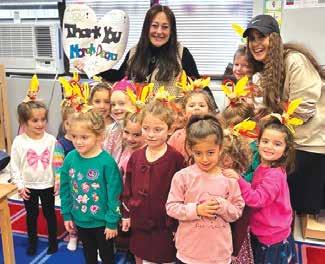
The Shulamith Women’s Organization (SWO) has been hard at work starting the school year off with meaningful, joyful, and impactful experiences for the Shulamith community! This year began with a hands-on Backto-School Carnival that delighted both students and parents. The event featured exciting activity stations, inflatables, delicious snacks, and upbeat music that filled the air with energy and excitement as students returned for a new school year.
Soon after, the SWO hosted an inspiring evening for mothers featuring Judge Ruchie Frier. In her powerful remarks, Judge Frier encouraged women to pursue their dreams, lead with purpose, and engage in meaningful work—while always holding strong to their Yiddishkeit. Over 150 women attended the evening and left feeling uplifted and motivated.
Most recently, the SWO coordinated an unforgettable Challah Bake led by the beloved Shimi Adar. Grades 1-8, together with their mothers, joined in this uplifting experience. Mothers and daughters recited the bracha together, heard inspiring words from school administration,
Shulamith ECC took the opportunity to express our hakaras hatov to the special people at school
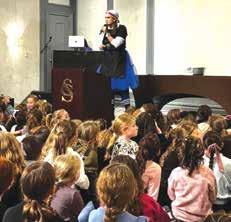
and celebrated with spirited dancing led by Shimi Adar. The sense of unity, joy, and ruchniyut filled the room, creating memories that will last long after the last song ended.
With such a successful start to the year, the SWO is already hard at work planning its next major event: the highly anticipated Father-Daughter Melaveh Malka. The Shulamith community looks forward to another exciting evening and can’t wait to see what else the SWO has in store.



Students at Lev Chana had a very special visit from Chief Holy Moly to get ready for Thanksgiving. The
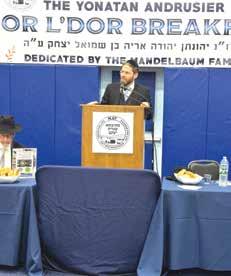
Mesivta Ateres Yaakov held its annual Yonatan Andrusier Dor L’Dor Breakfast last Thursday,


during which fathers and grandfathers joined their sons for an enjoyable morning of ruchniyus and gashmiyus at the Mesivta.


children also had a blast at their class Thanksgiving feasts!

Following morning seder for the bochurim, the program began with a beautifully arranged, lavish catered brunch in the Mesivta’s expansive gymnasium.
The Rosh HaYeshiva, Rabbi Mordechai Yaffe, opened the event by welcoming the fathers, grandfathers and talmidim, expressing heartfelt hakoras hatov and warm words of inspiration.
Representing the Mesivta student body, twelfth grader Yaakov Lauber delivered a sincere and thoughtful message about the growth he and his classmates have experienced in their learning, as well as the deep connections they share with their rabbeim. He concluded by expressing gratitude for the rabbeim’s constant warmth, care and guidance throughout his years at the Mesivta.
As in previous years, the program featured the Mesivta’s annual Fall Es-
say Contest, with excerpts read from the three first-place essays. Awards were presented by General Studies Principal, Rabbi Sam Rudansky, and Menahel, Rabbi Yossi Bennett.
The keynote address was delivered by Rabbi Motti Neuberger, Associate Rav of the White Shul, who spoke compellingly on the topic “The Secret Source of Happiness.” His divrei Torah and uplifting insights added a meaningful and inspiring dimension to the morning.
The event concluded with a lively raffle organized by the Student Government, featuring prizes including a gaming system, a restaurant package, MAY merchandise, and more—leaving several very happy winners.

Achiezer is proud to announce several major developments that will greatly enhance support and care for community members across the Five Towns, Far Rockaway, Queens, and beyond.

Achiezer Community Resource Center is proud to announce the opening of its seventh Hospital Respite Room, located in Long Island Jewish Valley Stream. This milestone achievement continues our mission of ensuring comfort, dignity, and support for families facing medical challenges. This newest respite room, created
in partnership with Northwell Health, reflects Achiezer’s ongoing commitment to standing at the side of our community during their most difficult moments.
“For more than a decade, Achiezer has identified gaps in community resources and worked tirelessly to fill them,” said Achiezer President Rabbi Boruch Ber Bender. “The need for quiet, comfortable, private spaces within hospitals—where families can regroup, rest, and recharge—has never been greater.”
New Wheelchair-Accessible Specialty Transport Vehicle
Filling yet another critical community need, Achiezer is excited to introduce a new wheelchair-accessible specialty vehicle. This resource is designed for urgent situations—whether assisting patients who cannot reach life-saving dialysis during storms, helping individuals travel from rehab or a hospital to attend a simcha, or ensuring someone can reach a levayah when other transport is unavailable. We extend sincere thanks to the generous community member who sponsored this essential vehicle, which is already becoming an important part of

the Achiezer fleet.
“This van is more than a vehicle,” said Rabbi Bender. “It’s dignity. It’s relief. It’s hope. And like everything we do, it was created because a member of our community cared enough to step forward and make it possible.”

After several years of coordinated effort, Achiezer and Northwell Health are proud to announce a groundbreaking partnership: the hiring of the first-ever Jewish Community Liaison dedicated exclusively to our community.
Navid Hakimian, a seasoned and highly respected Hatzalah member and community activist from Great Neck, has served as a trusted resource to Achiezer and countless patients in both the Five Towns and Queens. His appointment marks a transformative step forward in the level of care and advocacy available to families within the hospital system.
Having a devoted liaison inside the hospital every single day—someone who
understands our community’s culture, sensitivities, and unique needs—will be an invaluable asset. Navid will be working closely with Rabbi Boruch Ber Bender, Elke Rubin, and members of Achiezer’s Hospital Support Team. Together, they will provide hands-on guidance to hospitalized community members and their families, assisting with difficult surgical decisions, Shabbos accommodations, care coordination, and so much more.
Achiezer is thrilled to welcome Navid to this historic role and looks forward to the lasting impact this partnership will bring.
Together, these new initiatives underscore Achiezer’s ongoing mission: identifying unmet needs within the community and creating meaningful, practical solutions to support families during life’s most challenging moments.
About Achiezer: Achiezer continues to be a central address for crisis intervention, medical advocacy, social services, and emergency support across our region. Whether through our respite rooms, mental-health support, volunteer programs, hospital liaisons, emergency coordination, or specialty services, our mission remains the same: to be there for every individual, every family, and every need—24 hours a day. For more information, visit achiezer.org or contact 516-791-4444.
The Village of Lawrence’s comprehensive paving project is nearing completion. At the initiative of Mayor Samuel Nahmias, voted on unanimously by the Board of Trustees and implemented successfully by Administrator Gerry Castro, the Village invested approximately $1 million in road repaving projects across the community. This marks the first time in many years that such a significant investment has been made in restoring and improving local roads.
The project includes the repaving of: Mistletoe Way, Margaret Avenue, Muriel Avenue, Copperbeech Lane (entire area), Sutton Place South (approx. 275 ft.), Waverly Place, and the parking lot of the Lawrence Train Station.
In addition, the Village extends its
gratitude to Nassau County for the fresh pavement and beautification of Rock Hall Road. The project was facilitated by an allotment in the budget facilitated by County Executive Bruce Blakeman and Presiding Leader Howard Kopel. These investments reflect the Village’s ongoing commitment to improving infrastructure and enhancing the quality of life for all residents.
Mayor Samuel Nahmias emphasized the importance of the investment: “We are committed to doing as much as we can every year to bring our roads back to the condition they should be in. This year’s $1 million repaving project represents a major step forward in that effort. I want to extend a big thank you to our team for their continued hard work and dedication.”

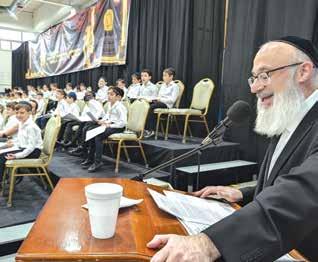

It was a beautiful and nachas-filled morning, as the third graders at Yeshiva Ketana of Long Island excitedly received their Mishnayos at our Haschalas Mishnayos Mesiba. Proud parents and grandparents looked on as the boys sang all the Masechtos of the Shisha Sedarim. Rabbi Elysha Sandler, rav of Kehillas Beis Yisrael, shared divrei bracha and presented each boy with his precious Mishnayos.


Shalom Task Force will gather the community on Sunday, December 7, at the Sephardic Temple in Cedarhurst for its Annual Brunch, a morning dedicated to connection, reflection, and strengthening the support systems that so many individuals in crisis rely upon. This year’s theme, “A Stronger Tomorrow Starts With Us,” captures the profound moments that defined the past year for us. Every day, people turn to us at times of darkness and fear. They are unsure what comes next, uncertain of what is possible, and questioning whether hope is still within reach. At Shalom Task Force, we know that hope is not about unrealistic promises or vague assurances that everything will be “fine.” Instead, our work is rooted in realistic hope
Through our Hotline and Legal Services, hope means helping a caller understand the options available to them, sometimes for the first time in years, and supporting them as they reclaim control over their own lives. Control and choice are often the very things that have been stripped away in abusive relationships. Restoring them is the foundation of hope survivors carry with them every day.
In our Education Department, hope means offering communities the tools to build relationships that are healthy,
supportive, and safe. Hope means equipping the next generation to recognize red flags, communicate with respect, and support another.
We are, at our core, in the business of fostering hope. Our honorees this year beautifully embody this vision of purposeful, realistic hope.
This year, Shalom Task Force is proud to honor Esther and Howard Kopel as Guests of Honor. Together, they have been steadfast partners of Shalom Task Force for many years, each contributing in ways that speak to their shared commitment to safety, dignity, and community strength. Howard, Presiding Officer of the Nassau County Legislature, has used his public platform to champion community safety and raise awareness about domestic abuse, while Esther has given her time and skills to support survivors of domestic abuse and advance STF’s programs. Their leadership reflects the very heart of this year’s theme: that a stronger tomorrow is built through meaningful action, compassionate presence, and a belief that change is possible.
We are also privileged to recognize Judge Esther “Micky” Morgenstern with the community impact award. Judge Morgenstern’s nearly four decades of public service have transformed the landscape of domestic violence intervention in New
York. As one of the founders and longtime presiding judge of the Kings County Integrated Domestic Violence Court, she helped to pioneer the “one family, one judge” model, ensuring that criminal, family, and matrimonial matters involving intimate partner violence could be handled with coordination, sensitivity, and deep understanding. Her best practices now guide domestic violence responses in all 62 counties across the state. A former President of the Brooklyn Women’s Bar Association and recipient of numerous legal and leadership awards, Judge Morgenstern embodies what it means to build hope systemically, not by offering platitudes, but by reshaping the structures that protect survivors.
Finally, Shalom Task Force is thrilled to present the Young Leadership Award to Hili Zubli, Eve Gelberg, Molly Feldschreiber, and Sofia Asher, who served as the Purple Fellows for North Shore Hebrew Academy High School during the 2024–2025 school year. Their leadership, teamwork, and creativity resulted in an extraordinary Go Purple Day campaign that raised significant funds and brought meaningful educational programming to their peers. Their impact was so strong that, for the first time, all four students were invited to join the STF Young Leadership Board, where they
continue to serve as passionate ambassadors for healthy relationships and positive change. Their dedication reminds us that hope is not only something we offer; it is something the next generation is already learning to carry forward.
As we come together for this year’s brunch, we do so with the shared understanding that a stronger tomorrow truly starts with us. We look forward to gathering with our friends, partners, and supporters on December 7th as we honor those who embody this mission and continue our work to ensure safety, respect, and healing for all who turn to Shalom Task Force.
Shalom Task Force’s Annual Brunch will be held on December 7, 2025, at the Sephardic Temple in Cedarhurst, NY. Walkins welcome! To learn more or register, please visit shalomtaskforce.org/ brunch.
Shalom Task Force has been offering support and education to the Jewish community for the last 32 years. If you or your loved one has questions or concerns about relationships, or are currently in an unhealthy or abusive relationship, we are here for you. Please call, text, or WhatsApp the confidential Shalom Task Force Hotline at 888-883-2323 or chat with a live advocate at shalomtaskforce.org.





By Alex Radinsky
On November 19 in Hewlett, the Jewish Orthodox Women’s Medical Association (JOWMA) and the SKA Pre-Heath Club hosted “Beneath the Surface: A Live Ultrasound Session,” a fun, educational event for students on how ultrasound technology works and what the inside of our bodies looks like. The event was hosted at Stella K. Abraham High School for Girls.
Dr. Chava Blivaiss is a general surgeon. She focuses on trauma and acute care. She often uses ultrasound technology in her profession. Her main use of ultrasound is to identify a problem efficiently. Ultrasound allows us to see deep inside the body in great detail.
Dr. Blivaiss explained her profession and how the ultrasound works. She demonstrated the ultrasound on herself. She used two different probes, the abdominal and cardiac. She first used the abdominal probe and showed us her liver, kidney, bladder, and uterus. Then, she switched to the cardiac probe, where she showed us her veins, arteries, and lungs. While showing us the ultrasounds, she also explained how to change the setting to get the desired image. Not only did she just show us the organs, but she also showed examples of what she encounters daily. She showed us what a collapsed lung would look like and how it differed from a normal lung.
After she presented, Dr. Blivaiss allowed the students to do their own ultrasounds on themselves and their peers. They got to see their own veins, as well as others. In addition, we practiced with the stethoscope to listen to other people’s heartbeats. All who participated in the event found the activity very interesting and intriguing.
SKA is proud to showcase our involvement in JOWMA, a meaningful collaboration that will bring valuable health education and empowerment to our students and community. We extend our heartfelt thanks to Dr. Glen and Mrs. Reva Hirsch for generously sponsoring this initiative in memory of Reva’s parents, Lea and Leon Eisenberg, A”H. Their dedication to fostering knowledge and well-being is a lasting tribute, and we are deeply grateful for their support in making this partnership possible.
The next SKA × JOWMA event will take place on Tuesday, December 7, featuring an exciting lineup of medical professionals and medical students who will help bring the world of healthcare to life. Students will have the opportunity to participate in hands-on experiences including a phlebotomy workshop, anatomy interactive boards, surgical-skills stations, a laparoscopic simulator, and intubation simulations. This unique program promises an engaging and immersive exploration of the medical field for all participants.

Gesher had an amazing experience yesterday with the Small Wonder Puppet Show! The children loved learning all about the Chanukah story and how the Maccabim were victorious over the Yevanim. The show brought the story to life in such a fun and engaging way, and the students were captivated from start to finish.
heartfelt thank you to Mr. Goldfarb, grandfather of Ezra and Gavriel Btesh, for generously sponsoring this wonderful program.
We would like to extend a warm and
By Monet Binder, Esq.
As the year comes to a close, many of us feel inspired to give back, whether to causes that shaped our lives or to communities that supported us. Including charitable giving in your estate plan is a meaningful way to extend that generosity beyond your lifetime, while also offering potential tax benefits for you and your loved ones.
Simple Ways to Give Direct Gifts or Bequests: You can leave money or belongings to a charity in your will or trust, or give during your lifetime. In 2025, you can gift up to $19,000 per person or organization without reporting it.
Qualified Charitable Distributions (QCDs): If you’re over 70½, you can donate up to $108,000 of your retirement account’s Required Minimum Distribution (RMD) directly to charity. This can lower taxable income and support causes you care about.
Donor Advised Funds (DAFs): A DAF works like a charitable investment account. You contribute now and recommend grants over time and you can name loved ones to continue your giving in the years to come.
Charitable Trusts or Family
Foundations: For larger estates, these tools offer more control, potential tax savings, and opportunities for multi-generational involvement in charitable decision making.
Making Your Giving Count: A bit of planning goes a long way. Think about whether you’d like to give now or later, choose charities that align with your values, and consider inviting family into the conversation so they understand and can carry on your approach to giving
Creating Your Plan: As your Personal Lawyer, I can help you choose the right giving strategies, maximise tax benefits, and document everything clearly, so your generosity continues to make an impact for years to come.
If you’d like help crafting your charitable giving plan, I’m here whenever you’re ready.
Consult a professional who has your best interests in mind, not someone who only focuses on after death documents.
At the Yeshiva University High School for Girls (Central), identifying and nurturing student leadership isn’t just a value. It’s a mission. One of the most exciting ways this mission is coming to life is through the YUHS Leadership Track, an initiative developed in close collaboration with YUHSG’s parent school, Yeshiva University. Now in its third year, the Leadership Track has become a deeply impactful, hands-on program that provides YUHSG seniors with leadership potential the opportunity to work directly with leadership experts, scholars, and individuals making a difference in their communities.
The initiative is guided collaboratively by YU’s Program Director for Leadership Scholars (and former Central Assistant Principal) Mrs. Aliza Abrams Konig, Rabbi Mordechai Schiffman, from the Azrieli School, and Central’s current Associate Principal, Ms. Leah Moskovich, who oversees the program onsite at YUHSG. Unlike traditional leadership clubs, the Leadership Track is structured as a gen-
uine immersive experience. Participants have been chosen from across the school’s leadership landscape, including Senior Class Representatives, G.O. Presidents, and F.I.R.E. Fellows. The Track offers these seniors a tailored curriculum, student leadership training workshops, mentorship from YU Leadership Scholars, and time with guest speakers such as Dr. Erica Brown, Vice Provost for Values and Leadership at YU and founding director of the Sacks-Herenstein Center, and Rabbi Ari Rockoff, the David Mitzner Community Dean for Values and Leadership at YU. Each member of the cohort will also check in annually with a faculty advisor and participate in the annual Leadership Shabbaton. The result of these experiences: a program that feels bigger than high school.
“The leadership track is an amazing example of Central’s connection to Yeshiva University,” said Leadership Track member, senior Ellie Gross. “I’ve gotten to be a part of leadership training that enhances my ability to create and run programming with my school.” Senior Noa Shuval agrees: “As part of Central’s Lead-
Estate Planning is also about what happens while you’re still living. Learn the best way to protect yourself and your family while you’re still living and after you’re gone and keep everyone out of court and conflict.
Call Today 718.514.7575 | 732.333.1854. Monet Binder, Esq., has a practice in Lakewood, Queens, and Brooklyn areas, dedicated to protecting families, their legacies and values. All halachic documents are approved by the Bais Havaad Halacha Center in Lakewood, under the direction of Rabbi Dovid Grossman and the guidance of Harav Shmuel Kaminetsky, shlita, as well as other leading halachic authorities.

ership Track, I have gained insight on how to make moments meaningful when leading activities, and will apply that insight to future Central Programming,” she said.
As the program continues to grow, one thing remains clear: the Leadership Track is more than a resume booster. It is a true partnership between YUHSG and YU, one that prepares young women to lead with vision and compassion.
Meanwhile, the Wildcat class of 2029 is already making its presence felt on campus. On the evening of Saturday, November 22, the annual Freshman Panoply Event took place at YUHSG. “Our Freshmen Panoply Event was a smashing success,” said Freshman Grade Dean and
Judaic Studies faculty member Mrs. Karen Lavner. “Freshman students and parents had the opportunity to spend time together, meet other parents, and experience firsthand the warmth and fun of being part of the Central family. The positive energy in the room was palpable.”
The night began with a welcome message from Mrs. Lavner and a Dvar Torah from freshman Dana Lazarus. As always, games, prizes, and class-wide bonding defined the night. YUHSG would like to thank Mrs. Lavner, as well as the Director of Student Activities and Judaic Studies faculty member, Mrs. Sydney Yaros, who designed the night’s interactive, fastpaced Panoply game.



Mrs. Suleymanov’s second grade students at Yeshiva Darchei Torah learned about and built weathervanes in the Yeshiva’s CIJE Science Laboratory

On Thanksgiving morning, MTA talmidim filled Beis Medrashim across the tri-state area with the sound of learning. There was no break for our talmidim, only a powerful reminder of what it means to love Torah and to be part of a true yeshiva community.
In Bergen County, Rav Aryeh Lebowitz gave a shiur for MTA talmidim, alumni, and the broader community. In West Hempstead, the energy was just as strong, with talmidim joining Rav Konigsberg for a high-level, engaging learning program that set a spiritual tone for the day.
Monsey hosted a vibrant crowd with Rav Kerner, who guided an uplifting morning and helped talmidim connect deeply. In Queens, Rav Schnall wel-
comed a full room of motivated students eager to begin the morning with learning. And in Brooklyn, Rav Brownstein led a dynamic program where talmidim enjoyed a warm, welcoming environment and a powerful morning of Torah. Each location began with breakfast and a chance for the talmidim to connect before opening their sefarim. The atmosphere in every community was the same: excitement, commitment, and pride in being part of something bigger.
For MTA, Thanksgiving morning was not about taking a day off. It was about showing up. It was about choosing Torah. It was about being connected across communities. It was about demonstrating what it truly means to be #Lion4Life.


By Yaakov Shwekey & Yisroel Besser
Kiddush on the Entire World
When I first started to sing professionally, I needed guidance.
While there were opportunities available during the week, being ready and willing to go away for Shabbos opened up a more lucrative avenue of parnassah. There were simchos, conventions, and events held over weekends, and I was not sure what was the proper course of action for me.
My wife and I went to speak with R’ Shmuel Kamenetsky, who was gracious and welcoming. Shabbos, he told us, is a time to connect with your children and a day on which you can tend to your own growth, a day on which a family becomes whole.
The Rosh Yeshivah was very clear with his directions: Shabbos at home should not be for sale, regardless of the amount of money being offered.
We followed his advice, of course, even though it also meant turning down
Sunday or Thursday bookings in locations too far for same-day travel, and we never regretted it.
The Rosh Yeshivah did tell us that if we felt we needed to make an occasional exception, like once a year, that would be okay.
One such exception was a Shabbos we spent with the children and families of the Special Children’s Center on a memorable trip to Eretz Yisrael. The trip involved intense planning and there were logistical challenges at every step, but it got done. We spent Shabbos at a hotel in Teveriah, our whole group eating the seudah together outdoors. It had been an exhausting, exhilarating week, and Shabbos brought a sense of peace and calm with it.
I lifted the kos to make Kiddush, filled with gratitude for the week that was and hope for the days ahead. I recited Kiddush louder than usual, since we were being motzi all the children and their families as well, and I noticed that some of the other hotel guests, not part of our group, had come closer so that they could hear as well.
There was one family seated nearby. They did not appear to be religious, but I could see that the mother’s eyes were filled with tears as we said Kiddush.
I approached their table, and the mother confirmed that, though she had never experienced Shabbos, she felt her neshamah trembling as we sang.
Once the seudah started, we started to sing zemiros, and again, I noticed that the members of that family appeared to be transfixed. It was a special encounter, but I soon forgot about it.
Several years later, I met a young man in Eretz Yisrael, and he introduced himself. He was the child of that family, and he remembered that Shabbos in Teveriah well. It had inspired him to learn more about where he came from, and the inheritance — Kiddush! — that belonged to him as well.
This is not a story about the power of my Kiddush, but a story about the power of Kiddush. As we climb out of the six days of the week and into the exalted realm called Shabbos, a Yid proclaims that the heavens, the earth, and all the creatures

within them have a Creator, and there is a purpose to creation.
He is a witness, an eid, at that moment, and all of creation is listening!
Let us make Kiddush on the entire world; every Yid has this power, during these moments, to lift up the world and the people within it!
Reprinted from The Music of Shabbos by Yaakov Shwekey & Yisroel Besser, with permission from the copyright holder, ArtScroll Mesorah Publications.



By A Single Wishing to Remain Anonymous

It can be a thankless job.
Even as a single person writing this, I’ve redt many shidduchim myself — and baruch Hashem, even made an actual shidduch! Having been on both sides, I see how utterly frustrating it can be to try to set people up.
You have feelings. You’re sincerely trying to help someone who needs your chessed. And yet, the person you’re helping may come across as ungrateful, disinterested, or even rude. Singles should definitely make a greater effort to appreciate your work and respond with derech eretz. There’s no excuse for rudeness.
That said, having stood on both sides of the shidduch process, here’s my perspective:
Shadchanim need to be the “bigger ones.”
Yes, singles should be polite and grateful, recognizing the time, thought, and care you invest in trying to make a match. But please remember — the single is the one who is in pain.
You may think you’re helping when you offer “unsolicited advice” or try to “set a single straight.” But that isn’t the shadchan’s role. If you find that part of the process difficult, it might simply not be for you. It takes a thick skin and a deep sense of compassion to do this kind of chessed properly.
Personally, I strive to work on myself — my middos, my connection to Hashem — despite the deep challenge of singlehood. No one would describe me as having “bad middos.” Yet when a shadchan comes on too strong, it can be triggering. As much as I try to stay calm and composed, sometimes I need to assert myself and set boundaries. That self-advocacy can easily be misunderstood as rudeness, pickiness, or ungratefulness — but often, it’s simply a single trying to protect their emotional space.
It’s a fine line. There’s still no excuse for disrespect, but when a shadchan questions a single’s judgment or challenges their decision to decline a suggestion, it can create a deeply un -
comfortable situation. The single knows you mean well — but when they feel cornered, they’re forced to “defend themselves” while trying not to “offend” you.
So, to keep it simple:
Please, put aside ego and pride. Don’t be pushy. Don’t make it uncomfortable for the single. Remember — Hashem is the True Shadchan.
Your job is to facilitate, to do the chessed, to play your role in building Klal Yisrael’s future. The single you’re helping is often already filled with doubt, insecurity, and pain — doing their best to stay hopeful and dignified through this test.
Practically speaking: if a single considers your suggestion but decides to decline, please avoid comments like:
• “Are you sure you’re being open enough?”
• “OK, suit yourself.”
• “It’s your call.”
• “I thought you wanted to get married?”
These words sting more than you
might realize.
Part of this chessed isn’t just making the match — it’s being kind and supportive throughout the process. Don’t let your beautiful chessed turn hurtful. The other side is already in pain; don’t pour salt on the wound.
On behalf of singles everywhere, I want to apologize if we’ve ever caused you frustration or hurt while you were trying to help. We truly wish things were different — that we weren’t dependent on others’ kindness in this area. Please don’t make us feel that dependence even more deeply.
Let’s all strive to approach this process with extra sensitivity. Right now, what most singles need isn’t pressure or critique — it’s a little more understanding, a little more compassion, and a lot more heart.
Thank you for your efforts, your care, and your partnership with Hashem in helping to build Jewish homes. May you continue to have hatzlachah and siyata dishmaya in this holy work.


1. Which U.S. president was on the last penny minted on November 12, 2025?
a. Abraham Lincoln
b. Donald Trump
c. George Washington
d. Teddy Roosevelt
2. When was the first U.S. penny produced?
a. 1793
b. 1805
c. 1812
d. 1864
3. In 2023, a rare penny (1958 Doubled Die Obverse cent) broke the record for the most expensive penny every purchased. How much did it sell for?
a. $1,203
b. $9,465
c. $733,876
d. $1,136,250
4. What metal are modern pennies primarily made of?
a. Copper
b. Tin

c. Aluminum
d. Zinc with copper plating

5. How much did it cost the U.S. Mint to make ONE penny, as of its final day of production on November 12, 2025?
a. 1.1 cents
b. 2.5 cents
c. 3.69 cents
d. 5.2 cents
6. What design has appeared on the back of the penny since 2010?
a. The Lincoln Memorial b. Wheat stalks
c. The Capitol Building d. The Union Shield
7. In 2015, Otha Anders from Louisianna, who had been collecting pennies for 45 years, cashed in his 15 fivegallon waters containers full of pennies. How much money did he have?
a. 79,000 pennies, totaling $790
b. 152,400 pennies, totaling $1,524.00
c. 334,295 pennies, totaling $3,342.95
d. 513,600 pennies, totaling $5,136
Answers: 1-A 2-A 3-D 4-D 5-C 6-D 7-D
Wisdom key:
6-7 correct: You are a penny expert. I’m sure you are one of those people that would prefer a penny doubled every day for a month, correct? Of course, you know what I’m talking about!
2-5 correct: You are as mediocre as a penny abandoned in a cup holder since 2009.
0-1 correct: You are not penny wise but are certainly pound foolish!
Penny has five children. The name of Penny’s first child is January. The second is called February. Penny’s third child answers to the name March. The fourth one’s name is April. What is the name of Penny’s fifth child.

Answer: Penny’s child is named What.
With the penny going the way of the dinosaur, it’s time to replace those penny clichés
“A penny for your thoughts.” >>>>>>> “Please share your thoughts — I promise not to judge…out loud.”
“In for a penny, in for a pound.” >>>>> “I started cleaning one drawer and now I’m elbows-deep alphabetizing the spice rack like it’s a cooking show TV set.”
“Penny-pincher.” >>>>>>>>>>>>>>>> “Extreme coupon vigilante.”


“Take a penny, leave a penny.” >>>>>> “Take a charger, promise you’ll return it… but I know to say my last goodbyes because you ain’t ever brining that charger back.”
“Every penny counts.” >>>>>>>>>>>>> “Every reward point counts — even the ones that expire faster than a container of milk left in the trunk in July.”
“Not worth a red cent.” >>>>>>>>>>>> “Not worth a stress wrinkle.”
“Put in your two cents.” >>>>>>>>>>>> “Drop your unsolicited dissertation into the chat like you’re defending a PhD.”
“Cost a pretty penny.” >>>>>>>>>>>>> “Cost so much that my bank app asked if I was emotionally stable before approving it.”
“Not worth a red cent.” >>>>>>>>>>>> “Not worth the fingerprint smudge it’ll put on my screen.”
“Turns up like a bad penny.” >>>>>>>> “Shows up like the ‘update your password’ screen that refuses to go away.”
“A penny saved is a penny earned.” >> “I saved $4 today, which should totally cancel out the lifetime of financial mistakes haunting me.”
“Not one penny more.” >>>>>>>>>>>> “I refuse to invest another dime, tear, neuron, or shred of dignity into this disaster.”
“Turned on a penny” >>>>>>>>>>>>>> “Turned as quick as I do when the waiter brings the food to the table near me and I want to check out what they ordered.”
Buddy and his buddy Jimbo were at the county fair and decided to check out the helicopter rides. When the pilot told them it was $50, they said that was way too much for them.
Being a nice guy, the pilot said, “Folks, I’ll make you a deal. I’ll take the both of you for a ride. If you can stay quiet for the entire ride and don’t say a word, I won’t charge you a penny! But if you say one word it’s fifty dollars.”
Buddy and Jimbo agreed and up they went.

The pilot did all kinds of fancy moves, but not a word was heard. He did his daredevil tricks over and over again, but still not a word...
When they landed, the pilot turned to Buddy and said, “By golly, I did everything I could to get you to yell out, but you didn’t. I’m impressed!”
Buddy replied, “Well, to tell you the truth, I almost said something when Jimbo fell out, but you know, fifty bucks is fifty bucks!”



By Rabbi Berel Wein z”l
In this week’s parsha, our father Yaakov, fresh from his successful escape from Lavan, prepares to encounter his brother and sworn enemy, Eisav. He sends malachim to deal with Eisav before he meets with him face to face. The word malachim signifies two different meanings. One is that it means agents, messengers, human beings who were sent on a particular mission to do Yaakov’s bidding. The other meaning is that
the word malachim signifies angels, supernatural messengers of G-d who were sent to Yaakov to help him in his fateful encounter with his brother.
Rashi cites both possible interpretations in his commentary. When Rashi does so, he is teaching us that both interpretations are correct at differing levels of understanding the verse involved. The message here is that the encounter with Eisav, to be successful from Yaakov’s van-


tage point and situation, must have both human and supernatural help.
Eisav is a formidable foe, physically, militarily, culturally and intellectually speaking. He cannot be ignored nor wished away. He has accompanied us from the time of Yaakov till this very day. At times, he threatens our very existence, and at times, he appears to have a more benevolent attitude towards us. Yet, he is always there, hovering over and around us, and he has never relinquished any of his demands upon us to either convert, assimilate or just plain disappear. While it is Yishmael that currently occupies the bulk of our attention, it would be foolish
weapons, the sword and war.
Two of these strategies – gifts to Eisav and war against Eisav – require human endeavor, talent and sacrifice. They are the representative of the interpretation of malachim as being human agents and messengers. The third strategy, prayer and reliance upon heavenly intervention to thwart Eisav’s evil designs, follows the idea that Yaakov’s malachim were heavenly, supernatural creatures.
In the long history of our encounter with Eisav, we have always relied upon both interpretations of malachim. Neither interpretation by itself will suffice to defeat Eisav. Without human endeavor
While it is Yishmael that currently occupies the bulk of our attention, it would be foolish of us to ignore the continuing presence of Eisav in our world and affairs.
of us to ignore the continuing presence of Eisav in our world and affairs.
Yaakov’s strategy is to employ both possibilities of malachim in his defense. He prepares himself for soothing Eisav by gifts and wealth, pointing out to Eisav that it is beneficial to him to have Yaakov around and being productive He also strengthens himself spiritually in prayer and in appealing to G-d to deliver him from Eisav. And finally, as a last resort, he is prepared to fight Eisav with his own
and sacrifice, heavenly aid is often denied or diminished.
According to the labor is the reward. But it is foolish to believe that a small and beleaguered people can by itself weather all storms and defeat Eisav’s intentions solely by its own efforts. Without the L-rd to help, we attempt in vain to build our national home. Thus, the double meaning of malachim in this week’s parsha has great relevance to our situation.
Shabbat shalom.


By Rav Moshe Weinberger
Adapted for publication by Dvora Margolis

It is quoted in many sources including Reishis Chochmoh, Kitzur Hasheloh, and Sefer Eliyahu Rabbah , as well as in the poskim , that when a person leaves this world after 120 years, he will be asked a series of questions, the most important of which is “What is your name?” The seforim say that righteous people will remember their names, while evildoers will forget them. If a person is unable to answer this question, angels of destruction will seize him and bring him to a world of chaos (tohu) where he will suffer intense disorientation. A person’s name defines his essence and the root of his soul, his purpose in this world and what he is expected to accomplish.
The Shla Hakadosh offers a segulah to remember one’s name when asked this all-important question. He recommends that before stepping back three steps at the end of Shemoneh Esrei, a person should recite a pasuk that corresponds to his name. Many siddurim contain lists of these verses in alphabetical order by name, so that the first and last letters of the pasuk correspond with the first and last letters of the person’s name. The Shla
is telling us that by delving into these verses in a deep and meaningful way, a person will come to understand the root of his identity and what he should be focusing on in his life. The Shla and others, such as R’ Menachem Mendel Vitebsker zy”a (Parshas Vayigash) and the Meor Enayim (Parshas Vayakhel), explain that the question “What is your name?” is not a simple test of memory, but rather, an inquiry as to whether a person has accomplished and fulfilled his life’s purpose which is hinted at and embedded in his name.
The pasuk says (Bereishis 32:25), “And Yaakov was left alone, and a man wrestled with him until the break of dawn.” (There is a popular song that contains these words. Fortunately, we still have music that enables us to at least know some pesukim by heart!) Yaakov Avinu had forgotten some small jugs and gone back across the river alone to retrieve them. He was then confronted by “a man” whom we are told was the angel of Eisav, an otherworldly power who fought with him until daybreak. This epic battle had tremendous repercussions regarding our future exile and redemption.
The Gemara (Chullin 91a) describes how this battle caused a tremendous commotion in the world and that the particles of dust generated by it rose up to the heavenly throne. Bereishis Rabbah (77:1) states, “Just as it says about Hashem, ‘The L-rd alone shall be exalted on that day’ (Yeshayahu 2:11), so too does it say about Yaakov, ‘And Yaakov remained alone.’”
The commentaries are extremely disturbed by this comparison. Hashem is unique in His Oneness. Even though we may refer to Yaakov as a great person, how dare we compare a human being to Hashem Who is unknowable and alone in His Essence?
Rav Yeruchem Levovitz, zt”l, offers a beautiful explanation that is very relevant to a test many of us face in today’s turbulent times. Hashem, for whatever reason, decided to create the world and to surround Himself with a multitude of holy angels, who often function as messengers to carry out His commands. But despite being surrounded by throngs of angels, it is obvious to any believing person that Hashem is still the One and Only. So too, l’havdil, Yaakov Avinu was an extremely
busy person, surrounded by the two camps of his large family. He had many possessions and was deeply engaged in the task of “And you shall gain strength westward and eastward and northward and southward” (Bereishis 28:14). He had many appointments and people to see. Yet, despite all of this, the Torah tells us that he was utterly alone. Yaakov states, “For with my staff I have crossed this Jordan” (ibid. 32:10). The word for staff in Hebrew, makel, is a derivative of three words: “Mei’olam kivinu lach,” meaning, “Forever, in You (Hashem) I place my hope.” He was on one side of the river, and everyone else was on the other side. The Hebrew term for river is nachal, a derivative of “Nafsheinu chiksah l’Hashem, Our souls pine for G-d” and “L’hadlik ner Chanukah, To light a Chanukah candle.” Although Yaakov was surrounded by a multitude of family, friends, acquaintances, and students, at the end of the day he was still alone. His essence was unknown even to those closest to him. There was a “Holy of Holies,” an inner sanctum within himself that no one was allowed to enter. The pasuk says, “Yaakov became very frightened and was distressed, so he divided the peo -

ple who were with him…into two camps” (ibid. 32:8). What did Yaakov Avinu fear most? He wanted to make sure that although his strength, time and energy were dispersed and divided, he should never forget his name, his essence, his self.
This is one of the main tests we face today. When our soul was created in Heaven, a part of it crossed over into this world. It is so easy to forget our soul’s source and true identity. In today’s busy world, a person could be learning Torah and doing mitzvos and still forget his essence, his name.
When Hashem created man, he created him as an individual. He did not come into the world together with a family, a community, a town or a village. These things only form later. But the original existence of man, which is woven into the structure of each and every one of us, is not a dual structure. We were not created with an iPhone, a computer, a chat group, or a network of acquaintances, friends, or even a wife. The Torah clearly emphasizes that man came into existence alone. After his initial creation, we see the division begin. This is similar to what the pssuk states regarding Yaakov, “And now I have become two camps.” Marriage was the beginning of Adam’s division, the way Hashem wanted it to be.
Within each person there are two distinct forces. The first is the power of connection, the natural tendency and drive for a social being to live in a world among others. We desperately long for companionship, marriage, family, friends, and community. We need to develop connections and to network with others.
A second, deeper force exists in a person prior to the drive for connection, the need to be alone. The need to understand one’s essence and identity is accompanied by a fear that we may forget our individuality due to the distraction of others.
As children, we are dominated by the need to be connected. We are totally dependent on friends and will ingratiate ourselves to others. A classic example of this might be: “I’ll be your best friend if you give me some of your potato chips.” As teenagers, we are trying to decide who our real friends are, and we yearn for the affirmation and approval of others. As we mature and marry, marriage represents a deep essential connection, in which our spouse becomes our closest friend, and the need for other friends diminishes in significance. But another level of maturity that Hashem desires from us is the ability to be alone. A person must first reach a level of “And Yaakov was left alone” where he comes to understand his true essence. Only then can he form a true connection
with Hashem as is stated, “And Hashem alone will be exalted on that day.”
Hashem does not want us to be alone by abandoning our family or friends. He wants us to achieve a healthy balance between being alone and connecting with others. There were a few exceptional tzaddikim who actually lived alone, but most did not. One notable exception was the Vilna Gaon, who spent all week alone and only was with other people on Shabbos.
Today, it is too easy to forget the wonderful world of self, of being alone. It is one of the greatest tests of our generation. The
cause you have commanding power with [an angel of] G-d and with men, and you have prevailed.’”
The Gemara distinguishes between our patriarchs Avraham and Yaakov. When Avraham’s name was changed from Avram, we are no longer allowed to refer to him by his former name. In contrast, even after Yaakov’s name is changed to Yisroel he is still sometimes referred to as Yaakov. Why?
Perhaps we can explain this in the following manner. The name Yisroel refers to a powerful person who is in control in relation to others. This name represents the
He wanted to make sure that although his strength, time and energy were dispersed and divided, he should never forget his name, his essence, his self.
prophet says, “Hashem was not found in the wind… Hashem was not found in an earthquake…Hashem was not found in fire” (Melachim I 19:11-12). Rather, Hashem is found in a “still, small voice.” I believe that this refers to the power of being alone, still and quiet. The kumzitz and the comradery and brotherhood and are holy and wonderful tools when it comes to serving Hashem, but they are not the end purpose. We were not meant to be stuck in chat rooms, even when using them for holy purposes!
The Midrash (Shemos Rabbah 20:29) says, “When Hashem gave the Torah, a bird did not chirp, fowl did not fly, bulls did not make sounds, Ofanim angels did not fly, Seraphim angels did not say, ‘Holy, Holy,’ the oceans stood still, no creation spoke, the world was utterly silent and a voice proclaimed, ‘I am the Hashem, your G-d.’” The only way the Torah was originally received was in silence and solitude, and this is the only way we are able to receive it today.
“And a man wrestled with him.” This battle between Yaakov and the angel of Esav is the life battle we all face of trying to maintain our selves, our essence, while living a life with others. There are tempting and even seductive forces trying to pull us away from being alone, causing us to forget our names, our essence, and our entire life’s purpose.
Now we can understand why the angel of Eisav asked Yaakov (Bereishis 32:28, 29), “‘What is your name?’ And he said, ‘Yaakov.’ And he said, ‘Your name shall no longer be called ‘Yaakov,’ but ‘Yisroel,’ be -
power of connection. It is the name with which the world knows a person. However, the name Yaakov was his original name, his essential name, and represents the ability to be alone. The angel of Eisav wants nothing more than for us to forget our essential name! He wants to push us away from living in our own thoughts and towards constant merging with others. He wants us to be so busy with others that we neglect the vital work of self-reflection and the power of solitude. This is hinted to in the words, “Your name shall no longer be called Yaakov.” The angel of Eisav wants us to forget that Adam was created alone, as an individual.
The pasuk in Shir HaShirim (1:6) states: “They made me a keeper of the vineyards, my own vineyard I did not keep.” We often become so busy with everyone and everything around us that we neglect our own “vineyards.” It is essential for a person to set aside time for himself, especially during the long winter Friday nights. In general, Shabbos is a time connected to this idea of the power of self, and Shabbos is also specifically associated with Yaakov Avinu, as we say in Kiddush (based on Yeshayahu 58:14), “And I will feed you with the heritage of Yaakov your father.” The angel fighting with Yaakov is the battle we face all week in our interactions, texting, phones, and email. It is essential for us to have time for “And Yaakov remained alone,” especially on Shabbos.
Yaakov Avinu asks the angel, “What is your name?” and the angel has no response.
An angel does not have this power of being alone. We, the Jewish nation, have this power as alluded to in the events of Chanukah. We had to locate a single jug of oil, untainted by others. The Chashmonaim won the battle of “the few against the many.” On Chanukah, one must have times set aside for himself, to put himself on one side of the river, while everyone else is on the other side, as our forefather Yaakov did. A story is told about the previous Lubavitcher Rebbe, Rabbi Yosef Yitzchak Schneerson, zy”a (1880-1950). He lived in Russia at the time of the Bolsheviks and the communists. At that time, it was illegal to teach any religion, and especially Judaism. Every time the communists made a decree against Judaism, the Rebbe would counter by opening more Jewish institutions, yeshivos, and mikva’os. At one point, the Rebbe was arrested and brought to a local jail. As they led him out to a wagon in chains to be brought to a big prison in Petersburg, the chassidim watched in horror and tears. They feared that they would never see him alive again. He looked up and, seeing his chassidim, stood up and screamed, “Yidden! These evil men are not the ones putting me in prison! They are not capable of putting any Jew in exile! Hashem sent us here and put our bodies into this exile, but the soul of a Jew is never in exile. Build more yeshivos! Build more mikva’os!” This is the power of one individual, the power of being alone. A person can change the whole world for the better, but first he must know his true self. Hashem called out to Yaakov as he is going into exile, “And Hashem said to Yisroel in visions of the night, and he said, ‘Yaakov, Yaakov!’” (Bereishis 35:10). Hashem repeated his name twice to emphasize to all Jews in exile never to forget our names, our essence. There is one part of a Jew that can never be violated by any person, just as the single jug of oil with the seal of the Kohein Gadol was left alone and unadulterated. This challenge is extremely difficult in our times because of the common desire to be in the company of others and never alone. But this is crucial, and if we don’t address this, Hashem will ask us, as He asked Adam, “Where are you?” (Bereishis 3:9). What has become of the essential you? May Hashem help us all to be Jews who remember our names, our true essence.
Rav Moshe Weinberger, shlita, is the founding Morah d’Asrah of Congreagation Aish Kodesh in Woodmere, NY, and serves as leader of the new mechina Emek HaMelech.

By Rabbi Avrohom Sebrow
Many people wear two pairs of tefillin — Rashi and Rabbeinu Tam. The question arises whether one may wear both pairs at the same time. The Shulchan Aruch rules that one may. However, this seems problematic: doesn’t this constitute baal toseif, adding to a mitzvah? Hashem commanded us to wear one pair of tefillin; by wearing two, isn’t one adding to the commandment?
This is unlike tzitzis, where any four-cornered garment one wears is obligated in tzitzis. A person could theoretically wear fifty such garments, each with tzitzis, without any concern of baal toseif. Indeed, Rav Scheinberg, zt”l, wore many garments with tzitzis. Married men wear both a tallis katan and a tallis gadol during Shacharis.
The Chofetz Chaim, in his Biur Halacha, explains that there is no violation of baal toseif when wearing both Rashi and Rabbeinu Tam tefillin, because one of the pairs is certainly invalid. The order of the parshiyos is essential (me’akeiv). According to Rabbeinu Tam, Rashi’s tefillin are invalid, and according to Rashi, Rabbeinu Tam’s tefillin are invalid. Therefore, one is effectively wearing only one valid pair of tefillin, not two.
Still, the Chofetz Chaim concedes that it may appear as if one is transgressing baal toseif. To address this, he explains that the Shulchan Aruch’s advice is for the person to stipulate: if Rabbeinu Tam’s tefillin are the kosher ones, he only intends to fulfill the mitzvah with those; and if Rashi’s are the kosher ones, he only intends to fulfill the mitzvah with those. Since he does not intend to fulfill the mitzvah with both pairs, it does not even fall under the rabbinic concern of looking like baal toseif
Interestingly, standard Rabbeinu Tam tefillin are not fully Rabbeinu Tam at all. There is more than one dispute between
Rashi and Rabbeinu Tam. The two pairs of tefillin generally address only the order of the parshiyos. However, there is another dispute regarding the orientation of the parshiyos: according to Rashi, they are placed vertically, while according to Rabbeinu Tam, they should be placed horizontally. In practice, most Rabbeinu Tam tefillin only change the order of the parshiyos but keep them vertical. They are therefore a hybrid of Rashi and Rabbeinu Tam. This is one of the arguments advanced by those who choose not to wear Rabbeinu Tam tefillin. In fact, to truly account for all permutations of opinions, one would theoretically need to wear at least 64 pairs of tefillin.
This dispute extends to mezuzah as well. Should a mezuzah be affixed vertically (Rashi) or horizontally (Rabbeinu Tam)? The common custom is to place it on an angle, which is often said to compromise between the two opinions. However, this is not so simple. The Steipler Gaon maintained that a 45-degree angle may not fulfill either opinion — as if there is no mezuzah at all. The Minchas Elazar disagreed and argued that the mezuzah should indeed be placed on a 45-degree angle to satisfy both views. The Steipler maintained that since the halacha follows Rashi, one should make it primarily vertical, with only a slight tilt. That way, Rashi is certainly fulfilled and Rabbeinu Tam potentially as well.
Seemingly, the simplest solution would be to install two mezuzos on each doorpost — one vertical and one horizontal. Mezuzah merchants would certainly welcome this! Indeed, the Birur Halacha suggests that this is comparable to wearing both Rashi and Rabbeinu Tam tefillin, since one mezuzah would certainly be invalid. However, the Mezuzos Melachim argues that it is not absolutely clear that Rashi would consider a horizontal mezuzah invalid. As a result, placing two mezuzos on one doorpost, one
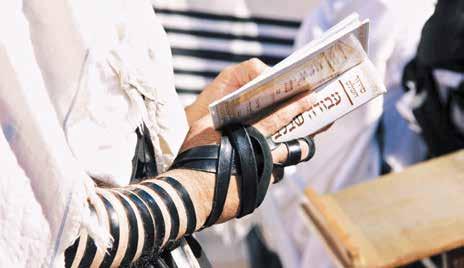
vertical and one horizontal, may indeed constitute baal toseif.
It is clear that placing two otherwise-valid mezuzos on one doorpost definitely poses a problem of baal toseif. But what if one is unsure whether the existing mezuzah is kosher — may he simply add a second one? Rav Moshe Feinstein ruled that he may not. The Minchas Elazar, however, reportedly rented a bungalow that already had a mezuzah and simply added a second one. The Shut Betzeil HaChochmah (4:165) explains that he knew that most, if not all, of the mezuzos in that establishment were invalid.
The Yad HaKetanah suggests a situation where one might have no choice but to affix two mezuzos on one doorpost. If the doorpost is straight for ten tefachim and then curves into an arch, the Rambam maintains that the mezuzah must be placed on the straight section, whereas Rashi holds that even the arched section is considered part of the doorpost. According to Rashi, the mezuzah would be placed at the bottom of the top third including the arch; according to the Rambam, at the bottom of the top third of the straight portion. To fulfill both opinions, one would have no choice but to affix two mezuzos. Still, this isn’t one hundred percent clear because it is possible that both mezuzos may be kosher according to Rashi.
Generally, a mezuzah is placed on the right side when entering a room. But what if two rooms are connected and it is unclear which direction is considered “entering”? In such a case, one might argue that a mezuzah should be placed on both doorposts. Since only one is actually required, the other would be meaningless. This is the ruling of the Binyan Tzion. The Ma-
haram Schick, however, rules that even in this situation, placing two mezuzos could still constitute baal toseif.
The Pischei Teshuvah (286:11) cites the Chamudei Daniel, who maintains that a storage room within a larger house requires a mezuzah even if it is smaller than sixteen square amos. According to this view, a walk-in closet or balcony would be obligated in mezuzah regardless of size, since it is considered a functional space.
Rebbi Akiva Eiger does not accept the Chamudei Daniel’s ruling. However, he suggests that a mezuzah may be required on the doorway of a walk-in closet specifically because that doorway is significant: it leads into a larger room.
The practical difference between the Chamudei Daniel and Rebbi Akiva Eiger lies in which side of the doorway receives the mezuzah. According to the Chamudei Daniel, it would be placed on the right side when entering the closet. According to Rebbi Akiva Eiger, it would be placed on the right side when entering the larger room from the closet. Whether one could place a mezuzah on both sides depends on the earlier debate between the Binyan Tzion and the Maharam Schick.
Rav Moshe’s opinion was that no mezuzah should be installed in such a situation, since the halacha does not follow either the Chamudei Daniel or Rebbi Akiva Eiger on this matter. The Chazon Ish, however, disagreed.
Rabbi Avrohom Sebrow is a rebbe at Yeshiva Ateres Shimon in Far Rockaway. In addition, Rabbi Sebrow leads a daf yomi chaburah at Eitz Chayim of Dogwood Park in West Hempstead, NY. He can be contacted at ASebrow@gmail.com.

By Rabbi Yair Hoffman

In the United States, there is a device known as a “Denver boot” after the city of Denver, Colorado, which was the first place in the country to employ them, mostly to force the payment of outstanding parking tickets. It is essentially a wheel clamp.
Some people erroneously think that one can utilize the services of a non-Jew to permit pretty much anything on Shabbos. This is actually not the case. The halachos are a bit more complex. There are instances in which it is permitted for a non-Jew to perform something that is Biblically forbidden for a Jew to perform on Shabbos, and there are times when it is permitted for a non-Jew to perform something that is forbidden by the Sages, but not by the Torah, for a Jew to perform on Shabbos; there are also instances in which we may not benefit from the services of a non-Jew on Shabbos at all.
The first thing that we need to know is that there are two separate prohibitions involved in having a non-Jew perform an act for us on Shabbos. The first prohibition is asking him or her to perform the
act; the second prohibition is in deriving benefit from the tangible results of the act performed.
Most of us have heard that one is not permitted to tell a gentile to do something for you on Shabbos but you can hint it to him. The problem is that neither part of that statement is altogether correct.
There are times when one can ask directly; on the other hand, even hinting is not permitted when we end up deriving benefit from the tangible results of the forbidden act. This means that if a non-Jew turns on a light for us, we cannot derive benefit from it, even if we merely hinted to him to do so, or even if he did it without any prompting at all!
If, however, the non-Jew shut off the light for us, we can derive benefit from the darkness. Why? Because there is no tangible item there; there is only the absence of something that existed before.
Think of it this way: a Denver boot clamped onto a car wheel is undeniably there —heavy, solid, physical. That’s tangibility. But when something is removed or shut off, there is no “Denver boot”; there is nothing to point to, nothing to grasp. We
are allowed to derive benefit from the absence of something but not from the tangible presence of the result of an act forbidden on Shabbos.
There are also three reasons cited in the Rishonim as to why the Sages forbade us from asking a gentile to perform work for us on Shabbos.
One reason is that we might come to treat Shabbos lightly. Another reason is based on a verse in the Navi that our very speech has to be different on Shabbos. A third explanation is that the Sages treated it as if the person performing the melachah, the forbidden act, were our direct messenger. We rule in accordance with all three of these reasons.
“Boro Park Challah Eez Best”
One way to remember when it is permitted to ask a non-Jew to perform an action which would be Biblically forbidden for a Jew to perform is to remember the following mnemonic: “Boro Park challah eez best” – BPCEB.
“B” stands for “bein ha’shemashos,”
twilight. The period after sundown and before the night stars become visible is known as bein ha’shemashos. When very necessary, it is permissible during this time to ask a gentile to perform a melachah which we are Biblically prohibited from performing ourselves. How long of a period is this? Rav Shlomo Miller, shlita, holds that it is for 30 minutes after sundown. Rav Sheinberg, shlita, holds that in a bind one can even rely on this up to 71 minutes after sundown. One should, of course, ask one’s rabbi as to which opinion to follow.
“P” stands for “p’sik reisha.” P’sik reisha refers to an ancillary consequence that will invariably happen as a result of an action. If the action itself is essentially permissible, but it would inevitably result in a melachah being performed, it is permitted to ask a non-Jew to perform the action. For example, if a Jew needs to access his refrigerator on Shabbos, but opening the refrigerator door would cause the light inside to turn on, he is forbidden from opening the door. The Mishnah Berurah rules, however, that asking a non-Jew to open the door—even though there is a p’sik reisha because the light will definitely turn on—is
permitted. The Mishnah Berurah permits this even regarding a Biblical prohibition. Thus, if one left an item in the car that is necessary for Shabbos, he may ask a gentile to retrieve it, even if the light will turn on.
“C” is for “choleh”—a sick person. If a person is bedridden from illness (or cannot present himself to appear healthy), it is permitted to ask a non-Jew to perform work for him. The illness does not have to be dangerous. It is interesting to note that all people are considered to be a choleh in regard to cold weather. Thus in New York, if one has inadvertently left the heat off, he may ask a gentile to turn it on.
“E” (with apologies to the spelling purists) stands for ”eiruv.” One may ask a nonJew to repair an eiruv on Shabbos because a broken eiruv may lead to widespread Shabbos violation.
Finally, “B” stands for ”b’ris.” The needs of a b’ris milah may be performed by a non-Jew. According to Ashkenazic tradition, this applies to all melachos; Sefardic custom, however, is to permit this only in the case of actions forbidden rabbinically, not Biblically.
Rabbinically Forbidden Melachah
Now we shall discuss the general ex-
ceptions to the rule regarding the performance by non-Jews of actions that Jews are rabbinically prohibited from performing. To remember these categories, the following mnemonic may be employed: “Her Majesty’s kallah tzedakah” – HMKT. “H” stands for “hefsed merubah,” a substantial monetary loss. Under these circumstances, one may ask a gentile to perform a rabbinic prohibition but not a
dividual. Clearly, a freezer full of meat is a large financial loss. A freezer with two pints of Tofutti and a take-home bag from last week’s chasunah would not be a substantial financial loss.
“M” is for “mitzvah.” For the needs of a mitzvah, we may ask a non-Jew to perform acts which we are not allowed to perform due to rabbinic decree. For example, if one forgot to purchase challah for
We are allowed to derive benefit from the absence of something but not from the tangible presence of the result of an act forbidden on Shabbos.
Biblical prohibition. According to most poskim, electricity is a rabbinic prohibition. Thus, if the freezer got unplugged, one may ask a gentile to plug it back in on Shabbos if the owner would otherwise incur a substantial financial loss. But how much is a substantial financial loss? This varies depending upon each in-

Shabbos lunch, one may ask a gentile to go to a supermarket and purchase a challah; purchasing on Shabbos is a rabbinic prohibition.
“K” represents “kavod ha’berios,” human dignity. One may ask a gentile to perform a rabbinically prohibited act on Shabbos if it is necessary for maintaining
human dignity. Examples of this are embarrassment, such as when one has ripped or soiled clothing. Thus, a gentile may be asked to violate what would normally be a Rabbinic prohibition in order to save someone from embarrassment.
And “T” stands for ”tzaar” to alleviate suffering, considerable pain, or even for Miktzas Choli, a slight illness. Dayan Weiss (Minchas Yitzchok Vol. III #23) gives an example: If it is extremely hot in the house or the shul, one may ask a nonJew to turn on the air conditioner, since there is suffering. (Turning on an air conditioner is a rabbinic prohibition according to most authorities.)
It is important that we learn the intricacies of what one may or may not ask a non-Jew to do for us on Shabbos. The author of the Lecha Dodi writes an important stanza in this regard: “Ki hi mekor ha’bracha, for she is the source of [all] blessing.”
Through the merit of our careful observance of the Shabbos, we shall receive incredible blessing.
This article should be viewed as a halachic discussion and not practical advice. The author can be reached at yairhoffman2@gmail.com.

You know it’s going to be a hard day when you wake up to an email reminder about a credit card payment for a card you never activated, and you buy six packs of giant water and seltzer bottles that are just so heavy in your granny cart that the weight of the cart almost trips you over as you are walking home. And, when you finally get down the hill of your block, hoping to have a drink when you slice open the plastic seal around the seltzer bottles using a knife, you accidentally poke a hole in the seltzer bottle resulting in a geyser that nearly blinds you.
Some days are just like that.
During Covid and the war in Gaza, Israeli farmers struggled to get their crops to market. To help alleviate some of the backbreaking and tedious work of planting and harvesting, hundreds of farmers posted a need for help. Local and international volunteers came en masse to support them.
Bob and I had volunteering on our bucket list. Apart from going to Pantry Packers with grandchildren and packaging produce at Tachlit, we never really found the opportunity to do the heavy lifting needed for farming; we thought that the work would be too hard on our aging bodies. When my friend Anne recently suggested picking pomegranates with her and her husband Shelly, I said OK.
I seem to do that a lot lately, and sometimes, it results in questionable outcomes.
I cleared my now-always purposefully packed schedule, put on my layman’s agricultural gear, and stood waiting and ready for my 8:00 a.m. pickup. It was a gorgeous, sunny and not-so-hot day. This pomegranate farmer had sent multiple postings for help; he needed to get his fruit to market before the rains came. It was Sunday, and market day is Tuesday.
After a few roadway twists and turns, we found the lovely, hidden-away-fromthe-main-road farm. We parked near a barn filled with local singing seminary girls, Asian workers, and a small, lovely, round woman, in flip-flops and a tichel,

By Barbara Deutsch

who was directing everyone.
The farmer had specified that the work included picking and packing. As we waited for his truck to take us to the fields, we learned how to build boxes – not as easy as you would think. Shelly is a superstar box builder. Anne is pretty good. I am not. For some dumb reason, I wore a still sparkling white t-shirt from Zara. The forelady did not want me to stain it and insisted that I wear her son’s grey army one.
Impatient to get started, we drove ourselves to the pomegranate fields where we joined another group of seminary girls and were introduced to Bon, the Asian field supervisor. There were rows and rows of pomegranate trees and big orange buckets lining the paths between the trees. Our job was to fill the buckets and yell, “Bon” when they were full.
Two problems: the majority of the trees were almost bare or filled with rotting fruit. This harvest was the third goround, and the best pomegranates were situated high above our heads. Bon also never showed up when called.
Not daunted, we began the work of locating, among the brambled paths (I had to throw out my prickly socks), the salvageable fruit. You needed strong muscle power to pull the now very ripe and heavy pomegranates off the trees. It’s not hard work if you are young, strong, and
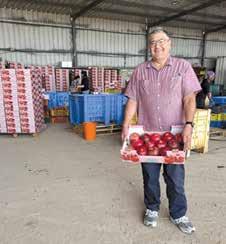
agile. You also need good knees for the long hours of standing.
Word to the wise: it gets pretty hot in the sun when you aren’t wearing a hat. If you are wearing sunscreen, that’s a plus.
Anne was the clear champion; Shelly and I did our best but soon began to lose interest (Shelly) and grow tired (both of us). We filled about 6 big buckets. For our efforts, we were rewarded with deliciously sweet pomegranates to eat and a box-load to take home.
Next time – yes, there will be a next time – we will go earlier during the more fun time of the harvest season. We are comforted by the fact that whatever the farmer is able to harvest from this last scraggly batch will be his profit. I believe the other harvests were more about his expenses in the running of his farm.
On our way home, we stopped to pay a shiva call to the Marcus family; they were sitting together at Yeshivat Reishit, a magnificent structure set in a breathtaking setting! The yeshiva is a living testament to the legacy that Rabbi Jay Marcus built for his family and Klal Yisroel I knew Rabbi Marcus from his leadership in building the Jewish community on Staten Island, founding the Genesis Project in America, being a leader of the Western Walls Program, the excavation of the Western Wall Tunnels, the City of David, and more.
I had the privilege of working with his son, Rabbi Chaim Marcus (he built the Springfield, New Jersey community), during my time as the Middle School Principal at the Joseph Kushner Hebrew Academy; we collaborated on many thorny issues together.
I also worked with his brother Rabbi Doni Marcus as a Machon camper in Camp Morasha; that is a whole different story which we laughed about during my visit. Funerals and shiva visits proliferate in Israel as more and more families choose to find their final resting place here. The opportunity to pay respects for a “meit” is easily available. I was able to pay my respects to a long-time Morasha colleague and friend, Rena Greenwald. Her dad, Hart Rottenstein, had the zechut to live a long and meaningful life; 80 direct descendants accompanied him to his final resting home. Rena lives in Toronto, and because her dad is buried in Israel, I was able to participate in the mitzvah.
Thanks to my patient financial gatekeeper daughter-in-law Tamar, the credit card issue got resolved for now. I didn’t break my hip pushing the granny cart. I was able to salvage the seltzer and to offer good drinks to my friend Anna Wruble when she dropped in to give me a reset in the afternoon.
My white shirt is in the wash, and given the hard water, I am confident that it will no longer be sparkling. The box filled with pomegranates are delicious and made for wonderful gifts to supportive friends. Life in Israel.
Barbara Deutsch is the former associate principal at HANC, middle school principal at Kushner, and Dean of Students at Yeshiva of Flatbush. A not-retired educator, she is trying to figure out life in Israel through reflections on navigating the dream of aliyah as a wife, mother, grandmother, great-grandmother and friend.



By Hershel Lieber
Over the years, we have taken short day trips or overnight trips to cities and towns in the tristate area. The purpose of those mini excursions was to break the monotony of daily life and add a spark of adventure to our existence. Yes, we were always overtly busy, whether with family obligations and joys, our respective occupations, kiruv work at our home or abroad, and involvement in community projects. This continuous and hectic pace necessitated occasional pauses to maintain our sanity, hence these short expeditions which we took two or three times a year.
We generally travelled within a travel distance of two to three hours from our home so that the driving should not become the straw that breaks the camel’s neck. Unless there was a kosher establishment, we took along our own food. I would prepare an itinerary by going through the AAA Travel guide books and with the help of internet sites. By having a definite plan, although we made occasional changes, we were assured that we would see the major attractions that were part of our plan.
A few years ago, I wrote about trips to Baltimore, Washington, D.C., Delaware, and Harrisburg, PA. Recently, I wrote about our journeys to the towns and cities along the Hudson River, and just two weeks ago I wrote about a visit to Trenton, NJ. This article will focus on cities and towns that we visited over the years in the Keystone State.

On Thursday, February 8, 1996, we drove to Doylestown. There were three major attractions that we were interested in seeing, and we managed to see them all in one day.

Mercer Museum is a treasure trove of handmade objects that were created and were being discarded in favor of machine made goods. Historian and archeologist Henry Mercer recognized the need to collect and
Fonthill Castle was the home of Henry Mercer, and it has 44 rooms, 200 windows, 18 fireplaces and 10 bathrooms.
preserve the old-fashioned implements of daily life that were being swept away by the Industrial Revolution. Mercer gathered over 30,000 items, ranging from hand tools to horse-drawn vehicles, and erected a six-floor

castle to house and display them to the public. Most artifacts are stored in either rooms, alcoves or niches, while the larger objects are in a central atrium. One can get lost for hours viewing and admiring the myriad of items that this museum stores.
Fonthill Castle was the home of Henry Mercer, and it has 44 rooms, 200 windows, 18 fireplaces and 10 bathrooms. The castle contains built-in furniture and is embellished with hand-crafted decorative tiles embedded in the concrete walls of the house. There are many artifacts that Mercer collected during his world-wide travels including Cuneiform tablets from Mesopotamia that are thousands of years old. There are over 1,000 prints and well over 6,000 books, almost all annotated by Mercer himself.
Moravian Pottery and Tile Works were also part of Henry Mercer’s legacy. Founded in 1898, the Tile Works specialized in handmade ceramic tiles incorporating medieval, Renaissance and Pennsylvania German designs. We were able to see the original furnaces, dyes and molds that produced these popular tiles, and the gift shop had a great sampling for sale.
All in all, we packed in three highly interesting sights into a single day and stayed overnight in New Hope before traveling back on Friday morning.
York, PA
Another overnight trip that we took was in early November of 2015. Our destination was York, PA, where we arrived at 11 AM. Our first excursion was a walking tour of York’s Colonial Complex along the Heritage Trail. York is known for its rich history going back to 1741 during the Colonial era. The city was the site of the signing of the Articles of Confederation while serving as the temporary home for the Continental Congress between 1777-1778, when it was the capital of the United States. It became an important industrial center


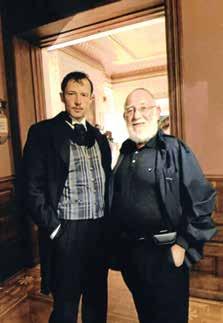
after the Civil War with the manufacturing of steam engines, railroads and paper being the most prominent products.

The weather was a perfect fall day, and the autumn foliage was at the height of its season. We toured colonial homes and strolled in the parks along the Susquehanna River. Our next stop was an outing to Harley Davidson where we posed for photos on motorcycles. This was followed by a visit to the National Clock
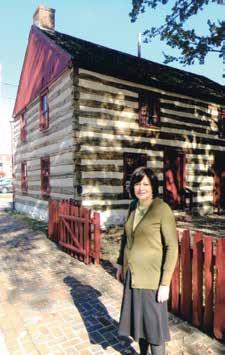
Museum with its collection of clocks in every shape and form from all the corners of the Earth. In the evening, we drove to Lebanon, PA, where we participated in a reading and reenacting of the works of Edgar Allen Poe in a dark speakeasy. It was a spooky experience but quite engaging.
The next day, we drove to Harrisburg where we toured the State Capitol Building and visited the State Museum. We returned to York in the early afternoon and created our own walking tour along the lively streets of downtown. With a wide combination of historical and commercial sights, we kept ourselves interested and entertained. We decided to sleep over another night and headed back the next morning to Lakewood to spend Shabbos with our children.
Jim Thorpe, PA
We took a one-day trip to Jim Thorpe just recently. I had heard of that town only a bit before and was intrigued by its unusual name. When I started reading about it, I realized that it would make a great destination for a mini trip. So, in April of 2024, we drove 100 miles to see

the town that is described as “a mix of history, art and recreation.” The town’s present name is in honor of a Native American athlete who is buried there. The town features well-preserved Victorian mansions and buildings, many of which house shops, restaurants and inns.
We arrived just in time for the seventy-minute Lehigh Gorge Scenic Railway ride through the mountains. The vintage nearly one hundred-year-old coaches are comfortable with large windows to enjoy the local scenery. Returning, we walked up Broadway, passing unique shops and inns. We arrived to the Old Jail in time for a one-hour tour, which was highly educational and interesting. We saw the cells, the mess hall, the solitary confinement dungeon, and the notorious gallows which were actually used. We then headed back to a meeting point where we

met our guide who took us for an hour walking tour. By the time we finished, we had a comprehensive understanding of the town’s colorful history. The only major sites we did not get to see were the Asa Packer Mansion and the Harry Packer Mansion.
Maybe next time.
Hershel Lieber has been involved in kiruv activities for over 30 years. As a founding member of the Vaad L’Hatzolas Nidchei Yisroel he has traveled with his wife, Pesi, to the Soviet Union during the harsh years of the Communist regimes to advance Yiddishkeit. He has spearheaded a yeshiva in the city of Kishinev that had 12 successful years with many students making Torah their way of life. In Poland, he lectured in the summers at the Ronald S. Lauder Foundation camp for nearly 30 years. He still travels to Warsaw every year – since 1979 – to be the chazzan for Rosh Hashana and Yom Kippur for the Jews there. Together with Pesi, he organized and led trips to Europe on behalf of Gateways and Aish Hatorah for college students finding their paths to Jewish identity. His passion for travel has taken them to many interesting places and afforded them unique experiences. Their open home gave them opportunities to meet and develop relationships with a variety of people. Hershel’s column will appear in The Jewish Home on a bi-weekly basis.



By Eliyahu RosEnBERg
In 2019, shortly after Rabbi Yitzchak Berkovits succeeded Rav Noach Weinberg, zt”l, as Aish HaTorah’s rosh yeshiva, the organization adopted an ambitious 10-year vision.
“Rabbi Berkovits, like Rav Noach, felt that the greatest chillul Hashem is that the majority of Jews in the world have no relationship with the Al-mighty,” Rabbi Steven Burg, CEO of Aish World Center, shares. “We need to fix that. And the way to fix it is through Torah — through Jewish wisdom, through Jewish values.”
Education is incredibly important — we know this as Jews. Torah is everything for us, but it has to be Torah plus spirituality.
What was so amazing about Rav noach — and this is what drew me to a ish — was that the al-mighty was real to him. a nd people would come in, and his first thing would be, ‘ you know, the al-mighty loves you’ — g-d loves you no matter what.
Rav noach would say that the first letter of the hebrew alphabet is an aleph. a nd he would tell us all the time, ‘When you learn aleph, you need to go teach aleph.’ guys would show up in a ish with no background, they’d be there for a couple of weeks, and he’d say, ‘oK, now it’s your turn to teach a class.’ so, if you have a background, don’t have a background, you’re orthodox, you’re not orthodox — it doesn’t matter. Jewish wisdom speaks to everyone. so, number one is that you should study more Jewish wisdom. But more importantly, you should share it with someone else.
According to studies conducted a few years ago, around 72% of Jews in North America are completely and utterly disconnected from Judaism: their Jewish identities play no role in their lives, neither religiously nor culturally. The remaining 28% includes Jews of all religious sects — Orthodox, Conservative, Reform, traditional — as well as secular Jews who have any sort of connection with Yiddishkeit.
It’s a frightening statistic, a tragic product of our long and bitter exile. Many non-religious Jews incorporate elements of Judaism in their lives: many are proud of their heritage, love Israel, and keep a few Jewish traditions. But the vast majority of American Jews sadly have no love or connection to Judaism; their Jewishness means absolutely nothing to them. And those are the people that Aish is trying hardest to inspire.
As Rabbi Burg explains, Aish’s mission isn’t to make people frum. It isn’t to convince secular Jews to keep Shabbos or kashrus — though that would no doubt be amazing. Rather, in Rabbi Burg’s words, “it’s all about Jewish wisdom for us.”
“And so, we set a 10-year goal,” he explains. “We called it AishVision2030: our goal is to get 3 million Jews who are not currently engaged in Torah study to study Torah by 2030. That’s it. That’s our goal.”
* * *
Rabbi Steven Burg’s passion for community service was born at age 19 the moment he walked into a NCSY Shabbaton. It was, in his words, “love at first sight.”
“I had never seen that kind of energy. I’d never seen that type of spirituality. I’d never seen a room erupt in emotion the way it did,” Rabbi Burg recalls. “I definitely was a product of the yeshiva system, which was wonderful. But I didn’t really leave the system with a real passion for Judaism. I went to Israel for two years, and I found a passion for Israel. I found a passion for Judaism. I found a passion for G-d. And I couldn’t understand: Why aren’t we helping kids get to this place? But when I walked into that Shabbaton, it was like I found the answer: This is something I wish I had known when I was 15, so let me figure out how to help others.”
Rabbi Burg’s passion for NCSY, an OU-run organization that inspires Jewish teenagers, soon evolved into a 22-year-long career. Nine years later, he became a regional director. And then, from there, he became the organization’s international director. In that role, he helped solidify NCSY’s place as an inspirational rather than educational institution.
“Education is incredibly important — we know this as Jews. Torah is everything for us, but it has to be Torah plus spirituality,” Rabbi Burg shares. “In NCSY, when I was there, we did a big
rebrand, and one of the things we did was rebrand our tagline to ‘Inspiring the Jewish Future.’ We basically made the decision that we were not an educational institution; we were an inspirational institution. That doesn’t mean we don’t have educational models; that doesn’t mean we don’t do education. But our ultimate goal isn’t education — it’s inspiration.”
From there, he served as the Orthodox Union’s managing director. Then, he joined the Simon Wiesenthal Center, a Jewish human rights organization named after a famous Holocaust survivor-turned Nazi hunter. And finally, in 2015, Rabbi Burg became the chief executive of Aish HaTorah, where he has served since.
He was appointed following the passing of Rav Noach Weinberg, the founder and beloved rosh yeshiva of Aish HaTorah. One of Rabbi Burg’s greatest tasks as CEO was to find Rav Weinberg’s successor. After spending four years guiding the organization toward financial stability, the best pick for Aish’s next rosh yeshiva was unanimous: Rabbi Yitzchak Berkovits.
At Aish, the rosh yeshiva invents the vision, and the CEO supervises its implementation. So, when Rabbi Bervokits launched Aish’s initiative to bring Torah learning to 3 million Jews by 2030, Rabbi Burg and his team immediately jumped into action to make that vision a reality. Since then, Aish has expanded its social media presence, spreading Torah all over the Internet and reaching Jews across the globe.
As Rabbi Burg explains, learning Jewish wisdom develops one’s relationship with G-d. Just by learning about Judaism, one builds the foundation for a life of Torah.
“What was so amazing about Rav Noach — and this is what drew me to

Aish — was that the Al-mighty was real to him. And people would come in, and his first thing would be, ‘You know, the Al-mighty loves you’ — G-d loves you no matter what,” Rabbi Burg shares.
“Everything I do — the path I’ve chosen — is for G-d. And I wrestle in speaking with Him; tefillah, to me, is almost like an aside to the rest of the conversations I have with Him all day. He loves you so much, and He’s there for you. And so, we talk about spirituality, but it’s so much bigger than that. For me, without Him, I wouldn’t necessarily be doing this. I do what I do for Him.”
One of the most perplexing stories in the Torah, in Rabbi Burg’s mind, is G-d’s encounter with Moshe Rabbeinu after the sin of the Golden Calf. “Moshe basically fights with G-d. G-d wants to destroy the Jews, and Moshe has the audacity to basically fight with G-d on their behalf,” he explains. “Where did he get that from?
“So, I saw a beautiful explanation. What does G-d say to Moshe? He says, ‘Moshe, don’t fight with me, because I need to go do this.’ But wait a minute — Moshe didn’t say a word. Before Moshe says anything, G-d tells him not to argue,” Rabbi Burg shares.
Why did Hashem, out of the blue, tell Moshe not to fight Him? Moshe didn’t even have the chance to say a word. If G-d didn’t want any objections, there would’ve been no need to say that. If G-d didn’t want Moshe to fight for Klal Yisroel, it should’ve been case closed, end of discussion. Why did Hashem even mention the possibility of Moshe objecting?
“So, G-d was basically winking at him, saying, ‘You can get them out of trouble if you want.’And that is really Who G-d is. You know, G-d is basically there, waiting for us to step up,” Rabbi Burg adds. “Even though we get a lot thrown at us, there’s always a way out, and there’s always a way for us to become stronger. And that’s how
we build ourselves.” *
It’s easy to appreciate Aish HaTorah’s vision, admire its audacity, and understand why it’s necessary. But it’s harder to grasp the following: Where do we, as individuals, fit into Aish’s plan? What can we do to help the organization’s dream become a reality? As Rabbi Burg says, it all comes down to spreading Jewish wisdom.
“Rav Noach would say that the first letter of the Hebrew alphabet is an Aleph. And he would tell us all the time, ‘When you learn Aleph, you need to go teach Aleph.’ Guys would show up in Aish with no background, they’d be there for a couple of weeks, and he’d say, ‘OK, now it’s your turn to teach a class,’” Rabbi Steven Burg recounts. “So, if you have a background, don’t have a background, you’re Orthodox, you’re not Orthodox — it doesn’t matter. Jewish wisdom speaks to everyone. So, number one is that you
should study more Jewish wisdom. But more importantly, you should share it with someone else.”
Very often, people shy away from teaching. Some are too humble, insisting that they aren’t qualified to teach. Others are too shy. But everyone has at least some knowledge to offer — some insight, a bit of Jewish wisdom to share with the world. As Rav Noach Weinberg taught, you don’t need to be a rabbi or an expert to spread Torah. Even if you know just one letter of the Aleph Beis, one pasuk, one word — go and teach it to someone.
“We all know fellow Jews we could share it with, or even non-Jews: Jewish wisdom is there for the world; we’re a light unto the nations. It’s there to be used, it’s there to be expressed,” Rabbi Burg concludes. “So, what we want people to do is just share Jewish wisdom. Study Jewish wisdom, but don’t be bashful.
“Share it with other people.”
Share it with the world.
This article is based on a podcast, “Inspiration For the Nation,” hosted by Yaakov Langer. To catch more of this conversation, you can watch it on LivingLchaim.com or YouTube.com/LivingLchaim or listen wherever you listen to podcasts (just search for “Inspiration For The Nation”) or call our free hotline: 605-477-2100

Moderated by Jennifer Mann, LCSW of The Navidaters

Thanks for the column. I love reading it. I was wondering if you could please answer this as soon as possible.
I am 35 years old, and I very rarely get set up on any dates... The very few men I do get set up with are not even close to being a decent match for me. I am saddened that it is becoming more and more likely that I may never find my bashert and have a family.
There is a single man with whom I work with who I have developed a friendship with. He is now expressing that he would like to progress the friendship into us dating each other. I think he is an amazing guy, and we really get along very well. His personality is exactly what I have been seeking in a potential spouse. The thing is, he is really not as religious as I am. Do you think I should date him?
I would like to think that this question may get very different responses from each of you. What do you think?
Esther*

Dear Readers,
We want to offer YOU an opportunity to be part of the discussion! Please email us at MichelleMondShadchan@gmail.com, subject line “reader’s response,” if you would like to participate in the new “A Reader’s Response” columnist spot. We will send you a question and publish your answer in an upcoming Navidaters edition.
If you have a question you would like the Navidaters to answer, please reach out to this email as well.
Looking forward!
Michelle, the “Shadchan”
Rebbetzin Faigie Horowitz, M.S.
Iam concerned about the depth of your despair more than anything. Your feelings are so strong that you it’s hard for the logic of short-term and long-term ramifications of dating someone who is not so religious to penetrate. You need support and understanding for yourself more than anything else.
A professional therapist who is frum will understand your bleak outlook now about the prospects of getting married and help you deal with your emotional and practical situation.
Michelle Mond
First and foremost, I am so sorry for what you are going through. I would like to tell you that I have seen this type of scenario work out before, but first I will explain the context.
Since you left out your own religious level, it might be safe to say you are on a similar level to this man however you aim to have a home that is more religious once you settle down. I have seen many singles in this category. In the case of a woman who considers herself shomer Shabbos and kashrus for the
purpose of dating however does not fully hold herself to these standards and is very much Modern Orthodox in practice, such a scenario can work. I understand that ideally even if someone is not on that level herself, she may want that for her future.
However, one must be realistic about where she is holding currently when looking for a future spouse. Most importantly, who, in that category, is going to want to go out with her, if she herself has a certain reputation. In a case such as this, you can go out with this guy and see if the two of you can respect and grow together. If, however, you are completely religious both in mind and in practice and this man is leaning the other way, please ask yourself how you will respect him long term.
If he is interested in dating you, ask him questions about his religious level. Does he see himself growing and becoming more religious? Maybe he is. If not, you will have to make this decision with full knowledge that he may never change. Is this the lifestyle you want?
Only you can answer that.
Hatzlacha!
The Zaidy
Dr. Jeffrey Galler
values you were raised with.
This is an extremely important question and is very relevant to many of our young singles. Should you date someone, or consider marrying someone, who is less religious than you?
The problem with formulating a cogent answer to this question is exactly what does “less religious” actually mean? If it means wearing a kippah instead of a black hat, that may sound okay; if it means keeping kosher at home but eating at non-kosher restaurants when outside of the home, that does not sound okay.
We all position ourselves differently on our religious spectrum. What may seem like being unacceptably less religious to one person might still seem like being an ultra-religious fanatic to another person.
So, how should you approach this? Here is one possible method.
Many couples sign prenuptial agreements about financial matters. You probably do not need a written agreement about observance, but you should have some serious discussions about how to handle religious practices in your married life.
Specifically, you might wish to tell him that certain elements are non-negotiable for you. For example, full Shabbos observance, keeping a strictly kosher home, following taharas hamishpacha, and giving your future children a yeshiva education are iron-clad requirements.
Of course, no short column can list every detail that deserves discussion. So let me offer a guideline that shaped my own approach to life.
Years ago, I taught dental students, lectured at continuing education courses, and served as Chairman of the New York State Dental Council on Peer Review and Quality Assurance. I often told students and colleagues: “A dental procedure does not necessarily have to be absolutely perfect in order to be acceptable. However, we must be very, very careful to never, ever convince ourselves that something is acceptable when it is clearly not acceptable.”
I have applied that mindset to many areas of life. You can apply it here, too.
Never persuade yourself that a violation of your core values is “not so bad.”
Know your essentials. Know your compromises. And never persuade yourself that a violation of your core values is “not so bad.”
Isaiah Cox The Curmudgeon
Dear Esther,
All relationships are hard to build and preserve. Every married person “settles” in some way. If you have found an imperfect guy, then you have something in common with every married woman in the world.
Nevertheless, as you well know, Shabbos and kashrut are not minor problems. Let me share with you how my own parents addressed this challenge:
My mother was raised in a profoundly Jewish – and entirely anti-religious –home. In this respect, she was not atypical for enlightened Jews from Poland after the War. She spoke perfect Yiddish but never learned to daven.
My father, on the other hand, is a deeply spiritual and committed Jew. When he married my mother, he told her that he understood that she did not believe in practicing Judaism, but he needed her to honor his wishes and keep an observant home, complete with Shabbos and kashrus – and never tell the kids of her reservations. Though I am sure it was not a harmonious It was not until I was in my 20s that I realized that my mother, left to her own devices, would not have been observant at all. But we kids were never aware of
this. All we knew was that our mother was more skeptically-minded than our father – which was in any case true about every subject under the sun.
In the end, my mother’s observance grew and deepened much later in life. But even if it had not, the fact that she loved my father enough to agree to his
terms was a real lesson in what it means to be willing to invest into a relationship. They raised four frum children to adulthood.
If I were in your shoes, I would take a similar approach. Every relationship takes effort, investment, and
Dating and Relationship Coaches and Therapists
Dear Esther,
First, I want to acknowledge the ache beneath your letter. It’s real. The waiting, the hoping, the disappointments, the setups that feel random or mismatched… it’s exhausting. And when a kind, emotionally safe, aligned person finally appears in your orbit, of course your heart pays attention. We’re human. We’re wired for connection. And you deserve love.
This is not a “simple halachic question.”
This is a values, lifestyle, emotional compatibility, and long-term vision question.
So I want to offer you a few gentle frameworks to help you get clarity, not just a yes or no.
1. Chemistry and emotional safety matter.
You’re describing someone who treats you well, who feels familiar and kind, who sees you, and who has the personality traits you’ve been praying for. That is not something to dismiss lightly.
Many women write in with the opposite problem:
“He’s frum, but we don’t connect.”
“He checks the boxes, but I feel nothing.”
“He’s perfect on paper but not present.”
Connec - tion is not something you can manufacture, so the fact that this man has the emotional qualities you desire is significant.
But emotional safety alone isn’t the whole picture.
2. Shared values and daily life matter, too.
The question you are really presenting is this:
Can you build a peaceful, aligned home with someone whose practices may differ from yours?
Let’s look at the practical reality:
• What would Shabbos look like in your home?
• Will there be resentment if you take on all the kosher labor alone?
• Will you feel alone in your spiritual life?
• Will your children be confused?
• Will you admire him long-term or will this become a wedge?
• Does he respect your observance?
• Does he value Judaism even if he practices differently?
These are not theoretical. They are daily reality.
Only you know the answers.
soul-searching. Marriage is hard work for everyone, even if everything is aligned.
If you love each other, you can make this work.
May you be blessed to build a bayis ne’eman B’Yisroel.
Making the decision from fear (“I may never find someone”) will never lead you where you want to go.
3. Halacha cannot be ignored — but neither can emotional truth. A marriage doesn’t succeed because two people keep the same mitzvos. A marriage succeeds because two people walk through life with shared respect, shared meaning, shared integrity, shared devotion, and a shared willingness to grow.
There are frum marriages with no love.
There are less-frum marriages that thrive.
There are frum marriages that flourish beautifully.
The key is not the label.
The key is alignment.
4. The real question is this: Would dating him mean abandoning a core part of yourself?
Or
Would dating him mean expanding your life in a way that still honors who you are?
Only you can feel that in your bones. If being fully religious is central to your identity — if it’s how you find meaning, purpose, grounding, and self — then dating someone who might not join you may feel lonely and misaligned longterm.
If your connection to Judaism is strong but flexible, and if his values (kindness, integrity, warmth, responsibility) matter more to you than his level of observance, then there’s room to explore — slowly, mindfully, with honesty.
5. Here’s what I know for sure:
You deserve someone who chooses you wholeheartedly.
You deserve to build a home where you feel safe and connected.
You deserve a partner who respects your faith even if he isn’t in the same place.
You deserve a future family built on love, stability, and authenticity.
This man may be part of that future. Or he may not.
But making the decision from fear (“I may never find someone”) will never lead you where you want to go.
Make your decision from hope, not panic.
From alignment, not pressure.
From your deepest truth, not your loneliness.
My advice?
Get curious. Talk to him.
Ask him where he sees himself religiously in the future — not as a test, but as a conversation.
See how he responds to your world, your practices, your values.
See if he respects your frumkeit even if he is not on your level.
The answers will guide you.
Sincerely, Jennifer

By Mordechai Schmutter
If someone you know is in the hospital, chas v’shalom, you should definitely go visit them.
It’s definitely a good time to visit people, because most of the time in life, you visit people and they don’t have time to chat. But in the hospital, they’re bored. The doctors said they should stay away from stress, except for the stress of missing work and the stress of being in the hospital.
Yes, your first instinct might be to let them have their privacy. But I have to tell you, when you’re in the hospital, privacy goes out the window. You’re being accosted by strangers who, less than a minute after introducing themselves, immediately start poking and prodding and putting you in a gown that is more about easy access than it is about covering anything up and then constantly leaving the door of your room open. You can buzz them back to your room and ask them to close the door, and they will, but then they’ll open it again on the way out for easy access.
Yes, you might be afraid that the conversation will be awkward. “What will I say?” But it will definitely be less awkward than your conversation afterward if you don’t come. Also, they’ll be so happy that you’re there that sometimes they will just lead the conversation. If not them, then definitely their spouse who has been sleeping curled up in the corner and pretending the armchair is comfortable.
“Can we offer you something to eat? Do you like crackers and ginger ale?”
But here are some tips to get through this stressful time. Because it’s not like you can unload on the person you’re visiting:
- In order to get into the hospital, you have to go through a strict security screening wherein they ask you to name one patient in their hospital, and if you get it right, they let you in.
- The hospital has a rule about how many visitors are allowed in the room

at once, and they keep track at the front desk. You cannot get them to relax their rule by bringing your own folding chairs or by assuring them that you’ll just borrow a chair from the chessed room.
- Nor should you get around the rule by memorizing the name of the always-sleeping patient in the room next to your patient and giving that name to the front desk.
- They might tell you that too many visitors is too much excitement for the patient. But that’s ridiculous. They can’t have the same number for every patient. How is that possible? This is the number, they figured out. Four. Also, some visitors are more exciting than others. They don’t know you. “I’m very low-key,” you can tell them. “I’m not so exciting.”
- That said, if someone gets suspicious and comes by to check, some of you will have to hide in the bathroom. That is definitely not too much excitement for the patient.
- You might feel weird about showing up empty-handed. What kind of guest are you? Maybe a nice bottle of wine, or a candy dish… So you ask beforehand, “Can we bring you guys some food?” And they say, “No, we have enough food.” And the
patient can’t eat anyway except for the medically-approved 4-oz. portion of apple juice. So some people bring flowers that the patient will have to keep watering and then carefully schlep home with all two weeks of their stuff. Or they can leave it in their neighbor’s room as a thank you and an apology for leaving that guy’s family stranded at the front desk.
- Or you can bring balloons, which say something like, “Get well soon,” instead of “Get well immediately.” Soon is good enough. Immediately is too stressful for the patients.
- If you bring your own balloons from home, see if the hospital has an oxygen tank you can use to fill it. Check the neighbor’s room.
- Allow yourself time to figure out how to park. There’s a garage, but it’s never clear if you’re going to have to pay to use the garage, and the hospital doesn’t like if you ask if things cost money. They’ll just send you a bill in two weeks.
- On your way toward the patient’s room, don’t stare at all the other patients lying in bed with their doors open, despite having to look at their doors to find the room number you’re looking for and their doors are open to the inside of their
rooms. Instead, keep your eyes down and wonder what that smell in the hallway is.
- That smell came with the hospital. The windows don’t open.
- Knock on the door before entering the correct room. Pretend it’s not already wide open.
- Don’t shake hands with the patient upon entering. Or do that hug thing with you picking them up and spinning around.
- Definitely don’t come up behind the patient, cover their eyes, and say, “Guess who?” (“Um… Dr. Johnson?”)
- It’s very hot in the hospital, because everyone’s wearing one-size-fits-all robes and also everyone is sick. See if your patient can spot you some ice chips, if he’s not contagious.
- Do not stare at any of the tubes or wires. Look at the patient’s face. If there are tubes in his face, find somewhere else to look. Or pretend you didn’t even notice. “Tubes?” you can say, if he brings it up. “What tubes?” Instead, look around and make comments about the features of the room. “Wow, look at all those places to plug stuff in!”
- No matter when you come, they nurses will choose the very next moment to do a procedure. And you’re going to have to find somewhere less awkward to look. Or go hang out in the hallway, with the smell.
- Or you can choose that moment to check out the bathroom the patient is not allowed to use. They’re stuck in bed. It’s the guest bathroom. Complete with a shower and a shower bench, in case there’s not enough seating in the room.
- You can also use that time to check out the chessed room. That’s something that every Jewish patient says these days: “You have to go check out the chessed room!” So you do. Look at the magazines in there and wonder if you can take any food. Is it also for people doing bikur cholim? It’s not like I had time to get lunch

today. Is there a donation box, at least?
- Don’t wake a sleeping patient. Instead, sit there staring at them until they wake up. If you need reading material, there are medical charts.
- Don’t give your own medical opinions, based on the charts.
QUESTIONS YOU SHOULD THINK ABOUT BEFORE ASKING:
“Wow! Have you lost weight?”
“This is the hospital you picked?”
“So what do all the tubes do? Are they uncomfortable?”
“What is that liquid? Is it coming out of you or going into you?”
“Can I play with your bed remote?”
“Can I borrow your socks? We’re going to the jumpy place after this.”
Also questions about the patient in the other bed.
ACCEPTABLE CONVERSATION TOPICS:
“So I read this article about inappropriate questions to ask…”
“So where did you guys park?”
“Who brought the balloons?”
“Have you smelled the hallway? What is that?”
“So is the food in the chessed room just for patients, or…?”
“Have you figured out the room for Shabbos yet?” Because as it turns out, absolutely everything in the hospital is muktzah, which is what happens when the designers want to make it largely a hands-free experience. So the patient
the trees with the window that doesn’t open. They’re trying to guess what’s doing outside by what you’re wearing coming in. (“Wait, are you wearing a gown?” “Yeah, I got it from the patient next door.”)
You’re being accosted by strangers who, less than a minute after introducing themselves, immediately start poking and prodding and putting you in a gown that is more about easy access than it is about covering anything up.
closes a door, and He opens a window.”
“Well, not this window.”
One article I read said to ask, “What was it like growing up in the 1930s?” Do not ask this unless the patient actually did grow up in the 1930s. And if you’re not sure, you can’t ask if they did. Also, if you know the patient from before today, they might be wondering why you’re just now asking them about the 1930s.
Another question that is acceptable to ask is: “I have no idea how to get out of here. I’ve been walking for five minutes, and apparently it’s all been one big looping hallway, so I’m back. I think you’re stuck with me. Is there an exit map on the back of the door?”
- Do not let the patient walk you out to your car.
might have to pick a bed position they can live with for the entire Shabbos or figure out how they’re going to hint to the nurse to adjust it in a way that implies it’s also to the nurse’s benefit to do so.
You can also talk about the weather. The weather is absolutely thrilling to these people. They can’t really see what the weather is from their room above
“Yeah, but what if it’s nice outside?” you ask. “They’re going to be upset that they’re not outside!”
Don’t worry about it. They’ve seen nice weather before. Do you think you should maybe lie: “No, it’s horrible outside,” and then they’ll be happy that they’re not outside?
“Oh. Well, B”H I’m in here. Hashem
- As you leave, don’t forget to assure them that everything was delicious. Especially if you had crackers or something. Like ginger ale.
Mordechai Schmutter is a freelance writer and a humor columnist for Hamodia and other magazines. He has also published eight books and does stand-up comedy. He can be contacted at mschmutter@gmail.com.


On a number of occasions, I’ve noted the irony that what I choose to read is often very different from what I write. While I predominantly write parenting articles and do take the time to read parenting and similar books, I usually choose fiction to relax with. There is a certain freedom fiction writers have of being able to explore issues of their choosing with characters they’ve created.
I was recently reading two books that both made me think about the challenges the main characters were facing. Like many readers, what seems obvious to me isn’t so clear to the story’s protagonist. After some time, I realized what it was that kept their conflict on my mind. As I questioned why the author made the character so uncertain despite what was clearly in front of her, it dawned on me how deeper the underlying issue was. This wasn’t simply an attempt to add more pages to a book but was reflecting the character’s unaddressed trust issues. Without an inherent ability to trust, the main character was fully incapable of recognizing care and concern, love, and stability.
The depth of this conflict weighed on
By Sara Rayvych, MSEd

my mind, which – in my brain – naturally turned towards its impact on parenting. After all, the characters’ trust issues developed in childhood, conditioned by early experiences. While the stories themselves were obviously fiction, the effect on the characters was all too real. It struck me how powerful parenting is – that we often don’t realize the many big ways we make an impact with small actions.
We assume so many things will naturally develop during childhood, such as trust, love and communication, yet they are not automatic. These seedlings naturally take root, but they need to be watered and tended to with parental input and guidance. Without the natural devotion of their caregivers, these seedlings could wither young. While possible to attain as an adult, it’s much harder to acquire these feelings when they’re not nurtured in childhood.
The Beauty of Childhood Childhood is the natural time to develop these core emotional skills. We started off as young and helpless, dependent on someone else for our every need. Starting off, we don’t even
understand who that person is who is taking care of us. We get fed when we’re hungry, rocked when we cry, and held throughout the day. We may not have appreciated those diaper changes, but they, too, were for our benefit.
Slowly, we learn to recognize those familiar faces, and turn to them when we’re in need. We may not know much about this confusing world, but we know those loving adults will fix what is bothering us.
It is these small but daily interactions that build an infant into a person. Each time an infant turns to us with a smile and sees one returned, they know they’re loved. Each drop of milk builds trust that they’re being taken care of. Every boo-boo that is kissed lets them know the world is a good place.
Childhood is when we are so vulnerable, and it’s when we inherently need protection and help from those around us. Our dependency on others is normal, and it’s fulfilling this need that teaches us about the world. As an adult – or even a teen – we can’t accept being dependent the same way, nor can we so fully accept that level of care from others. By then we expect a certain amount
of independence from ourselves, and we may not feel as comfortable with vulnerability.
The beautiful pattern of innocence and vulnerability, paired with parental love and devotion, is the guiding hand for a child’s emotional development.
Our job is simple yet challenging. It’s simple because parents instinctively love their children and want to take care of them. It’s challenging because it can be overwhelming and feel beyond our capabilities.
The smallest of people come with the greatest of needs. As parents of teens will testify, those needs still exist but are adjusted as they grow. Those many needs include physical and emotional ones, both crucial to their development. It’s our job as parents to be tuned into those needs and mindfully parent each unique child in their care.
Physical needs change as children grow. Newborns need sleep, food, and fresh diapers. Rinse, wash, repeat. Slightly older children will also need sleep and food, but their hygiene is different and they require more physical
activity. Teens need more sleep than they get and eat more than we anticipate. The needs may sound similar but vary in how they are carried out. Regardless of age, tending to their physical needs teaches children to trust. They know someone is thinking of them and taking care of them. Food, being a basic human need, is a good example. A newborn needs to be fed around the clock, while an older child feels loved coming home to a meal they know was made for them. Perhaps it means making sure they have snacks for school or the flavor doughnut they like for Chanukah. These all show, in different ways, “I love you, and I’m taking care of you. You can trust me; I’m here for you.”
People do not live by food (or sleep) alone, and a child’s emotional needs are no less important. Children of all ages need physical comfort, such as hugs and being held. Compliments are one way we convey to children how much we value them and how special they are. Our opinion of them matters more than we realize, and it’s damaging when children grow up hearing constant criticism. Children of all ages will experience a variety of emotions and confusing situations. When we take the time to listen
and validate them, we demonstrate that they and their feelings matter. Children need to hear that we love them and think highly of them. We assume they know how we feel about them, but we need to specify. “I love you!” “I think you’re amazing!” “I was impressed how you handled that.”
claimer, here it is. Parenting is intense and a full-time job. It’s hard to be oncall 26 hours a day, with no downtime or coffee breaks. We get frazzled. We get emotional. We get tired.
We love our sweet, precious charges, and they’re our biggest concerns. It’s only natural that we want to get it right
It is these small but daily interactions that build an infant into a person.
Each child has their own set of needs. What is beneficial for one child may be upsetting to another. This is one reason why there is no single parenting book (or article) that can fully cover the needs of all children. Mindfully evaluating each child’s needs will guide us in choosing the correct approach.
In case every article needs a dis -

and that we may be worried if we’ve made mistakes. Every parent makes mistakes – it’s inherent in creation that nobody can be perfect. Many loving parents may panic or get nervous thinking they’re not parenting perfectly. “But I didn’t hear her crying and now her face is all red from tears.” “He wasn’t feeling well, and I didn’t realize it until he developed a fever a few hours later.” Childhood is not meant to be perfect,
and children can grow up healthy and loved with imperfect parents. Look at how you’re overall providing for your child’s needs and not at each detail with a microscope.
Parents may struggle, but sometimes we’re not coping. During these times, parents should reach out for help. For some parents, that may mean more help around the house, while for others it will require professional intervention. It’s a sign of strength – not weakness –to know when help is needed.
The key is to recognize that when we do all these small, seemingly meaningless jobs, we’re building people and the futures of those we love. We should never take for granted the impact of our actions. Every act of love and devotion is one brick more in a child’s healthy development.
Sara Rayvych, MSEd, holds a master’s degree in general and special education. She has been homeschooling for over 15 years. Sara provides personalized parent mentoring services, addressing a variety of general and specific parenting concerns. She can be contacted at Sara.Rayvych@gmail.com with comments, questions or for private consultations.

By Etti Siegel
Q:Dear Etti,
My 6-year-old son has always been a regular little boy. He runs around, gets wild at times, annoys his older and younger sisters (of course!), asks a million questions, and loves to learn. He’s creative, constantly drawing, cutting, pasting, and inventing little projects around the house. His rebbi and teachers consistently tell me he’s a pleasure – well-behaved, curious, and doing nicely academically. In short, he’s a very well-rounded child.
But suddenly, he has developed a lot of fears. At bedtime, I have to remove anything in his room that looks “scary.” He asks me to check under the bed. If he hears sirens, he becomes visibly tense. He’s still the same child in every other way, but this burst of anxiety feels new and sudden. Should I be telling his teachers or rebbi about this? They haven’t said anything, but maybe something at school triggered it?
- Concerned Mother
A:Dear Concerned Mother, Although it is worrisome to you, what you’re describing is far more common than parents realize, and the good news is that it often represents a normal developmental phase, not a sign that something is wrong.
Around ages 5-7, children’s imaginations and cognitive abilities expand faster than their sense of emotional regulation. Research in child development shows that this is a time when children begin to understand danger in more realistic ways, yet they don’t yet have the emotional tools to manage those ideas calmly. So fears of shadows, noises, sirens, “what ifs,” and nighttime imaginings often appear suddenly and intensely.
In other words, his brain is doing exactly what a 6-year-old’s brain does.
You wondered if it could it be coming from school. Possibly, but not necessarily. There are a lot we expose our children to (think parsha, Purim, Pesach, and all the many exciting tales our children hear with the evil Poritz), but for most children it does not translate into fears. Also, teachers might not see the same anxieties you see at home because children often “hold it together” in structured settings and then release their worries in the safest place: home. That said, it’s still worth looping the teachers in, not because something is wrong at school, but because they may have helpful observa-

tions, they can keep an eye out for anything new, and it gives your child a consistent support system in both environments.
A quick, calm message, “Just sharing that he has been more anxious at bedtime and with certain noises lately; please let me know if you notice anything,” is perfectly appropriate. There might be a classmate sharing scary stories or another child with anxiety that your son is copying. While it is unlikely, it is possible and good to check out.
Around ages 5-7, children’s imaginations and cognitive abilities expand faster than their sense of emotional regulation.
At home, you’re already responding by helping him feel safe. Here are a few evidence-based strategies:
1. Normalize it
Kids this age often think they are the only ones afraid. You can say, “Lots of children your age have imaginations that get extra busy at night. Nothing is wrong with you.”
2. Don’t over-accommodate
Removing one or two scary items is fine, but don’t let the “checking” ritual grow. If checking under the bed becomes nightly, you’re teaching him that there might be something to fear. Instead, gently set limits: “I’ll check once, and that’s enough because you are safe.”
3. Add a coping skill
Deep breathing, squeezing a favorite stuffed animal, or singing “Hinei Lo Yanum” can be very grounding. In our home, when we used to put our children to sleep, we had a little ritual after Shema: we sang Hinei Lo Yanum V’lo Yishan, Shomer Yisroel three times. The first two times we would add, “Hashem never rests and nev-
er sleeps, He watches the Siegel family,” and we named each family member. The third time, we sang, “He watches the entire Jewish people.” It wrapped them in a sense of security and connection, and it might give your son that same feeling of being held and protected.
4. Keep routines predictable
Consistency at bedtime, morning time, and transitions helps anxious thoughts have less space.
Chazal remind us, “Da’agah b’lev ish yashchena,” if someone has worry in their heart, help them speak it out. You’re already doing this by listening and staying calm. You’re showing him that his feelings can be held, named, and managed, not avoided and not feared.
Most childhood fears fade within weeks as quietly as they arrived. But reach out for support if:
• fears grow instead of lessen
• he avoids school, playdates, or activities
• bedtime becomes a prolonged struggle
• the fears are interfering with daily functioning
From your letter, he sounds like a delightful, well-adjusted boy who is simply moving through a very normal stage of development, one that, with your calm presence, will likely pass soon.
Loop the teachers in, keep supporting him with warmth and structure, and trust that this phase is just that – a phase.
Hatzlacha, - Etti

By Malkie Bobker, LMHC
Picture the scene: it’s 5:00 in the afternoon, and the kids are home from a full day of school. You just walked into the door from work yourself, and you are rushing to get dinner on the table. One child yells a question about their homework from the other room, while another one is trying to get your attention so you can listen to and sign their Kriah sheet. “I’ll be there in a minute!” you shout back, while you tell your other child to start reading. He’s not even one word in when you see your toddler has started to color on the wall
– in marker! You speak to him sternly, and as you’re reaching for the cleaner and paper towels, your baby starts crying. You quickly take your baby out of the bouncer and get back to wiping the marker off the wall, while your toddler is crying because he thinks you’re angry at him. You start listening to the Kriah homework again, and then your oldest starts yelling that she is still waiting for you and she doesn’t understand her homework. You tell her to hold on for one more minute, but she gets very upset and cries that she asked for help


first and it’s not fair you’re dealing with everyone else before her. Feeling guilty, you start making your way over to help her with an impatient child who is also waiting for homework help, a cranky baby, and a crying toddler. You start answering her question when she just erupts into a fit of “I don’t understand this at all, this makes no sense, I’m not doing this anymore!” and she throws her paper and pencil across the room. Feeling incredibly overwhelmed, that’s when you finally lose it, and now everyone is crying – maybe even you.
Some version of this scene plays out in almost every household (including my own, by the way). Those hours between school and bedtime can be chaotic. We are overwhelmed and tired, and so are our children. As parents, we never intend to lose it on our kids, and we feel terribly guilty afterward, but sometimes it really just feels like it is all too much. While it is virtually impossible to eliminate meltdowns all together, there are ways to help manage and mitigate these situations, both for you and for your child/ren.
1. Perfection is NOT the Goal: One of the most difficult aspects of a situation like this is that we are striving for perfection in a wholly imperfect situation. We are trying to do too many things at the same time, and meet several sets of needs simultaneously, which is impossible. Oftentimes though, we struggle to accept this reality, and instead, we fight and push ourselves to the breaking point. Those overwhelmed
feelings that eventually cause us to lose it come from this tension between needing to fix everything and make it perfect all at once and with the reality that that is most likely not going to happen. However, if we can give ourselves the space to acknowledge that we simply cannot do it all, we will be far more able to address the situation at hand.
Not being able to do it all, or solve everything, is a tough pill for many of us to swallow, but accepting the reality will allow us to focus all of that energy on more effective problem-solving.
2. Triage : Once we accept that we are not perfect and that someone is inevitably going to be upset about not having their needs met at that exact moment, we can take a step back and triage the situation. We quickly assess whose needs are the most pressing at that moment and tackle them in that order, with any safety needs always coming first. Removing the need for perfection, plus prioritizing needs in an orderly manner, will help you feel more confident instead of frantic, and will subsequently bring a certain calm to the situation that did not exist before.
3. Helping Our Kids Cope: Even if you have triaged correctly, someone is going to be upset because their needs are going to be met last, or simply not first. It really is a difficult reality for both the parent and the child, but there are ways to help them cope and move through. In a situation in which everyone needs you at once and you have triaged, it can be helpful to explain the
order in which you are going to get to everyone. Children do well when they know what to expect. If someone is upset, you can and should validate the feeling and reassure them that you will meet their needs, too. You can encourage them to do something calming in the meantime, or if it is homework help that they need, you can suggest they try to start a different subject’s homework or just do as much as their can independently.
4. The Bigger Picture: There are always two ways of tackling difficult situations, and they are equally important. First, there is the in-the-moment need to “put out the fire,” which is what triage is for. Once the moment is over, though, we can take a step back and evaluate the situation and look for patterns. Is there a particular child who is always melting down this time of day? Is one of your children always getting their needs met last and losing it by the time you get to them? Are you feeling that you are being pulled in too many different directions between dinner, homework, and younger children? Maybe your child needs a quick snack and to run a lap or two around the backyard before sitting down to homework, or maybe it would
help to get to one of your children sooner rather than later if you can (and if you cannot, it can be helpful to discuss that with them in an age-appropriate way).
Perhaps you can prepare some of dinner earlier in the day so that you have less to do when you get home and can be more present. Establishing strong and
5. Repair: You have tried everything, you have done it all right, and it still ended in meltdown. They lost it, you lost it, and you are feeling awful. First of all, it happens to all of us and going down a shame spiral is not helpful for you or your children. Secondly, and perhaps most importantly, this is
One of the most difficult aspects of a situation like this is that we are striving for perfection in a wholly imperfect situation.
consistent routines around homework, dinner, bath/showers, and bedtime can also be a great way of bringing order to these nights.
Whatever the scenario is, it can always be helpful to identify patterns and potential solutions. Sometimes, it is possible that you really cannot do things differently, in which case we go back to our first point of accepting that perfection cannot be the goal.

a wonderful opportunity to teach your children about the power of repair. Disruption in relationships is an inevitable part of life, and learning how to repair is an incredibly important skill. As parents, we model for our children what healthy relationships look like, and this is no different. If you have done something wrong, you can apologize to your child. Most importantly, though, it is crucial to restore a positive, connected
feeling. For some children, that can be a hug, reading them a story, coloring with them, or playing a game. Again, it is important to keep in mind that no one is perfect. We all make mistakes, and even in those mistakes there is opportunity for growth for our children.
Parenting can sometimes feel like a never-ending marathon, and those hours between school and bedtime are the ultimate juggling act. It can get crazy and chaotic, with this overwhelming pressure to manage it all perfectly. If we can give ourselves permission to be less than perfect, we will naturally move through these difficult situations with a stronger sense of confidence and calm. Children take their cues from us, and so the more regulated we are, they more regulated they are likely to be as well.
Malkie Bobker is a Licensed Mental Health Counselor with a private psychotherapy practice in Cedarhurst, NY. She works with adolescents and adults struggling with anxiety, social skills, life transitions, and parenting. She can be reached at malkiebobker@gmail.com or (516) 946-9601.

Let’s talk about the “E” word – the one almost no one says out loud, even though it’s everywhere. Our friends, extended family members, coworkers, neighbors, even the woman in front of us at the supermarket – people you’d never suspect – are quietly wiggling through a very private, very shame-filled reality.
Estrangement.
For the people living it, estrangement feels like a curse word. For the people watching it from the sidelines, it feels like a dirty secret. And for the people who feel it’s a “trend” or a “phase”...I can understand why it might look that way from the outside. Without a doubt, the conversation needs more nuance.
Estrangement isn’t a trend. It’s the cost of refusing to keep paying for someone else’s dysfunction with your own wellbeing.
So what is actually going on? It’s simple and old as time: two family members stuck in emotional or physical distance so deep they can’t see eye to eye, and it’s causing one or both of them excruciating pain. This has been happening for centuries. Generations. Every culture. Every community.
The shift: Modern families are no longer forcing themselves to stick together

By Bassy Schwartz, LMFT

through hell or high water just because “that’s what family does.” Being related by blood doesn’t automatically guarantee closeness or safety anymore. Security, respect, and emotional safety – especially from the people who shaped our formative years – matter more.
And when those very people prove to be self-serving, unboundaried, unfair, unsafe, or simply unwilling to acknowledge the impact of their behavior? There is no pain like it. It feels something like: “The people who were supposed to help me grow and blossom stomped on me, and then blamed me for not growing.”
So no, estrangement isn’t new. What’s new is courage. People wanting better for themselves and for their children. People facing cycles of pain and saying, “I can’t keep carrying this, and I won’t hand it to the next generation.” People choosing wholeness over obligation. And yes; sometimes the relationship becomes the korban, the sacrifice necessary for a healthier future. Is it deeply sad? Oh man, there are no words. Is it sometimes the only way? Tragically, yes.
Why talk about this now? Because the holidays crank up the volume. Family gatherings, nostalgic traditions, Chanukah parties – it tugs at old longing. It makes you question your stance. Maybe
I should try again? Maybe it’ll be different? Maybe I’m being too harsh?
It’s confusing. It’s tempting. And it can be incredibly re-wounding if you rush back into dynamics your system simply cannot tolerate. So let me be perfectly clear: There is no one-size-fits-all path. Distance, low-contact, no-contact – each is layered, nuanced, and intensely personal. Every person’s emotional capacity, safety needs, financial reality, and support system look different.
But if someone finds that no matter what they do, their relationship with a family member or close friend continues to be wounding, painful, violating, threatening, or neglectful, they – and only they – get to decide whether some or complete distance is necessary.
To the people who don’t understand, who think this is “dramatic,” “selfish,” or “toxic”: I bless you to only ever know safe, nurturing, uncomplicated relationships. May you never need to understand this kind of pain from the inside.
But to the ones nodding their heads right now…To the ones reading this and thinking, She’s talking about me. I am.
Your pain is specific, your struggle is severe, and no matter how much it may feel like it, you are absolutely not an outlier. You belong to a quiet tribe of humans
you may never meet – people who are trudging through the same fire, trying to find clarity, softness, and inner peace for the first time in their lives.
And I promise you: There is a “more” on the other side. This ache won’t be erased, but it will loosen. You will grow bigger than the pain. You will meet yourself again. There will be a day where you can breathe easier.
I’m with you. So many others are with you.
This holiday season, may your figurative table be filled with every version of yourself that has protected you, carried you, and guided you toward light. Let them sit beside you. Honor them. They got you here.
Bassy Schwartz, LMFT is the founder of Core Relationships, a boutique therapy practice in the Five Towns offering individual, couples, and family therapy. Her work centers on helping clients build safer, more authentic connections by healing the patterns that block intimacy and trust. Bassy is trained in Emotionally Focused Therapy (EFT) and integrates trauma-informed care and relational insight in her approach. She believes therapy is not about “fixing” people — it’s about creating the safety to be fully human.


By Naomi Nachman
I recently made this dish for a recipe development for Manischewitz. They asked me to come up with a creative recipe using their cello soup packages aside from using it as a soup. This was so quick and easy as it was a meal in one pan with the noodles and then adding the chicken.

Ingredients
◦ 8 chicken thighs, skin on
◦ 2 large onions, sliced
◦ 1 package Manischewitz Bowtie Noodle Cello pack
◦ 1 box Manischewitz Vegetable Broth
◦ Salt
◦ Pepper
◦ Paprika
◦ 2 tablespoons canola oil
1. Preheat oven to 400°F.
2. In a large Dutch oven, sauté the onions in 2 tablespoons of canola oil with 1 teaspoon salt on medium heat.
3. While the onions are sautéing, season the chicken with some salt, black pepper, and paprika and smear it all around.
4. Raise the oil temperature to high and place the chicken skin down on the pan; sear for a few minutes till you get some color. Flip the chicken over and sear for another minute. Remove from pan and set aside.
5. Add entire cello soup package and mix it around with the onions. Make sure everything is well coated with the spices.
6. Place the chicken back in the Dutch oven and add the box of broth.
7. Cover and cook in preheated oven for one hour.
8. Baste the chicken with the juices and then broil for a few minutes until golden brown.
Naomi Nachman, the owner of The Aussie Gourmet, caters weekly and Shabbat/ Yom Tov meals for families and individuals within The Five Towns and neighboring communities, with a specialty in Pesach catering. Naomi is a contributing editor to this paper and also produces and hosts her own weekly radio show on the Nachum Segal Network stream called “A Table for Two with Naomi Nachman.” Naomi gives cooking presentations for organizations and private groups throughout the New York/New Jersey Metropolitan area. In addition, Naomi has been a guest host on the QVC TV network and has been featured in cookbooks, magazines as well as other media covering topics related to cuisine preparation and personal chefs. To obtain additional recipes, join The Aussie Gourmet on Facebook or visit Naomi’s blog. Naomi can be reached through her website, www.theaussiegourmet.com or at (516) 295-9669.


I don’t think any of us fully realized how much life was going to change in making the transition from the sort of rank-and-file member to Speaker. It’s an all-encompassing, literal 24-hour, 7-day-a-week assignment.
- Speaker of the House Mike Johnson (R-KY) on The Katie Miller Podcast
We have this joke that I’m not really a Speaker of the House. I’m really like a mental health counselor, and so when the pressure gets turned up really high and then the stakes are so high and the votes are so tight, I just try to sit down and listen to everybody and figure out what their primary need is and how we can meet that, and sometimes those are long counseling sessions, but we get that done. It’s not unlike, I mean, it’s the same skills you use as a parent.
- ibid.
The Afghan terrorist who shot 2 National Guard heroes in D.C. was welcomed into this country with open arms by Joe Biden. We must IMMEDIATELY BAN all ISLAM immigrants and DEPORT every single Islamist who is living among us just waiting to attack.
- Tweet by Sen. Tommy Tuberville (R-AL)
Miss Palestine, who is running in the Miss Universe Pageant, is married to the son of a Palestinian terrorist. The judges were tipped off when during the talent portion of the event, she blew up an orphanage… That’s a joke – or is it?
– Greg Gutfeld, Fox
After much deliberation and a grueling interview process, I’m pleased to announce that I’ve accepted a new job and will not need any financial support from my parents to cover the high costs of childcare going forward.
#AmericanDream #ThisIsYourCity.
- Democratic Seattle Mayor-elect and self-described socialist Katie Wilson, 43, boasting in a Tuesday X post that she no longer requires financial assistance from her parents to pay for childcare now that she will become the mayor
And all it took was becoming the mayor. Pretty sweet that an individual cannot manage their own life and now they are in charge of a city…. American dream.
- One of many replies to the asinine post
After leeching from your parents, you moved on to leeching from taxpayers. Good job.
- ibid.
A city which hasn’t had a GOP mayor for...let’s see here...56 years has a childcare affordability problem? Huh, isn’t that something.
- ibid
The fat drug – F.A.T. Anyone use it at the table? Don’t answer that.
- Pres. Trump at a cabinet meeting talking about how he brought down the price of Ozempic
I feel as though I’ve been ripped in half.
- Award-winning Canadian-American author Thomas King, whose career was tied to his apparent indigenous ancestry, commenting after he learned that he has no Cherokee roots
Barbaric cartels are injecting billions of dollars of narcotics into our country, causing death, violence and addiction. That’s not a war crime, but stopping them is a war crime?
– Jesse Watters responding to Democrat outrage over the Trump administration blowing up cartel drug boats
We had to keep surviving. We had to keep being strong… It’s possible to break, and it’s okay to break, and it’s okay to cry – but I couldn’t allow myself to lose it there.
- Released hostage Guy Gilboa-Dalal in an interview with Israel’s Channel 12
There were three things I held onto to stay strong and not fall apart: That I was being filmed for my family, that they were seeing me, that my future children were seeing me, and that I would stay strong and show them that everything happens for a reason.
- ibid.



People are obsessed with Trump. They’re fixated — they’re hyper-fixated on Trump. And they talk about some of the features of this disorder: they can’t sleep, they feel traumatized by Mr. Trump, they feel restless. I had one patient who said she couldn’t enjoy a vacation because any time she saw Trump in the news or on her device, she felt triggered. So this is a profound pathology, and I would even go so far as to call it the defining pathology of our time.
- Manhattan psychotherapist Jonathan Alpert in an interview on Fox’s “The Sunday Briefing” talking about treating TDS
We’ve got 20 million people invading our country over four years. We don’t know where they’re coming from. That includes Tren de Aragua and cartels and violent criminals. They bring drugs…poisoning, an intentional poisoning of the American people, killing hundreds of thousands of Americans.
- Secretary of War Pete Hegseth when asked by the press about strikes on drug boats
This is called the fog of war. This is what you in the press don’t understand… You sit in your air-conditioned offices, or up on Capitol Hill, and you nitpick and you plant fake stories in the Washington Post about “Kill everybody!” based on anonymous sources not based in any truth at all. And then you throw out really irresponsible terms about American heroes and the judgments they make.
- ibid., when pressed about a second strike on survivors of a drug boat bombing
Suddenly, when you lose everything and realize what really matters, it’s very hard to desire material things. It doesn’t matter how much money you have or what car you drive, but how many people surround you and how many of them will stand by you in your hardest moments.
- Released hostage Eli Cohen

And I always explain this to people, like, bro, you give somebody a 5-year, $100 million contract, right? What is it really? It’s 5 years for $60M. You’re getting taxed. Do the math—that’s $12M a year, you know, that you have to spend, use, save, invest, flaunt…just being real. I’m going to buy a car; I’m going to give my mom a house. Everything costs money. So, if you’re spending $4M a year, that’s really $40M over five years—$8M a year… Can you make that last forever? And you always hear the people who ain’t us and ain’t been in the position to be, “Oh, well, that would last a lifetime.” - NFL wide-receiver Odell Beckham Jr. on a podcast explaining why a $100 million contract is not quite the windfall people think it is

You know, our country’s at a tipping point. We could go bad. We’re at a tipping point. I don’t know if people mind me saying that, but I’m saying it. We could go one way or the other, and we’re going to go the wrong way if we keep taking in garbage into our country. Ilhan Omar is garbage. She’s garbage. Her friends are garbage. – Pres. Trump talking about Somali migrants
These aren’t people that work. These aren’t people that say, “Let’s go. Come on, let’s make this place great.” These are people that do nothing but complain. They complain. And from where they came from, they got nothing. You know, they came from paradise and they said this isn’t paradise. But when they come from [gehenom] and they complain and do nothing but [complain], we don’t want them in our country. Let them go back to where they came from and fix it.
- ibid.



By Martin Oliner
We are about to enter 2026, a decade since the year Donald Trump was first elected president of the United States.
Throughout that decade, too many of my fellow strong supporters of Israel in America have warned that Trump was about to turn against the Jewish state. And – as I predicted to the doomsayers – every time, President Trump has proven them absolutely wrong.
They should not expect that their current concerns will meet a different fate, yet their consistent kvetching continues.
Why did the president have a positive meeting with New York mayor-elect Zohran Mamdani and praise him? Doesn’t that mean that he will abandon New York Jews?
Why did the president greet Syrian leader Ahmed al-Sharaa? Doesn’t that mean that he has abandoned Israel?
Why did the president give a hero’s welcome to Saudi Crown Prince Mohammed bin Salman (MBS)? Doesn’t that mean that he sacrificed Israel for Saudi investments in the United States?
Is the president creating a Palestinian state? Is he being manipulated by Turkey? Is he surrendering to Qatar? The list goes on.
The answer to all the questions is a rather obvious ABSOLUTELY NOT.
President Trump will always support Israel, just like he will always do the right thing for his own country, because he rightly believes that preventing harm to Israel helps America.
That can be seen from every step Trump has taken since he first got elected, from recognizing Jerusalem as Israel’s capital, to moving the U.S. embassy, to recognizing Israeli sovereignty over the Golan, to closing the Palestine Liberation Organization office
in Washington, to ending the nuclear deal with Iran. And that was just the tip of the iceberg in his first term.
In less than a year in office in this term, President Trump freed every live hostage in Gaza and at the time of this writing, all the dead Jewish hostages except one. He bombed the most fortified nuclear facilities with bunker-busting bombs Israel lacked. And he is ending the war on terms so favorable to Israel that the naysayers could not have dreamed possible.
He even tried to get Arab and European countries to absorb the population of Gaza during its reconstruction while he builds a Riviera on the Gaza beach.
Now he is outlawing the Muslim Brotherhood as a foreign terrorist organization and fighting emerging rightwing antisemitism.
Prime Minister Benjamin Netanyahu was the first world leader Trump wel-

And yet the doomsayers continue with their doubts.
So let’s address them concretely:
Trump held a surprisingly cordial meeting with mayor-elect Mamdani, but he still considers him a vile antisemite, and – as he has called him – a “lunatic,” “radical,” “communist,” and “not very smart.”
The president, who is very smart, does not want to see New York harmed, and when Mamdani does harm the city, Trump doesn’t want the White House to get the blame. What matters most is that Trump will not let Mamdani arrest Netanyahu or do anything to hurt Israel.
The Syrian leader came to Washington and got a shpritz of Trump’s cologne. Did he get Israel out of any of what was Syrian sovereign territory before 2024 or 1967? No.
They should not expect that their current concerns will meet a different fate, yet their consistent kvetching continues.
comed in Washington after returning to power, and he has been invited three times since – more than any other world leader – ensuring there is no daylight between the two leaders.
Can anyone imagine any of those positive steps being taken by Joe Biden, Kamala Harris, or frankly almost any other potential Democratic president of the United States?
Relations between Israel and Saudi Arabia are gradually getting back on track to be normalized after they were understandably harmed by the war. Israel’s qualitative military advantage will be maintained, and official normalization between the Saudis and the Jewish state will be finalized long before any American fighter jet is delivered to Riyadh. No, Trump is not creating a Palestin-
ian state. There are plenty of conditions on the way to the “credible pathway to Palestinian self-determination and statehood” in United Nations Resolution 2803 that I know – and the president knows – have no chance of being met.
Meanwhile, the International Stabilization Force being created in Gaza will have soldiers from Indonesia, Azerbaijan, Pakistan, and Italy. You don’t see Turkey or Qatar on that list, because Israel vetoed their participation, and the U.S. accepted its requests.
The United Arab Emirates will play a positive role in Gaza’s rehabilitation, helping implement the Abraham Accords educational curriculum that teaches tolerance and not hate, while the corrupt United Nations Relief and Works Agency will play no role at all.
Yes, President Trump has maintained positive relationships with Qatari Emir Tamim bin Hamad bin Khalifa Al Thani and Turkish President Recep Tayyip Erdoğan, which helped him bring the Israeli hostages home. But the president knows how to tell them no.
There are only three years left of President Trump in office. Supporters of Israel must cherish this time – the golden years of U.S.-Israel relations – and the doomsayers of Donald must desist.
Martin Oliner is the chairman of Religious Zionists of America, president of the Culture for Peace Institute, and a committee member of the Jewish Agency. He currently serves as a member of the U.S. Holocaust Memorial Council, appointed by President Trump. He is the former mayor of the Village of Lawrence.


In March 1976, a young Senate staffer named James Johnston who was investigating the assassination of President John F. Kennedy was summoned to CIA headquarters to meet an unidentified agency representative. The man showed him an explosive document whose existence has never been revealed publicly – until now.
The document said that “the Mexican government had investigated Kennedy’s assassination and concluded Cuba was responsible,” recalls Johnston, a lawyer and writer who has closely followed the assassination ever since. According to a vetting slip he saw that day, Johnston told me, this file had only been read by five other people, one of whom was Richard Helms, who headed the CIA from 1966 to 1973.
The CIA representative who shared the document, Johnston later learned, was Thomas Karamessines, the head of the agency’s clandestine service. Even now, Johnston won’t reveal how the CIA obtained its information, except to say that the source was “sensitive and credible.” Johnston believes the CIA had showed him the document so it couldn’t be accused of hiding it from Senate investigators. The secret Mexican assessment was compelling because about two months before Kennedy’s death, Lee Harvey Oswald had visited the Cuban embassy in Mexico City seeking a visa. He went to the Soviet embassy there, too, where he also requested a visa and met with a KGB operative.
Johnston doesn’t have a copy of the document, and this report is based on his sole account and recollection. The CIA claimed it sent all Kennedy assassination
By David Ignatius

documents to the National Archives in 1998, and they’ve been declassified and released in tranches since. With President Donald Trump’s order to release all remaining classified documents about the assassination, the Mexican report should have been included. But Johnston said he’s seen no evidence that the document he saw in 1976 has ever emerged.
“I’m not aware that the CIA has released any such document,” Jefferson Morley, a leading expert on the assassination and the editor of “JFK Files” on Substack, told me.
Johnston told me he doesn’t know if the document’s allegation of Cuban involvement is true or not, but he argued “the real question is why the CIA never released it,” even in the flood of material the agency disclosed this year. Johnston said he has come forward now because
Trump ordered all secrets about the assassination be unlocked.
Back in 1976, Johnston immediately described the document to his bosses, Sens. Richard Schweiker (R-Pennsylvania) and Gary Hart (D-Colorado), who were running the Kennedy assassination subcommittee of a groundbreaking investigation of the CIA overseen by Sen. Frank Church (D-Idaho). The Church committee’s final report faulted the CIA and FBI’s assassination investigations and added only that it had found unpursued leads related to Cuba and the assassination.
Johnston decided to share the information with me for a special reason. Back in November 1989, when I was editor of The Post’s Outlook section, I ran a piece he wrote with the headline “Did Cuba Murder JFK?” It summarized Johnston’s
continuing personal investigation of a possible Cuban link to the assassination – in particular the evidence he had gathered that on Nov. 22, 1963, at the very moment Kennedy was killed, the CIA was meeting with a high-level Cuban official named Rolando Cubela, code-named “AMLASH,” for the purpose of assassinating Cuban President Fidel Castro.
“There is no direct evidence to prove that the AMLASH operation and the JFK assassination were related,” Johnston wrote in 1989. That remains true today. But the agency suppressed so many secrets – about its attempts to murder Castro, its interest in Oswald, its intelligence about the Mexican government’s belief that Castro ordered the killing – that top CIA officials must have staggered under the burden they were carrying. Perhaps they had guilty consciences, even if the CIA had no role in the murder.
Another possible reason for the CIA’s silence: Johnston believes that President Lyndon B. Johnson feared that even a hint of foreign involvement might trigger a war with Cuba and possibly the Soviet Union.
Here’s why this story haunts me. Immediately after we ran Johnston’s piece in 1989, I received a call from Helms, the former CIA director. I had spoken with him many times since he retired, often about the Middle East, which I had covered as a reporter and continued to follow closely. He had even written an article for me in the Outlook section.
Helms was usually Mr. Cool. But in this call, following our publication of “Did Cuba Murder JFK?,” he was more upset than I’d ever heard him. “How could you publish something like that?” he asked

I didn’t understand at first. The article made no accusations against the CIA, and Johnston, unlike some investigators, didn’t believe the conspiracy theory that the CIA killed Kennedy.
But clearly this was a raw wound for Helms, maybe for a personal reason. He’d read the Mexican report, according to the vetting slip Johnston saw. Had he perhaps wondered for decades if it was true that AMLASH had tipped off Castro about the CIA’s plot – and that the Kennedy assassination had been an act of revenge?
Helms died in 2002, so we’ll never know. But when I hung up the phone that day, I knew that he was genuinely troubled that The Post had surfaced these issues.
Readers who want to understand the background better should visit Johnston’s blog about the assassination or read his excellent 2019 book, “Murder, Inc.: The CIA under John F. Kennedy.” He drew his title from a comment LBJ made to a reporter shortly before his death, that Kennedy had been operating “a [darned] Murder Inc. in the Caribbean.”
After he left office, LBJ became increasingly concerned by the “possibility that Castro had Kennedy killed in retaliation for the CIA plots,” Johnston notes
in his book. Back in 1967, LBJ had asked Ramsey Clark, his attorney general, to investigate a possible link, after he was told about it by the well-sourced columnist Drew Pearson. In a March 1967 column, Pearson described “a reported CIA plan in 1963 to assassinate Cuba’s
IG turned in a 133-page report; Helms ordered that every copy but one be destroyed, writes Johnston. He says the only discussion of the JFK assassination in the document (which the CIA eventually released) was this: “It is very likely that at the very moment President Ken-
“It is very likely that at the very moment President Kennedy was shot a CIA officer was meeting with a Cuban agent in Paris and giving him an assassination device for use against Castro.”
Fidel Castro, which according to some sources, may have resulted in a counterplot by Castro to assassinate President Kennedy.”
Helms, who was CIA director at the time, asked the CIA inspector general to investigate plots against Castro. The

nedy was shot a CIA officer was meeting with a Cuban agent in Paris and giving him an assassination device for use against Castro.”
I’m not taken with conspiracy theories, and I continue to believe that the most likely explanation is that Oswald
was a lone assassin operating on his own. The Mexican government has never publicly stated its findings, Johnston says. As for Cuba, it denied any role soon after the assassination.
What I take from Johnston’s story is a lesson that’s as relevant today as it was in 1963. When the U.S. government meddles abroad, it must be wary of unintended consequences. So often, there is “blowback,” as the agency delicately puts it.
Johnston quotes from an interview Castro gave to an Associated Press reporter in September 1963, two months before Kennedy’s death, at a time when he seemed aware of the CIA’s attempts to kill him, “United States leaders should be mindful that if they are aiding terrorist plans to eliminate Cuban leaders, they themselves will not be safe.”
Why did the CIA bury its knowledge about the Castro schemes, its activities in Mexico, and a dozen other subjects related to the assassination? Surely, officials wondered if the agency had an unintentional role in one of modern history’s greatest tragedies. But the public record remains incomplete.
© 2025, Washington Post Writers Group


By Jim Tankersley and Ekaterina Bodyagina

Sabri Kadib Alban needed seven tries to cross from Turkey to Greece after he fled Syria, and then five more to cross from Greece to Italy. He lost 30 pounds. After six months he reached Germany, where he had heard the schools would be best for his children. He landed in a small town in the western hills, called Daun.
When Bashar Amin arrived from Syria, he also first headed west. But then he moved to Leipzig, a large city near the eastern border with Poland. There, he settled into a life more difficult than he expected when he left behind his war-torn home.
Over the course of a decade, Kadib Alban and Amin discovered a stubborn fact about their new home. Thirty-five years after reunification, economic success in Germany is still heavily dictated by geography.
It is an inequality that has plagued native Germans since the end of the Cold War. New research shows it has haunted immigrants, too.
More than 1 million refugees have arrived in Germany since Angela Merkel, the former chancellor, encouraged Ger -
mans to open their arms to asylum-seekers fleeing the Syrian civil war in 2015, saying, “We can do this.”
Some asylum-seekers followed family or friends in choosing where to settle. Others went where the German government sent them, through a policy that sprinkled some throughout the country using a formula based on population and tax revenues. The policy remains in place today.
But over the decade since the first wave arrived, refugees who landed in the former West Germany have done better than those who settled in what was East Germany.
Kadib Alban, who was sent by the government to the western region surrounding Daun, found a community where jobs were plentiful and many locals opened their arms to refugees. The transition was rocky at times. But he and his wife found work, and their children grew up to finish secondary school, start careers and speak fluent German.
“I always say I was born a second time in Daun, and I’m staying here,” Kadib Alban said on a recent evening, sometimes fighting back tears on a break from his work at a senior center. “Walking the
streets of town, I greet people, and they greet me back. In those moments I think, ‘This is my hometown.’”
Amin was initially sent to the West, too, but he chose to move east because he had friends there. In Leipzig, he has struggled to master German and to find work. He has noticed growing public hostility to migrants.
“In the beginning it was easier; people were a bit more open,” he said, “and now it has become more difficult or more closed.”
Incomes are significantly lower in eastern states, and unemployment is worse. The rate in the state of Saxony, where Leipzig sits, remains about 1.5 percentage points higher than it is in Rhineland-Palatinate, where Daun is.
Research by German economists shows that refugees who landed in the East over the past 10 years found fewer jobs and lower pay than those in the West. Refugees in the East were also more likely to encounter local opposition to their arrival, including more support for the anti-immigrant Alternative for Germany party, or AfD.
Anecdotal evidence suggests the countries’ newest arrivals, like Serhii
Pashchenko, 47, and his family, who came from Ukraine in 2022, have found similar divides. In Leipzig, Pashchenko has had difficulty learning German, which he must do before he can apply to a work-training program. For now, they remain on public support.
On the whole, the asylum-seekers who arrived in Germany a decade ago now work at nearly identical rates to native-born Germans, when self-employment is included.
They also appear to be prospering more than refugees in any other European country, said Herbert Brücker, an economist who heads migration research centers at Humboldt University Berlin and the Institute for Employment Research in Nuremberg, and an author of the research finding the regional divide.
But “there is still a substantial distinction” between the economies of the former East and former West Germany, as well as the outcomes for refugees settling there, he said. The former East Germany remains poorer than the West, despite large federal spending efforts over more than three decades.
Immigrants spend and work enough
to boost local economies all over the country, Brücker said. But, he added, “Sending people to a less prosperous region in eastern Germany, more rural with less population, of course you can get problems.”
Amin, who owned a bakery and a tire shop in Syria, said that in Leipzig, he had found jobs elusive and some neighbors unfriendly.
After working two years in a grocery store, he is now unemployed and has grown discouraged by the lack of opportunity. He longs to own a business again.
“I would like a shop — that is better for me — but I’m looking for a taxi driver job,” he said.
He has not contemplated moving back to the West, he said. But he has considered what once seemed unthinkable: returning to Syria.
Osman Al-Ansarey, 38, who arrived in Leipzig from Libya in 2015, has also found the local job market difficult. He lost his job as an information technol-
the country’s stifling bureaucracy. One volunteer became a confidant and cheerleader for the Kadib Alban family.
“I didn’t have an uncle or aunt here, but I had someone who helped me and looked out for me,” Jian Kadib Alban said. “I used to tell him everything that happened at school, and he always encouraged me: ‘Keep going, and once you finish school, they’ll all be surprised. They’ll say, look, she came to Germany in 2015 and already has a diploma.’ That definitely helped me a lot.”
Another resident basically became a family member. In 2019, Jian Kadib Alban’s mother, Hanifa Mohamad, began working for Christel and Alfred Deutsch, a local couple. She maintained the house they had built decades before on a hill overlooking Daun.
Alfred Deutsch died in 2022. Christel Deutsch remained in the home, alone, until the Kadib Albans were forced to leave their rental because their landlord
He has considered what once seemed unthinkable: returning to Syria.
ogy specialist in August when his contract ended. He recently started working as a cleaner.
In contrast, Daun’s mayor, Thomas Scheppe, said that the surrounding area, in the West, struggles to find enough workers, even with the influx of migrants from Syria, Ukraine and elsewhere.
“Jobs are not a source of conflict here,” Scheppe said.
In Syria, Kadib Alban worked as an assistant to an anesthesiologist. After moving to Daun, he retrained in elder care. He learned German and since 2015 has worked in a residential senior center.
His family, who are Kurdish Muslims, were some of the first refugees to arrive in town. It was not always easy. Their youngest daughter, Jian, now 20, says she was bullied in school. Her older sister Joudi, now 27, was sent down several grades from where she had been in Aleppo.
Despite difficulties, in East and West alike, refugees said some locals had smoothed their economic and cultural transition over the past decade.
Inside a repurposed old train station in Daun, volunteers at a refugee assistance center called Café Asyl teach German classes and help refugees navigate
wanted to sell it. Deutsch invited them to join her, an arrangement that Scheppe, the mayor, says has become a common way for refugee families to cope with the region’s housing shortage.
Mohamad says Deutsch is now like a mother to her. Jian Kadib Alban calls her “Oma,” or Grandma.
A few miles away from Daun, in a town called Manderscheid, another set of Kurdish refugees from Syria have opened the only bakery in town, sparing their neighbors a 15-minute drive to buy bread. They also run a restaurant.
Mihan Hasan brought her four children with her in 2016 to join her husband, who had fled for Germany two years earlier. On a recent morning, she joined her eldest son — Jakar, 23 — at the bakery, where a steady flow of locals and tourists stopped in to buy rolls, pastries and fresh loaves of bread.
Jakar Hasan greeted several customers, shaking hands and smiling, like old friends. Many of them were.
“We know a lot of people here,” Hasan said. “I think if we had been anywhere else, none of this would have been possible.”


By Jonathan S. Tobin

There are some sound reasons for Israeli President Isaac Herzog to choose not to grant a pardon to Prime Minister Benjamin Netanyahu. But none of them have anything to do with justice, defending the Jewish state’s judicial system, or even its democracy.
The idea didn’t originate with Netanyahu, who has consistently said the only proper way to end the long-running farce of his prosecution and trial should be with a full acquittal. Still, the prime minister wound up sending a request for a pardon largely as a result of foreign pressure. The controversy began, after all, when President Donald Trump suggested that Herzog grant the pardon when speaking to the Knesset on Oct. 13, after coming to Israel to celebrate the release of the 20 remaining living hostages held by Hamas since Oct. 7, 2023, and the ceasefire in the subsequent war in Gaza.
Whether one sides with Netanyahu and believes that the entire case is a politically inspired travesty of justice or are someone who supports the effort to prosecute him, the suggestion was itself
inappropriate. Trump may have proven to be the best friend that Israel has ever had in the White House, and he’s right that the ongoing trial is an unnecessary distraction from the vital diplomatic and security questions facing the U.S.-Israel alliance and the Middle East, in general.
But this sort of heavy-handed American intervention into something that is clearly an internal Israeli concern is just wrong.
That being said, the reason why this matters to Trump is not merely a matter of him playing favorites in Israeli politics.
The U.S. president may not be all that knowledgeable about Israeli politics, but he knows a thing or two about lawfare.
It is a sad fact of political life in Israel and the United States that the use of the law to target and take out opponents has become ubiquitous in the last decade. In both countries, liberal elites have sought to end the careers of the two men who were and are their principal nemesis. Ending the Netanyahu prosecution via the pardon route is a terrible idea. Nevertheless, stopping the prime minister’s trial—which began in 2020 and could, if not stopped by a pardon, go on for years to come—is something that ought to happen.
The analogies between the prosecutions of Trump under the Biden administration and the case against Netanyahu are inevitable, yet apt. If, as The New York Times suggested in a blatantly biased article stuffed with partisan anti-Trump and anti-Netanyahu talking points but still labeled as “news” claimed, the prime minister is using the same playbook employed by the president in his efforts to counter the charges against him, he has good reason to do so.
Whatever you might think of either man, their prosecutions were politically motivated.
The efforts to first bankrupt and then jail Trump on various charges related to fraud in his business dealings, payoffs to a woman who claimed to have a relationship with him or even those relating to his efforts to challenge the 2020 election results had little to do with the “rule of law,” as his opponents falsely claimed. The truth about all the allegations wasn’t flattering, but neither was there any real proof of lawbreaking or criminal intent.
It wasn’t that he was trying to be treated as above the law as much as Democratic Party prosecutors were attempting to treat him as below it, charging him with crimes that would not be filed against anyone other than someone who was a political target.
While ardent Trump-haters may regret that he wasn’t somehow jailed or ruled ineligible to run again for the presidency in 2024, the fact remains that last year’s election was, in addition to other issues, a referendum on the Democrats’ lawfare campaign against him. Indeed, rather than ensure that he couldn’t return to the White House, it’s arguable that the unfair prosecutions made his renomination by the Republican Party a foregone conclusion and helped fuel his general election victory.
Yet the cases against Netanyahu are, if anything, even flimsier than the ones Trump faced.
The three cases—labeled Case 1000, Case 2000 and Case 4000—are each insubstantial.
The first, Case 1000, centers on the allegations that the prime minister accepted valuable gifts, in the form of
champagne and cigars, in exchange for political favors to wealthy donors. There is no proof that the alleged favors occurred, and evidence at the trial indicates that many of the gifts were intended for other guests of the donors. While it has become an article of faith among much of the Israeli public that Netanyahu took bribes, all he appears to be really guilty of is having rich friends and expensive tastes.
Case 2000 also lacks substance. It alleges that the prime minister acted improperly by discussing a possible bargain with the head of a critical newspaper in which the publisher would give Netanyahu favorable coverage in exchange for the prime minister supporting legislation that would hurt Israel Hayom, the pro-Likud newspaper owned by the late casino magnate and philanthropist Sheldon Adelson. Since nothing came of the conversation, the criminality is hard to find. The charge is also a joke because the effort to strangle Israel Hayom by the left-wing opposition parties and rival papers was itself an anti-democratic plot against freedom of the press that Netanyahu ultimately foiled.
In Cases 1000 and 2000, the specific charge is a breach of public trust. But again, even if there is something unseemly about a prime minister taking cigars and champagne or in having such conversations, there is no Israeli law that prohibits either of the alleged criminal actions. In other words, like some of the charges against Trump, they are the result of novel legal theories invented solely to take out a political opponent and completely untethered to the rule of law that Netanyahu’s opponents claim to be upholding.
Case 4000 seems a bit more substantial since it involves claims that Netanyahu traded regulatory decisions that favored the Bezeq Company in exchange for favorable coverage on its Walla news site. But since Walla remained consistently critical of the prime minister, it’s hard to see how that constitutes actual bribery. Even if it had flipped to favor the Likud, as in the other cases, there is no Israeli law on the books that says asking for favorable coverage—something politicians do all the time—is considered bribery.
So, while Netanyahu’s critics routinely call him the “crime minister” and speak of him in their weekly demonstrations as if he is a monster of corruption, if these appallingly thin cases are the best his opponents can muster to prove those assertions, then it is obvious that there’s not much to their claims other
What’s also obvious is that the determination to pursue these cases with all the force a hostile liberal legal establishment can muster, including brutal and possibly illegal attempts to coerce witnesses into giving evidence against him, stems entirely from their frustration at being unable to get rid of Netanyahu through the existing mechanism for ousting politicians: elections.
Nor would a pardon, as Netanyahu’s petition claimed, lead to national unity. Nothing short of the prime minister being toppled from office and hauled off to prison will assuage the hunger on the part of Netanyahu’s opponents to discredit him. A pardon will only further enrage them. And far from calming the large proportion of the voters who do support Netanyahu, a pardon that provided a victory for their opponents without the benefit of actually beating him at the polls would further embitter them as well. It
Nothing short of the prime minister being toppled from office and hauled off to prison will assuage the hunger on the part of Netanyahu’s opponents to discredit him.
While some of these allegations may stem from the prime minister’s sense of entitlement (the natural result of being in power so long), the real corruption here is not to be found in his behavior. Rather, it is that of a judicial system that allowed a campaign of lawfare to drag the country into a legal mess that never rose to the level that might justify trying to topple a sitting prime minister.
That the case took four years from the inception of the investigation to the indictments being handed down was a disgrace. That the trial has continued for five years, during which elections have been held and a two-year war fought with multiple enemies, is nothing less than a scandal.
Seen from that perspective—and given that the judges in the case have already indicated that the most serious charge should be dropped—perhaps Herzog would be right to end the circus of the Netanyahu trial.
Even if Herzog was inclined to do so, it’s highly likely that he would ask Netanyahu to admit guilt and/or to resign from public life in exchange for a pardon.
That is something Netanyahu shouldn’t promise since doing so would grant an undeserved victory to the prosecutors. Pressure from Trump, whose goodwill is an Israeli national security asset, may have forced him to apply for a pardon. Still, he should not budge from the position that if he is to accept one, it cannot be at the price of granting legitimacy to a legal travesty.
which would have probably taken some of the wind out of his sails in his drive to return to the White House, fueled in no small measure by the outrage felt by many people at the unfair treatment he was getting.
Yet it’s unlikely that Herzog will do that because it would end whatever hopes he might harbor for a return to electoral politics after his term in the nonpartisan office of president. He also probably realizes that a pardon will further embitter the anti-Netanyahu left that perceives the effort to jail their bête noir as part of a broader culture war they are waging against religious and right-wing Israelis whose numbers continue to grow.
Israel has real problems. That includes questions about responsibility for the Oct. 7 disaster and how to ensure that the ceasefire doesn’t merely provide a temporary respite from war before Hamas resumes its efforts to destroy the Jewish state. […]
would deepen their distrust of what they already consider to be a judicial system whose primary purpose is to thwart the popular will, rather than defend majority rule against the desire of left-wing elites to hold onto power regardless of how many elections they lose.
The best thing for Israel is for the trial to play out, however long that takes, even if the judges should have dismissed the charges long ago. Only if, in the face of all the credible evidence, Netanyahu is nonetheless convicted should a pardon be considered.
What this controversy should lead to isn’t so much a debate about Netanyahu’s innocence or guilt, but efforts by Israel’s leaders to ensure an end to the spirit of lawfare that created this fiasco.
The problem is not how Herzog or Trump himself may use or abuse the power to pardon, though President Joe Biden’s pre-emptive pardons for his family when he was leaving office for any charges that might be lodged against them for their influence-peddling business brought an already controversial process into complete disrepute. Rather, it is how Israel and the United States can end the cycle of political score-settling that has been allowed to hijack the judicial systems of both countries.
Herzog might take a step in that direction if he were to issue an unconditional pardon of Netanyahu. Biden should have done the same for Trump two years ago,
Still, the effort to take the question of who should lead Israel out of the hands of the voters is a far greater threat to “democracy” than Netanyahu’s failed attempt to reform an all-powerful and outof-control judiciary. His fate should rest with the verdict of the voters when they return to the polls sometime in the next year, not with a panel of judges sitting in a courtroom presiding over a marathon legal farce or a president with the power to pardon him.
The conclusion to be drawn from these cases is that it’s vital that the political establishment in both countries never again tries to jail their political opponents, rather than sticking to efforts to defeat them at the polls, however difficult or frustrating that task might be. The same is true of Trump’s obvious attempt to take revenge on those who unfairly pursued him in a similar manner, even if the impulse is understandable.
Lawfare, such as we have seen in both countries, is the result of an intolerant brand of politics that views opponents as enemies to be delegitimized and destroyed, rather than fellow citizens with whom we might disagree. Attempts to imprison foes are wrong under any circumstance, let alone when they involve the sort of insubstantial charges lodged against Trump and Netanyahu. The cases against them are the stuff of banana republics, not democracies.
Jonathan S. Tobin is editor-in-chief of JNS (Jewish News Syndicate).
By Natan Odenheimer and Isabel Kershner

TEL AVIV, Israel — A Hamas commander presented six Israeli hostages huddled in a tunnel in the Gaza Strip with a choice: Pick three to be executed and three to be shot in the leg, recalled one of the captives, Segev Kalfon.
“He pointed a Kalashnikov rifle to my head and asked, ‘Should you be first?’”
Kalfon said he persuaded the burly commander to spare him.
“But then he wanted to kill my friend,” he added.
For hours, the Palestinian militant toyed with them, before sending them all back to their cell.
After surviving two years in captivity, Kalfon was released Oct. 13 as part of a ceasefire agreement between Israel and Hamas in which the last 20 living hostages were freed in exchange for 2,000 Palestinian prisoners and detainees.
Kalfon was among the first to speak openly about his experience. He was abducted Oct. 7, 2023, when Palestinian militants rampaged through southern Israel, killing about 1,200 people and abducting roughly 250 others.
Like many hostages, Kalfon’s account of his 738 days in captivity included nu-
merous examples of physical and mental abuse. The captors broke his teeth, starved him and pressured him to convert to Islam.
He blames Israeli officials for drawing out his captivity, believing those in power could have acted sooner to hasten his release.
After a far-right Israeli minister, Itamar Ben-Gvir, bragged about worsening the conditions for Palestinians in Israeli jails, Kalfon said that he and other hostages were beaten.
Kalfon, now 27, spoke to The New York Times as he sat outside a hotel turned into a rehabilitation center near Tel Aviv, Israel. Speaking out, he said, is therapeutic.
Many of the details he recounted aligned with what some of the other hostages held with him told Israeli media. Several of them corroborated episodes like the mind games and the beatings they endured as revenge for Ben-Gvir’s words.
Hamas did not respond to repeated requests for comment.
Kalfon described being deprived of food. During one stretch, he had to make a small can of beans last two days. At times, standing became a struggle.
The last 20 living hostages appeared to be in better condition than the frail captives released earlier in the war. Kalfon said that Hamas had given them more food in the prelude to their release. A doctor who treated 10 of those returned hostages, Dr. Noya Shilo of Sheba Medical Center, said that they told her that Hamas had given them more food in their final days of captivity.
“The longer people were in captivity, the deeper the damage,” Shilo said. “They went through horrible abuse,” she added, noting that some of the physical and mental consequences could take years to surface.
Other captives who spoke after they were released also said that they were held in suffocating underground makeshift cells, beaten, and given barely enough food to survive. Some said they were kept in solitude for long periods.
Guy Gilboa-Dalal, who was freed on the same day as Kalfon, told the Israeli channel N12 that on one occasion, after he had showered and was still naked, his captor forcibly touched his body.
For Kalfon, the second year of captivity was worse. Desperation drove him to
devise a dangerous escape plan, he said.
Then he heard his mother, Galit Kalfon, speaking on a radio the hostages had managed to tune to Israeli broadcasts.
“She said she misses me,” he recalled. He abandoned the idea of escaping — hearing her voice, he said, gave him “an ocean of hope” that he would return.
On the day of the Oct. 7 attack, Kalfon said he fled the Nova music festival under a hail of rocket fire from Gaza, sprinting through furrowed fields, bullets whistling overhead. He fell straight into the hands of a group of gunmen in white pickup trucks.
Blindfolded and bound, he repeated the Shema, a Jewish prayer, in his head as his captors beat him ferociously.
“I got to the point where I didn’t feel the blows,” he said.
Before his capture, Kalfon, from Dimona, in southern Israel, worked in his father’s bakery and as a fiber-optic cable installer. He had recently begun a career as a financial trader.
After being driven into Gaza, he said he was stripped down to his underwear and questioned as one militant held a box
cutter to his throat. He was soon joined by two more captives, Yosef-Chaim Ohana and Maxim Herkin. For the next eight months, the three men were held in apartments in central Gaza, hustled from one hideout to another under Israeli bombardment, Kalfon said.
He was constantly petrified, fearing that his captors could kill him at any moment, while Israel’s “rain of missiles” was also terrifying, he said.
“All I would think of was how to survive another day,” he recalled.
In that first week, when he asked to use a bathroom, he said a gunman tripped him every step of the way and whipped him repeatedly.
A few days later, an Israeli airstrike blew away the top three floors of the building the hostages were in. The kidnappers threw them clothes and flip-flops to put on, then led them onto the street to the next location.
In total, the three men would stay in about a half dozen locations, some for as little as a few days and some for a few months. They shared a used toothbrush. Mice scuttled around sometimes, Kalfon recalled.
He said they were forbidden from talking to each other. Save for a few snatched whispers, Kalfon said they were silent, “like one tree next to another.”
Gunmen came and went, often ferrying weapons. One played around with live grenades to scare them, Kalfon said.
On many days, he said all they had to eat was a quarter of a tomato and a shared small bowl of rice.
Despite the widespread food shortages that would grip the Palestinian residents of Gaza because of Israeli restrictions, the hostages’ captors appeared well fed, Kalfon said. At times, they snacked on large bags of cookies and mixed nuts in front of them, he recalled.
Kalfon grew thinner as months passed.
In the summer of last year, the three hostages were in a building in Nuseirat, in central Gaza, when fierce fighting erupted outside. The kidnappers locked them into a small bathroom, Kalfon said.
They embraced and said their goodbyes. They later learned that Israeli commandos had rescued four other hostages in a deadly raid nearby. Days later, their captors took the hostages down into the tunnels, where they would spend the next 16 months.
Under the Ground, “Like Ghosts”
The Israelis were led to a tiny space where they joined three other hostag-
es: Bar Kupershtein, Elkana Bohbot and Ohad Ben-Ami, Kalfon said. Their captors kept watch from about 300 yards away.
The six hostages were given rice with worms, moldy pita and sometimes nothing at all.
Their captors “kept saying that if the people of Gaza above us were hungry, we will also go hungry,” Kalfon said.
tages managed to fashion a makeshift antenna to pick up sporadic broadcasts of Israel’s Army Radio, including the interview with Kalfon’s mother.
After almost a year in the tunnel, Abu Nar split the group and took Kalfon and Ohana to a different tunnel.
Kalfon, who by then knew more Ar -
Save for a few snatched whispers, Kalfon said they were silent, “like one tree next to another.”
family members had been killed.
“I was scared to death of what he might do to me,” Kalfon said. But the commander just bowed in prayer.
Ohana was moved again and Kalfon remained alone with Abu Nar for his final 10 weeks in captivity. Kalfon said that they shared a room and had long conversations, during which the militant admitted that, had Hamas known the consequences of the Oct. 7 attack, they would not have carried it out.
In the days leading to his release, he was moved to another tunnel where he met other hostages. They were given clean clothes and brought above ground to a greenhouse to await the handover.
A Hamas operative played one last mind game.
Kalfon said that they were kept in darkness much of the time but that they were able to talk. The six would tell the same stories again and again — how they were kidnapped and about their lives before the attack. They spoke about food, relaying their families’ recipes as they shriveled, “like ghosts,” Kalfon said.
After Ben-Gvir boasted of toughening the conditions of Palestinian security prisoners, Kalfon said he and others were beaten by their guards as revenge.
“They said it was because of BenGvir,” Kalfon said.
Herkin and Kupershtein similarly described the abuse set off by the Israeli minister’s remarks. In response, BenGvir said that he was proud of his prison policies and that the news media had adopted Hamas’ narrative.
During the ceasefire in January, their captors summoned the six men for the “execution” game. The hostages refused to choose which three would be killed so the kidnappers drew lots. Ben-Ami and Ohana corroborated the account.
A militant known as Hajj, Kalfon said, appeared to be in charge of the group.
After his release, Kalfon said he learned Hajj’s identity when Israeli security officials showed him photographs and told him his name was Bayan Abu Nar, the Hamas battalion commander in Nuseirat. Kalfon also confirmed his identity from a photograph shown to him by the Times.
Abu Nar, whom Kalfon described as a tall, bearded and frightening character, told the hostages that they had been saved from execution because Islam rejected killing prisoners. He pressured the hostages to convert to Islam and brought them a radio to listen to recitations of the Quran, Kalfon said.
Kalfon said that he and the other hos-
abic than his captors realized, said that he eavesdropped on many of Abu Nar’s calls.
Hamas members were cautious and seemed to speak in code, he said. They typed secret messages on a computer and saved them to a thumb drive.
One day, Kalfon recalled, an explosion shook the tunnel. Television images showed the destruction from an airstrike, and Abu Nar received a call informing him that his wife and several
“You, alone, will be sent back to the tunnel,” Kalfon recalled the operative saying. “I almost had a stroke on the spot,” Kalfon said.
Less than an hour later, he was handed over to the Red Cross and driven to the Israeli border.
Kalfon said he now appreciates every little thing in life, “even drinking a glass of clean water.”
© The New York Times

By Jeffrey Gettleman
KYIV, Ukraine — At the beginning of the war in Ukraine, Mykola Zakhozhyi, a 37-year-old father of two young boys, jumped on his motorcycle and zoomed off from his house in the suburbs of Kyiv.
He told his wife he wanted to see what was going on with the Russian troops who had just invaded their area.
He did not come back that night. Or the next. Or that month. Or the month after that.
“I was in shock,” said his wife, Iryna Zakhozha. “And the kids kept asking: ‘When’s Dad coming home?’”
Dad, a heating and water technician, had become one of hundreds of Ukrainian civilians taken by Russian forces from occupied areas of Ukraine and shunted through a constellation of Russian prisons in a new kind of gulag.
They are a class of prisoners languishing incommunicado deep within the penal system of an enemy state. Some have died in captivity, and relatively few have been released. Those who have been freed, like Zakhozhyi, say they were tortured, nearly starved and tormented constantly.
He described his nearly yearlong ordeal, which he said included regular beatings with a plastic pipe and a paltry diet of ground-up fish heads, in a series of face-toface interviews from Makariv, his suburb outside Kyiv, Ukraine’s capital.
He also provided paperwork showing he had been incarcerated in Russia. Ukrainian human rights investigators and government officials corroborated that he had been taken prisoner by Russian forces and the accounts of a half dozen others like him who were interviewed by The New York Times.
The details of how Zakhozhyi said he was treated could not be verified independently, but everything he said fit with a growing body of reports and investigations into the abuse of prisoners in Russian custody. The other former prisoners interviewed by the Times shared similar stories.

The Ukrainians call these prisoners “civilian hostages.” Their fates are likely to be one of the most difficult issues to resolve if Ukraine and Russia ever agree on a peace deal, which the Trump administration is pushing hard again.
Uniformed soldiers captured on the battlefield are routinely exchanged between the two sides. They are POWs — prisoners of war — and there is an established channel for them. Trading them is part of modern warfare.
Captured civilians are a different story.
In the twisted logic of war, Ukrainian officials say that they cannot start trading the Russian soldiers they have captured for their civilians. It would only incentivize the Russians to scoop up more civilians. And the Russians, occupying 20% of Ukraine, have a vast population to choose from.
That has made these cases particularly difficult to resolve, leaving families across Ukraine suspended in a black hole of confusion, anxiety and great fear as they try, on their own, to track down their loved ones.
Ukrainian officials say they have confirmed that at least 1,700 civilians are in Russian captivity. “The actual number,” U.N. investigators said in a new report, is “likely significantly higher” because it is difficult to get information on many cases.
Russian authorities have shared very
little about where captives are being held or even if they are still alive. The only information often comes from a patchwork of accounts and fleeting glimpses from released Ukrainian POWs who were kept in the same prisons.
Emails to the Russian Ministry of Foreign Affairs and the Russian Embassy in Washington to discuss these prisoners and their accusations went unanswered. In August, a Russian official said allegations of human rights abuses were “ridiculous” and “misinformation.”
Unlike the legions of Ukrainian children that Russian forces have abducted, the adult prisoners have not received nearly the same level of attention, the Ukrainian government says.
“There are three categories of prisoners,” said Oleksandr Kononenko, a Ukrainian human rights official. “POWs, children and civilian hostages.”
“The last category is the hardest,” he said. “The Russians don’t even want to talk about them.”
Captured and Kicked
Zakhozhyi said the abuse started from the moment he was captured on March 2, 2022.
He had ridden his motorcycle to the woods outside his town, trying to spot
the Russian invaders. But they spotted him first.
Zakhozhyi said that Russian soldiers had dragged him to a frozen pit and kicked him in the head so hard that he was knocked out. When he came to, he saw Russian soldiers pouring diesel over him and some other captives, threatening to light them on fire.
One Russian soldier nicknamed Kliuch, or key, used a small wrench key to break people’s fingers, Zakhozhyi said. He wanted to cover his ears and block out the screams.
Under international law, Zakhozhyi fell into a gray zone. He was not armed when he was apprehended, nor was he part of any official military unit.
But he was, by his own admission, trying to help the Ukraine war effort and resist the Russian occupation, part of a volunteer network in the early days of the war gathering information on Russian troops and sharing it with people who had connections to the Ukrainian military.
The Geneva Conventions give occupying powers (like Russia in this case) the authority to detain civilians whom they deem security risks. The conventions specifically refer to spies and saboteurs, and the Russians have put some Ukrainians on trial for espionage and sentenced them to years in prison.
But legal scholars say that Russia and Ukraine often disagree on who should be considered a civilian or combatant, and that the Russians flagrantly disregard international law.
The fact that Russia refuses to call the conflict in Ukraine a war, but rather “a special military operation,” complicates matters further. According to a new report by the Organization for Security and Cooperation in Europe, Russia intentionally “blurs the line between POWs and civilian detainees.”
Zakhozhyi’s case is an example of the confusion. He was incarcerated with captured Ukrainian soldiers and civilians, he said, and the Ukrainian government origi-
nally gave him a document indicating that he had been held as a POW.
But in a recent interview, Petro Yatsenko, a spokesperson for the Ukrainian government’s agency that handles both civilian and military prisoner issues, said he did not know exactly why that happened but that Zakhozhyi was “a civilian for sure.”
Regardless of a prisoner’s status, the Geneva Conventions call for humane treatment. That is not what they have received in Russia, say U.N. investigators, human rights groups and Ukrainian officials.
“Ninety-four percent have claimed torture,” Yatsenko said. “It’s not rare cases. It’s policy.”
When Zakhozhyi failed to come home that first night, his wife, a kindergarten teacher, said she became crazed with tracking him down.
She frantically called his friends, tried to get through to national hotlines, scoured social media accounts, barely slept or ate and tried to take care of her kids at the same time.
“This was the beginning of the invasion and there was a lot of confusion,” she remembered. “There were Russia troops in our area, air raid alarms, electricity problems.”
A few weeks into her search, she got a call that stopped her cold. Near her town, a mass grave had been discovered. And one of the bodies matched her husband’s description.
She could not bear to go and sent a family friend. The friend came back and said it was not him.
Several weeks after that, a Ukrainian soldier who had just been released in an official prisoner exchange responded to a plea for information that Zakhozha had posted on Facebook.
The soldier told her that her husband was alive. He had shared a cell with him in a pretrial detention facility in Kursk, a Russian city not far from the border. The news, she said, sent her racing.
She contacted every agency she could think of, but none could confirm the information.
Finally, she found a small volunteer organization called Civilians in Captivity that was tracking civilian detainees. The members invited her to join rallies to pressure Ukrainian officials to do more.
Their logo: a low battery. Their message: Time was running out.
At each prison he was taken to, Zakhozhyi said, he was treated to what was
known as “the welcome beating.”
The guards would line up the incoming prisoners and force them to run a gantlet. The prisoners were knocked to the ground with punches and kicks. Sometimes, Zakhozhyi said, the guards jumped on their backs. Then they would march the prisoners through the corridors, taking special care to slam them into the metal door frames.
Zakhozhyi said he was held in half a dozen different places, including army camps, two detention facilities and an airfield that he believed was in Belarus — he was blindfolded at the time, but said he could recognize the accents.
In the Kursk jail, he said, he was beaten on the way to the showers, beaten on way to the yard, hit with electric shockers and beaten while waiting to be interrogated. None of this, according to other civilian prisoners, was unusual.
“They weren’t full of hate,” said Oleksandr Tarasov, a Ukrainian journalist who was held in Russian captivity. “They were cold-blooded systematic professionals.”
Tetiana Katrychenko, a Ukrainian human rights defender, said she had collected several reports of Russian guards who forced Ukrainians to cut patriotic tattoos out of their skin with razor blades or scrape them off against walls.
“This is the sick imagination of Russians who want to delete Ukrainian identity,” Katrychenko said.
Another released prisoner said his group was forced to run around naked while making buzzing bee sounds as guards pummeled them and ordered them to shout, “Putin is president of the universe!”
After one exchange of POWs in August 2022, Zakhozha said another Ukrainian soldier who had been freed contacted her. He said he had been held in the same facility as her husband in Kursk, but the Russians had taken Zakhozhyi somewhere else. But he did not know where.
That same month, Zakhozha said, she received an email from the International Committee of the Red Cross confirming her husband was in captivity in Russia but stating he was a POW.
That sent her into another tailspin. She resumed her late-night social media patrols, marched in rallies for prisoners and spoke on a Ukrainian talk show, “I’m Searching for You.”
“I was crying all the time,” she said.
At the Media Initiative for Human Rights, another Ukrainian human rights organization working on civilian prison-
ers, Anastasiia Pantielieieva and her team steadily gathered information about hundreds of cases, including Zakhozhyi’s.
They said more than 100 Russian-run facilities were holding Ukrainian teachers, journalists, local administrators and others suspected of resisting the Russian occupation.
“The Russians are trying to show that Ukrainians are terrorists,” she said. “It’s part of their political strategy and they’ve put a lot of effort into this.”
Even if the war comes to an end, she fears the Russians will keep holding these prisoners as bargaining chips.
Pantielieieva also said that at least 100 had died in Russian captivity, based on bodies that had been exhumed from occupied territory after the Russians left, remains that had been officially exchanged and witness testimonies. And many prisoners have been assaulted, according to her organization and several others.
The Whisper Network
Zakhozhyi’s wife did not know it, but after about two months in Kursk, he said, he was transferred to another facility. This time, he was sent all the way to Tula, about 120 miles south of Moscow.
In Tula, the guards took a “white plastic pipe, maybe 30 centimeters diameter,” Zakhozhyi explained with an engineer’s precision. “Before they beat your back with it, they would tell you about the bruises they would leave. A British flag? Tic-tactoe? A cross?”
In Tula, he got sick. He lost more than 60 pounds. A typical meal, he said, was a single slice of white bread or maybe, every once in a while, a mushy, hockey-puckshaped lump of minced fish heads.
He hit rock bottom. His Ukrainian cellmates tried to cheer him up. But, he said, “I didn’t want to talk to anyone.”
He did take part in a whisper network, though, which several other former prisoners also described.
When the guards were not watching, the Ukrainians sat quietly with their cellmates and whispered to one another their personal details. Name. Phone number. Girlfriend or wife’s name. Facebook avatars. Place of capture.
The prisoners committed the details to memory. It was not an exercise just to kill time. It added up to a vital lifeline of information.
One night in early 2023, Zakhozhyi heard cell doors banging open and guards barking out names.
“I said to myself, ‘L-rd, let them call my name.’”
They called his name.
He was marched outside to a bus, blindfolded, driven to an airfield and put on an aircraft. He emerged at a tented camp where instead of a welcome beating, he and the other prisoners were treated to powdered potatoes and noodles.
Apparently, the Russians were trying to fatten them up — or least make them look less sickly. Zakhozhyi ate till his stomach hurt.
He climbed aboard another bus, where a Russian officer stepped on and said: “Cossacks, why are you so sad? You’re going home.”
He was released as part of an exchange of POWs. It is not clear if the mistake in categorizing him as a POW helped get him out; in other exchanges, a few civilians have been released along with many more soldiers. Ukrainian human rights groups and the Zakhozhyis said they still do not know why he was chosen to be freed.
The Russians never provided any explanation.
On the morning of Feb. 4, 2023, Zakhozha was anxiously monitoring a prisoner release broadcast online when she saw the image of a man who looked like a dying version of her husband.
A Ukrainian woman called a minute later. She said she was standing next to him on Ukrainian soil. Zakhozha dropped the phone and fainted, she said.
Zakhozhyi tried to call back. But he just stared at the phone. His hands were quivering. His whole body was shaking. He could not push the call button. He had been captive for 11 months.
“I had such inner fear,” he said. “I had left her alone with all these problems. How did she do with my parents? And the kids? I didn’t know how to start the conversation.”
Finally, he hit the button.
It has been more than two years since the Zakhozhyis were reunited but still, he says, he feels the presence of “a shadow” on his life.
His ears continue to ring from the beatings. His back is so damaged from the time a guard jumped on him that he has trouble picking up his youngest son.
On Friday afternoons, he, his wife and their two boys used to race off into the woods to go camping. Now, they look forward to squeezing together on the couch and watching TV.
Sometimes, after work, he likes to sit by himself, which he rarely did before.
After all he’s been through, what he really craves, he said, was “maximum silence.” © The New York Times
By Avi Heiligman

The American naval base at Pearl Harbor, Hawaii, was attacked in a surprise airstrike on December 7, 1941, coming from the aircraft carriers of the Japanese fleet. America had been a neutral country in the first two years of World War II, although they had lent support to the Allied nations that were in brutal struggle against the Axis powers. During the attack, many acts of courage and bravery from servicemen from all branches of the U.S. military took place.
Many servicemen and women received awards or citations for actions on December 7 including sixteen recipients of the Medal of Honor. Chief Boatswain Edwin Hill was stationed on the battleship USS Nevada . The Nevada was only the only battleship at Pearl Harbor that attempted to leave port during the attack. Hill jumped onto the dock to release the anchor and then jumped in the water to get back onto the moving battleship. Japanese planes sent a torpedo that hit the ship, and damage control teams attempted to stop the ship from taking on too much
water. Five bombs then hit the Nevada More planes started strafing the deck as Hill told other crewmembers to hide behind gun turrets. These men survived the attack and credited Hill with saving their lives. Hill was killed in the attack by an exploding bomb and was one of 60 sailors killed on the Nevada
Ross had returned to the ship the night of December 6 even though he was on leave as he had a feeling that he needed to be on the Nevada. His job was to keep the boilers running through the night, and he was shaving when the Japanese planes started their attack. Ross ran back to the boiler room and then to the
The room began filling with smoke, but he remained alone, keeping the ship moving until he passed out.
on December 7. He was posthumously awarded the Medal of Honor. The ship was eventually refloated and repaired to serve throughout the rest of the war. Hill wasn’t the only sailor from the Nevada to earn the Medal of Honor that day. Chief Machinist Donald Kirby
forward generator room where he told the sailors to leave. The room began filling with smoke, but he remained alone, keeping the ship moving until he passed out. Resuscitated, he went back to the generator where he fell unconscious for a second time. Again, he was rescued and went back to work until the ship was beached. Ross’s actions proved vital in keeping the ship moving. He was the first sailor to be awarded the Medal of Honor during World War II. Hundreds of Jewish sailors, soldiers, airmen and civilians were present during the air raid, and many were awarded medals for their actions that day. One of the Jewish servicemen at the naval base was Private Ira Leonard York from Columbus, Ohio. He was stationed at Pearl Harbor with the Army’s Headquarters Detachment, Demolition (DEML). During the aerial assault, he manned a machine gun with the Coast Artillery and was credited with shooting down two Japanese planes. The 25-year-old was wounded in the attack and was awarded the Purple Heart. Seaman Irving Greenstein of Philadelphia was another Jewish serviceman cited for bravery at Pearl Harbor. He was a pharmacist’s mate in the navy and had survived a severe case of meningitis that had taken the lives of many in his unit. Stationed at Oahu, Hawaii, to recover in a medical facili -


ty, Greenstein watched as the Japanese planes relentlessly attacked American ships and installations on December 7. He sprang into action by jumping into the oil-slick water to pull out wounded sailors. It is estimated that he saved the lives of a dozen servicemen.
The Japanese plan was to deliver a knockout blow to the American ships stationed at Pearl Harbor, and the strike did cause heavy damage to the battleships and installations on the islands.
However, Japanese Vice Admiral Chuichi Nagumo, commander of the carrier strike force, decided to withdraw after the first two waves of aircraft had returned despite another group that was ready to launch. One of the reasons for the withdrawal was that American aircraft carriers were not sighted, they were out to sea, and they could strike back at his carriers at any time. Although the Americans did not launch a counter-attack that day, their carriers

became important platforms for fighting back against the Japanese in the coming months as evidenced during the Battle of the Coral Sea and the Battle of Midway.
The first minutes and hours of the American entry into World War II were chaotic, and the carnage was terrible. 2,400 servicemen, women and civilian lost their lives on December 7, and close to 1,200 others were wounded. The bravery shown at Pearl Harbor is
highlighted through the many medals and citations awarded. The story of these Forgotten Heroes is history to be remembered. Avi Heiligman is a weekly contributor to The Jewish Home. He welcomes your comments and suggestions for future columns and can be reached at aviheiligman@gmail.com.

DU N DURT
Power & Soft Washing
We clean siding, stucco, decks, driveways, concrete, pool patios, pavers & sidewalks.
Say goodbye to grime, mold & allergens!
Call/WhatsApp: 718-688-2964
Email: dundurtny01@gmail.com
VACUUM SALES AND REPAIR
All areas call Max Flam 718-444-4904
THE LEATHER SHOPPE
The spot for all your custom leather Judaica. Tallis/tefillin bags, lulav and esrog bags, havdallah sets, challah covers, shtenders, pesach sets, matzah/afikomen bags. WhatsApp: (732) 523-0007 or email: theleathershoppe732@gmail.com for a full catalog. We ship.
PEACEFUL PRESENCE STUDIO
Men’s private yoga, Licensed Massage & Holistic Health Guidance 436 Central Ave, Cedarhurst Info. & free video training www.peacefulpresence.com 516-371-3715
DIAL-A SUB-LEGENDARY & experienced teachers available for emergencies. Substitutes teaching all subjects.
$180 per day. Payment a must before entering a class. Please call (516) 265-4872
GERBER MOVING
Full Service Moving Packing Moving Supplies
Local Long Distance. Licensed Insured 1000’S Of Happy Customers Call Shalom 347-276-7422
HANDYMAN AVAILABLE
For big or small jobs, Sheetrock, carpentry, painting, electrical, plumbing, install & repair appliances Call Ephraim at 347-593-4691
MANAGEMENT STAFF WILL ASSIST
you with: * Obtaining Medicaid and Pooled Income Trust
* In-home Assessments, Individual and Family Counseling
* Securing reliable home care assistance
* Case and Care Management services
Dr. S. Sasson, DSW, LCSW (718) 544- 0870 or (646) 284-6242
Traveling EMT
For school trips & Shabbatons, hotels, all social events. last summer was sold out! Make reservations early! Please call (516) 265-4872
HAIR COURSE:
Learn how to wash & style hair & wigs. Hair and wig cutting, wedding styling Private lessons or in a group Call Chaya 718-715-9009
ZEVIZZ WOODTURNING JUDAICA
Challah knifes, batei mezuzah, besamim holder, kiddish cups, havdalah candle holders, yad for sefer torah, pens, stenders, bowls and more 952-356-2228
MY MOTTO IS DON’T WAIT TO buy real estate
Buy real estate and wait Your realtor for life 516-784-0856 Alexandra at Realty Connect USA
REAL ESTATE MANAGEMENT
Services – Do Not Manage Your Properties Alone!
Contact Aliyah Suites for all your real estate management needs and affordable office space near you! (516) 366-1049
Management@aliyahsuites.com
Marc Jeret (MJ) Team Leader & Licensed Real Estate Agent






















classifieds@fivetownsjewishhome.com • text 443-929-4003
CEDARHURST
Prime Restaurant Location For Lease.
For more information: Call/Text/WhatsApp Owner: (516) 206-1100
5 TOWNS - OFFICES FOR LEASE
250SF to 500SF Offices in Inwood & Cedarhurst Utilities, Internet & Parking incl. with some Kosher kitchen - Minyan Next to LIRR - No broker fee Call/text/Whatsapp: 516-206-1100
Don’t Get Stuck With a Two Story House Ya Know, It’s One Story Before You Buy It But a Second Story After You Own It!
Call Dov Herman For An Accurate Unbiased Home Inspection InfraredTermite Inspection
Full Report All Included NYC 718-INSPECT
Long Island 516-INSPECT www.nyinspect.com
DELIVERY PERSON NEEDED to deliver this Newspaper every Thursday morning to locations in Brooklyn. Must have Mini van or SUVand availability to work Consistently every week.
Good pay - Please email gabe@fivetownsjewishhome.com or call (917) 299-8082
REGENTS EXPERT
Tutoring regents in Algebra and Geometry A Darchei Torah instructor. Guaranteed results Text 347-491-8045 WhatsApp 347-767-1755
ARE YOU A DOULA?
Or have a passion to be? Come join our great referral group and get access to a vast new clientele through Medicaid.
JUST CALL 347 668 7886







ACCOUNTING MANAGER seeking a proactive accounting manager to handle monthly closing,reconciliations and reporting. 2 -3 yers accounting exp and a BA required. Solid finacial reporing and excel skills necessary malky@candidrecruits.net
INSURANCE OPERATIONS
Manager within an ABA company to lead daily insurance operations incl. Payor rnrillements, credentialing, authorizations etc. Must have relevant experience and problem solving skills. malky@candidrecruits.net
LOOKING TO HIRE:
F/T Customer Service in Inwood / FR. Answering phones & emails for kids clothing store. Email jobs@shirtstop.us
LOOKING TO HIRE: F/T Website & Content Editor in Inwood / FR. Edit & upload product photos (will train), design banners, create promo emails etc. Email jobs@shirtstop.us
SEEKING ELEMENTARY TEACHERS and assistants for General Studies for the ‘25-’26 year. Assistants should have skills to take over for teachers if needed. Far Rockaway area boys’ school, M-Th, PM hours, strong support. Excellent salary. Send resume to teachersearch11@gmail.com.
ZAREINU
Is seeking a Co-teacher position for this year for a seventh and eighth grade girls class in the 5 Towns M-TH 2:00-4:30 & Friday 8:15-12:45. Great pay! Warm environment with administrative support! Email resume: info@zareinu.org or call 718-406-8343 ext 229

YESHIVAT KOL YAAKOV
In Great Neck, NY, is seeking general studies teachers for both the elementary and middle schools, for the upcoming academic year. Mon-Thur afternoons. Competitive salary, warm and supportive environment. Send resume to m.kalati@kolyaakov.org
MDS REGIONAL NURSE
5 Towns area Nursing Home management office seeking a Regional/Corporate level MDS Nurse to work in our office. Must be an RN. Regional experience preferred. 2-3 years MDS experience with good computer skills required. Position is Full Time but Part Time can be considered. Great Shomer Shabbos environment with some remote options as well. Email: officejob2019@gmail.com
A multi-tasker needed for general office work. The ideal candidate is someone who is detail-oriented, responsible, and can take ownership. Looking for someone who is eager to learn, and expand his/her skill set while possessing the ability to work independently and as part of a team. Experience with Excel required. Five Towns location. In-office position only, not remote. Please send resume to 5tpart.timecareer@gmail.com
A Five Towns Real Estate Company is seeking a full-time Bookkeeper. The right candidate must be proficient with QuickBooks and Excel. They must also be self-motivated, organized, detail oriented, reliable, and able to work independently or as a team player. Warm, frum office environment with excellent salary & benefits. Please email resume to HR@capsprop.com

HASHAVAS AVEIDA
Apple airpods found on Wednesday morning on the way to the Woodmere dock. To claim, 516-351-8105.
SHMIRAS HALASHON
Text 516-303-3868 with a time slot of your choice to be careful on lashon hara. Be a part of the 1,000 people for klal yisroel!
BEIS HAMEDRASH CONG.
Chasdei Uvois Oshpitzin
Talmidei chachomim are willing to learn mishnayos, say kaddish and be the shliach tzibbur to daven for the umid on the yartzeit yom hashanah of your parents or close relatives or loved ones To arrange please call
Rabbi Miller 917-445-6220