January 28 — Febuary 3, 2016
Distributed weekly in the Five Towns, Long Island, Queens & Brooklyn
Your Favorite Five Towns Family Newspaper
Loss of a Leader
Pages 9, 10, 11 & 13
Around the
Community
Remembering Rabbi Ronnie Greenwald z”l
50
OHEL Hosts First Lady Chirlane McCray
47
No Storm Could Stop These Boys from the YOSS Motzei Shabbos Learning Program
pg
66
pg
86
What’s a Caucus?
The Guide to the Iowa Caucus (Even if You Don’t Vote in Iowa)
42
Local Educators Join Together to Help Understand and Motivate their Students
Pesach Vacation Section Starts on Page 93 Page 51
PAGE 26
– See pages 3 & 33
SEASONS LAWRENCE
330 Central Avenue, Lawrence, NY 11559
JANUARY 28, 2016 | The Jewish Home
O
5 45,000
232
28
74
1
כאיש אחד בלב אחד לכבוד התורה ולומדיה
I
E ID
O
CITIE S W OR • L RS DW ERETZ Y TE N I I S RO ES TI
-A-KOLLEL G OPT AB D A BA I R PE VE
TORA 0 0 0 , HS 5 1 R UP E V TED • C A PO P O IM • 2 E 7C R M PL
EL
2
PARTNERSHIPS
Sweeping Kiddush Hashem
Five Towns - Queens PA R T N E R S H I P S Agudas Yisroel of Bayswater Rabbi Menachem Feifer Aliyos Shlomo Yerushalayim Rav Dovid Lipson Agudas Yisroel of Long Island Rabbi Yaakov Reisman Zichron Kelm Rav Avraham Broide Agudath Israel of West Lawrence Rabbi Moshe Brown Kollel Amalei Torah Rav Yehoshua Atik Bais Medrash of Bayswater Rabbi Yaakov Shapiro Kollel Mevakshei Ha’emes Khal Machzikei Torah Rabbi Nosson Greenberg Shaarei Simcha Rav Yitzchok Soloveitchik Khal Zichron Moshe Dov Rabbi Aaron Eliezer Stein Har Efraim Rav Avrohom Garboz
Yeshiva Ateres Shimon Rabbi Mordechai Groner Kollel Chatzos - Menachem Tzion Rav Yoel Mashinsky
Bais Medrash of Harborview Rabbi Yehoshua Kalish Kollel Toras Chaim Rav Daniel Travis
Khal Adas Yeraim
Young Israel of Bayswater Rabbi Eliezer Feuer Sifsei Daas Rav Chaim Piltz
Bais Medrash of Lawrence Rabbi Dovid Fordsham Kollel Tiferes Tzvi Rav Moshe Ahron Rosengarten
Rav Yechiel Michal Stern
Khal Bnei Yeshivos Rabbi Shmuel Witkin Heichal Hatorah Rav Tzvi Kushelevsky
Kollel Torat Devash
Chevra Bais Dovid D’Lantzut Rabbi Naftali Rubin Kollel 1: Kollel Nezer Yisroel Rav Pinchos Dick Kollel 2: Toldos Moshe Yitzchok Rav Shmuel Rosenbaum
Amalah Shel Torah
Cong. Tiferes Shmuel Rabbi Shmuel Ashkenazi Chelev Chittim Kollel Network Rav Yechiel Michal Stern
Nachlei Daas- Halacha
Kew Gardens Synagogue Adath Yeshurun Rabbi Aryeh Sokoloff Chelev Chittim Kollel Network Rav Yechiel Michal Stern
Nachlas Avos
Cong. Bais Medrash of Cedarhurst Rabbi Dovid Spiegel Kollel Yikar Oraisa Rav Naftali Aryeh Spiegel Kehillas Bais Yehuda Tzvi Rabbi Yaakov Feitman Kollel Ohr Avrohom Yitzchok (Sheal Yedei Reshet Kollelim Nezer Horaah) Rav Ahron Shochet Bais Tefillah of Inwood Rabbi Pinchas Weinberger Kollel Derech Chaim Rav Boruch Feivelson Bais Medrash Heichal Dovid Rabbi Mordechai Stern Ruach Chaim Rav Shmuel Shapiro
Rabbi Shlomo Teitelbaum Chelev Chittim Kollel Network
Ateres Yisroel Rabbi Yisroel Meir Blumenkrantz Rav Dovid Rafalowitz Chevras Bnos Yisrael Rav Yosef Zev Feinstein Khal Nachlas Yitzchak Rabbi Noach Isaac Oelbaum Rav Moshe Mendelson Rav Aryeh Zilberstein
Rabbi Leibel Rockove Chelev Chittim Kollel Network Rav Yechiel Michal Stern
Giving every individual the opportunity to collectively make a difference. AN INTERNATIONAL RELIEF RESPONSE
866.953.2735
INFO@ADOPTAKOLLEL.ORG
Ad paid for by private donors. Please call for sponsorship opportunities.
The Jewish Home | JANUARY 28, 2016
Stop in to Seasons and get your T o e l te b a s Seasons Reu Use your eco-friendly reusable tote bag for anything! The NEW Seasons website is
! n o o S g n i m o C
the
family
LAWRENCE • QUEENS • SCARSDALE • MANHATTAN •
LAWRENCE
INFO@SEASONSKOSHER.COM
COMING SOON!!
L A K E W O O D , PA S S A I C , B A LT I M O R E & C L E V E L A N D
3
4
JANUARY 28, 2016 | The Jewish Home
The Jewish Home | JANUARY 28, 2016
5
6
JANUARY 28, 2016 | The Jewish Home
Dear Readers,
H
I are standing on the side. Thousands of girls will remember him that way. He loved seeing campers happily swinging a bat or walking arm and arm. His vision for camp was to give every child a great experience in which they could grow and enjoy the summer months. Every camper was equal. There were no phone calls to parents, no visits from parents, no tipping on visiting day. And who brought their best clothes to camp when rain made the campus into rivers of mud? Every girl came to camp on the same level as the other. No one was too rich or too poor, too fast or too slow for camp. They were all challenged in the same way. As a lifeguard, I would sometimes have to supervise the lake and the canoeing activities there. Rabbi Greenwald would say that canoeing is not just about learning a skill; it’s about showing children how they have to work together. If the girl in the front of the canoe does not communicate with her partner in the back, they will end up in circles. Going to the Pioneer program is fun but it also taught girls how to challenge themselves – sleeping in tents, spelunking, living without running water. He taught that every challenge strengthens them as a person; every challenge helps them see themselves as stronger, more confident young women. When I heard about Rabbi Greenwald’s sudden petirah, I felt forlorn. He was a man who never stopped doing, never stopped innovating, was constantly moving forward. The world was changed by him and his ideals. His passing leaves an empty hole as thousands of people from every community will remember and mourn the man whose vision changed the world. Shoshana
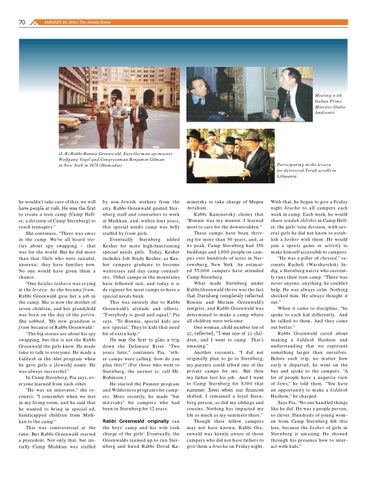
e would get up in the dining room in front of hundreds of girls. Mike in hand, he would ask, “With a show of hands, who likes tuna sandwiches? How about peanut butter and jelly? What about butter?” Other times he would query, “How many girls have sisters who went to Sternberg? Anyone’s mother here went to Sternberg? How about a father or uncle in Magen Av? What about a grandmother who went to Sternberg or SPAT?” The dining room was quiet as he asked these questions and as the girls raised their hands. Of course, when the lone person in the room signaled that her grandmother enjoyed the same camp as she, there was applause. And he smiled as he proudly pointed to the “third-generation” camper. I spent eleven wonderful summers in Camp Sternberg. But I am only one out of thousands who passed through those red and brown arches every year. Every one of those girls were given an experience they would never forget because of a man whose vision was greater and grander than the norm. The genius of Rabbi Ronnie Greenwald was twofold: he was a doer, he was a risk taker, he was a savior to many. He took up causes that most felt were doomed. He fought for the underdog and kept swinging. But he was not a man who wore his many victories on his sleeve. When you spoke to him, you knew he was listening and you knew that he genuinely wanted to hear what you had to say. He valued your ideas, your opinions. He wanted to hear the other side. And he was approachable. He was humble. He was welcoming. I have a photo of myself with Rabbi Greenwald in camp. It shows him smiling in his golf cart with his tzitzis over his blue polo shirt. My friend and
Yitzy Halpern PUBLISHER
publisher@fivetownsjewishhome.com
Yosef Feinerman MANAGING EDITOR
ads@fivetownsjewishhome.com
Shoshana Soroka EDITOR
editor@fivetownsjewishhome.com
Nate Davis Editorial Assistant Nechama Wein Copy Editor Rachel Bergida Berish Edelman Mati Jacobovits Design & Production Gabe Solomon Distribution & Logistics P.O. BOX 266 Lawrence, NY 11559 Phone | 516-734-0858 Fax | 516-734-0857
Classifieds
classifieds@fivetownsjewishhome.com text 443-929-4003 The Jewish Home is an independent weekly magazine. Opinions expressed by writers are not neces sarily the opinions of the publisher or editor. The Jewish Home is not responsible for typographical errors, or for the kashrus of any product or business advertised within. The Jewish Home contains words of Torah. Please treat accordingly.
Shabbos Zemanim
Weekly Weather | January 29 - February 4
Friday, January 29 Parshas Yisro 29
30
31
1
2
3
4
Candle Lighting: 4:50 pm Shabbos Ends: 5:53 pm Rabbeinu Tam: 6:22 pm Sponsored by
Partly Cloudy/Wind
Mostly Sunny
Partly Cloudy
AM Clouds/ PM Sun
Partly Cloudy
Rain
AM Showers
41° 23°
40° 33°
46° 37°
48° 36°
47° 41°
50° 35°
43° 29°
eretzhachaim.org
The Jewish Home | JANUARY 28, 2016
MAN of THE YEAR
Hon. Benjamin Weinstock MAYOR OF CEDARHURST
ONE COMMUNITY. ONE HEART.
GUESTS of HONOR
Shlomo & Raizy Hackel ESTEEMED PHYSICIAN APPRECIATION AWARD
Dr. Deborah Dienstag COMMUNITY SERVICE AWARDEES
BottomLineMG.com
Eliahu & Chaia Frishman DINNER CHAIRMEN Ari Jungreis • Adam Okun David Sokol • Avi Weinstock JOURNAL CHAIRMEN Eli Bobker • Moshe Feldhamer Heshy Friedman • Nochum Wolf DINNER COMMITTEE Rabbi Dovid Bender • Adam Dachs Joe Eisenberger • Elly Friedman Pinky Friedman • Dr. Duvy Goldberg Tzali Gutman • Mendy Haas Charlie Harary • Yosef Hillel Kanner Ben Lowinger • Dr. Asher Mansdorf Dr. Avishai Neuman • Moshe Ratner Mark Salamon • Aron Solomon
ACHIEZER DINNER SUNDAY, 02/28/16 The Sands 1395 Beech Street, Atlantic Beach, NY 11509 Reception: 6:15 PM Program: 7:45 PM Dessert: 8:30 PM
Visit AchiezerDinner.org to make your dinner reservations and place your journal ads! For more information please contact Achiezer at: Phone: 516.791.4444 x113 • email: Dinner2016@Achiezer.org
7
8
JANUARY 28, 2016 | The Jewish Home
Contents LETTERS TO THE EDITOR
8
COMMUNITY Readers’ Poll
8
Community Happenings
42
NEWS
76
Global
13
National
29
Odd-but-True Stories
39
What’s a Caucus? The Guide to the Iowa Caucus (Even if You Don’t Vote in Iowa) by Brendy J. Siev 86 ISRAEL Israel News
My Israel Home: Double Taxation on Ghost Apartments
22 74
PEOPLE Loss of a Leader: Remembering Rabbi Ronnie Greenwald z”l by Brendy J. Siev
66
Early Commanders of the Israeli Air Force by Avi Heiligman
104
PARSHA Rabbi Wein
58
The Shmuz
62
JEWISH THOUGHT No Joke by Rabbi Jonathan Gewirtz
59
The Art of the Compromise by Eytan Kobre
64
JEWISH HISTORY Amulets, Accusations & Controversy: The Devastating Polemic Between Rabbi Yaakov Emden and Rabbi Yonason Eybeschutz, Part I by Rabbi Pini Dunner 72 HEALTH & FITNESS Go Green! by Cindy Weinberger MS, RD, CDN
76
FOOD & LEISURE The Aussie Gourmet: Super Bowl of Salads
82
Dear Editor, Firstly, I second your comment about spending “cozy-time” at home with your family without the need to entertain them away from home when the kids are on winter break. Growing-up in the ‘50s my parents, ob”m, did not entertain us when we had time off from school. We did fun things with our friends. We went to the park, shopping, etc. Of course times were different. We could play outside for hours without our parents worrying about our safety, etc. We were free to develop our inherent creativity rather than depending on stationery activities such as video games etc. I encourage my einiklach (several under bar/bat mitzvah age) to send me their artwork so that I can post it on “Bubby’s Nachas Wall.” This is surely a way to keep them entertained and creative at the same time. Kol tuv, Penina Metal Dear Editor, With all due respect, I was dismayed and upset to see your cover page: Vacation? Staycation? Your Midwinter Guide to Fun vs. your small bottom of the page mention of Mother of Six Killed in Otniel bottom lefthand corner of page 21. While I understand that yours is
LIFESTYLES
a family newspaper geared toward the Five Towns, I cannot understand how you justify a tiny blurb about a mother of six brutally murdered for being a Jew. It could have been any one of us. The fact is this apathetic appearance of the blurb on the bottom left-hand corner of page 21 is a symptom of the malaise of being in this country. When someone, a Jew is murdered, I consider it as if a member of my family has been murdered thus garnering it first page mention. Yes, even more important than marketing and keeping everyone entertained. Sadly, fun seems to be of more importance than actual life and death of those who are on the front lines in our Holy Land. Nothing left to say except “We Need Moshiach Now!” Leah L. Luckman Dear Editor, I think this storm brought me a lesson in addition to many inches of snow. On Motzei Shabbos we were stuck at home, surveying the blizzardy conditions and wondering how we were going to dig ourselves out of this white mess. On Sunday, we spent many hours with the snow, shoveling, shoving, scraping and slipping. It seemed an insurmountable task, but we managed to clear Continued on page 12
Dating Dialogue, Moderated by Jennifer Mann, LMSW 78 The College Application Process by Chaim Homnick
106
I Want to Buy a House … Where Do I Start? by Nesanel Vogel 108
82
Your Money
116
Norway, Here I Come! by Rivki Rosenwald, Esq., CLC
118
HUMOR Centerfold
56
Rocky’s Rant: Avraham Avinu, Daniel Murphy and Me
102
Uncle Moishy Fun Page
110
POLITICAL CROSSFIRE Notable Quotes
90
The GOP Gets the Iran Prisoner Swap Wrong by Charles Krauthammer
98
The GOP Needs both Trump and Cruz to Fall by Michael Gerson CLASSIFIEDS
100 111
Was the blizzard harsher than you anticipated?
72 % 20 % 8 %
Harsher
Not as bad
Just as I thought
The Jewish Home | JANUARY 28, 2016
9
10
JANUARY 28, 2016 | The Jewish Home
Sale Dates: January 31st - February 6th 2016
Weekly Heinz Ketchup
Snapple Iced Teas
44 oz
All Flavors - 12 Pack - 16 oz
5
2/$
6
$
99
Assorted 12 Count
599
$
......................................................
Duncan Hines Classic & Signature Cake Mixes All Flavors - 15.3 oz
.................................................
Green Giant Steam Crisp Extra Sweet Corn Niblets 11 oz
99¢
99¢
......................................................
Domino Sugar 4 lb Bag $ 79
Sparkling Ice All Flavors - 12 Pack $ 99
by the case!
Whole, Diced, Crushed, Sauce, Puree 28 oz/29 oz
5
Tree Ripe Orange Juice
Heinz Chili Sauce
1
$ 99
.................................................
Dark Brown, Light Brown, 10X Confectioners 1 lb
Chocolate, Carob, Sugar-Free Chocolate - 3.5 oz
All Purpose or High Gluten - 5 lb
Domino Sugar
Shibolim Rice Chips
5
2/$
4
10 ...................................................... Ha’olam American Cheese
5
1
$ 99 ................................................. Salted or Unsalted 15 oz
Gourmet Glatt Cashews
699
$
.................................................
.................................................
.................................................
.................................................
All Flavors - 4.5 oz
Parve or Dairy Except Sugar-Free or Cappuccino 10 Pack
All Flavors 6.7 oz - 8.4 oz
5 oz
Mauzone Mania Fiber Biscotti
.................................................
Mrs. Pure’s Cookies
Kosure Hot Cocoa Mix
Quaker Chewy Granola Carolina Yellow Rice Bars or Rice Pilaf Mix 2/$
79¢
.................................................
.................................................
.................................................
12 Pack - 12 oz Cans
15 oz
26 oz
2
$
99
5
Pepsi, Sierra Mist, Brisk, Gefen Baby Corn, Bean Gefen Marinara & Pasta Sauces Schweppes, Mountain Sprouts or Bamboo Assorted Shoots Dew
11
3/$
3
2/$
.......................................
10/$
Glick’s Flour
Quaker Life Cereal
2/$
Chobani Greek Yogurt All Varieties - 5.3 oz
299
2/$
Regular or Spicy 8 oz
......................................................
79¢
.................................................
Sabra Guacamole
Assorted - 59 oz
Smart Fries
.................................................
99¢
5/$
$
Regular or Cinnamon 13 oz
ABC, Animal, Chocolate Chip 12 oz
Except Lasagna, Jumbo Shells, Manicotti, Gluten-Free & 150 Calorie - 12 oz - 16 oz
99¢
.................................................
5/$
Ronzoni Pasta
Original Only 100 Count
Lipton Tea
All Varieties - 1 oz
5
......................................................
16 oz
Heinz Vegetarian Baked Beans
4
2/$
.................................................
2/$
5
1
3/$
.................................................
Sour Cream & Onion Only - 10.6 oz
12 oz
5
Red Pack Tomatoes
1 Liter
.................................................
5
.................................................
5/$
......................................................
Vintage Seltzer
Cracker Crisps Nish Nosh Crackers
9 oz - 15 oz
Quaker Instant Oats
5
......................................................
.................................................
Kellogg’s 12 oz Rice Krispies or 15.5 oz Cocoa Krispies 2/$
.................................................
2/$
1
9
New England Coffee K-Cups
Reddi Wip Topping 6.5 oz
5
2/$
Starbuck’s Iced Coffee All Varieties 48 oz
99¢
4
2/$
Axelrod Sour Cream
Jello Pudding All Flavors 4 Pack
16 oz
4
1
$ 49
2/$
.......................................
.......................................
.......................................
8 oz
8 oz
399
$
Sabra Dips & Spreads
5
2/$
3 lb $
Schtark Cholov Yisrael Shredded Cheese
Farms Creamery Cream Cheese
Assorted 2 lb
1
$ 99
799
$
1199
Ore-Ida French Fries
All Varieties - 26 oz - 32 oz
Mendelsohn’s Pizza Bagels
. . .1 ......................................................
$
$ 99
Bodek Spinach or California Blend
24 oz
99
.........................................................
Fresh & Frozen Gefilte Fish
20 oz
All Varieties 6 Count
299
99
NOW 2 locations!
Good Humor Ice Cream
$
3
$
3
99
.......................................
4
$
Original Only - 17 oz
Cedarhurst STORE HOURS
137 Spruce Street
(516) 569-2662
SUN -TUE: 7 AM-9 PM WED: 7 AM-11 PM THURS: 7 AM-12 AM
Lender’s Bagels
Plain, Blueberry, Onion 6 Pack
3
2/$
.......................................
Kineret Onion Rings 32 oz
499
$
Woodmere STORE HOURS
Macabee Mozzarella Ta’amti Potato or Vegetarian Cigars Sticks 7 oz
14 oz - 16 oz
5
399
2/$
$
.......................................
.......................................
14 oz
12 oz
Yasso Greek Yogurt Eggo Chocolate Chip Bars Waffles
399
$
5
2/$
1030 Railroad Avenue
(516) 295-6901
SUN - THURS: 7 AM-9 PM FRIDAY 7 AM UNTIL 2 HRS. BEFORE CANDLE LIGHTING
The Jewish Home | JANUARY 28, 2016
Specials .
CORNED BEEF DECKEL
849 lb.
$
WHOLE OR CUT-UP BROILERS
239 lb.
$
Silver Tip $ 99 Beef Shoulder 8 lb. Roast Neck $ 99 2 lb. London $ 99 ................... 8 lb. Bones Broil ................... Boneless ................... Breast Turkey $549 lb. of Veal $ 99 Square 6 lb. Thighs . . . . . . . . . . . . . . . . . . . ................... Cut French $949 lb. Boneless Breaded Roast Fillet Chicken $649 lb. ................... Steaks $ 99 Cutlets 8 lb. Family Pack or Fingers READY TO Bake! ................... Boneless Neck of Untrimmed ................... Veal $1099 lb. Chicken $ 69 Navel 3 lb. $ 99 Cutlets Roast Pastrami 9 lb. Super Family Pack
Coke, Fresca, Sprite, Dr. Pepper 2 Liter
5
5/$
......................................................
Tradition Cup-a-Soup
Original Chicken Flavor Only - 12 Pack
699 by the case! ...................................................... $
Wesson Oil
Canola, Corn, Vegetable - Gallon
5
$ 99 Granny Smith Apples
Cello Mushrooms
Golden Delicious Apples
99¢ lb.
199 lb.
$
..........................
Crispy Broccoli
4
2/$
Ripe Mangos
99¢
79¢ ea.
89¢ ea.
Butternut Squash
69¢ lb.
..........................
Mini Peeled Carrots
Fresh Romaine $ 29 1 ea. Kirbies Lettuce
89¢ ea.
......................................................
Idaho Potatoes
..........................
59¢ lb.
..........................
Head
..........................
..........................
Bartlett Pears
Spanish Onions
English Cucumbers 4/$
..........................
99¢ lb.
49¢ lb.
new! hot sandwiches!
9
99 ea.
Taco Chicken Fingers Hawaiian Orzo Noodles & Cabbage
1199lb. $ 99 4 lb. $ 99 3 lb.
$
Nile Perch $ 99 lb.
8
4 $ 99 7
Aliza Beer Nutritional Meals
............................
Quart
Beet, Romaine & Spinach Salad with Feta Cheese
24 VARIETIES!
SPECIAL OF THE WEEK:
699lb.
$
Cauliflower Mashed Potatoes
Salmon Flounder Pinwheels $ 99 lb.
12
999
$
9
1699
$
order@gourmetglatt.com
Orchid Arrangements
495
Giant Vegetable Roll $ 50
5
5
............................
Lion Roll
1095
$
............................
Black Dragon Roll $
1195
349ea. $ 49 Dill Dip Pre-Packaged sugar-free! 3 ea. $ Turkish Salad Pre-Packaged 349ea. $ 49 Hearts of Palm Pre-Packaged 4 ea. $ Quinoa Soup Pre-Packaged 499ea. $ 99 Roasted Potatoes At the Counter 4 lb. checks. Not responsible for typographical errors. checks.Not Notresponsible responsiblefor for typographical typographical errors. errors. checks. $ 99 Parve Cholent At the Counter 3 lb. Mushroom Dip
1
Orchid Plants
Tuna Avocado Roll $
Cooked Salmon Roll $ 95
all our cabbage is greenhouse grown!
monday only!
Bunch
450
$
99
$
Assorted Flat Onion Rolls Combination Package of 4 Bread Small Chocolate Cheesecakes 2 lb Pastry Horn $ 49 $ 99 $ 49 ea. ea. ea. ¢ ea.
Dendrobium Orchids
order your shabbos platters early!
............................
6
Mini Cymbidium Orchid Sprays Stem
999
Crunch Roll
Mushroom Barley Soup
Tilapia Family Pack $ 49 lb.
99
32 oz
5
Deli & Takeout Pastrami, Corned Beef, Brisket or Turkey with 1 Container Hot Soup
Of Tov Chicken Nuggets
$
89¢ lb.
1 lb Bag
/
$
Mehadrin Yogurt All Flavors - 7 oz
3
..........................
Red Bell Peppers
Hass Avocado
2/$
99¢ lb.
......................................................
2
2999& Up $ 3499& Up $
/gourmetglatt
Pre-Packaged
$
We reserve the right to limit quantities. No rain checks. Not responsible for typographical errors.
11
12
JANUARY 28, 2016 | The Jewish Home
Continued from 8
our cars and make way on the sidewalks for walking. But as I backed out of the driveway, I wondered how long it would be until I see the concrete and grass once again. Come Tuesday, I was heartened. What seemed like towers of snow were now only small huts, what seemed like mountains of snow were only small hills. Look what can happen in just a few days’ time! Look how something that seems like it’s never going to move, will be here forever, can melt under the right conditions. What a wonderful lesson for all of
us. There is never a task too great or too arduous to tackle. It may seem impossible at first, but if we try and wait and take things slowly, under the right conditions, we can get it done. Just look at the snow – or whatever is left of it. Chava K. Dear Community, First and foremost, I wish to publicly thank HKB”H for sparing our community and its residents from any serious injury or death from the recent blizzard. Our thoughts and prayers go out to our fellow New
Views expressed on the Letters to the Editor page do not necessarily reflect the views of The Jewish Home. Please send all correspondence to editor@fivetownsjewishhome.com.
Yorkers and the others across our country that were not as lucky. Special thanks as well to our public servants for keeping us safe and our streets cleared. Over the past year, we have been lucky to have partnered with Rabbi Dovid Frischman of Yeshiva Darchei Torah, enabling us to dispatch young men throughout the community to assist in snow removal from the homes of the elderly and handicapped. Throughout the day on Sunday and Monday Eli Weiss triaged these calls through our urgent hotline and Rabbi Frischman, along with his wife Bassie, helped coordinate the various clean ups. One call stood out from the rest. A man named Joseph, who works at Seasons Supermarket of Lawrence, left an urgent voicemail on our hotline at about 3PM on Monday. He stated that an elderly rabbi who is a customer at the store had been stuck at home since the storm. Seasons is a supermarket, not a chessed organization. However, they took the initiative to see what could be done. The message was received, the information was confirmed and once the Frischmans heard the plight of this
iurfz ,phxt
k''z ejmh 'r ic ohhj ouka 'r b''gk R’ Sholom Chaim (Shuli) Schneider k''z HESPEDIM WILL BE DELIVERED BY:
Rabbi Yosef Eisen t''yhka RAV, KOLLEL BNEI TORAH
Honorable Shlomo Mostofsky
elderly gentleman, they decided to grab the opportunity and bring their own family to shovel this man’s property. When the Frischmans met the rabbi, he told Mrs. Frischman, “I have been waiting by the window for two days. I am a Holocaust survivor; these last two days reminded me of when I was trapped back in the camps.” We are a community that cares like no other. A phone call to Seasons, a phone call to Achiezer’s urgent hotline, a phone call to the Frischmans, all with one common denominator. Someone out there needed help and because of this unique underlying passion to do chessed this Holocaust survivor was the recipient of a unique chessed. It is community members like Joseph, like the Frischmans and hundreds of others that make my wife and I so incredibly proud to be a part of this community – a community where there are no limits when it comes to helping another Jew in need. Rabbi Boruch B. Bender President Achiezer
Shuli Schneider died suddenly on Shabbos iuaj j”f. Circumstances prevented the news of his petirah to spread and the hespdim he deserved were not made. Anyone who met Shuli Schneider remembers his warm smile, twinkle in his eye and quickly made a new friend. At this Azkara, The Yeshiva Ketana Chavrusa Program will be dedicated to perpetuate his name. The program provides subsidized tutoring in limudei kodesh for Yeshiva Torah Vodaath Elementary School children.
MOTZOEI SHABBOS, FEBRUARY 6, 2016 • 8:15PM • ohypan ‘p e”amun AGUDAS YISROEL BAIS BINYOMIN BEIS MEDRASH NOSTRAND AVE. & AVENUE L THE YESHIVA MELAE MALKA WILL FOLLOW THE AZKARA IN THE UPSTAIRS BALLROOM
The Jewish Home | JANUARY 28, 2016
The Week In News
sponsor Iran, through Syria and into Lebanon. “The United States remains concerned about some of the activities that Iran is engaged in in other countries,” Kerry told reporters, citing as an example Iran’s “support for terrorist groups like Hezbollah.”
Sad Ending for Antarctic Trek
While attempting to cross Antarctica, explorer Henry Worsley died this week after suffering exhaustion and dehydration. The ex-Army officer, 55, was 30 miles short of his goal of becoming the first person to cross the continent unaided. Mr. Worsley was from Fulham in London. The Duke of Cambridge said he was “very sad” to hear of Worsley’s death. “He was a man who showed great courage and determination and we are incredibly proud to be associated with him,” Prince William said. In a message published before he was airlifted to Chile for treatment, Mr. Worsley wrote: “The 71 days alone on the Antarctic with over 900 statute miles covered and a gradual grinding down of my physical endurance finally took its toll today, and it is with sadness that I report it is journey’s end – so close to my goal.” Mr. Worsley began the 1,100-mile coast-to-coast trek in November, pulling a sledge containing his food, tent and equipment. The plan was to cross the continent “unassisted and unsupported,” with no supply drops or help from dogs or any other source.
Kerry: U.S. Has Concerns about Iran According to Secretary of State John Kerry, 80,000 rockets are allegedly in the hands of Lebanon-based terror group Hezbollah. Speaking from Saudi Arabia, Kerry said that the majority of the terror group’s weaponry comes from its
After Gulf allies expressed concern over the building of ties between Washington and Iran, Kerry also announced that the Syria Support Group of 20 nations and organizations will meet “very shortly” to help promote peace. Skeptical allies were further frightened this month when crippling economic sanctions on Iran were lifted in return for a scaling back of its nuclear capabilities. Iran is the world’s leading Shiite power whose relations with Sunni rival Saudi Arabia have worsened recently. Saudi Arabia and some of its allies cut diplomatic ties with Iran a few weeks ago after protesters burned Riyadh’s embassy in Tehran and a consulate in the second city of Mashhad. The attacks were in response to the Saudi kingdom executing dissident Shiite cleric Nimr alNimr who was a driving force behind anti-government protests. Kerry also said the Syria Support Group will meet “very shortly” after the first round of Syria talks “because we want to keep the process moving.” The group of 20 nations and organizations has devised a plan for a political transition aimed at ending the nearly five-year war in Syria that has cost more than 260,000 lives and displaced millions. The group includes Saudi Arabia, the U.S. and other countries who say President Bashar Assad can have no role in Syria’s future, and Assad’s allies, Iran and Moscow.
Taliban’s Qatar Office Negotiating Peace According to the Taliban in Afghanistan, its “political office” in Qatar is the only entity authorized
13
14
JANUARY 28, 2016 | The Jewish Home
The Jewish Home | JANUARY 28, 2016
At closed-door talks taking place in the Qatari capital of Doha, the group also laid out a series of demands including the release of an unspecified number of prisoners and the removal of senior members from a U.N. blacklist. It described the demands as “preliminary steps needed for peace.” The talks in Qatar are organized by Pugwash Conferences on Science and World Affairs, a Nobel Peace Prize-winning group focused on resolving conflict. The discussions in Doha are separate from official peace efforts involving Afghanistan, Pakistan, China and the United States. Those negotiations, which do not include the Taliban but aim to pave the way for talks between the militants and Kabul, are expected to resume in Islamabad on February 6. In its statement from the latest Qatar talks, the Taliban said it is serious about peace should it succeed in its aims of ending foreign intervention in Afghanistan and establishing an “independent Islamic system.” It claimed it is committed to “civil activities,” free speech and “women’s rights in the light of Islamic rules, national interests and values.” The group added that it wants good relations with the world “on the basis of mutual respect.” The Taliban ruled Afghanistan according to a harsh version of Islamic law from 1996 until the U.S.-led invasion launched after the Sept. 11 attacks.
Rocky’s Rant Page 102
U.K. Judge Accuses Putin of Role in Killing Spy
London and Moscow shared harsh exchanges late last week after a British judge concluded that former KGB officer Alexander Litvinenko was poisoned by two Russian men supposedly acting on behalf of Russia’s security services and most likely with the approval – if not command – of President Vladimir Putin. This revelation comes almost a decade after Litvinenko died in a London hospital. Judge Robert Owen, who directed the public investigation into the murder, said he was confident that two Russians with links to the security services had intentionally fed Litvinenko green tea containing a fatal dose of radioactive polonium-210 during a meeting at a London hotel. He said there was a “strong probability” that Russia’s FSB, the successor to the Soviet Union’s KGB spy agency, directed the killing and that the operation was “probably approved” by Putin, who was already serving as the president of Russia at the time. In 2000, Litvinenko escaped to Britain and became an outspoken criticizer of Russia’s security services and of Putin. “There were powerful motives for organizations and individuals within the Russian state to take action against Mr. Litvinenko, including killing him,” Owen wrote in the 326-page report. The judge said the case for Russian state involvement was circumstantial but strong. Owen said Litvinenko had “personally targeted President Putin himself with highly personal public criticism,” allied himself with Putin’s opponents and was believed to be working for British intelligence. As Litvinenko lay in his death bed, he was well aware of who his enemies were and he accused Putin of ordering his killing. This, though, is the first official report linking the Russian president to the crime. Brit-
Get The ‘Credit’ You DesErve For the KNOWLEDGE YOU HAVE
MKink.com
to carry out negotiations on its behalf. This announcement reinforces the authority of Mullah Akhtar Mansoor, the man who took control of the group following the death of longtime leader Mullah Mohammad Omar. After Omar’s death, there was a brutal struggle for the terror group’s top spot.
15
Earn college credits by taking exams on subjects you already know! TTI’s academic advisors will design a personalized bachelor’s degree plan based on your interests and knowledge. By taking our exclusive combination of Judaic and general studies exams, you will accumulate credits quickly and affordably. Start today to earn your degree and follow your dream!
C elebrating 20 years START YOUR CAREER TODAY!
Call 877.RING.TTI
testingandtraining.com
16
JANUARY 28, 2016 | The Jewish Home
ish Prime Minister David Cameron said the evidence in the report of “state-sponsored” killing was “absolutely appalling.” Britain summoned the Russian ambassador for a dressing-down and imposed an asset freeze on the two main suspects: Andrei Lugovoi, now a Russian lawmaker, and Dmitry Kovtun. Home Secretary Theresa May said the involvement of the Russian state was “a blatant and unacceptable breach of the most fundamental tenets of international law and of civilized behavior.” Moscow has consistently denied any involvement in Litvinenko’s death and instead accused Britain of shepherding a secretive and politically motivated inquiry. Putin spokesman Dmitry Peskov told reporters that the “quasi-investigation” would “further poison the atmosphere of our bilateral relations.” He insisted the report “cannot be accepted by us as a verdict.” Russia refuses to extradite the two suspects. Lugovoi is now a member of the Russian parliament, which means he is immune from prosecution in his country. In an interview with The Associated Press, he called the British investigation a “spectacle.” “I think
that — yet again — Great Britain has shown that anything that involves their political interests, they’ll make a top priority,” he said. Kovtun, currently a “businessman,” told the Tass news agency that the conclusions were based on “false evidence” presented in closed hearings. “It’s unthinkable that the prime minister would do nothing in the face of the[se]… findings,” Marina Litvinenko, the former spy’s widow, told reporters. Despite the assertions, the two countries are walking on eggshells as they try to work together against the Islamic State group in Syria after many years of chilly relations, limiting Britain’s options for any strong reaction to these accusations.
Violence Postpones Haitian Vote Again The Haiti presidential runoff election that was slated for January 24 was cancelled this week when vio-
We pride ourselves on having the most diverse range of products, and offering amongst the most competitive rates in the country. Whether you are looking to buy or refinance, we have a program that fits your needs.
We Have Great Programs for First Time Homebuyers! Contact me today to learn more about our low rates!
Evan Tempelman NMLS#28392 Direct: 516-493-9594 | Cell: 917-291-1951 etempelman@mortgagemaster.com NY LIC # NY-28392-004142
200 Garden City Plaza, Suite 200, Garden City, NY 11530 loanDepot.com, LLC. NMLS #174457. Licensed Mortgage Banker – New York State Department of Financial Services d/b/a loanDepot.com, LLC.
lent protests erupted throughout the country. The Provisional Electoral Council cited the safety of citizens and potential voters as the reason for the abrupt cancellation following violent attacks on electoral offices.
“January 24 is no longer opportune for having elections considering the threats against the electoral infrastructure and on the population who would have to go vote,” PEC president Pierre-Lois Opont declared. Schools serving as election centers and voting stations in various towns were attacked and set on fire. Fearing further attacks, officials stopped the distribution of ballots and recovered other voting materials that had been distributed.
The move to cancel the election came after Opont reported attacks on the communal electoral bureau in Limbe as well as the private residence of an elections official in Pignon. “Masked individuals fired upon the voting center in Savanette this morning,” he said. “In Fond Parisien, there was a group of masked, armed individuals who seized all of the sensitive materials that they had started to deliver for Sunday’s vote.” The election had been previously postponed from its intended date on December 27 but more violence and allegations of fraud caused it to be moved to January 24. No new date for the election has been offered, despite current president Mitchell Martelly being constitutionally-mandated to leave office on February 7.
The Best Country in the World “Best” can be a subjective word in many instances. What classifies as a “best” friend? Who determines the “best” restaurant in town? What’s the “best” challah recipe?
The Jewish Home | JANUARY 28, 2016
Schottenstein talmud Sale NOW THROUG H
L AST FEW DAYS !
FE B. 1 ST 20 16
IN THE USA AND CANADA ONLY
Hebrew Talmud Bavli Full-size edition or Compact size edition
Talmud Yerushalmi Hebrew edition or English edition
English Talmud Bavli Full-size edition or Daf Yomi size edition
IT’S SIMPLE — BUY 3 VOLUMES OF THE SAME EDITION AT YOUR BOOKSELLER’S DISCOUNTED PRICE,
GET A 4TH VOLUME OF THAT EDITION ABSOLUTELY
FREE!
THIS SPECIAL OFFER ALSO APPLIES TO THE EDMOND J. SAFRA EDITION IN FRENCH.
T H E R E IS N O L IM IT !
SPECIAL S PURCHASE THE COMPLETE 73-VOL. SET S E T P R I CE
AND
OF THE VOLS. ARE FREE! plus FREE SHIPPING IN THE USA
73-VOLUME ENGLISH SET FULL-SIZE SET
regular list price $2,999
your final cost
2,099
$
DAF YOMI SET
regular list price $2,599
your final cost
1,759
$
*based on list price
73-VOLUME HEBREW SET FULL-SIZE SET
regular list price $2,750
your final cost
1,759
$
COMPACT SET
regular list price $2,299
your final cost
1,469
$
The following ArtScroll sefarim are available for your daily learning programs:
The Schottenstein Edition Talmud Bavli and Yerushalmi; Yad Avraham Mishnah Series; Schottenstein Edition Mishnah Elucidated; Ryzman Edition Hebrew Mishnah; Kleinman Edition Kitzur Shulchan Aruch; Kleinman Edition Daily Dose of Torah. This Shabbos, Shevat 20: Daf Yomi Bavli – Gittin 48 / Daf Yomi Yerushalmi – Beitzah 22 / Mishnah Yomi – Machshirin 5:10-11 / Kitzur Shulchan Aruch Yomi – 60:6-13
Available at your local Hebrew bookseller or at www.artscroll.com • 1-800-MESORAH (637-6724)
17
18
JANUARY 28, 2016 | The Jewish Home
The 60 countries included in the study represent about three-fourths of the world’s population and about 90 percent of global GDP. So what’s the best country in the world? Seems like we should be speaking German. The research revealed Germany as the overall “best country.” It is home to Europe’s largest economy and respondents ranked it high for encouraging entrepreneurship, providing global leadership, and caring for its citizens. Its leader, Chancellor Angela Merkel, was named Person of the Year for 2015 by both the Financial Times and Time magazine. Surprisingly – especially to Americans’ ears – despite the United States’ reputation for the world’s greatest military power and the largest economy, it ranked fourth, trailing Canada and the United Kingdom. “There really does seem to be some skepticism about some things that we [Americans] think we may do better than other people do, education being a prime one,” says Brian Kelly, editor and chief content officer at U.S. News and World Report. “Canada and the United Kingdom do better than the U.S. in education. People don’t feel as comfortable about U.S. education as perhaps we’ve been led to believe.” The top ten “best” countries around the globe are: 1. Germany 2. Canada 3. United Kingdom 4. United States 5. Sweden 6. Australia 7. Japan 8. France 9. The Netherlands 10. Denmark Determining the “best” country is a difficult task. What determines whether one country is better than another? Is it their economic status? Their political power? Their military strength? Actually, it is all those factors together that formulate how people perceive a country and ultimately which one ranks as the best overall.
U.S. News & World Report, in collaboration with BAV Consulting and the Wharton School of the University of Pennsylvania, sought to answer the question of what makes a best country to produce the Best Countries rankings. The ranking was officially unveiled at the World Economic Forum in Davos, Switzerland, last Wednesday.
More than 16,000 people in four global regions were surveyed. They were asked to associate 60 countries with specific qualities. Based on their responses, an overall score was assigned to each country. The countries were chosen on measures that included the United Nations’ Human Development Index, gross domestic product, tourism and total exports.
Court for Those who Scratched King Tut’s Mask It’s been a few thousand years since Egypt’s King Tut died but his power still remains: after a botched
19
The Jewish Home | JANUARY 28, 2016
repair job of the famed pharaoh’s beard left scratches on his burial mask, Egyptian prosecutors ordered eight museum workers to a disciplinary court for “gross negligence.”
The beard on the 3,300-year old mask unintentionally cracked off and was hastily repaired with glue with epoxy in 2014. Prosecutors are claiming it was scratched and damaged during the rushed and sloppy repair. The case implicates the thenhead of the Egyptian Museum and the chief of the restoration department. “In an attempt to cover up the damage they inflicted, they used sharp instruments such as scalpels and metal tools to remove traces of adhesive on the mask, causing damage and scratches that remain,” it said, citing an investigation. The
eight museum employees involved now face fines and disciplinary measures including dismissal. About a year ago, an eyewitness and museum conservator told the Associated Press that epoxy had dried on the face of the boy king’s mask and that a colleague used a spatula to remove it, leaving scratches. Another conservator who inspects the artifact routinely also noticed the scratches and said it was obvious that they had been caused by a tool used to scrape off the epoxy. They both spoke on condition of anonymity for fear of repercussions. After careful repairs by a German-Egyptian team of specialists using beeswax, the mask was redisplayed last month. British archeologists recovered the mask in 1922 along with other valuable artifacts, igniting global interest in archaeology and ancient Egypt. It remains one of the world’s most priceless artifacts and most well-known objects in the Egyptian Museum, a major tourist attraction in Cairo that was built in 1902 and houses ancient Egyptian artifacts and mummies.
The “Exploding Nightmare” of Childhood Obesity
In the United States, efforts have been made to recognize and combat childhood obesity. But this alarming epidemic is not just indigenous to the U.S. Childhood obesity has reached soaring rates globally and is fast becoming a terrifying nightmare for those in the developing world – including Africa where the number of obese and overweight children under five has nearly doubled since 1990, a WHO commission said on Monday. The authors of the report from the Commission on Ending Childhood Obesity stressed that the epidemic has historically not been treated as a grave public health issue and was regarded by some as a product of life-
style choices by individuals and families. But after two years of research with children in 100 countries, the authors are pointing out that governments and global public health bodies need to be involved to combat the surge. “What’s the big message? It’s not the kid’s fault,” commission co-chair Peter Gluckman said. Biological factors, inadequate access to healthy foods, a decline in physical activity in schools and the unregulated marketing of fattening foods are among the drivers of a worsening epidemic that requires a coordinated global response. If not reversed, “the obesity epidemic has the potential to negate many of the health benefits that have contributed to the increased longevity observed in the world,” added the report, commissioned by the UN’s World Health Organization. Some of the recommendations cited seem to be common sense: lead healthier lifestyles, tax sugary drinks. But even those measures have not been adequately implemented around the world, with the number of obese and overweight children under five growing from 31 million to 41 Continued on page 22
torah saved A life
#536
The tears flowed down my cheeks when the doctor informed me that my beloved sister Chaya Rivka only had hours to live. Her devastating illness was like a dark cloud hovering over our family as it rocked us to the core. She had been on a respirator for days; we along with our community had been davening feverishly. It was just before 5:15 pm on the very day that we heard the news from the doctors and the minutes passed as though they were hours. I made the decision to contact an internationally renowned Gadol HaDor for an aitza on what segulah we could take upon ourselves as a zechus for a refuah shleima and a neis min hashamayim. He told me that if a group of sincere talmidei chochomim would gather together to shteig away in learning Torah, it would have the power to deter a dreaded illness.
the doctors could not give an explanation for her miraculous and complete recovery
I immediately placed an urgent call to Kollel Chatzos asking to join their special partnership program. Soon a er, Chaya Rivka indicated that she wanted to eat something. At about 7:15 pm I again contacted KC to offer my payment and it was then that Chaya Rivka got up and walked off the bed. Suffice it to say, the perplexed doctors could not give an explanation for her miraculous and complete recovery. By erev Shabbos, Miriam Chana was home with us, Baruch HaShem. There is no doubt in our minds that the dedicated learning of these talmidei chochomim aroused Hashem's rachmunis and helped to facilitate my sister's recovery. I cannot even begin to thank Kollel Chatzos enough for their extraordinary sensitivity to families in pain. Every midnight our talmidei chachamim illuminate the world with Torah.
B RO O K LY N
M O NS EY
1.855.CHaTZOS
M O N RO E
M E RO N
24
hours!
BECOME a CHaTZOS
PaRTNER TODaY
718.887.9114 info@kollelchatzos.com
and experience the zchus of
www.1855chatzos.org 46 Main St #104 Monsey
4 locations:
TORAH KNIGHTS OF KLAL YISROEL
sustaining Torah learning.
20
JANUARY 28, 2016 | The Jewish Home
weekly
speci ls
01/28/16 - 02/03/16
1913 Cornaga Avenue • Far Rockaway • T. 718.471.7555 F. 718.471.9102 E. ordersfrankels@gmail.com
Produce
House Hold
Onion
GPOD
Potato
Avocado
3lb
#80
Plum Tomato
"48
.49lb
1.00
$
MVP 9 In
Plastic Plate
.69
$
.79lb
$
$
$
Reg. $4.99
3.69
Setting
Cutlery
400ct Tea/Soup/Knife/Fork
Fridge -Freezer
Reg. $3.29
Mehadrin
Haolam
Golden Flow
Golden Taste
Plastix 7oz
108 Slice
64oz
Reg-Strong 14oz
100ct
6oz
Chocolate Leben Reg. $1.15
Orange Juice
American Cheese Reg. $16.59
0.89
$
Gevina
Greek Yogurt
JJ
Reg. $1.09
Reg. $1.89
10.99
$
12.Oz Reg-Flavor
0.89
$
2/ 5.00
1.49
$
2.59
$
Gefilta Fish
Reg. $8.99
Reg. $4.79
22 Oz
6.99
$
3.69
$
Free Coffee in store KJ
Family Pack
Family Pack
Chicken Legs
Chicken Wings
1.99 Lb
99 Lb
$
Empire
David Elliot
Family Pack
Family Pack
Chicken Thighs
Chicken Cutlets
2.49 Lb
Solomon’s Baby Shin
$ Solomon’s
Chuck Eye
Kolichel
Gefen
14oz
16oz
Reg. $5.49
3.59
$
Canola Oil 1 Gal
Reg. $8.99
Reg. $1.59
1.29
$
Cereal Puffy Cream
Unbleached High Gluten 5lb
4.99 Lb
7.49 Lb
Cold Cuts
Fillet Steaks
1.99
$
8.49 Lb
Reg. $3.49
Osem
3.88
$
Reg. $4.99
Reg. $4.59
3.59
$
Reg. $2.49
2.99
$
Soft Tissue
Gefen All Flavors
Mini Croutons
Noodle Soup
14.10 Oz
5oz Mexican/Honey Glaze/ Oven Roast/ Smoke
$
Grape Juice
Kleenex $
Tiroz Zvi
Boneless
Kedem Concord
13.2 0z
Roast
$
6.99
$
64oz
Kariot
Flour
Reg. $2.55
Major Deals
Cholent Mix
Glick
3.79 Lb
$
Sterns
Chocolate Rugelech
$
0.89
Wesson
Grocery
Meal Mart
$
Fresh & Frozen
Pizza
Meat
2.49
Plastic Cups Reg. $1.25
$
Mendelsons 8 Slice
Cappuccino
5oz All Flavors
Reg. $3.19
Horseradish
$
230ct 10pk
12 X 2.30oz
1.99
$
7.99
$
16.59
$
ArtisticGraphics
The Jewish Home | JANUARY 28, 2016
10% Discount For Bnei Torah
In admiraton and appreciation to the avreichim and Klei kodesh of the community, we offer a discount for all your shopping needs. Come by and let us serve you.
FREE
DELIVERY 1913 Cornaga Avenue
•
Far Rockaway
T. 718.471.7555 F. 718.471.9102 E. ordersfrankels@gmail.com Sun: 8-7, Mon-wed: 7-8, Turs:7-10, Fri: 7-3
21
22
JANUARY 28, 2016 | The Jewish Home
million between 1990 and 2014. Child obesity “is an exploding nightmare in the developing world,” Gluckman said. The figures have surged in Africa, with the number of overweight or obese children under five nearly doubling from 1990 to 2014, from 5.4 million to 10.3 million. The rate of increase in Asia was difficult to quantify, Gluckman said, but Asia currently accounts for nearly half (48 percent) of young children categorized as overweight or obese. The report notes that in wealthier countries, poorer children are more likely to be obese, partly due to the relative affordability and abundance of fatty fast foods and high-sugar snacks. Conversely, in poorer countries the children of wealthier families are more likely to be obese, including in cultures where “an overweight child is often considered to be healthy.”
Shlomit Krigman Succumbs to Stabbing Wounds
“Shlomit was a beloved, sweet girl, always smiling, energetic and full of light,” Danny Hirschberg, Shlomit Krigman’s cousin, lamented. “We are in great pain. Let us hope for better days.” Hundreds of people attended the funeral on Tuesday of 23-year-old Shlomit who sustained serious injuries during a stabbing attack in the West Bank settlement of Beit Horon on Monday and died of her wounds Tuesday morning. Krigman was buried at Jerusalem’s Givat Shaul cemetery, in a plot near that of Dafna Meir, an Israeli mother of six stabbed to death in her home in Otniel last week.
“She was open to the world and had great curiosity,” said Eitan Bnaya, one of Shlomit’s teachers at the Ariel University. “She was interested in many areas. Everything got cut off in a single moment, a young woman whose life was ended.” She added, “Despite her gentle appearance, she would tackle every machine and every material and build models. Her final project was to build public libraries in bus stops, a sort of social activity that combines her two great loves — books and design.” Shlomit’s death left friends and relatives shaken, and they recalled her warm heart, her artistic nature, and her social conscience. “She was a caring person, close and caring toward her friends,” Einat Dermer related earlier on Tuesday. “She was just a person who wanted everything to be good, and she did that in her own way.” “It hasn’t sunk in. When they called me I was certain that it was to tell me she was engaged. She had such a good heart and was so empathetic to those around her. She was very creative. I still can’t imagine returning home without Shlomit,” she cried. Shlomit, who had previously served as a group leader in Beit Horon for the national-religious Bnei Akiva youth movement, was spending time with her grandparents at the settlement when she was attacked. Another woman, 58, was moderately injured in the attack, which took place outside a small market in the settlement. Both attackers, one from nearby Beit Ur al-Tahta and one from the Ramallah area, were shot and killed by a security guard. One victim was stabbed in the store and a second as the two attackers attempted to flee the scene, according to initial accounts. The terror attack was the third in just over a week to take place inside a settlement. On January 17, a terrorist infiltrated the settlement of Otniel in the southern West Bank, stabbing Dafna Meir to death. A day later, a terrorist sneaked into the settlement of Tekoa, south of Jerusalem, and knifed a pregnant woman, Michal Froman, moderately wounding her. Though originally from the West Bank settlement of Shadmot Mehola, located in the Beit She’an Valley, Shlomit spent much time in Beit Horon, outside Jerusalem, and was seen as a resident by many who lived
The Jewish Home | JANUARY 28, 2016
Please Join Us MOTZEI SHABBOS KODESH OF PARSHAS YISRO JANUARY 30, AT 8:15 FOR A SPECIAL IN HONOR OF THE SIYUM L’KOVOD HATORAH OF OUR MESIVTA BOCHURIM COMPLETING MESECHTAS BAVA BASRA
THERE WILL BE FIRE TORCHES, A LIVE MUSIC TRUCK AND MORE. KINDERLACH WILL BE GIVEN FLAGS AND PECKLACH TO JOIN IN THE SIMCHA. THE MARCH WILL START FROM THE HOME OF R. DOV KEILSON 1716 BROOKHAVEN AND WILL CONTINUE DOWN BEACH 17TH STREET TO THE MESIVTA BUILDING. THIS IS FOR MEN WOMEN AND CHILDREN. FOR KINDERLACH THE PATICIPATION TIME IS FROM 8:00-9:15.
23
24
JANUARY 28, 2016 | The Jewish Home
a
Great Day starts with a
in the small community. “Shlomit, your address may have been in Shadmot Mehola, but you were without a doubt a resident of Beit Horon,” one resident wrote on Facebook in tribute to her. “Shlomit, part of the landscape of Beit Horon, a smiling, quiet flower who brightened up her surroundings.” Shlomit had recently completed her bachelor’s degree in industrial design at the University of Ariel and was trying to decide on a path to pursue in the field. She is survived by her parents and her six siblings.
also did well in the Movers category, where it came in 14th place, receiving good scores for being Distinctive, Different and Unique. Surprisingly, it did less well in Entrepreneurship, where it came in at #21. This ranking does not jibe with Israel’s reputation as a “start-up nation.” A set of 65 country attributes were identified and presented in a survey of more than 16,000 people from across the globe. The more a country was perceived to exemplify a certain characteristic in relation to the average, the higher that country’s attribute score.
Israel’s Impressive Power Ranking
Palestinian TV Inspired Terrorist to Kill
U.S. News & World Report has ranked Israel in twenty-fifth place in the world’s “best countries” list of 2016. An especially high score was achieved in the “Power” category in which Israel came in at number 8 in the world. The IDF received a score of 9.7 – similar to the U.S., and second only to Russia’s military, which received a perfect 10. Additional criteria for power included political influence, for which the Jewish state received a score of 7.6, and strong international alliances, for which it got a 5.8. It fared less well in the field of economic influence (2.4) and leadership (2.7). According to the report, Israel is very highly developed in terms of life expectancy, education, per capita income and other human development index indicators, but it also has “one of the most unequal economies in the Western world, with significant gaps between the rich and poor.” The top five “best countries” overall were Germany, Canada, Britain, the U.S. and Sweden. Israel
The Shin Bet has discovered that the 16-year-old Arab terrorist who killed Dafna Meir Hy”d was inspired to launch his murderous terrorist attack by Palestinian TV. The show that Murad Bader Abdullah Adais watched on Palestinian TV presented Israel as “executing young Palestinians” in a warped twist on how security forces have killed attacking terrorists to save lives. On the day of the attack last Sunday, supposedly under the influence of the TV shows, Adais decided to conduct a stabbing attack with the goal of murdering a Jew. Given the proximity of Otniel to his hometown, he chose it as his target. “The serious results of the attack demonstrate again the seriousness of the threat posed by the wild incitement being conducted against the state of Israel and the Jews in Palestinian media, which influences the lone attackers to conduct murder and serious terror attacks,” said an Israeli Security Agency statement. Adais, who has been arrested, was not only influenced by TV but apparently also by his family. After the murder, his father said he was “proud” of his son.
24-HOUR NURSES NIGHT NURSES • ELDERLY CARE
newmarketingcreative / 732.276.7918
BABY CARE • CERTIFIED • RELIABLE
GoodNight THE AG E N C Y T HAT
personally NURSING AGENCY K NOWS EV E RY NURSE
GoodNight Nursing
MALKY HAUER MICHAL BRULL
732.644.2894 732.552.8954
The Jewish Home | JANUARY 28, 2016
IDF Air Force Takes Out Hamas Compound
A Hamas military compound in central Gaza was hit by an Israeli air force airstrike this week. The attack was in retaliation for a Sunday rocket attack on the Sha’ar Hanegev Regional Council in southern Israel. “The IDF holds the Hamas terrorist organization solely responsible for the Gaza Strip and will continue to act firmly to maintain quiet in the towns of southern Israel,” according to the IDF statement. The rocket, which was fired at southern Israel, exploded in an open area in the Gaza Belt area causing no physical injuries or damages. A Salafi organization affiliated
with ISIS claimed responsibility for the rocket attack. The attack was the second rocket attack on Israel in as many days, though the first rocket that was fired towards southern Israel missed its target and exploded on the Gazan side of the border. Member of Knesset Chaim Yellin, a resident of Kibbutz Nahal Oz on the Gaza Belt, blasted the Israeli government over the latest rocket attack. “Tonight we received another reminder of Israel’s lack of leadership and of the steadily deteriorating security situation in the Gaza Belt. Kassam rockets are exploding, tunnels becoming more powerful, a security situation which continues to deteriorate and a government which is losing its direction,” he charged.
Bomb Backfires on Palestinian Terrorist A Palestinian man blew himself up while attempting to attack Israeli Border Police in the East Jerusalem neighborhood of Abu Dis early this
week. Apparently, the bomb he was carrying exploded prematurely and killed him instantly. Thankfully, no Israelis were hurt in the attempted attack. Earlier in the day, a Border Police officer shot a Palestinian teenager who tried to stab him as he guarded the entrance to a West Bank settlement. Roqaya Abu-Eid, a 13-yearold girl, attempted to stab a policeman guarding the entrance of Anatot. Israel Police said later that an initial investigation showed the girl, from the nearby village of Anata, had fought with her parents and stormed out the family home with the knife, declaring that she wanted to die. At least 29 Israelis and some 150 Palestinians, most of them attackers, have been killed in the latest spate of terrorism and violence in recent months, which has included Palestinian stabbing, car-ramming and shooting attacks in Israel and the West Bank. The head of the Palestinian domestic intelligence body said this week that the Palestinian Authority has prevented 200 attacks against Israelis in the current wave of violence, which began in October.
Looney PA Op-ed Blames U.S. For Just About Everything
According to an official Palestinian Authority daily op-ed, the United States is behind all the chaos and civil wars in the Muslim and Arab world. The writer includes in that list the longest and oldest fight from right after Mohammed’s times between Sunni and Shi’ite Muslims. According to Palestinian Media Continued on page 28
Resale boutique looking to purchase high end new K used children's clothing Initial Proceeds can go to a charity of your choice or your very own pocket.
25
For a quick response email
sales@lamarang.com or visit lamarang.com
26
JANUARY 28, 2016 | The Jewish Home
pay less - get more
1/31/16 - 2/5/16
FRESH SuSHI
$3.99
$4.99
each
Sweet Juicy Clementines
Sweet Red Globe Grapes
Yellow Ripe Bananas
5 lb
lb
lb
$5.99
bunch
Premium Green Giant Yukon Gold Potatoes or Red Bliss Potatoes
Extra Large Best Mangoes
Baby Peeled Sweet Carrots
each
16 oz
99¢
25for $5 lb bag
$4.99
99¢
1 lb pkgs
Fantastic Spray Cleaner 2 for $5.00
99¢
12.5 oz btls
$13.99 15 roll pkg
.55 oz pkg
Kleenex White Facial Tissue 3 for $4.00
McCain Potatoes
Assorted
160 ct pkg
Assorted Varieties
Mendelsohn’s Pizza Squares
Mendelsohn’s Pizza Dough
Frankels Pizza Snaps
Smakin Good Potato Knishes
Rich’s Whipped Topping
16 oz pkg
16 oz pkg
20 oz
12 pack
8 oz cont
$6.99
Galbani Ricotta
Tropicana Orange Juice
2 lb cont
59 oz cont
Friendship Sour Cream 2 for $3
$4.99
Regular or Light
Whole Milk or Part Skim
16 oz pkg
$2.99
La Yogurt Yogurts 2 for 89¢
Assorted
Assorted
99¢
$2.99
$1.99
6 ct box
Kedem Tea Biscuits
Bissli Family Pack
Haddar Mini Pretzels
4.2 oz pkg
14.8 oz pkg
15 oz bag 30 pack
$3.49
$3.99
2 for $5.00
Assorted
Lenders Bagels for
Kineret Onion Rings 20 oz Bag
2
$3.00
12 oz pkg
19 to 32 oz pkg
10.7 to 14.8 oz pkg
Sabra Hummus 3 for $7.00
Ta’amti Feta Cheese
Yo Crunch Yogurt 2 for 99¢
$5.69
Assorted
32 oz jar
9.5 oz
$3.49
69¢
Assorted
Blueberry – Cinnamon – Egg – Onion – Plain
Tirat Zvi Turkey Slices
4 lb bag
5 oz pkg
2 for 99¢
10 oz cont
$1.69
Nestle Rich Gushers Fruit Milk Chocolate Snacks 2 for $3.00 Hot Cocoa
Eggo Waffles or Pancakes
Batampte Half Sour Pickles
6 oz cont
$6.99
Vanilla – Chocolate – Plain – Cappuccino
Assorted
$7.99
Family Size
12 oz btl
8 oz pkg
1 oz pkg
99¢
11.5 oz btl
Domino Granulated Sugar
Corn – Vegetable – Canola
Regular or Light
Original – lemon – Bleach
$3.99
Heinz Chili Sauce
White or Flavored
Bounty Paper Towels
32 oz btl
Hellmann’s Squeeze Mayonnaise
$2.99
$1.99
Gallon Btl
Assorted
Original or Veggie
each
Wesson Oil Gallon
12.6 oz pkg
Paskesz Marshmallows Airhead Candy 2 for $5.00 5 for $1.00
99¢
12 pack 16 oz btls
Assorted
3 lb box
Parade Spring Water
$6.99
Macabee Pizza Bagels 2 for $5.00
Diamond Crystal Kosher Salt
Gourmet Hass Avocadoes 5 for $4.99
10 for $3.99 each
2 for3 $5.00 lb bag
20 oz btls
99¢
Florida Star Ruby Grapefruits
Glaceau Vitamin Water 12 for $10
Regular or Diet
Confectioner – Dark or Light Brown
Southern Kale or Collard Green
$3.99 2 for $3.00 2 for 8$3.00 oz
each
2 liter Btls
Apple – Punch – Berry – Vanilla – Chocolate – Duplex Orange – Pear
99¢
Premium Red Delicious, Golden Delicious or McIntosh Apples
16 oz can
Snapple Tea
VO5 Shampoo & Conditioner
Tangy Juicy Limes 10 for $2
5 oz can
16 oz pkg
Arrid XX Solid Deodorant
Whole or Sliced
Coke, Sprite, Fresca, Dr Pepper
5 lb bag
2 8forpack $5 2 for $5.00 32 oz pkg
each
Heinz Vegetarian Beans
High Gluten or All Purpose
Paskesz Sandwich Cookies
each
15
each
Domino Sugar Glicks Flour 89¢ 2 for $4.00
each
Assorted
Snow White Mushrooms
Chicken of the Sea Solid White Tuna Water or Oil
26 oz jar
Dole Classic Iceberg or Coleslaw Mix
$2.99
89¢
Ziti – Spaghetti – Elbows – Rotini – Linguine
Sweet Juicy California Sunkist Navel oranges for
Golden Extra Sweet Pineapples
99¢
99¢
Parve Philly Fluff
Apple & Eve Sesame Street Drinks
49¢
$1.99
1 lb pkg
each
Spicy Salmon Roll w/ Salmon Outside
California Tempura Style w/ Sweet Sauce
Frescorti Marinara Sauce 2 for $3.00
88¢
$9.50
each
each
Ronzoni Pasta
Red Dragon Roll
$6.99
$4.99
each
Fresh California Broccoli 2 for $3.00
California Tempura Roll
Pepper Tuna Roll
Cooked Salmon Roll
Mango Roll
SupER SpEcIalS
$5.99
8 oz pkg
Philadelphia Cream Cheese Bars
2 for $5.00
6 oz cont
8 oz pkg
Assorted
Regular or Low Fat
appY. cOuNTER Lasagne
Penne Ala Vodka
prepackaged
prepackaged
Grilled Tilapia
Emek Swiss
prepackaged
¼ lb
$8.99
Assorted
$2.99
$7.99
FRESH FISH Whole Brook Trout
$7.99
Top Quality Scottish Salmon Steak
lb
Wild Tuna Steaks
$10.99
$8.99
Beer Battered Pollock
$5.99
$5.99
lb
lb
Breaded Tilapia lb
lb
$10.99
Aaron’s Smoked Turkey Breast
Diet Cole Slaw
Corn Salad
lb
lb
lb
Family Pack Chicken Cutlets
Family Pack Chicken Wings
lb
lb
$3.49
$1.19
French Roast
$14.99 lb
$4.99
$5.49
$7.99
Boneless Spareribs
Family Pack Ground Beef
lb
lb
$12.99
$4.69
$2.50
Boneless Flanken
$14.99 lb
3:30 p.m.
Strip Steak
$14.99 lb
Family Pack Rib Steak
$13.99 lb
l
The Jewish Home | JANUARY 28, 2016
CELEBRATING THE COMPLETION OF OUR CAMPUS
Inaugura ing Our New S uden Residence
Journal Ad Deadline Extended MONDAY . FEBRUARY 1, 2016 To Submit your Ad
PLEASE CONTACT THE YESHIVA AT F: (718) 327-7600 . E: DINNER@YOFR.ORG
Mo zoei Shabbos Parshas Mishpa im February 6, 2016 . 27 Shva 5776 At the Yeshiva Campus 802 Hicksville Road Far Rockaway, New York 11691
Mr. Charles Harary Master of Ceremonies
Yeshiva of Far Rockaway 802 Hicksville Road Far Rockaway, NY 11691 P: (718) 327-7600 F: (718) 327-1430 E: dinner@yofr.org W: www.yofr.org
MR. MOSHE MAJESKI Dinner Chairman
MR. DANIEL WOLFSON Journal Chairman
MR. CHAIM BALTER . MR. MOTTI FOX MR. CHARLES HARARY . MR. DOV WARMAN Dinner Committee MR. SHMUEL BACKENROTH . MR. YOCHANAN BODNER MR. YOSSI DEUTSCH . MR. YEHOSHUA GELB MR. MORDECHAI MENDLOWITZ Alumni Committee
י בה דרך ששי מרן רבי אברהם יפה’ןאזיצ’’תן ’’ע ל Yeshiva of Far Rockaway
Yaakov & Ilana Melohn campus in memory of Reb Yosef Melohn z’’l
27
28
JANUARY 28, 2016 | The Jewish Home
Watch (PMW), the PA writer claims that this turmoil is the direct result of the September 11th attacks on the U.S., stating that the U.S. utilized this attack to create “an imaginary enemy called ‘terror,’ and it supervised the cultivation of the idea until it ripened into what is known today as the Islamic State organization.” The writer also claims that the facts indicate that the U.S. itself is the number one suspect in the 9/11 terror attack. This type of conspiracy theory has been voiced often in the official PA daily, and depending on the day, includes Israel as a collaborator. Abbas’s daily has previously blamed the U.S. for establishing the ISIS terror organization and for being responsible for all the crises and wars in the Middle East. PMW revealed the latest accusations, claiming the U.S. is responsible for the regional unrest in the Middle East in the form of Dr. Osama Al-Fara in his regular op-ed column: “The U.S. invented the idea of creative anarchy in the [Middle East] region, which began with its war against Iraq, to create a game of dominoes in the region. The same U.S. has indeed succeeded in convincing the world that the Is-
lamic extremism is what threatens world security and peace.” He added, “In order to do this, it used the events of Sept. 11, 2001, even though that event raised many questions that place the U.S. in the defendant’s seat, as was exposed later in a series of facts and reports. However, out of this event the U.S. succeeded in creating an imaginary enemy called ‘terror,’ and it supervised the cultivation of the idea until it ripened into what is known today as the Islamic State organization,” wrote Al-Fara. He continued, “There is no doubt that the U.S. is still holding many of strings of the game, and its main goal is to spill oil on the fire that is burning in the region, of which it is clearly the sole beneficiary. This is so because the fighting raging in the region provides the appropriate land for redrawing the map of the region, which will use sectarianism to determine the geographic borders of its states, on the basis of studies prepared years ago. In this way, the U.S. will distance Arab states from each other, and uproot the idea of unity between them. “Naturally, it will not find a better chord than the Sunni-Shiite con-
WHEREVER YOU GO...
AMIGO!
Sim Cards & Cell Phone Rentals For International Travel
888.AMIGO.US | W W W. A M I G O - U S . C O M
flict on which to play the tune of the next war in the region. Moreover, the fire burning in the region has even turned the wheels of the traditional American arms industry in an unprecedented way, while the U.S. pays no price for the anarchy it has created in the region. This is so as the ‘terror’ has not reached [the U.S.’] yard as has happened in the European states, and [the U.S.] has not been forced to open its gates to the immigrants who have flocked to Europe,” concluded Al-Fara.
Survivor May Be Oldest Living Man
Holocaust survivor Yisrael Kristal is believed to be the oldest man in the world. The 112-year-old Haifa resident achieved that status this week after the death of Yasutaro Koide of Japan. Koide was also 112. Kristal’s grandson, Oren, received an email this week from the Gerontology Research Group, an international organization that tracks the world’s over-110 set, alerting him that the Polish-born Auschwitz survivor was up for the honor. Upon hearing the news, Kristal said in Yiddish: “The joy of my old age.” To be officially certified as the oldest living man, Kristal must present documentation from the first 20 years of his life. However, it seems the earliest official document Kristal possesses is from when he was 25. Born on September 15, 1903, in the town of Zarnow, Kristal moved to Lodz in 1920 to work in his family’s candy business. He continued operating the business after the Nazis forced the city’s Jews into a ghetto, where Kristal’s two children died. In 1944, he was deported to Auschwitz, where his wife, whom he had married at age 25, was murdered. In 1950, Mr. Kristal moved to Haifa with his second wife and their son, working again as a confectioner. His daughter, Shula Kuperstoch, related that he has been religiously observant his whole life and continues to put on tefillin each morning.
“The Holocaust did not affect his beliefs,” Kuperstoch said. “He believes he was saved because that’s what G-d wanted. He is not an angry person, he is not someone who seeks to an accounting, he believes everything has a reason in the world.” “His attitude to life is everything in moderation,” she added. “He eats and sleeps moderately, and says that a person should always be in control of their own life and not have their life control them, as far as this is possible.” In 2012, at the comparatively youthful age of 109, Kristal declined to offer a theory for his longevity, instead saying, “It’s no great bargain. Everyone has their own good fortune. It’s from heaven. There are no secrets.” Asked if his diet was responsible for his long life, he said, “In the camps there wasn’t always anything to eat. What they gave me, I ate. I eat to live; I don’t live to eat. I don’t need too much. Anything that’s too much is no good.”
Bomb-Making Twins Girls Arrested
Twin sisters from the Palestinian city of Tulkarem in the West Bank have been arrested for making bombs in the West Bank. Israel Defense Forces soldiers and Shin Bet officers discovered pipe bombs and other explosive materials in the home of Diana and Nadia Hawila in late December 2015, officials said. “This investigation again shows the motivation to carry out terror attacks, especially among those who are not a part of terrorist organizations, including women,” the Shin Bet said. They also found knives, Hamas headbands, and “equipment for riots.” Diana Hawila admitted that she had purchased the fertilizer and other chemicals necessary to create the explosives. She learned how to create bombs by watching instructional videos online, according to the Shin Bet. Diana also watched Islamic extremist videos that encouraged
29
The Jewish Home | JANUARY 28, 2016
women to take part in terror attacks against Israelis and Jews, which “strengthened her decision to act,” the Shin Bet said. Diana planned to use her homemade explosive devices against Israeli citizens and soldiers. Nadia Hawila helped her sister hide the pipe bombs in the home that the two shared. But hopefully their dream of terror will not come to fruition. This week the dangerous duo was indicted in a military court. Diana Hawila has been accused of creating explosive devices and for the sale of war materials. Nadia Hawila was charged with the sale of war materials.
Bloomberg for President – Maybe
Just when we thought this presidential race was as messy and hopeless as possible there comes more surprising news – from Michael Bloomberg’s office. Supposedly the former mayor of New York City has called upon his aides to draw up plans for an independent campaign for the U.S. presidency. The billionaire has more money than Trump and there seems to be an “if he can do it, why can’t I” attitude. According to friends and associates, Bloomberg, 73, is willing to spend at least $1 billion of his own personal money on a campaign for the November 2016 election, according to the source, who spoke on condition of anonymity, of course. After commissioning a poll in December to see how he would fare against Donald Trump and Hillary Clinton – the Republican and Democratic frontrunners – Bloomberg has set a deadline for early March
to officially enter the race. The former NYC mayor earned 13 percent support when facing a hypothetical three-way race against Clinton and Trump, according to a poll of 4,060 registered voters conducted January 14-17 by Morning Consult. Trump and Clinton were virtually tied at 37 and 36 percent, respectively, the survey found. To date, no third-party candidate has ever won a U.S. presidential election. But Bloomberg, who has close Wall Street ties and liberal social views, sees an opening for his candidacy if Republicans nominate Trump or Texas Senator Ted Cruz and the Democrats nominate Vermont Senator Bernie Sanders. During Bloomberg’s 11 years as mayor of NYC he switched his party affiliation from Republican to Independent in 2007. In recent years, he has spent millions on national campaigns to tighten U.S. gun laws and reform immigration, making his views on pressing issues predictable. Another unnamed Bloomberg adviser related to the media that the former mayor believes voters want “a non-ideological, bipartisan, results-oriented vision” that has not been offered in the 2016 election cycle by either political party.
Three Escape Southern California Jail
CHILDHOOD APRAXIA OF SPEECH: A Multi-Sensory Approach to Achieving Speech Outcomes
Therapy Rich and Video Enhanced Presented by
DAVID W. HAMMER, MA, CCC-SLP Key differential diagnostic features for childhood apraxia of speech • Effective multi-sensory therapy strategies for children with CAS • Therapy activities for repetitive practice • Enhancing parent involvement and home carryover •
Sunday, February 7, 2016
8:30 am to 4:30 pm
Challenge Early Intervention Center
649 39th Street, Brooklyn NY 11232 .65 ASHA CEUs, 6.5 NBCOT PDUs Course Meets NYS DOH Requirements for Early Childhood Training
Jonathan Tieu, 20, Bac Duong, 43, and Hossein Nayeri, 37, didn’t have much in common aside from being held at the same prison in Orange County Men’s Central Jail in California. Their cases were unconnected but they were all awaiting trial, one for suspected murder. On Friday, sometime before 5 a.m., the three men vanished from the jail dormitory they shared. They were discovered missing shortly after the 5 a.m. inmate head count, county sheriff officials said. Investigators believe that the escape wasn’t noticed for up to 16 hours after head count was delayed an hour due to a fight involving other inmates that may or may not have been a part of
For more information, Course Fees and Registration, T: Call Angela at
718-851-3300 ext 157
Email: Shoshana.Challenge@thejnet.com Website:
Challenge-ei.com
FREE ROUND TRIP VAN SERVICE TO
STATEN ISLAND AND QUEENS
30
JANUARY 28, 2016 | The Jewish Home
the elaborate escape plan. Authorities quickly scrambled to piece together information as to how they managed to escape and where they may have gone. Somehow the men managed to obtain tools that enabled them to cut through the quarter-inch-thick metal that surrounded their cell. They then crawled through plumbing tunnels and cut their way through half-inch-thick steel bars before making their way to an unguarded area of the four-story facility’s roof. From there they moved aside razor wire and rappelled to the ground using elaborately braided ropes made from bedlinens. A probe is underway to see whether the men had any help from inside or outside the Orange County Men’s Central Jail, authorities said on Sunday. Sheriff’s Lt. Jeff Hallock said, “We’re going to take a look at everybody who may have been assigned there. What I can assure you is that the compromises in security have been shored up.” “Escapes do occur from time to time,” Sheriff Sandra Hutchens admitted. “We try and limit that. We learn from the mistakes. I can tell you that this is a very sophisticated-looking operation. People in jail have a lot of time to sit around and think about ways to defeat our systems.” This is the first escape in over 20 years from the prison built in 1968. Previously, there had been two escapes. The jail hosts about 900 men and its design allows inmates to move through different areas more easily than more modern jails, making it more difficult to get daytime head counts. “We have people going to court, we have people going for medical treatment, and you can’t leave them locked down 24 hours a day. There are requirements that they get out and exercise from time to time,” Hutchens said. Tieu had been held on a $1 million bond since October 2013 on charges of murder, attempted murder and shooting at an occupied residence. Hossein Nayeri, 37, had been held without bond since September 2014 on charges of kidnapping, torture, aggravated mayhem and burglary. The third escaped inmate, Bac Duong, 43, was being held without bond since last month on charges of attempted murder, assault with a deadly weapon and other charges.
Think Your FB Friends are Your Friends?
Social media seems to be giving many a false sense of popularity and an inaccurate number of friends. Although every person classifies a friend differently, a Facebook friend is definitely not an automatic real friend. Last year, from April to May 2015, evolutionary psychologist Robin Dunbar conducted research involving 3,375 people between the ages of 18 to 65. In general, women have larger social circles than men; the average number of Facebook friends among this sample was 150. However, Dunbar defines several “real-life” friendship levels. According to the research, the average number of close good friends one can truly count on in a crisis is just four. This number of “real” friends seemed to be relatively consistent across backgrounds, gender, and age. After that there is a circle of “sympathy” friends – those are friends that people feel they can confide in – which averages at about 15. Then there are friends that are “close,” or were at some point, and that people tally up at about 50 friends. The number of 150 friends as seen on social media are usually just “casual” friends and acquaintances. The typical realm of total acquaintances tops out at 500. Individuals with thousands of Facebook friends aren’t necessarily more social, Dunbar concludes: “Respondents who had unusually large networks did not increase the numbers of close friendships they had, but rather added more loosely defined acquaintances into their friendship circle.” Facebook and other social media outlets may help slow the natural rate of “decay” in friendships that inevitably occurs over time “that alone may not be sufficient to prevent friendships eventually dying naturally if they are not occasionally reinforced by face-to-face interac-
The Jewish Home | JANUARY 28, 2016
31
32
JANUARY 28, 2016 | The Jewish Home
tion,” he adds. Feeling lonely after these statistics? Pick up the phone and call your friend from childhood or high school and make plans to meet for coffee…of course after all the snow has melted.
Smiles, Songs and Strong Words at Democratic Town Hall Meeting
“Experience is important, but judgment is also,” Sanders proclaimed on Monday night. “In other words, yes, I do think I have the background and the judgment to take this very, very difficult job of being president of the United States.”
During Monday night’s live Iowa town hall meeting that was broadcast nationally on CNN, Democrat contenders Hillary Clinton and Bernie Sanders faced off – and watched each other’s campaign ads on stage. Clinton’s TV ad flashes through scenes of proud moments and crises during her career as a New York U.S. senator, first lady and U.S. secretary of state, as a narrator says: “The presidency is the toughest job in the world, and she’s the one leader who has what it takes to get every part of the job done.” Clinton has made that argument central to her campaign: she has the experience and is better prepared to handle the Oval Office. Sanders, on the other hand, claims he has better vision. The race is too close to call. She has 46% support, and he has 45% in the polling averages tallied by RealClearPolitics.com. Sanders said on the campaign trail in Iowa earlier on Monday he thinks a high turnout will virtually ensure him a win, but “right now,” he admitted, “it is a nip-andtuck race.” At the forum after watching Clinton’s “This House” ad, Sanders, a Vermont U.S. senator, cited times he
thinks he had more foresight in decision-making than Clinton: He voted against the Iraq war, but she voted for it; he led the effort against Wall Street deregulation, but “see where Clinton was” on that; he decided from the start the Keystone Pipeline was “a dumb idea,” but she took a long time reaching the same conclusion; he quickly objected to the Pacific trade deal, but she took much longer to come on board. Experience may be important but his judgement and foresight should not be ignored, Sanders insists. After Clinton took the stage later, she was shown Sanders’ “America” television ad. Set to a Simon and Garfunkel song, the ad shows throngs of people going wild for Sanders. At the end, it features the liberal rock star with a pleased smile on his face as he looks out at the revolution he inspired. Asked to react to it, Clinton said: “I think that’s great. I think that’s fabulous. I loved it.” She added: “You campaign in poetry. You govern in prose.” Poetry is wonderful, she added, “but I believe I am the better person to be the Democratic nominee and to be the president.”
Asked to respond to Sanders’ criticism about her Iraq war vote, Clinton answered: “I have a much longer history than one vote, which I’ve said was a mistake.” The third candidate, former Maryland Gov. Martin O’Malley, was asked about The Des Moines Register’s endorsement of Clinton. The editorial board opined that O’Malley would be better suited as a Cabinet secretary. His answer was that the country faces challenges. “We need a candidate who can actually pull us together. I’m not a divider,” said O’Malley. He stressed his “Democratic upbringing,” saying his story is not one of “a Democratic conversion,” a reference to Sanders, who has previously run as an independent, not a Democrat.
Blizzard Jonas Blankets East Coast After last year’s epic fail of a blizzard (remember “Storm” Juno that barely ever happened?) many people in the east coast were caught by surprise on Saturday when the
The Jewish Home | JANUARY 28, 2016
In 24/6
We re Always
Here for you!
EXPRESS LAWRENCE 50 Doughty Blvd, Lawrence, New York 516.666.9900 • info@seasonskosher.com LAWRENCE • QUEENS • SCARSDALE • MANHATTAN • LAWRENCE L A K E W O O D, C L I F TO N / PA S S A I C & B A LT I M O R E LO C AT I O N S C O M I N G S O O N
33
34
JANUARY 28, 2016 | The Jewish Home
s”xc
EVENT NIGHT FOR WOMEN ONLY
YAD ELIEZER
The blizzard was the second-largest snowstorm on record in New York City’s history, bringing 26.8 inches of snow to Central Park. Washington, D.C., saw at least 17.8 inches of snow at Reagan National Airport, although the device used by weather observers to measure snow there was buried in the blizzard, which means that they weren’t able to truly record the most accurate snowfall there.
FEBRUARY 20, 2016 • 8:30PM • vum, ,arp asue ,ca htmun AT THE HOME OF: SARA
MALKA KRASNOW 10 HOLLY LANE • LAWRENCE, NY 11559 DIVREI CHIZUK:
Rebbetzin Bryna Bender
EVENING SPONSOR
YAD ELIEZER REPRESENTATIVES: Reb.
Esther Trenk• Reb. Sori Tropper
THE EVENING IS DEDICATED L’ILUI NISHMAS AARON SHALOM TEPFER v"g
The money raised will go towards the Big Brother Program, a division of Yad Eliezer, which represents the essence of how Aaron Shalom conducted his daily life – bein adam l’chaveiro. His chasodim continue to be incorporated within our daily lives. 1 JACKPOT 2 GOLDILOCKS The only hairy decision will be your choice of color!!! • A 100% European hair custom headband or hat fall. Upgrade available. Custom or ready made wigs by all your favorite brands. (restrictions apply) • Wig cut by Rachelli Leiner Co-sponsored by Goldilocks Creations, Rachelli Leiner & package sponsors
3 BEJEWELED • $1,000 Gift Certificate to Goldmine Jewelers Co-sponsored by Goldmine Jewelers & package sponsors
Tzirel Farkovits
Libby Yavne
Bevy Baida Devorah Baron Devorah Benderly Mariam Bodner Tzippy Charlap Gila Dembitzer Chayala Feigenbaum Shani Fox Chaia Frishman Goldie Katz Ariella Kelman Avigayil Lesser Rochella Levine Chana Lipschitz
Edythe Markowitz Nicole Mokovsky Leah Mond Machi Muller Sara Oldak Ilana Pilevsky Elisheva Rosen Rachel Solomon Esty Stolberg Sori Tamir Miriam Trenk Estee Waldman Devorah Yavne Sarah Yavne
• $750 Gift Certificate to Seasons
Sponsored by Seasons
5 TIME IS OF THE ESSENCE His and Her Gevril watches – an absolute must for both of you!!! • Gv2 Montreux for him is a limited edition of 500 pieces • Gv2 Astor for her with a beautiful diamond rim Sponsored by the Gevril Group in honor of Rabbi Trenk L’ilui Nishmas Gittel bas HaRav Yosef Mordechai
6 TRAVEL IN STYLE Traveling never looked this good!!! • 3 Piece Manchester Hardside Luggage Set in Silver/Moon Houndstooth Donated by package sponsors
7 FOR THAT SPECIAL TEEN IN YOUR LIFE Your daughter will hug you for winning this package!!! • $360 Gift Certificate to Teen Boutique • $50 Gift Certificate to Tip Toe Boutique • $50 Gift Certificate to Liz at Harvey’s Place • $50 Gift Certificate to H20 Co-sponsored by vendors & package sponsors
8 SOMETHING JUST FOR HIM
SPONSORS
Moishe & Aliza Spinner Yaakov & Yona Spinner k"z ovrct ic ejmh ohrpt b"gk k"z vnka van ,c khytn b"gk
Thank You To Those Who Wish To Remain Anonymous
This one will pamper you – and you deserve it !!! PER PRIZ TICKET E • $360 Gift Certificate to FAME • A Dazzling Evening Bag • $100 gift certificate to Rivka’s Robe Outlet • $50 Gift Certificate to Cozy Hose • $50 Gift Certificate to Sox Plus Co-sponsored by vendors & package sponsors
I Know Your Password
11 FOR YOUR SEEING PLEASURE • $360 Gift Certificate to Visionville
Sponsored by Visionville
12 ARTSCROLL SHOPPING SPREE • $500 Gift Certificate to Artscroll Books
Sponsored by Artscroll
13 B’TAYAVON
4 FOOD FOR THOUGHT
COMMITTEE
$
10 SOMETHING JUST FOR YOU
Your opportunity to win a ticket in every package
Let him know how special he is!!! • $500 Gift Certificate to Emporio • $180 Gift Certificate to Right Place • David Fin Tie – Luxury Hand-Crafted Silk Tie Co-sponsored by vendors, www.davidfin.com & package sponsors
9 PICTURE THIS PORTRAITS BY IRA THOMAS CREATIONS • Photo Shoot with complimentary 8x10 and 11x14 canvas portrait. • Sterling Silver Picture Frame from 925 Sterling Sponsored by Ira Thomas Creations
Enjoy a sampling of our many Central Ave. eating establishments!!! Gift Certificates to: • Amsterdam Burger • Carlos & Gabby’s • Chosen Island • Crawfords • Graze Smokehouse • Mom’s Pastries • Sushi Tokyo Co-sponsored by vendors & package sponsors • Tradition’s • Upper Crust
14 LINEN BY THE SCHORR Choose from a royal selection of linen!!! • Master Bedroom Set or Children’s Set Girl or Boy Donated by package sponsors
15 ARTISTICLY DISPLAYED Custom framing or a stunning art piece the choice is yours to go with our unique home protection!!! • $500 Gift Certificate to Artistic Gallery • A beautiful mezuzah checked by Rabbi Akiva Oppen • A stunning hand made mezuzah case Donated by vendors
16 ENTERTAINMENT ON THE GO • iPad mini 2 16GB • OtterBox Symmetry Series Case • Portable Power Bank Donated by package sponsors
17 WAKE UP AND SMELL THE COFFEE • Keurig 2.0 K250 Coffee Brewing System • Keurig 2.0 Carousal & 60 count K-Cup Variety Pack Donated by package sponsors
18 ONEG SHABBOS • Hot Water Urn Eurolux EL5151. You can add cold water on Yom Tov! • Decorative Tea Box with matching Cutlery Caddy from Lulu’s • Zeigelbaum Cake • $50 value to Fruit Platters & More Donated by vendors & package sponsors
Restrictions may apply
ALL TICKETS PRICED AT $10 TICKET PACKAGES: $100 BUYS $120 $150 BUYS $200 $200 BUYS $300 $360 BUYS $600 $500 BUYS $1,000
ONLY
TO ORDER CALL 917-968-1614 OR EMAIL: YECHINESEAUCTION@GMAIL.COM OR MAIL TO YAD ELIEZER, c/o LIBBY YAVNE 520 MEEHAN AVENUE, FAR ROCKAWAY, NY 11691
streets were blanketed with snow up to three feet in some regions. The storm earned itself the name “Jonas” and broke some records in NYC. Sadly, the treacherous conditions left 29 people dead due to weather-related incidents. After the storm began, NYC Mayor De Blasio ordered all non-emergency vehicles off the road – and this time it wasn’t a false alarm. The roads were treacherous on Saturday, Sunday, and even going into Monday’s commute. Airports cancelled thousands of
flights with many people stranded away from home and many others left disappointed after cancelled vacations. Nearly 12,000 flights were cancelled over the weekend. Unlike the big snowstorm of 2011 when NYC was ill-equipped and unprepared to clear the snow, crews were on the streets from the start of the storm and continued well into the night after the last snowflakes fell just before midnight. Residents in Queens, though, once again felt like they were living in the tundra as many streets in
the borough were left unplowed. As the sun shone brightly on Sunday many people toiled away, attempting to dig out their cars while many others enjoyed the fun snow brings. In Baltimore, Aaron Brazell organized a playful snowball fight via Facebook, and more than 600 people responded. “I knew people would be cooped up in their houses and wanting to come outside,” said Brazell. Baltimore received a record 29.2 inches of snow.
With so much personal and financial information in cyberspace, identity theft and fraud seems to be a growing epidemic. Sometimes its skilled hackers that attack a company’s website to obtain info and sometimes they are able to break into people’s personal accounts because their passwords are just too easy. A unique and hard-to-guess password is crucial to an individual’s cybersecurity. Yet many people still resort to obvious or default passwords because they are easier to remember. What was your password last year? In the year 2015, the two most stolen passwords were “12345” and “password,” according to California-based security company DataSplash. “The bad news from my research is that this year’s most commonly used passwords are pretty consistent with prior years,” online security expert Mark Burnett related. “The good news is that it appears that more people are moving away from using these passwords.” Other easy passwords to unlock, according to DataSplash, are “baseball” and “football” which rank in the top 10 most common passwords and
The Jewish Home | JANUARY 28, 2016
Nearly four decades of Torah Literacy
from
L AST FEW ! DAYS
ale Schottenstein talmud S
NOW THROUGH
FEB. 1 ST 2016
PLUS FREE SHIPPING
on orders over $49! in USA
IN THE USA AND CANADA ONLY
IT’S SIMPLE — BUY 3 VOLUMES OF THE SAME EDITION AT YOUR BOOKSELLER’S DISCOUNTED PRICE,
GET A 4TH VOLUME OF THAT EDITION ABSOLUTELY
The Ryzman Hebrew Edıtıon of Mıshnayos
עדיות, שבועות,מכות
FREE!
sc∑ottenstein e∂ition
Dedicated by Jay and Jeanie Schottenstein and by Edward and Elissa Czuker
COMPLETE IN ONE VOLUME Dedicated by NEW! Mr. and Mrs. Zvi Ryzman
THE JAN CZUKER FAMILY ELUCIDATION OF THE TORAH’S COMMANDMENTS
of Los Angeles
VOLUME 9: MITZVOS 491-551
FOUR LEVELS OF EXCELLENCE 1. Explanatory phrases woven into the words of the Mishnah, for quick learning 2. A detailed commentary, for a clearer understanding 3. Questions and answers, discussion and depth — the lomdus of the Mishnah 4. Halachah section summarizing the halachah l’ma’aseh derived from the Mishnah
)פרשיות שופטים–כי תצא (א N E W — VO L . 9!
This volume includes the mitzvos of Eglah Arufah, Ter umah, Returning a Lost Ob ject, Shiluach Hakein, Shaatnez an d many more
6”x9” Full-size (H/C) 5½”x8½” compact-size (P/B) 4”x6” pocket-size
(H/C and P/B)
NEW T POCKE! SIZE
THIS LIFE-CHANGING BOOK NOW IS AVAILABLE IN POCKET SIZE! LIVING EMUNAH VOL. 1
Achieving a life of serenity through faith by Rabbi David Ashear
From the author of Baruch and His Disappearing Yarmulke
Baruch’s Magical Bedtime
y other things There are so man and say, He wants to do all seem to do them But he just can’t y day. In one long happ
NEW VOLUME IN THE
TRAITÉ MOÈD KATAN
20 VOLUMES AVAILABLE
by Rivke Gerstenblit
Illustrations by Chani Judowitz Meet Baruch, whose story will delight every parent who’s tried to get a child to go to bed ... and every youngster who would so much rather play than sleep. With its fun, whimsical text and adorable, kid-friendly illustrations, Baruch’s Magical Bedtime will change bedtime from a battle to a wonderful time of bonding and love. Large 8½"x11" page size.
25
NE W FOR AGES 3-7
He says She ma and shu ts his eyes, But thinks of all he’ll miss.
Available at your local Hebrew bookseller or at www.artscroll.com • 1-800-MESORAH (637-6724) 9
35
36
JANUARY 28, 2016 | The Jewish Home
Want to protect your accounts? Don’t choose these passwords in 2016. They were the top 25 stolen passwords of 2015: 1. 123456 2. password 3. 12345678 4. qwerty 5. 12345 6. 123456789 7. football 8. 1234 9. 1234567 10. baseball 11. welcome 12. 1234567890 13. abc123 14. 111111 15. 1qaz2wsx 16. dragon 17. master 18. monkey 19. letmein 20. login 21. princess 22. qwertyuiop 23. solo 24. passw0rd 25. starwars
Rejoice, Mets Fans, Cespedes Will Stay
more recently “starwars” making the list at number 25. So how to make sure that Jimmy the Hacker can’t access your bank account? Many websites require a variation of letters and numbers and for good reason. Security experts believe that users should avoid passwords that are all numbers, especially when using them consecutively and using
important dates like birthdays or anniversaries. The strongest passcode is a string of numbers and letters that is more than eight characters long, according to DataSplash. National Security Agency whistleblower Edward Snowden contests that claim, though. “For somebody who has a very common eight-character password,
it can literally take less than a second for a computer to go through possibilities and pull that password out,” Snowden said in an April 2015 interview with comedian John Oliver on his late night show “Last Week Tonight.” Instead, Snowden suggests using more intricate passcodes that contain symbols and have more characters.
30-year-old outfielder Yoenis Cespedes will be calling New York home for at least another three years. The Mets paid a cool $75 million to keep the slugger in their lineup. Cespedes is allowed to opt-out of the deal after one season. Given that next year’s free agent class is pretty weak, that is a very attractive offer for the ballplayer. The Mets decision to go big comes on the heels of the division rival Washington Nationals making a strong push for Cespedes. The Nationals were believed to be willing to go five years for $100 million. Cespedes turned down that security to return where he felt comfortable last season and to possibly maximize his earning potential if he does indeed opt out.
The Jewish Home | JANUARY 28, 2016
Cespedes was acquired by the Mets in the final months of the 2015 season. He had a fantastic two months, hitting .287 with 17 home runs and 44 RBIs over 57 games. The Mets were 36-21 in those games, going from a contender that was destined to battle for a postseason spot to a juggernaut that wouldn’t be denied. His presence was that strong and his production was that valuable. Another factor in the huge deal is that Mets fans were calling for this signing. Of course, if it didn’t make sense, the $1.35 billion franchise wouldn’t go for it. But it does, and a little extra loyalty with fans goes a long way.
Fast & Furious Weapons Used by El Chapo
take down a helicopter. It is believed that it was intended to take down aircraft. As authorities closed in on El Chapo on January 8 in the city of Los Mochis, five of his men were killed and one Mexican marine was wounded. Many other weapons were discovered at the scene as well. When agents from the Bureau of Alcohol, Tobacco, Firearms and Explosives checked serial numbers of the eight weapons found in his possession, they found one of the two .50-caliber weapons traced back to the ATF program, sources said. Federal law enforcement sources told Fox News that El Chapo would put his guardsmen on hilltops to be on guard for Mexican police helicopters that would fly through valleys conducting raids. The sole purpose of the guardsmen would be to shoot down those helicopters.
So You Want to be a Millionaire?
Slowly more details are emerging about Joaquin “El Chapo” Guzman’s stunning escape and hideout. Last week, sources confirmed that a .50-caliber rifle was found at Guzman’s hideout in Mexico. Supposedly it was funneled through the gun-smuggling investigation known as Fast and Furious. The Fast and Furious operation involved federal agents allowing criminals to buy guns with the intention of tracking them. Instead, agents from the ATF lost track of 1,400 of the 2,000 guns involved in the sting operation, leaving deadly weapons in the hands of ruthless criminals. The operation became a major issue for the Obama administration as Republicans in Congress conducted a series of inquiries into how the Justice Department allowed such an operation to happen and fail. Former Attorney General Eric Holder was criticized after he refused to disclose documents for a congressional investigation into the matter. This is the third time a weapon from the Fast and Furious program has been found at a high-profile Mexican crime scene. The powerful weapon can potentially stop a car or
Want to know if you should keep trying or just give up and be content with being an average (at best) income household? Bloomberg News asked economists at the Federal Reserve Bank of St. Louis an intriguing question: Would it be possible to calculate the odds of being a millionaire for anyone in the U.S. based on age, education and race? Bank researchers William Emmons, Bryan Noeth, and Lowell Ricketts conducted extensive analysis of this question and revealed their findings. Of these three demographic characteristics, race is especially dominant in determining a person’s potential net worth. “It’s a false narrative to say race doesn’t matter in the United States,” said Emmons, a senior economic adviser at the St. Louis Fed. “It demonstrably does in the results we keep coming upon.” The researchers analyzed financial information on almost 12,500 house-
37
JANUARY 28, 2016 | The Jewish Home
holds in the Federal Reserve’s Survey of Consumer Finances for 2010 and 2013. Expectedly, education generally benefits people across all racial and ethnic groups, according to the analysis. However, not all things are equal as it benefits Caucasians and Asians more heavily than Hispanics and blacks. According to the sample, a black person’s odds of being a millionaire increase from less than 1 percent if he or she doesn’t complete high school to 6.7 percent with a graduate degree. White Americans without a high school diploma start out with slightly better chances—1.7 percent— and that rapidly improves with more school: A graduate-level education increases their probability of amassing a net worth greater than $1 million to 37 percent. A similar discrepancy between races exists in the 40- to 61-year-old range. At middle age, a black graduate-degree holder has just about the same odds of being a millionaire as a white person who only completed high school. An Asian person younger than 40 years old has a 2.4 percent chance of being a millionaire, odds that soar to
21 percent by the time he’s nearing or in retirement. For Hispanics, those chances barely budge: from less than 1 percent when they’re young to 2.3 percent when they’re 62 or older. Emmons said this study should be enlightening as opposed to disheartening. The results can be a catalyst for changes a person can make in behavior to achieve greater financial success. Some suggestions he offered were that young people should resist the urge to purchase a home and wait until they can actually easily afford it and should heavily consider postsecondary schooling.
The Potato Portrait This picture is no small potatoes. Recently, a photograph of a small spud sold for £750,000 ($1.5 million). Now, once you’ve gotten your jaw off the sidewalk, you should know that the photographer of the overpriced
picture is Kevin Abosch. And the subject – the lowly potato – is not so lowly. It’s an organic potato from Ireland, the mystical home for all spuds. PHOTO BY KEVIN ABOSCH
38
But even the photographer, who is better known for taking photos of live people, acknowledged that the price tag may have been a bit “absurd.” A little alcohol, though, may have had something to do with it. The photographer was having dinner with a businessman at his home when the guest saw the photograph hanging on the wall, The Sunday Times in London reported. The potato was photographed back in 2010 after the photographer received a batch of organic vegetables delivered to his home. “We had two glasses of wine and he [the businessman] said, ‘I really like that.’ Two more glasses of wine and he said: ‘I really want that,’” Abosch recalled. “We set the price two weeks later. It is the most I have been paid for a piece of work that has been bought [rather than commissioned].” Despite Abosch being, well, abashed by the price of this potato portrait, his trademark photos on black backgrounds have become collectors’ items, earning him upwards of £200,000 with each commission. The jaw dropping potato picture is not the only one of the spud. Three different-sized prints of the potato were made. Abosch donated one to the National Museum of Contemporary Art in Novi Sad, Serbia; one is in his private collection; and the third was sold to the private buyer. I know one potato that never made it into French fries.
Run, Fido, Run! Sometimes you see a dog running and you know he’s after the tennis ball. Or maybe he’s chasing a stick or a cat. This dog, though, was chasing the finish line – and he got there in record time. Seems like you can teach an old dog new tricks. Organizers of an Alabama half marathon said an unregistered participant, Ludivane the bloodhound,
joined runners for the full race and finished seventh. She wandered out of her yard on January 17 and joined runners at the starting line. The pooch ran the entire Trackless Train Trek course and finished seventh with a time of 1:32.56. Hot diggety dog!
After the race, Ludivane proudly sported her medal and was reunited with her embarrassed but proud owner. “My first reaction was that I was embarrassed and worried that she had possibly gotten in the way of the other runners,” April Hill, Ludivane’s owner, said. “All I did was open the door, and she ran the race on her own accord.” Don’t worry, April. We all know that every dog has his day.
Name a Roach after Her
Looking for a truly unusual present for your wife on your next anniversary? This gift will surely get you attention, although not the type you’d like to brag about. For the sixth year running, the Bronx Zoo is offering patrons the chance to name a cockroach after their spouse. According to their website, “Love is like a roach. Elusive, resilient and sometimes scary.” Yes, love is forever and so are roaches – they just never seem to die. It seems that there’s a surplus of Madagascar hissing cockroaches and naming one after your wife will be sure
The Jewish Home | JANUARY 28, 2016
39
40
JANUARY 28, 2016 | The Jewish Home
to melt her heart. The zoo proclaims, “As they say, roaches make the heart beat faster.” Yes, she will be bugging out. The present is a bargain, only costing $10 a name. And if you’d like to add in something sweet, for just $15 more, your wife will get a certificate with the roach’s and her name and two chocolates. Because nothing makes you want to eat chocolate more than reading about roaches. Seems like they should have marketed their “Name a Roach” campaign at those who were just fired from their jobs. It may be a bit more fitting.
Give the Doll a Seat
Does the woman sitting next to
you on the plane look a little pale? Is she not smiling and staring straight ahead? Is she stiff and seems lifeless? It may not be the turbulence that’s draining the life out of her. Recently, Thai Smile Airways, a member of national carrier Thai Airways International, issued a staff memorandum, advising flight attendants to treat “supernatural” dolls like children. The dolls have gone through a “spiritualization” process that gives them life, according to the airline. These dolls are not lining kids’ carriages. They are considered lucky charms by Thai women, are known as Luk Thep, or Child Angels, and have been selling for hundreds of dollars after celebrities began promoting them on media. Their owners believe that they possess the spirits of angels and ply them with expensive clothes and accessories. For those who provide better treatment to their dolls, better luck will be bestowed upon them. And many women are willing to pay for an extra seat for their straight-faced companion. If not, the dolls are stowed away like carry-on luggage. At Thai Smile Airways, dolls cannot sit in exit rows, like children
passengers, and their owners are required to fasten their seatbelts upon takeoff and landing. Ladies, gentlemen and dolls, thank you for flying with us today. We hope you don’t feel too stiff after that long flight.
Bribery is OK – Just Not Too Much
It seems that in other countries bribing may just be the way life is. According to an Italian court, a drunk driver did nothing wrong when he tried to pay off a cop because his bribe of 100 euros ($108) wasn’t big enough to be deemed corruption. The court added that he wasn’t of “sound mind” when he offered the money to the officer. According to Italian law, in order for a bribery attempt to be considered as corruption, “it is necessary that the offer is made with appropriate seriousness,” and “that the attempt is able to psychologically unsettle the public official.” Despite the drunkard being able to shrug off the bribery conviction, he was convicted of driving under the influence of alcohol, which in Italy carries a fine of up to $6,717 dollars and a license ban and prison sentence of up to a year. Seems like there is some sort of justice there.
I Scream, You Scream, We All Scream for… Bernie? Bernie Sanders is a cool dude. He’s so cool, in fact, that he’s frozen. The presidential hopeful now has a Ben & Jerry’s ice cream named after him, “Bernie’s Yearning.” And he’s chillin’.
The new flavor that was unveiled on Monday was created by Ben Cohen, one of the founders of Ben & Jerry’s, and is not officially one of the company’s flavors. Even so, declared Mr. Cohen, “Nothing is so unstoppable as a flavor whose time has finally come.” The flavor in honor of the Vermont senator consists of a pint of mint ice cream topped by a chocolate disk that Cohen explains in a description on the container “represents the huge majority of economic gains that have gone to the top 1% since the end of the recession.” The disk is meant to be broken up with a spoon and mixed into the rest of the ice cream, the description continues. The container is also a Bernie classic. The Ben & Jerry’s name and tagline have been replaced by “Ben’s Best” and “Vermont’s Finest Senator” on its distinctive packaging. Cohen actually made 40 pints of idealistic ice cream in his own kitchen and donated 25 to the Sanders campaign to be disseminated through a public contest.
Cohen and co-founder Jerry Greenfield, who have been Sanders constituents in Vermont for over 30 years, have been steadfast supporters of the senator throughout his campaign. They introduced him last year at his presidential campaign launch in Burlington. This is not the first time the ice cream makers thrust frozen concoctions into the political arena. In 2009, Ben & Jerry’s produced a flavor, “Yes Pecan,” honoring President Obama’s historic inauguration and featuring “Amber Waves of Buttery Ice Cream With Roasted Non-Partisan Pecans.” Sounds yummy. But when did eating ice cream mean we have to take sides?
The Jewish Home | JANUARY 28, 2016
41
42
JANUARY 28, 2016 | The Jewish Home
Around the
Community Hidden Sparks Dives into what Motivates Educators and Their Students
A
career educator, Mrs. Barbara Deutsch, Assistant Principal at HANC West Hempstead, recognizes the need for impactful professional development. Speaking of Hidden Sparks, a unique organization that provides professional development opportunities to yeshivas focused on meeting the needs of diverse learners, Mrs. Deutsch says, “I am a lifelong learner and Hidden Sparks gives me the opportunity to question what I do. The fact that Hidden Sparks provides such as warm and supportive environment allows you to take chances and risks with your own learning.” Like her, local principals active in Hidden Sparks such as Mrs. Joyce Yarmak and Dr. Evelyn Gross of Shulamith School for Girls know that finding opportunities where faculty feel supported, have the opportunity to collaborate with peers, and focus on their own learning with experts in the field is crucial to their ongoing success. Hidden Sparks meets this need by training faculty members to become coaches in their schools, resources in understanding all types of learners in the classroom. This year, at the Hidden Sparks annual retreat held in January at the Museum of Jewish Heritage, over 70 teachers and administrators from partnering schools, better known as the “Hidden Sparks family,” came together to discuss the application of their Hidden Sparks training in their schools. The program was headlined by
Kathleen Cushman, co-founder of the nonprofit What Kids Can Do and an expert on motivation and mastery. She presented her work on understanding what motivates children to learn and succeed, based on her book, “The Motivation Equation,” and the Hidden Sparks educational leadership team facilitated the connection of Ms. Cushman’s material with the work that Hidden Sparks faculty coaches do in their schools on a regular basis. Of particular interest was the animated film “Ned’s Great 8,” which imagines a teenage brain speaking to a group of teachers about the optimal conditions that need to exist for him to learn, specifically: 1) I feel okay; 2) It matters; 3) It’s active; 4) It stretches me; 5) I have a coach; 6) I have to use it; 7) I think back on it; and 8) I plan my next steps. Rebecca Nenner, a kindergarten teacher at HANC and trained by Hidden Sparks to be a faculty coach, reflects on what she has gained from the organization. “Hidden Sparks has given me the tools to both understand a child and work with him, by understanding temperament, ecology and neurodevelopment.” As part of the Hidden Sparks coach training, faculty receive one-on-one mentoring as new coaches hone their skills. “I don’t imagine I will ever have an opportunity now like I do with my mentor [Dr. Sara Reichman] who is brilliant, kind and giving ... A friend of mine who also took the Hidden Sparks training said, ‘Every teacher
Dr. Evelyn Gross, Assistant Principal at Shulamith (seated at right), talking with Rochel Zimmerman of Torah U’Mesorah.
Some of the HANC faculty at the retreat: From left: Rebecca Nenner (teacher), Michal Wasser (teacher), Dr. Sara Reichman (Hidden Sparks Coach), Barbara Deutsch (Assistant Principal), and Randi Silber (Student Personnel Coordinator)
should take this.’ I said, ‘Every human should take this!’” In her opening remarks, Co-founder and Executive Director Debbie Niderberg noted that Hidden Sparks has trained 184 coaches and has proudly partnered with 64 schools in NY, NJ, Baltimore, Chicago, Boca Raton and with 6 schools in
Israel to help them enhance the ways they teach to all of their students. Hidden Sparks offers regular and blended courses and free webinars for teachers and parents. For more information, go to HiddenSparks.org.
The Jewish Home | JANUARY 28, 2016
Around the Community
At the Young Israel of Long Beach Tu B’Shvat Seder
Midreshet Shalhevet Menahelet Mrs. Esther Eisenman hosted the annual alumnae reunion in Jerusalem with girls from many of the different seminaries this week
Yeshiva University Jewish Job Fair Offers Opportunities and Connections
Y
eshiva University’s Center for the Jewish Future (CJF)
and the YU School Partnership will host their annual Jewish Job Fair on Thursday, March 3 at the Max Stern Athletic Center on YU’s Wilf Campus, 2501 Amsterdam Avenue at 185th Street in New York City. The event is free and open to the public from 7-9 p.m., with priority admission for YU students and alumni beginning at 6 p.m. In addition to showcasing a variety of professional opportunities at Jewish day schools, organizations and nonprofits, the event provides a robust networking opportunity for job-hunters seeking information on careers in the Jewish community. We are proud to offer schools the incredible opportunity to do some of their most challenging work, which is finding good teachers, while at the same time enabling job seekers to pound the pavement in one room and interview with dozens of poten-
tial employers,” said Eliana Sohn, project coordinator of leadership development programs and placement services at the YU School Partnership. “As a co-hosting partner of the YU Jewish Job Fair since its inception, we are finding that the job fair has become much more than its name reflects – it is now a vital networking opportunity for schools and educators alike.” More than 60 Jewish day schools from 13 states and community organizations from across North America and overseas will be in attendance to meet and conduct interviews with candidates. Pre-registration is open through March 1. To book appointments with day school employers in advance and to receive email updates about which employers will be attending as well as to submit a resume before the fair, register on YU’s JEDJobs (www.JEDJobs.org).
43
44
JANUARY 28, 2016 | The Jewish Home
Around the Community
Bnos Malka: Mitzva, State and Science Fair
A
nnual science fairs have been part and parcel of the school experience for generations and yet Bnos Malka has distinguished itself with a simple, yet ingenious model. The Executive Director, Michael Salzbank, explained, “The administration took note that a girl may easily tire of the annual process of entering a science fair project. It is easy for this event to lose its luster after 7 or 8 years.” The school has designed the event where students in grades 1-4 participate in a Mitzva Fair. The girls displayed projects that reflected the theme for the year, “Being Mindful, Using Our Five Senses.” Each class picked a part of the body that we use to do mitzvos and studied it in depth. Kitah Aleph focused on mitzvos we do with our hands. Kitah Bet focused
on mitzvos we do with our mouths. Kitah Gimmel learned about mitzvos we do with our feet, while Kitah Daled worked on mitzvos we do with our heart. The Bnos Malka fifth grade class, in their State Fair, displayed a tri-board containing the results of their research. The sixth grade had
a World Fair where the students researched and presented countries in the Eastern Hemisphere. The seventh and eighth grade girls produced their own science fair projects. Each girl selected a topic of interest and tested her hypothesis using the scientific method. “Historically, science fairs
have been an avenue for students to do independent work, develop research and presentation skills and allow for induvial creativity. Bnos Malka achieves those same goals while keeping the event fresh and exciting for the girls as they progress through school.”
Hineni Dinner to Celebrate 50 Years of Rebbetzin Esther Jungreis’ Pioneering Work in the World of Kiruv
O
n Tuesday evening, March 15, hundreds will gather at the Annual Hineni Dinner to pay tribute to Rebbetzin Esther Jungreis. A true visionary in the realm of kiruv for more than half a century, the Rebbetzin has touched the hearts and lives of thousands of people worldwide. These people, and so many others, will come to celebrate the Rebbetzin’s recovery, her tremendous accomplishments and the powerful experiences through which she touched their lives. After surviving the Bergen-Belsen concentration camp in Nazi Germany, the Rebbetzin immigrated to the United States. Seeing the tremendous need to reignite the flame of Judaism for so many in whom it had been extinguished, the Rebbetzin was determined to fight the spiritual Holocaust that was prevalent amongst so much of American Jewry. Ever since that moment when she decided to take this mission upon herself, the Rebbetzin has been a driving force in the world of Outreach and Torah leadership. Her petite frame belies a powerful personality, changing the lives of all those
she comes in contact with. Hardly a Jew in America, let alone the world, was not somehow, either directly or indirectly touched by the Rebbetzin. Her sincere love and dedication for each and every member of Klal Yisrael, both affiliated and non-affiliated alike, has enabled her to have such a strong impact. Many have fond memories of reading the Rebbetzin’s weekly column, “Rebbetzin’s Viewpoint,” in the Jewish Press, dating as far back as 1960. Her global reach is renowned; the Rebbetzin has visited commu-
nities and delivered captivating lectures across the globe. She has also authored numerous highly regarded, life changing books, including The Committed Life, The Jewish Soul on Fire, The Committed Marriage, and her latest bestseller, Life is a Test. Through the thousands of shidduchim that she has made and her close relationships with many notable rabbis and political figures, including President George W. Bush, Prime Minister Menachem Begin and Chief Rabbi Yisrael Meir Lau, the Rebbetzin has had an impressionable impact on thousands. The Rebbetzin’s inaugural mass Hineni event, at Madison Square Garden on November 8, 1973 in front of more than 18,000 people, was the beginning of a legacy. Since then, Hineni and the Rebbetzin have been at the forefront of the Jewish community, providing transformational Torah classes and helping people make life-changing spiritual discoveries. Over the years, Hineni’s programs and activities have vastly expanded to include the Rebbetzin’s children, as well. Together with the Rebbetzin, their work to change lives, inspire hearts and bring people closer to Judaism is ceaseless. Hine-
ni has truly become a family for so many. On March 15, just a few short weeks away, people world over will gather at Hineni’s 50th Jubilee Dinner. The event will take place at Guastavino’s, a landmark venue in New York City, just minutes from Hineni’s international headquarters, where so many people receive the opportunity to experience the wondrous continuity of Judaism and develop a deeper love and connection to G-d. At the dinner event, the Rebbetzin and Hineni will introduce an exciting new initiative. Shema is the one prayer that, throughout all that the Jewish people have endured, serves as an eternal reminder of our continuity. The Rebbetzin will be announcing the launch of a worldwide campaign to keep the flame of Shema Yisrael alive. Be a part of history. Join the Hineni family in paying tribute to 50 years of the Rebbetzin’s pioneering work on behalf of Klal Yisrael. For more information, or to place a journal ad and make dinner reservations, please visit www.hinenindinner.org, or contact HINENI at 1.212.496.1660.
The Jewish Home | JANUARY 28, 2016
45
46
JANUARY 28, 2016 | The Jewish Home
Around the Community
Neither Snow or Sleet or Hail or a Blizzard Stopped These Boys from Coming to the YOSS Motzei Shabbos Learning Program
T
he airports were closed. The railroads were shut. A state of emergency hovered over the state. But learning went on almost as usual at the Yeshiva of South Shore’s Motzei Shabbos Learning Program. Some came by car, some trudged in the snow, a few even came by sled! But they came! The enthusiasm and passion that the boys of Yeshiva of South Shore Motzai Shabbos Learning Program have for learning in general and for coming to learn with their father on Motzai Shabbos in particular is outstanding. This fact was certainly proven this past Motzai Shabbos when more than a dozen boys came to learn with their fathers at the Yeshiva in spite of the almost record snowfall. On Friday, Rabbi Shlomo Drebin, the program coordinator, was optimistic that there would be at least a small group that would come to learn. He went out to purchase hot
cocoa to give each boy who braved the snow to come to learn. To conclude the hour of learning, he related to the boys two appropriate stories. First, the story in the Gemara about Hillel who due to his immense desire to learn in the Bais Medrash climbed
up onto the roof to hear the learning that was going on and subsequently got covered by snow. Secondly, the story of Rav Shlomo Hyman who gave shiur to a small group of talmidim who came to yeshiva during a blizzard. As was his custom he gave
shiur with tremendous energy and excitement even to a paltry crowd because he knew that he was teaching not only them but their children and generations to come. The boys and their fathers who came to learn this past Motzai Shabbos felt a sense of pride in coming to learn in very difficult weather. Rabbi Drebin made sure that every single boy received not only hot cocoa and nosh but with the prize of their choice which included two beautiful sleds! A hearty yasher koach to Aryeh, Baruch and Dovid Bluth, Yosef Drebin, Yisroel M. and Yacov Goldblatt , Yoni, Yehuda and Yaakov Meisels, Avner and Naftali Ribacoff, Shmuel Z. Rosenberg, Shmuli and Nachi Zinn. And the two boys that came by sled ... where do you think they got the sled? They won it at one of last year’s YOSS Motzai Shabbos learning programs, of course!
Libi b'Mizrach: The Keilson family of Far Rockaway built a Kosel out of snow over the weekend
The Jewish Home | JANUARY 28, 2016
47
48
JANUARY 28, 2016 | The Jewish Home
Around the Community
Simcha and Achdus in East Northport
O
Israel of East Northport member, arranged the sound. Rabbi Teichman and his team delivered a riveting performance that interspersed slow and fast songs, while LITN Director Rabbi Mendel Becker shared a moving story: in his old age, Rav Shach zt”l attended the levaya of a little-known elderly woman. Why? As a young bochur, Rav Schach suffered so much from the frigid winter nights that he contemplated leaving Yeshiva. One day, a woman donated warm blankets to
the yeshiva; because of this gift, Rav Shach was able to persevere in yeshiva. Many decades later, an elderly Rav Schach traveled to this woman’s levaya, standing outside in the cold rain to relive the frigid weather of his youth and better appreciate the depth of this woman’s kindness. At the conclusion of the story, everyone joined in a moving rendition of “Tov Lehodos L’ashem,” and the event concluded with lively and spirited dancing. “It’s clear,” notes LITN
Director Rabbi Elazar Grossman, “that the evening struck a chord for many. The Long Island Torah Network seeks to elevate people by connecting them to the beauty of limud HaTorah. Events like this cement that connection, by showing how Torah generates simcha and achdus.” For information on Long Island Torah Network’s year-round events and ongoing learning programs, please email info@longislandtorah. org or call (516) 778 7895.
AT RE
SH
E
W
G
IP
W ED W DI O NG RL DW GI F ID T! E!
ver forty people enjoyed an inspiring Melave Malka-Kumzitz arranged by the Long Island Torah Network, held at Young Israel of East Northport on January 16, Motzei Shabbos Parshas Va’era. An elegant dairy buffet accompanied a lively kumzitz by a trio from Yeshiva Chofetz Chaim: alumnus Rabbi Moshe Teichman, a Rebbe at Stars of Israel, and Beis Medrash students Shlomo Chait and Yaakov Glazer. Mr. Stuart Popovitz, a Young
“THERE IS ALWAYS A LIGHT AT THE END OF THE TUNNEL” One of Many Inspiring Lessons from Creation
YAEL KAISMAN
Well-Known Lecturer for JRC, Teacher at Bruria H.S., Involved in College Outreach
CUSTOM FAUX LEATHER TABLECLOTHS AND CHALLAH COVERS WHOLESALE CHALLAH COVERS NOW AVAILABLE FOR SHUL AND PERSONAL SHALACH MANOS! LOCATED
IN
CEDARHURST, NY
CALL/TEXT TO ORDER: (845)-323-6616
@TABLE_SCAPES HOSTESS GIFTS|BAR MITZVAHS| SHUL SHALACH MANOS|CORPORATE ORDERS
Sunday, January 31, 2016 the 21st of Shvat at 10 A.M. at Cong. Beth Sholom – 390 Broadway THIS MONTH’S LECTURE IS BEING SPONSORED BY:
Michael and Robbye Henesch li”n Ephraim Fischel ben Isroel Leib , 5 Shvat Norman and Beatrice Braun li”n Reb Shlomo Shimon ben Reb Eliezer, 8 Shvat Jay and Faya Cohen Bizchus Refua Shelaima Leah Bracha bas Velya Etta
To sponsor a lecture email jgulkowitz@yahoo.com or call Debbie at 516-239-0494 B”H in our 26th year of unifying the women of our community!
The Jewish Home | JANUARY 28, 2016
WHEN SOMEONE IS SERIOUSLY ILL AND YOU NEED SUPPORT & GUIDANCE
CHAYIM ARUCHIM
WE ARE HERE FOR YOU! 24 HOUR HOTLINE:
718-ARUCHIM 2
PRESS 1 FOR
7
8 - 2
PRESS 2 FOR
Pikuach Nefesh & Critical Decisions
Discharge & Transfer Advice
4 4 6
PRESS 3 FOR
General Information & Donations
Chayim Aruchim ohfurt ohhj Center for Culturally Sensitive Health Advocacy & Counseling A P R O J E C T O F A G U D AT H I S R A E L O F A M E R I C A
LEARN MORE AND WATCH OUR VIDEO AT WWW.CHAYIMARUCHIM.COM
ohkaurhc iuhm hkct rta lu,c of,t ojbh ouenv We regret the passing of Rabbi Ronnie Greenwald, the chairman of our advisory board.
Rabbi Greenwald was a true champion and a staunch advocate for all Jews in crisis. His love of G-d guided his every action, and his love of humanity prpelled those actions to spectacular achievement. He was instrumental in our work and inspiring to all of us. May his family and all the mourners of Zion find comfort.
Board Members
Advisory Board
Mendy Klein
Barry Horowitz LCSW Shira Manne Shlomie Zimmerman PSY.D Dr. David Pelcovitz Ph.D
Chairman
Moshe Wolfson Adam Westreich Adam Sokol Jona Rechnitz Rabbi Zvi Gluck Change Lives. Build Futures.
Director
www.amudim.org
49
50
JANUARY 28, 2016 | The Jewish Home
Around the Community
The boys in Rabbi Morgenbesser’s first grade class in Yeshiva Ketana of Long Island came “upstairs” last week to join the fourth grade class, as Rabbi Morgenstern, a fourth grade rebbi, explained the makkos as well as many topics which took place when the Jews were in Mitzrayim. The boys were mesmerized as Rabbi Morgenstern weaved all the topics in a clear way showing each makka and scene with a colorful picture.
OHEL Hosts First Lady Chirlane McCray Who Details Bold New ThriveNYC Mental Health Roadmap
O
HEL Children’s Home and Family Services warmly welcomed First Lady Chirlane McCray as she spoke to leaders of Jewish social service organizations in NYC about her ThriveNYC Mental Health Roadmap. This roadmap, an ambitious 119 page report, outlines over 50 initiatives to deeply change the structure of mental health services in NYC. ThriveNYC intends to change the culture and ways in which people access Care so every New Yorker can receive the mental health services they need without shame or unnecessary barriers. Ms. McCray spoke of one of the initiatives, NYC Support, which offers 24/7 access to crisis counseling and referral via phone, web or text. OHEL’s Co-President, Moishe Hellman, flanked by Mel Zachter,
OHEL Co-President, along with OHEL Board member Jay Kestenbaum and Asher Fogel, OHEL COO, spoke of the importance of combatting stigma and thanked the First Lady for her courage to speak publicly of her own family’s experience and her efforts to address this major health crisis in NYC. Mr. Hellman added, “OHEL has been at the forefront of breaking down various stigmas in the community, not least in mental health, and we welcome being a partner in this new initiative of First Lady Chirlane McCray which we know will only further help to raise more awareness of mental illness, encourage more to seek help, and strengthen the community by a greater sense of inclusivity.” Mr. Yossi Simonds, a married individual from OHEL, spoke movingly about his own victories over
mental illness, and how he recently received certification as a peer counselor, referred to by Ms. McCray as “the heroes of our mental health initiative.” Deputy Mayor Buren, who is leading the ThriveNYC project, spoke of the need to understand the distinct needs of each community, and yet also wisely observed, “Whether it’s the South Bronx or it’s Boro Park, the needs are both the same and very different.” Deputy Mayor Buren and First Lady Chirlane McCray joined Dr. Gary Belkin, NYC DOHMH Executive Deputy Commissioner for Mental Hygiene in answering questions from the audience about the needs of the elderly and better ways to fund care. They also spoke of a new Mental Health Services Corps, which will be a cadre of four thousand trained, city
sponsored mental health professionals who will work out of community and senior centers, after-school programs and other underserved areas to bring mental health services to where it is needed most. The First Lady and the Deputy Mayor concluded the standing room only meeting with a promise that we will come back at least once a year to meet together again, to share progress and hear suggestions, emphasizing that ThriveNYC is a living document and a work in progress. Since 1969, OHEL Children’s Home and Family Services has served as a dependable haven of individual and family support, helping people of all ages effectively manage disability, surmount everyday challenges, heal from trauma, and manage with strength and dignity during times of crises.
The Jewish Home | JANUARY 28, 2016
51
52
JANUARY 28, 2016 | The Jewish Home
Around the Community
Schumer, Gillibrand & Rice Announce Nearly $10 Million for Repairs to Long Beach Boardwalk
U
.S. Senators Charles Schumer and Kirsten Gillibrand and U.S. Representative Kathleen Rice announced this week that the City of Long Beach has been awarded nearly $10 million in federal grant funding for repairs to the Long Beach Boardwalk and other facilities that sustained damage during Superstorm Sandy. The Federal Emergency Management Agency (FEMA) agreed to cover 90 percent of the cost of rebuilding the boardwalk, but initially declined additional costs totaling more than $9 million. Long Beach officials successfully appealed that decision, and FEMA will now reimburse the city for an additional $8,291,085.23 spent repairing the boardwalk and $1,553,231.76 spent repairing damage to the Sanitation Garage, the Beach Maintenance and Highway Garage Building, and the Pay Loader Shop. “The boardwalk in Long Beach is the cultural, recreational and economic heart of this city, and that’s why it has been so important for us to rebuild it and make it stronger. I am pleased that FEMA is reimbursing these funds so that the city of Long Beach and its taxpayers are not
on the hook for these much-needed expenses,” said Schumer. “Superstorm Sandy devastated our communities, and this FEMA funding will help cover the cost of repairing damages to the Long Beach Boardwalk and facilities,” said Senator Gillibrand. “These investments remain critical as renovation efforts progress and helps ensure that local taxpayers aren’t left alone to foot the bill as we continue rebuilding our infrastructure.” “Rebuilding the Long Beach Boardwalk was a testament to this community’s resilience and determination to fully recover from superstorm Sandy,” said Representative Kathleen Rice. “The boardwalk is back and more beautiful than ever, and I’m pleased that this federal funding has come through to cover additional costs of rebuilding the boardwalk and repairing other important facilities that were damaged during Sandy. We’ve made a lot of progress since Sandy by working together at all levels of government, and we’ll keep working together until every community in our district has fully recovered from the storm.” “On behalf of our residents, I
would like to thank Sen. Charles E. Schumer, Sen. Kirsten E. Gillibrand, our Congresswoman Rep. Kathleen Rice, Rep. Steve Israel, Rep. Peter King, Governor Andrew Cuomo and the NY State Division of Homeland Security and Emergency Services for providing invaluable assistance with the FEMA appeals process regarding reimbursement for the reconstruction of the Long Beach boardwalk as they have been tireless advocates for us every step of the way,” commented Long Beach City Councilman
Scott J. Mandel. “Together, we have all worked hard to ensure that Long Beach receives the resources we need and deserve to recover both physically and fiscally from the damage inflicted by Superstorm Sandy.” “Thanks to our elected officials, FEMA approved, on appeal, nearly $10 million to rebuild our boardwalk, and for necessary repairs to the sanitation garage, providing tremendous financial relief to local taxpayers,” said City Councilwoman Eileen J. Goggin.
Twenty New Families Join Ramat Givat Zeev’s Up-and-Coming American Community
F
ollowing the announcement by Rabbi Bezalel Rudinsky of Monsey that he will be participating in the formation of a new American-style frum community on the outskirts of Jerusalem, 20 new families have joined the blossoming project in Ramat Givat Zeev. Of the new families joining the community, many are making Aliyah from the U.S., while others are former U.S. residents already living in Jerusalem.
Rabbi Rudinsky, of Congregation Ahavas Yitzchok and Rosh Yeshiva of Yeshivas Ohr Reuven and Yeshivas Darchei Noam of Monsey, will be assisting in establishing an American-style Mesivta high school in the neighborhood and playing an active role in the spiritual and chinuch functions of this upscale community. “The idea, iy”H, is to create a united community lifestyle in Israel, with a special emphasis on building a
Amulets, Accusations and Controversy Rabbi Pini Dunner Page 72
community that has everything, and in which everyone feels connected,” said Rabbi Rudinsky. “There will be an educational system similar to what we have in the U.S. for families with young kids.” According to Rabbi Rudinsky and many families in his community, Ramat Givat Zeev provides a perfect setting to build a community that integrates an American-style Charedi lifestyle. “This community will be conducted in our American lifestyle, but with the privilege of living in Eretz Yisroel,” said Rabbi Rudinsky. Ramat Givat Zeev will combine a Torah lifestyle with modern commercial and recreational centers, along with all of the necessary amenities and services. Located minutes from Jerusalem, Ramat Givat Zeev includes approximately 400 housing units in total; 150 houses ranging from ap-
proximately 2,780 square feet and up to 5,580 square feet, and about 250 apartments in 13 luxury buildings in the neighborhood. The neighborhood will include high standards of construction and infrastructure. With the construction intended to be completed in the next two years, Ramat Givat Zeev will be a gated neighborhood including schools, Yeshivas, shuls, stores and a country club. Additionally, the neighborhood will feature wide streets, walking paths and LED street lighting. A number of wide green parks will be established, as well as fountains and sports fields. Ramat Givat Zeev is the perfect place for people wishing to live in a dream home in Israel, in a beautiful neighborhood, and in a community just in their style.
The Jewish Home | JANUARY 28, 2016
53
54
JANUARY 28, 2016 | The Jewish Home
Low Cost Quality Insurance
Around the Community
Our Specialty Free Consultation
Free Policy Evaluation
Ask the Rabbi !!?? The Rabbi loves a bargain (a metzia) Let the Rabbi help you save money (up to 50%)
¾ ¾ ¾ ¾ ¾
Large Commercial Insurance Policies Life Insurance Disability Insurance Self Employed Health Insurance Long Term Care insurance Rabbi S. M. Leiner, CLTC
Licensed Independent Broker for All Types of Insurance
Call: 917‐543‐0497 – Leave a message
Mail: Rabbi S. M. Leiner, CLTC P.O. Box # 7655 600 Franklin Ave Garden City, NY 11530
Premier clients receive a copy of my book (sefer) “Sweeter Than Honey” as a gift
Members of Rockaway Nassau Safety Patrol (RNSP) helping out on Motzei Shabbos during the blizzard
Senate Passes Martins/Felder Bill Supporting Israel and Allies Targeted by Boycotts
T
he New York State Senate passed an historic bill on Wednesday, January 20 that prohibits the state from doing business with companies that seek to economically harm Israel and other American allies through boycotts and discriminatory economic agendas. The bill (S6378A), sponsored by Senator Jack Martins (R-C-I, Mineola) and Senator Simcha Felder (D, Brooklyn), expands existing state law to prevent New York from entering into a state contract or investment with known extremists seeking to economically harm American allies. Senator Felder commented, “Those who advocate and engage in boycotts against Israel, and who promote anti-Semitic ideology, have no place as a state contractor. This meaningful legislation protects our nation’s allies, and stands up against bigotry and injustice.” “Our tax dollars should not be used to aid those who wish to harm our friends. Israel and our other allies stand side by side with us to protect New Yorkers and all Americans. We owe it to them to ensure our own resources are not used in efforts to
attack them. This sends a strong message that New York State supports those who have continually supported us,” said Senator Martins. The state would use publicly available information to develop a reference list of companies, organizations, persons, or other entities that have engaged in or promoted boycotts of American allies. Those on this list would be ineligible to participate as a state contractor or receive state investment in their operations. New Jersey, Illinois, and South Carolina have all adopted similar laws in recent years to ensure that their residents are not paying to support this wrongful behavior.
The Jewish Home | JANUARY 28, 2016
55
Around the Community
St. John’s Appoints Dr. Arthur DeLuca Pediatric Pulmonologist
T
he Pediatric Department at St. John’s is pleased to welcome Dr. Arthur DeLuca to the Pediatric Team. Dr. DeLuca is a board certified Pediatric Pulmonologist. He is a graduate of SUNY Health Science Center at Brooklyn Downtown and completed his residency training at Bellevue Medical Center. He trained as a Pediatric Pulmonology Fellow through Children’s Hospital of Pittsburgh and served as an attending at Schneider’s Children’s Hospital, Winthrop, New York Hospital of Queens and Cornell Medical Center. Dr. DeLuca is certified by the American Board of Pediatrics and Diplomate in Pediatric Pulmonology.
Department subspecialties: Neonatology - the medical care of infants, especially ill or premature newborns Pediatric Endocrinology - medical care focused on variations of physical growth and sexual development in childhood, as well as diabetes and other disorders of the endocrine glands Pediatric Neurology - medical care focused on issues involving the nervous system, such as seizures, delayed speech, weakness, or headaches Pediatric Pulmonology - diagnosis and comprehensive care for the full range of lung and respiratory disorders including asthma and chronic lung disease The Team Dr. Cynthia Criss is a graduate of the New York College of Osteopathic Medicine. She completed her training at Schneider Children’s Hospital of Long Island Jewish Medical Center before coming to St. John’s. She has been on the medical staff of the Hospital for fifteen years, is the Pediatric Department Chair and is Board Certified in Pediatrics. Dr. Allan Steinberg completed his training at Long Island College Hospital and his fellowship in neonatology at Brookdale Hospital. He has been a dedicated member of the Hospital and community for more
than 25 years. He provides specialized care required for the sick and well newborn, and is Board Certified in Pediatrics. Dr. Steinberg is fluent in Spanish. Dr. Lesly Gracias Michel offers endocrinology services. He completed his training at Nassau County Medical Center and his fellowship in Pediatric Endocrinology at Winthrop Children’s Hospital. He specializes in diabetes, thyroid disease, growth disturbances, precocious puberty, short stature and obesity. Dr. Michel is fluent in Spanish, Creole and French. Dr. Rami Grossman completed his neurology training at Long Island Jewish Medical Center. He has been providing care to the community for more than 20 years. Common disorders that he diagnoses and treats include ADHD, autism, developmental delay, seizures, headaches, learning difficulties and tic disorders. Dr. Grossman is boarded by the American Board of Psychiatry and Neurology in Neurology with a special qualification in child neurology, and is fluent in Spanish. Debbie Steiger Cohen R.N. is a certified lactation consultant. She is available to assist mothers and babies with their breast feeding needs. She is fluent in Spanish. Please call 347-619-5950 for an appointment. Our offices are located at 495 Beach 20th Street.
The Mochan family of Kew Gardens Hills enjoyed the snow that blanketed the community over the weekend
62 22 56
OCTOBER JANUARY29, 28,2015 2016||The TheJewish JewishHome Home
TJH ?
Centerfold
Riddle me this? Four people in Georgia compete in a grand cake baking competition and come in 1st through 4th place. Based on the following clues, figure out the 4 competitors’ last names, what position they ended up in, and which cake they baked. Their first names are: John, Zack, Lisa and Melissa Their last names are: Jefferson, Quinn, Gray and Smith The baked the following cakes: chocolate cake, cheesecake, fruitcake and sponge cake. Clues: 1. John Smith beat Lisa by two places. 2. Zack’s fruitcake beat Mrs. Quinn’ daughter, who came in 3rd. 3. The sponge cake, despite being a bit bland, got in the top three. 4. The chocolate cake came in 2nd place. 5. Jefferson’s mother cried as she watched her son take 1st prize. What are the full names of the top four, what position did they come, and what cake did they bake?
Going South If you are sick of the snow and plan on moving south, these tips will be useful as you embark on your new life U If you forget a Southerner’s name, refer to him (or her) as “Bubba.” You have a 75% chance of being right. U When there is one snowflake it’s a “storm.” When there are two snowflakes it’s a “blizzard.” U If you run your car into a ditch, don’t panic. Four men in the cab of a four wheel drive with a 12-pack of beer and a tow chain will be along shortly. Don’t try to help them. Just stay out of their way. This is what they live for. U If you see someone wearing camouflage, he is not necessarily in the army. He may just be going to his own wedding, so wish him “Congratulations!” U “Bless your heart” means you really did something wrong; just apologize and walk away. U If you hear a Southerner exclaim, “Hey, y’all, watch this!” stay out of his way. These are likely the last words he will ever say.
U Don’t be surprised to find eyeglasses and bait in the same store. U Remember: “Y’all” is singular. “All y’all” is plural. “All y’all’s” is plural possessive. U Be advised: The “He needed killin’” defense is valid there. U Your driveway is meant for an old boat or ATV; cars should be parked in the street. U Satellite dishes are very popular in the South. When you purchase one it is to be positioned directly in front of your trailer. This is logical bearing in mind that the dish cost considerably more than the trailer and should, therefore, be displayed. U Anything that ain’t fried ain’t good. U Ammo is the preferred gift. You can also buy any other type of gift as long as it can be traded in for ammo. U When someone is going 15 MPH in a 55 MPH zone, it’s not that they are a slow driver, it’s just that they forgot that they are not on their John Deere tractor. U You can ask for directions, but unless you already know the positions of key hills, trees and rocks, you’re better off trying to find it yourself.
The TheJewish JewishHome Home| |OCTOBER JANUARY29, 28,2015 2016
*
Southern States Trivia
1. What is the only state in the country to have parishes instead of counties subdividing the state? a. Texas b. Louisiana c. Mississippi d. Arkansas 2. Fort Zackning, the world’s largest infantry training center, is located in which state? a. Georgia b. South Carolina c. Florida d. Texas 3. Which Southern state has the largest office building in the U.S.? a. Tennessee b. South Carolina c. Virginia d. Florida 4. Stone Mountain, which is one of the largest single masses of
!
exposed granite in the world, is located in which state? a. Georgia b. Texas c. New Mexico d. Alabama 5. To Kill a Mockingbird takes place in a small town in which state? a. Arkansas b. Georgia c. Louisiana d. Alabama 6. How many states does the Mississippi River run through? a. 2 b. 4 c. 6 d. 8 e. 10 Answers: 1. B 2. A 3. C- The Pentagon, located in
You gotta be
Arlington, VA, is the largest office building in the world. 4. A 5. D 6. E- The Mississippi River runs through Minnesota, Wisconsin, Iowa, Illinois, Missouri, Kentucky, Tennessee, Arkansas, Mississippi, and Louisiana – before emptying into the Gulf of Mexico. Wisdom key: 5-6 correct: You know your South…did anyone ever tell you that chewing tobacco is dangerous? 3-4 correct: You are “Southern light”; you qualify to live in eastern Virginia. 0-2 correct: Bless your heart!
kidding
Bubba gets a flat tire so he pulls off on the side Bubba replies, “I have a flat tire.” of the road and puts a bouquet of flowers in front The police officer asks, “But what’s with the of the car and one behind it. Then he gets back flowers?” in the car to wait. Sure enough, within a few Bubba answers, “When you break down they minutes a police officer drives up, gets out of his tell you to put flares in the front and flares in the car and asks, “What’s going on?” back. I’m just following orders.”
63 23 57
Answer to riddle: Zack Jefferson came in 1st with his fruitcake. John Smith came in 2nd with his chocolate cake. Melissa Quinn came in 3rd with her sponge cake. Lisa Gray came in 4th with her cheesecake.
58
JANUARY 28, 2016 | The Jewish Home
Torah Thought
Parshas Yisro By Rabbi Berel Wein
T
he mores present in today’s Western world seem to suggest that the Ten Commandments are, at best, recommendations but certainly not legal or moral mandatory obligations. The commandments that relate to money and other ideas are publicly violated, almost with impunity, on a seemingly daily basis. This is true with regard to all religious groups, including ours as well. One would have thought that after more than thirty-three hundred years of human experience regarding these matters, the message of Sinai would have finally taken root in the Jewish and human soul. But appar-
ently we are still standing before that desert mountain awaiting Divine instruction as to how to conduct our behavior and our lives. We said that we would do and we would listen but in reality our commitment was not absolute and our moral compass is still not properly adjusted. Hence, we are aware of everything that is still happening all around us. The obsessive nature of shopping and the ever-futile pursuit of entertainment and escapism have sapped the vitality and holiness of the Shabbat in the Jewish world and of any day of rest in human society generally.
Murder is an everyday acceptable occurrence and the warped amongst us even justify its commitment by hiding behind the name of G-d. And honoring parents and elders is passé, a relic of ancient ideas and bygone societies. So, one can easily see that there is not much left of the Ten Commandments in the modern world. But, we should not be overly discouraged by all of the above. After all, G-d has not given up on us, so why should we do so? The prophet Malachi has taught us: “I the L-rd G-d have not changed.” There are no other sets of commandments from G-d to the human race and to the Jewish people – and the proof of that statement lies in the fact that “….you, the children of Yaakov have not been destroyed.” The Jewish people remain eternal. As far as G-d is concerned, so to speak, the Ten Commandments remain obligatory and enforceable through G-d’s will. King Solomon
warned us in Kohelet never to say that previous times were better than our days are now. All generations rose against the Ten Commandments, violated them and disregarded their practical and moral import. But the Ten Commandments have survived all attempts to ignore, modify or even forget them. Instinctively, we are aware that they are in force and set the bar by which we are to measure ourselves and assess our actions. Thus the revelation at Sinai was not a oneoff event. In the words of Avot, the echo of Sinai reverberates daily in the universe that we inhabit. The Ten Commandments are not past advice. They are current instructions and mandatory obligations, a loving Torah that speaks to our generation and its challenges and problems. We would certainly be wiser and happier if we heeded its words and absorbed its eternal moral messages. Shabbat shalom.
The Jewish Home | JANUARY 28, 2016
59
The Observant Jew
No Joke By Rabbi Jonathan Gewirtz
Q: How many psychologists does it take to change a lightbulb? A: Only one. But the lightbulb must be willing to change.
I
t sounds like a joke, because it is. But, on the other hand, it isn’t. You see, no matter how many valid points a person makes, he cannot change someone else. The person must be open to change because anything short of that will result in denial, defensiveness, and no change at all. Want an example? Tell a smoker that cigarettes cause cancer, disease, death, and misery until that point. They’ll likely respond that you’re just blowing smoke and respond in kind. They won’t stop smoking for that reason because they don’t want to stop. However, when my brother, at the tender age of six, took my father’s cigarettes and threw them out of the car window, saying, “I heard people who smoke cigarettes die and I don’t want you to die, Daddy,” my father stopped immediately. Was it because my brother convinced him it was dangerous? Not at all. It was because my father decided his son was more important than the cigarettes. I live in Monsey where people often walk the streets wearing black or dark-colored clothes while drivers strain their eyes to see them. People ask why nobody tells these people to wear reflectors which are given out for free in many places. But they have been told. In fact, when a prominent rebbe’s grandchild was killed by a car
when the driver didn’t see her, there was a campaign to get people to wear reflectors. However, bad things only happen to “other people,” so people didn’t care. It’s the same reason so many parents let their children ride bikes without helmets or let older children watch younger children even when they both need watching. We believe we live charmed lives, protected from all harm so we rationalize that it’s unnecessary. If only we were all on the level that that was true. The change and desire to wear the reflector has to come from within. It has to be the person who was injured by the car, or lost a child, rachmana litzlan, who finally decides to make the change himself. But that’s hard to inspire unless tragedy hits. If you’ve been battling the scale for years, you know this to be true. It’s so hard to change our eating habits. For many, when they have a heart attack like my grandfather did or bypass surgery like so many others, they suddenly realize that it’s their only option, and they want to change. If we could convince ourselves some other way, we’d be able to change. I was habitually late for davening. I knew what to skip and what to say so as to catch up to the minyan. People made comments about my tardiness. Instead of motivating me to come earlier, they made me defensive and in my fighting them, they pushed me the other way. The turning point for me happened to be a shiur on the halachos of what to skip and it really isn’t so simple. I realized that for me it was easier and better to be more on time. That’s when the change happened. How many people do we each
know who are no longer observant r”l? Why, when we argue and cajole and threaten and yell do they not come around and see that we’re right? For the same reason it won’t work to put warning labels on cigarettes. You could make the package black with a big skull and crossbones on the label and people would still buy them and light up. Until they have the desire to change, it won’t happen. The truth is that we’re not here to change others. As a wise man once
he’s fulfilled a mitzvah but it’s almost sure that he won’t want to do it again. If you force a girl to wear a longer skirt, she may be modestly dressed for now, but you can bet that if she doesn’t feel the need for it, it won’t be long for long. We need to be the change we want to see in the world, not tell others what they should be doing. As for other people? Don’t tell them what to do. Show them what’s right and help them choose it on their own. Remem-
You could make the package black with a big skull and crossbones on the label and people would still buy them and light up. Until they have the desire to change, it won’t happen. said, Islam is about changing others; Judaism is about changing yourself. We’re not here to make people dress differently or speak differently or act differently. We’re here to change ourselves. We’re here on earth to improve ourselves and become better people. What may happen once we do that is that others will see who we are and want to follow suit. Hopefully we’ll set the right example and make people choose to emulate us. So what about chinuch, tradition, and guiding others? That is absolutely a part of Yiddishkeit but not the way many people see it. If I forcibly tie Tefillin on someone’s arm, it’s questionable whether
ber: some things cannot be taught; they can only be learned.
Jonathan Gewirtz is an inspirational writer and speaker whose work has appeared in publications around the world. You can find him at www.facebook.com/ RabbiGewirtz and follow him on Twitter @RabbiJGewirtz. He also operates JewishSpeechWriter.com, where you can order a custom-made speech for your next special occasion. Sign up for the Migdal Ohr, his weekly PDF Dvar Torah in English. E-mail info@JewishSpeechWriter. com and put Subscribe in the subject.
60
JANUARY 28, 2016 | The Jewish Home
The Jewish Home | JANUARY 28, 2016
61
62
JANUARY 28, 2016 | The Jewish Home
Torah Shmuz
Parshas Yisro The Neshama and the Ape By R’ Ben Tzion Shafier
“Yisro, the minister of Midian, the father-in-law of Moshe, heard all that G-d did to Moshe and to Yisrael, His people — that Hashem took Yisrael out of Egypt.” - Shemos 18:1
T
he Ramban explains that one time in the course of history Hashem demonstrated that He alone created, maintains and orchestrates all of physicality. When taking Klal Yisrael out of Mitzrayim, He showed the world His might and His control over every facet of nature. The Torah tells us that Yisro heard about the wonders that Hashem had done, and he joined the Jewish people. Rashi explains that while Yisro heard about all of the miracles, the two that actually moved him were the splitting of the sea and the war with Amalek. The others were impressive, but these alone actually affected him. This Rashi is difficult to understand. How can those
two events even be mentioned in the same breath? Keriyas Yam Suf was the greatest miracle ever revealed to man. The war with Amalek may have been a miracle, but it was nowhere near as stupendous. At the time of the battle, the Jewish people numbered six hundred thousand men between twenty and sixty years of age. They weren’t soldiers — they were born slaves — but they were armed and fighting for their lives. Many a small band of people fighting for their existence have beaten powerful armies. Of all the miracles, why should this be part of what moved Yisro?
UNDERSTANDING FREE WILL
The answer to this question is based on understanding one of the most difficult dilemmas in Creation: free will. To give man credit for making himself into what he is, Hashem gave him the ability to choose good or bad, right or wrong. By making the difficult choices presented to him, he is considered the one who shaped himself, and forever he can enjoy the rewards of his labor. However, here is the problem: Man has wisdom
that is greater than the malachim. Man understands that he was put into this world for a few short years, given a mission to accomplish, and when he leaves this thing called life, forever he will be exactly what he shaped himself into. Every mitzvah is designed to help him grow, and every sin damages him. The stakes are very high, the risks and rewards are great — and he understands that. He is fully aware that who he will be for eternity is in his own hands. If so, how does man have free will? How is it possible that he would choose anything other than following every nuance of every commandment exactly as his Creator said he should? In theory, he would have free will. In theory, he can choose poorly but never would because it would be self-destructive. How then does man have free will in a practical sense? Blurring the Consciousness of Man To allow for practical free will, Hashem added another dimension to man to blur his consciousness. To help understand this feature, let’s imagine that you are watching Shmeil, a young yeshivah bachur. It’s
Purim, and he is drunk. You see Shmeil walking into the middle of a busy street. You grab him by the arm and say, “Shmeil! What are you doing?” “Whad am I doinnn’? I’m playing, playing with the pretty cars.” “Shmeil! You are going to get hit by one of those cars!” “Yeah. I know. Isn’t that fun? Smack, Crack. Break my back. Hee, hee, hee.” “Shmeil! Don’t you understand? If a car hits you are going to be in the hospital!” “Yeah, break those bones. Crack. Crack. Splatter goes me. Hee, hee, hee. And then … and then, they take me to the hospital. Hee. hee. hee. All those nice doctors with the white coats. Maybe they can put some pins in my legs that set off the metal detectors in airport. Ding. Ding. Ding. Hee hee hee.” What you are watching is a great disconnect. Part of Shmeil gets it. He understands that playing in traffic is dangerous, but in his current state, the danger doesn’t register; he can’t see the consequences. His normally sharp intellect is dulled, and he is capable of making choices that are
quite unwise.
THE NESHAMA AND THE APE
In a similar sense, Hashem blurred our understanding, not by making us drunk, but by putting us into a body. This body isn’t simply a physical entity; it has its own desires, hungers, and appetites — all of the drives and instincts needed to keep it alive. By taking the brilliant part of man and inserting into it a physical entity, Hashem has effectively blurred our vision. The “I” who thinks and feels now has another dimension. Part brilliant and wise, part instinct and appetite, the darkness of physicality blinds my mind from seeing consequences and truth. Now man has free will. Now man can just as easily choose bad over good because his inner sight, his wisdom, is blurred. Much like the drunk yeshivah bachur, he can’t see the consequences and doesn’t relate to the danger. The physical part of us affects every decision that we make. As an example, imagine for a moment that Eliyahu HaNavi said to you: Klal Yisrael has sinned, and some retribution must be
The Jewish Home | JANUARY 28, 2016
meted out. Either you will break your arm and for six months you will be in pain, or an earthquake will strike
recognize that there were two voices in your mind. Part of you said, “Of course, I would rather suffer than
Part brilliant and wise, part instinct and appetite, the darkness of physicality blinds my mind from seeing consequences and truth.
Yerushalayim and a hundred thousand Jews will die. It’s your choice. Of course you scream out, “Break my arm, in three places! Go ahead!” And while that may be what you say, it is important to
have that calamity occur,” but another part of you said, “What? Break my arm? I need my arm! You can’t break it. What do I care if other people die?” There is a full half of you that doesn’t care about
anyone else. In fact, it can’t care about anyone else. It was created to care for you and you alone. It is incapable of feeling the pain of anyone else, and it doesn’t even know about a place as far away as Yerushalayim, wherever that may be.
WHO’S IN CHARGE HERE?
This concept is essential for making sense of our lives. As but one example of many, it helps us understand how we can daven with real kavana, fully relating to the fact that Hashem controls everything in our lives, and then thirty minutes later leave to work, and poof! — Hashem is gone. I am back in charge; my wisdom, my skills are what determine my success. Part of me gets it, and part
of me doesn’t. Part of me understands that Hashem is always present, and part of me walks completely alone. This seems to be the answer to Yisro. He saw two miracles. One was very lofty, a G-d like miracle, and the other was very mundane, something that spoke directly to his nefesh ha-behami, his animal soul. When he heard about the splitting of the sea, that is G-d type of stuff. Hurricanes, typhoons, droughts — those are the things that G-d controls. But when it came to the war — this was war, and war is concrete, here and now. And there was a part of him that was very powerfully moved by the danger, the realness of the moment. “Wow, G-d saved you from that!” Even though it paled in compar-
63
ison to the splitting of the sea, it spoke directly to the animal soul of Yisro, and he was moved. By being aware of our inner makeup and understanding the different forces that play out in our personality, we are able to better accomplish our mission in life. The key is to allow that wise part of me, the brilliant neshama, to control my physical side so I can reach the greatness that all humans are destined for.
Rabbi Shafier is the founder of the Shmuz.com. The Shmuz is an engaging, motivating shiur that deals with real life issues. All of the Shmuzin are available free of chaarge at the www.theShmuz.com or on the Shmuz app for iPhone or Android.
64
JANUARY 28, 2016 | The Jewish Home
Between the Lines
The Art of the Compromise By Eytan Kobre
Compromise is the best and cheapest lawyer. - Robert Louis Stevenson
T
here was this guy who wanted a boat more than anything, but his wife refused. Well, one day, he just couldn’t control himself and bought one anyway. “I’ll tell you what,” he told her. “Let’s compromise. I’ll keep the boat, but you can name it.” To his surprise, his wife agreed. The next day, he arrived at the dock for his maiden voyage, only to see this name painted on its side: “For Sale.” Compromise may not always turn out as planned, but it is the way of progress. Consider United States history. The fledgling nation survived and thrived because of compromise –The Three-Fifths Compromise, The Missouri Compromise, The Compromise of 1850, and The Compromise of 1877 all kept the nation intact during its early, tumultuous times. Compromise then, as nearly always, kept the peace. So it is no surprise that when Yisro saw how the Jewish people’s disputes sapped Moshe’s time and energy (Devarim 1:12), he devised a hierarchical judicial system predicated upon the notion of compromise (Shemos 18:20; Bava Kama 100a; Bava Metzia 30b). Compro-
mise, Yisro advised Moshe, would teach the Jewish people to avoid conflict in the first place (Mechilta, Yisro 18). To further his judicial system of compromise, Yisro suggested appointing judges who were “G-d fearing” and adept at brokering compromise (Shemos 18:21 and Mechilta ad loc.). Unlike blind application of the law, compromise draws upon a wide array of talents – an understanding of people, business, emotions, and motives – utilizing all these to construct a solution palatable to both sides. Yisro advised appointing judges less familiar with the law because they would be more likely to facilitate compromise (Ha’amek Davar, Shemos 18:23). In short, Yisro’s advice went beyond just setting up a hierarchical court system; he taught Moshe and the Jewish people the importance of compromise. That importance cannot be overstated. It preserves peace (Sanhedrin 6b), it is an integral part of “doing the right and the good” (Rashi, Devarim 6:18), and even G-d sometimes compromises (see e.g. Berachos 10a; Rashi, Koheles 8:1). In contrast, Yerushalayim was destroyed because the Jewish people refused to compromise with one another (Bava Metzia 30b). As a litigation attorney, I certainly appreciate that there are times when litigation is necessary –an unreasonable adversary or to discover information essential to formulating an informed settle-
ment position or in those rare cases where there is no good compromise solution. But more often than not, I encourage settlement – on favorable terms – to avoid protracted litigation. I also relish the opportunities I’m given to serve as a mediator for disputes within our community because I favor compromise. Robert Louis Stevenson would be proud. Unlike secular law, however, the Torah doesn’t regard compromise as extra-judicial. When litigants appear before a Jewish tribunal, they first are asked whether they want strict justice or compromise, with the latter much preferred (Sanhedrin 6b; Shulchan Aruch, Choshen Mishpat 12:2; Rambam, Sanhedrin 22:4). Judges are permitted to urge settlement even to the meritorious party because it is never bad advice to suggest compromise (S”ma, Choshen Mishpat 12:6). Even for the party relinquishing some right, emerging from the dispute on peaceful terms outweighs modest financial loss. In a knock-down, drag-out fight, even the winner loses. Two neighbors with adjoining fields had a sharp disagreement over the rights to a tract of land on the border between them, so they decided to submit the dispute to R’ Chaim Volozhin. After both sides had been presented, R’ Chaim asked to see the field in question. Surveying the parcel of land, R’ Chaim again heard their arguments. Then he bent down and placed his
ear to the ground. “I’ve heard your positions,” explained R’ Chaim, “but now I’d like to hear what the ground has to say.” The men thought he was joking. “Nu, so what does the ground say?” R’ Chaim smiled. “The ground is surprised at how stubborn and short-sighted you both are. It says that while you both claim to own it, the truth is that one day – when you both pass away – it will own you.” But even compromise has its limits. Some maintain that “compromise is forbidden, and a judge who urges compromise has sinned”; even worse, “one who blesses a compromiser is a blasphemer” (Sanhedrin 6b). Some compromise, apparently, is disfavored. A compromise that lets others take advantage, of course, is not true compromise. As in the Russian parable of the hunter who took aim at a massive bear. Just as the hunter was about to pull the trigger, the bear asked softly, “Isn’t it better to talk than to shoot?” The hunter lowered his rifle. “Fine. I want a fur coat.” “Okay,” said the bear, “I can work with that. I only want a full stomach. Let’s compromise.” So they sat down to iron out a deal, after which the bear walked away alone. The negotiations had been successful: The bear had a full stomach, and the hunter had his fur coat. Now that’s not compromise.
The Jewish Home | JANUARY 28, 2016
That’s exploitation. And we disgorge the ill-gotten gains of litigants who act that way (Shulchan Aruch, Choshen Mishpat 12:6). It also is unacceptable to compromise on our values. As R’ Sam-
ideals by which we live and which, in turn, give us life – must never be compromised. At a meeting of Jewish leaders, several speakers bemoaned the decline in religious observance
The negotiations had been successful: The bear had a full stomach, and the hunter had his fur coat.
son Raphael Hirsch put it: “Where goods that we are entitled to call our own are concerned…we may and should come to an agreement even at a sacrifice. But if values… are concerned, we are not entitled to negotiate a settlement” (From the Wisdom of Mishlei, pg. 197). While we can and often should compromise on our rights, our values – the
amongst the youth of that generation. “Judaism is disappearing,” one speaker declared. “Our only hope is to make it more appealing. Just as water for putting out a fire (unlike drinking water) can be dirty, so too, now that Judaism is on fire, even dirty water – an imperfect and incomplete version of the Torah – will put it out.”
R’ Yosef Yitzchak Schneersohn, the sixth Lubavitcher Rebbe, rose in vehement protest. “Your analogy might have merit if, in fact, you proposed to throw dirty water on the fire. But you propose to throw kerosene on the fire. That won’t extinguish the fire. It will inflame the fire.” A compromise on values is a compromise of the self. And that is never acceptable. R’ Shlomo Zalman Auerbach was riding a bus when an immodestly-dressed woman boarded and sat down beside him. R’ Shlomo Zalman waited a minute, rang the bell, and alighted at the next stop, where he waited for another bus. A student escorting him was rather surprised. “Why did Rebbi get off the bus? Now we have to waste time waiting for the next bus and pay an additional fare.” “I had three options,” R’ Shlomo Zalman explained. “I could have remained in my seat, but I felt uncomfortable doing so. I could have
65
switched my seat, but the woman next to me likely would have been insulted. I could have gotten off the bus, which would have spared the woman embarrassment, spared me my values, but cost me additional time and expense. I’m happy to forfeit my time and money to preserve another Jew’s dignity and my standards.” * * * Compromise can be favored or disfavored. It depends on what we are being asked to compromise. We need to be yielding enough to compromise on our rights when appropriate. We need to be courageous enough never to compromise on our values. And we need to be wise enough to discern between the two.
Eytan Kobre is a writer, speaker, mediator, and attorney living in Kew Gardens Hills. Questions? Comments? Suggestions? E-mail eakobre@outlook.com.
56 66
OCTOBER 29, 2015 | The Jewish Home JANUARY 28, 2016 | The Jewish Home
Loss of a Leader Remembering Rabbi Ronnie Greenwald z”l by Brendy J. Siev
Last week, Rabbi Ronnie Greenwald passed away. Over the course of his life, he served as Torah U’Mesorah’s director of development, national chairman of National Council of Synagogue Youth, executive director of Toras Emes, a New York police chaplain, vice president of the Orthodox Union, chairman of the board of the Women’s League Community Residences, the head of the Monsey Academy for Girls, the chairman of Neve Yerushalayim, founding chairman of the board of the Jewish Board of Family Services, a commodities trader, and director of Camp Sternberg. Those were only (most of) his official roles.
H
e was an “approachable powerhouse who put as much import on presidents as any child with an issue,” says Racheli Indig. He was “the rosh yeshiva of our dor,” says Rabbi Zecharia Wallerstein.
He took life casually, without an ego. He was “machaneinu Machaneh Sternberg.” “He was,” says Mrs. Rochel Gruen, “larger than life. He believed in everyone and made people believe in themselves.”
Rabbi Dovid Refson of Neve Yerushalayim says that “Ronnie was unable, just unable, to see avlah and sit at the side.” Rabbi Marvin Schick claims that Rabbi Greenwald “operated on both parts of the spectrum.” On one hand, he worked to improve himself. On the
other, he worked to save the world. “In a global sense, he was good to the Jewish people. But his most noble efforts were for individuals. He brought happiness and light to individuals. No individual challenge was too great.” Who was Rabbi Ronnie Greenwald?
The Jewish Home | OCTOBER 29, 2015 The Jewish Home | JANUARY 28, 2016
THE REBBE
Rabbi Greenwald began his career as a rebbe in Toras Emes in Brooklyn. His talmidim, including Rabbi Yosef Soroka of Brooklyn and Mr. Howard Steinberg of Boston, recall his warmth and ease. “He had an almost casual style,” says Mr. Steinberg. “He was a very endearing person. Something about him was bacheinaufdik, and he still got the message across. For years, he kept this student-rebbe relationship. Whenever we met, it was like time never passed.” In his high school years, Mr. Steinberg worked at Camp Mogen Avraham as a lifeguard. Each year the lifeguards put on nocturnal aqua show. The entire camp sat on the dock that extended over the lake; the lifeguards performed from a floating dock in middle of the water. One year, during the final act of the show, the dock cracked in half: all the campers were thrown into the lake. The lifeguards took im-
then looked Mr. Steinberg in the eye, “I never thanked you for what you did.” Later, Rabbi Greenwald, in the 1970s, worked for Torah Umesorah opening schools across the country and championed a boys’ vocational school for those who could not learn for hours each day.
THE POLITICIAN
In his late 20s, Rabbi Greenwald was instrumental in galvanizing a larger Jewish vote for Governor Rockefeller. Subsequently, the governor introduced Rabbi Greenwald to Richard Nixon, and Rabbi Greenwald became Nixon’s liaison for the Jewish vote. At the end of Nixon’s career, Rabbi Greenwald was among those who urged Jewish Democrats to vote against Nixon’s impeachment. This earned Ronnie a letter of gratitude from the White House. But more than that, it earned him connections and drew him into a larger world of politics on the world stage.
People asked him whether he was afraid. “My name is Greenwald, I come from Brooklyn, I talk loud. They’re gonna think I’m Chinese?”
mediate action, grabbing and rescuing the campers from the dark and deep water until each child was accounted for. Several years ago, Mr. Steinberg was invited to Rabbi Greenwald’s great grandson’s bris. Rabbi Greenwald got up to speak and paused. “Before I give this dvar Torah, I want to tell everyone that someone special is in the audience. This person is responsible for saving numerous people.” Rabbi Greenwald
Because of his connections, the frum world grew to rely on him: when a child went missing, Rabbi Greenwald ensured the information hit the papers, and when a person was captured, he helped arranged his release.
THE SPYMASTER
Rabbi Greenwald became close with Congressman Benjamin Gilman, chair of the House Committee on Foreign Affairs. He was able to
use his influence to help free hostages and lead spy swaps. After one swap, the Washington Post posited that Rabbi Greenwald was working for the CIA, KGB, Mossad, and the Mafia. He assisted with the release of Raul Granados who was kidnapped by guerrillas in Guatemala in 1979. Granados had been kidnapped at a soccer game and held for a $20 million ransom. A former Toras Emes student who had business dealings with the family introduced them to Rabbi Greenwald: the man’s grandfather had been a United Nations diplomat when Israel was recognized as a state. Rabbi Greenwald arranged a meeting at the airport with a guerrilla representative. The negotiations were terse and tense: the two recognized each other by their shirt colors and Rabbi Greenwald kept all information he needed written on a tissue so he could eat it if approached by police. In the end, they negotiated a final ransom price of $4 million; twenty-six days later, Granados was released. Rabbi Greenwald made more than 25 trips to East Germany to try to procure the release of Natan Sharansky. Sharansky, then known as Anatoly, was a refusenik who helped Soviet dissidents. The Soviets jailed him for nine years, accusing him of being an American spy. After an OU conference in 1977 in Israel, Rabbi Greenwald received a call from MK Shmuel Flatto-Sharon. He thought Rabbi Greenwald could utilize his connections with Nixon to help liberate Sharansky. Flatto-Sharon had a plan: he hoped that Rabbi Greenwald could negotiate a swap between a Robert Thompson, jailed in the U.S. as a Soviet spy, and Anatoly Sharansky. He also proposed including Israeli citizen Miran Markus who became a hostage in Mozambique after a plane crash there in 1978 as part of the spy deal. Sharansky stayed alive by play-
57 67
ing chess in his head; Rabbi Greenwald helped with the spy swap that liberated him. Sharansky, whose imprisonment typified Soviet torture during the 1980s (some may recall the song “Let My People Go!” that calls for his release, as well as the countless rallies), went on to become a leader in Israeli politics. Currently, he chairs the Jewish Agency in Israel; a phone call to his office noted that they were saddened by Rabbi Greenwald’s death. Lori Berenson was involved in many South American rebel groups during the 1980s. In the 1990s, she was captured in Peru and sentenced to life imprisonment in a military-style tribunal. Rabbi Greenwald intervened, and the charges were dropped. She was retried with due process and sentenced to 20 years. Due to the relationships Rabbi Greenwald honed over the Sharansky spy swap, he was able to learn about Raoul Wallenberg’s death. At a birthday party for one of his connections, lawyer Wolfgang Vogel in East Berlin, Rabbi Greenwald was careful to drink only water while the other drank schnapps deep into the night. At the end of the night, Rabbi Greenwald pulled out a picture of Raoul Wallenberg. “Do you know what happened to this man?” “Lange tot [long dead]” was the answer. In his spy swapping work, he met with Henry Kissinger to learn more about the Soviet mindset and visited the prime minister of South Africa. Rabbi Greenwald met Yasser Arafat, though he would not shake his hand, citing a “contagious disease.” Spy swapping was only a part of his repertoire. Even when involved in business or international relations, he looked out for the underdog. Once when in East Germany, Rabbi Greenwald was entering the consulate. A man sat on the steps, looking despondent. Rabbi Gre-
58 68
OCTOBER 29, 2015 | The Jewish Home JANUARY 28, 2016 | The Jewish Home
Rabbi Greenwald with Secretary of State Henry Kissinger
Rabbi Ronnie Greenwald shaking hands with Natan Scharansky, with Congressman Benjamin Gilman in the background (Hamodia)
A letter from President Nixon to Rabbi Greenwald
enwald approached him, “What’s wrong?” The man responded, “They’ve rejected my visa application again.” A moment later, Greenwald entered the consulate and went straight for the visa desk. He greeted the clerk, “You’re still here? They never gave you a promotion? I’m going straight in to talk to them about that.” He paused and then said, “And by the way, maybe you can help out my friend on the steps over there. He needs a visa.” This, says Shmuel Tropper, was a typical story, often shared with his beloved Camp Sternberg family at kiddush in camp. “Rabbi Greenwald didn’t need too much prompting. If he could help, he would help.” Rabbi Tropper shared another “typical Ronnie” vignette. Rabbi Greenwald was on a mission to Africa to rescue someone in captivity. The rescue date fell on a yom tov. R’ Moshe Feinstein, zt”l, directed Rabbi Greenwald to go; this was a classic case of pidyon shvuyim. But when Rabbi Greenwald arrived, the captive did not want to leave on yom tov and clearly did not under-
stand the urgency of the situation. Rabbi Greenwald looked at him and said, “We got to get out of here. If they don’t kill you, I will.” And so they left. Rabbi Greenwald wore a yarmulke even in East Berlin. People asked him whether he was afraid. “My name is Greenwald, I come from Brooklyn, I talk loud. They’re gonna think I’m Chinese?” Even in Brooklyn, at times he met with people who needed him to settle a score. At one point, a member of the Colombo crime family approached him to deliver a message to Evsay Agran, a leader of the Russian mob, whom Rabbi Greenwald had known during the Soviet era, to pay a debt of $200,000. Agran refused; the delivery, for which he owed money, had been intercepted by the FBI, and so Agran had not received the goods. Rabbi Greenwald negotiated between the two parties and ensured that no “blood will be spilled in the streets.” Rabbi Greenwald also worked to ensure that Uzbeki Jews could receive and use dollars in their tzedakah organizations. In order to do so, he arranged for a photo opportunity
between President Bill Clinton and the president of Uzbekistan, who believed it would help his political standing. Clinton agreed only if he could speak to the president about human rights violations; the Uzbeki leader agreed because he wanted the public handshake. The organizations were then able to receive donations in dollars and utilize those dollars to help their people. Not all meetings, though, were wholly successful. Rabbi Greenwald wanted the release of the bodies of three Israeli soldiers who were kidnapped in the Lebanon War. He tried to meet with various Middle Eastern leaders but could not get an interview. As a ploy, Rabbi Greenwald decided to meet with the president of Sierra Leone to request the delay of a trial of an Arab who had attempted to assassinate the president. This show of power impressed the Arab leaders that Rabbi Greenwald was a man of influence. President Assad of Syria’s brother agreed then to meet with Rabbi Greenwald, though he laughed at the request: “Margaret Thatcher was here last week, and she asked us the same question!”
SAVING SIFREI TORAH
In negotiating on behalf of Vladimir Raiz and his family, Rabbi Greenwald told the Lithuanian authorities that he had been instructed by his rabbi to search for any remaining seforim, sifrei Torah, or manuscripts left behind in the former Telshe Yeshiva. He was invited to Lithuania and then met officials who took him to a monastery. The floor was covered in mountains of sifrei Torah, burnt and in tatters. After convincing the officials that burying the Torahs would be respectful and not sacrilege, Rabbi Greenwald arranged for the funeral. Eliyahu Fink, Rabbi Greenwald’s nephew, wrote a moving account about this. “During the Holocaust, Telshe Yeshiva was destroyed and all of the students still in Europe were murdered by the Nazis. In 1997, my uncle negotiated with the Lithuanian government for permission to recover any Torah scrolls that survived the war and bury the scrolls that were too damaged to be salvaged. One stop along the way was Telsai (Telze), Lithuania. He performed a mini-eulogy for the deceased students who had
The Jewish Home | OCTOBER 29, 2015 The Jewish Home | JANUARY 28, 2016
died al kiddush Hashem and had never been properly eulogized. “The entire process was very moving and also a little depressing….Most of the Torah scrolls were burnt to a crisp. There was one small section of a one small piece of parchment that was not singed. Uncle Ronnie bent down to pick it up and he saw the entire parchment was blackened by smoke and fire. He was only able to read one line. It was from this week’s parsha. “‘Avenge the children of Israel.’ “This was our revenge. An alumnus of Telshe Cleveland coming back to the original Telshe Yeshiva, burying the burnt Torah scrolls, and eulogizing the students who perished, as a proud observant Jews.” At that same visit, Rabbi Greenwald met with the Lithuanian prime minister to preserve a Jewish cemetery that was slated to become a shopping mall.
issues. Everyone was accepted and respected as a person. “Everyone is included, and everyone has value. There’s no such thing as sharing people’s tzaros: we just welcome everyone.” Rabbi Greenwald’s mother was an artist who died when her oldest grandchild, Basi (now Wolf), was five years old. Her sister, who passed away at 97, took over the role of matriarch and would always tell the Greenwald family, “There are two types of Hungarians, the type with the fancy curtains and the type who can cook. We’re the type who can cook, and don’t you ever forget it.” Rabbi Greenwald’s father lived with Rabbi and Mrs. Greenwald in the room adjacent to their bedroom. He went to camp with them in the summers, learned, and rose early each morning to daven tikkun chatzos. As a child, Rabbi Greenwald
Rabbi Greenwald looked at him and said, “We got to get out of here. If they don’t kill you, I will.” And so they left.
THE SON, THE TATTY, AND THE ZAIDY
For years, Rabbi Eliyahu Wolf, Rabbi Greenwald’s second grandson, spent nearly every Shabbos and yom tov with his grandparents. They were warm, fun, and welcoming. “It was natural,” says Rabbi Wolf, “people were always there. This didn’t get in the way of being a grandchild. It was always nice, an open house, full of interesting people. We were all involved in the conversation.” The grandchildren had no idea that any guest had any struggles or
grew up on the Lower East Side and Brownsville. He went to Torah Vodaas and Telz Cleveland. He was often hungry, as his father lost his job weekly because he would not work on Shabbos. Eventually, his parents opened a small business. They sold hors d’oeuvres: his mother made them, and his father delivered them on his bicycle. Later in life, when traveling at times through Communist countries, Rabbi Greenwald was often hungry, subsisting at times on rationed canned tuna, as “His chiyus came from serving others.” Rabbi Greenwald married
Miriam and together they had six children: Bassi (Wolf), Rabbi Chananya, Rabbi Zecharya, Rabbi Yisroel, Chevi, and Chana Shterna (Lewenstein). The children find it inconceivable to separate them, especially as his refrain to them was, “Mommy, Mommy, it’s all Mommy.” His children and grandchildren inherited the family’s love of Shabbos and devotion to family. “For us, the greatest thing was coming to him and getting a hug and kiss.”
CAMP STERNBERG
Camp Sternberg was a unique experience and home away from home for thousands of young women who passed through its rustic gates. “Rabbi Greenwald,” says Pia Weinstein, “taught us all. But the love of his life was Camp Sternberg. No matter where he was, Sternberg was his love. That’s where he taught others.” And here is what Rabbi Greenwald conveyed and taught, in his camp, home, and international activities: tolerance. Indeed, a summer in Sternberg did not include some of the usual camp extras. Sternberg was not the place for dry-clean only Shabbos clothes or nice shoes or mothers coming by on Friday with fresh kugel. For years, those on “campus” – from second to seventh grades – did not leave campus on trips. The canteen was limited. And tipping staff was verboten. This created an evenness between campers. No one knew who had money and who did not or even how frum one’s family was. This meant that campers were judged on a new plane: how positive they were (known in camp as “a great kid”) and how open to others. Campers in Sternberg were evaluated based on how much fun they were, how loudly they cheered, how much they participated, how good a friend they could be. The camp was strict in one
59 69
way: campers had to participate in all activities. This was key to growth: campers learned that joining the group and being a team player is fun. Campers from all parts of the country, all levels of frumkeit, and all stratas of wealth became friends simply because that girl is amazing. “Sternberg was Rabbi Greenwald’s nachas,” says Pia. “He put together people. He pulled things together, and that was the overall atmosphere of the camp. When Rebbetzin Ruthie Assaf would visit, she would ask us, ‘How can I bottle this up? There’s just so much I can give my [students], but I can’t give them this.’” Back in his 20s, after years directing the Williamsburg YMHA day camp, Rabbi Greenwald partnered with the New York Jewish Federation to open Camps Sternberg and Mogen Avraham. “He was the first to introduce Upper West Side Federation Jews to Orthodox girls,” Pia recalls. “They loved coming to visit, to see girls who were real, who were impressive to them, who will contribute to the larger Jewish community.” The camp was inclusionary. Rabbi Greenwald abhorred competition. “You can only,” he would say, “compete against yourself.” Rabbi Greenwald eschewed inter-camp competitions and color war because “everyone’s a winner.” The camp never had “Best Camper” awards, only “Best in Shiur.” Mrs. Rochel Gruen started out as a camper and continued as Camp Sternberg staff for decades. “When he gave you a job, he never checked on it. You had to come through, because he trusted you. He let you do the best job you could.” In her 50 years working with Rabbi Greenwald, from childhood through adulthood, they never had a disagreement. “And Rabbi Greenwald knew,” when he established programs, “if
60 70
OCTOBER 29, 2015 | The Jewish Home JANUARY 28, 2016 | The Jewish Home
Meeting with Italian Prime Minister Giulio Andreotti
(L-R) Rabbi Ronnie Greenwald, East German spymaster Wolfgang Vogel and Congressman Benjamin Gilman in New York in 1978 (Hamodia)
he wouldn’t take care of this, we will have people at risk. He was the first to create a teen camp [Camp Heller, a division of Camp Sternberg] to reach teenagers.” She continues, “There was emes in the camp. We’ve all heard stories about spy swapping – that was for the world. But he did more than that. Girls who were suicidal, anorexic: they have families now. No one would have given them a chance. “One ba’alas teshuva was crying at the levaya. As she became frum, Rabbi Greenwald gave her a job in the camp. She is now the mother of seven children, and her grandchild was born on the day of the petira. She sobbed, ‘My new grandson is frum because of Rabbi Greenwald.’ “The big stories are about his spy swapping, but this is not the Rabbi Greenwald the girls knew. He made time to talk to everyone. He made a kiddush in the Alot program when he gave girls a [Jewish] name. He was always successful.” In Camp Sternberg, Pia says, everyone learned from each other. “He was an innovator,” she recounts. “I remember when we met in my living room, and he said that he wanted to bring in special ed, handicapped children from Mishkan to the camp.” This was controversial at the time. But Rabbi Greenwald started a precedent. Not only that, but initially Camp Mishkan was staffed
by non-Jewish workers from the city. Rabbi Greenwald guided Sternberg staff and counselors to work at Mishkan, and, within four years, this special needs camp was fully staffed by frum girls. Eventually Sternberg added Kesher for more high-functioning special needs girls. Today, Kesher includes Job Study Kesher, as Kesher campers graduate to become waitresses and day camp counselors. Other camps in the mountains have followed suit, and today it is de rigueur for most camps to have a special needs bunk. This was entirely due to Rabbi Greenwald’s attitude and efforts. “Everybody is good and equal,” Pia says. “To Ronnie, special kids are not ‘special.’ They’re kids that need bit of extra help.” He was the first to plan a trip down the Delaware River. “Two years later,” continues Pia, “other camps were calling: how do you plan this?” (For those who went to Sternberg, the answer is: call Mr. Robinson.) He started the Pioneer program and Wilderness programs for campers. More recently, he made “bat mitzvahs” for campers who had been in Sternberg for 12 years. Rabbi Greenwald originally ran the boys’ camp and his wife took charge of the girls’. Eventually, the Greenwalds teamed up to run Sternberg and hired Rabbi Dovid Ka-
Participating in the levaya for destroyed Torah scrolls in Lithuania
minetzky to take charge of Mogen Avraham. Rabbi Kaminetzky claims that “Ronnie was my mentor. I learned most to care for the downtrodden.” These camps have been thriving for more than 50 years, and, at its peak, Camp Sternberg had 150 buildings and 1,800 people on campus over hundreds of acres in Narrowsburg, New York. An estimated 55,000 campers have attended Camp Sternberg. What made Sternberg under Rabbi Greenwald thrive was the fact that Sternberg completely reflected Ronnie and Miriam Greenwald’s zeitgeist, and Rabbi Greenwald was determined to make a camp where all children were welcome. One woman, child number ten of 12, reflected, “I was one of 12 children, and I went to camp. That’s amazing.” Another recounts, “I did not originally plan to go to Sternberg; my parents could afford one of the private camps for me. But then my father lost his job. And I went to Camp Sternberg for $300 that summer. Even when our finances shifted, I remained a loyal Sternberg person, as did my siblings and cousins. Nothing has impacted my life as much as my summers there.” Though their fellow campers may not have known, Rabbi Greenwald was keenly aware of those campers who did not have fathers to give them a bracha on Friday night.
With that, he began to give a Friday night bracha to all campers each week in camp. Each week, he would share seudah shlishis in Camp Heller, the girls’ teen division, with several girls he did not know to establish a kesher with them. He would join a sports game or activity to make himself accessible to campers. “He was a pillar of chessed,” recounts Racheli (Warshavchik) Indig, a Sternberg native who currently runs their teen camp. “There was never anyone, anything, he couldn’t help. He was always calm. Nothing shocked him. He always thought it out.” When it came to discipline, “he spoke to each kid differently. And he talked to them. And they came out better.” Rabbi Greenwald cared about making a kiddush Hashem and understanding that we represent something larger than ourselves. Before each trip, no matter how early it departed, he went on the bus and spoke to the campers. “A lot of people have a negative view of Jews,” he told them. “You have an opportunity to make a kiddush Hashem,” he charged. Says Pia, “No one handled things like he did. He was a people person, so clever. Hundreds of young women from Camp Sternberg felt this loss, because the kesher of girls in Sternberg is amazing. He showed through his presence how to interact with kids.”
The Jewish Home | OCTOBER 29, 2015 The Jewish Home | JANUARY 28, 2016
CHALLENGED CHILDREN
In 2011, Rabbi Greenwald addressed the Agudah Convention about children at risk. Rabbi Greenwald had his own way of perceiving these children: every child in yeshiva is at risk. Those who have left yeshiva are in risk. He deplored the phrases “off the derech” or “at risk.” He preferred to refer to children in that situation as challenged. For years, Rabbi Greenwald had reached out to those who were challenged. Many were welcomed into his home: a Satmar boy in the 1970s with a drug problem, at a time they didn’t even have a Yiddish word for “drugs.” The pregnant teens whose parents had kicked them out of the house. The orphan without a place to live in the United States (who became a maggid shiur). Rabbi Greenwald tried to re-
tience. Give people chizuk, give people love, and the rest will follow. “He was a people person,” says Rabbi Shmuel Tropper, the camp caterer for 26 years. “He was always involved in helping people.” Few people can be iconoclastic and beloved. But “everyone liked him,” recalls Sefi Sywiatcki Schwartz. Rachelli Indig adds, “His real heart and soul was helping kids with challenges. He helped those people kicked to the side of the road.” Rabbi Greenwald opened the Monsey Academy for Girls, a “religious school for girls who didn’t want to be religious and didn’t want to go to school.” His message to the teachers: it’s not about you. What about the student? Each kid, he said, must be treated differently. Each is a different
“Most people see black and white: the kid did something wrong, go out of school. I wear rose-colored glasses when I look at other Jews. I’m always wearing them.” mind people that a lot of religious issues that children have are actually social issues. If they’re not happy with Yiddishkeit, they’re often not happy with themselves. The goal is not to confuse issues: the goal is to make the child happy and healthy – and then religious. He told Mrs. Brochie Lipsett, “I am a psychiatric ophthalmologist. I see a young woman as her future; I’m not looking at her now.” The most important thing, Rabbi Greenwald would remind parents, is patience. Time and pa-
shaped cookie: The round cookie, the square cookie, the star cookie, and the tough cookie. Parents and teachers need to recognize that each child has a different nature that must be understood in order to properly raise them. Rabbi Greenwald would tell people, “Why do I see kids differently from most people? Most people see black and white: the kid did something wrong, go out of school. I wear rose-colored glasses when I look at other Jews. I’m always wearing them.”
In his speech to the Agudah Convention, he mentioned young women who don’t keep Shabbos but text each other when someone is sick to say Tehillim. People must recognize these positives and promote tolerance. “Be nice,” he said. “Be a friend.” At a sobriety ceremony several months ago, Rabbi Yakov Horowitz of Project YES met Rabbi and Mrs. Greenwald. They had been chosen by one of the ten recovering addicts to receive a commemorative coin marking this milestone of her life. “This girl had been living in their house for four years,” Rabbi Horowitz told VosIzNeias. “She was their adopted daughter. She thanked the Greenwalds for taking her in and believing in her when no one else did. For so many of these girls, they were their parents and their grandparents.” Rabbi Marvin Schick mentions one story of a teenager whose mother was convicted of murder. Rabbi Greenwald helped the boy, and his life changed. Today, he lives a successful life because of Rabbi Greenwald’s support. Rabbi Greenwald’s son, Rabbi Zecharya Greenwald, recalled at the levaya how there were always people in his parents’ house. His brother, Rabbi Chananya Greenwald, echoed the sentiment: he can’t remember a time without people living with them. Every time he came home, he had a new sibling. Those siblings went on to have families of their own. Today, many young campers in Camp Sternberg call Rabbi Greenwald “Zaidy.” Though they are not biologically his grandchildren, they certainly are his children’s children. Rabbi Greenwald had four letters in his possession that he carried with him, four suicide notes. One came from a chassidishe girl who included $200 with letter for Kupat Hair. The girl wrote the note to her father, a father who had
61 71
abused her. She calls him a rotzeach for what he did to her. In reading this note this past May to a Jewish Community Watch (JCW) gathering, Rabbi Greenwald choked up. He reminded the audience that we will rarely have witnesses to abuse because abusers know how to hide their actions. He urged people to act on any knowledge they have of abuse and report it to the authorities.
AN UNEXPECTED PASSING
Rabbi Greenwald passed away in his sleep – a misas neshikah – on Wednesday, January 20, while on vacation in North Miami Beach. He was 82. He leaves a legacy of giving. As Rabbi Schick says, “When he was confronted by a person in distress, he didn’t reckon the prospect of success: he first helped.” Leah Zidele, a former camper and Camp Sternberg staffer, reflected on her way to the levaya how Rabbi Greenwald was involved with so many people. So many people opened up to him and shared their confidentialities in the hope that he would be the one to help them. Who knows how many people feel lost without him, with the hopelessness that nobody will follow through?
Mrs. Miriam Greenwald has asked those who knew Rabbi Greenwald to send in their thoughts, stories and things they’d like to share about Rabbi Greenwald. She will be compiling a book in his memory. Please send submissions to sternbergplus@gmail.com. May the family know no more tzaar.
72
JANUARY 28, 2016 | The Jewish Home
Jewish History
Amulets, Accusations and Controversy The Devastating Polemic Between Rabbi Yaakov Emden and Rabbi Yonason Eybeschutz R’ Yonason Eybeschutz’s tombstone in Hamburg. He was the Chief Rabbi of the “triple community,” Hamburg-Altona-Wansbeck, from 1750 until his death in 1764
By Rabbi Pini Dunner
Part I
T
he atmosphere in the room was somber and tense. The elderly rabbi lay on a rickety bed, surrounded by family and a handful of close friends, his breathing labored, his wrinkled face sunken and pale. This wasn’t just any elderly rabbi; this was one of Europe’s most influential rabbinic figures, Rabbi Yaakov Emden, and these were his final moments. At seventy-eight years old he had reached a ripe old age. He had outlived two of his three wives and most of his twenty children. Once a wealthy and successful businessman, his fortunes had reversed and just a year earlier he was compelled to seek assistance from the community fund. His health had been in decline for some time, and waning eyesight had ultimately resulted in total blindness, denying him his one remaining pleasure – reading and studying the numerous books in his private library. It was April 19, and the year was 1776. For more than a quarter of a century all of R’ Yaakov Emden’s energy had been devoted and dedicated to just one thing – ensuring that
every G-d-fearing Jew was aware of the fact that the Chief Rabbi of Hamburg and revered rabbinic leader, Rabbi Yonason Eybeschutz, was not the devout Jew he purported himself to be but was in fact a secret believer in the false messiah, Shabbetai Tzvi, and that he had cunningly insinuated Sabbatian heresy into mainstream Jewish life. R’ Yonason Eybeschutz had already been dead for twelve years. But his demise had not halted R’ Yaakov’s campaign. In fact, it seemed only to have increased its ferocity. R’ Yaakov was absolutely determined that the man he considered the epitome of evil would never be lionized nor adulated. Even as R’ Yonason was being buried twelve years earlier R’ Yaakov delivered a “eulogy” in which he accused him of religious deviancy and worse, astounding his audience with the vehemence of his denouncements. But now, as the small group of relatives and friends stood silently, watching the aged rabbi as his life ebbed away, the last thing on their minds was R’ Yonason Eybeshutz. All they were concerned with was the imminent final breath of this titan of Jewish leadership, who had been at the center of European Jewish life for well over fifty years. The bitter dis-
pute between him and his archrival was utterly remote at that moment and if anyone in the room gave the saga any thought, it would only have been to reflect on the fact that the controversy was finally coming to an end. Suddenly, unexpectedly, R’ Yaakov opened his unseeing eyes. He grabbed the hand of the person closest to him, a member of the Chevra Kadisha at his bedside, and began to speak in a whisper. It sounded as if he was greeting someone; a long lost relative or friend. His voice was barely audible, and the man whose hand he had clutched leaned towards him, trying to make out what he was saying. He put his ear next to R’ Yaakov’s mouth and listened intently, then gasped and went pale. “What is he saying? What is he saying?” The young man seemed unable to respond. He leaned back down and listened again, and then shook his head in bewilderment. “The rabbi is saying over and over again, ‘Baruch haba, my father; baruch haba, Rabbi Yonason,’ that is what he is saying!” There was a sharp intake of breath from everyone in the crowded room. What could this mean? How was it possible that in his final moments R’ Yaa-
kov was mentioning his beloved father in the same breath as the name of his hated nemesis? What did he mean by “baruch haba,” a phrase usually said as a welcome? The family muttered to each other quietly, trying to figure out some explanation for what was going on. One of them suggested they ask R’ Yaakov, but he had gone quiet again, and closed his eyes. His breathing began to slow down, and within a matter of minutes he was gone. The Chevra Kadisha cleared the room, and – in keeping with tradition – they lifted the rabbi’s fragile body off the bed and onto the floor. Outside the family began discussing the funeral and burial arrangements with community officials. Obviously R’ Yaakov would be buried in the most distinguished portion of the cemetery, where only community leaders and distinguished rabbis were buried. After all, besides for being one of Europe’s preeminent rabbis, he had lived in Hamburg for most of his life, and his father, Chacham Tzvi Ashkenazi, had served as chief rabbi. No one would dare to deny him his rightful place in the cemetery. But the community representatives were shifting from foot to foot, looking down at the floor. There was
The Jewish Home | JANUARY 28, 2016
a problem. A big problem. Who was going to break the news to the family? The only available gravesite in the cemetery was a few feet away from where R’ Yonason was buried, and on the same row. There was no way the family would agree
been any change of attitude? Had he softened his stance? Not really, the family member responded – his harsh criticism had been unceasing. Except, he added, in the moments just before he died, and he related the strange episode that had taken
There was a problem. A big problem. Who was going to break the news to the family?
for R’ Yaakov to be buried there, and nor would the Hamburg community leadership, whose loyalty to R’ Yonason had been absolute over the years, be willing to see the man who had caused so much strife buried near the object of his relentless crusade. One of the community’s representatives blurted out the news to the family. There was dead silence. You could have heard a pin drop. The head of the Chevra Kadisha spoke up. He wanted to suggest a solution. “I hear that R’ Yechezkel Landau, Chief Rabbi of Prague, is in town, presiding over a court case. Perhaps let us ask him to rule whether R’ Yaakov can be buried near R’ Yonason. He knows the history between them very well. For my part, I can speak on behalf of the community. We will follow the Rav of Prague’s direction – as long as the family also agrees to do so.” The family members looked at each other and nodded their agreement. What choice did they have? Every minute they delayed the funeral was disrespectful to R’ Yaakov. A meeting was hastily set up with R’ Landau. His relationship with both R’ Yaakov and R’ Yonason had been fraught and difficult over the years, which at the very least meant that both sides would treat his ruling as objective. A senior member of the Emden family and a representative of the Chevra Kadisha were shown into R’ Landau’s room, and he listened intently as they explained the problem at hand. He pondered for a moment, and asked how R’ Yaakov had spoken of R’ Yonason over the last few months of his life. Had there
place just minutes before R’ Yaakov had drawn his last breath. R’ Landau smiled. “I think we can announce the funeral,” he said, “and it is absolutely fine for R’ Yaakov’s final resting place be so close to R’ Yonason. Clearly, as his soul was departing from this world, R’ Yaakov finally reconciled with R’ Yonason, and none other than the great Chacham Tzvi was there to witness it. Baruch Dayan Ha’emes!” And with that the worst rabbinic battle in modern Jewish history appeared to have reached its natural conclusion. A controversy that had embroiled multiple communities, ruined careers, split families, involved the gentile authorities of more than one country, and devastated lives, seemed – finally – to be at an end. With the death of the second of the two protagonists whose names were synonymous with this epic fight, on what possible grounds would it continue? But had anyone breathed a sigh of relief as they buried R’ Yaakov Emden on that spring day in Hamburg, they would have been completely mistaken to do so. The root causes of the controversy, the two principal combatants, the impact of the controversy on Jewish life and on the development of Judaism, would fascinate and polarize scholars and rabbis of every subsequent generation, as well as captivate aficionados of Jewish history, and they continue to do so to this day. So how did it all begin?
Rabbi Pini Dunner is the Rav of Young Israel North Beverly Hills in California.
73
74
JANUARY 28, 2016 | The Jewish Home
My Israel Home
Double Taxation on Ghost Apartments By Gedaliah Borvick
David's Crown in Talbieh, Jerusalem Photo Courtesy Gedaliah Borvick
O
ver the past half decade, there has been talk to double the property taxes (called “arnona”) on the estimated 10,000 “ghost apartments” or secondary residences in Jerusalem. A ghost apartment is defined as a property that sits vacant for at least nine months a year. These ghost apartments have understandably generated resentment from local residents who claim that these empty units reduce the city’s already limited housing supply. Two years ago, the Knesset Finance Committee approved this law, and in January 2016, the Jerusalem Municipality began to implement this law.
GOAL
The goal of this new tax is to encourage owners of vacant units to rent out their apartments. Over the past few months, Mayor Nir Barkat has written to these apartment owners, requesting that they
rent out their properties to young families. He then selected six management companies to reach out to these owners and encourage them to rent out the apartments. As Barkat recently stated, “Young people are the ‘oxygen of the city,’ and we are working all the time to attract young people and young families to Jerusalem. The entry of thousands of vacant apartments into the market will dramatically increase the supply of apartments for rent to young people, and will also lower rental rates in the city.”
ENFORCEMENT
The government has spent considerable time trying to solve the question of enforcement. Their solution to determine vacancy has been to monitor electrical and water usage. As you have probably surmised, property owners who keep a refrigerator on and set their lights on timers, plus have their property managers
'Ghost buildings' in Mamilla, Jerusalem
run the water for ten minutes a few times a month, can easily overcome both of these enforcement hurdles.
EXPECTATIONS
Furthermore, we do not believe that this law will generate any meaningful change to the status quo because the vast majority of owners of these relatively expensive homes would rather part with an extra few thousand dollars a year than to rent out their apartments. In addition, most apartment owners who visit Israel sporadically will not rent out their homes when they are overseas, as very few tenants would lease an apartment on condition that they move out every time the landlord visits. However, it will be interesting to see how many of these owners will consider renting out their apartments on a short-term basis between visits in order to be in compliance with this new law. Nir Barkat’s quote about young
couples being the “oxygen of the city” is a cogent and important statement. However, punitive measures such as double taxing unoccupied apartments, though allowing politicians to proclaim that they are addressing the housing crisis, smacks of populism. If the municipality is serious about attracting young motivated families to Jerusalem, they may want to consider allocating housing grants or building affordable housing, both of which can be distributed based on criteria deemed consistent with the city’s objective, such as achieving a minimal level of education, and/or completion of army or national service. Gedaliah Borvick is the founder of My Israel Home (www.myisraelhome. com), a real estate agency focused on helping people from abroad buy and sell homes in Israel. To sign up for his monthly market updates, contact him at gborvick@gmail.com.
The Jewish Home | JANUARY 28, 2016
HAVE A FUN NIGHT OUT • HANG WITH FRIENDS • HELP A CAUSE
Ra f g n i t i c x E
fle!
ics Electron ets ick T Sports ia emorabil ne NOW M Sports nli
BOWL-A-THON
ets O Buy Tickwlforthem.org www.bo
To Benefi t
Strike A Better Future For Our Youth
DAVID
JAISON
THE MENTALIST
Food Sponsored By:
Tuesday, February 23rd 2016
Woodmere Bowling Lanes, 948 Broadway 8:00 PM - Registration
RE
DP IN CO NT ES T
936 Broadway, Woodmere NY
To register or for information on becoming a sponsor, Please contact Rabbi Josh Zern at
jzern@madraigos.org or call 516-371-3250 ext. 5
9:00 PM Bowling Begins
YOUTH PROGRAMS Holiday Retreats The Lounge Year Round Events
COMMUNITY RESOURCES Community Education Educational Enhancement Job Placement School Based Services
CLINICAL SERVICES 24 Hour Support Line Assessments/Referrals Case Management Crisis Intervention Support Groups
BowlForThem.org
75
76
JANUARY 28, 2016 | The Jewish Home
Health & F tness
Go Green! By Cindy Weinberger MS, RD, CDN
W
ith the first snowfall of the season, winter has finally arrived. After a long, hard day of work and venturing out in the cold, who doesn’t love to come home and sit on the couch all snuggled up in a warm, cozy blanket sipping a hot beverage? With this picture painted in your head, the hot beverage you are imagining holding in your hand is most probably a hot chocolate. But, let’s face it, there’s nothing possibly nutritious that I can conjure up about a hot chocolate. Sorry to burst your bubble! So let’s try replacing that hot chocolate with a steaming hot cup of green tea. Tea has been a popular beverage amongst the Asian culture for over thousands of years. Globally, tea is second to water for popular drinks. Of all the varieties of teas, green tea is one of the most beloved and wellknown. Green tea’s benefits go far beyond simply quenching thirst and hydrating the body. It is considered the healthiest beverage on the planet. Not only can a hot cup of tea prevent all sorts of diseases (i.e., heart attack, stroke, obesity, diabetes, and certain cancers), having green tea regularly can ease ailments, improve cognitive function, and even protect
teeth and bone health. Here’s a few of the many reasons you should be pouring yourself a cup of green tea:
der, ovarian, colorectal, esophageal, lung, prostate, skin, and stomach cancer.
1. ANTIOXIDANTS AND CANCER
Another unfortunate epidemic that is striking the population is diabetes. Green tea is thought to help regulate glucose levels by slowing the rise of blood sugar after eating (post-prandial glucose). This can prevent high insulin spikes many usually experience after meals. Studies have also shown that green tea can improve insulin sensitivity. Various studies demonstrate that green tea can decrease blood sugar levels. It may also lower the risk of developing type II diabetes in the long term.
According to the National Cancer Institute, the antioxidants in tea have been shown to decrease tumor growth and protect the cells from oxidative damage. Since green tea is not processed much before it’s poured into your cup, it is rich in antioxidants. Antioxidants fight free radicals that damage DNA and cause aging, cancer, stroke, and heart disease. Antioxidants play a large role in cancer prevention. It is well-known that oxidative damage contributes to the growth of cancers and that antioxidants can have a protective effect. Green tea is an excellent source of antioxidants so it makes sense that it could reduce your risk of developing cancer. Researchers believe that the best benefit of green tea is the catechin content. Catechins are antioxidants that fight and may even prevent cell damage. Multiple studies have shown that green tea drinkers had lower occurrences of various types of cancer such as breast, blad-
2. DIABETES
3. HEART DISEASE
Antioxidants and polyphenols come into play once again. Catechins have been found to have a protective effect on the cardiovascular system as well. Studies also show that green tea can improve one’s lipid profile which is a major risk factor for developing cardiovascular disease. Green tea has been shown to lower total cholesterol, LDL cholesterol, and triglyceride levels. In addition, the antioxidants in green tea also protect
the LDL cholesterol particles from oxidation which is part of the pathway of the disease. Scientists also believe that green tea helps keep the lining of the blood vessels relaxed, thus helping regulate blood pressure. Furthermore, green tea is thought to help protect against blood clotting which is a primary cause of heart attacks. Observational studies have shown that green tea drinkers have up to a 31% lower risk of developing heart disease.
4. WEIGHT LOSS
The magic effect we’ve all been waiting for – weight loss! Studies have shown that green tea promotes weight loss. Epigallocatechin Gallate (EGCG), an antioxidant found in high amounts in green tea, is thought to promote weight loss. Green tea has also been shown to improve fat burning and metabolism. Furthermore, researchers believe that polyphenols found in green tea increase fat oxidation, thus reducing triglyceride levels and increasing the rate at which your body turns food into calories. However, other studies believe that the main reason why green tea promotes weight loss is due to the fact that it substitutes sugary drinks.
The Jewish Home | JANUARY 28, 2016
The weight loss promoted by green tea also indirectly reduces chances of developing type II diabetes, heart attack and stroke.
5. RHEUMATOID ARTHRITIS
The amino acid EGCG is also known to protect cartilage destruction and reduce joint swelling and pain. This leads many health professionals to recommend green tea as a treatment for arthritis.
6. IMPROVES BRAIN FUNCTION
Green tea contains a substance called L-theanine. L-theanine is an amino acid that has anti-anxiety effects. Additionally, L-theanine, together with the caffeine in green tea, has been shown to improve brain function.
7. ALZHEIMER’S AND PARKINSON’S DISEASE
Not only does green tea improve
brain function for short term, it may help in the long term as well. Alzheimer’s and Parkinson’s disease are the two most common neurodegenerative diseases. Many studies have demonstrated that the catechin compounds found in green tea have protective effects on neurons, potentially lowering the risk of Alzheimer’s and Parkinson’s disease.
8. IMMUNE HEALTH
Again, as one of the main benefits of green tea, EGCG has been highlighted as being able to prevent infection. The catechins are also beneficial for the immune system and have been found to be strong antibacterial and antiviral agents. These characteristics give green tea the title as an “immune booster.”
9. FIGHTS ALLERGIES
Once again, our good friend EGCG comes to the rescue! EGCG has been found to be anti-allergenic by blocking the IgE receptor, the
key receptor involved in an allergic response. Additionally, quercetin, a flavonol found in green tea, can also alleviate a histamine response.
10. ORAL HEALTH
Most people are under the impression that tea is bad for your teeth since its dark color may have a staining effect. However, the consumption of green tea can actually be beneficial when it comes to your oral health. Studies have shown that green tea is inversely associated with periodontal disease. The catechins found in green tea are found to reduce inflammation in the body, which therefore prevents inflammation from periodontal bacteria. Studies also suggest that catechins can destroy bacteria and viruses that cause throat infections, dental caries and other dental conditions. These benefits are only a few of the many reasons why you should
77
start brewing green tea. Aside from the warmth it provides us in the winter and the anti-allergenic effects that help us during the spring and summer, green tea is beneficial all year-round. From disease prevention to weight loss and many more health benefits in between, going green is the way to go!
Cindy Weinberger MS, RD, CDN, is a Master’s level Registered Dietitian and Certified Dietitian-Nutritionist. She graduated CUNY Brooklyn College receiving a Bachelor’s in Science and Master’s degree in Nutrition and Food Sciences. Her Dietetic Internship was completed under Brooklyn College primarily in Ditmas Park Care Center and Boro Park Center where she developed clinical and education skills to treat patients with comprehensive nutrition care. She is currently a dietitian at Boro Park Center and a private nutrition consultant. She can be reached at CindyWeinberger1@gmail.com.
78 44
JANUARY 28, 2016 | The Jewish Home OCTOBER 29, 2015 | The Jewish Home
Dating Dialogue
What Would You Do If… Moderated by Jennifer Mann, LMSW of The Navidaters
Disclaimer: This column is not intended to diagnose or otherwise offer resolutions to any questions. Our intention is not to offer any definitive conclusions to any particular question, but to offer areas of exploration for the author and reader. Due to the nature of the column receiving only a short snapshot of an issue, without the benefit of an actual discussion, the panel’s role is to offer a range of possibilities. We hope to open up meaningful dialogue and individual exploration.
Dear Navidaters,
I am 19 years old and about to start dating. Or at least that is what is expected of me. Most of my friends have started dating and a few are actually engaged already. My mother has taken me to talk to several shadchanim and I realize that I have a real problem. I’m embarrassed to say that as a result of these “interviews,” (at least that’s how it feels to me), I am becoming aware of the fact that I probably don’t know who I am and therefore what kind of husband I want. I’m not talking about basic lifestyle goals. I mean I don’t seem to have any ideas regarding what type of personality would suit me. When they ask me simple questions like, “Do you prefer someone very outgoing or someone more on the quiet side?” I honestly don’t know what to answer. I don’t have a clue. I don’t know if I want to date someone closer to my age or not. Or whether I need someone with a good sense of humor or someone more serious. I don’t care that much about height or even weight. I guess none of these issues matter all that much to me because I am clueless regarding what would make me happy. As embarrassing as it is, I’ve asked a few of my close friends whether they feel confident answering these questions when asked. They seem to have a pretty clear sense of what kind of guy they are looking to be set up with. Sarah was quick to say, “I need a geek! Someone quiet and serious.” Tova said a great sense of humor has always been extremely important to her and she wouldn’t dream of getting serious with anyone who did not make her laugh. I tried to figure out what I couldn’t live without and couldn’t think of anything. I know that I’m an easy-going person and I can get along with almost anyone. But this situation is making me feel kind of simple and non-descript and it has me concerned and confused. How will I know when the right person comes along if everyone seems fine enough to me? Will I be able to distinguish who that special someone is? How do I find greater insights into myself and my needs so that when I start dating I have some specific goals that I can hope to attain?
The Jewish Home | JANUARY 28, 2016 The Jewish Home | OCTOBER 29, 2015
79 45
The Panel The Rebbetzin Rebbetzin Faigie Horowitz, M.S.
Y
our question is a very honest one that many people don’t even articulate. You are right. You are very young, not even out of your teens. It is normal to find it challenging to answer questions about yourself and to know the personality type you should be dating. Other questions keep coming up from shadchanim and you feel put on the spot to answer. This is not a big problem. You don’t have to feel pressured. It’s O.K. and normal to take some time and concentrate on your schooling and work while you sort these questions out. Don’t let the fact that your friends are already dating and some are even engaged force you into a situation you are not ready for. How to sort out who you are and what you are looking for? Consult a mentor who knows you well and has seen you grow. Pay attention to married relationships. Keep growing spiritually and in your own relationships. And then, when you feel ready, let the dating process give you some answers as to what personality type seems to fit. You will learn what types you “go for” and what does not work. But all this is secondary to what your personality goals are and what you want to accomplish with your life. Your aspirations and values are what need to become clear first. This is different than lifestyle goals such as yeshivish, modern Orthodox, learner/ earner, etc. What is of value to you and where you are going are questions you need to answer first. Then you can start looking for someone who has the same goals and is a good personal fit for you. Your comment about not knowing what will make you happy is very telling. Until you know yourself well and sort out what you want out of life, you can’t learn anything through the dating process. Get some help and begin the process of identifying goals and aspirations. Learn yourself as your grow. Then date like-minded people and see
what personality seems to work.
The Mother Sarah Schwartz Schreiber, PA
H
ow to prepare for dating: Resume updated? Check. List of shadchanim? Check. List of “What I’m Looking for…” Not so fast. My dear, you need not be embarrassed or feel pressured that you have not figured out “what kind of husband you want.” I find your innocence refreshing. You may have an advantage over the girl who is certain she knows what type of husband she needs or wants. Pre-conceived notions and checklists are anathema to successful dating and may prolong the process. Long term daters will attest that they have changed their prerequisites over time; if only they were not so set on a particular type (or yarmulke) from the get-go. Approach dating with an open mind and an open heart. Concentrate on putting your best foot forward, be honest and listen carefully to the verbal and non-verbal cues coming from the guy across the table. Trust your parents to do the vetting (i.e., reference checking) and have a good time. Bear in mind: you didn’t learn to ride a bike by reading a manual; you didn’t learn to swim by watching a video. And the only way you can figure out what appeals to you in a mate is… by… DATING!
The Dating Mentor Rochel Chafetz, Educator/Mentor
Y
ou are 19 years old and you are about to start dating. I will quote you: “At least that is what is expected of me.” Here exists the first issue that we need to address. You cannot date because that is what is expected of you. That is a sure sign of potential failure, unhappiness, call it what you like. If you are supposedly ready to date then you are grown up enough
to sit down with your parents and tell them you may not be ready and you understand their concern. However, you need time to develop your inner self more fully in order to understand what is truly important to you in a perspective husband. Observe yourself when you are around other people and notice who you feel most comfortable with – for instance an outgoing person or a quieter person. Think about what topics interest you when you are with a group of people. Start looking at your parents’ relationship and try to notice different nuances. How they speak to one another, if they laugh together, if they are respectful to one another, and whether they value one another’s opinions. If you went to seminary and slept in a dorm, think back to which individuals seemed to have impressed you the most, who made you feel comfortable and what may have annoyed you. You can also try looking back on the families that you visited with. Become aware of your surroundings and the people around you and how they make you feel. I don’t think you should feel embarrassed that you don’t know yet what you want. I think you are quite brave and mature for even admitting that. I wish more girls and guys would think about this before beginning to date. You are young. Take this time to daven to Hashem for help in being able to zone in more successfully to what is important for you to focus on. Being easygoing is a wonderful attribute but it shouldn’t take the place of having your own opinions, likes and dislikes. Or the ability to make your own decisions. All these factors are very important when you join together with your mate to build a house. You can’t say, “Oh, I don’t care either way. Whatever you want is fine with me.” Because, later on in your life, when you have grown into yourself, it may be too late to assert yourself. So now is the time to truly get acquainted with who you are. In Parshas Vayechi, Yaakov blessed his sons. He zoned in to their specific middah, koach (strength) and weakness, and helped them realize
You can learn a lot about yourself and what you want in a relationship from the company you presently keep. their potential and what great characteristics they have and how to use them. My bracha to you is that you find the ability to tap into all the positives that you have been imbued with. Look closely, search deep, listen to your inner voice and may you find out your likes, dislikes and what is truly important to you. Hatzlacha.
The Single Irit Moshe (pen name)
F
or a 19 year old, you are pretty mature to be saying that you don’t know yourself well and that you are seeking advice. It is very normal for someone of your age to not know who they are and what they want in a relationship. You are at a very tender age and juncture in life. Do not be ashamed or embarrassed. I find that many 30 and 40 year olds are still clueless on these very points as well. Also, some people have the opportunity to be around the opposite gender while growing up in an Orthodox home and can see and feel what seems right for them or not in regard to personality matching with the opposite gender and some don’t. That being said, the first thing I would suggest is for you to take a Myer’s Briggs’ Personality Test (www. myersbrigg.org), which you can find online. It will help you identify and describe your personality type in a way that you’ll understand and be able to communicate affectively to shadchanim and/or a dating coach or therapist, should you end up working with such individuals. It is the most
80 46
JANUARY 28, 2016 | The Jewish Home OCTOBER 29, 2015 | The Jewish Home
recognized and used test around the world in determining one’s personality type and it makes matching people up much easier. Secondly, I would consider getting a dating coach or a therapist to help you fine tune your “need and want” lists, which are two distinctly different lists and should be treated differently as well. The things on
your “need” list are non-negotiables and the things listed on you “want” list are negotiable. Also, your coach and/ or therapist will help you sort through the eligible men that are suggested to you and help you pick the right ones. Your coach or therapist can also give you tools to work with while you are communicating with these men and
Pulling It All Together The Navidaters Dating and Relationship Coaches and Therapists
I
f you and I were chatting, I would ask you to expand upon the second sentence of your email, “or at least that is what expected of me.” You are 19, about to start dating, or at least that is what expected of you. It sounds to me like someone or perhaps the culture at large has placed an expectation upon you to start dating. Conceivably I am reading into something that is not there or making a mountain out of a molehill, but I cannot pass up mentioning the possibility that you are not ready to date … yet. If that is the case, please give yourself permission to take some time to be a young, single woman. Unfortunately, in some circles there is such immense pressure to marry at an early age because of the very real fear of missing that magical window of time when a woman is considered most viable. This is an unfortunate byproduct of a shidduch system that is failing so many Jewish men and women. The panel has spoken and it seems the general consensus is that you are bright, intuitive and mature. Rebbetzin Horowitz suggests that it is OK not to have all the answers at nineteen. Now is the time to figure out what you want. Sarah Schwartz Schreiber is refreshed by your innocence and reflects that practice makes perfect. The only way you will learn what you like is to DATE, DATE, DATE! Rochel Chafetz suggests taking time to figure yourself out and having a heart to heart
with your parents letting them know you aren’t ready. And finally, Irit Moshe suggests taking a personality test to get to know more about your personality and perhaps working with a dating coach or therapist to help you fine tune your wants and needs. You look around and see your friends dating and getting engaged. When our peers are crossing those milestones off their checklist and we aren’t there yet, it can feel confusing and even depressing. By the way, this phenomenon never ends. “Keeping up with the Joneses” or maybe in our case, “the Goldbergs” can be consuming at every stage of life. Right now your friends are getting engaged. One day they will be having babies, buying first homes, buying second homes, taking vacations, getting raises, etc. etc. It is very difficult not to look into their lives and think, “I should be doing X right now. I should be dating now. I should know what I want. Tova and Sarah know what they are looking for in a guy. I should also know.” We human beings are very good at telling ourselves what we “should” know, “should” be doing, “should, should, and should.” However, this is entirely erroneous. Who said at age nineteen you need to know any of this? In certain circles nineteen is a very respectable age to begin dating and soon after get married. But please un-
while you are on dates, making sure you recognize red flags and advise you on how to act or bail appropriately in certain scenarios. They can also follow up with you afterwards to help evaluate and/or tweak your dating experience. Also, they are able to help you figure out what suits you and what doesn’t in regard to their personalities and behaviors. This information and these experiences will help move you closer to finding
derstand that developmentally, you are still in your adolescence; a time when your psychic and cognitive energies are supposed to be focused on the self. It’s the time when we human beings are figuring ourselves out. We are working toward a healthy separation from our parents… not quite an adult and not quite a child. If you do not know what you want yet in a mate, rest assured, this is can be perfectly normal. On the other hand, if you find yourself struggling with ambivalence in other important areas of your life, or not as important areas of your life (career, hashkafah, friendships, which car to lease, what to eat for dinner) this may be a manifestation of that ambivalence. For some people it is a low self-esteem or a lack of confidence in their ability to get it right that has them unable to make decisions or know what it is they like with certainty. For others it may be anxiety or fear that they will somehow ruin things or disappoint loved ones. And then there are those who were never given the space to make decisions for themselves and when the time comes to be in the driver’s seat, they decline the opportunity. If this resonates with you, then there is a deeper core issue that could be addressed and dealt with in therapy. If none of this resonates with you, then continue reading. I agree with the panelists when they say that now is the time to get to know you and your personality before you begin dating. What makes you tick? Spend a Sunday alone and see where the day takes you, naturally. You may find yourself taking a stroll in Central Park, taking a yoga class, skydiving, reading a book, at a mu-
Your aspirations and values are what need to become clear first. a healthy, loving and respectful man and ultimately – marriage. Wishing you lots of hatzlacha on your new venture of self-discovery and eventually marriage!
seum, serving lunch at soup kitchen, or perfectly content organizing your closet and baking cookies at home. In getting to know you, take a look at your current friendships to get a sense of the qualities that you find attractive in others. In other words, what do you find endearing about them? Do you have a best friend? If so, what is it about her that makes her stand out from the rest? Is she outspoken or soft spoken; class clown or bookworm? Is she easy going and laid back like you or does she come prepared with a game plan? You can learn a lot about yourself and what you want in a relationship from the company you presently keep. Once you have a clearer sense of you and are more in touch with what floats your boat, I am hopeful you will have more confidence in your ability to discern your relationship likes and dislikes. Sincerely, Jennifer Please note: This column is not meant to diagnose or otherwise offer comprehensive resolutions to any questions. The Navidaters are dating and relationship coaches and therapists. Located in Lawrence, NY, their services include date debriefing, dating skills coaching, couples counseling, premarital and marital counseling. Sessions are held in the office or via phone or Skype. The Navidaters can be reached at 516.224.7779. If you have a dating or relationship scenario you would like to be featured in WHAT WOULD YOU DO IF, email thenavidaters@gmail.com. Check out their website, thenavidaters.com for more information. Follow TheNavidaters on Facebook, Instagram and Twitter.
The Jewish Home | JANUARY 28, 2016
81
82 52
JANUARY 28, 2016 | The Jewish Home OCTOBER 29, 2015 | The Jewish Home
In The K
tchen
The Super BOWL(s) of Salad By Naomi Nachman
When people think of Super Bowl foods they think: 6 foot heroes, hotdogs, burgers, wings or ribs. I love all that kind of food. However, I thought I would try to do a healthy spin on Super Bowl food. How about a salad bar? You can still serve all your typical foods, but adding a salad bar can make it more exciting. People can choose their vegetables, proteins or grains and make a really exciting and individualized [super] bowl to their liking. Of course you can always have on your dinner buffet Hasselbeck salami and chicken wings for those who need their meat. Pick your line-up:
Grains
Proteins
Avocado
Sunflower seeds
Quinoa
Skirt steak strips
Scallions
Slivered almonds
Barley
Grilled chicken strips
Red onion
Bulgar
Salmon
Snow peas
Dressing
Rice
Deli meats
Shredded carrot
Caesar
Greens
Eggs (hard boiled, poached or fried)
Crunch
Raspberry vinaigrette
Romaine lettuce
Chickpeas
Honey glazed pecans
Sweet and sour
Kale
Red kidney beans
Terra chip stix
Russian dressing
Creamy Italian
Cabbage Arugula
Vegetables
Radicchio
Tomatoes Grilled portobello mushrooms
Here are some recipes to make with the suggested list above to be incorporated in the salads to make them really superb:
The Jewish Home | JANUARY 28, 2016 The Jewish Home | OCTOBER 29, 2015
Citrus Skirt Steak
83 53
Easy Grilled Chicken Strips
Skirt steak is an inexpensive cut of beef taken from the diaphragm muscle. It ranks with filet mignon as my favorite juicy and tender cut. It comes in long, narrow strips about 3/4 lb. each. The grain runs across the narrow side and so for serving the steak should be cut into serving-size pieces with the grain so that it can then be cut into bites against the grain Skirt steak is marinated overnight in tangy citrus juices, making it tender and flavorful! Note: skirt steak is a salty cut of meat. In order to reduce the salt content, I leave the meat in a bowl of water for a few hours, changing the water every hour or so. Afterwards, I place the meat into the marinade.
Ingredients 2 pounds chicken breasts, pounded thin and cut into long strips ¼ cup soy sauce 3 tablespoons white wine 2 tablespoons fresh lemon juice ¼ cup extra-virgin olive oil ½ teaspoon ginger 3 fresh cloves of garlic, minced ¼ tsp. onion powder
Ingredients 1 pound skirt steak, trimmed of silver skin 1 cup orange juice ½ cups fresh lime juice ¼ cups fresh lemon juice 2 cloves garlic ¼ cups diced onion 2 tablespoons fresh chopped cilantro or parsley ½ teaspoons cumin
Preparation Combine all the ingredients and marinate the chicken for 2 to 4 hours. Grill on a BBQ for a few minutes on each side, or on a grill pan on the stovetop on medium heat. Make sure the chicken doesn’t dry out.
Preparation In a large plastic bag inside a bowl, combine the orange juice, lime juice, lemon juice, garlic, onion, cilantro, and cumin. Mix well, then reserve ½ cup of the mixture in a separate container. Add the skirt steak to the bag, press out most of the air, and seal. Refrigerate overnight, or for at least four hours. Thirty minutes before you are ready to cook, remove the steak from the refrigerator and let it stand in the marinade. Heat your grill, or grill pan, to medium-high heat and brush lightly with oil. Grill to your preferred level of doneness. I like mine medium-rare, about three minutes per side. Remove the steak from the grill. Allow the steak to rest for ten minutes. While the steak rests, take the reserved marinade and heat it in a small saucepan over medium heat. Cook until it reduces slightly. Strain into a small serving bowl.
Naomi’s Favorite Steak Salad Combo Arugula, skirt steak, yellow cherry tomatoes, honey glazed pecans, red onion, poached eggs and Caesar dressing.
84 54
JANUARY 28, 2016 | The Jewish Home OCTOBER 29, 2015 | The Jewish Home
Easy Hasselback Salami
Dressings All the dressings are fresh and delicious and can be easily doubled and kept in the fridge for up to 10 days.
SWEET AND SOUR DRESSING Ingredients ½ cup duck sauce ½ cup barbecue sauce Any size Abeles and Heymann Salami. The bigger the better as it’s so delicious. (Just make more sauce) Preparation Mix the two sauces together and set aside. Remove the labeled casing from the salami and place on a cutting board. Slice the salami making sure you are not cutting all the way through and keeping the salami still intact. Place the fanned salami on a cookie sheet lined with parchment paper. Take the sauce, and with a pastry brush, coat the slices really well on both sides and across the top making sure not to tear apart the slices. Place the salami in a 400° oven for 45 minutes. During the baking conttinue to baste the salami with the sauce. Watch for burning as the sauce has a high sugar content. During the cooking process the salami will fan out and bend. After the salami has cooled a little, place on a serving tray with extra sauce for dipping. I also always serve it with a small steak knife to cut the salami slices. Serve warm with leftover sauce for dip
Australian Beer Barbecued Wings Ingredients 12 chicken wings, whole ¼ cup peanut oil ¼ cup lemon juice, fresh ¼ cup Worcestershire sauce ¼ cup beer, Australian, such as Foster’s 1 teaspoon salt 1 teaspoon black pepper, freshly ground Preparation Mix all the ingredients together and toss in the wings. Marinade in the fridge for a few hours. When ready to cook, place the wings on a cookie sheet lines with parchment paper and cook at 400° for 20 minutes. (Flip the wings after 10 mina utes.) Alternatively, you can place them on a hot BBQ and cook them for 10 minutes on both sides. Watch for burning.
Ingredients 1 clove fresh garlic ¼ teaspoon mustard ¼ teaspoon paprika ¼ cup balsamic vinegar ¼ cup sugar ½ teaspoon salt ¼ cup ketchup 2/3 cup olive oil Preparation Blend all ingredients together and shake well.
CAESAR SALAD Ingredients ¼ cup olive oil 3 tablespoon sugar 3 tablespoon mayo 1 tablespoon parsley flakes 1 teaspoon mustard 1 teaspoon lemon juice 2 cloves crushed garlic Preparation Mix all ingredients together and shake well
RASPBERRY VINAIGRETTE Ingredients 1 tablespoon shallots, finely minced 3 tablespoons raspberry preserves 2 tablespoons balsamic vinegar 1/3 cup olive oil Salt and ground black pepper Preparation Place shallot in food processor and mince finely. Then add preserves and vinegar. In a steady stream while the machine is running, add in the olive oil. Add salt and pepper to taste. You can do this by hand with a whisk but it is a smoother consistency in a food processor. Naomi Nachman, the owner of The Aussie Gourmet, caters weekly and Shabbat/ Yom Tov meals for families and individuals within The Five Towns and neighboring communities, with a specialty in Pesach catering. Naomi is a contributing editor to this paper and also produces and hosts her own weekly radio show on the Nachum Segal Network stream called “A Table for Two with Naomi Nachman.” Naomi gives cooking presentations for organizations and private groups throughout the New York/New Jersey Metropolitan area. In addition, Naomi has been a guest host on the QVC TV network and has been featured in cookbooks, magazines as well as other media covering topics related to cuisine preparation and personal chefs. To obtain additional recipes, join The Aussie Gourmet on Facebook or visit Naomi’s blog. Naomi can be reached through her website,www.theaussiegourmet.com or at (516) 295-9669.
85
The Jewish Home | JANUARY 28, 2016
Plaza PAL Auto Leasing
BS”D
CALL 718-975-9000 2750 Nostrand Ave Corner of Ave N Brooklyn NY 11210
WE SELL, LEASE & FINANCE
ALL MAKES AND MODELS
www.PlazaAutoLeasing.com
CONGRATS TO ALL RECENT AND UPCOMING GRADS! YOU DESERVE A PALS EXCLUSIVE GRADUATE SALE! 2015 NISSAN SENTRA S
NOW! $99/mo Bluetooth, AM/FM/CD
2016 HYUNDAI ELANTRA SE
NOW! $129/mo
Bluetooth, AM/FM/CD, Power Windows
2016 HONDA CIVIC LX
W ALL NE ! N DESIG
NOW! $159/mo
Bluetooth, Backup Camera, LED Running Lights
2015 NISSAN ALTIMA 2.5s
NOW! $149/mo
Bluetooth, Power Seat, Push Button Start
2016 HONDA ACCORD LX
NOW! $169/mo
Bluetooth, Backup Camera, LED Lights
2016 NISSAN ROGUE S
NOW! $179/mo
ARE YOU A PAL YET?
AWD, Bluetooth, Backup Camera
MUST TAKE DELIVERY BY 1/31/2016 NO EXCEPTIONS! LIMITED QUANTITES!
PARENTS CAN SAVE TOO! LESSEES MUST MEET BANK COLLEGE GRADUATE REQUIREMENTS. CALL FOR DETAILS!
Details: Hyundai Leases are 36 months 10k miles per year. Honda Leases are 39 months 10k, Nissan Leases are 24k/10k miles per year. Residency restrictions may apply. All leases are 36 months/10k miles per year. Due at signing first month, bank fee ($595), applicable taxes, registration fees. DCA #1312589 DMV #7084665
86
JANUARY 28, 2016 | The Jewish Home
What’s a Caucus? The Guide to the Iowa Caucus (Even if You Don’t Vote in Iowa) By Brendy J. Siev
Welcome to 2016, a world where “caucus” has fast become one of the most Googled words. We saved you the trouble.
L
ike “Mississippi,” “Wyoming,” “pecan,” and “chipmunk,” the word “caucus” comes from the Algonquin Indian term for “adviser.” Essentially, caucuses are assemblies of like-minded people who gather to advise their political party on who should represent them and how the party should approach decisions. Put more formally, a caucus is a “meeting of the members of a legislative body who are members of a political party, to select candidates or decide policy” or a “group of people with shared concerns within a political party or larger organization.” You’re probably familiar with vot-
ing in your local primary election, an election run and funded by the state government. A primary is an election on the state-level where party members vote for a candidate to represent them in the political election. If you live in a state with a closed primary system, you can only vote in a primary for the party that you’ve joined. The candidates that win the primaries run against each other on Election Day, a day open to all registered voters, Republican, Democrat, and even Prohibitionist (that’s been around since 1869 and had 519 votes in the 2012 election!). But only 34 states conduct primary elections. The other 16 states hold caucuses. (To make it a little more confusing, several states hold both, depending on the voting party.) A caucus is distinct from a primary. It is really the oldest method of choosing delegates in the United States: the system originated in the
English colonies before the American Revolution. John Adams’ 1863 diary talks about a “Caucus Clubb [sic]” where “they smoke tobacco till you cannot see from End of the Garrett to the other…choose a moderator, who puts Questions to the Vote…and select Men, Assessors, Collectors, Wardens, Fire Wards, and representatives.” Today’s caucus involves less smoking and more stumping. It’s a local meeting where registered members of a political party gather to vote for their preferred party candidate and conduct other party business. These are combined with the state convention to elect delegates to the national nominating convention for presidential elections. Iowa runs the first caucus, so it is considered the most significant. For 40 years, the Iowa caucuses have been the first stop for major party candidates hoping to get the presidential nomination. Precinct
caucuses are held locally. There, party members talk about their party direction and express a preference for their candidates for president. At each caucus location, county convention delegates are chosen from the attendees. The number of delegates garnered from caucus night reflects the strength of a candidate’s campaign. We hear a lot about Iowa in the news but how important is the Iowa caucus in the long run? Since 1972, only two eventual nominees placed outside the top three finishers in Iowa (Bill Clinton in 1992 and John McCain in 2008); no nominee finished lower than second place in New Hampshire, the site of the first primary. In 1972, the Democratic caucuses were contested for the first time, drawing national attention. This brought the caucus process to the national stage, and the Republican Party of Iowa decided to match their
The Jewish Home | JANUARY 28, 2016
Jeb Bush at the Iowa State Fair
meeting dates with that of the Democratic Party. This joint day has drawn increased media attention and coverage, making the caucuses – for those who care about politics – a mustwatch event. The results of the Iowa caucus have become a litmus test for the candidates and start the winning candidates off with the right momentum. Because of this, candidates will often choose to build organizations in the state, hold events, actively stump, kiss babies, and shake hands with every senior citizen in every Iowa coun-
Hillary dropped in for coffee with Iowa voters earlier this year
that precinct’s feelings toward presidential candidates. Iowa has 99 counties and therefore 99 conventions. County conventions then select delegates for Iowa’s Congressional District Convention and the State Convention that eventually choose the delegates for the presidential nominating conventions. Because of this, delegates work the room to be elected as national convention delegates and present their presidential nominee preference. That’s just the beginning. Caucus night is hectic and time-consuming.
Candidates will often choose to build organizations in the state, hold events, actively stump, kiss babies, and shake hands with every senior citizen in every Iowa county for months or years leading up to the election year. ty for months or years leading up to the election year. So a caucus is one big Party party. But what’s the goal? Caucuses are held at each of Iowa’s 1,744 precincts at a really grassroots level: neighbors get together in different places, like schools, churches, and community centers. Those who have to work that night or are in a nursing home get to join through a satellite caucus; members of the military or National Guard join a “TeleCaucus.” The major goal of each caucus is to elect delegates to attend each county convention. Each delegate represents
This year it falls on February 1, 2016. The events will start at 7 pm, Iowa time. Each Party’s party differs in practice.
THE DEMOCRATIC CAUCUS
At the Democratic caucuses, voters gather at their precinct meeting place. Up to 30 minutes are slated for voters to make candidate preference groups. Each group identifies like-minded neighbors and meets, or “caucuses.” When time is up, each group then reports how many supporters they have for their candidate.
87
Anything to woo the votes in Iowa
If a candidate has a minimum of 15 percent of the total number of caucus-goers, the candidate is declared “viable.” (Hurray! Our candidate lives!) Candidate groups without 15 percent support need to dissolve. If a group’s candidate is declared “unviable,” members have 30 minutes to join a viable preference group. During this time, other voters will talk to them to convince them to support their candidate. The number of county delegates comes from the precinct’s population. Delegate spots are then divided among viable candidates based on the amount of support. Delegates are selected by members of the candidate preference groups.
THE REPUBLICAN WAY
The Republicans, however, have a different method. They used to use a straw poll: a non-binding, popular vote. This has changed this year. The popular vote is now binding and the ultimate way to select delegates. Microsoft developed a voting app for Republican Iowans so the results will be available in real time and published on a public website. Delegates are bound to vote for candidates in proportion to votes cast for each candidate at caucus sites. Typically, caucus attendees hear different speeches from supporters of each candidate. Voting follows with a secret ballot, now conducted on a tablet, computer, or smartphone. The results of each precinct’s vote go to the Republican Party of Iowa that releases the statewide results of the total vote for each candidate. Each precinct also chooses delegates to the county convention who can try to be selected as national delegates to district and party conventions. The
national delegates will then vote at the national Republican nominating convention. Sounds complicated? It always has been… Back in 1865, Lewis Carroll wrote his own wry parody of caucus races in none other than Alice in Wonderland. Here it is, straight from chapter three. We’ll let Carroll speak for himself, as the Dodo Bird (pun intended) calls for a caucus race: “What I was going to say,” said the Dodo in an offended tone, “was, that the best thing to get us dry would be a Caucus-race.” “What IS a Caucus-race?” said Alice.... “Why,” said the Dodo, “the best way to explain it is to do it.” ... First it marked out a race-course, in a sort of circle, (“the exact shape doesn’t matter,” it said,) and then all the party were placed along the course, here and there. There was no “One, two, three, and away,” but they began running when they liked, and left off when they liked, so that it was not easy to know when the race was over. However, when they had been running half an hour or so, and were quite dry again, the Dodo suddenly called out, “The race is over!” and they all crowded round it, panting, and asking, “But who has won?” This question the Dodo could not answer without a great deal of thought, and it sat for a long time with one finger pressed upon its forehead ... while the rest waited in silence. At last the Dodo said, “EVERYBODY has won, and all must have prizes.” And that, my friends, is a caucus race. All eyes on Iowa, and may the best candidate get the prize.
88
JANUARY 28, 2016 | The Jewish Home
PEDIATRICS AT ST. JOHN’S The Pedriatic Department at St. John’s is pleased to welcome Dr. Arthur DeLuca to the Pediatric Team. Dr. DeLuca is a board certified Pediatric Pulmonologist. He is a graduate of SUNY Health Science Center at Brooklyn Downtown and completed his residency training at Bellevue Medical Center. He trained as a Pediatric Pulmonology Fellow through Children’s Hospital of Pittsburgh and served as an attending at Schneider’s Children’s Hospital, Winthrop, New York Hospital of Queens and Cornell Medical Center. Dr. DeLuca is certified by the American Board of Pediatrics and Diplomate in Pediatric Pulmonology.
THE TEAM Dr. Cynthia Criss is a graduate of the New York College of Osteopathic Medicine. She completed her training at Schneider Children’s Hospital of Long Island Jewish Medical Center before coming to St. John’s. She has been on the medical staff of the Hospital for 15 years, is the Pediatric Department Chair and is Board Certified in Pediatrics. Dr. Allan Steinberg completed his training at Long Island College Hospital and his fellowship in neonatology at Brookdale Hospital. He has been a dedicated member of the Hospital and community for more than 25 years. He provides specialized care required for the sick and well newborn, and is Board Certified in Pediatrics. Dr. Steinberg is fluent in Spanish. Dr. Lesly Gracias Michel offers endocrinology services. He completed his training at Nassau County Medical Center and
his fellowship in Pediatric Endocrinology at Winthrop Children’s Hospital. He specializes in diabetes, thyroid disease, growth disturbances, precocious puberty, short stature and obesity. Dr. Michel is fluent in Spanish, Creole and French. Dr. Rami Grossman completed his neurology training at Long Island Jewish Medical Center. He has been providing care to the community for more than 20 years. Common disorders that he diagnoses and treats include ADHD, autism, developmental delay, seizures, headaches, learning difficulties and tic disorders. Dr. Grossman is boarded by the American Board of Psychiatry and Neurology in Neurology with a special qualification in child neurology, and is fluent in Spanish. Debbie Steiger Cohen R.N. is a certified lactation consultant. She is available to assist mothers and babies with their breast feeding needs. She is fluent in Spanish.
Please call: (347) 619-5950 for an appointment. Our offices are located at 495 Beach 20th Street.
ST. JOH N’S EPISCOPA L HOSPITA L E P I S C O PA L H E A LT H S E R V I C E S I N C . 718.869.7000 | WWW. EHS.ORG
The Jewish Home | JANUARY 28, 2016
$150
SUIT SALE! Thousands of suits! Regularly $179-$289 sale ends 2/5/16
456 Central Avenue Cedarhurst, NY 11516 (516) 791-1925 Sun: 11-6 | Mon-Thurs: 11-7 | Fri: 10:30-1:30
89
18 90
OCTOBER JANUARY 29, 28, 2015 2016 | The Jewish Home
Notable Quotes “Say What?!”
We learned from a secret back channel that the Ayatollah and Putin both intend to treat Donald Trump unfairly when they meet with him if he becomes president — a nefarious source tells us that Trump has his own secret plan to replace the Cabinet with his Twitter followers to see if he should even go to those meetings. - A Fox News spokesman responding to Trump tweeting a poll question to followers regarding whether he should attend the Fox News debate hosted by Megyn Kelly, with whom he is feuding
Hey, listen, this might be my last rodeo, so, it sure has been a pleasure. - Denver Broncos quarterback, Peyton Manning, into Patriots’ coach Bill Belichick’s ear when the two met mid-field and hugged after Denver defeated the Patriots in the AFC Championship game (overhead mics picked up the audio)
I don’t know what you expect me to do. Do you want me to go down there with a mop? For your friends and family who are concerned about why I’m not there, I just wonder what it is they think I’d be doing today. I’m the governor. I’m not the chief engineer. I run a government of 60,000 people [and] they know exactly what they need to do. - Gov. Christie at a New Hampshire town hall meeting responding to an attendee who suggested that her friends and family were flooded in New Jersey and Christie should be there with them
I got carried away. - Ibid., the following day when asked by reporters about the exchange
Sarah Palin appeared in Iowa today to endorse Donald Trump for president. Though I think she just likes him because “Trump” sounds like a name she would give one of her kids — Bristol, Willow, Track, and Trump. – Seth Myers
Donald Trump is the face of that insalubrious relationship, a lifelong crony capitalist who brags about buying political favors. But his enthusiasts, devoid as they are of a literate politics capable of thinking about all three sides of a triangle at the same time, take a kind of homeopathic view of Trump, believing that they can dispatch a crony capitalist to undo crony capitalism. - Kevin Williamson, writing in conservative publication National Review
Yesterday’s episode of “Jeopardy” ended with no one winning. Viewers at home were confused and thought they were watching a Republican debate. – Conan O’Brien
The joy of my old age. - Holocaust survivor Yisroel Kristal, upon hearing that at 112 years old he is now the oldest man in the world
MORE QUOTES
The Jewish Home | JANUARY 28, 2016
91
92
The Jewish Home | OCTOBER 29, 2015
JANUARY 28, 2016 | The Jewish Home
19
I think that some of it will end up in the hands of the [Iranian Revolutionary Guard Corps] or of other entities, some of which are labeled terrorists. - Sec. of State John Kerry on CNBC acknowledging that some of the billions released to Iran will go to fund terrorist activities
Yesterday in Iowa, Sarah Palin gave a 20-minute speech to endorse Donald Trump for president, while Trump stood off to the side. Palin described Trump as a great leader, while Trump described being quiet for 20 minutes as the most painful experience of his life. – Jimmy Fallon
Jeb Bush mistakenly referred to President Obama’s daughter Malia as “Malala.” When Jeb Bush apologized for his mistake, Malia said, “Don’t worry about it, Jethbo.” – Conan O’Brien
They should come here, to Russia. We are ready to accept them. They left the Soviet Union; now they should come back. - Russian President Vladimir Putin at a meeting with the European Jewish Congress when told about rising anti-Semitism in Europe
The “best countries” report was released at the World Economic Forum in Switzerland today…Germany came in first, Canada was second, the United Kingdom third, the United States fourth. When Donald Trump finds out about this, he’s going to sell a lot more hats, that’s for sure. – Jimmy Kimmel
Judge Judy – According to a new poll, almost 10% of college grads think she is on the Supreme Court
A recent poll found that 10 percent of college graduates think Judge Judy once served on the Supreme Court. To be fair, it’s the same 10 percent that think Justice Antonin Scalia is the Cake Boss. – Seth Myers
A snowplow goes through and then people go out and clean their cars off and they literally re-block their own streets… People are saying, “My street’s not cleared.” They’re not wrong, but unfortunately they may have contributed…to it inadvertently. - NYC Mayor De Blasio, deflecting the blame for Queens streets not being plowed
They say I have the most loyal people…I could stand in the middle of 5th Avenue and shoot somebody and I wouldn’t lose any voters, okay? - Donald Trump at an Iowa rally
It’s like being shot or poisoned. What does it really matter? - Former 2016 Republican candidate Sen. Lindsey Graham (R-SC) when asked by reporters whether he would prefer that Trump or Cruz get the Republican nomination
So when my own son is going through what he goes through coming back, I can certainly relate with other families who kind of feel these ramifications of PTSD and some of the woundedness that our soldiers do return with, and it makes me realize more than ever, it is now or never for the sake of America’s finest that we’ll have that commander in chief who will respect them and honor them. – Sarah Palin addressing her Iraqi war veteran son’s recent arrest for domestic violence
MORE QUOTES
The Jewish Home | JANUARY 28, 2016
PRESENTS
PESACH 2016 White Oaks Resort Niagara Falls, Canada “Extraordinary would be the only way to describe it. The resort that has it all.” NO ONE OFFERS AN EXPERIENCE LIKE “UPSCALE”. LET US SHOW YOU WHY.
The Upscale Experience Awaits. Rancho Bernardo Inn San Diego, California
-Condé Nast Traveler Worlds Top 100 Resorts
“A peaceful haven in the heart of the mountains.”
Rabbi Daniel Mechanic
Ami Horowitz
Ben Shapiro
Dennis Prager
Rabbi Chanan Gordon
Comedian Mendy Pellin
Featuring Live Performances By Soulfarm
info@upscale-getaways.com www.upscale-getaways.com
1.877.895.3210
93
20 94
OCTOBER 29, 2016 2015 || The The Jewish Jewish Home Home JANUARY 28,
No, I’m not willing to say it was an error in judgement because nothing I did was wrong. - Hillary Clinton when asked by Chris Cuomo during CNN’s Democratic town hall whether she would apologize for exercising bad judgment by using her own private email server for allegedly classified information
At a Donald Trump rally in Oklahoma, Sarah Palin called President Obama a “weak-kneed capitulator in chief.” When asked if she knows what a capitulator is, she said, “Of course I do — it’s one of those worms that turns into a butterfly!” – Jimmy Fallon
Donald Trump’s supporters are now being called “Trumpeters.” And Jeb Bush’s supporters are being called “clinically depressed.” – Conan O’Brien
Chipotle said they will be closing all of their stores for one day next month to discuss food safety. Chipotle said if that doesn’t work they’re going to fall back to Plan B, “Salmonella Sundays.” – Conan O’Brien
According to a recent poll, Hillary Clinton has a better chance than Bernie Sanders at beating Donald Trump – while Martin O’Malley still has a good chance of beating traffic. – Seth Myers
Critics are calling Sarah Palin’s endorsement speech of Donald Trump “bizarre,” “meandering,” and “mystifying.” In other words, she’s still got it. – Conan O’Brien
This morning, Twitter went down for almost three hours. It wasn’t good — in fact, I heard Donald Trump actually had to fax his insults to people. – Jimmy Fallon
MORE QUOTES
1 hour 15 min.
Heritage
PASSOVER 2016
from the Whitestone Bridge
The
Steven Savitzky Scholar-in-Residence
Resort
S O U T H B U R Y, C T
You can make memories of a lifetime. ■
Our service is legendary; our cuisine, exquisite. ■ An engaging daycamp for all ages ■ Shiurim,inspiring musical davening ■ Chol Hamoed activities to delight the family ■ Walk-A-Thon on the Boardwalk -
2 hours
Claridge
from the Verrazano and George Washington Bridge
The
Hotel
ATLANTIC
CITY,
NJ
PARK PLACE AND THE BOARDWALK
proceeds to Yad Eliezer
Rabbi Dr. Aaron Glatt 4 2 Ye a r s of Hospitality
B u s a v a i l a b l e f ro m B a l t i m o re
Scholar-in-Residence
718.998.4477 or 410.484.5553 www.vimsholidays.com
The Jewish Home | JANUARY 28, 2016
PESACH 2016
experience ...
THE SMILOW FAMILY BONAVENTURE Ft. Lauderdale, FL
SPEND YOM TOV IN LUXURY & TRANQUILITY
• Entire 23 Acre Sprawling Resort Glatt Kosher & Cholov Yisroel • Dynamic & Inspiring Rabbinic Personalities & Lecturers
• 5 Star Cuisine & Service with Daily BBQ’s • Oversized Guest Rooms, 1 & 2 Bedroom Suites with Balconies
• Professional Day Camp, Teen Program, Activities and Primo Programming
• 65,000 Sq. Ft. Expansive Banquet Space with Private Seder Rooms & Lobby all Located on Ground Floor
• Organized Excursions and Transportation
• World Class 48,000 Sq. Ft. Spa & Fitness Center
• Golf, Tennis, Jacuzzi, 4 Pools
323-275-1949 www.smilowfamilytours.com
telephone :
website :
Joining Us For The Sedarim
HONORED GUEST SPEAKERS:
Senator Joseph & Mrs. Hadassah Lieberman
95
96
21
The Jewish Home | OCTOBER 29, 2015
JANUARY 28, 2016 | The Jewish Home
Donald Trump got the endorsement of Sarah Palin. When he heard, John McCain said, “Well, then you’re all set.” – Conan O’Brien
It is human nature to react to occupation, which often serves as a potent incubator of hate and extremism. – U.N. Secretary General Ban Ki-Moon speaking at the U.N. and essentially excusing the rise of Palestinian terrorism
It would take me two weeks to get an agreement.
Have you ever had a speck of dirt fly into your eye? Annoying, irritating, might even make you cry. But if the dirt doesn’t go away, it’ll keep scratching away at your cornea until it eventually blinds you with all its filth, and then it makes fun of you on CNN. Donald Trump is a delusional narcissist and an orange-faced windbag. A speck of dirt is way more qualified to be president.
- Donald Trump to John Kerry in 2004 when the latter was running for president and Trump was lobbying to be his Middle East envoy, according to a new biography about Trump titled, No Such Thing as Over-Exposure: Inside the Life and Celebrity of Donald Trump
– 2016 Republican candidate Sen. Rand Paul discussing Trump on Comedy Central’s “Nightly Show With Larry Wilmore”
GLEN COVE MANSION The Mandel Family Presents
Pesach 2016 at the Glen Cove Mansion Glen Cove, NY
RABBI YISROEL ROLL
RABBI YITZCHOK FELDHEIM
RABBI AVI SCHNALL
RABBI ABA WAGENSBERG
ION!
LOCAT
Activities ~ Indoor Pool ~ Tennis ~ Exclusive Spa ~ Basketball ~ 18 Hole Golf ~ Miniature Golf ~ Jogging Trails ~ Zipline ~ Horseback Riding
MICHOEL PRUZANSKY
~ Rabbi Avi Juravel, Rav
~ Day camp run by Rabbi Shlomo Hyman of Englewood
~ Entire hotel Kosher L’Pesach
~ Daf Yomi, Shiurim and lectures by noted Rabbonim & speakers
~ All baking done on premises ~ Fully Stocked Bais Medrash
Repairing the world through Judaism’s timeless wisdom
CALL NOW FOR EARLY BIRD SPECIAL
NEW
~ Amazing teen program
~ Infant day care and babysitting ~ Jugglers, clowns, animal shows, and more for the kids
732.370.7777 Chasidishe shechita, Cholov Yisroel, Non Gebrokts, Hand Shmurah Matzo
Looking forward to greeting you personally. Your hosts, The Mandel Family www.pesachtime.com
97
The Jewish Home | JANUARY 28, 2016
IRGUN SHIURAI TORAH presents the
בס"ד
ORLDWIDE SHOVAVIM PROJEC
Worldwide Taharas Hamishpacha/Family Purity Review Courses during the sacred weeks of Shovavim
4
JOIN THOUSANDS WORLDWIDE!
th LISTING
Review the fundamental Halachos and Hashkafos that preserve the sanctity of the Jewish home! These courses review the basic Halacha and Hashkafa issues that affect the daily lives of all observant family couples.
Following is a partial listing of locations in the USA and Canada where review courses will take place. (Listed by state)
ALL MARRIED PEOPLE D! ARE INVITE
Irgun Shiurai Torah organizes shiurim primarily for men one year and primarily for women the alternate year. This year, 5776 (2016) Irgun Shiurai Torah is focusing on men’s shiurim. Next year, in 5777 (2017), we will B’ezras Hashem organize shiurim primarily for women. Shovavim is an acronym for the initial letters of six sidros of the Torah (Shemos, Vaerah, Bo, Beshalach, Yisro & Mishpotim.) These six weeks are a time for Teshuvah, according to the Arizal. During these sacred weeks, Irgun Shiurai Torah organizes Shiurim in Taharas Hamishpacha to help foster increased awareness of these laws.
Los Angeles, CA FOR MEN
You will have a tremendous merit in all of the Shiurim taking place throughout the world!
For more information about I.S.T.’s Taharas Hamishpacha/Family Purity Project taking place in the following locations, please contact Irgun Shiurai Torah at (718) 853-3950. Argentina • Australia Austria • Belgium Brazil • Canada • Chile England • France Germany • Hong Kong Italy • Mexico South Africa • Switzerland Uruguay • U.S.A.
Khal Bais Nosson • 2901 Taney Rd.
Deal, NJ FOR WOMEN
Rabbi Ezra Douek
Mrs. Rozzie Fallas
Wed, Dec. 30, Jan. 6, 13, 20, 27, Feb. 3 at 8:30 PM
Rabbi Yisocher Dov Eichenstein
Mon, Jan. 4, 11, 18, 25 at 10:30 AM
Cong. Hazon Ovadia • 7210 Beverly Blvd.
Rabbi Binyamin Rowshanshad
Torah Institute of Los Angeles 8963 W. Pico Blvd.
Sun, Jan. 3, 10, 17
at 8:30-9:30 PM
San Diego, CA
Rabbi Avram Bogopulsky Beth Jacob Cong. 4855 College Ave. FOR MEN AND WOMEN
Shabbos, Feb. 27 at 4:15 PM FOR MEN
Sun, Feb. 28 at 8:00 PM
San Jose, CA FOR WOMEN
Reb. Levine
Maariv 10:15
Mercaz Torah and Tefillah 6500 Baythorne Rd.
Sun, Jan. 3, 17, 31 at 9:05-9:40 AM
Rabbi Nechemia Goldstein
Kollel Nachlas Hatorah @ Machzikei Torah 6216 Biltmore Ave.
Mon, Jan. 18, Feb.1 at 9:30 AM
Rabbi Yonason Seidemann
Kehillas Bnai Torah • 6301 Green Meadow Pkwy.
all Thurs. nights of Shovavim 10:15 PM FOR WOMEN
Mrs. Zehava Lefkowitz Khal Ahavas Yisroel Tzemach Tzedek 6811 Park Heights Ave.
Mon, Jan. 25, Wed, Feb. 3 8:00-9:00 PM
Wed. Jan. 27, Feb. 3
Silver Spring, MD
Bridgeport, CT
Rabbi Mordechai Rhine
Details to be announced FOR MEN
Rabbi Yitzchok Elchonen Bridgeport Community Kollel 85 Arlington St.
Mon, Jan. 25 at 8:00 PM
Waterbury, CT
FOR MEN & WOMEN
Southeast Hebrew Cong. 10900 Lockwood Dr.
Wed, Jan. 13 at 8:00 PM FOR WOMEN
Wed, Feb. 3 at 8:00 PM Halachic Review FOR MEN Shalom Bayis
Shabbos Jan. 30
Rabbi Yaakov Feitman
Between Mincha and Maariv
Details to be announced
Detroit, MI
Wed, Feb. 3
Boca Raton, FL FOR MEN
Rabbi Efrem Goldberg Thurs, Jan. 14
Hollywood, FL Young Israel of Hollywood/ Ft. Lauderdale 3291 Stirling Rd. FOR WOMEN
Part 1
Reb. Meira Davis
Mon, Feb. 8 at 8:00 PM
Part 2
Over fifty thousand people are participating in Irgun Shiurai Torah’s Worldwide Taharas Hamishpacha project. The cost of this project exceeds $250,000.00! To join us in this massive Kiddush Hashem, PLEASE SEND IN YOUR GENEROUS tax deductible CONTRIBUTION to the Worldwide Shovavim Project of IRGUN SHIURAI TORAH 1438-40th Street B’klyn, NY 11218 USA
Rabbi Nesanel Kostelitz Mon, Jan. 4, 18, Feb. 8 at 9:45-10:15 PM
Reb. Reva Homnick
Mon, Feb. 22 at 8:00 PM FOR MEN
Rabbi Yosef Weinstock Tues, Feb. 16 at 8:00 PM
Review
Rabbi Edward Davis Tues, Feb. 23 at 8:00 PM
North Miami Beach, FL FOR MEN
Rabbi Yaakov Tzvi Blejer Cong. Shaaray Tefila • 971 NE 172 St.
Tues, Feb. 2, 9 9:00-10:00 PM
Chicago, IL FOR MEN
Rabbi Ephraim Friedman Beis Medrash Mikor Hachaim 2821 W. Touhy Ave.
Oak Park FOR MEN
Rabbi Michael Cohen Young Israel of Oak Park 15140 W. 10 Mile Rd.
Thurs, Jan. 7 at 7:30 PM
Rabbi Ari Kosterlitz
Cong. Dovid Ben Nuchim • 14800 Lincoln St.
Thurs, Jan. 21 at 8:30 PM FOR MEN
Rabbi Doniel Neustadt Cong. Bnei Israel • 15400 W. 10 Mile Rd.
Cong, Ohel Simha • 295 Park Ave
Edison/Highland Park, NJ Cong. Ahavas Achim • 216 S. First Ave.
Tues, Jan. 12 at 8:00 PM Halacha FOR WOMEN: SHALOM BAYIS
Reb. Sara Markowitz
Cong. Shomrei Torah • 19-10 Morlot Ave.
Tues, Jan. 26 at 8:00 PM
Highland Park, NJ FOR MEN
Rabbi David Bassous Cong. Etz Ahaim • 230 Denison St.
Sun, Jan. 10 at 5:00 PM
Rabbi Moshe Tzvi Danziger
Sun, Dec. 27, Jan. 3, 10, 31, Feb. 7, 14 9:00 - 10:00 pm (In Yiddish)
Rabbi Yehoshua Gelbwachs
Baltimore, MD FOR MEN
Rabbi Dovid Heber
Khal Ahavas Yisroel Tzemach Tzedek 6811 Park Heights Ave.
Mon, Feb. 1 at 9:00 PM Maariv !0:00 PM
Rabbi Nesanel Kostelitz Baltimore Community Kollel 3800 Labyrinth Rd.
Fri, Jan. 1, 15, Feb. 5, 19 11:00-11:30 AM
Yeshiva Gedola Ohr Yisroel 2899 Nostrand Ave
Sun, Dec. 27, Jan. 3, 17, 31
9:00 am
Kensington
FOR WOMEN
FOR MEN
Rabbi Menachem Greenblatt Agudas Yisroel of St. Louis 8202 Delmar Blvd
Wed, Feb. 3, 10, 17 at 8:45 PM
Bergenfield, NJ FOR MEN
Rabbi Yaakov Neuberger Cong. Beth Abraham
Fri, Jan. 1
at 9:20 AM
FOR MEN
Rabbi Zvi Sobolofsky Cong. Ohr Hatorah • 36 Rector Ct.
Sun, Jan. 17 at 9:00 PM
Cherry Hill, NJ FOR MEN
Cherry Hill Community Kollel 401 Cooper Landing Rd # C1
5 consecutive Weds at 8:00 pm Maariv at 9:00
Jan. 20: R' Yona Klahr Jan. 27: R' Ephraim Epstein Feb. 3: R' Yisroel Tzvi Serebrowski Feb. 10: R' Jonathan Bienenfeld Feb. 17: R' Mordechai Miller
Watch for updated listings
FOR MEN
Rabbi Mordechai Wiilig FOR WOMEN
Tues, Jan. 12, 19 at 9:30 pm
Rabbi Avrohom Spitzer Skver • 537 W. County Line Rd.
Sun, Jan. 24, 31
9:15 - 10:15 pm In Yiddish. Maariv after Shiur.
Rabbi Chaim Weg
Bais HaVaad Halacha Center (First Commerce Bank Complex) 105 River Ave. Building B
Motzei Shabbos Jan. 9, 30 at 8:45 PM Ohel Aharon • 90 Sharon Ct. Maariv 10:00
Belz
Sun, Dec. 27, Jan. 3, 10 at 9:15 pm
Rabbi Shimon Wosner Chateau Park (Sefard)
Thurs, Dec. 31, Jan. 7
Sun, Jan. 31, Feb. 7 at 8:00-9:05 PM
Tues, Jan. 5, 12.19,26, Feb. 2 at 8:45 pm
Marine Park FOR MEN
9:45-10:30 am
Dec. 27
Rabbi Daniel Asher Kleinman
Rabbi Dovid Frischman Tues, Jan. 19 at 9:15 PM
Rabbi Dovid Bender Tues. Jan. 26 at 9:15 PM
Rayim Ahuvim (Rabbi Schnall) 33 Glenbrook at 9:40pm (Ma’ariv 9:25pm)
Wed, Jan. 27, Feb. 3, 10
at 10:00 pm Maariv 9:45 & 10:30
New Hempstead
1:15-2:00pm Mincha 2:00
Pomona
Rabbi Dovid Baum Thurs, Feb. 4, 18 at 8:45
Halacha:
Sholom Bayis: Yeshiva Ner Boruch-PTI • 441 Passaic Ave. Sun, Feb. 7 at 8:30 PM
Khal Yereim of Passaic (Rabbi Berkovicz' Shul) 145 Main Ave.
Tues. Feb. 9, 16 at 9:15 PM Maariv 9:00
Brooklyn, NY Flatbush
FOR MEN, UNLESS OTHERWISE NOTED
Rabbi Yosef Eisen
Kollel Bnei Torah • 1323 E 32 St
Sun, Feb 14 at 8:30 pm
Mon, Feb. 15 at 9:30-10:30 AM Shacharis 8:30 Breakfast 9:15 FOR MEN
Rabbi Yaakov Feitman
Kehillas Bais Yehudah Tzvi • 395 Oakland Ave.
Wed, Feb. 10, 17
at 9:00 PM Maariv 9:45
North Woodmere FOR MEN
Rabbi Shmuel Witkin Kehillas Bnei Hayeshivos 575 Hungry Harbor Rd.
Fri, Night Jan. 1, 8, 15, 22, 29, Feb. 5 at 8:00 PM
FOR MEN
Details to Follow
Zichron Yitzchok 3197 Bathurst St
Rabbi Chaim Dovid Kulik Every 2nd Thursday
at 9:15 pm Maariv at 9:45 pm
for Women
Congregation B’nai Israel 420 Spotswood Ave.
Agudah North Goldreich Residence • 63 Collinson
Sun, Jan. 3 at 5:30 PM
Motzei Shabbos Feb. 13 at 8:30 pm
Rabbi Sender Haber Rabbi Baruch Danziger Sun, Jan. 10 at 5:30 PM
Mrs. S. Nussbaum
Yeshiva Ner Yisroel • 16 Noam Ct
Mrs. C . Kamenetsky
Motzei Shabbos Jan 23 at 9:00 pm
Milwaukee, WI
Kollel Avreichim • Zichron Shneur Tehilla L'Dovid
Village Green Shul • 4 Village Green
Sun, Jan. 17 at 5:30 PM Sun, Jan. 24 at 5:30 PM
Mrs. C. Kamenetsky
FOR WOMEN
Thornhill for Men
Sun, Jan. 31 at 10:30 AM
Rabbi Yosef Elefant
Motzei Shabbos Jan. 9 at 8:45 PM
Reb. Feige Twersky
The Becker Home • 3277 N. 52 St.
Sun, Jan. 3 at 11:00 AM
CANADA Vancouver, BC FOR WOMEN
Building Confidence in our Children and Preparing Them for Life FOR MEN
Reb. Menucha Ackerman
Cong. Zichron Eliezer • 2455A Section Rd
Toronto, ON
FOR MEN
Rabbi Meir Minster and Rabbi Yitzchok Preis
Cong. Zichron Eliezer • 2455A Section Rd
Tues, Feb. 9, 16 at 9:15 PM
Cleveland, OH Beachwood FOR MEN
to take place in various homes
Tues, Jan. 19, 26, Feb. 2, 9 at 8:009:00 PM
for Men
Agudah Anshei Kielce • 2941 Bathurst St
Rabbi Uri Kaufman
Wednesday, Jan 6, 13, 20 at 8:30 pm Anshei Minsk 10 Andrew Street
Rabbi Shmuel Spero
Thurs, Jan. 7, 14, 21
8:00-9:00 pm
Bais Dov Yosef Cong. 3407 Bathurst St.
Avraham Bartfeld Rabbi Alexander Charlop Rabbi Shabbos Feb. 20 at 6:00-7:00 pm the Mantel home • 2560 Lafayette Rd.
Wed, Jan. 6, Thurs, Jan. 14, 21 at 8:00 PM
Rabbi Raphael Davidovich
Beis Medrash Shoavei Mayim 148 Shelborne Ave
8:00-9:30 PM
Kollel Ohr Yosef • 613 Clark Ave
Rabbi Mordechai Scheiner Details to Follow
Sephardi Kehila Centre 7026 Bathurst St
Rabbi Amrom Assayag Mon, Feb. 1 at 8:00 pm
for Women Khal Ateres Mordechai • 230 Arnold Ave
Rabbi Avrohom Bitterman Monday, Jan 18 at 8:00 pm
Kol Torah Cong. • 1 Promenade Circle
Rabbi Ovadia Haboucha Details will be posted in Shul
Montreal, QC FOR MEN
Rabbi Ronen Abitbol
Hekhal Shalom Cong. • 825 Gratton St.
Sun, Jan. 10, 17 at 5:00- 6:00 PM Maariv 4:30 (Before Shiur) in French
Every Sunday in Shovavim
Bobov 3703 Bathurst St.
Tues, Jan. 5, 12, 19
Wednesday, Jan. 20 at 8:45 pm
8:00 am
FOR WOMEN
Zigdon Residence • 2500 Blossom Ln.
Khal Ateres Mordechai • 230 Arnold Ave
Rabbi Avrohom Bitterman
Rabbi Aryeh Eliezer Posen
All Shabbosos in Shovavim at
Reb. Deena Davidovich
Ehrentreu Home • 525 Coldstream Ave
Rabbi Yoir Adler
Zigdon Residence • 2500 Blossom Ln.
Wed. Jan. 20 at 8:00 PM
at 8:30 pm
Motzei Shabbos Feb 6 8:30 pm
Cincinnati, OH The Wilhelms • 2606 Fair Oaks Ln.
Mrs. T. Pearl
FOR MEN
Rabbi Moshe Peretz Gilden
FOR MEN
Zichron Yitzchok • 3197 Bathurst St
Milwaukee Kollel • 5007 West Keefe Ave.
Thurs, Dec. 31, Jan. 7 at 8:00pm
Passaic, NJ
Kehillas Bais Shalom • 733 Passaic Ave.
Tues, Jan. 12 at 8:00 PM
Rabbi Yaakov Felder
Rabbi Simcha Bunim Berger
FOR MEN
Motzei Shabbos Jan. 16 at 8:30 PM
FOR WOMEN
Shomrai Shabbos • 538 Glengrove Ave
Wed, Jan. 6, Tues, Jan 12, 19
Tues, Feb. 9, 16 at 8:30 PM
Rabbi Yisrael Hirsch
Wed, Jan. 13 at 8:00 PM
Rabbi Yehuda Oppenheimer
Mon, Jan. 4, 11, 18 at 8:00 pm
Rabbi Shmuel Katz
Zichron Eliezer • 2455A Section Rd
Agudath Israel of the Five Towns 508 Peninsula Blvd.
FOR MEN
Rabbi Aryeh Rodin
Cong. Ohev Shalom • 6821 McCallum Blvd.
IN YIDDISH Marlee Shul 788 Marlee Ave
Sun, Jan. 17, 24
at 8:45am Shachris 7:45 and 9:30
10:15-11:00 PM Maariv at 10:00
FOR MEN
Dallas, TX
Rabbi Shlomo Miller
Rabbi Yosef Viener
Shaar HaShomayim • 71 E Willow Tree Rd
Beis Medrash Westgate • 100 Ropshitz
Rabbi Dovid Baum Rosh Kollel Tiferes Avraham
Sun, Jan. 17, 24 9:15-10:00 PM
Tues, Dec 29, Jan. 5
at 9:15-10:00 pm Maariv after shiur
Rabbi Moshe Rubinovich
Tues. Feb. 9 at 9:15 PM
Cedarhurst
Providence Community Kollel 671 East Ave. Pawtucket
Norfolk, VA
Rabbi Avrohom Weinrib
Details to follow
Rabbi Dovid Schwartz
Reb. Aliza Rodin
Five Towns, NY
Tues, Jan. 5, 12, 19, 26
Sun, Jan. 10 at 6:45-8:45 PM
Sundays, Dec. 27, Jan. 3, 10, 17, 24, 31, Feb. 7, 14
Khal Nachlas Moshe • 2 Kakiat Lane
Agudath Israel of Bayswater 2422 Bayswater Ave.
9:00 - 10:00 pm Maariv 8:45 & 10:00
Rabbi Yosef Zymbal
Sun, Dec. 27 at 6:45-8:45 PM
Rabbi Zalman Leib Hollander
Fri, Night Jan. 8 at 8:45 PM The Building Blocks of Healthy Relationships FOR MEN AND WOMEN
FOR MEN
at 8:45 pm IN YIDDISH Kollel Beis Avrohom Dovid 72 Glen Rush Blvd
Rabbi Dovid Baum
Rabbi Dovid Bender Bayswater
FOR WOMEN
Details to be Posted in Shul
Rabbi Yosef Elefant
Rabbi Sholom Silberberg
Scranton, PA
Mrs. Judy Oelbaum
Rabbi Shlomo Y. Biksenspanner
Motzei Shabbos, Jan. 30, Feb. 6, 20
FOR MEN
Rabbi Dovid Frischman Tues. Feb. 2 at 9:15 PM
Tues. Jan. 19 7:15-8:00 PM
at 8:30 pm
Khal Yereim of Toronto • 35 Stormont Ave
Providence, RI
Wesley Hills
FOR MEN
Cong. Beth Solomon 198 Tomlinson Rd.
After Maariv
Forshay
Sun, Jan 3
Far Rockaway, NY
Rabbi Yakov Aryeh Abraham
Details to Follow
Khal Toras Emes • 1 Viewmount
Rabbi Kalman Ochs
Kollel Toronto • 515 Coldstream Ave
Sundays, Jan. 3, 10
6:00pm- 6:45pm Ma’ariv 6:45pm
Rabbi Yosef Eisen Bais Medrash Heichal Dovid of Yeshiva Darchei Torah 211 B. 17 St.
Sun, Feb. 21 at 7:00 PM
Rabbi Yisroel Yoel Miller
Khal Tiferes Tefillo • 11 Hidden Valley Rd
Hashkafa, Sun, Jan 10
Mrs. Rochel Goldbaum
at the Home of Mrs. Raizel Hernandez 725 N. Webster Ave.
Chestnut Ridge
Rabbi Zev Kashitzky
Kolel Lomdei Hashas • 445 South Pascack Rd
Bais Medresh Ohr Chaim 18 Forshay Rd (upstairs)
Bais Medrash Machze Avrohom 245 Foster Ave, Cor. Seton (E2 St.)
FOR WOMEN
the Home of Mrs. Essie Flam 528 Madison Ave.
Wednesdays, Jan. 13, 20
Thurs, Dec. 31 at 9:45 PM
Beis Medrash William Street
Chaim Mayer Roth Rabbi Asher Eisenberger RabbiSterling Forest (Sefard)
Rabbi Aharon Sorscher
Young Israel of Riverdale 4502 Henry Hudson
Thurs, Jan. 14, 21 at 3:30 pm
Every Friday night of Shovavim at about 8:00 _
Sun, Jan. 24 at 8:00 PM
at 10:00 AM
Rabbi Leibel Williger
Rabbi Moshe Chaim Kahan
Rabbi Pinchas Wind
Tues, Feb. 2, Wed, Feb. 3, Tues, Feb. 9 at 8:30 PM
at 8:30-9:15 pm Maariv 9:15
Rabbi Simcha Klein
Wed, Jan. 20, 27, Feb. 3 at 10:15 pm
FOR MEN
Wed, Jan 6, 13
Rabbi Yechezkel Eichenstein
Feb. 7 & 8 at 8:00 pm
Rabbi Meir Bulman
Rabbi Yehuda Sheinkopf
at 8:30 pm Maariv 8:15
Young Israel of Southfield 27705 Lahser Road • 27705 Lahser Rd.
Home of Mrs. Esther Soleimani 215 Grist Mill Lane
Sun, Jan. 10, 17 at 8:00-9:05 PM
Sun, Jan. 10, 31, Feb. 7
St. Louis, MO
Hebrew Orthodox Congregation 3207 South High St.
Sun, Jan 10, 17
at 9:10-9:50 am Shachris 8:30
FOR MEN
home of Mrs. Esti Kranzer • 15758 Fairfax St.
South Bend, IN
Khal Igud Avreichim • 3017 Bedford Ave
Rabbi Mordechai Zev Wosner
Rabbi Zalman Leib Eichenstein
at 4:00 PM
Rabbi Pinchas Frankel
Rabbi Shaul Friedman
Rabbi Moshe Wehl
Shabbos Feb. 6
Halacha: Thurs, Jan. 28, Feb. 4
Mesivta Torah Vodaath • 425 E 9 St.
Mrs. Malky Nadoff
FOR MEN
Hashkafa: Motzei Shabbos
FOR MEN
Ohr Yaakov 1517 Lagura Lane Details to Follow Shemen Lemincha • 2 Milano Drive
at 8:30
Rabbi Tzvi Hershkowitz
Philadelphia, PA
Southfield
Rabbi Yechiel Morris
Khal Toras Chesed • 567 Lawrence Ave West
8:00-9:00 PM
Riverdale, NY
Rabbi Yonason B. Katz
Khal Beis Eluzer-Faltishan • 1516 E. 24 St.
Motzei Shabbos, Jan 16, 23 at 8:00-8:45
Tiferes Avrohom Ziditchoiv • 4017 Ave P
Wed, Jan. 6 at 8:30 PM
Bensalem, PA Bensalem Outreach Center • 2446 Bristol Rd.
Rabbi Avrohom Nesanel Zucker Shiur
FOR MEN, UNLESS OTHERWISE NOTED
JEP 2939 Bathurst St
Wed, Jan. 6, 13, 20, 27, Feb. 3
Bris Avrohom • 910 Salem Ave.
Lakewood, NJ
Aleksander Shul
Thurs, Feb. 11at 8:00 pm
Rabbi Moshe Rosenbaum
Thurs. Feb. 11, 18, 25
Khal Shalheves Kodesh • 2920 Ave J
Wed, Feb. 10 at 7:45 PM
FOR MEN
FOR WOMEN
8:30-9:30 PM Followed By Arvit
Mon, Jan. 25 at 8:30 PM
Rabbi Boruch Lesches
University Heights
Rabbi Yehuda Cahan
Details will be posted in Shul
Rabbi Yirmiya Milevsky
Thurs, Jan. 7, 14, 21, Feb. 4
Rabbi Avremy Kanelsky FOR MEN
Cong. Bnai Torah Library • 465 Patricia Ave
8:15-9:00 PM
Motzei Shabbos, Jan. 9, 16, 23
Rockland County, NY
The Kanelsky Home • 819 Stanton Ave.
Mon, Jan. 11, 25, Feb. 1
Kollel Torah LIFE • 1861 S. Taylor Rd.
Details To Follow
Bais Efraim • 2802 Ave J
Khal Ner Yisroel • 733 Ridge Ave
Agudas Yisroel/Mogen Avraham 15751 Lincoln Rd.
Kollel Ohr Haemet • 112 Steamboat Rd.
Rabbi Boruch Hirschfeld
Rabbi Yitzchok Steinwurzel
Mon, Feb. 8 at 7:45 PM
Ahavas Olam Weingarden Torah Center 15620 W. 10 Rd.
Rabbi Daniel Shalieh-Saboo
Clanton Park Machzikei Hadas 11 Lowesmoor Avenue
Rabbi Yehoshua Weber
Reb. Avigail Shalieh-Saboo
Monastrich (Downstairs in Hall) Corner Ave M & E 27 ST
FOR MEN
Maariv: 9:30
Rabbi Aaron S. Lauer
8:30-10:00 pm
FOR MEN
Thurs, Dec. 31, Jan. 7, 14 at 9:00 pm
Hillside, NJ
Wed, Jan. 6 at 8:30 PM
Binyan Ariel Learning Center 3800 Dempster
Wed, Jan 20
Great Neck, NY
Rabbi Mordechai Wiilig
Rabbi Yaakov Robinson
Skokie, IL
FOR WOMEN
The Home of Rabbi Lefkowitz 1001 Hazel Pl.
Rabbi Ezra Rodkin
Wed, Feb. 3 at 8:30 PM
Sun, Jan. 3, 10, 17, 31 at 9:30-10:15 AM
FOR MEN
Reb. Sarah Rokeach
Mon, Dec. 28, Jan. 4, 11 at 8:15 PM
Chicago Center for Torah and Chesed 3135 W.Devon Ave.
Tues, Jan. 12, 19 at 8:45 PM
Fair Lawn, NJ Cong. Shomrei Torah • 19-10 Morlot Ave.
FOR MEN
Rabbi Simcha Lefkowitz
Sun, Jan. 17, 24 at 10:00 am
9:00-10:00 pm Maariv at 8:45, 10:00
Reb. Shevi Yudin
Cleveland Heights
FOR MEN
Boston Bais Hamedrash • 2822 Ave J
Wed, Feb. 10, 17 at 8:00 PM FOR WOMEN
Woodmere
Bais Mordechai D’Bertch • 3302 Ave P
Elimelech Rokeach Rabbi Steven Miodownik Rabbi Tzvi Sun, Jan 17, 24
Cong. Yagdil Torah • 17100 W. 10 Mile Rd.
Maariv: 9:30
Bostoner Rebbe, Rabbi Pinchas Horowitz
Kollel Keser Torah • 180 Bates St. at 10. :30-11:00 am
Rabbi Yehoshua Fuhrer Rabbi Yoel Chanan Wenger
AllTuesdays in Shovavim at 9:00 pm Bais Medrash Eitz Chaim • 6105 Deacon Road IN YIDDISH
Details to Follow
HAVE YOUR SHUL CALL US TO JOIN!
SPONSOR TAHARAS HAMISHPACHA WORLDWIDE!
Mail your contribution to: IRGUN SHIURAI TORAH Worldwide Shovavim Project: 1438 40th Street • Brooklyn, NY 11218 • 718.851.8651 • 718. 853.3950 • IST@THEJNET.COM To be notified of upcoming shiurim in your neighborhood, send an email specifying your location to tapecenter@yeshivanet.com
98
JANUARY 28, 2016 | The Jewish Home
Political Crossfire
The GOP Gets the Iran Prisoner Swap Wrong By Charles Krauthammer
G
ive President Obama credit. His Iran nuclear deal may be disastrous but the packaging was brilliant. The nearsimultaneous prisoner exchange was meant to distract from last
Saturday’s official implementation of the sanctions-lifting deal. And it did. The Republicans concentrated almost all their fire on the swap sideshow. And in denouncing the swap,
Cash-rich, reconnected with global banking and commerce, and facing an Arab world collapsed into a miasma of raging civil wars, Iran has instantly become the dominant power of the Middle East.
they were wrong. True, we should have made the prisoner release a precondition for negotiations. But that pre-emptive concession was made long ago (among many others, such as granting Iran in advance the right to enrich uranium). The remaining question was getting our prisoners released before we gave away all our leverage upon implementation of the nuclear accord. We did. Republicans say: We shouldn’t negotiate with terror states. But we do and we should. How else do you get hostages back? And yes, of course negotiating encourages further hostage taking. But there is always something to be gained by kidnapping Americans. This swap does not affect that truth one way or the other. And here, we didn’t give away
much. The seven released Iranians, none of whom has blood on his hands, were sanctions busters (and a hacker), and sanctions are essentially over now. The slate is clean. But how unfair, say the critics. We released prisoners duly convicted in a court of law. Iran released perfectly innocent, unjustly jailed hostages. Yes, and so what? That’s just another way of saying we have the rule of law, they don’t. It doesn’t mean we abandon our hostages. Natan Sharansky was a prisoner of conscience who spent eight years in the Gulag on totally phony charges. He was exchanged for two real Soviet spies. Does anyone think we should have said no? The one valid criticism of the Iranian swap is that we left one, perhaps two, Americans behind and
The Jewish Home | JANUARY 28, 2016
unaccounted for. True. But the swap itself was perfectly reasonable. And cleverly used by the administration to create a heartwarming human interest story to overshadow a rotten diplomatic deal, just as the Alan Gross release sweetened a Cuba deal that gave the store away to the Castro brothers. The real story of Saturday, Jan. 16, 2016 – “Implementation Day” of the Iran deal – was that it marks a historic inflection point in the geopolitics of the Middle East. In a stroke, Iran shed almost four decades of rogue-state status and was declared a citizen of good standing of the international community, open to trade, investment and diplomacy. This, without giving up, or even promising to change, its policy of subversion and aggression. This, without having forfeited its status as the world’s greatest purveyor of terrorism. Overnight, it went not just from pariah to player but from pariah to dominant regional power, flush with 100$ billion in unfrozen assets and virtually free of international sanctions. The oil trade alone will pump tens of billions of dollars into its economy. The day after Implementation Day, President Hassan Rouhani predicted 5 percent growth – versus the contracting, indeed hemorrhaging, economy in pre-negotiation 2012 and 2013. On Saturday, the Iranian transport minister announced the purchase of 114 Airbuses from Europe. This inaugurates a rush of deals binding European companies to Iran, thoroughly undermining Obama’s pipedream of “snapback sanctions” if Iran cheats. Cash-rich, reconnected with global banking and commerce, and facing an Arab world collapsed into a miasma of raging civil wars, Iran has instantly become the dominant power of the Middle East. Not to worry, argued the administration. The nuclear opening will temper Iranian adventurism and empower Iranian moderates. The opposite is happening. And it’s not just the ostentatious, illegal ballistic missile launches; not just Iran’s president reacting to the most puny retaliatory sanctions by ordering his military to accelerate the missile program; not just the videotaped and broadcast humiliation of seized U.S. sailors. Look at what the mullahs are doing at home. Within hours of
99
Gross and Schechter Families
t u o b a a a i Pesach i y l i m a F , d d n Frie ! e c n a i b m &A Multi-million dollar renovation The Gross and Schechter Families invite you to celebrate Pesach 2016 in a “home away from home” atmosphere. Come be one of the family and not one of the crowd.
Beautiful indoor shul A large number of oversized connecting guest rooms Tranquil gardens and ponds on 16 acres of property Guest rooms outfitted with Hilton’s luxurious “Pillow Top Beds” On premises tennis, volleyball and basketball courts as well as a nearby golf course Heated indoor pool and jacuzzi Stimulating Scholar in Residence program R’ Menachem Leibtag - Founder of the Tanach Study Center R’ Zev Meir Friedman - Rosh HaYeshiva of Rambam Mesivta R’ Dr. Gil S. Perl - Chief Academic Officer, Kohelet Foundation R’ Yossi Prager - Executive Director of The AVI CHAI Foundation Dr. Sharon Goldman - Northeast Political Director for AIPAC Ms. Ann Koffsky - Author/Illustrator/Editor
Spectacular tea room & nightly entertainment Warm and professional day camp staff
For more information contact “implementation,” the regime disqualified 2,967 of roughly 3,000 moderate candidates from even running in parliamentary elections next month. And just to make sure we got the point, the supreme leader reiterated that Iranian policy – aggressively interventionist and immutably anti-American – continues
unchanged. In 1938, the morning after Munich, Europe woke up to Germany as the continent’s dominant power. Last Sunday, the Middle East woke up to Iran as the regional hegemon, with a hand – often predominant – in the future of Syria, Yemen, Iraq, the Gulf Arab
states and, in time, in the very survival of Israel. And we’re arguing over an asymmetric hostage swap. (c) 2016, The Washington Post Writers Group
100
JANUARY 28, 2016 | The Jewish Home
Political Crossfire
The GOP Needs both Trump and Cruz to Fall By Michael Gerson
T
he outbreak of hostilities between Donald Trump and Ted Cruz may not be edifying, but it is clarifying. Cruz represents the arrival of tea party ideology at the presidential level. He espouses a “constitutionalism” that would disqualify much of modern government, and a belief that Republican elites are badly, even mainly, at fault for accommodating cultural and economic liberalism. Trump has adopted an ethno-nationalism in which the constraints of “political correctness” are lifted to express frankly nativist sentiments: that many illegal immigrants are criminals who threaten American jobs, and that Muslims are foreign, suspicious and potentially dangerous. These approaches can overlap, but they are not identical. Cruz is attacking Trump as a “fake conservative” on gun and property rights and as a New York liberal on cultural matters. For his part, Trump defends those portions of the welfare state that benefit
the working class, opposing cuts in Social Security and an increase in the retirement age. Cruz is the conservative true believer. Trump is the wrecking ball of political convention. They are not only two strong personalities; they demonstrate two different tendencies within the right. Trump’s attacks on Cruz have begun drawing both blood and protests from ideological conservatives. “Either cut [out],” warns radio host Mark Levin, “your accusations ... that Cruz is Canadian, a criminal, owned by the banks, etc. ... or you will lose lots and lots of conservatives.” Levin and others registered no protest when Trump denigrated women, minorities and the disabled. Attacking a favored conservative is evidently a different matter. But this is Trump’s greatest political talent – exploiting weaknesses like a dentist probing and drilling the most sensitive spot. Trump’s questions about Cruz’s Canadian roots are not primarily about constitutional interpretation.
The issue is simpler: Why would voters who support the forced expulsion of 11 million undocumented people want a president born north of the border? Trump’s mention of undisclosed Wall Street contributions highlights the contrast between Cruz’s outsider brand and insider resume. And Cruz’s seriously Denmark-like proposal for a value-added tax – as Marco Rubio pointed out in the recent Republican debate – may be disqualifying for many economic conservatives. In a Trump-Cruz battle, I would not bet against Trump. Much of the Republican donor class is convinced that Cruz is the political equivalent of Barry Goldwater, in part because of his very conservative social views. A TrumpClinton contest, however, is beginning to appear more winnable (particularly as Hillary Clinton appears more awkward and inept). “Donors,” one leading Republican figure told me, “are trying hard to get comfortable with Trump.” And Trump, without doubt, has
improved his skills as a candidate. But here is the problem. Donors, analysts and media are naturally drawn to the horse-race aspect of politics: establishment vs. anti-establishment, insider vs. outsider. But Trump is proposing a massive ideological and moral revision of the Republican Party. Re-created in his image, it would be the anti-immigrant party; the party that blows up the global trading order; the party that undermines the principle of religious liberty; the party that encourages an ethnic basis for American identity and gives strength and momentum to prejudice. We are already seeing the disturbing normalization of policies and arguments that recently seemed unacceptable, even unsayable. Trump proposes the forced expulsion of 11 million people or a ban on Muslim immigration, and there are a few days of outrage from responsible Republican leaders. But the proposals still lie on the table, eventually seeming reg-
ular and acceptable. But they are not acceptable. They are not normal. They are extreme, and obscene and immoral. The Republican nominee – for the sake of his party and his conscience – must draw these boundaries clearly. Ted Cruz is particularly ill-equipped to play this role. He is actually more of a demagogue than an ideologue. So he has changed his views on immigration to compete with Trump – and raised the ante by promising that none of the deported 11 million will ever be allowed back in the country. Instead of demonstrating the humane instincts of his Christian faith – a faith that motivated abolition and the struggle for civil rights – Cruz is presenting the crueler version of a pipe dream. For Republicans, the only good outcome of Trump vs. Cruz is for both to lose. The future of the party as the carrier of a humane, inclusive conservatism now depends on some viable choice beyond them. (c) 2016, Washington Post Writers Group
The Jewish Home | JANUARY 28, 2016
F u y n a d d a n y u S by
z
i
b
• m a a
•
•
t
a s 'n r
AT OHR TORAH 410 HUNGRY HARBOR ROAD For girls in kindergarten through 4th grade From 9:30 am -12:00 pm Early bird till January 18
THIRD SESSION: FEBRUARY 7 - MARCH 13
SARI SCHWARTZ: 516.755.7855 BAILA HALPERN: 516.225.4521 or email Campfunshine2015@gmail.com
101
102
JANUARY 28, 2016 | The Jewish Home
Rocky’s
Rant
Avraham Avinu, Daniel Murphy and Me By Rocky Zweig
I
went to the movies Wednesday night, October 21. I’m sorry, but I still do that. I remember when there were two movie theaters in Boro Park: the Loews 46th Street (on 46th and New Utrecht, where Regal Furniture is now, and Rubinstein and Klein before that), and the Loews Boro Park (on 50th and New Utrecht, where the post office is now). I grew up on 49th Street between 13th and 14th Avenues. Things were different back then. I don’t want to get all Arnold Fine-y on you, but they just were. Everyone I knew had a TV and went to the movies. And we all grew up reasonably sane and reasonably frum. Go figure. But on the way home from the Regal Theaters in Sheepshead Bay on that unseasonably balmy night in October, I was listening to the fourth (and, as it would turn out, final) game of the National League
Championship Series between the Mets and the Cubs. I’m a dyed-inthe-wool Yankees fan since the days of Mantle and Maris, but if the Mets are still playing in October and the Yankees are home ironing their sweat socks, I’ll root for the Amazin’s. I don’t consider it sacrilege — fan loyalties don’t necessarily have to be mutually exclusive. I couldn’t find a spot on my block, as is often the case when I get home late (welcome to Brooklyn!). Luckily I have a Handicapped Parking Permit because of my lousy lungs, so I parked in front of the Beth Israel Jewish Center on the corner of Homecrest and Avenue T. And there I sat listening to the top of the ninth, with the lukewarm remnants of my medium Diet Coke squished into my cup holder. There was enough liquid in there to drown a good-sized leprechaun. If I wanted a large, I probably would have
needed an advance on my credit card. I wasn’t about to shut the radio and walk home during the top of the ninth, so I kept the engine running and kept listening. I wasn’t really paying any attention to what was going on outside the vehicle until someone rapped on my passenger side window. Admittedly it was a gentle rap, but that did not mitigate the coronary event that followed. Relax, nothing fatal…just my heart going, “YIKES! What was that?!” I looked up and looked right into the eyes of the rav of my shul. A few words about shuls: As a single person, I’m almost never home for Shabbos. I’m usually at one of my siblings’ homes or my daughter who lives in Flatbush. But the shul in which I daven when I’m home or during the week is a little shteeble which I will not name because, well, just because. Consequently, I won’t
name the rabbi either. So let’s just call him Rabbi Fenwick, after the famous fly-fishing rod company. Hey, when you’re writing an article, you can decide what pseudonyms to use, okay? Rabbi Fenwick was coming home from a chasunah. I don’t know if he recognized me or my car, but he knocked on my window. He knows me very well and he’s a very smart guy. I rolled down the window and before I even had a chance to say hello, he asked: “What’s the score?” Amazing. Somehow he divined I wasn’t listening to a Torah CD during the fourth game of the NLCS. Boy, I hope he doesn’t know what a Regal Theater soda cup looks like! “It’s 8-3, top of the ninth. Murphy homered again.” From the look on his face, I might as well have been talking
The Jewish Home | JANUARY 28, 2016
about Eddie Murphy. “Why don’t you go home and watch the game?” Did the rabbi of my shul just ask me why I’m not watching TV? I was actually quite proud of my response: “I don’t have TV service anymore. I canceled it a few months ago.” Boy, what a tzaddik I am. Wow, what mesiras nefesh. Of course it had absolutely nothing to do with the $100 a month I was saving and the fact that I almost never watched. “Yeah, but why don’t you watch it online?” Didn’t know what to say. He was interrupting the game and I didn’t
why the Ribbono Shel Olam saw fit to challenge him through such a heart-wrenching test. The rav then explained that Hakadosh Baruch Hu does not burden a person with a nisayon he cannot handle. Hashem knew that Avraham was on such a tremendously high madreigah that he would be able to summon the inner strength he needed and do His bidding and would therefore receive the s’char that He wanted him to have. Hashem challenges each of us according to our own capabilities and our own madraigos. I know, I know. Why is he going into all this detail about a short d’var Torah, right? This isn’t the time or the place, right? This is
It’s a very small shul; and before you could say Yoenis Céspedes, the whole place knew who the rav was talking about.
want to miss anything which was why I wasn’t going home in the first place, so this is what my little pea brain finally spit out: “I don’t want to put myself near that yeitzer harah.” Somehow, he swallowed that. And before I could ask him if he wanted to buy a bridge, he said goodnight and walked away. By the way, much later on when I tried to watch the first Republican debate online, I found out that I most certainly cannot watch TV online. Cablevision is not that stupid; if you cancel your TV, they don’t let you watch online either — d’oh! That Shabbos, Parshas Lech Lecha, I was away. The following week was Parshas Yareira, obviously, and I stayed home. The rav says a short vort before Barchu every Friday night, usually about something in the week’s sedra. He started talking about Akeidas Yitzchak, about what a tremendous nisayon it was for Avraham Avinu, and
the kind of stuff I get emails from Shoshana about (“try to remember to keep it humorous…”). Just relax, and stay with me, okay? I’m getting there. Just as I thought he was about to wrap it up, and just as I was about to nod off, the rabbi said this: “About a week and a half ago I was walking home from a chasunah and I passed a car parked in front of the shul on Homecrest and T…” …Huh?…did he just say what I think he just said? “I’m not going to mention any names, but someone from our kehillah was sitting in the car…” …no, he’s not really gonna do this… “…listening to the Mets game.” See, the thing is, there are certainly bodily responses I can control and others I cannot. I didn’t laugh. I didn’t giggle. Hey, I didn’t even smile. But I’m a redhead, and I felt myself blushing furiously. And so naturally, the guy sitting next to me turned to me and whispered,
“Was it a blue Elantra by any chance?” It’s a very small shul; and before you could say Yoenis Céspedes, the whole place knew who the rav was talking about. “…he told me he didn’t have a TV anymore. Then, when I asked him why he doesn’t watch the game online, he said he didn’t want to be so close to that yeitzer harah.” At this point, he made one of those leaky-radiator “I’m impressed” noises: “pshhhhhhh…” More blushing. More giggling. Not from me, from the Peanut Gallery. “Just like Hashem tested Avraham Avinu with the Akeidah, He tested our mispallel with the internet. And Baruch Hashem — he passed with flying colors!” I half expected the place to burst into applause. Needless to say, I had never been mentioned in a d’var Torah before, and certainly not one wherein I was compared to Avraham Avinu! But some of it must have sunk in, because when I was away for Shabbos again the following week, something interesting happened. I sit at a table when I go to that particular shul that’s one of those “beineni” tables: not crazy noisy (it couldn’t be; the shul is pretty quiet), but they’ll chapp ah shmooz once in a while. And there’s one person in particular it’s very hard to say no to. He’s 89, b’li eyin harah, a Holocaust survivor, his brain is in a lot better shape than mine, and he hates Obama even more than I do! Let’s call him…let’s call him Mr. Shimano. Mr. Shimano loves to talk about politics, and I always fall for it. And so my friends, believe it or not, with the words, “Just like Hashem tested Avraham Avinu with the Akeidah, He tested our mispallel with the internet. And Baruch Hashem — he passed with flying colors!” ringing in my ears, I picked up my siddur and chumash as quietly and discreetly as I could, and I changed tables. I moved all the way to the other side of the room, and I’ve stayed there ever since. I’ll still go back to my old
103
table if there’s a kiddush, and Mr. Shimano always complains that I’ve abandoned him, but he does it jokingly. I think. Come to think of it, he is a little slow when I ask him to pass the kugel… In conclusion, I guess this is an interesting case of m’toch sheloh lishmah bah lishmah. I mean if you think about it, I got quieter during davening because of a Mets game. I guess the L-rd really does work in mysterious ways. And so, I guess, does Daniel Murphy.
Rocky Zweig has been writing since he was sixteen and was the Editor-in-Chief of the late and decidedly unlamented Modieinu, the mimeographed (remember mimeographs?) newspaper of the Tenth Avenue Pirchei of Boro Park, where he wrote everything from stories to news articles to hashkafa articles to...yes (now it can be told!)...letters to the editor. Rocky was sixteen a very long time ago. He is the proud father of three marginally neurotic children. He has been married three — count ‘em — three times and has finally determined that he’s probably not very good at matrimonial bliss. He lives in his Fortress of Solitude in Flatbush with a small menagerie: Clarice, a European Starling; Rabbi Horatio LeZard, a Bearded Dragon; an aquarium filled with Lake Malawi African Cichlids; and a ten gallon tank that functions as a Home for Unwanted Goldfish, or H.U.G., collected over the years by his grandkids and great nieces and nephews at myriad street fairs and carnivals (rather than face the unpleasant task of flushing these unfortunate piscine creatures when they are eventually, inevitably ignored by their own obnoxious progeny, the parents simply call Uncle Rocky who then feeds them and cares for them until their ultimate natural demise three or four or even ten years down the pike). So apparently Rocky seems to get along better with animals than with his fellow homo sapiens. Or sapienses. Or whatever. Rocky’s column will be appearing every other week in The Jewish Home. Rocky can be reached at anidaati@aol.com.
104
JANUARY 28, 2016 | The Jewish Home
Forgotten Her es
The Commanders of the Israeli Air Force By Avi Heiligman
U
nless a commander is a war hero or has done something significant in his career most of them remain relatively unknown to the public. For example, take retired Air Force General Norton A. Schwartz. He was the first Jewish general to hold the top position in the American Air Force but since he was an airlift and Special Forces pilot most people don’t know that he was the Air Force Chief of Staff from 2008-2012. Several Israeli Air Force (IAF) commanders fall under the same category. One thing these commanders in the IAF held in common was that they all started their careers in WWII mainly with the British Royal Air Force (RAF). The first commander of the IAF was Yisrael Amir who held the position for only two months. His replacement was Aharon Remez. Born in Tel Aviv, he joined the Haganah in 1936 when he was only 17. Three years later his dream to be a pilot was fulfilled when the Jewish Agency sent him to New Jersey for flight lessons. In 1942 Remez joined the 41 Squadron of the RAF and trained to fly the best plane the British had – the Spitfire. Towards the end of the war, he saw action against the
now plane-less Germans and was active fighting the German V-1 flying bomb campaign. Remez left the RAF in 1947 with the rank of warrant officer probably because he was too involved with outlawed immigration of Jewish refugees to the British Mandate of Palestine. He rejoined the Haganah in 1947 and became a vital piece of their air unit called Sherut Avir. In May 1948 this became the backbone of the IAF but they had only 25 planes. Yisrael Amir was instrumental in obtaining more planes, and Remez took those planes with the handful of trained pilots and fought against the Egyptians in the south. The air force took the lessons that Remez taught them from his experience in the RAF and pushed back the Egyptians. Remez held the post of commander of the IAF until 1950 when he resigned because of differences on how the air force should be structured. Later in life he became a member of the Knesset for the Mapai party. For five years, starting in 1965, he was the Israeli ambassador to the United Kingdom. The next commander of the IAF was Shlomo Shamir who had no previous aerial
combat experience. In fact he was previously commander of the Israeli Navy but he did receive his civilian’s pilot license in the UK while serving with the British military during WWII. The fourth commander, Chaim Laskov, also served with the British during WWII but not as a pilot. He was a commander of the Jewish Brigade in Italy before going back to Israel. Dan Tolkowsky served as the fifth commander of the IAF and had a storied military career that started with the RAF. After two years in the Haganah he went to study mechanical engineering at the Imperial College of London and upon graduating he joined the RAF. In 1942 the RAF had just withstood a fierce onslaught of Luftwaffe planes in the Battle of Britain that saved England from German invasion. The RAF was a major factor in Britain’s war effort but they needed more pilots to replace their losses from battle. Tolkowsky was one of several pilots selected to take flight training in Rhodesia (present day Zimbabwe) and flew fighter (Spitfires) and reconnaissance aircraft. He saw action over the Mediterranean, France and Germany before being stationed on a RAF base in what is now
known as Lod Air Force Base (the IAF stopped using it in 2008). In 1946 Tolkowsky was discharged from the RAF and worked as an engineer in England while secretly helping the Sherut Avir obtain aircraft. He returned to Eretz Yisrael in 1947 and joined the IAF. During the War of Independence he took part in the bombing of Egyptian air bases. He was appointed the commander of the IAF in 1953 and served at that post until 1958. While he was in command the IAF received its first fighter jets from England and France and he oversaw the IAF upgrade to become a top-ofthe-line fighting unit. The last commander of the IAF to serve in the RAF during WWII was Ezer Weizman who has a far more interesting fighting career than the other commanders. Weizman was born in Tel Aviv, learned to fly when he was just 16, and joined the British Army in 1942. He served as a truck driver during the desert campaigns before joining the RAF in 1943. After his training at the base in Rhodesia he fought in India as a Spitfire pilot. When the war ended he helped the Irgun while studying economics
in London but was forced to flee after raising suspicions with Scotland Yard. Upon his return to Eretz Yisrael he joined the Haganah’s air service as the War of Independence broke out. Weizman was the commander of the Negev Air Base during the war but had to learn to fly a totally different type of fighter. The Haganah was able to procure several Czech versions of the German Bf-109 – called Avia S-199 – and sent pilots to Czechoslovakia to train. He flew in the IAF’s first mission ever when four S-199 fighters attacked an Egyptian column advancing on a bridge that led to Tel Aviv. Another pilot was shot down and two others came back with significant damage. Only Weizman came through unscathed. On January 7, 1949, Weizman was flying one of four Spitfires that the IAF had recently obtained. In an unprecedented event they met 14 British aircraft flown by the Egyptian Air Force who were looking for four planes that were shot down in an earlier engagement with the Israelis. The Israeli Spitfires shot down an additional three Egyptian planes. Weizman’s career after his front line actions in two
The Jewish Home | JANUARY 28, 2016
Chief of Staff Yitzhak Rabin, center, with Haim Bar-Lev, left, and Ezer Weizman at the General Headquarters in Tel Aviv during the Six-Day War, June 1967
wars took a giant step when he was sent to the RAF Staff Collage in England and held several command posts. In 1958 he was appointed as the commander of the IAF until 1966. During the Six Day War in 1967, he was the
Commander Aharon Remez
deputy chief of the general staff and directed the air raids which wiped out the Egyptian Air Force in a matter of hours. After his time in the military he entered the world of politics and in 1993 was elected by the Knesset
Weizman on the wing of an Avia S-199
to serve as the seventh president of Israel. Being the top general of a large command such as the IAF is a major task which starts with the commander’s early days in the military. These commanders took
the opportunity that the RAF gave them and served both nations to their fullest. While we may not always know the history behind the rise of the IAF to be one of the best in the world we can thank commanders such as
105
Shlomo Shamir
these for their service. Avi Heiligman is a weekly contributor to The Jewish Home. He welcomes your comments and suggestions for future columns and can be reached at aviheiligman@gmail.com.
106
JANUARY 28, 2016 | The Jewish Home
Studying Sm
rt
The College Application Process By Chaim Homnick
T
he college application process is a critical step for high schoolers as they attempt to advance to the next stage of their lives, and yet the process is shrouded in an aura of confusion, misinformation and downright inaccuracies. Lines such as, “Well my friend’s neighbor’s cousin got into that school without taking the SAT” are far more prevalent than actual cold, hard facts. To compound the issue, not all schools have college advisors and even among the schools that do, many college advisors are overwhelmed and unavailable at this time of year. A New York Times report found that the national average was 500 students per college advisor. And yet, when crunch time hits, the majority of those students need advisement all at the same time! Private schools have better averages as the national median for private schools is 106 students per advisor. Nonetheless, many parents and students still feel like they are operating blindly without sufficient guidance and information. Here then is a step-by-step guide to the process for parents and high schoolers that includes an approximate timeline and an explanation of how the average student should approach the college application process:
STEP 1 (11TH GRADE – EARLY 12TH GRADE): ACHIEVE THE NECESSARY SCORES
As simple as it sounds, this step is the most important aspect of the entire process. A student’s GPA and SAT/ACT score will always be the first metric that a prospective college analyzes when determining an application (for some schools, these are the only relevant factors). The GPA at the time of applications will generally be based upon a student’s performance in 9th – 11th grade. The SAT or ACT should be taken for the first time in mid-11th grade and up to 3 times total (by early 12th grade) if necessary to hit one’s target score (taking either test more than 3 times is a red flag to schools). Here are some basic targets to aim for, depending of course on the student’s individual abilities:
scholarship programs. This is because (as is demonstrated in step 2’s chart), schools can vary widely in that range. Thus a student with a strong GPA and an SAT score over the 1250 range should research specific schools/programs and their respective standards.
STEP 2 (11TH GRADE – OCTOBER OF 12TH GRADE): DETERMINE YOUR TARGET SCHOOLS/CAREER OPTIONS
Based upon a student’s scores, the next step is to consider schools and programs that are in line with those metrics. A key factor to consider is what the student is interested in studying and potentially pursuing as a career. Someone considering pre-med, for example, will pursue different school and program choices than someone who is interested in engineering or law or any other field. As an example, below is a chart delineating the basic standards of several New York schools and honors programs. Steps 1 and 2 are best performed in tandem; the grades a student has should influence their decision in choosing target schools, but the student’s preferred choice of schools should also push them to achieve the requisite scores if they haven’t achieved them yet but they are realistically within their reach.
MINIMUM STANDARDS OF LOCAL SCHOOLS/ PROGRAMS
Note: These numbers are based upon most recent available published information or educated estimates. They are not to be relied upon as admissions guarantees or standards. GPA
SAT (ACT)
85
1100 (24)
Brooklyn
81
1000 (20)
Touro/Landers
85
1100 (24)
YU
85
1100 (24)
Macaulay Honors
95
1300-1400 (30-32)
90-95
1250-1400 (28-32)
95
1400 (32)
Queens
Average minimum standards for acceptance to 4-year colleges
Average Honors Program and/or scholarship standards
GPA
85
95
Honors Programs at Queens/Landers/YU
SAT (ACT)
1100 (24)
1250 – 1400 (28-32)
Average Ivy League School
Keep in mind that the decisions in step 2 (what the student’s target schools are) will be influenced by the grades the student has and what schools he/ she subsequently has a legitimate shot of getting accepted to. Note that in the chart above there is a wide range in the standards of Honors programs and
Thus a student who has a GPA in the mid-80’s and is struggling to break a 1000 on the SAT should push themselves to score an 1100 as that is the magic number for many institutions. Similarly, a student with a good GPA and strong early results on the SAT or ACT should push themselves to hit the next
The Jewish Home | JANUARY 28, 2016
tier and potentially open up more doors.
STEP 3 (OCTOBER OF 12TH GRADE): IDENTIFY THE APPLICATION REQUIREMENTS/ DEADLINES
Schools can vary widely in what they require on applications and what the deadlines are to submit applications. For example, all the City University of New York (CUNY) schools can be applied for within the CUNY online portal. Many of those CUNY schools (such as Queens and Brooklyn) base their accep-
A key factor to consider is what the student is interested in studying and potentially pursuing as a career.
tance decisions almost entirely on GPA and SAT/ACT scores, to the point that they do not require personal statements or letters of recommendation. At the other end of the spectrum, honors programs and certainly Ivy League schools take a more holistic approach; they are looking for well-rounded, bright students. The GPA and SAT/ACT are important gatekeepers, but the student’s personal statement, letters of recommendation, and even a résumé (for some schools) play an equally vital role. It is these students who have to be mindful of maximizing their community service and extracurricular activities to stand out from the crowd of smart, qualified applicants. In terms of deadlines, honors programs, scholarships, and early decision options usually have early deadlines like December 1st. Students who are in the running for such programs need to have everything lined up early in 12th grade so that the applications are submitted in time. Most other schools and regular programs have deadlines in the February 1st range or later.
STEP 4 (NOVEMBER): CREATE YOUR ONLINE ACCOUNTS AND BEGIN WITH THE BASICS
Nearly all schools have their applications online. It is important to make an account and input all of the basic information while also seeing what else is required within the account before submitting a complete application. For many CUNY schools and other colleges, the basic information may be all that is required.
STEP 5 (NOVEMBER FOR HONORS PROGRAMS, LATER FOR SOME SCHOOLS): PERSONAL STATEMENTS AND LETTERS OF RECOMMENDATION
For schools that require personal statements and letters of recommendation, students need to put effort into composing and perfecting an articulate, narrative-based personal statement that shows the student’s strengths and interests, rather than tells them. That is the key in standing out from the slew of essays that each school’s admissions office is receiving and reading. As for letters of recommendation, care should be taken to find a current teacher who likes the student and will write a personal and positive letter. Students also need to submit those requests to the teacher early so that the teacher has sufficient time to write and submit the letter.
STEP 6 (BEFORE EACH SCHOOL’S DEADLINE): REVIEW AND SUBMIT
Once you have completed all aspects of the application, review it and submit it! Be sure as well to request transcripts from the high school and to send SAT/ACT scores from the student’s account. After the application is submit-
107
ted, don’t be afraid to reach out to the admissions department of each school over the next few weeks to ensure that the full application has been received and to determine the status of your application.
STEP 7 (WITHIN THE NEXT FEW WEEKS): RECEIVE ACCEPTANCE LETTERS
Finally, the fun part! Hopefully several acceptance letters come and you have options. Carefully read the details to determine the next step in terms of fees, deadlines and paperwork for the school that you choose.
STEP 8 (BEFORE THE REGISTRATION DEADLINE): CHOOSE A SCHOOL/DEFER TO GO TO ISRAEL
The next step after receiving multiple acceptance letters (hopefully) is to decide which school to register for. For students who are planning to attend yeshiva or seminary in Israel, reach out to the school of your choice and make sure you are aware of their deferral policies (both the deadlines to submit your deferral and the number of years that they allow you to defer for). Consider an Israel Option Program if applicable for the financial aid and college credit benefits. Then make your final decision.
STEP 9 (FALL OF ….): START YOUR COLLEGE CAREER Chaim Homnick is the College Advisor at Mesivta Ateres Yaakov of Lawrence and also teaches 5 periods of Honors/AP English Literature. Chaim is the owner of Five Towns Tutoring (fivetownstutoring.com) as well as Machane Miami Day Camp of Florida (machanemiami.com). He scored in the 99th percentile on the SAT and the LSAT and tutors both extensively. He has a Masters Degree in Educational Leadership and Administration as well as an MBA. For questions, comments, or tutoring, he can be reached directly at chomnick@gmail.com.
108
JANUARY 28, 2016 | The Jewish Home
I Want to Buy a House … Where do I Start? By Nesanel Vogel
I
would love to buy a house, but in Far Rockaway/Five Towns but prices seem out of reach! Can I afford a down payment in this neighborhood? I am not sure about my credit history or credit score, can I even qualify for a mortgage? These questions and many more plague the minds of many people in our community. For many of these people buying a house feels like a dream, but that should not be the case. Buying a home may be much closer than you imagine. In order for people to realize how attainable it can be, it is important to first dispel some common misconceptions. One of these assumptions is that you need pristine credit to get a mortgage. Although this is the best way to get the lowest available rate, it is far from the only way to obtain a mortgage at an attractive interest rate. You do not need a 700+ credit score to obtain a great mortgage. While the industry standard is a 620 or above, there are mortgage products designed for people with lower credit and, in fact, borrowers can be approved with as low as a 580 credit score. Of course, having a higher credit score makes more mortgage prod-
ucts available to you, making it easier for you to qualify (be approved for) a loan. So, if you’re considering a home purchase in the near future, or even if you just want to make sure that you are ready, obtain a copy of your credit report and review it with a mortgage professional. Remember that good credit is built over time and includes much more than just paying bills on time. 35% of your credit score is determined by paying bills on time, 30% by your credit utilization (percentage of available credit you are using, lower is better), 15% by the length of your credit history, 10% by the mix of credit types you have and 10% by amount of recent inquiries. At the same time, it is important to remember that bad credit can always be improved and it will not necessarily prevent you from buying a home. Although credit is an important facet of the mortgage process, it is not the focus of today’s column. Another common misconception first-time buyers have is that you need to pay a 20% down payment in order to get a mortgage. This is also false! While it is true that putting more money down will lower your mort-
gage payment, it may not be the best option for some people. You can, in fact, put down as little as 3 or 3.5% on a house. For some people, putting down less makes more sense. This can either be because they are interested in putting more money towards upgrading the house or because they have a well-paying job but not much money saved up. It is also crucial to remember that there are closing costs associated with every real estate transaction that include fees outside of the loan and down payment. These include title fees, mortgage tax (which can vary greatly depending what county you live in), closing attorney fees, etc. They can vary and are by no means uniform, but you should account for them being somewhere around 4% of the loan amount. So, even if you have a full 20% down payment all saved up, don’t forget about closing costs! Some general rules to know regarding income, but first a disclaimer: This is general info only, every case is unique and must be treated on its own. OK, now to the rules: A 2 year history is almost always required, but can include time spent in school full-time prior to working. Self-employed
borrowers and borrowers with non-salaried income will most likely need to average their last two years of income. Also, be ready for a wake-up call when you do speak to a mortgage professional. The total amount you make and the amount of income you can use to qualify may be two different numbers. Remember, only income which can be documented can be used towards qualifying for your mortgage. Unless it is already on or going to be on your tax return, it cannot be used towards qualifying. A quick scenario: Joe makes $50K as a teacher. He gets paid with regular W-2 salaried income. He also makes an additional $23K a year tutoring children. Unless he declares that $23K a year, it cannot be used toward qualifying him for the mortgage. Many first time homebuyers pick out a house before looking for financing, but experts say it should be just the opposite. In fact, before making any calls, the first step should be for prospective buyers to sit down and determine the amount that they can afford to pay monthly for a housing payment. Their next call should be to a loan officer who can tell them what home price
they can qualify for. This can help them avoid the pitfall of making an offer on a home only to realize later that is out of their price range. Remember the loan officer may offer valuable insights that can help borrowers adjust to a more realistic (sometimes higher!) monthly payment, while still remaining true to their budget. This can be due to both “pluses” and “minuses” that the buyer may be unaware of. These can include “minuses” such as taxes, home insurance and possibly higher utilities, as well as “pluses” like lowering withholdings on the borrower’s W-2 income to match anticipated mortgage insurance and interest. Nesanel Vogel is a Loan Officer and Senior Processor at Luxury Mortgage Corp based in Stamford, CT, and located in the Cedarhurst, NY, branch. Nesanel began in the mortgage business in 2012 in the pre-closing department and was promoted to closing and post-closing manger. This experience gives him a comprehensive overview of the mortgage process from application to approval and through closing and beyond. He can be reached at nvogel@ luxurymortgage.com or 240626-1413. NMLS #1235062
The Jewish Home | JANUARY 28, 2016
109
110
JANUARY 28, 2016 | The Jewish Home
The Jewish Home | JANUARY 28, 2016
111
Classifieds classifieds@fivetownsjewishhome.com / text 443-929-4003 SERVICES
SERVICES
Alternative Solutions Geriatric Care Management staff will assist you with: * Obtaining Medicaid and Pooled Income Trust * In-home Assessments, Individual and Family Counseling * Securing reliable home care assistance * Case and Care Management services Dr. S. Sasson, DSW, LCSW (718) 544- 0870 or (646) 284-6242
SAFETY GRAB BARS Install… before you Fall! Home Work After 3, INC. Licensed and Insured Call Mark Dubin @ (516) 569-2113
Buying or Refinancing a Home? Pre-Approval letters that brokers trust! Put as little as 3% down. Borrow up to 90% with no MI! We can beat any written offer! Specializing in very difficult scenarios Call Daniel at Landmark Funding Group. NMLS#367291 at 718-663-7202 All loans arranged through 3rd party lenders.
Leah’s Beauty Concepts Experienced Makeup Artist and Skin Care Specialist Makeup for all occasions Conventional and airbrush Wake up looking beautiful with permanent makeup Relaxing deep cleansing European facials Laser hair removal-electrolysis Leah Sperber 917-771-7329 The Children’s Clothing Gemach in Cedarhurst is fully stocked for boys/ girls in sizes newborn-teen. To make an appointment please call/text 516-712-7735 Personal chef, menu planning, grocery shopping, cooking, will stock your freezer with prepared meals, customized meals, every day, holidays, dinners, Naphtali Sobel 516-732-1729 Struggling with Shalom Bayis? The Shalom Bayis Hotline 732-523-1112. Caring rabbanim answering your questions for free. So far very positive results BS’D! HAIR COURSE Learn how to wash and style hair and wigs Hair and wig cutting, wedding styling Private lessons or in a group Call Chaya 718-715-9009 SHALOM HANDYMAN Plumbing, heating, sewer, locks, dryer vent cleaning, and more. Call 917-217-3676
“Kosher” Yoga & Licensed Massage Therapy Peaceful Presence Studio 436 Central Avenue, Cedarhurst Separate men/women Group/private sessions, Martial Arts... Gift Cards Available www.peacefulpresence.com 516-371-3715
HOUSES FOR SALE Don’t Get Stuck With a Two Story House Ya Know, It’s One Story Before You Buy It But a Second Story After You Own It! Call Dov Herman For An Accurate Unbiased Home Inspection Infrared - Termite Inspection Full Report All Included NYC 718-INSPECT Long Island 516-INSPECT www.nyinspect.com
HOUSES FOR SALE SOUTH FALLSBURG, NY MUST SEE 2 Story with finished basement 4+ bedrooms, 2 full baths, Well & Septic Call 845-707-4521 LAWRENCE Magnificent Waterfront home 8 BR/4BATH with deck & boat All amenities - OWNER MOTIVATED Asking $1.69M - Neg. Owner: 516-206-1100, mark@mbequitygroup.com HUGE EAST BOCA FLORIDA HOME FOR SALE BY OWNER Unique home on huge lot in the heart of East Boca Raton, right across from the growing community shul and yeshiva. 5 bedrooms, 5 baths plus a detached office and guest house. Balustrades, balconies, double sided fireplaces, boat and car garage etc. More than 3400 sq ft under air. Please call (718) 288-8434 for more information WOODMERE 6 Bdrms, 2.5 Baths, new trex front porch, brick patio, in ground pool, koi pond with water fall, central A/C, gas/steam heat, wood floors, security system with cameras and remote control front gates Asking $799,000, taxes $14,800. Please call 516-569-9042 WOODMERE NEW CONSTRUCTION 5 BR, 3.5 Bths, Center Hall Colonial. Master Suite w/2 Walk in Closets, Guest BR wFull Bath on First Floor. Radiant Heat on First Floor, Granite Kosher EIK………………….….. $1.3M By Owner NO Brokers 646-634-4642
LAWRENCE: Bright & Open 5BR, 3 Full Bath Hi-Ranch In Lawrence Bay Park, Amazing Outdoor Area W/IGP, Wet Bar, Custom Decks & Private Vegetable Garden…$999,995 Carol Braunstein (516) 295-3000 www.pugatch.com
HOUSES FOR SALE HEWLETT: Charming 3BR, 2.5BA Colonial on Cul-De-Sac, Eik, Formal DR, Full Finished Bsmt W/Sept Entrance, Lovely Private Backyard…$435K Call Carol Braunstein (516) 295-3000 www.pugatch.com WOODMERE: 2BR Ranch, 2 Dens, LR/DR, Finished Attic, Large Property, Close To All…$425K Call Carol Braunstein (516) 295-3000 www.pugatch.com WOODMERE: PRICE REDUCED - Completely Renovated 3BR, 2BA Ranch, Updated Eik, Formal DR, MBR Suite, Den W/Fplc & Vaulted Ceiling, Lovely Property, SD#14…$599K Call Carol Braunstein (516) 295-3000 www.pugatch.com
112
JANUARY 28, 2016 | The Jewish Home
Charming 3BR Cape, LR, Charming 3BR, 2BA Col, Legal 2 Family, 4BR, 6BR, 3BA Hi-Ranch, Eik, FDR, Fin Bsm..$649K Low Taxes... $489K FDR, Eik, Near All..$339K Eik, Low Taxes..$419K
Great Potential Investment, Mint 6BR, 3BA Split, New 4BR, 4BACol, LR, FDR, Eik, Bright 5BR, 3BA Hi-Ranch, Legal 2 Family, 6BR..$699K Eik, Den W/Fpl…$699K Den, Full Fin Bsmt..$949K IG-Pool, Deck…$999,995
Susan Pugatch
Carol Braunstein
(516)
Call or Text
(516) 592-2206
295-3000
www.pugatch.com
spugatch@pugatch.com
LAWRENCE: 115 Lawrence Ave (12-1:30) $999,995 VALLEY S TREAM: 60 Dar tmouth St(2-4)$ 3 3 9 K
1450 +/- SF W/Office, Bullpen & Much More!!! Empire Zone Benefits Totally Rehabbed
1250 +/- SF Free Standing Luxury Building Street Parking Great Location, Convenient To All
The Jewish Home | JANUARY 28, 2016
113
Classifieds classifieds@fivetownsjewishhome.com / text 443-929-4003 HOUSES FOR SALE WOODMERE Magnificent Split Level 6BR, 3 Full Baths, New Eik, Formal DR, HW Floors, Lg Den W/Fplc, Central A/C, SD#14...$699K Call Carol Braunstein (516) 295-3000 www.pugatch.com
COMMERCIAL RE
COMMERCIAL RE
COMMERCIAL RE
CEDARHURST:
ROCKVILLE CENTRE: 5,000 +/- SF Beautiful 2nd Floor Office Space In Elevator Building. Municipal Parking. Fully Handicap Accessible W/ Ramp. For Lease…Call Randy for More Details (516) 295-3000 www.pugatch.com
800-3000 +/- SF Professional Office Space Available in the Heart of Cedarhurst, For Lease... Call For More Details (516) 295-3000 www.pugatch.com OCEANSIDE: Mixed Use Building, Investor or User
CEDARHURST OFFICE SPACE LOWEST PRICES IN TOWN! 500-5000 square feet very nice office space with cool conference room & Kitchen. Onsite parking Great Location. Lots of options! Will divide and customize space for your needs! Call 516-567-0100 CEDARHURST: 500-3000 +/- SF Professional Office Space Available in the Heart of Cedarhurst, For Lease... Call For More Details Broker (516) 792-6698 CEDARHURST: 3400 +/- SF Restaurant Space Available in the Heart of Cedarhurst, Can be Combined, No Key Money, For Lease... Call For More Details Broker (516) 792-6698
Property, 5 Commercial Tenants, 3 Residential Apartments, New Stucco Façade & More, For Sale… Call For More
LYNBROOK: 1251 +/- SF Neat & Clean Professional Office Suite in Free Standing Building, Ground Floor, Great Location, For Lease… Call For More Details Broker (516) 792-6698
Details Broker (516) 792-6698 VALLEY STREAM: Office Space in Professional Hi-Rise Building, Can Be Built to Suit, Various Suites Available, $28 RSF Full Service, For Lease...Call Randy For More Details (516) 295-3000 www.pugatch.com WOODMERE: Follow The Leader To Woodmere, Now Is The Time To Act!!! No Metered Parking, Various Retail/Office Spaces Available, For Sale/Lease... Call For More Details (516) 295-3000 www.pugatch.com
INWOOD OFFICE SPACE LOWEST PRICES IN TOWN! 500-7000 Square feet gorgeous office space with WATERVIEW in Inwood! Lots of options. Tons of parking. WIll divide and customize space for your needs! Call 516-567-0100 INWOOD Commercial mixed use building + Lot. Private parking, corner property, high traffic area 1st floor offices, 2nd floor: 2 Apts. Asking 849k. Call 212-470-3856 Yochi @ WinZone Re
APT FOR RENT LAWRENCE Large 2 Bedroom Apartment for Rent on Second Floor of Private Home Near LIRR and Shaaray $2K/month, includes heat For more information call 516-318-9153 FAR ROCKAWAY BRAND NEW CONSTRUCTION 2 AND 3 BEDROOM APTS. Granite countertops SS appliances. Indoor and outdoor playground 2 br starting at $1600 3 br duplex starting at $2100 NO FEE call Heidi 516-514-7525 HOUSE FOR RENT - LAWRENCE For rent by owner, No Brokerage Involved. Large renovated Center Hall Colonial. Central location - Lawrence; walk to all shuls. Hi ceilings. New eat-in kitchen with Stainless Steel appliances. 5 large Bedrooms, Wood paneled library, Formal Dining Room, Den, Backyard, excessive amount of closet space. Available immediately. $4,250 p/mo. 917-455-7376
114
JANUARY 28, 2016 | The Jewish Home
Classifieds classifieds@fivetownsjewishhome.com / text 443-929-4003 APT FOR RENT
APT FOR RENT
HELP WANTED
HELP WANTED
Brand new luxury 3 bedroom 2 bath apartment in central Far Rockaway 2 Family home. Features: Private entrance, 1 car off street parking, Sukkah porch. Large eat in kitchen with new appliances, Living room, Dining room, Additional storage in attic, Separate heat, A/C, hot water, Washer/Dryer Hook Up, Walk to all Call 1-917-415-0055
LAWRENCE: Spacious & Updated 3 Bedrooms, 2 Bath Apartment, CAC, Washer/Dryer Included, Use Of Yard & Driveway…$2,395/Mo. Call Carol Braunstein (516) 295-3000 www.pugatch.com
COMPUTER NETWORKING TECHNICIAN - ENTRY LEVEL Great opportunity - We are a well established IT company in Far Rockaway that currently has an entry level position open in our networking division. We are looking to fill this position with a person who has a strong work ethic, basic knowledge, is tech savvy and has an interest in learning new applications. Experience with Sonicwall, Access points, Microsoft server, Microsoft Exchange and VOIP a plus. Please send your resume to readyvoicedata@yahoo.com
Fast-paced office in the 5 Towns seeking talented, professional, highlymotivated individuals to join our Sales team. Must be detail oriented, and thrive in a collaborative environment. Please submit qualified resume to admin@getpeyd.com
CEDARHURST 500-3,500 +/- SF Beautiful, newly renovated space for rent. Ideal for Retail or Executive offices. Prime location. Convenient Parking. Call Sam @ 516-612-2433 or 718-747-8080 ON SEAGIRT AVENUE 2 & 3 bedroom. Newly renovated. Washer and dryer hook up. Granite countertops. More info call or text 917-602-2914 FAR ROCKAWAY 3 Bedrooms – New Construction Central air, oak floors, granite kitchen, elevator building. Asking $2350 Call Yossi 917-337-6262
BUSINESS OPPNTY Five Towns Restaurant for Sale Ongoing business; Good sales; Great reputation. Perfect opportunity Email: kosherrestaurantforsale@gmail. com or call: 516-206-1100 ESTABLISHED ONLINE CLOTHING COMPANY FOR SALE Including Over 130K Worth Of Sellable Merchandise Office Located In Lawrence, Very Low Rent Serious Inquires Only vintageblazers@gmail.com
HELP WANTED Experienced Real Estate Sales agent needed for a HIGH Producing real estate office who is seeking an opportunity to Earn & Learn more!!! Call Today (516) 295-3000 x 128. All calls kept confidential.
OUT-OF-TOWN GIRLS HIGH SCHOOL
seeking part-time Assistant Principal
Small out-of-town Bais Yaakov high school serving a young, growing, vibrant community. We are seeking a woman who has solid educational knowledge and experience, and wants to be involved in shaping the Torah atmosphere of an up and coming school.
Serve as a strong role model and provide spiritual leadership Build meaningful relationships with the girls Assist in leading, overseeing, and directing staff Participate in the development and implementation of curriculum, programming and special activities Job placement assistance will be provided for spouse. Serious inquiries only please. Send resume to rwyi@mail.com
Ohel Bais Ezra’s Community Habilitation and Respite Programs are looking for creative dedicated and responsible male and female staff to work oneon-one with children or adults with developmental disabilities who live at home in your community. Locations include Far Rockaway, Queens, Long Island, Manhattan, Brooklyn, and Staten Island. Experience and driving strongly preferred but not required. Good English communication skills a must. Flexible part time, after school hours. For more information contact OHEL Bais Ezra 718-686-3487 or go to www.ohelfamily.org/careers to apply!
Fast-paced office in the 5 Towns seeking talented, professional Executive Assistant. Includes administrative duties for Sales Management. Responsibilities may include screening calls and customer relations. Requires strong computer skills. Also calls for flexibility, excellent interpersonal skills, project coordination experience, and the ability to work well with all levels of internal management and staff, as well as outside clients and vendors. Please submit qualified resume to admin@ getpeyd.com TEACHER & ASSISTANTS: Immediate opening in elementary school due to expansion. Experience necessary. Call 718-887-6030 Playgroup (children ages 2 ½ -4 years) looking for a warm loving assistant in a heimishe environment. Call 516-371-6848
Looking for a job? Let The Macher help you
Thousands of jobs online! www.macherusa.com
Macher Real Estate | Jobs | Services Products | Vehicles
The Jewish Home | JANUARY 28, 2016
Classifieds classifieds@fivetownsjewishhome.com / text 443-929-4003 HELP WANTED
HELP WANTED
Marketing Copywriter Wanted Marketing firm is looking for a Freelance Copywriter for creative ads and marketing literature. Email: adwriting01@gmail.com
Local F.T. Accounting Office Seeks P/T JR. ACCOUNTANT proficient in Q.B. knowledge of payroll tax, sales tax, business tax and individual taxes Qualified applicants should please e-mail resume to: 5towntaxoffice@gmail.com
Social Worker For 200+ bed nursing facility in Queens Must be knowledgeable in cre planning and MDS & have prior LTC or hospital experience Please email resume promrehab@aol.com PART TIME AND FULL TIME BOOKKEEPING POSITION Fast growing accounting and consulting firm seeks a qualified individual to assist our accounting staff in providing bookkeeping services for our clients. Qualified individuals will have the opportunity to join our employee friendly culture At least 2 years working experience Working knowledge of Microsoft Office, QuickBooks a MUST Email – info@smallbizoutsource.com GREAT OPPORTUNITY Looking for class B CDL DRIVER with clutch for a heimishe lumber co. Great pay, Call: 718-369-3141 Ext. 348 DIRECT SUPPORT PROFESSIONAL to work with men with autism and other disabilities in a residential setting in Cedarhurst. F/T positions include: 3pm-11pm, and Overnight. High pay rate, plus benefit package. Contact OHEL Bais Ezra 718-686-3102 or www.ohelfamily.org/careers EXPERIENCED REAL ESTATE SALES AGENT needed for a HIGH Producing real estate office who is seeking an opportunity to Earn & Learn more!!! Call Today (516) 295-3000 x 128. All calls kept confidential.
CATAPULT LEARNING Teachers for Title I in Boro Park andWilliamsburg Chassidic boys schools *College/Yeshiva Degree Required *Strong desire to help children learn *Excellent organizational skills *Small group instruction *Competitive salary Email resume: nyteachers@catapultlearning.com. Fax (718) 381-3493
Life CAPTURE
I M A G E S LTD PHOTOGRAPHY I VIDEO
GABRIEL SOLOMON
GABE@LIFECAPTUREIMAGES.COM 516.499.9620 WWW.LIFECAPTUREIMAGES.COM
Physical Therapist Assistants (PTA’s) & Occupational Therapists Assistants (COTA’s)For 200+ bed Nursing Home in Queens. Must have Hospital or Nursing Home experience. Please email resume to promrehab@aol.com
SITUATION WANTED LICENSED PRACTICAL NURSE seeks position in homecare with the elderly or pediatric care. I am skilled, caring and dependable. Please call me at 631-759-0025 FRUM BABYSITTER AVAILABLE with Long Hours My place, Excellent references, long hours. Also available in the evenings Part time or full time. All ages. TLC 516-314-1588
MISC SHIDDUCH DATING? NEED PLACES TO GO? Check out Pegishaplace.com
TJH Classifieds Post your Real Estate, Help Wanted, Services, Miscellaneous Ads here. Weekly Classifed Ads Up to 5 lines and/or 25 words 1 week ................ $20 $10 2 weeks .............. $35 $17.50 4 weeks .............. $60 $30 Email ads to: classifieds@fivetownsjewishhome.com Include valid credit card info
Deadline Monday 5:00pm
Tutors desperately needed for Zichron Etel, a gemach providing free tutoring to those who cannot afford it. Now in Brooklyn and the Five Towns! Kindly visit our website at www.zichronetel.com Yehalomim Shelanu Special Programming presents an after school program for the special children of our neighborhood! Every Monday afternoon from 4:45- 6:15 Fun & educational run by talented and experienced staff. Call 516-732-2949 for more info or to register
• Leibedik One Man Band/Singer • DJ with DANCE MOTIVATORS • Projector/Screen Rentals • Full Orchestra • Karaoke • Shabbos Ruach A Capella Singers
115
116
JANUARY 28, 2016 | The Jewish Home
Your
Money
Spinning Garbage into Gold By Allan Rolnick, CPA
C
enturies ago, medieval alchemists used all the technology at their disposal to try to transform base elements like lead into precious substances like gold. Occasionally they even succeeded! Alas, in most cases, transmutations that seemed too good to be true turned out to be just that, and alchemists who tried to pass off their fools’ gold as the real thing could count themselves lucky if jail was all they got. Today, a new breed of financial alchemists use all the resources at their disposal to turn ordinary financial transactions into tax-advantaged gold. Occasionally they, too, even succeed! But alas, in too many cases, transactions that seem too good to be true also often turn out to be false — or even fraudulent — and our intrepid schemers are glad that the worse they face is jail. Joseph Furando, of Montvale New Jersey, is a thoroughly nasty piece of work who came up with a can’t-miss business idea. Biodiesel fuel is made from renewable resources like soybean oil and used restaurant grease. It qualifies for two valuable tax credits — a “blender’s tax credit” of $1 per gallon, plus
a “renewable identification number” that manufacturers can use to show compliance with federal renewable fuel obligations. It’s not especially glamorous, but the tax credits make it a predictably profitable proposition. Furando’s lightbulb idea was to take biofuel that had already quali-
into a Ferrari and other cars, a million-dollar home, artwork, a piano, and two biodiesel-fueled motorcycles. (He probably had an enviable pinky-ring collection, too.) Unfortunately for Furando, his scheme attracted the wrong sort of attention, from people like the FBI, the IRS Criminal Investigation unit,
He poured that money into a Ferrari and other cars, a million-dollar home, artwork, a piano, and two biodiesel-fueled motorcycles. (He probably had an enviable pinky-ring collection, too.)
fied for those credits in New Jersey, truck it to a different blender in Indiana, then re-certify it to qualify for the credits a second time. Naturally, he dubbed his scheme “alchemy.” And for two years, life was good. Furando sold 35 million gallons of his fraudulent fuel and spun $56 million in profits. He poured that money
and the EPA’s Criminal Investigation Division. (I bet you didn’t know the EPA even has a criminal investigation division.) No need to bore you with the Court TV details — last week, Judge Sarah Evans Barker sentenced Furando to 20 years in the pen and ordered him to pay $56 million in restitution.
And why do we call Furando “a thoroughly nasty piece of work”? For starters, prosecutors claim he threatened to kill anyone who ratted him out. He also has a history of casual violence, like denting a wall with one employee’s head and telling another employee’s mother, “Young guys like your son are found dead in ditches all the time in New Jersey.” When law enforcement officials executed a search warrant on his home, they found 46 firearms, two sets of brass knuckles (because, hey, you can only use two at a time, right?), and three switchblade knives. Surely Furando must have had a mother who loved him. Surely she must have told him “crime doesn’t pay.” Unfortunately, some of us have to learn our lessons the hard way. The good news is, you don’t have to be a sociopath to take advantage of valuable tax credits. You just have to know where to look. So make sure you’re not missing out on your fair share of these opportunities! Allan J Rolnick is a CPA who has been in practice for over 30 yea rs in Queens, NY. He welcomes your comments and can be reached at 718-896-8715 or at allanjrcpa@aol.com.
The Jewish Home | JANUARY 28, 2016
Shovavim
117
A Three Part Aish Kodesh Lecture Series for Women All Shiurim in Aish Kodesh Beis Medrash at 8:15pm Part I Taharas HamishpachaUpholding A Woman’s Dignity And The Sanctity Of Her Home Tuesday, January 12 by Rabbi Moshe Weinberger Morah D’asra Cong. Aish Kodesh, Mashpia Yeshiva University Part II Journey For A LifetimeStrengthening the Intimate Connection Tuesday, February 2 by Dr. Binyamin Tepfer, PhD Clinical Psychologist, Noted lecturer Part III Review of Hilchos Taharas Hamishpacha with an emphasis on most frequently asked questions Tuesday, February 16 by Rebbetzin Abby Lerner Rebbetzin YI of Great Neck, Faculty YUHS for Girls, Kallah Teacher
*Admission by Donation Aish Kodesh in Conjuction with the Grove Street Mikvah proudly sponsored by Gourmet Glatt, Part of the Community, Partners in the Community
118
JANUARY 28, 2016 | The Jewish Home
Life C ach
Norway, Here I Come! By Rivki D. Rosenwald Esq., CLC, SDS
N
orway, here I come! All that deciding where and when to go on vacation....But remember: Who’s your Daddy?! The main one! ‘Cause that’s who decides for you anyway! If you made your escape on time you got away before the record setting big one of 2016, politely called “Jason,” as if some 6-foot-2, well mannered, Ivy Leaguer would be showing up for a pleasant date this weekend. Wouldn’t you think with that gusting personality and persistent pounding they’d at least have named it something tougher, like Jake or the J-man? Some call it a “winter wonderland” out there. Probably because they are “wondering” who’s shoveling their driveway, whether they even have a shovel, and in fact where their car disappeared to altogether. Or if that little glare, reflecting off the sun, is actually their car?! To quote my spouse, “The Norwegians say there is no such thing as bad weather – only bad clothing!” And I think we can all attest to that. There are those people who are out there looking as if they were born to weather the storm. They have all
the perfect gear… and then there is everyone else! For instance, some people felt proud to own those high, rubber rain boots. They put them on and got out there in the falling snow, feeling prepared. But they soon found out it was naive. Oh, sure, it would keep their toes dry – but here’s the scoop – we are not just going for dry, we are also going for continued blood circulation. I guess snow does have some of the features of a rainstorm. But then again so does humidity or even an ocean. And you wouldn’t dress the same for all these would you? Yes, they are all made of water. But here’s the wakeup call – they all call for different gear. If you are over 14 years old, your foot probably stopped growing. So here’s my advice, spring for a pair of snow boots!! Not work boots, not rain boots – a warm dependable snow boot. Okay, you may not think you look like the “coolest” guy around in them – and that will be true! You won’t be! Because the guy with the “frozen” toes will be! Snow is an enigma! You see, the snow is not black or white. Bet you thought it was white! But it’s gray. Because it is not defini-
tive. It brings smiles to some and frowns to others. Okay, little kids see it as white – all the time – because they love it – all the time. But working adults can only tolerate it on weekends, retired adults can do without it anytime, and school age children only find it worth anything if it comes during the school week! And in abundance. In fact, I’d say for most day school kids this particular storm was just black! Talk about adding insult to injury: not only did it mistakenly come on the weekend, it came during their vacation. What a waste of a good storm! Snow brings with it some real challenges but the biggest dilemma truthfully is where to sled. Now I don’t want to make you jealous but I happen to have a neighbor with a sloped backyard! Woohoo! Now for all you real estate brokers and new home buyers – it wouldn’t be anyone’s first choice when buying a house but it certainly is a great little extra to be aware of when assessing the neighbors. Some people feel lucky to have escaped to Miami or Orlando before the snow arrived. I’m wondering why. Couldn’t they freeze just as well at home? And here
at least they have the attic to search for some warmer clothing in! Here’s an irony! 32 states were hit with this storm and the one place that people wanted it to arrive was clear skies almost all weekend. The skiers were looking for the snow to pile on ‘cause they are totally “Norwegian” prepared. And after all,
time!! But I am still a snow lover. It’s got a lot of good features. It’s practical. It gets a lot of needed water to earth without soaking us in the process. It’s whimsical. It falls in beautiful patterns that play through the sky as it floats down. And it’s light and painless certainly, till it accumulates. Sure it can inconvenience us, freeze and
You may not think you look like the “coolest” guy around in them – and that will be true! You won’t be! Because the guy with the “frozen” toes will be.
their vacation is only about 2 things: snow and hot chocolate. So they need G-d to kick in for the snow; Nestles’ got the hot chocolate covered! And guess what? On a ski vacation everyone sees the snow as all white all the time – unless of course they happen to spill some of their hot chocolate on it! They say the snow covers the world with a lovely, thick blanket. I personally would opt for a down blanket any-
become dangerous, get dirty and lose its cleansing aura. Still, the best way to enjoy it is the way to weather anything in life. Be Norwegian! Outfit yourself right to cope with whatever comes your way!
Rivki Rosenwald is a certified relationship counselor, and career and life coach. She can be contacted at 917-705-2004 or rivki@rosenwalds.com
The Jewish Home | JANUARY 28, 2016
119
120
JANUARY 28, 2016 | The Jewish Home
DO YOU NEED
MONEY?
Insignis will get you the money for a startup, existing business, or any personal need. I I I I I
No Collateral Needed Stated Income Program Available Capital Accessible Via Checks or Purchases 0% Interest Rates for 12-21 Months No Fees Without Securing of Capital
1501 Broadway, 12th Floor New York, NY 10036 www.insigniscapital.com 212.580.3355
Actual credit amount varies based on multiple factors
Insignis Capital Jan16 QueensHome 8.75x11.indd 1
1/20/16 5:03 PM