Whose Terms? A Glossary for Social Practice: RESPONSIBILITY :...
SIX DEGREES MONDAY
09/08 TWEET
ABOUT
BLOG
DIGITAL ARCHIVE
FOLLOW US
Visit
CONTACT US
http://www.newmuseum.org/blog/view/whose-terms-a-glossary-for-s... PRESS
Exhibitions
SPACE RENTAL
Calendar
FOR MEMBERS
Learn
Whose Terms? A Glossary for Social Practice: RESPONSIBILITY
JOIN
STORE
Collaborations
RHIZOME
Related Exhibition
by Jenny Perlin and Nova Benway, tagged with Whose Terms?, Jenny Perlin, Nova Benway, responsibility, social practice, glossary EXHIBITION
Paweł Althamer: The Neighbors
Related Event
EVENT
Whose Terms? New Perspectives on Social Practice
Featured Post
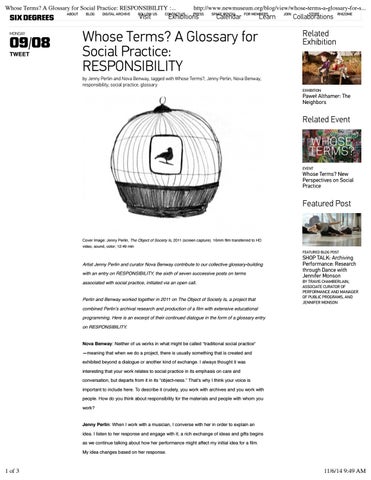
Cover Image: Jenny Perlin, The Object of Society Is, 2011 (screen capture). 16mm film transferred to HD video, sound, color; 12:49 min FEATURED BLOG POST
Artist Jenny Perlin and curator Nova Benway contribute to our collective glossary-building with an entry on RESPONSIBILITY, the sixth of seven successive posts on terms associated with social practice, initiated via an open call.
Perlin and Benway worked together in 2011 on The Object of Society Is, a project that
SHOP TALK: Archiving Performance: Research through Dance with Jennifer Monson BY TRAVIS CHAMBERLAIN, ASSOCIATE CURATOR OF PERFORMANCE AND MANAGER OF PUBLIC PROGRAMS, AND JENNIFER MONSON
combined Perlinʼs archival research and production of a film with extensive educational programming. Here is an excerpt of their continued dialogue in the form of a glossary entry on RESPONSIBILITY.
Nova Benway: Neither of us works in what might be called “traditional social practice“ —meaning that when we do a project, there is usually something that is created and exhibited beyond a dialogue or another kind of exchange. I always thought it was interesting that your work relates to social practice in its emphasis on care and conversation, but departs from it in its “object-ness.” Thatʼs why I think your voice is important to include here. To describe it crudely, you work with archives and you work with people. How do you think about responsibility for the materials and people with whom you work?
Jenny Perlin: When I work with a musician, I converse with her in order to explain an idea. I listen to her response and engage with it; a rich exchange of ideas and gifts begins as we continue talking about how her performance might affect my initial idea for a film. My idea changes based on her response.
1 of 3
11/6/14 9:49 AM
Whose Terms? A Glossary for Social Practice: RESPONSIBILITY :... I find a text in an archive. It triggers my imagination: I try to “climb into” the text, its
Visit
http://www.newmuseum.org/blog/view/whose-terms-a-glossary-for-s...
Exhibitions
SIX DEGREES meaning and its form; I imagine who might have written it in order to understand it better. I
Calendar
Learn
Collaborations
copy the text, I write about it. I animate it, translating it into another medium: film or video or drawing.
Responsibility is inextricably tied to empathy, or “feeling into,” which might be a more useful description of the term. In order to be responsible I must try to “feel into” the document or into the presence of the person with whom I am working. Only then can the real weight of responsibility be carried and fully felt. Responsibility is also linked to respect. Respect for people, histories, spaces, and methodologies. Respect for practice as process and the taking on of that. This means that one must be responsible to the necessity or inevitability of change through the process of making engaged work. The process can mean a deeper understanding of a text, or a shift in the conversation with a person with whom one is working. Responsibility means curiosity and an active response to changes throughout the process of making.
How do you frame responsibility and openness with regard to exchange—of ideas and information and affect?
NB: Collaborative practices highlight the close relations between the notions you list. I am, like a lot of curators these days, particularly interested in developing new projects with artists, meaning that my role as a selector or organizer who is responsible for a project is inextricable from my role as an interlocutor who is responsible to a person (the artist). In such cases, artists and curators link themselves together by sharing responsibility for something that has not happened yet. This could be taken as an inherently political act—yet the rarity of a collaborative project that seems worthy of that name is both disconcerting and potentially enlightening. While curators have become increasingly prominent in the field of contemporary art, interestingly, they have also become even more dependent on artists because of this dual responsibility. When I am optimistic, I think that this visibility affords a possibility for curators to take on a broader political responsibility, to work alongside artists to help reimagine communication, and to invent new models of sharing and creating power that could be transferable to other fields.
JP: Maybe another reason why we are doing this is because we revel in language and the challenge of definition. To describe a term is a really fascinating way to unpack it and it feels very weighty to do so. I think an interest I have in doing this with you is that it resembles on a small scale the work we did together on The Object of Society Is.
Nova Benway is on the curatorial team at The Drawing Center in New York, where she recently launched Open Sessions, a two-year program of experimental exhibitions and public programs co-organized with more than fifty local, national, and international artists.
In her films, videos, installations, and drawings, Jenny Perlin works with and against the documentary tradition, incorporating innovative stylistic techniques to emphasize issues of truth, misunderstanding, and personal history. Her projects look closely at ways in which social machinations are reflected in the smallest fragments of daily life.
Suggested Reading 2 of 3
11/6/14 9:49 AM
Whose Terms? A Glossary for Social Practice: RESPONSIBILITY :...
Visit
SIX DEGREES
NEW 235 BOWERY NEW YORK NY 10002 USA MUSEUM
http://www.newmuseum.org/blog/view/whose-terms-a-glossary-for-s...
Exhibitions
Calendar
Learn
Collaborations
BLOG POST
BLOG POST
BLOG POST
Whose Terms? A Glossary for Social Practice: ENGAGEMENT
Whose Terms? A Glossary for Social Practice: CONSCIOUSNESS
“Whose Terms? A Glossary for Social Practice,” Part 1/2
Visit
Exhibitions
Calendar
Learn
Collaborations
Get Tickets
Current
Today
Digital Archive
Art Spaces Directory
Hours & Admission
Upcoming
Upcoming
G:Class
Ideas City
Audio Guides
First Look: New Art Online
Past
Bowery Artist Tribute
Museum as Hub
Tours
Past
First Saturdays for Families
Rhizome
Neighborhood
Audio Guides
Resource Center
Three M Project
Follow @newmuseum
About
Blog
712 PUBLIC PROGRAMS
3 of 3
Follow Us
Contact Us
Press
Space Rental
For Members
Join
Store
All Content is ©2012-2014 New Museum Of Contemporary Art. All Rights Reserved. Site by:
11/6/14 9:49 AM