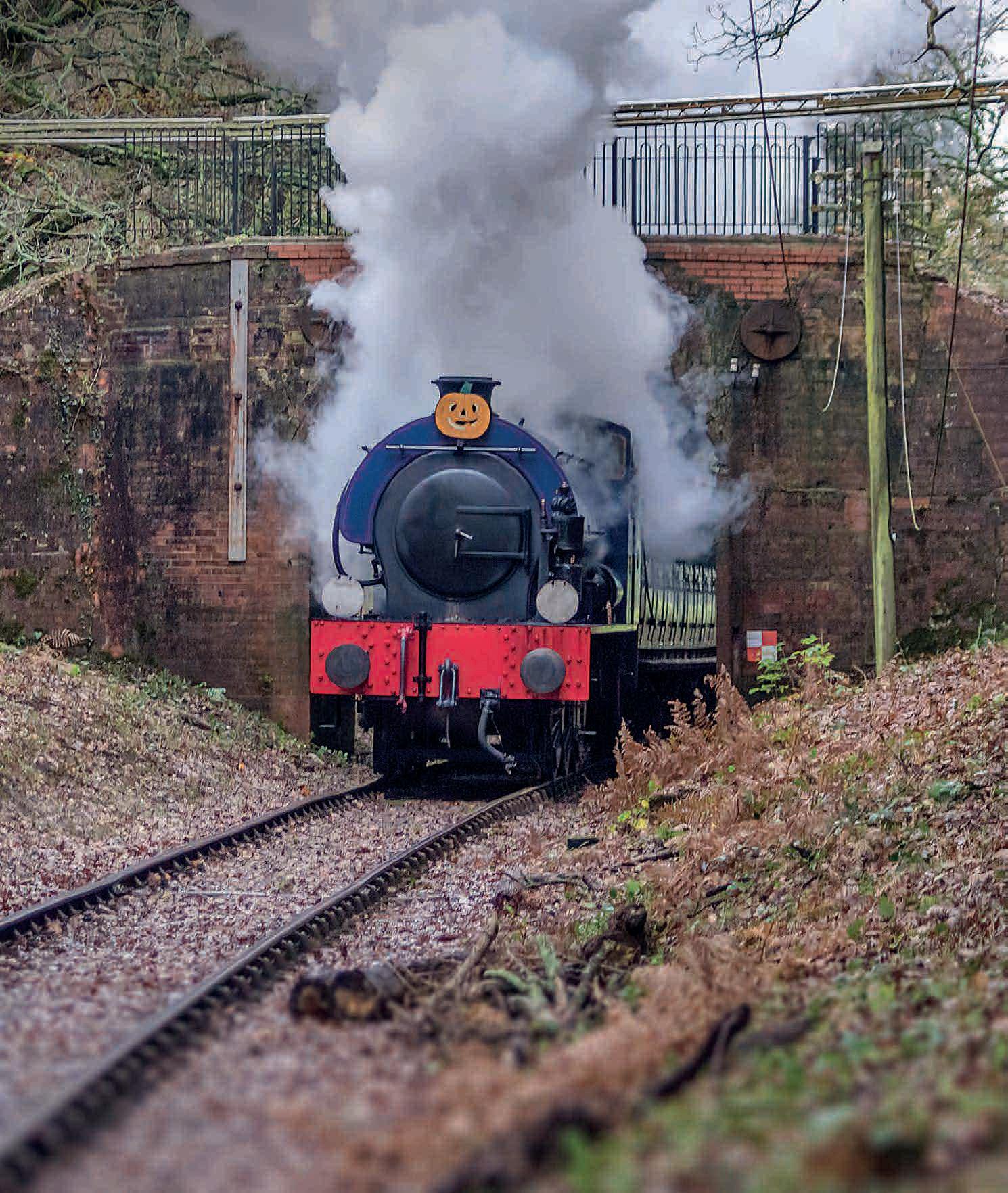
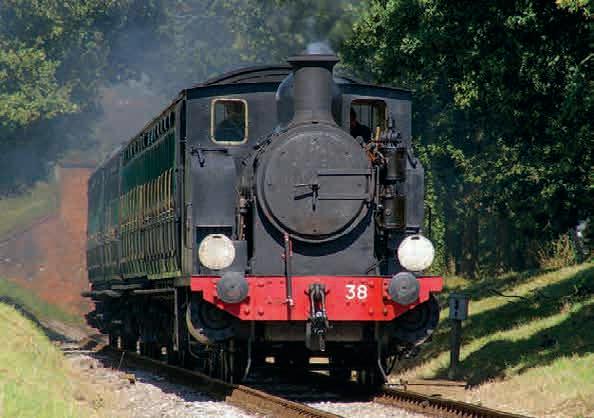
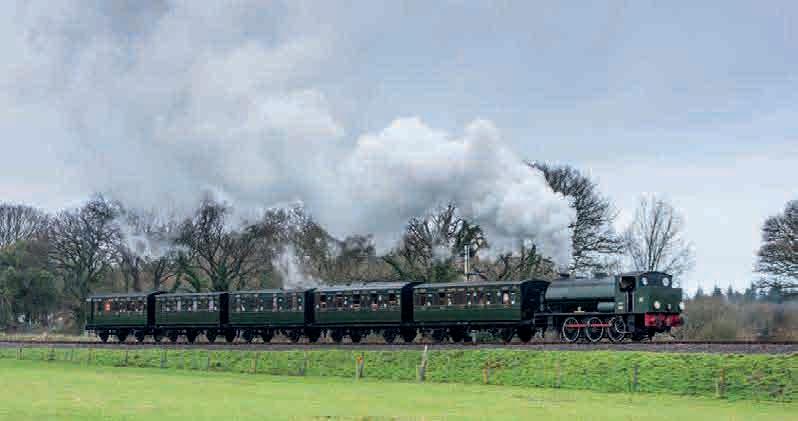
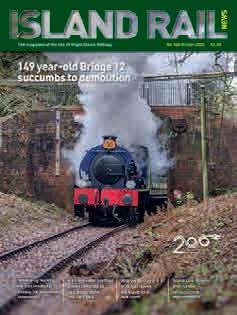
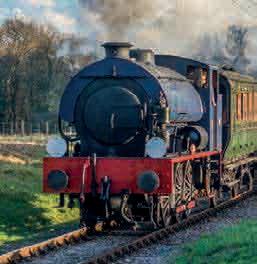
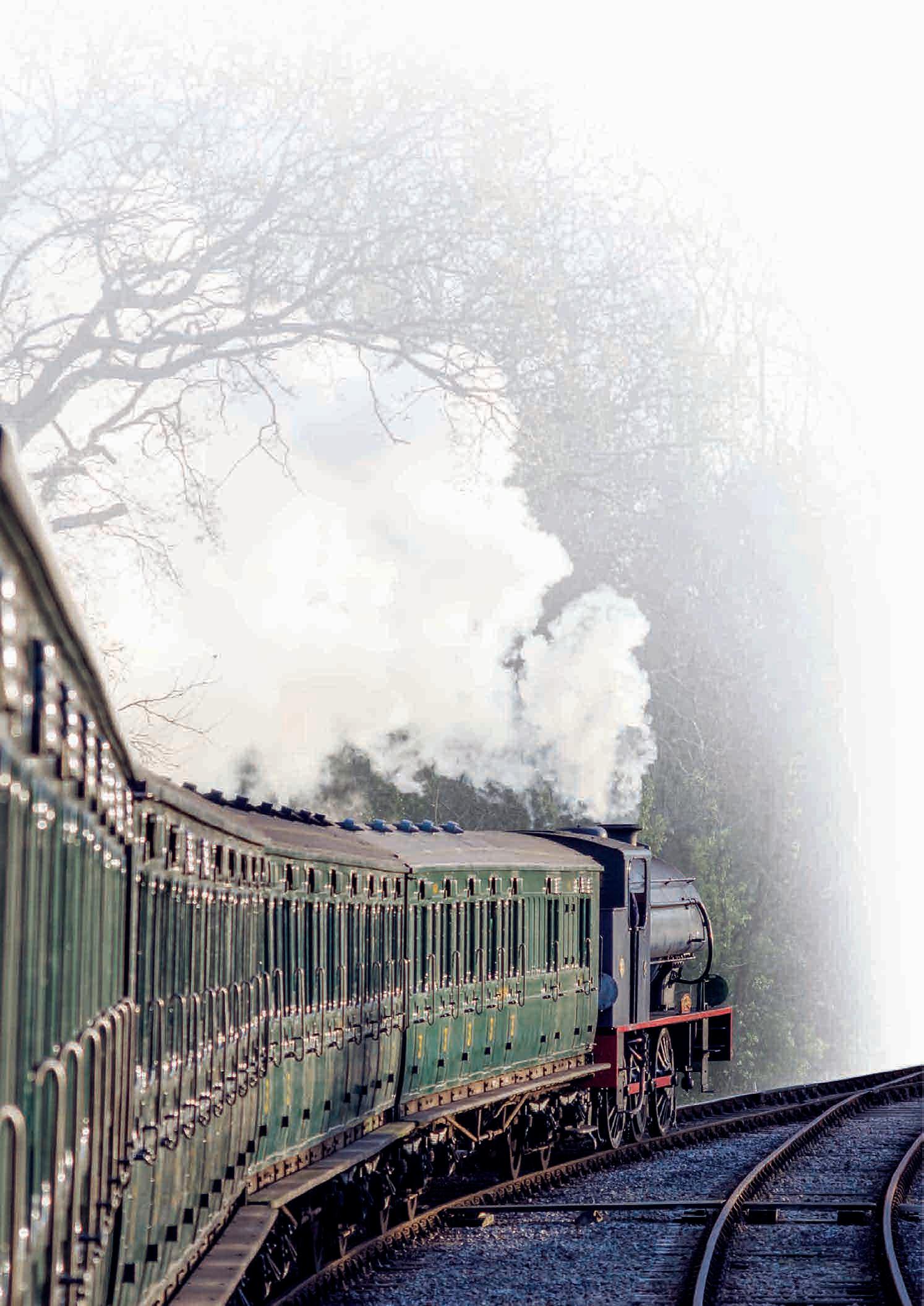
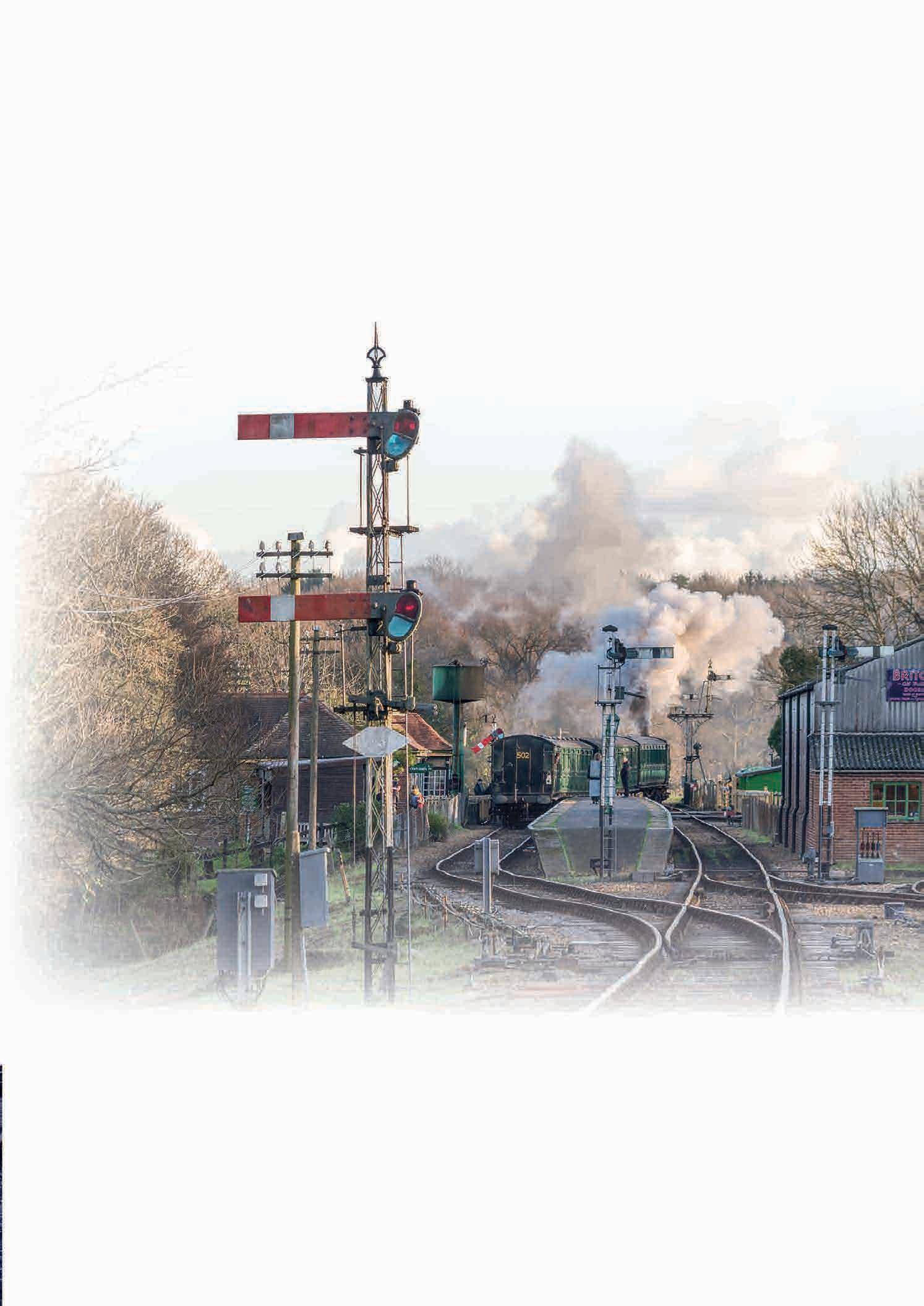
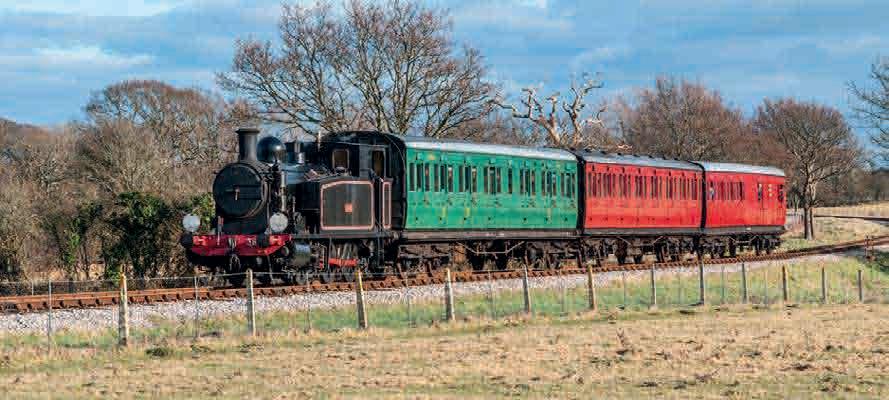
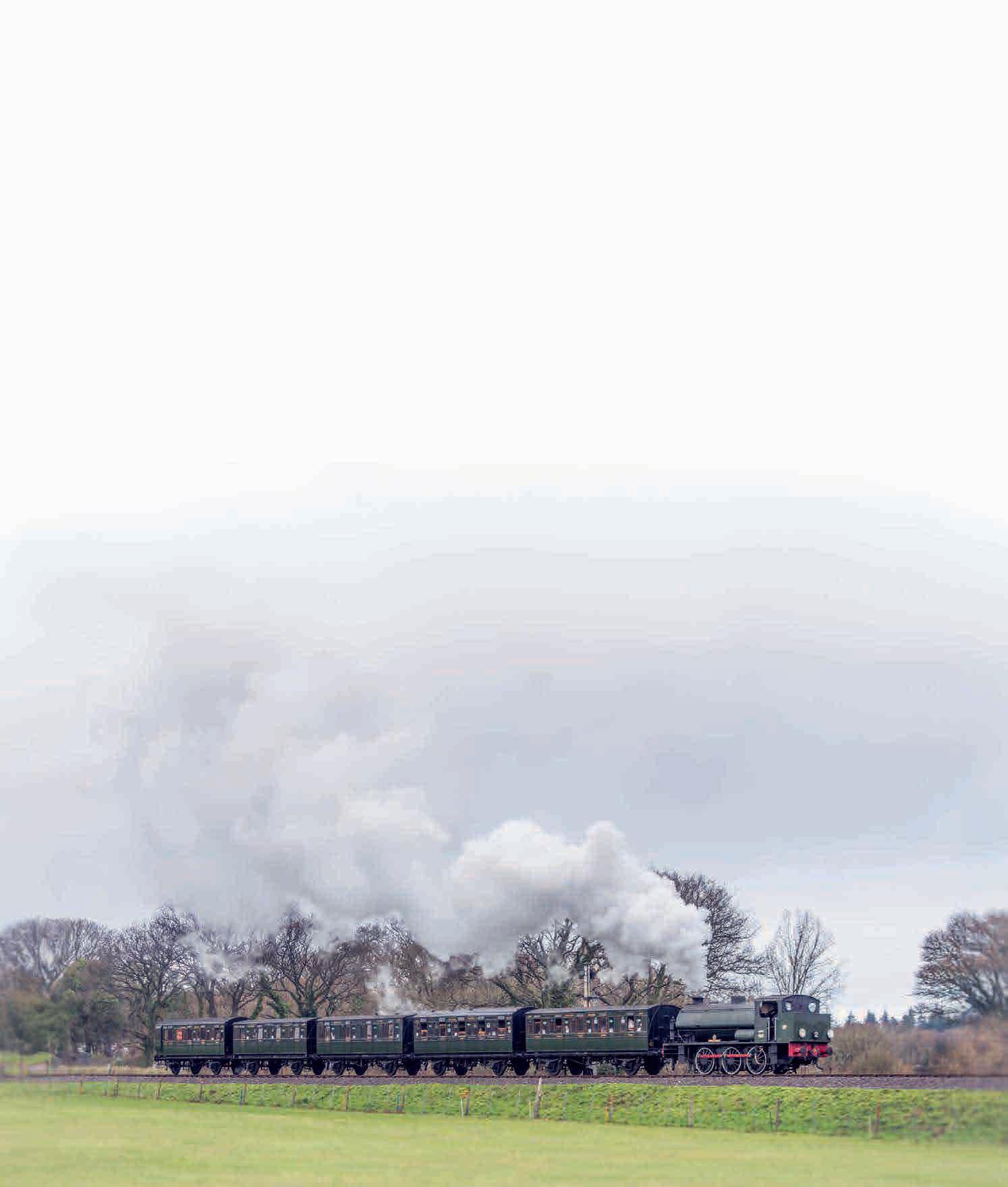
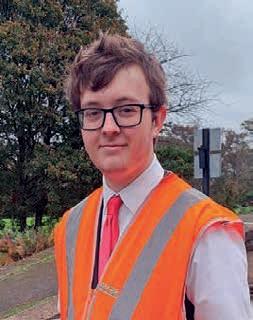
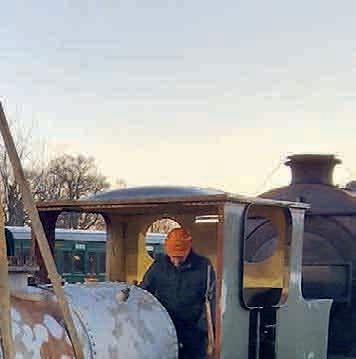
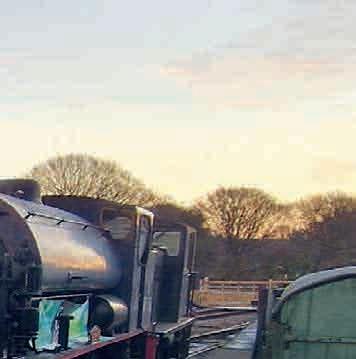
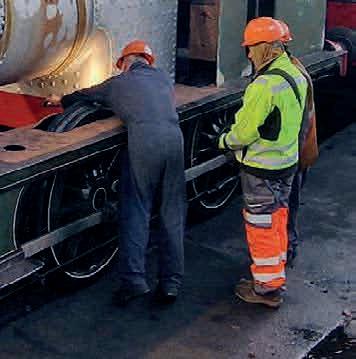
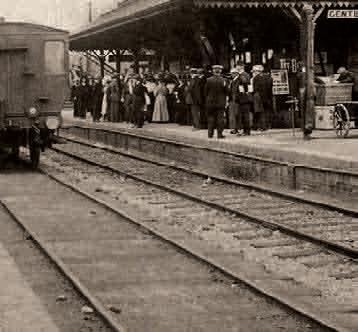
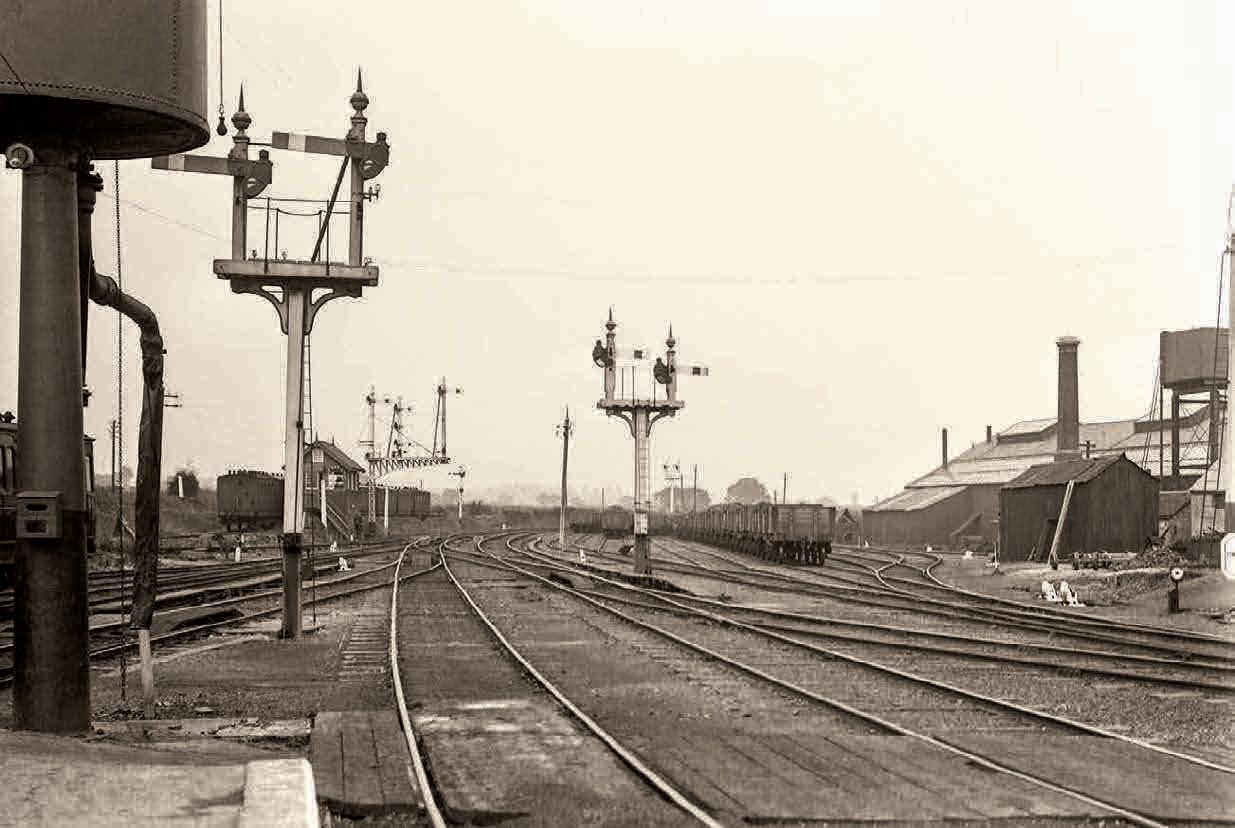
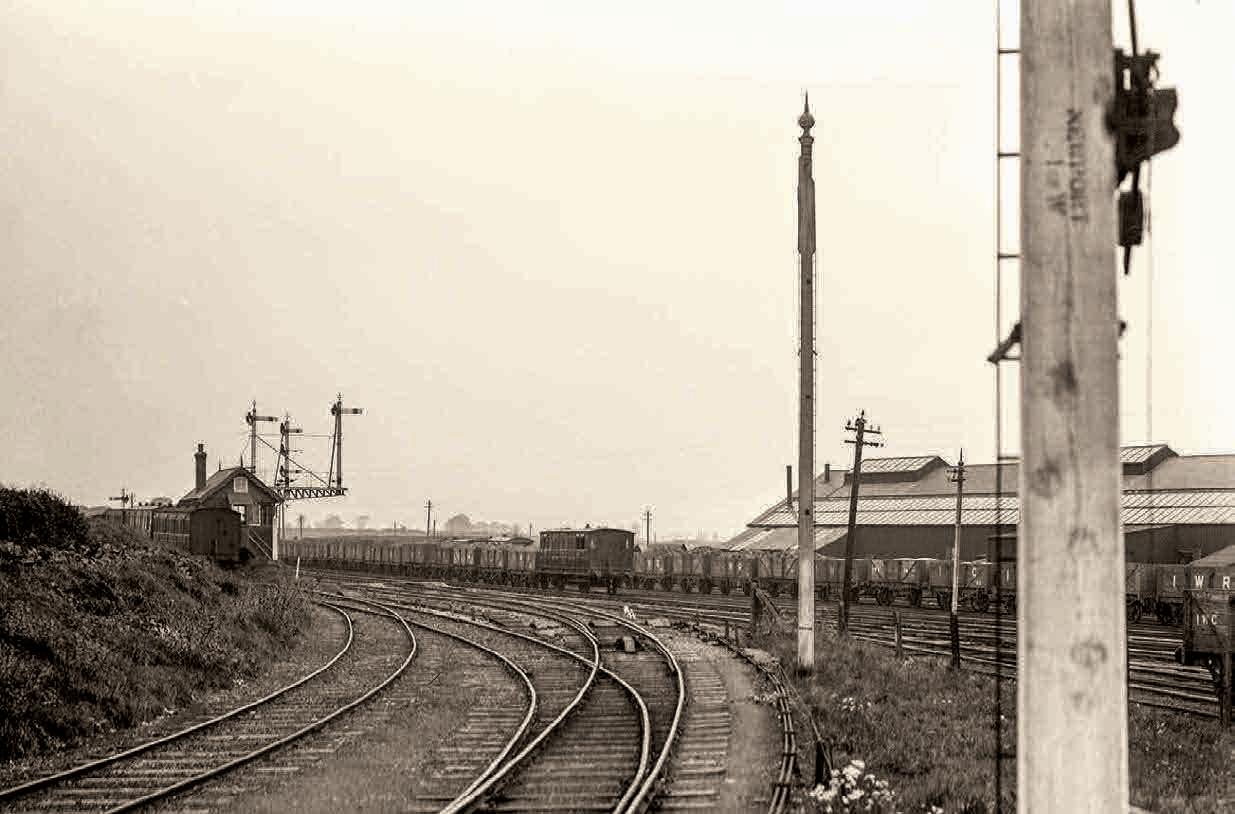
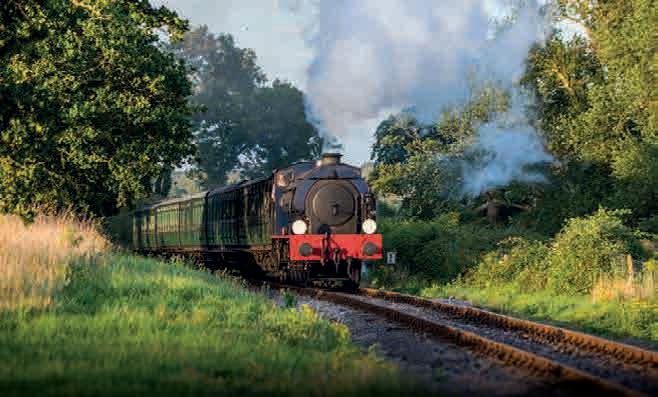
'Whistle-up' marks the start of national Railway 200 bicentenary celebrations
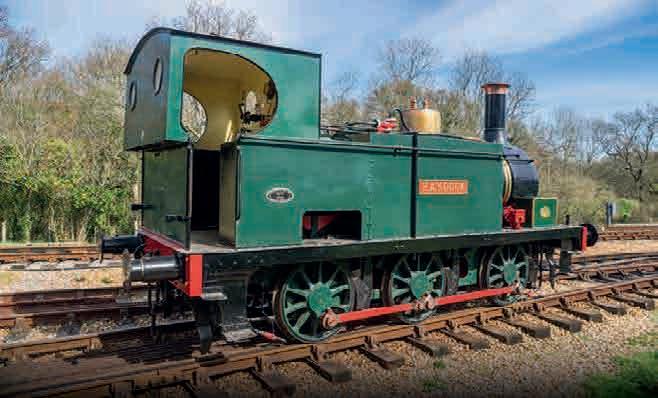
W8 Freshwater overhaul almost complete as loco prepared for February gala Andrew Barclay 0-6-0T
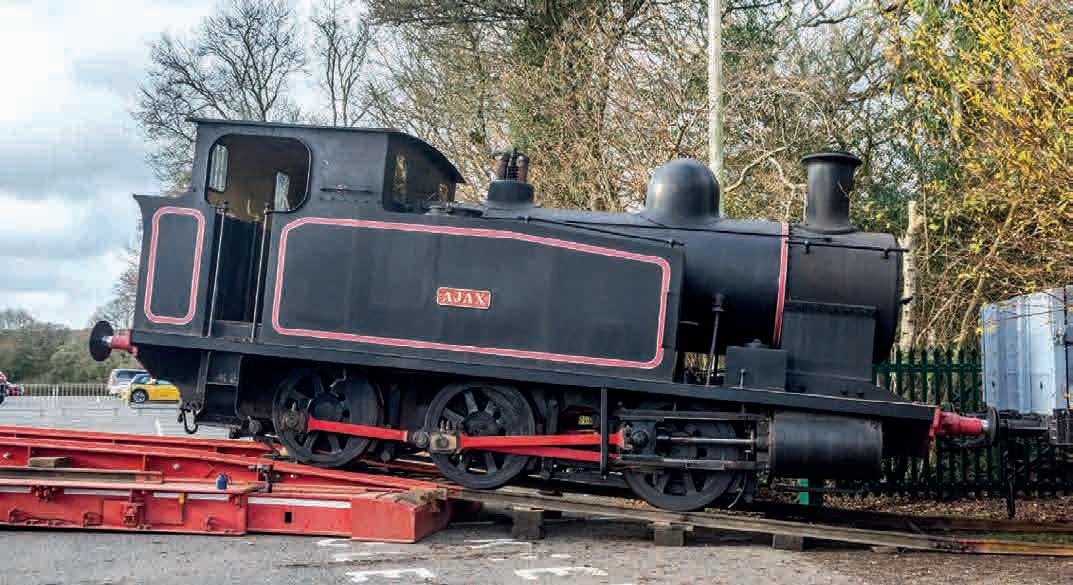
W38 Ajax leaves the Island for a new home Island Line reopens after further infrastructure improvements
A New Life for Ajax - Page 6
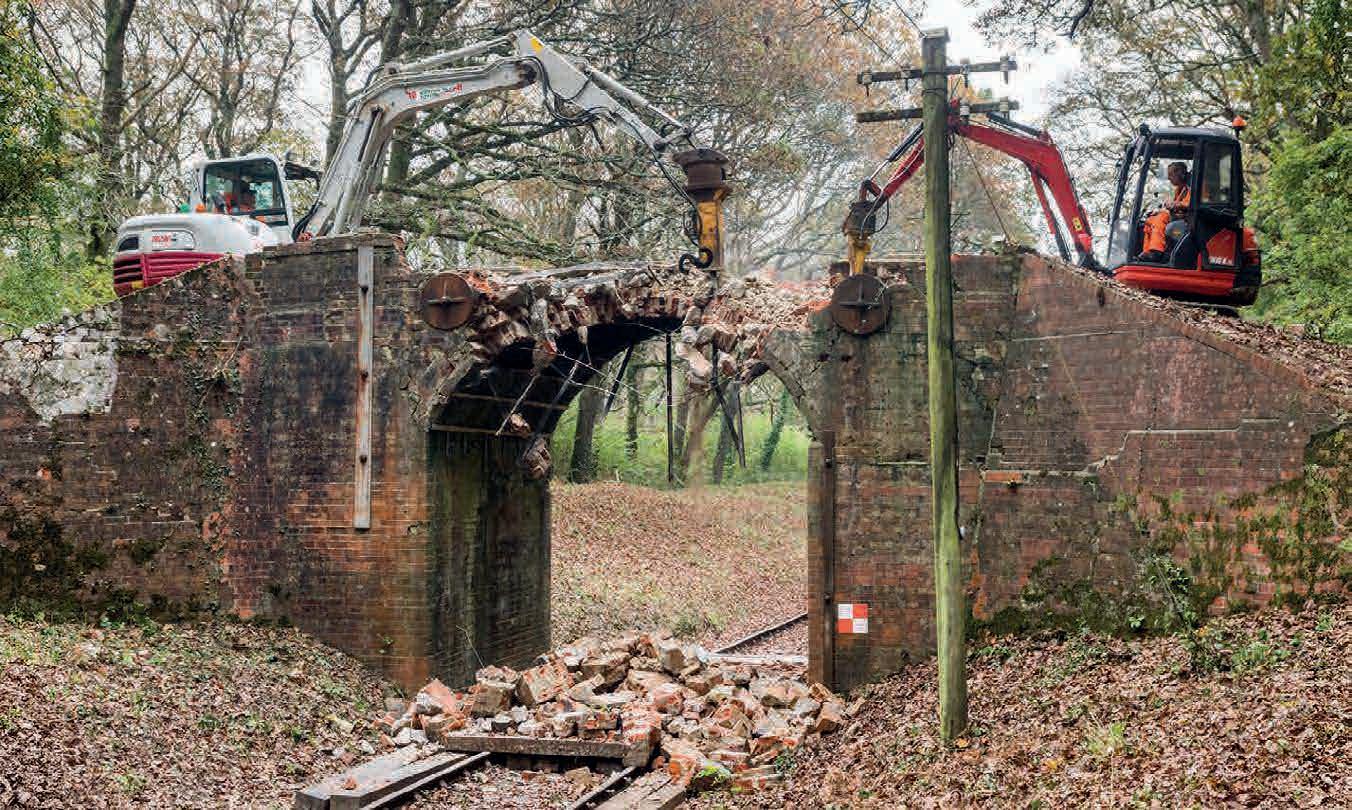
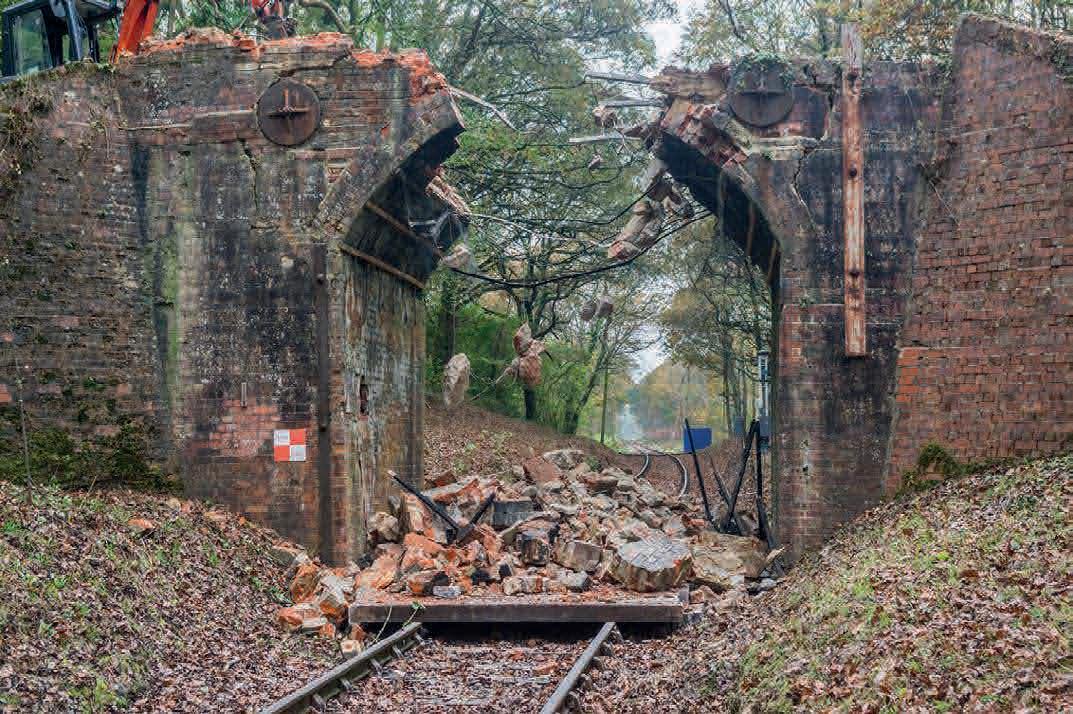
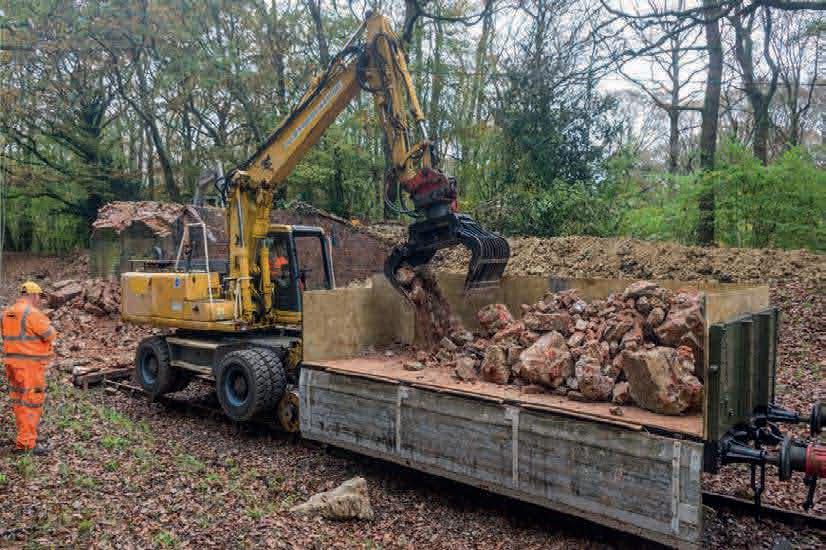
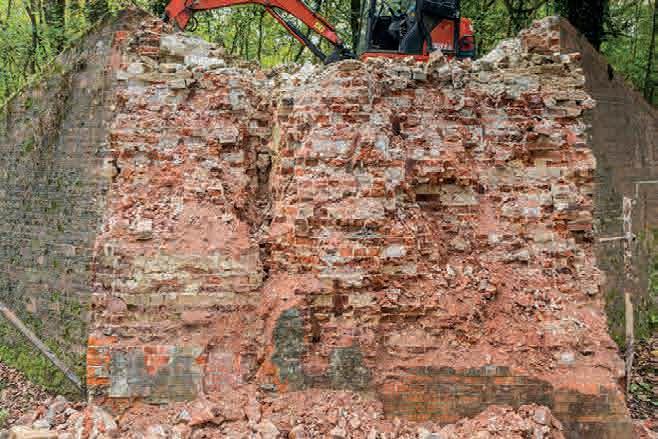
Bridge 12 Demolition - Page 18
Special Events - Page 8 Island Line News - Page 24
Workshop Files - Page 13
Operating Department News - Page 10 Newport Station - Page 26 Potential Diesel Traction - Page 39
John Faulkner
John Faulkner
lan Hodson
IWSR Archive
John Faulkner
John Mitchell Iain Whitlam
John Faulkner
Editorial
FIRST, WELCOME to IRN 105 and the first edition of 2025, an opportunity to both reflect and to look forward.
In terms of reflection, the final quarter of 2024 was a period when some long-established features of our Railway disappeared. Having been built for the opening of the Ryde & Newport Railway in 1875, we bade farewell to Bridge 12 in early November. There can be few of us closely associated with the Railway who were not sad to bear witness to the demise of this 149-year-old structure but, as explained in IRN 100 (p6), the bridge could not be saved without expenditure running well into six figures.
Turning to locomotives, after spending almost half her life at Havenstreet, Andrew Barclay 0-6-0T W38 Ajax departed Havenstreet in December, destined for a new home in Northamptonshire. You can read more about Ajax and the decision to release her on page 6 of this edition. Again, some may question this decision but it is worth remembering just how fortunate the IWSR has been over the last 15 years or so in having been the recipient of no fewer than six gifted steam locomotives (three Hunslet ‘Austerities’ and three Ivatt 2MTs) as well as a diesel shunter. It must surely be good for the heritage railway movement that Ajax now has a new home where she will be restored and returned to steam.
Finally, although perhaps less emotive, having used the auditing services of Bright Brown continuously for 52 years, our membership has accepted a recommendation to appoint a different firm. Compared to those early days when the late Roy Barton would cheerfully attend AGMs on behalf of Bright Brown, the Railway is now a very different and more complex business. There is more information about this change in Iain Whitlam’s News from the Boardroom overleaf.
There can be little doubt that 2025 will be another challenging year, but there is plenty to which we can look forward, including the national Railway 200 celebrations. Due to take place soon after this edition is expected to land on members’ doormats, our first ever February gala will kick off our own milestone anniversary year, when we celebrate the sesquicentenary of the Ryde & Newport Railway, 100 years since W24 Calbourne arrived on the Island and the 50th anniversary of our own Island Steam Show.
Stuart Duddy IRN Editor
Marc Morgan Huws’ Chief Executive’s Report
WITH 2024 HAVING drawn to a close it’s a good opportunity to take stock of the year. From a heritage perspective, we’ve made progress after faltering on the Wootton goods shed and Wootton signalling projects. We’ve learned that we need better project planning and more realistic costing plans for big and complex projects. The Smallbrook Connections project delivered solar power, the waiting shelter linking the two platforms and, of course, a magnificent replica signal box. This project delayed others, including those at Wootton, and required unbudgeted works to create the signal box balcony and tidy the site prior to opening. Project planning and realistic resource allocation are key to managing the Railway’s growing projects and assets.
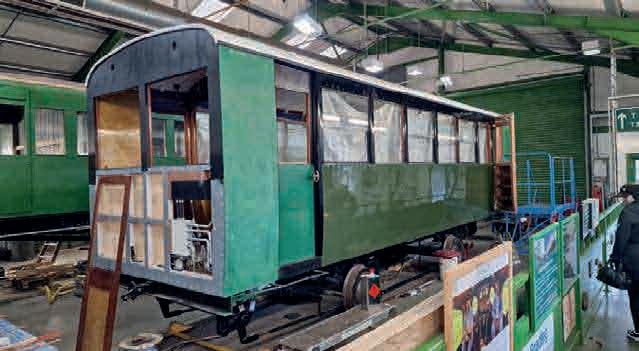
In the Rolling Stock Department also, we have made progress where we have previously faltered. The return of A1/x Class W8 Freshwater is now within sight alongside other major projects such as Ryde Pier Tram Trailer Car 10 and the work to reconfigure the Drewry driving car so it can run as a two-car set again. The boiler for E1 Class W2 Yarmouth is expected to arrive shortly whilst progress has continued on other components required for this substantial rebuild. LBSCR Third 2403 also required slightly more extensive repairs to the wooden body panels than had been anticipated.
Our future cost base is significant. We know that we need to fully overhaul our entire fleet of bogie and four-wheeled carriages one at a time, planned to be one per annum for the next 12 years. If we want to continue restoring carriages (which we do) then this will pretty much double our workload.
During the year we addressed our locomotive strategy – there are eight steam locomotives which we intend to keep in service, a substantial task and cost in itself and one which many steam railways would love to emulate.
Our Permanent Way is also the envy of many heritage railways but still requires a long-term investment approaching £100k per annum and our building estate is substantial and requires continual maintenance and repair.
The costs of all our materials and contractor works have risen well beyond the headline inflation rates which themselves have reached 25% over the last five years. Coal, electricity, gas and insurance have all surged in price. Perhaps reflective of the cost challenges is the cost of labour. Whilst headline inflation has risen by a
challenging 25% over five years, the National Minimum Wage, which drives a substantial proportion of our staffing costs, has risen by 40% over this period (and more for those under the age of 23).
Increasing regulation and technology requires more staff, human resources being a good example, to ensure that we are compliant and properly supportive of both our voluntary and paid staff. Information technology is another area where we need greater technical support. Nevertheless, our cost base is under detailed scrutiny, and we will be looking to reduce costs wherever we can without losing revenue or stopping our heritage railway activities.
Adding to the challenges, the Island’s visitor numbers continued to fall. Overnight visitors either staying in accommodation or with friends and family during July, August and September dropped by a whopping 13%. Looking forward, the UK’s tourism sector’s regular research shows that some 51% of people in the UK expect that ‘the worse is still to come’ in terms of the economic outlook. 46% say they are being very careful with their spending and 19% say they have cut back spending.
So, what does this mean for us? Whilst we’ve always benefited from the tourist economy and volume of visiting tourists, this is a declining market. We’ve increased our share of that sector over the years but we are now a mature attraction in that market. Last year saw an overall drop in visitor numbers of around 5%. This was better than the market figures suggest but, nevertheless, a clear sign that we need to develop a strategy to deal with this situation.
Against this we’ve managed to increase our income by around 5% through increased prices and secondary spend – the Barn Café has been a big contributor. Simply increasing our prices alone, however, is not a long-term solution and our strategy has to be smarter and broader. Nevertheless, what is striking is how much comparative prices have risen – for train travel at our peer railways and everywhere, every day for items such as a coffee or a slice of cake. It’s interesting to look at how our café prices compared to others at the start of the season and then the end. And so, yes, prices will need to increase as we keep pace with the rest of heritage rail and other cafés and shops.
Our marketing must be better and smarter – more focused – a good example is the need for a new website that will be delivered early in 2025 but, of course, at a cost.
John Faulkner
We also need to challenge ourselves on the quality of our offer – both on non-event days and the content of our events. Probably the greatest want from our visitors is to feel that they have had ‘value for money’ - that’s not a bargain with giveaways, but a high quality and exciting experience that exceeded their expectations. Our every-day plans will concentrate on delivering new, exciting, high-quality experiences, attracting more local people to offset a diminishing visitor market and, through these actions, hold our visitor numbers steady. Attracting more Island residents is a key area on which we must work. Wizard Week proved that, with imagination and attention to detail, we can improve the offer. Similarly, our Christmas event which, again, concentrated on the local market, provided better dressing, more activity and a new food and drink offer across the outlets. With smarter marketing too (highly targeted Sky TV advertisements for example) we increased our visitor numbers by 10%. There is much more we can do in these and other events and markets to continue to drive local business for 2025.
There are significant capital projects that we aspire to achieve. These include more covered storage both on and off track, a proper archive and conservation facility and the replacement of the Plessey building out of sight to name but a few – but all will require us to generate additional revenue to fund or match fund grants.
I hope I haven’t depressed you all with the challenges and, indeed, as I write this the Railway is tantalisingly close to being able to announce a major opportunity to secure a hugely-significant historic asset – but at a considerable cost!
We need to adjust to a fast-moving world and the economic challenges of the UK in 2025. This will require change, but if we embrace the challenges and think smartly and more imaginatively then the Railway will continue to flourish.
In the meantime, you can help - I’m not asking for money (although if you want to donate please do!). Little things can help – taking IRN digitally to save us the rising cost of postage and printing, changing your membership payment method to direct debit, giving us an email contact to save us having to write to you by post, visiting us more often, even just for lunch or tea and cake in the Barn Café, encouraging friends and family to visit or selling a few more draw tickets.
News from the Boardroom
THE CHIEF EXECUTIVE has drawn up the principles of a draft strategic plan, which will cascade into our next business plan and will review and encompass the previous Strategic Goals. The world around us in which we trade has changed significantly since 2020 and the Covid-19 pandemic. A team of six directors will be working with the Chief Executive to work up these principles into the strategic plan, talking to managers, paid staff and volunteers to ensure a broad cross-section of ideas.
We had struggled to complete the audited accounts in time for the 29 June Annual General Meeting. We have since identified a firm of auditors which can deal with our type of business and has an Island base. An
compiled by Iain Whitlam, Company Secretary
Extraordinary General Meeting was therefore called for 30 November to approve a change of auditors to Moore (South). With the expectation that, for a short meeting, attending in person would not appeal to mainland members, arrangements were made for online participation. No-one joined online, however, and so a quorum was not achieved. In accordance with our Articles of Association, the meeting was adjourned for one week, when an overwhelming vote was confirmed in favour of the change. We apologise that the reason for the change could not be expounded in the EGM agenda as we had still been working with and needed the cooperation of the existing auditors.
John Faulkner
by
Rolling Stock Manager Andrew Summers and Director Nick Felton
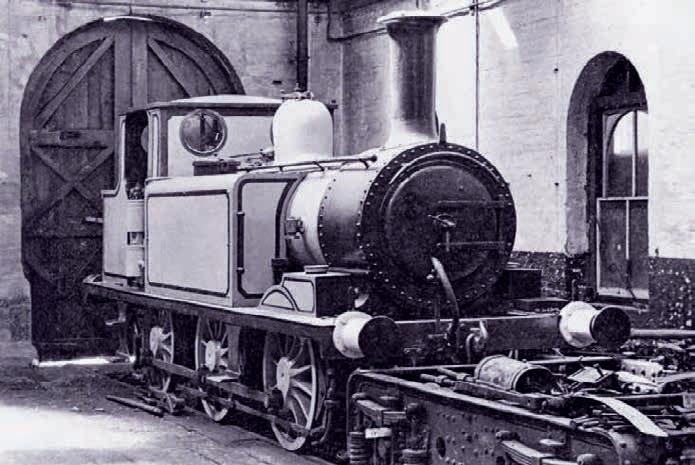
RECORDS SHOW THAT the last examination of Andrew Barclay 0-6-0T W38 Ajax in industrial service for Stewarts & Lloyds was in 1967. By 1969 Ajax and another locomotive now in IWSR ownership – Hunslet ‘Austerity’ Juno – were on the Stewarts & Lloyds disposal list, their industrial service having come to an end. Ajax was purchased privately by the late Henry FramptonJones whilst Juno was purchased by the Ivatt Locomotive Trust – it’s a small world!
Following inspection by the IWSR in August 1972, Ajax arrived at Havenstreet on 30 November 1972, still in the ownership of Henry Frampton-Jones. In the early 1970s the Railway was still in its embryonic stage and Ajax was viewed as a locomotive with potential for future use. Following a boiler inspection and report undertaken in 1977 by former Ryde locomotive boilersmith Joe Snellgrove a formal loan agreement was signed in 1979. Lack of funding for any overhaul, however, meant that no work was done on Ajax and so she slumbered at Havenstreet and, later, at Wootton on the siding that once stretched from the run round loop to Packsfield crossing.
In 1987, while at Wootton, her asbestos boiler lagging was removed, after which a new contract was agreed covering the overhaul and eventual use of the locomotive, although Ajax almost departed the Railway in 1994 owing to a shortage of siding space. By 1995, however, firm moves were afoot to restore Ajax as she met our operating needs. Key dates in her overhaul and use history are as follows: -
• c1989: boiler repairs initiated
• 1995: design approval obtained for change in firebox design from copper to steel
• 1996 onwards: extensive work undertaken at Havenstreet and a new inner firebox purchased from Israel Newton & Sons Ltd
• 2002: boiler repairs were undertaken by Bartlett Engineering in Tenby, Wales
• At Havenstreet, extensive plate replacement was underway
• 1 December 2003: the boiler was test steamed
• 4 November 2004: Ajax ran under her own power for the first time
• 11 September 2014: The locomotive was steamed for the final time
• Ajax clocked up 11,501 miles on Island metals between 2004 and 2014.
Ajax came into Railway ownership on Christmas Eve 2004, after purchase from Mr FramptonJones for the sum of £10,000. The material and sub-contract cost of the restoration was £42,126; volunteer and employed staff work was estimated as having a value of £223,250.
After nearly 33 years on the Island, Ajax hauled her first passenger train on 13 April 2005. Thereafter Ajax saw regular use, often covering turns when no other steam traction was available. In 2014, when her 10-year boiler certificate expired, Ajax became a long-term resident of Train Story with her footplate accessible to visitors for most of the time. After ten years Ajax departed Train Story in November 2024, her appearance being still that of a working locomotive, showing the benefits of under-cover storage. Incidentally, it is understood that the restoration of Ajax was one of the contributing reasons leading to the Ivatt Locomotive Trust choosing the Isle of Wight as home for its three Ivatts and Juno because this work had indicated to its trustees Peter Clarke and Roy Miller that we could return to steam the locomotives that they had preserved.
With the donation to the Railway of other very capable and more suitable locomotives there was little incentive for the Railway to overhaul Ajax
Her career on static display effectively became permanent.
In conjunction with the Rolling Stock Manager, the trustees conducted a review of the Railway’s locomotives and rolling stock during the April 2024 board meeting. After some discussion it was agreed that it would be best for the Railway, and for the locomotive, if a new home could be found for Ajax The justification for this is that Ajax has no historical Island connections, the Railway still has very limited siding space, only some of which is
under cover, and there was no realistic prospect of the locomotive ever being returned to service on the Island.
Agreement was reached with the Northampton & Lamport Railway for Ajax to be based at Pitsford and Brampton station for overhaul and return to steam. As an accredited museum, the Railway has an obligation to ensure the long-term security of this 106-year-old locomotive which has spent nearly half that time on the Isle of Wight. Consequently, and also recognising the IWSR’s investment
in the locomotive, the agreement is structured as a long-term loan. There is an option, if mutually agreed, for the Northampton & Lamport Railway to purchase Ajax for a nominal sum at some time in the future. The initial term of the agreement gives up to three years for the N&LR to complete the overhaul followed by 10 years in service.
Ajax departed Havenstreet on 9 December 2024 and was unloaded at the Northampton & Lamport Railway the following day.
Opposite Page:
Top: A familiar sight to people using Packsfield crossing for a number of years was Ajax languishing at the end of the former siding at Wootton, seen here on 15 February 1987.
Eric Faulkner
Bottom:Ajax in service with a mix of green and red carriages crossing Ashey Grounds on 15 February 2012.
John Faulkner
This Page: Ajax being loaded for transfer to the Northampton & Lamport Railway on 9 December, 10 years after being withdrawn from service and still looking as good as new. John Faulkner
This page:
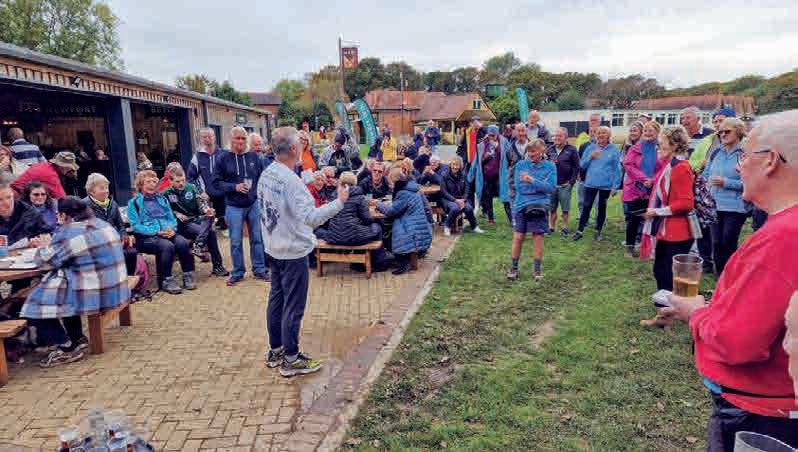
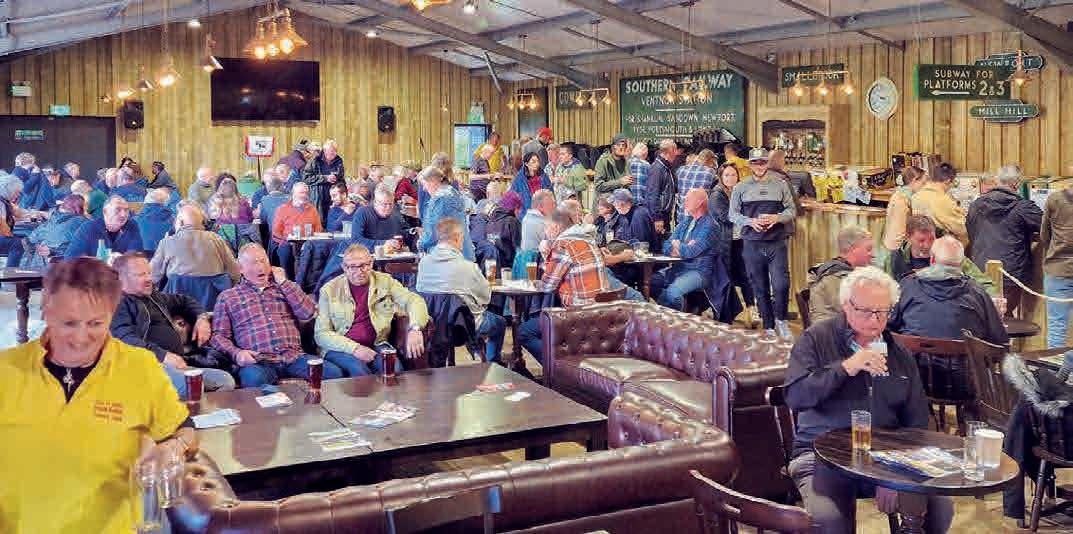
Right: The Sunday of Beer & Steam also attracted the Hash House Harriers, sometimes described as a drinking group with a running problem!
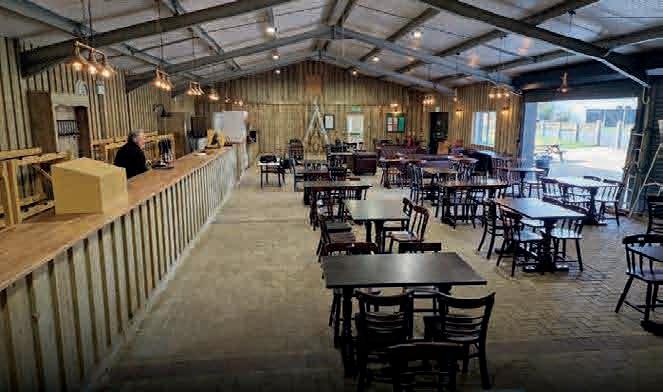
Below: Beer & Steam attracted plenty of visitors to the real ale bar.
SPECIAL EVENTS REPORT
by Events Officer Liz Tagart. Photographs by John Faulkner unless otherwise credited
RAILWAY 200
AS I WRITE this report on New Year’s Eve, it’s hard to believe that 2024 is almost at an end. Havenstreet is peaceful currently, but scheduled services run again on New Year’s Day, when the Railway 200 ‘Whistle Up’ kicks off the year of nationwide celebrations to mark the bicentenary of the birth of the modern railway. On 27 September 1825, George Stephenson’s steam-powered Locomotion No 1 travelled 26 miles between Shildon, Darlington and Stockton, carrying hundreds of passengers to great fanfare. That event, almost 200 years ago, set in motion a chain of events that would change the world forever.
BEER & STEAM
Beer & Steam on 12 and 13 October followed a similar format to that of previous years. This type of event attracts a healthy number of regular visitors who enjoy a drink and with whom we can exchange some good-humoured banter.
Opposite page:
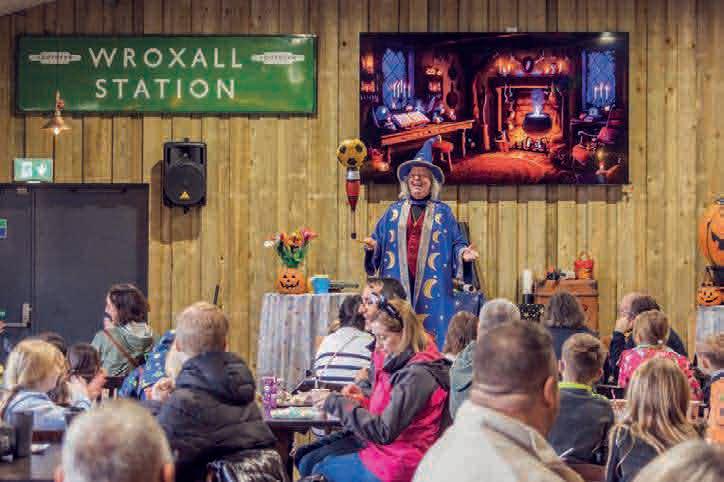
Top: Professor Crump entertaining children in the Barn Café during Wizard Week. Note the newly-acquired Wroxall station sign.
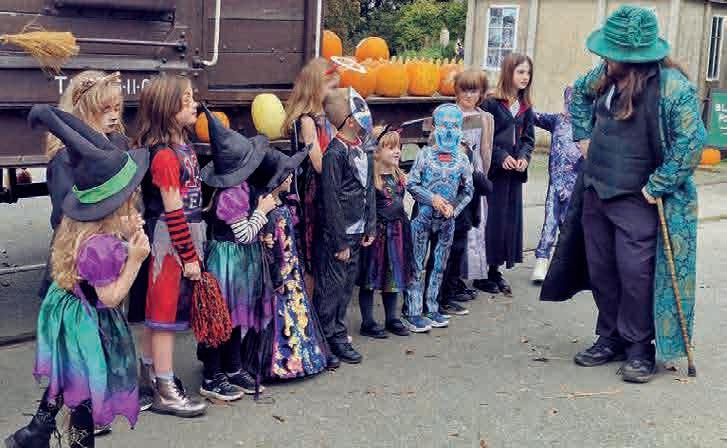
Middle: Judging the fancy dress costumes.
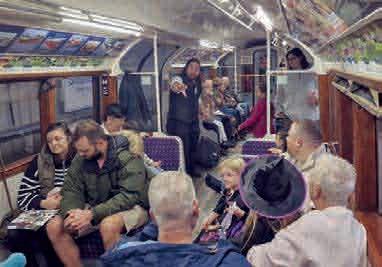
Below left: Greg Chapman telling spooky stories in 483 007.
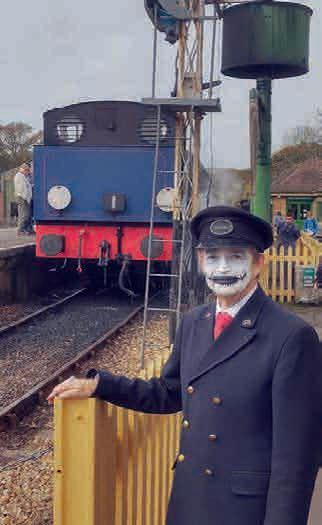
Below right: Your editor looking even scarier than usual. Tony Barry
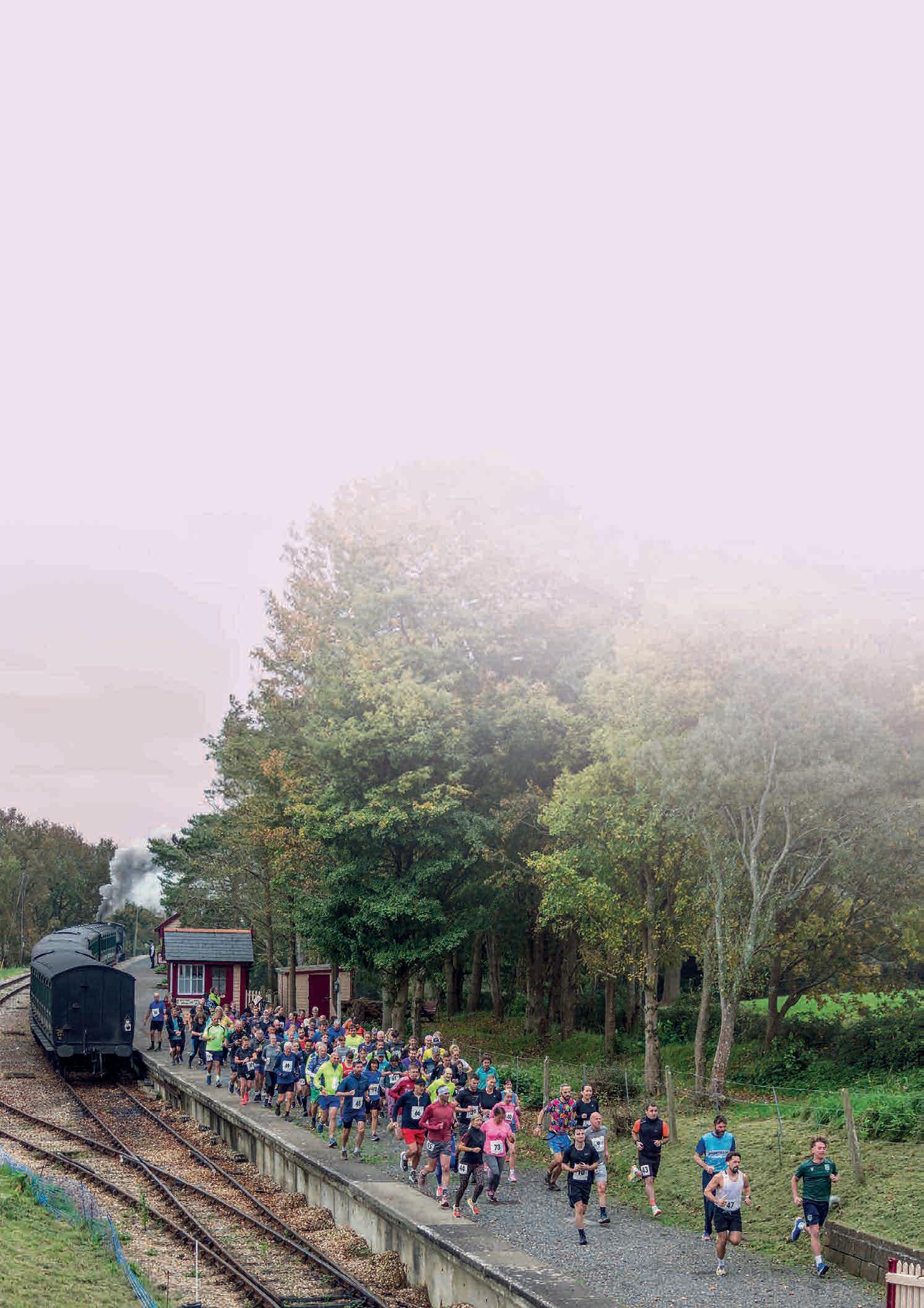
Bottom: Simultaneous departure of 198 Royal Engineer and Race 1 runners, Race the Train
WIZARD WEEK
The 2024 event extended to seven days. In common with several events, Wizard Week attracts a lot of repeat business from Island residents and their families, and so it’s worth making changes and enhancing the offering to keep things fresh. Visitors could not have failed to notice the many dozens of pumpkins scattered around Havenstreet station and on the open balconies of SR 15T Goods Brake Van 55724 berthed in the Display Siding.
Elsewhere, there was a potions bar in the Barn Café where younger visitors could select hideously-coloured drinks
containing tentacles and other gruesome accompaniments. Nearby, they could make alternative transport arrangements in the broomstick and wand-making classes where there was glitter aplenty, some of which was still evident around the site at Christmas! Entertainment was provided again by the wizardly Professor Crump, with Greg Chapman assisting with announcements, performing magic tricks in the station yard and spooky story telling in the former Island Line Class 483 unit in Train Story. Positioned in the station yard were our friends from Luxurious Shortbread with their stall located in our 1940s Experience houses which had been
dressed as shops to enhance the display. The popular Wizard Week treasure hunt followed the usual format as did the daily fancy dress competition.
Come the end of the event, we were a little concerned about how we might dispose of 200-300 pumpkins, but as he loaded countless winter squashes into his Land Rover, our Chief Executive assured us that they would be appreciated greatly by his three alpacas. It later transpired, however, that even alpacas don’t care much for pumpkins!
RACE THE TRAIN
Race the Train took place on Saturday 2 November in much-improved weather conditions compared with those experienced in 2023. Following registration, runners and accompanying visitors boarded the train for Wootton. With the locomotive having run round, each of the two races began at the sound of the engine whistle as the train departed Wootton. Simultaneously, a radio message was sent to those manning the finishing line at Havenstreet so that the digital stopwatch could be started. Those of us manning the finish line were equipped with medals and water for the participants as they arrived back at Havenstreet. The first race was won by Michael Thompsett who learned of the event only a few days earlier. The train crew – Roger Milward, Ian Corney and Jessica Garbett – made a good effort, with the train returning from Smallbrook just a few minutes after the first runners reached the finishing line. A number of runners are also members of our own Railway team. Unfortunately for her, Ellie Corney, whose father Ian was fireman, did not beat the train but she put on a good show for her first year. In both races, as the train approaches Havenstreet, the runners seem to find some extra energy as they endeavour to reach the finishing line before the train passes over the crossing ahead of them. They are all applauded and encouraged towards the finishing line, with perhaps the loudest cheer being reserved for the back marker.
SANTA SPECIALS
Our 2024 Santas were, once again, based in Train Story, with grottos in Ventnor West push-pull set 484, the saloon compartment of SECR Composite 6375 and in the First Class compartment of Oldbury IWR Composite 10. Many visitors enjoy the fact that they are going to see Santa in his train and using the saloons means that we have space for larger groups; it is not uncommon for groups to comprise six or more adults but only one child. Setting up this event is always a great challenge but with our team of volunteers pulling together I think the display in Train Story was the best that we have achieved.
Entertainment in Train Story was provided by Huxley and Greg Chapman, both familiar with how things work, and they make a great addition to our team. Generally, they performed at the far end of Hall 2, where visitors waited before crossing into Hall 1 and up the slope, passing through a magical tunnel. At the top they were met by the elves who would escort them to see Santa. Initially, it had been intended that all visitors would take their train ride before visiting Santa but, as we moved closer to Christmas and visitor numbers increased, we found that the previous ‘free flow’ system was better. In any case, much of our Santa traffic is repeat business and many visitors have their visit already planned before they arrive.
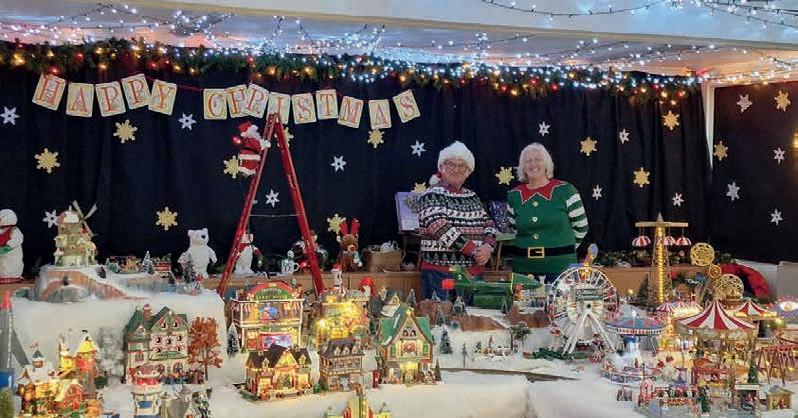
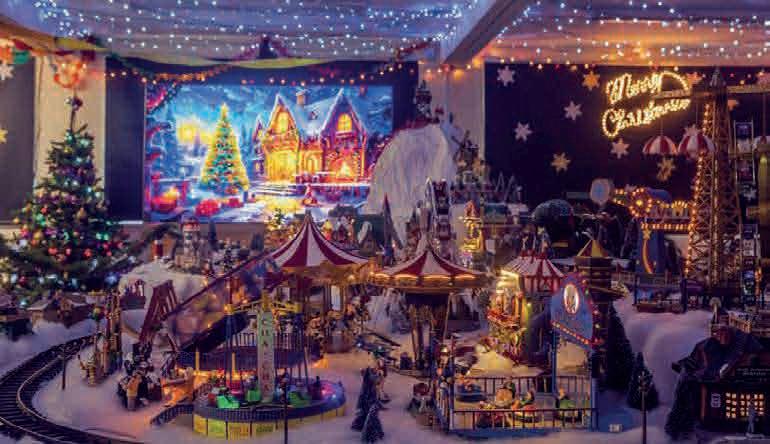
Spearheaded by Clive Miller and his team, there were vast improvements in the decorations and atmosphere in the station area at Havenstreet. These included a large Santa model standing alongside his sleigh, the return of the snowmaking machine and literally thousands of coloured lights which adorned almost every surface. Three juvenile rides from Hortons’ Steam Fair were housed in a marquee and, nearby, children were able to make Christmas stars from willow twigs. In the Freshwater Room Derek Bishop’s Winter Wonderland made a welcome return and, with improved signage, was appreciated by more visitors.
Operating Department News
UNDERSTANDABLY, THE TAIL end of the main operating season sees fewer visitors compared with the peak summer months but the special events held during October resulted in good passenger loadings on some days.
It is a statutory requirement in the UK that railway passengers must have the ability to stop a train in the event of an emergency or, at least, be able to communicate with the train crew. Given that IWSR carriages are all at least 100 years old our trains can be stopped by means of the passenger communication apparatus, although its use is very rare. On 12 October, however – the first day of Beer & Steam – a passenger stopped a train by pulling the emergency handle in NLR 4-wheeled Composite 6336. Many believe that pulling the communication chain or handle simply alerts the driver or guard by means of an audible signal and that it is the driver who brings the train to a stand. This, however, is not the case. The act of pulling the chain or handle operates the passenger emergency valve (PEV), returning the pressurised train pipe to atmospheric pressure and automatically applying the air brakes throughout the length of the train. Once made, this application cannot be overridden by the train crew and the train cannot restart until
from Tim Spencer-Peet, Acting Operating Manager
the PEV has been reset manually by the guard who, in most cases, must clamber up onto the carriage running board, reach up and turn the red ‘butterfly’ flag back to its usual, horizontal position. It is likely that those using the equipment on this occasion were Beer & Steam revellers enjoying an afternoon train ride. They were, however, advised against further inappropriate use of the system.
The weather during Wizard Week was far kinder than we experienced in 2023. Regular readers of this column may recall that we were unable to operate advertised services on the Wednesday of the 2023 event, such was the flooding caused by the volume of overnight rainfall. We had no such problems in 2024 and the week of two-train services went very well, the only notable incident being a passenger deciding to lean through what he thought was an open droplight, only to discover that it was, in fact, closed. As a precaution, the passenger was advised to seek medical attention and the broken droplight was replaced before the following day’s service. The incident was reportable to the ORR. We recorded a healthy 4,253 passenger journeys during the seven days of Wizard Week activities, a figure that compares with a total of 2,758 during the four days that
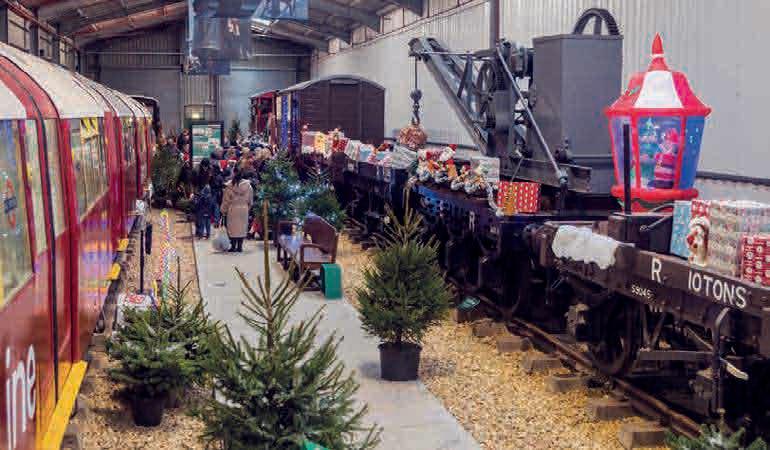
Top: The Winter Wonderland was back during the Santa Specials Above: Train Story dressed for Christmas
Opposite page:
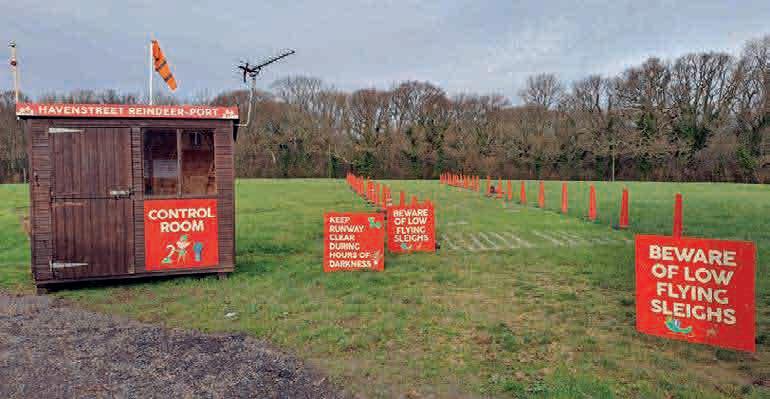
Top: Havenstreet Reindeer Port. Stuart Duddy
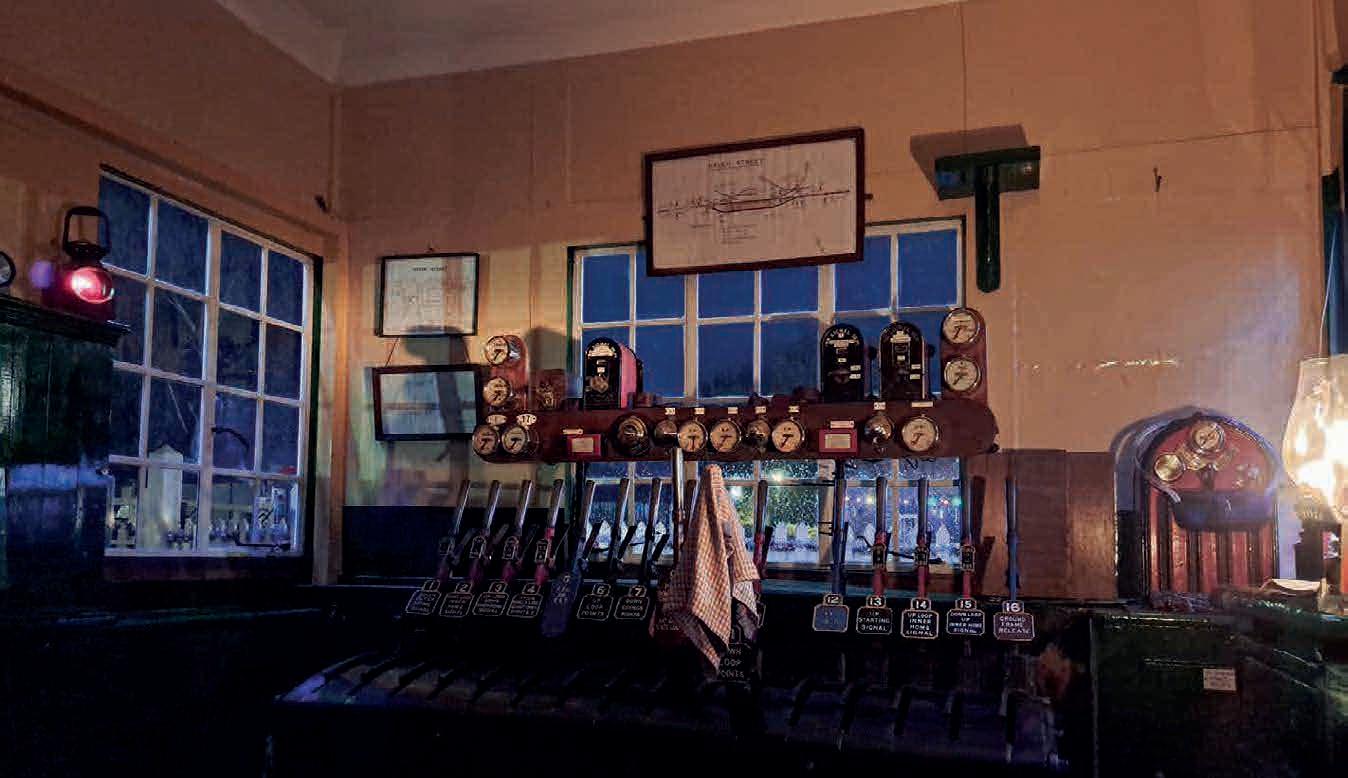
Below: Paraffin lamps and the glow from the fire add to the atmosphere of Havenstreet signal box after dark. Stuart Duddy
Wizard Week trains operated in 2023.
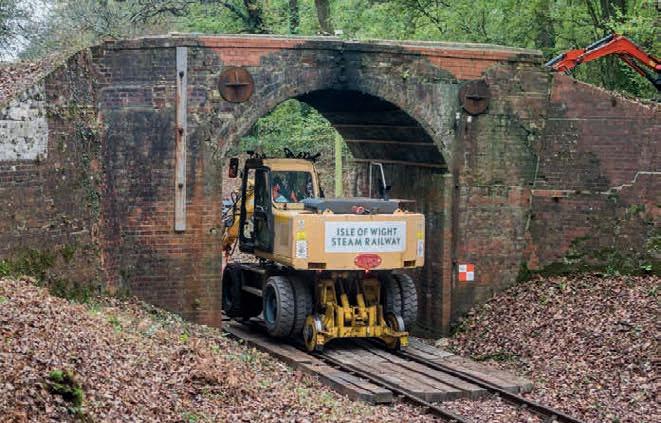
Wizard Week was followed immediately by Race the Train on Saturday 2 November. As in previous years, we operated two round trips of the line, via Wootton and then Smallbrook, with Up trains running non-stop through Havenstreet. The second of these trains was the final advertised service to pass beneath Bridge 12 before its demolition the following week. During the preceding week most drivers had saluted the bridge by sounding long, mournful whistles on their final passage beneath the arch, whilst some guards removed their caps in respect. Driver Roger Millward had the dubious honour of driving the final trains through the bridge. John Faulkner’s video of the poignant occasion can be viewed by means of this QR code. https://www.facebook.com/ iwsteamrailway/videos/1407975530160695
Works trains and the road/rail vehicle operated during the following week, both in connection with the removal of the redundant bridge, for which a possession of the Wootton section was taken, and to deliver materials to Smallbrook Junction for the ongoing replacement of the platform timbers.
The locomotive release at Smallbrook Junction, reduced in length temporarily in mid-September to facilitate the transfer of reusable materials made redundant during recent Island Line work (IRN 104 p12), was declared fully usable again on 26 November.
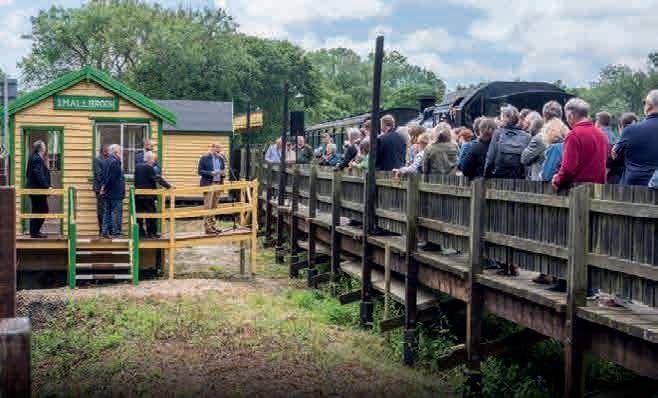
Three diesel-hauled passenger trips to Smallbrook Junction and back operated on Saturday 30 November in connection with the signing of two IW railway books, authored by Derek Gawn and Richard Long.
The arrival of the fourth named storm of the season coincided with the start of the Santa Specials. With crossSolent services impacted severely, Storm Darragh proved especially challenging for our mainland-based colleagues and the wet and windy weather created some particularly
unpleasant working conditions for our outdoor-based staff on Saturday 7 December. Despite this, however, train services operated as published although, over in the events field, overnight sleigh flights using the seasonal airstrip were suspended as a precaution!
Santa Specials operated on a total of 10 days which, in 2024, included two Fridays when a one-train service started a little later in the morning and continued until later in the afternoon, offering the relatively rare opportunity for after-dark working. A two-train service operated on all other dates. Demand on the two Fridays was not especially strong, however, and this experiment is unlikely to be repeated in 2025.
We adopted a different queuing arrangement for passengers waiting to board their allocated trains. Instead of queuing in the open air outside the souvenir shop passengers were able to wait in the relative comfort of a marquee located in the events field. Station staff checked tickets in the marquee and then called passengers to board the train when ready, via the Up Loop pedestrian crossing.
As usual, we operated trains on both Boxing Day and New Year’s Day. Although advertised originally as a two-train service, a shortage of available train crew meant that we could provide only a one-train service on Boxing Day. In practical terms, limited cross-Solent travel options on Boxing Day preclude the rostering of mainland-based staff. Fortunately, however, the situation became apparent in good time, meaning that online sales for duty 2 trains could be switched off.
TRAFFIC DATA
The monthly traffic figures for Quarter 4 and for 2024 as a whole are shown below.
Operating data refer only to published service days and trains available to fare-paying passengers. Figures also exclude passenger journeys recorded on the Drewry railcar on days when the vehicle is operating alongside published steam-hauled services.
TRAINING
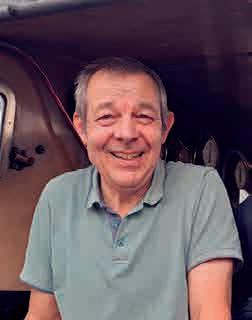
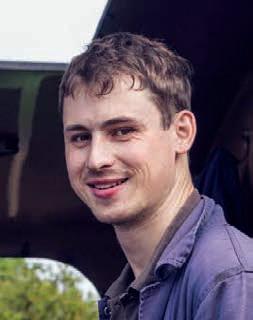
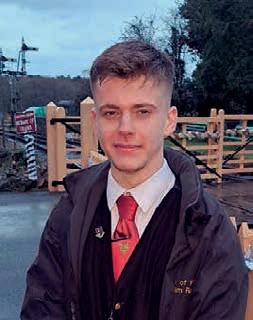
The winter months offer fewer opportunities to complete the qualification process for colleagues but in recent months we welcome to the footplate Adrian Nigh and Rupert Bickham who have both qualified as firemen. Elsewhere, Oliver Taylor has completed his signalman’s training and Dylan Moorman is now a qualified pointsman.
LOOKING AHEAD
There will be a number of changes to our operating pattern in 2025. The season commences with a four-day gala and dark ales event starting on Thursday 20 February, after which trains will operate on every Thursday and Sunday until Christmas, with the weekly operating frequency increasing in line with predicted demand. The daily, peak season operation will extend to 38 days, starting on Tuesday 29 July and running through until Thursday 4 September. The return of the Fish and Chip Specials in 2024 proved popular and these feature again this year, operating on eight Tuesday evenings from 1 July until 19 August.
With the anticipated entry into service of Ryde Pier Tram Trailer Car 10, the Ryde Pier Railcar will become a permanently-coupled two-car unit with a seating capacity of around 40. The unit is scheduled to operate on 34 days in 2025, in some cases replacing what would previously have been the duty 2 steam-hauled service. There will, however, still be plenty of occasions when there will be at least two steam locomotive diagrams, the current plan showing some 70 such days, falling mainly during school holiday periods and during the first half of September.
Adrian Nigh
Rupert Bickham
Oliver Taylor
Dylan Moorman
Below: Hunslet 'Austerity'
198 Royal Engineer hauls her train away from Havenstreet towards Smallbrook Junction on Christmas Eve. John Faulkner
LOCOMOTIVE | CARRIAGE & WAGON
Compiled by Andrew Summers, Rolling Stock Manager and Neil Rees, Deputy Rolling Stock Manager
Photography by John Faulkner
AUTUMN INTO WINTER is often thought of as being a quiet part of the season but with two locomotives in service and all carriages in use for the Santa Specials it is far from quiet.
In both workshops there are priority projects underway, with both A1/x ‘Terrier’ Class W8 Freshwater and Ryde Pier Tram Trailer Car 10 benefiting from the commitment of significant resources. Both workshops are also hosting longer-term projects, with work underway on Oldbury IWR First 21, LCDR Brake Third 4115, Ivatt 2MT Class 41298 and W37 Invincible
STEAM LOCOMOTIVES
Historic Island Locomotives
Adams O2 Class W24 Calbourne is in a serviceable condition and following her final operating duty of the season a washout and annual exams were undertaken; the locomotive was then laid up for the winter. On 21 October Calbourne was moved to under-cover storage in Train Story where she took pride of place on public display.
Service ‘Workhorse’ Locomotives
Hunslet ‘Austerities’ 192 Waggoner and 198 Royal Engineer both remained in active service throughout the autumn and provided motive power for the Santa Specials. The ‘Austerity’ design provides a simple, straightforward locomotive and significant faults are few and far between. In mid-October, however, 192 had her piston and valve rod gland packing replaced.
Away from the Island, at the East Somerset Railway, 27 October saw Ivatt 2MT Class 46447 in service for the final time before being withdrawn for her 10-year boiler overhaul and Monday 9 December witnessed the departure of Andrew Barclay 0-6-0T W38 Ajax to a new home at the Northampton & Lamport Railway.
New security gates have been fitted to the works yard, replacing the previous steel farm type. As well as deterring would-be thieves they also give a smart appearance, being finished in a colour resembling SR green.
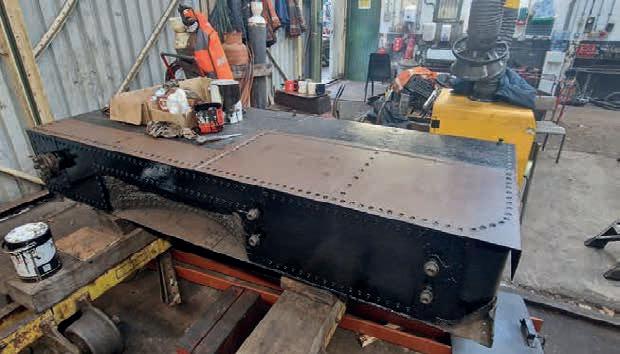
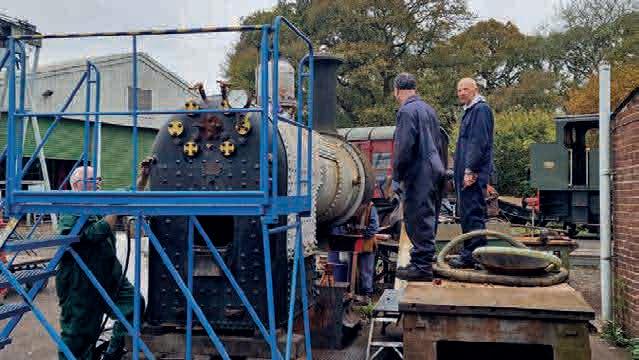
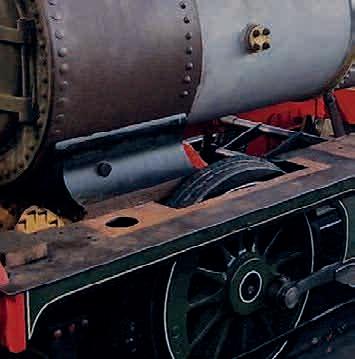
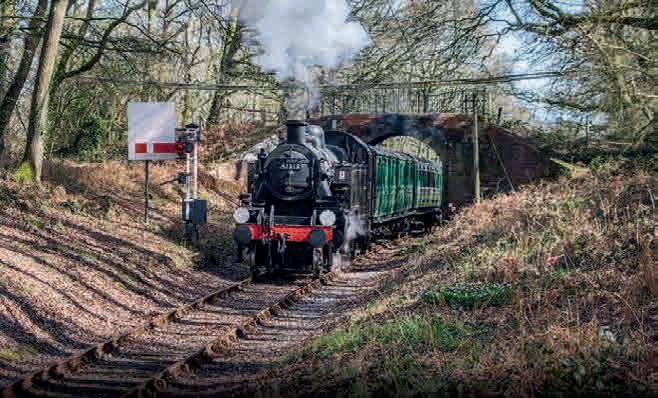
In preparation for the annual inspection of Ivatt 2MT Class 41313 some boiler tubes were removed to allow for checking and clearing of scale in the water space, this area being almost impossible to view without removal. Also in the firebox, several collar bolts were replaced. The independent boiler inspector undertook his visual examination on 14 November and, at his request, some small-headed firebox rivets were removed and replaced with collar bolts. He visited again on Wednesday 4 December for the official steam test which the Ivatt passed, providing a spare locomotive for Christmas if required. Top: The left-hand side tank from W8 Freshwater with most new panels fastened to the frame and welded together at the turn of the year.
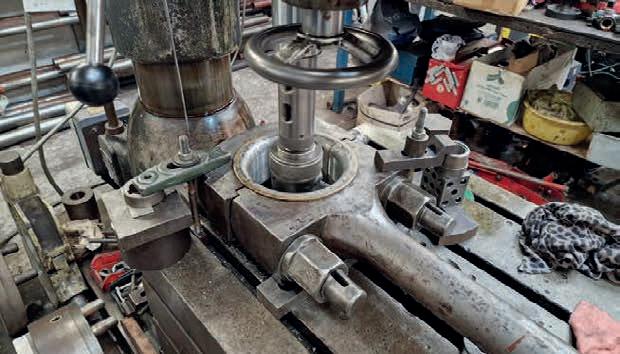
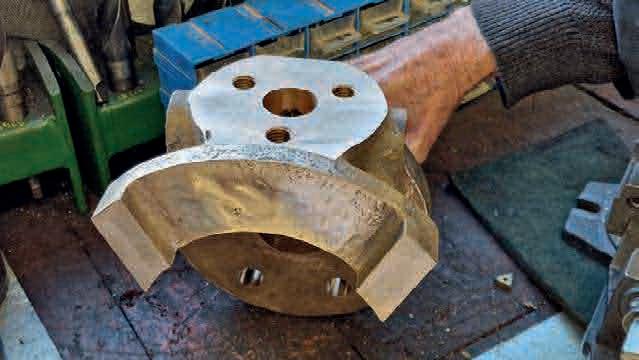
Left: Machining a big-end bearing on one of the connecting rods from W8 Freshwater
WORKSHOP FILES
Locomotive projects
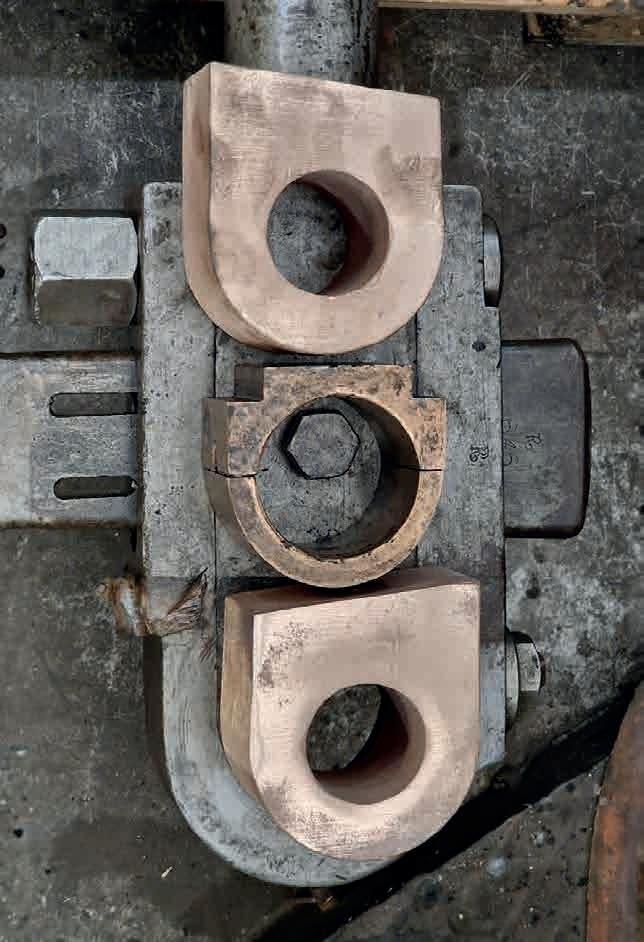
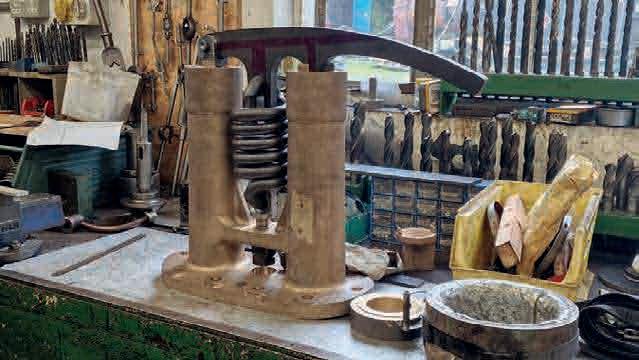
The restoration of A1/x Class W8 Freshwater continues when staff are not engaged with maintaining the service locomotives. Repairs to the left-hand side tank continued, with these being very close to those detailed in previous reports. The unification of the underframe and wheelsets allowed the refitting of many parts removed previously: brake main air reservoir, brake cross shaft, and brake rigging which required reprofiling of brake blocks. Following cleaning and inspection, the side rods were refitted and the eccentric straps machined and hand fitted. Both connecting rod big ends have been re-white metalled and machined ready for fitting. Owing to heavily-worn gudgeon pins, the small ends and crosshead slippers were removed and sent to contractors for overhaul. New small end brasses were cast and then machined at Havenstreet.
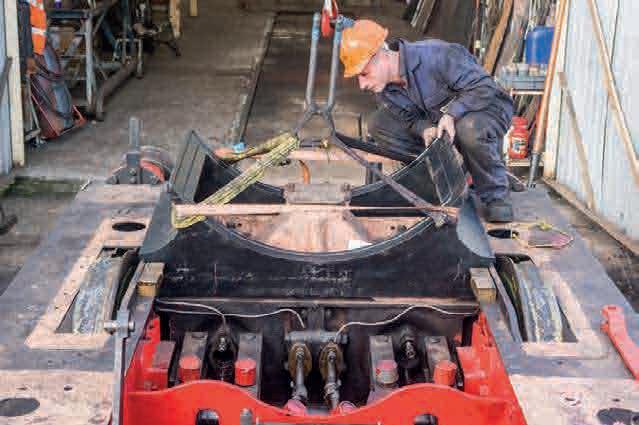
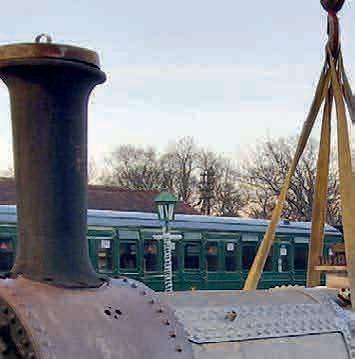
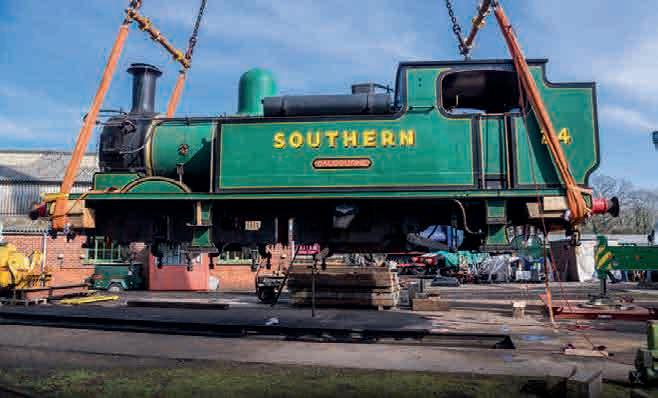
The isolating valves on the boiler back head were fitted, allowing the boiler to be filled with water on 6 November. Hydraulic pressure testing for the boiler inspector was completed on 14 November. The new smokebox saddle casting was offered up to the locomotive and, following some minor alteration, bolted in place. With repair patches welded into
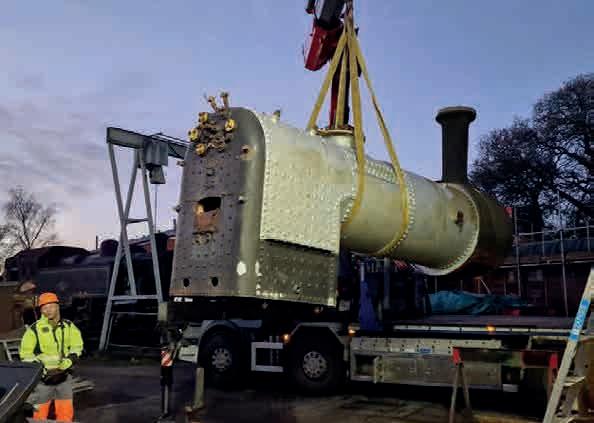
the smokebox on Friday 6 December the boiler was lifted into position on the frames. Lagging and cladding then followed.
Turning to W37 Invincible, boiler work continues as and when staff are available but priority is invariably given to other projects.
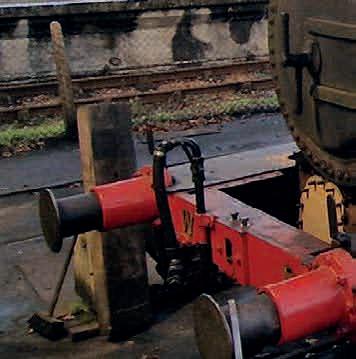
Work to restore Stroudley E1 Class W2 Yarmouth continues, one notable item being the removal of the rear buffer beam corner gussets. Although not original they have been a feature of the locomotive for many years. The brake cross shaft also received attention in November with removal of the keys holding the operating arms in place. Castings for the boiler continue to arrive and are steadily being machined. In Derbyshire, at Israel Newton and Sons, good progress is being made with the boiler. A visit was made mid-November to see the completed outer firebox before fitting of the inner firebox and see the fit of the barrel in the outer firebox assembly.
The pace of work on Ivatt 2MT Class 41298 has slowed at present, although one task that is underway is the removal of a decade’s worth of dirt and grime on normally-inaccessible areas of the rolling frames. Inspection has also started, with pressure testing of the mechanical lubricators in October and, more recently, checking of wheel profiles.
Above: Bronze small-end bearing castings for W8 Freshwater, with one of the old bearings placed between them.
Top right: In-house hydraulic test on the boiler from W8 Freshwater, ahead of visit by the boiler inspector.
Middle right: The new smokebox saddle being fitted to W8 Freshwater on 11 November.
Right: Completed safety valve assembly for E1 Class W2 Yarmouth
Andrew Barclay 0-6-0T W38 Ajax
Following agreement that Ajax was to leave the Island she left the protective cover of Train Story in mid-November. This allowed the removal of the Westinghouse air equipment which is now available as spares for our operating fleet. Ajax was due to depart the Island on 30 November – 52 years to the day after her arrival in 1972 – but being a long-standing Island resident she was a little reluctant to leave, and departed eventually on 9 December.
DIESEL LOCOMOTIVES
The three diesel locomotives, D235, D2059 and D2554, are all in working order. The smallest – Andrew Barclay 0-4-0DM 235 ‘Mavis’ – has more recently been plagued with intermittent electrical problems and, therefore, at the end of October the voltage regulator and dynamo were removed and despatched for overhaul.
On Monday 4 November BR Class 03 D2059 ‘Edward’ departed Havenstreet with a goods train bound for Smallbrook, carrying materials for the Estates Department. Following this, 11 days of operating were undertaken with a small works train in connection with the removal of Bridge 12. On Saturday 30 November D2059 hauled a small passenger set for a book launch, completing the rostered duty. However, falling oil pressure resulted in the loco being withdrawn from service at the end of the day. Soon identified as a diesel leak contaminating the lubricating oil, the cause was traced and rectified, thus allowing normal use to recommence following a full oil change.
Below: The boiler being re-installed on W8 Freshwater before dawn on 6 December.
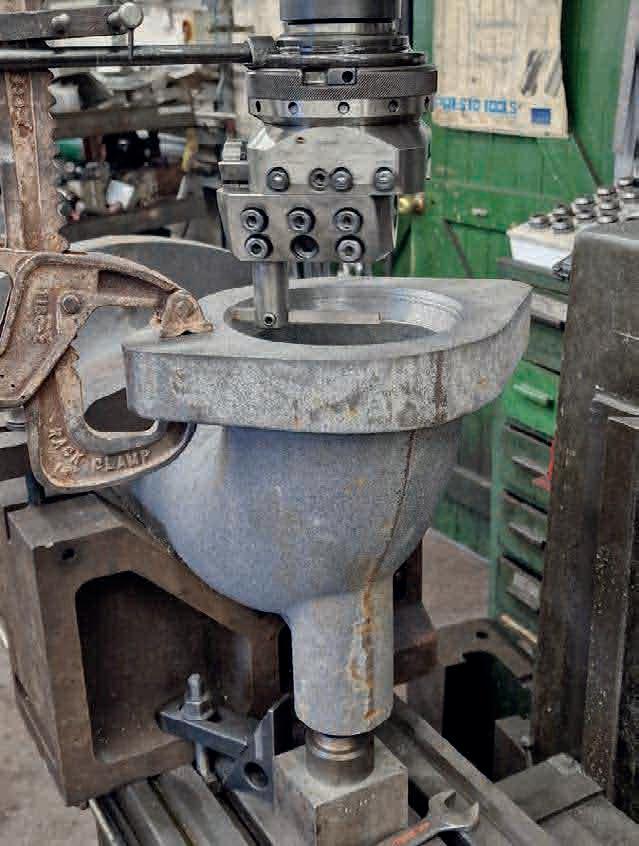
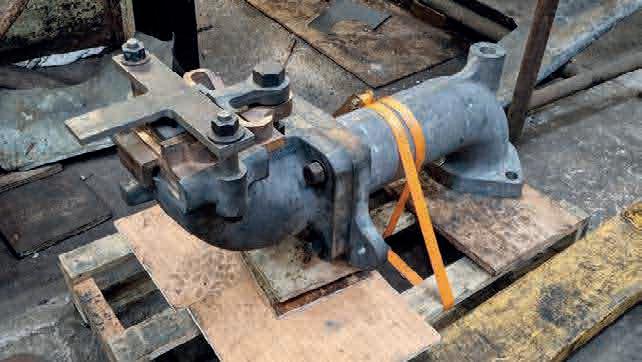
Above: Milling a taper on the J-pipe for the E1’s boiler using a Wohlhaupter boring and facing head.
Top: The completed regulator and J-pipe assembly for the E1’s boiler
Above: Regulator stuffing box for the E1’s boiler. It differs from our more usual stuffing boxes as it has the flange for mounting the whistle valve.
CARRIAGES
Service Carriages
Both carriage sets continue in service with regular maintenance being undertaken as and when required. The bogie carriages underwent B exams at the start of October; this exam is mileage-based rather than time. A droplight was replaced on LBSCR Third 2416 following an incident during Wizard Week. The 4-wheeled set did not achieve the mileage required for B exams and so an intermediate check on axleboxes was undertaken in mid-November to ensure all was well for the Santa running. Steam heat examinations were also completed on both sets. Requiring a
for the
Top
Seats and armrests during installation in one of the compartments in IWR First 21 in mid-December.
Above: Compartment D north-side door installed in LCDR Brake Third 4115 on 12 October.
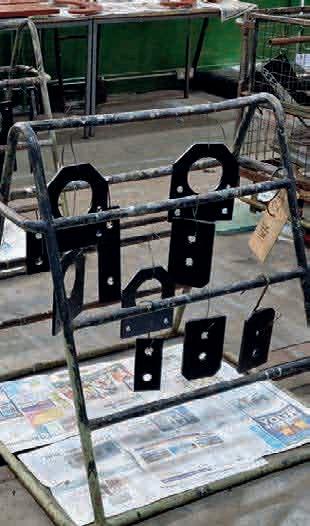
Top left: Some of the profile-cut flat plates
underframe of Oldbury carriage IWR First 21, after painting by Calbourne Club members.
right:
supply of steam, this was undertaken on 4 December following 41313’s boiler test.
Reported defects follow the normal type expected, 20 being reported and rectified on the bogie set and only one on the 4-wheeled set.
Carriage Projects
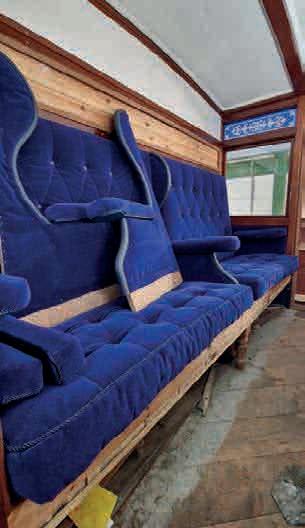
Work to restore Oldbury carriage IWR First 21 continues. Preparation to construct the underframe progresses with the arrival in November of various components including profile-cut flat plates, cut and folded items and fabricated units. This gave the younger members of the Railway, i.e. our Calbourne Club members, the opportunity to apply paint to some of these parts when they met in early December.
By mid-December one side of the first compartment had been upholstered fully, with seats and armrests fitted. The partition mouldings in the last of the three compartments are also underway. Externally, the fifth door frame is complete and awaits panelling.
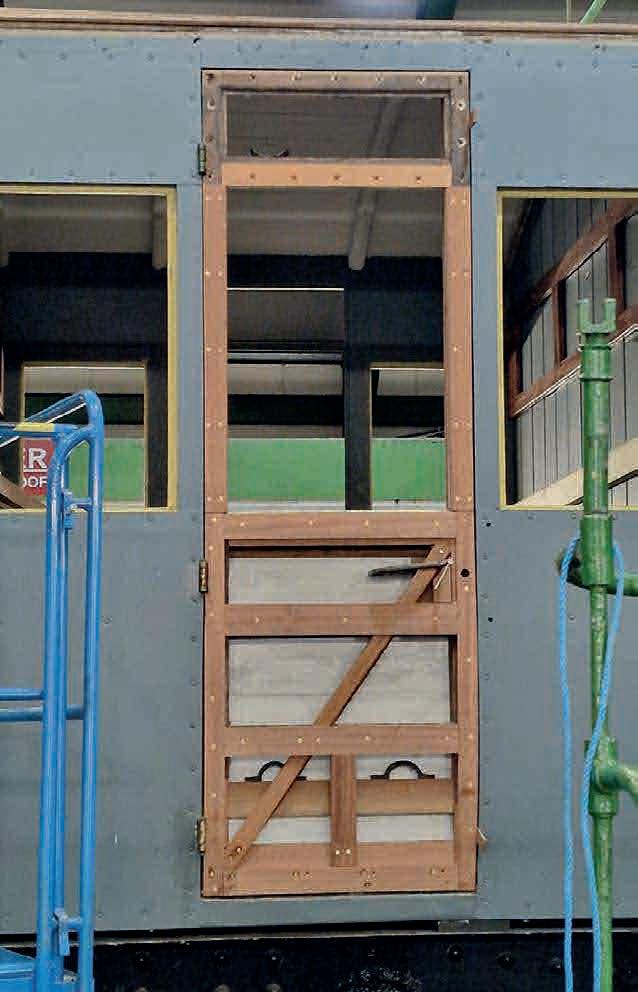
Turning to LCDR 4115 Brake Third, restoration work continues. In this column in IRN 104 we reported that work on the D compartment doors had just commenced. By mid October the north door was completed and, at the end of November, the south side door was fitted. The north-side door frame of Compartment E is now complete and awaits panelling.
Other work completed includes, at the end of October, the fitting of the final roof board, allowing the ceilings to be primed and undercoated. The luggage compartment has now also received a coat of gloss paint. The manufacture of fixed window mouldings is underway and 25% of the fixed glazing has been fitted. Six new droplights have been manufactured and material has been cut for the remainder.
WAGONS
Storage space at the Railway is always in demand but our PMVs are ideal. Unfortunately, the roofs of several were beginning to leak and required repair, to protect both the vehicles and their contents. Accordingly, on 23 October, a scaffold was erected outside the C&W workshop to facilitate this work.
Regular maintenance of our wagon fleet is a never-ending process with the following vehicles receiving attention recently: SR Passenger Luggage Van (PLV) S1046 and BR 13T Dropside High 483700 (Hocknulls wagon) received A exams (on 31 October), followed by BR 12T Rail Wagon DS70000 ‘Britannia’ (6 November) and SR PMVs 1566 and 1603 at the end of November. In early December attention turned to SR PMV 1930, SR CCT 2373 and LNER 25T Lowmac E263276 and finally, just before Christmas, SR PMV 1964.
RYDE
PIER RAILCAR 2 AND TRAM TRAILER CAR 10
Drewry Railcar No 2 remained in service until the end of November when the vehicle was decommissioned to allow removal of the second (Ryde-end) driving position. This equipment is now being fitted to the Ryde-end of Trailer Car 10.
Since Tram Trailer Car 10 entered the C&W workshop on 3 September good progress has been made. In early October the first stages of the electric systems were underway, initially with the fitting of conduit and junction boxes. Throughout November cable runs were being installed and, in early December, initial fitting of the control panel was underway. For this work we also had assistance from an apprentice from Ryde Works.
A few new castings have undergone machining and other fittings produced from scratch such as the driver’s control column.
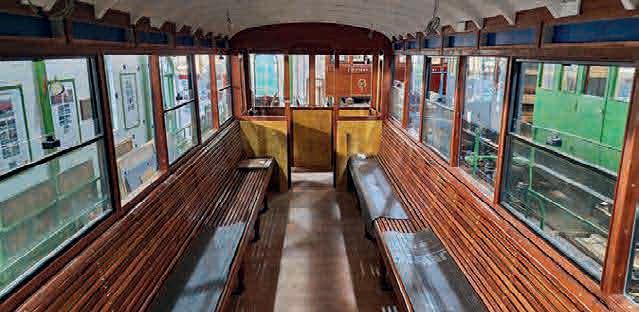
October also saw drilling and dimpling of the exterior panels for the fixing screws to attach the steel sheets. In early November the north side had progressed to the extent that the first coats of green and black undercoat could be applied, whilst the south side was receiving its panels and having the gutters fitted. The half drop window units were fitted in mid-November. Internally, the steel roof hoops were fitted in early December followed by the installation of the fixed glass.
RYDE PIER VEHICLES
Ryde Pier Railcar 2 1,6621,102374
Ryde Pier Tram Trailer Car 10 –1–
Left: Ryde Pier Tram Trailer Car 10 with bodywork painting underway. Work was still proceeding with the driving position.
Below left: Internal view of Ryde Pier Tram Trailer Car 10 looking towards the driving end.
Grand Draw Result
We are pleased to report that the last year’s Grand Draw raised over £9,000 towards the restoration of our Oldbury carriages.
Thanks to all who sold tickets!
The winners were as follows:
1st Prize: £1,000 Mrs B Wilson, Freshwater, Isle of Wight
2nd Prize: £500 Mr R Comer, Newport, Isle of Wight
3rd Prize: £250 Miss E Davies, Rushwick, Worcestershire
4th Prize: £125 Mrs V Newell, Milford-on-Sea, Hampshire
The Demolition of Bridge 12 and other Rail Infrastructure activities
by Infrastructure Manager Ian Hodson
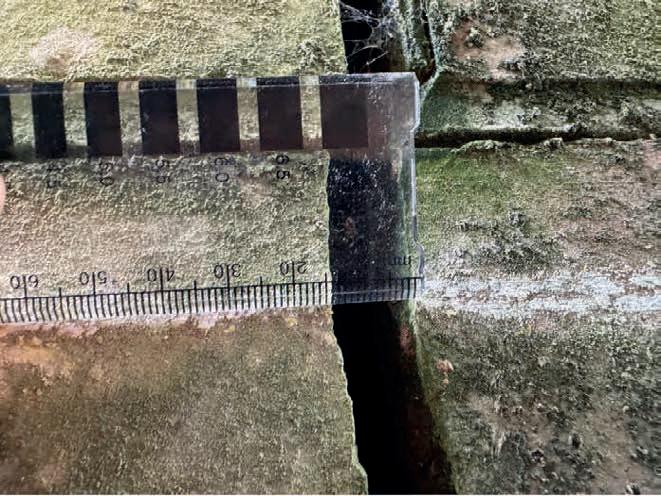
Above left: To illustrate the dire state of Bridge 12, this 14mm wide crack extended all the way up the north abutment wall of Bridge 12, viewed on 28 September. Ian Hodson
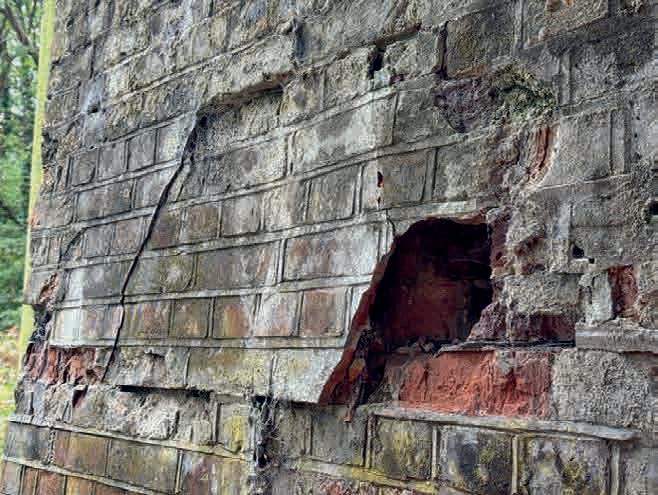
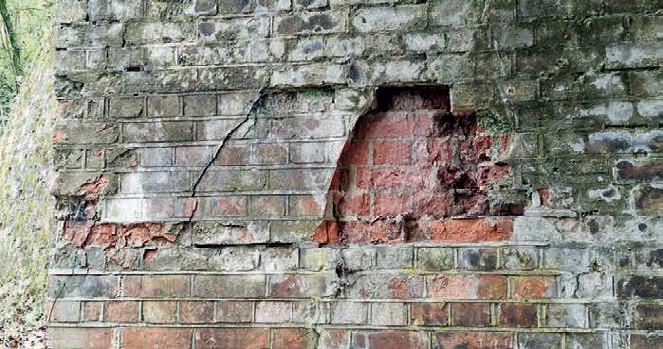
Above right: Seen on the same day was this compressive failure of the facing bricks on the south abutment wall, caused by rotational movement of the section to the left. There was a pronounced offset to the wall towards the track at the Havenstreet end. Ian Hodson
Right: By 30 October, a further section of the failed brickwork was on the ground.
John Faulkner
Below right: This is the very last movement of a rail vehicle beneath the bridge as the RRV moved to the Havenstreet side, from where it laid a further layer of old sleepers transversely to complete the crash deck, 4 November.
John Faulkner
IMMEDIATELY AFTER the end of Wizard Week and Race the Train services, work began on the demolition of Bridge 12. Beforehand, the weekend working party prepared BR 13T Dropside High 483733 for use in transporting the brick rubble away from the site as well as removing the remains of the steel parapet railings from the bridge. Vegetation around the bridge and on the embankments to either side was removed in advance over several weeks by members of the Friday Gang, who worked their way up towards Woodhouse crossing. The welfare unit was also moved to a convenient lineside location using the road/rail vehicle (RRV) and trailer. Lastly, the dormouse crossing was removed by its owners, the People’s Trust for Endangered Species.
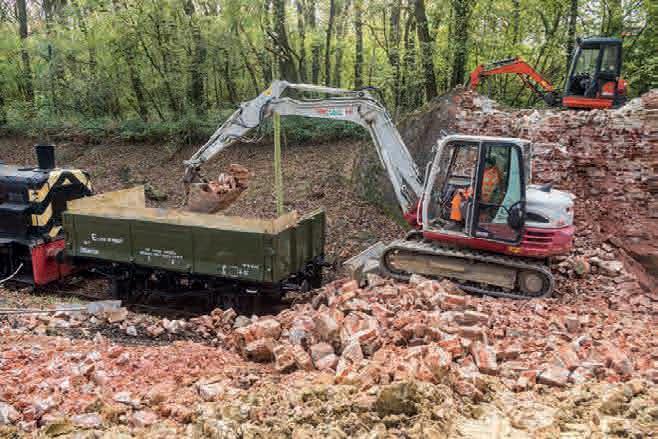
Old sleepers were used to form a ‘crash deck’ mat under the bridge, to protect the track from falling materials. Sleepers were also used to the west of the bridge to form a track crossing for our Kubota 2.7T excavator, which was set up on the south side of the bridge. On the north side a hired 8T excavator was used. Both machines used a choice of buckets for excavating and moving the soil and brick rubble, as well as having breaker attachments for use on the brickwork. After removing most of the soil over and behind the arch, which was spread along the embankments, work began on the removal of the arch.
When working on masonry arches, it is important to keep the levels equal on both sides, hence the use of two machines at the same time. This is because removing the backfill to an arch on one side makes the structure unstable, and could result in
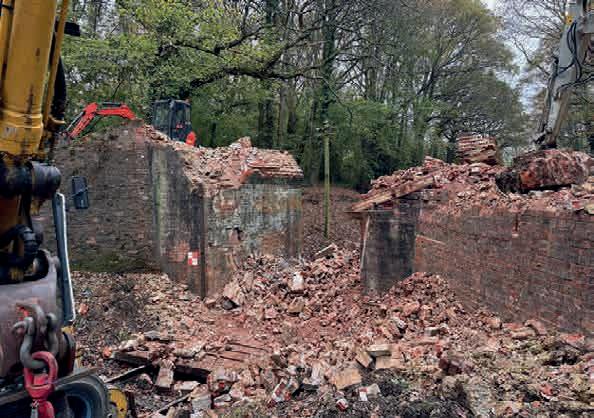
an uncontrolled collapse. By Tuesday 5 November, just a few days after the last train had passed through Bridge 12, the arch barrel and spandrel walls had already been removed, leaving only the abutments and wing walls on both sides.
As demolition continued, it revealed the thickness of the wing walls to be up to 1.2m/4ft. Despite this, the cumulative effects of clay heave and shrinkage had caused the wing walls to move, most significantly to the south-east corner wall which had rotated outwards. This was the cause of the cracking and spalling to the face of the south abutment wall,
where the compression forces had caused the facing bricks to fail. As the abutment wall was removed, the extent of the cracking at the rear of the wall became more obvious.
Removing the brick rubble remains of the bridge was probably the most time-consuming part of the process. Once a pile of material had built up on the sleeper mat, the Komatsu RRV was used to load it into the rail wagon using a grab attachment. This was then hauled away by BR Class 03 D2059 and shunted into Griffin’s Sidings, where yet another (fourth) excavator was used to unload the wagon. In the meantime, Martyn Budd was busy creating the next pile, ready for the returning train. This process continued until the third week of November, when the last remaining parts of the bridge were removed and the embankments re-graded. The lower part of the wing walls and abutments are still visible, just above
ground level, to show where the bridge once stood. Fortunately the weather stayed dry for most of November, allowing good progress to be maintained.
As someone who has spent most of his working life as a bridge engineer, building, strengthening, repairing and maintaining structures of all sizes and types, I was saddened to see Bridge 12 reduced to a pile of bricks, no matter how logical the decision to demolish it may have been. The bridge’s demise, however, may not have been in vain as it may go on to help other masonry arch bridges to survive. Samples of the brickwork have been taken away by Southampton University for laboratory testing, as part of a study to determine the load capacity of older structures. Sadly it isn’t practical to salvage many of the remaining bricks for re-use, but we will be keeping a few to use in future projects.
Both excavators using breaker attachments or ‘peckers’ to break through the arch on 5 November.
Left: The concrete saddle, installed in 1990/91, had done a good job in extending the life of the arch. Sections of it are seen dangling from the reinforcement wires.
Above:
John Faulkner
John Faulkner
Many thanks go to all of the staff and volunteers who made this happen, completing the job on time and within a tight budget.
Other than the demolition of Bridge 12, the Rail Infrastructure team took advantage of gaps between the Santa Special running days to undertake a large number of sleeper replacements on the Smallbrook single line, particularly over Ashey Grounds, greatly assisted by the RRV. Some fallen trees on the Wootton section were also removed, once the Bridge 12 works were completed and the line reopened again. The section of track to the east of Havenstreet up to Bridge 8 that was re-ballasted and relayed in early 2024 was subject to lifting and packing, allowing the temporary speed restriction to be removed in December. Lifting and packing was also carried out at Swanpond.
During November and December we received further used track materials salvaged from Island Line’s Ryde Pier works. This work is ongoing and further rails, sleepers, timbers, chairs, etc. are hopefully still to come.
To round off 2024, the Friday Gang celebrated another successful year of keeping the lineside clear, holding their annual Christmas bonfire and barbecue on 20 December.
Above left: A deep internal failure in the south abutment is clearly visible in this photo. The section to its left had been on the move, rotating outwards. The area where the masonry had been failing, in photos 1 and 2, can be seen to the left of the crack at the bottom. Infill behind the wall was pure clay. John Faulkner
Above: Samples of the brickwork on pallets, ready to be taken to Southampton University for detailed analysis. Ian Hodson
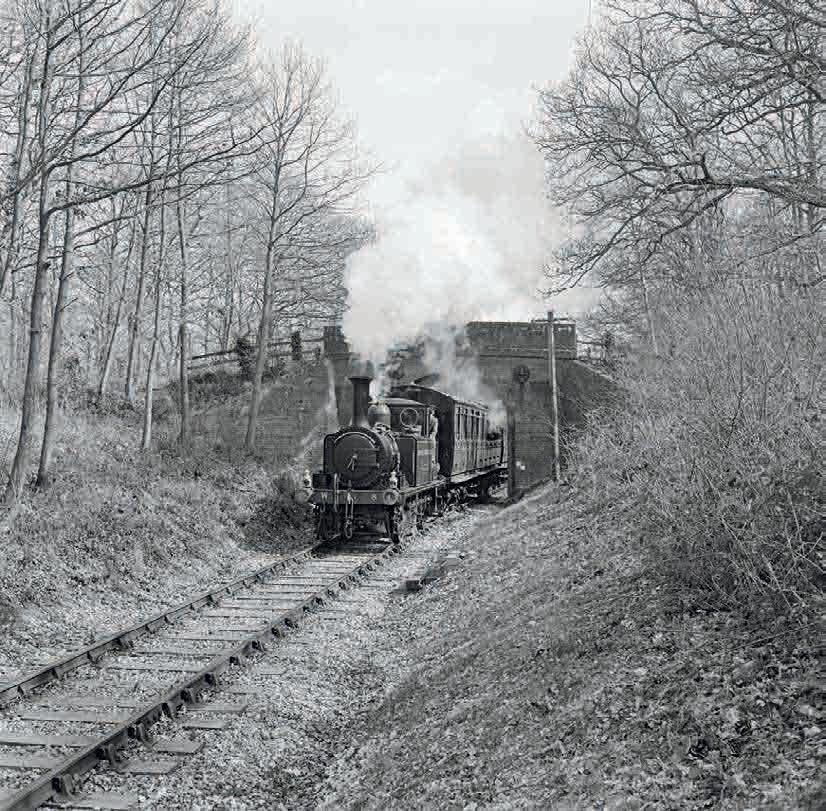
Right: Happier days for Bridge 12 as W8 Freshwater passed beneath on 4 April 1983. The bridge still has the original parapets and rustic fencing on the approach embankments. Tim Stephens
Above: The RRV transferring rubble to the wagon. The grab could only pick up limited quantities of rubble and owing to the limitations of a road/rail vehicle the rotational speed of the unit was slow. John Faulkner
Below right: As soon as the hired 8T excavator was in a convenient position it took over loading rubble. This photo was taken six days after demolition had started. John Faulkner
HERITAGE & LEARNING REPORT
By Cara Trevor, Heritage & Learning Manager
WITH THE SUPPORT of our school guide volunteers, we were pleased to welcome local and mainland schools for visits in September and October. Moreover, we were also able to test out some of our newly-developed educational materials in workshops with local schools.
Work has been ongoing over the last few months on the conservation and care of items in our growing museum collection. For example, the Wroxall Station sign mentioned in IRN 104 has undergone some minor conservation work and is now on display in the Barn Café (as can be seen in the photograph on page 9).
Following the end of the main season in early November, the focus of the Heritage & Learning Department moved to preparing for 2025. Plans for exhibitions to celebrate key anniversaries this year are in progress and we are also planning additional interpretation for Train Story.
Artefacts included a substitute nameplate for
In heritage collection news, we also welcomed a wide range of new items into our collection. Artefacts included a substitute nameplate for O2 Class W22 Brading, kindly donated by an IWSR member, and a livestock transportation box for bees with Southern Railway and local destination labels.
W22 Brading substitute nameplate
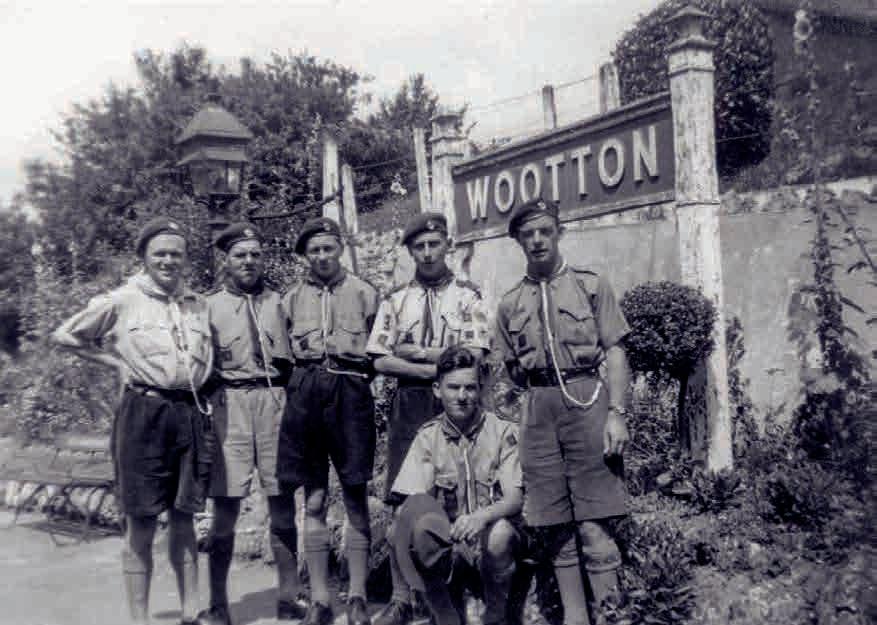
Additionally, this photograph showing a group of older scouts at Wootton station was received into the Photographic Archive recently, but contained no additional information. Contact with the Isle of Wight Scouting Association resulted in Mr Barry Groves identifying the group as being Rover Scouts belonging to the 1st Wootton Scout Group. Rover Scouts were given permission
to wear berets in 1949, although the person kneeling is holding the earlier ‘lemon squeezer’ style of hat. The variety of shade of uniform is noteworthy. So far, it has not been possible to name any of the scouts depicted; the date is probably about 1950. Does any reader recognise anyone? Any information would be gratefully received c/o The Editor.
Our Grateful Thanks
We thank the following members who have made donations in the past few months: John A Hulse, Peter Mabey, Francis G Spence and M Thorner
We have received a legacy from Palmers Solicitors in respect of the estate of the late David Vincent Smedley. Donations have also been received from the Isle of Wight Morris Minors Owners Club and the Jaguar Enthusiasts Club.
We also thank those who have made online donations when renewing their annual membership and those who have made donations towards Calbourne’s new tyres. We also thank those who continue to support the LCDR 4115, SECR and Oldbury carriage appeals, the Wootton signalling project and those who made donations when returning their Grand Draw ticket counterfoils.
Following publication of IRN 103, it was brought to our attention that we had received misleading information from the memorial tribute platform ‘Much Loved’ regarding a donation relating to the Bowra family. We should like to extend our apologies to John and David Bowra. Linda Walker, Deputy Finance Manager.
200 Club News
Firstly, may I wish a Happy New Year to all 200 Club members. Thank you for another 12 months of supporting the Railway through the 200 Club.
The Christmas 2024 draw took place at the end of November. The winners and winning numbers are as follows:
1st Prize £500 Brian Shaw, Wolverhampton (No 119)
2nd Prize £150 Mark Searle, Croydon (No 313)
3rd Prize £75 Peter Smith, Bracknell, Berkshire (No 287)
Many congratulations to our winners and thanks to Liz King who always helps me with the quarterly draws.
Ros Everett, 200 Club Co-ordinator
The group of scouts at Wootton station
Bee transportation box with Southern Railway label
VOLUNTEERING NEWS
from Doug Alldred Volunteer Development Manager
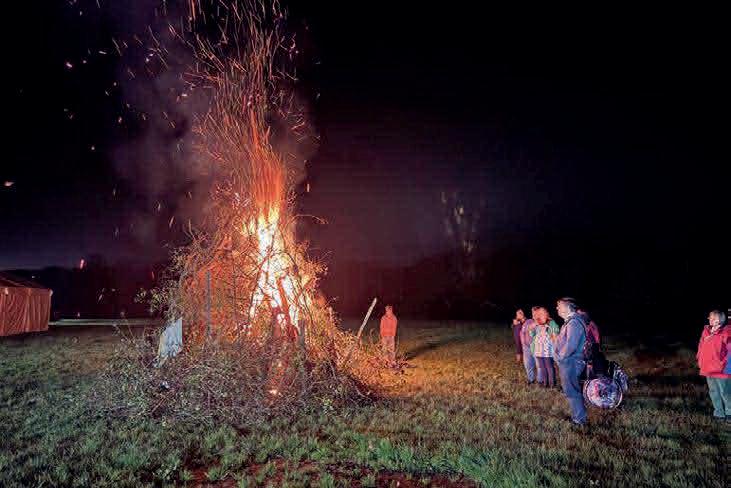
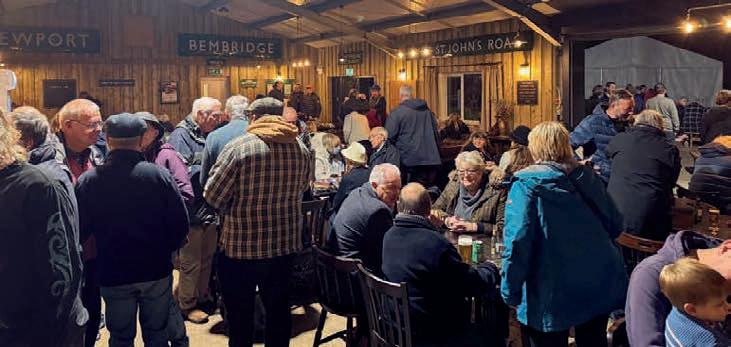
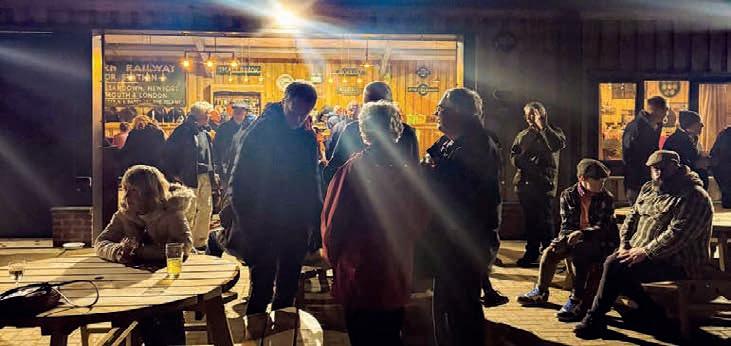
AS THE MAIN running season of 2024 came to a close, the Railway once again took the opportunity to thank our fantastic team of volunteers for their hard work and commitment by hosting a celebratory evening with a bonfire, free hog roast, bar and live music for our volunteer team, their partners and children. Over 200 people attended and enjoyed the excellent food and entertainment. It’s really important for the Railway to demonstrate its gratitude for the effort contributed by everyone on the team and it also provides volunteers with the opportunity to meet new people and socialise with colleagues from other departments.
Another way we thank our volunteers is by the ongoing series of benefits and prize draws and we’re really pleased to have been able to expand these through 2024. These included more extensive discounts on cross-Solent travel as well as prize draws for entry to Beaulieu and Buckler’s Hard Museum and events at Ventnor Fringe, the County Show, the Isle of Wight Festival, the Isle of Wight Proms and many other events. We’re currently putting together similar opportunities for 2025 so if you’ve thought about volunteering at the Railway in the past there’s never been a better time to become involved.
We also offered our team more training opportunities through the season, with many of our public-facing volunteers completing a ‘Delighting the Customer’ training course.
As part of my ongoing efforts to meet with as many volunteers as possible and to understand in greater depth their roles and the tasks they undertake on a day-to-day basis, I recently spent another day with our locomotive engineering team working in the yard preparing for one of our Santa Specials running days. Similarly, I intend to spend some time working with the carriage and wagon team and join one of our Rail Infrastructure monthly working parties. It’s really great to be involved with the team and learn what their roles entail and also to chat with volunteers across the Railway and find out what keeps them coming back to volunteer as well as what we might be able to improve about their experience.
Want to get involved?
If you have some time to offer as a volunteer at IWSR, please visit our website, take a look at the many roles available, and complete the online form to register your interest.
MEMBERSHIP MATTERS… AND IT REALLY DOES MATTER!
IF YOU’RE READING this magazine and you’re not already an Isle of Wight Steam Railway member, then please consider joining us.
The Railway is a registered educational charity and is already supported by over 3,000 members but we’d love to increase this number. If you would like to keep up to date with Railway news and developments, support our work or even become involved at the Railway as a volunteer, then please join us! As well as supporting a great cause you’ll benefit from great savings too. Becoming a member offers the best value if you visit the Railway and travel on our steam trains more than once per year.
You can buy a membership at our company office, online or by calling us on 01983 882204. Please allow 14 days to receive your membership card for free train travel.
Benefits of membership include:
• Unlimited free admission to Havenstreet station, the museum and visitor areas during normal opening hours*
• Three FREE tickets each year for train travel*
• Four FREE editions of our award-winning magazine Island Rail News, keeping you up to date with news from around the Railway, available online or as a hard copy
• Our Annual Report showing how ‘your’ Railway is progressing
• The opportunity to attend and vote at the Annual General Meeting * other than during our Santa Specials.
Membership Categories and Costs
Reduced membership costs apply to those choosing to pay annually by direct debit.
Michelle Pardington and Steve Robinson Railway People
AFTER A DELAY of a few months, caused by a busy spike in his professional career, Harrison Sell has found time to sit down and speak with two fellow mainland-based volunteers and long-term IWSR supporters Michelle Pardington and Steve Robinson.
HS: How long have you been involved in the Isle of Wight Steam Railway and how did your involvement come about?
MJP: I inherited a love of steam from my grandfather. I became a member following a school trip to the Railway from the mainland, in 1977. Before the trip my school was sent several editions of Wight Report [the predecessor of IRN], which I read from cover to cover. We had a guided tour of Havenstreet station and I’ve loved the place ever since.
SR: I’ve been a member of the Railway for 26 years. My membership and volunteering is all down to my wife, Michelle. Her love of steam, and the Isle of Wight Steam Railway is the biggest influence.
A change of work patterns in 2021 allowed us more free time at weekends and so we began volunteering together at the Island Steam Show that year. We’d had some great encouragement from other volunteers to become involved, notably Steve Smart, so we booked a holiday and took the plunge.
HS: Do you have any links to the Island? If not do you travel far?
MJP & SR: Neither of us have any links with the Island, we live in southwest London and try to volunteer for about 30 days each year.
HS: Typically, where can you be found when volunteering at the Railway?
MJP & SR: We began our volunteering with the events team, on car-parking duties at the Island Steam Show, which we still do each year. We usually volunteer only at weekends owing to our work commitments. We also help in the bar at various events but, mostly, we can be found in the locomotive workshop doing whatever jobs are needed.
MJP: I was even mad enough to stand for election to the board. I was duly elected in July 2024 and I’m finding it to be a very rewarding experience.
HS: What occupies your time away from the Railway?
MJP & SR: Apart from work and families, we mostly enjoy visiting other preserved steam railways and watching motor racing. We are life members of the Midland Automobile Club which runs the world famous Shelsley Walsh Hill Climb in Worcestershire. We also attend motor race meetings at Goodwood and the Le Mans 24 hour race in France each year, as well as a few other events.
SR: Michelle is a life member of the Terrier Trust and also a shareholder of Cotswold Steam Preservation Ltd which runs and maintains Churchward 28xx Class heavy freight locomotive 2807 at the Gloucestershire Warwickshire Railway. We do some gardening when time allows and Michelle likes to keep fit and exercise at our local gym.
HS: If someone is considering joining the IWSR family, what advice would you give?
MJP & SR: Do it! Visit the Railway, speak to other volunteers, and get a feel for the place and what interests you. We started very slowly with the events team, and that is a great way to get to know more people at the Railway. Anyone can find their place here. Whatever your skill or experience, there will be something that you can help with. You don’t have to stick to one role or department either. The most important thing is the friendship and camaraderie amongst volunteers and staff. We’ve made some brilliant new friendships and found the Isle of Wight Steam Railway to be a very welcoming, rewarding and fun place to be. We all have a common goal, which ultimately is the preservation of our wonderful railway, and to enjoy what we do.
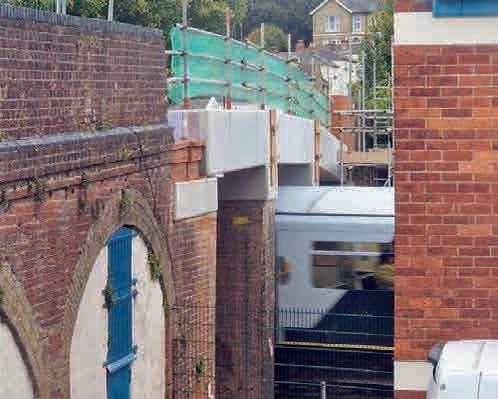
Top: An unusual angle on Park Road bridge showing a reasonable headroom above the train. The image also shows detail of the new cill beams and side beams. The contentious parapets were yet to be installed at this date, 13 October. John Faulkner
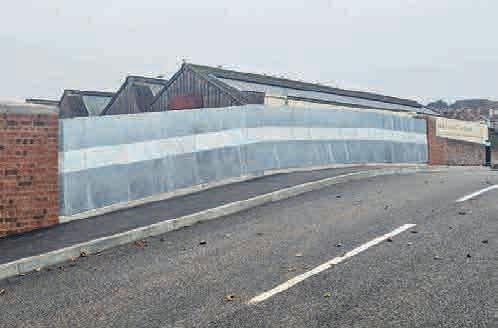
Middle: Three weeks later the stainless-steel sections of the parapet walls had been installed and the road reopened. As well as not being aesthetically pleasing, there have also been complaints that the parapets are too tall.
John Mitchell
Below right: The surviving span of Sandown Girder Bridge, fully refurbished and opened to road traffic on 2 November. It was said to be intended to install collision protection beams but they are not fitted currently.
John Mitchell
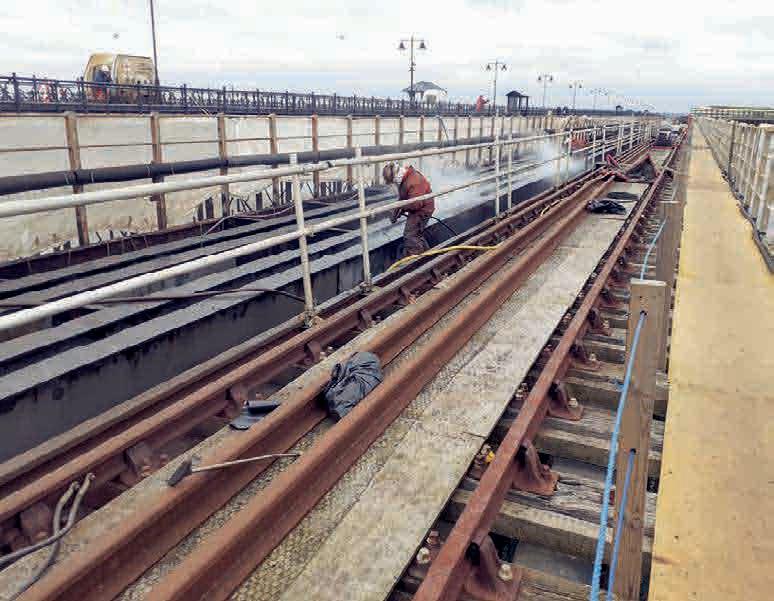
Below: Ryde railway pier’s rail bearer 'I' beams being pressure jetted on 10 December to remove corrosion and scale prior to being protected with s highly resilient paint system. The new rails lying in the four-foot of the disused line had been there since early August.
Graham Deegan
Island Line News
by John Mitchell
AFTER A MONTH without trains the stage was set for services to resume on Monday 7 October, with all five Class 484s being available. The independent power supply within Ryde depot had allowed the units to be shunted around with maintenance work taking place as required. Unit 005 was the first to venture onto the main line with test runs taking place around midnight on 6/7 October between Ryde Esplanade and Shanklin. The engineering possession had only concluded at 23.00 that evening.
The following morning public services resumed with units 002 and 005. It did not take long, however, before the 484s were in trouble, with ancillary batteries failing after a month without use and flagging up various alarms. Units 001 and 003 came on as replacements although, late in the day, one of these also went off service, likely 001, which then remained off service for almost a month. Units 002 and 003 saw the most use during this initial period. After the first few days, services settled down and have proved, in the main, to be reliable, but some issues have occurred.
On the evening of 17 October, services terminated early owing to a police incident. Occasional train faults usually cause minimal disruption, with a replacement unit quickly brought on. A traction fault with unit 002 on 19 October saw its 13.30 service from Shanklin depart 11 minutes late and thus cross with 003 at Sandown. It was replaced with unit 005 at Ryde St John’s Road, with only the call at Ryde Esplanade omitted. The following day saw the 18.30 departures from both Ryde Esplanade and Shanklin stopped at Brading for an hour owing to a trespass incident.
Train crew issues caused some cancellations and late service starts between 24 and 28 October. A points failure on 7 November resulted in 005's 11.30 departure from Shanklin terminating at St John’s Road. It was able to resume with a 12.03 departure to Shanklin.
On 16 and 17 November the 18.00 and 18.30 trains from Shanklin terminated at St John’s Road and remaining services were cancelled owing to the absence of signalling staff. Early services on the following two mornings were cancelled for the same reason.
Following a night of torrential rain on 27 November some flooding occurred between Park Road and Rink Road bridges in Ryde. After the first couple of trains had operated, a track circuit failure then occurred and all departures from 07.00 for the remainder of the day terminated at and started from Ryde St John’s Road. Over the weekend of 7 and 8 December Storm Darragh was to cause much disruption on the Island generally and to crossSolent ferry services. To its credit, there was no disruption to Island Line services whatsoever.
There was some disruption on the morning of 10 December caused by track or signalling issues. On 23 December the 09.00 services from Ryde Esplanade and Shanklin were held at Brading and Sandown respectively as a result of an issue between these two stations. Unit 002 remained at Sandown until 12.09, when services returned to normal. On 19 December the service was suspended for a while in the morning owing to a member of signalling staff being taken ill.
Repair work on Sandown Girder Bridge continued for several weeks after resumption of train services, work taking place during night-time possessions. Avenue Road, beneath the bridge, reopened to road traffic in the early afternoon of Friday 1 November, exactly on schedule. Some outstanding work did require a further one-day closure to road traffic. Rink Road bridge in Ryde reopened to road traffic shortly before 16.00 on 1 November, but
Park Road bridge had to wait until after dark to carry its first road traffic owing to some missing bolts needing to be sourced. Locally there has been criticism about the steel side cladding on the Ryde bridges, described as ‘brutalist’ by some. The new footbridge at Brading initially had temporary rope-style lighting installed to make the structure serviceable until permanent lighting could be provided.
The Christmas festive period saw Island Line services suspended on 25 and 26 December in line with the majority of the UK rail network.
The Rail Accident Investigation Branch (RAIB) has published its report on the collision between a road/rail vehicle (RRV) and a trolley near Brading on 22 November 2023 (IRN 101, p26). The report can be viewed by scanning this QR Code.
Ryde Pier Upgrade
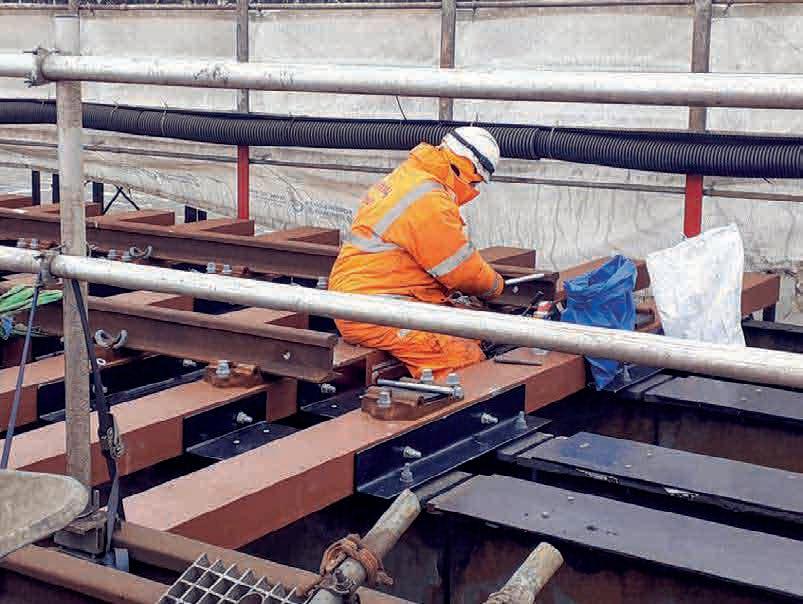
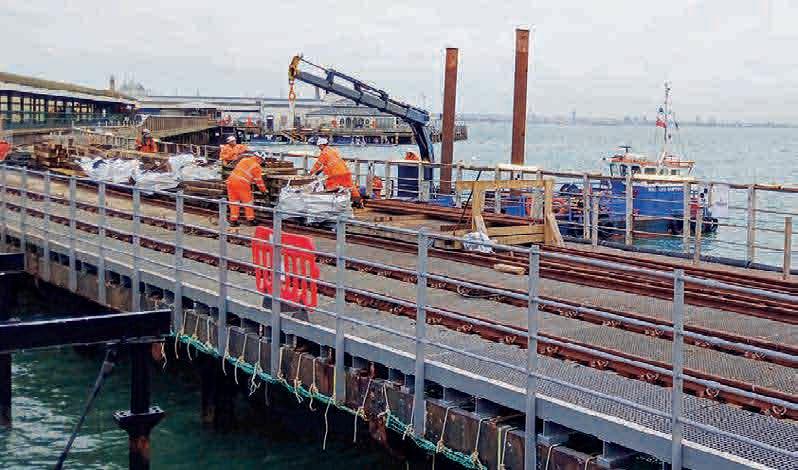
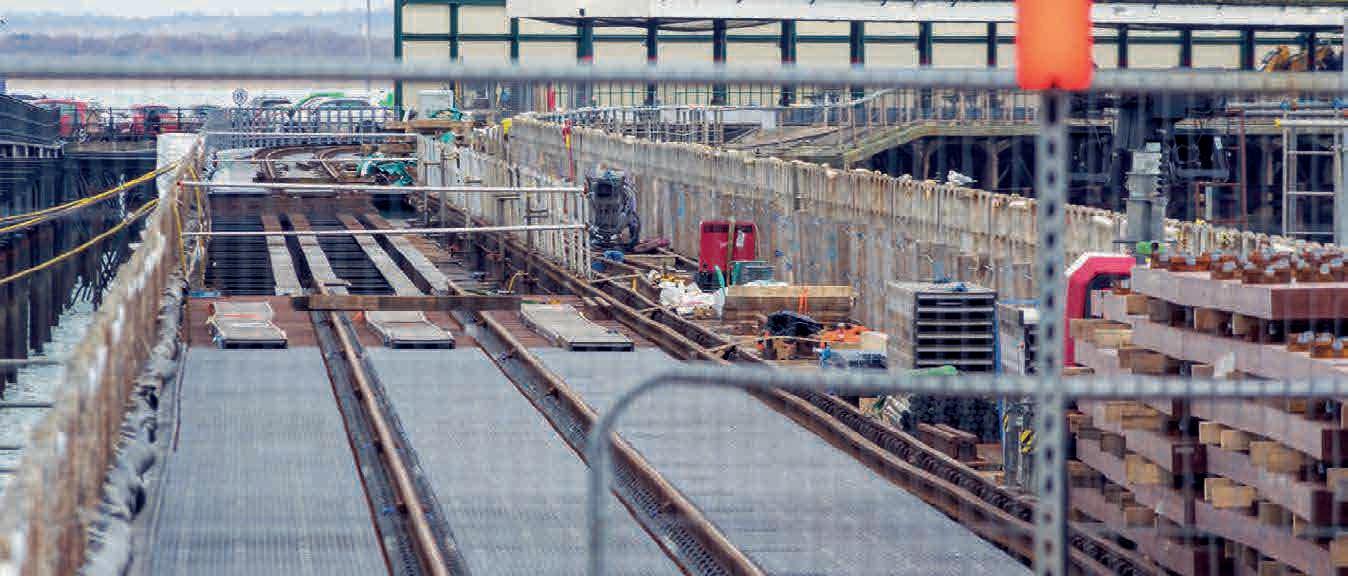
This work involves the repair of a 1,100ft length of the main shank of the pier between the Up end of the Esplanade station platform and the straight section near the pier head that was completed in July 2023. Specifically, this is replacement of the old track on the working line with new fibre-reinforced foamed urethane (FFU) synthetic wood sleepers and flatbottomed rails and renewal of the rail bearer ‘I’ beams. There is evidence that some rail bearers have been replaced, but the majority are in fair condition and are being pressure jetted to remove corrosion and scale, repaired as necessary, then protected with three coats of high-performance protective paint. All the steel cross-bracing is being replaced. By the time work stopped for the Christmas break, all of the old track had been removed except for a 40ft section at the Esplanade end where an RRV is often parked, 500ft of new track had been laid and GRP walkway panels had been laid over a 400ft length. South Western Railway revealed in early December that the project had reached its half way stage and was on schedule to re-open to trains in May 2025. Adverse weather had so far not caused any delays to the project in what nonetheless must be a challenging and often unpleasant working environment.
Top: New track being laid on 10 December. The strips on top of the 'I' beams are thought to be plastic, bedded on mastic or a filler to provide a flat surface and obviate a water trap between sleepers and steel beams. Graham Deegan
Above: Old materials are taken away by sea, direct to the Empress Dock in Southampton by Williams Shipping. Its vessels Wiljive and Wiltango (pictured) had between them made 13 high-tide visits between September and the end of the year. Andy Merritt
Below: An absence of contractors and equipment during the Christmas break allowed a clear view of the good progress made so far on the Ryde railway pier repairs. John Faulkner
From the archives Newport - Part 1
The pre-Grouping Era
by Roger Silsbury and Roger Macdonald with signalling detail by George Wheeler
INTRODUCTION
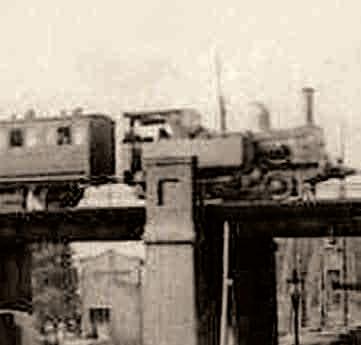
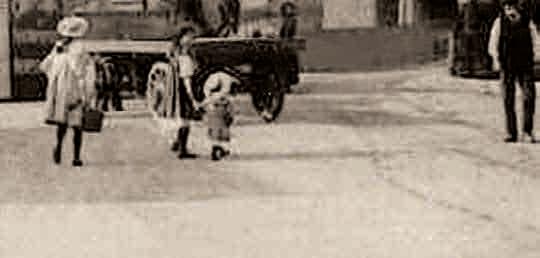
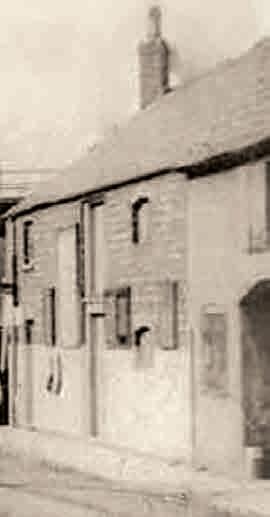
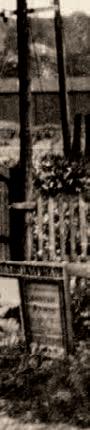
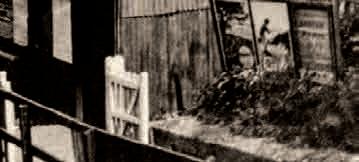
WE BEGIN OUR feature about Newport and its environs with a look at its establishment and development during the preGrouping era. Further parts will cover the Southern Railway and Nationalisation eras. We apologise that some of the accompanying illustrations are not of the quality we would wish but are included because of the historic information they impart.
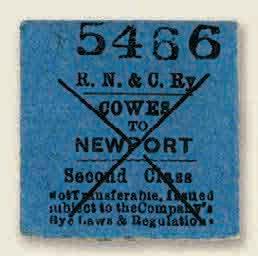
The first station at Newport was the southern terminus of the Cowes & Newport Railway (CNR) which opened on 16 June 1862. This station was very rudimentary, consisting of a wooden platform and building with a run-round loop; there were no sidings or goods facilities. These basic provisions were considered sufficient as it was confidently expected that a more substantial station would be built to serve the other lines planned to converge on Newport. It
Opposit Page:
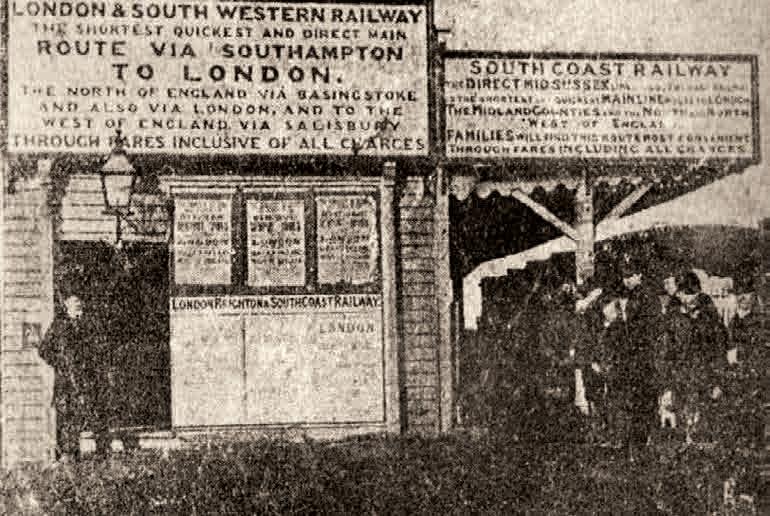
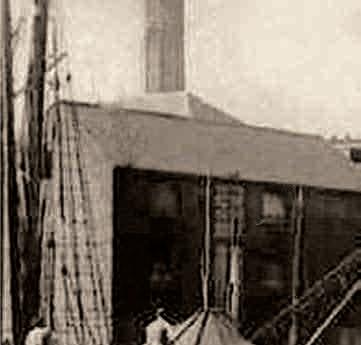
Top: This is the only known image of the original Cowes & Newport Railway station and, although of poor quality, must be included for historic interest. IWSR Archive / J Mackett Collection
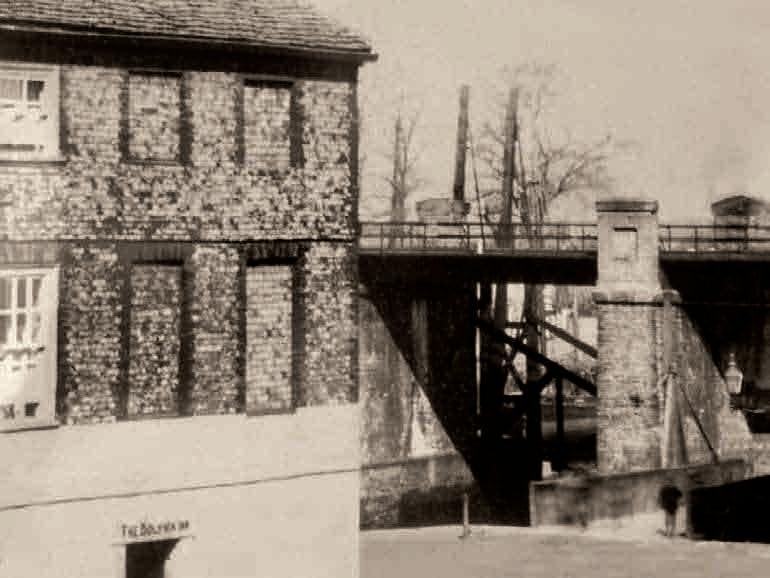
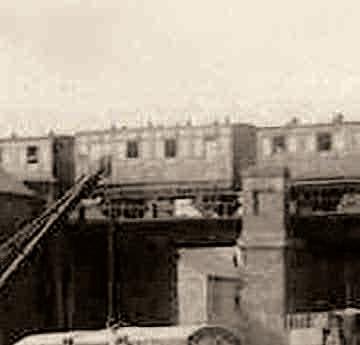
Middle: One of the only known images of another feature, in this case the low-level bascule bridge giving access to the east bank of the River Medina and the Corporation Quay, viewed through the opening span of the railway viaduct.
IWSR Archive / Roy Brinton Collection
would be the mid-1870s, however, before this became a reality. A joint committee was formed to construct and manage a new station which was situated some 150ft east of the original CNR one and would serve an end-on junction between the CNR and the Ryde & Newport Railway (RNR) and later also the Isle of Wight (Newport Junction) Railway (IWNJR). It is not known whether the station became operational prior to the opening of the RNR on 20 December 1875. Meanwhile, the CNR station had burnt down on 2 December 1874.
The RNR line from Ryde approached Newport in a south-south-westerly direction through Fairlee before entering a short, 73-yard tunnel as it curved sharply right emerging onto a brick viaduct comprising 13 arches, followed by three wrought iron girders, one of which was an opening span to maintain navigation rights to wharves and warehouses. There was one further brick arch over the road connecting Sea Street with the quay on the western bank of the River Medina at Little London. A wooden signal box containing 20 levers stood on the Down
side at the end of the viaduct.
The IWNJR had managed to build its line as far as Pan Mill by October 1875, but the intervening gap to access the joint station was not opened to passenger traffic until 1 June 1879, although goods traffic had been passing for a few weeks beforehand. The IWNJR approached Newport in a northerly direction, with a lengthy series of viaducts and bridges comprising seven brick arches, a long lattice girder bridge supported midway by two cast iron columns, three brick arches, one wrought iron girder bridge down on 2 December 1874.
Continued on page 30
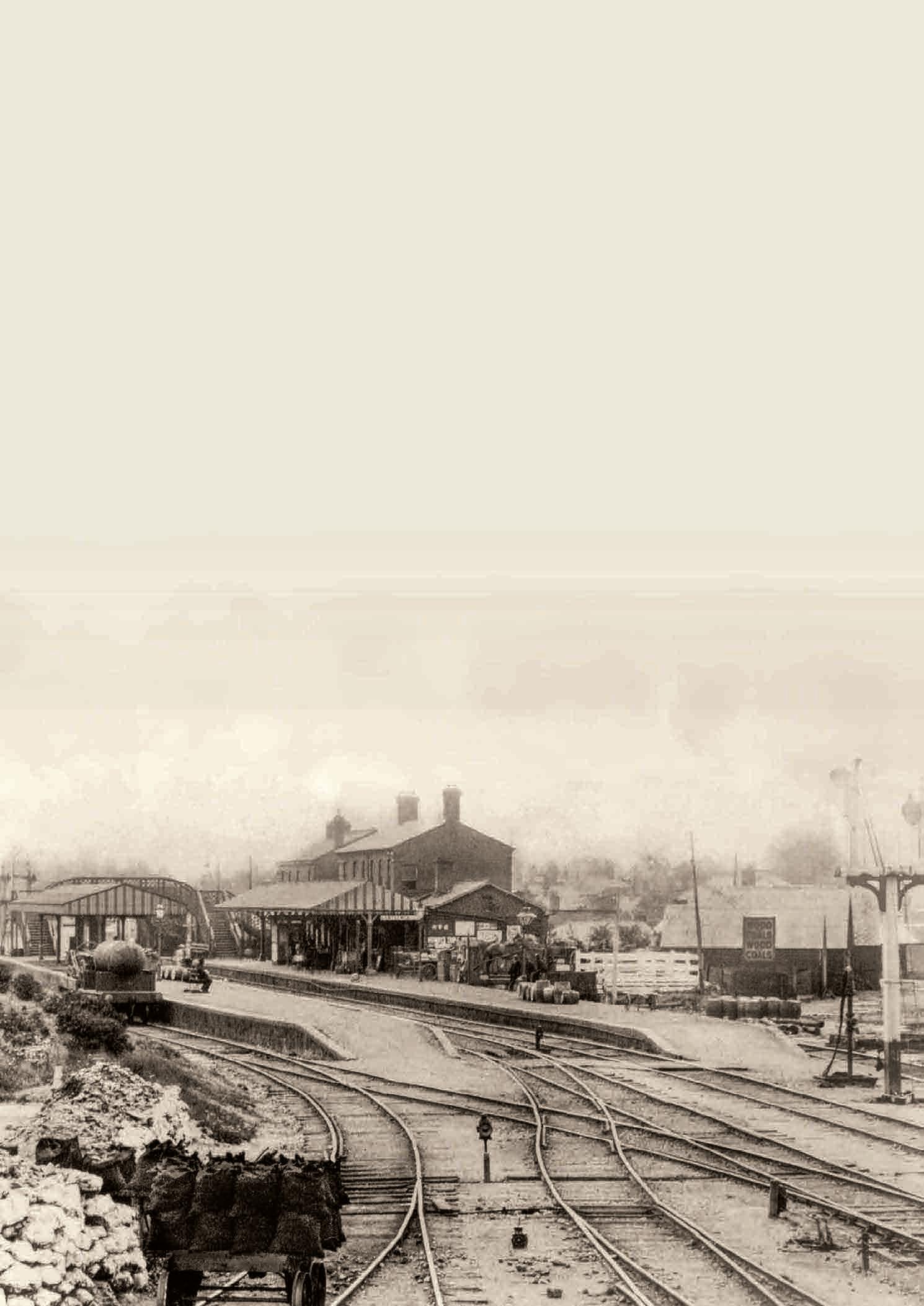
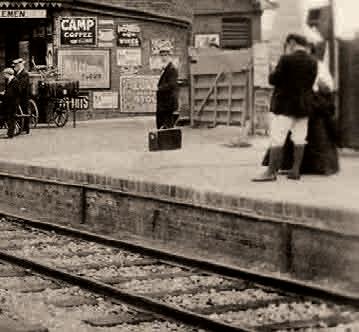
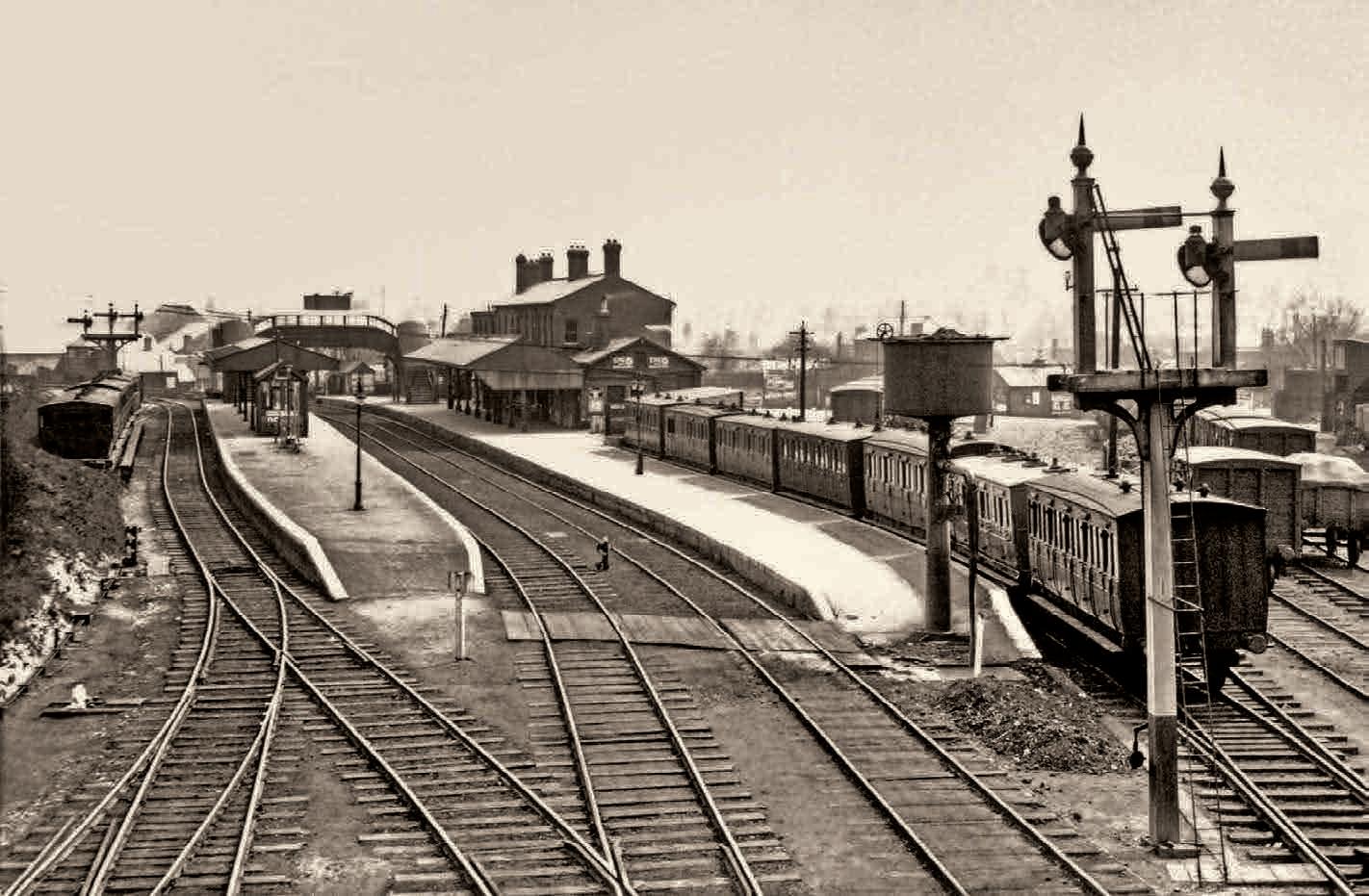
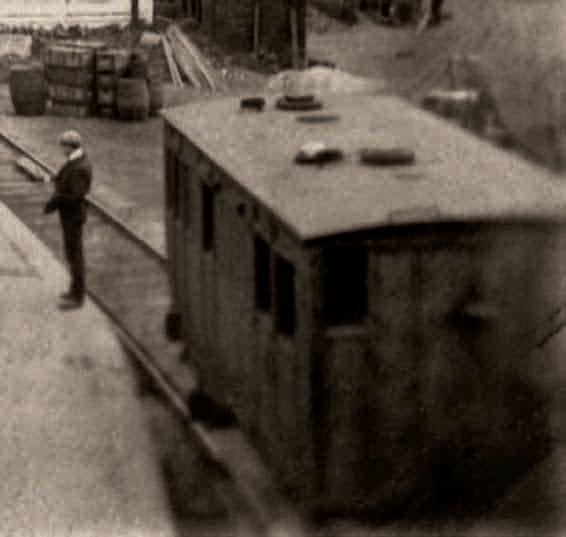
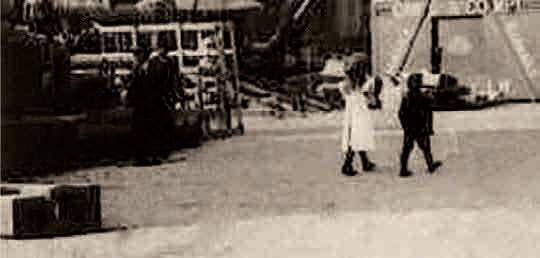
Bottom: One of the earliest images of Newport station, looking southwards from the Up Sidings, dated pre-1905. The track layout is as altered for the arrival of the FYNR. Points of note include the two, twostorey station buildings linked at ground floor, the short Down bay with cattle pen, and the paint style of the canopy. In the lower centre is one of the rotating signals connected to the points, in the loop a tank to provide water for the cranes at Medina Wharf and a large number of barrels, presumably containing beer from the nearby Mew Langton’s brewery. Note the trolley of coal sacks in the left foreground.
IWSR Archive
This Page:
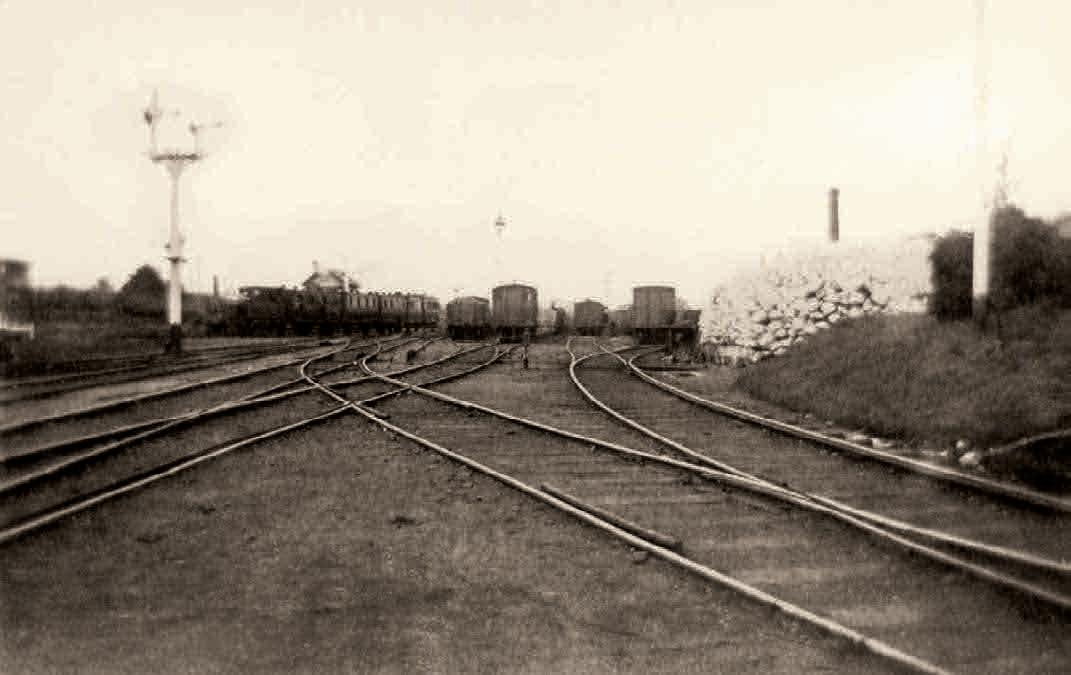
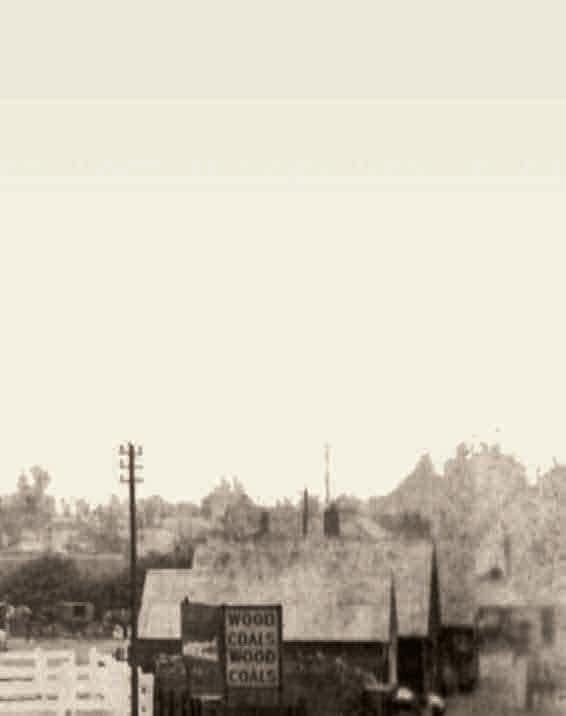
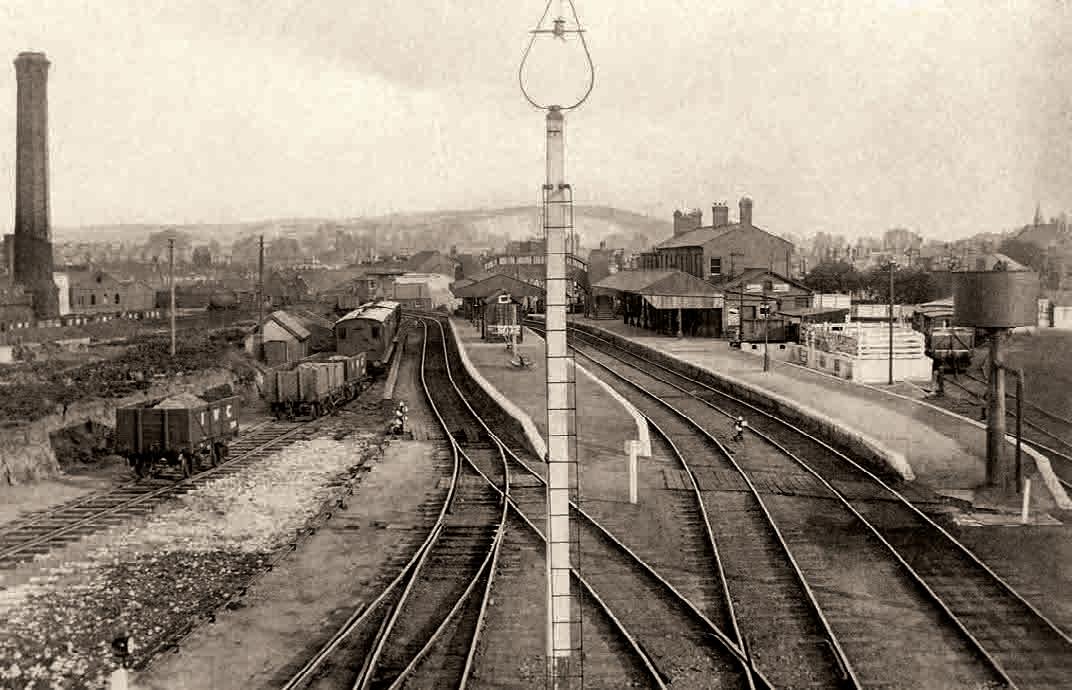
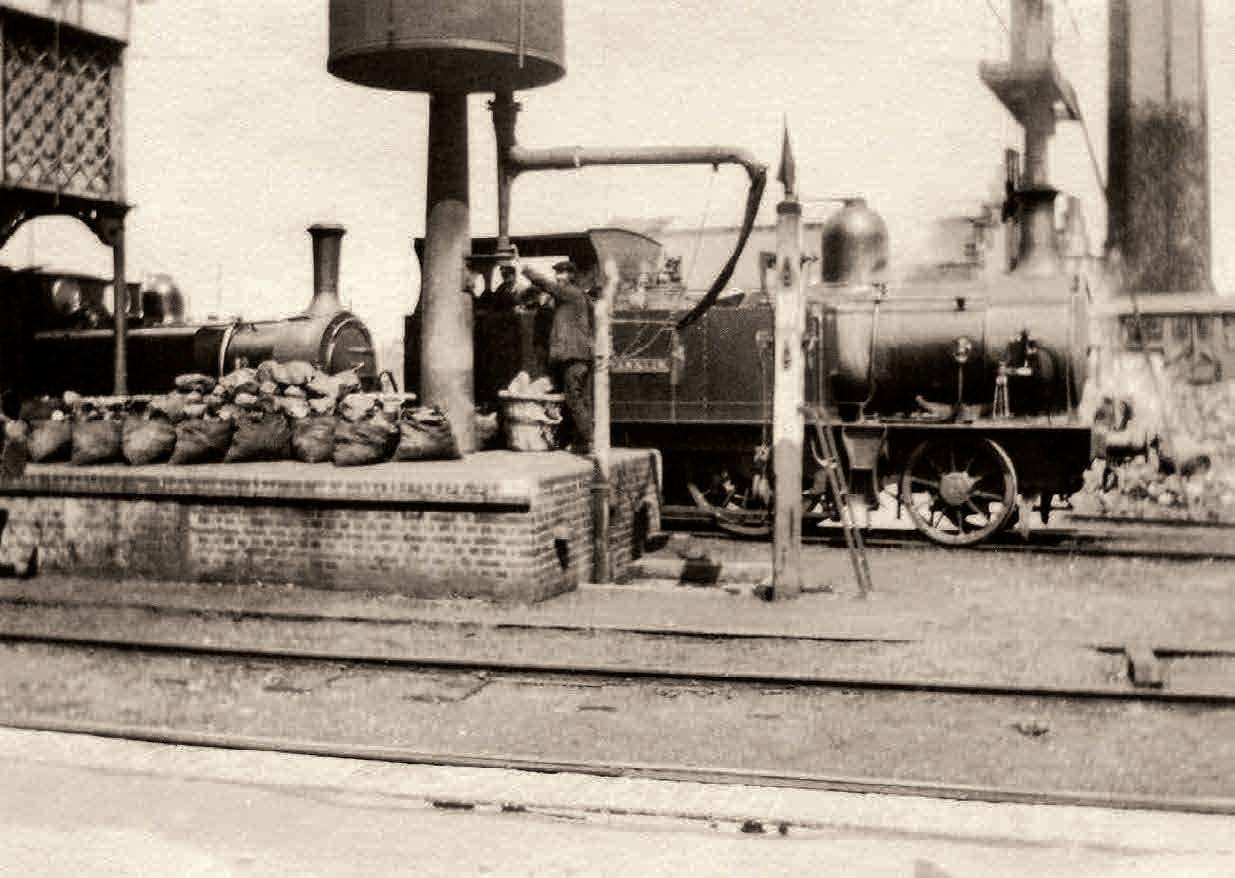
Top: Presumably taken at the same date as the previous photograph, this is the view looking northwards from the Down end of the Up platform. A train is leaving for Freshwater, above which can be seen the roof of North signal box. Centrally, the leftmost siding on which stands an open wagon loaded with coal, is the one laid between the running line and the two carriage shed roads: one appears to hold a train of chalk wagons. In front of the covered van can just be made out a small stage used to load coal sacks taken to the Up end of the Up platform to replenish locomotives without the need for them to go on shed. Also visible are the single yard lamp and, faintly, the tall Up Home bracket signal. It is unknown what the large pile of chalk is for.
IWSR Archive
Left: A closer view of the main portion of the station, with a large crowd on the Down platform.
IWSR Archive
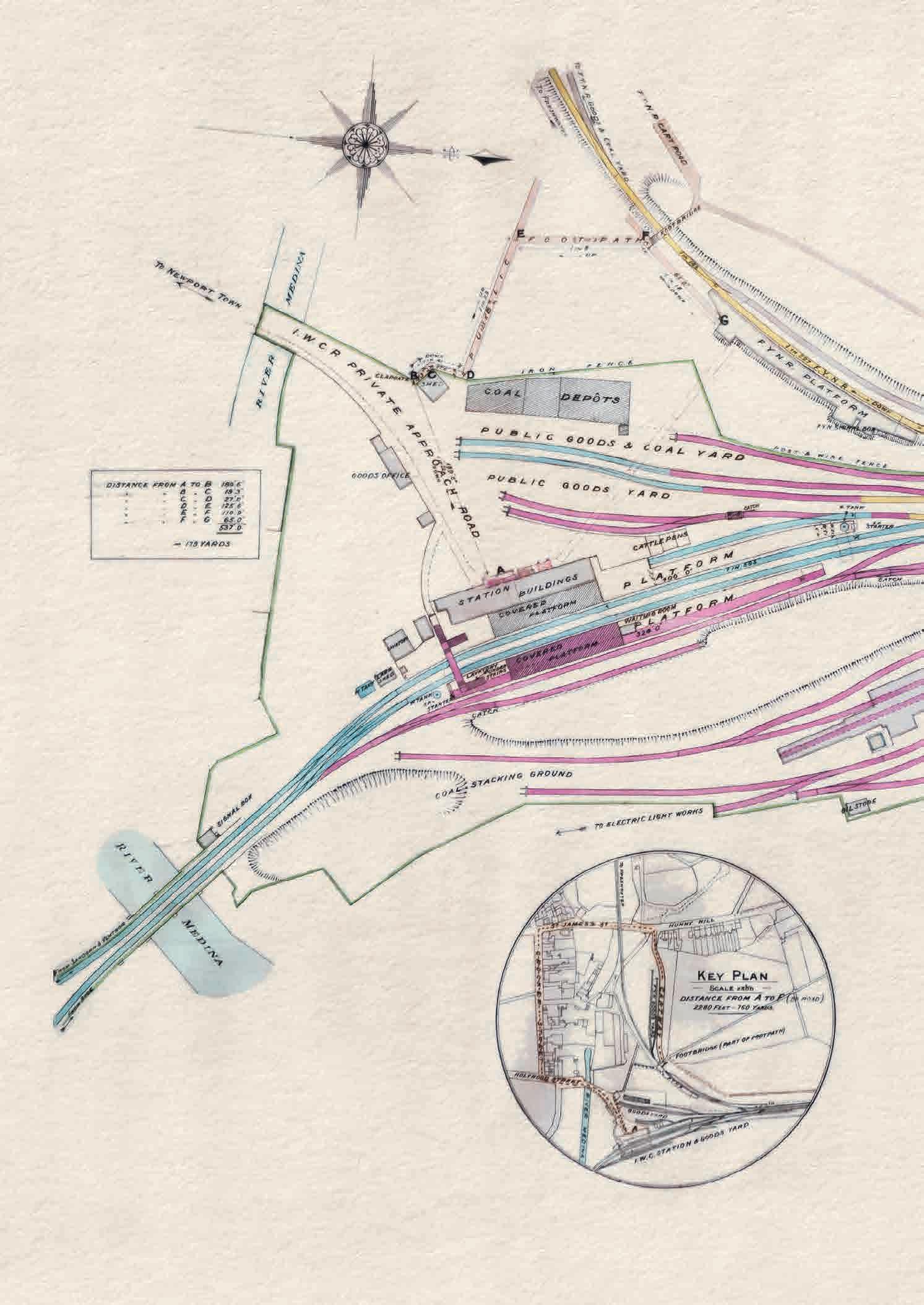
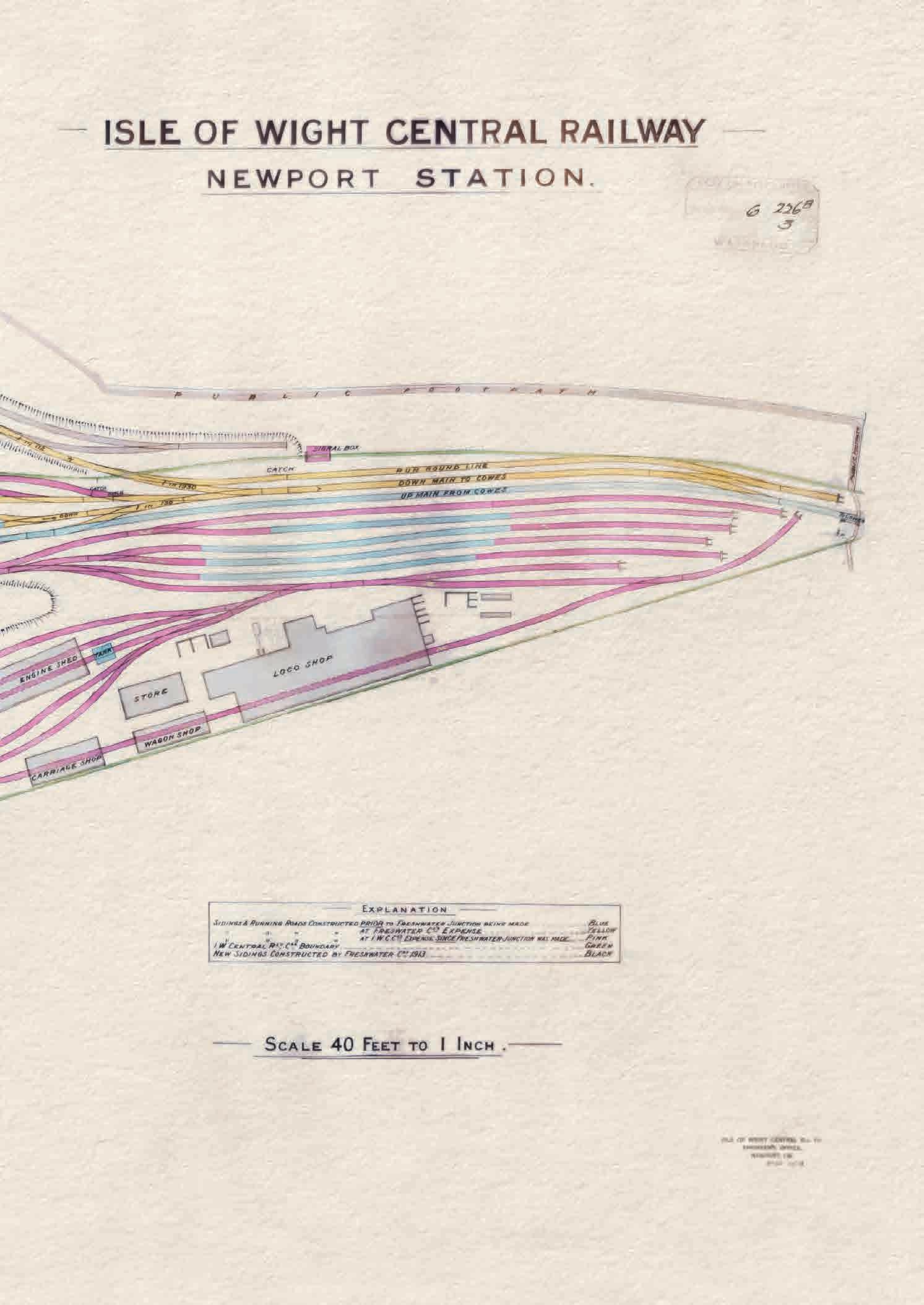
This map shows Newport station at almost its greatest extent during the pre-Grouping era and depicts most of the features described in the main text. Although dated 1913, it may have been drawn a little earlier. Careful study will show that the footpath linking the IWCR and FYNR has various annotations as to distances and gradients, also a faint ‘direct route’ across the goods yard, plus an inset Key Plan depicting the routes by road. This was likely to be evidence supplied to the Board of Trade for a hearing before the Railway and Canal Commission regarding the access between the two companies’ stations following the FYNR deciding to work its own trains. There is an error on the original map, in that the IWRC's approach road leading to the station is shown as crossing the River Medina; this is actually Lukely Brook, a tributary of the River Medina. IWSR Archive
and a further eight brick arches and a single iron girder bridge before it ran across the viaduct alongside the Ryde line, which had been widened at the RNR’s expense, and included a second opening span which was operated independently of the one on the Ryde line.
The joint station lay on a north-north-westerly orientation and consisted of a loop, the Up end of which began immediately at the end of the viaduct, Up and Down platforms with access between them by means of a foot crossing, and a short bay at the north end of the Down platform. The main station buildings consisted of a twostorey brick structure on the Down platform containing the usual facilities on the ground floor and the stationmaster’s accommodation on the first floor. There were no facilities on the Up platform; the Inspecting Officer asked for provision of a waiting shelter, nameboard and a ramp at the Up end – the latter was not provided until Southern Railway days. To the north and on the east (Up) side four sidings were provided, with the two nearest the running line having a 130ft by 30ft carriage shed built by September
1876. From the easternmost siding a line ran back down a steep gradient to a low-level lifting bridge across the Medina, serving sidings on the Corporation New Quay on the eastern bank via a wagon turntable: these facilities were finally ready in November 1878. The track in the old CNR station had the headshunt cut back to permit a road to serve the new station, the original loop becoming two sidings serving a goods yard. In 1879, when the IWNJR reached the station, a scissors crossover replaced the Up Loop points. Plans for a refreshment room were altered to include a second storey and an 18ft square cellar. This building was constructed and connected to the south (Up) end of the main station building. The initial licensee was a Mr Godden.
In 1887 the joint companies amalgamated to form the Isle of Wight Central Railway (IWCR), just in time for major alterations at the northern end, necessary to accommodate the Freshwater, Yarmouth & Newport Railway (FYNR). This line approached from the west, over a viaduct consisting of 19 spans of wrought iron and nine brick and concrete arches, curving northwards
Below: Probably taken from the Down Starting signal, this view dates from 1904/5. On the left is the chimney of the Electricity Works with one of the Anglo-American Oil Company’s large storage tanks partly hidden beyond it, and the Gas Works building further in the distance and to the right, whilst one of the FYNR’s cattle wagons stands in the Up Loop and an IWCR ex-LBSCR Goods Brake Van is on the Up Main. ‘Terrier’ No 11 has the coal rails fitted in October 1904. IWSR Archive
to make a trailing connection into the Cowes line north of the station. The double track loop was extended northwards by 500ft, with the second line of rails and a run-round loop on the western (Down) side and an additional siding to the east between the original main line and the carriage shed. These alterations also required rearrangements of the connections from the carriage shed, the western siding and the new siding connected to the Up main line whilst the eastern fan of sidings ran into a new Up loop that was provided to the outer face of the Up platform, but which could serve only the Ryde line from its Up end. To control this complex, a new signal box was provided on the Down side. Freshwater trains were not permitted to propel either into or out of the station, hence the need for the run-round loop. It would be August 1911 before the Board of Trade (BoT) would finally sanction the propelling of trains to/from the main platform lines, but this did not extend to the bay platform. Also, at this time a footbridge was provided to replace the foot crossing. A new, two-storey office building was built to the north of the main station building. Indications are that it was a separate
Continued on page 32
Right: Viewed from the north, c1913, after the platforms were extended and the ‘balloon’ water tanks installed in 1911. The main station buildings appear as one continuous two-storey range and the footbridge has acquired a covering. The platforms are considerably less cluttered than in previous days and the canopies have lost their stripes. Note the offset Up Starting bracket signal; small repeater arms were provided at the end of the platform (as can be seen in the photo on page 33). The shorter doll of the Down Starting bracket signal applied to trains accessing the Freshwater loop, the taller one to the main line to Cowes. The coaching stock berthed in the Freshwater Bay suggests that the image was taken during the period that FYNR trains were not using the IWCR station. IWSR Archive
Pre-Grouping
Signalling at Newport
The original CNR station appears from an early map to have had a Home signal near the Cowes end of the platform, but otherwise the first signalling installation with a signal box would have been what later would be called the South Cabin, adjacent to the station end of the drawbridge carrying the RNR into the new station. A second drawbridge was provided for the IWNJR line when it extended from Shide into Newport in 1879.
The signal box was built above the room containing the winding gear for operating both drawbridges. The signalling was provided by Stevens & Sons, and the windows of the box resembled those at Brading box, dating from a similar period. The hipped roof also resembled the style of Brading but, unlike Brading, the main structure was largely of timber construction. A 20-lever frame was provided, controlling the junction of the Ryde and Sandown lines, with a scissors crossover to connect the Up and Down lines through the station. In about 1889 an Up Loop line was provided at the back of the Up platform, but this gave access only to the Ryde line, whereas trains could run from the Up platform to either Ryde or Sandown, and a bracket signal was provided to carry the three Up Starting signals: No 8 Up Loop to Ryde; No 3 Up Main to Ryde; No 4 Up Main to Sandown.
In the other direction, Home and Distant signals were provided, protecting the drawbridges as well as the junction: No 17 From Sandown Home; No 18 Distant; No 19 From Ryde Home; No 20 Distant. The signal levers were interlocked with the Bridge Bolt levers, No 14 for the Ryde line drawbridge and No 15 for the Sandown line.
Right: Again viewed from the north, c1914. On the left a rake of wagons stand on the Electricity Works siding. The carriage siding alongside the Up loop is in the process of being extended; it would eventually become a through road but not at this time. Prominent in the foreground, a new yard lamp has been provided. Beyond and in the distance can be seen Shide Quarry.
IWSR Archive
Below: One of the Ryde & Newport Railway Beyer Peacock tanks heads an Up train across Newport viaduct, the opening section being beneath the second carriage, probably c1910. Note the ‘lift van’ on the quay, owned by a local company whose name it is difficult to ascertain.
IWSR Archive
Opposite page: Although taken in 1924, just outside the period covered by this article, this image has been included as it shows the arrangement at the Up end of the Up platform, particularly the lack of a ramp which had been requested at the BoT inspection of 1875. Note the sacks of coal for replenishing locomotives and the short signal post on which were mounted repeater arms for the Up Starting signals, apparently sprouting from Shanklin’s chimney!
IWSR Archive
building, although later it was definitely connected. Meanwhile, consideration was being given to moving the workshops and locomotive shed from Cowes to Newport, but negotiations over the purchase of additional land meant it would be 2 February 1891 before the new locomotive shed and associated water tower became operational. This was followed the following month by new workshops comprising a machine and lifting shop
with associated paint and carpenters' shops and, a little later, a stores shed, all sited on the Up side and north-east of the station; access was to/from the Up Loop only. It is uncertain whether the siding down to the low-level bridge and serving the Corporation Quay was removed at this time, but there is reference that it was out of use by 1893. An oil store was built at the south end of the workshops in 1902 but burnt down in 1904, although it was rebuilt in brick.
Additional sidings and a 10-ton weighbridge were provided in 1889 and, in 1901, another siding, which ran between the locomotive shed and the workshops, was extended into the new Electricity Works. Further sidings were added in 1907 and, in 1911, an extra coal siding, but again their location is unspecified. In 1902 the Anglo-American Oil Company leased land and established a terminal with storage tanks to the south of the
Continued on page 34
For the opening of the FYNR a new signal box, known as the North Cabin, was provided by the Railway Signal Company and sited at the junction with the Down line, a little way north of the station. It was of their typical design, built of brick up to the operating room windows, a pitched slate roof and contained a 36-lever frame of their pattern. The Down line was extended towards Cowes and a third line provided between it and the new signal box, to be used as a run-round loop. Since propelling was not allowed, trains from Newport to Freshwater had to stop on the Down line while the engine ran round, before proceeding. In the opposite direction the trains had to come to a stand on the Down line to allow the engine to run round and then draw the train into the Bay behind the Down platform.
The running signals included four bracket structures: Down Starting signals from the Bay or Down platform to the Down lines (Nos 33 and 34 respectively); Up Inner Home signals near the facing points to the Up Loop (No 3 to Up Line; No 4 to Up Loop); Up Outer Home signals near the facing points at the Cowes end of the double line (No 2 to Up Line; No 6 to Down Line); and, finally, ‘splitting’ Distants in rear of the Outer Homes (No 1 to Up Line; No 5 to Down line). As No 5 would only have been worked for through trains from Cowes towards Freshwater it must have seen little use but followed the practice of the time.
The Down Advance Starting Signal (No 30) controlled movements from the Down line onto the Cowes single line, whilst Nos 31 and 32 were the Home and Distant from Freshwater respectively.
A post carrying three arms, one above the other, controlled movements from the Down line at the junction with the Freshwater line, top to bottom: No 9 over crossover to Up Inner Homes; No 8 to Freshwater Bay platform; No 7 to Freshwater line.
With signal boxes at both ends of the station, each ‘slotted’ the signals of the other box in respect of movements into the platforms.
That is, both boxes had to ‘pull off’ their levers before the ‘slotted’ signal would clear. North box No 35 slotted both From Ryde and From Sandown Home signals worked from South box, whilst the North box Up Inner Homes (Nos 3 and 4) were slotted by South box Nos 2 and 5.
The new arrangements were inspected in 1889 and the BoT Inspecting Officer required Calling-on signals to be provided under the Down Homes from Sandown and Ryde (Nos 17 and 19). Presumably, this was to give a definite signal to proceed over the drawbridge if the North box had not cleared the slot (No 35) on the main signal, but the Calling-on signals were worked from the same levers as the main signals, and the main signals became fixed at Danger in due course so, until the end of the IWCR era, Down trains entered Newport on a Calling-on signal.
In November 1895 there was a failure of the Ryde line drawbridge mechanism, when an engine standing on the bridge during a shunt movement caused the moving span to ‘settle down’ under its weight. The large cams that held the moving span in position, and which had to be lowered to allow the span to be wound back into a recess under the track when opening the bridge for shipping, had moved and allowed the span to lower itself, damaging the lock connected to South box lever No 14. Lt Col Addison, the BoT Inspecting Officer, duly inspected the bridge, and whilst he could not prove for certain how the accident had happened, he found other defects in the mechanism of the Sandown line span, as well as in the electrical contacts intended to break the block instrument circuits when the cams were lowered. Improvements were carried out and inspected again by Lt Col Addison in June 1896. These included new dwarf semaphore shunting signals worked from South box for movements onto the bridge from the station; No 1 from Up Loop; No 10 pull and push from Up Main and No 16 pull and push from Down Main, each to Ryde and Sandown lines respectively. No 16 signals were suspended from the footbridge whilst No 10 arms were on a short post off the end of the Up platform.
Continued on page 35
Right: The FYNR’s station in September 1920 viewed from the footbridge. The roof of the FYNR signal box is just visible over the waiting shelter; the nearer building contained the ticket office, at the bottom of the ramp from the public footpath. In the background are the tall water tank provided in 1916 to serve the IWCR works and, centrally, the locomotive shed; the lower extension to the right may be that built to house the railmotors.
IWSR Archive
Electricity Works and behind the coal stacking grounds. Various station improvements were undertaken in 1911: both platforms were extended at their Down ends and two ‘balloon’ water tanks supplied. The one that was situated at the Down end of the Down platform is the one now at Havenstreet. There are also references to a goods shed and ‘Breakdown siding’, location unspecified. The advent of the railmotor in 1906 saw the construction of a shed in which to house it: this was built to the south of the locomotive shed over the eastern track and was later extended to accommodate the second ‘home-made’ railmotor.
The breakaway of the FYNR in 1913 required it to construct its own station. Work on this began in May: it was situated on the curve between a public footbridge and the junction
Below: The exterior of Newport station in 1920 looking up the approach road, the condition of which was the subject of much complaint over the years. The external staircase gave access to the first-floor offices; the covered portico led into the booking office and the refreshment rooms were well identified. The large, smoking chimney belongs to the Electricity Works. IWSR Archive
with the IWCR and comprised a 175ft long platform with all the necessary facilities, a run-round loop with a headshunt which ended close to the IWCR signal box, as well as the provision of its own signal box. There was no direct communication between the FYNR and the IWCR signal boxes. Spoil from the excavations for the run-round loop and headshunt was used to build up ground between the footbridge and the viaduct, on which the FYNR established four sidings, two for goods traffic and two shorter ones with sheds for locomotives and the railcar. A roadway led down to Hunny Hill, where a corrugated iron building to serve as offices was built. On 1 May 1914 a few FYNR trains again began running into the main IWCR station.
Although repairs had been carried out to the main lattice girder bridge
on the IWNJR’s line where it crossed Coppins Bridge, its condition required complete replacement of the main span in 1920. This was supplied by the Patent Shaft and Axletree Company of Birmingham, although the actual construction was by the Metropolitan Carriage, Wagon and Finance Company of Wednesbury. Trial erected at the builder’s premises, it was then transported in sections to the Island. Removal of the old lattice girders began on Saturday 24 October, the abutments strengthened, and four new buttresses built before the first girder was raised into position on Monday 1 November, followed by the second on the Friday. On Saturday 13 November four locomotives were run over the new bridge to successfully test its strength: the line reopened two days later.
A beautiful array of signals controlling the northern end of Newport in September 1920. From the left are the Down Starting bracket, Newport North signal box, Up Inner Home gantry, Down Advanced Starting, Up Platform Home bracket and, in the distance, Up Outer Home bracket. On the right is the main workshop with its tall water tank and boiler house chimney. IWSR Archive
At a later date a new connection was laid in from the Up Loop to the sidings, between the platform end and the drawbridge, the points worked by No 1 lever. No 10 pull and push now controlled shunting signals in and out of the sidings over No 1 points. The bracket for Nos 3, 4 and 8 was re-sited away from the new connection, but to aid sighting the dwarf signals that had been 10 pull and push were now connected to levers 3 and 4 to act as repeaters to the main signals on the bracket.
From 1896 until 1910 C L Conacher was Manager of the IWCR and during his tenure a rather piecemeal installation of Tyer’s Electric Tablet system on the single line sections was carried out, but it never covered the whole system. The Staff & Ticket system was in use on all the company’s lines, including the Freshwater line worked by the IWCR. On the Central this was in conjunction with Preece’s one-wire block instruments (as used by the LSWR). Preece instruments also controlled the double line and Up Loop between the North and South boxes at Newport. The Freshwater line had been equipped with Sykes ‘Bell Block’ instruments by the FYNR in 1895: like the Preece instruments these used a miniature semaphore arm as the block indicator.
The Staff & Ticket system between Ryde St John’s Road (IWR) and Ashey was replaced by Tyer’s No 7A tablet early in 1899. The No 7A was also known as Tyer’s ‘Automatic’ tablet instrument, but the only known use of it in Britain was on the Lynton & Barnstaple Railway, opened the previous year. By this time the No 6 instrument had been adopted by several companies and became the most-used type. The IWCR seems to have had a penchant for obscure and rare types of tablet instrument, but this was probably to reduce cost –the No 7As were paid in instalments, and the others appear to have been through an intermediary, and thus probably second-hand.
From 14 October 1906 tablet working was instituted between Newport North and Cowes, with two sections: Newport to Medina Wharf and Medina Wharf to Cowes. Tyer’s No 5 instruments were installed – another rare type. This required the Wharf box to be staffed for normal working, but right from the start an economy was made by switching it out on Sundays, when the whole line
from Newport to Cowes was worked under One Engine in Steam regulations, with a Newport – Wharf tablet used as the Train Staff. This could not be replaced in the instrument until the end of service.
In 1909 tablet working was put in place between Newport South and Shide and between Shide and Merstone. This time Tyer’s No 4 instruments were provided – an earlier version of the No 6 machines and easily mistaken for them, as externally they were very similar, but SR publications clearly state No 4. They were an obsolete type by the time they arrived.
By 1912 Conacher had resigned and moved to Cambrian Railways as Manager, and Russell Willmott was General Manager at Newport. Tablet instruments continued, but the next one used instruments of current pattern, presumably supplied new. On 15 April 1912 the No 5 instruments on the Cowes line were replaced by No 7, with an intermediate instrument at Medina Wharf. The No 5 instruments were withdrawn and the Wharf box closed as a block post. This saved the cost of a signalman, and the Newport – Cowes tablet was used to unlock the points at the Wharf, allowing a train engine to be ‘shut in’ the sidings and the points reset for the main line. The tablet could then be placed into the intermediate instrument, which allowed a tablet to be withdrawn at Newport or Cowes and trains to run normally. When the train or engine required to leave the Wharf sidings the signalman at Newport or Cowes had to send a release to the intermediate instrument, to permit a tablet to be removed and used to unlock the points. When the train was out on the main line and the points had been reset, the train would proceed to Newport or Cowes with the tablet. The No 7 machine was the only type that could work with an intermediate instrument. It was marketed as ‘Tyer’s Automatic Visual Indicator Tablet Instrument’.
Attention now turned to the Ryde line, where Staff & Ticket working remained in force between Newport and Ashey, with an intermediate block post at Wootton. On 16 June 1912 Tyer’s ‘Automatic Absolute’ instruments were installed at Newport South and Whippingham, where a new loop opened on the same day, and Whippingham and Ashey. This was an extremely rare type of instrument. It was a forerunner of the ‘No Signalman’ key-token
Looking from the end of the FYNR’s platform in 1920, the connection to the IWCR Down Main runs ahead, whilst the connection to the FYNR headshunt and run-round loop curves sharply left. The nearest signal post, on which is stencilled the legend ‘Newport I of W’, holds the Home signal worked by the FYNR signal box and controlled movements onto the IWCR, replacing the former ‘From Freshwater’ Home signal which had been mounted on the tall post with ball and spike finial. More clearly visible than in the photo on page 35 is the IWCR Up Inner Home gantry: a description of the various signals is included in the main text. Of interest is the use of a passenger luggage/brake van on a goods train. IWSR Archive
instruments that can be found in use in a few places, insofar as it could be worked by the train crew and did not require a release to be sent from the other end of the section, and hence no bell signals were exchanged. It may be that the idea was to facilitate the working of the night mail train when Ashey and Whippingham boxes were closed, but in any event the use of these instruments seems to have been short-lived. Having the No 5 machines that had been withdrawn from the Cowes line in April still on hand, the pragmatic solution was to reinstall them between Newport South, Whippingham and Ashey, where they remained in service into SR days.
A few years later, with the First World War in progress, the IWCR made an approach to Tyers enquiring about ‘Long Section’ tablet working between Newport and Ryde St John’s overnight, with Whippingham and Ashey boxes closed. Tyers replied on 7 September 1917, suggesting No 6 instruments for the long section, as these lent themselves to use with a square tablet, to emphasise the difference from the round ‘Short Section’ tablets. The scheme was never proceeded with.
Meanwhile in 1913 the FYNR took over the working of their own line, requiring a new platform to be built, together with a booking office and a signal box. The box was supplied by the Railway Signal Company and contained a 12-lever frame with four spares. The structure was later removed to Freshwater and eventually to Wootton where it serves as a signal box again. The block instrument to Carisbrooke (or Calbourne?) was moved from the North box to the new signal box, leaving no block signalling between the two boxes, but they slotted each other’s signals.
In 1919 a large bracket signal was provided adjacent to North box, replacing the three-armed signal described above, and although
these arms were retained on the middle doll, the middle arm was now of the ‘scissors’ or ‘bow-tie’ pattern used on the LSWR, to signify it controlled a ‘wrong road’ movement - in this case back along the Down Main into the Down platform. This was new, as the previous three-armed signal did not provide a signalled route into the Down platform. It was provided to allow trains from Cowes to be routed into the Down platform, to reduce congestion on the platforms with large numbers of passengers trying to cross the footbridge in both directions. Separate new arms were provided on their own dolls applying to the Up Main (No 2) and as a Starting signal towards Freshwater (No 31) slotted by No 11 in the Freshwater box.
The Up Outer Home reading to the Up line was now worked by lever No 1; this had previously worked the Up Distant, reading to the Up line, but all Distant signals at Newport were now fixed at Caution. The arm and doll referring to movements towards the Freshwater line were removed from the Up Distant bracket, leaving one fixed arm.
There had also been other alterations over the years, including North Box No 26 lever which was a ground disc signal for shunting from the Down line to the run-round headshunt at the Cowes end. This was modified so that it also worked a short arm Shunt signal on the Down Advance Starting post (No 30), also reading to the runround headshunt. The correct signal was selected by the position of No 12 points at the Cowes end of the double line.
The ‘From Freshwater’ Home signal at North Box (No 31) was replaced by a new signal at the end of the FYNR platform, No 3 in their box but slotted by North Box No 31. The FYNR box also boltlocked the points leading to the IWCR line (No 9 in the FYNR box, North Box points No 16).
Look out for Part 2 of Newport - The Southern Railway Era in IRN 106
Tickets to and from Newport
Tickets are shown actual size
Like images, we sometimes have less-than-perfect tickets, but which have historic value; the first two are such examples, being the right-hand halves of entire edmondsons, perhaps bisected for use as Child Singles.
043 is the only Cowes & Newport Railway ticket in the Archive and is a Single, class unknown, for a journey from Cowes to Horringford. One deduces that the ‘nction Ry.’ refers to the IWNJR. Dated AU 19 83
TI/2024/0733
A journey over the erstwhile RNR is shown on 8727, a Parliamentary Third Class Single from Newport to RYDE (St. John’s Rd.) at a fare of 8½d (3½p). Where the word ‘Available’ is printed there is an embossed indentation of a letter ‘N’: it was common for the IWCR to emboss ‘C’ for Cowes and ‘N’ for Newport rather than nipping a portion of the ticket when passing the ticket barrier. Dated 27.JA.14.
TI/2024/0707
1560 is the outward portion of a Second Class Return from Newport to Horringford and dated J? ?3.79 and is from Series 1, the year the line was opened throughout. The lengthy title on the ticket has caused the typesetter some problems. IsleofWight appears as one word, followed by a full stop, and then running straight into Newport, which should have been proceeded by an opening bracket, and leaving a solid mass of text.
TI/2024/0047
Although in poor condition, 033 is a Parliamentary Third Single from Horringford to ‘E CROSSING’. One deduces this to be Pan Lane Crossing where there was a temporary station before the line was completed into Newport in 1879. The date is missing from the rear of the ticket.
TI/2024/0724
A joint committee had been formed to build the new Newport station and also to operate the CNR and RNR. 5466 is the return portion of a Second Class Newport-issued ticket to Cowes, dated AU 1? 84. Of interest is the form of title used on the ticket: R. N. & C. Ry, although there was no Ryde Newport & Cowes Railway; was it a temporary expedient before the formation of the IWCR?
TI/2024/0732
2721 is for the outward portion of an IWCR First Class Day Excursion from Newport to Portsmouth via Ryde at a fare of 3/6 (17½p) and is dated 17.SP.14. The diagonal line at bottom left would have been correspondingly matched on the return portion and is known as the ‘Half Snip’. It would have been removed by the booking clerk, retained and submitted as evidence of the ticket having been issued as a Child ticket.
TI/2024/0773
The Third Class Single from Newport to Clapham Jun (LB&SCR) strongly hints that the onward journey from Portsmouth would not have been via the LSWR. 0773 is dated JY.24.19 and the fare is 8/6½d (43p). This ticket came to the Archive courtesy of the Bluebell Railway Museum and is a classic example of how Accredited Museums can help each other by ensuring that material finds an appropriate home.
TI/2019/0144
At the commencement of this 150th anniversary year of the Ryde & Newport Railway it is perhaps appropriate to showcase two documents relevant to the beginning and end of the line’s existence. They have a common theme – coal – a commodity once in great abundance but now perceived as leading to environmental pollution and no longer mined in this country.
Although unfortunately damaged, the invoice To JOHN HAM, COLLIERY AGENT, is an important document relevant to the history of the early days of Island railways. Note the two addresses for the agent, in Newport, and Ryde Railway Station. At this time there was only one station in Ryde, and it was renamed Ryde St Johns Road when the line was extended to Ryde Pier. Of further note is the date of the invoice, Feby 29th 1876, a mere two months after the opening of the R&NR. Was the new railway conveying coal, landed at Newport, to Ryde?
The delivery of coal to the Island and its distribution ashore could be an interesting topic for study. Does any reader have information to share with a wider audience?
In 1956 Inspector Parsons wrote to the Chief Building Inspector at Eastleigh in respect of the coal shutes [sic] located in Bridges 27 and 28 and seeking permission to close them up. Wagons used to be positioned on the bridges and emptied by the simple expedient of shovelling the coal into the chutes and letting gravity do the hard work. The writer remembers the late Driver Ken West telling him that you could earn extra money by emptying the wagons.
Giving permission to carry out the work was not straightforward and the District Engineer at Eastleigh wrote to the Chief Civil Engineer, Waterloo. The following is an extract from his memorandum:
‘There is in existence an agreement dated 19th September,1874 between the Newport Gas Company to which is attached some notes by a Mr. Sawkins from which it appears that these shutes were constructed and maintained by the Railway Company to facilitate the unloading of coal brought from Medina Wharf to the Gas Works.
‘It appears necessary to have the Agreement modified before any work is carried out in filling in the gaps in the wall, and as my staff are now working on these viaducts, I shall be pleased if you will investigate the matter as soon as possible”.
The wheel had come virtually full circle with maintenance work almost at the end of the line’s existence being determined by an agreement made when the line was built. The wheel continued to turn slowly, however; the official who sent a carbon copy of the memorandum to Inspector Parsons added a handwritten note: ‘It may be some time before we get a reply’.
The spelling 'shute' may confuse. It is an old dialect word and appears in Island place names, such as St Lawrence Shute, and Inspector Parsons may probably have considered this the correct spelling and not ‘chute’.
Potential Diesel Traction on the Isle of Wight
by the late Gerald Jacobs
Preface by Iain Whitlam
Discussions with the late Gerald Jacobs in the 1990s, when he helped man the museum at Havenstreet, included mention of Southern Region thoughts along the lines of a notional diesel motor luggage van to replace steam traction on the Isle of Wight: I had a vague recollection that Gerald had mentioned a concept drawing being dug out and used as a starting point when the JA Class (Class 73) Electro-Diesel Locomotive was being developed (and which entered service in 1962), although he was adamant that this was not the case. I asked Gerald to write something about the thought processes he had described but he was hesitant: there was insufficient evidence to support an article on the subject. He did, however, put typewriter to paper and produce the following tentative notes of his memories, even if not rigorous in historical accuracy, of what Southern deliberations had been. These primarily cover the period 1948 – 1967. The notes were prepared in 2002. I have inserted some interjections [in brackets] to provide some context to his notes, and a postscript to cover subsequent diesel considerations which, again, did not come to fruition.
During my 40 years’ railway experience, I was asked to prepare many reports. I remember that one asked for ‘an in-depth study with sophisticated reply’, another ‘do a broadbrush exercise with a degree of realism’. Incidentally, some long-term decisions were made after only brief and urgent enquiries. Addressing the question of diesel traction options considered for the Isle of Wight deserves an ‘in depth study’ but now, in the absence of useful evidence, only a ‘broadbrush’ approach is possible. This, therefore, is an ‘interim response’ – a term used for the dieselisation of the Oxted line many years ago but which is still applicable in part today!
Had there been some ‘blue sky thinking’ at Nationalisation, I doubt if any further building of steam locomotives could have been justified for the railways. [Politics however had driven the decision – early British main line diesels were problematic and British coal plentiful; importing American products (and adapting them to the British loading gauge) and importing fuel immediately after the war were both economically unacceptable.] The Southern Railway had, of course, published their ambitious electrification plans –while the Second World War was at its peak! The 1955/56 Modernisation Plan [to introduce British main line diesel
locomotives and light-weight multiple units] came as a surprise. Apart from dusting off pre-War schemes, the 1950s and 1960s were fertile years for many ‘inventions’; most of these fall outside the scope of the present subject. The question as regards diesel and the Isle of Wight is a bit complicated to answer but as I had involvement in many aspects of Southern operations during this period, I can throw some light on this fascinating time.
The subject of electro-diesel locomotives (EDL) is very dear to my heart, having been closely involved with their development and use. Although after I finished on the Southern, I was unable to convince the powers that be of the usefulness of employing this type of locomotive on both the West Coast Main Line and East Coast Main Line, I was happily surprised to read that after languishing in the wilderness for 40 years, the concept had been revived [with 2000s talk eventually working out into the likes of Class 800 trains and Class 88 freight locomotives – now called bi-mode rather than electro-diesel]. This can be helpful in a ‘wires down’ situation. I still regard the EDL as the high-water mark of locomotive development.
Above: 3R Class unit (‘tadpole type’) 1202 at Tonbridge in April 1965 preparing for a Reading departure, with plenty of parcels being loaded. When being planned originally, consideration was given to the Hastings units being electro-diesel as they were to operate considerable distances over the conductor rail. At the time electricity and diesel fuel costs were comparable per mile. Dual fitting has a very real installation cost, operating weight and maintenance penalty. A simpler way to control a diesel-electric train was to vary the generator output, whereas straight electric then involved additional resistance grids and contactors. The idea that you might ‘lift out the diesel engine and you had an electric unit’ is simplistic. When surplus Hastings units were split to form the ‘tadpoles’ using 2EPB Class Driving Trailers (restriction 4 unlike the restriction 0 Hastings vehicles – hence the 'tadpole' moniker), the electropneumatic brakes (overlaid on the straight Westinghouse Automatic Brake for emergency use) of the types were compatible but some clever rework was needed to adapt the 70-volt electric multiple unit (EMU) control system to work the 90-volt diesel-electric (DEMU) control system. Iain Whitlam
Below: First series (JA Class)
EDL E6004 seen laying over at London Bridge (South Eastern Low Level) between parcels duties on 17 June 1967. The Southern were passed master at interoperability wherever possible (an attribute lost on today’s railway with incompatible features such as Scharfenberg and Dellner couplers!) The EDLs were arranged to control (or be controlled by) a coupled EMU or (post-Bournemouth electrification) 4TC trailer control units. Iain Whitlam
Whilst the Southern Railway must be commended on its bold electrification schemes, attention to the needs of handling parcels and freight workings were a long time evolving. Even during the 1960s, I felt that electrification of both the Grain and Fawley branches would have been of benefit, given the volume of traffic and its extended running over other electrified lines. Unfortunately, traffic levels plummeted in the early 1970s [resulting, for example, in withdrawal of Collect-And-Deliver parcels services]. The introduction during the War years of the Bulleid/Raworth CC electric locomotives only offered limited employment, even when Newhaven Harbour boat trains were added to their restricted freight duties. They could only operate on the conductor rail and this was restricted to the perimeter of freight yards, necessitating shunting locomotives to position or retrieve trains.
I think the EDL idea was around in the 1920s. [London Transport built an experimental locomotive in 1939 from a couple of 1915 Central London Railway tube cars but opted for battery electric locomotives because of exhaust fumes in the tube operating environment.] The Kent Coast Electrification Scheme really brought it up front. Their primary employment was envisaged to be for newspaper trains, to enable them to be electrically hauled throughout by running through those sections of the line which might be ‘dead’ electrically [during night-time maintenance]: the diesel auxiliary engine could bridge the gap. To protect men working on one track, it is common practice to switch the current off from an adjoining line. Also, the need to transfer vans of baggage from boat trains to the quayside at Dover and Folkestone was met with the introduction of the [all-electric] Motorised Luggage Vans (MLVs), with limited battery traction capability. They were separate concepts. Incidentally, the MLVs ‘assisted’ the multiple-unit boat trains.
When the demand for MLVs eased, alternative employment was found using them either independently or with a van or two on parcels and mail services – of which there were still a large number. They were particularly useful when the trains had to be shunted or recessed, where the provision of a third rail would not have been justified.
Part of the Kent Coast scheme involved equipping quite a number of sidings at many locations with [simple low-speed ‘tramway’ style] overhead wiring for the ‘straight’ electric locomotives (Class 71). The National Coal Board were not at all happy with this in the proximity of colliery workings. These locomotives did a lot of work on Kent coal trains. Their performance and reliability have possibly never been equalled.
The post-War Southern Region electrification scheme was divided into three stages: 1. Kent, 2. Sussex, 3. Wessex. In this context was the complete elimination of steam, dictated very much by the judgement that procurement of staff to continue its use would not be sustained for a number of reasons. Where full electrification would not appear to be justified, other solutions were planned. These were dieselelectric units for passenger services, diesel locomotives for some passenger trains and freight services outside of the electrified area, and EDLs for freight services within the electrified area to obviate putting conductor rails in freight yards like Feltham and Eastleigh or providing overhead wires.
The pioneer diesel-electric units were to replace steam on the Hastings services from Charing Cross and Cannon Street. Their introduction was brought forward as a consequence of Cannon Street signal box being destroyed by fire in 1957. This scheme was followed closely by the Hampshire area one. Assessments were actively in hand for many other
areas, including such as the Isle of Wight, Hayling Island and Somerset & Dorset; probably the most ambitious scheme was the East Devon scheme based on Exeter. In subsequent boundary changes, all lines west of Salisbury were ceded to the Western Region. Plans were changed and with the deferment of stage 2 of the original electrification scheme, the Oxted ‘interim’ diesel scheme came about in 1962 – part of which (Uckfield services) survives [60 years on].
In anticipation of developing electrification, the dieselelectric units were designed with electrical compatibility with the standard EPB electric units of the Southern. The theory was that one only had to lift out the diesel engine and you had an electric unit – in the event it did not happen like that. Another casualty of the era was the Brighton / Portsmouth – Bristol / Cardiff 4-car scheme, because the Western Region refused at that time to accommodate dieselelectric traction.
The commitment to build what became the Class 33 locomotives did not include provision for working freight trains over the Tonbridge – Hastings line, owing to the restricted loading gauge. This had subsequently to be remedied by building a sub-class which became known as the ‘Slim Jims’. Part of the scheme to convert passenger services envisaged the use of the ‘motor’ coaches from the Hastings units in multiple to work the freight trains. The logistics of such an operation had probably not been carefully considered and to the best of my knowledge never attempted. I was faced with a similar challenge in the 1960s
Postscript
to intermingle passenger and freight train workings but it was accepted that the origins and destinations of passengers was not compatible with freight operations.
Although this concept failed to materialise on the Hastings line, it was seriously considered for the Isle of Wight, where geography was much more contained. It was expected that when steam trains ceased, there would still be a need to move coal traffic from Medina Wharf. Given the rapidly diminishing market in industrial and domestic coal, it is doubtful this would have survived more than a few years. Nevertheless, it was seriously considered that the power cars from the envisaged 3-car units could be detached and multipled to constitute a power unit to work freight trains. Remember, we are talking about the period 1948 – 1967, before the rapid decline of rail freight. [Northern Ireland and the Irish Republic introduced lightweight diesel ‘railcar sets’ (multiple units – referred to as Multi-Engined Diesels and the later Multi-Purpose Diesels in Northern Ireland) earlier than Britain; furthermore freight lingered longer than in Britain: such means of operating freight traffic did occur there to a limited extent.] In the event, I had no further working contact with the scheme and I have no recollection of what stock might have been suitable, given the Isle of Wight loading gauge problem. I can only imagine at this stage that new build would have been in mind.
That is my ‘broad-brush survey with a degree of realism’.
Gerald Jacobs, December 2002
Diesel traction was again considered at the end of steam, when, had the Minister of Transport decision in 1965 been to retain only Ryde Pier operations, or retain Ryde – Ventnor, or retain Ryde – Ventnor and Ryde – Cowes, the cheapest option in each scenario was to fit diesel engines in 1920s/1930s Standard Stock. In the event, the economics for the announced outcome, retaining Ryde – Shanklin, swung in favour of electric traction, adapting the Standard Stock to third rail operation.
Again, with the recent 2020-22 Island Line refurbishment, one of the unsuccessful franchise bids had been based on London Underground D stock fitted with diesel engines. With Vivarail going into administration, not helped by technical problems with this approach of retrofitting diesel engine pods, perhaps Island Line is fortunate to retain electric traction.
Below: An MLV by Grosvenor Carriage Shed (outside Victoria station) awaiting another boat train duty, 27 October 1971. Some luggage vans were wired to work between the MLV and EMUs of boat trains to provide extra capacity (as with our SECR Brake Thirds, railways used to recognise that people travelled with luggage). Working on their own, MLVs could pull trailing vacuum braked vans. Indeed, like the EDLs, they were equipped with vacuum and air brake and capable of operating both systems either side of the MLV proportionally. Iain Whitlam
Our past recalled by
John Hulse
Having lifted the body of LBSCR Third 2403 on to a road trailer, the crane is about to give assistance to draw the trailer out of the soft ground, before the trailer can be turned and 2403 lifted back on the ground facing the other way, 29 October 1994.
Wight Report
50 years ago Wight Report 26 – Winter 1975
A report was given of a disaster at Briddlesford Copse on the 24 October, with wagons derailed, passengers badly injured and some trapped in the wreckage. Fortunately for all concerned, this was a carefully-staged accident exercise, arranged in conjunction with all the Island’s emergency services. The event was filmed by the BBC but never aired.
A1/x Class IWCR 11 still resided inside the works at Ryde St John’s Road but it was hoped she would be moved to Havenstreet during January 1975.
Redundant track comprising 10 lengths of 45ft track panels, one turnout and buffer stops had been purchased from Bedhampton waterworks near Havant.
30 years ago Wight Report 106 – Winter 1995
A report recalled the lifting and turning of the body of LBSCR Third 2403, which at the time resided behind the station garden. Restoration work had been completed on one side and it was necessary to rotate the coach body to allow the other side to receive attention.
Railway artist Terence Cuneo visited Havenstreet in November as part of a surprise birthday celebration arranged by his daughter.
LBSCR Brake Third 4168 had been lifted off its underframe in preparation for the original to be replaced by the modified frames from LSWR Ironclad 752.
Capacity crowds enjoyed the 20th Summer Extravaganza held over the August bank holiday weekend.
A view of A1/x Class IWCR 11 seen inside Ryde Works, summer 1974. R
If you would like to discover more about the Isle of Wight Steam Railway, the Island’s electric railway, closed lines and shipping during the period from 1967 until 1998, why not request back numbers of Wight Report, the predecessor to Island Rail News?
Originals of the first 21 issues (Preliminary, October 1967 – 20) are now scarce but John Hulse has a very limited supply of issues 1/3/6 and 8 – 20, priced at £5.00 each including P&P. A CD with all 21 issues as high-quality PDFs, priced at £13.00 including P&P, is also available. He has originals of all subsequent issues (21 – 117, July 1998) at £3.00 each including P&P.
Please make cheques payable to JOHN HULSE and send to him at ‘Whitwell’ 26 Dennison Road, Cheadle Hulme, Cheshire, SK8 6LW and allow a few weeks for delivery. Please remember, all proceeds will go to the Railway appeal of your choice.
Bartrum
Artist Terence Cuneo, seen during his visit on 6 November 1994, a few days after his 87th birthday. Brian Deegan
Brian Deegan
Some significant happenings of 2024
Calbourne was in the air twice as the wheels and bogie were removed and later replaced, following repairs.
WRITE TO IRN NOW!
Letters should be addressed to: The News Editor, IRN, The Railway Station, Havenstreet, Isle of Wight, PO33 4DS or emailed to: irn@iwsteamrailway.co.uk
The Editor reserves the right to edit letters and stresses that the opinions expressed are not necessarily those of the magazine or The Isle of Wight Railway Co Ltd.
If you would like to place an advertisement in the magazine please contact the Railway on 01983 882204 oremail: irn@iwsteamrailway.co.uk
Page Rates:
Eighth: £25
Quarter: £45
Third: £55
Half: £80
Full: £150
Articles and letters relating to the Isle of Wight Steam Railway, Island Rail News and any other topics regarding railways on the Isle of Wight are welcomed.
Deadline for articles and /or photographs for the next issue of Island Rail News is 31 March 2025
It would really help the magazine production team if articles, letters and photographs are submitted in electronic format. They can be supplied on disc or can be emailed to the editor at: irn@iwsteamrailway.co.uk
Photographs should preferably be supplied electronically in high resolution and with the photographer’s name added to the filenames (if not added automatically to the metadata). If captions are brief, they may also be added to the filenames, otherwise they should be supplied in a separate file.
If prints or slides are supplied, captions and credits should also be given and please enclose a SAE if you would like the photographs returned.
If possible, please restrict letters to no more than 200 words.
A new exhibit for Train Story arrived in February in the form of Haydock, a near sister to the Freshwater, Yarmouth and Newport Railway’s contractor’s locomotive Freshwater.
A major refurbishment of the events barn was nearing completion in March, after which the facility was re-branded as the Barn Café
The replica Smallbrook Junction signal box was officially inaugurated in June.
A scene now lost following demolition of the unsound Bridge 12 in November.
Fish and Chip Specials returned, seeing evening trains running on a weekly basis in July and August.